 filings.tools
Cadence Design Systems (CDNS) 10-K risk factor changes: FY2020 vs FY2019
The 2021-01-02 10-K against the 2019-12-28 one, compared heading by heading and sentence by sentence.
Item 1A131 rewritten38 added273 removed269 unchanged
All filing items1,219 rewritten646 added897 removed1,221 unchanged
Summary
counted, not written
- Item 1A lists 41 risk factor headings: 2 new, 4 reworded and 35 unchanged since FY2019. 3 headings from FY2019 no longer appear.
- Sentence by sentence, 646 added, 897 removed, 1,219 rewritten and 1,221 unchanged across 17 items that differ.
New Item 1A headings (2)
- The ongoing COVID-19 pandemic could continue to adversely affect our business, results of operations and financial condition.
- Our failure to respond quickly to technological developments or customers’ increasing technological requirements and to continue to develop or acquire technological capabilities could make our products uncompetitive and obsolete and impede our ability to address the requirements in technology segments that are expected to contribute to our growth.
Removed Item 1A headings (3)
- Our failure to respond quickly to technological developments or customers’ increasing technological requirements could make our products uncompetitive and obsolete.
- Our Intelligent System Design strategy requires the development or acquisition of products and expertise in new areas of technology. Our inability to develop or acquire these capabilities could impede our ability to address the technical requirements in technology segments which are expected to contribute to our growth.
- Tax laws, regulations, and compliance practices are evolving and may have a material adverse effect on our results of operations, cash flows and financial position.
Reworded Item 1A headings (4)
- Any periods of uncertainty in the global economy and international trade relations, [added: changes in governmental policies relating to technology,] and any potential downturn in the semiconductor and electronics industries, may negatively impact our business and reduce our bookings levels and revenue.
- If our security measures are
[removed: breached,][added: breached or vulnerabilities are discovered in our products] and [added: services, and] an unauthorized party obtains access to customer data, financial data or assets or our proprietary business information, our information systems [added: and products and services] may be perceived as being unsecure, [added: we could experience business or financial harm,] and our business and reputation could be harmed. - We have substantial cash requirements in the United States, but a significant portion of our cash is held and generated outside of the United States, and if our cash available in the United States
[removed: and the cash available under our revolving credit facility are][added: is] insufficient to meet our operating expenses and debt repayment obligations in the United States, then we may be required to raise cash in ways that could negatively affect our financial condition, results of operations and the market price of our common stock. - Our
[removed: operating]results could be adversely affected by an increase in our effective tax rate as a result of U.S. and foreign tax law changes, outcomes of current or future tax examinations, or by material differences between our forecasted and actual effective tax rates.
A heading is new when no FY2019 heading matches it after ignoring case and punctuation, and reworded when it shares at least 60 percent of its words with one that went away. All current risk factor headings.
Sentences by item
22 items, with every count and a link to each item that changed
Underlined words on a shaded ground are new in FY2020; struck-through words were in FY2019. Sentences that are wholly new or wholly gone are labelled rather than marked.
Item 1A. Risk Factors
131 rewritten, 38 added, 273 removed, 269 unchanged
Read the full itemFY2020 item · filed February 22, 2021FY2019 item · filed February 24, 2020
Any periods of uncertainty in the global economy and international trade relations, [added: changes in governmental policies relating to technology,] and any potential downturn in the semiconductor and electronics industries, may negatively impact our business and reduce our bookings levels and revenue.
Spending on our products and services has grown in recent years, but the current outlook for the [removed: semiconductor industry] [added: global economy] is uncertain and may result in a decrease in spending on our products and services.
[removed: During] [added: In] fiscal [removed: 2019,] [added: 2019 and 2020,] the Bureau of Industry and Security (“BIS”) of the U.S. Department of Commerce placed certain entities who are our customers on the “Entity List,” limiting our ability to deliver products and services to these entities.
When certain customers are on the Entity [removed: List,] [added: List or are subject to new or expanded trade restrictions, such as the expansion of the scope of military end-users] and [added: military end-use by BIS] in [added: April 2020 and] the [added: foreign-produced direct product rules in August 2020, and in the] absence of a license from the BIS, it will have a negative effect on our ability to sell products and provide services to these customers.
Entity List restrictions [added: and other trade restrictions] will also encourage customers to seek substitute products from our competitors that are not subject to these restrictions or to develop their own solutions, thereby decreasing our long-term competitiveness.
In addition, although customers are not prohibited from paying (and we are not restricted from collecting) for products we previously delivered to them, the credit risks associated with outstanding receivables from customers on the Entity List [added: and other trade restrictions] could increase as a result of these limitations.
We cannot predict whether or when any changes will be made that eliminate or decrease these limitations on our ability to sell products and provide services to these [removed: customers.][added: Entity List customers or other customers impacted by other trade restrictions.]
Additionally, other companies may be added to the Entity List and/or be subject to [added: new or expanded] trade restrictions.
[removed: As] [added: If] this trend continues, it could make us more dependent on fewer customers who may be able to exert increased pressure on our prices and other contract terms and could increase the portion of our total sales concentration for any single customer.
Our failure to respond quickly to technological developments or customers’ increasing technological requirements [added: and to continue to develop or acquire technological capabilities] could make our products uncompetitive and [removed: obsolete.][added: obsolete and impede our ability to address the requirements in technology segments that are expected to contribute to our growth.]
[removed: | • | changes in the design and manufacturing of ICs, including migration to advanced-process nodes and three-dimensional transistors, such as FinFETs, present major challenges to the semiconductor industry, particularly in IC design, design automation, design of manufacturing equipment, and the manufacturing process itself.] With migration to advanced-process nodes, the industry must adapt to more complex physics and manufacturing [removed: challenges] [added: challenges,] such as the need to draw features on silicon that are many times smaller than the wavelength of light used to draw the features via lithography. [removed: Models of each component’s electrical properties and behavior also become more complex as do requisite analysis, design, verification and manufacturing capabilities. Novel design tools and methodologies must be invented and enhanced quickly to remain competitive in the design of electronics in the smallest nanometer ranges; |]
[removed: | • | the ability to design SoCs increases the complexity of managing a design that, at the lowest level, is represented by billions of shapes on fabrication masks.] In addition, SoCs typically incorporate microprocessors and DSPs that are programmed with software, requiring simultaneous design of the IC and the related software embedded on the IC; [removed: |]
[removed: | • | with the availability of seemingly endless gate capacity, there is an increase in design reuse, or the combining of off-the-shelf design IP with custom logic to create ICs or SoCs.] The unavailability of a broad range of high-quality design IP (including our own) that can be reliably incorporated into a customer’s design with our software products and services could lead to reduced demand for our products and services; [removed: |]
[removed: | • |] [added: -] increased technological capability of the [removed: FPGA, which is a programmable] [added: FPGA] logic chip, [added: which] creates an alternative to IC implementation for some [removed: electronics companies. This] [added: companies and] could reduce demand for our IC implementation products and services; [removed: |]
[removed: | • |] [added: -] a growing number of low-cost engineering [removed: services] [added: service] businesses could reduce the need for some IC companies to invest in EDA products; [removed: |]
[removed: | • |] [added: -] adoption of cloud computing technologies with accompanying new [removed: business] [added: engagement] models for an increasing number of software [removed: categories; and |][added: categories may impact our business;]
[removed: | • |] [added: -] integration and optimization of solutions for system design with core EDA [removed: technologies. |][added: technologies could result in reduced demand for our broad portfolio;]
Our strategy is [removed: meant] [added: designed] to increase our business among electronic systems companies, which are now [removed: designing] [added: developing] their own ICs and other electronic subsystems.
Our strategy is also [removed: meant] [added: intended] to increase our business among semiconductor companies, which are increasing their contribution to the end products into which their ICs and other electronic subsystems are incorporated.
Part of this strategy involves addressing the needs of new categories of electronic systems, including hyperscale computing and infrastructure, edge computing, machine learning, 5G networks, [removed: augmented reality, virtual reality,] [added: AR/VR,] IoT, aerospace and defense, and autonomous vehicle subsystems, where increased investment is expected by our customers.
Each of these categories requires [removed: technologies] [added: technologies, expertise,] and [removed: expertise] [added: marketing and operations infrastructure] that are application-specific.
[removed: If we are unable] [added: Our inability] to develop or acquire [removed: the application-specific technologies and expertise necessary to address the requirements of] these [removed: categories,] [added: application-specific capabilities,] it could impede our ability to expand our business in these categories and ultimately affect our future growth.
Therefore, changes in hardware and IP bookings or deliveries [added: (including disruptions caused by COVID-19)] relative to expectations will have a more immediate impact on our revenue than changes in software or services bookings, for which revenue is generally recognized over time.
Therefore, our hardware or IP sales may be delayed or may decrease if our customers delay or cancel projects because their spending is constrained or if there are problems or delays with the [removed: supply or] [added: supply,] delivery [added: or installation] of our hardware or IP products or our hardware suppliers.
A substantial proportion of our software licenses yield revenue recognized over time, which may make it difficult for us to rapidly increase our revenue in future fiscal [added: periods, and means that a decrease in orders in a given period would negatively affect our revenues in future] periods.
If we do not achieve the benefits anticipated from these investments, if the achievement of these benefits is delayed, or if customers reduce or slow the need to upgrade or enhance their [removed: EDA] [added: computational software] products and design flows, our revenue and operating results may be adversely affected.
[removed: | • |] [added: -] the development by others of competitive products or platforms and engineering services, possibly resulting in a shift of customer preferences away from our products and services and significantly decreased revenue; [removed: |]
[removed: | • |] [added: -] aggressive pricing competition by some of our competitors may cause us to lose our competitive position, which could result in lower revenues or profitability and could adversely impact our ability to realize the revenue and profitability forecasts for our software or emulation and prototyping hardware systems products; [removed: |]
[removed: | • |] [added: -] the challenges of advanced-node design may lead some customers to work with more mature, less risky manufacturing processes that may reduce their need to upgrade or enhance their EDA products and design flows; [removed: |]
[removed: | • |] [added: -] the challenges of developing (or acquiring externally developed) technology solutions that are adequate and competitive in meeting the rapidly evolving requirements of next-generation design challenges; [removed: |]
[removed: | • |] [added: -] intense competition to attract acquisition targets, possibly making it more difficult for us to acquire companies or technologies at an acceptable price, or at all; [removed: |]
[removed: | • |] [added: -] new entrants, including larger electronic systems companies, in our business; [removed: |]
[removed: | • |] [added: -] the combination of our competitors or collaboration among many companies to deliver more comprehensive offerings than they could individually; [removed: |]
[removed: | • |] [added: -] decisions by electronics manufacturers to perform engineering services or IP development internally, rather than purchase these services from outside vendors due to budget constraints or excess engineering capacity; and [removed: |]
[removed: | • |] [added: -] actions by regulators to limit the contractual terms that either we or our customers can apply to product and service offerings. [removed: |]
We compete most frequently with Synopsys, Inc., [removed: Mentor Graphics Corporation, a division of] Siemens [removed: AG,] [added: EDA,] and ANSYS, Inc., and also with numerous other [removed: EDA] [added: tools] providers, [added: electronics device] manufacturers [removed: of electronic devices that have developed, acquired or have the capability to develop] [added: with] their own EDA [removed: products,] [added: capabilities,] technical [added: or computational] software companies, electronics design and consulting companies, and other IP companies.
We have acquired and expect to acquire other companies and businesses in order to expand our product [removed: offerings.][added: offerings and enter into new markets.]
[removed: | • |] [added: -] the failure to realize, or a delay in realizing, anticipated benefits such as cost savings and revenue enhancements; [removed: |]
[removed: | • |] [added: -] overlapping customers and product sets that impact our ability to maintain revenue at historical rates; [removed: |]
[removed: | • |] [added: -] the failure to understand, compete and operate effectively in markets where we have limited experience; [removed: |]
Business and Operational Risks
The ongoing COVID-19 pandemic could continue to adversely affect our business, results of operations and financial condition.
While we are unable to accurately predict the full impact that the COVID-19 pandemic will have on our results of operations, financial condition, liquidity and cash flows due to numerous uncertainties, including the duration and severity of the pandemic and containment measures, our compliance with these measures has impacted our day-to-day operations and could disrupt our business and operations, as well as that of our key customers, suppliers (including contract manufacturers) and other counterparties, for an indefinite period of time.
To support the health and well-being of our employees, customers, partners and communities, a vast majority of our employees are still working remotely as of February 22, 2021.
The disruptions to our operations caused by COVID-19 may result in inefficiencies, delays and additional costs in our product development, sales, marketing, and customer service efforts that we cannot fully mitigate through remote or other alternative work arrangements.
In addition, we have experienced, and may continue to experience, some volatility in our hardware product delivery times due to delays in obtaining access to customer sites.
Moreover, access by our employees to our laboratory facilities that are necessary for the development of certain IP products has been and may in the future be disrupted due to local conditions.
More generally, the pandemic raises the possibility of an extended global economic downturn and has caused volatility in financial markets, which could affect demand for our products and services and impact our results and financial condition even after the pandemic is contained, shelter-in-place orders are lifted and local conditions improve.
For example, we may be unable to collect receivables from those customers significantly impacted by COVID-19 and, in fact, have received numerous requests from our customers to delay their payments to us, while we continue to provide services to these customers.
Also, a decrease in orders in a given period could negatively affect our revenues in future periods, particularly if experienced on a sustained basis, because a substantial proportion of our software licenses yield revenue recognized over time.
The pandemic may also have the effect of heightening many of the other risks described in this “Risk Factors” section, including risks associated with our customers and supply chain.
We will continue to evaluate the nature and extent of the impact of COVID-19 to our business.
Although we expect that current cash and cash equivalent balances, cash flows that are generated from operations and cash borrowings available under our revolving credit facility will be sufficient to meet our domestic and international working capital needs and other capital and liquidity requirements for at least the next 12 months, if our access to capital is restricted or our borrowing costs increase due to the pandemic, our operations and financial condition could be adversely impacted.
In addition, new or expanded trade restrictions, such as the expansion of the military end-user, military end-use rule and the foreign-produced direct product rules, will increase our costs or expenses.
In particular, China’s stated national policy to be a global leader in all segments of the semiconductor industry by 2030 has resulted in and may continue to cause increased competitive capability in China.
- incurring costs to remediate issues of an acquired company discovered during due diligence or thereafter;
Furthermore, we have and may continue to acquire companies with less sophisticated security measures and that have had or may experience in the future cybersecurity incidents causing business or financial harm.
- public health emergencies, such as the recent COVID-19 pandemic and the subsequent public health measures, including restrictions on travel between jurisdictions in which we and our customers and suppliers operate.
Risks Related to Customers, Suppliers and Industry Competition
- changes in the design and manufacturing of ICs, including migration to advanced-process nodes and three-dimensional transistors, such as FinFETs, present major challenges to the semiconductor industry, particularly in IC design, design automation, design of manufacturing equipment, and the manufacturing process itself.
Models of each component’s electrical properties and behavior also become more complex as do requisite analysis, design, verification and manufacturing capabilities.
Novel design tools and methodologies must be invented and enhanced quickly to remain competitive in the design of electronics in the smallest nanometer ranges;
- the ability to design SoCs increases the complexity of managing a design that, at the lowest level, is represented by billions of shapes on fabrication masks.
- with the availability of seemingly endless gate capacity, there is an increase in design reuse, or the combining of off-the-shelf design IP with custom logic to create ICs or SoCs.
- with Moore's Law slowing, the trend towards on-chip integration could change the required product mix and impact the need for system-on-chip integration; and
- changing end-user dynamics in our eight target technology verticals - consumer, hyperscale computing, mobile, 5G communications, automotive, aerospace and defense, industrial and healthcare - could advance the need from simple ICs to full-system design and analysis capabilities that require increasingly complex computational software-based solutions.
These include U.S. based companies such as Keysight Technologies, Inc. and CEVA, Inc., and foreign companies such as Altium Limited (Australia), Zuken Ltd. (Japan), and emerging competitors in China like Huada Empyrean, Xpeedic, X-EPIC, Primarius and Giga-DA.
Tax, Regulatory and Litigation Risks
Our future effective tax rates could be adversely affected by factors that include, but are not limited to, changes in tax laws or the interpretation of such tax laws in jurisdictions in which we have business activity, earnings being lower than anticipated in jurisdictions with low statutory tax rates, changes in tax benefits from stock-based compensation, changes in the valuation of our deferred tax assets and liabilities, changes in our recognition or measurement of a tax position taken in a prior period, increases to interest or penalty expenses, new accounting standards or interpretations of such standards, or results of examinations by the Internal Revenue Service (“IRS”), state, and foreign tax or other governmental authorities.
- damage to our reputation and loss of customers and market share;
Our stock price is subject to changes in recommendations or earnings estimates by financial analysts, changes in investors’ or analysts’ valuation measures for our stock, our credit ratings and market trends unrelated to our performance.
Furthermore, speculation in the press or investment community about our strategic position, financial condition, results of operations, business or security of our products, can cause changes in our stock price.
In addition to these factors and industry and general economic and political conditions, our stock price may be adversely impacted by announcements related to financial results or forecasts that fail to meet or are inconsistent with earlier projections or the expectations of our securities analysts or investors, announcements of new products or acquisitions of new technologies by us, our competitors or our customers, or announcements by us of acquisitions, major transaction or litigation developments, or management changes.
A significant drop in our stock price could expose us to the risk of securities class actions lawsuits, which may result in substantial costs and divert management’s attention and resources, which may adversely affect our business.
For example, our certificate of incorporation allows our Board of Directors to designate and issue, at any time and without stockholder approval up to 400,000 shares of preferred stock in one or more series.
All 400,000 shares of preferred stock are currently designated as Series A Preferred, but because no such shares are outstanding or reserved for issuance, our Board of Directors may reduce the number of shares of preferred stock designated as Series A Preferred to zero.
Subject to the Delaware General Corporation Law, our Board of Directors may, as to any shares of preferred stock the terms of which have not then been designated, fix the rights, preferences, privileges and restrictions on these shares, fix the number of shares and designation of any series, and increase or decrease the number of shares of any series if not below the number of outstanding shares plus the number of shares reserved for issuance.
Our Board of Directors has the power to issue shares of Series A Preferred with dividend, voting and liquidation rights superior to our common stock at a rate of 1,000-to-1 without further vote or action by the common stockholders.
Risks Related to Our Business
The industries in which we compete experience rapid technology developments, rapid changes in industry standards and customer requirements, and frequent introductions and improvements of new products.
| | |
| --- | --- |
| | |
| --- | --- |
| | |
| --- | --- |
| | |
| --- | --- |
| | |
| --- | --- |
| | |
| --- | --- |
| | |
| --- | --- |
If we cannot offset price reductions with a corresponding increase in the number of sales or with lower spending, then the reduced revenues resulting from lower prices could have an adverse effect on our results of operations.
Our Intelligent System Design strategy requires the development or acquisition of products and expertise in new areas of technology.
Our inability to develop or acquire these capabilities could impede our ability to address the technical requirements in technology segments which are expected to contribute to our growth.
| | |
| --- | --- |
| | |
| --- | --- |
| | |
| --- | --- |
| | |
| --- | --- |
| | |
| --- | --- |
| | |
| --- | --- |
| | |
| --- | --- |
| | |
| --- | --- |
| | |
| --- | --- |
These include Altium Limited, CEVA, Inc., Keysight Technologies, Inc. and Zuken Ltd.
| | |
| --- | --- |
An excerpt. Shown here: 40 of 131 rewritten, all 38 added and 40 of 273 removed. The counts are complete. For every sentence, read Item 1A. Risk Factors in the FY2020 filing and the FY2019 filing.
Item 7. Management’s Discussion and Analysis of Financial Condition and Results of Operations
187 rewritten, 134 added, 151 removed, 160 unchanged
Read the full itemFY2020 item · filed February 22, 2021FY2019 item · filed February 24, 2020
Our products and services are designed to give our customers a competitive edge in their development of [removed: electronic devices and systems,] [added: ICs,] SoCs, [removed: ICs] and increasingly sophisticated [removed: manufactured products.][added: electronic devices and systems.]
Our products and services do this by optimizing performance, minimizing power consumption, shortening the time to bring our customers’ products to [removed: market] [added: market, improving engineering productivity] and reducing their design, development and manufacturing costs.
Our strategy, which we call Intelligent System Design™, is to provide the [removed: technologies] [added: technology] necessary for our [removed: electronic system and semiconductor] customers to develop electronic products across a variety of vertical markets including [removed: mobile,] consumer, [added: hyperscale computing, 5G communications,] automotive, aerospace and defense, industrial and [removed: medical segments.][added: healthcare.]
We [removed: combine] [added: group] our products [removed: and technologies] into categories related to major design activities:
| [removed: • |] Functional Verification, including Emulation and Prototyping [removed: Hardware;] [added: Hardware] | [added: | | 22 | | % | | | | 23 | | % | | | | | | |]
[removed: | • |] [added: -] Digital IC Design and Signoff; [removed: |]
[removed: | • |] [added: -] Custom IC Design and Simulation; [removed: |]
| [removed: • |] System [removed: Interconnect and Analysis;] [added: Design] and [added: Analysis] | [added: | | 10 | | % | | | | 9 | | % | | | | | | |]
The aggregate cash consideration for these acquisitions of approximately [removed: $195] [added: $196] million [removed: will be] [added: was] allocated to the assets acquired and liabilities assumed based on their respective estimated fair values on the [added: respective] acquisition dates.
These acquisitions enhance our technology portfolio to address growing [removed: RF/microwave] [added: radio frequency] design activity, driven by expanding use of 5G communications.
[removed: We expect these] [added: These] acquisitions [removed: will result in more] [added: increased] expenses, including amortization of acquired intangible assets, [added: more] than revenue during fiscal 2020.
[removed: We have identified certain items that management] [added: Management] uses [removed: as] [added: certain] performance indicators to manage our business, including revenue, certain elements of operating expenses and cash flow from operations, and we describe these items further below under the headings “Results of Operations” and “Liquidity and Capital Resources.”
The discussion of our fiscal [removed: 2019] [added: 2020] consolidated results of operations include year-over-year comparisons [removed: versus] [added: to] fiscal [removed: 2018] [added: 2019] for revenue, cost of revenue, operating expenses, [added: operating margin,] other non-operating expenses, income taxes and cash flows.
For a discussion of the fiscal [removed: 2018] [added: 2019] changes compared to fiscal [removed: 2017,] [added: 2018,] see the discussion in Item 7, [removed: “Management's] [added: “Management’s] Discussion and Analysis of Financial Condition and Results of Operations” in our Annual Report on Form 10-K for the fiscal year ended December [removed: 29, 2018,] [added: 28, 2019,] filed on February [removed: 27, 2019.][added: 24, 2020.]
Results of operations for fiscal [removed: 2019,] [added: 2020,] as compared to fiscal [removed: 2018,] [added: 2019,] reflect the following:
[removed: | • |] [added: -] increased product and maintenance [removed: revenue] [added: revenue,] resulting from [removed: overall] growth in [removed: each geographic area,] [added: software, IP and hardware,] particularly in China and [removed: Other Asia; |][added: the United States;]
[removed: | • | increased] [added: - higher] selling costs, including additional investment in technical sales support in response to our customers’ increasing technological requirements; [removed: and |]
[removed: | • |] [added: -] continued investment in research and development activities focused on [removed: creating] [added: expanding] and enhancing our [removed: products; and |][added: product portfolio;]
[removed: | • |] [added: - changes in our provision (benefit) for income taxes due to] a non-cash tax benefit resulting from intercompany transfers of certain intangible property rights to our Irish [removed: subsidiary. |][added: subsidiary during fiscal 2019.]
Fiscal [added: 2020 was a 53-week year, compared to] 2019 and [removed: 2018] [added: 2018, which] were each 52-week fiscal years.
[removed: Between] [added: In any fiscal year, we expect that between] 85% and 90% of our [added: annual] revenue [removed: is] [added: will be] characterized as recurring revenue.
The following table shows our revenue for fiscal [removed: 2019] [added: 2020] and [removed: 2018] [added: 2019] and the change in revenue between years:
| | | | | | | | | | [added: | | | | | | | | | | | |] Change | | | | | | [added: | | | | | | | | | | | | | | |]
| | [removed: 2019] | | [added: 2020] | | [removed: 2018] | | | | 2019 [added: | | | | | | | | | | | | 2020] vs. [removed: 2018] [added: 2019] | | | | | | [added: | | | | | | | | | | | | | | |]
| | [added: | |] (In millions, except percentages) | | | | | | | | | | | | | | [added: | | | | | | | | | | | | | | | | | | | | | | | | |]
| Product and maintenance | [added: | |] $ | [removed: 2,204.6] [added: 2,536.6] | | | [added: | |] $ | [removed: 1,997.9] [added: 2,204.6] | | | [added: | | | | | | | |] $ | [removed: 206.7] [added: 332.0] | | | [removed: 10] | [added: | 15 | |] % | [added: | | | | | | | | | | | |]
| Total revenue | [added: | |] $ | [removed: 2,336.3] [added: 2,682.9] | | | [added: | |] $ | [removed: 2,138.0] [added: 2,336.3] | | | [added: | | | | | | | |] $ | [removed: 198.3] [added: 346.6] | | | [removed: 9] | [added: | 15 | |] % | [added: | | | | | | | | | | | |]
Product and maintenance revenue increased during fiscal [removed: 2019,] [added: 2020,] as compared to fiscal [removed: 2018,] [added: 2019,] primarily because of increased investments by our customers in new, complex designs for their products that include the design of electronic systems for [removed: AI,] [added: consumer, hyperscale computing,] 5G [removed: networks,] [added: communications, automotive,] aerospace and defense, [removed: automotive, cloud data center] [added: industrial] and [removed: other market segments.][added: healthcare.]
No one customer accounted for 10% or more of total revenue during fiscal [removed: 2019] [added: 2020] or [removed: 2018.][added: 2019.]
The following table shows the percentage of product and related maintenance revenue contributed by each of our five product categories and services during fiscal [removed: 2019] [added: 2020] and [removed: 2018:][added: 2019:]
| [removed: Functional Verification, including hardware for emulation] [added: Emulation] and prototyping [added: hardware costs] | [removed: 23] | [removed: %] | [added: 34.1] | [removed: 24] | [removed: %] | [added: | | | | | |]
| Digital IC Design and Signoff | [removed: 30] | [added: | 29 | |] % | | [removed: 29] | [added: | 30 | |] % | [added: | | | | | |]
| Custom IC Design and Simulation | [added: | |] 25 | [added: |] % | | [removed: 26] | [added: | 25 | |] % | [added: | | | | | |]
| Total | [added: | |] 100 | [added: |] % | | [added: | |] 100 | [added: |] % | [added: | | | | | |]
Revenue by product [removed: group] [added: category] fluctuates from period to period based on demand for our products and [removed: services and] [added: services,] our available resources [added: and our ability] to deliver and support them.
For these arrangements, we estimate the allocation of the revenue to product [removed: groups] [added: categories] based upon the expected usage of our products.
| | | | | | | | | | [added: | | | | | | | | | | | |] Change | | | | | | [added: | | | | | | | | | | | | | | |]
| | [removed: 2019] | | [added: 2020] | | [removed: 2018] | | | | 2019 [added: | | | | | | | | | | | | 2020] vs. [removed: 2018] [added: 2019] | | | | | | [added: | | | | | | | | | | | | | | |]
| | [added: | |] (In millions, except percentages) | | | | | | | | | | | | | | [added: | | | | | | | | | | | | | | | | | | | | | | | | |]
| United States | [added: | |] $ | [removed: 982.4] [added: 1,096.3] | | | [added: | |] $ | [removed: 924.6] [added: 982.4] | | | [added: | | | | | | | |] $ | [removed: 57.8] [added: 113.9] | | | [removed: 6] | [added: | 12 | |] % | [added: | | | | | | | | | | | |]
- Functional Verification;
- IP; and
- System Design and Analysis.
During the first quarter of fiscal 2020, we completed our acquisitions of AWR and Integrand.
During the first quarter of fiscal 2021, we entered into a definitive agreement to acquire all of the outstanding equity of Belgium-based NUMECA, a leader in CFD, mesh generation, multi-physics simulation and optimization.
The addition of NUMECA’s technologies and talent supports our Intelligent System Design™ strategy.
The acquisition is expected to close in the first quarter of fiscal 2021, subject to customary closing conditions.
COVID-19 Impact
In March 2020, the World Health Organization declared the outbreak of COVID-19 a pandemic, which continues to spread throughout the U.S. and the world and has resulted in authorities implementing numerous measures to contain the virus, including travel bans and restrictions, quarantines, shelter-in-place orders, and business limitations and shutdowns.
We are unable to accurately predict the full impact that COVID-19 will have on our results of operations, financial condition, liquidity and cash flows due to numerous uncertainties, including the duration and severity of the pandemic and containment measures.
Our compliance with these containment measures has impacted our day-to-day operations and could disrupt our business and operations, as well as that of our key customers, suppliers (including contract manufacturers) and other counterparties, for an indefinite period of time.
To support the health and well-being of our employees, customers, partners and communities, a vast majority of our employees are still working remotely as of February 22, 2021.
The COVID-19 pandemic has caused some volatility in our usual delivery timing for our hardware and IP products to certain customers.
Many of our customers' employees are working remotely, and, in some cases, we have experienced delivery lead times that are longer than normal because of delays in getting access to customer sites to complete our deliveries.
In other cases, the amount of our hardware and IP products that we have been able to deliver has been greater than we originally anticipated at the beginning of the respective period.
We have also received numerous COVID-19 pandemic-related requests from our customers to allow them to delay their payments to us, while we continue to provide services to these customers.
Despite the challenges the COVID-19 pandemic has posed to our operations, it did not have material adverse impact on our results of operations, financial condition, liquidity or cash flows during fiscal 2020.
We will continue to evaluate the nature and extent of the impact of COVID-19 on our business.
See Part I, Item 1A, “Risk Factors” for additional information on the impact of COVID-19.
The additional week in fiscal 2020 resulted in additional revenue of approximately $45 million and additional expense, including stock-based compensation and amortization of acquired intangibles, of approximately $35 million.
- decreased operating expenses for travel, meetings and events due to various measures implemented to contain COVID-19;
- a 3 percentage point increase in operating margin driven primarily by revenue growth and temporary decreases in certain operating expenses due to the COVID-19 pandemic; and
| | | | | | | | | | | | | | | | | | | | | | | | | | | | | | | | | | | | | | | | | | |
| --- | --- | --- | --- | --- | --- | --- | --- | --- | --- | --- | --- | --- | --- | --- | --- | --- | --- | --- | --- | --- | --- | --- | --- | --- | --- | --- | --- | --- | --- | --- | --- | --- | --- | --- | --- | --- | --- | --- | --- | --- | --- |
| Services | | | 146.3 | | | | | | 131.7 | | | | | | | | | | | | 14.6 | | | | | | 11 | | % | | | | | | | | | | | | |
| | | | | | | | | | | | | | | | | | |
| --- | --- | --- | --- | --- | --- | --- | --- | --- | --- | --- | --- | --- | --- | --- | --- | --- | --- |
| | | | 2020 | | | | | | 2019 | | | | | | | | |
| IP | | | 14 | | % | | | | 13 | | % | | | | | | |
| | | | | | | | | | | | | | | | | | | | | | | | | | | | | | | | | | | | | | | | | | |
| --- | --- | --- | --- | --- | --- | --- | --- | --- | --- | --- | --- | --- | --- | --- | --- | --- | --- | --- | --- | --- | --- | --- | --- | --- | --- | --- | --- | --- | --- | --- | --- | --- | --- | --- | --- | --- | --- | --- | --- | --- | --- |
| China | | | 406.6 | | | | | | 241.5 | | | | | | | | | | | | 165.1 | | | | | | 68 | | % | | | | | | | | | | | | |
| Japan | | | 179.2 | | | | | | 176.6 | | | | | | | | | | | | 2.6 | | | | | | 1 | | % | | | | | | | | | | | | |
Revenue in China increased during fiscal 2020, as compared to fiscal 2019,due to increased demand from many of our customers in China.
We experienced an increase in demand in the first half of fiscal 2020 that resulted in approximately 13% of our total revenue being generated from customers in China, as compared to approximately 11% during the first half of fiscal 2019.
This was followed by an additional increase in demand in the second half of fiscal 2020 that resulted in approximately 17% of our revenue being generated from customers in China, as compared to approximately 10% during the second half of fiscal 2019.
During fiscal 2021, we expect revenue from our customers in China to be consistent, as a percentage of total revenue, with the first half of fiscal 2020.
| | | | | | | | | | | | | | | | | | |
| --- | --- | --- | --- | --- | --- | --- | --- | --- | --- | --- | --- | --- | --- | --- | --- | --- | --- |
| | | | 2020 | | | | | | 2019 | | | | | | | | |
| | |
| --- | --- |
| | |
| --- | --- |
| | |
| --- | --- |
| | |
| --- | --- |
| | |
| --- | --- |
| • | IP. |
On January 15, 2020, we completed our acquisition of AWR.
On February 6, 2020, we also acquired Integrand Software.
| | |
| --- | --- |
| | |
| --- | --- |
| • | increased IP revenue; |
| | |
| --- | --- |
| | |
| --- | --- |
| | |
| --- | --- |
Fiscal 2020 will be a 53-week fiscal year.
| | | | | | | | | | | | | | | |
| --- | --- | --- | --- | --- | --- | --- | --- | --- | --- | --- | --- | --- | --- | --- |
| | | | | | | | | | | | | | | |
| Services | 131.7 | | | | 140.1 | | | | (8.4 | | ) | | (6 | )% |
This demand has resulted in revenue growth in each geographic area and each of our five product categories.
| | | | | | |
| --- | --- | --- | --- | --- | --- |
| | | | | | |
| | 2019 | | | 2018 | |
| System Interconnect and Analysis | 9 | % | | 9 | % |
| IP | 13 | % | | 12 | % |
| | | | | | | | | | | | | | | |
| --- | --- | --- | --- | --- | --- | --- | --- | --- | --- | --- | --- | --- | --- | --- |
| | | | | | | | | | | | | | | |
| China | 241.5 | | | | 210.2 | | | | 31.3 | | | | 15 | % |
An excerpt. Shown here: 40 of 187 rewritten, 40 of 134 added and 40 of 151 removed. The counts are complete. For every sentence, read Item 7. Management’s Discussion and Analysis of Financial Condition and Results of Operations in the FY2020 filing and the FY2019 filing.
Item 7A. Quantitative and Qualitative Disclosures About Market Risk
9 rewritten, 12 added, 13 removed, 33 unchanged
Read the full itemFY2020 item · filed February 22, 2021FY2019 item · filed February 24, 2020
The following table provides information about our foreign currency forward exchange contracts as of [removed: December 28, 2019.][added: January 2, 2021.]
All of these forward contracts matured during February [removed: 2020.][added: 2021.]
| | [added: | |] Notional Principal | | | | [added: | |] Weighted Average Contract Rate | | [added: |]
| | [added: | |] (In millions) | | | | | | [added: | | |]
| Forward Contracts: | | | | | | | [added: | | | | |]
| European Union euro | [added: | |] $ | [removed: 124.6] [added: 133.0] | | | [removed: 0.90] | | [added: 0.84 | | |]
| Estimated fair value | [added: | |] $ | [removed: 3.6] [added: 8.9] | | | | | [added: | | |]
The carrying value of our interest-bearing instruments approximated fair value as of [removed: December 28, 2019.][added: January 2, 2021.]
As of [removed: December 28, 2019,] [added: January 2, 2021,] there were no borrowings outstanding under our revolving credit facility.
| | | | | | | | | | | | |
| --- | --- | --- | --- | --- | --- | --- | --- | --- | --- | --- | --- |
| British pound | | | 103.2 | | | | | | 0.75 | | |
| Israeli shekel | | | 68.4 | | | | | | 3.34 | | |
| Japanese yen | | | 31.0 | | | | | | 103.96 | | |
| Swedish krona | | | 29.9 | | | | | | 8.49 | | |
| Chinese renminbi | | | 24.4 | | | | | | 6.59 | | |
| Indian rupee | | | 27.4 | | | | | | 74.57 | | |
| Taiwan dollar | | | 14.8 | | | | | | 28.02 | | |
| Canadian dollar | | | 7.9 | | | | | | 1.3 | | |
| Other | | | 6.6 | | | | | | N/A | | |
| Total | | | $ | 446.6 | | | | | | | |
| | | | | | | |
| --- | --- | --- | --- | --- | --- | --- |
| | | | | | | |
| British pound | 84.9 | | | | 0.77 | |
| Israeli shekel | 69.4 | | | | 3.48 | |
| Japanese yen | 35.8 | | | | 108.94 | |
| Swedish krona | 32.5 | | | | 9.55 | |
| Chinese renminbi | 30.7 | | | | 7.02 | |
| Indian rupee | 24.4 | | | | 72.16 | |
| Taiwan dollar | 10.0 | | | | 30.14 | |
| Singapore dollar | 7.4 | | | | 1.36 | |
| Other | 5.6 | | | | N/A | |
| Total | $ | 425.3 | | | | |
Item 1. Business
73 rewritten, 80 added, 24 removed, 162 unchanged
Read the full itemFY2020 item · filed February 22, 2021FY2019 item · filed February 24, 2020
Our products and services are designed to give our customers a competitive edge in their development of [removed: electronic systems,] integrated circuits (“ICs”), [removed: electronic devices] [added: systems-on-chip (“SoCs”),] and increasingly sophisticated [removed: manufactured products.][added: electronic devices and systems.]
Our products and services do this by optimizing performance, minimizing power consumption, shortening the time to bring our customers’ products to [removed: market] [added: market, improving engineering productivity] and reducing their design, development and manufacturing costs.
Our customers create and sell electronic products at differing levels of [added: end-product] completeness.
Our electronic systems customers deliver entire devices, such as smartphones, laptop computers, gaming systems, automobiles and autonomous driving systems, servers, cloud [removed: datacenter] [added: data center] infrastructure, artificial intelligence (“AI”) systems, aerospace and defense, medical equipment and networking products.
Our semiconductor customers deliver ICs, which include subcategories such as memory chips, [removed: systems-on-chip (“SoCs”),] [added: SoCs,] analog chips, processors and other types of chips.
Systems customers use our offerings to develop and integrate software that is key to the functionality [added: and analysis] of their products, as well as to design their ICs and PCBs.
The rate of technical innovation in electronics is swift, long driven by a concept known as Moore’s Law, which more than 50 years ago predicted that the complexity of ICs would double [removed: about] [added: approximately] every 24 months.
Today, our offerings include and extend beyond [added: core] EDA [removed: tools] to enable [added: computational software for] Intelligent System Design across three layers as illustrated below—starting with IC and SoC design excellence, followed by system innovation, and then pervasive intelligence.
[removed: ][added: 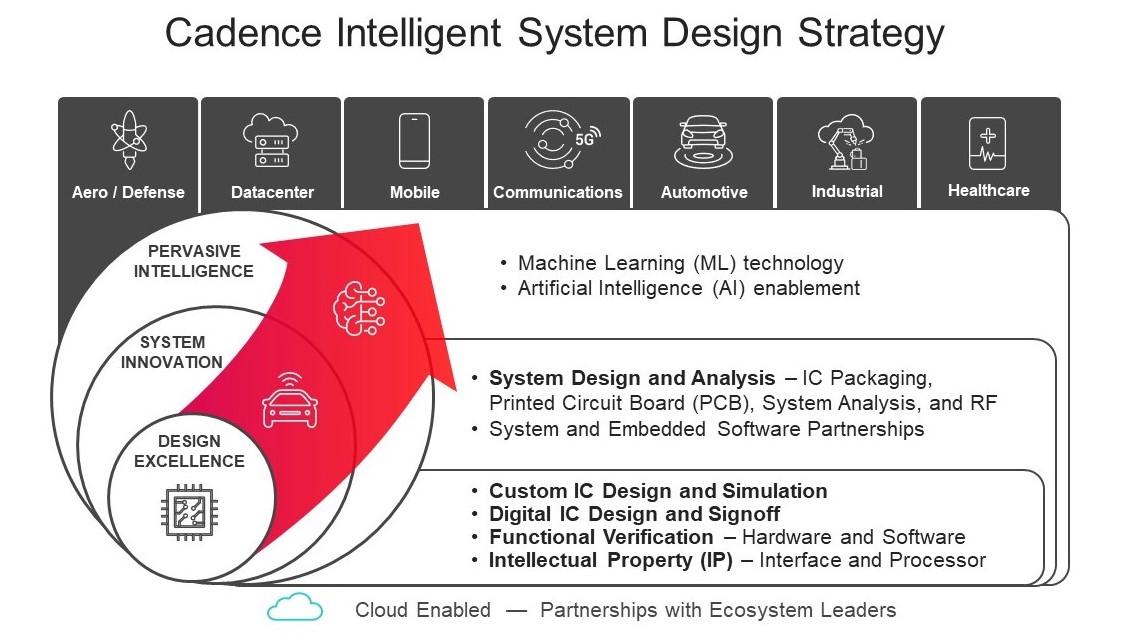]
The [removed: core] IC and SoC design excellence requires [removed: core EDA] technologies for custom IC, digital IC [added: design] and signoff, and functional verification, and leverages [removed: pre-build] [added: pre-built] semiconductor IP.
These tools, IP and associated services are specifically designed to meet the [added: growing] requirements of engineers [removed: who design] [added: designing increasingly complex chips] across analog, digital and mixed-signal domains, and perform the associated verification [removed: efforts,] [added: tasks,] including validation of low-level software running on the silicon model, thereby enabling design teams to manage complexity [added: and verification throughput] without [added: commensurately] increasing the team size or extending the project schedule, while reducing technical risks.
The third layer of our strategy [removed: is enabling] [added: addresses] pervasive intelligence in new electronics.
It starts with providing solutions and services to develop AI-enhanced systems and includes machine learning and deep learning capabilities being added to the [removed: Cadence] [added: Cadence®] technology portfolio to make IP and tools more automated and to produce optimized results [removed: faster, supported by cloud access to address the growing computation needs of our customers.][added: faster.]
Our products and services [removed: allow] [added: enable] our customers to design complex and innovative electronic products [removed: which] [added: that] are accelerated by [added: the] growing digital transformation.
Demand for our technology and expertise is driven by [added: increasing complexity and] our customers’ investment in new designs and products.
The most promising new opportunities for us involve enabling the design of electronic systems for [added: consumer (including augmented reality (“AR”), virtual reality (“VR”), and internet of things (“IoT”), hyperscale computing (including data center infrastructure),] AI, edge computing, [removed: hyperscale computing including datacenter infrastructure, communications, including] [added: mobile, communications (including] 5G [removed: networks, augmented reality, virtual reality, internet-of-things (“IoT”),] [added: networks), automotive,] aerospace and defense, [removed: automotive,] [added: and] industrial and healthcare subsystems.
Large and existing electronics categories, such as [removed: datacenter servers,] [added: data center infrastructure, mobile,] smartphones and networking products continue to provide business opportunities for us as customers initiate new design projects.
In order for our customers to take advantage of such advancements, some of our products [removed: must first be developed] [added: need] to [added: first incorporate new capabilities such that they can] exploit new manufacturing capabilities.
With the rapid pace of innovation comes the opportunity for our products to address [added: growing] key challenges associated with electronic product creation, such as power consumption, [removed: performance] [added: performance, chip area] and cost.
In general, these attributes can be grouped into broader categories such as quality of results (“QoR”) (in terms of power consumption, performance and chip area), engineering productivity, tool performance, and faster [removed: time-to-market.][added: time to market.]
We are applying machine learning [added: or computational software] techniques within our products to enhance QoR, productivity, performance and methodology.
Our Intelligent System Design strategy [removed: is to provide] [added: enables] our customers [removed: with the ability] to address [removed: the] [added: a] broad range of [removed: issues] [added: challenges] that arise as they develop electronic products.
Our solutions are [removed: comprised of products that are] categorized according to the role they play in the electronic product design process.
We combine our products and technologies into categories related to major design activities, including Custom IC [added: Design] and Simulation, Digital IC Design and Signoff, Functional Verification, IP, and System [removed: Interconnect] [added: Design] and Analysis.
These representations are verified using simulation tools optimized for each type of design, including the design capture environment, simulation and IC layout within the Virtuoso® custom [added: IC] design platform.
[added: The] Virtuoso [removed: Advanced Node] [added: Advanced-Node Platform] adds functionality to the base Virtuoso package to enable the use of three-dimensional transistors (“FinFETs”), multi-patterning and other technologies required for advanced designs.
[added: The] Spectre® [removed: Simulator] [added: Simulation Platform] provides large-scale verification simulation.
Our digital IC [added: design] and signoff technology suite provides a full flow to achieve power, performance, and area (“PPA”) design targets, and includes three major categories: logic design, physical implementation and signoff.
The offering includes the Genus™ Synthesis Solution, a logic synthesis offering that provides fast throughput while also offering high quality results, [removed: the Stratus™ High-Level Synthesis solution for system-level synthesis,] and the Joules™ RTL Power Solution, which delivers fast power analysis while preserving near-signoff accuracy.
We also offer the Modus [removed: Design-For-Test (“DFT”)] software solution, which reduces SoC [removed: test] [added: design-for-test (“DFT”)] time.
Our signoff offering is comprised of tools used to [removed: signoff] [added: sign off] the design as ready for manufacture by a semiconductor foundry, which provides certification for this step.
This offering includes the Tempus™ Timing Signoff Solution, Voltus™ Power Integrity Solution, Quantus™ Extraction [removed: Solution,] [added: Solution] and Pegasus™ Physical Verification System.
Functional verification products are used by our customers to [removed: efficiently and] effectively [added: and efficiently] verify that the circuitry or the software they have designed [removed: will perform as intended.][added: is consistent with the functional specification.]
Verification [removed: takes place during and after custom and analog design, and] [added: is largely done throughout the design process, with the objective of identifying as many potential functional problems as possible] before manufacturing the circuitry, [added: thereby] significantly reducing the risk of discovering a costly error in the completed product.
Our Verification Suite™ includes four primary verification engines, starting with the JasperGold® Formal Verification Platform and Xcelium™ Parallel Logic Simulation Platform, which are used in the early stages of [removed: design,] [added: design verification,] often at the IP and subsystem level.
Once the design is more mature, with early formal and simulation verification tasks performed, verification engineers deploy our Palladium® [added: Enterprise] Emulation Platform and Protium™ [added: FPGA-Based] Prototyping [removed: Platform] [added: Platforms] for more [removed: complete] [added: comprehensive] chip verification, often running low-level embedded software on top of a model of the chip, to ensure proper functionality before silicon manufacturing.
[added: The] Palladium [added: Z1 platform] provides high throughput, capacity, [removed: datacenter] [added: data center] reliability and workgroup productivity to enable global design teams to develop advanced hardware-software systems.
[added: The] Protium [added: platform] leverages a common front end with the Palladium environment [removed: in order] to move designs rapidly from emulation to the prototyping stage, allowing for software development to start weeks to months [removed: earlier.][added: earlier than otherwise possible.]
These engines are also supported by other verification tools that provide an environment that allows for effective verification [removed: throughput,] [added: throughput and management,] including verification planning and metric tracking, testbench automation, debugging and software-driven tests, enabling our customers to coordinate verification activities across multiple verification engines, and teams and locations for effective verification closure.
System [removed: Interconnect] [added: Design] and Analysis
Cadence is a leader in electronic design, building upon more than 30 years of computational software expertise.
We apply our underlying Intelligent System Design™ strategy to deliver software, hardware and IP that turn design concepts into reality.
Our customers include some of the world’s most innovative companies that deliver extraordinary electronic products from chips to boards to systems for dynamic market applications including consumer, hyperscale computing, 5G communications, mobile automotive, aerospace and defense, industrial and healthcare.
With our Intelligent System Design™ strategy, we provide the computational software technologies necessary for our electronic system and semiconductor customers to develop electronic products across a variety of vertical markets including consumer, hyperscale computing, mobile, 5G communications, automotive, aerospace and defense, industrial and healthcare.
Our software and emulation products also support cloud access to address the growing computational needs of our customers.
Recently, we have added System VIP offerings for system-level verification to model full system-level behavior at the chip level.
In 2020, we expanded our technology portfolio with the Clarity 3D Transient Solver, a 3D finite difference time domain (“FDTD”) electromagnetic (“EM”) simulation software tool for simulating complex systems and subsystems, the EMX Planar 3D Solver, an EM simulator for high-frequency RF- and mixed-signal circuits and the portfolio from our acquisition of AWR Corporation (“AWR”) that provides software products used by microwave and RF engineers to design wireless products for complex, high-frequency RF applications.
To broaden the Cadence System Design and Analysis portfolio and expand the engineering talent, we entered into a definitive agreement to acquire Belgium-based Numerical Mechanics Applications International SA (“NUMECA”), a leader in computational fluid dynamics (“CFD”), mesh generation, multi-physics simulation and optimization.
The addition of NUMECA’s technologies and talent supports our Intelligent System Design™ strategy, servicing a fast-moving CFD market segment where accuracy, reliability and predictability are paramount concerns for high-fidelity modeling.
The acquisition is expected to close in the first quarter of fiscal 2021, subject to customary closing conditions.
In fiscal 2020, as part of our continuous endeavor to simplify training for our customers, we integrated Cadence Training’s Learning Management System and Cadence Support to create the Cadence Learning and Support System.
With a single sign-on and an improved user experience, the new system gives customers easy access to extensive content.
In addition, we made online training free of cost and expanded our webinar offerings to support the increase in the number of our customers working from home this year.
| | | | | | | | | | | | | | | | | | | | | | | | | | | | | | | | | | | | |
| --- | --- | --- | --- | --- | --- | --- | --- | --- | --- | --- | --- | --- | --- | --- | --- | --- | --- | --- | --- | --- | --- | --- | --- | --- | --- | --- | --- | --- | --- | --- | --- | --- | --- | --- | --- |
Governmental Regulations
We are subject to a variety of federal, state, local and foreign laws and regulations relating to our business and operations.
These include, but are not limited to, laws and regulations related to import and export controls, anti-corruption, competition, data privacy, and employment.
For example, we are subject to the regulations of the United States and certain other jurisdictions in selling or shipping our products and technology outside the United States and to foreign nationals, including tariffs, trade protection measures, import or export licensing requirements, sanctions and other trade barriers, such as U.S. Export Administration regulations and “Entity List” restrictions imposed by the Bureau of Industry and Security (“BIS”) of the U.S. Department of Commerce.
Import/export regulations limiting or banning sales into certain countries or to certain companies have impacted our ability to transact business in certain countries and with certain customers.
In addition, as a result of our international operations, we are subject to laws and regulations, such as the U.S. Foreign Corrupt Practices Act, the U.K. Bribery Act and other local laws, prohibiting corrupt payments to governmental officials, as well as anti-competition regulations.
We are also subject to laws and regulations governing data privacy in the U.S. and other jurisdictions, such as the General Data Protection Regulation (“GDPR”) in the European Union.
These laws and regulations are complex and may change or develop over time, sometimes with limited notice.
We may incur significant expenditures in future periods related to compliance, which could restrict our business operations.
For more information on risks related to these regulations, see the relevant discussions throughout Item 1A, "Risk Factors."
These include U.S. based companies such as Keysight Technologies, Inc. and CEVA, Inc., and foreign companies such as Altium Limited (Australia), Zuken Ltd. (Japan), and emerging competitors in China like Huada Empyrean, Xpeedic, X-EPIC, Primarius Technologies and Giga-DA.
For more information on risks related to competitive factors affecting our business, see the relevant discussions throughout Item 1A, “Risk Factors.”
Human Capital Resource Management
Our future success is inextricably linked to our ability to attract, retain and develop exceptional talent globally.
To facilitate talent attraction and retention, Cadence invests in key initiatives including, but not limited to, diversity and inclusion, physical and mental health, and talent development.
Our cultural tenet is “One Team – One Cadence.” This culture-first message underpins our belief that a diverse, highly supported and engaged workforce is critical to the foundation of our business success.
Our employees represent the best and brightest in our industry and the talent we select to be a part of our team defines our culture and success.
Our global workforce is highly educated, technical and specialized, with a substantial majority of employees working in technical roles.
Diversity and Inclusion
We believe that workforce diversity and inclusion advance high performance and innovation.
We recognize that gender and racial disparities remain a challenge in the technology field, and with a high proportion of technical employees, Cadence is deeply committed to addressing this issue.
Some of our key programs and initiatives aimed at addressing this issue include:
- Regular monitoring of the diversity of our current workforce and candidate pool, with an aim to identify and address areas where we can improve.
- Partnerships with organizations such as National Society of Black Engineers (“NSBE”), Society of Hispanic Professional Engineers (“SHPE”), Out in Tech, and Society of Women Engineers (“SWE”) to advance our inclusion efforts.
These partnerships allow us to do more targeted recruiting, outreach, and engagement with these communities.
We enable our customers to design electronic products.
Our strategy, which we call Intelligent System Design™, provides the technologies necessary for our customers to develop and optimize a complete and functional electronic product.
Our business opportunities are significantly enhanced when our offerings address these key factors.
Our VIP offerings are also used in system-level verification to model correct behavior of full systems interacting with their environments.
Our technology portfolio expanded in 2019 into the growing system analysis market segment.
Building upon Virtuoso RF technology and expertise and to better address increasing RF/microwave design activity, driven by growing use of 5G communications, our portfolio expanded with the acquisition of AWR Corporation and Integrand Software, Inc. in the first quarter of fiscal 2020.
| | | | | | | | | | | | | | | | | | | | | |
| --- | --- | --- | --- | --- | --- | --- | --- | --- | --- | --- | --- | --- | --- | --- | --- | --- | --- | --- | --- | --- |
| | | | | | | | | | | | | | | | | | | | | |
The remainder of our revenue is characterized as upfront revenue.
These include Altium Limited, CEVA, Inc., Keysight Technologies, Inc. and Zuken Ltd.
We were organized as a Delaware corporation in June 1988.
Information on our website is not incorporated by reference in this Annual Report on Form 10-K unless expressly noted.
Our next 53-week fiscal year will be fiscal 2020.
| | | | | |
| --- | --- | --- | --- | --- |
| | | | | |
| James J. Cowie | | 55 | | Senior Vice President, General Counsel and Secretary |
Mr. Tan serves as a director of Advanced Micro-Fabrication Equipment Inc. China (AMEC), Hewlett Packard Enterprise Company and Schneider Electric SE.
JAMES J.
COWIE has served as Senior Vice President and General Counsel of Cadence since April 2008 and Secretary of Cadence since May 2008.
From August 2000 to March 2008, Mr. Cowie held several positions at Cadence, most recently as Corporate Vice President – Business Development, Associate General Counsel and Assistant Secretary.
Mr. Cowie has an A.B. in economics from Duke University and a J.D. from Stanford Law School.
NEIL ZAMAN has served as Senior Vice President, Worldwide Field Operations of Cadence since September 2015.
An excerpt. Shown here: 40 of 73 rewritten, 40 of 80 added and all 24 removed. The counts are complete. For every sentence, read Item 1. Business in the FY2020 filing and the FY2019 filing.
Cover and table of contents
47 rewritten, 39 added, 44 removed, 32 unchanged
Read the full itemFY2020 item · filed February 22, 2021FY2019 item · filed February 24, 2020
[removed: FORM 10-K][added: FORM 10-K]
| | [added: | |] ☒ | [added: | |] ANNUAL REPORT PURSUANT TO SECTION 13 OR 15(d) OF THE SECURITIES EXCHANGE ACT OF 1934 | [added: | |]
For the fiscal year [removed: ended December 28, 2019][added: ended January 2, 2021]
| | [added: | |] ☐ | [added: | |] TRANSITION REPORT PURSUANT TO SECTION 13 OR 15(d) OF THE SECURITIES EXCHANGE ACT OF 1934 | [added: | |]
Commission file [removed: number 000-15867][added: number 000-15867]
[removed: ][added: ]
CADENCE DESIGN [removed: SYSTEMS INC][added: SYSTEMS, INC.]
| Delaware | | | | [added: | | | | | | | |] 00-0000000 | [added: | |]
| (State or Other Jurisdiction of Incorporation or Organization) | | | | [added: | | | | | | | |] (I.R.S. Employer Identification No.) | [added: | |]
| 2655 Seely Avenue, Building 5, | [added: | |] San Jose, | [added: | |] California | | [added: | | | |] 95134 | [added: | |]
| (Address of Principal Executive Offices) | | | | [added: | | | | | | | |] (Zip Code) | [added: | |]
[removed: (408)\-943-1234][added: (408)\-943-1234]
| Title of Each Class | [added: | |] Trading Symbol(s) | [added: | |] Names of Each Exchange on which Registered | [added: | |]
| Common Stock, $0.01 par value per share | [added: | |] CDNS | [added: | |] Nasdaq Global Select Market | [added: | |]
| Large Accelerated Filer | | [added: | | | |] ☒ | | [added: | | | |] Accelerated Filer | | [added: | | | |] ☐ | [added: | |]
| Non-accelerated Filer | | [added: | | | |] ☐ | | [added: | | | |] Smaller Reporting Company | | [added: | | | |] ☐ | [added: | |]
| | | | | [added: | | | | | | | |] Emerging Growth Company | | [added: | | | |] ☐ | [added: | |]
The aggregate market value of the voting and non-voting common equity held by non-affiliates computed by reference to the price at which the common equity was last sold as of the last business day of the registrant’s most recently completed second fiscal quarter ended June [removed: 29, 2019] [added: 27, 2020] was approximately [removed: $19,837,633,930.][added: $26,162,000,000.]
On February [removed: 1, 2020,] [added: 6, 2021,] approximately [removed: 280,168,000] [added: 278,974,000] shares of the Registrant’s Common Stock, $0.01 par value, were outstanding.
Portions of the definitive proxy statement for Cadence Design Systems, Inc.’s [removed: 2020] [added: 2021] Annual Meeting of Stockholders are incorporated by reference into Part III hereof.
FOR THE FISCAL YEAR [removed: ENDED DECEMBER 28, 2019][added: ENDED JANUARY 2, 2021]
| | | [added: | | | |] Page | [added: | |]
| PART I. | | | [added: | | | | | |]
| Item 1. | [removed: [Business](#sD5AA3843E0D75ADDA916B47B673F3ECA)] | [removed: [1](#sD5AA3843E0D75ADDA916B47B673F3ECA)] | [added: [Business](#i7db652776ff546b7bfc0141f88148829_13) | | | [1](#i7db652776ff546b7bfc0141f88148829_13) | | |]
| Item 1A. | [added: | |] [Risk [removed: Factors](#sB1C9D8F7F2F35B8AB2B34B07C427A6E9)] [added: Factors](#i7db652776ff546b7bfc0141f88148829_22)] | [removed: [9](#sB1C9D8F7F2F35B8AB2B34B07C427A6E9)] | [added: | [11](#i7db652776ff546b7bfc0141f88148829_22) | | |]
| Item 1B. | [added: | |] [Unresolved Staff [removed: Comments](#sD4DEC8C9AF5358458F56AF3F888B0B81)] [added: Comments](#i7db652776ff546b7bfc0141f88148829_25)] | [removed: [22](#sD4DEC8C9AF5358458F56AF3F888B0B81)] | [added: | [25](#i7db652776ff546b7bfc0141f88148829_25) | | |]
| Item 2. | [removed: [Properties](#sB8077A8AD4A0504B9A3663DD57A81830)] | [removed: [23](#sB8077A8AD4A0504B9A3663DD57A81830)] | [added: [Properties](#i7db652776ff546b7bfc0141f88148829_28) | | | [25](#i7db652776ff546b7bfc0141f88148829_28) | | |]
| Item 3. | [added: | |] [Legal [removed: Proceedings](#s2F5B86E04B2551F3A763525BDF2CA70A)] [added: Proceedings](#i7db652776ff546b7bfc0141f88148829_31)] | [removed: [23](#s2F5B86E04B2551F3A763525BDF2CA70A)] | [added: | [26](#i7db652776ff546b7bfc0141f88148829_31) | | |]
| Item 4. | [added: | |] [Mine Safety [removed: Disclosures](#sBC1FE13437CC5381B5CE7916FB4A7A2B)] [added: Disclosures](#i7db652776ff546b7bfc0141f88148829_34)] | [removed: [23](#sBC1FE13437CC5381B5CE7916FB4A7A2B)] | [added: | [26](#i7db652776ff546b7bfc0141f88148829_34) | | |]
| PART II. | | | [added: | | | | | |]
| Item 5. | [added: | |] [Market for Registrant’s Common Equity, Related Stockholder Matters and Issuer Purchases of Equity [removed: Securities](#sB6E6E4BC07FB56D6AE9ED2CB36F4B0D2)] [added: Securities](#i7db652776ff546b7bfc0141f88148829_40)] | [removed: [24](#sB6E6E4BC07FB56D6AE9ED2CB36F4B0D2)] | [added: | [27](#i7db652776ff546b7bfc0141f88148829_40) | | |]
| Item 6. | [added: | |] [Selected Financial [removed: Data](#sAC3A3A6883DE5EC4943BBD22E954A00A)] [added: Data](#i7db652776ff546b7bfc0141f88148829_52)] | [removed: [25](#sAC3A3A6883DE5EC4943BBD22E954A00A)] | [added: | [28](#i7db652776ff546b7bfc0141f88148829_52) | | |]
| Item 7. | [added: | |] [Management’s Discussion and Analysis of Financial Condition and Results of [removed: Operations](#sF5AF800D7B59529291CFCE6A89576452)] [added: Operations](#i7db652776ff546b7bfc0141f88148829_55)] | [removed: [26](#sF5AF800D7B59529291CFCE6A89576452)] | [added: | [29](#i7db652776ff546b7bfc0141f88148829_55) | | |]
| Item 7A. | [added: | |] [Quantitative and Qualitative Disclosures About Market [removed: Risk](#s39946814D59D5FEE81267AC1039D6D91)] [added: Risk](#i7db652776ff546b7bfc0141f88148829_85)] | [removed: [38](#s39946814D59D5FEE81267AC1039D6D91)] | [added: | [42](#i7db652776ff546b7bfc0141f88148829_85) | | |]
| Item 8. | [added: | |] [Financial Statements and Supplementary [removed: Data](#sEC6F9C0A9B165886BE3D8FC45264BC17)] [added: Data](#i7db652776ff546b7bfc0141f88148829_88)] | [removed: [39](#sEC6F9C0A9B165886BE3D8FC45264BC17)] | [added: | [43](#i7db652776ff546b7bfc0141f88148829_88) | | |]
| Item 9. | [added: | |] [Changes in and Disagreements with Accountants on Accounting and Financial [removed: Disclosure](#s5D929BB4A48C59A8A4DB66FE010676CA)] [added: Disclosure](#i7db652776ff546b7bfc0141f88148829_91)] | [removed: [40](#s5D929BB4A48C59A8A4DB66FE010676CA)] | [added: | [44](#i7db652776ff546b7bfc0141f88148829_91) | | |]
| Item 9A. | [added: | |] [Controls and [removed: Procedures](#s08413741E74A56E69ACF992CC8A4688E)] [added: Procedures](#i7db652776ff546b7bfc0141f88148829_94)] | [removed: [40](#s08413741E74A56E69ACF992CC8A4688E)] | [added: | [44](#i7db652776ff546b7bfc0141f88148829_94) | | |]
| Item 9B. | [added: | |] [Other [removed: Information](#s468BD4DE03785C0F8EB0D8723AFCF208)] [added: Information](#i7db652776ff546b7bfc0141f88148829_97)] | [removed: [40](#s468BD4DE03785C0F8EB0D8723AFCF208)] | [added: | [44](#i7db652776ff546b7bfc0141f88148829_97) | | |]
| PART III. | | | [added: | | | | | |]
| Item 10. | [added: | |] [Directors, Executive Officers and Corporate [removed: Governance](#s3C6DEE065B045D2E93E0F7949CBEF655)] [added: Governance](#i7db652776ff546b7bfc0141f88148829_103)] | [removed: [41](#s3C6DEE065B045D2E93E0F7949CBEF655)] | [added: | [45](#i7db652776ff546b7bfc0141f88148829_103) | | |]
| | | | | | | | | |
| --- | --- | --- | --- | --- | --- | --- | --- | --- |
| | | | | | | | | |
| --- | --- | --- | --- | --- | --- | --- | --- | --- |
| | | | | | | | | | | | | | | |
| --- | --- | --- | --- | --- | --- | --- | --- | --- | --- | --- | --- | --- | --- | --- |
| | | | | | | | | | | | | | | |
| | | | | | | | | |
| --- | --- | --- | --- | --- | --- | --- | --- | --- |
| | | | | | | | | | | | | | | | | | | | | |
| --- | --- | --- | --- | --- | --- | --- | --- | --- | --- | --- | --- | --- | --- | --- | --- | --- | --- | --- | --- | --- |
Indicate by check mark whether the registrant has filed a report on and attestation to its management’s assessment of the effectiveness of its internal control over financial reporting under Section 404(b) of the Sarbanes-Oxley Act (15 U.S.C. 7262(b)) by the registered public accounting firm that prepared or issued its audit report.
| | | | | | | | | |
| --- | --- | --- | --- | --- | --- | --- | --- | --- |
| | | | | | | | | |
| | | | | | | | | |
| | | | | | | | | |
| | | | | | | | | |
| | | | | | | | | |
| | | | | | | | | |
| | | | | | | | | |
| | | | | | | | | |
| | | | | | | | | |
| | | | | | | | | |
| | | | | | | | | |
| | | | | | | | | |
| | | | | | | | | |
| | | | | | | | | |
| | | | | | | | | |
| | | | | | | | | |
| | | | | | | | | |
| | | | | | | | | |
| | | | | | | | | |
| | | | | | | | | |
| | | | | | | | | |
| | | | | | | | | |
| | | | | | | | | |
| | | | | | | | | |
| | | | [Signatures](#i7db652776ff546b7bfc0141f88148829_235) | | | [87](#i7db652776ff546b7bfc0141f88148829_235) | | |
| | | |
| --- | --- | --- |
| | | |
| | | |
| --- | --- | --- |
| | | |
| | | | | |
| --- | --- | --- | --- | --- |
| | | | | |
| | | | | |
| | | |
| --- | --- | --- |
| | | |
| | | | | | | |
| --- | --- | --- | --- | --- | --- | --- |
| | | | | | | |
| | | |
| --- | --- | --- |
| | | |
| | | |
| | | |
| | | |
| | | |
| | | |
| | | |
| | | |
| | | |
| | | |
| | | |
| | | |
| | | |
| | | |
| | | |
| | | |
| | | |
| | | |
| | | |
| | | |
| | | |
| | | |
An excerpt. Shown here: 40 of 47 rewritten, all 39 added and 40 of 44 removed. The counts are complete. For every sentence, read Cover and table of contents in the FY2020 filing and the FY2019 filing.
Item 2. Properties
1 rewritten, 0 added, 0 removed, 5 unchanged
Read the full itemFY2020 item · filed February 22, 2021FY2019 item · filed February 24, 2020
As of [removed: December 28, 2019,] [added: January 2, 2021,] the total square footage of our owned buildings was approximately 1,010,000.
Item 5. Market for Registrant’s Common Equity, Related Stockholder Matters and Issuer Purchases of Equity Securities
10 rewritten, 15 added, 21 removed, 7 unchanged
Read the full itemFY2020 item · filed February 22, 2021FY2019 item · filed February 24, 2020
As of February [removed: 1, 2020,] [added: 6, 2021,] we had [removed: 443] [added: 410] registered stockholders and approximately [removed: 100,000] [added: 250,000] beneficial owners of our common stock.
The graph assumes that the value of the investment in our common stock and in each index on January [removed: 3, 2015] [added: 2, 2016] (including reinvestment of dividends) was $100 and tracks it each year thereafter on the last day of our fiscal year through [removed: December 28, 2019] [added: January 2, 2021] and, for each index, on the last day of the calendar year.
[removed: 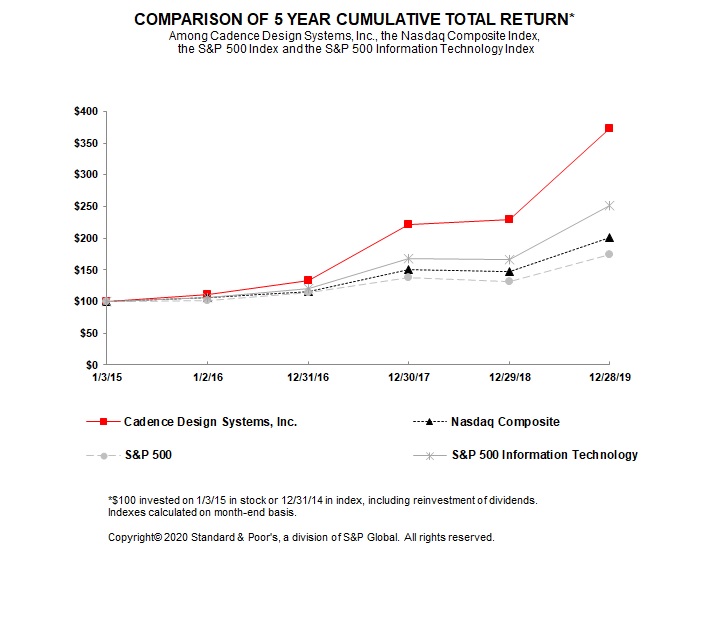][added: ]
| | | [removed: 1/3/2015] | | | | 1/2/2016 | | | | [added: | |] 12/31/2016 | | | | [added: | |] 12/30/2017 | | | | [added: | |] 12/29/2018 | | | | [added: | |] 12/28/2019 | | | [added: | | | 1/2/2021 | | |]
At the end of fiscal [removed: 2018,] [added: 2019,] approximately [removed: $175] [added: $369] million remained available under our previously announced authorization to repurchase shares of our common stock.
As of [removed: December 28, 2019, $369] [added: January 2, 2021, approximately $739] million remained available to repurchase shares of our common stock.
The following table presents repurchases made under our current authorization and shares surrendered by employees to satisfy income tax withholding obligations during the three months ended [removed: December 28, 2019:][added: January 2, 2021:]
| Period | [added: | |] Total Number of Shares Purchased (1) | | | [added: | | |] Average Price Paid Per Share (2) | | | | [added: | |] Total Number of Shares Purchased as Part of Publicly Announced Plan or Program | | | [added: | | |] Maximum Dollar Value of Shares Authorized for Repurchase Under Publicly Announced Plan or Program (1) (In millions) | | |
[removed: | (1) | Shares] [added: (1)Shares] purchased that were not part of our publicly announced repurchase programs represent employee surrender of shares of restricted stock to satisfy employee income tax withholding obligations due upon vesting, and do not reduce the dollar value that may yet be purchased under our publicly announced repurchase programs. [removed: |]
[removed: | (2) | The] [added: (2)The] weighted average price paid per share of common stock does not include the cost of commissions. [removed: |]
| | | | | | | | | | | | | | | | | | | | | | | | | | | | | | | | | | | | | | | |
| --- | --- | --- | --- | --- | --- | --- | --- | --- | --- | --- | --- | --- | --- | --- | --- | --- | --- | --- | --- | --- | --- | --- | --- | --- | --- | --- | --- | --- | --- | --- | --- | --- | --- | --- | --- | --- | --- | --- |
| | | | | | | | | | | | | | | | | | | | | | | | | | | | | | | | | | | | | | | |
| | | | | | | | | | | | | | | | | | | | | | | | | | | | | | | | | | | | | | | |
| Cadence Design Systems, Inc. | | | | | | $ | 100.00 | | | | | $ | 121.19 | | | | | $ | 200.96 | | | | | $ | 208.27 | | | | | $ | 337.77 | | | | | $ | 655.60 | |
| Nasdaq Composite | | | | | | 100.00 | | | | | | 118.10 | | | | | | 153.10 | | | | | | 148.75 | | | | | | 203.33 | | | | | | 294.67 | | |
| S&P 500 | | | | | | 100.00 | | | | | | 117.81 | | | | | | 143.52 | | | | | | 137.23 | | | | | | 180.44 | | | | | | 213.64 | | |
| S&P 500 Information Technology | | | | | | 100.00 | | | | | | 119.63 | | | | | | 166.09 | | | | | | 165.61 | | | | | | 248.89 | | | | | | 358.13 | | |
In July 2020, our Board of Directors increased the previously announced authorization to repurchase shares of our common stock by an additional $750 million.
| | | | | | | | | | | | | | | | | | | | | | | | |
| --- | --- | --- | --- | --- | --- | --- | --- | --- | --- | --- | --- | --- | --- | --- | --- | --- | --- | --- | --- | --- | --- | --- | --- |
| September 27, 2020 – October 31, 2020 | | | 456,598 | | | | | | $ | 110.99 | | | | | 416,064 | | | | | | $ | 823 | |
| November 1, 2020 – November 28, 2020 | | | 357,411 | | | | | | $ | 114.82 | | | | | 331,060 | | | | | | $ | 785 | |
| November 29, 2020 – January 2, 2021 | | | 479,517 | | | | | | $ | 121.92 | | | | | 375,702 | | | | | | $ | 739 | |
| Total | | | 1,293,526 | | | | | | $ | 116.10 | | | | | 1,122,826 | | | | | | | | |
| | | | | | | | | | | | | | | | | | | | | | | | | |
| --- | --- | --- | --- | --- | --- | --- | --- | --- | --- | --- | --- | --- | --- | --- | --- | --- | --- | --- | --- | --- | --- | --- | --- | --- |
| | | | | | | | | | | | | | | | | | | | | | | | | |
| | | | | | | | | | | | | | | | | | | | | | | | | |
| | | | | | | | | | | | | | | | | | | | | | | | | |
| Cadence Design Systems, Inc. | | $ | 100.00 | | | $ | 110.52 | | | $ | 133.94 | | | $ | 222.09 | | | $ | 230.16 | | | $ | 373.29 | |
| Nasdaq Composite | | 100.00 | | | | 106.96 | | | | 116.45 | | | | 150.96 | | | | 146.67 | | | | 200.49 | | |
| S&P 500 | | 100.00 | | | | 101.38 | | | | 113.51 | | | | 138.29 | | | | 132.23 | | | | 173.86 | | |
| S&P 500 Information Technology | | 100.00 | | | | 105.92 | | | | 120.59 | | | | 167.42 | | | | 166.94 | | | | 250.89 | | |
In February 2019, our Board of Directors authorized the repurchase of an additional $500 million.
| | | | | | | | | | | | | | |
| --- | --- | --- | --- | --- | --- | --- | --- | --- | --- | --- | --- | --- | --- |
| | | | | | | | | | | | | | |
| September 29, 2019 – November 2, 2019 | 475,085 | | | $ | 65.68 | | | 431,348 | | | $ | 416 | |
| November 3, 2019 – November 30, 2019 | 372,090 | | | $ | 67.26 | | | 347,411 | | | $ | 392 | |
| December 1, 2019 – December 28, 2019 | 468,919 | | | $ | 67.78 | | | 343,329 | | | $ | 369 | |
| Total | 1,316,094 | | | $ | 66.87 | | | 1,122,088 | | | | | |
| | |
| --- | --- |
| | |
| --- | --- |
Item 6. Selected Financial Data-Unaudited
13 rewritten, 4 added, 4 removed, 7 unchanged
Read the full itemFY2020 item · filed February 22, 2021FY2019 item · filed February 24, 2020
| | [added: | | 2020 | | | | | |] 2019 | | | | [added: | |] 2018 | | | | [removed: 2017] | | [added: 2017] | | [removed: 2016] | | | | [removed: 2015] [added: 2016] | | |
| | [added: | |] (In millions, except per share amounts) | | | | | | | | | | | | | | | | | | | [added: | | | | | | | |]
| Revenue (1) [added: (2)] | [added: | |] $ | [removed: 2,336.3] [added: 2,682.9] | | | [added: | |] $ | [removed: 2,138.0] [added: 2,336.3] | | | [added: | |] $ | [removed: 1,943.0] [added: 2,138.0] | | | [added: | |] $ | [removed: 1,816.1] [added: 1,943.0] | | | [added: | |] $ | [removed: 1,702.1] [added: 1,816.1] | |
| Income from operations (1) [added: (2)] | [added: | | 645.6 | | | | | |] 491.8 | | | | [added: | |] 396.2 | | | | [removed: 324.0] | | [added: 324.0] | | [removed: 244.9] | | | | [removed: 285.4] [added: 244.9] | | |
| Net income (1) (2) (3) [added: (4)] | [added: | | 590.6 | | | | | |] 989.0 | | | | [added: | |] 345.8 | | | | [removed: 204.1] | | [added: 204.1] | | [removed: 203.1] | | | | [removed: 252.4] [added: 203.1] | | |
| Net income per share-diluted (1) (2) (3) [added: (4)] | [added: | | 2.11 | | | | | |] 3.53 | | | | [added: | |] 1.23 | | | | [removed: 0.73] | | [added: 0.73] | | [removed: 0.70] | | | | [removed: 0.81] [added: 0.70] | | |
| Total assets [removed: (3)] [added: (4)] | [added: | | 3,950.8 | | | | | |] 3,357.2 | | | | [added: | |] 2,468.7 | | | | [removed: 2,418.7] | | [added: 2,418.7] | | [removed: 2,096.9] | | | | [removed: 2,345.5] [added: 2,096.9] | | |
| Debt [removed: (4)] [added: (5)] | [added: | | 346.8 | | | | | |] 346.0 | | | | [added: | |] 445.3 | | | | [removed: 729.4] | | [added: 729.4] | | [removed: 693.5] | | | | [removed: 343.3] [added: 693.5] | | |
| Stockholders’ equity [removed: (5)] (6) | [added: | | 2,493.0 | | | | | |] 2,102.9 | | | | [added: | |] 1,288.4 | | | | [removed: 989.2] | | [added: 989.2] | | [removed: 741.8] | | | | [removed: 1,376.1] [added: 741.8] | | |
Because of the adoption, results of operations for fiscal [added: 2020,] 2019 and 2018 are not comparable to the results of operations for the other fiscal years presented in the table above.
[removed: (2)] [added: (3)] During fiscal 2017, we recorded a provisional income tax expense of $96.8 million related to the income tax effects of the Tax Act, which included $67.2 million related to the one-time transition tax on the mandatory deemed repatriation of foreign earnings.
[removed: (3)] [added: (4)] During fiscal 2019, we completed intercompany transfers of certain intangible property rights to our Irish subsidiary which resulted in the establishment of a net deferred tax asset and the recognition of an income tax benefit of $575.6 million.
[removed: (4)] [added: (5)] During fiscal 2018, we prepaid the outstanding principal balance and accrued interest on our $300.0 million 2019 Term Loan.
| | | | | | | | | | | | | | | | | | | | | | | | | | | | | | |
| --- | --- | --- | --- | --- | --- | --- | --- | --- | --- | --- | --- | --- | --- | --- | --- | --- | --- | --- | --- | --- | --- | --- | --- | --- | --- | --- | --- | --- | --- |
(2) Fiscal 2020 was a 53-week year, compared to 2019 and 2018, which were each 52-week fiscal years.
The additional week in fiscal 2020 resulted in additional revenue of approximately $45 million and additional expense, including stock-based compensation and amortization of acquired intangibles, of approximately $35 million.
| | | | | | | | | | | | | | | | | | | | |
| --- | --- | --- | --- | --- | --- | --- | --- | --- | --- | --- | --- | --- | --- | --- | --- | --- | --- | --- | --- |
| | | | | | | | | | | | | | | | | | | | |
(5) During fiscal 2016, we repurchased shares of our common stock for a total cost of $960.3 million.
Item 8. Financial Statements and Supplementary Data
7 rewritten, 6 added, 5 removed, 5 unchanged
Read the full itemFY2020 item · filed February 22, 2021FY2019 item · filed February 24, 2020
| | | [added: | | | |] 4th | | | | [added: | |] 3rd | | | | [added: | |] 2nd | | | | [added: | |] 1st | | | | [added: | |] 4th | | | | [added: | |] 3rd | | | | [added: | |] 2nd | | | | [added: | |] 1st | | |
| | | [added: | | | |] (In thousands, except per share amounts) | | | | | | | | | | | | | | | | | | | | | | | | | | | | | | | [added: | | | | | | | | | | | | | |]
| Cost of revenue [added: (1)] | | [removed: 73,328] | | | | [removed: 60,975] [added: 73,536] | | | | [removed: 61,469] | | [added: 82,284] | | [removed: 70,585] | | | | [removed: 76,124] [added: 75,215] | | | | [removed: 60,454] | | [added: 74,463] | | [removed: 58,960] | | | | [removed: 63,209] [added: 73,328] | | | [added: | | | 60,975 | | | | | | 61,469 | | | | | | 70,585 | | |]
| Net income (1) [added: (2)] | | [removed: 659,675] | | | | [removed: 101,514] [added: 173,738] | | | | [removed: 107,235] | | [added: 161,630] | | [removed: 120,555] | | | | [removed: 98,425] [added: 131,288] | | | | [removed: 99,318] | | [added: 123,988] | | [removed: 75,149] | | | | [removed: 72,885] [added: 659,675] | | | [added: | | | 101,514 | | | | | | 107,235 | | | | | | 120,555 | | |]
| Net income per share –basic (1) [added: (2)] | | [removed: 2.41] | | | | [removed: 0.37] [added: 0.63] | | | | [removed: 0.39] | | [added: 0.59] | | [removed: 0.44] | | | | [removed: 0.36] [added: 0.48] | | | | [removed: 0.36] | | [added: 0.45] | | [removed: 0.27] | | | | [removed: 0.27] [added: 2.41] | | | [added: | | | 0.37 | | | | | | 0.39 | | | | | | 0.44 | | |]
| Net income per share –diluted (1) [added: (2)] | | [removed: 2.36] | | | | [removed: 0.36] [added: 0.62] | | | | [removed: 0.38] | | [added: 0.58] | | [removed: 0.43] | | | | [removed: 0.35] [added: 0.47] | | | | [removed: 0.35] | | [added: 0.44] | | [removed: 0.27] | | | | [removed: 0.26] [added: 2.36] | | | [added: | | | 0.36 | | | | | | 0.38 | | | | | | 0.43 | | |]
[removed: (1)] [added: (2)] During the fourth quarter of fiscal 2019, we completed intercompany transfers of certain intangible property rights to our Irish subsidiary, which resulted in the establishment of a net deferred tax asset and the recognition of an income tax benefit of $575.6 million.
| | | | | | | | | | | | | | | | | | | | | | | | | | | | | | | | | | | | | | | | | | | | | | | | | | | |
| --- | --- | --- | --- | --- | --- | --- | --- | --- | --- | --- | --- | --- | --- | --- | --- | --- | --- | --- | --- | --- | --- | --- | --- | --- | --- | --- | --- | --- | --- | --- | --- | --- | --- | --- | --- | --- | --- | --- | --- | --- | --- | --- | --- | --- | --- | --- | --- | --- | --- | --- |
| | | | | | | 2020 | | | | | | | | | | | | | | | | | | | | | | | | 2019 | | | | | | | | | | | | | | | | | | | | |
| Revenue (1) | | | | | | $ | 759,909 | | | | | $ | 666,607 | | | | | $ | 638,418 | | | | | $ | 617,957 | | | | | $ | 599,555 | | | | | $ | 579,603 | | | | | $ | 580,419 | | | | | $ | 576,742 | |
(1) Fiscal 2020 was a 53-week year, compared to 2019, which was a 52-week fiscal year.
The additional week in fiscal 2020 resulted in additional revenue of approximately $45 million and additional expense, including stock-based compensation and amortization of acquired intangibles, of approximately $35 million in the fourth quarter of fiscal 2020.
| | | | | | | | | | | | | | | | | | | | | | | | | | | | | | | | | |
| --- | --- | --- | --- | --- | --- | --- | --- | --- | --- | --- | --- | --- | --- | --- | --- | --- | --- | --- | --- | --- | --- | --- | --- | --- | --- | --- | --- | --- | --- | --- | --- | --- |
| | | | | | | | | | | | | | | | | | | | | | | | | | | | | | | | | |
| | | 2019 | | | | | | | | | | | | | | | | 2018 | | | | | | | | | | | | | | |
| Revenue | | $ | 599,555 | | | $ | 579,603 | | | $ | 580,419 | | | $ | 576,742 | | | $ | 569,850 | | | $ | 532,468 | | | $ | 518,391 | | | $ | 517,313 | |
Item 9A. Controls and Procedures
6 rewritten, 0 added, 0 removed, 15 unchanged
Read the full itemFY2020 item · filed February 22, 2021FY2019 item · filed February 24, 2020
As required by Rule 13a-15 of the Securities Exchange Act of 1934, as amended (the “Exchange Act”) under the supervision and with the participation of our management, including our Chief Executive Officer (“CEO”) and our Chief Financial Officer (“CFO”), we evaluated the effectiveness of the design and operation of our disclosure controls and procedures (as defined in Rules 13a-15(e) and 15d-15(e) under the Exchange Act) as of [removed: December 28, 2019.][added: January 2, 2021.]
Based on their evaluation as of [removed: December 28, 2019,] [added: January 2, 2021,] our CEO and CFO have concluded that our disclosure controls and procedures were effective to provide reasonable assurance that the information required to be disclosed by us in our reports filed or submitted under the Exchange Act is recorded, processed, summarized and reported within the time periods specified in the SEC’s rules and forms and is accumulated and communicated to our management, including the CEO and CFO, as appropriate to allow timely decisions regarding required disclosure.
There were no changes in our internal control over financial reporting during the fiscal quarter ended [removed: December 28, 2019] [added: January 2, 2021] that materially affected, or are reasonably likely to materially affect, our internal control over financial reporting.
Our management assessed the effectiveness of our internal control over financial reporting as of [removed: December 28, 2019.][added: January 2, 2021.]
Our management has concluded that, as of [removed: December 28, 2019,] [added: January 2, 2021,] our internal control over financial reporting is effective based on these criteria.
Our independent registered public accounting firm, [removed: KPMG] [added: PricewaterhouseCoopers] LLP, has issued an attestation report on our internal control over financial reporting, which is included in Part IV, Item 15, “Exhibits and Financial Statement Schedules.”
Item 10. Directors, Executive Officers and Corporate Governance
3 rewritten, 0 added, 0 removed, 1 unchanged
Read the full itemFY2020 item · filed February 22, 2021FY2019 item · filed February 24, 2020
The information required by Item 10 as to directors is incorporated herein by reference from the sections entitled “Proposal 1 - Election of Directors” [removed: and] [added: and, as applicable,] “Security Ownership of Certain Beneficial Owners and Management - Delinquent Section 16(a) Reports” in Cadence’s definitive proxy statement for its [removed: 2020] [added: 2021] Annual Meeting of Stockholders.
The information required by Item 10 as to Cadence’s code of ethics is incorporated herein by reference from the section entitled “Corporate Governance - Code of Business Conduct” in Cadence’s definitive proxy statement for its [removed: 2020] [added: 2021] Annual Meeting of Stockholders.
The information required by Item 10 as to the director nomination process and Cadence’s Audit Committee is incorporated by reference from the section entitled “Board of Directors - Committees of the Board” in Cadence’s definitive proxy statement for its [removed: 2020] [added: 2021] Annual Meeting of Stockholders.
Item 11. Executive Compensation
1 rewritten, 0 added, 0 removed, 0 unchanged
Read the full itemFY2020 item · filed February 22, 2021FY2019 item · filed February 24, 2020
The information required by Item 11 is incorporated herein by reference from the sections entitled “Board of Directors - Components of Director Compensation,” “Board of Directors - Director Compensation for Fiscal [removed: 2019,”] [added: 2020,”] “Compensation Discussion and Analysis,” “Compensation Committee Report,” “Compensation Committee Interlocks and Insider Participation,” “Compensation of Executive Officers,” “Potential Payments Upon Termination or Change In Control,” and “Pay Ratio Disclosure” in Cadence’s definitive proxy statement for its [removed: 2020] [added: 2021] Annual Meeting of Stockholders.
Item 12. Security Ownership of Certain Beneficial Owners and Management and Related Stockholder Matters
1 rewritten, 0 added, 0 removed, 0 unchanged
Read the full itemFY2020 item · filed February 22, 2021FY2019 item · filed February 24, 2020
The information required by Item 12 is incorporated herein by reference from the sections entitled “Security Ownership of Certain Beneficial Owners and Management” and “Equity Compensation Plan Information” in Cadence’s definitive proxy statement for its [removed: 2020] [added: 2021] Annual Meeting of Stockholders.
Item 13. Certain Relationships and Related Transactions and Director Independence
1 rewritten, 0 added, 0 removed, 0 unchanged
Read the full itemFY2020 item · filed February 22, 2021FY2019 item · filed February 24, 2020
The information required by Item 13 is incorporated herein by reference from the sections entitled “Certain Transactions” and “Board of Directors - Director Independence” in Cadence’s definitive proxy statement for its [removed: 2020] [added: 2021] Annual Meeting of Stockholders.
Item 14. Principal Accountant Fees and Services
1 rewritten, 0 added, 0 removed, 1 unchanged
Read the full itemFY2020 item · filed February 22, 2021FY2019 item · filed February 24, 2020
The information required by Item 14 is incorporated herein by reference from the section entitled “Fees Billed to Cadence by [removed: KPMG LLP] [added: the Independent Registered Public Accounting Firm] During Fiscal [removed: 2019] [added: 2020] and [removed: 2018”] [added: 2019”] in Cadence’s definitive proxy statement for its [removed: 2020] [added: 2021] Annual Meeting of Stockholders.
Item 15. Exhibits and Financial Statement Schedules
704 rewritten, 292 added, 335 removed, 504 unchanged
Read the full itemFY2020 item · filed February 22, 2021FY2019 item · filed February 24, 2020
| | | [added: | | | |] Page | [added: | |]
| (a) 1. Financial Statements | | | [added: | | | | | |]
[removed: | | [Report] [added: Report] of Independent Registered Public Accounting [removed: Firm](#s9B9E453A490652D68AA7AB5EF86B0D72) | [43](#s9B9E453A490652D68AA7AB5EF86B0D72) |][added: Firm]
| | [added: | |] [Consolidated Balance Sheets as of [removed: December 28, 2019] [added: January 2, 2021] and December [removed: 29, 2018](#s885F30AC5242596C8B7940B5B1890B32)] [added: 28, 2019](#i7db652776ff546b7bfc0141f88148829_127)] | [removed: [46](#s885F30AC5242596C8B7940B5B1890B32)] | [added: | [50](#i7db652776ff546b7bfc0141f88148829_127) | | |]
| | [added: | |] [Consolidated Income Statements for the three fiscal years ended [removed: December 28, 2019](#s9960405FA06A55C8B0EB7A6769FBA876)] [added: January 2, 2021](#i7db652776ff546b7bfc0141f88148829_133)] | [removed: [47](#s9960405FA06A55C8B0EB7A6769FBA876)] | [added: | [51](#i7db652776ff546b7bfc0141f88148829_133) | | |]
| | [added: | |] [Consolidated Statements of Comprehensive Income for the three fiscal years ended [removed: December 28, 2019](#s0457EA77D4F0574D94A5D1758E297353)] [added: January 2, 2021](#i7db652776ff546b7bfc0141f88148829_136)] | [removed: [48](#s0457EA77D4F0574D94A5D1758E297353)] | [added: | [52](#i7db652776ff546b7bfc0141f88148829_136) | | |]
| | [added: | |] [Consolidated Statements of Stockholders’ Equity for the three fiscal years ended [removed: December 28, 2019](#s44D17D14F1D65A02A0E49C9F0A559EEA)] [added: January 2, 2021](#i7db652776ff546b7bfc0141f88148829_139)] | [removed: [49](#s44D17D14F1D65A02A0E49C9F0A559EEA)] | [added: | [53](#i7db652776ff546b7bfc0141f88148829_139) | | |]
| | [added: | |] [Consolidated Statements of Cash Flows for the three fiscal years ended [removed: December 28, 2019](#s8BFBAB2ED527568FB140FD9C9EF97E33)] [added: January 2, 2021](#i7db652776ff546b7bfc0141f88148829_142)] | [removed: [50](#s8BFBAB2ED527568FB140FD9C9EF97E33)] | [added: | [54](#i7db652776ff546b7bfc0141f88148829_142) | | |]
| | [added: | |] [Notes to Consolidated Financial [removed: Statements](#s60B07B6EDE4057368515AD6375E00133)] [added: Statements](#i7db652776ff546b7bfc0141f88148829_145)] | [removed: [51](#s60B07B6EDE4057368515AD6375E00133)] | [added: | [55](#i7db652776ff546b7bfc0141f88148829_145) | | |]
| (a) 2. Financial Statement Schedules | | | [added: | | | | | |]
| | [added: | |] All financial statement schedules are omitted because they are not applicable, not required or the required information is shown in the consolidated financial statements or notes thereto. | | [added: | | | |]
© [removed: 2020] [added: 2021] Cadence Design Systems, Inc. All rights reserved worldwide.
[removed: *Opinions] [added: Opinions] on the [removed: Consolidated] Financial Statements and Internal Control [removed: Over] [added: over] Financial [removed: Reporting*][added: Reporting]
We have audited the accompanying consolidated balance [removed: sheets] [added: sheet] of Cadence Design Systems, Inc. and subsidiaries (the Company) as of December 28, [removed: 2019 and December 29, 2018,] [added: 2019,] the related consolidated [removed: income statements,] statements of [added: income,] comprehensive income, stockholders’ equity, and cash flows for each of the years in the [removed: three-year] [added: two-year] period ended December 28, 2019, and the related notes (collectively, the consolidated financial statements).
We also have audited the Company’s internal control over financial reporting as of [removed: December 28, 2019,] [added: January 2, 2021,] based on criteria established in [removed: *Internal] [added: Internal] Control [removed: –] [added: -] Integrated [removed: Framework* *(2013)*] [added: Framework (2013)] issued by the Committee of Sponsoring Organizations of the Treadway [removed: Commission.][added: Commission (COSO).]
In our opinion, the consolidated financial statements referred to above present fairly, in all material respects, the financial position of the Company as of December 28, [removed: 2019 and December 29, 2018,] [added: 2019,] and the results of its operations and its cash flows for each of the years in the [removed: three-year] [added: two-year] period ended December 28, 2019, in conformity with U.S. generally accepted accounting principles.
Also in our opinion, the Company maintained, in all material respects, effective internal control over financial reporting as of [removed: December 28, 2019] [added: January 2, 2021,] based on criteria established in [removed: *Internal] [added: Internal] Control [removed: –] [added: -] Integrated Framework [removed: (2013)*] [added: (2013)] issued by the [removed: Committee of Sponsoring Organizations of the Treadway Commission.][added: COSO.]
As discussed in Note 2 to the consolidated financial statements, the Company changed its method of accounting for leases as of December 30, 2018, due to the adoption of Financial Accounting Standards Board (“FASB”) Accounting Standards Update (ASU) 2016-02, [removed: *Leases*, and changed its method of accounting for revenue recognition as of December 31, 2017, due to the adoption of FASB ASU 2014-09, *Revenue from Contracts with Customers*.][added: Leases.]
[removed: *Basis] [added: Basis] for [removed: Opinions*][added: Opinions]
The Company’s management is responsible for these consolidated financial statements, for maintaining effective internal control over financial reporting, and for its assessment of the effectiveness of internal control over financial reporting, included in [removed: the accompanying] Management’s Report on Internal Control Over Financial Reporting [removed: included in] [added: appearing under] Item 9A.
Our responsibility is to express [removed: an opinion] [added: opinions] on the Company’s consolidated financial statements and [removed: an opinion] on the Company’s internal control over financial reporting based on our [removed: audits.][added: audit.]
Those standards require that we plan and perform the [removed: audits] [added: audit] to obtain reasonable assurance about whether the consolidated financial statements are free of material misstatement, whether due to error or fraud, and whether effective internal control over financial reporting was maintained in all material respects.
We believe that our audits provide a reasonable basis for our [removed: opinions.][added: opinion.]
[removed: *Definition] [added: Definition] and Limitations of Internal Control [removed: Over] [added: over] Financial [removed: Reporting*][added: Reporting]
A company’s internal control over financial reporting includes those policies and procedures that [removed: (1)] [added: (i)] pertain to the maintenance of records that, in reasonable detail, accurately and fairly reflect the transactions and dispositions of the assets of the company; [removed: (2)] [added: (ii)] provide reasonable assurance that transactions are recorded as necessary to permit preparation of financial statements in accordance with generally accepted accounting principles, and that receipts and expenditures of the company are being made only in accordance with authorizations of management and directors of the company; and [removed: (3)] [added: (iii)] provide reasonable assurance regarding prevention or timely detection of unauthorized acquisition, use, or disposition of the company’s assets that could have a material effect on the financial statements.
[removed: *Critical] [added: Critical] Audit [removed: Matters*][added: Matters]
The critical audit [removed: matters] [added: matter] communicated below [removed: are matters] [added: is a matter] arising from the current period audit of the consolidated financial statements that [removed: were] [added: was] communicated or required to be communicated to the audit committee and [removed: that: (1) relate] [added: that (i) relates] to accounts or disclosures that are material to the consolidated financial statements and [removed: (2)] [added: (ii)] involved our especially challenging, subjective, or complex judgments.
The communication of critical audit matters does not alter in any way our opinion on the consolidated financial statements, taken as a whole, and we are not, by communicating the critical audit [removed: matters] [added: matter] below, providing [added: a] separate [removed: opinions] [added: opinion] on the critical audit [removed: matters] [added: matter] or on the accounts or disclosures to which [removed: they relate.][added: it relates.]
[removed: *Evaluation of the intercompany] [added: | Intercompany] transfers of intangible property [removed: rights*][added: rights | | | — | | | | | | (575,618) | | | | | | — | | |]
[removed: The Company expects to be able] [added: Cadence expected] to realize the [added: Irish] deferred tax asset in future years [removed: based on projections of future taxable income] and did not provide for a valuation allowance.
We have served as the Company’s auditor since [removed: 2002.][added: 2020.]
[removed: December] [added: January 2, 2021 and December] 28, 2019 [removed: and December 29, 2018]
| | [removed: December 28,] [added: | | 2020 | | | | | |] 2019 | | | | [removed: December 29,] [added: | |] 2018 | | |
| ASSETS | | | | | | | | [added: | | | |]
| Current assets: | | | | | | | | [added: | | | |]
| Cash and cash equivalents [added: at beginning of year] | [added: | |] $ | 705,210 | | | [added: | |] $ | 533,298 | | [added: | | | $ | 688,087 | |]
| Receivables, net | [removed: 304,546] | | [added: 338,487] | | [removed: 297,082] | | | [added: | 304,546 | | |]
| Inventories | [removed: 55,802] | | [added: 75,956] | | [removed: 28,162] | | | [added: | 55,802 | | |]
| Prepaid expenses and other | [removed: 103,785] | | [added: 135,712] | | [removed: 92,550] | | | [added: | 103,785 | | |]
| Total current assets | [removed: 1,169,343] | | [added: 1,478,587] | | [removed: 951,092] | | | [added: | 1,169,343 | | |]
| | | | [Report of Independent Registered Public Accounting Firm](#i7db652776ff546b7bfc0141f88148829_124) | | | [47](#i7db652776ff546b7bfc0141f88148829_124) | | |
| | | | | | | | | |
| | | | | | | | | |
| | | | | | | | | |
| | | | | | | | | |
| | | | | | | | | |
| | | | | | | | | |
| | | | | | | | | |
| | | | | | | | | |
| | | | | | | | | |
| [(a) 3. Exhibits](#i7db652776ff546b7bfc0141f88148829_229) | | | | | | [83](#i7db652776ff546b7bfc0141f88148829_229) | | |
| | | | | | | | | |
To the Board of Directors and Stockholders of Cadence Design Systems, Inc.
We have audited the accompanying consolidated balance sheet of Cadence Design Systems, Inc. and its subsidiaries (the “Company”) as of January 2, 2021, and the related consolidated statements of income, of comprehensive income, of stockholders’ equity and of cash flows for the year then ended, including the related notes (collectively referred to as the “consolidated financial statements”).
In our opinion, the consolidated financial statements referred to above present fairly, in all material respects, the financial position of the Company as of January 2, 2021, and the results of its operations and its cash flows for the year then ended in conformity with accounting principles generally accepted in the United States of America.
We conducted our audit in accordance with the standards of the PCAOB.
Our audit of the consolidated financial statements included performing procedures to assess the risks of material misstatement of the consolidated financial statements, whether due to error or fraud, and performing procedures that respond to those risks.
Our audit also included evaluating the accounting principles used and significant estimates made by management, as well as evaluating the overall presentation of the consolidated financial statements.
Our audit also included performing such other procedures as we considered necessary in the circumstances.
We believe that our audit provides a reasonable basis for our opinions.
*Revenue Recognition – Identifying and Evaluating Terms and Conditions in Contracts*
As described in Note 2 to the consolidated financial statements, the Company enters into contracts that can include various combinations of licenses, products, and services, some of which are distinct and are accounted for as separate performance obligations.
For contracts with multiple performance obligations, management allocates the transaction price of the contract to each performance obligation and recognizes revenue upon transfer of control of promised products or services to customers.
Management applies judgment in identifying and evaluating any terms and conditions in contracts which may impact revenue recognition.
For the year ended January 2, 2021, the Company’s total revenue was $2.683 billion.
The principal considerations for our determination that performing procedures relating to revenue recognition, specifically the identification and evaluation of terms and conditions in contracts, is a critical audit matter are the significant judgment by management in identifying and evaluating terms and conditions in contracts that impact revenue recognition, which in turn led to a high degree of auditor judgment, subjectivity and effort in performing procedures and evaluating whether terms and conditions in contracts were appropriately identified and evaluated by management.
Addressing the matter involved performing procedures and evaluating audit evidence in connection with forming our overall opinion on the consolidated financial statements.
These procedures included testing the effectiveness of controls relating to the revenue recognition process, including controls related to the identification and evaluation of terms and conditions in contracts that impact revenue recognition.
These procedures also included, among others (i) testing management’s process of identifying and evaluating the terms and conditions in contracts, including management’s determination of the impact of those terms and conditions on revenue recognition and (ii) testing the completeness and accuracy of management’s identification and evaluation of the terms and conditions in contracts by examining revenue arrangements on a test basis.
/s/ PricewaterhouseCoopers LLP
San Jose, California
February 22, 2021
*Opinion on the Consolidated Financial Statements*
*Basis for Opinion*
These consolidated financial statements are the responsibility of the Company’s management.
Our responsibility is to express an opinion on the Company’s consolidated financial statements based on our audits.
We are a public accounting firm registered with the Public Company Accounting Oversight Board (United States) (PCAOB) and are required to be independent with respect to the Company in accordance with the U.S. federal securities laws and the applicable rules and regulations of the Securities and Exchange Commission and the PCAOB.
Those standards require that we plan and perform the audits to obtain reasonable assurance about whether the consolidated financial statements are free of material misstatement, whether due to error or fraud.
Such procedures included examining, on a test basis, evidence regarding the amounts and disclosures in the consolidated financial statements.
We served as the Company’s auditor from 2002 to 2020.
| | | |
| --- | --- | --- |
| | | |
| | | |
| | | |
| | | |
| | | |
| | | |
| | | |
| | | |
| | | |
| | | |
| | | |
| [(a) 3. Exhibits](#s9DDEE5A1B63C5AA594F8D8EA9CA3FBF4) | | [80](#s9DDEE5A1B63C5AA594F8D8EA9CA3FBF4) |
| | | |
*Evaluation of the allocation of the transaction price to distinct performance obligations*
As discussed in Notes 2 and 5 to the consolidated financial statements, the Company’s contracts with customers often include promises to transfer to a customer multiple software or intellectual Property (IP) licenses and services, including professional services, technical support services, and rights to unspecified updates.
Determining whether licenses and services are distinct performance obligations that should be accounted for separately, or not distinct and thus accounted for together, requires significant judgment.
The accounting for contracts with multiple performance obligations also requires the contract’s transaction price to be allocated to each distinct performance obligation based on relative stand-alone selling price (SSP).
Judgment is required to determine SSP for each distinct performance obligation as the Company rarely licenses or sells products on a standalone basis.
In instances where the SSP is not directly observable because the Company does not sell the license, product or service separately, the Company determines the SSP using information that maximizes the use of observable inputs and may include market conditions.
We identified the evaluation of the allocation of the transaction price to distinct performance obligations as a critical audit matter.
Specifically, with significant software license contracts that include multiple performance obligations, a high degree of auditor judgment was required to evaluate the identification of distinct performance obligations.
Revenue for each of the distinct performance obligations may be recognized at different points of time or over different periods of time.
In addition, evaluating SSP of the software licenses was challenging as the Company rarely licenses its software on a standalone basis and therefore a higher degree of auditor judgment was required to assess the relevance and reliability of indirect market and observable data used by the Company to determine the SSP.
The allocation of the transaction price was sensitive to the determination of the SSP of software licenses.
The primary procedures we performed to address this critical audit matter included the following: We tested certain internal controls related to the identification of distinct performance obligations and the allocation of the transaction price to the performance obligations based on SSP.
We selected certain sales contracts and obtained and read contract source documents.
We also confirmed the terms of certain arrangements with customers.
We then assessed that all distinct performance obligations were properly identified and that the total transaction price was allocated to each distinct performance obligation based on SSPs that relied on and maximized the use of observable inputs.
For certain contracts that include a software license, we developed an expectation of the allocation of the transaction price and compared it to the Company’s allocation.
As discussed in Note 6 to the consolidated financial statements, the Company completed intercompany transfers of certain intangible property rights to its Irish subsidiary during fiscal 2019.
These intercompany transfers resulted in the establishment of a deferred tax asset and the recognition of an income tax benefit of $575.6 million.
We identified the evaluation of the intercompany transfers of intangible property rights to the Irish subsidiary as a critical audit matter.
A high degree of auditor judgment was required to evaluate the estimated fair value of the transferred intangible property rights pursuant to the relevant tax regulations.
Reasonably possible changes to the key assumptions, in particular the revenue growth rate, operating margin, discount rate and terminal growth rate, could have a significant impact on the fair value.
The Company’s projections of future taxable income in Ireland, which supports the recognition of the deferred tax asset, are based on these same key assumptions.
The primary procedures we performed to address this critical audit matter included the following: We tested certain internal controls over the Company’s estimate of the fair value of the transferred intangible property rights.
This included controls over the development of the revenue growth rate, operating margin, discount rate and terminal growth rate assumptions.
We compared the revenue growth rate and operating margin estimates to historical actual results and compared the estimates to analyst and industry reports.
An excerpt. Shown here: 40 of 704 rewritten, 40 of 292 added and 40 of 335 removed. The counts are complete. For every sentence, read Item 15. Exhibits and Financial Statement Schedules in the FY2020 filing and the FY2019 filing.
Item 16. Form 10-K Summary
24 rewritten, 26 added, 27 removed, 7 unchanged
Read the full itemFY2020 item · filed February 22, 2021FY2019 item · filed February 24, 2020
| CADENCE DESIGN SYSTEMS, INC. | | [added: | | | |]
| /s/ Lip-Bu Tan | | [added: | | | |]
| Lip-Bu Tan | | [added: | | | |]
| Chief Executive Officer and Director | | [added: | | | |]
| Dated: | [added: | |] February [removed: 24, 2020] [added: 22, 2021] | [added: | |]
| /s/ Lip-Bu Tan | [added: | |] DATE: | [added: | |] February [removed: 24, 2020] [added: 22, 2021] | [added: | |]
| Lip-Bu Tan | | | [added: | | | | | |]
| Chief Executive Officer and Director | | | [added: | | | | | |]
| /s/ John M. Wall | [added: | |] DATE: | [added: | |] February [removed: 24, 2020] [added: 22, 2021] | [added: | |]
| John M. Wall | | | [added: | | | | | |]
| Senior Vice President and Chief Financial Officer | | | [added: | | | | | |]
[removed: Cowie,] [added: Wall] and [added: Alinka Flaminia, and] each of them, as his or her true and lawful attorneys-in-fact and agents, with full power of substitution and resubstitution, for him or her and in his or her name, place and stead, in any and all capacities, to sign any and all amendments (including post-effective amendments) to this Report on Form 10-K, and to file the same, with all exhibits thereto, and other documents in connection therewith, with the Securities and Exchange Commission, granting unto said attorneys-in-fact and agents, and each of them, full power and authority to do and perform each and every act and thing requisite and necessary to be done in connection therewith, as fully to all intents and purposes as he or she might or could do in person, hereby ratifying and confirming all that said attorneys-in-fact and agents, or any of them, or their, his or her substitute or substitutes, may lawfully do or cause to be done by virtue hereof.
| /s/ | [added: | |] Dr. John B. Shoven | | [added: | | | |] February [removed: 24, 2020] [added: 22, 2021] | | [added: | | | |]
| Dr. John B. Shoven, Chairman of the Board of Directors | | | | | [added: | | | | | | | | | |]
| /s/ | [added: | |] Mark W. Adams | | [added: | | | |] February [removed: 24, 2020] [added: 22, 2021] | | [added: | | | |]
| Mark W. Adams, Director | | | | | [added: | | | | | | | | | |]
| /s/ | [added: | |] Susan L. Bostrom | | [added: | | | |] February [removed: 24, 2020] [added: 22, 2021] | | [added: | | | |]
| Susan L. Bostrom, Director | | | | | [added: | | | | | | | | | |]
| /s/ | [added: | |] Dr. James D. Plummer | | [added: | | | |] February [removed: 24, 2020] [added: 22, 2021] | | [added: | | | |]
| Dr. James D. Plummer, Director | | | | | [added: | | | | | | | | | |]
| /s/ | [added: | |] Dr. Alberto Sangiovanni-Vincentelli | | [added: | | | |] February [removed: 24, 2020] [added: 22, 2021] | | [added: | | | |]
| Dr. Alberto Sangiovanni-Vincentelli, Director | | | | | [added: | | | | | | | | | |]
| /s/ | [added: | |] Young K. Sohn | | [added: | | | |] February [removed: 24, 2020] [added: 22, 2021] | | [added: | | | |]
| Young K. Sohn, Director | | | | | [added: | | | | | | | | | |]
| | | | | | |
| --- | --- | --- | --- | --- | --- |
| | | | | | |
| | | | | | | | | |
| --- | --- | --- | --- | --- | --- | --- | --- | --- |
| | | | | | | | | |
| | | | | | | | | |
| | | | | | | | | |
| | | | | | | | | |
| | | | | | | | | | | | | | | |
| --- | --- | --- | --- | --- | --- | --- | --- | --- | --- | --- | --- | --- | --- | --- |
| | | | | | | | | | | | | | | |
| | | | | | | | | | | | | | | |
| | | | | | | | | | | | | | | |
| | | | | | | | | | | | | | | |
| /s/ | | | Ita Brennan | | | | | | February 22, 2021 | | | | | |
| Ita Brennan, Director | | | | | | | | | | | | | | |
| | | | | | | | | | | | | | | |
| /s/ | | | Lewis Chew | | | | | | February 22, 2021 | | | | | |
| Lewis Chew, Director | | | | | | | | | | | | | | |
| | | | | | | | | | | | | | | |
| /s/ | | | Julia Liuson | | | | | | February 22, 2021 | | | | | |
| Julia Liuson, Director | | | | | | | | | | | | | | |
| | | | | | | | | | | | | | | |
| | | | | | | | | | | | | | | |
| | | | | | | | | | | | | | | |
| | |
| --- | --- |
| | |
| | |
| | | |
| --- | --- | --- |
| | | |
| | | |
| | | |
| | | |
| | | |
Wall and James J.
| | | | | |
| --- | --- | --- | --- | --- |
| | | | | |
| | | | | |
| | | | | |
| | | | | |
| | | | | |
| | | | | |
| | | | | |
| /s/ | Roger S. Siboni | | February 24, 2020 | |
| Roger S. Siboni, Director | | | | |
| | | | | |
| | | | | |
| /s/ | Mary Agnes Wilderotter | | February 24, 2020 | |
| Mary Agnes Wilderotter, Director | | | | |