 filings.tools
Charter Communications 10-K 2019-12-31
Filed 2020-01-31. 21 sections, 556K characters. Original on sec.gov · Markdown · JSON
Cover and table of contents
UNITED STATES SECURITIES AND EXCHANGE COMMISSION
Washington, D.C. 20549
FORM 10-K
(Mark One)
| ☒ | ANNUAL REPORT PURSUANT TO SECTION 13 OR 15(d) OF THE SECURITIES EXCHANGE ACT OF 1934 |
For the fiscal year ended December 31, 2019
or
| ☐ | TRANSITION REPORT PURSUANT TO SECTION 13 OR 15(d) OF THE SECURITIES EXCHANGE ACT OF 1934 |
For the Transition Period From to Commission File Number: 001-33664
Charter Communications, Inc.
(Exact name of registrant as specified in its charter)
| Delaware | 84-1496755 | ||
| (State or other jurisdiction of incorporation or organization) | (I.R.S. Employer Identification No.) | ||
| 400 Atlantic Street | Stamford | Connecticut | 06901 |
| (Address of Principal Executive Offices) | (Zip Code) |
(203) 905-7801
(Registrant's telephone number, including area code)
Securities registered pursuant to section 12(b) of the Act:
| Title of each class | Trading Symbol(s) | Name of each exchange on which registered |
| Class A Common Stock $.001 Par Value | CHTR | NASDAQ Global Select Market |
Securities registered pursuant to section 12(g) of the Act: None
Indicate by check mark if the registrant is a well-known seasoned issuer, as defined in Rule 405 of the Securities Act. Yes x No o
Indicate by check mark if the registrant is not required to file reports pursuant to Section 13 or Section 15(d) of the Act. Yes o No x
Indicate by check mark whether the registrant (1) has filed all reports required to be filed by Section 13 or 15(d) of the Securities Exchange Act of 1934 during the preceding 12 months (or for such shorter period that the registrant was required to file such reports), and (2) has been subject to such filing requirements for the past 90 days. Yes x No o
Indicate by check mark whether the registrants have submitted electronically and posted on their corporate website, if any, every Interactive Data File required to be submitted and posted pursuant to Rule 405 of Regulation S-T (§232.405 of this chapter) during the preceding 12 months (or for such shorter period that the registrants were required to submit and post such files). Yes x No o
Indicate by check mark whether the registrant is a large accelerated filer, an accelerated filer, a non-accelerated filer, or a smaller reporting company. See definition of “large accelerated filer,” “accelerated filer,” and “smaller reporting company” in Rule 12b-2 of the Exchange Act.:
Large accelerated filer x Accelerated filer o Non-accelerated filer o Smaller reporting company ☐ Emerging growth company ☐
If an emerging growth company, indicate by check mark if the registrant has elected not to use the extended transition period for complying with any new or revised financial accounting standards provided pursuant to Section 13(a) of the Exchange Act. o
Indicate by check mark whether the registrant is a shell company (as defined in Rule 12b-2 of the Act). Yes ☐ No x
The aggregate market value of the registrant of outstanding Class A common stock held by non-affiliates of the registrant at June 30, 2019 was approximately $65.3 billion, computed based on the closing sale price as quoted on the NASDAQ Global Select Market on that date. For purposes of this calculation only, directors, executive officers and the principal controlling shareholders or entities controlled by such controlling shareholders of the registrant are deemed to be affiliates of the registrant.
There were 209,975,963 shares of Class A common stock outstanding as of December 31, 2019. There was 1 share of Class B common stock outstanding as of the same date.
Documents Incorporated By Reference
Information required by Part III is incorporated by reference from Registrant’s proxy statement or an amendment to this Annual Report on Form 10-K to be filed by April 30, 2020.
CHARTER COMMUNICATIONS, INC. FORM 10-K — FOR THE YEAR ENDED DECEMBER 31, 2019
TABLE OF CONTENTS
This annual report on Form 10-K is for the year ended December 31, 2019. The United States Securities and Exchange Commission (“SEC”) allows us to “incorporate by reference” information that we file with the SEC, which means that we can disclose important information to you by referring you directly to those documents. Information incorporated by reference is considered to be part of this annual report. In addition, information that we file with the SEC in the future will automatically update and supersede information contained in this annual report. In this annual report, “Charter,” “we,” “us” and “our” refer to Charter Communications, Inc. and its subsidiaries.
i
CAUTIONARY STATEMENT REGARDING FORWARD-LOOKING STATEMENTS:
This annual report includes forward-looking statements within the meaning of Section 27A of the Securities Act of 1933, as amended (the “Securities Act”), and Section 21E of the Securities Exchange Act of 1934, as amended (the “Exchange Act”), regarding, among other things, our plans, strategies and prospects, both business and financial including, without limitation, the forward-looking statements set forth in Part I. Item 1. under the heading “Business” and in Part II. Item 7. under the heading “Management’s Discussion and Analysis of Financial Condition and Results of Operations” in this annual report. Although we believe that our plans, intentions and expectations reflected in or suggested by these forward-looking statements are reasonable, we cannot assure you that we will achieve or realize these plans, intentions or expectations. Forward-looking statements are inherently subject to risks, uncertainties and assumptions, including, without limitation, the factors described in Part I. Item 1A. under “Risk Factors” and in Part II. Item 7. under the heading, “Management’s Discussion and Analysis of Financial Condition and Results of Operations” in this annual report. Many of the forward-looking statements contained in this annual report may be identified by the use of forward‑looking words such as “believe,” “expect,” “anticipate,” “should,” “planned,” “will,” “may,” “intend,” “estimated,” “aim,” “on track,” “target,” “opportunity,” “tentative,” “positioning,” “designed,” “create,” “predict,” “project,” “initiatives,” “seek,” “would,” “could,” “continue,” “ongoing,” “upside,” “increases,” “focused on” and “potential,” among others. Important factors that could cause actual results to differ materially from the forward-looking statements we make in this annual report are set forth in this annual report and in other reports or documents that we file from time to time with the SEC, and include, but are not limited to:
| • | our ability to sustain and grow revenues and cash flow from operations by offering video, Internet, voice, mobile, advertising and other services to residential and commercial customers, to adequately meet the customer experience demands in our service areas and to maintain and grow our customer base, particularly in the face of increasingly aggressive competition, the need for innovation and the related capital expenditures; |
| • | the impact of competition from other market participants, including but not limited to incumbent telephone companies, direct broadcast satellite ("DBS") operators, wireless broadband and telephone providers, digital subscriber line (“DSL”) providers, fiber to the home providers and providers of video content over broadband Internet connections; |
| • | our ability to obtain programming at reasonable prices or to raise prices to offset, in whole or in part, the effects of higher programming costs (including retransmission consents); |
| • | our ability to develop and deploy new products and technologies including mobile products and any other consumer services and service platforms; |
| • | any events that disrupt our networks, information systems or properties and impair our operating activities or our reputation; |
| • | the effects of governmental regulation on our business including costs, disruptions and possible limitations on operating flexibility related to, and our ability to comply with, regulatory conditions applicable to us as a result of the Time Warner Cable Inc. and Bright House Networks, LLC transactions; |
| • | general business conditions, economic uncertainty or downturn, unemployment levels and the level of activity in the housing sector; |
| • | the ability to retain and hire key personnel; |
| • | the availability and access, in general, of funds to meet our debt obligations prior to or when they become due and to fund our operations and necessary capital expenditures, either through (i) cash on hand, (ii) free cash flow, or (iii) access to the capital or credit markets; and |
| • | our ability to comply with all covenants in our indentures and credit facilities, any violation of which, if not cured in a timely manner, could trigger a default of our other obligations under cross-default provisions. |
All forward-looking statements attributable to us or any person acting on our behalf are expressly qualified in their entirety by this cautionary statement. We are under no duty or obligation to update any of the forward-looking statements after the date of this annual report.
ii
PART I
Item 1. Business.
Introduction
We are the second largest cable operator in the United States and a leading broadband communications services company providing video, Internet and voice services to approximately 29.2 million residential and small and medium business customers at December 31, 2019. We also offer mobile service to residential customers and recently launched mobile service to small and medium business customers. In addition, we sell video and online advertising inventory to local, regional and national advertising customers and tailored communications and managed solutions to larger enterprise customers. We also own and operate regional sports networks and local sports, news and community channels.
We own and operate a high-capacity, two-way telecommunications network which passes over 52 million households and small and medium businesses across the United States. Our core strategy is to use our network to deliver high quality products at competitive prices, combined with outstanding service. This strategy, combined with simple, easy to understand pricing and packaging, is central to our goal of growing our customer base while selling more of our core connectivity services, which include both fixed and mobile Internet, video and voice services, to each individual customer. We execute this strategy by managing our operations in a consumer-friendly, efficient and cost-effective manner. Our operating strategy includes insourcing nearly all of our customer care and field operations workforces, which results in higher quality service delivery. While an insourced operating model can increase the field operations and customer care costs associated with individual service transactions, the higher quality nature of insourced labor service transactions significantly reduces the volume of service transactions per customer, more than offsetting the higher investment made in each insourced service transaction. As we reduce the number of service transactions and recurring costs per customer relationship, we continue to provide our customers with products and prices that we believe provide more value than what our competitors offer. The combination of offering high quality, competitively priced products and outstanding service, allows us to both increase the number of customers we serve over our fully deployed network, and to increase the number of products we sell to each customer. This combination also reduces the number of service transactions we perform per relationship, yielding higher customer satisfaction and lower customer churn, resulting in lower costs to acquire and serve customers.
We have enhanced our service operations to allow our customers to (1) more frequently interact with us through our customer website and Spectrum TV application, online chat and social media, (2) have their services installed at the time and in the manner of their own choosing, including self-installation, and (3) receive a variety of video packages on an increasing number of connected devices including those owned by us and those owned by the customer. By offering our customers growing levels of choices in how they receive and install their services and how they interact with us, we are driving higher overall levels of customer satisfaction and reducing our operating costs and capital expenditures per customer relationship. Ultimately, our operating strategy enables us to offer high quality, competitively priced services profitably, while continuing to invest in new products and services.
The capability and functionality of our two-way network continues to grow in a number of areas, especially with respect to wireless connectivity. Our Internet service offers consumers the ability to wirelessly connect to our network using WiFi technology. We estimate that over 300 million devices are wirelessly connected to our network through WiFi. Initially, our wireless strategy focused on offering wireless connectivity solutions inside the home and business using WiFi. Through our mobile virtual network operator (“MVNO”) reseller agreement with Verizon Communications Inc. ("Verizon"), we are now able to offer Internet connectivity to our customers beyond the home via our Spectrum Mobile product. We are also actively testing and evaluating opportunities for our customers to wirelessly connect to our network using a combination of licensed and unlicensed radio spectrum to deliver fixed and mobile service directly from our distributed, high capacity network.
Our principal executive offices are located at 400 Atlantic Street, Stamford, Connecticut 06901. Our telephone number is (203) 905-7801, and we have a website accessible at www.charter.com. Our Annual Reports on Form 10-K, Quarterly Reports on Form 10-Q and Current Reports on Form 8-K, and all amendments thereto, are available on our website free of charge as soon as reasonably practicable after they have been filed. The information posted on our website is not incorporated into this annual report.
Corporate Entity Structure
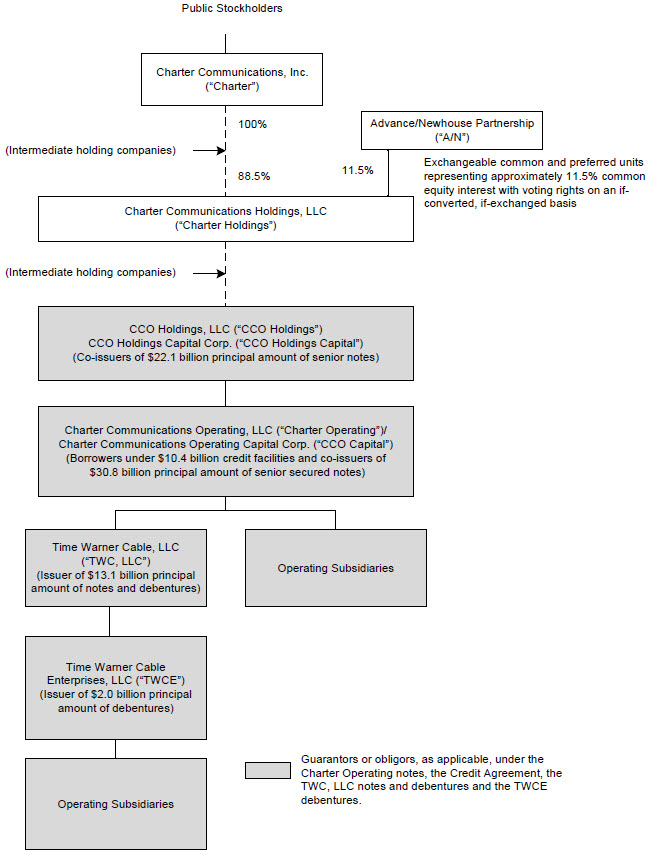
The chart below sets forth our entity structure and that of our direct and indirect subsidiaries. The chart does not include all of our affiliates and subsidiaries and, in some cases, we have combined separate entities for presentation purposes. The equity ownership percentages shown below are approximations. Indebtedness amounts shown below are principal amounts as of December 31, 2019. See Note 9 to the accompanying consolidated financial statements contained in “Part II. Item 8. Financial Statements and Supplementary Data,” which also includes the accreted values of the indebtedness described below.
Products and Services
We offer our customers subscription-based video services, Internet services, and voice and mobile services. Our services are offered to residential and commercial customers on a subscription basis, with prices and related charges based on the types of service selected, whether the services are sold as a “bundle” or on an individual basis, and based on the equipment necessary to receive our services. Bundled services are available to substantially all of our passings, and approximately 57% of our residential customers subscribe to a bundle of services including some combination of our video, Internet and/or voice products.
The following table summarizes our customer statistics for video, Internet, mobile and voice as of December 31, 2019 and 2018 (in thousands except per customer data and footnotes).
| Approximate as of | |||||||
| December 31, | |||||||
| 2019 (a) | 2018 (a) | ||||||
| Customer Relationships (b) | |||||||
| Residential | 27,277 | 26,270 | |||||
| Small and Medium Business | 1,958 | 1,833 | |||||
| Total Customer Relationships | 29,235 | 28,103 | |||||
| Residential Primary Service Units ("PSUs") | |||||||
| Video | 15,620 | 16,104 | |||||
| Internet | 24,908 | 23,625 | |||||
| Voice | 9,443 | 10,135 | |||||
| Monthly Residential Revenue per Residential Customer (c) | $ | 112.63 | $ | 111.56 | |||
| Small and Medium Business PSUs | |||||||
| Video | 524 | 502 | |||||
| Internet | 1,756 | 1,634 | |||||
| Voice | 1,144 | 1,051 | |||||
| Monthly Small and Medium Business Revenue per Customer (d) | $ | 169.90 | $ | 174.88 | |||
| Mobile Lines | 1,082 | 134 | |||||
| Enterprise PSUs (e) | 267 | 248 |
| (a) | We calculate the aging of customer a |
Showing the first 8K of 67K characters. Open the full section
Item 1A. Risk Factors.
Risks Related to Our Business
We operate in a very competitive business environment, which affects our ability to attract and retain customers and can adversely affect our business, operations and financial results.
The industry in which we operate is highly competitive and has become more so in recent years. In some instances, we compete against companies with fewer regulatory burdens, access to better financing, greater personnel resources, greater resources for marketing, greater and more favorable brand name recognition, and long-established relationships with regulatory authorities and customers. Increasing consolidation in the telecommunications and content industries have provided additional benefits to certain of our competitors, either through access to financing, resources, or efficiencies of scale including the ability to launch new video services.
Our video service faces competition from a number of sources, including DBS services, as well as other companies that deliver linear network programming, movies and television shows on demand and other video content over broadband Internet connections to televisions, computers, tablets and mobile devices often with password sharing among multiple users and security that makes content susceptible to piracy. Newer products and services, particularly alternative methods for the distribution, sale and viewing of content will likely continue to be developed, further increasing the number of competitors that we face.
The increasing number of choices available to audiences, including low-cost or free choices, could negatively impact not only consumer demand for our products and services, but also advertisers’ willingness to purchase advertising from us. We compete for the sale of advertising revenue with television networks and stations, as well as other advertising platforms, such as radio, print and, increasingly, online media.
Our Internet service faces competition from the phone companies’ FTTH, FTTN, DSL and wireless broadband offerings as well as from a variety of companies that offer other forms of online services, including fixed wireless and satellite-based broadband services. Various mobile phone companies offer wireless Internet services delivered over networks which they continue to enhance to deliver faster speeds and some began deploying 5G mobile services in 2019 with plans to expand 5G more broadly in the 2020. Our voice and mobile services compete with wireless and wireline phone providers, as well as other forms of communication, such as text messaging on cellular phones, instant messaging, social networking services, video conferencing and email. Competition from these companies, including intensive marketing efforts with aggressive pricing, exclusive programming and increased HD broadcasting may have an adverse impact on our ability to attract and retain customers.
Wireline and wireless overbuilds could also adversely affect our growth, financial condition, and results of operations, by creating or increasing competition. We are aware of traditional overbuild situations impacting certain of our service areas, however, we are unable to predict the extent to which additional overbuild situations may occur.
Our services may not allow us to compete effectively. Our failure to effectively anticipate or adapt to new technologies and changes in consumer expectations and behavior could significantly adversely affect our competitive position with respect to the leisure time and discretionary spending of our customers and, as a result, affect our business and results of operations. Competition may also reduce our expected growth of future cash flows which may contribute to future impairments of our franchises and goodwill and our ability to meet cash flow requirements, including debt service requirements. For additional information regarding the competition we face, see “Item 1. Business -Competition” and “-Regulation and Legislation.”
We face risks inherent in our commercial business.
We may encounter unforeseen difficulties as we increase the scale of our service offerings to businesses. We sell Internet access, data networking and fiber connectivity to office buildings and cellular towers, and video and business voice services to businesses. In order to grow our commercial business, we expect to continue to invest in technology, equipment and personnel focused on the commercial business. Commercial business customers often require service level agreements and generally have heightened customer expectations for reliability of services. If our efforts to build the infrastructure to scale the commercial business are not successful, the growth of our commercial services business would be limited. We depend on interconnection and related services provided by certain third parties for the growth of our commercial business. As a result, our ability to implement changes as the services grow may be limited. If we are unable to meet these service level requirements or expectations, our commercial business could be adversely affected. Competition continues to increase as well, as more companies deploy more fiber to more buildings, which may negatively impact our growth and/or put pressure on margins. Finally, we expect advances in communications technology, as well as changes in the marketplace and the regulatory and legislative environment. Consequently, we are unable to predict the effect that ongoing or future developments in these areas might have on our commercial businesses and operations.
Programming costs per video customer are rising at a much faster rate than wages or inflation, and we may not have the ability to reduce or moderate the growth rates of, or pass on to our customers, our increasing programming costs, which would adversely affect our cash flow and operating margins.
Video programming has been, and is expected to continue to be, our largest operating expense item. In recent years, the cable industry has experienced a rapid escalation in programming rates. Media corporation consolidation has resulted in fewer suppliers and additional selling power on the part of programming suppliers. We expect programming rates will continue to increase due to a variety of factors, including annual increases imposed by programmers with additional selling power as a result of media consolidation, increased demands by owners of broadcast stations for payment for retransmission consent or linking carriage of other services to retransmission consent, and additional programming, particularly new services. The inability to fully pass programming cost increases on to our customers has had, and is expected in the future to have, an adverse impact on our cash flow and operating margins associated with the video product. The contracts set to expire in any particular year vary. There can be no assurance that these agreements will be renewed on favorable or comparable terms. In addition, a number of programmers have begun to sell their services through alternative distribution channels, including IP-based platforms, which are less secure than our own video distribution platforms. There is growing evidence that these less secure video distribution platforms are leading to video product theft via password sharing among consumers. Password sharing may drive down the number of customers who pay for certain programming, putting programmer revenues at risk, and which in turn may cause certain programmers to seek even higher programming fees from us. The ability for consumers to receive the same content for free through such unauthorized channels has devalued our video product which could impact sales, customer retention and our ability to pass through programming costs to consumers, which increases the risk of non-renewal when programmers seek increases. To the extent that we are unable to reach agreement with certain programmers on terms that we believe are reasonable, we have been, and may be in the future, forced to remove such programming channels from our line-up, which may result in a loss of customers. Our failure to carry programming that is attractive to our customers could adversely impact our customer levels, operations and financial results. In addition, if our Internet customers are unable to access desirable content online because content providers block or limit access by our customers as a class, our ability to gain and retain customers, especially Internet customers, may be negatively impacted.
Increased demands by owners of some broadcast stations for carriage of other services or payments to those broadcasters for retransmission consent are likely to further increase our programming costs. Federal law allows commercial television broadcast stations to make an election between “must-carry” rights and an alternative “retransmission-consent” regime. When a station opts for the retransmission consent regime, we are not allowed to carry the station’s signal without that station’s permission. In some cases, we carry stations under short-term arrangements while we attempt to negotiate new long-term retransmission agreements. If negotiations with these programmers prove unsuccessful, they could require us to cease carrying their signals, possibly for an indefinite period. Any loss of stations could make our video service less attractive to customers, which could result in less
subscription and advertising revenue. In retransmission-consent negotiations, broadcasters often condition consent with respect to one station on carriage of one or more other stations or programming services in which they or their affiliates have an interest. Carriage of these other services, as well as increased fees for retransmission rights, may increase our programming expenses and diminish the amount of capacity we have available to introduce new services, which could have an adverse effect on our business and financial results.
Our inability to respond to technological developments and meet customer demand for new products and services could adversely affect our ability to compete effectively.
We operate in a highly competitive, consumer-driven and rapidly changing environment. From time to time, we may pursue strategic initiatives, including, for example, our wireless strategy which includes the launch of our mobile product through an MVNO and testing the deployment of unlicensed and licensed spectrum for fixed and mobile wireless services. Our success is, to a large extent, dependent on our ability to acquire, develop, adopt, upgrade and exploit new and existing technologies to address consumers’ changing demands and distinguish our services from those of our competitors. We may not be able to accurately predict technological trends or the success of new products and services. If we choose technologies or equipment that are less effective, cost-efficient or attractive to customers than those chosen by our competitors, if we offer services that fail to appeal to consumers, are not available at competitive prices or that do not function as expected, or we are not able to fund the expenditures necessary to keep pace with technological developments, our competitive position could deteriorate, and our business and financial results could suffer.
The ability of some of our competitors to introduce new technologies, products and services more quickly than we do may adversely affect our competitive position. Furthermore, advances in technology, decreases in the cost of existing technologies or changes in competitors’ product and service offerings may require us in the future to make additional research and development expenditures or to offer, at no additional charge or at a lower price, certain products and services that we currently offer to customers separately or at a premium. In addition, the uncertainty of our ability, and the costs, to obtain intellectual property rights from third parties could impact our ability to respond to technological advances in a timely and effective manner.
Our inability to maintain and expand our upgraded systems and provide advanced services such as a state of the art user interface in a timely manner, or to anticipate the demands of the marketplace, could materially adversely affect our ability to attract and retain customers. In addition, as we launch our new mobile services using virtual network operator rights from a third party, we expect an initial funding period to grow a new product as well as negative working capital impacts from the timing of device-related cash flows when we provide the handset or tablet pursuant to equipment installation plans. Consequently, our growth, financial condition and results of operations could suffer materially.
We depend on third-party service providers, suppliers and licensors; thus, if we are unable to procure the necessary services, equipment, software or licenses on reasonable terms and on a timely basis, our ability to offer services could be impaired, and our growth, operations, business, financial results and financial condition could be materially adversely affected.
We depend on a limited number of third-party service providers, suppliers and licensors to supply some of the services, hardware, software and operational support necessary to provide some of our services. Some of our hardware, software and operational support vendors, and service providers represent our sole source of supply or have, either through contract or as a result of intellectual property rights, a position of some exclusivity. If any of these parties breaches or terminates its agreement with us or otherwise fails to perform its obligations in a timely manner, demand exceeds these vendors’ capacity, tariffs are imposed that impact vendors' ability to perform their obligations or significantly increase the amount we pay, they experience operating or financial difficulties, they significantly increase the amount we pay for necessary products or services, or they cease production of any necessary product due to lack of demand, profitability or a change in ownership or are otherwise unable to provide the equipment or services we need in a timely manner, at our specifications and at reasonable prices, our ability to provide some services might be materially adversely affected, or the need to procure or develop alternative sources of the affected materials or services might delay our ability to serve our customers. In addition, the existence of only a limited number of vendors of key technologies can lead to less product innovation and higher costs. These events could materially and adversely affect our ability to retain and attract customers and our operations, business, financial results and financial condition.
Our business may be adversely affected if we cannot continue to license or enforce the intellectual property rights on which our business depends.
We rely on patent, copyright, trademark and trade secret laws and licenses and other agreements with our employees, customers, suppliers and other parties to establish and maintain our intellectual property rights in technology and the products and services used in our operations. Also, because of the rapid pace of technological change, we both develop our own technologies, products and services and rely on technologies developed or licensed by third parties. However, any of our intellectual property rights, or
the rights of our suppliers, could be challenged or invalidated, or such intellectual property rights may not be sufficient to permit us to take advantage of current industry trends or otherwise to provide competitive advantages, which could result in costly redesign efforts, discontinuance of certain product or service offerings or other competitive harm. We may not be able to obtain or continue to obtain licenses from these third parties on reasonable terms, if at all. In addition, claims of intellectual property infringement could require us to enter into royalty or licensing agreements on unfavorable terms, incur substantial monetary liability or be enjoined preliminarily or permanently from further use of the intellectual property in question, which could require us to change our business practices or offerings and limit our ability to compete effectively. Even unsuccessful claims can be time-consuming and costly to defend and may divert management’s attention and resources away from our business. Infringement claims continue to be brought frequently in the communications and entertainment industries, and we are also often a party to such litigation alleging that certain of our services or technologies infringe the intellectual property rights of others.
Various events could disrupt or result in unauthorized access to our networks, information systems or properties and could impair our operating activities and negatively impact our reputation and financial results.
Network and information systems technologies are critical to our operating activities, both for our internal uses, such as network management and supplying services to our customers, including customer service operations and programming delivery. Network or information system shutdowns or other service disruptions caused by events such as computer hacking, phishing, dissemination of computer viruses, worms and other destructive or disruptive software, “cyber attacks,” process breakdowns, denial of service attacks and other malicious activity pose increasing risks. Both unsuccessful and successful “cyber attacks” on companies have continued to increase in frequency, scope and potential harm in recent years. While we develop and maintain systems seeking to prevent systems-related events and security breaches from occurring, the development and maintenance of these systems is costly and requires ongoing monitoring and updating as techniques used in such attacks become more sophisticated and change frequently. We, and the third parties on which we rely, may be unable to anticipate these techniques or implement adequate preventive measures. While from time to time attempts have been made to access our network, these attempts have not as yet resulted in any material release of information, degradation or disruption to our network and information systems.
Our network and information systems are also vulnerable to damage or interruption from power outages, telecommunications failures, accidents, natural disasters (including extreme weather arising from short-term or any long-term changes in weather patterns), terrorist attacks and similar events. Our system redundancy may be ineffective or inadequate, and our disaster recovery planning may not be sufficient for all eventualities.
Any of these events, if directed at, or experienced by, us or technologies upon which we depend, could have adverse consequences on our network, our customers and our business, including degradation of service, service disruption, excessive call volume to call centers, and damage to our or our customers’ equipment and data. Large expenditures may be necessary to repair or replace damaged property, networks or information systems or to protect them from similar events in the future. Moreover, the amount and scope of insurance that we maintain against losses resulting from any such events or security breaches may not be sufficient to cover our losses or otherwise adequately compensate us for any disruptions to our business that may result. Any such significant service disruption could result in damage to our reputation and credibility, customer dissatisfaction and ultimately a loss of customers or revenue. Any significant loss of customers or revenue, or significant increase in costs of serving those customers, could adversely affect our growth, financial condition and results of operations.
Furthermore, our operating activities could be subject to risks caused by misappropriation, misuse, leakage, falsification or accidental release or loss of information maintained in our information technology systems and networks and those of our third-party vendors, including customer, personnel and vendor data. We provide certain confidential, proprietary and personal information to third parties in connection with our business, and there is a risk that this information may be compromised.
We process, store, and transmit large amounts of data, including the personal information of our customers. Ongoing increases in the potential for mis-use of personal information, the public’s awareness of the importance of safeguarding personal information, and the volume of legislation that has been adopted or is being considered regarding the protection, privacy, and security of personal information have resulted in increases to our information-related risks. We could be exposed to significant costs if such risks were to materialize, and such events could damage our reputation, credibility and business and have a negative impact on our revenue. We could be subject to regulatory actions and claims made by consumers in private litigations involving privacy issues related to consumer data collection and use practices. We also could be required to expend significant capital and other resources to remedy any such security breach.
Our exposure to the economic conditions of our current and potential customers, vendors and third parties could adversely affect our cash flow, results of operations and financial condition.
We are exposed to risks associated with the economic conditions of our current and potential customers, the potential financial instability of our customers and their financial ability to purchase our products. If there were a general economic downturn, we may experience increased cancellations or non-payment by our customers or unfavorable changes in the mix of products purchased. This may include an increase in the number of homes that replace their video service with Internet-delivered and/or over-air content, as well as an increase in the number of Internet and voice customers substituting mobile data and voice products for wireline services, which would negatively impact our ability to attract customers, increase rates and maintain or increase revenue. In addition, our ability to gain new customers is dependent to some extent on growth in occupied housing in our service areas, which is influenced by both national and local economic conditions. Weak economic conditions may also have a negative impact on our advertising revenue. These events have adversely affected us in the past, and may adversely affect our cash flow, results of operations and financial condition if a downturn were to occur.
In addition, we are susceptible to risks associated with the potential financial instability of the vendors and third parties on which we rely to provide products and services or to which we outsource certain functions. The same economic conditions that may affect our customers, as well as volatility and disruption in the capital and credit markets, also could adversely affect vendors and third parties and lead to significant increases in prices, reduction in output or the bankruptcy of our vendors or third parties upon which we rely. Any interruption in the services provided by our vendors or by third parties could adversely affect our cash flow, results of operation and financial condition.
For tax purposes, Charter could experience a deemed ownership change in the future that could limit its ability to use its tax loss carryforwards.
Charter had approximately $7.5 billion of federal tax net operating loss carryforwards resulting in a gross deferred tax asset of approximately $1.6 billion as of December 31, 2019. These losses resulted from the operations of Charter Communications Holding Company, LLC ("Charter Holdco") and its subsidiaries and from loss carryforwards received as a result of the merger with TWC. Federal tax net operating loss carryforwards expire in the years 2020 through 2035. In addition, Charter had state tax net operating loss carryforwards resulting in a gross deferred tax asset (net of federal tax benefit) of approximately $257 million as of December 31, 2019. State tax net operating loss carryforwards generally expire in the years 2020 through 2039.
In the past, Charter has experienced ownership changes as defined in Section 382 of the Internal Revenue Code of 1986, as amended (the “Code”). In general, an ownership change occurs whenever the percentage of the stock of a corporation owned, directly or indirectly, by 5-percent stockholders (within the meaning of Section 382 of the Code) increases by more than 50 percentage points over the lowest percentage of the stock of such corporation owned, directly or indirectly, by such 5-percent stockholders at any time over the preceding three years. As a result, Charter is subject to an annual limitation on the use of its loss carryforwards which existed at November 30, 2009 for the first ownership change, those that existed at May 1, 2013 for the second ownership change, and those created at May 18, 2016 for the third ownership change. The limitation on Charter's ability to use its loss carryforwards, in conjunction with the loss carryforward expiration provisions, could reduce Charter's ability to use a portion of its loss carryforwards to offset future taxable income, which could result in Charter being required to make material cash tax payments. Charter's ability to make such income tax payments, if any, will depend at such time on its liquidity or its ability to raise additional capital, and/or on receipt of payments or distributions from Charter Holdco and its subsidiaries.
If Charter were to experience additional ownership changes in the future (as a result of purchases and sales of stock by its 5-percent stockholders, new issuances or redemptions of our stock, certain acquisitions of its stock and issuances, redemptions, sales or other dispositions or acquisitions of interests in its 5-percent stockholders), Charter's ability to use its loss carryforwards could become subject to further limitations.
If we are unable to retain key employees, our ability to manage our business could be adversely affected.
Our operational results have depended, and our future results will depend, upon the retention and continued performance of our management team. Our ability to retain and hire new key employees for management positions could be impacted adversely by the competitive environment for management talent in the broadband communications industry. The loss of the services of key members of management and the inability or delay in hiring new key employees could adversely affect our ability to manage our business and our future operational and financial results.
Risks Related to Our Indebtedness
We have a significant amount of debt and expect to incur significant additional debt, including secured debt, in the future, which could adversely affect our financial health and our ability to react to changes in our business.
We have a significant amount of debt and expect to (subject to applicable restrictions in our debt instruments) incur additional debt in the future as we maintain our stated objective of 4.0 to 4.5 times Adjusted EBITDA leverage (our net debt divided by our last twelve months Adjusted EBITDA). As of December 31, 2019, our total principal amount of debt was approximately $78.4 billion with a leverage ratio of 4.5 times Adjusted EBITDA.
Our significant amount of debt could have consequences, such as:
| • | impact our ability to raise additional capital at reasonable rates, or at all; |
| • | make us vulnerable to interest rate increases, in part because approximately 14% of our borrowings as of December 31, 2019 were, and may continue to be, subject to variable rates of interest; |
| • | expose us to increased interest expense to the extent we refinance existing debt with higher cost debt; |
| • | require us to dedicate a significant portion of our cash flow from operating activities to make payments on our debt, reducing our funds available for working capital, capital expenditures, and other general corporate expenses; |
| • | limit our flexibility in planning for, or reacting to, changes in our business, the cable and telecommunications industries, and the economy at large; |
| • | place us at a disadvantage compared to our competitors that have proportionately less debt; and |
| • | adversely affect our relationship with customers and suppliers. |
To the extent our current debt amounts increase more than expected, our business results are lower than expected, or credit rating agencies downgrade our debt limiting our access to investment grade markets, the related risks that we now face will intensify. In addition, our variable rate indebtedness may use London Interbank Offering Rate (“LIBOR”) as a benchmark for establishing the rate. The United Kingdom’s Financial Conduct Authority, which regulates LIBOR, has announced that it intends to stop encouraging or compelling banks to submit rates for the calculation of LIBOR rates after 2021 (the “FCA Announcement”). The FCA Announcement indicates that the continuation of LIBOR on the current basis is not guaranteed after 2021 and, based on the foregoing, it appears likely that LIBOR will be discontinued or modified by 2021. The effects of the FCA Announcement cannot be entirely predicted, but could include an increase in the cost of our variable rate indebtedness.
The agreements and instruments governing our debt contain restrictions and limitations that could significantly affect our ability to operate our business, as well as significantly affect our liquidity.
Our credit facilities and the indentures governing our debt contain a number of significant covenants that could adversely affect our ability to operate our business, our liquidity, and our results of operations. These covenants restrict, among other things, our and our subsidiaries’ ability to:
| • | incur additional debt; |
| • | repurchase or redeem equity interests and debt; |
| • | issue equity; |
| • | make certain investments or acquisitions; |
| • | pay dividends or make other distributions; |
| • | dispose of assets or merge; |
| • | enter into related party transactions; and |
| • | grant liens and pledge assets. |
Additionally, the Charter Communications Operating, LLC ("Charter Operating") credit facilities require Charter Operating to comply with a maximum total leverage covenant and a maximum first lien leverage covenant. The breach of any covenants or obligations in our indentures or credit facilities, not otherwise waived or amended, could result in a default under the applicable debt obligations and could trigger acceleration of those obligations, which in turn could trigger cross defaults under other agreements governing our long-term indebtedness. In addition, the secured lenders under our notes and the Charter Operating credit facilities could foreclose on their collateral, which includes equity interests in our subsidiaries, and exercise other rights of secured creditors.
Risks Related to Ownership Position of Liberty Broadband Corporation and Advance/Newhouse Partnership
Liberty Broadband and Advance/Newhouse Partnership (“A/N”) have governance rights that give them influence over corporate transactions and other matters.
Liberty Broadband currently owns a significant amount of Charter Class A common stock and is entitled to certain governance rights with respect to Charter. A/N currently owns Charter Class A common stock and a significant amount of membership interests in our subsidiary Charter Communications Holdings, LLC (“Charter Holdings”), that are convertible into Charter Class A common stock and is entitled to certain governance rights with respect to Charter. Members of the Charter board of directors include a director who is also an officer and director of Liberty Broadband and directors who are current or former officers and directors of A/N. Mr. Greg Maffei is the President and Chief Executive Officer of Liberty Broadband. Steven Miron is the Chief Executive Officer of A/N and Michael Newhouse is an officer or director of several of A/N’s affiliates. As of December 31, 2019, Liberty Broadband beneficially held approximately 25% of Charter’s voting stock (including shares owned by GCI Liberty, Inc. ("GCI Liberty," formerly known as Liberty Interactive Corporation) over which Liberty Broadband holds an irrevocable voting proxy) and A/N beneficially held approximately 13% of Charter’s voting stock. Pursuant to the stockholders agreement between Liberty Broadband, A/N and Charter, Liberty Broadband currently has the right to designate up to three directors as nominees for Charter’s board of directors and A/N currently has the right to designate up to two directors as nominees for Charter’s board of directors. Each of A/N and Liberty Broadband is entitled to nominate at least one director to each of the committees of Charter's board of directors, subject to applicable stock exchange listing rules and certain specified voting or equity ownership thresholds for each of A/N and Liberty Broadband, and provided that the Nominating and Corporate Governance Committee and the Compensation and Benefit Committee each have at least a majority of directors independent from A/N, Liberty Broadband and Charter (referred to as the “unaffiliated directors”).
In connection with the merger with TWC, Liberty Broadband and GCI Liberty entered into a proxy and right of first refusal agreement, pursuant to which GCI Liberty granted Liberty Broadband an irrevocable proxy to vote all Charter Class A common stock owned beneficially or of record by GCI Liberty, with certain exceptions. In addition, at the closing of the acquisition of Bright House, A/N and Liberty Broadband entered into a proxy agreement pursuant to which A/N granted to Liberty Broadband a 5-year irrevocable proxy (which we refer to as the “A/N proxy”) to vote, subject to certain exceptions, that number of shares of Charter Class A common stock and Charter Class B common stock, in each case held by A/N (such shares are referred to as the “proxy shares”), that will result in Liberty Broadband having voting power in Charter equal to 25.01% of the outstanding voting power of Charter, provided, that the voting power of the proxy shares is capped at 7.0% of the outstanding voting power of Charter. In December of 2019, Liberty Broadband’s voting power in Charter exceeded 25.01% and, therefore, as of December 31, 2019, the A/N proxy had no impact on Liberty Broadband’s voting power. The stockholders agreement and Charter’s amended and restated certificate of incorporation fixes the size of the board at 13 directors. Liberty Broadband and A/N are required to vote (subject to the applicable voting cap) their respective shares of Charter Class A common stock and Charter Class B common stock for the director nominees nominated by the nominating and corporate governance committee of the board of directors, including the respective designees of Liberty Broadband and A/N, and against any other nominees, except that, with respect to the unaffiliated directors, Liberty Broadband and A/N must instead vote in the same proportion as the voting securities are voted by stockholders other than A/N and Liberty Broadband or any group which includes any of them are voted, if doing so would cause a different outcome with respect to the unaffiliated directors. In addition, because Liberty Broadband’s voting power exceeds its voting cap of 25.01%, Liberty Broadband must vote and exercise rights to consent with respect to voting securities held in excess of the voting cap in the same proportion as all other votes cast by stockholders other than A/N and Liberty Broadband with respect to the applicable matter. As a result of their rights under the stockholders agreement and their significant equity and voting stakes in Charter, Liberty Broadband and/or A/N, who may have interests different from those of other stockholders, will be able to exercise substantial influence over certain matters relating to the governance of Charter, including the approval of significant corporate actions, such as mergers and other business combination transactions.
The stockholders agreement provides A/N and Liberty Broadband with preemptive rights with respect to issuances of Charter equity in connection with certain transactions, and in the event that A/N or Liberty Broadband exercises these rights, holders of Charter Class A common stock may experience further dilution.
The stockholders agreement provides that A/N and Liberty Broadband will have certain contractual preemptive rights over issuances of Charter equity securities in connection with capital raising transactions, merger and acquisition transactions, and in certain other circumstances. Holders of Charter Class A common stock will not be entitled to similar preemptive rights with respect to such transactions. As a result, if Liberty Broadband and/or A/N elect to exercise their preemptive rights, (i) these parties would not experience the dilution experienced by the other holders of Charter Class A common stock, and (ii) such other holders of Charter Class A common stock may experience further dilution of their interest in Charter upon such exercise.
Risks Related to Regulatory and Legislative Matters
Our business is subject to extensive governmental legislation and regulation, which could adversely affect our business.
Regulation of the cable industry has increased cable operators’ operational and administrative expenses and limited their revenues. Cable operators are subject to numerous laws and regulations including those covering the following:
| • | the provision of high-speed Internet service, including net neutrality and transparency rules; |
| • | the provision of voice communications; |
| • | cable franchise renewals and transfers; |
| • | the provisioning and marketing of cable equipment; |
| • | customer and employee privacy and data security; |
| • | copyright royalties for retransmitting broadcast signals; |
| • | when a cable system must carry a particular broadcast station and when it must first obtain retransmission consent to carry a broadcast station; |
| • | the provision of video channel capacity to unaffiliated commercial leased access programmers; |
| • | limitations on our ability to enter into exclusive agreements with multiple dwelling unit complexes and control our inside wiring; |
| • | equal employment opportunity; |
| • | emergency alert systems, disability access, pole attachments, and technical standards; |
| • | marketing practices, customer service, and consumer protection; and |
| • | approval for mergers and acquisitions often accompanied by the imposition of restrictions and requirements on an applicant’s business in order to secure approval of the proposed transaction. |
Legislators and regulators at all levels of government frequently consider changing, and sometimes do change, existing statutes, rules, regulations, or interpretations thereof, or prescribe new ones. Any future legislative, judicial, regulatory or administrative actions may increase our costs or impose additional restrictions on our businesses.
As a result of the closing of the 2016 merger with TWC and acquisition of Bright House, our businesses are subject to the conditions set forth in the FCC Order and the DOJ Consent Decree and those imposed by state utility commissions and local franchise authorities, and there can be no assurance that these conditions will not have an adverse effect on our businesses and results of operations.
In connection with the Transactions, the FCC Order, the DOJ Consent Decree, and the approvals from state utility commissions and local franchise authorities incorporated numerous commitments and voluntary conditions made by the parties and imposed numerous conditions on our businesses relating to the operation of our business and other matters. Under federal approvals, among other things, (i) we are not permitted to charge usage-based prices or impose data caps and are prohibited from charging interconnection fees for qualifying parties; (ii) we are prohibited from entering into or enforcing any agreement with a programmer that forbids, limits or creates incentives to limit the programmer’s provision of content to OVD and cannot retaliate against programmers for licensing to OVDs; (iii) we are not able to avail ourself of other distributors’ MFN provisions if they are inconsistent with this prohibition; (iv) we appointed an independent compliance monitor and comply with a broad array of reporting requirements; and (v) we must satisfy various other conditions relating to our Internet services, including building out an additional two million locations with access to a high-speed connection of at least 60 megabits per second, and implementing a reduced price high-speed Internet program for low income families. These and other conditions and commitments relating to the transactions are of varying duration, ranging from three to seven years. In light of the breadth and duration of the conditions and potential changes in market conditions during the time the conditions and commitments are in effect, there can be no assurance that our compliance, and ability to comply, with the conditions will not have a material adverse effect on our business or results of operations.
Changes to existing statutes, rules, regulations, or interpretations thereof, or adoption of new ones, could have an adverse effect on our business.
There are ongoing efforts to amend or expand the federal, state, and local regulation of some of the services offered over our cable systems, which may compound the regulatory risks we already face. For example, with respect to our retail broadband Internet access service, the FCC has reclassified the service twice in the last few years, with the first change adding federal regulatory obligations and the second change largely removing those new regulatory obligations. These changes reflect a lack of regulatory certainty in this business area, which may continue as a result of litigation, as well as future legislative or administrative changes.
Other potential legislative and regulatory changes could adversely impact our business by increasing our costs and competition and limiting our ability to offer services in a manner that that would maximize our revenue potential. These changes could include,
for example, the adoption of new privacy restrictions on our collection, use and disclosure of certain customer information, new data security and cybersecurity mandates that could result in additional network and information security requirements for our business, new restraints on our discretion over programming decisions, including commercial leased access programming, new restrictions on the rates we charge for video programming and the marketing and packaging of that video programming and other services to consumers, changes to the cable industry’s compulsory copyright license to carry broadcast signals, new requirements to assure the availability of navigation devices (such as set-top boxes) from third-party providers, new Universal Service Fund obligations on our provision of Internet service that would add to the cost of that service; increases in government-administered broadband subsidies to rural areas that could result in subsidized overbuilding of our more rural facilities, changes to the FCC's administration of spectrum, and changes in the regulatory framework for VoIP phone service, including the scope of regulatory obligations associated with our VoIP service and our ability to interconnect our VoIP service with incumbent providers of traditional telecommunications service.
If any of these such laws or regulations are enacted, they could affect our operations and require significant expenditures. We cannot predict future developments in these areas, and we are already subject to Charter-specific conditions regarding certain Internet practices as a result of the FCC’s approval in 2016 of the merger with TWC and acquisition of Bright House, but any changes to the regulatory framework for our video, Internet or VoIP services could have a negative impact on our business and results of operations.
It remains uncertain what rule changes, if any, will ultimately be adopted by Congress and the FCC and what operating or financial impact any such rules might have on us, including on our programming agreements, customer privacy and the user experience. In addition, the FCC, the FTC, and various state agencies and attorney generals actively investigate industry practices and could impose substantial forfeitures for alleged regulatory violations.
Our cable system franchises are subject to non-renewal or termination and are non-exclusive. The failure to renew a franchise or the grant of additional franchises in one or more service areas could adversely affect our business.
Our cable systems generally operate pursuant to franchises, permits, and similar authorizations issued by a state or local governmental authority controlling the public rights-of-way. Many franchises establish comprehensive facilities and service requirements, as well as specific customer service standards and monetary penalties for non-compliance. In many cases, franchises are terminable if the franchisee fails to comply with significant provisions set forth in the franchise agreement governing system operations. Franchises are generally granted for fixed terms and must be periodically renewed. Franchising authorities may resist granting a renewal if either past performance or the prospective operating proposal is considered inadequate. Franchise authorities often demand concessions or other commitments as a condition to renewal. In some instances, local franchises have not been renewed at expiration, and we have operated and are operating under either temporary operating agreements or without a franchise while negotiating renewal terms with the local franchising authorities.
We cannot assure you that we will be able to comply with all significant provisions of our franchise agreements and certain of our franchisers have from time to time alleged that we have not complied with these agreements. Additionally, although historically we have renewed our franchises without incurring significant costs, we cannot assure you that we will be able to renew, or to renew as favorably, our franchises in the future. A termination of or a sustained failure to renew a franchise in one or more service areas could adversely affect our business in the affected geographic area.
Our cable system franchises are non-exclusive. Consequently, local and state franchising authorities can grant additional franchises to competitors in the same geographic area or operate their own cable systems. In some cases, local government entities and municipal utilities may legally compete with us on more favorable terms.
Tax legislation and administrative initiatives or challenges to our tax and fee positions could adversely affect our results of operations and financial condition.
We operate cable systems in locations throughout the United States and, as a result, we are subject to the tax laws and regulations of federal, state and local governments. From time to time, various legislative and/or administrative initiatives may be proposed that could adversely affect our tax positions. There can be no assurance that our effective tax rate or tax payments will not be adversely affected by these initiatives. Certain states and localities have imposed or are considering imposing new or additional taxes or fees on our services or changing the methodologies or base on which certain fees and taxes are computed. Potential changes include additional taxes or fees on our services which could impact our customers, changes to income tax sourcing rules and other changes to general business taxes, central/unit-level assessment of property taxes and other matters that could increase our income, franchise, sales, use and/or property tax liabilities. For example, some local franchising authorities are seeking to impose franchise fee assessments on our broadband Internet access service (in addition to our video service), and more may do so in the future. If they do so, and challenges to such assessments are unsuccessful, it could adversely impact our costs. Although the FCC recently
issued a decision precluding the imposition of such duplicative fees, that favorable decision is currently subject to judicial review. In addition, federal, state and local tax laws and regulations are extremely complex and subject to varying interpretations. There can be no assurance that our tax positions will not be challenged by relevant tax authorities or that we would be successful in any such challenge.
Item 1B. Unresolved Staff Comments.
None.
Item 2. Properties.
Our principal physical assets consist of cable distribution plant and equipment, including signal receiving, encoding and decoding devices, headend reception facilities, distribution systems, and customer premise equipment for each of our cable systems.
Our cable plant and related equipment are generally attached to utility poles under pole rental agreements with local public utilities and telephone companies, and in certain locations are buried in underground ducts or trenches. We own or lease real property for signal reception sites, and own our service vehicles.
We generally lease space for business offices. Our headend and tower locations are located on owned or leased parcels of land, and we generally own the towers on which our equipment is located.
The physical components of our cable systems require maintenance as well as periodic upgrades to support the new services and products we introduce. See “Item 1. Business – Our Network Technology and Customer Premise Equipment.” We believe that our properties are generally in good operating condition and are suitable for our business operations.
Item 3. Legal Proceedings.
The legal proceedings information set forth in Note 21 to the accompanying consolidated financial statements contained in “Part II. Item 8. Financial Statements and Supplementary Data” in this Annual Report on Form 10-K is incorporated herein by reference.
Item 4. Mine Safety Disclosures.
Not applicable.
PART II
Item 5. Market for Registrant’s Common Equity, Related Stockholder Matters and Issuer Purchases of Equity Securities.
Charter’s Class A common stock is listed on the NASDAQ Global Select Market under the symbol “CHTR.” As of December 31, 2019, there were approximately 12,300 holders of record of Charter’s Class A common stock and one holder of Charter's Class B common stock. Charter has not paid cash dividends on its common stock and does not intend to do so in the foreseeable future. During 2019, there were no unregistered sales of securities of the registrant.
Securities Authorized for Issuance Under Equity Compensation Plans
The following information is provided as of December 31, 2019 with respect to equity compensation plans:
| Plan Category | Number of Securities to be Issued Upon Exercise of Outstanding Options, Warrants and Rights | Weighted Average Exercise Price of Outstanding Warrants and Rights | Number of Securities Remaining Available for Future Issuance Under Equity Compensation Plans | |||||||||
| Equity compensation plans approved by security holders | 12,608,020 | (1) | $ | 242.50 | 15,882,887 | (1) | ||||||
| Equity compensation plans not approved by security holders | — | $ | — | — | ||||||||
| TOTAL | 12,608,020 | (1) | 15,882,887 | (1) |
| (1) | This total does not include 8,284 shares issued pursuant to restricted stock grants made under our 2019 Stock Incentive Plan, which are subject to vesting based on continued service. |
For information regarding securities issued under our equity compensation plans, see Note 16 to our accompanying consolidated financial statements contained in “Part II. Item 8. Financial Statements and Supplementary Data.”
Performance Graph
The performance graph required by Item 5 will be included in Charter’s 2019 Proxy Statement (the “Proxy Statement”) under the headings “Compensation Discussion and Analysis,” or in amendment to this Annual Report on Form 10-K and is incorporated herein by reference.
Purchases of Equity Securities by the Issuer
The following table presents Charter’s purchases of equity securities completed during the fourth quarter of 2019 (dollars in millions, except per share data).
| Period | Total Number of Shares Purchased (1) | Average Price Paid per Share | Total Number of Shares Purchased as Part of Publicly Announced Plans or Programs (2) | Approximate Dollar Value of Shares that May Yet Be Purchased Under the Plans or Programs (2) | |||
| October 1 - 31, 2019 | 1,186,853 | $ | 428.17 | 1,157,618 | $803 | ||
| November 1 - 30, 2019 | 1,586,050 | $ | 472.21 | 1,538,480 | $2,254 | ||
| December 1 - 31, 2019 | 2,270,062 | $ | 471.62 | 2,243,602 | $1,361 |
| (1) | Includes 29,235, 47,570 and 26,460 shares withheld from employees for the payment of taxes and exercise costs upon the exercise of stock options or vesting of other equity awards for the months of October, November and December 2019, respectively. |
| (2) | During the three months ended December 31, 2019, Charter purchased approximately 4.9 million shares of its Class A common stock for approximately $2.3 billion. Charter Holdings purchased 0.7 million Charter Holdings common units from A/N at an average price per unit of $442.38, or $292 million during the three months ended December 31, 2019. As of December 31, 2019, Charter had remaining board authority to purchase an additional $1.4 billion of Charter’s Class A common stock and/ |
or Charter Holdings common units. In addition to open market purchases including pursuant to Rule 10b5-1 plans adopted from time to time, Charter may also buy shares of Charter Class A common stock, from time to time, pursuant to private transactions outside of its Rule 10b5-1 plan and any such repurchases may also trigger the repurchases from A/N pursuant to and to the extent provided in the Letter Agreement. See "Part II. Item 7. Management's Discussion and Analysis of Financial Condition and Results of Operations — Liquidity and Capital Resources."
Item 6. Selected Financial Data.
The following table presents selected consolidated financial data for the periods indicated (dollars in millions, except per share data):
| Years Ended December 31, | |||||||||||||||||||
| 2019 | 2018 | 2017 | 2016 | 2015 | |||||||||||||||
| Statement of Operations Data: | |||||||||||||||||||
| Revenues | $ | 45,764 | $ | 43,634 | $ | 41,581 | $ | 29,003 | $ | 9,754 | |||||||||
| Income from operations | $ | 6,511 | $ | 5,221 | $ | 4,106 | $ | 2,456 | $ | 1,114 | |||||||||
| Interest expense, net | $ | 3,797 | $ | 3,540 | $ | 3,090 | $ | 2,499 | $ | 1,306 | |||||||||
| Income (loss) before income taxes | $ | 2,431 | $ | 1,686 | $ | 1,028 | $ | 820 | $ | (331 | ) | ||||||||
| Net income (loss) attributable to Charter shareholders | $ | 1,668 | $ | 1,230 | $ | 9,895 | $ | 3,522 | $ | (271 | ) | ||||||||
| Income (loss) per common share, basic | $ | 7.60 | $ | 5.29 | $ | 38.55 | $ | 17.05 | $ | (2.68 | ) | ||||||||
| Income (loss) per common share, diluted | $ | 7.45 | $ | 5.22 | $ | 34.09 | $ | 15.94 | $ | (2.68 | ) | ||||||||
| Weighted average shares outstanding, basic (a) | 219,506,735 | 232,356,665 | 256,720,715 | 206,539,100 | 101,152,647 | ||||||||||||||
| Weighted average shares outstanding, diluted (a) | 223,786,380 | 235,525,226 | 296,703,956 | 234,791,439 | 101,152,647 | ||||||||||||||
| Balance Sheet Data (end of period): | |||||||||||||||||||
| Investment in cable properties | $ | 138,920 | $ | 141,564 | $ | 142,712 | $ | 144,396 | $ | 16,375 | |||||||||
| Total assets | $ | 148,188 | $ | 146,130 | $ | 146,623 | $ | 149,067 | $ | 39,316 | |||||||||
| Total debt | $ | 79,078 | $ | 72,827 | $ | 70,231 | $ | 61,747 | $ | 35,723 | |||||||||
| Total shareholders’ equity (deficit) | $ | 38,811 | $ | 44,272 | $ | 47,531 | $ | 50,366 | $ | (46 | ) |
| (a) | Weighted average number of shares outstanding for the year ended December 31, 2015 have been recast to reflect the application of the Parent Merger Exchange Ratio (as defined in the Merger Agreement related to the merger with TWC and acquisition of Bright House in 2016). |
Comparability of the above information from year to year is affected by acquisitions and dispositions completed by us, including the merger with TWC and acquisition of Bright House in 2016.
Item 7. Management’s Discussion and Analysis of Financial Condition and Results of Operations.
Reference is made to “Part I. Item 1A. Risk Factors” and “Cautionary Statement Regarding Forward-Looking Statements,” which describe important factors that could cause actual results to differ from expectations and non-historical information contained herein. In addition, the following discussion should be read in conjunction with the audited consolidated financial statements and accompanying notes thereto of Charter included in “Part II. Item 8. Financial Statements and Supplementary Data.”
Overview
We are the second largest cable operator in the United States and a leading broadband communications services company providing video, Internet and voice services to approximately 29.2 million residential and small and medium business customers at December 31, 2019. We also offer mobile service to residential customers and recently launched mobile service to small and medium business customers. In addition, we sell video and online advertising inventory to local, regional and national advertising customers and tailored communications and managed solutions to larger enterprise customers. We also own and operate regional sports networks and local sports, news and community channels. See “Part I. Item 1. Business — Products and Services” for further description of these services, including customer statistics for different services.
In 2019, with the integration of TWC and Bright House substantially behind us, we are realizing the benefits of operating as one company, with a unified product, marketing and service infrastructure. We remain focused on driving customer relationship growth
by deploying superior products and services packaged with attractive pricing. We expect our insourced, high quality workforce will continue to drive an improved customer experience which will result in lower customer churn, longer customer lifetimes and, combined with our continued ramping of our self-installation program, improved productivity with fewer customer calls and truck rolls per customer relationship. With approximately 85% of our residential customer base now in SPP packages, we expect additional benefits from lower legacy package migration activity, combined with SPP customers rolling off introductory pricing and price increases. Further, we expect to continue to drive customer relationship growth through sales of bundled services and improving customer retention despite the expectation for continued losses of video and wireline voice customers. With the completion of our all-digital conversion, roll-out of DOCSIS 3.1 technology across our footprint, and the integration of TWC and Bright House substantially complete, we have experienced a meaningful reduction in cable capital expenditures as a percent of revenue in 2019 and expect continued lower cable capital intensity in 2020.
We launched our mobile product, Spectrum Mobile, in the second half of 2018 under our MVNO reseller agreement with Verizon. Our Spectrum Mobile service is offered to customers subscribing to our Internet service and runs on Verizon's mobile network combined with Spectrum WiFi. In the second quarter of 2019, we expanded our Spectrum Mobile bring-your-own-device program across all sales channels to include a broader set of devices which we believe lowers the cost for consumers of switching mobile carriers, and reduces the short-term working capital impact of selling new mobile devices on installment plans. We expect these developments, along with the launch of 5G service offerings in 2020, to contribute to the growth of our mobile business. We also continue to explore ways to drive even more mobile traffic to our network. We plan to use our WiFi network in conjunction with additional unlicensed, and potentially licensed, spectrum to improve network performance and expand capacity to offer consumers a superior mobile service at a lower total cost to us. Further, we have experimental wireless licenses from the FCC that we are utilizing to test next generation mobile services in several service areas around the country.
We believe Spectrum-branded mobile services will drive higher sales of our core products, create longer customer lives and increase profitability and cash flow over time. As a result of growth costs associated with our new mobile product line, we cannot be certain that we will be able to grow revenues or maintain our margins at recent historical rates. During the years ended December 31, 2019 and 2018, our mobile product line increased revenues by $726 million and $106 million, respectively, reduced Adjusted EBITDA by approximately $520 million and $240 million, respectively, and reduced free cash flow by approximately $1.2 billion and $594 million, respectively. As we continue to grow our mobile service and scale the business, we expect continued negative impacts to Adjusted EBITDA, as well as negative working capital impacts from the timing of device-related cash flows when we sell the handset or tablet to customers pursuant to equipment installment plans.
The Company realized revenue, Adjusted EBITDA and income from operations during the periods presented as follows (in millions; all percentages are calculated using whole numbers. Minor differences may exist due to rounding).
| Years ended December 31, | ||||||||||
| 2019 | 2018 | 2019 vs. 2018 Growth | ||||||||
| Revenues | $ | 45,764 | $ | 43,634 | 4.9 | % | ||||
| Adjusted EBITDA | $ | 16,855 | $ | 16,059 | 5.0 | % | ||||
| Income from operations | $ | 6,511 | $ | 5,221 | 24.7 | % |
Adjusted EBITDA is defined as net income attributable to Charter shareholders plus net income attributable to noncontrolling interest, net interest expense, income taxes, depreciation and amortization, stock compensation expense, loss on extinguishment of debt, (gain) loss on financial instruments, net, other pension (benefits) costs, net, other (income) expense, net and other operating (income) expenses, net, such as merger and restructuring costs, special charges and (gain) loss on sale or retirement of assets. See “—Use of Adjusted EBITDA and Free Cash Flow” for further information on Adjusted EBITDA and free cash flow.
Growth in total revenue was primarily due to growth in our residential Internet, mobile and commercial business customers. Adjusted EBITDA and income from operations growth was impacted by growth in revenue and increases in operating costs and expenses, primarily mobile, programming and regulatory, connectivity and produced content. Income from operations was also affected by a decrease in depreciation and amortization expense.
Approximately 91% of our revenues for each of the years ended December 31, 2019 and 2018 are attributable to monthly subscription fees charged to customers for our video, Internet, voice, mobile and commercial services. Generally, these customer subscriptions may be discontinued by the customer at any time subject to a fee for certain commercial customers. The remaining 9% of revenue is derived primarily from advertising revenues, franchise and other regulatory fee revenues (which are collected
by us but then paid to local authorities), VOD and pay-per-view programming, installation, processing fees or reconnection fees charged to customers to commence or reinstate service, revenue from regional sports and news channels and commissions related to the sale of merchandise by home shopping services.
Critical Accounting Policies and Estimates
Certain of our accounting policies require our management to make difficult, subjective and/or complex judgments. Management has discussed these policies with the Audit Committee of Charter’s board of directors, and the Audit Committee has reviewed the following disclosure. We consider the following policies to be the most critical
Showing the first 8K of 70K characters. Open the full section
Item 7A. Quantitative and Qualitative Disclosures About Market Risk.
We use derivative instruments to manage foreign exchange risk on the Sterling Notes, and do not hold or issue derivative instruments for speculative trading purposes.
Cross-currency derivative instruments are used to effectively convert £1.275 billion aggregate principal amount of fixed-rate British pound sterling denominated debt, including annual interest payments and the payment of principal at maturity, to fixed-rate U.S. dollar denominated debt. The cross-currency derivative instruments have maturities of June 2031 and July 2042. We are required to post collateral on the cross-currency derivative instruments when such instruments are in a liability position. In April 2019, we entered into a collateral holiday agreement for 60% of both the 2031 and 2042 cross-currency swaps, which eliminates the requirement to post collateral for three years, as well as a ten year collateral cap on the remaining 40% of the cross-currency swaps which limits the required collateral posting on that 40% of the cross-currency swaps to $150 million. The fair value of our
cross-currency derivatives included in other long-term liabilities on our consolidated balance sheets was $224 million and $237 million as of December 31, 2019 and 2018, respectively. For more information, see Note 12 to the accompanying consolidated financial statements contained in “Part II. Item 8. Financial Statements and Supplementary Data.”
As of December 31, 2019 and 2018, the weighted average interest rate on the credit facility debt was approximately 3.3% and 4.3%, respectively, and the weighted average interest rate on the senior notes was approximately 5.4% and 5.6%, respectively, resulting in a blended weighted average interest rate of 5.1% and 5.4%, respectively. The interest rate on approximately 86% and 85% of the total principal amount of our debt was effectively fixed as of December 31, 2019 and 2018, respectively.
The table set forth below summarizes the fair values and contract terms of financial instruments subject to interest rate risk maintained by us as of December 31, 2019 (dollars in millions):
| 2020 | 2021 | 2022 | 2023 | 2024 | Thereafter | Total | Fair Value | |||||||||||||||||||||||||
| Debt: | ||||||||||||||||||||||||||||||||
| Fixed Rate | $ | 3,500 | $ | 1,700 | $ | 4,250 | $ | 4,150 | $ | 2,950 | $ | 50,539 | $ | 67,089 | $ | 74,011 | ||||||||||||||||
| Average Interest Rate | 4.19 | % | 4.05 | % | 4.70 | % | 5.85 | % | 5.36 | % | 5.53 | % | 5.38 | % | ||||||||||||||||||
| Variable Rate | $ | 277 | $ | 277 | $ | 277 | $ | 436 | $ | 1,165 | $ | 8,895 | $ | 11,327 | $ | 11,375 | ||||||||||||||||
| Average Interest Rate | 2.94 | % | 2.75 | % | 2.78 | % | 2.90 | % | 3.16 | % | 3.28 | % | 3.22 | % |
Interest rates on variable-rate debt are estimated using the average implied forward LIBOR for the year of maturity based on the yield curve in effect at December 31, 2019 including applicable bank spread.
Item 8. Financial Statements and Supplementary Data.
Our consolidated financial statements, the related notes thereto, and the reports of independent accountants are included in this annual report beginning on page F-1.
Item 9. Changes in and Disagreements with Accountants on Accounting and Financial Disclosure.
None.
Item 9A. Controls and Procedures.
Conclusion Regarding the Effectiveness of Disclosure Controls and Procedures
As of the end of the period covered by this report, under the supervision and with the participation of our management, including our Chief Executive Officer and Chief Financial Officer, we have evaluated the effectiveness of the design and operation of disclosure controls and procedures with respect to the information generated for use in this annual report. The evaluation was based upon reports and certifications provided by a number of executives. Based on, and as of the date of that evaluation, our Chief Executive Officer and Chief Financial Officer concluded that the disclosure controls and procedures were effective to provide reasonable assurances that information required to be disclosed in the reports we file or submit under the Securities Exchange Act of 1934 is recorded, processed, summarized and reported within the time periods specified in the SEC’s rules and forms.
In designing and evaluating the disclosure controls and procedures, our management recognized that any controls and procedures, no matter how well designed and operated, can provide only reasonable, not absolute, assurance of achieving the desired control objectives, and management necessarily was required to apply its judgment in evaluating the cost-benefit relationship of possible controls and procedures. Based upon the above evaluation, we believe that our controls provide such reasonable assurances.
During the quarter ended December 31, 2019, there was no change in our internal control over financial reporting that has materially affected, or is reasonably likely to materially affect, our internal control over financial reporting.
Management’s Report on Internal Control Over Financial Reporting
Our management is responsible for establishing and maintaining adequate internal control over financial reporting (as defined in Rule 13a-15(f) under the Exchange Act) for the Company. Our internal control system was designed to provide reasonable
assurance to our management and board of directors regarding the preparation and fair presentation of published financial statements.
Management has assessed the effectiveness of our internal control over financial reporting as of December 31, 2019. In making this assessment, we used the criteria set forth by the Committee of Sponsoring Organizations of the Treadway Commission (“COSO”) in Internal Control — Integrated Framework (2013). Based on management’s assessment utilizing these criteria we believe that, as of December 31, 2019, our internal control over financial reporting was effective**.**
Our independent auditors, KPMG LLP, have audited our internal control over financial reporting as stated in their report on page F-2.
Item 9B. Other Information.
On January 28, 2020, Charter’s board of directors approved an amendment to Charter's 2019 Stock Incentive Plan (the “Stock Plan”) to remove the ability under the Stock Plan for Charter to effect a repricing of stock options without stockholder approval.
The foregoing summary of the amendment to the Stock Plan does not purport to be complete and is qualified in its entirety by reference to the full text of such amendment, which is included as Exhibit 10.152 hereto.
PART III
Item 10. Directors, Executive Officers and Corporate Governance.
The information required by Item 10 will be included in the Proxy Statement under the headings “Election of Class A Directors,” “Section 16(a) Beneficial Ownership Reporting Requirements,” and “Code of Ethics,” or in amendment to this Annual Report on Form 10-K and is incorporated herein by reference.
Item 11. Executive Compensation.
The information required by Item 11 will be included in the Proxy Statement under the headings “Executive Compensation,” “Election of Class A Directors – Director Compensation” and “Compensation Discussion and Analysis,” or in an amendment to this Annual Report on Form 10-K and is incorporated herein by reference. Information contained in the Proxy Statement or an amendment to this Annual Report on Form 10-K under the caption “Report of Compensation and Benefits Committee” is furnished and not deemed filed with the SEC.
Item 12. Security Ownership of Certain Beneficial Owners and Management and Related Stockholder Matters.
The information required by Item 12 will be included in the Proxy Statement under the heading “Security Ownership of Certain Beneficial Owners and Management” or in amendment to this Annual Report on Form 10-K and is incorporated herein by reference.
Item 13. Certain Relationships and Related Transactions, and Director Independence.
The information required by Item 13 will be included in the Proxy Statement under the heading “Certain Relationships and Related Transactions” and “Election of Class A Directors” or in amendment to this Annual Report on Form 10-K and is incorporated herein by reference.
Item 14. Principal Accounting Fees and Services.
The information required by Item 14 will be included in the Proxy Statement under the heading “Accounting Matters” or in amendment to this Annual Report on Form 10-K and is incorporated herein by reference.
PART IV
Item 15. Exhibits and Financial Statement Schedules.
| (a) | The following documents are filed as part of this annual report: |
| (1) | Financial Statements. |
A listing of the financial statements, notes and reports of independent public accountants required by "Part II. Item 8. Financial Statements and Supplementary Data" begins on page F-1 of this annual report.
| (2) | Financial Statement Schedules. |
No financial statement schedules are required to be filed by Items 8 and 15(c) because they are not required or are not applicable, or the required information is set forth in the applicable financial statements or notes thereto.
| (3) | The index to the exhibits begins on page E-1 of this annual report. |
SIGNATURES
Pursuant to the requirements of Section 13 or 15(d) of the Securities Exchange Act of 1934, Charter Communications, Inc. has duly caused this annual report to be signed on its behalf by the undersigned, thereunto duly authorized.
| CHARTER COMMUNICATIONS, INC., | ||||
| Registrant | ||||
| By: | /s/ Thomas M. Rutledge | |||
| Thomas M. Rutledge | ||||
| Chairman and Chief Executive Officer | ||||
| Date: January 31, 2020 |
S- 1
POWER OF ATTORNEY
KNOW ALL MEN BY THESE PRESENTS, that each person whose signature appears below constitutes and appoints Richard R. Dykhouse and Kevin D. Howard, and each of them (with full power to each of them to act alone), his or her true and lawful attorney-in-fact and agent, with full power of substitution and resubstitution, for him or her and in his or her name, place and stead, in any and all capacities, to sign on his or her behalf individually and in each capacity stated below any and all amendments (including post-effective amendments) to this annual report, and to file the same, with all exhibits thereto and other documents in connection therewith, with the Securities and Exchange Commission, granting unto said attorneys-in-fact and agents, and each of them, full power and authority to do and perform each and every act and thing requisite and necessary to be done in and about the premises, as fully to all intents and purposes as he or she might or could do in person, hereby ratifying and confirming all that said attorneys-in-fact and agents and either of them, or their substitutes, may lawfully do or cause to be done by virtue hereof.
Pursuant to the requirements of the Securities Exchange Act of 1934, this report has been signed below by the following persons on behalf of Charter Communications, Inc. and in the capacities and on the dates indicated.
| Signature | Title | Date |
| /s/ Thomas M. Rutledge Thomas M. Rutledge | Chairman, Chief Executive Officer, Director (Principal Executive Officer) | January 31, 2020 |
| /s/ Christopher L. Winfrey Christopher L. Winfrey | Chief Financial Officer (Principal Financial Officer) | January 31, 2020 |
| /s/ Kevin D. Howard Kevin D. Howard | Executive Vice President, Chief Accounting Officer and Controller (Principal Accounting Officer) | January 31, 2020 |
| /s/ Eric L. Zinterhofer Eric L. Zinterhofer | Director | January 31, 2020 |
| /s/ W. Lance Conn W. Lance Conn | Director | January 31, 2020 |
| /s/ Kim C. Goodman Kim C. Goodman | Director | January 31, 2020 |
| /s/ Craig A. Jacobson Craig A. Jacobson | Director | January 31, 2020 |
| /s/ Gregory Maffei Gregory Maffei | Director | January 31, 2020 |
| /s/ John D. Markley, Jr. John D. Markley, Jr. | Director | January 31, 2020 |
| /s/ David C. Merritt David C. Merritt | Director | January 31, 2020 |
| /s/ James E. Meyer James E. Meyer | Director | January 31, 2020 |
| /s/ Steven Miron Steven Miron | Director | January 31, 2020 |
| /s/ Balan Nair Balan Nair | Director | January 31, 2020 |
| /s/ Michael Newhouse Michael Newhouse | Director | January 31, 2020 |
| /s/ Mauricio Ramos Mauricio Ramos | Director | January 31, 2020 |
S- 2
Exhibit Index
Exhibits are listed by numbers corresponding to the Exhibit Table of Item 601 in Regulation S-K.
Showing the first 8K of 337K characters. Open the full section