 filings.tools
Cincinnati Financial 2023 10-K Annual Report
CINF · CIK 20286 · Form 10-K · Fiscal year ended December 31, 2023 · Filed February 26, 2024
24 sections, 907K characters. Original on sec.gov · Markdown · JSON
Risk FactorsBusinessMD&AFinancial StatementsWhat changed vs 2022
Cover and table of contents
United States Securities and Exchange Commission
Washington, D.C. 20549
Form 10-K
| ☑ | ANNUAL REPORT PURSUANT TO SECTION 13 OR 15(d) OF THE SECURITIES EXCHANGE ACT OF 1934. |
For the fiscal year ended December 31, 2023.
| ☐ | TRANSITION REPORT PURSUANT TO SECTION 13 OR 15(d) OF THE SECURITIES EXCHANGE ACT OF 1934. |
For the transition period from _____________________ to _____________________.
Commission file number 000-04604
Cincinnati Financial Corporation
(Exact name of registrant as specified in its charter)
| Ohio | 31-0746871 | ||||
| (State of incorporation) | (I.R.S. Employer Identification No.) |
6200 S. Gilmore Road
Fairfield, Ohio 45014-5141
(Address of principal executive offices) (Zip Code)
(513) 870-2000
(Registrant’s telephone number, including area code)
Securities registered pursuant to Section 12(b) of the Act:
| Title of each class | Trading Symbol(s) | Name of each exchange on which registered | ||||||||||||
| Common stock, $2.00 par | CINF | Nasdaq Global Select Market |
Securities registered pursuant to Section 12(g) of the Act:
None
Indicate by check mark if the registrant is a well-known seasoned issuer, as defined in Rule 405 of the Securities Act. Yes ☑ No ☐
Indicate by check mark if the registrant is not required to file reports pursuant to Section 13 or Section 15(d) of the Act. Yes ☐ No ☑
Indicate by check mark whether the registrant: (1) has filed all reports required to be filed by Section 13 or 15(d) of the Securities Exchange Act of 1934 during the preceding 12 months (or for such shorter period that the registrant was required to file such reports) and (2) has been subject to such filing requirements for the past 90 days.
Yes ☑ No ☐
Indicate by check mark whether the registrant has submitted electronically every Interactive Data File required to be submitted pursuant to Rule 405 of Regulation S-T (§232.405 of this chapter) during the preceding 12 months (or for such shorter period that the registrant was required to submit such files). Yes ☑ No ☐
Indicate by check mark whether the registrant is a large accelerated filer, an accelerated filer, a non-accelerated filer, a smaller reporting company, or emerging growth company. See definition of “large accelerated filer,” “accelerated filer,” “smaller reporting company" and "emerging growth company" in Rule 12b-2 of the Exchange Act.
Large accelerated filer ☑ Accelerated filer ☐ Non-accelerated filer ☐ Smaller reporting company ☐
Cincinnati Financial Corporation - 2023 10-K - Page 1
Emerging growth company ☐
If an emerging growth company, indicate by check mark if the registrant has elected not to use the extended transition period for complying with any new or revised financial accounting standards provided pursuant to Section 13(a) of the Exchange Act. ☐
Indicate by check mark whether the registrant has filed a report on and attestation to its management’s assessment of the effectiveness of its internal control over financial reporting under Section 404(b) of the Sarbanes-Oxley Act (15 U.S.C. 7262(b)) by the registered public accounting firm that prepared or issued its audit report. ☑
If securities are registered pursuant to Section 12(b) of the Act, indicate by check mark whether the financial statements of the registrant included in the filing reflect the correction of an error to previously issued financial statements. ☐
Indicate by check mark whether any of those error corrections are restatements that required a recovery analysis of incentive-based compensation received by any of the registrant’s executive officers during the relevant recovery period pursuant to §240.10D-1(b). ☐
Indicate by check mark whether the registrant is a shell company (as defined in Rule 12b-2 of the Act). Yes ☐ No ☑
The aggregate market value of voting stock held by nonaffiliates of the Registrant based on the closing price of $97.32 per share as reported on Nasdaq Global Select Market on June 30, 2023, was $14,988,706,711.
As of February 16, 2024, there were 156,665,018 shares of common stock outstanding.
Document Incorporated by Reference
Portions of the definitive Proxy Statement for Cincinnati Financial Corporation’s Annual Meeting of Shareholders to be held on May 4, 2024, are incorporated by reference into Part III of this Form 10-K.
Cincinnati Financial Corporation - 2023 10-K - Page 2
2023 ANNUAL REPORT ON FORM 10-K
T****ABLE OF C****ONTENTS
Cincinnati Financial Corporation - 2023 10-K - Page 3
Cincinnati Financial Corporation - 2023 10-K - Page 4
Part I
Item 1. Business
Cincinnati Financial Corporation – Introduction
We are an Ohio corporation formed in 1968. Our lead subsidiary, The Cincinnati Insurance Company, was founded in 1950. Our main business is property casualty insurance marketed through independent insurance agencies in 46 states. Our headquarters is in Fairfield, Ohio.
Cincinnati Financial Corporation owns 100% of four subsidiaries: The Cincinnati Insurance Company (Cincinnati Insurance), Cincinnati Global Underwriting Ltd.SM (Cincinnati Global), CSU Producer Resources Inc. and CFC Investment Company. In addition, the parent company has an investment portfolio, owns the headquarters property and is responsible for corporate borrowings and shareholder dividends.
The Cincinnati Insurance Company owns 100% of four additional insurance subsidiaries. Our standard market property casualty insurance group includes two of those subsidiaries – The Cincinnati Casualty Company and The Cincinnati Indemnity Company. This group writes a broad range of business, homeowner and auto policies. The Cincinnati Insurance Company also conducts the business of our reinsurance assumed operations, known as Cincinnati Re®. Other subsidiaries of The Cincinnati Insurance Company include: The Cincinnati Life Insurance Company (Cincinnati Life), which provides life insurance policies and fixed annuities; and The Cincinnati Specialty Underwriters Insurance Company (Cincinnati Specialty Underwriters), which offers excess and surplus lines insurance products. In this report and elsewhere we often refer to any or all of these five companies as The Cincinnati Insurance Companies.
Cincinnati Global owns 100% of Cincinnati Global Underwriting Agency Ltd.SM, a London-based, global specialty underwriter for Lloyd's Syndicate 318, and Cincinnati Global Dedicated No. 2 Ltd.SM, a Lloyd’s corporate member and vehicle through which capital is provided by Cincinnati Financial Corporation and third-party names at Lloyd’s.
The two noninsurance subsidiaries of Cincinnati Financial Corporation are CSU Producer Resources, which offers insurance brokerage services to our independent agencies so their clients can access our excess and surplus lines insurance products; and CFC Investment Company, which offers commercial leasing and financing services to our agencies, their clients and other customers.
Our filings with the U.S. Securities and Exchange Commission (SEC) are available on our website,
cinfin.com/investors, as soon as possible after they have been filed with the SEC. Reports filed with the SEC may also be viewed at sec.gov. These filings include annual reports on Form 10-K, quarterly reports on Form 10-Q, current reports on Form 8-K and exhibits and amendments to those reports filed or furnished pursuant to Section 13(a) or 15(d) of the Securities Exchange Act of 1934. In this report we reference various websites. These websites, including our own, are not incorporated by reference in this Annual Report on Form 10-K.
Periodically, we refer to estimated industry data so that we can give information about our performance versus the overall U.S. insurance industry. Unless otherwise noted, the industry data is prepared by A.M. Best, a leading insurance industry statistical, analytical and insurer financial strength and credit rating organization. Information from A.M. Best is presented on a statutory accounting basis for insurance company regulation in the United States of America. When we provide our results on a comparable statutory accounting basis, we label it as such; all other company data is presented in accordance with accounting principles generally accepted in the United States of America (GAAP).
Cincinnati Financial Corporation - 2023 10-K - Page 5
Our Business and Our Strategy
Introduction
The Cincinnati Insurance Company was founded more than 70 years ago by four independent insurance agents. They established the mission that continues to guide all of the companies in the Cincinnati Financial Corporation family – to grow profitably and enhance the ability of local independent insurance agents to deliver quality financial protection to the people and businesses they serve by:
-
providing insurance market stability through financial strength
-
producing competitive, up-to-date products and services
-
developing associates committed to superior service
At year-end 2023, a select group of independent agencies in 46 states actively marketed our property casualty insurance within their communities. Standard market commercial lines and excess and surplus lines policies were
marketed in 43 of those states. Personal lines policies were marketed in 45 of those states. Within our select group of agencies, we also seek to become the life insurance carrier of choice and to help agents and their clients – our policyholders – by offering leasing and financing services.
Three competitive advantages distinguish our company, positioning us to build shareholder value and to be successful overall:
-
Commitment to our professional independent insurance agencies and to their continued success
-
Financial strength to fulfill our promises and be a consistent market for our agents’ business, supporting stability and confidence
-
Operating structure that supports local decision making, showcasing our claims excellence and allowing us to balance growth with underwriting discipline
Management and our board of directors has developed an agency-focused strategy that we believe positions our company for long-term success and value creation, while managing difficult economic, market or pricing cycles. We broadly group our key strategic initiatives into two areas of focus – managing insurance profitability and driving premium growth, as summarized below. Our strategic priorities include meeting the wants and needs of our agent customers, attracting and developing talented associates, achieving best-in-class field service and continually enhancing operational efficiency and effectiveness. To help guide our strategic efforts, we have placed an emphasis on innovation to accelerate operational improvement and to also favorably position us for the future. We find innovative ideas in many places, including: internally through management and other associates, with our traditional business partners and in the start-up business community.
-
Manage insurance profitability – Implementation of these initiatives is intended to enhance underwriting expertise and knowledge, thereby increasing our ability to manage our business while also gaining efficiency. We believe profit margins can be improved with additional information and expanded pricing capabilities we can access with the use of technology and analytics. This includes segmentation efforts that emphasize identification and retention of insurance policies we believe have relatively stronger pricing, while seeking more aggressive renewal terms and conditions on policies we believe have relatively weaker pricing. Pricing property casualty insurance policies includes estimates for expected losses, loss expenses to settle claims and expenses from underwriting policies while also considering the time value of money related to expected cash flows and a reasonable profit margin. In addition to enhancing company efficiency and more quickly deploying product or service enhancements, improving internal processes also supports the ability of the independent agencies that represent us to grow profitably by allowing them to serve clients faster and to more efficiently manage agency expenses as we make it easier for them to do business with us.
-
Drive premium growth – Implementation of these initiatives is intended to further penetrate each market we serve through our appointed independent agencies. Strategies aimed at specific market opportunities, along with service enhancements, can help our agents grow and increase our share of their business. This includes increasing opportunities for agenci
Showing the first 8K of 102K characters. Open the full section
Item 1A. Risk Factors
Our business involves various risks and uncertainties that may affect achievement of our business objectives. Many of the risks could have ramifications across our organization. For example, while risks related to setting insurance rates and establishing and adjusting loss reserves are insurance activities, actual results differing from our assumptions, judgments or estimates in these areas could have an impact on our investment activities, growth and overall results.
The following discussion should be viewed as a starting point for understanding the significant risks we face. It is not a definitive summary of their potential impacts or of our strategies to manage and control the risks. Please see Item 7, Management’s Discussion and Analysis of Financial Condition and Results of Operations, for a discussion of those strategies.
If any risks or uncertainties discussed here develop into actual events, they could have a material adverse effect on our business, financial condition, results of operations or cash flows. In that case, the market price of our common stock could decline materially. The failure of our risk management strategies could have a material adverse impact on our consolidated financial condition, results of operations or cash flows.
Readers should carefully consider this information together with the other information we have provided in this report and in other reports and materials we file periodically with the Securities and Exchange Commission as well as news releases and other information we disseminate publicly.
Risks related to insurance operations
We rely primarily on independent insurance agents to distribute our products.
We market our main products, insurance policies for businesses and individuals, through independent, nonexclusive insurance agents. These agents are not obligated to promote our products and can and do sell our competitors’ products. We must offer insurance products that meet the needs of these agents and their clients. We need to maintain good relationships with the agents who market our products. If we do not, these agents may market our competitors’ products instead of ours, which may lead to us having a less desirable mix of business and could affect our results of operations.
In addition to our marketing of insurance policies for businesses and individuals, Cincinnati Re reinsures policies written by other insurance companies. This business is marketed through reinsurance intermediaries and is generally not offered by the typical independent agents who market our insurance policies.
Certain events or conditions could diminish our agents’ desire to produce business for us and the competitive advantage that our independent agents enjoy, including:
-
Downgrade of the financial strength ratings of our insurance subsidiaries. We believe our strong insurer financial strength ratings, in particular, the A+ (Superior) ratings from A.M. Best for our standard market property casualty insurance group and each subsidiary in that group, are an important competitive advantage. See Item 1, Our Business and Our Strategy, Financial Strength, for additional discussion of our financial strength ratings.
-
Concerns that doing business with us is difficult or not profitable, perceptions that our level of service is no longer a distinguishing characteristic in the marketplace, perceptions that our products do not meet the needs of our agents’ clients or perceptions that our business practices are not compatible with agents’ business models.
-
Mergers and acquisitions of agencies could result in a concentration of a significant amount of premium in one agency.
-
Delays in the development, implementation, performance and benefits of technology systems and enhancements or independent agent perceptions that our technology solutions do not match their needs.
A reduction in the number of independent agencies marketing our products, the failure of agencies to successfully market our products or pay amounts due to us, changes in the strategy or operations of agencies or the choice of agencies to reduce their writings of our products could affect our results of operations if we are unable to replace them with agencies that produce adequate and profitable premiums.
Cincinnati Financial Corporation - 2023 10-K - Page 30
Further, policyholders may choose a competitor’s product rather than our own because of real or perceived differences in price, terms and conditions, coverage or service. If the quality of the independent agencies with which we do business were to decline, that also might cause policyholders to purchase their insurance through different agencies or channels. Consumers, especially in the personal insurance industry segment, may increasingly choose to purchase insurance from distribution channels other than independent insurance agents, such as direct marketers. Increased advertising by insurers, especially direct marketers, could cause consumers to shift their buying habits, bypassing independent agents altogether. Innovation, new or changing technologies and/or buying trends or consumer preferences could reduce or eliminate the need or demand for products we sell.
Marked or prolonged economic downturns or other events have in the past and may in the future result in a softening of the insurance market and agents or consumers choosing a competitor’s product that may in turn adversely affect our premium revenues and underwriting profit. Such economic events experienced during recent periods included elevated inflation, global supply chain disruptions, increasing interest rates, tightening credit markets and higher fuel costs.
Our credit ratings or financial strength ratings of our insurance subsidiaries could be downgraded.
A downgrade in one or more of our company’s credit or debt ratings could adversely impact our borrowing costs or limit our access to capital. Financial strength ratings reflect a rating agency’s opinion of our insurance subsidiaries’ financial strength, operating performance, strategic position and ability to meet obligations to policyholders. Our ratings are subject to periodic review and there is no assurance that our ratings will not be changed. Rating agencies could change or expand their requirements or could find that our insurance subsidiaries no longer meet the criteria established for current ratings. If our property casualty or life insurance subsidiary insurer financial strength ratings were to be downgraded, our agents might find it more difficult to market our products or might choose to emphasize the products of other carriers.
We could experience an unusually high level of losses due to natural or man-made catastrophe, terrorism or epidemic events or risk concentrations.
Our insurance operations expose us to claims arising out of catastrophes. Catastrophes can be man-made or caused by natural perils. Man-made catastrophes to which we have been exposed in the past, and may be exposed in the future, include, but are not limited to, industrial accidents, terrorist attacks, wars, cyberattacks, infrastructure failures, social unrest and riot. Other man-made events, such as hydraulic fracturing, could cause damage from earth movement or create environmental and/or health hazards. Natural peril catastrophe events to which we have been exposed in the past, and may be exposed in the future, include, but are not limited to, hurricanes, severe winter weather, wildfires, earthquakes, landslides and severe convective storm effects such as tornadoes, windstorms, hailstorms and flooding. Due to the nature of these events, we are unable to predict precisely the frequency, severity or potential cost of catastrophe occurrences.
The extent of losses from a catastrophe is a function of both the total amount of insured and reinsured exposure in the area affected by the event and the severity of the event. Our ability to appropriately manage catastrophe risk depends part
Showing the first 8K of 62K characters. Open the full section
Item 1B. Unresolved Staff Comments
None
Item 1C. Cybersecurity
Risk Management and Strategy
As discussed further in Item 1, Regulation, Enterprise Risk Management, we manage cybersecurity as part of our overall enterprise risk programs.
As part of this program to keep our systems and data secure and to assist in understanding, assessing, identifying and managing material risks from cybersecurity threats, we take various measures through internal risk management efforts and testing by third-party experts. Those measures assess our cybersecurity program structure and capabilities and include blocking attempted cyber intrusions, defending against service disruptions, performing frequent vulnerability assessments and maintaining procedures to ensure timely notification of critical cybersecurity incidents and performance of related disclosure controls. We also have developed procedures and reporting processes when we identify an attempted cyber intrusion to the systems of one of our independent agents.
Additionally, the company uses third-party service providers, or vendors, in the course of conducting its operations. As such, the company has measures in place to help identify material risks from cybersecurity threats associated with the use of those vendors. When work with a vendor is evaluated, we consider, among other items, the availability of system and organization controls reports, interactions with our systems, the data involved and its level of sensitivity, the amount of data the vendor will process, where the data will be stored, what they will do with the data and destruction of data. Once a vendor is approved by the appropriate personnel, expectations regarding incident reporting are established and followed.
We are not aware of having experienced a material cybersecurity incident and we take commercially reasonable measures, described above and below, to monitor and respond to threats to keep our systems and data secure. However, we acknowledge that administrative, technical and internal accounting controls as well as other preventative actions may be insufficient to prevent security breaches to our systems or those of third parties with whom we do business due to, among other factors, changing technologies as well as criminal and state-sponsored cybercrime and cyber threats. Further, a material breach of our security or the security of a vendor that results in unauthorized access to our data could expose us to a disruption or challenges relating to our daily operations as well as to data loss, litigation, damages, fines and penalties, significant increases in compliance costs and reputational damage and could affect the company's strategy, results of operations or financial condition. See Item 1A, Risk Factors, for additional details.
Governance
Cybersecurity matters are an important part of reporting to our board of directors, executive management team, risk committee and disclosure committee. From a board perspective, the audit committee oversees the company's cybersecurity efforts along with additional oversight from the entire board. Several members of the audit committee have obtained certifications in cybersecurity oversight. Each quarter, the chief information officer and chief information security officer report to the audit committee on cybersecurity risks and controls. Also occurring each quarter, the entire board, and our senior executive team, as appropriate, receives a comprehensive report from the chief risk officer on the status and management of risk and other metrics relative to identified tolerances and limits, risk assessments and risk plans. Additionally, the chief risk officer has direct access to all members of the board of directors and presents in person at board meetings twice each year.
At the executive management and management levels, the chief information security officer leads the process of assessing and managing material risks from cybersecurity threats. Our chief information security officer has over 25 years of experience as a technology professional with in-depth knowledge of IT management processes and holds multiple degrees and professional designations, including as a certified information systems security professional (CISSP). The chief information security officer also works in collaboration with our chief information officer and chief risk officer and is supported by a cross-functional group of qualified and experienced professionals across various committees and functions. On a quarterly basis, the chief information officer provides a cybersecurity update to the disclosure committee and, on a monthly basis, the information security office team delivers a cybersecurity report to the senior executive team. Also refer to Item 10, Directors, Executive Officers and Corporate Governance, for additional qualification, experience and responsibility details.
Cincinnati Financial Corporation - 2023 10-K - Page 43
Associates involved in this area stay informed of industry trends and evolving threats using various resources including government authorities, peers, continuous education, industry publications, news outlets and other external parties that provide pertinent information. We take administrative, technical and internal accounting control measures to protect against cybersecurity incidents, including actions to monitor for, prevent, detect, mitigate and remediate any incidents that occur. These measures and actions include endpoint controls, multi-factor authentication and general cybersecurity education directed at our workforce and independent agents.
From a monitoring perspective, generally speaking, our information security office associates monitor the environment for threats, events and potential incidents. Depending on the potential severity of any identified incident, the company's incident response process, modeled after National Institute for Standards and Technology (NIST) frameworks, is initiated. As part of this process, each incident is evaluated and inventoried by our incident response team and reported to our legal compliance subcommittee for further action. Depending on severity, certain other internal and external parties may participate in the incident response process from a compliance and financial reporting perspective.
Incidents, regardless of severity, are evaluated and documented and are shared with the audit committee. In 2023, the audit committee received four updates on matters related to cybersecurity. The process of evaluating and documenting individual incidents, even when not deemed material, assists in determining how previous incidents have or may reasonably likely have a material effect on the company in the future.
Item 2. Properties
Cincinnati Financial Corporation owns our headquarters building located on 107 acres of land in Fairfield, Ohio. This building has 1,508,200 square feet of total space. The property, including land is recorded in our financial statements at $133 million at December 31, 2023, and is classified as Land, building and equipment, net, for company use. John J. & Thomas R. Schiff & Co. Inc., a related party, occupies 9,056 square feet (less than 1%). This property is used for the operations described in the Consolidated Financial Statements and accompanying Notes.
Cincinnati Financial Corporation owns Gilmore Pointe, located on the northwest corner of our headquarters property. This four-story building contains approximately 103,000 square feet of usable space. The property is recorded in the financial statements at $3 million at December 31, 2023, and is classified as investment property in Other invested assets. At December 31, 2023, unaffiliated tenants occupied 86%, Cincinnati Financial affiliates occupied 14%.
The Cincinnati Insurance Company owns the CFC Winton Center used for multiple operations with approximately 48,000 square feet of total space, located approximately six miles from our headquarters. The property, including land, is recorded in our financial statements at $7 million at December 31, 2023, and is classified as Land, building and equipment, net, for company use.
We lease office space located in London, United Kingdom, for our Cincinnati Global operations. We also lease office space throughout the U.S. to support our insurance operations.
Item 3. Legal Proceedings
Neither the company nor any of our subsidiaries are involved in any litigation believed to be material other than ordinary, routine litigation incidental to the nature of our business.
Item 4. Mine Safety Disclosures
This item is not applicable to the company.
Cincinnati Financial Corporation - 2023 10-K - Page 44
Part II
I****TEM 5. Market for the Registrant’s Common Equity, Related Stockholder Matters and
Issuer Purchases of Equity Securities
Cincinnati Financial Corporation had approximately 205,000 shareholders of record as of December 31, 2023. While approximately 13,800 shareholders are registered, the majority of shareholders are beneficial owners whose shares are held in “street name” by brokers and institutional accounts. We believe many of our independent agent representatives and most of the 5,426 associates of our subsidiaries own the company’s common stock. Our common shares are traded under the symbol CINF on Nasdaq.
Cumulative Total Return
As depicted in the graph below, the five-year total return on a $100 investment made December 31, 2018, assuming the reinvestment of all dividends, was 52.2% for Cincinnati Financial Corporation’s common stock compared with 107.2% for the S&P 500 Index and 99.6% for the S&P Composite 1500 Property & Casualty Insurance Index.
The following graph depicts $100 invested on December 31, 2018, in stock or index, including reinvestment of dividends. The years shown represent each respective fiscal year ending December 31.
Comparison of Five-Year Cumulative Total Return
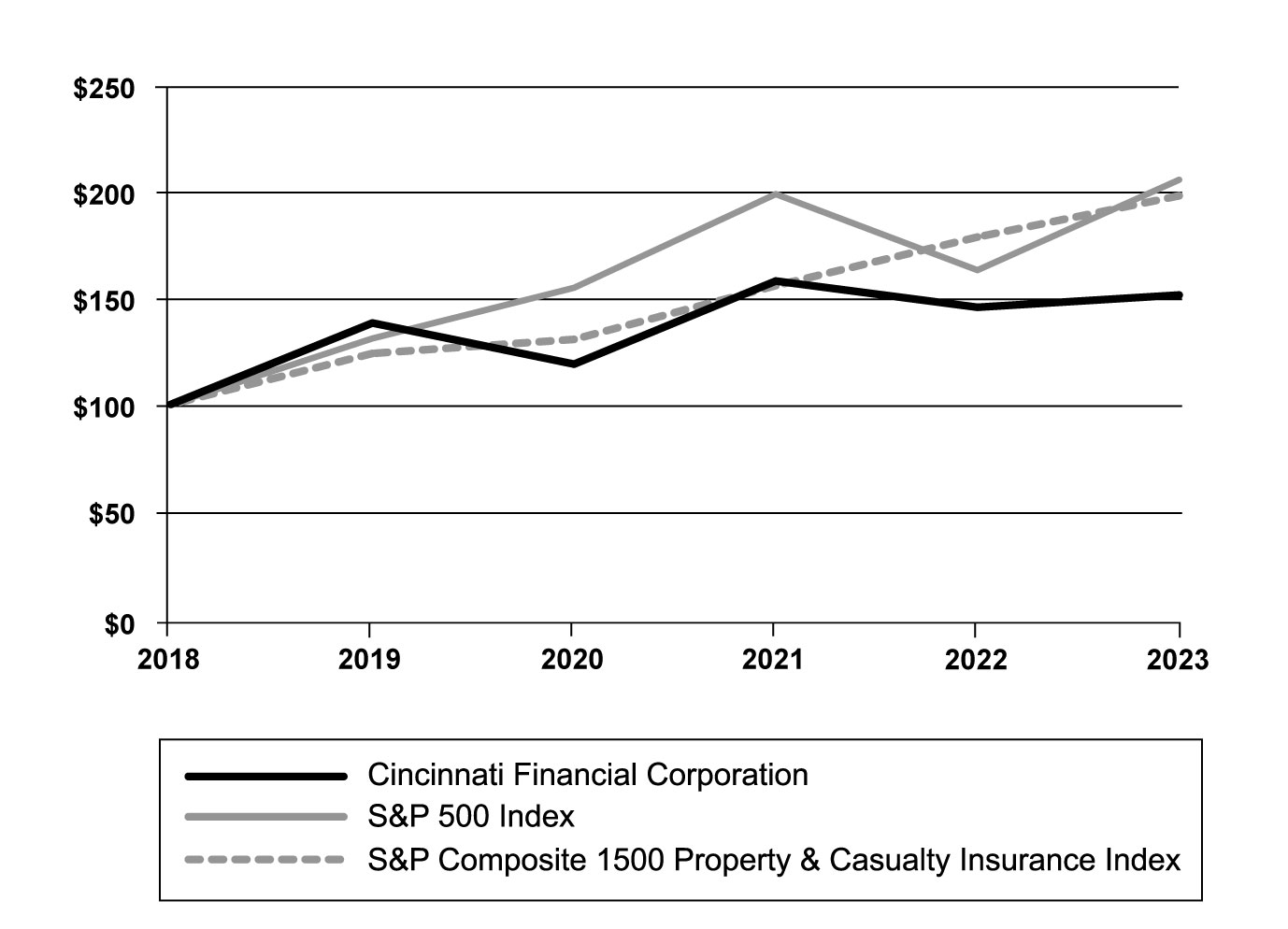
The S&P 500 Index includes a representative sample of 500 leading companies in a cross section of industries of the U.S. economy. At year-end 2023, the S&P Composite 1500 Property & Casualty Insurance Index included 31 companies.
Cincinnati Financial Corporation - 2023 10-K - Page 45
Issuances and Purchases of Equity Securities
The following summarizes securities authorized for issuance under our equity compensation plans as of December 31, 2023:
| Plan category | Number of securities to be issued upon exercise of outstanding options, warrants and rights at December 31, 2023 | Weighted-average exercise price of outstanding options, warrants and rights | Number of securities remaining available for future issuance under equity compensation plan (excluding securities reflected in column (a)) at December 31, 2023 | |||||||||||||||||
| (a) | (b) | (c) | ||||||||||||||||||
| Equity compensation plans approved by security holders | 3,647,437 | $ | 92.36 | 3,627,346 | ||||||||||||||||
| Equity compensation plans not approved by security holders | — | — | — | |||||||||||||||||
| Total | 3,647,437 | $ | 92.36 | 3,627,346 | ||||||||||||||||
The number of securities remaining available for future issuance includes: 3,395,481 shares available for issuance under the Cincinnati Financial Corporation 2016 Stock Compensation Plan (the 2016 Plan) and 231,865 shares available for issuance of share grants under the Director’s Stock Plan of 2018. The number of securities remaining available for future issuance assumes the number of securities to be issued from performance-based awards are issued at the target-level performance level. The 2016 Plan allows for issuance of stock options, service-based or performance-based restricted stock units, stock appreciation rights or other equity-based grants. Awards other than stock options granted from the 2016 Plan are counted as three shares against the plan for each one share of common stock actually issued. Additional information about share-based associate compensation granted under our equity compensation plans is available in Item 8, Note 17 of the Consolidated Financial Statements.
We discuss the factors that affect our ability to pay cash dividends and repurchase shares, as well as the objectives of our repurchase program, in Item 7, Liquidity and Capital Resources. Regulatory restrictions on dividends our insurance subsidiaries can pay to the parent company are discussed in Item 8, Note 9 of the Consolidated Financial Statements.
The following summarizes shares purchased under our repurchase programs:
| Period | Total number of shares purchased | Average price paid per share | Total number of shares purchased as part of publicly announced plans or programs | Maximum number of shares that may yet be purchased under the plans or programs | ||||||||||||||||||||||
| October 1-31, 2023 | — | $ | — | — | 6,726,785 | |||||||||||||||||||||
| November 1-30, 2023 | — | — | — | 6,726,785 | ||||||||||||||||||||||
| December 1-31, 2023 | — | — | — | 6,726,785 | ||||||||||||||||||||||
| Totals | — | — | — | |||||||||||||||||||||||
We did not sell any of our shares that were not registered under the Securities Act during 2023. Our repurchase program does not have an expiration date. Our repurchase program was expanded on January 26, 2018, by
15 million shares. We have 6,726,785 shares available for purchase under our programs at December 31, 2023. During 2023, we repurchased 600,000 shares at an average price of $110.99.
Item 6. [Reserved]
Cincinnati Financial Corporation - 2023 10-K - Page 46
Item 7. Management's Discussion and Analysis of Financial Condition and
Results of Operations
Introduction
The purpose of Management’s Discussion and Analysis is to provide an understanding of Cincinnati Financial Corporation’s consolidated results of operations and financial condition. Our Management’s Discussion and Analysis should be read in conjunction with Item 8, Consolidated Financial Statements and related Notes. We present per share data on a diluted basis unless otherwise noted, adjusting those amounts for all stock splits and stock dividends.
We begin with an executive summary of our results of operations, followed by other highlights and details about critical accounting estimates. In several instances, we refer to estimated industry data so that we can provide information on our performance within the context of the overall insurance industry. Unless otherwise noted, the industry data is prepared by A.M. Best, a leading insurance industry statistical, analytical and financial strength rating organization. Information from A.M. Best is presented on a statutory accounting basis for insurance company regulation in the United States of America. When we provide our results on a comparable statutory accounting basis, we label it as such; all other company data is presented in accordance with accounting principles generally accepted in the United States of America (GAAP).
As discussed in Item 8, Note 1, Summary of Significant Accounting Policies, effective January 1, 2023, we adopted ASU 2018-12, Financial Services - Insurance (Topic 944): Targeted Improvements to the Accounting for Long-Duration Contracts. We adjusted applicable financial statements. Related financial data shown in Management's Discussion and Analysis of Financial Condition and Results of Operations also have been adjusted.
Through The Cincinnati Insurance Company, Cincinnati Financial Corporation is one of the 25 largest property casualty insurers in the nation, based on net written premium volume for the first nine months of 2023, among approximately 2,000 U.S. stock and mutual insurer groups. We market our insurance products through a select group of independent insurance agencies in 46 states as discussed in Item 1, Our Business and Our Strategy.
The U.S. economy, the insurance industry and our company continue to face many challenges. Our long-term perspective has allowed us to address immediate challenges while also focusing on the major decisions that best position the company for success through all market cycles. We believe that this forward-looking view consistently benefits our shareholders, agents, policyholders and associates.
To measure our progress, we have defined a measure of value creation that we believe captures the contribution of our insurance operations, the success of our investment strategy and the importance we place on paying cash dividends to shareholders. We refer to this measure as our value creation ratio (VCR) and it is made up of two primary components: (1) our rate of growth in book value per share plus (2) the ratio of dividends declared per share to beginning book value per share. This measure, intended to be all-inclusive regarding changes in book value per share, uses originally reported book value per share in cases where book value per share has been adjusted, such as after the adoption of Accounting Standards Updates with a cumulative effect of a change in accounting.
The primary sources of our company’s net income are summarized below. We discuss contributions to net income and VCR by source in Corporate Financial Highlights, followed by more detailed discussion in Financial Results.
-
Underwriting profit (loss) – Includes revenues from earned premiums for insurance and reinsurance policies or contracts, reduced by losses and loss expenses from associated insurance coverages. Those revenues are further reduced by underwriting expenses associated with marketing policies or related to administration of our insurance operations. The net result represents an underwriting profit when revenues exceed losses and expenses.
-
Investment income – Is generated primarily from investing the premiums collected for insurance policies sold, until funds are needed to pay losses for insurance claims or other expenses. Interest income from bonds or dividend income from stocks are the main categories of our investment income, with additional contribution from compounding effects over time.
Cincinnati Financial Corporation - 2023 10-K - Page 47
- Investment gains and losses – Occur from appreciation or depreciation of invested assets over time. Gains or losses are generally recognized from changes in market values of equity securities without a sale or when invested assets are sold or become impaired.
Executive Summary
Our value creation ratio, defined above, is our primary performance target. VCR trends are shown in the table below.
| One year | Three-year % average | Five-year % average | ||||||||||||||||||
| Value creation ratio: | ||||||||||||||||||||
| As of December 31, 2023 | 19.5 | % | 10.2 | % | 15.2 | % | ||||||||||||||
| As of December 31, 2022 | (14.6) | 8.6 | 11.2 | |||||||||||||||||
| As of December 31, 2021 | 25.7 | 23.6 | 18.7 | |||||||||||||||||
We are targeting an annual value creation ratio averaging 10% to 13% over the next five-year period. At 19.5% for 2023, our performance was above the high end of that range. It was within the range for the three-year period and above the high end of the range for the five-year period, both that ended in December 2023.
The table below shows the primary contributors of our value creation ratio on a percentage basis. Analysis of the contributors aids understanding of our financial performance. Our financial results are further analyzed in the Corporate Financial Highlights section below.
| Years ended December 31, | 2023-2022 | 2022-2021 | ||||||||||||||||||||||||||||||
| 2023 | 2022 | 2021 | Pt. Change | Pt. Change | ||||||||||||||||||||||||||||
| Value creation ratio major contributors: | ||||||||||||||||||||||||||||||||
| Net income before investment gains | 9.1 | % | 5.2 | % | 9.7 | % | 3.9 | (4.5) | ||||||||||||||||||||||||
| Change in fixed-maturity securities, realized and unrealized gains | 1.9 | (10.1) | (1.5) | 12.0 | (8.6) | |||||||||||||||||||||||||||
| Change in equity securities, investment gains | 8.6 | (9.3) | 16.8 | 17.9 | (26.1) | |||||||||||||||||||||||||||
| Other | (0.1) | (0.4) | 0.7 | 0.3 | (1.1) | |||||||||||||||||||||||||||
| Value creation ratio | 19.5 | % | (14.6) | % | 25.7 | % | 34.1 | (40.3) | ||||||||||||||||||||||||
The 2023 value creation ratio improved by 34.1 percentage points, compar
Showing the first 8K of 234K characters. Open the full section
Item 5. , Market for the Registrant’s Common Equity, Related Stockholder Matters and Issuer Purchases of Equity Securities.
Obligations
We pay obligations to customers, suppliers and associates in the normal course of our business operations. Some are contractual obligations that define the amount, circumstances and/or timing of payments. We have other commitments for business expenditures; such as $223 million we expect to fund for our private equity and real estate investments, however, the amount, circumstances and/or timing of our other commitments are not dictated by contractual arrangements.
Contractual Obligations
At December 31, 2023, we estimated our significant future contractual obligations as follows:
| (Dollars in millions) | Year | Years | There- | |||||||||||||||||||||||||||||
| Payment due by period | 2024 | 2025-2028 | after | Total | ||||||||||||||||||||||||||||
| Gross property casualty loss and loss expense payments | $ | 2,963 | $ | 4,742 | $ | 1,270 | $ | 8,975 | ||||||||||||||||||||||||
| Gross life policyholder obligations | 145 | 500 | 5,709 | 6,354 | ||||||||||||||||||||||||||||
| Long-term debt | — | — | 793 | 793 | ||||||||||||||||||||||||||||
| Interest on long-term debt | 52 | 193 | 126 | 371 | ||||||||||||||||||||||||||||
| Profit-sharing commissions | 208 | — | — | 208 | ||||||||||||||||||||||||||||
| Other liabilities | 123 | 83 | 1 | 207 | ||||||||||||||||||||||||||||
| Total | $ | 3,491 | $ | 5,518 | $ | 7,899 | $ | 16,908 | ||||||||||||||||||||||||
Liquidity and Capital Resources Outlook
At December 31, 2023, we had $907 million in cash and cash equivalents. During 2024, our lead insurance subsidiary may pay a maximum of $729 million in dividends to our parent company without regulatory approval. That strong liquidity and our consistent cash flows give us the flexibility to meet current obligations and commitments while building value by prudently investing where we see potential for both current income and long-term return. Our cash and cash equivalents provide adequate financial cushion when short-term operating results do not meet our objectives.
A long-term perspective governs our liquidity and capital resources decisions, with the goal of benefiting our policyholders, agents, shareholders and associates over time. Our underwriting philosophy and initiatives can drive performance to achieve underwriting profit. Our GAAP combined ratio averaged 94.6% over the five-year period 2019 through 2023, resulting in strong underwriting profits.
In any year, we consider the most likely source of pressure on liquidity would be an unusually high level of catastrophe loss payments within a short period of time. There could be additional obligations for our insurance operations due to increasing severity or frequency of noncatastrophe claims. To address the risk of unusually large insurance loss obligations, including catastrophe events, we maintain property casualty reinsurance contracts with highly rated reinsurers, as discussed under 2024 Reinsurance Ceded Programs. We also monitor the financial condition of our reinsurers because their insolvency could jeopardize a portion of our $651 million reinsurance recoverable asset at December 31, 2023. Parent-company liquidity could also be constrained by Ohio regulatory requirements that restrict the dividends insurance subsidiaries can pay.
Economic weakness also has the potential to affect our liquidity and capital resources in a number of different ways, including delinquent payments from agencies, defaults on interest payments by fixed-maturity holdings in our portfolio, dividend reductions by holdings in our equity portfolio or declines in the market value of holdings in our portfolio.
Cincinnati Financial Corporation - 2023 10-K - Page 97
Off-Balance-Sheet Arrangements
We do not use any special-purpose financing vehicles or have any undisclosed off-balance-sheet arrangements (as that term is defined in applicable SEC rules) that are reasonably likely to have a current or future material effect on the company’s financial condition, results of operation, liquidity, capital expenditures or capital resources.
Property Casualty Loss and Loss Expense Obligations and Reserves
Our estimate of future gross property casualty loss and loss expense payments of $8.975 billion is lower than loss and loss expense reserves of $9.050 billion reported on our balance sheet at December 31, 2023. The $75 million difference is due to certain life and health loss reserves. Reserving practices are discussed in Critical Accounting Estimates, Property Casualty Insurance Loss and Loss Expense Reserves.
For the business lines in the commercial and personal lines insurance segments, and in total for the excess and surplus lines insurance segment and for other parts of our property casualty insurance operations, the following table details gross reserves among case, IBNR and loss expense reserves, net of salvage and subrogation. The $639 million increase in total gross reserves included an $86 million increase in case loss reserves, a $395 million increase in IBNR loss reserves and a $158 million increase in loss expense reserves. The increase in total gross reserves included $285 million for our commercial casualty line of business, $179 million for excess and surplus lines and $110 million for Cincinnati Re.
Cincinnati Financial Corporation - 2023 10-K - Page 98
Property Casualty Gross Loss and Loss Expense Reserves
| (Dollars in millions) | Loss reserves | Loss expense reserves | Total gross reserves | |||||||||||||||||||||||||||||
| Case reserves | IBNR reserves | Percent of total | ||||||||||||||||||||||||||||||
| At December 31, 2023 | ||||||||||||||||||||||||||||||||
| Commercial lines insurance: | ||||||||||||||||||||||||||||||||
| Commercial casualty | $ | 1,111 | $ | 1,205 | $ | 792 | $ | 3,108 | 34.6 | % | ||||||||||||||||||||||
| Commercial property | 362 | 116 | 81 | 559 | 6.3 | |||||||||||||||||||||||||||
| Commercial auto | 418 | 303 | 142 | **8 |
Showing the first 8K of 64K characters. Open the full section
Item 7A. Quantitative and Qualitative Disclosures About Market Risk
Introduction
Market risk is the potential for a decrease in securities value resulting from broad yet uncontrollable forces such as inflation, economic growth, interest rates, world political conditions or other widespread unpredictable events. It is comprised of many individual risks that, when combined, create a macroeconomic impact. The company accepts and manages risks in its investment portfolio as part of the means of achieving portfolio objectives. Some of the risks are:
-
Political – the potential for a decrease in value due to the real or perceived impact of governmental policies or conditions
-
Regulatory – the potential for a decrease in value due to the impact of legislative proposals or changes in laws or regulations
-
Economic – the potential for a decrease in value due to changes in general economic factors (recession, inflation, deflation, etc.)
-
Revaluation – the potential for a decrease in value due to a change in relative value (change in market multiple) of the market brought on by general economic factors
-
Interest-rate – the potential for a decrease in value of a security or portfolio due to its sensitivity to changes (increases or decreases) in the general level of interest rates
Company-specific risk is the potential for a particular issuer to experience a decline in value due to the impact of sector or market risk on the holding or because of issues specific to the firm:
-
Fraud – the potential for a negative impact on an issuer’s performance due to actual or alleged illegal or improper activity of individuals it employs
-
Credit – the potential for deterioration in an issuer’s financial profile due to specific company issues, problems it faces in the course of its operations or industry-related issues
-
Default – the possibility that an issuer will not make a required payment (interest payment or return of principal) on its debt. Generally this occurs after its financial profile has deteriorated (credit risk) and it no longer has the means to make its payments
The investment committee of the board of directors monitors the investment risk management process primarily through its executive oversight of our investment activities. We take an active approach to managing market and other investment risks, including the accountabilities and controls over these activities. Actively managing these market risks is integral to our operations and could require us to change the character of future investments purchased or sold or require us to shift the existing asset portfolios to manage exposure to market risk within acceptable ranges.
Sector risk is the potential for a negative impact on a particular industry due to its sensitivity to factors that make up market risk. Market risk affects general supply or demand factors for an industry and affects companies within that industry to varying degrees.
Cincinnati Financial Corporation - 2023 10-K - Page 113
Risks associated with the asset classes described in Item 1, Our Segments, Investments Segment, can be summarized as follows (H – high, A – average, L – low):
| Taxable fixed maturities | Tax-exempt fixed maturities | Common equities | Nonredeemable preferred equities | |||||||||||||||||||||||
| Political | A | H | A | A | ||||||||||||||||||||||
| Regulatory | A | A | A | A | ||||||||||||||||||||||
| Economic | A | A | H | A | ||||||||||||||||||||||
| Revaluation | H | H | H | H | ||||||||||||||||||||||
| Interest rate | A | A | A | A | ||||||||||||||||||||||
| Fraud | A | L | A | A | ||||||||||||||||||||||
| Credit | A | L | A | A | ||||||||||||||||||||||
| Default | A | L | A | A | ||||||||||||||||||||||
Fixed-Maturity Securities Investments
For investment-grade corporate bonds, the inverse relationship between interest rates and bond prices leads to falling bond values during periods of increasing interest rates. We address this risk by attempting to construct a generally laddered maturity schedule that allows us to reinvest cash flows at prevailing rates. Although the potential for a worsening financial condition, and ultimately default, does exist with investment-grade corporate bonds, we address this risk by performing credit analysis and monitoring as well as maintaining a diverse portfolio of holdings.
The primary risk related to high-yield corporate bonds is credit risk. A weak financial profile can lead to rating downgrades from the credit rating agencies, which can put further downward pressure on bond prices. Interest rate risk, while significant, is less of a factor with high-yield corporate bonds, as valuation is related more directly to underlying operating performance than to general interest rates. This puts more emphasis on the financial results achieved by the issuer rather than on general economic trends or statistics within the marketplace. We address this concern by analyzing issuer- and industry-specific financial results and by closely monitoring holdings within this asset class.
The primary risks related to tax-exempt bonds are interest rate risk and political risk associated with the specific economic environment within the political boundaries of the issuing municipal entity. We address these concerns by focusing on municipalities’ general-obligation debt and on essential-service bonds. Essential-service bonds derive a revenue stream from municipal services that are vital to the people living in the area (water service, sewer service, etc.). Another risk related to tax-exempt bonds is regulatory risk or the potential for legislative changes that would negate the benefit of owning tax-exempt bonds. We monitor regulatory activity for situations that may negatively affect current holdings and our ongoing strategy for investing in these securities.
The final, less significant risk is our exposure to credit risk for a portion of the tax-exempt portfolio that has support from corporate entities. Examples are bonds insured by corporate bond insurers or bonds with interest payments made by a corporate entity through a municipal conduit or authority. Our decisions regarding these investments primarily consider the underlying municipal situation. The existence of third-party insurance is intended to reduce risk in the event of default. In circumstances in which the municipality is unable to meet its obligations, risk would be increased if the insuring entity were experiencing financial duress. Because of our diverse exposure and selection of higher-rated entities with strong financial profiles, we do not believe this is a material concern as we discuss in Item 1, Our Segments, Investments Segment.
Interest Rate Sensitivity Analysis
Because of our strong shareholders’ equity, long-term investment horizon and ability to hold most fixed-maturity investments to maturity, we believe the company is well-positioned if interest rates were to rise. A higher rate environment would provide the opportunity to invest cash flow in higher-yielding securities, while reducing the likelihood of untimely redemptions of currently callable securities. While higher interest rates would be expected to increase the number of fixed-maturity holdings fair valued below 100% of amortized cost, we believe lower fixed-maturity security values due solely to interest rate changes would not signal a decline in credit quality.
Cincinnati Financial Corporation - 2023 10-K - Page 114
Our dynamic financial planning model uses analytical tools to assess market risks. As part of this model, the effective duration of the fixed-maturity portfolio is continually monitored by our investment department to evaluate the theoretical impact of interest rate movements.
The table below summarizes the effect of an instantaneous hypothetical change in interest rates on the fair value of our fixed-maturity portfolio.
| (Dollars in millions) | Effect from interest rate change in basis points | |||||||||||||||||||||||||||||||
| -200 | -100 | — | 100 | 200 | ||||||||||||||||||||||||||||
| At December 31, 2023 | $ | 14,962 | $ | 14,375 | $ | 13,791 | $ | 13,179 | $ | 12,543 | ||||||||||||||||||||||
| At December 31, 2022 | $ | 13,300 | $ | 12,714 | $ | 12,132 | $ | 11,548 | $ | 10,974 | ||||||||||||||||||||||
The effective duration of the fixed-maturity portfolio was 4.3 years at year-end 2023, down from 4.7 years at year-end 2022. A 100-basis-point movement in interest rates would result in an approximately 4.3% change in the fair value of the fixed-maturity portfolio. Generally speaking, the higher a bond is rated, the more directly correlated movements in its fair value are to changes in the general level of interest rates, exclusive of call features. The fair values of average- to lower-rated corporate bonds are additionally influenced by the expansion or contraction of credit spreads.
In the dynamic financial planning model, the selected interest rate change of 100 to 200 basis points represents our views of a shift in rates that is quite possible over a one-year period. The rates modeled should not be considered a prediction of future events as interest rates may be much more volatile in the future. The analysis is not intended to provide a precise forecast of the effect of changes in rates on our results or financial condition, nor does it take into account any actions that we might take to reduce exposure to such risks.
Cincinnati Financial Corporation - 2023 10-K - Page 115
Equity Securities Investments
Our equity portfolio is subject to a variety of risk factors encompassed under the umbrella of market risk. General economic swings influence the performance of the underlying industries and companies within those industries. Industry- and company-specific risks also have the potential to substantially affect the value of our portfolio. Our investment guidelines help address these risks by diversifying the portfolio and establishing parameters to help manage exposures.
The table below summarizes the effect of hypothetical changes in market prices on the fair value of our equity portfolio.
| (Dollars in millions) | Effect from market price change in percent | |||||||||||||||||||||||||||||||||||||||||||
| -30% | -20% | -10% | — | 10% | 20% | 30% | ||||||||||||||||||||||||||||||||||||||
| At December 31, 2023 | $ | 7,692 | $ | 8,791 | $ | 9,890 | $ | 10,989 | $ | 12,088 | $ | 13,187 | $ | 14,286 | ||||||||||||||||||||||||||||||
| At December 31, 2022 | $ | 6,889 | $ | 7,873 | $ | 8,857 | $ | 9,841 | $ | 10,825 | $ | 11,809 | $ | 12,793 | ||||||||||||||||||||||||||||||
Our equity holdings represented $10.989 billion in fair value at year-end 2023. No holding had a fair value greater than 8.0% of our $10.641 billion publicly traded common stock portfolio. We had 39 holdings among nine different sectors each with a fair value greater than $100 million. See Item 1, Our Segments, Investments Segment and Item 8, Note 2 of the Consolidated Financial Statements, for additional details on our holdings.
The primary risks related to preferred stocks are similar to those related to investment-grade corporate bonds. Rising interest rates adversely affect market values due to the normal inverse relationship between interest rates and bond prices. Credit risk exists due to the subordinate position of preferred stocks in the capital structure. We minimize this risk by primarily purchasing investment-grade preferred stocks of issuers with a strong history of paying a common stock dividend.
Cincinnati Financial Corporation - 2023 10-K - Page 116
Application of Asset Impairment Policy
As discussed in Item 7, Critical Accounting Estimates, Asset Impairment, our fixed-maturity investment portfolio is evaluated for credit-related impairments. The company’s asset impairment committee monitors a number of significant factors for indications of investments with a fair value below the carrying amount that may not be recoverable. The application of our impairment policy resulted in write-downs of impaired securities intended to be sold that reduced our income before income taxes by $4 million in 2023, $5 million in 2022 and $1 million in 2021. Impairments are discussed in Item 7, Investments Results.
We expect the number of fixed-maturity securities with a fair value below 100% of amortized cost to fluctuate as interest rates rise or fall and credit spreads expand or contract due to prevailing economic conditions. Further, amortized cost for some securities have been revised due to impairment charges recognized in prior periods. At year-end 2023, 2,840 of the 4,738 fixed-maturity securities we owned had a fair value below 100% of amortized cost compared with 3,272 of the 4,521 at year-end 2022 and 278 of the 4,329 at year-end 2021.
The 2,840 holdings fair valued below amortized cost at year-end 2023 represented 67.4% of our fixed-maturity portfolio and $687 million in unrealized losses.
-
1,963 of these holdings were fair valued between 90% and 100% of amortized cost. The value of these securities fluctuates primarily because of changes in interest rates. The fair value of these 1,963 securities was $7.208 billion at year-end 2023, and they accounted for $226 million in unrealized losses.
-
857 of these holdings were fair valued between 70% and 90% of amortized cost. The fair value of these holdings was $2.044 billion, and they accounted for $438 million in unrealized losses.
-
20 of these holdings had a fair value below 70% of amortized cost. The fair value of these holdings was $44 million, and they accounted for $23 million in unrealized losses.
The following table summarizes the length of time securities in the investment portfolio have been in a continuous unrealized loss position.
| (Dollars in millions) | Less than 12 months | 12 months or more | Total | |||||||||||||||||||||||||||||||||||
| At December 31, 2023 | Fair value | Unrealized losses | Fair value | Unrealized losses | Fair value | Unrealized losses | ||||||||||||||||||||||||||||||||
| Fixed-maturity securities: | ||||||||||||||||||||||||||||||||||||||
| Corporate | $ | 379 | $ | 13 | $ | 5,560 | $ | 441 | $ | 5,939 | $ | 454 | ||||||||||||||||||||||||||
| States, municipalities and political subdivisions | 313 | 2 | 1,932 | 206 | 2,245 | 208 | ||||||||||||||||||||||||||||||||
| Government-sponsored enterprises | 652 | 3 | 113 | 3 | 765 | 6 | ||||||||||||||||||||||||||||||||
| United States government | 32 | — | 129 | 3 | 161 | 3 | ||||||||||||||||||||||||||||||||
| Mortgage-backed | 5 | — | 172 | 16 | 177 | 16 | ||||||||||||||||||||||||||||||||
| Foreign government | 3 | — | 6 | — | 9 | — | ||||||||||||||||||||||||||||||||
| Total | $ | 1,384 | $ | 18 | $ | 7,912 | $ | 669 | $ | 9,296 | $ | 687 | ||||||||||||||||||||||||||
| At December 31, 2022 | ||||||||||||||||||||||||||||||||||||||
| Fixed-maturity securities: | ||||||||||||||||||||||||||||||||||||||
| Corporate | $ | 5,651 | $ | 412 | $ | 661 | $ | 168 | $ | 6,312 | $ | 580 | ||||||||||||||||||||||||||
| States, municipalities and political subdivisions | 2,600 | 274 | 77 | 29 | 2,677 | 303 | ||||||||||||||||||||||||||||||||
| Government-sponsored enterprises | 123 | 3 | 3 | — | 126 | 3 | ||||||||||||||||||||||||||||||||
| United States government | 146 | 3 | 41 | 2 | 187 | 5 | ||||||||||||||||||||||||||||||||
| Mortgage-backed | 215 | 13 | 14 | 3 | 229 | 16 | ||||||||||||||||||||||||||||||||
| Foreign government | 25 | 1 | 4 | — | 29 | 1 | ||||||||||||||||||||||||||||||||
| Total | $ | 8,760 | $ | 706 | $ | 800 | $ | 202 | $ | 9,560 | $ | 908 | ||||||||||||||||||||||||||
Cincinnati Financial Corporation - 2023 10-K - Page 117
The following table summarizes and classifies securities based on fair values relative to amortized cost:
| (Dollars in millions) | Number of issues | Amortized cost | Fair value | Gross unrealized gain (loss) | Gross investment income | |||||||||||||||||||||||||||
| At December 31, 2023 | ||||||||||||||||||||||||||||||||
| Taxable fixed maturities: | ||||||||||||||||||||||||||||||||
| Fair valued below 70% of amortized cost | 16 | $ | 55 | $ | 36 | $ | (19) | $ | 2 | |||||||||||||||||||||||
| Fair valued at 70% to less than 100% of amortized cost | 1,854 | 8,316 | 7,734 | (582) | 362 | |||||||||||||||||||||||||||
| Fair valued at 100% and above of amortized cost | 494 | 2,043 | 2,119 | 76 | 83 | |||||||||||||||||||||||||||
| Investment income on securities sold in current year | — | — | — | — | 22 | |||||||||||||||||||||||||||
| Total | 2,364 | 10,414 | 9,889 | (525) | 469 | |||||||||||||||||||||||||||
| Tax-exempt fixed maturities: | ||||||||||||||||||||||||||||||||
| Fair valued below 70% of amortized cost | 4 | 12 | 8 | (4) | 1 | |||||||||||||||||||||||||||
| Fair valued at 70% to less than 100% of amortized cost | 966 | 1,600 | 1,518 | (82) | 47 | |||||||||||||||||||||||||||
| Fair valued at 100% and above of amortized cost | 1,404 | 2,335 | 2,376 | 41 | 79 | |||||||||||||||||||||||||||
| Investment income on securities sold in current year | — | — | — | — | 4 | |||||||||||||||||||||||||||
| Total | 2,374 | 3,947 | 3,902 | (45) | 131 | |||||||||||||||||||||||||||
| Fixed-maturities summary: | ||||||||||||||||||||||||||||||||
| Fair valued below 70% of amortized cost | 20 | 67 | 44 | (23) | 3 | |||||||||||||||||||||||||||
| Fair valued at 70% to less than 100% of amortized cost | 2,820 | 9,916 | 9,252 | (664) | 409 | |||||||||||||||||||||||||||
| Fair valued at 100% and above of amortized cost | 1,898 | 4,378 | 4,495 | 117 | 162 | |||||||||||||||||||||||||||
| Investment income on securities sold in current year | — | — | — | — | 26 | |||||||||||||||||||||||||||
| Total | 4,738 | $ | 14,361 | $ | 13,791 | $ | (570) | $ | 600 | |||||||||||||||||||||||
| At December 31, 2022 | ||||||||||||||||||||||||||||||||
| Fixed-maturities summary: | ||||||||||||||||||||||||||||||||
| Fair valued below 70% of amortized cost | 49 | $ | 91 | $ | 61 | $ | (30) | $ | 3 | |||||||||||||||||||||||
| Fair valued at 70% to less than 100% of amortized cost | 3,223 | 10,377 | 9,499 | (878) | 392 | |||||||||||||||||||||||||||
| Fair valued at 100% and above of amortized cost | 1,249 | 2,511 | 2,572 | 61 | 92 | |||||||||||||||||||||||||||
| Investment income on securities sold in current year | — | — | — | — | 23 | |||||||||||||||||||||||||||
| Total | 4,521 | $ | 12,979 | $ | 12,132 | $ | (847) | $ | 510 | |||||||||||||||||||||||
Cincinnati Financial Corporation - 2023 10-K - Page 118
Item 8. Financial Statements and Supplementary Data
Responsibility for Financial Statements
We have prepared the consolidated financial statements of Cincinnati Financial Corporation and our subsidiaries for the year ended December 31, 2023, in accordance with accounting principles generally accepted in the United States of America (GAAP).
We are responsible for the integrity and objectivity of these financial statements. The amounts, presented on an accrual basis, reflect our best estimates and judgment. These statements are consistent in all material aspects with other financial information in the Annual Report on Form 10-K. Our accounting system and related internal controls are designed to assure that our books and records accurately reflect the company’s transactions in accordance with established policies and procedures as implemented by qualified personnel.
Our board of directors has established an audit committee of independent outside directors. We believe these directors are free from any relationships that could interfere with their independent judgment as audit committee members.
The audit committee meets periodically with management, our independent registered public accounting firm and our internal auditors to discuss how each is handling its respective responsibilities. The audit committee reports its findings to the board of directors. The audit committee recommends to the board the annual appointment of the independent registered public accounting firm. The audit committee reviews with this firm the scope of the audit assignment and the adequacy of internal controls and procedures.
Deloitte & Touche LLP, our independent registered public accounting firm, audited the consolidated financial statements of Cincinnati Financial Corporation and subsidiaries for the year ended December 31, 2023. Deloitte & Touche LLP met with our audit committee to discuss the results of its audit. They have the opportunity to discuss the adequacy of internal controls and the quality of financial reporting without management present.
Cincinnati Financial Corporation - 2023 10-K - Page 119
Management’s Annual Report on Internal Control Over Financial Reporting
The management of Cincinnati Financial Corporation and its subsidiaries is responsible for establishing and maintaining adequate internal controls, designed to provide reasonable assurance regarding the reliability of financial reporting and the preparation of financial statements for external purposes in accordance with accounting principles generally accepted in the United States of America (GAAP). The company’s internal control over financial reporting includes those policies and procedures that:
-
Pertain to the maintenance of records that, in reasonable detail, accurately and fairly reflect the transactions and dispositions of the assets of the company;
-
Provide reasonable assurance that transactions are recorded as necessary to permit preparation of financial statements in accordance with GAAP and that receipts and expenditures of the company are being made only in accordance with authorizations of management and the directors of the company; and
-
Provide reasonable assurance regarding prevention or timely detection of unauthorized acquisition, use or disposition of the company’s assets that could have a material effect on the financial statements.
All internal control systems, no matter how well designed, have inherent limitations, including the possibility of human error and the circumvention of overriding controls. Accordingly, even effective internal control can provide only reasonable assurance with respect to financial statement preparation and presentation. Further, because of changes in conditions, the effectiveness of internal control may vary over time.
The company’s management assessed the effectiveness of the company’s internal control over financial reporting as of December 31, 2023, as required by Section 404 of the Sarbanes Oxley Act of 2002. Management’s assessment was based on the criteria established in the Internal Control – Integrated Framework (2013) issued by the Committee of Sponsoring Organizations of the Treadway Commission and was designed to provide reasonable assurance that the company maintained effective internal control over financial reporting as of December 31, 2023. The assessment led management to conclude that, as of December 31, 2023, the company’s internal control over financial reporting was effective based on those criteria.
The company’s independent registered public accounting firm has issued an audit report on our internal control over financial reporting as of December 31, 2023.
/S/ Steven J. Johnston
Steven J. Johnston, FCAS, MAAA, CFA, CERA
Chairman and Chief Executive Officer
/S/ Michael J. Sewell
Michael J. Sewell, CPA
Chief Financial Officer, Executive Vice President and Treasurer
(Principal Accounting Officer)
February 26, 2024
Cincinnati Financial Corporation - 2023 10-K - Page 120
Report of Independent Registered Public Accounting Firm
To the Shareholders and Board of Directors of Cincinnati Financial Corporation
Opinions on the Financial Statements and Internal Control over Financial Reporting
We have audited the accompanying consolidated balance sheets of Cincinnati Financial Corporation and subsidiaries (the "Company") as of December 31, 2023 and 2022, the related consolidated statements of income, comprehensive income, shareholders' equity, and cash flows for each of the three years in the period ended December 31, 2023, and the related notes and the schedules listed in the Index at Item 15(c) (collectively referred to as the "financial statements"). We also have audited the Company’s internal control over financial reporting as of December 31, 2023, based on criteria established in Internal Control — Integrated Framework (2013) issued by the Committee of Sponsoring Organizations of the Treadway Commission (COSO).
In our opinion, the financial statements referred to above present fairly, in all material respects, the financial position of the Company as of December 31, 2023 and 2022, and the results of its operations and its cash flows for each of the three years in the period ended December 31, 2023, in conformity with accounting principles generally accepted in the United States of America. Also, in our opinion, the Company maintained, in all material respects, effective internal control over financial reporting as of December 31, 2023, based on criteria established in Internal Control — Integrated Framework (2013) issued by COSO.
Change in Accounting Principle
As discussed in Note 1 to the financial statements, the Company changed its method of accounting, measurement, and disclosure of long duration contracts effective January 1, 2023, using the modified retrospective method applied as of the transition date of January 1, 2021, due to adoption of ASU 2018-12, Financial Services - Insurance (Topic 944): Targeted Improvements to the Accounting for Long-Duration Contracts.
Basis for Opinions
The Company’s management is responsible for these financial statements, for maintaining effective internal control over financial reporting, and for its assessment of the effectiveness of internal control over financial reporting, included in the accompanying Management’s Annual Report on Internal Control over Financial Reporting. Our responsibility is to express an opinion on these financial statements and an opinion on the Company’s internal control over financial reporting based on our audits. We are a public accounting firm registered with the Public Company Accounting Oversight Board (United States) (PCAOB) and are required to be independent with respect to the Company in accordance with the U.S. federal securities laws and the applicable rules and regulations of the Securities and Exchange Commission and the PCAOB.
We conducted our audits in accordance with the standards of the PCAOB. Those standards require that we plan and perform
Showing the first 8K of 300K characters. Open the full section
Item 9. Changes in and Disagreements With Accountants on
Accounting and Financial Disclosure
We had no disagreements with the independent registered public accounting firm on accounting and financial disclosure during the last two fiscal years.
Item 9A. Controls and Procedures
Evaluation of Disclosure Controls and Procedures – The company maintains disclosure controls and procedures (as that term is defined in Rules 13a-15(e) and 15d-15(e) under the Securities Exchange Act of 1934, as amended (Exchange Act)).
Any controls and procedures, no matter how well designed and operated, can provide only reasonable assurance of achieving the desired control objectives. The company’s management, with the participation of the company’s chief executive officer and chief financial officer, has evaluated the effectiveness of the design and operation of the company’s disclosure controls and procedures as of December 31, 2023. Based upon that evaluation, the company’s chief executive officer and chief financial officer concluded that the design and operation of the company’s disclosure controls and procedures provided reasonable assurance that the disclosure controls and procedures are effective to ensure that:
-
information required to be disclosed in the company’s reports under the Exchange Act is recorded, processed, summarized and reported within the time periods specified in the Securities and Exchange Commission’s rules and forms, and
-
such information is accumulated and communicated to the company’s management, including its chief executive officer and chief financial officer, as appropriate, to allow for timely decisions regarding required disclosures.
Changes in Internal Control over Financial Reporting – During the three months ended December 31, 2023, there were no changes in our internal controls over financial reporting that have materially affected, or are reasonably likely to materially affect, our internal control over financial reporting. We are continually monitoring and assessing any potential impact on the design and operating effectiveness of our internal controls over financial reporting related to the alternating of associate schedules between working at our headquarters and working from remote locations. Management’s Annual Report on Internal Control Over Financial Reporting and the Report of the Independent Registered Public Accounting Firm are set forth in Item 8.
Item 9B. Other Information
Neither the company nor any of our officers or directors adopted or terminated a Rule 10b5-1 or non-Rule 10b5-1 trading arrangement as defined by Item 408(a) and Item 408(d) of Regulation S-K during the last fiscal quarter.
Item 9C. Disclosure Regarding Foreign Jurisdictions that Prevent Inspections
This item is not applicable to the company.
Cincinnati Financial Corporation - 2023 10-K - Page 182
Part III
Our Proxy Statement will be filed with the SEC no later than April 29, 2024, in preparation for the 2024 Annual Meeting of Shareholders scheduled for May 4, 2024. As permitted in Paragraph G(3) of the General Instructions for Form 10-K, we are incorporating by reference, to that statement, portions of the information required by Part III as noted in Item 10 through Item 14 below.
Item 10. Directors, Executive Officers and Corporate Governance
a) The following sections of our Proxy Statement for our 2024 Annual Meeting of Shareholders to be held May 4, 2024, are incorporated herein by reference: “Delinquent Section 16(a) Reports,” “Information about the Board of Directors,” and “Governance of Your Company.”
b) Information about the “Code of Ethics for Senior Financial Officers” appeared in the 2004 Proxy Statement as an appendix and is available at cinfin.com/investors. Our Code of Ethics applies to those who are responsible for preparing and disclosing our financial information. This includes our chief executive officer, chief financial officer and others performing similar functions.
c) Set forth below is information concerning the company’s executive officers who are not also directors of the company, as of February 26, 2024.
| Name and Age as of | Primary Title(s) and Business Responsibilities | Executive | ||||||||||||
| February 26, 2024 | Since February 2019 | Officer Since | ||||||||||||
| Roger A. Brown, FSA, MAAA, CLU (52) | Senior vice president and chief operating officer of The Cincinnati Life Insurance Company. Responsible for life insurance underwriting and operations. | 2016 | ||||||||||||
| Teresa C. Cracas, Esq. (58) | Chief risk officer and executive vice president of The Cincinnati Insurance Company. Senior vice president until 2022. Responsible for strategic planning and risk management, including oversight of modeling for financial analysis, property casualty reserving and pricing, strategic innovation, ceded reinsurance programs, reinsurance assumed operations and the activities of Cincinnati Global Underwriting Ltd., a London-based, global specialty underwriter for Lloyd's Syndicate 318. | 2011 | ||||||||||||
| Angela O. Delaney (55) | Senior vice president of The Cincinnati Insurance Company. Responsible for property casualty insurance sales and marketing operations since 2019, including management of field underwriters and independent agency relationships. | 2020 | ||||||||||||
| Donald J. Doyle, Jr., CPCU, AIM (57) | Senior vice president of The Cincinnati Insurance Company. Responsible for excess and surplus lines underwriting and operations of The Cincinnati Specialty Underwriters Insurance Company and CSU Producer Resources Inc. | 2008 | ||||||||||||
| Sean M. Givler, CIC, CRM (48) | Senior vice president of The Cincinnati Insurance Company. Responsible for standard market commercial lines underwriting and operations, including management liability and surety insurance, machinery and equipment insurance, loss control and premium audit since 2019. | 2017 | ||||||||||||
| Theresa A. Hoffer (62) | Senior vice president and treasurer of The Cincinnati Insurance Company since 2016. Responsible for corporate accounting and SEC reporting operations. | 2017 | ||||||||||||
| John S. Kellington (62) | Chief information officer and executive vice president of The Cincinnati Insurance Company. Senior vice president until 2022. Responsible for enterprise technology platforms and related activities. | 2010 | ||||||||||||
| Lisa A. Love, Esq. (64) | Chief legal officer, executive vice president and corporate secretary of Cincinnati Financial Corporation. Senior vice president and general counsel until 2022. Responsible for corporate legal, governance and compliance activities, including oversight of regulatory and compliance, shareholder services, government relations, litigation and contract administration. | 2011 |
Cincinnati Financial Corporation - 2023 10-K - Page 183
| Name and Age as of | Primary Title(s) and Business Responsibilities | Executive | ||||||||||||
| February 26, 2024 | Since February 2019 | Officer Since | ||||||||||||
| Marc J. Schambow, CPCU, AIM, ASLI (58) | Chief claims officer and senior vice president of The Cincinnati Insurance Company. Responsible for all headquarters and field claims operations, including special investigations and claims administration. Until 2020, vice president of field claims. | 2022 | ||||||||||||
| Michael J. Sewell, CPA (60) | Chief financial officer, principal accounting officer, executive vice president and treasurer of Cincinnati Financial Corporation. Senior vice president until 2022. Chief operating officer of CFC Investment Company, a commercial lease and finance subsidiary. Responsible for oversight of accounting, finance, financial reporting, purchasing, investor relations, administrative services and facilities maintenance and security. | 2011 | ||||||||||||
| Steven A. Soloria, CFA, CPCU (57) | Chief investment officer and executive vice president of Cincinnati Financial Corporation. Responsible for all investment operations. Senior vice president of The Cincinnati Insurance Company until 2023. Vice president of investments until 2022. | 2023 | ||||||||||||
| William H. Van Den Heuvel (57) | Senior vice president of The Cincinnati Insurance Company. Responsible for all aspects of personal lines operations, including underwriting, insurance regulatory filings, product management and risk management. | 2014 |
Cincinnati Financial Corporation - 2023 10-K - Page 184
Item 11. Executive Compensation
The “Compensation of Named Executive Officers and Directors,” section of our Proxy Statement for our Annual Meeting of Shareholders to be held May 4, 2024, is incorporated herein by reference. It includes the “Report of the Compensation Committee,” “Compensation Committee Interlocks and Insider Participation” and the “Compensation Discussion and Analysis.”
Item 12. Security Ownership of Certain Beneficial Owners and Management and
Related Stockholder Matters
a) The “Security Ownership of Principal Shareholders and Management” section of our Proxy Statement for our Annual Meeting of Shareholders to be held May 4, 2024, is incorporated herein by reference.
b) Information on securities authorized for issuance under equity compensation plans appears in Part II, Item 5, Market for the Registrant’s Common Equity, Related Stockholder Matters and Issuer Purchases of Equity Securities. Additional information on share-based compensation under our equity compensation plans is available in Item 8, Note 17 of the Consolidated Financial Statements.
Cincinnati Financial Corporation - 2023 10-K - Page 185
Item 13. Certain Relationships and Related Transactions, and Director Independence
The following sections of our Proxy Statement for our Annual Meeting of Shareholders to be held May 4, 2024, are incorporated herein by reference: “Governance of Your Company – Director Independence” and “Governance of Your Company – Certain Relationships and Transactions.”
Item 14. Principal Accounting Fees and Services
The “Audit-Related Matters,” section of our Proxy Statement for our Annual Meeting of Shareholders to be held May 4, 2024, is incorporated herein by reference. It includes the “Proposal 5 – Ratification of Selection of Independent Registered Public Accounting Firm,” “Report of the Audit Committee,” “Fees Billed by the Independent Registered Public Accounting Firm” and “Services Provided by the Independent Registered Public Accounting Firm.”
Cincinnati Financial Corporation - 2023 10-K - Page 186
Part IV
Item 15. Exhibit and Financial Statement Schedules
a) Financial Statements – information contained in Part II, Item 8, of this report, Page 119 to Page 181
b) Exhibits – see Index of Exhibits, Page 199
Schedule I – Summary of Investments – Other Than Investments in Related Parties, Page 188
Schedule II – Condensed Financial Statements of Parent Company, Page 190
Schedule III – Supplementary Insurance Information, Page 193
Schedule IV – Reinsurance, Page 195
Schedule V – Valuation and Qualifying Accounts, Page 196
Schedule VI – Supplementary Information Concerning Property Casualty Insurance Operations, Page 197
Item 16. Form 10-K Summary
This item is not applicable to the company.
Cincinnati Financial Corporation - 2023 10-K - Page 187
Schedule I
| Cincinnati Financial Corporation and Subsidiaries | ||||||||||||||||||||
| Summary of Investments - Other Than Investments in Related Parties | ||||||||||||||||||||
| (Dollars in millions) | At December 31, 2023 | |||||||||||||||||||
| Type of investment | Cost or amortized cost | Fair value | Balance sheet | |||||||||||||||||
| Fixed maturities: | ||||||||||||||||||||
| States, municipalities and political subdivisions: | ||||||||||||||||||||
| The Cincinnati Insurance Company | $ | 3,339 | $ | 3,278 | $ | 3,278 | ||||||||||||||
| The Cincinnati Casualty Company | 239 | 231 | 231 | |||||||||||||||||
| The Cincinnati Indemnity Company | 50 | 49 | 49 | |||||||||||||||||
| The Cincinnati Life Insurance Company | 447 | 388 | 388 | |||||||||||||||||
| The Cincinnati Specialty Underwriters Insurance Company | 738 | 710 | 710 | |||||||||||||||||
| Cincinnati Financial Corporation | 54 | 47 | 47 | |||||||||||||||||
| Total | 4,867 | 4,703 | 4,703 | |||||||||||||||||
| United States government: | ||||||||||||||||||||
| The Cincinnati Insurance Company | 122 | 119 | 119 | |||||||||||||||||
| The Cincinnati Casualty Company | 1 | 1 | 1 | |||||||||||||||||
| The Cincinnati Indemnity Company | 1 | 1 | 1 | |||||||||||||||||
| Cincinnati Global Underwriting Ltd. | 79 | 79 | 79 | |||||||||||||||||
| Total | 203 | 200 | 200 | |||||||||||||||||
| Government-sponsored enterprises: | ||||||||||||||||||||
| The Cincinnati Insurance Company | 641 | 641 | 641 | |||||||||||||||||
| The Cincinnati Casualty Company | 25 | 25 | 25 | |||||||||||||||||
| The Cincinnati Indemnity Company | 6 | 6 | 6 | |||||||||||||||||
| The Cincinnati Life Insurance Company | 320 | 318 | 318 | |||||||||||||||||
| The Cincinnati Specialty Underwriters Insurance Company | 126 | 126 | 126 | |||||||||||||||||
| Cincinnati Global Underwriting Ltd. | 6 | 5 | 5 | |||||||||||||||||
| Cincinnati Financial Corporation | 103 | 103 | 103 | |||||||||||||||||
| Total | 1,227 | 1,224 | 1,224 | |||||||||||||||||
| Foreign government: | ||||||||||||||||||||
| Cincinnati Global Underwriting Ltd. | 25 | 25 | 25 | |||||||||||||||||
| Total | 25 | 25 | 25 | |||||||||||||||||
| All other corporate bonds: | ||||||||||||||||||||
| The Cincinnati Insurance Company | 4,147 | 3,955 | 3,955 | |||||||||||||||||
| The Cincinnati Casualty Company | 98 | 89 | 89 | |||||||||||||||||
| The Cincinnati Indemnity Company | 35 | 33 | 33 | |||||||||||||||||
| The Cincinnati Life Insurance Company | 3,176 | 3,005 | 3,005 | |||||||||||||||||
| The Cincinnati Specialty Underwriters Insurance Company | 398 | 373 | 373 | |||||||||||||||||
| Cincinnati Global Underwriting Ltd. | 158 | 158 | 158 | |||||||||||||||||
| Cincinnati Financial Corporation | 27 | 26 | 26 | |||||||||||||||||
| Total | 8,039 | 7,639 | 7,639 | |||||||||||||||||
| Total fixed maturities | $ | 14,361 | $ | 13,791 | $ | 13,791 | ||||||||||||||
Cincinnati Financial Corporation - 2023 10-K - Page 188
Schedule I (continued)
| Cincinnati Financial Corporation and Subsidiaries | ||||||||||||||||||||
| Summary of Investments - Other Than Investments in Related Parties | ||||||||||||||||||||
| (Dollars in millions) | At December 31, 2023 | |||||||||||||||||||
| Type of investment | Cost or amortized cost | Fair value | Balance sheet | |||||||||||||||||
| Equity securities: | ||||||||||||||||||||
| Common equities: | ||||||||||||||||||||
| The Cincinnati Insurance Company | $ | 2,025 | $ | 5,558 | $ | 5,558 | ||||||||||||||
| The Cincinnati Casualty Company | 58 | 171 | 171 | |||||||||||||||||
| The Cincinnati Indemnity Company | 18 | 40 | 40 | |||||||||||||||||
| The Cincinnati Specialty Underwriters Insurance Company | 109 | 302 | 302 | |||||||||||||||||
| CSU Producer Resources Inc. | 17 | 28 | 28 | |||||||||||||||||
| Cincinnati Financial Corporation | 1,642 | 4,542 | 4,542 | |||||||||||||||||
| Total | 3,869 | 10,641 | 10,641 | |||||||||||||||||
| Nonredeemable preferred equities: | ||||||||||||||||||||
| The Cincinnati Insurance Company | 397 | 334 | 334 | |||||||||||||||||
| The Cincinnati Life Insurance Company | 13 | 12 | 12 | |||||||||||||||||
| Cincinnati Financial Corporation | 3 | 2 | 2 | |||||||||||||||||
| Total | 413 | 348 | 348 | |||||||||||||||||
| Total equity securities | $ | 4,282 | $ | 10,989 | $ | 10,989 | ||||||||||||||
| Other invested assets: | ||||||||||||||||||||
| Policy loans: | ||||||||||||||||||||
| The Cincinnati Life Insurance Company | $ | 33 | — | $ | 33 | |||||||||||||||
| Deposits at Lloyd's: | ||||||||||||||||||||
| Cincinnati Global Underwriting Ltd. | 39 | — | 39 | |||||||||||||||||
| Cincinnati Finan |
Showing the first 8K of 74K characters. Open the full section