 filings.tools
CenterPoint Energy 10-K 2017-12-31
Filed 2018-02-22. 22 sections, 615K characters. Original on sec.gov · Markdown · JSON
Cover and table of contents
10-K 1 cnp_10kx12312017.htm 10-K
UNITED STATES SECURITIES AND EXCHANGE COMMISSION
Washington, D.C. 20549
Form 10-K
| (Mark One) | |
| þ | ANNUAL REPORT PURSUANT TO SECTION 13 OR 15(d) OF THE SECURITIES EXCHANGE ACT OF 1934 |
| FOR THE FISCAL YEAR ENDED DECEMBER 31, 2017 | |
| OR | |
| o | TRANSITION REPORT PURSUANT TO SECTION 13 OR 15(d) OF THE SECURITIES EXCHANGE ACT OF 1934 |
| FOR THE TRANSITION PERIOD FROM TO |
Commission File Number 1-31447
CenterPoint Energy, Inc.
(Exact name of registrant as specified in its charter)
| Texas | 74-0694415 |
| (State or other jurisdiction of incorporation or organization) | (I.R.S. Employer Identification No.) |
| 1111 Louisiana Houston, Texas 77002 (Address and zip code of principal executive offices) | (713) 207-1111 (Registrant’s telephone number, including area code) |
Securities registered pursuant to Section 12(b) of the Act:
| Title of each class | Name of each exchange on which registered |
| Common Stock, $0.01 par value | New York Stock Exchange Chicago Stock Exchange |
Securities registered pursuant to Section 12(g) of the Act:
None
Indicate by check mark if the registrant is a well-known seasoned issuer, as defined in Rule 405 of the Securities Act. Yes þ No o
Indicate by check mark if the registrant is not required to file reports pursuant to Section 13 or Section 15(d) of the Act. Yes o No þ
Indicate by check mark whether the registrant: (1) has filed all reports required to be filed by Section 13 or 15(d) of the Securities Exchange Act of 1934 during the preceding 12 months (or for such shorter period that the registrant was required to file such reports), and (2) has been subject to such filing requirements for the past 90 days. Yes þ No o
Indicate by check mark whether the registrant has submitted electronically and posted on its corporate Web site, if any, every Interactive Data File required to be submitted and posted pursuant to Rule 405 of Regulation S-T (§ 232.405 of this chapter) during the preceding 12 months (or for such shorter period that the registrant was required to submit and post such files). Yes þ No o
Indicate by check mark if disclosure of delinquent filers pursuant to Item 405 of Regulation S-K is not contained herein and will not be contained, to the best of the registrant’s knowledge, in definitive proxy or information statements incorporated by reference in Part III of this Form 10-K or any amendment to this Form 10-K. þ
Indicate by check mark whether the registrant is a large accelerated filer, an accelerated filer, a non-accelerated filer, or a smaller reporting company. See definitions of “large accelerated filer”, “accelerated filer” and “smaller reporting company” in Rule 12b-2 of the Exchange Act. (Check one):
| Large accelerated filer þ | Accelerated filer o | Non-accelerated filer o | Smaller reporting company o | Emerging growth company o |
| (Do not check if a smaller reporting company) |
If an emerging growth company, indicate by check mark if the registrant has elected not to use the extended transition period for complying with any new or revised financial accounting standards provided pursuant to Section 13(a) of the Exchange Act. o
Indicate by check mark whether the registrant is a shell company (as defined in Rule 12b-2 of the Exchange Act). Yes o No þ
The aggregate market value of the voting stock held by non-affiliates of CenterPoint Energy, Inc. (CenterPoint Energy) was $11,722,467,012 as of June 30, 2017, using the definition of beneficial ownership contained in Rule 13d-3 promulgated pursuant to the Securities Exchange Act of 1934 and excluding shares held by directors and executive officers. As of February 9, 2018, CenterPoint Energy had 431,048,125 shares of Common Stock outstanding. Excluded from the number of shares of Common Stock outstanding are 166 shares held by CenterPoint Energy as treasury stock.
DOCUMENTS INCORPORATED BY REFERENCE
Portions of the definitive proxy statement relating to the 2018 Annual Meeting of Shareholders of CenterPoint Energy, which will be filed with the Securities and Exchange Commission within 120 days of December 31, 2017, are incorporated by reference in Item 10, Item 11, Item 12, Item 13 and Item 14 of Part III of this Form 10-K.
TABLE OF CONTENTS
| PART I | ||||
| Page | ||||
| Item 1. | Business | 1 | ||
| Item 1A. | Risk Factors | 17 | ||
| Item 1B. | Unresolved Staff Comments | 42 | ||
| Item 2. | Properties | 42 | ||
| Item 3. | Legal Proceedings | 42 | ||
| Item 4. | Mine Safety Disclosures | 42 | ||
| PART II | ||||
| Item 5. | Market for Registrants’ Common Equity, Related Stockholder Matters and Issuer Purchases of Equity Securities | 43 | ||
| Item 6. | Selected Financial Data | 44 | ||
| Item 7. | Management’s Discussion and Analysis of Financial Condition and Results of Operations | 45 | ||
| Item 7A. | Quantitative and Qualitative Disclosures About Market Risk | 70 | ||
| Item 8. | Financial Statements and Supplementary Data | 72 | ||
| Item 9. | Changes in and Disagreements with Accountants on Accounting and Financial Disclosure | 125 | ||
| Item 9A. | Controls and Procedures | 125 | ||
| Item 9B. | Other Information | 128 | ||
| PART III | ||||
| Item 10. | Directors, Executive Officers and Corporate Governance | 128 | ||
| Item 11. | Executive Compensation | 128 | ||
| Item 12. | Security Ownership of Certain Beneficial Owners and Management and Related Stockholder Matters | 129 | ||
| Item 13. | Certain Relationships and Related Transactions, and Director Independence | 129 | ||
| Item 14. | Principal Accounting Fees and Services | 129 | ||
| PART IV | ||||
| Item 15. | Exhibits and Financial Statement Schedules | 129 | ||
| Item 16. | Form 10-K Summary | 129 |
i
| GLOSSARY | ||
| ADFIT | Accumulated deferred federal income taxes | |
| ADMS | Advanced Distribution Management System | |
| AEM | Atmos Energy Marketing, LLC, previously a wholly-owned subsidiary of Atmos Energy Holdings, Inc., a wholly-owned subsidiary of Atmos Energy Corporation | |
| AFUDC | Allowance for funds used during construction | |
| AMAs | Asset Management Agreements | |
| AMS | Advanced Metering System | |
| AOL | AOL Inc. | |
| APSC | Arkansas Public Service Commission | |
| ArcLight | ArcLight Capital Partners, LLC | |
| ARO | Asset retirement obligation | |
| ASC | Accounting Standards Codification | |
| ASU | Accounting Standards Update | |
| AT&T | AT&T Inc. | |
| AT&T Common | AT&T common stock | |
| Bcf | Billion cubic feet | |
| Btu | British thermal units | |
| BDA | Billing Determinant Adjustment, which is a revenue stabilization mechanism used to adjust revenues impacted by declines in natural gas consumption which occurred after the most recent rate case | |
| Bond Companies | Wholly-owned, bankruptcy remote entities formed solely for the purpose of purchasing and owning transition or system restoration property through the issuance of Securitization Bonds | |
| Brazos Valley Connection | A portion of the Houston region transmission project between Houston Electric’s Zenith substation and the Gibbons Creek substation owned by the Texas Municipal Power Agency | |
| CEA | Commodities Exchange Act of 1936 | |
| CEIP | CenterPoint Energy Intrastate Pipelines, LLC | |
| CenterPoint Energy | CenterPoint Energy, Inc., and its subsidiaries | |
| CERC Corp. | CenterPoint Energy Resources Corp. | |
| CERC | CERC Corp., together with its subsidiaries | |
| CERCLA | Comprehensive Environmental Response, Compensation and Liability Act of 1980, as amended | |
| CES | CenterPoint Energy Services, Inc., a wholly-owned subsidiary of CERC Corp. | |
| CFTC | Commodity Futures Trading Commission | |
| Charter Common | Charter Communications, Inc. common stock | |
| Charter merger | Merger of Charter Communications, Inc. and Time Warner Cable Inc. | |
| CIP | Conservation Improvement Program | |
| COLI | Corporate-owned life insurance | |
| Continuum | The retail energy services business of Continuum Retail Energy Services, LLC, including its wholly-owned subsidiary Lakeshore Energy Services, LLC and the natural gas wholesale assets of Continuum Energy Services, LLC | |
| DCRF | Distribution Cost Recovery Factor | |
| Dodd-Frank Act | Dodd-Frank Wall Street Reform and Consumer Protection Act of 2010 | |
| DOE | U.S. Department of Energy | |
| DOT | U.S. Department of Transportation | |
| Dth | Dekatherms | |
| EBITDA | Earnings before interest, taxes, depreciation and amortization | |
| EDIT | Excess deferred income taxes |
ii
| GLOSSARY (cont.) | ||
| EECR | Energy Efficiency Cost Recovery | |
| EECRF | Energy Efficiency Cost Recovery Factor | |
| EGT | Enable Gas Transmission, LLC | |
| EIA | U.S. Energy Information Administration | |
| Enable | Enable Midstream Partners, LP | |
| EPA | Environmental Protection Agency | |
| EPAct of 2005 | Energy Policy Act of 2005 | |
| ERCOT | Electric Reliability Council of Texas | |
| ERCOT ISO | ERCOT Independent System Operator | |
| ERISA | Employee Retirement Income Security Act of 1974 | |
| ERO | Electric Reliability Organization | |
| FASB | Financial Accounting Standards Board | |
| FERC | Federal Energy Regulatory Commission | |
| Fitch | Fitch, Inc. | |
| FRP | Formula Rate Plan | |
| Gas Daily | Platts gas daily indices | |
| GenOn | GenOn Energy, Inc. | |
| GHG | Greenhouse gases | |
| GRIP | Gas Reliability Infrastructure Program | |
| GWh | Gigawatt-hours | |
| Houston Electric | CenterPoint Energy Houston Electric, LLC and its subsidiaries | |
| HVAC | Heating, ventilation and air conditioning | |
| IBEW | International Brotherhood of Electrical Workers | |
| ICA | Interstate Commerce Act of 1887 | |
| IG | Intelligent Grid | |
| IRS | Internal Revenue Service | |
| kV | Kilovolt | |
| LIBOR | London Interbank Offered Rate | |
| LNG | Liquefied natural gas | |
| LPSC | Louisiana Public Service Commission | |
| LTIPs | Long-term incentive plans | |
| Meredith | Meredith Corporation | |
| MGPs | Manufactured gas plants | |
| MLP | Master Limited Partnership | |
| MMBtu | One million British thermal units | |
| MMcf | Million cubic feet | |
| Moody’s | Moody’s Investors Service, Inc. | |
| MPSC | Mississippi Public Service Commission | |
| MPUC | Minnesota Public Utilities Commission | |
| MRT | Enable-Mississippi River Transmission, LLC | |
| NAV | Net asset value | |
| NECA | National Electrical Contractors Association | |
| NERC | North American Electric Reliability Corporation | |
| NESHAPS | National Emission Standards for Hazardous Air Pollutants | |
| NGA | Natural Gas Act of 1938 | |
| NGD | Natural gas distribution business | |
| NGLs | Natural gas liquids | |
| NGPA | Natural Gas Policy Act of 1978 |
iii
| GLOSSARY (cont.) | ||
| NGPSA | Natural Gas Pipeline Safety Act of 1968 | |
| NRG | NRG Energy, Inc. | |
| NYMEX | New York Mercantile Exchange | |
| NYSE | New York Stock Exchange | |
| OCC | Oklahoma Corporation Commission | |
| OGE | OGE Energy Corp. | |
| PBRC | Performance Based Rate Change | |
| PHMSA | Pipeline and Hazardous Materials Safety Administration | |
| PRPs | Potentially responsible parties | |
| PUCT | Public Utility Commission of Texas | |
| Railroad Commission | Railroad Commission of Texas | |
| RCRA | Resource Conservation and Recovery Act of 1976 | |
| Reliant Energy | Reliant Energy, Incorporated | |
| REP | Retail electric provider | |
| RICE MACT | Reciprocating Internal Combustion Engines Maximum Achievable Control Technology | |
| ROE | Return on equity | |
| RRA | Rate Regulation Adjustment | |
| RRI | Reliant Resources, Inc. | |
| RSP | Rate Stabilization Plan | |
| SEC | Securities and Exchange Commission | |
| SESH | Southeast Supply Header, LLC | |
| Securitization Bonds | Transition and system restoration bonds | |
| Series A Preferred Units | Enable’s 10% Series A Fixed-to-Floating Non-Cumulative Redeemable Perpetual Preferred Units, representing limited partner interests in Enable | |
| S&P | Standard & Poor’s Ratings Services, a division of The McGraw-Hill Companies | |
| TBD | To be determined | |
| TCEH Corp. | Formerly Texas Competitive Electric Holdings Company LLC, predecessor to Vistra Energy Corp. whose major subsidiaries include Luminant and TXU Energy | |
| TCJA | Tax reform legislation informally called the Tax Cuts and Jobs Act of 2017 | |
| TCOS | Transmission Cost of Service | |
| TDU | Transmission and distribution utility | |
| Time | Time Inc. | |
| Time Common | Time common stock | |
| Transition Agreements | Services Agreement, Employee Transition Agreement, Transitional Seconding Agreement and other agreements entered into in connection with the formation of Enable | |
| Texas RE | Texas Reliability Entity | |
| TW | Time Warner Inc. | |
| TW Common | TW common stock | |
| TWC | Time Warner Cable Inc. | |
| TWC Common | TWC common stock | |
| TW Securities | Charter Common, Time Common and TW Common | |
| VaR | Value at Risk |
iv
| GLOSSARY (cont.) | ||
| Verizon | Verizon Communications, Inc. | |
| VIE | Variable interest entity | |
| Vistra Energy Corp. | Texas-based energy company focused on the competitive energy and power generation markets | |
| ZENS | 2.0% Zero-Premium Exchangeable Subordinated Notes due 2029 | |
| 2002 Act | Pipeline Safety Improvement Act of 2002 | |
| 2006 Act | Pipeline Inspection, Protection, Enforcement and Safety Act of 2006 | |
| 2011 Act | Pipeline Safety, Regulatory Certainty, and Job Creation Act of 2011 | |
| 2016 Act | Protecting our Infrastructure of Pipelines and Enhancing Safety Act of 2016 |
v
CAUTIONARY STATEMENT REGARDING FORWARD-LOOKING INFORMATION
From time to time we make statements concerning our expectations, beliefs, plans, objectives, goals, strategies, future events or performance and underlying assumptions and other statements that are not historical facts. These statements are “forward-looking statements” within the meaning of the Private Securities Litigation Reform Act of 1995. Actual results may differ materially from those expressed or implied by these statements. You can generally identify our forward-looking statements by the words “anticipate,” “believe,” “continue,” “could,” “estimate,” “expect,” “forecast,” “goal,” “intend,” “may,” “objective,” “plan,” “potential,” “predict,” “projection,” “should,” “target,” “will” or other similar words.
We have based our forward-looking statements on our management’s beliefs and assumptions based on information reasonably available to our management at the time the statements are made. We caution you that assumptions, beliefs, expectations, intentions and projections about future events may and often do vary materially from actual results. Therefore, we cannot assure you that actual results will not differ materially from those expressed or implied by our forward-looking statements.
Some of the factors that could cause actual results to differ from those expressed or implied by our forward-looking statements are described under “Risk Factors” in Item 1A and “Management’s Discussion and Analysis of Financial Condition and Results of Operations — Certain Factors Affecting Future Earnings” and “ — Liquidity and Capital Resources — Other Matters — Other Factors That Could Affect Cash Requirements” in Item 7 of this report, which discussions are incorporated herein by reference.
You should not place undue reliance on forward-looking statements. Each forward-looking statement speaks only as of the date of the particular statement, and we undertake no obligation to update or revise any forward-looking statements.
vi
PART I
Item 1. Business
OUR BUSINESS
Overview
We are a public utility holding company. Our operating subsidiaries own and operate electric transmission and distribution and natural gas distribution facilities, supply natural gas to commercial and industrial customers and electric and natural gas utilities and own interests in Enable as described below. Our simplified corporate structure is shown below:
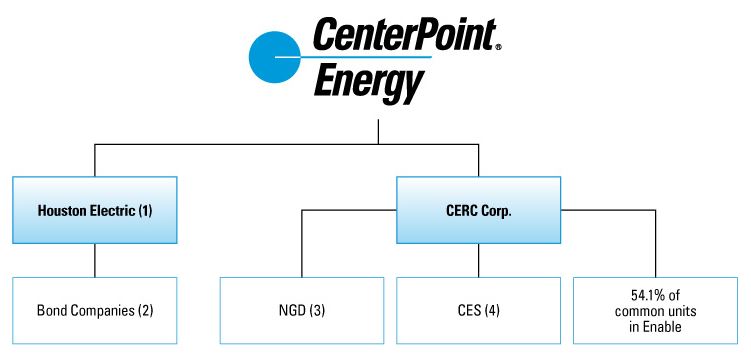
| (1) | Houston Electric engages in the electric transmission and distribution business in the Texas Gulf Coast area that includes the city of Houston. |
| (2) | Bond Companies are wholly-owned, bankruptcy remote entities formed solely for the purpose of purchasing and owning transition or system restoration property through the issuance of Securitization Bonds. |
| (3) | NGD operates natural gas distribution systems in six states. |
| (4) | CES obtains and offers competitive variable and fixed-price physical natural gas supplies and services primarily to commercial and industrial customers and electric and natural gas utilities in 33 states. |
| (5) | Represents limited partner interests in Enable, which owns, operates and develops natural gas and crude oil infrastructure assets. For additional information regarding our interest in Enable, see Note 10 to our consolidated financial statements. |

Our reportable business segments are Electric Transmission & Distribution, Natural Gas Distribution, Energy Services, Midstream Investments and Other Operations. For a discussion of operating income by segment, see “Management’s Discussion and Analysis of Financial Condition and Results of Operations — Results of Operations by Business Segment” in Item 7 of Part II of this report. For additional information about the segments, see Note 18 to our consolidated financial statements. From time to time, we consider the acquisition or the disposition of assets or businesses.
Our principal executive offices are located at 1111 Louisiana, Houston, Texas 77002 (telephone number: 713-207-1111).
We make available free of charge on our internet website our annual report on Form 10-K, quarterly reports on Form 10-Q, current reports on Form 8-K and amendments to those reports filed or furnished pursuant to Section 13(a) or 15(d) of the Securities Exchange Act of 1934 as soon as reasonably practicable after we electronically file such reports with, or furnish them to, the SEC. Additionally, we make available free of charge on our Internet website:
| • | our Code of Ethics for our Chief Executive Officer and Senior Financial Officers; |
| • | our Ethics and Compliance Code; |
| • | our Corporate Governance Guidelines; and |
| • | the charters of the audit, compensation, finance and governance committees of our Board of Directors. |
Any shareholder who so requests may obtain a printed copy of any of these documents from us. Changes in or waivers of our Code of Ethics for our Chief Executive Officer and Senior Financial Officers and waivers of our Ethics and Compliance Code for directors or executive officers will be posted on our Internet website within five business days of such change or waiver and maintained for at least 12 months or timely reported on Item 5.05 of Form 8-K.
Our website address is www.centerpointenergy.com. Investors should also note that we announce material financial information in SEC filings, press releases and public conference calls. Based on guidance from the SEC, we may use the investor relations section of our website to communicate with our investors. It is possible that the financial and other information posted there could be deemed to be material information. Except to the extent explicitly stated herein, documents and information on our website are not incorporated by reference herein.
Electric Transmission & Distribution
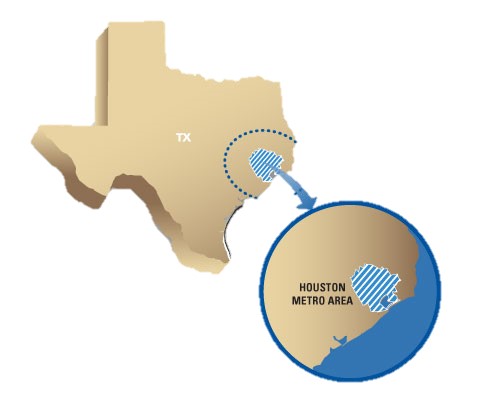
Houston Electric is a transmission and distribution electric utility that operates wholly within the state of Texas and is a member of ERCOT. ERCOT serves as the independent system operator and regional reliability coordinator for member electric power systems in most of Texas. The ERCOT market represents approximately 90% of the demand for power in Texas and is one of the nation’s largest power markets. The ERCOT market operates under the reliability standards developed by the NERC, approved by the FERC and monitored and enforced by the Texas RE. The PUCT has primary jurisdiction over the ERCOT market to ensure the adequacy and reliability of electricity supply across the state’s main interconnected power transmission grid. Neither
Houston Electric nor any other subsidiary of CenterPoint Energy makes direct retail or wholesale sales of electric energy or owns or operates any electric generating facilities. Houston Electric’s service territory is depicted below:
Electric Transmission
On behalf of REPs, Houston Electric delivers electricity from power plants to substations, from one substation to another and to retail electric customers taking power at or above 69 kV in locations throughout Houston Electric’s certificated service territory. Houston Electric constructs and maintains transmission facilities and provides transmission services under tariffs approved by the PUCT.
The ERCOT ISO is responsible for operating the bulk electric power supply system in the ERCOT market. Houston Electric’s transmission business, along with those of other owners of transmission facilities in Texas, supports the operation of the ERCOT ISO. Houston Electric participates with the ERCOT ISO and other ERCOT utilities to plan, design, obtain regulatory approval for and construct new transmission lines necessary to increase bulk power transfer capability and to remove existing constraints on the ERCOT transmission grid.
Electric Distribution
In ERCOT, end users purchase their electricity directly from certificated REPs. Houston Electric delivers electricity for REPs in its certificated service area by carrying lower-voltage power from the substation to the retail electric customer. Houston Electric’s distribution network receives electricity from the transmission grid through power distribution substations and delivers electricity to end users through distribution feeders. Houston Electric’s operations include construction and maintenance of distribution facilities, metering services, outage response services and call center operations. Houston Electric provides distribution services under tariffs approved by the PUCT. PUCT rules and market protocols govern the commercial operations of distribution companies and other market participants. Rates for these existing services are established pursuant to rate proceedings conducted before municipalities that have original jurisdiction and the PUCT.
Bond Companies
Houston Electric has special purpose subsidiaries consisting of the Bond Companies, which it consolidates. The consolidated special purpose subsidiaries are wholly-owned, bankruptcy remote entities that were formed solely for the purpose of purchasing and owning transition or system restoration property through the issuance of Securitization Bonds, and conducting activities incidental thereto. The Securitization Bonds are repaid through charges imposed on customers in Houston Electric’s service territory. For further discussion of the Securitization Bonds and the outstanding balances as of December 31, 2017 and 2016, see Not
Showing the first 8K of 70K characters. Open the full section
Item 1A. Risk Factors
We are a holding company that conducts all of our business operations through subsidiaries, primarily Houston Electric and CERC. We also own interests in Enable. The following, along with any additional legal proceedings identified or incorporated by reference in Item 3 of this report, summarizes the principal risk factors associated with our holding company, the businesses conducted by our subsidiaries and our interests in Enable. However, additional risks and uncertainties either not presently known or not currently believed by management to be material may also adversely affect our businesses.
Risk Factors Associated with Our Consolidated Financial Condition
We are a holding company with no operations or operating assets of our own. As a result, we depend on distributions from our subsidiaries and from Enable to meet our payment obligations and to pay dividends on our common stock, and provisions of applicable law or contractual restrictions could limit the amount of those distributions.
We derive all of our operating income from, and hold all of our assets through, our subsidiaries, including our interests in Enable. As a result, we depend on distributions from our subsidiaries and Enable to meet our payment obligations and to pay dividends on our common stock. In general, our subsidiaries are separate and distinct legal entities and have no obligation to provide us with funds for our payment obligations, whether by dividends, distributions, loans or otherwise. In addition, provisions of applicable law, such as those limiting the legal sources of dividends, limit our subsidiaries’ and Enable’s ability to make payments or other distributions to us, and our subsidiaries or Enable could agree to contractual restrictions on their ability to make distributions. For a discussion of risks that may impact the amount of cash distributions we receive with respect to our interests in Enable, please read “ — Additional Risk Factors Affecting Our Interests in Enable Midstream Partners, LP — Our cash flows will be adversely impacted if we receive less cash distributions from Enable than we currently expect” and “ — Other Risk Factors Affecting Our Businesses or Our Interests in Enable Midstream Partners, LP — Our or Enable’s potential business strategies and strategic initiatives, including merger and acquisition activities and the disposition of assets or businesses, may not be completed or perform as expected.”
Our right to receive any assets of any subsidiary, and therefore the right of our creditors to participate in those assets, will be effectively subordinated to the claims of that subsidiary’s creditors, including trade creditors. In addition, even if we were a creditor of any subsidiary, our rights as a creditor would be subordinated to any security interest in the assets of that subsidiary and any indebtedness of the subsidiary senior to that held by us.
If we are unable to arrange future financings on acceptable terms, our ability to refinance existing indebtedness could be limited.
Our businesses are capital intensive. We depend (i) on long-term debt to finance a portion of our capital expenditures and refinance our existing debt, (ii) on short-term borrowings through our revolving credit facilities and commercial paper programs and (iii) on distributions from our interests in Enable to satisfy liquidity needs to the extent not satisfied by cash flow from our business operations; we may also depend on the net proceeds from a potential sale of common units we own in Enable. As of December 31, 2017, we had $8.8 billion of outstanding indebtedness on a consolidated basis, which includes $1.9 billion of non-recourse Securitization Bonds. As of December 31, 2017, approximately $50 million principal amount of this debt is required to be paid through 2020. This amount excludes principal repayments of approximately $1.1 billion on Securitization Bonds, for which dedicated revenue streams exist. Our future financing activities may be significantly affected by, among other things:
| • | general economic and capital market conditions; |
| • | credit availability from financial institutions and other lenders; |
| • | volatility or fluctuations in distributions from Enable’s units or volatility in Enable’s unit price; |
| • | investor confidence in us and the markets in which we operate; |
| • | maintenance of acceptable credit ratings; |
| • | market expectations regarding our future earnings and cash flows; |
| • | our ability to access capital markets on reasonable terms; |
| • | our exposure to GenOn (formerly known as RRI Energy, Inc., Reliant Energy and RRI), a wholly-owned subsidiary of NRG and currently the subject of bankruptcy proceedings, in connection with certain indemnification obligations; |
| • | incremental collateral that may be required due to regulation of derivatives; and |
| • | provisions of relevant tax and securities laws. |
As of December 31, 2017, Houston Electric had approximately $2.9 billion aggregate principal amount of general mortgage bonds outstanding under the General Mortgage, including approximately $118 million held in trust to secure pollution control bonds for which we are obligated. Additionally, as of December 31, 2017, Houston Electric had approximately $102 million aggregate principal amount of first mortgage bonds outstanding under the Mortgage. Houston Electric may issue additional general mortgage bonds on the basis of retired bonds, 70% of property additions or cash deposited with the trustee. Approximately $4.2 billion of additional first mortgage bonds and general mortgage bonds in the aggregate could be issued on the basis of retired bonds and 70% of property additions as of December 31, 2017. However, Houston Electric has contractually agreed that it will not issue additional first mortgage bonds, subject to certain exceptions.
Our current credit ratings are discussed in “Management’s Discussion and Analysis of Financial Condition and Results of Operations - Liquidity and Capital Resources — Other Matters — Impact on Liquidity of a Downgrade in Credit Ratings” in Item 7 of Part II of this report. These credit ratings may not remain in effect for any given period of time and one or more of these ratings may be lowered or withdrawn entirely by a rating agency. We note that these credit ratings are not recommendations to buy, sell or hold our securities. Each rating should be evaluated independently of any other rating. Any future reduction or withdrawal of one or more of our credit ratings could have a material adverse impact on our ability to access capital on acceptable terms.
An impairment of goodwill, long-lived assets, including intangible assets, and equity and cost method investments could reduce our earnings.
Goodwill is recorded when the purchase price of a business exceeds the fair market value of the tangible and separately measurable intangible net assets. Accounting principles generally accepted in the United States of America require us to test goodwill for impairment on an annual basis or when events or circumstances occur indicating that goodwill might be impaired. Long-lived assets, including intangible assets with finite useful lives, are reviewed for impairment whenever events or changes in circumstances indicate that the carrying amount may not be recoverable.
For investments we account for under the equity or cost method, the impairment test considers whether the fair value of such investment as a whole, not the underlying net assets, has declined and whether that decline is other than temporary. For example, if Enable’s unit price, distributions or earnings were to decline, and that decline is deemed to be other than temporary, we could determine that
Showing the first 8K of 136K characters. Open the full section
Item 1B. Unresolved Staff Comments
None.
Item 2. Properties
Character of Ownership
We lease or own our principal properties in fee, including our corporate office space and various real property. Most of our electric lines and natural gas mains are located, pursuant to easements and other rights, on public roads or on land owned by others.
Electric Transmission & Distribution
For information regarding the properties of our Electric Transmission & Distribution business segment, please read “Business — Our Business — Electric Transmission & Distribution — Properties” in Item 1 of this report, which information is incorporated herein by reference.
Natural Gas Distribution
For information regarding the properties of our Natural Gas Distribution business segment, please read “Business — Our Business — Natural Gas Distribution — Assets” in Item 1 of this report, which information is incorporated herein by reference.
Energy Services
For information regarding the properties of our Energy Services business segment, please read “Business — Our Business — Energy Services — Assets” in Item 1 of this report, which information is incorporated herein by reference.
Midstream Investments
For information regarding the properties of our Midstream Investments business segment, please read “Business — Our Business — Midstream Investments” in Item 1 of this report, which information is incorporated herein by reference.
Other Operations
For information regarding the properties of our Other Operations business segment, please read “Business — Our Business — Other Operations” in Item 1 of this report, which information is incorporated herein by reference.
Item 3. Legal Proceedings
For a discussion of material legal and regulatory proceedings affecting us, please read “Business — Regulation” and “Business — Environmental Matters” in Item 1 of this report, “Management’s Discussion and Analysis of Financial Condition and Results of Operations — Liquidity and Capital Resources — Regulatory Matters” in Item 7 of this report and Note 15(d) to our consolidated financial statements, which information is incorporated herein by reference.
Item 4. Mine Safety Disclosures
Not applicable.
PART II
Item 5. Market for Registrant’s Common Equity, Related Stockholder Matters and Issuer Purchases of Equity Securities
As of February 9, 2018, our common stock was held by approximately 30,493 shareholders of record. Our common stock is listed on the NYSE and Chicago Stock Exchange and is traded under the symbol “CNP.”
The following table sets forth the high and low closing prices of the common stock of CenterPoint Energy on the NYSE composite tape during the periods indicated, as reported by Bloomberg, and the cash dividends declared in these periods.
| Market Price | Dividend Declared | ||||||||||
| High | Low | Per Share | |||||||||
| 2017 | |||||||||||
| First Quarter | $ | 0.2675 | |||||||||
| January 3 | $ | 24.59 | |||||||||
| March 15 | $ | 28.09 | |||||||||
| Second Quarter | $ | 0.2675 | |||||||||
| May 17 | $ | 27.17 | |||||||||
| June 1 | $ | 28.93 | |||||||||
| Third Quarter | $ | 0.2675 | |||||||||
| July 11 | $ | 27.16 | |||||||||
| September 11 | $ | 30.45 | |||||||||
| Fourth Quarter (1) | $ | 0.5450 | |||||||||
| November 30 | $ | 30.01 | |||||||||
| December 21 | $ | 27.77 | |||||||||
| 2016 | |||||||||||
| First Quarter | $ | 0.2575 | |||||||||
| January 20 | $ | 16.90 | |||||||||
| March 29 | $ | 21.25 | |||||||||
| Second Quarter | $ | 0.2575 | |||||||||
| April 5 | $ | 20.51 | |||||||||
| June 29 | $ | 24.00 | |||||||||
| Third Quarter | $ | 0.2575 | |||||||||
| July 22 | $ | 24.69 | |||||||||
| August 16 | $ | 22.13 | |||||||||
| Fourth Quarter | $ | 0.2575 | |||||||||
| October 11 | $ | 21.84 | |||||||||
| December 22 | $ | 24.84 |
| (1) | On October 25, 2017, our Board of Directors declared a regular quarterly cash dividend of $0.2675 per share of common stock payable on December 8, 2017, to shareholders of record as of the close of business on November 16, 2017. On December 13, 2017, our Board of Directors declared a regular quarterly cash dividend of $0.2775 per share, payable on March 8, 2018 to shareholders of record at the close of business on February 15, 2018. |
The closing market price of our common stock on December 31, 2017 was $28.36 per share.
The amount of future cash dividends will be subject to determination based upon our results of operations and financial condition, our future business prospects, any applicable contractual restrictions and other factors that our Board of Directors considers relevant and will be declared at the discretion of the Board of Directors.
Repurchases of Equity Securities
During the quarter ended December 31, 2017, none of our equity securities registered pursuant to Section 12 of the Securities Exchange Act of 1934 were purchased by or on behalf of us or any of our “affiliated purchasers,” as defined in Rule 10b-18(a)(3) under the Securities Exchange Act of 1934.
Item 6. Selected Financial Data
The following table presents selected financial data with respect to our consolidated financial condition and consolidated results of operations and should be read in conjunction with our consolidated financial statements and the related notes in Item 8 of this report.
| Year Ended December 31, | |||||||||||||||||||
| 2017 | 2016 | 2015 | 2014 | 2013 | |||||||||||||||
| (in millions, except per share amounts) | |||||||||||||||||||
| Revenues | $ | 9,614 | $ | 7,528 | $ | 7,386 | $ | 9,226 | $ | 8,106 | |||||||||
| Equity in earnings (losses) of unconsolidated affiliates | 265 | 208 | (1,663 | ) | (2) | 308 | 188 | ||||||||||||
| Net income (loss) | 1,792 | (1) | 432 | (692 | ) | 611 | 311 | ||||||||||||
| Basic earnings (loss) per common share | 4.16 | 1.00 | (1.61 | ) | 1.42 | 0.73 | |||||||||||||
| Diluted earnings (loss) per common share | 4.13 | 1.00 | (1.61 | ) | 1.42 | $ | 0.72 | ||||||||||||
| Cash dividends paid per common share | $ | 1.07 | $ | 1.03 | $ | 0.99 | $ | 0.95 | $ | 0.83 | |||||||||
| Dividend payout ratio | 26 | % | 103 | % | n/a | 67 | % | 114 | % | ||||||||||
| Return on average common equity | 44 | % | 12 | % | (17 | )% | 14 | % | 7 | % | |||||||||
| Ratio of earnings to fixed charges | 3.70 | 2.74 | 2.67 | 2.79 | 2.42 | ||||||||||||||
| At year-end: | |||||||||||||||||||
| Book value per common share | $ | 10.88 | $ | 8.04 | $ | 8.05 | $ | 10.58 | $ | 10.09 | |||||||||
| Market price per common share | 28.36 | 24.64 | 18.36 | 23.43 | 23.18 | ||||||||||||||
| Market price as a percent of book value | 261 | % | 306 | % | 228 | % | 221 | % | 230 | % | |||||||||
| Percentage of common units owned representing limited partner interests in Enable | 54.1 | % | 54.1 | % | 55.4 | % | 55.4 | % | 58.3 | % | |||||||||
| Total assets (4) | $ | 22,736 | $ | 21,829 | $ | 21,290 | $ | 23,150 | $ | 21,816 | |||||||||
| Short-term borrowings | 39 | 35 | 40 | 53 | 43 | ||||||||||||||
| Securitization Bonds, including current maturities (3) | 1,868 | 2,278 | 2,667 | 3,037 | 3,388 | ||||||||||||||
| Other long-term debt, including current maturities (3) | 6,933 | 6,279 | 6,063 | 5,717 | 4,873 | ||||||||||||||
| Capitalization: | |||||||||||||||||||
| Common stock equity | 35 | % | 29 | % | 28 | % | 34 | % | 34 | % | |||||||||
| Long-term debt, including current maturities | 65 | % | 71 | % | 72 | % | 66 | % | 66 | % | |||||||||
| Capitalization, excluding Securitization Bonds: | |||||||||||||||||||
| Common stock equity | 40 | % | 36 | % | 36 | % | 44 | % | 47 | % | |||||||||
| Long-term debt, excluding Securitization Bonds, and including current maturities | 60 | % | 64 | % | 64 | % | 56 | % | 53 | % | |||||||||
| Capital expenditures | $ | 1,494 | $ | 1,406 | $ | 1,575 | $ | 1,402 | $ | 1,272 |
| (1) | Net income for the year ended December 31, 2017 includes a reduction in income taxes of $1,113 million due to tax reform. See Note 14 to our consolidated financial statements for further discussion of the impacts of tax reform implementation. |
| (2) | This amount includes $1,846 million of non-cash impairment charges related to Enable. |
| (3) | Amounts for 2013 to 2015 have been restated to reflect adoption of ASU 2015-03. |
Item 7. Management’s Discussion and Analysis of Financial Condition and Results of Operations
The following discussion and analysis should be read in combination with our consolidated financial statements included in Item 8 herein.
OVERVIEW
Background
We are a public utility holding company. Our operating subsidiaries own and operate electric transmission and distribution and natural gas distribution facilities, supply natural gas to commercial and industrial customers and electric and natural gas utilities and own interests in Enable as described below. Our indirect, wholly-owned subsidiaries include:
| • | Houston Electric, which engages in the electric transmission and distribution business in the Texas Gulf Coast area that includes the city of Houston; |
| • | CERC Corp., which owns and operates natural gas distribution systems in six states; and |
| • | CES, which obtains and offers competitive variable and fixed-price physical natural gas supplies and services primarily to commercial and industrial customers and electric and natural gas utilities in 33 states. |
As of December 31, 2017, we also owned an aggregate of 14,520,000 Series A Preferred Units in Enable, which owns, operates and develops natural gas and crude oil infrastructure assets, and CERC Corp. owned approximately 54.1% of the common units representing limited partner interests in Enable.
Business Segments
In this Management’s Discussion and Analysis, we discuss our results from continuing operations on a consolidated basis and individually for each of our business segments. We also discuss our liquidity, capital resources and critical accounting policies. We are first and foremost an energy delivery company and it is our intention to remain focused on these segments of the energy business. The results of our business operations are significantly impacted by weather, customer growth, economic conditions, cost management, competition, rate proceedings before regulatory agencies and other actions of the various regulatory agencies to whose jurisdiction we are subject. Our electric transmission and distribution services are subject to rate regulation and are reported in the Electric Transmission & Distribution business segment, as are impacts of generation-related stranded costs and other true-up balances recoverable by the regulated electric utility. For further information about our Electric Transmission & Distribution business segment, see “Business — Our Business — Electric Transmission & Distribution” in Item 1 of Part I of this report. Our natural gas distribution services are also subject to rate regulation and are reported in the Natural Gas Distribution business segment. For further information about our Natural Gas Distribution business segment, see “Business — Our Business — Natural Gas Distribution” in Item 1 of Part I of this report. Our Energy Services business segment includes non-rate regulated natural gas sales to, and transportation and storage services, for commercial and industrial customers. For further information about our Energy Services business segment, see “Business — Our Business — Energy Services” in Item 1 of Part I of this report. The results of our Midstream Investments business segment are dependent upon the results of Enable, which are driven primarily by the volume of natural gas, NGLs and crude oil that Enable gathers, processes and transports across its systems and other factors as discussed below under “— Factors Influencing Our Midstream Investments Segment.” Our Other Operations business segment includes office buildings and other real estate used in our business operations and other corporate operations which support all of our business operations.
EXECUTIVE SUMMARY
Factors Influencing Our Businesses and Industry Trends
We expect our and Enable’s businesses to continue to be affected by the key factors and trends discussed below. Our expectations are based on assumptions made by us and information currently available to us. To the extent our underlying assumptions about, or interpretations of, available information prove to be incorrect, our actual results may vary materially from our expected results.
We are an energy delivery company. The majority of our revenues are generated from the sale of natural gas and the transmission and delivery of electricity by our subsidiaries. We do not own or operate electric generating facilities or make retail sales to end-use electric customers. To assess our financial performance, our management primarily monitors operating income and cash flows from our business segments. Within these broader financial measures, we monitor margins, operation and maintenance expense,
interest expense, capital spending and working capital requirements. In addition to these financial measures, we also monitor a number of variables that management considers important to the operation of our business segments, including the number of customers, throughput, use per customer, commodity prices and heating and cooling degree days. We also monitor system reliability, safety factors and customer satisfaction to gauge our performance.
To the extent adverse economic conditions affect our suppliers and customers, results from our energy delivery businesses may suffer. For example, our electric business is largely concentrated in Houston, Texas, where a higher percentage of employment is tied to the energy sector relative to other regions of the country. Although Houston, Texas has a diverse economy, employment in the energy industry remains important. During 2015 and 2016, the rate of growth in employment in Houston declined in connection with the significant decline in energy and commodity prices over that period. Relatively low commodity prices compared to pre-2015 levels continued in 2017, and we expect such relatively low prices to continue or slightly improve in 2018.
Also, adverse economic conditions, coupled with concerns for protecting the environment and increased availability of alternate energy sources, may cause consumers to use less energy or avoid expansions of their facilities, resulting in less demand for our services. To the extent population growth is affected by lower energy prices and there is financial pressure on some of our customers who operate within the energy industry, there may be an impact on the growth rate of our customer base and overall demand. Due to a slowdown in multi-family residential construction, meter growth in 2017 has declined. We saw year-over-year residential meter growth decline from 2.3% in 2016 to 1.6% in 2017. As the recent stability in the energy sector gains momentum in 2018, we anticipate this growth will continue at roughly 2%, in line with long-term trends.
Performance of our Electric Transmission & Distribution and Natural Gas Distribution business segments is significantly influenced by the number of customers and energy usage per customer. Weather conditions can have a significant impact on energy usage, and we compare our results on a weather-adjusted basis.
Overall, in 2017 the Houston area experienced a number of record-breaking high and low temperatures, primarily in January-April and in October-November, resulting in a year that was warmer by a tenth of a degree than the previous warmest year, 2012. In terms of heating degree days, Texas recorded its warmest year and for most other jurisdictions the second warmest year since 1970. In 2017, our Houston service area experienced above normal warmth with record rainfall during Hurricane Harvey. In 2016, our Houston service area experienced above normal warmth with episodes of flooding. In 2015, our Houston service area experienced some of the mildest temperatures on record during November and December. Every state in which we distribute natural gas had a warmer than normal winter in 2017, 2016 and 2015.
Historically, both the TDU and NGD have utilized weather hedges to help reduce the impact of mild weather on their financial results.
Showing the first 8K of 114K characters. Open the full section
Item 7A. Quantitative and Qualitative Disclosures About Market Risk
Impact of Changes in Interest Rates, Equity Prices and Energy Commodity Prices
We are exposed to various market risks. These risks arise from transactions entered into in the normal course of business and are inherent in our consolidated financial statements. Most of the revenues and income from our business activities are affected by market risks. Categories of market risk include exposure to commodity prices through non-trading activities, interest rates and equity prices. A description of each market risk is set forth below:
| • | Interest rate risk primarily results from exposures to changes in the level of borrowings and changes in interest rates. |
| • | Equity price risk results from exposures to changes in prices of individual equity securities. |
| • | Commodity price risk results from exposures to changes in spot prices, forward prices and price volatilities of commodities, such as natural gas, NGLs and other energy commodities. |
Management has established comprehensive risk management policies to monitor and manage these market risks.
Interest Rate Risk
As of December 31, 2017, we had outstanding long-term debt, lease obligations and obligations under our ZENS that subject us to the risk of loss associated with movements in market interest rates.
Our floating rate obligations aggregated $1.8 billion and $1.4 billion as of December 31, 2017 and 2016, respectively. If the floating interest rates were to increase by 10% from December 31, 2017 rates, our combined interest expense would increase by $3 million annually.
As of December 31, 2017 and 2016, we had outstanding fixed-rate debt (excluding indexed debt securities) aggregating $7 billion and $7.1 billion, respectively, in principal amount and having a fair value of $7.5 billion and $7.5 billion, respectively. Because these instruments are fixed-rate, they do not expose us to the risk of loss in earnings due to changes in market interest rates (see Note 13 to our consolidated financial statements). However, the fair value of these instruments would increase by approximately $218 million if interest rates were to decline by 10% from their levels as of December 31, 2017. In general, such an increase in fair value would impact earnings and cash flows only if we were to reacquire all or a portion of these instruments in the open market prior to their maturity.
As discussed in Note 11 to our consolidated financial statements, the ZENS obligation is bifurcated into a debt component and a derivative component. The debt component of $122 million at December 31, 2017 was a fixed-rate obligation and, therefore, did not expose us to the risk of loss in earnings due to changes in market interest rates. However, the fair value of the debt component would increase by approximately $19 million if interest rates were to decline by 10% from levels at December 31, 2017. Changes in the fair value of the derivative component, a $668 million recorded liability at December 31, 2017, are recorded in our Statements of Consolidated Income and, therefore, we are exposed to changes in the fair value of the derivative component as a result of changes in the underlying risk-free interest rate. If the risk-free interest rate were to increase by 10% from December 31, 2017 levels, the fair value of the derivative component liability would increase by approximately $6 million, which would be recorded as an unrealized loss in our Statements of Consolidated Income.
Equity Market Value Risk
We are exposed to equity market value risk through our ownership of 7.1 million shares of TW Common, 0.9 million shares of Time Common and 0.9 million shares of Charter Common, which we hold to facilitate our ability to meet our obligations under the ZENS. See Note 11 to our consolidated financial statements for a discussion of our ZENS obligation. Changes in the fair value of the TW Securities held by CenterPoint Energy are expected to substantially offset changes in the fair value of the derivative component of the ZENS. A decrease of 10% from the December 31, 2017 aggregate market value of these shares would result in a net loss of approximately $2 million, which would be recorded as an unrealized loss in our Statements of Consolidated Income.
Commodity Price Risk From Non-Trading Activities
We manage these risk exposures through the implementation of our risk management policies and framework. We manage our commodity price risk exposures through the use of derivative financial instruments and derivative commodity instrument contracts. During the normal course of business, we review our hedging strategies and determine the hedging approach we deem appropriate based upon the circumstances of each situation.
Derivative instruments such as futures, forward contracts, swaps and options derive their value from underlying assets, indices, reference rates or a combination of these factors. These derivative instruments include negotiated contracts, which are referred to as over-the-counter derivatives, and instruments that are listed and traded on an exchange.
Derivative transactions are entered into in our non-trading operations to manage and hedge certain exposures, such as exposure to changes in natural gas prices. We believe that the associated market risk of these instruments can best be understood relative to the underlying assets or risk being hedged.
We use derivative instruments as economic hedges to offset the commodity price exposure inherent in our businesses. The commodity risk created by these instruments, including the offsetting impact on the market value of natural gas inventory, is described below. We measure this commodity risk using a sensitivity analysis. For purposes of this analysis, we estimate commodity price risk by applying a $0.50 change in the forward NYMEX price to our net open fixed price position (including forward fixed price physical contracts, natural gas inventory and fixed price financial contracts) at the end of each period. As of December 31, 2017, the recorded fair value of our non-trading energy derivatives was a net asset of $111 million (before collateral), all of which is related to our Energy Services business segment. A $0.50 change in the forward NYMEX price would have had a combined impact of $5 million on our non-trading energy derivatives net asset and the market value of natural gas inventory.
Commodity price risk is not limited to changes in forward NYMEX prices. Variation of commodity pricing between the different indices used to mark to market portions of our natural gas inventory (Gas Daily) and the related fair value hedge (NYMEX) can result in volatility to our net income. Over time, any gains or losses on the sale of storage gas inventory would be offset by gains or losses on the fair value hedges.
Item 8. Financial Statements and Supplementary Data
REPORT OF INDEPENDENT REGISTERED PUBLIC ACCOUNTING FIRM
To the Board of Directors and Shareholders of
CenterPoint Energy, Inc.
Houston, Texas
Opinion on the Financial Statements
We have audited the accompanying consolidated balance sheets of CenterPoint Energy, Inc. and subsidiaries (the "Company") as of December 31, 2017 and 2016, the related statements of consolidated income, comprehensive income, shareholders' equity, and cash flows, for each of the three years in the period ended December 31, 2017, and the related notes (collectively referred to as the "financial statements"). In our opinion, the financial statements present fairly, in all material respects, the financial position of the Company as of December 31, 2017 and 2016, and the results of its operations and its cash flows for each of the three years in the period ended December 31, 2017, in conformity with accounting principles generally accepted in the United States of America.
We have also audited, in accordance with the standards of the Public Company Accounting Oversight Board (United States) (PCAOB), the Company's internal control over financial reporting as of December 31, 2017, based on criteria established in Internal Control - Integrated Framework (2013) issued by the Committee of Sponsoring Organizations of the Treadway Commission and our report dated February 22, 2018, expressed an unqualified opinion on the Company's internal control over financial reporting.
Basis for Opinion
These financial statements are the responsibility of the Company's management. Our responsibility is to express an opinion on the Company's financial statements based on our audits. We are a public accounting firm registered with the PCAOB and are required to be independent with respect to the Company in accordance with the U.S. federal securities laws and the applicable rules and regulations of the Securities and Exchange Commission and the PCAOB.
We conducted our audits in accordance with the standards of the PCAOB. Those standards require that we plan and perform the audit to obtain reasonable assurance about whether the financial statements are free of material misstatement, whether due to error or fraud. Our audits included performing procedures to assess the risks of material misstatement of the financial statements, whether due to error or fraud, and performing procedures that respond to those risks. Such procedures included examining, on a test basis, evidence regarding the amounts and disclosures in the financial statements. Our audits also included evaluating the accounting principles used and significant estimates made by management, as well as evaluating the overall presentation of the financial statements. We believe that our audits provide a reasonable basis for our opinion.
/s/ DELOITTE & TOUCHE LLP
Houston, Texas
February 22, 2018
We have served as the Company's auditor since 1932.
CENTERPOINT ENERGY, INC. AND SUBSIDIARIES
STATEMENTS OF CONSOLIDATED INCOME
| Year Ended December 31, | |||||||||||
| 2017 | 2016 | 2015 | |||||||||
| (in millions, except per share amounts) | |||||||||||
| Revenues: | |||||||||||
| Utility revenues | $ | 5,603 | $ | 5,440 | $ | 5,448 | |||||
| Non-utility revenues | 4,011 | 2,088 | 1,938 | ||||||||
| Total | 9,614 | 7,528 | 7,386 | ||||||||
| Expenses: | |||||||||||
| Utility natural gas | 1,109 | 983 | 1,264 | ||||||||
| Non-utility natural gas | 3,785 | 1,983 | 1,838 | ||||||||
| Operation and maintenance | 2,221 | 2,093 | 2,007 | ||||||||
| Depreciation and amortization | 1,036 | 1,126 | 970 | ||||||||
| Taxes other than income taxes | 391 | 384 | 374 | ||||||||
| Total | 8,542 | 6,569 | 6,453 | ||||||||
| Operating Income | 1,072 | 959 | 933 | ||||||||
| Other Income (Expense): | |||||||||||
| Gain (loss) on marketable securities | 7 | 326 | (93 | ) | |||||||
| Gain (loss) on indexed debt securities | 49 | (413 | ) | 74 | |||||||
| Interest and other finance charges | (313 | ) | (338 | ) | (352 | ) | |||||
| Interest on Securitization Bonds | (77 | ) | (91 | ) | (105 | ) | |||||
| Equity in earnings (losses) of unconsolidated affiliates | 265 | 208 | (1,633 | ) | |||||||
| Other, net | 60 | 35 | 46 | ||||||||
| Total | (9 | ) | (273 | ) | (2,063 | ) | |||||
| Income (Loss) Before Income Taxes | 1,063 | 686 | (1,130 | ) | |||||||
| Income tax expense (benefit) | (729 | ) | 254 | (438 | ) | ||||||
| Net Income (Loss) | $ | 1,792 | $ | 432 | $ | (692 | ) | ||||
| Basic Earnings (Loss) Per Share | $ | 4.16 | $ | 1.00 | $ | (1.61 | ) | ||||
| Diluted Earnings (Loss) Per Share | $ | 4.13 | $ | 1.00 | $ | (1.61 | ) | ||||
| Weighted Average Shares Outstanding, Basic | 431 | 431 | 430 | ||||||||
| Weighted Average Shares Outstanding, Diluted | 434 | 434 | 430 |
See Notes to Consolidated Financial Statements
CENTERPOINT ENERGY, INC. AND SUBSIDIARIES
STATEMENTS OF CONSOLIDATED COMPREHENSIVE INCOME
| Year Ended December 31, | |||||||||||
| 2017 | 2016 | 2015 | |||||||||
| (in millions) | |||||||||||
| Net income (loss) | $ | 1,792 | $ | 432 | $ | (692 | ) | ||||
| Other comprehensive income (loss): | |||||||||||
| Adjustment to pension and other postretirement plans (net of tax of $6, $4 and $12, respectively) | 6 | (7 | ) | 20 | |||||||
| Net deferred gain (loss) from cash flow hedges (net of tax of $2, $-0-, and $-0-, respectively) | (3 | ) | 1 | — | |||||||
| Reclassification of deferred loss from cash flow hedges realized in net income (net of tax of $-0-, $1, and $-0-, respectively) | — | 1 | — | ||||||||
| Other comprehensive income (loss) | 3 | (5 | ) | 20 | |||||||
| Comprehensive income (loss) | $ | 1,795 | $ | 427 | $ | (672 | ) |
See Notes to Consolidated Financial Statements
CENTERPOINT ENERGY, INC. AND SUBSIDIARIES
CONSOLIDATED BALANCE SHEETS
| December 31, 2017 | December 31, 2016 | ||||||
| (in millions) | |||||||
| ASSETS | |||||||
| Current Assets: | |||||||
| Cash and cash equivalents ($230 and $340 related to VIEs, respectively) | $ | 260 | $ | 341 | |||
| Investment in marketable securities | 960 | 953 | |||||
| Accounts receivable ($73 and $52 related to VIEs, respectively), less bad debt reserve of $19 and $15, respectively | 1,000 | 740 | |||||
| Accrued unbilled revenues | 427 | 335 | |||||
| Natural gas inventory | 222 | 131 | |||||
| Materials and supplies | 175 | 181 | |||||
| Non-trading derivative assets | 110 | 51 | |||||
| Taxes receivable | — | 30 | |||||
| Prepaid expense and other current assets ($35 and $40 related to VIEs, respectively) | 241 | 161 | |||||
| Total current assets | 3,395 | 2,923 | |||||
| Property, Plant and Equipment, net | 13,057 | 12,307 | |||||
| Other Assets: | |||||||
| Goodwill | 867 | 862 | |||||
| Reg |
Showing the first 8K of 209K characters. Open the full section
Item 9. Changes in and Disagreements with Accountants on Accounting and Financial Disclosure
None.
Item 9A. Controls and Procedures
Disclosure Controls And Procedures
In accordance with Exchange Act Rules 13a-15 and 15d-15, we carried out an evaluation, under the supervision and with the participation of management, including our principal executive officer and principal financial officer, of the effectiveness of our disclosure controls and procedures as of the end of the period covered by this report. Based on that evaluation, our principal executive officer and principal financial officer concluded that our disclosure controls and procedures were effective as of December 31, 2017 to provide assurance that information required to be disclosed in our reports filed or submitted under the Exchange Act is recorded, processed, summarized and reported within the time periods specified in the Securities and Exchange Commission’s rules and forms and such information is accumulated and communicated to our management, including our principal executive officer and principal financial officer, as appropriate to allow timely decisions regarding disclosure.
There has been no change in our internal controls over financial reporting that occurred during the three months ended December 31, 2017 that has materially affected, or is reasonably likely to materially affect, our internal controls over financial reporting.
Management’s Annual Report on Internal Control over Financial Reporting
Our management is responsible for establishing and maintaining adequate internal control over financial reporting. Internal control over financial reporting is defined in Rule 13a-15(f) or 15d-15(f) promulgated under the Securities Exchange Act of 1934 as a process designed by, or under the supervision of, the company’s principal executive and principal financial officers and effected by the company’s board of directors, management and other personnel, to provide reasonable assurance regarding the reliability of financial reporting and the preparation of financial statements for external purposes in accordance with generally accepted accounting principles and includes those policies and procedures that:
| • | Pertain to the maintenance of records that in reasonable detail accurately and fairly reflect the transactions and dispositions of the assets of the company; |
| • | Provide reasonable assurance that transactions are recorded as necessary to permit preparation of financial statements in accordance with generally accepted accounting principles, and that receipts and expenditures of the company are being made only in accordance with authorizations of management and directors of the company; and |
| • | Provide reasonable assurance regarding prevention or timely detection of unauthorized acquisition, use or disposition of the company’s assets that could have a material effect on the financial statements. |
Management has designed its internal control over financial reporting to provide reasonable assurance regarding the reliability of financial reporting and the preparation of financial statements in accordance with accounting principles generally accepted in the United States of America. Management’s assessment included review and testing of both the design effectiveness and operating effectiveness of controls over all relevant assertions related to all significant accounts and disclosures in the financial statements.
All internal control systems, no matter how well designed, have inherent limitations. Therefore, even those systems determined to be effective can provide only reasonable assurance with respect to financial statement preparation and presentation. Projections of any evaluation of effectiveness to future periods are subject to the risk that controls may become inadequate because of changes in conditions, or that the degree of compliance with the policies or procedures may deteriorate.
Under the supervision and with the participation of our management, including our principal executive officer and principal financial officer, we conducted an evaluation of the effectiveness of our internal control over financial reporting based on the framework in Internal Control — Integrated Framework (2013) issued by the Committee of Sponsoring Organizations of the Treadway Commission. Based on our evaluation under the framework in Internal Control — Integrated Framework (2013), our management has concluded that our internal control over financial reporting was effective as of December 31, 2017.
Deloitte & Touche LLP, the Company’s independent registered public accounting firm, has issued an attestation report on the effectiveness of our internal control over financial reporting as of December 31, 2017 which is set forth below.
REPORT OF INDEPENDENT REGISTERED PUBLIC ACCOUNTING FIRM
To the Board of Directors and Shareholders of
CenterPoint Energy, Inc.
Houston, Texas
Opinion on Internal Control over Financial Reporting
We have audited the internal control over financial reporting of CenterPoint Energy, Inc. and subsidiaries (the “Company”) as of December 31, 2017, based on criteria established in Internal Control - Integrated Framework (2013) issued by the Committee of Sponsoring Organizations of the Treadway Commission (COSO). In our opinion, the Company maintained, in all material respects, effective internal control over financial reporting as of December 31, 2017, based on criteria established in Internal Control - Integrated Framework (2013) issued by COSO.
We have also audited, in accordance with the standards of the Public Company Accounting Oversight Board (United States) (PCAOB), the consolidated financial statements as of and for the year ended December 31, 2017, of the Company and our report dated February 22, 2018, expressed an unqualified opinion on those financial statements.
Basis for Opinion
The Company’s management is responsible for maintaining effective internal control over financial reporting and for its assessment of the effectiveness of internal control over financial reporting, included in the accompanying Management’s Annual Report on Internal Control over Financial Reporting. Our responsibility is to express an opinion on the Company’s internal control over financial reporting based on our audit. We are a public accounting firm registered with the PCAOB and are required to be independent with respect to the Company in accordance with the U.S. federal securities laws and the applicable rules and regulations of the Securities and Exchange Commission and the PCAOB.
We conducted our audit in accordance with the standards of the PCAOB. Those standards require that we plan and perform the audit to obtain reasonable assurance about whether effective internal control over financial reporting was maintained in all material respects. Our audit included obtaining an understanding of internal control over financial reporting, assessing the risk that a material weakness exists, testing and evaluating the design and operating effectiveness of internal control based on the assessed risk, and performing such other procedures as we considered necessary in the circumstances. We believe that our audit provides a reasonable basis for our opinion.
Definition and Limitations of Internal Control over Financial Reporting
A company’s internal control over financial reporting is a process designed to provide reasonable assurance regarding the reliability of financial reporting and the preparation of financial statements for external purposes in accordance with generally accepted accounting principles. A company’s internal control over financial reporting includes those policies and procedures that (1) pertain to the maintenance of records that, in reasonable detail, accurately and fairly reflect the transactions and dispositions of the assets of the company; (2) provide reasonable assurance that transactions are recorded as necessary to permit preparation of financial statements in accordance with generally accepted accounting principles, and that receipts and expenditures of the company are being made only in accordance with authorizations of management and directors of the company; and (3) provide reasonable assurance regarding prevention or timely detection of unauthorized acquisition, use, or disposition of the company’s assets that could have a material effect on the financial statements.
Because of its inherent limitations, internal control over financial reporting may not prevent or detect misstatements. Also, projections of any evaluation of effectiveness to future periods are subject to the risk that controls may become inadequate because of changes in conditions, or that the degree of compliance with the policies or procedures may deteriorate.
/s/ DELOITTE & TOUCHE LLP
Houston, Texas
February 22, 2018
Item 9B. Other Information
Compensatory Arrangements of Certain Officers
Amendments to Forms of Award Agreements under Long-Term Incentive Plan
On February 21, 2018, the Compensation Committee of the Board of Directors of CenterPoint Energy approved new forms of award agreements under CenterPoint Energy’s LTIP for performance share awards and restricted stock unit awards.
Among other things, the newly approved forms of award agreements for officers and director employees provide that a “retirement eligible” (age 55 or greater with at least five years of service) participant, who meets the requirements for enhanced retirement as specified under the agreement will fully vest in the award, subject, in the case of performance share awards, to the achievement of the relevant performance metrics. The requirements for enhanced retirement include having a sum of age and years of employment equal to 65 or greater, providing at least six months’ written notice of retirement, providing a transition plan and retiring on or after the January 1 immediately following the grant (for restricted stock units) or the first anniversary of the beginning of the designated performance cycle (for performance share awards). In addition, for officers subject to Section 16 of the Exchange Act, eligibility for enhanced retirement is subject to approval by the Compensation Committee.
In connection with a change in control of CenterPoint Energy (as defined in the LTIP), the newly approved forms of award agreements provide for full vesting if (a) such awards are not assumed or continued, or substituted with a substantially equivalent award, by the surviving or successor entity, or (b) the award holder is terminated (other than due to death, disability, voluntary resignation or for cause) within two years after the date upon which such change in control occurred.
In addition, the newly approved forms of award agreements provide for vesting upon death or termination due to disability. The newly approved forms of award agreements also include restrictive covenants (confidentiality, non-solicitation and non-competition provisions) that provide for forfeiture of unpaid awards and return of paid awards upon violation.
The description of the forms of award agreements, as amended, is qualified in its entirety by reference to the full text of the forms of performance share award and restricted stock unit award agreements, which are included as Exhibits 10(q)(2), 10(q)(3), 10(q)(5) and 10(q)(7) hereto and incorporated by reference herein.
With respect to the newly approved form of award agreement for restricted stock unit awards (retention) only, such agreement has been updated solely for purposes of the change in control and restrictive covenant provisions described above. The description of the form of award agreement for restricted stock unit awards (retention), as amended, is qualified in its entirety by reference to the full text of the form of restricted stock unit award agreement (retention), which is included as Exhibit 10(q)(6) hereto and incorporated by reference herein.
PART III
Item 10. Directors, Executive Officers and Corporate Governance
The information called for by Item 10, to the extent not set forth in “Executive Officers” in Item 1, will be set forth in the definitive proxy statement relating to CenterPoint Energy’s 2018 annual meeting of shareholders pursuant to SEC Regulation 14A. Such definitive proxy statement relates to a meeting of shareholders involving the election of directors and the portions thereof called for by Item 10 are incorporated herein by reference pursuant to Instruction G to Form 10-K.
Item 11. Executive Compensation
The information called for by Item 11 will be set forth in the definitive proxy statement relating to CenterPoint Energy’s 2018 annual meeting of shareholders pursuant to SEC Regulation 14A. Such definitive proxy statement relates to a meeting of shareholders involving the election of directors and the portions thereof called for by Item 11 are incorporated herein by reference pursuant to Instruction G to Form 10-K.
Item 12. Security Ownership of Certain Beneficial Owners and Management and Related Stockholder Matters
The information called for by Item 12 will be set forth in the definitive proxy statement relating to CenterPoint Energy’s 2018 annual meeting of shareholders pursuant to SEC Regulation 14A. Such definitive proxy statement relates to a meeting of shareholders involving the election of directors and the portions thereof called for by Item 12 are incorporated herein by reference pursuant to Instruction G to Form 10-K.
Item 13. Certain Relationships and Related Transactions, and Director Independence
The information called for by Item 13 will be set forth in the definitive proxy statement relating to CenterPoint Energy’s 2018 annual meeting of shareholders pursuant to SEC Regulation 14A. Such definitive proxy statement relates to a meeting of shareholders involving the election of directors and the portions thereof called for by Item 13 are incorporated herein by reference pursuant to Instruction G to Form 10-K.
Item 14. Principal Accounting Fees and Services
The information called for by Item 14 will be set forth in the definitive proxy statement relating to CenterPoint Energy’s 2018 annual meeting of shareholders pursuant to SEC Regulation 14A. Such definitive proxy statement relates to a meeting of shareholders involving the election of directors and the portions thereof called for by Item 14 are incorporated herein by reference pursuant to Instruction G to Form 10-K.
PART IV
Item 15. Exhibits and Financial Statement Schedules
(a)(1) Financial Statements.
| Report of Independent Registered Public Accounting Firm | 72 |
| Statements of Consolidated Income for the Three Years Ended December 31, 2017 | 73 |
| Statements of Consolidated Comprehensive Income for the Three Years Ended December 31, 2017 | 74 |
| Consolidated Balance Sheets as of December 31, 2017 and 2016 | 75 |
| Statements of Consolidated Cash Flows for the Three Years Ended December 31, 2017 | 77 |
| Statements of Consolidated Shareholders’ Equity for the Three Years Ended December 31, 2017 | 79 |
| Notes to Consolidated Financial Statements | 80 |
The financial statements of Enable Midstream Partners, LP required pursuant to Rule 3-09 of Regulation S-X are included in this filing as Exhibit 99.1.
(a)(2) Financial Statement Schedules for the Three Years Ended December 31, 2017.
The following schedules are omitted because of the absence of the conditions under which they are required or because the required information is included in the financial statements:
I, II, III, IV and V.
(a)(3) Exhibits.
See Index of Exhibits beginning on page 130, which index also includes the management contracts or compensatory plans or arrangements required to be filed as exhibits to this Form 10-K by Item 601(b)(10)(iii) of Regulation S-K.
Item 16. Form 10-K Summary
None.
CENTERPOINT ENERGY, INC.
EXHIBITS TO THE ANNUAL REPORT ON FORM 10-K
For Fiscal Year Ended December 31, 2017
INDEX OF EXHIBITS
Exhibits included with this report are designated by a cross (†); all exhibits not so designated are incorporated herein by reference to a prior filing as indicated. Exhibits designated by an asterisk (*) are management contracts or compensatory plans or arrangements required to be filed as exhibits to this Form 10-K by Item 601(b)(10)(iii) of Regulation S-K. CenterPoint Energy has not filed the exhibits and schedules to Exhibit 2. CenterPoint Energy hereby agrees to furnish supplementally a copy of any schedule omitted from Exhibit 2 to the SEC upon request.
The agreements included as exhibits are included only to provide information to investors regarding their terms. The agreements listed below may contain representations, warranties and other provisions that were made, among other things, to provide the parties thereto with specified rights and obligations and to allocate risk among them, and such agreements should not be relied upon as constituting or providing any factual disclosures about us, any other persons, any state of affairs or other matters.
| Exhibit Number | Description | Report or Registration Statement | SEC File or Registration Number | Exhibit Reference | ||||
| 2 | — | Transaction Agreement dated July 21, 2004 among CenterPoint Energy, Utility Holding, LLC, NN Houston Sub, Inc., Texas Genco Holdings, Inc. (Texas Genco), HPC Merger Sub, Inc. and GC Power Acquisition LLC | CenterPoint Energy’s Form 8-K dated July 21, 2004 | 1-31447 | 10.1 | |||
| 3(a) | — | Restated Articles of Incorporation of CenterPoint Energy | CenterPoint Energy’s Form 8-K dated July 24, 2008 | 1-31447 | 3.2 | |||
| 3(b) | — | Third Amended and Restated Bylaws of CenterPoint Energy | CenterPoint Energy’s Form 8-K dated February 21, 2017 | 1-31447 | 3.1 | |||
| 3(c) | — | Statement of Resolutions Deleting Shares Designated Series A Preferred Stock of CenterPoint Energy | CenterPoint Energy’s Form 10-K for the year ended December 31, 2011 | 1-31447 | 3(c) | |||
| 4(a) | — | Form of CenterPoint Energy Stock Certificate | CenterPoint Energy’s Registration Statement on Form S-4 | 333-69502 | 4.1 | |||
| 4(b) | — | Contribution and Registration Agreement dated December 18, 2001 among Reliant Energy, CenterPoint Energy and the Northern Trust Company, trustee under the Reliant Energy, Incorporated Master Retirement Trust | CenterPoint Energy’s Form 10-K for the year ended December 31, 2001 | 1-31447 | 4.3 | |||
| 4(c)(1) | — | Mortgage and Deed of Trust, dated November 1, 1944 between Houston Lighting and Power Company (HL&P) and Chase Bank of Texas, National Association (formerly, South Texas Commercial National Bank of Houston), as Trustee, as amended and supplemented by 20 Supplemental Indentures thereto | HL&P’s Form S-7 filed on August 25, 1977 | 2-59748 | 2(b) | |||
| 4(c)(2) | — | Twenty-First through Fiftieth Supplemental Indentures to Exhibit 4(c)(1) | HL&P’s Form 10-K for the year ended December 31, 1989 | 1-3187 | 4(a)(2) | |||
| 4(c)(3) | — | Fifty-First Supplemental Indenture to Exhibit 4(c)(1) dated as of March 25, 1991 | HL&P’s Form 10-Q for the quarter ended June 30, 1991 | 1-3187 | 4(a) | |||
| 4(c)(4) | — | Fifty-Second through Fifty-Fifth Supplemental Indentures to Exhibit 4(c)(1) each dated as of March 1, 1992 | HL&P’s Form 10-Q for the quarter ended March 31, 1992 | 1-3187 | 4 | |||
| 4(c)(5) | — | Fifty-Sixth and Fifty-Seventh Supplemental Indentures to Exhibit 4(c)(1) each dated as of October 1, 1992 | HL&P’s Form 10-Q for the quarter ended September 30, 1992 | 1-3187 | 4 |
| 4(c)(6) | — | Fifty-Eighth and Fifty-Ninth Supplemental Indentures to Exhibit 4(c)(1) each dated as of March 1, 1993 | HL&P’s Form 10-Q for the quarter ended March 31, 1993 | 1-3187 | 4 | |||
| 4(c)(7) | — | Sixtieth Supplemental Indenture to Exhibit 4(c)(1) dated as of July 1, 1993 | HL&P’s Form 10-Q for the quarter ended June 30, 1993 | 1-3187 | 4 | |||
| 4(c)(8) | — | Sixty-First through Sixty-Third Supplemental Indentures to Exhibit 4(c)(1) each dated as of December 1, 1993 | HL&P’s Form 10-K for the year ended December 31, 1993 | 1-3187 | 4(a)(8) | |||
| 4(c)(9) | — | Sixty-Fourth and Sixty-Fifth Supplemental Indentures to Exhibit 4(c)(1) each dated as of July 1, 1995 | HL&P’s Form 10-K for the year ended December 31, 1995 | 1-3187 | 4(a)(9) | |||
| 4(d)(1) | — | General Mortgage Indenture, dated as of October 10, 2002, between CenterPoint Energy Houston Electric, LLC and JPMorgan Chase Bank, as Trustee | Houston Electric’s Form 10-Q for the quarter ended September 30, 2002 | 1-3187 | 4(j)(1) | |||
| 4(d)(2) | — | Second Supplemental Indenture to Exhibit 4(d)(1), dated as of October 10, 2002 | Houston Electric’s Form 10- Q for the quarter ended September 30, 2002 | 1-3187 | 4(j)(3) | |||
| 4(d)(3) | — | Third Supplemental Indenture to Exhibit 4(d)(1), dated as of October 10, 2002 | Houston Electric’s Form 10-Q for the quarter ended September 30, 2002 | 1-3187 | 4(j)(4) | |||
| 4(d)(4) | — | Officer’s Certificates dated October 10, 2002 setting forth the form, terms and provisions of the First through Eighth Series of General Mortgage Bonds | CenterPoint Energy’s Form 10-K for the year ended December 31, 2003 | 1-31447 | 4(e)(10) | |||
| 4(d)(5) | — | Ninth Supplemental Indenture to Exhibit 4(d)(1), dated as of November 12, 2002 | CenterPoint Energy’s Form 10-K for the year ended December 31, 2002 | 1-31447 | 4(e)(10) | |||
| 4(d)(6) | — | Tenth Supplemental Indenture to Exhibit 4(d)(1), dated as of March 18, 2003 | CenterPoint Energy’s Form 8-K dated March 13, 2003 | 1-31447 | 4.1 | |||
| 4(d)(7) | — | Officer’s Certificate dated March 18, 2003 setting forth the form, terms and provisions of the Tenth Series and Eleventh Series of General Mortgage Bonds | CenterPoint Energy’s Form 8-K dated March 13, 2003 | 1-31447 | 4.2 | |||
| 4(d)(8) | — | Eleventh Supplemental Indenture to Exhibit 4(d)(1), dated as of May 23, 2003 | CenterPoint Energy’s Form 8-K dated May 16, 2003 | 1-31447 | 4.2 | |||
| 4(d)(9) | — | Officer’s Certificate dated May 23, 2003 setting forth the form, terms and provisions of the Twelfth Series of General Mortgage Bonds | CenterPoint Energy’s Form 8-K dated May 16, 2003 | 1-31447 | 4.1 | |||
| 4(d)(10) | — | Twentieth Supplemental Indenture to Exhibit 4(d)(1), dated as of December 9, 2008 | Houston Electric’s Form 8-K dated January 6, 2009 | 1-3187 | 4.2 | |||
| 4(d)(11) | — | Twenty-Second Supplemental Indenture to Exhibit 4(d)(1) dated as of August 10, 2012 | CenterPoint Energy’s Form 10-K for the year ended December 31, 2012 | 1-31447 | 4(e)(33) | |||
| 4(d)(12) | — | Officer’s Certificate, dated August 10, 2012 setting forth the form, terms and provisions of the Twenty-Second Series of General Mortgage Bonds | CenterPoint Energy’s Form 10-K for the year ended December 31, 2012 | 1-31447 | 4(e)(34) | |||
| 4(d)(13) | — | Twenty-Third Supplemental Indenture, dated as of March 17, 2014, to the General Mortgage Indenture, dated as of October 10, 2002, between Houston Electric and the Trustee | CenterPoint Energy’s Form 10-Q for the quarter ended March 31, 2014 | 1-31447 | 4.10 | |||
| 4(d)(14) | — | Officer’s Certificate, dated as of March 17, 2014, setting forth the form, terms and provisions of the Twenty-Third Series of General Mortgage Bonds | CenterPoint Energy’s Form 10-Q for the quarter ended March 31, 2014 | 1-31447 | 4.11 | |||
| 4(d)(15) | — | Twenty-Fourth Supplemental Indenture, dated as of May 18, 2016, to the General Mortgage Indenture, dated as of October 10, 2002, between Houston Electric and the Trustee | CenterPoint Energy’s Form 10-Q for the quarter ended June 30, 2016 | 1-31447 | 4.5 |
Pursuant to Item 601(b)(4)(iii)(A) of Regulation S-K, CenterPoint Energy has not filed as exhibits to this Form 10-K certain long-term debt instruments, including indentures, under which the total amount of securities authorized does not exceed 10% of the total assets of CenterPoint Energy and its subsidiaries on a consolidated basis. CenterPoint Energy hereby agrees to furnish a copy of any such instrument to the SEC upon request.
| Exhibit Number | Description | Report or Registration Statement | SEC File or Registration Number | Exhibit Reference | ||||
| *10(a) | — | CenterPoint Energy, Inc. 1991 Benefit Restoration Plan, as amended and restated effective as of February 25, 2011 | CenterPoint Energy’s Form 10-Q for the quarter ended March 31, 2011 | 1-31447 | 10.3 | |||
| *10(b)(1) | — | CenterPoint Energy Benefit Restoration Plan, effective as of January 1, 2008 | CenterPoint Energy’s Form 8-K dated December 22, 2008 | 1-31447 | 10.1 | |||
| *10(b)(2) | — | First Amendment to Exhibit 10(b)(1), effective as of February 25, 2011 | CenterPoint Energy’s Quarterly Report on Form 10-Q for the quarter ended March 31, 2011 | 1-31447 | 10.4 | |||
| *10(c) | — | CenterPoint Energy 1985 Deferred Compensation Plan, as amended and restated effective January 1, 2003 | CenterPoint Energy’s Form 10-Q for the quarter ended September 30, 2003 | 1-31447 | 10.1 | |||
| *10(d)(1) | — | Amended and Restated CenterPoint Energy, Inc. 1991 Savings Restoration Plan, effective as of January 1, 2008 | CenterPoint Energy’s Form 8-K dated December 22, 2008 | 1-31447 | 10.4 | |||
| *10(d)(2) | — | First Amendment to Exhibit 10(d)(1), effective as of February 25, 2011 | CenterPoint Energy’s Quarterly Report on Form 10-Q for the quarter ended March 31, 2011 | 1-31447 | 10.5 | |||
| *10(e)(1) | — | CenterPoint Energy Savings Restoration Plan, effective as of January 1, 2008 | CenterPoint Energy’s Form 8-K dated December 22, 2008 | 1-31447 | 10.3 |
| *10(e)(2) | — | First Amendment to Exhibit 10(e)(1), effective as of February 25, 2011 | CenterPoint Energy’s Quarterly Report on Form 10-Q for the quarter ended March 31, 2011 | 1-31447 | 10.6 | |||
| *10(f) | — | CenterPoint Energy Executive Life Insurance Plan, as amended and restated effective June 18, 2003 | CenterPoint Energy’s Form 10-Q for the quarter ended September 30, 2003 | 1-31447 | 10.5 | |||
| 10(g)(1) | — | Stockholder’s Agreement dated as of July 6, 1995 between Houston Industries Incorporated and Time Warner Inc. | Schedule 13-D dated July 6, 1995 | 5-19351 | 2 | |||
| 10(g)(2) | — | Amendment to Exhibit 10(g)(1) dated November 18, 1996 | HI’s Form 10-K for the year ended December 31, 1996 | 1-7629 | 10(x)(4) | |||
| †10(h) | — | Summary of Certain Compensation Arrangements of the Executive Chairman of the Board | ||||||
| 10(i)(1) | — | Master Separation Agreement entered into as of December 31, 2000 between Reliant Energy, Incorporated and Reliant Resources, Inc. | Reliant Energy’s Form 10-Q for the quarter ended March 31, 2001 | 1-3187 | 10.1 | |||
| 10(i)(2) | — | First Amendment to Exhibit 10(i)(1) effective as of February 1, 2003 | CenterPoint Energy’s Form 10-K for the year ended December 31, 2002 | 1-31447 | 10(bb)(5) | |||
| 10(i)(3) | — | Employee Matters Agreement, entered into as of December 31, 2000, between Reliant Energy, Incorporated and Reliant Resources, Inc. | Reliant Energy’s Form 10-Q for the quarter ended March 31, 2001 | 1-3187 | 10.5 | |||
| 10(i)(4) | — | Retail Agreement, entered into as of December 31, 2000, between Reliant Energy, Incorporated and Reliant Resources, Inc. | Reliant Energy’s Form 10-Q for the quarter ended March 31, 2001 | 1-3187 | 10.6 | |||
| 10(i)(5) | — | Tax Allocation Agreement, entered into as of December 31, 2000, between Reliant Energy, Incorporated and Reliant Resources, Inc. | Reliant Energy’s Form 10-Q for the quarter ended March 31, 2001 | 1-3187 | 10.8 | |||
| 10(j)(1) | — | Separation Agreement entered into as of August 31, 2002 between CenterPoint Energy and Texas Genco | CenterPoint Energy’s Form 10-K for the year ended December 31, 2002 | 1-31447 | 10(cc)(1) | |||
| 10(j)(2) | — | Transition Services Agreement, dated as of August 31, 2002, between CenterPoint Energy and Texas Genco | CenterPoint Energy’s Form 10-K for the year ended December 31, 2002 | 1-31447 | 10(cc)(2) | |||
| 10(j)(3) | — | Tax Allocation Agreement, dated as of August 31, 2002, between CenterPoint Energy and Texas Genco | CenterPoint Energy’s Form 10-K for the year ended December 31, 2002 | 1-31447 | 10(cc)(3) | |||
| *10(k)(1) | — | CenterPoint Energy, Inc. Deferred Compensation Plan, as amended and restated effective January 1, 2003 | CenterPoint Energy’s Form 10-Q for the quarter ended June 30, 2003 | 1-31447 | 10.2 | |||
| *10(k)(2) | — | First Amendment to Exhibit 10(k)(1) effective as of January 1, 2008 | CenterPoint Energy’s Form 8-K dated February 20, 2008 | 1-31447 | 10.4 | |||
| *10(l)(1) | — | CenterPoint Energy 2005 Deferred Compensation Plan, effective January 1, 2008 | CenterPoint Energy’s Form 8-K dated February 20, 2008 | 1-31447 | 10.3 | |||
| *10(l)(2) | — | Amended and Restated CenterPoint Energy 2005 Deferred Compensation Plan, effective January 1, 2009 | CenterPoint Energy’s Form 10-Q for the quarter ended September 30, 2008 | 1-31447 | 10.1 | |||
| *10(m)(1) | — | CenterPoint Energy Short Term Incentive Plan, as amended and restated effective January 1, 2003 | CenterPoint Energy’s Form 10-Q for the quarter ended September 30, 2003 | 1-31447 | 10.3 | |||
| *10(m)(3) | — | Second Amendment to Exhibit 10(m)(1) | CenterPoint Energy’s Form 8-K dated December 10, 2009 | 1-31447 | 10.1 | |||
| *10(n)(1) | — | CenterPoint Energy Stock Plan for Outside Directors, as amended and restated effective May 7, 2003 | CenterPoint Energy’s Form 10-K for the year ended December 31, 2003 | 1-31447 | 10(ll) | |||
| *10(n)(2) | — | First Amendment to Exhibit 10(n)(1) | CenterPoint Energy’s Form 10-Q for the quarter ended March 31, 2010 | 1-31447 | 10.2 | |||
| *10(n)(3) | — | Second Amendment to Exhibit 10(n)(1) | CenterPoint Energy’s Registration Statement on Form S-8 | 333-173660 | 4.6 |
| †23.1 | — | Consent of Deloitte & Touche LLP | ||||||
| †23.2 | — | Consent of Deloitte & Touche LLP, Independent Registered Public Accounting Firm of Enable Midstream Partners, LP | ||||||
| †31.1 | — | Rule 13a-14(a)/15d-14(a) Certification of Scott M. Prochazka | ||||||
| †31.2 | — | Rule 13a-14(a)/15d-14(a) Certification of William D. Rogers | ||||||
| †32.1 | — | Section 1350 Certification of Scott M. Prochazka | ||||||
| †32.2 | — | Section 1350 Certification of William D. Rogers | ||||||
| 99.1 | — | Financial Statements of Enable Midstream Partners, LP as of December 31, 2017 and 2016 and for the years ended December 31, 2017, 2016 and 2015 | Part II, Item 8 of Enable Midstream Partners, LP’s Form 10-K for the year ended December 31, 2017 | 001-36413 | Item 8 | |||
| †101.INS | — | XBRL Instance Document | ||||||
| †101.SCH | — | XBRL Taxonomy Extension Schema Document | ||||||
| †101.CAL | — | XBRL Taxonomy Extension Calculation Linkbase Document | ||||||
| †101.DEF | — | XBRL Taxonomy Extension Definition Linkbase Document | ||||||
| †101.LAB | — | XBRL Taxonomy Extension Labels Linkbase Document | ||||||
| †101.PRE | — | XBRL Taxonomy Extension Presentation Linkbase Document |
SIGNATURES
Pursuant to the requirements of Section 13 or 15(d) of the Securities Exchange Act of 1934, the registrant has duly caused this report to be signed on its behalf by the undersigned, thereunto duly authorized, in the City of Houston, the State of Texas, on the 22nd day of February, 2018.
| CENTERPOINT ENERGY, INC. | |
| (Registrant) | |
| By: /s/ Scott M. Prochazka | |
| Scott M. Prochazka | |
| President and Chief Executive Officer |
Pursuant to the requirements of the Securities Exchange Act of 1934, this report has been signed below by the following persons on behalf of the registrant and in the capacities indicated on February 22, 2018.
| Signature | Title | |
| /s/ SCOTT M. PROCHAZKA | President, Chief Executive Officer and | |
| Scott M. Prochazka | Director (Principal Executive Officer and Director) | |
| /s/ WILLIAM D. ROGERS | Executive Vice President and Chief | |
| William D. Rogers | Financial Officer (Principal Financial Officer) | |
| /s/ KRISTIE L. COLVIN | Senior Vice President and Chief | |
| Kristie L. Colvin | Accounting Officer (Principal Accounting Officer) | |
| /s/ MILTON CARROLL | Executive Chairman of the Board of Directors | |
| Milton Carroll | ||
| /s/ MICHAEL P. JOHNSON | Director | |
| Michael P. Johnson | ||
| /s/ JANIECE M. LONGORIA | Director | |
| Janiece M. Longoria | ||
| /s/ SCOTT J. MCLEAN | Director | |
| Scott J. McLean | ||
| /s/ THEODORE F. POUND | Director | |
| Theodore F. Pound | ||
| /s/ SUSAN O. RHENEY | Director | |
| Susan O. Rheney | ||
| /s/ PHILLIP R. SMITH | Director | |
| Phillip R. Smith | ||
| /s/ JOHN W. SOMERHALDER II | Director | |
| John W. Somerhalder II | ||
| /s/ PETER S. WAREING | Director | |
| Peter S. Wareing | ||