 filings.tools
Deere & Co. (DE) 10-K risk factor changes: FY2024 vs FY2023
The 2024-10-27 10-K against the 2023-10-29 one, compared heading by heading and sentence by sentence.
Item 1A80 rewritten73 added82 removed177 unchanged
All filing items1,555 rewritten609 added599 removed2,604 unchanged
Summary
counted, not written
- Item 1A lists 31 risk factor headings: 7 new, 4 reworded and 20 unchanged since FY2023. 9 headings from FY2023 no longer appear.
- Sentence by sentence, 609 added, 599 removed, 1,555 rewritten and 2,604 unchanged across 12 items that differ.
- New this year: Item 1C. CYBERSECURITY..
New Item 1A headings (7)
- Our financial results largely depend upon the agricultural market business cycle, as well as general economic conditions and outlook. Negative conditions in the agricultural industry and general economy cause weakened demand for our equipment and services, limit access to funding, and result in higher funding costs.
- Failure by our supply base to use ethical business practices and comply with applicable laws and regulations may adversely affect our business, financial condition, and operational results.
- Rationalization or restructuring of manufacturing facilities, and plant expansions and updates at our manufacturing facilities may cause capacity constraints, inventory fluctuations, and other issues.
- If we are unable to remain competitive and relevant, including by delivering precision technology solutions to our customers, our business, results of operations, and financial condition could be adversely affected.
- Technical or regulatory limitations may impact our ability to effectively implement automation, autonomy, and artificial intelligence solutions.AI
- Disruption of our technology systems or unexpected network interruption could disrupt our business.
- Legal proceedings, disputes and government inquiries and investigations could harm our business, financial condition, reputation, and brand.
Removed Item 1A headings (9)
- We may be impacted by general negative economic conditions and outlook, causing weakened demand for our equipment and services, limiting access to funding, and resulting in higher funding costs.
- Our ability to understand our customers’ preferences and requirements and to develop, manufacture, and market products that meet customer demand could significantly affect our business results.
- If we are unable to deliver precision technology and agricultural solutions to our customers, it could affect our business, results of operations, and financial condition.
- Our ability to adapt in highly competitive markets could affect our business, results of operations, and financial condition.
- Increasingly stringent engine emission regulations or bans on internal combustion engines may impact our ability to manufacture and distribute certain engines or equipment, which could negatively affect business results.
- Changes in government banking, monetary, and fiscal policies could have a negative effect on us.
- We may sustain increases in funding obligations under our pension plans which may impair our liquidity or financial condition.
- We are subject to governmental laws, regulations, and other legal obligations related to privacy and data protection. Any inability or perceived inability of addressing these requirements could adversely affect our business.
- Legal proceedings and disputes in which we are, and may in the future be, involved could harm our business, financial condition, reputation, and brand.
Reworded Item 1A headings (4)
- Changes in the availability and price of certain raw materials, components, and whole goods have resulted and could
[removed: continue to]result in disruptions to the supply chain causing production disruptions, increased costs, and lower profits on sales of our products. - Changes in interest rates or market liquidity
[removed: conditions][added: conditions, as well as changes in government banking, monetary and fiscal policies,] could adversely affect our financials and our earnings and/or cash flows. - We rely on a network of independent dealers to manage the distribution of our products and services. If [added: our] dealers are unsuccessful with their sales and business operations, it could have an adverse effect on our overall sales and revenue.
- We may not realize
[removed: all]anticipated benefits of acquisitions, joint ventures, and divestitures, or these benefits may take longer to realize than expected.
A heading is new when no FY2023 heading matches it after ignoring case and punctuation, and reworded when it shares at least 60 percent of its words with one that went away. All current risk factor headings.
Sentences by item
24 items, with every count and a link to each item that changed
| Item | Added | Removed | Rewritten | Unchanged | Page headers and footers changed |
|---|---|---|---|---|---|
| Item 1A. RISK FACTORS. | 73 | 82 | 80 | 177 | 0 |
| Item 7. MANAGEMENT’S DISCUSSION AND ANALYSIS OF FINANCIAL CONDITION AND RESULTS OF OPERATIONS. | 0 | 0 | 0 | 2 | 0 |
| Item 7A. QUANTITATIVE AND QUALITATIVE DISCLOSURES ABOUT MARKET RISK. | 0 | 0 | 0 | 4 | 0 |
| Item 1. BUSINESS. | 24 | 88 | 102 | 197 | 0 |
| Item 3. LEGAL PROCEEDINGS. | 0 | 0 | 3 | 2 | 0 |
| Cover and table of contents | 1 | 0 | 11 | 76 | 0 |
| Item 1B. UNRESOLVED STAFF COMMENTS. | 0 | 0 | 0 | 2 | 0 |
| Item 1C. CYBERSECURITY.new | 31 | 0 | 0 | 0 | 0 |
| Item 2. PROPERTIES. | 0 | 3 | 1 | 8 | 0 |
| Item 4. MINE SAFETY DISCLOSURES. | 0 | 0 | 0 | 3 | 0 |
| Item 5. MARKET FOR REGISTRANT’S COMMON EQUITY, RELATED STOCKHOLDER MATTERS AND ISSUER PURCHASES OF EQUITY SECURITIES. | 5 | 8 | 8 | 19 | 0 |
| Item 6. [RESERVED] | 0 | 0 | 0 | 1 | 0 |
| Item 8. FINANCIAL STATEMENTS AND SUPPLEMENTARY DATA. | 0 | 0 | 0 | 2 | 0 |
| Item 9. CHANGES IN AND DISAGREEMENTS WITH ACCOUNTANTS ON ACCOUNTING AND FINANCIAL DISCLOSURE. | 0 | 0 | 0 | 2 | 0 |
| Item 9A. CONTROLS AND PROCEDURES. | 0 | 0 | 4 | 10 | 0 |
| Item 9B. OTHER INFORMATION. | 0 | 0 | 1 | 2 | 0 |
| Item 9C. DISCLOSURE REGARDING FOREIGN JURISDICTIONS THAT PREVENT INSPECTIONS. | 0 | 0 | 0 | 3 | 0 |
| Item 10. DIRECTORS, EXECUTIVE OFFICERS AND CORPORATE GOVERNANCE. | 0 | 0 | 2 | 6 | 0 |
| Item 11. EXECUTIVE COMPENSATION. | 0 | 0 | 0 | 2 | 0 |
| Item 12. SECURITY OWNERSHIP OF CERTAIN BENEFICIAL OWNERS AND MANAGEMENT AND RELATED STOCKHOLDER MATTERS. | 0 | 0 | 0 | 2 | 0 |
| Item 13. CERTAIN RELATIONSHIPS AND RELATED TRANSACTIONS, AND DIRECTOR INDEPENDENCE. | 0 | 0 | 0 | 2 | 0 |
| Item 14. PRINCIPAL ACCOUNTANT FEES AND SERVICES. | 0 | 0 | 0 | 3 | 0 |
| Item 15. EXHIBITS AND FINANCIAL STATEMENT SCHEDULES. | 0 | 0 | 7 | 21 | 0 |
| Item 16. FORM 10-K SUMMARY. | 475 | 418 | 1,336 | 2,058 | 0 |
Underlined words on a shaded ground are new in FY2024; struck-through words were in FY2023. Sentences that are wholly new or wholly gone are labelled rather than marked.
Item 1A. RISK FACTORS.
80 rewritten, 73 added, 82 removed, 177 unchanged
Read the full itemFY2024 item · filed December 12, 2024FY2023 item · filed December 15, 2023
The risks described in this Annual Report on Form 10-K and the Forward-Looking Statements in this report are not the only risks [removed: faced by us.][added: we face.]
| | ● | Trade restrictions, negotiation of new trade agreements, non-tariff trade barriers, local content requirements, and imposition of new or retaliatory tariffs against certain countries or covering certain products, including developments in U.S.-China trade relations, [removed: export control and sanctions against Russia,] have limited, and could continue to limit, our ability to capitalize on current and future growth opportunities in international markets. These trade restrictions, and changes in, or uncertainty surrounding global trade policies, may affect our competitive position. |
Efforts to grow our businesses depend in part upon access [added: to] and developing market share and profitability in additional geographic markets, including, but not limited to, Argentina, Brazil, [added: CIS,] China, India, and South Africa.
| | ● | Expanding business operations globally also increases exposure to currency fluctuations, which can materially affect our financial results. [added: In Argentina, the government has certain capital and currency controls that restrict our ability to access U.S. dollars and remit earnings from our Argentine operations, leaving us exposed to long-term currency fluctuations.] |
| | ● | While [removed: we maintain a positive corporate image and] our brands are widely recognized [removed: and valued] in our traditional markets, [removed: the brands] [added: they] are less known in some emerging markets, which could impede our efforts to successfully compete in these markets. |
| | ● | Changing U.S. export controls and sanctions on various foreign countries and on various parties could affect our ability to collect receivables, provide aftermarket warranty support for our equipment, [added: and] sell products, and [added: could] otherwise impact our reputation and business. |
[removed: We may be impacted by general negative economic] [added: Negative] conditions [added: in the agricultural industry] and [removed: outlook, causing] [added: general economy cause] weakened demand for our equipment and services, [removed: limiting] [added: limit] access to funding, and [removed: resulting] [added: result] in higher funding costs.
Decreases in construction activity and housing starts [removed: could] have [added: had] a material adverse effect on our financial results.
Uncertain or negative outlook with respect to pervasive U.S. fiscal issues as well as general economic conditions and outlook, such as market volatility [removed: and continuing] [added: or] interest rate [removed: increases by the Federal Reserve,] [added: changes,] have caused and could continue to cause significant changes in market liquidity conditions.
Lower agricultural commodity prices directly affect farm incomes, which [removed: could] negatively affect sales of agricultural equipment and result in higher credit losses.
In addition, changing energy [removed: renewable] demands may cause farmers to change the types or quantities of the crops they raise, with corresponding changes in equipment demands.
Finally, changes in governmental policies regulating [removed: bio-fuel utilization could] [added: fuel utilization, including biofuel,] affect commodity demand and commodity prices, demand for our diesel-fueled equipment, and result in higher research and development costs related to equipment fuel standards.
Failure to realize the anticipated benefits of our Smart Industrial Operating Model and related business strategies in production systems, precision technologies, and aftermarket [removed: support] [added: support, as well as failure to have selected a business strategy that aligns with our customer needs and market trends,] could [removed: adversely affect results of] [added: have an adverse effect on] our [removed: operations] [added: operational] and financial [removed: condition.][added: results.]
| | ● | Failure to holistically provide lifecycle solutions; [removed: and] |
| | ● | Failure to optimize our capital allocation in connection with the Smart Industrial Operating [removed: Model.] [added: Model; and] |
As part of our Leap [removed: Ambitions] [added: Ambitions,] we adopted various goals we expect to achieve by 2026 or [removed: 2030.][added: 2030, but these goals and their timelines might be modified or updated.]
We may [added: modify or] not be able to achieve these goals for a variety [added: of] reasons, some of which may be beyond our control.
| | ● | Certain materials, such as quality battery [removed: cells and cameras,] [added: cells,] may become unavailable or too costly; |
| | ● | The infrastructure required to achieve our goals, such as sufficient charging stations or fuel availability, may become too costly or may not be developed on the expected [removed: timeline; and] [added: timelines.] |
We may not realize [removed: all] anticipated benefits of acquisitions, joint ventures, and divestitures, or these benefits may take longer to realize than expected.
Acquisitions and joint ventures we have [removed: entered,] [added: entered into,] or may enter [added: into] in the future, may involve significant challenges and risks, including that the acquisitions or joint ventures do not advance our business strategy, or fail to produce satisfactory returns on investment.
| | ● | We may encounter difficulties [removed: in] integrating acquisitions with our operations, applying internal control processes to these acquisitions, [added: including those related to cybersecurity,] managing strategic investments, assimilating new capabilities to meet the future needs of our businesses, and/or combining business cultures; |
| | ● | We [removed: may choose not to fully integrate businesses and may] face regulatory or compliance exposure until appropriate processes and controls are put in place; |
| | ● | Due diligence evaluations of potential transactions include business, legal, [added: compliance,] and financial reviews with the goal of identifying and evaluating the material risks involved. These due diligence reviews may not identify all of the issues necessary to accurately estimate the cost and potential risks of a particular acquisition or joint venture, including potential exposure to regulatory sanctions resulting from an acquisition target’s or joint venture partner’s previous activities or costs associated with any quality issues with an acquisition target’s or joint venture’s products or services. |
We may also decide to divest businesses [removed: if in the best interests of our shareholders] and [added: terminate] joint ventures [removed: may be terminated at or] before their stated expiration.
Divestitures of businesses or dissolutions of joint ventures may involve significant challenges and risks, including failure to advance our business strategy, costs [removed: or] [added: and] disruptions to us, and negative effects on our product offerings, which may adversely affect our business, results of operations, and financial condition.
[removed: This requires] [added: To remain competitive, we need to have] a thorough understanding of our existing and potential customers on a global basis, particularly in growth markets such as [removed: Argentina, Brazil,] [added: Argentina] and [removed: India.][added: Brazil.]
If we are unable to [removed: deliver] [added: remain competitive and relevant, including by delivering] precision technology [removed: and agricultural] solutions to our customers, [removed: it could affect] our business, results of operations, and financial [removed: condition.][added: condition could be adversely affected.]
[removed: Our] [added: Furthermore, our] approach to precision technology involves hardware and software, guidance, connectivity and digital solutions, automation and machine intelligence, and autonomy.
We may make significant investments in research and development, connectivity solutions, digital security for precision technology solutions, and [added: conduct] dealer and employee training.
These investments may not produce solutions that provide the desired results for customers’ profitability or sustainability [removed: outcomes.][added: outcomes, impacting our competitive position.]
We utilize automation and machine learning [removed: and intelligence] in some of our [removed: products.][added: products, including consumer-facing features, and leverage generative artificial intelligence in our business processes.]
While [added: we believe] the use of these emerging technologies can present significant benefits, it also creates risks and [removed: challenges.][added: challenges as the use of artificial intelligence is a novel business model without an established track record.]
Data sourcing, technology, integration and process issues, [removed: program] [added: programmed] bias [removed: into] [added: in] decision-making algorithms, [added: concerns over intellectual property,] security [removed: problems,] [added: concerns,] and the protection of privacy could impair the adoption and acceptance of autonomous machine solutions.
[removed: If] [added: Additionally, if] the [removed: output from these solutions] [added: data used to train the solution or the content, analyses, or recommendations that the machine learning and intelligence applications assist in producing] is deemed to be [removed: inaccurate] [added: inaccurate, incomplete, biased] or questionable, our brand and reputation may be harmed and we may be subject to legal liability claims.
Aggressive pricing or other strategies of competitors, unanticipated product or manufacturing delays, [added: our failure to deliver quality products that meet customer needs,] or our failure to price products competitively [removed: could] adversely [removed: affect] [added: affects] our business, results of operations, and financial condition.
If [added: our] dealers are unsuccessful with their sales and business operations, it could have an adverse effect on our overall sales and revenue.
Dealers [removed: may] [added: could also] have trouble funding their day-to-day cash flow needs and paying their obligations due to adverse business conditions resulting from negative economic effects or other factors.
The unplanned loss of any of our dealers could lead to inadequate market [removed: coverage,] [added: coverage or] negative customer impressions, and may adversely impact our ability to collect receivables that are associated with that dealer.
Each of these conditions could [removed: have a negative impact on farm income which can] [added: negatively] affect demand for agricultural [added: and turf] equipment and the financial condition and credit risk of our dealers and customers.
| --- | --- |
Our financial results largely depend upon the agricultural market business cycle, as well as general economic conditions and outlook.
Our success largely depends on the vitality of the agricultural industry.
Historically, the agricultural industry has been cyclical and subject to a variety of economic and other factors.
Sales of agricultural equipment, in turn, are also cyclical and generally reflect the economic health of the agricultural industry.
The economic health of the agricultural industry is affected by numerous factors, including farm income, farmland values, and debt levels and financing costs, all of which are influenced by the levels of commodity and protein prices, world grain stocks, acreage available and planted, crop yields, agricultural product demand, soil conditions, farm input costs, government policies, and government subsidies.
Downturns in the agricultural industry due to these and other factors, which could vary by market, have resulted in decreases in demand for agricultural equipment, adversely affecting our performance.
In fiscal year 2024, unfavorable market conditions resulted in lower sales volumes, higher sales discounts, higher receivable write offs, and a higher provision for credit losses.
We expect certain of these conditions to persist in fiscal year 2025.
Changes in interest rates and the agricultural market business cycle are driven by factors outside of our control, and as a result we cannot reasonably foresee when these conditions will fully subside.
| | ● | In some cases, these countries have greater political and economic volatility, greater vulnerability to infrastructure and labor disruptions, and differing customer product preferences and requirements than our other markets. |
| | ● | Market uncertainty and volatility in various geographies have been magnified as a result of potential shifts in U.S. and foreign trade, economic, and other policies following the 2024 U.S. presidential and congressional elections. |
| | ● | Geopolitical tensions, including the Russia/Ukraine war and the conflict in the Middle East, have also exacerbated market volatility and affected agricultural global production and demand levels. |
We have experienced changes in the availability and prices of raw materials, components, whole goods, and freight over the past several years, especially in fiscal years 2021 and 2022.
Work interruption or union strikes by employees of suppliers could also contribute to disruptions within our supply chain.
Failure by our supply base to use ethical business practices and comply with applicable laws and regulations may adversely affect our business, financial condition, and operational results.
While we conduct due diligence on our suppliers and require their compliance with various policies and contractual covenants, we do not control our suppliers’ business practices.
Accordingly, we cannot guarantee that our due diligence efforts will reveal that they follow ethical business practices such as fair wage practices and compliance with environmental, safety, labor, human rights, material sourcing, and other laws.
A lack of compliance could lead us to seek alternative suppliers, which could increase our costs and result in delayed delivery of our products, product shortages, or other disruptions of our operations.
If our suppliers or retail partners fail to comply with applicable laws, regulations, safety codes, employment practices, human rights standards, quality standards, environmental standards, production practices, or other obligations, norms, identification and reporting requirements, or ethical standards, our reputation and brand could be harmed, and we could be exposed to litigation, investigations, enforcement actions, monetary liability and additional costs that could have a material adverse effect on our business, financial condition, and results of operations.
Most recently, Hurricane Helene in the U.S. closed operations at our Augusta, Georgia and Greenville, Tennessee facilities temporarily.
Rationalization or restructuring of manufacturing facilities, and plant expansions and updates at our manufacturing facilities may cause capacity constraints, inventory fluctuations, and other issues.
The rationalization or restructuring of our manufacturing facilities, including relocating production or closing facilities, may result in temporary constraints on our ability to produce the quantity of products necessary to fill orders and thereby complete sales in a timely manner.
In addition, decisions regarding the rationalization, restructuring or relocation of facilities, such as the recently announced shifting of production of skid steer loaders and compact track loaders from our Dubuque, Iowa factory to Ramos, Mexico, and any similar actions we may undertake in the future, could also subject us to additional or new tariffs, other issues relating to the importation of products, fines, and reputational risks.
Finally, the expansion and reconfiguration of existing manufacturing facilities, as well as new or expanded manufacturing operations in emerging markets, such as Brazil, could increase the risk of production delays, as well as require significant investments.
While central banks began cutting their policy interest rates in the latter part of fiscal year 2024, interest rates remain above recent norms.
STRATEGY RISKS
| | ● | The adoption of new regulations or policies supporting and/or subsidizing outputs that are inconsistent with our strategy, such as policies that have the effect of encouraging or supporting the use of conventional sources of energy. |
| | ● | Customers may not embrace the value proposition of the Solutions as a Service license model; and |
In addition, if we are unable to remain relevant and effectively develop and deliver technology that customers can easily adopt and utilize, customer adoption rates could reduce, adversely impacting our business operations and future financial performance.
Therefore, our ability to deliver precision technology and expand value-driven solutions is critical to our business success.
If we fail to stay ahead of both traditional and non-traditional competitors in the technology space, it may hinder our ability to adapt or identify strategic partnerships within our industries in a timely manner.
This could result in increased costs and delays in delivering value to our customers, ultimately affecting our competitive position and financial condition.
Our ability to accurately forecast demand could be affected by many factors, including changes in customer demand for our products and services, changes in
Our dealers carry inventories of finished products as part of their operations and adjust those inventories based on future needs and market conditions, including the level of used equipment inventory.
If the inventory levels of our dealers are higher than they desire, they may postpone equipment purchases from us, which could cause our sales to be lower and negatively impact our results.
Similarly, our results could be negatively impacted through the loss of time-sensitive sales if our dealers do not maintain inventory levels sufficient to meet customer demand.
| | ● | We may not realize all the anticipated benefits of acquisitions or joint ventures, or the realized benefits may be significantly delayed; for example, our joint venture with Bradesco in Brazil with respect to Banco John Deere S.A. may not have the expected result of reducing our incremental risk as we aim to grow in the Brazilian market; and |
Negative claims or publicity
Furthermore, our shareholders, customers, and other stakeholders have evolving, varied and often times conflicting expectations regarding our culture, values, and our business, which makes it difficult to achieve a uniform positive perception amongst all stakeholders.
STRATEGIC RISKS
| | ● | In some cases, these countries have greater political and economic volatility, greater vulnerability to infrastructure and labor disruptions, and differing customer product preferences and requirements than our other markets. In fiscal year 2023, as a result of the war in Ukraine, we suspended shipments of machines and service parts to Russia. The suspension of shipments to Russia reduced actual and forecasted revenue for the region and resulted in impairments of most long-lived assets, among other impacts. In addition, we initiated a voluntary separation program for employees in Russia in the third quarter of fiscal year 2022. |
Negative or uncertain economic conditions that cause our customers to lack confidence in the general economic outlook can significantly reduce their likelihood of purchasing our equipment.
These economic events adversely affected and may continue to adversely affect our operations.
If negative economic conditions affect the overall farm economy, there could be a similar effect on our agricultural equipment sales.
| | ● | The actual or perceived failure to achieve our Leap Ambitions could negatively impact our ability to execute the Smart Industrial Operating Model. |
| | ● | We may not realize all the anticipated benefits of acquisitions or joint ventures, or the realized benefits may be significantly delayed; and |
For example, in March and October 2023, we sold our financial services and roadbuilding businesses in Russia following the outbreak of the war in Ukraine.
Our ability to understand our customers’ preferences and requirements and to develop, manufacture, and market products that meet customer demand could significantly affect our business results.
Our ability to match new product offerings to global customers’ preferences for different types and sizes of equipment and various equipment features and functionality, at affordable prices, is critical to our success.
Failure to deliver quality products that meet customer needs at competitive prices could have an adverse effect on our business.
In addition, customer preferences in the markets we serve are changing as a result of ongoing social and regulatory focus on sustainability as these markets transition to less carbon-intensive business models.
As regulations and social pressure drive change, we must continue to proactively monitor trends and develop alternatives and enhancements that elevate and complement our product offerings.
For example, even though we plan to offer electric, hybrid-electric, and battery electric equipment solutions, we may be unable to keep up with the rising demand for electric agriculture, turf, and construction equipment.
The development of alternative farming techniques, carbon sequestration technologies, and new low-carbon biofuels are changing farmers’ business models and equipment needs.
If we fail to continue to develop or invest in emerging technologies to meet changing customer demands, we will be at risk of losing potential sources of revenue, which could affect our future financial results.
Customers continue to adopt technology integrated in our portfolio of “smart” machines, systems, and solutions.
We expect this trend to persist for the foreseeable future.
To create and maintain a competitive differentiation, we need to successfully develop and introduce new precision technology solutions that improve profitability and sustainability for our customers.
Automation and machine learning and intelligence may also become the subject of local, state, federal, and foreign regulatory efforts limiting the features and capabilities of the technology.
If we are not able to deliver precision technology solutions with differentiated features and functionality, or these solutions are not effective, customers may not adopt technology solutions, which could have a material adverse effect on our reputation and business.
Our ability to adapt in highly competitive markets could affect our business, results of operations, and financial condition.
We compete in a variety of highly competitive global and regional markets with other manufacturers and distributors that produce and sell similar products.
In addition, our industry is attracting non-traditional competitors, including technology-focused companies and start-up ventures.
ENVIRONMENTAL, CLIMATE, AND WEATHER RISKS
The EU recently adopted the European Sustainability Reporting Standards (ESRS) and the Corporate Sustainability Reporting Directive (CSRD) that will impose disclosure of the risks and opportunities arising from social and environmental issues, and on the impact of companies’ activities on people and the environment.
The CSRD will need to be transposed into Member State law before it becomes effective, which is expected to occur in 2024.
Similarly, the State of California recently passed the Climate Corporate Data Accountability Act and the Climate-Related Financial Risk Act that will impose broad climate-related disclosure obligations on certain companies doing business in California, including us, starting in 2026.
The SEC has included in its regulatory agenda potential rulemaking on climate change disclosures that, if adopted, could significantly increase compliance burdens and associated regulatory costs and complexity.
Increasingly stringent engine emission regulations or bans on internal combustion engines may impact our ability to manufacture and distribute certain engines or equipment, which could negatively affect business results.
Our equipment operations must meet increasingly stringent engine emission reduction regulations throughout the world, including the European Union’s Stage V standard, which limits the amount of certain substances in exhaust gases that off-road engines can emit into the environment.
Governmental agencies throughout the world are enacting more stringent laws and regulations to reduce off-road engine emissions.
These laws and regulations are applicable to engines we manufacture, including those used in agriculture and CF equipment.
We have incurred, and continue to incur, substantial research and development costs related to the implementation of these more rigorous laws and regulations.
While we have developed and are executing comprehensive plans to meet these requirements, these plans are subject to variables that could delay or otherwise affect our ability to manufacture and distribute certain equipment or engines, which could negatively impact business results.
Additionally, in certain locations governments have banned, or may in the future ban, internal combustion engines for some types of products completely.
To the extent these bans affect products manufactured and sold by us, our business, results of operations, and financial condition could be negatively affected.
FINANCIAL RISKS
Changes in government banking, monetary, and fiscal policies could have a negative effect on us.
Central bank policy interest rates continued to increase in fiscal year 2023.
An excerpt. Shown here: 40 of 80 rewritten, 40 of 73 added and 40 of 82 removed. The counts are complete. For every sentence, read Item 1A. RISK FACTORS. in the FY2024 filing and the FY2023 filing.
Item 1. BUSINESS.
102 rewritten, 24 added, 88 removed, 197 unchanged
Read the full itemFY2024 item · filed December 12, 2024FY2023 item · filed December 15, 2023
As used herein, the terms “John Deere,” “we,” “us,” “our,” or “the Company” refer [added: collectively] to Deere & Company and its [removed: subsidiaries] [added: subsidiaries,] unless designated or identified otherwise.
| | | [removed: ] [added: ] | | [removed: ] [added: ] | | [removed: ] [added: ] | | [removed: ] [added: ] |
| PRODUCTS | | ● Large and Certain Mid-Size Tractors ● Combines ● Cotton Pickers and Cotton Strippers ● Sugarcane Harvesters ● Sugarcane Loaders [removed: and Pull Behind Scrapers] ● Soil Preparation, [added: Tillage,] Seeding, Application, and Crop Care Equipment [removed: ● Tillage Equipment] | | ● Certain Mid-Size, Utility, and Compact Utility Tractors ● Self-Propelled Forage Harvesters ● Hay and Forage Equipment ● Rotary Mowers ● Utility Vehicles ● Riding Lawn Equipment and Commercial Mowing Equipment ● Golf Course Equipment | | ● Backhoe Loaders ● Crawler Dozers and Loaders ● [added: Skid Steers ● Scraper Systems ●] Four-Wheel-Drive Loaders and Compact Track Loaders ● Excavators and Compact Excavators ● Equipment used in Timber Harvesting ● Road Building and Road Rehabilitation Equipment ● Articulated Dump Trucks and Motor Graders | | ● Retail Notes ● Revolving Charge Accounts ● Wholesale Receivables ● Leases ● Extended Warranties |
| CROPS/FUNCTION | | ● Corn and Soy ● Small Grain ● Cotton ● Sugarcane | | ● Dairy and Livestock ● Lawn and Property Maintenance ● Golf Course Maintenance ● High-Value [removed: Crop Solutions] [added: Crops and Small Acreage Crops] | | ● Earthmoving ● Forestry ● Roadbuilding | | ● Financial Solutions |
[removed: The model] [added: Our Smart Industrial Operating Model] is based on the following three focus areas:
| | 2. | Technology Stack. Investments in technology, as well as research and development, that deliver intelligent solutions to our customers through hardware and devices, embedded software, connectivity, data platforms, and applications. The technology stack leverages [removed: the] [added: these] core technologies [removed: mentioned in the previous sentence] across the enterprise, including digital capabilities, [removed: automation,] [added: automation and machine learning,] autonomy, and alternative power technologies. The stack has the potential to unlock economic and sustainable value for customers by optimizing jobs, strengthening decision-making, and better connecting the steps of a production system. |
[removed: The] [added: Our] Leap Ambitions are [added: a framework] designed to boost economic value and sustainability for our customers.
The ambitions align across our customers’ production [removed: systems] [added: systems,] seeking to optimize their operations to deliver better outcomes with fewer resources.
[removed: Applying this framework, the] [added: The] Leap Ambitions set goals to measure the results [removed: under] [added: of] our Smart Industrial Operating Model.
We are [added: also] introducing viable alternative power technologies for various product families.
[removed: We also] [added: Furthermore, we] plan to enhance how we deliver value by [removed: introducing and scaling] [added: investing in] a Solutions as a Service business model.
[removed: We also aim to enable] [added: For example, we provide] our [removed: agriculture] [added: agricultural] customers [removed: to be more sustainable in their production steps by providing] [added: with] technology solutions that help to improve their [added: crops’] nitrogen use [removed: efficiency,] [added: efficiency and] increase their [removed: crop] [added: crops’] protection [removed: efficiency, and reduce their CO2e emissions.][added: efficiency.]
[removed: For our CF customers, we aim] [added: We also expect] to [added: support sustainable outcomes and] deliver [removed: ongoing] value [removed: by offering electric and hybrid-electric options where feasible in our product families and] [added: through] increasing the use of grade management control for earthmoving customers, intelligent boom control for forestry customers, and precision [removed: roadbuilding] solutions for [removed: our] roadbuilding customers.
In fiscal year [removed: 2023,] [added: 2024,] PPA generated [removed: $26,790] [added: $20,834] net [removed: sales and revenue,] [added: sales,] or [removed: 48] [added: 47] percent of equipment operations net [removed: sales and revenues;] [added: sales;] SAT generated [removed: $13,980] [added: $10,969] net [removed: sales and revenues,] [added: sales,] or [removed: 25] [added: 24] percent of equipment operations net [removed: sales and revenues;] [added: sales;] and CF generated [removed: $14,795] [added: $12,956] net [removed: sales and revenues,] [added: sales,] or [removed: 27] [added: 29] percent of equipment operations net sales.
Equipment manufactured and distributed by the segment includes large and certain mid-size tractors, combines, cotton pickers, cotton strippers, sugarcane harvesters, [added: and] related harvesting front-end [removed: equipment, and pull-behind scrapers.][added: equipment.]
We [removed: have been bringing innovations to agriculture for nearly 200 years and] continue to invest in the development and production of advanced technology through integrated agricultural solutions and precision technologies across our portfolio of equipment.
We have developed a differentiated, production system-level approach that helps us understand how customers operate, focusing on their costs, identifying the opportunities for them to reduce inputs, and [removed: increasing] [added: improving] productivity, [removed: yield improvement,] [added: crop yields,] and sustainability.
This [added: connection] provides real-time alerts and information about equipment location, utilization, performance, and maintenance to improve productivity and efficiency, as well as to monitor agronomic job execution.
| Sugarcane Harvester Aftermarket Parts | [added: Sunbelt Outdoor Products,] Unimil [added: by John Deere] |
| Aftermarket Parts for PPA Products | Vapormatic, [removed: A&I,] [added: A & I,] Unimil, Alternatives by John [removed: Deere] [added: Deere, Frontier] |
SAT is committed to meeting the needs of our customers through defining, developing, and delivering global equipment and technology solutions designed to unlock [removed: customer] value and sustainability for dairy and livestock producers, high-value crop [added: and small acre crop] producers, and turf and utility customers.
In the small agriculture market, we have introduced autonomous solutions, connectivity capabilities, and a path to electrifying our future by delivering a portfolio that helps current customers meet sustainability goals while finding innovative ways to serve new customers and unlock new markets for [removed: mechanization,] [added: mechanization] at scale.
| Aftermarket Parts for SAT | Vapormatic, A&I, [removed: Sunbelt,] Alternatives by John [removed: Deere] [added: Deere, Frontier] |
[removed: _Agriculture] [added: Agriculture] and Turf [removed: Operations_][added: Operations]
Sales and marketing support for both the PPA and SAT segments [removed: continues to be] [added: is] organized around four geographic regions: U.S., Canada, and Australia; Latin America and South America; Europe, [removed: Middle East,] and the Commonwealth of Independent States (CIS); and [removed: Africa] [added: Africa, Asia,] and [removed: Asia.][added: the Middle East.]
Sales of agricultural equipment are affected by total farm cash receipts, which reflect levels of farm commodity prices, acreage planted, crop yields, and government policies, including global trade policies, [added: and] the amount and timing of government [removed: payments, and policies related to climate change.][added: payments.]
Sales also are influenced by general economic conditions, farmland prices, farmers’ debt levels and access to financing, interest and exchange rates, agricultural trends, including the production of and demand for renewable fuels, labor availability and costs, energy [removed: costs,] [added: costs and related policies,] tax policies, [added: policies related to climate change,] and other input costs associated with farming.
For example, larger, more productive equipment is well accepted where farmers are striving for more efficiency in their [removed: operations.][added: operations to increase profits.]
[added: A large proportion of the equipment] operations’ total agricultural equipment sales in the U.S. and Canada, as well as in many countries outside the U.S. and Canada, are comprised of [added: (1)] tractors over 100 horsepower, [added: (2)] self-propelled combines, [removed: self-propelled] cotton pickers, [removed: self-propelled] forage harvesters, [removed: self-propelled] [added: and] sprayers, and [added: (3)] seeding equipment.
[removed: However,] [added: In addition,] small tractors are [removed: also] an important part of our global business.
Retail sales of lawn and garden tractors, compact utility tractors, residential and commercial mowers, utility vehicles, and golf and turf equipment are influenced by the housing market, weather conditions, consumer spending patterns, and general economic conditions like unemployment, [removed: interest,] [added: interest rates,] and [removed: inflation rates.][added: inflation.]
Seasonal demand [removed: must be] [added: is] estimated in advance, and equipment [removed: must be] [added: is] manufactured in anticipation of such demand to achieve efficient utilization of personnel and facilities throughout the year.
For certain equipment, we offer early order programs, which can include discounts to retail customers [removed: that] [added: who] place orders well in advance of the use season.
New [removed: combine and] [added: combines,] cotton harvesting [removed: equipment has been] [added: equipment, and sprayers are] sold under early order programs with waivers of retail finance charges available to customers who take delivery of machines during non-use seasons.
Obstacle detection solutions such as SmartDetect™ [removed: supplements] [added: supplement] operator visibility on the jobsite through a combination of cameras, radar, and machine learning.
Our primary construction products include excavators, wheel loaders, motor graders, dozers, backhoes, articulated dump trucks, [removed: compact construction equipment including] skid steers, compact excavators, and compact track loaders, along with a variety of attachments.
General economic conditions, interest [removed: rate levels,] [added: rates,] the availability of credit, and certain commodity prices, such as those applicable to oil and gas, pulp, paper, and saw logs, also influence sales.
| PRODUCT | [removed: BRAND NAME] [added: BRAND NAME] |
| [removed: Roadbuilding Equipment] [added: Roadbuilding Equipment] | Wirtgen, Vögele, Hamm, Kleemann, Benninghoven, [removed: and] Ciber |
| [removed: Forestry Attachments] [added: Forestry Attachments] | Waratah |
We are measuring our customers’ utilization of our technology, in part, by the number of engaged acres, which is a measure of our PPA and SAT customers’ use of the John Deere Operations Center (our online farm management system).
Engaged acres generally reflects the number of unique acres with at least one operation pass recorded in the Operations Center in the past 12 months.
We also aim to enable our customers to be more sustainable in their production steps.
Across all segments we believe we will deliver ongoing value by continuing to focus on reducing the CO2e emissions from our equipment, including offering hybrid-electric and electric options where feasible in our product families.
We also continue to work toward production of a fully autonomous, battery-powered agricultural tractor and have launched several models of electric turf and compact construction products.
For example, we have advanced our planting and crop care offerings for corn and soy production systems to better meet customer demands throughout the cultivation cycle.
In fiscal year 2024, we introduced the new S7 Series combines and updated 9RX tractors, designed to enhance customer value and address key agricultural challenges, such as time constraints caused by variable weather, labor shortages, and rising costs.
The S7 Series combines feature advanced automation packages and the 9RX tractors come with new engine options, updated technology packages, and modernized cabins.
With challenging economic conditions including higher interest rates and decreasing crop prices, innovations in machinery and technology may have an even greater influence on agricultural equipment purchasing.
We make substantial investments in research and development to improve the quality and performance of our products, to develop new products and technologies to meet our customers’ needs, to integrate sustainable solutions into our products, and to comply with government, safety, and engine emissions regulations.
Our research and development activities are a vital component in our Smart Industrial Operating Model as customers seek to improve profitability, productivity, and sustainability through technology.
Integration of technology into equipment is a persistent market trend, and we continue to capitalize on this market trend.
Our obligations to make payments to
For example, in the fourth quarter of fiscal year 2024, we entered into a joint venture agreement with a Brazilian bank, Banco Bradesco S.A. (Bradesco), for Bradesco to invest and become 50 percent owner of our subsidiary in Brazil, Banco John Deere S.A..
In fiscal year 2024, compliance with environmental controls applicable to us did not have a material effect on our capital expenditures, earnings, or competitive position.
Humanity was added as our fifth core value in fiscal year 2024.
At October 27, 2024, we had approximately 75,800 employees, of which approximately 35,200 are full-time production employees.
We had 29,600 total employees in the U.S. of which approximately 13,300 were production employees.
_Workplace Practices and Policies_
We are an equal opportunity employer committed to providing a workplace free of harassment and discrimination.
We believe that a diverse workforce that reflects the communities we serve is essential to our long-term success.
For recruiting and development opportunities, we work with a variety of professional organizations to support a diverse pipeline of candidates representing the fields of accounting, agriculture, engineering, general business, science, and technology, and provide development opportunities for employees.
| Kellye L. Walker (58) | Senior Vice President and Chief Legal Officer, Global Law Services & Regulatory Affairs (2024) | \- Executive Vice President, Chief Legal Officer, and Corporate Secretary, Eastman Chemical Company (2020) \- Executive Vice President and Chief Legal Officer, Huntington Ingalls Industries (2015) |
| | | |
In fiscal year 2020, we announced our Smart Industrial Operating Model.
Building upon the Smart Industrial Operating Model, we announced our Leap Ambitions framework in fiscal year 2022.
We believe we will deliver ongoing value to our SAT customers by increasing the connectivity of their equipment, offering electric options where feasible in our product families, and working toward production of a fully autonomous, battery powered electric agricultural tractor.
We anticipate enabling sustainable outcomes for our customers.
Specifically, we aim to enable our agriculture customers to be more sustainable in their production steps by providing technology solutions that help to improve their nitrogen use efficiency, increase their crop protection efficiency, and reduce their CO2e emissions.
As compared with fiscal year 2022, PPA net sales for fiscal year 2023 were:
| | | | |
| --- | --- | --- | --- |
| (In millions of dollars) | 2023 | 2022 | % Change |
| Net Sales | $26,790 | $22,002 | 22% |
This approach directs our work.
We aim to support our customers and their equipment throughout the entire equipment lifecycle.
To prevent downtime, we offer a wide variety of aftermarket and customer solutions to keep equipment running, including machine monitoring, remote diagnostics, predictive maintenance alerts, and e-commerce solutions.
Examples of recent developments to unlock customer value and address challenges in the field include ExactShot™ and FurrowVision, which help customers reduce inputs during planting applications, generating cost savings, and lowering their environmental footprint; our fully autonomous 8R tillage tractor with a GPS guidance system and stereo cameras to execute tillage work without an in-cab operator, which helps to address farmers’ labor challenges and time constraints; and See & Spray™ Ultimate, which targets the application of non-residual herbicides on weeds in corn, soybean, and cotton fields.
As compared with fiscal year 2022, SAT net sales for fiscal year 2023 were:
| | | | |
| --- | --- | --- | --- |
| (In millions of dollars) | 2023 | 2022 | % Change |
| Net Sales | $13,980 | $13,381 | 4% |
Similar to PPA, the SAT segment aims to support customers and their equipment through the entire equipment lifecycle.
For example, our joint venture with GUSS Automation, LLC in fiscal year 2022 added to our portfolio an autonomous sprayer to target our high value crop customers’ needs.
In fiscal year 2023, we announced the acquisition of Smart Apply, Inc., a precision spraying equipment company.
The Smart Apply Intelligent Spray Control System™ stacked with GUSS Automation’s remote sprayer is aimed at the needs of our high-value crop customers to improve their productivity and optimize inputs.
On the turf side of the business, in fiscal year 2023 we launched two battery-powered walk behind mowers and announced certain hybrid innovations.
Our PPA and SAT segments offer a full line of agriculture and turf equipment and related service parts.
Innovations in machinery and technology also influence agricultural equipment purchasing.
A large proportion of the equipment
Further, we offer a number of harvesting solutions to support development of the mechanized harvesting of grain, oilseeds, cotton, sugarcane, forage, and biomass.
However, the patterns of seasonality have been affected by the supply chain disruptions experienced during fiscal year 2022.
As compared with fiscal year 2022, CF net sales for fiscal year 2023 were:
| | | | |
| --- | --- | --- | --- |
| (In millions of dollars) | 2023 | 2022 | % Change |
| Net Sales | $14,795 | $12,534 | 18% |
CF also aims to support customers and their equipment through the entire equipment lifecycle (see PPA section above).
We currently have the 644X four-wheel-drive loader and 944X four-wheel-drive loader in production with an electric drive coupled with a diesel engine.
The equipment operations’ manufacturing strategy involves four elements: Build a Stronger Business, Deliver Innovation, Excite the Customer, and Live the Team.
Build a Stronger Business refers to our ability to execute lean initiatives supported by safety, quality, delivery, and productivity goals.
Deliver Innovation refers to implementing our digitally connected factory projects to improve efficiency and differentiated value.
An excerpt. Shown here: 40 of 102 rewritten, all 24 added and 40 of 88 removed. The counts are complete. For every sentence, read Item 1. BUSINESS. in the FY2024 filing and the FY2023 filing.
Item 3. LEGAL PROCEEDINGS.
3 rewritten, 0 added, 0 removed, 2 unchanged
Read the full itemFY2024 item · filed December 12, 2024FY2023 item · filed December 15, 2023
We are subject to various unresolved legal actions [removed: that arise in the normal course of business,] [added: and investigations,] the most prevalent of which relate to product liability (including asbestos related liability), [removed: retail credit,] employment, patent, trademark, and antitrust [removed: matters.][added: matters (including class action litigation).]
Currently we believe the reasonably possible range of losses for [removed: other] unresolved legal actions would not have a material effect on our financial statements; however, the outcome of any current or future proceedings, claims, or investigations cannot be predicted with certainty.
It is therefore possible that legal [removed: judgements] [added: judgments or investigations] could give rise to expenses that are not covered, or not fully covered by our insurance programs and could affect our financial position and results.
Cover and table of contents
11 rewritten, 1 added, 0 removed, 76 unchanged
Read the full itemFY2024 item · filed December 12, 2024FY2023 item · filed December 15, 2023
For the fiscal year ended October [removed: 29, 2023][added: 27, 2024]
| (State [added: or other jurisdiction] of [removed: incorporation)] [added: incorporation or organization)] | | (IRS Employer Identification No.) |
| (Address of principal executive offices) | | (Zip Code) | | [removed: (Telephone Number)] [added: (Registrant’s telephone number, including area code)] |
The aggregate quoted market price of voting stock of the registrant held by non-affiliates at April [removed: 28, 2023] [added: 26, 2024] was [removed: $110,752,079,592.][added: $108,321,022,524.]
At November [removed: 30, 2023, 280,255,442] [added: 29, 2024, 271,575,282] shares of common stock, $1 par value, of the registrant were outstanding.
Portions of the proxy statement for the annual meeting of stockholders to be held on February [removed: 28, 2024] [added: 26, 2025] are incorporated by reference into Part III of this Form 10-K.
| [ITEM 1A.](#Item1a_RiskFactors__194719) | [RISK FACTORS](#Item1a_RiskFactors__194719) | [removed: 14] [added: 13] |
| [ITEM 1B.](#Item1b_UnresolvedStaffComments__194818) | [UNRESOLVED STAFF COMMENTS](#Item1b_UnresolvedStaffComments__194818) | [removed: 24] [added: 23] |
| [ITEM 5.](#Item5_MarketForRegistrantsCommonE_194831) | [MARKET FOR REGISTRANT’S COMMON EQUITY, RELATED STOCKHOLDER MATTERS AND ISSUER PURCHASES OF EQUITY SECURITIES](#Item5_MarketForRegistrantsCommonE_194831) | [removed: 25] [added: 24] |
| [ITEM 9B.](#Item9b_OtherInformation__200633) | [OTHER INFORMATION](#Item9b_OtherInformation__200633) | [removed: 27] [added: 26] |
| [ITEM 9C.](#Item9c_ForeignJurisdicitons) | [DISCLOSURE REGARDING FOREIGN JURISDICTIONS THAT PREVENT INSPECTIONS](#Item9c_ForeignJurisdicitons) | [removed: 27] [added: 26] |
| [ITEM 1C.](#Item1b_UnresolvedStaffComments__194818) | [CYBERSECURITY](#Item1c_Cybersecurity) | 23 |
Item 1C. CYBERSECURITY.
0 rewritten, 31 added, 0 removed, 0 unchanged
New section this year
Read the full itemFY2024 item · filed December 12, 2024
| --- | --- |
Cybersecurity is an integral part of our overall risk management program.
We take a comprehensive approach by incorporating industry best practices to guide and evaluate our cybersecurity strategy and posture, involving key stakeholders in oversight and decision making, and assessing the program regularly within a dynamically changing environment.
We leverage a multifaceted approach to cybersecurity including measures designed to prevent, detect, and respond to cyberthreats while monitoring and adapting to the evolving threat and technology landscapes.
Governance
At the management level, we maintain a dedicated global team of cybersecurity professionals (Cybersecurity Team) led and managed by the Chief Information Security Officer (CISO).
The Cybersecurity Team has members with experience in governance, risk management and compliance, threat monitoring, threat emulation, penetration testing, and cyber incident management.
Our CISO holds a degree in Management Information Systems and has been with the Company for over ten years.
He has over two decades of extensive experience in information technology and cybersecurity and reports directly to the Chief Information Officer.
In addition, a cross-functional team of senior executives from across the enterprise known as the Digital Risk Governance Council (DRGC) provides oversight at the management level of the Company’s structures for managing digital risk, including the Cybersecurity Team.
The Audit Review Committee (ARC) of the Board of Directors (Board) shares oversight responsibilities of our cybersecurity program, including oversight of related risks, with the full Board.
Information on trends, strategic initiatives, and metrics is presented quarterly to the ARC by the CISO and/or members of the Cybersecurity Team.
The ARC also receives periodic updates and information from subject matter experts in areas such as risk management, identity and access management, product security, and information technology.
Risk Management and Strategy
Our cybersecurity program is designed to identify, protect, detect, respond to, and recover from cybersecurity threats and incidents with the goal of protecting the confidentiality, integrity, and availability of our critical systems and information.
We use a risk-based, multi-layered information security strategy to assess, identify, and manage risks from cybersecurity threats.
Our Cybersecurity Team meets frequently to monitor, assess, and address cybersecurity threats and incidents.
We also work with third parties to assess the maturity of our cybersecurity program, leveraging the National Institute of Standards and Technology (NIST) Cybersecurity Framework (CSF).
We also utilize third-party service providers as a normal part of our business operations.
We have established processes to support the Company in identifying and managing cybersecurity risks associated with the use of third parties, which include the completion of due diligence before engaging with a third-party, controls for response to mitigate any significant risks, and assessments and reviews throughout the relationship.
Monitoring such risks and threats is integrated into our overall risk management program.
Also, as part of the program, we periodically conduct cybersecurity awareness training including phishing simulations as well as e-learning for employees.
We maintain cybersecurity policies, standards, and procedures, which include a cyber incident response plan.
These policies and procedures are regularly evaluated and refined with strategies and protocols designed to adapt to changing regulations and emerging security risks.
Regular exercises, tests, incident simulations, and system assessments are conducted to discover and address
potential vulnerabilities and improve decision-making, prioritization, monitoring, and overall response effectiveness.
As part of our incident response plan, the Cybersecurity Team uses an established protocol to assess the severity of cybersecurity incidents.
In addition, a cross-functional Cybersecurity Incident Response Team is responsible for cybersecurity incident oversight and response, as needed, depending on incident severity.
Our cyber incident response plan also includes an escalation process to relevant senior management and/or members of the Board if a cybersecurity incident meets specific rating criteria to prompt response to attempt to minimize potential disruptions and protect the integrity of our operations.
Based on the information available as of the date of this Annual Report on Form 10-K, cybersecurity risks, including as a result of any previous cybersecurity incident, have not materially affected, and are not reasonably likely to materially affect, our business strategy, results of operations, or financial condition.
However, we have seen an increase in cyberattack volume, frequency, and sophistication in the digital environment.
Item 2. PROPERTIES.
1 rewritten, 0 added, 3 removed, 8 unchanged
Read the full itemFY2024 item · filed December 12, 2024FY2023 item · filed December 15, 2023
In the U.S. and Canada, the equipment operations own and operate 23 factory locations and lease and operate another [removed: 3] [added: three] locations.
Our manufacturing facility in Russia was shut down in 2022.
Our Eurasian parts distribution center in Russia was also closed, and the leased premises were returned to the landlord in the second quarter of fiscal year 2023.
Premises owned by Wirtgen in Russia operating in the roadbuilding business were sold in the fourth quarter of fiscal year 2023.
Item 5. MARKET FOR REGISTRANT’S COMMON EQUITY, RELATED STOCKHOLDER MATTERS AND ISSUER PURCHASES OF EQUITY SECURITIES.
8 rewritten, 5 added, 8 removed, 19 unchanged
Read the full itemFY2024 item · filed December 12, 2024FY2023 item · filed December 15, 2023
| (a) | Our common stock is listed on the New York Stock Exchange (NYSE) under the symbol “DE.” We have a history of paying quarterly cash dividends. While we currently expect a cash dividend to be paid in the future, future dividend payments will depend on our earnings, capital requirements, financial condition, and other factors considered relevant by our [removed: Board of Directors.] [added: Board.] See the information concerning the number of stockholders in Note 21 to the Consolidated Financial Statements. |
| (c) | Purchases of our common stock during the fourth quarter of [removed: 2023] [added: 2024] were as follows: |
| (1) | We have a share repurchase plan that was announced in December 2022 to purchase up to $18.0 billion of shares of our common stock. The maximum number of shares that may yet be repurchased under this plan was [removed: 35.9] [added: 21.9] million based on the closing price of our common stock on the NYSE as of the end of the fourth quarter of [removed: $361.15] [added: 2024 of $407.93] per share. At the end of the fourth quarter of [removed: 2023, $13.0] [added: 2024, $8.9] billion of common stock [removed: remains] [added: remained] to be [removed: repurchased] [added: purchased] under this plan. |
| (2) | In the fourth quarter of [removed: 2023,] [added: 2024,] 1 thousand shares were acquired from a plan participant at a market price of [removed: $431.68] [added: $373.26] to pay payroll taxes on the vesting of a restricted stock award. |
The [added: following] graph compares the [added: yearly percentage change of Deere & Company’s cumulative] total shareholder returns (TSR) [removed: of Deere & Company,] [added: for] the [removed: Standard & Poor’s (S&P) 500 Construction Machinery & Heavy Transportation Equipment Index,] [added: last five years to that of] the S&P 500 [removed: Industrials,] [added: Index] and the S&P 500 [removed: Stock Index over a five-year period.][added: Industrials Index.]
[removed: It] [added: The graph] assumes $100 was invested on [removed: October 26, 2018] [added: November 1, 2019,] and that dividends were reinvested.
[removed: ][added: ]
[removed: ][added: ]
| Jul 29 to Aug 25 | | 877 | | $ | 362.97 | | 876 | | 23.1 | |
| Aug 26 to Sept 22 | | 515 | | | 390.00 | | 515 | | 22.6 | |
| Sept 23 to Oct 27 | | 651 | | | 412.74 | | 651 | | 21.9 | |
| Total | | 2,043 | | | | | 2,042 | | | |
The S&P 500 Industrials Index represents a focus group of companies across major industrial manufacturing categories that carry similar operational characteristics to us.
| Jul 31 to Aug 27 | | 682 | | $ | 424.30 | | 681 | | 42.3 | |
| Aug 28 to Sept 24 | | 2,204 | | | 410.43 | | 2,204 | | 39.8 | |
| Sept 25 to Oct 29 | | 3,593 | | | 384.94 | | 3,593 | | 35.9 | |
| Total | | 6,479 | | | | | 6,478 | | | |
Our stock price at October 27, 2023, was $361.15.
Going forward, we intend to use the S&P 500 Industrials to replace the S&P 500 Construction Machinery & Heavy Transportation Equipment.
We believe the S&P 500 Industrials provides a better benchmark to compare our cumulative total returns against the industry because it comprises those companies included in the S&P 500 that are classified as members of the GICS industrials sector, and therefore, have many characteristics similar to us, regardless of the specific types of products they offer.
In contrast, the S&P’s 500 Construction Machinery & Heavy Transportation Equipment Index is made up of only four companies (Caterpillar (CAT), Cummins (CMI), Paccar (PCAR), and Wabtec (WAB)).
Item 9A. CONTROLS AND PROCEDURES.
4 rewritten, 0 added, 0 removed, 10 unchanged
Read the full itemFY2024 item · filed December 12, 2024FY2023 item · filed December 15, 2023
Our principal executive officer and our principal financial officer have concluded that our disclosure controls and procedures (as defined in Rules 13a-15(e) and 15d-15(e) of the Securities Exchange Act of 1934, as amended (the Exchange Act)) were effective as of October [removed: 29, 2023,] [added: 27, 2024,] based on the evaluation of these controls and procedures required by Rule 13a-15(b) or 15d-15(b) of the Exchange Act.
Our internal control system was designed to provide reasonable assurance regarding the preparation and fair presentation of published financial statements in accordance with generally accepted [added: U.S.] accounting principles.
Management assessed the effectiveness of our internal control over financial reporting as of October [removed: 29, 2023,] [added: 27, 2024,] using the criteria set forth in Internal Control [removed: -] [added: –] Integrated Framework (2013) issued by the Committee of Sponsoring Organizations of the Treadway Commission.
Based on that assessment, management concluded that, as of October [removed: 29, 2023,] [added: 27, 2024,] our internal control over financial reporting was effective.
Item 9B. OTHER INFORMATION.
1 rewritten, 0 added, 0 removed, 2 unchanged
Read the full itemFY2024 item · filed December 12, 2024FY2023 item · filed December 15, 2023
[removed: _Director] [added: Director] and Executive Officer Trading [removed: Arrangements_][added: Arrangements]
Item 10. DIRECTORS, EXECUTIVE OFFICERS AND CORPORATE GOVERNANCE.
2 rewritten, 0 added, 0 removed, 6 unchanged
Read the full itemFY2024 item · filed December 12, 2024FY2023 item · filed December 15, 2023
The information regarding directors required by this Item 10 will be set forth in the definitive proxy statement for our [removed: 2024] [added: 2025] annual meeting of stockholders (proxy statement) to be filed with the Commission in advance of such meeting.
The charters of the Audit Review, Corporate Governance, Compensation, and Finance committees of our Board [removed: of Directors] are available on our website as well.
Item 15. EXHIBITS AND FINANCIAL STATEMENT SCHEDULES.
7 rewritten, 0 added, 0 removed, 21 unchanged
Read the full itemFY2024 item · filed December 12, 2024FY2023 item · filed December 15, 2023
| | [Statements of Consolidated Income for the years ended October [added: 27, 2024, October] 29, 2023, [removed: October 30, 2022,] and October [removed: 31, 2021](#StatementOfConsolidatedIncom_162154)] [added: 30, 2022](#StatementOfConsolidatedIncom_162154)] | 44 |
| | [Statements of Consolidated Comprehensive Income for the years ended October [added: 27, 2024, October] 29, 2023, [removed: October 30, 2022,] and October [removed: 31, 2021](#StatementOfConsolidatedComprehens_162202)] [added: 30, 2022](#StatementOfConsolidatedComprehens_162202)] | 45 |
| | [Consolidated Balance Sheets as of October [removed: 29, 2023] [added: 27, 2024] and October [removed: 30, 2022](#ConsolidatedBalanceSheet)] [added: 29, 2023](#ConsolidatedBalanceSheet)] | 46 |
| | [Statements of Consolidated Cash Flows for the years ended October [added: 27, 2024, October] 29, 2023, [removed: October 30, 2022,] and October [removed: 31, 2021](#StatementOfConsolidatedCashF_162215)] [added: 30, 2022](#StatementOfConsolidatedCashF_162215)] | 47 |
| | [Statements of Changes in Consolidated Stockholders’ Equity for the years ended October [removed: 31, 2021, October] 30, 2022, [removed: and] October 29, [removed: 2023](#StatementOfChangesInConsolidatedS_162223)] [added: 2023, and October 27, 2024](#StatementOfChangesInConsolidatedS_162223)] | 48 |
| | See the “[Index to Exhibits](#IndexToExhibits_072013)” on pages [removed: 83] [added: 84] – [removed: 86] [added: 87] of this report | |
| | Certain instruments relating to long-term borrowings constituting less than 10 percent of registrant’s total assets are not filed as exhibits herewith pursuant to Item 601(b)4(iii)(A) of Regulation S-K. [removed: Registrant] [added: The registrant] agrees to file copies of such instruments upon request of the Commission. | |
Item 16. FORM 10-K SUMMARY.
1,336 rewritten, 475 added, 418 removed, 2,058 unchanged
Read the full itemFY2024 item · filed December 12, 2024FY2023 item · filed December 15, 2023
For comparison of [removed: 2022] [added: 2023] to [removed: 2021] [added: 2022] results, refer to the “Management’s Discussion and Analysis” section of our [removed: 2022] [added: 2023] Form 10-K.
John Deere Financial provides financing for John Deere equipment, parts, [removed: service,] [added: services,] and other [removed: input costs] [added: inputs] customers need to run their operations.
Net Sales and Revenues by Segment in [removed: 2023][added: 2024]
[removed: ][added: ]
[removed: Smart] [added: | | ● | the ability to execute business strategies, including our Smart] Industrial Operating Model and Leap [removed: Ambitions][added: Ambitions; |]
Industry Sales Outlook for Fiscal [removed: 2024][added: 2025]
[removed: ][added: 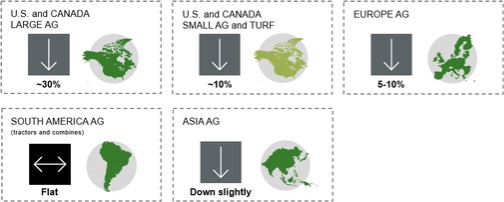]
[removed: ][added: ]
[removed: Company Trends –] Customers seek to improve profitability, productivity, and sustainability through [removed: technology.][added: integrating technology into their operations.]
[removed: Integration] [added: Deeper integration] of technology into equipment is a persistent market trend.
Company Outlook for [removed: 2024][added: 2025]
Agriculture and Turf Outlook for [removed: 2024][added: 2025]
[removed: Market Conditions:][added: | | ● | market |]
Construction and Forestry Outlook for [removed: 2024][added: 2025]
Financial Services Outlook for [removed: 2024][added: 2025]
| Net Income | | | | Up [removed: moderately] | | | |
| \+ [removed: Nonrecurring prior] [added: Prior] period special items | | | | Favorable | | | |
[added: _Results of Operations_ –] Central bank policy [removed: interest] rates increased in 2022 and [removed: 2023.][added: 2023 and have remained elevated.]
Increased rates impacted us in several ways, primarily affecting the [added: demand for our products and] financing spreads for the financial services [removed: operations, and may impact future demand for our products.][added: operations.]
[removed: Most retail] [added: | Retail] customer [removed: receivables are fixed rate.][added: receivables: | | | | | | | | | | | | | |]
Rising interest rates have historically impacted our [removed: borrowings] [added: borrowing costs] sooner than the benefit is realized from receivable and lease portfolios.
[removed: Rising] [added: Changes in] interest rates [added: and the agricultural market business cycle] are driven by factors outside of our control, and as a [removed: result,] [added: result] we cannot reasonably foresee when [removed: this condition] [added: these conditions] will [added: fully] subside.
Agricultural Market Business [removed: Cycle.] [added: Cycle –] The agricultural market is affected by various factors including commodity prices, acreage planted, crop yields, and government policies.
These factors affect farmers’ income and may result in [removed: lower] [added: varying] demand for [added: our] equipment.
| [added: |] ● | global and regional political conditions, including the [added: ongoing] war [removed: in] [added: between Russia and] Ukraine and the [removed: Israel-Hamas war,] [added: conflict in the Middle East,] |
| [added: |] ● | new or retaliatory tariffs, |
| [added: |] ● | capital market disruptions, |
| [added: |] ● | foreign currency and capital control policies, |
| [added: |] ● | regulations and legislation regarding right to [removed: repair,] [added: repair or right to modify,] |
| [added: |] ● | weather conditions, |
| [added: |] ● | marketplace adoption and monetization of technologies we have invested in, |
| [added: |] ● | our ability to strengthen our digital capabilities, automation, autonomy, and alternative power technologies, |
| [added: |] ● | changes in demand and pricing for new and used equipment, |
| [added: |] ● | significant fluctuations in foreign currency exchange rates, |
| [added: |] ● | volatility in the prices of many commodities, and |
| CONSOLIDATED RESULTS | [removed: 2023] [added: 2024] compared to [removed: 2022] [added: 2023] |
| [added: |] ● | Net income [removed: rose] [added: declined] in [removed: 2023] [added: 2024] compared to [removed: 2022,] [added: 2023,] driven by [removed: strong] [added: declining] market conditions. |
| [added: |] ● | We continue to focus on structural profitability and strategically investing in solutions that deliver value to our customers. |
[removed: ][added: ]
[removed: ][added: ]
Company Trends
Engaged acres are an indicator we use to understand customer utilization of our technology.
We are investing in a Solutions as a Service business model to increase technology adoption and utilization by our customers.
Solutions as a Service products did not represent a significant percentage of our revenues in 2024.
| | ● | Agriculture and turf equipment sales are projected to decline in 2025 due to contraction of agriculture markets globally. |
| | ● | Construction equipment sales are projected to decline in 2025 as healthy end markets are offset by continued uncertainty in equipment purchases. Roadbuilding equipment sales are anticipated to be generally flat. |
| | ● | Demand in the U.S. and Canada is expected to further moderate amidst weak farm fundamentals, high interest rates, elevated used inventory levels, and short-term farmer liquidity concerns heading into the 2025 growing season. |
| | ● | We expect small agricultural equipment sales to be down from 2024 levels in the U.S. and Canada. The dairy and livestock segment is anticipated to have another year of strong profitability as elevated livestock and hay prices are further enhanced by low input feed costs. This is projected to be more than offset by restrained demand in the turf and compact utility tractor markets as single family home sales and home improvement spending remain stagnant amid high interest rates. |
| | ● | In Europe, the industry is forecasted to be down as farm fundamentals in the region continue to deteriorate, but at a moderated pace relative to 2024. Adverse factors include depressed yields from unfavorable weather, reduced regional commodity prices due to a mixture of excess grain inflows from Ukraine and global pricing pressures, persistently elevated input costs, and unfavorable agriculture legislation. These issues coupled with high interest rates and elevated industry inventory |
levels are expected to keep industry equipment demand at low levels throughout 2025.
| | ● | Demand in South America is expected to be flat. In Brazil, we expect crop prices to decline in 2025 offset by decreasing input costs and improving yields as drought concerns abate. These factors coupled with continued acreage expansion and recent appreciation of the U.S. dollar against the Brazilian real will offer further profitability tailwinds to farmers. Across the rest of South America, strong yields are expected to be offset by low commodity prices and elevated interest rates. Argentina industry sales are forecasted to improve as the currency stabilizes amid agricultural industry recovery. |
| | ● | Industry sales in Asia are forecasted to be down slightly, as foundational technology adoption and improving agriculture fundamentals in India provide moderate demand. |
| | ● | Construction equipment industry sales are forecasted to be down in the U.S. and Canada from 2024 levels. The decline is due to projected modest growth in single family housing starts and U.S. government infrastructure spending, which is expected to be more than offset by further slowdowns in multi-family housing developments, non-residential buildings, and reduced spending in oil and gas. Historically low levels of earthmoving rental purchases and rising used inventories are expected to further pressure equipment sales as market uncertainty persists. |
| | ● | Global forestry markets are expected to be flat to down as challenged global markets stabilize at low demand levels. |
| | ● | Global roadbuilding markets are forecasted to be generally flat, as a modest recovery in Europe is expected to compensate for a slight slowdown in other geographies. |
Additional Trends
Interest Rates – While interest rates in the U.S. began to decrease in the fourth quarter of 2024, they remained elevated.
The markets for our agriculture, turf, and construction products were negatively impacted in 2024 by elevated interest rates and their effect on borrowing costs for our customers.
In 2024, we experienced unfavorable market
conditions which resulted in lower sales volumes, higher sales incentives, higher receivable write-offs, and an increase in expected credit losses.
We introduced cost reduction measures to manage our profitability and inventory levels.
In the third quarter of 2024, we implemented employee-separation programs for our salaried workforce to help meet our strategic priorities while reducing overlap and redundancy in roles and responsibilities.
The programs’ total pretax expenses are estimated to be approximately $165, of which $157 was recorded in 2024 (see Note 4).
Annual pretax savings from these programs are estimated to be about $220.
Approximately $100 of savings was realized in 2024.
| | ● | shifts in energy, economic, tax, and trade policies following the 2024 U.S. presidential and congressional elections, |
| | ● | workforce reductions’ impact on employee retention, morale, and institutional knowledge, |
| | ● | delays or disruptions in our supply chain, |
| | ● | slower economic growth. |
| | ● | Net sales decreased in 2024 primarily due to lower sales volumes driven by declining market conditions (see Business Segment Results). |
| | ● | Net income and diluted EPS decreased driven by lower sales. |
| \+ Material costs | | Favorable | | | | | | | |
| Increased mostly due to higher overhead costs from reduced volumes resulting in production inefficiencies partially offset by sales price realization, lower material costs, and lower employee profit-sharing incentives. | | | | | | | | | |
| Finance and interest income | | $ | 5,759 | | $ | 4,683 | | +23 | |
| Increased primarily due to higher average financing receivable portfolios and higher average financing rates. | | | | | | | | | |
| Higher primarily due to investment income earned on international marketable securities, legal settlements (see Note 4), and increased revenues from services. | | | | | | | | | |
| Deere & Company | | 2024 | | | 2023 | | | % Change | |
| Increased mostly due to higher provision for credit losses, employee separation programs' expenses, and higher employee pay driven by merit increases, partially offset by the effect of a prior year accounting treatment correction (see Note 4). | | | | | | | | | |
| Lower due to foreign exchange, higher pension benefits (see Note 9), and a settlement of an insurance claim recovery at an international location. | | | | | | | | | |
| Decreased as a result of lower pretax income, adjustments to valuation allowance on deferred tax, and the favorable impact of discrete tax benefits. These items were partially offset by prior years' favorable income tax ruling in Brazil. | | | | | | | | | |
| | |
| --- | --- |
We announced the Smart Industrial Operating Model in 2020.
This operating model is based on three focus areas:
| (a) | Production systems: A strategic alignment of products and solutions around our customers’ operations. |
| --- | --- |
| (b) | Technology stack: Investments in technology, as well as research and development, that deliver intelligent solutions to our customers through digital capabilities, automation, autonomy, and alternative power technologies. |
| --- | --- |
| (c) | Lifecycle solutions: The integration of our aftermarket and support capabilities to more effectively manage customer equipment, service, and technology needs across the full lifetime of a John Deere product. |
| --- | --- |
Our Leap Ambitions were launched in 2022.
These ambitions are designed to boost economic value and sustainability for our customers.
The ambitions align across our customers’ production systems seeking to optimize their operations to deliver better outcomes with fewer resources.
| --- | --- |
The investments in these technologies and in establishing a Solutions as a Service business model might increase our operating costs and may decrease operating margins during the transition period.
Most notably in 2023, we introduced See & Spray™ Ultimate and a new model of See & Spray™ Premium.
These technologies were introduced on a limited basis and did not represent a significant percentage of our sales in 2023.
| ● | Demand is expected to decline in 2024. |
| --- | --- |
| ● | Production volumes will decline to more normal levels in 2024. |
| --- | --- |
| ● | We expect large agricultural equipment sales to decline in 2024 in North America, Europe, and South America. |
| --- | --- |
| ● | Demand for small agricultural equipment is expected to moderate in Europe. |
| --- | --- |
| ● | Turf and utility equipment product sales are expected to be lower due to the overall U.S. economic condition and elevated interest rates. |
| --- | --- |
| ● | Agricultural fundamentals are expected to moderate in 2024 due to lower commodity prices and elevated interest rates, offset by declining input costs and improved customer financials. |
| --- | --- |
| ● | The dairy and livestock sector continues to benefit from elevated protein and hay prices. |
| --- | --- |
| ● | Farm input costs in Europe are declining. Grain prices vary from favorable in Western Europe to depressed in Eastern Europe due to the Russia/Ukraine war. |
| --- | --- |
| ● | Dealer inventories are elevated in Brazil due to inventory oversupply driven by weakening demand in the second half of 2023. |
| --- | --- |
| ● | Industry sales in Asia are impacted by moderating demand in India, the world’s largest tractor market by number of units. |
| --- | --- |
| ● | The fleet average age is older than in prior business cycles. Combines are in line with the historical average age, while tractors are slightly older than historical averages. |
| --- | --- |
An excerpt. Shown here: 40 of 1,336 rewritten, 40 of 475 added and 40 of 418 removed. The counts are complete. For every sentence, read Item 16. FORM 10-K SUMMARY. in the FY2024 filing and the FY2023 filing.