 filings.tools
Deere & Co. (DE) 10-K risk factor changes: FY2025 vs FY2024
The 2025-11-02 10-K against the 2024-10-27 one, compared heading by heading and sentence by sentence.
Item 1A116 rewritten123 added84 removed130 unchanged
All filing items1,848 rewritten801 added681 removed2,044 unchanged
Summary
counted, not written
- Item 1A lists 28 risk factor headings: 4 new, 8 reworded and 16 unchanged since FY2024. 7 headings from FY2024 no longer appear.
- Sentence by sentence, 801 added, 681 removed, 1,848 rewritten and 2,044 unchanged across 12 items that differ.
New Item 1A headings (4)
- Our international operations expose us to risks and events beyond our control in countries in which we operate.
- The introduction of new products and technologies involves risk, and, from time to time, we may fail to realize their anticipated benefits.
- From time to time our equipment fails to perform as expected and we have experienced, and may in the future experience, warranty claims, post-sale repairs and recalls, and other consequences.
- Our business may be adversely affected by any disruptions caused by union activities.
Removed Item 1A headings (7)
- We may be unable to manage increasing political, economic, and social uncertainty in certain regions of the world, which could significantly change the dynamics of our competition, customer base, and product offerings globally.
- Unfavorable weather conditions or natural catastrophes that reduce agricultural production and demand for agriculture and turf equipment could directly and indirectly affect our business.
- Our consolidated financial results are reported in U.S. dollars while certain assets and other reported items are denominated in foreign currencies, creating currency exchange and translation risk.
- If we are unable to remain competitive and relevant, including by delivering precision technology solutions to our customers, our business, results of operations, and financial condition could be adversely affected.
- Disputes with labor unions may adversely affect our ability to operate in our facilities as well as impact our financial results.
- We could be impacted by changes to or reallocation of radio frequency (RF) bands which could disrupt or degrade the reliability of our high precision augmented Global Positioning System (GPS) or other RF technology, which could impair our ability to develop and market GPS- and RF-based technology solutions, as well as significantly reduce agricultural and construction customers’ profitability.
- Our business may suffer if our equipment fails to perform as expected.
Reworded Item 1A headings (8)
- We
[removed: may]face risks associated with international, national, and regional trade laws, regulations, and[removed: policies, and government farm programs and]policies[removed: which][added: that] could[removed: significantly][added: materially] impair our[removed: profitability and growth prospects.][added: profitability.] [removed: We may be affected by changing][added: Changing] worldwide demand for food and different forms of renewable[removed: energy, which could][added: energy can] impact the price of farm commodities and consequently the demand for our equipment. This could result in higher research and development costs related to changing machine fuel requirements.[removed: Rationalization or restructuring of manufacturing facilities, and plant expansions][added: Restructuring, rationalization,] and[removed: updates at our][added: relocation of] manufacturing facilities may cause capacity constraints, inventory fluctuations, and other issues.[removed: We may be unable][added: Inability] to accurately forecast customer demand for products and services, and to adequately manage inventory,[removed: which]could adversely affect our operating results.- Changes in the availability and price of certain raw materials, components, and whole goods have resulted and could result in disruptions to the supply chain causing production disruptions, increased costs, and lower profits
[removed: on][added: from] sales of our products. - We may not realize [added: the] anticipated benefits of acquisitions, joint ventures, and divestitures, or these benefits may take longer to realize than expected.
- Security breaches and other disruptions to our information technology infrastructure could interfere with our operations and could compromise our information as well as information
[removed: of][added: about] our employees, customers, suppliers, and/or dealers, exposing us to liability that could cause our business and reputation to suffer. - Any unauthorized control or manipulation of our products’ systems could result in [added: a] loss of confidence in us and our products.
A heading is new when no FY2024 heading matches it after ignoring case and punctuation, and reworded when it shares at least 60 percent of its words with one that went away. All current risk factor headings.
Sentences by item
24 items, with every count and a link to each item that changed
| Item | Added | Removed | Rewritten | Unchanged |
|---|---|---|---|---|
| Item 1A. RISK FACTORS. | 123 | 84 | 116 | 130 |
| Item 7. MANAGEMENT’S DISCUSSION AND ANALYSIS OF FINANCIAL CONDITION AND RESULTS OF OPERATIONS. | 0 | 0 | 0 | 2 |
| Item 7A. QUANTITATIVE AND QUALITATIVE DISCLOSURES ABOUT MARKET RISK. | 0 | 0 | 0 | 4 |
| Item 1. BUSINESS. | 79 | 48 | 112 | 163 |
| Item 3. LEGAL PROCEEDINGS. | 8 | 0 | 2 | 3 |
| Cover and table of contents | 0 | 0 | 28 | 60 |
| Item 1B. UNRESOLVED STAFF COMMENTS. | 0 | 0 | 0 | 2 |
| Item 1C. CYBERSECURITY. | 0 | 1 | 3 | 27 |
| Item 2. PROPERTIES. | 38 | 7 | 1 | 1 |
| Item 4. MINE SAFETY DISCLOSURES. | 0 | 0 | 0 | 3 |
| Item 5. MARKET FOR REGISTRANT’S COMMON EQUITY, RELATED STOCKHOLDER MATTERS AND ISSUER PURCHASES OF EQUITY SECURITIES. | 24 | 17 | 7 | 4 |
| Item 6. [RESERVED] | 0 | 0 | 0 | 1 |
| Item 8. FINANCIAL STATEMENTS AND SUPPLEMENTARY DATA. | 0 | 0 | 0 | 2 |
| Item 9. CHANGES IN AND DISAGREEMENTS WITH ACCOUNTANTS ON ACCOUNTING AND FINANCIAL DISCLOSURE. | 0 | 0 | 0 | 2 |
| Item 9A. CONTROLS AND PROCEDURES. | 0 | 0 | 5 | 9 |
| Item 9B. OTHER INFORMATION. | 0 | 0 | 1 | 2 |
| Item 9C. DISCLOSURE REGARDING FOREIGN JURISDICTIONS THAT PREVENT INSPECTIONS. | 0 | 0 | 0 | 3 |
| Item 10. DIRECTORS, EXECUTIVE OFFICERS AND CORPORATE GOVERNANCE. | 0 | 0 | 1 | 7 |
| Item 11. EXECUTIVE COMPENSATION. | 0 | 0 | 0 | 2 |
| Item 12. SECURITY OWNERSHIP OF CERTAIN BENEFICIAL OWNERS AND MANAGEMENT AND RELATED STOCKHOLDER MATTERS. | 0 | 0 | 0 | 2 |
| Item 13. CERTAIN RELATIONSHIPS AND RELATED TRANSACTIONS, AND DIRECTOR INDEPENDENCE. | 0 | 0 | 0 | 2 |
| Item 14. PRINCIPAL ACCOUNTANT FEES AND SERVICES. | 0 | 0 | 0 | 3 |
| Item 15. EXHIBITS AND FINANCIAL STATEMENT SCHEDULES. | 0 | 1 | 9 | 18 |
| Item 16. FORM 10-K SUMMARY. | 529 | 523 | 1,563 | 1,592 |
Underlined words on a shaded ground are new in FY2025; struck-through words were in FY2024. Sentences that are wholly new or wholly gone are labelled rather than marked.
Item 1A. RISK FACTORS.
116 rewritten, 123 added, 84 removed, 130 unchanged
They involve [removed: certain] factors that are subject to change and important risks and uncertainties that could cause actual results to differ materially.
The risks described in this Annual Report on Form 10-K and the Forward-Looking Statements [removed: in this report] are not the only risks we face.
[removed: OPERATIONAL RISKS][added: OPERATIONAL AND MANUFACTURING RISKS]
Historically, the agricultural industry has been cyclical and subject to a variety of economic and other [removed: factors.][added: factors; consequently, sales of agricultural equipment are also cyclical and generally reflect the economic health of the agricultural industry.]
[removed: The economic health of the agricultural industry is affected by numerous factors, including] [added: In addition,] farm [removed: income, farmland values, and debt levels and financing costs, all of which are] [added: income is] influenced by [removed: the levels of] commodity and protein prices, world grain stocks, acreage available and planted, crop yields, agricultural product demand, soil conditions, farm input costs, government [removed: policies,] [added: policies] and [removed: government subsidies.][added: support.]
Downturns in the agricultural industry due to these and other factors, which could vary by market, have resulted in decreases in demand for agricultural equipment, adversely affecting our [added: business and financial] performance.
The demand for our products and services depends on the fundamentals in the markets in which we operate and can be significantly reduced in an economic environment characterized by high unemployment, high interest rates, cautious consumer spending, inflation, lower corporate earnings, and lower business [removed: investment.][added: investment, all of which affect farmers’ income and sentiment.]
In fiscal year [removed: 2024,] [added: 2025,] unfavorable market conditions resulted in lower sales volumes, [removed: higher] [added: greater reliance on] sales [removed: discounts, higher receivable write offs,] [added: incentives,] and [removed: a higher provision for credit losses.][added: elevated receivable write-offs.]
We expect certain of these conditions to persist in fiscal year [removed: 2025.][added: 2026.]
Changes in [removed: interest rates] [added: the economic environment] and the agricultural market business cycle are driven by factors outside of our control, and as a result we cannot reasonably foresee when these conditions will fully subside.
Sustained general negative economic conditions and outlook [added: could] also affect [added: construction and] housing [removed: starts,] [added: activities, and] energy prices and demand, [removed: and other construction,] which [removed: dampens] [added: could decrease] demand for [removed: certain] construction [removed: equipment.][added: and turf equipment and could have a material adverse effect on our financial results.]
Uncertain or negative outlook with respect to pervasive U.S. fiscal issues as well as general economic conditions and outlook, such as market [removed: volatility] [added: volatility, inflation,] or interest rate changes, have caused and could continue to cause significant changes in market liquidity conditions.
Efforts to grow our businesses depend in part upon access to and developing [added: and maintaining] market share and profitability in additional geographic markets, including, but not limited to, Argentina, Brazil, CIS, China, India, and South Africa.
| | ● | Changing U.S. export controls and sanctions on various foreign countries and on various parties could affect our ability to [added: manufacture our products in foreign jurisdictions,] collect receivables, provide aftermarket warranty support for our [removed: equipment,] [added: equipment] and sell products, and could otherwise impact our reputation and business. |
[removed: We may be affected by changing] [added: Changing] worldwide demand for food and different forms of renewable [removed: energy, which could] [added: energy can] impact the price of farm commodities and consequently the demand for our equipment.
Changing worldwide demand for farm outputs to meet the world’s growing food and renewable energy demands, driven in part by government policies, including those related to climate change, and a growing world population, [removed: are] [added: is] likely to result in fluctuating agricultural commodity prices, which directly affect sales of agricultural equipment.
While higher commodity prices benefit our crop-producing agricultural equipment customers, they could result in greater feed costs for [removed: livestock] [added: dairy] and [removed: poultry] [added: livestock] producers, which in turn may result in lower levels of equipment purchased by [removed: these] [added: those] customers.
In addition, changing energy [removed: demands] [added: demand] may cause farmers to change the types or quantities of the crops they raise, with corresponding changes in equipment demands.
[removed: Finally,] [added: Furthermore,] changes in governmental policies regulating fuel utilization, including biofuel, affect commodity demand and commodity prices, demand for our diesel-fueled equipment, and result in higher research and development costs related to equipment fuel standards.
Changes in the availability and price of certain raw materials, components, and whole goods have resulted and could result in disruptions to the supply chain causing production disruptions, increased costs, and lower profits [removed: on] [added: from] sales of our products.
We have experienced changes in the availability and prices of raw materials, components, whole goods, and freight over the past several [removed: years, especially in fiscal years 2021 and 2022.][added: years.]
[removed: Global] [added: Past global] logistics network challenges [added: have] resulted in delays, shortages of key manufacturing components, increased order backlogs, increased transportation costs, and production inefficiencies from a higher number of partially completed machines in inventory, which [added: in the past have] increased our overall production and overhead costs.
Increases in such costs have [removed: had an adverse effect on] [added: adversely affected] our business operations.
[removed: While we have seen stabilization] [added: We anticipate fluctuations] in [removed: the] [added: our] supply chain [removed: and inflation, we anticipate potential future fluctuations] due to [removed: continued] [added: ongoing] geopolitical and economic uncertainty, and regulatory and policy instability, including import tariffs and trade agreements.
[removed: Work] [added: | | ● | work] interruption or union strikes by employees of [removed: suppliers could also contribute to disruptions within our supply chain.][added: suppliers, |]
[removed: A lack of compliance] [added: Failure to comply] could lead us to seek alternative suppliers, which could increase our costs and result in delayed delivery of our products, product shortages, or other disruptions [removed: of our] [added: in] operations.
If our suppliers [removed: or retail partners] fail to comply with [added: ethical standards and] applicable laws, regulations, safety codes, employment practices, human rights standards, quality standards, environmental standards, production practices, or other obligations, norms, identification and reporting requirements, [removed: or ethical standards,] our reputation and brand could be harmed, and we could be exposed to litigation, investigations, enforcement actions, monetary liability and additional costs that could have a material adverse effect on our business, financial condition, and results of operations.
[removed: Such conditions] [added: Examples of such disruptions] include:
The occurrence of one or more unexpected events, including war, [added: lack of available natural resources,] acts of terrorism, epidemics and [removed: pandemics (such as the COVID pandemic),] [added: pandemics,] civil unrest, fires, tornadoes, tsunamis, hurricanes, earthquakes, [added: temperatures outside of normal ranges,] floods, and other forms of severe [removed: weather in the United States] or [added: unusual weather] in [removed: other] countries in which we operate, or in which our suppliers are located, have adversely affected and could in the future adversely affect our operations and financial performance.
Such events have caused and could cause complete or partial closure of one or more of our manufacturing facilities or distribution centers, temporary or long-term disruptions in the supply of component products from some local and international suppliers, and disruption and delay in the transport of products to dealers, [removed: end-users, and distribution centers.]
The potential physical impacts of [added: weather conditions or] climate change on our facilities, suppliers, and customers, and therefore on our [removed: operations,] [added: business,] are [removed: highly] uncertain and will be [removed: particular] [added: specific] to the circumstances developing in various geographic regions.
Additionally, [added: from time to time,] third parties [removed: may] initiate legal proceedings to challenge the validity of our intellectual property or allege that we infringe on their intellectual property.
[removed: Rationalization or restructuring of manufacturing facilities, and plant expansions] [added: Restructuring, rationalization,] and [removed: updates at our] [added: relocation of] manufacturing facilities may cause capacity constraints, inventory fluctuations, and other issues.
The rationalization or restructuring of our manufacturing facilities, including relocating production or closing facilities, [removed: may result in] [added: requires significant investment and places] temporary constraints on our ability to produce the quantity of products necessary to fill [removed: orders] [added: orders,] and thereby complete sales in a timely manner.
In addition, decisions regarding the rationalization, restructuring or relocation of facilities, [removed: such as the recently announced shifting of production of skid steer loaders] and [removed: compact track loaders from our Dubuque, Iowa factory to Ramos, Mexico, and] any similar [removed: actions we may undertake in the future,] [added: actions,] could also subject us to additional or new tariffs, [added: reputational risks, and] other issues relating to the importation of [removed: products, fines, and reputational risks.][added: products.]
Our effective tax rates could be affected by changes in the mix of earnings in countries with differing statutory tax [removed: rates, changes in the valuation of deferred tax assets and liabilities, or changes in tax laws or their interpretations.]
High interest rates can [removed: have a dampening effect on] [added: dampen] overall economic activity and/or the financial condition of our customers, either or both of which can negatively affect customer demand for our equipment and [added: our] customers’ ability to repay [removed: their obligations to] us.
While we strive to match the interest rate characteristics of our financial assets and liabilities, changing interest rates have [removed: had an adverse effect on] [added: affected] our financing spreads—the difference between the yield we earn on our assets and the interest rates we pay for funding—which [removed: has] [added: have] affected our earnings.
Failure to realize the anticipated benefits of our Smart Industrial Operating Model and related business strategies in production systems, precision technologies, and aftermarket support, as well as failure to have selected a business strategy that aligns with our [removed: customer] [added: customers’] needs and market trends, could have an adverse effect on our operational and financial results.
Several factors could impact our ability to successfully [removed: execute] [added: execute, and to benefit from,] our Smart Industrial Operating Model, including, among other things:
GEOPOLITICAL AND MACROECONOMIC RISKS
The economic health of the agricultural industry is affected by numerous factors, including farm income, international trade, farmland values, debt levels, and financing costs.
| | ● | The imposition of tariffs and retaliatory tariffs has impacted, and we expect will continue to impact, the sourcing of parts and components, the cost and profitability of manufacturing operations, and our ability to ship, import, and export our products. During fiscal year 2025, new tariffs were imposed in the U.S. for imports from a broad range of countries and materials. Several countries also implemented or proposed retaliatory tariffs on imports from the U.S., as well as other barriers to trade. As a net exporter of agriculture and turf equipment from the U.S., these trade policies impact us. Nearly 80% of our domestic sales are assembled in the U.S., with the remaining products imported primarily from Europe, Mexico, India, and Japan. During fiscal year 2025, incremental import tariffs adversely affected the cost of our products and components and may continue to do so in 2026. In addition, retaliatory tariffs by regions outside the U.S., currently in effect or adopted in the future, may impact the prices of our |
| | | exported products and the profit realized from these exports. The direct impact of incremental tariffs incurred by us in 2025 was approximately $600, excluding the impact of tariffs on our suppliers and market demand. On November 5, 2025, the United States Supreme Court heard oral arguments on tariffs imposed under the International Emergency Economic Powers Act (IEEPA). The court may provide tariff relief and the potential recovery of amounts previously paid. We are monitoring developments in this case and its impact on our future financial statements and business. |
| | ● | If our business partners were to incur regulatory or judicial action, it could impact our ability to operate certain solutions abroad, or our connectivity to rural farmers. |
Our international operations expose us to risks and events beyond our control in countries in which we operate.
Particularly, we have invested significant resources to grow our operations in Brazil, and in 2024, we built a research and development center in Indaiatuba.
We may not realize the benefits from our investment in Brazil or in other regions and may be unable to grow our market share for a variety of reasons.
For example, some countries where we operate have greater political and economic volatility and greater infrastructure vulnerability than others.
| | ● | economic and political instability, including war or armed conflict, changes in government policies, expropriation, nationalization, and other political, economic, or social developments, |
| | ● | increased tariffs, trade barriers, trade agreements, and other restrictions on international trade, |
| | ● | supply chain disruptions, including, as a result of natural disasters, transportation disruptions, and geopolitical events, |
| | ● | multiple and potentially conflicting laws, regulations, and policies that are subject to change, along with the complexity and cost of compliance, |
| | ● | currency fluctuations which can affect the value of our foreign currency revenues, expenses, and cash flows, |
| | ● | inadequate intellectual property protections in foreign jurisdictions that could result in the unauthorized use or infringement of our intellectual property, |
| | ● | adverse consumer sentiment for non-local products, |
| | ● | local labor market conditions, and |
| | ● | lack of brand recognition in our emerging markets. |
The occurrence of one or more of these events has, from time to time, impacted, and may in the future impact, our business in a variety of ways, including reducing demand for our products, increasing costs, limiting our ability to operate in certain jurisdictions, disrupting our ability to deliver products to customers on time and at competitive prices, subjecting us to fines, penalties, and sanctions, harming our competitive position, devaluation of assets, and impacting our financials.
Please also refer to the risk factors in the “Legal and Regulatory Compliance Risks” section below that address our legal and regulatory risks associated with our international operations.
International buyers can also change the source of imported agricultural products, such as corn and soy, from the U.S. to other countries, impacting the profitability of our customers and demand for our equipment.
The growing demand for biofuels has led to a corresponding increased demand for agriculturally based feedstocks used in their production, such as corn in the U.S. and Europe and sugar cane in Brazil.
This increased demand may increase the demand for agricultural equipment to be used in the production of such crops.
However, the economic feasibility of biofuels can be impacted by the price of oil.
As the price of oil falls, biofuels become a less attractive alternative energy source, and as a result, there is uncertainty with respect to any benefits we may realize with respect to our investments related to renewable energy.
In 2024, we shifted production of small-frame skid steer loaders and compact track loaders to Mexico.
As a result, these products became subject to additional tariffs on imports from Mexico in 2025.
Even though we are taking actions to qualify for an exemption under the United States-Mexico-Canada Agreement (USMCA) to mitigate the elevated costs, there is no guarantee that we will be able to obtain such qualification.
Furthermore, our manufacturing processes are dependent on water.
Increasing competition for water resources, regulatory restrictions on water, and environmental changes can lead to water scarcity.
Any significant reduction in water availability could disrupt our manufacturing processes, increase our operational costs, and limit our ability to meet customer demand.
In 2025, elevated used inventory levels in late model-year machines impacted demand for our products in North America resulting in lower price realization and actions to reduce our inventory level.
Our business relies on a complex global supply chain, and any disruptions can impact our operations.
For example, certain of our products, including motors, batteries, and other components, rely on rare earth minerals for their manufacturing, of which a significant majority are sourced from China.
The inability to obtain export permits for rare earth minerals could have a detrimental effect on our business.
These complications have the potential to significantly increase production and logistics costs, including additional research and development costs for designing alternative solutions, and therefore would have a detrimental effect on the profitability of the business.
Rapid changes and growing complexity in trade policies may also affect the ability of customs brokers and logistics providers to timely process imported products, which could result in delays, higher logistics costs, and production disruptions.
The financial stability of our suppliers can also impact the continuity of our supply chain.
A number of our suppliers are facing higher prices due to inflation, increased tariffs or otherwise.
If one or more of our suppliers continue to encounter financial hardships, delivery setbacks, or other performance-related difficulties, we may be unable to fulfill our obligations to customers.
Sales of agricultural equipment, in turn, are also cyclical and generally reflect the economic health of the agricultural industry.
Our turf operations and our construction and forestry segments are dependent on construction activity and have also been affected by recent adverse economic conditions.
Decreases in construction activity and housing starts have had a material adverse effect on our financial results.
We may be unable to manage increasing political, economic, and social uncertainty in certain regions of the world, which could significantly change the dynamics of our competition, customer base, and product offerings globally.
| | ● | In some cases, these countries have greater political and economic volatility, greater vulnerability to infrastructure and labor disruptions, and differing customer product preferences and requirements than our other markets. |
| | ● | Having business operations in various regions and countries exposes us to multiple and potentially conflicting business practices and legal and regulatory requirements that are subject to change. These practices and legal requirements are often complex and difficult to navigate, including those related to tariffs and trade regulations, investments, property ownership rights, taxation, repatriation of earnings, and advanced technologies. |
| | ● | Expanding business operations globally also increases exposure to currency fluctuations, which can materially affect our financial results. In Argentina, the government has certain capital and currency controls that restrict our ability to access U.S. dollars and remit earnings from our Argentine operations, leaving us exposed to long-term currency fluctuations. |
| | ● | While our brands are widely recognized in our traditional markets, they are less known in some emerging markets, which could impede our efforts to successfully compete in these markets. |
| | ● | Market uncertainty and volatility in various geographies have been magnified as a result of potential shifts in U.S. and foreign trade, economic, and other policies following the 2024 U.S. presidential and congressional elections. |
| | ● | Geopolitical tensions, including the Russia/Ukraine war and the conflict in the Middle East, have also exacerbated market volatility and affected agricultural global production and demand levels. |
We require access to various raw materials, components, and whole goods at competitive prices to manufacture and distribute our products.
The latter have the potential to significantly increase production and logistics costs and have a material negative effect on the profitability of the business, particularly if we are unable to recover the increased costs due to market considerations or other factors.
We rely on our suppliers to acquire the raw materials, components, and whole goods required to manufacture their products.
In addition, certain materials and components used in our products are acquired from a single supplier or are proprietary in nature and cannot be alternatively sourced expeditiously.
Unfavorable weather conditions or natural catastrophes that reduce agricultural production and demand for agriculture and turf equipment could directly and indirectly affect our business.
The purchasing decisions of our customers, particularly the purchasers of agriculture and turf equipment, can be significantly affected by poor or unusual weather conditions.
| | ● | Insufficient levels of rain, which prevent farmers from planting new crops and may cause growing crops to die or result in lower yields; |
| | ● | Excessive rain or flooding can prevent planting from occurring at optimal times and may cause crop loss through increased disease or mold growth; |
| | ● | Temperatures outside normal ranges, which can cause crop failure or decreased yields and may also affect disease incidence; |
| | ● | Natural disasters such as regional floods, hurricanes or other storms, droughts, diseases, wildfires, and pests, either as a physical effect of climate change or otherwise, which have had, and could in the future have, significant negative effects on agricultural and livestock production; |
| | ● | Adverse weather conditions in a particular geographic region, particularly during the important spring selling season; and |
| | ● | Drought conditions can adversely affect sales of certain mowing equipment and can similarly cause lower sales volume. |
Each of these conditions could negatively affect demand for agricultural and turf equipment and the financial condition and credit risk of our dealers and customers.
Most recently, Hurricane Helene in the U.S. closed operations at our Augusta, Georgia and Greenville, Tennessee facilities temporarily.
We may incur substantial costs if third parties initiate such legal proceedings, or if we initiate legal proceedings to protect or enforce our intellectual property.
Finally, the expansion and reconfiguration of existing manufacturing facilities, as well as new or expanded manufacturing operations in emerging markets, such as Brazil, could increase the risk of production delays, as well as require significant investments.
Our consolidated financial results are reported in U.S. dollars while certain assets and other reported items are denominated in foreign currencies, creating currency exchange and translation risk.
We are a global company with transactions denominated in a variety of currencies.
We are subject to currency exchange risk to the extent that our costs are denominated in currencies other than those in which we earn our revenues.
Additionally, the reporting currency for our consolidated financial statements is the U.S. dollar.
Certain of our assets, liabilities, expenses, and revenues are denominated in other countries’ currencies, which are then translated into U.S. dollars at the applicable exchange rates and reported in our consolidated financial statements.
Therefore, fluctuations in foreign exchange rates affect the value of those items as reflected in our consolidated financial statements, even if their value remains unchanged in the original currencies.
While the use of currency hedging instruments may provide us with some protection from adverse fluctuations in currency exchange rates, by utilizing these instruments we potentially forego any benefits that may result from favorable fluctuations in such rates.
In Argentina, we have employed mechanisms to convert Argentine pesos into U.S. dollars to the extent possible.
These mechanisms are short-term in nature, leaving us exposed to long-term currency fluctuations.
While central banks began cutting their policy interest rates in the latter part of fiscal year 2024, interest rates remain above recent norms.
STRATEGY RISKS
| | ● | Failure to develop and introduce new technologies or lack of adoption of such technologies by our customers; |
As part of our Leap Ambitions, we adopted various goals we expect to achieve by 2026 or 2030, but these goals and their timelines might be modified or updated.
| | ● | Certain materials, such as quality battery cells, may become unavailable or too costly; |
An excerpt. Shown here: 40 of 116 rewritten, 40 of 123 added and 40 of 84 removed. The counts are complete. For every sentence, read Item 1A. RISK FACTORS. in the FY2025 filing and the FY2024 filing.
Item 1. BUSINESS.
112 rewritten, 79 added, 48 removed, 163 unchanged
All amounts are presented in millions of [added: U.S.] dollars, unless otherwise specified.
[removed: The] John Deere [removed: enterprise] has manufactured agricultural equipment since 1837.
Our business is managed through the following four business segments: [removed: production and precision agriculture] [added: Production & Precision Agriculture] (PPA), [removed: small agriculture and turf] [added: Small Agriculture & Turf] (SAT), [removed: construction and forestry] [added: Construction & Forestry] (CF), and [removed: financial services] [added: Financial Services] (John Deere Financial or FS).
| | | [removed: ] [added: ] | | [removed: ] [added: ] | | [removed: ] [added: ] | | [removed: ] [added: ] |
| [removed: BUSINESS SEGMENT] [added: BUSINESS SEGMENT] | | PRODUCTION [removed: AND] [added: &] PRECISION AGRICULTURE | | SMALL AGRICULTURE [removed: AND] [added: &] TURF | | CONSTRUCTION [removed: AND] [added: &] FORESTRY | | FINANCIAL SERVICES |
| PRODUCTS | | ● [removed: Large] [added: 4WD/track] and [removed: Certain Mid-Size Tractors] [added: row crop tractors] ● [removed: Combines] [added: Harvesters] ● Cotton Pickers and Cotton Strippers ● Sugarcane Harvesters ● Sugarcane Loaders ● Soil Preparation, Tillage, Seeding, Application, and Crop Care Equipment | | ● [removed: Certain Mid-Size,] [added: Specialty,] Utility, and Compact [removed: Utility] Tractors ● Self-Propelled Forage Harvesters [added: and Attachments] ● Hay and Forage Equipment ● Rotary Mowers ● Utility Vehicles ● Riding Lawn Equipment and Commercial Mowing Equipment ● Golf Course Equipment | | ● Backhoe Loaders ● Crawler Dozers and Loaders ● Skid Steers ● [removed: Scraper Systems ●] Four-Wheel-Drive Loaders [removed: and] [added: ●] Compact [removed: Track] [added: Wheel] Loaders ● Excavators and Compact Excavators ● Equipment used in Timber Harvesting ● Road Building and Road Rehabilitation Equipment ● Articulated Dump Trucks and Motor Graders | | ● Retail Notes ● Revolving Charge Accounts ● Wholesale Receivables ● Leases ● Extended Warranties |
[removed: | | 1. |] Production [removed: Systems. A strategic alignment of products and solutions around our customers’ production systems. Production] systems refer to the series of steps our customers take to execute different tasks, operations, and projects to grow an agricultural product or execute a project. [removed: |]
[removed: | | 3. | Lifecycle Solutions.] The enterprise integration of our aftermarket and support capabilities to more effectively manage customer equipment, service, and technology needs across the full lifetime of a John Deere product, and with a specific lifecycle solution focus on the ownership experience. [removed: This integrated support seeks to enhance customer value through proactive and reactive support, easy access to parts, value-add services, and precision upgrades, regardless of when a customer purchases our equipment. |]
[removed: The] [added: In 2022, we introduced our] Leap Ambitions [added: (“Ambitions”), a] set [added: of focused] goals [added: designed] to [removed: measure] [added: guide] the [removed: results] [added: implementation] of our Smart Industrial Operating Model.
In fiscal year [removed: 2024,] [added: 2025,] PPA generated [removed: $20,834] [added: $17,311] net sales, or [removed: 47 percent] [added: 45%] of equipment operations net sales; SAT generated [removed: $10,969] [added: $10,224] net sales, or [removed: 24 percent] [added: 26%] of equipment operations net sales; and CF generated [removed: $12,956] [added: $11,382] net sales, or [removed: 29 percent] [added: 29%] of equipment operations net sales.
Production [removed: and] [added: &] Precision Agriculture
Equipment manufactured and distributed by the segment includes [removed: large] [added: four-wheel-drive (4WD)/track] and [removed: certain mid-size] [added: row crop] tractors, [removed: combines,] [added: harvesters,] cotton pickers, cotton strippers, sugarcane harvesters, [added: sugarcane loaders,] and related harvesting front-end equipment.
In addition, the segment includes tillage, seeding, and application equipment, including sprayers and nutrient [removed: management] [added: management,] and soil preparation [removed: machinery.][added: machinery, and related attachments and service parts.]
We have developed a [removed: differentiated,] production system-level approach that helps us understand how customers operate, focusing on their costs, identifying the opportunities for them to reduce inputs, and [removed: improving] [added: to improve] productivity, crop yields, and sustainability.
Our advanced telematics systems remotely connect equipment owners, business managers, and dealers to equipment in the [removed: field.][added: field through the John Deere Operations Center ™, our digital management system that allows customers to access farm and jobsite]
In addition to John Deere brand names, the table below provides a list of [added: select] PPA products and their associated brand names:
| [removed: Planters and Cultivators] [added: Planters and Cultivators] | Monosem |
| [removed: Sprayers and Planters] [added: Sprayers and Planters] | PLA |
| [removed: Carbon Fiber Sprayer Booms] [added: Carbon Fiber Sprayer Booms] | King Agro |
| [removed: Sugarcane Harvester Aftermarket Parts] [added: Aftermarket and Precision Updates] | [added: A&I,] Sunbelt Outdoor Products, [removed: Unimil] [added: Alternatives] by John [removed: Deere] [added: Deere, Frontier] |
| [removed: Aftermarket Parts for PPA Products] [added: Aftermarket and Precision Upgrades] | [removed: Vapormatic,] A & I, [removed: Unimil,] [added: Unimil by John Deere,] Alternatives by John Deere, [removed: Frontier] [added: Frontier, Surepoint] |
Small Agriculture [removed: and] [added: &] Turf
SAT is committed to meeting the needs of our customers through defining, developing, and delivering global equipment and technology solutions [removed: designed to unlock value and sustainability] for dairy and livestock producers, high-value crop and small acre crop producers, and turf and utility customers.
The segment works to provide product leadership while extending integrated agricultural solutions and precision technologies across its portfolio of [removed: equipment to unlock incremental value for customers.][added: equipment.]
Equipment manufactured and distributed by the segment includes [removed: certain mid-size, small] [added: specialty, utility,] and [removed: utility] [added: compact] tractors, [added: hay] and [removed: related loaders] [added: forage equipment, including self-propelled forage harvesters] and [removed: attachments;] [added: attachments, balers, and mowers;] turf and utility equipment, including riding lawn equipment, commercial mowing equipment, golf course equipment, utility vehicles, implements for mowing, tilling, snow and debris handling, aerating, and other residential, commercial, golf, and sports turf care applications; and [removed: hay and forage equipment, including self-propelled forage harvesters and attachments, balers,] [added: related attachments] and [removed: mowers.][added: service parts.]
In the small agriculture market, we [removed: have introduced] [added: are developing] autonomous solutions, connectivity capabilities, and a path to electrifying our future by delivering a portfolio that helps current customers meet sustainability goals while finding innovative ways to serve new customers and unlock new markets for mechanization at scale.
In addition to John Deere brand names, the table below provides a list of [added: select] SAT products and their associated brand names:
| [removed: Equipment Attachments] [added: Equipment Attachments] | Frontier, Kemper, GreenSystem, Smart Apply |
[removed: Agriculture and Turf Operations][added: Agriculture and Turf Operations]
Sales and marketing support for both the PPA and SAT segments is organized around four geographic regions: [removed: U.S., Canada, and Australia; Latin America] [added: (1) Africa, Asia,] and [removed: South America;] [added: the Middle East; (2)] Europe, and the Commonwealth of Independent States (CIS); [added: (3) Latin America] and [removed: Africa, Asia,] [added: South America;] and [removed: the Middle East.][added: (4) U.S., Canada, and Australia.]
Sales of agricultural equipment are affected by total farm cash receipts, which reflect levels of farm commodity [added: and protein] prices, [added: world grain stocks,] acreage [added: available and] planted, crop yields, [removed: and] [added: soil conditions, farm input costs,] government policies, including global trade policies, and the amount and timing of government [removed: payments.][added: support.]
Sales also are influenced by general economic conditions, farmland prices, farmers’ debt levels and access to financing, interest and exchange rates, [removed: agricultural trends, including the production of and demand for renewable fuels,] labor availability and costs, energy costs and related policies, tax policies, policies related to climate change, and other input costs associated with farming.
These customers are increasingly adopting and integrating precision agricultural technologies like guidance, telematics, automation, and [removed: data] [added: data-driven] management in their operations.
For certain equipment, we offer early order programs, which can include [removed: discounts] [added: incentives] to retail customers who place orders well in advance of the use season.
New combines, cotton harvesting equipment, [added: planters] and [added: tillage equipment, and] sprayers are sold under early order [removed: programs] [added: programs,] with waivers of retail finance charges available to customers who take delivery of machines during non-use seasons.
To provide support to our dealers in these countries for carrying and ultimately selling this used inventory to retail customers, we provide these dealers with pools of funds awarded as a percentage of the dealer [removed: cost] [added: price] for eligible new equipment sales at the time of the new equipment settlement.
Retail demand for turf and utility equipment is normally higher in the second and third fiscal [removed: quarters.][added: quarters based on weather, turf maintenance needs, landscaping projects, and sports and recreational facilities preparation.]
Construction [removed: and] [added: &] Forestry
To address these [removed: challenges and unlock value for customers,] [added: challenges,] we [removed: deliver] [added: have delivered] a [removed: robust] portfolio of construction, roadbuilding, and forestry products with precision technology solutions.
Our smart solutions such as SmartWeigh™, [removed: grade control offerings,] [added: Smart Grade™,] machine and system automation, and [added: the John Deere] Operations [removed: Center,] [added: Center™,] are designed to allow customers to complete more functions with fewer inputs, reduce rework and guesswork, and transform data into insights to allow for better decisions.
Our Smart Industrial Operating Model aims to deliver greater value for our customers, accelerate our competitive advantage in advanced technologies, build on our fundamental manufacturing strengths and core values, and capitalize on opportunities that lie ahead by leveraging advanced technologies with our operational excellence.
To drive these outcomes, we are focused on the following three pillars:
Production Systems.
A strategic alignment of products and solutions around our customers’ production systems.
Technology Stack.
Investments in technology, as well as research and development, which deliver intelligent solutions to our customers through hardware and devices, embedded software, connectivity, data platforms, and applications.
The technology stack leverages these core technologies across the enterprise, including digital capabilities, automation and machine learning, and autonomy.
The stack has the potential to unlock economic and sustainable value for customers by optimizing jobs, strengthening decision-making, and better connecting the steps of a production system.
Lifecycle Solutions.
This integrated support seeks to enhance customer value through proactive and reactive support, easy access to parts, value-add services, and precision upgrades, regardless of when a customer purchases our equipment.
These Ambitions are built upon a foundation of product quality and manufacturing excellence, supported by a best-in-class dealer channel, and enabled by employees dedicated to solving some of the world’s most important problems.
To build on our accomplishments and lay the foundation for sustained growth as we move toward 2030, in December 2025 we refined our Ambitions.
Our refined Ambitions feature long-term financial and operational goals, emphasizing the use of our differentiated equipment and service solutions, including automation, autonomy, digitalization, lifecycle solutions, and Solutions as a Service (SaaS).
Utilization of these solutions is currently measured through various performance indicators.
Our refined Ambitions and their timelines may be updated from time to time.
In addition, we may not be able to achieve these goals for a variety of reasons, some of which may be beyond our control.
See Item 1A Risk Factors, “Strategic Risks—We may not realize the anticipated benefits of our Smart Industrial Operating Model and Leap Ambitions.”
We believe our investments in precision technology will transform our farmers’ equipment into smarter, more efficient machines.
information through their devices.
We are beginning to leverage technology from our PPA segment across other business segments.
For example, cameras, obstacle detection, radars, and machine learning have been applied to our CF Smart Detect™ tool to identify obstacles on jobsites.
In addition, CF roadbuilding customers are now able to access the John Deere Operations Center™, enabling them to view near real-time data and insights to help make informed decisions, streamline maintenance, and track productivity.
| Technology | Harvest Profit, Sentera |
| Sprayers | GUSS |
We believe innovations in machinery and technology may influence purchases of agricultural equipment, especially when the agricultural environment is challenging.
Agricultural trends, including the production of and demand for renewable fuels, including biofuels, can also impact sales.
This growing demand has led to a corresponding increase in the need for agriculturally based feedstocks used in their production, such as corn in the U.S. and Europe and sugar cane in Brazil.
This increased demand may increase the demand for agricultural equipment to be used in the production of such crops.
In addition, policies and market drivers such as federal mandates requiring renewable fuel blending, and global regulations in regions and countries like Europe and Brazil, are expected to increase demand for renewable fuels.
We also rely on the sale of small and mid-size tractors as part of our global business.
Customers use these tractors for small and medium-sized farming and in specialty agricultural industries like dairy, livestock, and high value crops (e.g., orchards and vineyards).
The majority of our mid-size tractors are manufactured and sold in Europe, while the majority of our small tractors are manufactured and sold in India.
Regions.
The majority of our sales occur in the U.S. and Canada; however, we continue to grow our business and invest in other regions.
In June of 2025, we celebrated our 25th anniversary of operations in Brazil.
In 2024, we built a research and development center in Indaiatuba, Brazil dedicated to tropical agriculture and serving our customers in the region.
Our growth in Brazil is just one example of deploying capital to areas where we can unlock the greatest value for our customers—a hallmark of our Smart Industrial Operating Model.
In general, retail sales to farmers are based on the timing of planting and harvesting seasons around the globe.
In addition to creating solutions for the challenges mentioned above, our CF training team is providing comprehensive sales, technical, parts, and operator training for dealers and customers so that the features and technologies of our solutions are understood and utilized with the goal of maximizing customer productivity, jobsite safety, and uptime.
Our compact construction products include skid steers, compact excavators, compact wheel loaders, and compact track loaders.
Our Smart Industrial Operating Model is based on the following three focus areas:
| --- | --- | --- |
| | 2. | Technology Stack. Investments in technology, as well as research and development, that deliver intelligent solutions to our customers through hardware and devices, embedded software, connectivity, data platforms, and applications. The technology stack leverages these core technologies across the enterprise, including digital capabilities, automation and machine learning, autonomy, and alternative power technologies. The stack has the potential to unlock economic and sustainable value for customers by optimizing jobs, strengthening decision-making, and better connecting the steps of a production system. |
Our Leap Ambitions are a framework designed to boost economic value and sustainability for our customers.
The ambitions align across our customers’ production systems, seeking to optimize their operations to deliver better outcomes with fewer resources.
The Leap Ambitions framework has three components: (i) size the incremental market opportunity, quantifying the value that can be created; (ii) identify the key actions required to guide investment in digitalization, autonomy, automation, and alternative power technologies; and (iii) define the desired financial and sustainable outcomes we hope to achieve to help investors and stakeholders understand the opportunities that can be unlocked in the future through present investments.
Current financial and sustainability goals for the Leap Ambitions relate to workforce safety, agriculture customer outcomes, product circularity, environmental footprint, Solutions as a Service, and equipment operations operating return on sales (OROS).
We aim to deliver ongoing value across our product lines by digitally connecting certain equipment we produce, enabling our customers to leverage technology for better economic and more sustainable outcomes in their businesses.
We are measuring our customers’ utilization of our technology, in part, by the number of engaged acres, which is a measure of our PPA and SAT customers’ use of the John Deere Operations Center (our online farm management system).
Engaged acres generally reflects the number of unique acres with at least one operation pass recorded in the Operations Center in the past 12 months.
We are also introducing viable alternative power technologies for various product families.
Furthermore, we plan to enhance how we deliver value by investing in a Solutions as a Service business model.
We also aim to enable our customers to be more sustainable in their production steps.
For example, we provide our agricultural customers with technology solutions that help to improve their crops’ nitrogen use efficiency and increase their crops’ protection efficiency.
Across all segments we believe we will deliver ongoing value by continuing to focus on reducing the CO2e emissions from our equipment, including offering hybrid-electric and electric options where feasible in our product families.
We also continue to work toward production of a fully autonomous, battery-powered agricultural tractor and have launched several models of electric turf and compact construction products.
We also expect to support sustainable outcomes and deliver value through increasing the use of grade management control for earthmoving customers, intelligent boom control for forestry customers, and precision solutions for roadbuilding customers.
For example, we have advanced our planting and crop care offerings for corn and soy production systems to better meet customer demands throughout the cultivation cycle.
In fiscal year 2024, we introduced the new S7 Series combines and updated 9RX tractors, designed to enhance customer value and address key agricultural challenges, such as time constraints caused by variable weather, labor shortages, and rising costs.
The S7 Series combines feature advanced automation packages and the 9RX tractors come with new engine options, updated technology packages, and modernized cabins.
| Aftermarket Parts for SAT | Vapormatic, A&I, Alternatives by John Deere, Frontier |
Smart Industrial Operating Model.
As part of our Smart Industrial Operating Model, the segments are aligned around production systems, enabling focus on delivering equipment, technology, and solutions across all the jobs customers execute during a season.
With challenging economic conditions including higher interest rates and decreasing crop prices, innovations in machinery and technology may have an even greater influence on agricultural equipment purchasing.
In addition, small tractors are an important part of our global business.
Our obligations to make payments to
For example, in the fourth quarter of fiscal year 2024, we entered into a joint venture agreement with a Brazilian bank, Banco Bradesco S.A. (Bradesco), for Bradesco to invest and become 50 percent owner of our subsidiary in Brazil, Banco John Deere S.A..
In addition to ensuring compliance with laws and regulations, we aim to reduce our environmental footprint through our Leap Ambitions framework and seek opportunities to reduce environmental impacts on the communities where we operate.
We are evaluating, cleaning-up, or conducting corrective action at a limited number of sites.
We continue to monitor and review developing sustainability frameworks, standards, and global regulations.
Employees are further guided by our Code of Business Conduct (Code), which helps them to uphold and strengthen the standards of honor and integrity that have defined John Deere since our founding.
And while our world and business may change, we continue to be guided by our core values — Integrity, Quality, Humanity, Commitment, and Innovation.
Humanity was added as our fifth core value in fiscal year 2024.
For further discussion, see “Risk Factors—Disputes with labor unions may adversely affect our ability to operate in our facilities as well as impact our financial results.”
We require all employees to complete training on our Code and also require that employees regularly certify compliance with the Code.
Leading indicators include incident corrective action closure rates, ergonomic scorecard, and risk reduction from safety and ergonomic risk assessment projects.
Lagging indicators include total recordable incident rate, ergonomic recordable case rate, lost time frequency rate, and near-miss rate.
In fiscal year 2024, we reported a total recordable incident rate of 1.69 and a lost time frequency rate of 0.63.
To improve our total recordable incident rate, we will prioritize injury prevention and risk reduction strategies and improve ergonomic programs.
_Workplace Practices and Policies_
An excerpt. Shown here: 40 of 112 rewritten, 40 of 79 added and 40 of 48 removed. The counts are complete. For every sentence, read Item 1. BUSINESS. in the FY2025 filing and the FY2024 filing.
Item 3. LEGAL PROCEEDINGS.
2 rewritten, 8 added, 0 removed, 3 unchanged
[removed: We] [added: In addition to the above, we] are subject to various unresolved legal actions and investigations, the most prevalent of which relate to product liability (including asbestos related liability), employment, patent, trademark, and antitrust matters (including class action litigation).
It is therefore possible that legal judgments or investigations could give rise to expenses that are not [removed: covered,] [added: covered] or not fully covered by our insurance programs and could affect our financial position and results.
On January 15, 2025, the Federal Trade Commission (FTC), along with the Attorneys General of the States of Illinois and Minnesota, filed a lawsuit against us in the United States District Court for the Northern District of Illinois Western Division.
The Attorneys General of the States of Arizona, Michigan, and Wisconsin then joined the lawsuit.
The lawsuit alleges monopolization and unfair competition in violation of federal and state antitrust laws.
Plaintiffs seek a permanent injunction and other equitable relief to allow owners of our equipment, as well as independent repair providers, access to our repair tools and any other repair resources available to authorized John Deere dealers.
On March 17, 2025, we filed a motion to dismiss the lawsuit, the FTC filed a response on April 28, 2025, and we filed a reply on May 28, 2025.
A hearing was held on the motion to dismiss, and the court denied the motion.
We are in preliminary discussions with the FTC with respect to a potential resolution.
At this stage we are unable to predict the outcome or impact of this matter on our business.
Cover and table of contents
28 rewritten, 0 added, 0 removed, 60 unchanged
For the fiscal year ended [removed: October 27, 2024][added: November 2, 2025]
| Title of each class | | Trading [removed: symbol] [added: Symbols] | | Name of each exchange on which registered |
The aggregate quoted market price of voting stock of the registrant held by non-affiliates at April [removed: 26, 2024] [added: 25, 2025,] was [removed: $108,321,022,524.][added: $124,313,866,554.]
At November [removed: 29, 2024, 271,575,282] [added: 28, 2025, 270,445,437] shares of common stock, $1 par value, of the registrant were outstanding.
Portions of the proxy statement for the annual meeting of stockholders to be held on February [removed: 26, 2025] [added: 25, 2026] are incorporated by reference into Part III of this Form 10-K.
| [ITEM [removed: 1A.](#Item1a_RiskFactors__194719)] [added: 1A.](#Item1a_RiskFactors)] | [RISK [removed: FACTORS](#Item1a_RiskFactors__194719)] [added: FACTORS](#Item1a_RiskFactors)] | [removed: 13] [added: 14] |
| [ITEM 1B.](#Item1b_UnresolvedStaffComments__194818) | [UNRESOLVED STAFF COMMENTS](#Item1b_UnresolvedStaffComments__194818) | [removed: 23] [added: 25] |
| [ITEM [removed: 1C.](#Item1b_UnresolvedStaffComments__194818)] [added: 1C.](#Item1c_Cybersecurity)] | [CYBERSECURITY](#Item1c_Cybersecurity) | [removed: 23] [added: 25] |
| [ITEM 2.](#Item2_Properties) | [PROPERTIES](#Item2_Properties) | [removed: 24] [added: 26] |
| [ITEM 3.](#Item3_LegalProceedings__194821) | [LEGAL PROCEEDINGS](#Item3_LegalProceedings__194821) | [removed: 24] [added: 27] |
| [ITEM 4.](#Item4_MineSafetyDisclosures__194822) | [MINE SAFETY DISCLOSURES](#Item4_MineSafetyDisclosures__194822) | [removed: 24] [added: 27] |
| [ITEM 5.](#Item5_MarketForRegistrantsCommonE_194831) | [MARKET FOR REGISTRANT’S COMMON EQUITY, RELATED STOCKHOLDER MATTERS AND ISSUER PURCHASES OF EQUITY SECURITIES](#Item5_MarketForRegistrantsCommonE_194831) | [removed: 24] [added: 27] |
| [ITEM 6.](#Item6_SelectedFinancialData__200525) | [\[RESERVED\]](#Item6_SelectedFinancialData__200525) | [removed: 26] [added: 29] |
| [ITEM 7.](#Item7_ManagementsDiscussionAndAna_200608) | [MANAGEMENT’S DISCUSSION AND ANALYSIS OF FINANCIAL CONDITION AND RESULTS OF OPERATIONS](#Item7_ManagementsDiscussionAndAna_200608) | [removed: 26] [added: 29] |
| [ITEM 7A.](#Item7a_QuantitativeAndQualitative_200609) | [QUANTITATIVE AND QUALITATIVE DISCLOSURES ABOUT MARKET RISK](#Item7a_QuantitativeAndQualitative_200609) | [removed: 26] [added: 29] |
| [ITEM 8.](#Item8_FinancialStatementsAndSuppl_200627) | [FINANCIAL STATEMENTS AND SUPPLEMENTARY DATA](#Item8_FinancialStatementsAndSuppl_200627) | [removed: 26] [added: 29] |
| [ITEM 9.](#Item9_ChangesInAndDisagreementsWi_200628) | [CHANGES IN AND DISAGREEMENTS WITH ACCOUNTANTS ON ACCOUNTING AND FINANCIAL DISCLOSURE](#Item9_ChangesInAndDisagreementsWi_200628) | [removed: 26] [added: 29] |
| [ITEM 9A.](#Item9a_ControlsAndProcedures__200629) | [CONTROLS AND PROCEDURES](#Item9a_ControlsAndProcedures__200629) | [removed: 26] [added: 29] |
| [ITEM 9B.](#Item9b_OtherInformation__200633) | [OTHER INFORMATION](#Item9b_OtherInformation__200633) | [removed: 26] [added: 29] |
| [ITEM 9C.](#Item9c_ForeignJurisdicitons) | [DISCLOSURE REGARDING FOREIGN JURISDICTIONS THAT PREVENT INSPECTIONS](#Item9c_ForeignJurisdicitons) | [removed: 26] [added: 29] |
| [ITEM 10.](#Item10_DirectorsExecutiveOfficers_200634) | [DIRECTORS, EXECUTIVE OFFICERS AND CORPORATE GOVERNANCE](#Item10_DirectorsExecutiveOfficers_200634) | [removed: 27] [added: 30] |
| [ITEM 11.](#Item11_ExecutiveCompensation__200641) | [EXECUTIVE COMPENSATION](#Item11_ExecutiveCompensation__200641) | [removed: 27] [added: 30] |
| [ITEM 12.](#Item12_SecurityOwnershipOfCertain_200642) | [SECURITY OWNERSHIP OF CERTAIN BENEFICIAL OWNERS AND MANAGEMENT AND RELATED STOCKHOLDER MATTERS](#Item12_SecurityOwnershipOfCertain_200642) | [removed: 27] [added: 30] |
| [ITEM 13.](#Item13_CertainRelationshipsAndRel_200647) | [CERTAIN RELATIONSHIPS AND RELATED TRANSACTIONS, AND DIRECTOR INDEPENDENCE](#Item13_CertainRelationshipsAndRel_200647) | [removed: 27] [added: 30] |
| [ITEM 14.](#Item14_PrincipalAccountantFeesAnd_200653) | [PRINCIPAL ACCOUNTANT FEES AND SERVICES](#Item14_PrincipalAccountantFeesAnd_200653) | [removed: 27] [added: 30] |
| [ITEM 15.](#Partiv_200742) | [EXHIBITS AND FINANCIAL STATEMENT SCHEDULES](#Partiv_200742) | [removed: 28] [added: 31] |
| [ITEM 16.](#Item16_Form_10K_Summary) | [FORM 10-K SUMMARY](#Item16_Form_10K_Summary) | [removed: 28] [added: 31] |
[removed: PART I][added: PART I]
Item 1C. CYBERSECURITY.
3 rewritten, 0 added, 1 removed, 27 unchanged
[removed: Risk Management and Strategy][added: Risk Management and Strategy]
Regular exercises, tests, incident simulations, and system assessments are conducted to discover and address [added: potential vulnerabilities and improve decision-making, prioritization, monitoring, and overall response effectiveness.]
However, we have seen an increase in cyberattack volume, frequency, and sophistication in the digital [removed: environment.][added: environment and future incidents could have a material impact on our business, operations, or financial condition.]
potential vulnerabilities and improve decision-making, prioritization, monitoring, and overall response effectiveness.
Item 2. PROPERTIES.
1 rewritten, 38 added, 7 removed, 1 unchanged
In the U.S. and Canada, the equipment operations own and operate 23 factory locations and lease and operate [removed: another three locations.][added: four locations for manufacturing purposes, as well as own and lease 12 facilities for distribution purposes.]
We own and lease properties throughout the world.
Our properties are primarily used for manufacturing, marketing, parts distribution and warehousing, research and development, and administration.
We consider each of our properties to be in good condition and adequate for its present use.
We believe that we have sufficient capacity to meet our current and anticipated manufacturing requirements.
Outside the U.S. and Canada, the equipment operations own or lease and operate 45 factory locations for manufacturing purposes and 13 facilities for distribution purposes in various countries.
Certain manufacturing facilities focus on manufacturing for one business segment and others for multiple business segments.
We have parts distribution depots in our four geographic regions with the largest distribution depots located in the U.S.
The following table provides an overview of our significant manufacturing properties and the related business segment as of November 2, 2025.
| | | | | |
| --- | --- | --- | --- | --- |
| Location | | Facility | | Business Segment |
| Augusta, Georgia | | John Deere Augusta Works Factory | | SAT |
| Catalão, Brazil | | John Deere Brasil Ltda (Catalão) Factory | | PPA |
| Davenport, Iowa | | John Deere Davenport Works Factory | | CF |
| Des Moines, Iowa | | John Deere Des Moines Works Factory | | PPA |
| Dubuque, Iowa | | John Deere Dubuque Works Factory | | CF |
| East Moline, Illinois | | John Deere Harvester Works Factory | | PPA |
| Joensuu, Finland | | Finland Forestry Factory | | CF |
| Fuquay, North Carolina | | John Deere Turf Care Factory | | SAT |
| Getafae, Spain | | John Deere Iberica, S.A. | | PPA, CF, SAT |
| Göppingen, Germany | | Kleemann GmbH | | CF |
| Greeneville, Tennessee | | John Deere Greeneville Factory | | SAT |
| Horicon, Wisconsin | | John Deere Horicon Works Factory | | SAT |
| Horizontina, Brazil | | John Deere Brazil SA Factory | | PPA |
| Indaiatuba, Brazil | | Brazil Construction Factory | | CF |
| Kernersville, North Carolina | | John Deere Kernersville Factory | | CF |
| Ludwigshafen am Rhein, Germany | | Vögele AG | | CF |
| Mannheim, Germany | | John Deere Werke Mannheim Factory | | SAT, PPA |
| Montenegro, Brazil | | John Deere Brazil Ltda Factory | | PPA |
| Monterrey, Mexico | | Industrias John Deere SA de CV Factory | | SAT, PPA, CF |
| --- | --- | --- | --- | --- |
| Pune, India | | John Deere Pune Works Factory | | SAT |
| Saran, France | | Saran Engine Factory | | SAT, PPA, CF |
| Tirschenreuth, Germany | | Hamm AG | | CF |
| Torréon, Mexico | | Torréon Engine Factory | | PPA, SAT, CF |
| Waterloo, Iowa | | John Deere Engine Works John Deere Waterloo Foundry John Deere Waterloo Works | | PPA, CF |
| Windhagen, Germany | | Wirtgen GmbH | | CF |
| Zweibrücken, Germany | | John Deere Werke Zweibrücken Factory | | PPA, SAT |
Outside of the U.S. and Canada, the equipment operations own or lease and operate 45 factory locations in Argentina, Austria, Brazil, China, Finland, France, Germany, India, Israel, Italy, Mexico, the Netherlands, New Zealand, and Spain.
In addition, the equipment operations own or lease 12 facilities comprised of three locations supporting centralized parts distribution and nine regional parts depots and distribution centers throughout the U.S. and Canada.
Outside the U.S. and Canada, the equipment operations also own or lease and occupy 11 total facilities with centralized parts distribution centers in Brazil, Germany, and India and regional parts depots and distribution centers in Argentina, Australia, China, India, Mexico, South Africa, Sweden, and the United Kingdom.
We also own or lease eight facilities for the manufacture and distribution of other brands of replacement parts.
We own or lease 53 administrative offices and research facilities globally as well as many other smaller, miscellaneous facilities.
Overall, we own approximately 70.0 million square feet of facilities and lease approximately 13.1 million additional square feet in various locations.
These properties are adequate and suitable for our business as presently conducted and are well maintained.
Item 5. MARKET FOR REGISTRANT’S COMMON EQUITY, RELATED STOCKHOLDER MATTERS AND ISSUER PURCHASES OF EQUITY SECURITIES.
7 rewritten, 24 added, 17 removed, 4 unchanged
[removed: | (a) | Our common stock is listed on the New York Stock Exchange (NYSE) under the symbol “DE.” We have a history of paying quarterly cash dividends.] While we currently expect a cash dividend to be paid in the future, future dividend payments will depend on our earnings, capital requirements, financial condition, and other factors considered relevant by our Board. [removed: See the information concerning the number of stockholders in Note 21 to the Consolidated Financial Statements. |]
[removed: ISSUER PURCHASES OF EQUITY SECURITIES][added: Issuer Purchases of Equity Securities]
[removed: | (1) | We have a share repurchase plan that was announced in December 2022 to purchase up to $18.0 billion of shares of our common stock.] The maximum number of shares that may yet be repurchased under this plan was [removed: 21.9] [added: 17.1] million based on the closing price of our common stock on the NYSE as of the end of the fourth quarter of [removed: 2024] [added: 2025] of [removed: $407.93] [added: $461.63] per share. [removed: At the end of the fourth quarter of 2024, $8.9 billion of common stock remained to be purchased under this plan. |]
[removed: | (2) |] In the fourth quarter of [removed: 2024, 1] [added: 2025, four] thousand shares were acquired from [removed: a] plan [removed: participant] [added: participants] at a [added: weighted-average] market price of [removed: $373.26] [added: $469.58] to pay payroll taxes on the vesting of a restricted stock award. [removed: |]
[removed: STOCK PERFORMANCE GRAPH][added: Stock Performance Graph]
The graph assumes $100 was invested on [removed: November 1, 2019,] [added: October 30, 2020,] and that dividends were reinvested.
[removed: ][added: ]
Market Information
Our common stock is listed on the New York Stock Exchange (NYSE) under the symbol “DE.”
Number of Shareholders
At November 28, 2025, we had 15,503 holders of record of our common stock.
Dividends
We have a history of paying quarterly cash dividends.
We have a share repurchase plan that was announced in December 2022 to purchase up to $18.0 billion of shares of our common stock.
Shares may be repurchased through various means, including on the open market or in private transactions, under accelerated share repurchase programs, or under plans complying with rules 10b5-1 and 10b-18 under the Securities Exchange Act of 1934.
At the end of the fourth quarter of 2025, $7.9 billion of common stock remained to be purchased under this plan.
There were no repurchases made during the three months ended November 2, 2025, pursuant to the share repurchase plan.
Sale of Unregistered Equity Securities
On August 5, 2025, we distributed 13,656 shares of common stock under the Deere & Company Nonemployee Director Stock Ownership Plan (“NEDSOP”).
Under the terms of the NEDSOP, deferred stock units issued to nonemployee directors convert to shares of common stock on a one-for-one basis.
Common stock issued under the NEDSOP are exempt from registration pursuant to Section 4(a)(2) of the Securities Act of 1933, as amended, and Rule 506 of the SEC’s Regulation D thereunder.
Comparison of 5 Year Total Cumulative Return*
Total Shareholder Returns (TSR) Performance
| | | | | | | | | | | | | | | | | | | | |
| --- | --- | --- | --- | --- | --- | --- | --- | --- | --- | --- | --- | --- | --- | --- | --- | --- | --- | --- | --- |
| | | 2020 | | | 2021 | | | 2022 | | | 2023 | | | 2024 | | | 2025 | | |
| Company / Index | | | | | | | | | | | | | | | | | | | |
| Deere & Company | | $ | 100.00 | | $ | 153.27 | | $ | 179.84 | | $ | 165.72 | | $ | 189.96 | | $ | 217.99 | |
| S&P 500 | | | 100.00 | | | 142.91 | | | 122.94 | | | 131.94 | | | 188.83 | | | 225.31 | |
| S&P 500 Industrials | | | 100.00 | | | 139.83 | | | 128.81 | | | 133.62 | | | 190.66 | | | 221.76 | |
| --- | --- |
| (b) | Not applicable. |
| (c) | Purchases of our common stock during the fourth quarter of 2024 were as follows: |
| | | | | | | | | | | |
| --- | --- | --- | --- | --- | --- | --- | --- | --- | --- | --- |
| | | | | | | | | | Maximum | |
| | | | | | | | Total Number of | | Number of Shares | |
| | | | | | | | Shares Purchased | | that May Yet Be | |
| | | Total Number of | | | | | as Part of Publicly | | Purchased under | |
| | | Shares | | | | | Announced Plans | | the Plans or | |
| | | Purchased (2) | | Average Price | | | or Programs (1) | | Programs (1) | |
| Period | | (thousands) | | Per Share | | | (thousands) | | (millions) | |
| Jul 29 to Aug 25 | | 877 | | $ | 362.97 | | 876 | | 23.1 | |
| Aug 26 to Sept 22 | | 515 | | | 390.00 | | 515 | | 22.6 | |
| Sept 23 to Oct 27 | | 651 | | | 412.74 | | 651 | | 21.9 | |
| Total | | 2,043 | | | | | 2,042 | | | |

Item 9A. CONTROLS AND PROCEDURES.
5 rewritten, 0 added, 0 removed, 9 unchanged
Our principal executive officer and our principal financial officer have concluded that our disclosure controls and procedures (as defined in Rules 13a-15(e) and 15d-15(e) of the Securities Exchange Act of 1934, as amended (the Exchange Act)) were effective as of [removed: October 27, 2024,] [added: November 2, 2025,] based on the evaluation of these controls and procedures required by Rule 13a-15(b) or 15d-15(b) of the Exchange Act.
Our internal control system was designed to provide reasonable assurance regarding the preparation and fair presentation of published financial statements in accordance with [added: U.S.] generally accepted [removed: U.S.] accounting principles.
Management assessed the effectiveness of our internal control over financial reporting as of [removed: October 27, 2024,] [added: November 2, 2025,] using the criteria set forth in Internal Control – Integrated Framework (2013) issued by the Committee of Sponsoring Organizations of the Treadway Commission.
Based on that assessment, management concluded that, as of [removed: October 27, 2024,] [added: November 2, 2025,] our internal control over financial reporting was effective.
During the fourth [removed: quarter,] [added: quarter of 2025,] there were no changes that have materially affected or are reasonably likely to materially affect our internal control over financial reporting.
Item 9B. OTHER INFORMATION.
1 rewritten, 0 added, 0 removed, 2 unchanged
[removed: Director and Executive Officer Trading Arrangements][added: Director and Executive Officer Trading Arrangements]
Item 10. DIRECTORS, EXECUTIVE OFFICERS AND CORPORATE GOVERNANCE.
1 rewritten, 0 added, 0 removed, 7 unchanged
The information regarding directors required by this Item 10 will be set forth in the definitive proxy statement for our [removed: 2025] [added: 2026] annual meeting of stockholders (proxy statement) to be filed with the Commission in advance of such meeting.
Item 15. EXHIBITS AND FINANCIAL STATEMENT SCHEDULES.
9 rewritten, 0 added, 1 removed, 18 unchanged
| | [Statements of Consolidated Income for the years ended [added: November 2, 2025,] October 27, 2024, [removed: October 29, 2023,] and October [removed: 30, 2022](#StatementOfConsolidatedIncom_162154)] [added: 29, 2023](#StatementOfConsolidatedIncom_162154)] | [removed: 44] [added: 47] |
| | [Statements of Consolidated Comprehensive Income for the years ended [added: November 2, 2025,] October 27, 2024, [removed: October 29, 2023,] and October [removed: 30, 2022](#StatementOfConsolidatedComprehens_162202)] [added: 29, 2023](#StatementOfConsolidatedComprehens_162202)] | [removed: 45] [added: 48] |
| | [Consolidated Balance Sheets as of [removed: October 27, 2024] [added: November 2, 2025] and October [removed: 29, 2023](#ConsolidatedBalanceSheet)] [added: 27, 2024](#ConsolidatedBalanceSheet)] | [removed: 46] [added: 49] |
| | [Statements of Consolidated Cash Flows for the years ended [added: November 2, 2025,] October 27, 2024, [removed: October 29, 2023,] and October [removed: 30, 2022](#StatementOfConsolidatedCashF_162215)] [added: 29, 2023](#StatementOfConsolidatedCashF_162215)] | [removed: 47] [added: 50] |
| | [Statements of Changes in Consolidated Stockholders’ Equity for the years ended October [removed: 30, 2022, October] 29, 2023, [removed: and] October 27, [removed: 2024](#StatementOfChangesInConsolidatedS_162223)] [added: 2024, and November 2, 2025](#StatementOfChangesInConsolidatedS_162223)] | [removed: 48] [added: 51] |
| | [Notes to Consolidated Financial Statements](#Note_Listing) | [removed: 49] [added: 52] |
| | [removed: See the “[Index to Exhibits](#IndexToExhibits_072013)” on pages 84 –] [added: [See the “Index to Exhibits” on pages] 87 [removed: of this report] [added: – 89 of this report](#Index_to_Exhibits)] | |
| | Certain instruments relating to long-term borrowings constituting less than [removed: 10 percent] [added: 10%] of registrant’s total assets are not filed as exhibits herewith pursuant to Item 601(b)4(iii)(A) of Regulation S-K. The registrant agrees to file copies of such instruments upon request of the Commission. | |
| [removed: Financial Statement Schedules Omitted] [added: ] | [added: Financial Statement Schedules Omitted] | |
| --- | --- | --- |
Item 16. FORM 10-K SUMMARY.
1,563 rewritten, 529 added, 523 removed, 1,592 unchanged
[removed: MANAGEMENT’S DISCUSSION AND ANALYSIS][added: MANAGEMENT’S DISCUSSION AND ANALYSIS]
All amounts are presented in millions of [added: U.S.] dollars, unless otherwise specified.
For comparison of [removed: 2023] [added: 2024] to [removed: 2022] [added: 2023] results, refer to the “Management’s Discussion and Analysis” section of our [removed: 2023] [added: 2024] Form [removed: 10-K.][added: 10-K, which is hereby incorporated by reference.]
Our operations are managed through the [removed: production and precision agriculture] [added: Production & Precision Agriculture] (PPA), [removed: small agriculture and turf] [added: Small Agriculture & Turf] (SAT), [removed: construction and forestry] [added: Construction & Forestry] (CF), and [removed: financial services] [added: Financial Services (FS)] operating segments.
[removed: Net Sales and Revenues by Segment in 2024][added: Net Sales and Revenues by Segment in 2025]
[removed: ][added: ]
| [removed: TRENDS & ECONOMIC CONDITIONS] [added: TRENDS & ECONOMIC CONDITIONS] | |
[removed: Industry Sales Outlook for Fiscal 2025][added: Industry Sales Outlook for Fiscal 2026]
[removed: Agriculture and Turf][added: Agriculture and Turf]
[removed: 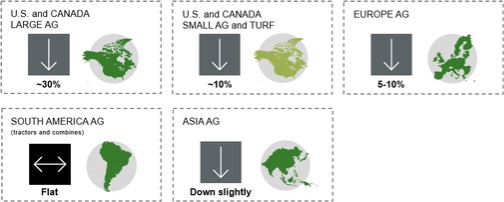][added: ]
[removed: Construction and Forestry][added: Construction and Forestry]
[removed: ][added: ]
[removed: Company Trends][added: Company Trends]
Customers seek to improve profitability, productivity, and sustainability [removed: through integrating] [added: by selecting our equipment and] technology [removed: into their operations.][added: solutions.]
Deeper integration of technology into equipment [removed: is] [added: to enable customers to do more with less remains] a persistent market trend.
[removed: Company Outlook for 2025][added: Company Outlook for 2026]
[removed: Agriculture and Turf Outlook for 2025][added: Agriculture and Turf Outlook for 2026]
[removed: Construction and Forestry Outlook for 2025][added: Construction and Forestry Outlook for 2026]
[removed: Financial Services Outlook for 2025][added: Financial Services Outlook for 2026]
| Net Income | | | | [removed: Up] [added: Down] | | | |
| [removed: \+] Provision [added: (credit)] for credit losses | [added: ] | | [added: 296 |] | [removed: Favorable] | [added: 310] | [added: ] | [added: | (16) |] |
| [removed: \+] [added: (-)] Prior period special items | | | | [removed: Favorable] [added: Unfavorable] | | | |
| [removed: (-)] [added: \+] Financing spreads | | | | [removed: Unfavorable] [added: Favorable] | | | |
[removed: Additional Trends][added: Additional Trends]
[removed: Increased] [added: _Results of Operations_ – Interest] rates [removed: impacted] [added: volatility impacts] us in several ways, primarily affecting the demand for our [removed: products and] [added: products,] financing spreads for the financial services [removed: operations.][added: operations, and the value of our investments.]
[removed: Agricultural Market Business Cycle –] [added: Agricultural Market Business Cycle –] The agricultural market is affected by various factors including commodity prices, acreage planted, crop yields, [removed: and] government [removed: policies.][added: policies, and uncertainty in macroeconomic trends.]
These factors affect farmers’ income and [added: sentiment which] may result in varying demand for our equipment.
Changes in [removed: interest rates and] the agricultural market business cycle [added: and global trade policies] are driven by factors outside of our control, and as a result we cannot reasonably foresee when these conditions will fully subside.
[removed: Other Items of Concern and Uncertainties –] [added: Other Items of Concern and Uncertainties –] Other items that could impact our results are:
| | ● | global and regional political conditions, including the ongoing war between Russia and Ukraine and the [removed: conflict] [added: conflicts] in the Middle [removed: East,] [added: East] |
| | ● | capital market [removed: disruptions,] [added: disruptions] |
| | ● | foreign currency and capital control [removed: policies,] [added: policies] |
| | ● | [removed: regulations and legislation regarding] right to repair [removed: or right to modify,] [added: regulations and legislation] |
| | ● | weather [removed: conditions,] [added: conditions] |
| | ● | marketplace [added: pace of] adoption and monetization of technologies we have invested [removed: in,] [added: in] |
| | ● | our ability to strengthen our digital capabilities, [added: artificial intelligence,] automation, [removed: autonomy,] and [removed: alternative power technologies,] [added: autonomy] |
| | ● | [removed: workforce reductions’] [added: the] impact [added: of workforce reductions] on [added: company culture,] employee [removed: retention,] [added: retention and] morale, and institutional [removed: knowledge,] [added: knowledge] |
| | ● | changes in demand and pricing for new and used [removed: equipment,] [added: equipment] |
| | ● | delays or disruptions in our supply [removed: chain,] [added: chain] |
| | ● | significant fluctuations in foreign currency exchange [removed: rates,] [added: rates] |
 
In 2022, we introduced our Leap Ambitions, a set of focused goals designed to guide the implementation of our Smart Industrial Operating Model.
These Ambitions are built upon a foundation of product quality and manufacturing excellence, supported by a best-in-class dealer channel, and enabled by employees dedicated to solving some of the world’s most important problems.
To build on our accomplishments and lay the foundation for sustained growth as we move toward 2030, in December 2025 we refined our Ambitions.
Our refined Ambitions feature multi-year financial and operational goals, emphasizing the use of our differentiated equipment and service solutions, including automation, autonomy, digitalization, lifecycle solutions, and Solutions as a Service (SaaS).
These technologies are incorporated into customer operations across the varied production systems in which we serve.
While we continue to benefit from the adoption of these technologies, revenue from SaaS products did not represent a significant percentage of our revenues in 2025.
| | ● | Large agriculture sales in North America are expected to remain subdued. |
| | ● | Small agriculture & turf and construction & forestry sales are expected to improve in 2026. |
| | ● | Demand in the U.S. and Canada for large agriculture equipment is expected to decrease further amidst challenging farm fundamentals for row crop farmers, which pressures short-term liquidity. Although the used equipment market is improving, it continues to constrain investments in new machines. These factors are partially offset by strong crop yields and consumption, recent U.S. trade agreements, growing demand for biofuels, and supportive government subsidies. |
| | ● | We expect small agricultural and turf equipment sales to be flat to up slightly from 2025 levels in the U.S. and Canada. The dairy and livestock segment continues to generate profits driven by solid beef prices. A modest recovery is anticipated in the turf sector following an inflection in the housing market and growth in the overall economy. |
| | ● | In Europe, the industry is forecasted to be flat to up slightly supported by strong dairy margins, a stabilizing interest rate environment, and improving crop yields. |
| | ● | Demand in South America is expected to be flat. In Brazil, while soybean and corn acreage is expected to grow, demand is projected to be tempered by high interest rates, strong global crop yields weighing on prices, and uncertainty over global trade policies. In Argentina, equipment demand is anticipated to moderate after robust growth in 2025. |
| | ● | Industry sales in Asia are forecasted to be down slightly. |
| | ● | Industry sales in the U.S. and Canada for earthmoving and compact construction equipment are projected to remain flat to slightly higher, supported by modest growth in construction markets. Record employment levels, strong construction backlogs, and U.S. government infrastructure spending continue to provide a solid foundation for the industry. Moreover, declining interest rates, increased investment in rental fleets, and surging data center construction starts are adding further momentum. These positive drivers are expected to be partially tempered by restrained investments in the private commercial sector. |
| | ● | Global forestry markets are expected to be flat. |
| | ● | Global roadbuilding markets are forecasted to remain flat at strong levels. |
| (-) Average portfolio | | | | Unfavorable | | | |
In 2025, we experienced the following effects due to unfavorable market conditions: lower sales volumes, greater reliance on sales incentives, and elevated receivable write-offs.
Global Trade Policies – During 2025, new tariffs were imposed in the U.S. for imports from a broad range of countries and on certain materials.
Several countries also implemented or proposed retaliatory tariffs on imports from the U.S. and introduced additional trade barriers.
Trade policies impact us in various ways.
We are a net exporter of agriculture and turf equipment from the U.S. Nearly 80% of our domestic sales are assembled in the U.S., with the remaining products imported primarily from Europe, Mexico, India, and Japan.
During 2025, incremental import tariffs adversely affected the cost of our products and components and may continue to do so in 2026.
In addition, retaliatory tariffs by regions outside the U.S., currently in effect or adopted in the future, may impact the prices and profitability of our exported products.
In 2025, the direct impact of incremental tariffs incurred by us was approximately $600, excluding the impact of tariffs on our suppliers and market demand.
Trade policies are evolving, causing uncertainty in the agriculture and construction industries.
We are actively taking steps to mitigate potential impacts on our business, to the extent possible.
On November 5, 2025, the United States Supreme Court heard oral arguments on tariffs imposed under the International Emergency Economic Powers Act (IEEPA).
The court may provide tariff relief and the potential recovery of amounts previously paid.
We are monitoring developments in this case and its impact on our future financial statements and business.
Legal Proceeding – On January 15, 2025, the Federal Trade Commission (FTC), along with the Attorneys General of the States of Illinois and Minnesota filed a lawsuit against us in the United States District Court for the Northern District of Illinois Western Division.
The Attorneys General of the States of Arizona, Michigan, and Wisconsin joined the lawsuit.
The lawsuit alleges monopolization and unfair competition in violation of the federal and state antitrust laws.
Plaintiffs seek a permanent injunction and other equitable relief to allow owners of our equipment, as
well as independent repair providers, access to our repair tools and any other repair resources available to authorized John Deere dealers.
We are in preliminary discussions with the FTC with respect to a potential resolution.
At this stage, we are unable to estimate the potential impact on our business.
| | ● | shifts in energy, including positions with respect to biofuels, economic, and positions on government subsidies of farming |
| (-) Tariffs | | Unfavorable | | | | | | | |
| --- | --- |
These technologies are incorporated into products within each of our operating segments.
We expect this trend to persist for the foreseeable future.
Our Smart Industrial Operating Model and Leap Ambitions are intended to capitalize on this market trend.
Engaged acres are an indicator we use to understand customer utilization of our technology.
We are investing in a Solutions as a Service business model to increase technology adoption and utilization by our customers.
Solutions as a Service products did not represent a significant percentage of our revenues in 2024.
| | ● | Agriculture and turf equipment sales are projected to decline in 2025 due to contraction of agriculture markets globally. |
| --- | --- | --- |
| | ● | Construction equipment sales are projected to decline in 2025 as healthy end markets are offset by continued uncertainty in equipment purchases. Roadbuilding equipment sales are anticipated to be generally flat. |
| | ● | Demand in the U.S. and Canada is expected to further moderate amidst weak farm fundamentals, high interest rates, elevated used inventory levels, and short-term farmer liquidity concerns heading into the 2025 growing season. |
| | ● | We expect small agricultural equipment sales to be down from 2024 levels in the U.S. and Canada. The dairy and livestock segment is anticipated to have another year of strong profitability as elevated livestock and hay prices are further enhanced by low input feed costs. This is projected to be more than offset by restrained demand in the turf and compact utility tractor markets as single family home sales and home improvement spending remain stagnant amid high interest rates. |
| | ● | In Europe, the industry is forecasted to be down as farm fundamentals in the region continue to deteriorate, but at a moderated pace relative to 2024. Adverse factors include depressed yields from unfavorable weather, reduced regional commodity prices due to a mixture of excess grain inflows from Ukraine and global pricing pressures, persistently elevated input costs, and unfavorable agriculture legislation. These issues coupled with high interest rates and elevated industry inventory |
levels are expected to keep industry equipment demand at low levels throughout 2025.
| | ● | Demand in South America is expected to be flat. In Brazil, we expect crop prices to decline in 2025 offset by decreasing input costs and improving yields as drought concerns abate. These factors coupled with continued acreage expansion and recent appreciation of the U.S. dollar against the Brazilian real will offer further profitability tailwinds to farmers. Across the rest of South America, strong yields are expected to be offset by low commodity prices and elevated interest rates. Argentina industry sales are forecasted to improve as the currency stabilizes amid agricultural industry recovery. |
| | ● | Industry sales in Asia are forecasted to be down slightly, as foundational technology adoption and improving agriculture fundamentals in India provide moderate demand. |
| | ● | Construction equipment industry sales are forecasted to be down in the U.S. and Canada from 2024 levels. The decline is due to projected modest growth in single family housing starts and U.S. government infrastructure spending, which is expected to be more than offset by further slowdowns in multi-family housing developments, non-residential buildings, and reduced spending in oil and gas. Historically low levels of earthmoving rental purchases and rising used inventories are expected to further pressure equipment sales as market uncertainty persists. |
| | ● | Global forestry markets are expected to be flat to down as challenged global markets stabilize at low demand levels. |
| | ● | Global roadbuilding markets are forecasted to be generally flat, as a modest recovery in Europe is expected to compensate for a slight slowdown in other geographies. |
Interest Rates – While interest rates in the U.S. began to decrease in the fourth quarter of 2024, they remained elevated.
The markets for our agriculture, turf, and construction products were negatively impacted in 2024 by elevated interest rates and their effect on borrowing costs for our customers.
Rising interest rates have historically impacted our borrowing costs sooner than the benefit is realized from receivable and lease portfolios.
In 2024, we experienced unfavorable market
conditions which resulted in lower sales volumes, higher sales incentives, higher receivable write-offs, and an increase in expected credit losses.
We introduced cost reduction measures to manage our profitability and inventory levels.
In the third quarter of 2024, we implemented employee-separation programs for our salaried workforce to help meet our strategic priorities while reducing overlap and redundancy in roles and responsibilities.
The programs’ total pretax expenses are estimated to be approximately $165, of which $157 was recorded in 2024 (see Note 4).
Annual pretax savings from these programs are estimated to be about $220.
Approximately $100 of savings was realized in 2024.
| | ● | shifts in energy, economic, tax, and trade policies following the 2024 U.S. presidential and congressional elections, |
| | ● | new or retaliatory tariffs, |
| | | | | | | | | | |
| --- | --- | --- | --- | --- | --- | --- | --- | --- | --- |
| (-) Overhead Costs | | Unfavorable | | | | | | | |
| Increased primarily due to higher average financing receivable portfolios and higher average financing rates. | | | | | | | | | |
| Higher primarily due to investment income earned on international marketable securities, legal settlements (see Note 4), and increased revenues from services. | | | | | | | | | |
| Higher due to continued focus on developing new technology solutions and product introductions. | | | | | | | | | |
| Increased mostly due to higher provision for credit losses, employee separation programs' expenses, and higher employee pay driven by merit increases, partially offset by the effect of a prior year accounting treatment correction (see Note 4). | | | | | | | | | |
| Decreased as a result of lower pretax income, adjustments to valuation allowance on deferred tax, and the favorable impact of discrete tax benefits. These items were partially offset by prior years' favorable income tax ruling in Brazil. | | | | | | | | | |
Declines in housing starts, decreases in rental purchases, lower levels of commercial real estate construction, and the effect of inventory management contributed to lower shipment volumes for construction equipment.
An excerpt. Shown here: 40 of 1,563 rewritten, 40 of 529 added and 40 of 523 removed. The counts are complete. For every sentence, read Item 16. FORM 10-K SUMMARY. in the FY2025 filing and the FY2024 filing.