 filings.tools
Domino's Pizza 10-K 2023-01-01
Filed 2023-02-23. 23 sections, 410K characters. Original on sec.gov · Markdown · JSON
Cover and table of contents
UNITED STATES
SECURITIES AND EXCHANGE COMMISSION
Washington, D.C. 20549
FORM 10-K
(Mark One)
[X] ANNUAL REPORT PURSUANT TO SECTION 13 OR 15(d) OF THE SECURITIES EXCHANGE ACT OF 1934
For the fiscal year ended January 1, 2023
or
[ ] TRANSITION REPORT PURSUANT TO SECTION 13 OR 15(d) OF THE SECURITIES EXCHANGE ACT OF 1934
Commission File Number 001-32242
Domino’s Pizza, Inc.
(Exact name of registrant as specified in its charter)
| DELAWARE(State or other jurisdiction of incorporation or organization) | 38-2511577(I.R.S. Employer Identification No.) | |
| 30 Frank Lloyd Wright DriveAnn Arbor, Michigan(Address of principal executive offices) | 48105(Zip Code) |
Registrant’s telephone number, including area code (734) 930-3030
Securities registered pursuant to Section 12(b) of the Act:
| Title of Each Class | Trading Symbol | Name of Each Exchange on Which Registered |
| Domino’s Pizza, Inc. Common Stock, $0.01 par value | DPZ | New York Stock Exchange |
Securities registered pursuant to Section 12(g) of the Act: None
Indicate by check mark if the registrant is a well-known seasoned issuer, as defined in Rule 405 of the Securities Act:
Yes [X] No [ ]
Indicate by check mark if the registrant is not required to file reports pursuant to Section 13 or Section 15(d) of the Act:
Yes [ ] No [X]
Indicate by check mark whether the registrant (1) has filed all reports required to be filed by Section 13 or 15(d) of the Securities Exchange Act of 1934 during the preceding 12 months (or for such shorter period that the registrant was required to file such reports), and (2) has been subject to such filing requirements for the past 90 days:
Yes [X] No [ ]
Indicate by check mark whether the registrant has submitted electronically every Interactive Data File required to be submitted pursuant to Rule 405 of Regulation S-T (§232.405 of this chapter) during the preceding 12 months (or for such shorter period that the registrant was required to submit such files):
Yes [X] No [ ]
Indicate by check mark whether the registrant is a large accelerated filer, an accelerated filer, a non-accelerated filer, a smaller reporting company, or an emerging growth company. See the definitions of “large accelerated filer,” “accelerated filer,” “smaller reporting company,” and “emerging growth company” in Rule 12b-2 of the Exchange Act.
Large accelerated filer [X] Accelerated filer [ ]
Non-accelerated filer [ ] Smaller reporting company [ ]
Emerging growth company [ ]
If emerging growth company, indicate by check mark if the registrant has elected not to use the extended transition period for complying with any new or revised financial accounting standards provided pursuant to Section 13(a) of the Exchange Act. [ ]
Indicate by check mark whether the registrant has filed a report on and attestation to its management’s assessment of the effectiveness of its internal control over financial reporting under Section 404(b) of the Sarbanes-Oxley Act (15 U.S.C. 7262(b)) by the registered public accounting firm that prepared or issued its audit report. [X]
If securities are registered pursuant to Section 12(b) of the Act, indicate by check mark whether the financial statements of the registrant included in the filing reflect the correction of an error to previously issued financial statements. [ ]
Indicate by check mark whether any of those error corrections are restatements that required a recovery analysis of incentive-based compensation received by any of the registrant’s executive officers during the relevant recovery period pursuant to §240.10D-1(b). [ ]
Indicate by check mark whether the registrant is a shell company (as defined in Rule 12b-2 of the Act): Yes [ ] No [X]
The aggregate market value of the voting and non-voting common stock held by non-affiliates of Domino’s Pizza, Inc. as of June 19, 2022 computed by reference to the closing price of Domino’s Pizza, Inc.’s common stock on the New York Stock Exchange on such date was $13,537,240,820.
As of February 16, 2023, Domino’s Pizza, Inc. had 35,419,653 shares of common stock, par value $0.01 per share, outstanding.
Documents incorporated by reference:
Portions of the definitive proxy statement to be furnished to shareholders of Domino’s Pizza, Inc. in connection with the annual meeting of shareholders to be held on April 25, 2023 are incorporated by reference into Part III.
TABLE OF CONTENTS
Throughout this document, Domino’s Pizza, Inc. (NYSE: DPZ) is referred to as the “Company,” “Domino’s,” “Domino’s Pizza” or in the first-person notations of “we,” “us” and “our.”
In this document, we rely on and refer to information regarding the U.S. quick service restaurant, or QSR, sector and the U.S. QSR pizza category from CREST® ongoing foodservice market research (years ending December) prepared by The NPD Group, as well as market research reports, analyst reports and other publicly-available information. Although we believe this information to be reliable, we have not independently verified it. U.S. sales information relating to the U.S. QSR sector and the U.S. QSR pizza category represent reported consumer spending obtained by The NPD Group’s CREST® ongoing foodservice market research from consumer surveys. This information relates to both our Company-owned and franchised stores.
Part I
Item 1. Business.
Overview
Domino’s is the largest pizza company in the world with more than 19,800 locations in over 90 markets around the world as of January 1, 2023, and operates two distinct service models within its stores with a significant business in both delivery and carryout. Founded in 1960, we are a highly recognized global brand, and we focus on value while serving neighborhoods locally through our large worldwide network of franchise owners and U.S. Company-owned stores through both the delivery and carryout service models. We are primarily a franchisor, with approximately 99% of Domino’s global stores owned and operated by our independent franchisees as of January 1, 2023. Franchising enables an individual to be his or her own employer and maintain control over all employment-related matters and pricing decisions, while also benefiting from the strength of the Domino’s global brand and operating system with limited capital investment by us.
The Domino’s business model is straightforward: Domino’s stores handcraft and serve quality food at a competitive price, with easy ordering access and efficient service, enhanced by our technological innovations. Our hand-tossed dough is made fresh and distributed to stores around the world by us and our franchisees.
Domino’s generates revenues and earnings by charging royalties and fees to our franchisees. Royalties are ongoing percent-of-sales fees for use of the Domino’s® brand marks. We also generate revenues and earnings by selling food, equipment and supplies to franchisees through our supply chain operations primarily in the U.S. and Canada and by operating a number of Company-owned stores in the United States. Franchisees profit by selling pizza and other complementary items to their local customers. In our international markets, we generally grant geographical rights to the Domino’s Pizza® brand to master franchisees. These master franchisees are charged with developing their geographical area, and they may profit by sub-franchising and selling food and equipment to those sub-franchisees, as well as by running pizza stores. We believe that everyone in the system can benefit, including the end consumer, who can purchase Domino’s menu items for themselves and their family conveniently and economically.
The Domino’s business model can yield strong returns for our franchise owners and our Company-owned stores. It can also yield significant cash flows to us, through a consistent franchise royalty payment and supply chain revenue stream, with moderate capital expenditures. We have historically returned cash to shareholders through dividend payments and share repurchases. We believe we have a proven business model for success, which includes leading with technology, service and product innovation and leveraging our global scale, which has historically driven strong returns for our shareholders.
Our History
We have been selling quality, affordable food through both the carryout and delivery service models to our customers since 1960. We became “Domino’s Pizza” in 1965 and opened our first franchised store in 1967. Over the last 60 years, we have built Domino’s into one of the most widely-recognized consumer brands in the world. We believe our commitment to value, convenience, quality and new products continues to keep consumers engaged with the brand.
Emphasis on technological innovation helped us achieve approximately two-thirds of all global retail sales in 2022 from digital channels. In the U.S., we have developed several innovative ordering platforms, including those for Google Home, Facebook Messenger, Apple Watch, Amazon Echo, Twitter and more.
Since 1998, the Company has been structured with a leveraged balance sheet and has completed a number of recapitalization transactions. As of January 1, 2023, the Company had $5.02 billion in total debt, which includes debt resulting from its recapitalization transactions completed in 2021, 2019, 2018, 2017 and 2015 (the “2021 Recapitalization,” “2019 Recapitalization,” “2018 Recapitalization,” “2017 Recapitalization” and the “2015 Recapitalization,” respectively, and collectively, the “2021, 2019, 2018, 2017 and 2015 Recapitalizations”).
Our Industry
The U.S. QSR pizza category is large and fragmented. From 2017 through 2022, the U.S. QSR pizza category has grown from $36.4 billion to $40.7 billion. It is the second-largest category within the $320.3 billion U.S. QSR sector. The U.S. QSR pizza category is primarily comprised of delivery, dine-in and carryout, with carryout and delivery comprising the two largest segments.
In the U.S., we compete in the delivery and carryout segments of the pizza industry, and we are the dollar market share leader for delivery and carryout among pizza QSRs. Delivery segment dollars of $17.3 billion in 2022 (up from $13.6 billion in 2017) account for approximately 43% of total U.S. consumer spend at pizza QSRs. The four industry leaders, including Domino’s, account for approximately 60% of U.S. pizza delivery, based on reported consumer spending, with the remaining dollars going to regional chains and independent establishments. From 2017 to 2022, the carryout segment grew from $16.4 billion to $18.9 billion. The four industry leaders, including Domino’s, account for approximately 50% of the U.S. carryout segment. (Source: The NPD Group/CREST®, year ending December 2022).
In contrast to the U.S., international pizza delivery is relatively underdeveloped, with only Domino’s and two other competitors having a significant global presence. We believe that demand for pizza delivery and pizza carryout is large and growing throughout the world, driven by international consumers’ increasing emphasis on convenience, and our proven success of 40 years of conducting business abroad.
Our Competition
The global pizza delivery and carryout segments, as well as the broader QSR sector, are highly competitive. In the U.S., we compete against regional and local companies as well as national chains Pizza Hut®, Papa John’s® and Little Caesars Pizza®. Internationally, we compete primarily with Pizza Hut®, Papa John’s® and country-specific national, regional and local pizzerias. We generally compete on the basis of product quality, location, image, service, technology, convenience and price. Our business and those of our competitors can be affected by changes in consumer tastes, economic and health conditions, demographic trends, marketing, advertising, pricing and consumers’ disposable income. We also compete with other food, food delivery and order and delivery aggregation companies, which have continued to grow in size and scale in recent years. We compete not only for customers, but also for management and hourly employees, including store team members, drivers and qualified franchisees, as well as suitable real estate sites.
Our Customers
Our business is not dependent upon a single retail customer or small group of customers, including franchisees. No customer accounted for more than 10% of total consolidated revenues in 2022, 2021 or 2020. As of January 1, 2023, our largest franchisee based on store count, Domino’s Pizza Enterprises (DMP: ASX), operated 3,751 stores in 13 international markets, and accounted for 19% of our total store count. Revenues from this master franchisee accounted for 1.7% of our consolidated revenues in 2022. Our international franchise segment only requires a modest amount of general and administrative expenses to support its markets and does not have a cost of sales component. Therefore, the vast majority of these royalty revenues result in profits to us.
Our Menu
We offer a menu designed to present an attractive, quality offering to customers, while keeping it simple enough to minimize operational complexity and expedite order-taking and food preparation. Our basic menu features pizza products with varying sizes and crust types. Our typical store also offers oven-baked sandwiches, pasta, boneless chicken and chicken wings, bread and dips side items, desserts and soft drink products. International markets vary toppings by country and culture, such as the Paratha Pizza in India, Durian Pizza in China or the Octopus Bomb Shrimp in Korea, featuring shrimp, octopus, vegetables, feta cream and horseradish sauce.
Store Image and Operations
We have delivered pizza for over 60 years, and we also emphasize carryout as a significant component of our business. The majority of our U.S. and international stores are constructed in the carryout-friendly Pizza Theater design. Many of these stores offer casual seating and enable customers to watch the preparation of their orders, but do not offer a full-service dine-in experience. As a result, our stores generally do not require expensive restaurant facilities and staffing.
Our Business Segments
We operate, and report, three business segments: U.S. stores, international franchise and supply chain.
U.S. Stores
During 2022, our U.S. stores segment accounted for $1.49 billion, or 33%, of our consolidated revenues. Our U.S. stores segment consists primarily of our franchise operations, which consisted of 6,400 franchised stores located in the United States as of January 1, 2023. We also operated a network of 286 U.S. Company-owned stores as of January 1, 2023.
Directly operating Domino’s stores contributes significantly to our ability to act as a credible franchisor. We also use our Company-owned stores as test sites for technological innovation and promotions as well as operational improvements. We also use them for training new store managers and operations team members, as well as developing prospective franchisees. While we are primarily a franchised business, we continuously evaluate our mix of U.S. Company-owned and franchised stores. As of January 1, 2023, franchised stores represented approximately 96% of our total store count within our U.S. stores segment.
U.S. Franchise Profile
As of January 1, 2023, our network of 6,400 U.S. franchise stores was owned and operated by 725 independent U.S. franchisees. Our franchise formula enables franchisees to benefit from our brand recognition with a relatively low initial capital investment. As of January 1, 2023, the average U.S. franchisee owned and operated approximately nine stores and had been in our franchise system for over 17 years. Additionally, 22 of our U.S. franchisees operated more than 50 stores (including our largest U.S. franchisee who operated 162 stores) and 204 of our U.S. franchisees each operated one store as of January 1, 2023.
We apply rigorous standards to prospective U.S. franchisees. We generally require them to manage a store for at least one year and graduate from our franchise management school program before being granted the right to franchise. This enables us to observe the operational and financial performance of a potential franchisee prior to entering into a long-term agreement. Substantially all of our independent U.S. franchise owners started their careers with us as delivery drivers or in other in-store positions, which we believe offers advantages in terms of familiarity with our business and store operations. In addition, we generally restrict the ability of U.S. franchisees to be involved in other businesses, which we believe helps focus our franchisees’ attention on operating their stores. We believe these characteristics and standards are largely unique within the franchise industry and have resulted in qualified and focused franchisees operating Domino’s stores. We maintain a productive relationship with our independent franchise owners through regional franchise teams, distributing materials that help franchise stores comply with our standards and using franchise advisory groups that facilitate communications between us and our franchisees. We consider our relationship with our U.S. franchisees to be good.
U.S. Franchise Agreements
We enter into franchise agreements with U.S. franchisees under which the franchisee is generally granted the right to operate a store in a particular location for a term of ten years, with an ability to renew for an additional term of ten years. We had a franchise agreement renewal rate of approximately 99% in 2022. Under the current standard franchise agreement, we assign an exclusive area of primary responsibility to each franchised store. Each franchisee is generally required to pay a 5.5% royalty fee on sales, as well as certain technology fees. In certain instances, we will collect lower rates based on certain incentives.
Our stores in the United States currently contribute 6% of their sales to fund national marketing and advertising campaigns (subject, in certain instances, to lower rates based on certain incentives and waivers). These funds are administered by Domino’s National Advertising Fund Inc. (“DNAF”), our consolidated not-for-profit advertising subsidiary. The funds are primarily used to purchase media for advertising, and also to support market research, field communications, public relations, commercial production, talent payments and other activities to promote the Domino’s brand. In addition to the national and market-level advertising contributions, U.S. stores generally spend additional funds on local store marketing activities.
We have the contractual right, subject to state law, to terminate a franchise agreement for a variety of reasons, including, but not limited to, a franchisee’s failure to adhere to the Company’s franchise agreement, failure to make required payments or failure to adhere to specified Company policies and standards.
International Franchise
During 2022, our international franchise segment accounted for $295.0 million, or 6%, of our consolidated revenues. This segment is comprised of a network of franchised stores in over 90 international markets. As of January 1, 2023, we had 13,194 international franchise stores. The principal sources of revenues from those operations are royalty payments generated by retail sales from franchised stores, as well as certain technology fees.
Our international franchisees employ our basic standard operating model and adapt it to satisfy the local eating habits and consumer preferences of various regions outside the U.S. Currently, the vast majority of our international stores operate under master franchise agreements.
We believe that Domino’s appeals to potential international franchisees because of our recognized brand name and technological leadership, the moderate capital expenditures required to open and operate the stores and the system’s desirable store-level profitability. Stores in seven of our ten largest international markets in terms of store count are operated by master franchise companies that are publicly traded on stock exchanges as noted in the below table. The following table shows our store count as of January 1, 2023 in our ten largest international markets, which accounted for approximately 63% of our international stores as of that date.
| Market | Number of stores | |||
| India (JUBLFOOD: NS) | 1,758 | |||
| United Kingdom (DOM: L) | 1,197 | |||
| Japan (DMP: ASX) | 957 | |||
| Mexico (ALSEA: MX) | 842 | |||
| Australia (DMP: ASX) | 756 | |||
| Turkey (DPEU: L) | 650 | |||
| China | 589 | |||
| Canada | 585 | |||
| France (DMP: ASX) | 487 | |||
| South Korea | 480 |
International Franchisee Profile
The vast majority of our markets outside of the U.S. are operated by master franchisees with franchise and distribution rights for entire regions or countries. In a few select markets, we franchise directly to individual store operators. Prospective master franchisees are required to possess local market knowledge to establish and develop Domino’s stores, with the ability to identify and access targeted real estate sites, as well as expertise in local laws, customs, culture and consumer behavior. We also seek candidates that have access to sufficient capital to meet growth and development plans. We consider our relationship with our international franchisees to be good.
International Master Franchise and Other Agreements
Our international master franchise agreements generally grant the franchisee exclusive rights to develop and sub-franchise stores, and the right to operate supply chain centers in particular geographic areas. Agreements are generally for a term of ten years, with options to renew for additional terms. The agreements typically contain growth clauses requiring franchisees to open a minimum number of stores within a specified period. The master franchisee is generally required to pay an initial, one-time franchise fee as well as an additional franchise fee upon the opening of each new store. The master franchisee is also required to pay a continuing royalty fee as a percentage of sales, which varies among international markets and may also differ based on certain incentives and concessions, and averaged approximately 3.0% in 2022. We also have agreements with certain of our international master franchisees with respect to certain technology fees.
Supply Chain
During 2022, our supply chain segment accounted for $2.75 billion, or 61%, of our consolidated revenues. In the U.S., we operate 22 regional dough manufacturing and supply chain centers, two thin crust manufacturing facilities, one vegetable processing center and one center providing equipment and supplies to our U.S. and certain international stores. We also operate five dough manufacturing and supply chain centers in Canada. We plan to continue investing in supply chain productivity initiatives in the future. Our supply chain segment leases a fleet of more than 1,000 tractors and trailers. Our centers produce fresh dough and purchase, receive, store and deliver quality food and other complementary items to substantially all of our U.S. stores and most of our Canadian franchised stores. We regularly supply over 7,200 stores with various food and supplies.
We believe our franchisees voluntarily choose to obtain food, supplies and equipment from us because we offer the most efficient, convenient and cost-effective alternative, while also offering both quality and consistency. Our supply chain segment offers profit-sharing arrangements to U.S. and Canadian franchisees who purchase all of their food for their stores from our centers. These profit-sharing arrangements generally offer participating franchisees and Company-owned stores with 50% (or a higher percentage in the case of Company-owned stores and certain franchisees who operate a larger number of stores) of the pre-tax profit from our supply chain center operations. We believe these arrangements strengthen our ties to and provide aligned benefits with franchisees.
Third-Party Suppliers
A significant amount of our annual food spend is with suppliers with whom we maintain long-standing partnerships. Our supply partners are required to meet strict quality standards to ensure food safety. We review and evaluate these partners’ quality assurance programs through (among other actions) on-site visits, third-party audits and product evaluations designed to ensure compliance with our standards. We believe the length and quality of our relationships with third-party suppliers provides us with priority service and quality products at competitive prices.
Cheese is our largest food cost. The price we charge to our U.S. franchisees for cheese is formula-based, with the Chicago Mercantile Exchange cheddar block price as the primary component, plus a supply chain markup. As cheese prices fluctuate, our revenues and margin percentages in our supply chain segment also fluctuate; however, actual supply chain dollar margins remain unchanged. We currently purchase our U.S. pizza cheese from a single supplier. Under our September 2017 agreement which expires in September 2024, our U.S. supplier agreed to provide the Company with an uninterrupted supply of cheese and the Company agreed to purchase all of its U.S. pizza cheese from this supplier. While we expect to meet the terms of this agreement, if we do not, we will be required to repay certain negotiated cost savings as provided in the agreement. The majority of our meat toppings in the U.S. come from a single supplier under a contract that, as extended, expires at the end of February 2023. We are actively negotiating a new contract with this supplier and we do not anticipate any significant impacts to our supply following the expiration of our current extension. We have the right to terminate these arrangements for quality failures and for certain uncured breaches. We have entered into a multi-year agreement with Coca-Cola® for the U.S. This contract, renegotiated in June 2019 and amended in January 2023, provides for Coca-Cola to continue to be our exclusive beverage supplier and expires on December 31, 2023 or at such time as a minimum number of cases of Coca-Cola products are purchased by Domino’s, whichever occurs later.
We believe alternative third-party suppliers are available for all of these referenced products. While we may incur additional costs if we are required to replace any of our supply partners, we do not believe such additional costs would have a material adverse effect on our business. We continually evaluate each supply category to determine the optimal sourcing strategy.
We have not experienced any significant shortages of supplies or delays in receiving our inventories or products. Prices charged to us by our supply partners are subject to fluctuation, and we have historically been able to pass increased costs and savings on to stores. We periodically enter into supplier contracts to manage the risk from changes in commodity prices. We do not engage in speculative transactions, nor do we hold or issue financial instruments for trading purposes.
Our Strengths
Strong Brand Equity
We are the largest pizza company in the world and we believe our Domino’s brand is one of the most widely-recognized consumer brands in the world. We are the recognized world leader in pizza delivery and, in the U.S., we are also the market share leader in carryout. We believe consumers associate our brand with the timely delivery of quality, affordable food and technological innovation. Over the past five years, our U.S. franchise and Company-owned stores have invested an estimated $2.6 billion in national, co-operative and local advertising. Our international franchisees also invest significant amounts in advertising efforts in their markets. We continue to reinforce our brand with extensive advertising through various media channels.
We are the number one pizza delivery company in the U.S. with approximately 32% share of delivery dollars at pizza QSRs, based on consumer spending data for the year ending December 2022. For the same period, we are also leading in carryout with approximately 19% share of carryout/drive-thru QSR pizza consumer spending (Source: The NPD Group/CREST®, year ending December 2022). With 6,686 stores located in the U.S., our store delivery areas cover a majority of U.S. households. Our share position and scale allow us to leverage our purchasing power, supply chain strength and marketing investments. We believe our scale and market coverage allow us to effectively serve our customers’ demands for convenience and timely delivery. Outside the U.S., we have significant market share positions in many of the markets in which we compete.
Strong and Proven Business Model
Our business model generates U.S. and international franchise royalties and fees, supply chain revenue and retail sales at Company-owned stores. We have developed this model over our many years of operation, and it is anchored by strong store-level economics, which provide an entrepreneurial incentive for our franchisees and historically has generated strong demand for new stores. Over the past ten years, average U.S. store profitability in the Domino’s system has increased meaningfully, resulting in higher profitability for our franchise owners. Our franchise system, in turn, has produced strong and consistent earnings for us through royalty and fee payments and through supply chain revenues.
We developed a cost-efficient store model, characterized by a delivery- and carryout-oriented store design, with moderate capital requirements and a menu of quality, value-oriented and affordable items. At the store level, we believe the simplicity and efficiency of our operations give us significant advantages over our competitors, who, in many cases, also focus on dine-in or have broader menu offerings. At the supply chain level, we believe we provide quality, good value and consistency for our franchise customers while also driving profits for us, which we share with our franchisees under the profit-sharing arrangements described above.
Our menu simplifies and streamlines production and delivery processes and maximizes economies of scale on purchases of our principal food items. In addition, our stores, including those in our Pizza Theater image, are generally smaller and less expensive to build, furnish and maintain as compared to many other restaurant concepts, and they create a positive experience for our carryout customers. The combination of this efficient store model and strong sales volume has resulted in strong store-level economics and, we believe, makes Domino’s an attractive business opportunity for existing and prospective franchisees around the world. We and our franchisees are continuing to focus on growing our global store count. In recent years, we have focused specifically on increasing our presence in our existing markets to provide better service to our customers, including condensing our delivery areas to provide better delivery service and adding locations that are closer to our carryout customers. We call this approach our fortressing strategy.
We believe our store financial returns have led to a strong, well-diversified franchise system. This established franchise system has produced strong cash flows and earnings for us, enabling us to invest in the Domino’s brand, stores, technology and supply chain centers, pay dividends, repurchase and retire shares of our common stock and service our debt obligations.
Technological Innovation
Technological innovation is vital to our brand and our long-term success, and digital ordering is critical to competing in the global pizza and broader QSR industries. Emphasis on technological innovation helped us achieve approximately two-thirds of global retail sales in 2022 from digital channels. In the U.S., we have developed several innovative ordering platforms, including those for Google Home, Facebook Messenger, Apple Watch, Amazon Echo, Twitter and more. We have also added GPS to our Domino’s Tracker, which allows customers to monitor the progress of their food, from the preparation stages to the time it is in the oven to the time it arrives at their doors.
Our Piece of the Pie Rewards® loyalty program is meant to reward customers with a program that is simple to understand and easy to use. Upon signing up for the program, customers become rewards members and can earn points for their orders. When rewards members reach a certain amount of points, they can redeem their points for free pizza. Rewards members may also receive exclusive members-only discounts and bonus offers. We may also occasionally provide additional opportunities for participating customers to benefit under the Piece of the Pie Rewards program.
This improved functionality has been developed to work seamlessly with our Domino’s PULSE™ point-of-sale system. Our Domino’s PULSE system is designed to drive operating efficiencies for our franchisees and our corporate management and assist franchisees in independently managing their business. As of January 1, 2023, Domino’s PULSE is being used in every Company-owned and franchised store in the U.S. and in approximately 79% of our international stores. We believe utilizing Domino’s PULSE with our integrated technology solutions throughout our system provides us with competitive advantages over other concepts. We intend to continue to enhance and grow our online ordering, digital marketing and technological capabilities.
Product Innovation
We believe our core hand-tossed pizza recipe has contributed to long-term growth in customer reorder rates, consumer traffic and increased sales. This recipe is now in use in other markets around the world. Our more than 60 years of innovation have resulted in numerous new product developments. Product innovation is also present in our global markets, where our master franchisees have the ability to recommend products to suit their local market tastes. Products can range from simple to indulgent, including the Cheese Fondue Fire Meat in Japan (cheese, tomato and truffle cream sauce, barbecue pork, bacon and vegetables) and the Saumoneta in France (light cream, potatoes, onions, smoked salmon and dill).
Internal Dough Manufacturing and Supply Chain System
In addition to generating significant revenues and earnings in the U.S. and Canada, we believe our vertically integrated dough manufacturing and supply chain system enhances the quality and consistency of our products, enhances our relationships with franchisees and leverages economies of scale to offer lower costs to our stores. It also allows store managers to focus on store operations and customer service by relieving them of the responsibility of mixing dough in the stores and sourcing other ingredients. Many of our international master franchisees also profit from running supply chain businesses in their respective markets.
Human Capital
As of January 1, 2023, we had approximately 11,000 employees, including approximately 6,600 employees supporting our U.S. Company-owned stores and U.S. franchise operations (our U.S. stores segment), approximately 3,300 employees supporting our U.S. and Canadian supply chain operations (our supply chain segment), approximately 100 employees supporting our international franchise operations (our international franchise segment) and approximately 1,000 corporate employees. Approximately 4,500 of our employees are part-time and approximately 6,500 are full-time equivalent. Our franchisees are independent business owners, so their employees are not our employees and therefore are not included in our employee count. None of our employees are covered by a collective bargaining agreement. We consider our relationship with our employees to be good.
Purpose and Values
We are a purpose-inspired and performance-driven company with exceptional people committed to feeding the power of possible, one pizza at a time. At the heart of our brand is a commitment to a set of values that define our core beliefs on how we run our business, treat our people, support our franchisees and serve our customers.
Do the Right Thing: We act with integrity and make disciplined decisions, even when it’s difficult or unpopular. High ethical standards and uncommon honesty are at the heart of how we work together. We are committed to safely and responsibly serving our customers, and to giving back to the communities where we live and work.
Put People First: We create an inclusive culture, knowing our people are core to our success. We treat each other with dignity and respect, and we value the differences each team member brings. We strive to be a company where all team members can bring their full selves to work and know that they can belong, contribute and reach their potential.
Create Inspired Solutions: We are a company built on entrepreneurship and innovation. We get better every day by having the humility and the courage to embrace and lead change. Together, we unlock our collective potential to be bold and think big. We have a bias for action to solve customer needs in new and relevant ways.
Champion our Customers: We deliver on our promises, treating each order and interaction as an opportunity to deepen relationships by delivering great products, services and experiences. We hold ourselves accountable, and if we don’t deliver on a promise, we are committed to making it right.
Grow and Win Together: We are not playing a finite game. We are committed to building an enduring brand that outlives any of our individual contributions. We will grow together, deliver exceptional results together, celebrate wins together, have fun together, and leave the Domino’s brand in a better place for those that come after.
Compensation and Benefits
Exceptional people are the core of our business. We are committed to providing competitive pay and benefits to attract and retain great talent, whether in our U.S. Company-owned stores, in our supply chain centers or in our corporate offices. We enable this by benchmarking and analyzing pay and benefits both externally and internally. In recent years, we have made continued investments in frontline team member wage rates in our U.S. Company-owned stores and supply chain centers. We are committed to providing pay equity for all employees.
Domino’s offers a comprehensive benefits package to eligible team members, including several benefits designed to promote an inclusive workplace like paid parental leaves, adoption support, discounted childcare tuition, and health plans that are available to dependents, spouses and domestic partners and include fertility and gender transition support. We also offer eligible team members a 401(k) plan, education assistance, access to financial education, a back-up childcare network and access to legal assistance.
Beyond basic insurance programs, Domino’s offers other wellness services to help team members participating in our health plan manage and optimize their health. These no-cost programs include smoking cessation, diabetes and hypertension management, at-home physical therapy for such team members, in addition to emotional support through Domino’s team member assistance program for all part-time and full-time team members and their dependents. Additionally, we provide up to 40 hours per year of sick time for all part-time and full-time team members, with no waiting period for our part-time team members who begin accruing sick pay on their first day of hire, and access to an outside wellness platform featuring 4,000+ videos on topics like mindfulness, exercise, nutrition, sleep, and financial well-being.
Talent Development and Recruiting
Having best-in-class talent across the globe is crucial to all aspects of Domino’s business, brand and long-term success. We are focused on attracting, developing and retaining high-performing, diverse teams and building an inclusive culture that inspires leadership, encourages innovative thinking and supports the development and advancement of all team members. Domino’s team members are empowered to drive their own success through different resources, training, and several development programs, including our G.O.L.D. (Global Operations Leadership Development) Program, our Supply Chain Services Driver Development Program and our Tech Rotation Program.
Our success will continue to depend on our ability to attract and retain qualified personnel to operate our stores, dough manufacturing and supply chain centers and international operations. In certain periods of 2022, we experienced labor shortages affecting store hours and staffing levels in many of our markets which contributed to lower order counts. To continue to strengthen our ability to attract and retain talent to ensure we have appropriate staffing to operate our stores and supply chain centers, we have launched a new Applicant Tracking System and have made continued investments in frontline team member wage rates in our U.S. Company-owned stores and supply chain centers. On an annual basis, we also review scores for our team member engagement and culture surveys to identify strengths and opportunities for our brand.
The opportunity and potential at Domino’s is best represented in a key statistic: substantially all of our U.S. franchisees started as delivery drivers or in other in-store positions. With the vast majority of Domino’s U.S. franchisees developed from within our own system, the opportunity to become a small business owner is a profound and unique aspect of Domino’s culture and strength as a brand. Experienced store managers and other operators can apply for Franchise Management School (“FMS”). At FMS, these operators receive training for a successful transition from store management to store ownership.
Inclusion and Diversity Efforts
“Do the Right Thing” and “Put People First” are two of our core values at Domino’s. From those two values our Inclusion and Diversity mission was launched, and we have been relentless in our commitment to building and strengthening our culture every day. Our mission is to foster a more diverse, highly engaged workforce that sees our Company as the employer of choice and is representative of the communities we serve. We want our team members to feel comfortable bringing their unique experiences and diverse backgrounds to discussions where they can share, learn and listen together enabled by conscious inclusion practices and our leadership competencies.
Domino’s is focused on building an inclusive culture that welcomes, seeks to understand and values everyone’s whole self. Our Inclusion and Diversity efforts have been crafted with a strategic framework that encompasses three pillars:
Workforce – focused on the diversity of our workforce at all levels of the organization.
Workplace – focused on ensuring that our Company-owned stores, offices and supply chains are inclusive.
Marketplace – focused on ensuring our brand reaches and is relevant to all consumers.
As part our workplace initiatives, we provide leadership and funding to support team members in participating in Employee Resource Groups (“ERGs”). We currently have ERGs representing the Black, Hispanic and LGBTQ communities, as well as women in the workforce and individuals with disabilities, with potentially more to come based on team member interest. We also make available to our eligible team members several benefits designed to promote an inclusive workplace like paid parental leaves, adoption support, discounted childcare tuition and health plans that are available to dependents, spouses and domestic partners and include fertility and gender transition support.
Corporate Stewardship
Our vision for stewardship is for Domino’s to deliver the power of possible every day for the communities we serve, our people and the planet. We drafted this inaugural stewardship vision, with notable goals and objectives to drive change in the years and decades to come, and with pillars that ladder up to that vision and our underlying long-term goals. We have continued our efforts to better understand our environmental and social impacts.
We engaged outside experts to measure and quantify our environmental footprint, and identify opportunities to improve. With the help of these experts, we have conducted a materiality assessment, connected with key stakeholders inside and outside of the company and developed a baseline report for our carbon, water and land use footprint in the U.S. We have set two significant commitments on greenhouse gas emissions, including a commitment to set and reach Science Based Targets by 2032 and achieve net zero carbon emissions by 2050. We also continue to highlight important stewardship topics with consumers, including our recent efforts to promote the ability to recycle pizza boxes throughout the U.S. We also launched a fleet of electric vehicles in 2022 as part of an initiative to solve a business need with a solution that is also good for the planet.
Domino’s also has a long history of caring for the communities we serve. Our national philanthropic partner is St. Jude Children’s Research Hospital®, which is internationally recognized for its pioneering work in finding cures and saving children with cancer and other catastrophic diseases. Through a variety of internal and consumer-based activities, including a national consumer fundraising campaign called St. Jude Thanks and Giving®, the Domino’s system has contributed $109.2 million to St. Jude since our partnership began in 2004, including raising $13.3 million in 2022. We have committed to a 10-year, $100 million campaign to raise funds to build Domino’s Village at St. Jude, a planned housing complex that will accommodate up to 140 patient families during long-term stays at the hospital.
We also support the Domino’s Pizza Partners Foundation (the “Partners Foundation”). Founded in 1986, the mission of the Partners Foundation is “Team Members Helping Team Members.” Primarily funded by team member and franchise contributions, the Partners Foundation is a separate, not-for-profit organization that has disbursed over $11.3 million over the past five years. The Partners Foundation is committed to meeting the needs of Domino’s team members facing crisis situations, such as fire, illness, natural disasters or other personal tragedies.
Additionally, in 2020, Domino’s announced a pledge of $3.0 million to support the Black community in the U.S., including $1.0 million to create the Company’s first Black Franchisee Opportunity Fund.
You can find more information about our initiatives and read our 2022 Corporate Stewardship Report, which includes both Sustainability Accounting Standards Board (SASB) and Global Reporting Initiative (GRI) indexed tables, at stewardship.dominos.com. The information included in our Corporate Stewardship Report is not incorporated by reference herein and should not be considered a part of this document.
Additional Disclosures
Working Capital
Information about the Company’s working capital is included in Management’s Discussion and Analysis of Financial Condition and Results of Operations in Part II, Item 7.
Government Regulation
We, along with our franchisees, are subject to various federal, state and local laws affecting the operation of our business. Each store is subject to licensing and regulation by a number of governmental authorities, which include zoning, health, safety, sanitation, building and fire agencies in the jurisdiction in which the store is located. In connection with maintaining our stores, we may be required to expend funds to meet certain federal, state and local regulations, including regulations requiring that remodeled or altered stores be accessible to persons with disabilities. Difficulties in obtaining, or the failure to obtain, required licenses or approvals could delay or prevent the opening of a new store in a particular area or cause an existing store to cease operations. Our supply chain facilities are also licensed and subject to similar regulations by federal, state and local health and fire codes.
We are also subject to the Fair Labor Standards Act and various other federal and state laws governing such matters as minimum wage requirements, overtime and other working conditions and citizenship requirements. Labor costs are largely a function of the minimum wage for a majority of our store personnel and certain supply chain personnel. A significant number of both our and our franchisees’ food service personnel are paid at rates related to the applicable minimum wage, and past increases in the minimum wage have increased labor costs, as would future increases.
We are subject to the rules and regulations of the Federal Trade Commission (“FTC”) and various state laws regulating the offer and sale of franchises. The FTC and various state laws require that we furnish a franchise disclosure document containing certain information to prospective franchisees, and a number of states require registration of the franchise disclosure document with state authorities. We are operating under exemptions from registration in several states based on the net worth of our subsidiary, Domino’s Pizza Franchising LLC, and experience. We believe our franchise disclosure document, together with any applicable state versions or supplements, and franchising procedures comply in all material respects with both the FTC guidelines and all applicable state laws regulating franchising in those states in which we have offered franchises.
Internationally, our franchise stores are subject to national and local laws and regulations that are often similar to those affecting our U.S. stores, including laws and regulations concerning franchises, labor, health, sanitation and safety. Our international stores are also often subject to tariffs and regulations on imported commodities and equipment, and laws regulating foreign investment. We believe our international disclosure statements, franchise offering documents and franchising procedures comply in all material respects with the laws of the foreign countries in which we have offered franchises.
Privacy and Data Protection
We are subject to a number of privacy and data protection laws and regulations both in the U.S. and globally. The legislative and regulatory landscape for privacy and data protection continues to evolve, and there has been an increase in attention given to privacy and data protection issues with the potential to directly affect our business. This includes recently-enacted laws and regulations in the U.S. and internationally requiring notification to individuals and government authorities of security breaches involving certain categories of personal information. Any changes in privacy or data protection laws or regulations could also impact our marketing techniques and could change our marketing strategies. We have a privacy policy posted on our website at dominos.com. The security of our financial data, customer information and other personal information is a priority for us.
Trademarks
We have many registered trademarks and believe that the Domino’s mark and Domino’s Pizza names and logos, in particular, have significant value and are important to our business. Our policy is to pursue registration of our trademarks and to vigorously oppose the infringement of any of our trademarks. We license the use of our registered marks to franchisees through franchise agreements.
Environmental Matters
We are not aware of any federal, state or local environmental laws or regulations that we would expect to materially affect our earnings or competitive position or result in material capital expenditures. However, we cannot predict the effect of possible future environmental legislation or regulations. During 2022, there were no material environmental compliance-related capital expenditures, and no such material expenditures are anticipated in 2023.
Available Information
The Company makes available, free of charge, through its internet website ir.dominos.com, its Annual Report on Form 10-K, Quarterly Reports on Form 10-Q, Current Reports on Form 8-K, proxy statements and amendments to those reports filed or furnished pursuant to Section 13(a), 15(d), or 16 of the Securities Exchange Act of 1934, as amended, as soon as reasonably practicable after electronically filing such material with the Securities and Exchange Commission. Materials filed with the Securities and Exchange Commission are available at sec.gov. Retail orders from Domino’s stores can be made through its website dominos.com. The reference to these website addresses anywhere in this Annual Report on Form 10-K (the “Form 10-K”) does not constitute incorporation by reference of the information contained on the websites and information appearing on those websites, including ir.dominos.com, stewardship.dominos.com and dominos.com, should not be considered a part of this document.
Item 1A. Risk Factors.
For a business as large and globally diverse as the Company, a wide range of factors could materially affect future developments and performance. In addition to the factors affecting specific business operations identified in connection with the description of these operations and the financial results of these operations elsewhere in this report and our other filings with the SEC, we believe the most significant risk factors affecting our business include the following:
Business, Operational and Industry Risks
The quick service restaurant (“QSR”) pizza category and the food service and food delivery markets in general are highly competitive and such competition could adversely affect our operating results.
In the U.S., we compete primarily against regional and local companies as well as national chains Pizza Hut®, Papa John’s® and Little Caesars Pizza®. Internationally, we compete primarily with Pizza Hut®, Papa John’s® and country-specific national, regional and local companies. We may experience increased competition from existing or new companies in the delivery and carryout pizza categories, in addition to competition from order and delivery aggregators both in the pizza category and more broadly, that may create increasing pressures to grow our business in order to maintain our market share. Competition for both customers and drivers from these order and delivery aggregators and other food delivery services has substantially increased as order and delivery aggregators have continued to grow in size and scale. Additionally, we face competition from the supermarket industry and meal kit and food delivery providers, with the improvement of prepared food and meal kit offerings, expansion in meal delivery platforms and services and the trend towards convergence in grocery, deli, retail and restaurant services.
We also compete on a broader scale with quick service and other international, national, regional and local restaurants. The overall food service market, food delivery market and the QSR market are intensely competitive with respect to food quality, price, service, image, convenience and concept, and are often affected by changes in:
consumer tastes;
international, national, regional or local economic conditions;
marketing, advertising and pricing, including both price increases and discounting;
disposable purchasing power and demographic trends; and
currency fluctuations related to international operations.
We compete within the food service market and the QSR market not only for customers, but also for management and hourly employees, including store team members, drivers and qualified franchisees, as well as suitable real estate sites. We and our franchisees have faced an increasingly competitive labor market due to sustained labor shortages and increased turnover resulting in part from the ongoing COVID-19 pandemic which has caused us and our franchisees to in certain cases reduce store hours and delay store openings, and has in the past prevented us from running promotions, which has impacted our sales, service levels and customer acquisition and experience and could ultimately impact our growth and competitive position. Our success is also dependent in large part upon our ability to maintain and enhance the goodwill and reputation of our brand, our customers’ connection to our brand, and a positive relationship with our franchisees and the communities in which we and our franchisees operate.
Our supply chain segment is also subject to competition from outside suppliers. While substantially all U.S. franchisees purchased food, equipment and supplies from us in 2022, U.S. franchisees are not required to purchase food, equipment or supplies from us and they may choose to purchase from outside suppliers. If other suppliers who meet our qualification standards were to offer lower prices or better service to our franchisees for their ingredients and supplies and, as a result, our franchisees chose not to purchase from our U.S. supply chain centers, our financial condition, business and results of operations would be adversely affected.
If we are unable to maintain our competitive position, we could experience downward pressure on prices, lower demand for our products, reduced margins, loss of management or hourly employees, reduced service levels, disruption in our supply chain, the inability to take advantage of new business opportunities and the loss of market share, all of which would have an adverse effect on our operating results and could cause our stock price to decline.
If we fail to successfully implement our growth strategy, which includes opening new U.S. and international stores, our ability to increase our revenues and operating profits could be adversely affected.
A significant component of our growth strategy includes the opening of new U.S. (both Company-owned as well as franchised stores) and international franchised stores. We and our franchisees face many challenges in opening new stores, including, among others:
construction, permitting or development delays, including those relating to the ongoing COVID-19 pandemic;
employment and training of qualified personnel, including availability of store team members;
selection and availability of suitable new store sites and the ability to renew leases in quality locations;
availability and negotiation of leases and financing with acceptable terms;
securing required U.S. or foreign governmental permits, licenses and approvals; and
general economic and business conditions, including increases in food costs and labor costs which could impact profitability and demand for new stores.
The opening of additional franchise stores also depends, in part, upon the availability of prospective franchisees who meet our criteria, the ability of these franchisees to attract and retain qualified personnel and their desire to open new stores. Our failure to add a significant number of new stores would adversely affect our ability to increase revenues and operating income. Additionally, our growth strategy and the success of new stores depend in large part on the availability of suitable store sites and leases. We and our franchisees are currently planning to expand our U.S. and international operations in many of the markets where we currently operate and in select new markets. This may require considerable management time as well as start-up expenses for market development before any significant revenues and earnings are generated. Operations in new markets may achieve low margins or may be unprofitable, and expansion in existing markets may be affected by local economic and market conditions. In addition, we expect to continue our strategy of building additional stores in markets and regions where we have existing stores, a strategy we refer to as “fortressing,” which may negatively impact sales at existing stores. Therefore, as we continue to expand, we or our franchisees may not experience the gross margins we expect, our results of operations may be negatively impacted, and our stock price may decline. Additionally, we have an equity investment in DPC Dash Ltd (“DPC Dash”), as further discussed elsewhere in this report. Through its subsidiaries, DPC Dash serves as the Company’s master franchisee in China that owns and operates Domino’s Pizza stores in that market. These types of investments are inherently risky. If DPC Dash does not succeed or is unable to successfully execute its growth strategy, we may be forced to record impairment charges and could lose some or all of our investment.
As part of our growth strategy, we may decide to increase or decrease the number of Company-owned stores, either by refranchising existing Company-owned stores or by purchasing existing franchised stores, as we have done in the past. Our failure to successfully execute these transactions could have an adverse effect on our operating
Showing the first 8K of 79K characters. Open the full section
Item 1B. Unresolved Staff Comments.
None.
Item 2. Properties.
We lease approximately 285,000 square feet for our World Resource Center, including our Domino’s Innovation Garage, located in Ann Arbor, Michigan under an operating lease with Domino’s Farms Office Park, L.L.C., an unrelated company. The lease, as amended, expires in 2029 and has two five-year renewal options.
We own five supply chain center buildings. All other U.S. and Canadian supply chain centers are leased by us, under leases ranging between five and 21 years with one or two five-year renewal options. All buildings for U.S. Company-owned stores are leased by us, typically under ten-year leases with one or two five-year renewal options. All franchise stores are leased or owned directly by the respective franchisees. We believe that our existing headquarters and other leased and owned facilities are adequate to meet our current requirements, but we plan to continue investing in additional supply chain productivity initiatives in the future.
Item 3. Legal Proceedings.
We are a party to lawsuits, revenue agent reviews by taxing authorities and administrative proceedings in the ordinary course of business which include, without limitation, workers' compensation, general liability, automobile and franchisee claims. We are also subject to suits related to employment practices.
Litigation is subject to many uncertainties, and the outcome of individual litigated matters is not predictable with assurance. These matters referenced above could be decided unfavorably to us and could require us to pay damages or make other expenditures in amounts or a range of amounts that cannot be estimated with accuracy. In management’s opinion, these matters, individually and in the aggregate, should not have a significant adverse effect on the financial condition of the Company, and the established accruals adequately provide for the estimated resolution of such claims.
While we may occasionally be party to large claims, including class action suits, we do not believe that any existing matters, individually or in the aggregate, will materially affect our financial position, results of operations or cash flows.
Item 4. Mine Safety Disclosures.
Not applicable.
Item 4A. Executive Officers of the Registrant.
The listing of executive officers of the Company is set forth under Part III Item 10. Directors, Executive Officers and Corporate Governance, which is incorporated herein by reference.
Part II
Item 5. Market for Registrant’s Common Equity, Related Stockholder Matters and Issuer Purchases of Equity Securities.
As of February 16, 2023, Domino’s Pizza, Inc. had 170,000,000 authorized shares of common stock, par value $0.01 per share, of which 35,419,653 were issued and outstanding. As of February 16, 2023, there were 1,507 registered holders of record of Domino’s Pizza, Inc.’s common stock. Domino’s Pizza, Inc.’s common stock is traded on the New York Stock Exchange (“NYSE”) under the ticker symbol “DPZ.”
Our Board of Directors declared a quarterly dividend of $1.21 per common share on February 21, 2023 payable on March 30, 2023 to shareholders of record at the close of business on March 15, 2023.
We currently anticipate continuing the payment of quarterly cash dividends. The actual amount of such dividends, if any, will depend upon future earnings, results of operations, capital requirements, our financial condition and certain other factors. There can be no assurance as to the amount of free cash flow that we will generate in future years and, accordingly, dividends will be considered after reviewing returns to shareholders, profitability expectations and financing needs and will be declared at the discretion of our Board of Directors.
As of January 1, 2023, we had a Board of Directors-approved share repurchase program for up to $1.0 billion of our common stock, of which $410.4 million remained available for future purchases of our common stock. Any future purchases of our common stock would be funded by current cash amounts, available borrowings or future excess cash flow. The following table summarizes our repurchase activity during the fourth quarter ended January 1, 2023:
| Period | Total Number of Shares Purchased (1) | Average Price Paid per Share | Total Number of Shares Purchased as Part of Publicly Announced Program (2) | Maximum Approximate Dollar Value of Shares that May Yet Be Purchased Under the Program (in thousands) | ||||||||||||
| Period #10 (September 12, 2022 to October 9, 2022) | 1,651 | $ | 310.40 | — | $ | 410,358 | ||||||||||
| Period #11 (October 10, 2022 to November 6, 2022) | 1,052 | 338.17 | — | 410,358 | ||||||||||||
| Period #12 (November 7, 2022 to December 4, 2022) | — | — | — | 410,358 | ||||||||||||
| Period #13 (December 5, 2022 to January 1, 2023) | 854 | 380.09 | — | 410,358 | ||||||||||||
| Total | 3,557 | $ | 335.34 | — | $ | 410,358 |
(1)
3,557 shares were purchased as part of the Company’s employee stock purchase discount plan. During the fourth quarter, the shares were purchased at an average price of $335.34.
(2)
Authorization for the repurchase program may be modified, suspended, or discontinued at any time. The repurchase of shares in any particular period and the actual amount of such purchases remain at the discretion of the Board of Directors, and no assurance can be given that shares will be repurchased in the future.
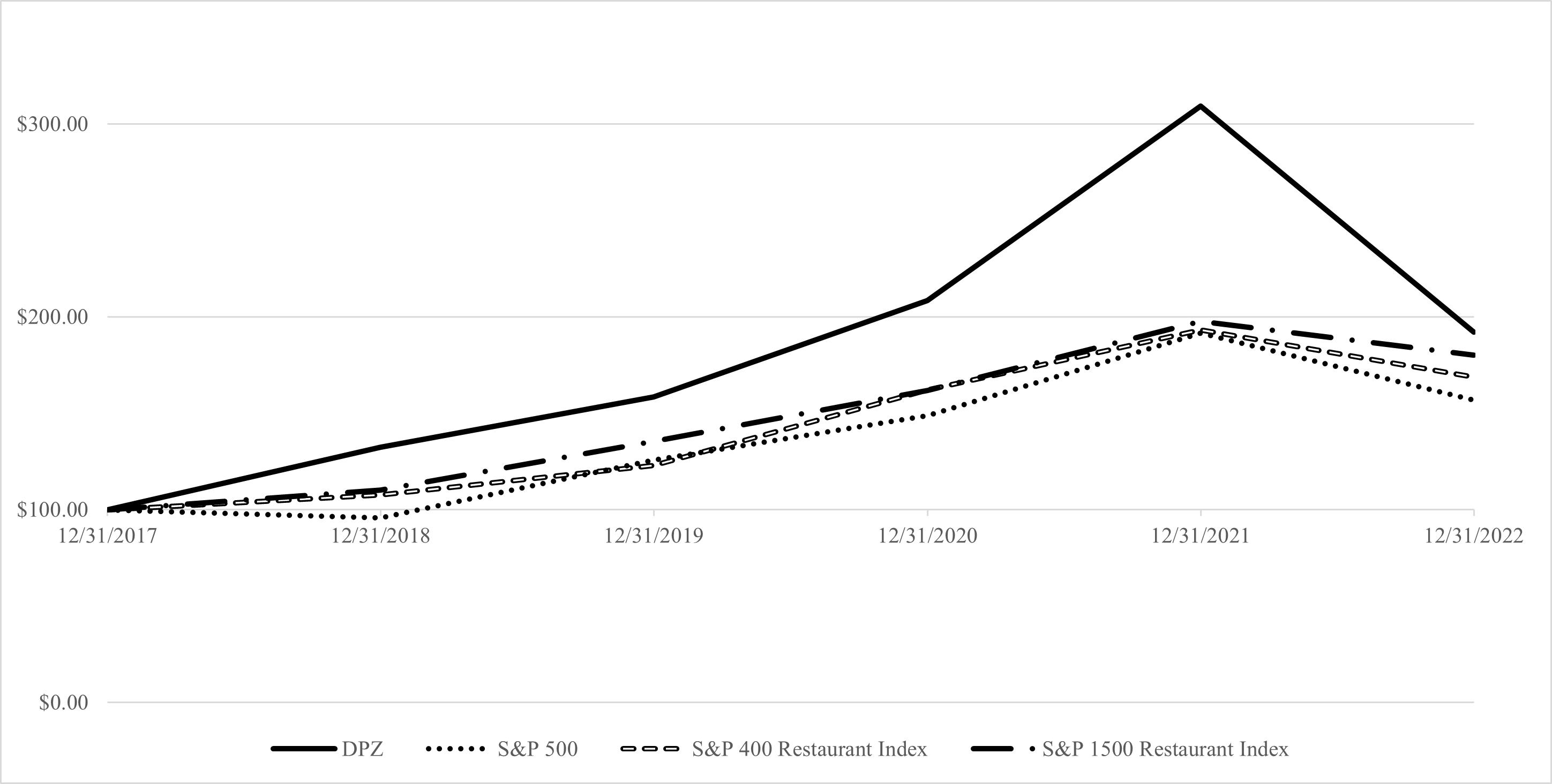
The following comparative stock performance line graph compares the cumulative shareholder return on the common stock of Domino’s Pizza, Inc. (NYSE: DPZ) for the five-year period between December 31, 2017 and December 31, 2022, with the cumulative total return on (i) the Standard & Poor’s 500 Index (the “S&P 500”), (ii) the Standard & Poor’s 400 Restaurant Index (the “S&P 400 Restaurant Index”), which was the Company’s previously-utilized comparison index, and (iii) the Company’s current comparison index, the Standard & Poor’s Composite 1500 Restaurant Index (the “S&P 1500 Restaurant Index”). Management believes that the companies included in the S&P 1500 Restaurant Index more appropriately reflect the scope and scale of the Company’s operations and better match the competitive market in which the Company operates than the S&P 400 Restaurant Index. Due to the change in selected comparative indices, we are presenting the current comparative index and the comparative index that was used in the prior year. The cumulative total return computations set forth in the performance graph assume the investment of $100 in each of the Company’s common stock, the S&P 500, the S&P 400 Restaurant Index and the S&P 1500 Restaurant Index on December 31, 2017.
Item 6. [Reserved].
Item 7. Management's Discussion and Analysis of Financial Condition and Results of Operations.
Overview
Our fiscal year typically includes 52 weeks, comprised of three twelve-week quarters and one sixteen-week quarter. Every five or six years our fiscal year includes an extra (or 53rd) week in the fourth quarter. Fiscal 2022 and 2021 each consisted of 52 weeks and fiscal 2020 consisted of 53 weeks.
In this section, we discuss the results of our operations for the fiscal year ended January 1, 2023 compared to the fiscal year ended January 2, 2022. For a discussion of the fiscal year ended January 2, 2022 compared to the fiscal year ended January 3, 2021, please refer to Part II, Item 7, “Management’s Discussion and Analysis of Financial Condition and Results of Operations” in our Annual Report on Form 10-K for the fiscal year ended January 2, 2022.
Description of the Business
Domino’s is the largest pizza company in the world, with more than 19,800 locations in over 90 markets around the world as of January 1, 2023, and operates two distinct service models within its stores with a significant business in both delivery and carryout. Founded in 1960, we are a highly-recognized global brand, and we focus on value while serving neighborhoods locally through our large network of franchise owners and Company-owned stores through both the delivery and carryout service models. We are primarily a franchisor, with approximately 99% of Domino’s global stores owned and operated by our independent franchisees as of January 1, 2023.
Our business model is straightforward: Domino’s stores handcraft and serve quality food at a competitive price, with easy ordering access and efficient service, enhanced by our technological innovations. Our hand-tossed dough is made fresh and distributed to stores around the world by us and our franchisees.
Domino’s generates revenues and earnings by charging royalties and fees to our independent franchisees. We also generate revenues and earnings by selling food, equipment and supplies to franchisees primarily in the U.S. and Canada and by operating a number of Company-owned stores in the U.S. Franchisees profit by selling pizza and other complementary items to their local customers. In our international markets, we generally grant geographical rights to the Domino’s Pizza brand to master franchisees. These master franchisees are charged with developing their geographical area, and they can profit by sub-franchising and selling food and equipment to those sub-franchisees, as well as by running pizza stores directly. We believe that everyone in the system can benefit, including the end consumer, who can feed their family conveniently and economically.
Our financial results are driven largely by retail sales at our franchised and Company-owned stores. Changes in retail sales are driven by changes in same store sales and store counts. We monitor both of these metrics very closely, as they directly impact our revenues and profits, and we strive to consistently increase both metrics. Retail sales drive royalty payments from franchisees, as well as Company-owned store and supply chain revenues. Retail sales are primarily impacted by the strength of the Domino’s Pizza brand, the results of our extensive advertising through various media channels, the impact of technological innovation and digital ordering, our ability to execute our strong and proven business model and the overall global economic environment.
Our business model can yield strong returns for our franchise owners and our Company-owned stores. It can also yield significant cash flow to us, through a consistent franchise royalty payment and supply chain revenue stream, with moderate capital expenditures. We have historically returned cash to shareholders through dividend payments and share repurchases since becoming a publicly-traded company in 2004. We believe we have a proven business model for success, which includes leading with technology, service and product innovation and leveraging our global scale, which has historically provided strong returns for our shareholders.
Critical accounting estimates
The following discussion and analysis of financial condition and results of operations is based on our consolidated financial statements, which have been prepared in accordance with accounting principles generally accepted in the United States. The preparation of these financial statements requires our management to make estimates and judgments that affect the reported amounts of assets, liabilities, revenues and expenses and related disclosures of contingent assets and liabilities. On an ongoing basis, our management evaluates its estimates, including those related to long-lived assets, casualty insurance reserves and income taxes. We base our estimates on historical experience and on various other assumptions that we believe are reasonable under the circumstances, the results of which form the basis for making judgments about the carrying values of assets and liabilities that are not readily apparent from other sources. Actual results may differ from those estimates, and changes in estimates could materially affect our results of operations and financial condition for any particular period.
We believe that our most critical accounting estimates are:
Long-lived assets
We record long-lived assets, including property, plant and equipment and capitalized software, at cost. For acquisitions of franchise operations, we estimate the fair values of the assets and liabilities acquired based on physical inspection of assets, historical experience and other information available to us regarding the acquisition. We depreciate and amortize long-lived assets using useful lives determined by us based on historical experience and other information available to us. We evaluate the potential impairment of long-lived assets at least annually or whenever events or changes in circumstances indicate that the carrying amount of the assets may not be recoverable. Our periodic evaluation is based on various analyses, including, on an annual basis, the projection of undiscounted cash flows. If we determine that the carrying amount of an asset (or asset group) may not be recoverable, we compare the net carrying value of the asset group to the undiscounted net cash flows to be generated from the use and eventual disposition of that asset group. For Company-owned stores, we perform related impairment tests on an operating market basis, which we have determined to be the lowest level for which identifiable cash flows are largely independent of other cash flows. If the carrying amount of a long-lived asset exceeds the amount of the expected future undiscounted cash flows of that asset, we estimate the fair value of the asset. If the carrying amount of the asset exceeds the estimated fair value of the asset, an impairment loss is recognized, and the asset is written down to its estimated fair value.
We have not made any significant changes in the methodology used to project the future market cash flows of Company-owned stores during the years presented. Same store sales fluctuations and the rates at which operating costs will fluctuate in the future are key factors in determining projected cash flows used to evaluate recoverability of the related assets. If our same store sales significantly decline or if operating costs increase and we are unable to recover these costs, the carrying value of our Company-owned stores, by market, may be unrecoverable and we may be required to recognize an impairment charge. There were no triggering events in 2022, 2021 or 2020, and accordingly, we did not record any impairment losses on long-lived assets in 2022, 2021 and 2020.
Casualty insurance reserves
For certain periods prior to December 1998 and for periods after December 2001, we maintain insurance coverage for workers’ compensation, general liability and owned and non-owned auto liabilities. We are generally responsible for up to $2.0 million per occurrence under these ret
Showing the first 8K of 72K characters. Open the full section
Item 7A. Quantitative and Qualitative Disclosures About Market Risk.
Market risk
We do not engage in speculative transactions nor do we hold or issue financial instruments for trading purposes. In connection with the recapitalizations of our business, we have issued fixed rate notes and entered into variable funding notes and, at January 1, 2023, we are exposed to interest rate risk on borrowings under our variable funding notes. As of January 1, 2023, we did not have any outstanding borrowings under our 2022 and 2021 Variable Funding Notes.
Our 2021 Variable Funding Notes bear interest at fluctuating interest rates based on LIBOR. Our 2021 Variable Funding Notes loan documents provide that after the date on which the administrator for LIBOR permanently or indefinitely ceases to provide all available settings of U.S. dollar LIBOR, any new advances under the 2021 Variable Funding Notes that would otherwise have borne interest based on LIBOR, as well as any existing LIBOR advances for which the interest period has expired, will instead bear interest at a forward-looking term rate based on the Secured Overnight Financing Rate (“Term SOFR”), plus a spread adjustment, that in each case have been selected or recommended by the Board of Governors of the Federal Reserve System or the Federal Reserve Bank of New York. The loan documents also permit the lenders to effect a transition from LIBOR to Term SOFR at an earlier date, subject to certain conditions. Because the composition and characteristics of Term SOFR are not the same as those of LIBOR, there can be no assurance that Term SOFR will perform the same way LIBOR would have at any given time or for any applicable period. As a result, our interest expense could increase, in which event we may have difficulties making interest payments and funding our other fixed costs, and our available cash flow for general corporate requirements may be adversely affected. Our interest expense could also be increased by the rising interest rate environment, which could potentially have an adverse impact on our 2021 Variable Funding Notes, as well as on our 2022 Variable Funding Notes, which bear interest at fluctuating interest rates that are based on Term SOFR.
Our fixed-rate debt exposes the Company to changes in market interest rates reflected in the fair value of the debt and to the risk that the Company may need to refinance maturing debt with new debt at a higher rate.
We are exposed to market risks from changes in commodity prices. During the normal course of business, we purchase cheese and certain other food products that are affected by changes in commodity prices and, as a result, we are subject to volatility in our food costs. Severe increases in commodity prices or food costs, including as a result of inflation, could affect the global and U.S. economies and could also adversely impact our business, financial condition or results of operations. We may periodically enter into financial instruments to manage this risk, although we have not done so historically. We do not engage in speculative transactions or hold or issue financial instruments for trading purposes. In instances when we use fixed pricing agreements with our suppliers, these agreements cover our physical commodity needs, are not net-settled and are accounted for as normal purchases.
Foreign currency exchange rate risk
We have exposure to various foreign currency exchange rate fluctuations for revenues generated by our operations outside the U.S., which can adversely impact our net income and cash flows. Approximately 6.5% of our total revenues in 2022, 6.8% of our total revenues in 2021 and 6.1% of our total revenues in 2020 were derived from our international franchise segment, a majority of which were denominated in foreign currencies. We also operate dough manufacturing and distribution facilities in Canada, which generate revenues denominated in Canadian dollars. We do not enter into financial instruments to manage this foreign currency exchange risk. A hypothetical 10% adverse change in the foreign currency rates for our international markets would have resulted in a negative impact on royalty revenues of approximately $26.1 million in 2022.
Item 8. Financial Statements and Supplementary Data.
Report of Independent Registered Public Accounting Firm
To the Stockholders and Board of Directors of Domino’s Pizza, Inc.
Opinions on the Financial Statements and Internal Control over Financial Reporting
We have audited the accompanying consolidated balance sheets of Domino’s Pizza, Inc. and its subsidiaries (the “Company”) as of January 1, 2023 and January 2, 2022, and the related consolidated statements of income, of comprehensive income, of stockholders’ deficit and of cash flows for each of the three years in the period ended January 1, 2023, including the related notes and schedule of condensed financial information of the registrant as of January 1, 2023 and January 2, 2022 and for each of the three years in the period ended January 1, 2023 appearing under Item 15 (collectively referred to as the “consolidated financial statements”). We also have audited the Company’s internal control over financial reporting as of January 1, 2023, based on criteria established in Internal Control - Integrated Framework (2013) issued by the Committee of Sponsoring Organizations of the Treadway Commission (COSO).
In our opinion, the consolidated financial statements referred to above present fairly, in all material respects, the financial position of the Company as of January 1, 2023 and January 2, 2022, and the results of its operations and its cash flows for each of the three years in the period ended January 1, 2023 in conformity with accounting principles generally accepted in the United States of America. Also in our opinion, the Company maintained, in all material respects, effective internal control over financial reporting as of January 1, 2023, based on criteria established in Internal Control - Integrated Framework (2013) issued by the COSO.
Basis for Opinions
The Company’s management is responsible for these consolidated financial statements, for maintaining effective internal control over financial reporting, and for its assessment of the effectiveness of internal control over financial reporting, included in Management’s Annual Report on Internal Control over Financial Reporting appearing under Item 9A. Our responsibility is to express opinions on the Company’s consolidated financial statements and on the Company's internal control over financial reporting based on our audits. We are a public accounting firm registered with the Public Company Accounting Oversight Board (United States) (PCAOB) and are required to be independent with respect to the Company in accordance with the U.S. federal securities laws and the applicable rules and regulations of the Securities and Exchange Commission and the PCAOB.
We conducted our audits in accordance with the standards of the PCAOB. Those standards require that we plan and perform the audits to obtain reasonable assurance about whether the consolidated financial statements are free of material misstatement, whether due to error or fraud, and whether effective internal control over financial reporting was maintained in all material respects.
Our audits of the consolidated financial statements included performing procedures to assess the risks of material misstatement of the consolidated financial statements, whether due to error or fraud, and performing procedures that respond to those risks. Such procedures included examining, on a test basis, evidence regarding the amounts and disclosures in the consolidated financial statements. Our audits also included evaluating the accounting principles used and significant estimates made by management, as well as evaluating the overall presentation of the consolidated financial statements. Our audit of internal control over financial reporting included obtaining an understanding of internal control over financial reporting, assessing the risk that a material weakness exists, and testing and evaluating the design and operating effectiveness of internal control based on the assessed risk. Our audits also included performing such other procedures as we considered necessary in the circumstances. We believe that our audits provide a reasonable basis for our opinions.
Definition and Limitations of Internal Control over Financial Reporting
A company’s internal control over financial reporting is a process designed to provide reasonable assurance regarding the reliability of financial reporting and the preparation of financial statements for external purposes in accordance with generally accepted accounting principles. A company’s internal control over financial reporting includes those policies and procedures that (i) pertain to the maintenance of records that, in reasonable detail, accurately and fairly reflect the transactions and dispositions of the assets of the company; (ii) provide reasonable assurance that transactions are recorded as necessary to permit preparation of financial statements in accordance with generally accepted accounting principles, and that receipts and expenditures of the company are being made only in accordance with authorizations of management and directors of the company; and (iii) provide reasonable assurance regarding prevention or timely detection of unauthorized acquisition, use, or disposition of the company’s assets that could have a material effect on the financial statements.
Because of its inherent limitations, internal control over financial reporting may not prevent or detect misstatements. Also, projections of any evaluation of effectiveness to future periods are subject to the risk that controls may become inadequate because of changes in conditions, or that the degree of compliance with the policies or procedures may deteriorate.
Critical Audit Matters
The critical audit matter communicated below is a matter arising from the current period audit of the consolidated financial statements that was communicated or required to be communicated to the audit committee and that (i) relates to accounts or disclosures that are material to the consolidated financial statements and (ii) involved our especially challenging, subjective, or complex judgments. The communication of critical audit matters does not alter in any way our opinion on the consolidated financial statements, taken as a whole, and we are not, by communicating the critical audit matter below, providing a separate opinion on the critical audit matter or on the accounts or disclosures to which it relates.
Valuation of Casualty Insurance Reserves
As described in Note 1 to the consolidated financial statements, the Company has retention programs for workers’ compensation, general liability, and owned and non-owned automobile liabilities for certain periods prior to December 1998 and for periods after December 2001. As of January 1, 2023, the Company had accruals for these casualty insurance matters of $57.6 million. The casualty insurance reserves are based on undiscounted independent actuarial estimates, which are based on historical information along with assumptions about future events. Management utilizes various methods, including analyses of historical trends and actuarial valuation methods, to estimate the cost to settle reported claims and claims incurred but not yet reported. The actuarial valuation methods develop estimates of the future ultimate claim costs based on the claims incurred as of the balance sheet date. When estimating these liabilities, several factors are considered, including the severity, duration and frequency of claims, legal cost associated with claims, healthcare trends and projected inflation.
The principal considerations for our determination that performing procedures relating to the valuation of casualty insurance reserves is a critical audit matter are (i) the significant judgment by management when developing the estimated reserves; (ii) a high degree of auditor judgment and effort in performing procedures relating to the actuarial valuation methods used to develop future ultimate claim costs and actuarial
Showing the first 8K of 129K characters. Open the full section
Item 9. Changes in and Disagreements with Accountants on Accounting and Financial Disclosure.
None.
Item 9A. Controls and Procedures.
(a)
Evaluation of Disclosure Controls and Procedures.
The Company carried out an evaluation as of the end of the period covered by this report, under the supervision and with the participation of the Company’s management, including the Company’s Chief Executive Officer and Chief Financial Officer, of the effectiveness of the design and operation of the Company’s disclosure controls and procedures pursuant to Rules 13a-15 and 15d-15 of the Securities Exchange Act of 1934, as amended (the “Exchange Act”). Based upon that evaluation, the Chief Executive Officer and Chief Financial Officer concluded that the Company’s disclosure controls and procedures are effective in ensuring that all information required in the reports it files or submits under the Exchange Act was accumulated and communicated to the Company’s management, including its Chief Executive Officer and Chief Financial Officer, as appropriate to allow timely decisions regarding required disclosure and was recorded, processed, summarized and reported within the time period required by the rules and regulations of the Securities and Exchange Commission.
(b)
Changes in Internal Control over Financial Reporting.
There have been no changes in internal control over financial reporting that occurred during the last fiscal quarter that have materially affected, or are reasonably likely to materially affect, the Company’s internal control over financial reporting.
(c)
Management’s Annual Report on Internal Control over Financial Reporting.
The management of Domino’s Pizza, Inc. is responsible for establishing and maintaining adequate internal control over financial reporting. Internal control over financial reporting is defined in Rule 13a-15(f) promulgated under the Exchange Act, as a process designed by, or under the supervision of, the Company’s principal executive and principal financial officers and effected by the Company’s board of directors, management and other personnel, to provide reasonable assurance regarding the reliability of financial reporting and the preparation of financial statements for external purposes in accordance with generally accepted accounting principles. Because of its inherent limitations, internal control over financial reporting may not prevent or detect misstatements. Also, projections of any evaluation of effectiveness to future periods are subject to the risk that controls may become inadequate because of changes in conditions, or that the degree of compliance with the policies or procedures may deteriorate. Under the supervision and with the participation of the Company’s management, including its Chief Executive Officer and Chief Financial Officer, the Company conducted an evaluation of the effectiveness of its internal control over financial reporting as of January 1, 2023 based on the framework in Internal Control — Integrated Framework (2013) issued by the Committee of Sponsoring Organizations of the Treadway Commission. Based on that evaluation, management concluded that its internal control over financial reporting was effective as of January 1, 2023. The effectiveness of the Company’s internal control over financial reporting as of January 1, 2023, has been audited by PricewaterhouseCoopers LLP, an independent registered public accounting firm, as stated in their report which appears herein.
Item 9B. Other Information.
None.
Item 9C. Disclosure Regarding Foreign Jurisdictions that Prevent Inspections.
Not applicable.
Part III
Item 10. Directors, Executive Officers and Corporate Governance.
The following table sets forth information about our executive officers.
| Name | Age | Position |
| Russell J. Weiner | 54 | Chief Executive Officer and Director |
| Joseph H. Jordan | 49 | President, U.S. and Global Services |
| Sandeep Reddy | 52 | Executive Vice President, Chief Financial Officer |
| Arthur P. D’Elia | 45 | Executive Vice President, International |
| Kelly E. Garcia | 47 | Executive Vice President, Chief Technology Officer |
| Frank R. Garrido | 52 | Executive Vice President, U.S. Operations and Support |
| Cynthia A. Headen | 54 | Executive Vice President, Supply Chain Services |
| Kevin S. Morris | 62 | Executive Vice President, General Counsel and Corporate Secretary |
| Lisa V. Price | 50 | Executive Vice President, Chief Human Resources Officer |
Russell J. Weiner has served as Domino’s Chief Executive Officer since May 2022. Prior to becoming CEO, Mr. Weiner served as Chief Operating Officer and President, Domino’s U.S. from July 2020 to April 2022, Chief Operating Officer and President of the Americas from July 2018 to July 2020, President, Domino’s USA from October 2014 to July 2018 and joined Domino’s as Executive Vice President and Chief Marketing Officer in September 2008. Prior to joining Domino’s, Mr. Weiner held various marketing positions at PepsiCo, Inc. from 1998 to 2008, most recently serving as Vice President of Marketing, Colas for Pepsi-Cola North America. Mr. Weiner has served on Domino’s Board of Directors since May 2022 when he was elected in conjunction with his appointment as Chief Executive Officer. Mr. Weiner also serves on the Board of Directors of The Clorox Company.
Joseph H. Jordan has served as Domino’s President, U.S. and Global Services since May 2022. Mr. Jordan previously served as Executive Vice President of International from April 2018 to April 2022, Senior Vice President and Chief Marketing Officer from May 2015 to April 2018, and joined Domino’s as Vice President of Innovation in September 2011. Prior to joining Domino’s, Mr. Jordan served most recently as Senior Director of Marketing at Pepsi-Cola North America where he worked for six years, held marketing roles at Philips Electronics and Unilever and was a consultant for Accenture. Mr. Jordan also serves on the Board of Directors of DPC Dash Ltd.
Sandeep Reddy has served as Domino’s Executive Vice President, Chief Financial Officer since April 2022. Prior to joining Domino’s, Mr. Reddy served as Executive Vice President and Chief Financial Officer of Six Flags Entertainment from July 2020 to March 2022, and as Chief Financial Officer of Guess?, Inc. from July 2013 to December 2019, after joining Guess?, Inc. in 2010 as the Vice President and European CFO. From 1997 to 2010, Mr. Reddy held a variety of positions with increasing responsibility for Mattel Inc.
Arthur P. D’Elia has served as Domino’s Executive Vice President, International since May 2022. Mr. D’Elia served as Executive Vice President, Chief Marketing Officer from July 2020 to April 2022 and as Senior Vice President, Chief Marketing Officer from February 2020 to July 2020. Mr. D'Elia joined Domino’s in January 2018 as Senior Vice President, Chief Brand and Innovation Officer. Prior to Domino’s, Mr. D'Elia served as Chief Marketing Officer for Danone Dairy’s UBN business unit from July 2017 to January 2018 after joining Danone U.S. in April 2010, and worked at PepsiCo in corporate strategy, development and marketing for the North American beverage business from June 2003 to March 2010.
Kelly E. Garcia has served as Domino’s Executive Vice President, Chief Technology Officer since October 2020. Prior to his current role, Mr. Garcia served as Senior Vice President, Chief Technology Officer from April 2019 to October 2020. Mr. Garcia joined Domino’s in July 2012 as Vice President, eCommerce Development. Prior to Domino’s, Mr. Garcia was with R.L. Polk & Co. from 2004 to 2012, most recently as Vice President of Business Intelligence and North American Operations. Mr. Garcia also serves on the Board of Directors of Ulta Beauty, Inc.
Frank R. Garrido has served as Domino’s Executive Vice President, U.S. Operations and Support since March 2021. Prior to this role, Mr. Garrido served as Senior Vice President, Team USA from June 2020 to March 2021 after joining Domino’s in March 2017 as Vice President, Franchise Operations for the East region. Prior to joining Domino’s, Mr. Garrido was Vice President of Operations of Focus Brands from March 2015 to March 2017. From July 2013 to March 2015, he served as Executive Vice President of Operations, Training and Concept Development for Edible Arrangements International.
Cynthia A. Headen has served as Domino’s Executive Vice President, Supply Chain Services since August 2020. Ms. Headen previously served as Senior Vice President, Global Procurement and Supply Chain Operations from December 2018 to August 2020, after joining Domino’s as Vice President of Procurement and Replenishment in November 2015. Prior to Domino’s, Ms. Headen spent nearly 16 years with PepsiCo, where she was responsible for global procurement.
Kevin S. Morris has served as Domino’s Executive Vice President, General Counsel since January 2017 and also as Corporate Secretary since October 2018. Prior to joining Domino’s, Mr. Morris served at Equinox Holdings, Inc. and its various operating subsidiaries and affiliates from December 2012 to January 2017, most recently as Senior Vice President, General Counsel and Corporate Secretary. Mr. Morris operated his own private legal practice from July 2009 to November 2012. Prior to 2009, Mr. Morris served as Vice President and Associate General Counsel at Global Hyatt Corporation (the predecessor in interest to Hyatt Hotels Corporation) from 1999 to 2008. Prior to 1999, Mr. Morris served as a Senior International Attorney and Staff Director at McDonald’s Corporation after beginning his career as an attorney at Rudnick & Wolfe LLP.
Lisa V. Price has served as Domino’s Executive Vice President, Chief Human Resources Officer since August 2019. Prior to joining Domino’s, Ms. Price served as Senior Vice President of Human Resources at Nordstrom from December 2015 to August 2019. Prior to her time at Nordstrom, she spent over 15 years at Starbucks Corporation in a variety of human resources roles, most recently as Vice President of Partner Resources.
The remaining information required by this item is incorporated by reference from Domino’s Pizza, Inc.'s definitive proxy statement, which will be filed within 120 days of January 1, 2023.
Item 11. Executive Compensation.
Information regarding executive compensation is incorporated by reference from Domino’s Pizza, Inc.’s definitive proxy statement, which will be filed within 120 days of January 1, 2023. However, no information set forth in the proxy statement regarding the Audit Committee Report shall be deemed incorporated by reference into this Form 10-K.
Item 12. Security Ownership of Certain Beneficial Owners and Management and Related Stockholder Matters.
Information regarding security ownership of certain beneficial owners and management and related stockholder matters is incorporated by reference from Domino’s Pizza, Inc.’s definitive proxy statement, which will be filed within 120 days of January 1, 2023.
Item 13. Certain Relationships and Related Transactions, and Director Independence.
Information regarding certain relationships and related transactions is incorporated by reference from Domino’s Pizza, Inc.’s definitive proxy statement, which will be filed within 120 days of January 1, 2023.
Item 14. Principal Accountant Fees and Services.
Information regarding principal accountant fees and services is incorporated by reference from Domino’s Pizza, Inc.’s definitive proxy statement, which will be filed within 120 days of January 1, 2023.
Part IV
Item 15. Exhibits, Financial Statement Schedules.
(a)1. Financial Statements: The following financial statements for Domino’s Pizza, Inc. and subsidiaries are included in Item 8, “Financial Statements and Supplementary Data”:
Report of Independent Registered Public Accounting Firm (PCAOB ID: 238)
Consolidated Balance Sheets as of January 1, 2023 and January 2, 2022
Consolidated Statements of Income for the Years Ended January 1, 2023, January 2, 2022 and January 3, 2021
Consolidated Statements of Comprehensive Income for the Years Ended January 1, 2023, January 2, 2022 and January 3, 2021
Consolidated Statements of Stockholders’ Deficit for the Years Ended January 1, 2023, January 2, 2022 and January 3, 2021
Consolidated Statements of Cash Flows for the Years Ended January 1, 2023, January 2, 2022 and January 3, 2021
Notes to Consolidated Financial Statements
Financial Statement Schedules: The following financial statement schedule is attached to this report.
Schedule I – Condensed Financial Information of the Registrant
All other schedules are omitted because they are not applicable, not required, or the information is included in the financial statements or the notes thereto.
Exhibits: Certain of the following Exhibits have been previously filed with the Securities and Exchange Commission pursuant to the requirements of the Securities Act of 1933 and the Securities Exchange Act of 1934. Such exhibits are identified by the parenthetical references following the listing of each such exhibit and are incorporated herein by reference.
- A management contract or compensatory plan or arrangement required to be filed as an exhibit to this report pursuant to Item 15(b) of Form 10-K.
SCHEDULE I – CONDENSED FINANCIAL INFORMATION OF THE REGISTRANT
Domino’s Pizza, Inc.
PARENT COMPANY CONDENSED BALANCE SHEETS
(In thousands, except share and per share amounts)
| January 1, | January 2, | |||||||
| 2023 | 2022 | |||||||
| ASSETS | ||||||||
| ASSETS: | ||||||||
| Cash | $ | 6 | $ | 6 | ||||
| Total assets | $ | 6 | $ | 6 | ||||
| LIABILITIES AND STOCKHOLDERS’ DEFICIT | ||||||||
| LIABILITIES: | ||||||||
| Equity in net deficit of subsidiaries | $ | 4,189,065 | $ | 4,209,536 | ||||
| Due to subsidiary | 6 | 6 | ||||||
| Total liabilities | 4,189,071 | 4,209,542 | ||||||
| STOCKHOLDERS’ DEFICIT: | ||||||||
| Common stock, par value $0.01 per share; 170,000,000 shares authorized;35,419,718 in 2022 and 36,138,273 in 2021 issued and outstanding | 354 | 361 | ||||||
| Preferred stock, par value $0.01 per share; 5,000,000 shares authorized, none issued | — | — | ||||||
| Additional paid-in capital | 9,693 | 840 | ||||||
| Retained deficit | (4,194,418 | ) | (4,207,917 | ) | ||||
| Accumulated other comprehensive loss | (4,694 | ) | (2,820 | ) | ||||
| Total stockholders’ deficit | (4,189,065 | ) | (4,209,536 | ) | ||||
| Total liabilities and stockholders’ deficit | $ | 6 | $ | 6 |
See accompanying notes to the Schedule I.
Domino’s Pizza, Inc.
PARENT COMPANY CONDENSED STATEMENTS OF INCOME AND COMPREHENSIVE INCOME
(In thousands, except share and per share amounts)
| For the Years Ended | ||||||||||||
| January 1, | January 2, | January 3, | ||||||||||
| 2023 | 2022 | 2021 | ||||||||||
| REVENUES | $ | — | $ | — | $ | — | ||||||
| Total revenues | — | — | — | |||||||||
| OPERATING EXPENSES | — | — | — | |||||||||
| Total operating expenses | — | — | — | |||||||||
| INCOME FROM OPERATIONS | — | — | — | |||||||||
| Equity earnings in subsidiaries | 452,263 | 510,467 | 491,296 | |||||||||
| INCOME BEFORE PROVISION FOR INCOME TAXES | 452,263 | 510,467 | 491,296 | |||||||||
| PROVISION FOR INCOME TAXES | — | — | — | |||||||||
| NET INCOME | $ | 452,263 | $ | 510,467 | $ | 491,296 | ||||||
| COMPREHENSIVE INCOME | $ | 450,389 | $ | 510,071 | $ | 492,614 | ||||||
| EARNINGS PER SHARE: | ||||||||||||
| Common Stock – basic | $ | 12.66 | $ | 13.72 | $ | 12.61 | ||||||
| Common Stock – diluted | $ | 12.53 | $ | 13.54 | $ | 12.39 |
See accompanying notes to the Schedule I.
Domino’s Pizza, Inc.
PARENT COMPANY CONDENSED STATEMENTS OF CASH FLOWS
(In thousands)
| For the Years Ended | ||||||||||||
| January 1, | January 2, | January 3, | ||||||||||
| 2023 | 2022 | 2021 | ||||||||||
| CASH FLOWS FROM OPERATING ACTIVITIES: | ||||||||||||
| Net cash provided by operating activities | $ | 458,679 | $ | 538,741 | $ | 402,348 | ||||||
| CASH FLOWS FROM INVESTING ACTIVITIES: | ||||||||||||
| Dividends from subsidiaries | — | 908,698 | — | |||||||||
| Net cash provided by investing activities | — | 908,698 | — | |||||||||
| CASH FLOWS FROM FINANCING ACTIVITIES: | ||||||||||||
| Payments of common stock dividends and equivalents | (157,531 | ) | (139,399 | ) | (121,925 | ) | ||||||
| Purchases of common stock | (293,740 | ) | (1,320,902 | ) | (304,590 | ) | ||||||
| Other | (7,408 | ) | 12,862 | 24,167 | ||||||||
| Net cash used in financing activities | (458,679 | ) | (1,447,439 | ) | (402,348 | ) | ||||||
| CHANGE IN CASH | — | — | — | |||||||||
| CASH, AT BEGINNING OF PERIOD | 6 | 6 | 6 | |||||||||
| CASH, AT END OF PERIOD | $ | 6 | $ | 6 | $ | 6 |
See accompanying notes to the Schedule I.
Domino’s Pizza, Inc.
NOTES TO PARENT COMPANY FINANCIAL STATEMENTS
(1)
Introduction and Basis of Presentation
Domino’s Pizza, Inc., on a stand-alone basis, (the “Parent Company”) has accounted for majority-owned subsidiaries using the equity method of accounting. The accompanying condensed financial statements of the Parent Company should be read in conjunction with the consolidated financial statements of Domino’s Pizza, Inc. and its subsidiaries (the “Company”) and the notes thereto included in Item 8 of this Form 10-K. These financial statements have been provided to comply with Rule 4-08(e) of Regulation S-X.
Use of Estimates
The use of estimates is inherent in the preparation of financial statements in accordance with generally accepted accounting principles. Actual results could differ from those estimates.
New Accounting Pronouncements
The Company has adopted the below new accounting pronouncements that impacted the Parent Company financial statements.
Accounting Standards Update (“ASU”) 2016-13, Financial Instruments – Credit Losses (Topic 326)
In June 2016, the Financial Accounting Standards Board (“FASB”) issued ASU 2016-13, Financial Instruments – Credit Losses (Topic 326): Measurement of Credit Losses on Financial Instruments (“ASC 326”). ASC 326 requires companies to measure credit losses utilizing a methodology that reflects expected credit losses and requires a consideration of a broader range of reasonable and supportable information to inform credit loss estimates. On December 30, 2019, the Company adopted ASC 326 using the modified retrospective method. The Parent Company recorded a $1.1 million adjustment to equity in net deficit of subsidiaries and recorded a $1.1 million adjustment to retained deficit related to this new accounting standard in 2020. See Note 1 to the Company’s consolidated financial statements as filed in this Form 10-K for additional information related to the adoption of this new accounting standard.
(2)
Supplemental Disclosures of Cash Flow Information
During 2022, 2021 and 2020, the Parent Company received dividends from its subsidiaries primarily consisting of amounts received to pay dividends and repurchase common stock, and in 2021, such amounts were received in connection with the Company’s recapitalization transaction. See Note 3 to the Company’s consolidated financial statements as filed in this Form 10-K for a description of the Company's recapitalization transactions. In 2021 and in connection with the Company's recapitalization, the amount of dividends received was in excess of current year equity in earnings from its subsidiaries, and thus a portion of these dividends was considered to be a return of investment and is classified as a cash inflow from investing activities.
Item 16. Form 10-K Summary.
Not applicable**.**
SIG****NATURES
Pursuant to the requirements of Section 13 or 15(d) of the Securities Exchange Act of 1934, the registrant has duly caused this annual report to be signed on its behalf by the undersigned, thereunto duly authorized.
| DOMINO’S PIZZA, INC. |
| /s/ Sandeep Reddy |
| Sandeep Reddy |
| Executive Vice President, Chief Financial Officer |
| February 23, 2023 |
Pursuant to the requirements of the Securities Exchange Act of 1934, this report has been signed below by the following persons on behalf of the registrants and in the capacities and on the dates indicated.
| /s/ Russell J. Weiner | ||
| Russell J. Weiner | Chief Executive Officer and Director | |
| February 23, 2023 | (Principal Executive Officer) | |
| /s/ Sandeep Reddy | ||
| Sandeep Reddy | Executive Vice President, Chief Financial Officer | |
| February 23, 2023 | (Principal Financial Officer) | |
| /s/ Jessica L. Parrish | ||
| Jessica L. Parrish | Vice President, Corporate Controller and Treasurer | |
| February 23, 2023 | ||
| /s/ David A. Brandon | ||
| David A. Brandon | Executive Chairman of the Board of Directors | |
| February 23, 2023 | ||
| /s/ C. Andrew Ballard | ||
| C. Andrew Ballard | Director | |
| February 23, 2023 | ||
| /s/ Andrew B. Balson | ||
| Andrew B. Balson | Director | |
| February 23, 2023 | ||
| /s/ Corie S. Barry | ||
| Corie S. Barry | Director | |
| February 23, 2023 | ||
| /s/ Diana F. Cantor | ||
| Diana F. Cantor | Director | |
| February 23, 2023 | ||
| /s/ Richard L. Federico | ||
| Richard L. Federico | Director | |
| February 23, 2023 | ||
| /s/ James A. Goldman | ||
| James A. Goldman | Director | |
| February 23, 2023 | ||
| /s/ Patricia E. Lopez | ||
| Patricia E. Lopez | Director | |
| February 23, 2023 |