 filings.tools
Item 1. BUSINESS
65K characters. Original on sec.gov · Markdown
Item 1. BUSINESS
Overview
Equifax Inc. is a global data, analytics and technology company. We provide information solutions and human resources business-process outsourcing services for businesses, governments and consumers. We have a large and diversified group of clients, including financial institutions, corporations, governments and individuals. Our services are based on comprehensive databases of consumer and business information derived from numerous sources including credit, financial assets, telecommunications and utility payments, employment, income, demographic and marketing data. We use advanced statistical techniques, machine learning and proprietary software tools to analyze available data to create customized insights, decision-making solutions and processing services for our clients. We also provide information, technology and services to support debt collections and recovery management. Additionally, we are a leading provider of payroll-related and human resource management business process outsourcing services in the United States of America (U.S.). For consumers, we provide products and services to help people understand, manage and protect their personal information and make more informed financial decisions.
We currently operate in four global regions: North America (U.S. and Canada), Asia Pacific (Australia, New Zealand and India), Europe (the United Kingdom (U.K.), Spain and Portugal) and Latin America (Argentina, Chile, Costa Rica, Ecuador, El Salvador, Honduras, Mexico, Paraguay, Peru and Uruguay). We maintain support operations in the Republic of Ireland, Chile, Costa Rica and India. We also offer Equifax-branded credit services in Russia and India through joint ventures, have investments in consumer and/or commercial credit information companies through joint ventures in Cambodia, Malaysia, Singapore and the United Arab Emirates, and have an investment in a consumer and commercial credit information company in Brazil.
Equifax was originally incorporated under the laws of the State of Georgia in 1913, and its predecessor company dates back to 1899. As used herein, the terms Equifax, the Company, we, our and us refer to Equifax Inc., a Georgia corporation, and its consolidated subsidiaries as a combined entity, except where it is clear that the terms mean only Equifax Inc.
We are organized and report our business results in four operating segments, as follows:
| • | U.S. Information Solutions (USIS) — provides consumer and commercial information solutions to businesses in the U.S. including online information, decisioning technology solutions, fraud and identity management services, analytical services, portfolio management services, mortgage reporting and marketing services. |
| • | International — provides products and services similar to those available in the USIS operating segment but with variations by geographic region. We also provide information, technology and services to support debt collections and recovery management. This operating segment is comprised of our Canada, Europe, Latin America and Asia-Pacific business units. |
| • | Workforce Solutions — provides services enabling customers to verify income and employment (Verification Services) of people in the U.S., as well as providing our customers services to outsource and automate the performance of certain payroll-related and human resource management business processes, including unemployment claims management, tax credits and incentives and I-9 and W-2 form management services and services to allow employers to ensure compliance with the Affordable Care Act (Employer Services). Workforce Solutions is in the process of establishing Verifications Services operations in Canada and Australia. |
| • | Global Consumer Solutions — provides products to consumers in the U.S., Canada and the U.K., enabling them to understand and monitor their credit and monitor and help protect their identity. We also sell consumer credit information to resellers who combine our information with other information to provide direct-to-consumer monitoring, reports and scores. |
2017 Cybersecurity Incident
In 2017, we experienced a cybersecurity incident following a criminal attack on our systems that involved the theft of certain personally identifiable information of U.S., Canadian and U.K. consumers. Criminals exploited a software vulnerability in a U.S. website application to gain unauthorized access to our network. In March 2017, the U.S. Department of Homeland Security distributed a notice concerning the software vulnerability. We undertook efforts to identify and remediate vulnerable
systems; however, the vulnerability in the website application that was exploited was not identified by our security processes. We discovered unusual network activity in late-July 2017 and upon discovery promptly investigated the activity. Once the activity was identified as potential unauthorized access, we acted to stop the intrusion and engaged a leading, independent cybersecurity firm to conduct a forensic investigation to determine the scope of the unauthorized access, including the specific information impacted. Based on our forensic investigation, the unauthorized access occurred from mid-May 2017 through July 2017. No evidence was found that the Company’s core consumer, employment and income, or commercial reporting databases were accessed. We continue to cooperate with law enforcement in connection with the criminal investigation into the actors responsible for the 2017 cybersecurity incident.
The Company has taken actions to provide consumers with tools to protect credit data. Immediately following the announcement of the 2017 cybersecurity incident, the Company devoted substantial resources to notify people of the incident and to provide free services to assist people in monitoring their credit and identity information. This included making its TrustedID® Premier service, an identity theft protection and credit file monitoring product, available for free to all U.S. consumers for twelve months for those who signed up by January 31, 2018. In late 2018, the Company extended the free credit file monitoring services for impacted consumers in the U.S. using the free TrustedID Premier® service by providing them the opportunity to enroll in Experian® IDNotify™ at no cost for an additional twelve months. Similarly, for impacted consumers in Canada and the U.K., we provided free credit reports and scores, credit monitoring and identity theft protection for twenty four months. As part of our commitment to providing long-term resources and protections for consumers, in January 2018, the Company introduced Lock & Alert™, a mobile application enabled service that allows U.S. consumers to quickly lock and unlock their Equifax credit report for free, for life.
As a result of the 2017 cybersecurity incident, we are party to numerous lawsuits and governmental investigations. See “Item 1A. Risk Factors” and “Item 3. Legal Proceedings” in this Form 10-K for more information regarding these lawsuits and investigations.
Our Business Strategy
Our vision is to be a trusted global leader in data, advanced analytics and technology that creates innovative solutions and insights for our customers. Our business strategy is driven by the following imperatives:
| • | Lead our industry in data security. Building on the progress we made following the 2017 cybersecurity incident, we are focused on becoming a leader in our industry in the effectiveness of our data and technology security practices. This includes building an Equifax culture that considers data and technology security, and more broadly risk management, as a primary requirement in all decisions. This also includes the extensive use of advanced data and technology security tools, techniques, services and processes in order to enhance our ability to protect the information with which we are entrusted from fraudulent access. |
| • | Transform our technology. We plan to rebuild our technology infrastructure, accelerate our migration to a public cloud environment, employ virtual private cloud deployment techniques, and rationalize and rebuild our application portfolio using cloud-focused services. This technology transformation is a significant enabler to our goal of leading our industry in data and technology security capability. Our goal is to deliver market-leading capabilities to our customers in terms of speed of bringing new products and services to market; ease of customer and partner implementation and integration; ease of consumer access to and interaction with Equifax, our systems and data; system resiliency and uptime; and ultimately cost to serve. We are approximately one year into our multi-year technology transformation, which is already broadly impacting our internal and external information technology systems. |
| • | Lead in data and analytics, to develop unparalleled analytical insights leveraging Equifax’s unique data. We use proprietary advanced analytical platforms, including capabilities in machine learning and advanced visualization tools, to leverage our unique data to develop leading analytical insights that enhance the precision of our customers’ decisioning activities. We strive to continue to advance these capabilities through ongoing data monetization activities, the acquisition of distinctive and differentiated assets, and continued advancement of capabilities in artificial intelligence and machine learning. As part of our technology transformation, we are investing to simplify our customers’ access to our leading analytical platforms, in order to speed the development of unique insights and the conversion of these insights into new products and services consumable by our customers through our delivery platforms. |
We offer a wide array of products, ranging from custom products for large clients, to software-as-a-service-based decisioning and data access technology platforms that are cost-effective for clients of all sizes. We also develop
predictive scores and analytics, some of which leverage multiple data assets, to help clients acquire new customers and manage their existing customer relationships. We develop a broad array of industry, risk management, cross-sell and account acquisition models to enhance the precision of our clients’ decisioning activities. We also develop custom and generic solutions that enable customers to effectively manage their debt collection and recovery portfolios.
| • | Improve the consumer user experience. Equifax understands the importance of providing consumers with user-friendly capabilities to see, understand and question their consumer credit file and information. As part of our technology transformation, we are rebuilding our digital and call center technology infrastructure to provide an experience focused on making consumers’ interactions with Equifax as effective and efficient as possible. |
| • | Foster a culture of customer centricity. We are focused on building a culture in which the customer is at the center of our decision processes, and we exceed customer expectations by delivering solutions with speed, flexibility, stability and performance. Our focus on customer centricity will enable us to be more proactive in solving problems better and faster for customers while delivering enhanced operational readiness to provide a better customer experience. |
| • | Deliver growth while enhancing profitability and shareholder returns. We strive to accelerate innovation through expanded customer focus and collaboration. We intend to leverage our unique data assets and capabilities, as well as customer expertise and data and technology assets, to help us jointly create high-value analytical products and services targeted at a broader range of customer needs. We seek to expand partnerships in order to further broaden the key customer domains and verticals that our products and services are able to serve. |
We seek to increase our share of clients’ spend on information-related services through these new products and services, price our products and services in accordance with the value they represent to our customers, increase the range of current products and services utilized by our clients, and improve the quality and effectiveness of our support for both customers and consumers.
We believe there are opportunities to continue to expand in the U.S. and internationally, across the existing financial, mortgage, telecommunications, automotive, insurance, healthcare, government and other markets that we serve, as well as in new and emerging market segments. We continue to invest, including through acquisitions and partnerships, to expand our addressable markets, and the data and capabilities we offer to solve customer challenges ranging from identity authentication to risk management.
We seek to enhance shareholder value through the disciplined execution of these imperatives and by positioning ourselves as a premier and trusted provider of high value information solutions.
| • | Build a world-class Equifax team by investing in talent to drive our strategy and promote a culture of innovation. We attract top talent by providing opportunities to grow and lead within our company. We regularly undertake talent initiatives to engage, develop and retain our top talent. |
Markets and Clients
Our products and services serve clients across a wide range of verticals, including financial services, mortgage, employers, consumer, commercial, telecommunications, retail, automotive, utilities, brokerage, healthcare and insurance industries, as well as state and federal governments. We also serve consumers directly. Our revenue stream is highly diversified with our largest client providing less than 3% of total revenue. The following table summarizes the various end-user markets we serve:
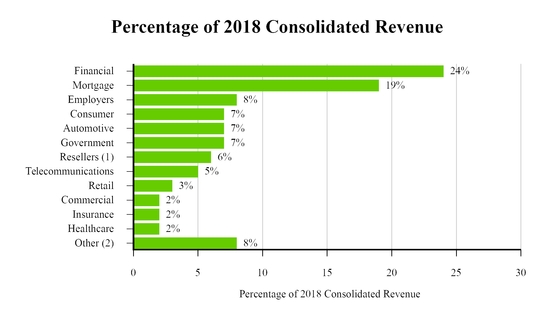
| (1) | Predominantly sold to companies who serve the direct-to-consumer market and includes other small end user markets. Mortgage and auto resellers are excluded from this category as they are included within their respective categories above. |
| (2) | Other includes revenue from other miscellaneous end-user markets. |
We market our products and services primarily through our own direct sales organization that is structured around sales teams that focus on client segments typically aligned by vertical markets and geography. Sales groups are based in our headquarters in Atlanta, Georgia, and field offices located in the U.S. and in the countries where we have operations. We also market our products and services through indirect channels, including alliance partners, joint ventures and other resellers. In addition, we sell through direct mail and the internet.
Our largest geographic global regions are the U.S.; Asia Pacific (Australia, New Zealand and India); Europe (the U.K., Spain and Portugal); Canada; and Latin America (Argentina, Chile, Costa Rica, Ecuador, El Salvador, Honduras, Mexico, Paraguay, Peru and Uruguay). We maintain support operations in the Republic of Ireland, Chile, Costa Rica, and India. We also offer Equifax branded credit services in Russia and India through joint ventures, have investments in consumer and/or commercial credit information companies through joint ventures in Cambodia, Malaysia, Singapore and the United Arab Emirates, and have an investment in a consumer and commercial credit information company in Brazil. We also provide information, technology and services to support debt collections and recovery management in Asia Pacific, Europe, Canada and Latin America.
Revenue from international clients, including end users and resellers, amounted to 29% of our total revenue in 2018, 29% of our total revenue in 2017 and 27% of our total revenue in 2016.
Products and Services
Our products and services help our clients make more informed decisions with higher levels of confidence by leveraging a broad array of data assets. Analytics are used to derive insights from the data that are most relevant for the client’s decisioning needs. The data and insights are then processed through proprietary software and generally transmitted to the client’s operating system to execute the decision.
The following chart summarizes the key products and services offered by each of the business units within our segments:
| USIS | International | Workforce Solutions | ||||||||||||||||||
| Online Information Solutions | Financial Marketing Services | Mortgage Services | Europe | Asia Pacific | Latin America | Canada | Verification Services | Employer Services | Global Consumer Solutions | |||||||||||
| Online data | X | X | X | X | X | X | X | X | ||||||||||||
| Portfolio management services | X | X | X | X | X | X | X | X | ||||||||||||
| Analytical services | X | X | X | X | X | X | X | X | X | X | ||||||||||
| Technology services | X | X | X | X | X | X | ||||||||||||||
| Identity management and fraud | X | X | X | X | X | X | X | |||||||||||||
| Marketing Services | X | X | X | X | X | |||||||||||||||
| Direct-to-consumer credit monitoring | X | X | ||||||||||||||||||
| Employment and income verification services | X | X | ||||||||||||||||||
| Business process outsourcing (BPO) | X | X | X | |||||||||||||||||
| Debt collection software, services and analytics | X | X | X | X |
Each of our operating segments is described more fully below. For the operating revenue, operating income and total assets for each segment see Note 12 of the Notes to the Consolidated Financial Statements in this report.
USIS
USIS provides consumer and commercial information solutions to businesses in the U.S. through three product and service lines, as follows:
Online Information Solutions. Online Information Solutions’ products are derived from multiple large and comprehensive databases of consumer and commercial information that we maintain about individual consumers and businesses, including credit history, current credit status, payment history and address information. Our clients utilize the information and analytical insights we provide to make decisions for a broad range of financial and business purposes, such as whether, and on what terms, to approve auto loans or credit card applications, and whether to allow a consumer or a business to open a new utility or telephone account. In addition, this information is used by our clients for cross selling additional products to existing customers, improving their underwriting and risk management decisions, and authenticating and verifying consumer and business identities. We also sell consumer and credit information to resellers who may combine our information with other information to provide services to the financial, mortgage, fraud and identity management, and other end-user markets. Our software platforms and analytical capabilities can integrate all types of information, including third-party and client information, to enhance the insights and decisioning process to help further mitigate the risk of granting credit, predict the risk of bankruptcy, indicate the applicant’s risk potential for account delinquency, ensure the identity of the consumer, and reduce exposure to fraud. These risk management services enable our clients to monitor risks and opportunities and proactively manage their portfolios.
Online Information Solutions’ clients access products through a full range of electronic distribution mechanisms, including direct real-time access, which facilitates instant decisions. We also develop and host customized applications that enhance the decision-making process for our clients. These decisioning technology applications assist with a wide variety of decisioning activities, including determining pre-approved offers, cross-selling of various products, determining deposit amounts for telephone and utility companies, and verifying the identity of their customers. We have also compiled commercial databases regarding businesses in the U.S., which include loan, credit card, public records and leasing history data, trade accounts receivable performance, and Secretary of State and Securities and Exchange Commission registration information. We offer scoring and analytical services that provide additional information to help mitigate the credit risk assumed by our clients.
Mortgage Solutions. Our Mortgage Solutions products, offered in the U.S., consist of specialized credit reports that combine information from the three major consumer credit reporting agencies (Equifax, Experian and TransUnion) into a single “merged” credit report in an online format, commonly referred to as a tri-merge report. Mortgage lenders use these tri-merge reports in making their mortgage underwriting decisions. Additionally, we offer various “triggering” services designed to alert lenders to changes in a consumer’s credit status during the underwriting period and securitized portfolio risk assessment services for evaluating inherent portfolio risk.
Financial Marketing Services. Our Financial Marketing Services products utilize consumer and commercial financial information enabling our clients to more effectively manage their marketing efforts, including targeting and segmentation, to identify and acquire new clients for their products and services; to develop portfolio strategies to minimize
risk and maximize profitability; and to realize additional revenue from existing customers through more effective cross selling of additional products and services. These products utilize information derived from consumer and commercial information, including credit, income, asset, liquidity, net worth and spending activity, which also support many of our Online Information Solutions’ products. These data assets broaden the understanding of consumer and business financial potential and opportunity which can further drive high value decisioning and targeting solutions for our clients. We also provide account review services, which assist our clients in managing their existing customers and prescreen services that help our clients identify new opportunities with their customers. Clients for these products primarily include institutions in the banking, brokerage, retail, insurance and mortgage industries as well as companies primarily focused on digital and interactive marketing.
International
The International operating segment includes our Asia Pacific, Europe, Latin America and Canada business units. These business units offer products that are similar to those available in the USIS operating segment, but with variations by geographic region. In some jurisdictions, data sources tend to rely more heavily on government agencies than in the U.S. We also offer specialized services that help our customers better manage risk in their consumer portfolios. This operating segment’s products and services generate revenue in Argentina, Australia, Canada, Chile, Costa Rica, Ecuador, El Salvador, Honduras, India, Mexico, New Zealand, Paraguay, Peru, Portugal, Spain, the U.K. and Uruguay. We also maintain support operations in the Republic of Ireland, Chile, Costa Rica, and India. We offer consumer credit services in Russia and India through investments in joint ventures, have investments in consumer and/or commercial credit information companies through joint ventures in Cambodia, Malaysia, Singapore and the United Arab Emirates, and have an investment in a consumer and commercial credit information company in Brazil. We also provide information, technology and services to support debt collections and recovery management in Asia Pacific, Europe, Canada and Latin America.
Europe. Our Europe operation provides information solutions, marketing and personal solutions products. Information solutions and personal solutions products are generated from information that we maintain and include credit reporting and scoring, asset information, risk management, identity management and authentication services, fraud detection and modeling services. Most of these products are sold in the U.K. with a more limited set of information solutions products sold in Spain and Portugal. Marketing products, which are similar to those offered in our Financial Marketing Services business unit, are primarily available in the U.K. and, to a lesser extent, in Spain. We also provide information, technology and services to support debt collections and recovery management in the U.K. and, to a lesser extent, in Spain. In the U.K., this includes a contract to provide these services to the U.K. government.
Asia Pacific. Our Asia Pacific operation provides consumer and commercial information solutions products, marketing products, workforce solutions, and personal solutions products. We offer a full range of products, generated from credit records and other data, including credit reporting and scoring, decisioning technology, risk management, identity management, authentication and fraud detection services. Our consumer and commercial products are the primary source of revenue in each of the countries in which we operate and include credit reporting, decisioning tools and risk management services. We also provide information, technology and services to support debt collections and recovery management. Additionally, we provide a variety of consumer and commercial marketing products generated from information databases, including business profile analysis, business prospect lists and database management. The countries in which we operate include Australia, New Zealand and India, as well as through joint ventures in India, Russia, Cambodia, Malaysia, Singapore and the United Arab Emirates.
Latin America. Our Latin America operation provides consumer and commercial information solutions products, marketing products and personal solutions products. We offer a full range of products, generated from credit records that we maintain, including credit reporting and scoring, decisioning technology, risk management, identity management, authentication and fraud detection services. Our consumer products are the primary source of revenue in each of the countries in this region in which we operate. We also offer various commercial products, which include credit reporting, decisioning tools and risk management services, in the countries we serve. We also provide information, technology and services to support debt collections and recovery management. Additionally, we provide a variety of consumer and commercial marketing products generated from our credit information databases, including business profile analysis, business prospect lists and database management. The countries in this region in which we operate include Argentina, Chile, Costa Rica, Ecuador, El Salvador, Honduras, Mexico, Paraguay, Peru and Uruguay. We also have an investment in a consumer and commercial credit information company in Brazil.
Canada. Similar to the USIS business units, our Canada operation offers products derived from the credit information that we maintain about individual consumers and businesses. We offer many products in Canada, including credit reporting and scoring, consumer and commercial marketing, risk management, fraud detection and modeling services, identity management and authentication services, together with certain of our decisioning products that facilitate pre-approved offers of credit and
automate a variety of credit decisions. We also provide information, technology and services to support debt collections and recovery management in Canada.
Workforce Solutions
Workforce Solutions operates in the U.S. through two business units:
Verification Services. Verification Services include employment and income verification services. Our online verification services enable third-party verifiers including various governmental agencies, mortgage originators, credit card and automotive lenders and pre-employment screeners to verify the employee’s employment status and income information. We also offer an offline manual verification service, which expands employment verification to locate data outside our existing automated database.
Employer Services. These services are aimed at reducing the cost to the human resources function of businesses through a broad suite of services including assisting with employment tax matters designed to reduce the cost of unemployment claims through effective claims representation and management and efficient processing and to better manage the tax rate that employers are assessed for unemployment taxes; comprehensive services designed to research the availability of employment-related tax credits (e.g., federal work opportunity tax credits), and to process the necessary filings and assist the client in obtaining the tax credit; W-2 management services (which include initial distribution, reissue and correction of W-2 forms); paperless pay services that enable employees to electronically receive pay statement information as well as review and change direct deposit account or W-4 information; I-9 management services designed to help clients electronically comply with the immigration laws that require employers to complete an I-9 form for each new hire; and onboarding services using online forms to complete the new hire process for employees of corporate and government agencies. In addition, we provide software and services to employers to assist in their compliance with the Affordable Care Act (“ACA”).
The Work Number®. The Work Number is our key repository of employment and income data serving our Verification Services business unit and enabling our Employer Services business unit. We rely on payroll data received from tens of thousands of organizations to regularly update the database. The updates occur as employers and other data contributors transmit data electronically to Equifax from their payroll systems. Employers provide this data to us so that we can handle verification requests on behalf of each employer. We use this data to provide automated employment and income verification services to third-party verifiers.
The fees we charge for services in these two business units are generally on a per transaction basis. We have not experienced significant turnover in the employer contributors to the database because we generally do not charge them to add their employment data to The Work Number® database and the verification service we offer relieves them of the administrative burden and expense of responding to third-party employment verification requests. The Work Number® database is approaching 380 million current and historic employment records at December 31, 2018.
Workforce Solutions is in the process of building income and employment verification service businesses in Canada and Australia, including establishing The Work Number® in each country. At present, revenues from these services in Canada and Australia are insignificant.
Global Consumer Solutions
Our Global Consumer Solutions (“GCS”) products give consumers information to enable them to understand and monitor their credit and monitor and help protect their identity. Equifax products offer monitoring features for consumers who are concerned about identity theft, including credit report monitoring from all three credit bureaus, internet scanning, bank account monitoring and lost wallet support. Country specific versions of our products are available to consumers in the U.S., Canada, and the U.K. primarily over the internet. Products may also be available indirectly through relationships with business partners who distribute our products or provide these services to their employees or customers. We also sell consumer credit information to resellers who combine our information with other information to provide direct-to-consumer monitoring, reports and scores. Due to the 2017 cybersecurity incident we ceased advertising our consumer business in the U.S. in September 2017. We resumed limited advertising of our consumer business in the U.S. in the fourth quarter of 2018.
Free Consumer Services
As part of our response to the 2017 cybersecurity incident, we made our TrustedID® Premier service, an identity theft protection and credit file monitoring product, available for free to all U.S. consumers for twelve months for those who signed up by January 31, 2018. In late 2018, the Company extended the free credit file and identity monitoring services for impacted
consumers in the U.S. using the free TrustedID® Premier service, by providing them the opportunity to enroll in Experian® IDNotify™ at no cost for an additional twelve months. Similarly, for consumers impacted by the 2017 cybersecurity incident in Canada and the U.K., we provided free credit reports and scores, credit monitoring, and identity theft protection for twenty four months. We provide U.S. consumers with an annual free credit report and the ability to freeze and unfreeze their Equifax credit report for free in accordance with the Fair Credit Reporting Act. Additionally, in January 2018, the Company introduced Lock & Alert™, a mobile application enabled service that allows U.S. consumers to quickly lock and unlock their Equifax credit report for free, for life.
Seasonality
We experience seasonality in certain of our revenue streams. Revenue generated by the online consumer information services component of our USIS operating segment is typically the lowest during the first quarter, when consumer lending activity is at a seasonal low. Revenue generated from the Employer Services business unit within the Workforce Solutions operating segment is generally higher in the first quarter due primarily to the provision of Form W-2 preparation services which occur in the first quarter each year. Revenue generated from our financial wealth asset products and data management services in our Financial Marketing Services business is generally higher in the fourth quarter each year due to the significant portion of our annual renewals and deliveries which occur in the fourth quarter of each year. Mortgage related revenue is generally higher in the second and third quarters of the year due to the increase in consumer home purchasing during the summer in the U.S.
Competition
The market for our products and services is highly competitive and is subject to constant change. Our competitors vary widely in size and in the nature of the products and services they offer. Sources of competition are numerous and include the following:
| • | Competition for our credit information solutions and direct-to-consumer solutions products varies by both application and industry, but generally includes two global consumer credit reporting companies, Experian and TransUnion, both of which offer a product suite similar to our credit information solutions. In the U.S., LifeLock is a national provider of personal identity theft protection service. Also, there are competitors offering free credit scores including Credit Karma in the U.S. and the U.K., ClearScore in the U.K., and Credit Simple and Credit Savvy in Australia. There are also a large number of competitors who offer competing products in specialized areas (such as fraud prevention, risk management and application processing and decisioning solutions) and software companies offering credit modeling services or analytical tools. Our differentiators include our unique data assets, decisioning technology and the features and functionality of our analytical capabilities. We emphasize our improved decision making and product quality while remaining competitive on price. Our marketing services products also compete with the foregoing companies and others who offer demographic information products, including Acxiom, Harte-Hanks and infoGROUP. We also compete with Fair Isaac Corporation with respect to certain of our analytical tools and solutions. |
| • | Competition for our commercial solutions products primarily includes Experian, Dun & Bradstreet and Cortera, and providers of these services in the international markets we serve. |
| • | Competition in the Verification Services market includes employers who manage verifications in-house, lenders who obtain verifications directly from employers, and other online and offline verification companies, such as CCC Verify, Thomas & Company, First Advantage and Employers Edge. Competition in the Employer Services market is diverse and includes in-house management of such services or the outsourcing of one or more of such services to other third-party outsourced providers like Corporate Cost Control, Thomas & Company, and Employers Edge; human resources (“HR”) consulting firms such as Mercer and Towers Watson; HR management services providers such as Oracle and Silk Road; payroll processors such as ADP and Ceridian; accounting firms such as PwC and EY; analytics companies such as Tableau and Visier; and hundreds of smaller companies that provide one or multiple offerings that compete with our Employer Services business. |
| • | Competition for our debt collection and recovery management software, services and analytics is similar to the competition for our consumer credit information solutions. We believe that the breadth and depth of our data assets enable our clients to develop a more current and comprehensive view of consumers. In the category of platforms and analytics, we compete to some extent with entities that deploy collections platforms, account management systems or recovery solutions. |
While we believe that none of our competitors offers the same mix of products and services as we do, certain competitors may have a larger share of particular geographic or product markets or operate in geographic areas where we do not currently have a presence.
We assess the principal competitive factors affecting our markets to include: our ability to protect information and systems; product attributes such as quality, depth, coverage, adaptability, scalability, interoperability, functionality and ease of use; product price; technical performance including system response time and availability; access to unique proprietary databases; availability in application service provider (“ASP”) format; quickness of response, flexibility and client services and support; effectiveness of sales and marketing efforts; existing market penetration; and new product innovation.
Technology and Intellectual Property
We generally seek protection under federal, state and foreign laws for strategic or financially important intellectual property developed in connection with our business. Certain intellectual property, where appropriate, is protected by registration under applicable trademark laws or by prosecution of patent applications. We own a number of patents registered in the U.S. and several in foreign countries. We also have certain registered trademarks, service marks, logos and internet domain names in the U.S. and in many foreign countries, the most important of which are “Equifax,” “Decision360,” “The Work Number” and variations thereof. These marks are used in connection with many of our product lines and services. We believe that, in the aggregate, the rights under our patents and trademarks are generally important to our operations and competitive position, but we do not regard any of our businesses as being dependent upon any single patent or group of patents or trademark. However, certain Company trademarks, which contribute to our identity and the recognition of our products and services, including but not limited to the “Equifax” trademark, are an integral part of our business, and their loss could have a significant negative impact on us. We also protect certain of our confidential intellectual property and technology in compliance with trade secret laws and through the use of nondisclosure agreements.
We license other companies to use certain data, software, and other technology and intellectual property rights we own or control, primarily as core components of our products and services, on terms that are consistent with customary industry standards and that are designed to protect our interest in our intellectual property. Other companies license us to use certain data, technology and other intellectual property rights they own or control. For example, we license credit-scoring algorithms and the right to sell credit scores derived from those algorithms from third parties for a fee. We do not hold any franchises or concessions that are material to our business or results of operations.
Governmental Regulation
We are subject to a number of U.S. federal, state, local and foreign laws and regulations that involve matters central to our business. These laws and regulations may involve consumer reporting, privacy, data protection, intellectual property, competition, consumer protection, anti-corruption, anti-bribery, anti-money laundering, employment, health, taxation or other subjects. In particular, we are subject to U.S. federal, state, local and foreign laws regarding the collection, protection, dissemination and use of personal information we have in our possession. Failure to satisfy those legal and regulatory requirements, or the adoption of new laws or regulations, could have a significant negative impact on our results of operations, financial condition or liquidity.
U.S. federal, state, local and foreign laws and regulations are evolving and can be subject to significant change. In addition, the application and interpretation of these laws and regulations are often uncertain. These laws are enforced by federal, state and local regulatory agencies in the jurisdictions where we operate, and in some instances also through private civil litigation. There are also a number of legislative proposals pending before the U.S. Congress, various state legislative bodies, and foreign governments concerning consumer and data protection that could particularly affect us.
Summary of U.S. Regulation Relating to Consumer and Data Protection
Our U.S. operations are subject to numerous laws and regulations governing the collection, protection and use of consumer credit and other information, and imposing sanctions for the misuse of such information or unauthorized access to data. Many of these provisions also affect our customers’ use of consumer credit or other data we furnish.
Examples of the most significant of these laws include, but are not limited to, the following:
Federal Laws and Regulation
| • | FCRA - The Fair Credit Reporting Act (“FCRA”) regulates consumer reporting agencies, including us, as well as data furnishers and users of consumer reports such as banks and other companies. FCRA provisions govern the accuracy, fairness and privacy of information in the files of consumer reporting agencies (“CRAs”) that engage in the practice of assembling or evaluating certain information relating to consumers for certain specified purposes. The FCRA limits the type of information that may be reported by CRAs, limits the distribution and use of consumer reports and establishes consumer rights to access, freeze and dispute their credit files. CRAs are required to follow reasonable procedures to assure maximum possible accuracy of the information concerning the individual about whom the report relates and if a consumer disputes the accuracy of any information in the consumer’s file, to conduct a reasonable reinvestigation. CRAs are required to make available to consumers a free annual credit report and free credit freezes. The FCRA imposes many other requirements on CRAs, data furnishers and users of consumer report information. Violation of the FCRA can result in civil and criminal penalties. The FCRA contains an attorney fee shifting provision to provide an incentive for consumers to bring individual or class action lawsuits against a CRA for violations of the FCRA. Regulatory enforcement of the FCRA is under the purview of the United States Federal Trade Commission (“FTC”), the Consumer Financial Protection Bureau (“CFPB”), and state attorneys general, acting alone or in concert with one another. |
| • | The Dodd-Frank Act - Title X of the Dodd-Frank Wall Street Reform and Consumer Protection Act (“Dodd-Frank Act”) created the CFPB. The Dodd-Frank Act provides the CFPB with examination and supervisory authority over CRAs, including us. The Dodd-Frank Act prohibits unfair, deceptive or abusive acts or practices (“UDAAP”) with respect to consumer financial services practices and provides the CFPB with enforcement authority to enforce those provisions. The CFPB may pursue administrative proceedings or litigation to enforce the laws and rules subject to its jurisdiction. In these proceedings the CFPB can obtain cease and desist orders, which can include orders for restitution to consumers or rescission of contracts, as well as other types of affirmative relief, and monetary penalties ranging from $5,000 per day for ordinary violations and up to $1 million per day for known violations. Also, the Dodd-Frank Act empowers state attorneys general and state regulators to bring civil actions in certain circumstances for the kind of cease and desist orders available to the CFPB (but not for civil penalties). |
| • | FTC Act - The Federal Trade Commission Act (“FTC Act”) prohibits unfair methods of competition and unfair or deceptive acts or practices. Under the FTC Act, the Federal Trade Commission’s jurisdiction includes oversight of the security measures we employ to safeguard the personal data of consumers. Allegations that we failed to safeguard or handle such data in a compliant manner may subject us to regulatory scrutiny or enforcement action. There is no private right of action under the FTC Act. |
| • | GLBA - The Financial Services Modernization Act of 1999, or Gramm-Leach-Bliley Act (“GLBA”), regulates, among other things, the use of non-public personal information of consumers that is held by financial institutions, including us. We are subject to various GLBA provisions, including rules relating to the use or disclosure of the underlying data and rules relating to the physical, administrative and technological protection of non-public personal financial information. Breach of the GLBA can result in civil and/or criminal liability and sanctions by regulatory authorities. Regulatory enforcement of the GLBA is under the purview of the FTC, the CFPB, the federal prudential banking regulators, the SEC and state attorneys general, acting alone or in concert with each other. |
| • | CROA - The Credit Repair Organizations Act (“CROA”) regulates companies that claim to be able to assist consumers in improving their credit standing. There have been efforts to apply the CROA to credit monitoring services offered by consumer reporting agencies and others. CROA allows for a private right of action. Consumers can sue to recover the greater of the amount paid or actual damages, punitive damages, costs, and attorney’s fees for violations of CROA. |
State Laws and Regulation Relating to Consumer and Data Protection
| • | A number of states have enacted requirements similar to the federal FCRA. Some of these state laws impose additional, or more stringent, requirements than the FCRA, especially in connection with investigations and responses to reported inaccuracies in consumer reports. The FCRA preempts some of these state laws, but the scope of preemption continues to be defined by the courts. The state of Vermont is grandfathered under the original FCRA requirements and thus we are subject to additional requirements to comply with Vermont law. |
| • | A majority of states have adopted versions of data security breach laws that require notification of affected consumers and potentially regulators in the event of a breach of personal information. A subset of these laws and other state data security laws require the implementation of data security measures as well. State attorneys general can enforce such state laws and can seek equitable as well as monetary remedies and in some cases private rights of action are permitted by such laws. |
| • | The New York State Department of Financial Services (“NYDFS”) has enacted regulatory requirements applicable to CRAs that require registration with that agency, prohibit unfair and deceptive consumer practices and require compliance with significant portions of the NYDFS cybersecurity rules. |
| • | We may also become subject to and affected by new and proposed state privacy laws such as the California Consumer Privacy Act which takes effect in 2020 and which will impose additional data privacy requirements on many businesses operating in the state, including, potentially, with respect to employee data in addition to consumer data. A number of states, such as Maryland, Massachusetts and Washington, appear to be following California’s lead and have introduced comprehensive data privacy legislation modeled after the California Consumer Privacy Act or the European General Data Protection Regulation. |
| • | State banking and financial services regulatory agencies have asserted either express or implied authority under applicable state laws to examine us as a third-party service provider to financial institutions, and in certain cases to bring enforcement actions against us. Generally, such examinations, and related enforcement actions, are focused on assessing our safety and soundness in support of financial institutions we serve. |
| • | We are also subject to federal and state laws that are generally applicable to any U.S. business with national or international operations, such as antitrust laws, the Foreign Corrupt Practices Act, the Americans with Disabilities Act, state unfair or deceptive practices acts and various employment laws. We continuously monitor legislative and regulatory activities that involve credit reporting, data privacy, security and other relevant issues to identify issues in order to remain in compliance with all applicable laws and regulations. |
Summary of International Regulation Relating to Consumer and Data Protection
We are subject to various data protection, privacy and consumer credit laws and regulations in the foreign countries where we operate. Examples of the most significant of these laws include, but are not limited to, the following:
| • | In the U.K., we are subject to a regulatory framework which provides for primary regulation by the Financial Conduct Authority (the “FCA”). The FCA focuses on consumer protection, the integrity of the U.K. financial system, and effective competition in the interests of consumers. The FCA has significant powers, including the power to regulate conduct related to the marketing of financial products, to specify minimum standards and to place requirements on products, impose unlimited fines, and to investigate organizations and individuals. In addition, the FCA is able to ban financial products for up to a year while considering an indefinite ban; it has the power to instruct firms to immediately retract or modify promotions which it finds to be misleading, and to publish such decisions. Effective December 2019, the FCA framework under which we operate will also include the “senior managers and certification regime” which among other things will allow the FCA to bring an enforcement action directly against designated personnel who do not take reasonable steps to avoid non-compliance. Our core credit reporting (“credit reference”) and debt collections services and recovery management businesses in the U.K. are subject to FCA supervision. In addition to regulation by the FCA, we are also subject to regulation by the U.K. Information Commissioner’s Office, which focuses on upholding information rights in the public interest and the protection of data privacy for individuals. |
| • | In Europe, we are subject to the European General Data Protection Regulation (“GDPR”). The GDPR establishes multiple data protection requirements that are more specific and comprehensive than those of the U.S. and most |
other countries where Equifax operates. In addition, the GDPR includes data breach notification requirements and it establishes the ability of regulators to pursue substantial penalties for non-compliance.
| • | In Canada, federal and provincial laws govern how we collect, use or disclose personal information in the course of our commercial activities. Federally, the Personal Information Protection and Electronic Documents Act (“PIPEDA”) governs the collection, use and disclosure of personal information by organizations in the private sector. It sets out specific obligations with respect to accountability and identifying purposes, consent, collection, use, disclosure, retention, accuracy, safeguards, personal data breach reporting, individual access and compliance. The federal and provincial privacy regulators have powers of investigation and intervention, and provisions of Canadian law regarding civil liability apply in the event of unlawful processing which is prejudicial to the persons concerned. Canada also has specific credit reporting legislation that is regulated at a provincial level. At present, each province has credit reporting legislation, with the exception of New Brunswick and the Territories (Northwest Territories, Yukon, and Nunavut). Generally speaking, the legislation regulates the contents of credit files, the length of time information can be included on a credit file and who can receive credit reports. |
| • | In Latin America, data protection and credit reporting laws and regulations vary considerably among Latin American countries. Some countries, such as El Salvador, Ecuador and Honduras, establish a constitutional right to privacy without general data protection standards or a data protection authority. These countries, however, have laws that govern the functioning of credit bureaus. In 2018, Ecuador amended a 2017 law relating to the collection of credit data and the operation of a credit bureau within the country allowing the existence of private credit bureaus along with the public credit data registry to be established. Other countries, such as Argentina, Uruguay, Peru, Costa Rica and most recently Brazil have enacted comprehensive data protection legislation similar to the European GDPR. The EU recognizes Argentina and Uruguay as having adequate levels of protection for personal data transfers and processing. Peru also has a specific law for credit reporting. Paraguay and Chile have fewer comprehensive data protection laws in place, but do have rules regarding reporting periods, consent and data collection. |
| • | In Australia, we are subject to regulatory oversight by various agencies. The Office of the Australian Information Commissioner (“OAIC”) is the agency with direct responsibility for administering the Australian Privacy Principles (which relate to the collection, holding, use and disclosure of personal information) and Part IIIA of the Privacy Act 1988 (which regulates credit reporting). The OAIC can investigate a complaint, conduct its own investigations, resolve/make binding determinations and seek civil penalties. Our credit reporting business, Equifax Information Services and Solutions, is a member of an external dispute resolution scheme, the Australian Financial Complaints Authority, which has been approved by the OAIC to handle privacy and credit reporting complaints and make binding determinations. The OAIC can register codes of practice under the Privacy Act 1988, and has registered the Privacy (Credit Reporting) Code 2014. The Australian Competition and Consumer Commission (“ACCC”) is the agency responsible for enforcing the Competition and Consumer Act of 2010 and related legislation concerning consumer protection and competition. The ACCC has the authority to use a range of actions to ensure compliance with the law, including investigative powers and the ability to seek penalties through litigation and other formal enforcement means. The Australian Retail Credit Association (“ARCA”) is a credit and credit reporting industry self-regulatory body, which administers principles and standards for the exchange of credit data between industry participants. Equifax Australasia Credit Ratings Pty Limited (formerly named Corporate Scorecard Pty Limited, one of our Australian subsidiaries), holds an Australia Financial Services License (“AFSL”), which allows it to provide general advice to wholesale clients by issuing a credit rating, and has been approved by the Reserve Bank of New Zealand as a rating agency under section 86 of the Non-bank Deposit Takers Act of 2013. The Australian Securities and Investments Commission (“ASIC”) regulates that business, and has authority to investigate, prosecute, ban individuals, and to seek civil penalties. In addition, in Australia, draft legislation has been released by the Federal Government, mandating the supply by large banks of comprehensive credit information to credit reporting bodies, including Equifax, and imposing certain disclosure, storage and reporting obligations on the credit reporting bodies. |
| • | In New Zealand, the regulatory framework provides for primary regulation under the Office of the Privacy Commissioner (“NZ OPC”). The NZ OPC investigates complaints relating to the collection, use, holding and disclosure of personal information, both credit-related and non-credit related. The NZ OPC can make a finding that there has been an interference with privacy but cannot impose civil penalties. In extreme cases where there has been an interference with privacy it can refer these cases to the Director of Human Rights for determination in the Human Rights Review Tribunal. The NZ OPC can issue practice codes under the Privacy Act 1993, and has issued and subsequently amended, the Credit Reporting Privacy Code 2004. A self-regulatory body, the Retail |
Credit Association of New Zealand (“RCANZ”) addresses reciprocity of data issues relating to comprehensive credit reporting and data standards.
| • | In India, various legislation including the Information Technology Act of 2000 and rules framed thereunder and the Credit Information Companies (Regulation) Act of 2005 and rules and regulations framed thereunder, establishes a federal data protection framework. Entities that collect and maintain personal data and/or credit information must ensure that it is complete, accurate and safeguarded, and must adopt certain privacy principles with respect to collecting, processing, preserving, sharing and using such data and/or credit information. The Indian parliament has passed legislation that would allow individuals to sue for damages in the case of a data breach, if the entity negligently failed to implement reasonable security practices and procedures to protect personal data and/or credit information and in 2018 the Personal Data Protection Bill was released by the Indian government and is expected to be enacted and eventually to impose additional requirements in this area. Our Indian joint venture is subject to regulation by the Reserve Bank of India, which is India’s central banking institution. |
| • | In Russia, credit reporting activities are governed by the Federal Law on Credit Histories No.218-fz, dated December 30, 2004. The law regulates the contents of credit files, who may submit data to a credit bureau and who can receive credit reports. Russia has also enacted a comprehensive data protection law that is similar to Europe’s approach. |
Tax Management Services
The Tax Management Services business within our Employer Services business unit in our Workforce Solutions segment is potentially impacted by changes in renewal or non-renewal of U.S. tax laws or interpretations, for example, those pertaining to work opportunity tax credits and unemployment compensation claims.
Personnel
Equifax employed approximately 10,900 employees in 22 countries as of December 31, 2018. None of our U.S. employees are subject to a collective bargaining agreement and no work stoppages have been experienced. Pursuant to local laws, certain of our employees in Argentina and Spain are covered under government-mandated collective bargaining regulations that govern general salary and compensation matters, basic benefits and hours of work. In some of our non-U.S. subsidiaries, certain of our employees are represented by workers’ councils or statutory labor unions.
Forward-Looking Statements
This report contains information that may constitute “forward-looking statements.” Generally, the words “believe,” “expect,” “intend,” “estimate,” “anticipate,” “project,” “will” and similar expressions identify forward-looking statements, which generally are not historical in nature. All statements that address operating performance, events or developments that we expect or anticipate will occur in the future, including statements relating to future operating results and statements related to the 2017 cybersecurity incident and improvements in our information technology and data security infrastructure, including as part of our technology transformation, our strategy, our culture, our ability to innovate, the market acceptance of new products and services and similar statements about our business plans are forward-looking statements. Management believes that these forward-looking statements are reasonable as and when made. However, forward-looking statements are subject to certain risks and uncertainties that could cause actual results to differ materially from our Company’s historical experience and our present expectations or projections, including without limitation our expectations regarding the Company’s outlook, long-term organic and inorganic growth, and customer acceptance of our business solutions referenced above under “Item 1. Business” and below in “Item 7. Management’s Discussion and Analysis of Financial Condition and Results of Operation — Business Environment and Company Outlook.” These risks and uncertainties include, but are not limited to, those described below in “Item 1A. Risk Factors,” and elsewhere in this report and those described from time to time in our future reports filed with the United States Securities and Exchange Commission (“SEC”). As a result of such risks and uncertainties, we urge you not to place undue reliance on any such forward-looking statements. Forward-looking statements speak only as of the date when made. We undertake no obligation to publicly update or revise any forward-looking statements, whether as a result of new information, future events or otherwise, except as required by law.
Available Information
Detailed information about us is contained in our annual reports on Form 10-K, quarterly reports on Form 10-Q, current reports on Form 8-K, proxy statements and other reports, and amendments to those reports, that we file with, or furnish
to, the SEC. These reports are available free of charge at our website, www.equifax.com, as soon as reasonably practicable after we electronically file such reports with or furnish such reports to the SEC. However, our website and any contents thereof should not be considered to be incorporated by reference into this document. We will furnish copies of such reports free of charge upon written request to Equifax Inc., Attn: Office of Corporate Secretary, P.O. Box 4081, Atlanta, Georgia, 30302. These reports are also available at www.sec.gov.
Previous: Cover and table of contents · Next: Item 1A. RISK FACTORS