 filings.tools
Expeditors International of Washington (EXPD) 10-K risk factor changes: FY2016 vs FY2015
The 2016-12-31 10-K against the 2015-12-31 one, compared heading by heading and sentence by sentence. One of these filings carries no fiscal year tag, so its year is the calendar year of the period end.
Item 1A15 rewritten0 added1 removed38 unchanged
All filing items570 rewritten1,023 added838 removed706 unchanged
Summary
counted, not written
- Item 1A headings could not be compared: only 0 carried over between the two years, which usually means one filing was read wrongly, so none is reported as new or removed.
- Sentence by sentence, 1,023 added, 838 removed, 570 rewritten and 706 unchanged across 18 items that differ.
- New this year: Item 16. FORM 10-K SUMMARY.
Sentences by item
22 items, with every count and a link to each item that changed
Underlined words on a shaded ground are new in FY2016; struck-through words were in FY2015. Sentences that are wholly new or wholly gone are labelled rather than marked.
Item 1A. RISK FACTORS
15 rewritten, 0 added, 1 removed, 38 unchanged
| International Trade | | [removed: The Company] [added: Expeditors] primarily provides services to customers engaged in international commerce. Everything that affects international trade has the potential to expand or contract [removed: the Company’s] [added: our] primary market and adversely impact [removed: its] [added: our] operating results. For example, international trade is influenced by: |
| | | • changes [added: and uncertainties] in governmental policies, such as taxation, quota restrictions, other forms of trade barriers and/or restrictions and trade accords; |
| Service Providers | | As a non-asset based provider of global logistics services, [removed: the Company] [added: Expeditors] depends on a variety of asset-based service providers, including air, ocean and ground freight carriers. The quality and profitability of [removed: the Company] [added: our services] depend upon effective selection, management and discipline of service providers. In recent years, many of [removed: the Company’s] [added: our] service providers have incurred significant operating losses and are highly leveraged with [removed: debt.] [added: debt, and in 2016 one of the world's largest ocean carriers filed for bankruptcy. Additionally, several ocean carriers have consolidated, with the potential for more to occur in the future.] Changes in the financial stability, operating capabilities and capacity of asset-based carriers and space allotment made available to [removed: the Company] [added: Expeditors] by asset-based carriers could affect [removed: the Company] [added: us] in unpredictable ways. Any combination of reduced carrier capacity, pricing volatility or more limited carrier transportation schedules could negatively impact [removed: the Company’s] [added: our] ability to maintain historical profitability. [removed: The Company’s] [added: Expeditors'] carriers are subject to increasingly stringent laws, which could directly or indirectly have a material adverse effect on [removed: the Company’s] [added: our] business. Future regulatory developments in the U.S. and abroad could adversely affect operations and increase operating costs in transportation industries, which in turn could increase [removed: the Company’s] [added: our] purchased transportation costs. If [removed: the Company is] [added: we are] unable to pass such costs on to [removed: its] [added: our] customers, [removed: its] [added: our] business and results of operations could be materially [removed: and] adversely affected. |
| Predictability of Results | | [removed: The Company] [added: Expeditors] is not aware of any accurate means of forecasting short-term customer requirements. However, long-term customer satisfaction depends upon [removed: the Company’s] [added: our] ability to meet these unpredictable short-term customer requirements. Personnel costs, [removed: the Company’s] [added: our] single largest expense, are always less flexible in the very near term as [removed: the Company] [added: we] must staff to meet uncertain demand. As a result, short-term operating results could be disproportionately affected. A significant portion of [removed: the Company’s] [added: Expeditors'] revenues are derived from customers in retail [added: and technology] industries whose shipping patterns are tied closely to consumer demand, and from customers in industries whose shipping patterns are dependent upon just-in-time production schedules. Therefore, the timing of [removed: the Company’s] [added: our] revenues are, to a large degree, impacted by factors out of [removed: the Company’s] [added: our] control, such as a sudden change in consumer demand for retail goods, product launches and/or manufacturing production delays. Additionally, many customers ship a significant portion of their goods at or near the end of a quarter, and therefore, [removed: the Company] [added: we] may not learn of a shortfall in revenues until late in a quarter. To the extent that a shortfall in revenues or earnings was not expected by securities analysts or investors, any such shortfall from levels predicted by securities analysts or investors could have an immediate and adverse effect on the trading price of [removed: the Company’s] [added: our] stock. [added: Volatile market conditions can create situations where rate increases charged by carriers and other service providers are implemented with little or no advance notice. We often times cannot pass these rate increases on to our customers in the same time frame, if at all. As a result, our yields and margins can be negatively impacted, as experienced in 2012 and parts of 2013, 2014 and 2016, particularly with ocean freight.] |
| Foreign Operations | | The majority of [removed: the Company’s] [added: Expeditors'] revenues and operating income comes from operations conducted outside the United States. To maintain a global service network, [removed: the Company] [added: we] may be required to operate in hostile locations and in dangerous situations. [added: Doing business in foreign locations also subjects us to a variety of risks and considerations not normally encountered by domestic enterprises.] In addition, [removed: the Company operates] [added: we operate] in parts of the world where common business practices could constitute violations of the anti-corruption laws, rules, regulations and decrees of the United [removed: States,] [added: States and of other countries in which we conduct business,] including the U.S. Foreign Corrupt Practices [removed: Act, the U.K. Bribery] Act and [removed: of all other countries in which] the [removed: Company conducts business;] [added: UK Bribery Act;] as well as trade and exchange control laws, or laws, regulations and Executive Orders imposing embargoes and sanctions; and anti-boycott laws and regulations. Compliance with these laws, rules, regulations and decrees is dependent on [removed: the Company’s] [added: our] employees, service providers, agents, third party brokers and customers, whose individual actions could violate these laws, rules, regulations and decrees. Failure to comply could result in substantial penalties and additional expenses, damage to [removed: the Company’s] [added: our] reputation and restrictions on [removed: its] [added: our] ability to conduct business. |
| Key Personnel | | [removed: The Company is a service business. The quality of this service is directly related to the quality of the Company’s employees.] Identifying, training and retaining key employees is essential to continued growth and future profitability. Effective succession planning is an important element of [removed: the Company's] [added: our] programs. Failure to ensure an effective transfer of knowledge and smooth transitions involving key employees could hinder [removed: the Company's] [added: our] ability to execute on [removed: its] [added: our] business strategies and level of service. Senior management of [removed: the Company] [added: Expeditors] includes employees with long tenures, some of whom may elect to retire. The loss of the services of one or more key personnel could have an adverse effect on [removed: the Company’s] [added: our] business. [removed: The Company] [added: We] must continue to develop and retain management personnel to address issues of succession planning. [removed: The Company believes] [added: We believe] that [removed: its] [added: our] compensation programs, which have been in place since [removed: the Company] [added: we] became a publicly traded entity, are one of the unique characteristics responsible for differentiating [removed: its] [added: our] performance from that of many of [removed: its] [added: our] competitors. Significant changes to [removed: its] compensation programs could affect [removed: the Company’s] [added: our] performance and ability to attract and retain key personnel. |
| Technology | | [removed: The Company] [added: Expeditors] relies heavily and must compete based upon the flexibility and sophistication of the technologies utilized in performing [removed: its] [added: our] core businesses. Future results depend [removed: upon Expeditors'] [added: on our] success in developing competitive and reliable systems to address the needs of [removed: the Company's] [added: our] customers and suppliers. Development and maintenance of these systems must be accomplished in a cost-effective manner and support the use of secure protocols, including integration [added: and availability] of third party technology. [removed: The Company has begun upgrading many of its] [added: We are continually enhancing our] systems, including [added: significant upgrades to] core [removed: operations] [added: operating] and [removed: accounting.] [added: accounting systems.] These [removed: processes] [added: efforts] are inherently complex and if not managed properly could lead to disruptions in [removed: the Company's] [added: our] operations or [removed: its] [added: our] ability to remain competitive. |
| Network Continuity and Cybersecurity | | As [removed: the Company] [added: Expeditors] and [removed: its] [added: our] customers continue to increase reliance on systems and as additional features are added, the risks also increase. Any significant disruptions to [removed: the Company’s] [added: our] global systems or the Internet for any reason, which could include equipment or network failures; co-location facility failures; power outages; sabotage; employee error or other actions; cyber-attacks or other security breaches; [added: reliance on third party technology;] geo-political activity or natural disasters; all of which could have a material negative effect on [removed: the Company's] [added: our] results. This could include loss of revenue; business disruptions (such as the inability to timely process shipments); loss of property, including trade secrets and confidential information; legal claims and proceedings; reporting delays or errors; interference with regulatory reporting; significant remediation costs; an increase in costs to protect [removed: the Company's] [added: our] systems and technology; or damage to [removed: its] [added: our] reputation. |
| Growth | | [removed: The Company] [added: Expeditors] has historically relied primarily upon organic growth and has tended to avoid growth through acquisition. Future results will depend upon [removed: the Company’s] [added: our] ability to anticipate and adapt to constantly evolving supply chain requirements and innovations. To continue to grow organically, [removed: the Company] [added: we] must gain profitable market share in a highly competitive environment and successfully develop and market new service offerings. When investment opportunities arise, [removed: the Company’s] [added: our] success [removed: will] [added: could] be dependent on [removed: its] [added: our] ability to evaluate and integrate [removed: the] acquisitions. |
| Regulatory Environment | | [removed: The Company] [added: Expeditors] is affected by ever increasing regulations from a number of sources in the United States and in foreign locations in which [removed: the Company operates.] [added: we operate.] Many of these regulations are complex and require varying degrees of interpretation, including those related to trade compliance, data privacy, employment and competition [removed: laws. The current business environment tends to stress the avoidance of risk through regulation and oversight, the effect of which is likely to be unforeseen costs] [added: laws] and [removed: potentially] [added: may result in] unforeseen [removed: consequences.] [added: costs.] In reaction to the continuing global terrorist threat, governments around the world are continuously enacting or updating security regulations. These regulations are multi-layered, increasingly technical in nature and characterized by a lack of harmonization of substantive requirements amongst various governmental authorities. Furthermore, the implementation of these regulations, including deadlines and substantive requirements, is driven by political urgencies rather than the industries’ realistic ability to comply. Failure to consistently and timely comply with these regulations, or the failure, breach or compromise of [removed: the Company’s] [added: our] policies and procedures or those of [removed: its] [added: our] service providers or agents, may result in increased operating costs, damage to [removed: the Company’s] [added: our] reputation, restrictions on operations [removed: and/or] [added: or] fines and penalties. |
| Competition | | The global logistics services industry is intensely competitive and is expected to remain so for the foreseeable future. There are a large number of companies competing in one or more segments of the industry, but the number of firms with a global network that offer a full complement of logistics services is more limited. Nevertheless, many of these competitors have significantly more resources than [removed: the Company,] [added: Expeditors, and] are actively pursuing acquisition opportunities and are developing new technologies to gain competitive advantages. Depending on the location of the shipper and the importer, [removed: the Company] [added: we] must compete against both the niche [removed: players and] [added: players,] larger [removed: entities,] [added: entities] including [removed: some carriers.] [added: carriers, and emerging technology companies.] The primary competitive factors are price and quality of service. Many larger customers utilize the services of multiple logistics providers. Customers regularly solicit bids from competitors in order to improve service, pricing and contractual terms such as seeking longer payment terms, [added: fixed-price arrangements,] higher or unlimited liability limits and performance penalties. Increased competition and competitors' acceptance of expanded contractual terms could result in reduced revenues, reduced margins, higher operating costs or loss of market share, any of which would damage [removed: the Company’s] [added: our] results of operations and financial condition. |
| Taxes | | [removed: The Company] [added: Expeditors] is subject to many taxes in the United States and foreign jurisdictions. In many of these jurisdictions, the tax laws are very complex and are open to different interpretations and application. Tax authorities frequently implement new taxes and change their tax rates and rules, including interpretations of those rules. [removed: The Company is] [added: We are] regularly under audit by tax authorities. Although [removed: the Company believes its] [added: we believe our] tax estimates are reasonable, the final determination of tax audits, including transfer pricing inquiries, could be materially different from [removed: the Company’s] [added: our] tax provisions and accruals and negatively impact [removed: its] [added: our] financial results. |
| Litigation/Investigations | | As a multinational corporation, [removed: the Company] [added: Expeditors] is subject to formal or informal investigations from governmental authorities or others in the countries in which [removed: it does] [added: we do] business. In addition, [removed: the Company] [added: we] may become subject to civil litigation with [removed: its] [added: our] customers, service providers and other parties with whom [removed: it does] [added: we do] business. These investigations and litigation may require significant management time and could cause [removed: the Company] [added: us] to incur substantial additional legal and related costs, which may include fines, penalties or damages that could have a [removed: material] [added: materially adverse] impact on [removed: the Company’s results of operations and operating cash flows.] [added: our financial results.] |
| Economic Conditions | | The global economy and capital and credit markets continue to experience uncertainty and volatility. Unfavorable changes in economic conditions may result in lower freight volumes and adversely affect [removed: the Company’s] [added: Expeditors'] revenues and operating results, as experienced in 2009 and 2012. These conditions may adversely affect certain of [removed: the Company’s] [added: our] customers and services providers. Were that to occur, [removed: the Company’s] [added: our] revenues and net earnings could also be adversely affected. Should [added: our] customers’ ability to pay deteriorate, additional bad debts may be incurred. [removed: These unfavorable conditions can create situations where rate increases charged by carriers and other service providers are implemented with little or no advanced notice. The Company often times cannot pass these rate increases on to its customers in the same time frame, if at all. As a result, the Company’s yields and margins can be negatively impacted, as experienced in 2012 and parts of 2013 and 2014, particularly with ocean freight.] |
| Catastrophic Events | | A disruption or failure of [removed: the Company’s] [added: Expeditors'] systems or operations in the event of a major earthquake, weather event, cyber-attack, terrorist attack, strike, civil unrest, pandemic or other catastrophic event could cause delays in providing services or performing other mission-critical functions. [removed: The Company’s] [added: Our] corporate headquarters, and certain other critical business operations are in the Seattle, Washington area, which is near major earthquake faults. A catastrophic event that results in the destruction or disruption of any of [removed: the Company’s] [added: our] critical business or information technology systems could harm [removed: the Company’s] [added: our] ability to conduct normal business operations and [removed: its] [added: our] operating results. |
| | | |
Item 7. MANAGEMENT’S DISCUSSION AND ANALYSIS OF FINANCIAL CONDITION AND RESULTS OF OPERATIONS
206 rewritten, 63 added, 44 removed, 174 unchanged
[removed: The Company's] [added: Our] services include air and ocean freight consolidation and forwarding, customs clearance, warehousing and distribution, purchase order management, vendor consolidation, time-definite transportation services, cargo insurance and other logistics solutions.
[removed: The Company does] [added: We do] not compete for overnight courier or small parcel business.
As a non-asset based carrier, [removed: the Company does] [added: we do] not own or operate transportation assets.
[removed: The Company derives its] [added: We derive our] revenues from three principal sources: 1) airfreight services, 2) ocean freight and ocean services, and 3) customs brokerage and other services.
These are the revenue categories presented in [removed: the] [added: our] financial statements.
[removed: The Company generates] [added: We generate] the major portion of [removed: its] [added: our] air and ocean freight revenues by purchasing transportation services on a wholesale basis from direct (asset-based) carriers and reselling those services to [removed: its] [added: our] customers on a retail basis.
[removed: The difference between the rate billed to customers (the sell rate) and the rate paid to the carrier (the buy rate) is termed “net revenue” (a non-GAAP measure), “yield" or "margin." By consolidating shipments] from multiple customers and concentrating [removed: its] [added: our] buying power, [removed: the Company is] [added: we are] able to negotiate favorable buy rates from the direct carriers, while at the same time offering lower sell rates than customers would otherwise be able to negotiate themselves.
[added: The most significant drivers of changes] in gross revenues and related transportation expenses are volume, sell rates and buy rates.
Volume has a similar effect on the change in both gross revenues and related transportation expenses in each of [removed: the Company's] [added: our] three primary sources of revenue.
In most cases [removed: the Company acts] [added: we act] as an indirect carrier.
When acting as an indirect carrier, [removed: the Company will] [added: we] issue a House Airway Bill (HAWB), a House Ocean Bill of Lading (HOBL) or a House Seaway Bill to customers as the contract of carriage.
In turn, when the freight is physically tendered to a direct carrier, [removed: the Company receives] [added: we receive] a contract of carriage known as a Master Airway Bill for airfreight shipments and a Master Ocean Bill of Lading for ocean shipments.
In these transactions, [removed: the Company evaluates] [added: we evaluate] whether it is appropriate to record the gross or net amount as revenue.
Generally, [removed: when the Company] [added: revenue] is [added: recorded on a gross basis when we are] the primary obligor, [removed: it is] [added: are] obligated to compensate direct carriers for services performed regardless of whether customers accept the service, [removed: has] [added: have] latitude in establishing price, [removed: has] [added: have] discretion in selecting the direct carrier, [removed: has] [added: have] credit risk or [removed: has] [added: have] several but not all of these [removed: indicators, revenue is recorded on a gross basis.][added: indicators.]
Revenue is generally recorded on a net basis where [removed: the Company is] [added: we are] not primarily obligated and [removed: does] [added: do] not have latitude in establishing prices.
Such amounts earned are determined using a fixed fee, a per unit of activity fee or a combination [removed: of] thereof.
For revenues earned in other capacities, for instance, when [removed: the Company does] [added: we do] not issue a HAWB, a HOBL, or a House Seaway Bill or otherwise [removed: acts] [added: act] solely as an agent for the shipper, only the commissions and fees earned for such services are included in revenues.
In these transactions, [removed: the Company is] [added: we are] not a principal and [removed: reports] [added: report] only commissions and fees earned in revenue.
These are complicated functions requiring technical knowledge of customs rules and regulations in the multitude of countries in which [removed: the Company has] [added: we have] offices.
[removed: The Company is managed] [added: We manage our company] along five geographic areas of responsibility: Americas; North Asia; South Asia; Europe; and Middle East, Africa and India (MAIR).
[removed: The Company’s] [added: Our] business involves shipments between operating units and typically touches more than one geographic area.
Because of this inter-relationship between operating units, it is very difficult to examine any one geographic area and draw meaningful conclusions as to its contribution to [removed: the Company’s] [added: our] overall success on a stand-alone basis.
The following chart shows net revenues by geographic areas of responsibility for the years ended December 31, [removed: 2015, 2014] [added: 2016, 2015] and [removed: 2013:][added: 2014:]
[removed: ][added: 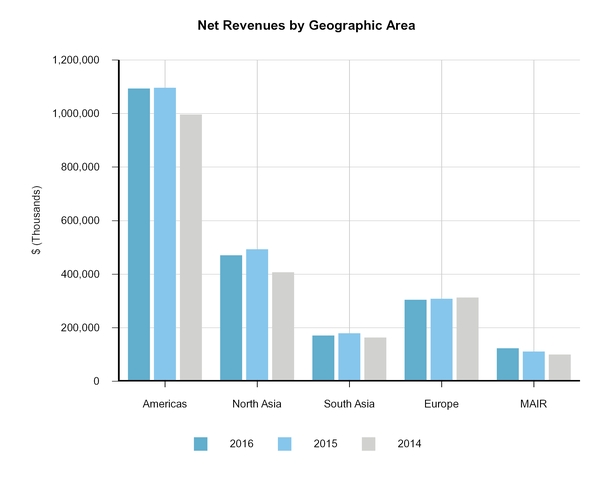]
[removed: The Company’s] [added: Our] operating units share revenue using the same arms-length pricing methodologies [removed: the Company uses] [added: that we use] when [removed: its] [added: our] offices transact business with independent agents.
[removed: The Company’s] [added: Our] strategy closely links compensation with operating unit profitability.
Individual success is closely linked to cooperation with other operating units within [removed: the] [added: our] network.
The mix of services varies by segment based primarily on the import or export orientation of local operations in each [removed: region.][added: of our regions.]
In accordance with [removed: the Company's] [added: our] revenue recognition policy (see Note 1.
North Asia is [removed: the Company's] [added: our] largest export oriented region and accounted for [removed: 39%] [added: 37%] of revenues, [removed: 23%] [added: 22%] of net revenues and 34% of operating income for the year ended December 31, [removed: 2015.][added: 2016.]
North Asia's [removed: operating income] [added: net revenues] as a percentage of [removed: revenue] [added: revenues] is lower than other segments due to the largely export nature of operations in that region.
From the inception of [removed: the Company,] [added: our company,] management has believed that the elements required for a successful global service organization can only be assured through recruiting, training, and ultimately retaining superior personnel.
[removed: The Company’s] [added: We believe that our] greatest challenge is now and always has been perpetuating a consistent global corporate culture which demands:
| • | Compliance with [removed: Company] [added: our] policies and [added: procedures and] government regulations; |
| • | Aggressive marketing of all of [removed: the Company’s] [added: our] service offerings; |
| • | Continuous identification, design and implementation of system [removed: solutions,] [added: solutions and differentiated service offerings,] both technological and otherwise, to meet and exceed the needs of [removed: the Company's] [added: our] customers while simultaneously delivering tools to make [removed: the Company's] [added: our] employees more efficient and more effective. |
[removed: The Company reinforces] [added: We reinforce] these values with a compensation system that rewards employees for profitably managing the things they can control.
This compensation system has been in place since [removed: the Company] [added: we] became a publicly traded [removed: entity.][added: company.]
[removed: The Company believes] [added: We believe] in a “real world” environment [removed: in every operating unit] where [removed: individuals] [added: the employees of our operating units] are [removed: not sheltered from] [added: held accountable for] the profit implications of their decisions.
If these decisions result in operating losses, management [added: generally] must make up these losses with future operating profits, in the aggregate, before any cash incentive compensation can be earned.
The difference between the rate billed to our customers (the sell rate) and the rate we pay to the carrier (the buy rate) is termed “net revenue” (a non-GAAP measure), “yield" or "margin." By consolidating shipments
Our business is also highly dependent on the financial stability and operational capabilities of the carriers we utilize.
Moreover, the ocean carrier industry has incurred substantial losses in recent years, many carriers are highly leveraged with debt and certain carriers are facing significant liquidity challenges, such as those that led to the bankruptcy filing of a large ocean carrier that occurred in August 2016.
currency exchange rates, our pricing and terms continue to be pressured by customers, carriers and service providers.
These financial challenges have resulted in the 2016 bankruptcy of one of the larger carriers in the market, as well as multiple mergers and acquisitions, as the carriers pursue scale and market share in an effort to reduce operating costs and improve their financial results.
Additionally, while the overall global volumes have increased slightly over recent years, many carriers continue to take delivery of new and larger ships, which has created excess capacity.
Consequently, when the market experiences seasonal peaks or any sort of disruption, the carriers react by increasing their pricing as quickly as possible.
This carrier behavior creates pricing volatility that could impact Expeditors' ability to maintain historical unitary profitability.
There is uncertainty as to how changes in oil prices will impact future buy rates.
The global economic environment and trade growth remain uncertain.
We cannot predict what impact this may have on our operating results, freight volumes, pricing, changes in consumer demand, carrier stability and capacity, customers’ abilities to pay or on changes in competitors' behavior.
Additionally, we cannot predict the direct or indirect impact that changes in consumer purchasing behavior, such as on-line shopping, could have on our business.
In March 2016, the Financial Accounting Standards Board (FASB) issued an Accounting Standard Update (ASU) simplifying the accounting for stock compensation.
The ASU requires excess tax benefits and deficiencies to be recorded as an income tax expense or benefit in our consolidated statements of earnings when our stock options are exercised or canceled and for disqualifying dispositions of shares issued to employees under our employee stock purchase plan.
All tax-related cash flows are required to be reported as operating activities in our consolidated statement of cash flows.
We will adopt this ASU on a prospective basis beginning on January 1, 2017.
We have elected to continue to estimate forfeitures expected to occur in determining the amount of compensation cost to be recognized in each period.
We believe the adoption of this ASU will result in volatility in our effective tax rate and diluted earnings per share due to the recording of all of the tax effects of share-based payments in our consolidated statements of earnings.
The volatility in future periods will be dependent upon our stock price, stock option exercise and cancellation activity and the amount of disqualifying dispositions of shares purchased by our employees under our employee stock purchase plan.
Had the standard been effective in 2016 and 2015, it would have resulted in $2.7 million of additional tax expense and a $1.1 million tax benefit, respectively.
We formed a cross-functional project team that is in the process of evaluating the adoption impacts of the ASU for each of our products and services.
This process, though underway, is not yet completed and our understanding of the future adoption impacts, including any potential changes related to principal and agent determinations, on our consolidated financial statements and related disclosures of the ASU have not yet been determined.
Our project team is also assessing how our current processes and systems may be impacted by adoption.
We have yet to decide whether we will adopt under a cumulative effect or retrospective method.
However, we have not yet completed our full assessment.
We expect to complete our assessment of the impact towards the end of 2017.
The ASU will be effective for us beginning on January 1, 2019 and will be adopted using a modified retrospective transition.
2016 compared with 2015
Airfreight services revenues decreased 10% in 2016, as compared with 2015, primarily as a result of lowering average sell rates in response to competitive market conditions.
The decrease in average sell rates was partially offset by a 3% growth in airfreight tonnage.
Airfreight services expenses decreased 12% in 2016 as compared with 2015, as a result of favorable buying opportunities throughout most regions due primarily to excess available carrier capacity.
While not possible to quantify, sell rates and tonnage were favorably impacted in 2015 by customers converting a portion of their ocean freight shipments to airfreight due to port disruptions on the U.S. West Coast.
Average net revenue per kilo declined in most regions primarily due to competitive market conditions and rapid changes in carrier pricing caused by sporadic increases in demand.
North America net revenues decreased by 6% due principally to a 3% decrease in tonnage.
North Asia, South Asia and Europe net revenues decreased 10%, 9% and 2%, respectively, despite tonnage increases of 5%, 7% and 3%.
Historically, we have experienced lower airfreight margins in the fourth quarter as seasonal volumes increase and carriers correspondingly increase buy rates.
Ocean freight and ocean services revenues decreased 13% in 2016 as compared with 2015, as we continued to lower average sell rates to customers in response to competitive market conditions and lower available buy rates from carriers.
Although average sell rates to customers declined, container volumes increased 3%.
Ocean freight and ocean services expenses decreased 16% in 2016 as compared with 2015, due to lower average buy rates, resulting from carrier overcapacity.
This decrease was due primarily to an 8% decrease in net revenue per container, partially offset by a 3% increase in volume.
The most significant drivers of changes
Currently, there is uncertainty as to how declines in oil prices will impact future buy rates due to a number of factors, including that some carriers have hedged fuel costs.
experience.
In August 2015, the FASB deferred the effective date of the revenue recognition guidance to reporting periods beginning after December 15, 2017.
In November 2015, the FASB issued an ASU simplifying the accounting for income taxes by requiring all deferred tax assets and liabilities to be classified as non-current on the consolidated balance sheet.
The ASU is effective for reporting periods beginning after December 15, 2016, with early adoption permitted.
The ASU may be adopted either prospectively or retrospectively.
The Company is currently evaluating the method of adoption and expects this ASU will have an impact on its consolidated balance sheets as its current deferred tax assets were $17 million and non-current deferred tax liabilities were $26 million as of December 31, 2015.
The Company is currently evaluating the full impact that the adoption of this ASU will have on its consolidated financial statements and related disclosures.
The Company expects pricing volatility to continue as customers and carriers react to current market conditions, which could result in reduced yields.
2014 compared with 2013
Airfreight services revenues increased 6% in 2014, as compared with 2013, due to a 9% increase in tonnage that was partially offset by lower sell rates in response to competitive market conditions in North America, North Asia and South Asia.
Airfreight services expenses increased 5% in 2014 as compared with 2013, as the increase in tonnage was slightly offset by negotiating lower buy rates with carriers, primarily on exports from North America, North Asia and South Asia.
North America export tonnage grew by 14%, while net revenues increased by only 8% as the reduction in average sell rates to customers exceeded the reduction in average buy rates negotiated with carriers.
Europe net revenues increased 17% primarily due to a 23% growth in export tonnage as a result of new customers.
North Asia net revenues remained flat.
The 2% growth in export tonnage in North Asia was offset by lower average sell rates in response to competitive market conditions, which resulted in a 2% reduction in net revenue per kilo.
South Asia net revenues decreased by 1% as the 12% growth in export tonnage was more than offset by a reduction in net revenue per kilo.
The reduction in net revenue per kilo resulted from lower average sell rates in response to competitive market conditions.
Ocean freight and ocean services revenues increased 11% in 2014 as compared with 2013, due primarily to an 11% increase in container volume.
During the second half of 2014, average rates increased due to higher overall demand in the marketplace.
Ocean freight and ocean services expenses increased 13% in 2014 as compared with 2013, primarily as the result of the increase in volume and higher costs in ocean freight consolidation.
This increase was due primarily to an 11% growth in container volume, largely offset by the effect of reducing sell rates, principally in the first half of 2014.
This resulted in a 6% decrease in net revenue per kilo, primarily in North America, North Asia and South Asia.
Direct ocean freight forwarding net revenues increased 6% in 2014, as compared with 2013, as a result of higher volumes, principally in North America, North Asia, South Asia and Europe.
The overall margins in order management declined due to higher costs, primarily in North Asia and South Asia.
North America ocean freight and ocean services net revenues increased 7% in 2014, as compared with 2013, primarily due to an increase in ocean freight consolidation in the second half of the year and growth in order management.
Europe net revenues increased 4%, primarily due to an increase in direct ocean forwarding.
Both North Asia and South Asia net revenues increased 5% due primarily to an increase in both direct ocean forwarding and ocean freight consolidation volumes.
The margin percentage declined primarily as a result of higher import costs and lower yields in time-definite Transcon services.
North America, North Asia and Europe net revenues increased 6%, 6% and 4%, in 2014 as compared with 2013, primarily as a result of higher volumes from existing and new customers.
In 2014, the Company benefited from a reduction in expense resulting from favorable claims experience in its employee healthcare self-insurance program.
Bonuses to executive management in 2014 were down 2% as compared with 2013, primarily as a result of a reduction in the 2014 bonus pool to recoup the retirement bonus expensed in 2013 for Peter J.
Rose, the Company's former Chairman and Chief Executive Officer.
Excluding the recovery of the retirement bonus, bonuses to executive management increased 7%.
Salaries and related costs decreased 1% as a percentage of net revenues in 2014 as compared with 2013 as the growth in net revenues outpaced salary and related cost increases from the increase in the number of employees and higher base salaries.
The increase in expenses is primarily due to (i) consulting fees and costs associated with the Company's strategic assessment and organizational changes; (ii) higher costs related to investments in software and systems; (iii) increased building, maintenance and warehousing costs; (iv) higher travel costs, and (v) higher business taxes partially offset by a recovery of bad debt expense, and reduced legal and claims costs.
The Company’s consolidated effective income tax rate decreased to 37.9% in 2014, as compared to 38.9% in 2013.
Foreign currency losses were $2 million in 2013.
The Company’s business is subject to seasonal fluctuations.
An excerpt. Shown here: 40 of 206 rewritten, 40 of 63 added and 40 of 44 removed. The counts are complete. For every sentence, read Item 7. MANAGEMENT’S DISCUSSION AND ANALYSIS OF FINANCIAL CONDITION AND RESULTS OF OPERATIONS in the FY2016 filing and the FY2015 filing.
Item 7A. QUANTITATIVE AND QUALITATIVE DISCLOSURES ABOUT MARKET RISK
19 rewritten, 2 added, 2 removed, 7 unchanged
[removed: The Company is] [added: We are] exposed to market risks in the ordinary course of [removed: its] [added: our] business.
The potential impact of [removed: the Company’s] [added: our] exposure to these risks is presented below:
[removed: The Company conducts] [added: We conduct] business in many different countries and currencies.
[removed: The Company’s] [added: Our] business often results in revenue billings issued in a country and currency which differs from that where the expenses related to the service are incurred.
In the ordinary course of business, [removed: the Company creates] [added: we create] numerous intercompany transactions and may have receivables, payables and currencies that are not denominated in the local functional currency.
This brings foreign exchange risk to [removed: the Company’s] [added: our] earnings.
The principal foreign exchange risks to which [removed: the Company] [added: Expeditors] is exposed [removed: are in] [added: include] Chinese Yuan, Euro, Mexican Peso, Canadian Dollar and British Pound.
Foreign exchange rate sensitivity analysis can be quantified by estimating the impact on [removed: the Company’s] [added: our] earnings as a result of hypothetical changes in the value of the U.S. dollar, [removed: the Company’s] [added: our] functional currency, relative to the other currencies in which [removed: the Company transacts] [added: we transact] business.
[removed: All other things being equal, an] average 10% weakening of the U.S. dollar, throughout the year ended December 31, [removed: 2015,] [added: 2016,] would have had the effect of raising operating income approximately [removed: $54] [added: $47] million.
An average 10% strengthening of the U.S. dollar, for the same period, would have the effect of reducing operating income approximately [removed: $44] [added: $39] million.
[removed: The Company] [added: We] currently [removed: does] [added: do] not use derivative financial instruments to manage foreign currency risk and only [removed: enters] [added: enter] into foreign currency hedging transactions in limited locations where regulatory or commercial limitations restrict [removed: the Company’s] [added: our] ability to move money freely.
Any such hedging activity throughout the year ended December 31, [removed: 2015,] [added: 2016,] was insignificant.
Net foreign currency gains were approximately $8 million [added: in both 2016] and [added: 2015 and were] $2 million in [removed: 2015 and 2014, respectively.][added: 2014.]
[removed: The Company] [added: We] had no foreign currency derivatives outstanding at December 31, [removed: 2015] [added: 2016] and [removed: 2014.][added: 2015.]
[removed: The Company] [added: We] instead [removed: follows] [added: follow] a policy of accelerating international currency settlements to manage foreign exchange risk relative to intercompany billings.
As of December 31, [removed: 2015, the Company] [added: 2016, we] had [removed: less than $1] [added: $11] million of net unsettled intercompany transactions.
At December 31, [removed: 2015, the Company] [added: 2016, we] had cash, cash equivalents and short-term investments of [removed: $808] [added: $974] million, of which [removed: $362] [added: $568] million was invested at various short-term market interest rates.
A hypothetical change in the interest rate of 10 basis points at December 31, [removed: 2015] [added: 2016] would not have a significant impact on [removed: the Company’s] [added: our] earnings.
In management’s opinion, there has been no material change in [removed: the Company’s] [added: our] interest rate risk exposure between [removed: 2015] [added: 2016] and [removed: 2014.][added: 2015.]
All other things being equal, an
We had no long-term debt at December 31, 2016.
Net foreign currency losses were $2 million in 2013.
The Company had no significant short-term borrowings at December 31, 2015.
Item 1. BUSINESS
167 rewritten, 48 added, 44 removed, 147 unchanged
Expeditors International of Washington, Inc. [removed: ("Expeditors” or “the Company")] [added: (herein referred to as "Expeditors,” the "Company," "we," "us," "our")] provides a full suite of global logistics services, offering customers a seamless international network of people and integrated information systems to support the movement and strategic positioning of goods.
As a third party logistics provider, [removed: Expeditors purchases] [added: we purchase] cargo space from carriers (including airlines and ocean shipping lines) on a volume basis and [removed: resells] [added: resell] that space to [removed: its] [added: our] customers.
[removed: The Company does] [added: We do] not compete for overnight courier or small parcel business and [removed: it does] [added: do] not own aircraft or [removed: steamships.][added: ships.]
[removed: The Company provides] [added: We provide] a broad range of customer solutions, such as order management, time-definite transportation, warehousing and distribution, temperature-controlled transit, cargo insurance, and customized logistics solutions.
In addition, [removed: the Company's] [added: our] Project Cargo unit handles special project shipments that move via a single method or combination of air, ocean, and/or ground transportation and generally require a high level of specialized attention because of the unusual size or nature of what's being shipped.
Whether acting as a consolidator or agent, [removed: Expeditors offers its] [added: we offer our] customers routing expertise, familiarity with local business practices, knowledge of export and import documentation and procedures, the ability to arrange for ancillary services and assistance with space availability in periods of [removed: peak] [added: high] demand.
Air Freight Consolidation: as an air freight consolidator, Expeditors purchases cargo space from airlines on a volume basis and resells that space to [removed: its] [added: our] customers at lower rates than what those customers could negotiate directly from the airlines on an individual shipment.
Expeditors determines the routing, consolidates shipments bound for a particular airport distribution point, and then selects the airline for transportation to the distribution point, where either [removed: the Company] [added: we] or one of [removed: its] [added: our] agents then [removed: arranges] [added: arrange] for the consolidated lot to be broken down into its component shipments and for the transportation of each individual shipment to its final destination.
Ocean Freight Consolidation: as an ocean freight consolidator, Expeditors contracts with ocean shipping lines to obtain transportation for a fixed number of containers between various points during a specified time period at an agreed [added: upon] rate.
[removed: The Company handles] [added: We handle] both full container loads as well as Less-than Container Load (LCL) freight, charging lower rates than what is available directly from the shipping lines.
[removed: The Company] [added: We] also [removed: generates] [added: generate] fees for ancillary services such as shipping and customs documentation, packing, crating, insurance services, negotiation of letters of credit, and the preparation of documentation to comply with local export laws.
Direct Ocean Forwarding: when a customer contracts directly with the [removed: steamship line,] [added: ocean carrier,] Expeditors acts as that customer’s agent and [added: we] may receive a commission from the [removed: steamship line] [added: carrier] in addition to [added: customer] handling [removed: fees from the customer.][added: fees.]
Order Management: [removed: the Company] [added: Expeditors] provides a range of order management services, collecting fees from the shipper in addition to generating fees for meeting specific customer needs.
Through Expeditors’ order management, [removed: the Company consolidates] [added: we consolidate] cargo from many suppliers in a particular origin into the fewest possible number of containers, putting more product in larger and fewer containers to maximize space and minimize cost.
Customs Brokerage Services: [removed: as a customs broker,] Expeditors helps importers clear shipments through customs by preparing required documentation, calculating and paying duties and other taxes on behalf of the importer, arranging for any required inspections by governmental agencies, and arranging for [added: local pickup, storage and] delivery.
The following charts show [removed: the Company's 2015] [added: our 2016] revenues and net revenues (a non-GAAP measure calculated as revenues less directly related operating [removed: expenses)] [added: expenses*)] by service type:
[removed:  ][added: 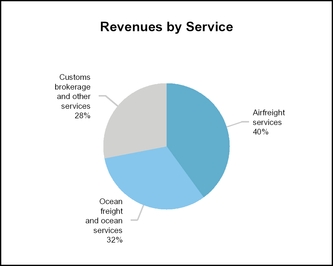 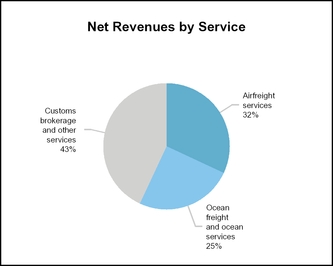]
Beginning in 1981, [removed: the Company’s] [added: Expeditors’] primary business focus was on airfreight shipments from Asia to the United States and related customs brokerage and other services.
In the mid-1980’s, [removed: Expeditors] [added: we] began to expand [removed: its] [added: our] service capabilities in airfreight, ocean freight and distribution services.
Today [removed: the Company] [added: Expeditors] has [removed: over 15,000] [added: approximately 16,000] employees [removed: that provide] [added: and provides] a complete range of global logistics services to a diversified group of customers, both in terms of industry specialization and geographic location.
As opportunities for profitable growth arise, [removed: the Company plans] [added: we plan] to create new offices.
While Expeditors has historically expanded through organic growth, [removed: the Company has] [added: we have] also been open to growth through acquisition of, or establishing joint ventures [removed: with,] [added: with] existing agents or others within the industry.
At January 31, [removed: 2016,] [added: 2017,] Expeditors, including its majority-owned subsidiaries, is organized functionally in geographic operating segments and operates [removed: full service] [added: district] offices in the regions identified below.
[removed: Full service] [added: Our district] offices have [removed: also] been established in locations where [removed: the Company] [added: Expeditors] maintains unilateral control over assets and operations and where the existence of the parent-subsidiary relationship is maintained by means other than record ownership of voting stock.
[removed: The Company] [added: Expeditors] operates [removed: 185 full service] [added: 177 district] offices in the following geographic areas of responsibility:
| • | Americas [removed: (73)] [added: (70)] |
| • | North Asia [removed: (23)] [added: (21)] |
| • | Europe [removed: (50)] [added: (45)] |
| • | Middle East, Africa and India [removed: (22)] [added: (24)] |
[removed: The Company] [added: We] also [removed: maintains sales and satellite] [added: maintain branch] offices which are aligned with and dependent on one [removed: or more full service offices.][added: district office.]
Additionally, [removed: the Company contracts] [added: we contract] with independent agents to provide required services and [removed: has] [added: have] established [removed: 46] [added: 45] such relationships world-wide.
For information concerning the amount of revenues, net revenues, operating income, identifiable assets, capital expenditures, depreciation and amortization and equity attributable to the geographic areas in which [removed: the Company conducts its] [added: we conduct our] business, see Note 10 to the consolidated financial statements.
In [removed: 2015,] [added: 2016,] Expeditors [removed: implemented] [added: continued executing] key strategic initiatives that were developed in late 2014 by [removed: the Company’s] [added: our] executive team.
Those operational initiatives are focused and aligned to achieve long-term earnings [removed: per share] growth.
Expeditors’ teams are aligned on the specific markets of its focused priorities; on the targeted accounts within those markets; and on ways that [removed: the Company] [added: we] can continue to differentiate [removed: itself] [added: ourselves] from [removed: its] [added: our] competitors.
[removed: The Company continues to be focused] [added: We are continuing our focus] on growth based on four key strategic initiatives:
| 1. | Ensure that every operating unit's base-line growth strategies for air, ocean and customs services grow at the rate of each unit's (i.e. district or region) relevant market growth [removed: rate (the Company’s] [added: rate, and Expeditors'] Transcon and Distribution services are expected to maintain higher growth [removed: rates).] [added: rates.] |
| 2. | Align and integrate [removed: the Company’s] [added: our] European-Asian Pacific and European-North Americas interests to the same degree that [removed: its] [added: our] Asian Pacific and Americas interests have historically been aligned. This alignment is expected to result in additional growth in these markets beyond [removed: the] [added: our] base-line growth expectations. |
| 3. | Leverage [removed: the Company’s] [added: our] long and deeply entrenched presence in various Asian export markets - as well as the reputation that [removed: Expeditors has] [added: we have] with the strategic carriers servicing those markets - to create a stronger Asian import presence, while concentrating and enhancing [added: our] export capabilities in key strategic lanes, particularly into and out of China and Southeast Asia. [removed: This is expected] [added: We expect this] to create additional product growth opportunities in those markets, which have not historically been a particular focus for [removed: the Company.] [added: us.] |
Expeditors has long believed [added: that] it [added: is] a competitive advantage to [removed: maintain a globally consistent IT system] [added: focus on organic growth and to utilize an enterprise technology platform] designed and built by logistics [added: technology] professionals for logistics professionals.
Such services can include review of commercial documentation, assessment of information regarding value, country of origin, special trade programs, and classification.
Customs reporting, discrepancy management and other visibility tools help our customers manage their compliance responsibilities globally.
Transcon: Expeditors Transcon consists of intra-continental ground transportation and delivery services and may be bundled together with domestic air.
Transcon also includes value-added, white glove, and time-definite services.
*See Management's Discussion and Analysis for a reconciliation of Net Revenues to Revenues.
Our Strategy
In addition, in early 2017 we announced the appointment of Philip M.
Coughlin to the newly created position of Chief Strategy Officer, effective on February 28 and reporting directly to President and Chief Executive Officer, Jeff Musser.
Mr. Coughlin's role is to establish and oversee a core Strategy Group within Expeditors, comprised of current employees with a deep understanding of our products, services and technology, and external individuals with expertise in supply chain management, data and market analysis, and technology.
Mr. Coughlin's team will be focused on exploring new avenues for innovation, differentiation and expansion.
Global Logistics and Supply Chain Technology
Our technology platform is built on principles of innovation, agility, collaboration, performance and consistency across the Expeditors global network to meet diverse and complex global logistics and supply chain needs.
The platform is comprised of proprietary, third party and open source technologies.
We utilize a globally consistent infrastructure supporting both centralized and distributed technology strategies that incorporate disaster recovery and high availability.
We are not dependent on third parties for developing or enhancing our core technology platforms to address our needs or those of our customers.
As a non-asset based provider, we have considerable flexibility to tailor customer-specific solutions based on a customer’s needs.
By understanding a customer's logistics processes and goals, we are able to identify opportunities for improvement, and are able to deploy relevant services and solutions for that customer.
These services include all modes of cargo transportation, customs brokerage, warehousing and distribution, and order management.
Expeditors' core services are further supported by our expertise in providing industry-specific solutions, supply chain analysis and optimization, cargo insurance, cargo security, and solutions for oversized and heavy lift freight.
We offer these services across the globe on a single technology platform, in conjunction with consistent and efficient operations and processes that adhere to the highest standards of compliance.
Because Expeditors is in the business of optimizing customer logistics and supply chains, we focus our marketing strategy and efforts on professionals in logistics and supply chain management roles.
While we drive our strategic marketing at a global level, district management of each office is responsible for its own business development, operations, and service execution.
Expeditors defines strategy, processes, technology and compliance that are supported and executed at all levels with dedicated account management personnel coupled with regional and local expertise.
We believe this balanced approach between corporate, regional, and local expertise enables us to supply solutions customized to the needs of our customers.
These goods include products from multiple industries, including electronics, high technology, healthcare, aerospace and aviation, manufacturing, oil and energy, automotive, retail and fashion.
In order to meet customers' complex and industry specific demands, we utilize industry vertical teams throughout our network to focus on providing solutions in different industries.
Industry vertical teams work closely with our regional and district resources to grow our business.
In 2015, airfreight customers continued to seek reductions in rates related to lower fuel prices.
That trend persisted in 2016, along with carriers incorporating the lower fuel rates into their pricing structures.
These financial challenges have resulted in the 2016 bankruptcy of one of the larger carriers in the market, as well as multiple mergers and acquisitions, as the carriers pursue scale and market share in an effort to reduce operating costs and regain their financial footing.
This excess capacity is at the heart of the carriers' financial challenge as they pursue business at lower rate levels to achieve higher load factors.
Consequently, when the market goes through seasonal peaks or any sort of disruption and demand exceeds supply, the carriers react by increasing their pricing as quickly as possible to offset their previous losses.
This carrier behavior, along with fluctuations in demand, creates pricing volatility that could impact Expeditors' ability to maintain historical unitary profitability.
We use a consistent approach in selecting and managing service providers across all of our product offerings, beginning with a rigorous qualification and risk-based diligence process.
We select and engage with best-in-class, compliance-focused, efficiently run, growth-oriented partners, based upon defined value elements and are intentional in our relationship and performance management activity, reinforcing success by awarding service providers who consistently achieve at the highest levels with additional business.
Expeditors is committed to continual improvement in reducing the sum total impact of our operations on the environment.
We have over 200 employee-led Green Teams, which cover each of our local district offices and are responsible for projects focused on reducing Expeditors' Scope 1 and Scope 2 emissions (as defined by the Greenhouse Gas Protocol, Scope 1 emissions include all direct greenhouse gas emissions; Scope 2 includes indirect greenhouse gas emission from purchased electricity, heat or steam).
We have voluntarily disclosed our Scope 1 and Scope 2 emissions data to the Carbon Disclosure Project since 2010, and we are currently a member of both SmartWay and Transporte Limpio in North America.
SmartWay is a voluntary public-private program sponsored by the EPA for tracking, documenting and sharing information about fuel use and freight emissions across supply chains.
Transporte Limpio is a similar, voluntary program sponsored by the Mexican government.
| | |
| --- | --- |
Transcon: through its Transcon unit, Expeditors offers multi-modal shipping services via air and/or ocean combined with ground transport.
Such services can also include specialty handling services, such as so-called “white glove” attention for shipments that require special handling.
Strategic Initiatives
In addition, the Company also has implemented four “enabling” initiatives, which, while also strategic in scope, are highly tactical in support of the main four strategic initiatives:
| A. | Align information technology (IT) resources to support global strategy. |
| B. | Refine risk management functions to effectively manage barriers to address customers' evolving requests related to terms and conditions. |
| C. | Develop and align global procurement strategies to optimize and leverage total cost of ownership in support of global strategic initiatives. |
| D. | Create an acquisition strategy that will identify and assess desirable acquisitions within a framework supported by Expeditors traditional acquisition methodologies and philosophies. Historically the Company has made acquisitions to obtain technology and specialized industry expertise that it did not have and that could be leveraged to benefit the entire network. The Company also has selectively acquired agents and, on occasion, key service providers. |
Globally Consistent Information Systems Built Specifically for Logistics
The Company’s IT systems were built on a foundation that dictated consistency and uniformity across the Expeditors global network for scalability.
The Company’s systems were designed on a decentralized basis, so that an interruption in one office or location would likely not debilitate the abilities of the entire network, or even a significant sub-part of the network.
Expeditors is not dependent on third parties for upgrades or modifications to its systems, whether to address Company needs or those of its customers, even as the Company is constantly engaged in enhancing and improving its systems.
The Company’s two primary strategies for expansion are to open offices in response to client requests, and to expand through joint-ventures with agents.
As a non-asset based organization, Expeditors has considerable flexibility in managing its customers' supply chains.
Because of its relationships with local suppliers and global air and ocean partners, Expeditors is able to provide each of its customers with routing and pricing expertise.
The Company’s logistics solutions are tailored to each of its customer’s individual business needs, from order inception through order delivery.
Although the domestic importer typically chooses a logistics company and services for what’s being shipped, the foreign shipper may also be involved in the selection process.
Accordingly, Expeditors targets its marketing to reach both domestic importers and their overseas suppliers.
Because Expeditors is in the business of optimizing its customers’ supply chains, the Company focuses its marketing to reach professionals in logistics, international and domestic transportation, customs, compliance and purchasing departments of existing and potential customers.
The district manager of each office is responsible for marketing, sales coordination, and operations in the area in which he or she is located.
Shipments of computers and components, electronic and consumer goods, medical equipment, pharmaceutical products, retail goods, automotive parts, aviation parts, industrial equipment and oil and energy equipment comprise a significant percentage of Company business.
The typical import customer includes retailers and distributors of consumer electronics, department store chains, clothing and shoe wholesalers, and high-tech, industrial and automotive manufacturers.
Expeditors also has established industry vertical teams throughout its network to focus on aviation and aerospace, healthcare, oil and energy, and retail and fashion.
Declines in fuel prices did not significantly impact airfreight buy and sell rates in 2014.
However, in 2015 airfreight customers began to seek reductions in rates related to lower fuel prices and currently carriers are incorporating the lower fuel rates into their pricing structures.
This excess capacity causes most carriers to redeploy ships and modify sailing schedules to improve financial results.
The potential combination of reduced sailing schedules and pricing volatility could impact the Company’s ability to maintain historical unitary profitability.
Customized EDI applications allow the transfer of key information between customers’, service providers' and Expeditors' systems.
Freight tracing and tracking applications provide customers with near real-time visibility to the location, transit time and estimated delivery time of inventory in transit.
At December 31, 2015, the Company employed 15,397 people as follows:
| • | North America 5,655 |
| • | Europe 2,685 |
| • | North Asia 2,464 |
| • | South Asia 1,323 |
| • | Middle East, Africa and India 1,417 |
| • | Latin America 796 |
| • | Information Systems 741 |
| • | Corporate 316. |
An excerpt. Shown here: 40 of 167 rewritten, 40 of 48 added and 40 of 44 removed. The counts are complete. For every sentence, read Item 1. BUSINESS in the FY2016 filing and the FY2015 filing.
Item 3. LEGAL PROCEEDINGS
4 rewritten, 0 added, 0 removed, 0 unchanged
[removed: The Company] [added: Expeditors] is involved in claims, lawsuits, government investigations and other legal matters that arise in the ordinary course of business and are subject to inherent uncertainties.
Currently, in management's opinion and based upon advice from legal advisors, none of these matters are expected to have a significant effect on [removed: the Company's operations] [added: our operations, cash flows] or financial position.
As of December 31, [removed: 2015,] [added: 2016,] the amounts accrued for these claims, lawsuits, government investigations and other legal matters are not significant to [removed: the Company's operations] [added: our operations, cash flows] or financial position.
At this time, [removed: the Company is] [added: we are] unable to estimate any additional loss or range of reasonably possible losses, if any, beyond the amounts recorded, that might result from the resolution of these matters.
Cover and table of contents
4 rewritten, 1 added, 1 removed, 62 unchanged
For the fiscal year ended December 31, [removed: 2015][added: 2016]
The aggregate market value of the registrant’s Common Stock held by non-affiliates of the registrant, based upon the closing price as of the last business day of the most recently completed second fiscal quarter ended June 30, [removed: 2015,] [added: 2016,] was approximately [removed: $8,643,828,563.][added: $8,814,080,920.]
At February [removed: 22, 2016,] [added: 20, 2017,] the number of shares outstanding of registrant’s Common Stock was [removed: 182,101,972.][added: 180,120,731.]
Portions of the definitive proxy statement for the Registrant’s [removed: 2016] [added: 2017] Annual Meeting of Shareholders to be held on May [removed: 3, 2016] [added: 2, 2017] are incorporated by reference into Part III of this Form 10-K.
10-K 1 a201610-k.htm 10-K
10-K 1 a201510-k.htm 10-K
Item 2. PROPERTIES
6 rewritten, 2 added, 0 removed, 42 unchanged
[removed: The Company] [added: Expeditors] owns the following properties:
[removed: The Company leases and maintains nearly 80 additional offices and warehouse locations in the United States and approximately 400] [added: These] leased locations [removed: worldwide,] [added: are] primarily located close to an airport, ocean port, or on an important border crossing.
Lease terms are either on a month-to-month basis or terminate at various times through [removed: 2025.][added: 2028.]
See Note 8 to [removed: the Company’s] [added: our] consolidated financial statements for lease commitments.
[removed: The Company] [added: We] will [added: from time to time] investigate the possibility of building or buying suitable facilities.
[removed: The Company believes] [added: We believe] that current leases can be extended and that suitable alternative facilities are available in the vicinity of each present facility should extensions be unavailable at the conclusion of current leases.
| Netherlands, Amsterdam | | Land |
We lease and maintain approximately 420 locations worldwide, of which approximately 90 are in the United States.
Item 5. MARKET FOR REGISTRANT’S COMMON EQUITY, RELATED STOCKHOLDER MATTERS AND ISSUER PURCHASES OF EQUITY SECURITIES
18 rewritten, 11 added, 11 removed, 31 unchanged
[removed: The Company's] [added: Expeditors'] common stock trades on The NASDAQ Global Select Market.
The following table sets forth the high and low sale prices for [removed: the Company’s] [added: our] common stock as reported by The NASDAQ Global Select Market under the symbol EXPD.
| First | | $ | [removed: 49.51] [added: 49.56] | | | $ | [removed: 42.17] [added: 40.41] | | | First | | $ | [removed: 45.69] [added: 49.51] | | | $ | [removed: 38.42] [added: 42.17] | |
| Second | | $ | [removed: 49.11] [added: 50.63] | | | $ | [removed: 45.27] [added: 46.48] | | | Second | | $ | [removed: 46.80] [added: 49.11] | | | $ | [removed: 38.54] [added: 45.27] | |
| Third | | $ | [removed: 50.08] [added: 52.58] | | | $ | [removed: 43.92] [added: 48.41] | | | Third | | $ | [removed: 45.78] [added: 50.08] | | | $ | [removed: 39.97] [added: 43.92] | |
| Fourth | | $ | [removed: 51.80] [added: 56.37] | | | $ | [removed: 44.73] [added: 47.23] | | | Fourth | | $ | [removed: 47.24] [added: 51.80] | | | $ | [removed: 38.14] [added: 44.73] | |
There were [removed: 965] [added: 861] shareholders of record as of February [removed: 22, 2016.][added: 20, 2017.]
This figure does not include a substantially greater number of beneficial holders of [removed: the Company’s] [added: our] common stock, whose shares are held of record by banks, brokers and other financial institutions.
In November 1993, [removed: the Company’s] [added: Expeditors'] Board of Directors authorized a Non-Discretionary Stock Repurchase Plan for the purpose of repurchasing [removed: the Company’s] [added: our] common stock in the open market with the proceeds received from the exercise of stock options.
On February 9, 2009, the Plan was amended to increase the authorization to repurchase up to 40 million shares of [removed: the Company’s] [added: our] common stock.
This plan was disclosed in [removed: the Company’s] [added: our] annual report on Form 10-K filed on March 31, 1995.
In the fourth quarter of [removed: 2015, the Company] [added: 2016, we] repurchased [removed: 554,336] [added: 621,240] shares of common stock under the Non-Discretionary Stock Repurchase Plan.
In November 2001, under a Discretionary Stock Repurchase Plan, [removed: the Company’s] [added: Expeditors'] Board of Directors authorized the repurchase of [removed: the Company's] [added: our] common stock in the open market to reduce the issued and outstanding stock down to 200 million shares.
In [removed: 2015,] [added: February and August 2015 and May 2016,] the Board of Directors [added: further] authorized repurchases down to 188 [removed: million and] [added: million,] 180 million [removed: shares of common stock outstanding on February 24, 2015] and [removed: August 4, 2015,] [added: 170 million,] respectively.
In the fourth quarter of [removed: 2015, the Company] [added: 2016, we] repurchased [removed: 3,946,661] [added: 659,485] shares of common stock under the Discretionary Stock Repurchase Plan.
These discretionary repurchases included [removed: 81,661] [added: 159,485] shares that were made to limit the growth in the number of issued and outstanding shares resulting from stock option exercises and [removed: 3,865,000] [added: 500,000] shares to reduce the number of total shares outstanding.
The graph assumes that the value of the investment in our common stock and in each of the indexes (including reinvestment of dividends) was $100 on [removed: 12/31/2010] [added: 12/31/2011] and tracks it through [removed: 12/31/2015.][added: 12/31/2016.]
[removed: ][added: 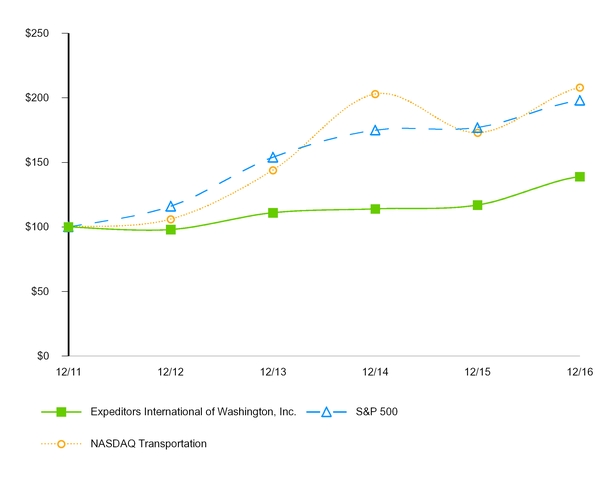]
| 2016 | | | | | | | | | | 2015 | | | | | | | | |
| June 15, 2016 | $ | 0.40 | |
| December 15, 2016 | $ | 0.40 | |
| October 1-31, 2016 | | — | | | $ | — | | | — | | | 17,310,277 | |
| November 1-30, 2016 | | 320,106 | | | $ | 49.54 | | | 320,106 | | | 16,982,782 | |
| December 1-31, 2016 | | 960,619 | | | $ | 55.91 | | | 960,619 | | | 16,182,333 | |
| Total | | 1,280,725 | | | $ | 54.31 | | | 1,280,725 | | | 16,182,333 | |
| | | 12/11 | | | 12/12 | | | 12/13 | | | 12/14 | | | 12/15 | | | 12/16 | | |
| Expeditors International of Washington, Inc. | | $ | 100.00 | | $ | 98.00 | | $ | 111.25 | | $ | 113.74 | | $ | 116.73 | | $ | 139.25 | |
| Standard and Poor's 500 Index | | 100.00 | | | 116.00 | | | 153.58 | | | 174.60 | | | 177.01 | | | 198.18 | | |
| NASDAQ Transportation | | 100.00 | | | 106.01 | | | 143.98 | | | 202.99 | | | 173.16 | | | 207.87 | | |
| 2015 | | | | | | | | | | 2014 | | | | | | | | |
| June 16, 2014 | $ | 0.32 | |
| December 15, 2014 | $ | 0.32 | |
| October 1-31, 2015 | | — | | | $ | — | | | — | | | 16,736,740 | |
| November 1-30, 2015 | | 1,000,000 | | | $ | 49.10 | | | 1,000,000 | | | 16,132,377 | |
| December 1-31, 2015 | | 3,500,997 | | | $ | 47.25 | | | 3,500,997 | | | 11,835,837 | |
| Total | | 4,500,997 | | | $ | 47.66 | | | 4,500,997 | | | 11,835,837 | |
| | | 12/10 | | | 12/11 | | | 12/12 | | | 12/13 | | | 12/14 | | | 12/15 | | |
| Expeditors International of Washington, Inc. | | $ | 100.00 | | $ | 75.84 | | $ | 74.32 | | $ | 84.37 | | $ | 86.26 | | $ | 88.53 | |
| Standard and Poor's 500 Index | | 100.00 | | | 102.11 | | | 118.45 | | | 156.82 | | | 178.29 | | | 180.75 | | |
| NASDAQ Transportation | | 100.00 | | | 90.09 | | | 95.46 | | | 130.08 | | | 181.38 | | | 153.54 | | |
Item 6. SELECTED FINANCIAL DATA
24 rewritten, 4 added, 2 removed, 10 unchanged
| | | [removed: 2015] [added: 2016] | | | | [removed: 2014] [added: 2015] | | | [removed: 2013] [added: 2014] | | | [removed: 2012] [added: 2013] | | | [removed: 2011] [added: 2012] | |
| Revenues | | $ | [added: 6,098,037 | | |] 6,616,632 | | | 6,564,721 | | | 6,080,257 | | | 5,992,215 | | [removed: | 6,161,537 | |]
| Net revenues1 | | [removed: 2,187,777] [added: $] | [added: 2,164,036] | | | [removed: 1,981,427] [added: 2,187,777] | | | [removed: 1,882,853] [added: 1,981,427] | | | [removed: 1,835,370] [added: 1,882,853] | | | [removed: 1,907,516] [added: 1,835,370] | |
| Net earnings attributable to shareholders | | [removed: 457,223] [added: $] | [added: 430,807] | | | [removed: 376,888] [added: 457,223] | | | [removed: 348,526] [added: 376,888] | | | [removed: 333,360] [added: 348,526] | | | [removed: 385,679] [added: 333,360] | |
| Diluted earnings attributable to shareholders per share | | [removed: 2.40] [added: $] | [added: 2.36] | | | [removed: 1.92] [added: 2.40] | | | [removed: 1.68] [added: 1.92] | | | [removed: 1.57] [added: 1.68] | | | [removed: 1.79] [added: 1.57] | |
| Basic earnings attributable to shareholders per share | | [removed: 2.42] [added: $] | [added: 2.38] | | | [removed: 1.92] [added: 2.42] | | | [removed: 1.69] [added: 1.92] | | | [removed: 1.58] [added: 1.69] | | | [removed: 1.82] [added: 1.58] | |
| Dividends declared and paid per common share | | [removed: 0.72] [added: $] | [added: 0.80] | | | [removed: 0.64] [added: 0.72] | | | [removed: 0.60] [added: 0.64] | | | [removed: 0.56] [added: 0.60] | | | [removed: 0.50] [added: 0.56] | |
| Cash used for dividends | | [removed: 135,673] [added: $] | [added: 145,123] | | | [removed: 124,634] [added: 135,673] | | | [removed: 123,292] [added: 124,634] | | | [removed: 117,263] [added: 123,292] | | | [removed: 106,011] [added: 117,263] | |
| Cash used for share repurchases | | [removed: 629,991] [added: $] | [added: 337,658] | | | [removed: 550,781] [added: 629,991] | | | [removed: 261,936] [added: 550,781] | | | [removed: 302,414] [added: 261,936] | | | [removed: 112,071] [added: 302,414] | |
| Shareholders’ equity | | [removed: 1,691,993] [added: $] | [added: 1,844,638] | | | [removed: 1,868,408] [added: 1,691,993] | | | [removed: 2,084,783] [added: 1,868,408] | | | [removed: 2,027,699] [added: 2,084,783] | | | [removed: 2,003,638] [added: 2,027,699] | |
| Weighted average diluted shares outstanding | | [removed: 190,223] [added: 182,704] | | | | [removed: 196,768] [added: 190,223] | | | [removed: 206,895] [added: 196,768] | | | [removed: 211,935] [added: 206,895] | | | [removed: 215,034] [added: 211,935] | |
| Weighted average basic shares outstanding | | [removed: 188,941] [added: 181,282] | | | | [removed: 196,147] [added: 188,941] | | | [removed: 205,995] [added: 196,147] | | | [removed: 210,423] [added: 205,995] | | | [removed: 212,118] [added: 210,423] | |
1Non-GAAP measure calculated as revenues less directly related operating expenses attributable to [removed: the Company's] [added: our] principal services.
This Annual Report on Form 10-K for the fiscal year ended December 31, [removed: 2015] [added: 2016] contains “forward-looking statements,” as defined in Section 27A of the Securities Act of 1933, as amended, and Section 21E of the Securities Exchange Act of 1934, as amended.
From time to time, [removed: the Company] [added: Expeditors] or its representatives have made or may make forward-looking statements, orally or in writing.
Such forward-looking statements may be included in, but not limited to, press releases, presentations, oral statements made with the approval of an authorized executive officer or in various filings made by [removed: the Company] [added: Expeditors] with the Securities and Exchange Commission.
Statements including those preceded by, followed by or that include the words or phrases “will likely result”, “are expected to”, "would expect", "would not expect", “will continue”, “is anticipated”, “estimate”, “project”, "plan", "believe", "probable", "reasonably [removed: possible"] [added: possible",] "may", "could", "should", "intends", "foreseeable future" or similar expressions are intended to identify “forward-looking statements” within the meaning of the Private Securities Litigation Reform Act of 1995.
Furthermore, reference is also made to other sections of this report which include additional factors which could adversely impact [removed: the Company’s] [added: Expeditors'] business and financial performance.
Moreover, [removed: the Company] [added: Expeditors] operates in a very competitive and rapidly changing global environment.
New risk factors emerge from time to time and it is not possible for management to predict all of such risk factors, nor can it assess the impact of all of such risk factors on [removed: the Company’s] [added: Expeditors'] business or the extent to which any factor, or combination of factors, may cause actual results to differ materially from those contained in any forward-looking statements.
Shareholders should be aware that while [removed: the Company] [added: Expeditors] does, from time to time, communicate with securities analysts, it is against [removed: the Company’s] [added: Expeditors'] policy to disclose to such analysts any material non-public information or other confidential commercial information.
Accordingly, shareholders should not assume that [removed: the Company] [added: Expeditors] agrees with any statement or report issued by any analyst irrespective of the content of such statement or report.
Furthermore, [removed: the Company] [added: Expeditors] has a policy against issuing financial forecasts or projections or confirming the accuracy of forecasts or projections issued by others.
Accordingly, to the extent that reports issued by securities analysts contain any projections, forecasts or opinions, such reports are not the responsibility of [removed: the Company.][added: Expeditors.]
| Working capital2 | | $ | 1,288,648 | | | 1,115,136 | | | 1,285,188 | | | 1,526,673 | | | 1,502,939 | |
| Total assets2 | | $ | 2,790,871 | | | 2,565,577 | | | 2,870,626 | | | 2,996,416 | | | 2,942,023 | |
See Management's Discussion and Analysis for a reconciliation of Net Revenues to Revenues.
2Adjusted for the reclassification of current deferred tax assets to a reduction of noncurrent deferred tax liabilities pursuant to the adoption of new accounting guidance in 2016.
| Working capital | | 1,131,997 | | | | 1,305,467 | | | 1,545,069 | | | 1,515,041 | | | 1,490,738 | |
| Total assets | | 2,582,438 | | | | 2,890,905 | | | 3,014,812 | | | 2,954,125 | | | 2,866,827 | |
Item 8. FINANCIAL STATEMENTS AND SUPPLEMENTARY DATA
7 rewritten, 0 added, 0 removed, 16 unchanged
| | | | [Reports of Independent Registered Public Accounting [removed: Firm](#s617135EC67685CF196DD708F3DCE6694)] [added: Firm](#sEC65C0DDEED150FEB68949136F46873D)] | | F-1 and F-2 |
| | | | [removed: [Balance] [added: Balance] Sheets as of December 31, [removed: 2015] [added: 2016] and [removed: 2014](#sE46EC5332ABD5458AA65356269BC99AC)] [added: 2015] | | F-3 |
| | | | [Statements of Earnings for the Years Ended December 31, [added: 201](#s574C97DF7E5B553B8AA3C47C733CE200)6,] 2015, [removed: 2014,] and [removed: 2013](#s8788C751B3845AE5A9D1DF07C0C69ED7)] [added: 2014] | | F-4 |
| | | | [Statements of Comprehensive Income for the Years Ended December 31, [added: 201](#s420BD3DF0E1D501BB6F45085EA890783)6,] 2015, [removed: 2014] and [removed: 2013](#sBA86663704DD573AB59101F9FE578476)] [added: 2014] | | F-5 |
| | | | [Statements of Equity for the Years Ended December 31, [added: 201](#s032D475E15605BA8A6A211B1AF611499)6,] 2015, [removed: 2014] and [removed: 2013](#s6933FCD3B4655E308D33CE46679587D4)] [added: 2014] | | F-6 and F-7 |
| | | | [Statements of Cash Flows for the Years Ended December 31, [added: 201](#s729CF5D79AC05BF98A0D1D4FFC4D7CC5)6,] 2015, [removed: 2014] and [removed: 2013](#s0382BA4571E553A38992937209C04A4B)] [added: 2014] | | F-8 |
| | | | [Notes to Consolidated Financial [removed: Statements](#sBEDECA2E5A095A469B9CF28AF17B4E6D)] [added: Statements](#sF84D80C73CFC5146878F5C8ACAAEF8EF)] | | F-9 through F-19 |
Item 9A. CONTROLS AND PROCEDURES
14 rewritten, 0 added, 0 removed, 8 unchanged
[removed: The Company] [added: We] carried out an evaluation, under the supervision and with the participation of [removed: its] [added: our] management, including the Chief Executive Officer and Chief Financial Officer, of the effectiveness of the design and operation of [removed: the Company’s] [added: our] disclosure controls and procedures (as defined in the Exchange Act Rule 13a-15(e)) as of the end of the period covered by this report.
Based upon that evaluation, the Chief Executive Officer and Chief Financial Officer concluded that [removed: the Company’s] [added: our] disclosure controls and procedures were effective as of the end of the period covered by this report at the reasonable assurance level.
There were no changes in [removed: the Company’s] [added: our] internal control over financial reporting that occurred during the most recent fiscal quarter that have materially affected, or are reasonably likely to materially affect, [removed: the Company’s] [added: our] internal control over financial reporting.
[removed: The Company's] [added: Our] management has confidence in [removed: the Company’s] [added: our] internal controls and procedures.
Nevertheless, [removed: the Company’s] [added: our] management, including [removed: the Company’s] [added: Expeditors’] Chief Executive Officer and Chief Financial Officer, does not expect that [removed: the Company’s] [added: our] disclosure controls and procedures or [removed: the Company’s] [added: our] internal controls will prevent all errors or intentional fraud.
Because of the inherent limitations in all internal control systems, no evaluation of controls can provide absolute assurance that all [removed: the Company’s] [added: of our] control issues and instances of fraud, if any, have been detected.
[removed: The Company is] [added: We are] developing a new accounting system which [removed: it] is [removed: implementing] [added: being implemented] on a worldwide basis over the next several years.
This transition affects the processes that constitute [removed: the Company's] [added: our] internal control over financial reporting and requires testing for operating effectiveness.
[removed: The management of the Company] [added: Management] is responsible for establishing and maintaining adequate internal control over financial reporting as required by the Sarbanes-Oxley Act of 2002 and as defined in Exchange Act Rule 13a-15(f).
[removed: The Company’s] [added: Our] system of internal control over financial reporting is designed to provide reasonable assurance to [removed: the Company’s] [added: our] management and Board of Directors regarding the reliability of [removed: its] [added: our] financial reporting and the preparation of financial statements for external purposes in accordance with U.S. generally accepted accounting principles.
Internal control over financial reporting includes those policies and procedures that (i) pertain to the maintenance of records that in reasonable detail accurately and fairly reflect the transactions and dispositions of the [removed: assets of the Company;] [added: assets;] (ii) provide reasonable assurance that transactions are recorded as necessary to permit preparation of financial statements in accordance with U.S. generally accepted accounting principles, and that receipts and expenditures [removed: of the Company] are being made only in accordance with authorizations of management and [removed: the] [added: our] Board of [removed: Directors of the Company;] [added: Directors;] and (iii) provide reasonable assurance regarding prevention or timely detection of unauthorized acquisition, use or disposition of the Company’s assets that could have a material effect on the financial statements.
Management, including the Chief Executive Officer and Chief Financial Officer, conducted an assessment of the effectiveness of the Company's internal control over financial reporting, as of December 31, [removed: 2015,] [added: 2016,] based on the framework in Internal Control — Integrated Framework (2013) issued by the Committee of Sponsoring Organizations of the Treadway Commission (COSO).
Based on this assessment, management has concluded that, as of December 31, [removed: 2015, the Company's] [added: 2016, our] internal control over financial reporting was effective.
KPMG LLP, an independent registered public accounting firm, has issued an attestation report on [removed: the Company’s] [added: our] internal control over financial reporting as of December 31, [removed: 2015,] [added: 2016,] which is included on page F-2.
Item 10. DIRECTORS, EXECUTIVE OFFICERS AND CORPORATE GOVERNANCE
9 rewritten, 2 added, 4 removed, 6 unchanged
The information required by this item is set forth below or incorporated by reference to information under the caption “Proposal No. [removed: 1–Election] [added: 1: Election] of Directors” and to the information under the captions “Section 16(a) Beneficial Ownership Reporting Compliance” and “Board Operations" in [removed: the Company’s] [added: Expeditors'] definitive Proxy Statement for its annual meeting of shareholders to be held on May [removed: 3, 2016.][added: 2, 2017.]
[removed: The Company's] [added: Expeditors'] Board has a separately-designated standing Audit Committee established in accordance with Section 3(a)(58)(A) of the Exchange Act.
[removed: Malone and] [added: Malone,] Dan P.
[removed: The Company's] [added: Expeditors'] Board has determined that Richard B.
[removed: The Company] [added: Expeditors] has adopted a Code of Business Conduct that applies to all [removed: Company] [added: Expeditors] employees including, of course, its principal executive officer and principal financial and accounting officer.
The Code of Business Conduct is posted on [removed: the Company's] [added: Expeditors'] website at http://www.investor.expeditors.com.
[removed: The Company] [added: Expeditors] will post any amendments to the Code of Business Conduct at that location.
In the unlikely event that the Board of Directors approves any sort of waiver to the Code of Business Conduct for [removed: the Company's] [added: Expeditors'] executive officers or directors, information concerning such waiver will also be posted at that location.
No [added: such] waivers have been granted.
Kourkoumelis and James M.
Dubois.
Kourkoumelis.
In addition to posting information regarding amendments and waivers on the Company's website, the same information will be included in a Current Report on Form 8-K within four business days following the date of the amendment or waiver, unless website posting of such amendments or waivers satisfies applicable NASDAQ listing rules.
The Company's investor relations website also includes under the heading “Stock Transactions - Stock Trading Plans” information regarding entries into a Rule 10b5-1 trading plan by directors or officers of the Company or by the Company itself.
Any new entry into such a trading plan or amendments thereto will be posted at that location.
Item 11. EXECUTIVE COMPENSATION
1 rewritten, 0 added, 1 removed, 0 unchanged
The information required by this item is incorporated by reference to information under the captions “Director Compensation Program” and “Compensation Committee Report” in [removed: the Company’s] [added: Expeditors'] definitive Proxy Statement for its annual meeting of shareholders to be held on May [removed: 3, 2016.][added: 2, 2017.]
| 28.
Item 12. SECURITY OWNERSHIP OF CERTAIN BENEFICIAL OWNERS AND MANAGEMENT AND RELATED STOCKHOLDER MATTERS
3 rewritten, 3 added, 2 removed, 9 unchanged
The information required by this item is incorporated by reference to information under the captions [removed: “Stock] [added: “Shareholder Engagement and Stock] Ownership Information” in [removed: the Company’s] [added: Expeditors'] definitive Proxy Statement for its annual meeting of shareholders to be held on May [removed: 3, 2016.][added: 2, 2017.]
The following table provides information as of December 31, [removed: 2015,] [added: 2016,] regarding compensation plans under which equity securities of [removed: the Company] [added: Expeditors] are authorized for issuance.
| (1) | Includes [removed: 2,794,758] [added: 2,091,669] available for issuance under the employee stock purchase plans, [removed: 81,300] [added: 75,750] available for future grants of stock options and [removed: 185,450] [added: 144,160] available for issuance of restricted stock. |
| 28.
| Equity Compensation Plans Approved by Security Holders | | 17,373,937 | | | $ | 44.25 | | | 2,311,579 | |
| Total | | 17,373,937 | | | $ | 44.25 | | | 2,311,579 | |
| Equity Compensation Plans Approved by Security Holders | | 18,731,197 | | | $ | 43.39 | | | 3,061,508 | |
| Total | | 18,731,197 | | | $ | 43.39 | | | 3,061,508 | |
Item 13. CERTAIN RELATIONSHIPS AND RELATED TRANSACTIONS, AND DIRECTOR INDEPENDENCE
1 rewritten, 0 added, 0 removed, 0 unchanged
The information required by this item is incorporated by reference to information under the captions “Certain Relationships and Related Transactions” in [removed: the Company’s] [added: Expeditors'] definitive Proxy Statement for its annual meeting of shareholders to be held on May [removed: 3, 2016.][added: 2, 2017.]
Item 14. PRINCIPAL ACCOUNTING FEES AND SERVICES
1 rewritten, 0 added, 0 removed, 1 unchanged
The information required by this item is incorporated by reference to information under the caption “Relationship with Independent Public Accountants” in [removed: the Company’s] [added: Expeditors'] definitive Proxy Statement for its annual meeting of shareholders to be held on May [removed: 3, 2016.][added: 2, 2017.]
Item 15. EXHIBITS, FINANCIAL STATEMENT SCHEDULES
71 rewritten, 1 added, 726 removed, 149 unchanged
| | | [Reports of Independent Registered Public Accounting [removed: Firm](#s617135EC67685CF196DD708F3DCE6694)] [added: Firm](#sEC65C0DDEED150FEB68949136F46873D)] | | F-1 and F-2 |
| | | [Consolidated Balance Sheets as of December 31, [removed: 2015] [added: 2016] and [removed: 2014](#sE46EC5332ABD5458AA65356269BC99AC)] [added: 2015](#sE7EB836CDEA057F48C50496000326B72)] | | F-3 |
| | | [Consolidated Statements of Earnings for the Years Ended December 31, [removed: 2015, 2014] [added: 2016, 2015] and [removed: 2013](#s8788C751B3845AE5A9D1DF07C0C69ED7)] [added: 2014](#s574C97DF7E5B553B8AA3C47C733CE200)] | | F-4 |
| | | [Consolidated Statements of Comprehensive Income for the Years Ended December 31, [removed: 2015, 2014] [added: 2016, 2015] and [removed: 2013](#sBA86663704DD573AB59101F9FE578476)] [added: 2014](#s420BD3DF0E1D501BB6F45085EA890783)] | | F-5 |
| | | [Consolidated Statements of Equity for the Years Ended December 31, [removed: 2015, 2014] [added: 2016, 2015] and [removed: 2013](#s6933FCD3B4655E308D33CE46679587D4)] [added: 2014](#s032D475E15605BA8A6A211B1AF611499)] | | F-6 and F-7 |
| | | [Consolidated Statements of Cash Flows for the Years Ended December 31, [removed: 2015, 2014] [added: 2016, 2015] and [removed: 2013](#s0382BA4571E553A38992937209C04A4B)] [added: 2014](#s729CF5D79AC05BF98A0D1D4FFC4D7CC5)] | | F-8 |
| | | [Notes to Consolidated Financial [removed: Statements](#sBEDECA2E5A095A469B9CF28AF17B4E6D)] [added: Statements](#sF84D80C73CFC5146878F5C8ACAAEF8EF)] | | F-9 through F-19 |
The following list is a subset of the list of exhibits described below and contains all compensatory plans, contracts or arrangements in which any director or executive officer of [removed: the Company] [added: Expeditors] is a participant, unless the method of allocation of benefits thereunder is the same for management and non-management participants:
| (1) | Form of Employment Agreement executed by Jeffrey S. Musser, [removed: the Company’s] [added: Expeditors'] President and Chief Executive Officer. See Exhibit 10.23. |
| (2) | Form of Employment Agreement executed by [removed: the Company’s] [added: Expeditors'] Chief Financial Officer. See Exhibit 10.25. |
| (3) | Form of Employment Agreement executed by [removed: the Company's] [added: Expeditors'] President, Global Products. See Exhibit 10.27. |
| (4) | [removed: The Company’s] [added: Expeditors'] Amended 1993 Directors’ Non-Qualified Stock Option Plan. See Exhibit 10.39. |
| (5) | Form of Stock Option Agreement used in connection with options granted under [removed: the Company’s] [added: Expeditors'] 1993 Directors’ Non-Qualified Stock Option Plan. See Exhibit 10.9. |
| (6) | [removed: The Company’s] [added: Expeditors'] 2008 Executive Incentive Compensation Plan. See Exhibit 10.35. |
| (7) | [removed: The Company’s] [added: Expeditors'] 2014 Directors’ Restricted Stock Plan. See Exhibit 10.36. |
| (8) | [removed: The Company’s] [added: Expeditors'] 2002 Employee Stock Purchase Plan. See Exhibit 10.42. |
| (9) | [removed: The Company’s] [added: Expeditors'] amendment to the 2002 Employee Stock Purchase Plan. See Exhibit 10.42.1 |
| (10) | [removed: The Company’s 2005] [added: Expeditors' 2006] Stock Option Plan. See Exhibit [removed: 10.45.] [added: 10.47.] |
| (11) | Form of Stock Option Agreement used in connection with Incentive options granted under [removed: the Company’s 2005] [added: Expeditors' 2006] Stock Option Plan. See Exhibit [removed: 10.46.] [added: 10.48.] |
| (12) | [removed: The Company’s 2006] [added: Expeditors' 2007] Stock Option Plan. See Exhibit [removed: 10.47.] [added: 10.49.] |
| (13) | Form of Stock Option Agreement used in connection with Incentive options granted under [removed: the Company’s 2006] [added: Expeditors' 2007] Stock Option Plan. See Exhibit [removed: 10.48.] [added: 10.50.] |
| (14) | [removed: The Company’s 2007] [added: Expeditors' 2008] Stock Option Plan. See Exhibit [removed: 10.49.] [added: 10.51.] |
| (15) | Form of Stock Option Agreement used in connection with [removed: Incentive] options granted under [removed: the Company’s 2007] [added: Expeditors' 2008] Stock Option Plan. See Exhibit [removed: 10.50.] [added: 10.52.] |
| (16) | [removed: The Company’s 2008] [added: Expeditors' 2009] Stock Option Plan. See Exhibit [removed: 10.51.] [added: 10.53.] |
| (17) | Form of Stock Option Agreement used in connection with options granted under [removed: the Company’s 2008] [added: Expeditors' 2009] Stock Option Plan. See Exhibit [removed: 10.52.] [added: 10.54.] |
| (18) | [removed: The Company’s 2009] [added: Expeditors' 2010] Stock Option Plan. See Exhibit [removed: 10.53.] [added: 10.55.] |
| (19) | Form of Stock Option Agreement used in connection with options granted under [removed: the Company’s 2009] [added: Expeditors’ 2010] Stock Option Plan. See Exhibit [removed: 10.54.] [added: 10.56.] |
| (20) | [removed: The Company’s 2010] [added: Expeditors' 2011] Stock Option Plan. See Exhibit [removed: 10.55.] [added: 10.57.] |
| (21) | Form of Stock Option Agreement used in connection with options granted under [removed: the Company’s 2010] [added: Expeditors' 2011] Stock Option Plan. See Exhibit [removed: 10.56.] [added: 10.58.] |
| (22) | [removed: The Company’s 2011] [added: Expeditors' 2012] Stock Option Plan. See Exhibit [removed: 10.57.] [added: 10.59.] |
| (23) | Form of Stock Option Agreement used in connection with options granted under [removed: the Company’s 2011] [added: Expeditors' 2012] Stock Option Plan. See Exhibit [removed: 10.58.] [added: 10.60.] |
| (24) | [removed: The Company’s 2012] [added: Expeditors' 2013] Stock Option Plan. See Exhibit [removed: 10.59.] [added: 10.61.] |
| (25) | Form of Stock Option Agreement used in connection with options granted under [removed: the Company’s 2012] [added: Expeditors' 2013] Stock Option Plan. See Exhibit [removed: 10.60.] [added: 10.62.] |
| (26) | [removed: The Company’s 2013] [added: Expeditors' 2014] Stock Option Plan. See Exhibit [removed: 10.61.] [added: 10.63.] |
| (27) | Form of Stock Option Agreement used in connection with options granted under [removed: the Company’s 2013] [added: Expeditors; 2014] Stock Option Plan. See Exhibit [removed: 10.62.] [added: 10.64.] |
| (28) | [removed: The Company’s 2014] [added: Expeditors' 2015] Stock Option Plan. See Exhibit [removed: 10.63.] [added: 10.65.] |
| (29) | Form of Stock Option Agreement used in connection with options granted under [removed: the Company’s 2014] [added: Expeditors' 2015] Stock Option Plan. See Exhibit [removed: 10.64.] [added: 10.66.] |
| (30) | [removed: The Company's 2015] [added: Expeditors' 2016] Stock Option Plan. See Exhibit [removed: 10.65.] [added: 10.67.] |
| (31) | Form of Stock Option Agreement used in connection with options granted under [removed: the Company's 2015] [added: Expeditors' 2016] Stock Option Plan. See Exhibit [removed: 10.66.] [added: 10.67.] |
| 3.1 | | | [removed: The Company’s] [added: Expeditors'] Restated Articles of Incorporation and the Articles of Amendment thereto dated December 9, 1993. (Incorporated by reference to Exhibit 3.1 to Form 10-K, filed on or about March 31, 1995.) |
| 10.68 | | | Form of Stock Option Agreement used in connection with options granted under Expeditors' 2016 Stock Option Plan. (Incorporated by reference to Appendix B of Expeditors' Notice of Annual Meeting of Shareholders and Proxy Statement pursuant to Regulation 14A filed on or about March 24, 2016.) |
| | |
| --- | --- |
| | | | |
| --- | --- | --- | --- |
| 10.54 | | | Form of Stock Option Agreement used in connection with options granted under the Company’s 2009 Stock Option Plan. (Incorporated by reference to Exhibit 10.2 to Form 8-K filed on or about May 11, 2009.) |
| 32.
SIGNATURES
Pursuant to the requirements of Section 13 or 15(d) of the Securities Exchange Act of 1934, the registrant has duly caused this report to be signed on its behalf by the undersigned, thereunto duly authorized.
Date: February 25, 2016
| | | |
| --- | --- | --- |
| EXPEDITORS INTERNATIONAL OF WASHINGTON, INC. | | |
| | By: | /s/ Bradley S. Powell |
| | | Bradley S. Powell |
| | | Senior Vice President and Chief Financial Officer |
| 33.
Pursuant to the requirements of the Securities Exchange Act of 1934, this report has been signed below by the following persons on behalf of the registrant and in the capacities indicated on February 25, 2016.
| Signature | | Title | |
| /s/ Jeffrey S. Musser | | President, Chief Executive Officer and Director | |
| (Jeffrey S. Musser) | | (Principal Executive Officer) and Director | |
| /s/ Bradley S. Powell | | Senior Vice President and Chief Financial Officer | |
| (Bradley S. Powell) | | (Principal Financial and Accounting Officer) | |
| /s/ Robert R. Wright | | Chairman of the Board and Director | |
| (Robert R. Wright) | | | |
| /s/ Mark A. Emmert | | Director | |
| (Mark A. Emmert) | | | |
| /s/ Diane H. Gulyas | | Director | |
| (Diane H. Gulyas) | | | |
| /s/ Dan P. Kourkoumelis | | Director | |
| (Dan P. Kourkoumelis) | | | |
| /s/ Michael J. Malone | | Director | |
| (Michael J. Malone) | | | |
| /s/ Richard B. McCune | | Director | |
| (Richard B. McCune) | | | |
| /s/ Liane J. Pelletier | | Director | |
| (Liane J. Pelletier) | | | |
| /s/ James Li Kou Wang | | Director | |
| (James Li Kou Wang) | | | |
| /s/ Tay Yoshitani | | Director | |
| (Tay Yoshitani) | | | |
An excerpt. Shown here: 40 of 71 rewritten, all 1 added and 40 of 726 removed. The counts are complete. For every sentence, read Item 15. EXHIBITS, FINANCIAL STATEMENT SCHEDULES in the FY2016 filing and the FY2015 filing.
Item 16. FORM 10-K SUMMARY
0 rewritten, 886 added, 0 removed, 0 unchanged
New section this year
None.
| 32.
SIGNATURES
Pursuant to the requirements of Section 13 or 15(d) of the Securities Exchange Act of 1934, the registrant has duly caused this report to be signed on its behalf by the undersigned, thereunto duly authorized.
Date: February 23, 2017
| | | |
| --- | --- | --- |
| | | |
| EXPEDITORS INTERNATIONAL OF WASHINGTON, INC. | | |
| | | |
| | By: | /s/ Bradley S. Powell |
| | | Bradley S. Powell |
| | | Senior Vice President and Chief Financial Officer |
| 33.
Pursuant to the requirements of the Securities Exchange Act of 1934, this report has been signed below by the following persons on behalf of the registrant and in the capacities indicated on February 23, 2017.
| | | | |
| --- | --- | --- | --- |
| | | | |
| Signature | | Title | |
| | | | |
| /s/ Jeffrey S. Musser | | President, Chief Executive Officer and Director | |
| (Jeffrey S. Musser) | | (Principal Executive Officer) | |
| | | | |
| /s/ Bradley S. Powell | | Senior Vice President and Chief Financial Officer | |
| (Bradley S. Powell) | | (Principal Financial and Accounting Officer) | |
| | | | |
| /s/ Robert R. Wright | | Chairman of the Board and Director | |
| (Robert R. Wright) | | | |
| | | | |
| /s/ James M. DuBois | | Director | |
| (James M. DuBois) | | | |
| | | | |
| /s/ Mark A. Emmert | | Director | |
| (Mark A. Emmert) | | | |
| | | | |
| /s/ Diane H. Gulyas | | Director | |
| (Diane H. Gulyas) | | | |
| | | | |
| /s/ Dan P. Kourkoumelis | | Director | |
| (Dan P. Kourkoumelis) | | | |
An excerpt. Shown here: all 0 rewritten, 40 of 886 added and all 0 removed. The counts are complete. For every sentence, read Item 16. FORM 10-K SUMMARY in the FY2016 filing.