 filings.tools
Ford Motor (F) 10-K risk factor changes: FY2024 vs FY2023
The 2024-12-31 10-K against the 2023-12-31 one, compared heading by heading and sentence by sentence.
Item 1A55 rewritten30 added103 removed140 unchanged
All filing items1,591 rewritten971 added801 removed3,324 unchanged
Summary
counted, not written
- Item 1A lists 24 risk factor headings: 1 new, 5 reworded and 18 unchanged since FY2023. 11 headings from FY2023 no longer appear.
- Sentence by sentence, 971 added, 801 removed, 1,591 rewritten and 3,324 unchanged across 18 items that differ.
New Item 1A headings (1)
- To facilitate access to the raw materials and other components necessary for the production of electric vehicles, Ford has entered into and may, in the future, enter into multi-year commitments to raw material and other suppliers that subject Ford to risks associated with lower future demand for such items as well as costs that fluctuate and are difficult to accurately forecast.
Removed Item 1A headings (11)
- Ford’s long-term competitiveness depends on the successful execution of Ford+.
- Ford’s vehicles could be affected by defects that result in recall campaigns, increased warranty costs, or delays in new model launches, and the time it takes to improve the quality of our vehicles and services could continue to have an adverse effect on our business.
- Item 1A. Risk Factors (Continued)
- Ford may not realize the anticipated benefits of existing or pending strategic alliances, joint ventures, acquisitions, divestitures, or business strategies.
- Ford may not realize the anticipated benefits of restructuring actions and such actions may cause Ford to incur significant charges, disrupt our operations, or harm our reputation.
- Item 1A. Risk Factors (Continued)
- Ford’s production, as well as Ford’s suppliers’ production, and/or the ability to deliver products to consumers could be disrupted by labor issues, public health issues, natural or man-made disasters, adverse effects of climate change, financial distress, production difficulties, capacity limitations, or other factors.
- Item 1A. Risk Factors (Continued)
- Failure to develop and deploy secure digital services that appeal to customers could have a negative impact on Ford’s business.
- Ford’s ability to maintain a competitive cost structure could be affected by labor or other constraints.
- Ford’s ability to attract, develop, grow, and reward talent is critical to its success and competitiveness.
Reworded Item 1A headings (5)
- Operational information systems, security systems, vehicles, and services could be affected by cybersecurity incidents, ransomware attacks, and other disruptions and impact
[removed: Ford and][added: Ford,] Ford[removed: Credit as well as][added: Credit,] their[removed: suppliers][added: suppliers,] and dealers. - Ford’s new and existing products and digital, software, and physical services are subject to market acceptance and face significant competition from existing and new entrants in the automotive and digital and software services industries, and
[removed: its][added: Ford’s] reputation may be harmed [added: based on positions it takes or] if it is unable to achieve the initiatives it has announced. - Ford may face increased price competition
[removed: or a reduction in demand]for its products [added: and services, including pricing pressure] resulting from industry excess capacity, currency fluctuations, competitive actions, or [added: economic or] other factors, particularly for electric vehicles. - Ford and Ford Credit’s access to debt, securitization, or derivative markets around the world at competitive rates or in sufficient amounts could be affected by credit rating downgrades, market volatility, market disruption, regulatory requirements, [added: asset portfolios,] or other factors.
- Ford and Ford Credit could be affected by the continued development of more stringent privacy, data use, data protection, [added: data access,] and artificial intelligence laws and regulations as well as consumers’ heightened expectations to safeguard their personal information.
A heading is new when no FY2023 heading matches it after ignoring case and punctuation, and reworded when it shares at least 60 percent of its words with one that went away. All current risk factor headings.
Sentences by item
25 items, with every count and a link to each item that changed
Underlined words on a shaded ground are new in FY2024; struck-through words were in FY2023. Sentences that are wholly new or wholly gone are labelled rather than marked.
Item 1A. Risk Factors (Continued)
55 rewritten, 30 added, 103 removed, 140 unchanged
Unlike our [removed: historical] [added: standard] arrangements with suppliers, under multi-year offtake agreements and other long-term purchase contracts, the risks associated with lower-than-expected electric vehicle production volumes or changes in battery technology that reduce the need for certain raw materials, batteries, or their components are borne by Ford rather than our suppliers.
In the event we do not purchase the materials or components pursuant to the terms of these agreements, we may [added: nevertheless] be obligated to [added: pay the purchase price or otherwise compensate the supplier in an amount determined by the contract or] reimburse the supplier for costs [added: or losses] it incurs.
For additional information regarding [removed: warranty and field service action costs, including] our [removed: process for establishing our reserves,] [added: assumptions,] see “Critical Accounting Estimates” in Item 7 and Note [removed: 25] [added: 16] of the Notes to the Financial Statements.
Operational information systems, security systems, vehicles, and services could be affected by cybersecurity incidents, ransomware attacks, and other disruptions and impact [removed: Ford and] [added: Ford,] Ford [removed: Credit as well as] [added: Credit,] their [removed: suppliers] [added: suppliers,] and dealers. We rely on information technology networks and information systems, including in-vehicle systems and mobile devices, some of which are managed by suppliers, [added: some of which are provided by third-party service providers, and some of which ultimately rely on other services provided] to [added: these third parties by unaffiliated service providers, to] process, transmit, and store electronic information that is important to the operation of our business, our vehicles, and the services we offer.
Such incidents could materially disrupt operational information systems; result in loss or unwilling publication of trade secrets or other proprietary or competitively sensitive information; compromise the privacy of personal information of consumers, employees, or others; jeopardize the security of our facilities; [added: disrupt or degrade service or our operations;] affect the performance of in-vehicle systems or services we offer; and/or impact the safety of our vehicles.
Moreover, we, our suppliers, [added: service providers,] and [removed: our] dealers have been the target of cybersecurity incidents and such threats are continuing and evolving, which may cause cybersecurity incidents to be more difficult to detect for periods of time.
Our networks and in-vehicle systems, sharing similar architectures, could also be impacted by, or a cybersecurity incident may result from, the negligence or misconduct of insiders or [removed: third-parties] [added: third parties] who have access to our networks and systems.
We employ capabilities, processes, and other security measures we believe are [added: reasonably] designed to detect, reduce, and mitigate the risk of cybersecurity incidents, and have requirements for our suppliers [added: and service providers] to do the same; however, we may not be aware of all vulnerabilities or might not accurately assess the risks of incidents, and such preventative measures cannot provide absolute security and may not be sufficient in all circumstances or mitigate all potential risks, including potential production disruption or the loss or disclosure of sensitive information.
Moreover, a cybersecurity incident could harm our reputation, cause customers to lose trust in our security measures, and/or subject us to regulatory actions or litigation, which may result in fines, penalties, judgments, or injunctions, and a cybersecurity incident involving us or one of our suppliers [added: or service providers] could impact our production, internal operations, business strategy, results of operations, financial condition, or our ability to deliver products and services to our customers.
[removed: For additional discussion on the market acceptance of our services, see below under “*Ford’s] [added: Ford’s] new and existing products and digital, software, and physical services are subject to market acceptance and face significant competition from existing and new entrants in the automotive and digital and software services industries, and [removed: its] [added: Ford’s] reputation may be harmed [added: based on positions it takes or] if it is unable to achieve the initiatives it has [removed: announced.*”][added: announced. Although we conduct extensive market research before launching new or refreshed vehicles and introducing new services, many factors both within and outside our control affect the success of new or existing products and services in the marketplace, and we may not be able to accurately predict or identify emerging trends or preferences or the success of new products or services in the market.]
Offering vehicles and services that customers want and value can mitigate the risks of increasing price [removed: competition] [added: competition, price sensitive customers,] and declining demand, but products and services that are perceived to be less desirable (whether in terms of price, quality, styling, safety, overall value, fuel efficiency, or other attributes) can exacerbate these risks.
For example, if we are unable to differentiate our products and services from those of our [removed: competitors,] [added: competitors in a manner that appeals to customers,] develop innovative new products and services, or sufficiently tailor our products and services to customers in other markets, there could be insufficient demand for our products and services, which could have an adverse impact on our financial condition or results of operations.
With increased consumer interconnectedness through the internet, social media, and other media, mere allegations relating to quality, safety, [added: reliability,] fuel efficiency, sustainability, corporate social responsibility, or other key attributes can negatively impact our reputation or market acceptance of our products or services, even where such allegations prove to be inaccurate or unfounded.
[removed: Further, our ability to successfully grow through capacity expansion and investments in the areas of electrification, connectivity, digital and physical services, and software services depends on many factors,] including advancements in technology, regulatory changes, infrastructure development (e.g., a widespread vehicle charging network), and other factors that are difficult to predict, that may significantly affect the future of electric vehicles, autonomous [added: and driver assistance] technologies, digital and physical services, and software services.
The automotive, software, and digital service businesses are very competitive and [removed: are undergoing rapid changes.][added: change rapidly.]
Our plans include offering electrified versions of many of our vehicles, including the F-150 Lightning and [removed: E-Transit.][added: E-Transit which we introduced in recent years.]
[removed: If the market for electrified vehicles does not develop at the rate we expect, even if] [added: This trend may continue, including as a result of] the regulatory framework [removed: encourages a] [added: in various markets shifting away from supporting the] rapid adoption of electrified vehicles, [added: if] there is a negative perception of our vehicles or about electric vehicles in general, [added: if] we are unable to or are delayed in developing or embracing new technologies or processes, or if consumers prefer our competitors’ vehicles, [added: and] there could be an adverse impact on our financial condition or results of operations.
We have announced interim emissions targets approved by the Science Based Targets initiative (SBTi) and made other statements about similar [removed: initiatives, e.g., our expected electric vehicle volumes in future years.][added: initiatives.]
To the extent we are unable to achieve these initiatives or our [removed: transition to] [added: plans for our] electrification [removed: is slower than expected,] [added: transition do not succeed,] it may harm our reputation or we may not otherwise receive the expected return on the investment.
Other parties may object to the positions we have [added: or are perceived to have] taken and may, in the future, take [added: or be perceived to take] on environmental, social, or other issues, or in the event we change our position on such issues, which may result in a loss of customers, a boycott of our products or services, or other actions that may impact not only our brand and reputation but also our results of operations, financial condition, and the price of our Common Stock.
Moreover, new offerings, including those related to electric vehicles and autonomous driving technologies, may present technological challenges that could be costly to implement and overcome and [added: have subjected us and] may [added: continue to] subject us to customer [removed: claims] [added: claims, government investigations, and recalls of our vehicles] if they do not operate as anticipated.
In addition, since new technologies are subject to market acceptance, a malfunction involving any manufacturer’s [removed: autonomous] vehicle [added: using autonomous or driver assist technologies] may negatively impact the perception of [removed: autonomous vehicles and autonomous vehicle] [added: such] technologies and erode customer trust.
[removed: If] [added: Despite recent trends, if] demand for electric vehicles grows at a rate greater than our ability to increase our production capacity for those vehicles, lower market share and revenue, as well as facility and other asset-related charges (e.g., accelerated depreciation) associated with the production of internal combustion vehicles, may result.
With a global footprint and supply chain, Ford’s results and operations could be adversely affected by economic or geopolitical developments, including protectionist trade policies such as tariffs, or other events. Because of the interconnectedness of the global economy, the challenges of a pandemic, [removed: a] financial crisis, economic downturn or [removed: recession,] [added: recession (including reduced consumer spending),] natural disaster, war, geopolitical crises, or other significant events in one area of the world can have an immediate and material adverse impact on markets around the world.
Steps taken by governments to [added: implement local content requirements or] apply or consider applying [added: additional or new] tariffs on automobiles, parts, and other products and materials have the potential to disrupt existing supply chains, impose additional costs on our business, and could lead to other countries attempting to retaliate by imposing tariffs, which would make our products more expensive for customers, and, in turn, could make our products less competitive.
Further, the U.S. government, other governments, and international organizations could impose additional sanctions or export controls that could restrict us from doing business directly or indirectly in or with certain countries or parties, which could include [removed: affiliates.][added: affiliates, and potentially impact the repatriation of earnings.]
Vehicle sales are affected by overall economic and market [removed: conditions,] [added: conditions (such as the level of interest rates and tariffs),] consumer [added: sentiment and] behavior, and developing trends such as shared vehicle ownership and ridesharing services.
Ford may face increased price competition [removed: or a reduction in demand] for its products [added: and services, including pricing pressure] resulting from industry excess capacity, currency fluctuations, competitive actions, or [added: economic or] other factors, particularly for electric vehicles. The global automotive industry is intensely competitive, with installed manufacturing capacity generally exceeding current demand.
Historically, industry overcapacity has resulted in many manufacturers offering marketing incentives on vehicles in an attempt to maintain and grow market share; these incentives historically have included a combination of subsidized financing or leasing programs, price [removed: rebates,] [added: rebates] and [added: reductions, and] other incentives.
Although we continue to invest in our electric vehicle strategy, we have observed lower-than-anticipated industrywide electric vehicle adoption rates and near-term pricing pressures, which [removed: has] [added: have] led [removed: us] [added: us,] and may in the future lead [removed: us] [added: us,] to adjust our spending, production, and/or product launches to better match the pace of electric vehicle adoption.
As a result of the lower-than-anticipated adoption rates, near-term pricing pressures, and other factors, we have accrued and may continue to incur [removed: charges, which could be substantial,] [added: charges] related to payments to our electric vehicle-related suppliers (battery, raw material, or otherwise), inventory adjustments, or other matters.
At Ford Credit, [removed: rising] [added: a high] interest [removed: rates] [added: rate environment] may impact Ford Credit’s ability to source funding and offer financing at competitive rates, which could reduce its financing margin.
Ford and Ford Credit’s access to debt, securitization, or derivative markets around the world at competitive rates or in sufficient amounts could be affected by credit rating downgrades, market volatility, market disruption, regulatory requirements, [added: asset portfolios,] or other factors. Ford and Ford Credit’s ability to obtain unsecured funding at a reasonable cost is dependent on their credit ratings or their perceived creditworthiness.
[removed: To the extent] [added: An increasing] interest [removed: rates remain relatively high, they] [added: rate environment] may have an adverse effect on borrowing costs for Ford Credit, making it more expensive to fund our operations or leading to higher rates charged to our customers if these costs are passed on.
These incentives may take various forms, including grants, [added: forgivable loans and] loan subsidies, or tax abatements or credits.
A decrease in, expiration without renewal of, or other cessation or clawback of government incentives for any of our [removed: operations,] [added: operations or that impact consumers of our products and services,] as a result of administrative decision or otherwise, could have a substantial adverse impact on our financial condition or results of operations.
The U.S. Inflation Reduction Act (“IRA”) provides, among other things, financial incentives in the form of tax credits to grow the domestic supply chain and domestic manufacturing base for electric vehicles, plug-in hybrid vehicles [removed: (PHEVs),] [added: (“PHEVs”),] and other “clean” vehicles.
[removed: When paired with] [added: In their current form,] the IRA’s tax credit [removed: for the construction of certain electric vehicle charging infrastructure, Ford expects] [added: and] the commercial clean vehicle credit [removed: will] [added: would, together, likely] influence commercial fleets, governmental fleets, and other vehicle purchasers in their evaluation of a transition from internal combustion engine vehicles to EVs and PHEVs.
To claim the retail tax credit, the IRA establishes numerous and complex prerequisites, including that the vehicle must be assembled in North America; the vehicle must be under specified limitations on manufacturer suggested retail price (“MSRP”); purchaser income limitations; [removed: starting in 2024,] any vehicle that contains “battery components” that were “manufactured or assembled” by a “foreign entity of concern” will be ineligible; and, starting in 2025, any vehicle that contains battery materials that were “extracted, processed, or recycled” by a “foreign entity of concern” will be ineligible.
[removed: Although we ultimately expect the IRA to benefit Ford and] [added: To] the [removed: automotive industry] [added: extent these elements remain] in [removed: general,] [added: place or are replaced with new laws that provide benefits using comparable eligibility criteria,] the availability of such benefits [added: to Ford] will depend on the further development and improvement of the U.S. battery supply, sufficient access to raw materials within the scope of the IRA, and the terms of the regulations and guidance (and the limitations therein) the U.S. government issues [removed: to implement the IRA,] [added: for such benefits,] which will ultimately determine which vehicles qualify for incentives and the amount thereof.
To facilitate access to the raw materials and other components necessary for the production of electric vehicles, Ford has entered into and may, in the future, enter into multi-year commitments to raw material and other suppliers that subject Ford to risks associated with lower future demand for such items as well as costs that fluctuate and are difficult to accurately forecast. We have announced plans to significantly increase our electric vehicle production volumes; however, our ability to produce higher volumes of electric vehicles is dependent upon the availability of raw materials and other components necessary for the production of batteries, e.g., lithium, cobalt, and nickel, among others.
As described above under “*Ford is highly dependent on its suppliers to deliver components in accordance with Ford’s production schedule and specifications, and a shortage of or inability to timely acquire key components or raw materials can disrupt Ford’s production of vehicles*,” to facilitate our access to such raw materials, we have entered into and we may, in the future, enter into offtake agreements and other long-term purchase contracts.
Such agreements obligate us, subject to certain conditions such as quality or minimum output, to purchase a certain percentage or minimum amount of output from raw material suppliers over an agreed upon period of time pursuant to agreed upon purchase price mechanisms that are typically based on the market price of the material at the time of delivery.
The new, substantial tariff increases on imports to the United States from Canada and Mexico (in addition to China) announced on February 1, 2025, should they be implemented and sustained for an extended period of time, would have a significant adverse effect, including financial, on the overall automotive industry, Ford, and our supply chain.
Further, any additional tariffs in the United States or retaliatory tariffs imposed by other governments would exacerbate the impact.
Insufficient demand for our products may also result in higher inventory levels, which may lead to downward pricing pressure, or reduced manufacturing efficiencies, which may reduce margins.
In the event of a shortage of available products, customers may elect to purchase from our competitors and may not return to Ford in the future.
Further, our ability to successfully grow through capacity expansion and investments in the areas of electrification, connectivity, digital and physical services, and software services depends on many factors,
We have observed lower than initially anticipated industrywide electric vehicle adoption rates.
The trend may be exacerbated as policy change in the United States could reduce or eliminate supply- and demand-side incentives, resulting in slower adoption of EVs.
Significant unexpected changes in the EV demand environment have led, and may in the future lead, to incremental competitive pricing actions.
Further, despite some recent rate cuts, over the last several years interest rates have increased significantly as central banks in developed countries attempt to subdue inflation, and there is no assurance that they will not remain elevated for a multi-year period.
At the same time, government deficits and debt remain at high levels in many global markets.
Elevated interest rates would make government debts more expensive to finance, and in that environment, businesses would face a higher cost of capital, impacting capital intensive businesses such as Ford.
Moreover, governmental restrictions on the sale, purchase, or use of internal combustion engine vehicles (e.g., city access restrictions) may limit our ability to sell some of our more profitable vehicles.
While a suspension or disruption of our manufacturing operations at any facility could have an adverse effect on our financial condition, results of operations, and cash flow, such an occurrence at one of our facilities where our larger, more profitable vehicles are produced, or in the event a launch is delayed or a stop ship is initiated for those vehicles, the impact may be particularly significant.
Further, we may lose or be required to repay incentives or forgivable loans as a result of a change we make to our business strategy, e.g., if we elect not to proceed with a previously planned program or project or do not create as many jobs as initially anticipated.
Although we ultimately expect the IRA to benefit Ford and the automotive industry in general, this would be the case only insofar as the IRA remains in place in its current form.
Some policymakers have expressed an intent to repeal or restrict eligibility for elements of the IRA, however, including those credits discussed above, which would adversely affect Ford and the industry.
Further, battery and electric vehicle manufacturing and the corresponding supply chains involve substantial lead time, and it may take years before Ford can satisfy any new eligibility criteria.
Litigation also is inherently uncertain, and we have in the past experienced, and could in the future experience, significant adverse results, including
While we have an insurance program that provides coverage for certain claims, it may not be sufficient to cover the losses incurred.
Our obligations under the regulatory compliance credit purchase agreements we have entered into, including the ultimate number of credits we may purchase under those agreements, are dependent on the sellers’ delivery of the credits.
If the seller under a credit purchase agreement does not deliver the credits contracted for, it may cause us to be out of compliance with emissions standards or other requirements.
Such noncompliance may result in fines, penalties, or other costs, and/or we may need to modify our product plans and be unable to sell certain products.
In the event we are obligated to purchase credits under those agreements, the cash impact of such purchases may be significant.
Further, autonomous vehicle and driver assist technologies continue to be scrutinized by the government and consumers, and actual or perceived failures or misuse of these technologies and features have led to government investigations and inquiries, including of Ford, which has responded to information requests from NHTSA and the National Transportation Safety Board about our BlueCruise system.
We and other OEMs are required to report to NHTSA crashes that meet NHTSA-defined criteria and occur when certain advanced driver assistance system features are in use.
Such events involving our vehicles and technologies could require safety recalls and/or subject us to fines, penalties, damages, investigations, and reputational harm.
Such laws, rules, and regulations, also apply to our vendors and/or may hold us liable for any violations by our vendors.
Ford’s long-term competitiveness depends on the successful execution of Ford+. We previously announced our plan for growth and value creation – Ford+.
Ford+ is focused on delivering distinctive and increasingly electric products plus “Always-On” customer relationships and user experiences.
Our Ford+ plan is designed to leverage our foundational strengths to build new capabilities – enriching customer experiences and deepening loyalty.
As we undertake this transformation of our business, we must integrate our strategic initiatives into a cohesive business model, and balance competing priorities, or we will not be successful.
To facilitate this transformation, we are making substantial investments, recruiting new talent, and optimizing our business model, management system, and organization.
Accordingly, maintaining discipline in our capital allocation continues to be important, as a strong core business and a balance sheet that provides the flexibility to invest in these new growth opportunities is critical to the success of our Ford+ plan.
If we are unable to optimize our capital allocation among vehicles, services, technology, and other calls on capital, make sufficient progress to become competitive on cost and quality, or we are otherwise not successful in executing Ford+ (or are delayed for reasons outside of our control), we may not be able to realize the full benefits of our plan, which could have an adverse effect on our financial condition or results of operations.
Furthermore, if we fail to make progress on our plan at the pace that shareholders expect, it may lead to an increase in shareholder activism, which may disrupt the conduct of our business and divert management’s attention and resources.
Ford’s vehicles could be affected by defects that result in recall campaigns, increased warranty costs, or delays in new model launches, and the time it takes to improve the quality of our vehicles and services could continue to have an adverse effect on our business. Government safety standards require manufacturers to remedy defects related to vehicle safety through safety recall campaigns, and a manufacturer is obligated to recall vehicles if it determines that the vehicles do not comply with a safety standard.
We may also be obligated to remedy defects or potentially recall our vehicles due to defective components provided to us by our suppliers, arising from their quality issues or otherwise.
NHTSA’s enforcement strategy has resulted in significant civil penalties being levied and the use of consent orders requiring direct oversight by NHTSA of certain manufacturers’ safety processes, a trend that could continue.
Should we or government safety regulators determine that a safety or other defect or a noncompliance exists with respect to certain of our vehicles prior to the start of production, the launch of such vehicle could be delayed until such defect is remedied.
The cost of recall and customer satisfaction actions to remedy defects in vehicles that have been sold could be substantial, particularly if the actions relate to global platforms or involve defects that are identified years after production.
For example, NHTSA and the automotive industry are currently engaged in a study of the safety of approximately 56 million Takata desiccated airbag inflators in the United States.
Of these, approximately three and a half million of the inflators are in our vehicles.
In addition, NHTSA is considering action related to 52 million vehicles containing inflators from ARC Automotive and Delphi Automotive in the United States.
Ford has 2.5 million vehicles within this population.
Should NHTSA determine that these inflators contain a safety defect, Ford and other manufacturers could potentially face significant incremental recall costs.
Further, to the extent recall and customer satisfaction actions relate to defective components we receive from suppliers, our ability to recover from the suppliers may be limited by the suppliers’ financial condition.
We accrue the estimated cost of both base warranty coverages and field service actions at the time a vehicle is sold, and we reevaluate the adequacy of our accruals on a regular basis.
In addition, from time to time, we issue extended warranties at our expense, the estimated cost of which is accrued at the time of issuance.
If warranty costs are greater than anticipated as a result of increased vehicle and component complexity, the adoption of new technologies, the time it takes to improve the quality of our products and services (or if such efforts are unsuccessful), or otherwise (including as a result of higher repair costs driven by inflation or other economic factors), such costs could continue to have an adverse effect on our financial condition or results of operations.
Furthermore, launch delays, recall actions, and
*Item 1A.
Risk Factors (Continued)*
increased warranty costs have adversely affected and could continue to adversely affect our reputation or the public perception and market acceptance of our products and services as discussed below under “*Ford’s new and existing products and digital, software, and physical services are subject to market acceptance and face significant competition from existing and new entrants in the automotive and digital and software services industries, and its reputation may be harmed if it is unable to achieve the initiatives it has announced.*” In an effort to improve quality, we have slowed down and may continue to slow down launches, which may result in lost sales, revenue, and profits and could have an adverse effect on our financial condition or results of operations.
In addition, as a result of vehicles on hold for quality control, our inventory levels may be higher.
Ford may not realize the anticipated benefits of existing or pending strategic alliances, joint ventures, acquisitions, divestitures, or business strategies. We have invested in, formed strategic alliances with, and announced or formed joint ventures with a number of companies, and we may expand those relationships or enter into similar relationships with additional companies.
These initiatives typically involve enormous complexity, may require a significant amount of capital, and may involve a lengthy regulatory approval process.
As a result, we may not be able to complete anticipated transactions, the anticipated benefits of these transactions may not be realized, or the benefits may be delayed.
For example, we may not successfully integrate an alliance or joint venture with our operations, including the implementation of our controls, systems, procedures, and policies, or unforeseen expenses or liabilities may arise that were not discovered during due diligence prior to an investment or entry into a strategic alliance, or a misalignment of interests may develop between us and the other party.
Further, to the extent we share ownership, control, or management with another party in a joint venture, our ability to influence the joint venture may be limited, and we may be unable to prevent misconduct or implement our compliance or internal control systems.
In order to secure critical materials for production of electric vehicles, we have entered into and may, in the future, enter into offtake agreements and other long-term purchase contracts with raw materials suppliers and make investments in certain raw material and battery suppliers; however, we may not realize the anticipated benefits of these actions and our efforts to have such suppliers, particularly those in less developed markets, adopt Ford’s sustainability and other standards may be unsuccessful, which could have an adverse impact on our reputation.
In addition, the implementation of a new or different business strategy may lead to the disruption of our existing business operations, including distracting management from current operations.
For example, our efforts to evaluate and implement alternative distribution models and channels for our products and services from those we have traditionally used may be challenged or may not succeed or be as successful as our historical arrangements.
External factors may also impact the success of our initiatives.
For example, our business and strategy are susceptible to tensions in U.S.-China relations and the rapid development of the Chinese electric vehicle industry, with domestic Chinese producers exporting to some key markets in which we operate.
In addition, as we transition to producing a higher percentage of electric vehicles, if industrywide adoption rates continue to be lower than anticipated, we may take actions to better match the pace of electric vehicle adoption, such as not fully utilizing or reducing the capacity of our existing or future plants, reducing production hours or shifts, and we may become subject to claims by suppliers as a result.
Results of operations from new activities may be lower than our existing activities, and, if a strategy is unsuccessful, we may not recoup our investments, which may be significant, in that strategy.
Moreover, we may continue to have financial exposure following a strategic divestiture or cessation of operations in a market.
An excerpt. Shown here: 40 of 55 rewritten, all 30 added and 40 of 103 removed. The counts are complete. For every sentence, read Item 1A. Risk Factors (Continued) in the FY2024 filing and the FY2023 filing.
Item 7. Management’s Discussion and Analysis of Financial Condition and Results of Operations (Continued)
87 rewritten, 36 added, 71 removed, 256 unchanged
| | | | For the Year Ended December 31, [removed: 2023] [added: 2024] | | | | | | | | | | | | | | | | | | | | |
| Depreciation and tooling amortization | | | [removed: 5,336] [added: 5,038] | | | | | | [removed: 2,354] [added: 2,529] | | | | | | — | | | | | | [removed: 7,690] [added: 7,567] | | |
| Provision [removed: for/(Benefit from)] [added: for] credit and insurance losses | | | [removed: 107] [added: 13] | | | | | | [removed: 331] [added: 562] | | | | | | — | | | | | | [removed: 438] [added: 575] | | |
| Pension and OPEB expense/(income) | | | [removed: 3,052] [added: 149] | | | | | | — | | | | | | — | | | | | | [removed: 3,052] [added: 149] | | |
| Equity method investment [removed: dividends received in excess of] (earnings)/losses and impairments [added: in excess of dividends received] | | | [removed: (29)] [added: (277)] | | | | | | [removed: (4)] [added: (10)] | | | | | | — | | | | | | [removed: (33)] [added: (287)] | | |
| Foreign currency adjustments | | | [removed: (49)] [added: 317] | | | | | | [removed: (185)] [added: (90)] | | | | | | — | | | | | | [removed: (234)] [added: 227] | | |
| Net realized and unrealized (gains)/losses on cash equivalents, marketable securities, and other investments | | | [removed: 236] [added: 45] | | | | | | [removed: (31)] [added: (3)] | | | | | | — | | | | | | [removed: 205] [added: 42] | | |
| Provision for/(Benefit from) deferred income taxes | | | [removed: (1,032)] [added: 74] | | | | | | [removed: (617)] [added: 276] | | | | | | — | | | | | | [removed: (1,649)] [added: 350] | | |
| Decrease/(Increase) in finance receivables (wholesale and other) | | | — | | | | | | [removed: (4,827)] [added: (4,299)] | | | | | | — | | | | | | [removed: (4,827)] [added: (4,299)] | | |
| Decrease/(Increase) in intersegment receivables/payables | | | [removed: 167] [added: 529] | | | | | | [removed: (167)] [added: (529)] | | | | | | — | | | | | | — | | |
| Decrease/(Increase) in accounts receivable and other assets | | | [removed: (2,512)] [added: (2,230)] | | | | | | [removed: (108)] [added: (267)] | | | | | | — | | | | | | [removed: (2,620)] [added: (2,497)] | | |
| Decrease/(Increase) in inventory | | | [removed: (1,219)] [added: 27] | | | | | | — | | | | | | — | | | | | | [removed: (1,219)] [added: 27] | | |
| Increase/(Decrease) in accounts payable and accrued and other liabilities | | | [removed: 9,602] [added: 8,106] | | | | | | [removed: 227] [added: 319] | | | | | | — | | | | | | [removed: 9,829] [added: 8,425] | | |
| Interest supplements and residual value support to Ford Credit | | | [removed: (3,921)] [added: (5,349)] | | | | | | [removed: 3,921] [added: 5,349] | | | | | | — | | | | | | — | | |
| Net cash provided by/(used in) operating activities | | | $ | [removed: 13,738] [added: 11,823] | | | | | $ | [removed: 1,180] [added: 3,600] | | | | | $ | — | | | | | $ | [removed: 14,918] [added: 15,423] | |
| Acquisitions of finance receivables and operating leases | | | — | | | | | | [removed: (54,505)] [added: (59,720)] | | | | | | — | | | | | | [removed: (54,505)] [added: (59,720)] | | |
| Collections of finance receivables and operating leases | | | — | | | | | | [removed: 44,561] [added: 45,159] | | | | | | — | | | | | | [removed: 44,561] [added: 45,159] | | |
| Purchases of marketable securities and other investments | | | [removed: (6,551)] [added: (12,026)] | | | | | | [removed: (2,039)] [added: (274)] | | | | | | — | | | | | | [removed: (8,590)] [added: (12,300)] | | |
| Sales and maturities of marketable securities and other investments | | | [removed: 9,895] [added: 11,990] | | | | | | [removed: 2,805] [added: 356] | | | | | | — | | | | | | [removed: 12,700] [added: 12,346] | | |
| Capital contributions to equity method investments | | | [removed: (2,733)] [added: (2,323)] | | | | | | — | | | | | | — | | | | | | [removed: (2,733)] [added: (2,323)] | | |
| Other | | | [removed: (687)] [added: (45)] | | | | | | — | | | | | | — | | | | | | [removed: (687)] [added: (45)] | | |
| Investing activity (to)/from other segments | | | [removed: —] [added: 500] | | | | | | [removed: (3)] [added: 4] | | | | | | [removed: 3] [added: (504)] | | | | | | — | | |
| Net cash provided by/(used in) investing activities | | | $ | [removed: (8,225)] [added: (8,854)] | | | | | $ | [removed: (9,406)] [added: (15,012)] | | | | | $ | [removed: 3] [added: (504)] | | | | | $ | [removed: (17,628)] [added: (24,370)] | |
| Cash payments for dividends and dividend equivalents | | | $ | [removed: (4,995)] [added: (3,118)] | | | | | $ | — | | | | | $ | — | | | | | $ | [removed: (4,995)] [added: (3,118)] | |
| Purchases of common stock | | | [removed: (335)] [added: (426)] | | | | | | — | | | | | | — | | | | | | [removed: (335)] [added: (426)] | | |
| Net changes in short-term debt | | | [removed: (115)] [added: 519] | | | | | | [removed: (1,424)] [added: (795)] | | | | | | — | | | | | | [removed: (1,539)] [added: (276)] | | |
| Proceeds from issuance of long-term debt | | | [removed: —] [added: 110] | | | | | | [removed: 51,659] [added: 57,202] | | | | | | — | | | | | | [removed: 51,659] [added: 57,312] | | |
| Payments on long-term debt | | | [removed: (212)] [added: (152)] | | | | | | [removed: (41,753)] [added: (45,528)] | | | | | | — | | | | | | [removed: (41,965)] [added: (45,680)] | | |
| Financing activity to/(from) other segments | | | [removed: 3] [added: (4)] | | | | | | [removed: —] [added: (500)] | | | | | | [removed: (3)] [added: 504] | | | | | | — | | |
| Net cash provided by/(used in) financing activities | | | $ | [removed: (5,756)] [added: (3,263)] | | | | | $ | [removed: 8,343] [added: 10,244] | | | | | $ | [removed: (3)] [added: 504] | | | | | $ | [removed: 2,584] [added: 7,485] | |
| Effect of exchange rate changes on cash, cash equivalents, and restricted cash | | | $ | [removed: (262)] [added: (191)] | | | | | $ | [removed: 158] [added: (267)] | | | | | $ | — | | | | | $ | [removed: (104)] [added: (458)] | |
*Equity.* At December 31, [removed: 2022,] [added: 2023,] total equity attributable to Ford was [removed: $43.2] [added: $42.8] billion, a decrease of [removed: $5.3] [added: $0.4] billion compared with December 31, [removed: 2021.][added: 2022.]
At December 31, [removed: 2023,] [added: 2024,] total equity attributable to Ford was [removed: $42.8] [added: $44.8] billion, [removed: a decrease] [added: an increase] of [removed: $0.4] [added: $2.1] billion compared with December 31, [removed: 2022.][added: 2023.]
| | | | [removed: 2022] [added: 2023] vs [removed: 2021] [added: 2022] Increase/ (Decrease) | | | | | | [removed: 2023] [added: 2024] vs [removed: 2022] [added: 2023] Increase/ (Decrease) | | |
| Net income/(loss) | | | $ | [removed: (2.0)] [added: 4.3] | | | | | $ | [removed: 4.3] [added: 5.9] | |
| Shareholder distributions (a) | | | [removed: (2.5)] [added: (5.4)] | | | | | | [removed: (5.4)] [added: (3.6)] | | |
| Other comprehensive income/(loss) | | | [removed: (1.0)] [added: 0.3] | | | | | | [removed: 0.3] [added: (0.6)] | | |
| Common stock issued (including share-based compensation impacts) | | | [removed: 0.2] [added: 0.4] | | | | | | 0.4 | | |
| Total | | | $ | [removed: (5.3)] [added: (0.4)] | | | | | $ | [removed: (0.4)] [added: 2.1] | |
See Note [removed: 25] [added: 24] of the Notes to the Financial Statements for information regarding warranty and field service action costs.
| Net income/(loss) | | | $ | 4,638 | | | | | $ | 1,256 | | | | | $ | — | | | | | $ | 5,894 | |
| Other amortization | | | 39 | | | | | | (1,739) | | | | | | — | | | | | | (1,700) | | |
| Stock compensation | | | 493 | | | | | | 18 | | | | | | — | | | | | | 511 | | |
| Other | | | 211 | | | | | | 228 | | | | | | — | | | | | | 439 | | |
| Capital spending | | | $ | (8,590) | | | | | $ | (94) | | | | | $ | — | | | | | $ | (8,684) | |
| Settlements of derivatives | | | 175 | | | | | | (443) | | | | | | — | | | | | | (268) | | |
| Returns of capital from equity method investments | | | 1,465 | | | | | | — | | | | | | — | | | | | | 1,465 | | |
| | | | | | | | | | | | | | | | | | | | | | | | |
| Other | | | (192) | | | | | | (135) | | | | | | — | | | | | | (327) | | |
Software updates are increasingly a component of vehicle service and may be performed during warranty coverage repairs, through field service actions, or through over-the-air updates.
Higher discount rates lowered the valuations of U.S. and non-U.S. plans.
The lower returns are explained primarily by lower returns on fixed income assets given the increase in long-term interest rates.
In total, higher discount rates, partially offset by asset returns lower than our assumptions, resulted in a net remeasurement gain of $575 million.
This gain has been recognized within net periodic benefit cost and reported as a special item.
Events that trigger a test for recoverability include:
- Material adverse changes in projected revenues or expenses, present negative cash flows combined with a history of negative cash flows and a forecast that demonstrates significant continuing losses
- Adverse change in legal factors or significant negative industry or regulatory trends (such as overcrowding of market offerings or changes in regulations, resulting in excess capacity relative to market demand)
- Current expectation that a long-lived asset group will be disposed of significantly before the end of its useful life
- Significant adverse change in the manner in which an asset group is used or in its physical condition
- Significant change in the asset grouping
*Nature of Estimates Required - Held-for-Sale Operations.* We perform an impairment test on a disposal group to be discontinued, held for sale, or otherwise disposed of when we have committed to an action and the action is expected to be completed within one year.
We estimate fair value to approximate the expected proceeds to be received, less cost to sell, and compare it to the carrying value of the disposal group.
An impairment charge is recognized when the carrying value exceeds the estimated fair value.
We also assess fair value if circumstances arise that were considered unlikely and, as a result, we decide not to sell a disposal group previously classified as held for sale upon reclassification to held and used.
When there is a change to a plan of sale, and the assets are reclassified from held for sale to held and used, the long-lived assets are reported at the lower of (i) the carrying amount before a held-for-sale designation, adjusted for depreciation that would have been recognized if the assets had not been classified as held for sale, or (ii) the fair value at the date the assets no longer satisfy the criteria for classification as held for sale.
Considerations include appropriate discount rates, valuation techniques, the most advantageous market, and assumptions about the highest and best use of the asset group.
During 2024, no triggering events were identified.
*Assumptions and Approach Used - Held-for-sale Operations.* In the first quarter of 2024, we entered into an agreement to sell 100% of our equity interest in Ford Sales and Service Korea Company (“FSSK”), and the assets and liabilities of the entity were classified as held for sale.
However, as of December 31, 2024, FSSK no longer met the held-for-sale criteria as that sale transaction did not close and is no longer probable of occurring.
Accordingly, FSSK’s assets and liabilities were reclassified and reported as held and used as of December 31, 2024.
In the third quarter of 2024, we entered into an agreement to sell 100% of our equity interest in Ford Motor Company A/S, our national sales company in Denmark.
The entity was classified as held for sale in the fourth quarter of 2024 once all held-for-sale criteria were met.
Accordingly, as of December 31, 2024, the assets and liabilities of Ford Motor Company A/S were reported as held for sale.
We determined that the assets of both FSSK and Ford Motor Company A/S, which were not material, were not impaired.
See Note 21 of the Notes to the Financial Statements for more information regarding held-for-sale operations.
Similar factors are considered in the third-party data Ford Credit uses to revise its estimate of the expected residual value during the lease term.
2023 SUPPLEMENTAL INFORMATION
The tables below provide supplemental consolidating financial information and other financial information.
Company excluding Ford Credit includes our Ford Blue, Ford Model e, Ford Pro, and Ford Next reportable segments, Corporate Other, Interest on Debt, and Special Items.
Eliminations, where presented, primarily represent eliminations of intersegment transactions and deferred tax netting.
| Net income/(loss) | | | $ | 2,996 | | | | | $ | 1,333 | | | | | $ | — | | | | | $ | 4,329 | |
| Other amortization | | | 28 | | | | | | (1,195) | | | | | | — | | | | | | (1,167) | | |
| Net (gain)/loss on changes in investments in affiliates | | | (9) | | | | | | — | | | | | | — | | | | | | (9) | | |
| Stock compensation | | | 446 | | | | | | 14 | | | | | | — | | | | | | 460 | | |
| Other | | | 539 | | | | | | 134 | | | | | | — | | | | | | 673 | | |
| Capital spending | | | $ | (8,156) | | | | | $ | (80) | | | | | $ | — | | | | | $ | (8,236) | |
| Settlements of derivatives | | | 7 | | | | | | (145) | | | | | | — | | | | | | (138) | | |
| Other | | | (102) | | | | | | (139) | | | | | | — | | | | | | (241) | | |
*Item 7.
Management’s Discussion and Analysis of Financial Condition and Results of Operations (Continued)*
*Selected Income Statement Information.* The following table provides supplemental income statement information (in millions):
| | | | | | | | | | | | | | | | | | |
| --- | --- | --- | --- | --- | --- | --- | --- | --- | --- | --- | --- | --- | --- | --- | --- | --- | --- |
| | | | For the Year Ended December 31, 2023 | | | | | | | | | | | | | | |
| | | | Company excluding Ford Credit | | | | | | Ford Credit | | | | | | Consolidated | | |
| Revenues | | | $ | 165,901 | | | | | $ | 10,290 | | | | | $ | 176,191 | |
| Total costs and expenses | | | 161,252 | | | | | | 9,481 | | | | | | 170,733 | | |
| Operating income/(loss) | | | 4,649 | | | | | | 809 | | | | | | 5,458 | | |
| Interest expense on Company debt excluding Ford Credit | | | 1,302 | | | | | | — | | | | | | 1,302 | | |
| Other income/(loss), net | | | (1,093) | | | | | | 490 | | | | | | (603) | | |
| Equity in net income/(loss) of affiliated companies | | | 382 | | | | | | 32 | | | | | | 414 | | |
| Income/(Loss) before income taxes | | | 2,636 | | | | | | 1,331 | | | | | | 3,967 | | |
| Provision for/(Benefit from) income taxes | | | (360) | | | | | | (2) | | | | | | (362) | | |
| Net income/(loss) | | | 2,996 | | | | | | 1,333 | | | | | | 4,329 | | |
| Less: Income/(loss) attributable to noncontrolling interests | | | (18) | | | | | | — | | | | | | (18) | | |
| Net income/(loss) attributable to Ford Motor Company | | | $ | 3,014 | | | | | $ | 1,333 | | | | | $ | 4,347 | |
*Selected Balance Sheet Information.* The following tables provide supplemental balance sheet information (in millions):
| | | | | | | | | | | | | | | | | | | | | | | | | | | |
| --- | --- | --- | --- | --- | --- | --- | --- | --- | --- | --- | --- | --- | --- | --- | --- | --- | --- | --- | --- | --- | --- | --- | --- | --- | --- | --- |
| | | | | | | December 31, 2023 | | | | | | | | | | | | | | | | | | | | |
| Assets | | | | | | Company excluding Ford Credit | | | | | | Ford Credit | | | | | | Eliminations | | | | | | Consolidated | | |
| Cash and cash equivalents | | | | | | $ | 14,204 | | | | | $ | 10,658 | | | | | $ | — | | | | | $ | 24,862 | |
| Marketable securities | | | | | | 14,520 | | | | | | 789 | | | | | | — | | | | | | 15,309 | | |
| Ford Credit finance receivables, net | | | | | | — | | | | | | 46,425 | | | | | | — | | | | | | 46,425 | | |
| Trade and other receivables, net | | | | | | 5,771 | | | | | | 9,830 | | | | | | — | | | | | | 15,601 | | |
| Inventories | | | | | | 15,651 | | | | | | — | | | | | | — | | | | | | 15,651 | | |
An excerpt. Shown here: 40 of 87 rewritten, all 36 added and 40 of 71 removed. The counts are complete. For every sentence, read Item 7. Management’s Discussion and Analysis of Financial Condition and Results of Operations (Continued) in the FY2024 filing and the FY2023 filing.
Item 7A. Quantitative and Qualitative Disclosures About Market Risk (Continued)
5 rewritten, 0 added, 0 removed, 48 unchanged
| Pre-Tax Cash Flow Sensitivity | | | | | | [removed: 2022] [added: 2023] | | | | | | [removed: 2023] [added: 2024] | | |
| One percentage point instantaneous *increase* in interest rates | | | | | | $ | [removed: 127] [added: 78] | | | | | $ | [removed: 78] [added: 107] | |
| One percentage point instantaneous *decrease* in interest rates | | | | | | [removed: (127)] [added: (78)] | | | | | | [removed: (78)] [added: (107)] | | |
As a result of this policy, Ford Credit believes its market risk exposure, relating to changes in currency exchange rates at December 31, [removed: 2023,] [added: 2024,] is insignificant.
*Derivative Fair Values.* The net fair value of Ford Credit’s derivative financial instruments at December 31, [removed: 2023] [added: 2024] was a liability of [removed: $1.3] [added: $1.2] billion, compared to a liability of [removed: $2.0] [added: $1.3] billion at December 31, [removed: 2022.][added: 2023.]
Item 1. Business (Continued)
54 rewritten, 173 added, 195 removed, 120 unchanged
| United States | | | [removed: 1,716 | | | | | | 2,012] [added: 87] | | | | | | [removed: 2,097] [added: 87] | | |
*Item [removed: 1.][added: 1A.]
[removed: FORD CREDIT SEGMENT][added: | Ford Credit | | | 6 | | | | | | 6 | | |]
[removed: CORPORATE OTHER][added: Other]
Compliance with ZEV [added: and emissions] requirements depends [added: heavily] on market conditions [removed: (including] [added: that promote] consumer preference for [removed: and the pricing of EVs) in each jurisdiction where the requirements apply (such] [added: EVs, such] as [removed: California and each opt-in state),] technology readiness, [added: purchase incentives,] and [removed: battery raw material availability] [added: affordability,] as well as the availability [added: and reliability] of adequate infrastructure to support vehicle charging.
In addition, new requirements for tailpipe and non-tailpipe emissions will be included in the upcoming Euro 7 [removed: regulation.][added: regulation and will be phased in beginning in November 2026 for new vehicle types and for all vehicles in November 2027.]
There [removed: is] [added: continues to be] an increasing trend of city access restrictions for internal combustion engine powered vehicles.
[removed: The] [added: These] access rules [removed: being introduced] are developed by individual cities based on their specific concerns, resulting in rapid deployment of access rules that differ greatly among cities.
*Other National Emissions Control Requirements.* Many countries, in an effort to address air quality and climate change concerns, [removed: are adopting] [added: have adopted] previous versions of European or United Nations Economic Commission for Europe (“UN-ECE”) mobile source emission regulations.
Mexico and most countries in Central America, the Caribbean, and South America [removed: are evolving] [added: continue] to [added: evolve and] implement more stringent requirements accepting Europe and U.S. regulations, except Brazil, which has a unique local process called PROCONVE based on U.S. regulations for light-duty vehicles and European regulations for heavy-duty vehicles.
[removed: Other] countries across Southeast Asia, the Middle East, and Australasia expect to introduce regulations based on EU Stage VI standards in the near term.
Pooling agreements between manufacturers to utilize credits are possible under certain conditions, and [removed: we have] [added: Ford has] entered into such pooling agreements in order to comply with fuel economy regulations without paying a penalty and to enable other manufacturers to benefit from our positive CO2 performance.
The initial target levels get significantly more stringent every five years (2025, 2030, and [removed: 2035,] [added: 2035),] after which all new [removed: light-duty] [added: passenger cars and light commercial] vehicles must be zero [removed: emission),] [added: emission,] requiring significant investments in [added: alternative] propulsion technologies and extensive fleet management to enable low CO2 emissions for our fleet.
The United Kingdom and Switzerland have introduced similar rules for light-duty vehicles, and the United Kingdom has adopted [added: a] ZEV [removed: mandates] [added: mandate] as well as CO2 fleet limits for non-ZEV vehicles starting in 2024.
[removed: The EU Commission] [added: It] is [added: also] investigating the introduction of Real Driving CO2 and Life Cycle Assessment elements, and heavy-duty vehicles are addressed in separate regulations with analogous requirements and challenges.
In addition, delayed vehicle launches and supply shortages, as well as an insufficient charging infrastructure and lower demand for ZEV and low CO2 emission vehicles as certain electric vehicle incentives are reduced or [added: eliminated or] for other reasons, can trigger compliance risks in all European markets.
While these regulations are applicable in European jurisdictions, they often apply to global corporations [added: across jurisdictions] and require adjustments in corporate processes, policies, and strategies, which may be costly.
For example, the Corporate Sustainability Reporting Directive requires companies to disclose [removed: how] [added: the compatibility of] their business model and strategy [removed: align] with limiting global warming to 1.5°C in line with the Paris Agreement.
The [added: EU] CBAM could increase our costs of importing such materials [added: from 2026 onwards] and/or limit our ability to import lower cost materials from non-EU countries.
[removed: *Other National GHG and Fuel Economy Requirements.*] Regional governments across the globe [added: have adopted or] are considering implementing, and in some cases introducing, emissions regulations that align with CAFE standards.
[added: *Other National GHG and Fuel Economy Requirements.*] The Canadian federal government regulates vehicle GHG emissions under the Canadian Environmental Protection Act.
[removed: On December 20,] [added: In] 2023, the Canadian federal government also published light-duty ZEV sales requirements through amendments to the Passenger Automobile and Light Truck Greenhouse Gas Emission Regulations.
[removed: Both] [added: The provinces of] Quebec and British Columbia have regulations requiring that 100% of new vehicle sales be ZEVs by [removed: 2035, but finalized amendments in 2023 that increase their interim annual targets starting in 2025 and 2026.][added: 2035.]
In addition to the ZEV [removed: mandates,] [added: mandate,] Quebec is also developing a regulation to ban the sale of light-duty internal combustion engine vehicles as of [removed: 2035, which is intended to capture only small manufacturers not already obligated under the ZEV mandate.][added: 2035.]
[added: For example,] China’s Corporate Average Fuel Consumption and New Energy Vehicle (“NEV”) [removed: Credit] [added: Credits] Administrative Rules contain fuel consumption requirements as well as credit mandates for NEV passenger vehicles, i.e., plug-in hybrids, electric vehicles, or fuel cell vehicles.
The fuel consumption [removed: requirement] [added: requirement, which is based on the WLTP,] uses a weight-based approach to establish targets, with year-over-year target reductions.
As discussed [added: above and] below in Item 1A.
Risk Factors under [removed: *“Ford] [added: “*Ford] may need to substantially modify its product plans and facilities to comply with safety, emissions, fuel economy, autonomous driving technology, environmental, and other regulations,”* in addition to the rates of EV growth, production disruptions, stop ships, supply chain limitations, lower-than-planned market acceptance of our vehicles, and/or other circumstances may cause us to modify product plans or, in some cases, purchase credits in order to comply with emissions standards, fuel economy standards, or ZEV requirements.
The GSR includes the mandatory introduction of multiple active and passive safety features, including cybersecurity requirements for [removed: new vehicle models from 2022 and for] all [removed: registrations] [added: registrations, which began] in 2024.
In Canada, regulatory requirements are [removed: currently] [added: mostly] aligned with U.S. regulations; however, under the Canadian Motor Vehicle Safety Act, the Minister of Transport has broad powers to order manufacturers to submit a notice of defect or non-compliance when the Minister considers it to be in the interest of safety.
Final regulations for [removed: AMPs] [added: Administrative Monetary Penalties] took effect in [removed: October] 2023.
Draft regulations for [removed: ACTIVE] [added: Analysis of Technical Information for Vehicles and Equipment] are expected to be released in [removed: 2024] [added: 2025] and will likely contain some reporting requirements that are unique to Canada.
E-Call [removed: became] [added: is] mandatory in the UAE for new [removed: vehicles starting with the 2021 model year,] [added: vehicles,] and, following an update to its next generation e-Call regulations, will be required in Saudi Arabia beginning with the 2027 model year.
NCAPs use crash tests and other evaluations that are different [added: and often more stringent] than what is required by applicable [removed: regulations, and use stars to rate vehicle safety, with five stars awarded for the highest rating and one for the lowest.][added: regulations.]
In Southeast [removed: Asia,] [added: Asia and Latin America,] an updated NCAP test and rating protocol is similarly forecast to be effective beginning in [removed: 2026,] [added: 2026] and is expected to put greater emphasis on assessment of driver assistance technologies.
Key topic areas include Compensation & Retention; [removed: Diversity, Equity, and Inclusion (“DEI”);] Organization Design; Talent Planning & Development; and [added: Inclusion and] Culture.
Our Board of Directors and Board committees provide important oversight on [removed: certain] human capital matters, including items discussed at the Executive People Forum.
The Compensation, Talent and Culture Committee maintains responsibility to review, discuss, and set strategic direction for various people-related business strategies, including: compensation and benefit [removed: programs;] [added: programs,] leadership succession [removed: planning; culture; DEI;] [added: planning, inclusive culture,] and talent development programs.
Nothing is more important than the health, [removed: safety] [added: safety,] and wellbeing of our employees and we consistently strive to achieve world-class levels of safety through the application of sound policies and best practices.
[removed: Our safety team also participates] [added: As a Company, we participate] in multi-industry benchmarking groups, within and outside the automotive sector, to share safety best practices and collaborate on common health and safety concerns.
To some extent, Ford can manage and is managing these risks in the United States and elsewhere by purchasing emissions credits from other vehicle manufacturers when the cost of those credits is less than the financial impact of the product-led actions listed above.
Such credits are available only from other manufacturers and only to the extent those manufacturers exceed compliance requirements.
Credits will have limited availability and may not be adequate to completely eliminate the need for product-led actions.
Accordingly, we have made a strategic decision to enter into agreements to purchase regulatory compliance credits for current and future model years in various regions.
Our obligations under these agreements are dependent on the continued existence of an underlying regulatory compliance requirement in the applicable jurisdiction.
Further, the number of credits we may ultimately purchase is dependent on the sellers’ delivery of the credits.
In the fourth quarter of 2024, we entered into agreements for the purchase of about $500 million of regulatory compliance credits, and for full year 2024, we entered into agreements for the purchase of about $4.3 billion of such credits.
As of December 31, 2024, our outstanding purchase obligations under our compliance credit purchase agreements totaled about $4.2 billion.
During 2024, we recorded about $200 million of expense for our estimated utilization of regulatory compliance credits related to current compliance period volumes (e.g., model year, calendar year), which was allocated to Ford Blue and Ford Pro results.
Ford’s ability to optimize investments and planning for compliance is hampered by sudden or frequent changes in applicable emissions and fuel economy standards and ZEV requirements.
Such changes can include rescissions and reinstatements of Clean Air Act waivers for California, court decisions that change applicable regulatory requirements, and significant changes to the stringency of federal requirements with each subsequent administration.
China’s Ministry of Ecology and Environment is currently drafting the China Stage VII emission standards, which are expected to impose significantly lower allowable emission levels for pollutants as compared to the Stage VI limits and be expanded to add GHGs.
Detailed proposals for these new standards are expected by the end of 2025.
Canadian criteria emissions regulations are largely aligned with U.S. requirements, and Canada accepts U.S. EPA certifications of vehicles and engines prior to their sale in Canada.
Testing is expected to continue on an ongoing basis, with new testing methods continually under development.
The EU Commission has introduced mandatory requirements for national authorities to conduct in-service verification testing on vehicles to measure their actual CO2 emissions in the field.
European regulators are also starting to look beyond tailpipe CO2 emissions with new requirements for battery electric vehicles and life cycle assessments.
For example, the EU Battery Regulation, which came into effect in August 2024, introduces a range of new requirements, including that manufacturers calculate and declare the carbon footprint of their EV batteries and track their environmental performance throughout their life cycles.
Maximum carbon footprint thresholds are expected to be set in 2028.
Compliance with regulations like these will require manufacturers to navigate complex data collection, calculation, and reporting processes.
A similar CBAM is expected to be introduced in the United Kingdom in 2027.
A majority of the U.S. EPA light-duty vehicle standards are automatically adopted in Canada by reference to the United States Code of Federal Regulations, with a few standalone administrative elements.
Similarly, heavy-duty vehicle and engine GHG emissions regulations in Canada also incorporate U.S. EPA rules by reference; however, while currently aligned, model year emission targets are standalone in Canada’s heavy-duty vehicle and engine regulations and, therefore, are not automatically updated with any updates to U.S. law.
The credit mandates require OEMs to generate a specific amount of NEV credits each year based on a percentage of the OEM’s annual ICE vehicle production or import volume, with the percentage increasing year over year.
China also imposes a national standard governing fuel consumption limits for passenger vehicles that are produced and to be sold domestically in China.
An updated version of this national standard, which will impose more stringent fuel consumption limits, will be implemented in January 2026.
China is also drafting mandatory national standards for limits on electrical energy consumption of battery electric vehicles, which are expected to be implemented in early 2026.
It is also expected that later in 2025, China will start drafting a new national standard imposing electrical energy consumption limits on PHEVs as well.
South American countries are implementing stricter standards for vehicle energy efficiency and sustainability as well.
For example, in 2024, Brazil introduced its MOVER Program, which aims to significantly reduce carbon emissions from Brazil’s automotive fleet through financial incentives for investments in sustainable technologies.
In addition to setting stricter fuel economy targets starting in 2027, MOVER mandates new requirements for recyclability and GHG emission reporting.
Autonomous vehicle and driver assist technologies continue to be scrutinized by the government, and actual or perceived failures or misuse of these technologies and features have led to government investigations and inquiries, including of Ford, which has responded to information requests from NHTSA and the National Transportation Safety Board about our hands-free highway driving system, BlueCruise.
Ford and other OEMs are required to report to NHTSA any crashes that meet NHTSA-defined criteria and occur when certain advanced driver assistance system features are in use.
Electric vehicle safety continues to be an active area of regulation in the EU, with UN-ECE Regulation No. 100 establishing safety requirements for EVs and mandating certain testing of electrical powertrains.
In 2021, Canada started preliminary consultations on several new proposed regulations.
In China, new standards related to electronic architecture and devices (including e-Call and radio systems) are expected to take effect in 2027 or 2028, and will be more comprehensive than UN-ECE requirements.
Additionally, new mandatory national standards for intelligent connected vehicles governing vehicle information security, software updates, and autonomous driving data recording systems are currently under development in China and will take effect in January 2026.
Similarly, in the Middle East and Southeast Asia, legislators are focusing on regulating driver assistance and autonomous driving technologies, as well as cyber and data security for connected vehicles.
In Malaysia and South Korea, mandatory e-Call requirements are being drafted.
Vehicle safety is rated using stars, with five stars awarded for the highest safety rating and one for the lowest.
Wholesales
Wholesales consist primarily of vehicles sold to dealerships.
For the majority of such sales, we recognize revenue when we ship the vehicles to our dealerships from our manufacturing facilities.
See Item 7 for additional discussion of revenue recognition practices.
Wholesales in certain key markets during the past three years were as follows:
| | | | | | | | | | | | | | | | | | |
| --- | --- | --- | --- | --- | --- | --- | --- | --- | --- | --- | --- | --- | --- | --- | --- | --- | --- |
| | | | Wholesales (a) | | | | | | | | | | | | | | |
| | | | (in thousands of units) | | | | | | | | | | | | | | |
| | | | 2021 | | | | | | 2022 | | | | | | 2023 | | |
| China (b) | | | 649 | | | | | | 495 | | | | | | 467 | | |
| Canada | | | 233 | | | | | | 258 | | | | | | 260 | | |
| United Kingdom | | | 227 | | | | | | 263 | | | | | | 243 | | |
| Germany | | | 152 | | | | | | 182 | | | | | | 162 | | |
| Türkiye | | | 72 | | | | | | 85 | | | | | | 124 | | |
| Italy (c) | | | 93 | | | | | | 107 | | | | | | 122 | | |
| France (c) | | | 77 | | | | | | 90 | | | | | | 104 | | |
| Other Markets | | | 723 | | | | | | 739 | | | | | | 834 | | |
| Total Company | | | 3,942 | | | | | | 4,231 | | | | | | 4,413 | | |
__________
(a)Wholesale unit volumes include sales of medium and heavy trucks.
Wholesale unit volumes also include all Ford and Lincoln badged units (whether produced by Ford or by an unconsolidated affiliate) that are sold to dealerships or others, units manufactured by Ford that are sold to other manufacturers, units distributed by Ford for other manufacturers, local brand units produced by our unconsolidated Chinese joint venture Jiangling Motors Corporation, Ltd. (“JMC”) that are sold to dealerships or others, and from the second quarter of 2021, Ford badged vehicles produced in Taiwan by Lio Ho Group.
Vehicles sold to daily rental car companies that are subject to a guaranteed repurchase option (i.e., rental repurchase), as well as other sales of finished vehicles for which the recognition of revenue is deferred (e.g., consignments), also are included in wholesale unit volumes.
Revenue from certain vehicles in wholesale unit volumes (specifically, Ford badged vehicles produced and distributed by our unconsolidated affiliates, as well as JMC brand vehicles) are not included in our revenue.
(b)China includes Taiwan.
(c)Not previously presented.
Sales, Industry Volume, and Market Share
Sales, industry volume, and market share in certain key markets during the past three years were as follows:
| | | | | | | | | | | | | | | | | | | | | | | | | | | | | | | | | | | | | | | | | | | | | | | | | | | | | | |
| --- | --- | --- | --- | --- | --- | --- | --- | --- | --- | --- | --- | --- | --- | --- | --- | --- | --- | --- | --- | --- | --- | --- | --- | --- | --- | --- | --- | --- | --- | --- | --- | --- | --- | --- | --- | --- | --- | --- | --- | --- | --- | --- | --- | --- | --- | --- | --- | --- | --- | --- | --- | --- | --- |
| | | | Sales (a) | | | | | | | | | | | | | | | | | | Industry Volume (b) | | | | | | | | | | | | | | | | | | Market Share (c) | | | | | | | | | | | | | | |
| | | | (in millions of units) | | | | | | | | | | | | | | | | | | (in millions of units) | | | | | | | | | | | | | | | | | | (as a percentage) | | | | | | | | | | | | | | |
| | | | 2021 | | | | | | 2022 | | | | | | 2023 | | | | | | 2021 | | | | | | 2022 | | | | | | 2023 | | | | | | 2021 | | | | | | 2022 | | | | | | 2023 | | |
| United States | | | 1.9 | | | | | | 1.9 | | | | | | 2.0 | | | | | | 15.4 | | | | | | 14.2 | | | | | | 16.1 | | | | | | 12.4 | | % | | | | 13.1 | | % | | | | 12.4 | | % |
| China (d) | | | 0.6 | | | | | | 0.5 | | | | | | 0.5 | | | | | | 26.3 | | | | | | 23.9 | | | | | | 25.1 | | | | | | 2.4 | | | | | | 2.1 | | | | | | 1.8 | | |
| Canada | | | 0.2 | | | | | | 0.2 | | | | | | 0.2 | | | | | | 1.7 | | | | | | 1.6 | | | | | | 1.8 | | | | | | 14.3 | | | | | | 15.2 | | | | | | 13.7 | | |
| United Kingdom | | | 0.2 | | | | | | 0.2 | | | | | | 0.2 | | | | | | 2.0 | | | | | | 1.9 | | | | | | 2.3 | | | | | | 11.8 | | | | | | 12.1 | | | | | | 10.8 | | |
| Germany | | | 0.2 | | | | | | 0.2 | | | | | | 0.2 | | | | | | 3.0 | | | | | | 3.0 | | | | | | 3.2 | | | | | | 5.7 | | | | | | 5.7 | | | | | | 5.1 | | |
| Türkiye | | | 0.1 | | | | | | 0.1 | | | | | | 0.1 | | | | | | 0.8 | | | | | | 0.8 | | | | | | 1.3 | | | | | | 9.7 | | | | | | 10.5 | | | | | | 8.9 | | |
| Italy (e) | | | 0.1 | | | | | | 0.1 | | | | | | 0.1 | | | | | | 1.7 | | | | | | 1.5 | | | | | | 1.8 | | | | | | 6.2 | | | | | | 6.4 | | | | | | 6.1 | | |
An excerpt. Shown here: 40 of 54 rewritten, 40 of 173 added and 40 of 195 removed. The counts are complete. For every sentence, read Item 1. Business (Continued) in the FY2024 filing and the FY2023 filing.
Item 3. Legal Proceedings (Continued)
0 rewritten, 17 added, 8 removed, 41 unchanged
Most of the asbestos litigation we face involves individuals who claim to have worked on the brakes of our vehicles.
We are prepared to defend these cases and believe that the scientific evidence confirms our long-standing position that there is no increased risk of asbestos-related disease as a result of exposure to the type of asbestos formerly used in the brakes on our vehicles.
The extent of our financial exposure to asbestos litigation remains very difficult to estimate and could include both compensatory and punitive damage awards.
The majority of our asbestos cases do not specify a dollar amount for damages; in many of the other cases the dollar amount specified is the jurisdictional minimum, and the vast majority of these cases involve multiple defendants.
Some of these cases may also involve multiple plaintiffs, and we may be unable to tell from the pleadings which plaintiffs are making claims against us (as opposed to other defendants).
Annual payout and defense costs may become significant in the future.
Our accrual for asbestos matters includes probable losses for both asserted and unasserted claims.
Software updates are increasingly a component of vehicle service and may be performed during warranty coverage repairs, through field service actions, or through over-the-air updates.
Annual payout and defense costs may become significant in the future.
We are continuing to cooperate with the Commission and the CMA.
*National Highway Traffic Safety Administration Consent Order.* On November 13, 2024, Ford entered into a consent order (the “Consent Order”) with the National Highway Traffic Safety Administration (“NHTSA”) to resolve, without an admission of liability, allegations made by NHTSA following its investigation into whether a recall conducted by Ford in 2020 addressing rearview camera performance was timely under NHTSA’s regulations.
The Consent Order includes a $165 million civil penalty, which consists of a $65 million cash payment from Ford, $55 million held in abeyance subject to Ford’s adherence to the terms of the Consent Order, and $45 million that Ford will use to invest in advanced data analytics, a new testing facility, and certain other projects to enhance compliance with NHTSA’s requirements.
In addition, during the term of the Consent Order, Ford has agreed to submit a monthly Safety Evaluation List (“SEL”) to NHTSA and to meet with NHTSA each quarter to review and answer NHTSA’s questions about any of the issues on the SEL.
Further, Ford has hired an independent third party selected by NHTSA to assess the Company’s adherence to the Consent Order and Vehicle Safety Act over the term of the Consent Order and to report on Ford’s progress to NHTSA.
Ford has also committed to review prior recalls over the past three years to ensure that all impacted vehicles were captured.
In the event Ford determines that it must add more vehicles to the population, the Company will update the applicable recalls.
The term of the Consent Order is three years, and it may be extended for one additional year at NHTSA’s discretion.
*Transit Connect Customs Penalty Notice.* U.S. Customs and Border Protection (“CBP”) ruled in 2013 that Transit Connects imported as passenger wagons and later converted into cargo vans are subject to the 25% duty applicable to cargo vehicles, rather than the 2.5% duty applicable to passenger vehicles.
We filed a challenge in the U.S. Court of International Trade (“CIT”), and CIT ruled in our favor in 2017.
CBP subsequently filed a notice of appeal to the U.S. Court of Appeals for the Federal Circuit, which ruled in favor of CBP.
Following the U.S. Supreme Court’s denial of our petition for a writ of certiorari in 2020, we paid the increased duties for certain prior imports, plus interest, and disclosed that CBP might assert a claim for penalties.
Subsequently, CBP issued a penalty notice to us dated July 22, 2021, and on November 18, 2021, CBP assessed against us a monetary penalty of $1.3 billion and additional duties of $181 million, plus interest.
We are vigorously defending our actions and contesting payment of the penalty and the additional duties.
Given that this investigation is in its early stages, it is difficult to predict the outcome or what remedies, if any, may be imposed.
We are cooperating with the Commission and the CMA as they complete their investigations.
Cover and table of contents
85 rewritten, 196 added, 15 removed, 161 unchanged
For the fiscal year ended December 31, [removed: 2023][added: 2024]
As of June [removed: 30, 2023,] [added: 28, 2024,] Ford had outstanding [removed: 3,931,183,222] [added: 3,904,327,951] shares of Common Stock and 70,852,076 shares of Class B Stock.
Based on the New York Stock Exchange Composite Transaction closing price of the Common Stock on that date [removed: ($15.13] [added: ($12.54] per share), the aggregate market value of such Common Stock was [removed: $59,478,802,149.][added: $48,960,272,506.]
The shares of Common Stock and Class B Stock outstanding at June [removed: 30, 2023] [added: 28, 2024] included shares owned by persons who may be deemed to be “affiliates” of Ford.
For information concerning ownership of outstanding Common Stock and Class B Stock, see the Proxy Statement for Ford’s Annual Meeting of Stockholders currently scheduled to be held on May [removed: 9, 2024] [added: 8, 2025] (our “Proxy Statement”), which is incorporated by reference under various Items of this Report as indicated below.
As of February [removed: 2, 2024,] [added: 3, 2025,] Ford had outstanding [removed: 3,902,781,032] [added: 3,892,595,628] shares of Common Stock and 70,852,076 shares of Class B Stock.
Based on the New York Stock Exchange Composite Transaction closing price of the Common Stock on that date [removed: ($12.14] [added: ($9.89] per share), the aggregate market value of such Common Stock was [removed: $47,379,761,728.][added: $38,497,770,761.]
For the Year Ended December 31, [removed: 2023][added: 2024]
| Item 1 | | | Business | | | | | | [removed: [1](#i96162517ffc0476786ba5f043a4bb2e7_16)] [added: [1](#if98d7df654e1473ab87a6f3d26985799_16)] | | |
| | | | Ford Blue, Ford Model e, and Ford Pro Segment | | | | | | [removed: [2](#i96162517ffc0476786ba5f043a4bb2e7_22)] [added: [2](#if98d7df654e1473ab87a6f3d26985799_22)] | | |
[removed: | | | | Ford Next Segment | | | | | | [6](#i96162517ffc0476786ba5f043a4bb2e7_25) | | |][added: FORD NEXT SEGMENT]
[removed: | | | | Ford Credit Segment | | | | | | [7](#i96162517ffc0476786ba5f043a4bb2e7_28) | | |][added: FORD CREDIT SEGMENT]
[removed: | | | | Corporate Other | | | | | | [8](#i96162517ffc0476786ba5f043a4bb2e7_31) | | |][added: CORPORATE OTHER]
[removed: | | | | Interest on Debt | | | | | | [8](#i96162517ffc0476786ba5f043a4bb2e7_34) | | |][added: INTEREST ON DEBT]
[removed: | | | | Governmental Standards | | | | | | [8](#i96162517ffc0476786ba5f043a4bb2e7_37) | | |][added: GOVERNMENTAL STANDARDS]
| | | | Human Capital Resources | | | | | | [removed: [14](#i96162517ffc0476786ba5f043a4bb2e7_40)] [added: [14](#if98d7df654e1473ab87a6f3d26985799_40)] | | |
| Item 1A | | | Risk Factors | | | | | | [removed: [17](#i96162517ffc0476786ba5f043a4bb2e7_43)] [added: [17](#if98d7df654e1473ab87a6f3d26985799_43)] | | |
| Item 1B | | | Unresolved Staff Comments | | | | | | [removed: [30](#i96162517ffc0476786ba5f043a4bb2e7_549755817672)] [added: [31](#if98d7df654e1473ab87a6f3d26985799_49)] | | |
| Item 1C | | | Cybersecurity | | | | | | [removed: [31](#i96162517ffc0476786ba5f043a4bb2e7_49)] [added: [32](#if98d7df654e1473ab87a6f3d26985799_52)] | | |
| Item 2 | | | Properties | | | | | | [removed: [33](#i96162517ffc0476786ba5f043a4bb2e7_52)] [added: [34](#if98d7df654e1473ab87a6f3d26985799_55)] | | |
| Item 3 | | | Legal Proceedings | | | | | | [removed: [34](#i96162517ffc0476786ba5f043a4bb2e7_58)] [added: [35](#if98d7df654e1473ab87a6f3d26985799_61)] | | |
| Item 4 | | | Mine Safety Disclosures | | | | | | [removed: [36](#i96162517ffc0476786ba5f043a4bb2e7_64)] [added: [37](#if98d7df654e1473ab87a6f3d26985799_67)] | | |
| Item 4A | | | Information about our Executive Officers | | | | | | [removed: [37](#i96162517ffc0476786ba5f043a4bb2e7_67)] [added: [38](#if98d7df654e1473ab87a6f3d26985799_70)] | | |
| Item 5 | | | Market for Registrant’s Common Equity, Related Stockholder Matters and Issuer Purchases of Equity Securities | | | | | | [removed: [38](#i96162517ffc0476786ba5f043a4bb2e7_73)] [added: [39](#if98d7df654e1473ab87a6f3d26985799_76)] | | |
| Item 6 | | | \[Reserved\] | | | | | | [removed: [39](#i96162517ffc0476786ba5f043a4bb2e7_3922)] [added: [40](#if98d7df654e1473ab87a6f3d26985799_79)] | | |
| Item 7 | | | Management’s Discussion and Analysis of Financial Condition and Results of Operations | | | | | | [removed: [40](#i96162517ffc0476786ba5f043a4bb2e7_76)] [added: [41](#if98d7df654e1473ab87a6f3d26985799_82)] | | |
| | | | Key Trends and Economic Factors Affecting Ford and the Automotive Industry | | | | | | [removed: [40](#i96162517ffc0476786ba5f043a4bb2e7_79)] [added: [41](#if98d7df654e1473ab87a6f3d26985799_85)] | | |
| | | | Results of Operations - 2023 | | | | | | [removed: [43](#i96162517ffc0476786ba5f043a4bb2e7_82)] [added: [53](#if98d7df654e1473ab87a6f3d26985799_121)] | | |
| | | | Ford Blue Segment | | | | | | [removed: [45](#i96162517ffc0476786ba5f043a4bb2e7_85)] [added: [46](#if98d7df654e1473ab87a6f3d26985799_91)] | | |
| | | | Ford Model e Segment | | | | | | [removed: [46](#i96162517ffc0476786ba5f043a4bb2e7_88)] [added: [47](#if98d7df654e1473ab87a6f3d26985799_94)] | | |
| | | | Ford Pro Segment | | | | | | [removed: [46](#i96162517ffc0476786ba5f043a4bb2e7_91)] [added: [47](#if98d7df654e1473ab87a6f3d26985799_97)] | | |
| | | | Ford Next Segment | | | | | | [removed: [48](#i96162517ffc0476786ba5f043a4bb2e7_106)] [added: [5](#if98d7df654e1473ab87a6f3d26985799_25)] | | |
| | | | Ford Credit Segment | | | | | | [removed: [49](#i96162517ffc0476786ba5f043a4bb2e7_109)] [added: [6](#if98d7df654e1473ab87a6f3d26985799_28)] | | |
| | | | Corporate Other | | | | | | [removed: [52](#i96162517ffc0476786ba5f043a4bb2e7_115)] [added: [7](#if98d7df654e1473ab87a6f3d26985799_31)] | | |
| | | | Interest on Debt | | | | | | [removed: [52](#i96162517ffc0476786ba5f043a4bb2e7_118)] [added: [7](#if98d7df654e1473ab87a6f3d26985799_34)] | | |
| | | | Ford Blue Segment | | | | | | [removed: [55](#i96162517ffc0476786ba5f043a4bb2e7_127)] [added: [55](#if98d7df654e1473ab87a6f3d26985799_124)] | | |
| | | | Ford Model e Segment | | | | | | [removed: [56](#i96162517ffc0476786ba5f043a4bb2e7_130)] [added: [56](#if98d7df654e1473ab87a6f3d26985799_127)] | | |
| | | | Ford Pro Segment | | | | | | [removed: [56](#i96162517ffc0476786ba5f043a4bb2e7_133)] [added: [56](#if98d7df654e1473ab87a6f3d26985799_130)] | | |
| | | | Ford Next Segment | | | | | | [removed: [57](#i96162517ffc0476786ba5f043a4bb2e7_145)] [added: [49](#if98d7df654e1473ab87a6f3d26985799_103)] | | |
| | | | Ford Credit Segment | | | | | | [removed: [57](#i96162517ffc0476786ba5f043a4bb2e7_148)] [added: [49](#if98d7df654e1473ab87a6f3d26985799_106)] | | |
| | | | Overview | | | | | | [2](#if98d7df654e1473ab87a6f3d26985799_19) | | |
| | | | Governmental Standards | | | | | | [7](#if98d7df654e1473ab87a6f3d26985799_37) | | |
| | | | Results of Operations - 2024 | | | | | | [44](#if98d7df654e1473ab87a6f3d26985799_88) | | |
| | | | Corporate Other | | | | | | [52](#if98d7df654e1473ab87a6f3d26985799_112) | | |
| | | | Interest on Debt | | | | | | [52](#if98d7df654e1473ab87a6f3d26985799_115) | | |
| | | | Taxes | | | | | | [52](#if98d7df654e1473ab87a6f3d26985799_118) | | |
| | | | Ford Next Segment | | | | | | [57](#if98d7df654e1473ab87a6f3d26985799_133) | | |
| | | | Ford Credit Segment | | | | | | [57](#if98d7df654e1473ab87a6f3d26985799_136) | | |
| | | | Corporate Other | | | | | | [58](#if98d7df654e1473ab87a6f3d26985799_139) | | |
| | | | Interest on Debt | | | | | | [58](#if98d7df654e1473ab87a6f3d26985799_142) | | |
| | | | Taxes | | | | | | [58](#if98d7df654e1473ab87a6f3d26985799_145) | | |
| | | | Credit Ratings | | | | | | [71](#if98d7df654e1473ab87a6f3d26985799_157) | | |
| | | | Outlook | | | | | | [72](#if98d7df654e1473ab87a6f3d26985799_160) | | |
| | | | 2024 Supplemental Financial Information | | | | | | [79](#if98d7df654e1473ab87a6f3d26985799_172) | | |
| | | | Signatures | | | | | | [103](#if98d7df654e1473ab87a6f3d26985799_253) | | |
| | | | Consolidated Income Statements | | | | | | [108](#if98d7df654e1473ab87a6f3d26985799_265) | | |
| | | | Consolidated Balance Sheets | | | | | | [109](#if98d7df654e1473ab87a6f3d26985799_274) | | |
The foregoing information regarding our websites and their content is for convenience only and not deemed to be incorporated by reference into this Report nor filed with the SEC.
| | | | | | | | | | | | |
Software updates are increasingly a component of vehicle service and may be performed during warranty coverage repairs, through field service actions, or through over-the-air updates.
Wholesales
Wholesales consist primarily of vehicles sold to dealerships.
For the majority of such sales, we recognize revenue when we ship the vehicles to our dealerships from our manufacturing facilities.
See Item 7 for additional discussion of revenue recognition practices.
Wholesales in certain key markets during the past three years were as follows:
| | | | | | | | | | | | | | | | | | |
| --- | --- | --- | --- | --- | --- | --- | --- | --- | --- | --- | --- | --- | --- | --- | --- | --- | --- |
| | | | Wholesales (a) | | | | | | | | | | | | | | |
| | | | (in thousands of units) | | | | | | | | | | | | | | |
| | | | 2022 | | | | | | 2023 | | | | | | 2024 | | |
| United States | | | 2,012 | | | | | | 2,097 | | | | | | 2,200 | | |
| China (b) | | | 495 | | | | | | 467 | | | | | | 442 | | |
| Canada | | | 258 | | | | | | 260 | | | | | | 269 | | |
| United Kingdom | | | 263 | | | | | | 243 | | | | | | 242 | | |
| Germany | | | 182 | | | | | | 162 | | | | | | 155 | | |
| Türkiye | | | 85 | | | | | | 124 | | | | | | 114 | | |
| Italy | | | 107 | | | | | | 122 | | | | | | 109 | | |
| Australia (c) | | | 71 | | | | | | 89 | | | | | | 104 | | |
| France | | | 90 | | | | | | 104 | | | | | | 78 | | |
| Other Markets | | | 668 | | | | | | 745 | | | | | | 757 | | |
| | | | Overview | | | | | | [2](#i96162517ffc0476786ba5f043a4bb2e7_19) | | |
| | | | Taxes | | | | | | [52](#i96162517ffc0476786ba5f043a4bb2e7_121) | | |
| | | | Results of Operations - 2022 | | | | | | [53](#i96162517ffc0476786ba5f043a4bb2e7_124) | | |
| | | | Corporate Other | | | | | | [58](#i96162517ffc0476786ba5f043a4bb2e7_151) | | |
| | | | Interest on Debt | | | | | | [58](#i96162517ffc0476786ba5f043a4bb2e7_154) | | |
| | | | Taxes | | | | | | [58](#i96162517ffc0476786ba5f043a4bb2e7_157) | | |
| | | | Credit Ratings | | | | | | [71](#i96162517ffc0476786ba5f043a4bb2e7_169) | | |
| | | | Outlook | | | | | | [72](#i96162517ffc0476786ba5f043a4bb2e7_172) | | |
| | | | 2023 Supplemental Financial Information | | | | | | [79](#i96162517ffc0476786ba5f043a4bb2e7_184) | | |
| | | | Signatures | | | | | | [103](#i96162517ffc0476786ba5f043a4bb2e7_265) | | |
| | | | Consolidated Income Statements | | | | | | [109](#i96162517ffc0476786ba5f043a4bb2e7_277) | | |
| | | | Consolidated Balance Sheets | | | | | | [110](#i96162517ffc0476786ba5f043a4bb2e7_283) | | |
On January 1, 2023, we implemented a new operating model and reporting structure.
As a result of this change, we analyze the results of our business through the following segments: Ford Blue, Ford Model e, and Ford Pro (combined, replacing the previous Automotive segment); Ford Next (previously the Mobility segment); and Ford Credit.
Company adjusted earnings before interest and taxes (“EBIT”) includes the financial results of these five reportable segments and Corporate Other, and net income comprises the financial results of the five reportable segments and Corporate Other, as well as Interest on Debt, Special Items, and Taxes.
An excerpt. Shown here: 40 of 85 rewritten, 40 of 196 added and all 15 removed. The counts are complete. For every sentence, read Cover and table of contents in the FY2024 filing and the FY2023 filing.
Item 1C. Cybersecurity.
24 rewritten, 8 added, 15 removed, 10 unchanged
[removed: While no organization can eliminate cybersecurity risk entirely, we] [added: We] devote significant resources to our security program that we believe is reasonably designed to mitigate our cybersecurity and information technology risk.
[removed: These efforts are] [added: We believe our cybersecurity program is reasonably] designed to protect [added: our information systems, software, networks, and other assets] against, and mitigate the effects [removed: of, among other things,] [added: of] cybersecurity incidents where unauthorized parties [removed: attempt] [added: attempt, among other things,] to [removed: access confidential, sensitive, or personal information; potentially hold such information for ransom; destroy data;] disrupt or degrade service or our operations; [removed: sabotage] [added: misuse or abuse technology and information] systems; [added: make unauthorized disclosure of data;] or otherwise cause harm to the Company, our customers, suppliers, or dealers, or other key stakeholders.
We employ capabilities, processes, and other security measures we believe are [added: reasonably] designed to reduce and mitigate these risks, and have requirements for our suppliers [added: and service providers] to do the same.
Despite having thorough due diligence, onboarding, and cybersecurity assessment processes in place for our [removed: suppliers,] [added: suppliers and service providers,] the responsibility ultimately rests with [removed: our suppliers] [added: those parties] to establish and [removed: uphold] [added: maintain] their respective cybersecurity programs.
Our ability to monitor the cybersecurity practices of [removed: our suppliers] [added: third parties] is limited and there can be no assurance that we can prevent or mitigate the risk of any compromise or failure in the information systems, software, networks, and other assets owned or controlled by [removed: our suppliers.][added: each of them.]
When we become aware that a [removed: supplier’s] [added: supplier or service provider’s] cybersecurity has been compromised, we attempt to mitigate the risk to the Company, including, if appropriate and feasible, by terminating the supplier’s connection to our information systems.
[removed: To do so, our] [added: Our] program leverages both internal and external techniques and expertise.
Internally, [removed: among other things,] we perform penetration tests, internal tests/code reviews, and [removed: simulations using cybersecurity professionals (often referred to as “white hat hackers” or a “Red Team”),] [added: red team exercises, among other things,] to [removed: assess vulnerabilities in our information systems and] evaluate [added: aspects of] our [removed: cyber defense capabilities.][added: cybersecurity program.]
We also perform phishing and social engineering simulations with, and provide cybersecurity training for, personnel with Company email and access to Company [removed: assets.][added: assets, and regularly circulate security awareness newsletters to employees.]
Externally, we monitor notifications from the U.S. Computer Emergency Readiness Team (“CERT”) and various Information Sharing and Analysis Centers (each an “ISAC”); review customer, media, and third-party cybersecurity reports; and [removed: offer bounties to responsible third-parties who notify us of vulnerabilities they are able to detect in our cyber defenses (commonly referred to as] [added: operate] a [removed: “Bug Bounty”).][added: bug bounty program.]
The Company’s global cybersecurity incident response is [added: also] overseen by our Chief Information Security Officer.
Our Chief Information Security Officer has served in that role for over [removed: 6] [added: 7] years and has over a decade of engineering and operations expertise with cybersecurity technologies and services.
Our Chief Information Security Officer reports to our Chief Enterprise Technology Officer who has spent over two decades [removed: leading digital and technology organizations] [added: managing cybersecurity risks as a leader] at [removed: both] enterprise software [removed: companies] and *Fortune 50* [removed: enterprises.][added: companies.]
Our Chief Enterprise Technology Officer reports directly to [removed: the] [added: our] Chief Executive Officer.
Further, we [added: have in the past and] may [added: in the future] engage [added: with] third-party [removed: advisors, from time to time,] [added: advisors and government and law enforcement agencies] as part of our incident management processes.
All cybersecurity incidents that are identified as reasonably having the potential to be highly significant to the Company are brought to the attention of both the Chief Enterprise Technology Officer and [added: Chief Policy Officer and] General Counsel by the Chief Information Security Officer as part of our cybersecurity incident response processes.
Cybersecurity risk [added: identification, assessment, and] management [removed: is an integral part of] [added: are integrated into] our overall enterprise risk management program.
[removed: Critical] [added: These critical] enterprise risks are assessed by senior management annually and discussed with the Board.
[removed: Once identified,] [added: Then] each of the [added: top] risks [removed: we view as most significant is] [added: are validated, prioritized, and] assigned [removed: an executive] risk [removed: owner] [added: owners] who [removed: is] [added: are] responsible to oversee risk assessment, develop and implement mitigation plans, and provide regular updates to the Board (and/or Board committee assigned to the risk).
[removed: Cybersecurity] [added: As a result of this enterprise risk management process, cybersecurity] threats have been and continue to be identified as one of the Company’s [removed: top] [added: critical business] risks, with our Chief Enterprise Technology Officer and Chief Information Security Officer assigned as the executive risk owners.
These [removed: regular] updates include topics related to cybersecurity practices, cyber risks, and risk management processes, such as updates to our cybersecurity programs and mitigation strategies, and other cybersecurity developments.
In addition to these regular updates, as part of our incident response processes, the Chief Enterprise Technology Officer, in collaboration with the Chief Information Security Officer and [added: Chief Policy Officer and] General Counsel, provides updates on certain cybersecurity incidents to the Audit Committee and, in some cases, the Board.
In [removed: 2023,] [added: 2024,] we did not identify any cybersecurity threats that have materially affected or are reasonably likely to materially affect our business strategy, results of operations, or financial condition.
[removed: For additional information, see] [added: generally and, in particular,] “*Operational [removed: information systems,] [added: information* *systems,] security systems, vehicles, and services could be affected by cybersecurity incidents, ransomware attacks, and other disruptions and impact [removed: Ford and] [added: Ford,] Ford [removed: Credit as well as] [added: Credit,] their [removed: suppliers] [added: suppliers,] and dealers*” on page [removed: 20.][added: 22.]
Cybersecurity Strategy and Risk Management
Our program is informed by and designed to comply with the National Institute of Standards and Technology (NIST) Cybersecurity Framework (CSF).
Our cybersecurity program also includes disaster recovery and incident response plans, including a ransomware response plan which is regularly tested and evaluated in tabletop simulations.
Cybersecurity Governance and Oversight
In this way, critical business risks, including cybersecurity risk, benefit from both top-down and bottom-up risk management efforts that we believe are reasonably designed to escalate key risk and control issues to senior management and the Board.
The Chief Enterprise Technology Officer and Chief Information Security Officer monitor the prevention, mitigation, detection, and remediation of cybersecurity incidents through their management of, and participation in, the cybersecurity risk management and strategy processes described above, including through the operation of the Company’s global cybersecurity incident response plans, which include provisions for escalation to the Chief Policy Officer and General Counsel, as well as the Board and its committees, as appropriate.
As discussed below, the executive risk owners for cybersecurity risk report out to the Audit Committee and, in some cases, the Board, on a regular basis as part of our enterprise risk management process.
For a discussion of whether and how cybersecurity incidents, ransomware attacks, and other disruptions to our operational information systems, security systems, vehicles, and services could reasonably be expected to affect the Company, including its business strategy, results of operations or financial condition, see our risk factors above in Item 1A.
Our efforts focus on protecting and enhancing the security of our information systems, software, networks, and other assets.
Notwithstanding our efforts to mitigate any such risk, there can be no assurance that the compromise or failure of supplier information systems, technology assets, or cybersecurity programs would not have an adverse effect on the security of the Company’s information systems.
On a monthly basis, we disseminate security awareness newsletters to employees to highlight emerging or urgent cybersecurity threats and best practices.
Our capabilities, processes, and other security measures also include, without limitation:
- Security Information and Event Management (“SIEM”) software, which provides a threat detection, compliance, and security incident management system;
- Endpoint Detection and Response (“EDR”) software, which monitors for malicious activities on external-facing endpoints (e.g., Windows workstations, servers, MAC clients, and Linux endpoints);
- Cloud monitoring, running on primary public and private cloud environments; and
- Disaster recovery and incident response plans, including a ransomware response plan.
We invest in enhancing our cybersecurity capabilities and strengthening our partnerships with appropriate business partners, service partners, and government and law enforcement agencies to understand the range of cybersecurity risks in the operating environment, enhance defenses, and improve resiliency against cybersecurity threats.
Additionally, we are a member of the Financial Services and Information Technology ISACs and both a founding member and board member of the Automotive ISAC.
Our membership with these industry cybersecurity groups assists in our efforts to protect the Company against both enterprise and in-vehicle security risks.
However, despite the capabilities, processes, and other security measures we employ that we believe are designed to detect, reduce, and mitigate the risk of cybersecurity incidents, we may not be aware of all vulnerabilities or might not accurately assess the risks of incidents, and such preventative measures cannot provide absolute security and may not be sufficient in all circumstances or mitigate all potential risks.
Moreover, we, our suppliers, and our dealers have been the target of cybersecurity incidents and such threats are continuing and evolving, which may cause cybersecurity incidents to be more difficult to detect for periods of time.
Our networks and in-vehicle systems, sharing similar architectures, could also be impacted by, or a cybersecurity incident may result from, the negligence or misconduct of insiders or third parties who have access to our networks and systems.
A cybersecurity incident could harm our reputation, cause customers to lose trust in our security measures, and/or subject us to regulatory actions or litigation, which may result in fines, penalties, judgments, or injunctions, and a cybersecurity incident involving us or one of our suppliers could impact our business strategy, results of operations, financial condition, or our reputation.
Item 2. Properties.
11 rewritten, 2 added, 8 removed, 48 unchanged
Most of our distribution centers are leased (we own approximately [removed: 32%] [added: 34%] of the total square footage and lease the balance).
Approximately [removed: 85%] [added: 80%] of the total square footage of our testing, prototype, and operations space is owned by us.
We and the entities that we consolidated as of December 31, [removed: 2023] [added: 2024] use over [removed: 300] [added: 375] operations facilities globally, including testing and prototype, across 24 countries, and 41 manufacturing and assembly plants, which includes plants that are operated by us or our consolidated joint venture that support our Ford Blue, Ford Model e, and Ford Pro segments.
We have one [removed: significant] consolidated joint [removed: venture,] [added: venture with manufacturing operations,] which is in our Ford Blue segment:
*•Ford Vietnam Limited* — a joint venture between Ford (75% partner) and Diesel Song Cong One Member Limited Liability Company (a subsidiary of the Vietnam Engine and Agricultural Machinery Corporation, [removed: which] [added: which,] in [removed: turn] [added: turn,] is majority owned (87.43%) by the State of Vietnam represented by the Ministry of Industry and Trade) (25% partner).
- *BlueOval SK, LLC* — a 50/50 joint venture among Ford, SK On Co., Ltd., and SK Battery America, Inc. (a wholly owned subsidiary of SK On) that [removed: will build] [added: is building] and [added: will] operate electric vehicle battery plants in Tennessee and Kentucky to supply batteries to Ford and Ford affiliates.
CAF operates four assembly plants, an engine plant, and a transmission plant in China where it produces and distributes a variety of Ford [added: and Lincoln brand] passenger vehicle models.
[removed: *•JMC*] [added: - *JMC*] — a publicly-traded company in China with Ford (32% shareholder) and Nanchang Jiangling Investment Co., Ltd. (41% shareholder) as its controlling shareholders.
JMC assembles Ford Transit, [added: Ford Ranger,] a series of Ford SUVs, Ford engines, and non-Ford vehicles and engines for distribution in China [removed: and in] [added: and, for certain products,] other export markets.
See Note [removed: 25] [added: 24] of the Notes to the Financial Statements for a discussion of loss contingencies.
On October 13, 2023, Ford filed a notice of appeal with the Georgia Court of [removed: Appeals.][added: Appeals, and on November 1, 2024, the Georgia Court of Appeals vacated the trial court’s judgment and remanded the matter for a new trial.]
On November 7, 2024, the plaintiffs filed their notice of intent to petition the Georgia Supreme Court for a writ of certiorari, and on December 19, 2024, the plaintiffs filed their petition with the Georgia Supreme Court.
Ford filed its response to the petition on February 5, 2025.
We believe the law supports our position that Ford is entitled to a new trial with the right to present evidence in its defense.
Most of the asbestos litigation we face involves individuals who claim to have worked on the brakes of our vehicles.
We are prepared to defend these cases and believe that the scientific evidence confirms our long-standing position that there is no increased risk of asbestos-related disease as a result of exposure to the type of asbestos formerly used in the brakes on our vehicles.
The extent of our financial exposure to asbestos litigation remains very difficult to estimate and could include both compensatory and punitive damage awards.
The majority of our asbestos cases do not specify a dollar amount for damages; in many of the other cases the dollar amount specified is the jurisdictional minimum, and the vast majority of these cases involve multiple defendants.
Some of these cases may also involve multiple plaintiffs, and we may be unable to tell from the pleadings which plaintiffs are making claims against us (as opposed to other defendants).
Annual payout and defense costs may become significant in the future.
Our accrual for asbestos matters includes probable losses for both asserted and unasserted claims.
Item 4A. Information About Our Executive Officers.
17 rewritten, 6 added, 8 removed, 35 unchanged
Our executive officers are as follows, along with each executive officer’s position and age at February 1, [removed: 2024:][added: 2025:]
| William Clay Ford, Jr. (a) | | | | | | Executive Chair and Chair of the Board | | | | | | September 2006 | | | | | | [removed: 66] [added: 67] | | |
| James D. Farley, Jr. (b) | | | | | | President and Chief Executive Officer | | | | | | October 2020 | | | | | | [removed: 61] [added: 62] | | |
| John Lawler [added: (c)] | | | | | | [added: Vice Chair and] Chief Financial Officer | | | | | | October 2020 | | | | | | [removed: 57] [added: 58] | | |
| Ashwani (“Kumar”) Galhotra | | | | | | Chief Operating Officer | | | | | | October 2023 | | | | | | [removed: 58] [added: 59] | | |
| Michael Amend | | | | | | Chief Enterprise Technology Officer | | | | | | September 2021 | | | | | | [removed: 46] [added: 47] | | |
| Steven P. Croley | | | | | | Chief Policy Officer and General Counsel | | | | | | July 2021 | | | | | | [removed: 58] [added: 59] | | |
| J. Doug Field | | | | | | Chief EV, Digital, and Design Officer | | | | | | October 2023 | | | | | | [removed: 58] [added: 59] | | |
| Andrew Frick | | | | | | President, Ford Blue [added: and Ford Customer Service Division] | | | | | | October 2023 | | | | | | [removed: 50] [added: 51] | | |
| Marin Gjaja | | | | | | Chief Operating Officer, Ford Model e | | | | | | September 2023 | | | | | | [removed: 54] [added: 55] | | |
| Jennifer Waldo | | | | | | Chief People and Employee Experience Officer | | | | | | May 2022 | | | | | | [removed: 47] [added: 48] | | |
| Shengpo (“Sam”) Wu | | | | | | President and Chief Executive Officer, Ford of China | | | | | | March 2023 | | | | | | [removed: 57] [added: 58] | | |
As of February [removed: 2, 2024,] [added: 3, 2025,] stockholders of record of Ford included approximately [removed: 100,089] [added: 96,223] holders of Common Stock and 3 holders of Class B Stock.
The following graph compares the cumulative total shareholder return on our Common Stock with the total return on the S&P 500 Index and the Dow Jones Automobiles & Parts Titans 30 Index for the five year period ended December 31, [removed: 2023.][added: 2024.]
It shows the growth of a $100 investment on December 31, [removed: 2018,] [added: 2019,] including the reinvestment of all dividends.
[removed: 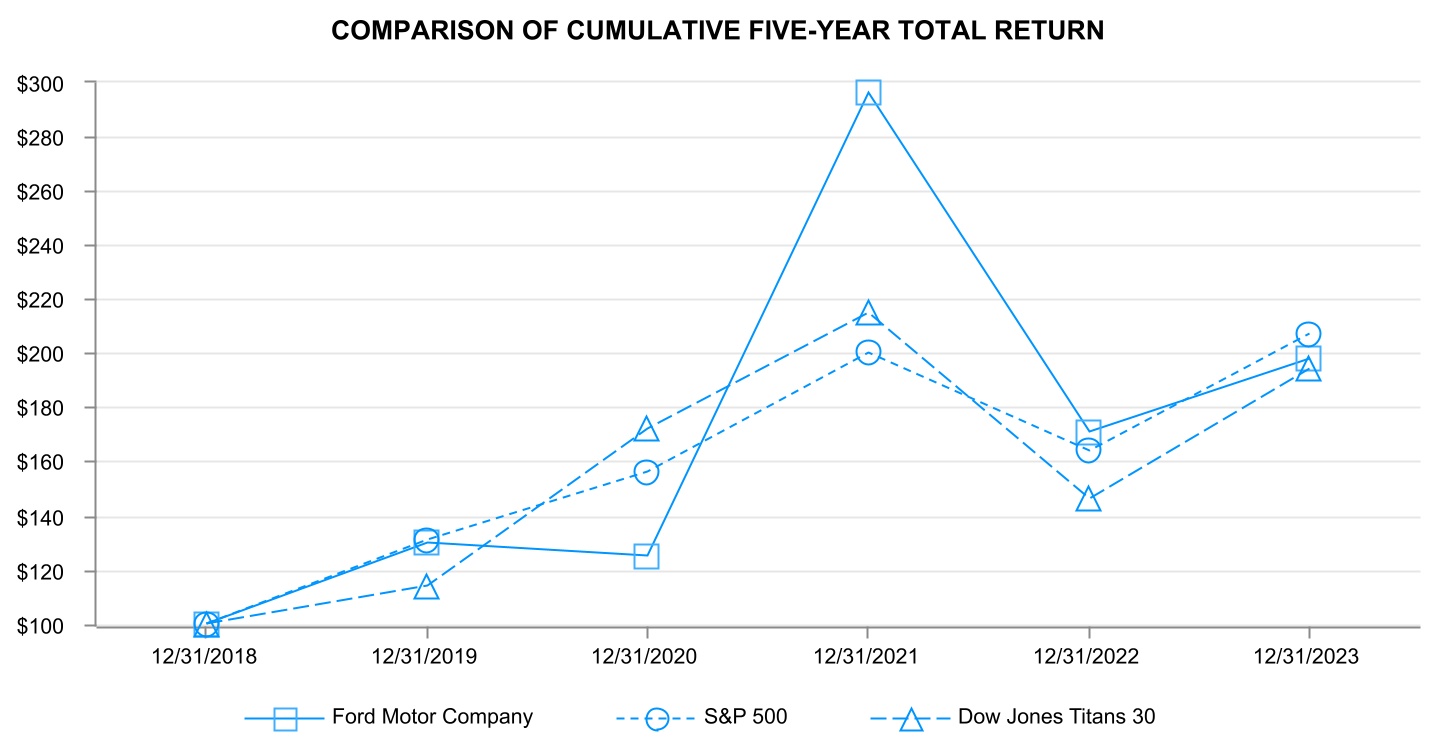][added: ]
| Company/Index | | | | | | [removed: 2018] [added: 2019] | | | | | | [removed: 2019] [added: 2020] | | | | | | [removed: 2020] [added: 2021] | | | | | | [removed: 2021] [added: 2022] | | | | | | [removed: 2022] [added: 2023] | | | | | | [removed: 2023] [added: 2024] | | |
| Mark Kosman | | | | | | Chief Accounting Officer | | | | | | February 2024 | | | | | | 59 | | |
(c)Mr. Lawler has held the position of Chief Financial Officer since October 2020.
He received the additional title of Vice Chair in June 2024.
| Ford Motor Company | | | | | | 100 | | | | | | 96 | | | | | | 228 | | | | | | 132 | | | | | | 153 | | | | | | 133 | | |
| S&P 500 | | | | | | 100 | | | | | | 118 | | | | | | 152 | | | | | | 125 | | | | | | 158 | | | | | | 197 | | |
| Dow Jones Automobiles & Parts Titans 30 | | | | | | 100 | | | | | | 151 | | | | | | 188 | | | | | | 128 | | | | | | 170 | | | | | | 183 | | |
| Theodore Cannis | | | | | | CEO, Ford Pro and Ford Customer Service Division | | | | | | September 2023 | | | | | | 57 | | |
| Peter C. Stern | | | | | | President, Integrated Services | | | | | | August 2023 | | | | | | 52 | | |
| Cathy O’Callaghan | | | | | | Controller | | | | | | June 2018 | | | | | | 55 | | |
- Peter C.
Stern was Vice President, Services at Apple from 2016 to 2023.
| Ford Motor Company | | | | | | 100 | | | | | | 130 | | | | | | 125 | | | | | | 296 | | | | | | 171 | | | | | | 198 | | |
| S&P 500 | | | | | | 100 | | | | | | 131 | | | | | | 156 | | | | | | 200 | | | | | | 164 | | | | | | 207 | | |
| Dow Jones Automobiles & Parts Titans 30 | | | | | | 100 | | | | | | 114 | | | | | | 172 | | | | | | 215 | | | | | | 146 | | | | | | 194 | | |
Item 5. Market for Registrant’s Common Equity, Related Stockholder Matters and Issuer Purchases of Equity Securities (Continued)
11 rewritten, 4 added, 10 removed, 11 unchanged
In the fourth quarter of [removed: 2023,] [added: 2024,] we completed [removed: a modest] [added: an] anti-dilutive share repurchase program to offset the dilutive effect of share-based compensation granted during [removed: 2023.][added: 2024.]
The program authorized repurchases of up to [removed: 51] [added: 53] million shares of Ford Common Stock.
As shown in the rightmost column of the table below, we do not intend to make any further purchases under this program because its anti-dilutive purpose was fulfilled after purchasing only [removed: 31] [added: 36.43] million shares.
| Total / Average | | | | | | [removed: 31,000,000] [added: 13,700,000] | | | | | | $ | [removed: 10.80] [added: 10.91] | | | | | [removed: 31,000,000] [added: 13,700,000] | | | | | | | | |
(a)The share repurchase program announced [removed: November 20, 2023] [added: February 7, 2024] authorized repurchases of up to [removed: 51] [added: 53] million shares of Ford Common Stock.
Although we have repurchased [removed: 31] [added: 36.43] million shares and the program was authorized for up to [removed: 51] [added: 53] million, we do not intend to make any further purchases under this program because its anti-dilutive purpose has been fulfilled.
The table below shows the dividends we paid per share of Common and Class B Stock for each quarterly period in [removed: 2022] [added: 2023] and [removed: 2023:][added: 2024:]
| | | | [removed: First Quarter] [added: First Quarter(a)] | | | | | | Second Quarter | | | | | | Third Quarter | | | | | | Fourth Quarter | | | | | | First Quarter(a) | | | | | | Second Quarter | | | | | | Third Quarter | | | | | | Fourth Quarter | | |
| Dividends per share of Ford Common and Class B Stock | | | $ | [removed: 0.10] [added: 0.80] | | | | | $ | [removed: 0.10] [added: 0.15] | | | | | $ | 0.15 | | | | | $ | 0.15 | | | | | $ | [removed: 0.80] [added: 0.33] | | | | | $ | 0.15 | | | | | $ | 0.15 | | | | | $ | 0.15 | |
(a)In the first quarter of [removed: 2023,] [added: 2023 and 2024,] in addition to a regular dividend of $0.15 per share, we paid a supplemental dividend of $0.65 per [removed: share.][added: share and $0.18 per share, respectively.]
On February [removed: 6, 2024,] [added: 5, 2025,] we declared a regular dividend of $0.15 per share and a supplemental dividend of [removed: $0.18] [added: $0.15] per share.
| October 1, 2024 through October 31, 2024 | | | | | | — | | | | | | $ | — | | | | | — | | | | | | 30,270,000 | | |
| November 1, 2024 through November 30, 2024 | | | | | | 13,700,000 | | | | | | 10.91 | | | | | | 13,700,000 | | | | | | 16,570,000 | | |
| December 1, 2024 through December 31, 2024 | | | | | | — | | | | | | — | | | | | | — | | | | | | 16,570,000 (a) | | |
| | | | 2023 | | | | | | | | | | | | | | | | | | | | | | | | 2024 | | | | | | | | | | | | | | | | | | | | |
| October 1, 2023 through October 31, 2023 | | | | | | — | | | | | | $ | — | | | | | — | | | | | | — | | |
| November 1, 2023 through November 30, 2023 | | | | | | 6,713,291 | | | | | | 10.25 | | | | | | 6,713,291 | | | | | | 44,286,709 | | |
| December 1, 2023 through December 31, 2023 | | | | | | 24,286,709 | | | | | | 10.95 | | | | | | 24,286,709 | | | | | | 20,000,000 (a) | | |
In December 2023, our Board of Directors approved a modest anti-dilutive share repurchase program to offset the dilutive effect of share-based compensation expected to be granted during 2024.
The program authorizes repurchases of up to 53 million shares of Ford Common Stock.
The Company may repurchase shares of Common Stock from time to time through open market purchases, in privately negotiated transactions, or by other means, including through the use of trading plans intended to satisfy the conditions of Rule 10b5-1(c) under the Securities Exchange Act of 1934, as amended, in accordance with applicable securities laws and other restrictions.
The timing and total amount of repurchases of Ford Common Stock under this program will depend upon business, economic, and market conditions, corporate, legal, and regulatory requirements, prevailing stock prices, trading volume, and other considerations.
The share repurchase program may be suspended or discontinued at any time, and does not obligate the Company to acquire any amount of Common Stock.
To the extent the Company elects to make purchases under the share repurchase program, the Company expects to utilize its existing cash and cash equivalents to fund such repurchases.
| | | | 2022 | | | | | | | | | | | | | | | | | | | | | | | | 2023 | | | | | | | | | | | | | | | | | | | | |
Item 6. [Reserved.]
330 rewritten, 193 added, 116 removed, 770 unchanged
*Currency Exchange Rate Volatility.* Globally, central banks have begun shifting from tightening policy by raising interest rates to holding rates steady or, in [removed: some] [added: several] markets, beginning to cut rates.
*Pricing Pressure.* Despite vehicle pricing remaining elevated over the last year due to strong demand, supply shortages, and inflationary costs, we have already observed [removed: moderation] [added: some declines] in [removed: the rate of] new and used vehicle [removed: price increases] [added: prices] as auto production recovers from the semiconductor shortage, but it is unclear whether prices will decline fully to pre-COVID-19 pandemic levels.
[removed: Over the long term, intense] [added: Intense] competition and excess capacity are likely to put downward pressure on inflation-adjusted [removed: prices] [added: prices, including increased marketing incentives,] for similarly-contented vehicles and contribute to a challenging pricing environment for the automotive industry in most major markets.
*Electric Vehicle Market.* Although we continue to invest in our electric vehicle strategy, we have observed lower-than-anticipated industrywide electric vehicle adoption rates and near-term pricing pressures, which has led [removed: us] [added: us,] and may in the future lead [removed: us] [added: us,] to adjust our spending, production, and/or product launches to better match the pace of electric vehicle adoption.
[removed: In some cases, spot] [added: Spot] prices for various commodities have recently diverged somewhat, as [removed: anticipated] weakening in global industrial activity mitigates price increases for base metals such as steel and aluminum, while precious metals (e.g., palladium), and raw materials that are used in batteries for electric vehicles (e.g., lithium, cobalt, [removed: nickel, graphite,] and [removed: manganese, among other materials, for batteries)] [added: nickel) have declined from historic highs but] remain elevated.
[removed: To help ensure supply of raw materials for critical components (e.g.,] batteries), we, like others in the industry, have entered into multi-year sourcing agreements and may enter into additional agreements.
In the long term, the outcome of de-carbonization and electrification of the vehicle fleet may depress oil demand, but [added: geopolitical dynamics and] the global energy transition will also contribute to ongoing volatility of oil and other energy prices.
For example, in Ford Blue, our larger, more profitable vehicles had an average contribution margin that was [removed: 139%] [added: 150%] of our total average contribution margin across all vehicles, whereas our smaller vehicles had significantly lower contribution margins.
[removed: While we believe the long-term trend will support the growth of free trade, we] [added: We] will continue to monitor and address the developing role that geopolitical, climate, and labor concerns are playing in trade relations.
*Inflation and Interest Rates.* We continue to see [removed: near-term] [added: lingering] impacts on our business due to inflation, including ongoing [removed: global price pressures in the wake of] geopolitical volatility, driving up energy prices, freight premiums, and other operating costs above normal rates.
Although headline inflation in the United States and Europe appears to have peaked, [removed: as gasoline and natural gas prices recede from the latest spike,] core inflation (excluding food and energy prices) remains elevated and is a source of continued cost pressure on businesses and households.
Interest rates have increased significantly [added: and are only now beginning to reverse,] as central banks in developed countries [removed: attempt] [added: attempted] to subdue inflation while government deficits and debt remain at high levels in many global markets.
Specifically, we include in cost of sales each of the following: material costs (including commodity costs); freight costs; warranty, including product recall costs; labor and other costs related to the development and production of our vehicles and connectivity, parts, accessories, and services; depreciation and amortization; [added: regulatory compliance expenses;] and other associated costs.
As a result, we analyze the profit impact of certain cost [removed: changes] [added: changes,] holding constant present-year volume and mix and currency exchange, in order to evaluate our cost trends absent the impact of varying production and currency exchange levels.
These costs include manufacturing; vehicle and software engineering; [removed: spending-related;] [added: spending-related (primarily depreciation and amortization for our manufacturing and engineering assets);] advertising and sales promotion; administrative, information technology, and selling; and pension and OPEB costs.
*Cost of sales* and *Selling, administrative, and other expenses* for full year [removed: 2023] [added: 2024] were [removed: $161.3] [added: $168.7] billion.
These items are discussed in more detail in Note [removed: 26] [added: 25] of the Notes to the Financial Statements.
In Note [removed: 26] [added: 25] of the Notes to the Financial Statements, special items are reflected as a separate reconciling item, as opposed to being allocated among our segments.
The table below shows our full year [removed: 2023] [added: 2024] key metrics for the Company compared to a year ago.
| Net Income/(Loss) ($M) | | | | | | (1,981) | | | | | | 4,347 | | | | | | [removed: 6,328] [added: $] | [added: 6,328] | |
Net income/(loss) margin was 2.5% in 2023, up from negative 1.3% [removed: a year ago.][added: in 2022.]
Company adjusted EBIT margin was 5.9% in 2023, down from 6.6% [removed: a year ago.][added: in 2022.]
The flat year-over-year Company adjusted EBIT primarily [removed: reflects] [added: reflected] higher Ford Pro and Ford Blue EBIT and a lower EBIT loss in Ford Next.
For a description of these causal factors, see *Definitions and Information Regarding Ford Blue, Ford Model e, [added: and] Ford Pro Causal Factors*.
| | | | [added: | | |] 2022 | | | | | | 2023 | | | | | | H / (L) | | |
| Wholesale Units (000) (a) | | | [added: | | |] 2,834 | | | | | | 2,920 | | | | | | 86 | | |
| Revenue ($M) | | | [added: | | |] $ | 94,762 | | | | | $ | 101,934 | | | | | $ | 7,172 | |
| EBIT ($M) | | | [added: | | |] 6,847 | | | | | | 7,462 | | | | | | 615 | | |
| EBIT Margin (%) | | | [added: | | |] 7.2 | | % | | | | 7.3 | | % | | | | 0.1 ppts | | |
(a)Includes Ford and Lincoln brand and JMC brand vehicles produced and sold in China by our unconsolidated affiliates (about 484,000 units in 2022 and 455,000 units in [removed: 2023)][added: 2023).]
| [removed: 2023] [added: 2023] Full Year [removed: EBIT] [added: EBIT] | | | | | | [removed: 7,462] [added: $] | [added: 7,462] | |
In 2023, Ford Blue’s wholesales increased 3% from [removed: a year ago,] [added: 2022,] primarily reflecting an improvement in production-related supply constraints, offset partially by ceasing production of EcoSport and Fiesta small vehicles and production losses during the UAW strike.
Ford Blue’s 2023 full year EBIT was $7.5 billion, an increase of $615 million from [removed: a year ago,] [added: 2022,] with an EBIT margin of 7.3%.
Partial offsets primarily [removed: include] [added: included] higher warranty costs (reflecting inflationary cost pressures and increased field service actions), higher material costs related to new products, higher structural costs and supplemental compensation (including the impact of the [removed: new] UAW collective bargaining agreement), and weaker currencies.
In 2023, Ford Model e’s wholesales increased 20% from [removed: a year ago,] [added: 2022,] primarily reflecting higher production of F-150 Lightning.
Ford Model e’s 2023 full year EBIT loss was $4.7 billion, a $2.6 billion higher loss than [removed: a year ago,] [added: in 2022,] with an EBIT margin of negative 79.7%.
In 2023, Ford Pro’s wholesales increased 6% from [removed: a year ago,] [added: 2022,] primarily reflecting an improvement in production-related supply constraints, offset partially by production losses during the UAW strike.
Ford Pro’s 2023 full year EBIT was $7.2 billion, an increase of $4.0 billion from [removed: a year ago,] [added: 2022,] with an EBIT margin of 12.4%.
Partial offsets primarily [removed: include] [added: included] higher material costs (related to inflationary cost pressures, new products, and about $80 million of volume-related obligations for batteries), higher warranty costs (reflecting inflationary cost pressures and increased field service actions), and higher structural costs (including volume-related) and supplemental compensation (including the impact of the [removed: new] UAW collective bargaining agreement).
*•Other* – includes a variety of items, such as parts and services earnings, royalties, government incentives, [removed: and] compensation-related [removed: changes][added: changes, and regulatory compliance expenses]
In addition, as governments consider an expanded use of tariffs as a lever in achieving a balance of trade, this new dynamic could have a substantial adverse effect on our business and the automotive sector.
The new, substantial tariff increases on imports to the United States from Canada and Mexico (in addition to China) announced on February 1, 2025, should they be implemented and sustained for an extended period of time, would have a significant adverse effect, including financial, on the overall automotive industry, Ford, and our supply chain.
*Production and Supply Chain.* We continued to see improved supply chain throughput in 2024 resulting from improved resilience to short term disruptions.
However, production constraints due to capacity and labor shortages remain as we adjust to shifting market conditions and balance our production mix, and the increased tariffs announced on February 1, 2025 and any additional tariffs, as discussed above, could have a significant impact on our supply chain and, in turn, our production.
In 2024, we recorded $1.2 billion of expenses related to the cancellation of a previously announced all-electric three-row SUV program.
We may incur additional expenses and cash expenditures of about $700 million related to the cancellation, the majority of which we expect to record by the first half of 2025.
Further, significant unexpected changes in the EV demand environment have led, and may in the future lead, to incremental competitive pricing actions, and we may continue to incur expenses related to payments to our electric vehicle-related suppliers (battery, raw material, or otherwise), asset write-downs, or other matters.
These market dynamics may continue to occur, which could have a substantial impact on our business, including our investments in supply and production capacity.
In addition, policy change in the United States could reduce or eliminate supply- and demand-side incentives, resulting in slower adoption of EVs.
Further, the pace of EV adoption could force Ford to take various product-led actions (e.g., curtailing the production and sale of certain internal combustion vehicles) that could have substantial adverse effects on our sales volume and operations.
To help ensure supply of raw materials for critical components (e.g.,
We also earn income from operating lease assets, primarily vehicles, and record the income on a straight-line basis over the term of the lease agreement.
| | | | | | | 2023 | | | | | | 2024 | | |
| Europe | | | | | | $ | (978) | | | | | $ | (716) | |
| North America Hourly Buyouts | | | | | | — | | | | | | (260) | | |
| China | | | | | | (958) | | | | | | (16) | | |
| Subtotal Restructuring | | | | | | $ | (2,023) | | | | | $ | (992) | |
| EV program cancellation | | | | | | $ | — | | | | | $ | (1,200) | |
| Transit Connect customs matter | | | | | | (396) | | | | | | — | | |
| Extended Oakville Assembly Plant Changeover | | | | | | — | | | | | | (181) | | |
| EV program dispute | | | | | | (143) | | | | | | 19 | | |
| Other (including gains/(losses) on investments) | | | | | | (188) | | | | | | 22 | | |
(a)2023 includes $28 million related to restructuring charges in India and $41 million in North America.
We recorded $1,860 million of pre-tax special item charges in 2024, primarily reflecting a write-down of certain product specific assets and other expenses related to the cancellation of a previously planned all-electric three-row SUV program, continued ongoing restructuring actions in Europe, and buyouts for hourly employees in North America.
Pension and OPEB remeasurement was a partial offset.
| | | | | | | 2023 | | | | | | 2024 | | | | | | H / (L) | | |
| Revenue ($M) | | | | | | 176,191 | | | | | | 184,992 | | | | | | 5 | | % |
| Net Income/(Loss) ($M) | | | | | | 4,347 | | | | | | 5,879 | | | | | | $ | 1,532 | |
| EPS (Diluted) | | | | | | $ | 1.08 | | | | | $ | 1.46 | | | | | $ | 0.38 | |
| Adjusted EPS (Diluted) | | | | | | $ | 2.01 | | | | | $ | 1.84 | | | | | $ | (0.17) | |
Net income/(loss) margin was 3.2% in 2024, up from 2.5% a year ago.
| | | | | | | 2023 | | | | | | 2024 | | | | | | H / (L) | | |
| Ford Blue | | | | | | $ | 7,462 | | | | | $ | 5,284 | | | | | $ | (2,178) | |
| Ford Model e | | | | | | (4,701) | | | | | | (5,076) | | | | | | (375) | | |
| Ford Next | | | | | | (138) | | | | | | (50) | | | | | | 88 | | |
| Ford Credit | | | | | | 1,331 | | | | | | 1,654 | | | | | | 323 | | |
| Corporate Other | | | | | | (760) | | | | | | (619) | | | | | | 141 | | |
| Interest on Debt | | | | | | (1,302) | | | | | | (1,115) | | | | | | 187 | | |
| Special Items | | | | | | (5,147) | | | | | | (1,860) | | | | | | 3,287 | | |
| Taxes / Noncontrolling Interests | | | | | | 380 | | | | | | (1,354) | | | | | | (1,734) | | |
*Production and Supply Chain.* Although we saw improvements in our supply chain throughout 2023, including easing of the semiconductor shortage, we continue to face some production issues due to, among other things, labor shortages at our suppliers.
Moreover, we have received and continue to receive claims from our supply base related to inflationary pressure and production disruption.
Upon receipt, we evaluate those claims, and, in certain circumstances, in order to ensure continuity of supply and mitigate the impact on our production, have made payments to our suppliers, sometimes under duress.
As a result of the lower-than-anticipated adoption rates, near-term pricing pressures, and other factors, we recorded about $0.7 billion of charges in 2023 and may continue to incur charges, which could be substantial, related to payments to our electric vehicle-related suppliers (battery, raw material, or otherwise), inventory adjustments, or other matters.
Vehicles sold to daily rental car companies with an obligation to repurchase at an agreed upon amount, exercisable at the option of the customer, are accounted for as operating leases, with lease revenue recognized over the term of the lease.
| | | | | | | | | | | | | | | |
*▪Pension and OPEB* – consists primarily of past service pension costs and other postretirement employee benefit costs
| Auction Values (b) | | | | | | $ | 32,410 | | | | | $ | 30,005 | | | | | (7) | | % |
Ford Credit’s loss metrics continue to normalize from historic lows.
We are planning for full year 2024 auction values to decrease as vehicle availability continues to improve.
| | | | | | | 2021 | | | | | | 2022 | | |
| Global Redesign | | | | | | | | | | | | | | |
| Europe | | | | | | $ | (530) | | | | | $ | (151) | |
| India | | | | | | (468) | | | | | | (298) | | |
| South America | | | | | | (803) | | | | | | 53 | | |
| China (including Taiwan) | | | | | | 150 | | | | | | (380) | | |
| North America | | | | | | (72) | | | | | | (198) | | |
| Subtotal Global Redesign | | | | | | $ | (1,720) | | | | | $ | (967) | |
| Gain/(loss) on Rivian investment | | | | | | $ | 9,096 | | | | | $ | (7,377) | |
| Debt extinguishment premium | | | | | | (1,692) | | | | | | (135) | | |
| AV strategy including Argo impairment | | | | | | — | | | | | | (2,812) | | |
| Ford Credit – Brazil restructuring | | | | | | 14 | | | | | | (155) | | |
| Russia suspension of operations/asset write-off | | | | | | — | | | | | | (158) | | |
| Patent matters related to prior calendar years | | | | | | — | | | | | | (124) | | |
| Cash effect of Global Redesign (incl. separations) | | | | | | $ | (1,935) | | | | | $ | (377) | |
For full year 2022, we recorded $12.2 billion of pre-tax special item charges, driven by a $7.4 billion mark-to-market net loss on our Rivian investment and a $2.7 billion impairment on our Argo investment.
| | | | | | | 2021 | | | | | | 2022 | | | | | | H / (L) | | |
| Revenue ($M) | | | | | | 136,341 | | | | | | 158,057 | | | | | | 16 | | % |
| Net Income/(Loss) ($M) | | | | | | 17,937 | | | | | | (1,981) | | | | | | $ | (19,918) | |
| EPS (Diluted) | | | | | | $ | 4.45 | | | | | $ | (0.49) | | | | | $ | (4.94) | |
| Adjusted EPS (Diluted) | | | | | | $ | 1.59 | | | | | $ | 1.88 | | | | | $ | 0.29 | |
Net income/(loss) margin was negative 1.3% in 2022, down from 13.2% in 2021.
| Ford Blue | | | | | | $ | 3,293 | | | | | $ | 6,847 | | | | | $ | 3,554 | |
| Ford Model e | | | | | | (892) | | | | | | (2,133) | | | | | | (1,241) | | |
| Ford Next | | | | | | (1,030) | | | | | | (926) | | | | | | 104 | | |
| Ford Credit | | | | | | 4,717 | | | | | | 2,657 | | | | | | (2,060) | | |
| Corporate Other | | | | | | 1,247 | | | | | | 748 | | | | | | (499) | | |
| Interest on Debt | | | | | | (1,803) | | | | | | (1,259) | | | | | | 544 | | |
| Special Items | | | | | | 9,583 | | | | | | (12,172) | | | | | | (21,755) | | |
| Taxes / Noncontrolling Interests | | | | | | 157 | | | | | | 1,035 | | | | | | 878 | | |
An excerpt. Shown here: 40 of 330 rewritten, 40 of 193 added and 40 of 116 removed. The counts are complete. For every sentence, read Item 6. [Reserved.] in the FY2024 filing and the FY2023 filing.
Item 8. Financial Statements and Supplementary Data.
1 rewritten, 0 added, 0 removed, 1 unchanged
Exhibits and Financial Statement Schedules” and are set forth beginning on page [removed: [105](#i96162517ffc0476786ba5f043a4bb2e7_271)] [added: [105](#if98d7df654e1473ab87a6f3d26985799_259)] immediately following the signature pages of this Report.
Item 9A. Controls and Procedures.
5 rewritten, 0 added, 0 removed, 7 unchanged
Lawler, our Chief Financial Officer (“CFO”), have performed an evaluation of the Company’s disclosure controls and procedures, as that term is defined in Rule 13a-15(e) or 15d-15(e) of the Securities Exchange Act of 1934, as amended (“Exchange Act”), as of December 31, [removed: 2023,] [added: 2024,] and each has concluded that such disclosure controls and procedures are effective to ensure that information required to be disclosed in our periodic reports filed under the Exchange Act is recorded, processed, summarized, and reported within the time periods specified by SEC rules and forms, and that such information is accumulated and communicated to the CEO and CFO to allow timely decisions regarding required disclosures.
Under the supervision and with the participation of our management, including our CEO and CFO, we conducted an assessment of the effectiveness of our internal control over financial reporting as of December 31, [removed: 2023.][added: 2024.]
Based on this assessment, management concluded that our internal control over financial reporting was effective as of December 31, [removed: 2023.][added: 2024.]
The effectiveness of the Company’s internal control over financial reporting as of December 31, [removed: 2023] [added: 2024] has been audited by PricewaterhouseCoopers LLP (PCAOB ID 238), an independent registered public accounting firm, as stated in its report included herein.
*Changes in Internal Control Over Financial Reporting.* There were no changes in internal control over financial reporting during the quarter ended December 31, [removed: 2023] [added: 2024] that have materially affected, or are reasonably likely to materially affect, our internal control over financial reporting.
Item 9B. Other Information.
1 rewritten, 3 added, 0 removed, 0 unchanged
During the [removed: three months] [added: quarter] ended December 31, [removed: 2023,] [added: 2024,] no director or officer [added: (as defined in Rule 16a-1(f) under the Exchange Act)] of the Company adopted, modified, or terminated a “Rule 10b5-1 trading arrangement” or a “non-Rule 10b5-1 trading arrangement” as each term is defined in Item 408(a) of Regulation [removed: S-K.][added: S-K, except as follows:]
Andrew Frick, President, Ford Blue and Ford Customer Service Division, adopted a Rule 10b5-1 trading arrangement on December 24, 2024 that is intended to satisfy the affirmative defense of Rule 10b5-1(c) under the Exchange Act.
The arrangement provides for the potential sale of up to 85,896 shares of Common Stock of the Company, subject to certain conditions.
The arrangement was adopted during an open trading window and has an expiration date of December 23, 2025.
Item 10. Directors, Executive Officers of Ford, and Corporate Governance.
1 rewritten, 2 added, 0 removed, 9 unchanged
The information required by Item 10 regarding our codes of ethics is incorporated by reference from the information under the caption “Corporate Governance – Codes of [removed: Ethics”] [added: Ethics and Insider Trading”] in our Proxy Statement.
The information required by Item 10 regarding our insider trading arrangements and policies is incorporated by reference from the information under the caption “Corporate Governance – Codes of Ethics and Insider Trading Policy” in our Proxy Statement.
A copy of our insider trading policy is filed as Exhibit 19 to this Report.
Item 11. Executive Compensation.
1 rewritten, 0 added, 0 removed, 0 unchanged
The information required by Item 11 is incorporated by reference from the information under the following captions in our Proxy Statement: “Director Compensation in [removed: 2023,”] [added: 2024,”] “Compensation Discussion and Analysis,” “Compensation Committee Report,” “Compensation Committee Interlocks and Insider Participation,” “Compensation of Named Executives,” “Summary Compensation Table,” “Grants of Plan-Based Awards in [removed: 2023,”] [added: 2024,”] “Outstanding Equity Awards at [removed: 2023] [added: 2024] Fiscal Year-End,” “Option Exercises and Stock Vested in [removed: 2023,”] [added: 2024,”] “Pension Benefits in [removed: 2023,”] [added: 2024,”] “Nonqualified Deferred Compensation in [removed: 2023,”] [added: 2024,”] “Potential Payments Upon Termination or Change-in-Control,” and “Pay Ratio.”
Item 15. Exhibits and Financial Statement Schedules.
93 rewritten, 7 added, 1 removed, 39 unchanged
The following are contained in this [removed: 2023] [added: 2024] Form 10-K Report:
- Consolidated Statements of Cash Flows for the years ended December 31, [removed: 2021,] 2022, [added: 2023,] and [removed: 2023.][added: 2024.]
- Consolidated Income Statements for the years ended December 31, [removed: 2021,] 2022, [added: 2023,] and [removed: 2023.][added: 2024.]
- Consolidated Statements of Comprehensive Income for the years ended December 31, [removed: 2021,] 2022, [added: 2023,] and [removed: 2023.][added: 2024.]
- Consolidated Balance Sheets at December 31, [removed: 2022] [added: 2023] and [removed: 2023.][added: 2024.]
- Consolidated Statements of Equity for the years ended December 31, [removed: 2021,] 2022, [added: 2023,] and [removed: 2023.][added: 2024.]
The Report of Independent Registered Public Accounting Firm, the Consolidated Financial Statements, and the Notes to the Financial Statements listed above are filed as part of this Report and are set forth beginning on page [removed: [105](#i96162517ffc0476786ba5f043a4bb2e7_271)] [added: [105](#if98d7df654e1473ab87a6f3d26985799_259)] immediately following the signature pages of this Report.
| Schedule II | | | | | | Valuation and Qualifying Accounts for the years ended [removed: 2021,] 2022, [added: 2023,] and [removed: 2023] [added: 2024] | | |
Schedule II is filed as part of this Report and is set forth on page [removed: [179](#i96162517ffc0476786ba5f043a4bb2e7_397)] [added: [177](#if98d7df654e1473ab87a6f3d26985799_379)] immediately following the Notes to the Financial Statements referred to above.
| [Exhibit [removed: 3-A](http://www.sec.gov/Archives/edgar/data/37996/000003799601000014/0000037996-01-000014-0002.txt)] [added: 3-A](https://www.sec.gov/Archives/edgar/data/37996/000003799601000014/0000037996-01-000014-0002.txt)] | | | | | | Restated Certificate of Incorporation, dated August 2, 2000. | | | | | | Filed as Exhibit 3-A to our Annual Report on Form 10-K for the year ended December 31, 2000. (a) | | |
| [Exhibit [removed: 3-A-1](http://www.sec.gov/Archives/edgar/data/37996/000114036109020642/ex3_1.htm)] [added: 3-A-1](https://www.sec.gov/Archives/edgar/data/37996/000114036109020642/ex3_1.htm)] | | | | | | Certificate of Designations of Series A Junior Participating Preferred Stock filed on September 11, 2009. | | | | | | Filed as Exhibit 3.1 to our Current Report on Form 8-K filed September 11, 2009. (a) | | |
| [Exhibit [removed: 3-B](http://www.sec.gov/Archives/edgar/data/37996/000003799622000085/exhibit31-byxlawsxfordmoto.htm)] [added: 3-B](https://www.sec.gov/Archives/edgar/data/37996/000003799622000085/exhibit31-byxlawsxfordmoto.htm)] | | | | | | By-laws. | | | | | | Filed as Exhibit 3.1 to our Form 8-K filed on December 9, 2022. (a) | | |
| [Exhibit [removed: 4-A](http://www.sec.gov/Archives/edgar/data/37996/000114036109020642/ex4_1.htm)] [added: 4-A](https://www.sec.gov/Archives/edgar/data/37996/000114036109020642/ex4_1.htm)] | | | | | | Tax Benefit Preservation Plan (“TBPP”) dated September 11, 2009 between Ford Motor Company and Computershare Trust Company, N.A. | | | | | | Filed as Exhibit 4.1 to our Current Report on Form 8-K filed September 11, 2009. (a) | | |
| [Exhibit [removed: 4-A-1](http://www.sec.gov/Archives/edgar/data/37996/000110465912062950/a12-20593_1ex4.htm)] [added: 4-A-1](https://www.sec.gov/Archives/edgar/data/37996/000110465912062950/a12-20593_1ex4.htm)] | | | | | | Amendment No. 1 to TBPP dated September 11, 2012. | | | | | | Filed as Exhibit 4 to our Current Report on Form 8-K filed September 12, 2012. (a) | | |
| [Exhibit [removed: 4-A-2](http://www.sec.gov/Archives/edgar/data/37996/000003799615000055/exhibit4totbpp8-kdated9x10.htm)] [added: 4-A-2](https://www.sec.gov/Archives/edgar/data/37996/000003799615000055/exhibit4totbpp8-kdated9x10.htm)] | | | | | | Amendment No. 2 to TBPP dated September 9, 2015. | | | | | | Filed as Exhibit 4 to our Current Report on Form 8-K filed September 11, 2015. (a) | | |
| [Exhibit [removed: 4-A-3](http://www.sec.gov/Archives/edgar/data/37996/000003799618000077/amendmentno3totbpp.htm)] [added: 4-A-3](https://www.sec.gov/Archives/edgar/data/37996/000003799618000077/amendmentno3totbpp.htm)] | | | | | | Amendment No. 3 to TBPP dated September 13, 2018. | | | | | | Filed as Exhibit 4 to our Current Report on Form 8-K filed September 14, 2018. (a) | | |
| [Exhibit [removed: 4-A-4](http://www.sec.gov/Archives/edgar/data/0000037996/000003799621000071/exhibit4_amendmentno4totbpp.htm)] [added: 4-A-4](https://www.sec.gov/Archives/edgar/data/0000037996/000003799621000071/exhibit4_amendmentno4totbpp.htm)] | | | | | | Amendment No. 4 to TBPP dated September 9, 2021. | | | | | | Filed as Exhibit 4 to our Current Report on Form 8-K filed September 10, 2021. (a) | | |
| [Exhibit [removed: 4-B](https://www.sec.gov/Archives/edgar/data/37996/000003799624000009/f12312023exhibit4-b.htm)] [added: 4-B](https://www.sec.gov/Archives/edgar/data/37996/000003799625000013/f12312024exhibit4-b.htm)] | | | | | | Description of Securities. | | | | | | Filed with this Report. | | |
| [Exhibit [removed: 10-A](http://www.sec.gov/Archives/edgar/data/37996/000003799618000012/exhibit101-x2018esapxresta.htm)] [added: 10-A](https://www.sec.gov/Archives/edgar/data/0000037996/000003799624000063/ex1022024esapar.htm)] | | | | | | Executive Separation Allowance Plan, as amended and restated effective as of [removed: January 1, 2018.] [added: March 14, 2024.] (b) | | | | | | Filed as Exhibit [removed: 10.1] [added: 10.2] to our Current Report on Form 8-K filed [removed: February 7, 2018.] [added: March 14, 2024.] (a) | | |
| [Exhibit [removed: 10-B](http://www.sec.gov/Archives/edgar/data/37996/000003799612000007/f12312011exhibit10-b.htm)] [added: 10-B](https://www.sec.gov/Archives/edgar/data/37996/000003799612000007/f12312011exhibit10-b.htm)] | | | | | | Deferred Compensation Plan for Non-Employee Directors, as amended and restated as of January 1, 2012. (b) | | | | | | Filed as Exhibit 10-B to our Annual Report on Form 10-K for the year ended December 31, 2011. (a) | | |
| [Exhibit [removed: 10-C](http://www.sec.gov/Archives/edgar/data/37996/000003799614000010/f12312013exhibit10-c.htm)] [added: 10-C](https://www.sec.gov/Archives/edgar/data/37996/000003799614000010/f12312013exhibit10-c.htm)] | | | | | | 2014 Stock Plan for Non-Employee [removed: Directors] [added: Directors.] (b) | | | | | | Filed as Exhibit 10-C to our Annual Report on Form 10-K for the year ended December 31, 2013. (a) | | |
| [Exhibit [removed: 10-D](http://www.sec.gov/Archives/edgar/data/37996/000003799622000024/f03312022exhibit103.htm)] [added: 10-](https://www.sec.gov/Archives/edgar/data/37996/000003799622000024/f03312022exhibit103.htm)[E](https://www.sec.gov/Archives/edgar/data/37996/000003799622000024/f03312022exhibit103.htm)] | | | | | | Benefit Equalization Plan, as amended and restated effective as of January 1, 2022. (b) | | | | | | Filed as Exhibit 10.3 to our Quarterly Report on Form 10-Q for the quarter ended March 31, 2022. (a) | | |
| [Exhibit [removed: 10-E](https://www.sec.gov/Archives/edgar/data/37996/000003799620000010/f12312019exhibit10-e.htm)] [added: 10-](https://www.sec.gov/Archives/edgar/data/37996/000003799620000010/f12312019exhibit10-e.htm)[F](https://www.sec.gov/Archives/edgar/data/37996/000003799620000010/f12312019exhibit10-e.htm)] | | | | | | Description of financial counseling services provided to certain executives. (b) | | | | | | Filed as Exhibit 10-E to our Annual Report on Form 10-K for the year ended December 31, 2019. (a) | | |
| [Exhibit [removed: 10-F](http://www.sec.gov/Archives/edgar/data/37996/000003799622000024/f03312022exhibit104.htm)] [added: 10-](https://www.sec.gov/Archives/edgar/data/37996/000003799622000024/f03312022exhibit105.htm)[G](https://www.sec.gov/Archives/edgar/data/37996/000003799622000024/f03312022exhibit105.htm)[\-1](https://www.sec.gov/Archives/edgar/data/37996/000003799622000024/f03312022exhibit105.htm)] | | | | | | Defined [removed: Benefit] [added: Contribution] Supplemental Executive Retirement Plan, as amended and restated effective as of January 1, 2022. (b) | | | | | | Filed as Exhibit [removed: 10.4] [added: 10.5] to our Quarterly Report on Form 10-Q for the quarter ended March 31, 2022. (a) | | |
| [Exhibit [removed: 10-F-1](https://www.sec.gov/Archives/edgar/data/37996/000003799622000024/f03312022exhibit105.htm)] [added: 10-](https://www.sec.gov/Archives/edgar/data/0000037996/000003799624000063/ex1012024dbserpar.htm)[G](https://www.sec.gov/Archives/edgar/data/0000037996/000003799624000063/ex1012024dbserpar.htm)] | | | | | | Defined [removed: Contribution] [added: Benefit] Supplemental Executive Retirement Plan, as amended and restated effective as of [removed: January 1, 2022.] [added: March 14, 2024.] (b) | | | | | | Filed as Exhibit [removed: 10.5] [added: 10.1] to our [removed: Quarterly] [added: Current] Report on Form [removed: 10-Q for the quarter ended] [added: 8-K filed] March [removed: 31, 2022.] [added: 14, 2024.] (a) | | |
| [Exhibit [removed: 10-G](http://www.sec.gov/Archives/edgar/data/37996/000114036106016173/ex10_g3.htm)] [added: 10-](https://www.sec.gov/Archives/edgar/data/37996/000114036106016173/ex10_g3.htm)[H](https://www.sec.gov/Archives/edgar/data/37996/000114036106016173/ex10_g3.htm)] | | | | | | Description of Director Compensation as of July 13, 2006. (b) | | | | | | Filed as Exhibit 10-G-3 to our Quarterly Report on Form 10-Q for the quarter ended September 30, 2006. (a) | | |
| [Exhibit [removed: 10-G-1](http://www.sec.gov/Archives/edgar/data/37996/000003799612000007/f12312011exhibit10-fx3.htm)] [added: 10-](https://www.sec.gov/Archives/edgar/data/37996/000003799612000007/f12312011exhibit10-fx3.htm)[H](https://www.sec.gov/Archives/edgar/data/37996/000003799612000007/f12312011exhibit10-fx3.htm)[\-1](https://www.sec.gov/Archives/edgar/data/37996/000003799612000007/f12312011exhibit10-fx3.htm)] | | | | | | Amendment to Description of Director Compensation as of February 8, 2012. (b) | | | | | | Filed as Exhibit 10-F-3 to our Annual Report on Form 10-K for the year ended December 31, 2011. (a) | | |
| [Exhibit [removed: 10-G-2](http://www.sec.gov/Archives/edgar/data/37996/000003799614000010/f12312013exhibit10-gx2.htm)] [added: 10-](https://www.sec.gov/Archives/edgar/data/37996/000003799614000010/f12312013exhibit10-gx2.htm)[H](https://www.sec.gov/Archives/edgar/data/37996/000003799614000010/f12312013exhibit10-gx2.htm)[\-2](https://www.sec.gov/Archives/edgar/data/37996/000003799614000010/f12312013exhibit10-gx2.htm)] | | | | | | Amendment to Description of Director Compensation as of July 1, 2013. (b) | | | | | | Filed as Exhibit 10-G-2 to our Annual Report on Form 10-K for the year ended December 31, 2013. (a) | | |
| [Exhibit [removed: 10-G-3](http://www.sec.gov/Archives/edgar/data/37996/000003799617000013/f12312016exhibit10-gx3.htm)] [added: 10-](https://www.sec.gov/Archives/edgar/data/37996/000003799617000013/f12312016exhibit10-gx3.htm)[H](https://www.sec.gov/Archives/edgar/data/37996/000003799617000013/f12312016exhibit10-gx3.htm)[\-3](https://www.sec.gov/Archives/edgar/data/37996/000003799617000013/f12312016exhibit10-gx3.htm)] | | | | | | Amendment to Description of Director Compensation as of January 1, 2017. (b) | | | | | | Filed as Exhibit 10-G-3 to our Annual Report on Form 10-K for the year ended December 31, 2016. (a) | | |
| [Exhibit [removed: 10-H](http://www.sec.gov/Archives/edgar/data/37996/000114036108018630/ex10_1.htm)] [added: 10-](https://www.sec.gov/Archives/edgar/data/37996/000114036108018630/ex10_1.htm)[I](https://www.sec.gov/Archives/edgar/data/37996/000114036108018630/ex10_1.htm)] | | | | | | 2008 Long-Term Incentive Plan. (b) | | | | | | Filed as Exhibit 10.1 to our Quarterly Report on Form 10-Q for the quarter ended June 30, 2008. (a) | | |
| [Exhibit [removed: 10-I](http://www.sec.gov/Archives/edgar/data/37996/000003799622000013/f12312021exhibit10-i.htm)] [added: 10-](https://www.sec.gov/Archives/edgar/data/37996/000003799622000013/f12312021exhibit10-i.htm)[J](https://www.sec.gov/Archives/edgar/data/37996/000003799622000013/f12312021exhibit10-i.htm)] | | | | | | Description of Vehicle Evaluation Program for Non-Executive Directors. (b) | | | | | | Filed as Exhibit 10-I to our Annual Report on Form 10-K for the year ended December 31, 2021. (a) | | |
| [Exhibit [removed: 10-J](http://www.sec.gov/Archives/edgar/data/37996/000115752311001210/a6622311_ex10i.htm)] [added: 10-](https://www.sec.gov/Archives/edgar/data/37996/000115752311001210/a6622311_ex10i.htm)[K](https://www.sec.gov/Archives/edgar/data/37996/000115752311001210/a6622311_ex10i.htm)] | | | | | | Non-Employee Directors Life Insurance and Optional Retirement Plan as amended and restated as of December 31, 2010. (b) | | | | | | Filed as Exhibit 10-I to our Annual Report on Form 10-K for the year ended December 31, 2010. (a) | | |
| Exhibit [removed: 10-K] [added: 10-L] | | | | | | Description of Non-Employee Directors Accidental Death, Dismemberment and Permanent Total Disablement Indemnity. (b) | | | | | | Filed as Exhibit 10-S to our Annual Report on Form 10-K for the year ended December 31, 1992. (a) | | |
| [Exhibit [removed: 10-K-1](http://www.sec.gov/Archives/edgar/data/37996/000003799614000010/f12312013exhibit10-kx1.htm)] [added: 10-](https://www.sec.gov/Archives/edgar/data/37996/000003799614000010/f12312013exhibit10-kx1.htm)[L](https://www.sec.gov/Archives/edgar/data/37996/000003799614000010/f12312013exhibit10-kx1.htm)[\-1](https://www.sec.gov/Archives/edgar/data/37996/000003799614000010/f12312013exhibit10-kx1.htm)] | | | | | | Description of Amendment to Basic Life Insurance and Accidental Death & Dismemberment Insurance. (b) | | | | | | Filed as Exhibit 10-K-1 to our Annual Report on Form 10-K for the year ended December 31, 2013. (a) | | |
| [Exhibit [removed: 10-L](https://www.sec.gov/Archives/edgar/data/37996/000003799624000009/f12312023exhibit10-l.htm)] [added: 10-](https://www.sec.gov/Archives/edgar/data/37996/000003799624000009/f12312023exhibit10-l.htm)[M](https://www.sec.gov/Archives/edgar/data/37996/000003799624000009/f12312023exhibit10-l.htm)] | | | | | | Offer Letter to Peter Stern dated July 21, 2023. (b) | | | | | | Filed [removed: with this Report.] [added: as Exhibit 10-L to our Annual Report on Form 10-K for the year ended December 31, 2023. (a)] | | |
| [Exhibit [removed: 10-](http://www.sec.gov/Archives/edgar/data/37996/000003799622000013/f123121exhibit10-n.htm)[M](http://www.sec.gov/Archives/edgar/data/37996/000003799622000013/f123121exhibit10-n.htm)] [added: 10-](https://www.sec.gov/Archives/edgar/data/37996/000003799622000013/f123121exhibit10-n.htm)[N](https://www.sec.gov/Archives/edgar/data/37996/000003799622000013/f123121exhibit10-n.htm)] | | | | | | Offer Letter to Doug Field dated August 26, 2021. (b) | | | | | | Filed as Exhibit 10-N to our Annual Report on Form 10-K for the year ended December 31, 2021. (a) | | |
| [Exhibit [removed: 10-](https://www.sec.gov/Archives/edgar/data/37996/000003799620000071/f09302020exhibit101.htm)[N](https://www.sec.gov/Archives/edgar/data/37996/000003799620000071/f09302020exhibit101.htm)] [added: 10-](https://www.sec.gov/Archives/edgar/data/37996/000003799620000071/f09302020exhibit101.htm)[O](https://www.sec.gov/Archives/edgar/data/37996/000003799620000071/f09302020exhibit101.htm)] | | | | | | Agreement between Ford Motor Company and James D. Farley, Jr. dated August 3, 2020. (b) | | | | | | Filed as Exhibit 10.1 to our Quarterly Report on Form 10-Q for the quarter ended September 30, 2020. (a) | | |
| [Exhibit [removed: 10-](http://www.sec.gov/Archives/edgar/data/37996/000003799618000012/exhibit104-x2018srpxrestat.htm)[O](http://www.sec.gov/Archives/edgar/data/37996/000003799618000012/exhibit104-x2018srpxrestat.htm)] [added: 10-](https://www.sec.gov/Archives/edgar/data/0000037996/000003799624000063/ex1032024srpar.htm)[P](https://www.sec.gov/Archives/edgar/data/0000037996/000003799624000063/ex1032024srpar.htm)] | | | | | | Select Retirement Plan, as amended and restated effective as of [removed: January 1, 2018.] [added: March 14, 2024.] (b) | | | | | | Filed as Exhibit [removed: 10.4] [added: 10.3] to our Current Report on Form 8-K filed [removed: February 7, 2018.] [added: March 14, 2024.] (a) | | |
| [Exhibit [removed: 10-](http://www.sec.gov/Archives/edgar/data/37996/000115752311001210/a6622311_ex10m.htm)[P](http://www.sec.gov/Archives/edgar/data/37996/000115752311001210/a6622311_ex10m.htm)] [added: 10-](https://www.sec.gov/Archives/edgar/data/37996/000115752311001210/a6622311_ex10m.htm)[Q](https://www.sec.gov/Archives/edgar/data/37996/000115752311001210/a6622311_ex10m.htm)] | | | | | | Deferred Compensation Plan, as amended and restated as of December 31, 2010. (b) | | | | | | Filed as Exhibit 10-M to our Annual Report on Form 10-K for the year ended December 31, 2010. (a) | | |
| [Exhibit [removed: 10-](http://www.sec.gov/Archives/edgar/data/37996/000115752310001218/a6182308ex10m1.htm)[P](http://www.sec.gov/Archives/edgar/data/37996/000115752310001218/a6182308ex10m1.htm)[\-1](http://www.sec.gov/Archives/edgar/data/37996/000115752310001218/a6182308ex10m1.htm)] [added: 10-](https://www.sec.gov/Archives/edgar/data/37996/000115752310001218/a6182308ex10m1.htm)[Q](https://www.sec.gov/Archives/edgar/data/37996/000115752310001218/a6182308ex10m1.htm)[\-1](https://www.sec.gov/Archives/edgar/data/37996/000115752310001218/a6182308ex10m1.htm)] | | | | | | Suspension of Open Enrollment in Deferred Compensation Plan. (b) | | | | | | Filed as Exhibit 10-M-1 to our Annual Report on Form 10-K for the year ended December 31, 2009. (a) | | |
| [Exhibit 4-A-5](https://www.sec.gov/Archives/edgar/data/0000037996/000003799624000176/exhibit4amendmentno5totbpp.htm) | | | | | | Amendment No. 5 to TBPP dated September 12, 2024. | | | | | | Filed as Exhibit 4 to our Current Report on Form 8-K filed September 13, 2024. (a) | | |
| [Exhibit 10-T](https://www.sec.gov/Archives/edgar/data/37996/000003799625000013/f12312024exhibit10-t.htm) | | | | | | 2023 Long-Term Incentive Plan, as amended January 1, 2025. (b) | | | | | | Filed with this Report. | | |
| [Exhibit 10-U-14](https://www.sec.gov/Archives/edgar/data/0000037996/000003799624000071/exhibit101.htm) | | | | | | Twenty-First Amendment dated April 22, 2024 to our Credit Agreement dated as of December 15, 2006, as amended and restated as of November 24, 2009, as amended and restated as of April 30, 2014, as amended and restated as of April 30, 2015, as amended and restated as of September 29, 2021, and as further amended. | | | | | | Filed as Exhibit 10.1 to our Current Report on Form 8-K filed April 22, 2024. (a) | | |
| [Exhibit 10-V-6](https://www.sec.gov/Archives/edgar/data/0000037996/000003799624000071/exhibit102.htm) | | | | | | Sixth Amendment dated April 22, 2024 to the Revolving Credit Agreement dated April 23, 2019, as amended and restated as of September 29, 2021, and as further amended. | | | | | | Filed as Exhibit 10.2 to our Current Report on Form 8-K filed April 22, 2024. (a) | | |
| [Exhibit 10-W-3](https://www.sec.gov/Archives/edgar/data/0000037996/000003799624000071/exhibit103.htm) | | | | | | Third Amendment dated April 22, 2024 to the 364-Day Revolving Credit Agreement dated as of June 23, 2022. | | | | | | Filed as Exhibit 10.3 to our Current Report on Form 8-K filed April 22, 2024. (a) | | |
| [Exhibit 10-X](https://www.sec.gov/Archives/edgar/data/0000037996/000003799624000235/exhibit10toforddecember132.htm) | | | | | | Sponsor Support, Share Retention and Subordination Agreement dated December 13, 2024 among the Company, BlueOval SK, LLC, SK Innovation Co., Ltd., SK On Co., Ltd., SK Battery America, Inc., and United States Department of Energy. | | | | | | Filed as Exhibit 10.1 to our Current Report on Form 8-K filed December 16, 2024. (a) | | |
| [Exhibit 19](https://www.sec.gov/Archives/edgar/data/37996/000003799625000013/f12312024exhibit19.htm) | | | | | | Ford Motor Company Insider Trading Policy as of October 9, 2024 | | | | | | Filed with this Report. | | |
| [Exhibit 97](https://www.sec.gov/Archives/edgar/data/37996/000003799624000009/f12312023exhibit97.htm) | | | | | | Financial Statement Compensation Recoupment Policy. (b) | | | | | | Filed with this Report. | | |
An excerpt. Shown here: 40 of 93 rewritten, all 7 added and all 1 removed. The counts are complete. For every sentence, read Item 15. Exhibits and Financial Statement Schedules. in the FY2024 filing and the FY2023 filing.
Item 16. Form 10-K Summary.
810 rewritten, 294 added, 251 removed, 1,618 unchanged
| Date: | | | February [removed: 6, 2024] [added: 5, 2025] | | |
| /s/ WILLIAM CLAY FORD, JR. | | | | | | Director, Chair of the Board, Executive Chair, Chair of the Office of the Chair and Chief Executive, and Chair of the Finance Committee | | | | | | February [removed: 6, 2024] [added: 5, 2025] | | |
| /s/ JAMES D. FARLEY, JR. | | | | | | Director, President and Chief Executive Officer | | | | | | February [removed: 6, 2024] [added: 5, 2025] | | |
| KIMBERLY A. CASIANO* | | | | | | Director | | | | | | February [removed: 6, 2024] [added: 5, 2025] | | |
| ALEXANDRA FORD ENGLISH* | | | | | | Director | | | | | | February [removed: 6, 2024] [added: 5, 2025] | | |
| HENRY FORD III* | | | | | | Director | | | | | | February [removed: 6, 2024] [added: 5, 2025] | | |
| WILLIAM W. HELMAN IV* | | | | | | Director and Chair of the Sustainability, Innovation and Policy Committee | | | | | | February [removed: 6, 2024] [added: 5, 2025] | | |
| JON M. HUNTSMAN, JR.* | | | | | | Director | | | | | | February [removed: 6, 2024] [added: 5, 2025] | | |
| WILLIAM E. KENNARD* | | | | | | Director and Chair of the Nominating and Governance Committee | | | | | | February [removed: 6, 2024] [added: 5, 2025] | | |
| JOHN C. MAY II* | | | | | | Director | | | | | | February [removed: 6, 2024] [added: 5, 2025] | | |
| BETH E. MOONEY* | | | | | | Director | | | | | | February [removed: 6, 2024] [added: 5, 2025] | | |
| LYNN VOJVODICH RADAKOVICH* | | | | | | Director and Chair of the Compensation, Talent and Culture Committee | | | | | | February [removed: 6, 2024] [added: 5, 2025] | | |
| JOHN L. THORNTON* | | | | | | Director | | | | | | February [removed: 6, 2024] [added: 5, 2025] | | |
| JOHN B. VEIHMEYER* | | | | | | Director and Chair of the Audit Committee | | | | | | February [removed: 6, 2024] [added: 5, 2025] | | |
| JOHN S. WEINBERG* | | | | | | Director | | | | | | February [removed: 6, 2024] [added: 5, 2025] | | |
| /s/ JOHN T. LAWLER | | | | | | [added: Vice Chair and] Chief Financial Officer | | | | | | February [removed: 6, 2024] [added: 5, 2025] | | |
| [removed: Cathy O’Callaghan] [added: Mark Kosman] | | | | | | (principal accounting officer) | | | | | | | | |
We have audited the accompanying consolidated balance sheets of Ford Motor Company and its subsidiaries (the “Company”) as of December 31, [removed: 2023] [added: 2024] and [removed: 2022,] [added: 2023,] and the related consolidated statements of income, of comprehensive income, of equity and of cash flows for each of the three years in the period ended December 31, [removed: 2023,] [added: 2024,] including the related notes and financial statement schedule listed in the index appearing under Item 15(a)(2) (collectively referred to as the “consolidated financial statements”).
We also have audited the Company’s internal control over financial reporting as of December 31, [removed: 2023,] [added: 2024,] based on criteria established in *Internal Control - Integrated Framework* (2013) issued by the Committee of Sponsoring Organizations of the Treadway Commission (COSO).
In our opinion, the consolidated financial statements referred to above present fairly, in all material respects, the financial position of the Company as of December 31, [removed: 2023] [added: 2024] and [removed: 2022,] [added: 2023,] and the results of its operations and its cash flows for each of the three years in the period ended December 31, [removed: 2023] [added: 2024] in conformity with accounting principles generally accepted in the United States of America.
Also in our opinion, the Company maintained, in all material respects, effective internal control over financial reporting as of December 31, [removed: 2023,] [added: 2024,] based on criteria established in *Internal Control - Integrated Framework* (2013) issued by the COSO.
As described in Note 10 to the consolidated financial statements, the Company had consumer finance receivables of [removed: $78,274] [added: $83,218] million, for which a consumer allowance for credit losses of [removed: $879] [added: $860] million was recorded as of December 31, [removed: 2023.][added: 2024.]
As described in Note [removed: 25] [added: 24] to the consolidated financial statements, the Company had an accrual for estimated future warranty and field service action costs, net of estimated supplier recoveries (“warranty accrual”), of [removed: $11,504] [added: $14,032] million as of December 31, [removed: 2023,] [added: 2024,] of which the United States comprises a significant portion.
[removed: February 6, 2024][added: | | | | 2024 | | | | | | | | | | | | | | |]
[removed: FORD MOTOR COMPANY AND SUBSIDIARIES][added: *Ford Motor Company A/S (“Denmark”)*.]
| | | | [removed: 2021] [added: 2022] | | | | | | [removed: 2022] [added: 2023] | | | | | | [removed: 2023] [added: 2024] | | |
| [removed: Net income/(loss)] [added: Net income/(loss)] | | | [removed: $] [added: (2,152)] | [removed: 17,910] | | | | | [removed: $] [added: 4,329] | [removed: (2,152)] | | | | | [removed: $] [added: 5,894] | [removed: 4,329] | |
| Depreciation and tooling amortization (Note 12 and Note 13) | | | [removed: 7,318] [added: 7,642] | | | | | | [removed: 7,642] [added: 7,690] | | | | | | [removed: 7,690] [added: 7,567] | | |
| Other amortization | | | [removed: (1,358)] [added: (1,149)] | | | | | | [removed: (1,149)] [added: (1,167)] | | | | | | [removed: (1,167)] [added: (1,700)] | | |
| Provision [removed: for/(Benefit from)] [added: for] credit and insurance losses | | | [removed: (298)] [added: 46] | | | | | | [removed: 46] [added: 438] | | | | | | [removed: 438] [added: 575] | | |
| Pension and other postretirement employee benefits (“OPEB”) expense/(income) (Note [removed: 17)] [added: 16)] | | | [removed: (4,865)] [added: (378)] | | | | | | [removed: (378)] [added: 3,052] | | | | | | [removed: 3,052] [added: 149] | | |
| Equity method investment [removed: dividends received in excess of] (earnings)/losses and impairments [added: in excess of dividends received] | | | [removed: 116] [added: 3,324] | | | | | | [removed: 3,324] [added: (33)] | | | | | | [removed: (33)] [added: (287)] | | |
| Foreign currency adjustments | | | [removed: 532] [added: (27)] | | | | | | [removed: (27)] [added: (234)] | | | | | | [removed: (234)] [added: 227] | | |
| Net realized and unrealized (gains)/losses on cash equivalents, marketable securities, and other investments (Note 5) | | | [removed: (9,159)] [added: 7,518] | | | | | | [removed: 7,518] [added: 205] | | | | | | [removed: 205] [added: 42] | | |
| [removed: Net (gain)/loss] [added: Gains/(Losses)] on changes in investments in affiliates (Note [removed: 5)] [added: 20 and Note 21)] | | | [removed: (368)] [added: (147)] | | | | | | [removed: 147] [added: 9] | | | | | | [removed: (9)] [added: 78] | | |
| Stock compensation (Note 6) | | | [removed: 305] [added: 336] | | | | | | [removed: 336] [added: 460] | | | | | | [removed: 460] [added: 511] | | |
| Provision for/(Benefit from) deferred income taxes | | | [removed: (563)] [added: (1,910)] | | | | | | [removed: (1,910)] [added: (1,649)] | | | | | | [removed: (1,649)] [added: 350] | | |
| Decrease/(Increase) in finance receivables (wholesale and other) | | | [removed: 7,656] [added: (10,560)] | | | | | | [removed: (10,560)] [added: (4,827)] | | | | | | [removed: (4,827)] [added: (4,299)] | | |
| Decrease/(Increase) in accounts receivable and other assets | | | [removed: (1,141)] [added: (1,183)] | | | | | | [removed: (1,183)] [added: (2,620)] | | | | | | [removed: (2,620)] [added: (2,497)] | | |
| Decrease/(Increase) in inventory | | | [removed: (1,778)] [added: (2,576)] | | | | | | [removed: (2,576)] [added: (1,219)] | | | | | | [removed: (1,219)] [added: 27] | | |
| By: | | | /s/ Mark Kosman | | |
| | | | Mark Kosman, Chief Accounting Officer | | |
| ADRIANA CISNEROS* | | | | | | Director | | | | | | February 5, 2025 | | |
| Adriana Cisneros | | | | | | | | | | | | | | |
| /s/ MARK KOSMAN | | | | | | Chief Accounting Officer | | | | | | February 5, 2025 | | |
| *By: /s/ SARAH E. FORTT | | | | | | | | | | | | February 5, 2025 | | |
| Sarah E. Fortt | | | | | | | | | | | | | | |
February 5, 2025
| Other | | | 654 | | | | | | 664 | | | | | | 439 | | |
| Returns of capital from equity method investments | | | — | | | | | | 1 | | | | | | 1,465 | | |
| Balance at December 31, 2023 | | | $ | 42 | | | | | $ | 23,128 | | | | | $ | 31,029 | | | | | $ | (9,042) | | | | | $ | (2,384) | | | | | $ | 42,773 | | | | | $ | 25 | | | | | $ | 42,798 | |
| Balance at December 31, 2024 | | | $ | 42 | | | | | $ | 23,502 | | | | | $ | 33,740 | | | | | $ | (9,639) | | | | | $ | (2,810) | | | | | $ | 44,835 | | | | | $ | 23 | | | | | $ | 44,858 | |
| Note 25 | | | Segment Information | | | [171](#if98d7df654e1473ab87a6f3d26985799_376) | | |
year presentation.
| | | | December 31, 2023 | | | | | | December 31, 2024 | | |
Notes receivable are recorded at their amortized cost using the effective interest method.
Supplier Finance Programs
SCF obligations are reported in *Payables*.
The rollforward of SCF obligations for the years ended December 31 was as follows (in millions):
| Outstanding at the beginning of the year | | | $ | 253 | | | | | $ | 220 | |
| Invoices received during the year | | | 1,778 | | | | | | 1,522 | | |
| Invoices settled during the year | | | (1,811) | | | | | | (1,570) | | |
| Outstanding at the end of the year | | | $ | 220 | | | | | $ | 172 | |
Regulatory Compliance Credits
When we are not able to meet regulatory compliance requirements through the sales mix of our products, compliance credits may be purchased and/or, in some cases, fines or penalties may be paid.
Compliance credits are recorded as *Other assets* upon delivery.
Once an asset is recorded, it must be monitored for recoverability at least quarterly.
When it is probable and estimable that the mix of vehicles sold will not meet regulatory compliance requirements and will result in a compliance shortfall during the compliance period (e.g., model year, calendar year), we recognize a liability and related expense.
The liability reflects an estimate of the cost of compliance credits and/or fines expected to be incurred to settle a compliance shortfall.
The asset and liability remain on our balance sheet until final certification from the applicable governmental regulatory agency is received.
Events that trigger a test for recoverability include:
- Material adverse changes in projected revenues or expenses, present negative cash flows combined with a history of negative cash flows and a forecast that demonstrates significant continuing losses
- Adverse change in legal factors or significant negative industry, or regulatory trends (such as overcrowding of market offerings or changes in regulations, resulting in excess capacity relative to market demand)
- Current expectation that a long-lived asset group will be disposed of significantly before the end of its useful life
- Significant adverse change in the manner in which an asset group is used or in its physical condition
- Significant change in the asset grouping
We use our
Valuations may lag up to
Ford Credit records a reduction to the finance receivable or reduces the cost of the
NOTE 2.
| By: | | | /s/ Cathy O’Callaghan | | |
| | | | Cathy O’Callaghan, Controller | | |
| /s/ CATHY O’CALLAGHAN | | | | | | Controller | | | | | | February 6, 2024 | | |
| *By: /s/ JONATHAN E. OSGOOD | | | | | | | | | | | | February 6, 2024 | | |
| Jonathan E. Osgood | | | | | | | | | | | | | | |
| (Gains)/Losses on extinguishment of debt (Note 5 and Note 19) | | | 1,702 | | | | | | 121 | | | | | | — | | |
| Other | | | (186) | | | | | | 386 | | | | | | 673 | | |
| Balance at December 31, 2020 | | | $ | 41 | | | | | $ | 22,290 | | | | | $ | 18,243 | | | | | $ | (8,294) | | | | | $ | (1,590) | | | | | $ | 30,690 | | | | | $ | 121 | | | | | $ | 30,811 | |
| Balance at December 31, 2021 | | | $ | 41 | | | | | $ | 22,611 | | | | | $ | 35,769 | | | | | $ | (8,339) | | | | | $ | (1,563) | | | | | $ | 48,519 | | | | | $ | 103 | | | | | $ | 48,622 | |
__________
NOTES TO THE FINANCIAL STATEMENTS
| Note 15 | | | Other Investments | | | [145](#i96162517ffc0476786ba5f043a4bb2e7_346) | | |
| Note 26 | | | Segment Information | | | [174](#i96162517ffc0476786ba5f043a4bb2e7_391) | | |
Trade and notes receivables are initially recorded at transaction cost.
Events that trigger a test for recoverability include material adverse changes in projected revenues or expenses, present cash flow losses combined with a history of cash flow losses and a forecast that demonstrates significant continuing losses, significant negative industry or economic trends, a current expectation that a long-lived asset group will be disposed of significantly before the end of its useful life, a significant adverse change in the manner in which an asset group is used or in its physical condition, or when there is a change in the asset grouping.
In 2022, we were also awarded incentives by the Canadian government and Province of Ontario in connection with the development of electric vehicles at our Oakville Assembly Plant.
Equipment, tooling, and labor incentives of C$590 million are expected to be received over the terms of the agreements beginning in 2024 through 2033 and will be recognized as a reduction of the related expenses.
Employee Bonus and Lump-Sum Payments
Effective November 20, 2023, we entered into a new agreement with the International Union, United Automobile, Aerospace, and Agricultural Implement Workers of America (“UAW”) covering approximately 59,000 employees in the United States.
The agreement established wages and benefits for covered employees over a four-and-a-half year period through April 30, 2028.
The agreement also provided for a lump-sum ratification bonus of $5,000 per employee, which was paid in the fourth quarter of 2023.
In addition, we entered into a new three\-year agreement on September 25, 2023 with Unifor covering approximately 5,600 employees in Canada.
The agreement included a Productivity and Quality bonus of C$10,000 for full-time employees and C$4,000 for temporary part-time employees upon signing of the contract.
Lump-sum cash bonuses paid in connection with ratifying a union contract are recognized in the period that the contract negotiations are finalized and approved by its members.
We recorded approximately $400 million in *Cost of sales* related to these bonuses for the year ended December 31, 2023.
*Accounting Standards Update (“ASU”) 2022-02, Financial Instruments – Credit Losses, Troubled Debt Restructurings and Vintage Disclosures.* Effective January 1, 2023, we adopted the new standard, which eliminates the troubled debt recognition and measurement guidance and requires disclosure of current-period gross charge-offs by year of origination (vintage disclosure).
*ASU 2022-04, Liabilities – Supplier Finance Programs, Disclosure of Supplier Finance Program Obligations.* Effective January 1, 2023, we adopted the new standard, which requires that entities that use supplier finance programs disclose information about the nature and potential magnitude of the programs, activity during the period, and changes from period to period.
The outstanding amount of Ford receivables that suppliers elected to sell to the SCF financial institutions, reported in *Payables*, was $253 million and $220 million at December 31, 2022 and 2023, respectively.
The amount settled through the SCF program during 2023 was $1.8 billion.
| 2022-01 | | | Derivatives and Hedging *–* Fair Value Hedging *–* Portfolio Layer Hedging | | | | | | January 1, 2023 | | |
| 2022-03 | | | Fair Value Measurement of Equity Securities Subject to Contractual Sale Restrictions | | | | | | January 1, 2023 | | |
| 2018-12 | | | Targeted Improvements to the Accounting for Long Duration Contracts (and related amendments) | | | | | | January 1, 2023 | | |
| 2023-03 | | | Amendments to SEC Paragraphs Pursuant to SEC Bulletins & Announcements | | | | | | July 14, 2023 | | |
| 2023-04 | | | Amendments to SEC Paragraphs Pursuant to SEC Staff Accounting Bulletin No. 121 | | | | | | August 3, 2023 | | |
*ASU 2023-07, Segment Reporting - Improvements to Reportable Segment Disclosures.* In November 2023, the FASB issued a new accounting standard related to disclosures about a public entity’s reportable segments and provides more detailed information about a reportable segment’s expenses.
| | | | 2021 | | | | | | | | | | | | | | |
| Revenues from sales and services | | | 125,982 | | | | | | 161 | | | | | | 126,143 | | |
| Leasing income | | | 286 | | | | | | 5,291 | | | | | | 5,577 | | |
| Total revenues | | | $ | 126,268 | | | | | $ | 10,073 | | | | | $ | 136,341 | |
| | | | 2022 | | | | | | | | | | | | | | |
An excerpt. Shown here: 40 of 810 rewritten, 40 of 294 added and 40 of 251 removed. The counts are complete. For every sentence, read Item 16. Form 10-K Summary. in the FY2024 filing and the FY2023 filing.