 filings.tools
Fifth Third Bancorp 10-K 2023-12-31
Filed 2024-02-27. 23 sections, 1161K characters. Original on sec.gov · Markdown · JSON
Cover and table of contents
UNITED STATES
SECURITIES AND EXCHANGE COMMISSION
Washington, D.C. 20549
FORM 10-K
ANNUAL REPORT PURSUANT TO SECTION 13 OR 15(d) OF
THE SECURITIES EXCHANGE ACT OF 1934
For the fiscal year ended December 31, 2023
Commission File Number 001-33653

(Exact name of Registrant specified in its charter)
| Ohio | 31-0854434 | ||||
| (State or other jurisdiction of incorporation or organization) | (I.R.S. Employer Identification Number) |
38 Fountain Square Plaza
Cincinnati, Ohio 45263
(Address of principal executive offices)
Registrant's telephone number, including area code: (800) 972-3030
Securities registered pursuant to Section 12(b) of the Act:
| Title of each class: | Trading Symbol(s): | Name of each exchange on which registered: | ||||||||||||||||||
| Common Stock, Without Par Value | FITB | The | NASDAQ | Stock Market LLC | ||||||||||||||||
| Depositary Shares Representing a 1/1000th Ownership Interest in a Share of | ||||||||||||||||||||
| 6.625% Fixed-to-Floating Rate Non-Cumulative Perpetual Preferred Stock, Series I | FITBI | The | NASDAQ | Stock Market LLC | ||||||||||||||||
| Depositary Shares Representing a 1/40th Ownership Interest in a Share of | ||||||||||||||||||||
| 6.00% Non-Cumulative Perpetual Class B Preferred Stock, Series A | FITBP | The | NASDAQ | Stock Market LLC | ||||||||||||||||
| Depositary Shares Representing a 1/1000th Ownership Interest in a Share of | ||||||||||||||||||||
| 4.95% Non-Cumulative Perpetual Preferred Stock, Series K | FITBO | The | NASDAQ | Stock Market LLC |
Indicate by check mark if the registrant is a well-known seasoned issuer, as defined in Rule 405 of the Securities Act. Yes: ☒ No: ☐
Indicate by check mark if the registrant is not required to file reports pursuant to Section 13 or Section 15(d) of the Act. Yes: ☐ No: ☒
Indicate by check mark whether the registrant (1) has filed all reports required to be filed by Section 13 or 15(d) of the Securities Exchange Act of 1934 during the preceding 12 months (or for such shorter period that the registrant was required to file such reports), and (2) has been subject to such filing requirements for the past 90 days. Yes: ☒ No: ☐
Indicate by check mark whether the registrant has submitted electronically every Interactive Data File required to be submitted pursuant to Rule 405 of Regulation S-T (§232.405 of this chapter) during the preceding 12 months (or for such shorter period that the registrant was required to submit such files). Yes: ☒ No: ☐
Indicate by check mark whether the registrant is a large accelerated filer, an accelerated filer, a non-accelerated filer, a smaller reporting company or an emerging growth company. See definitions of “large accelerated filer,” “accelerated filer,” “smaller reporting company” and “emerging growth company” in Rule 12b-2 of the Exchange Act.
Large accelerated filer ☒ Accelerated filer ☐ Non-accelerated filer ☐ Smaller reporting company ☐ Emerging growth company ☐
If an emerging growth company, indicate by check mark if the registrant has elected not to use the extended transition period for complying with any new or revised financial accounting standards provided pursuant to Section 13(a) of the Exchange Act. ☐
Indicate by check mark whether the registrant has filed a report on and attestation to its management’s assessment of the effectiveness of its internal control over financial reporting under Section 404(b) of the Sarbanes-Oxley Act (15 U.S.C. 7262(b)) by the registered public accounting firm that prepared or issued its audit report. ☒
If securities are registered pursuant to Section 12(b) of the Act, indicate by check mark whether the financial statements of the registrant included in the filing reflect the correction of an error to previously issued financial statements. ☐
Indicate by check mark whether any of those error corrections are restatements that required a recovery analysis of incentive-based compensation received by any of the registrant’s executive officers during the relevant recovery period pursuant to §240.10D-1(b). ☐
Indicate by check mark whether the registrant is a shell company (as defined in Rule 12b-2 of the Act). Yes: ☐ No: ☒
There were 681,221,886 shares of the Bancorp’s Common Stock, without par value, outstanding as of January 31, 2024. The Aggregate Market Value of the Voting Stock held by non-affiliates of the Bancorp was $15,509,992,776 as of June 30, 2023.
13 Fifth Third Bancorp
DOCUMENTS INCORPORATED BY REFERENCE
This report incorporates into a single document the requirements of the U.S. Securities and Exchange Commission (the “SEC”) with respect to annual reports on Form 10-K and annual reports to shareholders. Sections of the Bancorp’s Proxy Statement for the 2024 Annual Meeting of Shareholders are incorporated by reference into Part III of this report.
Only those sections of this 2023 Annual Report to Shareholders that are specified in this Cross Reference Index constitute part of the registrant’s Form 10-K for the year ended December 31, 2023. No other information contained in this 2023 Annual Report to Shareholders shall be deemed to constitute any part of this Form 10-K nor shall any such information be incorporated into the Form 10-K and shall not be deemed “filed” as part of the registrant’s Form 10-K.
10-K CROSS REFERENCE INDEX
14 Fifth Third Bancorp
FORWARD-LOOKING STATEMENTS
This report contains statements that we believe are “forward-looking statements” within the meaning of Section 27A of the Securities Act of 1933, as amended, and Rule 175 promulgated thereunder, and Section 21E of the Securities Exchange Act of 1934, as amended, and Rule 3b-6 promulgated thereunder. All statements other than statements of historical fact are forward-looking statements. These statements relate to our financial condition, results of operations, plans, objectives, future performance, capital actions or business. They usually can be identified by the use of forward-looking language such as “will likely result,” “may,” “are expected to,” “is anticipated,” “potential,” “estimate,” “forecast,” “projected,” “intends to,” or may include other similar words or phrases such as “believes,” “plans,” “trend,” “objective,” “continue,” “remain,” or similar expressions, or future or conditional verbs such as “will,” “would,” “should,” “could,” “might,” “can,” or similar verbs. You should not place undue reliance on these statements, as they are subject to risks and uncertainties, including but not limited to the risk factors set forth in the Risk Factors section in Item 1A in this Annual Report on Form 10-K. Moreover, you should treat these statements as speaking only as of the date they are made and based only on information then actually known to us. There are a number of important factors that could cause future results to differ materially from historical performance and these forward-looking statements. Factors that might cause such a difference include, but are not limited to: (1) deteriorating credit quality; (2) loan concentration by location or industry of borrowers or collateral; (3) problems encountered by other financial institutions; (4) inadequate sources of funding or liquidity; (5) unfavorable actions of rating agencies; (6) inability to maintain or grow deposits; (7) limitations on the ability to receive dividends from subsidiaries; (8) cyber-security risks; (9) Fifth Third’s ability to secure confidential information and deliver products and services through the use of computer systems and telecommunications networks; (10) failures by third-party service providers; (11) inability to manage strategic initiatives and/or organizational changes; (12) inability to implement technology system enhancements; (13) failure of internal controls and other risk management programs; (14) losses related to fraud, theft, misappropriation or violence; (15) inability to attract and retain skilled personnel; (16) adverse impacts of government regulation; (17) governmental or regulatory changes or other actions; (18) failures to meet applicable capital requirements; (19) regulatory objections to Fifth Third’s capital plan; (20) regulation of Fifth Third’s derivatives activities; (21) deposit insurance premiums; (22) assessments for the orderly liquidation fund; (23) weakness in the national or local economies; (24) global political and economic uncertainty or negative actions; (25) changes in interest rates and the effects of inflation; (26) changes and trends in capital markets; (27) fluctuation of Fifth Third’s stock price; (28) volatility in mortgage banking revenue; (29) litigation, investigations, and enforcement proceedings by governmental authorities; (30) breaches of contractual covenants, representations and warranties; (31) competition and changes in the financial services industry; (32) potential impacts of the adoption of real-time payment networks; (33) changing retail distribution strategies, customer preferences and behavior; (34) difficulties in identifying, acquiring or integrating suitable strategic partnerships, investments or acquisitions; (35) potential dilution from future acquisitions; (36) loss of income and/or difficulties encountered in the sale and separation of businesses, investments or other assets; (37) results of investments or acquired entities; (38) changes in accounting standards or interpretation or declines in the value of Fifth Third’s goodwill or other intangible assets; (39) inaccuracies or other failures from the use of models; (40) effects of critical accounting policies and judgments or the use of inaccurate estimates; (41) weather-related events, other natural disasters, or health emergencies (including pandemics); (42) the impact of reputational risk created by these or other developments on such matters as business generation and retention, funding and liquidity; (43) changes in law or requirements imposed by Fifth Third’s regulators impacting our capital actions, including dividend payments and stock repurchases; and (44) Fifth Third’s ability to meet its environmental and/or social targets, goals and commitments. We expressly disclaim any obligation or undertaking to release publicly any updates or revisions to any forward-looking statements contained herein to reflect any change in our expectations or any changes in events, conditions or circumstances on which any such statement is based, except as may be required by law, and we claim the protection of the safe harbor for forward-looking statements contained in the Private Securities Litigation Reform Act of 1995. The information contained herein is intended to be reviewed in its totality, and any stipulations, conditions or provisos that apply to a given piece of information in one part of this report should be read as applying mutatis mutandis to every other instance of such information appearing herein.
15 Fifth Third Bancorp
PART I
Item 1. BUSINESS
General Information
Fifth Third Bancorp (the “Bancorp” or “Fifth Third”), an Ohio corporation organized in 1975, is a bank holding company (“BHC”) as defined by the Bank Holding Company Act of 1956, as amended (the “BHCA”), and has elected to be treated as a financial holding company (“FHC”) under the Gramm-Leach-Bliley Act of 1999 (“GLBA”) and regulations of the Board of Governors of the Federal Reserve System (the “FRB”).
The Bancorp is a diversified financial services company headquartered in Cincinnati, Ohio and is the indirect holding company of Fifth Third Bank, National Association (the “Bank”). As of December 31, 2023, Fifth Third had $215 billion in assets and operates 1,088 full-service Banking Centers and 2,104 Fifth Third branded ATMs in Ohio, Kentucky, Indiana, Michigan, Illinois, Florida, Tennessee, West Virginia, Georgia, North Carolina and South Carolina. The Bancorp operates three main businesses: Commercial Banking, Consumer and Small Business Banking and Wealth & Asset Management. Fifth Third is among the largest money managers in the Midwest and, as of December 31, 2023, had $574 billion in assets under care, of which it managed $59 billion for individuals, corporations and not-for-profit organizations. Investor information and press releases can be viewed on the Bancorp’s Investor Relations website at ir.53.com. Information on or accessible through our website is not deemed to be incorporated into this Annual Report on Form 10-K. Website references in this Annual Report are merely textual references. Fifth Third’s common stock is traded on the NASDAQ® Global Select Market under the symbol “FITB.”
The Bancorp’s subsidiaries provide a wide range of financial products and services to the commercial, financial, retail, governmental, educational, energy and healthcare sectors. This includes a variety of checking, savings and money market accounts, wealth management solutions, payments and commerce solutions, insurance services and credit products such as commercial loans and leases, mortgage loans, credit cards, installment loans and auto loans. These products and services are delivered through a variety of channels including the Bancorp’s banking centers, other offices, telephone sales, the internet and mobile applications. The Bank has deposit insurance provided by the Federal Deposit Insurance Corporation (the “FDIC”) through the Deposit Insurance Fund (the “DIF”). Refer to Exhibit 21 filed as an attachment to this Annual Report on Form 10-K for a list of subsidiaries of the Bancorp as of February 15, 2024.
Additional information regarding the Bancorp’s businesses is included in Management’s Discussion and Analysis of Financial Condition and Results of Operations.
Availability of Financial Information
The Bancorp files reports with the SEC. Those reports include the annual report on Form 10-K, quarterly reports on Form 10-Q, current reports on Form 8-K and annual proxy statement, as well as any amendments to those reports. The SEC maintains an internet site that contains reports, proxy and information statements and other information regarding issuers that file electronically with the SEC at www.sec.gov. The Bancorp’s annual report on Form 10-K, quarterly reports on Form 10-Q, current reports on Form 8-K, annual proxy statement and amendments to those reports filed or furnished pursuant to section 13(a) or 15(d) of the Exchange Act are accessible at no cost on the Bancorp’s Investor Relations website at ir.53.com on a same day basis after they are electronically filed with or furnished to the SEC.
Information about the Bancorp’s Code of Business Conduct and Ethics (as amended from time to time), is available on Fifth Third’s corporate website at www.53.com. In addition, any future waivers from a provision of the Fifth Third Code of Business Conduct and Ethics covering any of Fifth Third’s directors or executive officers (including Fifth Third’s principal executive officer, principal financial officer, and principal accounting officer or controller) will be posted at this internet address.
Competition
The Bancorp, primarily through the Bank, competes for deposits, loans and other banking services in its principal geographic markets as well as in selected national markets as opportunities arise. In addition to traditional financial institutions, the Bancorp competes with securities dealers, brokers, mortgage bankers, investment advisors, specialty finance, telecommunications, technology and insurance companies as well as large retailers. These companies compete across geographic boundaries and provide customers with meaningful alternatives to traditional banking services in nearly all significant products. The increasingly competitive environment is a result primarily of changes in regulation, changes in technology, product delivery systems and the accelerating pace of consolidation among financial service providers. These competitive trends are likely to continue.
Human Capital Resources
The Bancorp’s human capital strategy is designed to attract, develop and retain talent. This strategy ensures that Fifth Third has the talent, capabilities, and organizational structure to support business needs now and in the future. As of December 31, 2023, the Bancorp had 18,724 full-time equivalent employees, compared to 19,319 as of December 31, 2022. These employees support the organization’s vision to be the One Bank people most value and trust by upholding its four Core Values: Be Respectful & Inclusive, Take Accountability, Work as One Bank and Act with Integrity.
16 Fifth Third Bancorp
Equality, Equity and Inclusion
Fifth Third believes that an inclusive culture is essential to living its Core Values, serving its customers, delivering financial performance and being recognized as a leader in building an engaging workplace. As of December 31, 2023, the Bancorp’s employees were approximately 57% female and approximately 29% persons of color: 71% White, 13% Black/African American, 8% Hispanic/Latino, 6% Asian, and 2% Other.
The Bancorp has embedded approaches that continue to drive strategies across several key workstreams that focus on employees, customers, and the community. To support its commitment, the Bancorp has invested in the ongoing growth and expansion of its nine employee Business Resource Groups (“BRGs”). All employees regardless of background may join any BRG. Each BRG focuses on three pillars: employee development, community involvement/volunteerism and business innovation. BRGs across the footprint share best practices, embedding specific actions and activities to progress a culture of belonging and engagement.
Engagement and Development
Fifth Third believes that an engaged workforce is one of its most valuable assets in sustaining its success. The Bancorp’s continuous listening strategy is an important component of its inclusive culture. The Bancorp’s holistic approach to collecting, measuring and responding to employee feedback enhances the employee experience at critical points during times of change in business or work environments. Feedback is collected through a variety of methods, including the Employee Viewpoints Survey which includes questions related to culture, engagement, inclusion, employee well-being, expectations and intent to stay.
The Bancorp’s learning, development and career mobility strategy delivers personalized and accessible experiences that fuel career growth and help retain talent. In 2023, employees completed over 779,000 training hours. In addition, the Bancorp requires all employees and contingent workers to complete compliance courses that support strong risk management behaviors and accountability.
Total Rewards – Compensation and Benefits
The Bancorp is committed to providing competitive compensation programs that attract and retain top talent, while driving its business strategy and effe
Showing the first 8K of 66K characters. Open the full section
Item 1A. RISK FACTORS
The risks and uncertainties listed below present risks that could have a material impact on the Bancorp’s financial condition, the results of its operations or its business. Some of these risks and uncertainties are interrelated and the occurrence of one or more of them may exacerbate the effect of others. The risks and uncertainties described below are not the only ones Fifth Third faces. Additional risks and uncertainties not presently known to Fifth Third or that Fifth Third currently believes to be immaterial may also adversely affect its business. See “Cautionary Note Regarding Forward-Looking Statements” elsewhere in this Annual Report on Form 10-K for more information.
CREDIT RISKS
Deteriorating credit quality has adversely impacted Fifth Third in the past and may adversely impact Fifth Third in the future.
When Fifth Third lends money or commits to lend money, the Bancorp incurs credit risk or the risk of loss if borrowers do not repay their loans, leases, credit cards, derivative obligations, or other credit obligations. The performance of these credit portfolios significantly affects the Bancorp’s financial results and condition. If the current economic environment were to deteriorate, more customers may have difficulty in repaying their credit obligations which could result in a higher level of credit losses and reserves for credit losses. Fifth Third reserves for credit losses by establishing reserves through a charge to earnings. The amount of these reserves is based on Fifth Third’s assessment of credit losses expected to be incurred in the credit portfolios including unfunded credit commitments. The process for determining the amount of the ALLL and the reserve for unfunded commitments is critical to Fifth Third’s financial results and condition. Such determination requires difficult, subjective and complex judgments about the environment, including analysis of economic or market conditions that may impair the ability of borrowers to repay their loans.
Fifth Third may underestimate the credit losses expected to be incurred in its portfolios and have credit losses in excess of the amount reserved. Fifth Third may increase the reserve because of changing economic or market conditions, including falling home prices or higher unemployment, or other factors such as changes in borrower’s behavior or changing protections in credit agreements. As an example, borrowers may “strategically default,” or discontinue making payments on their real estate-secured loans if the value of the real estate is less than what they owe, even if they are still financially able to make the payments.
Fifth Third believes that both the ALLL and the reserve for unfunded commitments are adequate to cover expected losses at December 31, 2023; however, there is no assurance that they will be sufficient to cover future credit losses associated with exposures existing at December 31, 2023, especially if economic conditions decline, including but not limited to housing and employment conditions. In the event of significant deterioration in economic or market conditions, Fifth Third may be required to increase reserves in future periods, which would reduce earnings.
For more information, refer to the Credit Risk Management subsection of the Risk Management section and the ALLL and Reserve for Unfunded Commitments subsections of the Critical Accounting Policies section of Management’s Discussion and Analysis of Financial Condition and Results of Operations.
Fifth Third may have more credit risk and higher credit losses to the extent loans are concentrated by exposure to individual borrowers, location or industry of the borrowers or collateral.
Fifth Third’s credit risk and credit losses can increase if its loans are concentrated among individual borrowers, borrowers engaged in the same or similar activities, industries or geographies or to borrowers who as a group may be uniquely or disproportionately affected by economic or market conditions. Deterioration in economic conditions, including housing conditions or commodity and real estate values in certain states or locations could result in materially higher credit losses if loans are concentrated in those locations or by other factors. Fifth Third has significant exposure to businesses in certain economic sectors such as manufacturing, real estate, financial services, insurance and healthcare, and weaknesses in those businesses may adversely impact Fifth Third’s business, results of operations or financial condition. Additionally, Fifth Third has a substantial portfolio of commercial and residential real estate loans and weaknesses in residential or commercial real estate markets may adversely impact Fifth Third’s business, results of operations or financial condition.
Problems encountered by other financial institutions could adversely affect financial markets generally and have direct and indirect adverse effects on Fifth Third.
Fifth Third has exposure to counterparties in the financial services industry and other industries and routinely executes transactions with such counterparties, including brokers and dealers, commercial banks, investment banks, mutual and hedge funds and other institutional clients. Many of Fifth Third’s transactions with other financial institutions expose Fifth Third to credit risk in the event of default of a counterparty or client. In addition, Fifth Third’s credit risk may be affected when the collateral it holds cannot be realized or is liquidated at prices not sufficient to recover the full amount of the loan or derivative exposure. The commercial soundness of many financial institutions may be closely interrelated as a result of credit, trading, clearing or other relationships between the institutions. As a result, concerns about, or a default or threatened default by, one institution could lead to significant market-wide liquidity and credit problems, losses or defaults by other institutions. This is sometimes referred to as “systemic risk” and may adversely affect financial intermediaries, such as clearing agencies, clearing houses, banks, securities firms and exchanges, with which the Bancorp interacts on a daily basis, and therefore could adversely affect Fifth Third.
27 Fifth Third Bancorp
Inability to refinance in capital markets could cause a default that impacts Fifth Third borrowers.
Some Fifth Third customers rely on additional sources of capital from outside the Bancorp. If capital markets are disrupted or unavailable to these borrowers such that they cannot obtain funds for refinancing, those borrowers may experience a shortfall that would leave them unable to honor short-term and/or long-term obligations to the Bancorp.
LIQUIDITY RISKS
Fifth Third must maintain adequate sources of funding and liquidity.
Fifth Third must maintain adequate funding sources in the normal course of business to support its operations and fund outstanding liabilities, as well as meet regulatory expectations. Fifth Third primarily relies on bank deposits to be a low cost and stable source of funding for the loans it makes and the operation of its business. Core deposits, which include transaction deposits and certificates of deposit $250,000 or less, have historically provided Fifth Third with a sizeable source of relatively stable and low-cost funds (average core deposits funded 76% of average total assets for the year ending December 31, 2023). In addition to customer deposits, sources of liquidity include investments in the securities portfolio, Fifth Third’s sale or securitization of loans in secondary markets, the pledging of loans and investment securities to access secured borrowing facilities through the FHLB and the FRB, and Fifth Third’s ability to raise funds in money and capital markets.
Fifth Third’s liquidity and ability to fund and operate its business could be materially a
Showing the first 8K of 97K characters. Open the full section
Item 1B. UNRESOLVED STAFF COMMENTS
There are no SEC staff comments regarding the Bancorp’s periodic or current reports under the Exchange Act that are pending resolution.
Item 1C. CYBERSECURITY
The Bancorp recognizes the importance of maintaining a cybersecurity risk management system designed to reduce the risks that cybersecurity threats pose to financial institutions. As such, the Bancorp has adopted proactive and defensive safeguards intended to better protect the Bancorp’s information assets and supporting infrastructures from technology-related attacks. The Bancorp’s Board of Directors and management oversee its information security and cybersecurity risk management programs. As further discussed below, the Bancorp has established various programs, policies and procedures which are designed to proactively protect information assets. However, not all incidents can be prevented. As a result, the Bancorp has also established various policies and procedures governing how to respond to security incidents, with the objective of minimizing any potential impacts. As of December 31, 2023, the Bancorp is not aware of any cybersecurity incidents that have materially affected or are reasonably likely to materially affect Fifth Third, including its business strategies, results of operations or financial condition.
Risk Assessment and Management
The Bancorp maintains a variety of programs and policies to support the management of cybersecurity risk within the organization with a focus on prevention, detection and recovery processes. These programs and policies leverage frameworks and controls from the National Institute of Standards and Technology as well as various other regulatory requirements and industry-specific standards. The Bancorp also participates in the federally recognized Financial Services Information Sharing and Analysis Center and requires its employees and contractors to complete various education and training programs related to information security.
The Bancorp’s Information Technology (IT) and Information Security (IS) teams have the primary responsibility for establishing appropriate policies and procedures that are responsive to cybersecurity threats and other information security risks. The Bancorp’s Information Technology and Cybersecurity Risk Management (IT CSRM) team, as part of the Bancorp’s Risk Management division, provides independent risk management oversight to those IT and IS teams. In addition to the Board oversight discussed below, the Bancorp’s Internal Audit function independently oversees, reviews and validates these activities and reports to the Board of Directors on the effectiveness of governance, risk management and internal controls.
The Bancorp has established an Enterprise Risk Management Framework which informs the Bancorp’s risk management programs. As part of this framework, the IT CSRM team maintains the Bancorp’s IT CSRM Program, which is designed to identify, assess, manage, monitor, and report cybersecurity risks as part of the Bancorp’s independent risk management function. The IT CSRM team is responsible for defining the risk management practices set forth in the IT CSRM Program. Refer to the Risk Management – Overview section of Item 7 (Management’s Discussion and Analysis of Financial Condition and Results of Operations) of this Annual Report for additional information on the Bancorp’s Enterprise Risk Management Framework and related risk management processes.
In light of the complexity and evolving nature of the cybersecurity landscape, the Bancorp periodically re-assesses the maturity of its cybersecurity programs, policies and procedures, including in some instances by engaging the assistance of external experts. The Bancorp also conducts exercises to test its incident response plans and threat assessments, some of which also involve assistance from external consultants.
The Bancorp also maintains a Third Party Risk Management Program to perform similar functions related to risks associated with the Bancorp’s relationships with third parties. This assists the Bancorp in its management of its relationships with third parties, which includes considerations for identifying, analyzing and monitoring the cybersecurity risks that third parties may present to Fifth Third. The Bancorp also maintains a third-party incident response program to govern its response in the event of third-party cybersecurity events.
Board of Directors Oversight
The Technology Committee of the Bancorp’s Board of Directors takes primary responsibility for overseeing the Bancorp’s information security programs at the Board level. The Technology Committee’s primary purpose is to assist the Board of Directors in its oversight of plans and operations related to information technology, cybersecurity, data privacy and third-party technology strategy.
The Bancorp’s Risk and Compliance Committee of the Board of Directors oversees the Bancorp’s Enterprise Risk Management Framework and policies, including oversight of risks related to information security. The Risk and Compliance Committee receives periodic reports from the Technology Committee and these committees meet jointly at least once per year to discuss the Company’s programs and risks.
The full Board of Directors receives reports from the Technology Committee and the Risk and Compliance Committee about the Bancorp’s cybersecurity programs as a result of the above-described oversight. In the event of a material cybersecurity incident, the Bancorp’s incident response procedures include notifications to the Technology Committee, Risk and Compliance Committee and full Board of Directors, when appropriate and necessary.
42 Fifth Third Bancorp
Management Oversight
The Bancorp’s Information Security Governance Committee (ISGC) is a management committee that reviews and discusses critical information security risks that impact the Bancorp, identifies solutions to address these risks and has oversight of the Bancorp’s information technology and information security policies. The ISGC provides cybersecurity reports periodically to the Risk and Compliance Committee and is comprised of the Bancorp’s senior information security, information technology and enterprise risk management leaders, including the Chief Information Security Officer (CISO), Chief Information Officer, Chief Technology Officer, Chief Data Officer and Chief Operational Risk Officer.
The Bancorp’s CISO is responsible for information security policies and the coordination of information security efforts across the organization. The CISO has over 35 years of diverse experience in information technology management and cybersecurity leadership at Fifth Third and at other large, complex organizations. This prior experience includes leadership of functions for cybersecurity threat management, intelligence, risk mitigation and incident response. The CISO has a Bachelor of Science degree in Computer and Information Science and is a certified Six Sigma Black Belt. The Bancorp’s CISO reports to the Chief Information Officer. The CISO also reports directly to the Technology Committee and participates in various management councils and committees. The Bancorp’s IT CSRM team monitors that the CISO has appropriate authority to carry out the duties and responsibilities necessary of that position.
The CISO remains informed about developments in cybersecurity, including potential threats and emerging risk management techniques, reporting such information to the Chief Information Officer and Technology Committee periodically. The CISO implements and oversees processes for the regular monitoring of information systems. This includes the deployment of advanced security measures and system audits to identify potential vulnerabilities. In the event of a cybersecurity incident, the CISO is equipped with a well-defined incident response plan. This plan includes immediate actions designed to mitigate the impact of any incident, and long-term strategies for remediation and prevention of future incidents.
Item 2. PROPERTIES
The Bancorp’s executive offices and the main office of the Bank are located on Fountain Square Plaza in downtown Cincinnati, Ohio in a 32-story office tower and a five-story office building with an attached parking garage known as the Fifth Third Center and the William S. Rowe Building, respectively. The Bancorp’s main operations campus is located in Cincinnati, Ohio, and is comprised of a three-story building with an attached parking garage known as the George A. Schaefer, Jr. Operations Center, and a two-story building with surface parking known as the Madisonville Office Building. The Bank owns 100% of these buildings.
At December 31, 2023, the Bancorp, through its banking and non-banking subsidiaries, operated 1,088 banking centers, of which 727 were owned, 192 were leased and 169 were in owned buildings but on leased land. The banking centers are located in the states of Ohio, Florida, Michigan, Illinois, Indiana, North Carolina, Kentucky, Tennessee, Georgia, South Carolina and West Virginia. The Bancorp’s significant owned properties are owned free from mortgages and major encumbrances.
Item 3. LEGAL PROCEEDINGS
Refer to Note 19 of the Notes to Consolidated Financial Statements in Part II, Item 8 of this report for information regarding legal proceedings, which is incorporated herein by reference.
Item 4. MINE SAFETY DISCLOSURES
Not applicable.
43 Fifth Third Bancorp
INFORMATION ABOUT OUR EXECUTIVE OFFICERS
Officers are appointed annually by the Board of Directors at the meeting of Directors immediately following the Annual Meeting of Shareholders. The names, ages and positions of the Executive Officers of the Bancorp as of February 27, 2024 are listed below along with their business experience during the past five years:
Timothy N. Spence, 45. Chairman, Chief Executive Officer and President. Mr. Spence has been Chairman since January 2024, Chief Executive Officer since July 2022 and President since October 2020. Previously, Mr. Spence was Executive Vice President and Head of Consumer Bank, Payments, and Strategy of the Bancorp from August 2018 to October 2020, Head of Payments, Strategy and Digital Solutions from 2017 to 2020, and Chief Strategy Officer of the Bancorp from September 2015 to October 2020. He also previously served as a senior partner in the Financial Services practice at Oliver Wyman, a global strategy and risk management consulting firm, from 2006 to 2015.
Kristine R. Garrett, 65. Executive Vice President, Group Regional President and Head of Wealth & Asset Management since July 2022. Ms. Garrett has been Executive Vice President and Head of Wealth & Asset Management since November 2020. Previously, she was Senior Vice President and Head of Wealth & Asset Management from July 2019 to November 2020 and Head of Fifth Third Private Bank from October 2017 until July 2019. Previously, she was President of Private Wealth in Chicago at CIBC U.S. from 2009 to 2017.
Kala J. Gibson, 52. Executive Vice President and Chief Corporate Responsibility Officer since February 2022. Mr. Gibson has been an Executive Vice President of the Bancorp since June 2019. Previously, Mr. Gibson served as Head of Business Banking and Chief Enterprise Corporate Responsibility Officer from December 2020 to February 2022, Head of Business Banking from September 2013 to December 2020, Senior Vice President from September 2011 to June 2019, and Business Banking Executive for Fifth Third’s East Michigan Region from July 2011 to September 2013.
Mark D. Hazel, 58. Executive Vice President and Controller of the Bancorp since February 2010. Mr. Hazel has been an Executive Vice President of the Bancorp since September 2021. Previously, Mr. Hazel was the Assistant Bancorp Controller from 2006 to 2010 and was the Controller of Nonbank entities from 2003 to 2006.
Kevin P. Lavender, 62. Executive Vice President and Head of Commercial Bank of the Bancorp since January 2020. Mr. Lavender has been Executive Vice President of the Bank since 2016 and was the Head of Corporate Banking from 2016 to January 2020. Previously, Mr. Lavender was Senior Vice President and Managing Director of Large Corporate and Specialized Lending from January 2009 to 2016 and the Senior Vice President and Head of National Healthcare Lending from December 2005 to January 2009.
James C. Leonard, 54. Executive Vice President and Chief Operating Officer since January 2024. Mr. Leonard has been an Executive Vice President of the Bancorp since September 2015. Previously, Mr. Leonard was Chief Financial Officer from November 2020 to December 2023, Chief Risk Officer from February 2020 to November 2020, Treasurer of the Bancorp from October 2013 to January 2020, Senior Vice President from October 2013 to September 2015, the Director of Business Planning and Analysis from 2006 to 2013 and the Chief Financial Officer of the Commercial Banking Division from 2001 to 2006.
Nancy C. Pinckney, 60. Executive Vice President and Chief Human Resources Officer since September 2021. Previously, Ms. Pinckney was Senior Vice President and Director of Human Capital Business Consulting from February 2012 through September 2021 and Director of Employee Relations from March 2010 to February 2012. Prior to that, she held various positions within Fifth Third’s human resources division.
Bryan D. Preston, 47. Executive Vice President and Chief Financial Officer since January 2024. Mr. Preston has been an Executive Vice President of the Bancorp since October 2022. Previously, Mr. Preston served as the Treasurer of the Bancorp from February 2020 to January 2024, Consumer Line of Business Chief Financial Officer from September 2017 to February 2020, Assistant Treasurer from March 2014 to September 2017 and in various other roles in finance and accounting within Fifth Third from 2008 to 2014.
Jude A. Schramm, 51. Executive Vice President and Chief Information Officer since March 2018. Previously, Mr. Schramm served as Chief Information Officer for GE Aviation and held various positions at GE beginning in 2001.
Robert P. Shaffer, 54. Executive Vice President and Chief Risk Officer since November 2020. Previously, Mr. Shaffer was Chief Human Resource Officer from February 2017 to November 2020 and Chief Auditor from August 2007 to February 2017. He was named Executive Vice President in 2010 and Senior Vice President in 2004. Prior to that, he held various positions within Fifth Third’s audit division.
Melissa S. Stevens, 49. Executive Vice President and Chief Marketing Officer since February 2023. Previously, Ms. Stevens was Chief Digital Officer and Head of Digital, Marketing, Design and Innovation from November 2020 to February 2023. She also served as Senior Vice President, Chief Digital Officer and Head of Omnichannel Banking Experiences, Design, and Innovation from May 2016 through November 2020. Prior to joining Fifth Third, she served in several senior management positions at Citigroup, including Chief Operating Officer and Managing Director of Citi FinTech from November 2015 through April 2016.
44 Fifth Third Bancorp
Susan B. Zaunbrecher, 64. Executive Vice President, Chief Legal Officer and Corporate Secretary. Ms. Zaunbrecher has been Executive Vice President and Chief Legal Officer since May 2018. Ms. Zaunbrecher has been Corporate Secretary since March 2023 and was previously Corporate Secretary from May 2018 to November 2020. Prior to Fifth Third, Ms. Zaunbrecher was a partner at the law firm Dinsmore and Shohl LLP, where she practiced for 28 years and served as the Chair of the Corporate Department and a member of the firm’s board of directors and executive committee.
45 Fifth Third Bancorp
PART II
Item 5. MARKET FOR REGISTRANT’S COMMON EQUITY, RELATED STOCKHOLDER MATTERS AND ISSUER PURCHASES OF EQUITY SECURITIES
The Bancorp’s common stock is traded in the over-the-counter market and is listed under the symbol “FITB” on the NASDAQ® Global Select Market System.
See a discussion of dividend limitations that the subsidiaries can pay to the Bancorp discussed in Note 3 of the Notes to Consolidated Financial Statements, which is incorporated herein by reference. Additionally, as of December 31, 2023, the Bancorp had 32,995 common shareholders of record.
| Issuer Purchases of Equity Securities | |||||||||||||||||||||||
| Period | Total Number of Shares Purchased*(a)* | Average Price Paid Per Share | Total Number of Shares Purchased as Part of Publicly Announced Plans or Programs | Maximum Number of Shares that May Yet be Purchased Under the Plans or Programs*(b)* | |||||||||||||||||||
| October 1 - October 31, 2023 | 75,992 | $ | 24.48 | — | 32,115,811 | ||||||||||||||||||
| November 1 - November 30, 2023 | 17,203 | 25.78 | — | 32,115,811 | |||||||||||||||||||
| December 1 - December 31, 2023 | 37,496 | 33.77 | — | 32,115,811 | |||||||||||||||||||
| Total | 130,691 | $ | 27.32 | — | 32,115,811 |
*(a)*Shares repurchased during the periods presented were in connection with various employee compensation plans. These purchases do not count against the maximum number of shares that may yet be purchased under the Board of Directors’ authorization.
*(b)*On June 18, 2019, the Bancorp announced that its Board of Directors had authorized management to purchase 100 million shares of the Bancorp’s common stock through the open market or in any private party transactions. This authorization did not include specific targets or an expiration date.
See further discussion on share repurchase transactions and stock-based compensation in Note 24 and Note 25 of the Notes to Consolidated Financial Statements, which is incorporated herein by reference.
46 Fifth Third Bancorp
The following performance graphs do not constitute soliciting material and should not be deemed filed or incorporated by reference into any other Company filing under the Securities Act of 1933 or the Securities Exchange Act of 1934, except to the extent the Bancorp specifically incorporates the performance graphs by reference therein.
Total Return Analysis
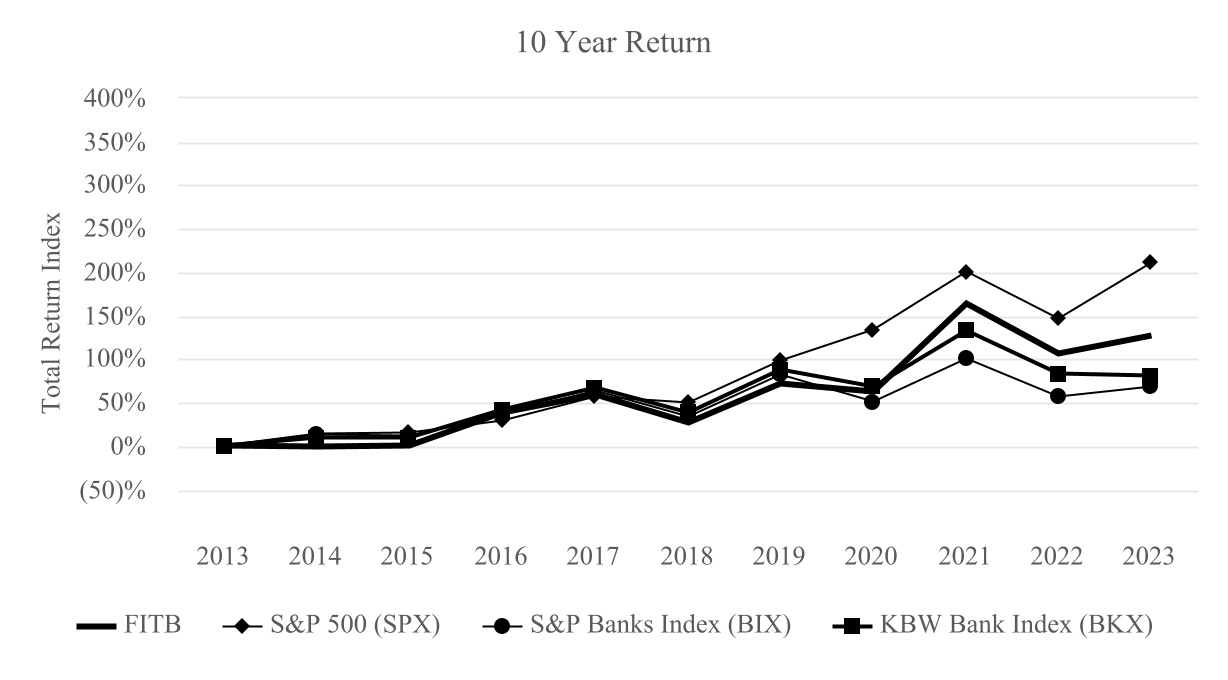
The graphs below summarize the cumulative return experienced by the Bancorp’s shareholders over the five and ten year periods ended December 31, 2023, respectively, compared to the S&P 500 Stock, the S&P Banks and the KBW Banks indices.
FIFTH THIRD BANCORP VS. MARKET INDICES

47 Fifth Third Bancorp
2023 ANNUAL REPORT
FINANCIAL CONTENTS
48 Fifth Third Bancorp
GLOSSARY OF ABBREVIATIONS AND ACRONYMS
Fifth Third Bancorp provides the following list of abbreviations and acronyms as a tool for the reader that are used in Management’s Discussion and Analysis of Financial Condition and Results of Operations, the Consolidated Financial Statements and the Notes to Consolidated Financial Statements.
| ACL: Allowance for Credit Losses | GSE: United States Government Sponsored Enterprise | ||||
| AFS: Available-For-Sale | HTM: Held-To-Maturity | ||||
| ALCO: Asset Liability Management Committee | IPO: Initial Public Offering | ||||
| ALLL: Allowance for Loan and Lease Losses | IRC: Internal Revenue Code | ||||
| AOCI: Accumulated Other Comprehensive Income (Loss) | IRLC: Interest Rate Lock Commitment | ||||
| APR: Annual Percentage Rate | ISDA: International Swaps and Derivatives Association, Inc. | ||||
| ARM: Adjustable Rate Mortgage | LCR: Liquidity Coverage Ratio | ||||
| ASC: Accounting Standards Codification | LIBOR: London Interbank Offered Rate | ||||
| ASU: Accounting Standards Update | LIHTC: Low-Income Housing Tax Credit | ||||
| ATM: Automated Teller Machine | LLC: Limited Liability Company | ||||
| BHC: Bank Holding Company | LTV: Loan-to-Value Ratio | ||||
| BOLI: Bank Owned Life Insurance | MD&A: Management’s Discussion and Analysis of Financial | ||||
| bps: Basis Points | Condition and Results of Operations | ||||
| CCAR: Comprehensive Capital Analysis and Review | MSR: Mortgage Servicing Right | ||||
| CD: Certificate of Deposit | N/A: Not Applicable | ||||
| CDC: Fifth Third Community Development Corporation and Fifth Third | NII: Net Interest Income | ||||
| Community Development Company, LLC | NM: Not Meaningful | ||||
| CECL: Current Expected Credit Loss | OAS: Option-Adjusted Spread | ||||
| CET1: Common Equity Tier 1 | OCC: Office of the Comptroller of the Currency | ||||
| CFPB: United States Consumer Financial Protection Bureau | OCI: Other Comprehensive Income (Loss) | ||||
| CME: Chicago Mercantile Exchange | OREO: Other Real Estate Owned | ||||
| C&I: Commercial and Industrial | PPP: Paycheck Protection Program | ||||
| DCF: Discounted Cash Flow | PSA: Performance Share Award | ||||
| DTCC: Depository Trust & Clearing Corporation | RCC: Risk and Compliance Committee | ||||
| DTI: Debt-to-Income Ratio | ROU: Right-of-Use | ||||
| ERM: Enterprise Risk Management | RSA: Restricted Stock Award | ||||
| ERMC: Enterprise Risk Management Committee | RSU: Restricted Stock Unit | ||||
| EVE: Economic Value of Equity | SAR: Stock Appreciation Right | ||||
| FASB: Financial Accounting Standards Board | SBA: Small Business Administration | ||||
| FDIC: Federal Deposit Insurance Corporation | SEC: United States Securities and Exchange Commission | ||||
| FHA: Federal Housing Administration | SOFR: Secured Overnight Financing Rate | ||||
| FHLB: Federal Home Loan Bank | TBA: To Be Announced | ||||
| FHLMC: Federal Home Loan Mortgage Corporation | TDR: Troubled Debt Restructuring | ||||
| FICO: Fair Isaac Corporation (credit rating) | TILA: Truth in Lending Act | ||||
| FINRA: Financial Industry Regulatory Authority | TRA: Tax Receivable Agreement | ||||
| FNMA: Federal National Mortgage Association | TruPS: Trust Preferred Securities | ||||
| FOMC: Federal Open Market Committee | U.S.: United States of America | ||||
| FRB: Federal Reserve Bank | U.S. GAAP: United States Generally Accepted Accounting | ||||
| FTE: Fully Taxable Equivalent | Principles | ||||
| FTP: Funds Transfer Pricing | VA: United States Department of Veterans Affairs | ||||
| FTS: Fifth Third Securities, Inc. | VIE: Variable Interest Entity | ||||
| GDP: Gross Domestic Product | VRDN: Variable Rate Demand Note | ||||
| GNMA: Government National Mortgage Association |
49 Fifth Third Bancorp
MANAGEMENT’S DISCUSSION AND ANALYSIS OF FINANCIAL CONDITION AND RESULTS OF OPERATIONS
Item 7. MANAGEMENT’S DISCUSSION AND ANALYSIS OF FINANCIAL CONDITION AND RESULTS OF OPERATIONS
The following is Management’s Discussion and Analysis of Financial Condition and Results of Operations of certain significant factors that have affected Fifth Third Bancorp’s (the “Bancorp” or “Fifth Third”) financial condition and results of operations during the periods included in the Consolidated Financial Statements, which are a part of this filing. Reference to the Bancorp incorporates the parent holding company and all consolidated subsidiaries. The Bancorp’s banking subsidiary is referred to as the Bank.
OVERVIEW
This overview of MD&A highlights selected information in the financial results of the Bancorp and may not contain all of the information that is important to you. For a more complete understanding of trends, events, commitments, uncertainties, liquidity, capital resources and critical accounting policies and estimates, you should carefully read this entire document. Each of these items could have an impact on the Bancorp’s financial condition, results of operations and cash flows. In addition, refer to the Glossary of Abbreviations and Acronyms in this report for a list of terms included as a tool for the reader of this Annual Report on Form 10-K. The abbreviations and acronyms identified therein are used throughout this MD&A, as well as the Consolidated Financial Statements and Notes to Consolidated Financial Statements.
Net interest income, net interest margin, net interest rate spread and the efficiency ratio are presented in MD&A on an FTE basis. The FTE basis adjusts for the tax-favored status of income from certain loans and leases and securities held by the Bancorp that are not taxable for federal income tax purposes. The Bancorp believes this presentation to be the preferred industry measurement of net interest income as it provides a relevant comparison between taxable and non-taxable amounts. The FTE basis for presenting net interest income is a non-GAAP measure. For further information, refer to the Non-GAAP Financial Measures section of MD&A.
The Bancorp’s revenues are dependent on both net interest income and noninterest income. For the year ended December 31, 2023, net interest income on an FTE basis and noninterest income provided 67% and 33% of total revenue, respectively. The Bancorp derives the majority of its revenues within the U.S. from customers domiciled in the U.S. Revenue from foreign countries and external customers domiciled in foreign countries was immaterial to the Consolidated Financial Statements for the year ended December 31, 2023. Changes in interest rates, credit quality, economic trends and the capital markets are primary factors that drive the performance of the Bancorp. As discussed later in the Risk Management section of MD&A, risk identification, measurement, monitoring, control and reporting are important to the management of risk and to the financial performance and capital strength of the Bancorp.
Net interest income is the difference between interest income earned on assets such as loans, leases and securities, and interest expense incurred on liabilities such as deposits, other short-term borrowings and long-term debt. Net interest income is affected by the general level of interest rates, the relative level of short-term and long-term interest rates, changes in interest rates and changes in the amount and composition of interest-earning assets and interest-bearing liabilities. Generally, the rates of interest the Bancorp earns on its assets and pays on its liabilities are established for a period of time. The change in market interest rates over time exposes the Bancorp to interest rate risk through potential adverse changes to net interest income and financial position. The Bancorp manages this risk by continually analyzing and adjusting the composition of its assets and liabilities based on their payment streams and interest rates, the timing of their maturities and their sensitivity to changes in market interest rates. Additionally, in the ordinary course of business, the Bancorp enters into certain derivative transactions as part of its overall strategy to manage its interest rate and prepayment risks. The Bancorp is also exposed to the risk of loss on its loan and lease portfolio as a result of changing expected cash flows caused by borrower credit events, such as loan defaults and inadequate collateral.
Noninterest income is derived from commercial banking revenue, wealth and asset management revenue, service charges on deposits, card and processing revenue, mortgage banking net revenue, leasing business revenue, other noninterest income and net securities gains or losses. Noninterest expense includes compensation and benefits, technology and communications, net occupancy expense, equipment expense, marketing expense, leasing business expense, card and processing expense and other noninterest expense.
Current Economic Conditions
Economic growth was resilient in 2023 but managing inflation remained a top priority for FRB officials. In response to inflationary pressures, FRB officials raised benchmark interest rates aggressively during 2022 and 2023 and have signaled that they will continue to monitor the cumulative economic effects of their policy actions, including tighter credit conditions for households and businesses, when determining future monetary actions. Amidst the rapid pace of interest rate increases, several financial markets have experienced heightened volatility. While interest rates may remain elevated for a sustained period of time, the FRB moved to a more balanced monetary policy stance in the later months of 2023 in response to easing inflationary pressures.
Changes in interest rates can affect numerous aspects of the Bancorp’s business and may impact the Bancorp’s future performance. If financial markets remain volatile, this may impact the future performance of various segments of the Bancorp’s business, in addition to the value of the Bancorp’s investment securities portfolio. The Bancorp continues to closely monitor the pace of inflation and the impacts of inflation on the broader market.
The bank failures that have occurred since March 2023 generated significant market volatility and increased regulatory and market focus on the liquidity, asset-liability management and unrealized securities losses of banks. In response to these failures, the U.S. banking agencies
50 Fifth Third Bancorp
MANAGEMENT’S DISCUSSION AND ANALYSIS OF FINANCIAL CONDITION AND RESULTS OF OPERATIONS
have proposed a number of regulatory amendments to improve the stability of U.S. banking institutions. Among these amendments, in November 2023, the FDIC issued a final rule for a special deposit insurance assessment on banking organizations with greater than $5 billion in assets to recover the costs associated with protecting uninsured depositors following these closures. The Bancorp’s estimate of its allocated share of the special assessment under the provisions of the final rule was $224 million, which was recognized in earnings upon issuance of the final rule in November 2023 and will be paid to the FDIC over an anticipated total of eight quarterly assessment periods beginning with the first quarter of 2024. The estimate of the cost associated with protecting the uninsured depositors will continue to be subject to periodic adjustment until the final loss is determined upon the termination of the receiverships by the FDIC.
For more information on current economic conditions, refer to the Credit Risk Management subsection of the Risk Management section of MD&A. Additionally, refer to the Interest Rate and Price Risk Management and Liquidity Risk Management subsections of the Risk Management section of MD&A for additional information about the Bancorp’s interest rate risk management and liquidity risk management activities.
Proposed Updates to Regulatory Requirements for Capital and Long-Term Debt
Showing the first 8K of 329K characters. Open the full section
Item 7A. QUANTITATIVE AND QUALITATIVE DISCLOSURES ABOUT MARKET RISK
This information is set forth in the Interest Rate and Price Risk Management section of Item 7 (Management’s Discussion and Analysis of Financial Condition and Results of Operations) of this Report and is incorporated herein by reference. This information contains certain statements that we believe are forward-looking statements. Refer to page 15 for cautionary information regarding forward-looking statements.
Item 8. FINANCIAL STATEMENTS AND SUPPLEMENTARY DATA
109 Fifth Third Bancorp
REPORT OF INDEPENDENT REGISTERED PUBLIC ACCOUNTING FIRM
To the shareholders and the Board of Directors of Fifth Third Bancorp:
Opinion on the Financial Statements
We have audited the accompanying consolidated balance sheets of Fifth Third Bancorp and subsidiaries (the “Bancorp”) as of December 31, 2023 and 2022, the related consolidated statements of income, comprehensive income, changes in equity, and cash flows for each of the three years in the period ended December 31, 2023, and the related notes (collectively referred to as the “financial statements”). In our opinion, the financial statements present fairly, in all material respects, the financial position of the Bancorp as of December 31, 2023 and 2022, and the results of its operations and its cash flows for each of the three years in the period ended December 31, 2023, in conformity with accounting principles generally accepted in the United States of America.
We have also audited, in accordance with the standards of the Public Company Accounting Oversight Board (United States) (PCAOB), the Bancorp’s internal control over financial reporting as of December 31, 2023, based on criteria established in Internal Control—Integrated Framework (2013) issued by the Committee of Sponsoring Organizations of the Treadway Commission and our report dated February 27, 2024 expressed an unqualified opinion on the Bancorp’s internal control over financial reporting.
Basis for Opinion
These financial statements are the responsibility of the Bancorp’s management. Our responsibility is to express an opinion on the Bancorp’s financial statements based on our audits. We are a public accounting firm registered with the PCAOB and are required to be independent with respect to the Bancorp in accordance with the U.S. federal securities laws and the applicable rules and regulations of the Securities and Exchange Commission and the PCAOB.
We conducted our audits in accordance with the standards of the PCAOB. Those standards require that we plan and perform the audit to obtain reasonable assurance about whether the financial statements are free of material misstatement, whether due to error or fraud. Our audits included performing procedures to assess the risks of material misstatement of the financial statements, whether due to error or fraud, and performing procedures that respond to those risks. Such procedures included examining, on a test basis, evidence regarding the amounts and disclosures in the financial statements. Our audits also included evaluating the accounting principles used and significant estimates made by management, as well as evaluating the overall presentation of the financial statements. We believe that our audits provide a reasonable basis for our opinion.
Critical Audit Matter
The critical audit matter communicated below is a matter arising from the current-period audit of the financial statements that was communicated or required to be communicated to the audit committee and that (1) relates to accounts or disclosures that are material to the financial statements and (2) involved our especially challenging, subjective, or complex judgments. The communication of critical audit matters does not alter in any way our opinion on the financial statements, taken as a whole, and we are not, by communicating the critical audit matter below, providing a separate opinion on the critical audit matter or on the accounts or disclosures to which it relates.
Allowance for Loan and Lease Losses (“ALLL”) — Qualitative Factors - Commercial Loans — Refer to Note 1 and Note 6 of the Notes to Consolidated Financial Statements
Critical Audit Matter Description
The Bancorp maintains the ALLL to absorb the amount of credit losses that are expected to be incurred over the remaining contractual terms of the related loans and leases. The Bancorp’s methodology for determining the ALLL includes an estimate of expected credit losses on a collective basis for groups of loans and leases with similar risk characteristics and specific allowances for loans and leases which are individually evaluated.
For collectively evaluated loans and leases, the Bancorp uses models to forecast expected credit losses based on the probability of a loan or lease defaulting, the expected balance at the estimated date of default and the expected loss percentage given a default. The Bancorp also considers qualitative factors in determining the ALLL. These considerations inherently require significant management judgment to determine the appropriate factors to be considered and the extent of their impact on the ALLL estimate. Qualitative factors are used to capture characteristics in the portfolio that impact expected credit losses but that are not fully captured within the Bancorp’s expected credit loss models. When evaluating the adequacy of allowances, consideration is given to the effect that changing economic conditions may have on the Bancorp’s customers.
110 Fifth Third Bancorp
Overall, the collective evaluation process requires significant management judgment when determining the estimation methodology and inputs into the models, as well as in evaluating the reasonableness of the modeled results and the appropriateness of qualitative adjustments.
At December 31, 2023, the key qualitative factors included adjustments to the expected credit losses on the commercial loan portfolio associated with the current economic environment.
The ALLL for the commercial portfolio segment was $1.1 billion at December 31, 2023, which includes adjustments for the qualitative factors noted above.
Considering the estimation and judgment in determining adjustments for such qualitative factors, our audit of the ALLL and the related disclosures involved subjective judgment about the qualitative adjustments to the commercial portfolio segment ALLL.
How the Critical Audit Matter Was Addressed in the Audit
Our audit procedures related to the qualitative adjustments for the commercial portfolio segment ALLL included the following, among others:
-
We tested the effectiveness of the Bancorp’s controls over the qualitative adjustments to the ALLL.
-
We assessed the reasonableness of, and evaluated support for, key qualitative adjustments based on market conditions, external market data and commercial portfolio performance metrics.
-
We tested the completeness and accuracy and evaluated the relevance of the key data used as inputs to the qualitative adjustment estimation process, including:
◦Portfolio segment loan balances and other borrower-specific data
◦Relevant macroeconomic indicators and data
- With the assistance of our credit specialists, we tested the mathematical accuracy of the underlying support used as a basis for the qualitative adjustments.
/s/ Deloitte & Touche LLP
Cincinnati, Ohio
February 27, 2024
We have served as the Company’s auditor since 1970.
111 Fifth Third Bancorp
CONSOLIDATED BALANCE SHEETS
| As of December 31 ($ in millions, except share data) | 2023 | 2022 | ||||||
| Assets | ||||||||
| Cash and due from banks | $ | 3,142 | 3,466 | |||||
| Other short-term investments*(a)* | 22,082 | 8,351 | ||||||
| Available-for-sale debt and other securities*(b)* | 50,419 | 51,503 | ||||||
| Held-to-maturity securities*(c)* | 2 | 5 | ||||||
| Trading debt securities | 899 | 414 | ||||||
| Equity securities | 613 | 317 | ||||||
| Loans and leases held for sale*(d)* | 378 | 1,007 | ||||||
| Portfolio loans and leases*(a)(e)* | 117,234 | 121,480 |
Showing the first 8K of 534K characters. Open the full section
Item 9. CHANGES IN AND DISAGREEMENTS WITH ACCOUNTANTS ON ACCOUNTING AND FINANCIAL DISCLOSURE
None.
Item 9A. CONTROLS AND PROCEDURES
EVALUATION OF DISCLOSURE CONTROLS AND PROCEDURES
The Bancorp conducted an evaluation, under the supervision and with the participation of the Bancorp’s management, including the Bancorp’s Chief Executive Officer and Chief Financial Officer, of the effectiveness of the design and operation of the Bancorp’s disclosure controls and procedures (as defined in Rules 13a-15(e) and 15d-15(e) under the Securities Exchange Act of 1934). Based on the foregoing, as of the end of the period covered by this report, the Bancorp’s Chief Executive Officer and Chief Financial Officer concluded that the Bancorp’s disclosure controls and procedures were effective, in all material respects, to ensure that information required to be disclosed in the reports the Bancorp files and submits under the Securities Exchange Act of 1934 is recorded, processed, summarized and reported as and when required and information is accumulated and communicated to management including its Chief Executive Officer and Chief Financial Officer, as appropriate to allow timely decisions regarding required disclosure.
MANAGEMENT’S ASSESSMENT AS TO THE EFFECTIVENESS OF INTERNAL CONTROL OVER FINANCIAL REPORTING
The management of Fifth Third Bancorp is responsible for establishing and maintaining adequate internal control, designed to provide reasonable assurance regarding the reliability of financial reporting and the preparation of financial statements for external purposes in accordance with accounting principles generally accepted in the United States of America. The Bancorp’s management assessed the effectiveness of the Bancorp’s internal control over financial reporting as of December 31, 2023. Management’s assessment is based on the criteria established in the Internal Control — Integrated Framework (2013) issued by the Committee of Sponsoring Organizations of the Treadway Commission and was designed to provide reasonable assurance that the Bancorp maintained effective internal control over financial reporting as of December 31, 2023. Based on this assessment, management believes that the Bancorp maintained effective internal control over financial reporting as of December 31, 2023. The Bancorp’s independent registered public accounting firm, that audited the Bancorp’s consolidated financial statements included in this annual report, has issued an audit report on our internal control over financial reporting as of December 31, 2023. This report appears on page 212 of the annual report.
CHANGES IN INTERNAL CONTROLS
The Bancorp’s management also conducted an evaluation of internal control over financial reporting to determine whether any changes occurred during the year covered by this report that have materially affected, or are reasonably likely to materially affect, the Bancorp’s internal control over financial reporting. Based on this evaluation, there has been no such change during the year covered by this report.
| /s/ Timothy N. Spence | /s/ Bryan D. Preston | |||||||
| Timothy N. Spence | Bryan D. Preston | |||||||
| Chairman, Chief Executive Officer and President | Executive Vice President and Chief Financial Officer | |||||||
| February 27, 2024 | February 27, 2024 |
211 Fifth Third Bancorp
REPORT OF INDEPENDENT REGISTERED PUBLIC ACCOUNTING FIRM
To the shareholders and the Board of Directors of Fifth Third Bancorp:
Opinion on Internal Control over Financial Reporting
We have audited the internal control over financial reporting of Fifth Third Bancorp and subsidiaries (the “Bancorp”) as of December 31, 2023, based on criteria established in Internal Control — Integrated Framework (2013) issued by the Committee of Sponsoring Organizations of the Treadway Commission (COSO). In our opinion, the Bancorp maintained, in all material respects, effective internal control over financial reporting as of December 31, 2023, based on criteria established in Internal Control — Integrated Framework (2013) issued by COSO.
We have also audited, in accordance with the standards of the Public Company Accounting Oversight Board (United States) (PCAOB), the consolidated financial statements as of and for the year ended December 31, 2023, of the Bancorp and our report dated February 27, 2024 expressed an unqualified opinion on those consolidated financial statements.
Basis for Opinion
The Bancorp’s management is responsible for maintaining effective internal control over financial reporting and for its assessment of the effectiveness of internal control over financial reporting, included in the accompanying Management’s Assessment as to the Effectiveness of Internal Control over Financial Reporting. Our responsibility is to express an opinion on the Bancorp’s internal control over financial reporting based on our audit. We are a public accounting firm registered with the PCAOB and are required to be independent with respect to the Bancorp in accordance with the U.S. federal securities laws and the applicable rules and regulations of the Securities and Exchange Commission and the PCAOB.
We conducted our audit in accordance with the standards of the PCAOB. Those standards require that we plan and perform the audit to obtain reasonable assurance about whether effective internal control over financial reporting was maintained in all material respects. Our audit included obtaining an understanding of internal control over financial reporting, assessing the risk that a material weakness exists, testing and evaluating the design and operating effectiveness of internal control based on the assessed risk, and performing such other procedures as we considered necessary in the circumstances. We believe that our audit provides a reasonable basis for our opinion.
Definition and Limitations of Internal Control over Financial Reporting
A company’s internal control over financial reporting is a process designed to provide reasonable assurance regarding the reliability of financial reporting and the preparation of financial statements for external purposes in accordance with generally accepted accounting principles. A company’s internal control over financial reporting includes those policies and procedures that (1) pertain to the maintenance of records that, in reasonable detail, accurately and fairly reflect the transactions and dispositions of the assets of the company; (2) provide reasonable assurance that transactions are recorded as necessary to permit preparation of financial statements in accordance with generally accepted accounting principles, and that receipts and expenditures of the company are being made only in accordance with authorizations of management and directors of the company; and (3) provide reasonable assurance regarding prevention or timely detection of unauthorized acquisition, use, or disposition of the company’s assets that could have a material effect on the financial statements.
Because of its inherent limitations, internal control over financial reporting may not prevent or detect misstatements. Also, projections of any evaluation of effectiveness to future periods are subject to the risk that controls may become inadequate because of changes in conditions, or that the degree of compliance with the policies or procedures may deteriorate.
/s/ Deloitte & Touche LLP
Cincinnati, Ohio
February 27, 2024
212 Fifth Third Bancorp
Item 9B. OTHER INFORMATION
Effective February 27, 2024, the Bancorp’s Board of Directors approved executive retention grant awards under the Bancorp’s 2021 Incentive Compensation Plan to certain of the Bancorp’s named executive officers, which awards were issued in part to promote continuity in key leadership roles and recognize new or expanded roles and responsibilities, where applicable. The Board granted these awards in the form of RSUs that will vest three years from the date of grant conditioned on the recipient’s continued employment and satisfactory performance of duties. In the event the recipient’s employment is terminated due to death or disability, any unvested RSUs will become immediately vested. In the event the recipient’s employment is terminated for any other reason, the unvested RSUs will be forfeited. In addition, if the Bancorp’s return on average tangible common equity for the fiscal year ending immediately prior to a vesting date (i.e., 2024, 2025 and 2026) does not meet or exceed 2%, one-third of the RSUs may be forfeited at the discretion of the Human Capital and Compensation Committee of the Bancorp’s Board of Directors. Furthermore, as a condition to receiving the award, if the recipient is asked to assume a different role within the Bancorp before the RSUs vest, the recipient is required to accept such a role and fully cooperate with any transition of required duties, as needed.
Kevin P. Lavender, the Bancorp’s Executive Vice President and Head of Commercial Bank, James C. Leonard, the Bancorp’s Executive Vice President and Chief Operating Officer, Jude A. Schramm, the Bancorp’s Executive Vice President and Chief Information Officer, and Robert P. Shaffer, the Bancorp’s Executive Vice President and Chief Risk Officer, will each receive a grant of RSUs in the amount of $2,000,000, based on the closing price of the Bancorp’s common stock on February 27, 2024.
Adoption or Termination of Insider Trading Arrangements
On December 14, 2023, Jude A. Schramm, Executive Vice President and Chief Information Officer of the Bancorp, adopted a trading arrangement for the sale of shares of stock (a “Rule 10b5-1 Trading Plan”) that is intended to satisfy the affirmative defense conditions of Exchange Act Rule 10b5-1(c). Mr. Schramm’s Rule 10b5-1 Trading Plan, which shall terminate on December 31, 2024, provides for the sale of up to 10,000 shares of common stock pursuant to the terms of the Rule 10b5-1 Trading Plan.
Item 9C. DISCLOSURE REGARDING FOREIGN JURISDICTIONS THAT PREVENT INSPECTION
Not applicable.
PART III
Item 10. DIRECTORS, EXECUTIVE OFFICERS AND CORPORATE GOVERNANCE
The Bancorp has adopted an Enterprise Insider Trading and Ethical Investing Policy that applies to all of its directors and employees.
The information required by this item relating to the Executive Officers of the Registrant is included in PART I under “INFORMATION ABOUT OUR EXECUTIVE OFFICERS.”
The information required by this item concerning Directors and the nomination process is incorporated herein by reference under the caption “Election of Directors” of the Bancorp’s Proxy Statement for the 2024 Annual Meeting of Shareholders.
The information required by this item concerning the Audit Committee and Code of Business Conduct and Ethics is incorporated herein by reference under the captions “Corporate Governance” and “Board of Directors, Committees, Meetings, and Functions” of the Bancorp’s Proxy Statement for the 2024 Annual Meeting of Shareholders. Fifth Third’s Code of Business Conduct and Ethics is available on Fifth Third’s corporate website at www.53.com. In addition, any future amendments to, or waivers from, a provision of the Fifth Third Code of Business Conduct and Ethics that applies to Fifth Third’s directors or executive officers (including Fifth Third’s principal executive officer, principal financial officer, and principal accounting officer or controller) will be posted at this internet address.
The information required by this item concerning Delinquent Section 16(a) Reports is incorporated herein by reference under the caption “Delinquent Section 16(a) Reports” of the Bancorp’s Proxy Statement for the 2024 Annual Meeting of Shareholders.
Item 11. EXECUTIVE COMPENSATION
The information required by this item is incorporated herein by reference under the captions “Compensation Discussion and Analysis,” “Compensation of Named Executive Officers,” “Board of Directors Compensation,” “CEO Pay Ratio,” “Human Capital and Compensation Committee Report” and “Compensation Committee Interlocks and Insider Participation” of the Bancorp’s Proxy Statement for the 2024 Annual Meeting of Shareholders.
Item 12. SECURITY OWNERSHIP OF CERTAIN BENEFICIAL OWNERS AND MANAGEMENT AND RELATED STOCKHOLDER MATTERS
Security ownership information of certain beneficial owners and management is incorporated herein by reference under the captions “Certain Beneficial Owners,” “Election of Directors,” “Compensation Discussion and Analysis,” “Board of Directors Compensation,” and “Compensation of Named Executive Officers” of the Bancorp’s Proxy Statement for the 2024 Annual Meeting of Shareholders.
The information required by this item concerning Equity Compensation Plan information is included in Note 25 of the Notes to Consolidated Financial Statements.
213 Fifth Third Bancorp
Item 13. CERTAIN RELATIONSHIPS AND RELATED TRANSACTIONS, AND DIRECTOR INDEPENDENCE
The information required by this item is incorporated herein by reference under the captions “Certain Transactions”, “Election of Directors”, “Corporate Governance” and “Board of Directors, Committees, Meetings, and Functions” of the Bancorp’s Proxy Statement for the 2024 Annual Meeting of Shareholders.
Item 14. PRINCIPAL ACCOUNTING FEES AND SERVICES
The information required by this item is incorporated herein by reference under the caption “Principal Independent External Audit Firm Fees” of the Bancorp’s Proxy Statement for the 2024 Annual Meeting of Shareholders. The Bancorp’s principal independent external audit firm is Deloitte & Touche LLP, whose PCAOB Firm ID is 34.
214 Fifth Third Bancorp
PART IV
Item 15. EXHIBITS, FINANCIAL STATEMENT SCHEDULES
| Pages | |||||
| Public Accounting Firm | 110, 212 | ||||
| Fifth Third Bancorp and Subsidiaries Consolidated Financial Statements | 112 | ||||
| Notes to Consolidated Financial Statements | 118 |
The schedules for the Bancorp and its subsidiaries are omitted because of the absence of conditions under which they are required, or because the information is set forth in the Consolidated Financial Statements or the notes thereto.
The following lists the Exhibits to the Annual Report on Form 10-K:
215 Fifth Third Bancorp
216 Fifth Third Bancorp
217 Fifth Third Bancorp
218 Fifth Third Bancorp
*(1)*Fifth Third Bancorp also entered into an identical security on March 4, 2008 representing an additional $500,000,000 of its 8.25% Subordinated Notes due 2038.
*(2)*Fifth Third Bancorp also entered into an identical security on November 20, 2013 representing an additional $250,000,000 in principal amount of its 4.30% Subordinated Notes due 2024.
** Denotes management contract or compensatory plan or arrangement.*
*** An application for confidential treatment for selected portions of this exhibit has been filed with the SEC.*
**** Selected portions of this exhibit have been omitted in accordance with Item 601(b)(10) of Regulation S-K.*
Item 16. FORM 10–K SUMMARY
None.
219 Fifth Third Bancorp
SIGNATURES
Pursuant to the requirements of Section 13 or 15(d) of the Securities Exchange Act of 1934, the Registrant has duly caused this report to be signed on its behalf by the undersigned, thereunto duly authorized.
FIFTH THIRD BANCORP
Registrant
| /s/ Timothy N. Spence | ||
| Timothy N. Spence | ||
| Chairman, Chief Executive Officer and President | ||
| Principal Executive Officer | ||
| February 27, 2024 |
Pursuant to requirements of the Securities Exchange Act of 1934, this report has been signed on February 27, 2024 by the following persons on behalf of the Registrant and in the capacities indicated.
OFFICERS:
| /s/ Timothy N. Spence | ||
| Timothy N. Spence | ||
| Chairman, Chief Executive Officer and President | ||
| Principal Executive Officer | ||
| /s/ Bryan D. Preston | ||
| Bryan D. Preston | ||
| Executive Vice President and Chief Financial Officer | ||
| Principal Financial Officer | ||
| /s/ Mark D. Hazel | ||
| Mark D. Hazel | ||
| Executive Vice President and Controller | ||
| Principal Accounting Officer |
DIRECTORS:
| /s/ Timothy N. Spence | ||
| Timothy N. Spence | ||
| Chairman | ||
| /s/ Nicholas K. Akins | ||
| Nicholas K. Akins | ||
| Lead Independent Director |
| /s/ B. Evan Bayh III | ||
| B. Evan Bayh III | ||
| /s/ Jorge L. Benitez | ||
| Jorge L. Benitez | ||
| /s/ Katherine B. Blackburn | ||
| Katherine B. Blackburn | ||
| /s/ Emerson L. Brumback | ||
| Emerson L. Brumback | ||
| /s/ Linda W. Clement-Holmes | ||
| Linda W. Clement-Holmes | ||
| /s/ C. Bryan Daniels | ||
| C. Bryan Daniels | ||
| /s/ Laurent Desmangles | ||
| Laurent Desmangles | ||
| /s/ Mitchell S. Feiger | ||
| Mitchell S. Feiger | ||
| /s/ Thomas H. Harvey | ||
| Thomas H. Harvey | ||
| /s/ Gary R. Heminger | ||
| Gary R. Heminger | ||
| /s/ Eileen A. Mallesch | ||
| Eileen A. Mallesch | ||
| /s/ Michael B. McCallister | ||
| Michael B. McCallister | ||
| /s/ Kathleen A. Rogers | ||
| Kathleen A. Rogers | ||
| /s/ Marsha C. Williams | ||
| Marsha C. Williams | ||
220 Fifth Third Bancorp
CONSOLIDATED TEN YEAR COMPARISON
| AVERAGE ASSETS FOR THE YEARS ENDED DECEMBER 31 ($ IN MILLIONS) | |||||||||||||||||||||||
| Interest-Earning Assets | |||||||||||||||||||||||
| Year | Loans and Leases | Other Short-Term Investments | Investment Securities | Total | Cash and Due from Banks | Other Assets | Total Average Assets | ||||||||||||||||
| 2023 | $ | 122,282 | 11,934 | 57,527 | 191,743 | 2,772 | 16,169 | 208,426 | |||||||||||||||
| 2022 | 120,561 | 12,419 | 53,346 | 186,326 | 3,093 | 19,490 | 206,929 | ||||||||||||||||
| 2021 | 114,117 | 33,243 | 37,018 | 184,378 | 3,055 | 21,050 | 206,324 | ||||||||||||||||
| 2020 | 114,411 | 21,935 | 36,342 | 172,688 | 2,978 | 20,933 | 194,230 | ||||||||||||||||
| 2019 | 107,794 | 2,140 | 35,470 | 145,404 | 2,748 | 16,903 | 163,936 | ||||||||||||||||
| 2018 | 93,876 | 1,476 | 33,553 | 128,905 | 2,200 | 12,203 | 142,183 | ||||||||||||||||
| 2017 | 92,731 | 1,390 | 32,172 | 126,293 | 2,224 | 13,236 | 140,527 | ||||||||||||||||
| 2016 | 94,320 | 1,866 | 30,099 | 126,285 | 2,303 | 14,870 | 142,173 | ||||||||||||||||
| 2015 | 93,339 | 3,258 | 26,987 | 123,584 | 2,608 | 15,100 | 139,999 | ||||||||||||||||
| 2014 | 91,127 | 3,043 | 21,823 | 115,993 | 2,892 | 14,443 | 131,847 |
| AVERAGE DEPOSITS AND AVERAGE SHORT-TERM BORROWINGS FOR THE YEARS ENDED DECEMBER 31 ($ IN MILLIONS) | |||||||||||||||||||||||||||||
| Deposits | |||||||||||||||||||||||||||||
| Year | Demand | Interest Checking | Savings | Money Market | Certificates of Deposit**(a)** | Foreign Office and Other | Total | Short-Term Borrowings**(b)** | Total | ||||||||||||||||||||
| 2023 | $ | 46,195 | 52,378 | 20,872 | 30,943 | 13,630 | 158 | 164,176 | 5,351 | 169,527 | |||||||||||||||||||
| 2022 | 60,185 | 45,835 | 23,445 | 29,326 | 4,030 | 170 | 162,991 | 4,925 | 167,916 | ||||||||||||||||||||
| 2021 | 62,028 | 45,850 | 20,531 | 30,631 | 3,744 | 164 | 162,948 | 1,440 | 164,388 | ||||||||||||||||||||
| 2020 | 47,111 | 46,890 | 16,440 | 29,879 | 7,455 | 256 | 148,031 | 2,094 | 150,125 | ||||||||||||||||||||
| 2019 | 34,343 | 36,658 | 14,041 | 25,879 | 9,974 | 474 | 121,369 | 2,313 | 123,682 | ||||||||||||||||||||
| 2018 | 32,634 | 29,818 | 13,330 | 21,769 | 6,532 | 839 | 104,922 | 3,120 | 108,042 | ||||||||||||||||||||
| 2017 | 35,093 | 26,382 | 13,958 | 20,231 | 6,335 | 665 | 102,664 | 3,715 | 106,379 | ||||||||||||||||||||
| 2016 | 35,862 | 25,143 | 14,346 | 19,523 | 6,745 | 830 | 102,449 | 3,351 | 105,800 | ||||||||||||||||||||
| 2015 | 35,164 | 26,160 | 14,951 | 18,152 | 6,920 | 874 | 102,221 | 2,641 | 104,862 | ||||||||||||||||||||
| 2014 | 31,755 | 25,382 | 16,080 | 14,670 | 7,691 | 1,828 | 97,406 | 2,331 | 99,737 |
| INCOME FOR THE YEARS ENDED DECEMBER 31 ($ IN MILLIONS, EXCEPT PER SHARE DATA) | ||||||||||||||||||||||||||
| Per Share | ||||||||||||||||||||||||||
| Year | Interest Income | Interest Expense | Noninterest Income | Noninterest Expense | Net Income Available to Common Shareholders | Earnings | Diluted Earnings | Dividends Declared | ||||||||||||||||||
| 2023 | $ | 9,760 | 3,933 | 2,881 | 5,205 | 2,212 | 3.23 | 3.22 | 1.36 | |||||||||||||||||
| 2022 | 6,587 | 978 | 2,766 | 4,719 | 2,330 | 3.38 | 3.35 | 1.26 | ||||||||||||||||||
| 2021 | 5,211 | 441 | 3,118 | 4,748 | 2,659 | 3.78 | 3.73 | 1.14 | ||||||||||||||||||
| 2020 | 5,572 | 790 | 2,830 | 4,718 | 1,323 | 1.84 | 1.83 | 1.08 | ||||||||||||||||||
| 2019 | 6,254 | 1,457 | 3,536 | 4,660 | 2,419 | 3.38 | 3.33 | 0.94 | ||||||||||||||||||
| 2018 | 5,183 | 1,043 | 2,790 | 3,958 | 2,118 | 3.11 | 3.06 | 0.74 | ||||||||||||||||||
| 2017 | 4,489 | 691 | 3,224 | 3,782 | 2,105 | 2.86 | 2.81 | 0.60 | ||||||||||||||||||
| 2016 | 4,193 | 578 | 2,696 | 3,737 | 1,472 | 1.92 | 1.91 | 0.53 | ||||||||||||||||||
| 2015 | 4,028 | 495 | 3,003 | 3,643 | 1,610 | 2.00 | 1.97 | 0.52 | ||||||||||||||||||
| 2014 | 4,030 | 451 | 2,473 | 3,619 | 1,384 | 1.65 | 1.63 | 0.51 |
| MISCELLANEOUS AT DECEMBER 31 ($ IN MILLIONS, EXCEPT PER SHARE DATA) | ||||||||||||||||||||||||||||||||
| Equity | ||||||||||||||||||||||||||||||||
| Year | Common Shares Outstanding | Common Stock | Preferred Stock | Capital Surplus | Retained Earnings | Accumulated Other Comprehensive (Loss) Income | Treasury Stock | Total | Book Value Per Share | Allowance for Loan and Lease Losses | ||||||||||||||||||||||
| 2023 | 681,124,810 | $ | 2,051 | 2,116 | 3,757 | 22,997 | (4,487) | (7,262) | 19,172 | 25.04 | 2,322 | |||||||||||||||||||||
| 2022 | 683,385,880 | 2,051 | 2,116 | 3,684 | 21,689 | (5,110) | (7,103) | 17,327 | 22.26 | 2,194 | ||||||||||||||||||||||
| 2021 | 682,777,664 | 2,051 | 2,116 | 3,624 | 20,236 | 1,207 | (7,024) | 22,210 | 29.43 | 1,892 | ||||||||||||||||||||||
| 2020 | 712,760,325 | 2,051 | 2,116 | 3,635 | 18,384 | 2,601 | (5,676) | 23,111 | 29.46 | 2,453 | ||||||||||||||||||||||
| 2019 | 708,915,629 | 2,051 | 1,770 | 3,599 | 18,315 | 1,192 | (5,724) | 21,203 | 27.41 | 1,202 | ||||||||||||||||||||||
| 2018 | 646,630,857 | 2,051 | 1,331 | 2,873 | 16,578 | (112) | (6,471) | 16,250 | 23.07 | 1,103 | ||||||||||||||||||||||
| 2017 | 693,804,893 | 2,051 | 1,331 | 2,790 | 14,957 | 73 | (5,002) | 16,200 | 21.43 | 1,196 | ||||||||||||||||||||||
| 2016 | 750,479,299 | 2,051 | 1,331 | 2,756 | 13,290 | 59 | (3,433) | 16,054 | 19.62 | 1,253 | ||||||||||||||||||||||
| 2015 | 785,080,314 | 2,051 | 1,331 | 2,666 | 12,224 | 197 | (2,764) | 15,705 | 18.31 | 1,272 | ||||||||||||||||||||||
| 2014 | 824,046,952 | 2,051 | 1,331 | 2,646 | 11,034 | 429 | (1,972) | 15,519 | 17.22 | 1,322 | ||||||||||||||||||||||
| (a) Includes CDs $250,000 or less and CDs over $250,000. | ||||||||||||||||||||||||||||||||
| (b) Includes federal funds purchased and other short-term borrowings. |
221 Fifth Third Bancorp
DIRECTORS AND OFFICERS
| FIFTH THIRD BANCORP DIRECTORS | FIFTH THIRD BANCORP OFFICERS | REGIONAL PRESIDENTS | ||||||||||||
| Timothy N. Spence Chairman Fifth Third Bancorp Nicholas K. Akins, Lead Director Retired Chairman & Chief Executive Officer American Electric Power Company B. Evan Bayh, III Senior Advisor Apollo Global Management Jorge L. Benitez Retired Chief Executive Officer North America of Accenture plc Katherine B. Blackburn Executive Vice President Cincinnati Bengals, Inc. Emerson L. Brumback Retired President & Chief Operating Officer M&T Bank Linda W. Clement-Holmes Retired Chief Information Officer The Procter & Gamble Company C. Bryan Daniels Founding Partner Prairie Capital Laurent Desmangles Retired Senior Partner & Managing Director Boston Consulting Mitchell S. Feiger Retired Chief Executive Officer and President MB Financial, Inc. Thomas H. Harvey Chief Executive Officer Energy Innovation: Policy and Technology, LLC Gary R. Heminger Retired Chief Executive Officer & Chairman Marathon Petroleum Corporation Eileen A. Mallesch Retired Chief Financial Officer Nationwide Property & Casualty Segment, Nationwide Mutual Insurance Company Michael B. McCallister Retired Chairman & Chief Executive Officer Humana, Inc. Kathleen A. Rogers Retired Executive Vice President U.S. Bancorp Marsha C. Williams Retired Chief Financial Officer Orbitz Worldwide, Inc | Timothy N. Spence Chairman, Chief Executive Officer and President Kristine R. Garrett Executive Vice President, Group Regional President & Head of Wealth & Asset Management Kala J. Gibson Executive Vice President & Chief Corporate Responsibility Officer Mark D. Hazel Executive Vice President & Controller Kevin P. Lavender Executive Vice President & Head of Commercial Bank James C. Leonard Executive Vice President & Chief Operating Officer Nancy C. Pinckney Executive Vice President & Chief Human Resource Officer Bryan D. Preston Executive Vice President & Chief Financial Officer Jude A. Schramm Executive Vice President & Chief Information Officer Robert P. Shaffer Executive Vice President & Chief Risk Officer Melissa S. Stevens Executive Vice President & Chief Marketing Officer Susan B. Zaunbrecher Executive Vice President & Chief Legal Officer | Michael Ash David Briggs Timothy Elsbrock Lee Fite David Girodat Stephanie Green Kimberly Halbauer Mark Heckler Francie Henry Randy Koporc Tom Partridge Cary Putrino Thomas G. Welch, Jr. Joseph Yurosek FIFTH THIRD BANCORP BOARD COMMITTEES Audit Committee Eileen A. Mallesch, Chair Jorge L. Benitez Katherine B. Blackburn Linda W. Clement-Holmes C. Bryan Daniels Thomas H. Harvey Gary R. Heminger Kathleen A. Rogers Finance Committee Gary R. Heminger, Chair Nicholas K. Akins Jorge L. Benitez Emerson L. Brumback Thomas H. Harvey Eileen A. Mallesch Michael B. McCallister Human Capital and Compensation Committee Michael B. McCallister, Chair Nicholas K. Akins Jorge L. Benitez Emerson L. Brumback Linda W. Clement-Holmes Gary R. Heminger Kathleen A. Rogers Nominating and Corporate Governance Committee Thomas H. Harvey, Chair Nicholas K. Akins B. Evan Bayh, III Jorge L. Benitez Katherine B. Blackburn Laurent Desmangles Marsha C. Williams Risk and Compliance Committee Emerson L. Brumback, Chair Nicholas K. Akins C. Bryan Daniels Laurent Desmangles Mitchell S. Feiger Eileen A. Mallesch Michael B. McCallister Kathleen A. Rogers Marsha C. Williams Technology Committee Jorge L. Benitez, Chair B. Evan Bayh, III Linda W. Clement-Holmes C. Bryan Daniels Laurent Desmangles Mitchell S. Feiger Thomas H. Harvey | ||||||||||||
222 Fifth Third Bancorp