 filings.tools
Federal Realty Investment Trust 10-K 2019-12-31
Filed 2020-02-10. 22 sections, 415K characters. Original on sec.gov · Markdown · JSON
Cover and table of contents
UNITED STATES
SECURITIES AND EXCHANGE COMMISSION
WASHINGTON, D.C. 20549
FORM 10-K
| ☒ | ANNUAL REPORT PURSUANT TO THE SECTION 13 OR 15(D) OF THE SECURITIES EXCHANGE ACT OF 1934 |
For the fiscal year ended December 31, 2019
OR
| ☐ | TRANSITION REPORT PURSUANT TO SECTION 13 OR 15(D) OF THE SECURITIES EXCHANGE ACT OF 1934 |
For the transition period from to
Commission file number: 1-07533
FEDERAL REALTY INVESTMENT TRUST
(Exact Name of Registrant as Specified in its Declaration of Trust)
| Maryland | 52-0782497 | |
| (State of Organization) | (IRS Employer Identification No.) |
1626 East Jefferson Street**,** Rockville**,** Maryland 20852
(Address of Principal Executive Offices) (Zip Code)
**(**301) 998-8100
(Registrant’s Telephone Number, Including Area Code)
Securities registered pursuant to Section 12(b) of the Act:
| Title of Each Class | Trading Symbol | Name of Each Exchange On Which Registered |
| Common Shares of Beneficial Interest | FRT | New York Stock Exchange |
| $.01 par value per share, with associated Common Share Purchase Rights | ||
| Depositary Shares, each representing 1/1000 of a share | FRT-C | New York Stock Exchange |
| of 5.00% Series C Cumulative Redeemable Preferred Stock, $.01 par value per share |
Securities registered pursuant to Section 12(g) of the Act: None
Indicate by check mark if the registrant is a well-known seasoned issuer, as defined in Rule 405 of the Securities Act. ☒ Yes ☐ No
Indicate by check mark if the registrant is not required to file reports pursuant to Section 13 or Section 15(d) of the Act. ☐ Yes ☒ No
Indicate by check mark whether the registrant (1) has filed all reports required to be filed by Section 13 or 15(d) of the Securities Exchange Act of 1934 during the preceding 12 months (or for such shorter period that the registrant was required to file such reports), and (2) has been subject to such filing requirements for the past 90 days. ☒ Yes ☐ No
Indicate by check mark whether the registrant has submitted electronically every Interactive Data File required to be submitted pursuant to Rule 405 of Regulation S-T (§ 232.405 of this chapter) during the preceding 12 months (or for such shorter period that the registrant was required to submit such files). ☒ Yes ☐ No
Indicate by check mark whether the registrant is a large accelerated filer, an accelerated filer, a non-accelerated filer, a smaller reporting company, or an emerging growth company. See definitions of “large accelerated filer,” “accelerated filer,” “smaller reporting company,” and "emerging growth company" in Rule 12b-2 of the Exchange Act:
| Large accelerated filer | ☒ | Accelerated filer | ☐ |
| Non-accelerated filer | ☐ | Smaller reporting company | ☐ |
| Emerging growth company | ☐ | ||
| If an emerging growth company, indicate by checkmark if the registrant has elected not use the extended transition period for complying with any new or revised financial accounting standards provided pursuant to Section 13(a) of the Exchange Act. | ☐ |
Indicate by check mark whether the registrant is a shell company (as defined in Rule 12b-2 of the Act). ☐ Yes ☒ No
The aggregate market value of the registrant's common shares held by non-affiliates of the registrant, based upon the closing sales price of the registrant's common shares on June 30, 2019 was $9.7 billion.
The number of registrant’s common shares outstanding on February 5, 2020 was 75,651,842.
FEDERAL REALTY INVESTMENT TRUST
ANNUAL REPORT ON FORM 10-K
FISCAL YEAR ENDED DECEMBER 31, 2019
DOCUMENTS INCORPORATED BY REFERENCE
Portions of the Registrant’s Proxy Statement to be filed with the Securities and Exchange Commission for the Registrant’s 2019 annual meeting of shareholders to be held in May 2020 will be incorporated by reference into Part III hereof.
TABLE OF CONTENTS
| PART I | ||
| Item 1. | Business | 3 |
| Item 1A. | Risk Factors | 8 |
| Item 1B. | Unresolved Staff Comments | 17 |
| Item 2. | Properties | 18 |
| Item 3. | Legal Proceedings | 26 |
| Item 4. | Mine Safety Disclosures | 27 |
| PART II | ||
| Item 5. | Market for Our Common Equity and Related Shareholder Matters and Issuer Purchases of Equity Securities | 28 |
| Item 6. | Selected Financial Data | 31 |
| Item 7. | Management’s Discussion and Analysis of Financial Condition and Results of Operations | 33 |
| Item 7A. | Quantitative and Qualitative Disclosures About Market Risk | 49 |
| Item 8. | Financial Statements and Supplementary Data | 49 |
| Item 9. | Changes In and Disagreements with Accountants on Accounting and Financial Disclosure | 49 |
| Item 9A. | Controls and Procedures | 49 |
| Item 9B. | Other Information | 50 |
| PART III | ||
| Item 10. | Trustees, Executive Officers and Corporate Governance | 51 |
| Item 11. | Executive Compensation | 51 |
| Item 12. | Security Ownership of Certain Beneficial Owners and Management and Related Shareholder Matters | 51 |
| Item 13. | Certain Relationships and Related Transactions, and Trustee Independence | 51 |
| Item 14. | Principal Accountant Fees and Services | 51 |
| PART IV | ||
| Item 15. | Exhibits and Financial Statement Schedules | 51 |
| Item 16. | Form 10-K Summary | 55 |
| SIGNATURES | 56 |
PART I
Forward-Looking Statements
Certain statements included in this Annual Report on Form 10-K are forward-looking statements. Those statements include statements regarding the intent, belief or current expectations of Federal Realty Investment Trust (“we” “our” or “us”) and members of our management team, as well as the assumptions on which such statements are based, and generally are identified by the use of words such as “may,” “will,” “seeks,” “anticipates,” “believes,” “estimates,” “expects,” “plans,” “intends,” “should” or similar expressions. Actual results may differ materially from those contemplated by such forward-looking statements. Further, forward-looking statements speak only as of the date they are made, and we undertake no obligation to update or revise forward-looking statements to reflect changed assumptions, the occurrence of unanticipated events or changes to future operating results over time, unless required by law.
The following are some of the risks and uncertainties, although not all risks and uncertainties, that could cause our actual results to differ materially from those presented in our forward-looking statements:
| • | risks that our tenants will not pay rent, may vacate early or may file for bankruptcy or that we may be unable to renew leases or re-let space at favorable rents as leases expire; |
| • | risks that we may not be able to proceed with or obtain necessary approvals for any redevelopment or renovation project, and that completion of anticipated or ongoing property redevelopment or renovation projects that we do pursue may cost more, take more time to complete or fail to perform as expected; |
| • | risk that we are investing a significant amount in ground-up development projects that may be dependent on third parties to deliver critical aspects of certain projects, requires spending a substantial amount upfront in infrastructure, and assumes receipt of public funding which has been committed but not entirely funded; |
| • | risks normally associated with the real estate industry, including risks that occupancy levels at our properties and the amount of rent that we receive from our properties may be lower than expected, that new acquisitions may fail to perform as expected, that competition for acquisitions could result in increased prices for acquisitions, that costs associated with the periodic maintenance and repair or renovation of space, insurance and other operations may increase, that environmental issues may develop at our properties and result in unanticipated costs, and, because real estate is illiquid, that we may not be able to sell properties when appropriate; |
| • | risks that our growth will be limited if we cannot obtain additional capital; |
| • | risks associated with general economic conditions, including local economic conditions in our geographic markets; |
| • | financing on terms which are acceptable to us, our ability to meet existing financial covenants and the limitations imposed on our operations by those covenants, and the possibility of increases in interest rates that would result in increased interest expense; and |
| • | risks related to our status as a real estate investment trust, commonly referred to as a REIT, for federal income tax purposes, such as the existence of complex tax regulations relating to our status as a REIT, the effect of future changes in REIT requirements as a result of new legislation, and the adverse consequences of the failure to qualify as a REIT. |
In addition, we describe risks and uncertainties that could cause actual results and events to differ materially in “Risk Factors” (Part I, Item 1A of this Annual Report on Form 10-K), “Quantitative and Qualitative Disclosures about Market Risk” (Part II, Item 7A), and “Management’s Discussion and Analysis of Financial Conditions and Results of Operations” (Part II, Item 7).
Item 1. BUSINESS
References to “we,” “us,” “our” or the “Trust” refer to Federal Realty Investment Trust and our business and operations conducted through our directly or indirectly owned subsidiaries.
General
We are an equity real estate investment trust (“REIT”) specializing in the ownership, management, and redevelopment of high quality retail and mixed-use properties located primarily in densely populated and affluent communities in strategically selected metropolitan markets in the Northeast and Mid-Atlantic regions of the United States, as well as in California and South Florida. As of December 31, 2019, we owned or had a majority interest in community and neighborhood shopping centers and mixed-use properties which are operated as 104 predominantly retail real estate projects comprising approximately 23.7 million square
feet. In total, the real estate projects were 94.2% leased and 92.5% occupied at December 31, 2019. Our revenue is primarily generated from lease agreements with tenants. We have paid quarterly dividends to our shareholders continuously since our founding in 1962 and have increased our dividends per common share for 52 consecutive years.
We were founded in 1962 as a REIT under the laws of the District of Columbia and re-formed as a REIT in the state of Maryland in 1999. We operate in a manner intended to qualify as a REIT for tax purposes pursuant to provisions of the Internal Revenue Code of 1986, as amended (the “Code”). Our principal executive offices are located at 1626 East Jefferson Street, Rockville, Maryland 20852. Our telephone number is (301) 998-8100. Our website address is www.federalrealty.com. The information contained on our website is not a part of this report and is not incorporated herein by reference.
Business Objectives and Strategies
Our primary business objective is to own, manage, acquire and redevelop a portfolio of high quality retail focused properties that will:
| • | provide increasing cash flow for distribution to shareholders; |
| • | generate higher internal growth than the shopping center industry over the long term; |
| • | provide potential for capital appreciation; and |
| • | protect investor capital. |
Our portfolio includes, and we continue to acquire and redevelop, high quality retail in many formats ranging from regional, community and neighborhood shopping centers that often are anchored by grocery stores to mixed-use properties that are typically centered around a retail component but also include office, residential and/or hotel components.
Operating Strategies
Our core operating strategy is to actively manage our properties to maximize rents and maintain occupancy levels by attracting and retaining a strong and diverse base of tenants and replacing less relevant, weaker, underperforming tenants with stronger ones. Our properties are generally located in some of the most densely populated and affluent areas of the country. These strong demographics help our tenants generate higher sales, which has enabled us to maintain higher occupancy rates, charge higher rental rates, and maintain steady rent growth, all of which increase the value of our portfolio. Our operating strategies also include:
| • | increasing rental rates through the renewal of expiring leases or the leasing of space to new tenants at higher rental rates while limiting vacancy and down-time; |
| • | maintaining a diversified tenant base, thereby limiting exposure to any one tenant’s financial or operating difficulties; |
| • | monitoring the merchandising mix of our tenant base to achieve a balance of strong national and regional tenants with local specialty tenants; |
| • | minimizing overhead and operating costs; |
| • | monitoring the physical appearance of our properties and the construction quality, condition and design of the buildings and other improvements located on our properties to maximize our ability to attract customers and thereby generate higher rents and occupancy rates; |
| • | developing local and regional market expertise in order to capitalize on market and retailing trends; |
| • | leveraging the contacts and experience of our management team to build and maintain long-term relationships with tenants; |
| • | providing exceptional customer service; and |
| • | creating an experience at many of our properties that is identifiable, unique and serves the surrounding communities to help insulate these properties and the tenants at these properties from the impact of on-line retailing. |
Investing Strategies
Our investment strategy is to deploy capital at risk-adjusted rates of return that exceed our long-term weighted average cost of capital in projects that have potential for future income growth and increased value. Our investments primarily fall into one of the following four categories:
| • | renovating, expanding, reconfiguring and/or retenanting our existing properties to take advantage of under-utilized land or existing square footage to increase revenue; |
| • | renovating or expanding tenant spaces for tenants capable of producing higher sales, and therefore, paying higher rents; |
| • | acquiring quality retail and mixed-use properties located in densely populated and/or affluent areas where barriers to entry for further development are high, and that have possibilities for enhancing operating performance and creating value through renovation, expansion, reconfiguration and/or retenanting; and |
| • | developing the retail portions of mixed-use properties and developing or otherwise investing in non-retail portions of mixed-use properties we already own in order to capitalize on the overall value created in these properties. |
Investment Criteria
When we evaluate potential redevelopment, retenanting, expansion, acquisition and development opportunities, we consider such factors as:
| • | the expected returns in relation to our short and long-term cost of capital as well as the anticipated risk we will face in achieving the expected returns; |
| • | the anticipated growth rate of operating income generated by the property; |
| • | the ability to increase the long-term value of the property through redevelopment and retenanting; |
| • | the tenant mix at the property, tenant sales performance and the creditworthiness of those tenants; |
| • | the geographic area in which the property is located, including the population density, household incomes, education levels, as well as the population and income trends in that geographic area; |
| • | competitive conditions in the vicinity of the property, including gross leasable area (GLA) per capita, competition for tenants and the ability of others to create competing properties through redevelopment, new construction or renovation; |
| • | access to and visibility of the property from existing roadways and the potential for new, widened or realigned, roadways within the property’s trade area, which may affect access and commuting and shopping patterns; |
| • | the level and success of our existing investments in the market area; |
| • | the current market value of the land, buildings and other improvements and the potential for increasing those market values; and |
| • | the physical condition of the land, buildings and other improvements, including the structural and environmental condition. |
Financing Strategies
Our financing strategies are designed to enable us to maintain an investment grade balance sheet while retaining sufficient flexibility to fund our operating and investing activities in the most cost-efficient way possible. Our financing strategies include:
| • | maintaining a prudent level of overall leverage and an appropriate pool of unencumbered properties that is sufficient to support our unsecured borrowings; |
| • | managing our exposure to variable-rate debt; |
| • | maintaining an available line of credit to fund operating and investing needs on a short-term basis; |
| • | taking advantage of market opportunities to refinance existing debt, reduce interest costs and manage our debt maturity schedule so that a significant portion of our debt relative to our size does not mature in any one year; |
| • | selling properties that have limited growth potential or are not a strategic fit within our overall portfolio and redeploying the proceeds to redevelop, renovate, retenant and/or expand our existing properties, acquire new properties or reduce debt; and |
| • | utilizing the most advantageous long-term source of capital available to us to finance redevelopment and acquisition opportunities, which may include: |
| ◦ | the sale of our equity or debt securities through public offerings, including our at-the-market ("ATM") equity program in which we may from time to time offer and sell common shares, or private placements, |
| ◦ | the incurrence of indebtedness through unsecured or secured borrowings, |
| ◦ | the issuance of operating partnership units in a new or existing “downREIT partnership” that is controlled and consolidated by us (generally operating partnership units in a “downREIT” partnership are issued in exchange for a tax deferred contribution of property; these units typically receive the same distributions as our common shares and the holders of these units have the right to exchange their units for cash or common shares, at our option), or |
| ◦ | the use of joint venture arrangements. |
Employees
At February 5, 2020, we had 308 full-time employees and 5 part-time employees. None of our employees are represented by a collective bargaining unit. We believe that our relationship with our employees is good.
Tax Status
We elected to be taxed as a REIT under the federal income tax laws when we filed our 1962 tax return. As a REIT, we are generally not subject to federal income tax on taxable income that we distribute to our shareholders. Under the Code, REITs are
subject to numerous organizational and operational requirements, including the requirement to generally distribute at least 90% of taxable income each year. We will be subject to federal income tax on our taxable income (including, for our taxable years ending on or prior to December 31, 2017, any applicable alternative minimum tax) at regular corporate rates if we fail to qualify as a REIT for tax purposes in any taxable year, or to the extent we distribute less than 100% of our taxable income. We will also generally not qualify for treatment as a REIT for federal income tax purposes for four years following the year during which qualification is lost. Even if we qualify as a REIT for federal income tax purposes, we may be subject to certain state and local income and franchise taxes and to federal income and excise taxes on our undistributed taxable income.
We have elected to treat certain of our subsidiaries as taxable REIT subsidiaries, which we refer to as a TRS. In general, a TRS may engage in any real estate business and certain non-real estate businesses, subject to certain limitations under the Code. A TRS is subject to federal and state income taxes. Our TRS activities have not been material.
Governmental Regulations Affecting Our Properties
We and our properties are subject to a variety of federal, state and local environmental, health, safety and similar laws, including without limitation:
| • | the Comprehensive Environmental Response, Compensation, and Liability Act of 1980, as amended, which we refer to as CERCLA; |
| • | the Resource Conservation & Recovery Act; |
| • | the Federal Clean Water Act; |
| • | the Federal Clean Air Act; |
| • | the Toxic Substances Control Act; |
| • | the Occupational Safety & Health Act; and |
| • | the Americans with Disabilities Act. |
The application of these laws to a specific property that we own depends on a variety of property-specific circumstances, including the current and former uses of the property, the building materials used at the property and the physical layout of the property. Under certain environmental laws, principally CERCLA, we, as the owner or operator of properties currently or previously owned, may be required to investigate and clean up certain hazardous or toxic substances, asbestos-containing materials, or petroleum product releases at the property. We may also be held liable to a governmental entity or third parties for property damage and for investigation and clean up costs incurred in connection with the contamination, whether or not we knew of, or were responsible for, such contamination. In addition, some environmental laws create a lien on the contaminated site in favor of the government for damages and costs it incurs in connection with the contamination. As the owner or operator of real estate, we also may be liable under common law to third parties for damages and injuries resulting from environmental contamination emanating from the real estate. Such costs or liabilities could exceed the value of the affected real estate. The presence of contamination or the failure to remediate contamination may adversely affect our ability to sell or lease real estate or to borrow using the real estate as collateral.
Neither existing environmental, health, safety and similar laws nor the costs of our compliance with these laws has had a material adverse effect on our financial condition or results of operations, and management does not believe they will in the future. In addition, we have not incurred, and do not expect to incur, any material costs or liabilities due to environmental contamination at properties we currently own or have owned in the past. However, we cannot predict the impact of new or changed laws or regulations on properties we currently own or may acquire in the future. We have no current plans for substantial capital expenditures with respect to compliance with environmental, health, safety and similar laws and we carry environmental insurance which covers a number of environmental risks for most of our properties.
Competition
Numerous commercial developers and real estate companies compete with us with respect to the leasing and the acquisition of properties. Some of these competitors may possess greater capital resources than we do, although we do not believe that any single competitor or group of competitors in any of the primary markets where our properties are located are dominant in that market. This competition may:
| • | reduce the number of properties available for acquisition; |
| • | increase the cost of properties available for acquisition; |
| • | interfere with our ability to attract and retain tenants, leading to increased vacancy rates and/or reduced rents; and |
| • | adversely affect our ability to minimize expenses of operation. |
Retailers at our properties also face increasing competition from online retailers, outlet stores, discount shopping clubs, superstores, and other forms of sales and marketing of goods and services, such as direct mail. This competition could contribute to lease defaults and insolvency of tenants.
Available Information
Copies of our Annual Report on Form 10-K, Quarterly Reports on Form 10-Q, Current Reports on Form 8-K, and amendments to those reports filed or furnished pursuant to Section 13(a) or 15(d) of the Securities Exchange Act of 1934 (the “Exchange Act”) are available free of charge through the Investors section of our website at www.federalrealty.com as soon as reasonably practicable after we electronically file the material with, or furnish the material to, the Securities and Exchange Commission, or the SEC.
Our Corporate Governance Guidelines, Code of Business Conduct, Code of Ethics applicable to our Chief Executive Officer and senior financial officers, Whistleblower Policy, organizational documents and the charters of our audit committee, compensation committee and nominating and corporate governance committee are all available in the Corporate Governance section of the Investors section of our website.
Amendments to the Code of Ethics or Code of Business Conduct or waivers that apply to any of our executive officers or our senior financial officers will be disclosed in the Corporate Governance section of our website as well.
Item 1A. RISK FACTORS
This Annual Report on Form 10-K contains forward-looking statements within the meaning of Section 27A of the Securities Act of 1933, Section 21E of the Exchange Act and the Private Securities Litigation Reform Act of 1995. Also, documents that we “incorporate by reference” into this Annual Report on Form 10-K, including documents that we subsequently file with the SEC will contain forward-looking statements. When we refer to forward-looking statements or information, sometimes we use words such as “may,” “will,” “could,” “should,” “plans,” “intends,” “expects,” “believes,” “estimates,” “anticipates” and “continues.” In particular, the below risk factors describe forward-looking information. The risk factors describe risks that may affect these statements but are not all-inclusive, particularly with respect to possible future events. Many things can happen that can cause actual results to be different from those we describe. These factors include, but are not limited to the following:
Risk Factors Related to our Real Estate Investments and Operations
Revenue from our properties may be reduced or limited if the retail operations of our tenants are not successful.
Revenue from our properties depends primarily on the ability of our tenants to pay the full amount of rent and other charges due under their leases on a timely basis. Some of our leases provide for the payment, in addition to base rent, of additional rent above the base amount according to a specified percentage of the gross sales generated by the tenants and generally provide for reimbursement of real estate taxes and expenses of operating the property. Economic, legal, and/or competitive conditions may impact the success of our tenants’ retail operations and therefore the amount of rent and expense reimbursements we receive from our tenants. Any reduction in our tenants' abilities to pay base rent, percentage rent, or other charges on a timely basis, including the closing of stores prior to the end of the lease term or the filing by any of our tenants for bankruptcy protection, will adversely affect our financial condition and results of operations. In the event of default by a tenant, we may experience delays and unexpected costs in enforcing our rights as landlord under lease terms, which may also adversely affect our financial condition and results of operations.
Our net income depends on the success and continued presence of our “anchor” tenants.
Our net income could be adversely affected in the event of a downturn in the business, or the bankruptcy or insolvency, of any anchor store or anchor tenant. Anchor tenants generally occupy large amounts of square footage, pay a significant portion of the total rents at a property and contribute to the success of other tenants by drawing significant numbers of customers to a property. The closing of one or more anchor stores at a property could adversely affect that property and result in lease terminations by, or reductions in rent from, other tenants whose leases may permit termination or rent reduction in those circumstances or whose own operations may suffer as a result. We continue to see higher levels of anchor turnover and closings in some markets, which has caused an oversupply of larger retail spaces. Therefore, tenant demand for certain of our anchor spaces may decrease and as a result, we may see an increase in vacancy and/or a decrease in rents for those spaces that could have a negative impact to our net income. As of December 31, 2019, our anchor tenant space is 97.5% leased and 95.9% occupied.
A shift in retail shopping from brick and mortar stores to online shopping may have an adverse impact on our cash flow, financial condition and results of operations.
Many retailers operating brick and mortar stores have made online sales a vital piece of their business. The shift to online shopping may cause declines in brick and mortar sales generated by certain of our tenants and may cause certain of our tenants to reduce the size or number of their retail locations in the future. This risk is partially mitigated by our strategy of maintaining a diverse portfolio of retail properties. The trend of retailers utilizing brick and mortar locations for ‘showroom’ and on-line sales distribution purposes (particularly at shopping centers in densely populated areas like ours) may further mitigate this risk. However, there can be no assurance that our shopping centers will not be further impacted by the shift to online shopping. As a result, our cash flow, financial condition, and results of operations could be adversely affected.
We have properties that are geographically concentrated, and adverse economic or real estate market declines in these areas could have a material adverse effect on us.
As of December 31, 2019, our tenants operated in 12 states and the District of Columbia. Any adverse situation that disproportionately affects the the markets where our properties are concentrated may have a magnified adverse effect on our portfolio. Refer to “Properties” (Item 2 of this Annual Report on Form 10-K) for additional discussion of the geographic concentration. Real estate markets are subject to economic downturns, as they have been in the past, and we cannot predict how economic conditions will impact this market in both the short and long term.
Declines in the economy or a decline in the real estate market in these states could hurt our financial performance and the value of our properties. Factors that may negatively affect economic conditions in these states include:
| • | business layoffs or downsizing; |
| • | industry slowdowns; |
| • | relocations of businesses; |
| • | changing demographics; |
| • | increased telecommuting and use of alternative work places; |
| • | infrastructure quality; |
| • | any oversupply of, or reduced demand for, real estate; |
| • | concessions or reduced rental rates under new leases for properties where tenants defaulted; and |
| • | increased operating costs including insurance premiums and real estate taxes. |
We may be unable to collect balances due from tenants that file for bankruptcy protection.
If a tenant or lease guarantor files for bankruptcy, we may not be able to collect all pre-petition amounts owed by that party. In addition, a tenant that files for bankruptcy protection may terminate our lease in which event we would have a general unsecured claim that would likely be for less than the full amount owed to us for the remainder of the lease term, which could adversely affect our financial condition and results of operations.
We may experience difficulty or delay in renewing leases or re-leasing space.
We derive most of our revenue directly or indirectly from rent received from our tenants. We are subject to the risks that, upon expiration or termination of leases, whether by their terms, as a result of a tenant bankruptcy, general economic conditions or otherwise, leases for space in our properties may not be renewed, space may not be re-leased, or the terms of renewal or re-lease, including the cost of required renovations or concessions to tenants, may be less favorable than current lease terms and may include decreases in rental rates. As a result, our net income could be reduced.
Our development activities have inherent risks.
The ground-up development of improvements on real property, as opposed to the renovation and redevelopment of existing improvements, presents substantial risks. We generally do not look to acquire raw land for future development; however, we do intend to complete the development and construction of future phases of projects we already own. We may undertake development of these and other projects on our own or bring in third parties if it is justifiable on a risk-adjusted return basis. We may also choose to delay completion of a project if market conditions do not allow an appropriate return. If conditions arise and we are not able or decide not to complete a project or if the expected cash flows of our project do not exceed the book value, an impairment of the project may be required. If additional phases of any of our existing projects or if any new projects are not successful, it may adversely affect our financial condition and results of operations.
During 2019, construction was substantially completed on the development of Phase II at both Assembly Row and Pike & Rose, with portions of both projects opening during 2018 and 2019. Additionally, we continued construction on Phase III at both projects, and our on-going redevelopment efforts at Santana Row. A further discussion of these projects, expected costs, and current status can be found in Item 7. Management's Discussion and Analysis of Financial Condition and Results of Operations in the "Outlook" subsection.
In addition to the risks associated with real estate investment in general, as described elsewhere and the specific risks above, the risks associated with our remaining development activities include:
| • | contractor changes may delay the completion of development projects and increase overall costs; |
| • | significant time lag between commencement and stabilization subjects us to greater risks due to fluctuations in the general economy; |
| • | delivery of residential product into uncertain residential environments may result in lower rents or longer time periods to reach economic stabilization; |
| • | substantial amount of our investment is related to infrastructure and the overall value of the project may be negatively impacted if we do not complete subsequent phases; |
| • | failure or inability to obtain construction or permanent financing on favorable terms; |
| • | expenditure of money and time on projects that may never be completed; |
| • | difficulty securing key anchor or other tenants may impact occupancy rates and projected revenue; |
| • | inability to achieve projected rental rates or anticipated pace of lease-up; |
| • | higher than estimated construction or operating costs, including labor and material costs; and |
| • | possible delay in completion of a project because of a number of factors, including weather, labor disruptions, construction delays or delays in receipt of zoning or other regulatory approvals, acts of terror or other acts of violence, or acts of God (such as fires, earthquakes or floods). |
Redevelopments and acquisitions may fail to perform as expected.
Our investment strategy includes the redevelopment and acquisition of high quality, retail focused properties in densely populated areas with high average household incomes and significant barriers to adding competitive retail supply. The redevelopment and acquisition of properties entail risks that include the following, any of which could adversely affect our results of operations and our ability to meet our obligations:
| • | our estimate of the costs to improve, reposition or redevelop a property may prove to be too low, or the time we estimate to complete the improvement, repositioning or redevelopment may be too short. As a result, the property may fail to achieve the returns we have projected, either temporarily or for a longer period; |
| • | we may not be able to identify suitable properties to acquire or may be unable to complete the acquisition of the properties we identify; |
| • | we may not be able to integrate an acquisition into our existing operations successfully; |
| • | properties we redevelop or acquire may fail to achieve the occupancy or rental rates we project, within the time frames we project, at the time we make the decision to invest, which may result in the properties’ failure to achieve the returns we projected; |
| • | our pre-acquisition evaluation of the physical condition of each new investment may not detect certain defects or identify necessary repairs until after the property is acquired, which could significantly increase our total acquisition costs or decrease cash flow from the property; and |
| • | our investigation of a property or building prior to our acquisition, and any representations we may receive from the seller of such building or property, may fail to reveal various liabilities, which could reduce the cash flow from the property or increase our acquisition cost. |
Our performance and value are subject to general risks associated with the real estate industry.
Our economic performance and the value of our real estate assets, and consequently, the value of our investments, are subject to the risk that if our properties do not generate revenues sufficient to meet our operating expenses, including debt service and capital expenditures, our cash flow and ability to pay distributions to our shareholders will be adversely affected. As a real estate company, we are susceptible to the following real estate industry risks:
| • | economic downturns in general, or in the areas where our properties are located; |
| • | adverse changes in local real estate market conditions, such as an oversupply or reduction in demand; |
| • | changes in tenant preferences that reduce the attractiveness of our properties to tenants; |
| • | zoning or regulatory restrictions; |
| • | decreases in market rental rates; |
| • | weather conditions that may increase or decrease energy costs and other weather-related expenses; |
| • | costs associated with the need to periodically repair, renovate and re-lease space; and |
| • | increases in the cost of adequate maintenance, insurance and other operating costs, including real estate taxes, associated with one or more properties, which may occur even when circumstances such as market factors and competition cause a reduction in revenues from one or more properties, although real estate taxes typically do not increase upon a reduction in such revenues. |
Each of these risks could result in decreases in market rental rates and increases in vacancy rates, which could adversely affect our financial condition and results of operation.
Many real estate costs are fixed, even if income from our properties decreases.
Our financial results depend primarily on leasing space in our properties to tenants on terms favorable to us. Costs associated with real estate investment, such as real estate taxes, insurance and maintenance costs, generally are not reduced even when a property is not fully occupied, rental rates decrease, or other circumstances cause a reduction in income from the property. As a result, cash flow from the operations of our properties may be reduced if a tenant does not pay its rent or we are unable to rent our properties on favorable terms. Under those circumstances, we might not be able to enforce our rights as landlord without delays and may incur substantial legal costs. Additionally, new properties that we may acquire or redevelop may not produce any significant revenue immediately, and the cash flow from existing operations may be insufficient to pay the operating expenses and debt service associated with such new properties until they are fully occupied.
Competition may limit our ability to purchase new properties and generate sufficient income from tenants.
Numerous commercial developers and real estate companies compete with us in seeking tenants for our existing properties and properties for acquisition. This competition may:
| • | reduce properties available for acquisition; |
| • | increase the cost of properties available for acquisition; |
| • | reduce rents payable to us; |
| • | interfere with our ability to attract and retain tenants; |
| • | lead to increased vacancy rates at our properties; and |
| • | adversely affect our ability to minimize expenses of operation. |
Retailers at our properties also face increasing competition from online retailers, outlet stores, discount shopping clubs and other forms of sales and marketing of goods, such as direct mail. This competition could contribute to lease defaults and insolvency of tenants. If we are unable to continue to attract appropriate retail tenants to our properties, or to purchase new properties in our geographic markets, it could materially affect our ability to generate net income, service our debt and make distributions to our shareholders.
We may be unable to sell properties when appropriate because real estate investments are illiquid.
Real estate investments generally cannot be sold quickly. In addition, there are some limitations under federal income tax laws applicable to real estate and to REITs in particular that may limit our ability to sell our assets. We may not be able to alter our portfolio promptly in response to changes in economic or other conditions including being unable to sell a property at a return we believe is appropriate due to the economic environment. Our inability to respond quickly to adverse changes in the performance of our investments could have an adverse effect on our ability to meet our obligations and make distributions to our shareholders.
We may have limited flexibility in dealing with our jointly owned investments.
Our organizational documents do not limit the amount of funds that we may invest in properties and assets owned jointly with other persons or entities. As of December 31, 2019, we held 16 predominantly retail real estate projects jointly with other persons in addition to properties owned in a “downREIT” structure. Additionally, we own an interest in the joint ventures that own the hotel components of Pike & Rose and Assembly Row. We may make additional joint investments in the future. Our existing and future joint investments may subject us to special risks, including the possibility that our partners or co-investors might become bankrupt, that those partners or co-investors might have economic or other business interests or goals which are unlike or incompatible with our business interests or goals, that those partners or co-investors might be in a position to take action contrary to our suggestions or instructions, or in opposition to our policies or objectives, and that disputes may develop with our joint venture partners over decisions affecting the property or the joint venture, which may result in litigation or arbitration or some other form of dispute resolution. Although as of December 31, 2019, we held the controlling interests in all of our existing co-investments (except the hotel investments discussed above and the investment in the La Alameda shopping center acquired in 2017), we generally must obtain the consent of the co-investor or meet defined criteria to sell or to finance these properties. Joint ownership gives a third party the opportunity to influence the return we can achieve on some of our investments and may adversely affect our ability to make distributions to our shareholders. We may also be liable for the actions of our co-investors.
Our insurance coverage on our properties may be inadequate.
We currently carry comprehensive insurance on all of our properties, including insurance for liability, fire, flood, earthquake, environmental matters, rental loss and acts of terrorism. All of these policies contain coverage limitations. We believe these coverages are of the types and amounts customarily obtained for or by an owner of similar types of real property assets located in the areas where our properties are located. We intend to obtain similar insurance coverage on subsequently acquired properties.
The availability of insurance coverage may decrease and the prices for insurance may increase as a consequence of significant losses incurred by the insurance industry and other factors outside our control. As a result, we may be unable to renew or duplicate our current insurance coverage in adequate amounts or at reasonable prices. In addition, insurance companies may no longer offer coverage against certain types of losses, such as losses due to terrorist acts and toxic mold, or, if offered, the expense of obtaining these types of insurance may not be justified. We therefore may cease to have insurance coverage against certain types of losses and/or there may be decreases in the limits of insurance available. If an uninsured loss or a loss in excess of our insured limits occurs, we could lose all or a portion of the capital we have invested in a property, as well as the anticipated future revenue from the property, but still remain obligated for any mortgage debt or other financial obligations related to the property. We cannot guarantee that material losses in excess of insurance proceeds will not occur in the future. If
any of our properties were to experience a catastrophic loss, it could seriously disrupt our operations, delay revenue and result in large expenses to repair or rebuild the property. Also, due to inflation, changes in codes and ordinances, environmental considerations and other factors, it may not be feasible to use insurance proceeds to replace a building after it has been damaged or destroyed. Further, we may be unable to collect insurance proceeds if our insurers are unable to pay or contest a claim. Events such as these could adversely affect our results of operations and our ability to meet our obligations, including distributions to our shareholders.
Natural disasters and climate change could have an adverse impact on our cash flow and operating results.
Climate change may add to the unpredictability and frequency of natural disasters and severe weather conditions and create additional uncertainty as to future trends and exposures. Certain of our operations are located in areas that are subject to natural disasters and severe weather conditions such as hurricanes, earthquakes, droughts, snow storms, floods and fires. The impact of climate change or the occurrence of natural disasters can delay new development projects, increase investment costs to repair or replace damaged properties, increase operating costs, create additional investment costs to make improvements to existing properties to comply with climate change regulations, increase future property insurance costs, and negatively impact the tenant demand for space. If insurance is unavailable to us or is unavailable on acceptable terms, or if our insurance is not adequate to cover business interruption or losses from these events, our earnings, liquidity or capital resources could be adversely affected.
Risk Factors Related to our Funding Strategies and Capital Structure
The amount of debt we have and the restrictions imposed by that debt could adversely affect our business and financial condition.
As of December 31, 2019, all of our $3.4 billion of debt outstanding has a fixed rate or is fixed via interest rate swap agreements. Of that outstanding debt, approximately $547.2 million was secured by all or a portion of 13 of our real estate projects. Our organizational documents do not limit the level or amount of debt that we may incur. The amount of our debt outstanding from time to time could have important consequences to our shareholders. For example, it could:
| • | require us to dedicate a substantial portion of our cash flow from operations to payments on our debt, thereby reducing funds available for operations, property acquisitions, redevelopments and other appropriate business opportunities that may arise in the future; |
| • | limit our ability to make distributions on our outstanding common shares and preferred shares; |
| • | make it difficult to satisfy our debt service requirements; |
| • | require us to dedicate increased amounts of our cash flow from operations to payments on debt upon refinancing or on our variable rate, unhedged debt, if interest rates rise; |
| • | limit our flexibility in planning for, or reacting to, changes in our business and the factors that affect the profitability of our business; |
| • | limit our ability to obtain any additional debt or equity financing we may need in the future for working capital, debt refinancing, capital expenditures, acquisitions, redevelopments or other general corporate purposes or to obtain such financing on favorable terms; and/or |
| • | limit our flexibility in conducting our business, which may place us at a disadvantage compared to competitors with less debt or debt with less restrictive terms. |
Our ability to make scheduled principal payments of, to pay interest on, or to refinance our indebtedness will depend primarily on our future performance, which to a certain extent is subject to economic, financial, competitive and other factors beyond our control. There can be no assurance that our business will continue to generate sufficient cash flow from operations in the future to service our debt or meet our other cash needs. If we are unable to generate this cash flow from our business, we may be required to refinance all or a portion of our existing debt, sell assets or obtain additional financing to meet our debt obligations and other cash needs, including the payment of dividends required to maintain our status as a real estate investment trust. We cannot assure you that any such refinancing, sale of assets or additional financing would be possible on terms that we would find acceptable.
We are obligated to comply with financial and other covenants pursuant to our debt obligations that could restrict our operating activities, and the failure to comply with such covenants could result in defaults that accelerate payment under our debt agreements.
Our revolving credit facility and certain series of notes include financial covenants that may limit our operating activities in the future. We are also required to comply with additional covenants that include, among other things, provisions:
| • | relating to the maintenance of property securing a mortgage; |
| • | restricting our ability to pledge assets or create liens; |
| • | restricting our ability to incur additional debt; |
| • | restricting our ability to amend or modify existing leases at properties securing a mortgage; |
| • | restricting our ability to enter into transactions with affiliates; and |
| • | restricting our ability to consolidate, merge or sell all or substantially all of our assets. |
As of December 31, 2019, we were in compliance with all of our default related financial covenants. If we were to breach any of our default related debt covenants, including the covenants listed above, and did not cure the breach within any applicable cure period, our lenders could require us to repay the debt immediately, and, if the debt is secured, could immediately begin proceedings to take possession of the property securing the loan. Many of our debt arrangements, including our public notes and our revolving credit facility, are cross-defaulted, which means that the lenders under those debt arrangements can put us in default and require immediate repayment of their debt if we breach and fail to cure a default under certain of our other debt obligations. As a result, any default under our debt covenants could have an adverse effect on our financial condition, our results of operations, our ability to meet our obligations and the market value of our shares.
Adverse changes in our credit rating could affect our borrowing capacity and borrowing terms.
Our credit worthiness is rated by nationally recognized credit rating agencies. The credit ratings assigned are based on our operating performance, liquidity and leverage ratios, financial condition and prospects, and other factors viewed by the credit rating agencies as relevant to our industry and the economic outlook in general. Our credit rating can affect the amount of capital we access, as well as the terms of certain existing and future financing we obtain. Since we depend on debt financing to fund the growth of our business, an adverse change in our credit rating, including actual changes in outlook, or even the initiation of review of our credit rating that could result in an adverse change, could have a material adverse effect on us.
Our ability to grow will be limited if we cannot obtain additional capital.
Our growth strategy is focused on the redevelopment of properties we already own and the acquisition of additional properties. We believe that it will be difficult to fund our expected growth with cash from operating activities because, in addition to other requirements, we are generally required to distribute to our shareholders at least 90% of our taxable income each year to continue to qualify as a REIT for federal income tax purposes. As a result, we must rely primarily upon the availability of debt or equity capital, which may or may not be available on favorable terms or at all. Debt could include the sale of debt securities and mortgage loans from third parties. If economic conditions and conditions in the capital markets are not favorable at the time we need to raise capital, we may need to obtain capital on less favorable terms. Additionally, we cannot guarantee that additional financing, refinancing or other capital will be available in the amounts we desire or on favorable terms. Our access to debt or equity capital depends on a number of factors, including the market’s perception of our growth potential and risk profile, our ability to pay dividends, and our current and potential future earnings. Depending on the outcome of these factors as well as the impact of the economic environment, we could experience delay or difficulty in implementing our growth strategy on satisfactory terms, or be unable to implement this strategy.
Rising interest rates could adversely affect our cash flow and the market price of our outstanding debt and preferred shares.
Of our $3.4 billion of debt outstanding as of December 31, 2019, approximately $56.5 million bears interest at a variable rate of LIBOR plus 195.0 basis points and is effectively fixed through two interest rate swap agreements. We also have a $1.0 billion revolving credit facility, on which no balance was outstanding at December 31, 2019, that bears interest at LIBOR plus 77.5 basis points. We may borrow additional funds at variable interest rates in the future. Increases in interest rates would increase the interest expense on our variable rate debt and reduce our cash flow, which could adversely affect our ability to service our debt and meet our other obligations and also could reduce the amount we are able to distribute to our shareholders. We may enter into additional hedging arrangements or other transactions for all or a portion of our variable rate debt to limit our exposure to rising interest rates. However, the amounts we are required to pay under variable rate debt to which hedging or similar arrangements relate may increase in the event of non-performance by the counterparties to any such hedging arrangements. In addition, an increase in market interest rates may lead purchasers of our debt securities and preferred shares to demand a higher annual yield, which could adversely affect the market price of our outstanding debt securities and preferred shares and the cost and/or timing of refinancing or issuing additional debt securities or preferred shares.
The phase-out of LIBOR could affect interest rates under our variable rate debt and interest rate swap arrangements.
LIBOR is used as a reference rate for our revolving credit facility, certain mortgage payables, and in our interest rate swap arrangements. On July 27, 2017, the United Kingdom's Financial Conduct Authority announced it intends to stop compelling banks to submit rates for the calculation of LIBOR after 2021. It is unclear if LIBOR will cease to exist at that time, if a new method of calculating LIBOR will be established, or if an alternative reference rate will be established. The Federal Reserve Board and the Federal Reserve Bank of New York organized the Alternative Reference Rates Committee which identified the
Secured Overnight Financing Rate ("SOFR") as its preferred alternative to U.S. dollar LIBOR in derivatives and other financial contracts. We are not able to predict when LIBOR will cease to be available or if SOFR, or another alternative rate reference rate, attains market traction as a LIBOR replacement. If LIBOR ceases to exist, we will need to agree upon a benchmark replacement index with the bank, and as such the interest rate on our revolving credit facility and certain mortgage payables may change. The new rate may not be as favorable as those in effect prior to any LIBOR phase-out. Furthermore, the transition process may result in delays in funding, higher interest expense, additional expenses, and increased volatility in markets for instruments that currently rely on LIBOR, all of which could negatively impact our cash flow.
We may be required to incur additional debt to qualify as a REIT.
As a REIT, we must generally make annual distributions to shareholders of at least 90% of our taxable income. We are subject to income tax on amounts of undistributed taxable income and net capital gain. In addition, we would be subject to a 4% excise tax if we fail to distribute sufficient income to meet a minimum distribution test based on our ordinary income, capital gain and aggregate undistributed income from prior years. We intend to make distributions to shareholders to comply with the Code’s distribution provisions and to avoid federal income and excise tax. We may need to borrow funds to meet our distribution requirements because:
| • | our income may not be matched by our related expenses at the time the income is considered received for purposes of determining taxable income; and |
| • | non-deductible capital expenditures, creation of reserves, or debt service requirements may reduce available cash but not taxable income. |
In these circumstances, we might have to borrow funds on terms we might otherwise find unfavorable and we may have to borrow funds even if our management believes the market conditions make borrowing financially unattractive. Current tax law also allows us to pay a portion of our distributions in shares instead of cash.
Risk Factors Related to our Company and the Market Price of our Securities
The market value of our debt and equity securities is subject to various factors that may cause significant fluctuations or volatility.
As with other publicly traded securities, the market price of our debt and equity securities depends on various factors, which may change from time to time and/or may be unrelated to our financial condition, operating performance or prospects that may cause significant fluctuations or volatility in such prices. These factors include, among others:
| • | general economic and financial market conditions; |
| • | level and trend of interest rates; |
| • | our ability to access the capital markets to raise additional capital; |
| • | the issuance of additional equity or debt securities; |
| • | changes in our funds from operations (“FFO”) or earnings estimates; |
| • | changes in our credit or analyst ratings; |
| • | our financial condition and performance; |
| • | market perception of our business compared to other REITs; and |
| • | market perception of REITs, in general, compared to other investment alternatives. |
We cannot assure you we will continue to pay dividends at historical rates.
Our ability to continue to pay dividends on our common shares at historical rates or to increase our common share dividend rate, and our ability to pay preferred share dividends and service our debt securities, will depend on a number of factors, including, among others, the following:
| • | our financial condition and results of future operations; |
| • | the performance by our tenants under their contractual lease agreements; |
| • | the terms of our loan covenants; and |
| • | our ability to acquire, finance, develop or redevelop and lease additional properties at attractive rates. |
If we do not maintain or increase the dividend on our common shares, it could have an adverse effect on the market price of our common shares and other securities. Any preferred shares we may offer in the future may have a fixed dividend rate that would not increase with any increases in the dividend rate of our common shares. Conversely, payment of dividends on our common shares may be subject to payment in full of the dividends on any preferred shares and payment of interest on any debt securities we may offer.
Loss of our key management could adversely affect performance and the value of our common shares.
We are dependent on the efforts of our key management. Although we believe qualified replacements could be found for any departures of key executives, the loss of their services could adversely affect our performance and the value of our common shares.
We may adjust our business policies without shareholder approval.
We may modify our approach to investment, financing, borrowing, and other operating strategies without shareholder approval. A change in the approach to any of these items could adversely affect our financial condition and results of operations, and the market price of our securities.
Our current business plan focuses on our investment in high quality retail based properties that are typically neighborhood and community shopping centers or mixed-use properties, principally through redevelopments and acquisitions. If this business plan is not successful, it could have a material adverse effect on our financial condition and results of operations.
Given these uncertainties, readers are cautioned not to place undue reliance on any forward-looking statements that we make, including those in this Annual Report on Form 10-K. Except as may be required by law, we make no promise to update any of the forward-looking statements as a result of new information, future events or otherwise. You should carefully review the above risks and the risk factors.
We face risks relating to cyber attacks that could cause loss of confidential information and other business disruptions.
We rely extensively on information technology systems to process transactions and manage our business, and our business is at risk from and may be impacted by cyber attacks. These could include attempts to gain unauthorized access to our data and computer systems as well as attacks on third party's information technology systems that we rely on to provide important information technology services relating to key business functions, such as payroll. Attacks can be both individual and/or highly organized attempts by very sophisticated hacking organizations. We employ a number of measures to prevent, detect and mitigate these threats, which include password encryption, frequent password change events, firewall detection systems, anti-virus software in-place, frequent backups, a redundant data system for core applications and penetration testing; however, there is no guarantee such efforts will be successful in preventing a cyber attack. A cyber attack could compromise the confidential information of our employees, tenants and vendors. A successful attack could disrupt and otherwise adversely affect our business operations.
Risk Factors Related to our REIT Status and Other Laws and Regulations
Environmental laws and regulations could reduce the value or profitability of our properties.
All real property and the operations conducted on real property are subject to federal, state and local laws, ordinances and regulations relating to hazardous materials, environmental protection and human health and safety. Under various federal, state and local laws, ordinances and regulations, we and our tenants may be required to investigate and clean up certain hazardous or toxic substances released on or in properties we own or operate, and also may be required to pay other costs relating to hazardous or toxic substances. This liability may be imposed without regard to whether we or our tenants knew about the release of these types of substances or were responsible for their release. The presence of contamination or the failure to properly remediate contamination at any of our properties may adversely affect our ability to sell or lease those properties or to borrow funds by using those properties as collateral. The costs or liabilities could exceed the value of the affected real estate. We are not aware of any environmental condition with respect to any of our properties that management believes would have a material adverse effect on our business, assets or results of operations taken as a whole. The uses of any of our properties prior to our acquisition of the property and the building materials used at the property are among the property-specific factors that will affect how the environmental laws are applied to our properties. If we are subject to any material environmental liabilities, the liabilities could adversely affect our results of operations and our ability to meet our obligations.
We cannot predict what other environmental legislation or regulations will be enacted in the future, how existing or future laws or regulations will be administered or interpreted or what environmental conditions may be found to exist on the properties in the future. Compliance with existing and new laws and regulations may require us or our tenants to spend funds to remedy environmental problems. Our tenants, like many of their competitors, have incurred, and will continue to incur, capital and operating expenditures and other costs associated with complying with these laws and regulations, which will adversely affect their potential profitability.
Generally, our tenants must comply with environmental laws and meet remediation requirements. Our leases typically impose obligations on our tenants to indemnify us from any compliance costs we may incur as a result of the environmental conditions on the property caused by the tenant. If a lease does not require compliance or if a tenant fails to or cannot comply, we could be
forced to pay these costs. If not addressed, environmental conditions could impair our ability to sell or re-lease the affected properties in the future or result in lower sales prices or rent payments.
The Americans with Disabilities Act of 1990 could require us to take remedial steps with respect to existing or newly acquired properties.
Our existing properties, as well as properties we may acquire, as commercial facilities, are required to comply with Title III of the Americans with Disabilities Act of 1990. Investigation of a property may reveal non-compliance with this Act. The requirements of this Act, or of other federal, state or local laws or regulations, also may change in the future and restrict further renovations of our properties with respect to access for disabled persons. Future compliance with this Act may require expensive changes to the properties.
The revenues generated by our tenants could be negatively affected by various federal, state and local laws to which they are subject.
We and our tenants are subject to a wide range of federal, state and local laws and regulations, such as local licensing requirements, consumer protection laws and state and local fire, life-safety and similar requirements that affect the use of the properties. The leases typically require that each tenant comply with all laws and regulations. Failure to comply could result in fines by governmental authorities, awards of damages to private litigants, or restrictions on the ability to conduct business on such properties. Non-compliance of this sort could reduce our revenues from a tenant, could require us to pay penalties or fines relating to any non-compliance, and could adversely affect our ability to sell or lease a property.
Failure to qualify as a REIT for federal income tax purposes would cause us to be taxed as a corporation, which would substantially reduce funds available for payment of distributions.
We believe that we are organized and qualified as a REIT for federal income tax purposes and currently intend to operate in a manner that will allow us to continue to qualify as a REIT under the Code. However, we cannot assure you that we will remain qualified as such in the future.
Qualification as a REIT involves the application of highly technical and complex Code provisions and applicable income tax regulations that have been issued under the Code. Certain facts and circumstances not entirely within our control may affect our ability to qualify as a REIT. For example, in order to qualify as a REIT, at least 95% of our gross income in any year must be derived from qualifying rents and certain other income. Satisfying this requirement could be difficult, for example, if defaults by tenants were to reduce the amount of income from qualifying rents. As a REIT, we must generally make annual distributions to shareholders of at least 90% of our taxable income. In addition, new legislation, new regulations, new administrative interpretations or new court decisions may significantly change the tax laws with respect to qualification as a REIT or the federal income tax consequences of such qualification. Any modification in the tax treatment of REITs could have a significant adverse impact to our net income.
If we fail to qualify as a REIT:
| • | we would not be allowed a deduction for distributions to shareholders in computing taxable income; |
| • | we would be subject to federal income tax at regular corporate rates; |
| • | unless we are entitled to relief under specific statutory provisions, we could not elect to be taxed as a REIT for four taxable years following the year during which we were disqualified; |
| • | we could be required to pay significant income taxes, which would substantially reduce the funds available for investment or for distribution to our shareholders for each year in which we failed or were not permitted to qualify; and |
| • | we would no longer be required by law to make any distributions to our shareholders. |
To maintain our status as a REIT, we limit the amount of shares any one shareholder can own.
The Code imposes certain limitations on the ownership of the stock of a REIT. For example, not more than 50% in value of our outstanding shares of capital stock may be owned, directly or indirectly, by five or fewer individuals (as defined in the Code) during the last half of any taxable year. To protect our REIT status, our declaration of trust prohibits any one shareholder from owning (actually or constructively) more than 9.8% in value of the outstanding common shares or of any class or series of outstanding preferred shares. The constructive ownership rules are complex. Shares of our capital stock owned, actually or constructively, by a group of related individuals and/or entities may be treated as constructively owned by one of those individuals or entities. As a result, the acquisition of less than 9.8% in value of the outstanding common shares and/or a class or series of preferred shares (or the acquisition of an interest in an entity that owns common shares or preferred shares) by an individual or entity could cause that individual or entity (or another) to own constructively more than 9.8% in value of the
outstanding capital stock. If that happened, either the transfer of ownership would be void or the shares would be transferred to a charitable trust and then sold to someone who can own those shares without violating the 9.8% ownership limit.
The Board of Trustees may waive these restrictions on a case-by-case basis. In addition, the Board of Trustees and two-thirds of our shareholders eligible to vote at a shareholder meeting may remove these restrictions if they determine it is no longer in our best interests to attempt to qualify, or to continue to qualify, as a REIT. The 9.8% ownership restrictions may delay, defer or prevent a transaction or a change of our control that might involve a premium price for the common shares or otherwise be in the shareholders’ best interest.
U.S. federal tax reform legislation now and in the future could affect REITs, both positively and negatively, in ways that are difficult to anticipate.
The Tax Cuts and Jobs Act of 2017 (the “2017 Tax Act”), signed into law on December 22, 2017, represents sweeping tax reform legislation that makes significant changes to corporate and individual tax rates and the calculation of taxes. While we currently do not expect the 2017 Tax Act will have a significant direct impact on us, it may impact us indirectly as our tenants and the jurisdictions in which we do business as well as the overall investment thesis for REITs may be impacted both positively and negatively in ways that are difficult to predict. Additionally, the overall impact of the 2017 Tax Act depends on future interpretations and regulations that may be issued by federal tax authorities, as well as changes in state and local taxation in response to the 2017 Tax Act, and it is possible that such future interpretations, regulations and other changes could adversely impact us.
Certain tax and anti-takeover provisions of our declaration of trust and bylaws may inhibit a change of our control.
Certain provisions contained in our declaration of trust and bylaws and the Maryland General Corporation Law, as applicable to Maryland REITs, may discourage a third party from making a tender offer or acquisition proposal to us. If this were to happen, it could delay, deter or prevent a change in control or the removal of existing management. These provisions also may delay or prevent the shareholders from receiving a premium for their common shares over then-prevailing market prices. These provisions include:
| • | the REIT ownership limit described above; |
| • | authorization of the issuance of our preferred shares with powers, preferences or rights to be determined by the Board of Trustees; |
| • | special meetings of our shareholders may be called only by the chairman of the board, the chief executive officer, the president, by one-third of the trustees or by shareholders possessing no less than 25% of all the votes entitled to be cast at the meeting; |
| • | the Board of Trustees, without a shareholder vote, can classify or reclassify unissued shares of beneficial interest, including the reclassification of common shares into preferred shares and vice-versa; |
| • | a two-thirds shareholder vote is required to approve some amendments to the declaration of trust; and |
| • | advance-notice requirements for proposals to be presented at shareholder meetings. |
In addition, if we elect to be governed by it in the future, the Maryland Control Share Acquisition Law could delay or prevent a change in control. Under Maryland law, unless a REIT elects not to be subject to this law, “control shares” acquired in a “control share acquisition” have no voting rights except to the extent approved by shareholders by a vote of two-thirds of the votes entitled to be cast on the matter, excluding shares owned by the acquirer and by officers or trustees who are employees of the REIT. “Control shares” are voting shares that would entitle the acquirer to exercise voting power in electing trustees within specified ranges of voting power. A “control share acquisition” means the acquisition of control shares, with some exceptions.
Our bylaws state that the Maryland control share acquisition law will not apply to any acquisition by any person of our common shares. This bylaw provision may be repealed, in whole or in part, at any time, whether before or after an acquisition of control shares, by a vote of a majority of the shareholders entitled to vote, and, upon such repeal, may, to the extent provided by any successor bylaw, apply to any prior or subsequent control share acquisition.
Item 1B. UNRESOLVED STAFF COMMENTS
None.
Item 2. PROPERTIES
General
As of December 31, 2019, we owned or had a majority ownership interest in community and neighborhood shopping centers and mixed-used properties which are operated as 104 predominantly retail real estate projects comprising approximately 23.7 million square feet. These properties are located primarily in densely populated and affluent communities in strategic metropolitan markets in the Northeast and Mid-Atlantic regions of the United States, California, and South Florida. No single commercial or residential property accounted for over 10% of our 2019 total revenue. We believe that our properties are adequately covered by commercial general liability, fire, flood, earthquake, terrorism and business interruption insurance provided by reputable companies, with commercially reasonable exclusions, deductibles and limits.
Tenant Diversification
As of December 31, 2019, we had approximately 3,000 commercial leases and 2,700 residential leases, with tenants ranging from sole proprietors to major national and international retailers. No one tenant or affiliated group of tenants accounted for more than 2.6% of our annualized base rent as of December 31, 2019. As a result of our tenant diversification, we believe our exposure to any one bankruptcy filing in the retail sector has not been and will not be significant, however, multiple filings by a number of retailers could have a significant impact.
Geographic Diversification
Our 104 real estate projects are located in 12 states and the District of Columbia. The following table shows the number of projects, the gross leasable area (“GLA”) of commercial space and the percentage of total portfolio gross leasable area of commercial space in each state as of December 31, 2019.
| State | Number of Projects | Gross Leasable Area | Percentage of Gross Leasable Area | ||||||
| (In square feet) | |||||||||
| California | 20 | 5,119,000 | 21.6 | % | |||||
| Maryland | 20 | 4,349,000 | 18.4 | % | |||||
| Virginia | 17 | 3,685,000 | 15.5 | % | |||||
| Pennsylvania(1) | 10 | 2,247,000 | 9.5 | % | |||||
| Massachusetts | 8 | 1,978,000 | 8.3 | % | |||||
| New Jersey | 7 | 1,887,000 | 8.0 | % | |||||
| New York | 7 | 1,366,000 | 5.8 | % | |||||
| Florida | 4 | 1,309,000 | 5.5 | % | |||||
| Illinois | 4 | 797,000 | 3.4 | % | |||||
| Connecticut | 3 | 394,000 | 1.7 | % | |||||
| Michigan | 1 | 217,000 | 0.9 | % | |||||
| District of Columbia | 2 | 170,000 | 0.7 | % | |||||
| North Carolina | 1 | 158,000 | 0.7 | % | |||||
| Total | 104 | 23,676,000 | 100.0 | % |
| (1) | Additionally, we own two participating mortgages totaling approximately $30.4 million secured by multiple buildings in Manayunk, Pennsylvania. |
Leases, Lease Terms and Lease Expirations
Our leases are classified as operating leases and typically are structured to require the monthly payment of minimum rents in advance, subject to periodic increases during the term of the lease, percentage rents based on the level of sales achieved by tenants, and reimbursement of a majority of on-site operating expenses and real estate taxes. These features in our leases generally reduce our exposure to higher costs and allow us to participate in improved tenant sales.
Commercial property leases generally range from three to ten years; however, certain leases, primarily with anchor tenants, may be longer. Many of our leases contain tenant options that enable the tenant to extend the term of the lease at expiration at pre-established rental rates that often include fixed rent increases, consumer price index adjustments or other market rate adjustments from the prior base rent. Leases on residential units are generally for a period of one year or less and, in 2019, represented approximately 9.1% of total rental income.
The following table sets forth the schedule of lease expirations for our commercial leases in place as of December 31, 2019 for each of the 10 years beginning with 2020 and after 2029 in the aggregate assuming that none of the tenants exercise future renewal options. Annualized base rents reflect in-place contractual rents as of December 31, 2019.
| Year of Lease Expiration | Leased Square Footage Expiring | Percentage of Leased Square Footage Expiring | Annualized Base Rent Represented by Expiring Leases | Percentage of Annualized Base Rent Represented by Expiring Leases | |||||||||
| 2020 | 1,786,000 | 8 | % | $ | 50,041,000 | 8 | % | ||||||
| 2021 | 2,469,000 | 11 | % | 72,709,000 | 11 | % | |||||||
| 2022 | 2,943,000 | 14 | % | 77,883,000 | 12 | % | |||||||
| 2023 | 2,453,000 | 11 | % | 74,976,000 | 12 | % | |||||||
| 2024 | 3,301,000 | 15 | % | 85,620,000 | 14 | % | |||||||
| 2025 | 2,026,000 | 9 | % | 58,415,000 | 9 | % | |||||||
| 2026 | 1,067,000 | 5 | % | 34,694,000 | 5 | % | |||||||
| 2027 | 1,299,000 | 6 | % | 50,746,000 | 8 | % | |||||||
| 2028 | 1,188,000 | 6 | % | 38,455,000 | 6 | % | |||||||
| 2029 | 1,322,000 | 6 | % | 41,396,000 | 7 | % | |||||||
| Thereafter | 2,025,000 | 9 | % | 50,644,000 | 8 | % | |||||||
| Total | 21,879,000 | 100 | % | $ | 635,579,000 | 100 | % |
During 2019, we signed leases for a total of 1,675,000 square feet of retail space including 1,557,000 square feet of comparable space leases (leases for which there was a prior tenant) at an average rental increase of 8% on a cash basis. New leases for comparable spaces were signed for 793,000 square feet at an average rental increase of 11% on a cash basis. Renewals for comparable spaces were signed for 763,000 square feet at an average rental increase of 4% on a cash basis. Tenant improvements and incentives for comparable spaces were $42.60 per square foot, of which, $81.24 per square foot was for new leases and $2.43 per square foot was for renewals in 2019.
During 2018, we signed leases for a total of 1,972,000 square feet of retail space including 1,874,000 square feet of comparable space leases (leases for which there was a prior tenant) at an average rental increase of 12% on a cash basis. New leases for comparable spaces were signed for 796,000 square feet at an average rental increase of 25% on a cash basis. Renewals for comparable spaces were signed for 1,078,000 square feet at an average rental increase of 4% on a cash basis. Tenant improvements and incentives for comparable spaces were $27.09 per square foot, of which, $61.02 per square foot was for new leases and $2.02 per square foot was for renewals in 2018.
The rental increases associated with comparable spaces generally include all leases signed for retail space in arms-length transactions reflecting market leverage between landlords and tenants during the period. The comparison between average rent for expiring leases and new leases is determined by including minimum rent and percentage rent paid on the expiring lease and minimum rent and in some instances, projections of first lease year percentage rent, to be paid on the new lease. In atypical circumstances, management may exercise judgment as to how to most effectively reflect the comparability of spaces reported in this calculation. The change in rental income on comparable space leases is impacted by numerous factors including current market rates, location, individual tenant creditworthiness, use of space, market conditions when the expiring lease was signed, capital investment made in the space and the specific lease structure. Tenant improvements and incentives include the total
dollars committed for the improvement (fit out) of a space as it relates to a specific lease and, except for redevelopments, may
also include base building costs (i.e. expansion, escalators or new entrances) which are required to make the space leasable.
Incentives include amounts paid to tenants as inducement to sign a lease that do not represent building improvements. Costs
related to redevelopments require judgment by management in determining what reflects base building costs and thus, is not
included in the "tenant improvements and incentives" amount.
The leases signed in 2019 generally become effective over the following two years though some may not become effective until 2022 and beyond. Further, there is risk that some new tenants will not ultimately take possession of their space and that tenants for both new and renewal leases may not pay all of their contractual rent due to operating, financing or other matters. However, these increases do provide information about the tenant/landlord relationship and the potential increase we may achieve in rental income over time.
Historically, we have executed comparable space leases for 1.3 to 1.9 million square feet of retail space each year and expect the volume for 2020 will be in line with our historical averages with overall positive increases in rental income. However,
changes in rental income associated with individual signed leases on comparable spaces may be positive or negative, and we can provide no assurance that the rents on new leases will continue to increase at the above disclosed levels, if at all.
Retail and Residential Properties
The following table sets forth information concerning all real estate projects in which we owned an equity interest, had a leasehold interest, or otherwise controlled and are consolidated as of December 31, 2019. Except as otherwise noted, we are the sole owner of our real estate projects. Principal tenants are the largest tenants in the project based on square feet leased or are tenants important to a project’s success due to their ability to attract retail customers.
| Property, City, State, Zip Code | Year Completed | Year Acquired | Square Feet(1) /Apartment Units | Average Base Rent Per Square Foot(2) | Percentage Leased(3) | Principal Tenant(s) | ||||||
| California | ||||||||||||
| Azalea South Gate, CA 90280(5)(9) | 2014 | 2017 | 223,000 | $29.03 | 100 % | Marshalls Ross Dress for Less Ulta Michaels | ||||||
| Bell Gardens Bell Gardens, CA 90201(4)(5)(9) | 1990, 2003, 2006 | 2017/2018 | 330,000 | $22.24 | 92 % | Food4Less Marshalls Ross Dress for Less Bob's Discount Furniture | ||||||
| Colorado Blvd Pasadena, CA 91103(4) | 1905-1988 | 1996/1998 | 61,000 | $47.20 | 100 % | Pottery Barn Banana Republic True Food Kitchen | ||||||
| 12 Units | N/A | 100 % | ||||||||||
| Crow Canyon Commons San Ramon, CA 94583 | 1980, 1998, 2006 | 2005/2007 | 241,000 | $29.59 | 88 % | Sprouts Total Wine & More Rite Aid | ||||||
| East Bay Bridge Emeryville & Oakland, CA 94608 | 1994-2001, 2011, 2012 | 2012 | 441,000 | $18.53 | 100 % | Pak-N-Save Home Depot Target Nordstrom Rack | ||||||
| Escondido Promenade Escondido, CA 92029(5) | 1987 | 1996/2010 | 297,000 | $28.98 | 98 % | TJ Maxx Dick's Sporting Goods Ross Dress For Less Bob's Discount Furniture | ||||||
| Fourth Street Berkeley, CA 94710(5) | 1948, 1975 | 2017 | 71,000 | $30.69 | 73 % | CB2 Ingram Book Group Bellwether Coffee | ||||||
| Freedom Plaza (formerly known as Jordan Downs Plaza) Los Angeles, CA 90002(4)(5)(6) | N/A | 2018 | 21,000 | $32.07 | 100 % | Blink Fitness | ||||||
| Hastings Ranch Plaza Pasadena, CA 91107(4) | 1958, 1984, 2006, 2007 | 2017 | 273,000 | $7.36 | 100 % | Marshalls HomeGoods CVS Sears | ||||||
| Hollywood Blvd Hollywood, CA 90028 | 1929, 1991 | 1999 | 179,000 | $36.71 | 93 % | Marshalls L.A. Fitness La La Land | ||||||
| Kings Court Los Gatos, CA 95032(4)(7) | 1960 | 1998 | 79,000 | $41.27 | 100 % | Lunardi's CVS | ||||||
| La Alameda Walnut Park, CA 90255(4)(8)(9) | 2008 | 2017 | 245,000 | $26.73 | 80% | Marshalls Ross Dress For Less CVS Petco | ||||||
| Old Town Center Los Gatos, CA 95030 | 1962, 1998 | 1997 | 97,000 | $42.21 | 86 % | Anthropologie Banana Republic Gap | ||||||
| Olivo at Mission Hills Mission Hills, CA 91345(5) | 2018 | 2017 | 139,000 | $31.38 | 100 % | Target 24 Hour Fitness Ross Dress for Less | ||||||
| Plaza Del Sol South El Monte, CA 91733(5)(9) | 2009 | 2017 | 48,000 | $23.27 | 100 % | Marshalls | ||||||
| Plaza El Segundo / The Point El Segundo, CA 90245(5)(9) | 2006-2007, 2016 | 2011/2013 | 502,000 | $44.23 | 93 % | Whole Foods Nordstrom Rack HomeGoods Dick's Sporting Goods Multiple Restaurants | ||||||
| San Antonio Center Mountain View, CA 94040(4)(7) | 1958, 1964-1965, 1974-1975, 1995-1997 | 2015/2019 | 212,000 | $15.90 | 94 % | Trader Joe's Walmart 24 Hour Fitness | ||||||
| Santana Row San Jose, CA 95128(4)(11) | 2002, 2009, 2016 | 1997 | 895,000 | $55.26 | 99 % | Crate & Barrel H&M Best Buy Splunk Multiple Restaurants |
| Property, City, State, Zip Code | Year Completed | Year Acquired | Square Feet(1) /Apartment Units | Average Base Rent Per Square Foot(2) | Percentage Leased(3) | Principal Tenant(s) | ||||||
| Santana Row Residential San Jose, CA 95128 | 2003-2006, 2011, 2014 | 1997/2012 | 662 units | N/A | 94 % | |||||||
| Sylmar Towne Center Sylmar, CA 91342(5)(9) | 1973 | 2017 | 148,000 | $15.92 | 89 % | Food4Less CVS | ||||||
| Third Street Promenade Santa Monica, CA 90401 | 1888-2000 | 1996-2000 | 209,000 | $90.68 | 100 % | adidas Banana Republic Old Navy J. Crew | ||||||
| Westgate Center San Jose, CA 95129 | 1960-1966 | 2004 | 653,000 | $19.72 | 99 % | Target Nordstrom Rack Nike Factory TJ Maxx | ||||||
| Connecticut | ||||||||||||
| Bristol Plaza Bristol, CT 06010 | 1959 | 1995 | 266,000 | $13.94 | 87 % | Stop & Shop TJ Maxx | ||||||
| Darien Darien, CT 06820 | 1920-2009 | 2013/2018 | 92,000 | $29.66 | 93 % | Stop & Shop Equinox Walgreens | ||||||
| 2 Units | N/A | 100 % | ||||||||||
| Greenwich Avenue Greenwich Avenue, CT 06830 | 1968 | 1995 | 36,000 | $96.19 | 100 % | Saks Fifth Avenue | ||||||
| District of Columbia | ||||||||||||
| Friendship Center Washington, DC 20015 | 1998 | 2001 | 119,000 | $30.83 | 100 % | Marshalls Nordstrom Rack DSW Maggiano's | ||||||
| Sam's Park & Shop Washington, DC 20008 | 1930 | 1995 | 51,000 | $39.22 | 94 % | Target | ||||||
| Florida | ||||||||||||
| CocoWalk Coconut Grove, FL 33133(5)(12) | 1990/1994, 1922-1973 | 2015-2017 | 169,000 | $19.84 | 77 % | Cinepolis Theaters Youfit Health Club | ||||||
| Del Mar Village Boca Raton, FL 33433 | 1982, 1994 & 2007 | 2008/2014 | 191,000 | $19.10 | 92 % | Winn Dixie CVS L.A. Fitness | ||||||
| The Shops at Sunset Place South Miami, FL 33143(5)(9) | 1999 | 2015 | 523,000 | $17.26 | 62 % | AMC L.A. Fitness Barnes & Noble Restoration Hardware Outlet | ||||||
| Tower Shops Davie, FL 33324 | 1989, 2017 | 2011/2014 | 426,000 | $24.99 | 98 % | Trader Joe's TJ Maxx Ross Dress for Less Best Buy Ulta | ||||||
| Illinois | ||||||||||||
| Crossroads Highland Park, IL 60035 | 1959 | 1993 | 168,000 | $22.34 | 91 % | L.A. Fitness Ulta Binny's Ferguson's Bath, Kitchen, & Lighting Gallery | ||||||
| Finley Square Downers Grove, IL 60515 | 1974 | 1995 | 278,000 | $15.73 | 98 % | Bed, Bath & Beyond Buy Buy Baby Michaels Portillo's | ||||||
| Garden Market Western Springs, IL 60558 | 1958 | 1994 | 140,000 | $14.14 | 99 % | Mariano's Fresh Market Walgreens | ||||||
| Riverpoint Center Chicago, IL 60614 | 1989, 2012 | 2017 | 211,000 | $21.17 | 93 % | Jewel Osco Marshalls Old Navy | ||||||
| Maryland | ||||||||||||
| Bethesda Row Bethesda, MD 20814(4) | 1945-1991 2001, 2008 | 1993-2006/ 2008/2010 | 536,000 | $53.39 | 97 % | Giant Food Apple Equinox Anthropologie Multiple Restaurants | ||||||
| Bethesda Row Residential Bethesda, MD 20814 | 2008 | 1993 | 180 units | N/A | 96 % | |||||||
| Congressional Plaza Rockville, MD 20852(5) | 1965 | 1965 | 324,000 | $38.51 | 97 % | The Fresh Market Buy Buy Baby Container Store Ulta |
| Property, City, State, Zip Code | Year Completed | Year Acquired | Square Feet(1) /Apartment Units | Average Base Rent Per Square Foot(2) | Percentage Leased(3) | Principal Tenant(s) | ||||||
| Congressional Plaza Residential Rockville, MD 20852(5) | 2003, 2016 | 1965 | 194 units | N/A | 95 % | |||||||
| Courthouse Center Rockville, MD 20852 | 1975 | 1997 | 38,000 | $24.26 | 81 % | |||||||
| Federal Plaza Rockville, MD 20852 | 1970 | 1989 | 250,000 | $38.23 | 96 % | Trader Joe's TJ Maxx Micro Center Ross Dress for Less | ||||||
| Gaithersburg Square Gaithersburg, MD 20878 | 1966 | 1993 | 207,000 | $28.91 | 96 % | Bed, Bath & Beyond Ross Dress For Less Ashley Furniture HomeStore CVS | ||||||
| Governor Plaza Glen Burnie, MD 21961 | 1963 | 1985 | 243,000 | $20.18 | 98 % | Aldi Dick's Sporting Goods A.C. Moore | ||||||
| Laurel Laurel, MD 20707 | 1956 | 1986 | 359,000 | $22.75 | 97% | Giant Food Marshalls L.A. Fitness | ||||||
| Montrose Crossing Rockville, MD 20852(9) | 1960-1979, 1996, 2011 | 2011/2013 | 371,000 | $32.35 | 100 % | Giant Food Marshalls Old Navy Barnes & Noble Bob's Discount Furniture | ||||||
| Perring Plaza Baltimore, MD 21134 | 1963 | 1985 | 396,000 | $14.93 | 99 % | Shoppers Food Warehouse Home Depot Micro Center Burlington | ||||||
| Pike & Rose North Bethesda, MD 20852(11) | 1963, 2014, 2018 | 1982/2007/ 2012 | 469,000 | $40.09 | 99 % | iPic Theater Porsche Uniqlo REI Pinstripes Multiple Restaurants | ||||||
| Pike & Rose Residential North Bethesda, MD 20852(11) | 2014, 2016, 2018 | 1982/2007 | 765 units | N/A | 97 % | |||||||
| Plaza Del Mercado Silver Spring, MD 20906 | 1969 | 2004 | 117,000 | $31.50 | 97 % | Aldi CVS L.A. Fitness | ||||||
| Quince Orchard Gaithersburg, MD 20877(4) | 1975 | 1993 | 266,000 | $24.50 | 94 % | Aldi HomeGoods L.A. Fitness Staples | ||||||
| Rockville Town Square Rockville, MD 20852(4) | 2006-2007 | 2006/2007 | 186,000 | $30.49 | 84 % | Dawson's Market CVS Gold's Gym Multiple Restaurants | ||||||
| Rollingwood Apartments Silver Spring, MD 20910(9) | 1960 | 1971 | 282 units | N/A | 95 % | |||||||
| THE AVENUE at White Marsh Baltimore, MD 21236(7)(9) | 1997 | 2007 | 314,000 | $24.23 | 96 % | AMC Ulta Old Navy Barnes & Noble | ||||||
| The Shoppes at Nottingham Square Baltimore, MD 21236 | 2005-2006 | 2007 | 32,000 | $49.05 | 96 % | |||||||
| Towson Residential (Flats @703) Baltimore, MD 21236 | 2017 | 2007 | 4,000 | $71.41 | 100 % | |||||||
| 105 units | N/A | 91 % | ||||||||||
| White Marsh Other Baltimore, MD 21236 | 1985 | 2007 | 70,000 | $31.74 | 97 % | |||||||
| White Marsh Plaza Baltimore, MD 21236 | 1987 | 2007 | 80,000 | $22.64 | 96 % | Giant Food | ||||||
| Wildwood Bethesda, MD 20814 | 1958 | 1969 | 87,000 | $102.53 | 96 % | Balducci's CVS Flower Child | ||||||
| Massachusetts | ||||||||||||
| Assembly Row/ Assembly Square Marketplace Somerville, MA 02145(11) | 2005, 2014, 2018 | 2005-2011/ 2013 | 805,000 | $32.31 | 98 % | Trader Joe's TJ Maxx AMC LEGOLAND Discovery Center Multiple Restaurants | ||||||
| Assembly Row Residential Somerville, MA 02145(11) | 2018 | 2005-2011 | 447 units | N/A | 98 % |
| Property, City, State, Zip Code | Year Completed | Year Acquired | Square Feet(1) /Apartment Units | Average Base Rent Per Square Foot(2) | Percentage Leased(3) | Principal Tenant(s) | ||||||
| Campus Plaza Bridgewater, MA 02324 | 1970 | 2004 | 116,000 | $16.89 | 97 % | Roche Bros. Burlington | ||||||
| Chelsea Commons Chelsea, MA 02150(9) | 1962-1969, 2008 | 2006-2008 | 222,000 | $12.74 | 91 % | Home Depot Planet Fitness | ||||||
| Dedham Plaza Dedham, MA 02026 | 1959 | 1993/2016 | 246,000 | $17.18 | 91 % | Star Market Planet Fitness | ||||||
| Linden Square Wellesley, MA 02481 | 1960, 2008 | 2006 | 223,000 | $49.43 | 96 % | Roche Bros. CVS | ||||||
| 7 Units | N/A | 100 % | ||||||||||
| North Dartmouth North Dartmouth, MA 02747 | 2004 | 2006 | 48,000 | $15.31 | 100 % | Stop & Shop | ||||||
| Queen Anne Plaza Norwell, MA 02061 | 1967 | 1994 | 149,000 | $18.63 | 100 % | Big Y Foods TJ Maxx HomeGoods | ||||||
| Saugus Plaza Saugus, MA 01906 | 1976 | 1996 | 169,000 | $17.18 | 100 % | Super Stop & Shop Floor & Decor | ||||||
| Michigan | ||||||||||||
| Gratiot Plaza Roseville, MI 48066 | 1964 | 1973 | 217,000 | $12.55 | 100 % | Kroger Bed, Bath & Beyond Best Buy DSW | ||||||
| New Jersey | ||||||||||||
| Brick Plaza Brick Township, NJ 08723(4) | 1958 | 1989 | 409,000 | $22.50 | 82 % | Trader Joe's AMC HomeGoods Ulta L.A. Fitness | ||||||
| Brook 35 Sea Grit, NJ 08750(5)(7)(9) | 1986, 2004 | 2014 | 99,000 | $38.58 | 96 % | Banana Republic Gap Williams-Sonoma | ||||||
| Ellisburg Cherry Hill, NJ 08034 | 1959 | 1992 | 268,000 | $16.70 | 90 % | Whole Foods Buy Buy Baby Stein Mart | ||||||
| Hoboken Hoboken, NJ 07030(5)(9)(13) | 1887-2006 | 2019 | 158,000 | $54.99 | 95 % | CVS New York Sports Club Sephora Multiple Restaurants | ||||||
| 123 Units | N/A | 97 % | ||||||||||
| Mercer Mall Lawrenceville, NJ 08648(4) | 1975 | 2003/2017 | 550,000 | $24.86 | 96 % | Shop Rite Ross Dress for Less Nordstrom Rack Bed, Bath & Beyond REI | ||||||
| The Grove at Shrewsbury Shrewsbury, NJ 07702(5)(7)(9) | 1988, 1993 & 2007 | 2014 | 192,000 | $48.29 | 97 % | Lululemon Anthropologie Pottery Barn Williams-Sonoma | ||||||
| Troy Hills Parsippany-Troy, NJ 07054 | 1966 | 1980 | 211,000 | $23.30 | 100 % | Target L.A. Fitness Michaels | ||||||
| New York | ||||||||||||
| Fresh Meadows Queens, NY 11365 | 1949 | 1997 | 404,000 | $35.40 | 99 % | Island of Gold AMC Kohl's Michaels | ||||||
| Georgetowne Shopping Center Brooklyn, NY 11234 | 1969, 2006, 2015 | 2019 | 147,000 | $39.98 | 90 % | Fairway Market Five Below IHOP | ||||||
| Greenlawn Plaza Greenlawn, NY 11743 | 1975, 2004 | 2006 | 106,000 | $19.02 | 96 % | Greenlawn Farms Tuesday Morning | ||||||
| Hauppauge Hauppauge, NY 11788 | 1963 | 1998 | 133,000 | $33.60 | 80 % | Shop Rite | ||||||
| Huntington Huntington, NY 11746 | 1962 | 1988/2007/ 2015 | 263,000 | $23.84 | 81 % | Nordstrom Rack Buy Buy Baby Michaels Ulta | ||||||
| Huntington Square East Northport, NY 11731(4) | 1980, 2007 | 2010 | 74,000 | $29.46 | 93 % | Barnes & Noble |
| Property, City, State, Zip Code | Year Completed | Year Acquired | Square Feet(1) /Apartment Units | Average Base Rent Per Square Foot(2) | Percentage Leased(3) | Principal Tenant(s) | ||||||
| Melville Mall Huntington, NY 11747(4) | 1974 | 2006 | 239,000 | $26.10 | 100% | Uncle Giuseppe's Marketplace Marshalls Dick's Sporting Goods Field & Stream Macy's Backstage | ||||||
| North Carolina | ||||||||||||
| Eastgate Crossing Chapel Hill, NC 27514 | 1963 | 1986 | 158,000 | $28.23 | 89 % | Trader Joe's Ulta Stein Mart Petco | ||||||
| Pennsylvania | ||||||||||||
| Andorra Philadelphia, PA 19128 | 1953 | 1988 | 266,000 | $14.52 | 87 % | Acme Markets Kohl's L.A. Fitness Staples | ||||||
| Bala Cynwyd Bala Cynwyd, PA 19004 | 1955 | 1993 | 294,000 | $25.03 | 98 % | Acme Markets Lord & Taylor Michaels L.A. Fitness | ||||||
| Flourtown Flourtown, PA 19031 | 1957 | 1980 | 156,000 | $23.11 | 99 % | Giant Food Movie Tavern | ||||||
| Lancaster Lancaster, PA 17601(4) | 1958 | 1980 | 127,000 | $19.17 | 82 % | Giant Food | ||||||
| Langhorne Square Levittown, PA 19056 | 1966 | 1985 | 227,000 | $17.22 | 99 % | Redner's Warehouse Markets Marshalls Planet Fitness | ||||||
| Lawrence Park Broomall, PA 19008 | 1972 | 1980/2017 | 363,000 | $22.38 | 98 % | Acme Markets TJ Maxx HomeGoods Barnes & Noble | ||||||
| Northeast Philadelphia, PA 19114 | 1959 | 1983 | 228,000 | $20.26 | 91 % | Marshalls Ulta A.C. Moore | ||||||
| Town Center of New Britain New Britain, PA 18901 | 1969 | 2006 | 124,000 | $9.31 | 87 % | Giant Food Rite Aid Dollar Tree | ||||||
| Willow Grove Willow Grove, PA 19090 | 1953 | 1984 | 211,000 | $18.15 | 91 % | Marshalls HomeGoods Barnes & Noble | ||||||
| Wynnewood Wynnewood, PA 19096 | 1948 | 1996 | 251,000 | $28.66 | 100 % | Giant Food Bed, Bath & Beyond Old Navy DSW | ||||||
| 9 Units | N/A | 67 % | ||||||||||
| Virginia | ||||||||||||
| 29th Place Charlottesville, VA 22091(9) | 1975-2001 | 2007 | 169,000 | $18.81 | 98 % | HomeGoods DSW Stein Mart Staples | ||||||
| Barcoft Plaza Falls Church, VA 22041 | 1963, 1972, 1990, & 2000 | 2006/2007/ 2016 | 114,000 | $26.51 | 95 % | Harris Teeter | ||||||
| Barracks Road Charlottesville, VA 22905 | 1958 | 1985 | 500,000 | $27.78 | 97 % | Harris Teeter Kroger Anthropologie Nike Bed, Bath & Beyond Old Navy | ||||||
| Fairfax Junction Fairfax, VA 22030 | 1981, 2000 | 2019 | 75,000 | $21.23 | 100 % | Aldi CVS Planet Fitness | ||||||
| Falls Plaza Falls Church, VA 22046 | 1960-1962 | 1967/1972 | 144,000 | $35.68 | 94 % | Giant Food CVS Staples | ||||||
| Graham Park Plaza Fairfax, VA 22042 | 1971 | 1983 | 132,000 | $37.04 | 93 % | Giant Food | ||||||
| Idylwood Plaza Falls Church, VA 22030 | 1991 | 1994 | 73,000 | $48.71 | 100 % | Whole Foods |
| Property, City, State, Zip Code | Year Completed | Year Acquired | Square Feet(1) /Apartment Units | Average Base Rent Per Square Foot(2) | Percentage Leased(3) | Principal Tenant(s) | ||||||
| Leesburg Plaza Leesburg, VA 20176 | 1967 | 1998 | 236,000 | $23.58 | 87 % | Giant Food Petsmart Office Depot | ||||||
| Mount Vernon/South Valley/ 7770 Richmond Hwy Alexandria, VA 22306(4)(7) | 1966, 1972,1987 & 2001 | 2003/2006 | 569,000 | $18.73 | 96 % | Shoppers Food Warehouse TJ Maxx Home Depot Bed, Bath & Beyond Results Fitness | ||||||
| Old Keene Mill Springfield, VA 22152 | 1968 | 1976 | 92,000 | $40.27 | 97 % | Whole Foods Walgreens Planet Fitness | ||||||
| Pan Am Fairfax, VA 22031 | 1979 | 1993 | 227,000 | $26.08 | 98 % | Safeway Micro Center CVS Michaels | ||||||
| Pentagon Row Arlington, VA 22202 | 2001-2002 | 1998/2010 | 298,000 | $35.61 | 95 % | Harris Teeter TJ Maxx Bed, Bath & Beyond DSW | ||||||
| Pike 7 Plaza Vienna, VA 22180 | 1968 | 1997/2015 | 172,000 | $47.78 | 91 % | TJ Maxx DSW Crunch Fitness Staples | ||||||
| Tower Shopping Center Springfield, VA 22150 | 1960 | 1998 | 112,000 | $26.01 | 91 % | L.A. Mart Talbots Total Wine & More | ||||||
| Tyson's Station Falls Church, VA 22043 | 1954 | 1978 | 50,000 | $46.72 | 96 % | Trader Joe's | ||||||
| Village at Shirlington Arlington, VA 22206(4) | 1940, 2006-2009 | 1995 | 258,000 | $39.36 | 91 % | Harris Teeter AMC Carlyle Grand Café | ||||||
| Willow Lawn Richmond, VA 23230 | 1957 | 1983 | 464,000 | $19.89 | 85 % | Kroger Old Navy Ross Dress For Less Gold's Gym Dick's Sporting Goods | ||||||
| Total All Regions—Retail(10) | 23,676,000 | $29.05 | 94% | |||||||||
| Total All Regions—Residential | 2,788 units | 96% |
| (1) | Represents the GLA of the commercial portion of the property. Some of our properties include office space which is included in this square footage. |
| (2) | Average base rent is calculated as the aggregate, annualized in-place contractual (defined as cash basis excluding rent abatements) minimum rent for all occupied spaces divided by the aggregate GLA of all occupied spaces. Average base rent is for commercial spaces only. |
| (3) | Percentage leased is expressed as a percentage of rentable commercial square feet occupied or subject to a lease. Residential percentage leased is expressed as a percentage of units occupied or subject to a lease. |
| (4) | All or a portion of this property is owned pursuant to a ground lease. |
| (5) | We own the controlling interest in this property. |
| (6) | On June 15, 2018, we formed a new joint venture to develop Freedom Plaza (formerly known as Jordan Downs Plaza), which when completed, will be an approximately 113,000 square foot grocery anchored shopping center. See Note 3 to the Consolidated Financial Statements for for further discussion. |
| (7) | We own all or a portion of this property in a “downREIT” partnership, of which a wholly owned subsidiary of the Trust is the sole general partner, with third party partners holding operating partnership units. |
| (8) | We own a noncontrolling interest in this property. |
| (9) | All or a portion of this property is encumbered by a mortgage loan. |
| (10) | Aggregate information is calculated on a GLA weighted-average basis, excluding our La Alameda property, which is unconsolidated. |
| (11) | Portion of property is currently under development. See further discussion in Item 7. Management's Discussion and Analysis of Financial Condition and Results of Operations. |
| (12) | This property includes interests in five buildings in addition to our initial acquisition. |
| (13) | This property includes 37 buildings primarily along Washington Street and 14th Street in Hoboken, New Jersey. |
Item 3. LEGAL PROCEEDINGS
We are involved from time-to-time in various legal and regulatory proceedings that arise in the ordinary course of our business, including, but not limited to, commercial disputes, environmental matters, and litigation in connection with transactions such as acquisitions and divestitures. We believe that our current proceedings will not have a material adverse effect on our financial condition, liquidity or results of operations. See Note 7 to the Consolidated Financial Statements for further discussions.
Item 4. MINE SAFETY DISCLOSURES
Item 5. MARKET FOR OUR COMMON EQUITY AND RELATED SHAREHOLDER MATTERS AND ISSUER PURCHASES OF EQUITY SECURITIES
Our common shares trade on the New York Stock Exchange under the symbol “FRT.” Listed below are the high and low sales prices of our common shares as reported on the New York Stock Exchange and the dividends declared for each of the periods indicated.
| Price Per Share | Dividends Declared Per Share | ||||||||||
| High | Low | ||||||||||
| 2019 | |||||||||||
| Fourth quarter | $ | 141.35 | $ | 126.69 | $ | 1.050 | |||||
| Third quarter | $ | 137.14 | $ | 126.11 | $ | 1.050 | |||||
| Second quarter | $ | 139.03 | $ | 126.29 | $ | 1.020 | |||||
| First quarter | $ | 139.29 | $ | 115.09 | $ | 1.020 | |||||
| 2018 | |||||||||||
| Fourth quarter | $ | 135.68 | $ | 115.22 | $ | 1.020 | |||||
| Third quarter | $ | 131.72 | $ | 120.00 | $ | 1.020 | |||||
| Second quarter | $ | 128.00 | $ | 110.66 | $ | 1.000 | |||||
| First quarter | $ | 134.20 | $ | 106.41 | $ | 1.000 |
On February 5, 2020, there were 2,378 holders of record of our common shares.
Our ongoing operations generally will not be subject to federal income taxes as long as we maintain our REIT status and distribute to shareholders at least 100% of our taxable income. Under the Code, REITs are subject to numerous organizational and operational requirements, including the requirement to generally distribute at least 90% of taxable income.
Future distributions will be at the discretion of our Board of Trustees and will depend on our actual net income available for common shareholders, financial condition, capital requirements, the annual distribution requirements under the REIT provisions of the Code and such other factors as the Board of Trustees deems relevant. We have paid quarterly dividends to our shareholders continuously since our founding in 1962 and have increased our regular annual dividend rate for 52 consecutive years.
Our total annual dividends paid per common share for 2019 and 2018 were $4.11 per share and $4.02 per share, respectively. The annual dividend amounts are different from dividends as calculated for federal income tax purposes. Distributions to the extent of our current and accumulated earnings and profits for federal income tax purposes generally will be taxable to a shareholder as ordinary dividend income. Distributions in excess of current and accumulated earnings and profits will be treated as a nontaxable reduction of the shareholder’s basis in such shareholder’s shares, to the extent thereof, and thereafter as taxable capital gain. Distributions that are treated as a reduction of the shareholder’s basis in its shares will have the effect of increasing the amount of gain, or reducing the amount of loss, recognized upon the sale of the shareholder’s shares. No assurances can be given regarding what portion, if any, of distributions in 2020 or subsequent years will constitute a return of capital for federal income tax purposes. During a year in which a REIT earns a net long-term capital gain, the REIT can elect under Section 857(b)(3) of the Code to designate a portion of dividends paid to shareholders as capital gain dividends. If this election is made, then the capital gain dividends are generally taxable to the shareholder as long-term capital gains.
The following table reflects the income tax status of distributions per share paid to common shareholders:
| Year Ended December 31, | |||||||
| 2019 | 2018 | ||||||
| Ordinary dividend | $ | 4.110 | $ | 3.859 | |||
| Ordinary dividend eligible for 15% rate | — | 0.161 | |||||
| $ | 4.110 | $ | 4.020 |
Distributions on our 5.417% Series 1 Cumulative Convertible Preferred Shares were paid at the rate of $1.354 per share per annum commencing on the issuance date of March 8, 2007. Distributions on our 5.0% Series C Cumulative Redeemable
Preferred Shares (which were issued September 29, 2017) were declared at the rate of $1.25 per depositary share per annum, and the first payment date was January 16, 2018. In 2018, dividends paid per depositary share were $1.306 due to the timing of issuance. We do not believe that the preferential rights available to the holders of interest in our preferred shares or the financial covenants contained in our debt agreements had or will have an adverse effect on our ability to pay dividends in the normal course of business to our common shareholders or to distribute amounts necessary to maintain our qualification as a REIT.
Total Stockholder Return Performance
The following performance graph compares the cumulative total shareholder return on Federal Realty's common shares with the S&P 500 Index and the index of equity real estate investment trusts prepared by the National Association of Real Estate Investment Trusts ("NAREIT") for the five fiscal years commencing December 31, 2014, and ending December 31, 2019, assuming an investment of $100 and the reinvestment of all dividends into additional common shares during the holding period. Equity real estate investment trusts are defined as those that derive more than 75% of their income from equity investments in real estate assets. The FTSE NAREIT Equity REIT Total Return Index includes all tax qualified real estate investment trusts listed on the NYSE, NYSE MKT, or the NASDAQ National Market. Stock performance for the past five years is not necessarily indicative of future results.
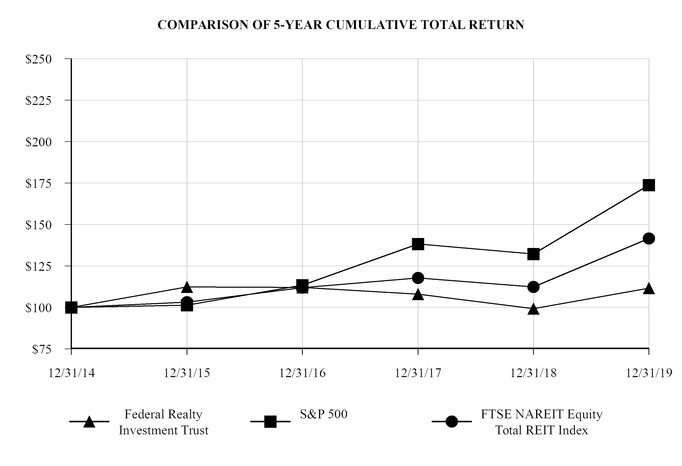
Recent Sales of Unregistered Shares
Under the terms of various operating partnership agreements of certain of our affiliated limited partnerships, the interest of limited partners in those limited partnerships may be redeemed, subject to certain conditions, for cash or an equivalent number of our common shares, at our option. During the three months ended December 31, 2019, we issued 17,035 common shares in connection with the redemption of operating partnership units. Such shares of common stock were issued in reliance on Section 4(a)(2) of the Securities Act. Any other equity securities sold by us during 2019 that were not registered have been previously reported in a Quarterly Report on Form 10-Q.
Purchases of Equity Securities by the Issuer and Affiliated Purchasers
During 2019, 10,501 restricted common shares were forfeited by former employees.
From time to time, we could be deemed to have repurchased shares as a result of shares withheld for tax purposes upon a stock compensation related vesting event.
Item 6. SELECTED FINANCIAL DATA
The following table includes certain financial information on a consolidated historical basis. You should read this section in conjunction with “Item 7. Management’s Discussion and Analysis of Financial Condition and Results of Operations” and “Item 8. Financial Statements and Supplementary Data.”
| Year Ended December 31, | ||||||||||||||||||||||||
| 2019 | 2018 | 2017 | 2016 | 2015 | ||||||||||||||||||||
| (In thousands, except per share data and ratios) | ||||||||||||||||||||||||
| Operating Data: | ||||||||||||||||||||||||
| Rental income | $ | 932,738 | $ | 912,287 | $ | 854,286 | $ | 797,598 | $ | 739,622 | ||||||||||||||
| Property operating income(1) | $ | 637,030 | $ | 627,566 | $ | 584,619 | $ | 547,979 | $ | 510,595 | ||||||||||||||
| Gain on sale of real estate and change in control of interests, net | $ | 116,393 | $ | 11,915 | $ | 77,922 | $ | 32,458 | $ | 28,330 | ||||||||||||||
| Operating income | $ | 470,911 | $ | 361,636 | $ | 410,210 | $ | 353,453 | $ | 328,484 | ||||||||||||||
| Net income | $ | 360,542 | $ | 249,026 | $ | 297,870 | $ | 258,883 | $ | 218,424 | ||||||||||||||
| Net income available for common shareholders | $ | 345,824 | $ | 233,865 | $ | 287,456 | $ | 249,369 | $ | 209,678 | ||||||||||||||
| Net cash provided by operating activities | $ | 461,919 | $ | 516,688 | $ | 458,828 | $ | 427,672 | $ | 371,808 | ||||||||||||||
| Net cash used in investing activities | $ | (316,532 | ) | $ | (192,247 | ) | $ | (837,922 | ) | $ | (590,221 | ) | $ | (355,353 | ) | |||||||||
| Net cash (used in) provided by financing activities | $ | (100,105 | ) | $ | (241,309 | ) | $ | 369,445 | $ | 168,838 | $ | (42,188 | ) | |||||||||||
| Earnings per common share, basic: | ||||||||||||||||||||||||
| Net income available to common shareholders | $ | 4.61 | $ | 3.18 | $ | 3.97 | $ | 3.51 | $ | 3.04 | ||||||||||||||
| Weighted average number of common shares, basic | 74,766 | 73,274 | 72,117 | 70,877 | 68,797 | |||||||||||||||||||
| Earnings per common share, diluted: | ||||||||||||||||||||||||
| Net income available to common shareholders | $ | 4.61 | $ | 3.18 | $ | 3.97 | $ | 3.50 | $ | 3.03 | ||||||||||||||
| Weighted average number of common shares, diluted | 74,766 | 73,302 | 72,233 | 71,049 | 68,981 | |||||||||||||||||||
| Dividends declared per common share | $ | 4.14 | $ | 4.04 | $ | 3.96 | $ | 3.84 | $ | 3.62 | ||||||||||||||
| Other Data: | ||||||||||||||||||||||||
| Funds from operations available to common shareholders(2) | $ | 465,819 | $ | 461,777 | $ | 419,977 | $ | 406,359 | $ | 352,857 | ||||||||||||||
| EBITDAre(3) | $ | 599,567 | $ | 595,558 | $ | 549,107 | $ | 515,151 | $ | 478,734 | ||||||||||||||
| Ratio of EBITDAre to combined fixed charges and preferred share dividends(3)(4) | 4.2x | 4.2x | 3.9x | 4.5x | 3.6x |
| As of December 31, | |||||||||||||||||||
| 2019 | 2018 | 2017 | 2016 | 2015 | |||||||||||||||
| (In thousands) | |||||||||||||||||||
| Balance Sheet Data: | |||||||||||||||||||
| Real estate, at cost | $ | 8,298,132 | $ | 7,819,472 | $ | 7,635,061 | $ | 6,759,073 | $ | 6,064,406 | |||||||||
| Total assets | $ | 6,794,992 | $ | 6,289,644 | $ | 6,275,755 | $ | 5,423,279 | $ | 4,896,559 | |||||||||
| Total debt | $ | 3,356,594 | $ | 3,229,204 | $ | 3,284,766 | $ | 2,798,452 | $ | 2,627,216 | |||||||||
| Total shareholders’ equity | $ | 2,636,132 | $ | 2,467,330 | $ | 2,391,514 | $ | 2,075,835 | $ | 1,781,931 | |||||||||
| Number of common shares outstanding | 75,541 | 74,250 | 73,091 | 71,996 | 69,493 |
| (1) | Property operating income is a non-GAAP measure that consists of rental income and mortgage interest income, less rental expenses and real estate taxes. This measure is used internally to evaluate the performance of property operations and we consider it to be a significant measure. Property operating income should not be considered an alternative measure of operating results or cash flow from operations as determined in accordance with GAAP. |
The reconciliation of operating income to property operating income is as follows:
| 2019 | 2018 | 2017 | 2016 | 2015 | |||||||||||||||
| (In thousands) | |||||||||||||||||||
| Operating income | $ | 470,911 | $ | 361,636 | $ | 410,210 | $ | 353,453 | $ | 328,484 | |||||||||
| General and administrative | 42,754 | 33,600 | 36,281 | 33,399 | 35,645 | ||||||||||||||
| Depreciation and amortization | 239,758 | 244,245 | 216,050 | 193,585 | 174,796 | ||||||||||||||
| Gain on sale of real estate and change in control of interests, net | (116,393 | ) | (11,915 | ) | (77,922 | ) | (32,458 | ) | (28,330 | ) | |||||||||
| Property operating income | $ | 637,030 | $ | 627,566 | $ | 584,619 | $ | 547,979 | $ | 510,595 |
| (2) | Funds from operations ("FFO") is a supplemental non-GAAP financial measure of real estate companies’ operating performances. The National Association of Real Estate Investment Trusts (“NAREIT”) defines FFO as follows: net income, computed in accordance with GAAP, plus real estate related depreciation and amortization, gains and losses on the sale of real estate, and impairment write-downs of depreciable real estate. We compute FFO in accordance with the NAREIT definition, and we have historically reported our FFO available for common shareholders in addition to our net income. |
We consider FFO available for common shareholders a meaningful, additional measure of operating performance primarily because it excludes the assumption that the value of the real estate assets diminishes predictably over time, as implied by the historical cost convention of GAAP and the recording of depreciation. We use FFO primarily as one of several means of assessing our operating performance in comparison with other REITs. Comparison of our presentation of FFO to similarly titled measures for other REITs may not necessarily be meaningful due to possible differences in the application of the NAREIT definition used by such REITs. Additional information regarding our calculation of FFO is contained in “Item 7. Management’s Discussion and Analysis of Financial Condition and Results of Operations.”
The reconciliation of net income to FFO available for common shareholders is as follows:
| 2019 | 2018 | 2017 | 2016 | 2015 | |||||||||||||||
| (In thousands) | |||||||||||||||||||
| Net income | $ | 360,542 | $ | 249,026 | $ | 297,870 | $ | 258,883 | $ | 218,424 | |||||||||
| Net income attributable to noncontrolling interests | (6,676 | ) | (7,119 | ) | (7,956 | ) | (8,973 | ) | (8,205 | ) | |||||||||
| Gain on sale of real estate and change in control of interests, net | (116,393 | ) | (11,915 | ) | (77,632 | ) | (31,133 | ) | (28,330 | ) | |||||||||
| Depreciation and amortization of real estate assets | 215,139 | 213,098 | 188,719 | 169,198 | 154,232 | ||||||||||||||
| Amortization of initial direct costs of leases | 19,359 | 24,603 | 19,124 | 16,875 | 15,026 | ||||||||||||||
| Funds from operations | 471,971 | 467,693 | 420,125 | 404,850 | 351,147 | ||||||||||||||
| Dividends on preferred shares | (7,500 | ) | (7,500 | ) | (1,917 | ) | (541 | ) | (541 | ) | |||||||||
| Income attributable to operating partnership units | 2,703 | 3,053 | 3,143 | 3,145 | 3,398 | ||||||||||||||
| Income attributable to unvested shares | (1,355 | ) | (1,469 | ) | (1,374 | ) | (1,095 | ) | (1,147 | ) | |||||||||
| Funds from operations available for common shareholders | $ | 465,819 | $ | 461,777 | $ | 419,977 | $ | 406,359 | $ | 352,857 |
(3) EBITDA for Real Estate ("EBITDAre") is a non-GAAP measure that NAREIT defines as: net income computed in accordance with GAAP plus net interest expense, income tax expense, depreciation and amortization, gain or loss on sale of real estate, impairments of real estate, and adjustments to reflect the entity's share of EBITDAre of unconsolidated affiliates. We calculate EBITDAre consistent with the NAREIT definition. As EBITDA is a widely known and understood measure of performance, management believes EBITDAre represents an additional non-GAAP performance measure, independent of a company's capital structure that will provide investors with a uniform basis to measure the enterprise value of a company. EBITDAre also approximates a key performance measure in our debt covenants, but it should not be considered an alternative measure of operating results or cash flow from operations as determined in accordance with GAAP.
The reconciliation of net income to EBITDAre for the periods presented is as follows:
| 2019 | 2018 | 2017 | 2016 | 2015 | |||||||||||||||
| (In thousands) | |||||||||||||||||||
| Net income | $ | 360,542 | $ | 249,026 | $ | 297,870 | $ | 258,883 | $ | 218,424 | |||||||||
| Interest expense | 109,623 | 110,154 | 100,125 | 94,994 | 92,553 | ||||||||||||||
| Other interest income | (1,266 | ) | (942 | ) | (475 | ) | (374 | ) | (149 | ) | |||||||||
| Early extinguishment of debt | — | — | 12,273 | — | 19,072 | ||||||||||||||
| Provision for income tax | 772 | 1,521 | 1,813 | — | — | ||||||||||||||
| Depreciation and amortization | 239,758 | 244,245 | 216,050 | 193,585 | 174,796 | ||||||||||||||
| Gain on sale of real estate and change in control of interests | (116,779 | ) | (13,560 | ) | (79,345 | ) | (32,458 | ) | (28,330 | ) | |||||||||
| Adjustments of EBITDAre of unconsolidated affiliates | 6,917 | 5,114 | 796 | 521 | 2,368 | ||||||||||||||
| EBITDAre | $ | 599,567 | $ | 595,558 | $ | 549,107 | $ | 515,151 | $ | 478,734 |
(4) Fixed charges consist of interest on borrowed funds (including capitalized interest), amortization of debt discount/ premiums and debt costs, costs related to the early extinguishment of debt, and the portion of rent expense representing an interest factor. Excluding the $11.9 million charge related to the buyout of the Kmart lease at Assembly Square Marketplace, our ratio of EBITDAre to combined fixed charges and preferred share dividends remains 4.2x in 2019. Excluding the $12.3 million and $19.1 million early extinguishment of debt charge from fixed charges in 2017 and 2015, respectively, the ratio of EBITDAre to combined fixed charges and preferred share dividends is 4.2x and 4.3x, for 2017 and 2015, respectively.
Item 7. MANAGEMENT'S DISCUSSION AND ANALYSIS OF FINANCIAL CONDITION AND RESULTS OF OPERATIONS
This section generally discusses 2019 and 2018 items and year-to-year comparisons between 2019 and 2018. Discussions of 2017 items and year-to-year comparisons between 2018 and 2017 that are not included in this Form 10-K can be found in “Management’s Discussion and Analysis of Financial Condition and Results of Operations” in Part II, Item 7 of our Annual Report on Form 10-K for the fiscal year ended December 31, 2018 filed with the Securities and Exchange Commission on February 13, 2019.
Forward-Looking Statements
Certain statements in this section or elsewhere in this report may be deemed “forward-looking statements”. See “Item 1A. Risk Factors” in this report for important information regarding these forward-looking statements and certain risk and uncertainties that may affect us. The following discussion should be read in conjunction with the consolidated financial statements and notes thereto appearing in “Item 8. Financial Statements and Supplementary Data” of this report.
Overview
We are an equity real estate investment trust (“REIT”) specializing in the ownership, management, and redevelopment of high quality retail and mixed-use properties located primarily in densely populated and affluent communities in strategically selected metropolitan markets in the Northeast and Mid-Atlantic regions of the United States, California, and South Florida. As of December 31, 2019, we owned or had a majority interest in community and neighborhood shopping centers and mixed-use properties which are operated as 104 predominantly retail real estate projects comprising approximately 23.7 million square feet. In total, the real estate projects were 94.2% leased and 92.5% occupied at December 31, 2019. We have paid quarterly dividends to our shareholders continuously since our founding in 1962 and have increased our dividends per common share for 52 consecutive years.
Critical Accounting Policies
The preparation of financial statements in conformity with accounting principles generally accepted in the United States of America, referred to as “GAAP”, requires management to make estimates and assumptions that in certain circumstances affect the reported amounts of assets and liabilities, disclosure of contingent assets and liabilities, and revenues and expenses. These estimates are prepared using management’s best judgment, after considering past and current events and economic conditions. In addition, information relied upon by management in preparing such estimates includes internally generated financial and operating information, external market information, when available, and when necessary, information obtained from consultations with third party experts. Actual results could differ from these estimates. A discussion of possible risks which may
affect these estimates is included in “Item 1A. Risk Factors” of this report. Management considers an accounting estimate to be critical if changes in the estimate could have a material impact on our consolidated results of operations or financial condition.
Our significant accounting policies are more fully described in Note 2 to the consolidated financial statements; however, the most critical accounting policies, which involve the use of estimates and assumptions as to future uncertainties and, therefore, may result in actual amounts that differ from estimates, are as follows:
Revenue Recognition and Accounts Receivable
Policy beginning January 1, 2019, with our adoption of Accounting Standards Codification (ASC) 842, "Leases"
Our leases with our tenants are classified as operating leases. When collection of substantially all lease payments during the lease term is considered probable, the lease qualifies for accrual accounting. Lease payments are recognized on a straight-line basis from when the tenant controls the space through the term of the related lease. Variable lease payments relating to percentage rent are recognized at the end of the lease year or earlier if we have determined the required sales level is achieved. Real estate tax and other cost reimbursements are recognized on an accrual basis over the periods in which the related expenditures are incurred. For a tenant to terminate its lease agreement prior to the end of the agreed term, we may require that they pay a fee to cancel the lease agreement. Lease termination fees for which the tenant has relinquished control of the space are generally recognized on the termination date. When a lease is terminated early but the tenant continues to control the space under a modified lease agreement, the lease termination fee is generally recognized evenly over the remaining term of the modified lease agreement.
When collection of substantially all lease payments during the lease term is not considered probable, total lease revenue is limited to the lesser of revenue recognized under accrual accounting or cash received. Determining the probability of collection of substantially all lease payments during lease term requires judgment. This determination is impacted by numerous factors including our assessment of the tenant’s credit worthiness, economic conditions, our historical experience with the tenant and tenants operating in the same industry, and the length of the lease term. If leases currently classified as probable are subsequently reclassified as not probable, any outstanding lease receivables (including straight-line rent receivables) would be written-off with a corresponding decrease in rental income. For example, in the event that our collectability determinations were not accurate and we were required to write off additional receivables equaling 1% of rental income, our rental income and net income would decrease by $9.3 million.
Policy prior to January 1, 2019
Prior to January 1, 2019, management estimates of collectability were considered when reserving for billed and accrued lease receivables and straight-line rent receivables. Full and partial reserves were recorded when determined to be appropriate with a corresponding charge to bad debt expense. The primary impact of the adoption of ASC 842, “Leases,” on our recognition of lease revenue relates to the upfront and ongoing assessment of the collectability of substantially all lease payments required by the new standard.
Other revenue recognition policies
When we enter into a transaction to sell a property or a portion of a property, we evaluate the recognition of the sale under ASC 610-20, "Other Income - Gains and Losses from the Derecognition of Nonfinancial Assets." In accordance with ASC 610-20, we apply the guidance in ASC 606, "Revenue from Contracts with Customers," to determine whether and when control transfers and how to measure the associated gain or loss. We determine the transaction price based on the consideration we expect to receive. Variable consideration is included in the transaction price to the extent it is probable that a significant reversal of a gain recognized will not occur. We analyze the risk of a significant gain reversal and if necessary limit the amount of variable consideration recognized in order to mitigate this risk. The estimation of variable consideration requires us to make assumptions and apply significant judgment.
Real Estate
The nature of our business as an owner, redeveloper and operator of retail shopping centers and mixed-use properties means that we invest significant amounts of capital. Depreciation and maintenance costs relating to our properties constitute substantial costs for us as well as the industry as a whole. We capitalize real estate investments and depreciate them on a straight-line basis in accordance with GAAP and consistent with industry standards based on our best estimates of the assets’ physical and economic useful lives. We periodically review the estimated lives of our assets and implement changes, as necessary, to these estim
Showing the first 8K of 76K characters. Open the full section
Item 7A. QUANTITATIVE AND QUALITATIVE DISCLOSURES ABOUT MARKET RISK
Our use of financial instruments, such as debt instruments, subjects us to market risk which may affect our future earnings and cash flows, as well as the fair value of our assets. Market risk generally refers to the risk of loss from changes in interest rates and market prices. We manage our market risk by attempting to match anticipated inflow of cash from our operating, investing and financing activities with anticipated outflow of cash to fund debt payments, dividends to common and preferred shareholders, investments, capital expenditures and other cash requirements.
We may enter into certain types of derivative financial instruments to further reduce interest rate risk. We use interest rate protection and swap agreements, for example, to convert some of our variable rate debt to a fixed-rate basis or to hedge anticipated financing transactions. We use derivatives for hedging purposes rather than speculation and do not enter into financial instruments for trading purposes.
Interest Rate Risk
The following discusses the effect of hypothetical changes in market rates of interest on interest expense for our variable rate debt and on the fair value of our total outstanding debt, including our fixed-rate debt. Interest rate risk amounts were determined by considering the impact of hypothetical interest rates on our debt. Quoted market prices were used to estimate the fair value of our marketable senior notes and debentures and discounted cash flow analysis is generally used to estimate the fair value of our mortgages and notes payable. Considerable judgment is necessary to estimate the fair value of financial instruments. This analysis does not purport to take into account all of the factors that may affect our debt, such as the effect that a changing interest rate environment could have on the overall level of economic activity or the action that our management might take to reduce our exposure to the change. This analysis assumes no change in our financial structure.
Fixed Interest Rate Debt
The majority of our outstanding debt obligations (maturing at various times through 2046 or, with respect to finance lease obligations through 2106) have fixed interest rates which limit the risk of fluctuating interest rates. However, interest rate fluctuations may affect the fair value of our fixed rate debt instruments. At December 31, 2019, we had $3.4 billion of fixed-rate debt outstanding, including $56.5 million in mortgage payables that are effectively fixed by two interest rate swap agreements. If market interest rates used to calculate the fair value on our fixed-rate debt instruments at December 31, 2019 had been 1.0% higher, the fair value of those debt instruments on that date would have decreased by approximately $250.5 million. If market interest rates used to calculate the fair value on our fixed-rate debt instruments at December 31, 2019 had been 1.0% lower, the fair value of those debt instruments on that date would have increased by approximately $288.1 million.
Variable Interest Rate Debt
Generally, we believe that our primary interest rate risk is due to fluctuations in interest rates on our variable rate debt. At December 31, 2019, we had no variable rate debt outstanding.
ITEM 8. FINANCIAL STATEMENTS AND SUPPLEMENTARY DATA
Our consolidated financial statements and supplementary data are included as a separate section of this Annual Report on Form 10-K commencing on page F-1 and are incorporated herein by reference.
Item 9. CHANGES IN AND DISAGREEMENTS WITH ACCOUNTANTS ON ACCOUNTING AND FINANCIAL DISCLOSURE
None.
Item 9A. CONTROLS AND PROCEDURES
Management's Evaluation of Disclosure Controls and Procedures
The Trust maintains disclosure controls and procedures (as defined in Rule 13a-15(e) and 15d-15(e) under the Securities Exchange Act of 1934, as amended (the "Exchange Act")) that are designed to provide reasonable assurance that information required to be disclosed in the reports that we file or submit under the Exchange Act is recorded, processed, summarized and reported within the time periods specified in the SEC's rules and forms, and that such information is accumulated and communicated to the Trust’s
management, including its Chief Executive Officer and Chief Financial Officer, as appropriate to allow timely decisions regarding required disclosures. Because of inherent limitations, disclosure controls and procedures, no matter how well designed and operated, can provide only reasonable, and not absolute, assurance that the objectives of disclosure controls and procedures are met.
Our management, with the participation of the Trust’s Chief Executive Officer and Chief Financial Officer, evaluated the effectiveness of the design and operation of the Trust’s disclosure controls and procedures as of December 31, 2019. Based on that evaluation, the Trust’s Chief Executive Officer and Chief Financial Officer concluded that, as of December 31, 2019, the Trust’s disclosure controls and procedures were effective at a reasonable assurance level.
Internal Control over Financial Reporting
The Trust’s management is responsible for establishing and maintaining adequate internal control over financial reporting. Internal control over financial reporting is defined in Rule 13a-15(f) and 15d-15(f) under the Exchange Act as a process designed by, or under the supervision of, the Trust’s principal executive and principal financial officers and effected by our Board of Trustees, management and other personnel, to provide reasonable assurance regarding the reliability of financial reporting and the preparation of financial statements for external purposes in accordance with generally accepted accounting principles in the United States of America (GAAP) and includes those policies and procedures that:
| • | pertain to the maintenance of records that in reasonable detail accurately and fairly reflect our transactions and disposition of our assets; |
| • | provide reasonable assurance that transactions are recorded as necessary to permit preparation of financial statements in accordance with generally accepted accounting principles, and that our receipts and expenditures are being made only in accordance with authorization of management and our Trustees; and |
| • | provide reasonable assurance regarding prevention or timely detection of unauthorized acquisition, use or disposition of any of our assets in circumstances that could have a material adverse effect on our financial statements. |
Because of its inherent limitations, internal control over financial reporting may not prevent or detect misstatements. Projections of any evaluation of effectiveness to future periods are subject to the risk that controls may become inadequate because of changes in conditions, or that the degree of compliance with the policies or procedures may deteriorate.
We assessed the effectiveness of the Trust’s internal control over financial reporting as of December 31, 2019. In making this assessment, we used the criteria set forth by the Committee of Sponsoring Organizations of the Treadway Commission (COSO) in Internal Control-Integrated Framework (2013). Based on that assessment and criteria, management concluded that the Trust's internal control over financial reporting was effective as of December 31, 2019.
Grant Thornton LLP, the independent registered public accounting firm that audited the Trust's consolidated financial statements included in this Annual Report on Form 10-K, has issued an attestation report on the Trust's internal control over financial reporting, which appears on page F-2 of this Annual Report on Form 10-K.
Changes in Internal Control Over Financial Reporting
There was no change in our internal control over financial reporting during our fourth fiscal quarter of 2019 that materially affected, or is reasonably likely to materially affect, our internal control over financial reporting.
Item 9B. OTHER INFORMATION
None.
PART III
Certain information required in Part III is omitted from this Report but is incorporated herein by reference from our Proxy Statement for the 2020 Annual Meeting of Shareholders (as amended or supplemented, the “Proxy Statement”).
Item 10. TRUSTEES, EXECUTIVE OFFICERS AND CORPORATE GOVERNANCE
The tables and narrative in the Proxy Statement identifying our Trustees and Board committees under the caption “Election of Trustees” and “Corporate Governance”, the sections of the Proxy Statement entitled “Executive Officers” and “Section 16(a) Beneficial Ownership Reporting Compliance” and other information included in the Proxy Statement required by this Item 10 are incorporated herein by reference.
We have adopted a Code of Ethics, which is applicable to our Chief Executive Officer and senior financial officers. The Code of Ethics is available in the Corporate Governance section of the Investors section of our website at www.federalrealty.com.
Item 11. EXECUTIVE COMPENSATION
The sections of the Proxy Statement entitled “Summary Compensation Table,” “Compensation Committee Interlocks and Insider Participation,” “Compensation Committee Report,” “Trustee Compensation” and “Compensation Discussion and Analysis” and other information included in the Proxy Statement required by this Item 11 are incorporated herein by reference.
Item 12. SECURITY OWNERSHIP OF CERTAIN BENEFICIAL OWNERS AND MANAGEMENT AND RELATED SHAREHOLDER MATTERS
The sections of the Proxy Statement entitled “Share Ownership” and “Equity Compensation Plan Information” and other information included in the Proxy Statement required by this Item 12 are incorporated herein by reference.
Item 13. CERTAIN RELATIONSHIPS AND RELATED TRANSACTIONS, AND TRUSTEE INDEPENDENCE
The sections of the Proxy Statement entitled “Certain Relationship and Related Transactions” and “Independence of Trustees” and other information included in the Proxy Statement required by this Item 13 are incorporated herein by reference.
Item 14. PRINCIPAL ACCOUNTANT FEES AND SERVICES
The sections of the Proxy Statement entitled “Ratification of Independent Registered Public Accounting Firm” and “Relationship with Independent Registered Public Accounting Firm” and other information included in the Proxy Statement required by this Item 14 are incorporated herein by reference.
PART IV
Item 15. EXHIBITS AND FINANCIAL STATEMENT SCHEDULES
| (a)(1) Financial Statements |
| Our consolidated financial statements and notes thereto, together with Reports of Independent Registered Public Accounting Firm are included as a separate section of this Annual Report on Form 10-K commencing on page F-1. |
| (2) Financial Statement Schedules |
| Our financial statement schedules are included in a separate section of this Annual Report on Form 10-K commencing on page F-31. |
| (3) Exhibits |
| (b) The following documents are filed as exhibits are filed as part of, or incorporated by reference info, this report: |
EXHIBIT INDEX
| Exhibit No. | Description | |
| 3.1 | Declaration of Trust of Federal Realty Investment Trust dated May 5, 1999 as amended by the Articles of Amendment of Declaration of Trust of Federal Realty Investment Trust dated May 6, 2004, as corrected by the Certificate of Correction of Articles of Amendment of Declaration of Trust of Federal Realty Investment Trust dated June 17, 2004, as amended by the Articles of Amendment of Declaration of Trust of Federal Realty Investment Trust dated May 6, 2009 (previously filed as Exhibit 3.1 to the Trust’s Registration Statement on Form S-3 (File No. 333-160009) and incorporated herein by reference) | |
| 3.2 | Amended and Restated Bylaws of Federal Realty Investment Trust dated February 12, 2003, as amended October 29, 2003, May 5, 2004, February 17, 2006, May 6, 2009, November 2, 2016, and February 5, 2019 (previously filed as Exhibit 3.2 to the Trust’s Quarterly Report on Form 10-Q for the quarter ended March 31, 2019 (File No. 1-07533) and incorporated herein by reference) | |
| 4.1 | Specimen Common Share certificate (previously filed as Exhibit 4(i) to the Trust’s Annual Report on Form 10-K for the year ended December 31, 1999 (File No. 1-07533) and incorporated herein by reference) | |
| 4.2 | Articles Supplementary relating to the 5.417% Series 1 Cumulative Convertible Preferred Shares of Beneficial Interest (previously filed as Exhibit 4.1 to the Trust’s Current Report on Form 8-K filed on March 13, 2007, (File No. 1-07533) and incorporated herein by reference) | |
| 4.3 | ** Indenture dated December 1, 1993 related to the Trust’s 7.48% Debentures due August 15, 2026; and 6.82% Medium Term Notes due August 1, 2027; (previously filed as Exhibit 4(a) to the Trust’s Registration Statement on Form S-3 (File No. 33-51029), and amended on Form S-3 (File No. 33-63687), filed on December 13, 1993 and incorporated herein by reference) | |
| 4.4 | ** Indenture dated September 1, 1998 related to the Trust’s 3.00% Notes due 2022; 2.75% Notes due 2023; 3.95% Notes due 2024; 4.50% Notes due 2044; 2.55% Notes due 2021; 3.625% Notes due 2046; 3.25% Notes due 2027; 3.20% Notes due 2029 (previously filed as Exhibit 4(a) to the Trust’s Registration Statement on Form S-3 (File No. 333-63619) filed on September 17, 1998 and incorporated herein by reference) | |
| 4.5 | Articles Supplementary relating to the 5.000% Series C Cumulative Redeemable Preferred Shares of Beneficial Interest (previously filed as Exhibit 3.2 to the Trust's Registration Statement on Form 8-A (File No. 1-07533), filed on September 29, 2017 and incorporated herein by reference) | |
| 4.6 | Deposit Agreement, dated as of September 29, 2017, by and among Federal Realty Investment Trust, American Stock Transfer and Trust Company, LLC, as Depositary, and all holders from time to time of Receipt (previously filed as Exhibit 4.1 to the Trust's Registration Statement on Form 8-A (File No. 1-07533), filed on September 29, 2017 and incorporated herein by reference) | |
| 4.7 | Specimen certificate relating to the 5.000% Series C Cumulative Redeemable Preferred Shares of Beneficial Interest (previously filed as Exhibit 4.3 to the Trust's Registration Statement on Form 8-A (File No. 1-07533), filed on September 29, 2017 and incorporated herein by reference) | |
| 4.8 | Description of Securities (filed herewith) | |
| 10.1 | * Severance Agreement between the Trust and Donald C. Wood dated February 22, 1999 (previously filed as a portion of Exhibit 10 to the Trust's Quarterly Report on Form 10-Q for the quarter ended March 31, 1999 (File No. 1-07533) (the "1999 1Q Form 10-Q") and incorporated herein by reference) | |
| 10.2 | * Executive Agreement between Federal Realty Investment Trust and Donald C. Wood dated February 22, 1999 (previously filed as a portion of Exhibit 10 to the 1999 1Q Form 10-Q and incorporated herein by reference) | |
| 10.3 | * Amendment to Executive Agreement between Federal Realty Investment Trust and Donald C. Wood dated February 16, 2005 (previously filed as Exhibit 10.12 to the Trust’s Annual Report on Form 10-K for the year ended December 31, 2004 (File No. 1-07533) (the “2004 Form 10-K”) and incorporated herein by reference) | |
| 10.4 | 2001 Long-Term Incentive Plan (previously filed as Exhibit 99.1 to the Trust’s S-8 Registration Number 333-60364 filed on May 7, 2001 and incorporated herein by reference) | |
| 10.5 | * Health Coverage Continuation Agreement between Federal Realty Investment Trust and Donald C. Wood dated February 16, 2005 (previously filed as Exhibit 10.26 to the 2004 Form 10-K and incorporated herein by reference) | |
| 10.6 | * Severance Agreement between the Trust and Dawn M. Becker dated April 19, 2000 (previously filed as Exhibit 10.26 to the Trust’s 2005 2Q Form 10-Q and incorporated herein by reference) | |
| 10.7 | * Amendment to Severance Agreement between the Trust and Dawn M. Becker dated February 16, 2005 (previously filed as Exhibit 10.27 to the 2004 Form 10-K and incorporated herein by reference) | |
| Exhibit No. | Description | |
| 10.8 | Form of Restricted Share Award Agreement for awards made under the Trust’s 2003 Long-Term Incentive Award Program for shares issued out of 2001 Long-Term Incentive Plan (previously filed as Exhibit 10.28 to the 2004 Form 10-K and incorporated herein by reference) | |
| 10.9 | Form of Restricted Share Award Agreement for long term vesting and retention awards for shares issued out of the 2010 Plan (previously filed as Exhibit 10.35 to the Trust's Annual Report on Form 10-K for the year ended December 31, 2010 (File No. 1-07533) (the "2010 Form 10-K") and incorporated herein by reference) | |
| 10.10 | Form of Option Award Agreement for awards made under the Trust’s 2003 Long-Term Incentive Award Program for shares issued out of the 2001 Long-Term Incentive Plan (previously filed as Exhibit 10.32 to the 2005 Form 10-K and incorporated herein by reference) | |
| 10.11 | Amended and Restated 2001 Long-Term Incentive Plan (previously filed as Exhibit 10.34 to the Trust’s Quarterly Report on Form 10-Q for the quarter ended June 30, 2007 (File No. 1-07533) and incorporated herein by reference) | |
| 10.12 | * Amendment to Severance Agreement between the Trust and Donald C. Wood dated January 1, 2009 (previously filed as Exhibit 10.26 to the Trust’s Annual Report on Form 10-K for the year ended December 31, 2008 (File No. 1-07533) (“the 2008 Form 10-K”) and incorporated herein by reference) | |
| 10.13 | * Second Amendment to Executive Agreement between the Trust and Donald C. Wood dated January 1, 2009 (previously filed as Exhibit 10.27 to the Trust’s 2008 Form 10-K and incorporated herein by reference) | |
| 10.14 | * Amendment to Health Coverage Continuation Agreement between the Trust and Donald C. Wood dated January 1, 2009 (previously filed as Exhibit 10.28 to the Trust’s 2008 Form 10-K and incorporated herein by reference) | |
| 10.15 | * Second Amendment to Severance Agreement between the Trust and Dawn M. Becker dated January 1, 2009 (previously filed as Exhibit 10.30 to the Trust’s 2008 Form 10-K and incorporated herein by reference) | |
| 10.16 | 2010 Performance Incentive Plan (previously filed as Appendix A to the Trust’s Definitive Proxy Statement for the 2010 Annual Meeting of Shareholders (File No. 01-07533) and incorporated herein by reference) | |
| 10.17 | Amendment to 2010 Performance Incentive Plan (“the 2010 Plan”) (previously filed as Appendix A to the Trust’s Proxy Statement for the 2010 Annual Meeting of Shareholders (File No. 01-07533) and incorporated herein by reference) | |
| 10.18 | * Restricted Share Award Agreement between the Trust and Donald C. Wood dated October 12, 2010 (previously filed as Exhibit 10.36 to the Trust’s Quarterly Report on Form 10-Q for the quarter ended September 30, 2010 (File No. 01-07533) and incorporated herein by reference) | |
| 10.19 | Form of Restricted Share Award Agreement for awards made under the Trust’s Long-Term Incentive Award Program and the Trust’s Annual Incentive Bonus Program and basic awards with annual vesting for shares issued out of the 2010 Plan (previously filed as Exhibit 10.34 to the Trust’s 2010 Form 10-K (File No. 1-07533) and incorporated herein by reference) | |
| 10.20 | Form of Option Award Agreement for awards made under the Trust’s Long-Term Incentive Award Program for shares issued out of the 2010 Plan (previously filed as Exhibit 10.38 to the Trust’s 2010 Form 10-K (File No. 1-07533) and incorporated herein by reference) | |
| 10.21 | Form of Option Award Agreement for front loaded awards made under the Trust’s Long-Term Incentive Award Program for shares issued out of the 2010 Plan (previously filed as Exhibit 10.39 to the Trust’s 2010 Form 10-K (File No. 1-07533) and incorporated herein by reference) | |
| 10.22 | Form of Option Award Agreement for basic options awarded out of the 2010 Plan (previously filed as Exhibit 10.40 to the Trust’s 2010 Form 10-K (File No. 1-07533) and incorporated herein by reference) | |
| 10.23 | Form of Restricted Share Award Agreement, dated as of February 10, 2011, between the Trust and Dawn M. Becker (previously filed as Exhibit 10.41 to the Trust’s 2010 Form 10-K (File No. 1-07533) and incorporated herein by reference) | |
| 10.24 | Credit Agreement dated as of July 7, 2011, by and among the Trust, as Borrower, the financial institutions party thereto and their permitted assignees under Section 12.6., as Lenders, Wells Fargo Bank, National Association, as Administrative Agent, PNC Bank, National Association, as Syndication Agent, Wells Fargo Securities, LLC, as a Lead Arranger and Book Manager, and PNC Capital Markets LLC, as a Lead Arranger and Book Manager (previously filed as Exhibit 10.1 to the Trust’s Current Report on Form 8-K (File No. 1-07533), filed on July 11, 2011 and incorporated herein by reference) | |
| Exhibit No. | Description | |
| 10.25 | Term Loan Agreement dated as of November 22, 2011, by and among the Trust, as Borrower, the financial institutions party thereto and their permitted assignees under Section 12.6., as Lenders, PNC Bank, National Association, as Administrative Agent, Capital One, N.A., Syndication Agent, PNC Capital Markets, LLC, as a Lead Arranger and Book Manager, and Capital One, N.A., as a Lead Arranger and Book Manager (previously filed as Exhibit 10.1 to the Trust's Current Report on Form 8-K (File No. 1-07533), filed on November 28, 2011 and incorporated herein by reference) | |
| 10.26 | Revised Form of Restricted Share Award Agreement for front loaded awards made under the Trust’s Long-Term Incentive Award Program for shares issued out of the 2010 Plan (previously filed as Exhibit 10.35 to the Trust's Annual Report on Form 10-K for the year ended December 31, 2012 (File No. 1-07533) (the "2012 Form 10-K") and incorporated herein by reference) | |
| 10.27 | Revised Form of Restricted Share Award Agreement for long-term vesting and retention awards made under the Trust’s Long-Term Incentive Award Program for shares issued out of the 2010 Plan (previously filed as Exhibit 10.36 to the Trust's 2012 Form 10-K (File No. 1-07533) and incorporated herein by reference) | |
| 10.28 | Revised Form of Performance Share Award Agreement for shares awarded out of the 2010 Plan (previously filed as Exhibit 10.37 to the Trust's 2012 Form 10-K (File No. 1-07533) and incorporated herein by reference) | |
| 10.29 | Revised Form of Restricted Share Award Agreement for awards made under the Trust’s Long-Term Incentive Award Program and the Trust’s Annual Incentive Bonus Program and basic awards with annual vesting for shares issued out of the 2010 Plan (previously filed as Exhibit 10.38 to the Trust's 2012 Form 10-K (File No. 1-07533) and incorporated herein by reference) | |
| 10.30 | First Amendment to the Credit Agreement, dated as of April 22, 2013, by and among Federal Realty Investment Trust, each of the Lenders party thereto, and Wells Fargo Bank, National Association, as Administrative Agent (previously filed as Exhibit 10.1 to the Trust's Current Report on Form 8-K (File No. 1-07533), filed on April 26, 2013 and incorporated herein by reference) | |
| 10.31 | First Amendment to the Term Loan Agreement, dated as of April 22, 2013, by and among Federal Realty Investment Trust, each of the Lenders party thereto, and PNC Bank, National Association, as Administrative Agent (previously filed as Exhibit 10.40 to the Trust's Quarterly Report on Form 10-Q for the quarter ended March 31, 2013 (File No. 1-07533) and incorporated herein by reference | |
| 10.32 | Second Amendment to Term Loan Agreement, dated as of August 28, 2014, by and among Federal Realty Investment Trust, each of the Lenders party thereto, and PNC Bank, National Association, as Administrative Agent (previously filed as Exhibit 10.1 to the Trust's Current Report on Form 8-K (File No. 1-07533), filed on September 2, 2014 and incorporated herein by reference) | |
| 10.33 | Second Amendment to Credit Agreement, dated as of April 20, 2016, by and among Federal Realty Investment Trust, each of the Lenders party thereto, and PNC Bank, National Association, as Administrative Agent (previously filed as Exhibit 10.1 to the Trust's Current Report on Form 8K (File No. 1-07533), filed on April 26, 2016 and incorporated herein by reference) | |
| 10.34 | Third Amendment to Term Loan Agreement, dated as of April 20, 2016, by and among Federal Realty Investment Trust, each of the Lenders party thereto, and PNC Bank, National Association, as Administrative Agent (previously filed as Exhibit 10.1 to the Trust's Current Report on Form 8-K (File No. 1-07533), filed on April 26, 2016 and incorporated herein by reference) | |
| 10.35 | Severance Agreement between the Trust and Daniel Guglielmone dated August 15, 2016 (previously filed as Exhibit 10.36 to the Trust's Quarterly Report on Form 10-Q for the quarter ended September 30, 2016 (File No. 1-07533 and incorporated herein by reference) | |
| 10.36 | Amended and Restated Credit Agreement, dated as of July 25, 2019, by and among Federal Realty Investment Trust, each of the Lenders party thereto, and PNC Bank, National Association, as Administrative Agent (previously filed as Exhibit 10.1 to the Trust's Current Report on Form 8-K (File No. 1-07533), filed on July 29, 2019 and incorporated herin by reference) | |
| 21.1 | Subsidiaries of Federal Realty Investment Trust (filed herewith) | |
| 23.1 | Consent of Grant Thornton LLP (filed herewith) | |
| 31.1 | Rule 13a-14(a) Certification of Chief Executive Officer (filed herewith) | |
| 31.2 | Rule 13a-14(a) Certification of Chief Financial Officer (filed herewith) | |
| 32.1 | Section 1350 Certification of Chief Executive Officer (filed herewith) | |
| 32.2 | Section 1350 Certification of Chief Financial Officer (filed herewith) | |
| 101 | The following materials from Federal Realty Investment Trust’s Annual Report on Form 10-K for the year ended December 31, 2019, formatted in XBRL (Extensible Business Reporting Language): (1) the Consolidated Balance Sheets, (2) the Consolidated Statements of Comprehensive Income, (3) the Consolidated Statement of Shareholders’ Equity, (4) the Consolidated Statements of Cash Flows, and (5) Notes to Consolidated Financial Statements that have been detail tagged. | |
| 104 | Cover Page Interactive Data File (formatted in Inline XBRL and contained in Exhibit 101) |
- Management contract or compensatory plan required to be filed as an exhibit pursuant to Item 15(b) of Form 10-K.
** Pursuant to Regulation S-K Item 601(b)(4)(iii), the Trust by this filing agrees, upon request, to furnish to the Securities and Exchange Commission a copy of other instruments defining the rights of holders of long-term debt of the Trust.
Item 16. FORM 10-K SUMMARY
None.
SIGNATURES
Pursuant to the requirements of Section 13 or 15(d) of the Securities Exchange Act of 1934, as amended, the Registrant has duly caused this Report to be signed on its behalf by the undersigned thereunto duly authorized this February 10, 2020.
| Federal Realty Investment Trust | |
| By: | /S/ DONALD C. WOOD |
| Donald C. Wood President, Chief Executive Officer and Trustee |
Pursuant to the requirements of the Securities Exchange Act of 1934, as amended, this Report has been signed below by the following persons on behalf of the Registrant and in the capacity and on the dates indicated. Each person whose signature appears below hereby constitutes and appoints each of Donald C. Wood and Dawn M. Becker as his or her attorney-in-fact and agent, with full power of substitution and resubstitution for him or her in any and all capacities, to sign any or all amendments to this Report and to file same, with exhibits thereto and other documents in connection therewith, granting unto such attorney-in-fact and agent full power and authority to do and perform each and every act and thing requisite and necessary in connection with such matters and hereby ratifying and confirming all that such attorney-in-fact and agent or his or her substitutes may do or cause to be done by virtue hereof.
| Signature | Title | Date | ||
| /S/ DONALD C. WOOD | President, Chief Executive Officer and | February 10, 2020 | ||
| Donald C. Wood | Trustee (Principal Executive Officer) | |||
| /S/ DANIEL GUGLIELMONE | Executive Vice President-Chief Financial | February 10, 2020 | ||
| Daniel Guglielmone | Officer and Treasurer (Principal | |||
| Financial and Accounting Officer) | ||||
| /S/ JOSEPH S. VASSALLUZZO | Non-Executive Chairman | February 10, 2020 | ||
| Joseph S. Vassalluzzo | ||||
| /S/ JON E. BORTZ | Trustee | February 10, 2020 | ||
| Jon E. Bortz | ||||
| /S/ DAVID W. FAEDER | Trustee | February 10, 2020 | ||
| David W. Faeder | ||||
| /S/ ELIZABETH I. HOLLAND | Trustee | February 10, 2020 | ||
| Elizabeth I. Holland | ||||
| /S/ MARK S. ORDAN | Trustee | February 10, 2020 | ||
| Mark S. Ordan | ||||
| /S/ GAIL P. STEINEL | Trustee | February 10, 2020 | ||
| Gail P. Steinel |
Item 8. and Item 15(a)(1) and (2)
Index to Consolidated Financial Statements and Schedules
| Consolidated Financial Statements | Page No. |
| Report of Independent Registered Public Accounting Firm | F-2 |
| Report of Independent Registered Public Accounting Firm | F-3 |
| Consolidated Balance Sheets | F-5 |
| Consolidated Statements of Comprehensive Income | F-6 |
| Consolidated Statement of Shareholders’ Equity | F-7 |
| Consolidated Statements of Cash Flows | F-8 |
| Notes to Consolidated Financial Statements | F-9 |
| Financial Statement Schedules | |
| Schedule III—Summary of Real Estate and Accumulated Depreciation | F-31 |
| Schedule IV—Mortgage Loans on Real Estate | F-39 |
All other schedules have been omitted either because the information is not applicable, not material, or is disclosed in our consolidated financial statements and related notes.
F-1
Report of Independent Registered Public Accounting Firm
Trustees and Shareholders
Federal Realty Investment Trust
Opinion on internal control over financial reporting
We have audited the internal control over financial reporting of Federal Realty Investment Trust (a Maryland real estate investment trust) and Subsidiaries (collectively, the "Trust") as of December 31, 2019, based on criteria established in the 2013 Internal Control—Integrated Framework issued by the Committee of Sponsoring Organizations of the Treadway Commission ("COSO"). In our opinion, the Trust maintained, in all material respects, effective internal control over financial reporting as of December 31, 2019, based on criteria established in the 2013 Internal Control-Integrated Framework issued by COSO.
We also have audited, in accordance with the standards of the Public Company Accounting Oversight Board (United States) (“PCAOB”), the consolidated financial statements of the Trust as of and for the year ended December 31, 2019, and our report dated February 10, 2020 expressed an unqualified opinion on those financial statements.
Basis for opinion
The Trust’s management is responsible for maintaining effective internal control over financial reporting and for its assessment of the effectiveness of internal control over financial reporting, included in the accompanying Management's Evaluation of Disclosure Controls and Procedures. Our responsibility is to express an opinion on the Trust’s internal control over financial reporting based on our audit. We are a public accounting firm registered with the PCAOB and are required to be independent with respect to the Trust in accordance with the U.S. federal securities laws and the applicable rules and regulations of the Securities and Exchange Commission and the PCAOB.
We conducted our audit in accordance with the standards of the PCAOB. Those standards require that we plan and perform the audit to obtain reasonable assurance about whether effective internal control over financial reporting was maintained in all material respects. Our audit included obtaining an understanding of internal control over financial reporting, assessing the risk that a material weakness exists, testing and evaluating the design and operating effectiveness of internal control based on the assessed risk, and performing such other procedures as we considered necessary in the circumstances. We believe that our audit provides a reasonable basis for our opinion.
Definition and limitations of internal control over financial reporting
A company’s internal control over financial reporting is a process designed to provide reasonable assurance regarding the reliability of financial reporting and the preparation of financial statements for external purposes in accordance with generally accepted accounting principles. A company’s internal control over financial reporting includes those policies and procedures that (1) pertain to the maintenance of records that, in reasonable detail, accurately and fairly reflect the transactions and dispositions of the assets of the company; (2) provide reasonable assurance that transactions are recorded as necessary to permit preparation of financial statements in accordance with generally accepted accounting principles, and that receipts and expenditures of the company are being made only in accordance with authorizations of management and directors of the company; and (3) provide reasonable assurance regarding prevention or timely detection of unauthorized acquisition, use, or disposition of the company’s assets that could have a material effect on the financial statements.
Because of its inherent limitations, internal control over financial reporting may not prevent or detect misstatements. Also, projections of any evaluation of effectiveness to future periods are subject to the risk that controls may become inadequate because of changes in conditions, or that the degree of compliance with the policies or procedures may deteriorate.
/s/ GRANT THORNTON LLP
Charlotte, North Carolina
February 10, 2020
F-2
Report of Independent Registered Public Accounting Firm
Trustees and Shareholders
Federal Realty Investment Trust
Opinion on the financial statements
We have audited the accompanying consolidated balance sheets of Federal Realty Investment Trust (a Maryland real estate investment trust) and Subsidiaries (collectively, the "Trust") as of December 31, 2019 and 2018, the related consolidated statements of comprehensive income, changes in shareholders’ equity, and cash flows for each of the three years in the period ended December 31, 2019, and the related notes and financial statement schedules included under Item 15(a) (collectively referred to as the “financial statements”). In our opinion, the financial statements present fairly, in all material respects, the financial position of the Trust as of December 31, 2019 and 2018, and the results of its operations and its cash flows for each of the three years in the period ended December 31, 2019, in conformity with accounting principles generally accepted in the United States of America.
We also have audited, in accordance with the standards of the Public Company Accounting Oversight Board (United States) (“PCAOB”), the Trust’s internal control over financial reporting as of December 31, 2019, based on criteria established in the 2013 Internal Control-Integrated Framework issued by the Committee of Sponsoring Organizations of the Treadway Commission (“COSO”), and our report dated February 10, 2020 expressed an unqualified opinion.
Change in accounting principle
As dicussed in Note 2 to the consolidated financial statements, the Trust has changed its method of accounting for leases in 2019 due to the adoption of Accounting Standards Codification (ASC) Topic 842, Leases.
Basis for opinion
These financial statements are the responsibility of the Trust’s management. Our responsibility is to express an opinion on the Trust’s financial statements based on our audits. We are a public accounting firm registered with the PCAOB and are required to be independent with respect to the Trust in accordance with the U.S. federal securities laws and the applicable rules and regulations of the Securities and Exchange Commission and the PCAOB.
We conducted our audits in accordance with the standards of the PCAOB. Those standards require that we plan and perform the audit to obtain reasonable assurance about whether the financial statements are free of material misstatement, whether due to error or fraud. Our audits inclu
Showing the first 8K of 167K characters. Open the full section