 filings.tools
First Solar (FSLR) 10-K risk factor changes: FY2021 vs FY2020
The 2021-12-31 10-K against the 2020-12-31 one, compared heading by heading and sentence by sentence.
Item 1A121 rewritten60 added188 removed294 unchanged
All filing items1,186 rewritten520 added1,006 removed1,728 unchanged
Summary
counted, not written
- Item 1A lists 31 risk factor headings: 2 new, 9 reworded and 20 unchanged since FY2020. 11 headings from FY2020 no longer appear.
- Sentence by sentence, 520 added, 1,006 removed, 1,186 rewritten and 1,728 unchanged across 19 items that differ.
- New this year: Item 9C. Disclosure Regarding Foreign Jurisdictions that Prevent Inspections.
New Item 1A headings (2)
- Our failure to reduce module manufacturing production and selling costs, including costs related to raw materials and logistics services, could render our solar modules uncompetitive and reduce our net sales, profitability, and/or market share.
- Our Amended and Restated Bylaws designate a state or federal court located within the State of Delaware as the exclusive forum for substantially all disputes between us and our stockholders, and the federal district courts of the United States as the exclusive forum for the resolution of any complaint asserting a cause of action under the Securities Act of 1933, which could limit our stockholders’ ability to choose the judicial forum for disputes with us or our directors, officers, employees, agents or stockholders.
Removed Item 1A headings (11)
- We may be unable to acquire or lease land, obtain necessary interconnection and transmission rights, and/or obtain the approvals, licenses, permits, and electric transmission grid interconnection and transmission rights necessary to build and operate PV solar power systems in a timely and cost effective manner, and regulatory agencies, local communities, labor unions, tribes, or other third parties may delay, prevent, or increase the cost of construction and operation of the system we intend to build.
- We may not be able to obtain long-term contracts for the sale of power produced by our projects at prices and on other terms favorable to attract financing and other investments; with regard to projects for which electricity is or will be sold on an open contract basis rather than under a PPA, our results of operations could be adversely affected to the extent prevailing spot electricity prices decline in an unexpected manner.
- Lack of transmission capacity availability, potential upgrade costs to the transmission grid, and other system constraints could significantly impact our ability to build PV solar power systems and generate solar electricity power sales.
- Competition at the system level can be intense, thereby potentially exerting downward pressure on system-level profit margins industry-wide, which could reduce our profitability and adversely affect our results of operations.
- Our systems business is largely dependent on us and third parties arranging financing from various sources, which may not be available or may only be available on unfavorable terms or in insufficient amounts.
- Developing solar power projects may require significant upfront investment prior to the signing of sales contracts, which could adversely affect our business and results of operations.
- We may be subject to unforeseen costs, liabilities, or obligations when providing O&M services. In addition, certain of our O&M agreements include provisions permitting the counterparty to terminate the agreement without cause.
- Our systems business is subject to regulatory oversight and liability if we fail to operate PV solar power systems in compliance with electric reliability rules.
- Our credit agreements contain covenant restrictions that may limit our ability to operate our business.
- We may not realize the anticipated benefits of past or future business combinations or acquisition transactions, and integration of business combinations may disrupt our business and management.
- Our future success depends on our ability to retain our key associates and to successfully integrate them into our management team.
Reworded Item 1A headings (9)
- Competition in solar markets globally and across the solar value chain is intense, and could remain that way for an extended period of time. An increased global supply of PV modules has caused and may
[removed: continue to]cause structural imbalances in which global PV module supply exceeds demand, which could have a material adverse effect on our business, financial condition, and results of operations. - If PV solar and related technologies are not suitable for continued adoption at economically attractive rates of return or if sufficient additional demand for solar
[removed: modules, related technologies,][added: modules] and[removed: systems][added: related technologies] does not develop or takes longer to develop than we anticipate, our net sales and profit may flatten or decline and we may be unable to sustain profitability. - The reduction, elimination, or expiration of government subsidies, economic incentives, tax incentives, renewable energy targets, and other support for on-grid solar electricity applications, or other public policies, such as tariffs or other trade remedies imposed on solar cells and modules, could negatively impact demand and/or price levels for our solar modules and
[removed: systems and]limit our growth or lead to a reduction in our net sales or increase our costs, thereby adversely impacting our operating results. - An increase in interest rates or tightening of the supply of capital in the global financial markets (including a reduction in total tax equity availability) could make it difficult for customers to finance the cost of a PV solar power system and could reduce the demand for our modules
[removed: or systems]and/or lead to a reduction in the average selling price for[removed: such offerings.][added: our modules.] - Our failure to further refine our
[removed: technology, reduce module manufacturing and BoS costs,][added: technology] and develop and introduce improved PV[removed: products][added: products, including as a result of delays in implementing planned advancements,] could render our solar modules[removed: or systems]uncompetitive and reduce our net sales, profitability, and/or market share. - A disruption in our supply chain for
[removed: CdTe][added: CdTe, other key raw materials, or equipment] could interrupt or impair our ability to manufacture solar modules and could adversely impact our profitability and long-term growth prospects. - Project development or construction
[removed: activities][added: activities, which are primarily concentrated in Japan,] may not be successful; projects under development may not receive required permits, [added: community support,] real property rights,[removed: PPAs,][added: power purchase agreements (“PPA”),] interconnection, and transmission arrangements; or financing or construction may not commence or proceed as scheduled, which could increase our costs and impair our ability to recover our investments. - Existing regulations and policies, changes thereto, and new regulations and policies may present technical, regulatory, and economic barriers to the purchase and use of PV solar
[removed: products or systems,][added: products,] which may significantly reduce demand for our[removed: modules, systems, or services.][added: modules.] - If we are unable to attract, train, [added: retain,] and
[removed: retain][added: successfully integrate] key[removed: personnel,][added: personnel into] our [added: management team, our] business may be materially and adversely affected.
A heading is new when no FY2020 heading matches it after ignoring case and punctuation, and reworded when it shares at least 60 percent of its words with one that went away. All current risk factor headings.
Sentences by item
23 items, with every count and a link to each item that changed
Underlined words on a shaded ground are new in FY2021; struck-through words were in FY2020. Sentences that are wholly new or wholly gone are labelled rather than marked.
Item 1A. Risk Factors
121 rewritten, 60 added, 188 removed, 294 unchanged
An increased global supply of PV modules has caused and may [removed: continue to] cause structural imbalances in which global PV module supply exceeds demand.
Sufficient additional demand for solar [removed: modules, related technologies,] [added: modules] and [removed: systems] [added: related technologies] may not develop or may take longer to develop than we anticipate, causing our net sales and profit to flatten or decline and threatening our ability to sustain profitability.
- The reduction, elimination, or expiration of government subsidies, economic incentives, tax incentives, renewable energy targets, and other support for on-grid solar electricity applications, or other public policies could negatively impact demand and/or price levels for our solar [removed: modules and systems.][added: modules.]
- An increase in interest rates or tightening of the supply of capital in the global financial markets (including a reduction in total tax equity availability) could make it difficult for customers to finance the cost of a PV solar power system and could reduce the demand for our modules [removed: or systems] and/or lead to a reduction in the average selling price for [removed: such offerings.][added: our products.]
- Our failure to further refine our [removed: technology, reduce module manufacturing and BoS costs,] [added: technology] and develop and introduce improved PV [removed: products] [added: products, including as a result of delays in implementing planned advancements,] could render our solar modules [removed: or systems] uncompetitive and reduce our net sales, profitability, and/or market share.
[removed: - Project] [added: Project] development or construction [removed: activities] [added: activities, which are primarily concentrated in Japan,] may not be successful; projects under development may not receive required permits, [added: community support,] real property rights, [removed: PPAs,] [added: power purchase agreements (“PPA”),] interconnection, and transmission arrangements; or financing or construction may not commence or proceed as scheduled, which could increase our costs and impair our ability to recover our [removed: investments.][added: investments.]
- Existing regulations and policies, changes thereto, and new regulations and policies may present technical, regulatory, and economic barriers to the purchase and use of PV solar products or systems, which may significantly reduce demand for our [removed: modules, systems, or services.][added: modules.]
An increased global supply of PV modules has caused and may [removed: continue to] cause structural imbalances in which global PV module supply exceeds demand, which could have a material adverse effect on our business, financial condition, and results of operations.
For example, we estimate that in [removed: 2020] [added: 2021] approximately [removed: 50] [added: 80] GWDC of capacity was added by solar module manufacturers, primarily but not exclusively in Asia.
We believe the solar industry may from time to time experience periods of structural imbalance between supply and demand (i.e., where production capacity exceeds global demand), and that [removed: such periods] [added: excess capacity] will continue to put pressure on pricing.
During the past several years, industry average selling prices per watt have [added: generally] declined in many markets, at times significantly, [removed: both at the module and system levels,] as competitors have reduced prices to sell inventories worldwide.
If PV solar and related technologies are not suitable for continued adoption at economically attractive rates of return or if sufficient additional demand for solar [removed: modules, related technologies,] [added: modules] and [removed: systems] [added: related technologies] does not develop or takes longer to develop than we anticipate, our net sales and profit may flatten or decline and we may be unable to sustain profitability.
In comparison to traditional forms of energy generation, the solar energy market continues to be at [removed: a relatively early] [added: an earlier] stage of development.
If utility-scale PV solar technology proves unsuitable for continued adoption at economically attractive rates of return or if additional demand for solar modules [removed: and systems] fails to develop sufficiently or takes longer to develop than we anticipate, we may be unable to grow our business or generate sufficient net sales to sustain [removed: profitability.]
In addition, demand for solar [removed: modules, related technologies,] [added: modules] and [removed: systems] [added: related technologies] in our targeted markets may develop to a lesser extent than we anticipate.
Many factors may affect the viability of continued adoption of utility-scale PV solar technology in our targeted markets, as well as the demand for solar modules [removed: and systems] generally, including the following:
The reduction, elimination, or expiration of government subsidies, economic incentives, tax incentives, renewable energy targets, and other support for on-grid solar electricity applications, or other public policies, such as tariffs or other trade remedies imposed on solar cells and modules, could negatively impact demand and/or price levels for our solar modules and [removed: systems and] limit our growth or lead to a reduction in our net sales or increase our costs, thereby adversely impacting our operating results.
Federal, state, and local governmental bodies in many countries have provided subsidies in the form of [removed: FiTs,] [added: feed-in-tariff (“FiT”) structures,] rebates, tax incentives, and other incentives to end users, distributors, system integrators, and manufacturers of PV solar products.
“Business – Support Programs.” To the extent these support programs are reduced earlier than previously [removed: expected or] [added: expected,] are changed retroactively, [added: or are not renewed,] such changes could negatively impact demand and/or price levels for our solar [removed: modules and systems,] [added: modules,] lead to a reduction in our net sales, and adversely impact our operating results.
[removed: The adoption of restrictive land-use] designations or environmental regulations that proscribe or restrict the siting of utility-scale solar facilities could adversely affect the marginal cost of such development.
- any limitations on the value or availability to potential investors of tax incentives that benefit solar energy [removed: projects] [added: projects,] such as the [removed: ITC] [added: ITC, which is currently scheduled to decrease to 22% in 2023] and [added: 10% in 2024, and] accelerated depreciation [removed: deductions] [added: deductions,] could result in reducing such investors’ economic returns, causing a reduction in the availability of affordable financing, thereby reducing demand for PV solar modules; and
For example, the United States currently imposes different types of tariffs and/or other trade remedies on certain imported crystalline silicon [removed: photovoltaic] [added: PV] modules and cells from various countries.
[removed: These] [added: During 2021, these] tariffs [removed: include] [added: included] a global safeguard measure imposed pursuant to Section 201 of the Trade Act of 1974 that [removed: provides] [added: provided] for tariffs on imported crystalline silicon solar modules and a tariff-rate quota on imported crystalline silicon solar [removed: cells.][added: cells above the first 2.5 GWDC of imports.]
In addition, the United States currently imposes antidumping and countervailing duties on certain imported crystalline silicon [removed: photovoltaic] [added: PV] cells and modules from China and Taiwan.
[removed: Examples include tariffs] [added: For example,] the United States imposes [added: tariffs] on certain imported aluminum and steel [removed: articles,] [added: articles from certain foreign jurisdictions,] generally at rates of 10% and 25%, respectively, under Section 232 of the Trade Expansion Act of [removed: 1962; and potential tariffs on imports of goods from Vietnam under Section 301 of the Tariff Act of 1974.][added: 1962.]
An increase in interest rates or tightening of the supply of capital in the global financial markets (including a reduction in total tax equity availability) could make it difficult for customers to finance the cost of a PV solar power system and could reduce the demand for our modules [removed: or systems] and/or lead to a reduction in the average selling price for [removed: such offerings.][added: our modules.]
Many of our customers [removed: and our systems business] depend on debt and/or equity financing to fund the initial capital expenditure required to develop, build, and/or purchase a PV solar power system.
As a result, an increase in interest rates, or a reduction in the supply of project debt financing or tax equity investments, could reduce the number of solar projects that receive financing or otherwise make it difficult for our customers [removed: or our systems business] to secure the financing necessary to develop, build, purchase, or install a PV solar power system on favorable terms, or at all, and thus lower demand for our solar modules, which could limit our growth or reduce our net sales.
See the Risk Factor entitled “The reduction, elimination, or expiration of government subsidies, economic incentives, tax incentives, renewable energy targets, and other support for on-grid solar electricity applications, or other public [added: policies, such as tariffs or other trade remedies imposed on solar cells and modules, could negatively impact demand and/or price levels for our solar modules and limit our growth or lead to a reduction in our net sales or increase our costs, thereby adversely impacting our operating results” for additional information.]
[added: Refer also to the Risk Factors entitled “Our substantial international operations subject us to a number of risks, including unfavorable political, regulatory, labor, and tax conditions in the United States and/or foreign countries,” and “The reduction, elimination, or expiration of government subsidies, economic incentives, tax incentives, renewable energy targets, and other support for on-grid solar electricity applications, or other public] policies, such as tariffs or other trade remedies imposed on solar cells and modules, could negatively impact demand and/or price levels for our solar modules and [removed: systems and] limit our growth or lead to a reduction in our net sales or increase our costs, thereby adversely impacting our operating [removed: results” for additional information.][added: results.”]
- difficulty in competing successfully with other technologies, such as bifacial modules and n-type mono-crystalline [removed: wafers and cells;][added: modules;]
- difficulty in accurately prioritizing geographic markets that we can most effectively and profitably serve with our [removed: PV] solar [added: module] offerings, including miscalculations in overestimating or underestimating addressable market demand;
- adverse public policies in countries we operate in and/or are pursuing, including local content requirements, the imposition of trade remedies, [added: the removal of trade barriers,] or capital investment requirements;
- difficulty in identifying effective local partners and developing any necessary partnerships with local businesses on commercially acceptable terms; [added: and]
- difficulty in balancing market demand and manufacturing production in an efficient and timely manner, potentially causing our manufacturing capacity to be constrained in some future periods or over-supplied in [removed: others; and][added: others.]
Our customers include [removed: integrators] [added: developers] and operators of systems, utilities, independent power producers, commercial and industrial companies, and other system owners, who may experience intense competition at the system level, thereby constraining the ability for such customers to sustain meaningful and consistent profitability.
These amendments may reduce the volume of modules to be sold under the contract, adjust delivery [removed: schedules, or otherwise decrease the expected revenue under these contracts.]
We may expand our portfolio of offerings to include solutions that build upon our core competencies but for which we have not had significant historical experience, including variations in our traditional product offerings or other offerings related to [removed: commercial and industrial customers and community solar.][added: certain markets.]
[removed: Also, in] [added: In] expanding into these areas, we may [removed: be competing] [added: also compete] against companies that previously have not been significant competitors, such as companies that currently have substantially more experience than we do in the residential, commercial and industrial, or other targeted offerings.
[added: If we are] unable to achieve growth in these areas, our overall growth and financial performance may be limited relative to our competitors and our operating results could be adversely impacted.
- Our failure to reduce module manufacturing production and selling costs, including costs related to raw materials and logistics services, could render our solar modules uncompetitive and reduce our net sales, profitability, and/or market share.
profitability.
The adoption of restrictive land-use
The positive impact of this measure on our operating results has been reduced by various actions taken by the U.S. government.
First, in June 2019, the Office of the U.S. Trade Representative granted a tariff exclusion for imports of bifacial modules.
In October 2020, the U.S. President withdrew the exclusion and adjusted the tariff rate from 15% to 18% between February 2021 and February 2022, but the U.S. Court of International Trade enjoined enforcement of those actions in November 2021.
Second, in February 2022, the U.S. President proclaimed a four-year extension of the current global safeguard measure, but this extension measure does not apply tariffs to imports of bifacial modules.
The extension measure imposes a 14.75% tariff in the first year, which is scheduled to phase down annually in 0.25 percentage point increments over the four-year term.
The extension measure also increased the annual tariff-rate quota threshold so that tariffs apply to imported crystalline silicon solar cells above the first 5.0 GWDC of imports.
In February 2022, Auxin Solar Inc., a U.S. producer of crystalline silicon PV products, petitioned the U.S. Department of Commerce (“USDOC”) to investigate alleged circumvention of antidumping and countervailing duties on Chinese imports by crystalline silicon PV cells and module imports assembled and completed in Cambodia, Malaysia, Thailand, and Vietnam.
We cannot predict what actions USDOC will take with respect to that petition.
Our operating results could be adversely impacted if USDOC declines to investigate or makes negative circumvention determinations.
Conversely, affirmative circumvention determinations could positively impact our operating results.
schedules, or otherwise decrease the expected revenue under these contracts.
We expect to compete with future entrants into the PV solar industry and existing market participants that offer new or differentiated technological solutions.
Additionally, certain module manufacturers recently introduced n-type mono-crystalline modules, such as TOPCon modules, which are expected to provide certain improvements to module efficiency, temperature coefficient, and bifacial performance, and claim to provide certain degradation advantages compared to other mono-crystalline modules.
BoS parts represent mounting, electrical, and other parts used in PV solar power systems.
potential risks in the form of delays, performance, additional costs, or other unintended contingencies.
For example, the implementation of our CuRe program has been delayed as a result of certain challenges, including in achieving full module performance entitlement in high volume manufacturing conditions and certain impediments to our ability to upgrade tooling to support our CuRe program.
As a result, we have amended or will endeavor to amend certain related customer contracts, including by potentially making certain price concessions and substituting other modules.
While we believe our CuRe program remains promising and that we will be able to resolve the challenges described above, we may encounter unanticipated technological, logistical, or other challenges that could result in further delays to our CuRe program.
Additionally, the successful launch of our Series 7 module technology, which we expect to produce at our third manufacturing facility in the U.S. and our first manufacturing facility in India, is sensitive to changes in the final product size and module mounting structure, among others.
While we believe that we will be able to manage these uncertainties, we may encounter unanticipated challenges as we implement design and process changes in connection with this new module series.
Any such additional challenges or other circumstances beyond our knowledge or control could result in material adverse impacts, including additional pricing concessions in other customer contracts.
See Item 7.
“Management’s Discussion and Analysis of Financial Condition and Results of Operations – Certain Trends and Uncertainties” of this Annual Report on Form 10-K for additional information on our CuRe program.
We often forward price our products in anticipation of future technology improvements.
Furthermore, certain of our contracts with customers may include transaction price adjustments associated with future module technology improvements, including new product designs and enhancements to certain energy related attributes.
Accordingly, an inability to further refine our technology and execute our module technology roadmap could adversely affect our operating results.
reasonable terms.
Additionally, we may also be unable to effectively manage fluctuations in the availability and cost of logistics services associated with the procurement of raw materials or equipment used in our manufacturing process.
Refer also to the Risk Factor entitled, “The COVID-19 pandemic could materially impact our business, financial condition, and results of operations.”
Our failure to reduce module manufacturing production and selling costs, including costs related to raw materials and logistics services, could render our solar modules uncompetitive and reduce our net sales, profitability, and/or market share.
Certain of our key raw material purchase contracts include variable pricing terms, which are driven by underlying indices for certain commodities, including aluminum, steel, and natural gas, among others.
Fluctuations in such underlying commodity indices may increase our raw material costs.
Additionally, an increase in price levels generally, such as inflation related to the cost of raw materials, key manufacturing equipment, labor, and logistics services, could adversely impact our profitability.
From time to time, we may utilize derivative hedging instruments to mitigate price changes related to our raw materials or key manufacturing equipment.
Our profitability could be adversely impacted if we are unable to effectively hedge such prices or pass these cost increases through to our customers.
costs; and by-product credits for certain materials recovered during the recycling process.
We recently announced plans to expand our manufacturing capacity by 6.6 GWDC by constructing our third manufacturing facility in the U.S. and our first manufacturing facility in India.
*Risks Related to Our Systems Business*
- We may be unable to acquire or lease land, obtain necessary interconnection and transmission rights, and/or obtain the approvals, licenses, permits, and electric transmission grid interconnection and transmission rights necessary to build and operate PV solar power systems in a timely and cost effective manner, and regulatory agencies, local communities, labor unions, tribes, or other third parties may delay, prevent, or increase the cost of construction and operation of the system we intend to build.
- We may not be able to obtain long-term contracts for the sale of power produced by our projects at prices and on other terms favorable to attract financing and other investments, adversely affecting our results of operations.
- Lack of transmission capacity availability, potential upgrade costs to the transmission grid, and other system constraints could significantly impact our ability to build PV solar power systems and generate solar electricity power sales.
*Risks Related to the COVID-19 Pandemic*
- The extent to which the COVID-19 pandemic could impact us is highly uncertain and will depend largely on the severity and duration of the pandemic, measures taken to contain the spread of the virus, and policies implemented by governmental authorities to ease restrictions in a phased manner.
- Our credit agreements contain covenant restrictions that may limit our ability to operate our business.
Between February 2021 and February 2022, the tariff rate is 18% for imported crystalline silicon photovoltaic modules and imported crystalline silicon solar cells above the tariff rate quota.
The positive impact of this measure on our operating results was reduced by a tariff exclusion for imports of bifacial modules that the U.S. Trade Representative granted in June 2019 and that the U.S. President withdrew in October 2020.
Further changes to the measure, including as a result of pending litigation challenging the withdrawal of the exclusion, could further impact our operating results.
If such tariffs are imposed on solar modules imported from Vietnam, it could negatively affect our business, financial condition, and results of operations.
Internationally, in July 2018, the Indian government imposed a safeguard measure on solar cells and modules imported from various countries, including member countries of the Organisation for Economic Co-operation and Development (“OECD”), China, and Malaysia, for a two-year period, starting at 25% through July 2019 and declining by five percentage points in each subsequent six-month period.
In July 2020, the Indian government announced an extension to the safeguard duty regime at a revised rate of 14.9% through December 2020 and declining to 14.5% through July 2021.
These duties are applicable to imports from member countries of the OECD, China, Vietnam, and Thailand, but imports from Malaysia have been exempted from the revised safeguard measures.
- difficulty in obtaining the necessary regulatory approvals to consummate the sale of our U.S. project development business.
Refer also to the Risk Factors entitled “Our substantial international operations subject us to a number of risks, including unfavorable political, regulatory, labor, and tax conditions in the United States and/or foreign countries,” and “The reduction, elimination, or expiration of government subsidies, economic incentives, tax incentives, renewable energy targets, and other support for on-grid solar electricity applications, or other public policies, such as tariffs or other trade remedies imposed on solar cells and modules, could negatively impact demand and/or price levels for our solar modules and systems and limit our growth or lead to a reduction in our net sales or increase our costs, thereby adversely impacting our operating results.”
If we are
Additionally, we believe that our competitors are evaluating the possibility of transitioning from p-type to n-type mono-crystalline wafers and cells.
If successful, such transition would further increase the efficiency and energy yield of their product.
Additionally, we may decide to lower our average selling
modules to remedy the power shortfall or making certain cash payments; however, historical versions of our module warranty did not provide a refund remedy.
In addition, other companies could potentially develop a highly reliable renewable energy system that mitigates the intermittent power generation drawback of many renewable energy systems, or offer other value-added improvements from the perspective of utilities and other system owners, in which case such companies could compete with us even if the LCOE associated with such new systems is higher than that of our systems.
As a result, our solar modules or systems may be negatively differentiated or rendered obsolete by the technological advances of our competitors, which would reduce our net sales, profitability, and/or market share.
solar modules will be collected and recycled.
Risks Related to Our Systems Business
Project development or construction activities may not be successful; projects under development may not receive required permits, real property rights, PPAs, interconnection, and transmission arrangements; or financing or construction may not commence or proceed as scheduled, which could increase our costs and impair our ability to recover our investments.
- entering into financeable arrangements for the purchase of the electrical output, capacity, ancillary services, and renewable energy attributes generated by the project;
- receipt of tribal government approvals for projects on tribal land;
- receipt of governmental approvals related to the presence of any protected or endangered species or habitats, migratory birds, wetlands or other jurisdictional water resources, and/or cultural resources;
- negotiation of state and local tax abatement and incentive agreements;
- securing necessary water rights for project construction and operation;
- securing appropriate title coverage, including coverage for mineral rights, mechanics’ liens, etc.;
- obtaining financing, including debt, equity, and funds associated with the monetization of tax credits and other tax benefits;
- providing required payment and performance security for the development of the project, such as through the provision of letters of credit; and
- timely implementation and satisfactory completion of construction.
- in connection with any such permit and litigation challenges, grants of injunctive relief to stop development and/or construction of a project;
- discovery of unknown impacts to protected or endangered species or habitats, migratory birds, wetlands or other jurisdictional water resources, and/or cultural resources at project sites;
- discovery of unknown title defects;
- discovery of unknown environmental conditions;
- work stoppages;
An excerpt. Shown here: 40 of 121 rewritten, 40 of 60 added and 40 of 188 removed. The counts are complete. For every sentence, read Item 1A. Risk Factors in the FY2021 filing and the FY2020 filing.
Item 7. Management’s Discussion and Analysis of Financial Condition and Results of Operations
169 rewritten, 140 added, 205 removed, 174 unchanged
This discussion and analysis does not address certain items in respect of the year ended December 31, [removed: 2018] [added: 2019] in reliance on amendments to disclosure requirements adopted by the SEC in 2019.
“Management’s Discussion and Analysis of Financial Condition and Results of Operations” in our Annual Report on Form 10-K for the year ended December 31, [removed: 2019] [added: 2020] for comparative discussions of our results of operations and liquidity and capital resources for the years ended December 31, [removed: 2019] [added: 2020] and [removed: 2018.][added: 2019.]
We are a leading [added: American solar technology company and] global provider of PV solar energy solutions.
We are the world’s largest thin film PV solar module manufacturer and [removed: one of] the [removed: world’s] largest PV solar module [removed: manufacturers.][added: manufacturer in the Western Hemisphere.]
Certain of our financial results and other key operational developments for the year ended December 31, [removed: 2020] [added: 2021] include the following:
- Net sales for [removed: 2020 decreased] [added: 2021 increased] by [removed: 11%] [added: 8%] to [removed: $2.7] [added: $2.9] billion compared to [removed: $3.1] [added: $2.7] billion in [removed: 2019.][added: 2020.]
[added: -] As of December 31, [removed: 2020] [added: 2021] we had [removed: 6.3] [added: 7.9] GWDC of total installed [removed: Series 6] nameplate [added: module] production capacity across all our facilities.
We produced [removed: 6.1] [added: 7.9] GWDC of solar modules during [removed: 2020,] [added: 2021,] which represented a [removed: 59%] [added: 34%] increase in Series 6 module production from [removed: 2019.][added: 2020.]
The increase in Series 6 production was primarily driven by the [added: incremental Series 6] production capacity added in [removed: 2019 at our second facility] [added: Malaysia] in [removed: Ho Chi Minh City, Vietnam] [added: early 2021] and [removed: our facility in Lake Township, Ohio as well as] higher throughput at [removed: various] [added: our manufacturing] facilities.
We expect to produce between [removed: 7.4] [added: 8.2] GWDC and [removed: 7.6] [added: 8.8] GWDC of Series 6 [added: and Series 6 Plus] modules during [removed: 2021.][added: 2022.]
[removed: To enable] [added: At this time, such limitations have had a minimal effect on our manufacturing facilities, with] the [removed: continuity] [added: exception] of [removed: our operations,] [added: the aforementioned technology roadmap delays, and] we have implemented a wide range of safety measures intended to [added: enable the continuity of our operations and] inhibit the spread of COVID-19 at our manufacturing, administrative, and other sites and [removed: facilities.][added: facilities, including those in the United States, Malaysia, and Vietnam.]
- Following an evaluation of the long-term cost structure, competitiveness, and risk-adjusted returns of our O&M services business, we received an offer to purchase certain portions of the business and determined it [removed: is] [added: was] in the best interest of our stockholders to pursue this transaction.
[removed: As a result, in] [added: In] August [removed: 2020] [added: 2020,] we entered into an agreement with [added: a subsidiary of] Clairvest for the sale of our North American O&M operations.
Assuming satisfaction of such [removed: closing conditions,] [added: items,] we expect the sale to be completed in the first half of [removed: 2021.][added: 2022.]
- Following [removed: an] [added: a separate] evaluation of the long-term cost structure, competitiveness, and risk-adjusted returns of our U.S. project development business, we [removed: have] determined it [removed: is] [added: was also] in the best interest of our stockholders to pursue the sale of this business.
[removed: On] [added: In] January [removed: 24,] 2021, we entered into an agreement with [removed: OMERS] [added: Leeward Renewable Energy Development, LLC (“Leeward”), a subsidiary of the Ontario Municipal Employees Retirement System,] for the sale of our U.S. project development [removed: operations,] [added: business,] which [removed: comprises the business of] [added: included] developing, contracting for the construction of, and selling utility-scale PV solar power [removed: systems.][added: systems in the United States.]
The transaction [removed: includes] [added: included] our approximately 10 GWAC utility-scale solar project pipeline, including the advanced-stage Horizon, Madison, Ridgely, Rabbitbrush, and Oak Trail [removed: projects that are expected to commence construction in the next two years;] [added: projects;] the 30 MWAC Barilla Solar project, which is operational; and certain other equipment.
In addition, [removed: OMERS has] [added: Leeward] agreed to certain module purchase commitments.
[removed: -] In [removed: January] [added: June] 2020, we entered into [removed: a Memorandum of Understanding (“MOU”)] [added: an agreement in principle] to settle [removed: a class action lawsuit] [added: certain claims] filed in [removed: 2012] [added: 2015] in the United States District Court for the District of Arizona (hereafter “Arizona District Court”) [removed: against the Company and certain] [added: by putative stockholders that opted out] of our [removed: current and former officers and directors] [added: previously settled class action lawsuit] (the [removed: “Class] [added: “Opt-Out] Action”).
The [removed: settlement contained] [added: agreement contains] no admission of liability, wrongdoing, or responsibility by any of the [removed: parties.][added: defendants.]
In the aggregate, we believe manufacturers of solar cells and [removed: modules] [added: modules, particularly those in China,] have significant installed production capacity, relative to global demand, and the ability for additional capacity expansion.
[added: Accordingly, we believe the solar] industry may [removed: from time to time] experience periods of structural imbalance between supply and demand (i.e., where production capacity exceeds global demand), and that [removed: such periods] [added: excess capacity] will also put pressure on [removed: pricing, which may be exacerbated by the COVID-19 pandemic’s disruption of the global economy.][added: pricing.]
[removed: Additionally, intense competition at the system level may result in an environment in which pricing falls rapidly, thereby potentially increasing] demand for solar energy solutions but constraining the ability for project developers and [removed: diversified] module manufacturers to sustain meaningful and consistent profitability.
In light of such market realities, we continue to focus on our strategies and points of differentiation, which include our advanced module technology, our manufacturing process, our [removed: diversified capabilities, our financial viability,] [added: research] and [added: development capabilities,] the sustainability advantage of our [removed: modules] [added: modules,] and [removed: systems.][added: our financial stability.]
Global solar markets continue to expand and develop, in part aided by demand elasticity resulting from declining average selling prices, both at the module and system levels, which [removed: have] [added: has] promoted the widespread adoption of solar energy.
[removed: Lower industry module and system] [added: Competitive] pricing [added: for modules and systems, relative to the cost of traditional forms of energy generation,] is expected to contribute to diversification in global electricity generation and further demand for solar energy.
Over time, however, declining average selling prices may adversely affect our results of operations to the extent we have not already entered into contracts for future module [removed: or system] sales.
Our results of operations could also be adversely affected if competitors reduce pricing to levels below their costs, bid aggressively low prices for module sale [removed: agreements or PPAs,] [added: agreements,] or are able to operate at minimal or negative operating margins for sustained periods of time.
For certain of our competitors, [removed: such actions] [added: including many in China, these practices] may be enabled by their direct or indirect access to sovereign capital or other forms of state-owned support.
In certain markets in California and elsewhere, an oversupply imbalance at the grid level may reduce short-to-medium term demand for new solar installations relative to prior years, lower [removed: PPA pricing,] [added: pricing for PPAs,] and lower margins on module and system sales to such markets.
We continue to address these uncertainties, in part, by executing on our module technology [removed: improvements, partnering with grid operators and utility companies,] [added: improvements] and implementing certain other cost reduction initiatives.
We face intense competition from manufacturers of crystalline silicon solar [removed: modules and developers of solar power projects.][added: modules.]
Solar module manufacturers compete with one another on [added: sales] price [removed: and on] [added: per watt, which may be influenced by] several module value attributes, including wattage (through a larger form factor or an improved conversion efficiency), energy yield, [removed: and] [added: degradation, sustainability,] reliability, [removed: and developers of systems compete on various factors such as net present value, return on equity,] [added: warranty terms,] and [removed: LCOE.][added: customer payment terms.]
[removed: Additionally, while] [added: While] conventional solar modules, including the solar modules we [added: currently] produce, are monofacial, meaning their ability to produce energy is a function of direct and diffuse irradiance on their front side, [removed: certain] [added: most module] manufacturers [removed: of mono-crystalline PERC modules] offer bifacial modules that also capture diffuse irradiance on the back side of a module.
Bifaciality compromises nameplate efficiency, but by converting both front and rear side irradiance, such technology may improve the overall energy production of a module relative to nameplate efficiency when applied in certain applications, [removed: which, after considering the incremental BoS and other costs,] [added: which] could potentially lower the overall LCOE of a system when compared to systems using conventional solar modules, including the modules we [added: currently] produce.
This cost competitiveness allows us to compete favorably in markets [added: where pricing for modules and systems is highly competitive.]
In addition, our CdTe modules use approximately [removed: 1-2%] [added: 2%] of the amount of semiconductor material that is used to manufacture conventional crystalline silicon solar modules.
[removed: In recent years, polysilicon] consumption per cell has been reduced through various initiatives, such as the adoption of diamond wire saw technology, which have contributed to declines in our relative manufacturing cost competitiveness over conventional crystalline silicon module manufacturers.
In terms of [removed: energy yield,] [added: performance,] in many climates our [removed: CdTe] solar modules provide [removed: an] [added: certain] energy production [removed: advantage over] [added: advantages relative to competing] crystalline silicon [removed: solar modules of equivalent efficiency rating.][added: modules.]
As a result of these and other factors, our [removed: PV] solar modules [removed: typically] [added: can] produce more annual energy in real world [removed: field] [added: operating] conditions than conventional [added: crystalline silicon] modules with the same nameplate capacity.
Developed at our R&D labs in California and Ohio, we manufacture and sell PV solar modules with an advanced thin film semiconductor technology that provide a high-performance, lower-carbon alternative to conventional crystalline silicon PV solar modules.
From raw material sourcing through end-of-life module recycling, we are committed to reducing the environmental impacts and enhancing the social and economic benefits of our products across their life cycle.
The increase in net sales was primarily attributable to an increase in the volume of modules sold to third parties, the sales of certain projects in the United States and Japan in the current period, and the settlement of an outstanding indemnification arrangement associated with the sale of one of our projects, partially offset by the sales of certain projects in Japan, the United States, and India in the prior period and a decrease in the average selling price per watt.
- Gross profit decreased 0.1 percentage points to 25.0% in 2021 from 25.1% in 2020 primarily due to a decrease in the average selling price per watt of our modules, the volume of higher gross profit projects sold during the prior period, and an increase in logistics costs, partially offset by continued module cost reductions and the indemnification matter mentioned above.
- During 2021, we announced plans to expand our manufacturing capacity by 6.6 GWDC by constructing our third manufacturing facility in the U.S. and our first manufacturing facility in India.
These new facilities are expected to commence operations in the first half of 2023 and the second half of 2023, respectively.
Accordingly, in August 2020, we entered into an agreement with a subsidiary of Clairvest Group, Inc. (“Clairvest”) for the sale of our North American O&M operations.
We completed the transaction in March 2021.
Following certain customary post-closing adjustments, we received total consideration of $149.1 million.
As a result of this transaction, we recognized a gain of $115.8 million, net of transaction costs and post-closing adjustments, which is presented in “Gain on sales of businesses, net” in our consolidated statements of operations for the year ended December 31, 2021.
We completed the transaction in March 2021 for an aggregate purchase price of $284.0 million.
Such purchase price included $151.4 million for the sale of the U.S. project development business and $132.6 million for the sale of 392 MWDC of solar modules, which is presented in “Net sales” on our consolidated statements of operations for the year ended December 31, 2021.
As a result of this transaction, we recognized a gain of $31.5 million, net of transaction costs and post-closing adjustments, which is presented in “Gain on sales of businesses, net” in our consolidated statements of operations for the year ended December 31, 2021.
*•*In late 2021, we received an offer to purchase our project development and O&M services businesses in Japan and determined it was in the best interest of our stockholders to pursue this transaction.
As a result, we expect to enter into an agreement for the sale of these businesses in the near term.
The completion of the transaction is contingent on the completion of final contract negotiations and the achievement of certain closing conditions.
As a result of such market opportunities, we recently announced plans to expand our manufacturing capacity by 6.6 GWDC by constructing our third manufacturing facility in the U.S. and our first manufacturing facility in India.
These new facilities, which we expect to produce our next generation Series 7 modules, are currently under construction and are expected to commence operations in the first half of 2023 and the second half of 2023, respectively.
This competition may result in an environment in which pricing falls rapidly, thereby potentially increasing
Although module average selling prices in many global markets have declined for several years, recent module spot pricing has increased, in part, due to elevated commodity and freight costs.
For example, the price of polysilicon has significantly increased in recent months due to a coal shortage in China, which resulted in higher energy prices and the Chinese government mandating power restrictions that led to curtailments of silicon metal production.
Given the majority of global polysilicon capacity is located in China, such higher energy prices and reduced operating capacities have adversely affected the supply of polysilicon, contributing to an increase in polysilicon pricing.
In response to such supply shortage, certain other Chinese-based producers of polysilicon are in the process of expanding their production capacity, which is expected to reduce the price of polysilicon in future periods.
Accordingly, while the duration of this elevated period of spot pricing is uncertain, module average selling prices in global markets are expected to continue to decline in the long-term.
Additionally, certain module manufacturers recently introduced n-type mono-crystalline modules, such as TOPCon modules, which are expected to provide certain improvements to module efficiency, temperature coefficient, and bifacial performance, and claim to provide certain degradation advantages compared to other mono-crystalline modules.
In recent years, polysilicon
For more information about these advantages, see Item 1.
“Business – Business Strategy.” Additionally, we warrant that our solar modules will produce at least 98% of their labeled power output rating during the first year, with the warranty coverage reducing by a degradation factor between 0.3% and 0.5%, depending on the module series, every year thereafter throughout the limited power output warranty period of up to 30 years.
Following the implementation of our CuRe program, we expect the warranted degradation of our modules to decline to 0.2% per year in the near term.
For more information about the risks associated with our CuRe program, see Item 1A.
“Risk Factors – Our failure to further refine our technology and develop and introduce improved PV products, including as a result of delays in implementing planned advancements, could render our solar modules uncompetitive and reduce our net sales, profitability, and/or market share.”
Our business is evolving worldwide and is shaped by the varying ways in which our offerings can be compelling and economically viable solutions to energy needs in various markets.
When deployed in utility-scale applications, our modules provide energy at a lower LCOE compared to traditional forms of energy generation, making them an attractive alternative to or replacement for aging fossil fuel-based generation resources.
Many governments have proposed policies or support programs intended to encourage renewable energy investments.
projects or manufacturers of renewable energy products.
For example, during 2021 legislation was introduced in the U.S. Congress to incentivize domestic solar manufacturing and accelerate the transition to clean energy by providing tax credits for U.S. solar manufacturers and project developers.
Among other things, such proposed legislation extends the investment tax credit up to 40% for 10 years for solar projects that satisfy certain domestic content, labor, and wage requirements; introduces certain refundable tax credits for solar module components manufactured in the U.S.; revives certain tax credits for capital investments in the manufacturing of solar module components; and expands the scope of production tax credits for energy storage projects.
At this time, it is unclear whether and to what extent such measures will be enacted into law.
If such legislation is successfully signed into law, or other similar policies or support programs are enacted, it could positively impact our business, financial condition, and results of operations.
As of December 31, 2021, we had entered into contracts with customers for the future sale of 21.9 GWDC of solar modules for an aggregate transaction price of $5.9 billion, which we expect to recognize as revenue through 2025 as we transfer control of the modules to the customers.
We design, manufacture, and sell PV solar modules with an advanced thin film semiconductor technology and also develop and sell PV solar power systems that primarily use the modules we manufacture.
Additionally, in certain markets we provide O&M services to system owners.
We have substantial, ongoing R&D efforts focused on various technology innovations.
The decrease in net sales was primarily attributable to the completion of substantially all construction activities at the Sun Streams, Phoebe, Sunshine Valley, Rosamond, Seabrook, and Lake Hancock projects in 2019, the sale of the Beryl and Little Bear projects in 2019, and lower construction activities at the GA Solar 4 project in the current period, partially offset by the sale of the Ishikawa, American Kings, Miyagi, Anamizu, Tungabhadra, and Anantapur projects in 2020 and an increase in the volume of modules sold to third parties.
- Gross profit increased 7.2 percentage points to 25.1% during 2020 from 17.9% during 2019 primarily due to higher gross profit on third-party module sales and improved throughput of our manufacturing facilities from the successful ramp of various Series 6 manufacturing lines, partially offset by the higher benefit from reductions to our product warranty liability in the prior period and an impairment loss for certain module manufacturing equipment.
- During late 2020, we completed the capacity expansion of our manufacturing facility in Perrysburg, Ohio.
- In response to the COVID-19 pandemic, governmental authorities have recommended or ordered the limitation or cessation of certain business or commercial activities in jurisdictions in which we operate, including the United States, Malaysia, and Vietnam.
At this time, such limitations have had limited effect on our Series 6 manufacturing facilities.
However, these orders are subject to continuous revision, and our
understanding of the applicability of these orders and any potential exemptions may change at any time.
The completion of the transaction is contingent on a number of closing conditions, including the receipt of certain third-party consents and other customary closing conditions.
The completion of the transaction is contingent on a number of closing conditions, including the receipt of regulatory approval from FERC, the expiration of the mandatory waiting period under U.S. antitrust laws, a review of the transaction by CFIUS, and other customary closing conditions.
Pursuant to the MOU, we paid a total of $350 million to settle the claims brought on behalf of all persons who purchased or otherwise acquired the Company’s shares during a specified period, in exchange for mutual releases and a dismissal with prejudice of the complaint upon court approval of the settlement.
The Arizona District Court entered an order in June 2020 that granted final approval of the settlement and dismissed the Class Action with prejudice.
- In June 2020, we entered into an agreement in principle to settle certain claims filed in 2015 in the Arizona District Court by putative stockholders that opted out of the Class Action (the “Opt-Out Action”).
In July 2020, the parties executed a definitive settlement agreement pursuant to which we agreed to pay a total of $19 million in exchange for mutual releases and a dismissal with prejudice of the Opt-Out Action.
The agreement contained no admission of liability, wrongdoing, or responsibility by any of the parties.
In July 2020, First Solar funded the settlement and the parties filed a joint stipulation of dismissal.
In September 2020, the Arizona District Court entered an order dismissing the case with prejudice.
In particular, module average selling prices in many global markets have declined in recent years and are expected to continue to decline in the future.
Furthermore, the COVID-19 pandemic has adversely affected certain purchasers of modules and systems, which may result in additional pressure on demand and average selling prices.
Accordingly, we believe the solar
As a result of such market opportunities, we are expanding our manufacturing capacity and developing solar projects in certain markets as we execute on our utility-scale project pipeline.
See the tables under “Management’s Discussion and Analysis of Financial Condition and Results of Operations – Systems Project Pipeline” for additional information about projects within our advanced-stage pipeline.
Although we expect a meaningful portion of our future consolidated net sales, operating income, and cash flows to be derived from such projects, we expect third-party module sales to continue to have a more significant impact on our operating results as we expand capacity and leverage the benefits of our Series 6 module technology.
Many crystalline silicon cell and wafer manufacturers have transitioned from lower efficiency BSF multi-crystalline cells (the legacy technology against which we have generally competed) to higher efficiency PERC mono-crystalline cells at competitive cost structures.
The cost effective manufacture of bifacial PERC modules has been enabled, in part, by the expansion of inexpensive crystal growth and diamond wire saw capacity in China.
where pricing for modules and systems is highly competitive.
For example, our CdTe solar modules provide a superior temperature coefficient, which results in stronger system performance in typical high insolation climates as the majority of a system’s generation, on average, occurs when module temperatures are well above 25°C (standard test conditions).
In addition, our CdTe solar modules provide a superior spectral response in humid environments where atmospheric moisture alters the solar spectrum relative to laboratory standards.
Our CdTe solar modules also provide a better partial shading response than conventional crystalline silicon solar modules, which may experience significantly lower energy generation than CdTe solar modules when partial shading occurs.
Furthermore, our thin-film CdTe semiconductor technology is immune to cell cracking and its resulting power output loss, a common failure often observed in crystalline silicon modules caused by poor manufacturing, handling, weather, or other conditions.
Our long-term strategic plans are focused on our goal to create long-term shareholder value through a balance of growth, profitability, and liquidity.
While these markets are expected to exhibit strong long-term demand for solar energy, the economic disruption caused by the COVID-19 pandemic has adversely affected near-term demand for electricity at the grid level.
As a result, such temporary decline in load may adversely affect demand for specific forms of generation, such as our PV solar energy solutions, depending on the severity and duration of the economic disruption.
Given these market dynamics, we continue to focus on opportunities in which our PV solar energy solutions compete directly with traditional forms of energy generation on an LCOE or similar basis, or complement such generation offerings.
These opportunities include the retirement and replacement of aging fossil fuel-based generation resources with utility-scale PV solar energy solutions.
For example, we generally sell projects we have developed within our systems business to purchasers that depend on financing to fund the initial capital expenditures required to develop, build, and/or purchase a system.
Although governments and central banks around the world have implemented significant measures to support capital markets, the economic disruption caused by the COVID-19 pandemic may result in a long-term tightening of the supply of capital in global financial markets (including, in the United States, a reduction in total tax equity availability).
A reduction in the supply of project debt or equity financing (including, in the United States, tax equity financing) caused by the COVID-19 pandemic could make it difficult for our customers to secure the financing necessary to develop, build, purchase, or install systems.
An excerpt. Shown here: 40 of 169 rewritten, 40 of 140 added and 40 of 205 removed. The counts are complete. For every sentence, read Item 7. Management’s Discussion and Analysis of Financial Condition and Results of Operations in the FY2021 filing and the FY2020 filing.
Item 7A. Quantitative and Qualitative Disclosures about Market Risk
18 rewritten, 1 added, 5 removed, 38 unchanged
[added: These foreign exchange forward] contracts qualify for accounting as cash flow hedges in accordance with ASC 815 and we designated them as such.
For the year ended December 31, [removed: 2020, 22%] [added: 2021, 11%] of our net sales were denominated in foreign currencies, including Japanese yen and Euro.
A 10% change in the U.S. dollar to Japanese yen and Euro exchange rates would have had an aggregate impact on our net sales of [removed: $53.8] [added: $29.5] million, excluding the effect of our hedging activities.
As of December 31, [removed: 2020,] [added: 2021,] a 10% change in the U.S. dollar relative to our primary foreign currency exposures would not have had a significant impact to our net foreign currency income or loss, including the effect of our hedging activities.
If such variable interest rates changed by 100 basis points, our interest expense for the year ended December 31, [removed: 2020] [added: 2021] would have changed by [removed: $1.2] [added: $1.3] million, including the effect of our hedging activities.
*Customer Financing Exposure.* We are also indirectly exposed to interest rate risk because many of our customers depend on debt financings to purchase [removed: modules or systems.][added: modules.]
Such factors could reduce demand or lower the price we can charge for our [removed: modules and systems,] [added: modules,] thereby reducing our net sales and gross profit.
For the year ended December 31, [removed: 2020,] [added: 2021,] our marketable securities earned a return of [removed: 2%,] [added: less than 1%,] including the impact of fluctuations in the price of the underlying securities, and had a weighted-average maturity of [removed: 8] [added: 5] months as of the end of the period.
Based on our investment positions as of December 31, [removed: 2020,] [added: 2021,] a hypothetical 100 basis point change in interest rates would have resulted in a [removed: $0.8] [added: $0.9] million change in the market value of our investment portfolio.
For the year ended December 31, [removed: 2020,] [added: 2021,] our restricted marketable securities [removed: earned] [added: incurred] a [removed: return] [added: loss] of [removed: 19%,] [added: 7%,] including the impact of fluctuations in the price of the underlying securities, and had a weighted-average maturity of approximately [removed: 15] [added: 14] years as of the end of the period.
Based on our restricted marketable securities positions as of December 31, [removed: 2020,] [added: 2021,] a hypothetical 100 basis point change in interest rates would have resulted in a [removed: $40.2] [added: $23.7] million change in the market value of our restricted marketable securities portfolio.
We are exposed to price risks for the raw materials, components, [added: logistics] services, and energy costs used in the manufacturing and transportation of our solar [removed: modules and BoS parts used in our systems.][added: modules.]
Accordingly, we are exposed to price changes in the raw materials and components used in our solar [removed: modules and systems.][added: modules.]
In addition, the failure of a key supplier could disrupt our supply chain, which could result in higher prices and/or a disruption in our manufacturing [removed: or construction processes.][added: process.]
We may be unable to pass along changes in the costs of the raw materials and components for our [removed: modules and systems] [added: modules, or the costs associated with logistics services for the distribution of our modules,] to our customers and may be in default of our delivery obligations if we experience a manufacturing [removed: or construction] disruption.
These consist primarily of cash, cash equivalents, marketable securities, accounts receivable, restricted [removed: cash] [added: cash, restricted marketable securities,] and [removed: investments, notes receivable,] foreign exchange forward [removed: contracts, and commodity swap] contracts.
[removed: We place cash, cash equivalents, marketable securities, restricted cash, restricted marketable securities, foreign exchange forward contracts, and commodity swap contracts with various high-quality] financial institutions and limit the amount of credit risk from any one counterparty.
Depending upon the sales arrangement, we may require some form of payment security from our customers, including, but not limited to, advance payments, parent guarantees, [removed: standby] letters of credit, bank guarantees, [removed: surety bonds,] or [removed: commercial letters of credit.][added: surety bonds.]
We place these instruments with various high-quality
These foreign exchange forward
In addition, we believe that a significant percentage of our customers purchase systems as an investment, funding the initial capital expenditure through a combination of equity and debt.
An increase in interest rates could lower an investor’s return on investment in a system or make alternative investments more attractive relative to PV solar power systems, which, in either case, could cause these end-users to seek alternative investments with higher risk-adjusted returns.
We also have PPAs that subject us to credit risk in the event our off-take counterparties are unable to fulfill their contractual obligations, which may adversely affect our project assets and certain receivables.
Accordingly, we closely monitor the credit standing of existing and potential off-take counterparties to limit such risks.
Item 1. Business
110 rewritten, 77 added, 144 removed, 180 unchanged
We are a leading [added: American solar technology company and] global provider of PV solar energy solutions.
In terms of [removed: energy yield,] [added: performance,] in many climates our [removed: CdTe] solar modules provide [removed: an] [added: certain] energy production [removed: advantage over] [added: advantages relative to competing] crystalline silicon [removed: solar modules of equivalent efficiency rating.][added: modules.]
[removed: For example, our CdTe solar modules provide] [added: -] a superior temperature coefficient, which results in stronger system performance in typical high insolation climates as the majority of a system’s generation, on average, occurs when module temperatures are well above 25°C (standard test [removed: conditions).][added: conditions);]
[removed: In addition, our CdTe solar modules provide] [added: -] a superior spectral response in humid environments where atmospheric moisture alters the solar spectrum relative to [removed: laboratory standards.][added: standard test conditions;]
[removed: Our CdTe solar modules also provide] [added: -] a better partial shading response than [removed: conventional] [added: competing] crystalline silicon [removed: solar modules,] [added: technologies,] which may experience significantly lower energy generation than CdTe solar [removed: modules] [added: technologies] when partial shading [removed: occurs.][added: occurs; and]
As a result of these and other factors, our PV solar modules [removed: typically] [added: can] produce more annual energy in real world [removed: field] [added: operating] conditions than conventional [added: crystalline silicon] modules with the same nameplate capacity.
[removed: Furthermore, our thin-film CdTe semiconductor technology is immune] [added: - an immunity] to cell cracking and its resulting power output loss, a common failure often observed in crystalline silicon modules caused by poor manufacturing, handling, weather, or other conditions.
Such [removed: manufacturing] process eliminates the multiple supply chain operators and resource-intensive batch processing steps that are used to produce crystalline silicon [removed: solar] modules, which typically occur over several days and across multiple factories.
At the outset of [removed: the production of] our [removed: modules,] [added: module production,] a sheet of glass enters the production line and in a matter of hours is transformed into a completed [removed: module, which is flash tested,][added: module ready for shipment.]
With more than [removed: 30] [added: 40] GWDC of modules sold worldwide, we have a demonstrated history of manufacturing success and innovation.
[removed: We] [added: In addition to our sustainability commitments, we] are [added: also] committed to creating long-term shareholder value through a decision-making framework that delivers a balance of growth, profitability, and liquidity.
This framework has enabled us to fund our [removed: Series 6] [added: module] manufacturing and capacity expansion initiatives [added: primarily] using cash flows generated by our operations despite substantial downward pressure on the price of solar modules [removed: and systems] due to competition, demand fluctuations, and significant overcapacity in the industry.
Our financial [removed: viability] [added: stability] provides strategic optionality as we evaluate how to invest in our business and generate returns for our shareholders.
Our financial [removed: viability and bankability] [added: stability] also [removed: enable] [added: enables] us to offer meaningful warranties, which provide us with a competitive advantage relative to many of our peers in the solar [removed: industry in the context of project financing and offering PV solar energy solutions to long-term owners.][added: industry.]
[removed: In addition to our financial commitments,] [added: From raw material sourcing through end-of-life module recycling,] we are [removed: also] committed to [removed: minimizing] [added: reducing] the environmental impacts and enhancing the social and economic benefits of our products across their life [removed: cycle, from raw material sourcing through end-of-life module recycling.][added: cycle.]
Our thin film modules are manufactured [removed: in a high-throughput, automated environment] [added: through an integrated process] that [removed: integrates all manufacturing steps into a continuous-flow operation, using] [added: uses] less energy, water, and semiconductor material than conventional crystalline [removed: silicon.][added: silicon modules.]
Accordingly, our modules [removed: and systems] provide an ecologically leading solution to climate change, energy security, and water [removed: scarcity, which also enables our customers to achieve their sustainability objectives.][added: scarcity.]
On a lifecycle basis, our thin film module technology has the fastest energy payback time, smallest carbon footprint, and lowest water use of any [added: competing] PV solar [removed: technology on the market.][added: technology.]
The energy payback [removed: time,] [added: time of our module technology,] which is the amount of time a [removed: system] [added: module] must operate to recover the energy required to produce it, [removed: of our module technology] is facilitated by our [removed: specialized manufacturing] [added: proprietary production] process.
[removed: This] [added: Our module] energy payback time [added: is approximately four months, which] represents a [removed: 50-fold] [added: 90-fold] energy return on investment over a theoretical [removed: 25-year] [added: 30-year] system lifetime and an abundant net energy gain to the electricity grid.
In addition, our industry-leading [added: PV solar module] recycling process further enhances our sustainability advantage by recovering approximately 90% of the glass for reuse in new glass products and over 90% of the semiconductor material for reuse in new modules.
[removed: During 2020 our] [added: Our] Series [added: 6TM (“Series 6”) and Series] 6 [added: PlusTM (“Series 6 Plus”)] modules [removed: became] [added: are] the world’s first [added: and only] PV [removed: product] [added: products] to be included in the Electronic Products Environmental Assessment Tool (“EPEAT”) Registry’s Photovoltaic and Inverters product category.
Our modules [removed: couple] [added: combine] our leading-edge CdTe technology with the manufacturing excellence and quality control that comes from being [removed: one of] the world’s most experienced [removed: producers] [added: producer] of [removed: advanced] [added: thin film] PV solar modules.
[removed: Following an evaluation of the long-term cost structure, competitiveness, and risk-adjusted returns of our O&M services business,] [added: In late 2021,] we received an offer to purchase [removed: certain portions of the business] [added: our project development] and [added: O&M services businesses in Japan and] determined it [removed: is] [added: was] in the best interest of our stockholders to pursue this transaction.
Assuming satisfaction of such [removed: closing conditions,] [added: items,] we expect the sale to be completed in the first half of [removed: 2021.][added: 2022.]
Furthermore, the fact that a PV solar power system requires no fuel provides a unique and valuable hedging benefit to owners of such systems relative to [removed: traditional energy] [added: other] generation assets.
In the aggregate, we believe manufacturers of solar cells and [removed: modules] [added: modules, particularly those in China,] have significant installed production capacity, relative to global demand, and the ability for additional capacity expansion.
[removed: We] [added: As a result, we] believe the solar industry may [removed: from time to time] experience periods of structural imbalance between supply and demand (i.e., where production capacity exceeds global demand), and that [removed: such periods] [added: excess capacity] will [removed: continue to] put pressure on pricing.
Additionally, intense competition at the system level may result in an environment in which pricing falls rapidly, thereby [removed: further] [added: potentially] increasing demand for solar energy solutions but constraining the ability for project developers and [removed: diversified] module manufacturers to sustain meaningful and consistent profitability.
In light of such market realities, we [removed: are focusing] [added: continue to focus] on our strategies and points of differentiation, which include our advanced module technology, our manufacturing process, our [removed: diversified capabilities, our financial viability,] [added: research] and [added: development capabilities,] the sustainability advantage of our [removed: modules] [added: modules,] and [removed: systems.][added: our financial stability.]
Accordingly, our business is evolving worldwide and is shaped by the varying ways in which our [removed: offerings] [added: modules] can [removed: be] [added: provide] compelling and economically viable solutions to energy needs in various markets.
*United States.* Multiple markets within the United States, which accounted for [removed: 68%] [added: 84%] of our [removed: 2020] [added: 2021] net sales, exemplify favorable characteristics for a solar market, including (i) sizeable electricity demand, particularly around growing population centers and industrial areas; (ii) strong demand for renewable energy generation; and (iii) abundant solar resources.
In those areas and applications in which these factors are more pronounced, our PV solar [added: modules compete favorably on an economic basis with traditional forms of] energy [removed: solutions][added: generation.]
The market penetration of PV solar is also impacted by certain federal and state support programs, including the federal investment tax credit, as described below under “Support Programs.” [added: As a result of such market opportunities, we recently announced plans to expand our manufacturing capacity by 3.3 GWDC by constructing our third U.S. manufacturing facility, which is expected to commence operations in the first half of 2023.]
*Japan.* Japan’s electricity markets have various [removed: characteristics, which] [added: characteristics that] make them attractive [removed: markets] for PV solar [removed: energy.][added: energy investments.]
In recent years, we have partnered with local companies to develop, construct, sell, and operate various PV solar power systems, which are [removed: expected to mitigate Japan’s dependence on fossil fuel imports and nuclear power.]
*India.* India continues to represent one of the largest and fastest growing markets for PV solar energy with an installed generation capacity of [removed: over 36 GWDC] [added: approximately 45 GWAC, approximately 45 GWAC of projects under various stages of construction,] and over 20 [removed: GWDC] [added: GWAC] of new [added: projects being contracted under active] procurement [removed: programs announced.][added: programs.]
In addition, the government has established aggressive renewable energy targets, which include increasing the country’s [removed: solar] [added: overall renewable energy] capacity to [removed: 100] [added: 500] GWAC by [removed: 2022,] [added: 2030] and [removed: the overall renewable energy] [added: establishing a net-zero carbon emissions] target [removed: of 450 GWDC of installed capacity] by [removed: 2030.][added: 2070.]
[added: The government has also announced a series of policy and regulatory measures to incentivize domestic manufacturing of PV solar modules, as described below under “Support Programs.”] These targets, [removed: along with various policy] [added: policies,] and regulatory [removed: measures,] [added: measures are expected to] help create significant and sustained demand for PV solar energy.
In addition to these support programs, financial incentives for PV solar energy [removed: generation] may include tax and production incentives.
Developed at our R&D labs in California and Ohio, we manufacture and sell PV solar modules with an advanced thin film semiconductor technology that provide a high-performance, lower-carbon alternative to conventional crystalline silicon PV solar modules.
In addressing the overall global demand for electricity, our modules provide energy at a lower levelized cost of electricity (“LCOE”), meaning the net present value of a system’s total life cycle costs divided by the quantity of energy that is expected to be produced over the system’s life, when compared to traditional forms of energy generation.
With over $1 billion in cumulative R&D investments in the last 10 years alone, we have a demonstrated history of innovation and continuous improvement.
Advanced Module Technology
For example, our CdTe solar technology provides:
In addition to these technological advantages, we also warrant that our PV solar modules will produce at least 98% of their labeled power output rating during the first year, with the warranty coverage reducing by a degradation factor between 0.3% and 0.5%, depending on the module series, every year thereafter throughout the limited power output warranty period of up to 30 years.
Following the implementation of our Copper Replacement (“CuRe”) program, which replaces copper with certain other elements that are expected to enhance module performance, we expect the warranted degradation of our modules to decline to 0.2% per year in the near term.
“Risk Factors – Our failure to further refine our technology and
develop and introduce improved PV products, including as a result of delays in implementing planned advancements, could render our solar modules uncompetitive and reduce our net sales, profitability, and/or market share.”
Our global manufacturing footprint includes facilities in the United States, Malaysia, and Vietnam, and we are expanding our global presence by constructing our first manufacturing facility in India, which is expected to commence operations in the second half of 2023.
We are committed to reducing our carbon footprint and enhancing the social and economic benefits of our products.
Furthermore, our modules have a carbon footprint that is 2.5 times lower and a water footprint that is three times lower than conventional crystalline silicon modules, measured on a lifecycle basis that accounts for the energy and water used for the raw materials, throughout our manufacturing process, and during end-of-life module recycling.
We are the only PV solar module manufacturer with global in-house recycling capabilities.
We have also committed to the RE100 campaign, a collaborative, global initiative of influential businesses committed to 100% renewable electricity, in which we plan to utilize renewable sources to power our manufacturing operations by 2028.
We expect this commitment to further reduce the carbon footprint of our modules by 40%, further enabling our customers to achieve their sustainability objectives.
Financial Stability
Although module average selling prices in many global markets have declined for several years, recent module spot pricing has increased, in part, due to elevated commodity and freight costs.
For example, the price of polysilicon has significantly increased in recent months due to a coal shortage in China, which resulted in higher energy prices and the Chinese government mandating power restrictions that led to curtailments of silicon metal production.
Given the majority of global polysilicon capacity is located in China, such higher energy prices and reduced operating capacities have adversely affected the supply of polysilicon, contributing to an increase in polysilicon pricing.
In response to such supply shortage, certain other Chinese-based producers of polysilicon are in the process of expanding their production capacity, which is expected to reduce the price of polysilicon in future periods.
Accordingly, while the duration of this elevated period of spot pricing is uncertain, module average selling prices in global markets are expected to decline in the long-term.
Upon completion of this facility, which commenced construction in late 2021, we expect our U.S. manufacturing capacity to be approximately 6 GWDC.
Based on these targets, it is projected that the solar energy generation capacity will be 300 GWAC by 2030.
In addition to these factors, our CdTe solar technology is well suited for the India market given its hot and humid climate conditions.
As a result of such market opportunities, we recently announced plans to expand our manufacturing capacity by an additional 3.3 GWDC by constructing our first manufacturing facility in India, which is expected to commence operations in the second half of 2023.
Such expansion builds upon our existing presence of approximately 2 GWDC of modules sold in India.
During 2021, European Union (“EU”) member states added a combined 26 GWDC of solar capacity, representing the largest annual solar deployment in the region in the last 10 years.
Such expansion, which was primarily driven by solar capacity additions in Germany, Spain, the Netherlands, Poland, and France, brings the region’s installed generation capacity to approximately 165 GWDC.
expected to mitigate Japan’s dependence on fossil fuel imports and nuclear power.
In 2021, we completed the sale of multiple projects in Japan totaling 51 MWAC.
As a result, we expect to enter into an agreement for the sale of these businesses in the near term.
The completion of the transaction is contingent on the completion of final contract negotiations and the achievement of certain closing conditions.
Following the sale of these businesses, we plan to continue pursuing module sales opportunities in Japan.
During 2021, legislation was introduced in the U.S. Congress to incentivize domestic solar manufacturing and accelerate the transition to clean energy by providing tax credits for U.S. solar manufacturers and project developers.
Among other things, such proposed legislation extends the ITC up to 40% for 10 years for solar projects that satisfy certain domestic content, labor, and wage requirements; introduces certain refundable tax credits for solar module components manufactured in the U.S.; revives certain tax credits for capital investments in the manufacturing of solar module components; and expands the scope of production tax credits for energy storage projects.
At this time, it is unclear whether and to what extent such measures will be enacted into law.
In India, incentives at both the federal and state levels have contributed to growth in domestic PV solar module manufacturing.
For example, in 2019 the government announced a concessional corporate income tax rate of 15% for new manufacturing investments, and in early 2021 the government approved a Production Linked Incentive (“PLI”) scheme of INR 45 billion ($0.6 billion) for PV solar cells and modules manufactured in India.
In early 2022, the government announced an expansion to the PLI scheme to INR 195 billion ($2.6 billion).
Under the PLI scheme, manufacturers are selected through a competitive bid process and receive the incentive over a five-year period following the commissioning of their manufacturing facilities.
We design, manufacture, and sell PV solar modules with an advanced thin film semiconductor technology.
In certain markets, we also develop and sell PV solar power systems that primarily use the modules we manufacture and provide operations and maintenance (“O&M”) services to system owners.
We have substantial, ongoing R&D efforts focused on various technology innovations.
In addressing the overall global demand for electricity, our CdTe modules, which leverage our Series 6TM (“Series 6”) module technology, compete favorably on an economic basis with traditional forms of energy generation and provide low cost electricity to end users.
Our diverse capabilities facilitate the sale of these solutions and the adoption of our technology in key markets around the world.
Differentiated Technology
As a field-proven technology, our CdTe solar modules offer certain advantages over conventional crystalline silicon solar modules by delivering competitive efficiency, higher real-world energy yield, and long-term reliability.
Proven to deliver up to 8% more usable energy per nameplate watt than crystalline silicon technologies in certain geographic markets and with a record of reliable system performance, our CdTe technology delivers more energy over the lifetime of a PV solar power system.
Our Series 6 module technology, with its combination of high wattage, low manufacturing costs, and balance of systems (“BoS”) component compatibility, has further enhanced our competitive position since the launch of such technology in 2018.
packaged, and ready for shipment.
We have a global manufacturing footprint with facilities based in the United States, Malaysia, and Vietnam.
Diversified Capabilities
We are diversified across the solar value chain.
Many of the efficiencies and capabilities that we deliver to our customers are not easily replicable for other industry participants that are not diversified in a similar manner.
Accordingly, our operational model offers PV solar energy solutions that benefit from our wide range of capabilities, including advanced PV solar module manufacturing and, in certain markets, project development, construction management services, and O&M services.
Financial Viability
In less than six months under high irradiance conditions, our systems produce more energy than was required to create them.
Furthermore, our module technology displaces up to 98% of greenhouse gas emissions and other air pollutants when replacing traditional forms of energy generation.
Our modules also use up to 400 times less water per MW hour than conventional energy sources and up to 24 times less water than other PV solar modules.
Offerings and Capabilities
We are focusing on markets and energy applications in which solar power can be a least-cost, best-fit energy solution, particularly in regions with high solar resources, significant current or projected electricity demand, and/or relatively high existing electricity prices.
We differentiate our product offerings by geographic market and localize the solution, as needed.
Our consultative approach to our customers’ solar energy needs and capabilities results in customized solutions to meet their economic goals.
As a result, we have designed our product and service offerings according to the following business areas:
*•PV Solar Modules*.
Our technology demonstrates certain performance advantages over crystalline silicon solar modules of equivalent efficiency rating by delivering higher real-world energy yield and long-term reliability.
We are able to provide such product performance, quality, and reliability to our customers due, in large part, to our consistent and sustained investments in R&D activities.
*•Power Plant Solutions*.
In certain markets, we develop and sell PV solar power systems that primarily use the modules we manufacture and provide O&M services to optimize system performance and comply with project agreements and regulations.
Our grid-connected systems support a diversified energy portfolio, reduce fossil-fuel consumption, mitigate the risk of fuel price volatility, and save costs, proving that centralized solar generation can deliver dependable and affordable solar electricity to the grid around the world.
Additional benefits of our grid-connected power systems include reductions of fuel imports and improvements in energy security, faster time-to-power, and managed variability through accurate forecasting.
Our products and services are engineered to enable the maximization of energy output and revenue for our customers while significantly reducing their unplanned maintenance costs.
As a result, in August 2020 we entered into an agreement with a subsidiary of Clairvest Group, Inc. (“Clairvest”) for the sale of our North American O&M operations.
The completion of the transaction is contingent on a number of closing conditions, including the receipt of certain third-party consents and other customary closing conditions.
Following an evaluation of the long-term cost structure, competitiveness, and risk-adjusted returns of our U.S. project development business, we have determined it is in the best interest of our stockholders to pursue the sale of this business.
On January 24, 2021, we entered into an agreement with a subsidiary of the Ontario Municipal Employees Retirement System (“OMERS”) for the sale of our U.S. project development operations, which comprises the business of developing, contracting for the construction of, and selling utility-scale PV solar power systems.
The transaction includes our approximately 10 GWAC utility-scale solar project pipeline, including the advanced-stage Horizon, Madison, Ridgely, Rabbitbrush, and Oak Trail projects that are expected to commence construction in the next two years; the 30 MWAC Barilla Solar project, which is operational; and certain other equipment.
In addition, OMERS has agreed to certain module purchase commitments.
The completion of the transaction is contingent on a number of closing conditions, including the receipt of regulatory approval from the U.S. Federal Energy Regulatory Commission (“FERC”), the expiration of the mandatory waiting period under U.S. antitrust laws, a review of the transaction by the Committee on Foreign Investment in the United States (“CFIUS”), and other customary closing conditions.
Module average selling prices in many global markets have declined in recent years and are expected to continue to decline to some degree in the future.
An excerpt. Shown here: 40 of 110 rewritten, 40 of 77 added and 40 of 144 removed. The counts are complete. For every sentence, read Item 1. Business in the FY2021 filing and the FY2020 filing.
Cover and table of contents
33 rewritten, 4 added, 4 removed, 94 unchanged
For the fiscal year ended December 31, [removed: 2020][added: 2021]
[removed: ][added: ]
The aggregate market value of the registrant’s common stock held by non-affiliates of the registrant as of June 30, [removed: 2020,] [added: 2021,] the last business day of the registrant’s most recently completed second fiscal quarter, was approximately [removed: $4.1] [added: $9.6] billion (based on the closing price of the registrant’s common stock on that date).
As of February [removed: 19, 2021, 105,986,398] [added: 25, 2022, 106,333,764] shares of the registrant’s common stock, $0.001 par value per share, were outstanding.
The information required by Part III of this Form 10-K, to the extent not set forth herein, is incorporated by reference from the registrant’s definitive proxy statement relating to the Annual Meeting of Shareholders to be held in [removed: 2021,] [added: 2022,] which will be filed with the Securities and Exchange Commission within 120 days after the end of the fiscal year to which this Form 10-K relates.
FORM 10-K FOR THE YEAR ENDED DECEMBER 31, [removed: 2020][added: 2021]
| Item 1. | | | [removed: [Business](#id856e227561f4645bfe95cf2173c66bd_16)] [added: [Business](#i68b71e97c07a4d1f90205c0dbf483410_16)] | | | [removed: [3](#id856e227561f4645bfe95cf2173c66bd_16)] [added: [3](#i68b71e97c07a4d1f90205c0dbf483410_16)] | | |
| | | | [Information about Our Executive [removed: Officers](#id856e227561f4645bfe95cf2173c66bd_55)] [added: Officers](#i68b71e97c07a4d1f90205c0dbf483410_55)] | | | [removed: [17](#id856e227561f4645bfe95cf2173c66bd_55)] [added: [15](#i68b71e97c07a4d1f90205c0dbf483410_55)] | | |
| Item 1A. | | | [Risk [removed: Factors](#id856e227561f4645bfe95cf2173c66bd_58)] [added: Factors](#i68b71e97c07a4d1f90205c0dbf483410_58)] | | | [removed: [20](#id856e227561f4645bfe95cf2173c66bd_58)] [added: [18](#i68b71e97c07a4d1f90205c0dbf483410_58)] | | |
| Item 1B. | | | [Unresolved Staff [removed: Comments](#id856e227561f4645bfe95cf2173c66bd_61)] [added: Comments](#i68b71e97c07a4d1f90205c0dbf483410_61)] | | | [removed: [49](#id856e227561f4645bfe95cf2173c66bd_61)] [added: [41](#i68b71e97c07a4d1f90205c0dbf483410_61)] | | |
| Item 2. | | | [removed: [Properties](#id856e227561f4645bfe95cf2173c66bd_64)] [added: [Properties](#i68b71e97c07a4d1f90205c0dbf483410_64)] | | | [removed: [49](#id856e227561f4645bfe95cf2173c66bd_64)] [added: [41](#i68b71e97c07a4d1f90205c0dbf483410_64)] | | |
| Item 3. | | | [Legal [removed: Proceedings](#id856e227561f4645bfe95cf2173c66bd_67)] [added: Proceedings](#i68b71e97c07a4d1f90205c0dbf483410_67)] | | | [removed: [50](#id856e227561f4645bfe95cf2173c66bd_67)] [added: [41](#i68b71e97c07a4d1f90205c0dbf483410_67)] | | |
| Item 4. | | | [Mine Safety [removed: Disclosures](#id856e227561f4645bfe95cf2173c66bd_70)] [added: Disclosures](#i68b71e97c07a4d1f90205c0dbf483410_70)] | | | [removed: [50](#id856e227561f4645bfe95cf2173c66bd_70)] [added: [41](#i68b71e97c07a4d1f90205c0dbf483410_70)] | | |
| Item 5. | | | [Market for Registrant’s Common Equity, Related Stockholder Matters, and Issuer Purchases of Equity [removed: Securities](#id856e227561f4645bfe95cf2173c66bd_76)] [added: Securities](#i68b71e97c07a4d1f90205c0dbf483410_76)] | | | [removed: [50](#id856e227561f4645bfe95cf2173c66bd_76)] [added: [42](#i68b71e97c07a4d1f90205c0dbf483410_76)] | | |
| Item 7. | | | [Management’s Discussion and Analysis of Financial Condition and Results of [removed: Operations](#id856e227561f4645bfe95cf2173c66bd_82)] [added: Operations](#i68b71e97c07a4d1f90205c0dbf483410_82)] | | | [removed: [53](#id856e227561f4645bfe95cf2173c66bd_82)] [added: [44](#i68b71e97c07a4d1f90205c0dbf483410_82)] | | |
| Item 7A. | | | [Quantitative and Qualitative Disclosures about Market [removed: Risk](#id856e227561f4645bfe95cf2173c66bd_106)] [added: Risk](#i68b71e97c07a4d1f90205c0dbf483410_106)] | | | [removed: [73](#id856e227561f4645bfe95cf2173c66bd_106)] [added: [62](#i68b71e97c07a4d1f90205c0dbf483410_106)] | | |
| Item 8. | | | [Financial Statements and Supplementary [removed: Data](#id856e227561f4645bfe95cf2173c66bd_109)] [added: Data](#i68b71e97c07a4d1f90205c0dbf483410_109)] | | | [removed: [76](#id856e227561f4645bfe95cf2173c66bd_109)] [added: [64](#i68b71e97c07a4d1f90205c0dbf483410_109)] | | |
| Item 9. | | | [Changes in and Disagreements with Accountants on Accounting and Financial [removed: Disclosure](#id856e227561f4645bfe95cf2173c66bd_112)] [added: Disclosure](#i68b71e97c07a4d1f90205c0dbf483410_112)] | | | [removed: [76](#id856e227561f4645bfe95cf2173c66bd_112)] [added: [64](#i68b71e97c07a4d1f90205c0dbf483410_112)] | | |
| Item 9A. | | | [Controls and [removed: Procedures](#id856e227561f4645bfe95cf2173c66bd_115)] [added: Procedures](#i68b71e97c07a4d1f90205c0dbf483410_115)] | | | [removed: [76](#id856e227561f4645bfe95cf2173c66bd_115)] [added: [64](#i68b71e97c07a4d1f90205c0dbf483410_115)] | | |
| Item 9B. | | | [Other [removed: Information](#id856e227561f4645bfe95cf2173c66bd_118)] [added: Information](#i68b71e97c07a4d1f90205c0dbf483410_118)] | | | [removed: [77](#id856e227561f4645bfe95cf2173c66bd_118)] [added: [65](#i68b71e97c07a4d1f90205c0dbf483410_118)] | | |
| Item 10. | | | [Directors, Executive Officers, and Corporate [removed: Governance](#id856e227561f4645bfe95cf2173c66bd_124)] [added: Governance](#i68b71e97c07a4d1f90205c0dbf483410_124)] | | | [removed: [78](#id856e227561f4645bfe95cf2173c66bd_124)] [added: [65](#i68b71e97c07a4d1f90205c0dbf483410_124)] | | |
| Item 11. | | | [Executive [removed: Compensation](#id856e227561f4645bfe95cf2173c66bd_127)] [added: Compensation](#i68b71e97c07a4d1f90205c0dbf483410_127)] | | | [removed: [78](#id856e227561f4645bfe95cf2173c66bd_127)] [added: [65](#i68b71e97c07a4d1f90205c0dbf483410_127)] | | |
| Item 12. | | | [Security Ownership of Certain Beneficial Owners and Management and Related Stockholder [removed: Matters](#id856e227561f4645bfe95cf2173c66bd_130)] [added: Matters](#i68b71e97c07a4d1f90205c0dbf483410_130)] | | | [removed: [78](#id856e227561f4645bfe95cf2173c66bd_130)] [added: [66](#i68b71e97c07a4d1f90205c0dbf483410_130)] | | |
| Item 13. | | | [Certain Relationships and Related Transactions, and Director [removed: Independence](#id856e227561f4645bfe95cf2173c66bd_133)] [added: Independence](#i68b71e97c07a4d1f90205c0dbf483410_133)] | | | [removed: [79](#id856e227561f4645bfe95cf2173c66bd_133)] [added: [66](#i68b71e97c07a4d1f90205c0dbf483410_133)] | | |
| Item 14. | | | [removed: [Principal Accounting Fees] [added: [Principal](#i68b71e97c07a4d1f90205c0dbf483410_136) [A](#i68b71e97c07a4d1f90205c0dbf483410_136)[c](#i68b71e97c07a4d1f90205c0dbf483410_136)[countant](#i68b71e97c07a4d1f90205c0dbf483410_136) [Fees] and [removed: Services](#id856e227561f4645bfe95cf2173c66bd_136)] [added: Services](#i68b71e97c07a4d1f90205c0dbf483410_136)] | | | [removed: [79](#id856e227561f4645bfe95cf2173c66bd_136)] [added: [66](#i68b71e97c07a4d1f90205c0dbf483410_136)] | | |
| Item 15. | | | [Exhibits and Financial Statement [removed: Schedules](#id856e227561f4645bfe95cf2173c66bd_142)] [added: Schedules](#i68b71e97c07a4d1f90205c0dbf483410_142)] | | | [removed: [79](#id856e227561f4645bfe95cf2173c66bd_142)] [added: [67](#i68b71e97c07a4d1f90205c0dbf483410_142)] | | |
| Item 16. | | | [Form 10-K [removed: Summary](#id856e227561f4645bfe95cf2173c66bd_259)] [added: Summary](#i68b71e97c07a4d1f90205c0dbf483410_247)] | | | [removed: [143](#id856e227561f4645bfe95cf2173c66bd_259)] [added: [125](#i68b71e97c07a4d1f90205c0dbf483410_247)] | | |
When referring to [removed: our] projects or systems, the unit of electricity in watts for MW and GW is alternating current (“AC” or “AC”) unless otherwise noted.
The forward-looking statements include statements, among other things, concerning: the length and severity of the ongoing COVID-19 (novel coronavirus) outbreak, including its impacts across our businesses on demand, manufacturing, project development, [removed: construction,] operations and [removed: maintenance,] [added: maintenance (“O&M”),] financing, and our global supply chains, actions that may be taken by governmental authorities to contain the COVID-19 outbreak or to treat its impacts, and the ability of our customers, suppliers, equipment vendors, and other counterparties to fulfill their contractual obligations to us; effects resulting from certain module manufacturing changes; our business strategy, including anticipated trends and developments in and management plans for our business and the markets in which we operate; future financial results, operating results, revenues, gross margin, operating expenses, products, projected costs (including estimated future module collection and recycling costs), warranties, solar module technology and cost reduction roadmaps, restructuring, product reliability, investments, and capital expenditures; our ability to continue to reduce the cost per watt of our solar modules; the impact of public policies, such as tariffs or other trade remedies imposed on solar cells and modules; [added: the potential impact of proposed legislation intended to encourage renewable energy investments through tax credits;] effects resulting from pending litigation; our ability to expand manufacturing capacity worldwide; [removed: our ability to reduce the costs to develop and construct photovoltaic (“PV”) solar power systems;] research and development (“R&D”) programs and our ability to improve the wattage of our solar modules; sales and marketing initiatives; and competition.
- structural imbalances in global supply and demand for [removed: PV] [added: photovoltaic (“PV”)] solar modules;
- interest rate fluctuations and [removed: both] our [removed: and our] customers’ ability to secure financing;
- the supply and price of components and raw materials, including [removed: CdTe;][added: cadmium telluride (“CdTe”);]
- environmental responsibility, including with respect to [removed: cadmium telluride (“CdTe”)] [added: CdTe] and other semiconductor materials;
| Item 6. | | | [Reserved](#i68b71e97c07a4d1f90205c0dbf483410_79) | | | [43](#i68b71e97c07a4d1f90205c0dbf483410_79) | | |
| Item 9C. | | | [Disclosure Regarding Foreign Jurisdictions that Prevent Inspections](#i68b71e97c07a4d1f90205c0dbf483410_2366) | | | [65](#i68b71e97c07a4d1f90205c0dbf483410_2366) | | |
| [Signatures](#i68b71e97c07a4d1f90205c0dbf483410_250) | | | | | | [126](#i68b71e97c07a4d1f90205c0dbf483410_250) | | |
- supply chain disruption, including the availability of shipping containers, port congestion, canceled shipments by logistic providers, and the cost of fuel;
| Item 6. | | | [Selected Financial Data](#id856e227561f4645bfe95cf2173c66bd_79) | | | [52](#id856e227561f4645bfe95cf2173c66bd_79) | | |
| [Signatures](#id856e227561f4645bfe95cf2173c66bd_262) | | | | | | [144](#id856e227561f4645bfe95cf2173c66bd_262) | | |
- the creditworthiness of our off-take counterparties and the ability of our off-take counterparties to fulfill their contractual obligations to us;
- our ability to successfully develop and complete our systems business projects;
Item 2. Properties
7 rewritten, 3 added, 1 removed, 8 unchanged
As of December 31, [removed: 2020,] [added: 2021,] our principal properties consisted of the following:
| Corporate headquarters | | | | | | Modules & [removed: Systems] [added: Other] | | | | | | Tempe, Arizona, United States | | | | | | Lease | | |
| R&D facility | | | | | | Modules [removed: & Systems] | | | | | | Santa Clara, California, United States | | | | | | Lease | | |
| Administrative offices | | | | | | Modules & [removed: Systems] [added: Other] | | | | | | Georgetown, Penang, Malaysia | | | | | | Lease | | |
| Manufacturing plant [removed: (2)] [added: (3)] | | | | | | Modules | | | | | | Frankfurt/Oder, Germany | | | | | | Own | | |
(1)Includes our [added: second U.S.] manufacturing plant located in Lake Township, Ohio, a short distance from our plant in Perrysburg, Ohio.
[removed: (2)In] [added: (3)In] December 2012, we ceased manufacturing at our German plant.
| Manufacturing plant (2) | | | | | | Modules | | | | | | Tamil Nadu, India | | | | | | Lease land, own buildings | | |
Also includes our third U.S. manufacturing plant currently under construction in Lake Township, Ohio, which is expected to commence operations in the first half of 2023.
(2)Manufacturing plant currently under construction; operations are expected to commence in the second half of 2023.
| Administrative offices | | | | | | Systems | | | | | | San Francisco, California, United States | | | | | | Lease | | |
Item 5. Market for Registrant’s Common Equity, Related Stockholder Matters, and Issuer Purchases of Equity Securities
6 rewritten, 0 added, 1 removed, 18 unchanged
As of February [removed: 19, 2021,] [added: 25, 2022,] there were [removed: 47] [added: 44] record holders of our common stock, which does not reflect beneficial owners of our shares.
The declaration and payment of dividends is subject to the discretion of our board of directors and depends on various factors, including our net income, financial condition, cash requirements, [removed: and] future [removed: prospects as well as the restrictions under our Revolving Credit Facility] [added: prospects,] and other factors considered relevant by our board of directors.
We expect to prioritize our working capital requirements, capacity expansion and other capital expenditure needs, [removed: project development] and [removed: construction, and] merger and acquisition opportunities prior to returning capital to our shareholders.
For purposes of the graph, an investment of $100 (with reinvestment of all dividends) is assumed to have been made in our common stock, the S&P 500 Index, and the Invesco Solar ETF on December 31, [removed: 2015,] [added: 2016,] and its relative performance is tracked through December 31, [removed: 2020.][added: 2021.]
[removed: 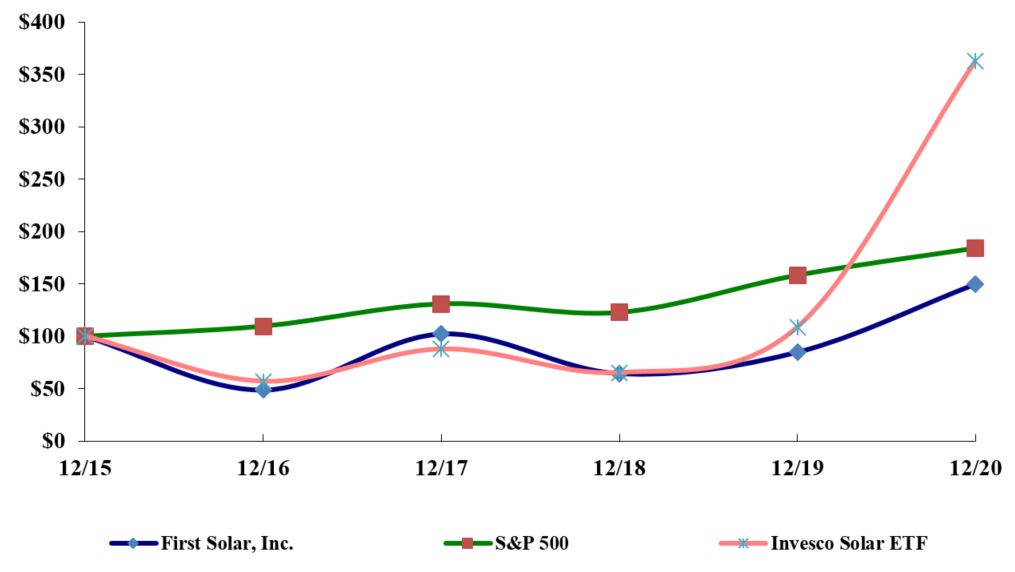][added: ]
* $100 invested on December 31, [removed: 2015] [added: 2016] in stock or index, including reinvestment of dividends.
Furthermore, our Revolving Credit Facility imposes restrictions on our ability to declare or pay dividends.
Item 6. Reserved
0 rewritten, 1 added, 29 removed, 0 unchanged
None.
The following tables set forth our selected financial data for the periods and at the dates indicated.
The selected financial data from the consolidated statements of operations and consolidated statements of cash flows for the years ended December 31, 2020, 2019, and 2018 and the selected financial data from the consolidated balance sheets as of December 31, 2020 and 2019 have been derived from the audited consolidated financial statements included in this Annual Report on Form 10-K.
The selected financial data from the consolidated statements of operations and consolidated statements of cash flows for the years ended December 31, 2017 and 2016 and the selected financial data from the consolidated balance sheets as of December 31, 2018, 2017, and 2016 have been derived from audited consolidated financial statements not included in this Annual Report on Form 10-K.
The information presented below should also be read in conjunction with our consolidated financial statements and the related notes thereto and Item 7.
“Management’s Discussion and Analysis of Financial Condition and Results of Operations.”
| | | | | | | | | | | | | | | | | | | | | | | | | | | | | | | | | |
| --- | --- | --- | --- | --- | --- | --- | --- | --- | --- | --- | --- | --- | --- | --- | --- | --- | --- | --- | --- | --- | --- | --- | --- | --- | --- | --- | --- | --- | --- | --- | --- | --- |
| | | | | | | Years Ended December 31, | | | | | | | | | | | | | | | | | | | | | | | | | | |
| | | | | | | 2020 | | | | | | 2019 | | | | | | 2018 | | | | | | 2017 | | | | | | 2016 | | |
| | | | | | | (In thousands, except per share amounts) | | | | | | | | | | | | | | | | | | | | | | | | | | |
| Net sales | | | | | | $ | 2,711,332 | | | | | $ | 3,063,117 | | | | | $ | 2,244,044 | | | | | $ | 2,941,324 | | | | | $ | 2,904,563 | |
| Gross profit | | | | | | 680,673 | | | | | | 549,212 | | | | | | 392,177 | | | | | | 548,947 | | | | | | 638,418 | | |
| Operating income (loss) | | | | | | 317,489 | | | | | | (161,785) | | | | | | 40,113 | | | | | | 177,851 | | | | | | (568,151) | | |
| Net income (loss) | | | | | | 398,355 | | | | | | (114,933) | | | | | | 144,326 | | | | | | (165,615) | | | | | | (416,112) | | |
| Net income (loss) per share: | | | | | | | | | | | | | | | | | | | | | | | | | | | | | | | | |
| Basic | | | | | | $ | 3.76 | | | | | $ | (1.09) | | | | | $ | 1.38 | | | | | $ | (1.59) | | | | | $ | (4.05) | |
| Diluted | | | | | | $ | 3.73 | | | | | $ | (1.09) | | | | | $ | 1.36 | | | | | $ | (1.59) | | | | | $ | (4.05) | |
| Cash dividends declared per common share | | | | | | $ | — | | | | | $ | — | | | | | $ | — | | | | | $ | — | | | | | $ | — | |
| Net cash provided by (used in) operating activities | | | | | | $ | 37,120 | | | | | $ | 174,201 | | | | | $ | (326,809) | | | | | $ | 1,340,677 | | | | | $ | 206,753 | |
| Net cash (used in) provided by investing activities | | | | | | (131,227) | | | | | | (362,298) | | | | | | (682,714) | | | | | | (626,802) | | | | | | 144,520 | | |
| Net cash (used in) provided by financing activities | | | | | | (82,587) | | | | | | 74,943 | | | | | | 255,228 | | | | | | 192,045 | | | | | | (136,393) | | |
| | | | | | | December 31, | | | | | | | | | | | | | | | | | | | | | | | | | | |
| | | | | | | (In thousands) | | | | | | | | | | | | | | | | | | | | | | | | | | |
| Cash and cash equivalents | | | | | | $ | 1,227,002 | | | | | $ | 1,352,741 | | | | | $ | 1,403,562 | | | | | $ | 2,268,534 | | | | | $ | 1,347,155 | |
| Marketable securities | | | | | | 520,066 | | | | | | 811,506 | | | | | | 1,143,704 | | | | | | 720,379 | | | | | | 607,991 | | |
| Total assets | | | | | | 7,108,931 | | | | | | 7,515,689 | | | | | | 7,121,362 | | | | | | 6,864,501 | | | | | | 6,824,368 | | |
| Total long-term debt | | | | | | 279,231 | | | | | | 471,697 | | | | | | 466,791 | | | | | | 393,540 | | | | | | 188,388 | | |
| Total liabilities | | | | | | 1,588,003 | | | | | | 2,418,922 | | | | | | 1,908,959 | | | | | | 1,765,804 | | | | | | 1,606,019 | | |
| Total stockholders’ equity | | | | | | 5,520,928 | | | | | | 5,096,767 | | | | | | 5,212,403 | | | | | | 5,098,697 | | | | | | 5,218,349 | | |
Item 8. Financial Statements and Supplementary Data
0 rewritten, 0 added, 18 removed, 3 unchanged
Selected Quarterly Financial Data (Unaudited)
The following selected quarterly financial data should be read in conjunction with our consolidated financial statements and the related notes thereto and Item 7.
“Management’s Discussion and Analysis of Financial Condition and Results of Operations.” This information has been derived from our unaudited consolidated financial statements that, in our opinion, reflect all recurring adjustments necessary to fairly present the information when read in conjunction with our consolidated financial statements.
The results of operations for any quarter are not necessarily indicative of the results to be expected for any future period.
| | | | | | | | | | | | | | | | | | | | | | | | | | | | | | | | | | | | | | | | | | | | | | | | | | | |
| --- | --- | --- | --- | --- | --- | --- | --- | --- | --- | --- | --- | --- | --- | --- | --- | --- | --- | --- | --- | --- | --- | --- | --- | --- | --- | --- | --- | --- | --- | --- | --- | --- | --- | --- | --- | --- | --- | --- | --- | --- | --- | --- | --- | --- | --- | --- | --- | --- | --- | --- |
| | | | | | | Quarters Ended | | | | | | | | | | | | | | | | | | | | | | | | | | | | | | | | | | | | | | | | | | | | |
| | | | | | | Dec 31, 2020 | | | | | | Sep 30, 2020 | | | | | | Jun 30, 2020 | | | | | | Mar 31, 2020 | | | | | | Dec 31, 2019 | | | | | | Sep 30, 2019 | | | | | | Jun 30, 2019 | | | | | | Mar 31, 2019 | | |
| | | | | | | (In thousands, except per share amounts) | | | | | | | | | | | | | | | | | | | | | | | | | | | | | | | | | | | | | | | | | | | | |
| Net sales | | | | | | $ | 609,232 | | | | | $ | 927,565 | | | | | $ | 642,411 | | | | | $ | 532,124 | | | | | $ | 1,399,377 | | | | | $ | 546,806 | | | | | $ | 584,956 | | | | | $ | 531,978 | |
| Gross profit | | | | | | 159,860 | | | | | | 293,015 | | | | | | 137,460 | | | | | | 90,338 | | | | | | 333,555 | | | | | | 138,363 | | | | | | 77,182 | | | | | | 112 | | |
| Production start-up | | | | | | 16,716 | | | | | | 13,019 | | | | | | 6,311 | | | | | | 4,482 | | | | | | 7,351 | | | | | | 18,605 | | | | | | 10,437 | | | | | | 9,522 | | |
| Litigation loss | | | | | | — | | | | | | — | | | | | | 6,000 | | | | | | — | | | | | | 363,000 | | | | | | — | | | | | | — | | | | | | — | | |
| Operating income (loss) | | | | | | 57,774 | | | | | | 207,163 | | | | | | 50,896 | | | | | | 1,656 | | | | | | (117,866) | | | | | | 41,304 | | | | | | (8,584) | | | | | | (76,639) | | |
| Net income (loss) | | | | | | 115,703 | | | | | | 155,037 | | | | | | 36,911 | | | | | | 90,704 | | | | | | (59,408) | | | | | | 30,622 | | | | | | (18,548) | | | | | | (67,599) | | |
| Net income (loss) per share: | | | | | | | | | | | | | | | | | | | | | | | | | | | | | | | | | | | | | | | | | | | | | | | | | | |
| Basic | | | | | | $ | 1.09 | | | | | $ | 1.46 | | | | | $ | 0.35 | | | | | $ | 0.86 | | | | | $ | (0.56) | | | | | $ | 0.29 | | | | | $ | (0.18) | | | | | $ | (0.64) | |
| Diluted | | | | | | $ | 1.08 | | | | | $ | 1.45 | | | | | $ | 0.35 | | | | | $ | 0.85 | | | | | $ | (0.56) | | | | | $ | 0.29 | | | | | $ | (0.18) | | | | | $ | (0.64) | |
Item 9A. Controls and Procedures
6 rewritten, 1 added, 0 removed, 14 unchanged
Based on that evaluation, our Chief Executive Officer and Chief Financial Officer concluded that as of December 31, [removed: 2020] [added: 2021] our disclosure controls and procedures were effective to ensure that information required to be disclosed by us in reports that we file or submit under the Exchange Act is recorded, processed, summarized, and reported within the time periods specified in SEC rules and forms, and that such information is accumulated and communicated to our management, including our Chief Executive Officer and Chief Financial Officer, as appropriate, to allow timely decisions regarding required disclosure.
We also carried out an evaluation, under the supervision and with the participation of management, including our Chief Executive Officer and Chief Financial Officer, of the effectiveness of our internal control over financial reporting as of December 31, [removed: 2020] [added: 2021] based on the criteria established in *Internal Control – Integrated Framework (2013)* issued by the Committee of Sponsoring Organizations of the Treadway Commission (“COSO”).
Based on such evaluation, our management concluded that our internal control over financial reporting was effective as of December 31, [removed: 2020.][added: 2021.]
The effectiveness of our internal control over financial reporting as of December 31, [removed: 2020] [added: 2021] has also been audited by PricewaterhouseCoopers LLP, an independent registered public accounting firm, as stated in its report which appears herein.
We also carried out an evaluation, under the supervision and with the participation of management, including our Chief Executive Officer and Chief Financial Officer, of our “internal control over financial reporting” to determine whether any changes in our internal control over financial reporting occurred during the quarter ended December 31, [removed: 2020] [added: 2021] that materially affected, or are reasonably likely to materially affect, our internal control over [removed: financial reporting.]
Based on that evaluation, there were no such changes in our internal control over financial reporting that occurred during the quarter ended December 31, [removed: 2020.][added: 2021.]
financial reporting.
Item 9B. Other Information
0 rewritten, 0 added, 1 removed, 1 unchanged
PART III
Item 9C. Disclosure Regarding Foreign Jurisdictions that Prevent Inspections
0 rewritten, 2 added, 0 removed, 0 unchanged
New section this year
Not applicable.
PART III
Item 10. Directors, Executive Officers, and Corporate Governance
2 rewritten, 0 added, 0 removed, 1 unchanged
“Business – Information about Our Executive Officers.” Information concerning our board of directors and audit committee of our board of directors will appear in our [removed: 2021] [added: 2022] Proxy Statement, under the sections “Directors” and “Corporate Governance,” and information concerning Section 16(a) beneficial ownership reporting compliance will appear in our [removed: 2021] [added: 2022] Proxy Statement under the section “Section 16(a) Beneficial Ownership Reporting Compliance.” We have adopted a [removed: Code] [added: code] of [removed: Business Conduct] [added: business conduct] and [removed: Ethics] [added: ethics] that applies to all directors, officers, and associates of First Solar.
Information concerning this code will appear in our [removed: 2021] [added: 2022] Proxy Statement under the section “Corporate Governance.” The information in such sections of the Proxy Statement is incorporated by reference into this Annual Report on Form 10-K.
Item 11. Executive Compensation
1 rewritten, 0 added, 0 removed, 0 unchanged
Information concerning executive compensation and related information will appear in our [removed: 2021] [added: 2022] Proxy Statement under the section “Executive Compensation,” and information concerning the compensation committee of our board of directors (the “compensation committee”) will appear under the sections “Corporate Governance” and “Compensation Committee Report.” The information in such sections of the [removed: 2021] [added: 2022] Proxy Statement is incorporated by reference into this Annual Report on Form 10-K.
Item 12. Security Ownership of Certain Beneficial Owners and Management and Related Stockholder Matters
3 rewritten, 2 added, 2 removed, 9 unchanged
Information concerning the security ownership of certain beneficial owners and management and related stockholder matters, including certain information regarding our equity compensation plans, will appear in our [removed: 2021] [added: 2022] Proxy Statement under the section “Security Ownership of Certain Beneficial Owners and Management and Related Stockholder Matters.” The information in such section of the Proxy Statement is incorporated by reference into this Annual Report on Form 10-K.
The following table sets forth certain information as of December 31, [removed: 2020] [added: 2021] concerning securities authorized for issuance under our equity compensation plans:
(1)Includes [removed: 1,852,256] [added: 1,316,860] shares issuable upon vesting of restricted stock units (“RSUs”) granted under our 2020 Omnibus Incentive Compensation Plan (“2020 Omnibus Plan”).
| Equity compensation plans approved by stockholders | | | | | | 1,316,860 | | | | | | $ | — | | | | | 6,792,347 | | |
| Total | | | | | | 1,316,860 | | | | | | $ | — | | | | | 6,792,347 | | |
| Equity compensation plans approved by stockholders | | | | | | 1,852,256 | | | | | | $ | — | | | | | 6,608,877 | | |
| Total | | | | | | 1,852,256 | | | | | | $ | — | | | | | 6,608,877 | | |
Item 13. Certain Relationships and Related Transactions, and Director Independence
1 rewritten, 0 added, 0 removed, 0 unchanged
Information concerning certain relationships and related party transactions will appear in our [removed: 2021] [added: 2022] Proxy Statement under the section “Certain Relationships and Related Party Transactions,” and information concerning director independence will appear in our [removed: 2021] [added: 2022] Proxy Statement under the section “Corporate Governance.” The information in such sections of the Proxy Statement is incorporated by reference into this Annual Report on Form 10-K.
Item 14. Principal Accountant Fees and Services
1 rewritten, 0 added, 0 removed, 1 unchanged
Information concerning principal accounting fees and services and the audit committee of our board of directors’ pre-approval policies and procedures for these items will appear in our [removed: 2021] [added: 2022] Proxy Statement under the section “Principal [removed: Accounting] [added: Accountant] Fees and Services.” The information in such section of the Proxy Statement is incorporated by reference into this Annual Report on Form 10-K.
Item 15. Exhibits and Financial Statement Schedules
696 rewritten, 223 added, 408 removed, 852 unchanged
Report of Independent Registered Public Accounting Firm [added: (PCAOB ID No. 238)]
We have audited the accompanying consolidated balance sheets of First Solar, Inc. and its subsidiaries (“the Company”) as of December 31, [removed: 2020] [added: 2021] and [removed: 2019,] [added: 2020,] and the related consolidated statements of operations, comprehensive income, stockholders’ equity and cash flows for each of the three years in the period ended December 31, [removed: 2020,] [added: 2021,] including the related notes (collectively referred to as the “consolidated financial statements”).
We also have audited the Company’s internal control over financial reporting as of December 31, [removed: 2020,] [added: 2021,] based on criteria established in *Internal Control – Integrated Framework* *(2013)* issued by the Committee of Sponsoring Organizations of the Treadway Commission (“COSO”).
In our opinion, the consolidated financial statements referred to above present fairly, in all material respects, the financial position of the Company as of December 31, [removed: 2020] [added: 2021] and [removed: 2019,] [added: 2020,] and the results of its operations and its cash flows for each of the three years in the period ended December 31, [removed: 2020] [added: 2021] in conformity with accounting principles generally accepted in the United States of America.
Also in our opinion, the Company maintained, in all material respects, effective internal control over financial reporting as of December 31, [removed: 2020,] [added: 2021,] based on criteria established in *Internal Control – Integrated Framework (2013)* issued by the COSO.
The critical audit [removed: matters] [added: matter] communicated below [removed: are matters] [added: is a matter] arising from the current period audit of the consolidated financial statements that [removed: were] [added: was] communicated or required to be communicated to the audit committee and that (i) [removed: relate] [added: relates] to accounts or disclosures that are material to the consolidated financial statements and (ii) involved our especially challenging, subjective, or complex judgments.
The communication of critical audit matters does not alter in any way our opinion on the consolidated financial statements, taken as a whole, and we are not, by communicating the critical audit [removed: matters] [added: matter] below, providing [added: a] separate [removed: opinions] [added: opinion] on the critical audit [removed: matters] [added: matter] or on the accounts or disclosures to which [removed: they relate.][added: it relates.]
[removed: *Solar Module Collection] [added: | Accrued solar module collection] and [removed: Recycling Liability*][added: recycling liability | | | | | | 10,491 | | | | | | (9,181) | | | | | | 3,748 | | |]
[removed: The Company’s accrued solar] [added: Our] module collection and recycling liability was [added: $139.1 million and] $130.7 million as of December 31, [removed: 2020.][added: 2021 and 2020, respectively.]
The principal considerations for our determination that performing procedures relating to the [removed: solar module collection and recycling] [added: product warranty] liability is a critical audit matter are (i) the significant judgment by management [removed: when developing] [added: in estimating] the [removed: estimated costs] [added: projections] of [removed: this program;] [added: warranty claims] and (ii) a high degree of auditor judgment, subjectivity, and effort in performing procedures to evaluate [removed: audit evidence related to management’s significant assumptions related to] the [removed: cost] [added: projections] of [removed: freight from the solar module installation sites to a recycling center, capital costs, present value assumptions, and the assumption regarding costs at the time the solar modules will be collected and recycled,] [added: warranty claims] and [removed: evaluating audit evidence] related [removed: to the results of those procedures.][added: audit evidence.]
The Company’s product warranty liability was [removed: $95.1] [added: $52.6] million as of December 31, [removed: 2020.][added: 2021.]
| | | | | | | [added: 2021 | | | | | |] 2020 | | | | | | 2019 | | |
| Cash and cash equivalents | | | | | | $ | [removed: 1,227,002] [added: 1,450,654] | | | | | $ | [removed: 1,352,741] [added: 1,227,002] | |
| Accounts receivable [removed: trade] [added: trade, gross] | | | | | | [removed: 269,095] [added: $] | [added: 430,100] | | | | | [removed: 476,425] [added: $] | [added: 269,095] | |
| [removed: Less: allowance] [added: Allowance] for credit [removed: losses] [added: losses, beginning of period] | | | | | | [removed: (3,009)] [added: $] | [added: 3,009] | | | | | [removed: (1,386)] [added: $] | [added: 1,386] | |
| Accounts receivable trade, net | | | | | | [removed: 266,086] [added: 429,436] | | | | | | [removed: 475,039] [added: 266,086] | | |
| Accounts [removed: receivable, unbilled and retainage] [added: receivable unbilled, gross] | | | | | | [removed: 26,673] [added: $] | [added: 25,336] | | | | | [removed: 183,473] [added: $] | [added: 26,673] | |
| [removed: Less: allowance] [added: Allowance] for credit losses | | | | | | [removed: (303)] [added: (63)] | | | | | | [removed: —] [added: (303)] | | |
| Accounts [removed: receivable, unbilled and retainage,] [added: receivable unbilled,] net | | | | | | [removed: 26,370] [added: 25,273] | | | | | | [removed: 183,473] [added: 26,370] | | |
| Inventories | | | | | | [removed: 567,587] [added: 666,299] | | | | | | [removed: 443,513] [added: 567,587] | | |
| Assets held for sale | | | | | | [removed: 155,685] [added: —] | | | | | | [removed: —] [added: 155,685] | | |
| Total current assets | | | | | | [removed: 3,014,535] [added: 3,191,243] | | | | | | [removed: 3,599,834] [added: 3,014,535] | | |
| Property, plant and equipment, net | | | | | | [removed: 2,402,285] [added: 2,649,587] | | | | | | [removed: 2,181,149] [added: 2,402,285] | | |
| PV solar power systems, net | | | | | | [removed: 243,396] [added: 217,293] | | | | | | [removed: 476,977] [added: 243,396] | | |
| Project assets | | | | | | [removed: 373,377] [added: 315,488] | | | | | | [removed: 333,596] [added: 373,377] | | |
| Deferred tax assets, net | | | | | | [removed: 104,099] [added: 59,162] | | | | | | [removed: 130,771] [added: 104,099] | | |
| Intangible assets, net | | | | | | [removed: 56,138] [added: 45,509] | | | | | | [removed: 64,543] [added: 56,138] | | |
| Inventories | | | | | | [removed: 201,229] [added: 237,512] | | | | | | [removed: 160,646] [added: 201,229] | | |
| Other assets | | | | | | [removed: 434,130] [added: 438,764] | | | | | | [removed: 329,926] [added: 434,130] | | |
| Total assets | | | | | | $ | [removed: 7,108,931] [added: 7,413,746] | | | | | $ | [removed: 7,515,689] [added: 7,108,931] | |
| Accounts payable | | | | | | $ | [removed: 183,349] [added: 193,374] | | | | | $ | [removed: 218,081] [added: 183,349] | |
| Income taxes payable | | | | | | [removed: 14,571] [added: 4,543] | | | | | | [removed: 17,010] [added: 14,571] | | |
| Accrued expenses | | | | | | [removed: 310,467] [added: 288,450] | | | | | | [removed: 351,260] [added: 310,467] | | |
| Current portion of long-term debt | | | | | | [removed: 41,540] [added: 3,896] | | | | | | [removed: 17,510] [added: 41,540] | | |
| Deferred revenue | | | | | | [removed: 188,813] [added: 201,868] | | | | | | [removed: 323,217] [added: 188,813] | | |
| [removed: Accrued litigation] [added: Litigation loss] | | | | | | — | | | | | | [added: 6,000 | | | | | |] 363,000 | | |
| Liabilities held for sale | | | | | | [removed: 25,621] [added: —] | | | | | | [removed: —] [added: 25,621] | | |
| Other current liabilities | | | | | | [removed: 83,037] [added: 34,747] | | | | | | [removed: 28,130] [added: 83,037] | | |
| Total current liabilities | | | | | | [removed: 847,398] [added: 726,878] | | | | | | [removed: 1,318,208] [added: 847,398] | | |
| Accrued solar module collection and recycling liability | | | | | | [removed: 130,688] [added: 139,145] | | | | | | [removed: 137,761] [added: 130,688] | | |
March 1, 2022
| | | | | | | 2021 | | | | | | 2020 | | |
| Marketable securities | | | | | | 375,389 | | | | | | 520,066 | | |
| Other current assets | | | | | | 244,192 | | | | | | 251,739 | | |
| Gain on sales of businesses, net | | | | | | 147,284 | | | | | | — | | | | | | — | | |
| Net income (loss) | | | | | | $ | 468,693 | | | | | $ | 398,355 | | | | | $ | (114,933) | |
| Net income | | | | | | — | | | | | | — | | | | | | — | | | | | | 468,693 | | | | | | — | | | | | | 468,693 | | |
| Balance at December 31, 2021 | | | | | | 106,332 | | | | | | $ | 106 | | | | | $ | 2,871,352 | | | | | $ | 3,184,455 | | | | | $ | (96,362) | | | | | $ | 5,959,551 | |
| Net income (loss) | | | | | | $ | 468,693 | | | | | $ | 398,355 | | | | | $ | (114,933) | |
| Gain on sales of businesses, net | | | | | | (147,284) | | | | | | — | | | | | | — | | |
| Other, net | | | | | | (3,484) | | | | | | 19,297 | | | | | | 1,962 | | |
| Inventories | | | | | | (136,365) | | | | | | (145,396) | | | | | | (83,528) | | |
| Proceeds from sales of businesses | | | | | | 300,499 | | | | | | — | | | | | | — | | |
Developed at our R&D labs in California and Ohio, we manufacture and sell PV solar modules with an advanced thin film semiconductor technology that provide a high-performance, lower-carbon alternative to conventional crystalline silicon PV solar modules.
From raw material sourcing through end-of-life module recycling, we are committed to reducing the environmental impacts and enhancing the social and economic benefits of our products across their life cycle.
that the impairment indicator occurs.
Our modules business represents our only reporting unit.
in a linear fashion, but never falling below 80% during the term of the warranty.
Sales of Businesses
Sale of North American O&M Operations
On March 31, 2021, we completed the transaction.
Following certain customary post-closing adjustments, we received total consideration of $149.1 million.
As a result of this transaction, we recognized a gain of $115.8 million, net of transaction costs and post-closing adjustments, during the year ended December 31, 2021, which was included in “Gain on sales of businesses, net” in our consolidated statements of operations.
Sale of U.S. project development business
On March 31, 2021, we completed the transaction for an aggregate purchase price of $284.0 million.
Such purchase price included $151.4 million for the sale of the U.S. project development business and $132.6 million for the sale of 392 MWDC of solar modules, which is presented in “Net sales” on our consolidated statements of operations for the year ended December 31, 2021.
During the year ended December 31, 2021, we recognized a gain of $31.5 million, net of transaction costs and post-closing adjustments, from the sale of our U.S. project development business, which is included in “Gain on sales of businesses, net” in our consolidated statements of operations.
| Other current assets | | | 12,649 | | | | | | 35,342 | | | | | | 47,991 | | |
| | | | | | | December 31, 2021 | | | | | | | | | | | | | | |
| Patents | | | | | | 8,480 | | | | | | (5,815) | | | | | | 2,665 | | |
| Total | | | | | | $ | 114,930 | | | | | $ | (69,421) | | | | | $ | 45,509 | |
| 2022 | | | | | | $ | 10,941 | |
| 2023 | | | | | | 10,657 | | |
| 2024 | | | | | | 10,527 | | |
| 2025 | | | | | | 4,056 | | |
| 2026 | | | | | | 2,673 | | |
| Thereafter | | | | | | 6,655 | | |
| | | | | | | 2021 | | | | | | 2020 | | |
| | | | | | | As of December 31, 2021 | | | | | | | | | | | | | | | | | | | | | | | | | | |
| Foreign debt | | | | | | $ | 103,263 | | | | | $ | 81 | | | | | $ | 18 | | | | | $ | 9 | | | | | $ | 103,317 | |
As described in Note 11 to the consolidated financial statements, certain of the Company’s legacy sales were covered by a module collection and recycling program, which was previously established to collect and recycle modules sold and covered under such program once the modules reach the end of their useful lives.
Management estimates the cost of collection and recycling obligations based on the present value of the expected future cost of collecting and recycling the solar modules, which includes estimates for the cost of packaging materials; the cost of freight from the solar module installation sites to a recycling center; material, labor, and capital costs; and by-product credits for certain materials recovered during the recycling process.
Management bases these estimates on experience collecting and recycling the solar modules and certain assumptions regarding costs at the time the solar modules will be collected and recycled.
Addressing the matter involved performing procedures and evaluating audit evidence in connection with forming our overall opinion on the consolidated financial statements.
These procedures included testing the effectiveness of controls relating to valuation of the solar module collection and recycling liability.
These procedures also included, among others, testing management’s process for developing the expected future cost of collecting and recycling the solar modules including evaluating the reasonableness of the significant assumptions used by management related to the cost of freight from the solar module installation sites to a recycling center, capital costs, present value assumptions, and the assumption regarding costs at the time the solar modules will be collected and recycled.
Evaluating the reasonableness of the significant assumptions involved (i) testing actual recycling costs incurred, (ii) obtaining and evaluating evidence from third parties, and (iii) evaluating other underlying input data considered by management in the development of its recycling liability.
The principal considerations for our determination that performing procedures relating to the product warranty liability is a critical audit matter are (i) the significant judgment by management in estimating the projections of warranty claims; and (ii) a high degree of auditor judgment, subjectivity, and effort in performing procedures to evaluate the projections of warranty claims and related audit evidence.
February 25, 2021
| Marketable securities (amortized cost of $519,844 and allowance for credit losses of $121 at December 31, 2020) | | | | | | 520,066 | | | | | | 811,506 | | |
| Balance of systems parts | | | | | | 30 | | | | | | 53,583 | | |
| Project assets | | | | | | — | | | | | | 3,524 | | |
| Prepaid expenses and other current assets | | | | | | 251,709 | | | | | | 276,455 | | |
| Restricted marketable securities (amortized cost of $247,628 and allowance for credit losses of $13 at December 31, 2020) | | | | | | 265,280 | | | | | | 223,785 | | |
| | | | | | | | | | | | | | | | | | | | | |
| --- | --- | --- | --- | --- | --- | --- | --- | --- | --- | --- | --- | --- | --- | --- | --- | --- | --- | --- | --- | --- |
| Litigation loss | | | | | | 6,000 | | | | | | 363,000 | | | | | | — | | |
| Balance at December 31, 2017 | | | | | | 104,468 | | | | | | $ | 104 | | | | | $ | 2,799,107 | | | | | $ | 2,297,227 | | | | | $ | 2,259 | | | | | $ | 5,098,697 | |
| Net income | | | | | | — | | | | | | — | | | | | | — | | | | | | 144,326 | | | | | | — | | | | | | 144,326 | | |
| Equity in earnings, net of tax | | | | | | 2,129 | | | | | | 284 | | | | | | (34,620) | | |
| Distributions received from equity method investments | | | | | | — | | | | | | — | | | | | | 12,394 | | |
| Remeasurement of monetary assets and liabilities | | | | | | 1,359 | | | | | | 919 | | | | | | 8,740 | | |
| Other, net | | | | | | 15,809 | | | | | | 759 | | | | | | 2,121 | | |
| Inventories and balance of systems parts | | | | | | (145,396) | | | | | | (83,528) | | | | | | (257,229) | | |
| Accrued solar module collection and recycling liability | | | | | | (9,181) | | | | | | 3,748 | | | | | | (31,003) | | |
| Proceeds from sales of equity method investments | | | | | | — | | | | | | — | | | | | | 247,595 | | |
| Payments received on notes receivable, affiliates | | | | | | — | | | | | | — | | | | | | 48,729 | | |
| Sale of system previously accounted for as sale-leaseback financing | | | | | | $ | — | | | | | $ | — | | | | | $ | 31,992 | |
| Accrued interest capitalized to long-term debt | | | | | | $ | — | | | | | $ | — | | | | | $ | 3,512 | |
We design, manufacture, and sell PV solar modules with an advanced thin film semiconductor technology.
In certain markets, we also develop and sell PV solar power systems that primarily use the modules we manufacture and provide O&M services to system owners.
We have substantial, ongoing R&D efforts focused on various technology innovations.
For example, we typically recognize revenue from contracts for the construction and sale of PV solar power systems over time using cost based input methods, which recognize revenue and gross profit as work is performed based on the relationship between actual costs incurred compared to the total estimated costs of the contract.
*Retainage.* Certain of our EPC contracts for PV solar power systems we build contain retainage provisions.
Retainage represents a contract asset for the portion of the contract price earned by us for work performed, but held for payment by the customer as a form of security until we reach certain construction milestones.
We consider whether collectibility of such retainage is reasonably assured in connection with our overall assessment of the collectibility of amounts due or that will become due under our EPC contracts.
Retainage included within “Accounts receivable, unbilled and retainage” is expected to be billed and collected within the next 12 months.
After we satisfy the EPC contract requirements and have an unconditional right to consideration, we typically bill our customer for retainage and reclassify such amount to “Accounts receivable trade.”
For our notes receivable, we determine estimated credit losses through an assessment of the borrower’s credit quality based primarily on quarterly reviews of certain financial information, including financial statements and forecasts.
*Balance of Systems Parts.* BoS parts represent mounting, electrical, and other parts purchased for the construction and maintenance of PV solar power systems.
An excerpt. Shown here: 40 of 696 rewritten, 40 of 223 added and 40 of 408 removed. The counts are complete. For every sentence, read Item 15. Exhibits and Financial Statement Schedules in the FY2021 filing and the FY2020 filing.
Item 16. Form 10-K Summary
12 rewritten, 6 added, 0 removed, 35 unchanged
| Date: [removed: February 25, 2021] [added: March 1, 2022] | | | By: | | | | | | /s/ BYRON JEFFERS | | |
| /s/ MARK R. WIDMAR | | | | | | Chief Executive Officer and Director | | | | | | [removed: February 25, 2021] [added: March 1, 2022] | | |
| /s/ ALEXANDER R. BRADLEY | | | | | | Chief Financial Officer | | | | | | [removed: February 25, 2021] [added: March 1, 2022] | | |
| /s/ MICHAEL J. AHEARN | | | | | | Chairman of the Board of Directors | | | | | | [removed: February 25, 2021] [added: March 1, 2022] | | |
| /s/ SHARON L. ALLEN | | | | | | Director | | | | | | [removed: February 25, 2021] [added: March 1, 2022] | | |
| /s/ RICHARD D. CHAPMAN | | | | | | Director | | | | | | [removed: February 25, 2021] [added: March 1, 2022] | | |
| /s/ GEORGE A. HAMBRO | | | | | | Director | | | | | | [removed: February 25, 2021] [added: March 1, 2022] | | |
| /s/ MOLLY E. JOSEPH | | | | | | Director | | | | | | [removed: February 25, 2021] [added: March 1, 2022] | | |
| /s/ CRAIG KENNEDY | | | | | | Director | | | | | | [removed: February 25, 2021] [added: March 1, 2022] | | |
| /s/ WILLIAM J. POST | | | | | | Director | | | | | | [removed: February 25, 2021] [added: March 1, 2022] | | |
| /s/ PAUL H. STEBBINS | | | | | | Director | | | | | | [removed: February 25, 2021] [added: March 1, 2022] | | |
| /s/ MICHAEL SWEENEY | | | | | | Director | | | | | | [removed: February 25, 2021] [added: March 1, 2022] | | |
| /s/ ANITA MARANGOLY GEORGE | | | | | | Director | | | | | | March 1, 2022 | | |
| Anita Marangoly George | | | | | | | | | | | | | | |
| /s/ KATHRYN A. HOLLISTER | | | | | | Director | | | | | | March 1, 2022 | | |
| Kathryn A. Hollister | | | | | | | | | | | | | | |
| | | | | | | | | | | | | | | |
| | | | | | | | | | | | | | | |