 filings.tools
First Solar (FSLR) 10-K risk factor changes: FY2022 vs FY2021
The 2022-12-31 10-K against the 2021-12-31 one, compared heading by heading and sentence by sentence.
Item 1A109 rewritten89 added95 removed270 unchanged
All filing items1,099 rewritten589 added505 removed1,760 unchanged
Summary
counted, not written
- Item 1A lists 29 risk factor headings: 3 new, 6 reworded and 20 unchanged since FY2021. 5 headings from FY2021 no longer appear.
- Sentence by sentence, 589 added, 505 removed, 1,099 rewritten and 1,760 unchanged across 16 items that differ.
New Item 1A headings (3)
- We may be unable to generate sufficient cash flows or have access to the sources of external financing necessary to fund planned capital investments in manufacturing capacity and product development.
- We expect certain financial benefits as a result of tax incentives provided by the Inflation Reduction Act of 2022. If these expected financial benefits vary significantly from our assumptions, our business, financial condition, and results of operations could be adversely affected.
- The severity and duration of public health threats (including pandemics such as COVID-19 or similarly infectious diseases) could materially impact our business, financial condition, and results of operations.
Removed Item 1A headings (5)
- If PV solar and related technologies are not suitable for continued adoption at economically attractive rates of return or if sufficient additional demand for solar modules and related technologies does not develop or takes longer to develop than we anticipate, our net sales and profit may flatten or decline and we may be unable to sustain profitability.
- We may be unable to profitably provide new solar offerings or achieve sufficient market penetration with such offerings.
- Project development or construction activities, which are primarily concentrated in Japan, may not be successful; projects under development may not receive required permits, community support, real property rights, power purchase agreements (“PPA”), interconnection, and transmission arrangements; or financing or construction may not commence or proceed as scheduled, which could increase our costs and impair our ability to recover our investments.
- The COVID-19 pandemic could materially impact our business, financial condition, and results of operations.
- If our long-lived assets or project related assets become impaired, we may be required to record significant charges to earnings.
Reworded Item 1A headings (6)
- Competition in solar markets globally and across the solar value chain is
[removed: intense,][added: intense] and could remain that way for an extended period of time.[removed: An increased global supply of PV modules has caused and][added: The solar industry] may[removed: cause][added: experience periods of] structural[removed: imbalances in which][added: imbalance between] global PV module supply[removed: exceeds demand,][added: and demand that result in periods of pricing volatility,] which could have a material adverse effect on our business, financial condition, and results of operations. - The reduction, elimination, or expiration of government subsidies, economic incentives, tax incentives, renewable energy targets, and other support for on-grid solar electricity applications, or [added: the impact of] other public policies, such as tariffs or other trade remedies imposed on solar cells and modules, could negatively impact demand and/or price levels for our solar modules and limit our growth or lead to a reduction in our net sales or increase our costs, thereby adversely impacting our operating results.
- Our failure to
[removed: reduce][added: effectively manage] module manufacturing production and selling costs, including costs related to raw materials and logistics services, could render our solar modules uncompetitive and reduce our net sales, profitability, and/or market share. - Our future success depends on our ability to effectively balance manufacturing production with market demand,
[removed: convert existing production facilities to support new product lines, decrease][added: effectively manage] our cost per watt, and, when necessary, continue to build new manufacturing plants over time in response to market demand, all of which are subject to risks and uncertainties. - Our failure to protect [added: or successfully commercialize] our intellectual property rights may undermine our competitive position, and litigation to protect our intellectual property rights or defend against third-party allegations of infringement may be costly.
- If we are unable to attract, train, retain, and successfully integrate key
[removed: personnel][added: talent] into our management team, our business may be materially and adversely affected.
A heading is new when no FY2021 heading matches it after ignoring case and punctuation, and reworded when it shares at least 60 percent of its words with one that went away. All current risk factor headings.
Sentences by item
23 items, with every count and a link to each item that changed
Underlined words on a shaded ground are new in FY2022; struck-through words were in FY2021. Sentences that are wholly new or wholly gone are labelled rather than marked.
Item 1A. Risk Factors
109 rewritten, 89 added, 95 removed, 270 unchanged
- Competition in solar markets globally and across the solar value chain is [removed: intense,] [added: intense] and could remain that way for an extended period of time.
If our competitors reduce module pricing to levels near or below their manufacturing costs, or are able to operate at minimal or negative operating margins for sustained periods of time, or if [added: global] demand for PV modules [removed: does not grow sufficiently] [added: decreases relative] to [removed: justify the current] [added: installed] production [removed: supply,] [added: capacity,] our business, financial condition, and results of operations could be adversely affected.
- Several of our key raw materials [added: and] components, [removed: particularly CdTe,] [added: in particular CdTe] and [added: substrate glass, and] manufacturing equipment are either single-sourced or sourced from a limited number of suppliers, and their failure to perform could cause manufacturing [removed: delays and] [added: delays, especially as we expand or seek to expand our business, and/or] impair our ability to deliver solar modules to customers in the required quality and quantities and at a price that is profitable to us.
- Our failure to [removed: reduce] [added: effectively manage] module manufacturing production and selling costs, including costs related to raw materials and logistics services, could render our solar modules uncompetitive and reduce our net sales, profitability, and/or market share.
- Existing regulations and policies, changes thereto, and new regulations and policies may present technical, regulatory, and economic barriers to the purchase and use of PV solar [removed: products or systems,] [added: products,] which may significantly reduce demand for our modules.
[removed: - The] [added: The severity and duration of public health threats (including pandemics such as] COVID-19 [removed: pandemic] [added: or similarly infectious diseases)] could materially impact our business, financial condition, and results of [removed: operations.][added: operations.]
Competition in solar markets globally and across the solar value chain is [removed: intense,] [added: intense] and could remain that way for an extended period of time.
[removed: An increased global supply of PV modules has caused and] [added: The solar industry] may [removed: cause] [added: experience periods of] structural [removed: imbalances in which] [added: imbalance between] global PV module supply [removed: exceeds demand,] [added: and demand that result in periods of pricing volatility,] which could have a material adverse effect on our business, financial condition, and results of operations.
For example, we estimate that in [removed: 2021] [added: 2022] approximately [removed: 80] [added: 160] GWDC of capacity was added by solar module manufacturers, primarily [removed: but not exclusively] in [removed: Asia.][added: China.]
We believe the solar industry may from time to time experience periods of structural imbalance between supply and [removed: demand (i.e., where production capacity exceeds global demand),] [added: demand,] and that excess capacity will continue to put pressure on pricing.
The reduction, elimination, or expiration of government subsidies, economic incentives, tax incentives, renewable energy targets, and other support for on-grid solar electricity applications, or [added: the impact of] other public policies, such as tariffs or other trade remedies imposed on solar cells and modules, could negatively impact demand and/or price levels for our solar modules and limit our growth or lead to a reduction in our net sales or increase our costs, thereby adversely impacting our operating results.
Federal, state, and local governmental bodies in many countries have provided subsidies in the form of feed-in-tariff [removed: (“FiT”)] structures, rebates, tax incentives, and other incentives to end users, distributors, system integrators, [removed: and manufacturers of PV solar products.]
Many of these support programs expire, phase [removed: out] [added: down] over time, require renewal by the applicable authority, or may be amended.
Another [removed: consideration in the U.S. market, and to a lesser extent in other global markets,] [added: example] is the effect of governmental land-use planning policies and environmental policies on utility-scale PV solar development.
[added: The adoption of restrictive land-use] designations or environmental regulations that proscribe or restrict the siting of utility-scale solar facilities could adversely affect the marginal cost of such development.
[removed: Changes] [added: Current regulatory policies,] or [added: any future changes or] threatened changes [removed: in U.S. regulatory policy] [added: to such policies,] may subject us to significant risks, including the following:
- any limitations on the value or availability to [added: manufacturers or] potential investors of tax incentives that benefit solar energy [added: production, sales, or] projects, such as the [added: Section 45X advanced manufacturing production credit,] ITC, [removed: which is currently scheduled to decrease to 22% in 2023] and [removed: 10% in 2024, and accelerated depreciation deductions,] [added: PTC,] could result in reducing such [added: manufacturers’ or] investors’ economic [removed: returns, causing] [added: returns and could cause] a reduction in the availability of [removed: affordable] financing, thereby reducing demand for PV solar modules; [removed: and]
Application of [removed: U.S.] trade [removed: laws, or trade] laws [removed: of other countries,] may also impact, either directly or indirectly, our operating results.
[removed: For example, the] [added: The] United States currently imposes different types of tariffs and/or other trade remedies on certain imported crystalline silicon PV [removed: modules and] cells [added: and modules] from various countries.
[removed: During 2021, these tariffs included] [added: In February 2022, the U.S. President proclaimed] a [added: four-year extension of a] global safeguard measure imposed pursuant to Section 201 of the Trade Act of 1974 that [removed: provided] [added: provides] for tariffs on imported crystalline silicon solar modules and a tariff-rate quota on imported crystalline silicon solar [removed: cells above the first 2.5 GWDC of imports.][added: cells.]
[removed: Second, in February 2022, the U.S. President proclaimed a four-year extension of] [added: Moreover,] the [removed: current global safeguard measure, but this] extension measure does not apply tariffs to imports of bifacial modules.
The extension measure also [removed: increased the] [added: provides an] annual tariff-rate [removed: quota threshold so that] [added: quota, whereby] tariffs apply to imported crystalline silicon solar cells above the first 5.0 GWDC of imports.
[removed: In addition, the] [added: - *United States — Antidumping and countervailing duties on certain imported crystalline silicon PV cells and modules.* The] United States currently imposes antidumping and countervailing duties on certain imported crystalline silicon PV cells and modules from China and Taiwan.
Such antidumping and countervailing duties can change over time pursuant to annual reviews conducted by the U.S. Department [removed: of Commerce, and a decline in duty rates could have an adverse impact on our operating results.]
In [removed: February] [added: March] 2022, [removed: Auxin Solar Inc., a U.S. producer of crystalline silicon PV products, petitioned] the [removed: U.S. Department of Commerce (“USDOC”) to investigate] [added: USDOC initiated inquiries concerning] alleged circumvention of antidumping and countervailing duties on Chinese imports by crystalline silicon PV cells and module imports assembled and completed in Cambodia, Malaysia, Thailand, and Vietnam.
We cannot predict what [added: further] actions [added: the] USDOC will take with respect to [removed: that petition.][added: these circumvention inquiries.]
Our operating results could be adversely impacted if [added: the] USDOC [removed: declines to investigate or] makes negative circumvention [added: determinations or refrains from imposing antidumping and countervailing duties on imports covered by affirmative circumvention] determinations.
Conversely, affirmative [added: final] circumvention determinations could positively impact our operating results.
[removed: For example, the] [added: - *United States — Tariffs on certain foreign-imported aluminum and steel.* The] United States [added: currently] imposes tariffs on certain imported aluminum and steel articles from certain foreign jurisdictions, generally at rates of 10% and 25%, respectively, under Section 232 of the Trade Expansion Act of 1962.
These examples show that established markets for PV solar development face uncertainties arising from policy, regulatory, and governmental [removed: constraints.][added: actions.]
[removed: While the expected potential of the markets we are targeting is significant,] policy promulgation and market development are especially vulnerable to governmental inertia, political instability, the imposition or lowering of trade remedies and other trade barriers, geopolitical risk, fossil fuel subsidization, potentially stringent localization requirements, and limited available infrastructure.
[removed: See] [added: For additional information, see] the Risk Factor [removed: entitled] [added: entitled,] “The reduction, elimination, or expiration of government subsidies, economic incentives, tax incentives, renewable energy targets, and other support for on-grid solar electricity applications, or [added: the impact of] other public policies, such as tariffs or other trade remedies imposed on solar cells and modules, could negatively impact demand and/or price levels for our solar modules and limit our growth or lead to a reduction in our net sales or increase our costs, thereby adversely impacting our operating [removed: results” for additional information.][added: results.” In addition, we believe that a significant percentage of our customers install systems as an investment, funding the initial capital expenditure through a combination of equity and debt.]
- unstable [added: or adverse] economic, social, and/or operating [removed: environments in foreign jurisdictions,] [added: environments,] including social unrest, currency, inflation, and interest rate uncertainties;
- difficulty in timely identifying, attracting, training, and retaining qualified sales, technical, and other [removed: personnel] [added: talent] in geographies targeted for expansion;
- difficulty in competing successfully for market share in overall solar markets as a result of the success of companies participating in [removed: the global rooftop PV] [added: other] solar [removed: market, which is a segment] [added: segments] in which we do not have significant historical [removed: experience;][added: experience, such as residential;]
Refer also to the Risk Factors [removed: entitled] [added: entitled,] “Our substantial international operations subject us to a number of risks, including unfavorable political, regulatory, labor, and tax conditions in the United States and/or foreign countries,” [removed: and] “The reduction, elimination, or expiration of government subsidies, economic incentives, tax incentives, renewable energy targets, and other support for on-grid solar electricity applications, or [added: the impact of] other public policies, such as tariffs or other trade remedies imposed on solar cells and modules, could negatively impact demand and/or price levels for our solar modules and limit our growth or lead to a reduction in our net sales or increase our costs, thereby adversely impacting our operating [removed: results.”][added: results,” and “We may be unable to generate sufficient cash flows or have access to the sources of external financing necessary to fund planned capital investments in manufacturing capacity and product development.”]
These amendments may reduce the volume of modules to be sold under the contract, adjust delivery [added: schedules, or otherwise decrease the expected revenue under these contracts.]
We may also mitigate this risk by requiring some form of payment security from our customers, such as [added: cash deposits,] parent guarantees, bank guarantees, surety bonds, or commercial letters of credit.
If we are unable to achieve [removed: growth in these areas,] [added: the necessary technology improvements to remain competitive,] our overall growth and financial performance may be limited relative to our competitors and our operating results could be adversely impacted.
In addition, the introduction of a [removed: low cost] [added: low-cost] disruptive technology could adversely affect our ability to compete, which could reduce our net sales and adversely affect our results of operations.
The solar industry may experience periods of structural imbalance between global PV module supply and demand that result in periods of pricing volatility.
- The loss of any of our large customers, or the inability of our customers and counterparties to perform under their contracts with us, could significantly reduce our net sales and negatively impact our results of operations.
- We may be unable to generate sufficient cash flows or have access to the sources of external financing necessary to fund planned capital investments in manufacturing capacity and product development.
- We expect certain financial benefits as a result of tax incentives provided by the Inflation Reduction Act of 2022.
If these expected financial benefits vary significantly from our assumptions, our business, financial condition, and results of operations could be adversely affected.
Although module average selling prices in many global markets have declined for several years, recent module spot pricing has increased, in part, due to trade measures and policies, government regulations, raw material availability, and supply chain disruptions.
If our competitors reduce module pricing to levels near or below their manufacturing costs, or are able to operate at minimal or negative operating margins for sustained periods of time, or if global demand for PV modules decreases relative to installed production capacity, our business, financial condition, and results of operations could be adversely affected.
and manufacturers of PV solar products.
- any incentives contingent upon domestic production of modules, such as tax incentives set forth under the IRA, could limit our ability to sell modules manufactured in certain foreign jurisdictions, which may adversely impact our module average selling prices and could require us to record significant charges to earnings should we determine that the manufacturing equipment in such foreign jurisdictions is impaired; and
Recent developments include the following:
- *United States — Tariffs on certain imported crystalline silicon PV cells and modules*.
The extension measure’s tariff rate was originally set at 14.75%, with annual reductions of 0.25 percentage points over the remainder of its four-year term.
The current rate is 14.5%.
of Commerce (“USDOC”), and a decline in duty rates or USDOC failure to fully enforce U.S. antidumping and countervailing duty laws could have an adverse impact on our operating results.
In June 2022, the U.S. President declared an emergency with respect to threats to electricity generation capacity and authorized the U.S. Secretary of Commerce to consider permitting the importation of crystalline silicon PV products from those four countries free of antidumping and countervailing duties for 24 months, or until the emergency has terminated.
The USDOC has issued regulations implementing that moratorium on antidumping and countervailing duties in the event that it finds circumvention with respect to crystalline silicon PV products assembled and completed in those four countries.
In December 2022, the USDOC issued affirmative preliminary determinations finding “country-wide” circumvention with respect to those four countries, but it also found that certain companies were not circumventing the antidumping and countervailing duties.
The USDOC is scheduled to issue its final circumvention determinations in May 2023, subject to possible extension.
- *United States — Tariffs on certain Chinese imports*.
The United States currently imposes tariffs on various articles imported from China at a rate of 25%, including crystalline silicon solar cells and modules, based on an investigation under Section 301 of the Trade Act of 1974.
In May 2022, the Office of the United States Trade Representative initiated a statutory four-year review of those tariff actions, which could result in the termination or modification of the tariffs.
The review remains pending, and we cannot predict its outcome.
Our operating results could be adversely impacted if the review results in a termination or reduction in tariffs on crystalline silicon solar cells and modules from China.
- *India — Domestic and foreign imports.* India maintains an Approved List of Module Manufacturers (“ALMM”), which is set by the MNRE.
Only PV modules and module manufacturers listed on the ALMM can be used for certain solar projects in India, including government projects or government-assisted projects.
Our ability to sell modules in the Indian market depends on the inclusion of our modules on the ALMM, and we currently expect that we will be included in the ALMM once we begin manufacturing solar panels in India.
However, our operating results could be adversely impacted if the ALMM restriction is significantly relaxed to allow modules to be imported from countries that are part of the Association of Southeast Asian Nations.
- *European Union — Foreign subsidies*.
In January 2023, the EU adopted the Foreign Subsidies Regulation (“FSR”), which was established to provide the European Commission with authority to investigate financial contributions granted by foreign governments to businesses operating within the EU.
Because the FSR is not effective until July 2023 and the European Commission has not yet issued any application guidance, it is not currently clear whether, and to what extent, the FSR could impact our business, financial condition, or results of operations.
While the expected potential of the markets we are targeting is significant,
- difficulty in competing successfully with other technologies, such as hybrid perovskites, tandem solar cells, or other thin films;
As a result, we may
If we are unable to pass such cost increases to our customers, a substantial increase in
Our future success depends on our ability to effectively balance manufacturing production with market demand, effectively manage our cost per watt, and, when necessary, continue to build new manufacturing plants over time in response to market demand, all of which are subject to risks and uncertainties.
- capital expenditures exceeding our initial estimates with respect to expanding and building our manufacturing and R&D facilities;
We may be unable to generate sufficient cash flows or have access to the sources of external financing necessary to fund planned capital investments in manufacturing capacity and product development.
Our business and our future plans for expansion are capital-intensive, and we anticipate that our operating and capital expenditure requirements may increase.
To develop new products, support future growth, and maintain product quality, we may need to make significant capital investments in manufacturing technology, facilities and capital equipment, and research and development.
Consequently, we may seek to raise additional funds through the issuance of equity, equity-related, or debt securities or through obtaining credit from financial institutions to fund, together with our traditional sources of liquidity, the costs of developing and manufacturing our current or future products.
An increased global supply of PV modules has caused and may cause structural imbalances in which global PV module supply exceeds demand.
- PV solar and related technologies may not be suitable for continued adoption at economically attractive rates of return.
Sufficient additional demand for solar modules and related technologies may not develop or may take longer to develop than we anticipate, causing our net sales and profit to flatten or decline and threatening our ability to sustain profitability.
- An increase in interest rates or tightening of the supply of capital in the global financial markets (including a reduction in total tax equity availability) could make it difficult for customers to finance the cost of a PV solar power system and could reduce the demand for our modules and/or lead to a reduction in the average selling price for our products.
*General Risk Factors*
- If our long-lived assets or project related assets become impaired, we may be required to record significant charges to earnings.
During the past several years, industry average selling prices per watt have generally declined in many markets, at times significantly, as competitors have reduced prices to sell inventories worldwide.
If PV solar and related technologies are not suitable for continued adoption at economically attractive rates of return or if sufficient additional demand for solar modules and related technologies does not develop or takes longer to develop than we anticipate, our net sales and profit may flatten or decline and we may be unable to sustain profitability.
In comparison to traditional forms of energy generation, the solar energy market continues to be at an earlier stage of development.
If utility-scale PV solar technology proves unsuitable for continued adoption at economically attractive rates of return or if additional demand for solar modules fails to develop sufficiently or takes longer to develop than we anticipate, we may be unable to grow our business or generate sufficient net sales to sustain
profitability.
In addition, demand for solar modules and related technologies in our targeted markets may develop to a lesser extent than we anticipate.
Many factors may affect the viability of continued adoption of utility-scale PV solar technology in our targeted markets, as well as the demand for solar modules generally, including the following:
- cost-effectiveness of the electricity generated by PV solar power systems compared to conventional energy sources, such as natural gas (which fuel source may be subject to significant price fluctuations from time to time), and other renewable energy sources, such as wind, geothermal, and hydroelectric;
- changes in tax, trade remedies, and other public policy, as well as changes in economic, market, and other conditions that affect the price of, and demand for, conventional energy resources, non-solar renewable energy resources (e.g., wind and hydroelectric), and energy efficiency programs and products, including increases or decreases in the prices of natural gas, coal, oil, and other fossil fuels and in the prices of competing renewable resources;
- the extent of competition, barriers to entry, and overall conditions and timing related to the development of solar in new and emerging market segments such as commercial and industrial customers, community solar, community choice aggregators, and other customer segments;
- availability, substance, and magnitude of support programs including federal, state, and local government subsidies, incentives, targets, and renewable portfolio standards, among other policies and programs, to accelerate the development of the solar industry;
- performance, reliability, and availability of energy generated by PV solar power systems compared to conventional and other non-solar renewable energy sources and products, particularly conventional energy generation capable of providing 24-hour, non-intermittent baseload power;
- the development, functionality, scale, cost, and timing of energy storage solutions; and
- changes in the amount and priorities of capital expenditures by end users of solar modules and systems (e.g., utilities), which capital expenditures tend to decrease when the economy slows or when interest rates increase, thereby resulting in redirection away from solar generation to development of competing forms of electric generation and to distribution (e.g., smart grid), transmission, and energy efficiency measures.
The adoption of restrictive land-use
The positive impact of this measure on our operating results has been reduced by various actions taken by the U.S. government.
First, in June 2019, the Office of the U.S. Trade Representative granted a tariff exclusion for imports of bifacial modules.
In October 2020, the U.S. President withdrew the exclusion and adjusted the tariff rate from 15% to 18% between February 2021 and February 2022, but the U.S. Court of International Trade enjoined enforcement of those actions in November 2021.
The extension measure imposes a 14.75% tariff in the first year, which is scheduled to phase down annually in 0.25 percentage point increments over the four-year term.
In other instances, the application of U.S. trade laws has had, or could have, an adverse impact on our operating results by increasing our costs or limiting the competitiveness of our products.
In addition, we believe that a significant percentage of our customers install systems as an investment, funding the initial capital expenditure through a combination of equity and debt.
- difficulty in competing successfully with other technologies, such as bifacial modules and n-type mono-crystalline modules;
schedules, or otherwise decrease the expected revenue under these contracts.
We may be unable to profitably provide new solar offerings or achieve sufficient market penetration with such offerings.
We cannot be certain that we will be able to ascertain and allocate the appropriate financial and human resources necessary to grow these business areas.
We could invest capital into growing these businesses but fail to address market or customer needs or otherwise not experience a satisfactory level of financial return.
In expanding into these areas, we may also compete against companies that previously have not been significant competitors, such as companies that currently have substantially more experience than we do in the residential, commercial and industrial, or other targeted offerings.
For example, most crystalline silicon cell and wafer manufacturers have transitioned from lower efficiency Back Surface Field (“BSF”) multi-crystalline cells (the legacy technology against which we have generally competed) to higher efficiency Passivated Emitter Rear Contact (“PERC”) mono-crystalline cells at competitive cost structures.
As a result, we expect that in the near future, our primary competition will be mono-crystalline PERC based modules with higher conversion efficiencies.
An increased global supply of PV modules has caused and may cause structural imbalances in which global PV module supply exceeds demand, which could have a material adverse effect on our business, financial condition, and results of operations,” for additional information.
potential risks in the form of delays, performance, additional costs, or other unintended contingencies.
For example, the implementation of our CuRe program has been delayed as a result of certain challenges, including in achieving full module performance entitlement in high volume manufacturing conditions and certain impediments to our ability to upgrade tooling to support our CuRe program.
As a result, we have amended or will endeavor to amend certain related customer contracts, including by potentially making certain price concessions and substituting other modules.
While we believe our CuRe program remains promising and that we will be able to resolve the challenges described above, we may encounter unanticipated technological, logistical, or other challenges that could result in further delays to our CuRe program.
An excerpt. Shown here: 40 of 109 rewritten, 40 of 89 added and 40 of 95 removed. The counts are complete. For every sentence, read Item 1A. Risk Factors in the FY2022 filing and the FY2021 filing.
Item 7. Management’s Discussion and Analysis of Financial Condition and Results of Operations
163 rewritten, 115 added, 119 removed, 182 unchanged
This discussion and analysis does not address certain items in respect of the year ended December 31, [removed: 2019 in reliance on amendments to disclosure requirements adopted by the SEC in 2019.][added: 2020.]
“Management’s Discussion and Analysis of Financial Condition and Results of Operations” in our Annual Report on Form 10-K for the year ended December 31, [removed: 2020] [added: 2021] for comparative discussions of our results of operations and liquidity and capital resources for the years ended December 31, [removed: 2020] [added: 2021] and [removed: 2019.][added: 2020.]
Certain of our financial results and other key operational developments for the year ended December 31, [removed: 2021] [added: 2022] include the following:
- Net sales for [removed: 2021 increased] [added: 2022 decreased] by [removed: 8%] [added: 10%] to [removed: $2.9] [added: $2.6] billion compared to [removed: $2.7] [added: $2.9] billion in [removed: 2020.][added: 2021.]
The [removed: increase] [added: decrease] in net sales was primarily attributable to [removed: an increase in the volume of modules sold to third parties, the] sales of certain projects in the United States and Japan in the [removed: current] [added: prior] period, [removed: and] the [added: prior period] settlement of an outstanding indemnification arrangement associated with the sale of one of our projects, [removed: partially offset by the sales of certain projects in Japan, the United States,] and [removed: India in the prior period and] a decrease in the average selling price per [removed: watt.][added: watt, partially offset by an increase in the volume of modules sold to third parties.]
See Note [removed: 13.][added: 7.]
- Gross profit decreased [removed: 0.1] [added: 22.3] percentage points to [removed: 25.0%] [added: 2.7%] in [removed: 2021] [added: 2022] from [removed: 25.1%] [added: 25.0%] in [removed: 2020] [added: 2021] primarily due to a decrease in the average selling price per watt of our modules, the volume of higher gross profit projects sold during the prior period, [removed: and] an increase in [removed: logistics costs, partially offset by continued module cost reductions] [added: sales freight, demurrage,] and [added: detention charges, an impairment loss for our Luz del Norte PV solar power plant, and] the [added: prior period settlement of the] indemnification matter mentioned above.
- As of December 31, [removed: 2021] [added: 2022,] we had [removed: 7.9] [added: approximately 9.8] GWDC of total installed nameplate module production capacity across all our facilities.
We produced [removed: 7.9] [added: 9.1] GWDC of solar modules during [removed: 2021,] [added: 2022,] which represented a [removed: 34%] [added: 15%] increase in [removed: Series 6] module production from [removed: 2020.][added: 2021.]
The increase in [removed: Series 6] production was primarily driven by [removed: the incremental Series 6 production capacity added in Malaysia in early 2021 and] higher throughput at our manufacturing facilities.
We expect to produce between [removed: 8.2] [added: 11.5] GWDC and [removed: 8.8] [added: 12.2] GWDC of [removed: Series 6 and Series 6 Plus] [added: solar] modules during [removed: 2022.][added: 2023.]
- During [removed: 2021,] [added: 2022,] we announced plans to expand our manufacturing capacity by [removed: 6.6] [added: an additional 4.4] GWDC by constructing our [removed: third] [added: fourth] manufacturing facility in the [removed: U.S.] [added: United States] and [added: increasing] our [removed: first] manufacturing [removed: facility] [added: footprint at our existing facilities] in [removed: India.][added: Ohio.]
As a result of this transaction, we recognized a gain of [removed: $115.8] [added: $1.4] million, net of transaction costs and post-closing adjustments, which [removed: is presented] [added: was included] in “Gain on sales of businesses, net” in our consolidated statements of operations for the year ended December 31, [removed: 2021.][added: 2022.]
As a result of this transaction, we recognized a gain of [removed: $31.5] [added: $245.2] million, net of transaction [removed: costs and post-closing adjustments,] [added: costs,] which [removed: is presented] [added: was included] in “Gain on sales of businesses, net” in our consolidated statements of operations for the year ended December 31, [removed: 2021.][added: 2022.]
Accordingly, we believe the solar industry may experience periods of structural imbalance between supply and [removed: demand (i.e., where production capacity exceeds global demand), and that excess capacity will also put pressure on pricing.][added: demand, which could lead to periods of pricing volatility.]
In light of such market realities, we continue to focus on our strategies and points of differentiation, which include our advanced module technology, our manufacturing process, our [removed: research and development] [added: R&D] capabilities, the sustainability advantage of our modules, and our financial stability.
[added: *Pricing competition.*] The solar industry [removed: continues to be] [added: has been] characterized by intense pricing competition, both at the module and system levels.
This competition may result in an environment in which pricing falls rapidly, thereby potentially increasing [added: demand for solar energy solutions but constraining the ability for project developers and module manufacturers to sustain meaningful and consistent profitability.]
Although module average selling prices in many global markets have declined for several years, recent module spot pricing has increased, in part, due to [removed: elevated commodity] [added: trade measures] and [removed: freight costs.][added: policies, government regulations, raw material availability, and supply chain disruptions.]
Our results of operations could [removed: also] be adversely affected if competitors reduce pricing to levels below their costs, bid aggressively low prices for module sale agreements, or are able to operate at minimal or negative operating margins for sustained periods of time.
For certain of our competitors, including many in China, these practices may be enabled by their direct or indirect access to sovereign capital or other forms of [removed: state-owned] [added: state] support.
[added: *Diverse offerings.*] We face intense competition from manufacturers of crystalline silicon solar [removed: modules.][added: modules and other emerging technologies.]
Solar module manufacturers compete with one another on sales price per watt, which may be influenced by several module value attributes, including wattage (through a larger form factor or an improved conversion efficiency), energy yield, degradation, sustainability, [removed: reliability, warranty terms,] and [removed: customer payment terms.][added: reliability.]
While conventional solar [removed: modules, including the solar] modules [removed: we currently produce,] are monofacial, meaning their ability to produce energy is a function of direct and diffuse irradiance on their front side, most module manufacturers offer bifacial modules that also capture diffuse irradiance on the back side of a module.
Additionally, certain module manufacturers [removed: recently] [added: have] introduced n-type mono-crystalline modules, such as TOPCon modules, which are expected to provide certain improvements to module efficiency, temperature coefficient, and bifacial performance, and claim to provide certain degradation advantages compared to other mono-crystalline modules.
[added: *Product efficiencies.*] We believe we are among the lowest cost module manufacturers in the solar industry on a module cost per watt basis, based on publicly available information.
Our cost competitiveness is based in large part on our advanced [removed: thin-film] [added: thin film] semiconductor technology, module wattage (or conversion efficiency), proprietary manufacturing process (which enables us to produce a CdTe module in a matter of hours using a continuous and highly automated industrial manufacturing process, as opposed to a batch process), and our focus on operational excellence.
In addition, our CdTe modules use approximately 2% [added: to 3%] of the amount of semiconductor material that is used to manufacture conventional crystalline silicon solar modules.
[added: In recent years, polysilicon] consumption per cell has been reduced through various initiatives, [removed: such as the adoption of diamond wire saw technology,] which have contributed to declines in our relative manufacturing cost competitiveness over conventional crystalline silicon module manufacturers.
[added: *Energy performance.*] In [removed: terms of performance, in] many climates our solar modules provide certain energy production advantages relative to competing crystalline silicon [added: solar] modules.
As a [removed: result of these and other factors,] [added: result,] our solar modules can produce more annual energy in real world operating conditions than conventional crystalline silicon modules with the same nameplate capacity.
For more information about [removed: the] [added: certain] risks associated with [removed: our CuRe program,] [added: the benefits available to us under the IRA,] see Item 1A.
We continue to focus on enhancing the competitiveness of our solar modules [removed: by accelerating progress along] [added: through] our module technology and cost reduction roadmaps.
In addressing [removed: such demand for electricity,] [added: electricity demands,] we are [removed: focusing] [added: focused] on providing utility-scale module offerings in key geographic markets that we believe have a [removed: compelling] [added: significant] need for mass-scale PV solar electricity, including markets throughout the United States, India, [removed: Europe,] and [removed: Japan.][added: Europe.]
This focus on utility-scale module offerings exists within a current market environment that includes rooftop and distributed generation [removed: solar, particularly in the United States.][added: solar.]
[removed: While it is unclear how rooftop and distributed generation solar might impact our core offerings over the next several years, we] [added: We] believe that utility-scale solar will continue to be a compelling offering for companies with technology and cost leadership and will continue to represent an increasing portion of the overall electricity generation mix.
[removed: Many] [added: For example, many] governments have proposed [added: or enacted] policies or support programs intended to encourage renewable energy [removed: investments.][added: investments to achieve decarbonization objectives and/or establish greater energy independence.]
While we compete in [removed: many] markets that do not require solar-specific government subsidies or support programs, our net sales and profits remain subject to variability based on the availability and size of government subsidies and economic incentives.
Adverse changes in these factors could increase the cost of utility-scale systems, which could reduce demand for our [removed: PV] solar modules.
As of December 31, [removed: 2021,] [added: 2022,] we had entered into contracts with customers for the future sale of [removed: 21.9] [added: 61.4] GWDC of solar modules for an aggregate transaction price of [removed: $5.9] [added: $17.7] billion, which we expect to recognize as revenue through [removed: 2025] [added: 2029] as we transfer control of the modules to the customers.
These decreases to gross profit were partially offset by the higher volume of modules sold and continued module cost reductions.
Such expansion plans, in combination with our previously announced expansion plans, are expected to increase our manufacturing capacity by approximately 11 GWDC by 2025.
- In May 2022, we entered into various agreements with certain subsidiaries of PAG Real Assets (“PAG”), a private investment firm, for the sale of our Japan project development business.
In June 2022, we completed the sale and, following certain customary post-closing adjustments, received total consideration of ¥66.4 billion ($490.8 million) and transferred cash and restricted cash of ¥8.4 billion ($61.9 million) to PAG.
In September 2022, we also completed the sale of our Japanese O&M operations to a subsidiary of PAG and, following certain customary post-closing adjustments, received total consideration of ¥692.7 million ($4.8 million).
Solar energy is one of the fastest growing forms of renewable energy with numerous economic and environmental benefits that make it an attractive complement to and/or substitute for traditional forms of energy generation.
In recent years, the cost of producing electricity from PV solar power systems has decreased to levels that are competitive with or below the wholesale price of electricity in many markets.
This price decline has opened new possibilities to develop systems in many locations with limited or no financial incentives, thereby promoting the widespread adoption of solar energy.
Additionally, recently enacted government support programs, such as the IRA discussed above, have contributed to this momentum by providing solar module manufacturers, project developers, and project owners with various incentives to accelerate the ongoing transition to clean energy.
For more information about these support programs, see Item 1.
“Business - Support Programs.”
*Supply and demand.* As a result of the market opportunities described above, we are in the process of expanding our manufacturing capacity by approximately 11 GWDC, including the construction of our third manufacturing facility in the United States, which commenced commercial production of modules in early 2023; our first manufacturing facility in India, which is expected to commence operations in the second half of 2023; our fourth manufacturing facility in the United States, which is expected to commence operations in late 2024; and the expansion of our manufacturing footprint at our existing facilities in Ohio.
For example, module spot pricing in the United States has increased, in part, due to elevated commodity and logistics costs and, more recently, due to the rising demand for modules manufactured in the United States as a result of the IRA.
The duration of this elevated period of pricing is uncertain.
Sales price per watt may also be influenced by warranty terms and customer payment terms.
We currently produce monofacial solar modules and, based on recent R&D activities, expect to produce bifacial solar modules in the near term.
Accordingly, future retirements of aging energy generation resources represent a significant increase in the potential market for solar energy.
For example, we continue to evaluate opportunities to develop and leverage other solar cell technologies in multi-junction applications that utilize our thin film PV technology.
We believe such applications have the potential to enable our module conversion efficiency to reach 28% by 2030.
Demand for our PV solar module offerings depends, in part, on market factors outside our control.
Recent developments to government support programs include the following:
- *United States.* In August 2022, the U.S. President signed the IRA into law, which is intended to accelerate the country’s ongoing transition to clean energy.
The provisions of the IRA are generally effective for tax years beginning after 2022.
Among other things, the financial incentives provided by the IRA are expected to significantly increase demand for modules manufactured in the United States.
Accordingly, the demand for these solar modules is expected to increase domestic manufacturing in the near term, which may result in localized supply chain constraints and periods of inflationary pricing for certain of our key raw materials, including substrate glass and cover glass.
The financial incentives provided by the IRA are also expected to significantly increase demand for solar modules in general due to the incremental tax credit available for the qualified production of clean hydrogen that is powered by renewable resources.
Given the complexities of the IRA, which is pending technical guidance and regulations from the IRS and U.S. Treasury Department, we continue to evaluate the extent of benefits available to us, which we expect will favorably impact our results of operations in future periods.
For example, we currently expect to qualify for the advanced manufacturing production credit under Section 45X of the IRC, which provides certain specified
benefits for solar modules and solar module components manufactured in the United States and sold to third parties.
Such credit, which may be refundable to us or transferable to a third party, is available through 2032, subject to phase down beginning in 2030.
“Risk Factors – We expect certain financial benefits as a result of tax incentives provided by the Inflation Reduction Act of 2022.
If these expected financial benefits vary significantly from our assumptions, our business, financial condition, and results of operations could be adversely affected.”
- *India.* In September 2022, the government of India approved an expansion to its PLI scheme to INR 195 billion ($2.5 billion), which is intended to promote the manufacturing of high efficiency solar modules in India and to reduce India’s dependency on foreign imports of solar modules.
Under the PLI scheme, manufacturers are selected through a competitive bid process and receive certain cash incentives over a five-year period following the commissioning of their manufacturing facilities.
Among other things, such incentives are based on the efficiency and temperature coefficient of the modules produced, the proportion of raw materials sourced from the domestic market, the extent to which the manufacturer’s operations are fully integrated within India, and the quantity of modules sold from such manufacturing operations.
At this time, it is uncertain whether and to what extent we may qualify for such incentives.
Demand for our solar energy solutions also depends on domestic or international trade policies and government regulations, which may be proposed, revised, and/or enacted across short- and long-term time horizons with varying degrees of impact to our net sales, profit, and manufacturing operations.
Changes in these policies and regulations could adversely impact the competitive landscape of solar markets, which could reduce demand for our solar modules.
Recent revisions or proposed changes to trade policy and government regulations include the following:
- *United States.* In June 2022, the U.S. President authorized the U.S. Secretary of Commerce to provide a 24-month antidumping and countervailing duty tariff exemption for imported solar panels from certain Southeast Asian countries.
“Commitments and Contingencies” to our consolidated financial statements for discussion of our indemnification arrangements.
These new facilities are expected to commence operations in the first half of 2023 and the second half of 2023, respectively.
- Following an evaluation of the long-term cost structure, competitiveness, and risk-adjusted returns of our O&M services business, we received an offer to purchase certain portions of the business and determined it was in the best interest of our stockholders to pursue this transaction.
Accordingly, in August 2020, we entered into an agreement with a subsidiary of Clairvest Group, Inc. (“Clairvest”) for the sale of our North American O&M operations.
We completed the transaction in March 2021.
Following certain customary post-closing adjustments, we received total consideration of $149.1 million.
- Following a separate evaluation of the long-term cost structure, competitiveness, and risk-adjusted returns of our U.S. project development business, we determined it was also in the best interest of our stockholders to pursue the sale of this business.
In January 2021, we entered into an agreement with Leeward Renewable Energy Development, LLC (“Leeward”), a subsidiary of the Ontario Municipal Employees Retirement System, for the sale of our U.S. project development business, which included developing, contracting for the construction of, and selling utility-scale PV solar power systems in the United States.
The transaction included our approximately 10 GWAC utility-scale solar project pipeline, including the advanced-stage Horizon, Madison, Ridgely, Rabbitbrush, and Oak Trail projects; the 30 MWAC Barilla Solar project, which is operational; and certain other equipment.
In addition, Leeward agreed to certain module purchase commitments.
We completed the transaction in March 2021 for an aggregate purchase price of $284.0 million.
Such purchase price included $151.4 million for the sale of the U.S. project development business and $132.6 million for the sale of 392 MWDC of solar modules, which is presented in “Net sales” on our consolidated statements of operations for the year ended December 31, 2021.
*•*In late 2021, we received an offer to purchase our project development and O&M services businesses in Japan and determined it was in the best interest of our stockholders to pursue this transaction.
As a result, we expect to enter into an agreement for the sale of these businesses in the near term.
The completion of the transaction is contingent on the completion of final contract negotiations and the achievement of certain closing conditions.
Assuming satisfaction of such items, we expect the sale to be completed in the first half of 2022.
Global solar markets continue to expand and develop, in part aided by demand elasticity resulting from declining average selling prices, both at the module and system levels, which has promoted the widespread adoption of solar energy.
As a result of such market opportunities, we recently announced plans to expand our manufacturing capacity by 6.6 GWDC by constructing our third manufacturing facility in the U.S. and our first manufacturing facility in India.
These new facilities, which we expect to produce our next generation Series 7 modules, are currently under construction and are expected to commence operations in the first half of 2023 and the second half of 2023, respectively.
demand for solar energy solutions but constraining the ability for project developers and module manufacturers to sustain meaningful and consistent profitability.
For example, the price of polysilicon has significantly increased in recent months due to a coal shortage in China, which resulted in higher energy prices and the Chinese government mandating power restrictions that led to curtailments of silicon metal production.
Given the majority of global polysilicon capacity is located in China, such higher energy prices and reduced operating capacities have adversely affected the supply of polysilicon, contributing to an increase in polysilicon pricing.
In response to such supply shortage, certain other Chinese-based producers of polysilicon are in the process of expanding their production capacity, which is expected to reduce the price of polysilicon in future periods.
Accordingly, while the duration of this elevated period of spot pricing is uncertain, module average selling prices in global markets are expected to continue to decline in the long-term.
Competitive pricing for modules and systems, relative to the cost of traditional forms of energy generation, is expected to contribute to diversification in global electricity generation and further demand for solar energy.
Over time, however, declining average selling prices may adversely affect our results of operations to the extent we have not already entered into contracts for future module sales.
In certain markets in California and elsewhere, an oversupply imbalance at the grid level may reduce short-to-medium term demand for new solar installations relative to prior years, lower pricing for PPAs, and lower margins on module and system sales to such markets.
However, we believe the effects of such imbalance can be mitigated by modern solar power plants and energy storage solutions that offer a flexible operating profile, thereby promoting greater grid stability and enabling a higher penetration of solar energy.
We continue to address these uncertainties, in part, by executing on our module technology improvements and implementing certain other cost reduction initiatives.
In recent years, polysilicon
Following the implementation of our CuRe program, we expect the warranted degradation of our modules to decline to 0.2% per year in the near term.
“Risk Factors – Our failure to further refine our technology and develop and introduce improved PV products, including as a result of delays in implementing planned advancements, could render our solar modules uncompetitive and reduce our net sales, profitability, and/or market share.”
See Item 1A.
Based on publicly available information, retirements of coal generation plants in the United States alone are expected to approximate 50 GWDC over the next ten years, representing a significant increase in the potential market for solar energy in the near term.
Demand for our PV solar module offerings depends, in part, on market factors outside our control, such as the availability of debt and/or equity financing (including, in the United States, tax equity financing), interest rate fluctuations, domestic or international trade policies, government regulations, and government support programs.
Such support programs may include additional incentives over several years for renewable energy
projects or manufacturers of renewable energy products.
For example, during 2021 legislation was introduced in the U.S. Congress to incentivize domestic solar manufacturing and accelerate the transition to clean energy by providing tax credits for U.S. solar manufacturers and project developers.
Among other things, such proposed legislation extends the investment tax credit up to 40% for 10 years for solar projects that satisfy certain domestic content, labor, and wage requirements; introduces certain refundable tax credits for solar module components manufactured in the U.S.; revives certain tax credits for capital investments in the manufacturing of solar module components; and expands the scope of production tax credits for energy storage projects.
At this time, it is unclear whether and to what extent such measures will be enacted into law.
An excerpt. Shown here: 40 of 163 rewritten, 40 of 115 added and 40 of 119 removed. The counts are complete. For every sentence, read Item 7. Management’s Discussion and Analysis of Financial Condition and Results of Operations in the FY2022 filing and the FY2021 filing.
Item 7A. Quantitative and Qualitative Disclosures about Market Risk
18 rewritten, 6 added, 9 removed, 30 unchanged
Our manufacturing facilities are also exposed to foreign currency exchange risk for purchases of certain equipment [added: and raw materials] from international vendors.
For the year ended December 31, [removed: 2021, 11%] [added: 2022, 5%] of our net sales were denominated in foreign currencies, including Japanese yen and Euro.
As a result, we [added: may, from time to time,] have exposure to foreign currencies with respect to our net sales, which has historically represented one of our primary foreign currency exchange risks.
A 10% change in the U.S. dollar to Japanese yen and Euro exchange rates would have had an aggregate impact on our net sales of [removed: $29.5] [added: $9.1] million, excluding the effect of our hedging activities.
*Transaction Exposure.* Many of our subsidiaries have assets and liabilities (primarily cash, receivables, deferred taxes, payables, accrued expenses, [added: long-term debt,] and solar module collection and recycling liabilities) that are denominated in currencies other than the subsidiaries’ functional currencies.
[removed: Changes in] the [removed: exchange rates between the] functional currencies of our subsidiaries and the other currencies in which these assets and liabilities are denominated will create fluctuations in our reported consolidated statements of operations and cash flows.
As of December 31, [removed: 2021,] [added: 2022,] a 10% change in the U.S. dollar relative to our primary foreign currency exposures would not have had a significant impact to our net foreign currency income or loss, including the effect of our hedging activities.
For the year ended December 31, [removed: 2021,] [added: 2022,] our marketable securities earned a return of [removed: less than 1%,] [added: 2%,] including the impact of fluctuations in the price of the underlying securities, and had a weighted-average maturity of [removed: 5] [added: 6] months as of the end of the period.
Based on our investment positions as of December 31, [removed: 2021,] [added: 2022,] a hypothetical 100 basis point change in interest rates would have resulted in a [removed: $0.9] [added: $0.5] million change in the market value of our [added: marketable securities] investment portfolio.
For the year ended December 31, [removed: 2021,] [added: 2022,] our restricted marketable securities incurred a loss of [removed: 7%,] [added: 22%,] including the impact of fluctuations in the price of the underlying securities, and had a weighted-average maturity of approximately [removed: 14] [added: 12] years as of the end of the period.
Based on our restricted marketable securities positions as of December 31, [removed: 2021,] [added: 2022,] a hypothetical 100 basis point change in interest rates would have resulted in a [removed: $23.7] [added: $17.6] million change in the market value of our restricted marketable securities portfolio.
[removed: We are exposed] [added: In addition] to price [removed: risks for] [added: changes in] the raw [removed: materials, components, logistics services,] [added: materials] and [removed: energy costs] [added: components] used in [removed: the] [added: our] manufacturing [added: process, we are also exposed to price changes associated with the shipping, handling, storage,] and [removed: transportation] [added: distribution] of our [removed: solar] modules.
[removed: Additionally, some] [added: Some] of our raw materials and components are sourced from a limited number of suppliers or a single supplier.
[removed: We] [added: However, we] may be unable to pass along [removed: changes in] the [removed: costs] [added: full amount] of [removed: the] [added: cost increases we experience for such] raw [removed: materials] [added: materials, components,] and [removed: components for our modules, or the costs associated with] logistics services [removed: for the distribution of our modules,] to our [removed: customers and may be in default of our delivery obligations if we experience a manufacturing disruption.][added: customers.]
These consist primarily of cash, cash equivalents, marketable securities, accounts receivable, restricted cash, restricted [added: cash equivalents, restricted] marketable securities, [removed: and] foreign exchange forward [added: contracts, and commodity swap] contracts.
[added: We place these instruments with various high-quality] financial institutions and limit the amount of credit risk from any one counterparty.
We [removed: continuously evaluate] [added: monitor] the credit standing of our counterparty financial institutions.
[removed: Depending upon the sales arrangement, we may] [added: We typically] require some form of payment security from our customers, including, but not limited to, advance payments, parent guarantees, letters of credit, bank guarantees, or surety bonds.
Changes in the exchange rates between
Although we may enter into long-term supply contracts for certain raw materials and components, we may be exposed to price changes for certain raw materials and components used to manufacture our solar modules for which we are unable to secure long-term supply contracts or if our demand exceeds our committed supply.
As a result, we may be in default of our delivery obligations if we experience a manufacturing disruption.
To mitigate such price changes, we have used and expect to continue using module contract structures that provide additional consideration to us if the cost of certain raw materials or logistics services
exceeds a defined threshold.
Our net sales are primarily concentrated among a limited number of customers.
*Variable Rate Debt Exposure.* We are exposed to interest rate risk as certain of our project specific debt financings have variable interest rates, exposing us to variability in interest expense and cash flows.
See Note 12.
“Debt” to our consolidated financial statements for additional information on our long-term debt borrowing rates.
An increase in relevant interest rates would increase the cost of borrowing under certain of our project specific debt financings.
If such variable interest rates changed by 100 basis points, our interest expense for the year ended December 31, 2021 would have changed by $1.3 million, including the effect of our hedging activities.
We evaluate our suppliers using a robust qualification process.
In some cases, we also enter into long-term supply contracts for raw materials and components.
Accordingly, we are exposed to price changes in the raw materials and components used in our solar modules.
We place these instruments with various high-quality
Item 1. Business
98 rewritten, 72 added, 56 removed, 209 unchanged
We are a leading American solar technology company and global provider of [removed: PV] [added: photovoltaic (“PV”)] solar energy solutions.
Developed at our [removed: R&D] [added: research and development (“R&D”)] labs in California and Ohio, we manufacture and sell PV solar modules with an advanced thin film semiconductor technology that provide a high-performance, lower-carbon alternative to conventional crystalline silicon PV solar modules.
Our current module semiconductor structure is a single-junction polycrystalline thin film that uses [removed: CdTe] [added: Cadmium Telluride (“CdTe”)] as the absorption layer.
CdTe has absorption properties that are well matched to the solar spectrum and can deliver competitive wattage using approximately 2% [added: to 3%] of the amount of semiconductor material used to manufacture conventional crystalline silicon modules.
In addition to these technological advantages, we also warrant that our [removed: PV] solar modules will produce at least 98% of their labeled power output rating during the first year, with the warranty coverage reducing by a degradation factor between 0.3% and 0.5%, depending on the module series, every year thereafter throughout the limited power output warranty period of up to 30 years.
As a result of these and other factors, our [removed: PV] solar modules can produce more annual energy in real world operating conditions than conventional crystalline silicon modules with the same nameplate capacity.
For more information about the risks associated with our [removed: CuRe program,] [added: supply chain,] see Item 1A.
With more than [removed: 40] [added: 50] GWDC of modules sold worldwide, we have a demonstrated history of manufacturing success and innovation.
[removed: Our global manufacturing footprint includes facilities in the United States, Malaysia, and Vietnam, and] [added: As a result of such market opportunities,] we are [added: in the process of] expanding our [removed: global presence] [added: manufacturing capacity] by [added: an additional 3.3 GWDC by] constructing our first manufacturing facility in India, which is expected to commence operations in the second half of 2023.
Our modules are manufactured in a high-throughput, automated environment that integrates all manufacturing steps into a continuous flow [removed: line.][added: process.]
Based on publicly available information, we are one of the leaders in R&D investment among PV solar module [removed: manufacturers, maintaining a rate of innovation that enables continual wattage gains and cost reductions.][added: manufacturers.]
We primarily conduct our R&D activities and qualify process and product improvements for full production at our Perrysburg, Ohio plant and systematically [removed: propagate] [added: deploy] them to our other facilities.
In addition, our production lines are replicas or near replicas of each other and, as a result, a process or production improvement on one line can be rapidly and reliably [removed: deployed to] [added: replicated across] other production lines.
We are committed to [removed: reducing our carbon footprint and] enhancing the social and economic benefits of our [removed: products.][added: products and reducing our carbon footprint, even as we continue to increase our manufacturing capacity and module throughput.]
Accordingly, our modules provide an ecologically leading solution to [added: address] climate change, energy security, and water scarcity.
The energy payback time of our module technology, which is the amount of time a module must operate to [removed: recover] [added: generate] the energy required to produce it, is facilitated by our proprietary [added: and resource efficient] production process.
In addition, our industry-leading PV solar module recycling process further enhances our sustainability advantage by recovering approximately 90% of the glass for reuse in new glass [added: container] products and over 90% of the semiconductor material for reuse in new modules.
Our Series 6TM (“Series 6”) and Series 6 PlusTM (“Series 6 Plus”) modules are the world’s first and only PV products to be included in the Electronic [removed: Products] [added: Product] Environmental Assessment Tool (“EPEAT”) Registry’s Photovoltaic [added: Modules] and Inverters product category.
The EPEAT Registry enables the identification of credible sustainable electronic products from a broad range of manufacturers based on several factors, including the [removed: product’s raw materials,] [added: management of substances in the product,] manufacturing energy, water use, product packaging, end-of-life recycling, [removed: and] corporate [removed: responsibility.]
[removed: We expect this commitment] [added: As a result of these commitments and our engagement with key suppliers] to [removed: further reduce] [added: minimize] the carbon footprint of our [removed: modules] [added: module components, we expect to reduce our module carbon footprint] by [removed: 40%,] [added: more than 65% by 2028,] further enabling our customers to achieve their sustainability objectives.
This framework has enabled us to fund our module manufacturing and capacity expansion initiatives primarily using cash flows generated by our operations [removed: despite substantial downward pressure on the price of solar modules due to competition, demand fluctuations,] and [removed: significant overcapacity in the industry.][added: by maintaining appropriate debt levels based on cash flow expectations.]
In recent years, the [removed: price of PV solar power systems, and accordingly the] cost of producing electricity from [removed: such systems,] [added: PV solar power systems] has [removed: dropped] [added: decreased] to levels that are competitive with or below the wholesale price of electricity in many markets.
This [removed: rapid] price decline has opened new possibilities to develop systems in many locations with limited or no financial [removed: incentives.][added: incentives, thereby promoting the widespread adoption of solar energy.]
Although module average selling prices in many global markets have declined for several years, recent module spot pricing has increased, in part, due to [removed: elevated commodity] [added: trade measures] and [removed: freight costs.][added: policies, government regulations, raw material availability, and supply chain disruptions.]
[removed: As a result, we] [added: We] believe the solar industry may experience periods of structural imbalance between supply and [removed: demand (i.e., where production capacity exceeds global demand), and that excess capacity will put pressure on pricing.][added: demand, which could lead to periods of pricing volatility.]
In light of such market realities, we continue to focus on our strategies and points of differentiation, which include our advanced module technology, our manufacturing process, our [removed: research and development] [added: R&D] capabilities, the sustainability advantage of our modules, and our financial stability.
We are currently focusing on markets, including those listed below, in which our CdTe solar modules provide certain advantages over conventional crystalline silicon solar modules, including high insolation climates in which our modules provide a superior temperature coefficient, humid environments in which our modules provide a superior spectral response, [removed: and] markets that favor the superior sustainability profile of our PV solar [removed: technology.][added: technology, and markets that value responsible sourcing through transparent supply chain reporting and ethical business practices.]
*United States.* Multiple markets within the United States, which accounted for 84% of our [removed: 2021] [added: 2022] net sales, exemplify favorable characteristics for a solar market, including (i) sizeable electricity demand, particularly around growing population centers and industrial areas; (ii) strong demand for renewable energy generation; and (iii) abundant solar resources.
*India.* India continues to represent one of the largest and fastest growing markets for PV solar energy with an installed generation capacity of approximately [removed: 45] [added: 63] GWAC, approximately [removed: 45] [added: 30] GWAC of projects under various stages of construction, and over [removed: 20] [added: 19] GWAC of new projects being contracted under active procurement programs.
Based on these targets, it is projected that the [added: installed] solar energy generation capacity will be [removed: 300] [added: 350] GWAC by 2030.
Such expansion builds upon our existing presence of approximately [removed: 2] [added: 2.2] GWDC of modules sold in India.
Most markets across Europe reflect strong demand for PV solar energy due to its ability to compete economically with more traditional forms of energy [removed: generation.][added: generation and, more recently, as a means to establish greater energy independence.]
During [removed: 2021,] [added: 2022,] European Union (“EU”) member states added a combined [removed: 26] [added: 41] GWDC of solar capacity, representing the largest annual solar deployment in the region in the last 10 years.
Such expansion, which was primarily driven by solar capacity additions in Germany, Spain, [added: Poland,] the Netherlands, [removed: Poland,] and France, brings the region’s installed generation capacity to approximately [removed: 165] [added: 209] GWDC.
Although we compete in [removed: many] markets that do not require solar-specific government subsidies or support programs, our net sales and profits remain [removed: subject, in the near term,] [added: subject] to variability based on the [removed: availability and size] [added: scope] of [removed: government subsidies] [added: tax] and [removed: economic] [added: production] incentives, [removed: such as quotas,] renewable portfolio standards, [removed: and] tendering [removed: systems.][added: systems, and other policies or support programs intended to stimulate economies, achieve decarbonization initiatives, and/or establish greater energy independence.]
[removed: Although we expect to become less impacted by and less dependent on these forms of government support over time, such] [added: Such] programs continue to influence the demand for PV solar energy around the world.
[added: *United States.*] In the United States, [removed: tax incentive] [added: support] programs exist at both the federal and state levels and can take the form of investment and production tax credits, [removed: accelerated depreciation, and] sales and property tax exemptions and [removed: abatements.][added: abatements, and/or renewable energy targets.]
[added: *•Investment Tax Credit.*] At the federal level, investment tax credits for business and residential solar systems have gone through several cycles of enactment and expiration since the 1980s.
The current federal energy investment tax credit (“ITC”) for [removed: both residential and commercial] solar [removed: installations] [added: energy property] requires projects to [added: meet certain wage and apprenticeship requirements and to] have commenced construction by a certain date, which may be achieved by certain qualifying procurement activities.
In 2020, the U.S. Congress extended the 26% ITC through 2022 as part of its COVID-19 relief [removed: efforts.][added: efforts, and such credit was scheduled to step down to 22% for projects that commence construction in 2023.]
Our global manufacturing footprint includes facilities in the United States, Malaysia, and Vietnam.
We are in the process of expanding our manufacturing capacity by approximately 11 GWDC, including the construction of our third manufacturing facility in the United States, which commenced commercial production of modules in early 2023; our first manufacturing facility in India, which is expected to commence operations in the second half of 2023; our fourth manufacturing facility in the United States, which is expected to commence operations in late 2024; and the expansion of our manufacturing footprint at our existing facilities in Ohio.
Our newest factory in the United States began producing and our newest factory in India is expected to produce our next generation Series 7 modules, which combine our thin film CdTe technology with a larger form factor and an innovative steel back rail mounting structure that reduces module installation time.
We continue to invest significant financial resources in such initiatives, including approximately $0.3 billion for a dedicated R&D facility in the United States to support the
implementation of our technology roadmap.
We expect such R&D facility to feature a high-tech pilot manufacturing line, allowing for the production of full-sized prototypes of thin film and tandem PV modules.
Such R&D facility is expected to be completed in 2024.
We continue to evaluate opportunities to develop and leverage other solar cell technologies in multi-junction applications consisting of CdTe, silicon, or other materials.
We believe such applications have the potential to enable our module conversion efficiency to reach 28% by 2030.
The module frame is removed and recycled for reuse in aluminum products, and in Malaysia, the recovered laminate material is reused in rubber products.
responsibility, and human rights.
We have set science-based targets to reduce our absolute direct (scope 1) and indirect (scope 2) greenhouse gas emissions by 34% by 2028, from a 2020 baseline, and achieve net zero emissions by 2050.
As a result of these and other factors, worldwide solar markets continue to develop and expand.
Recently enacted government support programs, such as the Inflation Reduction Act of 2022 (the “IRA”), have contributed and are expected to continue to contribute to this momentum by providing solar module manufacturers, project developers, and project owners with tax incentives to accelerate the ongoing transition to clean energy.
The provisions of the IRA are generally effective for tax years beginning after 2022 and, based on recent U.S. Treasury Department estimates, are expected to provide aggregate funding of $369 billion to address climate change, of which $270 billion is expected in the form of various tax incentives.
Among other things, the IRA (i) reinstates the 30% investment tax credit for qualifying solar projects that meet certain wage and apprenticeship requirements, (ii) extends the production tax credit (“PTC”) to include energy generated from solar projects, (iii) provides incremental investment and production tax credits for solar projects that meet certain domestic content and location requirements, and (iv) offers tax credits for solar modules and solar module components manufactured in the United States and sold to third parties.
In light of such regulatory developments, we have commenced certain manufacturing expansion activities and continue to evaluate opportunities for future expansion, particularly within the United States, as described below under “Global Markets.” For more information about certain risks associated with the IRA, see Item 1A.
“Risk Factors – We expect certain financial benefits as a result of tax incentives provided by the Inflation Reduction Act of 2022.
If these expected financial benefits vary significantly from our assumptions, our business, financial condition, and results of operations could be adversely affected.”
For example, module spot pricing in the United States has increased, in part, due to elevated commodity and logistics costs and, more recently, due to the rising demand for modules manufactured in the United States as a result of the IRA described above.
The duration of this elevated period of pricing is uncertain.
The market penetration of PV solar is also impacted by certain federal and state support programs described below under “Support Programs.” The United States currently has an installed solar generation capacity of approximately 140 GWDC, which is expected to double by 2027 due, in part, to the economic incentives provided by the IRA.
In addition, the government has established a net-zero carbon emissions target by 2050.
As a result of such market opportunities and renewable targets, we are in the process of expanding our U.S. manufacturing capacity by approximately 7.7 GWDC, including the construction of our third manufacturing facility in the U.S., which commenced commercial production of modules in early 2023, our fourth manufacturing facility in the U.S., which is expected to commence operations in late 2024, and the expansion of our manufacturing footprint at our existing facilities in Ohio.
Such incentives include the following:
- *Advanced Manufacturing Production Credit*.
In August 2022, the U.S. President signed the IRA into law, which is intended to accelerate the country’s ongoing transition to clean energy.
The provisions of the IRA are generally effective for tax years beginning after 2022.
As discussed above, the IRA offers various tax credits, including the advanced manufacturing production credit, pursuant to Section 45X of the Internal Revenue Code (the “IRC”), for solar modules and solar module components manufactured in the United States and sold to third parties.
Such credit, which may be refundable or transferable to a third party, is available through 2032, subject to phase down beginning in 2030.
For eligible components, the credit is equal to (i) $12 per square meter for a PV wafer, (ii) 4 cents multiplied by the capacity of a PV cell, and (iii) 7 cents multiplied by the capacity of a PV module.
Such credit is expected to increase domestic manufacturing of solar modules and solar module components in the near term.
For more information about certain risks associated with the benefits available to us under the IRA, see Item 1A.
“Risk Factors – We expect certain financial benefits as a result of tax incentives provided by the Inflation Reduction Act of 2022.
If these expected financial benefits vary significantly from our assumptions, our business, financial condition, and results of operations could be adversely affected.” For more information about pending and ongoing developments related to the IRA, see Item 7.
“Management’s Discussion and Analysis of Financial Condition and Results of Operations - Certain Trends and Uncertainties.”
However, during 2022, the U.S. Congress reinstated the 30% ITC through 2032 as part of the IRA discussed above.
The positive impact of the ITC depends on the availability of tax equity for project financing or the ability to transfer the ITC to other taxpayers.
- *R&D grants*.
In July 2022, the U.S. Department of Energy Solar Energy Technologies Office announced the 2022 Solar Manufacturing Incubator Funding Opportunity, which provides up to $27 million for qualifying solar R&D projects, particularly those related to CdTe.
Following the implementation of our Copper Replacement (“CuRe”) program, which replaces copper with certain other elements that are expected to enhance module performance, we expect the warranted degradation of our modules to decline to 0.2% per year in the near term.
“Risk Factors – Our failure to further refine our technology and
develop and introduce improved PV products, including as a result of delays in implementing planned advancements, could render our solar modules uncompetitive and reduce our net sales, profitability, and/or market share.”
We believe that our record cells demonstrate a potential mid-term module efficiency entitlement of 25% in a multi-junction application, which is achievable using our commercial-scale manufacturing equipment.
Furthermore, the fact that a PV solar power system requires no fuel provides a unique and valuable hedging benefit to owners of such systems relative to other generation assets.
Once installed, PV solar power systems can function for over 35 years with relatively less maintenance or oversight compared to many other forms of generation.
Worldwide solar markets continue to develop, aided by the above factors as well as demand elasticity resulting from declining industry average selling prices, both at the module and system level, which have made solar power one of the most economically attractive sources of energy.
For example, the price of polysilicon has significantly increased in recent months due to a coal shortage in China, which resulted in higher energy prices and the Chinese government mandating power restrictions that led to curtailments of silicon metal production.
Given the majority of global polysilicon capacity is located in China, such higher energy prices and reduced operating capacities have adversely affected the supply of polysilicon, contributing to an increase in polysilicon pricing.
In response to such supply shortage, certain other Chinese-based producers of polysilicon are in the process of expanding their production capacity, which is expected to reduce the price of polysilicon in future periods.
Accordingly, while the duration of this elevated period of spot pricing is uncertain, module average selling prices in global markets are expected to decline in the long-term.
In the aggregate, we believe manufacturers of solar cells and modules, particularly those in China, have significant installed production capacity, relative to global demand, and the ability for additional capacity expansion.
Additionally, intense competition at the system level may result in an environment in which pricing falls rapidly, thereby potentially increasing demand for solar energy solutions but constraining the ability for project developers and module manufacturers to sustain meaningful and consistent profitability.
The market penetration of PV solar is also impacted by certain federal and state support programs, including the federal investment tax credit, as described below under “Support Programs.” As a result of such market opportunities, we recently announced plans to expand our manufacturing capacity by 3.3 GWDC by constructing our third U.S. manufacturing facility, which is expected to commence operations in the first half of 2023.
Upon completion of this facility, which commenced construction in late 2021, we expect our U.S. manufacturing capacity to be approximately 6 GWDC.
As a result of such market opportunities, we recently announced plans to expand our manufacturing capacity by an additional 3.3 GWDC by constructing our first manufacturing facility in India, which is expected to commence operations in the second half of 2023.
*Japan.* Japan’s electricity markets have various characteristics that make them attractive for PV solar energy investments.
In particular, Japan has few domestic fossil fuel resources and relies heavily on fossil fuel imports.
Following the Fukushima earthquake in 2011, the country introduced certain initiatives to limit its reliance on nuclear power.
Accordingly, the Japanese government announced a long-term goal of dramatically increasing installed solar power capacity and provided various incentives for solar power installations.
In recent years, we have partnered with local companies to develop, construct, sell, and operate various PV solar power systems, which are
expected to mitigate Japan’s dependence on fossil fuel imports and nuclear power.
In 2021, we completed the sale of multiple projects in Japan totaling 51 MWAC.
In late 2021, we received an offer to purchase our project development and O&M services businesses in Japan and determined it was in the best interest of our stockholders to pursue this transaction.
As a result, we expect to enter into an agreement for the sale of these businesses in the near term.
The completion of the transaction is contingent on the completion of final contract negotiations and the achievement of certain closing conditions.
Assuming satisfaction of such items, we expect the sale to be completed in the first half of 2022.
Following the sale of these businesses, we plan to continue pursuing module sales opportunities in Japan.
In addition to these support programs, financial incentives for PV solar energy may include tax and production incentives.
Additionally, many governments have proposed or implemented policies or support programs intended to stimulate their respective economies.
Such support programs may include additional incentives for renewable energy projects, including PV solar power systems, over several years.
During 2021, legislation was introduced in the U.S. Congress to incentivize domestic solar manufacturing and accelerate the transition to clean energy by providing tax credits for U.S. solar manufacturers and project developers.
Among other things, such proposed legislation extends the ITC up to 40% for 10 years for solar projects that satisfy certain domestic content, labor, and wage requirements; introduces certain refundable tax credits for solar module components manufactured in the U.S.; revives certain tax credits for capital investments in the manufacturing of solar module components; and expands the scope of production tax credits for energy storage projects.
At this time, it is unclear whether and to what extent such measures will be enacted into law.
The positive impact of the ITC depends to a large degree on the availability of tax equity for project financing, and any significant reduction in the availability of tax equity in the future could make it more difficult to develop and construct projects requiring financing.
For example, in 2019 the government announced a concessional corporate income tax rate of 15% for new manufacturing investments, and in early 2021 the government approved a Production Linked Incentive (“PLI”) scheme of INR 45 billion ($0.6 billion) for PV solar cells and modules manufactured in India.
In early 2022, the government announced an expansion to the PLI scheme to INR 195 billion ($2.6 billion).
Such incentives may be increased for higher efficiency modules and raw materials sourced from the domestic market.
Various EU directives on renewable energy have set targets for all EU member states in support of the goal of a 55% share of energy from renewable sources in the EU by 2030.
Business Segments
An excerpt. Shown here: 40 of 98 rewritten, 40 of 72 added and 40 of 56 removed. The counts are complete. For every sentence, read Item 1. Business in the FY2022 filing and the FY2021 filing.
Item 3. Legal Proceedings
1 rewritten, 0 added, 0 removed, 1 unchanged
See Note [removed: 13.][added: 12.]
Cover and table of contents
45 rewritten, 5 added, 2 removed, 84 unchanged
For the fiscal year ended December 31, [removed: 2021][added: 2022]
[removed: ][added: ]
Tempe, Arizona [removed: 85281][added: 85288]
Indicate by check mark whether the registrant has filed a report on and attestation [removed: on] [added: to] its management’s assessment of the effectiveness of its internal control over financial reporting under Section 404(b) of the Sarbanes-Oxley Act (15 U.S.C. 7262(b)) by the registered public accounting firm that prepared or issued its audit report.
The aggregate market value of the registrant’s common stock held by non-affiliates of the registrant as of June 30, [removed: 2021,] [added: 2022,] the last business day of the registrant’s most recently completed second fiscal quarter, was approximately [removed: $9.6] [added: $7.2] billion (based on the closing price of the registrant’s common stock on that date).
As of February [removed: 25, 2022, 106,333,764] [added: 24, 2023, 106,609,094] shares of the registrant’s common stock, $0.001 par value per share, were outstanding.
The information required by Part III of this Form 10-K, to the extent not set forth herein, is incorporated by reference from the registrant’s definitive proxy statement relating to the Annual Meeting of Shareholders to be held in [removed: 2022,] [added: 2023,] which will be filed with the Securities and Exchange Commission within 120 days after the end of the fiscal year to which this Form 10-K relates.
FORM 10-K FOR THE YEAR ENDED DECEMBER 31, [removed: 2021][added: 2022]
| Item 1. | | | [removed: [Business](#i68b71e97c07a4d1f90205c0dbf483410_16)] [added: [Business](#i161bcb9dee5c411eae8920ab3a8dda3e_16)] | | | [removed: [3](#i68b71e97c07a4d1f90205c0dbf483410_16)] [added: [3](#i161bcb9dee5c411eae8920ab3a8dda3e_16)] | | |
| | | | [Information about Our Executive [removed: Officers](#i68b71e97c07a4d1f90205c0dbf483410_55)] [added: Officers](#i161bcb9dee5c411eae8920ab3a8dda3e_46)] | | | [removed: [15](#i68b71e97c07a4d1f90205c0dbf483410_55)] [added: [15](#i161bcb9dee5c411eae8920ab3a8dda3e_46)] | | |
| Item 1A. | | | [Risk [removed: Factors](#i68b71e97c07a4d1f90205c0dbf483410_58)] [added: Factors](#i161bcb9dee5c411eae8920ab3a8dda3e_49)] | | | [removed: [18](#i68b71e97c07a4d1f90205c0dbf483410_58)] [added: [18](#i161bcb9dee5c411eae8920ab3a8dda3e_49)] | | |
| Item 1B. | | | [Unresolved Staff [removed: Comments](#i68b71e97c07a4d1f90205c0dbf483410_61)] [added: Comments](#i161bcb9dee5c411eae8920ab3a8dda3e_52)] | | | [removed: [41](#i68b71e97c07a4d1f90205c0dbf483410_61)] [added: [40](#i161bcb9dee5c411eae8920ab3a8dda3e_52)] | | |
| Item 2. | | | [removed: [Properties](#i68b71e97c07a4d1f90205c0dbf483410_64)] [added: [Properties](#i161bcb9dee5c411eae8920ab3a8dda3e_55)] | | | [removed: [41](#i68b71e97c07a4d1f90205c0dbf483410_64)] [added: [40](#i161bcb9dee5c411eae8920ab3a8dda3e_55)] | | |
| Item 3. | | | [Legal [removed: Proceedings](#i68b71e97c07a4d1f90205c0dbf483410_67)] [added: Proceedings](#i161bcb9dee5c411eae8920ab3a8dda3e_58)] | | | [removed: [41](#i68b71e97c07a4d1f90205c0dbf483410_67)] [added: [40](#i161bcb9dee5c411eae8920ab3a8dda3e_58)] | | |
| Item 4. | | | [Mine Safety [removed: Disclosures](#i68b71e97c07a4d1f90205c0dbf483410_70)] [added: Disclosures](#i161bcb9dee5c411eae8920ab3a8dda3e_61)] | | | [removed: [41](#i68b71e97c07a4d1f90205c0dbf483410_70)] [added: [40](#i161bcb9dee5c411eae8920ab3a8dda3e_61)] | | |
| Item 5. | | | [Market for Registrant’s Common Equity, Related Stockholder Matters, and Issuer Purchases of Equity [removed: Securities](#i68b71e97c07a4d1f90205c0dbf483410_76)] [added: Securities](#i161bcb9dee5c411eae8920ab3a8dda3e_67)] | | | [removed: [42](#i68b71e97c07a4d1f90205c0dbf483410_76)] [added: [41](#i161bcb9dee5c411eae8920ab3a8dda3e_67)] | | |
| Item 6. | | | [removed: [Reserved](#i68b71e97c07a4d1f90205c0dbf483410_79)] [added: [Reserved](#i161bcb9dee5c411eae8920ab3a8dda3e_70)] | | | [removed: [43](#i68b71e97c07a4d1f90205c0dbf483410_79)] [added: [42](#i161bcb9dee5c411eae8920ab3a8dda3e_70)] | | |
| Item 7. | | | [Management’s Discussion and Analysis of Financial Condition and Results of [removed: Operations](#i68b71e97c07a4d1f90205c0dbf483410_82)] [added: Operations](#i161bcb9dee5c411eae8920ab3a8dda3e_73)] | | | [removed: [44](#i68b71e97c07a4d1f90205c0dbf483410_82)] [added: [42](#i161bcb9dee5c411eae8920ab3a8dda3e_73)] | | |
| Item 7A. | | | [Quantitative and Qualitative Disclosures about Market [removed: Risk](#i68b71e97c07a4d1f90205c0dbf483410_106)] [added: Risk](#i161bcb9dee5c411eae8920ab3a8dda3e_97)] | | | [removed: [62](#i68b71e97c07a4d1f90205c0dbf483410_106)] [added: [59](#i161bcb9dee5c411eae8920ab3a8dda3e_97)] | | |
| Item 8. | | | [Financial Statements and Supplementary [removed: Data](#i68b71e97c07a4d1f90205c0dbf483410_109)] [added: Data](#i161bcb9dee5c411eae8920ab3a8dda3e_100)] | | | [removed: [64](#i68b71e97c07a4d1f90205c0dbf483410_109)] [added: [61](#i161bcb9dee5c411eae8920ab3a8dda3e_100)] | | |
| Item 9. | | | [Changes in and Disagreements with Accountants on Accounting and Financial [removed: Disclosure](#i68b71e97c07a4d1f90205c0dbf483410_112)] [added: Disclosure](#i161bcb9dee5c411eae8920ab3a8dda3e_103)] | | | [removed: [64](#i68b71e97c07a4d1f90205c0dbf483410_112)] [added: [61](#i161bcb9dee5c411eae8920ab3a8dda3e_103)] | | |
| Item 9A. | | | [Controls and [removed: Procedures](#i68b71e97c07a4d1f90205c0dbf483410_115)] [added: Procedures](#i161bcb9dee5c411eae8920ab3a8dda3e_106)] | | | [removed: [64](#i68b71e97c07a4d1f90205c0dbf483410_115)] [added: [61](#i161bcb9dee5c411eae8920ab3a8dda3e_106)] | | |
| Item 9B. | | | [Other [removed: Information](#i68b71e97c07a4d1f90205c0dbf483410_118)] [added: Information](#i161bcb9dee5c411eae8920ab3a8dda3e_109)] | | | [removed: [65](#i68b71e97c07a4d1f90205c0dbf483410_118)] [added: [62](#i161bcb9dee5c411eae8920ab3a8dda3e_109)] | | |
| Item 9C. | | | [Disclosure Regarding Foreign Jurisdictions that Prevent [removed: Inspections](#i68b71e97c07a4d1f90205c0dbf483410_2366)] [added: Inspections](#i161bcb9dee5c411eae8920ab3a8dda3e_112)] | | | [removed: [65](#i68b71e97c07a4d1f90205c0dbf483410_2366)] [added: [62](#i161bcb9dee5c411eae8920ab3a8dda3e_112)] | | |
| Item 10. | | | [Directors, Executive Officers, and Corporate [removed: Governance](#i68b71e97c07a4d1f90205c0dbf483410_124)] [added: Governance](#i161bcb9dee5c411eae8920ab3a8dda3e_118)] | | | [removed: [65](#i68b71e97c07a4d1f90205c0dbf483410_124)] [added: [63](#i161bcb9dee5c411eae8920ab3a8dda3e_118)] | | |
| Item 11. | | | [Executive [removed: Compensation](#i68b71e97c07a4d1f90205c0dbf483410_127)] [added: Compensation](#i161bcb9dee5c411eae8920ab3a8dda3e_121)] | | | [removed: [65](#i68b71e97c07a4d1f90205c0dbf483410_127)] [added: [63](#i161bcb9dee5c411eae8920ab3a8dda3e_121)] | | |
| Item 12. | | | [Security Ownership of Certain Beneficial Owners and Management and Related Stockholder [removed: Matters](#i68b71e97c07a4d1f90205c0dbf483410_130)] [added: Matters](#i161bcb9dee5c411eae8920ab3a8dda3e_124)] | | | [removed: [66](#i68b71e97c07a4d1f90205c0dbf483410_130)] [added: [63](#i161bcb9dee5c411eae8920ab3a8dda3e_124)] | | |
| Item 13. | | | [Certain Relationships and Related Transactions, and Director [removed: Independence](#i68b71e97c07a4d1f90205c0dbf483410_133)] [added: Independence](#i161bcb9dee5c411eae8920ab3a8dda3e_127)] | | | [removed: [66](#i68b71e97c07a4d1f90205c0dbf483410_133)] [added: [64](#i161bcb9dee5c411eae8920ab3a8dda3e_127)] | | |
| Item 14. | | | [removed: [Principal](#i68b71e97c07a4d1f90205c0dbf483410_136) [A](#i68b71e97c07a4d1f90205c0dbf483410_136)[c](#i68b71e97c07a4d1f90205c0dbf483410_136)[countant](#i68b71e97c07a4d1f90205c0dbf483410_136) [Fees] [added: [Principal Accountant Fees] and [removed: Services](#i68b71e97c07a4d1f90205c0dbf483410_136)] [added: Services](#i161bcb9dee5c411eae8920ab3a8dda3e_130)] | | | [removed: [66](#i68b71e97c07a4d1f90205c0dbf483410_136)] [added: [64](#i161bcb9dee5c411eae8920ab3a8dda3e_130)] | | |
| Item 15. | | | [Exhibits and Financial Statement [removed: Schedules](#i68b71e97c07a4d1f90205c0dbf483410_142)] [added: Schedules](#i161bcb9dee5c411eae8920ab3a8dda3e_136)] | | | [removed: [67](#i68b71e97c07a4d1f90205c0dbf483410_142)] [added: [65](#i161bcb9dee5c411eae8920ab3a8dda3e_136)] | | |
| Item 16. | | | [Form 10-K [removed: Summary](#i68b71e97c07a4d1f90205c0dbf483410_247)] [added: Summary](#i161bcb9dee5c411eae8920ab3a8dda3e_241)] | | | [removed: [125](#i68b71e97c07a4d1f90205c0dbf483410_247)] [added: [124](#i161bcb9dee5c411eae8920ab3a8dda3e_241)] | | |
[removed: NOTE] [added: CAUTIONARY STATEMENT] REGARDING FORWARD-LOOKING STATEMENTS
The forward-looking statements include statements, among other things, concerning: [removed: the length and severity of the ongoing COVID-19 (novel coronavirus) outbreak, including its impacts across our businesses on demand, manufacturing, project development, operations and maintenance (“O&M”), financing, and our global supply chains, actions that may be taken by governmental authorities to contain the COVID-19 outbreak or to treat its impacts, and the ability of our customers, suppliers, equipment vendors, and other counterparties to fulfill their contractual obligations to us;] effects resulting from certain module manufacturing changes; our business strategy, including anticipated trends and developments in and management plans for our business and the markets in which we operate; future financial results, operating results, revenues, gross margin, operating expenses, products, projected costs (including estimated future module collection and recycling costs), warranties, solar module technology and cost reduction roadmaps, restructuring, product reliability, investments, and capital expenditures; our ability to continue to reduce the cost per watt of our solar modules; the impact of public [removed: policies, such as tariffs or other trade remedies imposed on solar cells and modules;] [added: policies;] the potential impact of [removed: proposed] legislation intended to encourage renewable energy investments through tax credits; [removed: effects resulting from pending litigation;] our ability to expand manufacturing capacity worldwide; [added: the impact of supply chain disruptions, which may affect the procurement of raw materials used in our manufacturing process and the distribution of our modules;] research and development [removed: (“R&D”)] programs and our ability to improve the wattage of our solar modules; sales and marketing initiatives; and competition.
In some cases, you can identify these statements by forward-looking words, such as “estimate,” “expect,” “anticipate,” “project,” “plan,” “intend,” “seek,” “believe,” “forecast,” “foresee,” “likely,” “may,” “should,” “goal,” “target,” “might,” “will,” “could,” “predict,” “continue,” [added: “contingent,”] and the negative or plural of these words, and other comparable terminology.
These forward-looking statements involve known and unknown risks, uncertainties, and other factors that may cause our actual results, levels of activity, performance, or achievements to differ materially from those expressed or implied by these [removed: statements, including, but not limited to:][added: statements.]
- structural imbalances in global supply and demand for photovoltaic [removed: (“PV”)] solar modules;
- the reduction, elimination, or expiration of government subsidies, policies, and support programs for solar energy [added: projects and other renewable energy] projects;
- the severity and duration of [removed: the COVID-19 pandemic,] [added: public health threats (including pandemics such as COVID-19),] including its potential impact on the Company’s business, financial condition, and results of operations;
- our ability to execute on our long-term strategic [removed: plans;][added: plans, including our ability to secure financing;]
- the supply and price of components and raw materials, including [removed: cadmium telluride (“CdTe”);][added: Cadmium Telluride;]
| [Signatures](#i161bcb9dee5c411eae8920ab3a8dda3e_244) | | | | | | [125](#i161bcb9dee5c411eae8920ab3a8dda3e_244) | | |
These factors include, but are not limited to:
- the passage of legislation intended to encourage renewable energy investments through tax credits, such as the Inflation Reduction Act of 2022;
- our ability to incorporate technology improvements into our manufacturing process, including the production of bifacial solar modules and next generation Series 7 modules;
- supply chain disruptions, including demurrage and detention charges;
| [Signatures](#i68b71e97c07a4d1f90205c0dbf483410_250) | | | | | | [126](#i68b71e97c07a4d1f90205c0dbf483410_250) | | |
- supply chain disruption, including the availability of shipping containers, port congestion, canceled shipments by logistic providers, and the cost of fuel;
An excerpt. Shown here: 40 of 45 rewritten, all 5 added and all 2 removed. The counts are complete. For every sentence, read Cover and table of contents in the FY2022 filing and the FY2021 filing.
Item 2. Properties
7 rewritten, 1 added, 1 removed, 10 unchanged
As of December 31, [removed: 2021,] [added: 2022,] our principal properties consisted of the following:
| Manufacturing [removed: plant,] [added: plants,] R&D [removed: facility,] [added: facilities,] and administrative offices [removed: (1)] | | | | | | Modules | | | | | | [removed: Perrysburg,] [added: Perrysburg and Lake Township,] Ohio, United States | | | | | | Own | | |
| Manufacturing plant [removed: (2)] [added: (1)] | | | | | | Modules | | | | | | Tamil Nadu, India | | | | | | Lease land, own buildings | | |
| Manufacturing plant [removed: (3)] [added: (2)] | | | | | | Modules | | | | | | Frankfurt/Oder, Germany | | | | | | Own | | |
[removed: Also includes our third U.S. manufacturing] [added: (1)Manufacturing] plant currently under [removed: construction in Lake Township, Ohio, which is] [added: construction; operations are] expected to commence [removed: operations] in the [removed: first] [added: second] half of 2023.
[removed: (2)Manufacturing] [added: (3)Manufacturing] plant currently under construction; operations are expected to commence in [removed: the second half of 2023.][added: late 2024.]
[removed: (3)In] [added: (2)In] December 2012, we ceased manufacturing at our German plant.
| Manufacturing plant (3) | | | | | | Modules | | | | | | Trinity, Alabama, United States | | | | | | Own | | |
(1)Includes our second U.S. manufacturing plant located in Lake Township, Ohio, a short distance from our plant in Perrysburg, Ohio.
Item 5. Market for Registrant’s Common Equity, Related Stockholder Matters, and Issuer Purchases of Equity Securities
4 rewritten, 0 added, 6 removed, 14 unchanged
As of February [removed: 25, 2022,] [added: 24, 2023,] there were 44 record holders of our common stock, which does not reflect beneficial owners of our shares.
We expect to prioritize our working capital requirements, capacity expansion and other capital expenditure needs, [added: R&D] and [added: technology investments, and] merger and acquisition opportunities prior to returning capital to our shareholders.
For purposes of the graph, an investment of $100 (with reinvestment of all dividends) is assumed to have been made in our common stock, the S&P 500 Index, and the Invesco Solar ETF on December 31, [removed: 2016,] [added: 2017,] and its relative performance is tracked through December 31, [removed: 2021.][added: 2022.]
[removed: ][added: 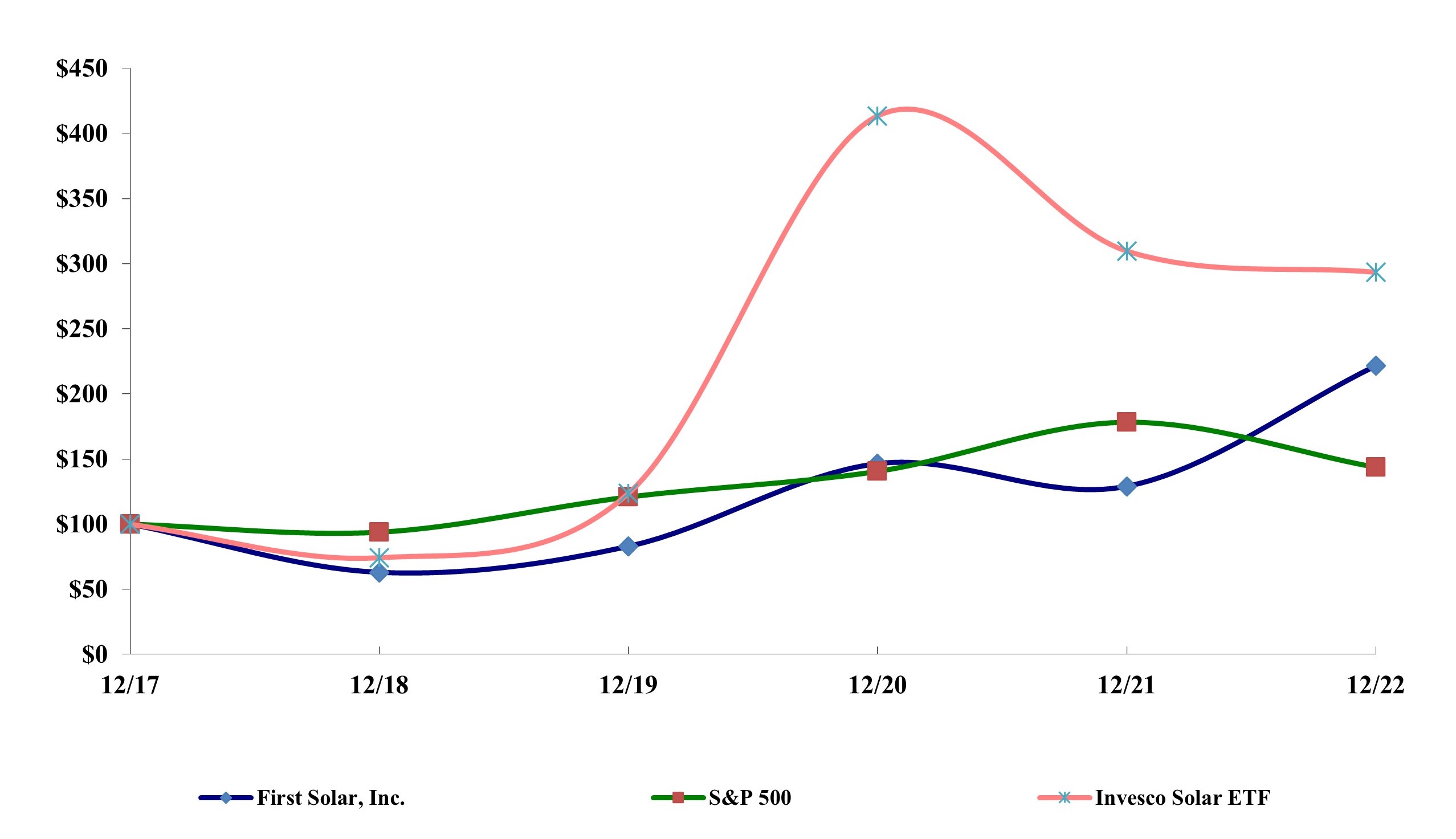]
COMPARISON OF FIVE-YEAR CUMULATIVE TOTAL RETURN*
Among First Solar, the S&P 500 Index,
and the Invesco Solar ETF
——————————
* $100 invested on December 31, 2016 in stock or index, including reinvestment of dividends.
Index calculated on a month-end basis.
Item 9A. Controls and Procedures
6 rewritten, 1 added, 1 removed, 14 unchanged
Based on that evaluation, our Chief Executive Officer and Chief Financial Officer concluded that as of December 31, [removed: 2021] [added: 2022] our disclosure controls and procedures were effective to ensure that information required to be disclosed by us in reports that we file or submit under the Exchange Act is recorded, processed, summarized, and reported within the time periods specified in SEC rules and forms, and that such information is accumulated and communicated to our management, including our Chief Executive Officer and Chief Financial Officer, as appropriate, to allow timely decisions regarding required disclosure.
We also carried out an evaluation, under the supervision and with the participation of management, including our Chief Executive Officer and Chief Financial Officer, of the effectiveness of our internal control over financial reporting as of December 31, [removed: 2021] [added: 2022] based on the criteria established in *Internal Control – Integrated Framework (2013)* issued by the Committee of Sponsoring Organizations of the Treadway Commission (“COSO”).
Based on such evaluation, our management concluded that our internal control over financial reporting was effective as of December 31, [removed: 2021.][added: 2022.]
[removed: The] effectiveness of our internal control over financial reporting as of December 31, [removed: 2021] [added: 2022] has also been audited by PricewaterhouseCoopers LLP, an independent registered public accounting firm, as stated in its report which appears herein.
We also carried out an evaluation, under the supervision and with the participation of management, including our Chief Executive Officer and Chief Financial Officer, of our “internal control over financial reporting” to determine whether any changes in our internal control over financial reporting occurred during the quarter ended December 31, [removed: 2021] [added: 2022] that materially affected, or are reasonably likely to materially affect, our internal control over [added: financial reporting.]
Based on that evaluation, there were no such changes in our internal control over financial reporting that occurred during the quarter ended December 31, [removed: 2021.][added: 2022.]
The
financial reporting.
Item 10. Directors, Executive Officers, and Corporate Governance
2 rewritten, 0 added, 0 removed, 1 unchanged
“Business – Information about Our Executive Officers.” Information concerning our board of directors and audit committee of our board of directors will appear in our [removed: 2022] [added: 2023] Proxy Statement, under the sections “Directors” and “Corporate Governance,” and information concerning Section 16(a) beneficial ownership reporting compliance will appear in our [removed: 2022] [added: 2023] Proxy Statement under the section “Section 16(a) Beneficial Ownership Reporting Compliance.” We have adopted a code of business conduct and ethics that applies to all directors, officers, and associates of First Solar.
Information concerning this code will appear in our [removed: 2022] [added: 2023] Proxy Statement under the section “Corporate Governance.” The information in such sections of the Proxy Statement is incorporated by reference into this Annual Report on Form 10-K.
Item 11. Executive Compensation
1 rewritten, 0 added, 0 removed, 0 unchanged
Information concerning executive compensation and related information will appear in our [removed: 2022] [added: 2023] Proxy Statement under the section “Executive Compensation,” and information concerning the compensation committee of our board of directors (the “compensation committee”) will appear under the sections “Corporate Governance” and “Compensation Committee Report.” The information in such sections of the [removed: 2022] [added: 2023] Proxy Statement is incorporated by reference into this Annual Report on Form 10-K.
Item 12. Security Ownership of Certain Beneficial Owners and Management and Related Stockholder Matters
4 rewritten, 3 added, 2 removed, 8 unchanged
Information concerning the security ownership of certain beneficial owners and management and related stockholder matters, including certain information regarding our equity compensation plans, will appear in our [removed: 2022] [added: 2023] Proxy Statement under the section “Security Ownership of Certain Beneficial Owners and Management and Related Stockholder Matters.” The information in such section of the Proxy Statement is incorporated by reference into this Annual Report on Form 10-K.
The following table sets forth certain information as of December 31, [removed: 2021] [added: 2022] concerning securities authorized for issuance under our equity compensation plans:
(1)Includes [removed: 1,316,860] [added: 1,310,887] shares issuable upon vesting of restricted stock units (“RSUs”) granted under our 2020 Omnibus Incentive Compensation Plan (“2020 Omnibus Plan”).
See Note [removed: 16.][added: 15.]
| Equity compensation plans approved by stockholders | | | | | | 1,310,887 | | | | | | $ | — | | | | | 6,500,832 | | |
| Total | | | | | | 1,310,887 | | | | | | $ | — | | | | | 6,500,832 | | |
These RSUs include the maximum amount of performance units available for issuance under our long-term incentive program for key executive officers and associates.
| Equity compensation plans approved by stockholders | | | | | | 1,316,860 | | | | | | $ | — | | | | | 6,792,347 | | |
| Total | | | | | | 1,316,860 | | | | | | $ | — | | | | | 6,792,347 | | |
Item 13. Certain Relationships and Related Transactions, and Director Independence
1 rewritten, 0 added, 0 removed, 0 unchanged
Information concerning certain relationships and related party transactions will appear in our [removed: 2022] [added: 2023] Proxy Statement under the section “Certain Relationships and Related Party Transactions,” and information concerning director independence will appear in our [removed: 2022] [added: 2023] Proxy Statement under the section “Corporate Governance.” The information in such sections of the Proxy Statement is incorporated by reference into this Annual Report on Form 10-K.
Item 14. Principal Accountant Fees and Services
1 rewritten, 0 added, 0 removed, 1 unchanged
Information concerning principal accounting fees and services and the audit committee of our board of directors’ pre-approval policies and procedures for these items will appear in our [removed: 2022] [added: 2023] Proxy Statement under the section “Principal Accountant Fees and Services.” The information in such section of the Proxy Statement is incorporated by reference into this Annual Report on Form 10-K.
Item 15. Exhibits and Financial Statement Schedules
627 rewritten, 293 added, 210 removed, 888 unchanged
We have audited the accompanying consolidated balance sheets of First Solar, Inc. and its subsidiaries (“the Company”) as of December 31, [removed: 2021] [added: 2022] and [removed: 2020,] [added: 2021,] and the related consolidated statements of operations, comprehensive income, stockholders’ equity and cash flows for each of the three years in the period ended December 31, [removed: 2021,] [added: 2022,] including the related notes (collectively referred to as the “consolidated financial statements”).
We also have audited the Company’s internal control over financial reporting as of December 31, [removed: 2021,] [added: 2022,] based on criteria established in *Internal Control – Integrated Framework* *(2013)* issued by the Committee of Sponsoring Organizations of the Treadway Commission (“COSO”).
In our opinion, the consolidated financial statements referred to above present fairly, in all material respects, the financial position of the Company as of December 31, [removed: 2021] [added: 2022] and [removed: 2020,] [added: 2021,] and the results of its operations and its cash flows for each of the three years in the period ended December 31, [removed: 2021] [added: 2022] in conformity with accounting principles generally accepted in the United States of America.
Also in our opinion, the Company maintained, in all material respects, effective internal control over financial reporting as of December 31, [removed: 2021,] [added: 2022,] based on criteria established in *Internal Control – Integrated Framework (2013)* issued by the COSO.
As described in Notes 2 and [removed: 13] [added: 12] to the consolidated financial statements, the Company provides a limited PV solar module warranty which covers defects in materials and workmanship for up to [removed: 12] [added: 12.5] years and warrants that modules will produce at least a specified minimum percentage of their labeled power output rating, on either an individual module or system-level basis, for up to 30 years.
The Company’s product warranty liability was [removed: $52.6] [added: $33.8] million as of December 31, [removed: 2021.][added: 2022.]
| | | | | | | [added: 2022 | | | | | |] 2021 | | | | | | 2020 | | |
| Cash and cash equivalents | | | | | | $ | [removed: 1,450,654] [added: 1,481,269] | | | | | $ | [removed: 1,227,002] [added: 1,450,654] | |
| Marketable securities | | | | | | [removed: 375,389] [added: 1,096,712] | | | | | | [removed: 520,066] [added: 375,389] | | |
| Accounts receivable trade, net | | | | | | [removed: 429,436] [added: 324,337] | | | | | | [removed: 266,086] [added: 429,436] | | |
| Accounts receivable unbilled, net | | | | | | [removed: 25,273] [added: 30,654] | | | | | | [removed: 26,370] [added: 25,273] | | |
| Inventories | | | | | | [removed: 666,299] [added: 621,376] | | | | | | [removed: 567,587] [added: 666,299] | | |
| Other current assets | | | | | | [removed: 244,192] [added: 237,073] | | | | | | [removed: 251,739] [added: 244,192] | | |
| Total current assets | | | | | | [removed: 3,191,243] [added: 3,791,421] | | | | | | [removed: 3,014,535] [added: 3,191,243] | | |
| Property, plant and equipment, net | | | | | | [removed: 2,649,587] [added: 3,536,902] | | | | | | [removed: 2,402,285] [added: 2,649,587] | | |
| PV solar power systems, net | | | | | | [removed: 217,293] [added: 6,242] | | | | | | [removed: 243,396] [added: 217,293] | | |
| Project assets | | | | | | [removed: 315,488] [added: 30,108] | | | | | | [removed: 373,377] [added: 315,488] | | |
| Deferred tax assets, net | | | | | | [removed: 59,162] [added: 78,680] | | | | | | [removed: 104,099] [added: 59,162] | | |
| Restricted marketable securities | | | | | | [removed: 244,726] [added: 182,070] | | | | | | [removed: 265,280] [added: 244,726] | | |
| Intangible assets, net | | | | | | [removed: 45,509] [added: 31,106] | | | | | | [removed: 56,138] [added: 45,509] | | |
| Inventories | | | | | | [removed: 237,512] [added: 260,395] | | | | | | [removed: 201,229] [added: 237,512] | | |
| Other assets | | | | | | [removed: 438,764] [added: 319,842] | | | | | | [removed: 434,130] [added: 438,764] | | |
| Total assets | | | | | | $ | [removed: 7,413,746] [added: 8,251,228] | | | | | $ | [removed: 7,108,931] [added: 7,413,746] | |
| Accounts payable | | | | | | $ | [removed: 193,374] [added: 341,409] | | | | | $ | [removed: 183,349] [added: 193,374] | |
| Income taxes payable | | | | | | [removed: 4,543] [added: 29,397] | | | | | | [removed: 14,571] [added: 4,543] | | |
| Accrued expenses | | | | | | [removed: 288,450] [added: 382,782] | | | | | | [removed: 310,467] [added: 288,450] | | |
| Current portion of long-term debt | | | | | | [removed: 3,896] [added: —] | | | | | | [removed: 41,540] [added: 3,896] | | |
| Deferred revenue | | | | | | [removed: 201,868] [added: 263,215] | | | | | | [removed: 188,813] [added: 201,868] | | |
| Other current liabilities | | | | | | [removed: 34,747] [added: 21,245] | | | | | | [removed: 83,037] [added: 34,747] | | |
| Total current liabilities | | | | | | [removed: 726,878] [added: 1,038,048] | | | | | | [removed: 847,398] [added: 726,878] | | |
| Accrued solar module collection and recycling liability | | | | | | [removed: 139,145] [added: 128,114] | | | | | | [removed: 130,688] [added: 139,145] | | |
| Long-term debt | | | | | | [removed: 236,005] [added: 184,349] | | | | | | [removed: 237,691] [added: 236,005] | | |
| Total liabilities | | | | | | [removed: 1,454,195] [added: 2,415,173] | | | | | | [removed: 1,588,003] [added: 1,454,195] | | |
| Common stock, $0.001 par value per share; 500,000,000 shares authorized; [removed: 106,332,315] [added: 106,609,094] and [removed: 105,980,466] [added: 106,332,315] shares issued and outstanding at December 31, [removed: 2021] [added: 2022] and [removed: 2020,] [added: 2021,] respectively | | | | | | [removed: 106] [added: 107] | | | | | | 106 | | |
| Additional paid-in capital | | | | | | [removed: 2,871,352] [added: 2,887,476] | | | | | | [removed: 2,866,786] [added: 2,871,352] | | |
| Accumulated earnings | | | | | | [removed: 3,184,455] [added: 3,140,289] | | | | | | [removed: 2,715,762] [added: 3,184,455] | | |
| Accumulated other comprehensive loss | | | | | | [removed: (96,362)] [added: (191,817)] | | | | | | [removed: (61,726)] [added: (96,362)] | | |
| Total stockholders’ equity | | | | | | [removed: 5,959,551] [added: 5,836,055] | | | | | | [removed: 5,520,928] [added: 5,959,551] | | |
| Total liabilities and stockholders’ equity | | | | | | $ | [removed: 7,413,746] [added: 8,251,228] | | | | | $ | [removed: 7,108,931] [added: 7,413,746] | |
| | | | | | | [removed: 2021] [added: 2022] | | | | | | [removed: 2020] [added: 2021] | | | | | | [removed: 2019] [added: 2020] | | |
[Table of Content](#i161bcb9dee5c411eae8920ab3a8dda3e_7)[s](#i161bcb9dee5c411eae8920ab3a8dda3e_7)
[Table of Content](#i161bcb9dee5c411eae8920ab3a8dda3e_7)[s](#i161bcb9dee5c411eae8920ab3a8dda3e_7)
[Table of Content](#i161bcb9dee5c411eae8920ab3a8dda3e_7)[s](#i161bcb9dee5c411eae8920ab3a8dda3e_7)
February 28, 2023
[Table of Content](#i161bcb9dee5c411eae8920ab3a8dda3e_7)[s](#i161bcb9dee5c411eae8920ab3a8dda3e_7)
| | | | | | | 2022 | | | | | | 2021 | | |
| Other liabilities | | | | | | 119,937 | | | | | | 256,224 | | |
[Table of Content](#i161bcb9dee5c411eae8920ab3a8dda3e_7)[s](#i161bcb9dee5c411eae8920ab3a8dda3e_7)
[Table of Content](#i161bcb9dee5c411eae8920ab3a8dda3e_7)[s](#i161bcb9dee5c411eae8920ab3a8dda3e_7)
| Net (loss) income | | | | | | $ | (44,166) | | | | | $ | 468,693 | | | | | $ | 398,355 | |
[Table of Content](#i161bcb9dee5c411eae8920ab3a8dda3e_7)[s](#i161bcb9dee5c411eae8920ab3a8dda3e_7)
| Balance at December 31, 2022 | | | | | | 106,609 | | | | | | $ | 107 | | | | | $ | 2,887,476 | | | | | $ | 3,140,289 | | | | | $ | (191,817) | | | | | $ | 5,836,055 | |
[Table of Content](#i161bcb9dee5c411eae8920ab3a8dda3e_7)[s](#i161bcb9dee5c411eae8920ab3a8dda3e_7)
| Net (loss) income | | | | | | $ | (44,166) | | | | | $ | 468,693 | | | | | $ | 398,355 | |
| Gain on debt forgiveness | | | | | | (30,201) | | | | | | — | | | | | | — | | |
| Other assets | | | | | | (72,602) | | | | | | (69,942) | | | | | | (33,065) | | |
| Accounts payable and accrued expenses | | | | | | 5,569 | | | | | | 48,968 | | | | | | (109,583) | | |
| Deferred revenue | | | | | | 912,946 | | | | | | 47,062 | | | | | | (157,284) | | |
| Other liabilities | | | | | | (11,948) | | | | | | (139,817) | | | | | | (391,710) | | |
[Table of Content](#i161bcb9dee5c411eae8920ab3a8dda3e_7)[s](#i161bcb9dee5c411eae8920ab3a8dda3e_7)
[Table of Content](#i161bcb9dee5c411eae8920ab3a8dda3e_7)[s](#i161bcb9dee5c411eae8920ab3a8dda3e_7)
[Table of Content](#i161bcb9dee5c411eae8920ab3a8dda3e_7)[s](#i161bcb9dee5c411eae8920ab3a8dda3e_7)
[Table of Content](#i161bcb9dee5c411eae8920ab3a8dda3e_7)[s](#i161bcb9dee5c411eae8920ab3a8dda3e_7)
[Table of Content](#i161bcb9dee5c411eae8920ab3a8dda3e_7)[s](#i161bcb9dee5c411eae8920ab3a8dda3e_7)
[Table of Content](#i161bcb9dee5c411eae8920ab3a8dda3e_7)[s](#i161bcb9dee5c411eae8920ab3a8dda3e_7)
Deferred revenue is classified as current or noncurrent based on the expected date that module shipments commence for each sales contract.
[Table of Content](#i161bcb9dee5c411eae8920ab3a8dda3e_7)[s](#i161bcb9dee5c411eae8920ab3a8dda3e_7)
See Note 12.
[Table of Content](#i161bcb9dee5c411eae8920ab3a8dda3e_7)[s](#i161bcb9dee5c411eae8920ab3a8dda3e_7)
[Table of Content](#i161bcb9dee5c411eae8920ab3a8dda3e_7)[s](#i161bcb9dee5c411eae8920ab3a8dda3e_7)
*Government Grants.* We account for government assistance that is not subject to the scope of ASC 740 using a grant accounting model, by analogy to International Accounting Standards 20, *Accounting for Government Grants and Disclosure of Government Assistance*, and recognize such grants when we have reasonable assurance that we will comply with the grant’s conditions and that the grant will be received.
Government grants whose primary condition is the purchase, construction, or acquisition of a long-lived asset are considered asset-based grants and are recognized as a reduction to such asset’s cost basis, which reduces future depreciation.
Other government grants not related to long-lived assets are considered income-based grants, which are initially recognized as “Government grants receivable” and are also recognized as a reduction to the related cost of activities that generated the benefit.
Proceeds received from asset-based grants are presented as cash inflows from investing activities on the consolidated statements of cash flows, whereas proceeds received from income-based grants are presented as cash inflows from operating activities.
[Table of Content](#i161bcb9dee5c411eae8920ab3a8dda3e_7)[s](#i161bcb9dee5c411eae8920ab3a8dda3e_7)
Sale of Japan Project Development Business
In May 2022, we entered into various agreements with certain subsidiaries of PAG, a private investment firm, for the sale of our Japan project development business.
The transaction included our approximately 293 MWDC utility-scale solar project development platform, which comprised the business of developing, contracting for the construction of, and selling utility-scale PV solar power systems.
In June 2022, we completed the sale of our Japan project development business and, following certain customary post-closing adjustments, received total consideration of ¥66.4 billion ($490.8 million) and transferred cash and restricted cash of ¥8.4 billion ($61.9 million) to PAG.
As a result of this transaction, we recognized a gain of $245.2 million, net of transaction costs, during the year ended December 31, 2022, which was included in “Gain on sales of businesses, net” in our consolidated statements of operations.
March 1, 2022
| Assets held for sale | | | | | | — | | | | | | 155,685 | | |
| Liabilities held for sale | | | | | | — | | | | | | 25,621 | | |
| Other liabilities | | | | | | 352,167 | | | | | | 372,226 | | |
| --- | --- | --- | --- | --- | --- | --- | --- | --- | --- | --- | --- | --- | --- | --- | --- | --- | --- | --- | --- | --- |
| Balance at December 31, 2018 | | | | | | 104,885 | | | | | | $ | 105 | | | | | $ | 2,825,211 | | | | | $ | 2,441,553 | | | | | $ | (54,466) | | | | | $ | 5,212,403 | |
| Other assets | | | | | | (7,715) | | | | | | (32,073) | | | | | | 28,728 | | |
| Accounts payable | | | | | | 34,919 | | | | | | (43,285) | | | | | | (336) | | |
| Accrued expenses and other liabilities | | | | | | (89,197) | | | | | | (606,111) | | | | | | 397,527 | | |
Restricted cash consists of cash and cash equivalents held by various banks to secure certain of our letters of credit and other such deposits designated for the construction of our project assets or operation of our PV solar power systems as well as the payment of amounts related to project specific debt financings.
Restricted cash for project construction, operation, and financing is classified as current or noncurrent based on the intended use of the restricted funds.
Payment terms for sales of our project assets, PV solar power systems, and operations and maintenance services vary by contract but are generally due upon demand or within several months of satisfying the associated performance obligations.
We typically do not include extended payment terms in our contracts with customers.
Finished goods inventory is comprised exclusively of solar modules that have not yet been sold to a third-party customer or installed in a PV solar power plant under construction.
Accordingly, our current PV solar power systems have estimated useful lives of 25 years.
Once we enter into a definitive sales agreement, we classify project assets as current until the sale is completed and we have recognized the sale as revenue.
Any income generated by a project while it remains within project assets is accounted for as a reduction to our basis in the project.
If a project is completed and begins commercial operation prior to the closing of a sales arrangement, the completed project will remain in project assets until placed in service.
We review project assets for impairment whenever events or changes in circumstances indicate that the carrying amount may not be recoverable.
We consider a project commercially viable or recoverable if it is anticipated to be sold for a profit once it is either fully developed or fully constructed.
We consider a partially developed or partially constructed project commercially viable or recoverable if the anticipated selling price is higher than the carrying value of the related project assets.
We examine a number of factors to determine if the project is expected to be recoverable, including whether there are any changes in environmental, permitting, market pricing, regulatory, or other conditions that may impact the project.
Such changes could cause the costs of the project to increase or the selling price of the project to decrease.
If a project is not considered recoverable, we impair the respective project assets and adjust the carrying value to the estimated fair value, with the resulting impairment recorded within “Selling, general and administrative” expense.
that the impairment indicator occurs.
in a linear fashion, but never falling below 80% during the term of the warranty.
In addition, we may provide an energy performance test during the first or second year of a system’s operation to demonstrate that the actual energy generation for the applicable period meets or exceeds the modeled energy expectation, after certain adjustments.
In certain instances, a bonus payment may be received at the end of the applicable test period if the system performs above a specified level.
Following an evaluation of the long-term cost structure, competitiveness, and risk-adjusted returns of our O&M services business, we received an offer to purchase certain portions of the business and determined it was in the best interest of our stockholders to pursue the transaction.
On March 31, 2021, we completed the transaction.
The assets and liabilities associated with this business were classified as held for sale in our consolidated balance sheet as of December 31, 2020.
Following a separate evaluation of the long-term cost structure, competitiveness, and risk-adjusted returns of our U.S. project development business, we determined it was also in the best interest of our stockholders to pursue the sale of this business.
The transaction included our approximately 10 GWAC utility-scale solar project pipeline, including the advanced-stage Horizon, Madison, Ridgely, Rabbitbrush, and Oak Trail projects; the 30 MWAC Barilla Solar project, which is operational; and certain other equipment.
On March 31, 2021, we completed the transaction for an aggregate purchase price of $284.0 million.
Such purchase price included $151.4 million for the sale of the U.S. project development business and $132.6 million for the sale of 392 MWDC of solar modules, which is presented in “Net sales” on our consolidated statements of operations for the year ended December 31, 2021.
The following table summarizes the assets and liabilities held for sale at December 31, 2020 (in thousands):
| | | | | | | | | | | | | | | | | | |
| --- | --- | --- | --- | --- | --- | --- | --- | --- | --- | --- | --- | --- | --- | --- | --- | --- | --- |
| | | | Operations & Maintenance | | | | | | Project Development | | | | | | Total | | |
| Inventories | | | 243 | | | | | | — | | | | | | 243 | | |
An excerpt. Shown here: 40 of 627 rewritten, 40 of 293 added and 40 of 210 removed. The counts are complete. For every sentence, read Item 15. Exhibits and Financial Statement Schedules in the FY2022 filing and the FY2021 filing.
Item 16. Form 10-K Summary
12 rewritten, 4 added, 4 removed, 37 unchanged
| Date: [removed: March 1, 2022] [added: February 28, 2023] | | | By: | | | | | | /s/ BYRON JEFFERS | | |
| /s/ MARK R. WIDMAR | | | | | | Chief Executive Officer and Director | | | | | | [removed: March 1, 2022] [added: February 28, 2023] | | |
| /s/ ALEXANDER R. BRADLEY | | | | | | Chief Financial Officer | | | | | | [removed: March 1, 2022] [added: February 28, 2023] | | |
| /s/ MICHAEL J. AHEARN | | | | | | Chairman of the Board of Directors | | | | | | [removed: March 1, 2022] [added: February 28, 2023] | | |
| /s/ RICHARD D. CHAPMAN | | | | | | Director | | | | | | [removed: March 1, 2022] [added: February 28, 2023] | | |
| /s/ ANITA MARANGOLY GEORGE | | | | | | Director | | | | | | [removed: March 1, 2022] [added: February 28, 2023] | | |
| /s/ GEORGE A. HAMBRO | | | | | | Director | | | | | | [removed: March 1, 2022] [added: February 28, 2023] | | |
| /s/ MOLLY E. JOSEPH | | | | | | Director | | | | | | [removed: March 1, 2022] [added: February 28, 2023] | | |
| /s/ CRAIG KENNEDY | | | | | | Director | | | | | | [removed: March 1, 2022] [added: February 28, 2023] | | |
| /s/ WILLIAM J. POST | | | | | | Director | | | | | | [removed: March 1, 2022] [added: February 28, 2023] | | |
| /s/ PAUL H. STEBBINS | | | | | | Director | | | | | | [removed: March 1, 2022] [added: February 28, 2023] | | |
| /s/ MICHAEL SWEENEY | | | | | | Director | | | | | | [removed: March 1, 2022] [added: February 28, 2023] | | |
| /s/ LISA A. KRO | | | | | | Director | | | | | | February 28, 2023 | | |
| Lisa A. Kro | | | | | | | | | | | | | | |
| /s/ NORMAN L. WRIGHT | | | | | | Director | | | | | | February 28, 2023 | | |
| Norman L. Wright | | | | | | | | | | | | | | |
| /s/ SHARON L. ALLEN | | | | | | Director | | | | | | March 1, 2022 | | |
| Sharon L. Allen | | | | | | | | | | | | | | |
| /s/ KATHRYN A. HOLLISTER | | | | | | Director | | | | | | March 1, 2022 | | |
| Kathryn A. Hollister | | | | | | | | | | | | | | |