 filings.tools
Item 1. BUSINESS
54K characters. Original on sec.gov · Markdown
Item 1. BUSINESS
(Dollars in millions, except per-share amounts or unless otherwise noted)
BUSINESS OVERVIEW
General Dynamics is a global aerospace and defense company that specializes in high-end design, engineering and manufacturing to deliver state-of-the-art solutions to our customers. We offer a broad portfolio of products and services in business aviation; ship construction and repair; land combat vehicles, weapons systems and munitions; and technology products and services. Our leadership positions in attractive business aviation and defense markets enable us to deliver superior and enduring shareholder returns.
Our company consists of 10 business units, which are organized into four operating segments: Aerospace, Marine Systems, Combat Systems and Technologies. We refer to the latter three collectively as our defense segments. To optimize its market focus, customer intimacy, agility and operating expertise, each business unit is responsible for the development and execution of its strategy and operating results. This structure allows for a lean corporate function, which sets the overall strategy and governance for the company and is responsible for allocating and deploying capital.
Our business units seek to deliver superior operating results by endeavoring to build industry-leading franchises. To achieve this goal, we invest in advanced technologies, pursue a culture of continuous improvement, and strive to be the low-cost, high-quality provider in each of our markets. The result is long-term value creation measured by strong earnings and cash flow and an attractive return on capital.
Over the past nine years, we have invested approximately $22 billion to create, renew or expand our portfolio of products and services across our businesses to drive long-term growth and shareholder value creation. This includes product development investments in Aerospace to bring to market an all-new lineup of business jet aircraft, capital investments in Marine Systems to support significant growth in U.S. Navy ship and submarine construction plans over the next two decades, development of next-generation platforms and technologies to meet customers’ emerging requirements in Combat Systems, and strategic acquisitions to achieve critical mass and build out a complete spectrum of solutions for our Technologies customers.
Following is additional information on each of our operating segments. For a supplemental discussion of segment performance and backlog, see Management’s Discussion and Analysis of Financial Condition and Results of Operations in Item 7.
AEROSPACE
Our Aerospace segment is recognized as a leading producer of business jets and the standard bearer in aircraft repair, support and completion services. The segment consists of our Gulfstream and Jet Aviation business units. We have earned our reputation through:
-
superior aircraft design, quality, performance, safety and reliability;
-
technologically advanced flight deck and cabin systems; and
-
industry-leading customer support.
We believe the key to long-term value creation in the business jet industry is steady investment in new aircraft models and technologies and in customer service capabilities. As a result, since we acquired Gulfstream over 20 years ago, we have made significant investments in research and development (R&D), state-of-the-art manufacturing facilities, and maintenance and support through a combination of product development efforts, capital expansion and the acquisition of Jet Aviation’s global support network.
We are committed to continual investment in R&D to create new aircraft that consistently broaden customer offerings while raising the bar for safety and performance. The result is the unprecedented development of an all-new lineup of the most technologically advanced business jet aircraft in the world. The Gulfstream family of aircraft offer industry-leading cabin, cockpit and safety technologies and the longest ranges at the fastest speeds in their respective classes.
The following represents Gulfstream’s current product line, along with the maximum range, maximum speed, cabin length (excluding baggage), and total number of city-pair speed records held for each aircraft:

The most recent additions to the in-service Gulfstream fleet are two new large-cabin aircraft, the G500 and G600, which entered service in 2018 and 2019, respectively. These clean-sheet (i.e., all-new) aircraft replace the G450 and G550 models, whose combined family has an installed base of more than 1,650 aircraft around the world. Our investment included development of a new wing, new avionics,
new fuselage and new ergonomically designed larger interiors, as well as systems and technologies to improve the manufacturing process and quality of the platform. As a result, the G500 and G600 are faster, more fuel efficient and have greater cabin volume, more range and improved flight controls compared with the aircraft they are replacing. At year-end 2021, cumulative deliveries for these aircraft totaled almost 150.
The next model to join the Gulfstream lineup is the ultra-long-range, ultra-large-cabin G700. It combines our most spacious cabin with our advanced Symmetry Flight Deck, the industry’s most technologically advanced flight deck, which we launched on our G500 and G600 aircraft, and the superior high-speed performance of all-new engines to create best-in-class capabilities. Gulfstream is in the process of flight testing and certification of the G700, which currently has over 2,200 test hours. We expect the G700 to enter service in the fourth quarter of 2022 pending certification from the U.S. Federal Aviation Administration (FAA).
In October 2021, we introduced two new aircraft, the ultra-long-range, ultra-large-cabin G800 and large-cabin G400, completing a nearly two-decade effort to develop an all-new family of Gulfstream aircraft. Both aircraft combine our industry-leading high-speed range and efficiency, safety enhancements, and our advanced Symmetry Flight Deck. The G800 is Gulfstream’s longest-range aircraft, with an 8,000 nautical mile range at Mach 0.85, and it is expected to enter service in 2023 pending FAA certification. The G400 is a clean-sheet design developed in concert with the G500 and G600, thus expanding the commonality across the Gulfstream family of aircraft. Expected to enter service in 2025 pending FAA certification, the G400 will join a market segment in which Gulfstream has not participated for several decades.
The ultra-long-range, ultra-large-cabin G650 and G650ER continue to generate significant customer interest, with more than 470 aircraft of this family currently operating in 50 countries. Since the first G650 entered service in December 2012, its capabilities and reliability have led to significant sales and expansion of our installed base around the globe. Gulfstream’s current product line holds more than 270 city-pair speed records, more than any other business jet manufacturer, led by the G650ER, which holds the National Aeronautic Association’s polar and westbound around-the-world speed records.
Our disciplined and consistent approach to new product development has allowed us to introduce repeatedly first-to-market capabilities that set industry standards for safety, performance, quality, speed and comfort. Product enhancement and development efforts include initiatives in advanced avionics, composites, flight-control and vision systems, acoustics, and cabin technologies.
Gulfstream designs, develops and manufactures aircraft in Savannah, Georgia, including all large-cabin models. The mid-cabin G280 is assembled by a non-U.S. partner. All models are outfitted in Gulfstream’s U.S. facilities. As Gulfstream’s aircraft portfolio and customer base have grown and become increasingly global in reach over the years, we have invested in our facilities and operations around the world. At our Savannah campus, we added new purpose-built manufacturing facilities, increased aircraft service capacity, and opened a customer-support distribution center and a dedicated R&D campus.
We offer comprehensive support for the more than 3,000 Gulfstream aircraft in service around the world and operate the largest factory-owned service network in the industry. We continue to invest in these maintenance, repair and overhaul (MRO) facilities and inventory to accommodate fleet growth. We also operate a 24/7 year-round customer support center and offer on-call Gulfstream aircraft technicians ready to deploy around the world for customer service requirements under our Field and Airborne Support Team (FAST) rapid-response unit.
In addition to expanding the reach of Gulfstream’s aircraft maintenance network outside the United States, Jet Aviation provides a comprehensive suite of innovative aircraft services for aircraft owners and operators around the world. With approximately 50 locations throughout North America, Europe, the Middle East and the Asia-Pacific region, our offerings include maintenance, aircraft management, charter, staffing and fixed-base operator (FBO) services.
Jet Aviation manages nearly 300 business aircraft globally on behalf of individuals and corporate owners. We operate a leading global FBO network and support all aircraft types with the full range of maintenance services, including 24/7 global aircraft-on-ground support. We also operate one of the world’s largest custom completion and refurbishment centers for both narrow- and wide-body aircraft and perform modifications, upgrades and lifecycle sustainment support for various government fleets. We continue to grow our global footprint through acquisitions, expansions and significant renovations in key business aviation markets.
The following map displays the broad reach of our combined Gulfstream and Jet Aviation services network, including authorized service centers:
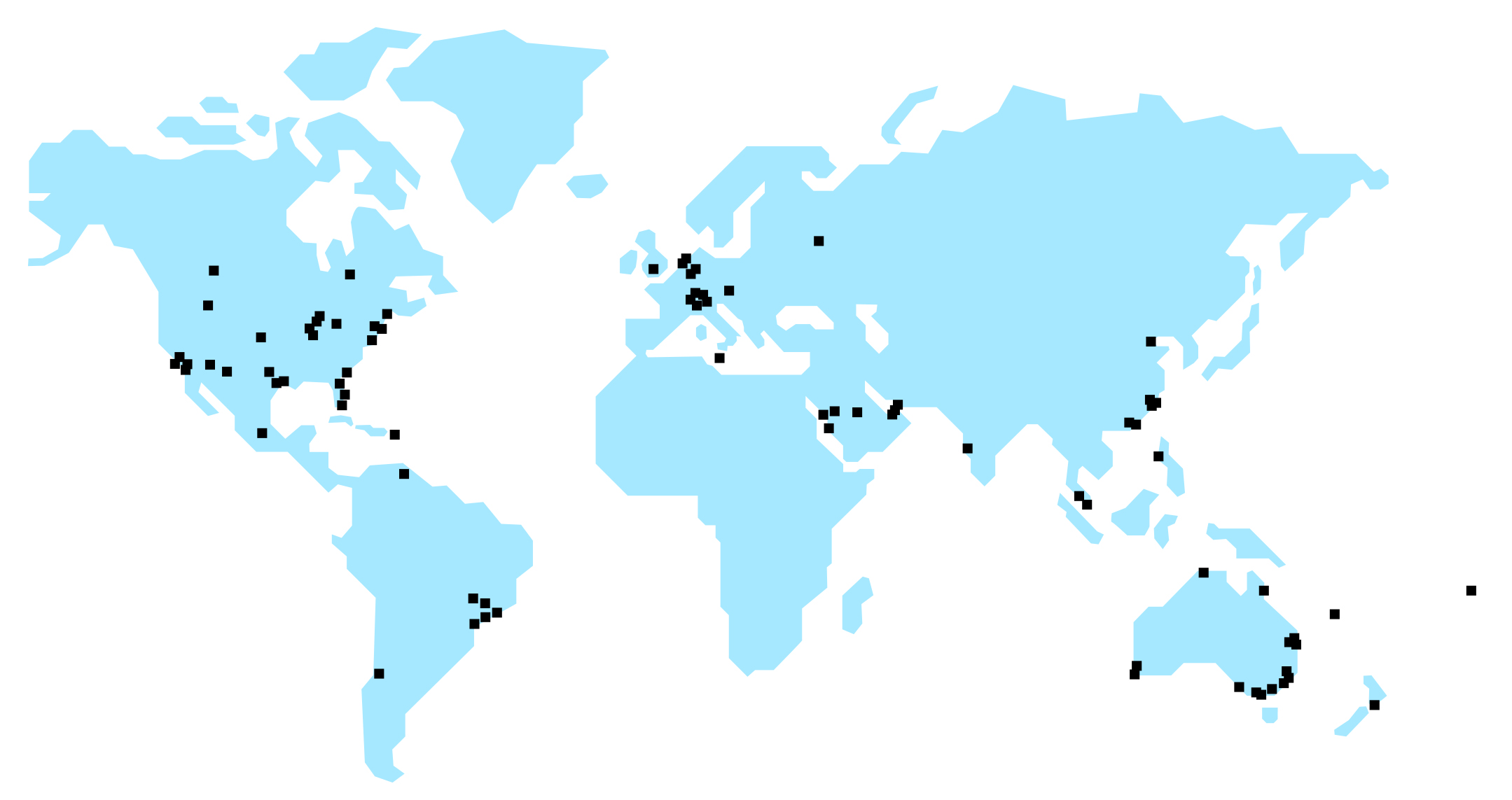
The Aerospace segment is committed to sustainability and the reduction of aviation’s carbon footprint. In support of this strategy, Gulfstream and Jet Aviation offer sustainable aviation fuel through our combined services network and lead the industry in total gallons supplied to the business jet market. Furthermore, we offer carbon offset credits and book and claim options to our customers, enabling them to operate aircraft on a carbon-neutral basis.
Revenue for the Aerospace segment was 21% of our consolidated revenue in 2021 and 2020 and 25% in 2019. Revenue by major products and services was as follows:
| Year Ended December 31 | 2021 | 2020 | 2019 | ||||||||||||||
| Aircraft manufacturing | $ | 5,864 | $ | 6,115 | $ | 7,541 | |||||||||||
| Aircraft services | 2,271 | 1,960 | 2,260 | ||||||||||||||
| Total Aerospace | $ | 8,135 | $ | 8,075 | $ | 9,801 |
MARINE SYSTEMS
Our Marine Systems segment is the leading designer and builder of nuclear-powered submarines and a leader in surface combatant and auxiliary ship design and construction for the U.S. Navy. We also provide maintenance, modernization and lifecycle support services for Navy ships and maintain the most sophisticated marine engineering expertise in the world to support future capabilities. Our ability to design, build and maintain our nation’s most technologically sophisticated warships is a critical element of the U.S. defense industrial base. In addition to Navy ships, we design and build ocean-going Jones Act ships for commercial customers. Marine Systems consists of three business units — Electric Boat, Bath Iron Works and NASSCO.
In support of our Navy customer’s significant increase in demand for submarines and surface ships, we are making substantial investments to expand our facilities, grow and train our workforce, and expand our supply chain. The resulting increase in capacity and capabilities will support the unprecedented growth expected in our shipbuilding business, particularly submarines, for the next two decades.
Electric Boat is the prime contractor and lead shipyard on all Navy nuclear-powered submarine programs. The business is responsible for all aspects of design and engineering and leads the construction of both the Virginia-class attack submarine and the Columbia-class ballistic-missile submarine.
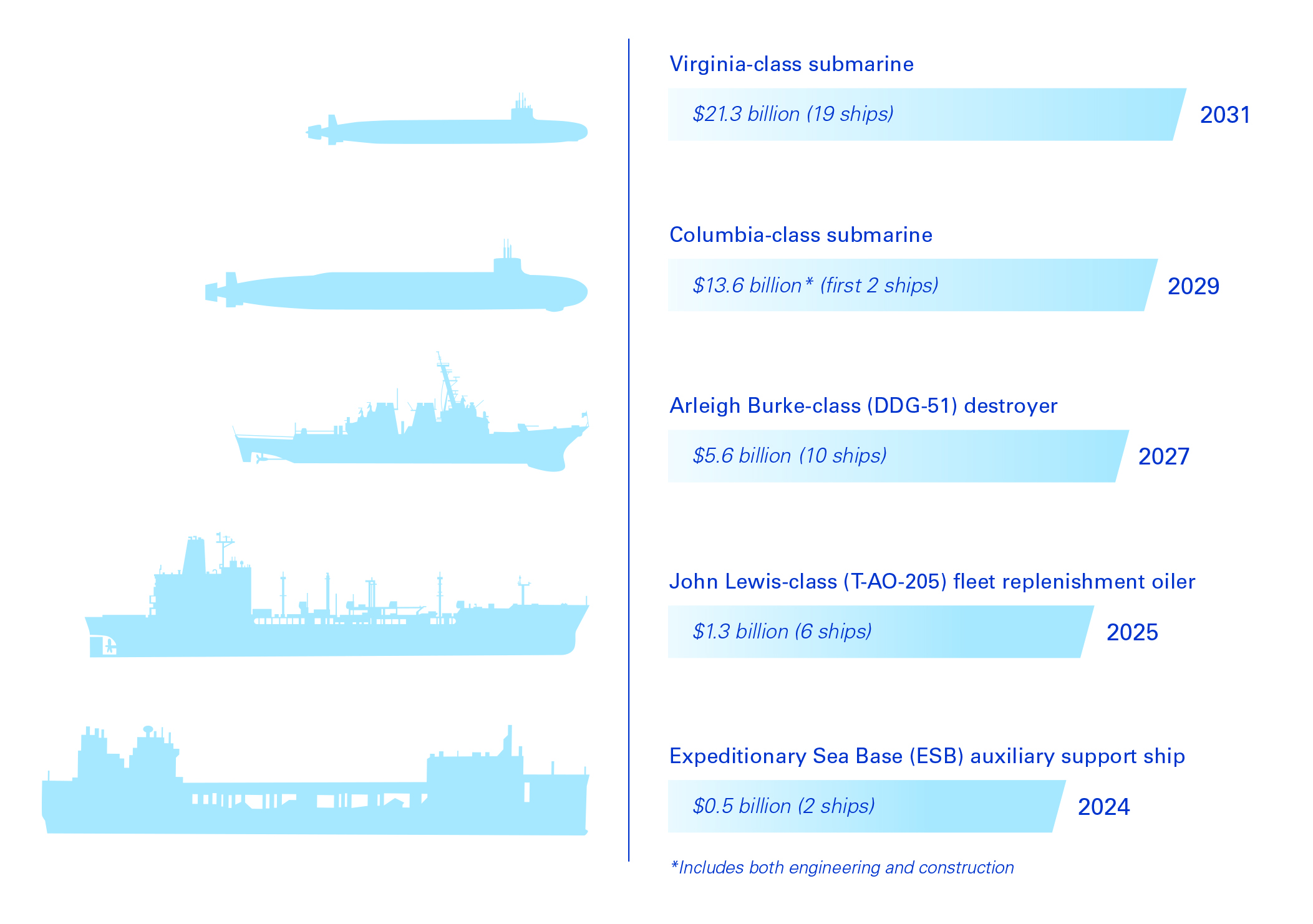
The Navy procures Virginia-class submarines in multi-boat blocks, currently at a two-per-year rate. We are currently working on Blocks IV and V in the program, with 19 Virginia-class submarines in our backlog scheduled for delivery through 2031. Nine of the boats in Block V include the Virginia Payload Module (VPM), an 84-foot Electric Boat-designed-and-built hull section that adds four additional payload tubes, more than tripling the strike capacity of these submarines and providing unique capabilities to support special missions.
The Columbia-class ballistic-missile submarine is a 12-boat program that the Navy considers its top acquisition priority. Accordingly, the program has received the highest possible rating from the government’s Defense Priorities and Allocations System (DPAS). These submarines will provide strategic deterrent capabilities for decades, with the first boat delivering in 2027 to begin replacement of the current Ohio-class ballistic-missile submarine fleet as it reaches the end of its service life. Construction is scheduled to continue for two decades, and the value of the Navy’s program of record is in excess of $110 billion. The submarine’s design was more than 80% complete at the time we began construction of the first boat in 2020, nearly twice as mature as any of the Navy’s previous submarine programs at the start of construction.
We are investing $1.8 billion of capital in expanded and modernized facilities at Electric Boat to support the growth in submarine construction and expect the projects to be substantially complete by the end of 2023. Equal to the commitment of capital is our commitment to our Electric Boat workforce, which is on track to grow approximately 25% in the current decade, particularly in support of Columbia-class production. Along with strong contributions from the states of Connecticut and Rhode Island, we continue to invest in the training and tools necessary for our employees to be prepared to deliver these next-generation submarines to the Navy on time and on budget. We are also working with our network of approximately 3,000 suppliers — mostly small businesses — to support concurrent production of the two submarine programs.
Bath Iron Works builds the Arleigh Burke-class (DDG-51) guided-missile destroyers and manages modernization and lifecycle support for the class. We have a total of 10 ships in backlog scheduled for delivery through 2027.
NASSCO specializes in Navy auxiliary and support ships and is currently building the Expeditionary Sea Base (ESB), which serves as an afloat forward-staging base for U.S. Marines and special operations forces, and the John Lewis-class (T-AO-205) fleet replenishment oiler. Work on the two ESBs in backlog will continue into 2024, while the initial ships in the T-AO-205 program have deliveries planned into 2025. NASSCO has also designed and built crude oil and product tankers and container and cargo ships for commercial customers, satisfying Jones Act requirements that ships carrying cargo between U.S. ports be built in U.S. shipyards.
On December 31, 2021, backlog for our major ship construction programs and the scheduled final delivery date of ships currently in backlog were as follows:
In addition to design and construction activities, our Marine Systems segment provides comprehensive post-delivery services to modernize and extend the service life of these and other Navy ships. NASSCO conducts full-service maintenance and surface-ship repair operations in Navy fleet concentration areas in San Diego, California; Norfolk, Virginia; Mayport, Florida; and Bremerton, Washington. Electric Boat provides submarine maintenance and modernization services in a variety of U.S. locations, and Bath Iron Works provides lifecycle support services for Navy surface ships in both U.S. and overseas ports. In support of allied navies, we offer program management, planning, engineering and design support for submarine and surface-ship construction programs.
Revenue for the Marine Systems segment was 27% of our consolidated revenue in 2021, 26% in 2020 and 23% in 2019. Revenue by major products and services was as follows:
| Year Ended December 31 | 2021 | 2020 | 2019 | ||||||||||||||
| Nuclear-powered submarines | $ | 7,117 | $ | 6,938 | $ | 6,254 | |||||||||||
| Surface ships | 2,328 | 2,055 | 1,912 | ||||||||||||||
| Repair and other services | 1,081 | 986 | 1,017 | ||||||||||||||
| Total Marine Systems | $ | 10,526 | $ | 9,979 | $ | 9,183 |
COMBAT SYSTEMS
Our Combat Systems segment is a premier manufacturer and integrator of land combat solutions worldwide, including wheeled and tracked combat vehicles, weapons systems and munitions. The segment consists of three business units — Land Systems, European Land Systems (ELS), and Ordnance and Tactical Systems (OTS).
Combat Systems creates long-term value through operational excellence — high-quality, on-schedule and on-budget performance — combined with investments in innovative technologies that modernize existing platforms and develop next-generation capabilities to meet our customers’ rapidly evolving requirements. We maintain our market-leading position by focusing on innovation, affordability and speed to market to deliver increased survivability, performance and lethality on the battlefield. Our large installed base of wheeled and tracked vehicles around the world and expertise gained from research, engineering and production programs position us well for modernization programs, support and sustainment services, and future development programs.
Land Systems is the sole-source producer of two foundational products central to the U.S. Army’s warfighting capabilities — the M1A2 Abrams main battle tank and Stryker wheeled combat vehicle. Both of these platforms are critical to the multi-domain, joint war fight envisioned on the battlefield of the future.
We are maximizing the effectiveness and lethality of the Army’s tank fleet with next-generation Abrams upgrades, providing technological advancements in communications, power generation, fuel efficiency, optics and armor. Even as we are delivering this modernized platform in the System Enhanced Package Version 3 (SEPv3) configuration, we are developing an Abrams SEPv4 configuration with additional advanced capabilities, including incorporating next-generation electronic architecture technology that will allow this platform to adapt and incorporate transformative capabilities into the future. We are also upgrading Abrams tanks for several non-U.S. partners.
The Stryker is an eight-wheeled, medium-weight combat vehicle that combines lethality, mobility and survivability. Land Systems continues to develop upgrades and enhancements to this highly versatile and combat-proven platform to address the Army’s evolving operational needs. We are fielding a new-generation Stryker that includes the double-V-hull (DVH) for survivability, increased power, improved cross-country mobility and an advanced digital, in-vehicle network. We have completed fielding these vehicles for the first of nine Army brigades, as well as for the Army’s Ranger Regiment. In addition, coordination continues with the Army for next-generation upgrades to the platform and new uses for the vehicle. Leveraging our rapid prototyping expertise and customer intimacy, we continue to expand the mission capabilities of this platform, including an air defense mission package (M-SHORAD), a state-of-the-art electronic warfare suite, a high-energy laser, a high-power microwave, and several command post options.
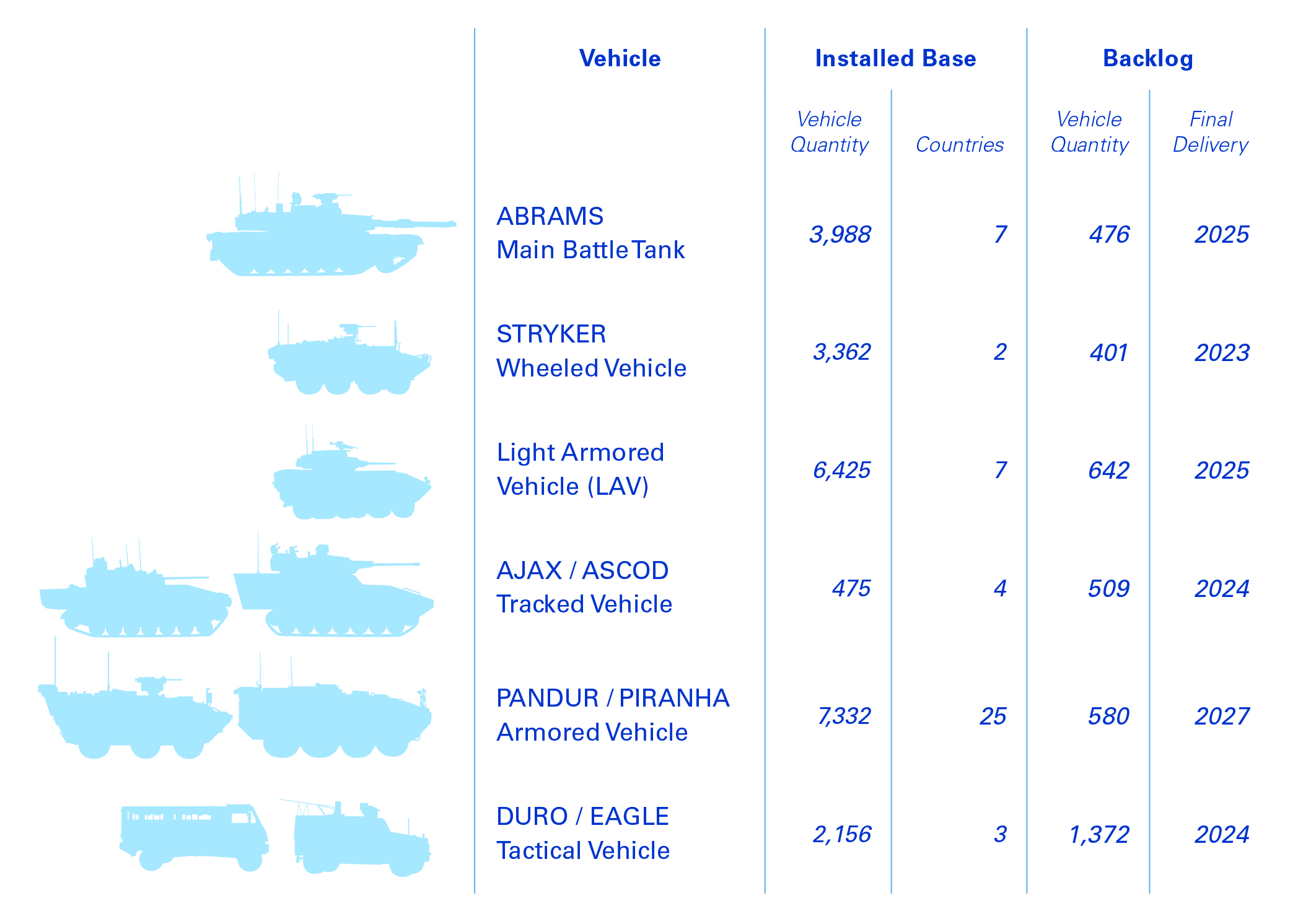
Combat Systems provides similar capabilities for U.S. allies through export opportunities and through our operations in several countries around the world, including Canada, the United Kingdom, Spain, Switzerland, Austria and Germany. As a result, we have a market-leading position in light armored vehicles (LAVs) with approximately 14,000 of the high-mobility, versatile Pandur, Piranha and other LAVs in service worldwide.
Land Systems is producing 360 new LAVs in eight variants, including ambulances, command posts, maintenance and recovery vehicles, and troop-carrying vehicles, for the Canadian Army, as well as upgrading its existing fleet. Land Systems is also producing the British Army’s AJAX armored fighting vehicle, a next-generation, medium-weight tracked combat vehicle. With six variants, including a reconnaissance vehicle, an armored personnel carrier, and various support platforms, the AJAX family of vehicles offers advanced electronic architecture and proven technology for an unparalleled balance of survivability, lethality and mobility, along with high reliability for a vehicle in its weight class.
ELS is producing and upgrading Piranha vehicles, a premier 8x8 armored combat vehicle, around the world. We are currently providing Piranha 5 vehicles for several countries, including Denmark, Romania and Spain. Additionally, we provide mobile bridge systems with payloads ranging from 100 kilograms to 100 tons to customers worldwide. We offer the ASCOD, a highly versatile tracked combat vehicle with multiple versions, including the Spanish Pizarro and the Austrian Ulan. ELS also offers Duro and Eagle tactical vehicles in a range of options and weight classes and is currently producing these vehicles for Denmark, Luxembourg, Switzerland and Germany, while providing a full range of product support for the German armed forces.
We are expanding our platform capabilities through continued investment in robotic and autonomous vehicle technology. We have the Multi-Utility Tactical Transport (MUTT), a semi-autonomous robotic platform that can be equipped with an array of modular mission payloads for use alongside dismounted soldiers. This platform was selected as the U.S. Army’s first robotic vehicle program of record and is officially designated as the Small Multipurpose Equipment Transport (SMET). Additionally, we have the Tracked Robot 10-ton (TRX) prototype, a medium-sized, semi-autonomous combat vehicle that enables critical battlefield roles, such as direct and indirect fire, autonomous resupply, reconnaissance and other battlefield missions.
On December 31, 2021, the installed base for our major vehicle programs, as well as the quantity and scheduled final delivery date of vehicles and vehicle upgrades currently in backlog were as follows:
Complementing these military-vehicle offerings, OTS designs, develops and produces a comprehensive array of sophisticated weapon systems for ground forces, including the M2/M2-A1 heavy machine guns and MK19/MK47 grenade launchers. OTS also produces next-generation weapon systems for shipboard and aircraft applications, including high-speed Gatling guns for all U.S. fighter aircraft, including the F-35 Joint Strike Fighter.
OTS’s munitions portfolio covers the full breadth of naval, air and ground forces applications across all calibers and weapon platforms for the U.S. government and its non-U.S. partners. Globally, we maintain a market-leading position in the supply of Hydra-70 rockets, general-purpose bombs and bomb bodies, large-caliber tank ammunition, medium-caliber ammunition, military propellants, mortar, and artillery projectiles. OTS is also the systems integrator for the next generation of artillery solutions in support of the Army’s Indirect Fire Modernization objectives. Additionally, OTS maintains a leading position providing missile subsystems in support of U.S. tactical and strategic missiles, provisioning both legacy and next-generation missiles with critical aerostructures, control actuators, high-performance warheads and cutting-edge hypersonic rocket cases.
Revenue for the Combat Systems segment was 19% of our consolidated revenue in 2021 and 2020 and 18% in 2019. Revenue by major products and services was as follows:
| Year Ended December 31 | 2021 | 2020 | 2019 | ||||||||||||||
| Military vehicles | $ | 4,699 | $ | 4,687 | $ | 4,620 | |||||||||||
| Weapons systems, armament and munitions | 2,006 | 1,991 | 1,906 | ||||||||||||||
| Engineering and other services | 646 | 545 | 481 | ||||||||||||||
| Total Combat Systems | $ | 7,351 | $ | 7,223 | $ | 7,007 |
TECHNOLOGIES
Our Technologies segment provides a full spectrum of services, technologies and products to an expanding market that increasingly seeks solutions combining leading-edge electronic hardware with specialized software. The segment is organized into two business units — Information Technology (GDIT) and Mission Systems. Together they serve a wide range of military, intelligence and federal civilian customers with a diverse portfolio that includes:
-
information technology (IT) solutions and mission-support services;
-
mobile communication, computers, command-and-control and cyber (C5) mission systems; and
-
intelligence, surveillance and reconnaissance (ISR) solutions.
This market has experienced a series of structural shifts in recent years, and our response to those trends has further solidified our position as a market leader. Over the past decade, the Department of Defense (DoD), the intelligence community and federal civilian agencies have increasingly prioritized technology solutions as a critical element of their missions. Cloud computing capabilities, cyber security threats, and advancements in artificial intelligence have transformed technology resources from short-cycle back-office support functions to a strategic priority for this customer community. The result is a significant increase in federal IT modernization and technology investments in recent years and a shift to large-scale, end-to-end, highly engineered solutions that require critical mass and a broad array of technology services and hardware offerings to meet these customer demands. The coronavirus (COVID-19) pandemic has only accelerated these trends, which have included an expansion of remote connectivity and added urgency to required technology investments.
These market shifts have resulted in significant consolidation in the industry in recognition of the scale and breadth of capabilities required to meet this growing demand. In response to these market dynamics, in 2015 we combined our C5 and ISR operations into a single Mission Systems business unit, and in 2018 we acquired CSRA, Inc. (CSRA), which doubled the size of our IT services business, brought critical capabilities and repositioned the segment as a leader in this market.
During the four years following the acquisition of CSRA, GDIT and Mission Systems carried out considerable portfolio shaping and realignment. At the top level, the two businesses share the same defense, intelligence and federal civilian customer base and increasingly go to market together to meet the ever-changing information-systems and mission-support needs of these customers. In addition, with the convergence of digital technologies, the two businesses have considerable commonality and benefit from significant complementary pull-through in their core offerings and solution sets, particularly in the areas of cloud computing; artificial intelligence and machine learning (AI/ML); big data analytics; development, security and operations (DevSecOps); software-defined networks; and everything as-a-service (XaaS).
With a broad network of global partners, the segment develops solutions that keep its customers at the leading edge of technology in support of their missions. The segment’s highly skilled workforce is one of its key differentiators and comprises approximately 40,000 employees, including technologists, engineers, mission experts and cleared personnel dedicated to solving the toughest security and technology challenges facing the United States and its allies.
GDIT modernizes large-scale IT enterprises and deploys the latest technologies to optimize and protect customer networks, data and information. Operating hundreds of complex digital modernization programs across the federal government, GDIT’s expansive portfolio includes cloud strategy and services, cybersecurity, network modernization, managed services, AI/ML, application development, and high-performance computing.
Mission Systems offers solutions across all domains and produces a unique combination of products and capabilities that are purpose-built for essential C5ISR applications. Our technologies and products are often built into platforms and integrated systems on which our customers rely. The business’ portfolio includes prime contract programs to provide innovative defense-electronics solutions as well as subcontract efforts that enhance the capabilities of large-scale land, air, sea and space platforms.
The Technologies segment leverages its scale, partnerships and deep knowledge of its customers’ missions and challenges to bring innovation to those customers across a portfolio of thousands of contracts. While no individual contract is material to the segment’s results, the following highlights provide a sampling of the value of this combined business.
GDIT delivers a full spectrum of cloud solutions and services to modernize customers’ legacy IT infrastructures and systems. These cloud capabilities advance security and accelerate access to cutting-edge technologies such as high-performance computing and AI/ML. For the DoD, GDIT is delivering, integrating and supporting Microsoft’s cloud-based productivity suite, Microsoft Office 365, under the Defense Enterprise Office Systems (DEOS) contract, which secures and streamlines email and collaborative tools across the DoD enterprise. In the federal civilian market, GDIT is delivering a scalable, hybrid multi-cloud platform to modernize the United States Patent and Trademark Office’s IT infrastructure and services.
We apply AI/ML to expand the human capacity to make better decisions and implement smarter actions as we automate, secure and enhance our customers’ operations. For the Department of Veterans Affairs (VA), GDIT leverages managed services and AI/ML to accelerate veteran benefits claims processing, develops applications and software to improve the veteran user experience, and provides on-demand 24/7/365 IT support to more than 500,000 VA personnel nationwide. In the federal civilian sector, GDIT supports some of the fastest supercomputers in the world, responsible for biomedical research, weather forecasting and climate modeling.
To adapt to a constantly evolving threat landscape, GDIT embeds cyber solutions into every aspect of digital modernization. More than 3,000 cyber professionals support cyber projects across 30 agencies in the federal government. This work includes modernizing the IT infrastructure for the U.S. Southern Command’s (USSOUTHCOM) secured networks with a full range of capabilities, including cyber security, cloud computing and software development.
Mission Systems develops and manufactures combat-proven global positioning systems (GPS) for the U.S. Army. This includes capabilities to ensure reliable satellite connectivity in any location and a suite of Assured Position, Navigation and Timing capabilities, which provide military forces the ability to synchronize communications utilizing trusted data, even when GPS signals are degraded or denied.
We are working with our Army customer to adapt elements of 5G technology to address battlefield realities such as jamming, spoofing, cyberattacks and lack of ground connectivity. We also provide similar capabilities to non-U.S. customers, including Canada and the United Kingdom.
On the platform side, we have a more than 60-year legacy of providing advanced fire-control systems for the Navy’s submarine programs. We are developing and integrating commercial off-the-shelf software and hardware upgrades to improve the tactical control capabilities for several submarine classes, including the Columbia and U.K. Dreadnought ballistic-missile submarines.
Mission Systems is also investing in autonomous capabilities, opening in 2021 a new Unmanned Undersea Vehicle (UUV) Manufacturing and Assembly Center of Excellence in Taunton, Massachusetts. The facility will provide manufacturing, assembly, integration and testing capabilities for Mission Systems’ Knifefish and Bluefin Robotics UUVs.
Revenue for the Technologies segment was 33% of our consolidated revenue in 2021 and 34% in 2020 and 2019. Revenue by major products and services was as follows:
| Year Ended December 31 | 2021 | 2020 | 2019 | ||||||||||||||
| IT services | $ | 8,069 | $ | 7,892 | $ | 8,422 | |||||||||||
| C5ISR solutions | 4,388 | 4,756 | 4,937 | ||||||||||||||
| Total Technologies | $ | 12,457 | $ | 12,648 | $ | 13,359 |
CUSTOMERS
In 2021, 70% of our consolidated revenue was from the U.S. government, 12% was from U.S. commercial customers, 10% was from non-U.S. government customers and the remaining 8% was from non-U.S. commercial customers.
U.S. GOVERNMENT
Our primary customer is the DoD. We also contract with other U.S. government customers, including the intelligence community and the Departments of Homeland Security and Health and Human Services. Our revenue from the U.S. government was as follows:
| Year Ended December 31 | 2021 | 2020 | 2019 | ||||||||||||||
| DoD | $ | 21,386 | $ | 20,840 | $ | 19,864 | |||||||||||
| Non-DoD | 4,862 | 4,726 | 5,254 | ||||||||||||||
| Foreign military sales (FMS)* | 598 | 737 | 689 | ||||||||||||||
| Total U.S. government | $ | 26,846 | $ | 26,303 | $ | 25,807 | |||||||||||
| % of total revenue | 70 | % | 69 | % | 66 | % |
*In addition to our direct non-U.S. sales, we sell to non-U.S. governments through the FMS program. Under the FMS program, we contract with and are paid by the U.S. government, and the U.S. government assumes the risk of collection from the non-U.S. government customer.
Our U.S. government revenue is derived from fixed-price, cost-reimbursement and time-and-materials contracts. Our production contracts are primarily fixed-price. Under these contracts, we agree to perform a specific scope of work for a fixed amount. Contracts for research, engineering, repair and maintenance, and other services are typically cost-reimbursement or time-and-materials. Under cost-reimbursement contracts, the customer reimburses contract costs incurred and pays a fixed, incentive or award-based fee. These fees are determined by our ability to achieve targets set in the contract, such as
cost, quality, schedule and performance. Under time-and-materials contracts, the customer pays a fixed hourly rate for direct labor and generally reimburses us for the cost of materials.
Of our U.S. government revenue, fixed-price contracts accounted for 57% in 2021 and 59% in 2020 and 2019; cost-reimbursement contracts accounted for 36% in 2021 and 35% in 2020 and 2019; and time-and-materials contracts accounted for 7% in 2021 and 6% in 2020 and 2019.
For information on the advantages and disadvantages of each of these contract types, see Note B to the Consolidated Financial Statements in Item 8.
U.S. COMMERCIAL
Our U.S. commercial revenue was $4.8 billion in 2021, $4.9 billion in 2020 and $6 billion in 2019, which represented 12%, 13% and 15% of our consolidated revenue in each of the respective years. The majority of this revenue was for business jet aircraft and related services where our customer base consists of individuals and public and privately held companies across a wide range of industries.
NON-U.S.
Our revenue from non-U.S. government and commercial customers was $6.8 billion in 2021, $6.7 billion in 2020 and $7.6 billion in 2019, which represented 18% of our consolidated revenue in 2021 and 2020 and 19% in 2019.
We conduct business with customers around the world. Our non-U.S. defense subsidiaries maintain long-term relationships with their customers and have established themselves as principal regional suppliers and employers, providing a broad portfolio of products and services.
Our non-U.S. commercial revenue consists primarily of business jet aircraft exports and worldwide aircraft services. While the installed base of aircraft is concentrated in North America, orders from customers outside North America represent a significant portion of our aircraft business with approximately 45% of the Aerospace segment’s aircraft backlog on December 31, 2021.
COMPETITION
Several factors determine our ability to compete successfully in the defense and business-aviation markets. While customers’ evaluation criteria vary, the principal competitive elements include:
-
the technical excellence, reliability, safety and cost competitiveness of our products and services;
-
our ability to innovate and develop new products and technologies that improve mission performance and adapt to dynamic threats;
-
successful program execution and on-time delivery of complex, integrated systems;
-
our global footprint and accessibility to customers;
-
the reputation and customer confidence derived from past performance; and
-
the successful management of customer relationships.
DEFENSE MARKET COMPETITION
The U.S. government contracts with numerous domestic and non-U.S. companies for products and services. We compete against other contractors as well as smaller companies that specialize in a particular technology or capability. Outside the United States, we compete with global defense contractors’ exports and the offerings of private and state-owned defense manufacturers. Our Marine Systems segment has one primary competitor with which it also partners on the Virginia-class
submarine program, and to which it subcontracts on the Columbia-class submarine program. Our Combat Systems segment competes with a large number of U.S. and non-U.S. businesses. Our Technologies segment competes with many companies, from large government contracting and commercial technology companies to small niche competitors with specialized technologies or expertise. The operating cycle of many of our major programs can result in sustained periods of program continuity when we perform successfully.
We are involved in teaming and subcontracting relationships with some of our competitors. Competitions for major defense and other government contracting programs often require companies to form teams to bring together a spectrum of capabilities to meet the customer’s requirements. Opportunities associated with these programs include roles as the program’s integrator, overseeing and coordinating the efforts of all participants on a team, or as a provider of a specific component or subsystem.
BUSINESS JET AIRCRAFT MARKET COMPETITION
The Aerospace segment has several competitors for each of its Gulfstream products. Key competitive factors include aircraft safety, reliability and performance; comfort and in-flight productivity; service quality, global footprint and responsiveness; technological and new-product innovation; and price. We believe that Gulfstream competes effectively in all of these areas.
The Aerospace segment competes worldwide in the business jet aircraft services market primarily on the basis of quality, price and timeliness. While competition for each type of service varies somewhat, the segment faces a number of competitors of varying sizes for each of its offerings.
INTELLECTUAL PROPERTY
We develop technology, manufacturing processes and systems-integration practices. In addition to owning a large portfolio of proprietary intellectual property, we license some intellectual property rights to and from others. The U.S. government holds licenses to many of our patents developed in the performance of U.S. government contracts, and it may use or authorize others to use the inventions covered by these patents. Although these intellectual property rights are important to the operation of our business, no existing patent, license or other intellectual property right is of such importance that its loss or termination would have a material impact on our business.
HUMAN CAPITAL MANAGEMENT
Our company consists of a community of approximately 103,100 employees dedicated to our ethos of transparency, trust, honesty and alignment. These four values drive how we operate our business; govern how we interact with each other and our customers, partners, and suppliers; guide the way that we treat our workforce; and determine how we connect with our communities. Our commitment to ethical business practices is outlined in our Standards of Business Ethics and Conduct, commonly known as our Blue Book. The Blue Book states our expectation that all employees conduct business in accordance with our Ethos, applicable laws and our policies; each employee is asked to acknowledge receipt, understanding of and compliance with our standards.
Due to the highly specialized nature of our business, we are required to hire and train skilled and qualified personnel to design and build the products and perform the services required by our customers. We recognize that our success as a company depends on our ability to attract, develop and retain a
qualified workforce. As such, we promote the health, welfare and safety of our employees. Part of our responsibility includes treating all employees with dignity and respect and providing them with fair, market-based, competitive and equitable compensation. We recognize and reward the performance of our employees in line with our pay-for-performance philosophy and provide a comprehensive suite of benefit options that enables our employees and their dependents to live healthy and productive lives.
Safety in our workplaces is paramount. Across our businesses, we take measures to prevent workplace hazards, encourage safe behaviors and enforce a culture of continuous improvement to ensure our processes help reduce incidents and illnesses and comply with governing health and safety laws. These efforts continue to be of the utmost importance as we address the ongoing challenges presented by the COVID-19 pandemic.
We are committed to promoting diversity of thought, experience, perspectives, backgrounds and capabilities to drive innovation and strengthen the solutions we deliver to our customers because we believe the results lead to a better outcome. We proudly support a culture of inclusion and encourage a work environment that respects diverse opinions, values individual skills and celebrates the unique experiences our employees bring. We are dedicated to equal employment opportunity that fosters and supports diversity in a principled, productive and inclusive work environment. We stand for basic universal human rights, including that employment must be voluntary. We track, measure and analyze our workforce trends to establish accountability for continuing to cultivate diverse and inclusive environments across our businesses and at every level of our company.
Our values motivate us to promote strong workplace practices with opportunities for development and training. Our training and development efforts focus on ensuring that the workforce is appropriately trained on critical job skills as well as leadership behaviors that are consistent with our ethos. We conduct rigorous succession planning exercises to ensure that key positions have the appropriate level of bench strength to provide for future key positions and leadership transitions. We listen to our workforce to assess areas of concern and levels of engagement.
2021 WORKFORCE STATISTICS
-
Approximately 85% of our employees are based in the United States, of which roughly 70% are white, 30% are people of color and 20% are veterans of the U.S. armed forces. The remaining 15% of our workforce is based internationally in over 65 countries with the primary concentrations in North America and Europe.
-
Our global workforce is 76% male and 24% female with our senior leadership teams across the business represented by 74% males and 26% females. During 2021, the diversity profile of our workforce continued to improve across our businesses as we hired approximately 21,300 individuals of which 69% were male and 31% were female. For our 2021 U.S.-based hires, 61% were white and 39% were people of color.
RAW MATERIALS AND SUPPLIERS
We depend on suppliers and subcontractors for raw materials, components and subsystems. Our U.S. government customer is a supplier on some of our programs. These supply networks can experience price fluctuations and capacity constraints, which can put pressure on our costs. Effective management and oversight of suppliers and subcontractors is an important element of our successful performance. If our sources of supply are disrupted, particularly in instances where we rely on only one or two sources of supply, our ability to meet our customer commitments could be adversely impacted. We attempt to
mitigate risks with our suppliers by entering into long-term agreements and leveraging company-wide agreements to achieve economies of scale and by negotiating flexible pricing terms in our customer contracts. We have not experienced, and do not foresee, significant difficulties in obtaining the materials, components or supplies necessary for our business operations.
REGULATORY MATTERS
U.S. GOVERNMENT CONTRACTS
U.S. government contracts are subject to procurement laws and regulations. The Federal Acquisition Regulation (FAR) and the Cost Accounting Standards (CAS) govern the majority of our contracts. The FAR mandates uniform policies and procedures for U.S. government acquisitions and purchased services. Also, individual agencies can have acquisition regulations that provide implementing language for the FAR or that supplement the FAR. For example, the DoD implements the FAR through the Defense Federal Acquisition Regulation Supplement (DFARS). For all federal government entities, the FAR regulates the phases of any product or service acquisition, including:
-
acquisition planning;
-
competition requirements;
-
contractor qualifications;
-
protection of source selection and supplier information; and
-
acquisition procedures.
In addition, the FAR addresses the allowability of our costs, while the CAS addresses the allocation of those costs to contracts. The FAR and CAS subject us to audits and other government reviews covering issues such as cost, performance, internal controls and accounting practices relating to our contracts.
NON-U.S. REGULATORY
Our non-U.S. operations are subject to the applicable government regulations and procurement policies and practices, as well as U.S. policies and regulations. We are also subject to regulations governing investments, exchange controls, repatriation of earnings and import-export control.
BUSINESS JET AIRCRAFT
The Aerospace segment is subject to FAA regulation in the United States and other similar aviation regulatory authorities internationally, including the Civil Aviation Administration of Israel (CAAI), the European Aviation Safety Agency (EASA) and the Civil Aviation Administration of China (CAAC). For an aircraft to be manufactured and sold, the model must receive a type certificate from the appropriate aviation authority, and each aircraft must receive a certificate of airworthiness. Aircraft outfitting and completions also require approval by the appropriate aviation authority, which is often accomplished through a supplemental type certificate. Aviation authorities can require changes to a specific aircraft or model type before granting approval. Maintenance facilities and charter operations must be licensed by aviation authorities as well.
ENVIRONMENTAL
We are subject to a variety of federal, state, local and foreign environmental laws and regulations. These laws and regulations cover the discharge, treatment, storage, disposal, investigation and remediation of materials, substances and wastes identified in the laws and regulations. We are directly or indirectly
involved in environmental investigations or remediation at some of our current and former facilities and at third-party sites that we do not own but where we have been designated a potentially responsible party (PRP) by the U.S. Environmental Protection Agency or a state environmental agency. As a PRP, we are potentially liable to the government or third parties for the cost of remediating contamination. In cases where we have been designated a PRP, we generally seek to mitigate these environmental liabilities through available insurance coverage and by pursuing appropriate cost-recovery actions. In the unlikely event that we are required to fully fund the remediation of a site, the current statutory framework would allow us to pursue contributions from other PRPs. We regularly assess our compliance status and management of environmental matters.
Operating and maintenance costs associated with environmental compliance and management of contaminated sites are a normal, recurring part of our operations. Historically, these costs have not been material. In addition, we could be affected by future laws or regulations imposed in response to concerns over climate change, the timing and effect of which are difficult to assess.
Changes in environmental and climate change laws or regulations, including laws relating to greenhouse gas emissions, could lead to new or additional investment in product designs or facilities and could increase environmental compliance expenditures, including increased energy and raw materials costs. Environmental costs are often recoverable under our contracts with the U.S. government. Based on information currently available and current U.S. government policies relating to cost recovery, we do not expect continued compliance with environmental regulations, including costs associated with changes in environmental and climate change laws or regulations, to have a material impact on our results of operations, financial condition or cash flows. For additional information relating to the impact of environmental matters, see Note M to the Consolidated Financial Statements in Item 8.
AVAILABLE INFORMATION
We file reports and other information with the Securities and Exchange Commission (SEC) pursuant to Section 13(a) or 15(d) of the Securities Exchange Act of 1934, as amended. These reports and information include an annual report on Form 10-K, quarterly reports on Form 10-Q, current reports on Form 8-K and proxy statements. Free copies of these items are made available on our website (www.gd.com) as soon as practicable. The SEC maintains a website (www.sec.gov) that contains reports, proxy and information statements, and other information.
In addition to the information contained in this Form 10-K, information about the company can be found on our website and our Investor Relations website (investorrelations.gd.com). Our Investor Relations website contains a significant amount of information about the company, including financial information, our corporate governance principles and practices, and other information for investors. We encourage investors to visit our website, as we frequently update and post new information about our company, and it is possible that this information could be deemed to be material information.
References to our website and the SEC’s website in this Form 10-K do not constitute, and should not be viewed as, incorporation by reference of the information contained on, or available through, the websites. The information should not be considered a part of this Form 10-K, unless otherwise expressly incorporated by reference.
Previous: Cover and table of contents · Next: Item 1A. RISK FACTORS