 filings.tools
Garmin 10-K 2016-12-31
Filed 2017-02-22. 22 sections, 398K characters. Original on sec.gov · Markdown · JSON
Cover and table of contents
10-K 1 s105240_10k.htm 10-K
UNITED STATES
SECURITIES AND EXCHANGE COMMISSION
Washington, D.C. 20549
FORM 10-K
| x | ANNUAL REPORT PURSUANT TO SECTION 13 OR 15(d) OF THE SECURITIES EXCHANGE ACT OF 1934 |
|---|
For the fiscal year ended December 31, 2016
or
| ¨ | TRANSITION REPORT PURSUANT TO SECTION 13 OR 15(d) OF THE SECURITIES EXCHANGE ACT OF 1934 |
|---|
For the transition period from _____ to _____
Commission file number 0-31983
GARMIN LTD.
(Exact name of registrant as specified in its charter)

| Switzerland (State or other jurisdiction of incorporation or organization) | 98-0229227 (I.R.S. Employer Identification No.) |
|---|---|
| Mühlentalstrasse 2 8200 Schaffhausen Switzerland (Address of principal executive offices) | N/A (Zip Code) |
Registrant’s telephone number, including area code: +41 52 630 1600
Securities registered pursuant to Section 12(b) of the Act:
| Registered Shares, CHF 0.10 Per Share Par Value | NASDAQ Global Select Market | |
|---|---|---|
| (Title of each class) | (Name of each exchange on which registered) |
Securities registered pursuant to Section 12(g) of the Act: None
Indicate by check mark if the registrant is a well-known seasoned issuer, as defined in Rule 405 of the Securities Act. YES þ NO ¨
Indicate by check mark if the registrant is not required to file reports pursuant to Section 13 or Section 15(d) of the Act. YES ¨ NO þ
Indicate by check mark whether the registrant (1) has filed all reports required to be filed by Section 13 or 15(d) of the Securities Exchange Act of 1934 during the preceding 12 months (or for such shorter period that the registrant was required to file such reports), and (2) has been subject to such filing requirements for the past 90 days. YES þ NO ¨
Indicate by check mark whether the registrant has submitted electronically and posted on its corporate website, if any, every Interactive Data File required to be submitted and posted pursuant to Rule 405 of Regulations S-T (§ 232.405 of this chapter) during the preceding 12 months (or for such shorter period that the registrant was required to submit and post such files). YES þ NO ¨
Indicate by check mark if disclosure of delinquent filers pursuant to Item 405 of Regulation S-K (§ 229.405 of this chapter) is not contained herein, and will not be contained, to the best of registrant’s knowledge, in definitive proxy or information statements incorporated by reference in Part III of this Form 10-K or any amendment to this Form 10-K. þ
Indicate by check mark whether the registrant is a large accelerated filer, an accelerated filer, a non-accelerated filer, or a smaller reporting company. See the definitions of “large accelerated filer”, “accelerated filer” and “smaller reporting company” in Rule 12b-2 of the Exchange Act.
| Large Accelerated Filer þ | Accelerated Filer ¨ |
|---|---|
| Non-accelerated Filer ¨ | Smaller reporting company ¨ |
| (Do not check if a smaller reporting company) |
Indicate by check mark whether the registrant is a shell company (as defined in Rule 12b-2 of the Exchange Act).
YES ¨ NO þ
Aggregate market value of the common shares held by non-affiliates of the registrant as of June 25, 2016 (based on the closing price of the registrant's common shares on the Nasdaq Stock Market for that date) was $4,939,741,064.
Number of shares outstanding of the registrant’s common shares as of February 17, 2017:
Registered Shares, CHF 0.10 par value – 198,077,418 (including treasury shares)
Documents incorporated by reference:
Portions of the following document are incorporated herein by reference into Part III of the Form 10-K as indicated:
| Document | Part of Form 10-K into which Incorporated | |
|---|---|---|
| Company's Definitive Proxy Statement for the 2017 Annual Meeting of Shareholders which will be filed no later than 120 days after December 31, 2016. | Part III |
Garmin Ltd.
2016 Form 10-K Annual Report
Table of Contents
CAUTIONARY STATEMENT WITH RESPECT TO FORWARD-LOOKING COMMENTS
The discussions set forth in this Annual Report on Form 10-K contain statements concerning potential future events. Such forward-looking statements are based upon assumptions by the Company's management, as of the date of this Annual Report, including assumptions about risks and uncertainties faced by the Company. In addition, management may make forward-looking statements orally or in other writings, including, but not limited to, in press releases, in the annual report to shareholders and in the Company’s other filings with the Securities and Exchange Commission. Readers can identify these forward-looking statements by their use of such verbs as “expects,” “anticipates,” “believes” or similar verbs or conjugations of such verbs. Forward-looking statements include any discussion of the trends and other factors that drive our business and future results in “Item 7. Management’s Discussion and Analysis of Financial Conditions and Results of Operations.” Readers are cautioned not to place undue reliance on these forward-looking statements, which speak only as of their date. If any of management's assumptions prove incorrect or should unanticipated circumstances arise, the Company's actual results could materially differ from those anticipated by such forward-looking statements. The differences could be caused by a number of factors or combination of factors including, but not limited to, those factors identified under Item 1A “Risk Factors.” Readers are strongly encouraged to consider those factors when evaluating any forward-looking statements concerning the Company. The Company does not undertake to update any forward-looking statements in this Annual Report to reflect future events or developments.
Part I
Item 1. Business
This discussion of the business of Garmin Ltd. ("Garmin" or the "Company") should be read in conjunction with, and is qualified by reference to, “Management's Discussion and Analysis of Financial Condition and Results of Operations” under Item 7 herein and the information set forth in response to Item 101 of Regulation S-K in such Item 7 is incorporated herein by reference in partial response to this Item 1. Garmin has identified five reportable segments for external reporting purposes: auto, aviation, marine, outdoor and fitness. There are two operating segments (auto PND and auto OEM) that are not reported separately but are aggregated within the auto reportable segment. Each operating segment is individually reviewed and evaluated by our Chief Operating Decision Maker (CODM), who allocates resources and assesses performance of each segment individually. The segment and geographic information included in Item 8, “Financial Statements and Supplementary Data,” under Note 8 is incorporated herein by reference in partial response to this Item 1.
Garmin was incorporated in Switzerland on February 9, 2010 as successor to Garmin Ltd., a Cayman Islands company (“Garmin Cayman”). Garmin Cayman was incorporated on July 24, 2000 as a holding company for Garmin Corporation, a Taiwan corporation, in order to facilitate a public offering of Garmin Cayman shares in the United States. On June 27, 2010, Garmin became the ultimate parent holding company of the Garmin group of companies pursuant to a share exchange transaction effected for the purpose of changing the place of incorporation of the ultimate parent holding company of the Garmin group from the Cayman Islands to Switzerland (the “Redomestication”). Pursuant to the Redomestication, all issued and outstanding Garmin Cayman common shares were transferred to Garmin and each common share, par value U.S. $0.005 per share, of Garmin Cayman was exchanged for one registered share, par value 10 Swiss francs (CHF) per share, of Garmin. At the Company’s Annual General Meeting on June 10, 2016, the Company’s shareholders approved the cancellation of 10,000,000 registered shares of the Company held by the Company (the “Formation Shares”) and the reduction in par value of each share of the Company from CHF 10 to CHF 0.10 and the amendment of the Company’s Articles of Association to effect a corresponding share capital reduction. This share cancellation has reduced authorized shares from 208,077,418 shares to 198,077,418 shares, with an incremental 99,038,709 conditional shares that may be issued through the exercise of option rights, which are granted to Garmin employees or members of its Board of Directors. Garmin owns, directly or indirectly, all of the operating companies in the Garmin group.
| 3 |
|---|
Garmin’s annual report on Form 10-K, quarterly reports on Form 10-Q, current reports on Form 8-K, proxy statement and Forms 3, 4 and 5 filed by Garmin’s directors and executive officers and all amendments to those reports will be made available free of charge through the Investor Relations section of Garmin’s website (http://www.garmin.com) as soon as reasonably practicable after such material is electronically filed with, or furnished to, the Securities and Exchange Commission (the “SEC”). The SEC maintains an Internet site (http://www.sec.gov) that contains reports, proxy and information statements, and other information regarding issuers that file electronically with the SEC.
The reference to Garmin’s website address does not constitute incorporation by reference of the information contained on this website, and such information should not be considered part of this report on Form 10-K.
Company Overview
For over 25 years, Garmin Ltd. and subsidiaries (together, the “Company”) has pioneered new Global Positioning System (GPS) navigation and wireless devices and applications that are designed for people who live an active lifestyle. Garmin serves five primary business units, including auto, aviation, fitness, marine, and outdoor. We believe it is through these business units that Garmin is able to achieve synergies in raw material purchases, manufacturing, distribution, research and development and marketing efforts making for a stronger, more effective company. Garmin designs, develops, manufactures, markets and distributes a diverse family of hand-held, wearable, portable and fixed-mount GPS-enabled products and other navigation, communications, sensor-based and information products. Since the inception of its business, Garmin has delivered over 173 million products, which includes the delivery of more than 16 million products during 2016.
Overview of the Global Positioning System
The Global Positioning System is a worldwide navigation system which enables the precise determination of geographic location using established satellite technology. The system consists of numerous constellations of orbiting satellites. Access to the systems is provided free of charge.
Garmin utilizes a variety of global navigation satellite systems (GNSS) including, but not limited to:
| · | The satellites and their ground control and monitoring stations maintained and operated by the United States Department of Defense, which maintains an ongoing satellite replenishment program to ensure continuous global system coverage. |
|---|
| · | Japan’s MTSAT-based Satellite Augmentation System (MSAS) which achieved initial operating capability for enroute, terminal and approach navigation for aviation on September 27, 2007. |
|---|
| · | The European Geostationary Navigation Overlay Service (EGNOS) aviation Safety of Life (SoL) service which achieved initial operating capability for enroute, terminal, and approach navigation on March 2, 2011. |
|---|
| · | The Global Navigation Satellite System (GLONASS), a space-based satellite navigation system operated by the Russian Federation, consisting of 24 satellites and providing world-wide coverage. In certain urban canyon or restricted sky visibility situations, the use of both GPS and GLONASS satellites to produce a navigation fix may result in improved accuracy. |
|---|
| · | On a subscription basis, certain Garmin products offer access to the Iridium satellite network, a synchronized constellation of 66 low Earth orbit (LEO) satellites offering global data communication coverage. The Iridium network is the only network that spans the entire globe, offering 100 percent coverage worldwide to enable satellite-based communication. |
|---|
The accuracy and utility of GPS can be enhanced through augmentation techniques which compute any remaining errors in the signal and broadcast these corrections to a GPS device. The Federal Aviation Administration (“FAA”) has developed a Wide Area Augmentation System (WAAS) comprising ground reference stations and additional satellites that improve the accuracy of GPS positioning available in the United States and most of Canada and Mexico to approximately 3 meters. WAAS supports the use of GPS as the primary means of enroute, terminal and approach navigation for aviation in the United States. The increased accuracy offered by WAAS also enhances the utility of WAAS-enabled GPS receivers for consumer applications.
| 4 |
|---|
Products
Garmin offers a broad range of solutions across its reportable segments as outlined below. In general, Garmin believes that its products are known for their value, high performance, ease of use, innovation, and ergonomics.
Auto
Garmin offers a broad range of auto navigation products, as well as a variety of products and applications designed for the mobile GPS market. Garmin currently offers to consumers around the world:
Personal Navigation Devices (PND) –
| | | PNDs combine a full-featured GPS navigator (with built-in maps) with Garmin’s uniquely simple user interf
Showing the first 8K of 60K characters. Open the full section
Item 1A. Risk Factors
The risks described below are not the only ones facing our company. Additional risks and uncertainties not presently known to us or that we currently believe to be immaterial may also impair our business operations. If any of the following risks occur, our business, financial condition or operating results could be materially adversely affected.
Risks Related to the Company
If we are not successful in the continued development, timely manufacture, and introduction of new products or product categories, demand for our products could decrease to the extent that lost sales and profits from declining segments or product categories are not entirely offset.
We expect that a significant portion of our future revenue will continue to be derived from sales of newly introduced products. This is particularly important to replace sales and profits lost in declining segments or product categories. The market for our products is characterized by rapidly changing technology, evolving industry standards and changes in customer needs. If we fail to introduce new products, or to modify or improve our existing products, in response to changes in technology, industry standards or customer needs, our products could rapidly become less competitive or obsolete. We must continue to make significant investments in research and development in order to continue to develop new products, enhance existing products and achieve market acceptance for such products. However, there can be no assurance that development stage products will be successfully completed or, if developed, will achieve significant customer acceptance.
If we are unable to successfully develop and introduce competitive new products, and enhance our existing products, our future results of operations would be adversely affected. Our pursuit of necessary technology may require substantial time and expense. We may need to license new technologies to respond to technological change. These licenses may not be available to us on terms that we can accept or may materially change the gross profits that we are able to obtain on our products. We may not succeed in adapting our products to new technologies as they emerge. Development and manufacturing schedules for technology products are difficult to predict, and there can be no assurance that we will achieve timely initial customer shipments of new products. The timely availability of these products in volume and their acceptance by customers are important to our future success. Any future challenges related to new products, whether due to product development delays, manufacturing delays, lack of market acceptance, delays in regulatory approval, or otherwise, could have a material adverse effect on our results of operations.
If we are unable to compete effectively with existing or new competitors, our resulting loss of competitive position could result in price reductions, fewer customer orders, reduced margins and loss of market share.
The markets for many of our products are highly competitive, and we expect competition to increase in the future. Some of our competitors have significantly greater financial, technical and marketing resources than we do. These competitors may be able to respond more rapidly to new or emerging technologies or changes in customer requirements. They may also be able to devote greater resources to the development, promotion and sale of their products or secure better product positioning with retailers. Increased competition could result in price reductions, fewer customer orders, reduced margins and loss of market share. Our failure to compete successfully against current or future competitors could seriously harm our business, financial condition and results of operations.
Maturation or contraction of the market for wearable devices could adversely affect our revenue and profits.
We have experienced growth in sales and profits in our outdoor and fitness segments, which in recent years have benefited from increased sales of wearable devices. If the wearable device market declines, or categories of devices within the wearable device market decline, such as fitness trackers or smartwatches, our business, financial condition or operating results could be materially adversely affected.
The demand for personal navigation devices (PNDs) has been and continues to be reduced by replacement technologies becoming available on mobile devices and factory-installed systems in new autos, as well as by market saturation.
GPS/navigation technologies have been incorporated into competing devices such as mobile handsets, tablets, and new automobiles through factory-installed systems. Many companies are now offering navigation software for these mobile devices. The acceptance of this technology by consumers has reduced sales in this segment and has reduced profits in some periods. Navigation systems are also becoming more prevalent as standard and/or optional equipment on new automobiles. Increased navigation penetration on mobile handsets and in new automobiles is expected to cause further declines in sales of our portable navigation devices and could further reduce profits.
| 19 |
|---|
The auto segment, which represents approximately 29% of our revenues, is expected to continue to decline in 2017.
We experienced substantial growth through 2008 in the auto segment of our business as PNDs became mass-market consumer electronics in both Europe and North America. This market is declining as competing technologies emerged and market saturation occurred. This has resulted in, and is expected to continue to result in, periods of lower revenues and profits for this segment.
Our annual and quarterly financial statements will reflect fluctuations in foreign currency translation.
The operation of our subsidiaries in international markets results in exposure to movements in currency exchange rates. We have experienced significant foreign currency gains and losses due to the strengthening and weakening of the U.S. Dollar relative to certain other currencies. The potential of volatile foreign exchange rate fluctuations in the future could have a significant effect on our results of operations. We have not historically hedged our foreign currency exchange rate risks.
The currencies that typically create a majority of our exchange rate exposure are the Taiwan Dollar, Euro, and British Pound Sterling. The Taiwan Dollar is the functional currency of Garmin Corporation, the U.S. Dollar is the functional currency of Garmin (Europe) Ltd., and the Euro is the functional currency of most of our other European subsidiaries, although some transactions and balances are denominated in British Pounds. Other legal entities primarily use the local currency as the functional currency. Due to the relative size of entities using a functional currency other than the Taiwan Dollar, Euro, and British Pound Sterling, fluctuations of other currencies are not expected to have a material impact on our financial statements.
We translate income and expense activity at the approximate rate of exchange at the transaction date, and all assets and liabilities at the rate of exchange in effect at the balance sheet date. Income and expense activity in a currency other than the U.S. Dollar can be impacted by exchange rate variations over time. The majority of our consolidated foreign currency gain or loss is typically driven by exchange rate impacts on the significant cash, receivables, and payables held in a currency other than the functional currency at a given legal entity. Such gain or loss will create variations in our earnings per share. However, because there is minimal cash impact caused by such exchange rate variations, management will continue to focus on our operating performance before the impact of foreign currency gains and losses.
Changes in applicable tax laws or resolutions of tax disputes could result in adverse tax consequences to the Company.
Our tax position could be adversely impacted by changes in Swiss, United States or foreign tax laws, tax treaties, or tax regulations or the interpretation or enforcement thereof by any tax authority. We cannot predict the outcome of any specific legislative proposals. Legislative proposals are being considered in Switzerland that could make significant changes in the corporate tax regime and increase the taxes applicable to us in Switzerland. Corporate reform being considered in the United States could significantly change our tax liability such as proposals to remove certain domestic deductions, implement border adjustments, and/or broaden the circumstances under which foreign corporations could be considered resident in the United States. Moreover, international taxing standards continue to evolve as a result of the Organization for Economic Co-Operation and Development (OECD) recommendations aimed at preventing perceived base erosion and profit shifting by multinational corporations. While these recommendations are not changes to tax law, the countries where we operate may implement legislation or take unilateral actions which may result in adverse effects to our income tax provision and financial statements.
Significant judgment is required in determining our worldwide provision for income taxes. In the ordinary course of our business, there are many transactions and calculations where the ultimate tax determination is uncertain. We are regularly under audit by tax authorities. Although we believe our tax estimates are reasonable, the final determination of tax audits and any related litigation could be materially different from our historical income tax provisions and accruals. The results of an audit or litigation could have a material effect on our income tax provision, net income or cash flows in the period or periods for which that determination is made.
Restrictions on trade, particularly on goods imported from Taiwan or the People’s Republic of China, could significantly harm our results of operations
A significant portion of our global and U.S. sales are comprised of goods assembled and manufactured in our facilities in Taiwan and the PRC. The imposition of additional U.S. or foreign governmental controls, regulations that create new or enhanced restrictions on free trade with the U.S., or increases in tariffs on goods imported into the U.S., including goods imported from China and Taiwan, could have substantial adverse effects on our business operations, results of operations, and financial condition.
Economic, regulatory and political conditions and uncertainty could adversely affect our revenue and profits.
Our revenue and profits depend significantly on general economic conditions and the demand for products in the markets in which we compete. Economic weakness or constrained consumer and business spending has resulted in periods of decreased revenue and in the future, could result in decreased revenue and problems with our ability to manage inventory levels and collect customer receivables. In addition, financial difficulties experienced by our retailers and OEM customers have resulted, and could result in the future, in significant bad debt write-offs and additions to reserves in our receivables and could have an adverse effect on our results of operations.
The United Kingdom (UK) held a referendum on June 23, 2016 in which a majority of voters voted to exit the European Union (EU). Due to the unprecedented nature of the expected withdrawal, significant uncertainty exists surrounding the timing and terms of the expected exit. We have operations in the UK and several EU member states whose currencies, namely British Pound Sterling (GBP) and Euro, economies, taxation, and trade regulation, among other factors, could be adversely impacted by the negotiations and outcomes of the UK’s leaving the EU, which is likely to be a lengthy and complicated process. These events could have a material adverse effect on our business operations, results of operations and financial condition.
| 20 |
|---|
If we do not correctly anticipate demand for our products, we may not be able to secure sufficient quantities or cost-effective production of our products or we could have costly excess production or inventories.
We have generally been able to increase or decrease production to meet fluctuations in demand. However, the demand for our products depends on many factors and may be difficult to forecast. We expect that it will become more difficult to forecast demand as we introduce and support a diverse product portfolio, as competition in the market for our products intensifies and as the markets for some of our products mature. Significant unanticipated fluctuations in demand could cause the following problems in our operations:
| · | If demand increases beyond what we forecast, we would have to rapidly increase production. We would depend on suppliers to provide additional volumes of components and those suppliers might not be able to increase production rapidly enough to meet unexpected demand. |
|---|
| · | Rapid increases in production levels to meet unanticipated demand could result in higher costs for manufacturing and supply of components and other expenses. These higher costs could lower our profit margins. Further, if production is increased rapidly, manufacturing quality could decline, which may also lower our margins and reduce customer satisfaction. |
|---|
| · | If forecasted demand does not develop, we could have excess inventories of finished products and components, which would use cash and could lead to write-offs of some or all of the excess inventories. Lower than forecasted demand could also result in excess manufacturing capacity or reduced manufacturing efficiencies at our facilities, which could result in lower margins. |
|---|
We depend on our suppliers, some of which are the sole source for specific components, and our production would be seriously harmed if these suppliers are not able to meet our demand and alternative sources are not available, or if the costs of components rise.
We are dependent on third party suppliers for various components used in our current products. Some of the components that we procure from third party suppliers include semiconductors and electroluminescent panels, liquid crystal displays, memory chips, batteries and microprocessors. The cost, quality and availability of components are essential to the successful production and sale of our products. Some components we use are from sole source suppliers. Certain application-specific integrated circuits incorporating our proprietary designs are manufactured for us by sole source suppliers. Alternative sources may not be currently available for these sole source components.
In the past we have experienced shortages of certain components. In addition, if there are shortages in supply of components, the costs of such components may rise. If suppliers are unable to meet our demand for components on a timely basis and if we are unable to obtain an alternative source or if the price of the alternative source is prohibitive, or if the costs of components rise, our ability to maintain timely and cost-effective production of our products would be seriously harmed.
Gross margins for our products may fluctuate or erode.
Gross margins in some of our segments have declined in recent years and could further decline in the future due to competitive price reductions that are not fully offset by material cost reductions. In addition, our overall gross margin may fluctuate from period to period due to a number of factors, including product mix, competition and unit volumes. In particular, the average selling prices of a specific product tend to decrease over that product’s life. To offset such decreases, we intend to rely primarily on component cost reduction, obtaining yield improvements and corresponding cost reductions in the manufacturing of existing products and on introducing new products that incorporate advanced features and therefore can be sold at higher average selling prices. However, there can be no assurance that we will be able to obtain any such yield improvements or cost reductions or introduce any such new products in the future. To the extent that such cost reductions and new product introductions do not occur in a timely manner or our products do not achieve market acceptance, our business, financial condition and results of operations could be materially adversely affected.
| 21 |
|---|
Changes in our United States federal income tax classification could result in adverse tax consequences to our shareholders.
We do not believe that we, or any of our United States or non-United States subsidiaries, are currently a ‘‘passive foreign investment company’’ for United States federal income tax purposes. We do not expect to become a passive foreign investment company. However, because the passive foreign investment company determination is made annually based on whether the company’s income or assets meet certain thresholds as determined under United States federal tax principles which are based on facts and circumstances that may be beyond our control, we cannot assure that we will not become a passive foreign investment company in the future. If we are a passive foreign investment company in any year, then any of our shareholders that is a United States person could be liable to pay tax on their pro rata share of our income plus an interest charge upon some distributions by us or when that shareholder sells our common shares at a gain. Further, if we are classified as a passive foreign investment company in any year in which a United States person is a shareholder, we generally will continue to be treated as a passive foreign investment company with respect to such shareholder in all succeeding years, regardless of whether we continue to satisfy the income or asset tests mentioned above.
We do not believe that we, or any of our United States or non-United States subsidiaries, are currently a Controlled Foreign Corporation (CFC) for United States federal income tax purposes. We do not expect to become a CFC. The CFC determination is made daily based on whether the United States shareholders own more than fifty percent of the voting power or value of the Company. Only United States persons that own ten percent or more of the voting power of the Company’s shares qualify as United States shareholders. Currently the Company has two shareholders that qualify as United States shareholders owning greater than ten percent of the voting power, totaling 36% of the outstanding shares. Thus, the addition of even one additional ten percent or greater United States shareholder could result in classification as a CFC and subject all such holders to significant tax consequences. If the Company were to be classified as a CFC for an uninterrupted thirty-day period in any year, the Company’s shareholders that qualify as United States shareholders could be liable to pay US income tax at ordinary income tax rates on their pro-rata share of certain categories of the Company’s income for the period in which the Company is classified as a CFC. As the Company cannot control the ownership of the Company’s stock nor can the Company control which shareholders participate in the Company’s stock buyback program, ownership changes could result that create United States shareholders which increase the risk of Garmin being treated as a CFC.
| 22 |
|---|
We may experience unique economic and political risks associated with companies that operate in Taiwan.
Our principal manufacturing facilities, where we manufacture most of our consumer products, are located in Taiwan. Relations between Taiwan and the People’s Republic of China, also referred to as the PRC, and other factors affecting the political or economic conditions of Taiwan in the future could materially affect our business, financial condition and results of operations and the market price and the liquidity of our shares.
The PRC asserts sovereignty over all of China, including Taiwan, certain other islands and all of mainland China. The PRC government does not recognize the legitimacy of the Taiwan government. Although significant economic and cultural relations have been established during recent years between Taiwan and the PRC, the PRC government has indicated that it may use military force to gain control over Taiwan in certain circumstances, such as the declaration of independence by Taiwan. The United States' relations with Taiwan are governed by the 1979 Taiwan Relations Act, which signifies when the U.S. switched diplomatic recognition from Taiwan to the PRC, referred to as the "one-China" policy. Deviations from the "one-China" policy could lead to adverse changes in China-U.S. and China-Taiwan relations and could adversely affect our operations in Taiwan in the future.
Our intellectual property rights are important to our operations, and we could suffer loss if they infringe upon other’s rights or are infringed upon by others.
We rely on a combination of patents, copyrights, trademarks and trade secrets, confidentiality provisions and licensing arrangements to establish and protect our proprietary rights. To this end, we hold rights to a number of patents and registered trademarks and regularly file applications to attempt to protect our rights in new technology and trademarks. However, there is no guarantee that our patent applications will become issued patents, or that our trademark applications will become registered trademarks. Moreover, even if approved, our patents or trademarks may thereafter be successfully challenged by others or otherwise become invalidated for a variety of reasons. Thus, any patents or trademarks we currently have or may later acquire may not provide us a significant competitive advantage.
Third parties may claim that we are infringing their intellectual property rights. Such claims could have a material adverse effect on our business and financial condition. From time to time we receive letters alleging infringement of patents, trademarks or other intellectual property rights and we have been, and currently are, a defendant in lawsuits alleging patent infringement. Litigation concerning patents or other intellectual property is costly and time consuming. We may seek licenses from such parties, but they could refuse to grant us a license or demand commercially unreasonable terms. Such infringement claims could also cause us to incur substantial liabilities and to suspend or permanently cease the use of critical technologies or processes or the production or sale of major products.
| 23 |
|---|
We may become subject to significant product liability costs.
If our aviation products malfunction or contain errors or defects, airplane collisions or crashes could occur resulting in property damage, personal injury or death. Malfunctions or errors or defects in our marine navigational products could cause boats to run aground or cause other wreckage, personal injury or death. If our automotive or marine products contain defects or errors in the mapping supplied by third-party map providers or if our users do not heed our warnings about the proper use of these products, collisions or accidents could occur resulting in property damage, personal injury or death. If any of these events occurs, we could be subject to significant liability for personal injury and property damage and, under certain circumstances, could be subject to a judgment for punitive damages. We maintain insurance against accident-related risks involving our products. However, there can be no assurance that such insurance would be sufficient to cover the cost of damages to others or that such insurance will continue to be available at commercially reasonable rates. In addition, insurance coverage may not cover awards of punitive damages and may not cover the cost of associated legal fees and defense costs, which could result in lower margins. If we are unable to maintain sufficient insurance to cover product liability costs or if our insurance coverage does not cover the award, this could have a materially adverse impact on our business, financial condition and results of operations.
We have claims and lawsuits against us that may result in adverse outcomes.
We are subject to a variety of claims and lawsuits. Adverse outcomes in some or all of these claims may result in significant monetary damages or injunctive relief that could adversely affect our ability to conduct our business. Litigation and other claims are subject to inherent uncertainties and the outcomes can be difficult to predict. Management may not adequately reserve for a contingent liability, or we may suffer unforeseen liabilities, which could then impact the results of a financial period. A material adverse impact on our consolidated financial statements could occur for the period in which the effect of an unfavorable final outcome becomes probable and reasonably estimable which, if not expected, could harm our results of operations and financial condition.
We collect, store, process, and use personal information and other customer data, which subjects us to governmental regulation and other legal obligations related to privacy, information security, and data protection, and our actual or perceived failure to comply with such obligations could harm our business.
We collect, store, process, and use personal information and other user data. Our users’ fitness-related data and personal information may include, among other information, names, addresses, phone numbers, email addresses, payment account information, height, weight, age, heart rates, sleeping patterns, GPS-based location, and activity patterns. Due to the volume and types of the personal information and data we manage and the nature of our products, the security features of our platform and information systems are critical. If our security measures or applications are breached, disrupted or fail, unauthorized persons may be able to obtain access to user data. If we or our third-party service providers, business partners, or third-party apps with which our users choose to share their Garmin data were to experience a breach, disruption or failure of systems compromising our users’ data or the media suggested that our security measures or those of our third-party service providers were insufficient, our brand and reputation could be adversely affected, use of our products and services could decrease, and we could be exposed to a risk of loss, litigation, and regulatory proceedings. Depending on the nature of the information compromised, in the event of a data breach, disruption or other unauthorized access to our user data, we may also have obligations to notify users about the incident and we may need to provide some form of remedy for the individuals affected by the incident. A growing number of legislative and regulatory bodies have adopted consumer notification requirements in the event of unauthorized access to or acquisition of certain types of personal data. Such breach notification laws continue to evolve and may be inconsistent from one jurisdiction to another. Complying with these obligations could cause us to incur substantial costs and could increase negative publicity surrounding any incident that compromises user data. Our users may also accidentally disclose or lose control of their passwords, creating the perception that our systems or those of our third-party service providers are not secure against third-party access. Additionally, if third parties we work with, such as vendors, business partners, service providers, or developers, violate applicable laws, agreements, or our policies, such violations may also put our users’ information at risk and could in turn have an adverse effect on our business. While we maintain insurance coverage that, subject to policy terms and conditions and a significant self-insured retention, is designed to address certain aspects of cyber risks, such insurance coverage may be insufficient to cover all losses or all types of claims that may arise in the continually evolving area of cyber risk.
| 24 |
|---|
Regulatory authorities around the world are considering a number of legislative and regulatory proposals concerning data protection, and a newly adopted data protection regulation in the E.U. will go into effect in May 2018. In addition, the interpretation and application of consumer and data protection laws in the U.S., Europe and elsewhere are sometimes uncertain and in flux. It is possible that these laws may be interpreted and applied in a manner that is inconsistent with our interpretation and data practices. If so, in addition to the possibility of fines, this could result in an order requiring that we change our data practices, which could have an adverse effect on our business and results of operations. Complying with these various laws could cause us to incur substantial costs or require us to change our business practices in a manner adverse to our business.
Security breaches and other disruptions, including as a result of cyber attacks, may harm our reputation and adversely affect our business and results of operations.
In the ordinary course of our business, we electronically maintain sensitive data, including intellectual property, our proprietary business information and that of our customers and suppliers, and some personally identifiable information of our customers and employees, in our facilities and on our networks. The secure processing, maintenance and transmission of this information is important to our operations. A breach of our security systems and procedures or those of our vendors could result in significant data losses or theft of our customers' or our employees' intellectual property, proprietary business information or personally identifiable information. A cybersecurity breach could negatively affect our reputation as a trusted product and service provider by adversely affecting the market's perception of the security or reliability of our products or services.
We have technology and processes in place to detect and respond to data security incidents. However, because the techniques used to obtain unauthorized access, disable or degrade service, or sabotage systems change frequently and may be difficult to detect for long periods of time, we may be unable to anticipate these techniques or implement adequate preventive measures. In addition, hardware, software or applications we develop or procure from third parties may contain defects in design or manufacture or other problems that could unexpectedly compromise information security. Unauthorized parties may also attempt to gain access to our systems or facilities through fraud, trickery or other forms of deceiving our customers and employees. Accordingly, we may be unable to anticipate these techniques or to implement adequate security barriers or other preventative measures, or if such measures are implemented, and even with appropriate training conducted in support of such measures, human errors may still occur. It is virtually impossible for us to entirely mitigate this risk. A party, whether internal or external, who is able to circumvent our security measures could misappropriate information.
Actual or anticipated attacks and risks may cause us to incur increasing costs, including costs to deploy additional personnel and protection technologies, to train employees, and to engage third party security experts and consultants. Our technology errors and omissions insurance may not protect against all of the costs, liabilities, and other adverse effects arising from a security breach or system failure. If we fail to reasonably maintain the security of confidential information, we may suffer significant reputational and financial losses and our results of operations, cash flows, financial condition, and liquidity may be adversely affected. In addition, a system breach could result in other negative consequences, including disruption of internal operations, and may subject us to private litigation, government investigations, enforcement actions, and cause us to incur potentially significant liability, damages, or remediation costs.
We depend on third party licensors for the digital map data contained in our auto products, and our business and/or gross margins could be harmed if we become unable to continue licensing such mapping data or if the royalty costs for such data rise.
We license digital mapping data for use in our products from various sources. There are only a limited number of suppliers of mapping data for each geographical region. The two largest digital map suppliers are HERE (formerly known as NAVTEQ) and TomTom N.V. HERE is owned by Here Acquisition B.V. (a consortium of Daimler AG, BMW AG and Audi AG). Here Acquisition B.V. and TomTom N.V. are also competitors of Garmin.
Although we do not foresee difficulty in continuing to license data at reasonable pricing due to a long term license agreement between Garmin and HERE extending through 2024, if we are unable to continue licensing such mapping data and are unable to obtain an alternative source, or if the nature of our relationships with HERE changes detrimentally, our ability to supply mapping data for use in our products would be seriously harmed.
| 25 |
|---|
Failure to obtain required certifications of our products on a timely basis could harm our business.
We have certain products, especially in our aviation segment, that are subject to governmental and similar certifications before they can be sold. For example, FAA certification is required for all of our aviation products that are intended for installation in type-certificated aircraft. To the extent required, certification is an expensive and time-consuming process that requires significant focus and resources. An inability to obtain, or excessive delay in obtaining, such certifications could have an adverse effect on our ability to introduce new products and, for certain aviation OEM products, our customers’ ability to sell airplanes. Delays in our obtaining certification for our aviation products have resulted, and may in the future result in our being required to pay compensation to our customers. Therefore, such inabilities or delays could adversely affect our operating results. In addition, we cannot assure that our certified products will not be decertified. Any such decertification could have an adverse effect on our operating results.
Our business may suffer if we are not able to hire and retain sufficient qualified personnel or if we lose our key personnel.
Our future success depends partly on the continued contribution of our key executive, engineering, sales, marketing, manufacturing and administrative personnel. We currently do not have employment agreements with any of our key executive officers. Swiss law prohibits us from paying severance payments to our senior executive officers, which may impair our ability to recruit for these positions. We do not have key person life insurance on any of our key executive officers and do not currently intend to obtain such insurance. The loss of the services of any of our senior level management, or other key employees, could harm our business. Recruiting and retaining the skilled personnel we require to maintain and grow our market position may be difficult. For example, in some recent years there has been a nationwide shortage of qualified engineers in the United States who are necessary for us to design and develop new products, and therefore, it has sometimes been challenging to recruit such personnel. If we fail to hire and retain qualified employees, we may not be able to maintain and expand our business.
Our quarterly operating results are subject to fluctuations and seasonality.
Our operating results are difficult to predict. Our future quarterly operating results may fluctuate significantly. If such operating results decline, the price of our stock could decline. As we have expanded our operations, our operating expenses, particularly our research and development costs, have increased as a percentage of our sales in some periods. If revenues decrease and we continue to increase research and development costs, our operating results would be negatively affected.
Historically, our revenues have been weaker in the first quarter of each fiscal year as our devices are highly consumer-oriented, and consumer buying is traditionally lower in this quarter. Sales of certain of our fitness, outdoor, marine and automotive products tend to be higher in our second fiscal quarter due to increased consumer spending for such products in the spring season and travel season. Sales of many of our consumer products also have been higher in our fourth fiscal quarter due to increased consumer spending patterns on electronic devices during the holiday season. In addition, we attempt to time our new product releases to coincide with relatively higher consumer spending in the second and fourth fiscal quarters, which contributes to these seasonal variations.
| 26 |
|---|
We rely on independent dealers and distributors to sell our products, and disruption to these channels would harm our business.
Because we sell many of our products to independent dealers and distributors, we are subject to many risks, including risks related to their inventory levels and support for our products. In particular, our dealers and distributors maintain significant levels of our products in their inventories. If dealers and distributors attempt to reduce their levels of inventory or if they do not maintain sufficient levels to meet customer demand, our sales could be negatively impacted.
Many of our dealers and distributors also sell products offered by our competitors. If our competitors offer our dealers and distributors more favorable terms, those dealers and distributors may de-emphasize or decline to carry our products. In the future, we may not be able to retain or attract a sufficient number of qualified dealers and distributors. If we are unable to maintain successful relationships with dealers and distributors or to expand our distribution channels, our business will suffer.
We may pursue strategic acquisitions, investments, strategic partnerships or other ventures, and our business could be materially harmed if we fail to successfully identify, complete and integrate such transactions.
We intend to evaluate acquisition opportunities and opportunities to make investments in complementary businesses, technologies, services or products, or to enter into strategic partnerships with parties who can provide access to those assets, additional product or services offerings, additional distribution or marketing synergies or additional industry expertise. We may not be able to identify suitable acquisition, investment or strategic partnership candidates, or if we do identify suitable candidates in the future, we may not be able to complete those transactions on commercially favorable terms, or at all.
Any past or future acquisition could also result in difficulties assimilating acquired employees, operations, and products and diversion of capital and management’s attention away from other business issues and opportunities. Integration of acquired companies may result in problems related to integration of technology and inexperienced management teams. In addition, the key personnel of the acquired company may decide not to work for us. We may not successfully integrate internal controls, compliance under the Sarbanes-Oxley Act of 2002 and other corporate governance matters, operations, personnel or products related to acquisitions we may make in the future. If we fail to successfully integrate such transactions, our business could be materially harmed.
There is uncertainty as to our shareholders’ ability to enforce certain foreign civil liabilities in Switzerland and Taiwan.
We are a Swiss company and a substantial portion of our assets are located outside the United States, particularly in Taiwan. As a result, it may be difficult to effect service of process within the United States upon us. In addition, there is uncertainty as to whether the courts of Switzerland or Taiwan would recognize or enforce judgments of United States courts obtained against us predicated upon the civil liability provisions of the securities laws of the United States or any state thereof, or be competent to hear original actions brought in Switzerland or Taiwan against us predicated upon the securities laws of the United States or any state thereof.
A shut down of Federal Aviation Administration operations would harm our business.
Any failure of the United States Congress to appropriate funds for FAA operations that results in any shut down of FAA operations or furloughing of FAA employees could result in delays in the required FAA certification of our avionics products and in the production, sale and registration of aircraft that use our avionics products. Such delays could have a material adverse effect on our business and financial results.
| 27 |
|---|
Many of our products rely on the Global Positioning System.
The Global Positioning System (GPS) is a satellite-based navigation and positioning system consisting of a constellation of orbiting satellites. The satellites and their ground control and monitoring stations are maintained and operated by the United States Department of Defense. The Department of Defense does not currently charge users for access to the satellite signals. These satellites and their ground support systems are complex electronic systems subject to electronic and mechanical failures and possible sabotage. The satellites were originally designed to have lives of 7.5 years and are subject to damage by the hostile space environment in which they operate. However, of the current deployment of satellites in place, some have been operating for more than 20 years.
To repair damaged or malfunctioning satellites is currently not economically feasible. If a significant number of satellites were to become inoperable, there could be a substantial delay before they are replaced with new satellites. A reduction in the number of operating satellites may impair the current utility of the GPS system and the growth of current and additional market opportunities. GPS satellites and ground control segments are being modernized. GPS modernization software updates can cause problems. We depend on public access to open technical specifications in advance of GPS updates.
GPS is operated by the U.S. Government, which is committed to maintenance and improvement of GPS; however, if the policy were to change, and GPS were no longer supported by the U.S. Government, or if user fees were imposed, it could have a material adverse effect on our business, results of operations, and financial condition.
Some of our products also use signals from Satellite Based Augmentation Systems (SBAS) that augment GPS, such as the U.S. Wide Area Augmentation System (WAAS), Japanese MTSAT-based Satellite Augmentation System (MSAS), Global Navigation Satellite System (GLONASS), and European Geostationary Navigation Overlay Service (EGNOS). Any curtailment of SBAS operating capability could result in decreased user capability for many of our aviation products, thereby impacting our markets.
Any of the foregoing factors could affect the willingness of buyers of our products to select Global Positioning System-based products instead of products based on competing technologies.
Our business is subject to disruptions and uncertainties caused by geopolitical instability, war or terrorism.
Acts of war or acts of terrorism, especially any directed at the GPS signals, could have a material adverse impact on our business, operating results, and financial condition. The threat of terrorism and war and heightened security and military response to this threat, or any future acts of terrorism, may cause a redeployment of the satellites used in GPS or interruptions of the system. To the extent that such interruptions have an effect on sales of our products, this could have a material adverse effect on our business, results of operations, and financial condition.
A shut down of airspace or imposition of restrictions on general aviation would harm our business. The shutdown of airspace could cause reduced sales of our general aviation products and delays in the shipment of our products manufactured in our Taiwan manufacturing facilities to our global distribution facilities, thereby adversely affecting our ability to supply new and existing products to our dealers and distributors.
Any reallocation or repurposing of radio frequency spectrum could cause harmful interference with the reception of Global Positioning System signals. This interference could harm our business.
Our Global Positioning System technology is dependent on the use of the Standard Positioning Service (SPS) provided by the U.S. Government’s Global Positioning System satellites. The Global Positioning System operates in radio frequency bands that are globally allocated for radio navigation satellite services. International allocations of radio frequency are made by the International Telecommunications Union (ITU), a specialized technical agency of the United Nations. These allocations are further governed by radio regulations that have treaty status and which may be subject to modification every two to three years by the World Radio Communication Conference. Each country also has regulatory authority on how each band is used. In the United States, the Federal Communications Commission (FCC) and the National Telecommunications and Information Administration (NTIA) share responsibility for radio frequency allocations and spectrum usage regulations.
| 28 |
|---|
Any ITU or national reallocation of radio frequency spectrum, including frequency band segmentation or sharing of spectrum, or other modifications of the permitted uses of relevant frequency bands, may materially and adversely affect the utility and reliability of our products and have significant negative impacts on our business and our customers.
We may be exposed to certain regulatory and financial risks related to climate change.
Various regulatory and legislative measures to address greenhouse gas emissions are in different phases of implementation or discussion. In the aftermath of its 2009 “endangerment finding” that greenhouse gas emissions pose a threat to human health and welfare, the Environmental Protection Agency has begun to regulate greenhouse gas emissions under the authority granted to it under the Clean Air Act. At the federal legislative level, Congressional passage of legislation adopting some form of federal mandatory greenhouse gas emission reduction, such as a nationwide cap-and-trade program, does not appear likely at this time, although it could be adopted at a future date. It is also possible that the U.S. Congress may pass alternative climate change bills that do not mandate a nationwide cap-and-trade program and instead focus on promoting renewable energy and energy efficiency, which could increase the cost of doing business.
Because it is uncertain what laws and regulations will be enacted, we cannot predict the potential impact of such laws and regulations on our future consolidated financial condition, results of operations or cash flows.
Risks Relating to Our Shares
The volatility of our stock price could adversely affect investment in our common shares.
The market price of our common shares has been, and may continue to be, highly volatile. During 2016, the closing price of our common shares ranged from a low of $32.29 to a high of $55.75. A variety of factors could cause the price of our common shares to fluctuate, perhaps substantially, including:
| · | new products or product enhancements by us or our competitors; |
|---|
| · | general conditions in the worldwide economy, including fluctuations in interest rates and global currency exchange rates; |
|---|
| · | announcements of technological innovations; |
|---|
| · | product obsolescence and our ability to manage product transitions; |
|---|
| · | developments in our relationships with our customers and suppliers; |
|---|
| · | the availability, pricing and timeliness of delivery of components, such as flash memory and liquid crystal displays, used in our products; |
|---|
| · | quarterly fluctuations in our actual or anticipated operating results; |
|---|
| · | changes in applicable tax laws and tax rates; |
|---|
| · | developments in patents or other intellectual property rights and litigation; |
|---|
| · | announcements and rumors of developments related to our business, our competitors, our suppliers or the markets in which we compete; |
|---|
| · | research reports or opinions issued by securities analysts or brokerage houses related to Garmin, our competitors, our suppliers or our customers; |
|---|
| · | any significant acts of terrorism against the United States, Taiwan or significant markets where we sell our products; and |
|---|
| · | other factors as discussed in the previously listed risks. |
|---|
| 29 |
|---|
In addition, in recent years the stock market in general and the markets for shares of technology companies in particular, have experienced extreme price fluctuations which have often been unrelated to the operating performance of affected companies. Any such fluctuations in the future could adversely affect the market price of our common shares.
Our officers and directors exert substantial influence over us.
As of January 18, 2017, current members and former members of our Board of Directors and our executive officers, together with members of their families and entities that may be deemed affiliates of or related to such persons or entities, beneficially owned approximately 41.36% of our outstanding common shares. Accordingly, these shareholders may be able to determine the outcome of corporate actions requiring shareholder approval, such as mergers and acquisitions and shareholder proposals. This level of ownership may have a significant effect in delaying, deferring or preventing a change in control of Garmin and may adversely affect the voting and other rights of other holders of our common shares.
The rights of our shareholders are governed by Swiss law.
The rights of our shareholders are governed by Swiss law and Garmin Ltd.’s articles of association. The rights of shareholders under Swiss law differ from the rights of shareholders of companies incorporated in other jurisdictions. For example, Swiss law allows our shareholders acting at a shareholders’ meeting to authorize share capital that can be issued by the board of directors without approval of a shareholders’ meeting, but this authorization is limited to 50% of the existing registered share capital and must be renewed at a shareholders’ meeting at least every two years for it to continue to be available. Additionally, subject to specified exceptions, including the exceptions described in our articles of association, Swiss law grants preemptive rights to existing shareholders to subscribe for new issuances of shares and other securities. Swiss law also does not provide as much flexibility in the various terms that can attach to different classes of shares as the laws of some other jurisdictions. Swiss law also reserves for approval by shareholders certain corporate actions over which a board of directors would have authority in some other jurisdictions. For example, Swiss law provides that dividends and other distributions must be approved by shareholders at the general meeting of shareholders. These Swiss law requirements relating to our capital management may limit our flexibility, and situations may arise where greater flexibility would have provided substantial benefits to our shareholders.
We have limited capital reserves from which to make distributions or repurchase shares without subjecting our shareholders Swiss withholding tax.
If we are unable to make distributions, if any, through a reduction of par value or to pay dividends, if any, out of qualifying capital contribution reserves, then any dividends paid by us will generally be subject to a Swiss federal withholding tax at a rate of 35%. Over the long term, the amount of par value and qualifying capital contribution reserves available for us to use for par value reductions or dividends will be limited. The withholding tax must be withheld from the gross distribution and paid to the Swiss Federal Tax Administration. A U.S. holder that qualifies for benefits under the Convention between the United States of America and the Swiss Confederation for the Avoidance of Double Taxation with Respect to Taxes on Income may apply for a refund of the tax withheld in excess of the 15% treaty rate (or in excess of the 5% reduced treaty rate for qualifying corporate shareholders with at least 10% participation in our voting stock, or for a full refund in case of qualified pension funds). However, there can be no assurance that our shareholders will approve a reduction in par value or a dividend out of qualifying capital contribution reserves, that we will be able to meet the other legal requirements for a reduction in par value, or that Swiss withholding rules will not be changed in the future or that a change in Swiss law will not adversely affect us or our shareholders, in particular as a result of distributions out of qualifying capital contribution reserves becoming subject to additional corporate law or other restrictions. If we are unable to make a distribution through a reduction in par value or to pay a dividend out of qualifying capital contribution reserves, we may not be able to make distributions without subjecting our shareholders to Swiss withholding taxes
| 30 |
|---|
Under current Swiss tax law, repurchases of shares for the purposes of capital reduction are treated as a partial liquidation subject to 35% Swiss withholding tax on the difference between the par value and the repurchase price. However, the portion of the repurchase price that is attributed to qualifying capital contribution reserves of the shares repurchased will not be subject to the Swiss withholding tax. Therefore, repurchase of our own shares further limits the amount of qualifying capital reserves available for distributions to shareholders free of Swiss withholding taxes. No partial liquidation treatment applies and no withholding tax is triggered if the shares are not repurchased for cancellation but held by us as treasury shares to the extent sufficient qualifying capital reserves are available. However, should we not resell such treasury shares within six years and there is not sufficient qualifying capital contribution reserves, the withholding tax becomes due at the end of the six-year period.
We may follow a share repurchase process for future share repurchases, if any, similar to a "second trading line" on the SIX Swiss Exchange in which Swiss institutional investors buy shares on the open market and sell these shares to us and are generally able to receive a refund of the Swiss withholding tax. However, if we are unable to use this process successfully, we may not be able to repurchase shares for the purposes of capital reduction without subjecting our shareholders to Swiss withholding taxes if and to the extent that the repurchase of shares is made out of retained earnings or other taxable reserves. No withholding tax would be applicable if and to the extent that qualifying capital contribution reserves are attributable to the share repurchase.
We have certain limitations on our ability to repurchase and hold our own shares.
Under Swiss law we have certain limitations on our ability to repurchase and hold our own shares. We and our subsidiaries may only repurchase and hold our own shares to the extent that sufficient freely distributable reserves (including contributed surplus as determined for Swiss tax and statutory purposes) are available. The aggregate par value of our registered shares held by us and our subsidiaries may not exceed 10% of our registered share capital. We may repurchase our registered shares beyond the statutory limit of 10%, however, if our share-holders have adopted a resolution at a general meeting of shareholders authorizing the board of directors to repurchase registered shares in an amount in excess of 10% and the repurchased shares are dedicated for cancellation. Our ability to repurchase and hold our own shares is a significant component of our capital management and shareholder return practices that we believe is important to our shareholders, and any restriction on our ability to repurchase our shares could make our stock less attractive to investors.
As mentioned previously, we do not believe that we, or any of our United States or non-United States subsidiaries, are currently a Controlled Foreign Corporation (CFC) for United States federal income tax purposes. However, the repurchase of the Company’s shares reduces the number of shares outstanding which is the basis for determining the ownership percentages for determination of whether the United States shareholders own more than fifty percent of the voting power or value of the Company. Only United States persons that own ten percent or more of the voting power of the Company’s shares qualify as United States shareholders. We may be limited in the number of shares we repurchase due to United States shareholders holding percentages.
Item 1B. Unresolved Staff Comments
None.
| 31 |
|---|
Item 2. Properties
The following are the principal properties owned or leased by the Company and its subsidiaries:
Garmin International, Inc. and Garmin USA, Inc. occupy facilities of approximately 1,215,000 square feet on approximately 59 acres in Olathe, Kansas, where the majority of product design and development work is conducted, the majority of aviation panel-mount products are manufactured and products are warehoused, distributed, and supported for North, Central and South America. Garmin International, Inc. has also broken ground on an expansion project on that land, which will include an approximately 720,000 square foot manufacturing and distribution center. The second phase of the expansion will include renovation of the existing warehouse and manufacturing center into a research and development facility and supporting office space. Garmin’s subsidiary, Garmin Realty, LLC also owns an additional 34 acres of land in Olathe for expansion. In connection with the bond financings for the facility in Olathe and the expansions of that facility, the City of Olathe holds the legal title to the Olathe facility, which is leased to Garmin’s subsidiaries by the City. Upon the payment in full of the outstanding bonds, the City of Olathe is obligated to transfer title to Garmin’s subsidiaries for the aggregate sum of $200. Garmin International, Inc. has purchased all the outstanding bonds and will hold the bonds until maturity in order to benefit from property tax abatement.
Garmin Corporation owns and occupies 247,000 and 95,000 square foot facilities in Xizhi Dist., New Taipei City, Taiwan, a 224,000 square foot facility in Jhongli, Tao-Yang County, Taiwan, and a 576,000 square foot facility in LinKou, Tao-Yang County, Taiwan. In these facilities, Garmin Corporation manufactures most of Garmin’s consumer and portable aviation products and warehouses, markets and supports products for the Pacific Rim countries. Garmin China Yangzhou Co., Ltd. leases an approximately 86,000 square foot manufacturing facility in Yangzhou, Jiangsu, People’s Republic of China.
Garmin AT, Inc. leases approximately 18 acres of land in Salem, Oregon under a ground lease. This ground lease expires in 2030, but Garmin AT, Inc. has the option to extend the ground lease until 2050. Garmin AT, Inc. owns and occupies a 115,000 square foot facility for office, development and manufacturing use and a 33,000 square foot aircraft hangar, flight test and certification facility on this land. Garmin AT, Inc. also owns and occupies an additional 66,000 square foot facility on the same property for Garmin’s West Coast customer support call center and for research and development activities.
Garmin International, Inc. owns and occupies an approximate 60,000 square foot facility in Chandler, Arizona, used as office space. Garmin International, Inc. leases 148,000 square feet of land at New Century Airport in Gardner, Kansas under a ground lease which expires in 2026. Garmin International, Inc. owns and occupies a 47,000 square foot aircraft hangar, flight test and certification facility on this land which is used in development and certification of aviation products. Garmin International, Inc. owns a leasehold interest in an additional 53,000 square foot aircraft hangar, flight test and certification facility at New Century Airport in Gardner, which is also used in development and certification of aviation products.
Garmin Würzburg GmbH leases approximately 43,000 square feet in Würzburg, Germany for office and research and development activities. Garmin Cluj S.R.L. leases 28,000 square feet in Cluj, Romania for research and development activities.
Various Garmin subsidiaries lease an additional: (i) 49,000 square feet of office space in Olathe, Kansas for a call center operation; (ii) approximately 38,000 square feet of office space in Yarmouth, Maine, for office and development use related to the business Garmin acquired from DeLorme in 2016; and (iii) approximately 33,000 square feet of office space in Tucson, Arizona, used as offices and for research and development.
Garmin (Europe) Ltd. owns and occupies a 155,000 square foot building located in Totton, Southampton, England, used as offices and a distribution facility.
| 32 |
|---|
Item 3. Legal Proceedings
Andrea Katz, on behalf of herself and all others similarly situated, v. Garmin Ltd. and Garmin International, Inc.
On December 18, 2013, a purported class action lawsuit was filed against Garmin International, Inc. and Garmin Ltd. in the U.S. District Court for the Northern District of Illinois. The lead plaintiff was Andrea Katz, on behalf of herself and all others similarly situated. The class of plaintiffs that Andrea Katz purported to represent includes all individuals who purchased any model of Forerunner watch in the State of Illinois and the United States. Plaintiff asserted claims for breach of contract, breach of express warranty, breach of implied warranties, negligence, negligent misrepresentation, and violations of Illinois statutory law. Plaintiff alleged that Forerunner watch bands have an unacceptable rate of failure in that they detach from the watch. Plaintiff sought compensatory and punitive damages, prejudgment interest, costs, and attorneys’ fees, and injunctive relief. On January 29, 2014 the court dismissed the lawsuit without prejudice. On January 30, 2014, the plaintiff re-filed the lawsuit with the same claims for relief as the earlier action and adding an additional claim for unjust enrichment. On February 4, 2014, the court ordered the case to be transferred to the United States District Court for the District of Utah. The plaintiff voluntarily dismissed the case filed in Illinois and, on March 6, 2014, she refiled the lawsuit in the District Court for the District of Utah with the same claims, but with additional claims for violations of the Utah Consumers Sales Practice Act, Lanham Act, and Utah Truth in Advertising Act. The relief she requested is the same. On March 31, 2014, Garmin filed a motion to transfer the venue of the Utah action back to the Northern District of Illinois. On October 21, 2014, the United States District Court for the District of Utah denied Garmin’s motion to transfer venue. On December 26, 2014, Garmin filed a motion to dismiss certain counts of the complaint. On April 16, 2015 the court granted Garmin’s motion in part and dismissed with prejudice (i) Mr. Katz’s (but not Mrs. Katz’s) claim for breach of the implied warranty of merchantability, (ii) the plaintiffs’ Lanham Act claim, (iii) the plaintiffs’ negligence claim and (iv) the plaintiffs’ negligent misrepresentation claim. No class was certified. The parties agreed to settle the lawsuit in consideration of a settlement under which Garmin would pay the plaintiff’s counsel $385,000 in attorneys’ fees and would repair or replace Forerunner 610 watchbands and watches at no cost provided that a request is made within twelve months of the date of the final approval of the settlement by the court. On November 3, 2016 the court granted final approval of the settlement.
In the Matter of Certain Marine Sonar Imaging Devices, Including Downscan and Sidescan Devices, Products Containing the Same, and Components Thereof
On June 9, 2014 Navico Inc. and Navico Holding AS filed a complaint with the United States International Trade Commission (“ITC”) against Garmin International, Inc., Garmin North America, Inc., Garmin USA, Inc. and Garmin (Asia) Corporation (collectively “Garmin”) alleging a violation of Section 337 of the Tariff Act of 1930, as amended, through alleged infringement by Garmin of U.S. Patents 8,300,499 (“the ’499 patent”); 8,305,840 (“the ’840 patent”); and 8,605,550 (“the ’550 patent”). On July 9, 2014 the ITC instituted an investigation pursuant to the complaint. Garmin believes that each asserted claim of the ‘499 patent, the ‘840 patent, and the ‘550 patent is invalid and/or not infringed. A trial hearing before the Administrative Law Judge was held on March 18 through March 24, 2015. The Administrative Law Judge issued his initial determination on July 2, 2015 finding that the asserted claims of the ‘840, ‘499 and ‘550 patents are valid but that there is no infringement by Garmin of the ‘840 patent, the ‘499 patent or the ‘550 patent. On December 1, 2015 the ITC issued a Final Determination finding that most of the asserted claims of the ‘840, ‘499 and ‘550 patents are valid and that there is no infringement by Garmin of the ‘499 patent but that there is infringement by Garmin of the ‘840 and ‘550 patents. The ITC held that claims 1, 7, 12, 13, and 57 of the ‘550 patent were invalid as obvious. The ITC issued a limited exclusion order prohibiting the import into the USA of infringing products and cease and desist orders prohibiting certain domestic activities relating to the infringing products. On January 27, 2016, Navico filed a petition for review of the ITC’s Final Determination in the U.S. Court of Appeals for the Federal Circuit (the “Federal Circuit”). On February 10, 2016, Garmin filed with the Federal Circuit: (i) a motion to intervene in Navico's appeal, and (ii) a petition for review of the abovementioned Final Determination. Garmin is seeking review of all issues appealable in the case, including the portions of the Final Determination finding infringement of the ’840 and ’550 patents. On February 16, 2016 Navico filed a request that the ITC initiate an enforcement proceeding in connection with alleged violations by Garmin of the ITC’s cease and desist orders. On June 3, 2016 Navico withdrew, without prejudice, its request that the ITC initiate an enforcement proceeding. On May 20, 2016 Navico filed a petition for modification of the limited exclusion order issued by the ITC. On June 1, 2016 Garmin filed its opposition to Navico’s petition for modification of the limited exclusion order. On June 9, 2016 Navico filed a reply to Garmin’s opposition. On June 10, 2016 Navico filed a motion for leave to file said reply. On June 20, 2016 Garmin filed an opposition to Navico’s motion for leave to file a reply. On August 18, 2016 the International Trade Commission (“ITC”) granted Navico’s petition for modification of the limited exclusion order and issued a modified limited exclusion order. On August 24, 2016 Garmin filed with the ITC a motion to stay the modified limited exclusion order pending Garmin’s appeal of this order. On August 29, 2016 Garmin filed a notice of appeal against the ITC’s modified limited exclusion order to the Federal Circuit. On August 30, 2016 Garmin filed with the Federal Circuit Court of Appeals a motion for an interim stay of the ITC’s modified exclusion order and a stay of such order pending resolution of Garmin’s appeal. On August 30, 2016 Garmin also filed with the Federal Circuit Court of Appeals a motion to expedite the schedule for Garmin’s motion for an interim stay of the ITC’s modified exclusion order and a stay of such order pending resolution of Garmin’s appeal and a motion for an expedited schedule for Garmin’s appeal against the modified limited exclusion order. On September 6, 2016 Navico filed with the ITC its opposition to Garmin’s motion for a stay of the modified limited exclusion order. On September 6, 2016 Navico filed with the Federal Circuit Court of Appeals its opposition to Garmin’s motion to expedite the schedule for Garmin’s motion for an interim stay of the ITC’s modified exclusion order and a stay of such order pending resolution of Garmin’s appeal and its opposition to Garmin’s motion for an expedited schedule for Garmin’s appeal against the modified limited exclusion order. On September 6, 2016 the ITC filed with the Federal Circuit Court of Appeals its opposition to Garmin’s motion for an interim stay of the ITC’s modified exclusion order and a stay of such order pending resolution of Garmin’s appeal and its opposition to Garmin’s motion for an expedited schedule for Garmin’s appeal against the modified limited exclusion order. On September 21, 2016 the Federal Circuit Court of Appeals granted Garmin’s motion to expedite the schedule for Garmin’s appeal against the modified limited exclusion order. On October 20, 2016, the ITC denied Garmin’s motion to stay the modified limited exclusion order pending appeal. On October 21, 2016, the Federal Circuit denied Garmin’s motion to stay the modified limited exclusion order pending appeal. On January 10, 2017 the Federal Circuit held hearings on (1) Navico’s petition for review of the ITC’s Final Determination, (2) Garmin’s petition for review of the ITC’s Final Determination, and (3) Garmin’s appeal against the ITC’s modification of the limited exclusion order.
| 33 |
|---|
On August 30, 2016, Navico filed a new request that the ITC initiate an enforcement proceeding for alleged violations by Garmin of the cease and desist orders issued by the ITC. The ITC initiated that proceeding on October 11, 2016. On January 6, 2017, in connection with this proceeding, Garmin filed a motion for summary determination of no infringement by its tilted DownVü sonar products. Also on January 6, 2017 Navico and Garmin filed a joint stipulation regarding representative products in which, among other things, Navico stated that it is not asserting infringement of ClearVü systems that include a ClearVü transducer and does not assert that ClearVü systems are covered by the ITC’s cease and desist orders. On January 18, 2017 Navico filed its opposition to Garmin’s motion for summary determination of no infringement by its tilted DownVü sonar products. On January 25, 2017 Garmin filed a motion for leave to file a reply in support of its motion for summary determination. On January 31, 2017 Navico filed an opposition to Garmin’s motion for leave to file a reply in support of its motion for summary determination. The Administrative Law Judge has scheduled a hearing in the enforcement proceeding for March 6 and 7, 2017.
Although there can be no assurance that an unfavorable outcome of this litigation would not have a material adverse effect on our operating results, liquidity or financial position, Garmin believes that the claims in this lawsuit are without merit and intends to vigorously defend this action.
Navico Inc. And Navico Holding AS v. Garmin International, Inc. and Garmin USA, Inc.
On June 4, 2014 Navico Inc. and Navico Holding AS filed suit in the United States District Court for the Northern District of Oklahoma against Garmin International, Inc. and Garmin USA, Inc. alleging infringement of U.S. Patents 8,300,499 (“the ’499 patent”); 8,305,840 (“the ’840 patent”); and 8,605,550 (“the ’550 patent”). On October 21, 2014, Garmin filed its answer asserting that each asserted claim of the ‘499, ‘840, and ‘550 patents is invalid and/or not infringed. On September 30, 2015, the court held a hearing on claim construction and the parties await the court’s claim construction order. On December 4, 2015 Garmin filed a motion for summary judgment of invalidity on the basis that the asserted claims of the ‘840 and ‘550 patents are invalid for failure to comply with the definiteness requirements of 35 U.S.S. §112 and that the asserted claims of ‘840 and ‘550 patents are also invalid for failure to comply with the written description requirement of 35 U.S.C. §112 and for summary judgment of non-infringement on the basis that there is no infringement by Garmin of the asserted claims of the ‘499 patent. Garmin also filed a motion for summary judgment of non-infringement of all asserted patents for its second generation DownVü sonar design. On December 4, 2015 Navico filed a motion for partial summary judgment of infringement on the basis that Garmin infringes certain claims of the ‘840 and ‘550 patents, and for summary judgment of validity on the basis that the asserted claims of the ‘840 patent are not anticipated by certain prior art references and that the asserted claims of the ‘840 and ‘550 patents include an adequate written description. On January 15, 2016 the court issued an order staying this lawsuit pending the final determination of any appeal filed with the U.S. Court of Appeals for the Federal Circuit concerning the final determination of the United States International Trade Commission in In the Matter of Certain Marine Sonar Imaging Devices, Including Downscan and Sidescan Devices, Products Containing the Same, and Components Thereof_._ Although there can be no assurance that an unfavorable outcome of this litigation would not have a material adverse effect on our operating results, liquidity or financial position, Garmin believes that the claims in this lawsuit are without merit and intends to vigorously defend this lawsuit.
| 34 |
|---|
Navico Inc. And Navico Holding AS v. Garmin International, Inc. and Garmin USA, Inc.
On March 4, 2016, Navico Inc. and Navico Holding AS filed suit in the United States District Court for the Eastern District of Texas, Marshall Division, against Garmin International, Inc. and Garmin USA, Inc. (collectively, “Garmin”) alleging infringement of U.S. Patents 9,223,022 (“the ’022 patent”) and 9,244,168 (“the ’168 patent”). On April 1, 2016 Garmin filed its answer asserting that each asserted claim of the ‘022 and ‘168 patents is invalid and/or not infringed and that the ‘022 and ‘168 patents are unenforceable due to inequitable conduct by Navico’s representatives during the prosecution of these patents. On April 1, 2016 Garmin also filed a motion to transfer this action to the United States District Court for the Northern District of Oklahoma. The court held a claim construction hearing on February 3, 2017 and the trial is scheduled to commence on September 5, 2017. On November 18, 2016, Navico amended its complaint to allege false advertising claims under the Lanham Act arising from Garmin’s ClearVü advertising materials. On February 6, 2017 the court denied Garmin’s motion to transfer this action to the United States District Court for the Northern District of Oklahoma. Although there can be no assurance that an unfavorable outcome of this litigation would not have a material adverse effect on our operating results, liquidity or financial position, Garmin believes that the claims in this lawsuit are without merit and intends to vigorously defend this lawsuit.
Pioneer Corporation v. Iiyonet Inc.
On October 2, 2014, Pioneer Corporation filed suit in the Tokyo District Court in Japan against Iiyonet Inc. alleging certain Garmin consumer products infringe Japanese Patent No. 3,442,138 (the ‘138 patent). Iiyonet Inc. is the Garmin distributor in Japan for consumer products and was acquired by Garmin in September 2016. Garmin intervened in this action on December 19, 2014, and has filed an answer asserting that the asserted claim of the ‘138 patent is invalid and/or not infringed. On February 25, 2015, Garmin filed a request for Trial of Invalidation for the ‘138 patent before the Japanese Patent Office. Preparatory oral arguments were held before the Tokyo District Court on March 9, 2015. A second round of preparatory oral arguments was held before the Tokyo District Court on May 21, 2015. The parties filed multiple rounds of preparatory documents with the Tokyo District Court between May 21, 2015, and November 30, 2015. On October 9, 2015, the Japanese Patent Office issued an Advanced Notice of Trial Decision finding that Pioneer’s asserted claims are invalid as overbroad but not invalid due to novelty or inventive step. On April 8, 2016, the Japanese Patent Office issued a Trial Decision finding that Pioneer’s asserted claims, as amended, are valid. Garmin has appealed the Japanese Patent Office’s Trial Decision. On August 31, 2016 the Tokyo District Court dismissed all of Pioneer’s claims and held that Garmin’s products do not infringe any of Pioneer’s asserted patents. On September 14, 2016 Pioneer filed an appeal from this ruling to the IP High Court of Japan. The IP High Court has scheduled a hearing for April 25, 2017. Although there can be no assurance that an unfavorable outcome of this litigation would not have a material adverse effect on our operating results, liquidity or financial position, Garmin believes that the claims in this lawsuit are without merit and intends to vigorously defend this action.
PulseOn Oy v. Garmin (Europe) Ltd.
On November 11, 2016, PulseOn Oy filed suit in the Patents Court in London, England, against Garmin (Europe) Ltd. alleging infringement of alleged UK unregistered design rights and Registered European Community Design No. 002473769-0004 (the “ 0004 Design”) and Registered European Community Design No. 002473769-0005 (the “ 0005 Design”) by certain Garmin products with wrist-worn heart rate monitors. On January 6, 2017 Garmin filed an application for an order that PulseOn provide a response to a Request for Further Information which Garmin served on PulseOn on December 21, 2016. On January 13, 2017 Garmin filed an application for security for costs. The court has scheduled a hearing on these applications on February 24, 2016. On January 16, 2017 Garmin served its Defence and Counterclaim denying infringement of the UK unregistered design rights and the 0004 Design and the 0005 Design and counterclaiming for revocation of the 0004 Design and the 0005 Design as being invalid. Although there can be no assurance that an unfavorable outcome of this litigation would not have a material adverse effect on our operating results, liquidity or financial position, Garmin believes that the claims in this lawsuit are without merit and intends to vigorously defend this action.
| 35 |
|---|
Visteon Global Technologies, Inc. and Visteon Technologies LLC v. Garmin International, Inc.
On February 10, 2010, Visteon Global Technologies, Inc. and Visteon Technologies LLC filed suit in the United States District Court for the Eastern District of Michigan, Southern Division, against Garmin International, Inc. alleging infringement of U.S. Patent No. 5,544,060 (“the ‘060 patent”), U.S. Patent No. 5,654,892 (“the ‘892 patent”), U.S. Patent No. 5,832,408 (“the ‘408 patent”), U.S. Patent No 5,987,375 (“the ‘375 patent”) and U.S. Patent No 6,097,316 (“the ‘316 patent”). On May 17, 2010, Garmin filed its answer asserting that each claim of the ‘060 patent, the ‘892 patent, the ‘408 patent and the ‘375 patent is invalid and/or not infringed. On April 12, 2011, the special master appointed by the court held a claim construction hearing. On December 12, 2011, the court issued an order adopting the special master’s report construing the claims of the patents-in-suit. On September 14, 2012, Garmin filed with the U.S. Patent and Trademark Office petitions for ex parte reexamination of the ‘408 patent and the ‘060 patent as being anticipated and obvious in view of the prior art. The U.S. Patent and Trademark Office subsequently granted Garmin’s requests for ex parte reexaminations and initially rejected all identified claims. On April 15, 2013, the U.S. Patent and Trademark Office issued a reexamination certificate confirming the patentability of the challenged claims of the ‘060 patent. On September 16, 2013, the U.S. Patent and Trademark Office issued a first reexamination certification canceling some of the challenged claims of the ‘408 patent and confirming the patentability of other claims. On November 30, 2012, Garmin filed motions for summary judgment of non-infringement and/or invalidity for the ‘892, ‘316, and ‘375 patents. Visteon filed its own motions for summary judgment of infringement of the ‘408 patent and validity, under section 112, of the ‘375 and ‘060 patents. On February 4, 2013, the summary judgment motions were referred to the special master for consideration. On May 23, 2014 the special master held a hearing on the summary judgment motions. Prior to the hearing Visteon dropped its claim that Garmin infringes the ‘316 patent. On September 17, 2014, the special master issued a report recommending that Garmin’s motion for summary judgment of non-infringement of the ‘375 patent be granted, Visteon’s motion for summary judgment of validity under section 112 of the ‘375 and ‘060 patents be granted, and that all other motions for summary judgment be denied. On March 18, 2015, the court issued an order granting Garmin’s motion for summary judgment of non-infringement of the ‘375 patent, denying Visteon’s motion for summary judgment as to the ‘408 patent, rejecting the Special Master’s recommendation to grant Visteon’s motion for summary judgment as to Garmin’s Section 112 defenses and denying Visteon’s motion for summary judgment as to Garmin’s Section 112 defenses, denying Garmin’s motion for summary judgment as to the ‘892 patent and dismissing as withdrawn Visteon’s claim of infringement of the ‘316 patent. On November 21, 2014, Garmin filed a second request for ex parte reexamination of the ‘408 patent. On March 23, 2015, the U.S. Patent Office issued a non-final office action finding the challenged claims of the ‘408 patent to be invalid and/or obvious in view of the prior art. On August 18, 2015, the U.S. Patent Office issued a final rejection finding claim 6 to be invalid but finding claims 4-5 to be patentable. On December 18, 2015, Visteon appealed the final rejection of claim 6. The court held a pretrial conference on September 28, 2015. At the pretrial conference, the court referred all pending motions to the special master for consideration. On May 23, 2016 the court also issued an order granting Garmin’s motion to exclude certain Garmin products from the lawsuit and granting in part Garmin’s motion to strike certain expert reports of certain of Visteon’s expert witnesses. On July 13, 2016, the court held a hearing on Garmin’s motion to exclude testimony of two of Visteon’s proposed expert witnesses. The court ordered the parties to submit additional briefing after the hearing with arguments based on the testimony provided at the hearing. On August 10, 2016 the Special Master issued a report and recommendations in which he recommended to the Court (a) the denial of two motions in limine filed by Visteon which had sought to exclude certain evidence from being offered at trial by Garmin and (b) the granting of Garmin’s motion in limine to exclude certain expert testimony concerning alleged infringement of the ’892 patent. On September 12, 2016 the Court issued an opinion and order in which it (a) granted Visteon’s motion in limine to exclude evidence of the fee agreement between Visteon and its counsel, (b) denied Visteon’s motion in limine to exclude evidence of a certain license agreement, and (c) denied Visteon’s motion to exclude Garmin’s expert witness on damages from testifying as to damages on behalf of Garmin. On October 14, 2016 the Court issued an order granting Garmin’s motion to exclude testimony of two of Visteon’s expert witnesses, including the testimony of Visteon’s expert witness as to damages. On October 20, 2016, the Court adopted the Special Master’s findings regarding the denied motions in limine but reversed the Special Master’s finding on the ‘892 patent to allow Visteon to present use survey evidence. No trial date has yet been set nor has any date been set for the special master’s review. Although there can be no assurance that an unfavorable outcome of this litigation would not have a material adverse effect on our operating results, liquidity or financial position, Garmin believes that the claims in this lawsuit are without merit and intends to vigorously defend this action.
| 36 |
|---|
In the normal course of business, the Company and its subsidiaries are parties to various legal claims, actions, and complaints, including matters involving patent infringement, other intellectual property, product liability, customer claims and various other risks. It is not possible to predict with certainty whether or not the Company and its subsidiaries will ultimately be successful in any of these legal matters, or if not, what the impact might be. However, the Company’s management does not expect that the results in any of these legal proceedings will have a material adverse effect on the Company’s results of operations, financial position or cash flows.
The Company settled or resolved certain matters during the fiscal year ended December 31, 2016 that did not individually or in the aggregate have a material impact on the Company’s financial condition or results of operations.
Item 4. Mine Safety Disclosure
None.
Executive Officers of the Registrant
Pursuant to General Instruction G(3) of Form 10-K and instruction 3 to paragraph (b) of Item 401 of Regulation S-K, the following list is included as an unnumbered Item in Part I of this Annual Report on Form 10-K in lieu of being included in the Company’s Definitive Proxy Statement in connection with its annual meeting of shareholders scheduled for June 9, 2017.
Dr. Min H. Kao, age 68, has served as Executive Chairman of Garmin Ltd. since January 2013 and was previously Chairman of Garmin Ltd. from August 2004 to December 2012 and Co-Chairman of Garmin Ltd. from August 2000 to August 2004. He served as Chief Executive Officer of Garmin Ltd. from August 2002 to December 2012 and previously served as Co-Chief Executive Officer from August 2000 to August 2002. Dr. Kao served as a director and officer of various subsidiaries of the Company from August 1990 until January 2013. Dr. Kao holds Ph.D. and MS degrees in Electrical Engineering from the University of Tennessee and a BS degree in Electrical Engineering from National Taiwan University.
Clifton A. Pemble, age 51, has served as a director of Garmin Ltd. since August 2004. He has served as President and Chief Executive Officer of Garmin Ltd. since January 2013. Previously, he served as President and Chief Operating Officer of Garmin Ltd. from October 2007 to December 2012, and is currently maintaining the role of principal operating officer. Previously, he was Vice President, Engineering of Garmin International, Inc. from 2005 to October 2007, Director of Engineering of Garmin International, Inc. from 2003 to 2005, Software Engineering Manager of Garmin International, Inc. from 1995 to 2002, and a Software Engineer with Garmin International, Inc. from 1989 to 1995. Mr. Pemble has served as a director and officer of various Garmin subsidiaries since August 2003. Mr. Pemble holds BA degrees in Mathematics and Computer Science from MidAmerica Nazarene University.
| 37 |
|---|
Douglas G. Boessen, age 54, has served as Chief Financial Officer and Treasurer of Garmin Ltd. since July 2014. He previously served as Chief Financial Officer of EiKO Global, LLC from September 2013 to May 2014, as well as Collective Brands, Inc. from November 1997 to November 2012. Mr. Boessen has served as a director and officer of various Garmin subsidiaries since July 2014. Mr. Boessen is a certified public accountant and holds a BS degree in Business from the University of Central Missouri and is a graduate of the executive development program at Northwestern University’s Kellogg Graduate School of Management.
Andrew R. Etkind, age 61, has served as Vice President, General Counsel and Secretary of Garmin Ltd. since June 2009. He was previously General Counsel and Secretary of Garmin Ltd. from August 2000 to June 2009. He has been Vice President and General Counsel of Garmin International, Inc. since July 2007, General Counsel since February 1998, and Secretary since October 1998. Mr. Etkind has served as a director and officer of various Garmin subsidiaries since December 2001. Mr. Etkind holds BA, MA and LLM degrees from Cambridge University, England and a JD degree from the University of Michigan Law School.
All executive officers are elected by and serve at the discretion of the Company’s Board of Directors. None of the executive officers have an employment agreement with the Company. There are no arrangements or understandings between the executive officers and any other person pursuant to which he or she was or is to be selected as an officer. There is no family relationship among any of the executive officers. Dr. Min H. Kao is the brother of Ruey-Jeng Kao, who is a supervisor of Garmin Corporation, Garmin’s Taiwan subsidiary, who serves as an ex-officio member of Garmin Corporation’s Board of Directors.
PART II
Item 5. Market for the Company’s Common Shares, Related Shareholder Matters and Issuer Purchases of Equity Securities
Garmin’s common shares have traded on the Nasdaq Stock Market LLC under the symbol “GRMN” since its initial public offering on December 8, 2000 (the “IPO”). As of February 3, 2017, there were 182 shareholders of record.
The high and low daily closing prices of Garmin’s common shares as reported on the Nasdaq Stock Market for each fiscal quarter of fiscal years 2016 and 2015 was as follows:
| Year Ended | ||||||||||||||||
|---|---|---|---|---|---|---|---|---|---|---|---|---|---|---|---|---|
| December 31, 2016 | December 26, 2015 | |||||||||||||||
| High | Low | High | Low | |||||||||||||
| First Quarter | $ | 41.44 | $ | 32.29 | $ | 56.81 | $ | 47.47 | ||||||||
| Second Quarter | $ | 43.88 | $ | 39.10 | $ | 48.13 | $ | 44.21 | ||||||||
| Third Quarter | $ | 55.75 | $ | 39.68 | $ | 46.40 | $ | 35.45 | ||||||||
| Fourth Quarter | $ | 52.87 | $ | 47.01 | $ | 38.27 | $ | 32.28 |
On June 10, 2016, the shareholders approved a dividend of $2.04 per share out of Garmin’s general reserves from capital contribution payable in four equal installments. The dates determined by the Board were as follows:
| Dividend Date | Record Date | $s per share | ||||
|---|---|---|---|---|---|---|
| June 30, 2016 | June 16, 2016 | $ | 0.51 | |||
| September 30, 2016 | September 15, 2016 | $ | 0.51 | |||
| December 30, 2016 | December 14, 2016 | $ | 0.51 | |||
| March 31, 2017 | March 15, 2017 | $ | 0.51 |
| 38 |
|---|
The Company paid the 2016 dividends in accordance with the schedule above and expects to pay the March 31, 2017 dividend. In addition, Garmin currently expects to pay a quarterly cash dividend in the remaining three quarters of 2017. The decision of whether to pay a dividend and the amount of the dividend will be voted on by the Company’s shareholders as required by Swiss law.
On June 5, 2015, the shareholders approved a dividend of $2.04 per share (of which $1.02 was paid in the Company’s 2015 fiscal year) payable in four equal installments on dates determined by the Board of Directors. The dates determined by the Board were as follows:
| Dividend Date | Record Date | $s per share | ||||
|---|---|---|---|---|---|---|
| June 30, 2015 | June 16, 2015 | $ | 0.51 | |||
| September 30, 2015 | September 15, 2015 | $ | 0.51 | |||
| December 31, 2015 | December 15, 2015 | $ | 0.51 | |||
| March 31, 2016 | March 16, 2016 | $ | 0.51 |
The Board of Directors approved a share repurchase program on February 13, 2015, authorizing the Company to repurchase up to $300 million of the Company’s shares as market and business conditions warrant. The share repurchase authorization expires on December 31, 2017. See Note 11 for additional information regarding the share repurchase plan.
| Period | Total # of Shares Purchased | Average Price Paid Per Share | Maximum Number of Shares (or Approx. Dollar Value of Shares in thousands) That May Yet be Purchased Under the Plan | |||||||||
|---|---|---|---|---|---|---|---|---|---|---|---|---|
| Sept 25 - Oct 22, 2016 | 215,700 | $ | 48.34 | $ | 92,940 | |||||||
| Oct 23 - Nov 19, 2016 | 189,377 | $ | 48.67 | $ | 83,722 | |||||||
| Nov 20 - Dec 31, 2016 | 167,294 | $ | 50.02 | $ | 75,354 | |||||||
| Total | 572,371 | $ | 48.94 | $ | 75,354 |
We refer you to Item 12 of this report under the caption “Equity Compensation Plan Information” for certain equity plan information required to be disclosed by Item 201(d) of Regulation S-K.
Stock Performance Graph
This performance graph shall not be deemed ‘‘filed’’ with the SEC or subject to Section 18 of the Securities Exchange Act of 1934, nor shall it be deemed incorporated by reference in any of our filings under the Securities Act of 1933, as amended.
The graph below matches Garmin Ltd.'s cumulative 5-Year total shareholder return on common stock with the cumulative total returns of the NASDAQ Composite index and the NASDAQ 100 index. The graph tracks the performance of a $100 investment in our common stock and in each index (with the reinvestment of all dividends) from 12/31/2011 to 12/31/2016.
| 39 |
|---|
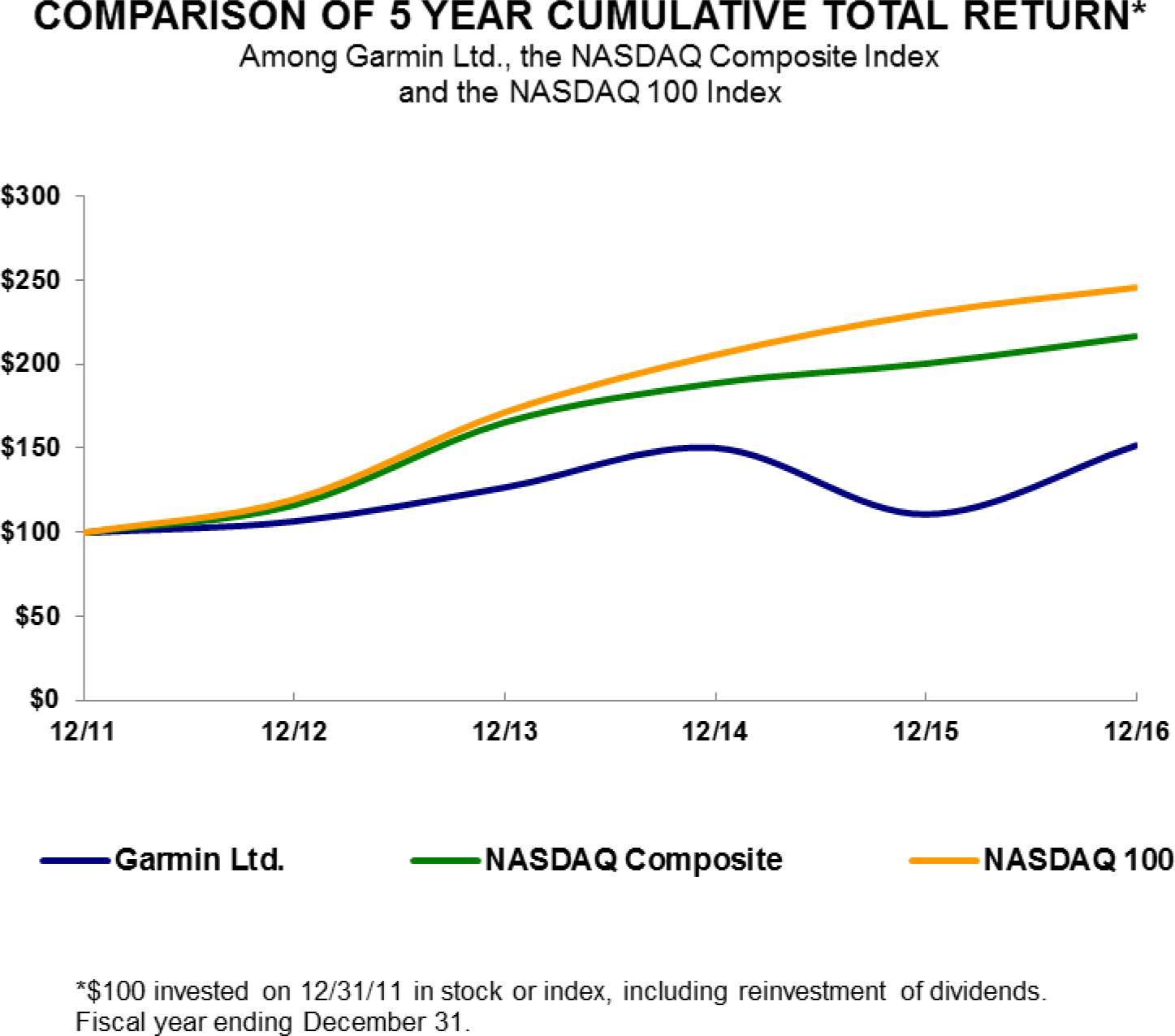
| 12/11 | 12/12 | 12/13 | 12/14 | 12/15 | 12/16 | |||||||||||||||||||
|---|---|---|---|---|---|---|---|---|---|---|---|---|---|---|---|---|---|---|---|---|---|---|---|---|
| Garmin Ltd. | 100.00 | 106.74 | 126.71 | 150.02 | 110.91 | 151.50 | ||||||||||||||||||
| NASDAQ Composite | 100.00 | 116.41 | 165.47 | 188.69 | 200.32 | 216.54 | ||||||||||||||||||
| NASDAQ 100 | 100.00 | 119.87 | 171.55 | 205.70 | 230.27 | 245.74 |
The stock price performance included in this graph is not necessarily indicative of future stock price performance.
Item 6. Selected Financial Data
The following table sets forth selected consolidated financial data of the Company. The selected consolidated balance sheet data as of December 31, 2016 and December 26, 2015 and the selected consolidated statement of income data for the years ended December 31, 2016, December 26, 2015, and December 27, 2014 were derived from the Company’s audited consolidated financial statements and the related notes thereto which are included in Item 8 of this annual report on Form 10-K. The selected consolidated balance sheet data as of December 27, 2014, December 28, 2013, and December 29, 2012 and the selected consolidated statement of income data for the years ended December 28, 2013 and December 29, 2012 were derived from the Company’s audited consolidated financial statements, not included herein.
The information set forth below is not necessarily indicative of the results of future operations and should be read together with "Management's Discussion and Analysis of Financial Condition and Results of Operations" and the consolidated financial statements and notes to those statements included in Items 7 and 8 in Part II of this Form 10-K.
| 40 |
|---|
| Years ended (1) | ||||||||||||||||||||
|---|---|---|---|---|---|---|---|---|---|---|---|---|---|---|---|---|---|---|---|---|
| Dec. 31, 2016 | Dec. 26, 2015 | Dec. 27, 2014 | Dec. 28, 2013 | Dec. 29, 2012 | ||||||||||||||||
| (in thousands, except per share data) | ||||||||||||||||||||
| Consolidated Statements of Income Data: | ||||||||||||||||||||
| Net sales | $ | 3,018,665 | $ | 2,820,270 | $ | 2,870,658 | $ | 2,631,851 | $ | 2,715,675 | ||||||||||
| Cost of goods sold | 1,339,095 | 1,281,566 | 1,266,246 | 1,224,551 | 1,277,195 | |||||||||||||||
| Gross profit | 1,679,570 | 1,538,704 | 1,604,412 | 1,407,300 | 1,438,480 | |||||||||||||||
| Operating expenses: | ||||||||||||||||||||
| Advertising expense | 177,143 | 167,166 | 146,633 | 112,905 | 138,757 | |||||||||||||||
| Selling, general and administrative | 410,558 | 394,914 | 372,032 | 355,440 | 369,790 | |||||||||||||||
| Research and development | 467,960 | 427,043 | 395,121 | 364,923 | 325,773 | |||||||||||||||
| Total operating expenses | 1,055,661 | 989,123 | 913,786 | 833,268 | 834,320 | |||||||||||||||
| Operating income | 623,909 | 549,581 | 690,626 | 574,032 | 604,160 | |||||||||||||||
| Other income, net (2)(3) | 5,761 | 17,606 | 33,119 | 79,526 | 20,368 | |||||||||||||||
| Income before income taxes | 629,670 | 567,187 | 723,745 | 653,558 | 624,528 | |||||||||||||||
| Income tax provision (4)(5) | 118,856 | 110,960 | 359,534 | 41,146 | 82,125 | |||||||||||||||
| Net income | $ | 510,814 | $ | 456,227 | $ | 364,211 | $ | 612,412 | $ | 542,403 | ||||||||||
| Net income per share: | ||||||||||||||||||||
| Basic | $ | 2.71 | $ | 2.39 | $ | 1.89 | $ | 3.13 | $ | 2.78 | ||||||||||
| Diluted | $ | 2.70 | $ | 2.39 | $ | 1.88 | $ | 3.12 | $ | 2.76 | ||||||||||
| Weighted average common shares outstanding: | ||||||||||||||||||||
| Basic | 188,818 | 190,631 | 193,106 | 195,411 | 194,909 | |||||||||||||||
| Diluted | 189,343 | 191,107 | 194,165 | 196,341 | 196,213 | |||||||||||||||
| Dividends declared per share | $ | 2.04 | $ | 2.04 | $ | 1.92 | $ | 1.80 | $ | 1.80 | ||||||||||
| Balance Sheet Data (at end of Period): | ||||||||||||||||||||
| Cash and cash equivalents | $ | 846,883 | $ | 833,070 | $ | 1,196,268 | $ | 1,179,149 | $ | 1,231,180 | ||||||||||
| Marketable securities | 1,480,237 | 1,558,548 | 1,575,333 | 1,651,968 | 1,641,395 | |||||||||||||||
| Total assets | 4,525,133 | 4,499,391 | 4,693,303 | 4,879,603 | 4,819,124 | |||||||||||||||
| Total debt | - | - | - | - | - | |||||||||||||||
| Total stockholders' equity | 3,418,003 | 3,345,126 | 3,403,367 | 3,659,706 | 3,531,796 |
| (1) | Our fiscal year-end is the last Saturday of the calendar year and does not always fall on December 31. All years presented contain 52 weeks excluding Fiscal 2016 which includes 53 weeks. |
|---|
| (2) | Other income, net mainly consists of gain (loss) on sale of marketable securities, interest income, and foreign currency gain (loss). |
|---|
| (3) | Includes $31.7 million, $23.5 million, $4.3 million, and $20.0 million of foreign currency losses in 2016, 2015, 2014, and 2012, respectively, and $35.5 million of foreign currency gain in 2013. |
|---|
| (4) | 2014 – includes $72.9 million income tax reserve release due to expiration of certain statutes of limitations or completion of tax audits partially offset by Swiss withholding tax expense due to the release of reserves; 2013 - includes $68.7 million income tax reserve release due to expiration of certain statutes of limitations or completion of tax audits partially offset by Taiwan surtax expense due to the release of reserves |
|---|
| (5) | Includes a $307.6 million income tax expense in 2014 associated with our inter-company restructuring discussed within Item 7 - Discussion and Analysis of Financial Condition and Results of Operation - Comparison of the 52-weeks ended December, 26 2015 and December 27, 2014 |
|---|
| 41 |
|---|
Item 7. Management’s Discussion and Analysis of Financial Condition and Results of Operations
The following discussion and analysis of our financial condition and results of operations focuses on and is intended to clarify the results of our operations, certain changes in our financial position, liquidity, capital structure and business developments for the periods covered by the consolidated financial statements included in this Form 10-K. This discussion should be read in conjunction with, and is qualified by reference to, the other related information including, but not limited to, the audited consolidated financial statements (including the notes thereto), the description of our business, all as set forth in this Form 10-K, as well as the risk factors discussed above in Item 1A.
As previously noted, the discussion set forth below, as well as other portions of this Form 10-K, contain statements concerning potential future events. Readers can identify these forward-looking statements by their use of such verbs as “expects,” “anticipates,” “believes” or similar verbs or conjugations of such verbs. If any of our assumptions on which the statements are based prove incorrect or should unanticipated circumstances arise, our actual results could materially differ from those anticipated by such forward-looking statements. The differences could be caused by a number of factors or combination of factors including, but not limited to, those discussed above in Item 1A. Readers are strongly encouraged to consider those factors when evaluating any such forward-looking statement. We do not undertake to update any forward-looking statements in this Form 10-K.
Garmin’s fiscal year is a 52-53 week period ending on the last Saturday of the calendar year. Fiscal year 2016 contains 53 weeks compared to 52 weeks for 2015 and 2014. Unless otherwise stated, all years and dates refer to the Company’s fiscal year and fiscal periods. Unless the context otherwise requires, references in this document to "we," "us," "our" and similar terms refer to Garmin Ltd. and its subsidiaries.
Unless otherwise indicated, dollar amounts set forth in the tables are in thousands, except per share data.
Overview
We are a leading worldwide provider of navigation, communications and information devices, most of which are enabled by Global Positioning System, or GPS, technology. We operate in five business segments, which serve the marine, outdoor, fitness, auto, and aviation markets. Our segments offer products through our network of subsidiary distributors and independent dealers and distributors. However, the nature of products and types of customers for the five segments can vary significantly. As such, the segments are managed separately.
Since our first products were delivered in 1991, we have generated positive income from operations each year and have funded our growth from these profits.
Critical Accounting Policies and Estimates
General
Garmin’s discussion and analysis of its financial condition and results of operations are based upon Garmin’s consolidated financial statements, which have been prepared in accordance with accounting principles generally accepted in the United States. The presentation of these financial statements requires Garmin to make estimates and judgments that affect the reported amounts of assets, liabilities, revenues and expenses, and related disclosure of contingent assets and liabilities. On an on-going basis, Garmin evaluates its estimates, including those related to customer sales programs and incentives, product returns, bad debts, inventories, investments, intangible assets, income taxes, warranty obligations, and contingencies and litigation. Garmin bases its estimates on historical experience and on various other assumptions that are believed to be reasonable under the circumstances, the results of which form the basis for making judgments about the carrying value of assets and liabilities that are not readily apparent from other sources. Actual results may differ from these estimates under different assumptions or conditions.
| 42 |
|---|
For information on each of the following critical accounting policies and/or estimates, refer to the discussion in the Notes to the Consolidated Financial Statements as indicated in the table below:
| Revenue Recognition | Note 2 - Summary of Significant Accounting Policies |
|---|---|
| Trade Accounts Receivable | Note 2 - Summary of Significant Accounting Policies |
| Loan Receivable | Note 2 - Summary of Significant Accounting Policies |
| Warranties | Note 2 - Summary of Significant Accounting Policies |
| Inventory | Note 2 - Summary of Significant Accounting Policies |
| Long-Lived Assets (including Goodwill) | Note 2 - Summary of Significant Accounting Policies |
| Investments | Note 2 - Summary of Significant Accounting Policies & Note 3 - Marketable Securities |
| Income Taxes | Note 2 - Summary of Significant Accounting Policies & Note 6 - Income Taxes |
| Stock Based Compensation | Note 2 - Summary of Significant Accounting Policies & Note 9 - Stock Compensation Plans |
Accounting Terms and Characteristics
Net Sales
Our net sales are primarily generated through sales to our retail partners, dealer and distributor network and to original equipment manufacturers. Refer to the Revenue Recognition discussion in Note 2 to the Consolidated Financial Statements. Our sales are largely of a consumer nature, and there is a relatively short cycle between order and shipment. Therefore, we believe that backlog levels are not necessarily indicative of our future sales results, and backlog information is not material to the understanding of our business. We typically ship most orders within 72 hours of receipt.
Net sales are subject to seasonal fluctuation. Sales of our consumer products are generally higher in the fourth quarter, due to increased demand during the holiday buying season, and, to a lesser extent, the second quarter, due to increased demand during the spring and summer season. Sales of consumer products are also influenced by the timing of the release of new products. Our aviation products do not experience much seasonal variation, but are more influenced by the timing of aircraft certifications and the release of new products when the initial demand is typically the strongest.
Cost of Sales/Gross Profit
Raw material costs are our most significant component of cost of goods sold. Our existing practice of performing the design and manufacture of our products in-house has enabled us to source components from different suppliers and, where possible, to redesign our products to leverage lower cost components. We believe that our flexible production model allows our Xizhi, Jhongli, and LinKou manufacturing plants in Taiwan; Yangzhou manufacturing plant in China; and our Olathe, Kansas, and Salem, Oregon manufacturing plants in the U.S. to experience relatively low costs of manufacturing. In general, products manufactured in Taiwan have been our highest volume products. Our manufacturing labor costs historically have been lower in Taiwan and China than in Olathe and Salem.
Sales price variability has had and can be expected to have an effect on our gross profit. In the past, prices of our devices sold into the auto market have declined due to market pressures and introduction of new products sold at lower price points. In recent years, pricing has stabilized in auto, allowing for relatively stable gross margins excluding the impact of deferred revenues and costs. The average selling prices of our aviation, outdoor, fitness, and marine products have historically been stable due to product mix and the introduction of more advanced products sold at higher prices. The effect of the sales price differences inherent within the mix of products sold could have a significant impact on our gross profit.
| 43 |
|---|
Advertising Expense
Our advertising expenses consist of costs for media advertising, cooperative
Showing the first 8K of 63K characters. Open the full section
Item 7A. Quantitative and Qualitative Disclosures About Market Risk
Market Sensitivity
We have market risk primarily in connection with the pricing of our products and services and the purchase of raw materials. Product pricing and raw materials costs are both significantly influenced by semiconductor market conditions. Historically, during cyclical industry downturns, we have been able to offset pricing declines for our products through a combination of improved product mix and success in obtaining price reductions in raw materials costs.
Inflation
We do not believe that inflation has had a material effect on our business, financial condition or results of operations. If our costs were to become subject to significant inflationary pressures, we may not be able to fully offset such higher costs through price increases. Our inability or failure to do so could adversely affect our business, financial condition and results of operations.
Foreign Currency Exchange Rate Risk
The operation of Garmin’s subsidiaries in international markets results in exposure to movements in currency exchange rates. We have experienced significant foreign currency gains and losses due to the strengthening and weakening of the U.S. dollar. The potential of volatile foreign exchange rate fluctuations in the future could have a significant effect on our results of operations. The Company has not historically hedged its foreign currency exchange rate risks.
| 57 |
|---|
The currencies that create a majority of the Company’s exchange rate exposure are the Taiwan Dollar, Euro, and British Pound Sterling. Garmin Corporation, headquartered in Xizhi, Taiwan, uses the local currency as the functional currency. The Company translates all assets and liabilities at year-end exchange rates and income and expense accounts at average rates during the year. In order to minimize the effect of the currency exchange fluctuations on our net assets, we have elected to retain most of our Taiwan subsidiary’s cash and investments in marketable securities denominated in U.S. dollars.
Most European subsidiaries use the Euro as the functional currency. The functional currency of our largest European subsidiary, Garmin (Europe) Ltd. remains the U.S. Dollar, and as some transactions occurred in British Pounds Sterling or Euros, foreign currency gains or losses have been realized historically related to the movements of those currencies relative to the U.S. Dollar. The Company believes that gains and losses will become more material in the future as our European presence grows.
During fiscal year 2016, the U.S. Dollar weakened 1.7% against the Taiwan Dollar resulting in a $9.2 million foreign currency loss. The U.S. Dollar strengthened 4.2% against the Euro resulting in a foreign currency loss of $13.0 million. The U.S. Dollar strengthened 16.8% against the British Pound Sterling resulting in a loss of $5.1 million. The net result of these currency moves combined with other net losses of $4.4 million, and the timing of transactions during the year was a net loss of $31.7 million for the Company and a currency translation adjustment of $4.7 million during the fiscal year 2016.
We assessed the Company’s exposure to movements in currency exchange rates by performing a sensitivity analysis of adverse changes in exchange rates and the corresponding impact to our results of operations. Based on monetary assets and liabilities denominated in currencies other than respective functional currencies as of December 31, 2016 and December 26, 2015, hypothetical and reasonably possible adverse changes of 10% for the Taiwan Dollar, Euro, and British Pound Sterling would have resulted in an adverse impact on income before income taxes of approximately $92 million and $95 million at December 31, 2016 and December 26, 2015.
Interest Rate Risk
We have no outstanding long-term debt as of December 31, 2016. We, therefore, have no meaningful debt-related interest rate risk.
We are exposed to interest rate risk in connection with our investments in marketable securities. As interest rates change, the unrealized gains and losses associated with those securities will fluctuate accordingly.
The Company’s investment policy targets low risk investments with the objective of minimizing the potential risk of principal loss. The Company does not intend to sell securities in an unrealized loss position and it is not more likely than not that the Company will be required to sell such investments before recovery of their amortized costs bases, which may be maturity. During 2016 and 2015, the Company did not record any material impairment charges on its outstanding securities.
We assessed the Company’s exposure to interest rate risk by performing a sensitivity analysis of a parallel shift in the yield curve and the corresponding impact to the Company’s portfolio of marketable securities. Based on balance sheet positions as of December 31, 2016 and December 26, 2015, the hypothetical and reasonably possible 100 basis point increases in interest rates across all securities would have resulted in declines in portfolio fair market value of approximately $45 million and $43 million at December 31, 2016 and December 26, 2015. Such losses would only be realized if the Company sold the investments prior to maturity.
| 58 |
|---|
Item 8. Financial Statements and Supplementary Data
CONSOLIDATED FINANCIAL STATEMENTS
Garmin Ltd. and Subsidiaries
Years Ended December 31, 2016, December 26, 2015, December 27, 2014
Contents
| 59 |
|---|
Report of Independent Registered Public Accounting Firm
The Board of Directors and Shareholders of Garmin Ltd. and Subsidiaries
We have audited the accompanying consolidated balance sheets of Garmin Ltd. and Subsidiaries as of December 31, 2016 and December 26, 2015, and the related consolidated statements of income, comprehensive income, stockholders' equity and cash flows for each of the three years in the period ended December 31, 2016. These financial statements are the responsibility of the Company's management. Our responsibility is to express an opinion on these financial statements based on our audits.
We conducted our audits in accordance with the standards of the Public Company Accounting Oversight Board (United States). Those standards require that we plan and perform the audit to obtain reasonable assurance about whether the financial statements are free of material misstatement. An audit includes examining, on a test basis, evidence supporting the amounts and disclosures in the financial statements. An audit also includes assessing the accounting principles used and significant estimates made by management, as well as evaluating the overall financial statement presentation. We believe that our audits provide a reasonable basis for our opinion.
In our opinion, the financial statements referred to above present fairly, in all material respects, the consolidated financial position of Garmin Ltd. and Subsidiaries at December 31, 2016 and December 26, 2015, and the consolidated results of their operations and their cash flows for each of the three years in the period ended December 31, 2016, in conformity with U.S. generally accepted accounting principles.
We also have audited, in accordance with the standards of the Public Company Accounting Oversight Board (United States), Garmin Ltd. and Subsidiaries' internal control over financial reporting as of December 31, 2016, based on criteria established in Internal Control-Integrated Framework issued by the Committee of Sponsoring Organizations of the Treadway Commission (2013 framework) and our report dated February 22, 2017 expressed an unqualified opinion thereon.
/s/ Ernst & Young LLP
Kansas City, Missouri
February 22, 2017
| 60 |
|---|
Garmin Ltd. And Subsidiaries
Consolidated Balance Sheets
(In Thousands, Except Per Share Information)
| December 31, | December 26, | |||||||
|---|---|---|---|---|---|---|---|---|
| 2016 | 2015 | |||||||
| Assets | ||||||||
| Current assets: | ||||||||
| Cash and cash equivalents | $ | 846,883 | $ | 833,070 | ||||
| Marketable securities (Note 3) | 266,952 | 215,161 | ||||||
| Accounts receivable, less allowance for doubtful accounts of $14,669 in 2016 and $13,805 in 2015 | 527,062 | 531,481 | ||||||
| Inventories, net | 484,821 | 500,554 | ||||||
| Deferred costs | 47,395 | 49,176 | ||||||
| Prepaid expenses and other current assets | 89,903 | 81,645 | ||||||
| Total current assets | 2,263,016 | 2,211,087 | ||||||
| Property and equipment, net | ||||||||
| Land and improvements | 104,740 | 85,162 | ||||||
| Building and improvements | 376,916 | 351,778 | ||||||
| Office furniture and equipment | 222,439 | 206,025 | ||||||
| Manufacturing equipment | 129,526 | 131,055 | ||||||
| Engineering equipment | 124,979 | 113,690 | ||||||
| Vehicles | 21,259 | 20,939 | ||||||
| 979,859 | 908,649 | |||||||
| Accumulated depreciation | (496,981 | ) | (462,560 | ) | ||||
| 482,878 | 446,089 | |||||||
| Restricted cash (Note 4) | 113 | 259 | ||||||
| Marketable securities (Note 3) | 1,213,285 | 1,343,387 | ||||||
| Noncurrent deferred income tax (Note 6) | 110,293 | 116,518 | ||||||
| Noncurrent deferred costs | 56,151 | 38,769 | ||||||
| Intangible assets, net | 305,002 | 245,552 | ||||||
| Other assets | 94,395 | 97,730 | ||||||
| Total assets | $ | 4,525,133 | $ | 4,499,391 | ||||
| Liabilities and Stockholders' Equity | ||||||||
| Current liabilities: | ||||||||
| Accounts payable | $ | 172,404 | $ | 178,905 | ||||
| Salaries and benefits payable | 88,818 | 70,601 | ||||||
| Accrued warranty costs | 37,233 | 30,449 | ||||||
| Accrued sales program costs | 80,953 | 67,613 | ||||||
| Deferred revenue | 146,564 | 164,982 | ||||||
| Accrued royalty costs | 36,523 | 30,310 | ||||||
| Accrued advertising expense | 37,440 | 33,547 | ||||||
| Other accrued expenses | 70,469 | 74,926 | ||||||
| Income taxes payable | 16,163 | 21,674 | ||||||
| Dividend payable | 96,168 | 192,991 | ||||||
| Total current liabilities | 782,735 | 865,998 | ||||||
| Deferred income taxes (Note 6) | 61,220 | 56,210 | ||||||
| Non-current income taxes | 121,174 | 101,689 | ||||||
| Non-current deferred revenue | 140,407 | 128,731 | ||||||
| Other liabilities | 1,594 | 1,637 | ||||||
| Stockholders' equity: | ||||||||
| Shares, CHF 0.10 par value, 198,077 shares authorized and issued, and 188,565 shares outstanding at December 31, 2016; | ||||||||
| Shares, CHF 10.00 par value, 208,077 shares authorized and issued; 189,722 shares outstanding at December 26, 2015; (Notes 9, 10, and 11): | 17,979 | 1,797,435 | ||||||
| Additional paid-in capital | 1,836,047 | 62,239 | ||||||
| Treasury stock | (455,964 | ) | (414,637 | ) | ||||
| Retained earnings | 2,056,702 | 1,930,517 | ||||||
| Accumulated other comprehensive income (loss) | (36,761 | ) | (30,428 | ) | ||||
| Total stockholders' equity | 3,418,003 | 3,345,126 | ||||||
| Total liabilities and stockholders' equity | $ | 4,525,133 | $ | 4,499,391 |
See accompanying notes.
| 61 |
|---|
Garmin Ltd. And Subsidiaries
Consolidated Statements of Income
(In Thousands, Except Per Share Information)
| Fiscal Year Ended | ||||||||||||
|---|---|---|---|---|---|---|---|---|---|---|---|---|
| December 31, | December 26, | December 27, | ||||||||||
| 2016 | 2015 | 2014 | ||||||||||
| Net sales | $ | 3,018,665 | $ | 2,820,270 | $ | 2,870,658 | ||||||
| Cost of goods sold | 1,339,095 | 1,281,566 | 1,266,246 | |||||||||
| Gross profit | 1,679,570 | 1 |
Showing the first 8K of 120K characters. Open the full section
Item 9. Changes in and Disagreements with Accountants on Accounting and Financial Disclosure
None.
Item 9A. Controls and Procedures
(a) Conclusion Regarding the Effectiveness of Disclosure Controls and Procedures
Under the supervision and with the participation of our management, including the Chief Executive Officer and Chief Financial Officer, we have evaluated the effectiveness of the design and operation of our disclosure controls and procedures pursuant to Exchange Act Rule 13a-15(b) as of the end of the period covered by this report. Based on the evaluation, the Chief Executive Officer and Chief Financial Officer have concluded that these disclosure controls and procedures are effective.
(b) Management’s Report on Internal Control over Financial Reporting
Management of the Company is responsible for establishing and maintaining adequate internal control over financial reporting for the Company. The Company’s internal control over financial reporting is a process designed to provide reasonable assurance regarding the reliability of financial reporting and the preparation of financial statements for external purposes in accordance with generally accepted accounting principles.
Because of its inherent limitations, internal control over financial reporting may not prevent or detect misstatements. Also, projections of any evaluation of effectiveness to future periods are subject to the risk that controls may become inadequate because of changes in conditions, or that the degree of compliance with the policies or procedures may deteriorate.
Management’s assessment of and conclusion on the effectiveness of internal control over financial reporting are included as Exhibits 31.1, 31.2, 32.1 and 32.2.
Management of the Company assessed the effectiveness of the Company’s internal control over financial reporting as of December 31, 2016. In making this assessment, management used the criteria set forth by the Committee of Sponsoring Organizations of the Treadway Commission (COSO) in “Internal Control-Integrated Framework” (2013 framework).
Based on such assessment and those criteria, management believes that the Company maintained effective internal control over financial reporting as of December 31, 2016.
Ernst & Young LLP, the independent registered public accounting firm that audited the Company’s consolidated financial statements, issued an attestation report on management’s effectiveness of the Company’s internal control over financial reporting as of December 31, 2016, as stated in their report which is included herein. That attestation report appears below.
| 93 |
|---|
(c) Attestation Report of the Independent Registered Public Accounting Firm
Report of Independent Registered Public Accounting Firm
The Board of Directors and Shareholders of Garmin Ltd. and Subsidiaries
We have audited Garmin Ltd. and Subsidiaries’ internal control over financial reporting as of December 31, 2016, based on criteria established in Internal Control—Integrated Framework issued by the Committee of Sponsoring Organizations of the Treadway Commission (2013 framework) (the COSO criteria). Garmin Ltd. and Subsidiaries’ management is responsible for maintaining effective internal control over financial reporting, and for its assessment of the effectiveness of internal control over financial reporting included in the accompanying Management’s Report on Internal Control over Financial Reporting. Our responsibility is to express an opinion on the company’s internal control over financial reporting based on our audit.
We conducted our audit in accordance with the standards of the Public Company Accounting Oversight Board (United States). Those standards require that we plan and perform the audit to obtain reasonable assurance about whether effective internal control over financial reporting was maintained in all material respects. Our audit included obtaining an understanding of internal control over financial reporting, assessing the risk that a material weakness exists, testing and evaluating the design and operating effectiveness of internal control based on the assessed risk, and performing such other procedures as we considered necessary in the circumstances. We believe that our audit provides a reasonable basis for our opinion.
A company’s internal control over financial reporting is a process designed to provide reasonable assurance regarding the reliability of financial reporting and the preparation of financial statements for external purposes in accordance with generally accepted accounting principles. A company’s internal control over financial reporting includes those policies and procedures that (1) pertain to the maintenance of records that, in reasonable detail, accurately and fairly reflect the transactions and dispositions of the assets of the company; (2) provide reasonable assurance that transactions are recorded as necessary to permit preparation of financial statements in accordance with generally accepted accounting principles, and that receipts and expenditures of the company are being made only in accordance with authorizations of management and directors of the company; and (3) provide reasonable assurance regarding prevention or timely detection of unauthorized acquisition, use, or disposition of the company’s assets that could have a material effect on the financial statements.
Because of its inherent limitations, internal control over financial reporting may not prevent or detect misstatements. Also, projections of any evaluation of effectiveness to future periods are subject to the risk that controls may become inadequate because of changes in conditions, or that the degree of compliance with the policies or procedures may deteriorate.
In our opinion, Garmin Ltd. and Subsidiaries maintained, in all material respects, effective internal control over financial reporting as of December 31, 2016, based on the COSO criteria.
We also have audited, in accordance with the standards of the Public Company Accounting Oversight Board (United States), the consolidated balance sheets of Garmin Ltd. and Subsidiaries as of December 31, 2016 and December 26, 2015, and the related consolidated statements of income, comprehensive income, stockholders’ equity and cash flows for each of the three years in the period ended December 31, 2016 of Garmin Ltd. and Subsidiaries and our report dated February 22, 2017 expressed an unqualified opinion thereon.
/s/ Ernst & Young LLP
Kansas City, Missouri
February 22, 2017
| 94 |
|---|
(d) Changes in Internal Control over Financial Reporting
There were no changes in our internal control over financial reporting during the quarter ended December 31, 2016 that have materially affected, or are reasonably likely to materially affect, our internal control over financial reporting.
Item 9B. Other Information
Not applicable.
| 95 |
|---|
PART III
Item 10. Directors, Executive Officers and Corporate Governance
Garmin has incorporated by reference certain information in response or partial response to the Items under this Part III of this Annual Report on Form 10-K pursuant to General Instruction G(3) of this Form 10-K and Rule 12b-23 under the Exchange Act. Garmin’s definitive proxy statement in connection with its annual meeting of shareholders scheduled for June 9, 2017 (the “Proxy Statement”) will be filed with the Securities and Exchange Commission no later than 120 days after December 31, 2016.
(a) Directors of the Company
The information set forth in response to Item 401 of Regulation S-K under the headings “Proposal 5 – Re-election of Directors” in the Proxy Statement is hereby incorporated herein by reference in partial response to this Item 10.
| (b) | Executive Officers of the Company |
|---|
The information set forth in response to Item 401 of Regulation S-K under the heading “Executive Officers of the Registrant” in Part I of this Form 10-K is incorporated herein by reference in partial response to this Item 10.
| (c) | Compliance with Section 16(a) of the Exchange Act |
|---|
The information set forth in response to Item 405 of Regulation S-K under the heading “Section 16(a) Beneficial Ownership Reporting Compliance” in the Proxy Statement is hereby incorporated herein by reference in partial response to this Item 10.
| (d) | Audit Committee and Audit Committee Financial Expert |
|---|
The information set forth in response to Item 402 of Regulation S-K under the heading “Board Meetings and Standing Committee Meetings— Audit Committee” in the Proxy Statement is hereby incorporated herein by reference in partial response to this Item 10.
The Audit Committee consists of Joseph J. Hartnett, Charles W. Peffer and Rebecca R. Tilden. Mr. Peffer serves as the Chairman of the Audit Committee. All members of the Audit Committee are “independent” within the meaning of the rules of the SEC and the NASDAQ Marketplace Rules. Garmin’s Board of Directors has determined that Mr. Hartnett and Mr. Peffer are “audit committee financial experts” as defined by the SEC regulations implementing Section 407 of the Sarbanes-Oxley Act of 2002.
| (e) | Code of Ethics |
|---|
Garmin’s Board of Directors has adopted the Code of Conduct of Garmin Ltd. and Subsidiaries (the “Code”). The Code is applicable to all Garmin employees including the President and Chief Executive Officer, the Chief Financial Officer, the Controller and other officers. A copy of the Code is available on Garmin’s website at: http://www8.garmin.com/aboutGarmin/invRelations/documents/Code_of_Conduct.pdf. If any amendments to the Code are made, or any waivers with respect to the Code are granted to the President and Chief Executive Officer, the Chief Financial Officer or Controller, or any person performing a similar function, such amendment or waiver will be disclosed on Garmin’s website at: http://www8.garmin.com/aboutGarmin/invRelations/documents/Code_of_Conduct.pdf.
| 96 |
|---|
Item 11. Executive Compensation
The information set forth in response to Item 402 of Regulation S-K under the headings “Executive Compensation Matters” and “Proposal 5-Re-election of Directors- Non-Management Director Compensation” in the Proxy Statement is hereby incorporated herein by reference in partial response to this Item 11.
The information set forth in response to Item 407(e)(4) of Regulation S-K under the heading “Proposal 5-Re-election of Directors — Compensation Committee Interlocks and Insider Participation; Certain Relationships” in the Proxy Statement is hereby incorporated herein by reference in partial response to this Item 11.
The information set forth in response to Item 407(e)(5) of Regulation S-K under the heading “Executive Compensation Matters –Compensation Committee Report” in the Proxy Statement is hereby incorporated herein by reference in partial response to this Item 11.
Item 12. Security Ownership of Certain Beneficial Owners and Management and Related Stockholder Matters
The information set forth in response to Item 403 of Regulation S-K under the heading “Stock Ownership of Certain Beneficial Owners and Management” in the Proxy Statement is hereby incorporated herein by reference in partial response to this Item 12.
Equity Compensation Plan Information
The following table gives information as of December 31, 2016 about the Garmin common shares that may be issued under all of the Company’s existing equity compensation plans, as adjusted for stock splits.
| A | B | C | ||||||||||
|---|---|---|---|---|---|---|---|---|---|---|---|---|
| Number of securities | ||||||||||||
| remaining available for | ||||||||||||
| future issuance under | ||||||||||||
| Number of securities to be | Weighted-average | equity compensation | ||||||||||
| issued upon exercise of | exercise price of | plans (excluding | ||||||||||
| outstanding options, | outstanding options, | securities reflected in | ||||||||||
| Plan Category | warrants and rights | warrants and rights | column A) | |||||||||
| Equity compensation plans approved by shareholders | 4,560,911 | $ | 74.48 | 6,254,383 | ||||||||
| Equity compensation plans not approved by shareholders | — | — | — | |||||||||
| Total | 4,560,911 | $ | 74.48 | 6,254,383 |
| 97 |
|---|
Table consists of the Garmin Ltd. 2005 Equity Incentive Plan (as Amended and Restated Effective June 5, 2010), the Garmin Ltd. 2000 Equity Incentive Plan, the Garmin Ltd. Amended and Restated 2000 Non-Employee Directors’ Option Plan, effective June 5, 2010, the Garmin Ltd. Amended and Restated Employee Stock Purchase Plan, effective January 1, 2010 and the Garmin Ltd. 2011 Non-Employee Directors Equity Incentive Plan, effective June 3, 2011. The weighted-average exercise price does not reflect the shares that will be issued upon the payment of outstanding awards of RSUs.
The Company has no knowledge of any arrangement, the operation of which may at a subsequent date result in a change in control of the Company.
Item 13. Certain Relationships and Related Transactions, and Director Independence
The information set forth in response to Item 404 of Regulation S-K under the heading “Proposal 5-Re-election of Directors — Compensation Committee Interlocks and Insider Participation; Certain Relationships” in the Proxy Statement is incorporated herein by reference in partial response to this Item 13.
The information set forth in response to Item 407(a) of Regulation S-K under the headings “Proposal 5 – Re-election of Directors” in the Proxy Statement is hereby incorporated herein by reference in partial response to this Item 13.
Item 14. Principal Accounting Fees and Services
The information set forth under the headings “Audit Matters — Independent Registered Public Accounting Firm Fees” and “Pre-Approval of Services Provided by the Independent Auditor” in the Proxy Statement is hereby incorporated by reference in response to this Item 14.
| 98 |
|---|
PART IV
Item 15. Exhibits, and Financial Statement Schedules
| (a) | List of Documents filed as part of this Report |
|---|
| (1) | Consolidated Financial Statements |
|---|
The consolidated financial statements and related notes, together with the reports of Ernst & Young LLP, appear in Part II, Item 8 “Financial Statements and Supplementary Data” of this Form 10-K.
| (2) | Schedule II Valuation and Qualifying Accounts |
|---|
| All other schedules have been omitted because they are not applicable, are insignificant or the required information is shown in the consolidated financial statements or notes thereto. |
|---|
| (3) | Exhibits — The following exhibits are filed as part of, or incorporated by reference into, this Annual Report on Form 10-K: |
|---|
| EXHIBIT | ||
|---|---|---|
| NUMBER | DESCRIPTION | |
| 3.1 | Articles of Association of Garmin Ltd., as amended and restated on June 10, 2016 (incorporated by reference to Exhibit 3.1 of the Registrant’s Quarterly Report on Form 10-Q filed on October 26, 2016). | |
| 3.2 | Organizational Regulations of Garmin Ltd., as amended on February 14, 2014 (incorporated by reference to Exhibit 3.2 of the Registrant’s Annual Report on Form 10-K filed on February 19, 2014). | |
| 10.1 | Garmin Ltd. 2000 Equity Incentive Plan (incorporated by reference to Exhibit 10.1 of the Registrant’s Registration Statement on Form S-1 filed December 6, 2000 (Commission File No. 333-45514)). | |
| 10.2 | Form of Stock Option Agreement pursuant to the Garmin Ltd. 2000 Equity Incentive Plan for Employees of Garmin International, Inc. (incorporated by reference to Exhibit 10.1 of the Registrant’s Current Report on Form 8-K filed on September 7, 2004). | |
| 10.3 | Form of Stock Option Agreement pursuant to the Garmin Ltd. 2000 Equity Incentive Plan for Employees of Garmin Corporation (incorporated by reference to Exhibit 10.3 of the Registrant’s Current Report on Form 8-K filed on September 7, 2004). | |
| 10.4 | Form of Stock Option Agreement pursuant to the Garmin Ltd. 2000 Equity Incentive Plan for UK-Approved Stock Options for Employees of Garmin (Europe) Ltd. (incorporated by reference to Exhibit 10.4 of the Registrant’s Current Report on Form 8-K filed on September 7, 2004). | |
| 10.5 | Form of Stock Option Agreement pursuant to the Garmin Ltd. 2000 Equity Incentive Plan for Non UK-Approved Stock Options for Employees of Garmin (Europe) Ltd. (incorporated by reference to Exhibit 10.5 of the Registrant’s Current Report on Form 8-K filed on September 7, 2004). |
| 99 |
|---|
| 10.6 | Garmin Ltd. 2000 Non-Employee Directors’ Option Plan (incorporated by reference to Exhibit 10.2 of the Registrant’s Registration Statement on Form S-1 filed December 6, 2000 (Commission File No. 333-45514)). | |
|---|---|---|
| 10.7 | Form of Stock Option Agreement pursuant to the Garmin Ltd. Non-Employee Directors’ Option Plan for Non-Employee Directors of Garmin Ltd. (incorporated by reference to Exhibit 10.2 of the Registrant’s Current Report on Form 8-K filed on September 7, 2004). | |
| 10.8 | Garmin Ltd. Amended and Restated Employee Stock Purchase Plan (incorporated by reference to Exhibit 10.1 of the Registrant’s Quarterly Report on Form 10-Q filed August 9, 2006). | |
| 10.9 | First Amendment to Garmin Ltd. Employee Stock Purchase Plan (incorporated by reference to Exhibit 10.4 of the Registrant’s Annual Report on Form 10-K filed on March 27, 2002). | |
| 10.10 | Second Amendment to Garmin Ltd. Employee Stock Purchase Plan (incorporated by reference to Exhibit 10.1 of the Registrant’s Quarterly Report on Form 10-Q filed on August 13, 2003). | |
| 10.11 | Garmin Ltd. 2005 Equity Incentive Plan (incorporated by reference to Exhibit 10.1 of the Registrant’s Current Report on Form 8-K filed on June 7, 2005). | |
| 10.12 | Form of Stock Option Agreement pursuant to the Garmin Ltd. 2005 Equity Incentive Plan (incorporated by reference to Exhibit 10.2 of the Registrant’s Current Report on Form 8-K filed on June 7, 2005). | |
| 10.13 | Form of Stock Appreciation Rights Agreement pursuant to the Garmin Ltd. 2005 Equity Incentive Plan (incorporated by reference to Exhibit 10.1 of the Registrant’s Quarterly Report on Form 10-Q filed on May 8, 2007). | |
| 10.14 | Form of Stock Appreciation Rights Agreement pursuant to the Garmin Ltd.2000 Equity Incentive Plan (incorporated by reference to Exhibit 10.4 of the Registrant’s Current Report on Form 8-K filed on June 7, 2005). | |
| 10.15 | Amended and Restated Garmin Ltd. Employee Stock Purchase Plan effective January 1, 2008 (incorporated by reference to Exhibit 10.15 of the Registrant’s Annual Report on Form 10-K filed on February 26, 2008). | |
| 10.16 | Form of Time Vested Restricted Stock Unit Award Agreement under the Garmin Ltd. 2005 Equity Incentive Plan (incorporated by reference to Exhibit 10.1 of the Registrant’s Current Report on Form 8-K filed on December 17, 2008). | |
| 10.17 | Form of Performance Shares Award Agreement under the Garmin Ltd. 2005 Equity Incentive Plan (incorporated by reference to Exhibit 10.2 of the Registrant’s Current Report on Form 8-K filed on December 17, 2008). | |
| 10.18 | Garmin Ltd. 2009 Cash Incentive Bonus Plan (incorporated by reference to Exhibit 10.18 of the Registrant’s Annual Report on Form 10-K filed on February 25, 2009 | |
| 10.19 | Amended and Restated Garmin Ltd. Employee Stock Purchase Plan, effective January 1, 2010 (incorporated by reference to Exhibit 10.22 of the Registrant’s Annual Report on Form 10-K filed on February 24, 2010). |
| 100 |
|---|
| 10.20 | Form of Time Vested Restricted Stock Unit Award Agreement under the Garmin Ltd. 2005 Equity Incentive Plan, as revised by the Registrant’s Board of Directors on December 11, 2009 (incorporated by reference to Exhibit 10.23 of the Registrant’s Annual Report on Form 10-K filed on February 24, 2010). | |
|---|---|---|
| 10.21 | Form of Performance Shares Award Agreement under the Garmin Ltd. 2005 Equity Incentive Plan, as revised by the Registrant’s Board of Directors on December 11, 2009 (incorporated by reference to Exhibit 10.24 of the Registrant’s Annual Report on Form 10-K filed on February 24, 2010). | |
| 10.22 | Garmin Ltd. 2005 Equity Incentive Plan (as Amended and Restated Effective June 5, 2009) (incorporated by reference to Schedule 1 of the Registrant’s Proxy Statement on Schedule 14A filed on April 21, 2009). | |
| 10.23 | Garmin Ltd. Amended and Restated 2000 Non-Employee Directors’ Option Plan, Effective June 5, 2010 (incorporated by reference to Schedule 2 of the Registrant’s Proxy Statement on Schedule 14A filed on April 21, 2010). | |
| 10.24 | Garmin Ltd. Amended and Restated 2000 Equity Incentive Plan (incorporated by reference to Exhibit 10.2 of the Registrant’s Current Report on Form 8-K filed on June 28, 2010). | |
| 10.25 | Garmin Ltd. Amended and Restated 2000 Non-Employee Directors’ Option Plan (incorporated by reference to Exhibit 10.3 of the Registrant’s Current Report on Form 8-K filed on June 28, 2010). | |
| 10.26 | Garmin Ltd. Amended and Restated Employee Stock Purchase Plan (incorporated by reference to Exhibit 10.4 of the Registrant’s Current Report on Form 8-K filed on June 28, 2010). | |
| 10.27 | Garmin Ltd. Amended and Restated 2005 Equity Incentive Plan (incorporated by reference to Exhibit 10.5 of the Registrant’s Current Report on Form 8-K filed on June 28, 2010). | |
| 10.28 | Form of Stock Option Agreement pursuant to the Garmin Ltd. Amended and Restated 2000 Non-Employee Directors’ Option Plan (incorporated by reference to Exhibit 10.6 of the Registrant’s Current Report on Form 8-K filed on June 28, 2010). | |
| 10.29 | Form of Performance Shares Award Agreement pursuant to the Garmin Ltd. 2005 Equity Incentive Plan (incorporated by reference to Exhibit 10.7 of the Registrant’s Current Report on Form 8-K filed on June 28, 2010). | |
| 10.30 | Form of Restricted Stock Unit Award Agreement pursuant to the Garmin Ltd. 2005 Equity Incentive Plan, for Swiss residents (incorporated by reference to Exhibit 10.8 of the Registrant’s Current Report on Form 8-K filed on June 28, 2010). | |
| 10.31 | Form of Restricted Stock Unit Award Agreement pursuant to the Garmin Ltd. 2005 Equity Incentive Plan, for non-Swiss residents (incorporated by reference to Exhibit 10.9 of the Registrant’s Current Report on Form 8-K filed on June 28, 2010). |
| 101 |
|---|
| 10.32 | Transaction Agreement between Garmin Ltd., a Cayman Islands company, and the Registrant, dated as of May 21, 2010 (incorporated by reference to Exhibit 10.1 of the Registrant’s Current Report on Form 8-K filed on June 28, 2010). | |
|---|---|---|
| 10.33 | Form of Non-Qualified Stock Option Agreement pursuant to the Garmin Ltd. 2005 Equity Incentive Plan, as amended and restated on June 27, 2010 (incorporated by reference to Exhibit 10.1 of the Registrant’s Current Report on Form 8-K filed on December 29, 2011). | |
| 10.34 | Garmin Ltd. 2011 Non-Employee Directors’ Equity Incentive Plan (incorporated by reference to Schedule 1 of the Registrant’s Definitive Proxy Statement on Form 14A filed on April 21, 2011). | |
| 10.35 | Form of Restricted Stock Unit Award Agreement pursuant to the Garmin Ltd. 2011 Non-Employee Directors’ Equity Incentive Plan (incorporated by reference to Exhibit 10.2 of the Registrant’s Current Report on Form 8-K filed on June 6, 2011). | |
| 10.36 | Form of Restricted Stock Unit Award Agreement pursuant to the Garmin Ltd. 2005 Equity Incentive Plan, for Swiss grantees (incorporated by reference to Exhibit 10.1 of the Registrant’s Current Report on Form 8-K filed on December 10, 2012). | |
| 10.37 | Form of Restricted Stock Unit Award Agreement pursuant to the Garmin Ltd. 2005 Equity Incentive Plan, for Canadian grantees (incorporated by reference to Exhibit 10.2 of the Registrant’s Current Report on Form 8-K filed on December 10, 2012). | |
| 10.38 | Form of Restricted Stock Unit Award Agreement pursuant to the Garmin Ltd. 2005 Equity Incentive Plan, for non-Swiss and non-Canadian grantees (incorporated by reference to Exhibit 10.3 of the Registrant’s Current Report on Form 8-K filed on December 10, 2012). | |
| 10.39 | Memorandum of Agreement dated March 14, 2013 between Garmin International, Inc. and Bombardier, Inc. (incorporated by reference to Exhibit 10.1 of the Registrant’s Quarterly Report on Form 10-Q filed on May 8, 2013). | |
| 10.40 | Amendment dated December 6, 2013 to Memorandum of Agreement between Garmin International, Inc. and Bombardier, Inc. (incorporated by reference to Exhibit 10.40 of the Registrant’s Annual Report on Form 10-K filed on February 19, 2014). | |
| 10.41 | Garmin Ltd. 2005 Equity Incentive Plan (as Amended and Restated Effective June 7, 2013) (incorporated by reference to Schedule 1 of the Registrant's Proxy Statement on Schedule 14A filed on April 22, 2013). | |
| 10.42 | Director and Officer Indemnification Agreement dated August 4, 2014 between Garmin Ltd. and each of Douglas G. Boessen, Dr. Donald H. Eller, Andrew R. Etkind, Joseph J. Hartnett, Charles W. Peffer, Dr. Min H. Kao, Clifton A. Pemble and Thomas P. Poberezny (incorporated by reference to Exhibit 10.1 of the Registrant’s Current Report on Form 8-K filed on August 8, 2014). | |
| 10.43 | Form of Restricted Stock Unit Award Agreement pursuant to the Garmin Ltd. 2005 Equity Incentive Plan, for awards of performance-based and time-based vesting restricted stock unit awards to grantees who are executive officers (incorporated by reference to Exhibit 10.1 of the Registrant’s Current Report on Form 8-K filed on February 17, 2015). |
| 102 |
|---|
| 10.44 | Form of Restricted Stock Unit Award Agreement pursuant to the Garmin Ltd. 2005 Equity Incentive Plan, for awards of performance-based and time-based vesting restricted stock unit awards to grantees who are not executive officers (incorporated by reference to Exhibit 10.2 of the Registrant’s Current Report on Form 8-K filed on February 17, 2015). | |
|---|---|---|
| 10.45 | Form of Restricted Stock Unit Award Agreement pursuant to the Garmin Ltd. 2011 Non-Employee Directors’ Equity Incentive Plan (incorporated by reference to Exhibit 10.3 of the Registrant’s Current Report on Form 8-K filed on February 16, 2014). | |
| 10.47 | Garmin Ltd. Employee Stock Purchase Plan, as amended and restated on June 5, 2015 (incorporated by reference to Exhibit 10.1 of the Registrant’s Current Report on Form 8-K filed on June 8, 2015). |
| 10.48 | Garmin Ltd. Employee Stock Purchase Plan, as amended and restated on October 21, 2016 (incorporated by reference to Exhibit 10.1 of the Registrant’s Quarterly Report on Form 10-Q filed on October 26, 2016). |
|---|
| 10.49 | Garmin Ltd. 2005 Equity Incentive Plan, as amended and restated on October 21, 2016 (incorporated by reference to Exhibit 10.2 of the Registrant’s Quarterly Report on Form 10-Q filed on October 26, 2016). |
|---|
| 10.50 | Garmin Ltd. 2011 Non-Employee Directors’ Equity Incentive Plan, as amended and restated on October 21, 2016 (incorporated by reference to Exhibit 10.3 of the Registrant’s Quarterly Report on Form 10-Q filed on October 26, 2016). |
|---|
| 10.51 | Form of Restricted Stock Unit Award Agreement pursuant to the Garmin Ltd. 2011 Non-Employee Directors’ Equity Incentive Plan (incorporated by reference to Exhibit 10.4 of the Registrant’s Quarterly Report on Form 10-Q filed on October 26, 2016). |
|---|
| 10.52 | Form of Restricted Stock Unit Award Agreement pursuant to the Garmin Ltd. 2005 Equity Incentive Plan, for Swiss grantees (incorporated by reference to Exhibit 10.5 of the Registrant’s Quarterly Report on Form 10-Q filed on October 26, 2016). |
|---|
| 10.53 | Form of Restricted Stock Unit Award Agreement pursuant to the Garmin Ltd. 2005 Equity Incentive Plan, for Canadian grantees (incorporated by reference to Exhibit 10.6 of the Registrant’s Quarterly Report on Form 10-Q filed on October 26, 2016). |
|---|
| 10.54 | Form of Restricted Stock Unit Award Agreement pursuant to the Garmin Ltd. 2005 Equity Incentive Plan, for non-Swiss and non-Canadian grantees (incorporated by reference to Exhibit 10.7 of the Registrant’s Quarterly Report on Form 10-Q filed on October 26, 2016). |
|---|
| 10.55 | Form of Restricted Stock Unit Award Agreement pursuant to the Garmin Ltd. 2005 Equity Incentive Plan, for awards of performance-based and time-based vesting restricted stock unit awards to Swiss grantees who are executive officers (incorporated by reference to Exhibit 10.8 of the Registrant’s Quarterly Report on Form 10-Q filed on October 26, 2016). |
|---|
| 10.56 | Form of Restricted Stock Unit Award Agreement pursuant to the Garmin Ltd. 2005 Equity Incentive Plan, for awards of performance-based and time-based vesting restricted stock unit awards to Swiss grantees who are not executive officers (incorporated by reference to Exhibit 10.9 of the Registrant’s Quarterly Report on Form 10-Q filed on October 26, 2016). |
|---|
| 103 |
|---|
| 10.57 | Form of Restricted Stock Unit Award Agreement pursuant to the Garmin Ltd. 2005 Equity Incentive Plan, for awards of performance-based and time-based vesting restricted stock unit awards to Canadian grantees who are not executive officers (incorporated by reference to Exhibit 10.10 of the Registrant’s Quarterly Report on Form 10-Q filed on October 26, 2016). |
|---|
| 10.58 | Form of Restricted Stock Unit Award Agreement pursuant to the Garmin Ltd. 2005 Equity Incentive Plan, for awards of performance-based and time-based vesting restricted stock unit awards to non-Swiss and non-Canadian grantees who are executive officers (incorporated by reference to Exhibit 10.11 of the Registrant’s Quarterly Report on Form 10-Q filed on October 26, 2016). |
|---|
| 10.59 | Form of Restricted Stock Unit Award Agreement pursuant to the Garmin Ltd. 2005 Equity Incentive Plan, for awards of performance-based and time-based vesting restricted stock unit awards to non-Swiss and non-Canadian grantee grantees who are not executive officers (incorporated by reference to Exhibit 10.12 of the Registrant’s Quarterly Report on Form 10-Q filed on October 26, 2016). |
|---|
| 21.1 | List of subsidiaries | |
|---|---|---|
| 23.1 | Consent of Ernst & Young LLP | |
| 24.1 | Power of Attorney (included in signature page) | |
| 31.1 | Chief Executive Officer’s Certification pursuant to Section 302 of the Sarbanes-Oxley Act of 2002. | |
| 31.2 | Chief Financial Officer’s Certification pursuant to Section 302 of the Sarbanes-Oxley Act of 2002. | |
| 32.1 | Chief Executive Officer’s Certification pursuant to Section 906 of the Sarbanes-Oxley Act of 2002. | |
| 32.2 | Chief Financial Officer’s Certification pursuant to Section 906 of the Sarbanes-Oxley Act of 2002. |
| Exhibit 101.INS | XBRL Instance Document |
|---|---|
| Exhibit 101.SCH | XBRL Taxonomy Extension Schema |
| Exhibit 101.CAL | XBRL Taxonomy Extension Calculation Linkbase |
| Exhibit 101.LAB | XBRL Taxonomy Extension Label Linkbase |
| Exhibit 101.PRE | XBRL Taxonomy Extension Presentation Linkbase |
| Exhibit 101.DEF | XBRL Taxonomy Extension Definition Linkbase |
| 104 |
|---|
| (b) | Exhibits. |
|---|
The exhibits listed on the accompanying Exhibit Index in Item 15(a)(3) are filed as part of, or are incorporated by reference into, this Annual Report on Form 10-K.
| (c) | Financial Statement Schedules. |
|---|
Reference is made to Item 15(a)(2) above.
Item 16. Form 10-K Summary
None.
| 105 |
|---|
SCHEDULE II - VALUATION AND QUALIFYING ACCOUNTS
Garmin Ltd. and Subsidiaries
(In thousands)
| Additions | ||||||||||||||||||||
|---|---|---|---|---|---|---|---|---|---|---|---|---|---|---|---|---|---|---|---|---|
| Balance at | Charged to | Charged to | Balance at | |||||||||||||||||
| Beginning of | Costs and | Other | End of | |||||||||||||||||
| Description | Period | Expenses | Accounts | Deductions | Period | |||||||||||||||
| Year Ended December 31, 2016: | ||||||||||||||||||||
| Deducted from asset accounts | ||||||||||||||||||||
| Allowance for doubtful accounts | $ | 13,805 | $ | 4,137 | - | $ | (3,273 | ) | $ | 14,669 | ||||||||||
| Inventory reserve | 46,071 | 26,458 | - | (32,077 | ) | 40,452 | ||||||||||||||
| Valuation allowance - Deferred Tax Asset | 2,781 | 1,966 | - | (125 | ) | 4,622 | ||||||||||||||
| Total | $ | 62,657 | $ | 32,561 | - | $ | (35,475 | ) | $ | 59,743 | ||||||||||
| Year Ended December 26, 2015: | ||||||||||||||||||||
| Deducted from asset accounts | ||||||||||||||||||||
| Allowance for doubtful accounts | $ | 18,330 | $ | (2,521 | ) | - | $ | (2,004 | ) | $ | 13,805 | |||||||||
| Inventory reserve | 37,135 | 23,257 | - | (14,321 | ) | 46,071 | ||||||||||||||
| Valuation allowance - Deferred Tax Asset | 11,358 | 422 | - | (8,999 | ) | 2,781 | ||||||||||||||
| Total | $ | 66,823 | $ | 21,158 | - | $ | (25,324 | ) | $ | 62,657 | ||||||||||
| Year Ended December 27, 2014: | ||||||||||||||||||||
| Deducted from asset accounts | ||||||||||||||||||||
| Allowance for doubtful accounts | $ | 20,367 | $ | 66 | - | $ | (2,103 | ) | $ | 18,330 | ||||||||||
| Inventory reserve | 28,381 | 25,903 | - | (17,149 | ) | 37,135 | ||||||||||||||
| Valuation allowance - Deferred Tax Asset | 63,361 | 2,930 | - | (54,933 | ) | 11,358 | ||||||||||||||
| Total | $ | 112,109 | $ | 28,899 | - | $ | (74,185 | ) | $ | 66,823 |
| 106 |
|---|
SIGNATURES
Pursuant to the requirements of Section 13 or 15(d) of the Securities Exchange Act of 1934, the registrant has duly caused this report to be signed on its behalf by the undersigned, thereunto duly authorized.
| GARMIN LTD. |
|---|
| By | /s/ Clifton A. Pemble | |
|---|---|---|
| Clifton A. Pemble | ||
| President and Chief Executive Officer |
Dated: February 22, 2017
POWER OF ATTORNEY
Know all persons by these presents, that each person whose signature appears below constitutes and appoints Clifton A. Pemble and Douglas G. Boessen and Andrew R. Etkind, and each of them, as his attorney-in-fact, with the power of substitution, for him in any and all capacities, to sign any amendments to this Annual Report on Form 10-K, and to file the same, with exhibits thereto and other documents in connection therewith, with the Securities and Exchange Commission, hereby ratifying and confirming all that said attorney-in-fact, or his substitute or substitutes, may do or cause to be done by virtue hereof.
Pursuant to the requirements of the Securities Exchange Act of 1934, this report on Form 10-K has been signed below by the following persons on behalf of the registrant and in the capacities indicated on February 22, 2017.
| /s/ Clifton A. Pemble | |
|---|---|
| Clifton A Pemble | |
| Director, President and Chief Executive Officer | |
| (Principal Executive Officer) | |
| /s/ Douglas G. Boessen | |
| Douglas G. Boessen | |
| Chief Financial Officer and Treasurer | |
| (Principal Financial Officer and Principal Accounting Officer) |
| /s/ Min H. Kao | /s/ Joseph J. Hartnett | |
|---|---|---|
| Min H. Kao | Joseph J. Hartnett | |
| Executive Chairman | Director | |
| /s/ Donald H. Eller | /s/ Rebecca R. Tilden | |
| Donald H. Eller | Rebecca R. Tilden | |
| Director | Director | |
| /s/ Charles W. Peffer | ||
| Charles W. Peffer | ||
| Director |
| 107 |
|---|
Garmin Ltd.
2016 Form 10-K Annual Report
Exhibit Index
The following exhibits are attached hereto. See Part IV of this Annual Report on Form 10-K for a complete list of exhibits.
| Exhibit | ||
|---|---|---|
| Number | Document | |
| 21.1 | List of subsidiaries | |
| 23.1 | Consent of Ernst & Young LLP | |
| 31.1 | Chief Executive Officer’s Certification pursuant to Section 302 of the Sarbanes-Oxley Act of 2002 | |
| 31.2 | Chief Financial Officer’s Certification pursuant to Section 302 of the Sarbanes-Oxley Act of 2002 | |
| 32.1 | Chief Executive Officer’s Certification pursuant to Section 906 of the Sarbanes-Oxley Act of 2002 | |
| 32.2 | Chief Financial Officer’s Certification pursuant to Section 906 of the Sarbanes-Oxley Act of 2002 |
| Exhibit 101.INS | XBRL Instance Document |
|---|---|
| Exhibit 101.SCH | XBRL Taxonomy Extension Schema |
| Exhibit 101.CAL | XBRL Taxonomy Extension Calculation Linkbase |
| Exhibit 101.LAB | XBRL Taxonomy Extension Label Linkbase |
| Exhibit 101.PRE | XBRL Taxonomy Extension Presentation Linkbase |
| Exhibit 101.DEF | XBRL Taxonomy Extension Definition Linkbase |
| 108 |
|---|