 filings.tools
W.W. Grainger 10-K 2017-12-31
Filed 2018-02-26. 22 sections, 287K characters. Original on sec.gov · Markdown · JSON
Cover and table of contents
10-K 1 gww20171231-10k.htm 10-K
UNITED STATES
SECURITIES AND EXCHANGE COMMISSION
Washington, D.C. 20549
FORM 10-K
(Mark One)
[X] ANNUAL REPORT PURSUANT TO SECTION 13 OR 15(d) OF
THE SECURITIES EXCHANGE ACT OF 1934
For the fiscal year ended December 31, 2017
OR
[ ] TRANSITION REPORT PURSUANT TO SECTION 13 OR 15(d) OF
THE SECURITIES EXCHANGE ACT OF 1934
For the transition period from ______ to _______
Commission file number 1-5684
W.W. Grainger, Inc.
(Exact name of registrant as specified in its charter)
| Illinois | 36-1150280 | |
| (State or other jurisdiction of incorporation or organization) | (I.R.S. Employer Identification No.) | |
| 100 Grainger Parkway, Lake Forest, Illinois | 60045-5201 | |
| (Address of principal executive offices) | (Zip Code) | |
| (847) 535-1000 | ||
| (Registrant’s telephone number including area code) | ||
| Securities registered pursuant to Section 12(b) of the Act: | ||
| Title of each class | Name of each exchange on which registered | |
| Common Stock $0.50 par value | New York Stock Exchange |
Indicate by check mark if the registrant is a well-known seasoned issuer, as defined in Rule 405 of the Securities Act. Yes [X] No [ ]
Indicate by check mark if the registrant is not required to file reports pursuant to Section 13 or Section 15(d) of the Act. Yes [ ] No [X]
Indicate by check mark whether the registrant (1) has filed all reports required to be filed by Section 13 or 15(d) of the Securities Exchange Act of 1934 during the preceding 12 months (or for such shorter period that the registrant was required to file such reports), and (2) has been subject to such filing requirements for the past 90 days. Yes [X] No [ ]
Indicate by check mark whether the registrant has submitted electronically and posted on its corporate website, if any, every Interactive Data File required to be submitted and posted pursuant to Rule 405 of Regulation S-T (§232.405 of this chapter) during the preceding 12 months (or for such shorter period that the registrant was required to submit and post such files). Yes [X] No [ ]
Indicate by check mark if disclosure of delinquent filers pursuant to Item 405 of Regulation S-K is not contained herein, and will not be contained, to the best of registrant’s knowledge, in definitive proxy or information statements incorporated by reference in Part III of this Form 10-K or any amendment to this Form 10-K. [ ]
Indicate by check mark whether the registrant is a large accelerated filer, an accelerated filer, a non-accelerated filer, or a smaller reporting company. See the definitions of “large accelerated filer,” “accelerated filer” and “smaller reporting company” in Rule 12b-2 of the Exchange Act.
| Large accelerated filer [X] | Accelerated filer [ ] | Non-accelerated filer [ ] | Smaller reporting company [ ] |
Indicate by check mark whether the registrant is a shell company (as defined in Rule 12b-2 of the Act). Yes [ ] No [X]
The aggregate market value of the voting common equity held by nonaffiliates of the registrant was $9,747,864,843 as of the close of trading as reported on the New York Stock Exchange on June 30, 2017. The Company does not have nonvoting common equity.
The registrant had 56,105,411 shares of the Company’s Common Stock outstanding as of January 31, 2018.
DOCUMENTS INCORPORATED BY REFERENCE
Portions of the registrant's definitive proxy statement to be filed in connection with the annual meeting of shareholders to be held on April 25, 2018, are incorporated by reference into Part III hereof of this Form 10-K where indicated the definitive 2018 proxy statement will be filed on or about March 15, 2018.
| TABLE OF CONTENTS | Page(s) | |||||
| PART I | ||||||
| Item 1: | BUSINESS | 3 | ||||
| Item 1A: | RISK FACTORS | 7 | ||||
| Item 1B: | UNRESOLVED STAFF COMMENTS | 11 | ||||
| Item 2: | PROPERTIES | 11 | ||||
| Item 3: | LEGAL PROCEEDINGS | 11 | ||||
| Item 4: | MINE SAFETY DISCLOSURES | 11 | ||||
| Item 4A: | EXECUTIVE OFFICERS OF THE REGISTRANT | 12 | ||||
| PART II | ||||||
| Item 5: | MARKET FOR REGISTRANT'S COMMON EQUITY, RELATED SHAREHOLDER | 13 | ||||
| MATTERS AND ISSUER PURCHASES OF EQUITY SECURITIES | ||||||
| Item 6: | SELECTED FINANCIAL DATA | 15 | ||||
| Item 7: | MANAGEMENT'S DISCUSSION AND ANALYSIS OF FINANCIAL | 16 | ||||
| CONDITION AND RESULTS OF OPERATIONS | ||||||
| Item 7A: | QUANTITATIVE AND QUALITATIVE DISCLOSURES ABOUT MARKET RISK | 31 | ||||
| Item 8: | FINANCIAL STATEMENTS AND SUPPLEMENTARY DATA | 31 | ||||
| Item 9: | CHANGES IN AND DISAGREEMENTS WITH ACCOUNTANTS | 31 | ||||
| ON ACCOUNTING AND FINANCIAL DISCLOSURE | ||||||
| Item 9A: | CONTROLS AND PROCEDURES | 32 | ||||
| Item 9B: | INFORMATION REQUIRED TO BE DISCLOSED IN A FORM 8-K | 32 | ||||
| PART III | ||||||
| Item 10: | DIRECTORS, EXECUTIVE OFFICERS AND CORPORATE GOVERNANCE | 33 | ||||
| Item 11: | EXECUTIVE COMPENSATION | 33 | ||||
| Item 12: | DIRECTORS AND EXECUTIVE OFFICERS | 33 | ||||
| Item 13: | CERTAIN RELATIONSHIPS AND RELATED TRANSACTIONS | 33 | ||||
| Item 14: | PRINCIPAL ACCOUNTANT FEES AND SERVICES | 33 | ||||
| PART IV | ||||||
| Item 15: | EXHIBITS AND FINANCIAL STATEMENT SCHEDULES | 34 | ||||
| Signatures | 76 | |||||
PART I
Item 1. Business
The Company
W.W. Grainger, Inc., incorporated in the State of Illinois in 1928, is a broad line, business-to-business distributor of maintenance, repair and operating (MRO) supplies and other related products and services. W.W. Grainger, Inc.'s operations are primarily in the United States (U.S.) and Canada, with a presence in Europe, Asia and Latin America. In this report, the words “Grainger” or “Company” mean W.W. Grainger, Inc. and its subsidiaries.
Grainger uses a combination of multichannel and single channel online business models to provide customers, primarily businesses, with a range of options for finding and purchasing MRO products, utilizing sales representatives, contact centers, catalogs, inventory management solutions and eCommerce technology. Grainger serves more than 3 million customers worldwide through a network of highly integrated distribution centers, websites, branches and inventory management solutions.
Products are regularly added to and removed from Grainger's product lines on the basis of customer demand, market research, suppliers' recommendations, sales volumes and other factors.
Grainger's centralized business support functions provide coordination and guidance in the areas of supply chain, product management, accounting and finance, strategy, communications and investor relations, human resources, compensation and benefits, information systems, health and safety, procurement, risk management, internal audit, legal, real estate, security, tax and treasury. These services are provided in varying degrees to all business units.
Grainger’s two reportable segments are the U.S. and Canada, and they are described further below. Other businesses include the single channel online businesses Zoro Tools, Inc. (Zoro) in the U.S. and MonotaRO Co., Ltd. (MonotaRO) in Japan and operations in Europe, Asia and Latin America. These businesses generate revenue through the distribution of MRO supplies and products and related services. For segment and geographical information and consolidated net sales and operating earnings, see “Item 7: Management’s Discussion and Analysis of Financial Condition and Results of Operations” and Note 16 to the Consolidated Financial Statements.
United States
The U.S. business offers a broad selection of MRO supplies and other related products and services through sales representatives, catalogs, eCommerce and local branches. A combination of product breadth, local availability, speed of delivery, detailed product information and competitively priced products and services is provided by this business. Products offered include material handling equipment, safety and security supplies, lighting and electrical products, power and hand tools, pumps and plumbing supplies, cleaning and maintenance supplies and metalworking tools. Services offered primarily relate to inventory management solutions.
The majority of products sold by the U.S. business are nationally branded products. In addition, 22% of 2017 sales were private label MRO items bearing Grainger’s registered trademarks, including DAYTON®, SPEEDAIRE®, AIR HANDLER®, TOUGH GUY®, WESTWARD®, CONDOR® and LUMAPRO®. Grainger has taken steps to protect these trademarks against infringement and believes that they will remain available for future use in its business. The U.S. business purchases products for sale from more than 2,600 suppliers, most of which are manufacturers. Through a global sourcing operation, the business procures competitively priced, high-quality products produced outside the U.S. from approximately 400 suppliers. No single supplier comprised more than 5% of total purchases and no significant barriers thus far exist with respect to sources of supply.
The U.S. business operates and fulfills orders in all 50 states and exports to a select number of countries through a network of distribution centers (DCs), branches and contact centers. Customers range from small and mid-sized businesses to large corporations, government entities and other institutions. They are primarily represented by purchasing managers or employees in facilities maintenance departments and service shops across a wide range of industries such as manufacturing, hospitality, transportation, government, retail, healthcare and natural resources. Sales in 2017 were made to approximately 1 million customers averaging 113,000 daily transactions. No single customer accounted for more than 4% of total sales.
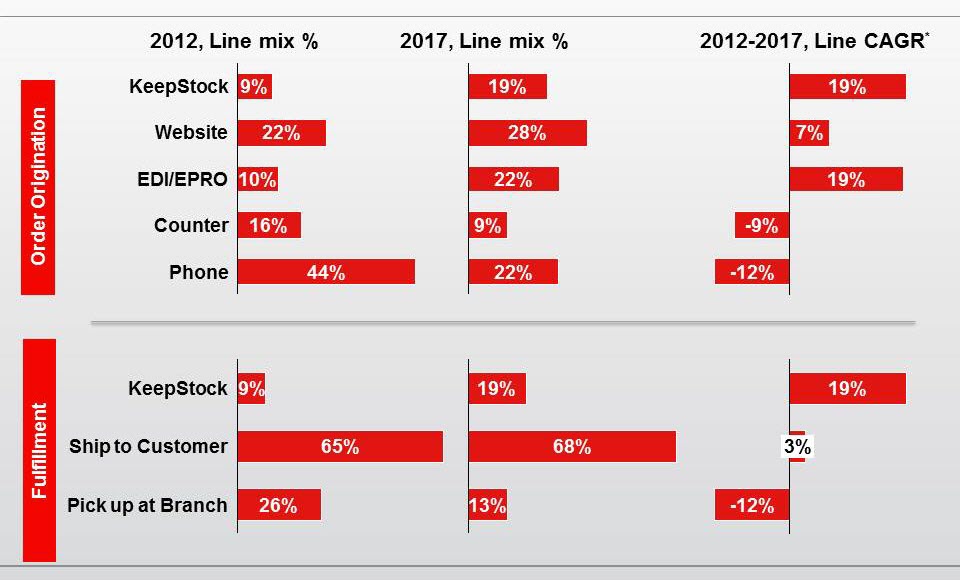
Macro trends are changing the way Grainger's customers behave. Customers want highly tailored solutions with real-time access to information and just-in-time delivery of products and services. Demands for transparency are also increasing as access to information expands. These changes in behaviors are reflected in how customers do business with the U.S. business as demonstrated in the following chart:
*CAGR is defined as compound annual growth rate.
Customers continue to migrate to web platforms and electronic purchasing platforms such as EDI, eProcurement and KeepStock®, the electronic inventory management offering. Through Grainger.com and other branded websites, which serve as prominent channels in the U.S. business, customers have access to approximately 2.4 million products. Grainger.com provides real-time price and product availability and detailed product information and offers features such as product search and compare capabilities. For customers with sophisticated electronic purchasing platforms, the U.S. business utilizes technology that allows these systems to communicate directly with Grainger.com.
Inventory management services is another area where the U.S. business helps customers be more productive. KeepStock® inventory solutions is a comprehensive program that includes vendor-managed inventory, customer-managed inventory and onsite vending machines. The U.S. business KeepStock® program currently provides services to nearly 20,000 customers and, in 2017, facilitated approximately 9,000 installations. As of December 31, 2017, there were approximately 65,000 total installations.
As of December 31, 2017, the U.S. business had 284 branches (251 stand alone, 31 onsite and 2 will-call express locations), 16 DCs, 3 national contact centers and 37 regional contact centers, which are located within branches. DCs in the U.S. business range in size from approximately 45,000 square feet to 1.3 million square feet, the largest of which can accommodate more than 500,000 in-stock products. Automated equipment and processes allow DCs to handle the majority of the customer shipping for next-day product availability and replenish branches that provide
same-day availability. The DC network fulfills a large portion of customer orders, especially as customers migrate to website and electronic purchasing.
Branches in the U.S. business serve the immediate needs of customers in their local markets by allowing them to directly pick up items. In addition, branches support local KeepStock® operations. The branch network has approximately 1,700 employees who primarily fulfill counter and will-call product purchases and provide customer service. Branch network sales volume has continued to grow throughout 2017.
Grainger's contact center network in the U.S. business consists of approximately 1,900 employees who handle about 70,000 customer interactions per day including approximately 20,000 orders via phone, e-mail and fax. To enable improved customer service, team member engagement and efficiencies, the 37 regional contact centers are currently being consolidated to 3 national contact centers with expanded work-from-home arrangements.
The U.S. business has a sales force of approximately 3,500 professionals who help customers select the right products to find immediate solutions to their needs and reduce costs by utilizing Grainger as a consistent source of supply. In 2017, the U.S. business continued to focus its outside sales force on facilitating growth with large customers who typically have more complex purchasing requirements than small and mid-sized customers. The U.S. business primarily utilizes a network of inside sellers and digital channels to meet the needs of small and mid-sized customers.
The Grainger catalog, most recently issued in February 2018, offers approximately 365,000 MRO products and is used by customers to assist in product selection. The 2018 catalog includes almost 24,000 new items and approximately 1 million copies of the catalog were produced.
Grainger estimates the U.S. market for MRO products to be approximately $127 billion in 2017, of which the U.S. business share is approximately 6%.
Canada
Acklands – Grainger Inc. and its subsidiaries (the Canada business) is Canada’s leading broad line MRO distributor. This business provides a combination of product breadth, local availability, speed of delivery, detailed product information and competitively priced products and services.
The Canada business serves customers through branches, sales and service representatives and DCs across Canada. As of December 31, 2017, the Canada business had 91 branches and 6 DCs. Approximately 13,000 sales transactions are completed daily. Customers have access to more than 131,000 stocked products through a comprehensive catalog. In addition, customers can purchase products through various fully bilingual websites. Grainger estimates the 2017 Canada market for MRO products was approximately $11 billion, of which the Canada business share is approximately 7%.
Other businesses
Other businesses include Zoro in the U.S., MonotaRO in Japan and operations in Europe, Asia and Latin America. The businesses in this group with revenues of more than $100 million in 2017 are described below.
Zoro
Zoro is an online MRO distributor primarily serving U.S. customers through its website, Zoro.com. Zoro offers a broad selection of more than 1 million products. Zoro has no branches or sales force, and customer orders are primarily fulfilled through the U.S. business supply chain.
MonotaRO
Grainger operates in Japan and other Asian countries primarily through its majority interest in MonotaRO. MonotaRO provides customers with MRO products primarily through its catalogs and websites. A majority of orders are conducted through Monotaro.com, through which customers have access to approximately 13 million products. MonotaRO fulfills the majority of orders from three DCs. Grainger estimates the Japanese market for MRO products was approximately $42 billion in 2017, of which MonotaRO’s share is approximately 2%.
Cromwell
Cromwell is a broad line MRO distributor in the United Kingdom (U.K.) serving approximately 130,000 customers. Headquartered in Leicester, England, as of December 31, 2017, Cromwell had 45 U.K. branches, 10 international branches in 10 countries and one DC. Customers have access to approximately 170,000 MRO products through a catalog and through Cromwell.co.uk. Grainger estimates the U.K. market for MRO products was approximately $15 billion in 2017, of which Cromwell's share is approximately 2%. In November 2017, Cromwell launched a new brand and website Zoro.co.uk and its customer orders are primarily fulfilled through the Cromwell business supply chain.
Fabory
Fabory is a European specialty distributor of fasteners and MRO products. Fabory is headquartered in Tilburg, the Netherlands. As of December 31, 2017, Fabory had 44 branches in 13 countries and two DCs. Customers have access to more than 250,000 products through a catalog and Fabory.com. Grainger estimates the European market (in which Fabory has its primary operations) for MRO products, including fasteners, was approximately $37 billion in 2017, of which Fabory’s share is approximately 1%.
Grainger Mexico
Grainger’s operations in Mexico provide local businesses with MRO supplies and other related products primarily from Mexico and the U.S. As of December 31, 2017, the business in Mexico distributes products through a network of 19 branches and two DCs. Customers have access to approximately 330,000 products through a Spanish-language catalog and through Grainger.com.mx. Grainger estimates the Mexican market for MRO products was approximately $10 billion in 2017, of which Grainger Mexico’s share is approximately 1%.
Seasonality
Grainger’s business in general is not seasonal, however, there are some products that typically sell more often during the winter or summer seasons. In any given month, unusual weather patterns, that is, unusually hot or cold weather, could positively or negatively impact the sales volumes of these products.
Competition
Grainger faces competition in each market from manufacturers (including some of its own suppliers) that sell directly to certain segments of the market, to wholesale distributors, catalog houses, retail enterprises and Internet-based businesses. Grainger differentiates itself by providing local product availability, a broad product line, sales representatives, competitive pricing, catalogs (which include product descriptions and, in certain cases, extensive technical and application data) and electronic and eCommerce technology. Grainger also offers other services, such as inventory management. Grainger has several large competitors and continues to be highly competitive against the predominant number of small local and regional competitors.
Employees
As of December 31, 2017, Grainger had approximately 25,700 employees, of whom approximately 24,400 were full-time and 1,300 were part-time or temporary. Grainger has never had a major work stoppage and considers employee relations to be good.
Website Access to Company Reports
Grainger makes available free of charge, through its website, www.Grainger.com/investor, its Annual Report on Form 10-K, quarterly reports on Form 10-Q, current reports on Form 8-K, proxy statements and amendments to those reports if any, as soon as reasonably practicable after these materials are electronically filed with or furnished to the U.S. Securities and Exchange Commission (SEC).
In addition, the public may read and copy any materials the Company files with the SEC at the SEC's Public Reference Room at 100 F Street, NE, Washington D.C. 20549. The public may obtain information on the operation of the Public Reference Room by calling the SEC at (800) SEC-0330. The SEC maintains a website that contains reports, proxy and information statements and other information regarding issuers that file electronically with the SEC and the address of that site is http://www.sec.gov.
Item 1A. Risk Factors
The following is a discussion of significant risk factors relevant to Grainger’s business that could adversely affect its financial condition, results of operations and cash flows. The risk factors discussed in this section should be considered together with information included elsewhere in this Annual Report on Form 10-K and should not be considered the only risks to which the Company is exposed.
Weakness in the economy, market trends and other conditions affecting the profitability and financial stability of Grainger’s customers could negatively impact Grainger’s sales growth and results of operations.
Economic and industry trends affect Grainger’s business environments. Grainger serves several industries in which the demand for its products and services is sensitive to the production activity, capital spending and demand for products and services of Grainger’s customers. Many of these customers operate in markets that are subject to cyclical fluctuations resulting from market uncertainty, costs of goods sold, currency exchange rates, foreign competition, offshoring of production, oil and natural gas prices, geopolitical developments and a variety of other factors beyond Grainger’s control. Any of these factors could cause customers to idle or close facilities, delay purchases, reduce production levels or experience reductions in the demand for their own products or services.
Any of these events could impair the ability of Grainger’s customers to make full and timely payments or reduce the volume of products and services these customers purchase from Grainger and could cause increased pressure on Grainger’s selling prices and terms of sale. Accordingly, a significant or prolonged slowdown in activity in the U.S., Canada or any other major world economy, or a segment of any such economy, could negatively impact Grainger’s sales growth and results of operations.
The facilities maintenance industry is highly competitive, and changes in competition could result in decreased demand for Grainger’s products and services.
There are several large competitors in the industry, although most of the market is served by small local and regional competitors. Grainger faces competition in all markets it serves, from manufacturers (including some of its own suppliers) that sell directly to certain segments of the market, wholesale distributors, catalog houses, retail enterprises and online businesses that compete with price transparency.
To remain competitive, the Company must be willing and able to respond to market pressures, including pricing, whether widely available or negotiated under a contract, delivery and services. These pressures, and the implementation, timing and results of our strategic pricing and other responses, could have a material effect on Grainger's sales and profitability. If the Company is unable to grow sales or reduce costs, among other actions, to wholly or partially offset the effect on profitability of our pricing actions, the Company's results of operations and financial condition may be adversely affected.
The industry is also consolidating as customers are increasingly aware of the total costs of fulfillment and of the need to have consistent sources of supply at multiple locations. This consolidation could cause the industry to become more competitive as greater economies of scale are achieved by competitors, or as competitors with a new lower cost business models are able to operate with lower prices.
Changes in inflation may adversely affect gross margins.
Inflation impacts the costs at which Grainger can procure product and the ability to increase prices to customers over time. Prolonged periods of deflation could adversely affect the degree to which Grainger is able to increase sales through price increases.
Volatility in commodity prices may adversely affect gross margins.
Some of Grainger’s products contain significant amounts of commodity-priced materials, such as steel, copper, petroleum derivatives or rare earth minerals, and are subject to price changes based upon fluctuations in the commodities market. Fluctuations in the price of fuel could affect transportation costs. Grainger’s ability to pass on such increases in costs in a timely manner depends on market conditions. The inability to pass along cost increases could result in lower gross margins. In addition, higher prices could impact demand for these products, resulting in lower sales volumes.
Unexpected product shortages could negatively impact customer relationships, resulting in an adverse impact on results of operations.
Grainger’s competitive strengths include product selection and availability. Products are purchased from approximately 5,200 suppliers located in various countries around the world, not one of which accounted for more than 5% of total purchases. Historically, no significant difficulty has been encountered with respect to sources of supply; however, disruptions could occur due to factors beyond Grainger’s control, including economic downturns, geopolitical unrest, port slowdowns, trade issues and other factors, any of which could adversely affect a supplier’s ability to manufacture or deliver products. As Grainger continues to source lower cost products from Asia and other areas of the world, the risk for disruptions has increased due to the additional lead time required and distances involved. If Grainger was to experience difficulty in obtaining products, there could be a short-term adverse effect on results of operations and a longer-term adverse effect on customer relationships and Grainger’s reputation. In addition, Grainger has strategic relationships with a number of vendors. In the event Grainger was unable to maintain those relations, there might be a loss of competitive pricing advantages which could, in turn, adversely affect results of operations.
Changes in customer or product mix could cause the gross margin percentage to decline.
From time to time, Grainger experiences changes in customer and product mix that affect gross margin. Changes in customer and product mix result primarily from business acquisitions, changes in customer demand, customer acquisitions, selling and marketing activities and competition. If rapid growth with larger, lower margin customers continues, Grainger will face pressure to maintain current gross margins, as these customers receive more discounted pricing due to their higher sales volume. There can be no assurance that Grainger will be able to maintain historical gross margins in the future.
Disruptions in Grainger’s supply chain could result in an adverse impact on results of operations.
A disruption within Grainger’s logistics or supply chain network, including damage, destruction, extreme weather and other events, which could cause one or more of Grainger’s distribution centers to become non-operational, could adversely affect Grainger’s ability to obtain or deliver inventory in a timely manner, impair Grainger’s ability to meet customer demand for products and result in lost sales or damage to Grainger’s reputation. Grainger’s ability to provide same-day shipping and next-day delivery is an integral component of Grainger’s business strategy and any such disruption could adversely impact results of operations.
Interruptions in the proper functioning of information systems could disrupt operations and cause unanticipated increases in costs and/or decreases in revenues.
The proper functioning of Grainger’s information systems is critical to the successful operation of its business. Grainger continues to invest in software, hardware and network infrastructures in order to effectively manage its information systems. Although Grainger’s information systems are protected with robust backup and security systems, including physical and software safeguards and remote processing capabilities, information systems are still vulnerable to natural disasters, power losses, computer viruses, telecommunication failures and other problems. If critical information systems fail or otherwise become unavailable, among other things, Grainger’s ability to process orders, maintain proper levels of inventories, collect accounts receivable and disburse funds could be adversely affected. Any such interruption of Grainger’s information systems could also subject Grainger to additional costs.
Breaches of information systems security could damage Grainger’s reputation, disrupt operations, increase costs and/or decrease revenues.
Through Grainger’s sales and eCommerce channels, Grainger collects and stores personally identifiable, confidential, proprietary and other information from customers so that they may, among other things, purchase products or services, enroll in promotional programs, register on Grainger’s websites or otherwise communicate or interact with the Company. Moreover, Grainger’s operations routinely involve receiving, storing, processing and transmitting sensitive information pertaining to its business, customers, suppliers and employees, and other sensitive matters.
While Grainger has instituted safeguards for the protection of such information, during the normal course of business, Grainger has experienced and expects to continue to experience attempts to breach the Company’s information systems, and Grainger may be unable to protect sensitive data and/or the integrity of the Company’s information systems. A cybersecurity incident could be caused by malicious outsiders using sophisticated methods to circumvent firewalls, encryption and other security defenses. Because techniques used to obtain unauthorized access or to
sabotage systems change frequently and generally are not recognized until they are launched against a target, Grainger may be unable to anticipate these techniques or implement adequate preventative measures.
Moreover, from time to time, Grainger may share information with vendors and other third parties that assist with certain aspects of the business. While Grainger requires assurances that these vendors and other parties will protect confidential information, there is a risk that the confidentiality of data held or accessed by them may be compromised. If successful, those attempting to penetrate Grainger’s or its vendors’ information systems may misappropriate personally identifiable, credit card, confidential, proprietary or other sensitive customer, supplier, employee or business information.
In addition, a Grainger employee, contractor or other third party with whom Grainger does business may attempt to circumvent security measures in order to obtain such information or inadvertently cause a breach involving such information. Further, Grainger’s systems are integrated with customer systems in certain cases, and a breach of the Company’s information systems could be used to gain illicit access to customer systems and information.
Loss of customer, supplier, employee or other business information could disrupt operations, damage Grainger’s reputation and expose Grainger to claims from customers, suppliers, financial institutions, regulators, payment card associations, employees and others, any of which could have a material adverse effect on Grainger, its financial condition and results of operations.
Fluctuations in foreign currency have an effect on reported results of operations.
Grainger’s exposure to fluctuations in foreign currency rates results primarily from the translation exposure associated with the preparation of the Consolidated Financial Statements, as well as from transaction exposure associated with transactions in currencies other than an entity’s functional currency. While the Consolidated Financial Statements are reported in U.S. dollars, the financial statements of Grainger’s subsidiaries outside the U.S. are prepared using the local currency as the functional currency and translated into U.S. dollars. In addition, Grainger is exposed to foreign currency exchange rate risk with respect to the U.S. dollar relative to the local currencies of Grainger’s international subsidiaries, primarily the Canadian dollar, euro, pound sterling, Mexican peso, renminbi and yen, arising from transactions in the normal course of business, such as sales and loans to wholly owned subsidiaries, sales to third-party customers, purchases from suppliers and bank loans and lines of credit denominated in foreign currencies. Grainger also has foreign currency exposure to the extent receipts and expenditures are not denominated in the subsidiary’s functional currency and that could have an impact on sales, costs and cash flows. These fluctuations in foreign currency exchange rates could affect Grainger’s results of operations and impact reported net sales and net earnings.
Changes in Grainger’s credit ratings and outlook may reduce access to capital and increase borrowing costs.
Grainger’s credit ratings are based on a number of factors, including Grainger’s financial strength and factors outside of Grainger’s control, such as conditions affecting Grainger’s industry generally or the introduction of new rating practices and methodologies. Grainger cannot provide assurances that Grainger’s current credit ratings will remain in effect or that the ratings will not be lowered, suspended or withdrawn entirely by the rating agencies. If rating agencies lower, suspend or withdraw the ratings, the market price or marketability of Grainger’s securities may be adversely affected. In addition, any change in ratings could make it more difficult for Grainger to raise capital on acceptable terms, impact the ability to obtain adequate financing and result in higher interest costs for Grainger’s existing credit facilities or on future financings.
Acquisitions, partnerships, joint ventures and other business combination transactions involve a number of inherent risks, any of which could result in the benefits anticipated not being realized and could have an adverse effect on results of operations.
Acquisitions, partnerships, joint ventures and other business combination transactions, both foreign and domestic, involve various inherent risks, such as uncertainties in assessing value, strengths, weaknesses, liabilities and potential profitability. There is also risk relating to Grainger’s ability to achieve identified operating and financial synergies anticipated to result from the transactions. Additionally, problems could arise from the integration of acquired businesses, including unanticipated changes in the business or industry or general economic conditions that affect the assumptions underlying the acquisition. Any one or more of these factors could cause Grainger to not realize the benefits anticipated or have a negative impact on the fair value of the reporting units. Accordingly, goodwill and intangible assets recorded as a result of acquisitions could become impaired.
In order to compete, Grainger must attract, retain and motivate key employees, and the failure to do so could have an adverse effect on results of operations.
In order to compete and have continued growth, Grainger must attract, retain and motivate executives and other key employees, including those in managerial, technical, sales, marketing and support positions. Grainger competes to hire employees and then must train them and develop their skills and competencies. Grainger’s results of operations could be adversely affected by increased costs due to increased competition for employees, higher employee turnover or increased employee benefit costs.
Grainger’s continued success is substantially dependent on positive perceptions of Grainger’s reputation.
One of the reasons why customers choose to do business with Grainger and why employees choose Grainger as a place of employment is the reputation that Grainger has built over many years. To be successful in the future, Grainger must continue to preserve, grow and leverage the value of Grainger’s brand. Reputational value is based in large part on perceptions of subjective qualities. Even an isolated incident, or the aggregate effect of individually insignificant incidents, can erode trust and confidence, particularly if they result in adverse publicity, governmental investigations or litigation, and as a result, could tarnish Grainger’s brand and lead to adverse effects on Grainger’s business.
Grainger is subject to various domestic and foreign laws, regulations and standards. Failure to comply or unforeseen developments in related contingencies such as litigation could adversely affect Grainger’s financial condition, results of operations and cash flows.
Grainger’s business is subject to a wide array of laws, regulations and standards in every domestic and foreign jurisdiction where it operates, including advertising and marketing regulations, anti-bribery and corruption laws, anti-competition regulations, data protection (including payment card industry data security standards), data privacy (including in the U.S. and the European Union, which has traditionally imposed strict obligations under data privacy laws and regulations that vary from country to country) and cybersecurity requirements (including protection of information and incident responses), environmental protection laws, foreign exchange controls and cash repatriation restrictions, government business regulations applicable to Grainger as a government contractor selling to federal, state and local government entities, health and safety laws, import and export requirements, intellectual property laws, labor laws, product compliance laws, supplier regulations regarding the sources of supplies or products, tax laws (including as to U.S. taxes on foreign subsidiaries), unclaimed property laws and laws, regulations and standards applicable to other commercial matters. Moreover, Grainger is also subject to audits and inquiries in the normal course of business.
Failure to comply with any of these laws, regulations and standards could result in civil, criminal, monetary and non-monetary penalties as well as potential damage to the Company’s reputation. Changes in these laws, regulations and standards, or in their interpretation, could increase the cost of doing business, including, among other factors, as a result of increased investments in technology and the development of new operational processes. Furthermore, while Grainger has implemented policies and procedures designed to facilitate compliance with these laws, regulations and standards, there can be no assurance that employees, contractors or agents will not violate such laws, regulations and standards or Grainger’s policies. Any such failure to comply or violation could individually or in the aggregate materially adversely affect Grainger’s financial condition, results of operations and cash flows.
Grainger also is, and from time to time may become, party to a number of legal proceedings incidental to Grainger’s business involving alleged damages or injuries arising out of the use of Grainger’s products and services or violations of these laws, regulations or standards. The defense of these proceedings may require significant expenses and divert management’s time and attention, and Grainger may be required to pay damages that could individually or in the aggregate materially adversely affect its financial condition, results of operations and cash flows. In addition, any insurance or indemnification rights that Grainger may have with respect to such matters may be insufficient or unavailable to protect the Company against potential loss exposures.
Tax changes could affect Grainger’s effective tax rate and future profitability.
Grainger’s future results could be adversely affected by changes in the effective tax rate as a result of changes in Grainger’s overall profitability and changes in the mix of earnings in countries with differing statutory tax rates, changes in tax legislation, the results of the examination of previously filed tax returns and continuing assessment of the Company’s tax exposures.
Item 1B. Unresolved Staff Comments
None.
Item 2. Properties
As of December 31, 2017, Grainger’s owned and leased facilities totaled approximately 28.2 million square feet. The U.S. and Canada businesses accounted for the majority of the total square footage. Grainger believes that its properties are generally in excellent condition, well maintained and suitable for the conduct of business.
A brief description of significant facilities follows:
| Location | Facility and Use (6) | Size in Square Feet (in 000s) | |||
| U.S. (1) | 284 U.S. branch locations | 6,367 | |||
| U.S. (2) | 16 distribution centers | 8,169 | |||
| U.S. (3) | Other facilities | 3,685 | |||
| Canada (4) | 139 facilities | 3,147 | |||
| Other businesses (5) | Other facilities | 5,624 | |||
| Chicago area (2) | Headquarters and general offices | 1,188 | |||
| Total Square Feet | 28,180 |
| (1) | Consists of 204 owned and 80 leased properties located throughout the U.S. ranging in size from approximately 500 to 109,000 square feet. |
| (2) | These facilities are primarily owned and range in size from approximately 45,000 square feet to 1.3 million square feet. |
| (3) | These facilities include both owned and leased locations, primarily consisting of storage facilities, office space, call centers and other properties. |
| (4) | Consists of general offices, distribution centers and branches located throughout Canada, of which 58 are owned and 81 leased. |
| (5) | These facilities include owned and leased locations in Europe, Asia, Latin America and other U.S. operations. |
| (6) | Owned facilities are not subject to any mortgages. |
Grainger continues to evaluate its physical footprint and announced throughout 2017 the intention to close 113 branches in the Canada business.
Item 3. Legal Proceedings
For a description of legal proceedings, see the disclosure contained in Note 17 to the Consolidated Financial Statements included in "Part II, Item 8: Financial Statements and Supplementary Data" of this report, which is incorporated herein by reference.
Item 4. Mine Safety Disclosures
Not applicable.
Item 4A. Executive Officers of the Registrant
Following is information about the Executive Officers of Grainger including age as of February 26, 2018. Executive Officers of Grainger generally serve until the next annual election of officers, or until earlier resignation or removal.
| Name and Age | Positions and Offices Held and Principal Occupation and Employment During the Past Five Years |
| Laura D. Brown (54) | Senior Vice President, Communications and Investor Relations, a position assumed in 2010 after serving as Vice President, Global Business Communications, a position assumed in 2009 and Vice President, Investor Relations, a position assumed in 2008. |
| Joseph C. High (63) | Senior Vice President and Chief People Officer, a position assumed in June 2011. Prior to joining Grainger, Mr. High was the Senior Vice President of Human Resources at Owens Corning in Toledo, Ohio, a position assumed in 2004. |
| John L. Howard (60) | Senior Vice President and General Counsel, a position assumed in 2000. |
| Ronald L. Jadin (57) | Senior Vice President and Chief Financial Officer, a position assumed in 2008. Previously, Mr. Jadin served as Vice President and Controller, a position assumed in 2006 after serving as Vice President, Finance. On July 19, 2017, Mr. Jadin announced that he planned to retire from the Company at the end of 2017. Mr. Jadin has agreed to continue serving the Company in his current position as Senior Vice President and Chief Financial Officer until the transition to his successor is completed later in 2018. |
| D.G. Macpherson (50) | Chairman of the Board, a position assumed in October 2017, and Chief Executive Officer, a position assumed in October 2016 at which time he was also appointed to the Board of Directors. Previously, Mr. Macpherson served as Chief Operating Officer, a position assumed in 2015; Senior Vice President and Group President, Global Supply Chain and International, a position assumed in 2013; Senior Vice President and President, Global Supply Chain and Corporate Strategy, a position assumed in 2012, and Senior Vice President, Global Supply Chain, a position assumed in 2008. |
| Paige K. Robbins (49) | Senior Vice President, Grainger Chief Digital Officer, a position assumed in September 2017. Previously, Ms. Robbins served as Senior Vice President, Global Supply Chain, Branch Network, Contact Centers and Corporate Strategy, a position assumed in 2016. Since joining Grainger in September 2010, Ms. Robbins has held various positions as a Vice President, including in the areas of Global Supply Chain and Logistics. |
| Eric R. Tapia (41) | Vice President and Controller, a position assumed in 2016. Previously, Mr. Tapia served as Vice President, Internal Audit from 2010 to 2016. Mr. Tapia is a Certified Public Accountant (CPA) and before joining Grainger in 2010 was an audit partner with KPMG. |
PART II
Item 5. Market for Registrant’s Common Equity, Related Shareholder Matters and Issuer Purchases of Equity Securities
Market Information and Dividends
Grainger's common stock is listed and traded on the New York Stock Exchange, under the symbol GWW. The high and low sales prices for the common stock and the dividends declared and paid per share for each calendar quarter during 2017 and 2016 are shown below.
| Market Price Per Share | ||||||||||||
| Quarters | High | Low | Dividends | |||||||||
| 2017 | First | $ | 262.72 | $ | 229.05 | $ | 1.22 | |||||
| Second | 234.66 | 168.58 | 1.28 | |||||||||
| Third | 185.82 | 155.00 | 1.28 | |||||||||
| Fourth | 240.49 | 166.46 | 1.28 | |||||||||
| Year | $ | 262.72 | $ | 155.00 | $ | 5.06 | ||||||
| 2016 | First | $ | 234.77 | $ | 176.85 | $ | 1.17 | |||||
| Second | 239.95 | 212.64 | 1.22 | |||||||||
| Third | 235.53 | 212.54 | 1.22 | |||||||||
| Fourth | 240.74 | 201.94 | 1.22 | |||||||||
| Year | $ | 240.74 | $ | 176.85 | $ | 4.83 |
Grainger expects that its practice of paying quarterly dividends on its common stock will continue, although the payment of future dividends is at the discretion of Grainger’s Board of Directors and will depend upon Grainger’s earnings, capital requirements, financial condition and other factors.
Holders
The approximate number of shareholders of record of Grainger’s common stock as of February 7, 2018, was 688 with approximately 150,934 additional shareholders holding stock through nominees.
Issuer Purchases of Equity Securities - Fourth Quarter
| Period | Total Number of Shares Purchased (A) | Average Price Paid Per Share (B) | Total Number of Shares Purchased as Part of Publicly Announced Plans or Programs (C) | Maximum Number of Shares That May Yet be Purchased Under the Plans or Programs | ||
| Oct. 1 – Oct. 31 | 206,586 | $185.37 | 206,586 | 3,506,481 | shares | |
| Nov. 1 – Nov. 30 | 237,397 | $199.91 | 237,397 | 3,269,084 | shares | |
| Dec. 1 – Dec. 31 | 410,679 | $227.94 | 410,679 | 2,858,405 | shares | |
| Total | 854,662 | $209.86 | 854,662 |
| (A) | 85 shares were withheld to satisfy tax withholding obligations in connection with the vesting of employee restricted stock awards. |
| (B) | Average price paid per share includes any commissions paid and includes only those amounts related to purchases as part of publicly announced plans or programs. |
| (C) | Purchases were made pursuant to a share repurchase program approved by Grainger's Board of Directors. This plan was announced on April 16, 2015, for 15 million shares with no expiration date. Activity is reported on a trade date basis. |
Company Performance
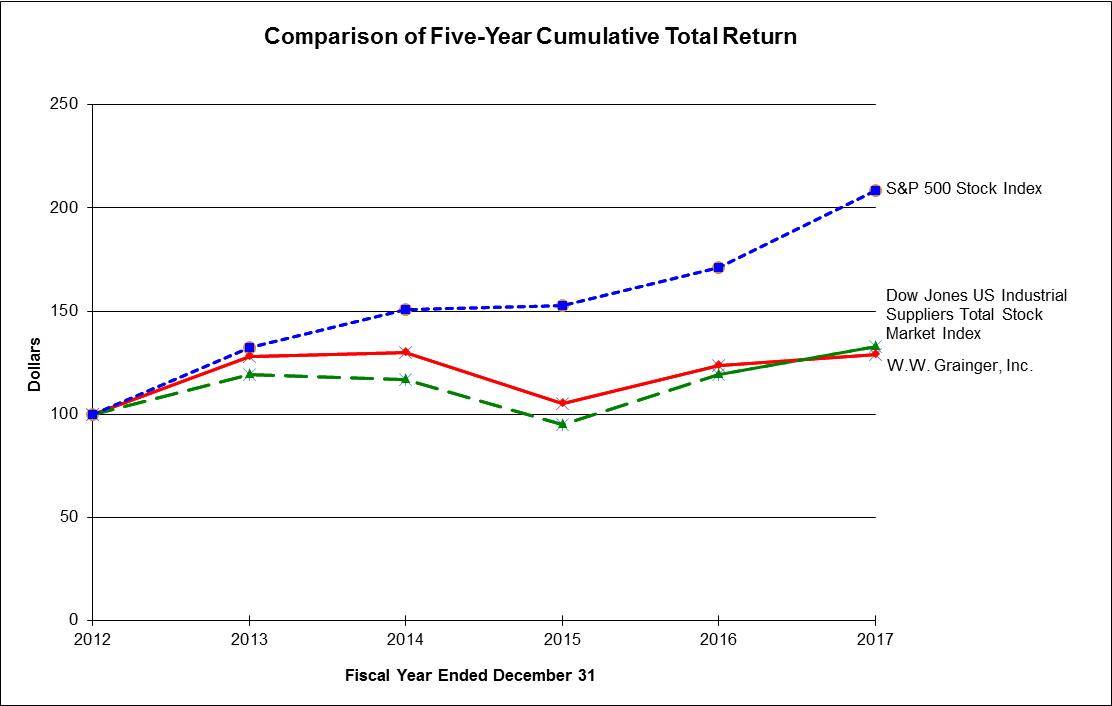
The following stock price performance graph compares the cumulative total return on an investment in Grainger common stock with the cumulative total return of an investment in each of the Dow Jones US Industrial Suppliers Total Stock Market Index and the S&P 500 Stock Index. It covers the period commencing December 31, 2012, and ending December 31, 2017. The graph assumes that the value for the investment in Grainger common stock and in each index was $100 on December 31, 2012, and that all dividends were reinvested.
| December 31, | ||||||||||||||||||
| 2012 | 2013 | 2014 | 2015 | 2016 | 2017 | |||||||||||||
| W.W. Grainger, Inc. | $ | 100 | $ | 128 | $ | 130 | $ | 105 | $ | 124 | $ | 129 | ||||||
| Dow Jones US Industrial Suppliers Total Stock Market Index | 100 | 119 | 117 | 95 | 119 | 133 | ||||||||||||
| S&P 500 Stock Index | 100 | 132 | 151 | 153 | 171 | 208 |
Item 6. Selected Financial Data
| 2017 | 2016 | 2015 | 2014 | 2013 | |||||||||||||||
| (In thousands of dollars, except for per share amounts) | |||||||||||||||||||
| Net sales | $ | 10,424,858 | $ | 10,137,204 | $ | 9,973,384 | $ | 9,964,953 | $ | 9,437,758 | |||||||||
| Net earnings attributable to W.W. Grainger, Inc. (herein referred to as Net earnings) | 585,730 | 605,928 | 768,996 | 801,729 | 797,036 | ||||||||||||||
| Net earnings per basic share | 10.07 | 9.94 | 11.69 | 11.59 | 11.31 | ||||||||||||||
| Net earnings per diluted share | 10.02 | 9.87 | 11.58 | 11.45 | 11.13 | ||||||||||||||
| Total assets | 5,804,254 | 5,694,307 | 5,857,755 | 5,283,049 | 5,266,328 | ||||||||||||||
| Long-term debt (less current maturities) and other long-term liabilities | 2,469,860 | 2,159,602 | 1,716,507 | 737,232 | 743,702 | ||||||||||||||
| Total shareholders' equity | $ | 1,827,733 | $ | 1,905,768 | $ | 2,352,714 | $ | 3,284,101 | $ | 3,326,836 | |||||||||
| Cash dividends paid per share | $ | 5.06 | $ | 4.83 | $ | 4.59 | $ | 4.17 | $ | 3.59 |
The items discussed below are considered to materially affect the comparability of the information reflected in the selected financial data. For further information see “Part II, Item 7: Management's Discussion and Analysis of Financial Condition and Results of Operations” of this report, which is incorporated herein by reference.
Net earnings for 2017 included a net expense of $84 million primarily consisting of a net charge of $102 million related to restructuring and other charges primarily consisting of branch closures in the U.S. and Canada businesses, net of gains on sale of branch real estate in the U.S., the consolidation of the contact center network in the U.S. and the wind-down of operations in Colombia, which is part of other businesses. This was partially offset by the net benefit of $15 million related to U.S. tax legislation and other discrete tax items and a net benefit of $3 million related to General Services Administrative (GSA) and unclaimed property reserves.
Net earnings for 2016 included a net expense of $105 million primarily consisting of the following:
| • | Restructuring: A net charge of $26 million related to restructuring actions. These actions primarily included branch closures, net of gains on sale of branch real estate in the U.S. and Canada businesses. |
| • | Goodwill and intangible impairments: An impairment charge of $52 million related to goodwill and intangible impairments in other businesses. |
| • | Unclaimed property contingency: A charge of $23 million related to an adjustment for unclaimed property in the U.S. business primarily related to activity from 2008 through 2012. |
| • | GSA contingency: A charge of $6 million to increase the U.S. business reserve for certain tax, freight and miscellaneous billing issues in connection with the audit of government contracts with the GSA first entered in 1999. |
| • | Inventory adjustment: A charge of $7 million related to an inventory adjustment in the Canada business to reflect an updated reserve methodology and better visibility to inventory performance provided by the conversion to the U.S. ERP system. |
| • | Discrete tax items: A net benefit of $9 million related to the conclusion of the federal income tax audit for the years 2009 through 2012 in the U.S. business and other discrete tax items. |
Net earnings for 2015 included a net charge of $30 million primarily composed of a $25 million net charge related to the reorganization in the U.S. and Canada businesses and a $5 million charge for restructuring in other businesses.
Net earnings for 2014 included a net charge of $56 million primarily composed of a $28 million charge related to closing of the business in Brazil, a $10 million charge due to the retirement plan transition in Europe, a $10 million charge related to restructuring of the business in Europe and a $8 million charge related to a goodwill impairment charge in other businesses.
Net earnings for 2013 included a net charge of $28 million primarily composed of $21 million in impairment charges in other businesses primarily for goodwill and a $7 million charge related to restructuring the businesses in Europe and China.
Grainger completed several acquisitions in the years 2013 through 2015, all of which were immaterial individually and in the aggregate. Operating results have included the results of each business acquired since the respective acquisition dates.
Item 7. Management’s Discussion and Analysis of Financial Condition and Results of Operations
General
W.W. Grainger, Inc. (Grainger) is a broad line, business-to-business distributor of maintenance, repair and operating (MRO) supplies and other related products and services with operations primarily in the U.S. and Canada, with a presence in Europe, Asia and Latin America. More than 3 million customers worldwide rely on Grainger for products such as safety, gloves, ladders, motors and janitorial supplies, along with services like inventory management and technical support. These customers represent a broad collection of industries including commercial, government, healthcare and manufacturing. They place orders online, on mobile devices, through sales representatives, over the phone and at local branches. Approximately 5,200 suppliers provide Grainger with approximately 1.7 million products stocked in Grainger's distribution centers (DCs) and branches worldwide.
Grainger’s two reportable segments are the U.S. and Canada. The U.S. operating segment reflects the results of Grainger’s U.S. businesses. The Canada operating segment reflects the results for Acklands – Grainger Inc. and its subsidiaries. Other businesses include the single channel online businesses (Zoro in the U.S. and MonotaRO in Japan) and operations in Europe, Asia and Latin America.
Business Environment
Given Grainger's large number of customers and the diverse industries it serves, several economic factors and industry trends tend to shape Grainger’s business environment. The overall economy and leading economic indicators provide general insight into projecting Grainger's growth. Grainger’s sales in the U.S. and Canada tend to positively correlate with Business Investment, Business Inventory, Exports and Industrial Production. In the U.S., sales tend to positively correlate with Gross Domestic Product (GDP). In Canada, sales tend to positively correlate with oil prices. The table below provides these estimated indicators for 2017 and 2018:
| U.S. | Canada | ||||||||||
| Estimated 2017 | Forecasted 2018 | Estimated 2017 | Forecasted 2018 | ||||||||
| Business Investment | 5.1 | % | 7.9 | % | 2.3 | % | 3.5 | % | |||
| Business Inventory | 0.8 | % | 2.1 | % | — | — | |||||
| Exports | 3.4 | % | 5.3 | % | 1.1 | % | 1.8 | % | |||
| Industrial Production | 1.9 | % | 3.3 | % | 5.2 | % | 0.1 | % | |||
| GDP | 2.2 | % | 2.7 | % | 3.0 | % | 2.4 | % | |||
| Oil Prices | — | — | $51/barrel | $54/barrel | |||||||
| Source: Global Insight (January 2018) |
In the U.S., Business Investment and Exports are two major indicators of MRO spending. Per the Global Insight January 2018 forecast, Business Investment is likely to remain on a strong growth path during 2018, supported by expanding global markets, lower capital costs and an improving regulatory climate. Additionally on December 22, 2017, the Tax Cuts and Jobs Act was signed into law, which significantly lowered U.S. corporate income tax rates and introduced accelerated expensing of qualified capital investments, among other changes. These changes to U.S. tax laws may increase capital spending in the U.S. and attract incremental foreign capital to the U.S., which is expected to support export growth.
Per the Global Insight January 2018 forecast, Canada's GDP and industrial production are forecast slow in 2018, while exports and business nonresidental investment (a component of Business Investment) are expected to improve.
Outlook
Grainger’s portfolio consists of its U.S. business, its Canada business and other businesses. Grainger’s imperative to create unique value is focused on: (i) continuing to grow its share of business with large and mid-size customers in the U.S. by executing its high-value sales and service model, building an advantaged digital capability and completing its pricing strategy; (ii) executing a complete business model reset in Canada; (iii) driving profitable growth in its international portfolio and (iv) continuing the strong growth of its single channel businesses by expanding its assortment and innovation around customer acquisition. Grainger is also focused on improving the end-to-end customer experience by making investments in its eCommerce and digital capabilities and executing continuous improvement initiatives within its supply chain, such that customers have a positive experience with Grainger from order to delivery. Grainger intends to continue to reduce its cost base while ensuring that it delivers an effortless customer experience.
On January 24, 2018, Grainger updated its 2018 earnings per share guidance to reflect the 2017 actual results, lower corporate tax rate, lower tax benefit from clean energy, incremental investment in digital and higher share repurchases. The prior earnings per share guidance issued on November 10, 2017 for 2018 was $10.60 to $11.80. The Company still expects 3 to 7 percent sales growth and now expects earnings per share of $12.95 to $14.15 for 2018.
Matters Affecting Comparability
There were 254 sales days in the full year 2017 and 255 sales days in the full years 2016 and 2015. Grainger completed one divestiture in 2017 and one acquisition in 2015, which were immaterial individually and in the aggregate. Grainger’s operating results have included the results of each business acquired since the respective acquisition dates.
Results of Operations
The following table is included as an aid to understanding changes in Grainger's Consolidated Statements of Earnings (in millions of dollars):
| For the Years Ended December 31, | |||||||||||||||||
| Percent Increase/(Decrease) from Prior Year | As a Percent of Net Sales | ||||||||||||||||
| 2017 (A) | 2016 (A) | 2017 | 2017 | 2016 | |||||||||||||
| Net sales | $ | 10,425 | $ | 10,137 | 3 | % | 100.0 | % | 100.0 | % | |||||||
| Cost of merchandise sold | 6,327 | 6,023 | 5 | % | 60.7 | 59.4 | |||||||||||
| Gross profit | 4,098 | 4,115 | — | % | 39.3 | 40.6 | |||||||||||
| Warehousing, marketing and administrative expenses | 3,049 | 2,995 | 2 | % | 29.3 | 29.6 | |||||||||||
| Operating earnings | 1,049 | 1,119 | (6 | )% | 10.1 | 11.0 | |||||||||||
| Other expense, net | 113 | 100 | 13 | % | 1.1 | 1.0 | |||||||||||
| Income taxes | 313 | 386 | (19 | )% | 3.0 | 3.8 | |||||||||||
| Net earnings | 622 | 633 | (2 | )% | 6.0 | 6.2 | |||||||||||
| Noncontrolling interest | 37 | 27 | 36 | % | 0.4 | 0.3 | |||||||||||
| Net earnings attributable to W.W. Grainger, Inc. | $ | 586 | $ | 606 | (3 | )% | 5.6 | % | 6.0 | % |
(A) May not sum due to rounding
2017 Compared to 2016
Grainger's net sales were $10,425 million for 2017, an increase of 3%, when compared with net sales of $10,137 million for the comparable 2016 period. On a daily basis, the 3% increase for the year consisted of the following:
| Percent Increase/ (Decrease) | |
| Volume | 8 |
| Divestiture | (1) |
| Price | (4) |
| Total | 3% |
The increase in net sales was primarily driven by the single channel online businesses in the U.S. and Japan, as well as volume increases in the U.S. business as a result of the pricing actions. The U.S. business pricing actions were primarily implemented in the first and third quarters of 2017 and included adj
Showing the first 8K of 63K characters. Open the full section
Item 7A. Quantitative and Qualitative Disclosures About Market Risk
Grainger may use financial instruments to reduce its exposure to adverse fluctuations in foreign currency exchange rates and interest rates as part of its overall risk management strategy. The derivative positions reduce risk by hedging certain underlying economic exposures. Because of the high correlation between the hedging instrument and the underlying exposure, fluctuations in the value of the instruments are generally offset by reciprocal changes in the value of the underlying exposure. Grainger does not enter into derivative financial instruments for trading or speculative purposes.
Foreign Currency Exchange Rates
Grainger’s financial results, including the value of assets and liabilities, are exposed to foreign currency exchange rate risk when the financial statements of the business units, as stated in their local currencies, are translated into U.S. dollars. While it is difficult to quantify any particular impact of changes in exchange rates, a uniform 10% strengthening in the U.S. dollar (whereby all other variables are held constant and unusual expense items described in "Item 7: Management's Discussion and Analysis of Financial Condition and Results of Operations" are excluded) would have resulted in an increase in net earnings of $1 million for the year ended December 31, 2017, and an increase in net earnings of $2 million for the year ended December 31, 2016. Comparatively, a 10% weakening of the U.S. dollar would have resulted in a decrease in net earnings of $2 million for the year ended December 31, 2017, and a decrease in net earnings of $2 million for the year ended December 31, 2016. This sensitivity analysis of the effects of changes in foreign currency exchange rates does not factor in future potential changes in sales levels or local currency prices or costs.
Commodity Price Risk
Grainger has limited primary exposure to commodity price risk on certain products for resale, but does not purchase commodities directly.
Item 8. Financial Statements and Supplementary Data
The financial statements and supplementary data are included on pages 37 to 77. See the Index to Financial Statements and Supplementary Data on page 36.
Item 9. Changes in and Disagreements with Accountants on Accounting and Financial Disclosure
None.
Item 9A. Controls and Procedures
Disclosure Controls and Procedures
Grainger carried out an evaluation, under the supervision and with the participation of its management, including the Chief Executive Officer and the Chief Financial Officer, of the effectiveness of the design and operation of Grainger's disclosure controls and procedures pursuant to Exchange Act Rule 13a-15. Based upon that evaluation, the Chief Executive Officer and the Chief Financial Officer concluded that Grainger's disclosure controls and procedures were effective as of the end of the period covered by this report.
Internal Control Over Financial Reporting
| (A) | Management's Annual Report on Internal Control Over Financial Reporting |
Management's report on Grainger's internal control over financial reporting is included on page 37 of this Report under the heading Management's Annual Report on Internal Control Over Financial Reporting.
| (B) | Attestation Report of the Registered Public Accounting Firm |
The report from Ernst & Young LLP on its audit of the effectiveness of Grainger's internal control over financial reporting as of December 31, 2017, is included on page 38 of this Report under the heading Report of Independent Registered Public Accounting Firm.
| (C) | Changes in Internal Control Over Financial Reporting |
There have been no changes in Grainger's internal control over financial reporting during the last fiscal quarter that have materially affected, or are reasonably likely to materially affect, Grainger's internal control over financial reporting.
Item 9B. Information Required to Be Disclosed in a Form 8-K
None.
PART III
Item 10. Directors, Executive Officers and Corporate Governance
The information required by this item is incorporated by reference to Grainger's proxy statement relating to the annual meeting of shareholders to be held April 25, 2018, under the captions “Directors,” “Board of Directors and Board Committees” and “Section 16(a) Beneficial Ownership Reporting Compliance.” Information required by this item regarding executive officers of Grainger is set forth below under the caption “Executive Officers.”
Grainger has adopted a code of ethics that applies to its principal executive officer, principal financial officer and principal accounting officer and controller. This code of ethics is part of Grainger’s Business Conduct Guidelines for directors, officers and employees, which is available free of charge through Grainger’s website at www.grainger.com/investor. A copy of the Business Conduct Guidelines is also available in print without charge to any person upon request to Grainger's Corporate Secretary. Grainger intends to disclose on its website any amendment to any provision of the Business Conduct Guidelines that relates to any element of the definition of “code of ethics” enumerated in Item 406(b) of Regulation S-K under the Exchange Act and any waiver from any such provision granted to Grainger’s principal executive officer, principal financial officer, principal accounting officer and controller or persons performing similar functions. Grainger has also adopted Operating Principles for the Board of Directors, which are available on its website and are available in print to any person who requests them.
Item 11. Executive Compensation
The information required by this item is incorporated by reference to Grainger's proxy statement relating to the annual meeting of shareholders to be held April 25, 2018, under the captions “Board of Directors and Board Committees,” “Director Compensation,” “Report of the Compensation Committee of the Board” and “Compensation Discussion and Analysis.”
Item 12. Directors and Executive Officers
The information required by this item is incorporated by reference to Grainger's proxy statement relating to the annual meeting of shareholders to be held April 25, 2018, under the captions “Ownership of Grainger Stock” and “Equity Compensation Plans.”
Item 13. Certain Relationships and Related Transactions
The information required by this item is incorporated by reference to Grainger's proxy statement relating to the annual meeting of shareholders to be held April 25, 2018, under the captions "Election of Directors" and "Transactions with Related Persons."
Item 14. Principal Accountant Fees and Services
The information required by this item is incorporated by reference to Grainger's proxy statement relating to the annual meeting of shareholders to be held April 25, 2018, under the caption “Audit Fees and Audit Committee Pre-Approval Policies and Procedures.”
PART IV
Item 15. Exhibits and Financial Statements Schedules
(a) Documents filed as part of the Form 10-K
| (1) | Financial Statements: see "Item 8: Financial Statements and Supplementary Data," on page 36 hereof, for a list of financial statements. Management's Annual Report on Internal Control Over Financial Reporting. |
| (2) | Financial Statement Schedules: the schedules listed in Rule 5-04 of Regulation S-X have been omitted because they are either not applicable or the required information is shown in the consolidated financial statements or notes thereto. |
| (3) | Exhibits Required by Item 601 of Regulation S-K: the information required by this Item 15(a)(3) of Form 10-K is set forth on the Exhibit Index that follows the Signatures page 77 of the Form 10-K. |
INDEX TO FINANCIAL STATEMENTS AND SUPPLEMENTARY DATA
December 31, 2017, 2016 and 2015
| Page(s) | |
| MANAGEMENT'S ANNUAL REPORT ON INTERNAL CONTROL OVER FINANCIAL REPORTING | 36 |
| REPORTS OF INDEPENDENT REGISTERED PUBLIC ACCOUNTING FIRM | 37 |
| FINANCIAL STATEMENTS | |
| CONSOLIDATED STATEMENTS OF EARNINGS | 39 |
| CONSOLIDATED STATEMENTS OF COMPREHENSIVE EARNINGS | 40 |
| CONSOLIDATED BALANCE SHEETS | 41 |
| CONSOLIDATED STATEMENTS OF CASH FLOWS | 42 |
| CONSOLIDATED STATEMENTS OF SHAREHOLDERS' EQUITY | 43 |
| NOTES TO CONSOLIDATED FINANCIAL STATEMENTS | 44 |
MANAGEMENT'S ANNUAL REPORT ON INTERNAL CONTROL OVER FINANCIAL REPORTING
The management of W.W. Grainger, Inc. (Grainger) is responsible for establishing and maintaining adequate internal control over financial reporting. Grainger's internal control system was designed to provide reasonable assurance to Grainger's management and Board of Directors regarding the reliability of financial reporting and the preparation of financial statements for external purposes in accordance with accounting principles generally accepted in the United States of America.
Because of its inherent limitations, internal control over financial reporting may not prevent or detect misstatements under all potential conditions. Therefore, effective internal control over financial reporting provides only reasonable, and not absolute, assurance with respect to the preparation and presentation of financial statements.
Grainger's management assessed the effectiveness of Grainger's internal control over financial reporting as of December 31, 2017, based on criteria established in Internal Control - Integrated Framework issued by the Committee of Sponsoring Organizations of the Treadway Commission (2013 framework) (the COSO criteria). Based on its assessment under that framework and the criteria established therein, Grainger's management concluded that Grainger's internal control over financial reporting was effective as of December 31, 2017.
Ernst & Young LLP, an independent registered public accounting firm, has audited Grainger's internal control over financial reporting as of December 31, 2017, as stated in their report, which is included herein.
Report of Independent Registered Public Accounting Firm
To the Shareholders and the Board of Directors of
W.W. Grainger, Inc. and Subsidiaries
Opinion on the Financial Statements
We have audited the accompanying consolidated balance sheets of W.W. Grainger, Inc. and subsidiaries (the Company) as of December 31, 2017 and 2016, the related consolidated statements of earnings, comprehensive earnings, and shareholders’ equity and cash flows for each of the three years in the period ended December 31, 2017, and the related notes (collectively referred to as the “consolidated financial statements”). In our opinion, the consolidated financial statements present fairly, in all material respects, the financial position of the Company at December 31, 2017 and 2016, and the consolidated results of its operations and its cash flows for each of the three years in the period ended December 31, 2017, in conformity with U.S. generally accepted accounting principles.
We also have audited, in accordance with the standards of the Public Company Accounting Oversight Board (United States) (PCAOB), the Company’s internal control over financial reporting as of December 31, 2017, based on criteria established in Internal Control-Integrated Framework issued by the Committee of Sponsoring Organizations of the Treadway Commission (2013 framework) and our report dated February 26, 2018 expressed an unqualified opinion thereon.
Basis for Opinion
These financial statements are the responsibility of the Company’s management. Our responsibility is to express an opinion on the Company’s financial statements based on our audits. We are a public accounting firm registered with the PCAOB and are required to be independent with respect to the Company in accordance with the U.S. federal securities laws and the applicable rules and regulations of the Securities and Exchange Commission and the PCAOB.
We conducted our audits in accordance with the standards of the PCAOB. Those standards require that we plan and perform the audit to obtain reasonable assurance about whether the financial statements are free of material misstatement, whether due to error or fraud. Our audits included performing procedures to assess the risks of material misstatement of the financial statements, whether due to error or fraud, and performing procedures that respond to those risks. Such procedures included examining, on a test basis, evidence regarding the amounts and disclosures in the financial statements. Our audits also included evaluating the accounting principles used and significant estimates made by management, as well as evaluating the overall presentation of the financial statements. We believe that our audits provide a reasonable basis for our opinion.
/s/ Ernst & Young LLP
We have served as the Company’s auditor since 2005.
Chicago, Illinois
February 26, 2018
Report of Independent Registered Public Accounting Firm
To the Shareholders and the Board of Directors of
W.W. Grainger, Inc. and Subsidiaries
Opinion on Internal Control over Financial Reporting
We have audited W.W. Grainger, Inc. and subsidiaries’ internal control over financial reporting as of December 31, 2017, based on criteria established in Internal Control-Integrated Framework issued by the Committee of Sponsoring Organizations of the Treadway Commission (2013 Framework) (the COSO Criteria). In our opinion, W.W Grainger, Inc. and subsidiaries (the Company) maintained, in all material respects, effective internal control over financial reporting as of December 31, 2017, based on the COSO criteria.
We also have audited, in accordance with the standards of the Public Company Accounting Oversight Board (United States) (PCAOB), the consolidated balance sheets of the Company as of December 31, 2017 and 2016, and the related consolidated statements of earnings, comprehensive earnings, and shareholders’ equity and cash flows for each of the three years in the period ended December 31, 2017 and the related notes and our report dated February 26, 2018 expressed an unqualified opinion thereon.
Basis for Opinion
The Company’s management is responsible for maintaining effective internal control over financial reporting and for its assessment of effectiveness of the internal control over financial reporting included in the accompanying Management’s Annual Report on Internal Controls over Financial Reporting. Our responsibility is to express an opinion on the Company’s internal control over financial reporting based on our audit. We are a public accounting firm registered with the PCAOB and are required to be independent with respect to the Company in
Showing the first 8K of 161K characters. Open the full section