 filings.tools
Huntington Bancshares 2023 10-K Annual Report
HBAN · CIK 49196 · Form 10-K · Fiscal year ended December 31, 2023 · Filed February 16, 2024
24 sections, 917K characters. Original on sec.gov · Markdown · JSON
Risk FactorsBusinessMD&AFinancial StatementsWhat changed vs 2022
Cover and table of contents
UNITED STATES
SECURITIES AND EXCHANGE COMMISSION
WASHINGTON, D.C. 20549
FORM 10-K
| ☒ | Annual Report Pursuant to Section 13 or 15(d) of the Securities Exchange Act of 1934 |
For the fiscal year ended December 31, 2023
Commission File Number 1-34073

| Huntington Bancshares Incorporated |
(Exact name of registrant as specified in its charter)
| Maryland | 31-0724920 | |||||||||||||
| (State or other jurisdiction of incorporation or organization) | (I.R.S. Employer Identification No.) | |||||||||||||
| 41 South High Street | Columbus, | Ohio | 43287 | |||||||||||
| (Address of principal executive offices) | (Zip Code) |
Registrant’s telephone number, including area code (614) 480-2265
Securities registered pursuant to Section 12(b) of the Act:
| Title of class | Trading Symbol(s) | Name of exchange on which registered | ||||||
| Depositary Shares (each representing a 1/40th interest in a share of 4.500% Series H Non-Cumulative, perpetual preferred stock) | HBANP | NASDAQ | ||||||
| Depositary Shares (each representing a 1/1000th interest in a share of 5.70% Series I Non-Cumulative, perpetual preferred stock) | HBANM | NASDAQ | ||||||
| Depositary Shares (each representing a 1/40th interest in a share of 6.875% Series J Non-Cumulative, perpetual preferred stock) | HBANL | NASDAQ | ||||||
| Common Stock—Par Value $0.01 per Share | HBAN | NASDAQ |
Indicate by check mark if the registrant is a well-known seasoned issuer, as defined in Rule 405 of the Securities Exchange Act. x Yes ¨ No
Indicate by check mark if the registrant is not required to file reports pursuant to Section 13 or 15(d) of the Act. ¨ Yes x No
Indicate by check mark whether the registrant (1) has filed all reports required to be filed by Section 13 or 15(d) of the Securities Exchange Act of 1934 during the preceding 12 months (or for such shorter period that the registrant was required to file such reports), and (2) has been subject to such filing requirements for the past 90 days. x Yes ¨ No
Indicate by check mark whether the registrant has submitted electronically every Interactive Data File required to be submitted pursuant to Rule 405 of Regulation S-T (§232.405 of this chapter) during the preceding 12 months (or for such shorter period that the registrant was required to submit such files). x Yes ¨ No
Indicate by check mark whether the registrant is a large accelerated filer, an accelerated filer, a non-accelerated filer, a smaller reporting company, or an emerging growth company. See the definitions of “large accelerated filer”, “accelerated filer”, “smaller reporting company”, and “emerging growth company” in Rule 12b-2 of the Exchange Act.
| Large Accelerated Filer | x | Accelerated filer | ☐ | ||||||||||||||
| Non-accelerated filer | ☐ | Smaller reporting company | ☐ | ||||||||||||||
| Emerging growth company | ☐ |
If an emerging growth company, indicate by check mark if the registrant has elected not to use the extended transition period for complying with any new or revised financial accounting standards provided pursuant to Section 13(a) of the Exchange Act. ¨
Indicate by check mark whether the registrant has filed a report on and attestation to its management’s assessment of the effectiveness of its internal control over financial reporting under Section 404(b) of the Sarbanes-Oxley Act (15 U.S.C. 7262(b)) by the registered public accounting firm that prepared or issued its audit report. ☒
If securities are registered pursuant to Section 12(b) of the Act, indicate by check mark whether the financial statements of the registrant included in the filing reflect the correction of an error to previously issued financial statements. ¨
Indicate by check mark whether any of those error corrections are restatements that required a recovery analysis of incentive-based compensation received by any of the registrant’s executive officers during the relevant recovery period pursuant to §240.10D-1(b). ¨
Indicate by check mark whether the registrant is a shell company (as defined in Rule 12b-2 of the Act)
☐ Yes x No
The aggregate market value of voting and non-voting common equity held by non-affiliates of the registrant as of June 30, 2023, determined by using a per share closing price of $10.78, as quoted by Nasdaq on that date, was $15,337,338,365. As of January 31, 2024, there were 1,448,345,863 shares of common stock with a par value of $0.01 outstanding.
Documents Incorporated By Reference
Part III of this Form 10-K incorporates by reference certain information from the registrant’s definitive Proxy Statement for the 2024 Annual Shareholders’ Meeting.
HUNTINGTON BANCSHARES INCORPORATED
INDEX
Glossary of Acronyms and Terms
The following listing provides a comprehensive reference of common acronyms and terms used throughout the document:
| ACL | Allowance for Credit Losses | ||||
| AFS | Available-for-Sale | ||||
| ALCO | Asset-Liability Management Committee | ||||
| ALLL | Allowance for Loan and Lease Losses | ||||
| AML | Anti-Money Laundering | ||||
| AOCI | Accumulated Other Comprehensive Income (Loss) | ||||
| ASC | Accounting Standards Codification | ||||
| ASU | Accounting Standards Update | ||||
| ATM | Automated Teller Machine | ||||
| AULC | Allowance for Unfunded Lending Commitments | ||||
| Bank Secrecy Act | Financial Recordkeeping and Reporting of Currency and Foreign Transactions Act of 1970 | ||||
| Basel III | Refers to the final rule issued by the Federal Reserve and OCC and published in the Federal Register on October 11, 2013 | ||||
| BHC | Bank Holding Company | ||||
| BHC Act | Bank Holding Company Act of 1956 | ||||
| BTFP | Bank Term Funding Program | ||||
| Capstone Partners | Capstone Enterprises LLC | ||||
| C&I | Commercial and Industrial | ||||
| CCAR | Comprehensive Capital Analysis and Review | ||||
| CCB | Capital Conservation Buffer | ||||
| CCPA | California Consumer Privacy Act of 2018, as amended by the California Privacy Rights Act of 2020 | ||||
| CDs | Certificates of Deposit | ||||
| CDS | Credit Default Swap | ||||
| CECL | Current Expected Credit Losses | ||||
| CEO | Chief Executive Officer | ||||
| CET1 | Common Equity Tier 1 on a Basel III basis | ||||
| CFO | Chief Financial Officer | ||||
| CFPB | Bureau of Consumer Financial Protection | ||||
| CISA | Cybersecurity Information Sharing Act | ||||
| CMO | Collateralized Mortgage Obligations | ||||
| CODM | Chief Operating Decision Maker | ||||
| COVID-19 | Coronavirus Disease 2019 | ||||
| CDP | Carbon Disclosure Project | ||||
| CRA | Community Reinvestment Act | ||||
| CRE | Commercial Real Estate | ||||
| CRO | Chief Risk Officer | ||||
| CRT | Credit Risk Transfer | ||||
| DEI | Diversity, Equity, and Inclusion | ||||
| DIF | Deposit Insurance Fund | ||||
| Dodd-Frank Act | Dodd-Frank Wall Street Reform and Consumer Protection Act | ||||
| EAD | Exposure at Default | ||||
| Economic Growth Act | Economic Growth, Regulatory Relief and Consumer Protection Act |
4 Huntington Bancshares Incorporated
| ELT | Executive Leadership Team | ||||
| EOP | End of Period | ||||
| EPS | Earnings Per Share | ||||
| ERM | Enterprise Risk Management | ||||
| ESG | Environmental, Social, and Governance | ||||
| EVE | Economic Value of Equity | ||||
| FASB | Financial Accounting Standards Board | ||||
| FCRA | Fair Credit Reporting Act | ||||
| FDIA | Federal Deposit Insurance Act | ||||
| FDIC | Federal Deposit Insurance Corporation | ||||
| Federal Reserve | Board of Governors of the Federal Reserve System | ||||
| FHC | Financial Holding Company | ||||
| FHLB | Federal Home Loan Bank | ||||
| FICO | Fair Isaac Corporation | ||||
| FinCEN | Financial Crimes Enforcement Network | ||||
| FINRA | Financial Industry Regulatory Authority, Inc. | ||||
| FRB | Federal Reserve Bank | ||||
| FRG | Financial Recovery Group | ||||
| FTE | Fully-Taxable Equivalent | ||||
| FTP | Funds Transfer Pricing | ||||
| FVO | Fair Value Option | ||||
| GAAP | Generally Accepted Accounting Principles in the United States of America | ||||
| GDP | Gross Domestic Product | ||||
| GLBA | Gramm-Leach-Bliley Act | ||||
| HIC | Huntington Investment Company | ||||
| HMDA | Home Mortgage Disclosure Act | ||||
| HTM | Held-to-Maturity | ||||
| IRS | Internal Revenue Service | ||||
| Last-of-Layer | Last-of-layer is a fair value hedge of the interest rate risk of a portfolio of similar prepayable assets whereby the last dollar amount within the portfolio of assets is identified as the hedged item | ||||
| LCR | Liquidity Coverage Ratio | ||||
| LFI Rating System | Large Financial Institution Rating System | ||||
| LGD | Loss Given Default | ||||
| LIBOR | London Interbank Offered Rate | ||||
| LIHTC | Low Income Housing Tax Credit | ||||
| LTV | Loan-to-Value | ||||
| MBS | Mortgage-Backed Securities | ||||
| MD&A | Management’s Discussion and Analysis of Financial Condition and Results of Operations | ||||
| MSA | Metropolitan Statistical Area | ||||
| MSR | Mortgage Servicing Right | ||||
| NAICS | North American Industry Classification System | ||||
| NALs | Nonaccrual Loans | ||||
| NCO | Net Charge-off | ||||
| NII | Net Interest Income | ||||
| NIM | Net Interest Margin | ||||
| NM | Not Meaningful | ||||
| NPAs | Nonperforming Assets | ||||
2023 Form 10-K 5
| OCC | Office of the Comptroller of the Currency | ||||
| OCI | Other Comprehensive Income (Loss) | ||||
| OCR | Optimal Customer Relationship | ||||
| OFAC | Office of Foreign Assets Control | ||||
| OLEM | Other Loans Especially Mentioned | ||||
| OREO | Other Real Estate Owned | ||||
| Patriot Act | Uniting and Strengthening America by Providing Appropriate Tools Required to Intercept and Obstruct Terrorism Act of 2001 | ||||
| PCAOB | Public Company Accounting Oversight Board | ||||
| PCD | Purchased Credit Deteriorated | ||||
| PD | Probability of Default | ||||
| Plan | Huntington Bancshares Retirement Plan | ||||
| PPP | Paycheck Protection Program | ||||
| Problem Loans | Includes nonaccrual loans and leases, accruing loans and leases past due 90 days or more, troubled debt restructured loans, and criticized commercial loans | ||||
| RBHPCG | Regional Banking and The Huntington Private Client Group | ||||
| REIT | Real Estate Investment Trust | ||||
| Riegle-Neal Act | The Riegle-Neal Interstate Banking and Branching Efficiency Act of 1994 | ||||
| ROC | Risk Oversight Committee | ||||
| RPS | Retirement Plan Services | ||||
| RV | Recreational vehicle | ||||
| RWA | Risk-Weighted Assets | ||||
| SBA | Small Business Administration | ||||
| SCB | Stress Capital Buffer | ||||
| SEC | Securities and Exchange Commission | ||||
| SOFR | Secured Overnight Financing Rate | ||||
| Tailoring Rules | Refers to the Capital and Liquidity Tailoring Rule, which refers to changes to applicability thresholds for regulatory and capital and liquidity requirements, issued by the OCC, the Federal Reserve, and the FDIC, and the EPS Tailoring Rule, which refers to the Prudential Standards for Large Bank Holding Companies and Savings and Loan Holding, issued by the Federal Reserve | ||||
| TBA | To Be Announced | ||||
| TCF | TCF Financial Corporation | ||||
| TCFD | Task Force on Climate-Related Financial Disclosures | ||||
| TDR | Troubled Debt Restructuring | ||||
| Torana | Digital Payments Torana, Inc. | ||||
| U.S. Treasury | U.S. Department of the Treasury | ||||
| VIE | Variable Interest Entity | ||||
| XBRL | eXtensible Business Reporting Language |
6 Huntington Bancshares Incorporated
Huntington Bancshares Incorporated
PART I
When we refer to “Huntington,” “we,” “our,” “us,” and “the Company” in this report, we mean Huntington Bancshares Incorporated and our consolidated subsidiaries, unless the context indicates that we refer only to the parent company, Huntington Bancshares Incorporated. When we refer to the “Bank” in this report, we mean our only bank subsidiary, The Huntington National Bank, and its subsidiaries.
Item 1. Business
General Business Description
We are a multi-state diversified regional bank holding company organized under Maryland law in 1966 and headquartered in Columbus, Ohio. Through the Bank, we are committed to making people’s lives better, helping businesses thrive, and strengthening the communities we serve, and we have been servicing the financial needs of our customers since 1866. Through our subsidiaries, we provide full-service commercial and consumer deposit, lending, and other banking services. These include, but are not limited to, payments, mortgage banking, automobile, recreational vehicle and marine financing, investment banking, capital markets, advisory, equipment financing, distribution finance, investment management, trust, brokerage, insurance, and other financial products and services. As of December 31, 2023, our 999 full-service branches and private client group offices are primarily located in Ohio, Colorado, Illinois, Indiana, Kentucky, Michigan, Minnesota, Pennsylvania, West Virginia, and Wisconsin. Select financial services and other activities are also conducted in other states.
Business Segments
Our business segments are based on our internally-aligned segment leadership structure, which is how we monitor results and assess performance. For each business segment, we expect the combination of our business model, investment in products and capabilities, and exceptional service to provide a competitive advantage that supports revenue and earnings growth. Our business model emphasizes the delivery of a complete set of banking products and services offered by larger banks but distinguished by local delivery and customer service.
A key strategic emphasis has been for our business segments to operate in cooperation to provide products and services to our customers and to build stronger and more profitable relationships using our OCR sales and service process, which aligns to our vision to be the leading people-first, digitally powered bank. The objectives of OCR are to:
-
Use a consultative and advisory sales approach to provide solutions that are specific to each customer;
-
Leverage each business segment in terms of its products and expertise to benefit customers; and
-
Develop prospects who may want to have multiple products and services as part of their relationship with us.
To align with our strategic priorities, during the second quarter of 2023, we completed an organizational realignment and now report on two business segments: Consumer & Regional Banking and Commercial Banking. The organizational realignment primarily involved consolidating our previously reported Consumer and Business Banking, Vehicle Finance and RBHPCG, into one new business segment called Consumer & Regional Banking.
Following is a description of our business segments and the Treasury / Other function:
- Consumer & Regional Banking: The Consumer & Regional Banking segment provides a wide array of financial products and services to consumer and business customers including, but not limited to, deposits, lending, payments, mortgage banking, dealer financing, investment management, trust, brokerage, insurance, and other financial products and services. We serve our customers through our network of channels, including branches and ATMs, online and mobile banking, and through our customer call centers.
We have a “Fair Play” banking philosophy: providing differentiated products and services, built on a strong foundation of customer friendly products and advocacy. Our brand resonates with consumers and businesses, helping us acquire new customers and deepen relationships with current customers. Our Fair Play banking suite of products includes 24-Hour Grace®, Asterisk-Free Checking®, Money Scout®, $50 Safety Zone®, Standby Cash®, Early Pay, Instant Access, Savings Goal Getter® and Huntington Heads Up®.
2023 Form 10-K 7
Consumer & Regional Banking offers a comprehensive set of digitally powered consumer and business financial solutions to Consumer Lending, Regional Banking, Branch Banking, and Wealth Management customers.
Consumer Lending provides direct and indirect consumer loans, as well as dealer finance loans and deposits. The direct consumer loan products, including mortgage and home equity, are originated through branch, online, and third-party channels. Indirect consumer loans are originated through deep relationships with dealerships to finance consumer purchases of automobiles, recreational vehicles, marine craft, and powersports. We also provide dealer finance loans (including floorplan loans), deposits, and other financial products to these dealerships and their owners.
Regional Banking, along with our business and specialty banking offerings, is a dynamic part of our business and we are committed to being the bank of choice for businesses in our markets. Regional Banking is defined as serving small to mid-sized businesses. Beyond conventional lending solutions, Huntington offers access to capital markets, practice finance, and SBA lending capabilities. We are the #1 SBA lender in the nation by loan volume as of federal fiscal year end September 30, 2023. In addition, our payments business provides credit and debit cards and treasury management services to our customers. Huntington continues to develop products and services that are designed specifically to meet the needs of business customers and looks for ways to help companies find solutions to their financing needs.
Branch Banking provides a full range of financial products and services to consumer and business customers through our extensive branch and ATM network. The branch network offers full-service branches that are primarily located in Ohio, Colorado, Illinois, Indiana, Kentucky, Michigan, Minnesota, Pennsylvania, West Virginia, and Wisconsin.
Wealth Management has a comprehensive product offering, including private banking, wealth management and legacy planning through investment and portfolio management, fiduciary administration and trust services, institutional custody services, and full-service retail brokerage investments.
- Commercial Banking:** The Commercial Banking segment provides expertise through bankers, capabilities, and digital channels, and includes a comprehensive set of product offerings. Our target clients span from mid-market to large corporates across a national footprint. The Commercial Banking segment leverages internal partnerships for wealth management, trust, insurance, payments, and treasury management capabilities. In particular, our payments capabilities continue to expand as we develop unique solutions for our diverse client segments, including Huntington ChoicePay. The Commercial Banking segment includes customers in Middle Market Banking, Corporate, Specialty, and Government Banking, Asset Finance, Commercial Real Estate Banking, and Capital Markets.
Middle Market Banking serves the banking needs of mid-sized clients, leveraging our local presence to serve our clients, and extending our full suite of banking products including lending, liquidity, treasury management and other payment services, and capital markets.
Corporate, Specialty, and Government Banking serves medium to large enterprises. We focus on specific industry verticals such as government and non-profits, healthcare, technology and telecommunications, franchises, financial sponsors, and global services. Our expertise in these markets allows us to uniquely serve our clients’ sophisticated banking, capital markets, and payments requirements.
Asset Finance serves our clients’ capital expenditure and working capital needs through equipment financing, asset-based lending, distribution finance, structured lending, and municipal financing solutions. Our relationship with large manufacturers is bolstered by a strong commitment to their dealers and financing needs.
Commercial Real Estate Banking provides banking solutions to commercial real estate developers and institutional spon
Showing the first 8K of 86K characters. Open the full section
Item 1A. Risk Factors
The risks and uncertainties listed below present risks that could have a material impact on Huntington’s financial condition, the results of operations, or its business. Some of these risks and uncertainties are interrelated and the occurrence of one or more of them may exacerbate the effect of others. The risks and uncertainties described below are not the only ones Huntington faces. Additional risks and uncertainties not presently known to Huntington or that Huntington believes to be immaterial may also adversely affect its business. Additionally refer to factors set forth under the caption “Forward-Looking Statements.” For more information on how we manage risks, see discussion in the “Risk Governance” section of our MD&A.
In addition to the other information included or incorporated by reference into this report, readers should carefully consider that the following important factors, among others, could negatively impact our business, future results of operations, and future cash flows materially.
Credit Risks:
Our ACL level may prove to not be adequate or be negatively affected by credit risk exposures which could adversely affect our net income and capital.
Our business depends on the creditworthiness of our customers. Our ACL of $2.4 billion at December 31, 2023, represented management’s estimate of the current expected losses in our loan and lease portfolio (ALLL) as well as our unfunded lending commitments (AULC). We regularly review our ACL for appropriateness. In doing so, we consider probability of default, loss given default, and exposure at default depending on economic parameters for each month of the remaining contractual term of the credit exposure. The economic parameters are developed using available information relating to past events, current conditions, and reasonable and supportable forecasts. There is no certainty that our ACL will be appropriate over time to cover lifetime losses of the portfolio because of unanticipated adverse changes in the economy, market conditions, or events adversely affecting specific customers, industries, or markets. If the credit quality of our customer base materially decreases, if the risk profile of a market, industry, or group of customers changes materially, or if the ACL is not appropriate, our net income and capital could be materially adversely affected, which could have a material adverse effect on our financial condition and results of operations.
In addition, regulatory review of risk ratings and loan and lease losses may impact the level of the ACL and could have a material adverse effect on our financial condition and results of operations.
Weakness in economic conditions could adversely affect our business.
Continued economic uncertainty and a recessionary or stagnant economy could adversely affect our business, financial condition, and results of operations. Our performance could be negatively affected to the extent there is deterioration in business and economic conditions, including persistent inflation, rising interest rates, supply chain issues or labor shortages, which have direct or indirect material adverse impacts on us, our customers, and our counterparties. These conditions could result in one or more of the following:
-
A decrease in the demand for loans and other products and services offered by us;
-
A decrease in customer savings generally, and in the demand for savings and investment products offered by us;
-
An increase in the number of customers and counterparties who become delinquent, file for protection under bankruptcy laws, or default on their loans or other obligations to us; and
-
An increase in the number of delinquencies, bankruptcies, or defaults could result in a higher level of NPAs, NCOs, provision for credit losses, and valuation adjustments on loans held for sale.
The markets we serve are dependent on industrial and manufacturing businesses and, thus, are particularly vulnerable to adverse changes in economic conditions affecting these sectors.
2023 Form 10-K 27
A U.S. government debt default would have a material adverse impact on our business and financial performance, including a decrease in the value of Treasury bonds and other government securities held by us, which could negatively impact the Bank’s capital position and its ability to meet regulatory requirements. Other negative impacts of a U.S. government debt default, budget deficit concerns, government shutdown, or related credit ratings downgrades could include volatile capital markets, an adverse impact on the U.S. economy and the U.S. dollar, as well as increased default rates among borrowers in light of increased economic uncertainty. Some of these impacts might occur even in the absence of an actual default or government shutdown as a consequence of extended political negotiations around the threat of such a default or government shutdown.
Market Risks:
Changes in interest rates could reduce our net interest income, reduce transactional income, and negatively impact the value of our loans, securities, and other assets. This could have an adverse impact on our cash flows, financial condition, results of operations, and capital.
Our results of operations depend substantially on net interest income, which is the difference between interest earned on interest earning assets (such as investments and loans) and interest paid on interest bearing liabilities (such as deposits and borrowings). Interest rates are highly sensitive to many factors, including governmental monetary policies, inflation, and domestic and international economic and political conditions. Conditions such as inflation, deflation, recession, unemployment, money supply, and other factors beyond our control may also affect interest rates. In addition, the Federal Reserve’s monetary policies, including changes in the federal funds rate and increasing or reducing the size of its balance sheet, may also affect interest rates. If our interest earning assets mature or reprice faster than interest bearing liabilities in a declining interest rate environment, net interest income could be materially adversely impacted. Likewise, if interest bearing liabilities mature or reprice more quickly than interest earning assets in a rising interest rate environment, net interest income could be adversely impacted.
Changes in interest rates can affect the value of loans, securities, assets under management, and other assets, including mortgage servicing rights. An increase in interest rates that adversely affects the ability of borrowers to pay the principal or interest on loans and leases may lead to an increase in NPAs and a reduction of income recognized, which could have a material adverse effect on our results of operations and cash flows. When we place a loan on nonaccrual status, we reverse any accrued but unpaid interest receivable, which decreases interest income. However, we continue to incur interest expense as a cost of funding NALs without any corresponding interest income. In addition, transactional income, including trust income, brokerage income, and gain on sales of loans can vary significantly from period-to-period based on a number of factors, including the interest rate environment. A decline in interest rates could result in declining net interest margins if longer duration assets reprice faster than deposits.
Rising interest rates reduce the value of our fixed-rate securities. Any unrealized loss from these portfolios impacts OCI, shareholders’ equity, and the Tangible Common Equity ratio. Any realized loss from these portfolios impacts regulatory capital ratios. For more information, refer to “Market Risk” section of the MD&A.
Certain investment securities, notably mortgage-backed securities, are sensitive to rising and falling rates. Generally, when rates rise, prepayments of principal and int
Showing the first 8K of 65K characters. Open the full section
Item 1B. Unresolved Staff Comments
None.
40 Huntington Bancshares Incorporated
Item 1C. Cybersecurity
Cybersecurity represents an important component of Huntington’s overall cross-functional approach to risk management. Our cybersecurity practices are integrated into Huntington’s ERM approach, and cybersecurity risks are among the core enterprise risks identified for oversight by our Board of Directors (“Board”) through our annual ERM assessment. See “Risk Factors—Operational Risks” for information on risks from cybersecurity threats. Our cybersecurity policies and practices follow the cybersecurity framework of the National Institute of Standards and Technology and other applicable industry standards.
Consistent with Huntington’s overall ERM policies and practices, our cybersecurity program includes:
-
Vigilance:** We maintain a global cybersecurity threat operation designed to detect, contain, and respond to cybersecurity threats and incidents in a prompt and effective manner with the goal of minimizing disruptions to our business.
-
Collaboration:** We have established collaboration mechanisms with public and private entities, including intelligence and enforcement agencies, industry groups, and third-party service providers to identify and assess cybersecurity risks.
-
Systems Safeguards:** We deploy technical safeguards that are designed to protect our information systems from cybersecurity threats, including firewalls, intrusion prevention and detection systems, anti-malware functionality, access controls, and ongoing vulnerability assessments.
-
Third-Party Management:** We maintain a risk-based approach to identifying and overseeing cybersecurity risks presented by third parties, such as vendors, service providers, and other users of our systems.
-
Education:** We provide periodic and ongoing training for personnel regarding cybersecurity threats, with such training scaled to reflect the roles, responsibilities, and access of relevant personnel.
-
Incident Response Planning:** We have established and maintain incident response plans that address our response to a cybersecurity incident, and such plans are tested at least annually, or more frequently as needed.
-
Communication and Coordination:** We utilize a cross-functional approach to evaluating the risk from cybersecurity threats, involving management personnel from the technology, operations, legal, risk management, internal audit, and other key business functions, as well as members of our Board and the Technology Committee of the Board regarding cybersecurity threats and incidents.
-
Governance:** The Board’s oversight of cybersecurity risk management is supported by the Technology Committee, which has responsibility for the development, implementation, maintenance, and risk management of the cybersecurity program and regularly interacts with Huntington’s ERM function, individual members of management, and relevant management committees.
A key part of Huntington’s strategy for managing risks from cybersecurity threats is the ongoing assessment and testing of our processes and practices through auditing, assessments, tabletop exercises, and other exercises focused on evaluating effectiveness. We regularly engage third parties to perform assessments on our cybersecurity measures, including information security maturity assessments, and independent reviews of our information security control environment and operating effectiveness. The results of such assessments and reviews are reported to the Technology Committee and the Board, and we adjust our cybersecurity processes and practices as necessary based on the information provided by the third-party assessments and reviews.
The Technology Committee of the Board oversees the management of risks from cybersecurity threats, including the policies, processes and practices that management implements to address risks from cybersecurity threats. The Board and the Technology Committee each receive regular presentations and reports on cybersecurity risks which address a wide range of topics including, for example, recent developments, evolving standards, vulnerability assessments, third-party and independent reviews, the threat environment, technological trends, and information security considerations arising with respect to peers and vendors. The Board and the Technology Committee also receive prompt information regarding the occurrence of any potentially material cybersecurity incidents, including ongoing updates, when applicable. To keep the Board apprised of the continually shifting landscape, the Chief Information Security Officer provides updates to the Technology Committee on information security and cybersecurity matters on at least a quarterly basis, and more frequently as necessary. The entire Board also participates in periodic cyber-related tabletop exercises.
2023 Form 10-K 41
Huntington’s Chief Information Security Officer is a member of our Information and Technology Risk Committee that is principally responsible for overseeing our cybersecurity risk management program, in partnership with other business leaders across Huntington. The Chief Information Security Officer also works with members of the ELT, which includes our Chief Executive Officer, Chief Financial Officer, Chief Risk Officer, and General Counsel. We believe our Board and management have the appropriate expertise, background, and depth of experience to manage risks arising from cybersecurity threats including applicable knowledge gained through industry experience, academia, ongoing internal and external training, and regular discussions with consultants and peers with applicable knowledge and expertise. In particular, one of our Board members has an extensive cybersecurity background, including having most recently served as the first-ever U.S. National Cyber Director. In addition, other members of our Board and management hold varying levels of relevant cybersecurity certifications.
The Company’s Chief Information Security Officer works collaboratively across Huntington to implement a program designed to identify and protect our information systems from cybersecurity threats and to promptly detect and respond to cybersecurity incidents. To facilitate this program, multi-disciplinary teams throughout Huntington are deployed to address cybersecurity threats and to respond to cybersecurity incidents in accordance with Huntington’s incident response plan. Through ongoing communications across the organization, the Chief Information Security Officer monitors the prevention, detection, mitigation, and remediation of cybersecurity incidents in real time, and reports such incidents to the CEO and the Technology Committee and the Board when appropriate, as discussed above.
Item 2. Properties
Our headquarters, as well as the Bank’s, is located in the Huntington Center, a thirty-seven story office building located in Columbus, Ohio. Of the building’s total office space available, we lease approximately 22%. The lease term expires in 2030, with six five-year renewal options for up to 30 years but with no purchase option. The Bank has an indirect minority equity interest of 18% in the building. Our commercial headquarters is located in the Detroit Tower, a twenty story office building, located in Detroit, Michigan. We lease the entirety of the building’s total office space available. The lease term expires in 2044, with four seven-year renewal options for up to 28 years with no purchase option. The Bank has no ownership interest in the building.
We own or lease numerous other premises for use in conducting business activities, including operations centers, offices, and branches and other facilities. We consider the facilities owned or occupied under lease by our subsidiaries to be adequate for the purposes of our business operations. Additional information regarding our properties is set forth in Note 9 - “Premises and Equipment” and Note 10 - “Operating Leases” of the Notes to Consolidated Financial Statements and is incorporated into this item by reference.
Item 3. Legal Proceedings
Information required by this item is set forth in Note 22 - “Commitments and Contingent Liabilities” of the Notes to Consolidated Financial Statements under the caption “Litigation and Regulatory Matters” and is incorporated into this Item by reference.
Item 4. Mine Safety Disclosures
Not applicable.
42 Huntington Bancshares Incorporated
PART II
Item 5. Market for Registrant’s Common Equity, Related Shareholder Matters and Issuer Purchases of Equity Securities
The common stock of Huntington Bancshares Incorporated is traded on the Nasdaq Global Stock Market under the symbol “HBAN.” As of January 31, 2024, we had 29,674 shareholders of record.
Information regarding restrictions on dividends, as required by this Item, is set forth in Item 1: “Business - Regulatory Matters” and in Note 23 - “Other Regulatory Matters” of the Notes to Consolidated Financial Statements and incorporated into this Item by reference.
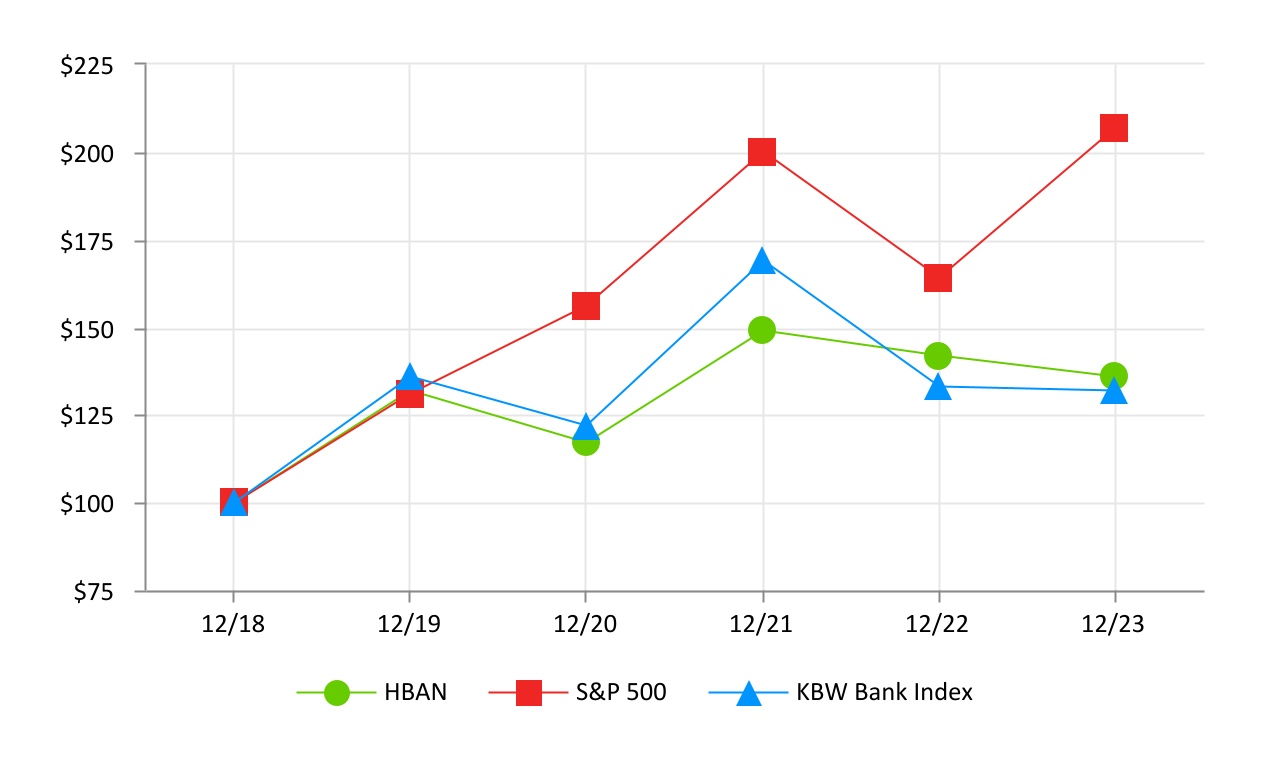
The following graph shows the changes, over the five-year period, in the value of $100 invested in (i) shares of Huntington’s Common Stock; (ii) the Standard & Poor’s 500 Stock Index (the S&P 500 Index) and (iii) Keefe, Bruyette & Woods Bank Index, for the period December 31, 2018, through December 31, 2023. The KBW Bank Index is a market capitalization-weighted bank stock index published by Keefe, Bruyette & Woods. The index is composed of the largest banking companies and includes all money center banks and many regional banks, including Huntington. An investment of $100 on December 31, 2018, and the reinvestment of all dividends, are assumed. The plotted points represent the cumulative total return on the last trading day of the fiscal year indicated.
| 2018 | 2019 | 2020 | 2021 | 2022 | 2023 | ||||||||||||||||||||||||||||||
| HBAN | $100 | $132 | $117 | $149 | $142 | $136 | |||||||||||||||||||||||||||||
| S&P 500 | 100 | 131 | 156 | 200 | 164 | 207 | |||||||||||||||||||||||||||||
| KBW Bank Index | 100 | 136 | 122 | 169 | 133 | 132 |
For information regarding securities authorized for issuance under Huntington’s equity compensation plans, see Part III, Item 12.
Item 6. [Reserved]
[Reserved]
2023 Form 10-K 43
Item 7. Management’s Discussion and Analysis of Financial Condition and Results of Operations
INTRODUCTION
This MD&A provides information we believe necessary for understanding our financial condition, changes in financial condition, results of operations, and cash flows. The MD&A should be read in conjunction with the Consolidated Financial Statements, Notes to Consolidated Financial Statements, and other information contained in this report. The forward-looking statements in this section and other parts of this report involve assumptions, risks, uncertainties, and other factors, including statements regarding our plans, objectives, goals, strategies, and financial performance. Our actual results could differ materially from the results anticipated in these forward-looking statements as a result of factors set forth under the caption “Forward-Looking Statements” and those set forth in Item 1A.
EXECUTIVE OVERVIEW
Acquisitions and Divestitures
In March 2023, Huntington completed the sale of the RPS business and entered into an ongoing partnership with the purchaser. The sale of our RPS business resulted in a $57 million gain including associated goodwill allocation, recorded within other noninterest income.
In June 2022, Huntington completed the acquisition of Capstone Partners, a top tier middle market investment bank and advisory firm. The transaction brings a national scale to serve middle market business owners throughout the corporate lifecycle, building on Huntington’s regional banking foundation. Capstone Partners related revenue, including mergers and acquisitions, capital raising and other advisory-related fees, is recognized within capital markets fees in the Consolidated Statements of Income. For further information, refer to Note 3 - “Business Combinations” of the Notes to Consolidated Financial Statements.
In May 2022, Huntington completed the acquisition of Torana, now known as Huntington ChoicePay, a digital payments business focused on business to consumer payments. This acquisition, along with the formation of our enterprise-wide payments group, reflects one of our strategic priorities to accelerate our payments capabilities and expand the services provided to our customers.
In June 2021, Huntington closed the acquisition of TCF Financial Corporation. TCF was a financial holding company headquartered in Detroit, Michigan with operations across the Midwest. The acquisition brought increased scale and market density, as well as added new markets and capabilities. Our operating results include the impact of TCF subsequent to the acquisition on June 9, 2021. For further information, refer to Note 3 - “Business Combinations” of the Notes to Consolidated Financial Statements.
Reporting Updates
During the fourth quarter of 2023, we updated the presentation of our noninterest income categories to align product and service types more closely with how we strategically manage our business. For a description of each updated noninterest income revenue stream refer to Note 15 - “Revenue from Contracts with Customers” of the Notes to the Consolidated Financial Statements.
During the fourth quarter of 2023, we revised our FTP methodology for non-maturity deposits, which has been enhanced to consider the internally modeled weighted average life by non-maturity deposit type. In general, the impact of the FTP methodology revision resulted in a higher cost of funds allocation as compared with the previous method.
To align with our strategic priorities, during the second quarter of 2023, we completed an organizational realignment and now report on two business segments: Consumer & Regional Banking and Commercial Banking. The Treasury / Other function includes technology and operations, and other unallocated assets, liabilities, revenue, and expense. Huntington’s business segments are based on our internally-aligned segment leadership structure, which is how management monitors results and assesses performance. The organizational realignment primarily involved consolidating our previously reported Consumer and Business Banking, Vehicle Finance and RBHPCG, into one new business segment called Consumer & Regional Banking.
44 Huntington Bancshares Incorporated
During the second quarter of 2023, we revised our process for assessing and monitoring the risk and performance of non-real estate secured commercial loans, primarily loans to REITs. These loans were reclassified from commercial real estate to the commercial and industrial loan category to align reporting with this process revision.
For the reporting updates discussed above, prior period results have been adjusted to conform to the current presentation.
2023 Financial Performance Review
Selected Financial Data
| Table 1 - Selected Year to Date Income Statement Data | |||||||||||||||||||||||||||||||||||||||||
| Year Ended December 31, | |||||||||||||||||||||||||||||||||||||||||
| Change from 2022 | Change from 2021 | ||||||||||||||||||||||||||||||||||||||||
| (amounts in millions, except per share data) | 2023 | Amount | Percent | 2022 | Amount | Percent | 2021 | ||||||||||||||||||||||||||||||||||
| Interest income | $ | 8,916 | $ | 2,947 | 49 | % | $ | 5,969 | $ | 1,778 | 42 | % | $ | 4,191 | |||||||||||||||||||||||||||
| Interest expense | 3,477 | 2,781 | 400 | 696 | 607 | 682 | 89 | ||||||||||||||||||||||||||||||||||
| Net interest income | 5,439 | 166 | 3 | 5,273 | 1,171 | 29 | 4,102 | ||||||||||||||||||||||||||||||||||
| Provision for credit losses | 402 | 113 | 39 | 289 | 264 | NM | 25 | ||||||||||||||||||||||||||||||||||
| Net interest income after provision for credit losses | 5,037 | 53 | 1 | 4,984 | 907 | 22 | 4,077 | ||||||||||||||||||||||||||||||||||
Showing the first 8K of 278K characters. Open the full section
Item 7A. Quantitative and Qualitative Disclosures About Market Risk
Information required by this item is set forth under the heading of “Market Risk” in Item 7: MD&A, which is incorporated by reference into this item.
Item 8. Financial Statements and Supplementary Data
Information required by this item is set forth in the Reports of Independent Registered Public Accounting Firm (PCAOB ID 238), Consolidated Financial Statements and Notes to Consolidated Financial Statements, which is incorporated by reference into this item.
88 Huntington Bancshares Incorporated
REPORT OF MANAGEMENT’S EVALUATION OF DISCLOSURE CONTROLS AND PROCEDURES
The Management of Huntington Bancshares Incorporated (Huntington or the Company) is responsible for the financial information and representations contained in the Consolidated Financial Statements and other sections of this report. The Consolidated Financial Statements have been prepared in conformity with accounting principles generally accepted in the United States. In all material respects, they reflect the substance of transactions that should be included based on informed judgments, estimates, and currently available information. Management maintains a system of internal accounting controls, which includes the careful selection and training of qualified personnel, appropriate segregation of responsibilities, communication of written policies and procedures, and a broad program of internal audits. The costs of the controls are balanced against the expected benefits. During 2023, the audit committee of the board of directors met regularly with Management, Huntington’s internal auditors, and the independent registered public accounting firm, PricewaterhouseCoopers LLP, to review the scope of their audits and to discuss the evaluation of internal accounting controls and financial reporting matters. The independent registered public accounting firm and the internal auditors have free access to, and meet confidentially with, the audit committee to discuss appropriate matters. Also, Huntington maintains a disclosure review committee. This committee’s purpose is to design and maintain disclosure controls and procedures to ensure that material information relating to the financial and operating condition of Huntington is properly reported to its chief executive officer, chief financial officer, chief auditor, and the audit committee of the board of directors in connection with the preparation and filing of periodic reports and the certification of those reports by the chief executive officer and the chief financial officer.
REPORT OF MANAGEMENT’S ASSESSMENT OF INTERNAL CONTROL OVER FINANCIAL REPORTING
Management is responsible for establishing and maintaining adequate internal control over financial reporting as such term is defined in Rules 13a-15(f) and 15d-15(f) of the Securities Exchange Act of 1934, as amended. Huntington’s Management assessed the effectiveness of the Company’s internal control over financial reporting as of December 31, 2023. In making this assessment, Management used the criteria set forth by the Committee of Sponsoring Organizations of the Treadway Commission (COSO) in Internal Control—Integrated Framework (2013). Based on that assessment, Management concluded that, as of December 31, 2023, the Company’s internal control over financial reporting is effective based on those criteria. The Company’s internal control over financial reporting as of December 31, 2023 has been audited by PricewaterhouseCoopers LLP, an independent registered public accounting firm, as stated in their report appearing on the next page.

Stephen D. Steinour – Chairman, President, and Chief Executive Officer

Zachary Wasserman – Senior Executive Vice President and Chief Financial Officer
February 16, 2024
2023 Form 10-K 89
Report of Independent Registered Public Accounting Firm
To the Board of Directors and Shareholders of
Huntington Bancshares Incorporated
Opinions on the Financial Statements and Internal Control over Financial Reporting
We have audited the accompanying consolidated balance sheets of Huntington Bancshares Incorporated and its subsidiaries (the “Company”) as of December 31, 2023 and 2022, and the related consolidated statements of income, of comprehensive income, of changes in shareholders' equity and of cash flows for each of the three years in the period ended December 31, 2023, including the related notes (collectively referred to as the “consolidated financial statements”). We also have audited the Company's internal control over financial reporting as of December 31, 2023, based on criteria established in Internal Control - Integrated Framework (2013) issued by the Committee of Sponsoring Organizations of the Treadway Commission (COSO).
In our opinion, the consolidated financial statements referred to above present fairly, in all material respects, the financial position of the Company as of December 31, 2023 and 2022, and the results of its operations and its cash flows for each of the three years in the period ended December 31, 2023 in conformity with accounting principles generally accepted in the United States of America. Also in our opinion, the Company maintained, in all material respects, effective internal control over financial reporting as of December 31, 2023, based on criteria established in Internal Control - Integrated Framework (2013) issued by the COSO.
Basis for Opinions
The Company's management is responsible for these consolidated financial statements, for maintaining effective internal control over financial reporting, and for its assessment of the effectiveness of internal control over financial reporting, included in the accompanying Report of Management's Assessment of Internal Control over Financial Reporting. Our responsibility is to express opinions on the Company’s consolidated financial statements and on the Company's internal control over financial reporting based on our audits. We are a public accounting firm registered with the Public Company Accounting Oversight Board (United States) (PCAOB) and are required to be independent with respect to the Company in accordance with the U.S. federal securities laws and the applicable rules and regulations of the Securities and Exchange Commission and the PCAOB.
We conducted our audits in accordance with the standards of the PCAOB. Those standards require that we plan and perform the audits to obtain reasonable assurance about whether the consolidated financial statements are free of material misstatement, whether due to error or fraud, and whether effective internal control over financial reporting was maintained in all material respects.
Our audits of the consolidated financial statements included performing procedures to assess the risks of material misstatement of the consolidated financial statements, whether due to error or fraud, and performing procedures that respond to those risks. Such procedures included examining, on a test basis, evidence regarding the amounts and disclosures in the consolidated financial statements. Our audits also included evaluating the accounting principles used and significant estimates made by management, as well as evaluating the overall presentation of the consolidated financial statements. Our audit of internal control over financial reporting included obtaining an understanding of internal control over financial reporting, assessing the risk that a material weakness exists, and testing and evaluating the design and operating effectiveness of internal control based on the assessed risk. Our audits also included performing such other procedures as we considered necessary in the circumstances. We believe that our audits provide a reasonable basis for our opinions.
90 Huntington Bancshares Incorporated
Definition and Limitations of Internal Control over Financial Reporting
A
Showing the first 8K of 401K characters. Open the full section
Item 9. Changes In and Disagreements With Accountants on Accounting and Financial Disclosure
None.
Item 9A. Controls and Procedures
Disclosure Controls and Procedures
Huntington maintains disclosure controls and procedures designed to ensure that the information required to be disclosed in the reports that it files or submits under the Securities Exchange Act of 1934, as amended (the Exchange Act), are recorded, processed, summarized, and reported within the time periods specified in the SEC’s rules and forms. Disclosure controls and procedures include, without limitation, controls and procedures designed to ensure that information required to be disclosed by an issuer in the reports that it files or submits under the Exchange Act is accumulated and communicated to the issuer’s management, including its principal executive and principal financial officers, or persons performing similar functions, as appropriate to allow timely decisions regarding required disclosure. Huntington’s management, with the participation of its Chief Executive Officer and the Chief Financial Officer, evaluated the effectiveness of Huntington’s disclosure controls and procedures (as such term is defined in Rules 13a-15(e) and 15d-15(e) under the Exchange Act) as of December 31, 2023. Based upon such evaluation, Huntington’s Chief Executive Officer and Chief Financial Officer have concluded that, as of December 31, 2023, Huntington’s disclosure controls and procedures were effective.
Internal Control Over Financial Reporting
Information required by this item is set forth in the Report of Management’s Assessment of Internal Control over Financial Reporting and the Report of Independent Registered Public Accounting Firm.
Changes in Internal Control Over Financial Reporting
There have not been any changes in our internal control over financial reporting (as such term is defined in Rules 13a-15(f) and 15d-15(f) under the Exchange Act) during the quarter ended December 31, 2023, that have materially affected, or are reasonably likely to materially affect, internal control over financial reporting.
Item 9B. Other Information
Trading Plans
On November 20, 2023, Julie C. Tutkovics, our Chief Marketing and Communications Officer, adopted a trading plan intended to satisfy the conditions under Rule 10b5-1(c) of the Exchange Act. Ms. Tutkovics’ plan is for the sale of up to 178,395 shares of our common stock in amounts and prices determined in accordance with formulae set forth in the plan and terminates on the earlier of the date all the shares under the plan are sold and November 4, 2024.
Item 9C. Disclosure Regarding Foreign Jurisdictions that Prevent Inspections.
Not applicable.
PART III
We refer in Part III of this report to relevant sections of our 2024 Proxy Statement for the 2024 Annual Meeting of shareholders, which will be filed with the SEC pursuant to Regulation 14A within 120 days of the close of our 2023 fiscal year. Portions of our 2024 Proxy Statement, including the sections we refer to in this report, are incorporated by reference into this report.
Item 10. Directors, Executive Officers, and Corporate Governance
Information required by this item is set forth under the captions Election of Directors, Our Executive Officers, Family Relationships, Delinquent Section 16(a) Reports, Codes of Ethics, Proposals by Shareholders for the 2024 Annual Meeting, Recommendations for Directorship, and Board Committee Information of our 2024 Proxy Statement, which is incorporated by reference into this item.
2023 Form 10-K 160
Item 11. Executive Compensation
Information required by this item is set forth under the captions Compensation of Executive Officers and Compensation of Directors of our 2024 Proxy Statement, which is incorporated by reference into this item.
Item 12. Security Ownership of Certain Beneficial Owners and Management and Related Stockholder Matters
The following table sets forth information about Huntington common stock authorized for issuance under Huntington’s existing equity compensation plans as of December 31, 2023.
| Plan Category (1) | Number of securities to be issued upon exercise of outstanding options, warrants, and rights (2)(3) (a) | Weighted-average exercise price of outstanding options, warrants, and rights (4) (b) | Number of securities remaining available for future issuance under equity compensation plans (excluding securities reflected in column (a)) (5) (c) | |||||||||||||||||
| Equity compensation plans approved by security holders | 34,359,531 | $ | 4.53 | 14,508,872 | ||||||||||||||||
| Equity compensation plans not approved by security holders | — | — | — | |||||||||||||||||
| Total | 34,359,531 | $ | 4.53 | 14,508,872 |
(1)All equity compensation plan authorizations for shares of common stock provide for the number of shares to be adjusted for stock splits, stock dividends, and other changes in capitalization. The Huntington 401(k) Plan, a broad-based plan qualified under Internal Revenue Code Section 401(a) which includes Huntington common stock as one of a number of investment options available to participants, is excluded from the table.
(2)The numbers in this column (a) reflect shares of common stock to be issued upon exercise of outstanding stock options and the vesting of outstanding awards of restricted stock awards, restricted share units, and performance share units, and the release of deferred share units.
(3)As of December 31, 2023, an additional 991,178 common shares, at a weighted-average exercise price of $7.07, are to be issued upon exercise or vesting under the TCF Incentive Plan, which was assumed in the acquisition of TCF, is no longer active, and for which Huntington has not reserved the right to make subsequent grants or awards.
(4)The weighted-average exercise prices in this column are based on outstanding options and do not take into account unvested awards of restricted stock awards, restricted stock units and performance share units and unreleased deferred share units as these awards do not have an exercise price.
(5)The number of shares in this column (c) reflects the number of shares remaining available for future issuance under Huntington’s 2018 Plan, excluding shares reflected in column (a). The number of shares in this column (c) does not include shares of common stock to be issued under the following compensation plans: the Executive Deferred Compensation Plan, which provides senior officers designated by the Human Resources and Compensation Committee the opportunity to defer up to 90% of base salary, annual bonus compensation and certain equity awards, and up to 90% of long-term incentive awards; the Supplemental Plan under which voluntary participant contributions made by payroll deduction are used to purchase shares; the Deferred Compensation for Huntington Bancshares Incorporated Directors under which directors may defer their director compensation and such amounts may be invested in shares of common stock; and the Deferred Compensation Plan for directors (now inactive) under which directors of selected subsidiaries may defer their director compensation and such amounts may be invested in shares of Huntington common stock. These plans do not contain a limit on the number of shares that may be issued under them.
The information related to item 403 of regulation S-K is set forth under the caption Ownership of Voting Stock of our 2024 Proxy Statement, which is incorporated by reference into this item.
Item 13. Certain Relationships and Related Transactions, and Director Independence
Information required by this item is set forth under the captions Review, Approval, or Ratification of Transactions with Related Persons and Independence of Directors of our 2024 Proxy Statement, which are incorporated by reference into this item.
Item 14. Principal Accounting Fees and Services
Information required by this item is set forth under the caption Audit Matters of our 2024 Proxy Statement which is incorporated by reference into this item.
161 Huntington Bancshares Incorporated
PART IV
Item 15. Exhibits and Financial Statement Schedules
Financial Statements and Financial Statement Schedules
Our consolidated financial statements required in response to this Item are incorporated by reference from Item 8 of this Report.
Exhibits
Our exhibits listed on the Exhibit Index of this Form 10-K are filed with this Report or are incorporated herein by reference.
Item 16. 10-K Summary
Not applicable.
2023 Form 10-K 162
Exhibit Index
This report incorporates by reference the documents listed below that we have previously filed with the SEC. The SEC allows us to incorporate by reference information in this document. The information incorporated by reference is considered to be a part of this document, except for any information that is superseded by information that is included directly in this document.
The SEC maintains an Internet web site that contains reports, proxy statements, and other information about issuers, like us, who file electronically with the SEC. The address of the site is http://www.sec.gov. The reports and other information filed by us with the SEC are also available free of charge at our Internet web site. The address of the site is http://www.huntington.com. Except as specifically incorporated by reference into this Annual Report on Form 10-K, information on those web sites is not part of this report. You also should be able to inspect reports, proxy statements, and other information about us at the offices of the Nasdaq National Market at 33 Whitehall Street, New York, New York 10004.
163 Huntington Bancshares Incorporated
2023 Form 10-K 164
165 Huntington Bancshares Incorporated
Signatures
Pursuant to the requirements of Section 13 or 15(d) of the Securities Exchange Act of 1934, the Registrant has duly caused this report to be signed on its behalf by the undersigned, thereunto duly authorized, on the 16th Day of February, 2024.
HUNTINGTON BANCSHARES INCORPORATED
(Registrant)
| By: | /s/ Stephen D. Steinour | By: | /s/ Zachary Wasserman | |||||||||||||||||
| Stephen D. Steinour | Zachary Wasserman | |||||||||||||||||||
| Chairman, President, Chief Executive | Chief Financial Officer | |||||||||||||||||||
| Officer, and Director (Principal Executive Officer) | (Principal Financial Officer) | |||||||||||||||||||
| By: | /s/ Nancy E. Maloney | |||||||||||||||||||
| Nancy E. Maloney | ||||||||||||||||||||
| Executive Vice President, Controller | ||||||||||||||||||||
| (Principal Accounting Officer) |
Pursuant to the requirements of the Securities Exchange Act of 1934, this report has been signed below by the following persons on behalf of the Registrant and in the capacities indicated on the 16th Day of February, 2024.
| Alanna Y. Cotton * | |||||
| Alanna Y. Cotton | |||||
| Director | |||||
| Ann B. Crane * | |||||
| Ann B. Crane | |||||
| Director | |||||
| Gina D. France * | |||||
| Gina D. France | |||||
| Director | |||||
| Rafael Andres Diaz-Granados * | |||||
| Rafael Andres Diaz-Granados | |||||
| Director | |||||
| J. Michael Hochschwender * | |||||
| J. Michael Hochschwender | |||||
| Director | |||||
| John C. Inglis * | |||||
| John C. Inglis | |||||
| Director | |||||
2023 Form 10-K 166
| Richard H. King * | |||||
| Richard H. King | |||||
| Director | |||||
| Katherine M.A. Kline * | |||||
| Katherine M.A. Kline | |||||
| Director | |||||
| Richard W. Neu * | |||||
| Richard W. Neu | |||||
| Director | |||||
| Kenneth J. Phelan * | |||||
| Kenneth J. Phelan | |||||
| Director | |||||
| David L. Porteous * | |||||
| David L. Porteous | |||||
| Director | |||||
| Roger J. Sit * | |||||
| Roger J. Sit | |||||
| Director | |||||
| Jeffrey L. Tate * | |||||
| Jeffrey L. Tate | |||||
| Director | |||||
| Gary Torgow * | |||||
| Gary Torgow | |||||
| Director | |||||
| */s/ Marcy C. Hingst | |||||
| Marcy C. Hingst | |||||
| Attorney-in-fact for each of the persons indicated |
167 Huntington Bancshares Incorporated