 filings.tools
HCA Healthcare 10-K 2023-12-31
Filed 2024-02-16. 24 sections, 556K characters. Original on sec.gov · Markdown · JSON
Cover and table of contents
UNITED STATES
SECURITIES AND EXCHANGE COMMISSION
Washington, D.C. 20549
Form 10-K
(Mark One)
☒ ANNUAL REPORT PURSUANT TO SECTION 13 OR 15(d) OF THE SECURITIES EXCHANGE ACT OF 1934
For the fiscal year ended December 31**,** 2023
Or
☐ TRANSITION REPORT PURSUANT TO SECTION 13 OR 15(d) OF THE SECURITIES EXCHANGE ACT OF 1934
For the transition period from to
Commission File Number 1-11239
HCA Healthcare, Inc.
(Exact Name of Registrant as Specified in its Charter)
| Delaware | 27-3865930 |
| (State or Other Jurisdiction of Incorporation or Organization) | (I.R.S. Employer Identification No.) |
| One Park Plaza Nashville**,** Tennessee | 37203 |
| (Address of Principal Executive Offices) | (Zip Code) |
Registrant’s telephone number, including area code: (615) 344-9551
Securities Registered Pursuant to Section 12(b) of the Act:
| Title of Each Class | Trading Symbol(s) | Name of Each Exchange on Which Registered |
| Common Stock, $0.01 Par Value | HCA | New York Stock Exchange |
Securities Registered Pursuant to Section 12(g) of the Act: None
Indicate by check mark if the Registrant is a well-known seasoned issuer, as defined in Rule 405 of the Securities Act. Yes ☒ No ☐
Indicate by check mark if the Registrant is not required to file reports pursuant to Section 13 or Section 15(d) of the Act. Yes ☐ No ☒
Indicate by check mark whether the Registrant (1) has filed all reports required to be filed by Section 13 or 15(d) of the Securities Exchange Act of 1934 during the preceding 12 months (or for such shorter period that the Registrant was required to file such reports), and (2) has been subject to such filing requirements for the past 90 days. Yes ☒ No ☐
Indicate by check mark whether the Registrant has submitted electronically every Interactive Data File required to be submitted pursuant to Rule 405 of Regulation S-T (§ 232.405 of this chapter) during the preceding 12 months (or for such shorter period that the Registrant was required to submit such files). Yes ☒ No ☐
Indicate by check mark whether the Registrant is a large accelerated filer, an accelerated filer, a non-accelerated filer, a smaller reporting company, or an emerging growth company. See the definitions of “large accelerated filer,” “accelerated filer,” “smaller reporting company” and “emerging growth company” in Rule 12b-2 of the Exchange Act.
| Large accelerated filer | ☒ | Accelerated filer | ☐ |
| Non-accelerated filer | ☐ | Smaller reporting company | ☐ |
| Emerging growth company | ☐ |
If an emerging growth company, indicate by check mark if the Registrant has elected not to use the extended transition period for complying with any new or revised financial accounting standards provided pursuant to Section 13(a) of the Exchange Act. ☐
Indicate by check mark whether the Registrant has filed a report on and attestation to its management’s assessment of the effectiveness of its internal control over financial reporting under Section 404(b) of the Sarbanes-Oxley Act (15 U.S.C. 7262(b)) by the registered public accounting firm that prepared or issued its audit report. ☒
If securities are registered pursuant to Section 12(b) of the Act, indicate by check mark whether the financial statements of the registrant included in the filing reflect the correction of an error to previously issued financial statements. ☐
Indicate by check mark whether any of those error corrections are restatements that required a recovery analysis of incentive-based compensation received by any of the registrant’s executive officers during the relevant recovery period pursuant to §240.10D-1(b). ☐
Indicate by check mark whether the Registrant is a shell company (as defined in Rule 12b-2 of the Act). Yes ☐ No ☒
| Auditor PCAOB ID Number: 42 | Auditor Name: Ernst & Young LLP | Auditor Location: Nashville, Tennessee, United States of America |
As of January 31, 2024, there were 264,498,700 outstanding shares of the Registrant’s common stock. As of June 30, 2023, the aggregate market value of the common stock held by nonaffiliates was approximately $61.126 billion. For purposes of the foregoing calculation only, Hercules Holding II and the Registrant’s directors and executive officers have been deemed to be affiliates.
DOCUMENTS INCORPORATED BY REFERENCE
Portions of the Registrant’s definitive proxy materials for its 2024 Annual Meeting of Stockholders are incorporated by reference into Part III hereof.
INDEX
PART I
Item 1. Business
General
HCA Healthcare, Inc. is one of the leading health care services companies in the United States. At December 31, 2023, we operated 186 hospitals, comprised of 178 general, acute care hospitals; six behavioral hospitals; and two rehabilitation hospitals. In addition, we operated 124 freestanding surgery centers and 24 freestanding endoscopy centers. Our facilities are located in 20 states and England.
The terms “Company,” “HCA,” “HCA Healthcare,” “we,” “our” or “us,” as used herein and unless otherwise stated or indicated by context, refer to HCA Healthcare, Inc. and its affiliates. The term “affiliates” means direct and indirect subsidiaries of HCA Healthcare, Inc. and partnerships and joint ventures in which such subsidiaries are partners. The terms “facilities” or “hospitals” refer to entities owned and operated by affiliates of HCA, and the term “employees” refers to employees of affiliates of HCA.
Our primary objective is to provide a comprehensive array of quality health care services in the most cost-effective manner possible. Our general, acute care hospitals typically provide a full range of services to accommodate such medical specialties as internal medicine, general surgery, cardiology, oncology, neurosurgery, orthopedics and obstetrics, as well as diagnostic and emergency services. Outpatient and ancillary health care services are provided by our general, acute care hospitals, freestanding surgery centers, freestanding emergency care facilities, urgent care facilities, walk-in clinics, diagnostic centers and rehabilitation facilities. Our behavioral hospitals provide a full range of mental health care services through inpatient, partial hospitalization and outpatient settings.
Our common stock is traded on the New York Stock Exchange (symbol “HCA”). Through our predecessors, we commenced operations in 1968. HCA Healthcare, Inc. was incorporated in Delaware in October 2010. Our principal executive offices are located at One Park Plaza, Nashville, Tennessee 37203, and our telephone number is (615) 344-9551.
Available Information
We file certain reports with the Securities and Exchange Commission (the “SEC”), including annual reports on Form 10-K, quarterly reports on Form 10-Q and current reports on Form 8-K. The SEC maintains an Internet site at http://www.sec.gov that contains the reports, proxy and information statements and other information we file. Our website address is www.hcahealthcare.com. Please note that our website address is provided throughout this report as an inactive textual reference only. We make available free of charge, through our website, our annual report on Form 10-K, quarterly reports on Form 10-Q, current reports on Form 8-K and all amendments to those reports filed or furnished pursuant to Section 13 or 15(d) of the Exchange Act, as soon as reasonably practicable after such material is electronically filed with or furnished to the SEC. The information provided on our website is not part of this report, and is therefore not incorporated by reference unless such information is specifically referenced elsewhere in this report.
Our Code of Conduct is available free of charge upon request to our Investor Relations Department, HCA Healthcare, Inc., One Park Plaza, Nashville, Tennessee 37203, and is also available on the Ethics and Compliance and Corporate Governance portion of our website at www.hcahealthcare.com.
Business Strategy
We are committed to providing the communities we serve with high quality, convenient and cost-effective health care while growing our business and creating long-term value for our stockholders. We strive to be the health care system of choice in the communities we serve by developing comprehensive networks locally and supporting these networks with enterprise expertise and economies of scale. Our strategy is organized around a framework that seeks to drive sustained growth by delivering operational excellence, attracting exceptional physicians and other health care professionals, developing comprehensive services; creating greater access, and coordinating higher quality care for patients.
To achieve these objectives, we align our efforts around the following growth agenda:
grow our presence in existing markets;
achieve industry-leading performance in clinical, operational and satisfaction measures;
recruit and retain physicians and other health care professionals to meet the need for high quality health services;
continue to utilize economies of scale to grow the Company; and
pursue a disciplined development strategy.
Our strategy also emphasizes investments that seek to advance our clinical systems and digital capabilities, transform care models with innovative care solutions, expand our workforce development programs and enhance our health care networks and partnerships.
Health Care Facilities
We currently own, manage or operate hospitals, freestanding surgery centers, freestanding emergency care facilities, urgent care facilities, walk-in clinics, diagnostic and imaging centers, radiation and oncology therapy centers, comprehensive rehabilitation and physical therapy centers, physician practices, home health, hospice, outpatient physical therapy home and community-based services providers, and various other facilities.
At December 31, 2023, we owned and operated 178 general, acute care hospitals with 48,755 licensed beds. Most of our general, acute care hospitals provide medical and surgical services, including inpatient care, intensive care, cardiac care, diagnostic services and emergency services. The general, acute care hospitals also provide outpatient services such as outpatient surgery, laboratory, radiology, respiratory therapy, cardiology and physical therapy. Each hospital has an organized medical staff and a local board of trustees or governing board comprised of members of the local community.
At December 31, 2023, we operated six behavioral hospitals with 653 licensed beds. Our behavioral hospitals provide therapeutic programs, including child, adolescent and adult psychiatric care and adolescent and adult alcohol and drug abuse treatment and counseling.
We also operate outpatient health care facilities, which include freestanding ambulatory surgery centers (“ASCs”), freestanding emergency care facilities, urgent care facilities, walk-in clinics, diagnostic and imaging centers, comprehensive rehabilitation and physical therapy centers, radiation and oncology therapy centers, physician practices and various other facilities. These outpatient services are an integral component of our strategy to develop comprehensive health care networks in select communities. Most of our ASCs are operated through partnerships or limited liability companies, with majority ownership of each partnership or limited liability company typically held by a general partner or member that is an affiliate of HCA.
Certain of our affiliates provide a variety of management services to our health care facilities, including patient safety programs, ethics and compliance programs, national supply contracts, equipment purchasing and leasing contracts, accounting, financial and clinical systems, governmental reimbursement assistance, construction planning and coordination, information technology systems and solutions, legal counsel, human resources services and internal audit services.
Summary Risk Factors
You should carefully read and consider the risk factors set forth under Item 1A, “Risk Factors,” as well as all other information contained in this annual report on Form 10-K. Additional risks and uncertainties not presently known to us or that we currently deem immaterial may also affect us. If any of these risks occur, our business, financial position, results of operations, cash flows or prospects could be materially, adversely affected. Our business is subject to the following principal risks and uncertainties:
Risks related to our i
Showing the first 8K of 159K characters. Open the full section
Item 1A. Risk Factors
If any of the events discussed in the following risk factors were to occur, our business, financial position, results of operations, cash flows or prospects could be materially, adversely affected. Additional risks and uncertainties not presently known to us or that we currently deem immaterial may also affect us. Our business is subject to the following material risks and uncertainties.
Risks related to our indebtedness:
We have significant indebtedness and may incur further indebtedness in the future. Our indebtedness could adversely affect our ability to raise additional capital to fund our operations, limit our ability to react to changes in the economy or our industry, expose us to interest rate risk to the extent of our variable rate debt and prevent us from meeting our obligations.
As of December 31, 2023, our total indebtedness was $39.593 billion. As of December 31, 2023, we had availability of $3.487 billion under our senior secured cash flow credit facility and $2.620 billion under our senior secured asset-based revolving credit facility, after giving effect to letters of credit and borrowing base limitations. Our indebtedness could have important consequences, including:
increasing our vulnerability to downturns or adverse changes in general economic, industry or competitive conditions and adverse changes in government regulations;
requiring a portion of cash flows from operations to be dedicated to the payment of principal and interest on our indebtedness, therefore reducing our ability to use our cash flows to fund our operations, capital expenditures and future business opportunities;
exposing us to the risk of increased interest rates on our existing borrowings that are at variable rates of interest or refinancing our debt in a rising or high rate environment;
limiting our ability to make strategic acquisitions or causing us to make nonstrategic divestitures;
limiting our ability to obtain additional financing for working capital, capital expenditures, share repurchases, dividends, product or service line development, debt service requirements, acquisitions and general corporate or other purposes; and
limiting our ability to adjust to changing market conditions and placing us at a competitive disadvantage compared to our competitors who have less debt.
We and our subsidiaries have the ability to incur additional indebtedness in the future, subject to the restrictions contained in our senior secured credit facilities and the indentures governing our outstanding notes. If new indebtedness is added to our current debt levels, interest rates and the related risks that we now face could intensify.
We may not be able to generate sufficient cash to service all of our indebtedness and may not be able to refinance our indebtedness on favorable terms. If we are unable to do so, we may be forced to take other actions to satisfy our obligations under our indebtedness, which may not be successful.
Our ability to make scheduled payments on or to refinance our debt obligations depends on our financial condition and operating performance, which are subject to prevailing economic and competitive conditions and to certain financial, business and other factors beyond our control. We cannot guarantee we will maintain a level of cash flows from operating activities sufficient to permit us to pay the principal, premium, if any, and interest on our indebtedness.
In addition, we conduct our operations through our subsidiaries. Accordingly, repayment of our indebtedness is dependent on the generation of cash flows by our subsidiaries and their ability to make such cash available to us by dividend, debt repayment or otherwise. Our subsidiaries may not be able to, or may not be permitted to, make distributions to enable us to make payments in respect of our indebtedness. Each subsidiary is a distinct legal entity, and, under certain circumstances, legal and contractual restrictions may limit our ability to obtain cash from our subsidiaries.
We may find it necessary or prudent to refinance our outstanding indebtedness, the terms of which may not be favorable to us. Our ability to refinance our indebtedness on favorable terms, or at all, is directly affected by the then current global economic and financial conditions which affect the availability of debt financing and the rates at which such financing is available. In addition, our ability to incur secured indebtedness depends in part on the value of our assets, which depends, in turn, on the strength of our cash flows and results of operations, and on economic and market conditions and other factors.
If our cash flows and capital resources are insufficient to fund our debt service obligations or we are unable to refinance our indebtedness, we may be forced to reduce or delay investments and capital expenditures, or to sell assets, seek additional capital or restructure our indebtedness. These alternative measures may not be successful and may not permit us to meet our scheduled debt service obligations. If our operating results and available cash are insufficient to meet our debt service obligations, we could face substantial liquidity problems and might be required to dispose of material assets or operations to meet our debt service and other obligations. We may not be able to consummate those dispositions, or the proceeds from the dispositions may not be adequate to meet any debt service obligations then due.
Our debt agreements contain restrictions that limit our flexibility in operating our business.
Our senior secured credit facilities and, to a lesser extent, the indentures governing our outstanding notes contain various covenants that limit our ability to engage in specified types of transactions. These covenants limit our and certain of our subsidiaries’ ability to, among other things:
incur additional indebtedness or issue certain preferred shares;
pay dividends on, repurchase or make distributions in respect of our capital stock or make other restricted payments;
make certain investments;
sell or transfer assets;
create liens;
consolidate, merge, sell or otherwise dispose of all or substantially all of our assets; and
enter into certain transactions with our affiliates.
Under our asset-based revolving credit facility, borrowing availability is subject to a borrowing base of 85% of eligible accounts receivable less customary reserves, with any reduction in the borrowing base that results in the borrowing base falling below the amount committed by the lenders thereunder commensurately reducing our ability to access this facility as a source of liquidity. In addition, under the asset-based revolving credit facility, when (and for as long as) the combined availability under our asset-based revolving credit facility and the revolving facility under our senior secured cash flow credit facility is less than a specified amount for a certain period of time or, if a payment or bankruptcy event of default has occurred and is continuing, funds deposited into any of our depository accounts will be transferred on a daily basis into a blocked account with the administrative agent and applied to prepay loans under the asset-based revolving credit facility and to collateralize letters of credit issued thereunder.
Under our senior secured credit facilities, we are required to satisfy and maintain specified financial ratios. Our ability to meet those financial ratios may be affected by global economic and financial conditions or other events beyond our control, and there can be no assurance we will continue to meet those ratios. A breach of this or any other covenant could result in a default under both the cash flow credit facility and the asset-based revolving credit facility. Upon the occurrence of an event of default under these senior secured credit facilities, the lenders thereunder could elect to declare
all amounts outstan
Showing the first 8K of 101K characters. Open the full section
Item 1B. Unresolved Staff Comments
None.
Item 1C. Cybersecurity
Management is responsible for the day-to-day handling of risks facing our Company, while the Board of Directors, as a whole and through its committees, oversees risk management, including cybersecurity risks. The Board has delegated certain risk management responsibilities with respect to cybersecurity to our Audit and Compliance Committee.
The Audit and Compliance Committee periodically reviews our data security programs, including cybersecurity, and reviews our programs and plans that management has established to monitor compliance with data security compliance programs and test preparedness. The Audit and Compliance Committee also receives reports regarding risks associated with our data security programs and management’s plans for monitoring and testing compliance with data security regulations.
The Audit and Compliance Committee meetings take place on a quarterly basis and include a report from our Chief Security Officer ("CSO") regarding our security programs, including (i) the status on activities under way to support our security strategy, (ii) an overview of the current threat landscape, including emerging threats and trends that may affect us, (iii) key performance measures of security operations, and (iv) general security program needs. The security program includes cybersecurity, privacy, physical security and information security risk management. Our senior security leadership team has an average of 20 years of data security experience, and each member has served in multiple roles within our security programs.
We seek to leverage a comprehensive risk management program that encompasses a structured approach to assess, identify, and manage cyber and information security risks. The internal processes for these activities are evaluated for alignment with our objectives and overall risk tolerance. This approach is consistent with our overall risk management efforts. The CSO participates with other senior officers, including the Chief Executive Officer, Chief Information Officer, Chief Financial Officer, Chief Legal Officer, Chief Ethics and Compliance Officer and others on our risk management committee, which develops and coordinates enterprise cybersecurity policy and strategy, and provides guidance to senior management.
We utilize cross-functional teams and risk assessment tools and technologies to identify potential cyber and information security threats and risks. These teams include representatives from various departments within our Company
to promote a holistic view of the organization’s cyber and information security risk landscape and to facilitate communication. We have implemented multiple layers of security measures designed to protect the confidentiality, integrity and availability of our data and the systems and devices that store and transmit such data. We also seek to embed security measures into software and system development processes and to use current security technologies. In addition, we engage third parties to actively monitor potential threats as well as our security defenses. The risk landscape is assessed to determine the likelihood and potential impact of identified risks. This assessment involves a combination of qualitative and quantitative analyses to help prioritize identified risks and determine the appropriate risk treatment. The effectiveness of the cyber and information security program is tested through a combination of internal and external assessments. Updates are provided to senior management and the Audit and Compliance Committee for informed decision-making and are integrated into our broader enterprise risk management processes.
We also seek to oversee and identify potential cyber and information security threats and risks relating to suppliers and third-party service providers. These efforts may include due diligence to assess the party’s cybersecurity practices, controls, and compliance with relevant statutes and regulations; the use of contractual agreements that outline certain cybersecurity requirements; and using outside services to perform ongoing monitoring of select suppliers and third-party service providers. We may also collaborate with third-party suppliers to develop and align incident response plans.
No risks from cybersecurity threats or previous cybersecurity incidents have materially affected our business strategy, results of operations, or financial condition. However, there can be no assurance that our controls and procedures in place to monitor and mitigate the risks of cyber threats, including the remediation of critical information security and software vulnerabilities, will be sufficient and/or timely and that we will not suffer material losses or consequences in the future. Additionally, while we have in place insurance coverage designed to address certain aspects of cyber risks, such insurance coverage may be insufficient to cover all insured losses or all types of claims that may arise.
Item 2. Properties
The following table lists, by state, the number of hospitals (general, acute care, behavioral and rehabilitation) directly or indirectly owned and operated by us as of December 31, 2023:
| State | Hospitals | Beds | ||||||
| Alaska | 1 | 250 | ||||||
| California | 5 | 1,895 | ||||||
| Colorado | 7 | 2,494 | ||||||
| Florida | 46 | 13,142 | ||||||
| Georgia | 5 | 1,543 | ||||||
| Idaho | 2 | 454 | ||||||
| Indiana | 1 | 278 | ||||||
| Kansas | 4 | 1,432 | ||||||
| Kentucky | 2 | 384 | ||||||
| Louisiana | 1 | 380 | ||||||
| Missouri | 5 | 1,080 | ||||||
| Nevada | 3 | 1,524 | ||||||
| New Hampshire | 3 | 432 | ||||||
| North Carolina | 7 | 1,219 | ||||||
| South Carolina | 4 | 1,024 | ||||||
| Tennessee | 14 | 2,752 | ||||||
| Texas | 50 | 14,025 | ||||||
| Utah | 8 | 1,057 | ||||||
| Virginia | 11 | 3,335 | ||||||
| International | ||||||||
| England | 7 | 888 | ||||||
| 186 | 49,588 |
In addition to the hospitals listed in the above table, we directly or indirectly operate 124 freestanding surgery centers and 24 freestanding endoscopy centers. We also operate medical office buildings in conjunction with some of our hospitals. These office buildings are primarily occupied by physicians who practice at our hospitals. Twelve of our general, acute care hospitals and five of our other properties have been mortgaged to support our obligations under our senior secured cash flow credit facility.
We maintain our headquarters in approximately 2,031,000 square feet of space in the Nashville, Tennessee area. In addition to the headquarters in Nashville, we maintain regional service centers related to our shared services initiatives. These service centers are located in markets in which we operate hospitals.
We believe our headquarters, hospitals and other facilities are suitable for their respective uses and are, in general, adequate for our present needs. Our properties are subject to various federal, state and local statutes and ordinances regulating their operation. Management does not believe that compliance with such statutes and ordinances will materially affect our financial position or results of operations.
Item 3. Legal Proceedings
The information set forth in Note 10 – Contingencies in the notes to the consolidated financial statements is incorporated herein by reference.
In addition, the following matter is being disclosed pursuant to Item 103 of Regulation S-K because it relates to environmental regulations and the Company believes monetary sanctions could exceed $300,000.
In December 2023, an affiliate of the Company was notified of an investigation conducted by District Attorneys in four counties in California regarding the waste disposal practices of the Company’s California facilities and alleging violations of certain state environmental and other laws. The Company is responding to requests for information from the District Attorneys and is assessing the allegations and underlying facts. Based on the information known at this time, the Company does not believe this matter will materially impact the Company.
Item 4. Mine Safety Disclosures
None.
PART II
Item 5. . Market for Registrant’s Common Equity, Related Stockholder Matters and Issuer Purchases of Equity Securities
During January 2022, January 2023 and January 2024, our Board of Directors authorized share repurchase programs for up to $8 billion, $3 billion and $6 billion, respectively, of the Company’s outstanding common stock. The January 2022 authorization was completed during 2023, and at December 31, 2023, there was $775 million of share repurchase authorization that remained available under the January 2023 authorization. All repurchases made during the fourth quarter of 2023, as detailed below, were made pursuant to the January 2023 share repurchase authorization and were made in the open market.
The following table provides certain information with respect to our repurchases of common stock from October 1, 2023 through December 31, 2023 (dollars in millions, except per share amounts).
| Period | Total Number of Shares Purchased | Average Price Paid per Share | Total Number of Shares Purchased as Part of Publicly Announced Plans or Programs | Approximate Dollar Value of Shares That May Yet Be Purchased Under Publicly Announced Plans or Programs | ||||||||||||
| October 2023 | 1,474,715 | $ | 244.12 | 1,474,715 | $ | 1,325 | ||||||||||
| November 2023 | 904,304 | $ | 243.29 | 904,304 | $ | 1,105 | ||||||||||
| December 2023 | 1,268,054 | $ | 260.25 | 1,268,054 | $ | 775 | ||||||||||
| Total for Fourth Quarter 2023 | 3,647,073 | $ | 249.52 | 3,647,073 |
Our common stock is traded on the New York Stock Exchange (“NYSE”) (symbol “HCA”). During 2023, our Board of Directors declared four quarterly dividends of $0.60 per share, or $2.40 per share in the aggregate, on our common stock. On January 29, 2024, our Board of Directors declared a quarterly dividend of $0.66 per share on our common stock payable on March 29, 2024 to stockholders of record at the close of business on March 15, 2024. Future declarations of quarterly dividends and the establishment of future record and payment dates are subject to the final determination of our Board of Directors. Our ability to declare future dividends may also from time to time be limited by the terms of our debt agreements. At the close of business on February 1, 2024, there were approximately 420 holders of record of our common stock.
STOCK PERFORMANCE GRAPH
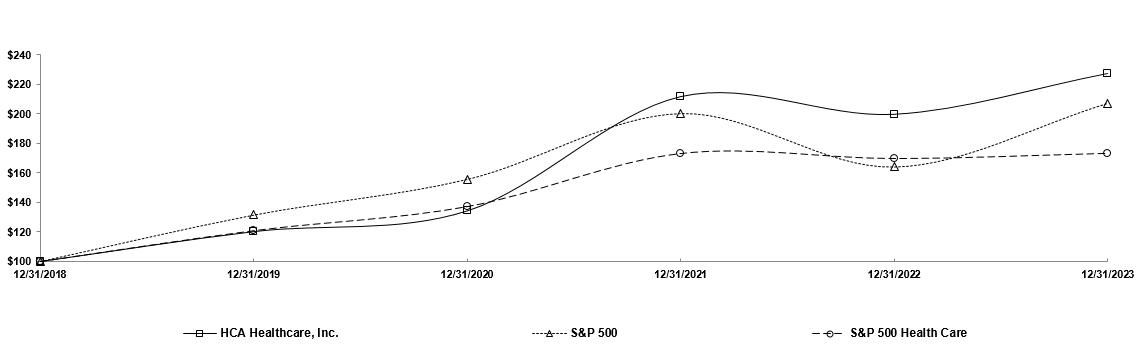
COMPARISON OF 5 YEAR CUMULATIVE TOTAL RETURN
Among HCA Healthcare, Inc., the S&P 500 Index and the S&P Health Care Index
| 12/31/2018 | 12/31/2019 | 12/31/2020 | 12/31/2021 | 12/31/2022 | 12/31/2023 | |||||||||||||||||||
| HCA Healthcare, Inc. | $ | 100.00 | $ | 120.25 | $ | 134.25 | $ | 211.56 | $ | 199.61 | $ | 227.19 | ||||||||||||
| S&P 500 | 100.00 | 131.49 | 155.68 | 200.37 | 164.08 | 207.21 | ||||||||||||||||||
| S&P Health Care | 100.00 | 120.82 | 137.07 | 172.89 | 169.51 | 172.99 |
The graph shows the cumulative total return to our stockholders for the five-year period ended December 31, 2023, in comparison to the cumulative returns of the S&P 500 Index and the S&P Health Care Index. The graph assumes $100 invested on December 31, 2018 in our common stock and in each index with the subsequent reinvestment of dividends. The stock performance shown on the graph represents historical stock performance and is not necessarily indicative of future stock price performance.
Item 6. . [Reserved]
HCA HEALTHCARE, INC.
MANAGEMENT'S DISCUSSION AND ANALYSIS OF FINANCIAL CONDITION
AND RESULTS OF OPERATIONS
Item 7. . Management’s Discussion and Analysis of Financial Condition and Results of Operations
The accompanying consolidated financial statements present certain information with respect to the financial position, results of operations and cash flows of HCA Healthcare, Inc. which should be read in conjunction with the following discussion and analysis. The terms “HCA,” “Company,” “we,” “our,” or “us,” as used herein, refer to HCA Healthcare, Inc. and its affiliates. The term “affiliates” means direct and indirect subsidiaries of HCA Healthcare, Inc. and partnerships and joint ventures in which such subsidiaries are partners.
Forward-Looking Statements
This annual report on Form 10-K includes certain disclosures that contain “forward-looking statements,” within the meaning of the federal securities laws, which involve risks and uncertainties. Forward-looking statements include statements regarding expected capital expenditures, expected dividends, expected share repurchases, expected net claim payments, expected inflationary pressures and all other statements that do not relate solely to historical or current facts, and can be identified by the use of words like “may,” “believe,” “will,” “expect,” “project,” “estimate,” “anticipate,” “plan,” “initiative” or “continue.” These forward-looking statements are based on our current plans and expectations and are subject to a number of known and unknown uncertainties and risks, many of which are beyond our control, which could significantly affect current plans and expectations and our future financial position and results of operations. These factors include, but are not limited to, (1) changes in or related to general economic conditions nationally and regionally in our markets, including inflation and economic and business conditions (and the impact thereof on the economy, financial markets and banking industry); changes in revenues due to declining patient volumes; changes in payer mix (including increases in uninsured and underinsured patients); potential increased expenses related to labor, supply chain or other expenditures; workforce disruptions; supply shortages and disruptions (including as a result of geopolitical disruptions); and the impact of potential federal government shutdowns, (2) the impact of our significant indebtedness and the ability to refinance such indebtedness on acceptable terms, (3) the impact of current and future federal and state health reform initiatives and possible changes to other federal, state or local laws and regulations affecting the health care industry, including, but not limited to, proposals to expand coverage of federally-funded insurance programs as an alternative to private insurance or establish a single-payer system (such reforms often referred to as “Medicare for All”), (4) the effects related to the implementation of sequestration spending reductions required under the Budget Control Act of 2011, related legislation extending these reductions and those required under the Pay-As-You-Go Act of 2010 as a result of the federal budget deficit impact of the American Rescue Plan Act of 2021, and the potential for future deficit reduction legislation that may alter these spending reductions, which include cuts to Medicare payments, or create additional spending reductions, (5) increases in the amount and risk of collectability of uninsured accounts and deductibles and copayment amounts for insured accounts, (6) the ability to achieve operating and financial targets, attain expected levels of patient volumes and revenues, and control the costs of providing services, (7) possible changes in Medicare, Medicaid and other state programs, including Medicaid supplemental payment programs, Medicaid waiver programs or SDPs that may impact reimbursements to health care providers and insurers and the size of the uninsured or underinsured population, (8) personnel-related capacity constraints, increases in wages and the ability to attract, utilize and retain qualified management and other personnel, including affiliated physicians, nurses and medical and technical support personnel, (9) the highly competitive nature of the health care business, (10) changes in service mix, revenue mix and surgical volumes, including potential declines in the population covered under third-party payer agreements, the ability to enter into and renew third-party payer provider agreements on acceptable terms and the impact of consumer-driven health plans and physician utilization trends and practices, (11) the efforts of health insurers, health care providers, large employer groups and others to contain health care costs, (12) the outcome of our continuing efforts to monitor, maintain and comply with appropriate laws, regulations, policies and procedures, (13) the availability and terms of capital to fund the expansion of our business and improvements to our existing facilities, (14) changes in accounting practices, (15) the emergence of and effects related to pandemics, epidemics and outbreaks of infectious diseases or other public health crises, including but not limited to developments related to COVID-19, (16) future divestitures which may result in charges and possible impairments of long-lived assets, (17) changes in business strategy or development plans, (18) delays in receiving payments for services provided, (19) the outcome of pending and any future tax audits, disputes and litigation associated with our tax positions, (20) the impact of known and unknown government investigations, litigation and other claims that may be made against us, (21) the impact of actual and potential cybersecurity incidents or security breaches, including the data security incident disclosed in July 2023, (22) our ongoing ability to demonstrate meaningful use of certified electronic health record technology and the impact of interoperability requirements, (23) the impact of natural
HCA HEALTHCARE, INC.
MANAGEMENT'S DISCUSSION AND ANALYSIS OF FINANCIAL CONDITION
AND RESULTS OF OPERATIONS (Continued)
Forward-Looking Statements (continued)
disasters, such as hurricanes and floods, physical risks from climate change or similar events beyond our control, (24) changes in U.S. federal, state, or foreign tax laws including interpretive guidance that may be issued by taxing authorities or other standard setting bodies, (25) the results of our efforts to use technology and resilience initiatives, including artificial intelligence and machine learning, to drive efficiencies, better outcomes and an enhanced patient experience, and (26) other risk factors described in this annual report on Form 10-K. As a consequence, current plans, anticipated actions and future financial position and results of operations may differ from those expressed in any forward-looking statements made by or on behalf of HCA. You are cautioned not to unduly rely on such forward-looking statements when evaluating the information presented in this report, which forward-looking statements reflect management’s views only as of the date of this report. We undertake no obligation to revise or update any forward-looking statements, whether as a result of new information, future events or otherwise.
2023 Operations Summary
Net income attributable to HCA Healthcare, Inc. totaled $5.242 billion, or $18.97 per diluted share, for 2023, compared to $5.643 billion, or $19.15 per diluted share, for 2022. The 2023 results include losses on sales of facilities of $5 million, or $0.04 per diluted share. The 2022 results include gains on sales of facilities of $1.301 billion, or $2.46 per diluted share, and losses on retirement of debt of $78 million, or $0.20 per diluted share. Our provisions for income taxes for 2023 and 2022 include tax benefits of $93 million, or $0.34 per diluted share, and $77 million, or $0.26 per diluted share, respectively, related to employee equity award settlements. All “per diluted share” disclosures are based upon amounts net of the applicable income taxes. Shares used for diluted earnings per
Showing the first 8K of 70K characters. Open the full section
Item 7A. . Quantitative and Qualitative Disclosures about Market Risk
Information with respect to this Item is provided under the caption “Market Risk” under Item 7, “Management’s Discussion and Analysis of Financial Condition and Results of Operations.”
Item 8. . Financial Statements and Supplementary Data
Information with respect to this Item is contained in our consolidated financial statements indicated in the Index to Consolidated Financial Statements on Page F-1 of this annual report on Form 10-K.
Item 9. . Changes in and Disagreements with Accountants on Accounting and Financial Disclosure
None.
Item 9A. . Controls and Procedures
1. Conclusion Regarding the Effectiveness of Disclosure Controls and Procedures
Under the supervision and with the participation of our management, including our principal executive officer and principal financial officer, we conducted an evaluation of our disclosure controls and procedures, as such term is defined under Rule 13a-15(e) promulgated under the Securities Exchange Act of 1934, as amended (the “Exchange Act”). Based on this evaluation, our principal executive officer and our principal financial officer concluded that our disclosure controls and procedures were effective as of the end of the period covered by this annual report.
2. Internal Control Over Financial Reporting
(a) Management’s Report on Internal Control Over Financial Reporting
Our management is responsible for establishing and maintaining effective internal control over financial reporting, as such term is defined in Exchange Act Rule 13a-15(f). Because of its inherent limitations, internal control over financial reporting may not prevent or detect misstatements. Therefore, even those systems determined to be effective, can provide only reasonable assurance with respect to financial statement preparation and presentation.
Under the supervision and with the participation of our management, including our principal executive officer and principal financial officer, we conducted an assessment of the effectiveness of our internal control over financial reporting based on the framework in Internal Control — Integrated Framework issued by the Committee of Sponsoring Organizations of the Treadway Commission (2013 framework). Based on our assessment under the framework in Internal Control — Integrated Framework, our management concluded that our internal control over financial reporting was effective as of December 31, 2023.
Ernst & Young LLP, the independent registered public accounting firm that audited our consolidated financial statements included in this Form 10-K, has issued a report on our internal control over financial reporting, which is included herein.
(b) Attestation Report of the Independent Registered Public Accounting Firm
Report of Independent Registered Public Accounting Firm
To the Stockholders and the Board of Directors
of HCA Healthcare, Inc.
Opinion on Internal Control Over Financial Reporting
We have audited HCA Healthcare, Inc.’s internal control over financial reporting as of December 31, 2023, based on criteria established in Internal Control — Integrated Framework issued by the Committee of Sponsoring Organizations of the Treadway Commission (2013 framework) (the COSO criteria). In our opinion, HCA Healthcare, Inc. (the Company) maintained, in all material respects, effective internal control over financial reporting as of December 31, 2023, based on the COSO criteria.
We also have audited, in accordance with the standards of the Public Company Accounting Oversight Board (United States) (PCAOB), the consolidated balance sheets of HCA Healthcare, Inc. as of December 31, 2023 and 2022, and the related consolidated statements of income, comprehensive income, stockholders’ equity (deficit), and cash flows for each of the three years in the period ended December 31, 2023, and the related notes and our report dated February 16, 2024 expressed an unqualified opinion thereon.
Basis for Opinion
The Company’s management is responsible for maintaining effective internal control over financial reporting and for its assessment of the effectiveness of internal control over financial reporting included in the accompanying Management’s Report on Internal Control Over Financial Reporting. Our responsibility is to express an opinion on the Company’s internal control over financial reporting based on our audit. We are a public accounting firm registered with the PCAOB and are required to be independent with respect to the Company in accordance with the U.S. federal securities laws and the applicable rules and regulations of the Securities and Exchange Commission and the PCAOB.
We conducted our audit in accordance with the standards of the PCAOB. Those standards require that we plan and perform the audit to obtain reasonable assurance about whether effective internal control over financial reporting was maintained in all material respects.
Our audit included obtaining an understanding of internal control over financial reporting, assessing the risk that a material weakness exists, testing and evaluating the design and operating effectiveness of internal control based on the assessed risk, and performing such other procedures as we considered necessary in the circumstances. We believe that our audit provides a reasonable basis for our opinion.
Definition and Limitations of Internal Control Over Financial Reporting
A company’s internal control over financial reporting is a process designed to provide reasonable assurance regarding the reliability of financial reporting and the preparation of financial statements for external purposes in accordance with generally accepted accounting principles. A company’s internal control over financial reporting includes those policies and procedures that (1) pertain to the maintenance of records that, in reasonable detail, accurately and fairly reflect the transactions and dispositions of the assets of the company; (2) provide reasonable assurance that transactions are recorded as necessary to permit preparation of financial statements in accordance with generally accepted accounting principles, and that receipts and expenditures of the company are being made only in accordance with authorizations of management and directors of the company; and (3) provide reasonable assurance regarding prevention or timely detection of unauthorized acquisition, use, or disposition of the company’s assets that could have a material effect on the financial statements.
Because of its inherent limitations, internal control over financial reporting may not prevent or detect misstatements. Also, projections of any evaluation of effectiveness to future periods are subject to the risk that controls may become inadequate because of changes in conditions, or that the degree of compliance with the policies or procedures may deteriorate.
/s/ Ernst & Young LLP
Nashville, Tennessee
February 16, 2024
(c) Changes in Internal Control Over Financial Reporting
During the fourth quarter of 2023, there were no changes in our internal control over financial reporting that materially affected or are reasonably likely to materially affect our internal control over financial reporting.
Item 9B. . Other Information
(b) During the three months ended December 31, 2023, no director or officer (as defined in Rule 16a-1(f) of the Exchange Act) of the Company adopted or terminated a “Rule 10b5-1 trading arrangement” or “non-Rule 10b5-1 trading arrangement,” as each term is defined in Item 408(a) of Regulation S-K.
Item 9C. . Disclosure Regarding Foreign Jurisdictions that Prevent Inspections
None.
PART III
Item 10. . Directors, Executive Officers and Corporate Governance
The information required by this Item regarding the identity and business experience of our directors and executive officers is set forth under the heading “Nominees for Election” and “Election of Directors” in the definitive proxy materials of HCA to be filed in connection with our 2024 Annual Meeting of Stockholders with respect to our directors and is set forth in Item 1 of Part I of this annual report on Form 10-K with respect to our executive officers. The information required by this Item contained in such definitive proxy materials is incorporated herein by reference.
Information on the beneficial ownership reporting for our directors and executive officers required by this Item is contained under the caption “Delinquent Section 16(a) Reports” in the definitive proxy materials to be filed in connection with our 2024 Annual Meeting of Stockholders and is incorporated herein by reference.
Information on our Audit and Compliance Committee and Audit Committee Financial Experts required by this Item is contained under the caption “Corporate Governance” in the definitive proxy materials to be filed in connection with our 2024 Annual Meeting of Stockholders and is incorporated herein by reference.
We have a Code of Conduct which is applicable to all our directors, officers and employees (the “Code of Conduct”). The Code of Conduct is available on the Ethics and Compliance and Corporate Governance pages of our website at www.hcahealthcare.com. To the extent required pursuant to applicable SEC regulations, we intend to post amendments to or waivers from our Code of Conduct (to the extent applicable to our chief executive officer, principal financial officer or principal accounting officer) at this location on our website or report the same on a Current Report on Form 8-K. Our Code of Conduct is available free of charge upon request to our Investor Relations Department, HCA Healthcare, Inc., One Park Plaza, Nashville, TN 37203.
Item 11. . Executive Compensation
The information required by this Item is set forth under the headings “Executive Compensation” and “Compensation Committee Interlocks and Insider Participation” in the definitive proxy materials to be filed in connection with our 2024 Annual Meeting of Stockholders, which information is incorporated herein by reference, except as to information required pursuant to Item 402(v) of SEC Regulation S-K, relating to pay versus performance.
Item 12. . Security Ownership of Certain Beneficial Owners and Management and Related Stockholder Matters
Information about security ownership of certain beneficial owners required by this Item is set forth under the heading “Security Ownership of Certain Beneficial Owners and Management and Related Stockholder Matters” in the definitive proxy materials to be filed in connection with our 2024 Annual Meeting of Stockholders, which information is incorporated herein by reference.
This table provides certain information as of December 31, 2023 with respect to our equity compensation plans:
EQUITY COMPENSATION PLAN INFORMATION
(Share and share unit amounts in millions)
| (a) | (b) | (c) | |||||
| Number of securities to be issued upon exercise of outstanding options, warrants and rights | Weighted-average exercise price of outstanding options, warrants and rights | Number of securities remaining available for future issuance under equity compensation plans (excluding securities reflected in column(a)) | |||||
| Equity compensation plans approved by security holders | 8.330 | (1) | $146.46 | (1) | 24.840 | (2) | |
| Equity compensation plans not approved by security holders | — | — | — | ||||
| Total | 8.330 | $146.46 | 24.840 |
(1)
Includes 1.551 million restricted share units which vest solely based upon continued employment over a specific period of time and 1.410 million performance share units which vest based upon continued employment over a specific period of time and the achievement of predetermined financial targets over time. The performance share units reported reflect the number of performance share units that would vest upon achievement of target performance; the number of performance share units that vest can vary from zero (for actual performance less than 90% of target) to two times the units granted (for actual performance of 110% or more of target). The weighted average exercise price does not take these restricted share units and performance share units into account.
(2)
Includes 11.056 million shares available for future grants under the 2020 Stock Incentive Plan for Key Employees of HCA Healthcare, Inc. and its Affiliates, 3.784 million shares of common stock reserved for future issuance under the HCA Holdings, Inc. Employee Stock Purchase Plan and 10.000 million shares of common stock reserved for future issuance under the HCA Healthcare, Inc. 2023 Employee Stock Purchase Plan.
- For additional information concerning our equity compensation plans, see the discussion in Note 2 — Share-Based Compensation in the notes to the consolidated financial statements.
Item 13. . Certain Relationships and Related Transactions, and Director Independence
The information required by this Item is set forth under the headings “Certain Relationships and Related Party Transactions” and “Corporate Governance” in the definitive proxy materials to be filed in connection with our 2024 Annual Meeting of Stockholders, which information is incorporated herein by reference.
Item 14. . Principal Accountant Fees and Services
The information required by this Item is set forth under the heading “Ratification of Appointment of Independent Registered Public Accounting Firm” in the definitive proxy materials to be filed in connection with our 2024 Annual Meeting of Stockholders, which information is incorporated herein by reference.
PART IV
Item 15. . Exhibits and Financial Statement Schedules
(a) Documents filed as part of the report:
-
Financial Statements. The accompanying Index to Consolidated Financial Statements on page F-1 of this annual report on Form 10-K is provided in response to this item.
-
List of Financial Statement Schedules. All schedules are omitted because the required information is either not present, not present in material amounts or presented within the consolidated financial statements.
3. List of Exhibits
Showing the first 8K of 79K characters. Open the full section
Item 16. . Form 10-K Summary
None.
SIGNATURES
Pursuant to the requirements of Section 13 or 15(d) of the Securities Exchange Act of 1934, the Registrant has duly caused this report to be signed on its behalf by the undersigned, thereunto duly authorized.
| HCA HEALTHCARE, INC. | |
| By: | /S/ SAMUEL N. HAZEN |
| Samuel N. Hazen Chief Executive Officer |
Dated: February 16, 2024
Pursuant to the requirements of the Securities Exchange Act of 1934, this report has been signed below by the following persons on behalf of the Registrant and in the capacities and on the dates indicated.
| Signature | Title | Date |
| /S/ SAMUEL N. HAZEN | Chief Executive Officer and Director (Principal Executive Officer) | February 16, 2024 |
| Samuel N. Hazen | ||
| /S/ WILLIAM B. RUTHERFORD | Executive Vice President and Chief Financial Officer (Principal Financial Officer and Principal Accounting Officer) | February 16, 2024 |
| William B. Rutherford | ||
| /S/ THOMAS F. FRIST III | Chairman and Director | February 16, 2024 |
| Thomas F. Frist III | ||
| /S/ MEG G. CROFTON | Director | February 16, 2024 |
| Meg G. Crofton | ||
| /S/ ROBERT J. DENNIS | Director | February 16, 2024 |
| Robert J. Dennis | ||
| /S/ NANCY-ANN DEPARLE | Director | February 16, 2024 |
| Nancy-Ann DeParle | ||
| /S/ WILLIAM R. FRIST | Director | February 16, 2024 |
| William R. Frist | ||
| /S/ HUGH F. JOHNSTON | Director | February 16, 2024 |
| Hugh F. Johnston | ||
| /S/ MICHAEL W. MICHELSON | Director | February 16, 2024 |
| Michael W. Michelson | ||
| /S/ WAYNE J. RILEY | Director | February 16, 2024 |
| Wayne J. Riley | ||
| /S/ ANDREA B. SMITH | Director | February 16, 2024 |
| Andrea B. Smith |
HCA HEALTHCARE, INC.
INDEX TO CONSOLIDATED FINANCIAL STATEMENTS
F-1
Report of Independent Registered Public Accounting Firm
To the Stockholders and the Board of Directors
of HCA Healthcare, Inc.
Opinion on the Financial Statements
We have audited the accompanying consolidated balance sheets of HCA Healthcare, Inc. (the Company) as of December 31, 2023 and 2022, the related consolidated statements of income, comprehensive income, stockholders’ equity (deficit) and cash flows for each of the three years in the period ended December 31, 2023, and the related notes (collectively referred to as the “consolidated financial statements”). In our opinion, the consolidated financial statements present fairly, in all material respects, the financial position of the Company at December 31, 2023 and 2022, and the results of its operations and its cash flows for each of the three years in the period ended December 31, 2023, in conformity with U.S. generally accepted accounting principles.
We also have audited, in accordance with the standards of the Public Company Accounting Oversight Board (United States) (PCAOB), the Company’s internal control over financial reporting as of December 31, 2023, based on criteria established in Internal Control-Integrated Framework issued by the Committee of Sponsoring Organizations of the Treadway Commission (2013 framework), and our report dated February 16, 2024 expressed an unqualified opinion thereon.
Basis for Opinion
These financial statements are the responsibility of the Company’s management. Our responsibility is to express an opinion on the Company’s financial statements based on our audits. We are a public accounting firm registered with the PCAOB and are required to be independent with respect to the Company in accordance with the U.S. federal securities laws and the applicable rules and regulations of the Securities and Exchange Commission and the PCAOB.
We conducted our audits in accordance with the standards of the PCAOB. Those standards require that we plan and perform the audit to obtain reasonable assurance about whether the financial statements are free of material misstatement, whether due to error or fraud. Our audits included performing procedures to assess the risks of material misstatement of the financial statements, whether due to error or fraud, and performing procedures that respond to those risks. Such procedures included examining, on a test basis, evidence regarding the amounts and disclosures in the financial statements. Our audits also included evaluating the accounting principles used and significant estimates made by management, as well as evaluating the overall presentation of the financial statements. We believe that our audits provide a reasonable basis for our opinion.
Critical Audit Matters
The critical audit matters communicated below are matters arising from the current period audit of the financial statements that were communicated or required to be communicated to the audit committee and that: (1) relate to accounts or disclosures that are material to the financial statements and (2) involved our especially challenging, subjective or complex judgments. The communication of critical audit matters does not alter in any way our opinion on the consolidated financial statements, taken as a whole, and we are not, by communicating the critical audit matters below, providing separate opinions on the critical audit matters or on the accounts or disclosures to which they relate.
F-2
| Revenue Recognition | |
| Description of the Matter | For the year ended December 31, 2023, the Company’s revenues were $64.968 billion. As discussed in Note 1 to the consolidated financial statements, revenues are based upon the estimated amounts the Company expects to be entitled to receive from patients and third-party payers. Estimates of contractual adjustments under managed care and commercial insurance plans are based upon the payment terms specified in the related contractual agreements. Management continually reviews the contractual adjustments estimation process to consider and incorporate the frequent changes in managed care contractual terms resulting from contract renegotiations and renewals. Revenues related to uninsured patients and uninsured copayment and deductible amounts for patients who have health care coverage may have discounts applied (uninsured and other discounts). The Company also records estimated implicit price concessions (based primarily on historical collection experience) related to uninsured accounts to record these revenues and accounts receivable at the estimated amounts the Company expects to collect. The primary collection risks relate to uninsured patient accounts, including amounts owed from patients after insurance has paid the amounts covered by the applicable agreement. Implicit price concessions relate primarily to amounts due directly from patients and are based upon management’s assessment of historical write-offs and expected net collections, business and economic conditio |
Showing the first 8K of 115K characters. Open the full section