 filings.tools
HCA Healthcare (HCA) 10-K risk factor changes: FY2023 vs FY2022
The 2023-12-31 10-K against the 2022-12-31 one, compared heading by heading and sentence by sentence.
Item 1A141 rewritten50 added110 removed342 unchanged
All filing items1,036 rewritten313 added320 removed2,447 unchanged
Summary
counted, not written
- Item 1A lists 39 risk factor headings: 3 new, 6 reworded and 30 unchanged since FY2022. 4 headings from FY2022 no longer appear.
- Sentence by sentence, 313 added, 320 removed, 1,036 rewritten and 2,447 unchanged across 17 items that differ.
- New this year: Item 1C. Cybersecurity.
New Item 1A headings (3)
- We may not be adequately reimbursed by third-party payers for services involving new technology.
- Risks related to public health crises:
- Third-party payer controls designed to reduce costs and other payer practices intended to decrease inpatient services, surgical procedure volumes or reimbursement for services rendered may reduce our revenues.
Removed Item 1A headings (4)
- Risks related to COVID-19 and other potential pandemics:
- COVID-19 has affected, and may continue to affect, our operations. Further, COVID-19 could negatively impact our business, financial condition, and cash flows, particularly if it causes public health conditions and/or economic conditions to deteriorate.
- We are unable to predict the ultimate impact of the CARES Act and other stimulus and relief legislation or the effect that such legislation and other governmental responses intended to assist providers in responding to COVID-19 may have on our business, financial condition, results of operations or cash flows.
- We may not be reimbursed for the cost of expensive, new technology.
Reworded Item 1A headings (6)
- [added: We have significant indebtedness and may incur further indebtedness in the future.] Our
[removed: substantial leverage][added: indebtedness] could adversely affect our ability to raise additional capital to fund our operations, limit our ability to react to changes in the economy or our industry, expose us to interest rate risk to the extent of our variable rate debt and prevent us from meeting our obligations. [removed: The][added: COVID-19 has affected, and may continue to affect, our operations. In addition, the] emergence and effects related to a potential future pandemic, epidemic or outbreak of an infectious disease could adversely affect our [added: business and] operations.- We have been and could become the subject of government investigations, claims and
[removed: litigation.][added: litigation, as well as governmental and commercial payer audits.] - Changes to physician utilization practices and treatment
[removed: methodologies, third-party payer controls designed to reduce inpatient services or surgical procedures][added: methodologies] and other factors outside our control that impact demand for medical services may reduce our revenues. - We may be adversely affected if we are not able to achieve our environmental, social and governance (“ESG”)
[removed: goals][added: objectives] or otherwise meet the expectations of our stakeholders with respect to ESG matters. - Our overall business results may suffer during periods of general economic
[removed: weakness.][added: weakness or recessions.]
A heading is new when no FY2022 heading matches it after ignoring case and punctuation, and reworded when it shares at least 60 percent of its words with one that went away. All current risk factor headings.
Sentences by item
24 items, with every count and a link to each item that changed
Underlined words on a shaded ground are new in FY2023; struck-through words were in FY2022. Sentences that are wholly new or wholly gone are labelled rather than marked.
Item 1A. Risk Factors
141 rewritten, 50 added, 110 removed, 342 unchanged
[removed: Developments related to COVID-19, including broad economic factors] [added: If public health conditions] related to COVID-19 [added: significantly worsen, any such developments could materially] and [removed: public health conditions, may have a material, adverse effect on] [added: adversely affect] our business, results of operations, financial position and cash flows.
[removed: *The] [added: In addition, the] emergence and effects related to a potential future pandemic, epidemic or outbreak of an infectious disease could adversely affect our [added: business and] operations.*
If [removed: a] [added: another] pandemic, epidemic, outbreak of an infectious disease or other public health crisis were to occur in an area in which we operate, our operations could be adversely affected.
If any of our facilities [removed: were] [added: are] involved, or perceived as being involved, in treating patients from such an infectious disease, [added: other] patients might cancel elective procedures or fail to seek needed care at our facilities, and our reputation may be negatively affected.
Further, a pandemic, epidemic or outbreak might adversely affect our operations by causing a temporary shutdown or diversion of patients, [removed: disrupting] [added: causing disruption] or [removed: delaying production and delivery of] [added: delays in supply chains for] materials and products [removed: in the supply chain] or causing staffing shortages in our facilities.
[removed: We] [added: Although we] have [removed: disaster] [added: contingency] plans in [removed: place] [added: place, including infection control] and [removed: operate pursuant to infectious disease protocols, but] [added: disaster plans,] the potential [removed: emergence of a pandemic, epidemic or outbreak,] [added: impact of,] as well as the public’s and the government’s response [removed: to the] [added: to, a future] pandemic, epidemic or [removed: outbreak,] [added: outbreak] is difficult to predict and could adversely affect our [removed: operations.][added: business, results of operations, financial condition and cash flows.]
[removed: *Our substantial leverage] [added: Our indebtedness] could adversely affect our ability to raise additional capital to fund our operations, limit our ability to react to changes in the economy or our industry, expose us to interest rate risk to the extent of our variable rate debt and prevent us from meeting our obligations.*
As of December 31, [removed: 2022,] [added: 2023,] our total indebtedness was [removed: $38.084] [added: $39.593] billion.
As of December 31, [removed: 2022,] [added: 2023,] we had availability of [removed: $1.935] [added: $3.487] billion under our senior secured cash flow credit facility and [removed: $1.600] [added: $2.620] billion under our senior secured asset-based revolving credit facility, after giving effect to letters of credit and borrowing base limitations.
requiring a [removed: substantial] portion of cash flows from operations to be dedicated to the payment of principal and interest on our indebtedness, therefore reducing our ability to use our cash flows to fund our operations, capital expenditures and future business opportunities;
exposing us to the risk of increased interest rates on our existing borrowings that are at variable rates of interest or refinancing our debt in a rising [added: or high] rate environment;
limiting our ability to adjust to changing market conditions and placing us at a competitive disadvantage compared to our competitors who [removed: are] [added: have] less [removed: highly leveraged.][added: debt.]
Our ability to make scheduled payments on or to refinance our debt obligations depends on our financial condition and operating performance, which are subject to prevailing economic and competitive [removed: conditions, including the impact of COVID-19,] [added: conditions] and to certain financial, business and other factors beyond our control.
We cannot [removed: assure you] [added: guarantee] we will maintain a level of cash flows from operating activities sufficient to permit us to pay the principal, premium, if any, and interest on our indebtedness.
Under our asset-based revolving credit facility, borrowing availability is subject to a borrowing base of 85% of eligible accounts receivable less customary reserves, with any reduction in the borrowing base [added: that results in the borrowing base falling below the amount committed by the lenders thereunder] commensurately reducing our ability to access this facility as a source of liquidity.
Our ability to meet those financial ratios may be affected by [added: global economic and financial conditions or other] events beyond our control, and there can be no assurance we will continue to meet those ratios.
A breach of [added: this or] any [removed: of these covenants] [added: other covenant] could result in a default under both the cash flow credit facility and the asset-based revolving credit facility.
[removed: Upon the occurrence of an event of default under these senior secured credit facilities, the lenders thereunder could elect to declare] all amounts outstanding under the senior secured credit facilities to be immediately due and payable and terminate all commitments to extend further credit, which would also result in an event of default under a significant portion of our other outstanding indebtedness.
Our operations are dependent on the efforts, abilities and experience of our management and medical [removed: support] personnel, such as [added: physicians,] nurses, pharmacists and lab [removed: technicians, as well as our physicians.][added: technicians.]
We may be required to [removed: continue to enhance] [added: increase] wages and benefits to recruit and retain nurses and other medical support personnel and to hire more expensive temporary or contract personnel.
As a result of [added: labor] shortages, competition and inflationary pressures, our labor costs could [removed: continue to] increase [removed: and/or] [added: and] our capacity could be negatively impacted.
When negotiating collective bargaining agreements with unions, whether such agreements are renewals or first contracts, [removed: there is the possibility that strikes could occur during the negotiation process,] [added: we have experienced,] and [removed: our continued operation during any strikes] could [removed: increase our] [added: experience in the future,] labor [removed: costs.][added: strikes.]
We operate in [removed: several] states that have adopted mandatory nurse-staffing [removed: ratios,] [added: ratios or] mandate staffing committees to develop staffing [removed: plans, or require public reporting of nurse staffing levels.][added: plans.]
If these states reduce, or if additional states in which we operate adopt, mandatory nurse-staffing ratios or related measures, such changes could significantly affect labor costs and have an adverse impact on revenues if we are required to limit admissions [added: or incur other costs] in order to [removed: meet the required ratios.][added: comply.]
[removed: Our] [added: The members of our] management team [removed: has] [added: have] significant industry [removed: experience] [added: experience,] and [added: if any member leaves the Company, such member] would be difficult to replace.
We may be unable to retain [removed: them] [added: key management] or [removed: to] attract other highly qualified employees, particularly if we do not offer employment terms that are competitive with the rest of the labor market.
The success of our hospitals depends in part on the number and quality of the physicians on the medical staffs of our hospitals, the [removed: admitting] [added: admission] and utilization practices of those physicians, maintaining good relations with those physicians and controlling costs related to [removed: the] [added: their] employment [removed: of physicians.][added: or affiliation with our hospitals.]
[removed: Although we employ some physicians, physicians are often not employees of the hospitals at which they practice, and, in] [added: In] many of the markets we serve, physicians may have admitting privileges at other hospitals in addition to our hospitals.
If we are unable to recruit and retain quality physicians to affiliate with our [removed: hospitals or adequately contract] [added: hospitals, enter into contractual arrangements] with hospital-based physicians, [added: or provide adequate support personnel or technologically advanced equipment and hospital facilities that meet the needs of those physicians and their patients,] our admissions may decrease, our operating performance may decline, and our capacity and growth prospects may be materially adversely affected.
[removed: *A cybersecurity incident] [added: *Cybersecurity incidents] or other [removed: form] [added: forms] of data [removed: breach] [added: breaches] could result in the compromise of our facilities, confidential data or critical data systems.
We, directly and through our vendors and other third parties, collect and store on our networks and devices and third-party technology platforms sensitive information, including intellectual property, proprietary business [added: information, personally identifiable] information and [added: protected health information of our patients and] personally identifiable information of our [removed: patients] [added: employees] and [removed: employees.][added: consumers.]
[removed: In addition,] [added: Our facilities use EHRs and] medical devices [removed: manufactured by third parties] that [added: store or transmit information that] are [removed: used within our facilities] [added: integral to the provision of patient care, and these systems and devices] are increasingly connected to the internet, hospital networks and other medical devices.
Despite [removed: these efforts,] [added: our efforts to mitigate our exposure to cyberattack,] even [removed: the most] [added: an] advanced internal control environment is vulnerable to compromise.
Threats from malicious persons and groups, new vulnerabilities and advanced new attacks against [added: our, or our vendors’,] information systems and devices [removed: against us or our vendors and other third parties] create risk of cybersecurity incidents, including ransomware, malware and phishing [removed: incidents.][added: incidents, in which third parties attempt to fraudulently induce our employees or our vendors’ employees into disclosing usernames, passwords or other sensitive information, which can in turn be used for unauthorized access to our or our vendors’ systems.]
We have seen, and believe we will continue to see, [removed: widely spread] [added: widespread] vulnerabilities that could affect our or other [added: third] parties’ [added: data or] systems.
Mitigation and remediation recommendations continue to evolve, and addressing this and other critical vulnerabilities [added: pertaining to widely used systems, platforms and infrastructure] is a priority for us.
[removed: The] [added: We expect to continue to experience an increase in cybersecurity threats in the future, as the] volume and intensity of cyberattacks on hospitals, health systems and other health care entities continue to increase.
We [removed: are regularly] [added: continue to be] the target of attempted cybersecurity and other threats that could have a security impact, including those by third parties to access, [removed: misappropriate] [added: misappropriate, corrupt] or manipulate our information or disrupt our [removed: operations, and we expect to continue to experience an increase in cybersecurity threats in the future.][added: operations.]
There can be no assurance that we or our vendors and other third parties will not be subject to [added: additional] cybersecurity threats and incidents that bypass our or their security measures, impact the integrity, availability or privacy of personal health information or other data subject to privacy laws or disrupt our or their information systems, devices or business, including our ability to provide various health care services.
[added: In such an] event, we may incur substantial costs, including but not limited to, costs associated with remediating the effects of the cybersecurity incident, costs for security measures to guard against similar future incidents and costs to recover data.
*We have significant indebtedness and may incur further indebtedness in the future.
Our indebtedness could have important consequences, including:
Upon the occurrence of an event of default under these senior secured credit facilities, the lenders thereunder could elect to declare
Economic conditions, increased inflationary pressure and COVID-19 have exacerbated workforce competition, shortages and capacity constraints.
Our continued operation during any strikes could result in an increase to our labor costs.
In addition, upon the expiration of existing collective bargaining agreements, we may not reach new agreements without union action, and any such new agreements may not be on terms satisfactory to us.
Although we employ some physicians, physicians are often not employees of the hospitals at which they practice and instead affiliate with us and use our facilities as an extension of their practices.
In July 2023, we disclosed a security incident in which an unauthorized party accessed information at an external storage location exclusively used to automate the formatting of email messages.
Approximately 11 million patients were affected by the security incident.
In response to this security incident, we reinforced our cybersecurity systems, protocols and monitoring procedures, particularly focusing on data interfaces with third party storage locations.
The rapid evolution and increased adoption of artificial intelligence technologies may intensify our cybersecurity risks by making cyberattacks more difficult to detect, contain or mitigate.
protective measures or to investigate and remediate any cybersecurity vulnerabilities or incidents.
Under a rule proposed by HHS in November 2023, a hospital found to have engaged in information blocking would not qualify as a “meaningful electronic health record user” under the Medicare Promoting Interoperability Program and as a result would lose 75% of the annual market basket increase it would otherwise receive.
For example, HHS finalized a rule in December 2023 imposing transparency requirements for artificial intelligence and other predictive algorithms that are part of certified health information technology.
Machine learning and artificial intelligence are driving innovations in technology in the health care industry, which presents certain risks.
As currently employed, our physicians use generative AI to assist with the taking of medical notes regarding our patients.
Should the use of generative AI fail to operate as anticipated or not perform as specified, patient care may be affected, legal claims may be asserted against us and our reputation may be harmed.
If reimbursement from third-party payers for services involving new technology does not sufficiently cover our purchasing costs, we may be unable to acquire new technology.
Even without sufficient third-party reimbursement, we may acquire or utilize new technology in order to treat our patients.
Risks related to public health crises:
Subsequent legislation extended these enhanced subsidies through 2025.
Some states are considering or have imposed rate-setting measures, including limits on hospital rates, or site-neutral pricing requirements.
Further, to address past changes to the 340B Drug Pricing Program that were invalidated by the U.S. Supreme Court, CMS finalized payment reductions under the outpatient PPS.
Payment rates were reduced for non-drug services in calendar year 2023, and additional reductions to payments for non-drug item and services will take effect in calendar year 2026 and continue for approximately 16 years.
As another example, CMS recently finalized changes to the Medicaid fraction of the Medicare DSH payment formula that will result in lower DSH payments for many hospitals.
We may also be impacted by SDP arrangements, which allow states to direct certain Medicaid managed plan expenditures, particularly as funding may be diverted from other payment programs, and we may not satisfy applicable criteria when payments are directed to a specific subset of providers.
the development and use of artificial intelligence and other predictive algorithms, including those used in clinical decision support tools;
Jurisdictions worldwide are proposing laws and regulations on the use of artificial intelligence and machine learning applications and tools, particularly on the use of artificial intelligence to facilitate health care, employment, or hiring decisions.
For example, in 2023, HHS finalized transparency requirements for artificial intelligence and other predictive algorithms used in certified health information technology, such as decision support interventions.
operations.
Various states, including California, Colorado, Connecticut, Utah and Virginia, have passed privacy laws and regulations that impose restrictive requirements on the use and disclosure of personal information, and many other state and federal privacy laws have been proposed.
In many cases, these laws are more restrictive or impose more obligations than, and may not be preempted by, the HIPAA privacy and security regulations, may apply to employees and business contacts in addition to patients, and may be subject to new and varying interpretations by courts and government agencies, creating complex compliance issues and potentially exposing us to additional expense, adverse publicity and liability.
In addition, federal and state legislatures have in recent years considered or passed various proposals impacting the size of the uninsured or underinsured population.
Revenues derived
Legislative and regulatory initiatives may accelerate or otherwise impact these trends.
Our revenues may be reduced if we experience growth in self-pay volume.
In recent years, federal and state legislatures have considered or passed various proposals potentially impacting the size of the uninsured population.
*Third-party payer controls designed to reduce costs and other payer practices intended to decrease inpatient services, surgical procedure volumes or reimbursement for services rendered may reduce our revenues.*
under which Medicare pays for certain services.
Cost control efforts have resulted in an increase in reimbursement denials and delays by governmental and commercial payers, which may increase costs and administrative burden for providers and decrease the reimbursement we receive.
COVID-19 amplifies and exacerbates many of the risks we face in our business operations, including those discussed below.
Risks related to COVID-19 and other potential pandemics:
Further, COVID-19 could negatively impact our business, financial condition, and cash flows, particularly if it causes public health conditions and/or economic conditions to deteriorate.*
Although vaccines and booster shots for the virus causing COVID-19 are widely available in the United States, COVID-19 has continued to result in a significant number of hospitalizations.
COVID-19 continues to evolve, including as a result of mutations of the virus.
Due to the concentration of our hospitals in Florida and Texas, we may be particularly sensitive to increases in COVID-19 cases in those states, where COVID-19 could have a disproportionate effect on our business.
The extent to which COVID-19 will continue to impact our business, results of operations, financial condition and liquidity will depend on future developments that are uncertain and cannot be accurately predicted.
We are unable to predict the severity or duration of impacts related to COVID-19, including direct or indirect impacts on macroeconomic conditions.
We continue to work with federal, state and local health authorities to respond to COVID-19 cases in the markets we serve and continue to take and support measures to try to limit the spread of the virus and to mitigate the burden on the health care system.
We expect to continue to incur additional costs, which may be significant, as a result of operational changes in response to COVID-19.
Further, our response to COVID-19 has required and may continue to require a substantial investment of management’s time and resources across our enterprise, which may affect our ability to properly prioritize and successfully execute on the Company’s strategic initiatives.
We have implemented considerable safety measures within our hospitals and other facilities in response to COVID-19.
Nonetheless, treatment of COVID-19 patients has associated risks, which may include the manner in which patients and our physicians and clinical staff perceive and respond to such risks.
These risks may result in reduced operating capacity, impaired employee morale and increased exposure to workforce disruptions.
Furthermore, we have experienced and may continue to experience supply chain disruptions, including delays and price increases in equipment, pharmaceuticals and medical supplies and supply shortages.
Continued constraints on staffing and equipment, laboratory resources and pharmaceutical and medical supplies shortages may impact our ability to schedule, admit and treat patients.
In addition, we may be subject to claims from patients, employees and others exposed to COVID-19 at our facilities.
Such actions may involve large demands, as well as substantial defense costs.
Our insurance, a portion of which is provided through our insurance subsidiaries, may not cover all claims against us.
Our operations and financial performance have been, and may continue to be, affected by actions taken by governmental authorities in response to COVID-19.
Some of these measures, such as restrictions on elective procedures, reduced, and may in the future reduce, the volume of procedures performed at our facilities, as well as the volume of emergency room and physician office visits unrelated to COVID-19.
Moreover, we believe that some individuals have elected to postpone medical care for an undetermined period of time as a result of COVID-19, impacting patient volumes in comparison to pre-pandemic levels.
While patient volumes began rebounding in the second quarter of 2021 as the effects of COVID-19 moderated and pandemic-related restrictions and policies were eased, we experienced a resurgence in COVID-19 cases in the latter half of 2021 and early 2022, further impacting the return to pre-pandemic levels.
We cannot provide assurances as to the continued recovery and stability of pre-pandemic patient volumes or the ultimate impact on demand.
Further, our patient volumes may be adversely impacted by the expanded use of telehealth services from other providers as a result of reduced regulatory barriers on the use and reimbursement of telehealth services and individuals becoming more comfortable with receiving remote care.
The Company may not be able to timely innovate its strategies and technologies to meet changing consumer demands as a result of COVID-19.
It is possible that COVID-19 could continue to impact patient behavior in future periods.
Beginning in 2020 and continuing through 2022, we experienced increased patient acuity as a result of COVID-19 cases at our hospitals, which led to increased reimbursements.
However, the impacts of COVID-19, including patient acuity levels, in future periods may vary, and could exert unpredictable and potentially negative effects on clinical performance metrics that impact reimbursement levels and could adversely affect our results of operations.
The foregoing and other continued disruptions to our business as a result of COVID-19 could heighten the risks in certain of the other risk factors described in this annual report on Form 10-K, any of which could have a material, adverse effect on our results of operations and financial position.
*We are unable to predict the ultimate impact of the CARES Act and other stimulus and relief legislation or the effect that such legislation and other governmental responses intended to assist providers in responding to COVID-19 may have on our business, financial condition, results of operations or cash flows.*
In response to COVID-19, federal and state governments have passed legislation, promulgated regulations and taken other administrative actions intended to assist health care providers in providing care to COVID-19 and other patients and to provide financial relief to health care providers.
Together, the CARES Act, the Paycheck Protection Program and Health Care Enhancement (“PPPHCE”) Act, the Consolidated Appropriations Act, 2021 (“CAA”) and the ARPA authorized over $186 billion in funding to be distributed to hospitals and other health care providers through the Public Health and Social Services Emergency Fund (“PHSSEF”), also known as the Provider Relief Fund, and expanded the Medicare Accelerated and Advance Payment Program.
Funds from the Provider Relief Fund are intended to reimburse eligible providers and suppliers for health care-related expenses or lost revenues attributable to COVID-19 and are not required to be repaid, provided that recipients attest to and comply with certain terms and conditions.
In addition, a portion of the available funding was distributed to reimburse health care providers that submitted claims requests for COVID-19-related treatment, testing and vaccine administration for uninsured patients at Medicare rates.
Recipients of these claims reimbursements must attest to and comply with certain terms and conditions, including confirming that patients are uninsured, limitations on balance billings and not using funds to reimburse expenses or losses that other sources are obligated to reimburse.
We received general and targeted distributions from the Provider Relief Fund in 2020, but during the fourth quarter of 2020, we returned or repaid early approximately $6.1 billion of our share of the Provider Relief Fund distributions and all Medicare accelerated payments.
The CARES Act and related legislation have also made other forms of financial assistance available to health care providers.
For example, CMS has increased payment under the hospital inpatient PPS by 20% for discharges of individuals diagnosed with COVID-19 and provides an add-on payment for eligible inpatient cases that use certain new products to treat COVID-19.
The CARES Act and related legislation temporarily suspended the Medicare sequestration payment adjustment, which would have otherwise reduced payments to Medicare providers by 2% as required by the BCA.
An excerpt. Shown here: 40 of 141 rewritten, 40 of 50 added and 40 of 110 removed. The counts are complete. For every sentence, read Item 1A. Risk Factors in the FY2023 filing and the FY2022 filing.
Item 7. . Management’s Discussion and Analysis of Financial Condition and Results of Operations
207 rewritten, 21 added, 27 removed, 269 unchanged
Forward-looking statements include statements regarding expected [removed: share-based compensation expense, expected] capital expenditures, expected dividends, expected share repurchases, expected net claim payments, expected inflationary pressures and all other statements that do not relate solely to historical or current facts, and can be identified by the use of words like “may,” “believe,” “will,” “expect,” “project,” “estimate,” “anticipate,” “plan,” “initiative” or “continue.” These forward-looking statements are based on our current plans and expectations and are subject to a number of known and unknown uncertainties and risks, many of which are beyond our control, which could significantly affect current plans and expectations and our future financial position and results of operations.
[removed: These factors include, but are not limited to, (1) developments related to COVID-19, including, without limitation, the length and severity of its impact and the spread of virus strains with new epidemiological characteristics; the volume of canceled or rescheduled procedures and the volume and acuity of COVID-19 patients cared for across our health systems; measures we are taking to respond to COVID-19; the impact and terms (including the termination or expiration) of government and administrative regulation and stimulus and relief measures (including the Families First Coronavirus Response Act, the Coronavirus Aid, Relief, and Economic Security (“CARES”) Act, the Paycheck Protection Program and Health Care Enhancement Act, the Consolidated Appropriations Act, 2021, the American Rescue Plan Act of 2021 (“ARPA”) and other enacted and potential future legislation) and whether various stimulus and relief programs continue or new similar programs are enacted in the future; changes in revenues due to declining patient volumes, changes in payer mix, deteriorating macroeconomic conditions (including increases in uninsured and underinsured patients) and capacity constraints; potential increased expenses related to inflation or labor, supply chain or other expenditures; supply shortages and disruptions; and the timing, availability and adoption of effective medical treatments and vaccines (including boosters), (2) the impact of our substantial indebtedness and the ability to refinance such indebtedness on acceptable terms, (3) the impact of current and future federal and state health reform initiatives and possible changes to other federal, state or local laws and regulations affecting the health care industry, including but not limited to, the Patient Protection and Affordable Care Act, as amended by the Health Care and Education Reconciliation Act of 2010 (collectively, the “Affordable Care Act”), additional changes to the Affordable Care Act, its implementation, or interpretation (including through executive orders and court challenges), and proposals to expand coverage of federally-funded insurance programs as an alternative to private insurance or establish a single-payer system (such reforms often referred to as “Medicare for All”), (4) the effects related to the implementation of sequestration spending reductions required under the Budget Control Act of 2011, related legislation extending these reductions and those required under the Pay-As-You-Go Act of 2010 (“PAYGO Act”) as a result of the federal budget deficit impact of the ARPA, and the potential for future deficit reduction legislation that may alter these spending reductions, which include cuts to Medicare payments, or create additional spending reductions, (5) increases in the amount and risk of collectability of uninsured accounts and deductibles and copayment amounts for insured accounts, (6) the ability to achieve operating and financial targets, and attain expected levels of patient volumes and control the costs of providing services, (7) possible changes in Medicare, Medicaid and other state programs, including Medicaid supplemental payment programs or Medicaid waiver programs, that may impact reimbursements to health care providers and insurers and the size of the uninsured or underinsured population, (8) personnel related capacity constraints; increases in wages and the ability to attract, utilize and retain qualified management and other personnel, including affiliated physicians, nurses and medical and technical support personnel; and workforce disruptions, (9) the highly competitive nature of the health care business, (10) changes in service mix, revenue mix and surgical volumes, including potential declines in the population covered under third-party payer agreements, the ability to enter into and renew third-party payer provider agreements on acceptable terms and the impact of consumer-driven health plans and physician utilization trends and practices, (11) the efforts of health insurers, health care providers, large employer groups and others to contain health care costs, (12) the outcome of our continuing efforts to monitor, maintain and comply with appropriate laws, regulations, policies and procedures, (13) the availability and terms of capital to fund the expansion of our business and improvements to our existing facilities, (14) changes in accounting practices, (15) changes in general economic conditions nationally and regionally in our markets, including inflation and economic and business conditions (and the impact thereof on the economy and financial markets), (16) the emergence of and effects related to pandemics, epidemics and infectious diseases, (17) future divestitures which may result in charges and possible impairments of long-lived assets, (18) changes in business strategy or development plans, (19) delays in receiving payments for][added: These factors include, but are not limited to, (1) changes in or related to general economic conditions nationally and regionally in our markets, including inflation and economic and business conditions (and the impact thereof on the economy, financial markets and banking industry); changes in revenues due to declining patient volumes; changes in payer mix (including increases in uninsured and underinsured patients); potential increased expenses related to labor, supply chain or other expenditures; workforce disruptions; supply shortages and disruptions (including as a result of geopolitical disruptions); and the impact of potential federal government shutdowns, (2) the impact of our significant indebtedness and the ability to refinance such indebtedness on acceptable terms, (3) the impact of current and future federal and state health reform initiatives and possible changes to other federal, state or local laws and regulations affecting the health care industry, including, but not limited to, proposals to expand coverage of federally-funded insurance programs as an alternative to private insurance or establish a single-payer system (such reforms often referred to as “Medicare for All”), (4) the effects related to the implementation of sequestration spending reductions required under the Budget Control Act of 2011, related legislation extending these reductions and those required under the Pay-As-You-Go Act of 2010 as a result of the federal budget deficit impact of the American Rescue Plan Act of 2021, and the potential for future deficit reduction legislation that may alter these spending reductions, which include cuts to Medicare payments, or create additional spending reductions, (5) increases in the amount and risk of collectability of uninsured accounts and deductibles and copayment amounts for insured accounts, (6) the ability to achieve operating and financial targets, attain expected levels of patient volumes and revenues, and control the costs of providing services, (7) possible changes in Medicare, Medicaid and other state programs, including Medicaid supplemental payment programs, Medicaid waiver programs or SDPs that may impact reimbursements to health care providers and insurers and the size of the uninsured or underinsured population, (8) personnel-related capacity constraints, increases in wages and the ability to attract, utilize and retain qualified management and other personnel, including affiliated physicians, nurses and medical and technical support personnel, (9) the highly competitive nature of the health care business, (10) changes in service mix, revenue mix and surgical volumes, including potential declines in the population covered under third-party payer agreements, the ability to enter into and renew third-party payer provider agreements on acceptable terms and the impact of consumer-driven health plans and physician utilization trends and practices, (11) the efforts of health insurers, health care providers, large employer groups and others to contain health care costs, (12) the outcome of our continuing efforts to monitor, maintain and comply with appropriate laws, regulations, policies and procedures, (13) the availability and terms of capital to fund the expansion of our business and improvements to our existing facilities, (14) changes in accounting practices, (15) the emergence of and effects related to pandemics, epidemics and outbreaks of infectious diseases or other public health crises, including but not limited to developments related to COVID-19, (16) future divestitures which may result in charges and possible impairments of long-lived assets, (17) changes in business strategy or development plans, (18) delays in receiving payments for services provided, (19) the outcome of pending and any future tax audits, disputes and litigation associated with our tax positions, (20) the impact of known and unknown government investigations, litigation and other claims that may be made against us, (21) the impact of actual and potential cybersecurity incidents or security breaches, including the data security incident disclosed in July 2023, (22) our ongoing ability to demonstrate meaningful use of certified electronic health record technology and the impact of interoperability requirements, (23) the impact of natural]
[removed: services provided, (20) the outcome of pending and any future tax audits, disputes and litigation associated with our tax positions, (21) potential adverse impact of known and unknown government investigations, litigation and other claims that may be made against us, (22) the impact of potential cybersecurity incidents or security breaches, (23) our ongoing ability to demonstrate meaningful use of certified electronic health record (“EHR”) technology and the impact of interoperability requirements, (24) the impact of natural] disasters, such as hurricanes and floods, physical risks from climate change or similar events beyond our control, [removed: (25)] [added: (24)] changes in U.S. federal, state, or foreign tax laws including interpretive guidance that may be issued by taxing authorities or other standard setting bodies, [added: (25) the results of our efforts to use technology] and [added: resilience initiatives, including artificial intelligence and machine learning, to drive efficiencies, better outcomes and an enhanced patient experience, and] (26) other risk factors described in this annual report on Form 10-K.
[removed: 2022] [added: 2023] Operations Summary
Net income attributable to HCA Healthcare, Inc. totaled [removed: $5.643] [added: $5.242] billion, or [removed: $19.15] [added: $18.97] per diluted share, for [removed: 2022,] [added: 2023,] compared to [removed: $6.956] [added: $5.643] billion, or [removed: $21.16] [added: $19.15] per diluted share, for [removed: 2021.][added: 2022.]
The [removed: 2021] [added: 2023] results include [removed: gains] [added: losses] on sales of facilities of [removed: $1.620 billion, or $3.69 per diluted share, and losses on retirement of debt of $12] [added: $5] million, or [removed: $0.03] [added: $0.04] per diluted share.
Our provisions for income taxes for [removed: 2022] [added: 2023] and [removed: 2021] [added: 2022] include tax benefits of [removed: $77] [added: $93] million, or [removed: $0.26] [added: $0.34] per diluted share, and [removed: $119] [added: $77] million, or [removed: $0.36] [added: $0.26] per diluted share, respectively, related to employee equity award settlements.
Shares used for diluted earnings per share were [removed: 294.666] [added: 276.412] million shares and [removed: 328.752] [added: 294.666] million shares for the years ended December 31, [removed: 2022] [added: 2023] and [removed: 2021,] [added: 2022,] respectively.
During [removed: 2022] [added: 2023] and [removed: 2021,] [added: 2022,] we repurchased [removed: 30.747] [added: 14.465] million and [removed: 37.812] [added: 30.747] million shares, respectively, of our common stock.
Revenues increased [added: 7.9%] to [added: $64.968 billion for 2023 from] $60.233 billion for 2022 [added: and increased 2.5% for 2022] from $58.752 billion for 2021.
Revenues increased [removed: 2.5%] [added: 7.9%] and [removed: 3.2%,] [added: 7.6%,] respectively, on a consolidated basis and on a same facility basis for [removed: 2022,] [added: 2023,] compared to [removed: 2021.][added: 2022.]
The [removed: consolidated revenues] increase [added: in revenues in 2022] can be [added: primarily] attributed to the combined impact of a [removed: 0.4%] [added: 2.1%] increase in [removed: revenue per] equivalent [removed: admission] [added: admissions] and a [removed: 2.1%] [added: 0.4%] increase in [added: revenue per] equivalent [removed: admissions.][added: admission compared to the prior year.]
The same facility revenues increase resulted [added: primarily] from the [removed: net] [added: combined] impact of a [removed: 3.3%] [added: 4.8%] increase in equivalent admissions and a [removed: 0.1% decline] [added: 2.7% increase] in revenue per equivalent admission.
[removed: During 2022, consolidated] [added: Consolidated] admissions [added: increased 2.7% during 2023 compared to 2022 and] declined 0.7% [removed: and same facility admissions increased 0.5%,] [added: during 2022] compared to 2021.
Inpatient surgical volumes [removed: were flat] [added: increased 1.3%] on a consolidated basis and increased [removed: 0.9%] [added: 2.0%] on a same facility basis during [removed: 2022,] [added: 2023,] compared to [removed: 2021.][added: 2022.]
Outpatient surgical volumes increased [removed: 1.5%] [added: 2.1%] on a consolidated basis and increased [removed: 1.8%] [added: 2.5%] on a same facility basis during [removed: 2022,] [added: 2023,] compared to [removed: 2021.][added: 2022.]
[removed: Emergency] [added: Same facility emergency] room visits increased [removed: 5.9% on a consolidated basis] [added: 4.7% during 2023 compared to 2022] and increased 7.6% [removed: on a same facility basis] during [removed: 2022,] [added: 2022] compared to 2021.
The estimated cost of total uncompensated care increased [removed: $141] [added: $229] million for [removed: 2022,] [added: 2023,] compared to [removed: 2021.][added: 2022.]
Consolidated and same facility uninsured admissions [added: each] declined [removed: 6.0% and 4.6%, respectively,] [added: 0.4%,] and consolidated and same facility uninsured emergency room visits increased [removed: 4.4%] [added: 4.0%] and [removed: 6.6%,] [added: 4.4%,] respectively, for [removed: 2022,] [added: 2023,] compared to [removed: 2021.][added: 2022.]
Interest expense totaled [removed: $1.741] [added: $1.938] billion for [removed: 2022,] [added: 2023,] compared to [removed: $1.566] [added: $1.741] billion for [removed: 2021.][added: 2022.]
The [removed: $175] [added: $197] million increase in interest expense for [removed: 2022] [added: 2023] was primarily due to an increase in the average [removed: debt balance, which was partially offset by a decline in the average] effective interest rate.
Cash flows from operating activities [removed: declined $437] [added: increased $909] million, from [removed: $8.959] [added: $8.522] billion for [removed: 2021] [added: 2022] to [removed: $8.522] [added: $9.431] billion for [removed: 2022.][added: 2023.]
The [removed: decline] [added: $909 million increase] in cash [removed: flows from] [added: provided by] operating activities [added: for 2023, compared to 2022,] was related primarily to a [removed: negative] [added: positive] change in working capital items of [removed: $649] [added: $695] million, mainly from [removed: a decline] [added: an increase] in accounts payable and accrued expenses, and [removed: a decline] [added: an increase] in net income of [removed: $687] [added: $275] million, excluding [added: losses and] gains on sales of facilities and losses on retirement of [removed: debt, offset by a decline in cash payments for interest and income taxes of $847 million for 2022 compared to 2021.][added: debt.]
We continue to invest in our [removed: Parallon subsidiary group] [added: shared service platforms] to deploy key components of our support infrastructure, including revenue cycle management, health care group purchasing, supply chain management and staffing functions.
Our strategy also emphasizes investments that [added: seek to] advance our clinical systems and digital capabilities, transform care models with innovative care solutions, expand our workforce development programs and enhance our health care networks and partnerships.
Patients treated at hospitals for non-elective [removed: care,] [added: care] who have income at or below 400% of the federal poverty [removed: level,] [added: level] are eligible for charity care, and we limit the patient responsibility amounts for these patients to a percentage of their annual household income, computed on a sliding scale based upon their annual income and the applicable percentage of the federal poverty level.
Patients treated at hospitals for non-elective [removed: care,] [added: care] who have income above 400% of the federal poverty [removed: level,] [added: level] are eligible for certain other discounts which limit the patient responsibility amounts for these patients to a percentage of their annual household income, computed on a sliding scale based upon their annual income and the applicable percentage of the federal poverty level.
| | | [removed: 2022] [added: 2023] | | | | [removed: 2021] [added: 2022] | | | | [removed: 2020] [added: 2021] | | |
| Patient care costs (salaries and benefits, supplies, other operating expenses and depreciation and amortization) | | $ | [removed: 51,180] [added: 55,341] | | | $ | [removed: 49,074] [added: 51,180] | | | $ | [removed: 44,271] [added: 49,074] | |
| Cost-to-charges ratio (patient care costs as percentage of gross patient charges) | | | [removed: 11.0] [added: 10.5] | % | | | [removed: 11.3] [added: 11.0] | % | | | [removed: 12.0] [added: 11.3] | % |
| Total uncompensated care | | $ | [removed: 31,734] [added: 35,426] | | | $ | [removed: 29,642] [added: 31,734] | | | $ | [removed: 29,029] [added: 29,642] | |
| Multiply by the cost-to-charges ratio | | | [removed: 11.0] [added: 10.5] | % | | | [removed: 11.3] [added: 11.0] | % | | | [removed: 12.0] [added: 11.3] | % |
| Estimated cost of total uncompensated care | | $ | [removed: 3,491] [added: 3,720] | | | $ | [removed: 3,350] [added: 3,491] | | | $ | [removed: 3,483] [added: 3,350] | |
Management expects a continuation of the challenges related to [removed: the] collection of [removed: the] patient due accounts.
Our facilities are insured by our insurance subsidiary for losses up to [removed: $75] [added: $80] million per occurrence, subject, in most cases, to a $15 million per occurrence self-insured retention.
Provisions for losses related to professional liability risks were [removed: $517] [added: $619] million, [removed: $453] [added: $517] million and [removed: $435] [added: $453] million for the years ended December 31, [removed: 2022, 2021] [added: 2023, 2022] and [removed: 2020,] [added: 2021,] respectively.
[removed: During 2022, 2021 and 2020, we] [added: We] recorded [added: an increase to the provision for professional liability risks of $40 million during 2023 and] reductions to the provision for professional liability risks of $55 [removed: million,] [added: million and] $87 million [added: for 2022] and [removed: $112 million,] [added: 2021,] respectively, due to the receipt of updated actuarial information.
The estimated reserve ranges, net of amounts receivable under reinsurance contracts, were [removed: $1.802] [added: $1.863] billion to [removed: $2.159] [added: $2.230] billion at December 31, [removed: 2022] [added: 2023] and [removed: $1.752] [added: $1.802] billion to [removed: $2.098] [added: $2.159] billion at December 31, [removed: 2021.][added: 2022.]
A 2.5% change in the expected frequency trend could be reasonably likely and would increase the reserve estimate by [removed: $29] [added: $31] million or reduce the reserve estimate by [removed: $28] [added: $30] million.
A 2.5% change in the expected claim severity trend could be reasonably likely and would increase the reserve estimate by [removed: $135] [added: $137] million or reduce the reserve estimate by [removed: $123] [added: $126] million.
Business Strategy (continued)
Critical Accounting Policies and Estimates (Continued)
| | | 2023 | | | | 2022 | | | | 2021 | | |
| | | 2023 | | | | 2022 | | | | 2021 | | |
| | | 2023 | | | | | | | | 2022 | | | | | | | | 2021 | | | | | | |
| | | 2023 | | | | 2022 | | | | 2021 | | |
Net income attributable to HCA Healthcare, Inc. totaled $5.242 billion, or $18.97 per diluted share, for 2023, compared to $5.643 billion, or $19.15 per diluted share, for 2022.
The 2023 results include losses on sales of facilities of $5 million, or $0.04 per diluted share.
Our provisions for income taxes for 2023 and 2022 include tax benefits of $93 million, or $0.34 per diluted share, and $77 million, or $0.26 per diluted share, respectively, related to employee equity award settlements.
Shares used for diluted earnings per share were 276.412 million shares and 294.666 million shares for the years ended December 31, 2023 and 2022, respectively.
During 2023 and 2022, we repurchased 14.465 million and 30.747 million shares, respectively, of our common stock.
During 2023, consolidated admissions increased 2.7% and same facility admissions increased 3.3% compared to 2022.
Revenues increased 7.9% to $64.968 billion for 2023 from $60.233 billion for 2022.
Same facility salaries and benefits per full time equivalent increased 1.7% for 2023 compared to 2022.
While these costs have declined compared to the prior year period, future costs may be affected by labor market conditions and other factors.
The decline of $23 million is primarily related to the operations of a hospital-based physician staffing joint venture.
The effective income tax rate was 23.6% for both 2023 and 2022.
The decline in working capital in the current period is primarily due to the $2.054 billion increase in long-term debt due within one year in the current period.
We used the net proceeds to repay borrowings under our asset-based revolving credit facility.
*Financing Activities (continued)*
The average effective interest rate for our long-term debt was 5.0% for 2023 and 4.7% for 2022.
COVID-19
We believe the extent of COVID-19’s impact on our operating results and financial condition has been and could continue to be driven by many factors, most of which are beyond our control and ability to forecast.
Because of these uncertainties, we cannot estimate how long or to what extent COVID-19 will impact our operations.
Patient volumes and the related revenues were negatively impacted by COVID-19 beginning in the first half of 2020, and subsequent periods through the first half of 2022 have experienced fluctuations in COVID-19 volumes and revenues through the various surges, impacting comparisons for most of our patient volume and revenues operating statistics.
Revenues increased 2.5% to $60.233 billion for 2022 from $58.752 billion for 2021 and increased 14.0% for 2021 from $51.533 billion for 2020.
Consolidated admissions declined 0.7% during 2022 compared to 2021 and increased 4.0% during 2021 compared to 2020.
(admissions) used to measure inpatient volume, resulting in a general measure of combined inpatient and outpatient volume.
The 2022 results include additional expenses and lost revenues estimated at approximately $85 million associated with the impact of Hurricane Ian primarily on our Florida facilities.
This amount is prior to any insurance recoveries.
Revenues for 2022 include $244 million and other operating expenses include $90 million from provider tax assessments related to the period September through December 2021 for the Texas directed payment program that was approved by CMS in March 2022 for the program year that began September 1, 2021.
We expect inflationary pressures will continue to impact our labor costs in the future.
We intend to continue reducing our utilization of and rates paid for premium rate labor, but our ability to mitigate labor cost challenges may be affected by labor market conditions and other factors.
The decline of $68 million is primarily related to the sale of an equity investment during 2021.
During 2022, we issued $6.000 billion aggregate principal amount of senior notes.
During 2021, we issued $2.350 billion aggregate principal amount of senior notes.
We also amended and restated our senior secured revolving credit facility and our senior secured asset-based revolving credit facility, including increasing availability under the asset-based revolving credit facility to $4.500 billion, extending the maturity date on both facilities to June 30, 2026 and entering into a new $1.500 billion term loan A facility and a new $500 million term loan B facility (the “Credit Agreement Transactions”).
We used the net proceeds from the senior notes issuance and the Credit Agreement Transactions to retire $3.657 billion of term loan facilities.
The pretax loss on retirement of debt was $12 million.
The effective income tax rates were 23.6% and 23.3% for 2022 and 2021, respectively.
During 2020, we deferred $688 million of Social Security taxes as allowed for under the CARES Act.
Half of these taxes were paid in January 2022 and the remainder was paid in January 2023.
In response to the risks COVID-19 presented to our business, we reduced certain planned projects and capital expenditures during 2020.
Cash flows from sales of hospitals and health care entities declined from $2.160 billion for 2021 (primarily related to the proceeds from our sales of five hospitals in Georgia and other health care entity investments) to $1.237 billion of net proceeds for 2022 (primarily related to proceeds from our sales of other health care entities).
Effective in January 2023, availability under our senior secured revolving credit facility was increased by $1.500 billion to total $3.500 billion.
On May 25, 2022, Standard & Poor’s Rating Services (“S&P”) announced it had issued an investment grade rating with respect to the issuer credit rating of HCA Healthcare, Inc. and its subsidiaries.
Following this release of the subsidiary guarantees and collateral securing the senior secured notes, the subsidiary guarantors deregistered with the SEC.
Market Risk (continued)
An excerpt. Shown here: 40 of 207 rewritten, all 21 added and all 27 removed. The counts are complete. For every sentence, read Item 7. . Management’s Discussion and Analysis of Financial Condition and Results of Operations in the FY2023 filing and the FY2022 filing.
Item 1. Business
225 rewritten, 66 added, 77 removed, 728 unchanged
At December 31, [removed: 2022,] [added: 2023,] we operated [removed: 182] [added: 186] hospitals, comprised of [removed: 175] [added: 178] general, acute care hospitals; [removed: five psychiatric] [added: six behavioral] hospitals; and two rehabilitation hospitals.
In addition, we operated [removed: 126] [added: 124] freestanding surgery centers and [removed: 21] [added: 24] freestanding endoscopy centers.
Our [removed: psychiatric] [added: behavioral] hospitals provide a full range of mental health care services through inpatient, partial hospitalization and outpatient settings.
Our strategy also emphasizes investments that [added: seek to] advance our clinical systems and digital capabilities, transform care models with innovative care solutions, expand our workforce development programs and enhance our health care networks and partnerships.
At December 31, [removed: 2022,] [added: 2023,] we owned and operated [removed: 175] [added: 178] general, acute care hospitals with [removed: 48,508] [added: 48,755] licensed beds.
At December 31, [removed: 2022,] [added: 2023,] we operated [removed: five psychiatric] [added: six behavioral] hospitals with [removed: 593] [added: 653] licensed beds.
Our [removed: psychiatric] [added: behavioral] hospitals provide therapeutic programs, including child, adolescent and adult psychiatric care and adolescent and adult alcohol and drug abuse treatment and counseling.
[removed: The] [added: In addition, the] emergence and effects related to a potential future pandemic, epidemic or outbreak of an infectious disease could adversely affect our [added: business and] operations.
Our [removed: substantial leverage] [added: indebtedness] could adversely affect our ability to raise additional capital to fund our operations, limit our ability to react to changes in the economy or our industry, expose us to interest rate risk to the extent of our variable rate debt and prevent us from meeting our obligations.
[removed: A cybersecurity incident] [added: Cybersecurity incidents] or other [removed: form] [added: forms] of data [removed: breach] [added: breaches] could result in the compromise of our facilities, confidential data or critical data systems.
A cybersecurity incident or other form of data breach could also give rise to potential harm to patients; remediation and other expenses; and exposure to liability under [removed: HIPAA (as defined below),] [added: Health Insurance Portability and Accountability Act of 1996 (“HIPAA”),] consumer protection laws, common law theories or other laws.
We may not be [added: adequately] reimbursed [added: by third-party payers] for [removed: the cost of expensive,] [added: services involving] new technology.
We have been and could become the subject of government investigations, claims and [removed: litigation.][added: litigation, as well as governmental and commercial payer audits.]
Changes to physician utilization practices and treatment [removed: methodologies, third-party payer controls designed to reduce inpatient services or surgical procedures] [added: methodologies] and other factors outside our control that impact demand for medical services may reduce our revenues.
We may be adversely affected if we are not able to achieve our environmental, social and governance (“ESG”) [removed: goals] [added: objectives] or otherwise meet the expectations of our stakeholders with respect to ESG matters.
Our overall business results may suffer during periods of general economic [removed: weakness.][added: weakness or recessions.]
We receive payments for patient services from the federal government under the Medicare program, state governments under their respective Medicaid or similar programs, managed care plans (including plans offered through [removed: the American Health Benefit Exchanges] [added: federal and state-based health insurance marketplaces] (“Exchanges”)), private insurers and directly from patients.
Our revenues by primary third-party payer classification and other (including uninsured patients) for the years ended December 31, [removed: 2022, 2021] [added: 2023, 2022] and [removed: 2020] [added: 2021] are summarized in the following table (dollars in millions):
| | | [removed: 2022] [added: 2023] | | | | Ratio | | | | [removed: 2021] [added: 2022] | | | | Ratio | | | | [removed: 2020] [added: 2021] | | | | Ratio | | |
| Medicare | | $ | [removed: 10,447] [added: 10,585] | | | | [removed: 17.3] [added: 16.3] | % | | $ | 10,447 | | | | [removed: 17.8] [added: 17.3] | % | | $ | [removed: 10,420] [added: 10,447] | | | | [removed: 20.2] [added: 17.8] | % |
| Managed Medicare | | | [removed: 9,201] [added: 10,496] | | | | [removed: 15.3] [added: 16.2] | | | | [removed: 8,424] [added: 9,201] | | | | [removed: 14.3] [added: 15.3] | | | | [removed: 6,997] [added: 8,424] | | | | [removed: 13.6] [added: 14.3] | |
| Medicaid | | | [removed: 2,636] [added: 3,606] | | | | [removed: 4.4] [added: 5.6] | | | | [removed: 2,290] [added: 2,636] | | | | [removed: 3.9] [added: 4.4] | | | | [removed: 1,965] [added: 2,290] | | | | [removed: 3.8] [added: 3.9] | |
| Managed Medicaid | | | [removed: 3,998] [added: 3,879] | | | | [removed: 6.6] [added: 6.0] | | | | [removed: 3,124] [added: 3,998] | | | | [removed: 5.3] [added: 6.6] | | | | [removed: 2,621] [added: 3,124] | | | | [removed: 5.1] [added: 5.3] | |
| Managed care and other insurers | | | [removed: 29,120] [added: 31,819] | | | | [removed: 48.3] [added: 49.0] | | | | [removed: 30,295] [added: 29,120] | | | | [removed: 51.6] [added: 48.3] | | | | [removed: 26,535] [added: 30,295] | | | | [removed: 51.5] [added: 51.6] | |
| International (managed care and other insurers) | | | [removed: 1,317] [added: 1,509] | | | | [removed: 2.2] [added: 2.3] | | | | [removed: 1,336] [added: 1,317] | | | | [removed: 2.3] [added: 2.2] | | | | [removed: 1,120] [added: 1,336] | | | | [removed: 2.2] [added: 2.3] | |
| Other | | | [removed: 3,514] [added: 3,074] | | | | [removed: 5.9] [added: 4.6] | | | | [removed: 2,836] [added: 3,514] | | | | [removed: 4.8] [added: 5.9] | | | | [removed: 1,875] [added: 2,836] | | | | [removed: 3.6] [added: 4.8] | |
| Revenues | | $ | [removed: 60,233] [added: 64,968] | | | | 100.0 | % | | $ | [removed: 58,752] [added: 60,233] | | | | 100.0 | % | | $ | [removed: 51,533] [added: 58,752] | | | | 100.0 | % |
All of our general, acute care hospitals located in the United States are eligible [added: and enrolled] to participate in Medicare and Medicaid programs.
In addition to the reimbursement reductions and adjustments discussed below, the Budget Control Act of 2011 (the “BCA”) requires automatic spending reductions to reduce the federal deficit, resulting in a uniform percentage reduction across all Medicare programs of 2% per fiscal [removed: year.][added: year that extends through the first seven months of federal fiscal year 2032.]
In addition, the American Rescue Plan Act of 2021 (“ARPA”) increased the federal budget deficit in a manner that triggers an additional sequestration mandated under the [removed: Pay As You Go] [added: Pay-As-You-Go] Act of [removed: 2010 (“PAYGO Act”).][added: 2010.]
MS-DRG weights represent the average resources for a given MS-DRG relative to the average [added: resources for all MS-DRGs.]
These payments are financed by offsetting reductions in the [removed: inpatient PPS rates.]
A high-cost outlier threshold is set annually at a level that targets estimated outlier payments equaling 5.1% of total inpatient PPS payments for the [added: federal] fiscal year.
MS-DRG [added: payment] rates are updated, and MS-DRG weights are recalibrated, using cost-relative weights each federal fiscal year (which begins October 1).
The index used to update the MS-DRG [added: payment] rates (the “market basket”) gives consideration to the inflation experienced by hospitals and entities outside the health care industry in purchasing goods and services.
For federal fiscal year [removed: 2022,] [added: 2023,] the Centers for Medicare & Medicaid Services (“CMS”) increased the MS-DRG [removed: rate] [added: payment rates] by approximately [removed: 2.5%.][added: 4.3%.]
This increase reflected a market basket update of [removed: 2.7%,] [added: 4.1%,] reduced by a [removed: negative 0.7] [added: 0.3] percentage point productivity adjustment and increased by 0.5 percentage points [removed: in accordance with] [added: as required by] the Medicare Access and CHIP Reauthorization Act of 2015 (“MACRA”).
For federal fiscal year [removed: 2023,] [added: 2024,] CMS increased the MS-DRG [removed: rate] [added: payment rates] by approximately [removed: 4.3%.][added: 3.1%.]
This increase reflects a market basket [removed: update] [added: increase] of 4.1%, reduced by a [removed: negative] 0.3 percentage point productivity [removed: adjustment and increased by 0.5 percentage points as required by MACRA.][added: adjustment.]
In addition, under [removed: the post-acute care] transfer [removed: policy,] [added: policies,] Medicare reimbursement rates may be reduced when an inpatient hospital discharges a patient [removed: in a] [added: to another hospital or, for] specified [removed: MS-DRG] [added: MS-DRGs,] to certain post-acute care settings.
We have significant indebtedness and may incur further indebtedness in the future.
Risks related to public health crises:
Third-party payer controls designed to reduce costs and other payer practices intended to decrease inpatient services, surgical procedure volumes or reimbursement for services rendered may reduce our revenues.
Payment under the Medicare and Medicaid programs is conditioned on satisfaction of extensive provider enrollment requirements.
inpatient PPS rates.
However, as of federal fiscal year 2024, these programs have resumed in their standard form.
In 2018, CMS implemented a payment policy that reduced Medicare payments for 340B hospitals for most drugs obtained at 340B-discounted rates and that resulted in increased payments for non-340B hospitals.
Most of our facilities are non-340B hospitals.
HHS also directed that $9 billion be paid to affected 340B hospitals in one-time lump sum payments as the remedy for calendar years 2018 through 2022.
In order to comply with budget neutrality requirements, HHS finalized a corresponding offset in future non-drug item and service payments for all outpatient PPS providers (except new providers) that will reduce the outpatient PPS conversion factor by 0.5% annually.
This adjustment will start in calendar year 2026 and continue for approximately 16 years.
Although both CMS and MedPAC determined that designing a post-acute care PPS is feasible, MedPAC noted that implementation would require significant policy changes and considerable agency resources and that CMS may consider smaller-scale site-neutral policies to address some of the overlap in patients treated in different settings.
by a 0.1 percentage point productivity adjustment, among other changes.
After evaluating the proposed model, which included home health agencies, MedPAC recommended that CMS instead focus on smaller-scale site-neutral policies to address some of the overlap in patients treated in different settings.
affect Medicare payments two years later.
Beginning in the 2024 performance year, qualifying providers will instead receive a higher Medicare Physician Fee Schedule payment rate (payment year 2026 for performance year 2024).
To smooth variations and decrease volatility, CMS has implemented permanent, budget-neutral caps on year-to-year decreases in the wage indexes under certain PPS structures, including the hospital inpatient PPS and home health PPS.
However, HHS has taken steps to streamline the appeals process and has significantly reduced the appeals backlog.
Medicaid enrollment is generally expected to continue to decline through fiscal year 2024 (which ends June 30, 2024, in most states).
To increase state compliance with redetermination and reporting requirements and guidelines, CMS published an interim final rule in December 2023 that provides an enforcement framework, including potential monetary penalties for states.
The funding amount to each hospital for uncompensated care is recalculated annually by the state and subject to changes in state policies.
The total uncompensated care funding for the state is also recalculated every five years by CMS and subject to rebasing again effective federal fiscal year 2028.
conditions.
The methodology for calculating DSH payment adjustments is affected by shifts in payment policy.
For example, in August 2023, CMS finalized changes to the treatment of patient days paid under demonstrations authorized under Section 1115 of the Social Security Act (“Section 1115”) (including through demonstration-authorized uncompensated and undercompensated care pools) in the Medicaid fraction of the DSH payment formula in a manner that will effectively lower DSH payments for many hospitals.
Many states have implemented state directed payment (“SDP”) arrangements to direct certain Medicaid managed care plan expenditures.
These arrangements, which are subject to approval by CMS, allow states to implement delivery system and provider payment initiatives by requiring Medicaid managed care organizations to pay providers according to specific rates or methods.
For example, SDP arrangements may require managed care plans to implement value-based purchasing models or performance improvement initiatives, or may direct managed care plans to adopt specific payment parameters, such as minimum or maximum fee schedules for specific types of providers.
States are increasingly using SDP arrangements, and some states have converted supplemental payment programs to SDP arrangements, diverting previously-available funding.
SDP arrangements can be limited to a specific subset of providers, and providers that do not satisfy applicable criteria may be ineligible for payments.
All state directed payment programs are subject to annual approval by CMS.
payments under other programs that vary by state under Section 1115 waivers.
Over the last three years, states in which the majority of our hospitals operate have implemented or enhanced their Medicaid state directed and supplemental payment programs.
Revenues from these programs totaled approximately $3.9 billion in 2023.
CMS continues to explore strategies to accelerate the growth of and access to ACOs.
Legislative and regulatory initiatives may impact our contract terms or ability to contract with payers, such as laws that permit payers to guide patients to particular providers and eliminate restrictions on placing providers into preferred tiers.
Price transparency
To receive reimbursement under the Medicare and Medicaid programs, organizational providers and suppliers and individuals must satisfy extensive enrollment and revalidation requirements.
CMS has the authority to deny or revoke Medicare enrollment and deactivate billing privileges for a variety of reasons.
An adverse action relating to Medicare enrollment may impact a provider’s Medicaid eligibility, and adverse actions relating to Medicaid enrollment may impact Medicare enrollment.
COVID-19
We believe the extent of COVID-19’s impact on our operating results and financial condition has been and could continue to be driven by many factors, most of which are beyond our control and ability to forecast.
Because of these uncertainties, we cannot estimate how long or to what extent COVID-19 will impact our operations.
Risks related to COVID-19 and other potential pandemics:
Further, COVID-19 could negatively impact our business, financial condition, and cash flows, particularly if it causes public health conditions and/or economic conditions to deteriorate.
We are unable to predict the ultimate impact of the CARES Act (as defined below) and other stimulus and relief legislation or the effect that such legislation and other governmental responses intended to assist providers in responding to COVID-19 may have on our business, financial condition, results of operations or cash flows.
The Coronavirus Aid, Relief, and Economic Security (“CARES”) Act and related legislation temporarily suspended these reductions through March 31, 2022 and reduced the sequestration adjustment from 2% to 1% from April 1 through June 30, 2022.
The full 2% reduction resumed on July 1, 2022.
The BCA sequestration has been extended through the first six months of 2032.
resources for all MS-DRGs.
These policies are intended to ensure that the programs neither reward nor penalize hospitals based on circumstances caused by the PHE that the measures were not designed to accommodate.
For example, CMS is modifying certain readmissions measures within the HRRP to exclude COVID-19 diagnosed patients.
Under the HVBP Program in federal fiscal year 2023, as a result of the measure suppression policy, hospitals will receive a net neutral payment adjustment for each discharge that is equal to the 2% withheld under the program.
In addition, facilities that experience extraordinary circumstances beyond their control, that prevent satisfaction of program reporting requirements, may request an exception from CMS.
The APC payment rates are updated for each calendar year.
Although our hospitals do not participate in the 340B program, the decision has implications for all hospitals reimbursed under the outpatient PPS and could affect our Medicare reimbursement for both past and future periods.
The past payment cuts, which CMS implemented in 2018, resulted in increased payments for non-340B hospitals, and it has not yet been determined whether the increased payments to non-340B hospitals may be recouped due to budget neutrality principles.
Further, depending on future Medicare payment policies, non-340B hospitals may receive decreased reimbursement going forward for outpatient drugs and services.
Before the expanded policy, the Physician Fee Schedule equivalent rate did not apply to “excepted” provider-based departments.
The Physician Fee Schedule equivalent rate for calendar year 2023 is substantially less than the outpatient PPS rate.
CMS noted in its report the need for additional analyses and acknowledged that the universal implementation of a unified post-acute care payment system would require congressional action.
The Medicare Payment Advisory Commission is required to submit a report to Congress by June 2023.
CMS began implementing a nationwide expansion of the Home Health Value-Based Purchasing (“HHVBP”) Model in January 2022.
Calendar year 2023 is the first performance year under the expanded HHVBP Model, which will affect payments in calendar year 2025.
The unified post-acute care payment system would include home health agencies.
Beginning in 2024, the payment reduction for failure to report quality data will increase to 4.0 percentage points.
However, Congress approved a partial offset to this reduction, increasing payment amounts by 2.5%, which will result in a payment reduction of approximately 2% for calendar year 2023.
CMS makes available an exception that permits clinicians to request reweighting of any or all performance categories if they encounter an extreme and uncontrollable circumstance or public health emergency, such as COVID-19, that is outside of their control.
CMS recently finalized a permanent, budget-neutral cap on year-to-year wage index changes to smooth variations and decrease volatility.
conduct post-payment reviews to detect and correct improper payments in the fee-for-service Medicare program.
Medicaid enrollment has increased as a result of COVID-19.
The enhanced funding is available to states that maintain continuous Medicaid enrollment and meet certain other conditions.
The continuous coverage requirement will expire as of April 1, 2023, and the increase in federal funding will be phased out through calendar year 2023.
from federal standards.
Although this Texas waiver has been extended through 2030, certain delivery system reform initiatives operate under different approval periods.
For example, a directed payment program for hospitals in Texas expires August 31, 2023.
Participation in bundled payment programs is generally
Pending litigation challenging the payment formula for prior years and any future policies implemented by CMS may affect how CMS calculates DSH payments and may increase or decrease our payments in the future.
CMS has previously proposed making changes to the calculation of Section 1115 Demonstrations in the Medicaid fraction of the DSH formula in a manner that would effectively lower DSH payments for many hospitals, and has indicated that the agency will return to the issue in future rulemaking.
These supplemental reimbursement programs are designed with input from CMS.
An excerpt. Shown here: 40 of 225 rewritten, 40 of 66 added and 40 of 77 removed. The counts are complete. For every sentence, read Item 1. Business in the FY2023 filing and the FY2022 filing.
Item 3. Legal Proceedings
0 rewritten, 4 added, 0 removed, 1 unchanged
In addition, the following matter is being disclosed pursuant to Item 103 of Regulation S-K because it relates to environmental regulations and the Company believes monetary sanctions could exceed $300,000.
In December 2023, an affiliate of the Company was notified of an investigation conducted by District Attorneys in four counties in California regarding the waste disposal practices of the Company’s California facilities and alleging violations of certain state environmental and other laws.
The Company is responding to requests for information from the District Attorneys and is assessing the allegations and underlying facts.
Based on the information known at this time, the Company does not believe this matter will materially impact the Company.
Cover and table of contents
8 rewritten, 1 added, 0 removed, 86 unchanged
For the fiscal year ended December 31, [removed: 2022][added: 2023]
Indicate by check mark whether any of those error corrections are restatements that required a recovery analysis of incentive-based compensation received by any of the registrant’s executive [removed: officers] [added: officers] during the relevant recovery period pursuant to §240.10D-1(b).
As of January 31, [removed: 2023,] [added: 2024,] there were [removed: 276,966,400] [added: 264,498,700] outstanding shares of the Registrant’s common stock.
As of June 30, [removed: 2022,] [added: 2023,] the aggregate market value of the common stock held by nonaffiliates was approximately [removed: $36.171] [added: $61.126] billion.
Portions of the Registrant’s definitive proxy materials for its [removed: 2023] [added: 2024] Annual Meeting of Stockholders are incorporated by reference into Part III hereof.
| Item 1B. | [Unresolved Staff Comments](#tx32297_3) | [removed: 52] [added: 51] |
| Item 16. | [Form 10-K Summary](#item_16) | [removed: 87] [added: 88] |
| | [Signatures](#signatures) | [removed: 88] [added: 89] |
| Item 1C. | [Cybersecurity](#item_1c_cybersecurity) | 51 |
Item 1C. Cybersecurity
0 rewritten, 27 added, 0 removed, 0 unchanged
New section this year
Management is responsible for the day-to-day handling of risks facing our Company, while the Board of Directors, as a whole and through its committees, oversees risk management, including cybersecurity risks.
The Board has delegated certain risk management responsibilities with respect to cybersecurity to our Audit and Compliance Committee.
The Audit and Compliance Committee periodically reviews our data security programs, including cybersecurity, and reviews our programs and plans that management has established to monitor compliance with data security compliance programs and test preparedness.
The Audit and Compliance Committee also receives reports regarding risks associated with our data security programs and management[’](#item_5)s plans for monitoring and testing compliance with data security regulations.
The Audit and Compliance Committee meetings take place on a quarterly basis and include a report from our Chief Security Officer ("CSO") regarding our security programs, including (i) the status on activities under way to support our security strategy, (ii) an overview of the current threat landscape, including emerging threats and trends that may affect us, (iii) key performance measures of security operations, and (iv) general security program needs.
The security program includes cybersecurity, privacy, physical security and information security risk management.
Our senior security leadership team has an average of 20 years of data security experience, and each member has served in multiple roles within our security programs.
We seek to leverage a comprehensive risk management program that encompasses a structured approach to assess, identify, and manage cyber and information security risks.
The internal processes for these activities are evaluated for alignment with our objectives and overall risk tolerance.
This approach is consistent with our overall risk management efforts.
The CSO participates with other senior officers, including the Chief Executive Officer, Chief Information Officer, Chief Financial Officer, Chief Legal Officer, Chief Ethics and Compliance Officer and others on our risk management committee, which develops and coordinates enterprise cybersecurity policy and strategy, and provides guidance to senior management.
We utilize cross-functional teams and risk assessment tools and technologies to identify potential cyber and information security threats and risks.
These teams include representatives from various departments within our Company
to promote a holistic view of the organization[’](#item_5)s cyber and information security risk landscape and to facilitate communication.
We have implemented multiple layers of security measures designed to protect the confidentiality, integrity and availability of our data and the systems and devices that store and transmit such data.
We also seek to embed security measures into software and system development processes and to use current security technologies.
In addition, we engage third parties to actively monitor potential threats as well as our security defenses.
The risk landscape is assessed to determine the likelihood and potential impact of identified risks.
This assessment involves a combination of qualitative and quantitative analyses to help prioritize identified risks and determine the appropriate risk treatment.
The effectiveness of the cyber and information security program is tested through a combination of internal and external assessments.
Updates are provided to senior management and the Audit and Compliance Committee for informed decision-making and are integrated into our broader enterprise risk management processes.
We also seek to oversee and identify potential cyber and information security threats and risks relating to suppliers and third-party service providers.
These efforts may include due diligence to assess the party[’](#item_5)s cybersecurity practices, controls, and compliance with relevant statutes and regulations; the use of contractual agreements that outline certain cybersecurity requirements; and using outside services to perform ongoing monitoring of select suppliers and third-party service providers.
We may also collaborate with third-party suppliers to develop and align incident response plans.
No risks from cybersecurity threats or previous cybersecurity incidents have materially affected our business strategy, results of operations, or financial condition.
However, there can be no assurance that our controls and procedures in place to monitor and mitigate the risks of cyber threats, including the remediation of critical information security and software vulnerabilities, will be sufficient and/or timely and that we will not suffer material losses or consequences in the future.
Additionally, while we have in place insurance coverage designed to address certain aspects of cyber risks, such insurance coverage may be insufficient to cover all insured losses or all types of claims that may arise.
Item 2. Properties
4 rewritten, 13 added, 13 removed, 20 unchanged
The following table lists, by state, the number of hospitals (general, acute care, [removed: psychiatric] [added: behavioral] and rehabilitation) directly or indirectly owned and operated by us as of December 31, [removed: 2022:][added: 2023:]
| North Carolina | | | 7 | | | | [removed: 1,181] [added: 1,219] | |
| South Carolina | | | [removed: 3] [added: 4] | | | | [removed: 989] [added: 1,024] | |
In addition to the hospitals listed in the above table, we directly or indirectly operate [removed: 126] [added: 124] freestanding surgery centers and [removed: 21] [added: 24] freestanding endoscopy centers.
| California | | | 5 | | | | 1,895 | |
| Colorado | | | 7 | | | | 2,494 | |
| Florida | | | 46 | | | | 13,142 | |
| Georgia | | | 5 | | | | 1,543 | |
| Idaho | | | 2 | | | | 454 | |
| Kansas | | | 4 | | | | 1,432 | |
| Louisiana | | | 1 | | | | 380 | |
| Missouri | | | 5 | | | | 1,080 | |
| Tennessee | | | 14 | | | | 2,752 | |
| Texas | | | 50 | | | | 14,025 | |
| Utah | | | 8 | | | | 1,057 | |
| Virginia | | | 11 | | | | 3,335 | |
| | | | 186 | | | | 49,588 | |
| California | | | 5 | | | | 1,883 | |
| Colorado | | | 7 | | | | 2,471 | |
| Florida | | | 46 | | | | 12,988 | |
| Georgia | | | 5 | | | | 1,487 | |
| Idaho | | | 2 | | | | 442 | |
| Kansas | | | 4 | | | | 1,400 | |
| Louisiana | | | 3 | | | | 923 | |
| Missouri | | | 5 | | | | 1,072 | |
| Tennessee | | | 14 | | | | 2,742 | |
| Texas | | | 45 | | | | 13,609 | |
| Utah | | | 8 | | | | 1,038 | |
| Virginia | | | 11 | | | | 3,300 | |
| | | | 182 | | | | 49,281 | |
Item 5. . Market for Registrant’s Common Equity, Related Stockholder Matters and Issuer Purchases of Equity Securities
11 rewritten, 7 added, 7 removed, 12 unchanged
During [removed: February 2021,] January [removed: 2022] [added: 2022, January 2023] and January [removed: 2023,] [added: 2024,] our Board of Directors authorized [removed: $6 billion,] [added: share repurchase programs for up to] $8 [added: billion, $3] billion and [removed: $3] [added: $6] billion, respectively, [removed: for share repurchases] of the Company’s outstanding common stock.
The [removed: February 2021] [added: January 2022] authorization was completed during [removed: 2022,] [added: 2023,] and at December 31, [removed: 2022,] [added: 2023,] there was [removed: $1.586 billion] [added: $775 million] of share repurchase authorization that remained available under the January [removed: 2022] [added: 2023] authorization.
All repurchases made during the fourth quarter of [removed: 2022,] [added: 2023,] as detailed below, were made pursuant to the January [removed: 2022] [added: 2023] share repurchase authorization and were made in the open market.
The following table provides certain information with respect to our repurchases of common stock from October 1, [removed: 2022] [added: 2023] through December 31, [removed: 2022] [added: 2023] (dollars in [removed: billions,] [added: millions,] except per share amounts).
During [removed: 2022,] [added: 2023,] our Board of Directors declared four quarterly dividends of [removed: $0.56] [added: $0.60] per share, or [removed: $2.24] [added: $2.40] per share in the aggregate, on our common stock.
On January [removed: 26, 2023,] [added: 29, 2024,] our Board of Directors declared a quarterly dividend of [removed: $0.60] [added: $0.66] per share on our common stock payable on March [removed: 31, 2023] [added: 29, 2024] to stockholders of record at the close of business on March [removed: 17, 2023.][added: 15, 2024.]
At the close of business on February 1, [removed: 2023,] [added: 2024,] there were approximately [removed: 400] [added: 420] holders of record of our common stock.
[removed: 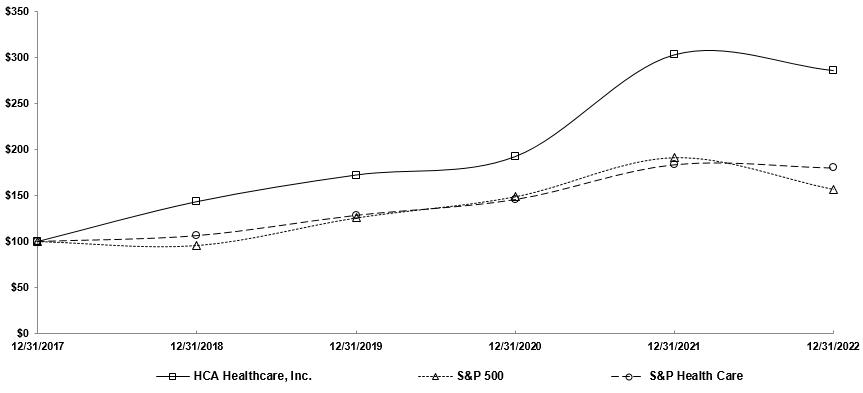][added: 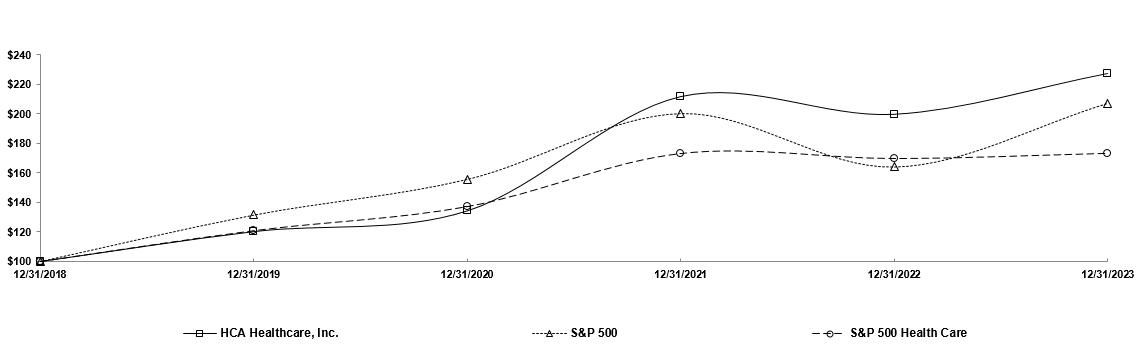]
| | | [removed: 12/31/2017 | | | |] 12/31/2018 | | | | 12/31/2019 | | | | 12/31/2020 | | | | 12/31/2021 | | | | 12/31/2022 | | | [added: | 12/31/2023 | | |]
The graph shows the cumulative total return to our stockholders for the five-year period ended December 31, [removed: 2022,] [added: 2023,] in comparison to the cumulative returns of the S&P 500 Index and the S&P Health Care Index.
The graph assumes $100 invested on December 31, [removed: 2017] [added: 2018] in our common stock and in each index with the subsequent reinvestment of dividends.
| October 2023 | | | 1,474,715 | | | $ | 244.12 | | | | 1,474,715 | | | $ | 1,325 | |
| November 2023 | | | 904,304 | | | $ | 243.29 | | | | 904,304 | | | $ | 1,105 | |
| December 2023 | | | 1,268,054 | | | $ | 260.25 | | | | 1,268,054 | | | $ | 775 | |
| Total for Fourth Quarter 2023 | | | 3,647,073 | | | $ | 249.52 | | | | 3,647,073 | | | | | |
| HCA Healthcare, Inc. | | $ | 100.00 | | | $ | 120.25 | | | $ | 134.25 | | | $ | 211.56 | | | $ | 199.61 | | | $ | 227.19 | |
| S&P 500 | | | 100.00 | | | | 131.49 | | | | 155.68 | | | | 200.37 | | | | 164.08 | | | | 207.21 | |
| S&P Health Care | | | 100.00 | | | | 120.82 | | | | 137.07 | | | | 172.89 | | | | 169.51 | | | | 172.99 | |
| October 2022 | | | 1,753,666 | | | $ | 205.58 | | | | 1,753,666 | | | $ | 2.745 | |
| November 2022 | | | 2,733,018 | | | $ | 222.84 | | | | 2,733,018 | | | $ | 2.136 | |
| December 2022 | | | 2,294,497 | | | $ | 239.71 | | | | 2,294,497 | | | $ | 1.586 | |
| Total for Fourth Quarter 2022 | | | 6,781,181 | | | $ | 224.09 | | | | 6,781,181 | | | $ | 1.586 | |
| HCA Healthcare, Inc. | | $ | 100.00 | | | $ | 143.38 | | | $ | 172.41 | | | $ | 192.49 | | | $ | 303.33 | | | $ | 286.20 | |
| S&P 500 | | | 100.00 | | | | 95.62 | | | | 125.72 | | | | 148.85 | | | | 191.58 | | | | 156.89 | |
| S&P Health Care | | | 100.00 | | | | 106.47 | | | | 128.64 | | | | 145.93 | | | | 184.07 | | | | 180.47 | |
Item 9A. . Controls and Procedures
7 rewritten, 1 added, 1 removed, 31 unchanged
Based on our assessment under the framework in Internal Control — Integrated Framework, our management concluded that our internal control over financial reporting was effective as of December 31, [removed: 2022.][added: 2023.]
[removed: The] [added: To the Stockholders and the] Board of Directors [removed: and Stockholders]
[added: of] HCA Healthcare, Inc.
We have audited HCA Healthcare, Inc.’s internal control over financial reporting as of December 31, [removed: 2022,] [added: 2023,] based on criteria established in Internal Control — Integrated Framework issued by the Committee of Sponsoring Organizations of the Treadway Commission (2013 framework) (the COSO criteria).
In our opinion, HCA Healthcare, Inc. (the Company) maintained, in all material respects, effective internal control over financial reporting as of December 31, [removed: 2022,] [added: 2023,] based on the COSO criteria.
We also have audited, in accordance with the standards of the Public Company Accounting Oversight Board (United States) (PCAOB), the consolidated balance sheets of HCA Healthcare, Inc. as of December 31, [removed: 2022] [added: 2023] and [removed: 2021,] [added: 2022,] and the related consolidated statements of income, comprehensive income, stockholders’ equity (deficit), and cash flows for each of the three years in the period ended December 31, [removed: 2022,] [added: 2023,] and the related notes and our report dated February [removed: 17, 2023] [added: 16, 2024] expressed an unqualified opinion thereon.
During the fourth quarter of [removed: 2022,] [added: 2023,] there were no changes in our internal control over financial reporting that materially affected or are reasonably likely to materially affect our internal control over financial reporting.
February 16, 2024
February 17, 2023
Item 9B. . Other Information
0 rewritten, 1 added, 1 removed, 0 unchanged
(b) During the three months ended December 31, 2023, no director or officer (as defined in Rule 16a-1(f) of the Exchange Act) of the Company adopted or terminated a “Rule 10b5-1 trading arrangement” or “non-Rule 10b5-1 trading arrangement,” as each term is defined in Item 408(a) of Regulation S-K.
None.
Item 10. . Directors, Executive Officers and Corporate Governance
3 rewritten, 0 added, 0 removed, 5 unchanged
The information required by this Item regarding the identity and business experience of our directors and executive officers is set forth under the heading “Nominees for Election” and “Election of Directors” in the definitive proxy materials of HCA to be filed in connection with our [removed: 2023] [added: 2024] Annual Meeting of Stockholders with respect to our directors and is set forth in Item 1 of Part I of this annual report on Form 10-K with respect to our executive officers.
Information on the beneficial ownership reporting for our directors and executive officers required by this Item is contained under the caption “Delinquent Section 16(a) Reports” in the definitive proxy materials to be filed in connection with our [removed: 2023] [added: 2024] Annual Meeting of Stockholders and is incorporated herein by reference.
Information on our Audit and Compliance Committee and Audit Committee Financial Experts required by this Item is contained under the caption “Corporate Governance” in the definitive proxy materials to be filed in connection with our [removed: 2023] [added: 2024] Annual Meeting of Stockholders and is incorporated herein by reference.
Item 11. . Executive Compensation
1 rewritten, 0 added, 0 removed, 0 unchanged
The information required by this Item is set forth under the headings “Executive Compensation” and “Compensation Committee Interlocks and Insider Participation” in the definitive proxy materials to be filed in connection with our [removed: 2023] [added: 2024] Annual Meeting of Stockholders, which information is incorporated herein by reference, except as to information required pursuant to Item 402(v) of SEC Regulation S-K, relating to pay versus performance.
Item 12. . Security Ownership of Certain Beneficial Owners and Management and Related Stockholder Matters
5 rewritten, 1 added, 1 removed, 12 unchanged
Information about security ownership of certain beneficial owners required by this Item is set forth under the heading “Security Ownership of Certain Beneficial Owners and Management and Related Stockholder Matters” in the definitive proxy materials to be filed in connection with our [removed: 2023] [added: 2024] Annual Meeting of Stockholders, which information is incorporated herein by reference.
This table provides certain information as of December 31, [removed: 2022] [added: 2023] with respect to our equity compensation plans:
| Equity compensation plans approved by security holders | | [removed: 9.586] [added: 8.330] | (1) | [removed: $126.38] [added: $146.46] | (1) | [removed: 18.262] [added: 24.840] | (2) |
Includes [removed: 1.784] [added: 1.551] million restricted share units which vest solely based upon continued employment over a specific period of time and [removed: 1.715] [added: 1.410] million performance share units which vest based upon continued employment over a specific period of time and the achievement of predetermined financial targets over time.
Includes [removed: 13.826] [added: 11.056] million shares available for future grants under the 2020 Stock Incentive Plan for Key Employees of HCA Healthcare, Inc. and its [removed: Affiliates and 4.436] [added: Affiliates, 3.784] million shares of common stock reserved for future issuance under the HCA Holdings, Inc. Employee Stock Purchase [added: Plan and 10.000 million shares of common stock reserved for future issuance under the HCA Healthcare, Inc. 2023 Employee Stock Purchase] Plan.
| Total | | 8.330 | | $146.46 | | 24.840 | |
| Total | | 9.586 | | $126.38 | | 18.262 | |
Item 13. . Certain Relationships and Related Transactions, and Director Independence
1 rewritten, 0 added, 0 removed, 0 unchanged
The information required by this Item is set forth under the headings “Certain Relationships and Related Party Transactions” and “Corporate Governance” in the definitive proxy materials to be filed in connection with our [removed: 2023] [added: 2024] Annual Meeting of Stockholders, which information is incorporated herein by reference.
Item 14. . Principal Accountant Fees and Services
1 rewritten, 0 added, 0 removed, 1 unchanged
The information required by this Item is set forth under the heading “Ratification of Appointment of Independent Registered Public Accounting Firm” in the definitive proxy materials to be filed in connection with our [removed: 2023] [added: 2024] Annual Meeting of Stockholders, which information is incorporated herein by reference.
Item 15. . Exhibits and Financial Statement Schedules
44 rewritten, 18 added, 3 removed, 364 unchanged
| 4.1 | — | [Description of Registered [removed: Securities.](https://www.sec.gov/Archives/edgar/data/860730/000095017023003234/hca-ex4_1.htm)] [added: Securities (filed as Exhibit 4.1 to the Company’s Annual Report on Form 10-K for the fiscal year ended December 31, 2022, and incorporated herein by reference).](https://www.sec.gov/Archives/edgar/data/860730/000095017023003234/hca-ex4_1.htm)] |
| 4.5(c) | — | [Amendment No. 2 to the Credit Agreement, dated as of March 2, 2009, by and among HCA Inc., HCA UK Capital Limited, the lending institutions from time to time parties thereto, Bank of America, N.A., as administrative agent, JPMorgan Chase Bank, N.A., and Citicorp North America, Inc., [removed: as Co-Syndication Agents, Banc of America Securities, LLC, J.P. Morgan Securities Inc., Citigroup Global Markets Inc. and Merrill Lynch, Pierce, Fenner & Smith Incorporated, as joint lead arrangers and](https://www.sec.gov/Archives/edgar/data/860730/000095014409001868/g17725exv4w8c.htm)] [added: as](https://www.sec.gov/Archives/edgar/data/860730/000095014409001868/g17725exv4w8c.htm)] |
| | | [removed: [bookrunners,] [added: [Co-Syndication Agents, Banc of America Securities, LLC, J.P. Morgan Securities Inc., Citigroup Global Markets Inc. and Merrill Lynch, Pierce, Fenner & Smith Incorporated, as joint lead arrangers and bookrunners,] Deutsche Bank Securities and Wachovia Capital Markets LLC, as joint bookrunners and Merrill Lynch Capital Corporation, as documentation agent (filed as Exhibit 4.8(c) to the Company’s Annual Report on Form 10-K for the fiscal year ended December 31, 2008, and incorporated herein by reference).](https://www.sec.gov/Archives/edgar/data/860730/000095014409001868/g17725exv4w8c.htm) |
| 4.5(k) | — | [Schedule of Omitted Supplements to the U.S. Guarantee, dated as of November 17, 2006 and amended and restated on February 26, 2014, filed pursuant to Instruction 2 to Item 601 of Regulation [removed: S-K.](https://www.sec.gov/Archives/edgar/data/860730/000095017023003234/hca-ex4_5k.htm)] [added: S-K.](https://www.sec.gov/Archives/edgar/data/860730/000095017024016524/hca-ex4_5k.htm)] |
| 4.6(c) | — | [Schedule of Omitted Supplements to the Security Agreement, dated as of November 17, 2006 and amended and restated as of March 2, 2009, filed pursuant to Instruction 2 to Item 601 of Regulation [removed: S-K.](https://www.sec.gov/Archives/edgar/data/860730/000095017023003234/hca-ex4_6c.htm)] [added: S-K.](https://www.sec.gov/Archives/edgar/data/860730/000095017024016524/hca-ex4_6c.htm)] |
| 4.7(c) | — | [Schedule of Omitted Supplements to the Pledge Agreement, dated as of November 6, 2006 and amended and restated as of March 2, 2009, filed pursuant to Instruction 2 to Item 601 of Regulation [removed: S-K.](https://www.sec.gov/Archives/edgar/data/860730/000095017023003234/hca-ex4_7c.htm)] [added: S-K.](https://www.sec.gov/Archives/edgar/data/860730/000095017024016524/hca-ex4_7c.htm)] |
| 4.8(e) | — | [Joinder Agreement, dated as of January 3, 2018, to the Credit Agreement, dated as of September 30, 2011 (as amended and restated on March 7, 2014, as further amended on October 30, 2014, and as further amended and restated on June 28, 2017), by and among the subsidiary borrowers party thereto and Bank of America, N.A., as administrative agent (filed as Exhibit 4.7(e) to the Company’s [removed: Annual](https://www.sec.gov/Archives/edgar/data/860730/000119312519047078/d676301dex47e.htm)] [added: Annual Report on Form 10-K for the fiscal year ended December 31, 2018, and incorporated herein by reference).](https://www.sec.gov/Archives/edgar/data/860730/000119312519047078/d676301dex47e.htm)] |
| [added: 10.9(f)] | [added: —] | [removed: [Report] [added: [Fifth Amendment to Employment Agreement effective January 1, 2019 (Samuel N. Hazen) (filed as Exhibit 10.14(i) to the Company’s Annual Report] on Form 10-K for the fiscal year ended December 31, 2018, and incorporated herein by [removed: reference).](https://www.sec.gov/Archives/edgar/data/860730/000119312519047078/d676301dex47e.htm)] [added: reference).*](https://www.sec.gov/Archives/edgar/data/860730/000119312519047078/d676301dex1014i.htm)] |
| 4.9(c) | — | [Schedule of Omitted Supplements to the Security Agreement dated as of September 30, 2011, filed pursuant to Instruction 2 to Item 601 of Regulation [removed: S-K.](https://www.sec.gov/Archives/edgar/data/860730/000095017023003234/hca-ex4_9c.htm)] [added: S-K.](https://www.sec.gov/Archives/edgar/data/860730/000095017024016524/hca-ex4_9c.htm)] |
| 4.10(h) | — | [Additional General Intercreditor Agreement, dated as of October 23, 2012, by and among Bank of America, N.A., in its capacity as First Lien Collateral Agent, The Bank of New York Mellon, in its capacity as Junior Lien Collateral Agent and in its capacity as trustee for the Second Lien Notes [removed: issued](https://www.sec.gov/Archives/edgar/data/860730/000119312512431659/d427701dex410.htm)] [added: issued on November 17, 2006, and The Bank of New York Mellon Trust Company, N.A., in its capacity as trustee for the Second Lien Notes issued on February 19, 2009 (filed as Exhibit 4.10 to the Company’s Current Report on Form 8-K filed October 23, 2012, and incorporated herein by reference).](https://www.sec.gov/Archives/edgar/data/860730/000119312512431659/d427701dex410.htm)] |
| 4.24 | — | [Indenture dated as of August 1, 2011, by and among HCA Inc., the guarantors named on Schedule I thereto, Delaware Trust Company (as successor to Law Debenture Trust Company of New York), [removed: as](https://www.sec.gov/Archives/edgar/data/841985/000119312518243478/d572895dex45.htm)] [added: as trustee, and Deutsche Bank Trust Company Americas, as paying agent, registrar and transfer agent (filed as Exhibit 4.5 to the Company’s Registration Statement on Form S-3 (File No. 333-226709), and incorporated herein by reference).](https://www.sec.gov/Archives/edgar/data/841985/000119312518243478/d572895dex45.htm)] |
| | | [removed: [trustee, and Deutsche Bank Trust] [added: [Trust] Company Americas, as paying agent, registrar and transfer agent (filed as Exhibit [removed: 4.5] [added: 4.4] to the Company’s [removed: Registration Statement] [added: Current Report] on Form [removed: S-3 (File No. 333-226709),] [added: 8-K filed March 10, 2022,] and incorporated herein by [removed: reference).](https://www.sec.gov/Archives/edgar/data/841985/000119312518243478/d572895dex45.htm)] [added: reference).](https://www.sec.gov/Archives/edgar/data/860730/000119312522070987/d312703dex44.htm)] |
| [removed: 4.37] [added: 4.83] | — | [Supplemental Indenture No. [removed: 14,] [added: 36,] dated as of [removed: December 8, 2015, by and] [added: May 4, 2023,] among HCA Inc., HCA [removed: Holdings,] [added: Healthcare,] Inc., [removed: Law Debenture] [added: Delaware] Trust [removed: Company of New York,] [added: Company,] as trustee, and Deutsche Bank Trust Company Americas, as paying agent, registrar and transfer agent (filed as Exhibit 4.4 to the Company’s Current Report on Form 8-K filed [removed: December 8, 2015,] [added: on May 4, 2023,] and incorporated herein by [removed: reference).](https://www.sec.gov/Archives/edgar/data/860730/000119312515397826/d87362dex44.htm)] [added: reference).](https://www.sec.gov/Archives/edgar/data/860730/000119312523136049/d308813dex44.htm)] |
| 4.40 | — | [Additional Receivables Intercreditor Agreement, dated as of March 15, 2016, by and between Bank of America, N.A., as ABL Collateral Agent, and Bank of America, N.A., as First Lien Collateral [removed: Agent](https://www.sec.gov/Archives/edgar/data/860730/000119312516505299/d159289dex47.htm)] [added: Agent (filed as Exhibit 4.7 to the Company’s Current Report on Form 8-K filed March 15, 2016, and incorporated herein by reference).](https://www.sec.gov/Archives/edgar/data/860730/000119312516505299/d159289dex47.htm)] |
| | | [removed: [(filed] [added: [as paying agent, registrar and transfer agent (filed] as Exhibit [removed: 4.7] [added: 4.2] to the Company’s Current Report on Form 8-K filed [removed: March 15, 2016,] [added: January 30, 2019,] and incorporated herein by [removed: reference).](https://www.sec.gov/Archives/edgar/data/860730/000119312516505299/d159289dex47.htm)] [added: reference).](https://www.sec.gov/Archives/edgar/data/860730/000119312519022657/d704054dex42.htm)] |
| [removed: 4.53] [added: 4.81] | — | [Supplemental Indenture No. [removed: 22,] [added: 34,] dated as of [removed: January 30, 2019, by and] [added: May 4, 2023,] among HCA Inc., HCA Healthcare, Inc., Delaware Trust Company, as trustee, and Deutsche Bank Trust Company Americas, as paying agent, registrar and transfer agent (filed as Exhibit 4.2 to the Company’s Current Report on Form 8-K filed [removed: January 30, 2019,] [added: on May 4, 2023,] and incorporated herein by [removed: reference).](https://www.sec.gov/Archives/edgar/data/860730/000119312519022657/d704054dex42.htm)] [added: reference).](https://www.sec.gov/Archives/edgar/data/860730/000119312523136049/d308813dex42.htm)] |
| 4.71 | — | [Supplemental Indenture No. 31, dated as of March 9, 2022, among HCA Inc., HCA Healthcare, Inc., the subsidiary guarantors named therein, Delaware Trust Company, as trustee, and Deutsche [removed: Bank Trust Company Americas, as paying agent, registrar and transfer agent (filed as Exhibit 4.4 to the Company’s Current Report on Form 8-K filed March 10, 2022, and incorporated herein by reference).](https://www.sec.gov/Archives/edgar/data/860730/000119312522070987/d312703dex44.htm)] [added: Bank](https://www.sec.gov/Archives/edgar/data/860730/000119312522070987/d312703dex44.htm)] |
| [removed: 10.9(b)] [added: 10.9(e)] | — | [removed: [Employment] [added: [Fourth Amendment to Employment] Agreement [removed: dated] [added: effective] November [removed: 16, 2006 (Charles J. Hall)] [added: 14, 2016 (Samuel N. Hazen)] (filed as Exhibit [removed: 10.28(d)] [added: 10.16(l)] to the Company’s Annual Report on Form 10-K for the fiscal year ended December 31, [removed: 2012,] [added: 2016,] and incorporated herein by [removed: reference).*](https://www.sec.gov/Archives/edgar/data/860730/000119312513077574/d453828dex1028.htm)] [added: reference).*](https://www.sec.gov/Archives/edgar/data/860730/000119312517052253/d299981dex1016l.htm)] |
| [removed: 10.9(c)] [added: 10.9(b)] | — | [Amendment to Employment Agreement effective February 9, 2011 (Samuel N. Hazen) (filed as Exhibit 10.29(j) to the Company’s Annual Report on Form 10-K for the fiscal year ended December 31, 2010, and incorporated herein by reference).*](https://www.sec.gov/Archives/edgar/data/860730/000095012311015233/g25905exv10w29wxjy.htm) |
| [removed: 10.9(d)] [added: 10.9(c)] | — | [Second Amendment to Employment Agreement effective January 29, 2015 (Samuel N. Hazen) (filed as Exhibit 10.23(i) to the Company’s Annual Report on Form 10-K for the fiscal year ended December 31, 2014 (File No. 001-11239), and incorporated herein by reference).*](https://www.sec.gov/Archives/edgar/data/860730/000119312515065975/d852730dex1023i.htm) |
| [removed: 10.9(e)] [added: 10.9(d)] | — | [Third Amendment to Employment Agreement effective January 27, 2016 (Samuel N. Hazen) (filed as Exhibit 10.23(j) to the Company’s Annual Report on Form 10-K for the fiscal year ended December 31, 2015, and incorporated herein by reference).*](https://www.sec.gov/Archives/edgar/data/860730/000119312516482165/d93001dex1023j.htm) |
| [removed: 10.9(f)] [added: 10.9(g)] | — | [removed: [Amendment to Employment Agreement effective] [added: [Signing Bonus Agreement, dated as of] January [removed: 27, 2016 (Charles J. Hall)] [added: 24, 2022, by and between HCA Healthcare, Inc. and Michael R. McAlevey] (filed as Exhibit [removed: 10.23(k)] [added: 10.9(i)] to the Company’s Annual Report on Form 10-K for the fiscal year ended December 31, [removed: 2015,] [added: 2022,] and incorporated herein by [removed: reference).*](https://www.sec.gov/Archives/edgar/data/860730/000119312516482165/d93001dex1023k.htm)] [added: reference) *](https://www.sec.gov/Archives/edgar/data/860730/000095017023003234/hca-ex10_9i.htm)] |
| [removed: 10.9(g)] [added: 10.33] | — | [removed: [Fourth Amendment to Employment] [added: [Form of 2021 Stock Appreciation Right Award] Agreement [removed: effective November 14, 2016 (Samuel N. Hazen)] [added: Under the 2020 Stock Incentive Plan for Key Employees of HCA Healthcare, Inc. and its Affiliates] (filed as Exhibit [removed: 10.16(l)] [added: 10.37] to the Company’s Annual Report on Form 10-K for the fiscal year ended December 31, [removed: 2016,] [added: 2020,] and incorporated herein by [removed: reference).*](https://www.sec.gov/Archives/edgar/data/860730/000119312517052253/d299981dex1016l.htm)] [added: reference).*](https://www.sec.gov/Archives/edgar/data/860730/000119312521048994/d37951dex1037.htm)] |
| [removed: 10.9(h)] [added: 10.34] | — | [removed: [Fifth Amendment to Employment] [added: [Form of 2021 Performance Share Unit Award] Agreement [removed: effective January 1, 2019 (Samuel N. Hazen)] [added: Under the 2020 Stock Incentive Plan for Key Employees of HCA Healthcare, Inc. and its Affiliates] (filed as Exhibit [removed: 10.14(i)] [added: 10.38] to the Company’s Annual Report on Form 10-K for the fiscal year ended December 31, [removed: 2018,] [added: 2020,] and incorporated herein by [removed: reference).*](https://www.sec.gov/Archives/edgar/data/860730/000119312519047078/d676301dex1014i.htm)] [added: reference).*](https://www.sec.gov/Archives/edgar/data/860730/000119312521048994/d37951dex1038.htm)] |
| 10.19 | — | [Form of 2015 Stock Appreciation Right Award Agreement Under the 2006 Stock Incentive Plan for Key Employees of HCA Holdings, Inc. and its Affiliates, as Amended and Restated (filed as [removed: Exhibit](https://www.sec.gov/Archives/edgar/data/860730/000119312515033847/d865389dex101.htm)] [added: Exhibit 10.1 to the Company’s Current Report on Form 8-K filed February 4, 2015, and incorporated herein by reference).*](https://www.sec.gov/Archives/edgar/data/860730/000119312515033847/d865389dex101.htm)] |
| | | [removed: [10.1] [added: [Company Americas, as paying agent, registrar and transfer agent (filed as Exhibit 4.4] to the Company’s Current Report on Form 8-K filed [removed: February 4,] [added: December 8,] 2015, and incorporated herein by [removed: reference).*](https://www.sec.gov/Archives/edgar/data/860730/000119312515033847/d865389dex101.htm)] [added: reference).](https://www.sec.gov/Archives/edgar/data/860730/000119312515397826/d87362dex44.htm)] |
| [removed: 10.32] [added: 10.35] | — | [HCA Healthcare, Inc. [removed: 2020] [added: 2021] Senior Officer Performance Excellence Program (filed as Exhibit 10.1 to the Company’s Current Report on Form 8-K filed April [removed: 2, 2020,] [added: 9, 2021,] and incorporated herein by [removed: reference).*](https://www.sec.gov/Archives/edgar/data/860730/000119312520096038/d853182dex101.htm)] [added: reference).*](https://www.sec.gov/Archives/edgar/data/860730/000119312521111694/d124952dex101.htm)] |
| [removed: 10.33] [added: 10.32] | — | [Form of Director Restricted Share Unit Agreement Under the 2020 Stock Incentive Plan for Key Employees of HCA Healthcare, Inc. and its Affiliates (filed as Exhibit 10.2 to the Company Quarterly Report on Form 10-Q for the quarter ended March 31, 2020, and incorporated herein by reference).*](https://www.sec.gov/Archives/edgar/data/860730/000119312520135021/d900877dex102.htm) |
| [removed: 10.34] [added: 10.36] | — | [Form of [removed: 2021] [added: 2022] Stock Appreciation Right Award Agreement Under the 2020 Stock Incentive Plan for Key Employees of HCA Healthcare, Inc. and its Affiliates (filed as Exhibit [removed: 10.37] [added: 10.38] to the [removed: Company’s](https://www.sec.gov/Archives/edgar/data/860730/000119312521048994/d37951dex1037.htm)] [added: Company’s Annual Report on Form 10-K for the fiscal year ended December 31, 2021, and incorporated herein by reference).*](https://www.sec.gov/Archives/edgar/data/860730/000119312522046707/d32297dex1038.htm)] |
| [added: 10.37] | [added: —] | [removed: [Annual] [added: [Form of 2022 Performance Share Unit Award Agreement Under the 2020 Stock Incentive Plan for Key Employees of HCA Healthcare, Inc. and its Affiliates (filed as Exhibit 10.39 to the Company’s Annual] Report on Form 10-K for the fiscal year ended December 31, [removed: 2020,] [added: 2021,] and incorporated herein by [removed: reference).*](https://www.sec.gov/Archives/edgar/data/860730/000119312521048994/d37951dex1037.htm)] [added: reference).*](https://www.sec.gov/Archives/edgar/data/860730/000119312522046707/d32297dex1039.htm)] |
| [removed: 10.35] [added: 10.40] | — | [Form of [removed: 2021] [added: 2023] Performance Share Unit Award Agreement Under the 2020 Stock Incentive Plan for Key Employees of HCA Healthcare, Inc. and its Affiliates (filed as Exhibit [removed: 10.38] [added: 10.41] to the Company’s Annual Report on Form 10-K for the fiscal year ended December 31, [removed: 2020,] [added: 2022,] and incorporated herein by [removed: reference).*](https://www.sec.gov/Archives/edgar/data/860730/000119312521048994/d37951dex1038.htm)] [added: reference).*](https://www.sec.gov/Archives/edgar/data/860730/000095017023003234/hca-ex10_41.htm)] |
| [removed: 10.36] [added: 10.38] | — | [HCA Healthcare, Inc. [removed: 2021] [added: 2022] Senior Officer Performance Excellence Program (filed as Exhibit 10.1 to the Company’s Current Report on Form 8-K filed [added: on] April [removed: 9, 2021,] [added: 11, 2022,] and incorporated herein by [removed: reference).*](https://www.sec.gov/Archives/edgar/data/860730/000119312521111694/d124952dex101.htm)] [added: reference).*](https://www.sec.gov/Archives/edgar/data/860730/000119312522101742/d184926dex101.htm)] |
| [removed: 10.37] [added: 10.39] | — | [Form of [removed: 2022] [added: 2023] Stock Appreciation Right Award Agreement Under the 2020 Stock Incentive Plan for Key Employees of HCA Healthcare, Inc. and its Affiliates (filed as Exhibit [removed: 10.38] [added: 10.40] to the Company’s Annual Report on Form 10-K for the fiscal year ended December 31, [removed: 2021,] [added: 2022,] and incorporated herein by [removed: reference).*](https://www.sec.gov/Archives/edgar/data/860730/000119312522046707/d32297dex1038.htm)] [added: reference).*](https://www.sec.gov/Archives/edgar/data/860730/000095017023003234/hca-ex10_40.htm)] |
| [removed: 10.38] [added: 10.44] | — | [Form of [removed: 2022] [added: 2024] Performance Share Unit Award Agreement Under the 2020 Stock Incentive Plan for Key Employees of HCA Healthcare, Inc. and its [removed: Affiliates (filed as Exhibit 10.39 to the Company’s Annual Report on Form 10-K for the fiscal year ended December 31, 2021, and incorporated herein by reference).*](https://www.sec.gov/Archives/edgar/data/860730/000119312522046707/d32297dex1039.htm)] [added: Affiliates.*](https://www.sec.gov/Archives/edgar/data/860730/000095017024016524/hca-ex10_44.htm)] |
| [removed: 10.39] [added: 10.41] | — | [HCA Healthcare, Inc. [removed: 2022] [added: 2023] Senior Officer Performance Excellence Program (filed as Exhibit 10.1 to the Company’s Current Report on Form 8-K filed on April [removed: 11, 2022,] [added: 6, 2023,] and incorporated herein by [removed: reference).*](https://www.sec.gov/Archives/edgar/data/860730/000119312522101742/d184926dex101.htm)] [added: reference).*](https://www.sec.gov/Archives/edgar/data/860730/000119312523094138/d494462dex101.htm)] |
| [removed: 10.40] [added: 10.43] | — | [Form of [removed: 2023] [added: 2024] Stock Appreciation Right Award Agreement [removed: Under] [added: under] the 2020 Stock Incentive Plan for Key Employees of HCA Healthcare, Inc. and its [removed: Affiliates.*](https://www.sec.gov/Archives/edgar/data/860730/000095017023003234/hca-ex10_40.htm)] [added: Affiliates.*](https://www.sec.gov/Archives/edgar/data/860730/000095017024016524/hca-ex10_43.htm)] |
| 21 | — | [List of [removed: Subsidiaries.](https://www.sec.gov/Archives/edgar/data/860730/000095017023003234/hca-ex21.htm)] [added: Subsidiaries.](https://www.sec.gov/Archives/edgar/data/860730/000095017024016524/hca-ex21.htm)] |
| 22 | — | [List of Subsidiary Guarantors and Pledged [removed: Securities.](https://www.sec.gov/Archives/edgar/data/860730/000095017023003234/hca-ex22.htm)] [added: Securities.](https://www.sec.gov/Archives/edgar/data/860730/000095017024016524/hca-ex22.htm)] |
| 23 | — | [Consent of Ernst & Young [removed: LLP.](https://www.sec.gov/Archives/edgar/data/860730/000095017023003234/hca-ex23.htm)] [added: LLP.](https://www.sec.gov/Archives/edgar/data/860730/000095017024016524/hca-ex23.htm)] |
| 31.1 | — | [Certification of Chief Executive Officer Pursuant to Section 302 of the Sarbanes-Oxley Act of [removed: 2002.](https://www.sec.gov/Archives/edgar/data/860730/000095017023003234/hca-ex31_1.htm)] [added: 2002.](https://www.sec.gov/Archives/edgar/data/860730/000095017024016524/hca-ex31_1.htm)] |
| 4.37 | — | [Supplemental Indenture No. 14, dated as of December 8, 2015, by and among HCA Inc., HCA Holdings, Inc., Law Debenture Trust Company of New York, as trustee, and Deutsche Bank Trust](https://www.sec.gov/Archives/edgar/data/860730/000119312515397826/d87362dex44.htm) |
| 4.53 | — | [Supplemental Indenture No. 22, dated as of January 30, 2019, by and among HCA Inc., HCA Healthcare, Inc., Delaware Trust Company, as trustee, and Deutsche Bank Trust Company Americas,](https://www.sec.gov/Archives/edgar/data/860730/000119312519022657/d704054dex42.htm) |
| 4.82 | — | [Supplemental Indenture No. 35, dated as of May 4, 2023, among HCA Inc., HCA Healthcare, Inc., Delaware Trust Company, as trustee, and Deutsche Bank Trust Company Americas, as paying agent, registrar and transfer agent (filed as Exhibit 4.3 to the Company’s Current Report on Form 8-K filed on May 4, 2023, and incorporated herein by reference).](https://www.sec.gov/Archives/edgar/data/860730/000119312523136049/d308813dex43.htm) |
| 4.84 | — | [Form of 5.200% Senior Notes due 2028 (included in Exhibit 4.81).](https://www.sec.gov/Archives/edgar/data/860730/000119312523136049/d308813dex42.htm) |
| 4.85 | — | [Form of 5.500% Senior Notes due 2033 (included in Exhibit 4.82).](https://www.sec.gov/Archives/edgar/data/860730/000119312523136049/d308813dex43.htm) |
| 4.86 | — | [Form of 5.900% Senior Notes due 2053 (included in Exhibit 4.83).](https://www.sec.gov/Archives/edgar/data/860730/000119312523136049/d308813dex44.htm) |
| --- | --- | --- |
| 10.42 | — | [HCA Healthcare, Inc. 2023 Employee Stock Purchase Plan (filed as Exhibit 10.1 to the Company’s Current Report on Form 8-K filed on April 21, 2023, and incorporated herein by reference).*](https://www.sec.gov/Archives/edgar/data/860730/000119312523110578/d423503dex101.htm) |
| | | |
| | | |
| | | |
| | | |
| | | |
| | | |
| | | |
| 97 | — | [HCA Healthcare, Inc. Compensation Recoupment Policy.](https://www.sec.gov/Archives/edgar/data/860730/000095017024016524/hca-ex97.htm) |
| | | |
| | | |
| | | [on November 17, 2006, and The Bank of New York Mellon Trust Company, N.A., in its capacity as trustee for the Second Lien Notes issued on February 19, 2009 (filed as Exhibit 4.10 to the Company’s Current Report on Form 8-K filed October 23, 2012, and incorporated herein by reference).](https://www.sec.gov/Archives/edgar/data/860730/000119312512431659/d427701dex410.htm) |
| 10.9(i) | — | [Signing Bonus Agreement, dated as of January 24, 2022, by and between HCA Healthcare, Inc. and Michael R. McAlevey.*](https://www.sec.gov/Archives/edgar/data/860730/000095017023003234/hca-ex10_9i.htm) |
| 10.41 | — | [Form of 2023 Performance Share Unit Award Agreement Under the 2020 Stock Incentive Plan for Key Employees of HCA Healthcare, Inc. and its Affiliates.*](https://www.sec.gov/Archives/edgar/data/860730/000095017023003234/hca-ex10_41.htm) |
An excerpt. Shown here: 40 of 44 rewritten, all 18 added and all 3 removed. The counts are complete. For every sentence, read Item 15. . Exhibits and Financial Statement Schedules in the FY2023 filing and the FY2022 filing.
Item 16. . Form 10-K Summary
378 rewritten, 103 added, 80 removed, 565 unchanged
Dated: February [removed: 17, 2023][added: 16, 2024]
| /S/ SAMUEL N. HAZEN | Chief Executive Officer and Director (Principal Executive Officer) | February [removed: 17, 2023] [added: 16, 2024] |
| /S/ WILLIAM B. RUTHERFORD | Executive Vice President and Chief Financial Officer (Principal Financial Officer and Principal Accounting Officer) | February [removed: 17, 2023] [added: 16, 2024] |
| /S/ THOMAS F. FRIST III | Chairman and Director | February [removed: 17, 2023] [added: 16, 2024] |
| /S/ MEG G. CROFTON | Director | February [removed: 17, 2023] [added: 16, 2024] |
| /S/ ROBERT J. DENNIS | Director | February [removed: 17, 2023] [added: 16, 2024] |
| /S/ NANCY\-ANN DEPARLE | Director | February [removed: 17, 2023] [added: 16, 2024] |
| /S/ WILLIAM R. FRIST | Director | February [removed: 17, 2023] [added: 16, 2024] |
| /S/ HUGH F. JOHNSTON | Director | February [removed: 17, 2023] [added: 16, 2024] |
| /S/ MICHAEL W. MICHELSON | Director | February [removed: 17, 2023] [added: 16, 2024] |
| /S/ WAYNE J. RILEY | Director | February [removed: 17, 2023] [added: 16, 2024] |
| /S/ ANDREA B. SMITH | Director | February [removed: 17, 2023] [added: 16, 2024] |
[removed: HCA HEALTHCARE, INC.][added: of HCA Healthcare, Inc.]
| [Consolidated Income Statements for the years ended December 31, [removed: 2022, 2021] [added: 2023, 2022] and [removed: 2020](#consolidated_income_statements)] [added: 2021](#consolidated_income_statements)] | F-5 |
| [Consolidated Comprehensive Income Statements for the years ended December 31, [removed: 2022, 2021] [added: 2023, 2022] and [removed: 2020](#consolidated_comprehensive_income)] [added: 2021](#consolidated_comprehensive_income)] | F-6 |
| [Consolidated Balance Sheets, December 31, [removed: 2022] [added: 2023] and [removed: 2021](#consolidated_balance_sheets)] [added: 2022](#consolidated_balance_sheets)] | F-7 |
| [Consolidated Statements of Stockholders’ Equity (Deficit) for the years ended December 31, [removed: 2022, 2021] [added: 2023, 2022] and [removed: 2020](#consolidated_of_stockholders_equity)] [added: 2021](#consolidated_of_stockholders_equity)] | F-8 |
| [Consolidated Statements of Cash Flows for the years ended December 31, [removed: 2022, 2021] [added: 2023, 2022] and [removed: 2020](#consolidated_statements_of_cash_flows)] [added: 2021](#consolidated_statements_of_cash_flows)] | F-9 |
[removed: The] [added: To the Stockholders and the] Board of Directors [removed: and Stockholders]
We have audited the accompanying consolidated balance sheets of HCA Healthcare, Inc. (the Company) as of December 31, [removed: 2022] [added: 2023] and [removed: 2021,] [added: 2022,] the related consolidated statements of income, comprehensive income, stockholders’ equity (deficit) and cash flows for each of the three years in the period ended December 31, [removed: 2022,] [added: 2023,] and the related notes (collectively referred to as the “consolidated financial statements”).
In our opinion, the consolidated financial statements present fairly, in all material respects, the financial position of the Company at December 31, [removed: 2022] [added: 2023] and [removed: 2021,] [added: 2022,] and the results of its operations and its cash flows for each of the three years in the period ended December 31, [removed: 2022,] [added: 2023,] in conformity with U.S. generally accepted accounting principles.
We also have audited, in accordance with the standards of the Public Company Accounting Oversight Board (United States) (PCAOB), the Company’s internal control over financial reporting as of December 31, [removed: 2022,] [added: 2023,] based on criteria established in Internal Control-Integrated Framework issued by the Committee of Sponsoring Organizations of the Treadway Commission (2013 framework), and our report dated February [removed: 17, 2023] [added: 16, 2024] expressed an unqualified opinion thereon.
| *Description of the Matter* | For the year ended December 31, [removed: 2022,] [added: 2023,] the Company’s revenues were [removed: $60.233] [added: $64.968] billion. As discussed in Note 1 to the consolidated financial statements, revenues are based upon the estimated amounts the Company expects to be entitled to receive from patients and third-party payers. Estimates of contractual [removed: allowances] [added: adjustments] under managed care and commercial insurance plans are based upon the payment terms specified in the related contractual agreements. Management continually reviews the contractual [removed: allowances] [added: adjustments] estimation process to consider and incorporate [removed: updates to laws and regulations and] the frequent changes in managed care contractual terms resulting from contract renegotiations and renewals. Revenues related to uninsured patients and uninsured copayment and deductible amounts for patients who have health care coverage may have discounts applied (uninsured [removed: discounts] and [removed: contractual] [added: other] discounts). The Company also records estimated implicit price concessions (based primarily on historical collection experience) related to uninsured accounts to record these revenues and accounts receivable at the estimated amounts the Company expects to collect. The primary collection risks relate to uninsured patient accounts, including amounts owed from patients after insurance has paid the amounts covered by the applicable agreement. Implicit price concessions relate primarily to amounts due directly from patients and are based upon management’s assessment of historical write-offs and expected net collections, business and economic conditions, trends in federal, state and private employer health care coverage and other collection indicators. Auditing management’s estimates of contractual [removed: allowances] [added: adjustments] and implicit price concessions was complex and judgmental due to the significant data inputs and subjective assumptions utilized in determining related amounts. |
| *How We Addressed the Matter in Our Audit* | We tested internal controls that address the risks of material misstatement related to the measurement and valuation of revenues, including estimation of contractual [removed: allowances] [added: adjustments] and implicit price concessions. For example, we tested management’s internal controls over the key data inputs to the contractual [removed: allowance] [added: adjustments] and implicit price concession models, significant assumptions underlying management’s models, and management’s internal controls over retrospective reviews of historical reserve accuracy. To test the estimated contractual [removed: allowances] [added: adjustments] and implicit price concessions, we performed audit procedures that included, among others, assessing methodologies and evaluating the significant assumptions discussed above and testing the completeness and accuracy of the underlying data used by the Company in its estimates. We compared the significant assumptions used by management to [added: historical assumptions and to] current industry and economic trends and considered changes, if any, to the Company’s business and other relevant factors. We also assessed the historical accuracy of management’s estimates as a source of potential corroborative or contrary evidence. |
| *Description of the Matter* | At December 31, [removed: 2022,] [added: 2023,] the Company’s reserves for professional liability risks were [removed: $2.043] [added: $2.089] billion and the Company’s related provision for losses for the year ended December 31, [removed: 2022] [added: 2023] was [removed: $517] [added: $619] million. As discussed in Note 1 to the consolidated financial statements, reserves for professional liability risks represent the estimated ultimate net cost of all reported and unreported losses incurred and unpaid through the consolidated balance sheet date. Management estimates professional liability reserves and provisions for losses using individual case-basis valuations and actuarial analyses. Trends in the average frequency (number of claims) and ultimate average severity (cost per claim) of claims are significant assumptions in estimating the reserves. |
| | Auditing management’s professional liability claims reserves was complex and judgmental due to the significant estimations required in determining the reserves, particularly the actuarial [removed: methodology] [added: analyses] and assumptions related to the [added: effects of trends in average] severity and frequency of claims. |
| *How We Addressed the Matter in Our Audit* | We tested management’s internal controls that address the risks of material misstatement over the Company’s professional liability claims reserves estimation process. For example, we tested internal controls over management’s review of the actuarial [removed: methodology and] [added: analyses, the] significant assumptions, and the completeness and accuracy of claims data [removed: supporting] [added: used in] the [removed: recorded reserves.] [added: reserve estimation process.] To test the Company’s determination of the estimated professional liability expense and reserves, we performed audit procedures that included, among others, testing the completeness and accuracy of underlying claims data used by the Company and its actuaries in its determination of reserves and reviewing the Company’s insurance contracts by policy year to validate self-insured limits, deductibles and coverage limits. Additionally, with the involvement of our actuarial specialists, we performed audit procedures that included, among others, assessing the actuarial [removed: valuation methodologies utilized] [added: analyses performed] by management and its actuaries, testing the significant assumptions including consideration of Company-specific claim reporting and payment data, assessing the accuracy of management’s historical reserve estimates, and developing an independent range of reserves for comparison to the Company’s recorded amounts. |
FOR THE YEARS ENDED DECEMBER 31, [removed: 2022, 2021] [added: 2023, 2022] AND [removed: 2020][added: 2021]
| | | [removed: 2022] [added: 2023] | | | | [removed: 2021] [added: 2022] | | | | [removed: 2020] [added: 2021] | | |
| Revenues | | $ | [removed: 60,233] [added: 64,968] | | | $ | [removed: 58,752] [added: 60,233] | | | $ | [removed: 51,533] [added: 58,752] | |
| Salaries and benefits | | | [removed: 27,685] [added: 29,487] | | | | [removed: 26,779] [added: 27,685] | | | | [removed: 23,874] [added: 26,779] | |
| Supplies | | | [removed: 9,371] [added: 9,902] | | | | [removed: 9,481] [added: 9,371] | | | | [removed: 8,369] [added: 9,481] | |
| Other operating expenses | | | [removed: 11,155] [added: 12,875] | | | | [removed: 9,961] [added: 11,155] | | | | [removed: 9,307] [added: 9,961] | |
| Equity in earnings of affiliates | | | [removed: (45] [added: (22] | ) | | | [removed: (113] [added: (45] | ) | | | [removed: (54] [added: (113] | ) |
| Depreciation and amortization | | | [removed: 2,969] [added: 3,077] | | | | [removed: 2,853] [added: 2,969] | | | | [removed: 2,721] [added: 2,853] | |
| Interest expense | | | [removed: 1,741] [added: 1,938] | | | | [removed: 1,566] [added: 1,741] | | | | [removed: 1,584] [added: 1,566] | |
| Losses (gains) on sales of facilities | | | [removed: (1,301] [added: 5] | [removed: )] | | | [removed: (1,620] [added: (1,301] | ) | | | [removed: 7] [added: (1,620] | [added: )] |
| Losses on retirement of debt | | | [removed: 78] [added: —] | | | | [removed: 12] [added: 78] | | | | [removed: 295] [added: 12] | |
| | | | [removed: 51,653] [added: 57,262] | | | | [removed: 48,919] [added: 51,653] | | | | [removed: 46,103] [added: 48,919] | |
| Income before income taxes | | | [removed: 8,580] [added: 7,706] | | | | [removed: 9,833] [added: 8,580] | | | | [removed: 5,430] [added: 9,833] | |
February 16, 2024
FOR THE YEARS ENDED DECEMBER 31, 2023, 2022 AND 2021
| | | | 10 | | | | (54 | ) | | | (16 | ) |
| | | | — | | | | 8 | | | | 38 | |
| | | 2023 | | | | 2022 | | |
| | | | 14,927 | | | | 13,643 | |
| | | | 58,548 | | | | 54,757 | |
| | | | 27,715 | | | | 25,575 | |
| | | $ | 56,211 | | | $ | 52,438 | |
| | | | 12,655 | | | | 9,902 | |
| | | | 1,060 | | | | (73 | ) |
| | | $ | 56,211 | | | $ | 52,438 | |
FOR THE YEARS ENDED DECEMBER 31, 2023, 2022 AND 2021
| Comprehensive income | | | | | | | | | | | | | | | 65 | | | | 5,242 | | | | 849 | | | | 6,156 | |
| Repurchase of common stock | | | (14.465 | ) | | | | | | | (186 | ) | | | | | | | (3,656 | ) | | | | | | | (3,842 | ) |
| Distributions | | | | | | | | | | | | | | | | | | | | | | | (640 | ) | | | (640 | ) |
| Balances, December 31, 2023 | | | 265.537 | | | $ | 3 | | | $ | — | | | $ | (425 | ) | | $ | (1,352 | ) | | $ | 2,834 | | | $ | 1,060 | |
FOR THE YEARS ENDED DECEMBER 31, 2023, 2022 AND 2021
| Net income | | $ | 6,091 | | | $ | 6,834 | | | $ | 7,721 | |
| Depreciation and amortization | | | 3,077 | | | | 2,969 | | | | 2,853 | |
| Losses (gains) on sales of facilities | | | 5 | | | | (1,301 | ) | | | (1,620 | ) |
| Losses on retirement of debt | | | — | | | | 78 | | | | 12 | |
| | | 2023 | | | | 2022 | | | | 2021 | | |
*Recent Pronouncements*
In November 2023, the FASB issued Accounting Standards Update 2023-07, *Segment Reporting (Topic 280): Improvements to Reportable Segment Disclosures* (“ASU 2023-07”), which requires enhanced disclosures for significant segment expenses.
ASU 2023-07 is effective for public business entities for annual periods beginning on January 1, 2024 and interim periods beginning on January 1, 2025.
We plan to adopt ASU 2023-07 on the respective annual and interim effective dates applying a retrospective approach to all prior periods presented in the financial statements.
We do not believe the adoption of this new standard will have a material effect on our disclosures.
In December 2023, the FASB issued Accounting Standards Update 2023-09, *Improvements to Income Tax Disclosures* (“ASU 2023-09”), which requires enhanced annual disclosures for specific categories in the rate reconciliation and income taxes paid disaggregated by federal, state and foreign taxes.
ASU 2023-09 is effective for public business entities for annual periods beginning on January 1, 2025.
We plan to adopt ASU 2023-09 effective January 1, 2025 applying a retrospective approach to all prior periods presented in the financial statements.
We do not believe the adoption of this new standard will have a material effect on our disclosures.
| | | 2023 | | | | 2022 | | | | 2021 | | |
| Granted | | | 580 | | | | — | | | | 580 | | | | 253.49 | | | | | | | |
| Exercised | | | (1,156 | ) | | | (83 | ) | | | (1,239 | ) | | | 95.29 | | | | | | | |
| Cancelled | | | (59 | ) | | | — | | | | (59 | ) | | | 202.05 | | | | | | | |
| SARs outstanding, December 31, 2023 | | | 5,325 | | | | 44 | | | | 5,369 | | | $ | 146.46 | | | 5.5 years | | $ | 667 | |
| SARs exercisable, December 31, 2023 | | | 3,748 | | | | 44 | | | | 3,792 | | | $ | 118.67 | | | 4.5 years | | $ | 576 | |
| Granted | | | 609 | | | | 479 | | | | 1,088 | | | | 253.85 | |
| Performance adjustment | | | — | | | | 697 | | | | 697 | | | | 144.42 | |
| | | |
| /S/ CHARLES O. HOLLIDAY, JR. | Director | February 17, 2023 |
| Charles O. Holliday, Jr. | | |
HCA Healthcare, Inc.
February 17, 2023
| | | | (54 | ) | | | (16 | ) | | | 14 | |
| | | | 8 | | | | 38 | | | | (42 | ) |
| | | | 13,643 | | | | 13,542 | |
| | | | 54,757 | | | | 51,350 | |
| | | | 25,575 | | | | 24,063 | |
| | | | 9,902 | | | | 9,582 | |
| | | | (73 | ) | | | 1,489 | |
| Balances, December 31, 2019 | | | 338.446 | | | $ | 3 | | | $ | — | | | $ | (460 | ) | | $ | (2,351 | ) | | $ | 2,243 | | | $ | (565 | ) |
| Comprehensive income (loss) | | | | | | | | | | | | | | | (42 | ) | | | 3,754 | | | | 633 | | | | 4,345 | |
| Repurchase of common stock | | | (3.287 | ) | | | | | | | | | | | | | | | (441 | ) | | | | | | | (441 | ) |
| Distributions | | | | | | | | | | | | | | | | | | | | | | | (626 | ) | | | (626 | ) |
*COVID-19*
We believe the extent of COVID-19’s impact on our operating results and financial condition has been and could continue to be driven by many factors, most of which are beyond our control and ability to forecast.
Because of these uncertainties, we cannot estimate how long or to what extent COVID-19 will impact our operations.
NOTES TO CONSOLIDATED FINANCIAL STATEMENTS (Continued)
During 2021, identifiable intangible assets increased by $60 million related to acquisitions and declined by $25 million due to amortization and other adjustments.
*Professional Liability Claims (continued)*
| SARs outstanding, December 31, 2019 | | | 9,050 | | | | 2,144 | | | | 11,194 | | | $ | 71.79 | | | | | | | |
| Granted | | | 1,120 | | | | — | | | | 1,120 | | | | 144.47 | | | | | | | |
| Exercised | | | (2,159 | ) | | | (1,325 | ) | | | (3,484 | ) | | | 44.07 | | | | | | | |
| Cancelled | | | (175 | ) | | | — | | | | (175 | ) | | | 111.69 | | | | | | | |
| SARs exercisable, December 31, 2022 | | | 4,022 | | | | 127 | | | | 4,149 | | | $ | 102.20 | | | 4.7 years | | $ | 572 | |
| | | | | | | | | | | | | | | | | |
| --- | --- | --- | --- | --- | --- | --- | --- | --- | --- | --- | --- | --- | --- | --- | --- | --- |
| RSUs and PSUs outstanding, December 31, 2019 | | | 2,620 | | | | 3,035 | | | | 5,655 | | | $ | 105.23 | |
| Granted | | | 1,048 | | | | 808 | | | | 1,856 | | | | 144.17 | |
| Performance adjustment | | | — | | | | 206 | | | | 206 | | | | 81.89 | |
| Vested | | | (1,030 | ) | | | (1,364 | ) | | | (2,394 | ) | | | 88.63 | |
| Cancelled | | | (162 | ) | | | (93 | ) | | | (255 | ) | | | 124.50 | |
NOTE 3 — ACQUISITIONS AND DISPOSITIONS (continued)
During 2020, we received proceeds of $68 million and recognized a pretax loss of $7 million ($9 million after tax) related to the sale of a hospital facility from our American Group (Mississippi market) and sales of real estate and other investments.
| | | $ | 2,187 | | | $ | 2,074 | | | $ | 2,203 | | | $ | 1,808 | |
| | | 2021 | | | | | | | | | | | | | | |
| | | $ | 525 | | | $ | 18 | | | $ | (2 | ) | | | 541 | |
| | | $ | 415 | | | $ | 377 | |
An excerpt. Shown here: 40 of 378 rewritten, 40 of 103 added and 40 of 80 removed. The counts are complete. For every sentence, read Item 16. . Form 10-K Summary in the FY2023 filing and the FY2022 filing.