 filings.tools
HCA Healthcare (HCA) 10-K risk factor changes: FY2024 vs FY2023
The 2024-12-31 10-K against the 2023-12-31 one, compared heading by heading and sentence by sentence.
Item 1A141 rewritten98 added72 removed320 unchanged
All filing items1,119 rewritten422 added340 removed2,295 unchanged
Summary
counted, not written
- Item 1A lists 37 risk factor headings: 1 new, 4 reworded and 32 unchanged since FY2023. 3 headings from FY2023 no longer appear.
- Sentence by sentence, 422 added, 340 removed, 1,119 rewritten and 2,295 unchanged across 16 items that differ.
New Item 1A headings (1)
- Our business and operations are subject to risks related to changing global weather patterns.
Removed Item 1A headings (3)
- Our business and results of operations may be adversely affected by health care reform efforts. We are unable to predict whether, what, and when additional health reform measures will be adopted or implemented, and the effects and ultimate impact of any such measures are uncertain *and may adversely affect our business and results of operations.
- Our business and operations are subject to risks related to climate change.
- We may be adversely affected if we are not able to achieve our environmental, social and governance (“ESG”) objectives or otherwise meet the expectations of our stakeholders with respect to ESG matters.
Reworded Item 1A headings (4)
- We may be unable to attract, hire and retain a highly qualified
[removed: and diverse]workforce, including key management. - Health care technology initiatives, particularly those related to sharing patient data and
[removed: interoperability,][added: interoperability and AI, involve risks that] may adversely affect our operations. [removed: COVID-19 has affected, and may continue to affect, our operations. In addition, the][added: The] emergence and effects related to a potential future pandemic, epidemic or outbreak of an infectious disease could adversely affect our business and operations.- Changes in government health care programs may adversely affect our
[removed: revenues.][added: revenues and business.]
A heading is new when no FY2023 heading matches it after ignoring case and punctuation, and reworded when it shares at least 60 percent of its words with one that went away. All current risk factor headings.
Sentences by item
24 items, with every count and a link to each item that changed
Underlined words on a shaded ground are new in FY2024; struck-through words were in FY2023. Sentences that are wholly new or wholly gone are labelled rather than marked.
Item 1A. Risk Factors
141 rewritten, 98 added, 72 removed, 320 unchanged
As of December 31, [removed: 2023,] [added: 2024,] our total indebtedness was [removed: $39.593] [added: $43.031] billion.
As of December 31, [removed: 2023,] [added: 2024,] we had availability of [removed: $3.487] [added: $3.486] billion under our senior secured cash flow credit facility and [removed: $2.620] [added: $4.500] billion under our senior secured asset-based revolving credit facility, after giving effect to letters of credit and borrowing base limitations.
Our subsidiaries may not be able to, or may not be permitted to, make distributions [removed: to enable us to make payments in respect of our indebtedness.]
Upon the occurrence of an event of default under these senior secured credit facilities, the lenders thereunder could elect to declare [added: all amounts outstanding under the senior secured credit facilities to be immediately due and payable and terminate all commitments to extend further credit, which would also result in an event of default under a significant portion of our other outstanding indebtedness.]
In some markets, the availability of [removed: nurses] [added: nonphysician health care professionals] and [removed: other] medical support personnel has been a significant operating issue to health care providers, including at certain of our facilities.
The impact of labor shortages across the health care industry may result in other health care facilities, such as nursing homes, limiting admissions, which may constrain our ability to discharge patients to such [removed: facilities] [added: facilities, increase labor costs] and further exacerbate the demand on our resources, supplies and staffing.
Economic conditions, [removed: increased] [added: including macroeconomic uncertainties and] inflationary [removed: pressure] [added: pressure, workforce burnout,] and [removed: COVID-19] [added: public health conditions] have exacerbated workforce competition, [added: personnel] shortages and capacity constraints.
We [removed: also] depend on the available labor pool of employees in each of the markets in which we operate to fill other necessary positions.
If there is [removed: continued competition for these employees or] additional union organizing activity or a significant portion of our employee base unionizes, it is possible our labor costs could increase.
If these states reduce, or if additional states in which we operate [removed: adopt,] [added: adopt or the federal government adopts,] mandatory nurse-staffing ratios or related measures, [added: our compliance with] such [removed: changes] [added: measures] could significantly affect labor costs and have an adverse impact on revenues [added: or our results of operations] if we are required to limit [removed: admissions] [added: admissions, hire additional personnel] or [added: otherwise] incur [removed: other costs in order to comply.][added: additional costs.]
If our labor costs continue to increase, we may not be able to offset these increased [removed: costs] [added: costs,] as a significant percentage of our revenues [removed: consists of fixed, prospective payments.][added: are based on reimbursement rates that are fixed or negotiated no less frequently than annually.]
We continue to face increasing competition to recruit and retain quality physicians, as well as increasing [removed: cost] [added: costs] to contract with hospital-based physicians.
*We may be unable to attract, hire and retain a highly qualified [removed: and diverse] workforce, including key management.*
[removed: In addition,] [added: Further,] institutional knowledge may be lost in any potential managerial transition.
[removed: We may be unable to retain key management or attract other highly qualified employees, particularly if we do] not offer employment terms that are competitive with the rest of the labor market.
Failure to attract, hire, develop, motivate, and retain highly qualified [removed: and diverse] employee [removed: talent,] [added: talent] or failure to develop and implement an adequate succession plan for the management [removed: team,] [added: team] could disrupt our operations and adversely affect our business and our future success.
*Cybersecurity incidents or other forms of data breaches could result in the compromise of our facilities, confidential data or critical data [removed: systems.][added: systems, causing our operations to be impaired or impacted.]
A cybersecurity incident or other form of data breach could also give rise to potential harm to patients; remediation and other expenses; and exposure to liability under [removed: HIPAA,] [added: privacy and security laws,] consumer protection laws, common law theories or other laws.
We, directly and through our vendors and other third parties, collect and store on our networks and devices and third-party technology platforms sensitive information, including intellectual property, proprietary business information, [removed: personally identifiable information and] protected health information of our patients and personally identifiable information of our [removed: employees] [added: employees, patients] and consumers.
[removed: Despite] [added: However, despite] our efforts to mitigate our exposure to cyberattack, even an advanced internal control environment is vulnerable to compromise.
[removed: We] [added: We, our vendors and other third parties have experienced cybersecurity incidents in the past and] continue to be the target of attempted cybersecurity and other threats that could have a [removed: security impact,] [added: significant impact on our business,] including [removed: those] [added: threats] by third parties [added: seeking] to access, misappropriate, [removed: corrupt] [added: corrupt,] or manipulate our information or disrupt our operations.
We expect [removed: to] [added: that we, our vendors and other third parties will] continue to experience an increase in cybersecurity threats in the future, [added: both directly and indirectly through threats targeting third parties,] as the volume and intensity of cyberattacks on hospitals, health systems and other health care entities continue to increase.
Threats from malicious [removed: persons] [added: threat actors, including nation-state actors] and [added: ransomware] groups, new vulnerabilities and advanced new attacks against our, or our vendors’, information systems and devices create risk of cybersecurity incidents, including ransomware, malware and phishing incidents, in which third parties attempt to fraudulently induce our employees or our vendors’ employees into disclosing usernames, passwords or other sensitive information, which can in turn be used for unauthorized access to our or our vendors’ systems.
Internal access management failures could [added: also] result in the compromise or unauthorized exposure of confidential data.
Moreover, hardware, software or applications we use may have inherent vulnerabilities or defects of design, [removed: manufacture] [added: manufacture,] or operations or could be inadvertently or intentionally implemented or used in a manner that could compromise [added: cybersecurity or] information security.
In such an event, we may incur substantial costs, including but not limited to, costs associated with remediating the effects of the cybersecurity [added: or information security] incident, costs for security measures to guard against similar future incidents and costs to recover data.
As cyber threats continue to evolve, along with their increased volume and sophistication, we may be required to expend significant additional resources to continue to modify or enhance our [added: protective measures or to investigate and remediate any cybersecurity vulnerabilities or incidents, and such measures may decrease the efficiency of our operations.]
[removed: Although] [added: Although,] to [removed: date] [added: date,] no cyberattack or other information or security [removed: breach, including those experienced by us in 2023,] [added: breach] has resulted in material losses or other material consequences to us, there can be no assurance that our controls and procedures in place to monitor and mitigate the risks of cyber threats, including the remediation of critical [added: cybersecurity,] information security and software vulnerabilities, will be sufficient and/or timely and that we will not suffer material losses or consequences in the future.
Information systems may be vulnerable to damage from a variety of sources, including telecommunications or network failures, human acts such as inadvertent or intentional misuse by employees, natural disasters and cyberattacks, including ransomware and data [removed: theft, such as the data security incident we disclosed in July 2023.][added: theft.]
Failure to adequately [added: and timely] manage implementations of new technology, updates or enhancements of such platforms or interfaces between platforms could place us at a competitive disadvantage, disrupt our operations, and have a material, adverse impact on our business and results of operations.
We have taken precautionary measures [added: designed] to prevent [removed: unanticipated] problems that could affect our information systems.
*Health care technology initiatives, particularly those related to sharing patient data and [removed: interoperability,] [added: interoperability and AI, involve risks that] may adversely affect our operations.*
For example, HHS incentivizes the adoption and meaningful use of certified EHR technology through its [added: Medicare] Promoting Interoperability [removed: Programs.][added: Program and Quality Payment Program.]
Eligible hospitals [removed: and eligible professionals, including our hospitals and employed professionals, are subject to reduced payments from Medicare if they] [added: that] fail to demonstrate meaningful use of certified EHR [removed: technology.][added: technology and have not applied and qualified for a hardship exception are subject to reduced reimbursement from Medicare.]
As [removed: these] [added: EHR] technologies have become widespread, the [removed: focus] [added: federal government] has [removed: shifted to increasing] [added: increased its focus on promoting] patient access to health care data and interoperability.
The 21st Century Cures Act and its implementing regulations [removed: promote information sharing by prohibiting] [added: prohibit] information blocking by health care providers and certain other entities.
Under a rule [removed: proposed] [added: finalized] by HHS in [removed: November 2023,] [added: July 2024,] a hospital found to have engaged in information blocking [removed: would] [added: will] not qualify as a “meaningful electronic health record user” under the Medicare Promoting Interoperability Program and as a result [removed: would] [added: will] lose 75% of the annual market basket increase it would otherwise [removed: receive.][added: receive, and MIPS-eligible clinicians, ACOs and ACO participants face similar disincentives.]
Current and future initiatives related to health care [removed: technology (including artificial intelligence and other predictive algorithms),] [added: technology,] data sharing and interoperability may require changes to our operations, impose new and complex compliance obligations and require investments in infrastructure.
For example, HHS finalized a rule in December 2023 imposing transparency requirements for [removed: artificial intelligence] [added: AI] and other predictive algorithms that are part of certified health information technology.
[removed: As currently employed,] [added: For example,] our physicians [added: are adopting the] use [added: of] generative AI to assist with the taking of [added: patient] medical [removed: notes regarding our patients.][added: notes, among other tasks.]
to enable us to make payments in respect of our indebtedness.
If states enact legal restrictions on the provision of medical care, such restrictions may impact providers' recruitment and retention efforts in certain states.
While we have adopted succession plans to prepare for such an event, our succession plans may not result in a successful transition.
We may be unable to retain key management or attract other highly qualified employees, particularly if we do
We have implemented multiple layers of security measures, including cybersecurity and information security systems, protocols and monitoring procedures, intended to protect the confidentiality, integrity and availability of our data and the systems and devices that store and transmit such data.
In addition, we rely on various third parties to have appropriate controls to protect our information that is on their systems or otherwise in their control, and we seek to obtain assurances that such third parties will protect our information.
We rely on a substantial number of employees, contractors, personnel, hardware, software, applications, and third-party vendors, platforms and technologies, each of which may represent an attack surface for threat actors.
Furthermore, because the tools and techniques used by attackers change frequently and often are not recognized until launched against a target, we may be unable to anticipate these techniques or implement adequate preventative measures.
We, our vendors and other third parties may experience security incidents that may remain undetected for an extended period.
Even if identified, we, our vendors and other third parties may be unable to adequately investigate or remediate incidents or breaches, including due to attackers increasingly using tools and techniques that are designed to circumvent controls, avoid detection and remove or obfuscate forensic evidence.
State-sponsored threat actors are increasingly targeting critical infrastructure sectors, including health systems and other critical infrastructure on which we rely.
Increasing use of AI technologies in our internal systems may create new attack surfaces or methods for threat actors, and threat actors may use AI technologies to make cyberattacks more difficult to detect, contain or mitigate.
We may also be required to expend additional resources to comply with evolving federal and state requirements related to cybersecurity and information security, including those focused on health care providers.
Eligible health care professionals are also subject to positive or negative payment adjustments based, in part, on their use of EHR technology.
Therefore, if our hospitals and employed professionals are unable to properly adopt, maintain and utilize certified EHR
systems, we could be subject to penalties that may have an adverse effect on our financial condition and results of operations.
In particular, AI is driving innovation and, in some cases, augmenting risks related to health care technology.
Rapid changes in technology driven by AI may require us to expend significant resources to acquire, develop, implement and maintain that technology.
Failure to integrate these technologies in a timely, cost-efficient and resource-efficient manner may impede our ability to deliver health care services in a competitive manner.
There is also a risk that our confidential information becomes part of a model that is accessible by other third-party AI applications or users as a result of a cybersecurity incident or a third-party AI developer’s violation of our vendor engagement terms.
The development of AI technologies is complex, and there are technical challenges associated with achieving the desired level of accuracy, efficiency and reliability.
For instance, AI models used by us or third-party vendors may be based on biased or deficient datasets, which could result in inaccurate or misleading outputs.
Ineffective or inadequate AI development or deployment practices by us or third-party developers or vendors, including any disruptions or failures of AI systems once implemented, could result in unintended consequences.
Further, federal and state requirements regarding the use of AI by health care providers continue to evolve.
Some states have adopted or are considering additional measures regarding the use of AI within the health care industry.
For example, AB 3030 requires that certain disclaimers and instructions be provided to patients if generative AI is used to create patient communications pertaining to patient clinical information.
In addition, the AIPA requires that physicians, nurses and other regulated health care providers disclose when an individual is interacting with generative AI while receiving the regulated service.
Further, the CAIA will impose significant requirements on companies that use AI systems to recommend certain health decisions.
If we or our third-party providers are restricted from using AI as a result of any laws or regulations, it could impact our operations and cause us to incur costs to replace or modify our use of AI.
In addition, any failure or perceived failure by us or our third-party providers to comply with applicable AI laws and regulations could result in investigations or legal proceedings, which could result in significant legal costs and potential liability.
Such a crisis could diminish the public trust in health care
The health care industry is subject to changing political, regulatory and other influences.
Regulatory uncertainty has increased as a result of decisions issued by the U.S. Supreme Court in June 2024 that affect review of federal agency actions.
These decisions increase judicial scrutiny of agency authority, shift greater responsibility for statutory interpretation to courts, expand the time period during which a plaintiff can sue regulators, and may result in inconsistent judicial interpretations and delays in agency rulemaking processes.
In *Loper Bright Enterprises v.
Raimondo*, the Court overruled a legal framework that gave significant judicial deference to federal agency interpretations of federal statutes.
The Court held that courts must instead exercise independent judgment when deciding whether an agency has acted within its statutory authority and that courts may not defer to an agency interpretation simply because a statute is ambiguous.
The *Loper Bright* decision and other recent decisions of the U.S. Supreme Court could have significant impacts on government agency regulation, particularly within the heavily regulated health care industry, and may have broad implications for our business.
While the effects of these decisions will become apparent over the coming months and years, we anticipate an increase in legal challenges to health care regulations and agency guidance and decisions, including, but not limited to, those issued by HHS and its agencies, including CMS, the FDA and the OIG.
Federal agencies oversee, regulate and otherwise affect many aspects of our business, including through Medicare and Medicaid payment and coverage policies, policies affecting the size of the uninsured population, administration of state Medicaid programs and enforcement and interpretation of fraud and abuse laws.
all amounts outstanding under the senior secured credit facilities to be immediately due and payable and terminate all commitments to extend further credit, which would also result in an event of default under a significant portion of our other outstanding indebtedness.
As a result of labor shortages, competition and inflationary pressures, our labor costs could increase and our capacity could be negatively impacted.
In July 2023, we disclosed a security incident in which an unauthorized party accessed information at an external storage location exclusively used to automate the formatting of email messages.
Approximately 11 million patients were affected by the security incident.
In response to this security incident, we reinforced our cybersecurity systems, protocols and monitoring procedures, particularly focusing on data interfaces with third party storage locations.
The rapid evolution and increased adoption of artificial intelligence technologies may intensify our cybersecurity risks by making cyberattacks more difficult to detect, contain or mitigate.
Mitigation and remediation recommendations continue to evolve, and addressing this and other critical vulnerabilities pertaining to widely used systems, platforms and infrastructure is a priority for us.
protective measures or to investigate and remediate any cybersecurity vulnerabilities or incidents.
It is difficult to predict how these initiatives will affect our relationships with providers and vendors, participation in health care information exchanges or networks, the exchange of patient data and patient engagement.
Machine learning and artificial intelligence are driving innovations in technology in the health care industry, which presents certain risks.
*COVID-19 has affected, and may continue to affect, our operations.
COVID-19 continues to evolve, and we may not be able to predict or effectively respond to future developments.
If public health conditions related to COVID-19 significantly worsen, any such developments could materially and adversely affect our business, results of operations, financial position and cash flows.
The ongoing impact of COVID-19 on our business will depend on, among other factors, the duration and severity of any severe or widespread outbreaks of COVID-19; the impact of COVID-19 on economic conditions; the volume of canceled or rescheduled procedures at our facilities; the volume of COVID-19 patients cared for across our health systems; the availability, acceptance of, and need for effective vaccines and medical treatments; the spread of potentially more contagious and/or virulent forms of the virus; and the impact of government actions on the health care industry and broader economy.
In recent years, the U.S. health care industry has undergone significant changes at the federal and state levels, many of which have been aimed at reducing costs and government spending and increasing access to health insurance.
The Affordable Care Act has been, and continues to be, subject to legislative and regulatory changes and court challenges.
For example, effective January 1, 2019, the penalty associated with the individual mandate to maintain health insurance was effectively eliminated.
However, some states have imposed individual health insurance mandates, and other states have explored or offer public health insurance options.
To increase access to health insurance during the COVID-19 pandemic, the ARPA enhanced subsidies for individuals eligible to purchase coverage through the Exchanges.
There is uncertainty regarding whether, when and how the Affordable Care Act may be further changed, and how the law will be interpreted.
Changes by Congress or government agencies could eliminate or alter provisions beneficial to us, while leaving in place provisions reducing our reimbursement or otherwise negatively impacting our business.
Some members of Congress have proposed measures that would expand government-sponsored coverage, including proposals to expand coverage of federally-funded insurance programs as an alternative to private insurance or establish a single-payer system (such reforms often referred to as “Medicare for All”).
For example, among other consumer protections, the No Surprises Act imposes various requirements on providers and health plans intended to prevent “surprise” medical bills.
For example, the CMS Care Compare website makes publicly available certain data on performance of hospitals and other Medicare-certified providers on quality measures and patient satisfaction, and our patient volumes could decline if any of our facilities achieve poor results.
Further, Medicare reimbursement for hospitals is adjusted based on quality and efficiency measures.
We are unable to predict the nature and success of such initiatives.
In addition, as a result of the ARPA, an additional Medicare payment reduction of up to 4% was required to take effect in January 2022; however, Congress has delayed implementation of this reduction until 2025.
Some states that provide Medicaid supplemental payments are reviewing these programs or have filed requests with CMS to replace these programs, and CMS has performed and continues to perform compliance reviews of some states’ programs and is considering changes to the requirements for such programs, which could result in Medicaid supplemental payments being reduced or eliminated.
For example, where states had previously been permitted to condition Medicaid enrollment on work or other community engagement, the approvals of waivers permitting these conditions have been rescinded.
However, a federal court is permitting Georgia to impose work and community engagement requirements under a Medicaid demonstration program that launched in mid-2023.
Some members of Congress are also reexamining block grant funding structures.
environmental protection.
We develop software programs utilizing machine learning/artificial intelligence for use within our network to improve care and may also use similar technologies in other capacities.
Jurisdictions worldwide are proposing laws and regulations on the use of artificial intelligence and machine learning applications and tools, particularly on the use of artificial intelligence to facilitate health care, employment, or hiring decisions.
For example, in 2023, HHS finalized transparency requirements for artificial intelligence and other predictive algorithms used in certified health information technology, such as decision support interventions.
In some cases, software can be considered a medical device under the federal Food, Drug, and Cosmetic Act (“FDCA”).
Medical devices are subject to extensive regulation by the Food and Drug Administration (“FDA”) under the FDCA.
In September 2022, FDA issued non-binding final guidance that describes the types of clinical decision support software that FDA will regulate as a medical device, potentially including software programs that were not previously treated as medical devices.
Application of the new guidance may result in our current and/or future software programs providing clinical decision support being subject to FDA regulation.
If FDA determines that any of our software programs are medical devices under the FDCA, the distribution and/or use of those software programs may require premarket approval or clearance, and we may be required to cease distribution and/or use of such programs until we obtain any required premarket approval or clearance, which could adversely affect our
An excerpt. Shown here: 40 of 141 rewritten, 40 of 98 added and 40 of 72 removed. The counts are complete. For every sentence, read Item 1A. Risk Factors in the FY2024 filing and the FY2023 filing.
Item 7. . Management’s Discussion and Analysis of Financial Condition and Results of Operations
188 rewritten, 32 added, 12 removed, 287 unchanged
[removed: These factors include, but are not limited to, (1) changes in or related to general economic conditions nationally and regionally in our markets, including inflation and economic and business conditions (and the impact thereof on the economy, financial markets and banking industry); changes in revenues due to declining patient volumes; changes in payer mix (including increases in uninsured and underinsured patients); potential increased expenses related to labor, supply chain or other expenditures; workforce disruptions; supply shortages and disruptions (including as a result of geopolitical disruptions); and the impact of potential federal government shutdowns, (2) the impact of our significant indebtedness and the ability to refinance such indebtedness on acceptable terms, (3) the impact of current and future federal and state health reform initiatives and possible changes to other federal, state or local laws and regulations affecting the health care industry, including, but not limited to, proposals to expand coverage of federally-funded insurance programs as an alternative to private insurance or establish a single-payer system (such reforms often referred to as “Medicare for All”), (4) the effects related to the implementation of sequestration spending reductions required under the Budget Control Act of 2011, related legislation extending these reductions and those required under the Pay-As-You-Go Act of 2010 as a result of the federal budget deficit impact of the American Rescue Plan Act of 2021, and the potential for future deficit reduction legislation that may alter these spending reductions, which include cuts to Medicare payments, or create additional spending reductions, (5) increases in the amount and risk of collectability of uninsured accounts and deductibles and copayment amounts for insured accounts, (6) the ability to achieve operating and financial targets, attain expected levels of patient volumes and revenues, and control the costs of providing services, (7) possible changes in Medicare, Medicaid and other state programs, including Medicaid supplemental payment programs, Medicaid waiver programs or SDPs that may impact reimbursements to health care providers and insurers and the size of the uninsured or underinsured population, (8) personnel-related capacity constraints, increases in wages and the ability to attract, utilize and retain qualified management and other personnel, including affiliated physicians, nurses and medical and technical support personnel, (9) the highly competitive nature of the health care business, (10) changes in service mix, revenue mix and surgical volumes, including potential declines in the population covered under third-party payer agreements, the ability to enter into and renew third-party payer provider agreements on acceptable terms and the impact of consumer-driven health plans and physician utilization trends and practices, (11) the efforts of health insurers, health care providers, large employer groups and others to contain health care costs, (12) the outcome of our continuing efforts to monitor, maintain and comply with appropriate laws, regulations, policies and procedures, (13) the availability and terms of capital to fund the expansion of our business and improvements to our existing facilities, (14) changes in accounting practices, (15) the emergence of and effects related to pandemics, epidemics and outbreaks of infectious diseases or other public health crises, including but not limited to developments related to COVID-19, (16) future divestitures which may result in charges and possible impairments of long-lived assets, (17) changes in business strategy or development plans, (18) delays in receiving payments for services provided, (19) the outcome of pending and any future tax audits, disputes and litigation associated with our tax positions, (20) the impact of known and unknown government investigations, litigation and other claims that may be made against us, (21) the impact of actual and potential cybersecurity incidents or security breaches, including the data security incident disclosed in July 2023, (22) our ongoing ability to demonstrate meaningful use of certified electronic health record technology and the impact of interoperability requirements, (23) the impact of natural][added: These factors include, but are not limited to, (1) changes in or related to general economic conditions nationally and regionally in our markets, including inflation and economic and business conditions (and the impact thereof on the economy, financial markets and banking industry); changes in revenues due to declining patient volumes; changes in payer mix (including increases in uninsured and underinsured patients); potential increased expenses related to labor, supply chain or other expenditures; workforce disruptions; supply shortages and disruptions (including as a result of geopolitical disruptions); and the impact of potential federal government shutdowns or interruptions in appropriation or distribution of governmental funds, (2) the impact of current and future health care public policy developments and possible changes to other federal, state or local laws and regulations affecting the health care industry, including, but not limited to, the expiration of enhanced premium tax credits for individuals eligible to purchase insurance coverage through federal and state-based health insurance marketplaces, (3) the impact of our significant indebtedness and the ability to refinance such indebtedness on acceptable terms, (4) the effects related to the implementation of sequestration spending reductions required under the Budget Control Act of 2011, related legislation extending these reductions, and the potential for future deficit reduction legislation that may alter these spending reductions, which include cuts to Medicare payments, or create additional spending reductions, (5) the ability to achieve operating and financial targets, attain expected levels of patient volumes and revenues, and control the costs of providing services, (6) possible changes in Medicare, Medicaid and other state programs, including Medicaid supplemental payment programs, Medicaid waiver programs or state directed payments, that may impact reimbursements to health care providers and insurers and the size of the uninsured or underinsured population, (7) increases in the amount and risk of collectability of uninsured accounts and deductibles and copayment amounts for insured accounts, (8) personnel-related capacity constraints, increases in wages and the ability to attract, utilize and retain qualified management and other personnel, including affiliated physicians, nurses and medical and technical support personnel, (9) the highly competitive nature of the health care business, (10) changes in service mix, revenue mix and surgical volumes, including potential declines in the population covered under third-party payer agreements, the ability to enter into and renew third-party payer provider agreements on acceptable terms and the impact of consumer-driven health plans and physician utilization trends and practices, (11) the efforts of health insurers, health care providers, large employer groups and others to contain health care costs, (12) the outcome of our continuing efforts to monitor, maintain and comply with appropriate laws, regulations, policies and procedures, (13) the availability and terms of capital to fund the expansion of our business and improvements to our existing facilities, (14) changes in accounting practices, (15) the emergence of and effects related to pandemics, epidemics and outbreaks of infectious diseases or other public health crises, (16) future divestitures which may result in charges and possible impairments of long-lived assets, (17) changes in business strategy or development plans, (18) delays in receiving payments for services provided, (19) the outcome of pending and any future tax audits, disputes and litigation associated with our tax positions, (20) the impact of known and unknown government investigations, litigation and other claims that may be made against us, (21) the impact of actual and potential cybersecurity incidents or security breaches involving us or our vendors and other third parties, (22) our ongoing ability to demonstrate meaningful use of certified electronic health record technology and the impact of interoperability requirements, (23) the impact of natural disasters, such as hurricanes and floods, including Hurricanes Milton and Helene, physical risks from changing global weather patterns or similar events beyond our control on our assets and activities and the communities we serve, (24) changes in U.S. federal, state, or foreign tax laws including interpretive guidance that may be issued by taxing authorities, other standard setting bodies or judicial decisions, (25) the results of our efforts to use technology and resilience initiatives, including AI and machine learning, to drive efficiencies, better outcomes and an enhanced patient experience, and (26) other risk factors described in this annual report on Form 10-K.]
[removed: 2023] [added: 2024] Operations Summary
Net income attributable to HCA Healthcare, Inc. totaled [removed: $5.242] [added: $5.760] billion, or [removed: $18.97] [added: $22.00] per diluted share, for [removed: 2023,] [added: 2024,] compared to [removed: $5.643] [added: $5.242] billion, or [removed: $19.15] [added: $18.97] per diluted share, for [removed: 2022.][added: 2023.]
The [removed: 2022] [added: 2024] results include gains on sales of facilities of [removed: $1.301 billion, or $2.46 per diluted share, and losses on retirement of debt of $78] [added: $14] million, or [removed: $0.20] [added: $0.04] per diluted share.
Our provisions for income taxes for [removed: 2023] [added: 2024] and [removed: 2022] [added: 2023] include tax benefits of [removed: $93] [added: $102] million, or [removed: $0.34] [added: $0.39] per diluted share, and [removed: $77] [added: $93] million, or [removed: $0.26] [added: $0.34] per diluted share, respectively, related to employee equity award settlements.
Shares used for diluted earnings per share were [removed: 276.412] [added: 261.806] million shares and [removed: 294.666] [added: 276.412] million shares for the years ended December 31, [removed: 2023] [added: 2024] and [removed: 2022,] [added: 2023,] respectively.
During [removed: 2023] [added: 2024] and [removed: 2022,] [added: 2023,] we repurchased [removed: 14.465] [added: 17.798] million and [removed: 30.747] [added: 14.465] million shares, respectively, of our common stock.
Revenues increased [added: 8.7%] to [added: $70.603 billion for 2024 from] $64.968 billion for 2023 [added: and increased 7.9% for 2023] from $60.233 billion for 2022.
Revenues increased [removed: 7.9%] [added: 8.7%] and [removed: 7.6%,] [added: 7.9%,] respectively, on a consolidated basis and on a same facility basis for [removed: 2023,] [added: 2024,] compared to [removed: 2022.][added: 2023.]
The consolidated revenues increase can be primarily attributed to the combined impact of a [removed: 4.9%] [added: 5.3%] increase in equivalent admissions and a [removed: 2.8%] [added: 3.2%] increase in revenue per equivalent admission.
The same facility revenues increase resulted primarily from the combined impact of a [removed: 4.8%] [added: 4.5%] increase in equivalent admissions and a [removed: 2.7%] [added: 3.2%] increase in revenue per equivalent admission.
[removed: During 2023, consolidated] [added: Same facility] admissions increased [removed: 2.7%] [added: 4.9% during 2024 compared to 2023] and [removed: same facility admissions] increased [removed: 3.3%,] [added: 3.3% during 2023] compared to 2022.
[removed: Inpatient] [added: Same facility inpatient] surgical volumes increased [removed: 1.3% on a consolidated basis] [added: 2.2% during 2024 compared to 2023] and increased 2.0% [removed: on a same facility basis] during [removed: 2023,] [added: 2023] compared to 2022.
[removed: Outpatient] [added: Same facility outpatient] surgical volumes [removed: increased 2.1% on a consolidated basis] [added: declined 1.6% during 2024 compared to 2023] and increased 2.5% [removed: on a same facility basis] during [removed: 2023,] [added: 2023] compared to 2022.
[removed: Emergency] [added: Same facility emergency] room visits increased [removed: 4.1% on a consolidated basis] [added: 4.9% during 2024 compared to 2023] and increased 4.7% [removed: on a same facility basis] during [removed: 2023,] [added: 2023] compared to 2022.
The estimated cost of total uncompensated care increased [removed: $229] [added: $646] million for [removed: 2023,] [added: 2024,] compared to [removed: 2022.][added: 2023.]
Consolidated and same facility uninsured admissions [removed: each declined 0.4%,] [added: increased 1.3%] and [added: 1.0%, respectively, and] consolidated and same facility uninsured emergency room visits increased [removed: 4.0%] [added: 13.8%] and [removed: 4.4%,] [added: 13.5%,] respectively, for [removed: 2023,] [added: 2024,] compared to [removed: 2022.][added: 2023.]
Interest expense totaled [removed: $1.938] [added: $2.061] billion for [removed: 2023,] [added: 2024,] compared to [removed: $1.741] [added: $1.938] billion for [removed: 2022.][added: 2023.]
The [removed: $197] [added: $123] million increase in interest expense for [removed: 2023] [added: 2024] was primarily due to an increase in the average [removed: effective interest rate.][added: debt balance.]
Cash flows from operating activities increased [removed: $909 million,] [added: $1.083 billion,] from [removed: $8.522] [added: $9.431] billion for [removed: 2022] [added: 2023] to [removed: $9.431] [added: $10.514] billion for [removed: 2023.][added: 2024.]
The increase in cash flows from operating activities was related primarily to [removed: a positive change in working capital items of $695 million, mainly from] an increase in [removed: accounts payable and accrued expenses, and an increase in] net income of [removed: $275] [added: $542] million, excluding losses and gains on sales of [removed: facilities] [added: facilities,] and [removed: losses on retirement] [added: a positive change in working capital items] of [removed: debt.][added: $351 million, mainly from a decline in inventories and other assets.]
We may [removed: attempt to] provide assistance to uninsured patients to help determine whether they may qualify for Medicaid, other federal or state assistance, or charity care.
| | | [removed: 2023] [added: 2024] | | | | [removed: 2022] [added: 2023] | | | | [removed: 2021] [added: 2022] | | |
| Patient care costs (salaries and benefits, supplies, other operating expenses and depreciation and amortization) | | $ | [removed: 55,341] [added: 60,056] | | | $ | [removed: 51,180] [added: 55,341] | | | $ | [removed: 49,074] [added: 51,180] | |
| Cost-to-charges ratio (patient care costs as percentage of gross patient charges) | | | [removed: 10.5] [added: 10.1] | % | | | [removed: 11.0] [added: 10.5] | % | | | [removed: 11.3] [added: 11.0] | % |
| Total uncompensated care | | $ | [removed: 35,426] [added: 43,231] | | | $ | [removed: 31,734] [added: 35,426] | | | $ | [removed: 29,642] [added: 31,734] | |
| Multiply by the cost-to-charges ratio | | | [removed: 10.5] [added: 10.1] | % | | | [removed: 11.0] [added: 10.5] | % | | | [removed: 11.3] [added: 11.0] | % |
| Estimated cost of total uncompensated care | | $ | [removed: 3,720] [added: 4,366] | | | $ | [removed: 3,491] [added: 3,720] | | | $ | [removed: 3,350] [added: 3,491] | |
Our facilities are insured by our insurance subsidiary for losses up to $80 million per [removed: occurrence,] [added: occurrence ($110 million effective January 1, 2025),] subject, in most cases, to a $15 million per occurrence self-insured retention.
Provisions for losses related to professional liability risks were [removed: $619] [added: $627] million, [removed: $517] [added: $619] million and [removed: $453] [added: $517] million for the years ended December 31, [removed: 2023, 2022] [added: 2024, 2023] and [removed: 2021,] [added: 2022,] respectively.
We recorded an increase to the provision for professional liability risks of $40 million during 2023 and [removed: reductions] [added: a reduction] to the provision for professional liability risks of $55 million [removed: and $87 million] for [removed: 2022 and 2021, respectively,] [added: 2022,] due to the receipt of updated actuarial information.
The estimated reserve ranges, net of amounts receivable under reinsurance contracts, were [removed: $1.863] [added: $1.855] billion to [removed: $2.230] [added: $2.221] billion at December 31, [removed: 2023] [added: 2024] and [removed: $1.802] [added: $1.863] billion to [removed: $2.159] [added: $2.230] billion at December 31, [removed: 2022.][added: 2023.]
A 2.5% change in the expected claim severity trend could be reasonably likely and would increase the reserve estimate by [removed: $137] [added: $121] million or reduce the reserve estimate by [removed: $126] [added: $113] million.
The reserves for professional liability risks cover approximately 2,100 [removed: and 2,000] individual claims at [added: both] December 31, [removed: 2023] [added: 2024] and [removed: 2022, respectively,] [added: 2023] and estimates for unreported potential claims.
Reserves for professional liability risks were [removed: $2.089] [added: $2.131] billion and [removed: $2.043] [added: $2.089] billion at December 31, [removed: 2023] [added: 2024] and [removed: 2022,] [added: 2023,] respectively.
The current portion of these reserves, [removed: $532] [added: $587] million and [removed: $515] [added: $532] million at December 31, [removed: 2023] [added: 2024] and [removed: 2022,] [added: 2023,] respectively, is included in “other accrued expenses.” Obligations covered by reinsurance and excess insurance contracts are included in the reserves for professional liability risks, as we remain liable to the extent reinsurers and excess insurance carriers do not meet their obligations.
Reserves for professional liability risks (net of [removed: $42] [added: $80] million and [removed: $60] [added: $42] million receivable under reinsurance and excess insurance contracts at December 31, [removed: 2023] [added: 2024] and [removed: 2022,] [added: 2023,] respectively) were [removed: $2.047] [added: $2.051] billion and [removed: $1.983] [added: $2.047] billion at December 31, [removed: 2023] [added: 2024] and [removed: 2022,] [added: 2023,] respectively.
The estimated total net reserves for professional liability risks at December 31, [removed: 2023] [added: 2024] and [removed: 2022] [added: 2023] are comprised of [removed: $947 million] [added: $1.059 billion] and [removed: $793] [added: $947] million, respectively, of case reserves for known claims and [removed: $1.100 billion] [added: $992 million] and [removed: $1.190] [added: $1.100] billion, respectively, of reserves for incurred but not reported claims.
| Net reserves for professional liability claims, January 1 | | $ | [removed: 1,983] [added: 2,047] | | | $ | [removed: 1,967] [added: 1,983] | | | $ | [removed: 1,924] [added: 1,967] | |
| Provision for current year claims | | | [removed: 573] [added: 545] | | | | [removed: 538] [added: 573] | | | | [removed: 530] [added: 538] | |
The 2024 results also include additional expenses and losses of revenues estimated at approximately $250 million, or $0.73 per diluted share, related to Hurricanes Helene and Milton, which impacted our facilities in North Carolina and certain facilities in Florida.
Our revenues from Medicaid state directed and supplemental payment programs totaled approximately $4.9 billion and $3.9 billion in 2024 and 2023, respectively.
Inpatient surgical volumes increased 2.2% on both a consolidated basis and a same facility basis during 2024, compared to 2023.
Outpatient surgical volumes declined 1.9% on a consolidated basis and declined 1.6% on a same facility basis during 2024, compared to 2023.
See Item 1, “Business — Developments in Health Care Public Policy.”
The 2024 increase in case reserves for known claims and the corresponding decrease in reserves for incurred but not reported claims is the result of changes in case management processes at our insurance subsidiary that include establishing case reserve estimates earlier and resolving claims quicker.
Consolidated outpatient surgical volumes declined 1.9% during 2024 compared to 2023 and increased 2.1% during 2023 compared to 2022.
| | | 2024 | | | | 2023 | | | | 2022 | | |
| | | 2024 | | | | 2023 | | | | 2022 | | |
In May 2024, CMS issued a final rule related to Medicaid managed care programs that addresses access, financing and quality within these programs.
This final rule addresses aspects of state directed program arrangements with new and updated requirements to ensure a more consistent and transparent approach for participating states.
The various elements of the rule take effect between issuance and early 2028.
| | | 2024 | | | | | | | | 2023 | | | | | | | | 2022 | | | | | | |
| | | 2024 | | | | 2023 | | | | 2022 | | |
Net income attributable to HCA Healthcare, Inc. totaled $5.760 billion, or $22.00 per diluted share, for 2024, compared to $5.242 billion, or $18.97 per diluted share, for 2023.
The 2024 results include gains on sales of facilities of $14 million, or $0.04 per diluted share.
The 2024 results also include additional expenses and losses of revenues estimated at approximately $250 million, or $0.73 per diluted share, related to Hurricanes Helene and Milton, which impacted our facilities in North Carolina and certain facilities in Florida.
Our provisions for income taxes for 2024 and 2023 include tax benefits of $102 million, or $0.39 per diluted share, and $93 million, or $0.34 per diluted share, respectively, related to employee equity award settlements.
Shares used for diluted earnings per share were 261.806 million shares and 276.412 million shares for the years ended December 31, 2024 and 2023, respectively.
During 2024 and 2023, we repurchased 17.798 million and 14.465 million shares, respectively, of our common stock.
Consolidated and same facility inpatient surgeries each increased 2.2% during 2024 compared to 2023.
Revenues increased 8.7% to $70.603 billion for 2024 from $64.968 billion for 2023.
Our revenues from Medicaid state directed and supplemental payment programs totaled approximately $4.9 billion and $3.9 billion in 2024 and 2023, respectively.
The increase in net income attributable to noncontrolling interests related primarily to the operations of one of our Texas markets and our surgery center partnerships.
The decrease in inventories during 2024 was the result of a targeted effort by our supply chain management to manage and reduce the inventory levels carried in our facilities.
During 2024, we issued $4.500 billion aggregate principal amount of senior notes comprised of (i) $1.000 billion aggregate principal amount of 5.450% senior notes due 2031 (the “Existing 2031 Notes”), (ii) $1.300 billion aggregate principal amount of 5.600% senior notes due 2034, (iii) $1.500 billion aggregate principal amount of 6.000% senior notes due 2054 and (iv) $700 million aggregate principal amount of 6.100% senior notes due 2064.
During 2024, we repaid all of the $2.000 billion aggregate principal amount of 5.000% senior notes due 2024 at maturity.
The New 2031 Notes represent a further issuance of our Existing 2031 Notes, issued during February 2024, and together with the New 2031 Notes, the aggregate principal amount of these notes is $1.750 billion.
We used the net proceeds to repay borrowings under our asset-based revolving credit facility and for general corporate purposes.
The average effective interest rate for our long-term debt was 5.0% for both 2024 and 2023.
Market Risk (continued)
During 2024, the Internal Revenue Service (“IRS”) completed its examination of our 2016, 2017 and 2018 income tax returns, resolving all federal income tax matters for those years, and the 2020 federal statute of limitations expired.
Forward-Looking Statements (continued)
disasters, such as hurricanes and floods, physical risks from climate change or similar events beyond our control, (24) changes in U.S. federal, state, or foreign tax laws including interpretive guidance that may be issued by taxing authorities or other standard setting bodies, (25) the results of our efforts to use technology and resilience initiatives, including artificial intelligence and machine learning, to drive efficiencies, better outcomes and an enhanced patient experience, and (26) other risk factors described in this annual report on Form 10-K.
Critical Accounting Policies and Estimates (continued)
Revenues increased 7.9% to $64.968 billion for 2023 from $60.233 billion for 2022 and increased 2.5% for 2022 from $58.752 billion for 2021.
Consolidated surgeries increased 1.8% during 2023 compared to 2022 and increased 1.0% during 2022 compared to 2021.
Same facility surgeries increased 2.3% during 2023 compared to 2022 and increased 1.5% during 2022 compared to 2021.
The decline in pharmacy supplies is primarily related to lower application of certain COVID-19 therapies, combined with increased utilization of generic drugs during 2023 compared to 2022.
The decline of $23 million is primarily related to the operations of a hospital-based physician staffing joint venture.
The gains on sales of facilities for 2022 were primarily related to the sales of controlling interests in a subsidiary of our group purchasing organization and subsidiaries of our research entities.
During 2022, we issued $6.000 billion aggregate principal amount of senior notes and used a portion of the net proceeds to pay down our revolving credit facilities, and we redeemed all $1.250 billion outstanding aggregate principal amount of our 4.75% senior notes due 2023 and all $1.250 billion outstanding aggregate principal amount of our 5.875% senior notes due 2023.
The aggregate pretax loss on retirement of debt for these two redemptions was $78 million.
The decline in net income attributable to noncontrolling interests related primarily to the gain on the sale of a controlling interest in a subsidiary of our group purchasing organization in 2022.
An excerpt. Shown here: 40 of 188 rewritten, all 32 added and all 12 removed. The counts are complete. For every sentence, read Item 7. . Management’s Discussion and Analysis of Financial Condition and Results of Operations in the FY2024 filing and the FY2023 filing.
Item 1. Business
202 rewritten, 126 added, 166 removed, 651 unchanged
At December 31, [removed: 2023,] [added: 2024,] we operated [removed: 186] [added: 190] hospitals, comprised of [removed: 178] [added: 180] general, acute care hospitals; six behavioral hospitals; and [removed: two] [added: four] rehabilitation hospitals.
In addition, we operated 124 freestanding [added: ambulatory] surgery centers [added: ("ASCs")] and [removed: 24] [added: 26] freestanding endoscopy centers.
Outpatient and ancillary health care services are provided by our general, acute care hospitals, [removed: freestanding surgery centers,] [added: ASCs,] freestanding emergency care facilities, urgent care facilities, walk-in clinics, [added: physician practices,] diagnostic [removed: centers] [added: centers, home health agencies, hospices] and rehabilitation [added: facilities and various other] facilities.
Our Code of Conduct is available free of charge upon request to our Investor Relations Department, HCA Healthcare, Inc., One Park Plaza, Nashville, Tennessee 37203, and is also available on the Ethics and Compliance and [removed: Corporate] Governance [added: Documents] portion of our website at www.hcahealthcare.com.
We are committed to providing the communities we serve with [removed: high quality,] [added: high-quality,] convenient and cost-effective health care while growing our business and creating long-term value for our stockholders.
Our strategy is organized around a framework that seeks to drive sustained growth by delivering operational excellence, attracting exceptional physicians and other health care professionals, developing comprehensive [removed: services;] [added: services,] creating greater [removed: access,] [added: access] and coordinating higher quality care for patients.
recruit and retain physicians and other health care professionals to meet the need for [removed: high quality] [added: high-quality] health services;
We currently own, manage or operate hospitals, [removed: freestanding surgery centers,] [added: ASCs,] freestanding emergency care facilities, urgent care facilities, walk-in clinics, diagnostic and imaging centers, radiation and oncology therapy centers, comprehensive rehabilitation and physical therapy centers, physician practices, home [removed: health, hospice,] [added: health agencies, hospices,] outpatient physical therapy [added: providers,] home and community-based services providers, and various other facilities.
At December 31, [removed: 2023,] [added: 2024,] we owned and operated [removed: 178] [added: 180] general, acute care hospitals with [removed: 48,755] [added: 49,114] licensed beds.
At December 31, [removed: 2023,] [added: 2024,] we operated six behavioral hospitals with [removed: 653] [added: 602] licensed beds.
We also operate outpatient health care facilities, which include [removed: freestanding ambulatory surgery centers (“ASCs”),] [added: ASCs,] freestanding emergency care facilities, urgent care facilities, walk-in clinics, diagnostic and imaging centers, comprehensive rehabilitation and physical therapy centers, radiation and oncology therapy centers, physician practices and various other facilities.
We may be unable to attract, hire and retain a highly qualified [removed: and diverse] workforce, including key management.
Cybersecurity incidents or other forms of data breaches could result in the compromise of our facilities, confidential data or critical data [removed: systems.][added: systems, causing our operations to be impaired or impacted.]
A cybersecurity incident or other form of data breach could also give rise to potential harm to patients; remediation and other expenses; and exposure to liability under [removed: Health Insurance Portability] [added: privacy] and [removed: Accountability Act of 1996 (“HIPAA”),] [added: security laws,] consumer protection laws, common law theories or other laws.
Health care technology initiatives, particularly those related to sharing patient data and [removed: interoperability,] [added: interoperability and artificial intelligence (“AI”), involve risks that] may adversely affect our operations.
[removed: In addition, the] [added: The] emergence and effects related to a potential future pandemic, epidemic or outbreak of an infectious disease could adversely affect our business and operations.
Our [removed: business] [added: business, financial condition] and results of operations may be adversely affected by [added: changes and uncertainty in the] health care [removed: reform efforts.][added: industry, including health care public policy developments and other changes to laws and regulations.]
We are unable to predict whether, what, and when [removed: additional] [added: changes in the] health [removed: reform measures will be adopted or implemented,] [added: care industry may occur,] and the effects and ultimate impact of any [removed: such measures] [added: changes] are uncertain and may adversely affect our business and results of operations.
Changes in government health care programs may adversely affect our [removed: revenues.][added: revenues and business.]
Our business and operations are subject to risks related to [removed: climate change.][added: changing global weather patterns.]
Hospital revenues depend upon inpatient occupancy levels, the medical and ancillary services ordered by physicians and provided to patients, the volume of outpatient procedures and the charges or [removed: payment] [added: reimbursement] rates for such services.
Our revenues by primary third-party payer classification and other (including uninsured patients) for the years ended December 31, [removed: 2023, 2022] [added: 2024, 2023] and [removed: 2021] [added: 2022] are summarized in the following table (dollars in millions):
| | | [removed: 2023] [added: 2024] | | | | Ratio | | | | [removed: 2022] [added: 2023] | | | | Ratio | | | | [removed: 2021] [added: 2022] | | | | Ratio | | |
| Medicare | | $ | [removed: 10,585] [added: 10,780] | | | | [removed: 16.3] [added: 15.3] | % | | $ | [removed: 10,447] [added: 10,585] | | | | [removed: 17.3] [added: 16.3] | % | | $ | 10,447 | | | | [removed: 17.8] [added: 17.3] | % |
| Managed Medicare | | | [removed: 10,496] [added: 11,987] | | | | [removed: 16.2] [added: 17.0] | | | | [removed: 9,201] [added: 10,496] | | | | [removed: 15.3] [added: 16.2] | | | | [removed: 8,424] [added: 9,201] | | | | [removed: 14.3] [added: 15.3] | |
| Medicaid | | | [removed: 3,606] [added: 4,678] | | | | [removed: 5.6] [added: 6.6] | | | | [removed: 2,636] [added: 3,606] | | | | [removed: 4.4] [added: 5.6] | | | | [removed: 2,290] [added: 2,636] | | | | [removed: 3.9] [added: 4.4] | |
| Managed Medicaid | | | [removed: 3,879] [added: 3,980] | | | | [removed: 6.0] [added: 5.6] | | | | [removed: 3,998] [added: 3,879] | | | | [removed: 6.6] [added: 6.0] | | | | [removed: 3,124] [added: 3,998] | | | | [removed: 5.3] [added: 6.6] | |
| Managed care and other insurers | | | [removed: 31,819] [added: 34,954] | | | | [removed: 49.0] [added: 49.5] | | | | [removed: 29,120] [added: 31,819] | | | | [removed: 48.3] [added: 49.0] | | | | [removed: 30,295] [added: 29,120] | | | | [removed: 51.6] [added: 48.3] | |
| International (managed care and other insurers) | | | [removed: 1,509] [added: 1,682] | | | | [removed: 2.3] [added: 2.4] | | | | [removed: 1,317] [added: 1,509] | | | | [removed: 2.2] [added: 2.3] | | | | [removed: 1,336] [added: 1,317] | | | | [removed: 2.3] [added: 2.2] | |
| Other | | | [removed: 3,074] [added: 2,542] | | | | [removed: 4.6] [added: 3.6] | | | | [removed: 3,514] [added: 3,074] | | | | [removed: 5.9] [added: 4.6] | | | | [removed: 2,836] [added: 3,514] | | | | [removed: 4.8] [added: 5.9] | |
| Revenues | | $ | [removed: 64,968] [added: 70,603] | | | | 100.0 | % | | $ | [removed: 60,233] [added: 64,968] | | | | 100.0 | % | | $ | [removed: 58,752] [added: 60,233] | | | | 100.0 | % |
Medicare is a federal program that provides certain hospital and medical insurance benefits to persons age 65 and over, some disabled persons, persons with end-stage renal disease and persons with [removed: Lou Gehrig’s Disease.][added: amyotrophic lateral sclerosis.]
We may [removed: attempt to] provide assistance to uninsured patients to help determine whether they may qualify for Medicaid, other federal or state assistance or charity care under our charity care policy.
In addition to the reimbursement reductions and adjustments discussed below, the Budget Control Act of 2011 (the “BCA”) requires automatic spending reductions to reduce the federal deficit, resulting in a uniform percentage reduction across all Medicare programs of 2% per fiscal year that extends through the first [removed: seven] [added: eight] months of federal fiscal year 2032.
These payments are financed by offsetting reductions in the [added: inpatient PPS rates.]
For federal fiscal year [removed: 2023,] [added: 2024,] the Centers for Medicare & Medicaid Services (“CMS”) increased the MS-DRG payment rates by approximately [removed: 4.3%.][added: 3.1%.]
For federal fiscal year [removed: 2024,] [added: 2025,] CMS increased the MS-DRG payment rates by approximately [removed: 3.1%.][added: 2.9%.]
This increase [removed: reflects] [added: reflected] a market basket update of 3.3%, reduced by a 0.2 percentage point productivity adjustment.
For calendar year [removed: 2023,] [added: 2024,] CMS increased payment rates under the outpatient PPS by an estimated [removed: 3.8%.][added: 3.1%.]
This increase reflects a market basket increase of [removed: 4.1%,] [added: 3.4%,] reduced by a [removed: 0.3] [added: 0.5] percentage point productivity adjustment.
This increase reflects a market basket update of 3.4%, reduced by a 0.5 percentage point productivity adjustment.
We anticipate that additional adjustments may apply in future payment years as a result of 2024 court decisions that vacated a low wage index policy CMS adopted in 2020.
The policy had funded an increase to the wage index value for hospitals with low wage indexes by decreasing reimbursement for all other hospitals.
CMS addressed the impact of the decision prospectively in its final rule updating inpatient hospital payment rates and policies for federal fiscal year 2025, but it is not yet clear how the agency will address the impact the low wage policy had in 2020 through 2024.
For calendar year 2025, total Medicare payments to home health agencies are anticipated to increase by 0.5%.
Days in excess of the limitation are paid at the routine home care rate.
Average payment rates under the Physician Fee Schedule will be reduced by approximately 2.9% in calendar year 2025.
The incentive payments were initially set to expire after the 2023 performance year (with associated payments in 2025), but were extended for one year at a lower rate.
After the 2024 performance year and associated payments in 2026, Advanced APM incentive payments will no longer be available.
Instead, qualifying providers will receive positive adjustments to their Physician Fee Schedule payment rates.
the other QPP participation track.
plan costs on beneficiaries.
Starting January 1, 2024, managed Medicare plans must adhere to the two-midnight rule, which requires managed Medicare plans provide coverage for an inpatient admission when the admitting physician expects the patient to require hospital care that crosses over two midnights.
The implementation of the two-midnight rule had a modest impact on our 2024 admissions growth.
Medicare Advantage enrollment is projected to continue to increase over the next decade.
These programs are administered by states under approved plans and waivers.
The number of individuals enrolled in Medicaid declined in 2024 in comparison to 2023.
Some states that use provider taxes, including Florida and Texas, rely on local provider taxes that are administered by local governments.
The total uncompensated care funding for the state is periodically reassessed by CMS and the state.
Changes to the federal funding formula for Medicaid could also have a significant impact on Medicaid programs and enrollment, particularly if federal contributions for Medicaid expansion populations decrease and those states are unable to offset the reductions.
Further, some states have trigger laws that would end their Medicaid expansion or require other changes if federal funding is reduced.
CMS employs UPICs to perform post-payment audits of Medicaid
In addition, the use and nature of SDP arrangements are subject to policy changes.
For example, CMS published a rule (the “Medicaid Managed Care Rule”) in May 2024 that addresses access, financing and quality within Medicaid managed care programs.
The rule includes new and updated requirements for SDP arrangements intended to ensure a more consistent and transparent approach for participating states.
The rule removes regulatory barriers to help states use SDP arrangements to implement value-based purchasing payment arrangements and include non-network providers in SDP arrangements.
The rule also requires provider payment levels for SDPs for certain services, including inpatient and outpatient hospital services, to not exceed the average commercial rate.
Further, the rule requires states to ensure each provider receiving an SDP attest by January 1, 2028 that they do not participate in any arrangement that holds taxpayers harmless for the cost of a tax.
The various elements of the rule take effect between issuance and early 2028.
It is possible that these developments and program reviews will result in the restructuring of or other significant changes to supplemental payment programs and SDP arrangements.
We are unable to estimate the financial impact that program structure modifications and other program changes, if any, may have on our results of operations.
*Disproportionate Share Hospital Payments*
For example, in August 2023, CMS finalized changes to the
However, in August 2024, a district court in Texas vacated the regulation, determining that CMS’ exclusion of patient days paid under such demonstrations was unlawful.
Separately, in November 2024, the U.S. Supreme Court heard oral arguments in a dispute focused on whether all patients enrolled in SSI assistance, even if no SSI payments were made during the month of a patient’s hospital admission, should be counted in the DSH methodology.
Medicaid DSH payments are also affected by shifts in payment policy.
For example, CMS published a final rule in February 2024 affecting how states calculate hospital-specific caps for Medicaid DSH payments.
*Value-Based Care Arrangements*
CMS has indicated that promoting value-based, person-centered care is among its top priorities, and commercial payers are also increasingly using value-based care arrangements.
Generally, value-based care aims to hold providers accountable for delivering efficient, effective care, tying provider reimbursement to patient outcomes or related measures.
COVID-19 has affected, and may continue to affect, our operations.
We may be adversely affected if we are not able to achieve our environmental, social and governance (“ESG”) objectives or otherwise meet the expectations of our stakeholders with respect to ESG matters.
In addition, the American Rescue Plan Act of 2021 (“ARPA”) increased the federal budget deficit in a manner that triggers an additional sequestration mandated under the Pay-As-You-Go Act of 2010.
As a result, a further payment reduction of up to 4% was required to take effect in January 2022.
However, Congress has delayed implementation of this payment reduction until 2025.
inpatient PPS rates.
This increase reflected a market basket update of 4.1%, reduced by a 0.3 percentage point productivity adjustment and increased by 0.5 percentage points as required by the Medicare Access and CHIP Reauthorization Act of 2015 (“MACRA”).
As a result of the national public health emergency declared in response to COVID-19, CMS paused or refined several measures across various hospital quality measurement and value-based purchasing programs.
However, as of federal fiscal year 2024, these programs have resumed in their standard form.
HHS also directed that $9 billion be paid to affected 340B hospitals in one-time lump sum payments as the remedy for calendar years 2018 through 2022.
The Improving Medicare Post-Acute Care Transformation Act of 2014 (“IMPACT Act”) required the U.S. Department of Health and Human Services (“HHS”), together with the Medicare Payment Advisory Commission (“MedPAC)”, to consider and propose a unified payment system for post-acute care services provided by IRFs, home health agencies, skilled nursing facilities, and long-term care hospitals.
A unified post-acute care payment system would pay post-acute care providers under a single framework according to a patient’s characteristics, rather than based on the post-acute care setting where the patient receives treatment.
As required under the statute, CMS issued a report in July 2022 presenting a prototype for a unified post-acute care payment model, and MedPAC issued a report in June 2023 evaluating a prototype design.
Although both CMS and MedPAC determined that designing a post-acute care PPS is feasible, MedPAC noted that implementation would require significant policy changes and considerable agency resources and that CMS may consider smaller-scale site-neutral policies to address some of the overlap in patients treated in different settings.
by a 0.1 percentage point productivity adjustment, among other changes.
As noted above, the IMPACT Act required HHS and MedPAC to propose a unified post-acute care payment model by 2023.
After evaluating the proposed model, which included home health agencies, MedPAC recommended that CMS instead focus on smaller-scale site-neutral policies to address some of the overlap in patients treated in different settings.
affect Medicare payments two years later.
Providers were able to earn a 3.5% incentive payment for performance year 2023 (to be paid in 2025), the final year for the incentive payments.
Beginning in the 2024 performance year, qualifying providers will instead receive a higher Medicare Physician Fee Schedule payment rate (payment year 2026 for performance year 2024).
Alternatively, providers may participate in the MIPS track.
The redistributive impact of wage index changes is not anticipated to have a material financial impact for 2024.
In recent years, there have been significant delays in the Medicare appeals process.
However, HHS has taken steps to streamline the appeals process and has significantly reduced the appeals backlog.
Medicaid enrollment is generally expected to continue to decline through fiscal year 2024 (which ends June 30, 2024, in most states).
The total uncompensated care funding for the state is also recalculated every five years by CMS and subject to rebasing again effective federal fiscal year 2028.
Where states had previously been permitted to condition Medicaid enrollment on work or other community engagement, the approvals of waivers permitting these conditions have been rescinded, and the federal government is also reexamining block grant funding structures.
conditions.
All state directed payment programs are subject to annual approval by CMS.
payments under other programs that vary by state under Section 1115 waivers.
*Accountable Care Organizations and Bundled Payment Initiatives*
In addition, a mandatory radiation oncology model was expected to begin on January 1, 2023, but CMS has indefinitely delayed its implementation.
CMS has indicated that it will provide six months’ notice before starting the model.
In a strategic report issued in 2021 and updated in 2022, the CMS Innovation Center highlighted the need to accelerate the movement to value-based care and drive broader system transformation.
In the 2022 updated report, the CMS Innovation Center indicated that it plans to focus on increased care coordination between primary care physicians and specialists.
In addition, the No Surprises Act requires providers to send to a patient’s health plan a good faith estimate of the expected charges for furnishing scheduled items or services, including billing and diagnostic codes, prior to the scheduled date of the items or services.
The estimate must cover any item or service that is reasonably expected to be provided in conjunction with the primary items or services, including those that may be delivered by another provider.
However, HHS is deferring enforcement of certain requirements of the No Surprises Act related to the good faith estimates for insured patients until it issues additional regulations.
It is not clear what impact, if any, these or future health reform efforts at the federal and state levels, consolidation within the third-party payer industry and vertical integration among third-party payers and health care providers will have on our ability to negotiate reimbursement rates.
The estimate must cover any item or service that is reasonably expected to be provided in conjunction with the scheduled item or service or that is reasonably expected to be delivered by another provider.
An excerpt. Shown here: 40 of 202 rewritten, 40 of 126 added and 40 of 166 removed. The counts are complete. For every sentence, read Item 1. Business in the FY2024 filing and the FY2023 filing.
Cover and table of contents
27 rewritten, 0 added, 0 removed, 68 unchanged
For the fiscal year ended December 31, [removed: 2023][added: 2024]
As of January 31, [removed: 2024,] [added: 2025,] there were [removed: 264,498,700] [added: 248,341,900] outstanding shares of the Registrant’s common stock.
As of June 30, [removed: 2023,] [added: 2024,] the aggregate market value of the common stock held by nonaffiliates was approximately [removed: $61.126] [added: $60.369] billion.
Portions of the Registrant’s definitive proxy materials for its [removed: 2024] [added: 2025] Annual Meeting of Stockholders are incorporated by reference into Part III hereof.
| Item 1A. | [Risk Factors](#tx32297_2) | [removed: 33] [added: 32] |
| Item 1B. | [Unresolved Staff Comments](#tx32297_3) | [removed: 51] [added: 50] |
| Item 1C. | [Cybersecurity](#item_1c_cybersecurity) | [removed: 51] [added: 50] |
| Item 2. | [Properties](#properties) | [removed: 53] [added: 52] |
| Item 3. | [Legal Proceedings](#legal_proceedings) | [removed: 53] [added: 52] |
| Item 4. | [Mine Safety Disclosures](#mine_safety_disclosures) | [removed: 53] [added: 52] |
| Item 5. | [Market for Registrant’s Common Equity, Related Stockholder Matters and Issuer Purchases of Equity Securities](#item_5) | [removed: 54] [added: 53] |
| Item 6. | [\[Reserved\]](#item_6) | [removed: 55] [added: 54] |
| Item 7. | [Management’s Discussion and Analysis of Financial Condition and Results of Operations](#item_7) | [removed: 56] [added: 55] |
| Item 7A. | [Quantitative and Qualitative Disclosures about Market Risk](#item_7a) | [removed: 70] [added: 69] |
| Item 8. | [Financial Statements and Supplementary Data](#item_8) | [removed: 71] [added: 70] |
| Item 9. | [Changes in and Disagreements with Accountants on Accounting and Financial Disclosure](#item_9) | [removed: 71] [added: 70] |
| Item 9A. | [Controls and Procedures](#item_9a) | [removed: 71] [added: 70] |
| Item 9B. | [Other Information](#item_9b) | [removed: 73] [added: 72] |
| Item 9C. | [Disclosure Regarding Foreign Jurisdictions that Prevent Inspections](#item_9c) | [removed: 73] [added: 72] |
| Item 10. | [Directors, Executive Officers and Corporate Governance](#item_10) | [removed: 74] [added: 73] |
| Item 11. | [Executive Compensation](#item_11) | [removed: 74] [added: 73] |
| Item 12. | [Security Ownership of Certain Beneficial Owners and Management and Related Stockholder Matters](#item_12) | [removed: 74] [added: 73] |
| Item 13. | [Certain Relationships and Related Transactions, and Director Independence](#item_13) | [removed: 75] [added: 74] |
| Item 14. | [Principal Accountant Fees and Services](#item_14) | [removed: 75] [added: 74] |
| Item 15. | [Exhibits and Financial Statement Schedules](#item_15) | [removed: 76] [added: 75] |
| Item 16. | [Form 10-K Summary](#item_16) | [removed: 88] [added: 87] |
| | [Signatures](#signatures) | [removed: 89] [added: 88] |
Item 1C. Cybersecurity
14 rewritten, 0 added, 1 removed, 12 unchanged
The Audit and Compliance Committee periodically reviews our data security programs, including [removed: cybersecurity,] [added: cybersecurity processes] and [added: procedures regarding cybersecurity threats, AI, disaster recovery and critical business continuity, and] reviews our programs and plans that management has established to monitor compliance with data security compliance programs and test [added: emergency operations] preparedness.
The Audit and Compliance Committee also receives reports regarding risks associated with our data security programs and [removed: management[’](#item_5)s] [added: management’s] plans for monitoring and testing compliance with data security regulations.
The Audit and Compliance Committee meetings take place on a quarterly basis and include a report from our Chief Security Officer ("CSO") regarding our security programs, including (i) the status on activities under way to support our security strategy, (ii) an overview of the current threat landscape, including emerging threats and trends that may affect us, (iii) key performance measures of security [removed: operations,] [added: operations] and (iv) general security program needs.
The security program includes [removed: cybersecurity, privacy, physical security] [added: cybersecurity] and information security risk management.
We seek to leverage a comprehensive risk management program [added: aligned with the National Institute of Technology Cybersecurity Framework 2.0] that encompasses a structured approach to assess, identify, and manage cyber and information security risks.
The CSO participates with other senior officers, including the Chief Executive Officer, Chief Information Officer, Chief Financial Officer, Chief Legal [added: and Administrative] Officer, Chief Ethics and Compliance Officer and others on our risk management committee, which develops and coordinates enterprise cybersecurity [added: and information security] policy and strategy, and provides guidance to senior management.
We utilize cross-functional teams and risk assessment tools and technologies to identify potential [removed: cyber] [added: cybersecurity] and information security threats and risks.
These teams include representatives from various departments within our Company [added: to promote a holistic view of the organization’s cybersecurity and information security risk landscape and to facilitate communication.]
The effectiveness of the [removed: cyber] [added: cybersecurity] and information security program is tested through a combination of internal and external assessments.
We also seek to oversee and identify potential [removed: cyber] [added: cybersecurity] and information security threats and risks relating to suppliers and third-party service providers.
These efforts may include due diligence to assess the [removed: party[’](#item_5)s] [added: party’s] cybersecurity practices, controls, and compliance with relevant statutes and regulations; the use of contractual agreements that outline certain cybersecurity requirements; and using outside services to perform ongoing monitoring of select suppliers and third-party service providers.
We [removed: may] also collaborate with [added: select] third-party suppliers to develop and align incident response plans.
However, there can be no assurance that our controls and procedures in place to monitor and mitigate the risks of [removed: cyber] [added: cybersecurity] threats, including the remediation of critical information security and software vulnerabilities, will be sufficient and/or timely and that we will not suffer material losses or consequences in the future.
Additionally, while we have in place insurance coverage designed to address certain aspects of [removed: cyber] [added: cybersecurity] risks, such insurance coverage may be insufficient to cover all insured losses or all types of claims that may arise.
to promote a holistic view of the organization[’](#item_5)s cyber and information security risk landscape and to facilitate communication.
Item 2. Properties
3 rewritten, 10 added, 10 removed, 24 unchanged
The following table lists, by state, the number of hospitals (general, acute care, behavioral and rehabilitation) directly or indirectly owned and operated by us as of December 31, [removed: 2023:][added: 2024:]
| South Carolina | | | 4 | | | | [removed: 1,024] [added: 1,054] | |
In addition to the hospitals listed in the above table, we directly or indirectly operate 124 [removed: freestanding surgery centers] [added: ASCs] and [removed: 24] [added: 26] freestanding endoscopy centers.
| California | | | 4 | | | | 1,660 | |
| Colorado | | | 7 | | | | 2,602 | |
| Florida | | | 46 | | | | 13,221 | |
| Kansas | | | 5 | | | | 1,473 | |
| Nevada | | | 3 | | | | 1,634 | |
| Tennessee | | | 13 | | | | 2,651 | |
| Texas | | | 54 | | | | 14,316 | |
| Virginia | | | 11 | | | | 3,359 | |
| England | | | 8 | | | | 938 | |
| | | | 190 | | | | 49,985 | |
| California | | | 5 | | | | 1,895 | |
| Colorado | | | 7 | | | | 2,494 | |
| Florida | | | 46 | | | | 13,142 | |
| Kansas | | | 4 | | | | 1,432 | |
| Nevada | | | 3 | | | | 1,524 | |
| Tennessee | | | 14 | | | | 2,752 | |
| Texas | | | 50 | | | | 14,025 | |
| Virginia | | | 11 | | | | 3,335 | |
| England | | | 7 | | | | 888 | |
| | | | 186 | | | | 49,588 | |
Item 5. . Market for Registrant’s Common Equity, Related Stockholder Matters and Issuer Purchases of Equity Securities
11 rewritten, 7 added, 7 removed, 12 unchanged
During January [removed: 2022,] [added: 2023,] January [removed: 2023] [added: 2024] and January [removed: 2024,] [added: 2025,] our Board of Directors authorized share repurchase programs for up to [removed: $8 billion,] $3 [added: billion, $6] billion and [removed: $6] [added: $10] billion, respectively, of the Company’s outstanding common stock.
The January [removed: 2022] [added: 2023] authorization was completed during [removed: 2023,] [added: 2024,] and at December 31, [removed: 2023,] [added: 2024,] there was [removed: $775] [added: $764] million of share repurchase authorization that remained available under the January [removed: 2023] [added: 2024] authorization.
All repurchases made during the fourth quarter of [removed: 2023,] [added: 2024,] as detailed below, were made pursuant to the January [removed: 2023] [added: 2024] share repurchase authorization and were made in the open market.
The following table provides certain information with respect to our repurchases of common stock from October 1, [removed: 2023] [added: 2024] through December 31, [removed: 2023] [added: 2024] (dollars in millions, except per share amounts).
During [removed: 2023,] [added: 2024,] our Board of Directors declared four quarterly dividends of [removed: $0.60] [added: $0.66] per share, or [removed: $2.40] [added: $2.64] per share in the aggregate, on our common stock.
On January [removed: 29, 2024,] [added: 23, 2025,] our Board of Directors declared a quarterly dividend of [removed: $0.66] [added: $0.72] per share on our common stock payable on March [removed: 29, 2024] [added: 31, 2025] to stockholders of record at the close of business on March [removed: 15, 2024.][added: 17, 2025.]
At the close of business on [removed: February 1, 2024,] [added: January 31, 2025,] there were approximately [removed: 420] [added: 460] holders of record of our common stock.
[removed: 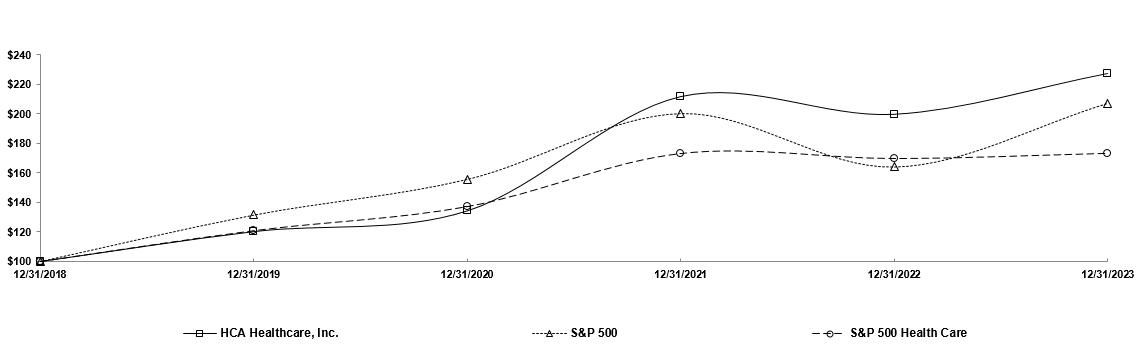][added: ]
| | | [removed: 12/31/2018 | | | |] 12/31/2019 | | | | 12/31/2020 | | | | 12/31/2021 | | | | 12/31/2022 | | | | 12/31/2023 | | | [added: | 12/31/2024 | | |]
The graph shows the cumulative total return to our stockholders for the five-year period ended December 31, [removed: 2023,] [added: 2024,] in comparison to the cumulative returns of the S&P 500 Index and the S&P Health Care Index.
The graph assumes $100 invested on December 31, [removed: 2018] [added: 2019] in our common stock and in each index with the subsequent reinvestment of dividends.
| October 2024 | | | 1,564,869 | | | $ | 390.45 | | | | 1,564,869 | | | $ | 1,822 | |
| November 2024 | | | 1,707,356 | | | $ | 349.09 | | | | 1,707,356 | | | $ | 1,226 | |
| December 2024 | | | 1,466,721 | | | $ | 315.00 | | | | 1,466,721 | | | $ | 764 | |
| Total for Fourth Quarter 2024 | | | 4,738,946 | | | $ | 352.19 | | | | 4,738,946 | | | | | |
| HCA Healthcare, Inc. | | $ | 100.00 | | | $ | 111.64 | | | $ | 175.93 | | | $ | 165.99 | | | $ | 188.93 | | | $ | 211.12 | |
| S&P 500 | | | 100.00 | | | | 118.40 | | | | 152.39 | | | | 124.79 | | | | 157.59 | | | | 197.02 | |
| S&P Health Care | | | 100.00 | | | | 113.45 | | | | 143.09 | | | | 140.29 | | | | 143.18 | | | | 146.87 | |
| October 2023 | | | 1,474,715 | | | $ | 244.12 | | | | 1,474,715 | | | $ | 1,325 | |
| November 2023 | | | 904,304 | | | $ | 243.29 | | | | 904,304 | | | $ | 1,105 | |
| December 2023 | | | 1,268,054 | | | $ | 260.25 | | | | 1,268,054 | | | $ | 775 | |
| Total for Fourth Quarter 2023 | | | 3,647,073 | | | $ | 249.52 | | | | 3,647,073 | | | | | |
| HCA Healthcare, Inc. | | $ | 100.00 | | | $ | 120.25 | | | $ | 134.25 | | | $ | 211.56 | | | $ | 199.61 | | | $ | 227.19 | |
| S&P 500 | | | 100.00 | | | | 131.49 | | | | 155.68 | | | | 200.37 | | | | 164.08 | | | | 207.21 | |
| S&P Health Care | | | 100.00 | | | | 120.82 | | | | 137.07 | | | | 172.89 | | | | 169.51 | | | | 172.99 | |
Item 9A. . Controls and Procedures
5 rewritten, 1 added, 1 removed, 33 unchanged
Based on our assessment under the framework in Internal Control — Integrated Framework, our management concluded that our internal control over financial reporting was effective as of December 31, [removed: 2023.][added: 2024.]
We have audited HCA Healthcare, Inc.’s internal control over financial reporting as of December 31, [removed: 2023,] [added: 2024,] based on criteria established in Internal [removed: Control — Integrated] [added: Control—Integrated] Framework issued by the Committee of Sponsoring Organizations of the Treadway Commission (2013 framework) (the COSO criteria).
In our opinion, HCA Healthcare, Inc. (the Company) maintained, in all material respects, effective internal control over financial reporting as of December 31, [removed: 2023,] [added: 2024,] based on the COSO criteria.
We also have audited, in accordance with the standards of the Public Company Accounting Oversight Board (United States) (PCAOB), the consolidated balance sheets of HCA Healthcare, Inc. as of December 31, [removed: 2023] [added: 2024] and [removed: 2022,] [added: 2023,] and the related consolidated statements of income, comprehensive income, stockholders’ equity (deficit), and cash flows for each of the three years in the period ended December 31, [removed: 2023,] [added: 2024,] and the related notes and our report dated February [removed: 16, 2024] [added: 13, 2025] expressed an unqualified opinion thereon.
During the fourth quarter of [removed: 2023,] [added: 2024,] there were no changes in our internal control over financial reporting that materially affected or are reasonably likely to materially affect our internal control over financial reporting.
February 13, 2025
February 16, 2024
Item 9B. . Other Information
1 rewritten, 0 added, 0 removed, 0 unchanged
(b) During the three months ended December 31, [removed: 2023,] [added: 2024,] no director or officer (as defined in Rule 16a-1(f) of the Exchange Act) of the Company adopted or terminated a “Rule 10b5-1 trading arrangement” or “non-Rule 10b5-1 trading arrangement,” as each term is defined in Item 408(a) of Regulation S-K.
Item 10. . Directors, Executive Officers and Corporate Governance
4 rewritten, 3 added, 0 removed, 4 unchanged
The information required by this Item regarding the identity and business experience of our directors and executive officers is set forth under the heading “Nominees for Election” and “Election of Directors” in the definitive proxy materials of HCA to be filed in connection with our [removed: 2024] [added: 2025] Annual Meeting of Stockholders with respect to our directors and is set forth in Item 1 of Part I of this annual report on Form 10-K with respect to our executive officers.
Information on the beneficial ownership reporting for our directors and executive officers required by this Item is contained under the caption “Delinquent Section 16(a) Reports” in the definitive proxy materials to be filed in connection with our [removed: 2024] [added: 2025] Annual Meeting of Stockholders and is incorporated herein by reference.
Information on our Audit and Compliance Committee and Audit Committee Financial Experts required by this Item is contained under the caption “Corporate Governance” in the definitive proxy materials to be filed in connection with our [removed: 2024] [added: 2025] Annual Meeting of Stockholders and is incorporated herein by reference.
The Code of Conduct is available on the Ethics and Compliance and [removed: Corporate] Governance [added: Documents] pages of our website at www.hcahealthcare.com.
We have adopted a securities trading policy (the “Securities Trading Policy”) that governs the purchase, sale and/or other dispositions of our securities by all directors, officers and employees of the Company or any of our affiliates and subsidiaries, and by the Company itself.
We believe that the Securities Trading Policy and related practices in respect of Company transactions are reasonably designed to promote compliance with insider trading laws, rules and regulations and listing standards applicable to the Company.
A copy of our Securities Trading Policy is filed with this Annual Report on Form 10-K as Exhibit 19.
Item 11. . Executive Compensation
1 rewritten, 0 added, 0 removed, 0 unchanged
The information required by this Item is set forth under the headings “Executive Compensation” and “Compensation Committee Interlocks and Insider Participation” in the definitive proxy materials to be filed in connection with our [removed: 2024] [added: 2025] Annual Meeting of Stockholders, which information is incorporated herein by reference, except as to information required pursuant to Item 402(v) of SEC Regulation S-K, relating to pay versus performance.
Item 12. . Security Ownership of Certain Beneficial Owners and Management and Related Stockholder Matters
6 rewritten, 1 added, 1 removed, 11 unchanged
Information about security ownership of certain beneficial owners required by this Item is set forth under the heading “Security Ownership of Certain Beneficial Owners and Management and Related Stockholder Matters” in the definitive proxy materials to be filed in connection with our [removed: 2024] [added: 2025] Annual Meeting of Stockholders, which information is incorporated herein by reference.
This table provides certain information as of December 31, [removed: 2023] [added: 2024] with respect to our equity compensation plans:
| [added: Plan Category] | | Number of securities to be issued upon exercise of outstanding options, warrants and rights | | Weighted-average exercise price of outstanding options, warrants and rights | | Number of securities remaining available for future issuance under equity compensation plans (excluding securities reflected in column(a)) | |
| Equity compensation plans approved by security holders | | [removed: 8.330] [added: 7,118] | (1) | [removed: $146.46] [added: $170.31] | (1) | [removed: 24.840] [added: 16,934] | (2) |
Includes [removed: 1.551] [added: 1.356] million restricted share units which vest solely based upon continued employment over a specific period of time and [removed: 1.410] [added: 1.175] million performance share units which vest based upon continued employment over a specific period of time and the achievement of predetermined financial targets over time.
Includes [removed: 11.056] [added: 7.316] million shares available for future grants under the 2020 Stock Incentive Plan for Key Employees of HCA Healthcare, Inc. and its [removed: Affiliates, 3.784 million shares of common stock reserved for future issuance under the HCA Holdings, Inc. Employee Stock Purchase Plan] [added: Affiliates] and [removed: 10.000] [added: 9.618] million shares of common stock reserved for future issuance under the HCA Healthcare, Inc. 2023 Employee Stock Purchase Plan.
| Total | | 7,118 | | $170.31 | | 16,934 | |
| Total | | 8.330 | | $146.46 | | 24.840 | |
Item 13. . Certain Relationships and Related Transactions, and Director Independence
1 rewritten, 0 added, 0 removed, 0 unchanged
The information required by this Item is set forth under the headings “Certain Relationships and Related Party Transactions” and “Corporate Governance” in the definitive proxy materials to be filed in connection with our [removed: 2024] [added: 2025] Annual Meeting of Stockholders, which information is incorporated herein by reference.
Item 14. . Principal Accountant Fees and Services
1 rewritten, 0 added, 0 removed, 1 unchanged
The information required by this Item is set forth under the heading “Ratification of Appointment of Independent Registered Public Accounting Firm” in the definitive proxy materials to be filed in connection with our [removed: 2024] [added: 2025] Annual Meeting of Stockholders, which information is incorporated herein by reference.
Item 15. . Exhibits and Financial Statement Schedules
130 rewritten, 13 added, 8 removed, 288 unchanged
| 4.5(k) | — | [Schedule of Omitted Supplements to the U.S. Guarantee, dated as of November 17, 2006 and amended and restated on February 26, 2014, filed pursuant to Instruction 2 to Item 601 of Regulation [removed: S-K.](https://www.sec.gov/Archives/edgar/data/860730/000095017024016524/hca-ex4_5k.htm)] [added: S-K.](https://www.sec.gov/Archives/edgar/data/860730/000095017025020134/hca-ex4_5k.htm)] |
| 4.5(n) | — | [Joinder Agreement No. 9, dated as of October 8, 2019, by and among HCA Inc., as borrower, the guarantors party thereto, Bank of America, N.A., as administrative agent and collateral agent, and [removed: the lenders party thereto (filed as Exhibit 4.1 to the Company’s Current Report on Form 8-K filed October 10, 2019, and incorporated herein by reference).](https://www.sec.gov/Archives/edgar/data/860730/000119312519265871/d788119dex41.htm)] [added: the](https://www.sec.gov/Archives/edgar/data/860730/000119312519265871/d788119dex41.htm)] |
| 4.6(c) | — | [Schedule of Omitted Supplements to the Security Agreement, dated as of November 17, 2006 and amended and restated as of March 2, 2009, filed pursuant to Instruction 2 to Item 601 of Regulation [removed: S-K.](https://www.sec.gov/Archives/edgar/data/860730/000095017024016524/hca-ex4_6c.htm)] [added: S-K.](https://www.sec.gov/Archives/edgar/data/860730/000095017025020134/hca-ex4_6c.htm)] |
| 4.7(c) | — | [Schedule of Omitted Supplements to the Pledge Agreement, dated as of November 6, 2006 and amended and restated as of March 2, 2009, filed pursuant to Instruction 2 to Item 601 of Regulation [removed: S-K.](https://www.sec.gov/Archives/edgar/data/860730/000095017024016524/hca-ex4_7c.htm)] [added: S-K.](https://www.sec.gov/Archives/edgar/data/860730/000095017025020134/hca-ex4_7c.htm)] |
| 4.9(c) | — | [Schedule of Omitted Supplements to the Security Agreement dated as of September 30, 2011, filed pursuant to Instruction 2 to Item 601 of Regulation [removed: S-K.](https://www.sec.gov/Archives/edgar/data/860730/000095017024016524/hca-ex4_9c.htm)] [added: S-K.](https://www.sec.gov/Archives/edgar/data/860730/000095017025020134/hca-ex4_9c.htm)] |
| 4.10(g) | — | [Additional Receivables Intercreditor Agreement, dated as of February 16, 2012, by and between Bank of America, N.A., as ABL Collateral Agent, and Bank of America, N.A., as New First Lien [removed: Collateral Agent (filed as Exhibit 4.10 to the Company’s Current Report on Form 8-K filed February 16, 2012, and incorporated herein by reference).](https://www.sec.gov/Archives/edgar/data/860730/000119312512065423/d302120dex410.htm)] [added: Collateral](https://www.sec.gov/Archives/edgar/data/860730/000119312512065423/d302120dex410.htm)] |
| [removed: 4.15] [added: 4.18] | — | [Form of [removed: 7.5%] [added: 7.50%] Debenture due [removed: 2023] [added: 2095] (filed as Exhibit [removed: 4.17] [added: 4.23] to the Company’s Registration Statement on Form S-4 (File No. 333-145054), and incorporated herein by [removed: reference).](https://www.sec.gov/Archives/edgar/data/841985/000119312507168470/dex417.htm)] [added: reference).](https://www.sec.gov/Archives/edgar/data/841985/000119312507168470/dex423.htm)] |
| [removed: 4.16] [added: 4.19] | — | [Form of [removed: 8.36%] [added: 7.05%] Debenture due [removed: 2024] [added: 2027] (filed as Exhibit [removed: 4.18] [added: 4.24] to the Company’s Registration Statement on Form S-4 (File No. 333-145054), and incorporated herein by [removed: reference).](https://www.sec.gov/Archives/edgar/data/841985/000119312507168470/dex418.htm)] [added: reference).](https://www.sec.gov/Archives/edgar/data/841985/000119312507168470/dex424.htm)] |
| [removed: 4.17] [added: 4.15] | — | [Form of Fixed Rate Global Medium-Term Note (filed as Exhibit 4.19 to the Company’s Registration Statement on Form S-4 (File No. 333-145054), and incorporated herein by reference).](https://www.sec.gov/Archives/edgar/data/841985/000119312507168470/dex419.htm) |
| [removed: 4.18] [added: 4.16] | — | [Form of Floating Rate Global Medium-Term Note (filed as Exhibit 4.20 to the Company’s Registration Statement on Form S-4 (File No. 333-145054), and incorporated herein by reference).](https://www.sec.gov/Archives/edgar/data/841985/000119312507168470/dex420.htm) |
| [removed: 4.19] [added: 4.17] | — | [Form of 7.69% Note due 2025 (filed as Exhibit 4.10 to the Company’s Annual Report on Form 10-K for the fiscal year ended December 31, 2004, and incorporated herein by reference).](https://www.sec.gov/Archives/edgar/data/860730/000095014405002397/g93199exv4w10.txt) |
| [removed: 4.20] [added: 4.21] | — | [Form of [removed: 7.50% Debenture due 2095] [added: Indenture of HCA Inc.] (filed as Exhibit [removed: 4.23] [added: 4.2] to the [removed: Company’s] [added: Registrant’s] Registration Statement on Form [removed: S-4] [added: S-3] (File No. [removed: 333-145054),] [added: 333-175791),] and incorporated herein by [removed: reference).](https://www.sec.gov/Archives/edgar/data/841985/000119312507168470/dex423.htm)] [added: reference).](https://www.sec.gov/Archives/edgar/data/841985/000095012311068186/y91604exv4w2.htm)] |
| [removed: 4.22] [added: 4.20] | — | [7.50% Note due 2033 in the principal amount of $250,000,000 (filed as Exhibit 4.2 to the Company’s Current Report on Form 8-K filed November 6, 2003, and incorporated herein by reference).](https://www.sec.gov/Archives/edgar/data/860730/000095014403012350/g85622exv4w2.txt) |
| [removed: 4.23] [added: 10.27] | — | [Form of [removed: Indenture] [added: Stock Appreciation Right Award Agreement Under the 2020 Stock Incentive Plan for Key Employees] of HCA [added: Healthcare,] Inc. [added: and its Affiliates] (filed as Exhibit [removed: 4.2] [added: 4.5] to the [removed: Registrant’s] [added: Company’s] Registration Statement on Form [removed: S-3] [added: S-8] (File No. [removed: 333-175791),] [added: 333-237967),] and incorporated herein by [removed: reference).](https://www.sec.gov/Archives/edgar/data/841985/000095012311068186/y91604exv4w2.htm)] [added: reference).*](https://www.sec.gov/Archives/edgar/data/860730/000119312520131082/d898777dex45.htm)] |
| [removed: 4.24] [added: 4.22] | — | [Indenture dated as of August 1, 2011, by and among HCA Inc., the guarantors named on Schedule I thereto, Delaware Trust Company (as successor to Law Debenture Trust Company of New York), as trustee, and Deutsche Bank Trust Company Americas, as paying agent, registrar and transfer agent (filed as Exhibit 4.5 to the Company’s Registration Statement on Form S-3 (File No. 333-226709), and incorporated herein by reference).](https://www.sec.gov/Archives/edgar/data/841985/000119312518243478/d572895dex45.htm) |
| [removed: 4.25] [added: 4.23] | — | [Indenture, dated as of December 6, 2012, by and among HCA Holdings, Inc., Law Debenture Trust Company of New York, as trustee, and Deutsche Bank Trust Company Americas, as registrar, paying agent and transfer agent (filed as Exhibit 4.1 to the Company’s Current Report on Form 8-K filed December 6, 2012, and incorporated herein by reference).](https://www.sec.gov/Archives/edgar/data/860730/000119312512493951/d446891dex41.htm) |
| [removed: 4.26] [added: 4.24] | — | [Supplemental Indenture No. [removed: 8,] [added: 10,] dated as of [removed: March] [added: October] 17, 2014, by and among HCA Inc., HCA Holdings, Inc., the subsidiary guarantors named therein, Law Debenture Trust Company of New York, as trustee, and Deutsche Bank Trust Company Americas, as paying agent, registrar and transfer agent (filed as Exhibit 4.3 to the Company’s Current Report on Form 8-K filed [removed: March 21,] [added: October 17,] 2014, and incorporated herein by [removed: reference).](https://www.sec.gov/Archives/edgar/data/860730/000119312514110448/d696567dex43.htm)] [added: reference).](https://www.sec.gov/Archives/edgar/data/860730/000119312514375189/d806654dex43.htm)] |
| 4.27 | — | [Form of [removed: 5.00%] [added: 5.375%] Senior [removed: Secured] Notes due [removed: 2024] [added: 2025] (included in Exhibit [removed: 4.26).](https://www.sec.gov/Archives/edgar/data/860730/000119312514110448/d696567dex43.htm)] [added: 4.26).](https://www.sec.gov/Archives/edgar/data/860730/000119312515013255/d852864dex42.htm)] |
| [removed: 4.28] [added: 10.14] | — | [removed: [Additional Receivables Intercreditor Agreement,] [added: [Amendment,] dated as of [removed: March 17, 2014, by and between Bank of America, N.A.,] [added: September 21, 2011, to the Stockholders’ Agreement, dated] as [removed: ABL Collateral Agent, and Bank] of [removed: America, N.A., as New First Lien Collateral Agent] [added: March 9, 2011] (filed as Exhibit [removed: 4.9] [added: 10.2] to the Company’s Current Report on Form 8-K filed [removed: March] [added: September] 21, [removed: 2014,] [added: 2011,] and incorporated herein by [removed: reference).](https://www.sec.gov/Archives/edgar/data/860730/000119312514110448/d696567dex49.htm)] [added: reference).](https://www.sec.gov/Archives/edgar/data/860730/000095012311085813/y92719exv10w2.htm)] |
| [removed: 4.29] [added: 4.34] | — | [Supplemental Indenture No. [removed: 10,] [added: 16,] dated as of [removed: October 17, 2014,] [added: August 15, 2016,] by and among HCA Inc., HCA Holdings, Inc., the subsidiary guarantors named therein, Law Debenture Trust Company of New York, as trustee, and Deutsche Bank Trust Company Americas, as paying agent, registrar and transfer agent (filed as Exhibit 4.3 to the Company’s Current Report on Form 8-K filed [removed: October 17, 2014,] [added: August 15, 2016,] and incorporated herein by [removed: reference).](https://www.sec.gov/Archives/edgar/data/860730/000119312514375189/d806654dex43.htm)] [added: reference).](https://www.sec.gov/Archives/edgar/data/860730/000119312516682009/d230671dex43.htm)] |
| [removed: 4.30] [added: 4.25] | — | [Form of 5.25% Senior Secured Notes due 2025 (included in Exhibit [removed: 4.29).](https://www.sec.gov/Archives/edgar/data/860730/000119312514375189/d806654dex43.htm)] [added: 4.24).](https://www.sec.gov/Archives/edgar/data/860730/000119312514375189/d806654dex43.htm)] |
| [removed: 4.31] | [removed: —] | [removed: [Additional Receivables Intercreditor Agreement, dated as of October 17, 2014, by and between Bank of America, N.A., as ABL Collateral Agent, and Bank of America, N.A., as New First Lien Collateral Agent] [added: [Agent] (filed as Exhibit [removed: 4.9] [added: 4.10] to the Company’s Current Report on Form 8-K filed [removed: October 17, 2014,] [added: February 16, 2012,] and incorporated herein by [removed: reference).](https://www.sec.gov/Archives/edgar/data/860730/000119312514375189/d806654dex49.htm)] [added: reference).](https://www.sec.gov/Archives/edgar/data/860730/000119312512065423/d302120dex410.htm)] |
| [removed: 4.32] [added: 4.26] | — | [Supplemental Indenture No. 11, dated as of January 16, 2015, by and among HCA Inc., HCA Holdings, Inc., Law Debenture Trust Company of New York, as trustee, and Deutsche Bank Trust Company Americas, as paying agent, registrar and transfer agent (filed as Exhibit 4.2 to the Company’s Current Report on Form 8-K filed January 16, 2015, and incorporated herein by reference).](https://www.sec.gov/Archives/edgar/data/860730/000119312515013255/d852864dex42.htm) |
| 4.33 | — | [Form of [removed: 5.375%] [added: 5.250%] Senior [added: Secured] Notes due [removed: 2025] [added: 2026] (included in Exhibit [removed: 4.32).](https://www.sec.gov/Archives/edgar/data/860730/000119312515013255/d852864dex42.htm)] [added: 4.32).](https://www.sec.gov/Archives/edgar/data/860730/000119312516505299/d159289dex42.htm)] |
| [removed: 4.34] [added: 4.28] | — | [Supplemental Indenture No. 12, dated as of May 20, 2015, by and among HCA Inc., HCA Holdings, Inc., Law Debenture Trust Company of New York, as trustee, and Deutsche Bank Trust Company Americas, as paying agent, registrar and transfer agent (filed as Exhibit 4.4 to the Company’s Current Report on Form 8-K filed May 20, 2015, and incorporated herein by reference).](https://www.sec.gov/Archives/edgar/data/860730/000119312515195297/d931617dex44.htm) |
| [removed: 4.35] [added: 4.29] | — | [Supplemental Indenture No. 13, dated as of November 13, 2015, by and among HCA Inc., HCA Holdings, Inc., Law Debenture Trust Company of New York, as trustee, and Deutsche Bank Trust Company Americas, as paying agent, registrar and transfer agent (filed as Exhibit 4.2 to the Company’s Current Report on Form 8-K filed November 13, 2015, and incorporated herein by reference).](https://www.sec.gov/Archives/edgar/data/860730/000119312515377134/d19992dex42.htm) |
| [removed: 4.36] [added: 4.30] | — | [Form of 5.875% Senior Notes due 2026 (included in Exhibit [removed: 4.35).](https://www.sec.gov/Archives/edgar/data/860730/000119312515377134/d19992dex42.htm)] [added: 4.29).](https://www.sec.gov/Archives/edgar/data/860730/000119312515377134/d19992dex42.htm)] |
| [removed: 4.37] [added: 4.31] | — | [Supplemental Indenture No. 14, dated as of December 8, 2015, by and among HCA Inc., HCA Holdings, Inc., Law Debenture Trust Company of New York, as trustee, and Deutsche Bank [removed: Trust](https://www.sec.gov/Archives/edgar/data/860730/000119312515397826/d87362dex44.htm)] [added: Trust Company Americas, as paying agent, registrar and transfer agent (filed as Exhibit 4.4 to the Company’s Current Report on Form 8-K filed December 8, 2015, and incorporated herein by reference).](https://www.sec.gov/Archives/edgar/data/860730/000119312515397826/d87362dex44.htm)] |
| | | [removed: [Company] [added: [Trust Company] Americas, as paying agent, registrar and transfer agent (filed as Exhibit [removed: 4.4] [added: 4.2] to the Company’s Current Report on Form 8-K filed [removed: December 8, 2015,] [added: June 22, 2017,] and incorporated herein by [removed: reference).](https://www.sec.gov/Archives/edgar/data/860730/000119312515397826/d87362dex44.htm)] [added: reference).](https://www.sec.gov/Archives/edgar/data/860730/000119312517210508/d377454dex42.htm)] |
| [removed: 4.38] [added: 4.32] | — | [Supplemental Indenture No. 15, dated as of March 15, 2016, by and among HCA Inc., HCA Holdings, Inc., the subsidiary guarantors named therein, Law Debenture Trust Company of New York, as trustee, and Deutsche Bank Trust Company Americas, as paying agent, registrar and transfer agent (filed as Exhibit 4.2 to the Company’s Current Report on Form 8-K filed March 15, 2016, and incorporated herein by reference).](https://www.sec.gov/Archives/edgar/data/860730/000119312516505299/d159289dex42.htm) |
| [removed: 4.39] [added: 4.40] | — | [Form of [removed: 5.250%] [added: 5.375%] Senior [removed: Secured] Notes [removed: due] [added: Due] 2026 (included in Exhibit [removed: 4.38).](https://www.sec.gov/Archives/edgar/data/860730/000119312516505299/d159289dex42.htm)] [added: 4.39).](https://www.sec.gov/Archives/edgar/data/860730/000119312518256366/d613143dex42.htm)] |
| [removed: 4.40] [added: 10.13] | — | [removed: [Additional Receivables Intercreditor] [added: [Stockholders’] Agreement, dated as of March [removed: 15, 2016,] [added: 9, 2011,] by and [removed: between Bank of America, N.A., as ABL Collateral Agent,] [added: among the Company, Hercules Holding II, LLC] and [removed: Bank of America, N.A., as First Lien Collateral Agent] [added: the other signatories thereto] (filed as Exhibit [removed: 4.7] [added: 10.1] to the Company’s Current Report on Form 8-K filed March [removed: 15, 2016,] [added: 16, 2011,] and incorporated herein by [removed: reference).](https://www.sec.gov/Archives/edgar/data/860730/000119312516505299/d159289dex47.htm)] [added: reference).](https://www.sec.gov/Archives/edgar/data/860730/000095012311025653/y90270exv10w1.htm)] |
| [removed: 4.41] [added: 4.36] | — | [Supplemental Indenture No. [removed: 16,] [added: 17,] dated as of [removed: August 15,] [added: December 9,] 2016, by and among HCA Inc., HCA Holdings, Inc., the subsidiary guarantors named therein, [removed: Law Debenture] [added: Delaware] Trust [removed: Company of New York,] [added: Company,] as trustee, and Deutsche Bank Trust Company Americas, as paying agent, registrar and transfer agent (filed as Exhibit [removed: 4.3] [added: 4.1] to the Company’s Current Report on Form 8-K filed [removed: August 15,] [added: December 9,] 2016, and incorporated herein by [removed: reference).](https://www.sec.gov/Archives/edgar/data/860730/000119312516682009/d230671dex43.htm)] [added: reference).](https://www.sec.gov/Archives/edgar/data/860730/000119312516789750/d311891dex41.htm)] |
| [removed: 4.42] [added: 4.35] | — | [Form of 4.500% Senior Secured Notes due 2027 (included in Exhibit [removed: 4.41).](https://www.sec.gov/Archives/edgar/data/860730/000119312516682009/d230671dex43.htm)] [added: 4.34).](https://www.sec.gov/Archives/edgar/data/860730/000119312516682009/d230671dex43.htm)] |
| [removed: 4.44] [added: 4.46] | — | [Supplemental Indenture No. [removed: 17,] [added: 23,] dated as of [removed: December 9, 2016,] [added: June 12, 2019,] by and among HCA Inc., HCA [removed: Holdings,] [added: Healthcare,] Inc., the subsidiary guarantors named therein, Delaware Trust Company, as trustee, and Deutsche Bank Trust Company Americas, as paying agent, registrar and transfer agent (filed as Exhibit [removed: 4.1] [added: 4.2] to the Company’s Current Report on Form 8-K filed [removed: December 9, 2016,] [added: June 12, 2019,] and incorporated herein by [removed: reference).](https://www.sec.gov/Archives/edgar/data/860730/000119312516789750/d311891dex41.htm)] [added: reference).](https://www.sec.gov/Archives/edgar/data/860730/000119312519171339/d763409dex42.htm)] |
| [removed: 4.45] [added: 4.54] | — | [Supplemental Indenture No. [removed: 18,] [added: 27,] dated as of June [removed: 22, 2017,] [added: 30, 2021,] by and among HCA Inc., HCA Healthcare, Inc., the subsidiary guarantors named therein, Delaware Trust Company, as trustee, and Deutsche Bank Trust Company Americas, as paying agent, registrar and transfer agent (filed as Exhibit 4.2 to the Company’s Current Report on Form 8-K filed [removed: June 22, 2017,] [added: July 1, 2021,] and incorporated herein by [removed: reference).](https://www.sec.gov/Archives/edgar/data/860730/000119312517210508/d377454dex42.htm)] [added: reference).](https://www.sec.gov/Archives/edgar/data/860730/000119312521205276/d191036dex42.htm)] |
| [removed: 4.46] [added: 4.38] | — | [Form of 5.500% Senior Secured Notes due 2047 (included in Exhibit [removed: 4.45).](https://www.sec.gov/Archives/edgar/data/860730/000119312517210508/d377454dex42.htm)] [added: 4.37).](https://www.sec.gov/Archives/edgar/data/860730/000119312517210508/d377454dex42.htm)] |
| [removed: 4.48] [added: 4.39] | — | [Supplemental Indenture No. 19, dated as of August 23, 2018, by and among HCA Inc., HCA Healthcare, Inc., Delaware Trust Company, as trustee, and Deutsche Bank Trust Company Americas, as paying agent, registrar and transfer agent (filed as Exhibit 4.2 to the Company’s Current Report on Form 8-K filed August 23, 2018, and incorporated herein by reference).](https://www.sec.gov/Archives/edgar/data/860730/000119312518256366/d613143dex42.htm) |
| 4.49 | — | [Form of [removed: 5.375%] [added: 4 1/8%] Senior [added: Secured] Notes [removed: Due 2026] [added: due 2029] (included in Exhibit [removed: 4.48).](https://www.sec.gov/Archives/edgar/data/860730/000119312518256366/d613143dex42.htm)] [added: 4.46).](https://www.sec.gov/Archives/edgar/data/860730/000119312519171339/d763409dex42.htm)] |
| [removed: 4.50] [added: 4.41] | — | [Supplemental Indenture No. 20, dated as of August 23, 2018, by and among HCA Inc., HCA Healthcare, Inc., Delaware Trust Company, as trustee, and Deutsche Bank Trust Company Americas, as paying agent, registrar and transfer agent (filed as Exhibit 4.3 to the Company’s Current Report on Form 8-K filed August 23, 2018, and incorporated herein by reference).](https://www.sec.gov/Archives/edgar/data/860730/000119312518256366/d613143dex43.htm) |
| 4.75 | — | [Supplemental Indenture No. 37, dated as of February 23, 2024, among HCA Inc., HCA Healthcare, Inc., Delaware Trust Company, as trustee, and Deutsche Bank Trust Company Americas, as paying agent, registrar and transfer agent (filed as Exhibit 4.2 to the Company’s Current Report on Form 8-K filed on February 23, 2024, and incorporated herein by reference).](https://www.sec.gov/Archives/edgar/data/860730/000119312524044555/d732073dex42.htm) |
| 4.76 | — | [Supplemental Indenture No. 38, dated as of February 23, 2024, among HCA Inc., HCA Healthcare, Inc., Delaware Trust Company, as trustee, and Deutsche Bank Trust Company Americas, as paying agent, registrar and transfer agent (filed as Exhibit 4.3 to the Company’s Current Report on Form 8-K filed on February 23, 2024, and incorporated herein by reference).](https://www.sec.gov/Archives/edgar/data/860730/000119312524044555/d732073dex43.htm) |
| 4.77 | — | [Supplemental Indenture No. 39, dated as of February 23, 2024, among HCA Inc., HCA Healthcare, Inc., Delaware Trust Company, as trustee, and Deutsche Bank Trust Company Americas, as paying agent, registrar and transfer agent (filed as Exhibit 4.4 to the Company’s Current Report on Form 8-K filed on February 23, 2024, and incorporated herein by reference).](https://www.sec.gov/Archives/edgar/data/860730/000119312524044555/d732073dex44.htm) |
| 4.79 | — | [Form of 5.450% Senior Notes due 2031(included in Exhibit 4.75).](https://www.sec.gov/Archives/edgar/data/860730/000119312524044555/d732073dex42.htm) |
| 4.80 | — | [Form of 5.600% Senior Notes due 2034 (included in Exhibit 4.76).](https://www.sec.gov/Archives/edgar/data/860730/000119312524044555/d732073dex43.htm) |
| 4.81 | — | [Form of 6.000% Senior Notes due 2054 (included in Exhibit 4.77).](https://www.sec.gov/Archives/edgar/data/860730/000119312524044555/d732073dex44.htm) |
| 4.83 | — | [Supplemental Indenture No. 41, dated as of August 12, 2024, among HCA Inc., HCA Healthcare, Inc., CSC Delaware Trust Company, as trustee, and Deutsche Bank Trust Company Americas, as paying agent, registrar and transfer agent (filed as Exhibit 4.4 to the Company’s Current Report on Form 8-K filed on August 12, 2024, and incorporated herein by reference).](https://www.sec.gov/Archives/edgar/data/860730/000119312524198927/d854227dex44.htm) |
| 4.84 | — | [Supplemental Indenture No. 42, dated as of August 12, 2024, among HCA Inc., HCA Healthcare, Inc., CSC Delaware Trust Company, as trustee, and Deutsche Bank Trust Company Americas, as paying agent, registrar and transfer agent (filed as Exhibit 4.5 to the Company’s Current Report on Form 8-K filed on August 12, 2024, and incorporated herein by reference).](https://www.sec.gov/Archives/edgar/data/860730/000119312524198927/d854227dex45.htm) |
| 4.86 | — | [Form of 5.450% Senior Notes due 2034 (included in Exhibit 4.84).](https://www.sec.gov/Archives/edgar/data/860730/000119312524198927/d854227dex45.htm) |
| 4.87 | — | [Form of 5.950% Senior Notes due 2054 (included in Exhibit 4.85).](https://www.sec.gov/Archives/edgar/data/860730/000119312524198927/d854227dex46.htm) |
| | | |
| | | |
| | | |
| 4.21 | — | [Form of 7.05% Debenture due 2027 (filed as Exhibit 4.24 to the Company’s Registration Statement on Form S-4 (File No. 333-145054), and incorporated herein by reference).](https://www.sec.gov/Archives/edgar/data/841985/000119312507168470/dex424.htm) |
| 4.43 | — | [Additional Receivables Intercreditor Agreement, dated as of August 15, 2016, by and between Bank of America, N.A., as ABL Collateral Agent, and Bank of America, N.A., as First Lien Collateral Agent (filed as Exhibit 4.8 to the Company’s Current Report on Form 8-K filed August 15, 2016, and incorporated herein by reference).](https://www.sec.gov/Archives/edgar/data/860730/000119312516682009/d230671dex48.htm) |
| 4.47 | — | [Additional Receivables Intercreditor Agreement, dated as of June 22, 2017, by and between Bank of America, N.A., as ABL Collateral Agent, and Bank of America, N.A., as First Lien Collateral Agent (filed as Exhibit 4.7 to the Company’s Current Report on Form 8-K filed June 22, 2017, and incorporated herein by reference).](https://www.sec.gov/Archives/edgar/data/860730/000119312517210508/d377454dex47.htm) |
| 4.61 | — | [Additional Receivables Intercreditor Agreement, dated as of June 12, 2019, by and between Bank of America, N.A., as ABL Collateral Agent, and Bank of America, N.A., as First Lien Collateral Agent (filed as Exhibit 4.11 to the Company’s Current Report on Form 8-K filed June 12, 2019, and incorporated herein by reference).](https://www.sec.gov/Archives/edgar/data/860730/000119312519171339/d763409dex411.htm) |
| 4.68 | — | [Additional Receivables Intercreditor Agreement, dated as of June 30, 2021, by and between Bank of America, N.A., as ABL Collateral Agent, and Bank of America, N.A., as First Lien Collateral Agent (filed as Exhibit 4.9 to the Company’s Current Report on Form 8-K filed July 1, 2021, and incorporated herein by reference).](https://www.sec.gov/Archives/edgar/data/860730/000119312521205276/d191036dex49.htm) |
| 4.79 | — | [Additional Receivables Intercreditor Agreement, dated as of March 9, 2022, by and between Bank of America, N.A., as ABL Collateral Agent, and Bank of America, N.A., as First Lien Collateral Agent (filed as Exhibit 4.15 to the Company’s Current Report on Form 8-K filed March 10, 2022, and incorporated herein by reference).](https://www.sec.gov/Archives/edgar/data/860730/000119312522070987/d312703dex415.htm) |
| 10.42 | — | [HCA Healthcare, Inc. 2023 Employee Stock Purchase Plan (filed as Exhibit 10.1 to the Company’s Current Report on Form 8-K filed on April 21, 2023, and incorporated herein by reference).*](https://www.sec.gov/Archives/edgar/data/860730/000119312523110578/d423503dex101.htm) |
| 10.44 | — | [Form of 2024 Performance Share Unit Award Agreement Under the 2020 Stock Incentive Plan for Key Employees of HCA Healthcare, Inc. and its Affiliates.*](https://www.sec.gov/Archives/edgar/data/860730/000095017024016524/hca-ex10_44.htm) |
An excerpt. Shown here: 40 of 130 rewritten, all 13 added and all 8 removed. The counts are complete. For every sentence, read Item 15. . Exhibits and Financial Statement Schedules in the FY2024 filing and the FY2023 filing.
Item 16. . Form 10-K Summary
384 rewritten, 131 added, 62 removed, 568 unchanged
Dated: February [removed: 16, 2024][added: 13, 2025]
| /S/ SAMUEL N. HAZEN | Chief Executive Officer and Director (Principal Executive Officer) | February [removed: 16, 2024] [added: 13, 2025] |
| /S/ [removed: WILLIAM B. RUTHERFORD] [added: MICHAEL A. MARKS] | Executive Vice President and Chief Financial Officer (Principal Financial [removed: Officer and Principal Accounting] Officer) | February [removed: 16, 2024] [added: 13, 2025] |
| /S/ THOMAS F. FRIST III | Chairman and Director | February [removed: 16, 2024] [added: 13, 2025] |
| /S/ MEG G. CROFTON | Director | February [removed: 16, 2024] [added: 13, 2025] |
| /S/ ROBERT J. DENNIS | Director | February [removed: 16, 2024] [added: 13, 2025] |
| /S/ NANCY\-ANN DEPARLE | Director | February [removed: 16, 2024] [added: 13, 2025] |
| /S/ WILLIAM R. FRIST | Director | February [removed: 16, 2024] [added: 13, 2025] |
| /S/ HUGH F. JOHNSTON | Director | February [removed: 16, 2024] [added: 13, 2025] |
| /S/ MICHAEL W. MICHELSON | Director | February [removed: 16, 2024] [added: 13, 2025] |
| /S/ WAYNE J. RILEY | Director | February [removed: 16, 2024] [added: 13, 2025] |
| /S/ ANDREA B. SMITH | Director | February [removed: 16, 2024] [added: 13, 2025] |
| [Consolidated Income Statements for the years ended December 31, [removed: 2023, 2022] [added: 2024, 2023] and [removed: 2021](#consolidated_income_statements)] [added: 2022](#consolidated_income_statements)] | F-5 |
| [Consolidated Comprehensive Income Statements for the years ended December 31, [removed: 2023, 2022] [added: 2024, 2023] and [removed: 2021](#consolidated_comprehensive_income)] [added: 2022](#consolidated_comprehensive_income)] | F-6 |
| [Consolidated Balance Sheets, December 31, [removed: 2023] [added: 2024] and [removed: 2022](#consolidated_balance_sheets)] [added: 2023](#consolidated_balance_sheets)] | F-7 |
| [Consolidated Statements of Stockholders’ Equity (Deficit) for the years ended December 31, [removed: 2023, 2022] [added: 2024, 2023] and [removed: 2021](#consolidated_of_stockholders_equity)] [added: 2022](#consolidated_of_stockholders_equity)] | F-8 |
| [Consolidated Statements of Cash Flows for the years ended December 31, [removed: 2023, 2022] [added: 2024, 2023] and [removed: 2021](#consolidated_statements_of_cash_flows)] [added: 2022](#consolidated_statements_of_cash_flows)] | F-9 |
We have audited the accompanying consolidated balance sheets of HCA Healthcare, Inc. (the Company) as of December 31, [removed: 2023] [added: 2024] and [removed: 2022,] [added: 2023,] the related consolidated statements of income, comprehensive income, stockholders’ equity (deficit) and cash flows for each of the three years in the period ended December 31, [removed: 2023,] [added: 2024,] and the related notes (collectively referred to as the “consolidated financial statements”).
In our opinion, the consolidated financial statements present fairly, in all material respects, the financial position of the Company at December 31, [removed: 2023] [added: 2024] and [removed: 2022,] [added: 2023,] and the results of its operations and its cash flows for each of the three years in the period ended December 31, [removed: 2023,] [added: 2024,] in conformity with U.S. generally accepted accounting principles.
We also have audited, in accordance with the standards of the Public Company Accounting Oversight Board (United States) (PCAOB), the [removed: Company’s] [added: Company's] internal control over financial reporting as of December 31, [removed: 2023,] [added: 2024,] based on criteria established in Internal Control-Integrated Framework issued by the Committee of Sponsoring Organizations of the Treadway Commission (2013 framework), and our report dated February [removed: 16, 2024] [added: 13, 2025] expressed an unqualified opinion thereon.
| *Description of the Matter* | For the year ended December 31, [removed: 2023,] [added: 2024,] the Company’s revenues were [removed: $64.968] [added: $70.603] billion. As discussed in Note 1 to the consolidated financial statements, revenues are based upon the estimated amounts the Company expects to be entitled to receive from patients and third-party payers. Estimates of contractual adjustments under managed care and commercial insurance plans [added: and government payor programs] are based upon the payment terms specified in the related contractual [removed: agreements.] [added: agreements or provided by government payor programs.] Management continually reviews the contractual adjustments estimation process to consider and incorporate [added: updates to laws and regulations and] the frequent changes in managed care contractual terms resulting from contract renegotiations and renewals. Revenues related to uninsured patients and uninsured copayment and deductible amounts for patients who have [removed: health care] [added: healthcare] coverage may have discounts applied (uninsured and other discounts). The Company also records estimated implicit price concessions (based primarily on historical collection experience) related to uninsured accounts to record these revenues and accounts receivable at the estimated amounts the Company expects to collect. The primary collection risks relate to uninsured patient accounts, including amounts owed from patients after insurance has paid the amounts covered by the applicable [removed: agreement.] [added: agreement or program.] Implicit price concessions relate primarily to amounts due directly from patients and are based upon management’s assessment of historical write-offs and expected net collections, business and economic conditions, trends in federal, state and private employer health care coverage and other collection indicators. Auditing management’s estimates of contractual adjustments and implicit price concessions was complex and judgmental due to the significant data inputs and subjective assumptions utilized in determining related amounts. |
| *How We Addressed the Matter in Our Audit* | We tested internal controls that address the risks of material misstatement related to the measurement and valuation of revenues, including estimation of contractual adjustments and implicit price concessions. For example, we tested management’s internal controls over the key data inputs to the contractual adjustments and implicit price concession models, significant assumptions underlying management’s models, and management’s internal controls over retrospective reviews of historical reserve accuracy. To test the estimated contractual adjustments and implicit price concessions, we performed audit procedures that included, among others, assessing [added: the] methodologies and evaluating the significant assumptions discussed above and testing the completeness and accuracy of the underlying data used by the Company in its estimates. We compared the significant assumptions used by management to historical assumptions and to current industry and economic trends and considered changes, if any, to the Company’s business and other relevant factors. We also assessed the historical accuracy of management’s estimates as a source of potential corroborative or contrary evidence. |
| *Description of the Matter* | At December 31, [removed: 2023,] [added: 2024,] the Company’s reserves for professional liability risks were [removed: $2.089] [added: $2.131] billion and the Company’s related provision for losses for the year ended December 31, [removed: 2023] [added: 2024] was [removed: $619] [added: $627] million. As discussed in Note 1 to the consolidated financial statements, reserves for professional liability risks represent the estimated ultimate net cost of all reported and unreported losses incurred and unpaid through the consolidated balance sheet date. Management estimates professional liability reserves and provisions for losses using individual case-basis valuations and actuarial analyses. Trends in the average frequency (number of claims) and ultimate average severity (cost per claim) of claims are significant assumptions in estimating the reserves. |
| | Auditing management’s professional liability claims reserves was complex and judgmental due to the significant estimations required in determining the reserves, particularly the actuarial analyses and assumptions related to the effects of trends in average severity and [added: average] frequency of claims. |
| *How We Addressed the Matter in Our Audit* | We tested management’s internal controls that address the risks of material misstatement over the Company’s professional liability claims reserves estimation process. For example, we tested internal controls over management’s review of the actuarial analyses, the significant assumptions, and the completeness and accuracy of claims data used in the reserve estimation process. To test the Company’s determination of the estimated professional liability expense and reserves, we performed audit procedures that included, among others, testing the completeness and accuracy of underlying claims data used by the Company and its actuaries in its determination of reserves and reviewing the Company’s insurance contracts [removed: by policy year] to validate self-insured limits, deductibles and coverage limits. Additionally, with the involvement of our actuarial specialists, we performed audit procedures that included, among others, assessing the actuarial analyses performed by management and its actuaries, testing the significant assumptions including consideration of Company-specific claim reporting and payment data, assessing the accuracy of management’s historical reserve estimates, and developing an independent range of reserves for comparison to the Company’s recorded amounts. |
FOR THE YEARS ENDED DECEMBER 31, [removed: 2023, 2022] [added: 2024, 2023] AND [removed: 2021][added: 2022]
| | | [removed: 2023] [added: 2024] | | | | [removed: 2022] [added: 2023] | | | | [removed: 2021] [added: 2022] | | |
| Revenues | | $ | [removed: 64,968] [added: 70,603] | | | $ | [removed: 60,233] [added: 64,968] | | | $ | [removed: 58,752] [added: 60,233] | |
| Salaries and benefits | | | [removed: 29,487] [added: 31,170] | | | | [removed: 27,685] [added: 29,487] | | | | [removed: 26,779] [added: 27,685] | |
| Supplies | | | [removed: 9,902] [added: 10,755] | | | | [removed: 9,371] [added: 9,902] | | | | [removed: 9,481] [added: 9,371] | |
| Other operating expenses | | | [removed: 12,875] [added: 14,819] | | | | [removed: 11,155] [added: 12,875] | | | | [removed: 9,961] [added: 11,155] | |
| Equity in earnings of affiliates | | | [removed: (22] [added: (23] | ) | | | [removed: (45] [added: (22] | ) | | | [removed: (113] [added: (45] | ) |
| Depreciation and amortization | | | [removed: 3,077] [added: 3,312] | | | | [removed: 2,969] [added: 3,077] | | | | [removed: 2,853] [added: 2,969] | |
| Interest expense | | | [removed: 1,938] [added: 2,061] | | | | [removed: 1,741] [added: 1,938] | | | | [removed: 1,566] [added: 1,741] | |
| Losses (gains) on sales of facilities | | | [removed: 5] [added: (14] | [added: )] | | | [removed: (1,301] [added: 5] | [removed: )] | | | [removed: (1,620] [added: (1,301] | ) |
| Losses on retirement of debt | | | — | | | | [removed: 78] [added: —] | | | | [removed: 12] [added: 78] | |
| | | | [removed: 57,262] [added: 62,080] | | | | [removed: 51,653] [added: 57,262] | | | | [removed: 48,919] [added: 51,653] | |
| Income before income taxes | | | [removed: 7,706] [added: 8,523] | | | | [removed: 8,580] [added: 7,706] | | | | [removed: 9,833] [added: 8,580] | |
| Provision for income taxes | | | [removed: 1,615] [added: 1,866] | | | | [removed: 1,746] [added: 1,615] | | | | [removed: 2,112] [added: 1,746] | |
| Net income | | | [removed: 6,091] [added: 6,657] | | | | [removed: 6,834] [added: 6,091] | | | | [removed: 7,721] [added: 6,834] | |
| Michael A. Marks | | |
| /S/ CHRISTOPHER F. WYATT | Senior Vice President and Controller (Principal Accounting Officer) | February 13, 2025 |
| Christopher F. Wyatt | | |
| | | |
| | Revenue Recognition – Contractual Adjustments and Implicit Price Concessions |
| | Professional Liability and Related Provision |
February 13, 2025
FOR THE YEARS ENDED DECEMBER 31, 2024, 2023 AND 2022
| | | | 1 | | | | 10 | | | | (54 | ) |
| | | | 66 | | | | 30 | | | | 58 | |
| | | | — | | | | — | | | | 8 | |
| | | 2024 | | | | 2023 | | |
| | | | 16,414 | | | | 14,927 | |
| | | | 62,514 | | | | 58,548 | |
| | | | 29,414 | | | | 27,715 | |
| | | $ | 59,513 | | | $ | 56,211 | |
| | | | 15,177 | | | | 12,655 | |
| | | $ | 59,513 | | | $ | 56,211 | |
FOR THE YEARS ENDED DECEMBER 31, 2024, 2023 AND 2022
| Comprehensive income | | | | | | | | | | | | | | | 38 | | | | 5,760 | | | | 897 | | | | 6,695 | |
| Repurchase of common stock | | | (17.798 | ) | | | | | | | (261 | ) | | | | | | | (5,803 | ) | | | | | | | (6,064 | ) |
| Distributions | | | | | | | | | | | | | | | | | | | | | | | (711 | ) | | | (711 | ) |
| Balances, December 31, 2024 | | | 249.981 | | | $ | 3 | | | $ | — | | | $ | (387 | ) | | $ | (2,115 | ) | | $ | 3,054 | | | $ | 555 | |
FOR THE YEARS ENDED DECEMBER 31, 2024, 2023 AND 2022
| Net income | | $ | 6,657 | | | $ | 6,091 | | | $ | 6,834 | |
| Depreciation and amortization | | | 3,312 | | | | 3,077 | | | | 2,969 | |
| Losses (gains) on sales of facilities | | | (14 | ) | | | 5 | | | | (1,301 | ) |
| Losses on retirement of debt | | | — | | | | — | | | | 78 | |
| | | 2024 | | | | 2023 | | | | 2022 | | |
| | | 2024 | | | | 2023 | | | | 2022 | | |
| Granted | | | 491 | | | | — | | | | 491 | | | | 305.44 | | | | | | | |
| Exercised | | | (1,128 | ) | | | (44 | ) | | | (1,172 | ) | | | 111.02 | | | | | | | |
| Cancelled | | | (101 | ) | | | — | | | | (101 | ) | | | 246.78 | | | | | | | |
| SARs outstanding, December 31, 2024 | | | 4,587 | | | | — | | | | 4,587 | | | $ | 170.31 | | | 5.3 years | | $ | 598 | |
| SARs exercisable, December 31, 2024 | | | 3,322 | | | | — | | | | 3,322 | | | $ | 136.86 | | | 4.3 years | | $ | 542 | |
| Granted | | | 582 | | | | 434 | | | | 1,016 | | | | 305.97 | |
| Performance adjustment | | | — | | | | 566 | | | | 566 | | | | 174.55 | |
| Vested | | | (639 | ) | | | (1,132 | ) | | | (1,771 | ) | | | 181.81 | |
| Cancelled | | | (138 | ) | | | (103 | ) | | | (241 | ) | | | 260.96 | |
| RSUs and PSUs outstanding, December 31, 2024 | | | 1,356 | | | | 1,175 | | | | 2,531 | | | $ | 260.95 | |
| William B. Rutherford | | |
| | Revenue Recognition |
| | Professional Liability Claims |
February 16, 2024
| | | | 10 | | | | (54 | ) | | | (16 | ) |
| | | | 30 | | | | 58 | | | | 115 | |
| | | | — | | | | 8 | | | | 38 | |
| | | | 14,927 | | | | 13,643 | |
| | | | 58,548 | | | | 54,757 | |
| | | | 27,715 | | | | 25,575 | |
| | | | 12,655 | | | | 9,902 | |
| Balances, December 31, 2020 | | | 339.426 | | | $ | 3 | | | $ | 294 | | | $ | (502 | ) | | $ | 777 | | | $ | 2,320 | | | $ | 2,892 | |
| Comprehensive income | | | | | | | | | | | | | | | 98 | | | | 6,956 | | | | 765 | | | | 7,819 | |
| Repurchase of common stock | | | (37.812 | ) | | | | | | | (578 | ) | | | | | | | (7,637 | ) | | | | | | | (8,215 | ) |
| Distributions | | | | | | | | | | | | | | | | | | | | | | | (749 | ) | | | (749 | ) |
In November 2023, the FASB issued Accounting Standards Update 2023-07, *Segment Reporting (Topic 280): Improvements to Reportable Segment Disclosures* (“ASU 2023-07”), which requires enhanced disclosures for significant segment expenses.
We plan to adopt ASU 2023-07 on the respective annual and interim effective dates applying a retrospective approach to all prior periods presented in the financial statements.
We do not believe the adoption of this new standard will have a material effect on our disclosures.
ASU 2023-09 is effective for public business entities for annual periods beginning on January 1, 2025.
Our cash management system provides for daily investment of available balances and the funding of outstanding checks when presented for payment.
Outstanding, but unpresented, checks totaling $600 million and $656 million at December 31, 2023 and 2022, respectively, have been included in “accounts payable” in the consolidated balance sheets.
Upon presentation for payment, these checks are funded through available cash balances or our credit facility.
| SARs outstanding, December 31, 2020 | | | 7,836 | | | | 819 | | | | 8,655 | | | $ | 91.53 | | | | | | | |
| Granted | | | 877 | | | | — | | | | 877 | | | | 174.98 | | | | | | | |
| Exercised | | | (2,443 | ) | | | (533 | ) | | | (2,976 | ) | | | 67.57 | | | | | | | |
| Cancelled | | | (108 | ) | | | — | | | | (108 | ) | | | 138.32 | | | | | | | |
| SARs exercisable, December 31, 2023 | | | 3,748 | | | | 44 | | | | 3,792 | | | $ | 118.67 | | | 4.5 years | | $ | 576 | |
| RSUs and PSUs outstanding, December 31, 2020 | | | 2,476 | | | | 2,592 | | | | 5,068 | | | $ | 125.40 | |
| Granted | | | 899 | | | | 689 | | | | 1,588 | | | | 174.34 | |
| Performance adjustment | | | — | | | | 684 | | | | 684 | | | | 102.02 | |
| Vested | | | (992 | ) | | | (1,772 | ) | | | (2,764 | ) | | | 106.62 | |
| Cancelled | | | (192 | ) | | | (110 | ) | | | (302 | ) | | | 149.07 | |
During 2021, we paid $67 million to acquire two hospital facilities, one in southern Georgia and one in Tennessee, $594 million to acquire a network of urgent care centers in Florida and $114 million to acquire other nonhospital health care entities (noncontrolling interests of $117 million were recorded).
We also paid $330 million and assumed certain liabilities to acquire an 80% interest (noncontrolling interests of $100 million were recorded) in a venture providing post-acute care services (home health and hospice).
During 2021, we received proceeds of $1.502 billion and recognized a pretax gain of $1.226 billion ($920 million after tax) related to the sales of five hospital facilities in Georgia, comprised of three facilities from our northern Georgia market and two facilities from our southern Georgia market.
| | | $ | 2,221 | | | $ | 2,400 | | | $ | 2,187 | | | $ | 2,074 | |
| | | 2022 | | | | | | | | | | | | | | |
| | | $ | 511 | | | $ | — | | | $ | (38 | ) | | | 473 | |
| | | $ | 404 | | | $ | 376 | |
| Investments of insurance subsidiaries | | | 473 | | | | 96 | | | | 377 | | | | — | |
An excerpt. Shown here: 40 of 384 rewritten, 40 of 131 added and 40 of 62 removed. The counts are complete. For every sentence, read Item 16. . Form 10-K Summary in the FY2024 filing and the FY2023 filing.