 filings.tools
Item 1. Business
57K characters. Original on sec.gov ·
Item 1. Business
options and customized pricing based on the policyholder’s individual risk characteristics. Within small commercial, both property and general liability coverages are offered under a single package policy, marketed under the Spectrum name. Specialty provides a variety of customized insurance products and services.
Small commercial provides coverages for small businesses, which the Company considers to be businesses with an annual payroll under $12, revenues under $25 and property values less than $20 per location. Through Maxum Specialty Insurance Group ("Maxum") small commercial also provides excess and surplus lines coverage to small businesses including umbrella, general liability, property and other coverages. Middle market provides insurance coverages to medium-sized businesses, which are companies whose payroll, revenue and property values exceed the small business definition. The Company has a small amount of property and casualty business written internationally. For U.S. exporters and other U.S. companies with international exposures, the Company covers property, marine and liability risks outside the U.S. as the assuming reinsurer under a reinsurance agreement with a third party.
In addition to offering standard commercial lines products, middle market includes program business which provides tailored programs, primarily to customers with common risk characteristics. Within specialty, a significant portion of the business is written through large deductible programs for national accounts. Other programs written within specialty are retrospectively-rated where the premiums are adjustable based on loss experience. Also within specialty, the Company writes captive programs business, which provides tailored programs to those seeking a loss sensitive solution where premiums are adjustable based on loss experience.
Marketing and Distribution
Commercial Lines provides insurance products and services through the Company’s regional offices, branches and sales and policyholder service centers throughout the United States. The products are marketed and distributed nationally using independent agents, brokers and wholesalers. The independent agent and broker distribution channel is consolidating and this trend is expected to continue. This will likely result in a larger proportion of written premium being concentrated among fewer agents and brokers. In addition, the Company offers insurance products to customers of payroll service providers through its relationships with major national payroll companies and to members of affinity organizations.
Competition
Small Commercial
In small commercial, The Hartford competes against large national carriers, as well as regional carriers in certain territories. Competitors include stock companies, mutual companies and other underwriting organizations. The small commercial market remains highly competitive as carriers seek to differentiate themselves through product expansion, price reduction, enhanced service and leading technology. Larger carriers such as The Hartford have improved their pricing sophistication and ease of doing business with agents and customers through the use of technology, analytics and other capabilities that improve the process of evaluating a risk, quoting new business and servicing customers. The Company is also adding to its digital capabilities on-line and through mobile devices as customers and distributors
demand more access and convenience, and expanding product and underwriting capabilities to accommodate both larger accounts and a broader risk appetite.
The small commercial market has also experienced low written premium growth rates in the current economic conditions, though the Company's written premium growth rate has been higher than the industry. This has put pressure on underwriting margins as competitors seek new business by increasing their underwriting appetite, and deepening their relationships with distribution partners. Also, carriers serving middle market-sized accounts are more aggressively competing for small commercial accounts, which are generally less price-sensitive. Some carriers, including start-up and non-traditional carriers, are looking to expand sales of business insurance products to small commercial market insureds through on-line and direct-to-consumer marketing.
Middle Market
Middle market business is considered “high touch” and involves individual underwriting and pricing decisions. The pricing of Middle market accounts is prone to significant volatility over time due to changes in individual account characteristics and exposure, as well as legislative and macro-economic forces. National and regional carriers participate in the middle market insurance sector, resulting in a competitive environment where pricing and policy terms are critical to securing new business and retaining existing accounts. Within this competitive environment, The Hartford is working to deepen its product and underwriting capabilities, and leverage its sales and underwriting talent with tools it has introduced in recent years. Through advanced training and data analytics, the Company’s field underwriters are working to improve risk selection and pricing decisions. In product development and related areas, such as claims and risk engineering, the Company is extending its capabilities in industry verticals, such as energy, construction, auto parts manufacturing, food processing and hospitality. Through a partnership with AXA Corporate Solutions, the Company offers business insurance coverages to exporters and other U.S. companies with a physical presence overseas. The Company has also added new middle market underwriters in the Midwest and Western U.S. to deepen relationships with its distribution partners.
Specialty Commercial
Specialty commercial competes on an account- by-account basis due to the complex nature of each transaction. Competition in this market includes stock companies, mutual companies, alternative risk sharing groups and other underwriting organizations.
For specialty casualty businesses, pricing competition continues to be significant, particularly for the larger individual accounts. As a means to mitigate the cost of insurance on larger accounts, more insureds may opt for the loss-sensitive products offered in our national accounts segment, including retrospectively rated contracts, in lieu of guaranteed cost policies. Under a retrospectively-rated contract, the ultimate premium collected from the insured is adjusted based on how incurred losses for the policy year develop over time, subject to a minimum and maximum premium. Within national accounts, the Company is implementing a phased roll out of a new risk management platform, allowing customers better access to claims data and other information needed by corporate risk managers. This
Part I - Item 1. Business
investment will allow the Company to work more closely with customers to improve long-term account performance.
In the bond business, favorable underwriting results in recent years has led to increased competition for market share, setting the stage for potential written price decreases. Public construction project work has slowed, resulting in only modest growth for our contract surety business.
In professional liability, large and medium-sized businesses are in differing competitive environments. Large public director & officers coverage, specifically excess layers, is under significant competitive price pressure. The middle market private management liability segment is in a more stable competitive and pricing environment.
| PERSONAL LINES |
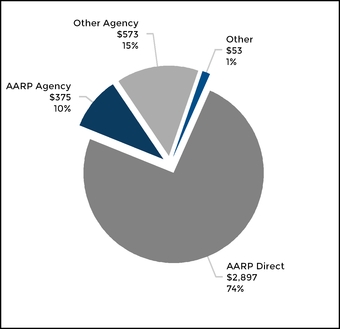
2016 Earned Premiums of $3,898 by Line of Business
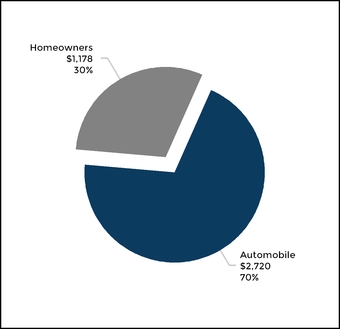
2016 Earned Premiums of $3,898 by Product
Principal Products and Services
| Automobile | Covers damage to an individual insured’s own vehicle due to collision or other perils and is referred to as auto physical damage. In addition to first party auto physical damage, automobile insurance covers liability for bodily injuries and property damage suffered by third parties and losses caused by uninsured or underinsured motorists. Also, under no-fault laws, policies written in some states provide first party personal injury protection. Some of the Company’s personal auto insurance policies also offer personal umbrella liability coverage for an additional premium. |
| Homeowners | Insures against losses to residences and contents from fire, wind and other perils. Homeowners insurance includes owned dwellings, rental properties and coverage for tenants. The policies may provide other coverages, including loss related to recreation vehicles or watercraft, identity theft and personal items such as jewelry. |
Personal Lines provides automobile, homeowners and personal umbrella coverages to individuals across the United States, including a program designed exclusively for members of AARP (“AARP Program”). The Hartford's auto and homeowners products provide coverage options and pricing tailored to a customer's individual risk. The Hartford has individual customer relationships with AARP Program policyholders and, as a group, they represent a significant portion of the total Personal Lines' business. Business sold to AARP members, either direct or through independent agents, amounted to earned premiums of $3.3 billion, $3.2 billion and $3.0 billion in 2016, 2015 and 2014, respectively.
During 2016, Personal Lines continued to refine its auto and home product offerings, i.e., its Open Road Auto and
Home Advantage products. Overall rate levels, price segmentation, rating factors and underwriting procedures were examined and updated to reflect the company’s actual experience with these products. In addition, Personal Lines also continued working with carrier partners to provide risk protection options for AARP members with needs beyond the company’s current product offering.
Marketing and Distribution
Personal Lines reaches diverse customers through multiple distribution channels, including direct-to-consumer and independent agents. In direct-to-consumer, Personal Lines markets its products through a mix of media, including direct mail,
Part I - Item 1. Business
digital marketing, television as well as digital and print advertising. Through the agency channel, Personal Lines provides products and services to customers through a network of independent agents in the standard personal lines market, primarily serving mature, preferred consumers. These independent agents are not employees of the Company.
Personal Lines has made significant investments in offering direct and agency-based customers the opportunity to interact with the company online, including via mobile devices. In addition, its technology platform for telephone sales centers enables sales representatives to provide an enhanced experience for direct-to-consumer customers, positioning The Company's to offer unique capabilities to AARP’s member base.
Most of Personal Lines' sales are associated with its exclusive licensing arrangement with AARP, with the current agreement in place through January 1, 2023, to market automobile, homeowners and personal umbrella coverages to AARP's approximately 38 million members, primarily direct but also through independent agents. This agreement provides Personal Lines with an important competitive advantage given the expected growth of the population of those over age 50 and the strength of the AARP brand. The Company has expanded its relationship with AARP to enable its members who are small business owners to purchase the Company's industry-leading small business products offered by Commercial Lines.
In addition to selling to AARP members, Personal Lines offers its automobile and homeowners products to non-AARP customers, primarily through the independent agent channel within select underwriting markets where we believe we have a competitive advantage. Personal Lines will leverage its agency channel to target AARP members and other customer segments that value the advice of an independent agent and recognize the differentiated experience The Company provides. In particular, the Company has taken action to distinguish its brand and improve profitability in the independent agent channel with fewer and more highly partnered agents.
Competition
The personal lines automobile and homeowners insurance
markets are highly competitive. Personal lines insurance is written by insurance companies of varying sizes that compete principally on the basis of price, product, service, including claims handling, the insurer's ratings and brand recognition. Companies with strong ratings, recognized brands, direct sales capability and economies of scale will have a competitive advantage. In recent years, insurers have increased their advertising in the direct-to-consumer market, in an effort to gain new business and retain profitable business. The growth of direct-to-consumer sales continues to outpace sales in the agency distribution channel.
Insurers that distribute products principally through agency channels compete by offering commissions and additional incentives to attract new business. To distinguish themselves in the marketplace, top tier insurers are offering online and self service capabilities that make it easier for agents and consumers to do business with the insurer. A large majority of agents have been using “comparative rater” tools that allow the agent to compare premium quotes among several insurance companies. The use of comparative rater tools increases price competition. Insurers that are able to capitalize on their brand and reputation, differentiate their products and deliver strong customer service are more likely to be successful in this market.
The use of data mining and predictive modeling is used by more and more carriers to target the most profitable business, and carriers have further segmented their pricing plans to expand market share in what they believe to be the most profitable segments. The Company is investing in capabilities to better utilize data and analytics, and thereby, refine and manage underwriting and pricing.
Also, new auto technology advancements, including lane departure warnings, backup cameras, automatic braking and active collision alerts, are being deployed rapidly and are expected to improve driver safety and reduce the likelihood of vehicle collisions. However, these features include expensive parts, potentially increasing average claim severity.
| PROPERTY & CASUALTY OTHER OPERATIONS |
Property & Casualty Other Operations includes certain property and casualty operations, managed by the Company, that have discontinued writing new business and includes substantially all of the Company's asbestos and environmental("A&E") exposures.
For a discussion of coverages provided under policies written with exposure to A&E, assumed reinsurance and all other non-A&E, see Part II, Item 7, MD&A - Critical Accounting Estimates, Property & Casualty Insurance Product Reserves.
Part I - Item 1. Business
| GROUP BENEFITS |
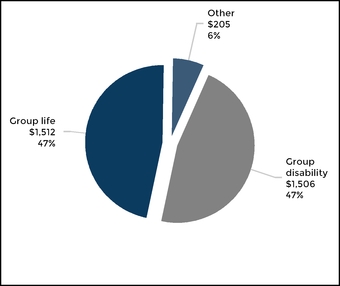
2016 Premiums and Fee Income of $3,223
Principal Products and Services
| Group Life | Typically is term life insurance provided in the form of yearly renewable term life insurance. Other life coverages in this category include accidental death and dismemberment and travel accident insurance. |
| Group Disability | Typically comprised of both short-term and long-term disability coverage that pays a percentage of an employee’s salary for a period of time if they are ill or injured and cannot perform the duties of their job. Short-term and long-term disability policies have elimination periods that must be satisfied prior to benefit payments. In addition to premiums, administrative service fees are paid by employers for leave management and the administration of underwriting, enrollment and claims processing for employer self-funded plans. |
| Other Products | Includes other group coverages such as retiree health insurance, critical illness, accident and blanket coverages. |
Group Insurance typically covers an entire group of people under a single contract, most typically the employees of a single employer or members of an association.
Group Benefits provides group life, disability and other group coverages to members of employer groups, associations and affinity groups through direct insurance policies and provides reinsurance to other insurance companies. In addition to employer paid coverages, Group Benefits offers voluntary product coverages which are offered through employee payroll deductions. Group Benefits also offers disability underwriting, administration, and claims processing to self-funded employer plans. In addition, Group Benefits offers a single-company leave management solution, The Hartford Productivity Advantage, which integrates work absence data from the insurer’s short-term and long-term group disability and workers’ compensation insurance with its leave management administration services.
Group Benefits generally offers term insurance policies, allowing for the adjustment of rates or policy terms in order to minimize the adverse effect of market trends, loss costs, declining interest rates and other factors. Policies are typically sold with one, two or three-year rate guarantees depending upon the product and market segment.
Marketing and Distribution
The Group Benefits distribution network is managed through a regional sales office system to distribute its group insurance products and services through a variety of distribution outlets including brokers, consultants, third-party administrators and trade associations. Additionally, Group Benefits has relationships with several private exchanges which offer its products to employer groups.
Competition
Group Benefits competes with numerous insurance companies and financial intermediaries marketing insurance products. In order to differentiate itself, Group Benefits uses its risk management expertise and economies of scale to derive a competitive advantage. Competitive factors include the extent of products offered, price, the quality of customer and claims handling services, and the Company's relationship with third-party distributors and private exchanges. Active price competition continues in the marketplace, resulting in multi-year rate guarantees being offered to customers. Top tier insurers in the marketplace also offer on-line and self service capabilities to third party distributors and consumers. The relatively large size and underwriting capacity of the Group Benefits business
Part I - Item 1. Business
provides a competitive advantage over smaller companies. Additionally, as employers continue to focus on reducing the cost of employee benefits, the shift to offering voluntary products paid for by employees will become greater. Competitive factors affecting the sale of voluntary products include the breadth of products, product education, enrollment capabilities and overall customer service.
The Company is striving to expand its employer group product offerings, including the voluntary product suite, such as coverages
for short term absences from work, critical illness and accident coverages. The Company's enhanced enrollment and marketing tools, such as My Tomorrow©, are providing additional opportunities to educate individual participants about supplementary benefits and deepen their knowledge about product selection.
| MUTUAL FUNDS |
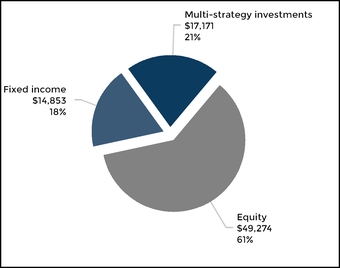
Mutual Fund Segment AUM as of December 31, 2016 [1]
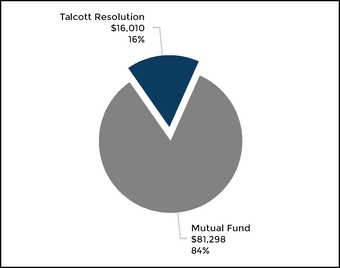
[1] Includes Mutual Fund Segment AUM for ETPs of $209.
Mutual Fund AUM as of December 31, 2016
Principal Products and Services
| Mutual Fund | Includes over 75 actively managed open-ended mutual funds across a variety of asset classes including domestic and international equity, fixed income, and multi-strategy investments, principally subadvised by two unaffiliated institutional asset management firms that have comprehensive global investment capabilities. |
| ETP | Includes a suite of exchange-traded products ("ETP") traded on the New York Stock Exchange that track indices using both active and passive investment techniques, commonly referred to as strategic beta. These investments strive to improve performance relative to traditional capitalization-weighted indices. |
| Talcott Resolution | Includes mutual fund assets held in separate accounts supporting legacy run-off Talcott Resolution variable insurance contracts. |
Mutual Funds segment provides investment management, administration, product distribution and related services to investors through a diverse set of investment products in domestic and international markets. Our comprehensive range of products and services assist clients in achieving their desired investment objectives. Our products are separated into three distinct categories referred to as Mutual Fund, ETP and Talcott Resolution.
Marketing and Distribution
Our mutual funds and ETPs are sold through national and regional broker-dealer organizations, independent financial advisers, defined contribution plans, financial consultants, bank trust groups and registered investment advisers. Our distribution team is organized to sell in North America. Talcott Resolution
represents variable insurance contracts from the legacy run-off Talcott Resolution variable insurance business and are not actively distributed.
Competition
The investment management industry is mature and highly competitive. Firms are differentiated by investment performance, range of products offered, brand recognition, financial strength, proprietary distribution channels, quality of service and level of fees charged relative to quality of investment products. The Mutual Funds segment competes with a large number of asset management firms and other financial institutions and differentiates itself through superior fund performance, product breadth, strong distribution and competitive fees.
Part I - Item 1. Business
| TALCOTT RESOLUTION |
2016 Revenues of $2,273
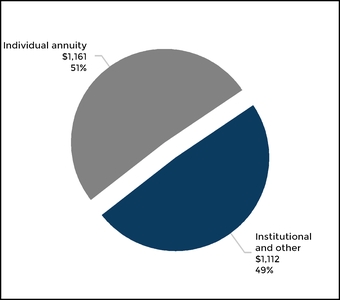
Talcott Resolution Account Values as of December 31, 2016 (in billions)

Principal Products and Services
| Individual Variable Annuities | Represents variable insurance contracts entered into between the Company and an individual policyholder. Products provide a current or future income stream based on the value of the individual's contract at annuitization, and can include a variety of guaranteed minimum death and withdrawal benefits. |
| Individual Fixed and Payout Annuities | Fixed Annuities represent fixed insurance contracts entered into between the Company and an individual policyholder. Products guarantee a minimum rate of interest and fixed amount of periodic payments. Payout Annuities represent single premium immediate payouts, deferred and matured annuity contracts. |
| Institutional Annuities | These are principally in the form of structured settlements, terminal funding agreements and guaranteed investment products. Structured settlements are contracts that provide periodic payments to claimants in settlement of a claim, a portion of which is related to the Company’s settlement of its own property and casualty insurance claims. Terminal funding agreements are single premium group annuities, most typically purchased by companies to fund pension plan liabilities. Guaranteed investment products are contracts that guarantee the owner repayment of principal plus a fixed or floating interest rate for a predetermined period of time. |
| Private Placement Life Insurance ("PPLI") | Represents variable life insurance policies that have a cash value which appreciates based on investment performance of funds held and includes individual high net worth and Corporate Owned Life Insurance (COLI). |
| Retirement Plans and Individual Life | Represents Retirement Plans and Individual Life contracts that have been reinsured to Massachusetts Mutual Life Insurance Company ("Mass Mutual") and The Prudential Insurance Company of America ("Prudential"), a subsidiary of Prudential Financial, Inc., respectively. Account values associated with these businesses no longer generate asset-based fee income due to the sales of these businesses through reinsurance. |
Talcott Resolution is comprised of the run-off of the Company's U.S. individual and institutional annuity and PPLI businesses.
The U.S. individual annuity business in run-off includes both variable and fixed annuities with many contracts in an asset accumulation phase before the contract reaches the payout or annuitization phase. Most of the Company’s variable annuity contracts sold to individuals provide a guaranteed minimum death benefit (GMDB) during the accumulation period that is generally equal to the greater of (a) the contract value at death or (b) premium payments less any prior withdrawals and may include adjustments that increase the benefit, such as for maximum anniversary value (MAV). In addition, some of the variable annuity contracts provide a guaranteed minimum withdrawal benefit (GMWB) whereby if the account value is reduced to a specified
level through a combination of market declines and withdrawals, the contract holder is entitled to a guaranteed remaining balance (GRB), which is generally equal to premiums less withdrawals. Many policyholders with a GMDB also have a GMWB. Policyholders that have a product that offers both guarantees can only receive the GMDB or GMWB, but not both.
The Talcott Resolution business segment also includes the Retirement Plans and Individual Life businesses sold in 2013 through reinsurance agreements with the respective buyers as well as the 2014 sale of Hartford Life Insurance KK, a Japanese company ("HLIKK"). For further discussion of the HLIKK transaction, see Note 2 - Business Acquisitions, Dispositions and Discontinued Operations of Notes to Consolidated Financial Statements.
Part I - Item 1. Business
| CORPORATE |
The Company includes in the Corporate category the Company's capital raising activities (including debt financing and related interest expense), purchase accounting adjustments related to
goodwill and other expenses not allocated to the reporting segments.
RESERVES
Total Reserves as of December 31, 2016
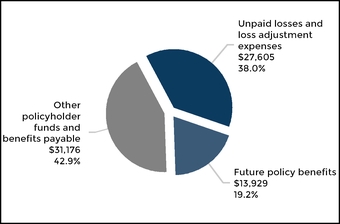
Unpaid Losses and Loss Adjustment Expenses $27,605 as of December 31, 2016
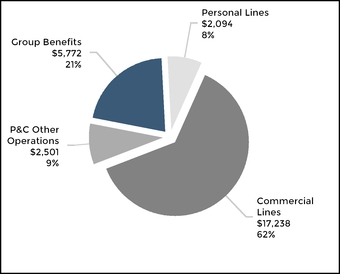
The reserves for losses and loss adjustment expenses include a liability for unpaid losses, including those that have been incurred but not yet reported, as well as estimates of all expenses associated with processing and settling these insurance claims, including reserves related to both Property & Casualty and Group Benefits.
Further discussion of The Hartford’s property and casualty insurance product reserves, including asbestos and environmental claims reserves, may be found in Part II, Item 7, MD&A — Critical Accounting Estimates — Property and Casualty Insurance Product Reserves, Net of Reinsurance. Additional discussion may be found in the Company’s accounting policies for
insurance product reserves within Note 1 - Basis of Presentation and Significant Accounting Policies of Notes to Consolidated Financial Statements.
Reserves for Future Policy Benefits
$13,929 as of December 31, 2016
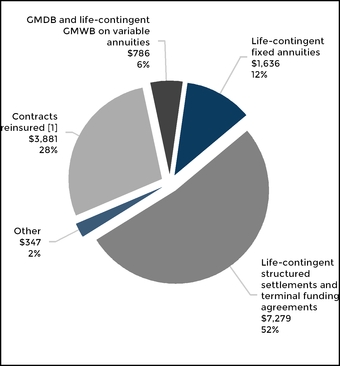
[1]Represent reserves for the individual life and retirement plans businesses that are fully reinsured and have an offsetting reinsurance recoverable.
Reserves for future policy benefits represent life-contingent reserves for which the company is subject to insurance and investment risk.
Part I - Item 1. Business
Other Policyholder Funds and Benefits Payable $31,176 as of December 31, 2016

[1]Represent reserves for individual life and retirement plans businesses that are fully reinsured and have an offsetting reinsurance recoverable.
Other policyholder funds and benefits payable represent deposits from policyholders where the company does not have insurance risk but is subject to investment risk.
UNDERWRITING FOR P&C AND GROUP BENEFITS
The Company underwrites the risks it insures in order to manage exposure to loss through favorable risk selection and diversification. Risk modeling is used to manage, within specified limits, the aggregate exposure taken in each line of business and across the Company. For property and casualty business, aggregate exposure limits are set by geographic zone and peril. Products are priced according to the risk characteristics of the insured’s exposures. Rates charged for Personal Lines products are filed with the states in which we write business. Rates for Commercial Lines products are also filed with the states but the premium charged may be modified based on the insured’s relative risk profile and workers’ compensation policies may be subject to modification based on prior loss experience. Pricing for Group Benefits products, including long-term disability and life insurance, is also based on an underwriting of the risks and a projection of estimated losses, including consideration of investment income.
Pricing adequacy depends on a number of factors, including the ability to obtain regulatory approval for rate changes, proper evaluation of underwriting risks, the ability to project future loss cost frequency and severity based on historical loss experience
adjusted for known trends, the Company’s response to rate actions taken by competitors, its expense levels and expectations about regulatory and legal developments. The Company seeks to price its insurance policies such that insurance premiums and future net investment income earned on premiums received will cover underwriting expenses and the ultimate cost of paying claims reported on the policies and provide for a profit margin.
Geographic Distribution of Earned Premium (% of total)
| Location | Commercial Lines | Personal Lines | Group Benefits | Total | |||||
| California | 8 | % | 3 | % | 2 | % | 13 | % | |
| Texas | 4 | % | 2 | % | 1 | % | 7 | % | |
| New York | 5 | % | 2 | % | 1 | % | 8 | % | |
| Florida | 2 | % | 2 | % | 1 | % | 5 | % | |
| All other [1] | 29 | % | 19 | % | 18 | % | 66 | % | |
| Total | 48 | % | 28 | % | 23 | % | 100 | % | [2] |
| [1] | No other single state or country accounted for 5% or more of the Company's consolidated earned premium written in 2016. |
| [2] | The total includes Talcott Resolution which makes up the other 1% of the total earned premium. |
CLAIMS ADMINISTRATION FOR P&C AND GROUP BENEFITS
Claims administration includes the functions associated with the receipt of initial loss notices, claims adjudication and estimates, legal representation for insureds where appropriate, establishment of case reserves, payment of losses and notification to reinsurers. These activities are performed by approximately 5,700 claim professionals located in 47 states, organized to meet the specific claim service needs for our various product offerings. Our combined Workers’ Compensation and Group Benefits units enable us to leverage synergies for improved outcomes and to accelerate continuous improvements.
Claim payments for benefit, loss and loss adjustment expenses are the largest expenditure for the Company.
REINSURANCE
For discussion of reinsurance, see Part II, Item 7, MD&A — Enterprise Risk Management and Note 8 - Reinsurance of Notes to Consolidated Financial Statements.
INVESTMENT OPERATIONS
Hartford Investment Management Company (“HIMCO”) is an SEC registered investment advisor and manages the Company's investment operations. HIMCO provides customized investment strategies, primarily for The Hartford's general account, as well as for The Hartford's pension plan, certain investment options in
Part I - Item 1. Business
Hartford Life Insurance Company's corporate owned life insurance products, a variable insurance trust and institutional clients.
As of December 31, 2016 and 2015, the fair value of HIMCO’s total assets under management was approximately $98.3 billion and $102.9 billion, respectively, of which $2.2 billion and $5.4 billion, respectively, were held in HIMCO managed third party accounts.
General Account Investment Management
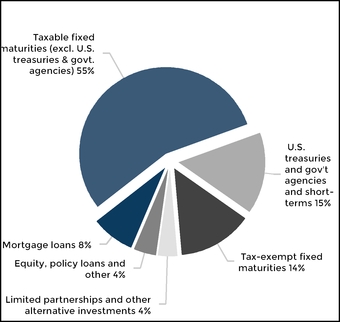
HIMCO manages the Company's portfolios to maximize economic value, and generate the returns necessary to support the Hartford’s various product obligations, within internally established objectives, guidelines and risk tolerances. The portfolio objectives and guidelines are developed based upon the asset/liability profile, including duration, convexity and other characteristics within specified risk tolerances. The risk tolerances considered include, but are not limited to, asset sector, credit issuer allocation limits, and maximum portfolio limits for below investment grade holdings. The Company attempts to minimize adverse impacts to the portfolio and the Company’s results of operations from changes in economic conditions through asset diversification, asset allocation limits, asset/liability duration matching and the use of derivatives. For further discussion of HIMCO’s portfolio management approach, see Part II, Item 7, MD&A — Enterprise Risk Management.
Investments as of December 31, 2016
ENTERPRISE RISK MANAGEMENT
The Company has insurance, operational and financial risks. For discussion on how The Hartford manages these risks, see Part II, Item 7, MD&A - Enterprise Risk Management.
REGULATION
State Insurance Laws
State insurance laws are intended to supervise and regulate insurers with the goal of protecting policyholders and ensuring the solvency of the insurers. As such, the insurance laws and regulations grant broad authority to state insurance departments (the “Departments”) to oversee and regulate the business of insurance. The Departments monitor the financial stability of an insurer by requiring insurers to maintain certain solvency standards and minimum capital and surplus requirements; invested asset requirements; state deposits of securities; guaranty fund premiums; restrictions on the size of risks which may be insured under a single policy; and adequate reserves and other necessary provisions for unearned premiums, unpaid losses and loss adjustment expenses and other liabilities, both reported and unreported. In addition, the Departments perform periodic market and financial examinations of insurers and require insurers to file annual and other reports on the financial condition of the companies. Policyholder protection is also regulated by the Departments through licensing of insurers, agents and brokers and others; approval of premium rates and policy forms; claims administration requirements; and maintenance of minimum rates for accumulation of surrender values.
Many states also have laws regulating insurance holding company systems. These laws require insurance companies, which are formed and chartered in the state (referred to as “domestic insurers”), to register with the state department of insurance (referred to as their “domestic state or regulator”) and file information concerning the operations of companies within the holding company system that may materially affect the operations, management or financial condition of the insurers within the system. Insurance holding company regulations principally relate to (i) state insurance approval of the acquisition of domestic insurers, (ii) prior review or approval of certain transactions between the domestic insurer and its affiliates, and (iii) regulation of dividends made by the domestic insurer. All transactions within a holding company system affecting domestic insurers must be determined to be fair and equitable.
The National Association of Insurance Commissioners (“NAIC”), the organization that works to promote standardization of best practices and assists state insurance regulatory authorities and insurers, conducted the “Solvency Modernization Initiative,” (the “Solvency Initiative” ). The effort focused on reviewing the U.S. financial regulatory system and financial regulation affecting insurance companies including: (1) capital requirements; (2) corporate governance and risk management; (3) group supervision; (4) statutory accounting and financial reporting; and (5) reinsurance. As a result of the Solvency Initiative, among other items, the NAIC adopted the Corporate Governance Annual Disclosure Model Act , which was enacted by the Company’s lead domestic state of Connecticut. The model law requires insurers to make an annual confidential filing regarding their corporate governance policies commencing in 2016. In addition, the NAIC adopted the Risk Management and Own Risk and Solvency Assessment Model Act (“ORSA”), which also has been adopted by Connecticut. ORSA requires insurers to maintain a risk management framework and conduct an internal risk and solvency assessment of the insurer’s material risks in normal and stressed environments. Many state insurance holding company laws, including Connecticut, have also been amended to require
Part I - Item 1. Business
insurers to file an annual confidential enterprise risk report with their lead domestic regulator, disclosing material risks within the entire holding company system that could pose an enterprise risk to the insurer.
Federal and State Securities and Financial Regulation Laws
Certain of the Company’s life insurance subsidiaries sold variable life insurance, variable annuity, and some fixed guaranteed products that are “securities” registered with the SEC under the Securities Act of 1933, as amended. Some of the products have separate accounts that are registered as investment companies under the Investment Company Act of 1940, as amended (the “1940 Act”), and/or are regulated by state law. Separate account investment products are also subject to state insurance regulation. Moreover, each registered separate account is divided into sub-accounts, each of which invests in an underlying mutual fund that is also registered as an investment company under the 1940 Act.
In addition, other subsidiaries of the Company sold and distributed the Company’s variable insurance products and retail mutual funds as broker-dealers and are subject to regulation promulgated and enforced by the Financial Industry Regulatory Authority (“FINRA”), the SEC and/or, in some instances, state securities administrators. Other subsidiaries operate as investment advisers registered with the SEC under the Investment Advisers’ Act of 1940, as amended, and are registered as investment advisers under certain state laws, as applicable. Because federal and state laws and regulations are primarily intended to protect investors in securities markets, they generally grant regulators broad rulemaking and enforcement authority. Some of these regulations include, among other things, regulations impacting sales methods, trading practices, suitability of investments, use and safekeeping of customers’ funds, corporate governance, capital, record keeping, and reporting requirements.
The Hartford operates in limited foreign jurisdictions. The extent of financial services regulation on business outside the United States varies significantly among the countries in which The Hartford operates. Some countries have minimal regulatory requirements, while others regulate financial services providers extensively. Foreign financial services providers in certain countries are faced with greater restrictions than domestic competitors domiciled in that particular jurisdiction.
Failure to comply with federal and state laws and regulations may result in fines, the issuance of cease-and-desist orders or suspension, termination or limitation of the activities of our operations and/or our employees.
INTELLECTUAL PROPERTY
We rely on a combination of contractual rights and copyright, trademark, patent and trade secret laws to establish and protect our intellectual property.
We have a trademark portfolio that we consider important in the marketing of our products and services, including, among others, the trademarks of The Hartford name, the Stag Logo and the
combination of these two trademarks. The duration of trademark registrations may be renewed indefinitely subject to country-specific use and registration requirements. We regard our trademarks as highly valuable assets in marketing our products and services and vigorously seek to protect them against infringement. In addition, we own a number of patents and patent applications relating to on-line quoting, insurance related processing, insurance telematics, proprietary interface platforms, and other matters, some of which may be important to our business operations. Patents are of varying duration depending on filing date, and will typically expire at the end of their natural term.
EMPLOYEES
The Hartford has approximately 16,900 employees as of December 31, 2016.
AVAILABLE INFORMATION
The Company’s Internet address is www.thehartford.com. Our annual report on Form 10-K, quarterly reports on Form 10-Q, current reports on Form 8-K, and amendments to those reports are available, without charge, on the investor relations section of our website, https://ir.thehartford.com, as soon as reasonably practicable after they are filed electronically with the SEC. Reports filed with the SEC may be viewed at www.sec.gov or obtained at the SEC’s Public Reference Room at 100 F Street, N.E., Washington D.C. Information regarding the operation of the Public Reference Room may be obtained by calling the SEC at 1-800-SEC-0330. References in this report to our website address are provided only as a convenience and do not constitute, and should not be viewed as, an incorporation by reference of the information contained on, or available through, the website. Therefore, such information should not be considered part of this report.
Part I - Item 1A. Risk Factors
Item 1A. RISK FACTORS
In deciding whether to invest in The Hartford, you should carefully consider the following risks, any of which could have a material adverse effect on our business, financial condition, results of operation or liquidity and could also impact the trading price of our securities. These risks are not exclusive, and additional risks to which we are subject include, but are not limited to, the factors mentioned under “Forward-Looking Statements” above and the risks of our businesses described elsewhere in this Annual Report on Form 10-K.
The following risk factors have been organized by category for ease of use, however many of the risks may have impacts in more than one category. The occurrence of certain of them may, in turn, cause the emergence or exacerbate the effect of others. Such a combination could materially increase the severity of the impact of these risks on our business, results of operations, financial condition or liquidity.
Risks Relating to Economic, Political and Global Market Conditions
Unfavorable economic, political and global market conditions may adversely impact our business and results of operations.
The Company’s investment portfolio and insurance liabilities are sensitive to changes in economic, political and global capital market conditions, such as the effect of a weak economy and changes in credit spreads, equity prices, interest rates and inflation. Weak economic conditions, such as high unemployment, low labor force participation, lower family income, a weak real estate market, lower business investment and lower consumer spending may adversely affect the demand for insurance and financial products and lower the Company’s profitability in some cases. In addition, the Company’s investment portfolio includes limited partnerships and other alternative investments for which changes in value are reported in earnings. These investments may be adversely impacted by political turmoil and economic volatility, including real estate market deterioration, which could impact our net investment returns and result in an adverse impact on operating results.
Below are several key factors impacted by changes in economic, political, and global market conditions and their potential effect on the Company’s business and results of operation:
| • | Credit Spread Risk- Credit spread exposure is reflected in the market prices of fixed income instruments where lower rated securities generally trade at a higher credit spread. If issuer credit spreads increase or widen, the market value of our investment portfolio may decline. If the credit spread widening is significant and occurs over an extended period of time, the Company may recognize other-than-temporary impairments, resulting in decreased earnings. If credit spreads tighten, significantly, the Company’s net investment |
income associated with new purchases of fixed maturities may be reduced. In addition, the value of credit derivatives under which the Company assumes exposure or purchases protection are impacted by changes in credit spreads, with losses occurring when credit spreads widen for assumed exposure or, when credit spreads tighten if credit protection has been purchased.
Our statutory surplus is also affected by widening credit spreads as a result of the accounting for the assets and liabilities on our fixed market value adjusted (“MVA”) annuities. Statutory separate account assets supporting the fixed MVA annuities are recorded at fair value. In determining the statutory reserve for the fixed MVA annuity payments we owe contract-holders, we are required to use current crediting rates. In many capital market scenarios, current crediting rates are highly correlated with market rates implicit in the fair value of statutory separate account assets. As a result, the change in the statutory reserve from period to period will likely substantially offset the change in the fair value of the statutory separate account assets. However, in periods of volatile credit markets, actual credit spreads on investment assets may increase sharply for certain sub-sectors of the overall credit market, resulting in statutory separate account asset market value losses. As actual credit spreads are not fully reflected in current crediting rates, the calculation of statutory reserves may not substantially offset the change in fair value of the statutory separate account assets, resulting in reductions in statutory surplus. This may result in the need to devote significant additional capital to support the fixed MVA product.
| • | Equity Markets Risk - A decline in equity markets may result in lower earnings from our Mutual Funds and Talcott Resolution operations where fee income is earned based upon the fair value of the assets under management. A decline in equity markets may also decrease the value of equity securities and limited partnerships and other alternative investments held in the Company’s general account portfolio, thereby negatively impacting our financial condition or reported earnings. In addition, certain of our annuity products have guaranteed minimum death benefits ("GMDB") or guaranteed minimum withdrawal benefits ("GMWB") that increase when equity markets decline requiring us to hold more statutory capital. While our hedging assets seek to reduce the net economic sensitivity of our potential obligations from guaranteed benefits to market fluctuations, because of the accounting asymmetries between our hedging targets and statutory and GAAP accounting principles for our guaranteed benefits, rising equity markets and/or rising interest rates may result in statutory or GAAP losses. The need to use additional capital to support these guaranteed benefits may adversely affect our ability to use funds for other purposes such as to support our other businesses, repay debt or repurchase shares. |
| • | Interest Rate Risk - Global economic conditions may result in the persistence of a low interest rate environment which would continue to pressure our net investment income and could result in lower margins and lower estimated gross profits on certain products. |
Part I - Item 1A. Risk Factors
New and renewal business for our property and casualty and group benefits products is priced based on prevailing interest rates. As interest rates decline, in order to achieve the same economic return, we would have to increase product prices to offset the lower anticipated investment income earned on invested premiums. Conversely, as interest rates rise, pricing targets will tend to decrease to reflect higher anticipated investment income. Our ability to effectively react to such changes in interest rates may affect our competitiveness in the marketplace, and in turn, could reduce written premium and earnings.
In addition, due to the long-term nature of the liabilities within our Group Benefits and Talcott Resolution operations, such as structured settlements, long-term disability and guaranteed benefits on variable annuities, declines in interest rates over an extended period of time would result in our having to reinvest at lower yields, increased hedging costs, reduced spreads on our annuity products and greater capital volatility. On the other hand, a rise in interest rates, in the absence of other countervailing changes, would reduce the market value of our investment portfolio and, if long-term interest rates were to rise dramatically, certain products within our Talcott Resolution segment might be exposed to disintermediation risk. Disintermediation risk refers to the risk that our policyholders may surrender their contracts in a rising interest rate environment, requiring us to liquidate assets in an unrealized loss position. A decline in market value of invested assets due to an increase in interest rates could also limit our ability to realize tax benefits from previously recognized capital losses.
| • | Inflation Risk - Inflation is a risk to our property and casualty and group benefits businesses because, in many cases, claims are paid out many years after a policy is written and premium is collected for the risk. Accordingly, a greater than expected increase in inflation related to the cost of medical services and repairs over the claim settlement period can result in higher claim costs than what was estimated at the time the policy was written. Inflation can also affect consumer spending and business investment which can reduce the demand for our products and services. |
Concentration of our investment portfolio increases the potential for significant losses.
The concentration of our investment portfolios in any particular industry, collateral type, group of related industries or geographic sector could have an adverse effect on our investment portfolios and consequently on our business, financial condition, results of operations, and liquidity. Events or developments that have a negative impact on any particular industry, collateral type, group of related industries or geographic region may have a greater adverse effect on our investment portfolio to the extent that the portfolio is concentrated rather than diversified.
Further, if issuers of securities or loans we hold are acquired, merge or otherwise consolidate with other issuers of securities or loans held by the Company, our investment portfolio’s credit concentration risk to issuers could increase for a period of time, until the Company is able to sell securities to get back in compliance with the established investment credit policies.
Insurance Industry and Product Related Risks
Unfavorable loss development may adversely affect our business, financial condition, results of operations and liquidity.
We establish property and casualty loss reserves to cover our estimated liability for the payment of all unpaid losses and loss expenses incurred with respect to premiums earned on our policies. Loss reserves are estimates of what we expect the ultimate settlement and administration of claims will cost, less what has been paid to date. These estimates are based upon actuarial projections and on our assessment of currently available data, as well as estimates of claims severity and frequency, legal theories of liability and other factors.
Loss reserve estimates are refined periodically as experience develops and claims are reported and settled, potentially resulting in increases to our reserves. Increases in reserves would be recognized as an expense during the periods in which these determinations are made, thereby adversely affecting our results of operations for those periods. In addition, since reserve estimates of aggregate loss costs for prior years are used in pricing our insurance products, inaccurate reserves can lead to our products not being priced adequately to cover actual losses and related loss expenses in order to generate a profit.
We continue to receive asbestos and environmental ("A&E")claims, the vast majority of which relate to policies written before 1986. Estimating the ultimate gross reserves needed for unpaid losses and related expenses for asbestos and environmental claims is particularly difficult for insurers and reinsurers. The actuarial tools and other techniques used to estimate the ultimate cost of more traditional insurance exposures tend to be less precise when used to estimate reserves for some A&E exposures.
Moreover, the assumptions used to estimate gross reserves for A&E claims, such as claim frequency over time, average severity, and how various policy provisions will be interpreted, are subject to significant uncertainty. It is also not possible to predict changes in the legal and legislative environment and their effect on the future development of A&E claims. These factors, among others, make the variability of gross reserves estimates for these longer-tailed exposures significantly greater than for other more traditional exposures.
Effective December 31, 2016, the Company entered into an agreement with National Indemnity Company (“NICO”), a subsidiary of Berkshire Hathaway Inc. (“Berkshire”) whereby the Company is reinsured for subsequent adverse development on substantially all of its net A&E reserves up to an aggregate net limit of $1.5 billion. The adverse development cover excludes risk of adverse development on net asbestos and environmental reserves held by the Company's U.K. Property and Casualty run-off subsidiaries which have been accounted for as liabilities held for sale in the consolidated balance sheets as of December 31, 2016. We remain directly liable to claimants and if the reinsurer does not fulfill its obligations under the agreement or if future adverse development exceeds the $1.5 billion aggregate limit, we may need to increase our recorded net reserves which could have a material adverse effect on our financial condition, results of
Previous: Cover and table of contents · Next: Item 1A. Risk Factors