 filings.tools
Hartford Insurance Group 10-K 2019-12-31
Filed 2020-02-21. 12 sections, 1092K characters. Original on sec.gov · Markdown · JSON
Cover and table of contents
UNITED STATES
SECURITIES AND EXCHANGE COMMISSION
Washington, D.C. 20549
FORM 10-K
(Mark One)
| ☑ | ANNUAL REPORT PURSUANT TO SECTION 13 OR 15(d) OF THE SECURITIES EXCHANGE ACT OF 1934 |
For the fiscal year ended December 31, 2019
or
| ☐ | TRANSITION REPORT PURSUANT TO SECTION 13 OR 15(d) OF THE SECURITIES EXCHANGE ACT OF 1934 |
For the transition period from to
Commission file number 001-13958

THE HARTFORD FINANCIAL SERVICES GROUP, INC.
(Exact name of registrant as specified in its charter)
| Delaware | 13-3317783 | |
| (State or other jurisdiction of incorporation or organization) | (I.R.S. Employer Identification No.) |
One Hartford Plaza**,** Hartford**,** Connecticut 06155
(Address of principal executive offices) (Zip Code)
(860) 547-5000
(Registrant’s telephone number, including area code)
SECURITIES REGISTERED PURSUANT TO SECTION 12 (b) OF THE ACT:
| Title of each class | Trading Symbol(s) | Name of each exchange on which registered |
| Common Stock, par value $0.01 per share | HIG | The New York Stock Exchange |
| 6.10% Notes due October 1, 2041 | HIG 41 | The New York Stock Exchange |
| 7.875% Fixed-to-Floating Rate Junior Subordinated Debentures due 2042 | HGH | The New York Stock Exchange |
| Depositary Shares, Each Representing a 1/1,000th Interest in a Share of 6.000% Non-Cumulative Preferred Stock, Series G, par value $0.01 per share | HIG PR G | The New York Stock Exchange |
SECURITIES REGISTERED PURSUANT TO SECTION 12 (g) OF THE ACT:
None
| Indicate by check mark: | |||||
| • | if the registrant is a well-known seasoned issuer, as defined in Rule 405 of the Securities Act. | Yes | ☑ | No | |
| • | if the registrant is not required to file reports pursuant to Section 13 or Section 15(d) of the Exchange Act. | Yes | No | ☑ | |
| • | whether the registrant (1) has filed all reports required to be filed by Section 13 or 15(d) of the Securities Exchange Act of 1934 during the preceding 12 months (or for such shorter period that the registrant was required to file such reports), and (2) has been subject to such filing requirements for the past 90 days. | Yes | ☑ | No | |
| • | whether the registrant has submitted electronically every Interactive Data File required to be submitted pursuant to Rule 405 of Regulation S-T during the preceding 12 months (or for such shorter period that the registrant was required to submit such files). | Yes | ☑ | No | |
| • | whether the registrant is a large accelerated filer, an accelerated filer, a non-accelerated filer, a smaller reporting company or an emerging growth company. See definitions of “large accelerated filer,” “accelerated filer,” “smaller reporting company” and "emerging growth company" in Rule 12b-2 of the Exchange Act. |
| Large accelerated filer | ☑ | Accelerated filer | ☐ | Non-accelerated filer | ☐ | Smaller reporting company | ☐ | Emerging growth company | ☐ |
If an emerging growth company, indicate by check mark if the registrant has elected not to use the extended transition period for complying with any new or revised financial accounting standards provided pursuant to Section 13(a) of the Exchange Act.
| • whether the registrant is a shell company (as defined in Rule 12b-2 of the Exchange Act). | Yes | ☐ | No | ☑ |
The aggregate market value of the shares of Common Stock held by non-affiliates of the registrant as of June 28, 2019 was approximately $20 billion, based on the closing price of $55.72 per share of the Common Stock on the New York Stock Exchange on June 28, 2019.
As of February 19, 2020, there were outstanding 358,252,183 shares of Common Stock, $0.01 par value per share, of the registrant.
Documents Incorporated by Reference
Portions of the registrant’s definitive proxy statement for its 2020 annual meeting of stockholders are incorporated by reference in Part III of this Form 10-K.
THE HARTFORD FINANCIAL SERVICES GROUP, INC.
ANNUAL REPORT ON FORM 10-K
FOR THE FISCAL YEAR ENDED DECEMBER 31, 2019
TABLE OF CONTENTS
[a] The information required by this item is set forth in the Enterprise Risk Management section of Item 7, Management's Discussion and Analysis of Financial Condition and Results of Operations and is incorporated herein by reference.
[b] See Index to Consolidated Financial Statements and Schedules elsewhere herein.
[c] The information called for by Item 11 will be set forth in the Proxy Statement under the subcaptions "Compensation Discussion and Analysis", "Executive Compensation", "Director Compensation", "Report of the Compensation and Management Development Committee", and "Compensation and Management Development Committee Interlocks and Insider Participation" and is incorporated herein by reference.
[d] Any information called for by Item 13 will be set forth in the Proxy Statement under the caption and subcaption "Board and Governance Matters" and "Director Independence" and is incorporated herein by reference.
[e] The information called for by Item 14 will be set forth in the Proxy Statement under the caption "Audit Matters" and is incorporated herein by reference.
Forward-Looking Statements
Certain of the statements contained herein are forward-looking statements made pursuant to the safe harbor provisions of the Private Securities Litigation Reform Act of 1995. Forward-looking statements can be identified by words such as “anticipates,” “intends,” “plans,” “seeks,” “believes,” “estimates,” “expects,” “projects,” and similar references to future periods.
Forward-looking statements are based on management's current expectations and assumptions regarding future economic, competitive, legislative and other developments and their potential effect upon The Hartford Financial Services Group, Inc. and its subsidiaries (collectively, the “Company” or “The Hartford”). Because forward-looking statements relate to the future, they are subject to inherent uncertainties, risks and changes in circumstances that are difficult to predict. Actual results could differ materially from expectations, depending on the evolution of various factors, including the risks and uncertainties identified below, as well as factors described in such forward-looking statements or in Part I, Item 1A. Risk Factors, in Part II, Item 7. Management's Discussion and Analysis of Financial Condition and Results of Operations, and those identified from time to time in our other filings with the Securities and Exchange Commission.
| • | Risks Relating to Economic, Political and Global Market Conditions: |
| ◦ | challenges related to the Company’s current operating environment, including global political, economic and market conditions, and the effect of financial market disruptions, economic downturns, changes in trade regulation including tariffs and other barriers or other potentially adverse macroeconomic developments on the demand for our products and returns in our investment portfolios; |
| ◦ | market risks associated with our business, including changes in credit spreads, equity prices, interest rates, inflation rate, foreign currency exchange rates and market volatility; |
| ◦ | the impact on our investment portfolio if our investment portfolio is concentrated in any particular segment of the economy; |
| ◦ | the impacts of changing climate and weather patterns on our businesses, operations and investment portfolio including on claims, demand and pricing of our products, the availability and cost of reinsurance, our modeling data used to evaluate and manage risks of catastrophes and severe weather events, the value of our investment portfolios and credit risk with reinsurers and other counterparties; |
| ◦ | the risks associated with the discontinuance of the London Inter-Bank Offered Rate ("LIBOR") on the securities we hold or may have issued, other financial instruments and any other assets and liabilities whose value is tied to LIBOR; |
| ◦ | the impacts associated with the withdrawal of the United Kingdom (“U.K.”) from the European Union (“E.U.”) on our international operations in the U.K. and E.U. |
| • | Insurance Industry and Product-Related Risks: |
| ◦ | the possibility of unfavorable loss development, including with respect to long-tailed exposures; |
| ◦ | the significant uncertainties that limit our ability to estimate the ultimate reserves necessary for asbestos and environmental claims |
| ◦ | the possibility of a pandemic, earthquake, or other natural or man-made disaster that may adversely affect our businesses; |
| ◦ | weather and other natural physical events, including the intensity and frequency of storms, hail, wildfires, flooding, winter storms, hurricanes and tropical storms, as well as climate change and its potential impact on weather patterns; |
| ◦ | the possible occurrence of terrorist attacks and the Company’s inability to contain its exposure as a result of, among other factors, the inability to exclude coverage for terrorist attacks from workers' compensation policies and limitations on reinsurance coverage from the federal government under applicable laws; |
| ◦ | the Company’s ability to effectively price its property and casualty policies, including its ability to obtain regulatory consents to pricing actions or to non-renewal or withdrawal of certain product lines; |
| ◦ | actions by competitors that may be larger or have greater financial resources than we do; |
| ◦ | technological changes including usage-based methods of determining premiums, advancements in automotive safety features, the development of autonomous vehicles, and platforms that facilitate ride sharing; |
| ◦ | the Company's ability to market, distribute and provide insurance products and investment advisory services through current and future distribution channels and advisory firms; |
| ◦ | the uncertain effects of emerging claim and coverage issues; |
| • | Financial Strength, Credit and Counterparty Risks: |
| ◦ | risks to our business, financial position, prospects and results associated with negative rating actions or downgrades in the Company’s financial strength and credit ratings or negative rating actions or downgrades relating to our investments; |
| ◦ | capital requirements which are subject to many factors, including many that are outside the Company’s control, such as National Association of Insurance Commissioners ("NAIC") risk based capital formulas, Funds at Lloyd's and Solvency Capital Requirement, |
which can in turn affect our credit and financial strength ratings, cost of capital, regulatory compliance and other aspects of our business and results;
| ◦ | losses due to nonperformance or defaults by others, including credit risk with counterparties associated with investments, derivatives, premiums receivable, reinsurance recoverables and indemnifications provided by third parties in connection with previous dispositions; |
| ◦ | the potential for losses due to our reinsurers' unwillingness or inability to meet their obligations under reinsurance contracts and the availability, pricing and adequacy of reinsurance to protect the Company against losses; |
| ◦ | state and international regulatory limitations on the ability of the Company and certain of its subsidiaries to declare and pay dividends; |
| • | Risks Relating to Estimates, Assumptions and Valuations: |
| ◦ | risk associated with the use of analytical models in making decisions in key areas such as underwriting, pricing, capital management, reserving, investments, reinsurance and catastrophe risk management; |
| ◦ | the potential for differing interpretations of the methodologies, estimations and assumptions that underlie the Company’s fair value estimates for its investments and the evaluation of other-than-temporary impairments on available-for-sale securities; |
| ◦ | the potential for further impairments of our goodwill or the potential for changes in valuation allowances against deferred tax assets; |
| • | Strategic and Operational Risks: |
| ◦ | the Company’s ability to maintain the availability of its systems and safeguard the security of its data in the event of a disaster, cyber or other information security incident or other unanticipated event; |
| ◦ | the potential for difficulties arising from outsourcing and similar third-party relationships; |
| ◦ | the risks, challenges and uncertainties associated with capital management plans, expense reduction initiatives and other actions, which may include acquisitions, divestitures or restructurings; |
| ◦ | risks associated with acquisitions and divestitures including the challenges of integrating acquired companies or businesses, which may result in our inability to achieve the anticipated benefits and synergies and may result in unintended consequences; |
| ◦ | difficulty in attracting and retaining talented and qualified personnel including key employees, such as executives, managers and employees with strong technological, analytical and other specialized skills; |
| ◦ | the Company’s ability to protect its intellectual property and defend against claims of infringement; |
| • | Regulatory and Legal Risks: |
| ◦ | the cost and other potential effects of increased federal, state and international regulatory and legislative developments, including those that could adversely impact the demand for the Company’s products, operating costs and required capital levels; |
| ◦ | unfavorable judicial or legislative developments; |
| ◦ | the impact of changes in federal , state or foreign tax laws; |
| ◦ | regulatory requirements that could delay, deter or prevent a takeover attempt that stockholders might consider in their best interests; and |
| ◦ | the impact of potential changes in accounting principles and related financial reporting requirements. |
Any forward-looking statement made by the Company in this document speaks only as of the date of the filing of this Form 10-K. Factors or events that could cause the Company’s actual results to differ may emerge from time to time, and it is not possible for the Company to predict all of them. The Company undertakes no obligation to publicly update any forward-looking statement, whether as a result of new information, future developments or otherwise.
Part I - Item 1. Business
Item 1. BUSINESS
(Dollar amounts in millions, except for per share data, unless otherwise stated)
GENERAL
The Hartford Financial Services Group, Inc. (together with its subsidiaries, “The Hartford”, the “Company”, “we”, or “our”) is a holding company for a group of subsidiaries that provide property and casualty ("P&C") insurance, group benefits insurance and services, and mutual funds and exchange-traded products to individual and business customers in the United States as well as in the United Kingdom, continental Europe and other international locations. The Hartford is headquartered in Connecticut and its oldest subsidiary, Hartford Fire Insurance Company, dates back to 1810. At December 31, 2019, total assets and total stockholders’ equity of The Hartford were $70.8 billion and $16.3 billion, respectively.
ORGANIZATION
The Hartford strives to maintain and enhance its position as a market leader within the financial services industry. The Company sells diverse and innovative products through multiple distribution channels to individuals and businesses and is considered a leading property and casualty and employee group benefits insurer. The Company endeavors to expand its insurance
product offerings and distribution and capitalize on the strength of the Company's brand. The Hartford Stag logo is one of the most recognized symbols in the financial services industry. The Company is also working to increase efficiencies through investments in technology.
As a holding company, The Hartford Financial Services Group, Inc. is separate and distinct from its subsidiaries and has no significant business operations of its own. The holding company relies on the dividends from its insurance companies and other subsidiaries as the principal source of cash flow to meet its obligations, pay dividends and repurchase common stock. Information regarding the cash flow and liquidity needs of The Hartford Financial Services Group, Inc. may be found in Part II, Item 7, Management’s Discussion and Analysis of Financial Condition and Results of Operations (“MD&A”) — Capital Resources and Liquidity.
STRATEGIC PRIORITIES
The Hartford’s strategy focuses on realizing the full potential of our product capabilities and underwriting expertise, becoming an easier company to do business with, and attracting, retaining and developing the talent needed for long-term success.

Many initiatives and investments in 2019 advanced our position in each strategic focus area:
| • | Closing on the acquisition of The Navigators Group, Inc. (“Navigators Group”), a global specialty insurance company. |
| • | Integrating the recent Group Benefits and Navigators Group acquisitions successfully, and maximizing our combined potential by deepening our distribution relationships, capitalizing on a broader product portfolio and meeting a wider array of customer needs. |
| • | Increasing the speed and ease of our interactions and business processes through data, digital technology and voice of customer, including expanded use of robotics and continued enhancements to underwriting and quoting platforms. |
| • | Continuing investment in new products and business models such as Spectrum, our next-generation package offering for |
small businesses, which offers customers tailored coverage recommendations as well as the ability to customize their own coverage, including real-time quote pricing. We are investing to maintain market leadership in small commercial as existing competitors and new entrants increase their focus on this business.
| • | Improving employee experience. We are investing in our workforce and striving to attract, retain and develop the best talent in the industry, enhance our industry-leading position in diversity and inclusion, and sustain our ethical culture. We see the benefits of this commitment in our sustained top-decile employee engagement scores. |
2019 Financial Results
Our 2019 financial results were excellent, with strong financial results across all of our business lines. Full year 2019 income from continuing operations, net of tax, available to common stockholders was $2.1 billion, or $5.66 per diluted share and net
Part I - Item 1. Business
income return on equity ("ROE") was 14.4%. Book value per diluted share rose 25%, to $43.85, primarily due to net income in excess of common stockholder dividends during 2019 and an increase in common stockholders' equity resulting from the impact of lower interest rates and tighter credit spreads on net unrealized investment gains within AOCI. Total revenues were $20.7 billion, up 9% since 2018 as growth in Commercial Lines, driven partly by the Navigators Group acquisition, and growth in Group Benefits was partially offset by a decline in Personal Lines.
Integration of the Navigators Group business is underway and we are making progress on improving the profitability of the acquired book of business, including pricing increases and underwriting actions. We are encouraged by the product breadth and depth of underwriting talent that the Navigators Group acquisition has contributed, and we’re already seeing the impact of these additions in our businesses and with our distribution partners.
Our Group Benefits business has benefited from favorable incidence trends in group disability and remains well-poised to compete moving forward with a complete set of voluntary product offerings.
We will also continue to address business challenges, including the need to return our Personal Lines segment to top line growth, the need for additional rate increases in challenging lines, such as in commercial auto, property, general liability and global specialty, and the continued rate pressure on workers’ compensation in response to continued favorable loss cost trends. In addition, the decline in reinvestment rates will continue to put pressure on investment yields and it remains to be seen whether the market will compensate with higher rate increases to increase underwriting profitability or will accept lower overall returns on equity.
2020 Priorities
As we enter 2020, our strategy remains consistent and we are focused on the following priorities:
| • | Commercial Lines |
| – | Benefiting from a firming pricing environment in most property and liability lines while navigating continued pricing pressure in workers’ compensation by staying disciplined in our underwriting; |
| – | Leveraging advanced analytics and technologies as well as the combined product breadth and talent we have acquired with Navigators Group; and |
| – | Continuing our journey to be a top-tier risk player in middle market. |
| • | Personal Lines |
| – | Continuing to upgrade our products and regain competitive momentum; and |
| – | Continuing to drive new business growth in AARP Direct. |
| • | Group Benefits |
| – | Continuing to grow revenues through sales growth in group life and voluntary; and |
| – | Substantially completing by year end the integration of the block of business we acquired from Aetna in 2017. |
Finally, beyond the achievement of business performance goals, The Hartford has long understood that making a sustainable and positive impact on society is an essential element of our ongoing success. Through financial contributions, volunteering and support for our company’s environmental initiatives, we are committed to demonstrating our character to customers and neighbors. We have proactive positions on social, environmental and governance issues important to our sustainability, and our capacity to deliver long-term shareholder value. For more information on the Company’s sustainability initiatives, please refer to our 2018 Sustainability Highlight Report available on the investor relations section of the Company’s website at: https://ir.thehartford.com.
Part I - Item 1. Business
REPORTING SEGMENTS
The Hartford conducts business principally in five reporting segments including Commercial Lines, Personal Lines, Property & Casualty Other Operations, Group Benefits and Hartford Funds, as well as a Corporate category. The Company includes in the Corporate category discontinued operations related to the life and annuity business sold in May 2018, reserves for run-off structured settlement and terminal funding agreement liabilities, capital raising activities (including equity financing, debt financing and related interest expense), transaction expenses incurred in connection with an acquisition, purchase accounting adjustments related to goodwill and other expenses not allocated to the reporting segments. Corporate also includes investment management fees and expenses related to managing third party business, including management of the invested assets of Talcott Resolution Life, Inc. and its subsidiaries ("Talcott Resolution"). Talcott Resolution is the holding company of the life and annuity business that we sold in May 2018. In addition, Corporate includes a 9.7% ownership interest in the legal entity that acquired the life and annuity business sold.
2019 Revenues of $20,740 [1] by Segment
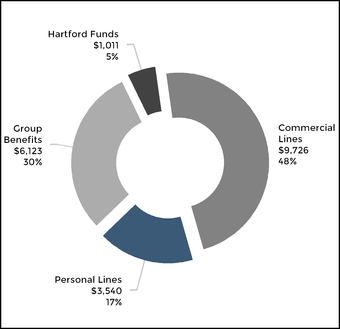
[1]Includes Revenue of $106 for Property & Casualty Other Operations and $234 for Corporate.
The following discussion describes the principal products and services, marketing and distribution, and competition of The Hartford's reporting segments. For further discussion of the reporting segments, including financial disclosures of revenues by product line, net income (loss), and assets for each reporting segment, see Note 4 - Segment Information of Notes to Consolidated Financial Statements.
Part I - Item 1. Business
| COMMERCIAL LINES |
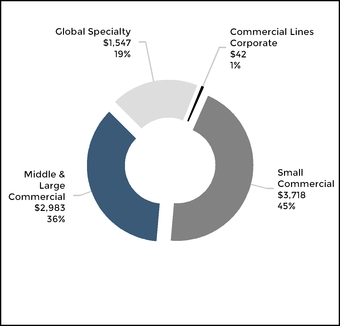
2019 Earned Premiums of $8,290 by Line of Business
2019 Earned Premiums of $8,290 by Product
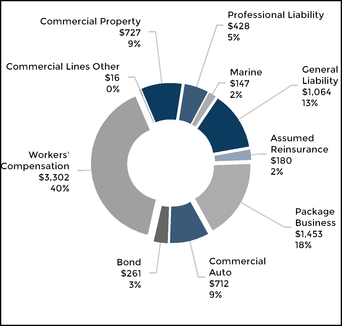
Principal Products and Services
| Automobile | Covers damage to a business's fleet of vehicles due to collision or other perils (automobile physical damage). In addition to first party automobile physical damage, commercial automobile covers liability for bodily injuries and property damage suffered by third parties and losses caused by uninsured or under-insured motorists. |
| Property | Covers the building a business owns or leases as well as its personal property, including tools and equipment, inventory, and furniture. A commercial property insurance policy covers losses resulting from fire, wind, hail, earthquake, theft and other covered perils, including coverage for assets such as accounts receivable and valuable papers and records. Commercial property may include specialized equipment insurance, which provides coverage for loss or damage resulting from the mechanical breakdown of boilers and machinery. |
| General Liability | Covers a business in the event it is sued for causing harm to a person and/or damage to property. General liability insurance covers third-party claims arising from accidents occurring on the insured’s premises or arising out of their operations. General liability insurance may also cover losses arising from product liability and provide replacement of lost income due to an event that interrupts business operations. |
| Marine | Encompasses various ocean and inland marine coverages including cargo, craft, hull, specie, transport and liability, among others. |
| Package Business | Covers both property and general liability damages. |
| Workers' Compensation | Covers employers for losses incurred due to employees sustaining an injury, illness or disability in connection with their work. Benefits paid under workers’ compensation policies may include reimbursement of medical care costs, replacement income, compensation for permanent injuries and benefits to survivors. Workers’ compensation is provided under both guaranteed cost policies (coverage for a fixed premium) and loss sensitive policies where premiums are adjustable based on the loss experience of the employer. |
| Professional Liability | Covers liability arising from directors and officers acting in their official capacity and liability for errors and omissions committed by professionals and others. Coverage may also provide employment practices insurance relating to allegations of wrongful termination and discrimination. |
| Bond | Encompasses fidelity and surety insurance, including commercial surety, contract surety and fidelity bonds. Commercial surety includes bonds that insure non-performance by contractors, license and permit bonds to help meet government-mandated requirements and probate and judicial bonds for fiduciaries and civil court proceedings. Contract surety bonds may include payment and performance bonds for contractors. Fidelity bonds may include ERISA bonds related to the handling of retirement plan assets and bonds protecting against employee theft or fraud. The Company also provides credit and political risk insurance offered to clients with global operations. |
| Assumed Reinsurance | Includes assumed reinsurance of property, liability, agriculture, marine and accident and health risks throughout the world but principally in Europe and North America. |
Item 1. Business
Through its three lines of business of small commercial, middle & large commercial, and global specialty, Commercial Lines offers its products and services to businesses in the United States ("U.S.") and internationally. Commercial Lines generally consists of products written for small businesses and middle market companies as well as national and multi-national accounts, largely distributed through retail agents and brokers, wholesale agents and global and specialty reinsurance brokers. The majority of Commercial Lines written premium is generated by small commercial and middle market, which provide coverage options and customized pricing based on the policyholder’s individual risk characteristics. Small commercial and middle market lines within middle & large commercial are generally referred to as standard commercial lines.
Small commercial provides coverages for small businesses, which the Company generally considers to be businesses with an annual payroll under $12, revenues under $25 and property values less than $20 per location. Within small commercial, both property and general liability coverages are offered under a single package policy, marketed under the Spectrum name. Through Maxum Specialty Insurance Group ("Maxum"), small commercial also provides excess and surplus lines coverage to small businesses including umbrella, general liability, property and other coverages.
Middle & large commercial business provides insurance coverages to medium-sized and national accounts businesses, which are companies whose payroll, revenue and property values exceed the small business definition. In addition to offering standard commercial lines products, middle & large commercial includes program business which provides tailored programs, primarily to customers with common risk characteristics. On national accounts, a significant portion of the business is written through large deductible programs. Other programs written within middle & large commercial are retrospectively-rated where the premiums are adjustable based on loss experience. Also within middle & large commercial, the Company writes captive programs business, which provides tailored programs to those seeking a loss sensitive solution where premiums are adjustable based on loss experience.
Global specialty provides a variety of customized insurance products, including property, liability, marine, professional liability, bond and accident and health reinsurance. On May 23, 2019, the Company' acquired Navigators Group, a global specialty insurer. The vast majority of the business written by our Navigators Group insurance subsidiaries is reported in the global specialty business unit. Revenues and earnings of the Navigators Group business are included in operating results of the Company's Commercial Lines segment since the acquisition date. For discussion of this transaction, see Note 2- Business Acquisitions of Notes to Consolidated Financial Statements.
Marketing and Distribution
Commercial Lines provides insurance products and services through the Company’s regional offices, branches and sales and policyholder service centers throughout the United States and overseas, principally in Europe. The products are marketed and distributed using independent retail agents and brokers, wholesale agents and global and specialty reinsurance brokers. As the sole corporate member of Lloyd's Syndicate 1221 ("Lloyd's Syndicate"), the Company has the exclusive right to underwrite
business up to an approved level of premium in the Lloyd’s of London (“Lloyd’s”) market.
In the United States, the independent agent and broker distribution channel is consolidating and this trend is expected to continue. This will likely result in a larger proportion of written premium being concentrated among fewer agents and brokers. In addition, the Company offers insurance products to customers of payroll service providers through its relationships with major national payroll companies in the United States and to members of affinity organizations.
Competition
Small Commercial
In small commercial, The Hartford competes against large national carriers, regional carriers and direct writers. Competitors include stock companies, mutual companies and other underwriting organizations. The small commercial market remains highly competitive and fragmented as carriers seek to differentiate themselves through product expansion, price reduction, enhanced service and leading technology. Larger carriers such as The Hartford continually advance their pricing sophistication and ease of doing business with agents and customers through the use of technology, analytics and other capabilities that improve the process of evaluating a risk, quoting new business and servicing customers. The Company also continuously enhances digital capabilities as customers and distributors demand more access and convenience, and expands product and underwriting capabilities to accommodate both larger accounts and a broader risk appetite. Existing competitors and new entrants, including start-up and non-traditional carriers, are actively looking to expand sales of business insurance products to small businesses through increasing their underwriting appetite, deepening their relationships with distribution partners, and through on-line and direct-to-consumer marketing.
Middle & Large Commercial
Middle & large commercial business is considered “high touch” and involves individual underwriting and pricing decisions. Competition in this market includes stock companies, mutual companies, alternative risk sharing groups and other underwriting organizations. The pricing of middle market and national accounts is prone to significant volatility over time due to changes in individual account characteristics and exposure, as well as legislative and macro-economic forces. National and regional carriers participate in the middle & large commercial insurance sector, resulting in a competitive environment where pricing and policy terms are critical to securing new business and retaining existing accounts. Within this competitive environment, The Hartford is working to deepen its product and underwriting capabilities, leverage its sales and underwriting talent and expand its use of data analytics to make risk selection and pricing decisions. In product development and related areas such as claims and risk engineering, the Company is extending its capabilities in industry verticals, such as energy, construction, technology and life sciences. Through business partners, the Company offers business insurance coverages to exporters and other U.S. companies with a physical presence overseas. The Hartford’s middle & large commercial business will leverage the investments in product, underwriting, and technology to better match price to individual risk as the firm pursues responsible growth strategies to deliver target returns.
Part I - Item 1. Business
For specialty casualty businesses within middle & large commercial, pricing competition continues to be significant, particularly for the larger individual accounts. As a means to mitigate the cost of insurance on larger accounts, more insureds may opt for the loss-sensitive products offered in our national accounts segment, including retrospectively rated contracts, in lieu of guaranteed cost policies. Under a retrospectively-rated contract, the ultimate premium collected from the insured is adjusted based on how incurred losses for the policy year develop over time, subject to a minimum and maximum premium.
Global Specialty
Global specialty competes against multi-national insurance and reinsurance companies, writing marine, property, excess casualty, professional liability, bond and assumed reinsurance. Global specialty also includes excess and surplus lines written through Maxum, including umbrella, general liability, property and other coverages. Due to adverse loss experience over the past couple
Showing the first 8K of 67K characters. Open the full section
Item 1A. Risk Factors
the Northeast and the Atlantic coast regions of the United States; tornadoes and hail in the Midwest and Southeast; earthquakes in geographical regions exposed to seismic activity; wildfires in the West and the spread of disease. We are also exposed to catastrophe losses in other parts of the world through our global specialty business. Any increases in the values and concentrations of insureds and property in these areas would increase the severity of catastrophic events in the future. In addition, changes in climate and/or weather patterns may increase the frequency and/or intensity of severe weather and natural catastrophe events potentially leading to increased insured losses. Potential examples include, but are not limited to:
| • | an increase in the frequency or intensity of wind and thunderstorm and tornado/hailstorm events due to increased convection in the atmosphere, |
| • | more frequent and larger wildfires in certain geographies, |
| • | higher incidence of deluge flooding, and |
| • | the potential for an increase in frequency and severity of hurricane events. |
For a further discussion of climate-related risks, see the above-referenced Risk Factor, “Changing climate and weather patterns may adversely affect our business, financial condition and results of operation.”
Our businesses also have exposure to global or nationally occurring pandemics caused by highly infectious and potentially fatal diseases spread through human, animal or plant populations.
In the event of one or more catastrophes, policyholders may be unable to meet their obligations to pay premiums on our insurance policies. Further, our liquidity could be constrained by a catastrophe, or multiple catastrophes, which could result in extraordinary losses. In addition, in part because accounting rules do not permit insurers to reserve for such catastrophic events until they occur, claims from catastrophic events could have a material adverse effect on our business, financial condition, results of operations or liquidity. The amount we charge for catastrophe exposure may be inadequate if the frequency or severity of catastrophe losses changes over time or if the models we use to estimate the exposure prove inadequate. In addition, regulators or legislators could limit our ability to charge adequate pricing for catastrophe exposures or shift more responsibility for covering risk.
Terrorism is an example of a significant man-made caused potential catastrophe. Private sector catastrophe reinsurance is limited and generally unavailable for terrorism losses caused by attacks with nuclear, biological, chemical or radiological weapons. In addition, workers' compensation policies generally do not have exclusions or limitations for terrorism losses. Reinsurance coverage from the federal government under the Terrorism Risk Insurance Program (the "Program") Reauthorization Act of 2019 (“TRIPRA 2019”) is also limited and only applies for certified acts of terrorism that exceed a certain threshold of industry losses. Accordingly, the effects of a terrorist attack in the geographic areas we serve may result in claims and related losses for which we do not have adequate reinsurance. TRIPRA 2019 also requires that the federal government create the following reports, which could lead to additional legislation or regulation: (1) Treasury Department to include in its biennial report on the effectiveness of the Program an evaluation of the availability and affordability of terrorism risk insurance for places of worship; and
(2) Government Accountability Office report to analyze and address the vulnerabilities and potential costs of cyber terrorism, adequacy of coverage under the Program, and to make recommendations for future legislative changes to address evolving cyber terrorism risks. Further, the continued threat of terrorism and the occurrence of terrorist attacks, as well as heightened security measures and military action in response to these threats and attacks or other geopolitical or military crises, may cause significant volatility in global financial markets, disruptions to commerce and reduced economic activity. These consequences could have an adverse effect on the value of the assets in our investment portfolio. Terrorist attacks also could disrupt our operation centers. In addition, TRIPRA 2019 expires on December 31, 2027 and if the U.S. Congress does not reauthorize the program or significantly reduces the government’s share of covered terrorism losses, the Company’s exposure to terrorism losses could increase materially unless it can purchase alternative terrorism reinsurance protection in the private markets at affordable prices or takes actions to materially reduce its exposure in lines of business subject to terrorism risk. For a further discussion of TRIPRA, see Part II, Item 7, MD&A - Enterprise Risk Management - Insurance Risk Management, Reinsurance as a Risk Management Strategy.
As a result, it is possible that any, or a combination of all, of these factors related to a catastrophe, or multiple catastrophes, whether natural or man-made, can have a material adverse effect on our business, financial condition, results of operations or liquidity.
Pricing for our products is subject to our ability to adequately assess risks, estimate losses and comply with state and international insurance regulations.
We seek to price our property and casualty and group benefits insurance policies such that insurance premiums and future net investment income earned on premiums received will provide for an acceptable profit in excess of underwriting expenses and the cost of paying claims. Pricing adequacy depends on a number of factors, including proper evaluation of underwriting risks, the ability to project future claim costs, our expense levels, net investment income realized, our response to rate actions taken by competitors, legal and regulatory developments, including in international markets, and the ability to obtain regulatory approval for rate changes.
State insurance departments regulate many of the premium rates we charge and also propose rate changes for the benefit of the property and casualty consumer at the expense of the insurer, which may not allow us to reach targeted levels of profitability. In addition to regulating rates, certain states have enacted laws that require a property and casualty insurer to participate in assigned risk plans, reinsurance facilities, joint underwriting associations and other residual market plans. State regulators also require that an insurer offer property and casualty coverage to all consumers and often restrict an insurer's ability to charge the price it might otherwise charge or restrict an insurer's ability to offer or enforce specific policy deductibles. In these markets, we may be compelled to underwrite significant amounts of business at lower than desired rates or accept additional risk not contemplated in our existing rates, participate in the operating losses of residual market plans or pay assessments to fund operating deficits of state-sponsored funds, possibly leading to
Part I - Item 1A. Risk Factors
lower returns on equity. The laws and regulations of many states also limit an insurer's ability to withdraw from one or more lines of insurance in the state, except pursuant to a plan that is approved by the state's insurance department. Additionally, certain states require insurers to participate in guaranty funds for impaired or insolvent insurance companies. These funds periodically assess losses against all insurance companies doing business in the state. Any of these factors could have a material adverse effect on our business, financial condition, results of operations or liquidity. For more on international regulatory risks, see the Risk Factor, “Regulatory and legislative developments could have a material adverse impact on our business, financial condition, results of operations and liquidity.”
Additionally, the property and casualty and group benefits insurance markets have been historically cyclical, experiencing periods characterized by relatively high levels of price competition, less restrictive underwriting standards, more expansive coverage offerings, multi-year rate guarantees and declining premium rates, followed by periods of relatively low levels of competition, more selective underwriting standards, more coverage restrictions and increasing premium rates. In all of our property and casualty and group benefits insurance product lines and states, there is a risk that the premium we charge may ultimately prove to be inadequate as reported losses emerge. In addition, there is a risk that regulatory constraints, price competition or incorrect pricing assumptions could prevent us from achieving targeted returns. Inadequate pricing could have a material adverse effect on our results of operations and financial condition.
Competitive activity, use of predictive analytics, or technological changes may adversely affect our market share, demand for our products, or our financial results.
The industries in which we operate are highly competitive. Our principal competitors are other property and casualty insurers, group benefits providers and providers of mutual funds and exchange-traded products. Competitors may expand their risk appetites in products and services where The Hartford currently enjoys a competitive advantage. Larger competitors with more capital and new entrants to the market could result in increased pricing pressures on a number of our products and services and may harm our ability to maintain or increase our profitability. For example, larger competitors, including those formed through consolidation or who may acquire new entrants to the market, such as insurtech firms, may have lower operating costs and an ability to absorb greater risk while maintaining their financial strength ratings, thereby allowing them to price their products more competitively. In addition, a number of insurers are making use of predictive analytics to, among other things, improve pricing accuracy, be more targeted in marketing, strengthen customer relationships and provide more customized loss prevention services. If they are able to use predictive analytics and other data and/or adopt innovative new technologies more effectively than we are, it may give them a competitive advantage. Because of the highly competitive nature of the industries we compete in, there can be no assurance that we will continue to compete effectively with our industry rivals, or that competitive pressure will not have a material adverse effect on our business and results of operations.
Our business could also be affected by technological changes, including further advancements in automotive safety features, the development of autonomous or “self-driving” vehicles, and platforms that facilitate ride sharing. These technologies could impact the frequency or severity of losses, disrupt the demand for certain of our products, or reduce the size of the automobile insurance market as a whole. In addition, our business may be disrupted due to failures of accelerated technological changes, including our automation of minimally complex tasks, which may adversely impact our business and results of operations. The risks we insure are also affected by the increased use of technology in homes and businesses, including technology used in heating, ventilation, air conditioning and security systems and the introduction of more automated loss control measures. While there is substantial uncertainty about the timing, penetration and reliability of such technologies, and the legal frameworks that may apply, such as to autonomous vehicles, any such impacts could have a material adverse effect on our business and results of operations.
We may experience difficulty in marketing and providing insurance products and investment advisory services through distribution channels and advisory firms.
We distribute our insurance products, mutual funds and ETPs through a variety of distribution channels and financial intermediaries, including brokers, independent agents, wholesale agents, reinsurance brokers, broker-dealers, banks, registered investment advisors, affinity partners, our own internal sales force and other third-party organizations. In some areas of our business, we generate a significant portion of our business through third-party arrangements. For example, we market personal lines products in large part through an exclusive licensing arrangement with AARP that continues through January 1, 2023. Our ability to distribute products through the AARP program may be adversely impacted by membership levels and the pace of membership growth. In addition, the independent agent and broker distribution channel is consolidating which could result in a larger proportion of written premium being concentrated among fewer agents and brokers, potentially increasing our cost of acquiring new business. While we periodically seek to renew or extend third party arrangements, there can be no assurance that our relationship with these third parties will continue or that the economics of these relationships won't change to make them less financially attractive to the Company. An interruption in our relationship with certain of these third parties could materially affect our ability to market our products and could have a material adverse effect on our business, financial condition, results of operations and liquidity.
Unexpected and unintended claim and coverage issues under our insurance contracts may adversely impact our financial performance.
Changes in industry practices and in legal, judicial, social and other environmental conditions, technological advances or fraudulent activities, may require us to pay claims we did not intend to cover when we wrote the policies. Social, economic and environmental issues, including rising income inequality, climate change, prescription drug use and addiction, exposures to new substances or those previously considered to be safe and sexual
Part I - Item 1A. Risk Factors
harassment claims, along with the use of social media to proliferate messaging around such issues, has expanded the theories for reporting claims, which may increase our claims administration and/or litigation costs. State and local governments' increased efforts aimed to respond to the costs and concerns associated with these types of issues, may also lead to expansive, new theories for reporting claims. In addition, these and other social, economic and environmental issues may either extend coverage beyond our underwriting intent or increase the frequency or severity of claims. Some of these changes, advances or activities may not become apparent until some time after we have issued insurance contracts that are affected by the changes, advances or activities and/or we may be unable to compensate for such losses through future pricing and underwriting. As a result, the full extent of liability under our insurance contracts may not be known for many years after a contract is issued, and this liability may have a material adverse effect on our business, financial condition, results of operations and liquidity at the time it becomes known.
Financial Strength, Credit and Counterparty Risks
Downgrades in our financial strength or credit ratings may make our products less attractive, increase our cost of capital and inhibit our ability to refinance our debt.
Financial strength and credit ratings are important in establishing the competitive position of insurance companies. Rating agencies assign ratings based upon several factors. While most of the factors relate to the rated company, others relate to the views of the rating agency (including its assessment of the strategic importance of the rated company to the insurance group), general economic conditions, and circumstances outside the rated company's control. In addition, rating agencies may employ different models and formulas to assess the financial strength of a rated company, and from time to time rating agencies have altered these models. Changes to the models or factors used by the rating agencies to assign ratings could adversely impact a rating agency's judgment of its internal rating and the publicly issued rating it assigns us.
Our financial strength ratings, which are intended to measure our ability to meet policyholder obligations, are an important factor affecting public confidence in most of our products and, as a result, our competitiveness. A downgrade or a potential downgrade in the rating of our financial strength or of one of our principal insurance subsidiaries could affect our competitive position and reduce future sales of our products.
Our credit ratings also affect our cost of capital. A downgrade or a potential downgrade of our credit ratings could make it more difficult or costly to refinance maturing debt obligations, to support business growth at our insurance subsidiaries and to maintain or improve the financial strength ratings of our principal insurance subsidiaries. These events could materially adversely affect our business, financial condition, results of operations and liquidity. For a further discussion of potential impacts of ratings downgrades on derivative instruments, including potential
collateral calls, see Part II, Item 7, MD&A - Capital Resources and Liquidity - Derivative Commitments.
The amount of capital that we must hold to maintain our financial strength and credit ratings and meet other requirements can vary significantly from time to time and is sensitive to a number of factors outside of our control.
We conduct the vast majority of our business through licensed insurance company subsidiaries. In the United States, statutory accounting standards and statutory capital and reserve requirements for these entities are prescribed by the applicable insurance regulators and the NAIC. The minimum capital we must hold is based on risk-based capital (“RBC”) formulas for both life and property and casualty companies. The RBC formula for life companies is applicable to our group benefits business and establishes capital requirements relating to insurance, business, asset, credit, interest rate and off-balance sheet risks. The RBC formula for property and casualty companies sets required statutory surplus levels based on underwriting, asset, and credit and off-balance sheet risks.
Countries in which our international insurance subsidiaries are incorporated or deemed commercially domiciled are subject to regulatory requirements as defined by the regulatory jurisdiction, including Solvency II. In addition, our Lloyd’s member company is required to maintain required Funds at Lloyd’s (“FAL”) to meet the capital requirements of its syndicate. The FAL is determined based on the syndicate’s Solvency Capital Requirement (“SCR”) under the E.U.’s Solvency II capital adequacy model plus an economic capital assessment determined by the Lloyd’s Franchise Board (which is responsible for the day-to-day management of the Lloyd's market).
In any particular year, statutory surplus amounts , RBC ratios, FAL and SCR may increase or decrease depending on a variety of factors, including (as applicable)
| • | the amount of statutory income or losses generated by our insurance subsidiaries, |
| • | the amount of additional capital our insurance subsidiaries must hold to support business growth, |
| • | the amount of dividends or distributions taken out of our insurance subsidiaries or Lloyd’s member company, |
| • | changes in equity market levels, |
| • | the value of certain fixed-income and equity securities in our investment portfolio, |
| • | the value of certain derivative instruments, |
| • | changes in interest rates, |
| • | admissibility of deferred tax assets, and |
| • | changes to the regulatory capital formulas. |
Most of these factors are outside of the Company's control. The Company's financial strength and credit ratings are significantly influenced by the amount of capital and regulatory capital formulas of various insurance operations. In addition, rating agencies may implement changes to their regulatory capital formulas that have the effect of increasing the amount of capital we must hold in order to maintain our current ratings. The
Part I - Item 1A. Risk Factors
regulatory capital formulas could also be negatively affected if the NAIC, state insurance regulators or other insurance regulators change the accounting guidance for determining capital adequacy. If our capital resources are insufficient to maintain a particular rating by one or more rating agencies, we may need to use holding company resources or seek to raise capital through public or private equity or debt financing. If we were not to raise additional capital, either at our discretion or because we were unable to do so, our financial strength and credit ratings might be downgraded by one or more rating agencies.
Losses due to nonperformance or defaults by counterparties can have a material adverse effect on the value of our investments, reduce our profitability or sources of liquidity.
We have credit risk with counterparties associated with investments, derivatives, premiums receivable, reinsurance recoverables and indemnifications provided by third parties in connection with previous dispositions. Among others, our counterparties include issuers of fixed maturity and equity securities we hold, borrowers of mortgage loans we hold, customers, trading counterparties, counterparties under swaps and other derivative contracts, reinsurers, clearing agents, exchanges, clearing houses and other financial intermediaries and guarantors. These counterparties may default on their obligations to us due to bankruptcy, insolvency, lack of liquidity, adverse economic conditions, operational failure, fraud, government intervention and other reasons. In addition, for exchange-traded derivatives, such as futures, options and "cleared" over-the-counter derivatives, the Company is generally exposed to the credit risk of the relevant central counterparty clearing house. Defaults by these counterparties on their obligations to us could have a material adverse effect on the value of our investments, business, financial condition, results of operations and liquidity. Additionally, if the underlying assets supporting the structured securities we invest in default on their payment obligations, our securities will incur losses.
The availability of reinsurance and our ability to recover under reinsurance contracts may not be sufficient to protect us against losses.
As an insurer, we frequently use reinsurance to reduce the effect of losses that may arise from, among other things, catastrophes and other risks that can cause unfavorable results of operations. In addition, our assumed reinsurance business purchases retrocessional coverage for a portion of the risks it assumes. Under these reinsurance arrangements, other insurers assume a portion of our losses and related expenses; however, we remain liable as the direct insurer on all risks reinsured. Consequently, ceded reinsurance arrangements do not eliminate our obligation to pay claims, and we are subject to our reinsurers' credit risk with respect to our ability to recover amounts due from them. The inability or unwillingness of any reinsurer or retrocessionaire to meet its financial obligations to us, including the impact of any insolvency or rehabilitation proceedings involving a reinsurer or retrocessionaire that could affect the Company's access to collateral held in trust, could have a material adverse effect on our financial condition, results of operations and liquidity.
In addition, should the availability and cost of reinsurance change materially, we may have to pay higher reinsurance costs, accept
an increase in our net liability exposure, reduce the amount of business we write, or access to the extent possible other alternatives to reinsurance, such as use of the capital markets. Further, due to the inherent uncertainties as to collection and the length of time before reinsurance recoverables will be due, it is possible that future adjustments to the Company’s reinsurance recoverables, net of the allowance, could be required, which could have a material adverse effect on the Company’s consolidated results of operations or cash flows in a particular quarterly or annual period.
Our ability to declare and pay dividends is subject to limitations.
The payment of future dividends on our capital stock is subject to the discretion of our board of directors, which considers, among other factors, our operating results, overall financial condition, credit-risk considerations and capital requirements, as well as general business and market conditions. Our board of directors may only declare such dividends out of funds legally available for such payments. Moreover, our common stockholders are subject to the prior dividend rights of any holders of depositary shares representing preferred stock then outstanding. The terms of our outstanding junior subordinated debt securities prohibit us from declaring or paying any dividends or distributions on our capital stock or purchasing, acquiring, or making a liquidation payment on such stock, if we have given notice of our election to defer interest payments and the related deferral period has not yet commenced or a deferral period is continuing.
Moreover, as a holding company that is separate and distinct from our insurance subsidiaries, we have no significant business operations of our own. Therefore, we rely on dividends from our insurance company subsidiaries and other subsidiaries as the principal source of cash flow to meet our obligations. Subsidiary dividends fund payments on our debt securities and the payment of dividends to stockholders on our capital stock. Connecticut state laws and certain other U.S. jurisdictions in which we operate limit the payment of dividends and require notice to and approval by the state insurance commissioner for the declaration or payment of dividends above certain levels. The laws and regulations of the countries in which our international insurance subsidiaries are incorporated or deemed commercially domiciled, as well as requirements of the Council of Lloyd’s, also impose limitations on the payment of dividends which, in some instances, are more restrictive. Dividends paid from our insurance subsidiaries are further dependent on their cash requirements. In addition, in the event of liquidation or reorganization of a subsidiary, prior claims of a subsidiary’s creditors may take precedence over the holding company’s right to a dividend or distribution from the subsidiary except to the extent that the holding company may be a creditor of that subsidiary. For further discussion on dividends from insurance subsidiaries, see Part II, Item 7, MD&A - Capital Resources & Liquidity.
Part I - Item 1A. Risk Factors
Risks Relating to Estimates, Assumptions and Valuations
Actual results could materially differ from the analytical models we use to assist our decision making in key areas such as underwriting, pricing, capital management, reserving, investments, reinsurance and catastrophe risks.
We use models to help make decisions related to, among other things, underwriting, pricing, capital allocation, reserving, investments, reinsurance, and catastrophe risk. Both proprietary and third party models we use incorporate numerous assumptions and forecasts about the future level and variability of interest rates, capital requirements, loss frequency and severity, currency exchange rates, policyholder behavior, equity markets and inflation, among others. The models are subject to the inherent limitations of any statistical analysis as the historical internal and industry data and assumptions used in the models may not be indicative of what will happen in the future. Consequently, actual results may differ materially from our modeled results. The profitability and financial condition of the Company substantially depends on the extent to which our actual experience is consistent with assumptions we use in our models and ultimate model outputs. If, based upon these models or other factors, we misprice our products or our estimates of the risks we are exposed to prove to be materially inaccurate, our business, financial condition, results of operations or liquidity may be adversely affected.
The valuation of our securities and investments and the determination of allowances and impairments are highly subjective and based on methodologies, estimations and assumptions that are subject to differing interpretations and market conditions.
Estimated fair values of the Company’s investments are based on available market information and judgments about financial instruments, including estimates of the timing and amounts of expected future cash flows and the credit standing of the issuer or counterparty. During periods of market disruption, it may be difficult to value certain of our securities if trading becomes less frequent and/or market data becomes less observable. There may be certain asset classes that were in active markets with significant observable data that become illiquid due to the financial environment. In addition, there may be certain securities whose fair value is based on one or more unobservable inputs, even during normal market conditions. As a result, the determination of the fair values of these securities may include inputs and assumptions that require more estimation and management judgment and the use of complex valuation methodologies. These fair values may differ materially from the value at which the investments may be ultimately sold. Further, rapidly changing or unprecedented credit and equity market conditions could materially impact the valuation of securities and
the period-to-period changes in value could vary significantly. Decreases in value could have a material adverse effect on our business, results of operations, financial condition and liquidity.
Similarly, management’s decision on whether to record an other-than-temporary impairment or write down is subject to significant judgments and assumptions regarding changes in general economic conditions, the issuer's financial condition or future recovery prospects, estimated future cash flows, the effects of changes in interest rates or credit spreads, the expected recovery period and the accuracy of third party information used in internal assessments. As a result, management’s evaluations and assessments are highly judgmental and its projections of future cash flows over the life of certain securities may ultimately prove incorrect as facts and circumstances change.
If our businesses do not perform well, we may be required to establish a valuation allowance against the deferred income tax asset or to recognize an impairment of our goodwill.
Our income tax expense includes deferred income taxes arising from temporary differences between the financial reporting and tax bases of assets and liabilities and carry-forwards for possible foreign tax credits, capital losses and net operating losses. Deferred tax assets are assessed periodically by management to determine if it is more likely than not that the deferred income tax assets will be realized. Factors in management's determination include the performance of the business, including the ability to generate, from a variety of sources and tax planning strategies, sufficient future taxable income and capital gains before net operating loss and capital loss carry-forwards, if any, expire. If based on available information, it is more likely than not that we are unable to recognize a full tax benefit on deferred tax assets, then a valuation allowance will be established with a corresponding charge to net income (loss). Charges to increase our valuation allowance could have a material adverse effect on our results of operations and financial condition.
Goodwill represents the excess of the amounts we paid to acquire subsidiaries and other businesses over the fair value of their net assets at the date of acquisition. We test goodwill at least annually for impairment. Impairment testing is performed based upon estimates of the fair value of the “reporting unit” to which the goodwill relates. The reporting unit is the operating segment or a business one level below an operating segment if discrete financial information is prepared and regularly reviewed by management at that level. The fair value of the reporting unit could decrease if new business, customer retention, profitability or other drivers of performance differ from expectations. If it is determined that the goodwill has been impaired, the Company must write down the goodwill by the amount of the impairment, with a corresponding charge to net income (loss). These write downs could have a material adverse effect on our results of operations or financial condition.
Strategic and Operational Risks
Our businesses may suffer and we may incur substantial costs if we are unable to access our systems and safeguard the security of our
Part I - Item 1A. Risk Factors
data in the event of a disaster, cyber breach or other information security incident.
We use technology to process, store, retrieve, evaluate and utilize customer and company data and information. Our information technology and telecommunications systems, in turn, interface with and rely upon third-party systems. We and our third party vendors must be able to access our systems to provide insurance quotes, process premium payments, make changes to existing policies, file and pay claims, administer mutual funds, provide customer support, manage our investment portfolios, report on financial results and perform other necessary business functions.
Systems failures or outages could compromise our ability to perform these business functions in a timely manner, which could harm our ability to conduct business and hurt our relationships with our business partners and customers. In the event of a disaster such as a natural catastrophe, a pandemic, an industrial accident, a cyber-attack, a blackout, a terrorist attack (including conventional, nuclear, biological, chemical or radiological) or war, systems upon which we rely may be inaccessible to our employees, customers or business partners for an extended period of time. Even if our employees and business partners are able to report to work, they may be unable to perform their duties for an extended period of time if our data or systems used to conduct our business are disabled or destroyed.
Our systems have been, and will likely continue to be, subject to viruses or other malicious codes, unauthorized access, cyber-attacks, cyber frauds or other computer related penetrations. The frequency and sophistication of such threats continue to increase as well. While, to date, The Hartford is not aware of having experienced a material breach of our cyber security systems, administrative, internal accounting and technical controls as well as other preventive actions may be insufficient to prevent physical and electronic break-ins, denial of service, cyber-attacks, business email compromises, ransomware or other security breaches to our systems or those of third parties with whom we do business. Such an event could compromise our confidential information as well as that of our clients and third parties, impede or interrupt our business operations and result in other negative consequences, including remediation costs, loss of revenue, additional regulatory scrutiny and litigation and reputational damage. In addition, we routinely transmit to third parties personal, confidential and proprietary information, which may be related to employees and customers, by email and other electronic means, along with receiving and storing such information on our systems. Although we attempt to protect privileged and confidential information, we may be unable to secure the information in all events, especially with clients, vendors, service providers, counterparties and other third parties who may not have appropriate controls to protect confidential information.
Our businesses must comply with regulations to control the privacy of customer, employee and third party data, and state, federal and international regulations, including the European Union General Data Protection Regulation and California Consumer Privacy Act, regarding data privacy are becoming increasingly more onerous. A misuse or mishandling of confidential or proprietary information could result in legal liability, regulatory action and reputational harm.
Third parties, including third party administrators and cloud-based systems, are also subject to cyber-breaches of confidential
information, along with the other risks outlined above, any one of which may result in our incurring substantial costs and other negative consequences, including a material adverse effect on our business, reputation, financial condition, results of operations and liquidity. While we maintain cyber liability insurance that provides both third party liability and first party insurance coverages, our insurance may not be sufficient to protect against all loss.
Performance problems due to outsourcing and other third-party relationships may compromise our ability to conduct business.
We outsource certain business and administrative functions and rely on third-party vendors to perform certain functions or provide certain services on our behalf and have a significant number of information technology and business processes outsourced with a single vendor. If we are unable to reach agreement in the negotiation of contracts or renewals with certain third-party providers, or if such third-party providers experience disruptions or do not perform as anticipated, we may be unable to meet our obligations to customers and claimants, incur higher costs and lose business which may have a material adverse effect on our business and results of operations. For other risks associated with our outsourcing of certain functions, see the Risk Factor, “Our businesses may suffer and we may incur substantial costs if we are unable to access our systems and safeguard the security of our data in the event of a disaster, cyber breach or other information security incident.”
Our ability to execute on capital management plans, expense reduction initiatives and other actions is subject to material challenges, uncertainties and risks.
The ability to execute on capital management plans is subject to material challenges, uncertainties and risks. From time to time, our capital management plans may include the repurchase of common stock, the paydown of outstanding debt or both. We may not achieve all of the benefits we expect to derive from these plans. In the case an equity repurchase plan is approved by the Board, such capital management plan would be subject to execution risks, including, among others, risks related to market fluctuations, investor interest and potential legal constraints that could delay execution at an otherwise optimal time. There can be no assurance that we will fully execute any such plan. In addition, we may not be successful in keeping our businesses cost efficient. The Company may not be able to achieve all the revenue increases, expense reductions and other synergies that it expects to realize as a result of acquisitions, divestitures or restructurings. We may take future actions, including acquisitions, divestitures or restructurings that may involve additional uncertainties and risks that negatively impact our business, financial condition, results of operations and liquidity.
Acquisitions and divestitures may not produce the anticipated benefits and may result in unintended consequences, which could have a material adverse impact on our financial condition and results of operations.
We may not be able to successfully integrate acquired businesses or achieve the expected synergies as a result of such acquisitions
Part I - Item 1A. Risk Factors
or divestitures. The process of integrating an acquired company or business can be complex and costly and may create unforeseen operating difficulties including ineffective integration of underwriting, risk management, claims handling, finance, information technology and actuarial practices. Difficulties integrating an acquired business may also result in the acquired business performing differently than we expected including through the loss of customers or in our failure to realize anticipated increased premium growth or expense-related efficiencies. We could be adversely affected by the acquisition due to unanticipated performance issues and additional expense, unforeseen liabilities, transaction-related charges, downgrades of third-party rating agencies, diversion of management time and resources to integration challenges, loss of key employees, regulatory requirements, exposure to tax liabilities, amortization of expenses related to intangibles and charges for impairment of long-term assets or goodwill. In addition, we may be adversely impacted by uncertainties related to reserve estimates of the acquired company and its design and operation of internal controls over financial reporting. We may be unable to distribute as much capital to the holding company as planned due to regulatory restrictions or other reasons that may adversely affect our liquidity.
In addition, in the case of business or asset dispositions, we may have continued financial exposure to the divested businesses through reinsurance, indemnification or other financial arrangements following the transaction. We may also retain a position in securities of the acquirer that purchased the divested business, which subjects us to risks related to the price of the equity securities and our ability to monetize such securities. The expected benefits of acquired or divested businesses may not be realized and involve additional uncertainties and risks that may negatively impact our business, financial condition, results of operations and liquidity.
Difficulty in attracting and retaining talented and qualified personnel may adversely affect the execution of our business strategies.
Our ability to attract, develop and retain talented employees, managers and executives is critical to our success. There is significant competition within and outside the insurance and financial services industry for qualified employees, particularly for individuals with highly specialized knowledge in areas such as underwriting, actuarial, data and analytics, technology and digital commerce. Our continued ability to compete effectively in our businesses and to expand into new business areas depends on our ability to attract new employees and to retain and motivate our existing employees. The loss of any one or more key employees, including executives, managers and employees with strong technological, analytical and other specialized skills, may adversely impact the execution of our business objectives or result in loss of important institutional knowledge. Our inability to attract and retain key personnel could have a material adverse effect on our financial condition and results of operations.
We may not be able to protect our intellectual property and may be subject to infringement claims.
We rely on a combination of contractual rights and copyright, trademark, patent and trade secret laws to establish and protect our intellectual property. Although we use a broad range of
measures to protect our intellectual property rights, third parties may infringe or misappropriate our intellectual property. We may have to litigate to enforce and protect our intellectual property and to determine its scope, validity or enforceability, which could divert significant resources and may not prove successful. Litigation to enforce our intellectual property rights may not be successful and cost a significant amount of money. The inability to secure or enforce the protection of our intellectual property assets could harm our reputation and have a material adverse effect on our business and our ability to compete. We also may be subject to costly litigation in the event that another party alleges our operations or activities infringe upon their intellectual property rights, including patent rights, or violate license usage rights. Any such intellectual property claims and any resulting litigation could result in significant expense and liability for damages, and in some circumstances we could be enjoined from providing certain products or services to our customers, or utilizing and benefiting from certain patent, copyrights, trademarks, trade secrets or licenses, or alternatively could be required to enter into costly licensing arrangements with third parties, all of which could have a material adverse effect on our business, results of operations and financial condition.
Regulatory and Legal Risks
Regulatory and legislative developments could have a material adverse impact on our business, financial condition, results of operations and liquidity.
We are subject to extensive laws and regulations that are complex, subject to change and often conflict in their approach or intended outcomes. Compliance with these laws and regulations can increase cost, affect our strategy, and constrain our ability to adequately price our products.
In the U.S., regulatory initiatives and legislative developments may significantly affect our operations and prospects in ways that we cannot predict. For example, further reforms to the Affordable Care Act, and potential modifications of the Dodd-Frank Act could have unanticipated consequences for the Company and its businesses. It is unclear whether and to what extent Congress will continue to make changes to the Dodd-Frank Act, and how those changes might impact the Company, its business, financial conditions, results of operations and liquidity.
Our U.S. insurance subsidiaries are regulated by the insurance departments of the states in which they are domiciled, licensed or authorized to conduct business. State regulations generally seek to protect the interests of policyholders rather than an insurer or the insurer’s stockholders and other investors. U.S. state laws grant insurance regulatory authorities broad administrative powers with respect to, among other things, licensing and authorizing lines of business, approving policy forms and premium rates, setting statutory capital and reserve requirements, limiting the types and amounts of certain investments and restricting underwriting practices. State insurance departments also set constraints on domestic insurer transactions with affiliates and dividends and, in many cases, must approve affiliate transactions and extraordinary dividends
Part I - Item 1A. Risk Factors
as well as strategic transactions such as acquisitions and divestitures.
Our international insurance subsidiaries are subject to the laws and regulations of the relevant jurisdictions in which they operate, including the requirements of the Prudential Regulation Authority and the Financial Conduct Authority in the U.K; the National Bank of Belgium and the Financial Services and Markets Authority in Belgium; and the Commissariat Aux Assurances in Luxembourg. Our Lloyd’s Syndicate is also subject to management and supervision by the Council of Lloyd’s, which has wide discretionary powers to regulate members’ underwriting at Lloyd’s, as well as regulations imposed by overseas regulators where the Lloyd’s Syndicate conducts business.
In addition, future regulatory initiatives could be adopted at the federal, state and international level that could impact the profitability of our businesses. For example, the NAIC and state insurance regulators are continually reexamining existing laws and regulations, specifically focusing on modifications to U.S. statutory accounting principles, interpretations of existing laws and the development of new laws and regulations. The NAIC continues to enhance the U.S. system of insurance solvency regulation, with a particular focus on group supervision, risk-based capital, accounting and financial reporting, enterprise risk management and reinsurance which could, among other things, affect statutory measures of capital sufficiency, including risk-based capital ratios.
In addition, changes in laws or regulations, particularly relating to privacy and data security and potential limitations on predictive models, such as use of certain underwriting rating variables, may materially impede our ability to execute on business strategies and/or our ability to be competitive. Any proposed or future legislation or NAIC initiatives, if adopted, may be more restrictive on our ability to conduct business than current regulatory requirements or may result in higher costs or increased statutory capital and reserve requirements. In addition, the Federal Reserve Board and the International Association of Insurance Supervisors ("IAIS") continue to advance the development of insurance group capital standards. As of January 1, 2020, the IAIS Insurance Capital Standard entered a five-year monitoring period at the end of which insurance firms are required to be in compliance with such standards. While the Company would not currently be subject to either of these capital standard regimes, it is possible that, in the future, standards similar to what is being contemplated by the Federal Reserve Board or the IAIS could apply to the Company. The NAIC is in the process of developing a U.S. group capital calculation that will employ a methodology based on aggregated risk-based capital.
Further, a particular regulator or enforcement authority may interpret a legal, accounting, or reserving issue differently than we have, exposing us to different or additional regulatory risks. The application of these regulations and guidelines by insurers involves interpretations and judgments that may be challenged by state insurance departments and other regulators. The result of those potential challenges could require us to increase levels of regulatory capital and reserves or incur higher operating and/or tax costs.
In addition, our asset management businesses are also subject to extensive regulation in the various jurisdictions where they operate. These laws and regulations are primarily intended to protect investors in the securities markets or investment advisory
clients and generally grant supervisory authorities broad administrative powers. Compliance with these laws and regulations is costly, time consuming and personnel intensive, and may have an adverse effect on our business, financial condition, results of operations and liquidity.
Our insurance business is sensitive to significant changes in the legal environment that could adversely affect The Hartford’s results of operations or financial condition or harm its businesses.
Like any major P&C insurance company, litigation is a routine part of The Hartford’s business - both in defending and indemnifying our insureds and in litigating insurance coverage disputes. The Hartford accounts for such activity by establishing unpaid loss and loss adjustment expense reserves. Significant changes in the legal environment could cause our ultimate liabilities to change from our current expectations. Such changes could be judicial in nature, like trends in the size of jury awards, developments in the law relating to tort liability or the liability of insurers, and rulings concerning the scope of insurance coverage or the amount or types of damages covered by insurance. In addition, changes in federal or state laws and regulations relating to the liability of insurers or policyholders, including state laws expanding “bad faith” liability and state “reviver” statutes, extending statutes of limitations for certain sexual abuse claims, could result in changes in business practices, additional litigation, or could result in unexpected losses, including increased frequency and severity of claims. It is impossible to forecast such changes reliably, much less to predict how they might affect our loss reserves or how those changes might adversely affect our ability to price our insurance products appropriately. Thus, significant judicial or legislative developments could adversely affect The Hartford’s business, financial condition, results of operations and liquidity.
Changes in federal, state or foreign tax laws could adversely affect our business, financial condition, results of operations and liquidity.
Changes in federal, state or foreign tax laws and tax rates or regulations could have a material adverse effect on our profitability and financial condition. The Company’s federal and state tax returns reflect certain items such as tax-exempt bond interest, tax credits, and insurance reserve deductions. There is an increasing risk that, in the context of deficit reduction or overall tax reform in the U.S., federal and/or state tax legislation could modify or eliminate these items, impacting the Company, its investments, investment strategies, and/or its policyholders. In addition, the Organization for Economic Co-operation and Development’s efforts around Global Pillars I and II dealing with possible new digital taxes and global minimum taxes, if enacted, could increase the Company’s overall tax burden, adversely affecting the Company’s business, financial condition and results of operation.
On December 22, 2017, the U.S. government enacted comprehensive tax legislation commonly referred to as the "Tax Cuts and Jobs Act" ("Tax Reform"). There is a risk that Congress could enact future legislation that may change or eliminate the provisions of that Tax Reform or affect how the provisions apply to the Company including a corporate tax rate increase or other changes that may affect the manner in which insurance
Part I - Item 1A. Risk Factors
companies are taxed. Moreover we could continue to see states enact changes to their tax laws including the state impacts of Tax Reform, such as limitations on interest deductions and income earned by foreign affiliates, which, in turn, could adversely affect the Company's business and financial results. Among other risks, there is risk that these additional clarifications could increase the taxes on the Company, further increase administrative costs, make the sale of our products more costly and/or make our products less competitive.
Regulatory requirements could delay, deter or prevent a takeover attempt that stockholders might consider in their best interests.
Before a person can acquire control of a U.S. insurance company, prior written approval must be obtained from the insurance commissioner of the state where the domestic insurer is domiciled. Prior to granting approval of an application to acquire control of a domestic insurer, the state insurance commissioner will consider such factors as the financial strength of the applicant, the acquirer's plans for the future operations of the domestic insurer, and any such additional information as the insurance commissioner may deem necessary or appropriate for the protection of policyholders or in the public interest. Generally, state statutes provide that control over a domestic insurer is presumed to exist if any person, directly or indirectly, owns, controls, holds with the power to vote, or holds proxies representing 10 percent or more of the voting securities of the domestic insurer or its parent company. Because a person acquiring 10 percent or more of our common stock would
indirectly control the same percentage of the stock of our U.S. insurance subsidiaries, the insurance change of control laws of various U.S. jurisdictions would likely apply to such a transaction. Other laws or required approvals pertaining to one or more of our existing subsidiaries, or a future subsidiary, may contain similar or additional restrictions on the acquisition of control of the Company. These laws and similar rules applying to subsidiaries domiciled outside of the United States may discourage potential acquisition proposals and may delay, deter, or prevent a change of control, including transactions that our Board of Directors and some or all of our stockholders might consider to be desirable.
Changes in accounting principles and financial reporting requirements could adversely affect our results of operations or financial condition.
As an SEC registrant, we are currently required to prepare our financial statements in accordance with U.S. GAAP, as promulgated by the Financial Accounting Standards Board ("FASB"). Accordingly, we are required to adopt new guidance or interpretations which may have a material effect on our results of operations and financial condition that is either unexpected or has a greater impact than expected. For a description of changes in accounting standards that are currently pending and, if known, our estimates of their expected impact, see Note 1 - Basis of Presentation and Significant Accounting Policies of Notes to the Consolidated Financial Statements.
Item 2. PROPERTIES
As of December 31, 2019, The Hartford owned building space totaling approximately 1.8 million square feet consisting principally of 1.77 million square feet for its home office complex in Hartford, Connecticut and other properties within the greater Hartford, Connecticut area, and approximately 22 thousand square feet in Belgium. In addition, we lease offices throughout North America, Europe and other overseas locations to house administrative, claims handling, sales and other business operations. As of December 31, 2019, The Hartford leased
approximately 1.6 million square feet throughout North America, 22 thousand square feet in London and 10 thousand square feet in other overseas and European branches. All of the properties owned or leased are used by one or more of all five reporting segments, depending on the location. For more information on reporting segments, see Part I, Item 1, Business Reporting Segments. The Company believes its properties and facilities are suitable and adequate for current operations.
Item 3. LEGAL PROCEEDINGS
LITIGATION
The Hartford is involved in claims litigation arising in the ordinary course of business, both as a liability insurer defending or providing indemnity for third-party claims brought against insureds and as an insurer defending coverage claims brought against it, including claims alleging bad faith in the handling of insurance claims or other allegedly unfair or improper claims practices. The Hartford accounts for such activity through the establishment of unpaid loss and loss adjustment expense reserves. Subject to the uncertainties related to The Hartford's A&E claims discussed in Note 14 - Commitments and Contingencies of the Notes to Consolidated Financial Statements, management expects that the ultimate liability, if any, with respect to such ordinary-course claims litigation, after consideration of provisions made for potential losses and costs of
defense, will not be material to the consolidated financial condition, results of operations or cash flows of The Hartford.
The Hartford is also involved in other kinds of legal actions, some of which assert claims for substantial amounts. These actions include lawsuits seeking certification of a state or national class alleging improper business practices, including, for example, underpayment of claims or improper underwriting practices, as well as individual lawsuits in which punitive damages may be sought. Management expects that the ultimate liability, if any, with respect to such lawsuits, after consideration of provisions made for estimated losses, will not be material to the consolidated financial condition of The Hartford. Nonetheless, given the large or indeterminate amounts sought in certain of these actions, and the inherent unpredictability of litigation, the outcome in certain matters could, from time to time, have a material adverse effect on the Company's results of operations or cash flows in particular quarterly or annual periods.
Part II - Item 5. Market for the Hartford's Common Equity, Related Stockholder Matters and Issuer Purchases of Equity Securities
Item 5. MARKET FOR THE HARTFORD’S COMMON EQUITY, RELATED STOCKHOLDER MATTERS AND ISSUER PURCHASES OF EQUITY SECURITIES
The Hartford’s common stock is traded on the New York Stock Exchange (“NYSE”) under the trading symbol “HIG”. As of February 19, 2020, the Company had approximately 10,525 registered holders of record of the Company's common stock. A substantially greater number of holders of our common stock are “street name” holders or beneficial holders, whose shares are held of record by banks, brokers and other financial institutions.
On June 13, 2019, the Company’s Chief Executive Officer certified to the NYSE that he is not aware of any violation by the Company of NYSE corporate governance listing standards, as required by Section 303A.12(a) of the NYSE’s Listed Company Manual.
There are various legal and regulatory limitations governing the extent to which The Hartford’s insurance subsidiaries may extend
credit, pay dividends or otherwise provide funds to The Hartford Financial Services Group, Inc. as discussed in the Liquidity Requirements and Sources of Capital section of Part II, Item 7, MD&A — Capital Resources and Liquidity.
For information related to securities authorized for issuance under equity compensation plans, see Part III, Item 12, Security Ownership of Certain Beneficial Owners and Management and Related Stockholder Matters.
In February, 2019, the Company announced a 1.0 billion share repurchase authorization by the Board of Directors which is effective through December 31, 2020. Any repurchase of shares under the equity repurchase program is dependent on market conditions and other factors.
| Repurchases of Common Stock by the Issuer for the Three Months Ended December 31, 2019 | ||||||||||
| Period | Total Number of Shares Purchased | Average Price Paid Per Share | Total Number of Shares Purchased as Part of Publicly Announced Plans or Programs | Approximate Dollar Value of Shares that May Yet Be Purchased Under the Plans or Programs | ||||||
| (in millions) | ||||||||||
| October 1, 2019 - October 31, 2019 | 608,005 | $ | 58.32 | 608,005 | $ | 874 | ||||
| November 1, 2019 - November 30, 2019 | 214,357 | $ | 60.93 | 214,357 | $ | 861 | ||||
| December 1, 2019 - December 31, 2019 | 1,008,914 | $ | 60.89 | 1,008,914 | $ | 800 | ||||
| Total | 1,831,276 | $ | 60.04 | 1,831,276 |
Total Return to Stockholders
The following tables present The Hartford’s annual return percentage and five-year total return on its common stock including reinvestment of dividends in comparison to the S&P 500 and the S&P Insurance Composite Index.
| Annual Return Percentage | ||||||||||
| For the years ended | ||||||||||
| Company/Index | 2015 | 2016 | 2017 | 2018 | 2019 | |||||
| The Hartford Financial Services Group, Inc. | 6.13 | % | 11.81 | % | 20.25 | % | (19.24 | )% | 39.71 | % |
| S&P 500 Index | 1.38 | % | 11.96 | % | 21.83 | % | (4.38 | )% | 31.49 | % |
| S&P Insurance Composite Index | 2.33 | % | 17.58 | % | 16.19 | % | (11.21 | )% | 29.38 | % |
Part II - Item 5. Market for the Hartford's Common Equity, Related Stockholder Matters and Issuer Purchases of Equity Securities
| Cumulative Five-Year Total Return | |||||||||||||
| Base | |||||||||||||
| Period | For the years ended | ||||||||||||
| Company/Index | 2014 | 2015 | 2016 | 2017 | 2018 | 2019 | |||||||
| The Hartford Financial Services Group, Inc. | $ | 100 | 106.13 | 118.66 | 142.68 | 115.23 | 161.00 | ||||||
| S&P 500 Index | $ | 100 | 101.38 | 113.51 | 138.29 | 132.23 | 173.86 | ||||||
| S&P Insurance Composite Index | $ | 100 | 102.33 | 120.32 | 139.80 | 124.13 | 160.60 |
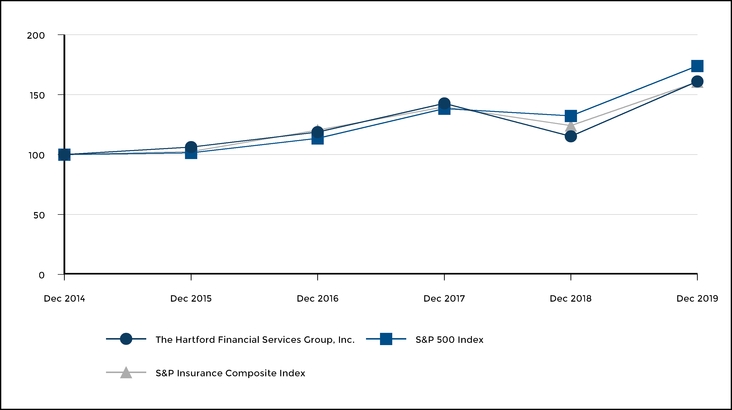
Part II - Item 6. Selected Financial Data
Item 6. SELECTED FINANCIAL DATA
The following table sets forth the Company's selected consolidated financial data at the dates and for the periods indicated below. The selected financial data should be read in
conjunction with the MD&A presented in Item 7 and the Company's Consolidated Financial Statements and the related Notes beginning on page F-1.
| (In millions, except per share data) | 2019 | 2018 | 2017 | 2016 | 2015 | ||||||||||
| Income Statement Data | |||||||||||||||
| Total revenues | $ | 20,740 | $ | 18,955 | $ | 17,162 | $ | 16,291 | $ | 16,187 | |||||
| Income from continuing operations, before tax | $ | 2,560 | $ | 1,753 | $ | 723 | $ | 447 | $ | 1,478 | |||||
| Income (loss) from continuing operations, net of tax | $ | 2,085 | $ | 1,485 | $ | (262 | ) | $ | 613 | $ | 1,189 | ||||
| Income (loss) from continuing operations, net of tax, available to common stockholders [1] | $ | 2,064 | $ | 1,479 | $ | (262 | ) | $ | 613 | $ | 1,189 | ||||
| Income (loss) from discontinued operations, net of tax | $ | — | $ | 322 | $ | (2,869 | ) | $ | 283 | $ | 493 | ||||
| Net income (loss) | $ | 2,085 | $ | 1,807 | $ | (3,131 | ) | $ | 896 | $ | 1,682 | ||||
| Balance Sheet Data | |||||||||||||||
| Total assets | $ | 70,817 | $ | 62,307 | $ | 225,260 | $ | 224,576 | $ | 229,616 | |||||
| Short-term debt | $ | 500 | $ | 413 | $ | 320 | $ | 416 | $ | 275 | |||||
| Total debt | $ | 4,848 | $ | 4,678 | $ | 4,998 | $ | 4,910 | $ | 5,216 | |||||
| Preferred stock | $ | 334 | $ | 334 | $ | — | $ | — | $ | — | |||||
| Total stockholders’ equity | $ | 16,270 | $ | 13,101 | $ | 13,494 | $ | 16,903 | $ | 18,024 | |||||
| Income (loss) from continuing operations, net of tax, available to common stockholders per common share [1] | |||||||||||||||
| Basic | $ | 5.72 | $ | 4.13 | $ | (0.72 | ) | $ | 1.58 | $ | 2.86 | ||||
| Diluted | $ | 5.66 | $ | 4.06 | $ | (0.72 | ) | $ | 1.55 | $ | 2.80 | ||||
| Cash dividends declared per common share | $ | 1.20 | $ | 1.10 | $ | 0.94 | $ | 0.86 | $ | 0.78 |
| [1] | Income from continuing operations, net of tax, available to common stockholders includes the impact of preferred stock dividends. |
Part II - Item 7. Management's Discussion and Analysis of Financial Condition and Results of Operations
Item 7. MANAGEMENT’S DISCUSSION AND ANALYSIS OF FINANCIAL CONDITION AND RESULTS OF OPERATIONS
(Dollar amounts in millions, except for per share data, unless otherwise stated)
The Hartford provides projections and other forward-looking information in the following discussions, which contain many forward-looking statements, particularly relating to the Company’s future financial performance. These forward-looking statements are estimates based on information currently available to the Company, are made pursuant to the safe harbor provisions of the Private Securities Litigation Reform Act of 1995 and are subject to the cautionary statements set forth on pages 4 and 5 of this Form 10-K. Actual results are likely to differ, and in the past have differed, materially from those forecast by the Company, depending on the outcome of various factors, including, but not limited to, those set forth in the following discussion and in Part I, Item 1A, Risk Factors, and those identified from time to time in our other filings with the Securities and Exchange Commission. The Hartford undertakes no obligation to publicly update any forward-looking statements, whether as a result of new information, future developments or otherwise.
On May 23, 2019, the Company completed the previously announced acquisition of Navigators Group, a global specialty underwriter, for $70 a share, or $2.137 billion in cash, including transaction expenses. Immediately after closing on the acquisition of Navigators Group, effective May 23, 2019, the Company purchased an aggregate excess of loss reinsurance agreement covering adverse development (“Navigators ADC”) from National Indemnity Company ("NICO") on behalf of Navigators Insurance Company and certain of its affiliates (collectively, the “Navigators Insurers”). For further information regarding the Navigators ADC, refer to Insurance Risk in the Enterprise Risk Management section. Navigators Group revenue and earnings since the acquisition date are included in the operating results of the Company's Commercial Lines reporting segment. For discussion of this transaction, see Note 2 - Business Acquisitions of Notes to Consolidated Financial Statements
On May 31, 2018, Hartford Holdings, Inc., a wholly owned subsidiary of the Company, completed the sale of the issued and outstanding equity of Hartford Life, Inc. (“HLI”), a holding company, and its life and annuity operating subsidiaries. For discussion of this transaction, see Note 21 - Business Dispositions and Discontinued Operations of Notes to Consolidated Financial Statements.
On February 16, 2018, The Hartford entered into a renewal rights agreement with the Farmers Exchanges, of the Farmers Insurance Group of Companies, to acquire its Foremost-branded small commercial business sold through independent agents. Written premium from this agreement began in the third quarter of 2018.
Certain reclassifications have been made to historical financial information presented in the MD&A to conform to the current period presentation.
Restricted cash has been reclassified out of cash to a separate line on the Consolidated Balance Sheet.
The Hartford defines increases or decreases greater than or equal to 200% as “NM” or not meaningful.
For discussion of the earliest of the three years included in the financial statements of the current filing, please refer to Part 2, Item 7, Management's Discussion and Analysis of Financial Condition and Results of Operations in The Hartford’s 2018 Form 10-K Annual Report.
Index
| Description | Page |
| Key Performance Measures and Ratios | 35 |
| The Hartford's Operations | 40 |
| Consolidated Results of Operations | 43 |
| Investment Results | 46 |
| Critical Accounting Estimates | 47 |
| Commercial Lines | 68 |
| Personal Lines | 72 |
| Property & Casualty Other Operations | 76 |
| Group Benefits | 77 |
| Hartford Funds | 79 |
| Corporate | 81 |
| Enterprise Risk Management | 82 |
| Capital Resources and Liquidity | 100 |
| Impact of New Accounting Standards | 108 |
KEY PERFORMANCE MEASURES AND RATIOS
The Company considers the measures and ratios in the following discussion to be key performance indicators for its businesses. Management believes that these ratios and measures are useful in understanding the underlying trends in The Hartford’s businesses. However, these key performance indicators should only be used in conjunction with, and not in lieu of, the results presented in the segment discussions that follow
Showing the first 8K of 259K characters. Open the full section
Item 7. Management's Discussion and Analysis of Financial Condition and Results of Operations
other capital securities and borrowings from its credit facilities as needed. The Company maintains multiple sources of contingent liquidity including a revolving credit facility, a commercial paper program, an intercompany liquidity agreement that allows for short-term advances of funds among the HFSG Holding Company and certain affiliates, and access to collateralized advances from the Federal Home Loan Bank of Boston ("FHLBB") for certain affiliates. The Company's CFO has primary responsibility for liquidity risk.
For further discussion on liquidity see the section on Capital Resources and Liquidity.
Credit Risk and Counterparty Risk
Credit risk is the risk to earnings or capital due to uncertainty of an obligor’s or counterparty’s ability or willingness to meet its obligations in accordance with contractually agreed upon terms. Credit risk is comprised of three major factors: the risk of change in credit quality, or credit migration risk; the risk of default; and the risk of a change in value due to changes in credit spreads.
Sources of Credit Risk The majority of the Company’s credit risk is concentrated in its investment holdings and use of derivatives, but it is also present in the Company’s ceded reinsurance activities and various insurance products.
Impact A decline in creditworthiness is typically reflected as an increase in an investment’s credit spread and associated decline in value, potentially resulting in an increase in other-than-temporary impairment, and an increased probability of a realized loss upon sale. In certain instances, counterparties may default on their obligations and the Company may realize a loss on default. Premiums receivable, reinsurance recoverable and deductible losses recoverable are also subject to credit risk based on the counterparty’s unwillingness or inability to pay.
Management The objective of the Company’s enterprise credit risk management strategy is to identify, quantify, and manage credit risk in aggregate and to limit potential losses in accordance with the Company's credit risk management policy. The Company manages its credit risk by managing aggregations of risk, holding a diversified mix of issuers and counterparties across its investment, reinsurance, and insurance portfolios and limiting exposure to any specific reinsurer or counterparty. Potential credit losses can be mitigated through diversification (e.g., geographic regions, asset types, industry sectors), hedging and the use of collateral to reduce net credit exposure.
The Company manages credit risk through the use of various analyses and governance processes. The investment, derivatives and reinsurance areas have formal policies and procedures for counterparty approvals and authorizations, which establish criteria defining minimum levels of creditworthiness and financial stability for eligible counterparties. Credits considered for investment are subject to underwriting reviews and private securities are subject to management approval. Mitigation strategies vary across the three sources of credit risk, but may include:
| • | Investing in a portfolio of high-quality and diverse securities; |
| • | Selling investments subject to credit risk; |
| • | Hedging through use of credit default swaps; |
| • | Clearing transactions through central clearing houses that require daily variation margin; |
| • | Entering into contracts only with strong creditworthy institutions |
| • | Requiring collateral; and |
| • | Non-renewing policies/contracts or reinsurance treaties. |
The Company has developed credit exposure thresholds which are based upon counterparty ratings. Aggregate counterparty credit quality and exposure are monitored on a daily basis utilizing an enterprise-wide credit exposure information system that contains data on issuers, ratings, exposures, and credit limits. Exposures are tracked on a current and potential basis and aggregated by ultimate parent of the counterparty across investments, reinsurance receivables, insurance products with credit risk, and derivatives.
As of December 31, 2019, the Company had no investment exposure to any credit concentration risk of a single issuer or counterparty greater than 10% of the Company's stockholders' equity, other than the U.S. government and certain U.S. government agencies. For further discussion of concentration of credit risk in the investment portfolio, see the Concentration of Credit Risk section in Note 6 - Investments of Notes to Consolidated Financial Statements.
Assets and Liabilities Subject to Credit Risk
Investments Essentially all of the Company's invested assets are subject to credit risk. Credit related impairments on investments were $3 and $1, in 2019 and 2018, respectively. (See the Enterprise Risk Management section of the MD&A under “Other-Than-Temporary Impairments.”)
Reinsurance recoverables Reinsurance recoverables, net of an allowance for uncollectible reinsurance, were $5,527 and $4,357, as of December 31, 2019 and 2018, respectively. (See the Enterprise Risk Management section of the MD&A under “Reinsurance as a Risk Management Strategy.”)
Premiums receivable and agents' balances Premiums receivable and agents’ balances, net of an allowance for doubtful accounts, were $4,384 and $3,995, as of December 31, 2019 and 2018, respectively. (For a discussion regarding collectibility of these balances, see Note 1 - Basis of Presentation and Significant Accounting Policies of Notes to Consolidated Financial Statements under the section labeled “Revenue Recognition.”)
Credit Risk of Derivatives
The Company uses various derivative counterparties in executing its derivative transactions. The use of counterparties creates credit risk that the counterparty may not perform in accordance with the terms of the derivative transaction.
Downgrades to the credit ratings of the Company’s insurance operating companies may have adverse implications for its use of derivatives. In some cases, downgrades may give derivative
counterparties for OTC derivatives and clearing brokers for OTC-cleared derivatives the right to cancel and settle outstanding derivative trades or require additional collateral to be posted. In addition, downgrades may result in counterparties and clearing brokers becoming unwilling to engage in or clear additional derivatives or may require additional collateralization before entering into any new trades.
Managing the Credit Risk of Counterparties to Derivative Instruments
The Company also has derivative counterparty exposure policies which limit the Company’s exposure to credit risk. The Company monitors counterparty exposure on a monthly basis to ensure compliance with Company policies and statutory limitations. The Company’s policies with respect to derivative counterparty exposure establishes market-based credit limits, favors long-term financial stability and creditworthiness of the counterparty and typically requires credit enhancement/credit risk reducing agreements, which are monitored and evaluated by the Company’s risk management team and reviewed by senior management.
The Company minimizes the credit risk of derivative instruments by entering into transactions with high quality counterparties primarily rated A or better. The Company also generally requires that OTC derivative contracts be governed by an International Swaps and Derivatives Association ("ISDA") Master Agreement, which is structured by legal entity and by counterparty and permits right of offset. The Company enters into credit support annexes in conjunction with the ISDA agreements, which require daily collateral settlement based upon agreed upon thresholds.
The Company also has derivative counterparty exposure policies which limit the Company’s exposure to credit risk. Cred
Showing the first 8K of 125K characters. Open the full section
Item 9A. Controls and Procedures
Report of Independent Registered Public Accounting Firm
To the Board of Directors and Stockholders of
The Hartford Financial Services Group, Inc.
Hartford, Connecticut
Opinion on Internal Control over Financial Reporting
We have audited the internal control over financial reporting of The Hartford Financial Services Group, Inc. and its subsidiaries (the "Company") as of December 31, 2019, based on criteria established in Internal Control - Integrated Framework (2013) issued by the Committee of Sponsoring Organizations of the Treadway Commission (COSO). In our opinion, the Company maintained, in all material respects, effective internal control over financial reporting as of December 31, 2019, based on criteria established in Internal Control - Integrated Framework (2013) issued by COSO.
We have also audited, in accordance with the standards of the Public Company Accounting Oversight Board (United States) (PCAOB), the consolidated financial statements as of and for the year ended December 31, 2019, of the Company and our report dated February 21, 2020, expressed an unqualified opinion on those financial statements.
As described in Management’s Annual Report on Internal Control over Financial Reporting, management excluded from its assessment the internal control over financial reporting of Navigators Group, which was acquired on May 23, 2019, and whose financial statements constitute 10% of total assets and 5% of total net revenues of the consolidated financial statements of the Company as of and for the year ended December 31, 2019. Accordingly, our audit did not include the internal control over financial reporting at the acquired business.
Basis for Opinion
The Company’s management is responsible for maintaining effective internal control over financial reporting and for its assessment of the effectiveness of internal control over financial reporting, included in the accompanying Management’s Annual Report on Internal Control over Financial Reporting. Our responsibility is to express an opinion on the Company’s internal control over financial reporting based on our audit. We are a public accounting firm registered with the PCAOB and are required to be independent with respect to the Company in accordance with the U.S. federal securities laws and the applicable rules and regulations of the Securities and Exchange Commission and the PCAOB.
We conducted our audit in accordance with the standards of the PCAOB. Those standards require that we plan and perform the audit to obtain reasonable assurance about whether effective internal control over financial reporting was maintained in all material respects. Our audit included obtaining an understanding of internal control over financial reporting, assessing the risk that a material weakness exists, testing and evaluating the design and operating effectiveness of internal control based on the assessed risk, and performing such other procedures as we considered necessary in the circumstances. We believe that our audit provides a reasonable basis for our opinion.
Definition and Limitations of Internal Control over Financial Reporting
A company’s internal control over financial reporting is a process designed to provide reasonable assurance regarding the reliability of financial reporting and the preparation of financial statements for external purposes in accordance with generally accepted accounting principles. A company’s internal control over financial reporting includes those policies and procedures that (1) pertain to the maintenance of records that, in reasonable detail, accurately and fairly reflect the transactions and dispositions of the assets of the company; (2) provide reasonable assurance that transactions are recorded as necessary to permit preparation of financial statements in accordance with generally accepted accounting principles, and that receipts and expenditures of the company are being made only in accordance with authorizations of management and directors of the company; and (3) provide reasonable assurance regarding prevention or timely detection of unauthorized acquisition, use, or disposition of the company’s assets that could have a material effect on the financial statements.
Because of its inherent limitations, internal control over financial reporting may not prevent or detect misstatements. Also, projections of any evaluation of effectiveness to future periods are subject to the risk that controls may become inadequate because of changes in conditions, or that the degree of compliance with the policies or procedures may deteriorate.
/s/ DELOITTE & TOUCHE LLP
Hartford, Connecticut
February 21, 2020
Part III - Item 10. Directors, and Executive Officers and Corporate Governance of the Hartford
Item 10. DIRECTORS, AND EXECUTIVE OFFICERS AND CORPORATE GOVERNANCE OF THE HARTFORD
Certain of the information called for by Item 10 will be set forth in the definitive proxy statement for the 2020 annual meeting of stockholders (the “Proxy Statement”) to be filed by The Hartford with the Securities and Exchange Commission within 120 days after the end of the fiscal year covered by this Form 10-K under the captions and subcaptions “Board and Governance Matters”, and “Director Nominees" and is incorporated herein by reference.
The Company has adopted a Code of Ethics and Business Conduct, which is applicable to all employees of the Company, including the principal executive officer, the principal financial officer and the principal accounting officer. The Code of Ethics and Business Conduct is available on the investor relations section of the Company’s website at: http://ir.thehartford.com.
Any waiver of, or material amendment to, the Code of Ethics and Business Conduct will be posted promptly to our web site in accordance with applicable NYSE and SEC rules.
Executive Officers of The Hartford
Information about the executive officers of The Hartford who are also nominees for election as directors will be set forth in The Hartford’s Proxy Statement. Set forth below is information about the other executive officers of the Company as of February 14, 2020:
| Name | Age | Position with The Hartford and Business Experience For the Past Five Years |
| Jonathan R. Bennett | 55 | Executive Vice President and Head of Group Benefits (August 2019 - Present); Chief Financial Officer and Head of Strategy for Property and Casualty and Group Benefits (October, 2012-August 2019), Executive Vice President of Digital Commerce and Customer Analytics (July, 2010-October, 2012) Executive Vice President of Personal & Small Business Insurance (December, 2005-July,2010) Senior Vice President of Personal Lines (April, 2003-December, 2005) |
| William A. Bloom | 56 | Executive Vice President of Operations and Technology (August 2014 - present); President of Global Client Services, EXL (July 2010-July 2014) |
| Kathleen M. Bromage | 62 | Chief Marketing and Communications Officer (June 2015-present); Senior Vice President of Strategy and Marketing, Small Commercial and Senior Vice President of Brand Marketing (July 2012-June 2015) |
| Beth A. Costello | 52 | Executive Vice President and Chief Financial Officer (July 2014-present); President of the life and annuity business sold in May 2018 and formerly referred to as Talcott Resolution (July 2012-July 2014) |
| Douglas G. Elliot | 59 | President (July 2014-present); Executive Vice President and President of Commercial Lines (April 2011-July 2014) |
| Brion S. Johnson | 60 | Executive Vice President, Chief Investment Officer (May 2012-Present); President Hartford Investment Management Company (May 2011-present), President of the life and annuity business sold in May 2018 and formerly referred to as Talcott Resolution (July 2014-May 2018) |
| Scott R. Lewis | 57 | Senior Vice President and Controller (May 2013-present); Senior Vice President and Chief Financial Officer, Personal Lines (2009-May 2013) |
| Robert W. Paiano | 58 | Executive Vice President and Chief Risk Officer (June 2017-Present); Senior Vice President & Treasurer (July 2010-May 2017) |
| David C. Robinson | 54 | Executive Vice President and General Counsel (June 2015-present); Senior Vice President and Director of Commercial Markets Law (August 2014-May 2015); Senior Vice President and Head of Enterprise Transformation, Strategy and Corporate Development (April 2012-August 2014) |
| Lori A. Rodden | 49 | Executive Vice President Chief Human Resources Officer (October 2019-present); Senior Vice President and Lead Human Resources Business Partner for Property & Casualty, Group Benefits, Claims and Actuarial (April 2016 to October 2019) and Vice President and Lead Human Resources for Middle Market, Large Commercial, Sales &Distribution and underwriting (November 2014 to April 2016) |
Part III - Item 12. Security Ownership of Certain Beneficial Owners and Management and Related Stockholder Matters
Item 12. SECURITY OWNERSHIP OF CERTAIN BENEFICIAL OWNERS AND MANAGEMENT AND RELATED STOCKHOLDER MATTERS
Certain of the information called for by Item 12 will be set forth in the Proxy Statement under the caption “Information on Stock Ownership” and is incorporated herein by reference.
Equity Compensation Plan Information
The following table provides information as of December 31, 2019 about the securities authorized for issuance under the Company’s equity compensation plans. The Company maintains The Hartford 2005 Incentive Stock Plan (the “2005 Stock Plan”), The Hartford 2010 Incentive Stock Plan (the “2010 Stock Plan”), The Hartford 2014 Incentive Stock Plan (the "2014 Stock Plan") (collectively the "Stock Plans") and The Hartford Employee Stock Purchase Plan (the “ESPP”). On May 21, 2014, the stockholders of
the Company approved the 2014 Stock Plan, which superseded the earlier plans. Pursuant to the provisions of the 2014 Stock Plan, no additional shares may be issued from the 2010 Stock Plan. To the extent that any awards under the 2005 Stock Plan and the 2010 Stock Plan are forfeited, terminated, surrendered, exchanged, expire unexercised or are settled in cash in lieu of stock (including to effect tax withholding) or for the issuance of a lesser number of shares than the number of shares subject to the award, the shares subject to such awards (or the relevant portion thereof) shall be available for award under the 2014 Stock Plan and such shares shall be added to the total number of shares available under the 2014 Stock Plan. For a description of the 2014 Stock Plan and the ESPP, see Note 19 - Stock Compensation Plans of Notes to Consolidated Financial Statements.
| (a) | (b) | (c) | |||||
| Number of Securities to be Issued Upon Exercise of Outstanding Options, **Warrants and Rights [**1] | Weighted-average Exercise Price of Outstanding Options, Warrants and Rights [2] | Number of Securities Remaining Available for Future Issuance Under Equity Compensation Plans (Excluding Securities Reflected in Column (a)) [3] | |||||
| Equity compensation plans approved by stockholders | 10,214,333 | $ | 43.43 | 9,352,607 | |||
| Equity compensation plans not approved by stockholders | — | — | — | ||||
| Total | 10,214,333 | $ | 43.43 | 9,352,607 |
| [1] | The amount shown in this column includes 5,846,481 outstanding options awarded under the 2005 Stock Plan and the 2010 Stock Plan. The amount shown in this column includes 3,608,257 outstanding restricted stock units and 759,595 outstanding performance shares at 100% of target (which excludes 391,492 shares that vested on December 31, 2019, related to the 2017-2019 performance period) as of December 31, 2019 under the 2010 Stock Plan and the 2014 Stock Plan. The maximum number of performance shares that could be awarded is 1,519,190 (200% of target) if the Company achieved the highest performance level. Under the 2010 and 2014 Stock Plans, no more than 500,000 shares in the aggregate can be earned by an individual employee with respect to restricted stock unit and performance share awards made in a single calendar year. As a result, the number of shares ultimately distributed to an employee with respect to awards made in the same year will be reduced, if necessary, so that the number does not exceed this limit. |
| [2] | The weighted-average exercise price reflects outstanding options and does not reflect outstanding restricted stock units or performance shares because they do not have exercise prices. |
| [3] | Of these shares, 4,084,500 remain available for purchase under the ESPP as of December 31, 2019*.* 5,268,108 shares remain available for issuance as options, restricted stock units, restricted stock awards or performance shares under the 2014 Stock Plan as of December 31, 2019*.* |
Part IV. Item 15. Exhibits, Financial Statement Schedules
Item 15. EXHIBITS, FINANCIAL STATEMENT SCHEDULES
| (a) | Documents filed as a part of this report: |
| (1) | Consolidated Financial Statements. See Index to Consolidated Financial Statements and Schedules elsewhere herein. |
| (2) | Consolidated Financial Statement Schedules. See Index to Consolidated Financial Statement and Schedules elsewhere herein. |
| (3) | Exhibits. See Exhibit Index elsewhere herein. |
THE HARTFORD FINANCIAL SERVICES GROUP, INC.
INDEX TO CONSOLIDATED FINANCIAL STATEMENTS AND SCHEDULES
F-1
REPORT OF INDEPENDENT REGISTERED PUBLIC ACCOUNTING FIRM
To the Board of Directors and Stockholders of
The Hartford Financial Services Group, Inc.
Hartford, Connecticut
Opinion on the Financial Statements
We have audited the accompanying consolidated balance sheets of The Hartford Financial Services Group, Inc. and its subsidiaries (the "Company") as of December 31, 2019 and 2018, the related consolidated statements of operations, comprehensive income (loss), changes in stockholders' equity, and cash flows, for each of the three years in the period ended December 31, 2019, and the related notes and the schedules listed in the Index at Item 15 (collectively referred to as the "financial statements"). In our opinion, the financial statements present fairly, in all material respects, the financial position of the Company as of December 31, 2019 and 2018, and the results of its operations and its cash flows for each of the three years in the period ended December 31, 2019, in conformity with accounting principles generally accepted in the United States of America.
We have also audited, in accordance with the standards of the Public Company Accounting Oversight Board (United States) (PCAOB), the Company's internal control over financial reporting as of December 31, 2019, based on criteria established in Internal Control - Integrated Framework (2013) issued by the Committee of Sponsoring Organizations of the Treadway Commission and our report dated February 21, 2020, expressed an unqualified opinion on the Company's internal control over financial reporting.
Basis for Opinion
These financial statements are the responsibility of the Company's management. Our responsibility is to express an opinion on the Company's financial statements based on our audits. We are a public accounting firm registered with the PCAOB and are required to be independent with respect to the Company in accordance with the U.S. federal securities laws and the applicable rules and regulations of the Securities and Exchange Commission and the PCAOB.
We conducted our audits in accordance with the standards of the PCAOB. Those standards require that we plan and perform the audit to obtain reasonable assurance about whether the financial statements are free of material misstatement, whether due to error or fraud. Our audits included performing procedures to assess the risks of material misstatement of the financial statements, whether due to error or fraud, and performing procedures that respond to those risks. Such procedures included examining, on a test basis, evidence regarding the amounts and disclosures in the financial statements. Our audits also included evaluating the accounting principles used and significant estimates made by management, as well as evaluating the overall presentation of the financial statements. We believe that our audits provide a reasonable basis for our opinion.
Critical Audit Matters
The critical audit matters communicated below are matters arising from the current period audit of the financial statements that were communicated or required to be communicated to the audit committee and that (1) relate to accounts or disclosures that are material to the financial statements and (2) involved especially challenging, subjective, or complex audit judgments. The communication of critical audit matters does not alter in any way our opinion on the financial statements, taken as a whole, and we are not, by communicating the critical audit matters below, providing separate opinions on the critical audit matters or on the accounts or disclosures to which they relate.
Unpaid Losses and Loss Adjustment Expenses - Refer to Notes 1 and 11 to the financial statements
Critical Audit Matter Description
For property and casualty and group life and disability insurance products, the Company establishes reserves for unpaid losses and loss adjustment expenses to provide for the estimated costs of paying claims under insurance policies written by the Company. These reserves include estimates for both claims that have been reported and claims that have been incurred but not reported, and include estimates of all losses and loss adjustment expenses associated with processing and settling these claims. This estimation process is based significantly on the assumption that past developments are an appropriate predictor of future events, and involves a variety of actuarial techniques that analyze experience, trends and other relevant factors.
Given the subjectivity of estimating the ultimate cost to settle the liabilities for reported and unreported claims due to uncertainties caused by various factors including frequency and severity of claims as well as changes in the legislative and regulatory environment, performing audit procedures to evaluate whether unpaid losses and loss adjustment expenses were appropriately recorded as of December 31, 2019, required a high degree of auditor judgment and an increased extent of effort, including the need to involve our actuarial specialists.
How the Critical Audit Matter Was Addressed in the Audit
Our audit procedures related to the unpaid losses and loss adjustment expenses included the following, among others:
| • | We |
Showing the first 8K of 530K characters. Open the full section