 filings.tools
International Flavors & Fragrances 10-K 2019-12-31
Filed 2020-03-03. 22 sections, 557K characters. Original on sec.gov · Markdown · JSON
Cover and table of contents
UNITED STATES SECURITIES AND EXCHANGE COMMISSION
Washington, D.C. 20549
FORM 10-K
| ☑ | ANNUAL REPORT PURSUANT TO SECTION 13 OR 15(d) OF THE SECURITIES EXCHANGE ACT OF 1934 |
For the fiscal year ended December 31, 2019
OR
| ☐ | TRANSITION REPORT PURSUANT TO SECTION 13 OR 15(d) OF THE SECURITIES EXCHANGE ACT OF 1934 | |
| For the transition period from to |
Commission File Number 1-4858
INTERNATIONAL FLAVORS & FRAGRANCES INC**.**
(Exact name of registrant as specified in its charter)
| New York | 13-1432060 |
| (State or other jurisdiction of incorporation or organization) | (I.R.S. Employer Identification No.) |
521 West 57th Stree****t, New York**,** NY 10019-2960
Registrant’s telephone number, including area code (212) 765-5500
SECURITIES REGISTERED PURSUANT TO SECTION 12(b) OF THE ACT:
| Title of Each Class | Trading Symbol | Name of Each Exchange on Which Registered | ||
| Common Stock, par value 12 1/2¢ per share | IFF | New York Stock Exchange | ||
| 6.00% Tangible Equity Units | IFFT | New York Stock Exchange | ||
| 0.500% Senior Notes due 2021 | IFF 21 | New York Stock Exchange | ||
| 1.750% Senior Notes due 2024 | IFF 24 | New York Stock Exchange | ||
| 1.800% Senior Notes due 2026 | IFF 26 | New York Stock Exchange |
SECURITIES REGISTERED PURSUANT TO SECTION 12(g) OF THE ACT:
None
Indicate by check mark if the registrant is a well-known seasoned issuer, as defined in Rule 405 of the Securities Act. Yes þ No o
Indicate by check mark if the registrant is not required to file reports pursuant to Section 13 or Section 15(d) of the Act. Yes o No þ
Indicate by check mark whether the registrant (1) has filed all reports required to be filed by Section 13 or 15(d) of the Securities Exchange Act of 1934 during the preceding 12 months (or for such shorter period that the registrant was required to file such reports), and (2) has been subject to such filing requirements for the past 90 days. Yes þ No o
Indicate by check mark whether the registrant has submitted electronically every Interactive Data File required to be submitted pursuant to Rule 405 of Regulation S-T (§232.405 of this chapter) during the preceding 12 months (or for such shorter period that the registrant was required to submit such files). Yes þ No o
Indicate by check mark whether the Registrant is a large accelerated filer, an accelerated filer, a non-accelerated filer, a smaller reporting company, or an emerging growth company. See the definitions of “large accelerated filer,” “accelerated filer,” “smaller reporting company,” and “emerging growth company” in Rule 12b-2 of the Exchange Act.
| Large accelerated filer | þ | Accelerated filer | o |
| Non-accelerated filer | o | Smaller reporting company | ☐ |
| Emerging growth company | ☐ |
If an emerging growth company, indicate by checkmark if the registrant has elected not to use the extended transition period for complying with any new or revised financial accounting standards provided pursuant to Section 13(a) of the Exchange Act. o
Indicate by check mark whether the registrant is a shell company (as defined in Rule 12b-2 of the Exchange Act). Yes ☐ No þ
The aggregate market value of the voting stock held by non-affiliates of the Registrant was $15,491,883,187 as of June 30, 2019.
As of February 26, 2020, there were 106,802,194 shares of the registrant’s common stock, par value 12 1/2¢ per share, outstanding.
DOCUMENTS INCORPORATED BY REFERENCE
Portions of the registrant’s proxy statement for the 2020 Annual Meeting of Shareholders (the “IFF 2020 Proxy Statement”) are incorporated by reference in Part III of this Form 10-K.
INTERNATIONAL FLAVORS & FRAGRANCES INC.
TABLE OF CONTENTS
PART I
In this report, we use the terms “IFF,” “the Company,” “we,” “us” and “our” to refer to International Flavors & Fragrances Inc. and its subsidiaries.
Item 1. BUSINESS.
We are a leading innovator of sensory experiences that move the world. Our creative capabilities, global footprint, regulatory and technological know-how provide us a competitive advantage in meeting the demands of our global, regional and local customers around the world. The 2018 acquisition of Frutarom solidified our position as an industry leader across an expanded portfolio of products, resulting in a broader customer base across small, mid-sized and large companies and an expansion to new adjacencies that provides a platform for significant cross-selling opportunities.
Our product portfolio covers taste, scent and complementary adjacent products, and we have over 128,000 individual products that are provided to customers in approximately 200 countries. Our global manufacturing footprint allows us to optimize our supply chain and support our global and regional customers. As of December 31, 2019, we had 104 manufacturing facilities and 82 creative centers and application laboratories located in 44 different countries. We currently anticipate that we will continue to optimize our global facilities footprint as we seek opportunities to efficiently and cost-effectively deliver value to our global and regional customers.
Sales in 2019 were approximately $5.1 billion which, management believes, makes us the second largest company in the taste, scent, nutrition and specialty ingredient industry. During the past few years, we have diversified our customer base and leveraged our technical expertise to significantly expand our global small and mid-sized customer base through acquisitions, including, Frutarom, and the development of Tastepoint. Based on 2019 sales, of our approximately 38,000 customers, approximately 35% are global consumer products companies and approximately 65% are small and mid-sized companies. During 2019, our 25 largest customers accounted for 38% of our sales. In 2019, no customer accounted for more than 10% of sales.
Our business is geographically diverse, with sales in the U.S. representing approximately 20% of sales in 2019. No other country represents more than 6% of sales. We believe that more significant future growth potential for taste and scent, and for our business, exists in the emerging markets (which we classify as all markets except North America, Japan, Australia, and Western, Southern and Northern Europe). As a result, we intend to continue to build on our multi-decade experience in the emerging markets. As our customers seek to grow their businesses in emerging markets, we provide them the ability to leverage our long-standing international presence and extensive market knowledge to help drive their brands in these markets.
For the periods presented in this Form 10-K, our business was organized in three segments: Taste, Scent and Frutarom. Beginning in the first quarter of fiscal year 2020, we are operating our business across two segments, Taste and Scent. As part of this new operating model, nearly all of the former Frutarom business segment was combined with the Taste segment. The financial results presented in this Form 10-K reflect the Taste, Scent and legacy Frutarom business segments prior to the realignment.
Vision 2021 and Frutarom Integration Initiative
Following the acquisition of Frutarom, we developed a new strategy, Vision 2021, targeting accelerated revenue and profitability growth. Vision 2021 has four "pillars":
-
Unlocking growth opportunities - capitalizing on our expanded product portfolio, broader customer base and extensive geographic presence as well as cross-selling and integrated solutions
-
Driving innovation - investing in high-growth and high-return platforms to continue to drive our research and development pipeline and accelerate long-term growth
-
Managing the Portfolio - focusing on optimizing our portfolio to maximize value creation
-
Accelerating Business Transformation - successfully integrating Frutarom while delivering on synergy targets and achieving productivity gains across the business base.
At the same time, we have been executing on our Frutarom integration plan to build our go-to-market business model by replicating the Tastepoint blueprint across certain markets, clarify roles and responsibilities and, thereby, accelerate decision-making through a series of organizational changes primarily aimed at driving cost synergies in the manufacturing and creative networks, procurement and overhead functions.
Pending Transaction with Nutrition & Biosciences, Inc.
On December 15, 2019, the Company entered into definitive agreements with DuPont de Nemours, Inc. (“DuPont”), including an Agreement and Plan of Merger, pursuant to which DuPont will transfer its nutrition and biosciences business (the “N&B Business”) to Nutrition & Biosciences, Inc., a Delaware corporation and wholly owned subsidiary of DuPont (“N&B”), and N&B will merge with and into a wholly owned subsidiary of IFF in exchange for a number of shares of IFF common stock, par value $0.125 per share (“IFF Common Stock”) (collectively, the “DuPont N&B Transaction”). In connection with the transaction, DuPont will receive a one-time $7.3 billion special cash payment (the “Special Cash Payment”), subject to certain adjustments. As a result of the DuPont N&B Transaction, holders of DuPont’s common stock will own approximately 55.4% of the outstanding shares of IFF on a fully diluted basis. We believe that the combination of IFF and the N&B Business will create a global leader in high-value ingredients and solutions in the global Food & Beverage, Home & Personal Care and Health & Wellness markets. We expect that the companies' complementary product portfolios will give the combined company leadership positions across key Taste, Texture, Scent, Nutrition, Enzymes, Cultures, Soy Proteins and Probiotics categories.
Completion of the DuPont N&B Transaction is subject to various closing conditions, including, among other things, (1) approval by IFF’s shareholders of the issuance of IFF Common Stock in connection with the transaction; (2) the effectiveness of the registration statements to be filed with the Securities and Exchange Commission pursuant to the Merger Agreement; and (3) the expiration of the applicable waiting period under the Hart-Scott-Rodino Antitrust Improvements Act of 1976, as amended, and obtaining certain other consents, authorizations, orders or approvals from governmental authorities. We expect that the transaction will close in early 2021.
Our Product Offerings
Taste
As a leading creator of flavor offerings, we help our customers deliver on the promise of delicious and healthy foods and drinks that appeal to consumers. While we are a global leader, our Taste business is more regional in nature, with different formulas that reflect local taste preferences. Consequently, we manage our Taste business geographically, creating products in our regional creative centers which allow us to satisfy local taste preferences, while also helping to ensure regulatory compliance and production standards. We develop thousands of different flavors and taste offerings for our customers, most of which are tailor-made. We continually develop new formulas to meet changing consumer preferences and customer needs.
Our Taste business comprises a diversified portfolio across flavor compounds, savory solutions, inclusions and nutrition and specialty ingredients. The savory solutions compounds, inclusions and nutrition and specialty ingredients products were included in the legacy Frutarom businesses during 2019 and we will begin reporting them under the Taste business segment in 2020.
Flavor Compounds. Our flavor compounds provide unique flavors that are ultimately used by our customers in savory products (soups, sauces, meat, fish, poultry, snacks, etc.), beverages (juice drinks, carbonated or flavored beverages, spirits, etc.), sweets (bakery products, candy, cereal, chewing gum, etc.), and dairy products (yogurt, ice cream, cheese, etc.).
Savory Solutions. Savory solutions include marinades or powder blends of flavors, natural colors, seasonings, functional ingredients and natural anti-oxidants that are primarily designed for the meat and fish industry.
Inclusions. Inclusions provide taste and texture by, among other things, combining flavorings with fruit, vegetables, and other natural ingredients for a wide range of food products, such as health snacks, baked goods, cereals, pastries, ice cream and other dairy products.
Nutrition and Specialty Ingredients. Our nutrition and specialty ingredients primarily consist of natural health ingredients, natural food protection, natural colors and flavor ingredients. Natural health ingredients include natural ingredients derived from plants and herbs, which provide, or are perceived as providing, health benefits. These ingredients are used in dietary supplements, functional food, infant and elderly nutrition, cosmetics, personal care and other over-the-counter products. Natural food protection ingredients consist of natural antioxidants and anti-microbials used for natural food preservation and shelf life extension to beverages, cosmetic and healthcare products, and pet food and feed additives. These ingredients reduce the oxidative deterioration and/or microbiology load that leads to rancidity or loss of flavor, color, and nutritional value. Natural colors comprise a wide array of natural colors and fruit and vegetable concentrates for food, beverage, and cosmetics.
Flavor Ingredients. The flavor ingredients market includes natural flavor extracts, specialty botanical extracts, distillates, essential oils, citrus products, aroma chemicals, and natural gums and resins. Such ingredients are used for food, beverage, and flavors and are often sold directly to food and beverage manufacturers who use them in producing consumer products.
Scent
Our global Scent business creates fragrance compounds and fragrance ingredients that are integral elements in the world’s finest perfumes and best-known household and personal care products. We believe our unique portfolio of natural and synthetic ingredients, global footprint, innovative technologies and know-how, deep consumer insight and customer intimacy make us a market leader in scent.
Our Scent business is a vertically integrated operation, originating in our research facilities with the development of natural, synthetic and proprietary molecules and innovative delivery systems, progressing to our creative centers, application laboratories and consumer insight teams where our perfumers partner with our customers to create unique fragrance compounds for use in a variety of end-use products. Finally, we produce these products in our manufacturing facilities in a consistent, high-quality and cost-effective manner. We also produce cosmetic active and functional ingredients for use in cosmetics. By providing our fragrance development teams with an extensive portfolio of innovative, high-quality and effective ingredients to support their creativity, we are able to provide our customers with a unique identity for their brands. These ingredients or fragrance compounds can then be combined with our innovative delivery systems which are key differentiators in the growth of our consumer fragrance portfolio. In September 2019, we opened our new Home & Fabric Care Innovation Center in Holmdel, New Jersey, a 60,000 square-foot research and development hub, to further drive innovation in our home care and fabric care categories, including digital olfaction technology, immersive virtual reality scent experiences, and the latest generation of encapsulation technology.
Fragrance Compounds. Fragrance compounds are unique and proprietary combinations of multiple ingredients that are ultimately used by our customers in their consumer goods. Our creative and commercial teams within fragrance compounds are organized into two broad categories, fine fragrances and consumer fragrances.
Our fine fragrances focus on perfumes and colognes. Our scientists and perfumers collaborate to develop new molecules, new natural extractions, and innovative processes to create unique, inspiring fragrances. We have created some of the industry-leading fine fragrance classics as well as cutting-edge niche fragrances, as evidenced by the number of top sellers and award winners.
Our consumer fragrances include five end-use categories of products:
-
Fabric Care, including laundry detergents, fabric softeners and specialty laundry products;
-
Home Care, including household cleaners, dishwashing detergents and air fresheners;
-
Personal Wash, including bar soaps and shower gels;
-
Hair Care, including shampoos and conditioners; and
-
Toiletries, including deodorants and shaving creams.
Ingredients. Fragrance ingredients consists of natural and synthetic, of active and functional ingredients that are used internally and sold to third parties, including competitors, for use in preparation of compounds. While the principal role of our fragrance ingredients facilities is to support our fragrance compounds business, we utilize our excess manufacturing capacity to manufacture and sell certain fragrance ingredients to third parties. We believe that this business allows us to leverage our fixed costs while maintaining the security of supply for our perfumers and ultimately our customers. Fragrance ingredients available for sale to third parties include innovative ingredients that leverage our manufacturing experience as well as a limited amount of cost-competitive, commodity ingredients. Fragrance ingredients also includes our cosmetic active and functional ingredients, which provide biologists and cosmetic chemists with innovative solutions to address cosmetic challenges such as skin aging and hair protection. With approximately 1,800 separate fragrance and active and functional ingredients, plus additional botanicals and delivery systems, we believe we are a leader in the industry with the breadth of our product portfolio.
Legacy Frutarom
During 2019, our Frutarom business created and manufactured a broad suite of flavor compounds and specialty fine ingredients, largely targeting small, local and regional customers. As noted above, beginning in fiscal year 2020, our business segments have been realigned such that nearly all of the Frutarom business segment will combine with our Taste business. The financial results presented in this Form 10-K reflect the Scent, Taste and Frutarom business segments prior to the realignment.
Consumer Insights, Research and Product Development Process
The markets in which we compete require constant innovation to stay ahead of the curve and to be competitive. Consumer preferences tend to drive change in our markets, and as science evolves and sustainability continues to be a key factor to customers and consumers, we must continue to strengthen our research and development platforms and adapt our capabilities to provide differentiated products to our customers.
Consumer Insights
We believe that the first step to creating an innovative and unique flavor or fragrance experience begins with gaining insight into the consumer and emerging trends. By developing a deep understanding of what consumers value and prefer through our consumer insight programs, we are better able to focus our research and development and creative efforts.
Our consumer science, insight and marketing teams interpret trends, monitor product launches, analyze quantitative market data, and conduct numerous consumer interviews annually. Our sensory experts direct research programs exploring topics such as fragrance performance, the psychophysics of sensory perception (including chemesthetic properties such as warming, cooling, and tingling), the genetic basis for flavor and fragrance preference, and the effects of aromas on mood, performance, health, and well-being.
Based on this information, we develop innovative and proprietary programs to evaluate potential products that enable us to understand the emotional connections between a prospective product and the consumer. We believe this ability to pinpoint the likelihood of a product’s success translates into stronger brand equity, resulting in increased returns and greater market share gains for our customers as well as for IFF.
Research and Development
We consider our research and development infrastructure to be one of our key competencies and critical to our ability to provide differentiated products to our customers. We focus and invest substantial resources in the research and development of new and innovative molecules, compounds, formulas and technologies and the application of these to our customers’ products. Using the knowledge gained from our consumer insights programs, we strategically focus our resources around key research and development platforms that address or anticipate consumer needs or preferences. By aligning our capabilities and resources to these platforms, we ensure the proper support and focus for each program so that it can be further developed and eventually accepted for commercial application.
We have been granted 415 patents in the United States since 2000 and we have developed many unique molecules and delivery systems for our customers that are used as the foundations of successful flavors and fragrances around the world.
We have traditionally conducted our principal basic research and development activities in Union Beach, New Jersey, where we employ scientists and application engineers who collaborate with our other research and development centers around the world, to support the:
-
discovery of new materials;
-
development of new technologies, such as delivery systems;
-
creation of new compounds; and
-
enhancement of existing ingredients and compounds.
We also have key basic research and development centers in Tilburg, the Netherlands, Neuilly and Grasse, France, and Nanjing, China. As of December 31, 2019, we employed approximately 2,300 people globally in research and development activities.
Our ingredients research program discovers molecules found in natural substances and creates new molecules that are subsequently tested for their sensorial value. To broaden our offerings of natural, innovative and unique products, we seek collaborations with research institutions and other companies throughout the world. We have established a number of such collaborations to strengthen our innovation pipeline. We may also consider acquiring companies that could provide access to new technologies.
The development of new and customized flavor and fragrance compounds is a complex process calling upon the combined knowledge of our scientists, flavorists and perfumers. Scientists from various disciplines work in project teams with flavorists and perfumers to develop flavor and fragrance compounds with consumer preferred performance characteristics. The development of new flavor and fragrance compounds requires (i) an in-depth knowledge of the flavor and fragrance
characteristics of the various ingredients we use, (ii) an understanding of how the many ingredients in a consumer product interact and (iii) the creation of controlled release and delivery systems to enhance flavor and fragrance performance. To facilitate this process, we have a scientific advisory board that provides external perspectives and independent feedback on our research and development and sustainability initiatives.
Creative Application
Through our global network of creative centers and application laboratories, we create or adapt the basic flavors or fragrances compounds that we have developed in the research and development process to commercialize for use in our customers’ consumer products. Our global creative teams consist of perfumers, fragrance evaluators and flavorists, as well as marketing, consumer science, consumer insights, and technical application experts, from a wide range of cultures and nationalities. In close partnership with our customers’ product development groups, our creative teams create the sensory experiences that our customers are seeking in order to satisfy consumer demands in each of their markets.
New flavor and fragrance development is driven by a variety of sources including requests from our customers, who are in need of specific flavors and fragrances for use in a new or modified consumer product, or as a result of internal initiatives stemming from our consumer insights program. Our product development team works in partnership with our scientists and researchers to optimize the consumer appeal and relevance of our flavors and fragrances. A collaborative process between our researchers, our product development team and our customers then follows to perfect the flavors and fragrances, so they are ready to be included in the final consumer product.
In addition to creating new flavors and fragrances, our researchers and product development teams advise customers on ways to improve their existing products by moderating or substituting current ingredients with more readily accessible or less expensive materials enhancing their yield. This often results in creating a better value proposition for our customers.
Our flavors and fragrances compound formulas are treated as trade secrets and remain our proprietary assets. Our business is not materially dependent upon any individual patent, trademark or license.
Supply Chain
We strive to provide our customers with consistent quality products on a timely and cost-effective basis by managing all aspects of the supply chain, from raw material sourcing through manufacturing, quality assurance, regulatory compliance and distribution.
Procurement
In connection with the manufacture of compounds, we use natural ingredients and, primarily in our fragrance compounds, synthetic ingredients. We purchase approximately 23,000 different raw materials from an extensive network of domestic and international suppliers and distributors.
With the acquisition of Frutarom, we significantly increased our natural products and therefore the percentage of our ingredients that are natural or crop-related has increased. Natural ingredients are derived from flowers, fruits and other botanical products, as well as from animal products, and contain varying numbers of organic chemicals that are responsible for the fragrance or flavor of the natural product. Natural products are purchased in processed or semi-processed form. Some are used in compounds in the state in which they are obtained and others are used after further processing. Natural products, together with various chemicals, are also used as raw materials for the manufacture of synthetic ingredients by chemical processes. Our flavor products also include extracts and seasonings derived from various fruits, vegetables, nuts, herbs, spices, and microbiologically-derived ingredients.
In order to ensure our supply of raw materials, achieve favorable pricing and provide timely transparency regarding inflationary trends to our customers, we continue to be focused on:
-
purchasing under contract with fixed or formula based pricing for set time periods;
-
entering into supplier relationships to gain access to supplies and available capacity that we do not have;
-
implementing indexed pricing;
-
reducing the complexity of our formulations; and
-
evaluating whether it is more profitable to buy or make an ingredient
-
local country sourcing with our own procurement professionals.
Manufacturing and Distribution
As of December 31, 2019, we had 186 manufacturing facilities and creative centers and application laboratories located in 44 different countries. Our major manufacturing facilities are located in the United States, the Netherlands, Spain, Great Britain, Germany, Indonesia, Turkey, Brazil, Mexico, Slovenia, China, India, and Singapore. Based on the regional nature of the Taste business and the concerns regarding the fragile nature of transporting raw materials, we have typically established smaller manufacturing facilities in our local markets that are focused on local needs. Products within the Scent business are typically composed of compounds that are more stable and more transportable around the world. Consequently, we have fewer manufacturing facilities within our Scent business, which produce compounds and ingredients for global distribution.
In connection with the integration of Frutarom, we have undertaken to optimize our global operations footprint to efficiently and cost-effectively deliver value to our global customers. As part of this effort, we expect to close approximately 35 manufacturing sites over the next two years with most of the closures targeted to occur before the end of fiscal 2020. During 2019, the Company announced the closure of 10 facilities, of which six facilities are in Europe, Africa and Middle East, one facility in each North America, Greater Asia and Latin America regions.
Our supply chain initiatives are focused on increasing capacity and investments in key technologies. Within our more mature markets, we tend to focus on consolidation and cost optimization as well as implementing new technologies. In addition to our own manufacturing facilities, we develop relationships with third parties, including contract manufacturing organizations, that permit us to expand access to the technologies, capabilities and capacity that we need to better serve our customers.
Sustainability
Over the past several years, we have redefined the way we envision sustainability. Moving from the traditional “take-make-dispose” model, we have embraced the circular economy model - one that is restorative and regenerative by design, which we believe is key in safeguarding the wellbeing of our consumers, the health of our planet and the integrity of our business.
Customers and consumers want to know if the products they are purchasing are responsibly sourced and environmentally conscious. Our sustainability vision and strategy are designed to meet these global trends, and we are committed to making real progress happen at every opportunity. Following the Frutarom acquisition, we are working on assessing our combined environmental footprint with the intent of identifying synergies, gaps and opportunities in our sustainability efforts and upgrading the legacy Frutarom operations to better align them with the legacy IFF sustainability practices.
In line with our Vision 2021 strategy and our goal of redefining how we live in and care for the resources of our world, our sustainability goals include:
-
Reducing Our Environmental Footprint - we will seek to leverage synergies and manage our combined footprint to reduce our environmental impact.
-
Strengthening Responsible Sourcing - we will continue to assess our supply chain and seek to increase sustainable sourcing across our combined supply base.
-
Driving Sustainable Innovation - we will seek to embed sustainability into our products and processes.
-
Embracing People and Communities - we will seek to create a culture of diversity and inclusiveness while giving back to the communities where we source and operate.
In 2019, we were recognized for our sustainability efforts with the 2019 “Industry Mover” award from SAM, a subsidiary of RobecoSAM which specializes in providing environmental, social and governance (ESG) data, benchmarks and ratings. The award acknowledges IFF’s top-scoring performance in economic, social and environmental categories. We also reconfirmed our commitment to mitigate climate change by signing the United Nation’s Business Ambition for 1.5°C: Our Only Future pledge, committing to set science-based emissions targets to limit global temperature rise to 1.5 degrees Celsius. In addition, among other distinctions, we were named to Barron’s 100 Most Sustainable Companies List for the second consecutive year, recognizing our exceptional environmental, social and corporate governance performance.
For more detailed information about our sustainability programs and performance, please refer to our annual sustainability report.
Governmental Regulation
We develop, produce and market our products in a number of jurisdictions around the world and are subject to federal, regional and local legislation and regulations in each of the various countries. Our products, which among other industries, are intended for use in food, beverage and pharmaceutical industries, are subject to strict quality and regulatory standards. As a result, we in turn are required to meet these strict standards which, in recent years, have become increasingly stringent and affect both existing as well as new products.
Our products and operations are subject to regulation by governmental agencies in each of the markets in which we operate. These agencies include (1) the Food and Drug Administration and equivalent international agencies that regulate flavors and other ingredients in consumer products, (2) the Environmental Protection Agency and equivalent international agencies that regulate our manufacturing facilities, (3) the Occupational Safety and Health Administration and equivalent international agencies that regulate the working conditions in our manufacturing, research laboratories and creative centers, (4) local and international agencies that regulate trade and customs, (5) the Drug Enforcement Administration and other local or international agencies that regulate controlled chemicals that we use in our operations and (6) the Chemical Registration/Notification authorities that regulate chemicals that we use in, or transport to, the various countries in which we manufacture and/or market our products. We have seen an increase in registration and reporting requirements concerning the use of certain chemicals in a number of countries, such as Registration, Evaluation, Authorisation and Restriction of Chemicals (“REACH”) regulations in the European Union, as well as similar regulations in other countries. In addition, the acquisition of Frutarom introduced business adjacencies which broaden the landscape of regulatory compliance requirements applicable to IFF.
In addition, we are subject to various rules relating to health, work safety and the environment at the local and international levels in the various countries in which we operate. Our manufacturing facilities throughout the world are subject to environmental standards relating to air emissions, sewage discharges, the use of hazardous materials, waste disposal practices and clean-up of existing environmental contamination. In recent years, there has been a significant increase in the stringency of environmental regulation and enforcement of environmental standards, and the costs of compliance have risen significantly, a trend we expect will continue in the future.
Competition
The markets for taste and scent are part of a larger market that supplies a wide variety of ingredients and compounds used in consumer products. The broader market includes functional foods and food additives, including seasonings, texturizers, spices, enzymes, certain food-related commodities, and fortified products as well as nutritional ingredients, supplements and active cosmetic ingredients.
The global market for taste and scent has expanded consistently, primarily as a result of an increase in demand for, and an increase in the variety of, consumer products containing flavors and fragrances.
The market for taste and scent is highly competitive. Based on annual sales, our main competitors consist of (1) the three other large global flavor and fragrance manufacturers, Givaudan, Firmenich and Symrise, (2) mid-sized companies, (3) numerous regional and local manufacturers and (4) consumer product companies who may develop their own flavors or fragrances.
We believe that our ability to compete successfully in the flavors and fragrances sub-market is based on:
-
our in-depth understanding of consumers,
-
vertical integration,
-
innovation and technological advances from our research and development activities and our perfumers and flavorists,
-
our ability to tailor products to customers’ needs,
-
our ability to manufacture products on a global scale, and
-
broad-based regulatory capabilities.
Large multi-national customers and, increasingly, mid-sized customers, may limit the number of their suppliers by placing some on “core lists,” giving them priority for development and production of their new or modified products. To compete more successfully in this environment, we must make continued investments in customer relationships and tailor our research and development efforts to anticipate customers’ needs, provide effective service and secure and maintain inclusion on these “core lists.”
Private label manufacturers, mostly medium-sized, local or small food manufacturers, constitute a growing segment in the flavor market. Over the last decade, with the strengthening of supermarket chains, online platforms and growing consumer price consciousness, demand and consumption of private label products has grown at a faster rate than the brand food industry rate. We believe that new business opportunities will continue to arise from these clients as they are increasing their demand for products that are similar to existing products in the market, distinctive premium products, as well as more innovative products.
The global demand for functional foods, food additives, natural ingredients, nutritional ingredients and supplements and active cosmetic ingredients is also growing. With our recent acquisitions, we have expanded our offerings to include products within the functional food ingredient market, including ingredients focused on improving the health and wellness characteristics of a consumer good, the nutritional supplement and infant nutrition markets and the cosmetic actives market. While the three other large global flavor and fragrance manufacturers, Givaudan, Firmenich and Symrise, are active in these areas, we also compete with specialty chemical companies, other large multi-national companies and smaller regional and local participants that offer products that address these same needs.
Our People
The success of our business is built on our talented employees. Our global team uses the latest science, insights, research, creative thinking and customer understanding to develop products that make an impact with customers and consumers across the world. At December 31, 2019, we had approximately 13,600 employees worldwide, of whom approximately 2,000 are employed in the United States. We believe that relations with our employees are good.
Availability of Reports
We make available free of charge on or through the “Investors” link on our website, www.iff.com, all materials that we file electronically with the Securities and Exchange Commission (“SEC”), including our annual report on Form 10-K, quarterly reports on Form 10-Q, current reports on Form 8-K, and amendments to those reports, filed or furnished pursuant to Section 13(a) or 15(d) of the Securities Exchange Act of 1934, as amended, as soon as reasonably practicable after electronically filing such materials with, or furnishing them to, the SEC. During the period covered by this Form 10-K, we made all such materials available through our website as soon as reasonably practicable after filing such materials with the SEC.
The SEC maintains an Internet website, www.sec.gov, that contains reports, proxy and information statements and other information that we file electronically with the SEC.
A copy of our Corporate Governance Guidelines, Code of Business Conduct and Ethics, and the charters of the Audit Committee, Compensation Committee and Nominating and Governance Committee of the Board of Directors are posted on the “Investors” section of our website, www.iff.com.
Our principal executive offices are located at 521 West 57th Street, New York, New York 10019 (212-765-5500).
Executive Officers of Registrant
The current executive officers of the Company, as of March 3, 2020, are listed below.
| Name | Age | Position | ||
| Andreas Fibig | 58 | Chairman of the Board and Chief Executive Officer | ||
| Rustom Jilla | 58 | Executive Vice President and Chief Financial Officer | ||
| Richard A. O'Leary | 59 | Executive Vice President, Integration Officer | ||
| Nicolas Mirzayantz | 57 | Divisional Chief Executive Officer, Scent | ||
| Matthias Haeni | 54 | Divisional Chief Executive Officer, Taste | ||
| Gregory Yep | 55 | Executive Vice President, Chief Global Scientific & Sustainability Officer | ||
| Susana Suarez-Gonzalez | 50 | Executive Vice President, Chief Human Resources Officer | ||
| Anne Chwat | 60 | Executive Vice President, General Counsel and Corporate Secretary | ||
| Francisco Fortanet | 51 | Executive Vice President, Operations |
Andreas Fibig has served as our Chairman since December 2014 and Chief Executive Officer since September 2014. Mr. Fibig has been a member of our Board of Directors since 2011. From 2008 to 2014, Mr. Fibig served as President and Chairman of the Board of Management of Bayer HealthCare Pharmaceuticals, the pharmaceutical division of Bayer AG. Prior to Bayer HealthCare Pharmaceuticals, Mr. Fibig held a number of positions of increasing responsibility at Pfizer Inc., a research-based
pharmaceutical company, including as Senior Vice President in the US Pharmaceutical Operations group from 2007 through 2008 and as President, Latin America, Africa and Middle East from 2006 through 2007.
Rustom Jilla has served as our Executive Vice President and Chief Financial Officer since January 2020. From July 2015 to January 2020, Mr. Jilla served as Executive Vice President and Chief Financial Officer of MSC Industrial Direct Co., Inc., a distributor of metalworking and maintenance repair operations, products and services. From April 2013 to September 2014, Mr. Jilla served as CFO for Dematic Group, a European based global provider of warehouse logistics and inventory management solutions. Prior to that Mr. Jilla was CFO of Ansell Limited, an Australian-listed global leader in protective solutions from September 2002 to April 2013. Before that, Mr. Jilla held various leadership positions in finance and product management at PerkinElmer Inc. and The BOC Group, a British public multinational industrial gas company, in the U.S. and New Zealand. He began his career in auditing with PricewaterhouseCoopers LLP in Sri Lanka.
Richard A. O'Leary has served as our Executive Vice President and Integration Officer since January 2020. Previously, Mr. O’Leary served as our Executive Vice President and Chief Financial Officer since October 2016. Mr. O’Leary originally joined our Company in July 2007. Mr. O’Leary was our Senior Vice President, Controller and Chief Accounting Officer from July 2015 until his appointment as Chief Financial Officer, and served as our Vice President and Controller from May 2009 to November 2014. Mr. O’Leary served as our Interim Chief Financial Officer from November 2014 to July 2015 and from July 2008 to May 2009. Mr. O’Leary was also our Vice President, Corporate Development from July 2007 to May 2009. Prior to joining our Company, Mr. O’Leary held various positions at International Paper Co., a paper and packaging company, which he originally joined in 1986, including Chief Financial Officer of International Paper Company (Brazil) from June 2004 to June 2007. Prior to International Paper Co., Mr. O’Leary was with Arthur Young & Co.
Nicolas Mirzayantz has served as our Divisional Chief Executive Officer, Scent since October 2018. Mr. Mirzayantz originally joined our Company in 1988 and was our Group President, Fragrances from January 2007 to October 2018. Mr. Mirzayantz also served as a member of our Temporary Office of the Chief Executive Officer from October 1, 2009 until February 2010, our Senior Vice President, Fine Fragrance and Beauty Care and Regional Manager, North America from March 2005 to December 2006, our Senior Vice President, Fine Fragrance and Beauty Care from October 2004 to February 2005, and our Vice President Global Fragrance Business Development from February 2002 to September 2004.
Matthias Haeni has served as our Divisional Chief Executive Officer, Taste since October 2018. Mr. Haeni joined our Company in 2007 as Regional General Manager, Flavors Greater Asia and was our Group President, Flavors from April 2014 to October 2018. In 2010, Mr. Haeni transferred to Hilversum, The Netherlands where he served as Regional General Manager for Flavors in Europe, Africa, and the Middle East (“EAME”). Prior to joining our Company, Mr. Haeni was based in Singapore as Givaudan’s Vice President of Commercial Flavors, Southeast Asia Pacific and held similar positions throughout EAME.
Gregory Yep has served as our Executive Vice President, Chief Global Scientific & Sustainability Officer since June 2016. Prior to joining our Company, Dr. Yep was Senior Vice President of Research, Development & Applications with The Kerry Group from January 2015 to June 2016. Prior to The Kerry Group, Dr. Yep was Senior Vice President of R&D at PepsiCo from June 2009 to December 2015 and was Global Vice President, Application Technologies at Givaudan Flavors and Fragrances from December 2005 to June 2009. Earlier in his career, Dr. Yep was at McCormick & Company, where he held executive roles of increasing responsibility in food science. Dr. Yep holds a bachelor’s degree in biology and chemistry from the University of Pennsylvania and master’s degree and Ph.D. in organic chemistry from Johns Hopkins University.
Susana Suarez-Gonzalez has served as our Executive Vice President, Chief Human Resources Officer since November 2016. Prior to joining our Company, Ms. Gonzalez was Senior Vice President, Global Operations & Centers Expertise, Human Resources of Fluor Corporation from 2014 to 2016. Ms. Gonzalez began her career at Fluor Corporation in 1991, and during her 25 years with the company, she held various leadership positions across several business groups and functions including construction, marketing, sales, project engineering and human resources.
Anne Chwat has served as our Executive Vice President, General Counsel and Corporate Secretary since August 2015 and as our Senior Vice President, General Counsel and Corporate Secretary from April 2011 to August 2015. Prior to joining our Company, Ms. Chwat served as Executive Vice President and General Counsel of Burger King Holdings, Inc., a fast food hamburger restaurant company, from September 2004 to April 2011. From September 2000 to September 2004, Ms. Chwat held various positions at BMG Music (now Sony Music Entertainment), including Senior Vice President, General Counsel and Chief Ethics and Compliance Officer.
Francisco Fortanet has served as our Executive Vice President, Operations since August 2015 and as Senior Vice President, Operations from February 27, 2012 to August 2015. In 2018, he was named Frutarom Integration lead. Mr. Fortanet joined our Company in 1995, and has served as our Vice President, Global Manufacturing Compounding from January 2007 to February 2012, our Vice President, Global Manufacturing from January 2006 to January 2007, our Regional Director of North America Operations from December 2003 to January 2005, the Project Manager of a special project in Ireland from May 2003
to December 2003, and as our Plant Manager in Hazlet, New Jersey from October 1999 to May 2003. Mr. Fortanet started his career in IFF-Mexico.
Item 1A. RISK FACTORS.
We routinely encounter and address risks in conducting our business. Some of these risks may cause our future results to be different - sometimes materially different - than we presently anticipate. Below are material risks we have identified that could adversely affect our business. How we react to material future developments, as well as how our competitors and customers react to those developments, could also affect our future results.
Risks Related to Our Business and Industry
We may not realize all the benefits anticipated from the Frutarom acquisition, which could adversely affect our business.
The success of the Frutarom acquisition ultimately depends on our ability to realize anticipated benefits from the transaction. Since the Frutarom acquisition, we have benefited from, and expect to continue to benefit from cost synergies through global footprint optimization across manufacturing, the realization of significant procurement synergies plus organizational and operational efficiencies in overhead expenses. We also expect to achieve revenue synergies by leveraging customer relationships across a much broader customer base and cross-selling legacy IFF and Frutarom technology and capabilities. If we fail to realize all the benefits that we expect to achieve from the Frutarom acquisition, our business could be adversely affected.
The integration of our legacy IFF business and Frutarom’s business is a costly and time-consuming process, and we may face significant implementation challenges that will impact our ability to realize the expected benefits from the acquisition, including without limitation:
-
potential disruption of, or reduced growth in, our historical core businesses, due to diversion of management attention as well as financial and other resources from our historical core business and uncertainty with our current customer and supplier relationships;
-
loss of business as a result of changes in customer and/or competitor behaviors following the Frutarom acquisition, including our inability to keep certain customer accounts of Frutarom who may be direct competitors to IFF, or our need to deprioritize our business activities in certain markets based on market conditions;
-
difficulties in achieving anticipated cost savings, synergies, business opportunities and growth prospects;
-
challenges arising from the expansion of our product offerings into adjacencies with which we have limited experience, including functional foods and nutrition;
-
the possibility of faulty assumptions underlying expectations regarding the integration;
-
coordinating and integrating research and development teams across technologies and products to enhance product development while reducing costs;
-
coordinating sales and marketing efforts to effectively position our capabilities and the direction of product development;
-
ensuring regulatory compliance, quality. safety and sustainability standards across an organization of increased scale and complexity;
-
retaining and efficiently managing our significantly expanded and decentralized customer base;
-
the assumption of and exposure to unknown or contingent liabilities of Frutarom;
-
unanticipated issues or higher than expected costs in consolidating and integrating corporate, information technology, finance and administrative infrastructures, and integrating and harmonizing business systems;
-
combining and optimizing our manufacturing facilities and global supply chain as well as leveraging customer relationships for cross-selling opportunities;
-
aligning compliance, quality, as well as safety and sustainability standards across operations;
-
aligning processes, policies, procedures, technologies, operations, employee benefits, information technologies and systems across operations;
-
difficulties in managing a larger and more complex combined company, addressing differences in business culture and retaining key personnel; and
-
managing tax costs or inefficiencies associated with integrating the operations of the combined company.
Some of these factors are outside of our control and any one of them if not successfully managed could result in increased costs and diversion of management’s time and energy, as well as reputational harm and decreases in the amount of expected revenue which could materially impact our business, financial condition and results of operations. If the anticipated benefits from the Frutarom acquisition are not fully realized, or take longer to realize than expected, the value of our common stock, revenues, levels of expenses and results of operations may be adversely affected.
The Frutarom acquisition resulted, and may continue to result, in significant costs, charges or other liabilities that could adversely affect the financial results of the combined company.
Following the acquisition of Frutarom, our financial results were adversely affected by restructuring charges, cash expenses and non-cash accounting charges incurred in connection with the acquisition. We expect to record total pretax restructuring charges related to the Frutarom acquisition of approximately $65 million, of which $10.4 million have been recorded since closing of the transaction through December 31, 2019, comprised of approximately $6.1 million of severance and related benefit costs; $0.5 million of asset write-downs and write-offs; and $3.7 million of costs associated with exit and disposal activities. In addition, there are many processes, policies, procedures, operations, technologies and systems that are being integrated across our organization that will result in costs, including financial advisory, tax, information technology, legal, consulting and other professional advisory fees associated with these integration activities. Costs and expenses incurred in connection with the integration limit resources that may otherwise be available for investment in research and development and capital expenditures.
As a result of the acquisition, we assumed all of Frutarom’s liabilities, including unknown and contingent liabilities. Due to the nature of the transaction and the characteristics of Frutarom, our ability to conduct extensive due diligence was limited and we may subsequently identify unknown liabilities, including those that Frutarom assumed in its prior acquisitions that are not currently probable or estimable. Prior to our acquisition, Frutarom completed 47 acquisitions since 2011, including 22 since the beginning of 2016. If we do not properly assess the scope of these liabilities or if these liabilities are neither probable nor estimable at this time, our future financial results could be adversely affected by unanticipated reserves or charges, unexpected litigation or regulatory exposure, unfavorable accounting charges, unexpected increases in taxes due, a loss of anticipated tax benefits or other adverse effects on our business, operating results or financial condition.
We may fail to realize the expected cost savings and increased efficiencies from or stay within our estimated costs of the Frutarom integration and our ongoing optimization of our manufacturing facilities may not be as effective as we anticipate.
Our ability to realize anticipated cost savings and synergies from the Frutarom manufacturing rationalization may be affected by a variety of factors which may impose significant risks to us and which may be out of our control, including:
-
our ability to accurately estimate costs in multiple jurisdictions related to the consolidation, updating or closing of manufacturing facilities;
-
our ability to successfully and efficiently manufacture the relocated product lines at a different manufacturing facility;
-
our ability to effectively reduce overhead and integrate and retain employees of the relocated operations;
-
difficulties in implementing and maintaining consistent standards, controls, procedures, policies and information systems;
-
integ
Showing the first 8K of 89K characters. Open the full section
Item 1B. UNRESOLVED STAFF COMMENTS.
None.
Item 2. PROPERTIES.
Our principal properties are as follows:
| Location | Operation |
| United States | |
| Carrollton, TX(1) | Production of flavor compounds; flavor laboratories. |
| Hazlet, NJ | Production of fragrance compounds. |
| Jacksonville, FL | Production of fragrance ingredients. |
| New York, NY(1) | Fragrance laboratories; corporate headquarters. |
| South Brunswick, NJ(1) | Production of flavor compounds and ingredients; flavor laboratories. |
| Union Beach, NJ | Research and development center. |
| Holmdel, NJ(1) | Research and development center. |
| Philadelphia, PA | Production of flavor compounds; flavor laboratories. |
| France | |
| Neuilly(1) | Fragrance laboratories. |
| Grasse | Production of fragrance compounds, and cosmetic ingredients. |
| Great Britain | |
| Haverhill | Production of flavor compounds and ingredients, and fragrance ingredients; flavor laboratories. |
| Netherlands | |
| Hilversum | Flavor and fragrance laboratories. |
| Tilburg | Production of flavor compounds and ingredients, and fragrance compounds. |
| Spain | |
| Benicarló | Production of fragrance ingredients. |
| Argentina | |
| Garin | Production of flavor and fragrance compounds; flavor and fragrance laboratories. |
| Brazil | |
| Rio de Janeiro | Production of fragrance compounds. |
| Taubate | Production of flavor compounds and ingredients. |
| Minas Gerias(1) | Production of taste solutions. |
| Mexico | |
| Tlalnepantla | Production of flavor and fragrance compounds; flavor and fragrance laboratories. |
| India | |
| Mumbai(2) | Flavor and fragrance laboratories. |
| Chennai(2) | Production of flavor compounds and ingredients, and fragrance compounds; flavor laboratories. |
| Australia | |
| Dandenong | Production of flavor compounds and flavor ingredients. |
| China | |
| Guangzhou(2) | Production of fragrance compounds. |
| Shanghai(1)(2) | Flavor and fragrance laboratories. |
| Zhangjiagang(2) | Production of flavor compounds. |
| Jiande(2) | Production of fragrance ingredients. |
| Yungpu(2) | Production of flavor compounds. |
| Indonesia | |
| Jakarta | Production of flavor compounds and ingredients; flavor and fragrance laboratories. |
| Location | Operation |
| Thailand | |
| Bangkok(1) | Production of savory solutions. |
| Japan | |
| Gotemba | Production of flavor compounds. |
| Singapore | |
| Jurong(1) | Production of flavor and fragrance compounds. |
| Science Park(1) | Flavor and fragrance laboratories. |
| Turkey | |
| Gebze(1) | Production of flavor compounds. |
| Slovenia | |
| Skofja(1) | Production of flavor, food systems and savory powders. |
| Israel | |
| Kibbutz Givat-Oz(1)(3) | Production of fragrance ingredients. |
| Migdal H'aemeq(1) | Production of health products. |
| Haifa(1) | Production of flavor compounds. |
| Russia | |
| Moscow(1) | Production of savory solutions. |
| Germany | |
| Hamburg(1) | Production of fragrance compounds. |
| Stadthagen | Production of health products. |
| Emmerich | Production of food systems. |
| Sittensen | Production of savory solutions. |
| Freilassing | Production of savory solutions. |
| (1) | Leased. |
| (2) | Land is leased and building, machinery and equipment are owned. |
| (3) | We have a 93.4% interest in the subsidiary company that owns this facility. |
Our principal executive offices and New York laboratory facilities are located at 521 West 57th Street, New York City.
Item 3. LEGAL PROCEEDINGS.
We are subject to various claims and legal actions in the ordinary course of our business.
Investigations
IFF’s investigation of allegations that improper payments to representatives of customers were made in Russia and Ukraine has been completed. Such allegations were substantiated, and IFF has confirmed that key members of Frutarom’s senior management at the time were aware of such payments. IFF has taken appropriate remedial actions, including replacing senior management in relevant locations, and believes that such improper customer payments have stopped.
IFF has confirmed in these investigations that total affected sales represented less than 1% of the Company's consolidated net sales for 2019. The impact of the reviews, including the costs associated with them, were not material to IFF’s results of operations or financial condition. In addition, no evidence was uncovered suggesting that any of these compliance matters had any connection to the United States.
In addition to IFF’s standard compliance integration activities, IFF has also conducted a robust secondary review of Frutarom’s operations in certain other jurisdictions, including those that it deems “high risk”. These reviews supplement IFF’s existing global compliance initiatives that were implemented at Frutarom in connection with the closing of the Frutarom transaction. These secondary reviews were conducted with the assistance of outside legal and accounting firms. These reviews are complete.
IFF is committed to the highest standards of ethics and integrity and has strict compliance policies in place that are regularly reviewed and updated.
Litigation Matters
On August 12, 2019, Marc Jansen filed a putative securities class action against IFF, its Chairman and CEO, and its CFO, in the United States District Court for the Southern District of New York. The lawsuit, which was filed after IFF disclosed that preliminary results of investigations indicated that Frutarom businesses operating principally in Russia and Ukraine had made improper payments to representatives of customers, alleges that defendants made materially false and misleading statements or omissions concerning IFF’s acquisition of Frutarom, the integration of the two companies, and IFF’s financial reporting and results. The lawsuit brings claims under Section 10(b) of the Securities Exchange Act of 1934 and SEC Rule 10b-5 against all defendants, and under Section 20(a) of the Securities Exchange Act of 1934 against the individual defendants, and was filed on behalf of a putative class of persons and entities who purchased or otherwise acquired IFF securities between May 7, 2018 and August 5, 2019. The complaint seeks an award of unspecified compensatory damages, costs, and expenses. On December 26, 2019, the Court appointed a group of six investment funds as lead plaintiff and Pomerantz LLP as lead counsel.
Two motions to approve securities class actions were filed in the Tel Aviv District Court, Israel in August 2019, similarly alleging, among other things, false and misleading statements largely in connection with IFF’s acquisition of Frutarom and the above-mentioned improper payments. Both assert claims under the U.S. federal securities laws against IFF, its Chairman and CEO, and its former CFO. One also asserts claims under the Israeli Securities Act-1968 against IFF, as well as against Frutarom and certain former Frutarom officers and directors, and asserts claims under the Israeli Companies Act-1999 against certain former Frutarom officers and directors.
On October 29, 2019, IFF and Frutarom filed a claim in the Tel Aviv District Court, Israel, against Ori Yehudai, the former President and CEO of Frutarom, and against certain former directors of Frutarom, challenging the bonus of US $20 million granted to Yehudai in 2018. IFF and Frutarom allege, among other things, that Yehudai was not entitled to receive the bonus because he breached his fiduciary duty by, among other things, knowing of the above-mentioned improper payments and failing to prevent them from being made.
Item 4. MINE SAFETY DISCLOSURES.
Not applicable.
PART II
Item 5. MARKET FOR REGISTRANT’S COMMON EQUITY, RELATED STOCKHOLDER MATTERS AND ISSUER PURCHASES OF EQUITY SECURITIES.
Market Information.
Our common stock is principally traded on the New York Stock Exchange and available on the Tel Aviv Stock Exchange, both under the ticker symbol "IFF".
Approximate Number of Equity Security Holders.
| Title of Class | Number of shareholders of record as of February 26, 2020 |
| Common stock, par value 12 1/2¢ per share | 1,555 |
Issuer Purchases of Equity Securities.
None.
Performance Graph.
The following graph compares a shareholder’s cumulative total return for the last five fiscal years as if such amounts had been invested in: (i) our common stock; (ii) the stocks included in the S&P 500 Index; and (iii) a customized Peer Group. The graph is based on historical stock prices and measures total shareholder return, which takes into account both changes in stock price and dividends. The total return assumes that dividends were reinvested daily and is based on a $100 investment on December 31, 2014.
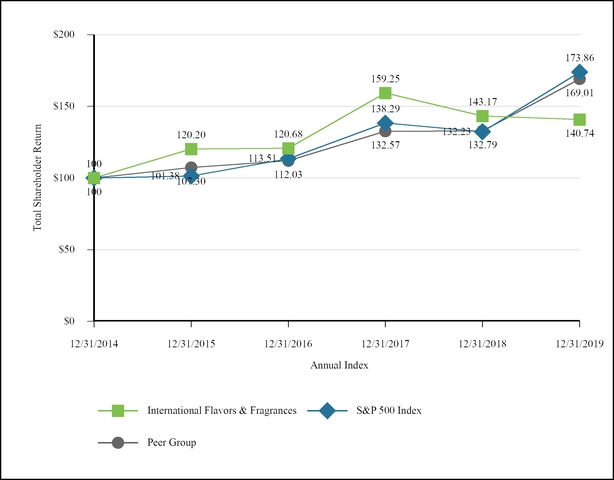
SOURCE: S&P Capital IQ
Due to the international scope and breadth of our business, we believe that a Peer Group comprising international public companies, which are representative of the customer group to which we sell our products, is the most appropriate group against which to compare shareholder returns. See the table below for the list of companies included in our Peer Group.
| Peer Group Companies | |
| Avon Products, Inc. | Kellogg Company |
| Campbell Soup Company | The Estée Lauder Companies Inc. |
| Church & Dwight Co., Inc. | McCormick & Company, Incorporated |
| The Clorox Company | McDonald’s Corporation |
| The Coca-Cola Company | Nestle SA |
| Colgate-Palmolive Company | PepsiCo, Inc. |
| Conagra Brands, Inc. | The Procter & Gamble Company |
| Edgewell Personal Care Company(1) | Revlon, Inc. |
| General Mills, Inc. | Sensient Technologies Corporation |
| The Hershey Company | Unilever N.V. |
| Hormel Foods Corporation | YUM! Brands, Inc. |
| (1) | Edgewell Personal Care has been included starting from July 1, 2015 when it spun off from Energizer Holdings. |
Item 6. SELECTED FINANCIAL DATA.
INTERNATIONAL FLAVORS & FRAGRANCES INC.
QUARTERLY FINANCIAL DATA
(UNAUDITED)
The following selected consolidated financial data is derived from our Consolidated Financial Statements. This data should be read in conjunction with the Consolidated Financial Statements and Notes thereto, and with Item 7. Management’s Discussion and Analysis of Financial Condition and Results of Operations.
| Fiscal Year Ended December 31, 2019 | |||||||||||||||||||
| (DOLLARS IN THOUSANDS EXCEPT PER SHARE AMOUNTS) | First Quarter | Second Quarter | Third Quarter | Fourth Quarter | Total Year | ||||||||||||||
| Net Sales | $ | 1,297,402 | $ | 1,291,568 | $ | 1,267,345 | $ | 1,283,769 | $ | 5,140,084 | |||||||||
| Gross Profit(a) | 531,259 | 546,239 | 533,088 | 502,162 | 2,112,748 | ||||||||||||||
| Income before taxes | 134,576 | 169,481 | 156,866 | 96,529 | 557,452 | ||||||||||||||
| Net income | 111,214 | 138,869 | 129,807 | 80,378 | 460,268 | ||||||||||||||
| Net income attributable to IFF stockholders(b) | 108,829 | 136,377 | 127,124 | 83,543 | 455,873 | ||||||||||||||
| Net income per share — basic(d) | 0.97 | 1.21 | 1.15 | 0.71 | 4.05 | ||||||||||||||
| Net income per share — diluted(c) | 0.96 | 1.20 | 1.13 | 0.70 | 4.00 |
| Fiscal Year Ended December 31, 2018 | |||||||||||||||||||
| (DOLLARS IN THOUSANDS EXCEPT PER SHARE AMOUNTS) | First Quarter | Second Quarter | Third Quarter | Fourth Quarter | Total Year | ||||||||||||||
| Net Sales | $ | 930,928 | $ | 920,016 | $ | 907,548 | $ | 1,219,047 | $ | 3,977,539 | |||||||||
| Gross Profit(a) | 405,809 | 398,717 | 400,666 | 477,515 | 1,682,707 | ||||||||||||||
| Income before taxes | 158,837 | 121,918 | 100,702 | 66,300 | 447,757 | ||||||||||||||
| Net income | 129,416 | 99,149 | 95,716 | 15,500 | 339,781 | ||||||||||||||
| Net income attributable to IFF stockholders(b) | 129,416 | 99,149 | 95,716 | 13,021 | 337,302 | ||||||||||||||
| Net income per share — basic(d) | 1.63 | 1.25 | 1.18 | 0.09 | 3.81 | ||||||||||||||
| Net income per share — diluted(c)(e) | 1.63 | 1.25 | 1.17 | 0.09 | 3.79 |
** See the following chart for (a)-(e) footnote explanations.*
Included in the above quarterly results are the following:
| Footnotes | ||||||||||
| (DOLLARS IN THOUSANDS EXCEPT PER SHARE AMOUNTS) | Gross Profit (a) | Net Expense (Income) (b) | Diluted EPS (c) | Description | ||||||
| Q1 2019 | ||||||||||
| Integration Related Costs | $ | 156 | $ | 11,548 | $ | 0.10 | Represents costs related to the integration of the Frutarom acquisition. | |||
| Restructuring and Other Charges, net | — | 12,143 | 0.11 | Represents severance costs related to restructuring programs. | ||||||
| Frutarom Acquisition Related Costs | 7,850 | 7,999 | 0.07 | Represents transaction-related costs and expenses related to the acquisition of Frutarom. | ||||||
| Q2 2019 | ||||||||||
| Integration Related Costs | 165 | 8,843 | 0.08 | Represents costs related to the integration of the Frutarom acquisition. | ||||||
| Restructuring and Other Charges, net | — | 1,973 | 0.02 | Represents severance costs related primarily to Frutarom. | ||||||
| Frutarom Acquisition Related Costs | — | (1,290 | ) | (0.01 | ) | Represents reductions in the contingent consideration payable related to certain acquisitions made by Frutarom. | ||||
| Q3 2019 | ||||||||||
| Integration Related Costs | 187 | 8,164 | 0.07 | Represents costs related to the integration of the Frutarom acquisition. | ||||||
| Restructuring and Other Charges, net | — | 2,905 | 0.03 | Represents costs primarily related to the Frutarom Integration Initiative and the 2019 Severance Program. | ||||||
| Frutarom Acquisition Related Costs | (3,603 | ) | (2,199 | ) | (0.02 | ) | Represents a measurement period adjustment to the amount of the inventory "step-up" recorded. | |||
| Q4 2019 | ||||||||||
| Integration Related Costs | 222 | 14,144 | 0.12 | Represents costs related to the integration of the Frutarom acquisition. | ||||||
| Restructuring and Other Charges, net | — | 5,947 | 0.05 | Represents costs primarily related to the Frutarom Integration Initiative and the 2019 Severance Program. | ||||||
| Frutarom Acquisition Related Costs | — | 636 | 0.01 | Represents costs primarily compensation associated with Frutarom options that had not vested at the time the Frutarom acquisition closed. | ||||||
| N&B Transaction Related Costs | — | 18,393 | 0.16 | Represents costs and expenses related to the pending transaction with Nutrition & Biosciences Inc. | ||||||
| Q1 2018 | ||||||||||
| Restructuring and Other Charges, net | — | 548 | 0.01 | Represents severance costs related to the 2017 Productivity Program and Taiwan lab closure. | ||||||
| U.S. Tax Reform | — | 649 | 0.01 | Represents charges incurred related to enactment of certain U.S. tax legislation changes in December 2017. | ||||||
| Q2 2018 | ||||||||||
| Integration Related Costs | — | 993 | 0.01 | Represents costs related to the integration of David Michael. | ||||||
| Restructuring and Other Charges, net | — | 147 | — | Represents severance costs related to the 2017 Productivity Program. | ||||||
| Frutarom Acquisition Related Costs | — | 30,446 | 0.38 | Represents transaction-related costs and expenses related to the acquisition of Frutarom. | ||||||
| Q3 2018 | ||||||||||
| Integration Related Costs | 18 | 722 | 0.01 | Represents costs related to the integration of Frutarom. | ||||||
| Restructuring and Other Charges, net | — | 699 | 0.01 | Represents severance costs related to the 2017 Productivity Program. | ||||||
| U.S. Tax Reform | — | (8,151 | ) | (0.10 | ) | Represents charges incurred related to enactment of certain U.S. tax legislation changes in December 2017. | ||||
| Frutarom Acquisition Related Costs | — | 45,433 | 0.56 | Represents transaction-related costs and expenses related to the acquisition of Frutarom. | ||||||
| Q4 2018 | ||||||||||
| Integration Related Costs | 84 | 4,076 | 0.04 | Represents costs related to the integration of the Frutarom acquisition. | ||||||
| Restructuring and Other Charges, net | — | 1,672 | 0.01 | Represents severance costs related to the 2017 Productivity Program and costs associated with the termination of agent relationships in a subsidiary. | ||||||
| U.S. Tax Reform | — | 32,847 | 0.30 | Represents additional expense based on updated repatriation plans requiring accruals for withholding taxes on deemed repatriation. | ||||||
| Frutarom Acquisition Related Costs | 23,550 | 51,200 | 0.46 | Represents transaction-related costs and expenses related to the acquisition of Frutarom. |
| (d) | The sum of Net Income per basic share by quarter does not equal the earnings per share for the full year due to the impact of higher shares in the third and fourth quarters. |
| (e) | The sum of Net Income per diluted share by quarter does not equal the earnings per share for the full year due to rounding. |
INTERNATIONAL FLAVORS & FRAGRANCES INC.
FIVE-YEAR SUMMARY
(DOLLARS IN THOUSANDS EXCEPT PER SHARE AND PERCENTAGE AMOUNTS)
| Year Ended December 31, | |||||||||||||||||||
| 2019**(a)** | 2018**(b)** | 2017**(k)** | 2016**(k)** | 2015**(k)** | |||||||||||||||
| Consolidated Statement of Income Data | |||||||||||||||||||
| Net sales | $ | 5,140,084 | $ | 3,977,539 | $ | 3,398,719 | $ | 3,116,350 | $ | 3,023,189 | |||||||||
| Cost of goods sold(c) | 3,027,336 | 2,294,832 | 1,926,256 | 1,720,787 | 1,672,308 | ||||||||||||||
| Gross profit | 2,112,748 | 1,682,707 | 1,472,463 | 1,395,563 | 1,350,881 | ||||||||||||||
| Research and development expenses | 346,128 | 311,583 | 295,469 | 258,863 | 245,605 | ||||||||||||||
| Selling and administrative expenses(d) | 876,121 | 707,461 | 570,144 | 572,518 | 494,097 | ||||||||||||||
| Restructuring and other charges, net(e) | 29,765 | 5,079 | 19,711 | (1,700 | ) | 7,594 | |||||||||||||
| Amortization of acquisition-related intangibles | 193,097 | 75,879 | 34,693 | 23,763 | 15,040 | ||||||||||||||
| Losses (gains) on sale of assets | 2,367 | (1,177 | ) | (184 | ) | (10,836 | ) | — | |||||||||||
| Operating profit | 665,270 | 583,882 | 552,630 | 552,955 | 588,545 | ||||||||||||||
| Interest expense | 138,221 | 132,558 | 65,363 | 52,989 | 46,062 | ||||||||||||||
| Loss on extinguishment of debt(f) | — | 38,810 | — | — | — | ||||||||||||||
| Other (income) expense, net(g) | (30,403 | ) | (35,243 | ) | (49,778 | ) | (23,751 | ) | 3,382 | ||||||||||
| Income before taxes | 557,452 | 447,757 | 537,045 | 523,717 | 539,101 | ||||||||||||||
| Taxes on income(h) | 97,184 | 107,976 | 241,380 | 118,686 | 119,854 | ||||||||||||||
| Net income | 460,268 | 339,781 | 295,665 | 405,031 | 419,247 | ||||||||||||||
| Net income attributable to noncontrolling interests | 4,395 | 2,479 | — | — | — | ||||||||||||||
| Net income attributable to IFF stockholders | $ | 455,873 | $ | 337,302 | $ | 295,665 | $ | 405,031 | $ | 419,247 | |||||||||
| Percentage of net sales | 9.0 | 8.5 | 8.7 | 13.0 | 13.9 | ||||||||||||||
| Percentage of average shareholders’ equity(i) | 7.4 | 8.7 | 17.8 | 25.1 | 26.9 | ||||||||||||||
| Net income per share — basic | $ | 4.05 | $ | 3.81 | $ | 3.73 | $ | 5.07 | $ | 5.19 | |||||||||
| Net income per share — diluted | $ | 4.00 | $ | 3.79 | $ | 3.72 | $ | 5.05 | $ | 5.16 | |||||||||
| Average number of diluted shares (thousands) | 113,307 | 88,121 | 79,370 | 79,981 | 80,891 | ||||||||||||||
| Consolidated Balance Sheet Data | |||||||||||||||||||
| Cash and cash equivalents | $ | 606,823 | $ | 634,897 | $ | 368,046 | $ | 323,992 | $ | 181,988 | |||||||||
| Receivables, net | 876,197 | 937,765 | 663,663 | 550,658 | 537,896 | ||||||||||||||
| Inventories | 1,123,068 | 1,078,537 | 649,448 | 592,017 | 572,047 | ||||||||||||||
| Property, plant and equipment, net | 1,386,920 | 1,241,152 | 880,580 | 775,716 | 732,794 | ||||||||||||||
| Goodwill and intangible assets, net(j) | 8,349,531 | 8,417,710 | 1,572,075 | 1,365,906 | 1,247,393 | ||||||||||||||
| Total assets | 13,287,411 | 12,889,395 | 4,598,926 | 4,016,984 | 3,702,010 | ||||||||||||||
| Bank borrowings, overdrafts and current portion of long-term debt | 384,958 | 48,642 | 6,966 | 258,516 | 132,349 | ||||||||||||||
| Long-term debt | 3,997,438 | 4,504,417 | 1,632,186 | 1,066,855 | 935,373 | ||||||||||||||
| Redeemable noncontrolling interests | 99,043 | 81,806 | — | — | — | ||||||||||||||
| Total Shareholders’ equity | 6,229,548 | 6,043,374 | 1,689,294 | 1,631,134 | 1,594,989 | ||||||||||||||
| Other Data | |||||||||||||||||||
| Current ratio | 1.9 | 2.6 | 2.5 | 1.8 | 2.0 | ||||||||||||||
| Additions to property, plant and equipment | $ | 235,978 | $ | 170,094 | $ | 128,973 | $ | 126,412 | $ | 101,030 | |||||||||
| Depreciation and amortization expense | 323,330 | 173,792 | 117,967 | 102,469 | 89,597 | ||||||||||||||
| Cash dividends declared per share | $ | 2.96 | $ | 2.84 | $ | 2.66 | $ | 2.40 | $ | 2.06 | |||||||||
| Number of shareholders of record at year-end | 1,555 | 1,276 | 1,735 | 1,892 | 2,013 | ||||||||||||||
| Number of employees at year-end | 13,668 | 13,209 | 7,299 | 6,932 | 6,732 |
| (a) | Results for the year ended 2019 include a full year of Frutarom’s business operations. |
| (b) | Results for the year ended 2018 include Frutarom’s business operations since the acquisition date of October 4, 2018. |
| (c) | The 2018 amount includes $23.6 million related to amortization for inventory "step-up" costs for the Frutarom acquisition and $7.1 million of net reimbursements from suppliers related to the previously disclosed FDA mandated recall**.** The 2017 amount includes $15.9 million of costs related to the amortization for inventory "step-up" for the Fragrance Resources and PowderPure acquisitions and FDA mandated product recall costs of $11.0 million. The 2016 amount includes $7.6 million of costs related to the amortization for inventory "step-up" for the David Michael and Lucas Meyer acquisitions. The 2015 amount includes $6.8 million of costs related to the fair value step-up of inventory for the Ottens Flavors and Lucas Meyer acquisitions. |
| (d) | The 2019 amount includes $53.5 million of integration related costs, $20.7 million of N&B transaction related costs, $11.3 million compliance review and legal defense costs offset by $8.0 million related to certain Brazil tax credits. The 2018 amount includes $66.1 million of transaction costs related to acquisition of Frutarom, $6.1 million of integration costs related to the David Michael and Frutarom acquisitions, and $1.3 million of transaction costs related to the acquisitions of Fragrance Resources and PowderPure**.** The 2017 amount includes $4.5 million of costs related to the Fragrance Resources and PowderPure acquisitions, $3.3 million of integration costs related to the 2017 Productivity Program and $5.3 million of reserve for payment of a tax assessment related to commercial rent for prior periods. The 2016 amount includes $48.5 million of legal charges/credits principally related to litigation accrual and $4.5 million of acquisition-related costs related to the acquisitions of Lucas Meyer, David Michael and Fragrance Resources. The 2015 amount includes $10.5 million of reversal of the previously recorded provision for the Spanish capital tax case, $7.2 million of expense for the acceleration of the contingent consideration payments related to the Aromor acquisition and $11.5 million of acquisition-related costs for the Ottens and Lucas Meyer acquisitions. |
| (e) | The 2019 amount represents costs primarily related to the Frutarom Integration Initiative and the 2019 Severance Program. The 2018 and 2017 amounts primarily represent severance costs related to the 2017 Productivity Program. The 2016 amount represents accelerated depreciation related to the termination of a former executive officer and partial reversal of restructuring accruals recorded in the prior year. |
| (f) | For 2018, represents a $34.9 million make whole payment on the Senior Notes - 2007 and a $3.9 million realized loss on the termination of a fair value hedge in connection with the acquisition financing of Frutarom. |
| (g) | The 2017 amount includes $12.2 million from the release of CTA related to the liquidation of a foreign entity. |
| (h) | The 2018 amount includes an additional charge based on updated repatriation plans requiring a $32.8 million accrual of a deferred tax liability for foreign withholding and other taxes, including state taxes, on deemed repatriation. For 2017, represents charges incurred related to enactment of certain U.S. tax legislation changes in December 2017, including $38.6 million related to net adjustments on deferred tax assets, and $100.6 million related to taxes on deemed repatriation of earnings. The 2015 amount includes $10.5 million of settlements due to favorable tax rulings in jurisdictions for which reserves were previously recorded for ongoing tax disputes. |
| (i) | Percentage of average shareholders’ equity is calculated using the Net income attributable to IFF stockholders as a percent of the average of Total Shareholders’ equity balance at the end of year and the preceding year. |
| (j) | Beginning in 2018, the amount includes $6.9 billion in identifiable intangible assets and goodwill related to our acquisition of Frutarom. |
| (k) | The amounts have been adjusted to reflect the adoption of ASU 2017-07, which required that employers who present a measure of operating income in their statement of income to include only the service cost component of net periodic pension cost and postretirement costs in operating expenses. The impact of the adoption of this standard was a decrease in operating profit by approximately $28.8 million, $14.4 million and $0.6 million for the fiscal year 2017, 2016 and 2015, respectively, and corresponding increases in Other (income) expense, net. |
Item 7. MANAGEMENT’S DISCUSSION AND ANALYSIS OF FINANCIAL CONDITION AND RESULTS OF OPERATIONS.
(UNLESS INDICATED OTHERWISE, DOLLARS IN MILLIONS EXCEPT PER SHARE AMOUNTS)
Overview
Company background
We are a leading innovator of sensory experiences that move the world. Our creative capabilities, global footprint, regulatory and technological know-how provide us a competitive advantage in meeting the demands of our global, regional and local customers around the world. The 2018 acquisition of Frutarom solidified our position as an industry leader across an expanded portfolio of products, resulting in a broader customer base across small, mid-sized and large companies and an expansion to new adjacencies that provides a platform for significant cross-selling opportunities.
Beginning in the first quarter of fiscal year 2020, we are operating our business across two segments, Taste and Scent. As part of this new operating model, nearly all of the former Frutarom business segment was consolidated with the Taste segment. The financial results presented in this Form 10-K reflect the Taste, Scent and legacy Frutarom business segments prior to the realignment.
As a leading creator of flavor offerings, we help our customers deliver on the promise of delicious and healthy foods and drinks that appeal to consumers. While we are a global leader, our Taste business is more regional in nature, with different formulas that reflect local taste preferences. Consequently, we manage our Taste business geographically, creating products in our regional creative centers which allow us to satisfy local taste preferences, while also helping to ensure regulatory compliance and production standards. We develop thousands of different flavors and taste offerings for our customers, most of which are tailor-made. We continually develop new formulas to meet changing consumer preferences and customer needs.
Our global Scent business creates fragrance compounds and fragrance ingredients that are integral elements in the world’s finest perfumes and best-known household and personal care products. We believe our innovative technologies, consumer insight and customer intimacy make us a market leader in scent.
Pending Transaction with Nutrition & Biosciences, Inc.
On December 15, 2019, we entered into definitive agreements with DuPont de Nemours, Inc. (“DuPont”), including an Agreement and Plan of Merger, pursuant to which DuPont will transfer its nutrition and biosciences business (the “N&B Business”) to Nutrition & Biosciences, Inc., a Delaware corporation and wholly owned subsidiary of DuPont (“N&B”), and N&B will merge with and into a wholly owned subsidiary of IFF in exchange for a number of shares of IFF common stock, par value $0.125 per share (“IFF Common Stock”) (collectively, the “DuPont N&B Transaction”). In connection with the transaction, DuPont will receive a one-time $7.3 billion special cash payment (the “Special Cash Payment”), subject to certain adjustments. As a result of the DuPont N&B Transaction, holders of DuPont’s common stock will own approximately 55.4% of the outstanding shares of IFF on a fully diluted basis. We believe that the combination of IFF and the N&B Business will create a global leader in high-value ingredients and solutions in the global Food & Beverage, Home & Personal Care and Health & Wellness markets. We expect that the companies' complementary product portfolios will give the combined company leadership positions across key Taste, Texture, Scent, Nutrition, Enzymes, Cultures, Soy Proteins and Probiotics categories.
Completion of the DuPont N&B Transaction is subject to various closing conditions, including, among other things, (1) approval by IFF’s shareholders of the issuance of IFF Common Stock in connection with the transaction; (2) the effectiveness of the registration statements to be filed with the Securities and Exchange Commission pursuant to the Merger Agreement; and (3) the expiration of the applicable waiting period under the Hart-Scott-Rodino Antitrust Improvements Act of 1976, as amended, and obtaining certain other consents, authorizations, orders or approvals from governmental authorities. We expect that the transaction will close in early 2021.
2019 Financial Performance Overview
Sales
Sales in 2019 increased 29% on a reported basis and 32% on a currency neutral basis (which excludes the effects of changes in currency), with the effects of the Frutarom acquisition contributing approximately 28% to reported growth rates and 29% to currency neutral growth rates. Taste reported sales growth was flat but currency neutral sales grew 2%. Scent achieved sales growth of 2% on a reported basis and 4% on a currency neutral basis in 2019. The impact of an additional week of sales, or a 53rd week, in 2019 contributed approximately 1% to reported and currency neutral sales growth. Consolidated reported
and currency neutral sales growth was driven by additional sales from our acquisition of Frutarom, and to a lesser extent, new win performance (net of losses) in Scent.
From a geographic perspective, North America ("NOAM"), Europe, Africa and Middle East ("EAME"), Greater Asia ("GA") and Latin America ("LA") all delivered sales growth on a consolidated basis led by the Frutarom acquisition.
Exchange rate variations had an unfavorable impact on net sales for 2019 of 3%. The effect of exchange rates can vary by business and region, depending upon the mix of sales priced in U.S. dollars as compared to other currencies.
Our 25 largest customers accounted for 38% of total sales in 2019. In 2019, no customer accounted for more than 10% of sales. A key factor for commercial success is inclusion on our strategic customers’ core supplier lists, which provides opportunities to win new business. We are on the core supplier lists of a large majority of our global and strategic customers within taste and scent.
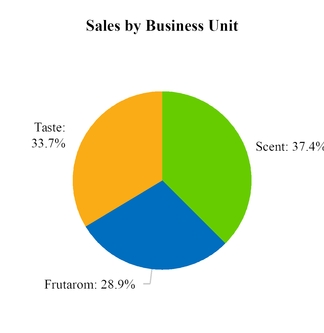
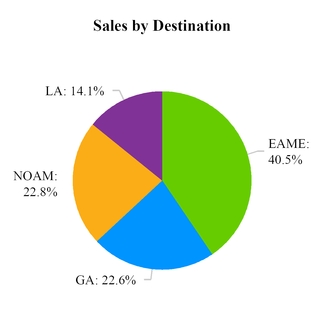
Gross Margin
Gross margin decreased 120 basis points ("bps") year-over-year, driven principally by lower margins in our Frutarom business unit and higher raw material costs, which were partially offset by cost savings and productivity initiatives.
Operating profit
Operating profit increased $81.4 million to $665.3 million (12.9% of sales) in 2019 compared to $583.9 million (14.7% of sales) in 2018. Included in 2019 were $127.8 million of charges related to operational improvement initiatives, integration related costs, restructuring and other charges, net, losses on sale of assets, FDA mandated product recall, compliance review costs, Frutarom acquisition related costs and N&B transaction related costs. The comparable period in 2018 included $93.5 million of charges related to operational improvement initiatives, integration related costs, restructuring and other charges, net, and Frutarom acquisition related costs, which were partially offset by acquisition related costs, gains on sale of assets and recoveries related to the FDA mandated product recall. Excluding these charges, adjusted operating profit was $793.1 million for 2019, an increase from $677.4 million for 2018, principally driven by the inclusion of Frutarom's operating profit for a full year in 2019 compared to one quarter in 2018, productivity initiatives, and volume increases on existing business, partially offset by price to input costs (including the net impact of the BASF supply chain disruption in 2018) and unfavorable foreign exchange rates.
Excluding the above charges, adjusted operating profit as a percentage of sales decreased to 15.4% for 2019 compared to 17.0% for 2018, principally driven by lower margins in our Frutarom business and price to input costs (including the net impact of the BASF supply chain disruption in 2018), partially offset by productivity initia
Showing the first 8K of 101K characters. Open the full section
Item 7A. QUANTITATIVE AND QUALITATIVE DISCLOSURES ABOUT MARKET RISK.
We operate on a global basis and are exposed to currency fluctuation related to the manufacture and sale of our products in currencies other than the U.S. dollar. The major foreign currencies involve the markets in the European Union, Great Britain, Mexico, Brazil, China, India, Indonesia, Australia, Russia and Japan, although all regions are subject to foreign currency fluctuations versus the U.S. dollar. We actively monitor our foreign currency exposures in all major markets in which we operate, and employ a variety of techniques to mitigate the impact of exchange rate fluctuations, including foreign currency hedging activities.
We have established a centralized reporting system to evaluate the effects of changes in interest rates, currency exchange rates and other relevant market risks. Our risk management procedures include the monitoring of interest rate and foreign exchange exposures and hedge positions utilizing statistical analyses of cash flows, market value and sensitivity analysis. However, the use of these techniques to quantify the market risk of such instruments should not be construed as an endorsement of their accuracy or the accuracy of the related assumptions. For the year ended December 31, 2019, our exposure to market risk was estimated using sensitivity analyses, which illustrate the change in the fair value of a derivative financial instrument assuming hypothetical changes in foreign exchange rates and interest rates.
We enter into foreign currency forward contracts with the objective of reducing exposure to cash flow volatility associated with foreign currency receivables and payables, and with anticipated purchases of certain raw materials used in operations. These contracts, the counterparties to which are major international financial institutions, generally involve the exchange of one currency for a second currency at a future date, and have maturities not exceeding twelve months. The gain or loss on the hedging instrument and services is recorded in earnings at the same time as the transaction being hedged is recorded in earnings. At December 31, 2019, our foreign currency exposures pertaining to derivative contracts exist with the Euro, Japanese Yen, British Pound, Australian Dollar and Indonesian Rupiah. Based on a hypothetical decrease or increase of 10% in the applicable balance sheet exchange rates (primarily against the U.S. dollar), the estimated fair value of our foreign currency forward contracts would increase by approximately $10 million. However, any change in the value of the contracts, real or hypothetical, would be significantly offset by a corresponding change in the value of the underlying hedged items.
We use derivative instruments as part of our interest rate risk management strategy. We have entered into certain cross currency swap agreements in order to mitigate a portion of our net European investments from foreign currency risk. As of December 31, 2018, these swaps were in a net liability position with an aggregate fair value of $4.2 million. Based on a hypothetical decrease or increase of 10% in the value of the U.S. dollar against the Euro, the estimated fair value of our cross currency swaps would change by approximately $60 million.
At December 31, 2019, the fair value of our EUR fixed rate debt was €1.9 billion. Based on a hypothetical decrease or increase of 10% in foreign exchange rates, the estimated fair value of our EUR fixed debt would change by approximately $200 million.
At December 31, 2019, the fair value of our USD fixed rate debt was $2.5 billion. Based on a hypothetical decrease or increase of 10% in interest rates, the estimated fair value of our US fixed debt would change by approximately $250 million.
We purchase certain commodities, such as natural gas, electricity, petroleum based products and certain crop related items. We generally purchase these commodities based upon market prices that are established with the vendor as part of the purchase process. In general, we do not use commodity financial instruments to hedge commodity prices.
Item 8. FINANCIAL STATEMENTS AND SUPPLEMENTARY DATA.
See index to Consolidated Financial Statements on page 61. See Item 6 on page 32 for supplemental quarterly data.
Item 9. CHANGES IN AND DISAGREEMENTS WITH ACCOUNTANTS ON ACCOUNTING AND FINANCIAL DISCLOSURE.
None.
Item 9A. CONTROLS AND PROCEDURES.
Evaluation of Disclosure Controls and Procedures and Changes in Internal Control over Financial Reporting.
Our Chief Executive Officer and Chief Financial Officer, with the assistance of other members of our management, have evaluated the effectiveness of our disclosure controls and procedures as of the end of the period covered by this Form 10-K. Based on such evaluation, our Chief Executive Officer and Chief Financial Officer have concluded that our disclosure controls and procedures are effective as of the end of the period covered by this Form 10-K.
We have established controls and procedures designed to ensure that information required to be disclosed in the reports that we file or submit under the Exchange Act is recorded, processed, summarized and reported within the time periods specified in the Commission’s rules and forms and is accumulated and communicated to management, including the principal executive officer and the principal financial officer, to allow timely decisions regarding required disclosure.
Our Chief Executive Officer and Chief Financial Officer have concluded that there have not been any changes in our internal control over financial reporting during the fourth quarter that have materially affected, or are reasonably likely to materially affect, our internal control over financial reporting.
Management’s Report on Internal Control Over Financial Reporting.
Our management is responsible for establishing and maintaining adequate internal control over financial reporting as defined in Rules 13a-15(f) and 15d-15(f) under the Securities Exchange Act of 1934. Our internal control over financial reporting is a process designed to provide reasonable assurance regarding the reliability of financial reporting and the preparation of financial statements for external purposes in accordance with generally accepted accounting principles.
Because of its inherent limitations, internal control over financial reporting may not prevent or detect misstatements. Also, projections of any evaluation of effectiveness to future periods are subject to the risk that controls may become inadequate because of changes in conditions, or that the degree of compliance with the policies or procedures may deteriorate.
Management assessed the effectiveness of our internal control over financial reporting as of January 3, 2020. In making this assessment, management used the criteria set forth by the Committee of Sponsoring Organizations of the Treadway Commission (“COSO”) in its 2013 Internal Control — Integrated Framework.
Based on this assessment, management determined that, as of January 3, 2020, our internal control over financial reporting was effective.
PricewaterhouseCoopers LLP, our independent registered public accounting firm, has audited the effectiveness of our internal control over financial reporting as of January 3, 2020 as stated in their report which is included herein.
Item 9B. OTHER INFORMATION.
None.
PART III
Item 10. DIRECTORS, EXECUTIVE OFFICERS AND CORPORATE GOVERNANCE.
The information relating to directors and nominees of the Company is set forth in the IFF 2020 Proxy Statement and is incorporated by reference herein. The information relating to Section 16(a) beneficial ownership reporting compliance that appears in the IFF 2020 Proxy Statement is also incorporated by reference herein. See Part I, Item 1 of this Form 10-K for information relating to the Company’s Executive Officers.
We have adopted a Code of Business Conduct and Ethics (the “Code of Ethics”) that applies to all of our employees, including our chief executive officer and our chief financial officer (who is also our principal accounting officer). We have also adopted a Code of Conduct for Directors and a Code of Conduct for Executive Officers (together with the Code of Ethics, the “Codes”). The Codes are available through the Investors — Corporate Governance link on our website www.iff.com.
Only the Board of Directors or the Audit Committee of the Board may grant a waiver from any provision of our Codes in favor of a director or executive officer, and any such waiver will be publicly disclosed. We will disclose substantive amendments to and any waivers from the Codes provided to our chief executive officer and principal financial officer (principal accounting officer), as well as any other executive officer or director, on the Company’s website: www.iff.com.
The information regarding the Company’s Audit Committee and its designated audit committee financial experts is set forth in the IFF 2020 Proxy Statement and such information is incorporated by reference herein.
The information concerning procedures by which shareholders may recommend director nominees is set forth in the IFF 2020 Proxy Statement and such information is incorporated by reference herein.
Item 11. EXECUTIVE COMPENSATION.
The items required by Part III, Item 11 are incorporated herein by reference from the IFF 2020 Proxy Statement to be filed on or before May 4, 2020.
Item 12. SECURITY OWNERSHIP OF CERTAIN BENEFICIAL OWNERS AND MANAGEMENT AND RELATED STOCKHOLDER MATTERS.
The items required by Part III, Item 12 are incorporated herein by reference from the IFF 2020 Proxy Statement to be filed on or before May 4, 2020.
Item 13. CERTAIN RELATIONSHIPS AND RELATED TRANSACTIONS, AND DIRECTOR INDEPENDENCE.
The items required by Part III, Item 13 are incorporated herein by reference from the IFF 2020 Proxy Statement to be filed on or before May 4, 2020.
Item 14. PRINCIPAL ACCOUNTANT FEES AND SERVICES.
The items required by Part III, Item 14 are incorporated herein by reference from the IFF 2020 Proxy Statement to be filed on or before May 4, 2020.
PART IV
Item 15. EXHIBITS AND FINANCIAL STATEMENT SCHEDULES.
| (a)(1) FINANCIAL STATEMENTS: The following consolidated financial statements, related notes, and independent registered public accounting firm’s report are included in this Form 10-K: | |
| Report of Independent Registered Public Accounting Firm | 62 |
| Consolidated Statement of Income and Comprehensive Income for the years ended December 31, 2019, 2018 and 2017 | 64 |
| Consolidated Balance Sheet as of December 31, 2019 and 2018 | 65 |
| Consolidated Statement of Cash Flows for the years ended December 31, 2019, 2018 and 2017 | 66 |
| Consolidated Statement of Shareholders’ Equity for the years ended December 31, 2019, 2018 and 2017 | 67 |
| Notes to Consolidated Financial Statements | 69 |
| (a)(3) EXHIBITS | 122 |
| (a)(2) FINANCIAL STATEMENT SCHEDULES | |
| Schedule II — Valuation and Qualifying Accounts and Reserves for the years ended December 31, 2019, 2018 and 2017 | S-1 |
All other schedules are omitted because they are not applicable or the required information is shown in the financial statements or notes thereto.
REPORT OF INDEPENDENT REGISTERED PUBLIC ACCOUNTING FIRM
To the Board of Directors and Shareholders of International Flavors & Fragrances Inc.
Opinions on the Financial Statements and Internal Control over Financial Reporting
We have audited the accompanying consolidated balance sheet of International Flavors & Fragrances Inc. and its subsidiaries (the “Company”) as of January 3, 2020 and December 28, 2018, and the related consolidated statements of income and comprehensive income, of shareholders' equity and of cash flows for each of the three years in the period ended January 3, 2020, including the related notes and schedule of valuation and qualifying accounts and reserves for each of the three years in the period ended January 3, 2020 appearing on S-1 (collectively referred to as the “consolidated financial statements”). We also have audited the Company's internal control over financial reporting as of January 3, 2020, based on criteria established in Internal Control - Integrated Framework (2013) issued by the Committee of Sponsoring Organizations of the Treadway Commission (COSO).
In our opinion, the consolidated financial statements referred to above present fairly, in all material respects, the financial position of the Company as of January 3, 2020 and December 28, 2018, and the results of its operations and its cash flows for each of the three years in the period ended January 3, 2020 in conformity with accounting principles generally accepted in the United States of America. Also in our opinion, the Company maintained, in all material respects, effective internal control over financial reporting as of January 3, 2020, based on criteria established in Internal Control - Integrated Framework (2013) issued by the COSO.
Change in Accounting Principle
As discussed in Note 1 to the consolidated financial statements, the Company changed the manner in which it accounts for leases in 2019.
Basis for Opinions
The Company's management is responsible for these consolidated financial statements, for maintaining effective internal control over financial reporting, and for its assessment of the effectiveness of internal control over financial reporting, included in Management’s Report on Internal Control Over Financial Reporting appearing under Item 9A. Our responsibility is to express opinions on the Company’s consolidated financial statements and on the Company's internal control over financial reporting based on our audits. We are a public accounting firm registered with the Public Company Accounting Oversight Board (United States) (PCAOB) and are required to be independent with respect to the Company in accordance with the U.S. federal securities laws and the applicable rules and regulations of the Securities and Exchange Commission and the PCAOB.
We conducted our audits in accordance with the standards of the PCAOB. Those standards require that we plan and perform the audits to obtain reasonable assurance about whether the consolidated financial statements are free of material misstatement, whether due to error or fraud, and whether effective internal control over financial reporting was maintained in all material respects.
Our audits of the consolidated financial statements included performing procedures to assess the risks of material misstatement of the consolidated financial statements, whether due to error or fraud, and performing procedures that respond to those risks. Such procedures included examining, on a test basis, evidence regarding the amounts and disclosures in the consolidated financial statements. Our audits also included evaluating the accounting principles used and significant estimates made by management, as well as evaluating the overall presentation of the consolidated financial statements. Our audit of internal control over financial reporting included obtaining an understanding of internal control over financial reporting, assessing the risk that a material weakness exists, and testing and evaluating the design and operating effectiveness of internal control based on the assessed risk. Our audits also included performing such other procedures as we considered necessary in the circumstances. We believe that our audits provide a reasonable basis for our opinions.
Definition and Limitations of Internal Control over Financial Reporting
A company’s internal control over financial reporting is a process designed to provide reasonable assurance regarding the reliability of financial reporting and the preparation of financial statements for external purposes in accordance with generally accepted accounting principles. A company’s internal control over financial reporting includes those policies and procedures that (i) pertain to the maintenance of records that, in reasonable detail, accurately and fairly reflect the transactions and dispositions of the assets of the company; (ii) provide reasonable assurance that transactions are recorded as necessary to permit preparation of financial statements in accordance with generally accepted accounting principles, and that receipts and expenditures of the company are being made only in accordance with authorizations of management and directors of the
company; and (iii) provide reasonable assurance regarding prevention or timely detection of unauthorized acquisition, use, or disposition of the company’s assets that could have a material effect on the financial statements.
Because of its inherent limitations, internal control over financial reporting may not prevent or detect misstatements. Also, projections of any evaluation of effectiveness to future periods are subject to the risk that controls may become inadequate because of changes in conditions, or that the degree of compliance with the policies or procedures may deteriorate.
Critical Audit Matters
The critical audit matter communicated below is a matter arising from the current period audit of the consolidated financial statements that was communicated or required to be communicated to the audit committee and that (i) relates to accounts or disclosures that are material to the consolidated financial statements and (ii) involved our especially challenging, subjective, or complex judgments. The communication of critical audit matt
Showing the first 8K of 271K characters. Open the full section
Item 16. FORM 10-K SUMMARY.
None.
SIGNATURES
Pursuant to the requirements of Section 13 or 15(d) of the Securities Exchange Act of 1934, the Registrant has duly caused this report to be signed on its behalf by the undersigned, thereunto duly authorized.
| INTERNATIONAL FLAVORS & FRAGRANCES INC. | ||
| By: | /s/ Rustom Jilla | |
| Name: | Rustom Jilla | |
| Title: | Executive Vice President and Chief Financial Officer |
Dated: March 3, 2020
Pursuant to the requirements of the Securities Exchange Act of 1934, this report has been signed below by the following persons on behalf of the registrant and in the capacities and on the dates indicated:
| Signature | Title | Date | ||
| /s/ Andreas Fibig | Chairman of the Board, Chief Executive Officer and Director (Principal Executive Officer) | March 3, 2020 | ||
| Andreas Fibig | ||||
| /s/ Rustom Jilla | Executive Vice President and Chief Financial Officer (Principal Financial and Accounting Officer) | March 3, 2020 | ||
| Rustom Jilla | ||||
| /s/ Marcello V. Bottoli | Director | March 3, 2020 | ||
| Marcello V. Bottoli | ||||
| /s/ Linda B. Buck | Director | March 3, 2020 | ||
| Linda B. Buck | ||||
| /s/ Michael Ducker | Director | March 3, 2020 | ||
| Michael Ducker | ||||
| /s/ David R. Epstein | Director | March 3, 2020 | ||
| David R. Epstein | ||||
| /s/ Roger W. Ferguson, Jr. | Director | March 3, 2020 | ||
| Roger W. Ferguson, Jr. | ||||
| /s/ John F. Ferraro | Director | March 3, 2020 | ||
| John F. Ferraro | ||||
| /s/ Christina Gold | Director | March 3, 2020 | ||
| Christina Gold | ||||
| /s/ Katherine M. Hudson | Director | March 3, 2020 | ||
| Katherine M. Hudson | ||||
| /s/ Dale F. Morrison | Director | March 3, 2020 | ||
| Dale F. Morrison | ||||
| /s/ Li-Huei Tsai | Director | March 3, 2020 | ||
| Li-Huei Tsai | ||||
| /s/ Stephen Williamson | Director | March 3, 2020 | ||
| Stephen Williamson |
INTERNATIONAL FLAVORS & FRAGRANCES INC. AND SUBSIDIARIES
SCHEDULE II — VALUATION AND QUALIFYING ACCOUNTS AND RESERVES
(IN THOUSANDS)
| For the Year Ended December 31, 2019 | |||||||||||||||||||||||
| Balance at beginning of period | Additions charged to costs and expenses | Acquisitions | Accounts written off | Translation adjustments | Balance at end of period | ||||||||||||||||||
| Allowance for doubtful accounts | $ | 9,173 | $ | 1,262 | $ | — | $ | (2,024 | ) | $ | (180 | ) | $ | 8,231 | |||||||||
| Valuation allowance on credit and operating loss carryforwards and other net deferred tax assets | 200,280 | 5,659 | — | — | (2,174 | ) | 203,765 | ||||||||||||||||
| For the Year Ended December 31, 2018 | |||||||||||||||||||||||
| Balance at beginning of period | Additions (deductions) charged to costs and expenses | Acquisitions | Accounts written off | Translation adjustments | Balance at end of period | ||||||||||||||||||
| Allowance for doubtful accounts | $ | 13,392 | $ | 1,286 | $ | — | $ | (4,642 | ) | $ | (863 | ) | $ | 9,173 | |||||||||
| Valuation allowance on credit and operating loss carryforwards and other net deferred tax assets | 207,483 | (1,821 | ) | (1) | 3,887 | — | (9,269 | ) | 200,280 | ||||||||||||||
| For the Year Ended December 31, 2017 | |||||||||||||||||||||||
| Balance at beginning of period | Additions charged to costs and expenses | Acquisitions | Accounts written off | Translation adjustments | Balance at end of period | ||||||||||||||||||
| Allowance for doubtful accounts | $ | 9,995 | $ | 3,798 | $ | — | $ | (1,496 | ) | $ | 1,095 | $ | 13,392 | ||||||||||
| Valuation allowance on credit and operating loss carryforwards and other net deferred tax assets | 152,752 | 35,646 | (2) | — | — | 19,085 | 207,483 |
| (1) | The 2018 amount includes an adjustment to the 2017 foreign net operating loss carryforwards in the amount of $5.9 million. |
| (2) | The 2017 amount includes an adjustment to the 2016 foreign net operating loss carryforwards in the amount of $58.8 million. |
S-1