 filings.tools
Intel 10-Q 2024-09-28
INTC · CIK 50863 · Form 10-Q · Period ended September 28, 2024 · Filed November 1, 2024
Revenue fell 6.2% to $13.3 billion. Operating margin was -68.2%, against -0.1% a year earlier. The net loss was $16.6 billion.
8 sections, 270K characters. Original on sec.gov · ·
| Measure | Quarter ended Sep 28, 2024 | Quarter ended Sep 30, 2023 | Change |
|---|---|---|---|
| Revenue | $13.3B | $14.2B | -6.2% |
| Operating income | -$9.06B | -$8.00M | n/a |
| Net income | -$16.6B | $297M | -5702% |
| Diluted EPS | -$3.88 | $0.07 | -5643% |
| Operating margin* | -68.2% | -0.1% | -68.1 pts |
From the XBRL facts tagged to this filing; both columns are as reported in this filing. * Computed by filings.tools: free cash flow is operating cash flow less capital spending; operating margin is operating income over revenue.
Cover and table of contents
UNITED STATES SECURITIES AND EXCHANGE COMMISSION
Washington, D.C. 20549
FORM 10-Q
(Mark One)
| ☑ | QUARTERLY REPORT PURSUANT TO SECTION 13 OR 15(d) OF THE SECURITIES EXCHANGE ACT OF 1934 | ||||||||||
| For the quarterly period ended | September 28, 2024 |
or
| ☐ | TRANSITION REPORT PURSUANT TO SECTION 13 OR 15(d) OF THE SECURITIES EXCHANGE ACT OF 1934 | |||||||
| For the transition period from to |
Commission File Number: 000-06217
INTEL CORPORATION
(Exact name of registrant as specified in its charter)
| Delaware | 94-1672743 | |||||||||||||
| (State or other jurisdiction of incorporation or organization) | (I.R.S. Employer Identification No.) | |||||||||||||
| 2200 Mission College Boulevard, | Santa Clara, | California | 95054-1549 | |||||||||||
| (Address of principal executive offices) | (Zip Code) |
(408) 765-8080
(Registrant’s telephone number, including area code)
N/A
(Former name, former address and former fiscal year, if changed since last report)
Securities registered pursuant to Section 12(b) of the Act:
| Title of each class | Trading symbol(s) | Name of each exchange on which registered | ||||||
| Common stock, $0.001 par value | INTC | Nasdaq Global Select Market |
Indicate by check mark whether the registrant (1) has filed all reports required to be filed by Section 13 or 15(d) of the Securities Exchange Act of 1934 during the preceding 12 months (or for such shorter period that the registrant was required to file such reports), and (2) has been subject to such filing requirements for the past 90 days. Yes ☑ No ¨
Indicate by check mark whether the registrant has submitted electronically every Interactive Data File required to be submitted pursuant to Rule 405 of Regulation S-T (§232.405 of this chapter) during the preceding 12 months (or for such shorter period that the registrant was required to submit such files). Yes ☑ No ¨
Indicate by check mark whether the registrant is a large accelerated filer, an accelerated filer, a non-accelerated filer, a smaller reporting company, or an emerging growth company. See the definitions of “large accelerated filer,” “accelerated filer,” “smaller reporting company,” and "emerging growth company" in Rule 12b-2 of the Exchange Act.
| Large accelerated filer | Accelerated filer | Non-accelerated filer | Smaller reporting company | Emerging growth company | |||||||||||||||||||
| ☑ | ¨ | ¨ | ☐ | ☐ | |||||||||||||||||||
If an emerging growth company, indicate by check mark if the registrant has elected not to use the extended transition period for complying with any new or revised financial accounting standards provided pursuant to Section 13(a) of the Exchange Act. ¨
Indicate by check mark whether the registrant is a shell company (as defined in Rule 12b-2 of the Exchange Act). Yes ☐ No ☑
As of October 25, 2024, the registrant had outstanding 4,313 million shares of common stock.
Table of Contents
Organization of Our Form 10-Q
The order and presentation of content in our Form 10-Q differs from the traditional SEC Form 10-Q format. Our format is designed to improve readability and better present how we organize and manage our business. See "Form 10-Q Cross-Reference Index" within Risk Factors and Other Key Information for a cross-reference index to the traditional SEC Form 10-Q format.
We have defined certain terms and abbreviations used throughout our Form 10-Q in "Key Terms" within the Consolidated Condensed Financial Statements and Supplemental Details.
The preparation of our Consolidated Condensed Financial Statements is in conformity with US GAAP. Our Form 10-Q includes key metrics that we use to measure our business, some of which are non-GAAP measures. See "Non-GAAP Financial Measures" within MD&A for an explanation of these measures and why management uses them and believes they provide investors with useful supplemental information.
| Page | |||||||||||
| Forward-Looking Statements | 1 | ||||||||||
| Availability of Company Information | 2 | ||||||||||
| A Quarter in Review | 3 | ||||||||||
| Consolidated Condensed Financial Statements and Supplemental Details | |||||||||||
| Consolidated Condensed Statements of Income | 4 | ||||||||||
| Consolidated Condensed Statements of Comprehensive Income | 5 | ||||||||||
| Consolidated Condensed Balance Sheets | 6 | ||||||||||
| Consolidated Condensed Statements of Cash Flows | 7 | ||||||||||
| Consolidated Condensed Statements of Stockholders' Equity | 8 | ||||||||||
| Notes to Consolidated Condensed Financial Statements | 9 | ||||||||||
| Key Terms | 26 | ||||||||||
| Management's Discussion and Analysis (MD&A) | |||||||||||
| Operating Segments Trends and Results | 28 | ||||||||||
| Consolidated Condensed Results of Operations | 37 | ||||||||||
| Liquidity and Capital Resources | 43 | ||||||||||
| Non-GAAP Financial Measures | 45 | ||||||||||
| Risk Factors and Other Key Information | |||||||||||
| Risk Factors | 48 | ||||||||||
| Quantitative and Qualitative Disclosures About Market Risk | 48 | ||||||||||
| Controls and Procedures | 48 | ||||||||||
| Issuer Purchases of Equity Securities | 48 | ||||||||||
| Rule 10b5-1 Trading Arrangements | 48 | ||||||||||
| Disclosure Pursuant to Section 13(r) of the Securities Exchange Act of 1934 | 49 | ||||||||||
| Exhibits | 50 | ||||||||||
| Form 10-Q Cross-Reference Index | 51 |
Forward-Looking Statements
This Form 10-Q contains forward-looking statements that involve a number of risks and uncertainties. Words such as "accelerate", "achieve", "aim", "ambitions", "anticipate", "believe", "committed", "continue", "could", "designed", "estimate", "expect", "forecast", "future", "goals", "grow", "guidance", "intend", "likely", "may", "might", "milestones", "next generation", "objective", "on track", "opportunity", "outlook", "pending", "plan", "position", "possible", "potential", "predict", "progress", "ramp", "roadmap", "seek", "should", "strive", "targets", "to be", "upcoming", "will", "would", and variations of such words and similar expressions are intended to identify such forward-looking statements, which may include statements regarding:
**▪**our business plans and strategy and anticipated benefits therefrom, including with respect to our IDM 2.0 strategy, Smart Capital strategy, partnerships with Apollo and Brookfield, internal foundry model, updated reporting structure, and AI strategy;
**▪**projections of our future financial performance, including future revenue, gross margins, capital expenditures, and cash flows;
**▪**projected costs and yield trends;
**▪**future cash requirements, the availability, uses, sufficiency, and cost of capital resources, and sources of funding, including for future capital and R&D investments and for returns to stockholders, such as stock repurchases and dividends, and credit ratings expectations;
**▪**future products, services, and technologies, and the expected goals, timeline, ramps, progress, availability, production, regulation, and benefits of such products, services, and technologies, including future process nodes and packaging technology, product roadmaps, schedules, future product architectures, expectations regarding process performance, per-watt parity, and metrics, and expectations regarding product and process leadership;
**▪**investment plans and impacts of investment plans, including in the US and abroad;
**▪**internal and external manufacturing plans, including future internal manufacturing volumes, manufacturing expansion plans and the financing therefor, and external foundry usage;
**▪**future production capacity and product supply;
**▪**supply expectations, including regarding constraints, limitations, pricing, and industry shortages;
**▪**plans and goals related to Intel's foundry business, including with respect to anticipated customers, future manufacturing capacity and service, technology, and IP offerings;
**▪**expected timing and impact of acquisitions, divestitures, and other significant transactions, including the sale of our NAND memory business;
**▪**expected completion and impacts of restructuring activities and cost-saving or efficiency initiatives;
**▪**future social and environmental performance goals, measures, strategies, and results;
**▪**our anticipated growth, future market share, and trends in our businesses and operations;
**▪**projected growth and trends in markets relevant to our businesses;
**▪**anticipated trends and impacts related to industry component, substrate, and foundry capacity utilization, shortages, and constraints;
**▪**expectations regarding government incentives;
**▪**future technology trends and developments, such as AI;
**▪**future macro environmental and economic conditions;
**▪**geopolitical tensions and conflicts and their potential impact on our business;
**▪**tax- and accounting-related expectations;
**▪**expectations regarding our relationships with certain sanctioned parties; and
**▪**other characterizations of future events or circumstances.
Such statements involve many risks and uncertainties that could cause our actual results to differ materially from those expressed or implied, including those associated with:
**▪**the high level of competition and rapid technological change in our industry;
**▪**the significant long-term and inherently risky investments we are making in R&D and manufacturing facilities that may not realize a favorable return;
**▪**the complexities and uncertainties in developing and implementing new semiconductor products and manufacturing process technologies;
**▪**our ability to time and scale our capital investments appropriately and successfully secure favorable alternative financing arrangements and government grants;
**▪**implementing new business strategies and investing in new businesses and technologies;
**▪**changes in demand for our products;
**▪**macroeconomic conditions and geopolitical tensions and conflicts, including geopolitical and trade tensions between the US and China, the impacts of Russia's war on Ukraine, tensions and conflict affecting Israel and the Middle East, and rising tensions between mainland China and Taiwan;
**▪**the evolving market for products with AI capabilities;
 | 1 |
**▪**our complex global supply chain, including from disruptions, delays, trade tensions and conflicts, or shortages;
**▪**product defects, errata and other product issues, particularly as we develop next-generation products and implement next-generation manufacturing process technologies;
**▪**potential security vulnerabilities in our products;
**▪**increasing and evolving cybersecurity threats and privacy risks;
**▪**IP risks including related litigation and regulatory proceedings;
**▪**the need to attract, retain, and motivate key talent;
**▪**strategic transactions and investments;
**▪**sales-related risks, including customer concentration and the use of distributors and other third parties;
**▪**our significantly reduced return of capital in recent years;
**▪**our debt obligations and our ability to access sources of capital;
**▪**complex and evolving laws and regulations across many jurisdictions;
**▪**fluctuations in currency exchange rates;
**▪**changes in our effective tax rate;
**▪**catastrophic events;
**▪**environmental, health, safety, and product regulations;
**▪**our initiatives and new legal requirements with respect to corporate responsibility matters; and
**▪**other risks and uncertainties described in this report, our 2023 Form 10-K and our other filings with the SEC.
Given these risks and uncertainties, readers are cautioned not to place undue reliance on such forward-looking statements. Readers are urged to carefully review and consider the various disclosures made in this Form 10-Q and in other documents we file from time to time with the SEC that disclose risks and uncertainties that may affect our business.
Unless specifically indicated otherwise, the forward-looking statements in this Form 10-Q do not reflect the potential impact of any divestitures, mergers, acquisitions, or other business combinations that have not been completed as of the date of this filing. In addition, the forward-looking statements in this Form 10-Q are based on management's expectations as of the date of this filing, unless an earlier date is specified, including expectations based on third-party information and projections that management believes to be reputable. We do not undertake, and expressly disclaim any duty, to update such statements, whether as a result of new information, new developments, or otherwise, except to the extent that disclosure may be required by law.
Availability of Company Information
We use our Investor Relations website, www.intc.com*,* as a routine channel for distribution of important, and often material, information about us, including our quarterly and annual earnings results and presentations, press releases, announcements, information about upcoming webcasts, analyst presentations, and investor days, archives of these events, financial information, corporate governance practices, and corporate responsibility information. We also post our filings on this website the same day they are electronically filed with, or furnished to, the SEC, including our annual and quarterly reports on Forms 10-K and 10-Q and current reports on Form 8-K, our proxy statements, and any amendments to those reports. All such information is available free of charge. Our Investor Relations website allows interested persons to sign up to automatically receive e-mail alerts when we post financial information and issue press releases, and to receive information about upcoming events. We encourage interested persons to follow our Investor Relations website in addition to our filings with the SEC to timely receive information about the company.
Intel, the Intel logo, Intel Core, Gaudi, Xeon and Altera are trademarks of Intel Corporation or its subsidiaries in the US and/or other countries.
** Other names and brands may be claimed as the property of others.*
| 2 |
Item 2. Management's Discussion and Analysis of Financial Condition and Results of Operations:
| A Quarter in Review | |||||
Total revenue of $13.3 billion was down $874 million from Q3 2023, as CCG revenue decreased 7%, Altera® revenue decreased 44%, and external Intel Foundry revenue decreased 79%, partially offset by an increase in DCAI revenue of 9%. Our consolidated results of operations were materially impacted by non-cash impairments and the acceleration of depreciation for certain manufacturing assets, a substantial majority of which related to our Intel 7 process node, restructuring charges resulting from our 2024 Restructuring Plan, non-cash impairments of goodwill and certain other assets, as well as non-cash charges related to a valuation allowance recognized against our net deferred tax assets in Q3 2024.
| Revenue | Gross Margin | Diluted EPS attributable to Intel | Cash Flows | |||||||||||||||||
| ■ GAAP $B | ■ GAAP ■ Non-GAAP | ■ GAAP ■ Non-GAAP | ■ Operating Cash Flow $B ■ Adjusted Free Cash Flow $B |
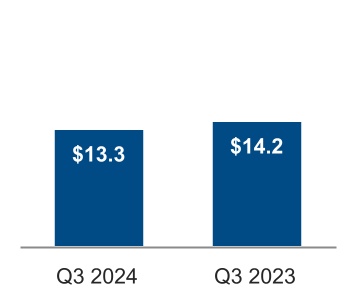
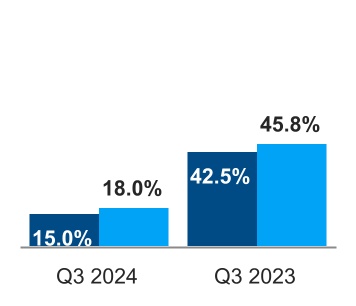
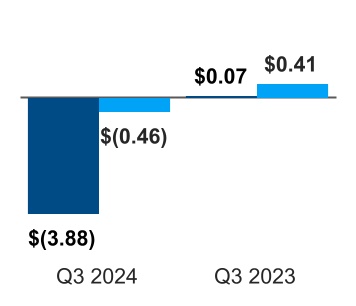
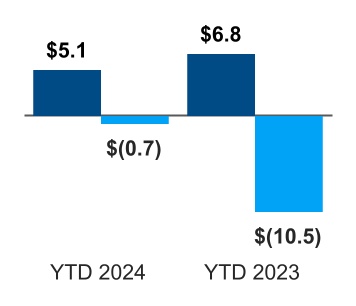
| $13.3B | 15.0% | 18.0% | $(3.88) | $(0.46) | $5.1B | $(0.7)B | ||||||||||||||||||||||||||||||||||||||
| GAAP | GAAP | non-GAAP1 | GAAP | non-GAAP1 | GAAP | non-GAAP1 | ||||||||||||||||||||||||||||||||||||||
| Revenue down $874M or 6% from Q3 2023 | Gross margin down 27.5 ppts from Q3 2023 | Gross margin down 27.8 ppts from Q3 2023 | Diluted EPS attributable to Intel down $3.95 from Q3 2023 | Diluted EPS attributable to Intel down $0.87 from Q3 2023 | Operating cash flow down $1.7B or 25% from Q3 2023 | Adjusted free cash flow improved by $9.8B or 93% from Q3 2023 | ||||||||||||||||||||||||||||||||||||||
| Lower CCG, Altera, and external Intel Foundry revenue, partially offset by higher DCAI revenue. | Lower GAAP gross margin from non-cash impairments and accelerated depreciation, and higher unit costs. | Lower GAAP EPS attributable to non-cash charges related to valuation allowances recorded against our net deferred tax assets, higher cash and non-cash restructuring and other charges, and non-cash impairments and accelerated depreciation for certain manufacturing assets. | Lower cash provided by operating activities was driven by higher net loss, partially offset by favorable non-cash operating cash flow adjustments and changes in working capital. |
Key Developments
**▪**We continued to advance our previously-announced cost-reduction measures by effectuating the 2024 Restructuring Plan, including reductions in headcount by 16,500 employees, other operating expenditures, capital expenditures, and cost of sales, with respect to which we recognized restructuring charges of $2.8 billion in Q3 2024.
**▪**Our consolidated results of operations were also materially impacted in Q3 2024 by the following charges:
▪$3.1 billion of charges, substantially all of which were recognized in cost of sales, related to non-cash impairments and the acceleration of depreciation for certain manufacturing assets, a substantial majority of which related to our Intel 7 process node;
▪$2.9 billion of non-cash charges associated with the impairment of goodwill for certain of our reporting units as well as certain acquired intangible assets; and
▪$9.9 billion of non-cash charges that substantially related to valuation allowances recorded to our net deferred tax assets.
**▪**We announced our intention to establish Intel Foundry as an independent subsidiary. This structure provides clearer separation for external foundry customers and suppliers between Intel Foundry and our Intel Products businesses. It also gives us future flexibility to evaluate independent sources of funding and optimize the capital structure of Intel Foundry and our Intel Products businesses to maximize growth and stockholder value.
**▪**We were awarded up to $3.0 billion in direct funding under the CHIPS and Science Act for the Secure Enclave program, which is designed to expand the trusted manufacturing of leading-edge semiconductors for the U.S. government.
**▪**We launched our latest family of x86 processors, the Intel® Core™ Ultra 200V series processors, which deliver exceptional performance, breakthrough x86 power efficiency, improved graphics performance, no-compromise application compatibility, enhanced security and competitive AI compute capabilities.
**▪**We announced our next-generation of AI solutions with the launch of the Intel® Xeon® 6 processor with Performance-cores and the Intel® Gaudi® 3 AI accelerator.
1 See "Non-GAAP Financial Measures" within MD&A.
| A Quarter in Review | 3 |
| Consolidated Condensed Statements of Income | |||||
| Three Months Ended | Nine Months Ended | |||||||||||||||||||||||||
| (In Millions, Except Per Share Amounts; Unaudited) | Sep 28, 2024 | Sep 30, 2023 | Sep 28, 2024 | Sep 30, 2023 | ||||||||||||||||||||||
| Net revenue | $ | 13,284 | $ | 14,158 | $ | 38,841 | $ | 38,822 | ||||||||||||||||||
| Cost of sales | 11,287 | 8,140 | 27,080 | 24,158 | ||||||||||||||||||||||
| Gross margin | 1,997 | 6,018 | 11,761 | 14,664 | ||||||||||||||||||||||
| Research and development | 4,049 | 3,870 | 12,670 | 12,059 | ||||||||||||||||||||||
| Marketing, general, and administrative | 1,383 | 1,340 | 4,268 |
Showing the first 8K of 116K characters. Open the full section
Item 1. Legal Proceedings
| Note 14 : | Contingencies |
Legal Proceedings
We are regularly party to various ongoing claims, litigation, and other proceedings, including those noted in this section. We have accrued a charge of $1.0 billion related to litigation involving VLSI (see VLSI Technology LLC v. Intel below), and a charge of $401 million related to an EC-imposed fine (see European Commission Competition Matter below). Excluding the VLSI claims, management at present believes that the ultimate outcome of these proceedings, individually and in the aggregate, will not materially harm our financial position, results of operations, cash flows, or overall trends; however, legal proceedings and related government investigations are subject to inherent uncertainties, and unfavorable rulings, excessive verdicts, or other events could occur. Unfavorable resolutions could include substantial monetary damages, fines, or penalties. Certain of these outstanding matters include speculative, substantial, or indeterminate monetary awards. In addition, in matters for which injunctive relief or other conduct remedies are sought, unfavorable resolutions could include an injunction or other order prohibiting us from selling one or more products at all or in particular ways, precluding particular business practices, or requiring other remedies. An unfavorable outcome may result in a material adverse impact on our business, results of operations, financial position, and overall trends. We might also conclude that settling one or more such matters is in the best interests of our stockholders, employees, and customers, and any such settlement could include substantial payments. Unless specifically described below, we have not concluded that settlement of any of the legal proceedings noted in this section is appropriate at this time.
In addition, in the second quarter of 2024, we accrued a charge of $780 million related to three separate confidential settlement agreements with R2, Third Point, and TRGP that we entered into in the third quarter of 2024 (see R2 Semiconductor Patent Litigation below).
| Financial Statements | Notes to Financial Statements | 22 |
European Commission Competition Matter
In 2009, the EC found that we had used unfair business practices to persuade customers to buy microprocessors in violation of Article 82 of the EC Treaty (later renumbered Article 102) and Article 54 of the European Economic Area Agreement. In general, the EC found that we violated Article 82 by offering alleged “conditional rebates and payments” that required customers to purchase all or most of their x86 microprocessors from us and by making alleged “payments to prevent sales of specific rival products.” The EC ordered us to end the alleged infringement referred to in its decision and imposed a €1.1 billion fine, which we paid in the third quarter of 2009.
We appealed the EC decision to the European Court of Justice in 2014, after the General Court (then called the Court of First Instance) rejected our appeal of the EC decision in its entirety. In September 2017, the Court of Justice sent the case back to the General Court to examine whether the rebates at issue were capable of restricting competition. In January 2022, the General Court annulled the EC’s 2009 findings against us regarding rebates, as well as the €1.1 billion fine imposed on Intel, which was returned to us in February 2022. The General Court’s January 2022 decision did not annul the EC’s 2009 finding that we made payments to prevent sales of specific rival products.
In April 2022 the EC appealed the General Court’s findings regarding rebates to the Court of Justice. In October 2024 the Court of Justice dismissed the EC’s appeal, upholding the judgment of the General Court.
In September 2023 the EC imposed a €376 million ($401 million) fine against us based on its 2009 finding that we made payments to prevent sales of specific rival products. We have appealed the EC’s decision. We have accrued a charge for the fine and are unable to make a reasonable estimate of the potential loss or range of losses in excess of this amount given the procedural posture and the nature of these proceedings.
In a related matter, in April 2022 we filed applications with the General Court seeking an order requiring the EC to pay us approximately €593 million in default interest on the original €1.1 billion fine that was held by the EC for 12 years, which applications were stayed pending the EC’s appeal of the General Court’s January 2022 decision.
Litigation Related to Security Vulnerabilities
In June 2017, a Google research team notified Intel and other companies that it had identified security vulnerabilities, the first variants of which are now commonly referred to as “Spectre” and “Meltdown,” that affect many types of microprocessors, including our products. As is standard when findings like these are presented, we worked together with other companies in the industry to verify the research and develop and validate software and firmware updates for impacted technologies. In January 2018, information on the security vulnerabilities was publicly reported, before software and firmware updates to address the vulnerabilities were made widely available.
Consumer class action lawsuits against us were pending in the US and Canada. The plaintiffs, who purport to represent various classes of purchasers of our products, generally claim to have been harmed by our actions and/or omissions in connection with Spectre, Meltdown, and other variants of this class of security vulnerabilities that have been identified since 2018, and assert a variety of common law and statutory claims seeking monetary damages and equitable relief. In the US, class action suits filed in various jurisdictions between 2018 and 2021 were consolidated for all pretrial proceedings in the US District Court for the District of Oregon, which entered final judgment in favor of Intel in July 2022 based on plaintiffs’ failure to plead a viable claim. The Ninth Circuit Court of Appeals affirmed the district court’s judgment in November 2023, ending the litigation. In November 2023, new plaintiffs filed a consumer class action complaint in the US District Court for the Northern District of California with respect to a further vulnerability variant disclosed in August 2023 and commonly referred to as “Downfall.” In August 2024, the district court dismissed plaintiffs’ complaint for failure to plead a viable claim. Plaintiffs filed an amended complaint in September 2024, which we moved to dismiss in October 2024. In Canada, an initial status conference has not yet been scheduled in one case relating to Spectre and Meltdown pending in the Superior Court of Justice of Ontario, and a stay of a second case pending in the Superior Court of Justice of Quebec is in effect. Additional lawsuits and claims may be asserted seeking monetary damages or other related relief. Given the procedural posture and the nature of these cases, including that the pending proceedings are in the early stages, that alleged damages have not been specified, that uncertainty exists as to the likelihood of a class or classes being certified or the ultimate size of any class or classes if certified, and that there are significant factual and legal issues to be resolved, we are unable to make a reasonable estimate of the potential loss or range of losses, if any, that might arise from these matters.
Litigation Related to Segment Reporting and Internal Foundry Model
A securities class action lawsuit was filed in the U
Showing the first 8K of 118K characters. Open the full section
Item 1A. Risk Factors
Risk Factors
The risks described in "Risk Factors" within Other Key Information in our 2023 Form 10-K could materially and adversely affect our business, financial condition, and results of operations, and the trading price of our common stock could decline. These risk factors do not identify all risks that we face—our operations could also be affected by factors that are not presently known to us or that we currently consider to be immaterial to our operations. Due to risks and uncertainties, known and unknown, our past financial results may not be a reliable indicator of future performance and historical trends should not be used to anticipate results or trends in future periods. Refer also to the other information set forth in this Form 10-Q, including in the Forward-Looking Statements, MD&A, and the Consolidated Condensed Financial Statements and Supplemental Details sections.
Item 3. Quantitative and Qualitative Disclosures About Market Risk
Quantitative and Qualitative Disclosures About Market Risk
We are affected by changes in currency exchange and interest rates, as well as equity and commodity prices. Our risk management programs are designed to reduce, but may not entirely eliminate, the impacts of these risks. For a discussion about market risk and sensitivity analysis related to changes in currency exchange rates, interest rates, equity prices, and commodity prices refer to "Quantitative and Qualitative Disclosures About Market Risk" within MD&A in our 2023 Form 10-K.
Item 4. Controls and Procedures
Controls and Procedures
Inherent Limitations on Effectiveness of Controls
Our management, including the principal executive officer and principal financial officer, does not expect that our disclosure controls and procedures or our internal control over financial reporting will prevent or detect all errors and all fraud. A control system, no matter how well-designed and operated, can provide only reasonable, not absolute, assurance that the control system’s objectives will be met. The design of a control system must reflect the fact that there are resource constraints, and the benefits of controls must be considered relative to their costs. Further, because of the inherent limitations in all control systems, no evaluation of controls can provide absolute assurance that misstatements due to error or fraud will not occur or that all control issues and instances of fraud, if any, have been detected.
Evaluation of Disclosure Controls and Procedures
Based on management’s evaluation (with the participation of our principal executive officer and principal financial officer), as of the end of the period covered by this report, our principal executive officer and principal financial officer have concluded that our disclosure controls and procedures (as defined in Rules 13a-15(e) and 15d-15(e) under the Securities Exchange Act of 1934, as amended (the Exchange Act)), were effective to provide reasonable assurance that information required to be disclosed by us in reports that we file or submit under the Exchange Act is recorded, processed, summarized, and reported within the time periods specified in SEC rules and forms, and is accumulated and communicated to management, including our principal executive officer and principal financial officer, as appropriate, to allow timely decisions regarding required disclosure.
Changes in Internal Control Over Financial Reporting
There were no changes to our internal control over financial reporting (as defined in Rules 13a-15(f) and 15d-15(f) under the Exchange Act) that occurred during the quarter ended September 28, 2024 that have materially affected, or are reasonably likely to materially affect, our internal control over financial reporting.
Issuer Purchases of Equity Securities
We have an ongoing authorization, originally approved by our Board of Directors in 2005 and subsequently amended, to repurchase shares of our common stock in open market or negotiated transactions. No shares were repurchased during the quarter ending September 28, 2024. As of September 28, 2024, we were authorized to repurchase up to $110.0 billion, of which $7.2 billion remained available.
We issue RSUs as part of our equity incentive plans. In our Consolidated Condensed Financial Statements, we treat shares of common stock withheld for tax purposes on behalf of our employees in connection with the vesting of RSUs as common stock repurchases because they reduce the number of shares that would have been issued upon vesting. These withheld shares of common stock are not considered common stock repurchases under our authorized common stock repurchase program.
Item 5. Other Information
Rule 10b5-1 Trading Arrangements
Our directors and officers (as defined in Rule 16a-1 under the Exchange Act) may from time to time enter into plans or other arrangements for the purchase or sale of our shares that are intended to satisfy the affirmative defense conditions of Rule 10b5–1(c) or may represent a non-Rule 10b5-1 trading arrangement under the Exchange Act. During the quarter ended September 28, 2024, no such plans or arrangements were adopted or terminated, including by modification.
| Other Key Information | 48 |
Disclosure Pursuant to Section 13(r) of the Securities Exchange Act of 1934
Section 13(r) of the Exchange Act requires an issuer to disclose certain information in its periodic reports if it or any of its affiliates knowingly engaged in certain activities, transactions, or dealings with individuals or entities subject to specific US economic sanctions during the reporting period, even when the activities, transactions, or dealings are conducted in compliance with applicable law. On March 2, 2021, the US Secretary of State designated the Federal Security Service of the Russian Federation (FSB) as a party subject to one such sanction. Though Intel has suspended sales in Russia, there may be a need to file documents or engage with FSB as Intel winds up our local Russian offices. All such dealings are explicitly authorized by General License 1B issued by the US Department of the Treasury’s Office of Foreign Assets Control (OFAC), and there are no gross revenues or net profits directly associated with any such dealings by us with the FSB.
On April 15, 2021, the US Department of the Treasury designated Pozitiv Teknolodzhiz, AO (Positive Technologies), a Russian IT security firm, as a party subject to one of the sanctions specified in Section 13(r). Prior to the designation, we communicated with Positive Technologies regarding its IT security research and coordinated disclosure of security vulnerabilities identified by the firm. Based on a license issued by OFAC, we resumed such communications. There are no gross revenues or net profits directly associated with any such activities. We plan to continue these communications in accordance with the terms and conditions of the OFAC license.
| Other Key Information | 49 |
Item 6. Exhibits
Exhibits
† Management contracts or compensation plans or arrangements in which directors or executive officers are eligible to participate.
| Other Key Information | 50 |
Form 10-Q Cross-Reference Index
| Item Number | Item | |||||||
| Part I - Financial Information | ||||||||
| Item 1. | Financial Statements | Pages 4 - 26 | ||||||
| Item 2. | Management's Discussion and Analysis of Financial Condition and Results of Operations: | |||||||
| Liquidity and capital resources | Pages 43 - 44 | |||||||
| Results of operations | Pages 3, 27 - 42 | |||||||
| Critical accounting estimates | Page 27 | |||||||
| Item 3. | Quantitative and Qualitative Disclosures About Market Risk | Page 48 | ||||||
| Item 4. | Controls and Procedures | Page 48 | ||||||
| Part II - Other Information | ||||||||
| Item 1. | Legal Proceedings | Pages 22 - 25 | ||||||
| Item 1A. | Risk Factors | Page 48 | ||||||
| Item 2. | Unregistered Sales of Equity Securities and Use of Proceeds | Page 48 | ||||||
| Item 3. | Defaults Upon Senior Securities | Not applicable | ||||||
| Item 4. | Mine Safety Disclosures | Not applicable | ||||||
| Item 5. | Other Information | |||||||
| Rule 10b5-1 Trading Arrangements | Page 48 | |||||||
| Disclosure Pursuant to Section 13(r) of the Securities Exchange Act of 1934 | Page 49 | |||||||
| Item 6. | Exhibits | Page 50 | ||||||
| Signatures | Page 52 |
| Other Key Information | 51 |
Signatures
Pursuant to the requirements of the Securities Exchange Act of 1934, the registrant has duly caused this report to be signed on its behalf by the undersigned thereunto duly authorized.
| INTEL CORPORATION (Registrant) | |||||||||||||||||
| Date: | October 31, 2024 | By: | /s/ DAVID ZINSNER | ||||||||||||||
| David Zinsner | |||||||||||||||||
| Executive Vice President, Chief Financial Officer, and Principal Financial Officer | |||||||||||||||||
| Date: | October 31, 2024 | By: | /s/ SCOTT GAWEL | ||||||||||||||
| Scott Gawel | |||||||||||||||||
| Corporate Vice President, Chief Accounting Officer, and Principal Accounting Officer |
| 52 |