 filings.tools
Item 11. EXECUTIVE COMPENSATION
105K characters. Original on sec.gov · Markdown
Item 11. EXECUTIVE COMPENSATION
| --- | --- |
Compensation Committee Report
The Compensation Committee has reviewed and discussed the following Compensation Discussion and Analysis with management. Based on its review and discussion with management, the Compensation Committee recommended to the Board of Directors that the Compensation Discussion and Analysis be included in this Annual Report on Form 10-K for the fiscal year ended December 31, 2017 and in the Company’s proxy statement on Schedule 14A for the 2018 Annual Meeting of Stockholders.
Submitted by the Compensation Committee of the Board of Directors:
| Peter Stavros, Chair | |
|---|---|
| Nickolas Vande Steeg | |
| Joshua Weisenbeck |
Compensation Discussion and Analysis
Introduction
This section describes our compensation philosophy and details the compensation programs that cover our named executive officers (“NEOs”).
Our NEOs for 2017 are:
| • | Vicente Reynal, our Chief Executive Officer; |
|---|
| • | Philip T. Herndon, our Vice President and Chief Financial Officer; and |
|---|
| • | Our three other most highly compensated executive officers who served in such capacities as of December 31, 2017, namely: |
|---|
| • | Andrew Schiesl, our Vice President, General Counsel, Chief Compliance Officer and Secretary; |
|---|
| • | Neil D. Snyder, our Senior Vice President, Strategy, Business Development and Planning; and |
|---|
| • | Enrique Miñarro Viseras, Vice President and General Manager, Industrials Segment EMEA |
|---|
Executive Compensation Objectives and Philosophy
Our executive compensation philosophy is designed to attract and retain individuals with the qualifications to meet the Company’s strategic objectives and create value for our shareholders. We believe that the best way to align our executives with our objectives and create shareholder value is to emphasize two key compensation principles: (1) significant equity participation and (2) pay-for-performance.
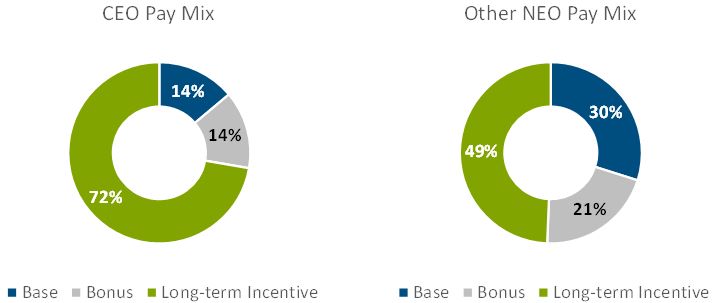
In February 2018, following an evaluation with the assistance of Pearl Meyer of equity-based incentives for our executive officers, the Compensation Committee adopted a new long-term equity incentive program (the “2018 LTI Program”). Under the 2018 LTI Program, our NEOs will receive annual equity awards, 50% of which will be in the form of time-vesting restricted stock and 50% of which will be in the form of time-vesting stock options. The following charts illustrate our focus on equity participation by showing that 72% of our CEO’s expected 2018 target base salary, annual incentive, and long-term equity incentive compensation mix and 49% of our other NEOs’ expected 2018 mix is based on long-term equity incentives.See “Compensation Actions Taken in 2018―Long-Term Incentive Compensation”.
Our commitment to aligning the interests of our executives to the interests of our shareholders through equity participation is further evidenced by the fact that in 2017 we adopted what we believe is a market-leading stock ownership and retention policy for our executives and non-employee directors that combines robust stock ownership requirements with retention requirements. See “Stock Ownership and Retention Policy” below. All of our NEOs maintain a significant equity stake in the Company and currently exceed their respective ownership requirements through ownership of vested and exercisable stock options and/or direct investments in our common stock.
In addition to equity participation, we strongly believe in a pay-for-performance culture. This is evidenced by the fact that our annual cash incentive program is 100% based on the financial performance of the Company and its business units and that it accounts for 50% of the expected total cash compensation of our CEO, and on average 41% for our other NEOs, in each case when paid out at target. When paid out at the maximum payout (capped at 200% of target), this percentage increases to 67% and 58%, respectively. Also, our executives receive no payout for below threshold performance and we believe that our threshold at 95% of target is more challenging than typical market practice. See “―Executive Compensation Program Elements―Cash Bonus Opportunities―Annual Cash Bonus Opportunity”. Even more importantly, when our short-term cash incentive is combined with our long term equity incentive, it results in 84% of our CEO’s and 70% of our NEOs’ compensation being variable performance compensation.
In addition to equity compensation and our annual cash incentive opportunity, we provide NEOs a combination of the following other compensation components:
| • | Base salary - Fixed pay that is market competitive and sufficient to engage high caliber talent; |
|---|
| • | Broad-based employee benefits – Fixed pay intended to attract and retain employees while providing them with retirement and health and welfare security; and |
|---|
| • | Severance and other benefits payable upon certain terminations of employment or a change in control - Encourages the continued attention and dedication of our NEOs and provides reasonable individual security to enable our NEOs to focus on our best interests, particularly when considering strategic alternatives. |
|---|
In 2017 we did not make any equity grants to our NEOs believing that the equity grants made in prior years were sufficiently retentive and fostered the necessary level of alignment with shareholder interests. See “―Executive Compensation Program Elements―Long-Term Equity Incentive Awards”.
Strong Compensation Governance Practices and Policies
Within the context of the compensation philosophy and the Company’s business objectives, the Compensation Committee engages in an ongoing review of the Company’s executive compensation programs. In connection with this review, the Compensation Committee has adopted the following practices and policies reflecting what it believes to be a best practices approach to executive compensation.

Compensation Determination Process and Compensation Consultant Independence
Prior to our initial public offering, our Compensation Committee historically made all executive compensation decisions, including determinations as to the compensation of our NEOs. From the date of our initial public offering, the Compensation Committee has been responsible for determining the compensation of our Chief Executive Officer (“CEO”) and other executive officers and approving or recommending such compensation to the board of directors. Because of his daily involvement with the executive team, our CEO makes recommendations to the Compensation Committee regarding compensation for the executive officers other than himself. No member of management participates in discussions with the Compensation Committee regarding his or her own compensation.
In connection with our initial public offering, we engaged Pearl Meyer & Partners, LLC (“Pearl Meyer”), a compensation consulting firm, to assist us in evaluating the elements and levels of our executive compensation, including base salaries, annual cash incentive awards and equity-based incentives for our executive officers. In February 2018, the Compensation Committee determined that Pearl Meyer is independent from management and that Pearl Meyer’s work has not raised any conflicts of interest.
The Compensation Committee did not benchmark 2017 compensation against a peer group. However, over the course of the second half of 2017 and early 2018, Pearl Meyer developed a compensation peer group, conducted a competitive market assessment and developed recommendations for the 2018 LTI Program. See “Compensation Actions Taken in 2018―Long-Term Incentive Compensation.”
Executive Compensation Program Elements
Base Salaries
Base salary is the only fixed component of the Company’s NEOs’ cash compensation. An NEO’s base salary is related to the individual’s level of responsibility and provides them with a level of cash income predictability and stability with respect to a portion of their total compensation. The Compensation Committee believes that base salaries for executives should reflect competitive levels of pay and factors unique to each executive such as experience and breadth of responsibilities, performance, individual skill set, time in the role and internal pay parity. Base salaries are reviewed annually or at other times when appropriate and may be increased from time to time pursuant to such review. In connection with our annual review, we determined to increase the base salaries of each of our NEOs by not more than 3% based on their performance in 2016, effective April 2017. Mr. Miñarro Viseras is based in Germany and compensated in Euros; accordingly, his salary increase was based on his salary in Euros. The following table reflects the base salaries of our NEOs as of December 31, 2017.
| Base Salary as of December 31, 2016 | Base Salary as of December 31, 2017 | |||||||
|---|---|---|---|---|---|---|---|---|
| Vicente Reynal, Chief Executive Officer | $ | 750,000 | $ | 766,500 | ||||
| Philip T. Herndon, Vice President and Chief Financial Officer | $ | 400,000 | $ | 409,000 | ||||
| Andrew Schiesl, Vice President, General Counsel, Chief Compliance Officer and Secretary | $ | 450,000 | $ | 460,000 | ||||
| Neil D. Snyder, Senior Vice President, Strategy, Business Development and Planning | $ | 345,000 | $ | 353,000 | ||||
| Enrique Miñarro Viseras, Vice President and General Manager, Industrials Segment EMEA(1) | $ | 304,288 | $ | 337,814 |
| (1) | Mr. Miñarro Viseras is based in Europe and is compensated in Euros. We converted his 2016 base salary (which was 275,000 Euros) to U.S. dollars at an exchange rate of 1.1065, which was the average monthly translation rate for 2016. We converted his 2017 base salary (which was 281,500 Euros) to U.S. dollars at an exchange rate of 1.20048, which was the end of month translation rate, December 2017. |
|---|
Cash Bonus Opportunities
Annual Cash Bonus Opportunity
In order to tie a portion of their cash compensation to actual performance, each NEO is eligible for an annual cash bonus award under our management incentive plan (“MIP”) based on the achievement of our financial goals for the Company and their respective business units.
A target annual bonus, expressed as a percentage of an NEO’s base salary in effect at year-end, is established within certain NEOs’ offer letters and employment agreements and may be adjusted from time to time by the Compensation Committee in connection with an NEO’s promotion or performance. The target annual bonus for 2017 for Messrs. Reynal and Herndon was 100% of their respective base salaries, for Mr. Schiesl was 75% of his base salary, for Mr. Snyder was 50% of his base salary and for Mr. Miñarro Viseras was 45% of his base salary.
We generally believe that tying our corporate level NEOs’ bonuses to company-wide performance goals encourages those NEOs to focus on company-wide priorities, and that tying the bonuses of our NEOs at the business segment and business unit level to business segment goals and business unit goals, respectively, rewards these NEOs for achievements with respect to their business segments and units. In 2017, the Compensation Committee decided to base MIP awards for Messrs. Reynal, Herndon and Snyder in part on the performance of our Industrials segment because each serves in roles at both the corporate level and the Industrials segment level and the Compensation Committee wanted them to continue to focus on the objectives of the Industrials segment since it typically accounts for a significant portion of our total revenue. A detailed description of the 2017 MIP metrics and the calculation of the actual amounts paid to each of our NEOs are provided below.
We chose to use Adjusted EBITDA, as that term is defined elsewhere in this Annual Report on Form 10-K because we believe that it provides a reliable indicator of our strategic growth and the strength of our overall financial results.
Actual amounts paid to Messrs. Reynal, Herndon and Snyder under the 2017 MIP were calculated by multiplying their target annual bonus for 2017 by the sum of (1) 75% multiplied by the weighted average of the payout percentages associated with our achievement against the Adjusted EBITDA targets for the MIP Business Units (as defined below) and (2) 25% multiplied by the payout percentage associated with our achievement against the Industrials Segment Adjusted EBITDA target. The “MIP Business Units” include Energy P&IP, Energy Nash/Garo, Energy Emco, Industrials Americas, Industrials EMEA, Industrials APAC, and Medical. The weighting for each MIP Business Unit is determined by dividing fiscal 2017 Adjusted EBITDA budget for each business unit by the sum of fiscal 2017 Adjusted EBITDA budgets for all the MIP Business Units. To calculate the composite payout percentage for all MIP Business Units, each MIP Business Unit’s corresponding weighting is multiplied by the payout percentage associated with actual 2017 Adjusted EBITDA achievement against that business unit’s respective Adjusted EBITDA budget and the resulting amounts are summed.
We believe Adjusted EBITDA targets set for the MIP Business Units in 2017 provided reasonably achievable, but challenging goals for our NEOs and the other MIP participants at the corporate level. In addition, we believe the Industrials Segment Adjusted EBITDA target set in 2017 provided reasonably achievable, but challenging goals for our NEOs and other MIP participants in the Industrials segment.
Actual amounts paid to Mr. Schiesl under the 2017 MIP were calculated by multiplying his target annual bonus for 2017 by the weighted average of the payout percentages associated with our achievement against the Adjusted EBITDA targets for the MIP Business Units.
For our NEO at the business unit level, Mr. Miñarro Viseras, the MIP award is tied to the financial results of his business segment and his business unit measured by Adjusted EBITDA. The actual amount paid to Mr. Miñarro Viseras under the 2017 MIP was calculated by multiplying his target annual bonus for 2017 by the sum of (1) 50% multiplied by the payout percentage associated with our achievement against the Industrials Segment Adjusted EBITDA target and (2) 50% multiplied by the payout percentage associated with our achievement against the Industrials EMEA Adjusted EBITDA target. We believe the Industrials EMEA Adjusted EBITDA target set in 2017 provided a reasonably achievable, but challenging goal for Mr. Miñarro Viseras and other MIP participants at our Industrials EMEA business unit.
The Adjusted EBITDA payout percentage for each of our segments and business units was determined by calculating actual achievement against the Adjusted EBITDA performance targets based on the pre-established scale set forth in the table below.
| Achievement of Performance Target | Payout Percentage | |
|---|---|---|
| Less than 95% | 0% | |
| 95% | 75% | |
| 100% | 100% | |
| 110% | 200% |
No cash incentive award would have been paid to our NEOs whose awards were based partially or entirely on the performance of our MIP Business Units unless actual performance for fiscal 2017 for at least one of the MIP Business Units was at or above 95% of the applicable Adjusted EBITDA target (or, in the case of Mr. Miñarro Viseras, if the performance of our Industrials segment for 2017 was at or above the Adjusted EBITDA target for our Industrials segment). Adjusted EBITDA results are adjusted to the extent that actual foreign exchange rates by country differ by more than 5% of budgeted foreign exchange rates. For performance percentages between the levels set forth above, the resulting payout percentage is adjusted on a linear basis. In addition to setting Adjusted EBITDA targets for our business units, we set an annual corporate expense budget each year and any difference between actual and budgeted corporate expense is allocated to the Adjusted EBITDA at our business units at the discretion of the Compensation Committee. While there are no individual goals for purposes of MIP award payments, the Compensation Committee, on the recommendation of Mr. Reynal, may adjust an incentive payment upward or downward for performance-related reasons. In addition, the Compensation Committee has discretion to adjust MIP award payments for unanticipated events. For 2017, the Compensation Committee did not make any discretionary adjustments to the calculated MIP award payments.
The following table sets forth our actual payout percentage achieved with respect to each performance metric applicable to our NEOs and illustrates the calculation of the annual cash incentive awards payable to our NEOs under the 2017 MIP in light of these performance results.
| Adjusted EBITDA Payout Percentage | ||||||||||||||||||||||||||||||||
|---|---|---|---|---|---|---|---|---|---|---|---|---|---|---|---|---|---|---|---|---|---|---|---|---|---|---|---|---|---|---|---|---|
| Name | 2017 Base Salary | Target Bonus % | Target Bonus Amount | Industrials | Industrials EMEA | Weighted Average of Business Units (1) | Weighted Payout Percentage | Actual Bonus Paid | ||||||||||||||||||||||||
| Vicente Reynal (2) | $ | 766,500 | 100 | % | $ | 766,500 | 150 | % | N/A | 142 | % | 144 | % | $ | 1,103,760 | |||||||||||||||||
| Philip T. Herndon (2) | $ | 409,000 | 100 | % | $ | 409,000 | 150 | % | N/A | 142 | % | 144 | % | $ | 588,960 | |||||||||||||||||
| Andrew Schiesl | $ | 460,000 | 75 | % | $ | 345,000 | N/A | N/A | 142 | % | 142 | % | $ | 489,900 | ||||||||||||||||||
| Neil Snyder | $ | 353,000 | 50 | % | $ | 176,500 | 150 | % | 142 | % | 144 | % | $ | 254,160 | ||||||||||||||||||
| Enrique Miñarro Viseras (3) | $ | 337,814 | 45 | % | $ | 152,016 | 150 | % | 120 | % | N/A | 135 | % | $ | 205,222 |
(1) Represents the weighted average of the payout percentages associated with our achievement against the Adjusted EBITDA targets for the MIP Business Units.
(2) Messrs. Reynal’s, Herndon’s and Snyder’s 2017 MIP opportunities were based 75% on the weighted average of the payout percentages associated with our achievement against the Adjusted EBITDA targets for the MIP Business Units and 25% on the payout percentage associated with our achievement against the Adjusted EBITDA target for the Industrials segment.
(3) Mr. Miñarro Viseras’s 2017 MIP opportunity was based 50% on the payout percentage associated with our achievement against the Adjusted EBITDA target for the Industrials segment and 50% on the payout percentage associated with our achievement against the Adjusted EBITDA target for the Industrials EMEA business unit.
IPO Bonuses
For their extraordinary efforts in 2017 in connection with our initial public offering, the Compensation Committee in February 2018 determined to award each of Messrs. Reynal, Herndon, Schiesl and Snyder a one-time discretionary IPO bonus. The IPO bonuses were awarded in the following amounts: Mr. Reynal - $225,000; Mr. Herndon - $125,000; Mr. Schiesl - $100,000; and Mr. Snyder - $75,000.
Sign-on Bonuses
From time to time, we may award sign-on bonuses in connection with the commencement of an NEO’s employment with us. Sign-on bonuses are used only when necessary to attract highly skilled officers to the Company. Generally, they are used to provide an incentive to candidates to leave their current employers or may be used to offset the loss of unvested compensation that they may forfeit as a result of leaving their current employers. Sign-on bonuses are typically subject to a clawback obligation if the officer voluntarily terminates his or her employment with us prior to the first anniversary of the employment commencement date. We did not award any sign-on bonuses to our NEOs in 2017.
Long-Term Equity Incentive Awards
Prior to our initial public offering, we granted long-term equity-based awards to our executives that were designed to align executives’ and shareholders’ interests, promote performance through a broad ownership mindset, incentivize our executives to remain in our service and align the interests of our executives with those of our ultimate equity holders. The awards we granted to our NEOs under our long-term incentive program (our “Long-Term Incentive Program”) were in the form of stock options, with 50% of each award vesting based on time-based vesting conditions (“Time Options”) and 50% of each award vesting based on performance-based vesting conditions (“Performance Options”). The stock options generally vest, if at all, ratably over a three- to five-year period, subject to continued employment through the applicable vesting date and, in the case of the Performance Options, achievement of the applicable performance criteria. See “Narrative Disclosure to Summary Compensation Table and Grants of Plan-Based Awards in 2017―Terms of Equity Awards―Long-Term Incentive Plan Grants.” The Compensation Committee determined that granting our NEOs stock options would meet our goals of fostering a culture of performance and commitment to our Company. Stock options serve as components of performance-based compensation because they only provide value to our NEOs if the value of our stock appreciates. All equity-based awards under our Long-Term Incentive Program were granted under the 2013 Stock Incentive Plan.
In addition to granting them long-term equity-based awards, we have given our executive officers the opportunity to, and in some cases, in connection with the commencement of their employment with us, have required them to, make meaningful investments in our common stock, subject to satisfaction of applicable securities law requirements. See “Narrative Disclosure to Summary Compensation Table and Grants of Plan-Based Awards in 2017―Summary of NEO Offer Letters and Employment Agreements.”
In connection with our initial public offering, we adopted a new incentive plan, the Gardner Denver Holdings, Inc. 2017 Stock Incentive Plan, pursuant to which we will grant our future long-term equity incentive awards. See “Compensation Actions Taken in 2018―Long-Term Incentive Compensation” below.
Benefits and Perquisites
While our compensation philosophy is to focus on performance-based forms of compensation while providing only minimal executive benefits and perquisites, we provide to all of our employees, including our NEOs, broad-based employee benefits that are intended to attract and retain employees while providing them with retirement and health and welfare security. These include:
| • | a 401(k) savings plan; |
|---|
| • | medical, dental, vision, life and disability insurance coverage; and |
|---|
| • | dependent care and healthcare flexible spending accounts. |
|---|
401(k) Plan
Our U.S. eligible employees, including our NEOs, participate in the Gardner Denver, Inc. Retirement Savings Plan (the “401(k) plan”), which is a tax-qualified retirement savings plan. For employees hired after January 1, 2014, enrollment in the 401(k) plan is automatic for employees who meet eligibility requirements unless they decline participation. Under the 401(k) plan, we match 100% of the first 6% of a participant’s salary contributions to the 401(k) plan. Participants are 100% vested in employee and matching contributions. The maximum contribution to the 401(k) plan is 100% of an employee's annual eligible compensation, subject to regulatory and plan limitations.
Supplemental Excess Defined Contribution Plan
In addition to the 401(k) plan, U.S. employees with a salary grade of 20 or higher (generally senior managers and above), including the NEOs other than Mr. Miñarro Viseras, are eligible to participate in the Gardner Denver, Inc. Supplemental Excess Defined Contribution Plan (the “Excess Contribution Plan”), which is funded through a Rabbi Trust. This plan provides participants with a similar level of benefits afforded to all other eligible employees who are not subject to the limitations imposed by the IRS on our tax-qualified 401(k) plan.
Eligible employees may contribute to the Excess Contribution Plan when they exceed the annual IRS pre-tax contribution limits and the annual catch-up contribution limit for participants age 50 or over. Under the Excess Contribution Plan, we match 100% of the first 6% of a participant’s salary contributions to the Excess Contribution Plan. Company matching contributions under the Excess Contribution Plan are contributed in the form of cash rather than our common stock. All employee and Company matching contributions are fully vested immediately.
Limited Perquisites
Executive perquisites are not part of our general compensation philosophy, however we provide limited perquisites and personal benefits that are not generally available to all employees when necessary to attract top talent. These are typically set forth in the offer letters or employment agreements we enter into with our executive officers. See “Narrative Disclosure to Summary Compensation Table and Grants of Plan-Based Awards in 2017―Summary of NEO Offer Letters and Employment Agreements.” For example, in 2017, per his employment agreement, Mr. Miñarro Viseras was entitled to international school assistance and use of a company car. Mr. Snyder was also provided with a housing allowance. In addition, from time to time, we provide tax gross-ups on perquisites we provide in order to allow our NEOs to enjoy the full benefit of the perquisite we are providing.
Severance and Change in Control Agreements
The Company believes that reasonable and appropriate severance and change in control benefits are necessary in order to be competitive in the Company’s executive attraction and retention efforts. As discussed above, the offer letters we enter into with our NEOs provide for certain payments, rights and benefits to the NEOs upon an involuntary termination of employment without Cause (as defined in “Potential Payments to Named Executive Officers Upon Termination of Employment or Change in Control-Severance Arrangements and Restrictive Covenants” below) from the Company or a termination by the NEO for Good Reason (as defined in “Potential Payments to Named Executive Officers Upon Termination of Employment or Change in Control-Severance Arrangements and Restrictive Covenants” below). In addition, our equity award agreements provide for accelerated vesting upon a change in control in certain circumstances, as more fully described above under “―Narrative Disclosure to Summary Compensation Table and Grants of Plan-Based Awards in 2017―Terms of Equity Awards.”
Employment Agreements
We do not typically enter into employment agreements with our NEOs; however, we entered into an employment agreement and offer letter with Mr. Miñarro Viseras and offer letters setting forth initial compensation and benefits, as well as severance terms, with each of our other NEOs. Full descriptions of the material terms of the employment agreement and offer letter we entered into with Mr. Miñarro Viseras and the offer letters we entered into with Messrs. Reynal, Herndon, Schiesl and Snyder are presented below in “―Narrative Disclosure to Summary Compensation Table and Grants of Plan-Based Awards in 2017.”
Risk Management
The Compensation Committee conducts a thorough review of all incentive programs and confirms that our executives are not incented to focus on short-term stock performance or take excessive risk in managing the business. In particular, long-term incentive awards, as a significant portion of total direct compensation and robust stock holding requirements, are structured to align management with the long-term health of the business.
Stock Ownership and Retention Policy
To align the interests of our management and directors with those of our stockholders, the Board of Directors concluded that certain of our executive officers (the “Covered Executives”) and directors should have a significant financial stake in the Company’s stock. To further that goal, we implemented stock ownership guidelines in 2017 (the “Guidelines”). The Covered Executives will be required to hold a specific level of equity ownership as outlined below:
Executives: The Guidelines will apply to the Covered Executives in the following Tiers:
| Tier One: | Chief Executive Officer |
|---|---|
| Tier Two: | Chief Financial Officer and General Counsel |
| Tier Three: | P&L and Corporate Leaders |
Covered Executives’ Stock Ownership Multiples: The stock ownership levels under the Guidelines, expressed as a multiple of the Covered Executive’s base annual salary rate as of January 1st of the year, are as follows:
| Tier One: | 10 times base salary |
|---|---|
| Tier Two: | 5 times base salary |
| Tier Three: | 3 times base salary |
Retention Requirement: There is no required time period within which a Covered Executive must attain the applicable stock ownership level under the Guidelines. However, until the applicable ownership level is achieved, Covered Executives must retain 75% of net shares granted to them. Once the ownership guideline is met, Covered Executives must retain 30% of net shares granted to them; however, this requirement drops to 20% for a Covered Executive upon the earlier of a (1) such Covered Executive reaching the age of 55 and (2) such covered executive achieving 10 years of service with the Company and terminates upon the earlier of (1) such Covered Executive reaching the age of 60 and (2) such covered executive achieving 15 years of service with the Company.
The shares counted toward these ownership requirements includes shares owned outright and vested stock options. The retention requirement applies to all prior and future grants.
These ownership requirements are set at levels that the Company believes are robust given the Covered Executives’ respective salaries and responsibilities.
Directors: Our directors are required to hold 75% of net shares granted to them under our benefit plans until they own equity equal to five times their annual cash retainers. Once the ownership guideline is met, directors must retain 30% of the net shares granted to them under our benefit plans until their retirement.
As of January 1, 2018, all of our NEOs and then serving directors were in compliance with the applicable stock ownership levels under the Guidelines.
Hedging and Pledging Policies
The Company’s Securities Trading Policy requires executive officers and directors to consult the Company’s General Counsel prior to engaging in transactions involving the Company’s securities. The Company’s Securities Trading Policy prohibits directors and executive officers from hedging or monetization transactions including, but not limited to, through the use of financial instruments such as exchange funds, variable forward contracts, equity swaps, puts, calls, and other derivative instruments, or through the establishment of a short position in the Company’s securities. The Company’s Securities Trading Policy limits the pledging of Company securities to those situations approved by the Company’s General Counsel.
Section 162(m) of the Internal Revenue Code
We expect to be able to claim the benefit of a special exemption rule that applies to compensation paid (or compensation in respect of equity awards such as stock options granted) during a specified transition period following our initial public offering. This transition period was previously anticipated to potentially extend until our first annual stockholders meeting that occurs in 2021 pursuant to regulations under the Section 162(m) of the Internal Revenue Code of 1986, as amended (the “Code”). However, the recently enacted Tax Cut and Jobs Act amended Section 162(m) of the Code in several respects, including the elimination the “performance-based compensation” exception under Section 162(m) of the Code for tax years beginning after December 31, 2017. Pending further guidance under Section 162(m) of the Code, it is unclear whether the post-IPO transition period exception under Section 162(m) will continue to apply to us for compensation paid or awards granted in 2018 or beyond. Once applicable guidance is released, we expect the Compensation Committee to consider the implications of Section 162(m) and such guidance in its future compensation decisions.
Compensation Actions Taken in 2018
Long-Term Incentive Compensation
In February 2018, following an evaluation with the assistance of Pearl Meyer of the equity-based incentives for our executive officers, the Compensation Committee adopted the 2018 LTI Program. Under the 2018 LTI Program, our NEOs will receive annual equity awards, 50% of which will be in the form of time-vesting restricted stock and 50% of which will be in the form of time-vesting stock options. The time-vesting restricted stock awards and the time-vesting options awards under the 2018 LTI Program will vest in equal annual installments on each of the first four anniversaries of the grant date, except that the awards granted in 2018 will vest in equal annual installments on each of the second, third, fourth and fifth anniversaries of the grant date. The Compensation Committee determined that, in 2018, awards under the 2018 LTI Program will be made to our NEOs in the following amounts: Mr. Reynal ― $4,000,000; Mr. Herndon ― $1,000,000; Mr. Schiesl ― $675,000; Mr. Snyder ― $400,000; Mr. Miñarro Viseras ― $500,000. These grant amounts will be translated into a number of stock options and shares of restricted stock by taking such dollar amount and dividing it by the per share or per option “fair value” that will be used for reporting the compensation expense associated with the grant under applicable accounting guidance, which “fair value” will be based in part on the per share closing price of our common stock on the NYSE on the date of grant.
Executive Severance Benefits – Mr. Snyder and Mr. Miñarro Viseras
In February 2018, in connection with our annual review of our executive compensation, we approved an increase to the benefits to which Messrs. Snyder and Miñarro Viseras are entitled in the event of certain qualifying terminations to align them with the severance benefits to which our other senior executive officers are entitled.
Under the terms approved by the Compensation Committee in February 2018, if the Company terminates Mr. Snyder’s employment without Cause (as that term is defined below under “Potential Payments to Named Executive Officers upon Termination of Employment or Change in Control―Severance Arrangements and Restrictive Covenants”) or if Mr. Snyder terminates his employment with us for Good Reason (as that term is defined below under “Potential Payments to Named Executive Officers upon Termination of Employment or Change in Control―Severance Arrangements and Restrictive Covenants”), subject to Mr. Snyder’s continued compliance with the restrictive covenants in his management equity agreements and his execution of a customary waiver and release agreement, he will be entitled to receive:
| • | Continued payment over a 12-month period (the “Severance Period”) of his annual base salary earned in respect of our fiscal year preceding the fiscal year in which the termination date occurs, payable in substantially equal monthly installments over the Severance Period; and |
|---|
| • | Continued group health coverage (on the same basis as actively employed employees of the Company), subject to his electing to receive benefits under COBRA, for 12 months following the date his employment terminates (or, if earlier, through the date that he becomes employed by another employer and eligible for health insurance coverage at such employer). |
|---|
The Compensation Committee also approved in February 2018 a mutual twelve-month advance notice period for a termination of Mr. Miñarro Viseras's employment not for cause or without good reason, during which Mr. Miñarro Viseras may be released from his work duties but will still be entitled to remuneration.
Summary Compensation Table
The following table provides summary information concerning compensation of our NEOs for services rendered to us during the years indicated.
| Name and Principal Position | Year | Salary ($)(1) | Bonus ($)(2) | Option Awards ($) | Non-Equity Incentive Plan Compensation ($)(3) | All Other Compensation ($)(4) | Total ($) | |||||||||||||||||||
|---|---|---|---|---|---|---|---|---|---|---|---|---|---|---|---|---|---|---|---|---|---|---|---|---|---|---|
| Vicente Reynal, Chief Executive Officer | 2017 | 765,754 | 225,000 | ― | 1,103,760 | 285,581 | 2,380,095 | |||||||||||||||||||
| 2016 | 750,000 | ― | 4,568,331 | 877,500 | 233,614 | 6,429,445 | ||||||||||||||||||||
| Philip T. Herndon, Vice President and Chief Financial Officer | 2017 | 406,750 | 125,000 | ― | 588,960 | 11,258 | 1,131,968 | |||||||||||||||||||
| 2016 | 347,917 | ― | 3,257,821 | 446,262 | 7,897 | 4,059,972 | ||||||||||||||||||||
| Andrew Schiesl, Vice President, General Counsel, Chief Compliance Officer and Secretary | 2017 | 457,500 | 100,000 | ― | 489,900 | 75,872 | 1,123,272 | |||||||||||||||||||
| 2016 | 450,000 | ― | 610,717 | 367,875 | 49,565 | 1,478,082 | ||||||||||||||||||||
| Neil Snyder, Senior Vice President, Strategy, Business Development and Planning | 2017 | 351,000 | 75,000 | ― | 254,160 | 123,941 | 804,101 | |||||||||||||||||||
| Enrique Miñarro Viseras, Vice President and General Manager, Industrials Segment EMEA(6) | 2017 | 316,000 | ― | ― | 205,222 | 229,222 | 750,444 | |||||||||||||||||||
| 2016 | 195,943 | 532,517 | 691,114 | 113,015 | 155,548 | 1,684,817 |
| (1) | Reflects the salary amounts earned by our NEOs in the years indicated. |
|---|
| (2) | Reflects special, one-time IPO bonus amounts. |
|---|
| (3) | Amounts shown reflect amounts earned under our 2017 MIP. |
|---|
| (4) | Amounts reported under All Other Compensation reflect the following: |
|---|
| (a) | as to Mr. Reynal, reimbursement for tax preparation expenses, Company-paid life insurance premiums ($1,827), Company 401(k) match ($6,367) and Company Excess Contribution Plan match ($161,300). Mr. Reynal also received a tax equalization payment with respect to his cash compensation earned during his service in Europe in 2016 ($83,871). |
|---|
| (b) | as to Mr. Herndon, company-paid life insurance premiums ($792) and Company 401(k) match ($10,467). |
|---|
| (c) | as to Mr. Schiesl, company-paid life insurance premiums ($792), Company 401(k) match ($15,429, plus a contribution of $2,571 to a Roth IRA) and Company Excess Contribution Plan match ($57,081). |
|---|
| (d) | as to Mr. Snyder, company-paid life insurance premiums ($792), Company 401(k) match ($16,200), a housing allowance ($53,903) and a tax gross-up relating to his housing allowance ($53,047). |
|---|
| (e) | as to Mr. Miñarro Viseras, actual Company expenditures for use, including business use, of a Company car, including expenditures for the car lease and gas ($25,748), a housing allowance ($43,202), reimbursement of school fees for Mr. Miñarro Viseras’s children ($63,675), a tax gross-up relating to his housing allowance ($39,044) and a tax gross-up relating to our reimbursement of school fees ($57,553). |
|---|
| (5) | Mr. Miñarro Viseras is based in Europe and compensated in Euros. We converted his 2017 cash compensation, his amounts earned under our 2017 MIP, and amounts shown in the “All Other Compensation” column for him to U.S. dollars at an exchange rate of 1.20048, which was the end of month translation rate, December 2017. |
|---|
Grants of Plan-Based Awards in 2017
| Estimated Possible Payouts under Non-Equity Incentive Plan Awards (1) | ||||||||||||
|---|---|---|---|---|---|---|---|---|---|---|---|---|
| Name | Threshold ($) | Target ($) | Maximum ($) | |||||||||
| Vicente Reynal | 8,083 | 766,500 | 1,533,000 | |||||||||
| Philip T. Herndon | 4,313 | 409,000 | 818,000 | |||||||||
| Andrew Schiesl | 10,914 | 345,000 | 690,000 | |||||||||
| Neil Snyder | 3,722 | 176,500 | 353,000 | |||||||||
| Enrique Miñarro Viseras | 57,006 | 152,016 | 304,032 |
(1) Reflects the possible payouts of cash incentive compensation under the 2017 MIP. The actual amounts earned are described in the “Non-Equity Incentive Plan Compensation” column of the “Summary Compensation Table.” Mr. Miñarro Viseras is based in Europe and compensated in Euros. His Estimated Possible Non-Equity Incentive Plan Payout amounts were converted to U.S. dollars at an exchange rate of 1.20048, which was the end of month translation rate, December 2017.
Narrative Disclosure to Summary Compensation Table and Grants of Plan-Based Awards in 2017
Summary of NEO Offer Letters and Employment Agreements
In general, the Company does not enter into employment agreements with employees, including our executive officers, however we do enter into offer letters with many of our executive officers. In addition, we did enter into an employment agreement with Mr. Miñarro Viseras as well as an offer letter. Descriptions of the offer letters we entered into with Messrs. Reynal, Herndon, Schiesl and Snyder and the employment agreement and offer letter we entered into with Mr. Miñarro Viseras are provided below. All current NEOs serve at the will of our board of directors.
Offer Letter with Mr. Reynal
The Company entered into an offer letter with Mr. Reynal, dated April 17, 2015, which was modified by a letter, dated November 19, 2015, we entered into with Mr. Reynal in connection with his promotion to Chief Executive Officer of the Company (the offer letter, dated April 17, 2015, as so modified, the “Reynal Offer Letter”). The Reynal Offer Letter provides that, as of January 1, 2016, Mr. Reynal is entitled to receive a base salary of $750,000, which base salary was increased to $766,500 in April, 2017, and that Mr. Reynal is entitled to participate in our annual MIP with a target award opportunity of 100% of his annual base salary. The Reynal Offer Letter further provides that, in 2016, Mr. Reynal’s MIP award would be based on the achievement of performance goals comparable to those that typically would be assigned to the Chief Executive Officer of the Industrials segment; however, following Mr. Reynal’s transition to devoting more of his business time and attention to the performance of duties as the Chief Executive Officer of the Company, his annual MIP award would transition to being based on the achievement of Company performance goals.
Mr. Reynal was eligible to receive two option grants under our Long-Term Incentive Program: one grant of 876,975 options upon commencement of his employment as the Chief Executive Officer of our Industrials segment, which he received in May 2015; and one grant of 585,403 options in connection with his promotion to Chief Executive Officer of the Company, which he received in May 2016. In addition, pursuant to the terms of the Reynal Offer Letter, Mr. Reynal was expected to invest a minimum of $2,000,000, and was given the opportunity to invest significantly more, into our common stock, subject to satisfaction of applicable securities law requirements.
During the time Mr. Reynal was based in Munich, Germany (the “Expat Period”), the Reynal Offer Letter provides that he was entitled to certain expatriate benefits, including an annual cost of living adjustment of $26,000, a monthly housing allowance of $5,533, payment or reimbursement of tuition to an international school for his dependent children, payment or reimbursement of school-sponsored transportation for his dependent children, reimbursement of expenses related to tax preparation performed by a tax preparation firm, use of a company car, reimbursement for expenses in connection with storage of household goods in the United States and reimbursement for business class travel to the United States or a comparable location for Mr. Reynal and his immediate family once per year. Mr. Reynal was also entitled to tax equalization on his cash compensation and expatriate benefits during the Expat Period; provided that the annual cost to the Company of such tax equalization shall not exceed $275,000.
Mr. Reynal is also eligible to participate in the Company’s 401(k), Excess Contribution, medical, dental, life insurance and disability plans, along with a comprehensive wellness program.
The Reynal Offer Letter also contains severance arrangements, which are discussed below under “Potential Payments to Named Executive Officers upon Termination of Employment or Change in Control.”
Offer Letter with Mr. Herndon
The Company entered into an offer letter with Mr. Herndon, dated November 18, 2015, which was modified by an offer letter, dated September 2, 2016, we entered into with Mr. Herndon in connection with his promotion to Chief Financial Officer of the Company (the offer letter, dated November 18, 2015, as so modified, the “Herndon Offer Letter”). The Herndon Offer Letter provides that Mr. Herndon is entitled to receive a base salary of $400,000, which base salary was increased to $409,000 in April, 2017, and is eligible to participate in the annual MIP with a target award opportunity of 100% of his base salary.
Mr. Herndon was eligible to receive a grant of 468,323 options under our Long-Term Incentive Program, which he received in May 2016. In addition, pursuant to the terms of the Herndon Offer Letter, Mr. Herndon was expected to invest a minimum of $1,000,000, and was given the opportunity to invest significantly more, into our common stock, subject to satisfaction of applicable securities law requirements, no later than two months following the date his employment with us commenced.
Mr. Herndon is also eligible to participate in the Company’s 401(k), Excess Contribution, medical, dental, life insurance and disability plans, along with a comprehensive wellness program.
The Herndon Offer Letter also contains severance arrangements, which are discussed below under “Potential Payments to Named Executive Officers upon Termination of Employment or Change in Control.”
Offer Letter with Mr. Schiesl
The Company entered into an offer letter with Mr. Schiesl, dated November 25, 2013 (the “Schiesl Offer Letter”). The Schiesl Offer Letter provides that Mr. Schiesl is entitled to receive a base salary of $450,000, which base salary was increased to $460,000 in April, 2017, and is eligible to participate in the annual MIP with a target award opportunity of 75% of his base salary.
Mr. Schiesl was eligible to receive (i) a grant of 394,474 options under our Long-Term Incentive Program, which he received in March 2014, and (ii) a grant of 36,739 options (the “Investment Options”) which he received in lieu of a sign-on bonus in March 2014 and which vested on June 16, 2014.
Mr. Schiesl is also eligible to participate in the Company’s 401(k), Excess Contribution, medical, dental, life insurance and disability plans, along with a comprehensive wellness program.
The Schiesl Offer Letter also contains severance arrangements, which are discussed below under “Potential Payments to Named Executive Officers upon Termination of Employment or Change in Control.”
Offer Letter with Mr. Snyder
The Company entered into an offer letter with Mr. Snyder, dated December 18, 2015(the “Snyder Offer Letter”). The Snyder Offer Letter provides that Mr. Snyder is entitled to receive a base salary of $300,000, which base salary was increased to $353,000 in April, 2017, and is eligible to participate in the annual MIP with a target award opportunity of 45% of his base salary, which target award opportunity was increased to 50% in November 2016.
Mr. Snyder was eligible to receive a grant of 263,430 options under our Long-Term Incentive Program, which he received in December 2016. In addition, pursuant to the terms of the Snyder Offer Letter, Mr. Snyder was expected to invest a minimum of $90,000, and was given the opportunity to invest significantly more, into our common stock, subject to satisfaction of applicable securities law requirements, no later than two months following the date his employment with us commenced.
Under the Snyder Offer Letter, Mr. Snyder received a lump sum cash signing bonus of $300,000 in February 2016. Such bonus was subject to a repayment obligation upon certain terminations of Mr. Snyder’s employment.
Under the Snyder Offer Letter, Mr. Snyder is entitled to reimbursement for his reasonable commuting expenses (consistent with our travel policies) related to travel to and from his home, as well as a tax gross-up relating to such reimbursement.
Mr. Snyder is also eligible to participate in the Company’s 401(k), Excess Contribution, medical, dental, life insurance and disability plans, along with a comprehensive wellness program.
The Snyder Offer Letter also contains severance arrangements, which are discussed below under “Potential Payments to Named Executive Officers upon Termination of Employment or Change in Control.”
Employment Agreement and Offer Letter with Mr. Miñarro Viseras
The Company entered into an employment agreement with Mr. Miñarro Viseras, dated April 29, 2016 and commencing on May 10, 2016 (the “Miñarro Viseras Employment Agreement”). The Miñarro Viseras Employment Agreement provides that Mr. Miñarro Viseras is entitled to receive a base salary of $330,013, which base salary was increased to $337,814 in April, 2017 (in each case, converted from Euros to U.S. dollars at an exchange rate of 1.20048, which was the end of monthy translation rate, December 2017), is eligible to participate in the annual MIP with an award opportunity of up to 45% of his base salary and is eligible to participate in our Management Equity Program.
Under the Miñarro Viseras Employment Agreement, Mr. Miñarro Viseras received a lump sum cash signing bonus of $470,263 (which amount was paid to Mr. Miñarro Viseras in Euros and has been converted to U.S. dollars at an exchange rate of 1.1065, which is the average monthly translation rate for 2016) in August 2016. Such bonus was subject to a repayment obligation upon certain terminations of Mr. Miñarro Viseras’s employment.
Under the Miñarro Viseras Employment Agreement, Mr. Miñarro Viseras is eligible for relocation benefits, use of a company car, and international school assistance for his children in the amount of $54,002 (converted from Euros to U.S. dollars at an exchange rate of 1.20048, which was the end of month translation rate, December 2017) for the first year of his employment and for $42,039 (converted from Euros to U.S. dollars at an exchange rate of 1.20048, which was the end of month translation rate, December 2017) for each year thereafter. Such relocation benefits are subject to a repayment obligation if Mr. Miñarro Viseras is terminated within 24 months by the Company for cause or by Mr. Miñarro Viseras without good reason.
Under the Miñarro Viseras Employment Agreement, Mr. Miñarro Viseras is also covered under the standard group accident insurance of the Company.
The Miñarro Viseras Employment Agreement provides for a mutual three-month advance notice period for a termination of employment not for cause or without good reason, during which Mr. Miñarro Viseras may be released from his work duties but will still be entitled to remuneration.
Under the terms of the Miñarro Viseras Employment Agreement, Mr. Miñarro Viseras is subject to certain restrictive covenants, including a perpetual confidentiality covenant, violation of which will constitute “cause” under such agreement, and a noncompetition covenant for the duration of the employment relationship. Mr. Miñarro Viseras may be required to pay certain contractual penalties for each breach of either restrictive covenant.
We also entered into an offer letter with Mr. Miñarro Viseras, dated March 16, 2016 (the “Miñarro Viseras Offer Letter”). The terms of the Miñarro Viseras Offer Letter are generally identical to those of the Miñarro Viseras Employment Agreement except that it does not contain any restrictive covenants, nor does it provide for a mutual three-month advance notice period for a termination of employment not for cause or without good reason. In addition, the Miñarro Viseras Offer Letter provided that Mr. Miñarro Viseras was eligible to receive a grant of 136,074 stock options under our Long-Term Incentive Plan, which he received in May 2016. The Miñarro Viseras Offer Letter also provided that Mr. Miñarro Viseras was expected to invest a minimum of $60,000, and he was given the opportunity to invest significantly more, into our common stock, subject to satisfaction of applicable securities law requirements.
Terms of Equity Awards
Long-Term Incentive Plan Grants
Time Option Vesting Schedule. We granted Time Options in May 2016 to Messrs. Reynal, Herndon, Snyder and Miñarro Viseras and in December 2016 to Messrs. Herndon and Snyder. The Time Options granted to Messrs. Reynal, Herndon and Snyder in May 2016 vest and become exercisable over time with respect to 33.3% of such Time Options on December 31st of each of 2016, 2017 and 2018, subject to continued employment through the applicable vesting date. The Time Options granted in May 2016 to Mr. Miñarro Viseras and December 2016 to Messrs. Herndon and Snyder vest and become exercisable over time with respect to 20% or such Time Options on December 31st of each of 2016, 2017, 2018, 2019 and 2020, subject to continued employment through the applicable vesting date.
In addition, we granted Time Options to Mr. Schiesl in 2014, and to Mr. Reynal in 2015. The Time Options granted to Mr. Schiesl in 2014 vest and become exercisable over time with respect to 20% of such Time Options on December 31st of each of 2014, 2015, 2016, 2017 and 2018, subject to continued employment through the applicable vesting date. The Time Options granted to Mr. Reynal in 2015 vest and become exercisable over time with respect to 33.3% of such Time Options on December 31st of each of 2016, 2017 and 2018, subject to continued employment through the applicable vesting date.
Performance Option Vesting Schedule. We granted Performance Options in May 2016 to Messrs. Reynal, Herndon, Snyder and Miñarro Viseras and in December 2016 to Messrs. Herndon and Snyder. The Performance Options granted in May 2016 to Messrs. Reynal, Herndon and Snyder are eligible to vest and become exercisable with respect to up to 33.3% of such Performance Options on December 31st of each of 2016, 2017 and 2018 and the Performance Options granted in May 2016 and December 2016 to Mr. Miñarro Viseras and Messrs. Herndon and Snyder, respectively, are eligible to vest and become exercisable with respect to up to 20% of such Performance Options on December 31st of each of 2016, 2017, 2018, 2019 and 2020, subject to continued employment through the applicable vesting date, if and only to the extent that the Company achieves the annual adjusted EBITDA performance targets set by the Compensation Committee, where “adjusted EBITDA” refers to earnings before interest, taxes, depreciation and amortization plus transaction, management and/or similar fees paid to KKR and/or its affiliates; provided that the Board may, following consultation with the CEO, adjust the calculation of adjusted EBITDA to reflect, to the extent not contemplated in the management plan, any extraordinary or one-time events, including, without limitation, acquisitions, divestitures, major capital investment programs, changes in accounting standards, stock expense related to the issuance of stock options, or other extraordinary or unusual events or occurrences, or any costs or expenses incurred during such period relating to environmental remediation, litigation or other disputes in respect of events and exposures that occurred prior to the end of the relevant fiscal year.
We also granted Performance Options to Mr. Schiesl in 2014, and to Mr. Reynal in 2015. The Performance Options granted to Mr. Schiesl in 2014 were eligible to vest and become exercisable with respect to up to 20% of such Performance Options on December 31st of each of 2014, 2015, 2016, 2017 and 2018, subject to continued employment through the applicable vesting date, if and only to the extent that the Company achieves the annual adjusted EBITDA performance targets set by the Compensation Committee. The Performance Options granted to Mr. Reynal in 2015 were eligible to vest and become exercisable with respect to up to 33.3% of such Performance Options on December 31st of each of 2016, 2017 and 2018, subject to continued employment through the applicable vesting date, if and only to the extent that the Company achieves the annual adjusted EBITDA performance targets set by the Compensation Committee.
The fiscal 2017 adjusted EBITDA performance target for purposes of determining vesting of Performance Options was $470 million and our actual adjusted EBITDA performance for fiscal 2017 was $561.5 million. Therefore, 33.3% of the Performance Options granted in May 2016 to Messrs. Reynal, Herndon and Snyder and to Mr. Reynal in 2015 and 20% of the Performance Options granted in May 2016 to Mr. Miñarro Viseras, in December 2016 to Messrs. Herndon and Snyder and to Mr. Schiesl in 2014 vested on December 31, 2017.
If the Company does not achieve the adjusted EBITDA performance target in 2018, but the Company’s adjusted EBITDA in respect of fiscal year 2018 equals or exceeds the adjusted EBITDA performance threshold set by the Compensation Committee for fiscal year 2018 then one-quarter (1/4) of the Performance Options granted in 2016 to our NEOs in other than Mr. Miñarro Viseras eligible to vest on December 31st of such year shall vest on December 31st of such year and with respect to the remaining three-quarters (3/4) of the Performance Options eligible to vest on December 31st of such year, one-half (1/2) of such Performance Options shall vest on December 31, 2019 if the Company’s adjusted EBITDA in respect of fiscal year 2019 equals or exceeds the adjusted EBITDA target set by the Compensation Committee for fiscal year 2019 and one-half (1/2) of such Performance Options shall vest on December 31, 2020 if the Company’s adjusted EBITDA in respect of fiscal year 2020 equals or exceeds the adjusted EBITDA target set by the Compensation Committee for fiscal year 2020.
At the end of the yearly measurement period with respect to any award of Performance Options, any then outstanding Performance Options that were not vested and exercisable in any previous year in accordance with their terms shall become vested and exercisable to the extent that the cumulative performance objectives have been satisfied in respect of the applicable performance period.
We believe that the adjusted EBITDA performance targets in all periods provide reasonably achievable, but challenging goals for our NEOs and other Long-Term Incentive Program participants and are intended to incentivize all participants to maximize their performance for the long-term benefit of our stockholders.
Effect of Change in Control on Vesting of Options. Notwithstanding the foregoing, immediately prior to any Change in Control (as defined below), any unvested portion of the Time Options shall vest and become immediately exercisable as to 100% of such Time Options. In addition, immediately prior to any Change in Control, the Performance Options shall vest and become immediately exercisable as to 100% of such Performance Options but only if, and to the extent that, as of such Change in Control, KKR achieves (x) a Sponsor IRR (as defined below) of 22.5% and (y) a Sponsor MOIC (as defined below) of 2.5x. No option will become exercisable as to any additional shares of the Company’s common stock following the termination of employment of an NEO for any reason and any option that is unexercisable as of the NEO’s termination of employment will immediately expire without payment.
“Sponsor IRR” means, as of a Change in Control, the cumulative internal rate of return of KKR, excluding any fees paid to KKR or expenses reimbursed to KKR from time to time (“Sponsor Fees”), on KKR’s aggregate investment in the Company determined on a fully diluted basis, assuming inclusion of all shares of the Company’s common stock underlying all then outstanding Time Options and Performance Options.
“Sponsor MOIC” means, as of a Change in Control, the result obtained by dividing (i) the cash consideration received by KKR (other than any Sponsor Fees) as of the Change in Control by (ii) the aggregate amount of cash invested in (and the initial gross asset value of any property (other than money) contributed to) the Company by KKR, directly or indirectly, from time to time in respect of such investment.
A “Change in Control” means, (i) in one or a series of related transactions, the sale of all or substantially all of the assets of the Company to any person (or group of persons acting in concert), other than to (x) KKR or one or more of its controlled affiliates or (y) any employee benefit plan (or trust forming a part thereof) maintained by the Company or its controlled affiliates; or (ii) a merger, recapitalization, or other sale by the Company, KKR, or any of their respective affiliates, to a person (or group of persons acting in concert) of the Company’s common stock that results in more than 50% of the common stock of the Company (or any resulting company after a merger) being held by a person (or group of persons acting in concert) that does not include (x) KKR or its affiliates or (y) an employee benefit plan (or trust forming a part thereof) maintained by the Company or its controlled affiliates; and in any event of clause (i) or (ii), which results in KKR and its controlled affiliates or such employee benefit plan ceasing to hold the ability to elect a majority of the members of the Company’s board of directors.
Expiration of Vested Options. Except as provided in the Management Stockholder’s Agreement described below under “Narrative Disclosure to Summary Compensation Table and Grants of Plan-Based Awards in 2017,” all vested options will expire upon the earliest to occur of the following events: (1) the tenth anniversary of the date such options were granted, so long as the NEO remains employed with the Company through such date; (2) the first anniversary of the termination of the NEO’s employment with the Company because of death or Disability (as defined in the option award agreement); (3) one hundred eighty (180) days after the termination of the NEO’s employment with the Company without Cause (as defined in the option award agreement) (except due to death or Disability) or the NEO’s resignation for Good Reason (as defined in the option award agreement); (4) the date the NEO’s employment is terminated by the Company for Cause; or (5) thirty (30) days after the NEO’s employment is terminated by the NEO without Good Reason. In addition, at the discretion of the Company, options may be cancelled at the effective date of a merger, consolidation, or other transaction or capital change of the Company, in accordance with the terms of the 2013 Stock Incentive Plan, in exchange for a payment (payable in cash or other consideration depending on the terms of the transaction) per share equal to the excess, if any, of (x) the per share consideration paid to stockholders of the Company in the transaction over (y) the exercise price of the option.
General Provisions for Options and Shares under the Management Stockholder’s Agreement
In connection with their initial equity awards, each of our NEOs became party to a Management Stockholder’s Agreement.
Under the Management Stockholder’s Agreement, shares of our common stock beneficially owned by our NEOs are generally nontransferable prior to the earlier of (i) a Change in Control or (ii) the fifth anniversary of the effective date of the applicable Management Stockholder’s Agreement.
Our NEOs have limited “piggyback” registration rights with respect to shares of our common stock, provided that in lieu of piggyback rights where such rights would otherwise be available, our board of directors, in its sole discretion, may elect to waive the transfer restrictions (other than any such restrictions contained in an underwriters’ lock-up or in connection with a public offering) on the number of shares of Common Stock that would have been subject to such piggyback rights
Pursuant to the terms of the Management Stockholder’s Agreement, the NEOs are subject to covenants not to (1) disclose confidential information, (2) solicit customers and certain employees, consultants and independent contractors of the Company, (3) compete with the Company and (4) disparage the Company.
Outstanding Equity Awards at 2017 Fiscal Year End
| Option Awards | |||||||||||||||||||
|---|---|---|---|---|---|---|---|---|---|---|---|---|---|---|---|---|---|---|---|
| Name | Grant Date | Number of Securities Underlying Unexercised Options (#) Exercisable(1) | Number of Securities Underlying Unexercised Options (#) Unexercisable(2) | Equity Incentive Plan Awards: Number of Securities Underlying Unexercised Unearned Options (#)(3) | Option Exercise Price ($) | Option Expiration Date | |||||||||||||
| Vicente Reynal | 5/10/2015 | 438,487 | 109,622 | 10.61 | 5/10/2025 | ||||||||||||||
| 5/10/2015 | 219,244 | 109,622 | 10.61 | 5/10/2025 | |||||||||||||||
| 5/10/2016 | 195,135 | 97,568 | 10.61 | 5/10/2026 | |||||||||||||||
| 5/10/2016 | 195,134 | 97,567 | 10.61 | 5/10/2026 | |||||||||||||||
| Philip T. Herndon | 5/10/2016 | 156,108 | 78,054 | 10.61 | 5/10/2026 | ||||||||||||||
| 5/10/2016 | 156,108 | 78,054 | 10.61 | 5/10/2026 | |||||||||||||||
| 12/9/2016 | 28,261 | 42,392 | 11.43 | 12/9/2026 | |||||||||||||||
| 12/9/2016 | 28,261 | 42,392 | 11.43 | 12/9/2026 | |||||||||||||||
| Andrew Schiesl | 3/7/2014 | 157,789 | 39,447 | 8.16 | 3/7/2024 | ||||||||||||||
| 3/7/2014 | 157,789 | 39,447 | 8.16 | 3/7/2024 | |||||||||||||||
| 3/7/2014 | 36,739 | - | 8.16 | 3/7/2024 | |||||||||||||||
| Neil Snyder | 5/10/2016 | 87,810 | 43,905 | 10.61 | 5/10/2026 | ||||||||||||||
| 5/10/2016 | 87,810 | 43,905 | 10.61 | 5/10/2026 | |||||||||||||||
| 12/1/2016 | 9,420 | 14,131 | 11.43 | 12/1/2026 | |||||||||||||||
| 12/1/2016 | 9,421 | 14,131 | 11.43 | 12/1/2026 | |||||||||||||||
| Enrique Miñarro Viseras | 5/10/2016 | 27,215 | 40,823 | 10.61 | 5/10/2026 | ||||||||||||||
| 5/10/2016 | 27,214 | 40,822 | 10.61 | 5/10/2026 |
| (1) | Reflects vested and exercisable Time Options, Performance Options and, in the case of Mr. Schiesl, Investment Options. 25% of the Time Options granted on 12/18/2013 and 3/7/2014 shown in this column vested on each of December 31, 2014, 2015, 2016 and 2017. 33.3% of the Time Options granted on 5/10/2015 shown in this column vested on each of December 31, 2015, 2016 and 2017. 50% of the Time Options granted on 5/10/2016, 12/9/2016 and 12/1/2017 shown in this column vested on each of December 31, 2016 and 2017. 25% of the Performance Options granted on 12/18/2013 and 3/7/2014 shown in this column vested on each of December 31, 2014, 2015 and 2016. 50% of the Performance Options granted on 5/10/2016, 12/9/2016 and 12/1/2016 shown in this column vested on each of December 31, 2016 and 2017. |
|---|
| (2) | Reflects unvested Time Options. The unvested Time Options granted on each of December 18, 2013, March 7, 2014, May 10, 2015 and May 10, 2016 shown in this column (other than those granted to Mr. Miñarro Viseras on May 10, 2016) will vest and become exercisable on December 31, 2018, subject to the NEO’s continued employment through such date. The unvested Time Options granted to Mr. Herndon on December 9, 2016, to Mr. Snyder on December 1, 2016 and to Mr. Miñarro Viseras on May 10, 2016 shown in this column will vest and become exercisable with respect to 33.3% of such Time Options on December 31st of each of 2018, 2019 and 2020, subject to the NEO’s continued employment through such date. |
|---|
| (3) | Reflects unvested Performance Options. As described in further detail under “Compensation Discussion and Analysis-Executive Compensation Program Elements-Long-Term Equity Incentive Awards,” the unvested Performance Options shown in this column will vest and become exercisable with respect to such Performance Options granted to Messrs. Reynal, Herndon and Snyder on May 10, 2016, to Mr. Schiesl on March 7, 2014 and to Mr. Reynal on March 10, 2015 on December 31, 2018, and with respect to 33.3% of such Performance Options granted to Mr. Herndon on December 9, 2016, Mr. Snyder on December 1, 2016 and Mr. Miñarro Viseras on May 10, 2016 on December 31st of each of 2018, 2019 and 2020, subject to the NEO’s continued employment through such date and our achievement of the relevant adjusted EBITDA target, or in full upon a Change in Control if we have achieved the Sponsor IRR and Sponsor MOIC targets at such time. The Performance Options eligible to vest on December 31st of 2018 (other than those granted to Mr. Miñarro Viseras) will vest and become exercisable with respect to 1/4 of such Performance Options on such date, subject to the NEO’s continued employment through such dates and our achievement of the relevant threshold adjusted EBITDA performance, and with respect to 3/8 of such Performance options on each of December 31st 2019 and 2020, subject to the NEO’s continued employment through such dates and our achievement of the relevant threshold adjusted EBITDA targets. At the end of the yearly measurement period with respect to any award of Performance Options, any then outstanding Performance Options that were not vested and exercisable in any previous year in accordance with their terms shall become vested and exercisable to the extent that the cumulative performance objectives have been satisfied in respect of the applicable performance period. We achieved the fiscal 2017 adjusted EBITDA target; accordingly the amounts reflected in the table reflect target performance. |
|---|
Option Exercises and Stock Vested in 2017
During 2017, none of our NEOs exercised options or had any shares of stock or restricted stock or restricted stock units or similar instruments vest.
Pension Benefits - Fiscal 2017
During 2017, no NEOs participated in either a tax-qualified or non-qualified defined benefit plan sponsored by the Company.
Non-Qualified Deferred Compensation - Fiscal 2017
| Name | Executive Contributions in Last FY ($)(1) | Registrant Contributions in Last FY ($)(2) | Aggregate Earnings in Last FY ($)(3) | Aggregate Withdrawals/ Distributions ($) | Aggregate Balance at Last FYE ($)(4) | |||||||||||||||
|---|---|---|---|---|---|---|---|---|---|---|---|---|---|---|---|---|---|---|---|---|
| Vicente Reynal | 888,016 | 161,300 | 140,712 | ― | 1,499,684 | |||||||||||||||
| Philip T. Herndon | ― | ― | ― | ― | ― | |||||||||||||||
| Andrew Schiesl | 57,081 | 57,081 | 37,994 | ― | 301,805 | |||||||||||||||
| Neil Snyder | ― | ― | ― | ― | ― | |||||||||||||||
| Enrique Miñarro Viseras | ― | ― | ― | ― | ― |
| (1) | The amounts in this column are reported as compensation for fiscal 2017 in the “Base Salary” and “Non-Equity Incentive Plan Compensation” columns of the Summary Compensation Table. |
|---|
| (2) | Represents the amount of the matching contribution made by us in accordance with our Excess Contribution Plan. Matching contributions are reported for the year in which the compensation against which the applicable deferral election is applied has been earned (regardless of whether such matching contribution is actually credited to the NEO’s non-qualified deferred compensation account in that year or the following year). The amounts in this column are reported as compensation for fiscal 2017 in the “All Other Compensation” column of the Summary Compensation Table. |
|---|
| (3) | Amounts in this column are not reported as compensation for fiscal 2017 in the Summary Compensation Table since they do not reflect above-market or preferential earnings. |
|---|
| (4) | Of the amounts reported in this column, $759,750 represents a portion of the compensation for 2016 reported in the “Base Salary” and “Non-Equity Incentive Plan Compensation” columns and $81,750 represents a portion of the compensation for 2016 reported in the “All Other Compensation” column of the Summary Compensation Table for Mr. Reynal and $32,768 represents a portion of the compensation for 2016 reported in the “Base Salary” and “Non-Equity Incentive Plan Compensation” columns and $32,768 represents a portion of the compensation for 2016 reported in the “All Other Compensation” column of the Summary Compensation Table for Mr. Schiesl. |
|---|
Non-qualified Deferred Compensation Plan
In addition to the 401(k) plan, U.S. employees with a salary grade of 20 or higher (generally senior managers and above) are eligible to participate in the Excess Contribution Plan. Once a participant in the Excess Contribution Plan reaches the IRS annual limits for the 401(k) plan, contributions will be made to the Excess Contribution Plan based on the deferral percentage under the 401(k) plan. Such deferral percentage is selected at the time of enrollment in the Excess Contribution Plan or once per year in December for the following year. A separate election to defer from the annual MIP awards is made in December for the MIP award earned the following year and payable in the year thereafter. The Company matches each participant’s contributions with Company matching contributions. The Company match consists of $1 for each $1 contributed by a participant, up to the first 6% of a participant’s annual compensation. The Company match is credited in the form of cash.
Historically, the NEOs were also credited with a nonelective Company contribution of 12% of recognized compensation in excess of the IRS annual limit. The Company nonelective contributions were also contributed in cash and became fully vested after three years of employment. We discontinued the nonelective Company contributions in 2014.
Mr. Schiesl is fully vested in the nonelective Company contribution portion of the Excess Contribution Plan, and Messrs. Reynal and Herndon joined the Company after the nonelective contribution had been discontinued.
Participants in the Excess Contribution Plan may elect to receive distributions in either (x) a lump sum to be paid on the March 1 of the calendar year following the year of separation from the Company or (y) in a lump sum to be paid within 90 days after separation from service, subject to the terms and conditions of the Excess Contribution Plan. Loans and in-service withdrawals are not permitted under the Excess Contribution Plan.
The investment options available to the named executive officers under the Excess Contribution Plan are virtually the same as those offered to all of the participants in the 401(k) plan. Because some investment options available under the 401(k) plan are not available for the nonqualified plan, the Company has made similar investment options available to the nonqualified plan participants. The table below shows the funds available under the Excess Contribution Plan and their annual rate of return for the calendar year ended December 31, 2017, as reported by the administrator of the 401(k) plan.
| Name of Investment Fund | Ticker Symbol/Index Type | Annual Rate of Return % | ||||
|---|---|---|---|---|---|---|
| JPMorgan SmartRetirement Income R5 | JSIIX | 11.11 | % | |||
| JPMorgan SmartRetirement 2020 R5 | JTTIX | 13.96 | % | |||
| JPMorgan SmartRetirement 2025 R5 | JNSIX | 16.32 | % | |||
| JPMorgan SmartRetirement 2030 R5 | JSMIX | 18.99 | % | |||
| JPMorgan SmartRetirement 2035 R5 | SRJIX | 20.42 | % | |||
| JPMorgan SmartRetirement 2040 R5 | SMTIX | 21.83 | % | |||
| JPMorgan SmartRetirement 2045 R5 | JSAIX | 22.05 | % | |||
| JPMorgan SmartRetirement 2050 R5 | JTSIX | 22.08 | % | |||
| JPMorgan SmartRetirement 2055 R5 | JFFIX | 22.01 | % | |||
| American Funds EuroPacific Gr R6 | RERGX | 31.17 | % | |||
| MFS International New Discovery R6 | MIDLX | 32.16 | % | |||
| American Century Small Cap Value Inv | ASVIX | 10.26 | % | |||
| Vanguard Small Cap Growth Index Instl | VSGIX | 21.94 | % | |||
| Artisan Mid Cap Institutional | APHMX | 20.75 | % | |||
| Dreyfus Mid Cap Index Fund | PESPX | 15.68 | % | |||
| American Funds Growth Fund of Amer R6 | RGAGX | 26.53 | % | |||
| Dodge & Cox Stock Fund | DODGX | 18.33 | % | |||
| JPMorgan Equity Index I | HLEIX | 21.61 | % | |||
| JPMorgan Core Bond R6 | JCBUX | 3.87 | % | |||
| Vanguard Federal Money Market Inv | VMFXX | 0.81 | % |
Potential Payments to Named Executive Officers upon Termination of Employment or Change in Control
The following table describes the potential payments and benefits that would have been payable to our NEOs under existing plans and arrangements assuming a qualifying termination if a termination or change in control occurred on December 29, 2017, the last business day of our 2017 fiscal year. A description of the provisions governing such payments under our agreements and any material conditions or obligations applicable to the receipt of payments is described below under “Severance Arrangements and Restrictive Covenants.”
The amounts shown in the table do not include payments and benefits to the extent they are provided generally to all salaried employees upon termination of employment and do not discriminate in scope, terms or operation in favor of the NEOs. These include accrued but unpaid salary and distributions of plan balances under our 401(k) savings plan.
| Name | Cash Severance Payment ($)(1) | Continuation of Group Health Coverage ($)(2) | Accrued but Unused Vacation ($)(3) | Value of Time Option and Performance Option Acceleration ($)(4) | Total ($) | |||||||||||||||
|---|---|---|---|---|---|---|---|---|---|---|---|---|---|---|---|---|---|---|---|---|
| Vicente Reynal | ||||||||||||||||||||
| Qualifying Termination | 1,644,000 | 20,052 | ― | ― | 1,664,052 | |||||||||||||||
| Change in Control | ― | ― | ― | 9,663,318 | 9,663,318 | |||||||||||||||
| Philip T. Herndon | ||||||||||||||||||||
| Qualifying Termination | 409,000 | 20,052 | ― | ― | 429,052 | |||||||||||||||
| Change in Control | ― | ― | ― | 5,548,079 | 5,548,079 | |||||||||||||||
| Andrew Schiesl | ||||||||||||||||||||
| Qualifying Termination | 827,875 | 20,052 | ― | ― | 847,927 | |||||||||||||||
| Change in Control | ― | ― | 2,033,098 | 2,033,098 | ||||||||||||||||
| Neil Snyder | ||||||||||||||||||||
| Qualifying Termination | 172,500 | 10,026 | ― | ― | 186,526 | |||||||||||||||
| Change in Control | ― | ― | 2,683,624 | 2,683,624 | ||||||||||||||||
| Enrique Miñarro Viseras | ||||||||||||||||||||
| Qualifying Termination | ― | ― | ― | ― | ― | |||||||||||||||
| Change in Control | ― | ― | ― | 1,903,961 | 1,903,961 |
| (1) | Cash severance payment includes the following: |
|---|
| • | Mr. Reynal - continued payment in substantially equal monthly installments over a 12-month period of the sum of (x) his annual base salary and (y) his annual incentive award under the MIP earned in fiscal 2016. |
|---|
| • | Mr. Herndon - continued payment in substantially equal monthly installments over a 12-month period of his annual base salary. |
|---|
| • | Mr. Schiesl - continued payment in substantially equal monthly installments over a 12-month period of the sum of (x) his annual base salary and (y) his annual incentive award under the MIP earned in fiscal 2016. |
|---|
| • | Mr. Snyder - continued payment in substantially equal monthly installments over a 6-month period of the sum of his annual base salary earned in fiscal 2016. |
|---|
| (2) | With respect to Messrs. Reynal, Herndon and Schiesl, reflects the cost of providing continued group health coverage (on the same basis as actively employed employees of the Company), subject to the executive’s electing to receive benefits under the Consolidated Omnibus Budget Reconciliation Act of 1985 (“COBRA”), for a period of 12 months, assuming 2017 rates. With respect to Mr. Snyder, reflects the cost of providing continued group health coverage (on the same basis as actively employed employees of the Company), subject to the executive’s electing to receive benefits under COBRA, for a period of 6 months, assuming 2017 rates. |
|---|
| (3) | Amounts reported in this column reflect zero accrued but unused vacation days for each of our NEOs. |
|---|
| (4) | Immediately prior to a Change in Control, all of our NEOs’ unvested Time Options would vest and become immediately exercisable. In addition, immediately prior to a Change in Control, all of our NEOs’ Performance Options would vest and become immediately exercisable but only if, and to the extent that, KKR achieves (x) a Sponsor IRR of 22.5% and (y) a Sponsor MOIC of 2.5. See “Narrative Disclosure to Summary Compensation Table and Grants of Plan-Based Awards―Terms of Equity Awards.” The amount reported in the table assumes that our Sponsor achieves the required Sponsor IRR and Sponsor MOIC. |
|---|
Severance Arrangements and Restrictive Covenants
We entered into offer letters with each of our NEOs, other than Mr. Miñarro Viseras, that contain severance terms. In 2017, Mr. Miñarro Viseras was not eligible for any severance pay and benefits not provided generally to all salaried employees upon termination of employment, however his employment agreement requires that we provide three months’ notice in the event of his termination, with the option to terminate him immediately with a lump sum payment of three months’ salary. As discussed above under “Compensation Discussion and Analysis―Compensation Actions Taken in 2018,” in February 2018, we approved an increase to Mr. Miñarro Viseras’s termination benefits.
Messrs. Reynal and Schiesl
Under the terms of their offer letters, if the Company terminates either of Messrs. Reynal’s or Schiesl’s employment without Cause (as defined below) or either of Messrs. Reynal or Schiesl terminates his employment with us for Good Reason (as defined below), subject in Mr. Reynal’s case to his continued compliance with the restrictive covenants in his management equity agreements, in Mr. Schiesl’s case to certain provisions in the Severance Plan, and in either case to the NEO’s execution of a customary waiver and release agreement, he will be entitled to receive:
| • | Continued payment over a 12-month period (the “Severance Period”) of the sum of (x) his annual base salary and (y) the annual incentive award under the MIP, if any, earned in respect of our fiscal year preceding the fiscal year in which the termination date occurs, payable in substantially equal monthly installments over the Severance Period; and |
|---|
| • | Continued group health coverage (on the same basis as actively employed employees of the Company), subject to the NEO’s electing to receive benefits under COBRA, for 12 months following the date his employment terminates (or, if earlier, through the date the NEO becomes employed by another employer and eligible for health insurance coverage at such employer). |
|---|
Mr. Herndon
Under the terms of Mr. Herndon’s offer letter, if the Company terminates Mr. Herndon’s employment without Cause or if Mr. Herndon terminates his employment with us for Good Reason, subject to Mr. Herndon’s continued compliance with the restrictive covenants in his management equity agreements and his execution of a customary waiver and release agreement, he will be entitled to receive:
| • | Continued payment over a 12-month period (the “Severance Period”) of his annual base salary, payable in substantially equal monthly installments over the Severance Period; and |
|---|
| • | Continued group health coverage (on the same basis as actively employed employees of the Company), subject to his electing to receive benefits under COBRA, for 12 months following the date his employment terminates (or, if earlier, through the date that he becomes employed by another employer and eligible for health insurance coverage at such employer). |
|---|
Mr. Snyder
Under the terms of Mr. Snyder’s offer letter, if the Company terminates Mr. Snyder’s employment without Cause or if Mr. Snyder terminates his employment with us for Good Reason, subject to Mr. Snyder’s continued compliance with the restrictive covenants in his management equity agreements and his execution of a customary waiver and release agreement, he will be entitled to receive:
| • | Continued payment over a 6-month period (the “Severance Period”) of his annual base salary earned in respect of our fiscal year preceding the fiscal year in which the termination date occurs, payable in substantially equal monthly installments over the Severance Period; and |
|---|
| • | Continued group health coverage (on the same basis as actively employed employees of the Company), subject to his electing to receive benefits under COBRA, for 6 months following the date his employment terminates (or, if earlier, through the date that he becomes employed by another employer and eligible for health insurance coverage at such employer). |
|---|
As described above under “Compensation Discussion and Analysis―Compensation Actions Taken in 2018,” in February 2018, we approved an increase to Mr. Snyder’s termination benefits.
In addition to the payments described above, each of our NEOs is entitled to receive a distribution of all vested amounts under our Excess Contribution Plan. See “―Non-Qualified Deferred Compensation ― Fiscal 2017.”
For purposes of each of the severance arrangements described above:
“Cause” means the occurrence of any of the following with respect to an NEO: (1) a material breach by the NEO of the terms of the Company’s policies, the terms of which have previously been provided to such NEO; (2) any act of theft, misappropriation, embezzlement, fraud or similar conduct by the NEO involving the Company or any of its affiliates; (3) the NEO’s failure to act in accordance with any specific lawful instructions given to the NEO by the board of directors (or any committee thereof) in connection with the performance of the NEO’s duties for the Company or any subsidiary of the Company, which continues beyond ten (10) business days after a written demand for substantial performance is delivered to the NEO by the Company (the “Cure Period”); (4) any damage of a material nature to the business or property of the Company or any affiliate caused by NEO’s willful or grossly negligent conduct which continues beyond the Cure Period (to the extent that, in the board of directors’ reasonable judgment, such breach can be cured); (5) any intentional misconduct by the NEO which is reasonably likely to be materially damaging to the Company without a reasonable good faith belief by the NEO that such conduct was in the best interests of the Company; (6) the conviction or the plea of nolo contendere or the equivalent in respect of any felony or a misdemeanor involving an act of dishonesty, moral turpitude, deceit, or fraud by the NEO; or (7) a knowing and material breach of any written agreement with the Company to which the NEO is a party, which continues beyond the Cure Period (to the extent that, in the board of directors’ reasonable judgment, such breach can be cured). A termination for Cause shall be effective when the Company has given the NEO written notice of its intention to terminate for Cause, describing those acts or omissions that are believed to constitute Cause, and has given the NEO the Cure Period within which to respond.
“Good Reason” means any of the following actions if taken without an NEO’s prior written consent (which will be deemed to have been given if the NEO does not provide written notification of an event described in clauses (1) and (2) within 90 days after the NEO knows or has reason to know of the occurrence of any such event): (1) a material adverse change in the NEO’s position causing it to be of materially less stature, responsibility, or authority or the assignment to the NEO of any material duties inconsistent with the customary duties of the NEO’s position, in each case without the NEO’s written consent (provided that if, after an initial public offering of equity securities of the Company, at a later date the Company or its successor entity ceases to be a publicly traded entity, such fact shall not constitute a change in the NEO’s existing position); (2) the relocation of the offices at which the NEO is principally employed to a location which is more than 50 miles from the offices at which the NEO is principally employed immediately prior to such relocation; or (3) a reduction, without the NEO’s written consent, in the NEO’s base salary or the target bonus amount the NEO is eligible to earn under the MIP; provided, however, that nothing herein shall be construed to guarantee the NEO’s MIP award payable for any fiscal year if the applicable performance targets are not met; and provided, further, that it shall not constitute Good Reason if the Company makes an appropriate pro rata adjustment to the applicable amount payable and targets under the MIP in the event of a change in the fiscal year.
Notwithstanding the foregoing, any event described in clauses (1) or (2) above must be an event that would result in a material negative change in the Executive’s employment relationship with the Company and thus effectively constitute an involuntary termination of employment for purposes of Section 409A of the Code.
Director Compensation in Fiscal 2017
| Name | Fees Earned or Paid In Cash ($) | Option Awards ($)(1) | Total ($) | |||||||||
|---|---|---|---|---|---|---|---|---|---|---|---|---|
| Brandon F. Brahm | ― | ― | ― | |||||||||
| William P. Donnelly(2) | 75,000 | 400,000 | 475,000 | |||||||||
| John Humphrey(3) | ― | ― | ― | |||||||||
| William E. Kassling | 75,000 | (2) | 75,000 | |||||||||
| Michael V. Marn | 75,000 | (2) | 75,000 | |||||||||
| Peter M. Stavros | ― | ― | ― | |||||||||
| Nickolas Vande Steeg | 75,000 | (2) | 75,000 | |||||||||
| Pastor Velasco(4) | 75,000 | 422,519 | (2) | 497,519 | ||||||||
| Joshua T. Weisenbeck | ― | ― | ― |
| (1) | Represents, as to Mr. Donnelly, the aggregate grant date fair value of option awards granted during 2017 computed in accordance with the Financial Accounting Standards Board (“FASB”) Accounting Standards Codification (“ASC”) Topic 718 and, as to Mr. Velasco, the incremental fair value, computed as of the modification date, in connection with the modification of his outstanding option award. In May 2017, we granted 44,799 time-vesting options to Mr. Donnelly (the “Donnelly Time Options”). Of the Donnelly Time Options, 22,399 are fully vested and exercisable. The remaining 22,400 Donnelly Time Options will vest and become exercisable on December 31, 2018. In October 2017, in connection with his resignation from our board, Mr. Velasco and the Company agreed that Mr. Velasco’s options would remain outstanding and eligible to vest as if he had continued to provide services to the Company through each applicable vesting date. |
|---|
In December 2013, we granted 57,534 time-vesting options (the “Director Time Options”) to purchase shares of our common stock at an exercise price of $8.16 per share to each non-employee director who was not associated with our Sponsor: Messrs. Kassling, Marn, Vande Steeg and Velasco. Of the Director Time Options, 46,026 are fully vested and exercisable. The remaining 11,507 Director Time Options will vest and become exercisable on December 31, 2018.
| (2) | Mr. Donnelly joined our board of directors in May 2017. |
|---|
| (3) | Mr. Humphrey joined our board of directors in February 2018. |
|---|
| (4) | Mr. Velasco resigned from our board in October 2017. In connection with his resignation, Mr. Velasco and the Company agreed that Mr. Velasco’s options would remain outstanding and eligible to vest as if he had continued to provide services to the Company through each applicable vesting date. |
|---|
Description of Director Compensation
This section contains a description of the material terms of our compensation arrangements for our non-employee directors in 2017.
Sponsor Directors
Our non-employee directors associated with KKR, including Messrs. Brahm, Stavros and Weisenbeck, received no compensation for their service on our board of directors in 2017.
Messrs. Donnelley, Kassling, Marn, Vande Steeg and Velasco
Each of Messrs. Donnelly, Kassling, Marn, Vande Steeg and Velasco was entitled to receive an annual $75,000 cash retainer for his service on the board of directors in fiscal 2017, payable quarterly in arrears and pro-rated for any portion of a calendar quarter during which he commences or terminates service as a director, as well as reimbursement of his reasonable travel and related expenses associated with attendance at board or committee meetings. In addition, Mr. Donnelly was eligible to receive an annual $25,000 cash retainer for his service as chairperson of the Audit Committee, payable in quarterly installments in arrears and pro-rated for any portion of a calendar quarter during which he commences or terminates service as chairperson of the Audit Committee. The Board of Directors also approved in 2017 an annual $25,000 cash retainer for any non-employee director not associated with KKR who serves as chairperson of the Compensation Committee, payable in quarterly installments in arrears and pro-rated for any portion of a calendar quarter during which such director commences or terminates service as chairperson of the Compensation Committee; however, Mr. Stavros, the chairperson of our Compensation Committee was ineligible to receive compensation for his service.
In connection with his election to our board of directors, Mr. Donnelly received the Donnelly Time Options, a grant of options under the 2013 Stock Incentive Plan with a fair value of $400,000 and vesting and becoming exercisable in equal parts on December 31, 2017 and December 31, 2018.
In addition, in December 2013, we granted each of Messrs. Kassling, Marn, Vande Steeg and Velasco 57,534 Director Time Options pursuant to the 2013 Stock Incentive Plan. Prior to our initial public offering, we also gave our non-employee directors not associated with our sponsor the opportunity to make investments in our common stock, subject to satisfaction of applicable securities law requirements, and each of Messrs. Marn and Vande Steeg has done so.
The Director Time Options vested and became exercisable or will vest and become exercisable with respect to 20% of such Director Time Options on December 31st of each of 2014, 2015, 2016, 2017 and 2018, subject to the director’s continued service through such date.
Vested Director Time Options and Donnelly Time Options expire upon the earliest to occur of the following events: (1) the tenth anniversary of the date such options were granted; (2) the first anniversary of the cessation of the director’s service to the Company because of death or Disability (as defined in the option award agreement); (3) one hundred eighty (180) days after the cessation of the director’s service to the Company without Cause (as defined in the option award agreement) (except due to death or Disability); (4) the date the director’s service is terminated by the Company for Cause; or (5) pursuant to the repurchase rights in the Director Stockholder’s Agreement described below. In addition, at the discretion of the Company, options may be cancelled at the effective date of a merger, consolidation, or other transaction or capital change of the Company, in accordance with the terms of the 2013 Stock Incentive Plan, in exchange for a payment (payable in cash or other consideration depending on the terms of the transaction) per share equal to the excess of (x) the per share consideration paid to stockholders of the Company in the transaction over (y) the exercise price of the option.
Except as described below with respect to Mr. Velasco’s Director Time Options, the Director Time Options and the Donnelly Time Options will not become exercisable as to any additional shares following the cessation of director’s service to the Company for any reason except in connection with a Change in Control. Notwithstanding the foregoing, immediately prior to any Change in Control (as defined in “Narrative Disclosure to Summary Compensation Table and Grants of Plan-Based Awards in 2017― Terms of Equity Awards”), any unvested portion of the Director Time Options and Donnelly Time Options shall vest and become immediately exercisable as to 100% of such Time Options.
On October 23, 2017, in connection with his resignation from our board of directors, we agreed to allow Mr. Velasco’s unvested Director Time Options to remain outstanding and eligible to vest following Mr. Velasco’s resignation as if Mr. Velasco had continued to provide services to the Company through each applicable vesting date. The incremental fair value in connection with such modification is reflected in the “Option Awards” column of the “Director Compensation in Fiscal 2017” table above.
In connection with their option awards, each of Messrs. Donnelly, Kassling, Marn, Vande Steeg and Velasco became party to a Director Stockholder’s Agreement.
Under the Director Stockholder’s Agreement, shares of our common stock beneficially owned by our directors are generally nontransferable prior to the earlier of (i) a Change in Control or (ii) the fifth anniversary of the effective date of the applicable Director Stockholder’s Agreement.
Our directors party to a Director Stockholder’s Agreement have limited “piggyback” registration rights with respect to shares of our common stock, provided that in lieu of piggyback rights where such rights would otherwise be available, our board of directors, in its sole discretion, may elect to waive the transfer restrictions (other than any such restrictions contained in an underwriters’ lock-up or in connection with a public offering) on the number of shares of Common Stock that would have been subject to such piggyback rights.
Pursuant to the terms of the Director Stockholder’s Agreement, the directors party to such agreement are subject to covenants not to (1) disclose confidential information, (2) solicit customers and certain employees, consultants and independent contractors of the Company, (3) compete with the Company and (4) disparage the Company.
Mr. Humphrey
Mr. Humphrey, who joined our Board on February 7, 2018, will be entitled to receive the compensation described below under “Director Compensation in 2018.” However, while our directors who served prior to 2018 will not receive their first annual equity grant until 2019, Mr. Humphrey will receive in 2018 an award of restricted stock having a fair market value of $125,000 which vests on the anniversary of the grant date.
Director Compensation in 2018
Following a competitive market assessment of non-employee director compensation conducted by Pearl Meyer, the Board adopted the following director compensation program for each of our non-employee directors not associated with KKR:
| · | Cash retainer of $75,000, payable quarterly in arrears; |
|---|
| · | Additional cash retainer of $25,000 payable quarterly in arrears for serving as the chairperson of our Audit Committee or $12,500 payable quarterly in arrears for serving as the chairperson of our Compensation Committee; and |
|---|
| · | An annual equity award having a fair market value of $125,000 payable in restricted stock which vests on the anniversary of the grant date. |
|---|
Our directors will not be paid any fees for attending meetings, however, our directors will be reimbursed for reasonable travel and related expenses associated with attendance at board or committee meetings. Because each of our non-employee directors not associated with KKR other than Mr. Humphrey was granted an equity award at or before our initial public offering, such directors will not receive their first equity awards under our newly-adopted director compensation program until 2019.
Compensation Committee Interlocks and Insider Participation
During 2017, none of the members of our Compensation Committee has at any time been one of our executive officers or employees. None of our executive officers currently serves, or has served during the last completed fiscal year, on the compensation committee or board of directors of any other entity that has one or more executive officers serving as a member of our Board of Directors or Compensation Committee. We are parties to certain transactions with KKR described below under “Item 13. Certain Relationships and Related Transactions, and Director Independence―Transactions with Related Persons”.
Previous: Item 10. DIRECTORS, EXECUTIVE OFFICERS AND CORPORATE GOVERNANCE · Next: Item 12. SECURITY OWNERSHIP OF CERTAIN BENEFICIAL OWNERS AND MANAGEMENT AND RELATED STOCKHOLDER MATTERS