 filings.tools
Alliant Energy 10-K 2016-12-31
Filed 2017-02-24. 21 sections, 700K characters. Original on sec.gov · Markdown · JSON
Cover and table of contents
10-K 1 lnt1231201610-k.htm 10-K
UNITED STATES
SECURITIES AND EXCHANGE COMMISSION
WASHINGTON, D.C. 20549
FORM 10-K
| ☒ | ANNUAL REPORT PURSUANT TO SECTION 13 OR 15(d) OF THE SECURITIES EXCHANGE ACT OF 1934 |
For the fiscal year ended December 31, 2016
or
| ☐ | TRANSITION REPORT PURSUANT TO SECTION 13 OR 15(d) OF THE SECURITIES EXCHANGE ACT OF 1934 |
For the transition period from to

| Commission File Number | Name of Registrant, State of Incorporation, Address of Principal Executive Offices and Telephone Number | IRS Employer Identification Number | ||
| 1-9894 | ALLIANT ENERGY CORPORATION | 39-1380265 | ||
| (a Wisconsin corporation) | ||||
| 4902 N. Biltmore Lane | ||||
| Madison, Wisconsin 53718 | ||||
| Telephone (608) 458-3311 | ||||
| 1-4117 | INTERSTATE POWER AND LIGHT COMPANY | 42-0331370 | ||
| (an Iowa corporation) | ||||
| Alliant Energy Tower | ||||
| Cedar Rapids, Iowa 52401 | ||||
| Telephone (319) 786-4411 | ||||
| 0-337 | WISCONSIN POWER AND LIGHT COMPANY | 39-0714890 | ||
| (a Wisconsin corporation) | ||||
| 4902 N. Biltmore Lane | ||||
| Madison, Wisconsin 53718 | ||||
| Telephone (608) 458-3311 |
This combined Form 10-K is separately filed by Alliant Energy Corporation, Interstate Power and Light Company and Wisconsin Power and Light Company. Information contained in the Form 10-K relating to Interstate Power and Light Company and Wisconsin Power and Light Company is filed by each such registrant on its own behalf. Each of Interstate Power and Light Company and Wisconsin Power and Light Company makes no representation as to information relating to registrants other than itself.
Securities registered pursuant to Section 12(b) of the Act:
| Title of Class | Name of Each Exchange on Which Registered | |
| Alliant Energy Corporation | Common Stock, $0.01 Par Value | New York Stock Exchange |
| Alliant Energy Corporation | Common Share Purchase Rights | New York Stock Exchange |
| Interstate Power and Light Company | 5.100% Series D Cumulative Perpetual Preferred Stock, $0.01 Par Value | New York Stock Exchange |
Securities registered pursuant to Section 12(g) of the Act: None
Indicate by check mark if the registrants are well-known seasoned issuers, as defined in Rule 405 of the Securities Act.
Yes ☒ No ☐
Indicate by check mark if the registrants are not required to file reports pursuant to Section 13 or Section 15(d) of the Act.
Yes ☐ No ☒
Indicate by check mark whether the registrants (1) have filed all reports required to be filed by Section 13 or 15(d) of the Securities Exchange Act of 1934 during the preceding 12 months (or for such shorter period that the registrants were required to file such reports) and (2) have been subject to such filing requirements for the past 90 days. Yes ☒ No ☐
Indicate by check mark whether the registrants have submitted electronically and posted on their corporate Web site, if any, every Interactive Data File required to be submitted and posted pursuant to Rule 405 of Regulation S-T (§232.405 of this chapter) during the preceding 12 months (or for such shorter period that the registrants were required to submit and post such files). Yes ☒ No ☐
Indicate by check mark if disclosure of delinquent filers pursuant to Item 405 of Regulation S-K is not contained herein, and will not be contained, to the best of the registrants’ knowledge, in definitive proxy or information statements incorporated by reference in Part III of this Form 10-K or any amendment to this Form 10-K. ☒
Indicate by check mark whether the registrants are large accelerated filers, accelerated filers, non-accelerated filers, or smaller reporting companies. See the definitions of “large accelerated filer,” “accelerated filer” and “smaller reporting company” in Rule 12b-2 of the Exchange Act.
| Large Accelerated Filer | Accelerated Filer | Non-accelerated Filer | Smaller Reporting Company Filer | ||||
| Alliant Energy Corporation | ☒ | ||||||
| Interstate Power and Light Company | ☒ | ||||||
| Wisconsin Power and Light Company | ☒ |
Indicate by check mark whether the registrants are shell companies (as defined in Rule 12b-2 of the Exchange Act). Yes ☐ No ☒
The aggregate market value of the voting and non-voting common equity held by nonaffiliates as of June 30, 2016:
| Alliant Energy Corporation | $9.0 billion |
| Interstate Power and Light Company | $— |
| Wisconsin Power and Light Company | $— |
Number of shares outstanding of each class of common stock as of January 31, 2017:
| Alliant Energy Corporation | Common stock, $0.01 par value, 227,687,330 shares outstanding |
| Interstate Power and Light Company | Common stock, $2.50 par value, 13,370,788 shares outstanding (all of which are owned beneficially and of record by Alliant Energy Corporation) |
| Wisconsin Power and Light Company | Common stock, $5 par value, 13,236,601 shares outstanding (all of which are owned beneficially and of record by Alliant Energy Corporation) |
DOCUMENTS INCORPORATED BY REFERENCE
Portions of the Proxy Statement relating to Alliant Energy Corporation’s 2017 Annual Meeting of Shareowners are, or will be upon filing with the Securities and Exchange Commission, incorporated by reference into Part III hereof.
TABLE OF CONTENTS
DEFINITIONS
The following abbreviations or acronyms used in this Form 10-K are defined below:
| Abbreviation or Acronym | Definition | Abbreviation or Acronym | Definition |
| 2017 Alliant Energy Proxy Statement | Alliant Energy’s Proxy Statement for the 2017 Annual Meeting of Shareowners | HDD | Heating degree days |
| AEF | Alliant Energy Finance, LLC | IPL | Interstate Power and Light Company |
| AFUDC | Allowance for funds used during construction | IRS | Internal Revenue Service |
| Alliant Energy | Alliant Energy Corporation | ITC | ITC Midwest LLC |
| AOCL | Accumulated other comprehensive loss | IUB | Iowa Utilities Board |
| ARO | Asset retirement obligation | KWh | Kilowatt-hour |
| ATC | American Transmission Company LLC | Marshalltown | Marshalltown Generating Station |
| ATI | AE Transco Investments, LLC | MDA | Management’s Discussion and Analysis of Financial Condition and Results of Operations |
| CA | Certificate of authority | MGP | Manufactured gas plant |
| CAA | Clean Air Act | MISO | Midcontinent Independent System Operator, Inc. |
| CAIR | Clean Air Interstate Rule | MW | Megawatt |
| CCR | Coal combustion residuals | MWh | Megawatt-hour |
| CDD | Cooling degree days | N/A | Not applicable |
| CO2 | Carbon dioxide | NAAQS | National Ambient Air Quality Standards |
| Corporate Services | Alliant Energy Corporate Services, Inc. | Note(s) | Combined Notes to Consolidated Financial Statements |
| CPCN | Certificate of Public Convenience and Necessity | NOx | Nitrogen oxide |
| CRANDIC | Cedar Rapids and Iowa City Railway Company | OIP | Alliant Energy 2010 Omnibus Incentive Plan |
| CSAPR | Cross-State Air Pollution Rule | OPEB | Other postretirement benefits |
| CWIP | Construction work in progress | PATH Act | Protecting Americans from Tax Hikes Act |
| DAEC | Duane Arnold Energy Center | PPA | Purchased power agreement |
| DATC | Duke-American Transmission Company, LLC | PSCW | Public Service Commission of Wisconsin |
| DCP | Alliant Energy Deferred Compensation Plan | Receivables Agreement | Receivables Purchase and Sale Agreement |
| DLIP | Alliant Energy Director Long Term Incentive Plan | RES | Renewable energy standards |
| Dth | Dekatherm | Riverside | Riverside Energy Center |
| EEP | Energy efficiency plan | RMT | RMT, Inc. |
| EGU | Electric generating unit | SCR | Selective catalytic reduction |
| EPA | U.S. Environmental Protection Agency | SEC | Securities and Exchange Commission |
| EPB | Emissions plan and budget | SO2 | Sulfur dioxide |
| EPS | Earnings per weighted average common share | U.S. | United States of America |
| FERC | Federal Energy Regulatory Commission | VEBA | Voluntary Employees’ Beneficiary Association |
| Financial Statements | Consolidated Financial Statements | VIE | Variable interest entity |
| FTR | Financial transmission right | WACC | Weighted-average cost of capital |
| Fuel-related | Electric production fuel and purchased power | Whiting Petroleum | Whiting Petroleum Corporation |
| GAAP | U.S. generally accepted accounting principles | WPL | Wisconsin Power and Light Company |
| GHG | Greenhouse gases | WPL Transco | WPL Transco, LLC |
FORWARD-LOOKING STATEMENTS
Statements contained in this Annual Report on Form 10-K that are not of historical fact are forward-looking statements intended to qualify for the safe harbors from liability established by the Private Securities Litigation Reform Act of 1995. These forward-looking statements can be identified as such because the statements include words such as “may,” “believe,” “expect,” “anticipate,” “plan,” “project, “will,” “projections,” “estimate,” or other words of similar import. Similarly, statements that describe future financial performance or plans or strategies are forward-looking statements. Such forward-looking statements are subject to certain risks and uncertainties that could cause actual results to differ materially from those expressed in, or implied by, such statements. Some, but not all, of the risks and uncertainties of Alliant Energy, IPL and WPL that could materially affect actual results include:
| • | federal and state regulatory or governmental actions, including the impact of energy, tax (including potential tax reform), financial and health care legislation, and of regulatory agency orders; |
| • | IPL’s and WPL’s ability to obtain adequate and timely rate relief to allow for, among other things, the recovery of fuel costs, operating costs, transmission costs, environmental compliance and remediation costs, deferred expenditures, capital expenditures, and remaining costs related to EGUs that may be permanently closed, earning their authorized rates of return, and the payments to their parent of expected levels of dividends; |
| • | the ability to continue cost controls and operational efficiencies; |
| • | the impact of IPL’s pending retail electric base rate filing, which is currently expected to be filed in the second quarter of 2017; |
| • | weather effects on results of utility operations; |
| • | the impact of the economy in IPL’s and WPL’s service territories and the resulting impacts on sales volumes, margins and the ability to collect unpaid bills; |
| • | the impact of customer- and third party-owned generation, including alternative electric suppliers, in IPL’s and WPL’s service territories on system reliability, operating expenses and customers’ demand for electricity; |
| • | the impact of energy efficiency, franchise retention and customer disconnects on sales volumes and margins; |
| • | the impact that price changes may have on IPL’s and WPL’s customers’ demand for electric, gas and steam services and their ability to pay their bills; |
| • | developments that adversely impact the ability to implement the strategic plan; |
| • | the ability to qualify for the full level of production tax credits on planned and potential new wind farms and the impact of changes to production tax credits for wind farms; |
| • | issues related to the availability and operations of EGUs, including start-up risks, breakdown or failure of equipment, performance below expected or contracted levels of output or efficiency, operator error, employee safety, transmission constraints, compliance with mandatory reliability standards and risks related to recovery of resulting incremental costs through rates; |
| • | disruptions in the supply and delivery of natural gas, purchased electricity and coal; |
| • | changes in the price of delivered natural gas, purchased electricity and coal due to shifts in supply and demand caused by market conditions and regulations; |
| • | impacts on equity income from unconsolidated investments due to further potential changes to ATC’s authorized return on equity; |
| • | issues associated with environmental remediation and environmental compliance, including compliance with the Consent Decree between WPL, the EPA and the Sierra Club, the Consent Decree between IPL, the EPA, the Sierra Club, the State of Iowa and Linn County in Iowa, the CCR rule, the Clean Power Plan, future changes in environmental laws and regulations, including the EPA’s regulations for CO2 emissions reductions from new and existing fossil-fueled EGUs, and litigation associated with environmental requirements; |
| • | the ability to defend against environmental claims brought by state and federal agencies, such as the EPA, state natural resources agencies or third parties, such as the Sierra Club, and the impact on operating expenses of defending and resolving such claims; |
| • | impacts that storms or natural disasters in IPL’s and WPL’s service territories may have on their operations and recovery of costs associated with restoration activities; |
| • | the direct or indirect effects resulting from terrorist incidents, including physical attacks and cyber attacks, or responses to such incidents; |
| • | the impact of penalties or third-party claims related to, or in connection with, a failure to maintain the security of personally identifiable information, including associated costs to notify affected persons and to mitigate their information security concerns; |
| • | the direct or indirect effects resulting from breakdown or failure of equipment in the operation of gas distribution systems, such as leaks, explosions and mechanical problems, and compliance with gas transmission and distribution safety regulations, such as proposed rules issued by the Pipeline and Hazardous Materials Safety Administration; |
| • | risks associated with integration of a new customer billing and information system, which was completed in 2016; |
| • | impacts of IPL’s future tax benefits from Iowa rate-making practices, including deductions for repairs expenditures and allocation of mixed service costs, and recoverability of the associated regulatory assets from customers, when the differences reverse in future periods; |
| • | any material post-closing adjustments related to any past asset divestitures, including the sales of IPL’s Minnesota electric and natural gas assets, RMT and Whiting Petroleum, which could result from, among other things, warranties, parental guarantees or litigation; |
| • | continued access to the capital markets on competitive terms and rates, and the actions of credit rating agencies; |
| • | inflation and interest rates; |
| • | changes to the creditworthiness of counterparties with which Alliant Energy, IPL and WPL have contractual arrangements, including participants in the energy markets and fuel suppliers and transporters; |
| • | current or future litigation, regulatory investigations, proceedings or inquiries; |
| • | reputational damage from negative publicity, protests, fines, penalties and other negative consequences resulting in regulatory and/or legal actions; |
| • | Alliant Energy’s ability to sustain its dividend payout ratio goal; |
| • | employee workforce factors, including changes in key executives, collective bargaining agreements and negotiations, work stoppages or restructurings; |
| • | inability to access technological developments, including those related to wind turbines, solar generation, smart technology, battery storage and other future technologies; |
| • | changes in technology that alter the channels through which electric customers buy or utilize electricity; |
| • | material changes in employee-related benefit and compensation costs; |
| • | the effect of accounting standards issued periodically by standard-setting bodies; |
| • | the impact of adjustments made to deferred tax assets and liabilities from state apportionment assumptions; |
| • | the ability to utilize tax credits and net operating losses generated to date, and those that may be generated in the future, before they expire; |
| • | impacts of the extension of bonus depreciation deductions; |
| • | the ability to successfully complete tax audits and changes in tax accounting methods with no material impact on earnings and cash flows; and |
| • | factors listed in MDA and Item 1A Risk Factors. |
Alliant Energy, IPL and WPL each assume no obligation, and disclaim any duty, to update the forward-looking statements in this Annual Report on Form 10-K, except as required by law.
WEBSITE ACCESS TO REPORTS
Alliant Energy, IPL and WPL make their periodic and current reports, and amendments to those reports, available, free of charge, on Alliant Energy’s website at www.alliantenergy.com/investors on the same day as such material is electronically filed with, or furnished to, the SEC. Alliant Energy, IPL and WPL are not including the information contained on Alliant Energy’s website as a part of, or incorporating it by reference into, this Annual Report on Form 10-K.
PART I
This Annual Report on Form 10-K includes information relating to Alliant Energy, IPL and WPL (as well as AEF and Corporate Services). Where appropriate, information relating to a specific entity has been segregated and labeled as such. Unless otherwise noted, the information herein excludes discontinued operations for all periods presented.
Item 1. BUSINESS
A. GENERAL
Alliant Energy was incorporated in Wisconsin in 1981 and maintains its principal executive offices in Madison, Wisconsin. Alliant Energy operates as a regulated investor-owned public utility holding company. Alliant Energy’s primary focus is to provide regulated electric and natural gas service to approximately 960,000 electric and approximately 410,000 natural gas customers in the Midwest through its two public utility subsidiaries, IPL and WPL. The primary first tier wholly-owned subsidiaries of Alliant Energy are as follows:
- IPL - was incorporated in 1925 in Iowa as Iowa Railway and Light Corporation. IPL is a public utility engaged principally in the generation and distribution of electricity and the distribution and transportation of natural gas to retail customers in select markets in Iowa. IPL provides utility services to incorporated communities as directed by the IUB and utilizes non-exclusive franchises, which cover the use of public right-of-ways for utility facilities in incorporated communities for a maximum term of 25 years. At December 31, 2016, IPL supplied electric and natural gas service to
approximately 490,000 and 220,000 retail customers, respectively, in Iowa. IPL also sells electricity to wholesale customers in Minnesota, Illinois and Iowa. IPL is also engaged in the generation and distribution of steam for two customers in Cedar Rapids, Iowa. In 2016, 2015 and 2014, IPL had no single customer for which electric, gas, steam and/or other sales accounted for 10% or more of IPL’s consolidated revenues.
-
WPL - was incorporated in 1917 in Wisconsin as Eastern Wisconsin Electric Company. WPL is a public utility engaged principally in the generation and distribution of electricity and the distribution and transportation of natural gas to retail customers in select markets in Wisconsin. WPL operates in municipalities pursuant to permits of indefinite duration and state statutes authorizing utility operation in areas annexed by a municipality. At December 31, 2016, WPL supplied electric and natural gas service to approximately 470,000 and 190,000 retail customers, respectively. WPL also sells electricity to wholesale customers in Wisconsin. In 2016, 2015 and 2014, WPL had no single customer for which electric, gas and/or other sales accounted for 10% or more of WPL’s consolidated revenues. WPL’s consolidated subsidiary, WPL Transco, held Alliant Energy’s investment in ATC until December 31, 2016. Refer to Note 6(a) for discussion of WPL’s transfer of its investment in ATC to ATI on December 31, 2016.
-
AEF - was created in 2016 in Wisconsin as a limited liability company. Alliant Energy’s non-regulated investments are organized under AEF. Refer to “Information Relating to Non-regulated Operations” for additional details.
-
CORPORATE SERVICES - was incorporated in 1997 in Iowa. Corporate Services provides administrative services to Alliant Energy, IPL, WPL and AEF.
Refer to Note 17 for further discussion of business segments, which information is incorporated herein by reference.
B. INFORMATION RELATING TO ALLIANT ENERGY ON A CONSOLIDATED BASIS
- EMPLOYEES - At December 31, 2016, Alliant Energy, IPL and WPL had the following full- and part-time employees:
| Total | Number of | Percentage of Employees | |||
| Number of | Bargaining Unit | Covered by Collective | |||
| Employees | Employees | Bargaining Agreements | |||
| Alliant Energy | 3,978 | 2,244 | 56% | ||
| IPL | 1,679 | 1,095 | 65% | ||
| WPL | 1,286 | 1,044 | 81% |
The majority of IPL’s bargaining unit employees are covered by the International Brotherhood of Electrical Workers Local 204 (Cedar Rapids) collective bargaining agreement, which expires on August 31, 2017. All of WPL’s bargaining unit employees are covered by the International Brotherhood of Electrical Workers Local 965 collective bargaining agreement, which expires on May 31, 2019.
-
CAPITAL EXPENDITURE AND INVESTMENT PLANS - Refer to “Liquidity and Capital Resources” in MDA for discussion of anticipated construction and acquisition expenditures for 2017 through 2020.
-
REGULATION - Alliant Energy, IPL and WPL are subject to regulation by various federal, state and local agencies. The following includes the primary regulations impacting Alliant Energy’s, IPL’s and WPL’s businesses.
FERC -
Public Utility Holding Company Act of 2005 - Alliant Energy is registered with FERC as a public utility holding company, pursuant to the Public Utility Holding Company Act of 2005, and is required to maintain certain records and to report certain transactions involving its public utilities, service company and other entities regulated by FERC. Corporate Services, IPL and WPL are subject to regulation by FERC under the Public Utility Holding Company Act of 2005 for various matters including, but not limited to, affiliate transactions, public utility mergers, acquisitions and dispositions, and books, records and accounting requirements.
Energy Policy Act - The Energy Policy Act requires creation of an Electric Reliability Organization to provide oversight by FERC. FERC designated North American Electric Reliability Corporation as the overarching Electric Reliability Organization. Midwest Reliability Organization, which is a regional member of North American Electric Reliability Corporation, has direct responsibility for mandatory electric reliability standards for IPL and WPL.
Federal Power Act - FERC also has jurisdiction, under the Federal Power Act, over certain electric utility facilities and operations, electric wholesale and transmission rates, dividend payments, issuance of IPL’s securities, and accounting practices of Corporate Services, IPL and WPL.
Electric Wholesale Rates - IPL and WPL receive wholesale electric market-based rate authority from FERC. Market-based rate authorization allows for wholesale sales of electricity within the MISO market and in transactions directly with third parties, based on the market value of the transactions. IPL and WPL also have FERC-approved cost of service formula based rates related to the provision of firm full- and partial-requirement wholesale electric sales, which allow for true-ups to actual costs, including fuel costs.
Electric Transmission Rates - FERC regulates the rates charged for electric transmission facilities used in interstate commerce. Neither IPL nor WPL own or operate electric transmission facilities; however, both IPL and WPL pay for the use of the interstate electric transmission system based upon FERC-regulated rates. IPL and WPL rely primarily on the use of the ITC and ATC transmission systems, respectively. Due to the formula rates used by ITC and ATC to charge their customers and possible future changes to these rates, there is uncertainty regarding IPL’s and WPL’s future electric transmission service expense. Refer to “Other Future Considerations” in MDA for further discussion of electric transmission service expense.
Natural Gas Act - FERC regulates the transportation and sale for resale of natural gas in interstate commerce under the Natural Gas Act. Under the Natural Gas Act, FERC has authority over certain natural gas facilities and operations of IPL and WPL.
IUB - IPL is subject to regulation by the IUB for various matters including, but not limited to, retail utility rates and standards of service, accounting requirements, sales of assets with values that exceed 3% of IPL’s revenues, and approval of the location and construction of EGUs.
Retail Utility Base Rates - IPL files periodic requests with the IUB for retail rate changes, which are based on historical test periods. The historical test periods may be adjusted for cert
Showing the first 8K of 64K characters. Open the full section
Item 1A. RISK FACTORS
You should carefully consider each of the risks described below relating to Alliant Energy, IPL and WPL, together with all of the other information contained in this combined Annual Report on Form 10-K, before making an investment decision with respect to our securities. If any of the following risks develop into actual events, our business, financial condition or results of operations could be materially and adversely affected and you may lose all or part of your investment.
Our business is significantly impacted by government legislation, regulation and oversight - We are subject to extensive regulation by federal and state regulatory authorities, which significantly influences our operations and our ability to timely recover costs from customers and earn appropriate rates of return. Regulatory authorities with jurisdiction over public utilities, including the IUB, the PSCW and FERC, regulate many aspects of our operations. We are also subject to oversight and monitoring by organizations such as the North American Electric Reliability Corporation, the Pipeline and Hazardous Materials Safety Administration, and the Midcontinent Independent System Operator, Inc. The impacts on our operations include: the amount and timing of changes to rates charged to our customers; authorized rates of return of IPL, WPL and ATC; our ability to site and construct new generating facilities and recover such costs, such as the natural gas-fired generating facilities in Marshalltown, Iowa and Beloit, Wisconsin, and renewable energy projects; the installation of environmental controls and the recovery of associated costs; our ability to decommission generating facilities and recover such costs and the remaining carrying value of these facilities; our ability to site, construct and recover costs for new natural gas pipelines; our ability to recover costs to upgrade our gas transmission and distribution systems to comply with the anticipated Pipeline and Hazardous Materials Safety Administration requirements that have not yet been finalized; the amount of certain sources of energy we must use, such as renewable sources; our ability to purchase generating facilities and recover the costs associated therewith; our ability to sell utility assets and any conditions placed upon the sale of such assets; the rates paid to transmission operators and how those costs are recovered from customers; our ability to enter into purchased power agreements and recover the costs associated therewith; resource adequacy requirements, energy capacity standards, what forms of energy are considered when determining whether we meet those standards, and when new facilities such as IPL’s Marshalltown Generating Station, WPL’s Riverside Energy Center expansion and IPL’s and WPL’s planned additional wind generation may be fully accredited with energy capacity; the allocation of expenditures by transmission companies on transmission network upgrades and our ability to recover costs associated therewith; reliability; safety; the issuance of securities; accounting matters; and transactions between affiliates. Failure to obtain approvals for any of these matters in a timely manner, or receiving approvals with uneconomical conditions may adversely impact our ability to achieve our strategic plan, cause us to record an impairment of our assets, and/or have a material adverse impact on our financial condition and results of operations.
These regulatory authorities and organizations are also empowered to impose financial penalties and other sanctions, including requirements to implement new compliance programs, which could increase our costs of compliance and may adversely impact our financial condition and results of operations.
Our utility financial condition is influenced by how regulatory authorities establish the rates we can charge our customers, our authorized rates of return and common equity levels, and the amount of deferred costs that may be recovered from customers. Our ability to timely obtain rate adjustments to earn authorized rates of return depends upon timely regulatory
action under applicable statutes and regulations, and cannot be guaranteed. In future rate cases, IPL and WPL may not receive an adequate amount of rate relief to recover all costs and earn their authorized rates of return, rates may be reduced, rate refunds may be required, rate adjustments may not be approved on a timely basis, costs may not be otherwise recovered through rates, future rates may be temporarily frozen, and authorized rates of return on capital may be reduced. As a result, we may experience adverse impacts on our financial condition and results of operations.
We are subject to a wide variety of periodically changing statutes, regulations and rules for energy market operations, grid management and reliability. State and federal election results may serve as a catalyst for legislative and regulatory changes. Changes in statutes, regulations and rules or the imposition of additional regulations and rules may increase our costs or change our business operations or plans, which may have an adverse impact on our financial condition and results of operations.
Provisions of the Wisconsin Utility Holding Company Act limit our ability to invest in non-utility activities. Takeover attempts by potential purchasers who might be willing to pay a premium for our stock are also limited by certain provisions of the Wisconsin Utility Holding Company Act and the delays and conditions that generally result from the requirement that regulatory authorities approve such a transaction. Change driven by technology and evolving customer expectations, intentional or inadvertent policy changes could impact all of our business model competitiveness and accordingly our financial results.
Construction projects are subject to delays and cost increases that may not be recovered from customers - Our strategic plan includes constructing natural gas-fired generating facilities, constructing renewable generating facilities, installing environmental control equipment at our newer and more efficient coal-fired generating facilities, and making other large-scale improvements to such generating facilities, and large-scale additions and upgrades to our electric and gas distribution systems. These construction projects are subject to various risks that could cause costs to increase or cause delays in completion. These risks include changes in costs of materials, equipment, commodities, fuel or labor; shortages in materials, equipment and qualified labor; changes to the scope or timing of the projects; general contractors or subcontractors not performing as required under their contracts; the inability to agree to contract terms or disputes in contract terms; poor initial cost estimates; work stoppages; adverse weather conditions; the inability to obtain necessary permits in a timely manner; adverse interpretation or enforcement of permit conditions; changes in applicable laws or regulations; governmental actions; legal action; unforeseen engineering or technology issues; limited access to capital; and other adverse economic conditions. We may not be able to recover all costs for the projects in rates and face increased risk of potential impairment of our project investment if a construction project is not completed or is delayed, or final costs exceed expectations or the costs approved by our regulators, for example, if IPL’s Marshalltown Generating Station or expansion of wind generation exceeds the respective cost cap approved by the IUB. Inability to recover costs, or inability to complete the project in a timely manner, could adversely impact our financial condition and results of operations.
Demand for energy may decrease - Our results of operations are affected by the demand for energy in our service territories. We could lose customers, and therefore see lower demand for energy, due to economic conditions, customers constructing their own generation facilities, higher costs and rates charged to customers, or loss of service territory or franchises. Communities in our service territory have considered municipalization of both electric and gas systems, which, if successful, could reduce the number of customers we serve, reducing the demand for our energy. Further, the energy conservation and technological advances that increase energy efficiency may temporarily or permanently reduce the demand for energy products. In addition, state and/or federal regulations require mandatory conservation measures, which would reduce the demand for energy. We may lose wholesale customers in addition to Jo-Carroll Energy, Inc., WPPI Energy and Great Lakes Utilities who have provided us notice of their intent to terminate their wholesale power supply agreements. Continuing technology improvements, tax incentives, regulatory developments and customer concern regarding their environmental and carbon footprint are making customer- and third party-owned generation technologies such as solar systems, wind turbines, microturbines and battery storage systems more cost effective, attractive and feasible for more of our customers. As more customers utilize their own generation, demand for energy from us may decline and negatively impact the affordability of our services for remaining customers. Future economic growth may not create enough growth for us to replace the lost energy demand from these customers. The loss of sales due to lower demand for energy may cause our rates to increase for remaining customers, as our rates must cover our fixed costs. The loss of customers, the inability to replace those customers with new customers, and the decrease in demand for energy could negatively impact our financial condition and results of operations.
Regional and national economic conditions could have an unfavorable impact on us - Our utility and non-regulated businesses follow the economic cycles of the customers we serve and credit risk of counterparties we do business with. Adverse economic conditions in our service territories can adversely affect the financial condition of our customers and
reduce their demand for electricity and natural gas. Reduced volumes of electricity and natural gas sold, or the inability to collect unpaid bills from our customers due to deterioration in national or regional economic conditions, could adversely impact our financial condition and results of operations.
Our operating results may fluctuate on a seasonal and quarterly basis and can be adversely affected by the impacts of weather - Our electric and gas utilities are seasonal businesses and temperature patterns can have a material impact on their operating performance. Demand for electricity is greater in the summer months associated with higher air conditioning needs. In addition, market prices for electricity generally peak in the summer due to the higher demand. Conversely, demand for natural gas depends significantly upon temperature patterns in winter months due to heavy use in residential and commercial heating. As a result, our overall operating results in the future may fluctuate substantially on a seasonal basis. In addition, we have historically generated less revenues and income when temperatures are warmer in the winter and/or cooler in the summer. Thus, unusually mild winters and/or summers could have an adverse effect on our financial condition and results of operations.
We are subject to numerous environmental laws and regulations, compliance with which could be difficult and costly, and pursuant to which we could incur material liabilities - We are subject to environmental laws and regulations that affect many aspects of our past, present and future operations. The environmental laws and regulations govern air emissions, ambient air quality standards, water quality, cooling water intake structures, wastewater discharges, the generation, transport and disposal of coal combustion residuals and other solid wastes and hazardous substances, clean-up of contaminated sites, and protection of natural resources and wildlife. These laws and regulations require us to obtain and comply with a wide variety of environmental registrations, licenses, permits, inspections and other approvals, which are subject to renewal proceedings and legal challenges. Environmental laws and regulations can also require us to restrict or limit the output of certain facilities or to combust certain fuels, to install environmental controls and implement operational practices at our facilities, manage generation system dispatch within emissions limitations and constraints, clean up spills and correct environmental hazards and other contamination. We may be required to pay all or a portion of the costs to remediate (i.e., clean-up) sites where our past activities, or the activities of certain other parties, caused environmental contamination, including lakebeds, sites of manufactured gas plants operated by our predecessors and sites where asbestos was used in the past. Compliance with these regulations can significantly increase capital spending, operating costs and plant down-times, and can negatively affect the affordability of our services for customers. We cannot predict with certainty the amount and timing of all future expenditures (including the potential or magnitude of any fines or penalties, as well as the severity of any restriction on our operations) necessary to comply with, or as a result of liabilities under, these environmental laws and regulations, although we expect the expenditures to be material.
We are subject to Consent Decrees between each of IPL and WPL and various environmental agencies and organizations, which resolved environmental claims related to air emissions at certain coal-fired generating facilities. The Consent Decrees require construction of specific environmental controls equipment, establish emission rate limits, require retirement or fuel switching of certain facilities, and require IPL and WPL to complete certain environmental mitigation projects.
Although we believe we comply in all material respects with currently applicable environmental laws, regulations, and the Consent Decrees, we may be subject to regulatory enforcement action by state or federal agencies should we operate out of compliance. In some instances, complying with certain environmental regulations may not be sufficient to satisfy the obligations of the Consent Decrees or other operating regulations discussed earlier. In addition, citizen groups and private individuals may bring legal action against regulatory agencies or bring citizen enforcement actions against us claiming that the environmental requirements are not being sufficiently enforced by regulatory agencies. For example, the Consent Decrees resulted from allegations originally raised by the Sierra Club that IPL and WPL violated various provisions of the Clean Air Act. If we are unsuccessful defending or settling such litigation by governmental agencies, citizen groups, or individuals, we could be subject to restrictions or prohibitions on operating our generating facilities, costly upgrades to our generating facilities, payment of damages or fines, requirements to complete other beneficial environmental projects, and litigation costs, all of which could be material. An adverse result in such legal actions could have a material adverse impact on our financial condition and results of operations. In addition, we may also be subject to third party environmental claims relating to property damage or personal injury that arise from our operations.
We are subject to existing and potential future governmental mandates to provide customers with renewable energy and energy conservation offerings. These mandates are designed in part to mitigate the potential environmental impacts of utility operations. Failure to meet the requirements of these mandates may result in fines or penalties, which could have a material adverse effect on our results of operations. If our regulators do not allow us to recover all or a part of the costs incurred to comply with the mandates, it could have a material adverse effect on our results of operations.
Existing environmental laws or regulations may be revised and new laws or regulations seeking to protect the environment and natural resources may be adopted or become applicable to us. Areas in our service territories that are currently attainment areas under National Ambient Air Quality Standards could be designated as non-attainment areas due to new air monitoring results or more stringent air quality standards. These revised and new laws or regulations and any areas in our service territories designated as non-attainment may require regulation of hazardous air pollutants including mercury, nitrogen oxide, sulfur dioxide, carbon dioxide (CO2) and other greenhouse gases (GHG) emissions, particulate matter, coal ash and other coal combustion products, wastewater discharges, cooling water intake structures, and threatened, endangered or invasive species. Federal and state election results, such as the election of a new President of the U.S., may serve as a catalyst for regulatory changes. Such changes could materially increase our cost of compliance. Revision of existing environmental laws or regulations may cause: (1) state utility commissions to not approve our plans to install environmental controls at our existing generating facilities or not allow us to recover costs of such projects; (2) state utility commissions to not approve costs of emission allowances purchased to comply with environmental regulations that are no longer applicable to our operations; (3) co-owners in our jointly-owned facilities to not agree with our decision to move forward with and the timing of these projects; or (4) our current plans and/or past actions to not meet new requirements. These outcomes could have a material adverse effect on our financial condition and results of operations.
Actions related to global climate change and reducing GHG emissions could negatively impact us - The primary GHG emitted from our utility operations is CO2 from combustion of fossil fuels at our electric generating facilities, which are primarily fossil-fueled facilities. We could incur costs or other obligations to comply with any GHG regulations that are adopted in the future, and could become the target of legal claims or challenges, because generating electricity using fossil fuels emits CO2 and other GHGs. Further, investors may determine that we are too reliant on fossil fuels and not buy shares of our common stock, or sell shares of our common stock, which may cause our stock price to decrease. In 2013, a series of actions were announced to reduce carbon emissions, prepare the U.S. for the impacts of climate change, and lead international efforts to address climate change. In 2015, the U.S. joined the Paris Agreement, a global agreement that commits participating countries to setting nationally determined climate targets to reduce GHG emissions and establishes a framework for reporting progress towards achieving these goals.
The EPA has proposed and adopted regulations governing GHG emissions that are expected to impact our operations. In 2015, the EPA published regulations governing GHG emissions from new generating facilities, which would impact IPL’s Marshalltown Generating Station in Iowa and WPL’s Riverside Energy Center expansion in Wisconsin. In 2015, the EPA published regulations under Clean Air Act Section 111(d) to reduce CO2 emissions from existing fossil-fueled electric generating facilities, otherwise known as the Clean Power Plan. These EPA regulations are based on broad measures to lower CO2 emissions, which could impact the dispatch of existing fossil-fueled generating facilities and the fuel mix used to generate electricity, and require other actions in order to achieve CO2 emission reduction goals including fossil-fueled generating unit heat rate improvements, expansion of renewable energy resources and demand-side energy efficiency measures. The EPA’s GHG regulations are currently subject to litigation, and the new presidential administration may change or repeal the regulations, making the final form of the GHG emissions regulations uncertain. As a result of this uncertainty, strategies to comply with the regulations, including available control technologies or other allowed compliance measures, are unpredictable and we cannot provide any assurance regarding the potential impacts these regulations would have on our operations. The impacts of these regulations could have a material adverse impact on our financial condition and results of operations.
Threats of terrorism and catastrophic events that could result from terrorism may impact our operations in unpredictable ways - We are subject to direct and indirect effects of terrorist threats and activities. Generation, transmission and distribution facilities, in general, have been identified as potential targets of physical or cyber attacks. Physical attacks on transmission and distribution facilities that appeared to be terrorist-style attacks have occurred. The risks posed by such attacks could include, among other things, the inability to generate, purchase or distribute electric energy or obtain fuel sources, the increased cost of security and insurance, the disruption of, volatility in, or other effects on capital markets, and a decline in the economy within our service territories, all of which could adversely impact our financial condition and results of operations. In addition, the cost of repairing damage to our facilities and infrastructure due to acts of terrorism, and the loss of revenue if such events prevent us from providing utility service to our customers, could adversely impact our financial condition and results of operations.
A cyber attack may disrupt our operations or lead to a loss or misuse of confidential and proprietary information or potential liability - We operate in an industry that requires the continuous use and operation of sophisticated information technology systems and network infrastructure. Cyber attacks targeting our electronic control systems used at our generating facilities and for electric and gas distribution systems, such as allegedly occurred in Ukraine, could result in a full or partial disruption of our electric and/or gas operations. Any disruption of these operations could result in a loss of service to
customers and a significant decrease in revenues, as well as significant expense to repair system damage and remedy security breaches. We have instituted certain safeguards to protect our operational systems and information technology assets, which may not always be effective due to the evolving nature of cyber attacks and cyber security. We cannot guarantee that such protections will be completely successful in the event of a cyber attack. If the technology systems were to fail or be breached by a cyber attack or a computer virus, and not be recovered in a timely fashion, we may be unable to fulfill critical business functions and confidential data could be compromised, adversely impacting our financial condition and results of operation.
In addition, in the ordinary course of business, we collect and retain sensitive information including personal information about our customers, shareowners and employees. In some cases, we outsource administration of certain functions to vendors that could be targets of cyber attacks. For example, we outsource administration of our employee health insurance to Anthem. Anthem was the target of a cyber attack in 2014. Any theft, loss and/or fraudulent use of customer, shareowner, employee or proprietary data as a result of a cyber attack could subject us to significant litigation, liability and costs, as well as adversely impact our reputation with customers and regulators, among others.
We may not be able to fully recover costs related to commodity prices - The prices that we may obtain for electric sales may not compensate for changes in delivered natural gas, coal or electric energy spot-market costs, or changes in the relationship between such costs and the market prices of electric energy. As a result, we may be unable to pass on the changes in costs to our customers, especially at WPL where we do not have a retail electric automatic fuel cost adjustment clause, which would allow for more consistent and timely cost recovery.
We are exposed to changes in the price and availability of natural gas. In addition to supplying natural gas to our natural gas customers, we also have responsibility to supply natural gas to certain natural gas-fired electric generating facilities that we own. Our strategic plan includes increasing our reliance on natural-gas fired electric generating facilities, particularly the new facilities planned in Marshalltown, Iowa and Beloit, Wisconsin, and coal-fired facilities expected to switch from coal to natural gas as the primary fuel type. This increases our exposure to market prices of natural gas, which have remained low recently, but have been volatile in the past. We have natural gas supply contracts in place, which are either fixed price in nature or market-based. As some of the contracts are market-based, and some of the contracts are short-term, we may not be able to purchase natural gas with terms and prices as favorable as the current contracts. Natural gas prices may increase due to disruption of production or transportation of natural gas, failure to drill new wells and reduced supply generally, or regulatory developments that increase the cost of natural gas extraction methods, including fracking. Price increases may cause us to incur additional costs to purchase natural gas, which may not be fully recovered through rates and may adversely impact our financial condition and results of operations.
We are exposed to changes in the price and availability of coal. We have contracts of varying durations for the supply and transportation of coal for most of our generating capability, but as these contracts end or otherwise are not honored, we may not be able to purchase coal on terms as favorable as the current contracts. Further, we currently rely on coal primarily from the Powder River Basin in Wyoming and any disruption of coal production in, or transportation from, that region, including due to bankruptcy of coal mining companies, may cause us to incur additional costs which may not be fully recovered through rates. Increases in prices and costs due to disruptions that are not fully and timely recovered in rates may adversely affect our financial condition and results of operations.
We may not be able to fully recover higher transmission costs related to changing transmission reliability requirements - Both IPL and WPL pay for the use of the interstate electric transmission system that they do not own or control. Rates charged to IPL and WPL for such transmission service are regulated by FERC. FERC also regulates transmission owners’ operations in order to support the reliability of the transmission network. Changes are occurring in the transmission network, which are necessary to, among other things, accommodate renewable energy and the decommissioning of older coal-fired generating facilities and prepare for potential compliance with future GHG regulations. These changes include socializing certain transmission network upgrades and system support resource payments, which may increase transmission costs to IPL and WPL. The prices that IPL and WPL charge for electric energy may not totally compensate for the increase in such transmission costs. We may not be able to fully or timely pass on the increases in such transmission costs to our customers. In addition, if the transmission cost rider at IPL or escrow accounting treatment of transmission costs at WPL are amended or removed, we may not be able to fully recover transmission costs. Inability to fully recover transmission costs in a timely manner may adversely impact our financial condition and results of operations.
We are dependent on the capital markets and could be negatively impacted by disruptions in the capital markets - Successful implementation of our strategic plan is dependent upon our ability to access the capital markets under competitive terms and rates. We have forecasted capital expenditures of approximately $6 billion over the next four years. Disruption, uncertainty or volatility in those markets could increase our cost of capital or limit the availability of capital. Disruptions
could be caused by Federal Reserve policies and actions, currency concerns, economic downturn or uncertainty, monetary policies, a negative view of the utility industry or our company, failures of financial institutions, U.S. debt management concerns, U.S. debt limit and budget debates including government shutdowns, European and worldwide sovereign debt concerns, other global or geopolitical events, or other factors. Any disruptions could adversely impact our ability to implement our strategic plan.
We rely on our strong credit ratings to access the credit markets. If our credit ratings are downgraded for any reason, we could pay higher interest rates in future financings, the pool of potential lenders could be reduced, borrowing costs under existing credit facilities could increase, our access to the commercial paper market could be limited, or we could be required to provide additional credit assurance, including cash collateral, to contract counterparties. If our access to capital were to become significantly constrained or costs of capital increased significantly due to lowered credit ratings, prevailing industry conditions, regulatory constraints, the volatility of the capital markets or other factors, our financial condition and results of operations could be adversely affected.
We are subject to employee workforce factors that could affect our businesses - We operate in an industry that requires many of our employees to possess specialized technical skills. Many of our employees with these specialized skills are nearing retirement. It may be difficult to hire and retain replacements due to labor market conditions, the length of time needed to acquire the skills, and general competition for talent. We are also subject to collective bargaining agreements with approximately 2,200 employees. Any work stoppage experienced in connection with negotiations of collective bargaining agreements could adversely affect our financial condition and results of operations as well as our ability to implement our strategic plan.
We face risks associated with operating electric and natural gas infrastructure - The operation of electric generating facilities involves many risks, including start-up risks, breakdown or failure of equipment, failure of generating facilities including wind turbines, the dependence on a specific fuel source, including the supply and transportation of fuel, the risk of performance below expected or contracted levels of output or efficiency, employee safety, operator error and compliance with mandatory reliability standards. The operation of our energy delivery infrastructure involves many risks, including breakdown or failure of equipment and fires developing from our power lines. In addition, the North American transmission grid is highly interconnected and, in extraordinary circumstances, disruptions at particular points within the grid could cause an extensive power outage in our delivery systems. Increased utilization of customer- and third party-owned generation technologies could disrupt the reliability and balance of the electricity grid. Further, the transmission system in our utilities’ service territories is constrained, limiting the ability to transmit electric energy within our service territories. The transmission constraints could result in an inability to deliver energy from generating facilities, particularly wind generating facilities, to the national grid, or to access lower cost sources of electric energy. We also have obligations to provide electric service under regulatory requirements and contractual commitments. Failure to meet our service obligations could adversely impact our financial condition and results of operations.
The operation of our gas transmission and distribution infrastructure also involves many risks, such as leaks, explosions, mechanical problems and employee safety, which could cause substantial financial losses. These risks could result in loss of human life, significant damage to property, environmental emissions, impairment of our operations and substantial losses to us. We are also responsible for compliance with new and changing mandatory reliability and safety standards, including anticipated new regulations under the Pipeline and Hazardous Materials Safety Administration. Our infrastructure is aging, which could impact safety and compliance with possible new regulations. Failure to meet these standards could result in substantial fines. Electric and gas infrastructure operations could be impacted by future compliance with the Clean Power Plan. We also have obligations to provide service under regulatory requirements and contractual commitments. Failure to meet our service obligations could adversely impact our financial condition and results of operations.
We face risks associated with integration of a new customer billing and information system - We implemented a new customer billing and information system for IPL and WPL, which was completed in 2016. This new customer billing and information system houses all customer records, and processes metering, billing and payment transactions. Integrating a new customer system is complex, costly and time consuming. If the system and related processes do not operate as intended, it could result in substantial disruptions to our business, including customer billings and collections, which could have a material adverse effect on our financial condition and results of operations.
Storms or other natural disasters may impact our operations in unpredictable ways - Storms and other natural disasters, including events such as floods, tornadoes, blizzards, ice storms, droughts, solar flares or pandemics may adversely impact our ability to generate, purchase or distribute electric energy or obtain fuel or other critical supplies. We incur costs for preventive measures to replace, reinforce and modernize operating infrastructure that will provide for further grid resiliency.
In addition, we could incur large costs to repair damage to our generating facilities and infrastructure, or costs related to environmental remediation, due to storms or natural disasters. Severe storms may also impact our natural gas infrastructure. The restoration costs may not be fully covered by insurance policies. Some costs may not be recovered in rates or through insurance, including damaged assets, or there could be significant delays in cost recovery. Storms and natural disasters may prevent our customers from being able to operate or may significantly slow growth or cause a decline in the economy within our service territories. The reduced demand for energy could cause lower sales and revenues, which may not be replaced or recovered in rates. Any of these items could adversely affect our financial condition and results of operations.
We may incur material post-closing adjustments related to past asset and business divestitures - We have sold certain non-regulated subsidiaries such as RMT, Inc. (RMT) and Whiting Petroleum Corporation (Whiting Petroleum), as well as regulated assets such as our Minnesota electric and natural gas distribution assets. We may continue to incur liabilities relating to our previous ownership of, or the transactions pursuant to which we disposed of, these subsidiaries and assets. For example, Alliant Energy continues to guarantee RMT’s performance obligations related to certain of RMT’s projects that were commenced prior to Alliant Energy’s sale of RMT. In addition, Alliant Energy Resources, LLC, as the successor to a predecessor entity that owned Whiting Petroleum and a wholly-owned subsidiary of Alliant Energy Finance, LLC, continues to guarantee the partnership obligations of an affiliate of Whiting Petroleum under general partnership agreements in the oil and gas industry, including liabilities with respect to the future abandonment of certain platforms off the coast of California and related onshore plant and equipment owned by the partnerships. Any potential liability under these guarantees may depend on a number of factors outside of our control, including the financial condition of RMT, Whiting Petroleum and/or their respective assignees. Any required payments on retained liabilities, guarantees or indemnification obligations with respect to RMT, Whiting Petroleum, the sales of our Minnesota electric and natural gas distribution assets, or other future asset or business divestitures, could have an adverse effect on our financial condition and results of operations.
We are subject to limitations on our ability to pay dividends - Alliant Energy is a holding company with no significant operations of its own. Accordingly, the primary sources of funds for Alliant Energy to pay dividends to its shareowners are dividends and distributions from its subsidiaries, primarily its utility subsidiaries. Our subsidiaries are separate and distinct legal entities and have no obligation to pay any amounts to us, whether by dividends, distributions, loans or other payments. The ability of our subsidiaries to pay dividends or make distributions to us and, accordingly, our ability to pay dividends on Alliant Energy common stock will depend on regulatory limitations, earnings, cash flows, capital requirements and general financial condition of our subsidiaries. Our utilities have dividend payment restrictions based on the terms of any outstanding preferred stock and regulatory limitations applicable to them. If we do not receive adequate dividends and distributions from our subsidiaries, then we may not be able to make, or may have to reduce, dividend payments on Alliant Energy common stock.
Changes to certain tax elections, tax regulations and future taxable income could negatively impact our financial condition and results of operations - We have significantly reduced our federal and state income tax obligations over the past few years through tax planning strategies and the extension of bonus depreciation deductions for certain expenditures for property. These tax planning strategies and extensions of bonus depreciation deductions have generated large annual taxable losses and tax credits over the past few years that have resulted in significant federal net operating losses and tax credit carryforwards. We plan to utilize these net operating losses and tax credit carryforwards in the future to reduce our income tax obligations. If we cannot generate enough taxable income in the future to utilize all of the net operating losses and tax credit carryforwards before they expire due to lower than expected financial performance or changes to tax regulations, we may incur material charges to earnings. If the IRS does not agree with the deductions resulting from our tax planning strategies or our position on the qualification of production tax credits from planned and potential wind generating facilities, our financial condition and results of operations may be adversely impacted.
Our utility business currently operates wind generating facilities, which generate production tax credits for us to use to reduce our federal tax obligations. The amount of production tax credits we earn is dependent on the level of electricity output generated by our wind farms and the applicable tax credit rate. A variety of operating and economic parameters, including significant transmission constraints, adverse weather conditions and breakdown or failure of equipment, could significantly reduce the production tax credits generated by our wind farms resulting in a material adverse impact on our financial condition and results of operations.
In addition, we have tax benefit riders in place in Iowa that provide billing credits to our customers. We have made certain assumptions regarding the timing of the tax benefit riders for accounting purposes. If those assumptions are not accurate, our results of operations and financial condition may be adversely impacted.
Also, if corporate tax rates or policies are changed with future federal or state legislation, we may be required to take material charges against earnings. For example, the new presidential administration has called for substantial change to fiscal and tax policies, which may include comprehensive tax reform. We are currently unable to determine what impacts these changes will have on our future financial condition or results of operations, including related impacts to IPL’s and WPL’s retail and wholesale electric and gas rates charged to their customers. However, it is possible that these changes could reduce corporate income tax rates, alter tax depreciation lives and methods, disallow deductions for net interest expense, and impede our ability to fully utilize our net operating loss and credit carryforwards.
Finally, FERC regulates utility income tax policies, including partnership tax policies, which impact our investment in ATC. FERC is currently investigating these income tax policies in addition to rate of return policies as a result of a recent court decision. The results of this investigation may lead to changes in FERC’s income tax policies, which would impact partnership entities, particularly our investment in ATC. We are currently unable to determine what impacts these potential changes will have on our future financial condition or results of operations, however, it is possible that a change could reduce Alliant Energy’s equity earnings and distributions from ATC.
Our pension and other postretirement benefits plans are subject to investment and interest rate risk that could negatively impact our financial condition - We have pension and other postretirement benefits plans that provide benefits to many of our employees and retirees. Costs of providing benefits and related funding requirements of these plans are subject to changes in the market value of the assets that fund the plans. The funded status of the plans and the related costs reflected in our financial statements are affected by various factors, which are subject to an inherent degree of uncertainty, including economic conditions, financial market performance, interest rates, life expectancies and demographics. Recessions and volatility in the domestic and international financial markets have negatively affected the asset values of our pension plans at various times in the past. Poor investment returns or lower interest rates may necessitate accelerated funding of the plans to meet minimum federal government requirements, which could have an adverse impact on our financial condition and results of operations.
We face risks related to non-regulated operations - We rely on our non-regulated operations for a portion of our earnings. If our non-regulated investments do not perform at expected levels, we could experience a material adverse impact on our financial condition and results of operations.
Energy industry changes could have a negative effect on our businesses - We operate in a highly regulated business environment. The advent of new and unregulated markets has the potential to significantly impact our financial condition and results of operations. Competitive pressures, including advances in technology that reduce the costs of alternative methods of producing electric energy to a level that is competitive with that of current electric production methods, could result in our utilities losing market share and customers and incurring stranded costs (i.e., assets and other costs rendered unrecoverable through customer rates), which could be borne by our shareowners. Further, competitors may not be subject to the same operating, regulatory and financial requirements that we are, potentially causing a substantial competitive disadvantage for us. Changes in technology could also alter the channels through which electric customers buy or utilize power, which could reduce the revenues or increase the expenses of our utility companies. Increased competition from any restructuring efforts in our primary retail electric service territories may have a significant adverse impact on our financial condition and results of operations.
Item 1B. UNRESOLVED STAFF COMMENTS
None.
Item 2. PROPERTIES
Alliant Energy - As a holding company, Alliant Energy doesn’t directly own any significant properties other than the stock of its subsidiaries. The principal properties of those subsidiaries are as follows:
IPL and WPL
Electric - At December 31, 2016, IPL’s and WPL’s EGUs by primary fuel type were as follows:
| IPL | Expected | Primary | Nameplate | Generating | ||||||||
| Retirement or | In-service | Dispatch | Capacity | Capacity | ||||||||
| Name of EGU and Location | Fuel Switch (a) | Dates | Type (b) | in MW | in MW (c) | |||||||
| Emery Generating Station (Units 1-3); Mason City, IA | N/A | 2004 | IN | 603 | 527 | |||||||
| M.L. Kapp Generating Station (Unit 2); Clinton, IA | N/A | 1967 | IN | 218 | 92 | |||||||
| Sutherland Generating Station (Units 1,3); Marshalltown, IA | Retire by 6/30/17 (d) | 1955-1961 | IN | 119 | 99 | |||||||
| Fox Lake Generating Station (Units 1,3); Sherburn, MN | Retire by 12/31/17 | 1950-1962 | IN | 93 | 83 | |||||||
| Burlington Combustion Turbines (Units 1-4); Burlington, IA | Retire by 12/31/17 | 1994-1996 | PK | 79 | 51 | |||||||
| Dubuque Generating Station (Units 3-4); Dubuque, IA | Retire by 6/30/17 (d) | 1952-1959 | IN | 66 | 59 | |||||||
| Grinnell Combustion Turbines (Units 1-2); Grinnell, IA | Retire by 12/31/17 | 1990-1991 | PK | 48 | 36 | |||||||
| Red Cedar Combustion Turbine (Unit 1); Cedar Rapids, IA | Retire by 12/31/18 | 1996 | PK | 23 | 11 | |||||||
| Total Gas | 1,249 | 958 | ||||||||||
| Ottumwa Generating Station (Unit 1); Ottumwa, IA (e) | N/A | 1981 | BL | 348 | 326 | |||||||
| Lansing Generating Station (Unit 4); Lansing, IA | N/A | 1977 | BL | 275 | 235 | |||||||
| Prairie Creek Generating Station (Units 1,3,4); Cedar Rapids, IA | Units 1 and 3 - fuel switch or retire by 12/31/25; Unit 4 - fuel switch by 12/31/17 (d) | 1958-1997 | BL | 213 | 147 | |||||||
| Burlington Generating Station (Unit 1); Burlington, IA | Fuel switch by 12/31/21 (d) | 1968 | BL | 212 | 203 | |||||||
| George Neal Generating Station (Unit 4); Sioux City, IA (f) | N/A | 1979 | BL | 179 | 160 | |||||||
| George Neal Generating Station (Unit 3); Sioux City, IA (g) | N/A | 1975 | BL | 164 | 131 | |||||||
| Louisa Generating Station (Unit 1); Louisa, IA (h) | N/A | 1983 | BL | 32 | 29 | |||||||
| Total Coal | 1,423 | 1,231 | ||||||||||
| Marshalltown Combustion Turbines (Units 1-3); Marshalltown, IA | Fuel switch by 12/31/17 | 1978 | PK | 189 | 139 | |||||||
| Lime Creek Combustion Turbines (Units 1-2); Mason City, IA | N/A | 1991 | PK | 90 | 69 | |||||||
| Centerville Combustion Turbines (Units 1-2); Centerville, IA | Retire by 12/31/17 | 1990 | PK | 54 | 47 | |||||||
| Diesel Stations (5 Units); Iowa (i) | Retire by 12/31/17 | 1963-1966 | PK | 10 | — | |||||||
| Total Oil | 343 | 255 | ||||||||||
| Whispering Willow - East (121 Units); Franklin Co., IA | N/A | 2009 | IN | 200 | 33 | |||||||
| Total Wind | 200 | 33 | ||||||||||
| Total capacity | 3,215 | 2,477 |
| WPL | Primary | Nameplate | Generating | |||||||||
| In-service | Dispatch | Capacity | Capacity | |||||||||
| Name of EGU and Location | Expected Retirement (a) | Dates | Type (b) | in MW | in MW (c) | |||||||
| Riverside Energy Center (Units 1-3); Beloit, WI | N/A | 2004 | IN | 675 | 539 | |||||||
| Neenah Energy Facility (Units 1-2); Neenah, WI | N/A | 2000 | PK | 371 | 283 | |||||||
| South Fond du Lac Combustion Turbines (2 Units); Fond du Lac, WI (j) | N/A | 1994 | PK | 191 | 146 | |||||||
| Rock River Combustion Turbines (Units 3-6); Beloit, WI | Retire by 12/31/20 | 1967-1972 | PK | 169 | 122 | |||||||
| Sheepskin Combustion Turbine (Unit 1); Edgerton, WI | Retire by 12/31/20 | 1971 | PK | 42 | 35 | |||||||
| Total Gas | 1,448 | 1,125 | ||||||||||
| Columbia Energy Center (Units 1-2); Portage, WI (k) | N/A | 1975-1978 | BL | 514 | 495 | |||||||
| Edgewater Generating Station (Unit 5); Sheboygan, WI | N/A | 1985 | BL | 414 | 399 | |||||||
| Edgewater Generating Station (Unit 4); Sheboygan, WI (l) | Retire by 12/31/18 (d) | 1969 | BL | 239 | 191 | |||||||
| Total Coal | 1,167 | 1,085 | ||||||||||
| Bent Tree (122 Units); Freeborn Co., MN | N/A | 2010-2011 | IN | 201 | 32 | |||||||
| Cedar Ridge (41 Units); Fond du Lac Co., WI | N/A | 2008 | IN | 68 | 9 | |||||||
| Total Wind | 269 | 41 | ||||||||||
| Prairie du Sac Hydro Plant (8 Units); Prairie due Sac, WI | N/A | 1914-1940 | IN | 32 | 12 | |||||||
| Kilbourn Hydro Plant (4 Units); Wisconsin Dells, WI | N/A | 1926-1939 | IN | 10 | 6 | |||||||
| Total Hydro | 42 | 18 | ||||||||||
| Total capacity | 2,926 | 2,269 |
| (a) | Expected dates for the retirement and fuel switching of these EGUs are subject to change depending on operational, regulatory, market and other factors. The potential retirement of other EGUs within the generation fleet continues to be evaluated. IPL and WPL are working with MISO, state regulatory commissions and other regulatory agencies, as required, to determine the final timing of certain of these actions. Final MISO studies could indicate that the retirement of an individual EGU may result in reliability issues and that transmission network upgrades for system reliability are necessary to enable such retirement. Under the current MISO tariff, the specific timing for the retirement of these EGUs could depend on the timing of the required transmission network upgrades as well as various operational, market and other factors. |
| (b) | Base load EGUs (BL) are designed for nearly continuous operation at or near full capacity to provide the system base load. Intermediate EGUs (IN) follow system load changes with frequent starts and curtailments of output during low demand. Peak load EGUs (PK) are generally low efficiency, quick response units that run primarily when there is high demand. |
| (c) | Based on the accredited generating capacity of the EGUs included in MISO’s resource adequacy process for the planning period from June 2016 through May 2017. |
| (d) | Actions and plans for retirement or fuel switch meet requirements specified in IPL’s and WPL’s respective Consent Decree, which are discussed in Note 16(e). |
| (e) | Represents IPL’s 48% ownership interest in this 726 MW (nameplate capacity) / 680 MW (generating capacity) EGU, which is operated by IPL. |
| (f) | Represents IPL’s 25.695% ownership interest in this 696 MW (nameplate capacity) / 622 MW (generating capacity) EGU, which is operated by MidAmerican Energy Company. |
| (g) | Represents IPL’s 28% ownership interest in this 584 MW (nameplate capacity) / 466 MW (generating capacity) EGU, which is operated by MidAmerican Energy Company. |
| (h) | Represents IPL’s 4% ownership interest in this 812 MW (nameplate capacity) / 725 MW (generating capacity) EGU, which is operated by MidAmerican Energy Company. |
| (i) | These EGUs did not receive any accredited generating capacity for the planning period from June 2016 through May 2017. |
| (j) | Represents Units 2 and 3, which WPL owns. WPL also operates, but does not own, South Fond du Lac Combustion Turbines Units 1 and 4. |
| (k) | Represents WPL’s 46.2% ownership interest in this 1,112 MW (nameplate capacity) / 1,072 MW (generating capacity) EGU, which is operated by WPL. |
| (l) | Represents WPL’s 68.2% ownership interest in this 351 MW (nameplate capacity) / 280 MW (generating capacity) EGU, which is operated by WPL. |
At December 31, 2016, IPL owned approximately 17,485 miles of overhead electric distribution line and 2,977 miles of underground electric distribution cable, as well as 564 substation distribution transformers, substantially all of which are located in Iowa. At December 31, 2016, WPL owned approximately 16,222 miles of overhead electric distribution line and 5,481 miles of underground electric distribution cable, as well as 302 substation distribution transformers, substantially all of which are located in Wisconsin.
Gas - IPL’s and WPL’s gas properties consist primarily of mains and services, meters, regulating and gate stations and other related transmission and distribution equipment. At December 31, 2016, IPL’s gas distribution facilities included approximately 5,116 miles of gas mains located in Iowa and WPL’s included approximately 4,430 miles of gas mains located in Wisconsin.
Other - IPL’s and WPL’s other property consists primarily of operating and storeroom facilities, vehicles, computer hardware and software, communication equipment and other miscellaneous tools and equipment. IPL’s other property also includes steam service assets. Refer to Note 10(b) for information regarding WPL’s lease of Sheboygan Falls from AEF’s Non-regulated Generation business.
AEF - AEF’s principal properties included in “Property, plant and equipment, net” on Alliant Energy’s balance sheet at December 31, 2016 were as follows:
Non-regulated Generation - Includes Sheboygan Falls, a 347 MW, simple-cycle, natural gas-fired facility near Sheboygan Falls, Wisconsin that was placed in service in 2005 and is leased to WPL, and the 99 MW (60 Units) Franklin County wind farm in Franklin County, Iowa that was placed in service in 2012. Sheboygan Falls and Franklin County wind farm were accredited with 281 MW and 17 MW, respectively, of generating capacity for MISO’s resource adequacy process for the planning period from June 2016 through May 2017.
Transportation - Includes a short-line railway in Iowa with 114 miles of railroad track, 10 active locomotives and 12 rail-cars; and a barge terminal on the Mississippi River.
Corporate Services - Corporate Services’ property included in “Property, plant and equipment, net” on Alliant Energy’s balance sheet at December 31, 2016 consisted primarily of a customer billing and information system for IPL and WPL and other computer software, and the corporate headquarters building located in Madison, Wisconsin.
Item 3. LEGAL PROCEEDINGS
Alliant Energy - None.
IPL - None.
WPL - None.
Other - Alliant Energy, IPL and WPL are involved in legal and administrative proceedings before various courts and agencies with respect to matters arising in the ordinary course of business. Although unable to predict the outcome of these matters, Alliant Energy, IPL and WPL believe that final disposition of these actions will not have a material effect on their financial condition or results of operations.
Item 4. MINE SAFETY DISCLOSURES
None.
EXECUTIVE OFFICERS OF THE REGISTRANTS
None of the executive officers for Alliant Energy, IPL or WPL listed below are related to any member of the Board of Directors or nominee for director or any other executive officer. All of the executive officers have no definite terms of office and serve at the pleasure of the Board of Directors. The executive officers of Alliant Energy, IPL and WPL as of the date of this filing are as follows (numbers following the names represent the officer’s age as of the date of this filing):
Executive Officers of Alliant Energy
| Patricia L. Kampling | 57 | Ms. Kampling has served as a director since January 2012, and as Chairman of the Board, President and Chief Executive Officer (CEO) since April 2012. She previously served as President and Chief Operating Officer since February 2011. |
| James H. Gallegos | 56 | Mr. Gallegos has served as Senior Vice President (VP), General Counsel and Corporate Secretary since February 2015. He previously served as Senior VP and General Counsel since February 2014 and as VP and General Counsel from November 2010 to February 2014. |
| Douglas R. Kopp | 63 | Mr. Kopp has served as Senior VP since March 2014. He previously served as VP-Environmental Affairs since January 2013 and as Director-Environmental Affairs from January 2011 to January 2013. |
| John O. Larsen | 53 | Mr. Larsen has served as Senior VP since February 2014. He previously served as Senior VP-Generation since January 2010. |
| Wayne A. Reschke | 61 | Mr. Reschke has served as Senior VP since February 2016. He previously served as VP since February 2014 and as VP-Human Resources from September 2009 to February 2014. |
| Robert J. Durian | 46 | Mr. Durian has served as VP, Chief Financial Officer (CFO) and Treasurer since December 2016. He previously served as VP, Chief Accounting Officer (CAO) and Treasurer since July 2016; VP, CAO and Controller from July 2015 to July 2016; and as Controller and CAO from February 2011 to July 2015. |
| Benjamin M. Bilitz | 42 | Mr. Bilitz has served as CAO and Controller since December 2016. He previously served as Controller since July 2016 and as Assistant Controller from March 2011 to July 2016. |
Executive Officers of IPL
| Patricia L. Kampling | 57 | Ms. Kampling has served as a director since January 2012, and as Chairman of the Board and CEO since April 2012. |
| Douglas R. Kopp | 63 | Mr. Kopp has served as President since April 2014. |
| James H. Gallegos | 56 | Mr. Gallegos has served as Senior VP, General Counsel and Corporate Secretary since February 2015. |
| John O. Larsen | 53 | Mr. Larsen has served as Senior VP since February 2014. |
| Wayne A. Reschke | 61 | Mr. Reschke has served as Senior VP since February 2016. |
| Robert J. Durian | 46 | Mr. Durian has served as VP, CFO and Treasurer since December 2016. |
| Benjamin M. Bilitz | 42 | Mr. Bilitz has served as CAO and Controller since December 2016. |
Executive Officers of WPL
| Patricia L. Kampling | 57 | Ms. Kampling has served as a director since January 2012, and as Chairman of the Board and CEO since April 2012. |
| John O. Larsen | 53 | Mr. Larsen has served as President since December 2010. |
| James H. Gallegos | 56 | Mr. Gallegos has served as Senior VP, General Counsel and Corporate Secretary since February 2015. |
| Douglas R. Kopp | 63 | Mr. Kopp has served as Senior VP since March 2014. |
| Wayne A. Reschke | 61 | Mr. Reschke has served as Senior VP since February 2016. |
| Robert J. Durian | 46 | Mr. Durian has served as VP, CFO and Treasurer since December 2016. |
| Benjamin M. Bilitz | 42 | Mr. Bilitz has served as CAO and Controller since December 2016. |
PART II
Item 5. MARKET FOR REGISTRANTS’ COMMON EQUITY, RELATED STOCKHOLDER MATTERS AND ISSUER PURCHASES OF EQUITY SECURITIES
Stock Price - Alliant Energy’s common stock trades on the New York Stock Exchange under the symbol “LNT.” Quarterly sales price high and low ranges and dividends with respect to Alliant Energy’s common stock were as follows. Amounts reflect the effects of a two-for-one common stock split distributed in May 2016. Refer to Note 7 for additional details.
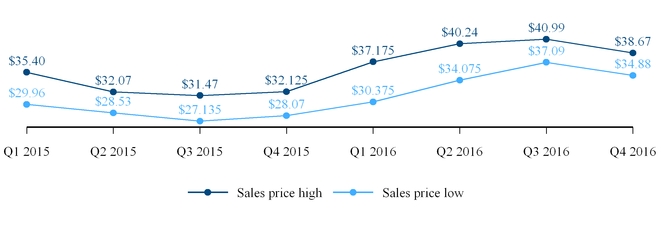
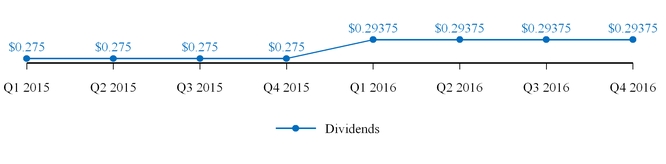
Closing sales price at December 31, 2016: $37.89
Shareowners - At December 31, 2016, there were 27,287 holders of record of Alliant Energy’s common stock, including holders through Alliant Energy’s Shareowner Direct Plan. Alliant Energy is the sole common shareowner of all 13,370,788 and 13,236,601 shares of IPL and WPL common stock, respectively, currently outstanding. As a result, there is no established public trading market for the common stock of either IPL or WPL.
Dividends - In November 2016, Alliant Energy announced an increase in its targeted 2017 annual common stock dividend to $1.26 per share, which is equivalent to a quarterly rate of $0.315 per share, beginning with the February 2017 dividend payment. The timing and amount of future dividends is subject to an approved dividend declaration from Alliant Energy’s Board of Directors, and is dependent upon earnings expectations, capital requirements, and general financial business conditions, among other factors.
Alliant Energy does not have any significant common stock dividend restrictions. Refer to Note 7 for information about IPL’s and WPL’s dividend restrictions and limitations on distributions to their parent company.
Common Stock Repurchases - A summary of Alliant Energy common stock repurchases for the quarter ended December 31, 2016 was as follows:
| Total Number | Average Price | Total Number of Shares | Maximum Number (or Approximate | ||||||||
| of Shares | Paid Per | Purchased as Part of | Dollar Value) of Shares That May | ||||||||
| Period | Purchased (a) | Share | Publicly Announced Plan | Yet Be Purchased Under the Plan (a) | |||||||
| October 1 to October 31 | 3,919 | $37.22 | — | N/A | |||||||
| November 1 to November 30 | 3,684 | 35.76 | — | N/A | |||||||
| December 1 to December 31 | 144 | 37.14 | — | N/A | |||||||
| 7,747 | 36.52 | — |
| (a) | All shares were purchased on the open market and held in a rabbi trust under the DCP. There is no limit on the number of shares of Alliant Energy common stock that may be held under the DCP, which currently does not have an expiration date. |
Other - Refer to “Security Ownership of Certain Beneficial Owners and Management and Related Stockholder Matters” in Item 12 for details of securities authorized for issuance under equity compensation plans.
Item 6. SELECTED FINANCIAL DATA
Financial Information
| Alliant Energy | 2016 (a) | 2015 (a) | 2014 (a) | 2013 | 2012 | ||||||||||||||
| (dollars in millions, except per share data) | |||||||||||||||||||
| Income Statement Data: | |||||||||||||||||||
| Operating revenues | $3,320.0 | $3,253.6 | $3,350.3 | $3,276.8 | $3,094.5 | ||||||||||||||
| Amounts attributable to Alliant Energy common shareowners: | |||||||||||||||||||
| Income from continuing operations, net of tax | 373.8 | 380.7 | 385.5 | 364.2 | 324.9 | ||||||||||||||
| Loss from discontinued operations, net of tax | (2.3 | ) | (2.5 | ) | (2.4 | ) | (5.9 | ) | (5.1 | ) | |||||||||
| Net income | 371.5 | 378.2 | 383.1 | 358.3 | 319.8 | ||||||||||||||
| Common Stock Data: | |||||||||||||||||||
| Earnings per weighted average common share attributable to Alliant Energy common shareowners (basic and diluted) (b): | |||||||||||||||||||
| Income from continuing operations, net of tax | $1.65 | $1.69 | $1.74 | $1.64 | $1.47 | ||||||||||||||
| Loss from discontinued operations, net of tax | ($0.01 | ) | ($0.01 | ) | ($0.01 | ) | ($0.02 | ) | ($0.03 | ) | |||||||||
| Net income | $1.64 | $1.68 | $1.73 | $1.62 | $1.44 | ||||||||||||||
| Common shares outstanding at year-end (000s) (b) | 227,674 | 226,918 | 221,871 | 221,887 | 221,975 | ||||||||||||||
| Dividends declared per common share (b) | $1.175 | $1.10 | $1.02 | $0.94 | $0.90 | ||||||||||||||
| Market value per share at year-end (b) | $37.89 | $31.225 | $33.21 | $25.80 | $21.955 | ||||||||||||||
| Book value per share at year-end (b) | $16.96 | $16.41 | $15.50 | $14.79 | $14.12 | ||||||||||||||
| Market capitalization at year-end | $8,626.6 | $7,085.5 | $7,368.3 | $5,724.7 | $4,873.5 | ||||||||||||||
| Other Selected Financial Data: | |||||||||||||||||||
| Cash flows from operating activities | $859.6 | $871.2 | $891.6 | $731.0 | $841.1 | ||||||||||||||
| Construction and acquisition expenditures | $1,196.8 | $1,034.3 | $902.8 | $798.3 | $1,158.1 | ||||||||||||||
| Total assets at year-end | $13,373.8 | $12,495.2 | $12,063.5 | $11,092.5 | $10,766.0 | ||||||||||||||
| Long-term obligations, net | $4,325.1 | $3,837.0 | $3,768.7 | $3,318.2 | $3,122.0 |
| IPL | |||||||||||||||||||
| Operating revenues | $1,820.4 | $1,774.5 | $1,848.1 | $1,818.8 | $1,650.3 | ||||||||||||||
| Earnings available for common stock | 215.6 | 186.0 | 181.6 | 172.0 | 145.7 | ||||||||||||||
| Cash dividends declared on common stock | 151.9 | 140.0 | 140.0 | 128.1 | 122.9 | ||||||||||||||
| Cash flows from operating activities | 361.9 | 385.0 | 406.1 | 232.6 | 291.0 | ||||||||||||||
| Total assets | 7,304.7 | 6,709.1 | 6,450.2 | 5,793.9 | 5,446.8 | ||||||||||||||
| Long-term obligations, net | 2,154.0 | 1,857.4 | 1,758.6 | 1,549.5 | 1,353.7 | ||||||||||||||
| WPL | |||||||||||||||||||
| Operating revenues | $1,459.1 | $1,435.1 | $1,449.1 | $1,406.3 | $1,392.0 | ||||||||||||||
| Earnings available for common stock | 190.4 | 176.3 | 180.4 | 177.5 | 169.4 | ||||||||||||||
| Cash dividends declared on common stock | 135.0 | 126.9 | 118.7 | 116.3 | 112.0 | ||||||||||||||
| Cash flows from operating activities | 521.4 | 449.8 | 424.4 | 423.3 | 427.4 | ||||||||||||||
| Total assets | 5,290.3 | 5,270.4 | 5,117.6 | 4,796.2 | 4,754.4 | ||||||||||||||
| Long-term obligations, net | 1,623.2 | 1,624.2 | 1,658.3 | 1,423.2 | 1,426.3 |
| (a) | Refer to “Results of Operations” in MDA for discussion of the 2016, 2015 and 2014 results of operations. |
| (b) | Amounts reflect the effects of a two-for-one common stock split distributed in May 2016. Refer to Note 7 for additional details. |
Alliant Energy is the sole common shareowner of all 13,370,788 and 13,236,601 shares of IPL’s and WPL’s common stock outstanding, respectively. As such, earnings per share data is not disclosed herein for IPL and WPL.
Item 7. MANAGEMENT’S DISCUSSION AND ANALYSIS OF FINANCIAL CONDITION AND RESULTS OF OPERATIONS
This MDA includes information relating to Alliant Energy, IPL and WPL, as well as AEF and Corporate Services. Where appropriate, information relating to a specific entity has been segregated and labeled as such. The following discussion and analysis should be read in conjunction with the Financial Statements and Notes included in this report. Unless otherwise noted, all “per share” references in MDA refer to earnings per diluted share.
EXECUTIVE OVERVIEW
Description of Business
General - Alliant Energy is an investor-owned public utility holding company whose primary subsidiaries are IPL, WPL, AEF and Corporate Services. IPL and WPL are public utilities, and AEF is the parent company for Alliant Energy’s non-regulated businesses and holds all of Alliant Energy’s investment in ATC. Corporate Services provides administrative services to Alliant Energy and its subsidiaries. An illustration of Alliant Energy’s primary businesses is shown below.
| Alliant Energy | |||||
| Utilities, ATC and Corporate Services | Non-regulated and Parent | ||||
| - Retail electric and gas services in IA (IPL) | - Transportation (AEF) | ||||
| - Retail electric and gas services in WI (WPL) | - Non-regulated Generation (AEF) | ||||
| - 16% interest in ATC (ATI) (a) | - Parent Company | ||||
| - Wholesale electric service in MN, IL & IA (IPL) | |||||
| - Wholesale electric service in WI (WPL) | |||||
| - Corporate Services |
| (a) | At December 31, 2016, ATI, a wholly-owned subsidiary of AEF, holds all of Alliant Energy’s investment in ATC, a transmission-only utility operating primarily in the Midwest. |
Utilities, ATC and Corporate Services - IPL and WPL own a portfolio of EGUs located in Iowa, Wisconsin and Minnesota with a diversified fuel mix including natural gas, renewable resources and coal. The output from these EGUs, supplemented with purchased power, is used to provide electric service to approximately 960,000 electric customers in the upper Midwest. The utility business also procures natural gas from various suppliers to provide service to approximately 410,000 retail gas customers in the upper Midwest. Alliant Energy’s utility business is its primary source of earnings and cash flows. The earnings and cash flows from the utilities, ATC and Corporate Services business are sensitive to various external factors including, but not limited to, the amount and timing of rates approved by regulatory authorities, the impact of weather and economic conditions on electric and gas sales volumes and other factors listed in “Risk Factors” in Item 1A and “Forward-looking Statements.”
Non-regulated Business and Parent - AEF manages various businesses including Non-regulated Generation (Sheboygan Falls and the Franklin County wind farm), Transportation (short-line railway and barge transportation services) and several other modest investments.
Financial Results - Alliant Energy’s net income and EPS attributable to Alliant Energy common shareowners were as follows (dollars in millions, except per share amounts):
| 2016 | 2015 | ||||||||||||||
| Income (Loss) | EPS (a) | Income (Loss) | EPS (a) | ||||||||||||
| Continuing operations: | |||||||||||||||
| Utilities, ATC and Corporate Services | $420.4 | $1.85 | $374.5 | $1.66 | |||||||||||
| Non-regulated and Parent | (46.6 | ) | (0.20 | ) | 6.2 | 0.03 | |||||||||
| Income from continuing operations | 373.8 | 1.65 | 380.7 | 1.69 | |||||||||||
| Loss from discontinued operations | (2.3 | ) | (0.01 | ) | (2.5 | ) | (0.01 | ) | |||||||
| Net income | $371.5 | $1.64 | $378.2 | $1.68 |
(a) Amounts reflect the effects of a two-for-one stock split distributed in May 2016. Refer to Note 7 for additional details.
The table above includes EPS from continuing operations for utilities, ATC and Corporate Services, and non-regulated and parent, which are non-GAAP financial measures. Alliant Energy believes EPS from continuing operations for utilities, ATC
and Corporate Services, and non-regulated and parent are useful to investors because they facilitate an understanding of segment performance and trends and provide additional information about Alliant Energy’s operations on a basis consistent with the measures that management uses to manage its operations and evaluate its performance.
Lower net income and EPS from continuing operations in 2016 compared to 2015 was primarily due to asset valuation charges related to the Franklin County wind farm in 2016, partially offset by higher electric and gas margins, higher AFUDC (primarily related to Marshalltown) and losses on sales of IPL’s Minnesota electric and gas distribution assets in 2015.
Refer to “Results of Operations” for additional details regarding the various factors impacting earnings during 2016, 2015 and 2014.
2016 Overview - In 2016, Alliant Energy, IPL and WPL focused on achieving financial objectives and executing their strategic plan. Key developments in 2016 include the following:
| • | IPL’s Expansion of Wind Generation - In October 2016, IPL and the Iowa Office of Consumer Advocate, among other customer groups, filed a settlement agreement with the IUB regarding the appropriate rate-making principles for up to 500 MW of additional wind generation at IPL. In October 2016, the IUB issued an order approving the settlement agreement, with limited modifications, and establishing rate-making principles, which IPL accepted, with key terms as follows. Refer to “Strategic Overview” for further discussion. |
| ▪ | Up to 500 MW of additional wind generation that qualifies for the full level of production tax credits, regardless of the location in Iowa, with a cost cap of $1,830/kilowatt, including AFUDC and transmission costs. Any costs incurred in excess of this $1,830/kilowatt cost cap are expected to be incorporated into rates if determined to be reasonable and prudent. |
| ▪ | A depreciable life of the wind generation of 40 years, unless changed as a result of a contested case before the IUB. |
| ▪ | An 11.0% return on common equity, with the exception of certain transmission facilities classified as intangible assets, which would earn the rate of return on common equity the IUB finds reasonable during a future rate case. |
| • | Franklin County Wind Farm - In addition to IPL’s expansion of wind generation discussed above, in February 2017, FERC issued an order approving the transfer of the 99 MW Franklin County wind farm from AEF to IPL. Alliant Energy and IPL currently expect to complete this transfer in 2017. |
| • | IPL’s and WPL’s Potential Expansion of Wind Generation - In addition to IPL’s 500 MW expansion of wind generation and transfer of the 99 MW Franklin County wind farm to IPL in 2017 discussed above, IPL and WPL are each exploring options to own and operate up to 200 MW of additional new wind generation. |
| • | WPL’s Construction of the Riverside Expansion - In May 2016, WPL received an order from the PSCW authorizing WPL to construct an approximate 730 MW natural gas-fired combined-cycle EGU in Beloit, Wisconsin, referred t |
Showing the first 8K of 179K characters. Open the full section
Item 7A. QUANTITATIVE AND QUALITATIVE DISCLOSURES ABOUT MARKET RISK
Quantitative and Qualitative Disclosures About Market Risk are reported in “Other Matters - Market Risk Sensitive Instruments and Positions” in MDA.
Item 8. FINANCIAL STATEMENTS AND SUPPLEMENTARY DATA
REPORT OF INDEPENDENT REGISTERED PUBLIC ACCOUNTING FIRM
To the Board of Directors and Shareowners of
Alliant Energy Corporation
Madison, Wisconsin
We have audited the accompanying consolidated balance sheets of Alliant Energy Corporation and subsidiaries (the “Company”) as of December 31, 2016 and 2015, and the related consolidated statements of income, common equity, and cash flows for each of the three years in the period ended December 31, 2016. Our audits also included the Company’s financial statement schedules listed in the Index at Item 15. These financial statements and financial statement schedules are the responsibility of the Company’s management. Our responsibility is to express an opinion on the financial statements and financial statement schedules based on our audits.
We conducted our audits in accordance with the standards of the Public Company Accounting Oversight Board (United States). Those standards require that we plan and perform the audit to obtain reasonable assurance about whether the financial statements are free of material misstatement. An audit includes examining, on a test basis, evidence supporting the amounts and disclosures in the financial statements. An audit also includes assessing the accounting principles used and significant estimates made by management, as well as evaluating the overall financial statement presentation. We believe that our audits provide a reasonable basis for our opinion.
In our opinion, such consolidated financial statements present fairly, in all material respects, the financial position of the Company as of December 31, 2016 and 2015, and the results of its operations and its cash flows for each of the three years in the period ended December 31, 2016, in conformity with accounting principles generally accepted in the United States of America. Also, in our opinion, such financial statement schedules, when considered in relation to the basic consolidated financial statements taken as a whole, present fairly, in all material respects, the information set forth therein.
We have also audited, in accordance with the standards of the Public Company Accounting Oversight Board (United States), the Company’s internal control over financial reporting as of December 31, 2016, based on the criteria established in Internal Control-Integrated Framework (2013) issued by the Committee of Sponsoring Organizations of the Treadway Commission and our report dated February 24, 2017 expressed an unqualified opinion on the Company’s internal control over financial reporting.
/s/ DELOITTE & TOUCHE LLP
DELOITTE & TOUCHE LLP
Milwaukee, Wisconsin
February 24, 2017
ALLIANT ENERGY CORPORATION
CONSOLIDATED STATEMENTS OF INCOME
| Year Ended December 31, | |||||||||||
| 2016 | 2015 | 2014 | |||||||||
| (in millions, except per share amounts) | |||||||||||
| Operating revenues: | |||||||||||
| Electric utility | $2,875.5 | $2,770.5 | $2,713.6 | ||||||||
| Gas utility | 355.4 | 381.2 | 517.5 | ||||||||
| Other utility | 48.6 | 57.9 | 66.1 | ||||||||
| Non-regulated | 40.5 | 44.0 | 53.1 | ||||||||
| Total operating revenues | 3,320.0 | 3,253.6 | 3,350.3 | ||||||||
| Operating expenses: | |||||||||||
| Electric production fuel and purchased power | 854.0 | 837.7 | 877.2 | ||||||||
| Electric transmission service | 527.9 | 485.3 | 447.5 | ||||||||
| Cost of gas sold | 194.3 | 219.1 | 327.8 | ||||||||
| Asset valuation charges for Franklin County wind farm | 86.4 | — | — | ||||||||
| Other operation and maintenance | 606.5 | 629.5 | 665.0 | ||||||||
| Depreciation and amortization | 411.6 | 401.3 | 388.1 | ||||||||
| Taxes other than income taxes | 102.3 | 103.7 | 101.1 | ||||||||
| Total operating expenses | 2,783.0 | 2,676.6 | 2,806.7 | ||||||||
| Operating income | 537.0 | 577.0 | 543.6 | ||||||||
| Interest expense and other: | |||||||||||
| Interest expense | 196.2 | 187.1 | 180.6 | ||||||||
| Equity income from unconsolidated investments, net | (39.6 | ) | (33.8 | ) | (40.4 | ) | |||||
| Allowance for funds used during construction | (62.5 | ) | (36.9 | ) | (34.8 | ) | |||||
| Interest income and other | (0.5 | ) | (0.7 | ) | (1.8 | ) | |||||
| Total interest expense and other | 93.6 | 115.7 | 103.6 | ||||||||
| Income from continuing operations before income taxes | 443.4 | 461.3 | 440.0 | ||||||||
| Income taxes | 59.4 | 70.4 | 44.3 | ||||||||
| Income from continuing operations, net of tax | 384.0 | 390.9 | 395.7 | ||||||||
| Loss from discontinued operations, net of tax | (2.3 | ) | (2.5 | ) | (2.4 | ) | |||||
| Net income | 381.7 | 388.4 | 393.3 | ||||||||
| Preferred dividend requirements of Interstate Power and Light Company | 10.2 | 10.2 | 10.2 | ||||||||
| Net income attributable to Alliant Energy common shareowners | $371.5 | $378.2 | $383.1 | ||||||||
| Weighted average number of common shares outstanding (basic and diluted) (a) | 227.1 | 225.4 | 221.7 | ||||||||
| Earnings per weighted average common share attributable to Alliant Energy common shareowners (basic and diluted) (a): | |||||||||||
| Income from continuing operations, net of tax | $1.65 | $1.69 | $1.74 | ||||||||
| Loss from discontinued operations, net of tax | (0.01 | ) | (0.01 | ) | (0.01 | ) | |||||
| Net income | $1.64 | $1.68 | $1.73 | ||||||||
| Amounts attributable to Alliant Energy common shareowners: | |||||||||||
| Income from continuing operations, net of tax | $373.8 | $380.7 | $385.5 | ||||||||
| Loss from discontinued operations, net of tax | (2.3 | ) | (2.5 | ) | (2.4 | ) | |||||
| Net income | $371.5 | $378.2 | $383.1 |
| (a) | Amounts reflect the effects of a two-for-one common stock split distributed in May 2016. Refer to Note 7 for additional details. |
The accompanying Combined Notes to Consolidated Financial Statements are an integral part of these statements.
ALLIANT ENERGY CORPORATION
CONSOLIDATED BALANCE SHEETS
| December 31, | |||||||
| 2016 | 2015 | ||||||
| (in millions, except per share and share amounts) | |||||||
| ASSETS | |||||||
| Current assets: | |||||||
| Cash and cash equivalents | $8.2 | $5.8 | |||||
| Accounts receivable, less allowance for doubtful accounts | 493.3 | 397.6 | |||||
| Production fuel, at weighted average cost | 98.1 | 98.8 | |||||
| Gas stored underground, at weighted average cost | 37.6 | 43.3 | |||||
| Materials and supplies, at weighted average cost | 86.6 | 81.4 | |||||
| Regulatory assets | 57.8 | 120.2 | |||||
| Other | 95.5 | 79.7 | |||||
| Total current assets | 877.1 | 826.8 | |||||
| Property, plant and equipment, net | 10,279.2 | 9,519.1 | |||||
| Investments: | |||||||
| Investment in American Transmission Company LLC | 317.6 | 293.3 | |||||
| Other | 20.0 | 53.0 | |||||
| Total investments | 337.6 | 346.3 | |||||
| Other assets: | |||||||
| Regulatory assets | 1,857.3 | 1,788.4 | |||||
| Deferred charges and other | 22.6 |
Showing the first 8K of 310K characters. Open the full section
Item 9. CHANGES IN AND DISAGREEMENTS WITH ACCOUNTANTS ON ACCOUNTING AND FINANCIAL DISCLOSURE
None.
Item 9A. CONTROLS AND PROCEDURES
Alliant Energy’s, IPL’s and WPL’s management evaluated, with the participation of each of Alliant Energy’s, IPL’s and WPL’s Chief Executive Officer, Chief Financial Officer and Disclosure Committee, the effectiveness of the design and operation of Alliant Energy’s, IPL’s and WPL’s disclosure controls and procedures as of the end of the quarter ended December 31, 2016 pursuant to the requirements of the Securities Exchange Act of 1934, as amended. Based on their evaluation, the Chief Executive Officer and the Chief Financial Officer concluded that Alliant Energy’s, IPL’s and WPL’s disclosure controls and procedures were effective as of the end of the quarter ended December 31, 2016.
There was no change in Alliant Energy’s, IPL’s and WPL’s internal control over financial reporting that occurred during the quarter ended December 31, 2016 that has materially affected, or is reasonably likely to materially affect, Alliant Energy’s, IPL’s and WPL’s internal control over financial reporting.
Management’s Annual Report on Internal Control over Financial Reporting - The management of Alliant Energy, IPL and WPL are responsible for establishing and maintaining adequate internal control over financial reporting, as such term is defined in Rules 13a-15(f) and 15d-15(f) under the Securities Exchange Act of 1934. Alliant Energy’s, IPL’s and WPL’s internal control over financial reporting is designed to provide reasonable assurance regarding the reliability of financial reporting and the preparation of financial statements for external purposes in accordance with GAAP.
Because of the inherent limitations of internal control over financial reporting, misstatements may not be prevented or detected on a timely basis. Also, projections of any evaluation of the effectiveness of the internal control over financial reporting to future periods are subject to the risk that the controls may become inadequate because of changes in conditions, or that the degree of compliance with the policies or procedures may deteriorate.
Alliant Energy’s, IPL’s and WPL’s management assessed the effectiveness of their respective internal control over financial reporting as of December 31, 2016 using the criteria set forth in Internal Control - Integrated Framework (2013) issued by the Committee of Sponsoring Organizations of the Treadway Commission. Based on these assessments, Alliant Energy’s, IPL’s and WPL’s management concluded that, as of December 31, 2016, their respective internal control over financial reporting was effective.
Deloitte & Touche LLP, Alliant Energy’s independent registered public accounting firm, has audited Alliant Energy’s internal control over financial reporting. That report is included herein. This Annual Report on Form 10-K does not include an attestation report of IPL’s and WPL’s independent registered public accounting firm regarding their respective internal control over financial reporting. Management’s report was not subject to attestation by IPL’s and WPL’s independent registered public accounting firm pursuant to rules of the SEC that permit IPL and WPL to provide only management’s report in this Annual Report on Form 10-K.
REPORT OF INDEPENDENT REGISTERED PUBLIC ACCOUNTING FIRM
To the Board of Directors and Shareowners of
Alliant Energy Corporation
Madison, Wisconsin
We have audited the internal control over financial reporting of Alliant Energy Corporation and subsidiaries (the “Company”) as of December 31, 2016, based on the criteria established in Internal Control - Integrated Framework (2013) issued by the Committee of Sponsoring Organizations of the Treadway Commission. The Company’s management is responsible for maintaining effective internal control over financial reporting and for its assessment of the effectiveness of internal control over financial reporting, included in the accompanying Management’s Annual Report on Internal Control over Financial Reporting. Our responsibility is to express an opinion on the Company’s internal control over financial reporting based on our audit.
We conducted our audit in accordance with the standards of the Public Company Accounting Oversight Board (United States). Those standards require that we plan and perform the audit to obtain reasonable assurance about whether effective internal control over financial reporting was maintained in all material respects. Our audit included obtaining an understanding of internal control over financial reporting, assessing the risk that a material weakness exists, testing and evaluating the design and operating effectiveness of internal control based on the assessed risk, and performing such other procedures as we considered necessary in the circumstances. We believe that our audit provides a reasonable basis for our opinion.
A company’s internal control over financial reporting is a process designed by, or under the supervision of, the company’s principal executive and principal financial officers, or persons performing similar functions, and effected by the company’s board of directors, management, and other personnel to provide reasonable assurance regarding the reliability of financial reporting and the preparation of financial statements for external purposes in accordance with generally accepted accounting principles. A company’s internal control over financial reporting includes those policies and procedures that (1) pertain to the maintenance of records that, in reasonable detail, accurately and fairly reflect the transactions and dispositions of the assets of the company; (2) provide reasonable assurance that transactions are recorded as necessary to permit preparation of financial statements in accordance with generally accepted accounting principles, and that receipts and expenditures of the company are being made only in accordance with authorizations of management and directors of the company; and (3) provide reasonable assurance regarding prevention or timely detection of unauthorized acquisition, use, or disposition of the company’s assets that could have a material effect on the financial statements.
Because of the inherent limitations of internal control over financial reporting, including the possibility of collusion or improper management override of controls, material misstatements due to error or fraud may not be prevented or detected on a timely basis. Also, projections of any evaluation of the effectiveness of the internal control over financial reporting to future periods are subject to the risk that the controls may become inadequate because of changes in conditions, or that the degree of compliance with the policies or procedures may deteriorate.
In our opinion, the Company maintained, in all material respects, effective internal control over financial reporting as of December 31, 2016, based on the criteria established in Internal Control - Integrated Framework (2013) issued by the Committee of Sponsoring Organizations of the Treadway Commission.
We have also audited, in accordance with the standards of the Public Company Accounting Oversight Board (United States), the consolidated financial statements and financial statement schedules as of and for the year ended December 31, 2016 of the Company and our report dated February 24, 2017 expressed an unqualified opinion on those financial statements and financial statement schedules.
/s/ DELOITTE & TOUCHE LLP
DELOITTE & TOUCHE LLP
Milwaukee, Wisconsin
February 24, 2017
Item 9B. OTHER INFORMATION
None.
PART III
Item 10. DIRECTORS, EXECUTIVE OFFICERS AND CORPORATE GOVERNANCE
The directors of Alliant Energy, IPL and WPL are the same, and therefore, the information required by Item 10 relating to directors and nominees for election of directors is the same for all registrants. The information required by Item 10 relating to directors and nominees for election of directors at the 2017 Annual Meeting of Shareowners, the timely filing of reports under Section 16 of the Securities Exchange Act of 1934, audit committees and audit committee financial experts, and Alliant Energy’s, IPL’s and WPL’s Code of Conduct is incorporated herein by reference to the relevant information in the 2017 Alliant Energy Proxy Statement, which will be filed with the SEC within 120 days after the end of Alliant Energy’s, IPL’s and WPL’s fiscal years. The code of ethics, also referred to as the Code of Conduct, of Alliant Energy, IPL and WPL are the same. Information regarding executive officers of Alliant Energy, IPL and WPL may be found in Part I of this report under the caption “Executive Officers of the Registrants.”
Item 11. EXECUTIVE COMPENSATION
The directors and executive officers of Alliant Energy, IPL and WPL for which compensation information must be included are the same. Therefore, the information required by Item 11 for each of Alliant Energy, IPL and WPL is incorporated herein by reference to the relevant information in the 2017 Alliant Energy Proxy Statement, which will be filed with the SEC within 120 days after the end of Alliant Energy’s, IPL’s and WPL’s fiscal years.
Item 12. SECURITY OWNERSHIP OF CERTAIN BENEFICIAL OWNERS AND MANAGEMENT AND RELATED STOCKHOLDER MATTERS
ALLIANT ENERGY
Information regarding Alliant Energy’s equity compensation plans as of December 31, 2016 was as follows:
| (A) | (C) | |||||
| Number of securities to be | (B) | Number of securities remaining available | ||||
| issued upon exercise of | Weighted-average exercise | for future issuance under equity | ||||
| outstanding options, | price of outstanding options, | compensation plans (excluding | ||||
| Plan Category | warrants and rights | warrants and rights | securities reflected in column (A)) | |||
| Equity compensation plans approved by shareowners | 655,936 (a) | $31.98 | 7,363,980 (b) | |||
| Equity compensation plans not approved by shareowners (c) | N/A | N/A | N/A (d) | |||
| 655,936 | $31.98 | 7,363,980 |
| (a) | Represents performance shares, performance restricted stock units and restricted stock units granted under the OIP. Performance shares may be paid out in shares of Alliant Energy’s common stock, cash, or a combination of cash and stock and performance restricted stock units are paid out in shares of Alliant Energy’s common stock. The awards are adjusted by a performance multiplier, which ranges from zero to 200%, based on the performance criteria. The performance share and performance restricted stock unit awards included in column (A) of the table reflect an assumed payout in the form of Alliant Energy’s common stock at the maximum performance multiplier of 200% for the 2016 and 2015 grants and at the estimated payout percentage of 148% for the 2014 grants. Also included are restricted stock units granted under the OIP, which may be paid out in shares of Alliant Energy’s common stock, cash, or a combination of cash and stock at the expiration of a three-year time-vesting period. |
| (b) | All of the available shares under the Amended and Restated OIP may be issued as awards in the form of shares of Alliant Energy’s common stock, restricted stock, restricted stock units, performance shares, performance units and other stock-based or cash-based awards. As of December 31, 2016, there were performance shares, restricted stock awards, performance restricted stock units and restricted stock units outstanding under the Amended and Restated OIP. Excludes 190,244 shares of non-vested restricted common stock previously issued and outstanding under the Amended and Restated OIP at December 31, 2016. |
| (c) | As of December 31, 2016, there were 441,695 shares of Alliant Energy’s common stock outstanding under the DCP, which is described in Note 12(c). |
| (d) | There is no limit on the number of shares of Alliant Energy’s common stock that may be held under the DCP. |
The remainder of the information required by Item 12 is incorporated herein by reference to the relevant information in the 2017 Alliant Energy Proxy Statement, which will be filed with the SEC within 120 days after the end of Alliant Energy’s fiscal year.
IPL AND WPL
None of IPL’s directors or executive officers own any shares of preferred stock in IPL. The remainder of the information required by Item 12 is incorporated herein by reference to the relevant information in the 2017 Alliant Energy Proxy Statement, which will be filed with the SEC within 120 days after the end of IPL’s and WPL’s fiscal years.
Item 13. CERTAIN RELATIONSHIPS AND RELATED TRANSACTIONS, AND DIRECTOR INDEPENDENCE
The information required by Item 13 for each of Alliant Energy, IPL and WPL is incorporated herein by reference to the relevant information in the 2017 Alliant Energy Proxy Statement, which will be filed with the SEC within 120 days after the end of Alliant Energy’s, IPL’s and WPL’s fiscal years.
Item 14. PRINCIPAL ACCOUNTING FEES AND SERVICES
ALLIANT ENERGY
The information required by Item 14 is incorporated herein by reference to the relevant information in the 2017 Alliant Energy Proxy Statement, which will be filed with the SEC within 120 days after the end of Alliant Energy’s fiscal year.
IPL AND WPL
Each of IPL’s and WPL’s Audit Committee of the Board of Directors has adopted a policy that requires advance approval of all audit, audit-related, tax and other permitted services performed by the independent registered public accounting firm. The policy provides for pre-approval by the Audit Committee of specifically defined audit and non-audit services after the Audit Committee is provided with the appropriate level of details regarding the specific services to be provided. The policy does not permit delegation of the Audit Committee’s authority to management. In the event the need for specific services arises between Audit Committee meetings, the Audit Committee has delegated to the Chairperson of the Audit Committee authority to approve permitted services provided that the Chairperson reports any decisions to the Audit Committee at its next scheduled meeting. The principal accounting fees billed to Alliant Energy by its independent registered public accounting firm, all of which were approved in advance by the Audit Committee, directly related and allocated to IPL and WPL were as follows (in thousands):
| IPL | WPL | ||||||||||||||||||||||||||
| 2016 | 2015 | 2016 | 2015 | ||||||||||||||||||||||||
| Fees | % of Total | Fees | % of Total | Fees | % of Total | Fees | % of Total | ||||||||||||||||||||
| Audit fees | $1,035 | 93 | % | $1,036 | 91 | % | $1,008 | 95 | % | $969 | 95 | % | |||||||||||||||
| Audit-related fees | 64 | 6 | % | 90 | 8 | % | 41 | 4 | % | 41 | 4 | % | |||||||||||||||
| All other fees | 8 | 1 | % | 7 | 1 | % | 7 | 1 | % | 7 | 1 | % | |||||||||||||||
| $1,107 | 100 | % | $1,133 | 100 | % | $1,056 | 100 | % | $1,017 | 100 | % |
IPL’s and WPL’s audit fees for 2016 and 2015 consisted of the respective fees billed for the audits of the financial statements of IPL and its subsidiary and WPL and its subsidiary, for reviews of financial statements included in Form 10-Q filings, and for services normally provided in connection with statutory and regulatory filings, such as financing transactions. IPL’s and WPL’s audit fees also included their respective portion of fees for the 2016 and 2015 audits of Alliant Energy’s financial statements and effectiveness of internal controls over financial reporting. IPL’s and WPL’s audit-related fees for 2016 and 2015 consisted of the fees billed for services rendered related to employee benefits plan audits and other attest services. All other fees for 2016 and 2015 for IPL and WPL consisted of license fees for accounting research software products and seminars. IPL and WPL did not have any tax fees for 2016 or 2015. The Audit Committee does not consider the provision of non-audit services by the independent registered public accounting firm described above to be incompatible with maintaining independence of the independent registered public accounting firm.
PART IV
Item 15. EXHIBITS, FINANCIAL STATEMENT SCHEDULES
| (1) | Consolidated Financial Statements - Refer to Item 8 Financial Statements and Supplementary Data. |
| (2) | Financial Statement Schedules - |
Schedule I. Condensed Parent Company Financial Statements
Schedule II. Valuation and Qualifying Accounts and Reserves
NOTE: All other schedules are omitted because they are not applicable or not required, or because that required information is shown either in the financial statements or in the notes thereto.
| (3) | Exhibits Required by SEC Regulation S-K - Exhibits for Alliant Energy, IPL and WPL are listed in the Exhibit Index, which is incorporated herein by reference. |
SCHEDULE I - CONDENSED PARENT COMPANY FINANCIAL STATEMENTS
ALLIANT ENERGY CORPORATION (Parent Company Only)
CONDENSED STATEMENTS OF INCOME
| Year Ended December 31, | |||||||||||
| 2016 | 2015 | 2014 | |||||||||
| (in millions) | |||||||||||
| Operating revenues | $1 | $2 | $2 | ||||||||
| Operating expenses | 3 | 3 | 3 | ||||||||
| Operating loss | (2 | ) | (1 | ) | (1 | ) | |||||
| Interest expense and other: | |||||||||||
| Equity earnings from consolidated subsidiaries | (374 | ) | (379 | ) | (388 | ) | |||||
| Interest expense | 3 | 3 | 9 | ||||||||
| Interest income | (2 | ) | (3 | ) | (2 | ) | |||||
| Total interest expense and other | (373 | ) | (379 | ) | (381 | ) | |||||
| Income before income taxes | 371 | 378 | 380 | ||||||||
| Income tax benefit | (1 | ) | (1 | ) | (3 | ) | |||||
| Net income | $372 | $379 | $383 |
The accompanying Notes to Condensed Financial Statements are an integral part of these statements.
ALLIANT ENERGY CORPORATION (Parent Company Only)
CONDENSED BALANCE SHEETS
| December 31, | |||||||
| 2016 | 2015 | ||||||
| (in millions) | |||||||
| ASSETS | |||||||
| Current assets: | |||||||
| Notes receivable from affiliated companies | $74 | $93 | |||||
| Other | 5 | 9 | |||||
| Total current assets | 79 | 102 | |||||
| Investments: | |||||||
| Investments in consolidated subsidiaries | 4,211 | 3,999 | |||||
| Other | 2 | 14 | |||||
| Total investments | 4,213 | 4,013 | |||||
| Other assets | 64 | 20 | |||||
| Total assets | $4,356 | $4,135 |
| LIABILITIES AND EQUITY | |||||||
| Current liabilities: | |||||||
| Current maturities of long-term debt | $— | $250 | |||||
| Commercial paper | 192 | 140 | |||||
| Notes payable to affiliated companies | 275 | — | |||||
| Other | 12 | 12 | |||||
| Total current liabilities | 479 | 402 | |||||
| Other liabilities | 18 | 12 | |||||
| Common equity: | |||||||
| Common stock and additional paid-in capital | 1,695 | 1,664 | |||||
| Retained earnings | 2,174 | 2,066 | |||||
| Shares in deferred compensation trust | (10 | ) | (9 | ) | |||
| Total common equity | 3,859 | 3,721 | |||||
| Total liabilities and equity | $4,356 | $4,135 |
The accompanying Notes to Condensed Financial Statements are an integral part of these statements.
ALLIANT ENERGY CORPORATION (Parent Company Only)
CONDENSED STATEMENTS OF CASH FLOWS
| Year Ended December 31, | |||||||||||
| 2016 | 2015 | 2014 | |||||||||
| (in millions) | |||||||||||
| Net cash flows from operating activities | $254 | $262 | $246 | ||||||||
| Cash flows from (used for) investing activities: | |||||||||||
| Capital contributions to consolidated subsidiaries | (250 | ) | (165 | ) | (90 | ) | |||||
| Capital repayments from consolidated subsidiaries | 130 | — | 50 | ||||||||
| Net change in notes receivable from and payable to affiliates | 294 | 2 | (23 | ) | |||||||
| Other | 10 | — | — | ||||||||
| Net cash flows from (used for) investing activities | 184 | (163 | ) | (63 | ) | ||||||
| Cash flows used for financing activities: | |||||||||||
| Common stock dividends | (267 | ) | (247 | ) | (226 | ) | |||||
| Proceeds from issuance of common stock, net | 27 | 151 | — | ||||||||
| Proceeds from issuance of long-term debt | — | — | 250 | ||||||||
| Payments to retire long-term debt | (250 | ) | — | (250 | ) | ||||||
| Net change in commercial paper | 52 | (1 | ) | 45 | |||||||
| Other | — | (2 | ) | (2 | ) | ||||||
| Net cash flows used for financing activities | (438 | ) | (99 | ) | (183 | ) | |||||
| Net decrease in cash and cash equivalents | — | — | — | ||||||||
| Cash and cash equivalents at beginning of period | — | — | — | ||||||||
| Cash and cash equivalents at end of period | $— | $— | $— | ||||||||
| Supplemental cash flows information: | |||||||||||
| Cash paid during the period for: | |||||||||||
| Interest, net of capitalized interest | ($3 | ) | ($3 | ) | ($11 | ) | |||||
| Income taxes, net | (37 | ) | (9 | ) | (5 | ) |
The accompanying Notes to Condensed Financial Statements are an integral part of these statements.
ALLIANT ENERGY CORPORATION
(Parent Company Only)
NOTES TO CONDENSED FINANCIAL STATEMENTS
Pursuant to rules and regulations of the SEC, the Condensed Financial Statements of Alliant Energy Corporation (Parent Company Only) do not reflect all of the information and notes normally included with financial statements prepared in accordance with GAAP. Therefore, these Condensed Financial Statements should be read in conjunction with the Financial Statements and related Notes included in the combined 2016 Form 10-K, Part II, Item 8, which is incorporated herein by reference.
In the Condensed Financial Statements of Alliant Energy Corporation (Parent Company Only), investments in subsidiaries are accounted for using the equity method.
SCHEDULE II - VALUATION AND QUALIFYING ACCOUNTS AND RESERVES
| Additions | |||||||
| Balance, | Charged to | Charged to Other | Balance, | ||||
| Description | January 1 | Expense | Accounts (a) | Deductions (b) | December 31 | ||
| (in millions) |
Valuation and Qualifying Accounts Which are Deducted in the Balance Sheet From the Assets to Which They Apply:
| Accumulated Provision for Uncollectible Accounts: | ||||||||||||||||||
| Alliant Energy (c) | ||||||||||||||||||
| Year ended December 31, 2016 | $4.8 | $17.4 | $8.8 | $22.3 | $8.7 | |||||||||||||
| Year ended December 31, 2015 | 5.1 | 8.1 | 3.0 | 11.4 | 4.8 | |||||||||||||
| Year ended December 31, 2014 | 4.8 | 11.7 | 4.1 | 15.5 | 5.1 | |||||||||||||
| IPL (c) | ||||||||||||||||||
| Year ended December 31, 2016 | $0.6 | $17.2 | $— | $16.7 | $1.1 | |||||||||||||
| Year ended December 31, 2015 | 0.4 | 8.1 | — | 7.9 | 0.6 | |||||||||||||
| Year ended December 31, 2014 | 0.7 | 11.5 | — | 11.8 | 0.4 | |||||||||||||
| WPL | ||||||||||||||||||
| Year ended December 31, 2016 | $3.7 | $0.1 | $8.8 | $5.5 | $7.1 | |||||||||||||
| Year ended December 31, 2015 | 4.2 | — | 3.0 | 3.5 | 3.7 | |||||||||||||
| Year ended December 31, 2014 | 1.7 | — | 4.1 | 1.6 | 4.2 |
Note: The above provisions relate to various customer, notes and other receivable balances included in various line items on the respective balance sheets.
Other Reserves:
| Accumulated Provision for Other Reserves (d): | ||||||||||||||||||
| Alliant Energy | ||||||||||||||||||
| Year ended December 31, 2016 | $27.1 | $6.1 | $— | $8.1 | $25.1 | |||||||||||||
| Year ended December 31, 2015 | 32.6 | 6.5 | — | 12.0 | 27.1 | |||||||||||||
| Year ended December 31, 2014 | 38.2 | 12.5 | — | 18.1 | 32.6 | |||||||||||||
| IPL | ||||||||||||||||||
| Year ended December 31, 2016 | $9.4 | $1.0 | $— | $1.7 | $8.7 | |||||||||||||
| Year ended December 31, 2015 | 10.6 | 2.1 | — | 3.3 | 9.4 | |||||||||||||
| Year ended December 31, 2014 | 18.1 | 3.9 | — | 11.4 | 10.6 | |||||||||||||
| WPL | ||||||||||||||||||
| Year ended December 31, 2016 | $11.4 | $1.8 | $— | $5.1 | $8.1 | |||||||||||||
| Year ended December 31, 2015 | 16.3 | 0.7 | — | 5.6 | 11.4 | |||||||||||||
| Year ended December 31, 2014 | 16.2 | 2.5 | — | 2.4 | 16.3 |
| (a) | Accumulated provision for uncollectible accounts: In accordance with its regulatory treatment, certain amounts provided by WPL are recorded in regulatory assets. WPL expenses these amounts when an uncollectible account is written-off. |
| (b) | Deductions are of the nature for which the reserves were created. In the case of the accumulated provision for uncollectible accounts, deductions from this reserve are reduced by recoveries of amounts previously written off. |
| (c) | Refer to Note 5(b) for discussion of IPL’s sales of accounts receivable program. |
| (d) | Other reserves are largely related to injury and damage claims arising in the ordinary course of business. |
SIGNATURES
Pursuant to the requirements of Section 13 or 15(d) of the Securities Exchange Act of 1934, the Registrants have duly caused this report to be signed on their behalf by the undersigned, thereunto duly authorized on the 24th day of February 2017.
| ALLIANT ENERGY | INTERSTATE POWER | WISCONSIN POWER | ||
| CORPORATION | AND LIGHT COMPANY | AND LIGHT COMPANY | ||
| By: /s/ Patricia L. Kampling | By: /s/ Patricia L. Kampling | By: /s/ Patricia L. Kampling | ||
| Patricia L. Kampling | Patricia L. Kampling | Patricia L. Kampling | ||
| Chairman, President and Chief Executive Officer | Chairman and Chief Executive Officer | Chairman and Chief Executive Officer |
Pursuant to the requirements of the Securities Exchange Act of 1934, this report has been signed below by the following persons on behalf of the Registrants and in the capacities indicated on the 24th day of February 2017.
| ALLIANT ENERGY | INTERSTATE POWER | WISCONSIN POWER | ||
| CORPORATION | AND LIGHT COMPANY | AND LIGHT COMPANY | ||
| By: /s/ Patricia L. Kampling | By: /s/ Patricia L. Kampling | By: /s/ Patricia L. Kampling | ||
| Patricia L. Kampling | Patricia L. Kampling | Patricia L. Kampling | ||
| Chairman, President, Chief Executive Officer and Director (Principal Executive Officer) | Chairman, Chief Executive Officer and Director (Principal Executive Officer) | Chairman, Chief Executive Officer and Director (Principal Executive Officer) | ||
| /s/ Robert J. Durian | /s/ Robert J. Durian | /s/ Robert J. Durian | ||
| Robert J. Durian | Robert J. Durian | Robert J. Durian | ||
| Vice President, Chief Financial Officer and Treasurer (Principal Financial Officer) | Vice President, Chief Financial Officer and Treasurer (Principal Financial Officer) | Vice President, Chief Financial Officer and Treasurer (Principal Financial Officer) | ||
| /s/ Benjamin M. Bilitz | /s/ Benjamin M. Bilitz | /s/ Benjamin M. Bilitz | ||
| Benjamin M. Bilitz | Benjamin M. Bilitz | Benjamin M. Bilitz | ||
| Chief Accounting Officer and Controller (Principal Accounting Officer) | Chief Accounting Officer and Controller (Principal Accounting Officer) | Chief Accounting Officer and Controller (Principal Accounting Officer) | ||
| /s/ Patrick E. Allen | /s/ Patrick E. Allen | /s/ Patrick E. Allen | ||
| Patrick E. Allen, Director | Patrick E. Allen, Director | Patrick E. Allen, Director | ||
| /s/ Michael L. Bennett | /s/ Michael L. Bennett | /s/ Michael L. Bennett | ||
| Michael L. Bennett, Director | Michael L. Bennett, Director | Michael L. Bennett, Director | ||
| /s/ Deborah B. Dunie | /s/ Deborah B. Dunie | /s/ Deborah B. Dunie | ||
| Deborah B. Dunie, Director | Deborah B. Dunie, Director | Deborah B. Dunie, Director | ||
| /s/ Darryl B. Hazel | /s/ Darryl B. Hazel | /s/ Darryl B. Hazel | ||
| Darryl B. Hazel, Director | Darryl B. Hazel, Director | Darryl B. Hazel, Director | ||
| /s/ Singleton B. McAllister | /s/ Singleton B. McAllister | /s/ Singleton B. McAllister | ||
| Singleton B. McAllister, Director | Singleton B. McAllister, Director | Singleton B. McAllister, Director | ||
| /s/ Thomas F. O’Toole | /s/ Thomas F. O’Toole | /s/ Thomas F. O’Toole | ||
| Thomas F. O’Toole, Director | Thomas F. O’Toole, Director | Thomas F. O’Toole, Director | ||
| /s/ Dean C. Oestreich | /s/ Dean C. Oestreich | /s/ Dean C. Oestreich | ||
| Dean C. Oestreich, Director | Dean C. Oestreich, Director | Dean C. Oestreich, Director | ||
| /s/ Carol P. Sanders | /s/ Carol P. Sanders | /s/ Carol P. Sanders | ||
| Carol P. Sanders, Director | Carol P. Sanders, Director | Carol P. Sanders, Director | ||
| /s/ Susan D. Whiting | /s/ Susan D. Whiting | /s/ Susan D. Whiting | ||
| Susan D. Whiting, Director | Susan D. Whiting, Director | Susan D. Whiting, Director |
ALLIANT ENERGY CORPORATION
INTERSTATE POWER AND LIGHT COMPANY
WISCONSIN POWER AND LIGHT COMPANY
EXHIBIT INDEX
The following Exhibits are filed herewith or incorporated herein by reference.
Pursuant to Item 601(b)(4)(iii) of Regulation S-K, the registrants agree to furnish to the Securities and Exchange Commission, upon request, any instrument defining the rights of holders of unregistered long-term debt not filed as an exhibit to this combined Form 10-K. No such instrument authorizes securities in excess of 10% of the total assets of Alliant Energy, IPL or WPL, as the case may be.
| Exhibit Number | Description | |
| 3.1 | Restated Articles of Incorporation of Alliant Energy, as amended (incorporated by reference to Exhibit 4.1 to Alliant Energy’s Registration Statement on Form S-8 (Reg. No. 333-117654)) | |
| 3.1a | Articles of Amendment to Restated Articles of Incorporation of Alliant Energy, as amended, effective May 4, 2016 (incorporated by reference to Exhibit 3.1 to Alliant Energy’s Form 10-Q for the quarter ended March 31, 2016 (File No. 1-9894)) | |
| 3.2 | Amended and Restated Bylaws of Alliant Energy, effective May 7, 2015 (incorporated by reference to Exhibit 3.1 to Alliant Energy’s Form 8-K, filed May 13, 2015 (File No. 1-9894)) | |
| 3.3 | Amended and Restated Articles of Incorporation of WPL, effective May 9, 2013 (incorporated by reference to Exhibit 3.4 to WPL’s Form 8-K, filed May 13, 2013 (File No. 0-337)) | |
| 3.4 | Amended and Restated Bylaws of WPL, effective May 7, 2015 (incorporated by reference to Exhibit 3.3 to WPL’s Form 8-K, filed May 13, 2015 (File No. 0-337)) | |
| 3.5 | Amended and Restated Articles of Incorporation of IPL, effective May 10, 2013 (incorporated by reference to Exhibit 3.2 to IPL’s Form 8-K, filed May 13, 2013 (File No. 1-4117)) | |
| 3.6 | Amended and Restated Bylaws of IPL, effective May 7, 2015 (incorporated by reference to Exhibit 3.2 to IPL’s Form 8-K, filed May 13, 2015 (File No. 1-4117)) | |
| 4.1 | Third Amended and Restated Five Year Credit Agreement, dated December 14, 2011, among Alliant Energy and the Banks set forth therein (incorporated by reference to Exhibit 99.1 to Alliant Energy’s Form 8-K, filed December 19, 2011 (File No. 1-9894)) | |
| 4.2 | Senior Note Indenture, dated as of September 30, 2009, between Alliant Energy and Wells Fargo Bank, National Association (N.A.) (incorporated by reference to Exhibit 4.28 to Alliant Energy’s Registration Statement on Form S-3 (Reg. No. 333-162214)) | |
| 4.3 | Amended and Restated Rights Agreement, dated as of December 11, 2008, between Alliant Energy and Wells Fargo Bank, N.A. (incorporated by reference to Exhibit 4.1 to Alliant Energy’s Registration Statement on Form 8-A/A, filed December 12, 2008 (File No. 1-9894)) | |
| 4.4 | Third Amended and Restated Five Year Credit Agreement, dated December 14, 2011, among WPL and the Banks set forth therein (incorporated by reference to Exhibit 99.3 to WPL’s Form 8-K, filed December 19, 2011 (File No. 0-337)) | |
| 4.5 | Indenture, dated as of June 20, 1997, between WPL and Wells Fargo Bank, N.A., Successor, as Trustee (incorporated by reference to Exhibit 4.33 to Amendment No. 2 to WPL’s Registration Statement on Form S-3 (Reg. No. 033-60917)) | |
| 4.6 | Officers’ Certificate, dated as of July 28, 2004, creating WPL’s 6.25% Debentures due July 31, 2034 (incorporated by reference to Exhibit 4.1 to WPL’s Form 8-K, filed August 2, 2004 (File No. 0-337)) | |
| 4.7 | Officers’ Certificate, dated as of August 8, 2007, creating WPL’s 6.375% Debentures due August 15, 2037 (incorporated by reference to Exhibit 4.1 to WPL’s Form 8-K, filed August 9, 2007 (File No. 0-337)) | |
| 4.8 | Officer’s Certificate, dated as of October 1, 2008, creating WPL’s 7.60% Debentures due October 1, 2038 (incorporated by reference to Exhibit 4.2 to WPL’s Form 8-K, filed October 2, 2008 (File No. 0-337)) | |
| 4.9 | Officers’ Certificate, dated as of July 7, 2009, creating WPL’s 5.00% Debentures due July 15, 2019 (incorporated by reference to Exhibit 4.2 to WPL’s Form 8-K, filed July 8, 2009 (File No. 0-337)) | |
| 4.10 | Officers’ Certificate, dated as of June 10, 2010, creating WPL’s 4.60% Debentures due June 15, 2020 (incorporated by reference to Exhibit 4.2 to WPL’s Form 8-K, filed June 11, 2010 (File No. 0-337)) | |
| 4.11 | Officers’ Certificate, dated as of November 19, 2012, creating WPL’s 2.25% Debentures due November 15, 2022 (incorporated by reference to Exhibit 4.1 to WPL’s Form 8-K, filed November 19, 2012 (File No. 0-337)) | |
| 4.12 | Officers’ Certificate, dated as of October 14, 2014, creating WPL’s 4.10% Debentures due October 15, 2044 (incorporated by reference to Exhibit 4.1 to WPL’s Form 8-K, filed October 14, 2014 (File No. 0-337)) | |
| 4.13 | Third Amended and Restated Five Year Credit Agreement, dated December 14, 2011, among IPL and the Banks set forth therein (incorporated by reference to Exhibit 99.2 to IPL’s Form 8-K, filed December 19, 2011 (File No. 1-4117)) |
| Exhibit Number | Description | |
| 4.14 | Indenture (For Senior Unsecured Debt Securities), dated as of August 20, 2003, between IPL and The Bank of New York Mellon Trust Co., N.A. (f/k/a The Bank of New York Trust Co., N.A.), as Trustee (incorporated by reference to Exhibit 4.11 to IPL’s Registration Statement on Form S-3 (Reg. No. 333-108199)) | |
| 4.15 | Officer’s Certificate, dated as of September 10, 2003, creating IPL’s 5.875% Senior Debentures due September 15, 2018 (incorporated by reference to Exhibit 4.1 to IPL’s Form 8-K, filed September 11, 2003 (File No. 1-4117)) | |
| 4.16 | Officer’s Certificate, dated as of October 14, 2003, creating IPL’s 6.45% Senior Debentures due October 15, 2033 (incorporated by reference to Exhibit 4.1 to IPL’s Form 8-K, filed October 15, 2003 (File No. 1-4117)) | |
| 4.17 | Officer’s Certificate, dated as of May 3, 2004, creating IPL’s 6.30% Senior Debentures due May 1, 2034 (incorporated by reference to Exhibit 4.1 to IPL’s Form 8-K, filed May 5, 2004 (File No. 1-4117)) | |
| 4.17a | Officer’s Certificate, dated as of August 2, 2004, reopening IPL’s 6.30% Senior Debentures due May 1, 2034 (incorporated by reference to Exhibit 4.1 to IPL’s Form 8-K, filed August 5, 2004 (File No. 1-4117)) | |
| 4.18 | Officer’s Certificate, dated as of July 18, 2005, creating IPL’s 5.50% Senior Debentures due July 15, 2025 (incorporated by reference to Exhibit 4 to IPL’s Form 8-K, filed July 19, 2005 (File No. 1-4117)) | |
| 4.19 | Officer’s Certificate, dated as of October 1, 2008, creating IPL’s 7.25% Senior Debentures due October 1, 2018 (incorporated by reference to Exhibit 4.1 to IPL’s Form 8-K, filed October 2, 2008 (File No. 1-4117)) | |
| 4.20 | Officer’s Certificate, dated as of July 7, 2009, creating IPL’s 6.25% Senior Debentures due July 15, 2039 (incorporated by reference to Exhibit 4.1 to IPL’s Form 8-K, filed July 8, 2009 (File No. 1-4117)) | |
| 4.21 | Officer’s Certificate, dated as of August 23, 2010, creating IPL’s 3.65% Senior Debentures due September 1, 2020 (incorporated by reference to Exhibit 4.1 to IPL’s Form 8-K, filed August 24, 2010 (File No. 1-4117)) | |
| 4.22 | Officer’s Certificate, dated as of October 8, 2013, creating IPL’s 4.70% Senior Debentures due October 15, 2043 (incorporated by reference to Exhibit 4.1 to IPL’s Form 8-K, filed October 8, 2013 (File No. 1-4117)) | |
| 4.23 | Officer’s Certificate, dated as of November 24, 2014, creating IPL’s 3.25% Senior Debentures due December 1, 2024 (incorporated by reference to Exhibit 4.1 to IPL’s Form 8-K, filed November 24, 2014 (File No. 1-4117)) | |
| 4.24 | Officer’s Certificate, dated as of August 18, 2015, creating IPL’s 3.40% Senior Debentures due August 15, 2025 (incorporated by reference to Exhibit 4.1 to IPL’s Form 8-K, filed August 18, 2015 (File No. 1-4117)) | |
| 4.25 | Officer’s Certificate, dated as of September 15, 2016, creating IPL’s 3.70% Senior Debentures due September 15, 2046 (incorporated by reference to Exhibit 4.1 to IPL’s Form 8-K, filed September 15, 2016 (File No. 1-4117)) | |
| 4.26 | Form of Preferred Stock Certificate of IPL (incorporated by reference to Exhibit 4.1 to IPL’s Form 8-K, filed March 20, 2013 (File No. 1-4117)) | |
| 10.1 | Operating Agreement of ATC, dated as of January 1, 2001 (incorporated by reference to Exhibit 10.16 to WPL’s Form 10-K for the year 2000 (File No. 0-337)) | |
| 10.2 | Term Loan Credit Agreement, dated as of October 7, 2016, among AEF, Alliant Energy, JPMorgan Chase Bank, N.A. and the lender parties set forth therein (incorporated by reference to Exhibit 10.1 to Alliant Energy’s Form 8-K, filed October 7, 2016 (File No. 1-9894)) | |
| 10.3# | OIP (incorporated by reference to Appendix A to Alliant Energy’s definitive proxy statement filed on Schedule 14A on April 1, 2010 (File No. 1-9894)) | |
| 10.3a# | Amendment to the OIP (incorporated by reference to Exhibit 10.1 to Alliant Energy’s Form 8-K, filed December 5, 2011 (File No. 1-9894)) | |
| 10.3b# | Form of Performance Share Agreement pursuant to the OIP, amended in 2012 (incorporated by reference to Exhibit 10.4c to Alliant Energy’s Form 10-K for the year 2011 (File No. 1-9894)) | |
| 10.3c# | Form of Performance Share Agreement amended in 2015, pursuant to the OIP, amended in 2012 (incorporated by reference to Exhibit 10.3c to Alliant Energy’s Form 10-K for the year 2014 (File No. 1-9894)) | |
| 10.3d# | Form of Performance Contingent Restricted Stock Agreement pursuant to the OIP, amended in 2012 (incorporated by reference to Exhibit 10.4e to Alliant Energy’s Form 10-K for the year 2011 (File No. 1-9894)) | |
| 10.3e# | Form of Performance Contingent Restricted Stock Agreement amended in 2015, pursuant to the OIP, amended in 2012 (incorporated by reference to Exhibit 10.3e to Alliant Energy’s Form 10-K for the year 2014 (File No. 1-9894)) | |
| 10.4# | Amended and Restated OIP, amended in 2015 (incorporated by reference to Appendix A to Alliant Energy’s definitive proxy statement filed on Schedule 14A on March 24, 2015 (File No. 1-9894)) | |
| 10.4a# | Form of Performance Share Agreement pursuant to the Amended and Restated OIP, amended in 2015 (incorporated by reference to Exhibit 10.4a to Alliant Energy’s Form 10-K for the year 2015 (File No. 1-9894)) | |
| 10.4b# | Form of Restricted Stock Unit Agreement pursuant to the Amended and Restated OIP, amended in 2015 (incorporated by reference to Exhibit 10.4b to Alliant Energy’s Form 10-K for the year 2015 (File No. 1-9894)) |
| Exhibit Number | Description | |
| 10.4c# | Form of Performance Restricted Stock Unit Agreement pursuant to the Amended and Restated OIP, amended in 2015 (incorporated by reference to Exhibit 10.4c to Alliant Energy’s Form 10-K for the year 2015 (File No. 1-9894)) | |
| 10.5# | DLIP, for director-level employees, amended in 2012 (incorporated by reference to Exhibit 10.5c to Alliant Energy’s Form 10-K for the year 2011 (File No. 1-9894)) | |
| 10.5a# | Form of Restricted Cash Agreement pursuant to the DLIP, amended in 2012 (incorporated by reference to Exhibit 10.5d to Alliant Energy’s Form 10-K for the year 2011 (File No. 1-9894)) | |
| 10.5b# | Form of Performance Restricted Award Agreement pursuant to the DLIP, amended in 2012 (incorporated by reference to Exhibit 10.5e to Alliant Energy’s Form 10-K for the year 2011 (File No. 1-9894)) | |
| 10.6# | DLIP, for director-level employees, amended in 2016 | |
| 10.6a# | Form of Performance Unit Agreement pursuant to the DLIP, amended in 2016 | |
| 10.6b# | Form of Performance Restricted Unit Agreement pursuant to the DLIP, amended in 2016 | |
| 10.6c# | Form of Restricted Unit Agreement pursuant to the DLIP, amended in 2016 | |
| 10.7# | DCP, as amended and restated effective January 1, 2011 (incorporated by reference to Exhibit 10.1 to Alliant Energy’s Form 8-K, filed December 14, 2010 (File No. 1-9894)) | |
| 10.7a# | Amendment to the DCP, as amended and restated (incorporated by reference to Exhibit 10.2 to Alliant Energy’s Form 8-K, filed December 5, 2011 (File No. 1-9894)) | |
| 10.8# | IES Industries Inc. Amended and Restated Key Employee Deferred Compensation Agreement, as amended (incorporated by reference to Exhibit 10.7 to Alliant Energy’s Form 10-K for the year 2015 (File No. 1-9894)) | |
| 10.9# | Alliant Energy Rabbi Trust Agreement for DCPs (incorporated by reference to Exhibit 10.19 to Alliant Energy’s Form 10-K for the year 2005 (File No. 1-9894)) | |
| 10.9a# | Amendment to the Alliant Energy Rabbi Trust Agreement for DCPs (incorporated by reference to Exhibit 10.2 to Alliant Energy’s Form 10-Q for the quarter ended June 30, 2015 (File No. 1-9894)) | |
| 10.9b# | Second Amendment to the Alliant Energy Rabbi Trust Agreement for DCPs (incorporated by reference to Exhibit 10.3 to Alliant Energy’s Form 10-Q for the quarter ended June 30, 2015 (File No. 1-9894)) | |
| 10.10# | Alliant Energy Excess Retirement Plan (incorporated by reference to Exhibit 10.1 to Alliant Energy’s Form 10-Q for the quarter ended September 30, 2008 (File No. 1-9894)) | |
| 10.10a# | Amendment to the Alliant Energy Excess Retirement Plan (incorporated by reference to Exhibit 10.4 to Alliant Energy’s Form 8-K, filed December 5, 2011 (File No. 1-9894)) | |
| 10.11# | Form of Supplemental Retirement Plan (SRP) Agreement by and between Alliant Energy and each of T.L. Hanson, P.L. Kampling and J.O. Larsen (incorporated by reference to Exhibit 10.3 to Alliant Energy’s Form 8-K, filed December 12, 2008 (File No. 1-9894)) | |
| 10.12# | Alliant Energy Defined Contribution SRP (incorporated by reference to Exhibit 10.1 to Alliant Energy’s Form 10-Q for the quarter ended September 30, 2010 (File No. 1-9894)) | |
| 10.12a# | Amendment to the Alliant Energy Defined Contribution SRP (incorporated by reference to Exhibit 10.3 to Alliant Energy’s Form 8-K, filed December 5, 2011 (File No. 1-9894)) | |
| 10.12b# | Amendment to the Alliant Energy Defined Contribution SRP (incorporated by reference to Exhibit 10.1 to Alliant Energy’s Form 8-K, filed March 12, 2014 (File No. 1-9894)) | |
| 10.13# | Form of Key Executive Employment and Severance Agreement (KEESA), by and between Alliant Energy and P.L. Kampling (incorporated by reference to Exhibit 10.1 to Alliant Energy’s Form 8-K, filed October 29, 2010 (File No. 1-9894)) | |
| 10.14# | Form of KEESA, by and between Alliant Energy and each of J.H. Gallegos, T.L. Hanson, D.R. Kopp, J.O. Larsen, W.A. Reschke and R.J. Durian (incorporated by reference to Exhibit 10.3 to Alliant Energy’s Form 10-Q for the quarter ended June 30, 2008 (File No. 1-9894)) | |
| 10.14a# | Form of Amendment to KEESA, by and between Alliant Energy and each of J.H. Gallegos, T.L. Hanson, D.R. Kopp, J.O. Larsen, W.A. Reschke and R.J. Durian (incorporated by reference to Exhibit 10.1 to Alliant Energy’s Form 10-Q for the quarter ended September 30, 2015 (File No. 1-9894)) | |
| 10.15# | Form of Amendment Number One to KEESA, by and between Alliant Energy and each of P.L. Kampling, J.H. Gallegos, T.L. Hanson, D.R. Kopp, J.O. Larsen, W.A. Reschke and R.J. Durian (incorporated by reference to Exhibit 10.6 to Alliant Energy’s Form 8-K, filed December 5, 2011 (File No. 1-9894)) | |
| 10.16# | Executive Severance Benefit under the Alliant Energy Severance Plan Summary Plan Description, effective March 19, 2008 (incorporated by reference to Exhibit 10.1 to Alliant Energy’s Form 8-K, filed March 24, 2008 (File No. 1-9894)) | |
| 10.16a# | Amendment to the Executive Severance Benefit under the Alliant Energy Severance Plan Summary Plan Description (incorporated by reference to Exhibit 10.5 to Alliant Energy’s Form 8-K, filed December 5, 2011 (File No. 1-9894)) | |
| 10.17# | Terms of Alliant Energy Executive Performance Pay Plan (incorporated by reference to Exhibit 10.18 to Alliant Energy’s Form 10-K for the year 2015 (File No. 1-9894)) | |
| 10.18# | Summary of Compensation and Benefits for Non-Employee Directors of Alliant Energy, IPL and WPL, effective January 1, 2017 | |
| 12.1 | Ratio of Earnings to Fixed Charges for Alliant Energy |
| Exhibit Number | Description | |
| 12.2 | Ratio of Earnings to Fixed Charges and Ratio of Earnings to Combined Fixed Charges and Preferred Dividend Requirements for IPL | |
| 12.3 | Ratio of Earnings to Fixed Charges for WPL | |
| 21.1 | Subsidiaries of Alliant Energy | |
| 21.2 | Subsidiaries of WPL | |
| 23.1 | Consent of Independent Registered Public Accounting Firm for Alliant Energy | |
| 23.2 | Consent of Independent Registered Public Accounting Firm for IPL | |
| 23.3 | Consent of Independent Registered Public Accounting Firm for WPL | |
| 31.1 | Certification of the Chairman, President and Chief Executive Officer for Alliant Energy | |
| 31.2 | Certification of the Vice President, Chief Financial Officer and Treasurer for Alliant Energy | |
| 31.3 | Certification of the Chairman and Chief Executive Officer for IPL | |
| 31.4 | Certification of the Vice President, Chief Financial Officer and Treasurer for IPL | |
| 31.5 | Certification of the Chairman and Chief Executive Officer for WPL | |
| 31.6 | Certification of the Vice President, Chief Financial Officer and Treasurer for WPL | |
| 32.1 | Written Statement of the Chief Executive Officer and Chief Financial Officer Pursuant to 18 U.S.C.§1350 for Alliant Energy | |
| 32.2 | Written Statement of the Chief Executive Officer and Chief Financial Officer Pursuant to 18 U.S.C.§1350 for IPL | |
| 32.3 | Written Statement of the Chief Executive Officer and Chief Financial Officer Pursuant to 18 U.S.C.§1350 for WPL | |
| 101.INS | Extensible Business Reporting Language (XBRL) Instance Document | |
| 101.SCH | XBRL Taxonomy Extension Schema Document | |
| 101.CAL | XBRL Taxonomy Extension Calculation Linkbase Document | |
| 101.LAB | XBRL Taxonomy Extension Label Linkbase Document | |
| 101.PRE | XBRL Taxonomy Extension Presentation Linkbase Document | |
| 101.DEF | XBRL Taxonomy Extension Definition Linkbase Document |