 filings.tools
Mastercard 10-K 2021-12-31
Filed 2022-02-11. 22 sections, 611K characters. Original on sec.gov · Markdown · JSON
Cover and table of contents
| UNITED STATES SECURITIES AND EXCHANGE COMMISSION | |||||||||||||||||
| Washington, D.C. 20549 | |||||||||||||||||
| Form | 10-K | ||||||||||||||||
| ☒ | ANNUAL REPORT PURSUANT TO SECTION 13 OR 15(d) OF THE SECURITIES EXCHANGE ACT OF 1934 |
For the fiscal year ended December 31, 2021
| Or | |||||
| ☐ | TRANSITION REPORT PURSUANT TO SECTION 13 OR 15(d) OF THE SECURITIES EXCHANGE ACT OF 1934 | ||||
| For the transition period from to |
Commission file number: 001-32877
 | ||||||||||||||||||||
| Mastercard Incorporated | ||||||||||||||||||||
| (Exact name of registrant as specified in its charter) | ||||||||||||||||||||
| Delaware | 13-4172551 | |||||||||||||||||||
| (State or other jurisdiction of incorporation or organization) | (IRS Employer Identification Number) | |||||||||||||||||||
| 2000 Purchase Street | ||||||||||||||||||||
| Purchase, | NY | 10577 | ||||||||||||||||||
| (Address of principal executive offices) | (Zip Code) |
(914) 249-2000
(Registrant’s telephone number, including area code)
| Securities registered pursuant to Section 12(b) of the Act: | ||||||||||||||
| Title of each class | Trading Symbol | Name of each exchange of which registered | ||||||||||||
| Class A Common Stock, par value $0.0001 per share | MA | New York Stock Exchange | ||||||||||||
| 1.1% Notes due 2022 | MA22 | New York Stock Exchange | ||||||||||||
| 2.1% Notes due 2027 | MA27 | New York Stock Exchange | ||||||||||||
| 2.5% Notes due 2030 | MA30 | New York Stock Exchange |
| Securities registered pursuant to Section 12(g) of the Act: | ||||||||||||||||||||
| Class B common stock, par value $0.0001 per share |
| Indicate by check mark if the registrant is a well-known seasoned issuer, as defined in Rule 405 of the Securities Act. | Yes | ☒ | No | ☐ | |||||||||||||||||||
| Indicate by check mark if the registrant is not required to file reports pursuant to Section 13 or Section 15(d) of the Act. | Yes | ☐ | No | ☒ | |||||||||||||||||||
| Indicate by check mark whether the registrant (1) has filed all reports required to be filed by Section 13 or 15(d) of the Securities Exchange Act of 1934 during the preceding 12 months (or for such shorter period that the registrant was required to file such reports), and (2) has been subject to such filing requirements for the past 90 days. | Yes | ☒ | No | ☐ | |||||||||||||||||||
| Indicate by check mark whether the registrant has submitted electronically every Interactive Data File required to be submitted pursuant to Rule 405 of Regulation S-T (§232.405 of this chapter) during the preceding 12 months (or for such shorter period that the registrant was required to submit such files). | Yes | ☒ | No | ☐ |
| Indicate by check mark whether the registrant is a large accelerated filer, an accelerated filer, a non-accelerated filer, a smaller reporting company, or an emerging growth company. See the definitions of “large accelerated filer,” “accelerated filer,” “smaller reporting company,” and “emerging growth company” in Rule 12b-2 of the Exchange Act. (Check One): | |||||||||||||||||||||||
| Large accelerated filer | ☒ | Accelerated filer | ☐ | ||||||||||||||||||||
| Non-accelerated filer | ☐ | (do not check if a smaller reporting company) | Smaller reporting company | ☐ | |||||||||||||||||||
| Emerging growth company | ☐ | ||||||||||||||||||||||
| If an emerging growth company, indicate by check mark if the registrant has elected not to use the extended transition period for complying with any new or revised financial accounting standards provided pursuant to Section 13 (a) of the Exchange Act. | ☐ | ||||||||||||||||||||||
| Indicate by check mark whether the registrant has filed a report on and attestation to its management’s assessment of the effectiveness of its internal control over financial reporting under Section 404(b) of the Sarbanes-Oxley Act (15 U.S.C. 7262(b)) by the registered public accounting firm that prepared or issued its audit report. | ☒ | ||||||||||||||||||||||
| Indicate by check mark whether the registrant is a shell company (as defined in Rule 12b-2 of the Act). | Yes | ☐ | No | ☒ |
The aggregate market value of the registrant’s Class A common stock, par value $0.0001 per share, held by non-affiliates (using the New York Stock Exchange closing price as of June 30, 2021, the last business day of the registrant’s most recently completed second fiscal quarter) was approximately $317.9 billion. There is currently no established public trading market for the registrant’s Class B common stock, par value $0.0001 per share. As of February 8, 2022, there were 969,729,455 shares outstanding of the registrant’s Class A common stock, par value $0.0001 per share and 7,746,984 shares outstanding of the registrant’s Class B common stock, par value $0.0001 per share.
| Portions of the registrant’s definitive proxy statement for the 2022 Annual Meeting of St |
Showing the first 8K of 91K characters. Open the full section
Item 1. BUSINESS
network from being used to facilitate money laundering and other illicit activity and to address these legal and regulatory requirements and assist in managing money laundering and terrorist financing risks. The economic sanctions programs administered by OFAC restrict financial transactions and other dealings with certain countries and geographies (specifically Crimea, Cuba, Iran, North Korea and Syria) and with persons and entities included in OFAC sanctions lists including its list of Specially Designated Nationals and Blocked Persons (the “SDN List”). We take measures to prevent transactions that do not comply with OFAC and other applicable sanctions, including establishing a risk-based compliance program that has policies, procedures and controls designed to prevent us from having unlawful business dealings with prohibited countries, regions, individuals or entities. As part of this program, we obligate issuers and acquirers to comply with their local sanctions obligations and the U.S. sanctions programs, including requiring the screening of account holders and merchants, respectively, against OFAC sanctions lists (including the SDN List). Iran and Syria have been identified by the U.S. State Department as terrorist-sponsoring states, and we have no offices, subsidiaries or affiliated entities located in these countries and do not license entities domiciled there. We are also subject to anti-corruption laws and regulations globally, including the U.S. Foreign Corrupt Practices Act and the U.K. Bribery Act, which, among other things, generally prohibit giving or offering payments or anything of value for the purpose of improperly influencing a business decision or to gain an unfair business advantage. We have implemented policies, procedures and internal controls to proactively manage corruption risk.
Financial Sector Oversight. We are or may be subject to regulations related to our role in the financial industry and our relationship with our financial institution customers. In addition, we are or may be subject to regulation by a number of agencies charged with oversight of, among other things, consumer protection, financial and banking matters. The regulators have supervisory and independent examination authority as well as enforcement authority that we may be subject to because of the services we provide to financial institutions that issue and acquire our products.
Issuer and Acquirer Practices Legislation and Regulation. Our issuers and acquirers are subject to numerous regulations and investigations applicable to banks, financial institutions and other licensed entities, impacting us as a consequence. Additionally, regulations such as the revised Payment Services Directive (commonly referred to as “PSD2”) in the EEA require financial institutions to provide third-party payment processors access to consumer payment accounts, enabling them to route transactions away from Mastercard products and provide payment initiation and account information services directly to consumers who use our products. PSD2 also requires a new standard for authentication of transactions, which necessitates additional verification information from consumers to complete transactions. This may increase the number of transactions that consumers abandon if we are unable to ensure a frictionless authentication experience under the new standards.
Regulation of Internet, Digital Transactions and High-Risk Merchant Categories. Various jurisdictions have enacted or have proposed regulation related to internet transactions. The legislation applies to payments system participants, including us and our customers, and is implemented through a federal regulation. We may also be impacted by evolving laws surrounding gambling, including fantasy sports, as well as certain legally permissible but high-risk merchant categories, such as alcohol, tobacco, firearms and adult content.
Privacy, Data and Information Security. Aspects of our operations or business are subject to increasingly complex privacy and data protection laws in the United States, the European Union and elsewhere around the world. For example, in the United States, we and our customers are respectively subject to Federal Trade Commission and federal banking agency information safeguarding requirements under the Gramm-Leach-Bliley Act that require the maintenance of a written, comprehensive information security program. In the European Union, we are subject to the General Data Protection Regulation (the “GDPR”), which requires a comprehensive privacy and data protection program to protect the personal and sensitive data of EEA residents. A number of regulators and policymakers around the globe are using the GDPR as a reference to adopt new or updated privacy and data protection laws, including in the U.S. (California, Virginia and Colorado), Argentina, Brazil, Canada (Quebec), Chile, China, India, Indonesia, Kenya and Saudi Arabia. Due to increasing data collection and data flows, numerous data breaches and security incidents as well as the use of emerging technologies such as artificial intelligence, regulations in this area are constantly evolving with regulatory and legislative authorities in numerous parts of the world adopting proposals to regulate data and protect information. In addition, the interpretation and application of these privacy and data protection laws are often uncertain and in a state of flux, thus requiring constant monitoring for compliance.
Sustainability. Various jurisdictions are increasingly considering or adopting laws and regulations that would impact us pertaining to ESG performance, transparency and reporting. Regulations being considered include mandated corporate reporting on sustainability matters generally (such as the European Union Corporate Sustainability Reporting Directive) as well as in specific areas such as mandated reporting on climate-related financial disclosures.
Additional Regulatory Developments. Various regulatory agencies also continue to examine a wide variety of issues that could impact us, including evolving laws surrounding marijuana, prepaid payroll cards, virtual currencies, identity theft, account management guidelines, disclosure rules, security and marketing that would impact our customers directly.
22 MASTERCARD 2021 FORM 10-K
PART I
ITEM 1. BUSINESS
Additional Information
Mastercard Incorporated was incorporated as a Delaware corporation in May 2001. We conduct our business principally through our principal operating subsidiary, Mastercard International Incorporated, a Delaware non-stock (or membership) corporation that was formed in November 1966. For more information about our capital structure, including our Class A common stock (our voting stock) and Class B common stock (our non-voting stock), see Note 16 (Stockholders' Equity) to the consolidated financial statements included in Part II, Item 8.
Website and SEC Reports
Our internet address is www.mastercard.com. From time to time, we may use our corporate website as a channel of distribution of material company information. Financial and other material information is routinely posted and accessible on the investor relations section of our corporate website. You can also visit “Investor Alerts” in the investor relations section to enroll your email address to automatically receive email alerts and other information about Mastercard.
Our annual report on Form 10-K, quarterly reports on Form 10-Q, current reports on Form 8-K and amendments to those reports are available for review, without charge, on the investor relations section of our corporate website as soon as reasonably practicable after they are filed with, or furnished to, the U.S. Securities and Exchange Commission (the “SEC”). The information contained on our corporate website, including, but not limited to, our Sustainability Report, our Global Inclusion Report and our U.S. Consolidated EEO-1 Report, is not incorporated by reference into this Report. Our filings are also available electronically from the SEC at www.sec.gov.
Item 1A. Risk factors
| RISK HIGHLIGHTS | ||||||||||||||||||||||||||
| Legal and Regulatory | Business and Operations | |||||||||||||||||||||||||
| Payments Industry Regulation | COVID-19 | Global Economic and Political Environment | ||||||||||||||||||||||||
| Preferential or Protective Government Actions | Competition and Technology | Brand and Reputational Impact | ||||||||||||||||||||||||
| Privacy, Data and Security | Information Security and Service Disruptions | Talent and Culture | ||||||||||||||||||||||||
| Other Regulation | Stakeholder Relationships | Acquisitions | ||||||||||||||||||||||||
| Litigation | Settlement and Third-Party Obligations | |||||||||||||||||||||||||
| Class A Common Stock and Governance Structure | ||||||||||||||||||||||||||
Legal and Regulatory
Payments Industry Regulation
Global regulatory and legislative activity directly related to the payments industry may have a material adverse impact on our overall business and results of operations.
Regulators increasingly seek to regulate certain aspects of payments systems such as ours, or establish or expand their authority to do so. Many jurisdictions have enacted such regulations, establishing, and potentially further expanding, obligations or restrictions with respect to the types of products and services that we may offer, the countries in which our integrated products and services
MASTERCARD 2021 FORM 10-K 23
PART I
Item 1A. RISK FACTORS
may be used, the way we structure and operate our business and the types of consumers and merchants who can obtain or accept our products or services. New regulations and oversight could also relate to our clearing and settlement activities (including risk management policies and procedures, collateral requirements, participant default policies and procedures, the ability to complete timely switching of financial transactions, and capital and financial resource requirements). Several jurisdictions have also inquired about the network fees we charge to our customers (typically as part of broader market reviews of retail payments). In addition, several central banks or similar regulatory bodies around the world have increased, or are seeking to increase, their formal oversight of the electronic payments industry. In several jurisdictions, we have been designated as a “systemically important payment system”, and other regulators are considering designating us as systemically important or in a similar category resulting in heightened regulatory oversight. These obligations, designations and restrictions may further expand and could conflict with each other as more jurisdictions impose oversight of payments systems. Moreover, as regulators around the world increasingly look to replicate similar regulation of payments and other industries, efforts in any one jurisdiction may influence approaches in other jurisdictions. Similarly, new initiatives within a jurisdiction involving one product may lead to regulation of similar or related products (for example, debit regulations could lead to regulation of credit products). As a result, the risks to our business created by any one new law or regulation are magnified by the potential it has to be replicated in other jurisdictions or involve other products within any particular jurisdiction.
The expansion of our products and services as part of our multi-rail strategy have also created the need for us to obtain new types and increasing numbers of regulatory licenses, resulting in increased supervision and additional compliance burdens distinct from those imposed on our core network activities. For example, certain of our subsidiaries maintain money transfer licenses to support certain activities. These licenses typically impose supervisory and examination requirements, as well as capital, safeguarding, risk management and other business obligations.
Increased regulation and oversight of payments systems, as well as increased exposure to regulation resulting from changes to our products and services, have resulted and may continue to result in costly compliance burdens or otherwise increase our costs. As a result, issuers, acquirers and other customers could be less willing to participate in our payments system and/or use our other products or services, reduce the benefits offered in connection with the use of our products (making our products less desirable to consumers), reduce the volume of domestic and cross-border transactions or other operational metrics, disintermediate us, impact our profitability and limit our ability to innovate or offer differentiated products and services, all of which could materially and adversely impact our financial performance. In addition, any regulation that is enacted related to the type and level of network fees we charge our customers could also materially and adversely impact our results of operations. Regulators could also require us to obtain prior approval for changes to our system rules, procedures or operations, or could require customization with regard to such changes, which could negatively impact us. Such changes could lead to new or different criteria for participation in and access to our payments system by financial institutions or other customers. Moreover, failure to comply with the laws and regulations to which we are subject could result in fines, sanctions, civil damages or other penalties, which could materially and adversely affect our overall business and results of operations, as well as have an impact on our brand and reputation.
Increased regulatory, legislative and litigation activity with respect to interchange rates could have an adverse impact on our business.
Interchange rates are a significant component of the costs that merchants pay in connection with the acceptance of our products. Although we do not earn revenues from interchange, interchange rates can impact the volume of transactions we see on our payment products. If interchange rates are too high, merchants may stop accepting our products or route transactions away from our network. If interchange rates are too low, issuers may stop promoting our integrated products and services, eliminate or reduce loyalty rewards programs or other account holder benefits (e.g., free checking or low interest rates on balances), or charge fees to account holders (e.g., annual fees or late payment fees).
Governments and merchant groups in a number of countries have implemented or are seeking interchange rate reductions through legislation, competition law, central bank regulation and litigation. See “Business - Government Regulation” in Part I, Item 1 and Note 21 (Legal and Regulatory Proceedings) to the consolidated financial statements included in Part II, Item 8 for more details.
If issuers cannot collect or we are required to reduce interchange rates, issuers may be less willing to participate in our four-party payments system, or may reduce the benefits offered in connection with the use of our products, reducing the attractiveness of our products to consumers. These and other impacts could lower transaction volumes, and/or make proprietary three-party networks or other forms of payment more attractive. Issuers could reduce the benefits associated with our products or choose to charge higher fees to consumers to attempt to recoup a portion of the costs incurred for their services. In addition, issuers could seek a fee reduction from us to decrease the expense of their payment programs, particularly if regulation has a disproportionate impact on us as compared to our competitors in terms of the fees we can charge. This could make our products less desirable to consumers, reduce the volume of transactions and our profitability, and limit our ability to innovate or offer differentiated products.
24 MASTERCARD 2021 FORM 10-K
PART I
ITEM 1A. RISK FACTORS
We are devoting substantial resources to defending our right to establish interchange rates in regulatory proceedings, litigation and legislative activity. The potential outcome of any of these activities could have a more positive or negative impact on us relative to our competitors. If we are ultimately unsuccessful in defending our ability to establish interchange rates, any resulting legislation, regulation and/or litigation may have a material adverse impact on our overall business and results of operations. In addition, regulatory proceedings and litigation could result (and in some cases has resulted) in us being fined and/or having to pay civil damages, the amount of which could be material.
Limitations on our ability to restrict merchant surcharging could materially and adversely impact our results of operations.
We have historically implemented policies, referred to as no-surcharge rules, in certain jurisdictions, including the United States, that prohibit merchants from charging higher prices to consumers who pay using our products instead of other means. Authorities in several jurisdictions have acted to end or limit the application of these no-surcharge rules (or indicated interest in doing so). Additionally, we have modified our no-surcharge rules to permit U.S. merchants to surcharge credit cards, subject to certain limitations. It is possible that over time merchants in some or all merchant categories in these jurisdictions may choose to surcharge as permitted by the rule change. This could result in consumers viewi
Showing the first 8K of 76K characters. Open the full section
Item 1B. Unresolved staff comments
Not applicable.
Item 2. Properties
We own our corporate headquarters, located in Purchase, New York, and our principal technology and operations center, located in O’Fallon, Missouri. As of December 31, 2021, Mastercard and its subsidiaries owned or leased commercial properties throughout the U.S. and other countries around the world, consisting of corporate and regional offices, as well as our operations centers.
We believe that our facilities are suitable and adequate for the business that we currently conduct. However, we periodically review our space requirements and may acquire or lease new space to meet the needs of our business and address climate-related impacts, or consolidate and dispose of facilities that are no longer required.
Item 3. Legal proceedings
Refer to Note 13 (Accrued Expenses and Accrued Litigation) and Note 21 (Legal and Regulatory Proceedings) to the consolidated financial statements included in Part II, Item 8.
Item 4. Mine Safety Disclosures
Not applicable.
MASTERCARD 2021 FORM 10-K 37
PART I
EXECUTIVE OFFICERS
Information about our executive officers
(as of February 11, 2022)
| Name Current Position | Age | Previous Mastercard Experience | Previous Business Experience | |||||||||||||||||
| Ajay BhallaPresident, Cyber and**Intelligence Solutionssince November 2018 | 56 | President, Enterprise Security Solutions (2014-2018) President, Digital Gateway Services (2011-2013) President, South Asia and Southeast Asia (2008-2011) Various senior leadership positions, including President, Southeast Asia; Country Manager, Singapore and Head of Marketing, Southeast Asia; Vice President | Various leadership positions at HSBC and Xerox Corporation | |||||||||||||||||
| Ann CairnsVice Chairmansince June 2018 | 65 | President, International (2011-2018) | Managing director, Alvarez & Marsal CEO, ABN AMRO Senior corporate and investment banking roles at Citigroup | |||||||||||||||||
| Gilberto Caldart Vice Chairman, Senior Client Partnerships and Relationships since January 2022 | 62 | President, International (2018-2021) President, Latin America and Caribbean region (2013-2018) Division President, South Latin America/Brazil (2008-2013) | Various leadership positions at Citigroup, including Country Business Manager, Brazil | |||||||||||||||||
| Michael FraccaroChief People Officersince July 2016 | 56 | Executive Vice President, Human Resources, Global Products and Solutions (2014-2016) Senior Vice President, Human Resources, Global Products and Solutions (2012-2014) | Various executive-level human resources positions at HSBC Group, Hong Kong (2000-2012) Various senior human resources positions in banking and financial services in Australia and the Middle East | |||||||||||||||||
| Michael Froman Vice Chairman and President, Strategic Growth since April 2018 | 59 | Mr. Froman joined the Company in 2018 in his current role | U.S. Trade Representative in the Executive Office of President Obama (2013-2017) Assistant to the President and Deputy National Security Advisor for International Economic Policy (2009-2013) Various senior leadership positions at Citigroup, including CEO, CitiInsurance and COO of Citigroup’s alternative investments business | |||||||||||||||||
38 MASTERCARD 2021 FORM 10-K
PART I
EXECUTIVE OFFICERS
| Name Current Position | Age | Previous Mastercard Experience | Previous Business Experience | |||||||||||||||||
| Linda Kirkpatrick President, North America since January 2021 | 45 | President, U.S. Issuers (2020) Executive Vice President, Merchants and Acceptance (2016-2020) Senior Vice President, Core Merchants (2013-2016) Senior Vice President, Franchise Development (2011-2013) Vice President, U.S. Region (2008-2011) Vice President, Investor Relations | ||||||||||||||||||
| Edward McLaughlinPresident, Operations and Technologysince May 2017 | 56 | Chief Information Officer (2016-2017) Chief Emerging Payments Officer (2010-2015) Various senior leadership roles, including Chief Franchise Development Officer and Senior Vice President, Bill Payment and Healthcare | Group Vice President, Product and Strategy, Metavante Corporation Co-Founder and CEO, Paytrust, Inc. | |||||||||||||||||
| Sachin MehraChief Financial Officersince April 2019 | 51 | Chief Financial Operations Officer (2018-2019) Executive Vice President, Commercial Products (2015-2018) Executive Vice President and Business Financial Officer, North America (2013-2015) Corporate Treasurer (2010-2013) | Various senior positions at Hess Corporation, including Vice President and Treasurer Various senior treasury and finance positions, General Motors Corporation and GMAC | |||||||||||||||||
| Michael Miebach President and Chief Executive Officer since January 2021 | 54 | President (2020) Chief Product Officer (2016-2020) President, Middle East and Africa (2010-2015) | Managing Director, Middle East and North Africa and Managing Director, Sub-Saharan Africa, Barclays Bank PLC Various executive positions at Citigroup in Germany, Austria, U.K. and Turkey | |||||||||||||||||
| Tim MurphyChief Administrative Officersince April 2021 | 54 | General Counsel (2014-2021) Chief Product Officer (2009-2014) Various senior leadership roles, including President, U.S. Region; Executive Vice President, Customer Business Planning and Analysis; and Senior Vice President and Associate General Counsel | Associate, Cleary, Gottlieb, Steen and Hamilton, New York and London | |||||||||||||||||
| Raja RajamannarChief Marketing and Communications Officer and President, Healthcaresince January 2016 | 60 | Chief Marketing Officer (2013-2015) | Executive Vice President-Senior Business and Chief Transformation Officer, Anthem (formerly, WellPoint, Inc.) (2012- 2013) Senior Vice President and Chief Innovation and Marketing Officer, Humana Inc. (2009-2012) Various management positions at Citigroup, including Executive Vice President and Chief Marketing Officer-Citi Global Cards | |||||||||||||||||
MASTERCARD 2021 FORM 10-K 39
PART I
EXECUTIVE OFFICERS
| Name Current Position | Age | Previous Mastercard Experience | Previous Business Experience | |||||||||||||||||
| Raj SeshadriPresident, Data and Servicessince January 2020 | 56 | President, U.S. Issuers (2016-2019) | Managing Director, Head of iShares U.S. Wealth Advisory business, BlackRock (2014-2016) Managing Director, Global Marketing Officer of iShares, BlackRock, Inc. (2012-2014) Various leadership positions at Citigroup, U.S. Trust Company and McKinsey & Company, Inc. | |||||||||||||||||
| Kevin StantonChief Transformation Officersince January 2020 | 60 | Chief Services Officer (2018-2019) President, Mastercard Advisors (2010-2017) Various senior leadership roles, including President, Canada; Senior Vice President, Strategy and Market Development; and Vice President, Senior Counsel and North America Region Counsel | Vice President, Counsel, Shawmut National Corporation | |||||||||||||||||
| Rich VermaGeneral Counsel and Head of Global Public Policysince April 2021 | 53 | Executive Vice President of Global Public Policy and Regulatory Affairs (2020-2021) | Vice Chairman & Partner, The Asia Group (2017-2020) U.S. Ambassador to India (2014-2017) Assistant Secretary of State (2009-2011) Member, Commission on the Prevention of WMD Proliferation and Terrorism (2008) National Security Advisor to Senate Majority Leader, Harry Reid (2002-2007) | |||||||||||||||||
| Craig VosburgChief Product Officersince January 2021 | 54 | President, North America (2016-2020) Chief Product Officer (2014-2015) Executive Vice President, U.S. Market Development (2010-2014) Various senior leadership roles, including Head of Mastercard Advisors, U.S. and Canada and Head of Mastercard Advisors, Southeast Asia, Greater China and South Asia/Middle East/Africa | Senior member-financial services practice, Bain & Company and A.T. Kearney Vice president, CoreStates Financial Corporation |
40 MASTERCARD 2021 FORM 10-K
PART II
ITEM 5. MARKET FOR REGISTRANT'S COMMON EQUITY, RELATED STOCKHOLDER MATTERS AND ISSUES PURCHASES OF EQUITY SECURITIES
Item 5. Market for registrant’s common equity, related stockholder matters and issuer purchases of equity securities
Our Class A common stock trades on the New York Stock Exchange under the symbol “MA”. At February 8, 2022, we had 71 stockholders of record for our Class A common stock. We believe that the number of beneficial owners is substantially greater than the number of record holders because a large portion of our Class A common stock is held in “street name” by brokers.
There is currently no established public trading market for our Class B common stock. There were approximately 240 holders of record of our non-voting Class B common stock as of February 8, 2022, constituting approximately 0.8% of our total outstanding equity.
Stock Performance Graph
The graph and table below compare the cumulative total stockholder return of Mastercard’s Class A common stock, the S&P 500 and the S&P 500 Financials for the five-year period ended December 31, 2021. The graph assumes a $100 investment in our Class A common stock and both of the indices and the reinvestment of dividends. Mastercard’s Class B common stock is not publicly traded or listed on any exchange or dealer quotation system.
Comparison of cumulative five-year total return
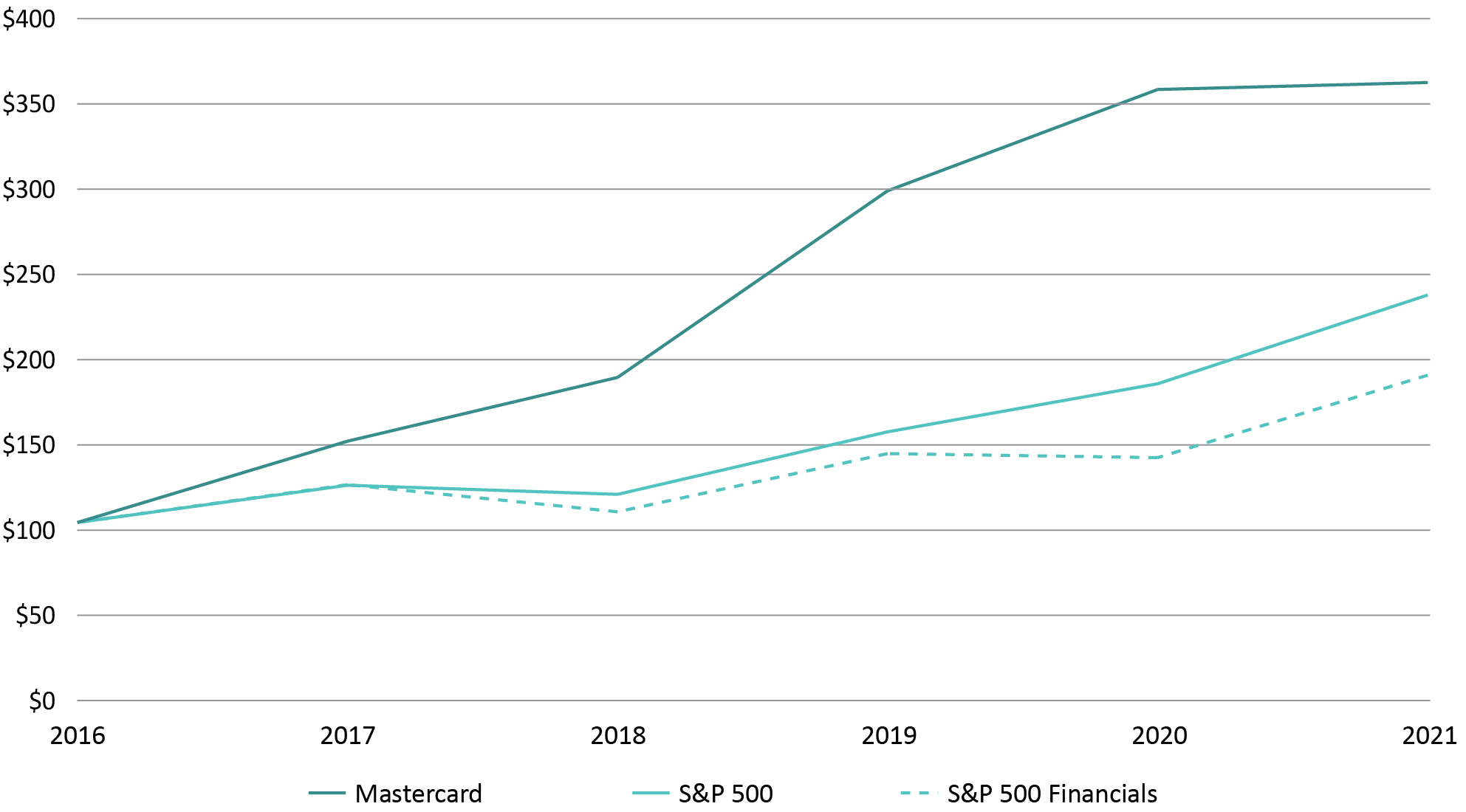
Total returns to stockholders for each of the years presented were as follows:
| Base period | Indexed Returns | |||||||||||||||||||||||||||||||||||||
| For the Years Ended December 31, | ||||||||||||||||||||||||||||||||||||||
| Company/Index | 2016 | 2017 | 2018 | 2019 | 2020 | 2021 | ||||||||||||||||||||||||||||||||
| Mastercard | $ | 100.00 | $ | 147.68 | $ | 185.07 | $ | 294.55 | $ | 353.98 | $ | 358.07 | ||||||||||||||||||||||||||
| S&P 500 | 100.00 | 121.83 | 116.49 | 153.17 | 181.35 | 233.41 | ||||||||||||||||||||||||||||||||
| S&P 500 Financials | 100.00 | 122.18 | 106.26 | 140.40 | 138.02 | 186.38 |
42 MASTERCARD 2021 FORM 10-K
PART II
Item 5. MARKET FOR REGISTRANT'S COMMON EQUITY, RELATED STOCKHOLDER MATTERS AND ISSUES PURCHASES OF EQUITY SECURITIES
Dividend Declaration and Policy
On November 30, 2021, our Board of Directors declared a quarterly cash dividend of $0.49 per share paid on February 9, 2022 to holders of record on January 7, 2022 of our Class A common stock and Class B common stock. On February 8, 2022, our Board of Directors declared a quarterly cash dividend of $0.49 per share payable on May 9, 2022 to holders of record on April 8, 2022 of our Class A common stock and Class B common stock.
Subject to legally available funds, we intend to continue to pay a quarterly cash dividend on our outstanding Class A common stock and Class B common stock. However, the declaration and payment of future dividends is at the sole discretion of our Board of Directors after taking into account various factors, including our financial condition, operating results, available cash and current and anticipated cash needs.
Issuer Purchases of Equity Securities
During the fourth quarter of 2021, we repurchased a total of 3.7 million shares for $1.3 billion at an average price of $342.86 per share of Class A common stock. See Note 16 (Stockholders' Equity) to the consolidated financial statements included in Part II, Item 8 for further discussion with respect to our share repurchase programs. The following table presents our repurchase activity on a cash basis during the fourth quarter of 2021:
| Period | Total Number of Shares Purchased | Average Price Paid per Share (including commission cost) | Total Number of Shares Purchased as Part of Publicly Announced Plans or Programs | Dollar Value of Shares that may yet be Purchased under the Plans or Programs 1 | ||||||||||||||||||||||
| October 1 – 31 | 1,282,075 | $ | 351.18 | 1,282,075 | $ | 4,752,404,601 | ||||||||||||||||||||
| November 1 – 30 | 1,126,537 | 340.52 | 1,126,537 | 12,368,795,391 | ||||||||||||||||||||||
| December 1 – 31 | 1,312,321 | 336.75 | 1,312,321 | 11,926,866,431 | ||||||||||||||||||||||
| Total | 3,720,933 | 342.86 | 3,720,933 |
1Dollar value of shares that may yet be purchased under the share repurchase programs is as of the end of the period.
2In November 2021 and December 2020, our Board of Directors approved share repurchase programs authorizing us to repurchase up to $8.0 billion and $6.0 billion respectively, of our Class A common stock under each plan.
Item 6. [Reserved]
MASTERCARD 2021 FORM 10-K 43
PART II
ITEM 7. MANAGEMENT’S DISCUSSION AND ANALYSIS OF FINANCIAL CONDITION AND RESULTS OF OPERATIONS
Item 7. Management’s discussion and analysis of financial condition and results of operations
The following discussion should be read in conjunction with the consolidated financial statements and notes of Mastercard Incorporated and its consolidated subsidiaries, including Mastercard International Incorporated (“Mastercard International”) (together, “Mastercard” or the “Company”), included elsewhere in this Report. Percentage changes provided throughout “Management’s Discussion and Analysis of Financial Condition and Results of Operations” were calculated on amounts rounded to the nearest thousand. For discussion related to the results of operations for the year ended December 31, 2020 compared to the year ended December 31, 2019, please see Part II, Item 7 of our Annual Report on Form 10-K for the year ended December 31, 2020.
Business Overview
Mastercard is a technology company in the global payments industry that connects consumers, financial institutions, merchants, governments, digital partners, businesses and other organizations worldwide, enabling them to use electronic forms of payment instead of cash and checks. We make payments easier and more efficient by providing a wide range of payment solutions and services using our family of well-known and trusted brands, including Mastercard®, Maestro® and Cirrus®. We operate a multi-rail payments network that provides choice and flexibility for consumers and merchants. Through our unique and proprietary core global payments network, we switch (authorize, clear and settle) payment transactions. We have additional payment capabilities that include automated clearing house (“ACH”) transactions (both batch and real-time account-based payments). Using these capabilities, we offer integrated payment products and services and capture new payment flows. Our value-added services include, among others, cyber and intelligence solutions to allow all parties to transact easily and with confidence, as well as other services that provide proprietary insights, drawing on our principled use of consumer and merchant data. Our franchise model sets the standards and ground-rules that balance value and risk across all stakeholders and allows for interoperability among them. Our payment solutions are designed to ensure safety and security for the global payments ecosystem.
Mastercard is not a financial institution. We do not issue cards, extend credit, determine or receive revenue from interest rates or other fees charged to account holders by issuers, or establish the rates charged by acquirers in connection with merchants’ acceptance of our products. In most cases, account holder relationships belong to, and are managed by, our customers.
COVID-19
In 2021, our growth rates, which are at various stages of recovery, increased as compared to the respective year ago period as consumer and business spend recovers and we lap the initial effects of the COVID-19 pandemic. The following tables provide a summary of trends in our key metrics for 2021 and 2020 as compared to the respective year ago periods:
| 2021 Quarter ended | Year ended December 31, 2021 | |||||||||||||||||||||||||||||||
| March 31 | June 30 | September 30 | December 31 | |||||||||||||||||||||||||||||
| Increase/(Decrease) | ||||||||||||||||||||||||||||||||
| Gross dollar volume (local currency basis) | 8 | % | 33 | % | 20 | % | 23 | % | 21 | % | ||||||||||||||||||||||
| Cross-border volume (local currency basis) | (17) | % | 58 | % | 52 | % | 53 | % | 32 | % | ||||||||||||||||||||||
| Switched transactions | 9 | % | 41 | % | 25 | % | 27 | % | 25 | % |
| 2020 Quarter ended | Year ended December 31, 2020 | |||||||||||||||||||||||||||||||
| March 31 | June 30 | September 30 | December 31 | |||||||||||||||||||||||||||||
| Increase/(Decrease) | ||||||||||||||||||||||||||||||||
| Gross dollar volume (local currency basis) | 8 | % | (10) | % | 1 | % | 1 | % | — | % | ||||||||||||||||||||||
| Cross-border volume (local currency basis) | (1) | % | (45) | % | (36) | % | (29) | % | (29) | % | ||||||||||||||||||||||
| Switched transactions | 13 | % | (10) | % | 5 | % | 4 | % | 3 | % |
The impact of the COVID-19 pandemic, which began in the first quarter of 2020, continues to have negative effects on the global economy. The pandemic has affected business activity, adversely impacting consumers, our customers, suppliers and business partners, as well as our workforce. Variants of the virus have emerged, resulting in a resurgence of infections that have affected regions at different times. New variants may emerge with similar results. The extent to which the resurgence and severity of infections has affected regions is impacted by the ongoing global administration of vaccines and the availability of therapeutic
44 MASTERCARD 2021 FORM 10-K
PART II
ITEM 7. MANAGEMENT’S DISCUSSION AND ANALYSIS OF FINANCIAL CONDITION AND RESULTS OF OPERATIONS
treatments in those locations. Governments, businesses and consumers continue to react to the changing conditions, tightening or loosening safety measures or voluntarily making personal safety decisions, as applicable, based on the current environment of their location.
We continue to monitor the effects of the pandemic and the related impact on our business. The full extent to which the pandemic, and measures and actions taken by stakeholders in response, affect our business, results of operations and financial condition will depend on future developments, including the duration of the pandemic and its impact on the global economy, which are uncertain, and cannot be predicted at this time.
Financial Results Overview
The following table provides a summary of our key GAAP operating results, as reported:
| Year ended December 31, | 2021 Increase/ (Decrease) | 2020 Increase/ (Decrease) | ||||||||||||||||||||||||||||||
| 2021 | 2020 | 2019 | ||||||||||||||||||||||||||||||
| ($ in millions, except per share data) | ||||||||||||||||||||||||||||||||
| Net revenue | $ | 18,884 | $ | 15,301 | $ | 16,883 | 23% | (9)% | ||||||||||||||||||||||||
| Operating expenses | $ | 8,802 | $ | 7,220 | $ | 7,219 | 22% | —% | ||||||||||||||||||||||||
| Operating income | $ | 10,082 | $ | 8,081 | $ | 9,664 | 25% | (16)% | ||||||||||||||||||||||||
| Operating margin | 53.4 | % | 52.8 | % | 57.2 | % | 0.6 ppt | (4.4) ppt | ||||||||||||||||||||||||
| Income tax expense | $ | 1,620 | $ | 1,349 | $ | 1,613 | 20% | (16)% | ||||||||||||||||||||||||
| Effective income tax rate | 15.7 | % | 17.4 | % | 16.6 | % | (1.7) ppt | 0.8 ppt | ||||||||||||||||||||||||
| Net income | $ | 8,687 | $ | 6,411 | $ | 8,118 | 35% | (21)% | ||||||||||||||||||||||||
| Diluted earnings per share | $ | 8.76 | $ | 6.37 | $ | 7.94 | 38% | (20)% | ||||||||||||||||||||||||
| Diluted weighted-average shares outstanding | 992 | 1,006 | 1,022 | (1)% | (2)% |
The following table provides a summary of our key non-GAAP operating results1, adjusted to exclude the impact of gains and losses on our equity investments, Special Items (which represent litigation judgments and settlements and certain one-time items) and the related tax impacts on our non-GAAP adjustments. In addition, we have presented growth rates, adjusted for the impact of currency:
| Year ended December 31, | 2021 Increase/(Decrease) | 2020 Increase/(Decrease) | ||||||||||||||||||||||||||||||||||||||||||
| 2021 | 2020 | 2019 | As adjusted | Currency-neutral | As adjusted | Currency-neutral | ||||||||||||||||||||||||||||||||||||||
| ($ in millions, except per share data) | ||||||||||||||||||||||||||||||||||||||||||||
| Net revenue | $ | 18,884 | $ | 15,301 | $ | 16,883 | 23% | 22% | (9)% | (8)% | ||||||||||||||||||||||||||||||||||
| Adjusted operating expenses | $ | 8,627 | $ | 7,147 | $ | 7,219 | 21% | 19% | (1)% | (1)% | ||||||||||||||||||||||||||||||||||
| Adjusted operating margin | 54.3 | % | 53.3 | % | 57.2 | % | 1.0 ppt | 1.2 ppt | (4.0) ppt | (3.7) ppt | ||||||||||||||||||||||||||||||||||
| Adjusted effective income tax rate | 15.4 | % | 17.2 | % | 17.0 | % | (1.8) ppt | (1.8) ppt | 0.2 ppt | 0.3 ppt | ||||||||||||||||||||||||||||||||||
| Adjusted net income | $ | 8,333 | $ | 6,463 | $ | 7,937 | 29% | 28% | (19)% | (17)% | ||||||||||||||||||||||||||||||||||
| Adjusted diluted earnings per share | $ | 8.40 | $ | 6.43 | $ | 7.77 | 31% | 30% | (17)% | (16)% |
Note: Tables may not sum due to rounding.
1 See “Non-GAAP Financial Information” for further information on our non-GAAP adjustments and the reconciliation to GAAP reported amounts.
MASTERCARD 2021 FORM 10-K 45
PART II
ITEM 7. MANAGEMENT’S DISCUSSION AND ANALYSIS OF FINANCIAL CONDITION AND RESULTS OF OPERATIONS
Key highlights for 2021 as compared to 2020 were as follows:
| Net revenue | |||||||||||
| GAAP | Non-GAAP (currency-neutral) | Net revenue increased 22% on a currency-neutral basis, which includes 2 percentage points of growth from acquisitions. The remaining increase was primarily due to: | |||||||||
| up 23% | up 22% | ||||||||||
| - Gross dollar volume growth of 21% on a local currency basis | |||||||||||
| - Cross-border volume growth of 32% on a local currency basis | |||||||||||
| - Switched transactions growth of 25% | |||||||||||
| - Other revenues increased 32%, or 31% on a currency-neutral basis, which | |||||||||||
| includes 8 percentage points of growth due to acquisitions. The remaining growth | |||||||||||
| was driven primarily by our Cyber & Intelligence and Data & Services solutions. | |||||||||||
| These increases to net revenue were partially offset by: | |||||||||||
| - Rebates and incentives growth of 32%, or 31% on a currency-neutral basis, | |||||||||||
| primarily due to increased volumes and transactions and new and renewed deals. |
| Operating expenses | Adjusted operating expenses | ||||||||||
| GAAP | Non-GAAP (currency-neutral) | Adjusted operating expenses increased 19% on a currency-neutral basis, which includes 7 percentage points of growth due to acquisitions. The remaining increase was primarily due to higher personnel costs, increased spending on advertising and marketing and increased data processing costs. | |||||||||
| up 22% | up 19% | ||||||||||
| Effective income tax rate | Adjusted effective income tax rate | ||||||||||
| GAAP | Non-GAAP (currency-neutral) | The adjusted effective income tax rate of 15.4% was lower than prior year, primarily due to the recognition of U.S. tax benefits, the majority of which were discrete, resulting from a higher foreign derived intangible income deduction and greater utilization of foreign tax credits in the U.S. In addition, a more favorable geographic mix of earnings in 2021 contributed to our lower effective tax rate. These benefits were partially offset by a lower discrete tax benefit related to share-based payments in 2021. | |||||||||
| 15.7% | 15.4% | ||||||||||
Other 2021 financial highlights were as follows:
-
We generated net cash flows from operations of $9.5 billion.
-
We completed the acquisitions of businesses for total consideration of $4.7 billion.
-
We repurchased 16.5 million shares of our common stock for $5.9 billion and paid dividends of $1.7 billion.
-
We completed debt offerings for an aggregate principal amount of $2.1 billion.
Non-GAAP Financial Information
Non-GAAP financial information is defined as a numerical measure of a company’s performance that excludes or includes amounts so as to be different than the most comparable measure calculated and presented in accordance with accounting principles generally accepted in the United States (“GAAP”). Our non-GAAP financial measures exclude the impact of gains and losses on our equity investments which includes mark-to-market fair value adjustments, impairments and gains and losses upon disposition and the related tax impacts. Our non-GAAP financial measures also exclude the impact of special items, where applicable, which represent litigation judgments and settlements and certain one-time items, as well as the related tax impacts (“Special Items”). Our non-GAAP financial measures for the comparable periods exclude the impact of the following:
Gains and Losses on Equity Investments
- During 2021, 2020 and 2019, we recorded net gains of $645 million ($497 million after tax, or $0.50 per diluted share), $30 million ($15 million after tax, or $0.01 per diluted share) and $167 million ($124 million after tax, or $0.12 per diluted share), respectively. These net gains were primarily related to unrealized fair market value adjustments on marketable and nonmarketable equity securities. In addition, in 2021, net gains also included realized gains on sales of marketable equity securities.
46 MASTERCARD 2021 FORM 10-K
PART II
ITEM 7. MANAGEMENT’S DISCUSSION AND ANALYSIS OF FINANCIAL CONDITION AND RESULTS OF OPERATIONS
Special Items
Litigation provisions
-
During 2021, we recorded pre-tax charges of $94 million ($74 million after tax, or $0.07 per diluted share) related to litigation settlements and estimated attorneys’ fees with U.K. and Pan-European merchants.
-
During 2020, we recorded pre-tax charges of $73 million ($67 million after tax, or $0.07 per diluted share) related to litigation provisions which included pre-tax charges of:
◦$45 million related to a legal matter associated with our prepaid cards in the U.K., and
◦$28 million related to estimated attorneys’ fees and litigation settlements with U.K. and Pan-European merchants.
Indirect tax matter
- During 2021, we recorded a pre-tax charge of $88 million ($69 million after tax, or $0.07 per diluted share) to resolve a foreign indirect tax matter for 2015 through the current period and the related interest.
Tax act
- During 2019, we recorded a $57 million net tax benefit ($0.06 per diluted share), which included a $30 million benefit related to a reduction to the 2017 one-time deemed repatriation tax on accumulated foreign earnings (the transition tax) resulting from final tax regulations issued in 2019 and a $27 million benefit related to additional foreign tax credits which can be carried back under transition rules.
See Note 7 (Investments), Note 20 (Income Taxes) and Note 21 (Legal and Regulatory Proceedings) to the consolidated financial statements included in Part II, Item 8 for further discussion. We excluded these items because management evaluates the underlying operations and performance of the Company separately from these recurring and non-recurring items.
We believe that the non-GAAP financial measures presented facilitate an understanding of our operating performance and provide a meaningful comparison of our results between periods. We use non-GAAP financial measures to, among other things, evaluate our ongoing operations in relation to historical results, for internal planning and forecasting purposes and in the calculation of performance-based compensation.
Currency-neutral Growth Rates
We present growth rates adjusted for the impact of currency, which is a non-GAAP financial measure. Currency-neutral growth rates are calculated by remeasuring the prior period’s results using the current period’s exchange rates for both the translational and transactional impacts on operating results. The impact of currency translation represents the effect of translating operating results where the functional currency is different than our U.S. dollar reporting currency. The impact of the transactional currency represents the effect of converting revenue and expenses occurring in a currency other than the functional currency of the entity. The impact of the related realized gains and losses resulting from our foreign exchange derivative contracts designated as cash flow hedging instruments is recognized in the respective financial statement line item on the statement of operations when the underlying forecasted transactions impact earnings. We believe the presentation of currency-neutral growth rates provides relevant information to facilitate an understanding of our operating results.
The translational and transactional impact of currency and the related impact of our foreign exchange derivative contracts designated as cash flow hedging instruments (“Currency impact”) has been excluded from our currency-neutral growth rates and has been identified in our drivers of change impact tables. See “Foreign Currency - Currency Impact” for further information on our currency impacts and “Financial Results - Revenue and Operating Expenses” for our drivers of change impact tables.
Net revenue, operating expenses, operating margin, other income (expense), effective income tax rate, net income and diluted earnings per share adjusted for the impact of gains and losses on our equity investments, Special Items and/or the impact of currency, are non-GAAP financial measures and should not be relied upon as substitutes for measures calculated in accordance with GAAP.
MASTERCARD 2021 FORM 10-K 47
PART II
ITEM 7. MANAGEMENT’S DISCUSSION AND ANALYSIS OF FINANCIAL CONDITION AND RESULTS OF OPERATIONS
The following tables reconcile our reported financial measures calculated in accordance with GAAP to the respective non-GAAP adjusted financial measures:
| Year ended December 31, 2021 | ||||||||||||||||||||||||||||||||||||||
| Operating expenses | Operating margin | Other income (expense) | Effective income tax rate | Net income | Diluted earnings per share | |||||||||||||||||||||||||||||||||
| ($ in millions, except per share data) | ||||||||||||||||||||||||||||||||||||||
| Reported - GAAP | $ | 8,802 | 53.4 | % | $ | 225 | 15.7 | % | $ | 8,687 | $ | 8.76 | ||||||||||||||||||||||||||
| (Gains) losses on equity investments | ** | ** | (645) | (0.5) | % | (497) | (0.50) | |||||||||||||||||||||||||||||||
| Litigation provisions | (94) | 0.5 | % | ** | 0.1 | % | 74 | 0.07 | ||||||||||||||||||||||||||||||
| Indirect tax matter | (82) | 0.4 | % | 6 | 0.1 | % | 69 | 0.07 | ||||||||||||||||||||||||||||||
| Non-GAAP | $ | 8,627 | 54.3 | % | $ | (413) | 15.4 | % | $ | 8,333 | $ | 8.40 |
| Year ended December 31, 2020 | ||||||||||||||||||||||||||||||||||||||
| Operating expenses | Operating margin | Other income (expense) | Effective income tax rate | Net income | Diluted earnings per share | |||||||||||||||||||||||||||||||||
| ($ in millions, except per share data) | ||||||||||||||||||||||||||||||||||||||
| Reported - GAAP | $ | 7,220 | 52.8 | % | $ | (321) | 17.4 | % | $ | 6,411 | $ | 6.37 | ||||||||||||||||||||||||||
| (Gains) losses on equity investments | ** | ** | (30) | (0.1) | % | (15) | (0.01) | |||||||||||||||||||||||||||||||
| Litigation provisions | (73) | 0.5 | % | ** | (0.1) | % | 67 | 0.07 | ||||||||||||||||||||||||||||||
| Non-GAAP | $ | 7,147 | 53.3 | % | $ | (351) | 17.2 | % | $ | 6,463 | $ | 6.43 |
| Year ended December 31, 2019 | ||||||||||||||||||||||||||||||||||||||
| Operating expenses | Operating margin | Other income (expense) | Effective income tax rate | Net income | Diluted earnings per share | |||||||||||||||||||||||||||||||||
| ($ in millions, except per share data) | ||||||||||||||||||||||||||||||||||||||
| Reported - GAAP | $ | 7,219 | 57.2 | % | $ | 67 | 16.6 | % | $ | 8,118 | 7.94 | |||||||||||||||||||||||||||
| (Gains) losses on equity investments | ** | ** | (167) | (0.2) | % | (124) | (0.12) | |||||||||||||||||||||||||||||||
| Tax act | ** | ** | ** | 0.6 | % | (57) | (0.06) | |||||||||||||||||||||||||||||||
| Non-GAAP | $ | 7,219 | 57.2 | % | $ | (100) | 17.0 | % | $ | 7,937 | $ | 7.77 |
Note: Tables may not sum due to rounding.
** Not applicable
48 MASTERCARD 2021 FORM 10-K
PART II
ITEM 7. MANAGEMENT’S DISCUSSION AND ANALYSIS OF FINANCIAL CONDITION AND RESULTS OF OPERATIONS
The following tables represent the reconciliation of our growth rates reported under GAAP to our non-GAAP growth rates:
| Year Ended December 31, 2021 as compared to the Year Ended December 31, 2020 | ||||||||||||||||||||||||||||||||||||||
| Increase/(Decrease) | ||||||||||||||||||||||||||||||||||||||
| Net revenue | Operating expenses | Operating margin | Effective income tax rate | Net income | Diluted earnings per share | |||||||||||||||||||||||||||||||||
| Reported - GAAP | 23 | % | 22 | % | 0.6 | ppt | (1.7) | ppt | 35 | % | 38 | % | ||||||||||||||||||||||||||
| (Gains) losses on equity investments | ** | ** | ** | (0.4) ppt | (7) | % | (8) | % | ||||||||||||||||||||||||||||||
| Litigation provisions | ** | — | % | — | ppt | 0.1 ppt | — | % | — | % | ||||||||||||||||||||||||||||
| Indirect tax matter | ** | (1) | % | 0.4 ppt | 0.1 ppt | 1 | % | 1 | % | |||||||||||||||||||||||||||||
| Non-GAAP | 23 | % | 21 | % | 1.0 | ppt | (1.8) ppt | 29 | % | 31 | % | |||||||||||||||||||||||||||
| Currency impact 1 | (1) | % | (2) | % | 0.2 | ppt | — ppt | (1) | % | (1) | % | |||||||||||||||||||||||||||
| Non-GAAP - currency-neutral | 22 | % | 19 | % | 1.2 | ppt | (1.8) ppt | 28 | % | 30 | % |
| Year Ended December 31, 2020 as compared to the Year Ended December 31, 2019 | ||||||||||||||||||||||||||||||||||||||
| Increase/(Decrease) | ||||||||||||||||||||||||||||||||||||||
| Net revenue | Operating expenses | Operating margin | Effective income tax rate | Net income | Diluted earnings per share | |||||||||||||||||||||||||||||||||
| Reported - GAAP | (9) | % | — | % | (4.4) | ppt | 0.8 | ppt | (21) | % | (20) | % | ||||||||||||||||||||||||||
| (Gains) losses on equity investments | ** | ** | ** | — ppt | 1 | % | 1 | % | ||||||||||||||||||||||||||||||
| Litigation provisions | ** | (1) | % | 0.5 ppt | (0.1) ppt | 1 | % | 1 | % | |||||||||||||||||||||||||||||
| Tax act | ** | ** | ** | (0.6) ppt | 1 | % | 1 | % | ||||||||||||||||||||||||||||||
| Non-GAAP | (9) | % | (1) | % | (4.0) ppt | 0.2 ppt | (19) | % | (17) | % | ||||||||||||||||||||||||||||
| Currency impact 1 | 1 | % | — | % | 0.3 ppt | 0.2 ppt | 1 | % | 1 | % | ||||||||||||||||||||||||||||
| Non-GAAP - currency-neutral | (8) | % | (1) | % | (3.7) ppt | 0.3 ppt | (17) | % | (16) | % |
Note: Tables may not sum due to rounding.
** Not applicable
1See “Non-GAAP Financial Information” for further information on Currency impact.
Key Metrics
In addition to the financial measures described above in “Financial Results Overview”, we review the following metrics to evaluate and identify trends in our business, measure our performance, prepare financial projections and make strategic decisions. We believe that the key metrics presented facilitate an understanding of our operating and financial performance and provide a meaningful comparison of our results between periods.
**Gross Dollar Volume (“GDV”)**1 measures dollar volume of activity on cards carrying our brands during the period, on a local currency basis and U.S. dollar-converted basis. GDV represents purchase volume plus cash volume and includes the impact of balance transfers and convenience checks; “purchase volume” means the aggregate dollar amount of purchases made with Mastercard-branded cards for the relevant period; and “cash volume” means the aggregate dollar amount of cash disbursements and includes the impact of balance transfers and convenience checks obtained with Mastercard-branded cards for the relevant period. Information denominated in U.S. dollars relating to GDV is calculated by applying an established U.S. dollar/local currency exchange rate for each local currency in which our volumes are reported. These exchange rates are calculated on a quarterly basis using the average exchange rate for each quarter. We report period-over-period rates of change in purchase volume and cash volume on the basis of local currency information, in order to eliminate the impact of changes in the value of currencies against the U.S. dollar in calculating such rates of change.
Cross-border Volume2 measures cross-border dollar volume initiated and switched through our network during the period, on a local currency basis and U.S. dollar-converted basis, for all Mastercard-branded programs.
Switched Transactions2 measures the number of transactions switched by Mastercard, which is defined as the number of transactions initiated and switched through our network during the period.
MASTERCARD 2021 FORM 10-K 49
PART II
ITEM 7. MANAGEMENT’S DISCUSSION AND ANALYSIS OF FINANCIAL CONDITION AND RESULTS OF OPERATIONS
Operating Margin measures how much profit we make on each dollar of sales after our operating costs but before other income (expense) and income tax expense. Operating margin is calculated by dividing our operating income by net revenue.
1 Data used in the calculation of GDV is provided by Mastercard customers and is subject to verification by Mastercard and partial cross-checking against information provided by Mastercard’s transaction switching systems. All data is subject to revision and amendment by Mastercard or Mastercard’s customers.
2 Growth rates are normalized to eliminate the effects of differing switching and carryover days between periods. Carryover days are those where transactions and volumes from days where the Company does not clear and settle are processed. In the fourth quarter of 2021, we began clearing and settling transactions and volumes on a daily basis.
Foreign Currency
Currency Impact
Our primary revenue functional currencies are the U.S. dollar, euro, Brazilian real and the British pound. Our overall operating results are impacted by currency translation, which represents the effect of translating operating results where the functional currency is different than our U.S. dollar reporting currency.
Our operating results are also impacted by transactional currency. The impact of the transactional currency represents the effect of converting revenue and expense transactions occurring in a currency other than the functional currency. Changes in currency exchange rates directly impact the calculation of gross dollar volume (“GDV”) and gross euro volume (“GEV”), which are used in the calculation of our domestic assessments, cross-border volume fees and certain volume-related rebates and incentives. In most non-European regions, GDV is calculated based on local currency spending volume converted to U.S. dollars using average exchange rates for the period. In Europe, GEV is calculated based on local currency spending volume converted to euros using average exchange rates for the period. As a result, certain of our domestic assessments, cross-border volume fees and volume-related rebates and incentives are impacted by the strengthening or weakening of the U.S. dollar versus non-European local currencies and the strengthening or weakening of the euro versus other European local currencies. For example, our billing in Australia is in the U.S. dollar, however, consumer spend in Australia is in the Australian dollar. The currency transactional impact of converting Australian dollars to our U.S. dollar billing currency will have an impact on the revenue generated. The strengthening or weakening of the U.S. dollar is evident when GDV growth on a U.S. dollar-converted basis is compared to GDV growth on a local currency basis. In 2021, GDV on a U.S. dollar-converted basis increased 21.9%, while GDV on a local currency basis increased 20.5% versus 2020. In 2020, GDV on a U.S. dollar-converted basis decreased 1.9%, while GDV on a local currency basis increased 0.1% versus 2019. Further, the impact from transactional currency occurs in transaction processing revenue, other revenue and operating expenses when the local currency of these items is different than the functional currency of the entity.
Through December 31, 2020, our approach to managing transactional currency exposure consisted of hedging a portion of anticipated revenues impacted by transactional currencies by entering into foreign exchange derivative contracts, and recording the related changes in fair value in general and administrative expenses on the consolidated statement of operations. During the first quarter of 2021, we started to formally designate certain newly-executed foreign exchange derivative contracts, which meet the established accounting criteria, as cash flow hedges. Gains and losses resulting from changes in fair value of these designated contracts are deferred in accumulated other comprehensive income (loss) and subsequently recognized in the respective component of net revenue when the underlying forecasted transactions impact earnings.
Foreign Exchange Activity
We incur foreign currency gains and losses from remeasuring monetary assets and liabilities, including settlement assets and obligations, that are denominated in a currency other than the functional currency of the entity. To manage this foreign exchange risk, we may enter into foreign exchange derivative contracts to economically hedge the foreign currency exposure of a portion of our nonfunctional monetary assets and liabilities. The gains or losses resulting from changes in fair value of these contracts are intended to reduce the potential effect of the underlying hedged exposure and are recorded net within general and administrative expenses on the consolidated statement of operations. The impact of this foreign exchange activity, including the related hedging activities, has not been eliminated in our currency-neutral results.
Our foreign exchange risk management activities are discussed further in Note 23 (Derivative and Hedging Instruments) to the consolidated financial statements included in Part II, Item 8.
Risk of Currency Devaluation
We are exposed to currency devaluation in certain countries. In addition, we are subject to exchange control regulations that restrict the conversion of financial assets into U.S. dollars. While these revenues and assets are not material to us on a consolidated basis, we can be negatively impacted should there be a continued and sustained devaluation of local currencies relative to the U.S. dollar and/or a continued and sustained deterioration of economic conditions in these countries.
50 MASTERCARD 2021 FORM 10-K
PART II
ITEM 7. MANAGEMENT’S DISCUSSION AND ANALYSIS OF FINANCIAL CONDITION AND RESULTS OF OPERATIONS
Financial Results
Revenue
Primary drivers of net revenue, versus the prior year, were as follows:
Gross revenue increased 26%, or 25% on a currency-neutral basis, which includes growth of 2 percentage points from acquisitions. The remaining increase was primarily driven by transaction and volume growth and an increase in our Cyber & Intelligence and Data & Services solutions within other revenue.
Rebates and incentives increased 32%, or 31% on a currency-neutral basis, primarily due to increased volumes and transactions and new and renewed deals.
Net revenue increased 23%, or 22% on a currency-neutral basis, and includes 2 percentage points of growth from acquisitions.
See Note 3 (Revenue) to the consolidated financial statements included in Part II, Item 8 for a further discussion of how we recognize revenue.
The components of net revenue were as follows:
| For the Years Ended December 31, | Increase (Decrease) | |||||||||||||||||||||||||||||||
| 2021 | 2020 | 2019 | 2021 | 2020 | ||||||||||||||||||||||||||||
| ($ in millions) | ||||||||||||||||||||||||||||||||
| Domestic assessments | $ | 8,158 | $ | 6,656 | $ | 6,781 | 23% | (2)% | ||||||||||||||||||||||||
| Cross-border volume fees | 4,664 | 3,512 | 5,606 | 33% | (37)% | |||||||||||||||||||||||||||
| Transaction processing | 10,799 | 8,731 | 8,469 | 24% | 3% | |||||||||||||||||||||||||||
| Other revenues | 6,224 | 4,717 | 4,124 | 32% | 14% | |||||||||||||||||||||||||||
| Gross revenue | 29,845 | 23,616 | 24,980 | 26% | (5)% | |||||||||||||||||||||||||||
| Rebates and incentives (contra-revenue) | (10,961) | (8,315) | (8,097) | 32% | 3% | |||||||||||||||||||||||||||
| Net revenue | $ | 18,884 | $ | 15,301 | $ | 16,883 | 23% | (9)% |
The following table summarizes the drivers of change in net revenue:
| For the Years Ended December 31, | ||||||||||||||||||||||||||||||||||||||||||||||||||||||||||||||
| Operational | Acquisitions | Currency Impact 3 | Total | |||||||||||||||||||||||||||||||||||||||||||||||||||||||||||
| 2021 | 2020 | 2021 | 2020 | 2021 | 2020 | 2021 | 2020 | |||||||||||||||||||||||||||||||||||||||||||||||||||||||
| Domestic assessments | 22% | 1 | 1% | 1 | —% | —% | —% | (3)% | 23 | % | (2) | % | ||||||||||||||||||||||||||||||||||||||||||||||||||
| Cross-border volume fees | 30% | 1 | (37)% | 1 | —% | —% | 3% | —% | 33 | % | (37) | % | ||||||||||||||||||||||||||||||||||||||||||||||||||
| Transaction processing | 22% | 1,2 | 3% | 1,2 | —% | —% | 1% | —% | 24 | % | 3 | % | ||||||||||||||||||||||||||||||||||||||||||||||||||
| Other revenues | 23% | 2 | 12% | 2 | 8% | 3% | 1% | (1)% | 32 | % | 14 | % | ||||||||||||||||||||||||||||||||||||||||||||||||||
| Rebates and incentives (contra-revenue) | 31% | 4% | —% | —% | 1% | (2)% | 32 | % | 3 | % | ||||||||||||||||||||||||||||||||||||||||||||||||||||
| Net revenue | 20% | (9)% | 2% | 1% | 1% | (1)% | 23 | % | (9) | % |
Note: Table may not sum due to rounding
1Includes impacts from our key metrics, other non-volume based fees, pricing and mix.
2Includes impacts from our cyber and intelligence solution fees, data analytics and consulting fees and other value-added services.
3Includes the translational and transactional impact of currency and the related impact of our foreign exchange derivative contracts designated as cash flow hedging instruments.
MASTERCARD 2021 FORM 10-K 51
PART II
ITEM 7. MANAGEMENT’S DISCUSSION AND ANALYSIS OF FINANCIAL CONDITION AND RESULTS OF OPERATIONS
The following tables provide a summary of the trend in volumes and transactions.
| For the Years Ended December 31, | ||||||||||||||||||||||||||
| 2021 | 2020 | |||||||||||||||||||||||||
| Increase/(Decrease) | ||||||||||||||||||||||||||
| USD | Local | USD | Local | |||||||||||||||||||||||
| Mastercard-branded GDV 1 | 22 | % | 21 | % | (2) | % | — | % | ||||||||||||||||||
| United States | 23 | % | 23 | % | 2 | % | 2 | % | ||||||||||||||||||
| Worldwide less United States | 22 | % | 20 | % | (4) | % | (1) | % | ||||||||||||||||||
| Cross-border volume 1 | 32 | % | (29) | % | ||||||||||||||||||||||
1Excludes volume generated by Maestro and Cirrus cards.
| For the Years Ended December 31, | ||||||||||||||
| Increase/(Decrease) | ||||||||||||||
| 2021 | 2020 | |||||||||||||
| Switched transactions | 25 | % | 3 | % |
No individual country, other than the United States, generated more than 10% of net revenue in any such period. A significant portion of our net revenue is concentrated among our five largest customers. In 2021, the net revenue from these customers was approximately $4.2 billion, or 23%, of total net revenue. The loss of any of these customers or their significant card programs could adversely impact our revenue.
Operating Expenses
Operating expenses increased 22% in 2021 versus the prior year. Adjusted operating expenses increased 21%, or 19% on a currency-neutral basis, versus the prior year. Current year results include growth of approximately 7 percentage points from acquisitions. Excluding acquisitions, expenses increased 12% primarily due to higher personnel costs to support our continued investment in our strategic initiatives, increased spending on advertising and marketing and increased data processing costs.
The components of operating expenses were as follows:
| For the Years Ended December 31, | Increase (Decrease) | |||||||||||||||||||||||||||||||
| 2021 | 2020 | 2019 | 2021 | 2020 | ||||||||||||||||||||||||||||
| ($ in millions) | ||||||||||||||||||||||||||||||||
| General and administrative | $ | 7,087 | $ | 5,910 | $ | 5,763 | 20 | % | 3 | % | ||||||||||||||||||||||
| Advertising and marketing | 895 | 657 | 934 | 36 | % | (30) | % | |||||||||||||||||||||||||
| Depreciation and amortization | 726 | 580 | 522 | 25 | % | 11 | % | |||||||||||||||||||||||||
| Provision for litigation | 94 | 73 | — | ** | ** | |||||||||||||||||||||||||||
| Total operating expenses | 8,802 | 7,220 | 7,219 | 22 | % | — | % | |||||||||||||||||||||||||
| Special Items 1 | (176) | (73) | — | ** | ** | |||||||||||||||||||||||||||
| Adjusted operating expenses (excluding Special Items 1) | $ | 8,627 | $ | 7,147 | $ | 7,219 | 21 | % | (1) | % |
Note: Table may not sum due to rounding.
** Not meaningful
1See “Non-GAAP Financial Information” for further information on our non-GAAP adjustments and the reconciliation to GAAP reported amounts.
52 MASTERCARD 2021 FORM 10-K
PART II
Item 7. MANAGEMENT’S DISCUSSION AND ANALYSIS OF FINANCIAL CONDITION AND RESULTS OF OPERATIONS
The following table summarizes the drivers of changes in operating expenses:
| For the Years Ended December 31, | ||||||||||||||||||||||||||||||||||||||||||||||||||||||||||||||
| Operational | Special Items 1 | Acquisitions | Currency Impact 2 | Total | ||||||||||||||||||||||||||||||||||||||||||||||||||||||||||
| 2021 | 2020 | 2021 | 2020 | 2021 | 2020 | 2021 | 2020 | 2021 | 2020 | |||||||||||||||||||||||||||||||||||||||||||||||||||||
| General and administrative | 11% | (1) | % | 1 | % | ** | 6 | % | 4 | % | 2 | % | — | % | 20 | % | 3 | % | ||||||||||||||||||||||||||||||||||||||||||||
| Advertising and marketing | 35% | (30) | % | ** | ** | 1 | % | — | % | 1 | % | (1) | % | 36 | % | (30) | % | |||||||||||||||||||||||||||||||||||||||||||||
| Depreciation and amortization | 3% | 5 | % | ** | ** | 20 | % | 6 | % | 2 | % | — | % | 25 | % | 11 | % | |||||||||||||||||||||||||||||||||||||||||||||
| Provision for litigation | ** | ** | ** | ** | ** | ** | ** | ** | ** | ** | ||||||||||||||||||||||||||||||||||||||||||||||||||||
| Total operating expenses | 12% | (5) | % | 1 | % | 1 | % | 7 | % | 4 | % | 2 | % | — | % | 22 | % | — | % |
Note: Table may not sum due to rounding.
** Not meaningful
1See “Non-GAAP Financial Information” for further information on our non-GAAP adjustments and the reconciliation to GAAP reported amounts.
2Represents the translational and transactional impact of currency.
General and Administrative
General and administrative expenses increased 20%, or 18% on a currency-neutral basis, in 2021 versus the prior year. Current year results include growth of 6 percentage points from acquisitions and 1 percentage point from Special Items. The remaining increase was primarily due to higher personnel costs to support our continued investment in our strategic initiatives and increased data processing costs.
The components of general and administrative expenses were as follows:
| For the Years Ended December 31, | Increase (Decrease) | |||||||||||||||||||||||||||||||
| 2021 | 2020 | 2019 | 2021 | 2020 | ||||||||||||||||||||||||||||
| ($ in millions) | ||||||||||||||||||||||||||||||||
| Personnel | $ | 4,489 | $ | 3,787 | $ | 3,537 | 19% | 7% | ||||||||||||||||||||||||
| Professional fees | 433 | 384 | 447 | 13% | (14)% | |||||||||||||||||||||||||||
| Data processing and telecommunications | 898 | 756 | 666 | 19% | 14% | |||||||||||||||||||||||||||
| Foreign exchange activity 1 | 51 | 9 | 32 | ** | ** | |||||||||||||||||||||||||||
| Other 2 | 1,216 | 974 | 1,081 | 25% | (10)% | |||||||||||||||||||||||||||
| Total general and administrative expenses | $ | 7,087 | $ | 5,910 | $ | 5,763 | 20% | 3% | ||||||||||||||||||||||||
Note: Table may not sum due to rounding.
** Not meaningful
1Foreign exchange activity includes gains and losses on foreign exchange derivative contracts and the impact of remeasurement of assets and liabilities denominated in foreign currencies. See Note 23 (Derivative and Hedging Instruments) to the consolidated financial statements included in Part II, Item 8 for further discussion.
2 Includes a special item related to a foreign indirect tax matter of $82 million, pre-tax, recorded during 2021. See “Non-GAAP Financial Information” for further information on our non-GAAP adjustments and the reconciliation to GAAP reported amounts.
Advertising and Marketing
Advertising and marketing expenses increased 36%, on both an as reported and currency-neutral basis, in 2021 versus the prior year, primarily due to an increase in spending on certain marketing campaigns and an increase in advertising and sponsorship spend driven by the reinstatement of sponsored events as the effects of the pandemic recede.
Depreciation and Amortization
Depreciation and amortization expenses increased 25%, or 23% on a currency-neutral basis, in 2021 versus the prior year, which includes growth of 20 percentage points from acquisitions due to the amortization of acquired intangible assets.
Provision for Litigation
In 2021 and 2020, we recorded $94 million and $73 million, respectively, related to various litigation settlements and legal costs. See Note 21 (Legal and Regulatory Proceedings) to the consolidated financial statements included in Part II, Item 8 for further discussion.
MASTERCARD 2021 FORM 10-K 53
PART II
ITEM 7. MANAGEMENT’S DISCUSSION AND ANALYSIS OF FINANCIAL CONDITION AND RESULTS OF OPERATIONS
Other Income (Expense)
Other income (expense) was favorable $546 million in 2021 versus the prior year, primarily due to higher net gains in the current period versus the prior period related to unrealized fair market value adjustments on marketable and nonmarketable equity securities and realized gains on sales of marketable equity securities. Adjusted other income (expense) was unfavorable $62 million versus the prior year, primarily due to increased interest expense related to our recent debt issuances and a decrease in our investment income.
The components of other income (expense) were as follows:
| For the Years Ended December 31, | Increase (Decrease) | |||||||||||||||||||||||||||||||
| 2021 | 2020 | 2019 | 2021 | 2020 | ||||||||||||||||||||||||||||
| ($ in millions) | ||||||||||||||||||||||||||||||||
| Investment Income | $ | 11 | $ | 24 | $ | 97 | (52) | % | (75) | % | ||||||||||||||||||||||
| Gains (losses) on equity investments, net | 645 | 30 | 167 | ** | ** | |||||||||||||||||||||||||||
| Interest expense | (431) | (380) | (224) | 13 | % | 70 | % | |||||||||||||||||||||||||
| Other income (expense), net | — | 5 | 27 | ** | ** | |||||||||||||||||||||||||||
| Total other income (expense) | 225 | (321) | 67 | ** | ** | |||||||||||||||||||||||||||
| (Gains) losses on equity investments 1 | (645) | (30) | (167) | ** | ** | |||||||||||||||||||||||||||
| Special Items 1 | 6 | — | — | ** | ** | |||||||||||||||||||||||||||
| Adjusted total other income (expense) 1 | $ | (413) | $ | (351) | $ | (100) | 18 | % | ** |
Note: Table may not sum due to rounding.
** Not meaningful
1 See “Non-GAAP Financial Information” for further information on our non-GAAP adjustments and the reconciliation to GAAP reported amounts.
Income Taxes
The effective income tax rates for the years ended December 31, 2021 and 2020 were 15.7% and 17.4%, respectively. The adjusted effective income tax rates for the years ended December 31, 2021 and 2020 were 15.4% and 17.2%, respectively. Both the as reported and as adjusted effective income tax rates in 2021 were lower than the prior year, primarily due to the recognition of U.S. tax benefits, the majority of which were discrete, resulting from a higher foreign derived intangible income deduction and greater utilization of foreign tax credits in the U.S. In addition, a more favorable geographic mix of earnings in 2021 contributed to our lower effective tax rates. These benefits were partially offset by a lower discrete tax benefit related to share-based payments in 2021.
See Note 20 (Income Taxes) to the consolidated financial statements included in Part II, Item 8 for further discussion.
Liquidity and Capital Resources
We rely on existing liquidity, cash generated from operations and access to capital to fund our global operations, credit and settlement exposure, capital expenditures, investments in our business and current and potential obligations. The following table summarizes the cash, cash equivalents, investments and credit available to us at December 31:
| 2021 | 2020 | |||||||||||||
| (in billions) | ||||||||||||||
| Cash, cash equivalents and investments 1 | $ | 7.9 | $ | 10.6 | ||||||||||
| Unused line of credit | 6.0 | 6.0 |
1Investments include available-for-sale securities and held-to-maturity securities. This amount excludes restricted cash and restricted cash equivalents of $2.5 billion and $2.3 billion at December 31, 2021 and 2020, respectively.
We believe that our existing cash, cash equivalents and investment securities balances, our cash flow generating capabilities, and our access to capital resources are sufficient to satisfy our future operating cash needs, capital asset purchases, outstanding commitments and other liquidity requirements associated with our existing operations and potential obligations which include litigation provisions and credit and settlement exposure.
Our liquidity and access to capital could be negatively impacted by global credit market conditions. We guarantee the settlement of many of the transactions between our customers. Historically, payments under these guarantees have not been significant;
54 MASTERCARD 2021 FORM 10-K
PART II
ITEM 7. MANAGEMENT’S DISCUSSION AND ANALYSIS OF FINANCIAL CONDITION AND RESULTS OF OPERATIONS
however, historical trends may not be an indication of potential future losses. The risk of loss on these guarantees is specific to individual customers, but may also be driven by regional or global economic conditions, including, but not limited to the health of the financial institutions in a country or region. See Note 22 (Settlement and Other Risk Management) to the consolidated financial statements in Part II, Item 8 for a description of these guarantees.
Our liquidity and access to capital could also be negatively impacted by the outcome of any of the legal or regulatory proceedings to which we are a party. For additional discussion of these and other risks facing our business, see Part I, Item 1A - Risk Factors - Legal and Regulatory Risks and Note 21 (Legal and Regulatory Proceedings) to the consolidated financial statements included in Part II, Item 8.
Cash Flow
The table below shows a summary of the cash flows from operating, investing and financing activities:
| For the Years Ended December 31, | ||||||||||||||||||||
| 2021 | 2020 | 2019 | ||||||||||||||||||
| (in millions) | ||||||||||||||||||||
| Net cash provided by operating activities | $ | 9,463 | $ | 7,224 | $ | 8,183 | ||||||||||||||
| Net cash used in investing activities | (5,272) | (1,879) | (1,640) | |||||||||||||||||
| Net cash used in financing activities | (6,555) | (2,152) | (5,867) |
Net cash provided by operating activities increased $2.2 billion in 2021 versus the prior year, primarily due to higher net income adjusted for non-cash items and the timing of customer incentive payments, partially offset by higher outstanding receivables in the current period due to increased volumes and timing of settlement with customers.
Net cash used in investing activities increased $3.4 billion in 2021 versus the prior year, primarily due to increased acquisition activity in the current year.
Net cash used in financing activities increased $4.4 billion in 2021 versus the prior year, primarily due to lower proceeds from debt issuances, higher repurchases of our Class A common stock and repayment of debt in the current year.
Debt and Credit Availability
In March 2021, we issued $600 million principal amount of notes due March 2031 and $700 million principal amount of notes due March 2051 and in November 2021, we issued $750 million principal amount of notes due November 2031 (collectively the “2021 USD Notes”). Additionally, during 2021, $650 million of principal related to the 2016 USD Notes was redeemed. Our total debt outstanding was $13.9 billion at December 31, 2021, with the earliest maturity of €700 million (approximately $793 million as of December 31, 2021) of principal occurring in December 2022. The proceeds of the 2021 USD Notes due March 2031 are to be used to fund eligible green and social projects, examples of which are described in the Use of Proceeds section of the Prospectus Supplement filed on March 4, 2021. All other notes are to be used for general corporate purposes.
As of December 31, 2021, we have a commercial paper program (the “Commercial Paper Program”), under which we are authorized to issue up to $6 billion in outstanding notes, with maturities up to 397 days from the date of issuance. In conjunction with the Commercial Paper Program, we have a committed unsecured $6 billion revolving credit facility (the “Credit Facility”) which now expires in November 2026.
Borrowings under the Commercial Paper Program and the Credit Facility are to be used to provide liquidity for general corporate purposes, including providing liquidity in the event of one or more settlement failures by our customers. In addition, we may borrow and repay amounts under these facilities for business continuity purposes. We had no borrowings outstanding under the Commercial Paper Program or the Credit Facility at December 31, 2021.
See Note 15 (Debt) to the consolidated financial statements included in Part II, Item 8 for further discussion on our debt, the Commercial Paper Program and the Credit Facility.
Dividends and Share Repurchases
We have historically paid quarterly dividends on our outstanding Class A common stock and Class B common stock. Subject to legally available funds, we intend to continue to pay a quarterly cash dividend. The declaration and payment of future dividends is at the sole discretion of our Board of Directors after taking into account various factors, including our financial condition, operating results, available cash and current and anticipated cash needs.
MASTERCARD 2021 FORM 10-K 55
PART II
ITEM 7. MANAGEMENT’S DISCUSSION AND ANALYSIS OF FINANCIAL CONDITION AND RESULTS OF OPERATIONS
The following table summarizes the annual, per share dividends paid in the years reflected:
| For the Years Ended December 31, | ||||||||||||||||||||
| 2021 | 2020 | 2019 | ||||||||||||||||||
| (in millions, except per share data) | ||||||||||||||||||||
| Cash dividend, per share | $ | 1.76 | $ | 1.60 | $ | 1.32 | ||||||||||||||
| Cash dividends paid | $ | 1,741 | $ | 1,605 | $ | 1,345 |
On November 30, 2021, our Board of Directors declared a quarterly cash dividend of $0.49 per share paid on February 9, 2022 to holders of record on January 7, 2022 of our Class A common stock and Class B common stock. The aggregate amount of this dividend was $479 million.
On February 8, 2022, our Board of Directors declared a quarterly cash dividend of $0.49 per share payable on May 9, 2022 to holders of record on April 8, 2022 of our Class A common stock and Class B common stock. The aggregate amount of this dividend is estimated to be $479 million.
Repurchased shares of our common stock are considered treasury stock. In November 2021, December 2020 and December 2019, our Board of Directors approved share repurchase programs authorizing us to repurchase up to $8.0 billion, $6.0 billion and $8.0 billion, respectively, of our Class A common stock. The program approved in 2021 will become effective after completion of the share repurchase program approved in 2020. The timing and actual number of additional shares repurchased will depend on a variety of factors, including cash requirements to meet the operating needs of the business, legal requirements, as well as the share price and economic and market conditions. The following table summarizes our share repurchase activity of our Class A common stock through December 31, 2021, under the plans approved in 2020 and 2019:
| (in millions, except per share data) | ||||||||
| Remaining authorization at December 31, 2020 | $ | 9,831 | ||||||
| Dollar-value of shares repurchased in 2021 | $ | 5,904 | ||||||
| Remaining authorization at December 31, 2021 | $ | 11,927 | ||||||
| Shares repurchased in 2021 | 16.5 | |||||||
| Average price paid per share in 2021 | $ | 356.82 | ||||||
See Note 16 (Stockholders' Equity) to the consolidated financial statements included in Part II, Item 8 for further discussion.
Critical Accounting Estimates
The application of GAAP requires us to make estimates and assumptions about certain items and future events that directly affect our reported financial condition. Our significant accounting policies, including recent accounting pronouncements, are described in Note 1 (Summary of Significant Accounting Policies) to the consolidated financial statements included in Part II, Item 8.
Revenue Recognition - Rebates and Incentives
We enter into business agreements with certain customers that provide for rebates and incentives when customers meet certain volume thresholds or other incentives tied to customer performance. We consider various factors in estimating customer performance, including forecasted transactions, card issuance and card conversion volumes, expected payments and historical experience with that customer. Rebates and incentives are recorded as a reduction to gross revenue based on these estimates primarily when volume- and transaction- based revenues are recognized over the contractual term. Differences between actual results and our estimates are adjusted in the period the customer reports actual performance. If our customers’ actual performance is not consistent with our estimates of their performance, net revenue may be materially different.
56 MASTERCARD 2021 FORM 10-K
PART II
ITEM 7. MANAGEMENT’S DISCUSSION AND ANALYSIS OF FINANCIAL CONDITION AND RESULTS OF OPERATIONS
Loss Contingencies
We are currently involved in various claims and legal proceedings. We regularly review the status of each significant matter and assess its potential financial exposure. If the potential loss from any claim or legal proceeding is considered probable and the amount can be reasonably estimated, we accrue a liability for the estimated loss. Significant judgment is required in both the determination of probability and whether an exposure is reasonably estimable. Our judgments are subjective based on the status of the legal or regulatory proceedings, the merits of our defenses and consultation with in-house and outside legal counsel. Because of uncertainties related to these matters, accruals are based only on the best information available at the time. As additional information becomes available, we reassess the potential liability related to pending claims and litigation and may revise our estimates. Due to the inherent uncertainties of the legal and regulatory process in the multiple jurisdictions in which we operate, our judgments may be materially different than the actual outcomes.
Income Taxes
In calculating our effective income tax rate, estimates are required regarding the timing and amount of taxable and deductible items which will adjust the pretax income earned in various tax jurisdictions. Through our interpretation of local tax regulations, adjustments to pretax income for income earned in various tax jurisdictions are reflected within various tax filings. Although we believe that our estimates and judgments discussed herein are reasonable, actual results may be materially different than the estimated amounts.
We record a valuation allowance to reduce our deferred tax assets to the amount that is more likely than not to be realized. Significant judgment is required in determining the valuation allowance. In assessing the need for a valuation allowance, we consider all sources of taxable income, including projected future taxable income, reversing taxable temporary differences and ongoing tax planning strategies. If it is determined that we are able to realize deferred tax assets in excess of the net carrying value or to the extent we are unable to realize a deferred tax asset, we would adjust the valuation allowance in the period in which such a determination is made, with a corresponding increase or decrease to earnings.
We record tax liabilities for uncertain tax positions taken, or expected to be taken, which may not be sustained or may only be partially sustained, upon examination by the relevant taxing authorities. We consider all relevant facts and current authorities in the tax law in assessing whether any benefit resulting from an uncertain tax position is more likely than not to be sustained and, if so, how current law impacts the amount reflected within these financial statements. If upon examination, we realize a tax benefit which is not fully sustained or is more favorably sustained, this would decrease or increase earnings in the period. In certain situations, we will have offsetting tax credits or taxes in other jurisdictions.
Deferred taxes are established on the estimated foreign exchange gains or losses for foreign earnings that are not considered permanently reinvested, which will be recognized through cumulative translation adjustments as incurred. Ultimately, the working capital requirements of foreign affiliates will determine the amount of cash to be remitted from respective jurisdictions.
Business Combinations
We account for our business combinations using the acquisition method of accounting. The acquisition purchase price, including contingent consideration, if any, is allocated to the underlying identified, tangible and intangible assets, liabilities assumed and any non-controlling interest in the acquiree, based on their respective estimated fair values on the acquisition date. Any excess of purchase price over the fair value of net assets acquired, including identifiable intangible assets, is recorded as goodwill. The amounts and useful lives assigned to acquisition-related tangible and intangible assets impact the amount and timing of future amortization expense. We use various valuation techniques to determine fair value, primarily discounted cash flows analysis, relief-from-royalty and multi-period excess earnings for estimating the value of intangible assets. These valuation techniques included comparable company multiples, discount rates, growth projections and other assumptions of future business conditions. Determining the fair value of assets acquired, liabilities assumed, any non-controlling interest in the acquiree and the expected useful lives, requires management’s judgment. The significance of management’s estimates and assumptions is relative to the size of the acquisition. Our estimates are based upon assumptions believed to be reasonable, but which are inherently uncertain and unpredictable.
MASTERCARD 2021 FORM 10-K 57
PART II
ITEM 7A. QUANTITATIVE AND QUALITATIVE DISCLOSURES ABOUT MARKET RISK
Item 7A. Quantitative and qualitative disclosures about market risk
Market risk is the potential for economic losses to be incurred on market risk sensitive instruments arising from adverse changes in factors such as interest rates and foreign currency exchange rates. Our exposure to market risk from changes in interest rates and foreign exchange rates is limited. Management monitors risk exposures on an ongoing basis and establishes and oversees the implementation of policies governing our funding, investments and use of derivative financial instruments to manage these risks.
Foreign currency and interest rate exposures are managed through our risk management activities, which are discussed further in Note 23 (Derivative and Hedging Instruments) to the consolidated financial statements included in Part II, Item 8.
Foreign Exchange Risk
We enter into foreign exchange derivative contracts to manage currency exposure associated with anticipated receipts and disbursements occurring in a currency other than the functional currency of the entity. We may also enter into foreign currency derivative contracts to offset possible changes in value of assets and liabilities due to foreign exchange fluctuations. The objective of these activities is to reduce our exposure to transaction gains and losses resulting from fluctuations of foreign currencies against our functional currencies, principally the U.S. dollar and euro. The effect of a hypothetical 10% adverse change in the value of the functional currencies could result in a fair value loss of approximately $70 million and $58 million on our foreign exchange derivative contracts outstanding at December 31, 2021 and 2020, respectively, before considering the offsetting effect of the underlying hedged activity.
We are also subject to foreign exchange risk as part of our daily settlement activities. To manage this risk, we enter into short duration foreign exchange contracts based upon anticipated receipts and disbursements for the respective currency position. This risk is typically limited to a few days between when a payment transaction takes place and the subsequent settlement with our customers. The effect of a hypothetical 10% adverse change in the value of the functional currencies could result in a fair value loss of approximately $1 million and $23 million on our short duration foreign exchange derivative contracts outstanding at December 31, 2021 and 2020, respectively.
We are further exposed to foreign exchange rate risk related to translation of our foreign operating results where the functional currency is different than our U.S. dollar reporting currency. To manage this risk, we may enter into foreign exchange derivative contracts to hedge a portion of our net investment in foreign subsidiaries. The effect of a hypothetical 10% adverse change in the value of the U.S. dollar could result in a fair value loss of approximately $165 million on our foreign exchange derivative contracts designated as a net investment hedge at December 31, 2021, before considering the offsetting effect of the underlying hedged activity. We did not have similar foreign exchange derivative contracts outstanding as of December 31, 2020.
Interest Rate Risk
Our available-for-sale debt investments include fixed and variable rate securities that are sensitive to interest rate fluctuations. Our policy is to invest in high quality securities, while providing adequate liquidity and maintaining diversification to avoid significant exposure. A hypothetical 100 basis point adverse change in interest rates would not have a material impact to the fair value of our investments at December 31, 2021 and 2020.
We are also exposed to interest rate risk related to our fixed-rate debt. To manage this risk, we may enter into interest rate derivative contracts to hedge a portion of our fixed-rate debt that is exposed to changes in fair value attributable to changes in a benchmark interest rate. The effect of a hypothetical 100 basis point adverse change in interest rates could result in a fair value loss of $49 million on our interest rate derivative contracts designated as a fair value hedge of our fixed-rate debt at December 31, 2021, before considering the offsetting effect of the underlying hedged activity. We did not have similar interest rate derivative contracts outstanding as of December 31, 2020.
58 MASTERCARD 2021 FORM 10-K
PART II
ITEM 8. FINANCIAL STATEMENTS AND SUPPLEMENTARY DATA
Item 8. Financial statements and supplementary data
Mastercard Incorporated
Index to consolidated financial statements
| Page | |||||||||||
| As of December 31, 2021 and 2020 and for the years ended December 31, 2021, 2020 and 2019 | |||||||||||
| Management’s report on internal control over financial reporting | 60 | ||||||||||
| Report of independent registered public accounting firm (PCAOB ID 238) | 61 | ||||||||||
| Consolidated Statement of Operations | 63 | ||||||||||
| Consolidated Statement of Comprehensive Income | 64 | ||||||||||
| Consolidated Balance Sheet | 65 | ||||||||||
| Consolidated Statement of Changes in Equity | 66 | ||||||||||
| Consolidated Statement of Cash Flows | 68 | ||||||||||
| Notes to consolidated financial statements | 69 |
MASTERCARD 2021 FORM 10-K 59
PART II
ITEM 8. FINANCIAL STATEMENTS AND SUPPLEMENTARY DATA
Management’s report on internal control over financial reporting
The management of Mastercard Incorporated (“Mastercard”) is responsible for establishing and maintaining adequate internal control over financial reporting. Internal control over financial reporting is a process designed to provide reasonable assurance regarding the reliability of financial reporting and the preparation of financial statements for external reporting purposes in accordance with accounting principles generally accepted in the United States of America. Because of its inherent limitations, internal control over financial reporting may not prevent or detect misstatements. As required by Section 404 of the Sarbanes-Oxley Act of 2002, management has assessed the effectiveness of Mastercard’s internal control over financial reporting as of December 31, 2021. In making its assessment, management has utilized the criteria set forth in Internal Control - Integrated Framework (2013) issued by the Committee of Sponsoring Organizations of the Treadway Commission (COSO). Management has concluded that, based on its assessment, Mastercard’s internal control over financial reporting was effective as of December 31, 2021. The effectiveness of Mastercard’s internal control over financial reporting as of December 31, 2021 has been audited by PricewaterhouseCoopers LLP, an independent registered public accounting firm, as stated in their report which appears on the next page.
60 MASTERCARD 2021 FORM 10-K
PART II
ITEM 8. FINANCIAL STATEMENTS AND SUPPLEMENTARY DATA
Report of Independent Registered Public Accounting Firm
To the Board of Directors and Stockholders of Mastercard Incorporated
*Opinions on the Financial Statements and I
Showing the first 8K of 125K characters. Open the full section
Item 8. FINANCIAL STATEMENTS AND SUPPLEMENTARY DATA - NOTES TO CONSOLIDATED FINANCIAL STATEMENTS
Financial Instruments - Recurring Measurements
The distribution of the Company’s financial instruments measured at fair value on a recurring basis within the Valuation Hierarchy were as follows:
| December 31, 2021 | December 31, 2020 | |||||||||||||||||||||||||||||||||||||||||||||||||
| Quoted Prices in Active Markets (Level 1) | Significant Other Observable Inputs (Level 2) | Significant Unobservable Inputs (Level 3) | Total | Quoted Prices in Active Markets (Level 1) | Significant Other Observable Inputs (Level 2) | Significant Unobservable Inputs (Level 3) | Total | |||||||||||||||||||||||||||||||||||||||||||
| (in millions) | ||||||||||||||||||||||||||||||||||||||||||||||||||
| Assets | ||||||||||||||||||||||||||||||||||||||||||||||||||
| Investment securities available-for-sale 1**:** | ||||||||||||||||||||||||||||||||||||||||||||||||||
| Municipal securities | $ | — | $ | 2 | $ | — | $ | 2 | $ | — | $ | 10 | $ | — | $ | 10 | ||||||||||||||||||||||||||||||||||
| Government and agency securities | 35 | 63 | — | 98 | 26 | 38 | — | 64 | ||||||||||||||||||||||||||||||||||||||||||
| Corporate securities | — | 214 | — | 214 | — | 247 | — | 247 | ||||||||||||||||||||||||||||||||||||||||||
| Derivative instruments 2**:** | ||||||||||||||||||||||||||||||||||||||||||||||||||
| Foreign exchange contracts | — | 8 | — | 8 | — | 19 | — | 19 | ||||||||||||||||||||||||||||||||||||||||||
| Interest rate contracts | — | 6 | — | 6 | — | — | — | — | ||||||||||||||||||||||||||||||||||||||||||
| Marketable securities 3**:** | ||||||||||||||||||||||||||||||||||||||||||||||||||
| Equity securities | 627 | — | — | 627 | 476 | — | — | 476 | ||||||||||||||||||||||||||||||||||||||||||
| Deferred compensation plan 4**:** | ||||||||||||||||||||||||||||||||||||||||||||||||||
| Deferred compensation assets | 89 | — | — | 89 | 78 | — | — | 78 | ||||||||||||||||||||||||||||||||||||||||||
| Liabilities | ||||||||||||||||||||||||||||||||||||||||||||||||||
| Derivative instruments 2**:** | ||||||||||||||||||||||||||||||||||||||||||||||||||
| Foreign exchange contracts | $ | — | $ | 15 | $ | — | $ | 15 | $ | — | $ | 28 | $ | — | $ | 28 | ||||||||||||||||||||||||||||||||||
| Interest rate contracts | — | 8 | — | 8 | — | — | — | — | ||||||||||||||||||||||||||||||||||||||||||
| Deferred compensation plan 5**:** | ||||||||||||||||||||||||||||||||||||||||||||||||||
| Deferred compensation liabilities | 89 | — | — | 89 | 81 | — | — | 81 |
1The Company’s U.S. government securities are classified within Level 1 of the Valuation Hierarchy as the fair values are based on unadjusted quoted prices for identical assets in active markets. The fair value of the Company’s available-for-sale municipal securities, non-U.S. government and agency securities and corporate securities are based on observable inputs such as quoted prices, benchmark yields and issuer spreads for similar assets in active markets and are therefore included in Level 2 of the Valuation Hierarchy.
2The Company’s foreign exchange and interest rate derivative asset and liability contracts have been classified within Level 2 of the Valuation Hierarchy as the fair value is based on observable inputs such as broker quotes relating to foreign exchange for similar derivative instruments. See Note 23 (Derivative and Hedging Instruments) for further details.
3The Company’s Marketable securities are publicly held and classified within Level 1 of the Valuation Hierarchy as the fair values are based on unadjusted quoted prices in their respective active markets.
4The Company has a nonqualified deferred compensation plan where assets are invested primarily in mutual funds held in a rabbi trust, which is restricted for payments to participants of the plan. The Company has elected to use the fair value option for these mutual funds, which are measured using quoted prices of identical instruments in active markets and are included in prepaid expenses and other current assets on the consolidated balance sheet.
5The deferred compensation liabilities are measured at fair value based on the quoted prices of identical instruments to the investment vehicles selected by the participants. These are included in other liabilities on the consolidated balance sheet.
84 MASTERCARD 2021 FORM 10-K
PART II
ITEM 8. FINANCIAL STATEMENTS AND SUPPLEMENTARY DATA - NOTES TO CONSOLIDATED FINANCIAL STATEMENTS
Financial Instruments - Non-Recurring Measurements
Nonmarketable Securities
The Company’s Nonmarketable securities are recorded at fair value on a non-recurring basis in periods after initial recognition under the equity method or measurement alternative method. Nonmarketable securities are classified within Level 3 of the Valuation Hierarchy due to the absence of quoted market prices, the inherent lack of liquidity and unobservable inputs used to measure fair value that require management’s judgment. The Company uses discounted cash flows and market assumptions to estimate the fair value of its Nonmarketable securities when certain events or circ
Showing the first 8K of 140K characters. Open the full section
Item 9. Changes in and disagreements with accountants on accounting and financial disclosure
Not applicable.
Item 9A. Controls and procedures
Evaluation of Disclosure Controls and Procedures
Our disclosure controls and procedures (as defined in Rules 13a-15(e) and 15d-15(e) under the Securities Exchange Act of 1934, as amended (the “Exchange Act”) are designed to ensure that information required to be disclosed in the reports that we file or submit under the Exchange Act is recorded, processed, summarized and reported within the time periods specified in the rules and forms of the Securities and Exchange Commission and to ensure that information required to be disclosed is accumulated and communicated to management, including our President and Chief Executive Officer and our Chief Financial Officer, to allow timely decisions regarding disclosure. The President and Chief Executive Officer and the Chief Financial Officer, with assistance from other members of management, have reviewed the effectiveness of our disclosure controls and procedures as of December 31, 2021 and, based on their evaluation, have concluded that the disclosure controls and procedures were effective as of such date.
Internal Control over Financial Reporting
In addition, Mastercard Incorporated’s management assessed the effectiveness of Mastercard’s internal control over financial reporting as of December 31, 2021. Management’s report on internal control over financial reporting is included in Part II, Item 8. PricewaterhouseCoopers LLP, an independent registered public accounting firm, has audited the consolidated financial statements included in this Annual Report on Form 10-K and, as part of their audit, has issued their report, included herein, on the effectiveness of our internal control over financial reporting.
Changes in Internal Control over Financial Reporting
There was no change in Mastercard’s internal control over financial reporting that occurred during the three months ended December 31, 2021 that has materially affected, or is reasonably likely to materially affect, Mastercard’s internal control over financial reporting.
Item 9B. Other Information
Pursuant to Section 219 of the Iran Threat Reduction and Syria Human Rights Act of 2012, we hereby incorporate by reference herein the disclosure contained in Exhibit 99.1 of this Report.
112 MASTERCARD 2021 FORM 10-K
PART III
ITEM 10. DIRECTORS, EXECUTIVE OFFICERS AND CORPORATE GOVERNANCE
Item 10. Directors, executive officers and corporate governance
Information regarding our executive officers is included in section “Information about our executive officers” in Part I of this Report. Additional information required by this Item with respect to our directors and executive officers, code of ethics, procedures for recommending nominees, audit committee, audit committee financial experts and compliance with Section 16(a) of the Exchange Act will appear in our definitive proxy statement to be filed with the SEC and delivered to stockholders in connection with our 2022 annual meeting of stockholders (the “Proxy Statement”).
The aforementioned information in the Proxy Statement is incorporated by reference into this Report.
Item 11. Executive compensation
The information required by this Item with respect to executive officer and director compensation will appear in the Proxy Statement and is incorporated by reference into this Report.
Item 12. Security ownership of certain beneficial owners and management and related stockholder matters
The information required by this Item with respect to security ownership of certain beneficial owners and management equity and compensation plans will appear in the Proxy Statement and is incorporated by reference into this Report.
Item 13. Certain relationships and related transactions, and director independence
The information required by this Item with respect to transactions with related persons, the review, approval or ratification of such transactions and director independence will appear in the Proxy Statement and is incorporated by reference into this Report.
Item 14. Principal accountant fees and services
The information required by this Item with respect to auditors’ services and fees will appear in the Proxy Statement and is incorporated by reference into this Report.
114 MASTERCARD 2021 FORM 10-K
| PART IV | |||||||||||||||||
| Item 15. Exhibits and financial statement schedules | |||||||||||||||||
| Item 16. Form 10-K summary | |||||||||||||||||
PART IV
ITEM 15. EXHIBITS AND FINANCIAL STATEMENTS
Item 15. Exhibits and financial statement schedules
(a)The following documents are filed as part of this Report:
1Consolidated Financial Statements
See Index to Consolidated Financial Statements in Part II, Item 8.
2Consolidated Financial Statement Schedules
None.
3The following exhibits are filed as part of this Report or, where indicated, were previously filed and are hereby incorporated by reference:
Refer to the Exhibit Index included herein.
Item 16. Form 10-K summary
None.
116 MASTERCARD 2021 FORM 10-K
Exhibit index
Showing the first 8K of 61K characters. Open the full section