 filings.tools
Masco 10-K 2014-12-31
Filed 2015-02-13. 21 sections, 326K characters. Original on sec.gov · Markdown · JSON
Cover and table of contents
10-K 1 a2222936z10-k.htm 10-K
Use these links to rapidly review the document
**UNITED STATES SECURITIES AND EXCHANGE COMMISSION ****Washington, DC 20549 ****FORM 10-K **ANNUAL REPORT PURSUANT TO SECTION 13 OR 15(d) OF THE SECURITIES EXCHANGE ACT OF 1934
**For the Fiscal Year Ended December 31, 2014 Commission File Number 1-5794 ****MASCO CORPORATION **(Exact name of Registrant as Specified in its Charter)
| Delaware | 38-1794485 | |
| (State of Incorporation) | (I.R.S. Employer Identification No.) | |
| 21001 Van Born Road, Taylor, Michigan | 48180 | |
| (Address of Principal Executive Offices) | (Zip Code) |
Registrant's telephone number, including area code: 313-274-7400 Securities Registered Pursuant to Section 12(b) of the Act:
| Title of Each Class | Name of Each Exchange On Which Registered | |
| Common Stock, $1.00 par value | New York Stock Exchange, Inc. |
Securities Registered Pursuant to Section 12(g) of the Act: None
Indicate by check mark if the registrant is a well-known seasoned issuer, as defined in Rule 405 of the Securities Act. Yes þ No o
Indicate by check mark if the registrant is not required to file reports pursuant to Section 13 or Section 15(d) of the Act. Yes o No þ
Indicate by check mark whether the Registrant: (1) has filed all reports required to be filed by Section 13 or 15(d) of the Securities Exchange Act of 1934 during the preceding 12 months (or for such shorter period that the registrant was required to file such reports), and (2) has been subject to such filing requirements for the past 90 days. Yes þ No o
Indicate by check mark whether the registrant has submitted electronically and posted on its corporate Web site, if any, every Interactive Data File required to be submitted and posted pursuant to Rule 405 of Regulation S-T during the preceding 12 months (or such shorter period that the registrant was required to submit and post such files). Yes þ No o
Indicate by check mark if disclosure of delinquent filers pursuant to Item 405 of Regulation S-K is not contained herein, and will not be contained, to the best of Registrant's knowledge, in definitive proxy or information statements incorporated by reference in Part III of this Form 10-K or any amendment to this Form 10-K. þ
Indicate by check mark whether the registrant is a large accelerated filer, an accelerated filer, a non-accelerated filer, or a smaller reporting company. See the definitions of "large accelerated filer," "accelerated filer" and "smaller reporting company" in Rule 12b-2 of the Exchange Act. (Check one):
| Large accelerated filer þ | Accelerated filer o | Non-accelerated filer o | Smaller reporting company o | |||
| (Do not check if a smaller reporting company) |
Indicate by check mark whether the registrant is a shell company (as defined in Rule 12b-2 of the Exchange Act). Yes o No þ
The aggregate market value of the Registrant's Common Stock held by non-affiliates of the Registrant on June 30, 2014 (based on the closing sale price of $22.20 of the Registrant's Common Stock, as reported by the New York Stock Exchange on such date) was approximately $7,790,502,000.
Number of shares outstanding of the Registrant's Common Stock at January 31, 2015:
349,544,600 shares of Common Stock, par value $1.00 per share
DOCUMENTS INCORPORATED BY REFERENCE
Portions of the Registrant's definitive Proxy Statement to be filed for its 2015 Annual Meeting of Stockholders are incorporated by reference into Part III of this Form 10-K.
Masco Corporation 2014 Annual Report on Form 10-K
**TABLE OF CONTENTS **
**PART I **
Item 1. Business.
**
Masco Corporation manufactures, distributes and installs home improvement and building products, with an emphasis on brand-name consumer products and services holding leadership positions. We are among the largest manufacturers in North America of a number of home improvement and building products, including faucets, cabinets, architectural coatings and windows, and we are a leading provider of services that include the installation of insulation and other building products. We provide broad product offerings in a variety of styles and price points and distribute products through multiple channels, including directly to homebuilders and wholesale and retail channels. Approximately 81 percent of our 2014 sales were generated by our North American operations.
The market for home improvement and building products at retailers increased by approximately four percent during 2014, despite continued economic uncertainties and modest consumer spending. Housing starts increased approximately ten percent during 2014.
Throughout 2014, we continued the execution of our strategy to position the Company for future growth, focusing on three strategic pillars: leveraging opportunities across our businesses, driving the full potential of our core businesses and actively managing our portfolio. We achieved gains in each of these areas. First, we leveraged our product leadership positions by expanding our brands and introducing innovative new and improved products. We believe that we gained share in our North American plumbing business with our DELTA®, PEERLESS®, and BRIZO® brands, and internationally with our HANSGROHE® products. In addition to its strong position with the "do-it-yourself" consumer, our decorative architectural products businesses continued to focus on the professional segment with BEHRPRO® paint and KILZ® PRO-X product lines. BEHR® paint expanded its MARQUEE® product line from exterior paint to interior paint and continued to pursue international opportunities. Milgard Manufacturing, our manufacturer of windows in the western U.S., and our U.K. Window Group continued to gain share.
To help drive the full potential of our core businesses, the second pillar of our strategy, we adopted a leaner operating model. We are transforming our corporate structure to a center-led model. We believe this model will increase our business units' efficiencies and our overall effectiveness as an organization. This change will align our corporate structure to support our strategy to drive the full potential of our businesses. In addition, we continued reducing costs and implementing lean principles and production process improvements. Our Installation and Other Services segments saw progress toward its goals during 2014 through incremental new home construction activity, cost reductions from lean processes and leveraging our ERP system and supply chain savings. During 2014, we remained focused on improvements at our Cabinets and Related Products businesses, which continued to face challenges.
The third pillar of our strategy is to actively manage our portfolio. In September 2014, we announced a plan to spin off 100 percent of our Installation and Other Services businesses into an independent, publicly-traded company through a tax-free stock distribution to our shareholders. We believe that these businesses will be better positioned to operate as a separate company that will focus on growth by capitalizing on new home construction in the United States as well as further expanding into commercial and retrofit categories. The transaction is expected to be completed in mid-2015.
To further drive value creation for our shareholders, our Board of Directors approved the repurchase of an aggregate 50 million shares of our common stock and increased our dividend by 20 percent. During 2014, we repurchased 7 million shares (including 1.7 million shares repurchased in the first quarter of 2014 to offset the dilutive impact of long-term stock awards) of our common stock. At December 31, 2014, we had approximately $1.7 billion of cash, cash investments and short-term bank deposits.
We believe that the actions we took during 2014 help provide the foundation for us to enhance future shareholder value. We also believe that the spin-off of our Installation and Other Services businesses will allow us to pursue a more focused strategy of growth through the innovation and manufacturing of
branded building products. We plan to continue to actively manage our portfolio, identify growth opportunities in key industries and produce new products that differentiate us in the marketplace. By continuing our disciplined execution of our strategy, we believe that we will increase shareholder value by enhancing our customer experience and improving our efficiencies.
Our Business Segments
We report our financial results in five business segments aggregated by similarity in products and services. The following table sets forth the contribution of our segments to net sales and operating profit (loss) for the three years ended December 31, 2014. Additional financial information concerning our operations by segment and by geographic regions, as well as general corporate expense, net, as of and for the three years ended December 31, 2014, is set forth in Note P to our consolidated financial statements included in Item 8 of this Report.
| (In Millions) | ||||||||||
| Net Sales (1) | ||||||||||
| 2014 | 2013 | 2012 | ||||||||
| Cabinets and Related Products | $ | 999 | $ | 1,014 | $ | 939 | ||||
| Plumbing Products | 3,308 | 3,183 | 2,955 | |||||||
| Installation and Other Services | 1,515 | 1,412 | 1,209 | |||||||
| Decorative Architectural Products | 1,998 | 1,927 | 1,818 | |||||||
| Other Specialty Products | 701 | 637 | 574 | |||||||
| | | | | | | | | | | |
| Total | $ | 8,521 | $ | 8,173 | $ | 7,495 | ||||
| | | | | | | | | | | |
| | | | | | | | | | | |
| | | | | | | | | | | |
| Operating Profit (Loss) (1)(2)(3)(4) | ||||||||||
| ** 2014** | ** 2013** | ** 2012** | ||||||||
| Cabinets and Related Products | $ | (62 | ) | $ | (10 | ) | $ | (89 | ) | |
| Plumbing Products | 512 | 394 | 307 | |||||||
| Installation and Other Services | 58 | 37 | (19 | ) | ||||||
| Decorative Architectural Products | 360 | 351 | 329 | |||||||
| Other Specialty Products | 47 | 35 | (31 | ) | ||||||
| | | | | | | | | | | |
| Total | $ | 915 | $ | 807 | $ | 497 | ||||
| | | | | | | | | | | |
| | | | | | | | | | | |
| | | | | | | | | | | |
(1)
Amounts exclude discontinued operations.
(2)
Operating profit (loss) is before general corporate expense, net, and gain on sale of fixed assets, net.
(3)
Operating profit (loss) is before income of $9 million regarding the 2014 litigation settlement in the Decorative Architectural Products segment and before net charges of $77 million regarding the 2012 litigation settlement, primarily in the Installation and Other Services segment.
(4)
Operating profit (loss) includes impairment charges for other intangible assets as follows: For 2012 – Other Specialty Products – $42 million.
All of our operating segments, except the Plumbing Products segment, normally experience stronger sales during the second and third calendar quarters, corresponding with the peak season for new home construction and repair and remodel activity.
Cabinets and Related Products
In North America, we manufacture and sell value-priced, stock and semi-custom assembled cabinetry for kitchen, bath, storage, home office and home entertainment applications in a broad range of styles and price points to address consumer preferences. We have also expanded our product offerings in this segment to include the manufacture and sale of kitchen countertops, as well as an integrated bathroom vanity and countertop solution. In the United Kingdom, we manufacture and sell assembled and ready-to-assemble kitchen, bath, and storage cabinetry. Our KRAFTMAID® brand is sold primarily to dealers, home centers and mass merchants and our MERILLAT®, MOORES™ and QUALITY CABINETS™ brands are sold primarily to dealers and homebuilders for both home improvement and new home construction. Cabinet sales are significantly affected by levels of activity in both new home construction and retail consumer spending, particularly spending for major kitchen and bathroom renovation projects. A significant portion of our sales for home improvement are made through home center retailers.
Our Cabinets and Related Products segment was particularly affected by the economic downturn and decline in new home construction and repair and remodel activity. While improving, consumer spending for big ticket remodeling projects, including large kitchen and bath remodeling projects, continues to be below normal levels, which impacts our profitability. Although home construction is improving and is expected to continue to improve, the demand for new homes remains below the historic average and demand has increased for multi-family housing units, which are smaller than single-family housing units and require fewer cabinets for the kitchen and bathrooms. In addition, our initiatives to improve this segment, including rationalizing our businesses, closing plants and reducing headcount, have been complex, time-consuming and expensive. The consolidation of our North American cabinet businesses has involved the integration of multiple manufacturing processes and information technology platforms and continues to affect our operations. We continue to focus on our cost structure in this segment and improving cabinet production efficiencies. Although faced with challenges, we are continuing to pursue our strategy to increase sales in this segment through brand building, new product introductions aimed to provide differentiated products to our multiple sales channels, and product innovation.
The cabinet manufacturing industry in the United States and the United Kingdom includes several large competitors and numerous local and regional competitors. In recent years, we have experienced significant competition in the form of discounts and new product offerings by our competitors, which have impacted the segment's results of operations. We also face competition from foreign manufacturers. In addition to price, we believe that competition in this industry is based largely on product quality, responsiveness to customer needs, product features and selection. Our North American competitors include American Woodmark Corporation, Fortune Brands Home & Security, Inc. and Norcraft Companies, Inc.
The raw materials used in this segment are primarily hardwood lumber, plywood and particleboard, and are available from multiple sources, both domestic and foreign.
Plumbing Products
The businesses in our Plumbing Products segment sell a wide variety of faucet, bathing and showering devices that are manufactured by or for us. The majority of our plumbing products are sold in North America and Europe under the brand names DELTA®, PEERLESS®, HANSGROHE®, AXOR®, BRIZO®, BRASSTECH®, BRISTAN™, GINGER®, HERITAGE™, NEWPORT BRASS® and PLUMB SHOP®. Our products include single-handle and double-handle faucets, showerheads, handheld showers, valves, bathing units and toilets. These products are sold to major retail accounts and to wholesalers and distributors that, in turn, sell our products to plumbers, building contractors, remodelers, smaller retailers and others.
Our spas are manufactured and sold under HOT SPRING®, CALDERA®, FREEFLOW® and other trademarks directly to independent specialty retailers as well as through online mass merchant retailers. Competitors include Jacuzzi, Sundance Spas, Master Spas and Dynasty Spas. We sell HÜPPE® shower enclosures through wholesale channels in Europe. HERITAGE™ ceramic and acrylic bath fixtures and faucets are principally sold in the United Kingdom directly to select retailers.
In 2014, we completed the process of integrating our plumbing products sold under our AQUA GLASS® and AMERICAN SHOWER & BATH™ brands into the DELTA and PEERLESS brands. Our acrylic tub and shower systems, bath and shower enclosure units, shower trays and laundry tubs are now manufactured and sold under the DELTA, PEERLESS, and MIROLIN® brand names. These products are sold primarily to home center retailers for home improvement and new home construction in North America, although our MIROLIN products are also sold to wholesalers and distributors in Canada.
Also included in our Plumbing Products segment are brass and copper plumbing system components and other plumbing specialties, which are sold to plumbing, heating and hardware wholesalers and to home center retailers, hardware stores, building supply outlets and other mass merchandisers. These products are marketed in North America for the wholesale trade under our BRASSCRAFT®, COBRA®, PLUMB SHOP®, and BRASSTECH®, and MASTER PLUMBER® trademarks, and are also sold under private label.
We believe that our plumbing products are among the leaders in sales in North America and Europe, with American Standard Brands, Kohler Co., Fortune Brands Home & Security Inc. and Pfister Faucets as major competitors. We are also experiencing competition from foreign manufacturers, including Grohe, particularly in Germany, China and the Middle East. We face significant competition from private label products (including house brands sold by certain of our customers). Many of the faucet and showering products with which our products compete are manufactured by foreign manufacturers that are putting downward pressure on price. The businesses in our Plumbing Products segment source products primarily from Asia and manufacture products in the United States, Europe and Asia. In addition to price, we believe that competition for our plumbing products is based largely on brand reputation, product quality, product innovation and features and breadth of product offering.
A substantial portion of our plumbing products contain brass, the major components of which are copper and zinc. We have multiple sources, both domestic and foreign, for the raw materials used in this segment, and sufficient raw materials have been available for our needs. We have encountered price volatility for brass, brass components and any components containing copper and zinc; therefore, we have implemented a hedging strategy to help reduce the impact of this volatility.
Federal legislation mandating a national standard for lead content in plumbing products used to convey drinking water became effective in January 2014. Faucet and water supply valve manufacturers, including our plumbing product companies, are required to obtain adequate supplies of lead-free brass or suitable alternative materials for continued production of faucets and certain of our other plumbing products. Our plumbing products that are affected by this legislation meet the federal standards, including our Delta Faucet products that use DIAMOND™ SEAL TECHNOLOGY, which also reduces the number of potential leak points in a faucet and simplifies installation.
Installation and Other Services
Our Installation and Other Services segment sells installed building products and distributes building products primarily for new home construction, and, to a lesser extent, retrofit and commercial construction, throughout the United States. In addition to insulation, we sell installed gutters, after-paint products, garage doors and fireplaces. The installation and distribution of insulation comprised approximately thirteen percent, twelve percent and eleven percent of our consolidated net sales in 2014, 2013 and 2012, respectively. We install building products primarily to homebuilders through our network of branches located across the United States. Our distributed products include insulation, insulation
accessories, gutters and roofing, among others. Distributed products are sold primarily to contractors and dealers (including lumber yards) from distribution centers in various parts of the United States.
We continue to pursue the expansion of this segment to serve the residential and commercial channels and custom homes and we have several initiatives related to improved residential energy efficiency, including retrofit installation services (primarily insulation) delivered directly to homeowners and traditional remodeling contractors, as well as through retailers and dealer outlets.
In addition to price, we believe that competition in this industry is based largely on customer service and the quality of installation service. We believe that we are a leading provider of installed insulation in the new home construction industry in the United States. Our competitors include Installed Building Products and several regional contractors, as well as numerous local contractors and lumber yards. We believe that our capabilities and financial resources are substantial compared to regional and local contractors.
We procure the materials used by this segment, primarily insulation, from multiple sources.
Decorative Architectural Products
We produce architectural coatings including paints, primers, specialty paint products, stains and waterproofing products. The products are sold in the United States, Canada, China, Mexico and South America under the brand names BEHRPRO®, BEHR® and KILZ® to "do-it-yourself" and professional customers through home centers and other retailers. Net sales of architectural coatings comprised approximately 21 percent in 2014 and 2013 and approximately 20 percent of our consolidated net sales in 2012. Our competitors include large national and international brands such as Benjamin Moore, Glidden, Olympic, PPG, Sherwin-Williams, Valspar and Zinsser, as well as many regional and other national brands. In addition to price, we believe that competition in this industry is based largely on product quality, technology and product innovation, customer service and brand reputation. In 2014, Behr introduced MARQUEE® Interior Paint that delivers high-performance, one-coat coverage with every color in the exclusive MARQUEE Interior One-Coat Color Collection.
Our BEHR products are principally sold through The Home Depot, this segment's and our largest customer. The loss of this segment's sales to The Home Depot would have a material adverse effect on this segment's business and on our consolidated business as a whole.
Titanium dioxide is a major ingredient in the manufacture of paint. The price for titanium dioxide can fluctuate as a result of surges in global demand and production capacity limitations, which can impact our operating results in this segment. Petroleum products are also used in the manufacture of architectural coatings. Significant increases in the cost of crude oil and natural gas lead to higher raw material costs (e.g., for resins, solvents and packaging, as well as titanium dioxide), which can adversely affect the segment's results of operations. We have agreements with the significant suppliers of the major raw materials used in this segment which are intended to help assure continued availability.
Our Decorative Architectural Products segment also includes LIBERTY® and BRAINERD® branded cabinet, door, window and other hardware, which is manufactured for us and sold to home centers, other retailers, original equipment manufacturers and wholesalers. Key competitors in North America include Amerock, Top Knobs and house brands. Decorative bath hardware and shower accessories are sold under the brand names DELTA®, FRANKLIN BRASS® and DECOR BATHWARE® to distributors, home centers and other retailers. Competitors include Moen, Gatco and house brands sold by certain of our customers.
Other Specialty Products
We manufacture and sell vinyl, fiberglass and aluminum windows and patio doors, as well as the ESSENCE SERIES® windows and doors, which combines a wood interior with a fiberglass exterior,
under the MILGARD® brand name for home improvement and new home construction, principally in the western United States. MILGARD products are sold primarily through dealers and, to a lesser extent, directly to production and custom homebuilders and through lumber yards and home centers. This segment's competitors in North America include national brands, such as Jeld-Wen, Marvin, Pella and Andersen, and numerous regional brands.
In the United Kingdom, we manufacture and sell windows, doors, related products and components under several brand names including GRIFFIN™, PREMIER™ and DURAFLEX™. Sales are primarily through dealers and wholesalers to the repair and remodeling markets, although our DURAFLEX products are also sold to other window fabricators. United Kingdom competitors include many small and mid-sized firms and a few large, vertically integrated competitors.
In addition to price, we believe that competition in this industry in both the domestic and foreign markets is based largely on customer service, product quality and brand reputation.
We manufacture and sell a complete line of manual and electric staple gun tackers, staples and other fastening tools under the brand names ARROW® and POWERSHOT®. We sell these products through various distribution channels including home centers and other retailers and wholesalers. Our principal North American competitor in this product line is Stanley Black & Decker.
The raw materials used in this segment have been available from multiple sources.
Additional Information
We hold U.S. and foreign patents, patent applications, licenses, trademarks, trade names, trade secrets and proprietary manufacturing processes. As a manufacturer and distributor of brand name products, we view our trademarks and other intellectual property rights as important, but do not believe that there is any reasonable likelihood of a loss of such rights that would have a material adverse effect on our present business as a whole.
We are subject to U.S. and foreign government regulations, particularly those pertaining to health and safety (including protection of employees and consumers), climate disruption and environmental issues. In addition to our responsibilities for environmental remediation, our businesses are subject to other requirements regarding protection of the environment and worker health and safety. Our businesses are subject to requirements relating to the emission of volatile organic compounds which may impact our sourcing of particleboard and may require that we install special equipment in manufacturing facilities or that we reformulate paint products. As described above, our Plumbing Products segment is subject to restrictions on lead content in some of its products. Compliance with such laws and regulations could significantly affect product performance as well as our production costs. We monitor applicable laws and regulations relating to the protection of the environment, climate disruption and worker health and safety, and incur ongoing expense relating to compliance. We do not expect compliance with the federal, state and local regulations relating to the discharge of materials into the environment, or otherwise relating to the protection of the environment and worker health and safety, will result in material capital expenditures or have a material adverse effect on our earnings or competitive position.
We do not consider backlog orders to be material in any of our segments.
At December 31, 2014, we employed approximately 32,000 people. We have generally experienced satisfactory relations with our employees.
Available Information
Our website is www.masco.com. Our periodic reports and all amendments to those reports required to be filed or furnished pursuant to Section 13(a) or Section 15(d) of the Securities Exchange Act of 1934 are available free of charge through our website as soon as reasonably practicable after those reports are electronically filed with or furnished to the Securities and Exchange Commission. This Report is being posted on our website concurrently with its filing with the Securities and Exchange Commission. Material contained on our website is not incorporated by reference into this Report.
Item 1A. Risk Factors.
**
There are a number of business risks and uncertainties that could affect our business. These risks and uncertainties could cause our actual results to differ from past performance or expected results. We consider the following risks and uncertainties to be most relevant to our specific business activities. Additional risks and uncertainties not presently known to us, or that we currently believe to be immaterial, also may adversely impact our business, financial condition and results of operations.
Risks Related to our Business
A significant portion of our business relies on home improvement and new home construction activity, both of which are cyclical.
A significant portion of our business relies on home improvement, including spending on repair and remodeling projects, and new home construction activity, principally in North America and Europe. Macroeconomic conditions, including consumer confidence levels, fluctuations in home prices, unemployment and underemployment levels, student loan debt, household formation and the availability of home equity loans and mortgages and the interest rates for such loans, affect both consumers' discretionary spending on home improvement projects as well as new home construction activity. Adverse changes or uncertainty regarding these macroeconomic conditions could result in a decline in spending on home improvement projects and a decline in demand for new home construction, both of which could adversely affect our results of operations and our financial position. While improving, both new home construction and consumer spending for big ticket remodeling projects continue to be below historic average levels.
If we do not maintain strong brands or respond to changing consumer preferences and purchasing practices, we could lose share and our results could be adversely affected.
Our competitive advantage is due, in part, to our ability to maintain our strong brands and to develop and introduce innovative new and improved products. While we continue to invest in brand building and brand awareness, these initiatives may not be successful. The uncertainties associated with developing and introducing new and improved products, such as gauging changing consumer preferences and successfully developing, manufacturing, marketing and selling these products, may impact the success of our product introductions. If we do not introduce new or improved products in a timely manner or if these products do not gain widespread acceptance, we could lose share, which could negatively impact our operating results.
The challenging economic environment of recent years has caused shifts in consumer preferences and purchasing practices and changes in the business models and strategies of our customers. Consumers are increasingly using the internet and mobile technology to research home improvement products and to inform and provide feedback on their purchasing and ownership experience for these products. E-business is a rapidly developing area, and development of a successful e-business strategy involves significant time, investment and resources. If we are unable to successfully execute our e-business strategy, our brands may lose share.
Similarly, the quantity, type and prices of products demanded by consumers and our customers have shifted. For example, demand has increased for multi-family housing units such as apartments and condominiums, which typically have smaller kitchens and smaller and fewer bathrooms, each with fewer cabinets and faucets, as well as less insulation, than single-family houses. While the economy is recovering, we are experiencing growth in certain channels for lower price point products. In some of our segments, these shifts have negatively impacted our sales and/or our profitability, and it is uncertain whether these shifts represent long-term changes in consumer preferences.
If we do not timely and effectively identify and respond to these changing consumer preferences and purchasing practices, our relationships with our customers and with consumers could be harmed, the demand for our brands and products could be reduced and our results of operations could be negatively affected.
We may not achieve all of the anticipated benefits of our strategic and operational initiatives or our actions to improve our underperforming cabinetry businesses.
In 2014, we announced new strategic initiatives, which are designed to increase shareholder value over the mid- to long-term. Our business performance and results could be adversely affected if we are unable to execute these strategic initiatives, or if we are unable to execute them in a timely and efficient manner. We have also identified a number of operational initiatives, which include making significant investments in technology systems that are key to managing our business. We could be adversely affected if we do not effectively implement our operational initiatives in a timely manner.
The downturn in home improvement and new home construction activity during the recent recession impacted our results, particularly at our cabinetry businesses. In response, we have implemented initiatives to reduce costs and increase sales; however, there is no assurance that our efforts will yield all of the anticipated benefits. Our initiatives to improve our cabinetry operations, including rationalizing our businesses, closing plants and reducing headcount, have been complex, time-consuming and expensive. The consolidation of our North American Cabinet businesses, in particular, involved the integration of multiple manufacturing processes and information technology platforms and continues to affect our operations.
Our strategy to increase our cabinetry businesses' sales through brand building, enhanced customer relationships and new product introductions requires time to implement, execute and assess. Further, these businesses continue to face pricing pressures, competition from low-cost manufacturers and a shift in the mix of products in certain channels to more value-priced products. If our strategy to increase our sales is not successful, our results of operations may continue to be negatively impacted.
Our sales are concentrated with two significant customers.
The size and importance of individual customers to our businesses continues to increase. In 2014, net sales to our largest customer, The Home Depot, were $2.3 billion (approximately 27 percent of consolidated net sales). Lowe's is our second largest customer. In 2014, sales to Lowe's were less than ten percent of our consolidated net sales. These home center customers may reduce the number of vendors they purchase from and can make significant changes in their volume of purchases. Additionally, home centers can significantly affect the prices we receive for our products and services, our cost of doing business with them and the terms and conditions on which we do business. If the mix of our business operations significantly changes, including as a result of acquisitions or divestitures, our reliance on these significant customers may increase. Although homebuilders, dealers and other retailers represent other channels of distribution for our products and services, the loss of a substantial portion of our sales to The Home Depot or the loss of our sales to Lowe's would have a material adverse effect on our business.
Further, as some of our customers expand their markets and their targeted customers, conflicts between our existing distribution channels have and will continue to occur, which could impact our results of operations. We may undermine the business relationships we have with our current customers if we increase the amount of business we transact directly with consumers. In addition, our large retail customers are increasingly requesting product exclusivity, which may affect our ability to offer products to other customers and may diminish our ability to leverage economies of scale.
We face significant competition.
Our products and services face significant competition. We believe that we compete on the basis of price, product and service quality, brand reputation, customer service and product features and innovation. Home centers continue to purchase select products in our segments directly from low-cost foreign manufacturers for sale as private label and house brand merchandise. Additionally, home centers, which have historically concentrated their sales efforts on retail consumers and remodelers, are increasingly marketing directly to professional contractors and installers, which may impact our margins on our products that contractors and installers would otherwise buy through our dealers and wholesalers.
In our other distribution channels, we compete with foreign manufacturers in a variety of our product groups. These foreign manufacturers are putting downward pressures on price. In some of our segments, we are continuing to experience a shift in the mix of some products we sell toward more value-priced or opening price point products, which may impact our ability to maintain or gain share and our profitability.
Our ability to maintain our competitive position in our industries and to grow our businesses depends upon successfully maintaining our relationships with major customers, implementing growth strategies and entering new geographic areas, including successful international penetration, developing a successful e-business strategy, maintaining strong brands, managing our cost structure, accommodating shorter life-cycles for our products, and developing and innovating products, none of which is assured.
If we experience increased commodity costs or limited availability of commodities, our operating results could be negatively impacted.
We buy various commodities to manufacture our products, including, among others, wood, brass (made of copper and zinc), titanium dioxide and resins. Fluctuations in the availability and prices of these commodities could increase our costs to manufacture our products. Further, increases in energy costs could increase our production costs as well as our transportation costs, each of which could negatively affect our financial condition and operating results.
It has been, and likely will continue to be, difficult for us to pass on to customers cost increases to cover our increased commodity and production costs. Our existing arrangements with customers, competitive considerations and customer resistance to price increases may delay or make us unable to adjust selling prices. If we are not able to increase the prices of our products or achieve cost savings to offset increased commodity and production costs, our financial condition and operating results could be negatively impacted. If we are able to increase our selling prices, sustained price increases for our products may lead to sales declines and loss of share, particularly if our competitors do not increase their prices. When commodity prices decline, we may receive pressure from our customers to reduce our prices.
To help reduce price volatility associated with certain anticipated commodity purchases, we use derivative instruments, including commodity futures and swaps. This strategy may increase the possibility that we may make commitments to purchase these commodities at prices that subsequently exceed their market prices, which could adversely affect our financial condition and operating results.
We are dependent on third-party suppliers and manufacturers, and the loss of a key supplier or manufacturer could negatively affect our operating results.
Our ability to offer a wide variety of products depends on our ability to obtain an adequate supply of products and components from manufacturers and other suppliers. We rely heavily or, in certain cases, exclusively, on third-party suppliers for some of our products and key components. Failure by our suppliers to provide us quality products on commercially reasonable terms, or to comply with applicable legal requirements, could have a material adverse effect on our financial condition or operating results. Resourcing these products and components to another supplier could take time and involve significant
costs. Accordingly, the loss of a key supplier, or a substantial decrease in the availability of products or components from our suppliers, could disrupt our business and adversely impact our operating results.
Further, we manufacture products in Asia and source products and components from third parties in Asia. The distances involved in these arrangements, together with differences in business practices, shipping and delivery requirements, the limited number of suppliers, and laws and regulations, have increased the complexity of our supply chain logistics and the potential for interruptions in our production scheduling. If we are unable to effectively manage our supply chain, our operating results could be negatively affected.
If we cannot adequately protect or prevent unauthorized use of our intellectual property we may be adversely affected.
Protecting our intellectual property is critical to our innovation efforts. We own a number of patents, trade names, brand names and other forms of intellectual property in our products and manufacturing processes throughout the world. There can be no assurance that our efforts to protect our intellectual property rights will prevent violations. Our intellectual property may be challenged or infringed upon by third parties, particularly in countries where property rights are not highly developed or protected. In addition, the global nature of our business increases the risk that we may be unable to obtain or maintain our intellectual property rights on reasonable terms. Furthermore, others may assert intellectual property infringement claims against us. If we are not able to protect our existing intellectual property rights, or prevent unauthorized use of our intellectual property, sales of our products may be affected and we may experience reputational damage to our brand names, increased litigation costs and adverse impact to our competitive position, which could affect our results of operations.
International political, monetary, economic and social developments affect our business.
Approximately 19 percent of our sales are made outside of North America (principally in Europe) and are transacted in currencies other than U.S. dollars (principally the Euro and the British pound sterling). Increasing our international sales is an important part of our future strategic plans. In addition, we manufacture products in Asia and source products, components and raw materials from third parties in Asia. We face risks associated with changes in political, monetary, economic and social environments, labor conditions and practices, the laws, regulations and policies of foreign governments, cultural differences and differences in enforcement of contract and intellectual property rights. U.S. laws and regulations affecting activities of U.S. companies doing business abroad, including tax laws, laws regulating various business practices, and trade regulations which may include duties and tariffs can also impact us. Our international operating results may also be influenced by economic conditions in Europe. In addition, our financial results could be adversely affected by the currency conversion rate if the U.S. dollar strengthens in value relative to foreign currencies, particularly the Euro, and fluctuations in currency exchange rates may present challenges in comparing operating performance from period to period.
The long-term performance of our businesses relies on our ability to attract, develop and retain talented personnel.
To be successful, we must attract, develop and retain highly qualified and talented personnel who have the experience, knowledge and expertise to successfully implement our key business strategies. We compete for employees with a broad range of employers in many different industries, including large multinational firms, and we invest significant resources in recruiting, developing, motivating and retaining them. The failure to attract and retain key employees, or to develop effective succession planning to assure smooth transitions of those employees and the knowledge and expertise they possess, could negatively affect our competitive position and our operating results. Further, as the economy continues to recover, if we are unable to recruit, train and retain sufficient skilled labor, we may not be able to
adequately satisfy increased demand for our products and services, which could impact our operating results.
Claims and litigation could be costly.
We are, from time to time, involved in various claims, litigation matters and regulatory proceedings that arise in the ordinary course of our business and which could have a material adverse effect on us. These matters may include contract disputes, automobile liability and other personal injury claims, warranty disputes, environmental claims or proceedings, other tort claims, employment and tax matters and other proceedings and litigation, including class actions.
We are subject to product safety regulations, recalls and direct claims for product liability that can result in significant liability and, regardless of the ultimate outcome, can be costly to defend or manage. Also, we rely on other manufacturers to provide us with products or components for products that we sell. Due to the difficulty of controlling the quality of products or components sourced from other manufacturers, we are exposed to risks relating to the quality of such products and to limitations on our recourse against such suppliers.
We have also experienced class action lawsuits in recent years predicated upon claims for antitrust violations, product liability and wage and hour issues. We have generally denied liability and have vigorously defended these cases. Due to their scope and complexity, however, these lawsuits can be particularly costly to defend and resolve, and we have and may continue to incur significant costs as a result of these types of lawsuits.
Our homebuilder customers are subject to construction defect and home warranty claims in the ordinary course of their business. Our contractual arrangements with these customers may include our agreement to defend and indemnify them against various liabilities. These claims, often asserted several years after completion of construction, can result in complex lawsuits or claims against the homebuilders and many of their subcontractors, including us, and may require us to incur defense and indemnity costs even when our products or services are not the principal basis for the claims.
Although we intend to defend all claims and litigation matters vigorously, given the inherently unpredictable nature of claims and litigation, we cannot predict with certainty the outcome or effect of any claim or litigation matter.
We maintain insurance against some, but not all, of these risks of loss resulting from claims and litigation. We may elect not to obtain insurance if we believe the cost of available insurance is excessive relative to the risks presented. The levels of insurance we maintain may not be adequate to fully cover any and all losses or liabilities. If any significant accident, judgment, claim or other event is not fully insured or indemnified against, it could have a material adverse impact on our business, financial condition and results of operations.
See Note U to the consolidated financial statements included in Item 8 of this Report for additional information about litigation involving our businesses.
If we are required to take additional significant non-cash charges, our financial resources could be reduced and our financial flexibility may be negatively affected.
We have recorded significant goodwill and other intangible assets related to prior business combinations on our balance sheet. The valuation of these assets is largely dependent upon the expectations for future performance of our businesses. Expectations about the growth of new home construction and home improvement activity may impact whether we are required to recognize additional non-cash, pre-tax impairment charges for goodwill and other indefinite-lived intangible assets or other long-lived assets. If the value of our goodwill or other intangible assets is further impaired, our earnings and shareholders' equity would be adversely affected.
Further, our credit agreement contains financial covenants we must comply with, including covenants regarding limits on our debt to total capitalization ratio. If we are required to record additional non-cash impairment charges, our shareholders' equity would be reduced, and our borrowing capacity under our credit agreement may be limited. We have negotiated amendments to our credit agreement to allow for the add-back to shareholders' equity for impairment charges we have taken. There can be no assurance that in the future we would be able to further amend our credit agreement, that alternative financing would be available on acceptable terms and at acceptable rates, or that we would be permitted to obtain alternative financing under the terms of our existing financing arrangements.
Compliance with government regulation and industry standards could impact our operating results.
We are subject to federal, state and foreign government regulations, particularly those pertaining to health and safety (including protection of employees and consumers), climate disruption and environmental issues. In addition to complying with current requirements and requirements that will become effective at a future date, even more stringent requirements could be imposed on us in the future. Additionally, some of our products must be certified by industry organizations. Compliance with these regulations and industry standards may require us to alter our product designs, our manufacturing and installation processes or our sourcing. Such actions could divert our attention and resources to compliance activities, and could cause us to incur higher costs. Further, if we do not effectively and timely comply with such regulations and industry standards, our results of operations could be negatively affected.
Our operations may be adversely affected by information systems interruptions or intrusions.
We rely on a number of information technology systems to process, transmit, store and manage information to support our business activities. Increased global cybersecurity vulnerabilities, threats and more sophisticated and targeted attacks pose a risk to our information technology systems. We have established security policies, processes and layers of defense designed to help identify and protect against intentional and unintentional misappropriation or corruption of our systems and information and disruption of our operations. Despite these efforts, our systems may be damaged, disrupted, or shut down due to attacks by unauthorized access, malicious software, undetected intrusion, hardware failures, or other events, and in these circumstances our disaster recovery planning may be ineffective or inadequate. These breaches or intrusions could lead to business interruption, exposure of proprietary or confidential information, data corruption, damage to our reputation, exposure to litigation, and increased operational costs. Such events could have a material adverse impact on our business, financial condition and results of operation. In addition, we could be adversely affected if any of our significant customers or suppliers experience any similar events that disrupt their business operations or damage their reputation.
Risks Related to our Proposed Spin-off Transaction
We are pursuing a plan to spin-off our Installation and Other Services segment (our "Services Business"). We are incurring significant costs in connection with this transaction, which also requires considerable time and attention of our management, and we may not be able to complete the transaction or, if the transaction is completed, realize the anticipated benefits.
In September 2014, we announced a plan to separate our Services Business from our other businesses through a spin-off transaction in which we would distribute the common stock of the Services Business to our existing shareholders in a tax-free transaction. Completion of the transaction will be contingent upon approval by our Board of Directors, our receipt of an opinion from tax counsel, the
effectiveness of a Registration Statement on Form 10, and certain other conditions. Additionally, our ability to complete the spin-off in a timely manner, if at all, could be affected by several factors, including:
our ability to obtain sufficient financing for the newly-created entity on acceptable terms;
our ability to obtain any necessary consents or approvals;
changes in the underlying businesses, contracts, or customers; and
political and economic conditions at the time of the transaction.
For these and other reasons, we may not be able to complete the spin-off within the expected time frame or at all. Even if the transaction is completed, we may not realize some or all of the anticipated benefits from the spin-off. We have incurred and will continue to incur significant costs in connection with this transaction, which will affect our profitability and operating results through completion of the transaction. Executing the proposed spin-off also requires considerable time and attention from management, which could distract them from other tasks in operating our business and executing our other strategic initiatives.
The proposed spin-off of our Services Business could result in substantial tax liability to us and our stockholders.
Among the conditions to completing the spin-off will be our receipt of an opinion of tax counsel substantially to the effect that, for U.S. federal income tax purposes, the spin-off and certain related transactions will qualify for tax-free treatment under certain sections of the Internal Revenue Code. However, if the factual assumptions or representations made by us in connection with the delivery of the opinion are inaccurate or incomplete in any material respect, including those relating to the past and future conduct of our business, we will not be able to rely on the opinion. Furthermore, the opinion will not be binding on the Internal Revenue Service ("IRS") or the courts. If, notwithstanding receipt of the opinion, the spin-off transaction and certain related transactions are determined to be taxable, we would be subject to a substantial tax liability. In addition, if the spin-off transaction is taxable, each holder of our common stock who receives shares of the new Services Business company would generally be treated as receiving a taxable distribution of property in an amount equal to the fair market value of the shares received, thereby potentially increasing such holder's tax liability.
Even if the spin-off otherwise qualifies as a tax-free transaction, the distribution could be taxable to us (but not to our stockholders) in certain circumstances if future significant acquisitions of our stock or the stock of the new Services Business company are deemed to be part of a plan or series of related transactions that included the spin-off. In this event, the resulting tax liability could be substantial. In connection with the spin-off, we expect to enter into a tax matters agreement with the new Services Business company, under which it will agree not to enter into any transaction without our consent that could cause any portion of the spin-off to be taxable to us and to indemnify us for any tax liability resulting from any such transaction. These obligations and potential tax liabilities may discourage, delay or prevent a change of control of us or of the new Services Business company.
Item 1B. Unresolved Staff Comments.
**
None.
Item 2. Properties.
**
The table below lists our principal North American properties for segments other than Installation and Other Services.
| Business Segment | Manufacturing | Warehouse and Distribution | |||||
| Cabinets and Related Products | 8 | 7 | |||||
| Plumbing Products | 18 | 5 | |||||
| Decorative Architectural Products | 8 | 8 | |||||
| Other Specialty Products | 10 | 5 | |||||
| | | | | | | | |
| Totals | 44 | 25 | |||||
| | | | | | | | |
| | | | | | | | |
| | | | | | | | |
Most of our North American facilities range from single warehouse buildings to complex manufacturing facilities. We own most of our North American manufacturing facilities, none of which are subject to significant encumbrances. A substantial number of our warehouse and distribution facilities are leased.
Our Installation and Other Services segment operates approximately 190 installation branch locations and approximately 75 distribution centers in the United States, most of which are leased.
The table below lists our principal properties outside of North America.
| Business Segment | Manufacturing | Warehouse and Distribution | |||||
| Cabinets and Related Products | 1 | 1 | |||||
| Plumbing Products | 11 | 22 | |||||
| Decorative Architectural Products | — | — | |||||
| Other Specialty Products | 7 | — | |||||
| | | | | | | | |
| Totals | 19 | 23 | |||||
| | | | | | | | |
| | | | | | | | |
| | | | | | | | |
Most of our international facilities are located in China, Germany and the United Kingdom. We own most of our international manufacturing facilities, none of which are subject to significant encumbrances. A substantial number of our international warehouse and distribution facilities are leased.
Our corporate headquarters are located in Taylor, Michigan and are owned by us. We own an additional building near our corporate headquarters that is used by our Masco Technical Services (research and development) department. We continue to lease an office facility in Luxembourg which serves as a headquarters for most of our foreign operations.
Each of our operating divisions assesses the manufacturing, distribution and other facilities needed to meet its operating requirements. Our buildings, machinery and equipment have been generally well maintained and are in good operating condition. We believe our facilities have sufficient capacity and are adequate for our production and distribution requirements.
Item 3. Legal Proceedings.
**
Information regarding legal proceedings involving us is set forth in Note U to our consolidated financial statements included in Item 8 of this Report and is incorporated herein by reference.
Item 4. Mine Safety Disclosures.
**
Not applicable.
**PART II **
Item 5. Market for Registrant's Common Equity, Related Stockholder Matters and Issuer Purchases of Equity Securities.
**
The New York Stock Exchange is the principal market on which our common stock is traded. The following table indicates the high and low sales prices of our common stock as reported by the New York Stock Exchange and the cash dividends declared per common share for the periods indicated:
| Market Price | ||||||||||
| Dividends Declared | ||||||||||
| Quarter | High | Low | ||||||||
| 2014 | ||||||||||
| Fourth | $ | 25.58 | $ | 19.84 | $ | .09 | ||||
| Third | 24.91 | 20.18 | .09 | |||||||
| Second | 23.42 | 19.50 | .09 | |||||||
| First | 23.73 | 20.60 | .075 | |||||||
| | | | | | | | | | | |
| Total | $ | .345 | ||||||||
| | | | | | | | | | | |
| | | | | | | | | | | |
| | | | | | | | | | | |
| 2013 | ||||||||||
| Fourth | $ | 22.90 | $ | 19.11 | $ | .075 | ||||
| Third | 22.94 | 18.27 | .075 | |||||||
| Second | 22.83 | 18.43 | .075 | |||||||
| First | 21.07 | 16.91 | .075 | |||||||
| | | | | | | | | | | |
| Total | $ | .30 | ||||||||
| | | | | | | | | | | |
| | | | | | | | | | | |
| | | | | | | | | | | |
On January 31, 2015, there were approximately 4,500 holders of record of our common stock.
We expect that our practice of paying quarterly dividends on our common stock will continue, although the payment of future dividends is at the discretion of our Board of Directors and will depend upon our earnings, capital requirements, financial condition and other factors.
In September 2014, our Board of Directors authorized the purchase of up to 50 million shares, for retirement of our common stock in open-market transactions or otherwise, replacing the previous authorization established in 2007. During 2014, we repurchased and retired 7 million shares of our common stock (including 1.7 million shares repurchased in the first quarter of 2014 to offset the dilutive impact of long-term stock awards) for cash aggregating $158 million. The following table provides information regarding the repurchase of our common stock for the three months ended December 31, 2014:
| Period | Total Number of Shares Purchased | Average Price Paid Per Common Share | Total Number of Shares Purchased as Part of Publicly Announced Plans or Programs | Maximum Number of Shares That May Yet Be Purchased Under the Plans or Programs | |||||||||
| 10/1/14 - 10/31/14 | — | $ | — | — | 50,000,000 | ||||||||
| 11/1/14 - 11/30/14 | 2,600,000 | $ | 22.86 | 2,600,000 | 47,400,000 | ||||||||
| 12/1/14 - 12/31/14 | 2,400,000 | $ | 24.63 | 2,400,000 | 45,000,000 | ||||||||
| | | | | | | | | | | | | | |
| Total for the quarter | 5,000,000 | $ | 23.71 | 5,000,000 | 45,000,000 |
Performance Graph
The table below compares the cumulative total shareholder return on our common stock with the cumulative total return of (i) the Standard & Poor's 500 Composite Stock Index ("S&P 500 Index"), (ii) The Standard & Poor's Industrials Index ("S&P Industrials Index") and (iii) the Standard & Poor's Consumer Durables & Apparel Index ("S&P Consumer Durables & Apparel Index"), from December 31, 2009 through December 31, 2014, when the closing price of our common stock was $25.20. The graph assumes investments of $100 on December 31, 2009 in our common stock and in each of the three indices and the reinvestment of dividends.
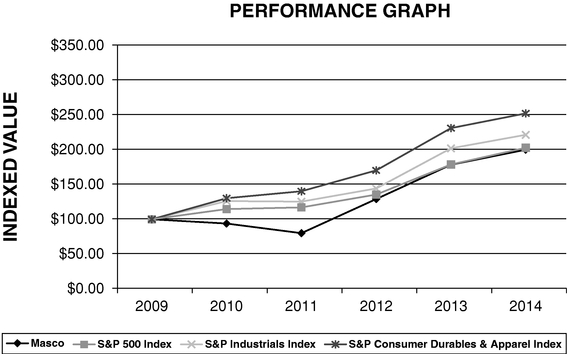
The table below sets forth the value, as of December 31 for each of the years indicated, of a $100 investment made on December 31, 2009 in each of our common stock, the S&P 500 Index, the S&P Industrials Index and the S&P Consumer Durables & Apparel Index and includes the reinvestment of dividends.
| 2010 | 2011 | 2012 | 2013 | 2014 | ||||||||||||
| Masco | $ | 93.85 | $ | 79.91 | $ | 129.32 | $ | 179.07 | $ | 200.78 | ||||||
| S&P 500 Index | $ | 114.82 | $ | 117.22 | $ | 135.83 | $ | 179.36 | $ | 203.60 | ||||||
| S&P Industrials Index | $ | 126.37 | $ | 125.60 | $ | 144.66 | $ | 202.79 | $ | 222.39 | ||||||
| S&P Consumer Durables & Apparel Index | $ | 130.54 | $ | 140.61 | $ | 170.84 | $ | 232.06 | $ | 253.37 |
Item 6. Selected Financial Data.
**
| Dollars in Millions (Except Per Common Share Data) | ||||||||||||||||
| 2014 | 2013 | 2012 | 2011 | 2010 | ||||||||||||
| Net Sales (1) | $ | 8,521 | $ | 8,173 | $ | 7,495 | $ | 7,170 | $ | 7,183 | ||||||
| Operating profit (loss) (1)(3)(4)(5) | $ | 788 | $ | 673 | $ | 302 | $ | (215 | ) | $ | (466 | ) | ||||
| Income (loss) from continuing operations attributable to Masco Corporation (1)(2)(3)(4)(5) | $ | 861 | $ | 298 | $ | (53 | ) | $ | (385 | ) | $ | (1,028 | ) | |||
| Income (loss) per common share from continuing operations: | ||||||||||||||||
| Basic | $ | 2.42 | $ | .83 | $ | (.16 | ) | $ | (1.11 | ) | $ | (2.95 | ) | |||
| Diluted | $ | 2.39 | $ | .83 | $ | (.16 | ) | $ | (1.11 | ) | $ | (2.95 | ) | |||
| Dividends declared | $ | .345 | $ | .30 | $ | .30 | $ | .30 | $ | .30 | ||||||
| Dividends paid | $ | .33 | $ | .30 | $ | .30 | $ | .30 | $ | .30 | ||||||
| At December 31: | ||||||||||||||||
| Total assets | $ | 7,167 | $ | 6,957 | $ | 6,883 | $ | 7,305 | $ | 8,139 | ||||||
| Long-term debt | 2,919 | 3,421 | 3,422 | 3,222 | 4,032 | |||||||||||
| Shareholders' equity | 1,128 | 787 | 542 | 750 | 1,581 |
(1)
Amounts exclude discontinued operations.
(2)
The year 2014 includes a $529 million tax benefit from the release of the valuation allowance on deferred tax assets.
(3)
The year 2012 includes non-cash impairment charges for other intangible assets aggregating $27 million after tax ($42 million pre-tax).
(4)
The year 2011 includes non-cash impairment charges for goodwill and other intangible assets aggregating $291 million after tax ($450 million pre-tax).
(5)
The year 2010 includes non-cash impairment charges for goodwill and other intangible assets aggregating $586 million after tax ($698 million pre-tax). The year 2010 also includes a $372 million non-cash charge to income tax expense to establish a valuation allowance on deferred tax assets.
Item 7. Management's Discussion and Analysis of Financial Condition and Results of Operations.
**
The financial and business analysis below provides information which we believe is relevant to an assessment and understanding of our consolidated financial position, results of operations and cash flows. This financial and business analysis should be read in conjunction with the consolidated financial statements and related notes.
The following discussion and certain other sections of this Report contain statements reflecting our views about our future performance and constitute "forward-looking statements" under the Private Securities Litigation Reform Act of 1995. Forward-looking statements can be identified by words such as "believe," "anticipate," "appear," "may," "will," "should," "intend," "plan," "estimate," "expect," "assume," "seek," "forecast" and similar references to future periods. These views involve risks and uncertainties that are difficult to predict and, accordingly, our actual results may differ materially from the results discussed in such forward-looking statements. We caution you against relying on any of these forward-looking statements. In addition to the various factors included in the "Executive Level Overview," "Critical Accounting Policies and Estimates" and "Outlook for the Company" sections, our future performance may be affected by our reliance on new home construction and home improvement, our reliance on key customers, the cost and availability of raw materials, uncertainty in the international economy, shifts in consumer preferences and purchasing practices, our ability to improve our underperforming businesses, our ability to maintain our competitive position in our industries, risks associated with the proposed spin-off of our Installation and Other Services businesses, our ability to realize the expected benefits of the spin-off, the timing and the terms of our share repurchase program, and our ability to reduce corporate expense and simplify our organizational structure. These and other factors are discussed in detail in Item 1A "Risk Factors" of this Report. Any forward-looking statement made by us speaks only as of the date on which it was made. Factors or events that could cause our actual results to differ may emerge from time to time, and it is not possible for us to predict all of them. Unless required by law, we undertake no obligation to update publicly any forward-looking statements as a result of new information, future events or otherwise.
Executive Level Overview
We manufacture, distribute and install home improvement and building products. These products are sold for home improvement and new home construction through mass merchandisers, hardware stores, home centers, homebuilders, distributors and other outlets for consumers and contractors and direct to the consumer.
2014 Results
Net sales were positively affected by increased new home construction and repair and remodel activity in the U.S. and Europe. Such increases were partially offset by decreased sales volume in our North American cabinetry business. Our results of operations were positively affected by increased sales volume, as well as a more favorable relationship between selling prices and commodity costs, except in paints and stains. Our results of operations were negatively affected by increased business rationalization costs and costs associated with our proposed spin-off transaction. Most of our business segments also benefited from the business rationalizations and cost savings initiatives we have undertaken over the last several years.
Our Cabinets and Related Products segment was negatively affected by lower sales volume of our North American operations, which completely offset a more favorable relationship between selling prices and commodity costs and any increased sales volume by our U.K. cabinet business. Our Plumbing Products segment benefited from increased sales volume of North American and International operations, as well as a more favorable relationship between selling prices and commodity costs. The Installation and Other Services segment benefited from increased new home construction and
commercial activity and a more favorable relationship between selling prices and commodity costs. The Decorative Architectural Products segment benefited from increased sales volume of paints and stains and builders' hardware, which was offset by a less favorable relationship between selling prices and commodity costs in paints and stains. Our Other Specialty Products segment benefited from a more favorable relationship between selling prices and commodity costs and a more favorable product mix of U.S. and U.K. windows, as well as increased sales volume.
Critical Accounting Policies and Estimates
Our discussion and analysis of our financial condition and results of operations are based upon our consolidated financial statements, which have been prepared in accordance with accounting principles generally accepted in the United States of America ("GAAP"). The preparation of these financial statements requires us to make certain estimates and assumptions that affect the reported amounts of assets and liabilities, disclosure of any contingent assets and liabilities at the date of the financial statements and the reported amounts of revenues and expenses during the reporting periods. We regularly review our estimates and assumptions, which are based upon historical experience, as well as current economic conditions and various other factors that we believe to be reasonable under the circumstances, the results of which form the basis for making judgments about the carrying values of certain assets and liabilities that are not readily apparent from other sources. Actual results may differ from these estimates and assumptions.
Note A to our consolidated financial statements includes our accounting policies, estimates and methods used in the preparation of our consolidated financial statements.
We believe that the following critical accounting policies are affected by significant judgments and estimates used in the preparation of our consolidated financial statements.
Revenue Recognition and Receivables
We recognize revenue as title to products and risk of loss is transferred to customers or when services are rendered. We record revenue for unbilled services performed based upon estimates of material and labor incurred in the Installation and Other Services segment; such amounts are recorded in Receivables. Receivables include unbilled revenue related to the Installation and Other Services segment of $24 million at both December 31, 2014 and 2013. We record estimated reductions to revenue for customer programs and incentive offerings, including special pricing and co-operative advertising arrangements, promotions and other volume-based incentives. We maintain allowances for doubtful accounts receivable for estimated losses resulting from the inability of customers to make required payments. In addition, we monitor our customer receivable balances and the credit worthiness of our customers on an on-going basis.
Goodwill and Other Intangible Assets
We record the excess of purchase cost over the fair value of net tangible assets of acquired companies as goodwill or other identifiable intangible assets. In the fourth quarter of each year, or as events occur or circumstances change that would more likely than not reduce the fair value of a reporting unit below its carrying amount, we complete the impairment testing of goodwill utilizing a discounted cash flow method. We selected the discounted cash flow methodology because we believe that it is comparable to what would be used by other market participants. We have defined our reporting units and completed the impairment testing of goodwill at the operating segment level, as defined by accounting guidance.
Determining market values using a discounted cash flow method requires us to make significant estimates and assumptions, including long-term projections of
Showing the first 8K of 70K characters. Open the full section
Item 7A. Quantitative and Qualitative Disclosures about Market Risk.
**
We have considered the provisions of accounting guidance regarding disclosure of accounting policies for derivative financial instruments and derivative commodity instruments, and disclosure of quantitative and qualitative information about market risk inherent in derivative financial instruments, other financial instruments and derivative commodity instruments.
We are exposed to the impact of changes in interest rates, foreign currency exchange rates and commodity costs in the normal course of business and to market price fluctuations related to our financial investments. We have involvement with derivative financial instruments and use such instruments to the extent necessary to manage exposure to foreign currency fluctuations and commodity fluctuations. See Note F to the consolidated financial statements for additional information regarding our derivative instruments.
At December 31, 2014, we performed sensitivity analyses to assess the potential loss in the fair values of market risk sensitive instruments resulting from a hypothetical change of 10 percent in foreign currency exchange rates, a 10 percent decline in the market value of our long-term investments, a 10 percent change in commodity costs, or a 10 percent change in interest rates. Based upon the analyses performed, such changes would not be expected to materially affect our consolidated financial position, results of operations or cash flows.
Item 8. Financial Statements and Supplementary Data
**
Management's Report on Internal Control Over Financial Reporting
The management of Masco Corporation is responsible for establishing and maintaining adequate internal control over financial reporting. Masco Corporation's internal control over financial reporting is a process designed to provide reasonable assurance regarding the reliability of financial reporting and the preparation of financial statements for external purposes in accordance with accounting principles generally accepted in the United States of America.
The management of Masco Corporation assessed the effectiveness of the Company's internal control over financial reporting as of December 31, 2014 using the criteria set forth by the Committee of Sponsoring Organizations of the Treadway Commission (COSO) in "Internal Control – Integrated Framework." Based on this assessment, management has determined that the Company's internal control over financial reporting was effective as of December 31, 2014.
PricewaterhouseCoopers LLP, an independent registered public accounting firm, performed an audit of the Company's consolidated financial statements and of the effectiveness of Masco Corporation's internal control over financial reporting as of December 31, 2014. Their report expressed an unqualified opinion on the effectiveness of Masco Corporation's internal control over financial reporting as of December 31, 2014 and expressed an unqualified opinion on the Company's 2014 consolidated financial statements. This report appears under 'Item 8. Financial Statements and Supplementary Data' under the heading "Report of Independent Registered Public Accounting Firm."
**Report of Independent Registered Public Accounting Firm **
To the Board of Directors and Shareholders of Masco Corporation:
In our opinion, the consolidated financial statements listed in the index appearing under Item 15(a) (1) present fairly, in all material respects, the financial position of Masco Corporation and its subsidiaries at December 31, 2014 and 2013, and the results of their operations and their cash flows for each of the three years in the period ended December 31, 2014 in conformity with accounting principles generally accepted in the United States of America. In addition, in our opinion, the financial statement schedule listed in the index appearing under Item 15(a)(2) presents fairly, in all material respects, the information set forth therein when read in conjunction with the related consolidated financial statements. Also in our opinion, the Company maintained, in all material respects, effective internal control over financial reporting as of December 31, 2014, based on criteria established in Internal Control – Integrated Framework (2013) issued by the Committee of Sponsoring Organizations of the Treadway Commission (COSO). The Company's management is responsible for these financial statements and financial statement schedule, for maintaining effective internal control over financial reporting and for its assessment of the effectiveness of internal control over financial reporting, included in Management's Report on Internal Control over Financial Reporting appearing under Item 8. Our responsibility is to express opinions on these financial statements, on the financial statement schedule, and on the Company's internal control over financial reporting based on our integrated audits. We conducted our audits in accordance with the standards of the Public Company Accounting Oversight Board (United States). Those standards require that we plan and perform the audits to obtain reasonable assurance about whether the financial statements are free of material misstatement and whether effective internal control over financial reporting was maintained in all material respects. Our audits of the financial statements included examining, on a test basis, evidence supporting the amounts and disclosures in the financial statements, assessing the accounting principles used and significant estimates made by management, and evaluating the overall financial statement presentation. Our audit of internal control over financial reporting included obtaining an understanding of internal control over financial reporting, assessing the risk that a material weakness exists, and testing and evaluating the design and operating effectiveness of internal control based on the assessed risk. Our audits also included performing such other procedures as we considered necessary in the circumstances. We believe that our audits provide a reasonable basis for our opinions.
A company's internal control over financial reporting is a process designed to provide reasonable assurance regarding the reliability of financial reporting and the preparation of financial statements for external purposes in accordance with generally accepted accounting principles. A company's internal control over financial reporting includes those policies and procedures that (i) pertain to the maintenance of records that, in reasonable detail, accurately and fairly reflect the transactions and dispositions of the assets of the company; (ii) provide reasonable assurance that transactions are recorded as necessary to permit preparation of financial statements in accordance with generally accepted accounting principles, and that receipts and expenditures of the company are being made only in accordance with authorizations of management and directors of the company; and (iii) provide reasonable assurance regarding prevention or timely detection of unauthorized acquisition, use, or disposition of the company's assets that could have a material effect on the financial statements.
Because of its inherent limitations, internal control over financial reporting may not prevent or detect misstatements. Also, projections of any evaluation of effectiveness to future periods are subject to the risk that controls may become inadequate because of changes in conditions, or that the degree of compliance with the policies or procedures may deteriorate.
/s/ PricewaterhouseCoopers LLP Detroit, Michigan February 13, 2015
** Financial Statements and Supplementary Data
MASCO CORPORATION and Consolidated Subsidiaries
CONSOLIDATED BALANCE SHEETS
at December 31, 2014 and 2013 **
| (In Millions, Except Share Data) | |||||||
| 2014 | 2013 | ||||||
| ASSETS | |||||||
| Current Assets: | |||||||
| Cash and cash investments | $ | 1,383 | $ | 1,223 | |||
| Short-term bank deposits | 306 | 321 | |||||
| Receivables | 1,040 | 1,004 | |||||
| Inventories | 819 | 765 | |||||
| Deferred income taxes | 244 | 73 | |||||
| Prepaid expenses and other | 71 | 82 | |||||
| | | | | | | | |
| Total current assets | 3,863 | 3,468 | |||||
| Property and equipment, net | 1,139 | 1,252 | |||||
| Goodwill | 1,884 | 1,903 | |||||
| Other intangible assets, net | 145 | 149 | |||||
| Other assets | 136 | 185 | |||||
| | | | | | | | |
| Total Assets | $ | 7,167 | $ | 6,957 | |||
| | | | | | | | |
| | | | | | | | |
| | | | | | | | |
| LIABILITIES and EQUITY | |||||||
| Current Liabilities: | |||||||
| Accounts payable | $ | 950 | $ | 902 | |||
| Notes payable | 505 | 6 | |||||
| Accrued liabilities | 756 | 778 | |||||
| | | | | | | | |
| Total current liabilities | 2,211 | 1,686 | |||||
| Long-term debt | 2,919 | 3,421 | |||||
| Other liabilities | 803 | 666 | |||||
| Deferred income taxes | 106 | 397 | |||||
| | | | | | | | |
| Total Liabilities | 6,039 | 6,170 | |||||
| | | | | | | | |
| Commitments and contingencies |
Showing the first 8K of 158K characters. Open the full section
Item 9. Changes in and Disagreements with Accountants on Accounting and Financial Disclosure.
**
Not applicable.
Item 9A. Controls and Procedures.
**
a.
Evaluation of Disclosure Controls and Procedures.
The Company, with the participation of the Chief Executive Officer and Chief Financial Officer, conducted an evaluation of its disclosure controls and procedures as required by Exchange Act Rules 13a-15(b) and 15d-15(b) as of December 31, 2014. Based on this evaluation, the Company's management, including the Chief Executive Officer and Chief Financial Officer, concluded that the Company's disclosure controls and procedures were effective.
b.
Management's Report on Internal Control over Financial Reporting.
Management's report on the Company's internal control over financial reporting (as such term is defined in Rules 13a-15(f) and 15d-15(f) under the Exchange Act) is included in this Report under Item 8. Financial Statements and Supplementary Data, under the heading, "Management's Report on Internal Control over Financial Reporting" and is incorporated herein by reference. The report of our independent registered public accounting firm is also included under Item 8, under the heading, "Report of Independent Registered Public Accounting Firm" and is incorporated herein by reference.
c.
Changes in Internal Control over Financial Reporting.
In connection with the evaluation of the Company's "internal control over financial reporting" that occurred during the quarter ended December 31, 2014, which is required under the Securities Exchange Act of 1934 by paragraph (d) of Exchange Rules 13a-15 or 15d-15 (as defined in paragraph (f) of Rule 13a-15), management determined that there was no change that materially affected or is reasonably likely to materially affect internal control over financial reporting.
Item 9B. Other Information.
**
Not applicable.
**PART III **
Item 10. Directors, Executive Officers and Corporate Governance.
**
Our Code of Business Ethics applies to all employees, officers and directors including our Principal Executive Officer, Principal Financial Officer and Principal Accounting Officer, and is posted on our website at www.masco.com. Other information required by this Item will be contained in our definitive Proxy Statement for the 2015 Annual Meeting of Stockholders, to be filed on or before April 30, 2015, and such information is incorporated herein by reference.
Item 11. Executive Compensation.
**
Information required by this Item will be contained in our definitive Proxy Statement for the 2015 Annual Meeting of Stockholders, to be filed on or before April 30, 2015, and such information is incorporated herein by reference.
Item 12. Security Ownership of Certain Beneficial Owners and Management and Related Stockholder Matters.
**
Equity Compensation Plan Information
We grant equity under our 2014 Long Term Stock Incentive Plan (the "2014 Plan"). The following table sets forth information as of December 31, 2014 concerning the 2014 Plan, which was approved by our stockholders. We do not have any equity compensation plans that have not been approved by our stockholders.
| Plan Category | Number of Securities to be Issued Upon Exercise of Outstanding Options, Warrants and Rights | Weighted-Average Exercise Price of Outstanding Options, Warrants and Rights | Number of Securities Remaining Available for Future Issuance Under Equity Compensation Plans (Excluding Securities Reflected in the First Column) | |||||||
| Equity compensation plans approved by stockholders | 18,201,674 | $ | 20.98 | 12,193,137 |
The remaining information required by this Item will be contained in our definitive Proxy Statement for our 2015 Annual Meeting of Stockholders, to be filed on or before April 30, 2015, and such information is incorporated herein by reference.
Item 13. Certain Relationships and Related Transactions, and Director Independence.
**
Information required by this Item will be contained in our definitive Proxy Statement for the 2015 Annual Meeting of Stockholders, to be filed on or before April 30, 2015, and such information is incorporated herein by reference.
Item 14. Principal Accountant Fees and Services.
**
Information required by this Item will be contained in our definitive Proxy Statement for the 2015 Annual Meeting of Stockholders, to be filed on or before April 30, 2015, and such information is incorporated herein by reference.
**PART IV **
Item 15. Exhibits and Financial Statement Schedules.
**
a. Listing of Documents.
(1)
Financial Statements. Our consolidated financial statements included in Item 8 hereof, as required at December 31, 2014 and 2013, and for the years ended December 31, 2014, 2013 and 2012, consist of the following:
(2)
Financial Statement Schedule.
a.
Our Financial Statement Schedule appended hereto, as required for the years ended December 31, 2014, 2013 and 2012, consists of the following:
II. Valuation and Qualifying Accounts
(3)
Exhibits.
See separate Exhibit Index beginning on page 92.
**SIGNATURES **
Pursuant to the requirements of Section 13 or 15(d) of the Securities Exchange Act of 1934, the Registrant has duly caused this Report to be signed on its behalf by the undersigned, thereunto duly authorized.
| MASCO CORPORATION | ||||
| By: | /s/ JOHN G. SZNEWAJS John G. Sznewajs | |||
| _Vice President, Treasurer and Chief Financial Officer _ |
February 13, 2015
Pursuant to the requirements of the Securities Exchange Act of 1934, this Report has been signed below by the following persons on behalf of the Registrant and in the capacities and on the date indicated.
| Principal Executive Officer: | ||||||
| /s/ KEITH ALLMAN Keith Allman | President, Chief Executive Officer and Director | |||||
| Principal Financial Officer: | ||||||
| /s/ JOHN G. SZNEWAJS John G. Sznewajs | Vice President, Treasurer and Chief Financial Officer | |||||
| Principal Accounting Officer: | ||||||
| /s/ JOHN P. LINDOW John P. Lindow | Vice President – Controller | |||||
| /s/ VERNE G. ISTOCK Verne G. Istock | Chairman of the Board | |||||
| /s/ MARK R. ALEXANDER Mark R. Alexander | Director | |||||
| /s/ DENNIS W. ARCHER Dennis W. Archer | Director | February 13, 2015 | ||||
| _/s/ J. MICHAEL LOSH _J. Michael Losh | _ Director_ | |||||
| /s/ RICHARD A. MANOOGIAN Richard A. Manoogian | Chairman Emeritus | |||||
| _/s/ CHRISTOPHER A. O'HERLIHY _Christopher A. O'Herlihy | _ Director_ | |||||
| /s/ DONALD R. PARFET Donald R. Parfet | Director | |||||
| /s/ LISA A. PAYNE Lisa A. Payne | Director | |||||
| /s/ JOHN C. PLANT John C. Plant | Director | |||||
| /s/ MARY ANN VAN LOKEREN Mary Ann Van Lokeren | Director |
**MASCO CORPORATION
SCHEDULE II. VALUATION AND QUALIFYING ACCOUNTS for the years ended December 31, 2014, 2013 and 2012 **
| **(In Millions) ** | ||||||||||||||||||||||
| Column A | Column B | Column C | Column D | Column E | ||||||||||||||||||
| Additions | ||||||||||||||||||||||
| Description | Balance at Beginning of Period | Charged to Costs and Expenses | Charged to Other Accounts | Deductions | Balance at End of Period | |||||||||||||||||
| Allowances for doubtful accounts, deducted from accounts receivable in the balance sheet: | ||||||||||||||||||||||
| 2014 | $ | 27 | $ | 6 | $ | — | $ | (15 | ) | (a | ) | $ | 18 | |||||||||
| | | | | | | | | | | | | | | | | | | | | | | |
| | | | | | | | | | | | | | | | | | | | | | | |
| | | | | | | | | | | | | | | | | | | | | | | |
| 2013 | $ | 31 | $ | 8 | $ | — | $ | (12 | ) | (a | ) | $ | 27 | |||||||||
| | | | | | | | | | | | | | | | | | | | | | | |
| | | | | | | | | | | | | | | | | | | | | | | |
| | | | | | | | | | | | | | | | | | | | | | | |
| 2012 | $ | 29 | $ | 13 | $ | — | $ | (11 | ) | (a | ) | $ | 31 | |||||||||
| | | | | | | | | | | | | | | | | | | | | | | |
| | | | | | | | | | | | | | | | | | | | | | | |
| | | | | | | | | | | | | | | | | | | | | | | |
| Valuation Allowance on deferred tax assets: | ||||||||||||||||||||||
| 2014 | $ | 662 | $ | (539 | ) | $ | (57 | ) | (b | ) | $ | — | $ | 66 | ||||||||
| | | | | | | | | | | | | | | | | | | | | | | |
| | | | | | | | | | | | | | | | | | | | | | | |
| | | | | | | | | | | | | | | | | | | | | | | |
| 2013 | $ | 785 | $ | (36 | ) | $ | (87 | ) | (c | ) | $ | — | $ | 662 | ||||||||
| | | | | | | | | | | | | | | | | | | | | | | |
| | | | | | | | | | | | | | | | | | | | | | | |
| | | | | | | | | | | | | | | | | | | | | | | |
| 2012 | $ | 686 | $ | 113 | $ | (14 | ) | (c | ) | $ | — | $ | 785 | |||||||||
| | | | | | | | | | | | | | | | | | | | | | | |
| | | | | | | | | | | | | | | | | | | | | | | |
| | | | | | | | | | | | | | | | | | | | | | | |
(a)
Deductions, representing uncollectible accounts written off, less recoveries of accounts written off in prior years.
(b)
Write off of a $55 million deferred tax asset on certain net operating loss carryforward against the valuation allowance as it was determined that there was only a remote likelihood that such a carryforward could be utilized; and $2 million valuation allowance on deferred tax assets recorded primarily in other comprehensive income.
(c)
Valuation allowance on deferred tax assets recorded primarily in other comprehensive income and paid in capital.
**EXHIBIT INDEX **
| Incorporated By Reference | |||||||||||||||
| Exhibit No. | Filed Here-with | ||||||||||||||
| Exhibit Description | Form | Exhibit | Filing Date | ||||||||||||
| 3.i | Restated Certificate of Incorporation of Masco Corporation. | 2010 10-K | 3.i | 02/18/2011 | |||||||||||
| 3.ii | Bylaws of Masco Corporation, as Amended and Restated May 8, 2012. | 8-K | 3.ii | 05/10/2012 | |||||||||||
| 4.a.i | Indenture dated as of December 1, 1982 between Masco Corporation and Bank of New York Trust Company, N.A., as successor trustee under agreement originally with Morgan Guaranty Trust Company of New York, as Trustee and Directors' resolutions establishing Masco Corporation's: | 2011 10-K | 4.a.i | 02/21/2012 | |||||||||||
| (i) | 6.625% Debentures Due April 15, 2018; and | 2013 10-K | 4.a.i(i) | 02/14/2014 | |||||||||||
| (ii) | 73/4% Debentures Due August 1, 2029. | X | |||||||||||||
| 4.a.ii | Supplemental Indenture dated as of July 26, 1994 between Masco Corporation and Bank of New York Trust Company, N.A., as successor trustee under agreement originally with The First National Bank of Chicago, as Trustee. | X | |||||||||||||
| 4.b.i | Indenture dated as of February 12, 2001 between Masco Corporation and Bank of New York Trust Company, N.A., as successor trustee under agreement originally with Bank One Trust Company, National Association, as Trustee and Directors' Resolutions establishing Masco Corporation's: | 2011 10-K | 4.b.i | 02/21/2012 | |||||||||||
| (i) | 61/2% Notes Due August 15, 2032; | 2012 10-K | 4.b.i(i) | 02/15/2013 | |||||||||||
| (ii) | 4.80% Notes Due June 15, 2015; | 2010 10-K | 4.b.i(iii) | 02/18/2011 | |||||||||||
| (iii) | 6.125% Notes Due October 3, 2016; | 2011 10-K | 4.b.i(iv) | 02/21/2012 | |||||||||||
| (iv) | 5.85% Notes Due 2017; | 2011 10-K | 4.b.i(v) | 02/21/2012 | |||||||||||
| (v) | 7.125% Notes Due 2020; and | 2010 10-K | 4.b.i(vi) | 02/18/2011 | |||||||||||
| (vi) | 5.95% Notes Due 2022. | 10-Q | 4.b | 05/02/2012 | |||||||||||
| 4.b.ii | Supplemental Indenture dated as of November 30, 2006 to the Indenture dated February 12, 2001 by and between Masco Corporation and Bank of New York Trust Corporation N.A., as Trustee. | 2011 10-K | 4.b.ii | 02/21/2012 | |||||||||||
| Note 1: | Other instruments, notes or extracts from agreements defining the rights of holders of long-term debt of Masco Corporation or its subsidiaries have not been filed since (i) in each case the total amount of long-term debt permitted thereunder does not exceed 10 percent of Masco Corporation's consolidated assets, and (ii) such instruments, notes and extracts will be furnished by Masco Corporation to the Securities and Exchange Commission upon request. |
| Incorporated By Reference | |||||||||||||||
| Exhibit No. | Filed Here-with | ||||||||||||||
| Exhibit Description | Form | Exhibit | Filing Date | ||||||||||||
| 10.a | Credit Agreement dated as of March 28, 2013 by and among Masco Corporation and Masco Europe S.à.r.l. as borrowers, the lenders party thereto, JPMorgan Chase Bank, N.A. as Administrative Agent, Citibank, N.A. as Syndication Agent, and Royal Bank of Canada, Deutsche Bank Securities, Inc., PNC Bank, National Association, and SunTrust Bank as Co-Documentation Agents. | 8-K | 10 | 04/03/2013 | |||||||||||
| Note 2: | Exhibits 10.b through 10.n constitute the management contracts and executive compensatory plans or arrangements in which certain of the Directors and executive officers of the Company participate. | ||||||||||||||
| 10.b.i | Masco Corporation 1991 Long Term Stock Incentive Plan (as amended and restated October 26, 2006): | 2011 10-K | 10.a | 02/21/2012 | |||||||||||
| (i) | Forms of Restricted Stock Award Agreement: | ||||||||||||||
| (A) | for awards prior to January 1, 2005, including supplemental letter; and | X | |||||||||||||
| (B) | for awards on and after January 1, 2005; | X | |||||||||||||
| (ii) | Form of Restoration Stock Option; | X | |||||||||||||
| (iii) | Form of Stock Option Grant; | X | |||||||||||||
| (iv) | Form of Stock Option Grant for Non-Employee Directors; and | X | |||||||||||||
| (v) | Form of Amendment to Award Agreements. | 2010 10-K | 10.a(v) | 02/18/2011 | |||||||||||
| 10.b.ii | Masco Corporation 2004 Restricted Stock Award Program (under the 1991 Long Term Stock Incentive Plan). | X | |||||||||||||
| 10.c.i | Masco Corporation 2005 Long Term Stock Incentive Plan (Amended and Restated May 11, 2010): | 2010 10-K | 10.b.i | 02/18/2011 | |||||||||||
| (i) | Form of Restricted Stock Award Agreements: | ||||||||||||||
| (A) | for awards on or after January 1, 2013; | 2012 10-K | 10.b.i(i)(A) | 02/15/2013 | |||||||||||
| (B) | for awards during 2012; | 2012 10-K | 10.b.i(i)(B) | 02/15/2013 | |||||||||||
| (C) | for awards prior to 2012; | 2010 10-K | 10.b.i(i) | 02/18/2011 | |||||||||||
| (ii) | Form of Stock Option Grant Agreements: | ||||||||||||||
| (A) | for grants on or after January 1, 2013; | 2012 10-K | 10.b.i(ii)(A) | 02/15/2013 | |||||||||||
| (B) | for grants during 2012 | 2012 10-K | 10.b.i(ii)(B) | 02/15/2013 | |||||||||||
| (C) | for grants prior to 2012; | 2010 10-K | 10.b.i(ii) | 02/18/2011 | |||||||||||
| (iii) | Form of Restoration Stock Option; and | 2010 10-K | 10.b.i(iii) | 02/18/2011 | |||||||||||
| (iv) | Form of Stock Option Grant for Non- Employee Directors. | X | |||||||||||||
| 10.c.ii | Non-Employee Directors Equity Program under Masco Corporation's 2005 Long Term Stock Incentive Plan (Amended July 2012): | 2012 10-K | 10.b.ii | 02/15/2013 | |||||||||||
| (i) | Form of Restricted Stock Awards. | 2012 10-K | 10.b.ii(i) | 02/15/2013 |
| Incorporated By Reference | |||||||||||||||
| Exhibit No. | Filed Here-with | ||||||||||||||
| Exhibit Description | Form | Exhibit | Filing Date | ||||||||||||
| 10.c.iii | Non-Employee Directors Equity Program under Masco Corporation's 2005 Long Term Stock Incentive Plan (Amended October 2010): | 10-Q | 10 | 10/28/2010 | |||||||||||
| (i) | Form of Restricted Stock Award for awards 2010 through 2012. | 2012 10-K | 10.b.iii(i) | 02/15/2013 | |||||||||||
| 10.c.iv | Non-Employee Directors Equity Program under Masco Corporation's 2005 Long Term Stock Incentive Plan (for awards prior to 2010): | 2012 10-K | 10.b.iv | 02/15/2013 | |||||||||||
| (i) | Form of Restricted Stock Award Agreement; and | 2012 10-K | 10.b.iv(i) | 02/15/2013 | |||||||||||
| (ii) | Form of Stock Option Grant Agreement. | 2012 10-K | 10.b.iv(ii) | 02/15/2013 | |||||||||||
| 10.d.i | Masco Corporation 2014 Long Term Stock Incentive Plan: | 8-K | 10.a | 05/06/2014 | |||||||||||
| (i) | Form of Restricted Stock Award Agreement; and | 8-K | 10.b | 05/06/2014 | |||||||||||
| (ii) | Form of Stock Option Grant Agreement. | 8-K | 10.d | 05/06/2014 | |||||||||||
| 10.d.ii | Non-Employee Directors Equity Program under Masco Corporation's 2014 Long Term Stock Incentive Plan: | 10-Q | 10 | 10/28/2014 | |||||||||||
| (i) | Form of Restricted Stock Award Agreement for Non-Employee Directors | 8-K | 10.c | 05/06/2014 | |||||||||||
| 10.e.i | Forms of Masco Corporation Supplemental Executive Retirement and Disability Plan and amendments thereto: | ||||||||||||||
| (i) | Richard A. Manoogian; | 2010 10-K | 10.c(iii) | 02/18/2011 | |||||||||||
| (ii) | John G. Sznewajs (includes amendment freezing benefit accruals); and | 2010 10-K | 10.c(iv) | 02/18/2011 | |||||||||||
| (iii) | Timothy Wadhams (includes amendment freezing benefit accruals). | 2010 10-K | 10.c(v) | 02/18/2011 | |||||||||||
| 10.e.ii | Form of letter agreement dated March 21, 2012 amending the Masco Corporation Supplemental Executive Retirement and Disability Plan. | 10-Q | 10.c | 05/02/2012 | |||||||||||
| 10.f | Masco Corporation 1997 Non-Employee Directors Stock Plan (as amended and restated October 27, 2005): | 2010 10-K | 10.d | 02/18/2011 | |||||||||||
| (i) | Form of Restricted Stock Award Agreement; | 2010 10-K | 10.d(i) | 02/18/2011 | |||||||||||
| (ii) | Form of Stock Option Grant; and | 2010 10-K | 10.d(ii) | 02/18/2011 | |||||||||||
| (iii) | Form of Amendment to Award Agreements. | 2010 10-K | 10.d(iii) | 02/18/2011 | |||||||||||
| 10.g | Other compensatory arrangements for executive officers. | 2011 10-K | 10.e | 02/21/2012 | |||||||||||
| 10.h | Form of award letter for the Masco Corporation Long-Term Cash Incentive Program: | ||||||||||||||
| (i) | for awards on or after to January 1, 2013; and | 2012 10-K | 10.f.(i) | 02/15/2013 | |||||||||||
| (ii) | for award prior to January 1, 2013: | 10-Q | 10.b | 05/02/2012 | |||||||||||
| 10.i | Compensation of Non-Employee Directors. | X | |||||||||||||
| 10.j.i | Masco Corporation Retirement Benefit Restoration Plan effective January 1, 1995 (as amended and restated December 22, 2010). | 2010 10-K | 10.g | 02/18/2011 |
| Incorporated By Reference | |||||||||||||||
| Exhibit No. | Filed Here-with | ||||||||||||||
| Exhibit Description | Form | Exhibit | Filing Date | ||||||||||||
| 10.j.ii | Amendment to Masco Corporation Retirement Benefit Restoration Plan effective February 6, 2012. | 10-Q | 10.h | 05/02/2012 | |||||||||||
| 10.k.i | Letter Agreement dated June 29, 2009 between Richard A. Manoogian and Masco Corporation. | X | |||||||||||||
| 10.k.ii | Aircraft Time Sharing Agreement dated October 1, 2012 between Richard A. Manoogian and Masco Corporation. | 2012 10-K | 10.i.ii | 02/15/2013 | |||||||||||
| 10.l | Consulting Agreement dated August 21, 2013 between Gregory D. Wittrock and Masco Corporation. | 10-Q | 10.j | 10/29/2013 | |||||||||||
| 10.m | Employment Offer Letter dated October 23, 2014 between Christopher Kastner and Masco Corporation. | X | |||||||||||||
| 10.n | Employment Offer Letter dated November 1, 2014 between Amit Bhargave and Masco Corporation. | X | |||||||||||||
| 12 | Computation of Ratio of Earnings to Combined Fixed Charges and Preferred Stock Dividends. | X | |||||||||||||
| 21 | List of Subsidiaries. | X | |||||||||||||
| 23 | Consent of Independent Registered Public Accounting Firm relating to Masco Corporation's Consolidated Financial Statements and Financial Statement Schedule. | X | |||||||||||||
| 31.a | Certification by Chief Executive Officer required by Rule 13a-14(a)/15d-14(a). | X | |||||||||||||
| 31.b | Certification by Chief Financial Officer required by Rule 13a-14(a)/15d-14(a). | X | |||||||||||||
| 32 | Certifications required by Rule 13a-14(b) or Rule 15d-14(b) and Section 1350 of Chapter 63 of Title 18 of the United States Code. | X | |||||||||||||
| 101 | Interactive Date File. | X | |||||||||||||
| The Company will furnish to its stockholders a copy of any of the above exhibits not included herein upon the written request of such stockholder and the payment to the Company of the reasonable expenses incurred by the Company in furnishing such copy or copies. |