 filings.tools
Moody's 10-K 2019-12-31
Filed 2020-02-24. 22 sections, 700K characters. Original on sec.gov · Markdown · JSON
Cover and table of contents
UNITED STATES
SECURITIES AND EXCHANGE COMMISSION
WASHINGTON, D.C. 20549
FORM 10-K
(MARK ONE)
☑ ANNUAL REPORT PURSUANT TO SECTION 13 OR 15(d) OF THE SECURITIES EXCHANGE ACT OF 1934
FOR THE FISCAL YEAR ENDED DECEMBER 31, 2019
OR
☐ TRANSITION REPORT PURSUANT TO SECTION 13 OR 15(d) OF THE SECURITIES EXCHANGE ACT OF 1934
FOR THE TRANSITION PERIOD FROM TO .
COMMISSION FILE NUMBER 1-14037
MOODY’S CORPORATION
(EXACT NAME OF REGISTRANT AS SPECIFIED IN ITS CHARTER)
| Delaware | 13-3998945 | ||||
| (STATE OF INCORPORATION) | (I.R.S. EMPLOYER IDENTIFICATION NO.) |
7 World Trade Center at 250 Greenwich Street, New York, New York 10007
(ADDRESS OF PRINCIPAL EXECUTIVE OFFICES)
(ZIP CODE)
REGISTRANT’S TELEPHONE NUMBER, INCLUDING AREA CODE: (212) 553-0300.
SECURITIES REGISTERED PURSUANT TO SECTION 12(b) OF THE ACT:
| TITLE OF EACH CLASS | TRADING SYMBOL(S) | NAME OF EACH EXCHANGE ON WHICH REGISTERED | ||||||||||||
| Common Stock, par value $0.01 per share | MCO | New York Stock Exchange | ||||||||||||
| 1.75% Senior Notes Due 2027 | MCO 27 | New York Stock Exchange | ||||||||||||
| 0.950% Senior Notes Due 2030 | MCO 30 | New York Stock Exchange |
SECURITIES REGISTERED PURSUANT TO SECTION 12(g) OF THE ACT:
NONE
Indicate by check mark if the registrant is a well-known seasoned issuer, as defined in Rule 405 of the Securities Act. Yes ☑ No ☐
Indicate by check mark if the registrant is not required to file reports pursuant to Section 13 or Section 15(d) of the Act. Yes ☐ No ☑
Indicate by check mark whether the registrant (1) has filed all reports required to be filed by Section 13 or 15(d) of the Securities Exchange Act of 1934 during the preceding 12 months (or for such shorter period that the registrant was required to file such reports), and (2) has been subject to such filing requirements for the past 90 days. Yes ☑ No ☐
Indicate by check mark whether the registrant has submitted electronically every Interactive Data File required to be submitted pursuant to Rule 405 of Regulation S-T (§232.405 of this chapter) during the preceding 12 months (or for such shorter period that the registrant was required to submit such files). Yes ☑ No ☐
Indicate by check mark whether the registrant is a large accelerated filer, an accelerated filer, a non-accelerated filer, a smaller reporting company, or emerging growth company. See the definitions of “large accelerated filer,” “accelerated filer,” “smaller reporting company,” and “emerging growth company” in Rule 12b-2 of the Exchange Act.
| Large Accelerated Filer | ☑ | Accelerated Filer ☐ | Non-accelerated Filer ☐ | Smaller reporting company | ☐ | Emerging growth company | ☐ |
If an emerging growth company, indicate by check mark if the registrant has elected not to use the extended transition period for complying with any new or revised financial accounting standards provided pursuant to Section 13(a) of the Exchange Act. ☐
Indicate by check mark whether the registrant is a shell company (as defined in Rule 12b-2 of the Act). Yes ☐ No ☑
The aggregate market value of Moody’s Corporation Common Stock held by nonaffiliates* on June 30, 2019 (based upon its closing transaction price on the New York Stock Exchange on such date) was approximately $37.0 billion.
As of January 31, 2020, 187.4 million shares of Common Stock of Moody’s Corporation were outstanding.
DOCUMENTS INCORPORATED BY REFERENCE
Portions of the Registrant’s definitive proxy statement for use in connection with its annual meeting of stockholders scheduled to be held on April 21, 2020, are incorporated by reference into Part III of this Form 10-K.
The Index to Exhibits is included as Part IV, Item 15(3) of this Form 10-K.
*Calculated by excluding all shares held by executive officers and directors of the Registrant without conceding that all such persons are “affiliates” of the Registrant for purposes of federal securities laws.
MOODY'S 2019 10-K
MOODY’S CORPORATION
INDEX TO FORM 10-K
2 MOODY'S 2019 10-K
| Exhibits filed Herewith | ||||||||
| 4.1 | Description of the Registrant’s securities registered pursuant to Section 12 of the Securities Exchange Act of 1934 | |||||||
| 10.3.1.3 | Second Amendment to the Amended and Restated 2001 Moody’s Corporation Key Employees’ Stock Incentive Plan (as amended, December 18, 2017) | |||||||
| 10.3.3.2 | Form of Employee Non-Qualified Stock Option Grant Agreement (for awards granted in 2020 or later) for the Amended and Restated 2001 Moody’s Corporation Key Employees’ Stock Incentive Plan | |||||||
| 10.3.4.3 | Form of Performance Share Award Letter (for awards granted in 2020 or later) for the Amended and Restated 2001 Moody’s Corporation Key Employees’ Stock Incentive Plan | |||||||
| 10.3.5.2 | Form of Restricted Stock Unit Grant Agreement (for awards granted in 2020 or later) for the Amended and Restated 2001 Moody’s Corporation Key Employees’ Stock Incentive Plan | |||||||
| 10.10 | Moody’s Corporation Retirement Account, amended and restated as of January 1, 2018 | |||||||
| 21 | SUBSIDIARIES OF THE REGISTRANT | |||||||
| 23.1 | CONSENT OF INDEPENDENT REGISTERED PUBLIC ACCOUNTING FIRM | |||||||
| 31.1 | Chief Executive Officer Certification Pursuant to Section 302 of the Sarbanes-Oxley Act of 2002 | |||||||
| 31.2 | Chief Financial Officer Certification Pursuant to Section 302 of the Sarbanes-Oxley Act of 2002 | |||||||
| 32.1 | Chief Executive Officer Certification Pursuant to Section 906 of the Sarbanes-Oxley Act of 2002 | |||||||
| 32.2 | Chief Financial Officer Certification Pursuant to Section 906 of the Sarbanes-Oxley Act of 2002 | |||||||
| 101.INS | Inline XBRL Instance Document (the instance document does not appear in the Interactive Data File because its XBRL tags are embedded within the Inline XBRL document) | |||||||
| 101.SCH | Inline XBRL Taxonomy Extension Schema Document | |||||||
| 101. CAL | Inline XBRL Taxonomy Extension Calculation Linkbase Document | |||||||
| 101.DEF | Inline XBRL Definitions Linkbase Document | |||||||
| 101.LAB | Inline XBRL Taxonomy Extension Labels Linkbase Document | |||||||
| 101.PRE | Inline XBRL Taxonomy Extension Presentation Linkbase Document | |||||||
| 104 | Cover Page Interactive Data File (formatted as inline XBRL and contained in Exhibit 101) |
MOODY'S 2019 10-K 3
GLOSSARY OF TERMS AND ABBREVIATIONS
The following terms, abbreviations and acronyms are used to identify frequently used terms in this report:
| TERM | DEFINITION | |||||||
| ABS Suite | Business acquired by the Company in October 2019 which includes a software platform used by issuers and trustees for administration of asset-backed and mortgage-backed securities programs | |||||||
| Acquisition-Related Amortization | Amortization of definite-lived intangible assets acquired by the Company from all business combination transactions | |||||||
| Acquisition-Related Expenses | Consists of expenses incurred to complete and integrate the acquisition of Bureau van Dijk for which the integration will be a multi-year effort | |||||||
| Adjusted Diluted EPS | Diluted EPS excluding the impact of certain items as detailed in the section entitled “Non-GAAP Financial Measures” | |||||||
| Adjusted Net Income | Net Income excluding the impact of certain items as detailed in the section entitled “Non-GAAP Financial Measures” | |||||||
| Adjusted Operating Income | Operating income excluding the impact of certain items as detailed in the section entitled "Non-GAAP Financial Measures" | |||||||
| Adjusted Operating Margin | Adjusted Operating Income divided by revenue | |||||||
| Americas | Represents countries within North and South America, excluding the U.S. | |||||||
| AOCI | Accumulated other comprehensive income (loss); a separate component of shareholders’ equity (deficit) | |||||||
| ASC | The FASB Accounting Standards Codification; the sole source of authoritative GAAP as of July 1, 2009 except for rules and interpretive releases of the SEC, which are also sources of authoritative GAAP for SEC registrants | |||||||
| Asia-Pacific | Represents Australia and countries in Asia including but not limited to: China, India, Indonesia, Japan, Korea, Malaysia, Singapore, Sri Lanka and Thailand | |||||||
| ASR | Accelerated Share Repurchase | |||||||
| ASU | The FASB Accounting Standards Update to the ASC. It also provides background information for accounting guidance and the bases for conclusions on the changes in the ASC. ASUs are not considered authoritative until codified into the ASC | |||||||
| Board | The board of directors of the Company | |||||||
| BPS | Basis points | |||||||
| Brexit | The withdrawal of the United Kingdom from the European Union, effective January 31, 2020 | |||||||
| Bureau van Dijk | Bureau van Dijk Electronic Publishing, B.V.; a global provider of business intelligence and company information; acquired by the Company on August 10, 2017 via the acquisition of Yellow Maple I B.V., an indirect parent of Bureau van Dijk; part of the RD&A LOB and a reporting unit within the MA reportable segment | |||||||
| CCAR | Comprehensive Capital Analysis and Review; annual review by the Federal Reserve in the U.S. to ensure that financial institutions have sufficient capital in times of economic and financial stress and that they have robust, forward-looking capital-planning processes that account for their unique risks. | |||||||
| CCXI | China Cheng Xin International Credit Rating Co. Ltd.; China’s first and largest domestic credit rating agency approved by the People’s Bank of China; the Company acquired a 49% interest in 2006; currently Moody’s owns 30% of CCXI. | |||||||
| CCXI Gain | In the first quarter of 2017, as part of a strategic business realignment, CCXI issued additional capital to its majority shareholder in exchange for a ratings business wholly-owned by the majority shareholder and which has the right to rate a different class of debt instrument in the Chinese market. The capital issuance by CCXI in exchange for this ratings business diluted Moody’s ownership interest in CCXI to 30% of a larger business and resulted in a $60 million non-cash, non-taxable gain. | |||||||
| CECL | Current expected credit losses | |||||||
4 MOODY'S 2019 10-K
| TERM | DEFINITION | |||||||
| CFG | Corporate finance group; an LOB of MIS | |||||||
| CLO | Collateralized loan obligation | |||||||
| CMBS | Commercial mortgage-backed securities; an asset class within SFG | |||||||
| Commission | European Commission | |||||||
| Common Stock | The Company’s common stock | |||||||
| Company | Moody’s Corporation and its subsidiaries; MCO; Moody’s | |||||||
| Content | A reporting unit within the MA segment that offers subscription based research, data and analytical products, including credit ratings produced by MIS, credit research, quantitative credit scores and other analytical tools, economic research and forecasts | |||||||
| CP | Commercial Paper | |||||||
| CP Notes | Unsecured commercial paper issued under the CP Program | |||||||
| CP Program | A program entered into on August 3, 2016 allowing the Company to privately place CP up to a maximum of $1 billion for which the maturity may not exceed 397 days from the date of issue and which is backstopped by the 2018 Facility. | |||||||
| CRAs | Credit rating agencies | |||||||
| D&B | Dun & Bradstreet | |||||||
| DBPPs | Defined benefit pension plans | |||||||
| Dodd-Frank Act | Dodd-Frank Wall Street Reform and Consumer Protection Act | |||||||
| EBITDA | Earnings before interest, taxes, depreciation and amortization | |||||||
| EMEA | Represents countries within Europe, the Middle East and Africa | |||||||
| EPS | Earnings per share | |||||||
| ERS | Enterprise Risk Solutions; an LOB within MA, which offers risk management software solutions as well as related risk management advisory engagements services | |||||||
| ESA | Economics and Structured Analytics; part of the RD&A line of business within MA | |||||||
| ESG | Environmental, Social and Governance | |||||||
| ESMA | European Securities and Markets Authority | |||||||
| ETR | Effective tax rate | |||||||
| EU | European Union | |||||||
| EUR | Euros | |||||||
| EURIBOR | The Euro Interbank Offered Rate | |||||||
| Eurozone | Monetary union of the EU member states which have adopted the euro as their common currency | |||||||
| Excess Tax Benefits | The difference between the tax benefit realized at exercise of an option or delivery of a restricted share and the tax benefit recorded at the time the option or restricted share is expensed under GAAP | |||||||
| Exchange Act | The Securities Exchange Act of 1934, as amended | |||||||
| External Revenue | Revenue excluding any intersegment amounts | |||||||
| FASB | Financial Accounting Standards Board | |||||||
| FIG | Financial institutions group; an LOB of MIS | |||||||
| Financial Reform Act | Dodd-Frank Wall Street Reform and Consumer Protection Act | |||||||
| Four Twenty Seven | A provider of data, intelligence, and analysis related to physical climate risks; acquired by the Company in July 2019 | |||||||
MOODY'S 2019 10-K 5
| TERM | DEFINITION | |||||||
| Free Cash Flow | Net cash provided by operating activities less cash paid for capital additions | |||||||
| FTSE | Financial Times Stock Exchange | |||||||
| FX | Foreign exchange | |||||||
| GAAP | U.S. Generally Accepted Accounting Principles | |||||||
| GBP | British pounds | |||||||
| ICRA | ICRA Limited; a provider of credit ratings and research in India. | |||||||
| IASB | International Accounting Standards Board | |||||||
| IFRS | International Financial Reporting Standards | |||||||
| INR | Indian Rupee | |||||||
| IRS | Internal Revenue Service | |||||||
| IT | Information technology | |||||||
| KIS | Korea Investors Service, Inc.; a Korean rating agency and consolidated subsidiary of the Company | |||||||
| KIS Pricing | Korea Investors Service Pricing, Inc.; a Korean provider of fixed income securities pricing and consolidated subsidiary of the Company | |||||||
| KIS Research | Korea Investors Service Research; a Korean provider of financial research and consolidated subsidiary of the Company | |||||||
| Korea | Republic of South Korea | |||||||
| Legacy Tax Matters | Exposures to certain potential tax liabilities assumed in connection with the Company’s spin-off from Dun & Bradstreet in 2000 | |||||||
| LIBOR | London Interbank Offered Rate | |||||||
| LOB | Line of business | |||||||
| MA | Moody’s Analytics—a reportable segment of MCO; provides a wide range of products and services that support financial analysis and risk management activities of institutional participants in global financial markets; consists of three LOBs—RD&A, ERS and PS | |||||||
| Make Whole Amount | The prepayment penalty amount relating to certain Senior Notes, which is a premium based on the excess, if any, of the discounted value of the remaining scheduled payments over the prepaid principal | |||||||
| MAKS | Moody’s Analytics Knowledge Services; formerly known as Copal Amba; provides offshore research and analytic services to the global financial and corporate sectors; part of the PS LOB and a reporting unit within the MA reportable segment; this business was divested in November 2019 | |||||||
| MALS | Moody’s Analytics Learning Solutions; a reporting unit within the MA segment that includes on-line and classroom-based training services as well as credentialing and certification services | |||||||
| MCO | Moody’s; Moody’s Corporation and its subsidiaries; the Company | |||||||
| MD&A | Management’s Discussion and Analysis of Financial Condition and Results of Operations | |||||||
| MIS | Moody’s Investors Service—a reportable segment of MCO; consists of five LOBs—SFG, CFG, FIG, PPIF and MIS Other | |||||||
| MIS Other | Consists of non-ratings revenue from ICRA, KIS Pricing and KIS Research. These businesses are components of MIS; MIS Other is an LOB of MIS | |||||||
| Moody’s | Moody’s Corporation and its subsidiaries; MCO; the Company | |||||||
| NAV | Net asset value | |||||||
6 MOODY'S 2019 10-K
| TERM | DEFINITION | |||||||
| Net Income | Net income attributable to Moody’s Corporation, which excludes net income from consolidated noncontrolling interests belonging to the minority interest holder | |||||||
| New Lease Accounting Standard | Updates to the ASC pursuant to ASU No. 2016-02, “Leases (ASC Topic 842)”. This new accounting guidance requires lessees to recognize a right-of-use asset and lease liability on the balance sheet for all leases with terms of more than 12 months. Recognition, measurement and presentation of expenses and cash flows depend on classification as either a finance or operating lease | |||||||
| New D&B | The New D&B Corporation—comprises the D&B business after September 30, 2000 | |||||||
| New Revenue Accounting Standard | Updates to the ASC pursuant to ASU No. 2014-09, “Revenue from Contracts with Customers (ASC Topic 606)”. This new accounting guidance significantly changes the accounting framework under U.S. GAAP relating to revenue recognition and to the accounting for the deferral of incremental costs of obtaining or fulfilling a contract with a customer | |||||||
| N/A | Not applicable | |||||||
| NM | Percentage change is not meaningful | |||||||
| Non-GAAP | A financial measure not in accordance with GAAP; these measures, when read in conjunction with the Company’s reported results, can provide useful supplemental information for investors analyzing period-to-period comparisons of the Company’s performance, facilitate comparisons to competitors’ operating results and to provide greater transparency to investors of supplemental information used by management in its financial and operational decision making | |||||||
| NRSRO | Nationally Recognized Statistical Rating Organization, which is a credit rating agency registered with the SEC. | |||||||
| OCI | Other comprehensive income (loss); includes gains and losses on cash flow and net investment hedges, unrealized gains and losses on available for sale securities (in periods prior to January 1, 2018), certain gains and losses relating to pension and other retirement benefit obligations and foreign currency translation adjustments | |||||||
| Omega Performance | A provider of online credit training; acquired by the Company in August 2018 | |||||||
| Operating segment | Term defined in the ASC relating to segment reporting; the ASC defines an operating segment as a component of a business entity that has each of the three following characteristics: i) the component engages in business activities from which it may recognize revenue and incur expenses; ii) the operating results of the component are regularly reviewed by the entity’s chief operating decision maker; and iii) discrete financial information about the component is available. | |||||||
| Other Retirement Plans | The U.S. retirement healthcare and U.S. retirement life insurance plans | |||||||
| PCS | Post-Contract Customer Support | |||||||
| PPIF | Public, project and infrastructure finance; an LOB of MIS | |||||||
| Pri-2012 | Private Retirement Plans Mortality Table published by the Society of Actuaries | |||||||
| Profit Participation Plan | Defined contribution profit participation plan that covers substantially all U.S. employees of the Company | |||||||
| PS | Professional Services, an LOB within MA consisting of MAKS and MALS that provides offshore analytical and research services as well as learning solutions and certification programs | |||||||
| Purchase Price Hedge | Foreign currency collars and forward contracts entered into by the Company to economically hedge the Bureau van Dijk euro denominated purchase price | |||||||
| Purchase Price Hedge Gain | Gain on foreign currency collars and forward contracts to economically hedge the Bureau van Dijk euro denominated purchase price | |||||||
| RD&A | Research, Data and Analytics; an LOB within MA that offers subscription based research, data and analytical products, including credit ratings produced by MIS, credit research, quantitative credit scores and other analytical tools, economic research and forecasts, business intelligence and company information products, and commercial real estate data and analytical tools | |||||||
| Redeemable Non-controlling Interest | Represents minority shareholders' interest in entities which are controlled but not wholly-owned by Moody's and for which Moody's obligation to redeem the minority shareholders' interest is represented by a put/call relationship |
MOODY'S 2019 10-K 7
| TERM | DEFINITION | |||||||
| Reform Act | Credit Rating Agency Reform Act of 2006 | |||||||
| Regulatory Data Corporation (RDC) | A global leader in risk and compliance intelligence; the Company acquired RDC in February 2020 | |||||||
| REIT | Real Estate Investment Trust | |||||||
| Reis, Inc. (Reis) | A provider of U.S. commercial real estate (CRE) data; acquired by the Company in October 2018; part of the RD&A LOB and a reporting unit within the MA reportable segment. | |||||||
| Relationship Revenue | For MIS, represents recurring monitoring fees of a rated debt obligation and/or entities that issue such obligations, as well as revenue from programs such as commercial paper, medium-term notes and shelf registrations. For MIS Other represents subscription-based revenue. For MA, represents subscription-based revenue and software maintenance revenue | |||||||
| Reporting unit | The level at which Moody’s evaluates its goodwill for impairment under U.S. GAAP; defined as an operating segment or one level below an operating segment | |||||||
| Retirement Plans | Moody’s funded and unfunded pension plans, the healthcare plans and life insurance plans | |||||||
| RiskFirst | A company providing risk analytic solutions for the asset management and pension fund communities; acquired by the Company in July 2019 | |||||||
| RMBS | Residential mortgage-backed securities; an asset class within SFG | |||||||
| ROU Asset | Assets recorded pursuant to the New Lease Accounting Standard which represent the Company’s right to use an underlying asset for the term of a lease | |||||||
| SaaS | Software-as-a-Service | |||||||
| SCDM | SCDM Financial, a leading provider of analytical tools for participants in securitization markets. Moody’s acquired SCDM’s structured finance data and analytics business in February 2017 | |||||||
| SEC | U.S. Securities and Exchange Commission | |||||||
| Securities Act | Securities Act of 1933, as amended | |||||||
| Settlement Charge | Charge of $864 million recorded in the fourth quarter of 2016 related to an agreement entered into on January 13, 2017 with the U.S. Department of Justice and the attorneys general of 21 U.S. states and the District of Columbia to resolve pending and potential civil claims related to credit ratings that MIS assigned to certain structured finance instruments in the financial crisis era | |||||||
| SFG | Structured finance group; an LOB of MIS | |||||||
| SG&A | Selling, general and administrative expenses | |||||||
| SynTao Green Finance (STGF) | A provider of environmental, social and governance data and analytics based in and serving China; a minority stake was acquired by the Company in October 2019 | |||||||
| SSP | Standalone selling price | |||||||
| T&M | Time-and-Material | |||||||
| Tax Act | The “Tax Cuts and Jobs Act” enacted into U.S. law on December 22, 2017, which significantly amends the tax code in the U.S. | |||||||
| Total Debt | All indebtedness of the Company as reflected on the consolidated balance sheets | |||||||
| Transaction Revenue | For MIS, represents the initial rating of a new debt issuance as well as other one-time fees. For MIS Other, represents revenue from professional services as well as data services, research and analytical engagements. For MA, represents perpetual software license fees and revenue from software implementation services, risk management advisory projects, training and certification services, and research and analytical engagements | |||||||
| U.K. | United Kingdom | |||||||
| U.S. | United States | |||||||
| USD | U.S. dollar | |||||||
8 MOODY'S 2019 10-K
| TERM | DEFINITION | |||||||
| UTPs | Uncertain tax positions | |||||||
| WACC | Weighted Average Cost of Capital | |||||||
| 2010 Senior Notes | Principal amount of $500 million, 5.50% senior unsecured notes, repaid in 2019 | |||||||
| 2012 Senior Notes | Principal amount of $500 million, 4.50% senior unsecured notes due in September 2022 | |||||||
| 2013 Senior Notes | Principal amount of the $500 million, 4.875% senior unsecured notes due in February 2024 | |||||||
| 2014 Senior Notes (5-Year) | Principal amount of $450 million, 2.75% senior unsecured notes, repaid in 2019 | |||||||
| 2014 Senior Notes (30-Year) | Principal amount of $600 million, 5.25% senior unsecured notes due in July 2044 | |||||||
| 2015 Senior Notes | Principal amount of €500 million, 1.75% senior unsecured notes due in March 2027 | |||||||
| 2017 Senior Notes Due 2023 | Principal amount of $500 million, 2.625% senior unsecured notes due January 15, 2023 | |||||||
| 2017 Senior Notes Due 2028 | Principal amount of $500 million, 3.25% senior unsecured notes due January 15, 2028 | |||||||
| 2017 Senior Notes Due 2021 | Principal amount of $500 million, 2.75% senior unsecured notes due in December 2021 | |||||||
| 2018 Facility | Five-year unsecured revolving credit facility, with capacity to borrow up to $1 billion; backstops CP issued under the CP Program | |||||||
| 2018 Senior Notes | Principal amount of $300 million, 3.25% senior unsecured notes due June 7, 2021 | |||||||
| 2018 Senior Notes (10-year) | Principal amount of $400 million, 4.25% senior unsecured notes due February 1, 2029 | |||||||
| 2018 Senior Notes (30-year) | Principal amount of $400 million, 4.875% senior unsecured notes due December 17, 2048 | |||||||
| 2019 Senior Notes | Principal amount of €750 million, 0.950% senior unsecured notes due in February 25, 2030 | |||||||
| 7WTC | The Company’s corporate headquarters located at 7 World Trade Center in New York, NY |
MOODY'S 2019 10-K 9
PART I
Item 1. BUSINESS
BACKGROUND
As used in this report, except where the context indicates otherwise, the terms “Moody’s” or the “Company” refer to Moody’s Corporation, a Delaware corporation, and its subsidiaries. The Company’s executive offices are located at 7 World Trade Center at 250 Greenwich Street, New York, NY 10007 and its telephone number is (212) 553-0300.
THE COMPANY
Company Overview
Moody’s is a provider of (i) credit ratings and assessment services; (ii) credit, capital markets and economic research, data and analytical tools; (iii) software solutions that support financial risk management activities; (iv) quantitatively derived credit scores; (v) learning solutions and certification services; (vi) offshore financial research and analytical services (this business was divested with the sale of the MAKS in the fourth quarter of 2019); and (vii) company information and business intelligence products. Moody’s reports in two reportable segments: MIS and MA. Financial information and operating results of these segments, including revenue, expenses and operating income, are included in Part II, Item 8. Financial Statements of this annual report, and are herein incorporated by reference.
MIS publishes credit ratings and provides assessment services on a wide range of debt obligations and the entities that issue such obligations in markets worldwide, including various corporate and governmental obligations, structured finance securities and commercial paper programs. Ratings revenue is derived from the originators and issuers of such transactions who use MIS ratings to support the distribution of their debt issues to investors. MIS provides ratings in more than 130 countries. Ratings are disseminated via press releases to the public through a variety of print and electronic media, including the internet and real-time information systems widely used by securities traders and investors. As of December 31, 2019, MIS had the following ratings relationships:
–Approximately 4,900 rated non-financial corporate issuers;
–Approximately 4,100 rated financial institutions issuers;
–Approximately 17,200 rated public finance issuers (including sovereign, sub-sovereign and supranational issuers);
–Approximately 9,500 rated structured finance transactions; and
–Approximately 1,000 rated infrastructure and project finance issuers.
MIS earns revenue from certain non-ratings-related operations, which primarily consist of financial instruments pricing services in the Asia-Pacific region as well as revenue from ICRA non-rating operations. The revenue from these operations is included in the MIS Other LOB and is not material to the results of the MIS segment.
MA provides financial intelligence and analytical tools to assist businesses in making decisions. MA’s portfolio of solutions consists of specialized research, data, software, and professional services, which are assembled to support the financial analysis and risk management activities of institutional customers worldwide. MA customers represent more than 11,000 institutions worldwide operating in over 155 countries. During 2019, Moody’s research website was accessed by over 306,000 individuals including 41,000 customer users.
Corporate Social Responsibility
Moody’s believes that knowledge fuels opportunity. The core of Moody’s business is to provide credit ratings, research, tools and analysis that help to equip participants in the global financial markets to understand risks and make important investment decisions with critical insight. Moody’s global corporate social responsibility (CSR) efforts are rooted in that same approach. Moody’s is committed to working to empower people with the knowledge, resources and confidence they need to create a better future – for themselves, their communities and the environment.
The CSR Council, chaired by President and CEO Raymond W. McDaniel, Jr. and comprised of members of the management team, evaluates the Company’s CSR progress and generates recommendations on its CSR strategy. The CSR Working Group, comprised of senior executives, is then charged with implementing the Company’s CSR strategy. In addition, the Company’s Board of Directors oversees sustainability matters, with assistance from the Governance & Nominating Committee, as part of its oversight of management and the Company’s overall strategy. For more information on Moody’s approach to CSR, see moodys.com/csr. The content of this website is not incorporated by reference herein.
10 MOODY'S 2019 10-K
Sustainability
Moody’s advances sustainability by considering Environmental, Social, and Governance (ESG) factors throughout its operations and two business segments. It uses its expertise and assets to make a positive difference through technology tools, research and analytical services that help other organizations and the investor community better understand the links between sustainability considerations and the global markets. Moody’s efforts to promote sustainability-related thought leadership, assessments and data to market participants include following the policies of recognized sustainability and corporate social responsibility parties that develop standards or frameworks and/or evaluate and assess performance, including Global Reporting Initiative (GRI) and Sustainability Accounting Standards Board (SASB). Moody’s sustainability-related achievements in 2019 included the following: (i) Moody’s began reporting using recommendations from SASB; (ii) the Company became a signatory to the Principles for Responsible Investment; (iii) it joined the United Nations Global Compact; and (iv) it issued its second annual report on how the Company has implemented the recommendations of the Task Force on Climate-related Financial Disclosures (TCFD).
PROSPECTS FOR GROWTH
Over recent decades, global fixed-income markets have grown significantly both in terms of the amount and types of securities or other obligations outstanding. Moody’s believes the overall long-term outlook remains favorable for continued growth of the global fixed-income market and related financial information market, which includes information such as credit opinions, research, data, analytics, risk management tools and related services.
Moody’s growth is influenced by a number of trends that impact financial information markets including:
–Health of the world’s major economies;
–Debt capital markets activity;
–Disintermediation of credit markets;
–Fiscal and monetary policy of governments; and
–Business investment spending, including mergers and acquisitions.
In an environment of increasing financial complexity and heightened attention to credit analysis and risk management, Moody’s is well positioned to benefit from continued growth in global fixed-income market activity and a more widespread use of credit ratings, research and related analytical products. Moody’s expects that these developments will support continued long-term demand for high quality, independent credit opinions, research, data, analytics, risk management tools and related services.
Strong secular trends should continue to provide long-term growth opportunities. For MIS, key growth drivers include debt market issuance driven by global GDP growth, continued disintermediation of fixed-income markets in both developed and emerging economies driving issuance and demand for new ratings products and services. Growth in MA is likely to be driven by deeper and broader penetration of the customer base as data demands, regulatory compliance and other analytical requirements drive demand for MA’s products and expertise. Moreover, pricing opportunities aligned with customer value creation and advances in information technology present growth opportunities for Moody’s.
Growth in global fixed income markets in a given year is dependent on many macroeconomic and capital market factors including interest rates, business investment spending, corporate refinancing needs, merger and acquisition activity, issuer profits, consumer borrowing levels and securitization activity. Rating fees paid by debt issuers account for most of the revenue of MIS. Therefore, a substantial portion of MIS’s revenue is dependent upon the dollar-equivalent volume and number of ratable debt securities issued in the global capital markets. MIS’s results can be affected by factors such as the performance and prospects for growth of the major world economies, the fiscal and monetary policies pursued by their governments, and the decisions of issuers to request MIS ratings to aid investors in their investment decisions. However, annual fee arrangements with frequent debt issuers, annual debt monitoring fees and annual fees from commercial paper and medium-term note programs, bank deposit ratings, insurance company financial strength ratings, mutual fund ratings, and other areas partially mitigate MIS’s dependence on the volume or number of new debt securities issued in the global fixed-income markets. Furthermore, the strong growth seen in the issuance of structured finance securities from the mid-1990’s reversed dramatically in 2008 due to market turmoil, before stabilizing in 2011. Despite significant declines from peak market issuance levels, Moody’s believes that structured finance securities will continue to play a role in global fixed-income markets and provide opportunities for long-term revenue growth.
The pace of change in technology and communication over the past two decades makes information about investment alternatives widely available throughout the world and facilitates issuers’ ability to place securities outside their national markets and similarly investors’ ability to obtain information about securities issued outside their national markets. Technology also allows issuers and investors the ability to more readily obtain information about new financing techniques and new types of securities that they may wish to purchase or sell, which in the absence of the appropriate technology might not be readily or easily obtainable. This availability of information promotes the ongoing integration and expansion of financial markets worldwide, giving issuers and investors access to a wider range of both established and newer capital markets. As technology provides broader access to worldwide markets, it also results in a greater need for credible, globally comparable opinions about credit risk, data, analytics and related services. Additionally, information technology also provides opportunities to further build a global platform to support Moody’s continued expansion in developing markets.
MOODY'S 2019 10-K 11
An ongoing trend in the world’s capital markets is the disintermediation of financial systems. Issuers increasingly raise capital in the global public capital markets, in addition to, or in substitution for, traditional financial intermediaries. Moreover, financial intermediaries have sold assets in the global public capital markets, in addition to, or instead of, retaining those assets. Moody’s believes that issuer use of global debt capital markets offer advantages in capacity and efficiency compared to traditional banking systems and that the trend of increased disintermediation will continue. Further, disintermediation has continued because of the historically low interest rate environment and bank deleveraging, which has encouraged a number of corporations and other entities to seek alternative funding in the bond markets.
Moody’s also observes disintermediation in key emerging markets where economic growth may outpace internal banking system capacity. Thus, disintermediation is expected to continue over the longer-term, with Moody’s targeting investment and resources to those markets where disintermediation and bond issuance is expected to remain robust.
In the aftermath of the global financial crisis, banking, insurance and capital markets authorities promulgated a wide range of new regulations to restore stability and confidence in financial institutions under their oversight. Programs such as Basel III, Solvency II, and CCAR — among many others — prompted banks, insurers, securities dealers, and asset managers to invest in more robust risk management practices and systems. Many of these investments drew on expertise and tools offered by MA, resulting in strong revenue growth in the post-crisis period. As banking and capital markets stabilized, and with financial institutions better capitalized, regulatory-driven demand for certain MA products has moderated, while in other areas (e.g., anti-money laundering (AML) and know-your-customer (KYC) compliance) regulatory-driven demand for data and solutions remains strong. We expect MA products and services that improve efficiencies, provide business insights and enable compliance with financial regulation, including AML, KYC, and accounting standards, will continue to be adopted by institutions worldwide. Finally, in order to respond to other sources of demand and drive growth, MA is actively investing in new products, including enhanced data sets and improved delivery methods (e.g., software-as-a-service). These efforts should support broader distribution of MA’s capabilities, deepen relationships with existing customers and drive new customer acquisition.
Legislative bodies and regulators in the U.S., Europe and other jurisdictions continue to conduct regulatory reviews of CRAs, which may result in, for example, an increased number of competitors, changes to the business model or restrictions on certain business activities of MIS, removal of references to ratings in certain regulations, or increased costs of doing business for MIS. At present, Moody’s is unable to assess the nature and effect that any regulatory changes may have on future growth opportunities.
Moody’s operations are subject to various risks, as more fully described in Part I, Item 1A “Risk Factors,” inherent in conducting business on a global basis. Such risks include currency fluctuations and possible nationalization, expropriation, exchange and price controls, changes in the availability of data from public sector sources, limits on providing information across borders and other restrictive governmental actions.
COMPETITION
MIS competes with other CRAs and with investment banks and brokerage firms that offer credit opinions and research. Many users of MIS’s ratings also have in-house credit research capabilities. MIS’s largest competitor in the global credit rating business is S&P Global Ratings (S&P), a division of S&P Global. There are some rating markets, based on industry, geography and/or instrument type, in which Moody’s has made investments and obtained market positions superior to S&P, while in other markets, the reverse is true.
In addition to S&P, MIS’s competitors in the U.S. include Fitch Ratings, A.M. Best Company, Kroll Bond Rating Agency Inc., and Morningstar Inc. In Europe, there are approximately 40 companies currently registered with ESMA, which include both purely domestic European CRAs and International CRAs such as S&P and Fitch. There are additional competitors in other regions and countries, some of which are global entities and compete across regions and asset classes, while others focus on particular asset classes and regions.
MA competes broadly in the financial information industry against diversified competitors such as Refinitiv, Bloomberg, S&P Global Market Intelligence, Fitch Solutions, D&B, SS&C Technologies, Wolters Kluwer, Fidelity National Information Services, SAS, Fiserv, MSCI and IHS Markit among others. MA’s main competitors within RD&A include S&P Global Market Intelligence, CreditSights, Refinitiv, Intex, IHS Markit, BlackRock Solutions, FactSet and other providers of fixed income analytics, valuations, economic data and research. In ERS, MA faces competition from both large software providers such as SS&C Technologies, Fidelity National Information Services, SAS, Oracle, Finastra, Oliver Wyman, Verisk Analytics and various other vendors and in-house solutions. Within Professional Services, MA competes with a host of financial training and education firms.
MOODY’S STRATEGY
Moody’s corporate mission is to be the world’s most respected authority serving financial risk-sensitive markets. The key aspects to implement this strategy are to:
–Defend and enhance the core ratings and research business of MIS;
–Build MA’s position as a leading provider of data, analytics and risk management solutions to financial institutions, corporations, and governmental authorities; and
–Invest in strategic growth opportunities.
12 MOODY'S 2019 10-K
Moody’s will make investments to defend and enhance its core businesses in an attempt to position the Company to fully capture market opportunities resulting from global debt capital market expansion and increased business investment spending. Moody’s will also make strategic investments to achieve scale in attractive financial information markets, move into attractive product and service adjacencies where the Company can leverage its brand, extend its thought leadership and expand its geographic presence in high growth emerging markets.
To broaden the Company’s potential, MA provides a wide range of products and services to enable financial institutions, corporations and governmental authorities to better manage risk. As such, MA adds to the Company’s value proposition in three ways. First, MA’s subscription businesses provide a significant base of recurring revenue to offset cyclicality in ratings issuance volumes that may result in volatility in MIS’s revenues. Second, MA products and services, such as financial training and professional services on research and risk management best practices, provide opportunities for entry into emerging markets before banking systems and debt capital markets fully develop and thus present long-term growth opportunities for the ratings business. Finally, MA’s integrated risk management software platform embeds Moody’s solutions deep into the technology infrastructure of banks and insurance companies worldwide.
Moody’s invests in initiatives to implement the Company’s strategy, including internally led organic development and targeted acquisitions. Example initiatives include:
–Enhancements to ratings quality and product extensions;
–Investments that extend ownership and participation in joint ventures and strategic alliances;
–New products, services, content (e.g., non-credit risk assessments such as ESG and cybersecurity risk) and technology capabilities to meet customer demands;
–Selective bolt-on acquisitions that accelerate the ability to scale and grow Moody’s businesses; and
–Expansion in emerging markets.
During 2019, Moody’s continued to invest in and acquire complementary businesses in MIS and MA as further described below:
–In April 2019, Moody’s acquired a majority stake in Vigeo Eiris, a provider of Environmental, Social and Governance (ESG) research, data and assessments. The acquisition furthers Moody’s objective of promoting global standards for ESG for use by market participants;
–In June 2019, Moody’s formed a joint venture with Team8, a cybersecurity think tank and company creation platform, to establish a global standard for evaluating and assessing cyber risk for enterprises. The joint venture builds on Moody’s investments and initiatives in cybersecurity and emerging technologies, including its 2018 strategic investment in Team8;
–In July 2019, Moody’s acquired a majority stake in Four Twenty Seven, Inc., a provider of data, intelligence, and analysis related to physical climate risks. This further complements Moody’s ESG research, data and assessment capabilities and its majority acquisition of Vigeo Eiris;
–Also in July 2019, Moody’s acquired RiskFirst, a provider of risk analytic solutions for the asset management and pension fund communities. The acquisition positions MA to extend its range of market-leading risk solutions to the institutional buy-side;
–In October 2019, Moody’s acquired the ABS Suite business from Deloitte & Touche LLP. ABS Suite is a software platform used by issuers and trustees for the administration of asset-backed and mortgage-backed securities programs. The transaction strengthens MA’s position as a leading provider of structured finance solutions;
–Also in October 2019, Moody’s acquired a minority stake in SynTao Green Finance, a provider of ESG data and analytics based in and serving China. The investment strengthens Moody’s presence and engagement in China and its financial markets, with a focus on supporting long-term, sustainable growth and contributing to the healthy development of ESG markets. It also complements the acquisitions of majority stakes in Vigeo Eiris and Four Twenty Seven, Inc.
Additionally, in November 2019, Moody’s completed the sale of Moody’s Analytics Knowledge Services (MAKS), a provider of offshore research and analytic services to the global financial and corporate sectors. Moody’s made the decision to divest the MAKS business given increasing strategic focus on providing its customers with financial intelligence and analytical tools and as a service business, MAKS was increasingly less relevant in this regard.
REGULATION
MIS and many of the securities that it rates are subject to extensive regulation in both the U.S. and in other countries (including by state and local authorities). Existing and proposed laws and regulations can impact the Company’s operations and the markets for securities that it rates. Additional laws and regulations have been proposed or are being considered. Each of the existing, adopted, proposed and potential laws and regulations can increase the costs and legal risk associated with the Company’s operations, including the issuance of credit ratings, and may negatively impact the Company’s profitability and ability to compete, or result in changes in the demand for credit ratings, in the manner in which credit ratings are utilized and in the manner in which the Company operates.
MOODY'S 2019 10-K 13
The regulatory landscape has changed rapidly in recent years and continues to evolve. In the U.S., CRAs are subject to extensive regulation primarily pursuant to the Reform Act and the Dodd-Frank Act. The Reform Act added Section 15E to the Exchange Act and provided the SEC with the authority to establish a registration and oversight program for credit rating agencies registered as NRSROs. Among other things, the Reform Act requires the SEC to submit an annual report to Congress providing an overview of SEC activities with respect to NRSROs, and detailing the SEC’s views on the state of competition, transparency and conflicts of interests among NRSROs. The Dodd-Frank Act enhanced the SEC’s oversight of the regulation of NRSROs, and includes a requirement that the SEC publish an annual report summarizing the results of its annual examinations of NRSROs. To date, through a series of rulemakings, the SEC has implemented a number of Exchange Act provisions related to NRSROs. These include, for example, provisions addressing disclosure of data and assumptions underlying credit ratings, conflicts of interest with respect to sales and marketing practices, disclosure of performance statistics, application and disclosure of credit rating methodologies, analyst training and testing and consistent application of rating symbols and definitions. The Company has made and continues to make substantial IT and other investments, and has implemented the relevant compliance obligations.
In the EU, the CRA industry is registered and supervised through a pan-European regulatory framework. The European Securities and Markets Authority (ESMA) has direct supervisory responsibility for the registered CRA industry throughout the EU. MIS’ EU CRA subsidiaries are registered and are subject to formal regulation and periodic inspection. Applicable rules include procedural requirements with respect to use of credit ratings, independence and avoidance of conflicts of interest, conflicts of interest concerning investments in CRAs, CRA rotation, methodologies, models and key rating assumptions, use of multiple CRAs, outsourcing, disclosures, credit ratings of sovereign issuers, liability for intentional or grossly negligent failure to abide by applicable regulations, reporting requirements to ESMA regarding fees, and additional procedural and substantive requirements on the pricing of services. From time to time, ESMA publishes interpretive guidance, or thematic reports regarding various aspects of the regulation and, annually, sets out its work program for the forthcoming year. During 2019, supervisory priorities included credit ratings quality, cybersecurity, Brexit and fees charged by CRAs. In 2019, ESMA updated guidelines, issued new guidelines and published an update to its thematic report on its observations of CRA fee practices. ESMA’s 2020 work program includes the credit rating process, methodology development and validation, governance and internal controls, including with respect to IT and information security where ESMA is expected to publish cloud guidelines in Q1. Policy priorities include assisting the European Commission in promoting sustainable finance in the field of CRAs.
In 2016, the European Commission published a report concluding that no new EU legislation was necessary at that time, but that it would continue to monitor the credit rating industry and analyze approaches that may strengthen existing regulation. The European Commission is expected to publish a report in Q1 2020 on CRAs and the integration of sustainability factors into their credit rating opinions and in Q2 on Sustainability Research and Ratings. Furthermore, new proposals on data are expected from the European Commission in 2020 which may have a direct or indirect impact on the Company.
Separately, on June 23, 2016, the U.K. voted to exit the E.U. and on January 31, 2020 formally left the E.U. There is now a transition period of 11 months until December 31, 2020 when most EU law will remain applicable in the U.K.. The longer-term impact of the decision to leave the E.U. on the overall regulatory framework for the U.K. will depend, in part, on the relationship that the U.K. negotiates with the E.U. During the transition period, the E.U. CRA regulatory framework will remain in place in the U.K. and firms must continue to abide by their existing obligations with ESMA as the regulator of EU-registered CRAs. It is expected that from the start of 2021, legislation for CRAs under the supervision of the Financial Conduct Authority will come into force in the U.K.
In light of the regulations that have gone into effect in both the E.U. and the U.S. (as well as many other countries), periodically and as a matter of course pursuant to their enabling legislation, regulatory authorities have and will continue to publish reports that describe their oversight activities over the industry. In addition, other legislation and/or interpretation of existing regulation relating to the Company’s operations, including credit rating, ancillary and research services is being considered by local, national and multinational bodies and this type of activity is likely to continue in the future. Finally, in certain countries, governments may provide financial or other support to locally-based CRAs. For example, governments may from time to time establish official CRAs or credit ratings criteria or procedures for evaluating local issuers. If enacted, any such legislation and regulation could change the competitive landscape in which MIS operates. The legal status of CRAs has been addressed by courts in various decisions and is likely to be considered and addressed in legal proceedings from time to time in the future. Management of the Company cannot predict whether these or any other proposals will be enacted, the outcome of any pending or possible future legal proceedings, or regulatory or legislative actions, or the ultimate impact of any such matters on the competitive position, financial position or results of operations of the Company.
INTELLECTUAL PROPERTY
Moody’s and its affiliates own and control a variety of intellectual property, including but not limited to proprietary information, trademarks, research, publications, software tools and applications, models and methodologies, databases, domain names, and other proprietary materials that, in the aggregate, are of material importance to Moody’s business. Management of Moody’s believes that each of the trademarks and related corporate names, marks and logos relating to its businesses, including those containing the term “Moody’s”, are of material importance to the Company.
14 MOODY'S 2019 10-K
The Company, primarily through MA and its subsidiaries, licenses certain of its databases, software applications, credit risk models, training courses in credit risk and capital markets, research and other publications and services that contain intellectual property to its customers. These licenses are provided pursuant to standard fee-bearing agreements containing customary restrictions and intellectual property protections.
In addition, Moody’s licenses from third parties certain technology, data and other intellectual property rights. Specifically, Moody’s obtains licenses from third parties to use financial information (such as market and index data, financial statement data, research data, default data, and security identifiers) as well as software development tools and libraries. In addition, the Company’s Bureau van Dijk business obtains from third party information providers certain financial, credit risk, compliance, management, ownership and other data on companies worldwide, which Bureau van Dijk distributes through its company information products. The Company obtains such technology and intellectual property rights from generally available commercial sources. The Company also utilizes generally available open source software and libraries for internal use and subject to appropriately permissive open source licenses, to carry out routine functions in certain of the Company’s software products. Most of such technology and intellectual property is available from a variety of sources. Although certain financial information (particularly security identifiers, certain pricing or index data, and certain company financial data in selected geographic markets) is available from a limited number of sources, Moody’s does not believe it is dependent on any one data source for a material aspect of its business.
The names of Moody’s products and services referred to herein are trademarks, service marks or registered trademarks or service marks owned by or licensed to Moody’s or one or more of its affiliates. The Company owns three patents. None of the Company's intellectual property is subject to a specific expiration date, except to the extent that the patents and the copyright in items that the Company creates (such as credit reports, research, software, and other written opinions) expire pursuant to relevant law.
The Company considers its intellectual property to be proprietary, and Moody’s relies on a combination of copyright, trademark, trade secret, patent, non-disclosure and other contractual safeguards for protection. Moody’s also pursues instances of third-party infringement of its intellectual property in order to protect the Company’s rights.
EMPLOYEES
As of December 31, 2019 the number of full-time equivalent employees of Moody’s was approximately 11,000.
AVAILABLE INFORMATION
Moody’s investor relations internet website is http://ir.moodys.com/. Under the “SEC Filings” tab at this website, the Company makes available free of charge its annual reports on Form 10-K, quarterly reports on Form 10-Q, current reports on Form 8-K and amendments to those reports as soon as reasonably practicable after they are filed with, or furnished to, the SEC.
The SEC maintains an internet site that contains annual, quarterly and current reports, proxy and other information statements that the Company files electronically with the SEC. The SEC’s internet site is http://www.sec.gov/.
INFORMATION ABOUT OUR EXECUTIVE OFFICERS
| Name, Age and Position | Biographical Data | ||||||||||
| Robert Fauber, 49 Executive Vice President and Chief Operating Officer | Mr. Fauber has served as the Company’s Chief Operating Officer since November 2019. Mr. Fauber served as President of Moody’s Investors Service, Inc. from June 1, 2016 to October 31, 2019, as Senior Vice President—Corporate & Commercial Development of Moody’s Corporation from April 2014 to May 31, 2016, and was Head of the MIS Commercial Group from January 2013 to May 31, 2016. From April 2009 through April 2014, he served as Senior Vice President—Corporate Development of Moody’s Corporation. Mr. Fauber served as Vice President—Corporate Development from September 2005 to April 2009. Prior to joining Moody’s, Mr. Fauber served in several roles at Citigroup and its investment banking subsidiary Salomon Smith Barney from 1999 to 2005. From 1992 to 1996, Mr. Fauber worked at NationsBank (now Bank of America) in the middle market commercial banking group. | ||||||||||
| John J. Goggins, 59 Executive Vice President and General Counsel | Mr. Goggins has served as the Company’s Executive Vice President and General Counsel since April 2011 and the Company’s Senior Vice President and General Counsel from October 2000 until April 2011. Mr. Goggins joined Moody’s Investors Service, Inc. in February 1999 as Vice President and Associate General Counsel. | ||||||||||
| Melanie Hughes, 57 Senior Vice President and Chief Human Resources Officer | Ms. Hughes has served as the Company’s Senior Vice President—Chief Human Resources Officer since September 2017. Prior to joining the Company, Ms. Hughes was Chief Human Resource Officer and Executive Vice President, Human Resources at American Eagle Outfitters from July 2016 to September 2017 and served as Executive Vice President, Human Resources at Tribune Media from May 2013 to June 2016. She has held several senior management roles for many different companies such as Coach, Gilt Group, DoubleClick and UBS Warburg. | ||||||||||
MOODY'S 2019 10-K 15
| Name, Age and Position | Biographical Data | |||||||
| Mark Kaye, 40 Senior Vice President and Chief Financial Officer | Mr. Kaye has served as the Company’s Senior Vice President—Chief Financial Officer since August 2018. Prior to joining the Company, Mr. Kaye was Senior Vice President and Head of Financial Planning and Analysis at Massachusetts Mutual Life Insurance Company (MassMutual) since February 2016, and Chief Financial Officer of MassMutual U.S. since July 2015. Prior to that, Mr. Kaye served as Chief Financial Officer and Senior Vice President, Retirement Solutions, at Voya Financial from 2011 to 2015. Mr. Kaye previously held various senior financial and risk reporting positions at ING U.S. and ING Group, and was in the investment banking division of Credit Suisse First Boston. | |||||||
| Raymond W. McDaniel, Jr.,62 President and Chief Executive Officer | Mr. McDaniel has served as the Company’s President and Chief Executive Officer since April 2012, and served as the Chairman and Chief Executive Officer from April 2005 until April 2012. He currently serves on the Executive Committee of the Board of Directors. Mr. McDaniel served as the Company’s President from October 2004 until April 2005 and the Company’s Chief Operating Officer from January 2004 until April 2005. He has served as Chief Executive Officer of Moody’s Investors Service, Inc. since October 2007. He held the additional titles of President from November 2001 to August 2007 and December 2008 to November 2010 and Chairman from October 2007 until June 2015. Mr. McDaniel served as the Company’s Executive Vice President from April 2003 to January 2004, and as Senior Vice President, Global Ratings and Research from November 2000 until April 2003. He served as Senior Managing Director, Global Ratings and Research, of Moody’s Investors Service, Inc. from November 2000 until November 2001 and as Managing Director, International from 1996 to November 2000. Mr. McDaniel currently is a director of John Wiley & Sons, Inc. (2005-present) and a member of the Board of Trustees of Muhlenberg College (2015-present). | |||||||
| Caroline Sullivan, 51 Senior Vice President and Corporate Controller | Ms. Sullivan has served as the Company’s Senior Vice President—Corporate Controller since December 2018. Prior to joining the Company, Ms. Sullivan served in several roles at Bank of America, where her last position held was Managing Director and Global Banking Controller. Prior to that role, Ms. Sullivan supported the Global Wealth & Investment Management business from 2015 to 2017 in a variety of positions including Controller and was Chief Financial Officer for the Latin America region from 2014 to 2015. From 2011 to 2013, she served as the Legal Entity Controller for the bank’s main broker dealer and other Merrill Lynch entities. Ms. Sullivan previously held various senior positions at several banks and a major accounting firm, and is a member of the American Institute of Certified Public Accountants. | |||||||
| Stephen Tulenko, 52 President, Moody’s Analytics | Mr. Tulenko has served as President of Moody’s Analytics since November 2019. Mr. Tulenko served as Executive Director of Enterprise Risk Solutions from 2013 to October 2019 and as Executive Director of Global Sales, Customer Service and Marketing from 2008 to 2013. Prior to the formation of Moody’s Analytics, he held various sales, product development and product strategy roles at Moody’s Investors Service, Inc. Mr. Tulenko joined Moody’s in 1990. | |||||||
| Michael West, 51 President, Moody’s Investors Service | Mr. West has served as President of Moody’s Investors Service, Inc. since November 2019. Mr. West served as Managing Director—Head of MIS Ratings and Research from June 2016 to October 2019. Previously, Mr. West served as Managing Director—Head of Global Structured Finance from February 2014 to May 2016 and Managing Director—Head of Global Corporate Finance from January 2010 to January 2014. Earlier in his career, he was also responsible for the research strategy for the ratings businesses and before that led Corporate Finance for the EMEA Region, European Corporates and the EMEA leveraged finance business. Prior to joining Moody’s in 1998, Mr. West worked at Bank of America and HSBC in various credit roles. |
16 MOODY'S 2019 10-K
Item 1A. RISK FACTORS
Please carefully consider the following discussion of significant factors, events and uncertainties that make an investment in the Company’s securities risky and provide important information for the understanding of the “forward-looking” statements discussed in Item 7 of this Form 10-K and elsewhere. These risk factors should be read in conjunction with the other information in this annual report on Form 10-K.
The events and consequences discussed in these risk factors could, in circumstances the Company may not be able to accurately predict, recognize, or control, have a material adverse effect on Moody’s business, financial condition, operating results (including components of the Company’s financial results such as sales and profits), cash flows and stock price. These risk factors do not identify all risks that Moody’s faces. The Company could also be affected by factors, events, or uncertainties that are not presently known to the Company or that the Company currently does not consider to present significant risks. In addition, the global economic climate amplifies many of these risks.
**A.**Legal and Regulatory Risks
Moody’s Faces Risks Related to U.S. Laws and Regulations Affecting the Credit Rating Industry and Moody’s Customers.
Moody’s operates in a highly regulated industry and is subject to extensive regulation by federal, state and local authorities in the U.S., including the Reform Act and the Financial Reform Act. These regulations are complex, continually evolving and have tended to become more stringent over time. See “Regulation” in Part 1, Item 1 of this annual report on Form 10-K for more information. These laws and regulations:
–seek to encourage, and may result in, increased competition among rating agencies and in the credit rating business;
–may result in alternatives to credit ratings or changes in the pricing of credit ratings;
–restrict the use of information in the development or maintenance of credit ratings;
–increase regulatory oversight of the credit markets and CRA operations;
–provide for direct jurisdiction of the SEC over CRAs that seek NRSRO status, and grant authority to the SEC to inspect the operations of CRAs; and
–authorize the adoption of enhanced oversight standards and new pleading standards, which may result in increases in the number of legal proceedings claiming liability for losses suffered by investors on rated securities and aggregate legal defense costs.
If these laws and regulations, and any future rulemaking or court rulings, reduce demand for credit ratings or increase costs, Moody’s may be unable to pass such costs through to customers. In addition, there may be uncertainty over the scope, interpretation and administration of such laws and regulations. The Company’s compliance and efforts to mitigate the risk of fines, penalties or other sanctions can result in significant expenses. Legal proceedings that are increasingly lengthy can result in uncertainty over and exposure to liability.
It is difficult to accurately assess the future impact of legislative and regulatory requirements on Moody’s business and its customers’ businesses. For example, new laws and regulations may affect MIS’s communications with issuers as part of the rating assignment process, alter the manner in which MIS’s ratings are developed, assigned and communicated, affect the manner in which MIS or its customers or users of credit ratings operate, impact the demand for MIS’s ratings and alter the economics of the credit ratings business, including by restricting or mandating business models for rating agencies. Further, speculation concerning the impact of legislative and regulatory initiatives and the increased uncertainty over potential liability and adverse legal or judicial determinations may negatively affect Moody’s stock price. Although these legislative and regulatory initiatives apply to rating agencies and credit markets generally, they may affect Moody’s in a disproportionate manner. Each of these developments increase the costs and legal risk associated with the issuance of credit ratings and can have a material adverse effect on Moody’s operations, profitability and competitiveness, the demand for credit ratings and the manner in which such ratings are utilized.
MOODY'S 2019 10-K 17
In addition, MA derives a significant amount of its sales in the ERS and Professional Services LOBs from banks and other financial services providers who are subject to regulatory oversight. U.S. banking regulators, including the Office of the Comptroller of the Currency, the Federal Deposit Insurance Corporation, the Board of Governors of the Federal Reserve System and the Consumer Financial Protection Board, as well as many state agencies have issued guidance to insured depository institutions and other providers of financial services on assessing and managing risks associated with third-party relationships, which include all business arrangements between a financial services provider and another entity, by contract or otherwise, and generally requires banks and financial services providers to exercise comprehensive oversight throughout each phase of a bank or financial service provider’s business arrangement with third-party service providers, and instructs banks and financial service providers to adopt risk management processes commensurate with the level of risk and complexity of their third-party relationships. In light of this, MA’s existing or potential bank and financial services customers subject to this guidance have sought to and may further revise their third-party risk management policies and processes and the terms on which they do business with MA. This can result in delayed or reduced sales to such customers, adversely affect MA’s relationship with such customers, increase the costs of doing business with such customers and/or result in MA assuming greater financial and legal risk under service agreements with such customers.
Moody’s Faces Risks Related to Financial Reforms Outside the U.S. Affecting the Credit Rating Industry and Moody’s Customers.
In addition to the extensive and evolving U.S. laws and regulations governing the industry, foreign jurisdictions have taken measures to increase regulation of rating agencies and the markets for ratings. In particular, the EU has adopted a common regulatory framework for rating agencies operating in the EU. As a result, ESMA has direct supervisory authority for CRAs in the EU and has the power to take enforcement action against non-compliant CRAs, including through the issuance of public notices, withdrawal of registration and, in some cases, the imposition of fines. Although the Commission published a report in 2016 concluding that no new European legislation was needed for the industry at that time, the report also stated that it would continue to monitor the credit rating industry and analyze approaches that may strengthen existing regulation. For example, in 2018, ESMA published final guidance on the applicability of EU regulation to endorsed ratings which became effective on January 1, 2019. See “Regulation” in Part 1, Item 1 of this annual report on Form 10-K for more information.
MIS is a registered entity and is therefore subject to formal regulation and periodic inspection in the EU. Applicable rules include procedural requirements with respect to ratings of sovereign issuers, liability for intentional or grossly negligent failure to abide by applicable regulations, mandatory rotation requirements of CRAs hired by issuers of securities for ratings of resecuritizations, and restrictions on CRAs or their shareholders if certain ownership thresholds are crossed. Additional procedural and substantive requirements include conditions for the issuance of credit ratings, rules regarding the organization of CRAs, restrictions on activities deemed to create a conflict of interest, including fees that are based on costs and are non-discriminatory, and special requirements for the rating of structured finance instruments. Compliance with the EU regulations may increase costs of operations and could have a significant negative effect on Moody’s operations, profitability or ability to compete, or the markets for its products and services, including in ways that Moody’s presently is unable to predict. In addition, exposure to increased liability under the EU regulations may further increase costs and legal risks associated with the issuance of credit ratings and materially and adversely impact Moody’s results of operations.
In addition, regulators in Europe and other foreign markets in which MA is active have issued guidance similar to that issued in the U.S. relating to financial institutions’ assessment and management of risks associated with third-party relationships. Such guidelines include the European Banking Authority’s Guidelines on Outsourcing which became effective on September 30, 2019. In light of this, MA’s existing or potential bank and financial services customers subject to this guidance have sought and may further revise their third-party risk management policies and processes and the terms on which they do business with MA. This can result in delayed or reduced sales to such customers, adversely affect MA’s relationship with such customers, increase the costs of doing business with such customers and/or result in MA assuming greater financial and legal risk under service agreements with such customers.
The EU and other jurisdictions engage in rulemaking on an ongoing basis that could significantly impact operations or the markets for Moody’s products and services, including regulations extending to products and services not currently regulated and regulations affecting the need for debt securities to be rated, expansion of supervisory remit to include non-EU ratings used for regulatory purposes, increasing the level of competition in the market for credit ratings, establishing criteria for credit ratings or limiting the entities authorized to provide credit ratings, regulation of pricing (such that fees that are based on costs and are non-discriminatory) on activities provided by MA such as the distribution of ratings and research, and laws and regulations related to collection, use, accuracy, correction and sharing of personal information by CRAs. Additionally, as of the date of the filing of this annual report on Form 10-K, there remains uncertainty regarding the impact that Brexit will have on the credit rating industry within the U.K., the EU and other jurisdictions. Although Moody’s will monitor these developments, Moody’s cannot predict the extent of such future laws and regulations, and the effect that they will have on Moody’s business or the potential for increased exposure to liability could be significant. Financial reforms in the EU and other foreign jurisdictions may have a material adverse effect on Moody’s business, operating results and financial condition.
18 MOODY'S 2019 10-K
The Company Faces Exposure to Litigation and Government Regulatory Proceedings, Investigations and Inquiries Related to Rating Opinions and Other Business Practices.
Moody’s faces exposure to litigation and government and regulatory proceedings, investigations and inquiries related to MIS’s ratings actions, as well as other business practices and products. If the market value of credit-dependent instruments declines or defaults, whether as a result of difficult economic times, turbulent markets or otherwise, the number of investigations and legal proceedings that Moody’s faces could increase significantly. Parties who invest in securities rated by MIS may pursue claims against MIS or Moody’s for losses they face in their portfolios. Moody’s has faced numerous class action lawsuits and other litigation, government investigations and inquiries concerning events linked to the U.S. subprime residential mortgage sector and broader deterioration in the credit markets during the financial crisis of 2007-2008. Legal proceedings impose additional expenses on the Company and require the attention of senior management to an extent that may significantly reduce their ability to devote time to addressing other business issues, and any of these proceedings, investigations or inquiries could ultimately result in adverse judgments, damages, fines, penalties or activity restrictions. Risks relating to legal proceedings are heightened in foreign jurisdictions that lack the legal protections or liability standards comparable to those that exist in the U.S. In addition, new laws and regulations have been and may continue to be enacted that establish lower liability standards, shift the burden of proof or relax pleading requirements, thereby increasing the risk of successful litigations in the U.S. and in foreign jurisdictions. These litigation risks are often difficult to assess or quantify. Moody’s may not have adequate insurance or reserves to cover these risks, and the existence and magnitude of these risks often remains unknown for substantial periods of time. Furthermore, when Moody’s is unable to achieve dismissals at an early stage and litigation matters proceed to trial, the aggregate legal defense costs incurred by Moody’s increase substantially, as does the risk of an adverse outcome.
Additionally, as litigation or the process to resolve pending matters progresses, Moody’s will continue to review the latest information available and may change its accounting estimates, which could require Moody’s to record or increase liabilities in the consolidated financial statements in future periods. See Note 22 to the consolidated financial statements for more information regarding ongoing investigations and civil litigation that the Company currently faces. Due to the number of these proceedings and the significant amount of damages sought, there is a risk that Moody’s will be subject to judgments, settlements, fines, penalties or other adverse results that have a material adverse effect on its business, operating results and financial condition.
The Company Is Exposed to Risks Related to Its Compliance and Risk Management Programs.
Moody’s operates in a number of countries, and as a result the Company is required to comply and quickly adapt with numerous international and U.S. federal, state and local laws and regulations. The Company’s ability to comply with applicable laws and regulations, including anti-corruption laws, is largely dependent on its establishment and maintenance of compliance, review and reporting systems, as well as its ability to attract and retain qualified compliance and risk management personnel. Moody’s policies and procedures to identify, evaluate and manage the Company’s risks, including risks resulting from acquisitions, may not be fully effective, and Moody’s employees or agents may engage in misconduct, fraud or other errors. It is not always possible to deter such errors, and the precautions the Company takes to prevent and detect this activity may not be effective in all cases. If Moody’s employees violate its policies or if the Company’s risk management methods are not effective, the Company could be subject to criminal and civil liability, the suspension of the Company’s employees, fines, penalties, regulatory sanctions, injunctive relief, exclusion from certain markets or other penalties, and may suffer harm to its reputation, financial condition and operating results.
Moody’s Faces Risks Related to Protecting Its Intellectual Property Rights.
Moody’s considers many aspects of its products and services to be proprietary. Failure to protect the Company’s intellectual property adequately could harm its reputation and affect the Company’s ability to compete effectively. Businesses the Company acquires also involve intellectual property portfolios, which increase the challenges the Company faces in protecting its strategic advantage. In addition, the Company’s operating results can be adversely affected by inadequate or changing legal and technological protections for intellectual property and proprietary rights in some jurisdictions and markets. On January 6, 2015, a rule with direct relevance to the CRA industry was published in the Official Journal of the European Union regarding the types of information that CRAs are to provide about certain ratings (those that were paid for by issuers) for publication on a central website administered by ESMA (the European Ratings Platform). This rule directly relates to the Company’s intellectual property as it requires that the Company provide proprietary information at no cost that the Company currently sells, which could result in lost revenue. ESMA launched the European Rating Platform for public use on December 1, 2016.
Unauthorized third parties may also try to obtain and use technology or other information that the Company regards as proprietary. It is also possible that Moody’s competitors or other entities could obtain patents related to the types of products and services that Moody’s offers, and attempt to require Moody’s to stop developing or marketing the products or services, to modify or redesign the products or services to avoid infringing, or to obtain licenses from the holders of the patents in order to continue developing and marketing the products and services. Even if Moody’s attempts to assert or protect its intellectual property rights through litigation, it may require considerable cost, time and resources to do so, and there is no guarantee that the Company will be successful. The Company’s ability to establish, maintain and protect its intellectual property and proprietary rights against theft, misappropriation or infringement could be materially and adversely affected by insufficient and/or changing proprietary rights and intellectual property legal protections in some jurisdictions and markets. These risks, and the cost, time and resources needed to address them, may increase as the Company’s business grows and its profile rises in countries with intellectual property regimes that are less protective than the rules and regulations applied in the United States.
MOODY'S 2019 10-K 19
Moody’s Faces Risks Related to Tax Matters, Including Changes in Tax Rates or Tax Rules.
As a global company, Moody’s is subject to taxation in the United States and various other countries and jurisdictions. As a result, our effective tax rate is determined based on the pre-tax income and applicable tax rates in the various jurisdictions in which the Company operates. Moody’s future tax rates could be affected by changes in the composition of earnings in countries or states with differing tax rates or other factors, including by increased earnings in jurisdictions where Moody’s faces higher tax rates, losses incurred in jurisdictions for which Moody’s is not able to realize the related tax benefit, or changes in foreign currency exchange rates. Changes in the tax, accounting and other laws, treaties, regulations, policies and administrative practices, or changes to their interpretation or enforcement, including changes applicable to multinational corporations such as the Base Erosion Profit Shifting initiative being conducted by the Organization for Economic Co-operation and Development, which requires companies to disclose more information to tax authorities on operations around the world, and the European Union’s state aid rulings, could have a material adverse effect on the Company’s effective tax rate, results of operations and financial condition and may lead to greater audit scrutiny of profits earned in various countries.
For example, the Tax Act made significant changes to the U.S. federal tax laws. Many aspects of the new legislation are currently uncertain or unclear and may not be clarified for some time. As additional regulatory guidance is issued interpreting or clarifying the Tax Act or if the tax accounting rules are modified, there may be adjustments or changes to the Company’s determination of its mandatory one-time deemed repatriation tax liability (“transition tax”) on previously untaxed accumulated earnings of foreign subsidiaries recorded in 2017. Additional regulatory guidance may also affect the Company’s expected future effective tax rates and tax assets and liabilities, which could have a material adverse effect on Moody’s business, results of operations, cash flows and financial condition. Furthermore, the Tax Act may impact the volume of debt securities issued as discussed in the Risk Factor, Changes in the Volume of Debt Securities Issued in Domestic and/or Global Capital Markets, Asset Levels and Flows into Investment Levels and Changes in Interest Rates and Other Volatility in the Financial Markets May Negatively Impact the Nature and Economics of the Company’s Business.
In addition, Moody’s is subject to regular examination of its income tax returns by the Internal Revenue Service and other tax authorities, and the Company is experiencing increased scrutiny as its business grows. Moody’s regularly assesses the likelihood of favorable or unfavorable outcomes resulting from these examinations to determine the adequacy of its provision for income taxes, including unrecognized tax benefits; however, developments in an audit or litigation could materially and adversely affect the Company. Although the Company believes its tax estimates and accruals are reasonable, there can be no assurance that any final determination will not be materially different than the treatment reflected in its historical income tax provisions, accruals and unrecognized tax benefits, which could materially and adversely affect the Company’s business, operating results, cash flows and financial condition.
B. Risks Relating to Our Business
The Company is Exposed to Legal, Economic, Operational and Regulatory Risks of Operating in Multiple Jurisdictions.
Moody’s conducts operations in various countries outside the U.S. and derives a significant portion of its revenue from foreign sources. Changes in the economic condition of the various foreign economies in which the Company operates have an impact on the Company’s business. For example, economic uncertainty in the Eurozone or elsewhere, including in Latin America or China, affects the number of securities offerings undertaken within those particular areas. In addition to the risks addressed elsewhere in this section, operations abroad expose Moody’s to a number of legal, economic and regulatory risks such as:
–exposure to exchange rate movements between foreign currencies and USD;
–restrictions on the ability to convert local currency into USD and the costs, including the tax impact, of repatriating cash held by entities outside the U.S.;
–U.S. laws affecting overseas operations, including domestic and foreign export and import restrictions, tariffs and other trade barriers and restrictions, such as those related to the U.S.’s relationship with China and embargoes and sanctions laws with respect to Russia and Venezuela;
–differing and potentially conflicting legal or civil liability, compliance and regulatory standards, including as a result of Brexit;
–uncertainty about the future relationship between the U.K. and the EU;
–current and future regulations relating to the imposition of mandatory rotation requirements on CRAs hired by issuers of securities;
–uncertain and evolving laws and regulations, including those applicable to the financial services industries, such as the European Union’s implementation of the Markets in Financial Instruments Directive II, MiFID II, in January 2018, and to the protection of intellectual property;
–the transition away from LIBOR to the Secured Overnight Financing Rate, SOFR, as a benchmark reference for short-term interests;
–economic, political and geopolitical market conditions, including the effect of these conditions on customers and customer retention;
20 MOODY'S 2019 10-K
–the possibility of nationalization, expropriation, price controls and other restrictive governmental actions;
–competition with local rating agencies that have greater familiarity, longer operating histories and/or support from local governments or other institutions;
–uncertainties in obtaining data and creating products and services relevant to particular geographic markets;
–reduced protection for intellectual property rights;
–longer payment cycles and possible problems in collecting receivables;
–differing accounting principles and standards;
–difficulties in staffing and managing foreign operations, including the expected relocation and/or restaffing of employees due to Brexit;
–difficulties and delays in translating documentation into foreign languages; and
–potentially adverse tax consequences.
Additionally, Moody’s is subject to complex U.S., foreign and other local laws and regulations that are applicable to its operations abroad, such as the Foreign Corrupt Practices Act of 1977, the U.K. Bribery Act of 2010 and other anti-bribery and anti-corruption laws. The internal controls, policies and procedures and employee training and compliance programs to deter prohibited practices the Company has implemented may not be effective in preventing employees, contractors or agents from violating or circumventing such internal policies or from material violations of applicable laws and regulations. Any determination that the Company has violated anti-bribery or anti-corruption laws could have a material adverse effect on Moody’s business, operating results and financial condition. Compliance with international and U.S. laws and regulations that apply to the Company’s international operations increases the cost of doing business in foreign jurisdictions. Violations of such laws and regulations may result in severe fines and penalties, criminal sanctions, administrative remedies, restrictions on business conduct and could have a material adverse effect on Moody’s reputation, its ability to attract and retain employees, its business, operating results and financial condition.
Moody’s Operations are Exposed to Risks from Infrastructure Malfunctions or Failures.
Moody’s ability to conduct business may be materially and adversely impacted by a disruption in the infrastructure that supports its businesses and the communities in which Moody’s is located, including New York City, the location of Moody’s headquarters, major cities worldwide in which Moody’s has offices, and locations in China used for certain Moody’s work. This may include a disruption involving physical or technological infrastructure (whether or not controlled by the Company), including the Company’s electronic delivery systems, data center facilities, or the Internet, used by the Company or third parties with or through whom Moody’s conducts business. Many of the Company’s products and services are delivered electronically and the Company’s customers depend on the Company’s ability to receive, store, process, transmit and otherwise rapidly handle very substantial quantities of data and transactions on computer-based networks. Some of Moody’s operations require complex processes and the Company’s extensive controls to reduce the risk of error inherent in our operations cannot eliminate such risk completely. The Company’s customers also depend on the continued capacity, reliability and security of the Company’s telecommunications, data centers, networks and other electronic delivery systems, including its websites and connections to the Internet. The Company’s employees also depend on these systems for internal use. Any significant failure, compromise, cyber-breach, interruption or a significant slowdown of operations of the Company’s infrastructure, whether due to human error, capacity constraints, hardware failure or defect, weather (including climate change), natural disasters, fire, power loss, telecommunication failures, break-ins, sabotage, intentional acts of vandalism, acts of terrorism, political unrest, pandemic, war or otherwise, may impair the Company’s ability to deliver its products and services.
Moody’s efforts to secure and plan for potential disruptions of its major operating systems may not be successful. The Company relies on third-party providers, including, increasingly, cloud-based service providers, to provide certain essential services. While the Company believes that such providers are reliable, the Company has limited control over the performance of such providers. To the extent any of the Company’s third-party providers ceases to provide these services in an efficient, cost-effective manner or fails to adequately expand its services to meet the Company’s needs and the needs of the Company’s customers, the Company could experience lower revenues and higher costs. Additionally, although the Company maintains processes to prevent, detect and recover from a disruption, the Company also does not have fully redundant systems for most of its smaller office locations and low-risk systems, and its disaster recovery plan does not include restoration of non-essential services. If a disruption occurs in one of Moody’s locations or systems and its personnel in those locations or those who rely on such systems are unable to utilize other systems or communicate with or travel to other locations, such persons’ ability to service and interact with Moody’s customers will suffer. The Company cannot predict with certainty all of the adverse effects that could result from the Company’s failure, or the failure of a third party, to efficiently address and resolve these delays and interruptions. A disruption to Moody’s operations or infrastructure may have a material adverse effect on its reputation, business, operating results and financial condition.
MOODY'S 2019 10-K 21
Changes in the Volume of Debt Securities Issued in Domestic and/or Global Capital Markets, Asset Levels and Flows into Investment Levels and Changes in Interest Rates and Other Volatility in the Financial Markets Can Negatively Impact the Nature and Economics of the Company’s Business.
Moody’s business is impacted by general economic conditions and volatility in the U.S. and world financial markets. Furthermore, issuers of debt securities may elect to issue securities without ratings or securities which are rated or evaluated by non-traditional parties such as financial advisors, rather than traditional CRAs, such as MIS. A majority of Moody’s credit-rating-based revenue is transaction-based, and therefore it is especially dependent on the number and dollar volume of debt securities issued in the capital markets. Market disruptions and economic slowdown and uncertainty have in the past, and may in the future, negatively impacted the volume of debt securities issued in global capital markets and the demand for credit ratings. Changes to U.S. tax laws and policy can negatively affect the volume of debt securities issued in the U.S. For example, the Tax Act limits deductibility on interest payments and significantly reduces the tax cost associated with the repatriation of cash held outside the U.S., both of which could negatively affect the volume of debt securities issued. Conditions that reduce issuers’ ability or willingness to issue debt securities, such as market volatility, declining growth, currency devaluations or other adverse economic trends, reduce the number and dollar-equivalent volume of debt issuances for which Moody’s provides ratings services and thereby adversely affect the fees Moody’s earns in its ratings business.
Economic and government factors such as a long-term continuation of difficult economic conditions, a re-emergence of the sovereign debt crisis in Europe, the ultimate impact of Brexit and current uncertainty in various other jurisdictions, may have an adverse impact on the Company’s business. Future debt issuances also could be negatively affected by increases in interest rates, widening credit spreads, regulatory and political developments, growth in the use of alternative sources of credit, and defaults by significant issuers. Declines or other changes in the markets for debt securities may materially and adversely affect the Company’s business, operating results and financial condition.
Moody’s initiatives to reduce costs to counteract a decline in its business may not be sufficient and cost reductions may be difficult or impossible to obtain in the short term, due in part to rent, technology, compliance and other fixed costs associated with some of the Company’s operations as well as the need to monitor outstanding ratings. Further, cost-reduction initiatives, including those under-taken to date, could make it difficult for the Company to rapidly expand operations in order to accommodate any unexpected increase in the demand for ratings. Volatility in the financial markets, including changes in the volumes of debt securities and changes in interest rates, may have a material adverse effect on the business, operating results and financial condition, which the Company may not be able to successfully offset with cost reductions.
The Company Faces Increased Pricing Pressure from Competitors and/or Customers.
There is price competition in the credit rating, research, credit risk management markets, research and analytical services and financial training and certification services. Moody’s faces competition globally from other CRAs and from investment banks and brokerage firms that offer credit opinions in research, as well as from in-house research operations. Competition for customers and market share has spurred more aggressive tactics by some competitors in areas such as pricing and services, as well as increased competition from non-NRSROs that evaluate debt risk for issuers or investors. At the same time, a challenging business environment and consolidation among customers, particularly those involved in structured finance products, and other factors affecting demand may enhance the market power of competitors and reduce the Company’s customer base. Weak economic growth intensifies competitive pricing pressures and can result in customers’ use of free or lower-cost information that is available from alternative sources or their development of alternative, proprietary systems for assessing credit risk that replace the products currently purchased from Moody’s. While Moody’s seeks to compete primarily on the basis of the quality of its products and services, it can lose market share when its pricing is not sufficiently competitive. In addition, the Reform Act was designed to encourage competition among rating agencies. The formation of additional NRSROs may increase pricing and competitive pressures. Furthermore, in some of the countries in which Moody’s operates, governments may provide financial or other support to local rating agencies. Any inability of Moody’s to compete successfully with respect to the pricing of its products and services will have a material adverse impact on its business, operating results and financial condition.
The Company is Exposed to Reputation and Credibility Concerns.
Moody’s reputation and the strength of its brand are key competitive strengths. To the extent that the rating agency business as a whole or Moody’s, relative to its competitors, suffers a loss in credibility, Moody’s business will be significantly impacted. Factors that may have already affected credibility and could potentially continue to have an impact in this regard include the appearance of a conflict of interest, the performance of securities relative to the rating assigned to such securities, the timing and nature of changes in ratings, a major compliance failure, negative perceptions or publicity and increased criticism by users of ratings, regulators and legislative bodies, including as to the ratings process and its implementation with respect to one or more securities and intentional, poor representation of our products and services by our partners or agents or unintentional misrepresentations of Moody’s products and services in advertising materials, public relations information, social media or other external communications. Operational errors, whether by Moody’s or a Moody’s competitor, could also harm the reputation of the Company or the credit rating industry. Damage to reputation and credibility could have a material adverse impact on Moody’s business, operating results and financial condition, as well as on the Company’s ability to find suitable candidates for acquisition.
22 MOODY'S 2019 10-K
The Introduction of Competing Products or Technologies by Other Companies Can Negatively Impact the Nature and Economics of the Company’s Business.
The markets for credit ratings, research, credit risk management services, research and analytical services and financial training and certification services are highly competitive and characterized by rapid technological change, changes in customer demands, and evolving regulatory requirements, industry standards and market preferences. The ability to develop and successfully launch and maintain innovative products and technologies that anticipate customers’ changing requirements and utilize emerging technological trends in a timely and cost-effective manner is a key factor in maintaining market share. Moody’s competitors include both established companies with significant financial resources, brand recognition, market experience and technological expertise, and smaller companies which may be better poised to quickly adopt new or emerging technologies or respond to customer requirements. Competitors may develop quantitative methodologies or related services for assessing credit risk that customers and market participants may deem preferable, more cost-effective or more valuable than the credit risk assessment methods currently employed by Moody’s, or may position, price or market their products in manners that differ from those utilized by Moody’s. Moody’s also competes indirectly against consulting firms and technology and information providers; these indirect competitors could in the future choose to compete directly with Moody’s, cease doing business with Moody’s or change the terms under which it does business with Moody’s in a way that could negatively impact our business. In addition, customers or others may develop alternative, proprietary systems for assessing credit risk. Such developments could affect demand for Moody’s products and services and its growth prospects. Further, the increased availability in recent years of free or relatively inexpensive internet information may reduce the demand for Moody’s products and services. Moody’s growth prospects also could be adversely affected by Moody’s failure to make necessary or optimal capital infrastructure expenditures and improvements and the inability of its information technologies to provide adequate capacity and capabilities to meet increased demands of producing quality ratings and research products at levels achieved by competitors. Any inability of Moody’s to compete successfully may have a material adverse effect on its business, operating results and financial condition.
Moody’s Is Exposed to Risks Related to Loss of Key Employees and Related Compensation Cost Pressures.
Moody’s success depends upon its ability to recruit, retain and motivate highly skilled, experienced financial analysts and other professionals. Competition for skilled individuals in the financial services industry is intense, and Moody’s ability to attract high quality employees could be impaired if it is unable to offer competitive compensation and other incentives or if the regulatory environment mandates restrictions on or disclosures about individual employees that would not be necessary in competing industries. As greater focus has been placed on executive compensation at public companies, in the future, Moody’s may be required to alter its compensation practices in ways that adversely affect its ability to attract and retain talented employees. Investment banks, investors and competitors may seek to attract analyst talent by providing more favorable working conditions or offering significantly more attractive compensation packages than Moody’s. Moody’s also may not be able to identify and hire the appropriate qualified employees in some markets outside the U.S. with the required experience or skills to perform sophisticated credit analysis. Additionally, relocation and/or restaffing of employees due to Brexit could adversely affect our ability to attract and retain talent for our European operations. There is a risk that even when the Company invests significant resources in attempting to attract, train and retain qualified personnel, it will not succeed in its efforts, and its business could be harmed.
Moody’s is highly dependent on the continued services of Raymond W. McDaniel, Jr., the President and Chief Executive Officer, and other senior officers and key employees. The loss of the services of skilled personnel for any reason and Moody’s inability to replace them with suitable candidates quickly or at all, as well as any negative market perception resulting from such loss, could have a material adverse effect on Moody’s business, operating results and financial condition.
Moody’s Acquisitions, Dispositions and Other Strategic Transactions or Internal Technology Investments May Not Produce Anticipated Results Exposing the Company to Future Significant Impairment Charges Relating to Its Goodwill, Intangible Assets or Property and Equipment.
Moody’s has entered into and expects to continue to enter into acquisition, disposition or other strategic transactions and expects to make various investments to strengthen its business and grow the Company. Such transactions as well as internal technology investments present significant challenges and risks. The market for acquisition targets, dispositions and other strategic transactions is highly competitive, especially in light of industry consolidation, which may affect Moody’s ability to complete such transactions and complete such transactions on favorable terms. If Moody’s is unsuccessful in completing such transactions on favorable terms or if opportunities for expansion do not arise, its business, operating results and financial condition could be materially adversely affected. Additionally, the Company makes significant investments in technology including software developed for internal-use which is time-intensive and complex to implement. Such investments may not be successful or may not result in the anticipated benefits resulting in asset write-offs.
MOODY'S 2019 10-K 23
In August 2017, Moody’s acquired Bureau van Dijk for $3,542 million. The anticipated synergies of the Bureau van Dijk acquisition, as well as other completed transactions, may not be fully realized due to a variety of factors. Any strategic transaction involves a number of risks, including unanticipated challenges regarding integration of operations, technologies and new employees; the existence of liabilities or contingencies not disclosed to or otherwise known by the Company prior to closing a transaction; unexpected regulatory and operating difficulties and expenditures; scrutiny from competition and antitrust authorities; failure to retain key personnel of the acquired business; future developments that impair the value of purchased goodwill or intangible assets; diversion of management’s focus from other business operations; failure to implement or remediate controls, procedures and policies appropriate for a larger public company at acquired companies that prior to the acquisition lacked such controls, procedures and policies; challenges retaining the customers of the acquired business; coordination of product, sales, marketing and program and systems management functions; integration of employees from the acquired business into Moody’s organization; integration of the acquired business’s accounting, information technology, human resources, legal and other administrative systems with Moody’s; risks that acquired systems expose us to cybersecurity risks; and for foreign transactions, additional risks related to the integration of operations across different cultures and languages, and the economic, political, and regulatory risks associated with specific countries. The anticipated benefits from an acquisition or other strategic transaction may not be realized fully, or may take longer to realize than expected. As a result, the failure of acquisitions, dispositions and other strategic transactions to perform as expected may have a material adverse effect on Moody’s business, operating results and financial condition.
At December 31, 2019, Moody’s had $3,722 million of goodwill and $1,498 million of intangible assets on its balance sheet, both of which increased significantly due to the acquisition of Bureau van Dijk in 2017. Approximately 92% of the goodwill and intangible assets reside in the MA business, including those related to Bureau van Dijk, and are allocated to the five reporting units within MA: Content; ERS; MALS; Bureau van Dijk; and Reis. The remaining 8% of goodwill and intangible assets reside in MIS and primarily relate to ICRA. Failure to achieve business objectives and financial projections in any of these reporting units could result in a significant asset impairment charge, which would result in a non-cash charge to operating expenses. Goodwill and intangible assets are tested for impairment on an annual basis and also when events or changes in circumstances indicate that impairment may have occurred. Determining whether an impairment of goodwill exists can be especially difficult in periods of market or economic uncertainty and turmoil, and requires significant management estimates and judgment. In addition, the potential for goodwill impairment is increased during periods of economic uncertainty. An asset impairment charge could have a material adverse effect on Moody’s business, operating results and financial condition.
C. Technology Risks
The Company is Exposed to Risks Related to Cybersecurity and Protection of Confidential Information.
The Company’s operations rely on the secure processing, storage and transmission of confidential, sensitive, proprietary and other types of information relating to its business operations and confidential and sensitive information about its customers and employees in the Company’s computer systems and networks, and in those of its third party vendors. The cyber risks the Company faces range from cyber-attacks common to most industries, to more advanced threats that target the Company because of its prominence in the global marketplace, or due to its ratings of sovereign debt. Breaches of Moody’s or Moody’s vendors’ technology and systems, whether from circumvention of security systems, denial-of-service attacks or other cyber-attacks, hacking, “phishing” attacks, computer viruses, ransomware, or malware, employee or insider error, malfeasance, social engineering, physical breaches or other actions, may result in manipulation or corruption of sensitive data, material interruptions or malfunctions in the Company’s or such vendors’ web sites, applications, data processing, or disruption of other business operations, or may compromise the confidentiality and integrity of material information held by the Company (including information about Moody’s business, employees or customers), as well as sensitive personally identifiable information (PII), the disclosure of which could lead to identity theft. Measures that Moody’s takes to avoid, detect, mitigate or recover from material incidents can be expensive, and may be insufficient, circumvented, or may become ineffective. Further, the Company may be exposed to additional cyber threats as the Company migrates its data from legacy systems to cloud-based solutions, and increased dependence on third parties to store cloud-based data subjects the Company to further cyber risks.
The Company has invested and continues to invest in risk management and information security measures in order to protect its systems and data, including employee training, disaster plans, and technical defenses. The cost and operational consequences of implementing, maintaining and enhancing further data or system protection measures could increase significantly to overcome increasingly intense, complex, and sophisticated global cyber threats. Despite the Company’s best efforts, it is not fully insulated from data breaches and system disruptions. Further, the extent of a particular cybersecurity incident and the steps needed to investigate may not be immediately clear, and it may take a significant amount of time before such an investigation can be completed and full and reliable information about the incident, including the extent of the harm and how best to remediate it, is known. Recent well-publicized security breaches at other companies have led to enhanced government and regulatory scrutiny of the measures taken by companies to protect against cyber-attacks, and may in the future result in heightened cybersecurity requirements, including additional regulatory expectations for oversight of vendors and service providers. Any material breaches of cybersecurity, including the accidental loss, inadvertent disclosure or unapproved dissemination of proprietary information or sensitive or confidential data, or media reports of perceived security vulnerabilities to the Company’s systems or those of the Company’s third parties, even if no breach has been attempted or occurred, could cause the Company to experience reputational harm, loss of customers and revenue, fines, regulatory actions and scrutiny, sanctions or other statutory penalties, litigation, liability for failure to safeguard the Company’s customers’ information, or financial losses that are either not insured against or not fully covered through any insurance maintained by the Company.
24 MOODY'S 2019 10-K
Any of the foregoing may have a material adverse effect on Moody’s business, operating results and financial condition.
The Company is Exposed to Risks Related Protection of Confidential Information
To conduct its operations, the Company regularly moves data across national borders, and consequently is subject to a variety of continuously evolving and developing laws and regulations in the United States and abroad regarding privacy, data protection and data security. The scope of the laws that may be applicable to Moody’s is often uncertain and may be conflicting, particularly with respect to foreign laws. For example, the European Union’s General Data Protection Regulation (“GDPR”), which became effective in May 2018, greatly increased the jurisdictional reach of European Union privacy law and added a broad array of requirements for processing personal data, including the public disclosure of significant data breaches. Failure to comply with GDPR requirements could result in penalties of up to 4% of annual worldwide revenue. Additionally, other countries have enacted or are enacting data localization laws that require data to stay within their borders. Further, California recently enacted legislation, the California Consumer Privacy Act (“CCPA”), that will, among other things, require covered companies to provide new disclosures to California consumers, and afford such consumers new abilities to opt-out of certain sales of personal information. Legislators have stated that they intend to propose amendments to the CCPA before it goes into effect, and it remains unclear what, if any, modifications will be made to this legislation or how it will be interpreted. The effects of the CCPA potentially are significant, however, and may require us to modify our data processing practices and policies and to incur substantial costs and expenses. All of these evolving compliance and operational requirements have required changes to certain business practices, thereby increasing costs, requiring significant management time and attention, and subjecting the Company to negative publicity, as well as remedies that may harm its business, including fines, modified demands or orders. the cessation of existing business practices, and exposure to litigation, regulatory actions, sanctions or other statutory penalties.
The Company Is Dependent on the Use of Third-Party Software, Data, Hosted Solutions, Data Centers, Cloud and Network Infrastructure (Together, “Third Party Technology”), and Any Reduction in Third-Party Product Quality or Service Offerings, Could Have a Material Adverse Effect on the Company’s Business, Financial Condition or Results of Operations.
Moody’s relies on Third Party Technology in connection with its product development and offerings and operations. The Company depends on the ability of Third Party Technology providers to deliver and support reliable products, enhance their current products, develop new products on a timely and cost-effective basis, and respond to emerging industry standards and other technological changes. The Third Party Technology Moody’s uses can become obsolete or restrictive, incompatible with future versions of the Company’s products, unavailable or fail to operate effectively, and Moody’s business could be adversely affected when the Company is unable to timely or effectively replace such Third Party Technology. The Company also monitors its use of Third Party Technology to comply with applicable license and other contractual requirements. Despite the Company’s efforts, the Company cannot ensure that such third parties will permit Moody’s use in the future, resulting in increased Third Party Technology acquisition costs and loss of rights. In addition, the Company’s operating costs could increase if license or other usage fees for Third Party Technology increase or the efforts to incorporate enhancements to Third Party Technology are substantial. Some of these third-party suppliers are also Moody’s competitors, increasing the risks noted above. When any of these risks materialize, they could have a material adverse effect on the Company’s business, financial condition or results of operations.
MOODY'S 2019 10-K 25
Item 1B. UNRESOLVED STAFF COMMENTS
None.
Item 2. PROPERTIES
Moody’s corporate headquarters is located at 7 World Trade Center at 250 Greenwich Street, New York, New York 10007, with approximately 797,537 square feet of leased space. As of December 31, 2019, Moody’s operations were conducted from 25 U.S. offices and 114 non-U.S. office locations, all of which are leased. These properties are geographically distributed to meet operating and sales requirements worldwide. These properties are generally considered to be both suitable and adequate to meet current operating requirements.
Item 3. LEGAL PROCEEDINGS
For information regarding legal proceedings, see Part II, Item 8 –“Financial Statements”, Note 22 “Contingencies” in this Form 10-K.
Item 4. MINE SAFETY DISCLOSURES
Item 5. MARKET FOR THE REGISTRANT’S COMMON EQUITY, RELATED SHAREHOLDER MATTERS AND ISSUER PURCHASES OF EQUITY SECURITIES
Information in response to this Item is set forth under the captions below.
MOODY’S PURCHASES OF EQUITY SECURITIES
For the three months ended December 31, 2019:
| Period | Total Number of Shares Purchased (1) | Average Price Paid per Share | Total Number of Shares Purchased as Part of Publicly Announced Program | Approximate Dollar Value of Shares That May Yet Be Purchased Under The Program (2) | ||||||||||||||||||||||
| October 1- 31 | 269,922 | $ | 211.45 | 267,621 | $540 million | |||||||||||||||||||||
| November 1- 30 | 434,096 | $ | 220.21 | 433,208 | $445 million | |||||||||||||||||||||
| December 1- 31 | 477,686 | $ | 232.83 | 475,447 | $1,334 million | |||||||||||||||||||||
| Total | 1,181,704 | $ | 223.32 | 1,176,276 |
(1)Includes surrender to the Company of 2,301, 888 and 2,239 shares of common stock in October, November and December, respectively, to satisfy tax withholding obligations in connection with the vesting of restricted stock issued to employees.
(2)As of the last day of each of the months. On December 15, 2015, the Board authorized a $1 billion share repurchase program which was fully utilized during 2019. On October 22, 2018, the Board approved an additional $1 billion for the share repurchase program, which at December 31, 2019 had approximately $334 million of remaining authority. On December 16, 2019, the Board approved an additional $1 billion for the share repurchase program, which may commence following the completion of the existing program. There is no established expiration date for the remaining authorization.
During the fourth quarter of 2019, Moody’s issued 0.1 million shares under employee stock-based compensation plans.
COMMON STOCK INFORMATION
The Company’s common stock trades on the New York Stock Exchange under the symbol “MCO”. The number of registered shareholders of record at January 31, 2020 was 1,801. A substantially greater number of the Company’s common stock is held by beneficial holders whose shares of record are held by banks, brokers and other financial institutions.
EQUITY COMPENSATION PLAN INFORMATION
The table below sets forth, as of December 31, 2019, certain information regarding the Company’s equity compensation plans.
| Plan Category | Number of Securities to be Issued Upon Exercise of Outstanding Options, Warrants and Rights | Weighted-Average Exercise Price of Outstanding Options, Warrants and Rights (2) | Number of Securities Remaining Available for Future Issuance Under Equity Compensation Plans (excluding Securities Reflected in Column (a)) | |||||||||||||||||||||||
| (a) | (b) | (c) | ||||||||||||||||||||||||
| Equity compensation plans approved by security holders | 4,277,981 | (1) | $ | 93.51 | 18,297,931 | (3) | ||||||||||||||||||||
| Equity compensation plans not approved by security holders | — | $ | — | — | ||||||||||||||||||||||
| Total | 4,277,981 | $ | 93.51 | 18,297,931 |
(1)Includes 3,394,705 options and unvested restricted shares outstanding under the Company's 2001 Key Employees' Stock Incentive Plan and 9,766 unvested restricted shares outstanding under the 1998 Non-Employee Directors' Stock Incentive Plan. This number also includes a maximum of 873,510 performance shares outstanding under the Company's 2001 Key Employees' Stock Incentive Plan, which is the maximum number of shares issuable pursuant to performance share awards assuming the maximum payout at 225% of the target award for performance shares granted in 2017 and the maximum payout of 200% of the target award for performance shares granted in 2018 and 2019. Assuming payout at target, the number of shares to be issued upon the vesting of outstanding performance share awards is 415,754.
(2)Does not reflect unvested restricted shares or performance share awards included in column (a) because these awards have no exercise price.
(3)Includes 14,724,774 shares available for issuance as under the 2001 Stock Incentive Plan, of which all may be issued as options and 8,552,689 may be issued as restricted stock, performance shares or other stock-based awards under the 2001 Stock Incentive Plan and 893,602 shares available for issuance as options, shares of restricted stock or performance shares under the 1998 Directors Plan, and 2,679,555 shares available for issuance under the Company’s Employee Stock Purchase Plan. No new grants may be made under the 1998 Stock Incentive Plan, which expired by its terms in June 2008.
MOODY'S 2019 10-K 27
PERFORMANCE GRAPH
The following graph compares the total cumulative shareholder return of the Company to the performance of Standard & Poor’s 500 Composite Index and the Russell 3000 Financial Services Index. Both of the aforementioned indexes are easily accessible to the Company’s shareholders in newspapers, the internet and other readily available sources for purposes of the following graph.
The comparison assumes that $100.00 was invested in the Company’s common stock and in each of the foregoing indices on December 31, 2014. The comparison also assumes the reinvestment of dividends, if any. The total return for the common stock was 163% during the performance period as compared with a total return during the same period of 74% for both the Russell 3000 Financial Services Index and the S&P 500 Composite Index.
Comparison of Cumulative Total Return
COMPARISON OF 5 YEAR CUMULATIVE TOTAL RETURN
Among Moody’s Corporation, the S&P 500 Index
and the Russell 3000 Financial Services Index
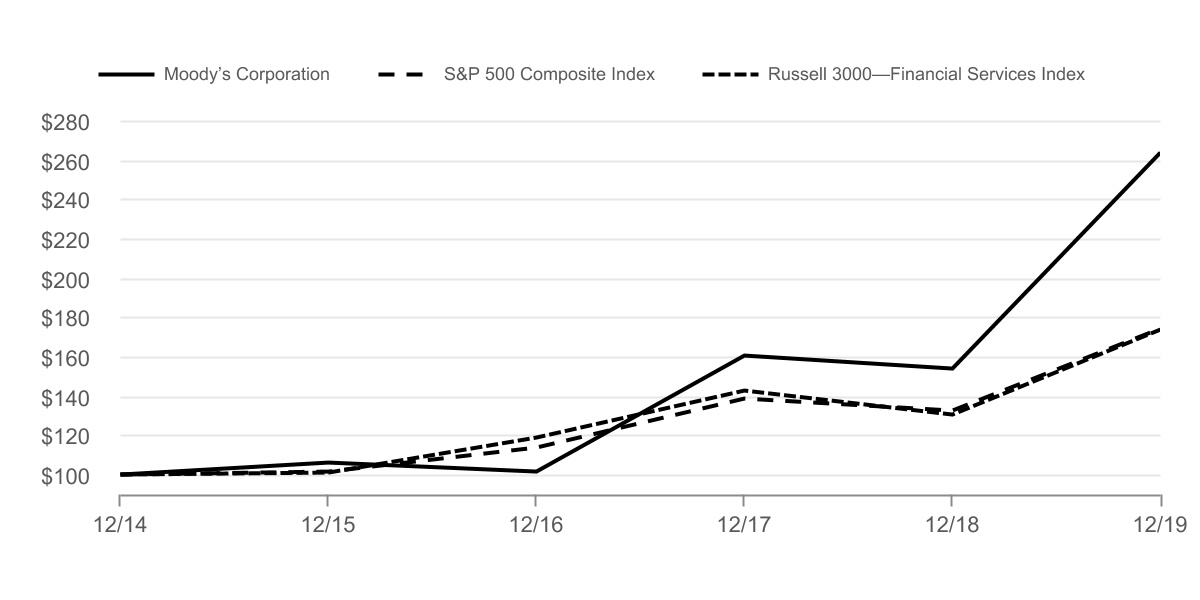
| Year Ended December 31, | ||||||||||||||||||||||||||||||||||||||||||||||||||||||||||||||||||||
| 2014 | 2015 | 2016 | 2017 | 2018 | 2019 | |||||||||||||||||||||||||||||||||||||||||||||||||||||||||||||||
| Moody’s Corporation | $ | 100.00 | $ | 106.09 | $ | 101.22 | $ | 160.45 | $ | 153.86 | $ | 263.49 | ||||||||||||||||||||||||||||||||||||||||||||||||||||||||
| S&P 500 Composite Index | $ | 100.00 | $ | 101.38 | $ | 113.51 | $ | 138.29 | $ | 132.23 | $ | 173.86 | ||||||||||||||||||||||||||||||||||||||||||||||||||||||||
| Russell 3000—Financial Services Index | $ | 100.00 | $ | 100.68 | $ | 118.77 | $ | 142.45 | $ | 130.56 | $ | 173.54 |
The comparisons in the graph above are provided in response to disclosure requirements of the SEC and are not intended to forecast or be indicative of future performance of the Company’s common stock.
28 MOODY'S 2019 10-K
Item 6. SELECTED FINANCIAL DATA
The Company’s selected consolidated financial data should be read in conjunction with Item 7. “MD&A” and the Moody’s Corporation consolidated financial statements and notes thereto.
| Year Ended December 31, | ||||||||||||||||||||||||||||||||||||||||||||||||||||||||
| amounts in millions, except per share data | 2019 | 2018 | 2017 | 2016 | 2015 | |||||||||||||||||||||||||||||||||||||||||||||||||||
| Results of operations | ||||||||||||||||||||||||||||||||||||||||||||||||||||||||
| Revenue | $ | 4,829 | $ | 4,443 | $ | 4,204 | $ | 3,604 | $ | 3,485 | ||||||||||||||||||||||||||||||||||||||||||||||
| Expenses | ||||||||||||||||||||||||||||||||||||||||||||||||||||||||
| Operating and SG&A Expenses (1) | 2,554 | 2,326 | 2,202 | 1,950 | 1,880 | |||||||||||||||||||||||||||||||||||||||||||||||||||
| Restructuring | 60 | 49 | — | 12 | — | |||||||||||||||||||||||||||||||||||||||||||||||||||
| Depreciation and amortization | 200 | 192 | 158 | 127 | 114 | |||||||||||||||||||||||||||||||||||||||||||||||||||
| Acquisition-Related Expenses | 3 | 8 | 23 | — | — | |||||||||||||||||||||||||||||||||||||||||||||||||||
| Settlement Charge | — | — | — | 864 | — | |||||||||||||||||||||||||||||||||||||||||||||||||||
| Loss pursuant to the divestiture of MAKS | 14 | — | — | — | — | |||||||||||||||||||||||||||||||||||||||||||||||||||
| Total Expenses | 2,831 | 2,575 | 2,383 | 2,953 | 1,994 | |||||||||||||||||||||||||||||||||||||||||||||||||||
| Operating income(2) | 1,998 | 1,868 | 1,821 | 651 | 1,491 | |||||||||||||||||||||||||||||||||||||||||||||||||||
| Non-operating (expense) income, net (3)(1) | (188) | (196) | (34) | (94) | (112) | |||||||||||||||||||||||||||||||||||||||||||||||||||
| Income before provision for income taxes (2) | 1,810 | 1,672 | 1,787 | 557 | 1,379 | |||||||||||||||||||||||||||||||||||||||||||||||||||
| Provision for income taxes (4) | 381 | 352 | 779 | 282 | 430 | |||||||||||||||||||||||||||||||||||||||||||||||||||
| Net income (2) (5) | 1,429 | 1,320 | 1,008 | 275 | 949 | |||||||||||||||||||||||||||||||||||||||||||||||||||
| Less: Net income attributable to noncontrolling interests | 7 | 10 | 7 | 9 | 8 | |||||||||||||||||||||||||||||||||||||||||||||||||||
| Net income attributable to Moody’s (2)(5) | $ | 1,422 | $ | 1,310 | $ | 1,001 | $ | 266 | $ | 941 | ||||||||||||||||||||||||||||||||||||||||||||||
| Earnings per share | ||||||||||||||||||||||||||||||||||||||||||||||||||||||||
| Basic (2) (5) | $ | 7.51 | $ | 6.84 | $ | 5.24 | $ | 1.38 | $ | 4.70 | ||||||||||||||||||||||||||||||||||||||||||||||
| Diluted (2) (5) | $ | 7.42 | $ | 6.74 | $ | 5.15 | $ | 1.36 | $ | 4.63 | ||||||||||||||||||||||||||||||||||||||||||||||
| Weighted average shares outstanding | ||||||||||||||||||||||||||||||||||||||||||||||||||||||||
| Basic | 189.3 | 191.6 | 191.1 | 192.7 | 200.1 | |||||||||||||||||||||||||||||||||||||||||||||||||||
| Diluted | 191.6 | 194.4 | 194.2 | 195.4 | 203.4 | |||||||||||||||||||||||||||||||||||||||||||||||||||
| Dividends declared per share | $ | 2.00 | $ | 1.76 | $ | 1.14 | $ | 1.49 | $ | 1.39 | ||||||||||||||||||||||||||||||||||||||||||||||
| Operating margin (2) | 41.4 | % | 42.0 | % | 43.3 | % | 18.1 | % | 42.8 | % | ||||||||||||||||||||||||||||||||||||||||||||||
| Operating Cash Flow (6) | $ | 1,675 | $ | 1,461 | $ | 755 | $ | 1,259 | $ | 1,198 |
| December 31, | |||||||||||||||||||||||||||||||||||||||||||||||||||||
| 2019 | 2018 | 2017 | 2016 | 2015 | |||||||||||||||||||||||||||||||||||||||||||||||||
| Balance sheet data | |||||||||||||||||||||||||||||||||||||||||||||||||||||
| Total assets | $ | 10,265 | $ | 9,526 | $ | 8,594 | $ | 5,327 | $ | 5,103 | |||||||||||||||||||||||||||||||||||||||||||
| Long-term debt | $ | 5,581 | $ | 5,226 | $ | 5,111 | $ | 3,063 | $ | 3,381 | |||||||||||||||||||||||||||||||||||||||||||
| Operating lease liabilities, long-term | $ | 485 | $ | — | $ | — | $ | — | $ | — | |||||||||||||||||||||||||||||||||||||||||||
| Total shareholders’ equity (deficit) | $ | 831 | $ | 656 | $ | (115) | $ | (1,027) | $ | (333) |
(1)Pursuant to the adoption of a new accounting standard relating to pension accounting in 2018, only the service cost component of net periodic expense is classified within operating and SG&A expenses with the remaining components being classified as non-operating (expenses) income. Prior period results have been restated to reflect this classification.
(2)The significant decrease in 2016 was primarily due to the $864 million Settlement Charge ($701 million, net of tax, or $3.59 per diluted share).
(3)The 2017 amount includes a $111 million Purchase Price Hedge Gain as well as the $60 million CCXI Gain. The 2016 amount includes a $35 million FX gain relating to the substantial liquidation of a subsidiary. The 2015 amount includes a benefit of $7 million related to the favorable resolution of certain Legacy Tax Matters.
MOODY'S 2019 10-K 29
(4)Provision for income taxes in the year ended December 31, 2019 includes a tax charge of $13 million pursuant to the divestiture of MAKS. Provision for income taxes in the year ended December 31, 2018 includes a charge of $64 million relating to an increase in non-U.S. UTPs, partially offset by a $59 million benefit from potential realization of foreign tax credits and other adjustments to previous estimates relating to the Tax Act. Provision for income taxes in the year ended December 31, 2017 includes a net charge of $246 million related to the impact of U.S. tax reform and a statutory tax rate reduction in Belgium.
(5)The 2019 amount includes i) a $45 million ($0.23 per share) restructuring charge, ii) a $14 million loss and $13 million tax charge ($0.07 per share each) pursuant to the divestiture of MAKS. The 2018 amount includes: i) a $59 million ($0.30 per share) benefit related to the impact of U.S. tax reform, ii) a $64 million ($0.33 per share) charge related to an increase to non-U.S UTPs; and iii) $37 million ($0.19 per share) net restructuring charge. The 2017 amount includes: i) a $246 million ($1.27 per share) charge related to the impact of U.S. tax reform; ii) a $72 million ($0.37 per share) Purchase Price Hedge Gain; and iii) the $60 million ($0.31 per share) CCXI Gain. The 2016 amount includes: i) a $701 million ($3.59 per share) Settlement Charge; ii) an $8 million ($0.04 per share) restructuring charge; and iii) a $35 million ($0.18 per share) FX gain relating to the substantial liquidation of a subsidiary. The 2015 amount includes a benefit of $6 million ($0.03 per share) related to the resolution of certain Legacy Tax Matters.
(6)The decline in operating cash flow in 2017 is primarily due to payments made relating to the Settlement Charge. Additionally, in the first quarter of 2017, the Company adopted ASU No. 2016-09 “Improvements to Employee Share-Based Payment Accounting”. As required by ASU 2016-09, Excess Tax Benefits or shortfalls relating to employee stock-based compensation are reflected in operating cash flow and the Company has applied this provision on a retrospective basis. Under previous accounting guidance, Excess Tax Benefits or shortfalls were shown as a reduction to operating cash flow and an increase to financing cash flow.
30 MOODY'S 2019 10-K
Item 7. MANAGEMENT'S DISCUSSION AND ANALYSIS OF FINANCIAL CONDITION AND RESULTS OF OPERATIONS
This discussion and analysis of financial condition and results of operations should be read in conjunction with the Moody’s Corporation consolidated financial statements and notes thereto included elsewhere in this annual report on Form 10-K.
This MD&A contains Forward-Looking Statements. See “Forward-Looking Statements” commencing on page 59 and Item 1A. “Risk Factors” commencing on page 17 for a discussion of uncertainties, risks and other factors associated with these statements.
THE COMPANY
Moody’s is a provider of (i) credit ratings and assessment services; (ii) credit, capital markets and economic research, data and analytical tools; (iii) software solutions that support financial risk management activities; (iv) quantitatively derived credit scores; (v) learning solutions and certification services; (vi) offshore financial research and analytical services (this business was divested with the sale of MAKS in the fourth quarter of 2019); and (vii) company information and business intelligence products. Moody’s reports in two reportable segments: MIS and MA.
MIS, the credit rating agency, publishes credit ratings and provides assessment services on a wide range of debt obligations and the entities that issue such obligations in markets worldwide. Revenue is primarily derived from the originators and issuers of such transactions who use MIS ratings in the distribution of their debt issues to investors. Additionally, MIS earns revenue from certain non-ratings-related operations, which consist primarily of financial instrument pricing services in the Asia-Pacific region as well as revenue from ICRA’s non-ratings operations. The revenue from these operations is included in the MIS Other LOB and is not material to the results of the MIS segment.
MA provides financial intelligence and analytical tools to assist businesses in making decisions. MA’s portfolio of solutions consists of specialized research, data, software, and professional services, which are assembled to support the financial analysis and risk management activities of institutional customers worldwide.
CRITICAL ACCOUNTING ESTIMATES
Moody’s discussion and analysis of its financial condition and results of operations are based on the Company’s consolidated financial statements, which have been prepared in accordance with accounting principles generally accepted in the United States. The preparation of these financial statements requires Moody’s to make estimates and judgments that affect reported amounts of assets and liabilities and related disclosures of contingent assets and liabilities at the dates of the financial statements and revenue and expenses during the reporting periods. These estimates are based on historical experience and on other assumptions that are believed to be reasonable under the circumstances. On an ongoing basis, Moody’s evaluates its estimates, including those related to revenue recognition, accounts receivable allowances, contingencies, restructuring, goodwill, long-lived assets (including acquired intangible assets), leases, pension and other retirement benefits and income taxes. Actual results may differ from these estimates under different assumptions or conditions. The following accounting estimates are considered critical because they are particularly dependent on management’s judgment about matters that are uncertain at the time the accounting estimates are made and changes to those estimates could have a material impact on the Company’s consolidated results of operations or financial condition.
Goodwill
On July 31st of each year, Moody’s evaluates its goodwill for impairment at the reporting unit level, defined as an operating segment (i.e., MIS and MA), or one level below an operating segment (i.e., a component of an operating segment).
The Company has seven primary reporting units at December 31, 2019: two within the Company’s ratings business (one for the ICRA business and one that encompasses all of Moody’s other ratings operations) and five reporting units within MA: Content, ERS, MALS, Bureau van Dijk and Reis. The Content reporting unit offers subscription-based research, data and analytical products, including credit ratings produced by MIS, credit research, quantitative credit scores and other analytical tools, economic research and forecasts, business intelligence and company information products. The ERS reporting unit provides products and services that support the credit risk management and regulatory compliance activities of financial institutions and also provides advanced actuarial software for the life insurance industry. These products and services are primarily delivered via software that is licensed on a perpetual basis or sold on a subscription basis. The MALS reporting unit consists of the portion of the MA business that offers both credit training as well as other professional development training. The Bureau van Dijk reporting unit primarily consists of the Bureau van Dijk business, and primarily provides business intelligence and company information products. The Reis reporting unit, which consists of the newly acquired Reis business, provides commercial real estate market information and analytical tools.
MOODY'S 2019 10-K 31
The Company evaluates the recoverability of goodwill using a two-step impairment test approach at the reporting unit level. In the first step, the Company assesses various qualitative factors to determine whether the fair value of a reporting unit may be less than its carrying amount. If a determination is made based on the qualitative factors that an impairment does not exist, the Company is not required to perform further testing. If the aforementioned qualitative assessment results in the Company concluding that it is more likely than not that the fair value of a reporting unit may be less than its carrying amount, the fair value of the reporting unit will be quantitatively determined and compared to its carrying value including goodwill. If the fair value of the reporting unit exceeds the carrying value of the net assets assigned to that unit, goodwill is not impaired and the Company is not required to perform further testing. If the fair value of the reporting unit is less than the carrying value, the Company will record a goodwill impairment charge for the amount by which the carrying value exceeds the reporting unit’s fair value. The Company evaluates its reporting units on an annual basis, or more frequently if there are changes in the reporting structure of the Company due to acquisitions, realignments or if there are indicators of potential impairment. For the reporting units where the Company is consistently able to conclude that no impairment exists using only a qualitative approach, the Company’s accounting policy is to perform the second step of the aforementioned goodwill impairment assessment at least once every three years.
At July 31, 2019, the Company performed quantitative assessments of the Content, ERS, MALS, Bureau van Dijk, MIS, and ICRA reporting units and a qualitative assessment for the Reis reporting unit, which was acquired by Moody's within one year of the Company's annual assessment date. The quantitative assessments did not result in the carrying value of the reporting unit exceeding its fair value. The qualitative analysis for Reis resulted in the Company determining that it was not more likely than not that the fair value of the Reis reporting unit was less than its carrying amount.
Determining the fair value of a reporting unit or an indefinite-lived acquired intangible asset involves the use of significant estimates and assumptions, which are more fully described below. In addition, the Company also makes certain judgments and assumptions in allocating shared assets and liabilities to determine the carrying values for each of its reporting units.
Other assets and liabilities, including applicable corporate as
Showing the first 8K of 143K characters. Open the full section
Item 7A. QUANTITATIVE AND QUALITATIVE DISCLOSURES ABOUT MARKET RISK
Information in response to this item is set forth under the caption “Market Risk” in Part II, Item 7 on page 51 of this annual report on Form 10-K.
MOODY'S 2019 10-K 59
Item 8. FINANCIAL STATEMENTS
Index to Financial Statements
Schedules are omitted as not required or inapplicable or because the required information is provided in the consolidated financial statements, including the notes thereto.
60 MOODY'S 2019 10-K
MANAGEMENT’S REPORT ON INTERNAL CONTROL OVER FINANCIAL REPORTING
Management of Moody’s Corporation is responsible for establishing and maintaining adequate internal control over financial reporting and for the assessment of the effectiveness of internal control over financial reporting. As defined by the SEC in Rules 13a-15(f) and 15d-15(f) under the Securities Exchange Act of 1934, internal control over financial reporting is a process designed by, or under the supervision of, the Company’s principal executive and principal financial officers, or persons performing similar functions, and effected by the Company’s Board, management and other personnel, to provide reasonable assurance regarding the reliability of financial reporting and the preparation of financial statements for external purposes in accordance with generally accepted accounting principles.
Moody’s internal control over financial reporting includes those policies and procedures that (1) pertain to the maintenance of records that, in reasonable detail, accurately and fairly reflect the transactions and dispositions of assets of the Company; (2) provide reasonable assurance that transactions are recorded as necessary to permit preparation of financial statements in accordance with generally accepted accounting principles, and that receipts and expenditures of the Company are being made only in accordance with authorizations of Moody’s management and directors; and (3) provide reasonable assurance regarding prevention or timely detection of unauthorized acquisition, use or disposition of the Company’s assets that could have a material effect on the financial statements.
Because of its inherent limitations, internal control over financial reporting may not prevent or detect misstatements. Also, projections of any evaluation of effectiveness to future periods are subject to the risk that controls may become inadequate because of changes in conditions, or that the degree of compliance with the policies or procedures may deteriorate.
Management of the Company has undertaken an assessment of the design and operational effectiveness of the Company’s internal control over financial reporting as of December 31, 2019 based on criteria established in the Internal Control—Integrated Framework (2013) issued by the Committee of Sponsoring Organizations of the Treadway Commission (COSO).
Based on the assessment performed, management has concluded that Moody’s maintained effective internal control over financial reporting as of December 31, 2019.
The effectiveness of our internal control over financial reporting as of December 31, 2019 has been audited by KPMG LLP, an independent registered public accounting firm, as stated in their report which appears herein.
/s/ RAYMOND W. MCDANIEL, JR.
Raymond W. McDaniel, Jr.
President and Chief Executive Officer
/s/ MARK KAYE
Mark Kaye
Senior Vice President and Chief Financial Officer
February 21, 2020
MOODY'S 2019 10-K 61
Report of Independent Registered Public Accounting Firm
To the Shareholders and Board of Directors of Moody’s Corporation:
Opinions on the Consolidated Financial Statements and Internal Control over Financial Reporting
We have audited the accompanying consolidated balance sheets of Moody’s Corporation and subsidiaries (the Company) as of December 31, 2019 and 2018, the related consolidated statements of operations, comprehensive income, shareholders’ equity (deficit), and cash flows for each of the years in the three-year period ended December 31, 2019, and the related notes (collectively, the consolidated financial statements). We also have audited the Company’s internal control over financial reporting as of December 31, 2019, based on criteria established in Internal Control – Integrated Framework (2013) issued by the Committee of Sponsoring Organizations of the Treadway Commission.
In our opinion, the consolidated financial statements referred to above present fairly, in all material respects, the financial position of the Company as of December 31, 2019 and 2018 and the results of its operations and its cash flows for each of the years in the three-year period ended December 31, 2019 in conformity with U.S. generally accepted accounting principles. Also in our opinion, the Company maintained, in all material respects, effective internal control over financial reporting as of December 31, 2019 based on criteria established in Internal Control – Integrated Framework (2013) issued by the Committee of Sponsoring Organizations of the Treadway Commission.
Change in Accounting Principles
As discussed in Note 1 to the financial statements, the Company has changed its method of accounting for leases as of January 1, 2019, due to the adoption of Accounting Standard Codification (ASC) Topic 842, Leases, and its method of accounting for revenue as of January 1, 2018, due to the adoption of Accounting Standard Update (ASU) 2014-019 and all related amendments, which established ASC Topic 606, Revenue—Revenue from Contracts with Customers.
Basis for Opinions
The Company’s management is responsible for these consolidated financial statements, for maintaining effective internal control over financial reporting, and for its assessment of the effectiveness of internal control over financial reporting, included in the accompanying Management’s Report on Internal Control over Financial Reporting. Our responsibility is to express an opinion on the Company’s consolidated financial statements and an opinion on the Company’s internal control over financial reporting based on our audits. We are a public accounting firm registered with the Public Company Accounting Oversight Board (United States) (PCAOB) and are required to be independent with respect to the Company in accordance with the U.S. federal securities laws and the applicable rules and regulations of the Securities and Exchange Commission and the PCAOB.
We conducted our audits in accordance with the standards of the PCAOB. Those standards require that we plan and perform the audits to obtain reasonable assurance about whether the consolidated financial statements are free of material misstatement, whether due to error or fraud, and whether effective internal control over financial reporting was maintained in all material respects.
Our audits of the consolidated financial statements included performing procedures to assess the risks of material misstatement of the consolidated financial statements, whether due to error or fraud, and performing procedures that respond to those risks. Such procedures included examining, on a test basis, evidence regarding the amount
Showing the first 8K of 368K characters. Open the full section
Item 9. CHANGES IN AND DISAGREEMENTS WITH ACCOUNTANTS ON ACCOUNTING AND FINANCIAL DISCLOSURE
Not applicable.
Item 9A. CONTROLS AND PROCEDURES
Evaluation of Disclosure Controls and Procedures
The Company carried out an evaluation, as required by Rule 13a-15(b) under the Exchange Act, under the supervision and with the participation of the Company’s management, including the Company’s Chief Executive Officer and Chief Financial Officer, of the effectiveness of the design and operation of the Company’s disclosure controls and procedures, as defined in Rule 13a-15(e) of the Exchange Act, as of the end of the period covered by this report (the “Evaluation Date”). Based on such evaluation, such officers have concluded that, as of the Evaluation Date, the Company’s disclosure controls and procedures were effective to provide reasonable assurance that information required to be disclosed by the Company in reports that it files or submits under the Exchange Act is recorded, processed, summarized and reported within the time periods specified in the communication to the Company’s management, including the Company’s Chief Executive Officer and Chief Financial Officer, as appropriate to allow timely decisions regarding required disclosure.
Changes In Internal Control Over Financial Reporting
Information in response to this Item is set forth under the caption “Management’s Report on Internal Control Over Financial Reporting”, in Part II, Item 8 of this annual report on Form 10-K.
The Company’s management, including the Company’s Chief Executive Officer and Chief Financial Officer, has determined that there were no changes in the Company’s internal control over financial reporting that have materially affected, or are reasonably likely to materially affect, these internal controls over financial reporting during the three months ended December 31, 2019.
Item 9B. OTHER INFORMATION
Not applicable.
118 MOODY'S 2019 10-K
PART III
Except for the information relating to the executive officers of the Company set forth in Part I of this annual report on Form 10-K, the information called for by Items 10-14 is contained in the Company’s definitive proxy statement for use in connection with its annual meeting of stockholders scheduled to be held on April 21, 2020, and is incorporated herein by reference.
Item 10. DIRECTORS, EXECUTIVE OFFICERS AND CORPORATE GOVERNANCE
Item 11. EXECUTIVE COMPENSATION
Item 12. SECURITY OWNERSHIP OF CERTAIN BENEFICIAL OWNERS AND MANAGEMENT AND RELATED STOCKHOLDER MATTERS
Item 13. CERTAIN RELATIONSHIPS AND RELATED TRANSACTIONS, AND DIRECTOR INDEPENDENCE
Item 14. PRINCIPAL ACCOUNTING FEES AND SERVICES
Item 15. EXHIBITS AND FINANCIAL STATEMENT SCHEDULES
LIST OF DOCUMENTS FILED AS PART OF THIS REPORT.
(1) Financial Statements.
See Index to Financial Statements on page 60, in Part II. Item 8 of this Form 10-K.
(2) Financial Statement Schedules.
None.
(3) Exhibits.
INDEX TO EXHIBITS
120 MOODY'S 2019 10-K
MOODY'S 2019 10-K 121
122 MOODY'S 2019 10-K
MOODY'S 2019 10-K 123
*Filed herewith
†Management contract of compensatory plan or arrangement
Item 16. FORM 10-K SUMMARY
None.
124 MOODY'S 2019 10-K
SIGNATURES
Pursuant to the requirements of Section 13 or 15(d) of the Securities Exchange Act of 1934, the Registrant has duly caused this report to be signed on its behalf by the undersigned, thereunto duly authorized.
| MOODY’S CORPORATION | ||
| (Registrant) | ||
| By: /s/ RAYMOND W. MCDANIEL, JR. | ||
| Raymond W. McDaniel, Jr. | ||
| President and Chief Executive Officer |
Date: February 21, 2020
Pursuant to the requirements of the Securities Exchange Act of 1934, this report has been signed below by the following persons on behalf of the Registrant and in the capacities and on the date indicated.
| /s/ RAYMOND W. MCDANIEL, JR. | /s/ KATHRYN M. HILL | ||||
| Raymond W. McDaniel, Jr., | Kathryn M. Hill, | ||||
| President and Chief Executive Officer | Director | ||||
| (principal executive officer) | |||||
| /s/ MARK KAYE | /s/ VINCENT A. FORLENZA | ||||
| Mark Kaye, | Vincent A. Forlenza, | ||||
| Senior Vice President and Chief Financial Officer | Director | ||||
| (principal financial officer) | |||||
| /s/ HENRY A. MCKINNELL, JR. PH.D. | |||||
| /s/ CAROLINE SULLIVAN | Henry A. McKinnell, Jr. Ph.D., | ||||
| Caroline Sullivan, | Chairman | ||||
| Senior Vice President and Corporate Controller | |||||
| (principal accounting officer) | |||||
| /s/ LESLIE F. SEIDMAN | |||||
| Leslie F. Seidman, | |||||
| /s/ BASIL L. ANDERSON | Director | ||||
| Basil L. Anderson, | |||||
| Director | |||||
| /s/ BRUCE VAN SAUN | |||||
| Bruce Van Saun, | |||||
| /s/ JORGE A. BERMUDEZ | Director | ||||
| Jorge A. Bermudez, | |||||
| Director | |||||
| /s/ GERRIT ZALM | |||||
| Gerrit Zalm, | |||||
| /s/ THÉRÈSE ESPERDY | Director | ||||
| Thérèse Esperdy, | |||||
| Director | |||||
| Date: February 21, 2020 |
MOODY'S 2019 10-K 125