 filings.tools
Martin Marietta Materials (MLM) 10-K risk factor changes: FY2020 vs FY2019
The 2020-12-31 10-K against the 2019-12-31 one, compared heading by heading and sentence by sentence.
Item 1A135 rewritten46 added63 removed226 unchanged
All filing items1,069 rewritten1,737 added1,964 removed1,473 unchanged
Summary
counted, not written
- Item 1A headings could not be compared: only 0 carried over between the two years, which usually means one filing was read wrongly, so none is reported as new or removed.
- Sentence by sentence, 1,737 added, 1,964 removed, 1,069 rewritten and 1,473 unchanged across 20 items that differ.
- Not in this year's filing: Item 7. MANAGEMENT’S DISCUSSION AND ANALYSIS OF FINANCIAL CONDITION AND RESULTS OF OPERATIONS.
Sentences by item
22 items, with every count and a link to each item that changed
Underlined words on a shaded ground are new in FY2020; struck-through words were in FY2019. Sentences that are wholly new or wholly gone are labelled rather than marked.
Item 1A. RISK FACTORS
135 rewritten, 46 added, 63 removed, 226 unchanged
An investment in [removed: our] [added: Martin Marietta] common stock or debt securities involves risks and uncertainties.
You should consider the following factors carefully, in addition to the other information contained in this Form 10-K, before deciding to purchase or otherwise trade [removed: our] [added: the Company’s] securities.
These forward-looking statements are made as of the date hereof based on management’s current expectations, and the Company does not undertake an obligation to update such statements, whether as a result of new information, future events, or [removed: otherwise.][added: otherwise, other than as required by law.]
Our business is cyclical and depends on activity within the construction [removed: industry.][added: industry]
As a result of these issues, several of our top [removed: sales generating] [added: revenue-generating] states, from time-to-time, stop bidding or slow bid projects in their transportation departments.
We sell most of our aggregates [removed: products, our] [added: (our] primary [removed: business,] [added: business)] and our cement products, to the construction industry, [removed: so] [added: therefore] our results depend on that industry’s strength.
Since our businesses depend on construction spending, which can be cyclical, our profits are sensitive to national, [removed: regional,] [added: regional] and local economic conditions and the intensity of the underlying spending on aggregates and cement products.
Construction spending is affected by economic conditions, changes in interest rates, demographic and population shifts, and changes in construction spending by federal, [removed: state,] [added: state] and local governments.
The [removed: Great Recession] [added: recession] of the late 2000s and early 2010s (the [removed: “Great Recession”)] [added: Great Recession)] was an example, and our shipment volumes were significantly reduced.
While our business operations cover a wide geographic area, our earnings depend on the strength of the local economies in which we operate because of the high cost to transport our products relative to their [added: selling] price.
If economic conditions [removed: and]
[added: and] construction spending decline significantly in one or more areas, particularly in [removed: our] [added: the Building Materials Business’] top five [removed: sales-generating] [added: revenue\-generating] states of [removed: our Building Materials business of] Texas, Colorado, North Carolina, [removed: Georgia,] [added: Georgia] and [removed: Iowa] [added: Iowa,] our profitability will decrease.
We experienced this situation [removed: with] [added: during] the Great Recession.
While historical spending on public infrastructure projects has been, comparatively, more stable as governmental appropriations and expenditures are typically less interest rate-sensitive than private sector spending, we experienced a slight retraction in aggregates [removed: product line] shipments to the infrastructure market after uncertainty regarding the passage of the [removed: federal highway bill in] [added: Highway and Transportation Funding Act of] 2014.
Contractors were not able to get any certainty on the availability of federal infrastructure funding until late 2015 with the enactment of [removed: a new federal highway bill.][added: the Fixing America’s Surface Transportation (FAST) Act.]
Our Building Materials [removed: business] [added: Business] is seasonal and subject to the weather, which can significantly impact [removed: operations.][added: operations]
Adverse weather conditions, including hurricanes and tropical storms, cold weather, [removed: snow,] [added: snow] and heavy or sustained rainfall, reduce construction activity, restrict the demand for our [removed: products,] [added: products] and impede our ability to efficiently transport material.
Adverse weather conditions also increase our costs and reduce our production output as a result of power loss, needed plant and equipment repairs, time required to remove water from flooded [removed: operations,] [added: operations] and similar events.
[removed: The Building Materials product lines’ production] [added: Production] and shipment levels [added: of the Building Materials Business’ products] follow activity in the construction industry, which typically are strongest in the spring, summer and fall.
Our Building Materials [removed: business] [added: Business] depends on the availability of [removed: aggregate] [added: quality aggregates] reserves or deposits and our ability to mine them [removed: economically.][added: economically]
Our challenge is to find [added: quality] aggregates deposits that we can mine economically, with appropriate permits, near either growing markets or long-haul transportation corridors that economically serve [removed: growing] [added: applicable] markets.
As communities have grown, they have [removed: taken up] [added: settled in and around] attractive quarrying locations and have imposed restrictions on mining.
We try to meet this challenge by identifying and permitting sites prior to economic expansion, buying more land around our existing quarries to increase our mineral reserves, developing underground [removed: mines,] [added: mines] and developing a distribution network that transports aggregates products by various methods, including rail and water.
While our distribution network allows us to transport our products longer distances than would normally be considered economical, we can give no assurances that we will be [removed: successful.][added: successful at this strategy.]
Our businesses face many [removed: competitors.][added: competitors]
Our results are affected by the number of competitors in a market, the production capacity that a particular market can accommodate, the pricing practices of other [removed: competitors,] [added: competitors] and the entry of new competitors in a market.
For example, our Magnesia Specialties business may compete with other chemical products that could be used instead of our magnesia-based [added: products.]
As other examples, our aggregates, ready [removed: mix] [added: mixed] concrete, and asphalt and paving [removed: product lines] [added: businesses] may compete with recycled asphalt and concrete products that could be used instead of new products and our cement [removed: product line] [added: operations] may compete with international competitors who are importing products [removed: to] [added: into] the United States [added: from jurisdictions] with lower production and regulatory costs.
Our future growth may depend in part on acquiring other businesses in our [removed: industry.][added: industry, and we may acquire businesses by paying all or in part with shares of our common stock]
We expect to continue to grow, in part, by [removed: buying] [added: acquiring] other businesses.
Our integration of the acquisition [removed: of] or business combination with other businesses may not be as successful as [removed: projected.][added: projected]
However, in connection with the integration of any other business that we acquire, there is a risk that we will not be able to achieve such integration in a successful manner or on the time schedule we have projected or in a way that will achieve the level of synergies, cost [removed: savings,] [added: savings] or operating efficiencies we forecast from the acquisition.
Any other significant business acquisition or combination we might choose to [removed: do, similar to the acquisition of TXI or Bluegrass, would] [added: undertake may] require that we devote significant management attention and resources to preparing for and then integrating our business practices and operations.
Nevertheless, we may fail to realize some of the anticipated benefits of any potential acquisition or other business combination that we pursue in the future, if the [removed: integration process takes longer than expected or is more costly than expected.]
[removed: Our] [added: Our] acquisitions could harm our results of [removed: operations.][added: operations]
| | • | we may not realize a satisfactory return on [removed: the investment we make;] [added: our investment;] |
Our cement [removed: product line] and Magnesia Specialties [removed: business] [added: businesses] may become [removed: capacity-constrained.][added: capacity-constrained]
If our cement [removed: product line] or Magnesia Specialties [removed: business] [added: businesses] becomes capacity-constrained, [removed: they] [added: we] may be unable to timely satisfy the demand for some of [removed: their] [added: our] products, and any resulting changes in customers would introduce volatility to the earnings of these segments.
Future demand for our products may require us to expand [removed: further] our manufacturing [removed: capacity,] [added: capacity further,] particularly through the purchase of additional manufacturing equipment.
While we are permitted to expand production by up to [removed: 800,000] [added: 0.8 million] additional tons at our Midlothian [added: cement] plant, it could take us a significant period of time before such production expansion could come to fruition.
Industry and COVID-19 Risk Factors
| A World-Class Organization Built for Success |  | Form 10-K ♦ Page 11 |
Subsequent to the Great Recession and until the impact from COVID-19 beginning in the first quarter of 2020, we experienced slow-but-steady construction growth that coincided with the longest economic recovery in United States history.
Our businesses could be adversely affected by the ongoing COVID-19 pandemic, or any other outbreak of disease, epidemic or pandemic, or similar public health threat, or fear of such an event and its related economic and societal response
Our businesses could be negatively impacted by the widespread outbreak of an illness or other communicable disease, or any other public health crisis that results in economic and trade disruptions.
In or around December 2019, COVID-19 was initially reported.
Four months later, in March 2020, the World Health Organization declared it a global pandemic.
The proliferation of COVID-19 cases in the United States, and the extent that geography of outbreaks primarily matches the regions in which the Company’s Building Materials Business principally operates, in combination with the related governmental orders limiting individuals’ movements and social gatherings, as well as requiring many businesses to close for an undetermined period of time, are negatively impacting economic activity, consumer confidence and discretionary spending, and overall market conditions.
Further, COVID-19 could continue to negatively affect the health of our employees, employee productivity, customer purchasing patterns and fulfillment of purchase orders, availability of supplies, pricing for raw materials, and the ability to transport materials via the Company’s distribution network.
While our operations have been designated as “essential” under applicable government orders otherwise restricting business activities to prevent further outbreak of COVID-19, and accordingly have been permitted to continue to operate during the pendency of these orders, it is possible that they may not continue to be so treated under future government orders, or, even if so treated, site-specific health and safety concerns might otherwise require certain of the Company’s operations to be halted for some period of time.
We are monitoring the impact of COVID-19 on our operations and on our product demand.
Due to economic uncertainty related to COVID-19, contractors and customers may delay advancing, or ultimately cancel, building projects.
In addition, reduced travel due to remote working and stay-at-home practices, including as a result of governmental orders restricting activity, may continue to negatively impact fuel tax revenues that fund highway projects.
While we do not currently expect that the virus will have a material adverse effect on the Company’s liquidity, we are unable to accurately and fully predict the impact that COVID-19 will have on the results of operations due to various uncertainties, including the ultimate geographic spread of the virus, the severity of the disease, the duration of the outbreak, actions that may be taken by governmental authorities and
| Form 10-K ♦ Page 12 |  | A World-Class Organization Built for Success |
other third-parties in response to COVID-19 and the timing and pace of any economic recovery as COVID-19 impacts ultimately abate.
| A World-Class Organization Built for Success |  | Form 10-K ♦ Page 13 |
integration process takes longer than expected or is more costly than expected.
| Form 10-K ♦ Page 14 |  | A World-Class Organization Built for Success |
advantage over domestically produced cement.
Certain of our operations may from time to time involve the use of substances that are classified as toxic or hazardous within the meaning of these laws and regulations.
With the change of the U.S. presidential administration, it is too early to tell whether the USEPA will proceed with revisions of the Tailoring Rule or proceed in a different direction, nor is it known how the USEPA may revise the BACT requirements.
| A World-Class Organization Built for Success |  | Form 10-K ♦ Page 15 |
U.S. President Biden has made climate change a central focus of his administration.
In addition to reentering the Paris Agreement, on January 27, 2021, President Biden issued a pair of executive orders and a presidential memorandum making the climate change central to U.S. Policy and setting out several administrative priorities and undertakings.
Although it is still too early to determine the actions the federal governmental will take to implement the orders, or the full scope, timing or ramifications of such measures, it is clear that the administration intends to make a significant and sweeping push on the climate front and, like other signatories to the Paris Agreement, intends to pursue a goal of a Net Zero GHG by 2050.
The orders, combined with democratic control of both chambers of the U.S. Congress, suggest that additional executive and/or legislative action is likely, although the timing and scope of such action is unclear.
Additionally, it seems probable that the USEPA and other agencies will likely use their rule-making authority and procurement decisions to further address climate change.
Various states where we have operations are considering climate change initiatives as well, and we may be subject to state regulations in addition to any federal laws and rules that are passed.
In light of the various regulatory uncertainties, we cannot at this time reasonably predict what the costs of any future compliance requirements may be, but we do not believe it will have a material adverse effect on the financial condition or results of the operations of either the Magnesia Specialties business or Building Materials Business.
We continue to monitor GHG regulations and legislation and its potential impact on our cement business, financial condition and product demand.
However, it is currently impossible to estimate the cost of any such future requirements at this time.
The FAST Act was extended for one year and now is set to expire September 30, 2021.
We expect to see increased infrastructure spending at the state and local levels in 2021, aided by $10 billion for state departments of transportation provided by the December 2020 federal stimulus package as well as $14 billion of approved ballot initiatives.
| Form 10-K ♦ Page 16 |  | A World-Class Organization Built for Success |
In addition, because of our reliance on our senior management team, the
| A World-Class Organization Built for Success |  | Form 10-K ♦ Page 17 |
unanticipated departure of any key member of our management team could have an adverse effect on our business.
Our future success depends, in part, on our ability to identify and develop or recruit talent to succeed our senior management and other key positions throughout the organization.
If we fail to identify and develop or recruit successors, we are at risk of being harmed by the departures of these key employees.
General Risk Factors
| Form 10-K ♦ Page 14 |  | Celebrating 25 Years as a Public Company |
| --- | --- | --- |
Part I ♦ Item 1A – Risk Factors
Recent years, however, have shown a slow but steady turnaround in this trend.
The current economic expansion in the United States, which began in 2009, has now become the longest economic recovery in United States history.
Weather-related hindrances were exacerbated over the last few years by record precipitation in many of our key markets, notably the eastern seaboard and Texas.
Importantly, inclement weather was most significant during the second and third quarters, which represents the height of the construction season.
These weather events reduced the Company’s overall profitability in the last few years, so our results for those years, or in comparison to other years, may not be indicative of our future operating results.
In 2019, Hurricane Dorian and Tropical Storm Imelda temporarily disrupted the Company’s business.
| Celebrating 25 Years as a Public Company |  | Form 10-K ♦ Page 15 |
products.
We will continue to look for strategic businesses to acquire, like our acquisition of TXI in 2014 and our acquisition of Bluegrass in 2018.
Our largest business acquisition was TXI, which closed in July 2014.
In 2015, we completed the integration of TXI’s operations into our own operations ahead of schedule, which allowed us to achieve and exceed the synergies, cost savings, and operating efficiencies we had forecasted at the time of the acquisition.
In 2018, we completed the integration of the operations of Bluegrass into our own operations in a manner that surpassed the publicly stated synergy estimates provided at the closing of the transaction.
| Form 10-K ♦ Page 16 |  | Celebrating 25 Years as a Public Company |
  | Form 10-K ♦ Page 17 |
The last few years brought an unprecedented amount of precipitation to the United States and particularly to Texas and the southeastern United States.
| Form 10-K ♦ Page 18 |  | Celebrating 25 Years as a Public Company |
The FAST Act, however, only reauthorized federal infrastructure funding through 2020, so must be reauthorized this year.
Federal highway bills provide spending authorizations that represent maximum amounts.
Each year, an appropriation act is passed establishing the amount that can actually be used for particular programs.
The annual funding level is generally tied to receipts of highway user taxes placed in the Highway Trust Fund.
Once the annual appropriation is passed, funds are distributed to each state based on formulas (“apportionments”) or other procedures (“allocations").
Apportioned and allocated funds generally must be spent on specific programs as outlined in the federal legislation.
The Highway Trust Fund has experienced shortfalls in recent years, due to high gas prices, fewer miles driven and improved automobile fuel efficiency.
These shortfalls created a significant decline in federal highway funding levels.
In response to the projected shortfalls, money has been transferred from the General Fund into the Highway Trust Fund over the past several years.
Timely Congressional action is needed to address the funding mechanism for the Highway Trust Fund.
We cannot be assured of the existence, timing or amount of federal highway funding levels in the future.
We also cannot be assured of the impact of the recent sharp reduction in gasoline prices on the levels of highway user taxes that might be collected in the future and the corresponding levels of funding to the Highway Trust Fund.
At the state level, each state funds its infrastructure spending from specially allocated amounts collected from various taxes, typically gasoline taxes and vehicle fees, along with voter-approved bond programs.
Shortages in state tax revenues can reduce the amounts spent on state infrastructure projects, even below amounts awarded under legislative bills.
Delays in state infrastructure spending can hurt our business.
Many states after the Great Recession experienced state-level funding pressures caused by lower tax revenues or other inability to finance approved projects.
For example, North Carolina was among the states that experienced these pressures, and this state disproportionately affects our revenues and profits.
Most state budgets, including North Carolina’s, improved in 2014 and later years as increased tax revenues helped resolve budget constraints.
North Carolina infrastructure spending recently has been restrained by spending required elsewhere for storm relief and litigation settlements.
Despite these restraints, the North Carolina General Assembly has provided interim financial relief for North Carolina to continue to fund its infrastructure spending.
An excerpt. Shown here: 40 of 135 rewritten, 40 of 46 added and 40 of 63 removed. The counts are complete. For every sentence, read Item 1A. RISK FACTORS in the FY2020 filing and the FY2019 filing.
Item 7. MANAGEMENT’S DISCUSSION AND ANALYSIS OF FINANCIAL CONDITION AND RESULTS OF OPERATIONS
0 rewritten, 0 added, 1,277 removed, 0 unchanged
Dropped this year
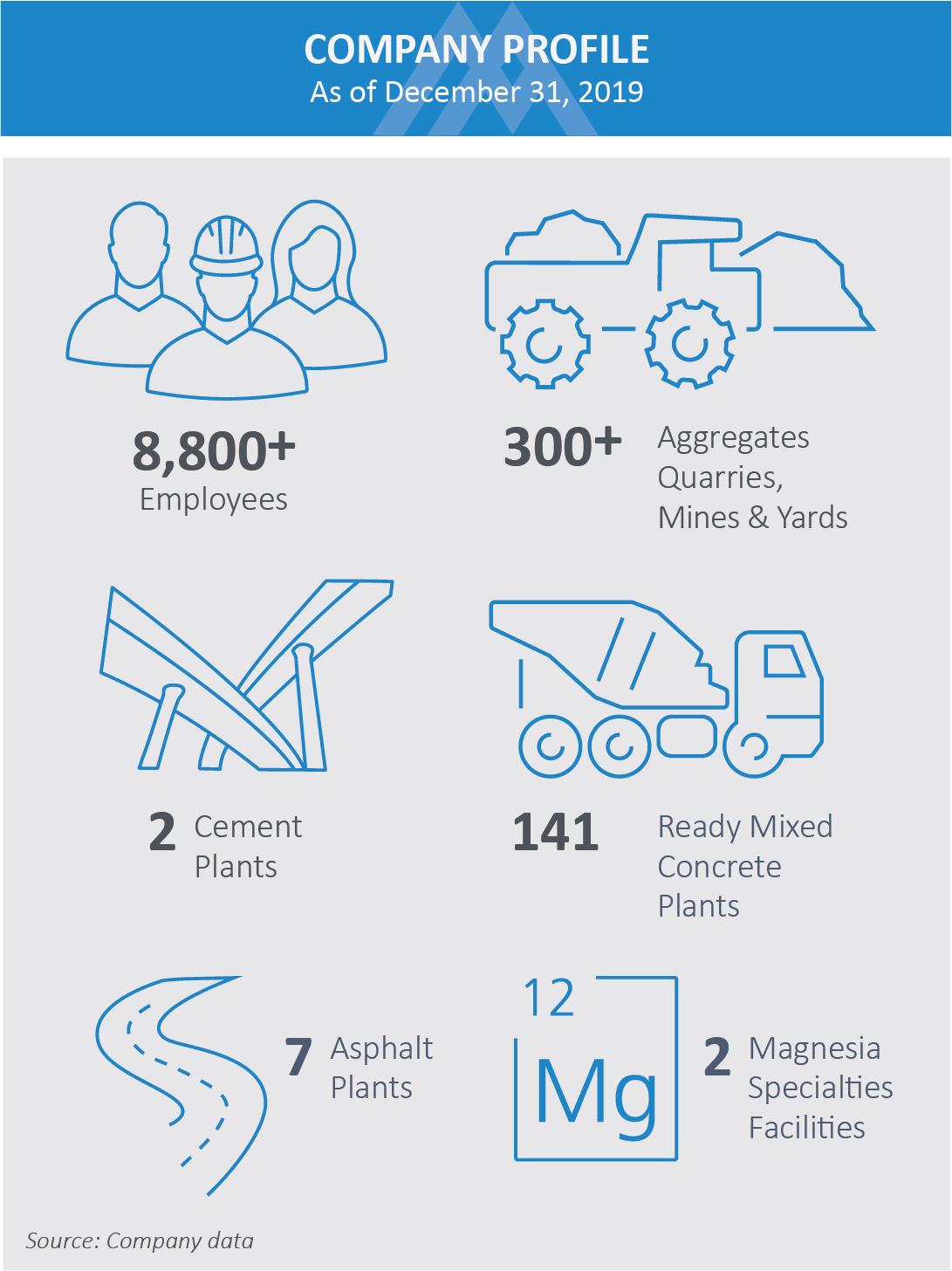INTRODUCTORY OVERVIEW
Martin Marietta Materials, Inc. (the “Company” or “Martin Marietta”) is a natural resource-based building materials company.
The Company supplies aggregates (crushed stone, sand and gravel) through its network of more than 300 quarries, mines and distribution yards in 27 states, Canada and the Bahamas.
In the western United States, Martin Marietta also provides cement and downstream products, namely ready mixed concrete, asphalt and paving services, in markets where the Company has a leading aggregates position.
Specifically, the Company has two cement plants in Texas and ready mixed concrete and asphalt operations in Texas, Colorado, Louisiana, Arkansas and Wyoming.
Paving services are exclusively in Colorado.
The Company’s heavy-side building materials are used in infrastructure, nonresidential and residential construction projects.
Aggregates are also used in agricultural, utility and environmental applications and as railroad ballast.
The aggregates, cement, ready mixed concrete, asphalt and paving product lines are reported collectively as the “Building Materials” business.
As more fully discussed in the *Consolidated Strategic Objectives* section, geography is critically important for the Building Materials business.
The Company conducts its Building Materials business through three reportable segments, organized by geography: Mid-America Group, Southeast Group and West Group.
The Mid-America and Southeast Groups provide aggregates products only.
The West Group provides aggregates, cement and downstream products and services.
Further, the following five states accounted for 72% of the Building Materials business 2019 total products and services revenues: Texas, Colorado, North Carolina, Georgia and Iowa.

| Form 10-K ♦ Page 34 |  | Celebrating 25 Years as a Public Company |
| --- | --- | --- |
| | | |
Part II ♦ Item 7 – Management’s Discussion and Analysis of Financial Condition and Results of Operations
The Building Materials business is a mature, cyclical business, dependent on activity within the construction marketplace.
As of December 31, 2019, the nation’s current economic expansion, which started in June 2009, has lasted 126 months and is the longest economic recovery in history.
By comparison, the average trough-to-peak expansionary cycle since 1938 was 60 months.
During the current economic expansion, however, governmental uncertainty, labor shortages and logistical challenges have tempered the recovery pace of growth of heavy construction activity, resulting in a slow, steady, extended construction cycle that is expected to continue over the next several years.
The level of economic recovery varies within the Company’s geographic footprint.
Magnesia Specialties
The Company operates a Magnesia Specialties business with production facilities in Michigan and Ohio.
The Magnesia Specialties business produces magnesia-based chemicals products used in industrial, agricultural and environmental applications.
It also produces dolomitic lime sold primarily to customers in the steel and mining industries.
Magnesia Specialties’ products are shipped to customers worldwide.
Consolidated Strategic Objectives
The Company’s strategic planning process, or Strategic Operating Analysis and Review (SOAR), provides the framework for 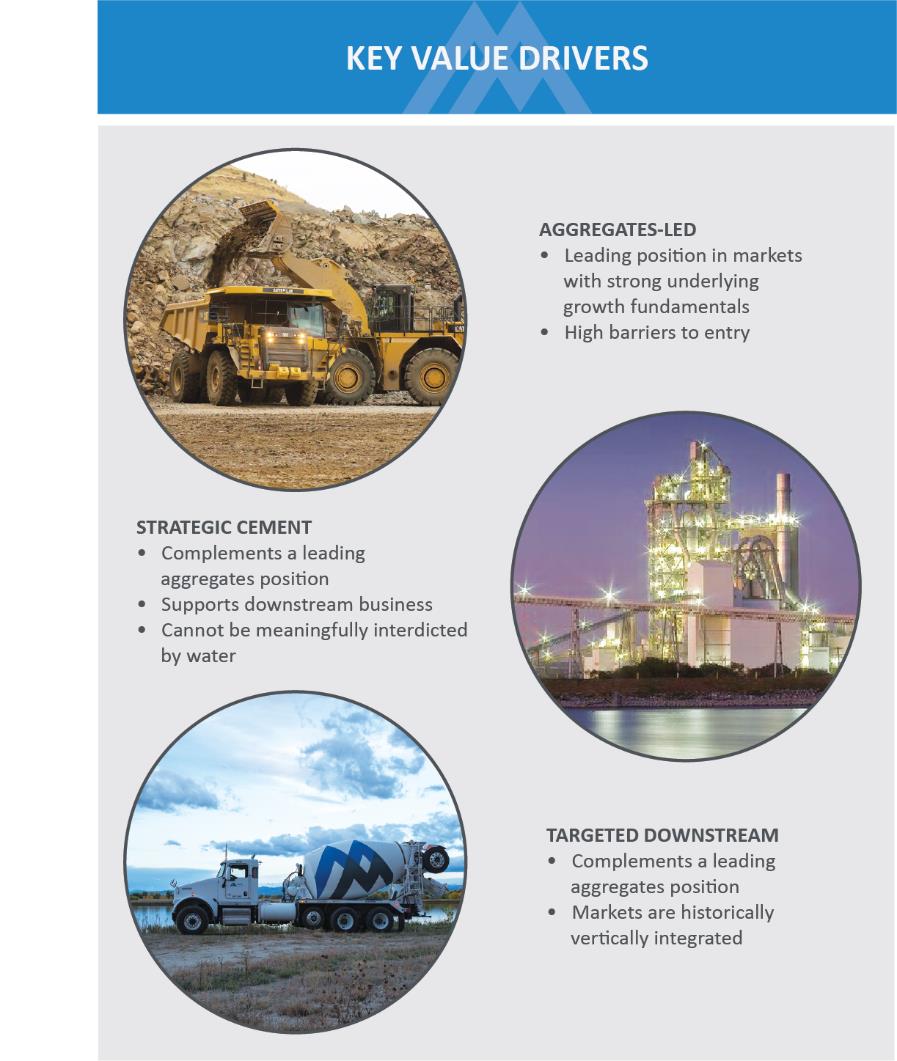 execution of Martin Marietta’s long-term strategic plan.
Guided by this framework and considering the cyclicality of the Building Materials business, the Company determines capital allocation priorities to maximize long-term shareholder value.
The Company’s strategy includes ongoing evaluation of aggregates-led opportunities of scale in new domestic markets (i.e., platform acquisitions), expansion through acquisitions that complement existing operations (i.e., bolt-on acquisitions), divestitures of assets that are not consistent with stated strategic goals, and arrangements with other companies engaged in similar or complementary businesses.
The Company finances such opportunities with the goal of preserving its financial flexibility by having a leverage ratio (consolidated debt-to-consolidated earnings before interest, taxes, depreciation and amortization, or EBITDA) within a target range of 2.0 times to 2.5 times within a reasonable time following the completion of a debt-financed transaction.
The Company, by purposeful design, will continue to be an aggregates-led business (aggregates product revenues represented 62% of 2019 total consolidated products and services revenues) that focuses on markets with strong, underlying growth fundamentals where it can sustain or achieve a leading market position.
Driven by this intentional approach, the Company has leading positions in 90% of its markets.
As part of its long-term strategic plan, the Company may pursue strategic cement and targeted downstream opportunities.
For Martin Marietta, strategic cement and targeted downstream operations are located in vertically-integrated markets where the Company has, or envisions a clear path toward, a leading aggregates position.
Additionally, strategic cement operations are attractive where market supply cannot be meaningfully interdicted by water.
Generally, the Company’s building materials products are both sourced and sold locally.
An excerpt. Shown here: all 0 rewritten, all 0 added and 40 of 1,277 removed. The counts are complete. For every sentence, read Item 7. MANAGEMENT’S DISCUSSION AND ANALYSIS OF FINANCIAL CONDITION AND RESULTS OF OPERATIONS in the FY2019 filing.
Item 7A. QUANTITATIVE AND QUALITATIVE DISCLOSURES ABOUT MARKET RISK
6 rewritten, 5 added, 4 removed, 27 unchanged
During [removed: 2019,] [added: 2020,] the Federal Reserve lowered the federal funds [removed: rate several times throughout] [added: rate, and at December 31, 2020,] the [removed: year.][added: rate was 0.09%.]
The residential construction market accounted for approximately [removed: 22%] [added: 24%] of the Company’s aggregates [removed: product line] shipments in [removed: 2019.][added: 2020.]
At December 31, [removed: 2019,] [added: 2020,] the Company had a $700 million Revolving Facility and a $400 million Trade Receivable Facility.
A hypothetical 10% change in the Company’s energy prices in [removed: 2020] [added: 2021] as compared with [removed: 2019,] [added: 2020,] assuming constant volumes, would change [removed: 2020] [added: 2021] energy expense by [removed: $27.9] [added: $23.1] million.
A hypothetical 10% change in sales price of the cement product line would impact cement product line revenues by [removed: $43.9 million, excluding the net impact of internal sales.][added: $45.3 million.]
A hypothetical 10% change in cement costs in [removed: 2020] [added: 2021] compared with [removed: 2019,] [added: 2020,] assuming constant volumes, would change the ready mixed concrete product line cost of sales by [removed: $24.5] [added: $25.5] million.
As of December 31, 2020, the Company did not have any outstanding variable-rate debt.
However, any future borrowings under the credit facilities or outstanding variable-rate debt are exposed to interest rate risk.
While increases in cement pricing may negatively impact the profitability of the ready mixed concrete operations, the cement business would benefit, although the positive impact may not reflect a direct correlation to the impact to the ready mix business.
| Form 10-K ♦ Page 64 |  | A World-Class Organization Built for Success |
| | | |
The rate at December 31, 2019 was 1.55%.
The Company also has $300 million of variable-rate senior notes outstanding.
A hypothetical 100-basis-point increase in interest rates on borrowings of $640 million, which was the collective outstanding balance at December 31, 2019, would increase interest expense by $6.4 million on an annual basis.
| Celebrating 25 Years as a Public Company |  | Form 10-K ♦ Page 71 |
Item 1. BUSINESS
139 rewritten, 73 added, 167 removed, 155 unchanged
Martin Marietta Materials, Inc. (the [removed: “Company”] [added: Company] or [removed: “Martin Marietta”)] [added: Martin Marietta)] is a natural resource-based building materials company.
The Company supplies aggregates (crushed stone, sand and gravel) through its network of [removed: more than] [added: approximately] 300 quarries, mines and distribution yards in 27 states, [removed: Canada, the Bahamas] [added: Canada] and [removed: the Caribbean Islands.][added: The Bahamas.]
In the western United States, Martin Marietta also provides cement and downstream products, namely, ready mixed concrete, asphalt and paving [removed: services] [added: services,] in markets [added: that are naturally vertically integrated and] where the Company has a leading aggregates position.
Specifically, the Company has two cement plants in Texas, and ready mixed concrete and asphalt operations in Texas, [removed: Colorado, Louisiana, Arkansas,] [added: Colorado] and Wyoming.
[removed: Paving] [added: Asphalt operations and paving] services are exclusively in Colorado.
The aggregates, cement, ready mixed concrete and asphalt and paving [removed: product lines] [added: operations] are reported collectively as the “Building [removed: Materials” business.][added: Materials Business”.]
It also produces dolomitic lime sold primarily to customers [removed: in the] [added: for] steel [added: production] and [removed: mining industries.][added: land stabilization.]
Magnesia Specialties’ products are shipped to customers [added: domestically and] worldwide.
The Company conducts its Building Materials [removed: business] [added: Business] through [removed: three] [added: two] reportable segments, organized by geography: [removed: Mid-America Group, Southeast] [added: East] Group and West Group.
[removed: Our] [added: The] top ten states accounted for [removed: 86%] [added: 87%] of the Building Materials [removed: business] [added: Business] total revenues in [removed: 2019:] [added: 2020:] Texas, Colorado, North Carolina, Georgia, Iowa, Florida, South Carolina, Indiana, Maryland and Nebraska.
The [removed: Company also has the] [added: Company’s] Magnesia Specialties [added: is reported as a separate] segment, which includes its magnesia-based chemicals and dolomitic lime businesses.
For more information on the organization and geographic area of the Company’s business segments, see [removed: “Note] [added: “[Note] A: Accounting [removed: Policies-Organization”] [added: Policies-Organization](#NOTE_A_ACCOUNTING_POLICIES)”] and [removed: “Note] [added: “[Note] P: [removed: Segments”] [added: Segments](#NOTE_P_SEGMENTS)”] of the “Notes to Financial Statements” of the Company’s consolidated financial statements, which appear in Item 8, “Financial Statements and Supplementary Data,” of this Annual Report on Form 10-K (this [removed: “Form 10-K”).][added: Form 10-K).]
The [removed: business’] profitability [added: of the Building Materials Business, which serves customers in the construction marketplace,] is sensitive to national, regional and local economic conditions and cyclical swings in construction spending, which are in turn affected by fluctuations in levels of public-sector infrastructure funding; interest rates; access to capital markets; and demographic, geographic, employment and population dynamics.
Therefore, erratic weather patterns, seasonal changes, and other weather-related conditions, including precipitation, flooding, hurricanes, snowstorms, extreme [removed: temperatures,] [added: temperatures] and droughts, can significantly affect production schedules, shipments, costs, efficiencies and profitability.
Aggregates are an engineered, granular material consisting of crushed stone, [removed: and] sand and gravel, [added: which is] manufactured to specific sizes, grades and chemistry for use primarily in construction applications.
The Company’s operations consist primarily of open pit quarries; however, the Company is the largest operator of underground aggregates mines in the United States with 14 active underground mines located in the [removed: Mid-America] [added: East] Group.
The Company’s aggregates reserves [removed: are 89 years on] average [removed: at] [added: approximately 90 years, based on] current production levels.
Cement is the basic [removed: binding] agent used to bind [removed: water, aggregates] [added: aggregates, sand] and [removed: sand,] [added: water] in the production of ready mixed concrete.
These plants produce Portland and specialty cements, have a combined [removed: annual capacity of 4.5 million tons, and operated at 80% to 85% utilization in 2019.]
The Midlothian plant permit allows the Company to expand production by up to [removed: 800,000] [added: 0.8 million] additional tons.
Ready mixed concrete, a mixture primarily [added: consisting] of cement, [removed: water,] aggregates, [added: sand] and [removed: sand,] [added: water,] is measured in cubic yards and specifically batched or produced for [removed: customers'] [added: customers’] construction projects and then transported and poured at the project site.
The Company operates [removed: 141] [added: 120] ready mix plants in Texas, [removed: Colorado, Louisiana, Arkansas,] [added: Colorado] and Wyoming.
The Company’s asphalt [removed: operations are located primarily in Colorado; additionally,] [added: and] paving [removed: services] [added: operations] are [removed: offered] [added: exclusively] in Colorado.
The Building Materials [removed: business] [added: Business] markets its products primarily to the construction industry, with [removed: 35%] [added: 36%] of [removed: the] aggregates [removed: product line] shipments in [removed: 2019 made] [added: 2020] to contractors in connection with highway and other public infrastructure projects and the balance of its shipments [removed: made] primarily to contractors [removed: in connection with] [added: for] nonresidential and residential construction projects.
Funding of public infrastructure, the Company’s largest end-use market, is discussed in greater detail under [removed: “Management’s Discussion and Analysis of Financial Condition and Results of Operations—Building] [added: “[Building] Materials Business’ Key Considerations—Public [removed: Infrastructure, the Company’s largest end-use market, is funded through a combination of federal, state and local sources”] [added: Infrastructure](#BMBs_Key_Consideration_Public_Infra)”] in [removed: Item] [added: [Item] 7, “Management’s Discussion and Analysis of Financial Condition and Results of [removed: Operations,’’] [added: Operations](#ITEM_7_MANAGEMENTS_DISCUSSION_ANALYSIS_F),’’] of this Form 10-K.
The [removed: Company’s] Building Materials [removed: business] [added: Business] covers a wide geographic area.
The five largest [removed: sales-generating] [added: revenue-generating] states (Texas, Colorado, North Carolina, Georgia, and Iowa) [added: accounted] for [added: 71% of] the Building Materials [removed: business accounted for 72% of] [added: Business’] total revenues by state of destination in [removed: 2019.][added: 2020.]
The [removed: Company’s] Building Materials [removed: business] [added: Business] is accordingly affected by the economies in these regions and has been adversely affected in part by recessions and weaknesses in these economies from time to time.
As a general rule, [added: the distance covered by] truck shipments from an individual quarry [removed: are] [added: is] limited because the cost of transporting processed aggregates to customers is high in relation to the price of the product itself.
As described below, the Company’s distribution system mainly uses trucks, but also has access to a [removed: river barge and an ocean vessel] [added: waterborne] network where the per-mile unit cost of transporting aggregates is much lower.
The Company’s rail network primarily serves its Texas, Florida, Colorado and Gulf Coast markets while the Company’s [added: locations in The] Bahamas and Nova Scotia [removed: locations] transport materials via oceangoing ships.
At December 31, [removed: 2019,] [added: 2020,] the [added: Company’s] distribution [removed: network available to the Company] [added: facilities] consisted of [removed: 86] [added: 84] terminals.
[removed: Particularly] [added: The risk of a downturn in one market may be somewhat mitigated by other markets served by the location, particularly] where a producing quarry serves a local market and transports products via rail, water and/or truck to be sold in other [removed: markets, the risk of a downturn in one market may be somewhat mitigated by other markets served by the location.][added: markets.]
Production costs are generally higher at underground mines than surface quarries since the depth of the [removed: aggregate] [added: aggregates] deposits and the access to the reserves result in higher costs related to development, explosives and depreciation costs.
However, these locations often possess [added: marketplace] transportation advantages that can lead to higher average selling prices than more distant surface quarries.
[removed: This] [added: The Company’s] distribution network moves aggregates materials from domestic and offshore [removed: sources,] [added: sources] via [added: its long-haul] rail and [removed: water,] [added: waterborne distribution network,] to markets where aggregates supply is limited.
This typically occurs where the Company transports aggregates from a production location to a distribution [removed: location by rail or water,] [added: location,] and the customer pays a selling price that includes a freight component.
Moreover, the Company’s expansion of its rail-based distribution network, coupled with the extensive use of rail [removed: service in the Southeast and West Groups,] [added: service,] increases the Company’s dependence on and exposure to railroad performance, including track congestion, crew availability, railcar availability, [removed: and] locomotive availability, and the ability to renegotiate favorable railroad shipping contracts.
The waterborne distribution [removed: network, primarily located within the Southeast Group,] [added: network] also increases the Company’s exposure to certain risks, including, among other items, meeting minimum tonnage [removed: requirements of shipping contracts, demurrage costs, fuel costs, ship availability and weather disruptions.]
The number of acquisition opportunities has increased in the last [removed: few] [added: several] years as the economy recovered from the protracted recession.
In 2020, the aggregates product gross profit accounted for 68% of the Company’s consolidated total product gross profit.
FOR FURTHER INFORMATION WITH RESPECT TO THE DEVELOPMENT OF THE COMPANY’S BUSINESS PRIOR TO 2020, SEE THE INFORMATION APPEARING UNDER THE HEADING “GENERAL” INCLUDED IN [PART I, ITEM 1](http://www.sec.gov/Archives/edgar/data/916076/000156459020005784/mlm-10k_20191231.htm#ITEM_1_BUSINESS) OF THE COMPANY’S [FORM 10-K](https://www.sec.gov/ix?doc=/Archives/edgar/data/916076/000156459020005784/mlm-10k_20191231.htm) FOR THE YEAR ENDED DECEMBER 31, 2019, WHICH INFORMATION IS INCORPORATED BY REFERENCE.
The East Group provides aggregates products only.
| A World-Class Organization Built for Success |  | Form 10-K ♦ Page 1 |
annual clinker capacity of 4.5 million tons, and operated at 80% utilization in 2020.
In 2020, the coronavirus (COVID-19) pandemic impacted the global economy.
The Company, being considered an essential business, continued to operate but experienced a modest volume decline in aggregates shipments due to a slowdown in overall construction activity.
However, management believes this slowdown represents a delay rather than cancellations of projects.
| Form 10-K ♦ Page 2 |  | A World-Class Organization Built for Success |
requirements of shipping contracts, demurrage costs, fuel costs, ship availability and weather disruptions.
The Company does not anticipate any significant difficulty in obtaining reserves used for production.
Cement
The rest are shipped to
| A World-Class Organization Built for Success |  | Form 10-K ♦ Page 3 |
Steel production in 2020 decreased 18% versus 2019.
However, demand for chemicals products in 2020 was negatively impacted by COVID-19.
| Form 10-K ♦ Page 4 |  | A World-Class Organization Built for Success |
The loss of any single customer would not have a material adverse effect on the segment.
The Company operates in a largely-fragmented industry with over 5,000 domestic aggregates producers, including large, public companies and a large number of small, privately-held companies.
| | • | HeidelbergCement AG |
Due to the localized nature of the industry resulting from the high cost of transportation relative to the price of the product, the Building Materials Business primarily operates in smaller distinct areas that can vary from one another.
According to the U.S. Geological Survey, United States cement production is widely dispersed, with the top five companies collectively producing approximately 61% of U.S. clinker capacity.
| A World-Class Organization Built for Success |  | Form 10-K ♦ Page 5 |
Overview
Environmental Compliance and Accruals
See “Legal Proceedings” under Item 3 of this Form 10-K, “Note O:
| Form 10-K ♦ Page 6 |  | A World-Class Organization Built for Success |
Mine Safety and Land Reclamation
Greenhouse Gases and Climate Change
| --- | --- | --- |
| A World-Class Organization Built for Success |  | Form 10-K ♦ Page 7 |
emissions.
With the change of the U.S. presidential administration, it is too early to determine whether the USEPA will proceed with revisions of the Tailoring Rule or proceed otherwise.
It is also unknown how the USEPA may revise BACT requirements.
U.S. President Biden has made climate change a central focus of his administration.
In addition to re-entering the Paris Agreement on January 27, 2021, President Biden issued a pair of executive orders and a presidential memorandum making the climate change central to U.S. Policy and setting out several administrative priorities and undertakings.
Although it is still too early to determine the actions the federal governmental will take to implement the orders, or the full scope, timing or ramifications of such measures, it is clear that the administration intends to make a significant and sweeping push on the climate front and, like other signatories to the Paris Agreement, intends to pursue a goal of a Net Zero GHG by 2050.
The orders, combined with democratic control of both chambers of the 117th U.S. Congress, suggest that additional executive and/or legislative action is likely, although the timing and scope of such action is unclear.
It also seems probable that the USEPA and other agencies will likely use their rule-making authority and procurement decisions to further address climate change.
In addition, the cement produced by the Company’s two plants in Texas, like other U.S. operators, is subject to strict limits set by the U.S. Department of Transportation (DOT) and other agencies, including those relating to “clinker substitution”, or the replacement of ground clinker in cement with alternate materials such as pozzolan, slag and fly ash, which has implications for the Company’s fuel use and efforts to reduce GHG emissions from its operations.
The Company was formed in 1993 as a North Carolina corporation to serve as successor to the operations of the materials group of the organization that is now Lockheed Martin Corporation.
An initial public offering of a portion of the Company’s common stock was completed in 1994, followed by a tax-free exchange transaction in 1996 that resulted in 100% of the Company’s common stock being publicly traded.
The Company completed over 90 smaller acquisitions from the time of its initial public offering until the present, which allowed the Company to enhance and expand its aggregates-led presence in the building materials marketplace.
This included an exchange of certain assets in 2011 with Lafarge North America Inc. (“Lafarge”), pursuant to which it received aggregates quarry sites, ready mixed concrete and asphalt plants, and a road paving business in and around the metropolitan Denver, Colorado, and the I-25 corridor, in exchange for which Lafarge received properties consisting of quarries, an asphalt plant and distribution yards operated by the Company along the Mississippi River (called the Company’s “River District Operations”) and a cash payment.
The business has developed further through the following transactions over the past few years.
In 2014, the Company completed the acquisition of Texas Industries, Inc. (“TXI”), further augmenting its position as a leading supplier of aggregates and heavy building materials.
TXI was a major supplier of natural aggregates in Texas, in northern Louisiana and, to a lesser extent, in Oklahoma and Arkansas.
TXI was the then largest supplier of cement and ready mixed concrete products in Texas.
TXI enhanced the Company’s position as an aggregates-led, low-cost operator in large and fast-growing geographies in the United States, adding 800 million tons of aggregates to the Company’s reserves, and provided high-quality assets in cement and ready mixed concrete.
In connection with the TXI acquisition, the Company acquired nine quarries and six aggregates distribution terminals located in Texas, Louisiana and Oklahoma.
The Company also acquired two cement plants in Midlothian, Texas, south of Dallas, and Hunter, Texas, north of San Antonio, and approximately 120 ready mixed concrete plants, situated primarily in three areas of Texas (the Dallas/Fort Worth/Denton area of north Texas; the Austin area of central Texas; and from Beaumont to Texarkana in east Texas), in north and central Louisiana and in Southwestern Arkansas.
As part of an agreement in conjunction with the United States Department of Justice’s review of the transaction, the Company divested its North Troy Quarry in Oklahoma and two related rail distribution yards in Dallas and Frisco, Texas.
TXI was also a cement producer in California.
In 2015, the Company divested its California cement operations acquired from TXI.
These operations were not in close proximity to aggregates and other core assets of the Company and, unlike other marketplace competitors, were not vertically integrated with ready mixed concrete production.
The divestiture primarily included a cement plant, two distribution terminals, mobile equipment, intangible assets and inventory.
The Company also completed the integration of the TXI operations in 2015, and completed three smaller acquisitions the same year, which included three aggregates operations and related assets.
In 2016, the Company acquired aggregates, ready mixed concrete and asphalt and paving operations in southern Colorado that provided more than 500 million tons of mineral reserves and expanded the Company’s presence along the Front Range
| Celebrating 25 Years as a Public Company |  | Form 10-K ♦ Page 1 |
Part I ♦ Item 1 – Business
of the Rocky Mountains, home to 85% of Colorado’s population.
The Company also acquired the remaining and controlling interest in a ready mixed concrete company that serves the I-35 corridor in central Texas between Dallas and Austin, which enhanced the Company’s position and provided additional vertical integration benefits with the Company’s cement product line.
In 2018, the Company completed the acquisition of Bluegrass Materials Company (“Bluegrass”), the then largest privately held, pure-play aggregates business in the United States.
With a portfolio of 22 active sites acquired by the Company, the operations provided more than 2.2 billion tons, or approximately 125 years, of strategically-located, high-quality reserves, in Georgia, South Carolina, Tennessee, Maryland, Kentucky and Pennsylvania.
These operations complemented the Company’s existing southeastern footprint in its Mid-America and Southeast Groups and provided a new growth platform within Maryland and Kentucky.
Between 2001 and 2019, the Company disposed of a number of underperforming operations, including aggregates, ready mixed concrete, trucking, and asphalt and road paving operations of its Building Materials business and the refractories business of its Magnesia Specialties business.
In some of its divestitures, the Company concurrently entered into supply agreements to provide aggregates at market rates to certain of these divested businesses.
During 2015, the Company disposed of certain non-core asphalt operations in San Antonio, Texas and divested its California cement operations.
Divestitures in 2018 also included those required as part of the governmental approval associated with the acquisition of Bluegrass, consisting of one site owned by Bluegrass and one site operated by the Company.
The Company will continue to evaluate opportunities to divest underperforming or non-strategic assets, if appropriate, during 2020 consistent with its strategic plan and in an effort to redeploy capital for other opportunities.
The Mid-America and Southeast Groups provide aggregates products only.
This section describes the product lines of the Building Materials business undertaken by the Company within its Mid-America Group, Southeast Group, and West Group.
The Company operates its aggregates product line of business in all of these geographic segments within its Building Materials business.
In 2019, the aggregates product line represented 62% of the Company’s consolidated total products and services revenues.
The Company’s cement, ready mixed concrete, and asphalt and paving operations are conducted within the Company’s West Group, with its two cement plants in Texas, and the remaining ready mixed concrete and asphalt product lines in Texas, Colorado, Louisiana, Arkansas, and Wyoming.
Paving services are offered exclusively in Colorado.
The Company’s cement product line is described below and in greater detail in the next section.
The Building Materials business serves customers in the construction marketplace.
| Form 10-K ♦ Page 2 |  | Celebrating 25 Years as a Public Company |
The Company believes public-works projects have historically accounted for approximately 50% of the total annual aggregates and cement consumption in the United States.
An excerpt. Shown here: 40 of 139 rewritten, 40 of 73 added and 40 of 167 removed. The counts are complete. For every sentence, read Item 1. BUSINESS in the FY2020 filing and the FY2019 filing.
Item 3. LEGAL PROCEEDINGS
3 rewritten, 0 added, 0 removed, 3 unchanged
However, [removed: we] [added: management] cannot assure [removed: you] that an adverse outcome in any of such litigation would not have a material adverse effect on the Company or its operating segments.
The Company was not required to pay any penalties in [removed: 2019] [added: 2020] for failure to disclose certain “reportable transactions” under Section 6707A of the Internal Revenue Code.
See also [removed: “Note] [added: “[Note] O: Commitments and [removed: Contingencies”] [added: Contingencies](#NOTE_O_COMMITMENTS_AND_CONTINGENCIES)”] of the [removed: “Notes] [added: “[Notes] to Financial [removed: Statements”] [added: Statements](#NOTE_A_ACCOUNTING_POLICIES)”] of the Company’s consolidated financial statements included under [removed: Item] [added: [Item] 8, “Financial Statements and Supplemental [removed: Data,”] [added: Data,”](#ITEM_8_FINANCIAL_STATEMENTS_SUPPLEMENTAR)] of this Form 10-K and the [removed: “Environmental] [added: “[Environmental] Regulation and [removed: Litigation”] [added: Litigation](#MDA_ENVIRONMENTAL_REG_AND_LIT)”] section included under [removed: Item] [added: [Item] 7, “Management’s Discussion and Analysis of Financial Condition and Results of [removed: Operations,”] [added: Operations,”](#ITEM_7_MANAGEMENTS_DISCUSSION_ANALYSIS_F)] of this Form 10-K.
Cover and table of contents
28 rewritten, 3 added, 3 removed, 90 unchanged
For the fiscal year ended December 31, [removed: 2019][added: 2020]
As of June [removed: 28, 2019,] [added: 30, 2020,] the last business day of the registrant’s most recently completed second fiscal quarter, the aggregate market value of the registrant’s common stock held by non-affiliates of the registrant was [removed: $12,807,658,433.72] [added: $11,377,742,588] based on the closing sale price as reported on the New York Stock Exchange.
| Class | | Outstanding at February [removed: 14, 2020] [added: 12, 2021] |
| Common Stock, $.01 par value per share | | [removed: 62,198,867] [added: 62,286,775] shares |
| Proxy Statement for the Annual Meeting of Shareholders to be held May [removed: 14, 2020] [added: 13, 2021] (Proxy Statement) | | Part III |
| ITEM 1A. | [RISK FACTORS](#ITEM_1A_RISK_FACTORS) | [removed: 14] [added: 11] |
| ITEM 1B. | [UNRESOLVED STAFF COMMENTS](#ITEM_1B_UNRESOLVED_STAFF_COMMENTS) | [removed: 25] [added: 21] |
| ITEM 2. | [PROPERTIES](#ITEM_2_PROPERTIES) | [removed: 25] [added: 21] |
| ITEM 3. | [LEGAL PROCEEDINGS](#ITEM_3_LEGAL_PROCEEDINGS) | [removed: 28] [added: 25] |
| ITEM 4. | [MINE SAFETY DISCLOSURES](#ITEM_4_MINE_SAFETY_DISCLOSURES) | [removed: 28] [added: 25] |
| [INFORMATION ABOUT OUR EXECUTIVE OFFICERS](#INFORMATION_ABOUT_OUR_EXECUTIVE_FICERS) | | [removed: 29] [added: 26] |
| [PART II](#PART_II) | | [removed: 30] [added: 27] |
| ITEM 5. | [MARKET FOR REGISTRANT’S COMMON EQUITY, RELATED STOCKHOLDER MATTERS AND ISSUER PURCHASES OF EQUITY SECURITIES](#ITEM_5_MARKET_FOR_REGISTRANTS_COMMON_EQU) | [removed: 30] [added: 27] |
| ITEM 6. | [SELECTED FINANCIAL DATA](#ITEM_6_SELECTED_FINANCIAL_DATA) | [removed: 32] [added: 28] |
| ITEM 7. | [MANAGEMENT’S DISCUSSION AND ANALYSIS OF FINANCIAL CONDITION AND RESULTS OF OPERATIONS](#ITEM_7_MANAGEMENTS_DISCUSSION_ANALYSIS_F) | [removed: 34] [added: 29] |
| ITEM 7A. | [QUANTITATIVE AND QUALITATIVE DISCLOSURES ABOUT MARKET RISK](#ITEM_7A_QUANTITATIVE_QUALITATIVE_DISCLOS) | [removed: 71] [added: 64] |
| ITEM 8. | [FINANCIAL STATEMENTS AND SUPPLEMENTARY DATA](#ITEM_8_FINANCIAL_STATEMENTS_SUPPLEMENTAR) | [removed: 72] [added: 65] |
| ITEM 9. | [CHANGES IN AND DISAGREEMENTS WITH ACCOUNTANTS ON ACCOUNTING AND FINANCIAL DISCLOSURE](#ITEM_9_CHANGES_IN_DISAGREEMENTS_WITH_ACC) | [removed: 118] [added: 107] |
| ITEM 9A. | [CONTROLS AND PROCEDURES](#ITEM_9A_CONTROLS_PROCEDURES) | [removed: 118] [added: 107] |
| ITEM 9B. | [OTHER INFORMATION](#ITEM_9B_OR_INFORMATION) | [removed: 119] [added: 108] |
| [PART III](#PART_III) | | [removed: 120] [added: 109] |
| ITEM 10. | [DIRECTORS, EXECUTIVE OFFICERS AND CORPORATE GOVERNANCE](#ITEM_10_DIRECTORS_EXECUTIVE_FICERS_CORPO) | [removed: 120] [added: 109] |
| ITEM 11. | [EXECUTIVE COMPENSATION](#ITEM_11_EXECUTIVE_COMPENSATION) | [removed: 120] [added: 109] |
| ITEM 12. | [SECURITY OWNERSHIP OF CERTAIN BENEFICIAL OWNERS AND MANAGEMENT AND RELATED STOCKHOLDER [removed: MATTERS](#ITEM_12_SECURITY_OWNERSHIP_CERTAIN_BENEF)] [added: MATTERS](#ITEM_12_SECURITY_OWNERSHIP_OF_CERTAIN_BE)] | [removed: 120] [added: 109] |
| ITEM 13. | [CERTAIN RELATIONSHIPS AND RELATED TRANSACTIONS, AND DIRECTOR INDEPENDENCE](#ITEM_13_CERTAIN_RELATIONSHIPS_RELATED_TR) | [removed: 120] [added: 109] |
| ITEM 14. | [PRINCIPAL ACCOUNTANT FEES AND SERVICES](#ITEM_14_PRINCIPAL_ACCOUNTANT_FEES_SERVIC) | [removed: 120] [added: 109] |
| ITEM 15. | [EXHIBITS AND FINANCIAL STATEMENT SCHEDULES](#ITEM_15_EXHIBITS_FINANCIAL_STATEMENT_SCH) | [removed: 121] [added: 110] |
| ITEM 16. | [FORM 10-K SUMMARY](#ITEM_16_FORM_10K_SUMMARY) | [removed: 126] [added: 115] |
Indicate by check mark whether the registrant has filed a report on and attestation to its management’s assessment of the effectiveness of its internal control over financial reporting under Section 404(b) of the Sarbanes-Oxley Act (15 U.S.C. 7262(b)) by the registered public accounting firm that prepared or issued its audit report.
| [PART IV](#PART_IV) | | 110 |
| [SIGNATURES](#SIGNATURES) | | 116 |
| | | |
| [PART IV](#PART_IV) | | 121 |
| [SIGNATURES](#SIGNATURES) | | 127 |
Item 2. PROPERTIES
36 rewritten, 46 added, 45 removed, 38 unchanged
[removed: Building] [added: Building] Materials [removed: Business][added: Business]
As of December 31, [removed: 2019,] [added: 2020,] the Company processed or shipped aggregates from [removed: more than] [added: approximately] 300 quarries, underground mines, and distribution yards in 27 states, [removed: Canada,] [added: Canada] and [removed: the] [added: The] Bahamas, of which [removed: 124] [added: 130] are located on land owned by the Company free of major encumbrances, [removed: 59] [added: 61] are on land owned in part and leased in part, [removed: 109] [added: 91] are on leased land, and [removed: 10] [added: 14] are on facilities neither owned nor leased, where raw materials are removed under an agreement.
The Company’s aggregates reserves, on [removed: the] average, represent [removed: 89] [added: approximately 90] years at current production levels.
In addition, as of December 31, [removed: 2019,] [added: 2020,] the Company processed and shipped ready mixed concrete [removed: and/or] [added: and] asphalt products from [removed: 148] [added: 128] properties in [removed: five] [added: three] states, of which [removed: 124] [added: 100] are located on land owned by the Company free of major encumbrances, [removed: one is] [added: two are] on land owned in part and leased in part, [added: two are at facilities neither owned nor leased] and [removed: 23] [added: 24] are on leased land.
The Company uses various drilling methods, depending on the type of [removed: aggregate,] [added: aggregates,] to estimate aggregates reserves that are economically mineable.
The extent of drilling varies and depends on whether the location is a potential new site [removed: (“greensite”),] [added: (greensite),] an existing location, or a potential acquisition.
More extensive drilling is performed for potential greensites and acquisitions, [removed: and] [added: and,] in rare cases, the Company may rely on existing geological data or results of prior drilling by third parties.
Proven reserves are reserves of deposits designated using closely spaced drill [removed: data, and based on that] data [removed: the reserves] [added: and] are believed to be relatively homogenous.
In determining the amount of reserves, the Company’s policy is to [removed: not include] [added: exclude] calculations that exceed certain depths, so for [removed: deposits,] [added: deposits] such as granite, that typically continue to depths well below the ground, there may be additional deposits that are not included in the reserve calculations.
The Company uses the same methods of analysis to evaluate and estimate the amount of its aggregates reserves used in the cement manufacturing process for its cement [removed: product line] [added: operations] as it does for its aggregates [removed: product line.][added: operations.]
For additional information on the Company’s assessment of reserves, see [removed: “Management’s] [added: “[Management’s] Discussion and Analysis of Financial Condition and Results of Operations – Other Financial Information - Critical Accounting Policies and Estimates - Property, Plant and [removed: Equipment”] [added: Equipment](#MDA_CRITICAL_ACCOUNTING_POLICIES_PPE)”] included under [removed: Article] [added: Item] 7, “Management’s Discussion and Analysis of Financial Condition and Results of Operations,” of this Form 10-K.
Set forth in the tables below are the Company’s estimates of reserves of recoverable aggregates (hard rock and sand and gravel) of suitable quality for economic extraction, shown on a state-by-state basis, and the Company’s total annual production for the last three years, along with the Company’s estimate of years of production available, shown on a [removed: segment-by-segment] [added: reportable segment-by-reportable segment] basis.
[added: The Company evaluates its] reserve estimates primarily on a Company-wide, or [removed: segment-by-segment] [added: reportable segment-by- reportable segment] basis, and does not believe comparisons of changes in reserve estimates on a state-by-state basis from year to year are particularly meaningful.
| State | | Number of Producing Quarries | | [added: | |] Tonnage of Reserves for each general type of aggregate at [removed: 12/31/18] [added: 12/31/19] (in [removed: thousands)] [added: millions)] | | | | | | | | Tonnage of Reserves for each general type of aggregate at [removed: 12/31/19] [added: 12/31/20] (in [removed: thousands)] [added: millions)] | | | | | | | | Change in Tonnage from [removed: 2018] [added: 2019] (in [removed: thousands)] [added: millions)] | | | | | | | | Percentage of aggregate reserves located at an existing quarry, and reserves not located at an existing quarry. | | | | | | | | Percentage of aggregate reserves on land that has not been | | | | Percent of reserves owned and percent leased | | | | | | |
| [added: State] | | [removed: 2019] [added: 2020] | | [added: | |] Hard Rock | | | | S & G | | | | Hard Rock | | | | S & G | | | | Hard Rock | | | | S & G | | | | At Quarry | | | | Not at Quarry | | | | zoned for [removed: quarrying.*] [added: quarrying*] | | | | Owned | | | | Leased | | |
| Mississippi | | [removed: 0] | [added: —] | | [removed: 0] | | [added: —] | | [removed: 67,238] | | [added: 67.2] | | [removed: 0] | | [added: —] | | [removed: 67,238] | | [added: 67.2] | | [removed: 0] | | [added: —] | | [removed: 0] | | [added: —] | | [added: | |] 100 | % | | 0% | | | | 0% | | | | 100% | | | | 0% | | |
[removed: | * |] The Company calculates its aggregate reserves for purposes of this table based on land that has been zoned for quarrying and land for which the Company has determined zoning is not required. [removed: |]
| [added: *] | The Company may own additional land adjacent [added: to] or near existing quarries on which reserves may be located but does not include such reserves in these calculations if zoning is required but has not been obtained. |
| * | The Company's reserves presented in the State of Ohio include dolomitic limestone reserves used in the [removed: business of the] Magnesia Specialties [removed: segment.] [added: business.] |
| | | Total Annual Production (in tons) (in [removed: thousands)] [added: millions)] For year ended December 31 | | | | | | | | | | | | Number of years of production available at December 31, | | |
| Reportable Segment | | [removed: 2019] [added: 2020] | | | | [removed: 2018] [added: 2019] | | | | [removed: 2017] [added: 2018] | | | | [removed: 2019] [added: 2020] | | |
As of December 31, [removed: 2019,] [added: 2020,] the Company, through its subsidiaries, processed or shipped cement from [removed: seven] [added: eight] properties in two states, of which [removed: five] [added: six] are located on land owned by the Company free of major [removed: encumbrances] [added: encumbrances, one is on land that is owned in part] and [removed: two are] [added: leased in part and one is] on leased land.
[removed: The Company’s cement product line has production facilities located at two] sites in Texas: Midlothian, Texas, south of Dallas/Fort Worth; and Hunter, Texas, north of San Antonio.
The following table summarizes certain information about the Company’s cement manufacturing facilities at December 31, [removed: 2019:][added: 2020:]
| Plant | | Rated Annual Productive Capacity-Tons of Clinker [added: (in millions)] | | | | Manufacturing Process | | Service Date | | Internally Estimated [removed: Minimum] Reserves—Years | | |
| Midlothian, TX | | | [removed: 2,400,000] [added: 2.4] | | | Dry | | 2001 | | | [removed: 65] [added: 60] | |
| Hunter, TX | | | [removed: 2,100,000] [added: 2.1] | | | Dry | | 2013, 1981 | | | 140 | |
As of December 31, [removed: 2019,] [added: 2020,] the Company estimated its total proven and probable limestone reserves on such land to be approximately [removed: 687] [added: 682] million tons.
The Company owns and leases various administrative offices for its five [removed: reportable] [added: operating] business segments.
During [removed: 2019,] [added: 2020,] the principal properties of the aggregates [removed: product line] [added: operations] were believed to be utilized at average productive capacities of approximately 75% [removed: to 80%] and were capable of supporting a higher level of market demand.
During [removed: 2019,] [added: 2020,] the Texas cement plants operated on average at 80% [removed: to 85%] utilization.
The Portland Cement Association [removed: (“PCA”)] [added: (PCA)] has projected that [added: Texas] cement consumption will [removed: slow] [added: increase] modestly in [removed: 2020 from 2019, with the rate of change decreasing in 2020 to 1.7%] [added: 2021] from [removed: 2.4% in 2019.][added: 2020.]
The cement [removed: product line’s] [added: business’] leadership, in collaboration with the aggregates and ready mixed concrete teams, have developed strategic plans regarding interplant efficiencies, as well as tactical plans addressing plant utilization and efficiency.
The [removed: Company] [added: Company’s Magnesia Specialties business] expects future organic earnings growth to result from increased pricing, [added: recovery from the impact from COVID-19,] rationalization of the current assets and portfolio and/or further cost reductions.
In the current operating environment, where steel utilization is [removed: at levels close to or below 70%] [added: between 75%] and [removed: the strength of the United States dollar pressures product competitiveness in international markets,] [added: 80%,] any unplanned change in costs or customers introduces volatility to the earnings of the Magnesia Specialties segment.
The dolomitic lime business of the Magnesia Specialties segment operated at [removed: 80%] [added: 73%] utilization in [removed: 2019.][added: 2020.]
| A World-Class Organization Built for Success |  | Form 10-K ♦ Page 21 |
| Form 10-K ♦ Page 22 |  | A World-Class Organization Built for Success |
| --- | --- | --- | --- | --- | --- | --- | --- | --- | --- | --- | --- | --- | --- | --- | --- | --- | --- | --- | --- | --- | --- | --- | --- | --- | --- | --- | --- | --- | --- | --- | --- | --- | --- | --- | --- | --- | --- | --- | --- | --- | --- | --- | --- | --- | --- | --- | --- | --- |
| Alabama | | | 4 | | | | 171.4 | | | | 11.6 | | | | 169.8 | | | | 11.6 | | | | (1.6 | ) | | | — | | | | 100 | % | | 0% | | | | 0% | | | | 56% | | | | 44% | | |
| Arkansas | | | 3 | | | | 242.5 | | | | — | | | | 237.4 | | | | — | | | | (5.1 | ) | | | — | | | | 100 | % | | 0% | | | | 0% | | | | 49% | | | | 51% | | |
| Colorado | | | 9 | | | | 750.3 | | | | 182.8 | | | | 745.1 | | | | 178.3 | | | | (5.2 | ) | | | (4.5 | ) | | | 91 | % | | 9% | | | | 0% | | | | 18% | | | | 82% | | |
| Florida | | | 1 | | | | 122.0 | | | | — | | | | 121.4 | | | | — | | | | (0.6 | ) | | | — | | | | 100 | % | | 0% | | | | 0% | | | | 36% | | | | 64% | | |
| Georgia | | | 18 | | | | 2,168.5 | | | | 18.8 | | | | 2,172.1 | | | | 18.2 | | | | 3.6 | | | | (0.6 | ) | | | 97 | % | | 3% | | | | 0% | | | | 79% | | | | 21% | | |
| Indiana | | | 10 | | | | 476.9 | | | | 73.7 | | | | 470.5 | | | | 65.8 | | | | (6.4 | ) | | | (7.9 | ) | | | 100 | % | | 0% | | | | 0% | | | | 52% | | | | 48% | | |
| Iowa | | | 25 | | | | 703.7 | | | | 19.9 | | | | 675.9 | | | | 25.4 | | | | (27.8 | ) | | | 5.5 | | | | 100 | % | | 0% | | | | 0% | | | | 30% | | | | 70% | | |
| Kansas | | | 2 | | | | 68.9 | | | | — | | | | 70.1 | | | | — | | | | 1.2 | | | | — | | | | 100 | % | | 0% | | | | 8% | | | | 39% | | | | 61% | | |
| Kentucky | | | 6 | | | | 177.7 | | | | 21.6 | | | | 175.8 | | | | 21.1 | | | | (1.9 | ) | | | (0.5 | ) | | | 100 | % | | 0% | | | | 0% | | | | 70% | | | | 30% | | |
| Louisiana | | | 2 | | | | — | | | | 7.5 | | | | — | | | | 7.4 | | | | — | | | | (0.1 | ) | | | 100 | % | | 0% | | | | 0% | | | | 0% | | | | 100% | | |
| Maryland | | | 8 | | | | 876.5 | | | | 6.6 | | | | 867.6 | | | | 6.3 | | | | (8.9 | ) | | | (0.3 | ) | | | 100 | % | | 0% | | | | 0% | | | | 99% | | | | 1% | | |
| Minnesota | | | 2 | | | | 295.6 | | | | — | | | | 291.6 | | | | — | | | | (4.0 | ) | | | — | | | | 64 | % | | 36% | | | | 0% | | | | 50% | | | | 50% | | |
| Missouri | | | 3 | | | | 340.6 | | | | — | | | | 390.7 | | | | — | | | | 50.1 | | | | — | | | | 91 | % | | 9% | | | | 0% | | | | 3% | | | | 97% | | |
| Nebraska | | | 6 | | | | 157.5 | | | | 30.5 | | | | 284.8 | | | | 28.9 | | | | 127.3 | | | | (1.6 | ) | | | 100 | % | | 0% | | | | 0% | | | | 50% | | | | 50% | | |
| Nevada | | | 1 | | | | 133.8 | | | | — | | | | 133.1 | | | | — | | | | (0.7 | ) | | | — | | | | 99 | % | | 1% | | | | 0% | | | | 93% | | | | 7% | | |
| North Carolina | | | 37 | | | | 3,324.8 | | | | 1.6 | | | | 3,304.1 | | | | 1.6 | | | | (20.7 | ) | | | — | | | | 74 | % | | 26% | | | | 0% | | | | 74% | | | | 26% | | |
| Ohio * | | | 11 | | | | 566.9 | | | | 102.9 | | | | 562.8 | | | | 100.5 | | | | (4.1 | ) | | | (2.4 | ) | | | 43 | % | | 57% | | | | 0% | | | | 96% | | | | 4% | | |
| Oklahoma | | | 9 | | | | 1,174.9 | | | | 11.6 | | | | 1,192.2 | | | | 11.4 | | | | 17.3 | | | | (0.2 | ) | | | 100 | % | | 0% | | | | 0% | | | | 85% | | | | 15% | | |
| Pennsylvania | | | 1 | | | | 4.3 | | | | — | | | | 4.2 | | | | — | | | | (0.1 | ) | | | — | | | | 100 | % | | 0% | | | | 0% | | | | 100% | | | | 0% | | |
| South Carolina | | | 10 | | | | 767.5 | | | | 75.8 | | | | 762.2 | | | | 73.9 | | | | (5.3 | ) | | | (1.9 | ) | | | 97 | % | | 3% | | | | 0% | | | | 83% | | | | 17% | | |
| Tennessee | | | 2 | | | | 103.3 | | | | — | | | | 102.5 | | | | — | | | | (0.8 | ) | | | — | | | | 100 | % | | 0% | | | | 0% | | | | 36% | | | | 64% | | |
| Texas | | | 24 | | | | 2,458.5 | | | | 137.1 | | | | 2,420.8 | | | | 128.2 | | | | (37.7 | ) | | | (8.9 | ) | | | 100 | % | | 0% | | | | 0% | | | | 61% | | | | 39% | | |
| Utah | | | 1 | | | | 21.6 | | | | — | | | | 21.1 | | | | — | | | | (0.5 | ) | | | — | | | | 100 | % | | 0% | | | | 0% | | | | 0% | | | | 100% | | |
| Virginia | | | 4 | | | | 328.7 | | | | — | | | | 303.9 | | | | — | | | | (24.8 | ) | | | — | | | | 100 | % | | 0% | | | | 0% | | | | 78% | | | | 22% | | |
| Washington | | | 2 | | | | 1.0 | | | | 16.9 | | | | 1.7 | | | | 16.6 | | | | 0.7 | | | | (0.3 | ) | | | 100 | % | | 0% | | | | 0% | | | | 91% | | | | 9% | | |
| West Virginia | | | 1 | | | | 16.4 | | | | — | | | | 15.8 | | | | — | | | | (0.6 | ) | | | — | | | | 100 | % | | 0% | | | | 0% | | | | 68% | | | | 32% | | |
| Wyoming | | | 2 | | | | 150.4 | | | | — | | | | 110.1 | | | | — | | | | (40.3 | ) | | | — | | | | 100 | % | | 0% | | | | 0% | | | | 19% | | | | 81% | | |
| U. S. Total | | | 204 | | | | 15,604.2 | | | | 786.1 | | | | 15,607.3 | | | | 762.4 | | | | 3.1 | | | | (23.7 | ) | | | 91 | % | | 9% | | | | 0% | | | | 66% | | | | 34% | | |
| Non-U. S. | | | 2 | | | | 833.0 | | | | — | | | | 825.6 | | | | — | | | | (7.4 | ) | | | — | | | | 100 | % | | 0% | | | | 0% | | | | 98% | | | | 2% | | |
| Grand Total | | | 206 | | | | 16,437.2 | | | | 786.1 | | | | 16,432.9 | | | | 762.4 | | | | (4.3 | ) | | | (23.7 | ) | | | | | | | | | | | | | | | | | | | | |
| | The Company’s underground mine project at its Ft. Calhoun plant increased the tonnage of reserves in 2020. |
| East Group | | | 120.4 | | | | 123.7 | | | | 107.6 | | | | 100 | |
| West Group | | | 70.8 | | | | 70.4 | | | | 67.4 | | | | 74 | |
| Total aggregates product line | | | 191.2 | | | | 194.1 | | | | 175.0 | | | | 90 | |
Cement
The Company’s cement operations have production facilities located at two
| A World-Class Organization Built for Success |  | Form 10-K ♦ Page 23 |
The Company evaluates its
| Celebrating 25 Years as a Public Company |  | Form 10-K ♦ Page 25 |
| --- | --- | --- | --- | --- | --- | --- | --- | --- | --- | --- | --- | --- | --- | --- | --- | --- | --- | --- | --- | --- | --- | --- | --- | --- | --- | --- | --- | --- | --- | --- | --- | --- | --- | --- | --- | --- | --- | --- | --- | --- | --- | --- | --- | --- | --- | --- |
| Alabama | | 4 | | | 174,754 | | | | 11,623 | | | | 171,371 | | | | 11,623 | | | | (3,382 | ) | | | 0 | | | | 100 | % | | 0% | | | | 0% | | | | 55% | | | | 45% | | |
| Arkansas | | 3 | | | 230,811 | | | | 0 | | | | 242,504 | | | | 0 | | | | 11,692 | | | | 0 | | | | 100 | % | | 0% | | | | 0% | | | | 48% | | | | 52% | | |
| Colorado | | 10 | | | 754,812 | | | | 117,204 | | | | 750,309 | | | | 182,829 | | | | (4,503 | ) | | | 65,625 | | | | 91 | % | | 9% | | | | 0% | | | | 19% | | | | 81% | | |
| Florida | | 1 | | | 122,724 | | | | 0 | | | | 122,022 | | | | 0 | | | | (702 | ) | | | 0 | | | | 100 | % | | 0% | | | | 0% | | | | 36% | | | | 64% | | |
| Georgia | | 18 | | | 2,185,263 | | | | 19,380 | | | | 2,168,486 | | | | 18,813 | | | | (16,777 | ) | | | 568 | | | | 97 | % | | 3% | | | | 0% | | | | 83% | | | | 17% | | |
| Indiana | | 10 | | | 481,120 | | | | 60,392 | | | | 476,879 | | | | 73,678 | | | | (4,240 | ) | | | 13,286 | | | | 100 | % | | 0% | | | | 0% | | | | 52% | | | | 48% | | |
| Iowa | | 25 | | | 727,232 | | | | 21,802 | | | | 703,737 | | | | 19,852 | | | | (23,495 | ) | | | 1,951 | | | | 100 | % | | 0% | | | | 0% | | | | 30% | | | | 70% | | |
| Kansas | | 3 | | | 75,210 | | | | 0 | | | | 68,928 | | | | 0 | | | | (6,283 | ) | | | 0 | | | | 100 | % | | 0% | | | | 8% | | | | 40% | | | | 60% | | |
| Kentucky | | 6 | | | 179,959 | | | | 24,206 | | | | 177,666 | | | | 21,641 | | | | (2,293 | ) | | | 2,565 | | | | 100 | % | | 0% | | | | 0% | | | | 70% | | | | 30% | | |
| Louisiana | | 2 | | | 0 | | | | 7,830 | | | | 0 | | | | 7,545 | | | | 0 | | | | 285 | | | | 100 | % | | 0% | | | | 0% | | | | 0% | | | | 100% | | |
| Maryland | | 8 | | | 883,671 | | | | 6,902 | | | | 876,493 | | | | 6,636 | | | | (7,178 | ) | | | 266 | | | | 100 | % | | 0% | | | | 0% | | | | 99% | | | | 1% | | |
| Minnesota | | 2 | | | 320,612 | | | | 0 | | | | 295,629 | | | | 0 | | | | (24,983 | ) | | | 0 | | | | 64 | % | | 36% | | | | 0% | | | | 50% | | | | 50% | | |
| Missouri | | 3 | | | 347,721 | | | | 0 | | | | 340,588 | | | | 0 | | | | (7,133 | ) | | | 0 | | | | 90 | % | | 10% | | | | 0% | | | | 5% | | | | 95% | | |
| Nebraska | | 6 | | | 158,074 | | | | 23,851 | | | | 157,475 | | | | 30,476 | | | | (600 | ) | | | 6,895 | | | | 100 | % | | 0% | | | | 0% | | | | 47% | | | | 53% | | |
| Nevada | | 1 | | | 134,507 | | | | 0 | | | | 133,814 | | | | 0 | | | | (693 | ) | | | 0 | | | | 99 | % | | 1% | | | | 0% | | | | 92% | | | | 8% | | |
| North Carolina | | 37 | | | 3,367,662 | | | | 1,696 | | | | 3,324,826 | | | | 1,630 | | | | (42,836 | ) | | | 67 | | | | 74 | % | | 26% | | | | 0% | | | | 74% | | | | 26% | | |
| Ohio* | | 11 | | | 571,805 | | | | 115,656 | | | | 566,887 | | | | 102,932 | | | | (4,918 | ) | | | 12,724 | | | | 44 | % | | 56% | | | | 0% | | | | 96% | | | | 4% | | |
| Oklahoma | | 9 | | | 1,191,901 | | | | 11,647 | | | | 1,174,891 | | | | 11,571 | | | | (17,010 | ) | | | 76 | | | | 100 | % | | 0% | | | | 0% | | | | 86% | | | | 14% | | |
| Pennsylvania | | 1 | | | 4,531 | | | | 0 | | | | 4,331 | | | | 0 | | | | (200 | ) | | | 0 | | | | 100 | % | | 0% | | | | 0% | | | | 100% | | | | 0% | | |
| South Carolina | | 10 | | | 773,008 | | | | 77,893 | | | | 767,473 | | | | 75,773 | | | | (5,535 | ) | | | 2,120 | | | | 97 | % | | 3% | | | | 0% | | | | 82% | | | | 18% | | |
| Tennessee | | 2 | | | 104,066 | | | | 0 | | | | 13,372 | | | | 0 | | | | (724 | ) | | | 0 | | | | 100 | % | | 0% | | | | 0% | | | | 36% | | | | 64% | | |
| Texas | | 25 | | | 2,481,790 | | | | 137,278 | | | | 2,458,474 | | | | 137,069 | | | | (23,317 | ) | | | 209 | | | | 100 | % | | 0% | | | | 0% | | | | 61% | | | | 39% | | |
| Utah | | 1 | | | 22,147 | | | | 0 | | | | 21,566 | | | | 0 | | | | (582 | ) | | | 0 | | | | 100 | % | | 0% | | | | 0% | | | | 0% | | | | 100% | | |
| Virginia | | 5 | | | 333,860 | | | | 0 | | | | 328,653 | | | | 0 | | | | (5,207 | ) | | | 0 | | | | 100 | % | | 0% | | | | 0% | | | | 60% | | | | 40% | | |
| Washington | | 2 | | | 6,274 | | | | 17,097 | | | | 1,014 | | | | 16,853 | | | | (5,260 | ) | | | 245 | | | | 100 | % | | 0% | | | | 0% | | | | 94% | | | | 6% | | |
| West Virginia | | 1 | | | 23,243 | | | | 0 | | | | 16,425 | | | | 0 | | | | (6,818 | ) | | | 0 | | | | 100 | % | | 0% | | | | 0% | | | | 66% | | | | 34% | | |
| Wyoming | | 2 | | | 153,092 | | | | 0 | | | | 150,418 | | | | 0 | | | | (2,674 | ) | | | 0 | | | | 100 | % | | 0% | | | | 0% | | | | 43% | | | | 57% | | |
| U. S. Total | | 208 | | | 15,809,851 | | | | 721,427 | | | | 15,604,202 | | | | 786,158 | | | | (205,648 | ) | | | 64,732 | | | | 91 | % | | 9% | | | | 0% | | | | 67% | | | | 33% | | |
| Non-U. S. | | 2 | | | 840,939 | | | | 0 | | | | 833,010 | | | | 0 | | | | (7,929 | ) | | | 0 | | | | 100 | % | | 0% | | | | 0% | | | | 97% | | | | 3% | | |
| Grand Total | | 210 | | | 16,650,790 | | | | 721,427 | | | | 16,437,213 | | | | 786,158 | | | | (213,577 | ) | | | 64,732 | | | | | | | | | | | | | | | | | | | | | |
| Form 10-K ♦ Page 26 |  | Celebrating 25 Years as a Public Company |
| Mid-America Group | | | 91,108 | | | | 78,137 | | | | 70,340 | | | | 89 | |
| Southeast Group | | | 28,465 | | | | 25,328 | | | | 22,274 | | | | 123 | |
| West Group | | | 74,483 | | | | 71,538 | | | | 74,184 | | | | 75 | |
| Total Aggregates Product Line | | | 194,056 | | | | 175,003 | | | | 166,798 | | | | 89 | |
Cement Product Line
| Total | | | 4,500,000 | | | | | | | | | |
An excerpt. Shown here: all 36 rewritten, 40 of 46 added and 40 of 45 removed. The counts are complete. For every sentence, read Item 2. PROPERTIES in the FY2020 filing and the FY2019 filing.
Item 4. MINE SAFETY DISCLOSURES
9 rewritten, 3 added, 3 removed, 17 unchanged
[removed: Information] [added: Information] about our Executive [removed: Officers][added: Officers]
The following sets forth certain information regarding the executive officers of Martin Marietta as of February [removed: 21, 2020:][added: 19, 2021:]
| C. Howard Nye | [removed: 57] [added: 58] | Chairman of the Board; | 2014 | |
| James A. J. Nickolas | [removed: 49] [added: 50] | Senior Vice President, Chief Financial Officer | 2017 | Principal Accounting Officer [removed: (March 2019-] [added: (March-] May 2019); Head, Corporate Development and Caterpillar Ventures, Caterpillar Inc. (January-July 2017), Group Chief Financial Officer of Caterpillar’s Resources Industries segment (October 2014-December 2016) |
| Roselyn R. Bar | [removed: 61] [added: 62] | Executive Vice President; | 2015 | [removed: Senior Vice President (2005-2015)] |
| Robert J. Cardin | [removed: 56] [added: 57] | Senior Vice President; Controller, and Chief Accounting Officer | 2019 | Vice President [removed: (March 2019-May] [added: and Corporate Controller (March-May] 2019); Chief Accounting Officer, SWM International [removed: (2013-2019), Interim CFO, SWM International (April 2015-October 2015)] [added: (2013-2019)] |
| Daniel L. Grant | [removed: 65] [added: 66] | Senior Vice President, Strategy & Development | 2013 | |
| Craig M. LaTorre | [removed: 52] [added: 53] | Senior Vice President, Chief Human Resource Officer | 2019 | Vice President, Human Resources (July 2018-March 2019); Senior Vice [removed: President;] [added: President] and Chief Human Resources Officer (2013-2018), Andeavor (formerly known as Tesoro Corporation) |
| John P. Mohr | [removed: 55] [added: 56] | Senior Vice President, | 2017 | Vice President [removed: (2015-2017);] [added: (2015-2017)] |
| A World-Class Organization Built for Success |  | Form 10-K ♦ Page 25 |
| | | Chief Information Officer | 2015 | |
| Form 10-K ♦ Page 26 |  | A World-Class Organization Built for Success |
| Form 10-K ♦ Page 28 |  | Celebrating 25 Years as a Public Company |
| | | Chief Information Officer | 2015 | Vice President, Information Services, Liggett Vector Brands (2007-2015) |
| Celebrating 25 Years as a Public Company |  | Form 10-K ♦ Page 29 |
Item 5. MARKET FOR REGISTRANT’S COMMON EQUITY, RELATED STOCKHOLDER MATTERS AND ISSUER PURCHASES OF EQUITY SECURITIES
6 rewritten, 5 added, 9 removed, 9 unchanged
The Company’s common stock, [removed: $.01] [added: $0.01] par value, is traded on the New York Stock Exchange [removed: (“NYSE”)] [added: (NYSE)] (Symbol: MLM).
There were [removed: 834] [added: 788] holders of record of the Company’s common stock as of February [removed: 14, 2020.][added: 12, 2021.]
The following graph and accompanying table compare the [removed: seven-year] [added: five-year] cumulative total return from December 31, [removed: 2012] [added: 2015] to December 31, [removed: 2019] [added: 2020] for (a) the Company’s common stock, (b) the Standard & Poor’s 500 Composite Stock Index, and (c) the Standard & Poor’s 500 Materials Index.
[removed: ][added: 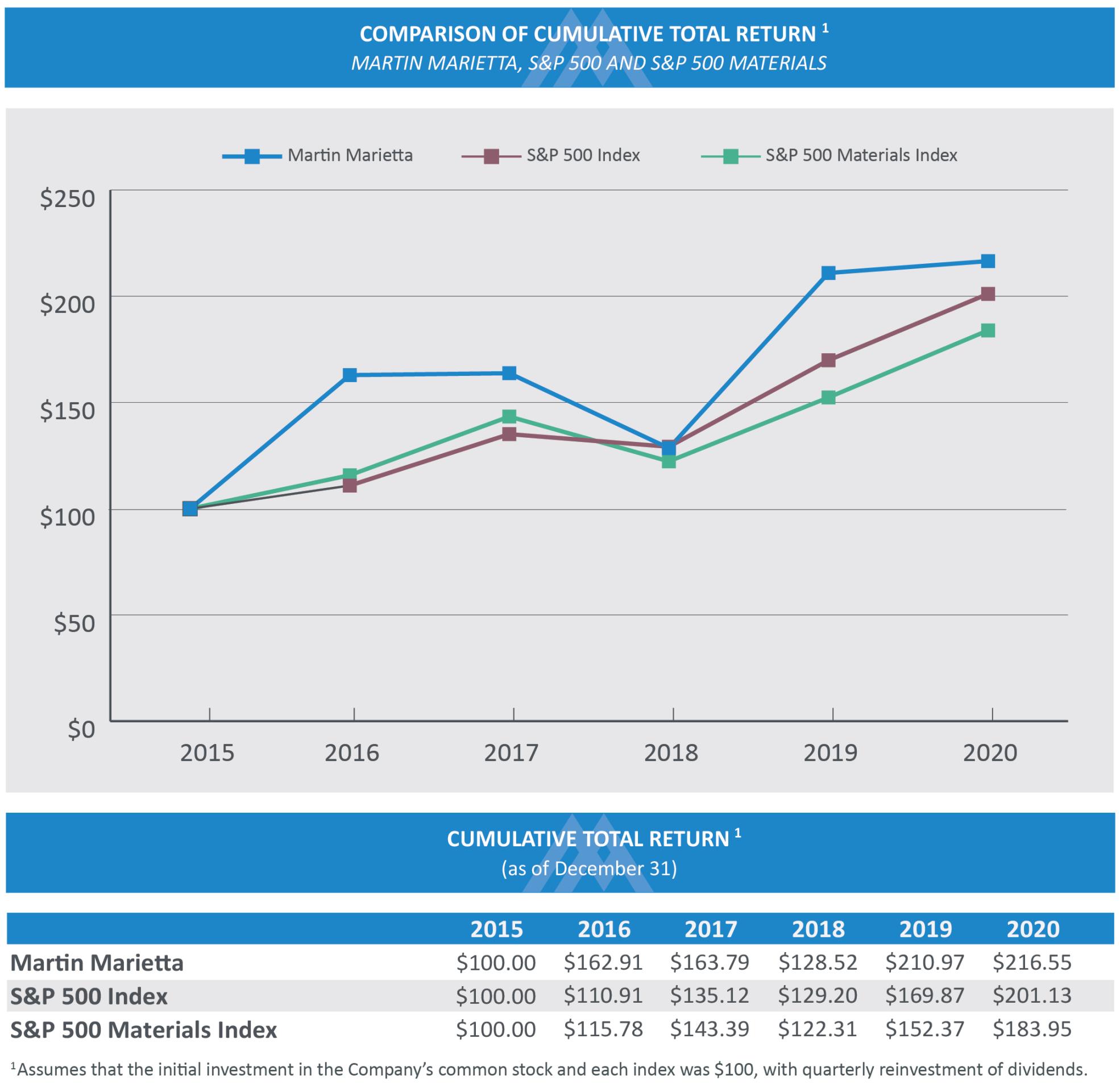]
[removed: Recent] [added: Recent] Sales of Unregistered [removed: Securities][added: Securities]
| Period | | Total Number of Shares Purchased | | | | Average Price Paid per Share | | | | Total Number of Shares Purchased as Part of Publicly Announced Plans or [removed: Programs1] [added: Programs(1)] | | | | Maximum Number of Shares that May Yet be Purchased Under the Plans or Programs | | |
| A World-Class Organization Built for Success |  | Form 10-K ♦ Page 27 |
| October 1, 2020 — October 31, 2020 | | | — | | | $ | — | | | | — | | | | 13,520,952 | |
| November 1, 2020 — November 30, 2020 | | | — | | | $ | — | | | | — | | | | 13,520,952 | |
| December 1, 2020 — December 31, 2020 | | | — | | | $ | — | | | | — | | | | 13,520,952 | |
| Total | | | — | | | $ | — | | | | — | | | | 13,520,952 | |
| Form 10-K ♦ Page 30 |  | Celebrating 25 Years as a Public Company |
| --- | --- | --- |
| October 1, 2019 — October 31, 2019 | | | 20,290 | | | $ | 264.86 | | | | 20,290 | | | | 13,865,827 | |
| November 1, 2019 — November 30, 2019 | | | 62,752 | | | $ | 258.09 | | | | 62,752 | | | | 13,803,075 | |
| December 1, 2019 — December 31, 2019 | | | 71,507 | | | $ | 270.99 | | | | 71,507 | | | | 13,731,568 | |
| Total | | | 154,549 | | | $ | 264.95 | | | | 154,549 | | | | 13,731,568 | |
| | | |
| Celebrating 25 Years as a Public Company |  | Form 10-K ♦ Page 31 |
Part II ♦ Item 6 – Selected Financial Data
Item 6. SELECTED FINANCIAL DATA
12 rewritten, 1,250 added, 41 removed, 7 unchanged
The [removed: selected] [added: discussion and analysis that follow reflect management’s assessment of the] financial [removed: data below] [added: condition and results of operations (MD&A) of the Company and] should be read in conjunction with [removed: Item 7 of this Form 10-K, “Management’s Discussion and Analysis of Financial Condition and Results of Operations,” as well as] the [removed: Company’s] [added: audited] consolidated financial [removed: statements and related notes included under Item 8, “Financial Statements and Supplemental Data,” of this Form 10-K.][added: statements.]
| Cost of revenues - products and services | | | [removed: 3,239.1 | | |] [added: 3,175.6] | [removed: 3,009.8] | | | | [removed: 2,749.5] | | | [added: 3,239.1] | [removed: 2,665.0] | | | | [removed: 2,541.2] | |
| Cost of revenues - freight | | | [removed: 321.0 | | |] [added: 301.5] | [removed: 267.9] | | | | [removed: 244.2] | | | [added: 321.0] | [removed: 242.0] | | | | [removed: 271.5] | |
| Acquisition-related [removed: expenses, net | | | 0.5] [added: expenses] | | | [added: 1.3] | [removed: 13.5] | | | | [removed: 8.6] | | | [added: 0.5] | [removed: 0.9] | | | | [removed: 6.3] | |
| Other operating [removed: (income) and expenses,] [added: income,] net | | | [removed: (9.1 | ) | | | (18.2] [added: (59.8] | ) | | | [removed: 0.8] | | | | [removed: (8.1] [added: (9.1] | ) | | | [removed: 15.6] | | [added: |]
| Other nonoperating [removed: expenses] [added: (income)] and [removed: (income), net2 | | | 7.3 |] [added: expenses, net] | | | [removed: (22.5] [added: (2.0] | ) | | | [removed: (10.0] | [removed: )] | | | [removed: (11.4] [added: 7.3] | [removed: )] | | | [removed: 4.1] | | [added: |]
| Earnings before income tax expense [removed: (benefit)] | | | [removed: 748.3 | | |] [added: 889.3] | [removed: 576.1] | | | | [removed: 618.9] | | | [added: 748.3] | [removed: 607.0] | | | | [removed: 413.8] | |
| Income tax expense [removed: (benefit)] | | | [removed: 136.3 | | |] [added: 168.2] | [removed: 105.7] | | | | [removed: (94.5] | [removed: )] | | [added: 136.3] | [removed: 181.6] | | | | [removed: 124.9] | |
| Less: Net earnings attributable to noncontrolling interests | | | 0.1 | | | | [removed: 0.4] | | | | 0.1 | | | | [removed: —] | | | [removed: | 0.1 | |]
| Net [removed: Earnings Attributable] [added: earnings attributable] to Martin Marietta | | $ | [removed: 611.9 | | | $ | 470.0 | | | $ | 713.3] [added: 721.0] | | | $ | [removed: 425.4 |] [added: 611.9] | | [removed: $] | [removed: 288.8] | |
[removed: |] Net Earnings Attributable to Martin Marietta [added: and Earnings] Per [removed: Common] [added: Diluted] Share [removed: (see Note A): | | | | | | | | | | | | | | | | | | | | |]
[removed: |] Property, [removed: plant] [added: Plant] and [removed: equipment, net | | | 5,206.0 | | | | 5,157.2 | | | | 3,592.8 | | | | 3,423.4 | | | | 3,156.0 | |][added: Equipment]
SEC Release No. 33-10890 eliminated the requirement of selected financial data previously required by Item 301 of Regulation S-K.
| Form 10-K ♦ Page 28 |  | A World-Class Organization Built for Success |
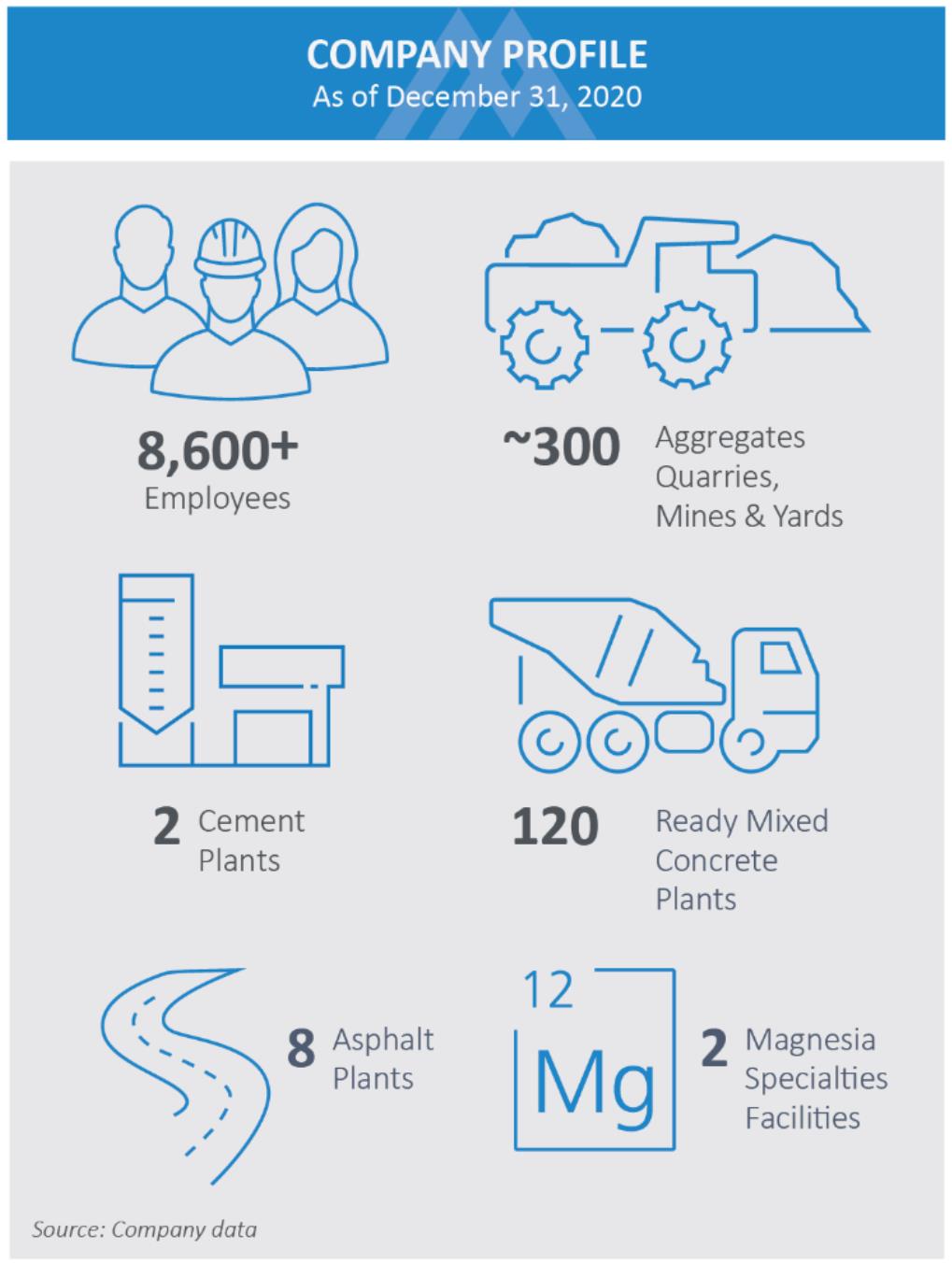ITEM 7 – MANAGEMENT’S DISCUSSION AND ANALYSIS OF FINANCIAL CONDITION AND RESULTS OF OPERATIONS
INTRODUCTORY OVERVIEW
Martin Marietta Materials, Inc. (the Company or Martin Marietta) is a natural resource-based building materials company.
The Company supplies aggregates (crushed stone, sand and gravel) through its network of approximately 300 quarries, mines and distribution yards in 27 states, Canada and The Bahamas.
In the western United States, Martin Marietta also provides cement and downstream products, namely ready mixed concrete, asphalt and paving services, in markets where the Company has a leading aggregates position.
Specifically, the Company has two cement plants in Texas and ready mixed concrete and asphalt operations in Texas, Colorado and Wyoming.
Asphalt operations and paving services are exclusively in Colorado.
The Company’s heavy-side building materials are used in infrastructure, nonresidential and residential construction projects.
Aggregates are also used in agricultural, utility and environmental applications and as railroad ballast.
The aggregates, cement, ready mixed concrete, asphalt and paving product lines are reported collectively as the “Building Materials” business.
As more fully discussed in the *Consolidated Strategic Objectives* section, geography is critically important for the Building Materials business.
The Company conducts its Building Materials business through two reportable segments, organized by geography: East Group and West Group.
The East Group, whose operations were previously reported in the Mid-America and Southeast Groups, consists of the East and Central Divisions.
The West Group is comprised of the Southwest and West Divisions.
The East Group provides aggregates products only.
The West Group provides aggregates, cement and downstream products and services.
Further, the following five states accounted for 71% of the Building Materials business 2020 total revenues: Texas, Colorado, North Carolina, Georgia and Iowa.
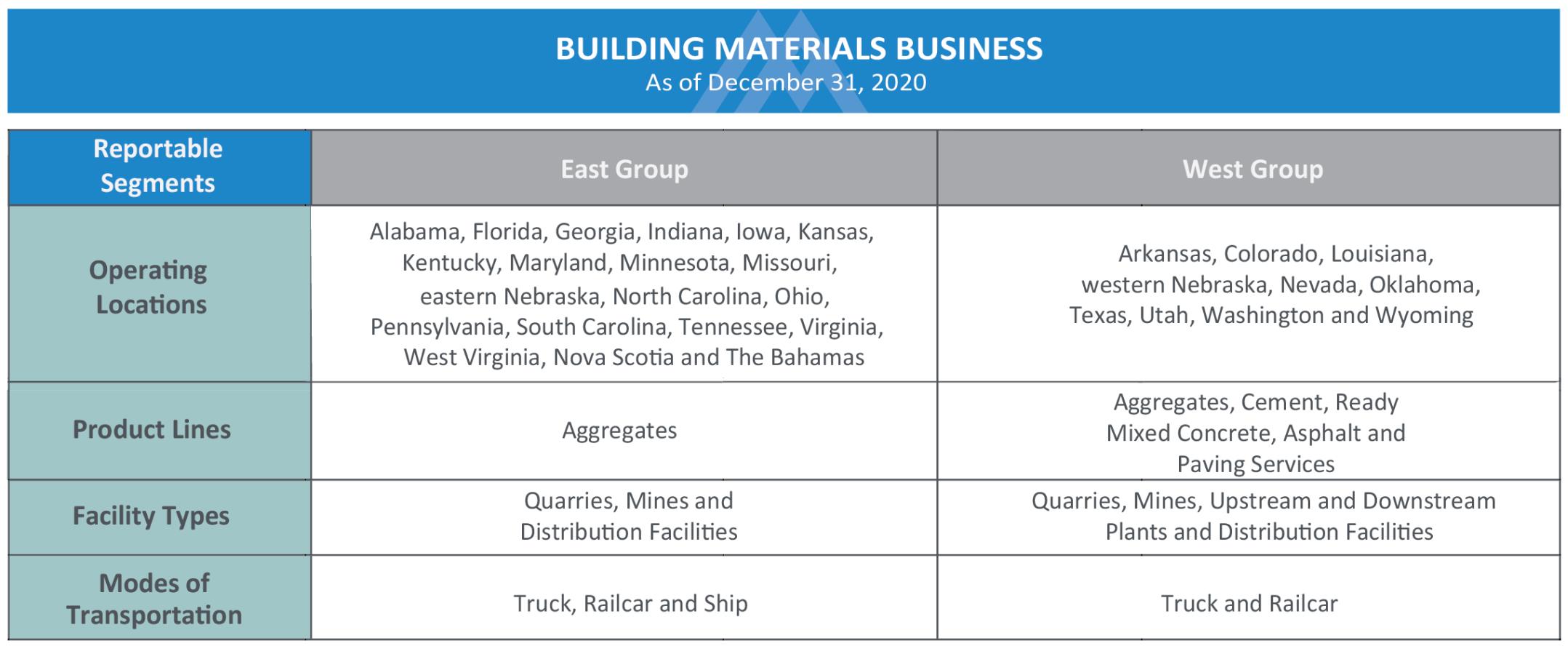
| A World-Class Organization Built for Success |  | Form 10-K ♦ Page 29 |
Part II ♦ Item 7 – Management’s Discussion and Analysis of Financial Condition and Results of Operations
Magnesia Specialties
The Company operates a Magnesia Specialties business with production facilities in Michigan and Ohio.
The Magnesia Specialties business produces magnesia-based chemicals products used in industrial, agricultural and environmental applications.
It also produces dolomitic lime sold primarily to customers for steel production and land stabilization.
Magnesia Specialties’ products are shipped to customers worldwide.
Consolidated Strategic Objectives
The Company’s strategic planning process, or Strategic Operating Analysis and Review (SOAR), provides the framework for execution of Martin Marietta’s long-term strategic plan.
Guided by this framework and considering the cyclicality of the Building Materials business, the Company determines capital allocation priorities to maximize long-term shareholder value creation.
The Company’s strategy includes ongoing evaluation of aggregates-led opportunities of scale in new domestic markets (i.e., platform acquisitions), expansion through acquisitions that complement existing operations (i.e., bolt-on acquisitions) and divestitures of assets that are not consistent with stated strategic goals.
The Company finances such opportunities with the goal of preserving its financial flexibility by having a leverage ratio (consolidated debt-to-consolidated earnings before interest, taxes, depreciation and amortization, or EBITDA) within a range of 2.0 times to 2.5 times within a reasonable time following the completion of a debt-financed transaction.
The Company, by purposeful design, will continue to be an aggregates-led business (aggregates product gross profit represented 68% of 2020 total consolidated gross profit) that focuses on markets with strong, underlying growth fundamentals where it can sustain or achieve a leading market position.
Driven by this intentional approach, the Company has leading positions, defined as either #1 or #2, in approximately 90% of its markets.
As part of its long-term strategic plan, the Company may also pursue strategic cement and targeted downstream opportunities.
For Martin Marietta, strategic cement and targeted downstream operations are located in vertically-integrated markets where the Company has, or envisions, a clear path toward a leading aggregates position.
Generally, the Company’s building materials products are both sourced and sold locally.
As a result, geography is critically important when assessing market attractiveness and growth opportunities.
Attractive geographies exhibit (a) population growth and/or population density, both of which are drivers of heavy-side building materials consumption; (b) business and employment diversity, drivers of greater economic stability; and (c) a superior state financial position, a driver of public infrastructure growth and support.
In order to assess population growth and density, the Company focuses on the megaregions of the United States.
Five Year Selected Financial Data
| (in millions, except per share data) | | 2019 | | | | 2018 | | | | 2017 | | | | 2016 | | | | 2015 | | |
| --- | --- | --- | --- | --- | --- | --- | --- | --- | --- | --- | --- | --- | --- | --- | --- | --- | --- | --- | --- | --- |
| Consolidated Operating Results | | | | | | | | | | | | | | | | | | | | |
| Products and services revenues1 | | $ | 4,422.3 | | | $ | 3,980.4 | | | $ | 3,723.5 | | | $ | 3,578.6 | | | $ | 3,269.2 | |
| Freight revenues1 | | | 316.8 | | | | 263.9 | | | | 242.1 | | | | 240.1 | | | | 270.4 | |
| Total revenues | | | 4,739.1 | | | | 4,244.3 | | | | 3,965.6 | | | | 3,818.7 | | | | 3,539.6 | |
| Total cost of revenues2 | | | 3,560.1 | | | | 3,277.7 | | | | 2,993.7 | | | | 2,907.0 | | | | 2,812.7 | |
| Gross Profit2 | | | 1,179.0 | | | | 966.6 | | | | 971.9 | | | | 911.7 | | | | 726.9 | |
| Selling, general and administrative expenses2 | | | 302.7 | | | | 280.6 | | | | 262.1 | | | | 241.6 | | | | 210.8 | |
| Earnings from Operations2 | | | 884.9 | | | | 690.7 | | | | 700.4 | | | | 677.3 | | | | 494.2 | |
| Interest expense | | | 129.3 | | | | 137.1 | | | | 91.5 | | | | 81.7 | | | | 76.3 | |
| Consolidated net earnings | | | 612.0 | | | | 470.4 | | | | 713.4 | | | | 425.4 | | | | 288.9 | |
| Basic attributable to common shareholders | | $ | 9.77 | | | $ | 7.46 | | | $ | 11.30 | | | $ | 6.66 | | | $ | 4.31 | |
| Diluted attributable to common shareholders | | $ | 9.74 | | | $ | 7.43 | | | $ | 11.25 | | | $ | 6.63 | | | $ | 4.29 | |
| | | | | | | | | | | | | | | | | | | | | |
| Cash Dividends Per Common Share | | $ | 2.06 | | | $ | 1.84 | | | $ | 1.72 | | | $ | 1.64 | | | $ | 1.60 | |
| (in millions) | | 2019 | | | | 20183 | | | | 20173 | | | | 2016 | | | | 2015 | | |
| Condensed Consolidated Balance Sheet Data | | | | | | | | | | | | | | | | | | | | |
| Total current assets4 | | $ | 1,426.7 | | | $ | 1,365.8 | | | $ | 2,631.2 | | | $ | 1,086.4 | | | $ | 1,081.6 | |
| Goodwill | | | 2,396.8 | | | | 2,399.1 | | | | 2,160.3 | | | | 2,159.3 | | | | 2,068.2 | |
| Other intangibles, net | | | 486.8 | | | | 501.3 | | | | 506.3 | | | | 511.3 | | | | 510.6 | |
| Other noncurrent assets4,5 | | | 615.3 | | | | 128.0 | | | | 101.9 | | | | 120.5 | | | | 141.2 | |
| Total Assets | | $ | 10,131.6 | | | $ | 9,551.4 | | | $ | 8,992.5 | | | $ | 7,300.9 | | | $ | 6,957.6 | |
| Current liabilities – other5 | | $ | 498.5 | | | $ | 396.7 | | | $ | 394.3 | | | $ | 366.6 | | | $ | 347.9 | |
| Current maturities of long-term debt4 | | | 340.0 | | | | 390.0 | | | | 299.9 | | | | 180.0 | | | | 18.7 | |
| Long-term debt4 | | | 2,433.6 | | | | 2,730.4 | | | | 2,727.3 | | | | 1,506.1 | | | | 1,550.1 | |
| Deferred income taxes, net | | | 733.0 | | | | 705.6 | | | | 410.7 | | | | 663.0 | | | | 583.5 | |
| Other noncurrent liabilities5 | | | 773.2 | | | | 379.3 | | | | 477.8 | | | | 442.6 | | | | 397.2 | |
| Shareholders’ equity | | | 5,350.8 | | | | 4,946.4 | | | | 4,679.7 | | | | 4,140.0 | | | | 4,057.3 | |
| Noncontrolling interests | | | 2.5 | | | | 3.0 | | | | 2.8 | | | | 2.6 | | | | 2.9 | |
| Total Liabilities and Equity | | $ | 10,131.6 | | | $ | 9,551.4 | | | $ | 8,992.5 | | | $ | 7,300.9 | | | $ | 6,957.6 | |
| 1 | Amounts for 2015-2017 may not equal amounts reported in the Company’s prior years’ Forms 10-K as amounts have been reclassified to conform to current year revenue presentation. |
| --- | --- |
| Form 10-K ♦ Page 32 |  | Celebrating 25 Years as a Public Company |
Part II ♦ Item 6 – Selected Financial Data
| 2 | Amounts for 2015\-2016 may not equal amounts reported in the Company’s prior years’ Forms 10-K as amounts have been reclassified to reflect the adoption of the Accounting Standards Update 2017-07, *Improving the Presentation of Net Periodic Pension Cost and Net Periodic Postretirement Benefit Cost.* |
| 3 | The 2018 balance sheet reflects the acquisition of Bluegrass Materials Company (“Bluegrass”) completed on April 27, 2018. The 2017 balance sheet reflects $1.1 billion of cash and long-term debt issued in anticipation of closing the Bluegrass acquisition. |
| 4 | Balance sheets reflect the adoption of Accounting Standards Update 2015-03, *Simplifying the Presentation of Debt Issuance Costs*. |
| 5 | The 2019 balance sheet reflects the adoption of ASC 842. The operating lease right-of-use assets are included in other noncurrent assets, and operating lease liabilities are included in other current and noncurrent liabilities. |
An excerpt. Shown here: all 12 rewritten, 40 of 1,250 added and 40 of 41 removed. The counts are complete. For every sentence, read Item 6. SELECTED FINANCIAL DATA in the FY2020 filing and the FY2019 filing.
Item 8. FINANCIAL STATEMENTS AND SUPPLEMENTARY DATA
624 rewritten, 283 added, 335 removed, 741 unchanged
| | [Statement of Responsibility and Management’s Report on](#STATEMENT_FINANCIAL_RESPONSIBILITY_MANAG) [Internal Control over Financial Reporting](#STATEMENT_FINANCIAL_RESPONSIBILITY_MANAG) | | [removed: 72] [added: 66] |
| | [Report of Independent Registered Public Accounting Firm](#REPORT_INDEPENDENT_REGISTERED_PUBLIC_ACC) | | [removed: 74] [added: 67] |
| | [Consolidated Statements of Earnings –](#STATEMENTS_OF_EARNINGS) [for years ended December 31, [removed: 2019, 2018,] [added: 2020, 2019] and [removed: 2017](#STATEMENTS_OF_EARNINGS)] [added: 2018](#STATEMENTS_OF_EARNINGS)] | | [removed: 76] [added: 69] |
| | [Consolidated Statements of Comprehensive Earnings –](#STATEMENTS_OF_COMPREHENSIVE_EARNINGS) [for years ended December [removed: 31,2019, 2018,] [added: 31,2020, 2019] and [removed: 2017](#STATEMENTS_OF_COMPREHENSIVE_EARNINGS)] [added: 2018](#STATEMENTS_OF_COMPREHENSIVE_EARNINGS)] | | [removed: 77] [added: 70] |
| | [Consolidated Balance Sheets –](#BALANCE_SHEETS) [at December 31, [removed: 2019] [added: 2020] and [removed: 2018](#BALANCE_SHEETS)] [added: 2019](#BALANCE_SHEETS)] | | [removed: 78] [added: 71] |
| | [Consolidated Statements of Cash Flows –](#STATEMENT_OF_CASH_FLOWS) [for years ended December 31, [removed: 2019, 2018,] [added: 2020, 2019] and [removed: 2017](#STATEMENT_OF_CASH_FLOWS)] [added: 2018](#STATEMENT_OF_CASH_FLOWS)] | | [removed: 79] [added: 72] |
| | [Consolidated Statements of Total Equity –](#STATEMENT_OF_TOTAL_EQUITY) [for years ended December 31, [removed: 2019, 2018,] [added: 2020, 2019] and [removed: 2017](#STATEMENT_OF_TOTAL_EQUITY)] [added: 2018](#STATEMENT_OF_TOTAL_EQUITY)] | | [removed: 80] [added: 73] |
| | [Notes to Financial Statements](#NOTE_A_ACCOUNTING_POLICIES) | | [removed: 81] [added: 74] |
[removed: Statement] [added: Statement] of Responsibility and [removed: Management’s Report] [added: Management’s Report] on Internal Control over Financial [removed: Reporting][added: Reporting]
The management of Martin Marietta Materials, Inc. (the [removed: “Company”] [added: Company] or [removed: “Martin Marietta”)] [added: Martin Marietta)] is responsible for the consolidated financial statements, the related financial information contained in this Form 10-K and the establishment and maintenance of adequate internal control over financial reporting.
The consolidated balance sheets for Martin Marietta, at December 31, [removed: 2019] [added: 2020] and [removed: 2018,] [added: 2019,] and the related consolidated statements of earnings, comprehensive earnings, total equity and cash flows for each of the three years in the period ended December 31, [removed: 2019,] [added: 2020,] include amounts based on estimates and judgments and have been prepared in accordance with accounting principles generally accepted in the United States applied on a consistent basis.
The Audit Committee of the Board of Directors, which consists of [removed: three] [added: four] independent, nonemployee directors, meets periodically and separately with management, the independent auditors and the internal auditors to review the activities of each.
Management assessed the effectiveness of the Company’s internal control over financial reporting as of December 31, [removed: 2019.][added: 2020.]
Based on management’s assessment under the 2013 framework, management concluded that the Company’s internal control over financial reporting was effective as of December 31, [removed: 2019.][added: 2020.]
The consolidated financial statements of the Company as of December 31, [removed: 2019] [added: 2020] and [removed: 2018,] [added: 2019,] and for each of the three years in the period ended December 31, [removed: 2019,] [added: 2020,] and the effectiveness of the Company’s internal control over financial reporting as of December 31, [removed: 2019,] [added: 2020,] have been audited by PricewaterhouseCoopers LLP, an independent registered public accounting firm, whose report appears on the following page.
| [removed: ] [added: ] | [removed: ] [added: ] |
We have audited the accompanying consolidated balance sheets of Martin Marietta Materials, Inc. and its subsidiaries (the “Company”) as of December 31, [removed: 2019] [added: 2020] and [removed: 2018,] [added: 2019,] and the related consolidated statements of earnings, comprehensive earnings, total equity and cash flows for each of the three years in the period ended December 31, [removed: 2019,] [added: 2020,] including the related notes and schedule of valuation and qualifying accounts for each of the three years in the period ended December 31, [removed: 2019] [added: 2020] appearing under Item [removed: 15(a)(2)] [added: 15(c)] (collectively referred to as the “consolidated financial statements”).
We also have audited the Company’s internal control over financial reporting as of December 31, [removed: 2019,] [added: 2020,] based on criteria established in *Internal Control - Integrated Framework* (2013) issued by the Committee of Sponsoring Organizations of the Treadway Commission (COSO).
In our opinion, the consolidated financial statements referred to above present fairly, in all material respects, the financial position of the Company as of December 31, [removed: 2019] [added: 2020] and [removed: 2018,] [added: 2019,] and the results of its operations and its cash flows for each of the three years in the period ended December 31, [removed: 2019] [added: 2020] in conformity with accounting principles generally accepted in the United States of America.
Also in our opinion, the Company maintained, in all material respects, effective internal control over financial reporting as of December 31, [removed: 2019,] [added: 2020,] based on criteria established in *Internal Control - Integrated Framework* (2013) issued by the COSO.
A company’s internal control over financial reporting includes those policies and procedures that (i) pertain to the maintenance of records that, in reasonable detail, accurately and fairly reflect the transactions and dispositions of the assets of the company; (ii) provide reasonable assurance that transactions are recorded [added: as necessary to permit preparation of financial statements in accordance with generally accepted accounting principles, and]
[removed: as necessary to permit preparation of financial statements in accordance with generally accepted accounting principles, and] that receipts and expenditures of the company are being made only in accordance with authorizations of management and directors of the company; and (iii) provide reasonable assurance regarding prevention or timely detection of unauthorized acquisition, use, or disposition of the company’s assets that could have a material effect on the financial statements.
[removed: The carrying values of goodwill are reviewed annually, as of October 1,] [added: Goodwill is tested] for impairment by comparing [removed: the] [added: each] reporting unit’s fair value to its carrying [removed: value.][added: value, which represents a Step-1 approach.]
These procedures included testing the effectiveness of controls relating to [removed: management’s goodwill impairment assessment, including controls over] the valuation of the [removed: Company’s reporting units.][added: projected benefit obligation, including controls over the discount rate assumption.]
| years ended December 31 (in millions, except per share data) | | | [removed: 2019] [added: 2020] | | | | | [removed: 2018] [added: 2019] | | | | | [removed: 2017] [added: 2018] | | |
| Products and services revenues | | | $ | [removed: 4,422.3] [added: 4,432.1] | | | | $ | [removed: 3,980.4] [added: 4,422.3] | | | | $ | [removed: 3,723.5] [added: 3,980.4] | |
| Freight revenues | | | | [removed: 316.8] [added: 297.8] | | | | | [removed: 263.9] [added: 316.8] | | | | | [removed: 242.1] [added: 263.9] | |
| Total [removed: revenues] [added: Revenues] | | | | [removed: 4,739.1] [added: 4,729.9] | | | | | [removed: 4,244.3] [added: 4,739.1] | | | | | [removed: 3,965.6] [added: 4,244.3] | |
| Cost of revenues - products and services | | | | [removed: 3,239.1] [added: 3,175.6] | | | | | [removed: 3,009.8] [added: 3,239.1] | | | | | [removed: 2,749.5] [added: 3,009.8] | |
| Cost of revenues - freight | | | | [removed: 321.0] [added: 301.5] | | | | | [removed: 267.9] [added: 321.0] | | | | | [removed: 244.2] [added: 267.9] | |
| Total cost of revenues | | | | [removed: 3,560.1] [added: 3,477.1] | | | | | [removed: 3,277.7] [added: 3,560.1] | | | | | [removed: 2,993.7] [added: 3,277.7] | |
| Gross Profit | | | | [removed: 1,179.0] [added: 1,252.8] | | | | | [removed: 966.6] [added: 1,179.0] | | | | | [removed: 971.9] [added: 966.6] | |
| Selling, general and administrative expenses | | | | [removed: 302.7] [added: 305.9] | | | | | [removed: 280.6] [added: 302.7] | | | | | [removed: 262.1] [added: 280.6] | |
| Acquisition-related expenses, net | | | | [removed: 0.5] [added: 1.3] | | | | | [removed: 13.5] [added: 0.5] | | | | | [removed: 8.6] [added: 13.5] | |
| Other operating [removed: (income) and expenses,] [added: income,] net | | | | [removed: (9.1] [added: (59.8] | ) | | | | [removed: (18.2] [added: (9.1] | ) | | | | [removed: 0.8] [added: (18.2] | [added: )] |
| Earnings from Operations | | | | [removed: 884.9] [added: 1,005.4] | | | | | [removed: 690.7] [added: 884.9] | | | | | [removed: 700.4] [added: 690.7] | |
| Interest expense | | | | [removed: 129.3] [added: 118.1] | | | | | [removed: 137.1] [added: 129.3] | | | | | [removed: 91.5] [added: 137.1] | |
| Other nonoperating [removed: expenses] [added: (income)] and [removed: (income),] [added: expenses,] net | | | | [removed: 7.3] [added: (2.0] | [added: )] | | | | [removed: (22.5] [added: 7.3] | [removed: )] | | | | [removed: (10.0] [added: (22.5] | ) |
| Earnings before income tax expense [removed: (benefit)] | | | | [removed: 748.3] [added: 889.3] | | | | | [removed: 576.1] [added: 748.3] | | | | | [removed: 618.9] [added: 576.1] | |
| Income tax expense [removed: (benefit)] | | | | [removed: 136.3] [added: 168.2] | | | | | [removed: 105.7] [added: 136.3] | | | | | [removed: (94.5] [added: 105.7] | [removed: )] |
| A World-Class Organization Built for Success |  | Form 10-K ♦ Page 65 |
February 19, 2021
| Form 10-K ♦ Page 66 |  | A World-Class Organization Built for Success |
  | Form 10-K ♦ Page 67 |
Valuation of the Projected Benefit Obligation
As described in Note K to the consolidated financial statements, the Company’s net projected benefit obligation for all defined benefit pension plans was $1,111.9 million as of December 31, 2020.
As disclosed by management, annually, as of December 31, management remeasures the defined benefit plans’ projected benefit obligation based on the present value of projected future benefit payments to all participants for services rendered to date, reflecting expected future pay increases through the participants’ expected retirement dates.
The key assumptions are the discount rate, the expected long-term rate of return on pension plan assets, the mortality table and mortality improvement scale, and the rate of increase in future compensation levels.
The discount rate is generally the most volatile and sensitive estimate.
Accordingly, a change in this assumption has the most significant impact on the projected benefit obligation.
The principal considerations for our determination that performing procedures relating to the valuation of the projected benefit obligation is a critical audit matter are (i) the significant judgment by management to determine the projected benefit obligation; (ii) a high degree of auditor judgment, subjectivity, and effort in performing procedures and evaluating the discount rate assumption; and (iii) the audit effort involved the use of professionals with specialized skill and knowledge.
These procedures also included, among others, testing the completeness and accuracy of underlying data used in the valuation of the projected benefit obligation and the involvement of professionals with specialized skill and knowledge to assist in (i) testing management’s process for determining the projected benefit obligation, (ii) evaluating the appropriateness of the actuarial method, and (iii) evaluating the reasonableness of the discount rate assumption.
February 19, 2021
| Form 10-K ♦ Page 68 |  | A World-Class Organization Built for Success |
  | Form 10-K ♦ Page 69 |
| Form 10-K ♦ Page 70 |  | A World-Class Organization Built for Success |
| Restricted cash | | | | 97.1 | | | | | — | |
| Accrued other taxes | | | | 43.5 | | | | | 43.6 | |
| A World-Class Organization Built for Success |  | Form 10-K ♦ Page 71 |
| Consolidated net earnings | | | $ | 721.1 | | | | $ | 612.0 | | | | $ | 470.4 | |
| Form 10-K ♦ Page 72 |  | A World-Class Organization Built for Success |
| Other comprehensive loss | | | — | | | | — | | | | — | | | | (12.6 | ) | | | — | | | | (12.6 | ) | | | — | | | | (12.6 | ) |
| Balance at December 31, 2020 | | | 62.3 | | | $ | 0.6 | | | $ | 3,440.8 | | | $ | (158.4 | ) | | $ | 2,607.7 | | | $ | 5,890.7 | | | $ | 2.6 | | | $ | 5,893.3 | |
| A World-Class Organization Built for Success |  | Form 10-K ♦ Page 73 |
Effective July 1, 2020, the Company made organizational changes, consolidating its operational management and operating divisions in connection with the retirement of two senior executives as of the end of the second quarter.
The Mid-Atlantic Division and Southeast Division were combined to form the East Division.
Additionally, the Southwest Aggregates Division and the Cement and Southwest Ready Mix Division were combined to form the Southwest Division.
Subsequent to these changes, the Building Materials business consists of four divisions: East, Central, Southwest and West.
Each division, as well as the Magnesia Specialties business, represents an operating segment.
Effective January 1, 2020, the Company moved the management of its one quarry in the state of Washington from the East Group to the West Group, resulting in an immaterial change to its reportable segments.
Prior-year segment disclosures have been reclassified to conform to current-year presentation.
During 2020, there were no changes to the Magnesia Specialties reportable segment.
| Form 10-K ♦ 74 |  | A World-Class Organization Built for Success |
Cash, Cash Equivalents and Restricted Cash.
As of December 31, 2020, the Company had $97.1 million of restricted cash, which was invested in an account designated for the purchase of like-kind exchange replacement assets under Section 1031 of the Internal Revenue Code (Section 1031).
The Company is restricted from utilizing the cash for purposes other than the purchase of the qualified assets for 180 days from receipt of the proceeds from the sale of the exchanged property.
Any unused cash at the end of the 180 days will be transferred to unrestricted accounts of the Company and can then be used for general corporate purposes.
The Company did not use $47.2 million within the allowable 180-day period and transferred that amount to unrestricted cash in January 2021.
The Company has until March 9, 2021 to utilize the remaining funds to purchase qualified assets under Section 1031.
In connection with Accounting Standards Update (ASU) 2016-18, *Statement of Cash Flows (Topic 230)*, the statement of cash flows reflects cash flow changes and balances for cash, cash equivalents and restricted cash on an aggregated basis.
| Form 10-K ♦ Page 72 |  | Celebrating 25 Years as a Public Company |
| --- | --- | --- |
| | | |
Part II ♦ Item 8 – Financial Statements and Supplementary Data
| --- | --- |
February 21, 2020
| Celebrating 25 Years as a Public Company |  | Form 10-K ♦ Page 73 |
| Form 10-K ♦ Page 74 |  | Celebrating 25 Years as a Public Company |
Goodwill Impairment Assessment - Cement and Southwest Ready Mix Division Reporting Unit
As described in Notes A and C to the consolidated financial statements, the Company’s consolidated goodwill balance was $2.4 billion as of December 31, 2019.
Of the consolidated goodwill balance, $934.7 million relates to the Cement and Southwest Ready Mix Division reporting unit.
An interim review is performed between annual tests if facts and circumstances indicate potential impairment.
The goodwill impairment assessment requires management to apply judgment and make assumptions.
A Step 1 impairment analysis was performed for the aforementioned reporting unit as of October 1, 2019.
The fair value was calculated using a discounted cash flow model.
Key assumptions included management’s estimates of changes in sales price, shipment volumes and production costs, as well as assumptions of future profitability, capital requirements, discount rate and terminal growth rate.
The Cement and Southwest Ready Mix Division reporting unit’s fair value exceeded its carrying value by 35%, or $701.5 million.
The principal considerations for our determination that performing procedures relating to the goodwill impairment assessment of the Cement and Southwest Ready Mix Division reporting unit is a critical audit matter are there was significant judgment by management when developing the fair value measurement of the reporting unit.
This in turn led to a high degree of auditor judgment, subjectivity and effort in performing procedures and in evaluating the audit evidence relating to management’s significant assumptions, including changes in sales price, shipment volumes, production costs, and the discount rate.
In addition, the audit effort involved the use of professionals with specialized skill and knowledge to assist in evaluating the audit evidence obtained.
These procedures also included, among others (i) testing management’s process for developing the fair value estimate, (ii) evaluating the appropriateness of the discounted cash flow model, (iii) testing the completeness, accuracy and relevance of underlying data used in the model, and (iv) evaluating the reasonableness of management’s significant assumptions used in the model, including changes in sales price, shipment volumes, production costs, and the discount rate.
Evaluating management’s assumptions related to changes in sales price, shipment volumes, and production costs involved evaluating whether the assumptions used by management were reasonable considering (i) the current and past performance of the reporting unit, (ii) the consistency with external industry reports, and (iii) whether these assumptions were consistent with evidence obtained in other areas of the audit.
Professionals with specialized skill and knowledge were used to assist in the evaluation of the Company’s discounted cash flow model and certain significant assumptions, including the discount rate.
| Celebrating 25 Years as a Public Company |  | Form 10-K ♦ Page 75 |
| Form 10-K ♦ Page 76 |  | Celebrating 25 Years as a Public Company |
  | Form 10-K ♦ Page 77 |
| Accrued insurance and other taxes | | | | 63.1 | | | | | 63.6 | |
| Form 10-K ♦ Page 78 |  | Celebrating 25 Years as a Public Company |
| Contributions by noncontrolling interest to joint venture | | | | — | | | | | — | | | | | 0.2 | |
| Celebrating 25 Years as a Public Company |  | Form 10-K ♦ Page 79 |
| --- | --- | --- | --- | --- | --- | --- | --- | --- | --- | --- | --- | --- | --- | --- | --- | --- | --- | --- | --- | --- | --- | --- | --- | --- | --- | --- | --- | --- | --- | --- | --- | --- |
| Balance at December 31, 2016 | | | 63.2 | | | $ | 0.6 | | | $ | 3,334.5 | | | $ | (130.7 | ) | | $ | 935.7 | | | $ | 4,140.1 | | | $ | 2.5 | | | $ | 4,142.6 | |
| Other comprehensive earnings | | | — | | | | — | | | | — | | | | 1.6 | | | | — | | | | 1.6 | | | | — | | | | 1.6 | |
| Contribution from owners of noncontrolling interest | | | — | | | | — | | | | — | | | | — | | | | — | | | | — | | | | 0.2 | | | | 0.2 | |
| Form 10-K ♦ Page 80 |  | Celebrating 25 Years as a Public Company |
The Southeast Group has operations in Alabama, Florida, Georgia, southwestern South Carolina, Tennessee, Nova Scotia and the Bahamas.
| Celebrating 25 Years as a Public Company |  | Form 10-K ♦ Page 81 |
Cash and Cash Equivalents.
The Company manages its cash and cash equivalents to ensure short-term operating cash needs are met and excess funds are managed efficiently.
When operating cash is not sufficient to meet current needs, the Company borrows money under its credit facilities.
An excerpt. Shown here: 40 of 624 rewritten, 40 of 283 added and 40 of 335 removed. The counts are complete. For every sentence, read Item 8. FINANCIAL STATEMENTS AND SUPPLEMENTARY DATA in the FY2020 filing and the FY2019 filing.
Item 9A. CONTROLS AND PROCEDURES
5 rewritten, 1 added, 2 removed, 22 unchanged
As of December 31, [removed: 2019,] [added: 2020,] an evaluation was performed under the supervision and with the participation of the Company’s management, including the Chief Executive Officer [removed: (“CEO”)] [added: (CEO)] and Chief Financial Officer [removed: (“CFO”),] [added: (CFO),] of the effectiveness of the design and operation of the Company’s disclosure controls and procedures.
The Company’s management concluded that the Company’s internal control over financial reporting was effective in providing reasonable assurance regarding the reliability of financial reporting and the preparation of the Company’s financial statements for external purposes in accordance with generally accepted accounting principles as of December 31, [removed: 2019.][added: 2020.]
PricewaterhouseCoopers LLP, the independent registered public accounting firm that audited the Company’s consolidated financial statements contained herein, also audited the Company’s internal control over financial reporting as of December 31, [removed: 2019.][added: 2020.]
There were no changes in the Company’s internal control over financial reporting during the most recently completed fiscal quarter ended December 31, [removed: 2019] [added: 2020] that materially affected, or are reasonably likely to materially affect, the Company’s internal control over financial reporting.
The design of any system of controls [removed: also] is based in part upon certain assumptions about the likelihood of future events, and there can be no assurance that any design will succeed in achieving its stated goals under all potential future conditions.
| A World-Class Organization Built for Success |  | Form 10-K ♦ Page 107 |
| | | |
| Form 10-K ♦ 118 |  | Celebrating 25 Years as a Public Company |
Item 9B. OTHER INFORMATION
0 rewritten, 1 added, 1 removed, 5 unchanged
| Form 10-K ♦ 108 |  | A World-Class Organization Built for Success |
| Celebrating 25 Years as a Public Company |  | Form 10-K ♦ Page 119 |
Item 10. DIRECTORS, EXECUTIVE OFFICERS AND CORPORATE GOVERNANCE
4 rewritten, 0 added, 0 removed, 0 unchanged
The information concerning directors of the Company, the Audit Committee of the Board of Directors, and the Audit Committee financial expert serving on the Audit Committee, all as required in response to this Item 10, is included under the captions “Corporate Governance Matters” in the Company’s definitive proxy statement to be filed with the SEC pursuant to Regulation 14A within 120 days after the close of the Company’s fiscal year ended December 31, [removed: 2019] [added: 2020] (the [removed: “2020] [added: “2021] Proxy Statement”), and that information is hereby incorporated by reference in this Form 10-K.
Information concerning Section 16(a) reporting compliance is incorporated by reference to the information appearing under the caption “Delinquent Section 16(a) Reports” in the [removed: 2020] [added: 2021] Proxy Statement.
Information concerning executive officers of the Company required in response to this Item 10 is included in Part I, under the heading [removed: “Information] [added: “[Information] about our Executive [removed: Officers,”] [added: Officers](#INFORMATION_ABOUT_OUR_EXECUTIVE_FICERS),”] of this Form 10-K.
The information concerning the Company’s code of ethics required in response to this Item 10 is included in Part I, under the heading [removed: “Available Information,”] [added: “[Available Information](#Available_Information),”] of this Form 10‑K.
Item 11. EXECUTIVE COMPENSATION
1 rewritten, 0 added, 0 removed, 0 unchanged
The information required in response to this Item 11 is included under the captions “Executive Compensation,” “Compensation Discussion and Analysis,” “Corporate Governance Matters,” “Management Development and Compensation Committee Report,” and “Compensation Committee Interlocks and Insider Participation” in the Company’s [removed: 2020] [added: 2021] Proxy Statement, and that information is hereby incorporated by reference in this Form 10-K.
Item 12. SECURITY OWNERSHIP OF CERTAIN BENEFICIAL OWNERS AND MANAGEMENT AND RELATED STOCKHOLDER MATTERS
1 rewritten, 0 added, 0 removed, 0 unchanged
The information required in response to this Item 12 is included under the captions “General Information,” “Security Ownership of Certain Beneficial Owners and Management,” and “Securities Authorized for Issuance Under Equity Compensation Plans” in the Company’s [removed: 2020] [added: 2021] Proxy Statement, and that information is hereby incorporated by reference in this Form 10-K.
Item 13. CERTAIN RELATIONSHIPS AND RELATED TRANSACTIONS, AND DIRECTOR INDEPENDENCE
1 rewritten, 0 added, 0 removed, 0 unchanged
The information required in response to this Item 13 is included under the captions “Compensation Committee Interlocks and Insider Participation in Compensation Decisions” and “Corporate Governance Matters” in the Company’s [removed: 2020] [added: 2021] Proxy Statement, and that information is hereby incorporated by reference in this Form 10-K.
Item 14. PRINCIPAL ACCOUNTANT FEES AND SERVICES
1 rewritten, 2 added, 1 removed, 3 unchanged
The information required in response to this Item 14 is included under the caption “Independent Auditors” in the Company’s [removed: 2020] [added: 2021] Proxy Statement, and that information is hereby incorporated by reference in this Form 10-K.
| | | |
| A World-Class Organization Built for Success |  | Form 10-K ♦ Page 109 |
| Form 10-K ♦ 120 |  | Celebrating 25 Years as a Public Company |
Item 15. EXHIBITS AND FINANCIAL STATEMENT SCHEDULES
45 rewritten, 10 added, 7 removed, 84 unchanged
| 4.12 | [removed: [\--First] [added: [\--Second] Supplemental Indenture, dated as of [removed: May 22,] [added: December 20,] 2017, between Martin Marietta Materials, Inc. and Regions Bank, as trustee, governing the Senior Notes issued by the Company on [removed: May 22,] [added: December 20,] 2017, in the form of the $300 million aggregate principal amount of Floating Rate Senior Notes due [removed: 2020] [added: 2019, $500 million aggregate principal amount of 3.500% Senior Notes due 2027,] and [removed: $300] [added: $600] million aggregate principal amount of [removed: 3.450%] [added: 4.250%] Senior Notes due [removed: 2027] [added: 2047] (incorporated by reference to Exhibit 4.2 to the Martin Marietta Materials, Inc. Current Report on Form 8-K, filed on [removed: May 22,] [added: December 20,] 2017 (Commission File No. 1-12744))](http://www.sec.gov/Archives/edgar/data/916076/000119312517178064/d401743dex42.htm) |
| 4.13 | [\--Form of [removed: Floating Rate] [added: 3.500%] Senior Notes due [removed: 2020] [added: 2027] (included in Exhibit [removed: 4.12)](http://www.sec.gov/Archives/edgar/data/916076/000119312517178064/d401743dex42.htm)] [added: 4.14)](http://www.sec.gov/Archives/edgar/data/916076/000119312517374738/d499713dex42.htm)] |
| [removed: 4.14] [added: 4.15] | [removed: [\--Second] [added: [\--Third] Supplemental Indenture, dated as of [removed: December 20, 2017,] [added: March 16, 2020,] between Martin Marietta Materials, Inc. and Regions Bank, as trustee, governing the Senior Notes issued by the Company on [removed: December 20, 2017,] [added: March 16, 2020,] in the form of [removed: the $300 million aggregate principal amount of Floating Rate Senior Notes due 2019,] $500 million aggregate principal amount of [removed: 3.500% Senior Notes due 2027, and $600 million aggregate principal amount of 4.250%] [added: 2.500%] Senior Notes due [removed: 2047] [added: 2030] (incorporated by reference to Exhibit 4.2 to the Martin Marietta Materials, Inc. Current Report on Form 8-K, filed on [removed: December 20, 2017] [added: March 16, 2020] (Commission File No. [removed: 1-12744))](http://www.sec.gov/Archives/edgar/data/916076/000119312517178064/d401743dex42.htm)] [added: 1-12744))](http://www.sec.gov/Archives/edgar/data/916076/000095015720000377/ex4-2.htm)] |
| [removed: 4.15] [added: 4.14] | [\--Form of [removed: 3.500%] [added: 4.250%] Senior Notes due [removed: 2027] [added: 2047] (included in Exhibit 4.14)](http://www.sec.gov/Archives/edgar/data/916076/000119312517374738/d499713dex42.htm) |
| 4.16 | [\--Form of [removed: 4.250%] [added: 2.500%] Senior Notes due [removed: 2047 (included] [added: 2030 (contained] in Exhibit [removed: 4.14)](http://www.sec.gov/Archives/edgar/data/916076/000119312517374738/d499713dex42.htm)] [added: 4.15)](http://www.sec.gov/Archives/edgar/data/916076/000095015720000377/ex4-2.htm)] |
| [removed: *4.17] [added: 4.17] | [\--Description of the Company’s Capital [removed: Stock](https://www.sec.gov/Archives/edgar/data/916076/000156459020005784/mlm-ex417_265.htm)] [added: Stock (incorporated by reference to Exhibit 4.17 to the Martin Marietta Materials, Inc. Current Report on Form 10-K for the fiscal year ended December 31, 2019 (Commission File No. 1-12744))](http://www.sec.gov/Archives/edgar/data/916076/000156459020005784/mlm-ex417_265.htm)] |
| [removed: 10.10] [added: 10.11] | [\--Purchase and Contribution Agreement dated as of April 19, 2013, between Martin Marietta Materials, Inc., as seller and as servicer, and Martin Marietta Funding LLC, as buyer (incorporated by reference to Exhibit 10.02 to the Martin Marietta Materials, Inc. Current Report on Form 8-K filed on April 24, 2013) (Commission File No. 1-12744)](http://www.sec.gov/Archives/edgar/data/916076/000095014408006590/g14828k1exv10w1.htm) |
| [removed: 10.11] [added: 10.12] | [\--Form of Martin Marietta Materials, Inc. Third Amended and Restated Employment Protection Agreement (incorporated by reference to Exhibit 10.01 to the Martin Marietta Materials, Inc. Current Report on Form 8‑K, filed on August 19, 2008) (Commission File No. 1-12744)](http://www.sec.gov/Archives/edgar/data/916076/000095014409001377/g17638exv10w05.htm) |
| [removed: 10.12] [added: 10.13] | [\--Amended and Restated Martin Marietta Materials, Inc. Common Stock Purchase Plan for Directors (incorporated by reference to Exhibit 10.05 to the Martin Marietta Materials, Inc. Annual Report on Form 10-K for the fiscal year ended December 31, 2013) (Commission File No. 1-12744)](http://www.sec.gov/Archives/edgar/data/916076/000095014409001377/g17638exv10w05.htm) |
| [removed: 10.13] [added: 10.14] | [\--Martin Marietta Materials, Inc. Amended and Restated Executive Incentive Plan (incorporated by reference to Exhibit 10.05 to the Martin Marietta Materials, Inc. Annual Report on Form 10-K for the fiscal year ended December 31, 2008) (Commission File No. 1-12744)](http://www.sec.gov/Archives/edgar/data/916076/000095014409001377/g17638exv10w06.htm) |
| [removed: 10.14] [added: 10.15] | [\--Martin Marietta Materials, Inc. Incentive Stock Plan, as Amended (incorporated by reference to Exhibit 10.06 to the Martin Marietta Materials, Inc. Annual Report on Form 10-K for the fiscal year ended December 31, 2008) (Commission File No. 1-12744)](http://www.sec.gov/Archives/edgar/data/916076/000095014409001377/g17638exv10w06.htm) |
| [removed: 10.15] [added: 10.16] | [\--Martin Marietta Amended and Restated Stock-Based Award Plan last amended and restated February 18, 2016 (incorporated by reference to Exhibit 10.01 to the Martin Marietta Materials, Inc. Quarterly Report on Form 10‑Q for the quarter ended June 30, 2016) (Commission File No. 1-12744)](http://www.sec.gov/Archives/edgar/data/916076/000156459016022616/mlm-ex1002_8.htm) |
| [removed: 10.16] [added: 10.17] | [\--Martin Marietta Executive Cash Incentive Plan adopted February 18, 2016 (incorporated by reference to Exhibit 10.02 to the Martin Marietta Materials, Inc. Quarterly Report on Form 10‑Q for the quarter ended June 30, 2016) (Commission File No. 1-12744)](http://www.sec.gov/Archives/edgar/data/916076/000095014401003808/g67160ex10-16.txt) |
| [removed: 10.17] [added: 10.18] | [\--Martin Marietta Materials, Inc. Amended Omnibus Securities Award Plan (incorporated by reference to Exhibit 10.16 to the Martin Marietta Materials, Inc. Annual Report on Form 10‑K for the fiscal year ended December 31, 2000) (Commission File No. 1-12744)](http://www.sec.gov/Archives/edgar/data/916076/000119312512337410/d367571dex10.htm) |
| [removed: 10.18] [added: 10.19] | [\--Martin Marietta Materials, Inc. Third Amended and Restated Supplemental Excess Retirement Plan (incorporated by reference to Exhibit 10 to the Martin Marietta Materials, Inc. Quarterly Report on Form 10-Q for the quarter ended June 30, 2012) (Commission File No. 1-12744)](http://www.sec.gov/Archives/edgar/data/916076/000095014409001377/g17638exv10w11.htm) |
| [removed: 10.19] [added: 10.20] | [\--Form of Option Award Agreement under the Martin Marietta Materials, Inc. Amended and Restated Stock-Based Award Plan (incorporated by reference to Exhibit 10.11 to the Martin Marietta Materials, Inc. Annual Report on Form 10-K for the fiscal year ended December 31, 2008) (Commission File No. 1-12744)](http://www.sec.gov/Archives/edgar/data/916076/000095014409001377/g17638exv10w13.htm) |
| [removed: 10.20] [added: 10.21] | [\--Form of Amendment to the Stock Unit Agreement under the Martin Marietta Materials, Inc. Amended and Restated Stock-Based Award Plan (incorporated by reference to Exhibit 10.13 to the Martin Marietta Materials, Inc. Annual Report on Form 10-K for the fiscal year ended December 31, 2008) (Commission File No. 1-12744)](http://www.sec.gov/Archives/edgar/data/916076/000095014409001377/g17638exv10w13.htm) |
| [removed: 10.21] [added: 10.22] | [\--Form of Restricted Stock Unit Agreement for Directors under the Martin Marietta Materials, Inc. Amended and Restated Stock-Based Award Plan (incorporated by reference to Exhibit 10.14 to the Martin Marietta Materials, Inc. Annual Report on Form 10-K for the fiscal year ended December 31, 2013) (Commission File No. 1-12744)](http://www.sec.gov/Archives/edgar/data/916076/000119312515060008/d877241dex1019.htm) |
| [removed: 10.22] [added: 10.23] | [\--Form of Special Restricted Stock Unit Agreement under the Martin Marietta Materials, Inc. Amended and Restated Stock-Based Award Plan (incorporated by reference to Exhibit 10.19 to the Martin Marietta Materials, Inc. Annual Report on Form 10-K for the fiscal year ended December 31, 2014) (Commission File No. 1-12744)](http://www.sec.gov/Archives/edgar/data/916076/000156459017010260/mlm-ex1001_100.htm) |
| [removed: 10.23] [added: 10.24] | [\--Form of Performance-Based Restricted Stock Unit Award Agreement under the Martin Marietta Materials, Inc. Amended and Restated Stock-Based Award Plan (incorporated by reference to Exhibit 10.02 to the Martin Marietta Materials, Inc. Quarterly Report on Form 10-Q for the quarter ended March 31, 2017) (Commission File No. 1-12744)](http://www.sec.gov/Archives/edgar/data/916076/000156459017014636/mlm-ex1001_243.htm) |
| [removed: 10.24] [added: 10.25] | [\--Offer Letter, dated as of June 9, 2017, by and between Martin Marietta Materials, Inc. and James A. J. Nickolas (incorporated by reference to Exhibit 10.01 to the Martin Marietta Materials, Inc. Quarterly Report on Form 10‑Q for the quarter ended June 30, 2018) (Commission File No. 1-12744)](http://www.sec.gov/Archives/edgar/data/916076/000156459017014636/mlm-ex1001_243.htm) |
| [removed: 10.25] [added: 10.26] | [\--Form of First Amendment to the Martin Marietta Materials, Inc. Third Amended and Restated Employment Protection Agreement (incorporated by reference to Exhibit 10.1 to the Martin Marietta Materials, Inc. Current Report on Form 8‑K, filed on December 18, 2018) (Commission File No. 1-12744)](http://www.sec.gov/Archives/edgar/data/916076/000095015718001227/ex10_2.htm) |
| [removed: 10.26] [added: 10.27] | [\--Form of Restricted Stock Unit Award Agreement under the Martin Marietta Materials, Inc. Amended and Restated Stock-Based Award Plan (incorporated by reference to Exhibit 10.2 to the Martin Marietta Materials, Inc. Current Report on Form 8‑K, filed on December 18, 2018) (Commission File No. 1-12744)](http://www.sec.gov/Archives/edgar/data/916076/000095015718001227/ex10_2.htm) |
| [removed: 10.27] [added: 10.28] | [\--Form of Performance Share Unit Award Agreement under the Martin Marietta Materials, Inc. Amended and Restated Stock-Based Award Plan (incorporated by reference to Exhibit 10.3 to the Martin Marietta Materials, Inc. Current Report on Form 8‑K, filed on December 18, 2018) (Commission File No. 1-12744)](http://www.sec.gov/Archives/edgar/data/916076/000095015718001227/ex10_3.htm) |
| [removed: 10.28] [added: 10.29] | [\--Form of Directors’ Restricted Stock Unit Award Agreement under the Martin Marietta Materials, Inc. Amended and Restated Stock-Based Award Plan (incorporated by reference to Exhibit 10.27 to the Martin Marietta Materials, Inc. Annual Report on Form 10-K for the fiscal year ended December 31, 2018) (Commission File No. 1-12744)](http://www.sec.gov/Archives/edgar/data/916076/000119312519049961/d640896dex1027.htm) |
| [removed: 10.29] [added: 10.32] | [\--Offer Letter, dated as of January 11, 2019, by and between Martin Marietta Materials, Inc. and Robert J. Cardin (incorporated by reference to Exhibit 10.01 to the Martin Marietta Materials, Inc. Quarterly Report on Form 10‑Q for the quarter ended June 30, 2019) (Commission File No. 1-12744)](http://www.sec.gov/Archives/edgar/data/916076/000156459019027408/mlm-ex1001_8.htm) |
| *21.01 | [\--List of subsidiaries of Martin Marietta Materials, [removed: Inc.](https://www.sec.gov/Archives/edgar/data/916076/000156459020005784/mlm-ex2101_266.htm)] [added: Inc.](https://www.sec.gov/Archives/edgar/data/916076/000156459021006959/mlm-ex2101_7.htm)] |
| *23.01 | [\--Consent of PricewaterhouseCoopers LLP, Independent Registered Public Accounting Firm for Martin Marietta Materials, Inc. and consolidated [removed: subsidiaries](https://www.sec.gov/Archives/edgar/data/916076/000156459020005784/mlm-ex2301_264.htm)] [added: subsidiaries](https://www.sec.gov/Archives/edgar/data/916076/000156459021006959/mlm-ex2301_6.htm)] |
| *31.01 | [\--Certification dated February [removed: 21, 2020] [added: 19, 2021] of Chief Executive Officer pursuant to Securities and Exchange Act of 1934, rule 13a‑14, as adopted pursuant to Section 302 of the Sarbanes-Oxley Act of [removed: 2002](https://www.sec.gov/Archives/edgar/data/916076/000156459020005784/mlm-ex3101_263.htm)] [added: 2002](https://www.sec.gov/Archives/edgar/data/916076/000156459021006959/mlm-ex3101_8.htm)] |
| *31.02 | [\--Certification dated February [removed: 21, 2020] [added: 19, 2021] of Chief Financial Officer pursuant to Securities and Exchange Act of 1934, rule 13a‑14, as adopted pursuant to Section 302 of the Sarbanes-Oxley Act of [removed: 2002](https://www.sec.gov/Archives/edgar/data/916076/000156459020005784/mlm-ex3102_262.htm)] [added: 2002](https://www.sec.gov/Archives/edgar/data/916076/000156459021006959/mlm-ex3102_9.htm)] |
| *32.01 | [\--Certification dated February [removed: 21, 2020] [added: 19, 2021] of Chief Executive Officer required by 18 U.S.C. 1350, as adopted pursuant to Section 906 of the Sarbanes-Oxley Act of [removed: 2002](https://www.sec.gov/Archives/edgar/data/916076/000156459020005784/mlm-ex3201_260.htm)] [added: 2002](https://www.sec.gov/Archives/edgar/data/916076/000156459021006959/mlm-ex3201_10.htm)] |
| *32.02 | [\--Certification dated February [removed: 21, 2020] [added: 19, 2021] of Chief Financial Officer required by 18 U.S.C. 1350, as adopted pursuant to Section 906 of the Sarbanes-Oxley Act of [removed: 2002](https://www.sec.gov/Archives/edgar/data/916076/000156459020005784/mlm-ex3202_261.htm)] [added: 2002](https://www.sec.gov/Archives/edgar/data/916076/000156459021006959/mlm-ex3202_11.htm)] |
| *95 | [\--Mine Safety Disclosure [removed: Exhibit](https://www.sec.gov/Archives/edgar/data/916076/000156459020005784/mlm-ex95_58.htm)] [added: Exhibit](https://www.sec.gov/Archives/edgar/data/916076/000156459021006959/mlm-ex95_13.htm)] |
| *101.INS | [removed: \--XBRL] [added: \--Inline XBRL] Instance Document |
| *101.SCH | [removed: \--XBRL] [added: \--Inline XBRL] Taxonomy Extension Schema Document |
| *101.CAL | [removed: \--XBRL] [added: \--Inline XBRL] Taxonomy Extension Calculation Linkbase Document |
| *101.LAB | [removed: \--XBRL] [added: \--Inline XBRL] Taxonomy Extension Label Linkbase Document |
| *101.PRE | [removed: \--XBRL] [added: \--Inline XBRL] Taxonomy Extension Presentation Linkbase Document |
| *101. DEF | [removed: \--XBRL] [added: \--Inline XBRL] Taxonomy Extension Definition Linkbase |
Martin Marietta Materials, Inc.’s [removed: 2020] [added: 2021] Proxy Statement to be filed pursuant to Regulation 14A, portions of which are incorporated by reference in this Form 10-K.
| Form 10-K ♦ 110 |  | A World-Class Organization Built for Success |
  | Form 10-K ♦ Page 111 |
| 10.10 | [\--Twelfth Amendment to Credit and Security Agreement, dated as of September 23, 2020, among Martin Marietta Funding LLC, as borrower, Martin Marietta Materials, Inc., as servicer, and Truist Bank, successor by merger to SunTrust Bank, as lender together with the other lenders from time to time party thereto, and Truist Bank, successor by merger to Sun Trust Bank, as administrative agent for the lenders (incorporated by reference to Exhibit 10.01 to the Martin Marietta Materials, Inc. Current Report on Form 8-K filed on September 23, 2020) (Commission File No. 1-12744)](http://www.sec.gov/Archives/edgar/data/916076/000095015720001165/ex10-1.htm) |
| Form 10-K ♦ 112 |  | A World-Class Organization Built for Success |
| 10.30 | [\--Martin Marietta Nonqualified Deferred Cash Compensation Plan (incorporated by reference to Exhibit 10.1 to the Martin Marietta Materials, Inc. Current Report on Form 8-K, filed on June 29, 2020 (Commission File No. 1-12744))](http://www.sec.gov/Archives/edgar/data/916076/000119312520182492/d708540dex101.htm) |
| 10.31 | [\--Martin Marietta Nonqualified Deferred Cash Compensation Plan Adoption Agreement (incorporated by reference to Exhibit 10.2 to the Martin Marietta Materials, Inc. Current Report on Form 8-K, filed on June 29, 2020 (Commission File No. 1-12744))](http://www.sec.gov/Archives/edgar/data/916076/000119312520182492/d708540dex102.htm) |
| A World-Class Organization Built for Success |  | Form 10-K ♦ Page 113 |
| Form 10-K ♦ 114 |  | A World-Class Organization Built for Success |
| Allowance for estimated credit losses | | $ | 4.7 | | | $ | 1.2 | | | $ | — | | | | $ | — | | | | $ | 5.9 | |
| Inventory valuation allowance | | | 168.6 | | | | 51.3 | | | | — | | | | | 39.6 | | (a) | | | 180.3 | |
| Celebrating 25 Years as a Public Company |  | Form 10-K ♦ Page 121 |
| Form 10-K ♦ 122 |  | Celebrating 25 Years as a Public Company |
  | Form 10-K ♦ Page 123 |
| Form 10-K ♦ 124 |  | Celebrating 25 Years as a Public Company |
  | Form 10-K ♦ Page 125 |
| Allowance for doubtful accounts | | $ | 6.3 | | | $ | — | | | $ | — | | | | $ | 3.9 | | (b) | | $ | 2.4 | |
| Inventory valuation allowance | | | 134.9 | | | | 38.5 | | | | — | | | | | 29.4 | | (a) | | | 144.0 | |
An excerpt. Shown here: 40 of 45 rewritten, all 10 added and all 7 removed. The counts are complete. For every sentence, read Item 15. EXHIBITS AND FINANCIAL STATEMENT SCHEDULES in the FY2020 filing and the FY2019 filing.
Item 16. FORM 10-K SUMMARY
13 rewritten, 9 added, 6 removed, 44 unchanged
Dated: February [removed: 21, 2020][added: 19, 2021]
[removed: Guy Brooks, III, jointly and severally,] [added: Bar] as [removed: his or] her true and lawful attorney-in-fact, each with full power of substitution and resubstitution, for him or her and in his or her name, place and stead, in any and all capacities, to sign any and all amendments to this Annual Report on Form 10-K, and to file the same, with all exhibits thereto, and other documents in connection therewith, with the Securities and Exchange Commission, granting unto said [removed: attorneys-in-fact, jointly and severally,] [added: attorney-in-fact,] full power and authority to do and perform each in connection therewith, as fully to all intents and purposes as he or she might or could do in person, hereby ratifying and confirming all that said [removed: attorneys-in-fact, jointly and severally, or their or his] [added: attorney-in-fact,] or her substitute or substitutes, may lawfully do or cause to be done by virtue hereof.
| /s/ C. Howard Nye | | Chairman of the Board, | | February [removed: 21, 2020] [added: 19, 2021] |
| /s/ James A. J. Nickolas | | Senior Vice President | | February [removed: 21, 2020] [added: 19, 2021] |
| /s/ Robert J. Cardin | | Senior Vice President, | | February [removed: 21, 2020] [added: 19, 2021] |
| /s/ Dorothy M. Ables | | Director | | February [removed: 21, 2020] [added: 19, 2021] |
| /s/ Sue W. Cole | | Director | | February [removed: 21, 2020] [added: 19, 2021] |
| /s/ Smith W. Davis | | Director | | February [removed: 21, 2020] [added: 19, 2021] |
| /s/ John J. Koraleski | | Director | | February [removed: 21, 2020] [added: 19, 2021] |
| /s/ Laree E. Perez | | Director | | February [removed: 21, 2020] [added: 19, 2021] |
| /s/ Thomas H. Pike | | Director | | February [removed: 21, 2020] [added: 19, 2021] |
| /s/ Michael J. Quillen | | Director | | February [removed: 21, 2020] [added: 19, 2021] |
| /s/ Donald W. Slager | | Director | | February [removed: 21, 2020] [added: 19, 2021] |
| A World-Class Organization Built for Success |  | Form 10-K ♦ 115 |
| Form 10-K ♦ 116 |  | A World-Class Organization Built for Success |
| /s/ Anthony R. Foxx | | Director | | February 19, 2021 |
| Anthony R. Foxx | | | | |
| | | | | |
| /s/ David C. Wajsgras | | Director | | February 19, 2021 |
| David C. Wajsgras | | | | |
| | | |
| A World-Class Organization Built for Success |  | Form 10-K ♦ 117 |
| Form 10-K ♦ 126 |  | Celebrating 25 Years as a Public Company |
Bar and M.
| Celebrating 25 Years as a Public Company |  | Form 10-K ♦ 127 |
| /s/ Stephen P. Zelnak, Jr. | | Director | | February 21, 2020 |
| Stephen P. Zelnak, Jr. | | | | |
| Form 10-K ♦ 128 |  | Celebrating 25 Years as a Public Company |