 filings.tools
Moderna 10-K 2023-12-31
Filed 2024-02-23. 24 sections, 704K characters. Original on sec.gov · Markdown · JSON
Cover and table of contents
UNITED STATES
SECURITIES AND EXCHANGE COMMISSION
Washington, DC 20549
| FORM | 10-K |
(Mark One)
☒ ANNUAL REPORT PURSUANT TO SECTION 13 OR 15(d) OF THE SECURITIES EXCHANGE ACT OF 1934
For the fiscal year ended December 31, 2023
OR
☐ TRANSITION REPORT PURSUANT TO SECTION 13 OR 15(d) OF THE SECURITIES EXCHANGE ACT OF 1934
For the transition period from _ to _
Commission File Number: 001-38753

Moderna, Inc.
(Exact Name of Registrant as Specified in Its Charter)
| Delaware | 81-3467528 | |||||||
| (State or Other Jurisdiction of Incorporation or Organization) | (IRS Employer Identification No.) | |||||||
| 200 Technology Square Cambridge, Massachusetts | 02139 | |||||||
| (Address of Principal Executive Offices) | (Zip Code) |
(617) 714-6500
(Registrant’s Telephone Number, Including Area Code)
Securities registered pursuant to Section 12(b) of the Act:
| Title of each class | Trading Symbol(s) | Name of each exchange on which registered | ||||||
| Common stock, par value $0.0001 per share | MRNA | The Nasdaq Stock Market LLC |
Securities registered pursuant to Section 12(g) of the Act: None
Indicate by check mark if the registrant is a well-known seasoned issuer, as defined in Rule 405 of the Securities Act. Yes ☑ No ☐
Indicate by check mark if the registrant is not required to file reports pursuant to Section 13 or Section 15(d) of the Act. Yes ☐ No ☑
Indicate by check mark whether the registrant (1) has filed all reports required to be filed by Section 13 or 15(d) of the Securities Exchange Act of 1934 during the preceding 12 months (or for such shorter period that the registrant was required to file such reports), and (2) has been subject to such filing requirements for the past 90 days. Yes ☑ No ☐
Indicate by check mark whether the registrant has submitted electronically every Interactive Data File required to be submitted pursuant to Rule 405 of Regulation S-T (§ 232.405 of this chapter) during the preceding 12 months (or for such shorter period that the registrant was required to submit such files). Yes ☑ No ☐
Indicate by check mark whether the registrant is a large accelerated filer, an accelerated filer, a non-accelerated filer, a smaller reporting company, or an emerging growth company. See the definitions of “large accelerated filer”, “accelerated filer”, “smaller reporting company”, and “emerging growth company” in Rule 12b-2 of the Exchange Act.
| Large accelerated filer ☑ | Accelerated filer ☐ | Non-accelerated filer ☐ | Smaller reporting company ☐ | |||||||||||||||||
| Emerging growth company ☐ |
If an emerging growth company, indicate by check mark if the registrant has elected not to use the extended transition period for complying with any new or revised financial accounting standards provided pursuant to Section 13(a) of the Exchange Act. ☐
Indicate by check mark whether the registrant has filed a report on and attestation to its management’s assessment of the effectiveness of its internal control over financial reporting under Section 404(b) of the Sarbanes-Oxley Act (15 U.S.C. 7262(b)) by the registered public accounting firm that prepared or issued its audit report. Yes ☑ No ☐
If securities are registered pursuant to Section 12(b) of the Act, indicate by check mark whether the financial statements of the registrant included in the filing reflect the correction of an error to previously issued financial statements. ☐
Indicate by check mark whether any of those error corrections are restatements that required a recovery analysis of incentive-based compensation received by any of the registrant's executive officers during the relevant recovery period pursuant to §240.10D-1(b). ☐
Indicate by check mark whether the registrant is a shell company (as defined in Rule 12b-2 of the Act). Yes ☐ No ☑
As of June 30, 2023, the aggregate market value of voting and non-voting common equity held by non-affiliates of the registrant was approximately $40.2 billion based on the closing sale price on that date of $121.50. Shares of common stock held by each executive officer and director and by each other person who may be deemed to be an affiliate of the Registrant have been excluded from this computation. The determination of affiliate status for this purpose is not necessarily a conclusive determination for other purposes.
As of February 16, 2024, there were 382,073,208 shares of the registrant’s common stock, par value $0.0001 per share, outstanding.
DOCUMENTS INCORPORATED BY REFERENCE
Portions of the registrant’s Definitive Proxy Statement relating to its 2024 Annual Meeting of Stockholders to be filed hereafter are incorporated by reference into Part III of this Annual Report on Form 10-K where indicated.
Table of Contents
| PART I**.** | Page | |||||||
| Item 1. | Business | 6 | ||||||
| Item 1A. | Risk Factors | 46 | ||||||
| Item 1B. | Unresolved Staff Comments | 79 | ||||||
| Item 1C. | Cybersecurity | 79 | ||||||
| Item 2. | Properties | 80 | ||||||
| Item 3. | Legal Proceedings | 80 | ||||||
| Item 4. | Mine Safety Disclosures | 81 | ||||||
| PART II**.** | ||||||||
| Item 5. | Market for Registrant’s Common Equity, Related Stockholder Matters and Issuer Purchases of Equity Securities | 82 | ||||||
| Item 6. | [Reserved] | 83 | ||||||
| Item 7. | Management’s Discussion and Analysis of Financial Condition and Results of Operations | 84 | ||||||
| Item 7A. | Quantitative and Qualitative Disclosures about Market Risk | 99 | ||||||
| Item 8. | Financial Statements and Supplementary Data | 101 | ||||||
| Item 9. | Changes in and Disagreements with Accountants on Accounting and Financial Disclosure | 140 | ||||||
| Item 9A. | Controls and Procedures | 141 | ||||||
| Item 9B. | Other Information | 143 | ||||||
| Item 9C. | Disclosure Regarding Foreign Jurisdictions that Prevent Inspections | 143 | ||||||
| PART III**.** | ||||||||
| Item 10. | Directors, Executive Officers and Corporate Governance | 144 | ||||||
| Item 11. | Executive Compensation | 144 | ||||||
| Item 12. | Security Ownership of Certain Beneficial Owners and Management and Related Stockholder Matters | 144 | ||||||
| Item 13. | Certain Relationships and Related Transactions, and Director Independence | 144 | ||||||
| Item 14. | Principal Accountant Fees and Services | 144 | ||||||
| PART IV**.** | ||||||||
| Item 15. | Exhibits, Financial Statement Schedules | 145 | ||||||
| Item 16. | Form 10-K Summary | 148 | ||||||
| Signatures | 149 |
SUMMARY OF THE MATERIAL RISKS ASSOCIATED WITH OUR BUSINESS
Our business is subject to numerous risks and uncertainties that you should be aware of before making an investment decision, including those highlighted in the section entitled “Risk Factors.” These risks include, but are not limited to, the following:
-
Evolving dynamics in the market for COVID-19 vaccines are likely to impact our financial results, which are likely to result in lower product revenues in 2024 than we have experienced in recent years;
-
We may encounter difficulties producing or shipping our products consistent with our projections or future contractual commitments;
-
We have limited sales, distribution and marketing experience and may be unable to effectively establish such capabilities or supplement our capabilities by entering into agreements with third parties;
-
The pharmaceutical market is intensely competitive, and we may not compete effectively in the market for existing products, new treatment methods and new technologies;
-
We may be unsuccessful or delayed in updating our COVID-19 vaccine to protect against future variants of the SARS-CoV-2 virus, and updated versions of our COVID-19 vaccine may not protect against such variants;
-
The commercial success of our products will depend on the degree of market acceptance by physicians, patients, third-party payors and others in the medical community;
-
Sales of pharmaceutical products depend on the availability and extent of reimbursement from third-party payors, and we may be adversely impacted by changes to such reimbursement policies or rules;
-
Preclinical development is lengthy and uncertain, especially for mRNA medicines, and our preclinical programs or product candidates may be delayed or terminated;
-
Clinical development is lengthy and uncertain, and our clinical programs may be delayed or terminated, or may be more costly to conduct than we anticipate;
-
If we cannot obtain, or are delayed in obtaining, required regulatory approvals, we will be unable to commercialize, or will be delayed in commercializing, product candidates we may develop;
-
Our mRNA products and product candidates are based on novel technologies and are complex and difficult to manufacture. We or our third-party manufacturers may encounter difficulties in manufacturing, product release, shelf life, testing, storage, supply chain management or shipping for any of our products;
-
As we grow as a commercial company and our drug development pipeline increases and matures, the increased demand for clinical and commercial supplies from our facilities and third parties may impact our ability to operate. We rely on third-party service providers, all of whom have inherent risks in their operations;
-
We are subject to operational risks associated with the physical and digital infrastructure at our manufacturing facilities and those of our external service providers;
-
Our individualized neoantigen therapy (INT) product candidates are uniquely manufactured for each patient using a novel, complex manufacturing process and we may encounter difficulties in producing INT;
-
We are dependent on single-source suppliers for some of the components and materials used in, and the processes required to develop, our products and product candidates;
-
We have entered into, and in the future may enter into, strategic alliances with third parties for the development and commercialization of products and product candidates. If these strategic alliances are not successful, our business could be adversely affected;
-
We may seek to establish additional strategic alliances and, if we are unable to establish them on commercially reasonable terms, we may have to alter our development and commercialization plans. Certain of our strategic alliance agreements may restrict our ability to develop certain products;
-
We may be unable to obtain and enforce patent protection for our discoveries and the intellectual property rights therein, or protect the confidentiality of our trade secrets;
-
Uncertainty over intellectual property in the pharmaceutical and biotechnology industry has been the source of litigation and other disputes, which is inherently costly and unpredictable and can have adverse financial and freedom-to-operate consequences;
-
We incurred net losses in 2023 and we are likely to incur losses again in the future; we have a limited history of recognizing revenue from product sales and may be unable to achieve long-term sustainable profitability;
-
We may encounter difficulties in managing the development and expansion of our company;
-
Our internal computer systems and physical premises, or those of third parties with which we share sensitive data or information, may fail or suffer security breaches, including from cybersecurity incidents, which could materially disrupt our product development programs and manufacturing operations; and
-
The price of our common stock has been volatile, which could result in substantial losses for stockholders.
You should consider carefully the risks and uncertainties described below, in the section entitled “Risk Factors” and the other information contained in this Annual Report on Form 10-K, including our consolidated financial statements and the related notes, before you decide whether to purchase our common stock. The risks described above are not the only risks that we face. Additional risks and uncertainties not presently known to us or that we currently deem immaterial may also impair our business operations.
SPECIAL NOTE REGARDING FORWARD-LOOKING STATEMENTS
This Annual Report on Form 10-K, including the sections entitled “Business,” “Risk Factors” and “Management’s Discussion and Analysis of Financial Condition and Results of Operations,” contains express or implied forward-looking statements within the meaning of the federal securities laws, Section 27A of the Securities Act of 1933, as amended (the Securities Act), and Section 21E of the Securities Exchange Act of 1934, as amended (the Exchange Act). All statements other than statements of historical facts contained in this Annual Report are forward-looking statements. Forward-looking statements in this Annual Report on Form 10-K include, but are not limited to, statements about:
-
our expectations regarding the future profitability of our COVID-19 vaccine franchise, as well as our ability to grow and maintain market share;
-
our expectations regarding the evolution of the endemic, commercial COVID-19 vaccine market and future demand for COVID-19 vaccines;
-
our expectations regarding sales of our COVID-19 vaccine in 2024 and beyond;
-
our ability to continue to develop variant-specific versions of our COVID-19 vaccine that are able to effectively combat COVID-19 as the SARS-CoV-2 virus continues to evolve;
-
the potential launch, following regulatory approvals, of our respiratory syncytial virus (RSV) vaccine for adults in the first half of 2024, as well as additional respiratory product launches in 2024 and 2025;
-
the durability of our individualized neoantigen therapy (INT) candidate, the ability of our INT candidate to address different types of cancer, our Phase 3 clinical trials in adjuvant melanoma and non-small cell lung cancer (NSCLC) and our plans to rapidly expand to additional tumor types;
-
our goal to launch up to 15 new products over the next five years;
-
our discussions with regulators regarding our first-generation seasonal influenza vaccine candidate (mRNA-1010), and our intent to file for regulatory approval in 2024;
-
the potential of our platform to address rare genetic diseases, and our plans to advance propionic acidemia (PA) and methylmalonic acidemia (MMA) programs into pivotal studies in 2024;
-
our ability to deliver on the next-generation pipeline and platform, including the commencement of additional clinical trials;
-
our ability to successfully contract with third-party suppliers, distributors and manufacturers;
-
our ability and the ability of third parties with whom we contract to successfully manufacture, supply and distribute our products, at scale, as well as drug substances, delivery vehicles and product candidates for preclinical and clinical use;
-
the scope of protection we are able to establish and maintain for intellectual property rights covering our commercial products, product candidates and technology, including our ability to enter into license agreements, and our expectations regarding pending legal proceedings related to our intellectual property;
-
the timing of initiation, progress, completion, results (including interim data) and cost of our clinical trials, preclinical studies and research and development programs, as well as those of our collaborators;
-
participant enrollment in our clinical trials, including enrollment demographics and timing;
-
potential advantages of mRNA as compared to traditional medicine;
-
our ability to obtain and maintain regulatory approval for our products;
-
our ability to successfully commercialize our products, if approved, including in light of the size and growth potential of the markets for our products and the degree of market acceptance of our products;
-
the pricing and reimbursement of our medicines, if approved;
-
the buildout of our manufacturing and commercial operations, including our partnerships with various governments to establish mRNA vaccine manufacturing facilities;
-
our financial performance and estimates of our future expenses, revenues and capital requirements;
-
the potential benefits of strategic collaboration agreements and our ability to enter into strategic collaborations or other agreements with collaborators with development, regulatory and commercialization expertise;
-
legal and regulatory developments in the United States and foreign countries;
-
our ability to produce our products or product candidates with advantages in turnaround times or manufacturing cost;
-
our ability to attract and retain key scientific, manufacturing, regulatory, commercial and management personnel; and
-
developments relating to our competitors and our industry.
In some cases, forward-looking statements can be identified by terminology such as “may,” “should,” “expects,” “intends,” “plans,” “anticipates,” “believes,” “estimates,” “predicts,” “potential,” “continue,” or the negative of these terms or other comparable terminology, although not all forward-looking statements contain these identifying words. Forward-looking statements are based on our management’s belief and assumptions and on information currently available to our management. Although we believe that the expectations reflected in these forward-looking statements are reasonable, these statements relate to future events or our future operational or financial performance, and involve known and unknown risks, uncertainties, and other factors that may cause our actual results, performance, or achievements to be materially different from any future results, performance, or achievements expressed or implied by these forward-looking statements. We may not actually achieve the plans, intentions or expectations disclosed in our forward-looking statements, and you should not place undue reliance on forward-looking statements. Factors that may cause actual results or events to differ materially from current expectations include, among other things, those listed under the section entitled “Risk Factors” and elsewhere in this Annual Report on Form 10-K. If one or more of these risks or uncertainties occur, or if our underlying assumptions prove to be incorrect, actual events or results may vary significantly from those expressed or implied by the forward-looking statements. No forward-looking statement is a guarantee of future performance.
The forward-looking statements in this Annual Report on Form 10-K represent our views as of the date of this Annual Report on Form 10-K. We anticipate that subsequent events and developments will cause our views to change. However, while we may elect to update these forward-looking statements at some point in the future, we have no current intention of doing so except to the extent required by applicable law. You should therefore not rely on these forward-looking statements as representing our views as of any date subsequent to the date of this Annual Report on Form 10-K.
This Annual Report on Form 10-K includes statistical and other industry and market data that we obtained from industry publications and research, surveys, and studies conducted by third parties. Industry publications and third-party research, surveys, and studies generally indicate that their information has been obtained from sources believed to be reliable, although they do not guarantee the accuracy or completeness of such information. We have not independently verified the information contained in such sources.
NOTE REGARDING COMPANY REFERENCES
Unless the context otherwise requires, the terms “Moderna,” the “Company,” “we,” “us” and “our” in this Annual Report on Form 10-K refer to Moderna, Inc. and its consolidated subsidiaries.
TRADEMARKS
This Annual Report on Form 10-K contains references to our trademarks and to trademarks belonging to other entities. Solely for convenience, trademarks and trade names referred to, including logos, artwork and other visual displays, may appear without the ® or TM symbols, but such references are not intended to indicate, in any way, that their respective owners will not assert, to the fullest extent under applicable law, their rights thereto. We do not intend our use or display of other companies’ trade names or trademarks to imply a relationship with, or endorsement or sponsorship of us by, any other companies.
Table of Contents
PART I
Item 1. Business
Moderna is a leader in the creation of the field of messenger RNA (mRNA) medicine. By working at the intersection of science, technology and health for more than a decade, we have developed medicines at unprecedented speed and efficiency, including one of the earliest and most effective COVID-19 vaccines.
Our mRNA platform has enabled the development of therapeutics and vaccines for infectious diseases, immuno-oncology, rare diseases and autoimmune diseases. With a unique culture and a global team driven by the Moderna values and mindsets to responsibly change the future of human health, we strive to deliver the greatest possible impact to people through mRNA medicines.
Our first commercial product, Spikevax (our COVID-19 vaccine), has helped hundreds of millions of people worldwide combat COVID-19. SARS-CoV-2, the virus that causes COVID-19, continues to evolve and in 2023, the COVID-19 vaccine market transitioned to an endemic, seasonal commercial market. To adapt to the evolving market, we significantly resized our manufacturing infrastructure to help position our COVID-19 franchise for future profitability. We achieved 2023 net product sales of $6.7 billion, with $6.1 billion of COVID-19 vaccine sales, and recognition of approximately $0.6 billion of deferred revenue related to our efforts with Gavi, The Vaccine Alliance. In the United States, we achieved 48% market share in the retail market for the 2023 fall season, compared to 37% in the 2022 fall season.
Beyond COVID-19, in 2023, we prepared for the potential 2024 launch of our investigational respiratory syncytial virus (RSV) vaccine for adults, which we expect to further demonstrate the commercial potential of our mRNA platform. In cancer, we reported additional data from our Phase 2b trial evaluating our individualized neoantigen therapy (INT) in combination with Merck’s KEYTRUDA in melanoma patients compared to KEYTRUDA alone. The treatment continued to show significant and clinically meaningful improvement in recurrence-free survival and reduced the risk of recurrence or death by 49%. We believe that these data, with a median follow-up of approximately three years, demonstrate the durability of the therapy, and we have initiated Phase 3 studies in the adjuvant setting in patients with high-risk melanoma and non-small cell lung cancer. We and Merck plan to rapidly expand our clinical trials to additional tumor types.
Having demonstrated clinical benefit in multiple infectious disease areas and skin cancer, as well as potential clinical benefit for several rare genetic diseases, we continue to advance a broad and diverse pipeline and are focused on execution to deliver for patients. Our pipeline includes 45 therapeutic and vaccine programs, nine of which are in late-stage development.
THE mRNA OPPORTUNITY
mRNA, the software of life
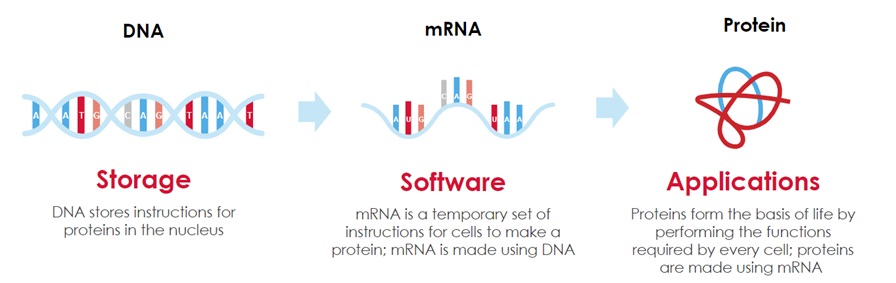
mRNA transfers the information stored in our genes to the cellular machinery that makes all the proteins required for life. Our genes are stored as sequences of DNA which contain the instructions to make specific proteins. DNA serves as a hard drive, safely storing these instructions in the cell’s nucleus until they are needed by the cell.
When a cell needs to produce a protein, the instructions to make that protein are copied from the DNA to mRNA, which serves as the template for protein production. Each mRNA molecule contains the instructions to produce a specific protein with a distinct function in the body. mRNA transmits those instructions to cellular machinery, called ribosomes, that make copies of the required protein.
We see mRNA functioning as the “software of life.” Every cell uses mRNA to provide real time instructions to make the proteins necessary to drive all aspects of biology, including in human health and disease. This was codified as the central dogma of molecular biology over 60 years ago, and is exemplified in the schematic below.
Table of Contents
The structure of mRNA
mRNA is a linear polymer comprising four monomers called nucleotides: adenosine (A), guanosine (G), cytosine (C) and uridine (U). Within the region of the molecule that codes for a protein (the coding region), the sequence of these four nucleotides forms a language made up of three-letter words called codons. The first codon, or start codon (AUG), signals where the ribosome should start protein synthesis. To know what protein to make, the ribosome then progresses along the mRNA one codon at a time, appending the appropriate amino acid to the growing protein. To end protein synthesis, three different codons (UAA, UAG, and UGA) serve as stop signals, telling the ribosome where to terminate protein synthesis. In total, there are 64 potential codons, but only 20 amino acids that are used to build proteins; therefore, multiple codons can encode for the same amino acid.
The process of protein production is called translation because the ribosome is reading in one language (a sequence of codons) and outputting in another language (a sequence of amino acids). The coding region is analogous to a sentence in English. Much like a start codon, a capitalized word can indicate the start of a sentence. Codons within the coding region resemble groups of letters representing words. The end of the sentence is signaled by a period in English, or a stop codon for mRNA.
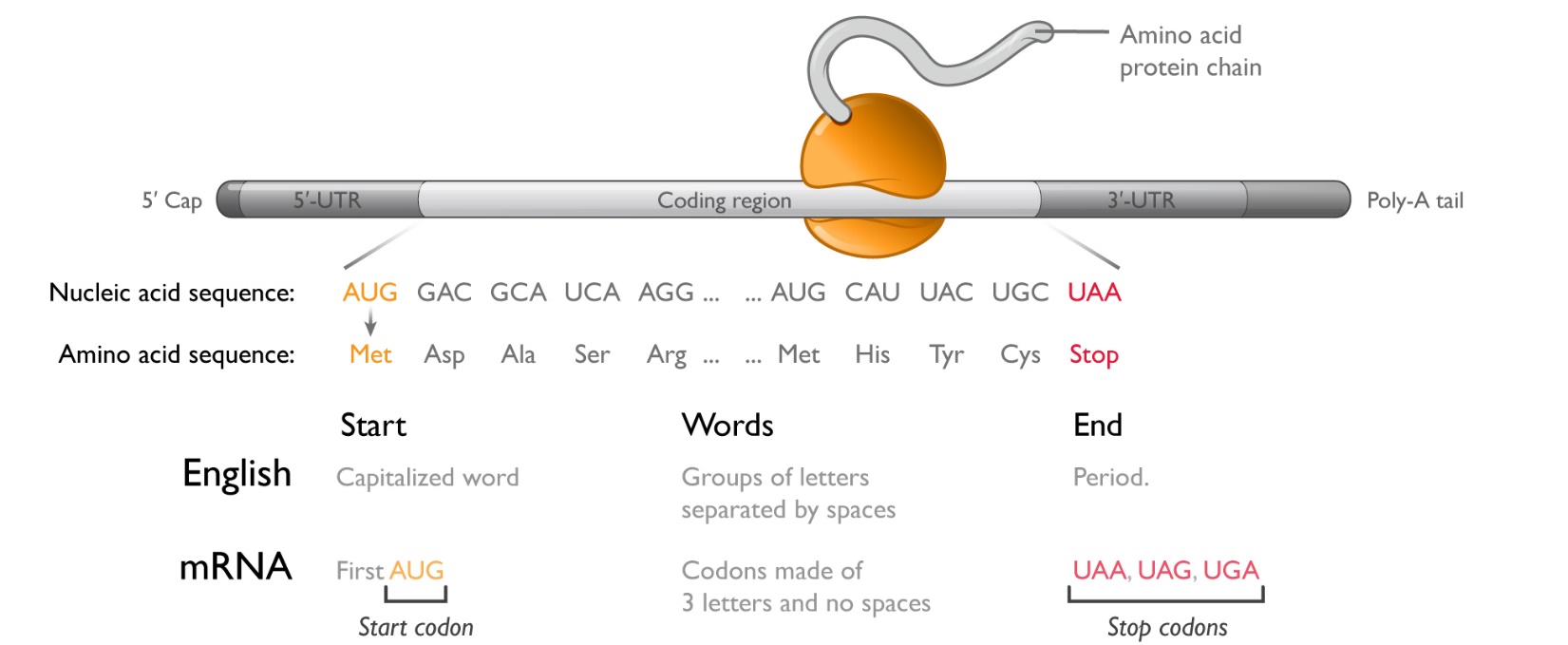
In every cell, hundreds of thousands of mRNAs make hundreds of millions of proteins every day. A typical protein contains 200-600 amino acids; therefore, a typical mRNA coding region ranges from 600-1,800 nucleotides. In addition to the coding region, mRNAs contain four other key features: (1) the 5’ untranslated region (5’-UTR); (2) the 3’ untranslated region (3’-UTR); (3) the 5’ cap; and (4) a 3’ polyadenosine (poly-A) tail. The sequence of nucleotides in the 5’-UTR influences how efficiently the ribosome initiates protein synthesis, whereas the sequence of nucleotides in the 3’-UTR contains information about which cell types should translate that mRNA and how long the mRNA should last. The 5’ cap and 3’ poly-A tail enhance ribosome engagement and protect the mRNA from attack by intracellular enzymes that digest mRNA from its ends.
Table of Contents
The intrinsic advantages of using mRNA as a medicine
mRNA possesses inherent characteristics that we believe position it to have a profound impact on human health:
-
mRNA is used by every cell to produce all proteins:** mRNA is used to make every type of protein, including secreted, membrane and intracellular proteins, in varying quantities over time, in different locations and in various combinations. Given the universal role of mRNA in protein production, we believe that mRNA medicines could have broad applicability across human disease.
-
Making proteins inside one’s own cells mimics human biology:** Tailored mRNA can be sent into cells to instruct them to produce specific protein therapeutics or vaccine antigens and provides certain advantages over traditional approaches to medicine, where a protein or chemical is introduced to the body.
-
mRNA has a simple and flexible chemical structure:** Each mRNA molecule comprises four chemically similar nucleotides to encode proteins made from up to 20 chemically different amino acids. To make the full diversity of possible proteins, only simple sequence changes are required in mRNA, instead of starting from scratch for each new vaccine or therapy.
-
mRNA has classic pharmacologic features:** mRNA possesses many of the attractive pharmacologic features of most modern medicines, including reproducible activity, predictable potency and well-behaved dose dependency; mRNA also provides the ability to adjust dosing based on an individual patient’s needs, including stopping or lowering the dose, to
Showing the first 8K of 195K characters. Open the full section
Item 1A. Risk Factors
You should carefully consider the following risks and uncertainties, together with all other information in this Annual Report on Form 10-K. Any of the risk factors we describe below could adversely affect our business, financial condition or results of operations and the market price of our common stock.
Risks related to commercialization and our products
Evolving dynamics in the market for COVID-19 vaccines are likely to impact our financial results, which are likely to result in lower product revenues in 2024 than we have experienced in recent years.
Through 2023, our only approved product and sole source of product sales has been our COVID-19 vaccine. The global market is transitioning to an endemic, commercial market for COVID-19 vaccine sales, resulting in different market and production dynamics than during the pandemic, including a more fragmented customer base, less predictability in orders, greater seasonality of demand, increased distribution costs, and higher costs of goods sold. Furthermore, our assumptions regarding the product presentation that will be accepted or preferred by the market (e.g., single-dose presentation), which could vary by market, may prove incorrect. In addition, certain U.S. private vaccine market practices, including regarding discounts, rebates and returns, may cause us to realize significantly lower revenues than list prices. We may also be adversely affected by similar market practices outside of the United States.
We recognized $6.7 billion of sales for COVID-19 vaccines delivered in 2023, compared to $18.4 billion in 2022 and $17.7 billion in 2021, as demand for COVID-19 vaccines declined. We anticipate that sales of COVID-19 vaccines are likely to be lower in 2024 than 2023. We expect the market for COVID-19 vaccines to evolve based on a number of factors, including medical need, viral evolution, public health authority recommendations and consumer motivation to vaccinate. In the third quarter of 2023, we significantly resized our manufacturing infrastructure as we shifted to an endemic COVID-19 vaccine market, and we may in the future incur additional costs associated with exiting commitments with suppliers for raw materials and contract manufacturing organization (CMOs). As a result of lower demand, we have experienced, and may in the future experience, increased costs with respect to raw material suppliers as we seek to exit or modify our purchase commitments. Further, we have entered, and may in the future enter, into non-cancellable or take-or-pay purchase commitments for raw materials that require a long lead time to procure, increasing our commitment exposure. If we cannot effectively manage evolving demand dynamics, our business, financial condition, results of operations and prospects may suffer.
Additionally, we may not see demand materialize for our products consistent with our projections. This may lead to lower than expected commercial sales or requests to defer, renegotiate or cancel existing contracts. Further, we may find that we need to dedicate greater resources to our commercial efforts than anticipated, and we may not realize a return on this investment.
We may encounter difficulties producing or shipping our products consistent with our projections or future contractual commitments.
We may encounter difficulties producing or shipping our products, including our COVID-19 vaccine or other future products, consistent with our current expectations or on the terms set forth in our supply agreements or future sales contracts. Our ability to commercialize our products depends on our manufacturing capability, both at our own facilities and those of our partners, particularly for fill-finish capabilities. Further, adapting our COVID-19 vaccine to new variants requires significant coordination with our partners, including for the sourcing of raw materials and production. Any capacity or production issues or delays experienced by our partners may cause us to fail to meet obligations under our supply agreements.
We have limited sales, distribution and marketing experience and may be unable to effectively establish such capabilities or supplement our capabilities by entering into agreements with third parties.
We have limited experience as a commercial organization and face risks and uncertainties as we shift to an endemic COVID-19 vaccine market and prepare for the commercial launch of other medicines, including our anticipated RSV vaccine launch in 2024. As a result of this limited commercial experience, we may be unsuccessful in accurately anticipating future rates of return for our products, which may adversely impact our accounting estimates. Additionally, we may seek to enter into agreements with others to utilize their marketing and distribution capabilities, but may be unable to enter into agreements on favorable terms, if at all. If we rely on others to commercialize our products, our revenues may be lower than if we commercialized these products ourselves. In addition, we may have little or no control over such third parties’ sales efforts. If our partners commit insufficient resources to commercialize our products, and we cannot independently develop necessary marketing capabilities, we may be unable to generate sufficient product revenue to sustain our business.
The pharmaceutical market is intensely competitive, and we may not compete effectively in the market for existing products, new treatment methods and new technologies.
The pharmaceutical market is intensely competitive and evolving. Many companies, academic institutions, governmental agencies and public and private research organizations are developing products for the same diseases that we are targeting or expect to target and such other parties may have:
-
greater resources and experience than us at every stage of drug discovery, development, testing, approval, manufacturing and commercialization;
-
multiple products that have been approved or are in late stages of development; and
-
arrangements in our target markets with purchasers, governments, leading companies and research institutions.
We face intense competition with respect to our COVID-19 vaccine, and it may not continue to compete favorably with existing or future vaccines and treatments. Other vaccines or treatments could prove to be safer, more effective, more convenient, have fewer side effects, be easier to ship or distribute or able to be developed at a lower cost than our vaccine. Even if our products demonstrate superiority to those of competitors, consumers and the public may fail to appreciate that benefit, or existing purchase commitments for a competitor’s product may discourage them from purchasing from us. These factors, or the perception of these factors, could lead to a competitor’s vaccine or treatment being more successfully commercialized. Further, the mRNA medicines field is growing rapidly, with increased competitive pressure from large and more established pharmaceutical companies. The actual or perceived success or failure of others may adversely impact our ability to commercialize our products.
We also will face competition from products that have already been approved and accepted by the medical community to treat certain conditions we target. For example, we are developing a seasonal flu vaccine, for which there is a well-developed market, and we may be unsuccessful in developing a product or achieving market share. Our RSV vaccine, which we expect to launch beginning in 2024, will also face competition from existing RSV vaccines. In markets that we enter after competitors have already introduced a competing product, we may have difficulty achieving market share. Further, we may need to offer more favorable terms to gain market share in an existing market or to compete in a new market, which may negatively impact our profitability.
If we successfully develop and obtain approval for other product candi
Showing the first 8K of 192K characters. Open the full section
Item 1B. Unresolved Staff Comments
None.
Item 1C. Cybersecurity
Cyber Risk Management and Strategy
Our cybersecurity organization’s mission is to provide a targeted set of services, support and capabilities to reduce the risk of cyberattacks, rapidly detect and contain threats, and mitigate risks to critical data.
Recognizing the threat of security breaches and cyberattacks globally, we have developed a cybersecurity program, overseen by our Chief Information Security Officer (CISO) and Chief Information Officer (CIO), that is designed to protect patient trust, defend the Moderna brand, and reduce the risk and impact of cyber-attacks. Our cybersecurity program is informed by industry standards and includes periodic risk assessments and security testing supported by cybersecurity technologies, including third-party security solutions, vulnerability management, and monitoring tools, designed to monitor, identify, and manage risks from cyber threats. In addition, we have implemented employee security and awareness training.
Management has established a cyber incident response plan (CIRP) designed to assess, identify and manage risks from cybersecurity threats and enable prompt response in the event that a cybersecurity incident is detected. We have a process in place for notification to our leadership response team in the event of a significant cyber incident, and for escalation of these events to our Audit Committee and Board, as appropriate. To date, we have not experienced a cybersecurity incident that has had a material impact on our business strategy, results of operations, or financial condition.
We undergo several annual internal compliance audits and external reviews to evaluate our controls, including cybersecurity controls. In an effort to minimize third-party risk, we have established a process to assess the security practices of third-party suppliers and related risks, including through review of relevant supplier certifications and security and responses to standardized information gathering (SIG) questionnaires, as applicable and appropriate.
Governance Related to Cybersecurity Risks
Our Board of Directors oversees Moderna’s overall risk management strategy. The Board exercises oversight of risks from cybersecurity threats primarily through its Audit Committee, which oversees our risk management processes for information security and technology risks. Our cybersecurity risk management processes are integrated into our overall risk management strategy, which is overseen by the Audit Committee. At least annually, the Audit Committee discusses our risk management program, including information security and technology risks and findings from any audits, with our internal audit staff.
The Audit Committee receives cyber-related updates from management, including our CISO at committee meetings. During meetings, our CISO updates the committee on Moderna’s cybersecurity posture, potential threats and risk mitigation strategies, and the progress of the Company’s cybersecurity initiatives, as appropriate. The Chair of the Audit Committee and management provide regular briefings on such matters to the full Board of Directors, as appropriate.
At the management level, our CISO is primarily responsible for leading our cybersecurity strategy for assessing and managing material risks from cybersecurity threats. Our current CISO has over 25 years of cybersecurity experience across a wide array of industries, most recently serving in leadership positions at two different public companies and previous roles of increasing responsibility at multinational technology companies. Our CISO reports directly to our CIO, who is a member of our Executive Committee and reports to our Chief Executive Officer.
We have built a cybersecurity leadership team designed to align with key services, with a separate lead overseeing each service offering, all reporting to the CISO. We also maintain relationships with law enforcement and industry groups to support our cybersecurity intelligence and risk management efforts.
Item 2. Properties
We have two main campuses in Massachusetts. During the third quarter of 2023, we commenced a lease for a property in Cambridge, Massachusetts. This building, spanning approximately 462,000 square feet, is designated as our new Moderna Science Center (MSC). The MSC will accommodate a combination of scientific and office spaces, including our principal executive offices. The lease has a term of 15 years, with options for us to extend the lease for up to two additional seven-year terms. We expect to begin a phased move-in process starting in early 2024. Additionally, we occupy a multi-building campus at Technology Square in Cambridge, Massachusetts, consisting of a mix of offices and research laboratory space, totaling approximately 292,000 square feet. The lease will expire in early 2025. The Cambridge campus is the location of our corporate headquarters, platform, drug discovery and clinical development.
The Moderna Technology Center (MTC) is located in Norwood, Massachusetts and is primarily comprised of three buildings (MTC South, MTC North and MTC East). The MTC campus is approximately 686,000 square feet which includes lab and office space, directly supporting our manufacturing capabilities and commercial and clinical activities. The MTC campus is leased through 2042 and we have the option to extend it for three additional five-year terms.
In the second quarter of 2023, we acquired a newly constructed biomanufacturing facility, encompassing 140,000 square feet, in Marlborough, Massachusetts. This facility is undergoing enhancements, including the addition of 60,000 square feet to the existing structure. Upon completion, the facility will feature office and mRNA manufacturing areas, including a full manufacturing clean room, quality control laboratories, a just-in-time satellite warehouse, and additional office spaces. We expect the facility to be operational in 2025. This new site is strategically intended to support our INT program.
We also own and lease various parcels of land, office and lab spaces across the globe for our business operations.
Item 3. Legal Proceedings
We are involved in various claims and legal proceedings of a nature considered ordinary course in our business, including the
intellectual property litigation described below. Most of the issues raised by these claims are highly complex and subject to substantial uncertainties. For a description of risks relating to these and other legal proceedings we face, see Part I, Item 1A, “Risk Factors,” including the discussion under the headings entitled “Risks related to our intellectual property” and “Risks related to the manufacturing of our commercial products and product candidates.”
The outcome of any such proceedings, regardless of the merits, is inherently uncertain; therefore, assessing the likelihood of loss and any estimated damages is difficult and subject to considerable judgment. We describe below those legal matters for which a material loss is either (i) possible but not probable, and/or (ii) not reasonably estimable at this time.
Pfizer/BioNTech Patent Litigation
In August 2022, we filed a lawsuit in the U.S. District Court for the District of Massachusetts against Pfizer Inc. (Pfizer) and BioNTech SE, BioNTech Manufacturing GmbH and BioNTech US Inc. (collectively, BioNTech), asserting infringement of certain U.S. patents concerning our mRNA platform technology and disease-specific vaccine designs in Pfizer and BioNTech’s manufacture and sale of their mRNA COVID-19 vaccines. The complaint seeks a judgment of infringement of the asserted patents and monetary damages.
Also in August 2022, we initiated patent infringement proceedings in Germany (in the Dusseldorf Regional Court), the Netherlands (in the District Court of The Hague) and the UK (in the High Court of Justice of England & Wales) against Pfizer, BioNTech and related entities with respect to certain European patents that also concern our mRNA platform technology and disease-specific vaccine designs, including coronaviruses. In May 2023, we initiated patent infringement proceedings in Ireland (in the High Court) and Belgium (Brussels Business Court) against Pfizer, BioNTech and related entities with respect to the same European patents. As in the U.S. action, we seek a judgment of infringement of the asserted patents and monetary damages.
Pfizer Inc. and BioNTech SE have also filed an action seeking revocation of certain Moderna patents in the UK. In addition, the Moderna patents being asserted in the European actions are subject to notices of opposition, including by Pfizer and BioNTech SE and others. These actions seek to revoke the patents, which have been filed at the European Patent Office.
Proceedings Related to Patents Owned by Arbutus
In February 2022, Arbutus Biopharma Corporation (Arbutus) and Genevant Sciences GmbH (Genevant) filed a complaint against us in the U.S. District Court for the District of Delaware asserting that our manufacture and sale of our COVID-19 vaccine willfully infringes certain U.S. patents concerning lipid nanoparticles. The complaint seeks a judgment of infringement of the asserted patents and monetary damages, but does not seek to prevent or stop the marketing or sales of our COVID-19 vaccines.
Proceedings Related to Patents Owned by Alnylam
In March 2022 and July 2022, Alnylam Pharmaceuticals, Inc. (Alnylam) filed two complaints against us in the U.S. District Court for the District of Delaware asserting that our manufacture and sale of our COVID-19 vaccine infringes certain U.S. patents concerning cationic lipids. On August 25, 2023, the Court entered a Final Judgment of non-infringement of all asserted patents in these lawsuits. Alnylam has appealed this judgment to the Federal Circuit Court of Appeals. In May 2023, Alnylam filed a third complaint against us in the U.S. District Court for the District of Delaware asserting three additional U.S. patents concerning cationic lipids. The complaints seek judgments of infringement of the asserted patents and monetary damages, but do not seek to prevent or stop the marketing or sales of our COVID-19 vaccines.
Item 4. Mine Safety Disclosures
Not applicable.
PART II
Item 5. Market for Registrant's Common Equity, Related Stockholder Matters and Issuer Purchases of Equity Securities
Market for Our Common Stock
Our common stock trades on the Nasdaq Global Select Market under the symbol “MRNA”.
Stock Performance Graph
The following performance graph shall not be deemed “soliciting material” or to be “filed” with the SEC for purposes of the Exchange Act or otherwise subject to the liabilities under that section, and shall not be deemed to be incorporated by reference into any filing of Moderna, Inc. under the Securities Act or the Exchange Act.
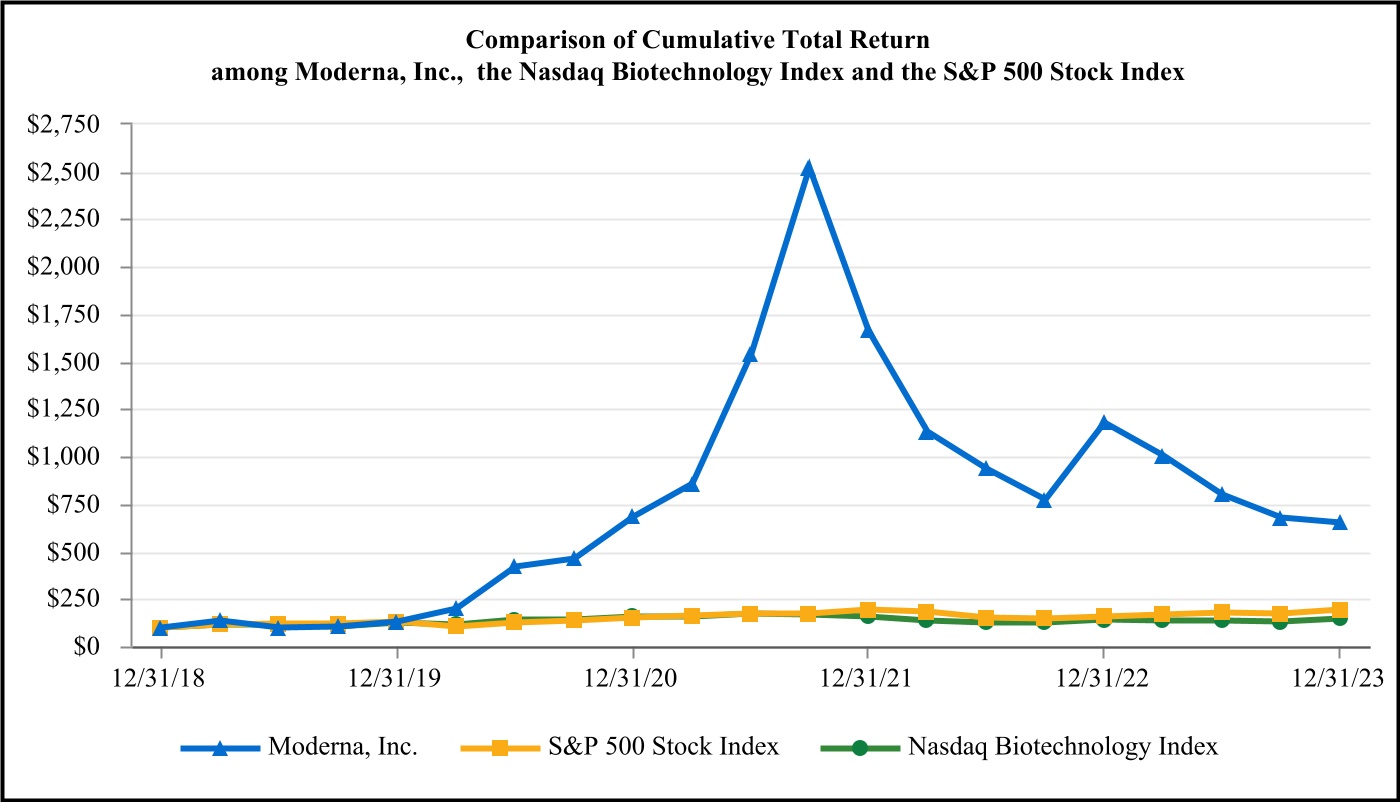
The following graph illustrates a comparison for the five years ended December 31, 2023 of the cumulative total return for our common stock, the Nasdaq Biotechnology Index, and the Standard & Poor’s 500 Stock Index (the S&P 500) each of which assumes an initial investment of $100 and reinvestment of all dividends. Such returns are based on historical results and are not intended to suggest future performance.
The comparisons shown in the graph below are based upon historical data. We caution that the stock price performance shown in the graph below is not necessarily indicative of, nor is it intended to forecast, the potential future performance of our common stock.
Stockholders
We had approximately 75 stockholders of record as of February 16, 2024. Because many of our outstanding shares are held in accounts with brokers and other institutions, the number of beneficial owners is significantly greater than the number of record holders. This number of holders of record also does not include stockholders whose shares may be held in trust by other entities.
Dividend Policy
We have never declared or paid cash dividends on our common stock and do not expect to pay dividends on our common stock for the foreseeable future.
Securities Authorized for Issuance Under Equity Compensation Plans
Information about our equity compensation plans in Item 12 of Part III of this Annual Report on Form 10-K is incorporated herein by reference. Any future determination to pay dividends will be made at the discretion of our board of directors and will depend on various factors, including applicable laws, our results of operations, financial condition, future prospects, then applicable contractual restrictions and any other factors deemed relevant by our board of directors. Investors should not purchase our common stock with the expectation of receiving cash dividends.
Recent Sales of Unregistered Securities
None.
Issuer Purchases of Equity Securities
On August 1, 2022, our Board of Directors authorized a share repurchase program for our common stock of up to $3.0 billion, with no expiration date. During the three months ended December 31, 2023, there were no shares repurchased. As of December 31, 2023, $1.7 billion of our Board of Directors’ authorization for repurchases of our common stock remains outstanding, with no expiration date.
Refer to Note 12 to consolidated financial statements for information regarding our share repurchase programs.
Item 6. [Reserved]
Item 7. MANAGEMENT’S DISCUSSION AND ANALYSIS OF FINANCIAL CONDITION AND RESULTS OF OPERATIONS
You should read the following discussion and analysis of our financial condition and results of operations together with our consolidated financial statements and related notes and other financial information appearing elsewhere in this Annual Report on Form 10-K. Some of the information contained in this discussion and analysis or set forth elsewhere in this Annual Report on Form 10-K, including information with respect to our plans and strategy for our business, includes forward-looking statements that involve risks and uncertainties. As a result of many factors, including those factors set forth in “Part I, Item 1A - Risk Factors” section of this Annual Report on Form 10-K, our actual results could differ materially from the results described in or implied by the forward-looking statements contained in the following discussion and analysis.
Overview
We are a biotechnology company advancing a new class of medicines made of messenger RNA (mRNA). mRNA medicines are designed to direct the body’s cells to produce intracellular, membrane or secreted proteins that have a therapeutic or preventive benefit with the potential to address a broad spectrum of diseases. Our platform builds on continuous advances in basic and applied mRNA science, delivery technology and manufacturing, providing us the capability to pursue in parallel a robust pipeline of new development candidates. We are developing therapeutics and vaccines for infectious diseases, immuno-oncology, rare diseases and autoimmune diseases, independently and with our strategic collaborators.
Since our founding in 2010, we have transformed from a research-stage company advancing programs in the field of mRNA to a commercial enterprise with a diverse clinical portfolio of vaccines and therapeutics across six modalities, a broad intellectual property portfolio and integrated manufacturing capabilities that allow for rapid clinical and commercial production at scale. We have a diverse and extensive development pipeline of 42 development candidates across our 45 development programs, of which 40 are in clinical studies currently.
Our COVID-19 vaccine is our first commercial product and is marketed, where approved, under the name Spikevax®. Our original vaccine, mRNA-1273, targeted the SARS-CoV-2 ancestral strain, and we have leveraged our mRNA platform to rapidly adapt our vaccine to emerging SARS-CoV-2 strains to provide protection as the virus evolves and regulatory guidance is updated.
2023 Business Highlights
On September 11, 2023, we received approval of the supplemental Biologics License Application from the U.S. Food and Drug Administration (FDA) for our updated COVID-19 vaccine, which targets the Omicron XBB.1.5 sublineage of SARS-CoV-2 (mRNA-1273.815), for individuals 12 years and older. The FDA also issued an Emergency Use Authorization for mRNA-1273.815 for children aged 6 months to 11 years old. We subsequently received authorization from regulatory authorities around the globe for mRNA-1273.815 and initiated the shipment of doses both in the U.S. and internationally.
For the year ended December 31, 2023, we recognized net product sales of $6.7 billion from sales of our COVID-19 vaccines, compared to $18.4 billion and $17.7 billion for the years ended December 31, 2022 and 2021, respectively.
In January 2023, we announced positive data from the interim analysis of our pivotal ConquerRSV study of our vaccine candidate against respiratory syncytial virus (RSV) (mRNA-1345). In the study, mRNA-1345 met primary efficacy endpoints, demonstrating vaccine efficacy of 83.7% against RSV lower respiratory tract disease in older adults. We have filed for a Biologics License Application to the FDA for our RSV vaccine for adults aged 60 years or older, and used a Priority Review Voucher to accelerate review. We have also submitted marketing authorization applications for the vaccine for adults aged 60 years or older to medical authorities in several countries beyond the U.S. We have initiated the manufacturing of mRNA-1345 and are preparing for a marketing launch in 2024, subject to approval.
During the third quarter of 2023, we embarked on a strategic initiative to optimize the cost structure of our COVID-19 business, with a focus on resizing our manufacturing cost structure. The launch of this initiative was prompted by the completion of our long-range planning within the third quarter of 2023, which incorporated revised forecasts of vaccination rates. These projections accounted for the market’s transition from COVID-19 pandemic conditions towards an endemic seasonal market. Consequently, this strategic shift resulted in charges of $1.4 billion for the quarter. In the fourth quarter of 2023, we incurred additional charges of $169 million related to this initiative. Despite the immediate impact to our financial statements, we believe this strategic initiative will enhance the efficiency of our manufacturing operations and equip us with the agility to better adjust our scale according to future market demands.
Program Developments
As of December 31, 2023, nine of our 45 development programs are in late-stage development, including seven programs in Phase 3 and two rare disease programs that are expected to enter pivotal studies in 2024.
Respiratory Vaccines
*•*Respiratory syncytial virus (RSV) vaccine: We have filed for regulatory approvals for our vaccine for the prevention of RSV-associated lower respiratory tract disease (RSV-LRTD) and acute respiratory disease (ARD) in adults ages 60 years or older (mRNA-1345). We expect regulatory approvals beginning in the first half of 2024. We anticipate entering the RSV market with a strong competitive profile as the only pre-filled syringe product available at the time of launch, along with robust efficacy data, a well-established safety and tolerability profile, and widespread consumer awareness and demand established in 2023.
*•*Next-generation COVID-19 vaccine: Our next-generation COVID-19 vaccine candidate, which is designed to be refrigerator-stable (mRNA-1283), is currently in its pivotal Phase 3 study. We anticipate data from the study in the first half of 2024.
-
Seasonal flu vaccine: Our seasonal flu vaccine candidate (mRNA-1010) demonstrated consistently acceptable safety and tolerability across three Phase 3 trials. In the most recent Phase 3 trial, mRNA-1010 met all immunogenicity endpoints, demonstrating higher titers compared to a currently licensed vaccine. mRNA-1010 has also shown higher or comparable titers compared to a currently licensed enhanced vaccine (Fluzone HD®) in a separate Phase 1/2 study. We are in discussions with regulators and intend to file in 2024.
-
Seasonal flu + COVID-19 vaccine: The Phase 3 trial of our combination vaccine candidate against seasonal flu and COVID-19 (mRNA-1083) is fully enrolled. We anticipate data from the study in 2024.
Latent and Other Vaccines
- Cytomegalovirus (CMV) vaccine: The pivotal Phase 3 study of our CMV vaccine candidate (mRNA-1647) is fully enrolled and accruing cases, evaluating its efficacy, safety and immunogenicity in the prevention of primary infection in women of childbearing age. We anticipate potential efficacy data from the study in 2024.
Oncology Therapeutics
- Individualized Neoantigen Therapy (INT): We continue to demonstrate the potential clinical benefit of our INT program (mRNA-4157), which we are developing in collaboration with Merck. Two separate Phase 3 trials continue to enroll patients with resected high-risk (stage III/IV) melanoma and completely resected stage II, IIIA or IIIB non-small cell lung cancer. We and Merck plan to expand their clinical studies to additional tumor types in 2024.
In December 2023, we announced results of a three-year analysis of our Phase 2b study evaluating INT in combination with KEYTRUDA®, Merck’s anti-PD-1 therapy, in patients with resected high-risk melanoma. Compared to KEYTRUDA
Showing the first 8K of 66K characters. Open the full section
Item 7A. Quantitative and Qualitative Disclosures about Market Risk
Interest Rate Risk
As of December 31, 2023 and 2022, we had cash, cash equivalents, restricted cash, and investments in marketable securities of $13.3 billion and $18.2 billion, respectively. Our investment portfolio comprises money market funds and marketable debt securities (including U.S. Treasury securities, debt securities of U.S. government agencies and corporate entities, and commercial paper), which are classified as available-for-sale securities. Our primary investment objectives are the preservation of capital and the maintenance of liquidity, and our investment policy defines allowable investments based on quality of the institutions and financial instruments designed to minimize risk exposure. Our exposure to interest rate sensitivity is affected by changes in the general level of U.S. interest rates.
Our marketable securities are subject to interest rate risk and will fall in value if market interest rates increase. Due to the short-term maturities and low risk profiles of our investments, we do not anticipate a significant exposure to interest rate risk. If market interest rates were to increase immediately and uniformly by one percentage point from levels at December 31, 2023, the net fair value of our marketable securities would decrease by approximately $83 million.
Foreign Currency Risk
We transact business in various foreign currencies and have international sales and expenses denominated in foreign currencies. Therefore, we are exposed to certain risks arising from both our business operations and economic conditions. For the year ended December 31, 2023, our revenue generating activities and operations continued to be primarily denominated in U.S. dollars. However, we maintained a significant exposure to foreign currency risk, particularly in the Euro, Japanese Yen and Swiss Franc markets, Our significant foreign currency revenue exposure was the equivalent of $1.4 billion in Japanese Yen and $518 million in Euros for 2023. As we pursue our international expansion strategy, our results of operations and cash flows remain subject to fluctuations in foreign currency exchange rates. To manage the exposure to foreign currency exchange rate fluctuations, we have implemented cash flow hedging and balance sheet hedging programs.
Cash Flow Hedging Activities
We mitigate the foreign exchange risk arising from the fluctuations in foreign currency denominated product sales in Euro and Japanese Yen through a foreign currency cash flow hedging program, using forward contracts and foreign currency options that do not exceed 15 months in duration. We hedge these cash flow exposures to reduce the risk that our earnings and cash flows will be adversely affected by changes in exchange rates. To receive hedge accounting treatment, all hedging relationships are formally documented at the inception of the hedge, and the hedges must be highly effective in offsetting changes to future cash flows on hedged transactions. The derivative assets or liabilities associated with our hedging activities are recorded at fair value in prepaid expenses and other current assets or other current liabilities, respectively, in our consolidated balance sheets. The gains or losses resulting from changes in the fair value of these hedges are initially recorded as a component of accumulated other comprehensive (loss) income (AOCI) in stockholders’ equity and subsequently reclassified to product sales in the period during which the hedged transaction affects earnings. In the event the underlying forecasted transaction does not occur, or it becomes probable that it will not occur, within the defined hedge period, we reclassify the gains or losses on the related cash flow hedge from AOCI to other expense, net, in our consolidated statements of operations. We evaluate hedge effectiveness at the inception of the hedge prospectively, and on an on-going basis both retrospectively and prospectively. If we do not elect hedge accounting, or the contract does not qualify for hedge accounting treatment, the changes in fair value from period to period are recorded as a component of other expense, net, in our consolidated statements of operations. We had no outstanding foreign currency forward contracts or foreign currency options as of December 31, 2023. Foreign currency hedging activities were immaterial during 2023.
Balance Sheet Hedging Activities
We enter into foreign currency forward contracts to hedge fluctuations associated with foreign currency denominated monetary assets and liabilities, primarily cash, accounts receivable, accounts payable and lease liabilities in Euro, Swiss Franc and Japanese Yen, that are not designated for hedge accounting treatment. Therefore, these forward contracts are accounted for as derivatives whereby the fair value of the contracts are reported as prepaid expenses and other current assets or other current liabilities in our consolidated balance sheets, and gains and losses resulting from changes in the fair value are recorded as a component of other expense, net, in our consolidated statements of operations. The gains and losses on these foreign currency forward contracts generally offset the gains and losses in the underlying foreign currency denominated assets and liabilities, which are also recorded to other expense, net, in our consolidated statements of operations. As of December 31, 2023, our outstanding balance sheet hedging derivatives, carried at fair value, had maturities of less than three months.
We enter into these foreign exchange contracts to hedge our forecasted revenue and monetary assets and liabilities denominated in foreign currency in the normal course of business and accordingly, they are not speculative in nature. We believe the counterparties to
our foreign currency forward contracts are creditworthy multinational commercial banks. While we believe the risk of counterparty nonperformance is not material, a sustained decline in the financial stability of financial institutions as a result of disruption in the financial markets could affect our ability to secure creditworthy counterparties for our foreign currency hedging programs.
Notwithstanding our efforts to mitigate some foreign currency exchange risks, there can be no assurance that our hedging activities will adequately protect us against the risks associated with foreign currency fluctuations. As of December 31, 2023, a hypothetical adverse movement of 10 percent in foreign currency exchange rates compared to the U.S. dollars across all maturities would have resulted in potential declines in the fair value on our foreign currency forward contracts used in balance sheet hedging of approximately $23 million. We expect that any increase or decrease in the fair value of the portfolio would be substantially offset by increases or decreases in the underlying exposures being hedged.
Item 8. Financial Statements and Supplementary Data
MODERNA, INC.
INDEX TO CONSOLIDATED FINANCIAL STATEMENTS
Report of Independent Registered Public Accounting Firm
To the Stockholders and the Board of Directors of Moderna, Inc.
Opinion on the Financial Statements
We have audited the accompanying consolidated balance sheets of Moderna, Inc. (the Company) as of December 31, 2023 and 2022, the related consolidated statements of operations, comprehensive income (loss), stockholders’ equity, and cash flows for each of the three years in the period ended December 31, 2023, and the related notes (collectively referred to as the “consolidated financial statements”). In our opinion, the consolidated financial statements present fairly, in all material respects, the financial position of the Company at December 31, 2023 and 2022, and the results of its operations and its cash flows for each of the three years in the period ended December 31, 2023, in conformity with U.S. generally accepted accounting principles.
We also have audited, in accordance with the standards of the Public Company Accounting Oversight Board (United States) (PCAOB), the Company's internal control over financial reporting as of December 31, 2023, based on criteria established in Internal Control-Integrated Framework issued by the Committee of Sponsoring Organizations of the Treadway Commission (2013 framework) and our report dated February 23, 2024, expressed an unqualified opinion thereon.
Basis for Opinion
These financial statements are the responsibility of the Company's management. Our responsibility is to express an opinion on the Company’s financial statements based on our audits. We are a public accounting firm registered with the PCAOB and are required to be independent with respect to the Company in accordance with the U.S. federal securities laws and the applicable rules and regulations of the Securities and Exchange Commission and the PCAOB.
We conducted our audits in accordance with the standards of the PCAOB. Those standards require that we plan and perform the audit to obtain reasonable assurance about whether the financial statements are free of material misstatement, whether due to error or fraud. Our audits included performing procedures to assess the risks of material misstatement of the financial statements, whether due to error or fraud, and performing procedures that respond to those risks. Such procedures included examining, on a test basis, evidence regarding the amounts and disclosures in the financial statements. Our audits also included evaluating the accounting principles used and significant estimates made by management, as well as evaluating the overall presentation of the financial statements. We believe that our audits provide a reasonable basis for our opinion.
Critical Audit Matters
The critical audit matters communicated below are matters arising from the current period audit of the financial statements that were communicated or required to be communicated to the audit committee and that: (1) relate to accounts or disclosures that are material to the financial statements and (2) involved our especially challenging, subjective or complex judgments. The communication of critical audit matters does not alter in any way our opinion on the consolidated financial statements, taken as a whole, and we are not, by communicating the critical audit matters below, providing separate opinions on the critical audit matters or on the accounts or disclosures to which they relate.
| Reserves for returns on product revenue | ||||||||
| Description of the Matter | During the year ended December 31, 2023, the Company’s net product revenues for Spikevax were $6.7 billion. As explained in Note 2 of the consolidated financial statements, revenue from product sales includes estimates of variable consideration for which reserves are established, including reserves for product returns. Auditing the Company’s measurement of reserves for product returns under its contracts with wholesalers, distributors and retail customers (collectively, “Customers”) was especially challenging because (1) it involves management assumptions about inventory remaining in the distribution channel as of the balance sheet date that could be subject to return in future periods and projected market demand, and (2) the Company has limited returns history on which to base its assumptions. |
| How We Addressed the Matter in Our Audit | We obtained an understanding, evaluated the design and tested the operating effectiveness of internal controls over the Company’s process to determine reserves for returns on product revenue. For example, we tested controls over management’s review of the completeness and accuracy of the data used in the process and the assumptions about the amount of inventory in the distribution channel that could be subject to return in future periods. To test the Company’s reserves for returns on product revenue, our audit procedures included, among other procedures, testing the accuracy and completeness of the underlying data used in the calculations and evaluating the assumptions used by management to estimate its reserves. To test management’s assumptions, we inspected agreements with significant Customers to validate the rights of return, made inquiries of members of the commercial function regarding any changes to the terms and conditions of commercial contracts. We also examined credit memos issued during and after year end for unusual items or trends not consistent with the Company’s analysis of product returns and performed revenue cutoff testing at period end to assess whether there were unusual trends that should have been considered in the Company analysis of product returns. In addition, we reviewed inventory on hand-reporting from significant Customers at the balance sheet date and subsequent to the balance sheet date and inspected vaccination data from third-party sources through the report date. We also performed sensitivity analyses over the Company’s return rate to assess the effect of changes in assumptions. | |||||||
| Raw Material Inventory Write-downs | ||||||||
| Description of the Matter | As of December 31, 2023, the Company had $0.4 billion of inventory. As disclosed in Note 2, inventory is recorded at |
Showing the first 8K of 173K characters. Open the full section
Item 9. Changes in and Disagreements with Accountants on Accounting and Financial Disclosure
None.
Item 9A. Controls and Procedures
Evaluation of Disclosure Controls and Procedures
Our management, with the participation of our Chief Executive Officer and our Chief Financial Officer, evaluated the effectiveness of our disclosure controls and procedures as of December 31, 2023. The term “disclosure controls and procedures,” as defined in Rules 13a-15(e) and 15d-15(e) under the Securities Exchange Act of 1934, or the Exchange Act, means controls and other procedures of a company that are designed to ensure that information required to be disclosed by a company in the reports that it files or submits under the Exchange Act is recorded, processed, summarized and reported, within the time periods specified in the SEC’s rules and forms. Disclosure controls and procedures include, without limitation, controls and procedures designed to ensure that information required to be disclosed by a company in the reports that it files or submits under the Exchange Act is accumulated and communicated to the company’s management, including its principal executive and principal financial officers, as appropriate to allow timely decisions regarding required disclosure. Management recognizes that any controls and procedures, no matter how well designed and operated, can provide only reasonable assurance of achieving their objectives and management necessarily applies its judgment in evaluating the cost-benefit relationship of possible controls and procedures. Based on the evaluation of our disclosure controls and procedures as of December 31, 2023, our Chief Executive Officer and Chief Financial Officer concluded that, as of such date, our disclosure controls and procedures were effective at the reasonable assurance level.
Management’s Report on Internal Control Over Financial Reporting
Our management is responsible for establishing and maintaining adequate internal control over financial reporting (as such term is defined in Exchange Act Rule 13a-15(f)) to provide reasonable assurance regarding the reliability of our financial reporting and the preparation of financial statements for external purposes in accordance with generally accepted accounting principles. Management assessed our internal control over financial reporting as of December 31, 2023. Management based its assessment on criteria established in Internal Control - Integrated Framework issued by the Committee of Sponsoring Organizations of the Treadway Commission (2013 Framework). Based on that evaluation, our management concluded that our internal control over financial reporting was effective as of December 31, 2023.
The effectiveness of our internal control over financial reporting as of December 31, 2023 has been audited by Ernst & Young LLP, an independent registered public accounting firm, as stated in their report included in this Annual Report on Form 10-K.
Changes in Internal Controls over Financial Reporting
During the three months ended December 31, 2023, there were no changes in our internal control over financial reporting (as defined in Rules 13a-15(f) and 15d-15(f) under the Exchange Act), which have materially affected, or are reasonably likely to materially affect, our internal control over financial reporting.
Inherent Limitations on the Effectiveness of Controls
Our management, including our Chief Executive Officer and Chief Financial Officer, believe that our disclosure controls and procedures and internal control over financial reporting are designed to provide reasonable assurance of achieving their objectives and are effective at the reasonable assurance level. However, our management does not expect that our disclosure controls and procedures or our internal control over financial reporting will prevent all errors and all fraud. A control system, no matter how well-conceived and operated, can provide only reasonable, not absolute, assurance that the objectives of the control system are met. Further, the design of a control system must reflect the fact that there are resource constraints, and the benefits of controls must be considered relative to their costs. Because of the inherent limitations in all control systems, no evaluation of controls can provide absolute assurance that all control issues and instances of fraud, if any, have been detected. These inherent limitations include the realities that judgments in decision making can be faulty, and that breakdowns can occur because of a simple error or mistake. Additionally, controls can be circumvented by the individual acts of some persons, by the collusion of two or more people or by a management override of the controls. The design of any system of controls also is based in part upon certain assumptions about the likelihood of future events, and there can be no assurance that any design will succeed in achieving its stated goals under all potential future conditions; over time, controls may become inadequate because of changes in conditions, or the degree of compliance with policies or procedures may deteriorate. Because of the inherent limitations in a cost-effective control system, misstatements due to error or fraud may occur and not be detected.
Report of Independent Registered Public Accounting Firm
To the Stockholders and the Board of Directors of Moderna, Inc.
Opinion on Internal Control Over Financial Reporting
We have audited Moderna, Inc.’s internal control over financial reporting as of December 31, 2023, based on criteria established in Internal Control-Integrated Framework issued by the Committee of Sponsoring Organizations of the Treadway Commission (2013 framework) (the COSO criteria). In our opinion, Moderna, Inc. (the Company) maintained, in all material respects, effective internal control over financial reporting as of December 31, 2023, based on the COSO criteria.
We also have audited, in accordance with the standards of the Public Company Accounting Oversight Board (United States) (PCAOB), the consolidated balance sheets of the Company as of December 31, 2023 and 2022, the related consolidated statements of operations, comprehensive income (loss), stockholders’ equity, and cash flows for each of the three years in the period ended December 31, 2023, and the related notes and our report dated February 23, 2024 expressed an unqualified opinion thereon.
Basis for Opinion
The Company’s management is responsible for maintaining effective internal control over financial reporting and for its assessment of the effectiveness of internal control over financial reporting included in the accompanying Management’s Report on Internal Control Over Financial Reporting. Our responsibility is to express an opinion on the Company’s internal control over financial reporting based on our audit. We are a public accounting firm registered with the PCAOB and are required to be independent with respect to the Company in accordance with the U.S. federal securities laws and the applicable rules and regulations of the Securities and Exchange Commission and the PCAOB.
We conducted our audit in accordance with the standards of the PCAOB. Those standards require that we plan and perform the audit to obtain reasonable assurance about whether effective internal control over financial reporting was maintained in all material respects.
Our audit included obtaining an understanding of internal control over financial reporting, assessing the risk that a material weakness exists, testing and evaluating the design and operating effectiveness of internal control based on the assessed risk, and performing such other procedures as we considered necessary in the circumstances. We believe that our audit provides a reasonable basis for our opinion.
Definition and Limitations of Internal Control Over Financial Reporting
A company’s internal control over financial reporting is a process designed to provide reasonable assurance regarding the reliability of financial reporting and the preparation of financial statements for external purposes in accordance with generally accepted accounting principles. A company’s internal control over financial reporting includes those policies and procedures that (1) pertain to the maintenance of records that, in reasonable detail, accurately and fairly reflect the transactions and dispositions of the assets of the company; (2) provide reasonable assurance that transactions are recorded as necessary to permit preparation of financial statements in accordance with generally accepted accounting principles, and that receipts and expenditures of the company are being made only in accordance with authorizations of management and directors of the company; and (3) provide reasonable assurance regarding prevention or timely detection of unauthorized acquisition, use, or disposition of the company’s assets that could have a material effect on the financial statements.
Because of its inherent limitations, internal control over financial reporting may not prevent or detect misstatements. Also, projections of any evaluation of effectiveness to future periods are subject to the risk that controls may become inadequate because of changes in conditions, or that the degree of compliance with the policies or procedures may deteriorate.
/s/ Ernst & Young LLP
Boston, Massachusetts
February 23, 2024
Item 9B. Other Information
10b5-1 Plans
On November 7, 2023, Noubar Afeyan, our Chairman, amended a trading arrangement intended to satisfy the affirmative defense of Rule 10b5-1(c) (the Afeyan 10b5-1 Plan). The Afeyan 10b5-1 Plan was amended to increase certain price triggers under the plan. The Afeyan 10b5-1 Plan, as amended, is scheduled to commence on February 28, 2024, and will run through August 20, 2025. The aggregate maximum number of shares of common stock that may be sold pursuant to the Afeyan 10b5-1 Plan is 745,000, which represents the shares remaining under the original plan that have not been sold to date.
On November 6, 2023, Arpa Garay, our former Chief Commercial Officer, terminated a trading arrangement that was intended to satisfy the affirmative defense of Rule 10b5-1(c) (the Garay 10b5-1 Plan). The Garay 10b5-1 Plan was entered into on August 24, 2023, and was scheduled to commence on November 27, 2023, with a termination date of August 30, 2024. The Garay 10b5-1 Plan provided for the potential sale of approximately 4,540 shares of common stock and for the potential exercise of vested stock options and the associated sale of up to 24,897 shares. No shares of common stock were sold, and no options to purchase shares of common stock were exercised, under the Garay 10b5-1 Plan prior to its termination.
Amended and Restated By-laws
On February 21, 2024, our Board of Directors approved and adopted the Company’s Second Amended and Restated By-laws (the “By-laws”), which became effective immediately. The By-laws supersede and replace in their entirety the Company's Amended and Restated By-laws in effect immediately prior to effectiveness of the By-laws.
The By-laws, among other things:
-
implement a majority voting standard in uncontested director elections;
-
implement a proxy access provision, which permits a stockholder, or a group of up to 20 stockholders, owning 3% of our outstanding common stock continuously for at least three years to nominate and include in our proxy materials director candidates constituting up to the greater of two nominees or 20% of the Board of Directors, subject to the terms and conditions set forth in the By-laws;
-
update our advance notice provisions to take into account recent rules adopted by the SEC regarding usage of universal proxies;
-
reflect recent amendments and updates to the Delaware General Corporation Law; and
-
incorporate certain other administrative, technical, clarifying and conforming changes.
The foregoing description does not purport to be complete and is qualified in its entirety by reference to the full text of the By-laws, a copy of which is attached hereto as Exhibit 3.2 and is incorporated herein by reference.
Item 9C. Disclosure Regarding Foreign Jurisdictions that Prevent Inspections
None Applicable.
PART III
Item 10. Directors, Executive Officers and Corporate Governance
The information required by this Item is incorporated herein by reference to the information that will be contained in our proxy statement related to the 2024 Annual Meeting of Stockholders, which we intend to file with the Securities and Exchange Commission within 120 days of the end of our fiscal year pursuant to General Instruction G(3) of Form 10-K.
Item 11. Executive Compensation
The information required by this Item is incorporated herein by reference to the information that will be contained in our proxy statement related to the 2024 Annual Meeting of Stockholders, which we intend to file with the Securities and Exchange Commission within 120 days of the end of our fiscal year pursuant to General Instruction G(3) of Form 10-K.
Item 12. Security Ownership of Certain Beneficial Owners and Management and Related Stockholder Matters
The information required by this Item is incorporated herein by reference to the information that will be contained in our proxy statement related to the 2024 Annual Meeting of Stockholders, which we intend to file with the Securities and Exchange Commission within 120 days of the end of our fiscal year pursuant to General Instruction G(3) of Form 10-K.
Item 13. Certain Relationships and Related Transactions, and Director Independence
The information required by this Item is incorporated herein by reference to the information that will be contained in our proxy statement related to the 2024 Annual Meeting of Stockholders, which we intend to file with the Securities and Exchange Commission within 120 days of the end of our fiscal year pursuant to General Instruction G(3) of Form 10-K.
Item 14. Principal Accounting Fees and Services
Our independent public accounting firm is Ernst & Young LLP, Boston, Massachusetts, PCAOB Auditor ID 00042.
The information required by this Item is incorporated herein by reference to the information that will be contained in our proxy statement related to the 2024 Annual Meeting of Stockholders, which we intend to file with the Securities and Exchange Commission within 120 days of the end of our fiscal year pursuant to General Instruction G(3) of Form 10-K.
PART IV
Item 15. Exhibits, Financial Statement Schedules
(a) Documents filed as part of this report.
(1) Financial statements.
For a list of the consolidated financial statements included herein, see “Index to Consolidated Financial Statements” under Part II, Item 8 of this Annual Report on Form 10-K.
(2) Schedules.
No financial statement schedules have been submitted because they are not required or are not applicable or because the information required is included in the consolidated financial statements or the notes thereto.
(3) Exhibits.
| * | Filed herewith. | ||||
| † | Pursuant to 17 C.F.R. §§230.406 and 230.83, the confidential portions of this exhibit have been omitted and are marked accordingly. | ||||
| # | Indicates a management contract or any compensatory plan, contract or arrangement. | ||||
| + | The certifications furnished in Exhibits 32.1 and 32.2 hereto are deemed to accompany this Annual Report on Form 10-K and will not be deemed “filed” for purposes of Section 18 of the Securities Exchange Act of 1934, as amended. Such certifications will not be deemed to be incorporated by reference into any filings under the Securities Act of 1933, as amended, or the Securities Exchange Act of 1934, as amended, except to the extent that the Registrant specifically incorporates it by reference. | ||||
| (1) | Incorporated by reference to the Registration Statement on Form S-1 (File No. 333-228300) filed with the Securities and Exchange Commission on November 9, 2018. | ||||
| (2) | Incorporated by reference to the Current Report on Form 8-K (File No. 001-38753) filed with the Securities and Exchange Commission on December 14, 2018. | ||||
| (3) | Incorporated by reference to the Quarterly Report on Form 10-Q (File No. 001-38753) filed with the Securities and Exchange Commission on May 6, 2021. | ||||
| (4) | Incorporated by reference to the Annual Report on Form 10-K (File No. 001-38753) filed with the Securities and Exchange Commission on February 27, 2020. | ||||
| (5) | Incorporated by reference to the Annual Report on Form 10-K (File No. 001-38753) filed with the Securities and Exchange Commission on February 25, 2022. | ||||
| (6) | Incorporated by reference to the Current Report on Form 8-K/A (File No. 001-38753) filed with the Securities and Exchange Commission on May 13, 2022. | ||||
| (7) | Incorporated by reference to the Current Report on Form 8-K/A (File No. 001-38753) filed with the Securities and Exchange Commission on June 1, 2022. | ||||
| (8) | Incorporated by reference to the Quarterly Report on Form 10-Q (File No. 001-38753) filed with the Securities and Exchange Commission on November 3, 2022. | ||||
| (9) | Incorporated by reference to the Annual Report on Form 10-K (File No. 001-38753) filed with the Securities and Exchange Commission on February 24, 2023. | ||||
Item 16. Form 10-K Summary
Not applicable.
SIGNATURES
Pursuant to the requirements of the Section 13 or 15(d) of the Securities Exchange Act of 1934, the Registrant has duly caused this report to be signed on its behalf by the undersigned, thereunto duly authorized.
| MODERNA, INC. | |||||||||||
| Date: | By: | /s/ Stéphane Bancel | |||||||||
| February 23, 2024 | |||||||||||
| Stéphane Bancel | |||||||||||
| Chief Executive Officer and Director | |||||||||||
POWER OF ATTORNEY AND SIGNATURES
Each individual whose signature appears below hereby constitutes and appoints each of Stéphane Bancel and James M. Mock as such person’s true and lawful attorney-in-fact and agent with full power of substitution and resubstitution, for such person in such person’s name, place and stead, in any and all capacities, to sign any and all amendments to this Annual Report on Form 10-K, and to file the same, with all exhibits thereto, and all documents in connection therewith, with the Securities and Exchange Commission granting unto each said attorney-in-fact and agent full power and authority to do and perform each and every act and thing requisite and necessary to be done in and about the premises, as fully to all intents and purposes as such person might or could do in person, hereby ratifying and confirming all that any said attorney-in-fact and agent, or any substitute or substitutes of any of them, may lawfully do or cause to be done by virtue hereof.
Pursuant to the requirements of the Securities Exchange Act of 1934, this report has been signed by the following persons on behalf of the Registrant and in the capacities and on the dates indicated.
| Signature | Title | Date | ||||||||||||
| /s/ Stéphane Bancel | Chief Executive Officer and Director (Principal Executive Officer) | February 23, 2024 | ||||||||||||
| Stéphane Bancel | ||||||||||||||
| /s/ James M. Mock | Chief Financial Officer (Principal Financial Officer and Principal Accounting Officer) | February 23, 2024 | ||||||||||||
| James M. Mock | ||||||||||||||
| /s/ Noubar B. Afeyan, Ph.D. | Chairman and Director | February 23, 2024 | ||||||||||||
| Noubar B. Afeyan, Ph.D. | ||||||||||||||
| /s/ Stephen Berenson | Director | February 23, 2024 | ||||||||||||
| Stephen Berenson | ||||||||||||||
| /s/ Sandra Horning, M.D. | Director | February 23, 2024 | ||||||||||||
| Sandra Horning M.D. | ||||||||||||||
| /s/ Robert Langer, Sc.D. | Director | February 23, 2024 | ||||||||||||
| Robert Langer, Sc.D. | ||||||||||||||
| /s/ Francois Nader, M.D. | Director | February 23, 2024 | ||||||||||||
| Francois Nader M.D. | ||||||||||||||
| /s/ Elizabeth Nabel, M.D. | Director | February 23, 2024 | ||||||||||||
| Elizabeth Nabel, M.D. | ||||||||||||||
| /s/ Paul Sagan | Director | February 23, 2024 | ||||||||||||
| Paul Sagan | ||||||||||||||
| /s/ Elizabeth Tallett | Director | February 23, 2024 | ||||||||||||
| Elizabeth Tallett | ||||||||||||||