 filings.tools
Nasdaq 10-K 2023-12-31
Filed 2024-02-21. 24 sections, 658K characters. Original on sec.gov · Markdown · JSON
Cover and table of contents
UNITED STATES SECURITIES AND EXCHANGE COMMISSION
Washington, D.C. 20549
_______________________________
FORM 10-K
| ☒ | ANNUAL REPORT PURSUANT TO SECTION 13 OR 15(d) OF THE SECURITIES EXCHANGE ACT OF 1934 | |||||||
| For the fiscal year ended | December 31, 2023 | |||||||
| OR | ||||||||
| ☐ | TRANSITION REPORT PURSUANT TO SECTION 13 OR 15(d) OF THE SECURITIES EXCHANGE ACT OF 1934 | |||||||
| For the transition period | from ________ to ________ |
Commission file number: 001-38855
___________________________________
Nasdaq, Inc.
(Exact name of registrant as specified in its charter)
| Delaware | 52-1165937 | ||||||||||
| (State or Other Jurisdiction of Incorporation or Organization) | (I.R.S. Employer Identification No.) |
| 151 W. 42nd Street, | New York, | New York | 10036 | ||||||||
| (Address of Principal Executive Offices) | (Zip Code) |
Registrant’s telephone number, including area code: +1 212 401 8700
Securities registered pursuant to Section 12(b) of the Act:
| Title of each class | Trading Symbol(s) | Name of each exchange on which registered | ||||||||||||
| Common Stock, $0.01 par value per share | NDAQ | The Nasdaq Stock Market | ||||||||||||
| 4.500% Senior Notes due 2032 | NDAQ32 | The Nasdaq Stock Market | ||||||||||||
| 0.900% Senior Notes due 2033 | NDAQ33 | The Nasdaq Stock Market | ||||||||||||
| 0.875% Senior Notes due 2030 | NDAQ30 | The Nasdaq Stock Market | ||||||||||||
| 1.75% Senior Notes due 2029 | NDAQ29 | The Nasdaq Stock Market |
Securities registered pursuant to Section 12(g) of the Act: None
Indicate by check mark if the registrant is a well-known seasoned issuer, as defined in Rule 405 of the Securities Act. Yes ☒ No ☐
Indicate by check mark if the registrant is not required to file reports pursuant to Section 13 or Section 15(d) of the Exchange Act. Yes ☐ No ☒
Indicate by check mark whether the registrant (1) has filed all reports required to be filed by Section 13 or 15(d) of the Securities Exchange Act of 1934 during the preceding 12 months (or for such shorter period that the registrant was required to file such reports), and (2) has been subject to such filing requirements for the past 90 days. Yes ☒ No ☐
Indicate by check mark whether the registrant has submitted electronically every Interactive Data File required to be submitted pursuant to Rule 405 of Regulation S-T (§232.405 of this chapter) during the preceding 12 months (or for such shorter period that the registrant was required to submit such files). Yes ☒ No ☐
Indicate by check mark whether the registrant is a large accelerated filer, an accelerated filer, a non-accelerated filer, a smaller reporting company, or an emerging growth company. See the definitions of “large accelerated filer,” “accelerated filer,” “smaller reporting company” and “emerging growth company” in Rule 12b-2 of the Exchange Act.
| Large accelerated filer | ☒ | Accelerated filer | ☐ | ||||||||
| Non-accelerated filer | ☐ | Smaller reporting company | ☐ | ||||||||
| Emerging growth company | ☐ |
If an emerging growth company, indicate by check mark if the registrant has elected not to use the extended transition period for complying with any new or revised financial accounting standards provided pursuant to Section 13(a) of the Exchange Act. ☐
Indicate by check mark whether the registrant has filed a report on and attestation to its management’s assessment of the effectiveness of its internal control over financial reporting under Section 404(b) of the Sarbanes-Oxley Act (15 U.S.C. 7262(b)) by the registered public accounting firm that prepared or issued its audit report. ☒
If securities are registered pursuant to Section 12(b) of the Act, indicate by check mark whether the financial statements of the registrant included in the filing reflect the correction of an error to previously issued financial statements. ☐
Indicate by check mark whether any of those error corrections are restatements that required a recovery analysis of incentive-based compensation received by any of the registrant’s executive officers during the relevant recovery period pursuant to §240.10D-1(b). ☐
Indicate by check mark whether the registrant is a shell company (as defined in Rule 12b-2 of the Exchange Act). Yes ☐ No ☒
As of June 30, 2023, the aggregate market value of the registrant’s common stock held by non-affiliates of the registrant was approximately $17.0 billion (this amount represents approximately 340.1 million shares of Nasdaq, Inc.’s common stock based on the last reported sales price of $49.85 of the common stock on The Nasdaq Stock Market on such date).
Indicate the number of shares outstanding of each of the issuer’s classes of common stock, as of the latest practicable date.
| Class | Outstanding at February 13, 2024 | ||||||||||
| Common Stock, $0.01 par value per share | 575,206,570 | shares |
| Documents Incorporated by Reference: Certain portions of the Definitive Proxy Statement for the 2024 Annual Meeting of Shareholders are incorporated by reference into Part III of this Form 10-K. | |||||
i
About this Form 10-K
Throughout this Form 10-K, unless otherwise specified:
-
“Nasdaq,” “we,” “us” and “our” refer to Nasdaq, Inc.
-
“Nasdaq Baltic” refers to collectively, Nasdaq Tallinn AS, Nasdaq Riga, AS, and AB Nasdaq Vilnius.
-
“Nasdaq BX” refers to the cash equity exchange operated by Nasdaq BX, Inc.
-
“Nasdaq BX Options” refers to the options exchange operated by Nasdaq BX, Inc.
-
“Nasdaq Clearing” refers to the clearing operations conducted by Nasdaq Clearing AB.
-
“Nasdaq CXC” and “Nasdaq CX2” refer to the Canadian cash equity trading books operated by Nasdaq CXC Limited.
-
“Nasdaq First North” refers to our alternative marketplaces for smaller companies and growth companies in the Nordic and Baltic regions.
-
“Nasdaq GEMX” refers to the options exchange operated by Nasdaq GEMX, LLC.
-
“Nasdaq ISE” refers to the options exchange operated by Nasdaq ISE, LLC.
-
“Nasdaq MRX” refers to the options exchange operated by Nasdaq MRX, LLC.
-
“Nasdaq Nordic” refers to collectively, Nasdaq Clearing AB, Nasdaq Stockholm AB, Nasdaq Copenhagen A/S, Nasdaq Helsinki Ltd, and Nasdaq Iceland hf.
-
“Nasdaq PHLX” refers to the options exchange operated by Nasdaq PHLX LLC.
-
“Nasdaq PSX” refers to the cash equity exchange operated by Nasdaq PHLX LLC.
-
“The Nasdaq Options Market” refers to the options exchange operated by The Nasdaq Stock Market LLC.
-
“The Nasdaq Stock Market” refers to the cash equity exchange and listing venue operated by The Nasdaq Stock Market LLC.
Nasdaq also provides as a tool for the reader the following list of abbreviations and acronyms that are used throughout this Annual Report on Form 10-K.
2022 Revolving Credit Facility: $1.25 billion senior unsecured revolving credit facility, which matures on December 16, 2027, which has replaced the $1.25 billion credit facility issued in 2020
2025 Notes: $500 million aggregate principal amount of 5.650% senior unsecured notes due June 28, 2025
2026 Notes: $500 million aggregate principal amount of 3.85% senior unsecured notes due June 30, 2026
2028 Notes: $1 billion aggregate principal amount of 5.350% senior unsecured notes due June 28, 2028
2029 Notes: €600 million aggregate principal amount of 1.75% senior unsecured notes due March 28, 2029
2030 Notes: €600 million aggregate principal amount of 0.875% senior unsecured notes due February 13, 2030
2031 Notes: $650 million aggregate principal amount of 1.650% senior unsecured notes due January 15, 2031
2032 Notes: €750 million aggregate principal amount of 4.500% senior unsecured notes due February 15, 2032
2033 Notes: €615 million aggregate principal amount of 0.900% senior unsecured notes due July 30, 2033
2034 Notes: $1.25 billion aggregate principal amount of 5.550% senior unsecured notes due February 15, 2034
2040 Notes: $650 million aggregate principal amount of 2.500% senior unsecured notes due December 21, 2040
2050 Notes: $500 million aggregate principal amount of 3.25% senior unsecured notes due April 28, 2050
2052 Notes: $550 million aggregate principal amount of 3.950% senior unsecured notes due March 7, 2052
2053 Notes: $750 million aggregate principal amount of 5.950% senior unsecured notes due August 15, 2053
2063 Notes: $750 million aggregate principal amount of 6.100% senior unsecured notes due June 28, 2063
AML: Anti-money Laundering
ARR: Annualized Recurring Revenue
ASC: Accounting Standards Codification
ASU: Accounting Standards Update
ASR: Accelerated Share Repurchase
ATS: Alternative Trading System
AUM: Assets Under Management
AWS: Amazon Web Services
CAT: A market-wide consolidated audit trail established under an SEC approved plan by Nasdaq and other exchanges
CCP: Central Counterparty
CFTC: U.S. Commodity Futures Trading Commission
EBITDA: Earnings before interest, taxes, depreciation and amortization
EMIR: European Market Infrastructure Regulation
Equity Plan: Nasdaq Equity Incentive Plan
ESG: Environmental, Social and Governance
ESPP: Nasdaq Employee Stock Purchase Plan
ETF: Exchange Traded Fund
ETP: Exchange Traded Product
ii
Exchange Act: Securities Exchange Act of 1934, as amended
FASB: Financial Accounting Standards Board
FICC: Fixed Income and Commodities Trading and Clearing
FINRA: Financial Industry Regulatory
GICS: Global Industry Classification Standard
IPO: Initial Public Offering
MiFID II: Update to the Markets in Financial Instruments Directive
MiFIR: Markets in Financial Instruments Regulation
NPM: The NASDAQ Private Market, LLC
NSCC: National Securities Clearing Corporation
OCC: The Options Clearing Corporation
OTC: Over-the-Counter
Proxy Statement: Nasdaq’s Definitive Proxy Statement for the 2024 Annual Meeting of Shareholders
PSU: Performance Share Unit
Regulation NMS: Regulation National Market System
Regulation SCI: Regulation Systems Compliance and Integrity
SaaS: Software as a Service
SEC: U.S. Securities and Exchange Commission
SERP: Supplemental Executive Retirement Plan
SFSA: Swedish Financial Supervisory Authority
SOFR: Secured Overnight Financing Rate
S&P: Standard & Poor’s
S&P 500: S&P 500 Stock Index
SPAC: Special Purpose Acquisition Company
SRO: Self-regulatory Organization
SSMA: Swedish Securities Markets Act 2007:528
TSR: Total Shareholder Return
U.S. GAAP: U.S. Generally Accepted Accounting Principles
U.S. Tape plans: U.S. cash equity and U.S. options industry data
UTP: Unlisted Trading Privileges
UTP Plan: Joint SRO Plan Governing the Collection, Consolidation, and Dissemination of Quotation and Transaction Information for Nasdaq-Listed Securities Traded on Exchanges on a UTP Basis
NASDAQ, the NASDAQ logos, and other brand, service or product names or marks referred to in this report are trademarks or service marks, registered or otherwise, of Nasdaq, Inc. and/or its subsidiaries. FINRA and Trade Reporting Facility are registered trademarks of FINRA.
This Annual Report on Form 10-K includes market share and industry data that we obtained from industry publications and surveys, reports of governmental agencies and internal company surveys. Industry publications and surveys generally state that the information they contain has been obtained from sources believed to be reliable, but we cannot assure you that this information is accurate or complete. We have not independently verified any of the data from third-party sources nor have we ascertained the underlying economic assumptions relied upon therein. Statements as to our market position are based on the most currently available market data. For market comparison purposes, The Nasdaq Stock Market data in this Annual Report on Form 10-K for IPOs and new listings of equity securities (including issuers that switched from other listings venues, closed-end funds and ETPs) is based on data generated internally by us; therefore, the data may not be comparable to other publicly-available IPO data. Data in this Annual Report on Form 10-K for IPOs and new listings of equity securities on the Nasdaq Nordic and Nasdaq Baltic exchanges and Nasdaq First North also is based on data generated internally by us. IPOs and new listings data is presented as of period end. While we are not aware of any misstatements regarding industry data presented herein, our estimates involve risks and uncertainties and are subject to change based on various factors, including those discussed in the “Item 1A. Risk Factors” section in this Annual Report on Form 10-K.
Nasdaq intends to use its website, ir.nasdaq.com, as a means for disclosing material non-public information and for complying with SEC Regulation FD and other disclosure obligations.
iii
Forward-Looking Statements
The SEC encourages companies to disclose forward-looking information so that investors can better understand a company’s future prospects and make informed investment decisions. This Annual Report on Form 10-K contains these types of statements. Words such as “may,” “will,” “could,” “should,” “anticipates,” “envisions,” “estimates,” “expects,” “projects,” “intends,” “plans,” “believes” and words or terms of similar substance used in connection with any discussion of future expectations as to industry and regulatory developments or business initiatives and strategies, future operating results or financial performance, and other future developments are intended to identify forward-looking statements. These include, among others, statements relating to:
*•*our strategic direction, including changes to our corporate structure;
*•*the integration of acquired businesses, including accounting decisions relating thereto;
-
the scope, nature or impact of acquisitions, divestitures, investments, joint ventures or other transactional activities;
-
the effective dates for, and expected benefits of, ongoing initiatives, including transactional activities and other strategic, restructuring, technology, ESG, de-leveraging and capital return initiatives;
-
our products and services;
-
the impact of pricing changes;
-
tax matters;
-
the cost and availability of liquidity and capital; and
*•*any litigation, or any regulatory or government investigation or action, to which we are or could become a party or which may affect us and any potential settlements of litigation, regulatory or governmental investigations or actions, including with respect to our CFTC investigation.
Forward-looking statements involve risks and uncertainties. Factors that could cause actual results to differ materially from those contemplated by the forward-looking statements include, among others, the following:
*•*our operating results may be lower than expected;
*•*our ability to successfully integrate acquired businesses or divest sold businesses or assets, including the fact that any integration or transition may be more difficult, time consuming or costly than expected, and we may be unable to realize synergies from business combinations, acquisitions, divestitures or other transactional activities;
- loss of significant trading and clearing volumes or values, fees, market share, listed companies, market data customers or other customers;
*•*our ability to develop and grow our non-trading businesses;
*•*our ability to keep up with rapid technological advances, including our ability to effectively manage the development and use of artificial intelligence in certain of our products and offerings, and adequately address cybersecurity risks;
*•*economic, political and market conditions and fluctuations, including inflation, interest rate and foreign currency risk inherent in U.S. and international operations, and geopolitical instability;
-
the performance and reliability of our technology and technology of third parties on which we rely;
-
any significant systems failures or errors in our operational processes;
*•*our ability to continue to generate cash and manage our indebtedness; and
*•*adverse changes that may occur in the litigation or regulatory areas, or in the securities markets generally, or increased regulatory oversight domestically or internationally.
Most of these factors are difficult to predict accurately and are generally beyond our control. You should consider the uncertainty and any risk related to forward-looking statements that we make. These risk factors are discussed under the caption "Item 1A. Risk Factors" in this Annual Report on Form 10-K. You are cautioned not to place undue reliance on these forward-looking statements, which speak only as of the date of this Annual Report on Form 10-K. You should carefully read this entire Annual Report on Form 10-K, including “Item 7. Management’s Discussion and Analysis of Financial Condition and Results of Operations” and the consolidated financial statements and the related notes. Except as required by the federal securities laws, we undertake no obligation to update any forward-looking statement, release publicly any revisions to any forward-looking statements or report the occurrence of unanticipated events. For any forward-looking statements contained in any document, we claim the protection of the safe harbor for forward-looking statements contained in the Private Securities Litigation Reform Act of 1995.
iv
PART I
Item 1. Business
Overview
Nasdaq is a global technology company serving corporate clients, investment managers, banks, brokers, and exchange operators as they navigate and interact with the global capital markets and the broader financial system. We aspire to deliver world-leading platforms that improve the liquidity, transparency, and integrity of the global economy. Our diverse offering of data, analytics, software, exchange capabilities, and client-centric services enables clients to optimize and execute their business vision with confidence.
We manage, operate and provide our products and services in three business segments: Capital Access Platforms, Financial Technology and Market Services.
History
Nasdaq was founded in 1971 as a wholly-owned subsidiary of FINRA. Beginning in 2000, FINRA restructured and broadened ownership in Nasdaq by selling shares to FINRA members, investment companies and issuers listed on The Nasdaq Stock Market. In connection with this restructuring, FINRA fully divested its ownership of Nasdaq in 2006, and The Nasdaq Stock Market became an independent registered national securities exchange in 2007.
In February 2008, Nasdaq and OMX AB combined their businesses, and we changed our corporate name to The NASDAQ OMX Group, Inc. This transformational combination resulted in the expansion of our business from a U.S.-based exchange operator to a global exchange company offering technology that powers our own exchanges and markets as well as many other marketplaces around the world. We operated as the NASDAQ OMX Group until we rebranded our business as Nasdaq, Inc. in 2015.
In November 2023, Nasdaq completed its acquisition of Adenza. Through its two solutions, AxiomSL and Calypso, Adenza is a provider of mission-critical risk management, regulatory reporting, and capital markets software to the financial services industry. The acquisition enhances our technology solutions and further expands Nasdaq’s complementary offerings across mission-critical capital markets infrastructure and compliance.
Growth Strategy
To enable success in the evolving global financial system, we have established our purpose, vision, and value proposition together with a focused growth strategy:
Our Purpose: We advance economic progress for all.
Our Vision: We will be the trusted fabric of the world’s financial system.
Our Value Proposition: We deliver world-leading platforms that improve the liquidity, transparency and integrity of the global economy.
Our Strategy: In 2017, we set a new strategic direction focused on maximizing the resources, people and capital allocated to our largest growth opportunities. These opportunities, which include anti-financial crime and compliance solutions, marketplace technology, workflow for investment managers and asset owners as well as insight solutions, constituted large and growing opportunities where we felt our strengths in technology, proprietary data, analytics and capital markets expertise, combined with our expansive client network, positioned us to meet our clients’ evolving needs.
Following the completion of the Adenza acquisition, including its two flagship solutions, AxiomSL and Calypso, we further aligned our business more closely with the foundational shifts that are driving the evolution of the global financial system. The divisional structure is as follows:
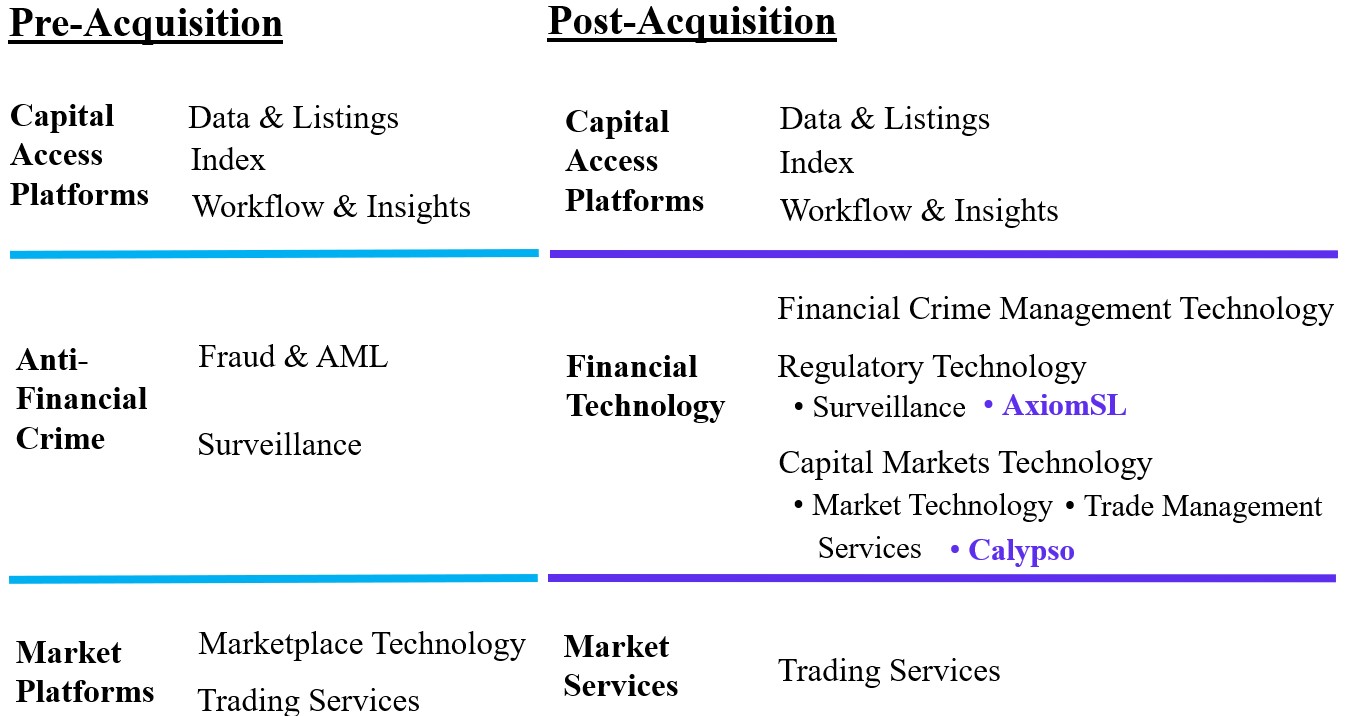
By aligning our business segments against these secular trends, we aim to deliver more for our clients and increase growth across our key pillars of liquidity, transparency and integrity:
-
Liquidity: Within our Financial Technology and Market Services segments, we continue to modernize markets by utilizing technology to maximize the liquidity of the global economy. New technologies, including cloud, blockchain, machine learning and artificial intelligence, present significant opportunities to further enhance market resiliency and scalability and make markets even more accessible. We believe that these technologies will enable more opportunities for market participants and new asset classes to be integrated across markets globally. The Financial Technology and Market Services segments together offer complementary capabilities to capture the potential these technologies can unlock in our industry. By utilizing our Market Services segment’s position at the center of markets, we believe that our Financial Technology segment will be at the forefront of the financial system’s evolution and will play a critical role in advancing the modernization of markets across geographies and asset classes.
-
Transparency: Our Capital Access Platforms segment is uniquely placed to help clients navigate the increasing complexity of the evolving financial system through access to capital and transparency which enables economic growth. With approximately 10,000 corporate clients and 5,000 clients across the investment management ecosystem, Nasdaq is a trusted partner to aid the corporate and investment communities in making more informed decisions. Leveraging the insights and capabilities across our listings, advisory, data, index, and analytics teams, we believe that Capital Access Platforms serves as a bridge between the investor and corporate communities, focused on enhancing the client experience by providing efficient routes to capital, delivering more holistic, actionable insights and intelligence, modernizing workflows, and navigating the climate and ESG landscape.
-
Integrity: Financial Crime Management Technology and Regulatory Technology include Nasdaq’s fraud detection, anti-money laundering, surveillance and risk data management and regulatory reporting solutions businesses. These businesses remain focused on capturing the growth associated with protecting the integrity of the financial system by fighting financial crime and helping our clients with their most significant compliance challenges. These businesses will continue delivering world-class solutions, leveraging the power of the cloud and machine learning across asset classes, to the full spectrum of banks and brokers, including the emerging ecosystem of financial technology, or FinTech, companies and digital banks.
Products and Services
Capital Access Platforms
Our Capital Access Platforms segment delivers liquidity, transparency and integrity to the corporate issuer and investment community by empowering our clients to effectively navigate the capital markets, achieve their sustainability goals, and drive governance excellence. We offer a suite of products to assist companies in managing corporate governance standards.
Our Capital Access Platforms segment includes Data & Listing Services, Index and Workflow & Insights.
Data & Listing Services
Our North American and European data products enhance transparency of market activity within our exchanges and provide critical information to professional and non-professional investors globally. Our Data business distributes historical and real-time market data to sell-side customers, the institutional investing community, retail online brokers, proprietary trading firms, and other venues, as well as internet portals and data distributors.
We collect, process, and create information and earn revenues as a distributor of our own, as well as select third-party, content. We provide varying levels of quote and trade information to market participants and to data distributors who in turn provide subscriptions for this information. Our systems enable distributors to gain access to our market depth, fund valuation, order imbalances, market sentiment and other analytical data.
We distribute this proprietary market information to both market participants and non-participants through a number of proprietary products, including Nasdaq TotalView, our flagship market depth quote product. We offer T
Showing the first 8K of 94K characters. Open the full section
Item 1A. Risk Factors
The risks and uncertainties described below are not the only ones facing us. Additional risks and uncertainties not presently known to us or that we currently believe to be immaterial may also adversely affect our business. If any of the following risks actually occur, our business, financial condition, or operating results could be adversely affected.
RISKS RELATED TO OUR BUSINESS AND INDUSTRY
Economic conditions and market factors, which are beyond our control, may adversely affect our business and financial condition.
Our business performance is impacted by a number of factors, including general economic conditions, current or expected inflation, interest rate fluctuations, market volatility, changes in investment patterns and priorities, pandemics and other factors that are generally beyond our control. To the extent that global or national economic conditions weaken and result in slower growth or recessions, our business may be negatively impacted. Adverse market conditions could reduce customer demand for our services and the ability of our customers, lenders and other counterparties to meet their obligations to us. Poor economic conditions may result in a reduction in the demand for our products and services, including our market technology, fraud detection, AML and surveillance solutions, data, indices and corporate solutions, or could result in a decline in the number of IPOs, reduced trading volumes or values and deterioration of the economic welfare of our listed companies, which could cause an increase in delistings.
Trading volumes and values are driven primarily by general market conditions and declines in trading volumes or values may affect our market share and impact our pricing. In addition, our Market Services businesses receive revenues from a relatively small number of customers concentrated in the financial industry, so any event that impacts one or more customers or the financial industry in general could impact our revenues.
The number of listings on our markets is primarily influenced by factors such as investor demand, the global economy, available sources of financing, and tax and regulatory policies. Adverse conditions may jeopardize the ability of our listed companies to comply with the continued listing requirements of our exchanges, or reduce the number of issuers launching IPOs, including SPACs, and direct listings. The number of IPOs on our exchanges decreased in both 2023 and 2022, and the number of delistings increased in 2023.
Our Capital Access Platforms revenues may be significantly affected by global economic conditions. Professional subscriptions to our data products are at risk if staff reductions occur in financial services companies or if our customers consolidate, which could result in significant reductions in our professional user revenue or expose us to increased risks relating to dependence on a smaller number of
customers. In addition, adverse market conditions may cause reductions in the number of non-professional investors with investments in the market and in ETP AUM tracking Nasdaq indices as well as trading in futures linked to Nasdaq indices.
There may be less demand for our analytics, corporate solutions, market technology and risk and regulatory products and services if global economic conditions remain weak. Our customers historically reduce purchases of new services and technology when growth rates decline, thereby diminishing our opportunities to sell new products and services or upgrade existing products and services.
Additionally, during a global economic downturn, or periods of economic, political or regulatory uncertainty, our sales cycle may become longer or more unpredictable due to customer budget constraints or unplanned administrative delays to approve purchases.
A reduction in trading volumes or values, market share of trading, the number of our listed companies, or demand for our products and services due to economic conditions or other market factors could adversely affect our business, financial condition and operating results.
The industries we operate in are highly competitive.
We face significant competition in our Capital Access Platforms, Financial Technology and Market Services segments from other market participants. We face intense competition from other exchanges and markets for market share of trading activity and listings. This competition includes both product and price competition.
The liberalization and globalization of world markets has resulted in greater mobility of capital, greater international participation in local markets and more competition. As a result, both in the U.S. and in other countries, the competition among exchanges and other execution venues has become more intense. Marketplaces in both Europe and the U.S. have also merged to achieve greater economies of scale and scope.
Regulatory changes also have facilitated the entry of new participants in the European Union that compete with our European markets. The regulatory environment, both in the U.S. and in Europe, is structured to maintain this environment of intense competition. In addition, a high proportion of business in the securities markets is becoming concentrated in a smaller number of institutions and our revenue may therefore become concentrated in a smaller number of customers.
We also compete globally with other regulated exchanges and markets, ATSs, MTFs and other traditional and non-traditional execution venues. Some of these competitors also are our customers. Competitors may develop market trading platforms that are more competitive than ours. Competitors may leverage data more effectively or enter into strategic partnerships, mergers or acquisitions that could make their trading, listings, clearing, data or technology businesses more competitive than ours.
We face intense price competition in all areas of our business. In particular, the trading industry is characterized by price competition. We have in the past lowered prices, and in the U.S., increased rebates for trade executions to attempt to gain or maintain market share. These strategies have not always been successful and have at times hurt operating performance. Additionally, we have also been, and may once again be, required to adjust pricing to respond to actions by competitors and new entrants, or due to new SEC regulations, which could adversely impact operating results. We also compete with respect to the pricing of data products and with respect to products for pre-trade book data and for post-trade last sale data.
If we are unable to compete successfully in the industries in which we do business, our business, financial condition and operating results will be adversely affected.
System limitations or failures could harm our business.
Our businesses depend on the integrity and performance of the technology, computer and communications systems supporting them. If new systems fail to operate as intended or our existing systems cannot expand to cope with increased demand or otherwise fail to perform, we could experience unanticipated disruptions in service, slower response times and delays in the introduction of new products and services. We could experience a systems failure due to human error by our employees, contractors or vendors, electrical or telecommunications failures or disruptions, hardware or software failures or defects, cyberattacks, sabotage or similar unexpected events. These consequences could result in service outages, lower trading volumes or values, financial losses, decreased customer satisfaction, litigation and regulatory sanctions. Our markets and the markets that rely on our technology have experienced systems failures and delays in the past and we could experience future systems failures and delays.
Although we currently maintain and expect to maintain multiple computer facilities, and leverage third party cloud providers, that are designed to provide
Showing the first 8K of 87K characters. Open the full section
Item 1B. Unresolved Staff Comments
None.
Item 1C. Cybersecurity
Risk management and strategy
Nasdaq’s brand and role as a critical infrastructure provider for global financial markets, and operator of the Nasdaq Stock Market, make us an attractive target for cybersecurity risks, including from international political opponents, hacktivists and ransomware or other financially motivated criminals targeting the financial sector. Our cybersecurity risks include financial and reputational damage, along with collateral damage from loss of customer confidence in our exchange, products or offerings, as applicable, potential regulatory enforcement actions or litigation, either from governmental authorities or shareholders, or the failure to comply with contractual breach notifications. To date, no risks from cybersecurity threats, including as a result of any previous cybersecurity incidents, have materially affected or are reasonably likely to materially affect our business, our business strategy, our results of operations or financial condition. For further information, see “Our role in the global marketplace positions us at greater risk for a cyberattack” and “Expanded cybersecurity regulations, and increased cybersecurity infrastructure and compliance costs, may adversely impact our results of operations” in “Item 1A, Risk Factors” of this Annual Report on Form 10-K.
Our risk management and mitigation approach includes the adoption of security controls and adaptive ongoing threat analysis. Our policies and our baseline security controls incorporate robust security infrastructure, risk-based controls and multi- layered defense systems. We have 16 System and Organization Controls Type 2, or SOC 2, certifications with respect to our information security and infrastructure. Our adaptive analysis monitors the threat landscape relevant to Nasdaq, our vendors and financial industry peers, and threats arising from geopolitical events. As the external threat landscape evolves, our information security controls are regularly evaluated, updated and enhanced to help protect against emerging risks. Additionally, we conduct extensive cybersecurity assessments of our acquired entities, both prior to acquisition and following completion of the transaction, to understand potential threats and mitigate any potential security gaps, as well as to ensure compliance with our security infrastructure and access management practices and policies.
We periodically engage external advisors to perform an analysis of our information security procedures, which include a review of program documentation and an overall maturity assessment of Nasdaq’s information security programs. These advisors provide recommendations to further enhance our procedures. The findings are then presented to the Audit & Risk Committee of the Board of Directors, or the Audit & Risk Committee. In 2023, our management team and the Board of Directors conducted tabletop exercises and simulations in cybersecurity matters with assistance from internal and outside experts.
We use certain cloud-based third-party vendors for the core trading systems of certain of our exchanges and certain of our governance products and solutions. Prior to engaging such vendors, we analyze each provider’s SOC2 certifications and perform due diligence and testing for information security and interoperability with our systems, and annually review the SOC2 certifications. Our security assurance and threat assessment team, within our Information Security organization, collaborates with our external threat intelligence providers to proactively review Nasdaq, and our vendors with respect to emerging threats and associated risks.
For our third-party service providers, our risk assessment process evaluates the probability and potential impact of incidents related to operational errors, technology disruptions, information security breaches, workforce issues, internal and external fraud, financial actions, and legal and regulatory matters. This assessment process is part of our Supplier Risk Management program, which establishes processes for identifying, assessing, and periodically reviewing our exposure to risk through third party vendors.
Governance
Cybersecurity is an integral part of risk management at Nasdaq. The Board of Directors appreciates the rapidly evolving nature of threats presented by cybersecurity incidents and is committed to the prevention, timely detection, and mitigation of the effect any such incidents may have on us. We use a cross-departmental approach to assess and manage cybersecurity risk, with our Information Security; Legal, Risk and Regulatory; and Internal Audit functions presenting on key topics to the Audit & Risk Committee, which provides oversight of our cybersecurity risk. Additionally, members from these organizations, along with Finance and Accounting, comprise a rapid response team that would mobilize in the event of a significant cybersecurity incident and would analyze and evaluate the incident while also advising the executive management team. Our Global Risk Management Committee, which includes our Chair and CEO and other senior executives, assists the Board of Directors in its cybersecurity risk oversight role.
Our Audit & Risk Committee receives quarterly or, if needed, more frequent reports on cybersecurity and information security matters from our Chief Information Security Officer, or CISO, and his team. The CISO has more than 25 years of experience in information technology and information security, particularly in the financial services industry, and our Information Security organization has more than 100 members, with expertise in application security; governance and compliance; program and vulnerability management; security engineering; security operations security assurance; and threat intelligence and security architecture.
This regular reporting to the Audit & Risk Committee also includes a cybersecurity dashboard that contains information on cybersecurity governance processes, and from time to time, also includes the status of projects to strengthen internal cybersecurity, ongoing prevention and mitigation efforts, security features of the products and services we provide our customers, or the results of security events during the period. The Audit & Risk Committee also reviews and discusses recent cyber incidents affecting the industry and the emerging threat landscape.
Cybersecurity is a shared responsibility, and our goal is for all employees to be vigilant in helping to protect our organization and themselves, at all times. We routinely perform simulations and tabletop exercises, and incorporate external resources and advisors as needed, to help strengthen our cybersecurity protection and information security procedures and safeguards. All employees are required to complete annual cybersecurity awareness training and have access to continuous cybersecurity educational opportunities throughout the year. Nasdaq also maintains a cybersecurity and information security risk insurance policy, and our Nasdaq Information Security Management System conforms to ISO 27001 requirements and is ISO 27001 certified.
On an annual basis, the Information Security team reviews and updates its governance documents, including the Information Security Charter, the Information Security Policy, and the Information Security Program Plan, and then presents the revised documents to the Audit & Risk Committee for review and/or approval. Additionally, the Information Security team maintains a formal cybersecurity strategic three-year plan, which outlines the strategic vision and associated goals for the cybersecurity of our global operations. The plan is regularly updated with new initiatives that align with technology innovations and changes in the threat landscape, and is reviewed and approved by the CISO and the Audit & Risk Committee. Throughout the three-year plan term, the CISO regularly provides management with progress reports.
Item 2. Properties
We conduct our business operations in leased facilities. We do not own any real property. Our U.S. headquarters are located in New York, New York, and our European headquarters are located in Stockholm, Sweden. We also lease space in multiple locations around the world, which are used for research and development, sales and support, and administrative activities, as well as for data centers and disaster preparedness facilities.
Generally, our properties are not allocated for use by a particular segment. Instead, most of our properties are used by two or more segments. We regularly monitor the facilities we occupy to ensure that they suit our needs in a hybrid work environment. We believe the facilities that we occupy are adequate for the purposes for which they are currently used and are well-maintained. See Note 16, “Leases,” to the consolidated financial statements for further discussion.
Item 3. Legal Proceedings
For a description of our legal proceedings, if any, see “Legal and Regulatory Matters” of Note 18, “Commitments, Contingencies and Guarantees,” to the consolidated financial statements, which is incorporated herein by reference.
Item 4. Mine Safety Disclosures
Not applicable.
PART II
Item 5. Market for Registrant’s Common Equity, Related Stockholder Matters and Purchases of Equity Securities
Market Information
Our common stock is listed on The Nasdaq Stock Market under the ticker symbol “NDAQ.” As of February 13, 2024, we had approximately 202 holders of record of our common stock.
Issuer Purchases of Equity Securities
Share Repurchase Program
See “Share Repurchase Program,” of Note 12, “Nasdaq Stockholders’ Equity,” to the consolidated financial statements for further discussion of our share repurchase program.
Purchases of Equity Securities by the Issuer and Affiliated Purchasers
The table below represents repurchases made by or on behalf of us or any “affiliated purchaser” of our common stock during the fiscal quarter ended December 31, 2023:
| Period | (a) Total Number of Shares Purchased | (b) Average Price Paid Per Share | (c) Total Number of Shares Purchased as Part of Publicly Announced Plans or Programs | (d) Maximum Dollar Value of Shares that May Yet Be Purchased Under the Plans or Programs (in millions) | ||||||||||||||||||||||
| October 2023 | ||||||||||||||||||||||||||
| Share repurchase program | — | $ | — | — | $ | 2,000 | ||||||||||||||||||||
| Employee transactions | 19,360 | $ | 48.85 | N/A | N/A | |||||||||||||||||||||
| November 2023 | ||||||||||||||||||||||||||
| Share repurchase program | 1,751,513 | $ | 52.36 | 1,751,513 | $ | 1,908 | ||||||||||||||||||||
| Employee transactions | — | $ | — | N/A | N/A | |||||||||||||||||||||
| December 2023 | ||||||||||||||||||||||||||
| Share repurchase program | 333,261 | $ | 54.44 | 333,261 | $ | 1,890 | ||||||||||||||||||||
| Employee transactions | 17,883 | $ | 56.22 | N/A | N/A | |||||||||||||||||||||
| Total Quarter Ended December 31, 2023 | ||||||||||||||||||||||||||
| Share repurchase program | 2,084,774 | $ | 52.69 | 2,084,774 | $ | 1,890 | ||||||||||||||||||||
| Employee transactions | 37,243 | $ | 52.39 | N/A | N/A |
In the preceding table:
-
N/A - Not applicable.
-
See “Share Repurchase Program,” of Note 12, “Nasdaq Stockholders’ Equity,” to the consolidated financial statements for further discussion of our share repurchase program.
-
Employee transactions represents shares surrendered to us to satisfy tax withholding obligations arising from the vesting of restricted stock and PSUs previously issued to employees.
PERFORMANCE GRAPH
The following performance graph and related information shall not be deemed “filed” for purposes of Section 18 of the Exchange Act or incorporated by reference into any of our other filings under the Securities Act or the Exchange Act, except as shall be expressly set forth by specific reference in such filing.
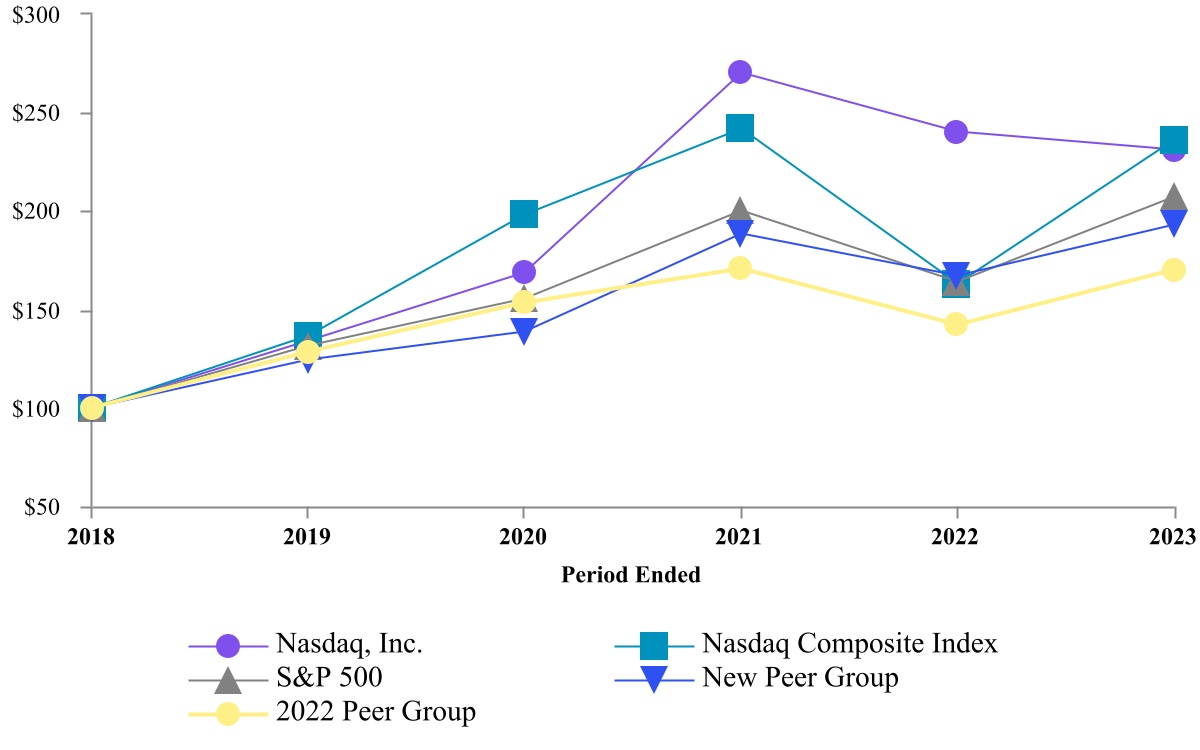
The following graph compares the total return of our common stock to the Nasdaq Composite Index, the S&P 500 and a peer group selected by us for the past five years. We changed our peer group in the table below to the S&P 500 GICS 4020 Index, or New Peer Group, which is a blend of exchanges, as well as data, financial technology and banking companies to align more closely with Nasdaq’s diverse business and competitors.
| Fiscal Year Ended December 31, | |||||||||||||||||||||||||||||||||||
| 2018 | 2019 | 2020 | 2021 | 2022 | 2023 | ||||||||||||||||||||||||||||||
| Nasdaq, Inc. | $ | 100 | $ | 134 | $ | 169 | $ | 270 | $ | 240 | $ | 231 | |||||||||||||||||||||||
| Nasdaq Composite Index | 100 | 137 | 198 | 242 | 163 | 236 | |||||||||||||||||||||||||||||
| S&P 500 | 100 | 131 | 156 | 200 | 164 | 207 | |||||||||||||||||||||||||||||
| New Peer Group | 100 | 125 | 139 | 188 | 167 | 193 | |||||||||||||||||||||||||||||
| 2022 Peer Group | 100 | 128 | 153 | 171 | 142 | 170 |
The figures represented below assume an initial investment of $100 in the common stock or index at the closing price on December 31, 2018 and the reinvestment of all dividends.
COMPARISON OF 5 YEAR CUMULATIVE TOTAL RETURN
Among Nasdaq, Inc., the Nasdaq Composite Index, the S&P 500 and Peer Groups
The prior peer group, collectively referred to as the 2022 Peer Group, was comprised of the following companies:
| 2022 Peer Group | |||||||||||||||||
| • | ASX Limited | • | Deutsche Börse AG | • | LSE | ||||||||||||
| • | B3 S.A. | • | Euronext N.V. | • | Singapore Exchange Limited | ||||||||||||
| • | Bolsas Mexicana de Valores, S.A.B. de C.V. | • | Hong Kong Exchanges and Clearing Limited | • | TMX Group Limited | ||||||||||||
| • | Cboe | • | ICE | ||||||||||||||
| • | CME Group Inc. | • | Japan Exchange Group, Inc. |
Item 6. [Reserved]
Item 7. Management’s Discussion and Analysis of Financial Condition and Results of Operations
The following discussion and analysis of the financial condition and results of operations of Nasdaq refers to the year-over-year comparison for the fiscal years ended December 31, 2023 and December 31, 2022 and should be read in conjunction with our consolidated financial statements and related notes included in this Form 10-K, as well as the discussion under “Item 1A. Risk Factors.” For further discussion of our growth strategy, products and services, and competitive strengths, see “Item 1. Business.”
Discussion of fiscal year 2022 items and the year-over year comparison of changes in our financial condition and results of operations as of and for the fiscal years ended December 31, 2022 and December 31, 2021 can be found in Part II, “Item 7. Management’s Discussion and Analysis of Financial Condition and Results of Operations” of our Annual Report on Form 10-K for the fiscal year ended December 31, 2022, which was previously filed with the SEC on February 23, 2023. For the Financial Technology segment, which was impacted by the new divisional structure subsequent to the Adenza acquisition, the comparisons presented in this discussion and analysis also include the year-over-year comparison of results of operations for the fiscal years ended December 31, 2022 and December 31, 2021.
Business Segments
Our organizational structure aligns our businesses with the foundational shifts that are driving the evolution of the global financial system. Following the acquisition of Adenza, we further refined the divisional structure into Capital Access Platforms, Financial Technology and Market Services reportable segments. All prior periods have been restated to conform to the current period presentation. See Note 1, “Organization and Nature of Operations,” and Note 19, “Business Segments,” to the consolidated financial statements for further discussion of our reportable segments and geographic data, as well as how management allocates resources, assesses performance and manages these businesses as three separate segments. See “Part I, Item 1. Business” for additional discussion on recent developments and highlights.
Nasdaq’s Operating Results
The following tables summarize our financial performance for the year ended December 31, 2023 compared to the same period in 2022 and for the year ended December 31, 2022 when compared to the same period in 2021. The comparability of our results of operations between reported periods is impacted by the acquisition of Adenza in November 2023. See “2023 Acquisition,” of Note 4, “Acquisitions,” to the consolidated financial statements for further discussion. For a detailed discussion of our results of operations, see “Segment Operating Results” below.
| Year Ended December 31, | Percentage Change | ||||||||||||||||||||||
| 2023 | 2022 | 2021 | 2023 vs. 2022 | 2022 vs. 2021 | |||||||||||||||||||
| (in millions, except per share amounts) | |||||||||||||||||||||||
| Revenues less transaction-based expenses | $ | 3,895 | $ | 3,582 | $ | 3,420 | 8.7 | % | 4.7 | % | |||||||||||||
| Operating expenses | 2,317 | 2,018 | 1,979 | 14.8 | % | 2.0 | % | ||||||||||||||||
| Operating income | 1,578 | 1,564 | 1,441 | 0.9 | % | 8.5 | % | ||||||||||||||||
| Net income attributable to Nasdaq | $ | 1,059 | $ | 1,125 | $ | 1,187 | (5.9) | % | (5.2) | % | |||||||||||||
| Diluted earnings per share | $ | 2.08 | $ | 2.26 | $ | 2.35 | (8.0) | % | (3.8) | % | |||||||||||||
| Cash dividends declared per common share | $ | 0.86 | $ | 0.78 | $ | 0.70 | 10.3 | % | 11.4 | % |
In countries with currencies other than the U.S. dollar, revenues and expenses are translated using monthly average exchange rates. Impacts on our revenues less transaction-based expenses and operating income associated with fluctuations in foreign currency are discussed in more detail under “Item 7A. Quantitative and Qualitative Disclosures about Market Risk.”
The following chart summarizes our ARR (in millions):
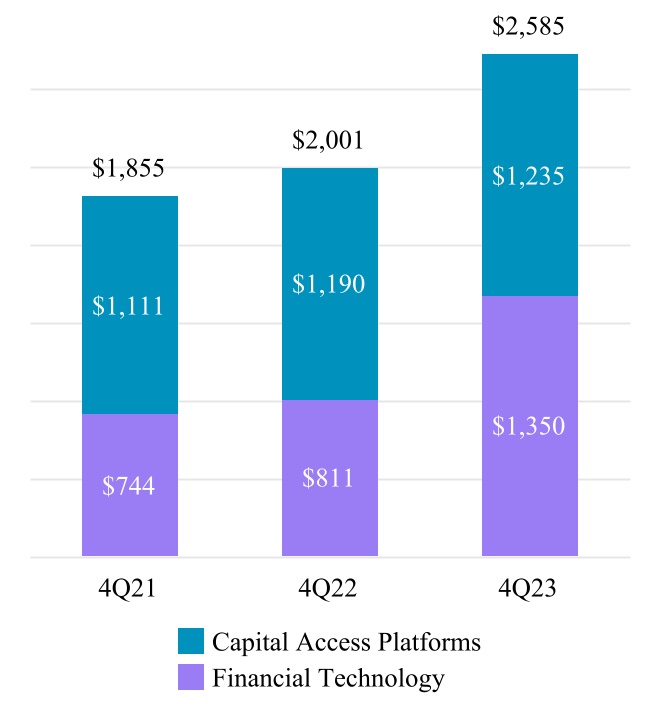
ARR for a given period is the current annualized value derived from subscription contracts with a defined contract value. This excludes contracts that are not recurring, are one-time in nature, or where the contract value fluctuates based on defined metrics. ARR is currently one of our key performance metrics to assess the health and trajectory of our recurring business. ARR does not have any standardized definition and is therefore unlikely to be comparable to similarly titled measures presented by other companies. ARR should be viewed independently of revenue and deferred revenue and is not intended to be combined with or to replace either of those items. For Adenza recurring revenue contracts, the amount included in ARR is consistent with the amount that we invoice the customer during the current period. Additionally, for Adenza recurring revenue contracts that include annual values that increase over time, we include in ARR only the annualized value of components of the contract that are considered active as of the date of the ARR calculation. We do not include the future committed increases in the contract value as of the date of the ARR calculation. ARR is not a forecast and the active contracts at the end of a reporting period used in calculating ARR may or may not be extended or renewed by our customers.
The ARR chart includes:
| ▪ | Proprietary market data subscriptions and annual listing fees within our Data & Listing Services business, index data subscriptions and guaranteed minimum on futures contracts within our Index business and subscription contracts under our Workflow & Insights business. | |||||||
| ▪ | SaaS subscription and support contracts related to Verafin, surveillance, market technology, AxiomSL, Calypso and trade management services, excluding one-time service requests. |
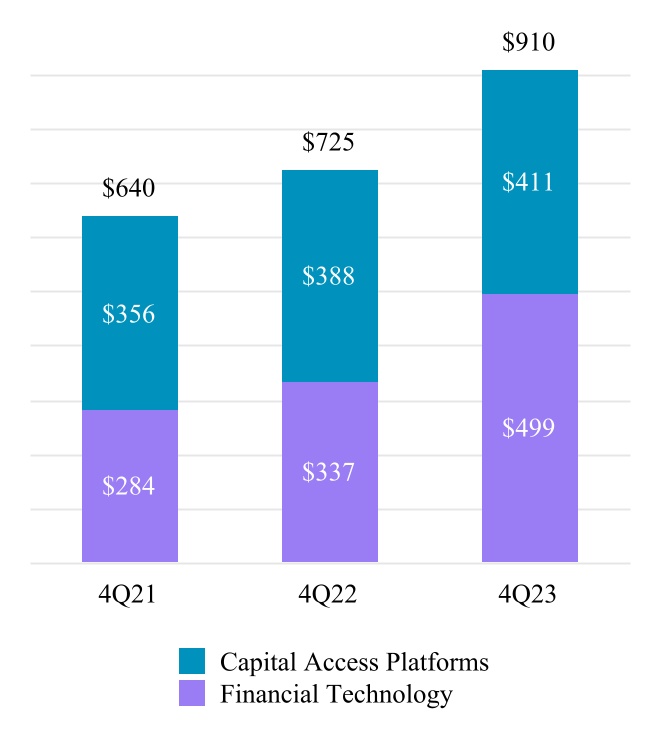
The following chart summarizes our quarterly annualized SaaS revenues for Solutions, which comprises our Capital Access Platforms and Financial Technology segments, for December 31, 2023, 2022 and 2021 (in millions):
Segment Operating Results
The following table presents our revenues by segment:
Showing the first 8K of 128K characters. Open the full section
Item 7A. Quantitative and Qualitative Disclosures About Market Risk
Information about quantitative and qualitative disclosures about market risk is incorporated herein by reference from “Item 7. Management’s Discussion and Analysis of Financial Condition and Results of Operations - Quantitative and Qualitative Disclosures About Market Risk.”
Item 8. Financial Statements and Supplementary Data
Nasdaq’s consolidated financial statements, including Consolidated Balance Sheets as of December 31, 2023 and 2022, Consolidated Statements of Income for the years ended December 31, 2023, 2022 and 2021, Consolidated Statements of Comprehensive Income for the years ended December 31, 2023, 2022 and 2021, Consolidated Statements of Changes in Stockholders’ Equity for the years ended December 31, 2023, 2022 and 2021, Consolidated Statements of Cash Flows for the years ended December 31, 2023, 2022 and 2021 and notes to our consolidated financial statements, together with a report thereon of Ernst & Young LLP, dated February 21, 2024, are attached hereto as pages F-1 through F-45 and incorporated by reference herein.
Item 9. Changes in and Disagreements with Accountants on Accounting and Financial Disclosure
None.
Item 9A. Controls and Procedures
Disclosure controls and procedures.
Nasdaq’s management, with the participation of Nasdaq’s Chief Executive Officer and Executive Vice President and Chief Financial Officer, has evaluated the effectiveness of Nasdaq’s disclosure controls and procedures (as defined in Rule 13a-15(e) and Rule 15d-15(e) under the Exchange Act) as of the end of the period covered by this report. In November 2023, Nasdaq completed the acquisition of Adenza. We accounted for this acquisition as a business combination. The scope of management’s assessment of the effectiveness of the Company’s disclosure controls and procedures did not include the internal controls over financial reporting of Adenza. This exclusion is in accordance with the SEC staff’s general guidance that an assessment of a recently acquired business may be omitted from the scope of management’s assessment for one year following the acquisition. The recognition of goodwill and intangible assets, however, is covered by our internal controls over mergers and acquisitions, which were included in management’s assessment of the effectiveness of the Company’s internal control over financial reporting as of December 31, 2023. Based upon that evaluation, Nasdaq’s Chief Executive Officer and Executive Vice President and Chief Financial Officer, have concluded that, as of the end of such period, Nasdaq’s disclosure controls and procedures are effective.
Changes in internal control over financial reporting. Based on the evaluation completed by management, in which our Chief Executive Officer and Chief Financial Officer participated, our management has concluded that, except as noted above with respect to the acquisition of Adenza, there were no changes in Nasdaq’s internal control over financial reporting (as defined in Rule 13a-15(f) and Rule 15d-15(f) under the Exchange Act) that occurred during the quarter ended December 31, 2023 that have materially affected, or are reasonably likely to materially affect, Nasdaq’s internal control over financial reporting.
Management’s Report on Internal Control Over Financial Reporting
Management is responsible for the preparation and integrity of the consolidated financial statements appearing in the reports that we file with the SEC. The consolidated financial statements were prepared in conformity with U.S. generally accepted accounting principles and include amounts based on management’s estimates and judgments.
Management is also responsible for establishing and maintaining adequate internal control over Nasdaq’s financial reporting. Although there are inherent limitations in the effectiveness of any system of internal control over financial reporting, or ICFR, we maintain a system of internal control that is designed to provide reasonable assurance as to the fair and reliable preparation and presentation of the consolidated financial statements, as well as to safeguard assets from unauthorized use or disposition that could have a material effect on the financial statements.
Our management assessed the effectiveness of our internal control over financial reporting as of December 31, 2023, based on criteria established in Internal Control—Integrated Framework issued by the Committee of Sponsoring Organizations of the Treadway Commission (COSO) (2013 framework). This evaluation included review of the documentation of controls, evaluation of the design effectiveness of controls, testing of the operating effectiveness of controls and a conclusion on this evaluation.
Our management has excluded the ICFR of Adenza, which we acquired on November 1, 2023 as discussed in Note 4 “Acquisitions,” to the Consolidated Financial Statements included elsewhere in this Annual Report on Form 10-K. Total revenues subject to Adenza’s ICFR represented 4% and 3% of revenues less transaction-based expenses and operating income, respectively, for the fiscal year ended December 31, 2023. Total assets subject to Adenza’s ICFR represented 36% of our consolidated total assets as of December 31, 2023 (of which $11 billion, or 34% of our consolidated total assets, represents intangible assets acquired and the goodwill resulting from the Adenza acquisition, which were subject to our ICFR as of December 31, 2023) and net assets of Adenza represented 3% of our consolidated net assets, excluding intangible assets acquired and the corresponding deferred tax liability as well as the goodwill resulting from the Adenza acquisition, which were subject to our ICFR as of December 31, 2023. Under guidelines established by the SEC, companies are permitted to exclude acquisitions from their assessment of ICFR for a period of up to one year following an acquisition while integrating the acquired company.
Based on its assessment, our management believes that, as of December 31, 2023, our internal control over financial reporting is effective. Ernst & Young LLP, an independent registered public accounting firm, has issued an attestation report on Nasdaq’s internal control over financial reporting, which is included herein.
Report of Independent Registered Public Accounting Firm
To the Shareholders and the Board of Directors of Nasdaq, Inc.
Opinion on Internal Control over Financial Reporting
We have audited Nasdaq, Inc.’s internal control over financial reporting as of December 31, 2023, based on criteria established in Internal Control—Integrated Framework issued by the Committee of Sponsoring Organizations of the Treadway Commission (2013 framework) (the COSO criteria). In our opinion, Nasdaq, Inc. (the Company) maintained, in all material respects, effective internal control over financial reporting as of December 31, 2023, based on the COSO criteria.
As indicated in the accompanying Management’s Report on Internal Control Over Financial Reporting, management’s assessment of and conclusion on the effectiveness of internal control over financial reporting did not include the internal controls of Adenza, which is included in the 2023 consolidated financial statements of the Company and constituted 2% and 3% of total and net assets, respectively, as of December 31, 2023 and 4% and 3% of revenues less transaction-based expenses and operating income, respectively, for the year then ended. Our audit of internal control over financial reporting of the Company also did not include an evaluation of the internal control over financial reporting of Adenza.
We also have audited, in accordance with the standards of the Public Company Accounting Oversight Board (United States) (PCAOB), the consolidated balance sheets of the Company as of December 31, 2023 and 2022, the related consolidated statements of income, comprehensive income, changes in stockholders’ equity and cash flows for each of the three years in the period ended December 31, 2023, and the related notes and our report dated February 21, 2024 expressed an unqualified opinion thereon.
Basis for Opinion
The Company’s management is responsible for maintaining effective internal control over financial reporting and for its assessment of the effectiveness of internal control over financial reporting included in the accompanying Management’s Report on Internal Control Over Financial Reporting. Our responsibility is to express an opinion on the Company’s internal control over financial reporting based on our audit. We are a public accounting firm registered with the PCAOB and are required to be independent with respect to the Company in accordance with the U.S. federal securities laws and the applicable rules and regulations of the Securities and Exchange Commission and the PCAOB.
We conducted our audit in accordance with the standards of the PCAOB. Those standards require that we plan and perform the audit to obtain reasonable assurance about whether effective internal control over financial reporting was maintained in all material respects.
Our audit included obtaining an understanding of internal control over financial reporting, assessing the risk that a material weakness exists, testing and evaluating the design and operating effectiveness of internal control based on the assessed risk, and performing such other procedures as we considered necessary in the circumstances. We believe that our audit provides a reasonable basis for our opinion.
Definition and Limitations of Internal Control Over Financial Reporting
A company’s internal control over financial reporting is a process designed to provide reasonable assurance regarding the reliability of financial reporting and the preparation of financial statements for external purposes in accordance with generally accepted accounting principles. A company’s internal control over financial reporting includes those policies and procedures that (1) pertain to the maintenance of records that, in reasonable detail, accurately and fairly reflect the transactions and dispositions of the assets of the company; (2) provide reasonable assurance that transactions are recorded as necessary to permit preparation of financial statements in accordance with generally accepted accounting principles, and that receipts and expenditures of the company are being made only in accordance with authorizations of management and directors of the company; and (3) provide reasonable assurance regarding prevention or timely detection of unauthorized acquisition, use, or disposition of the company’s assets that could have a material effect on the financial statements.
Because of its inherent limitations, internal control over financial reporting may not prevent or detect misstatements. Also, projections of any evaluation of effectiveness to future periods are subject to the risk that controls may become inadequate because of changes in conditions, or that the degree of compliance with the policies or procedures may deteriorate.
/s/ Ernst & Young LLP
New York, New York
February 21, 2024
Item 9B. Other Information
During the three months ended December 31, 2023, none of the Company’s directors or officers adopted, terminated or modified a “Rule 10b5-1 trading arrangement” or “non-Rule 10b5-1 trading arrangement” (as such terms are defined in Item 408 of Regulation S-K).
Item 9C. Disclosure Regarding Foreign Jurisdictions that Prevent Inspections
Not applicable.
PART III
Item 10. Directors, Executive Officers and Corporate Governance
Information about Nasdaq’s directors, as required by Item 401 of Regulation S-K, is incorporated by reference, if applicable, from the discussion under the caption “Director Nominees” in Nasdaq’s Proxy Statement. Information about Nasdaq’s executive officers, as required by Item 401 of Regulation S-K, is incorporated by reference from the discussion under the caption “Other Items-Executive Officers” in the Proxy Statement. Information about Section 16 reports, as required by Item 405 of Regulation S-K, is incorporated by reference from the discussion under the caption “Other Items-Delinquent Section 16(a) Reports” in the Proxy Statement. Information about Nasdaq’s code of ethics, as required by Item 406 of Regulation S-K, is incorporated by reference from the discussion under the caption “Operating with Integrity” in the Proxy Statement. Information about Nasdaq’s nomination procedures, Audit & Risk Committee and Audit & Risk Committee financial experts, as required by Items 407(c)(3), 407(d)(4) and 407(d)(5) of Regulation S-K, is incorporated by reference from the discussions under the headings “Director Nominees” and “Board Committees” in the Proxy Statement.
Item 11. Executive Compensation
Information about Nasdaq’s director and executive compensation, as required by Items 402, 407(e)(4) and 407(e)(5) of Regulation S-K, is incorporated by reference from the discussions under the headings “Director Compensation” and “Executive Compensation” in the Proxy Statement.
Item 12. Security Ownership of Certain Beneficial Owners and Management and Related Stockholder Matters
Information about security ownership of certain beneficial owners and management, as required by Item 403 of Regulation S-K, is incorporated by reference from the discussion under the heading “Other Items-Security Ownership of Certain Beneficial Owners and Management” in the Proxy Statement.
Equity Compensation Plan and ESPP Information
Nasdaq’s Equity Plan provides for the issuance of our equity securities to all employees and directors as part of their compensation plan.
In addition, in jurisdictions where participation in the ESPP is permitted, all our employees are eligible. The employees that joined us from Adenza are not yet eligible for participation in the ESPP, as payroll and benefits integration efforts remain ongoing following the consummation of the Adenza acquisition in November 2023. Employees may purchase shares of our common stock at a 15% discount to the lesser of the closing price of our common stock on (i) the first trading day of the offering period or (ii) the last trading day of the offering period. Offering periods under the ESPP are six months in duration. As of December 31, 2023, all our employees are eligible to participate.
The Equity Plan and the ESPP have been previously approved by our stockholders. The following table sets forth information regarding outstanding options and shares reserved for future issuance under all of Nasdaq’s compensation plans as of December 31, 2023.
| Plan Category | Number of shares to be issued upon exercise of outstanding options, warrants and rights(a) | Weighted-average exercise price of outstanding options, warrants and rights(b) | Number of shares remaining available for future issuance under equity compensation plans (excluding shares reflected in column(a))(c) | |||||||||||||||||
| Equity compensation plans approved by stockholders | 1,420,323 | $ | 41.79 | 36,014,602 | ||||||||||||||||
| Equity compensation plans not approved by stockholders | — | — | — | |||||||||||||||||
| Total | 1,420,323 | $ | 41.79 | 36,014,602 |
In the table above:
-
The number of shares to be issued upon exercise of outstanding options, warrants and rights include only the number of shares to be issued upon exercise of outstanding options, warrants and rights. As of December 31, 2023, we also had 6,217,621 shares to be issued upon vesting of outstanding restricted stock and PSUs.
-
The number of shares remaining available for future issuance under equity compensation plans (excluding shares reflected in column (a) includes 24,598,016 shares of common stock that may be awarded pursuant to the Equity Plan and (b) 11,416,586 shares of common stock that may be issued pursuant to the ESPP.
Item 13. Certain Relationships and Related Transactions, and Director Independence
Information about certain relationships and related transactions, as required by Item 404 of Regulation S-K, is incorporated herein by reference from the discussion under the heading “Other Items-Certain Relationships and Related Transactions” in the Proxy Statement. Information about director independence, as required by Item 407(a) of Regulation S-K, is incorporated herein by reference from the discussion under the heading “Director Nominees” in the Proxy Statement.
Item 14. Principal Accountant Fees and Services
Information about principal accountant fees and services, as required by Item 9(e) of Schedule 14A, is incorporated herein by reference from the discussion under the heading “Annual Evaluation and 2024 Selection of the Independent Auditors” in the Proxy Statement.
PART IV
Item 15. Exhibits and Financial Statement Schedules
(a)(1) Financial Statements
See “Index to Consolidated Financial Statements.”
(a)(2) Financial Statement Schedules
All schedules are omitted because they are not applicable or the required information is included in the consolidated financial statements or notes.
(a)(3) Exhibits
| Exhibit Number | ||||||||
| 2.1 | Share Purchase Agreement, dated as of November 18, 2020, by and among Osprey Acquisition Corporation, a wholly owned subsidiary of Nasdaq, Verafin Holdings Inc., certain shareholders of Verafin (the “Sellers”), and Shareholder Representative Services LLC, solely in its capacity as the representative of the Sellers (incorporated herein by reference to Exhibit 2.2 to the Annual Report on Form 10-K for the year ended December 31, 2020 filed on February 23, 2021).† | |||||||
| 2.2 | Amendment to Share Purchase Agreement, dated as of February 11, 2021, by and among Osprey Acquisition Corporation, a wholly owned subsidiary of Nasdaq, Verafin Holdings Inc., certain shareholders of Verafin (the “Sellers”), and Shareholder Representative Services LLC, solely in its capacity as the representative of the Sellers (incorporated herein by reference to Exhibit 2.3 to the Annual Report on Form 10-K for the year ended December 31, 2020 filed on February 23, 2021). | |||||||
| 2.3 | Agreement and Plan of Merger, dated as of June 10, 2023, by and among Nasdaq, Inc., Argus Merger Sub 1, Inc., Argus Merger Sub 2, LLC, Adenza Holdings, Inc. and Adenza Parent, LP. (incorporated herein by reference to Exhibit 2.1 to the Current Report on Form 8-K filed on June 12, 2023).† | |||||||
| 3.1 | Amended and Restated Certificate of Incorporation of Nasdaq (incorporated herein by reference to Exhibit 3.1 to the Current Report on Form 8-K filed on January 28, 2014). | |||||||
| 3.1.1 | Certificate of Elimination of Nasdaq’s Series A Convertible Preferred Stock (incorporated herein by reference to Exhibit 3.1.1 to the Current Report on Form 8-K filed on January 28, 2014). | |||||||
| 3.1.2 | Certificate of Amendment of Nasdaq’s Amended and Restated Certificate of Incorporation (incorporated herein by reference to Exhibit 3.1 to the Current Report on Form 8-K filed on November 19, 2014). | |||||||
| 3.1.3 | Certificate of Amendment of Nasdaq’s Amended and Restated Certificate of Incorporation (incorporated herein by reference to Exhibit 3.1 to the Current Report on Form 8-K filed on September 8, 2015). | |||||||
| 3.1.4 | Certificate of Amendment of Nasdaq’s Amended and Restated Certificate of Incorporation (incorporated herein by reference to Exhibit 3.1 to the Current Report on Form 8-K filed on July 20, 2022). | |||||||
| 3.2 | Nasdaq’s By-Laws (incorporated herein by reference to Exhibit 3.2 to the Current Report on Form 8-K filed on November 21, 2016). | |||||||
| 4.1 | Form of Common Stock certificate (incorporated herein by reference to Exhibit 4.1 to the Quarterly Report on Form 10-Q for the quarter ended September 30, 2015 filed on November 4, 2015). | |||||||
| 4.2 | Stockholders’ Agreement, dated as of February 27, 2008, between Nasdaq, Inc. (f/k/a The NASDAQ OMX Group, Inc.) and Borse Dubai Limited (incorporated herein by reference to Exhibit 10.2 to the Current Report on Form 8-K filed on March 3, 2008). | |||||||
| 4.2.1 | First Amendment to Stockholders’ Agreement, dated as of February 19, 2009, between Nasdaq, Inc. (f/k/a The NASDAQ OMX Group, Inc.) and Borse Dubai Limited (incorporated herein by reference to Exhibit 4.10.1 to the Annual Report on Form 10-K for the year ended December 31, 2008 filed on February 27, 2009). | |||||||
| 4.3 | Registration Rights Agreement, dated as of February 27, 2008, among Nasdaq, Inc. (f/k/a The NASDAQ OMX Group, Inc.), Borse Dubai Limited and Borse Dubai Nasdaq Share Trust (incorporated herein by reference to Exhibit 10.3 to the Current Report on Form 8-K filed on March 3, 2008). | |||||||
| 4.3.1 | First Amendment to Registration Rights Agreement, dated as of February 19, 2009, among Nasdaq, Inc. (f/k/a The NASDAQ OMX Group, Inc.), Borse Dubai Limited and Borse Dubai Nasdaq Share Trust (incorporated herein by reference to Exhibit 4.11.1 to the Annual Report on Form 10-K for the year ended December 31, 2008 filed on February 27, 2009). | |||||||
| 4.4 | Stockholders’ Agreement, dated as of December 16, 2010, between Nasdaq, Inc. (f/k/a The NASDAQ OMX Group, Inc.) and Investor AB (incorporated herein by reference to Exhibit 4.12 to the Annual Report on Form 10-K for the year ended December 31, 2010 filed on February 24, 2011). | |||||||
| 4.4.1 | First Amendment to Nasdaq Stockholders’ Agreement, dated as of December 14, 2022, between Nasdaq, Inc. and Investor AB (incorporated herein by reference to Exhibit 4.1 to the Current Report on Form 8-K filed on December 16, 2022). | |||||||
| 4.5 | Stockholders’ Agreement, dated as of November 1, 2023, by and among Nasdaq, Inc., Adenza Parent, LP and Thoma Bravo, L.P. (incorporated herein by reference to Exhibit 4.1 to the Current Report on Form 8-K filed on November 3, 2023). | |||||||
| 4.6 | Registration Rights Agreement, dated as of November 1, 2023, by and among Nasdaq, Inc. and Adenza Parent, LP. (incorporated herein by reference to Exhibit 4.2 to the Current Report on Form 8-K filed on November 3, 2023). | |||||||
| 4.7 | Indenture, dated as of June 7, 2013, between Nasdaq, Inc. (f/k/a The NASDAQ OMX Group, Inc.) and Wells Fargo Bank, National Association, as Trustee (incorporated herein by reference to Exhibit 4.1 to the Current Report on Form 8-K filed on June 10, 2013). | |||||||
| 4.8 | Sixth Supplemental Indenture, dated as of April 1, 2019, among Nasdaq, Inc., Wells Fargo Bank, National Association, as Trustee, and HSBC Bank USA, National Association, as paying agent and as registrar and transfer agent (incorporated by reference to Exhibit 4.2 to the Form 8-A filed on April 1, 2019). | |||||||
| 4.9 | Seventh Supplemental Indenture, dated February 13, 2020, among Nasdaq, Inc., Wells Fargo Bank, National Association, as Trustee, and HSBC Bank USA, National Association, as paying agent and as registrar and transfer agent (incorporated herein by reference to Exhibit 4.2 to the Company’s Form 8-A filed on February 13, 2020). | |||||||
| 4.10 | Eighth Supplemental Indenture, dated April 28, 2020, by and between Nasdaq, Inc. and Wells Fargo Bank, National Association, as Trustee (incorporated herein by reference to Exhibit 4.2 to the Current Report on Form 8-K filed on April 28, 2020). | |||||||
| 4.11 | Tenth Supplemental Indenture, dated December 21, 2020, by and between Nasdaq, Inc. and Wells Fargo Bank, National Association, as Trustee (incorporated herein by reference to Exhibit 4.3 to the Current Report on Form 8-K filed on December 21, 2020). | |||||||
| 4.12 | Eleventh Supplemental Indenture, dated December 21, 2020, by and between Nasdaq, Inc. and Wells Fargo Bank, National Association, as Trustee (incorporated herein by reference to Exhibit 4.4 to the Current Report on Form 8-K filed on December 21, 2020). | |||||||
| 4.13 | Twelfth Supplemental Indenture, dated July 30, 2021, by and among Nasdaq, Inc., Wells Fargo Bank, National Association, as Trustee and HSBC Bank USA, National Association, as registrar and transfer agent (incorporated herein by reference to Exhibit 4.2 to the Company’s 8-A filed on July 30, 2021). | |||||||
| 4.14 | Thirteenth Supplemental Indenture, dated as of March 7, 2022, by and between Nasdaq, Inc. and Computershare Trust Company, N.A. (as successor to Wells Fargo Bank, National Association), as trustee (incorporated herein by reference to Exhibit 4.2 to the Company’s Current Report on Form 8-K filed on March 7, 2022). | |||||||
| 4.15 | Fourteenth Supplemental Indenture, dated as of June 28, 2023, by and between Nasdaq, Inc. and Computershare Trust Company, N.A. (as successor to Wells Fargo Bank, National Association), as trustee (incorporated herein by reference to Exhibit 4.2 to the Current Report on Form 8-K filed on June 28, 2023). | |||||||
| 4.16 | Fifteenth Supplemental Indenture, dated as of June 28, 2023, by and between Nasdaq, Inc. and Computershare Trust Company, N.A. (as successor to Wells Fargo Bank, National Association), as trustee (incorporated herein by reference to Exhibit 4.3 to the Current Report on Form 8-K filed on June 28, 2023). | |||||||
| 4.17 | Sixteenth Supplemental Indenture, dated as of June 28, 2023, by and between Nasdaq, Inc. and Computershare Trust Company, N.A. (as successor to Wells Fargo Bank, National Association), as trustee (incorporated herein by reference to Exhibit 4.4 to the Current Report on Form 8-K filed on June 28, 2023). | |||||||
| 4.18 | Seventeenth Supplemental Indenture, dated as of June 28, 2023, by and between Nasdaq, Inc. and Computershare Trust Company, N.A. (as successor to Wells Fargo Bank, National Association), as trustee (incorporated herein by reference to Exhibit 4.5 to the Current Report on Form 8-K filed on June 28, 2023). | |||||||
| 4.19 | Eighteenth Supplemental Indenture, dated as of June 28, 2023, by and between Nasdaq, Inc. and Computershare Trust Company, N.A. (as successor to Wells Fargo Bank, National Association), as trustee (incorporated herein by reference to Exhibit 4.6 to the Current Report on Form 8-K filed on June 28, 2023). | |||||||
| 4.20 | Nineteenth Supplemental Indenture, dated as of June 28, 2023, by and between Nasdaq, Inc. and Computershare Trust Company, N.A. (as successor to Wells Fargo Bank, National Association), as trustee and HSBC Bank USA, National Association, as paying agent, registrar and transfer agent (incorporated herein by reference to Exhibit 4.7 to the Current Report on Form 8-K filed on June 28, 2023). | |||||||
| 4.21 | Description of Securities. | |||||||
| 10.1 | Amended and Restated Board Compensation Policy, effective on June 16, 2023 (incorporated herein by reference to Exhibit 10.1 to the Quarterly Report on Form 10-Q for the quarter ended June 30, 2023 filed on August 2, 2023).* | |||||||
| 10.2 | Nasdaq Executive Corporate Incentive Plan, effective as of January 1, 2015 (incorporated herein by reference to Exhibit 10.1 to the Current Report on Form 8-K filed on May 11, 2015).* | |||||||
| 10.3 | Nasdaq, Inc. Equity Incentive Plan (as amended and restated as of April 24, 2018) (incorporated herein by reference to Exhibit 10.1 to the Form S-8 filed on May 25, 2018).* | |||||||
| 10.4 | Form of Nasdaq Non-Qualified Stock Option Award Certificate (incorporated herein by reference to Exhibit 10.3 to the Annual Report on Form 10-K for the year ended December 31, 2010 filed on February 24, 2011).* | |||||||
| 10.5 | Form of Nasdaq Restricted Stock Unit Award Certificate (employees) (incorporated herein by reference to Exhibit 10.2 to the Quarterly Report on Form 10-Q for the quarter ended June 30, 2023 filed on August 2, 2023).* | |||||||
| 10.6 | Form of Nasdaq Restricted Stock Unit Award Certificate (directors) (incorporated herein by reference to Exhibit 10.3 to the Quarterly Report on Form 10-Q for the quarter ended June 30, 2023 filed on August 2, 2023).* | |||||||
| 10.7 | Form of Nasdaq Three-Year Performance Share Unit Agreement (incorporated herein by reference to Exhibit 10.4 to the Quarterly Report on Form 10-Q for the quarter ended June 30, 2023 filed on August 2, 2023).* | |||||||
| 10.8 | Form of Nasdaq Continuing Obligations Agreement (incorporated by reference to Exhibit 10.9 to the Company’s Annual Report on Form 10-K for the year ended December 31, 2021 filed on February 23, 2022). | |||||||
| 10.9 | Amended and Restated Supplemental Executive Retirement Plan, dated as of December 17, 2008 (incorporated herein by reference to Exhibit 10.6 to the Annual Report on Form 10-K for the year ended December 31, 2008 filed on February 27, 2009).* | |||||||
| 10.10 | Amendment No. 1 to Amended and Restated Supplemental Executive Retirement Plan, effective as of December 31, 2008 (incorporated herein by reference to Exhibit 10.6.1 to the Annual Report on Form 10-K for the year ended December 31, 2008 filed on February 27, 2009).* | |||||||
| 10.11 | Nasdaq Supplemental Employer Retirement Contribution Plan, dated as of December 17, 2008 (incorporated herein by reference to Exhibit 10.7 to the Annual Report on Form 10-K for the year ended December 31, 2008 filed on February 27, 2009).* | |||||||
| 10.12 | Nasdaq, Inc. Deferred Compensation Plan (incorporated by reference to Exhibit 10.1 to the Company’s Current Report on Form 8-K filed on June 16, 2022).* | |||||||
| 10.13 | Nonqualified Stock Option Award Certificate to Adena T. Friedman from Nasdaq, Inc. in connection with grant made on January 3, 2017 (incorporated herein by reference to Exhibit 10.1 to the Quarterly Report on Form 10-Q for the quarter ended September 30, 2017 filed on November 7, 2017).* | |||||||
| 10.14 | Employment Agreement between Nasdaq and Adena Friedman, made and entered into on November 19, 2021 and effective as of January 1, 2022 (incorporated herein by reference to Exhibit 10.14 to the Company’s Annual Report on Form 10-K for the year ended December 31, 2021 filed on February 23, 2022).* | |||||||
| 10.15 | Nonqualified Stock Option Award Certificate to Adena T. Friedman from Nasdaq, Inc. in connection with grant made on January 3, 2022 (incorporated herein by reference to Exhibit 10.15 to the Company’s Annual Report on Form 10-K for the year ended December 31, 2021 filed on February 23, 2022).* | |||||||
| 10.17 | Employment Agreement by and between Nasdaq, Inc. and Bradley J. Peterson, dated June 22, 2022 (incorporated herein by reference to Exhibit 10.5 to the Quarterly Report on Form 10-Q for the quarter ended June 30, 2022 filed on August 3, 2022).* | |||||||
| 10.18 | Employment Offer Letter by and between Nasdaq, Inc. and Michelle Daly (incorporated by reference to Exhibit 10.1 to the Current Report on Form 8-K filed on May 3, 2021).* | |||||||
| 10.19 | General Release and Separation Agreement by and between Nasdaq, Inc. and Ann M. Dennison, dated as of August 31, 2023 (incorporated herein by reference to Exhibit 10.1 to the Quarterly Report on Form 10-Q for the quarter ended September 30, 2023 filed on November 3, 2023).* | |||||||
| 10.20 | Employment Offer Letter by and between Nasdaq, Inc. and Sarah Youngwood, dated as of August 31, 2023 (incorporated herein by reference to Exhibit 10.2 to the Quarterly Report on Form 10-Q for the quarter ended September 30, 2023 filed on November 3, 2023).* | |||||||
| 10.21 | Nasdaq Change in Control Severance Plan for Executive Vice Presidents and Senior Vice Presidents, effective November 26, 2013, as amended December 6, 2022 (incorporated by reference herein to Exhibit 10.19 to the Annual Report on Form 10-K for the year ended December 31, 2022, filed on February 22, 2023.* | |||||||
| 10.22 | Amended and Restated Credit Agreement, dated as of December 16, 2022, among Nasdaq, Inc., the various lenders and issuing bank party thereto and Bank of America, N.A., as administrative agent (incorporated herein by reference to Exhibit 10.1 to the Current Report on Form 8-K filed on December 16, 2022). † | |||||||
| 10.23 | Amendment No. 1 to Amended and Restated Credit Agreement, dated as of March 29, 2023, among Nasdaq, Inc., the Lenders party hereto, Bank of America, N.A., as administrative agent and BofA Securities, Inc., as Sustainability Coordinator (incorporated herein by reference to Exhibit 10.1 to the Quarterly Report on Form 10-Q for the quarter ended March 30, 2023 filed on May 4, 2023).† | |||||||
| 10.24 | Amendment No. 2 to Amended and Restated Credit Agreement, dated as of June 16, 2023, among Nasdaq, Inc., a Delaware corporation, the lenders party thereto and Bank of America, N.A., as administrative agent (incorporated herein by reference to Exhibit 10.1 to the Current Report on Form 8-K filed on June 20, 2023). | |||||||
| 10.25 | Term Loan Credit Agreement, dated as of June 28, 2023, among Nasdaq, Inc., the lenders and other parties party thereto, and Bank of America, N.A., as Administrative Agent (incorporated herein by reference to Exhibit 10.1 to the Current Report on Form 8-K filed on June 28, 2023).† | |||||||
| 10.26 | Form of Commercial Paper Dealer Agreement between Nasdaq, Inc., as Issuer, and the Dealer party thereto (incorporated herein by reference to Exhibit 10.3 to the Current Report on Form 8-K filed on April 26, 2017). | |||||||
| 10.27 | Verafin Holdings Inc. Amended and Restated Management Incentive Plan (incorporated by reference herein to Exhibit 10.24 to the Annual Report on Form 10-K for the year ended December 31, 2022, filed on February 22, 2023.)* | |||||||
| 10.28 | Verafin Holdings Inc. Amended and Restated Management Incentive Plan Award Agreement, by and between Verafin Solutions ULC and Brendan Brothers, dated as of January 11, 2023 (incorporated by reference herein to Exhibit 10.25 to the Annual Report on Form 10-K for the year ended December 31, 2022, filed on February 22, 2023.)* | |||||||
| 11 | Statement regarding computation of per share earnings (incorporated herein by reference from Note 13 to the consolidated financial statements under Part II, Item 8 of this Form 10-K). | |||||||
| 21.1 | List of all subsidiaries. | |||||||
| 23.1 | Consent of Ernst & Young LLP. | |||||||
| 24.1 | Powers of Attorney. | |||||||
| 31.1 | Certification of Chief Executive Officer pursuant to Section 302 of the Sarbanes-Oxley Act of 2002 (“Sarbanes-Oxley”). | |||||||
| 31.2 | Certification of Executive Vice President and Chief Financial Officer pursuant to Section 302 of Sarbanes-Oxley. | |||||||
| 32.1 | Certifications Pursuant to 18 U.S.C. Section 1350, as adopted pursuant to Section 906 of Sarbanes-Oxley. | |||||||
| 97.1 | Supplemental Executive Officer Recoupment Policy.* | |||||||
| 101 | The following materials from the Nasdaq, Inc. Annual Report on Form 10-K for the year ended December 31, 2023, formatted in iXBRL (Inline eXtensible Business Reporting Language): (i) Consolidated Balance Sheets as of December 31, 2023 and December 31, 2022; (ii) Consolidated Statements of Income for the years ended December 31, 2023, 2022 and 2021 (iii) Consolidated Statements of Comprehensive Income for the years ended December 31, 2023, 2022 and 2021; (iv) Consolidated Statements of Changes in Stockholders’ Equity for the years ended December 31, 2023, 2022 and 2021; (v) Consolidated Statements of Cash Flows for the years ended December 31, 2023, 2022 and 2021; and (vi) notes to consolidated financial statements. | |||||||
| 104 | Cover Page Interactive Data File, formatted in iXBRL and contained in Exhibit 101. |
- Management contract or compensatory plan or arrangement.
† Schedules have been omitted pursuant to Item 601(b)(2) of Regulation S-K.
(b) Exhibits:
See Item 15(a)(3) above.
(c) Financial Statement Schedules:
All schedules are omitted because they are not applicable or the required information is included in the consolidated financial statements or notes.
Item 16. Form 10-K Summary
None.
SIGNATURES
Pursuant to the requirements of Section 13 or 15(d) of the Securities Exchange Act of 1934, the registrant has duly caused this report to be signed on its behalf by the undersigned, thereunto duly authorized, on February 21, 2024.
| Nasdaq, Inc. | ||||||||
| (Registrant) | ||||||||
| By: | /s/ Adena T. Friedman | |||||||
| Name: | Adena T. Friedman | |||||||
| Title: | Chief Executive Officer | |||||||
| Date: | February 21, 2024 | |||||||
Pursuant to the requirements of the Securities Exchange Act of 1934, this report has been signed below by the following persons on behalf of the registrant and in the capacities indicated as of February 21, 2024.
| By: | /s/ Adena T. Friedman | |||||||
| Name: | Adena T. Friedman | |||||||
| Title: | Chief Executive Officer and Chair of the Board | |||||||
| By: | /s/ Sarah Youngwood | |||||||
| Name: | Sarah Youngwood | |||||||
| Title: | Executive Vice President and Chief Financial Officer | |||||||
| By: | /s/ Michelle Daly | |||||||
| Name: | Michelle Daly | |||||||
| Title: | Senior Vice President, Controller and Principal Accounting Officer | |||||||
| By: | * | |||||||
| Name: | Michael R. Splinter | |||||||
| Title: | Director | |||||||
| By: | * | |||||||
| Name: | Melissa M. Arnoldi | |||||||
| Title: | Director | |||||||
| By: | * | |||||||
| Name: | Charlene T. Begley | |||||||
| Title: | Director | |||||||
| By: | * | |||||||
| Name: | Steven D. Black | |||||||
| Title: | Director | |||||||
| By: | * | |||||||
| Name: | Essa Kazim | |||||||
| Title: | Director | |||||||
| By: | * | |||||||
| Name: | Thomas A. Kloet | |||||||
| Title: | Director | |||||||
| By: | * | |||||||
| Name: | Holden Spaht | |||||||
| Title: | Director | |||||||
| By: | * | |||||||
| Name: | Johan Torgeby | |||||||
| Title: | Director | |||||||
| By: | * | |||||||
| Name: | Toni Townes-Whitley | |||||||
| Title: | Director | |||||||
| By: | * | |||||||
| Name: | Jeffery W. Yabuki | |||||||
| Title: | Director | |||||||
| By: | * | |||||||
| Name: | Alfred W. Zollar | |||||||
| Title: | Director | |||||||
| * Pursuant to Power of Attorney | ||||||||
| By: | /s/ John A. Zecca | |||||||
| Name: | John A. Zecca | |||||||
| Title: | Attorney-in-Fact |
Nasdaq, Inc.
INDEX TO CONSOLIDATED FINANCIAL STATEMENTS
The following consolidated financial statements of Nasdaq, Inc. and its subsidiaries are presented herein on the page indicated:
F-1
Report of Independent Registered Public Accounting Firm
To the Shareholders and the Board of Directors of Nasdaq, Inc.
Opinion on the Financial Statements
We have audited the accompanying consolidated balance sheets of Nasdaq, Inc. (the Company) as of December 31, 2023 and 2022, the related consolidated statements of income, comprehensive income, changes in stockholders’ equity and cash flows for each of the three years in the period ended December 31, 2023, and the related notes (collectively referred to as the “consolidated financial statements”). In our opinion, the consolidated financial statements present fairly, in all material respects, the financial position of the Company at December 31, 2023 and 2022, and the results of its operations and its cash flows for each of the three years in the period ended December 31, 2023, in conformity with U.S. generally accepted accounting principles.
We also have audited, in accordance with the standards of the Public Company Accounting Oversight Board (United States) (PCAOB), the Company’s internal control over financial reporting as of December 31, 2023, based on criteria established in Internal Control-Integrated Framework issued by the Committee of Sponsoring Organizations of the Treadway Com
Showing the first 8K of 262K characters. Open the full section