 filings.tools
NetApp 10-K 2021-04-30
Filed 2021-06-21. 21 sections, 417K characters. Original on sec.gov · Markdown · JSON
Cover and table of contents
UNITED STATES
SECURITIES AND EXCHANGE COMMISSION
Washington, D.C. 20549
Form 10-K
(Mark One)
| ☑ | ANNUAL REPORT PURSUANT TO SECTION 13 OR 15(d) OF THE SECURITIES EXCHANGE ACT OF 1934 |
|---|
| For the fiscal year ended April 30, 2021 |
|---|
or
| ☐ | TRANSITION REPORT PURSUANT TO SECTION 13 OR 15(d) OF THE SECURITIES EXCHANGE ACT OF 1934 |
|---|
| For the transition period from to |
|---|
Commission File Number 000-27130

NetApp, Inc.
(Exact name of registrant as specified in its charter)
| Delaware | 77-0307520 | |
|---|---|---|
| (State or other jurisdiction of | (I.R.S. Employer | |
| incorporation or organization) | Identification No.) |
3060 Olsen Drive,
San Jose, California 95128
(Address of principal executive offices, including zip code)
(408) 822-6000
(Registrant’s telephone number, including area code)
Securities registered pursuant to Section 12(b) of the Act:
| Title of each class | Trading Symbol(s) | Name of exchange on which registered | |
|---|---|---|---|
| Common Stock, $0.001 Par Value | NTAP | The NASDAQ Stock Market LLC |
Securities registered pursuant to Section 12(g) of the Act:
None
Indicate by check mark if the registrant is a well-known seasoned issuer, as defined in Rule 405 of the Securities Act. Yes ☑ No ☐
Indicate by check mark if the registrant is not required to file reports pursuant to Section 13 or Section 15(d) of the Act. Yes ☐ No ☑
Indicate by check mark whether the registrant (1) has filed all reports required to be filed by Section 13 or 15(d) of the Securities Exchange Act of 1934 during the preceding 12 months (or for such shorter period that the registrant was required to file such reports), and (2) has been subject to such filing requirements for the past 90 days. Yes ☑ No ☐
Indicate by check mark whether the registrant has submitted electronically every Interactive Data File required to be submitted pursuant to Rule 405 of Regulation S-T (§232.405 of this chapter) during the preceding 12 months (or for such shorter period that the registrant was required to submit such files). Yes ☑ No ☐
Indicate by check mark whether the registrant is a large accelerated filer, an accelerated filer, a non-accelerated filer, a smaller reporting company, or an emerging growth company. See the definitions of “large accelerated filer,” “accelerated filer,” “smaller reporting company,” and “emerging growth company” in Rule 12b-2 of the Exchange Act.
| Large accelerated filer | ☑ | Accelerated filer | ☐ | |||
|---|---|---|---|---|---|---|
| Non-accelerated filer | ☐ | Smaller reporting company | ☐ | |||
| Emerging growth company | ☐ |
If an emerging growth company, indicate by check mark if the registrant has elected not to use the extended transition period for complying with any new or revised financial accounting standards provided pursuant to Section 13(a) of the Exchange Act. ☐
Indicate by check mark whether the registrant has filed a report on and attestation to its management’s assessment of the effectiveness of its internal control over financial reporting under Section 404(b) of the Sarbanes-Oxley Act (15 U.S.C. 7262(b)) by the registered public accounting firm that prepared or issued its audit report. ☑
Indicate by check mark whether the registrant is a shell company (as defined in Rule 12b-2 of the Exchange Act). Yes ☐ No ☑
The aggregate market value of voting stock held by non-affiliates of the registrant, as of October 30, 2020, the last business day of the registrant’s most recently completed second fiscal quarter, was $5,651,372,914 (based on the closing price for shares of the registrant’s common stock as reported by the NASDAQ Global Select Market on that date). Shares of common stock held by each executive officer, director, and holder of 5% or more of the outstanding common stock have been excluded in that such persons may be deemed to be affiliates. This determination of possible affiliate status is not a conclusive determination for other purposes.
On June 2, 2021, 223,217,394 shares of the registrant’s common stock, $0.001 par value, were outstanding.
DOCUMENTS INCORPORATED BY REFERENCE
The information called for by Part III of this Form 10-K is hereby incorporated by reference from the definitive Proxy Statement for our annual meeting of stockholders, which will be filed with the Securities and Exchange Commission not later than 120 days after April 30, 2021.
TABLE OF CONTENTS
Cautionary Note on Forward-Looking Statements
This Annual Report on Form 10-K contains forward-looking statements within the meaning of Section 27A of the Securities Act of 1933, as amended, and Section 21E of the Securities Exchange Act of 1934, as amended (the Exchange Act). Forward-looking statements are all statements (and their underlying assumptions) included in this document that refer, directly or indirectly, to future events or outcomes and, as such, are inherently not factual, but rather reflect only our current projections for the future. Consequently, forward-looking statements usually include words such as “estimate,” “intend,” “plan,” “predict,” “seek,” “may,” “will,” “should,” “would,” “could,” “anticipate,” “expect,” “believe,” or similar words, in each case, intended to refer to future events or circumstances. A non-comprehensive list of the topics including forward-looking statements in this document includes:
| • | our future financial and operating results; |
|---|
| • | our strategy; |
|---|
| • | our beliefs and objectives for future operations, research and development; |
|---|
| • | expectations regarding future product releases, growth and performance; |
|---|
| • | political, economic and industry trends; |
|---|
| • | expected timing of, customer acceptance of and benefits from, product introductions, developments and enhancements; |
|---|
| • | expected benefits from acquisitions, joint ventures, growth opportunities and investments; |
|---|
| • | expected outcomes from legal, regulatory and administrative proceedings; |
|---|
| • | our competitive position; |
|---|
| • | our short-term and long-term cash requirements, including, without limitation, anticipated capital expenditures; |
|---|
| • | our anticipated tax rate; |
|---|
| • | the repayment of our indebtedness; and |
|---|
| • | future uses of our cash, including, without limitation, the continuation of our stock repurchase and cash dividend programs. |
|---|
All forward-looking statements included in this document are inherently uncertain as they are based on management’s current expectations and assumptions concerning future events and are subject to numerous known and unknown risks and uncertainties. Therefore, actual events and results may differ materially from these forward-looking statements. Factors that could cause actual results to differ materially from those described herein include, but are not limited to:
| • | the impacts of the global COVID-19 pandemic and uneven recovery on our business operations, financial condition, results of operations or cash flows; |
|---|
| • | the overall growth, structure and changes in the networked storage market; |
|---|
| • | our ability to expand our total available market and grow our portfolio of products and solutions; |
|---|
| • | our ability to introduce new and differentiated products, solutions and services without disruption; |
|---|
| • | our ability to successfully execute new business models; |
|---|
| • | our ability to successfully execute on our Data Fabric strategy to generate profitable growth and stockholder return; |
|---|
| • | general global political, macroeconomic, social, health and market conditions; |
|---|
| • | our ability to accurately forecast demand for our products, solutions and services, and future financial performance; |
|---|
| • | our ability to successfully manage our backlog; |
|---|
| • | disruptions in our supply chain, which could limit our ability to ship products to our customers in the amounts and at the prices forecasted; |
|---|
| • | our ability to maintain our customer, partner, supplier and contract manufacturer relationships on favorable terms and conditions; |
|---|
| • | our ability to maintain our gross profit margins; |
|---|
| • | our ability to timely and successfully introduce and increase volumes of new products and services and to forecast demand and pricing for the same; |
|---|
| • | changes in U.S. government spending; |
|---|
| • | the actions of our competitors including, without limitation, their ability to introduce competitive products and to acquire businesses and technologies that negatively impact our strategy, operations or customer demand for our products; |
|---|
| • | the impact of industry consolidation affecting our suppliers, competitors, partners and customers; |
|---|
| • | our ability to grow direct and indirect sales and to efficiently provide global service and support; |
|---|
| • | our ability to design, manufacture and market products meeting global environmental standards; |
|---|
| • | failure of our products and services to meet our customers’ quality requirements, including, without limitation, any epidemic failure event relating to our systems installed by our customers in their IT infrastructures; |
|---|
| • | our ability to resolve ongoing litigation, tax audits, government audits, inquiries and investigations in line with our expectations; |
|---|
| • | the availability of acceptable financing to support our future cash requirements; |
|---|
| • | our ability to effectively integrate acquired businesses, products and technologies; |
|---|
| • | valuation and liquidity of our investment portfolio; |
|---|
| • | foreign exchange rate impacts; |
|---|
| • | our ability to successfully recruit and retain critical employees and to manage our investment in people, process and systems; |
|---|
| • | our ability to anticipate techniques used to obtain unauthorized access or to sabotage systems and to implement adequate preventative measures against cybersecurity and other security breaches; and |
|---|
| • | those factors discussed under the heading “Risk Factors” elsewhere in this Annual Report on Form 10-K. |
|---|
Readers are cautioned not to place undue reliance on these forward-looking statements, which speak only as of the date of this document and are based upon information available to us at this time. These statements are not guarantees of future performance. Except as required by law, we disclaim any obligation to update information in any forward-looking statement. Actual results could vary from our forward-looking statements due to the foregoing factors as well as other important factors.
PART I
Item 1. Business
Overview
NetApp, Inc. (NetApp, we, or us) is a global cloud-led, data-centric software company, building on a rich history of software innovation. We bring enterprise-grade data services to the leading clouds, and the simple flexibility of cloud into the data center. We help organizations run large and demanding workloads on the public cloud and in hybrid cloud environments with industry-leading solutions that work across diverse environments and the leading public clouds. We empower organizations to lead with data in the age of accelerated digital transformation. We were incorporated in 1992 and are headquartered in San Jose, California. In a world where technology is pervasive and changing expectations, digital transformation tops the strategic agenda in most organizations. To successfully transform, data must become the lifeblood of an organization, accelerating efforts to create new customer experiences and seize opportunities for innovation, while at the same time, optimizing operations for cost, scale, speed, and agility. Digital transformations are driving IT organizations to future-proof on-premises investments for a cloud-next world, move enterprise workloads to the cloud, and continually pursue the promise of cloud-native innovation. Meeting these requirements means transforming IT to take control and thrive in a multi-cloud world. This puts IT leaders under pressure to harness today’s wealth of data and leverage technology to create value across the entire organization.
Our strategy is to apply our rich data-centric software innovation to enable customers to thrive in a hybrid cloud world and build data fabrics to accelerate data-driven digital transformations. A data fabric simplifies the integration and orchestration of data services across clouds and on-premises to accelerate digital transformation. We help organizations to get the most out of their cloud experience – whether public, private or hybrid – by enabling IT to discover, integrate, automate, optimize, protect, and secure data and applications. NetApp delivers the full range of capabilities organizations need for their data fabrics, enabling the business to deliver the data and applications to the right place at the right time with the right capabilities to fuel innovation.
Product, Solutions and Services Portfolio
NetApp provides software, systems and cloud services that allow organizations to run their applications from the data center to the cloud, whether they are developing in the cloud, moving to the cloud, or creating their own cloudlike experiences on-premises.
Public Cloud Services
NetApp's public cloud services (formerly referred to as “Cloud Data Services”) are delivered as cloud-based software and as Software-as-a-Service (SaaS). Our portfolio of enterprise-class solutions and services enables customers to fully control and manage storage systems in the cloud, consume high-performance storage services for primary workloads, and optimize cloud environments for cost and efficiency. These solutions and services are generally available on the leading public clouds, including Microsoft Azure, Google Cloud Platform and Amazon Web Services (AWS).
The public cloud services portfolio can be categorized into four solution areas:
| • | Cloud Storage – Software and services available for the management of storage in the public clouds. |
|---|
| • | Cloud Controls – A centralized control plane to automate, monitor, orchestrate, manage, and optimize applications, services, and data in the cloud and hybrid-cloud environments. |
|---|
| • | Cloud Services and Analytics – SaaS services that help protect, leverage, and optimize customer investments in the cloud. |
|---|
| • | Cloud Optimization – Services that automate and continuously optimize cloud compute infrastructure, helping companies reduce their compute costs while ensuring scalability and availability, as well as offerings that provide managed virtual desktop services. |
|---|
Cloud Storage
NetApp Cloud Volumes delivers cloud storage as customer-managed software or as a fully managed service, enabling customers to choose whether to fully control and manage their own storage systems in the cloud or simply select their performance levels, service level agreements (SLAs), and service level objectives (SLOs).
Customers benefit from the ability to migrate data to the cloud securely and efficiently with built-in data transport features and services for existing NetApp or third-party storage and can choose where to deploy primary workloads without having to re-architect the applications or databases. These cloud storage offerings are available on the major cloud providers, including Microsoft (Azure NetApp Files), Google (Cloud Volumes Service for Google Cloud), and Amazon (Cloud Volumes Service for AWS). For those customers who wish to manage their own cloud storage implementation, we offer Cloud Volumes ONTAP, a cloud-based data management service built on NetApp ONTAP storage software.
Cloud Controls
NetApp Cloud Manager provides IT experts and cloud architects with a centralized control plane to manage, monitor, and automate data in hybrid-cloud environments, delivering an integrated experience of NetApp's Cloud Solutions and Services.
NetApp Virtual Desktop Service (VDS) enables organizations to deploy, manage, and optimize virtual desktop environments through a SaaS-delivered global control plane for virtual desktop management that functions as an extension of their cloud environment.
Cloud Services and Analytics
NetApp Cloud Insights is an infrastructure monitoring tool that gives organizations visibility into their entire infrastructure with the ability to monitor, troubleshoot, and optimize cost across all resources, including public clouds and private data centers.
NetApp Cloud Sync delivers simple, rapid, and continuous data migration and synchronization service for file systems with any cloud or on-premises target.
NetApp Cloud Compliance, driven by artificial intelligence algorithms with automated controls for data privacy regulations such as the General Data Protection Regulation (GDPR), California Consumer Privacy Act (CCPA), and more, enables organizations to get their business application data, on-premises data, and cloud environments privacy-ready.
NetApp Cloud Tiering service allows customers to retain on-premises, high-performance All-Flash FAS (AFF) and FAS Solid-State Disk (SSD) storage and combine it with the benefits of cloud economics. By leveraging the low costs of Azure Blob and Amazon S3 object storage for cold data, organizations can optimize their investments.
NetApp SaaS Backup service is a secure, encrypted cloud-native offering that safeguards business-critical Microsoft Office 365 data from corruption, malicious or accidental deletion via a backup and restore offering.
NetApp Cloud Backup delivers seamless and cost-effective backup and restore capabilities for protecting and archiving cloud and on-premises ONTAP data.
NetApp Global File Cache is a software-based solution that delivers fast and secure access to data for users by caching active data sets to distributed offices globally.
Cloud Optimization
Spot by NetApp offers a portfolio of compute and storage services that monitor and analyze applications' needs and automatically optimize cloud resources to meet those needs. These cloud operations services help drive cloud resource optimization in real-time for both compute and storage, offering significant operational savings while maintaining SLAs and SLOs.
Spot Cloud Analyzer by NetApp is a cloud management and optimization dashboard. It provides a gateway to other tools that optimize cloud spending, including tracking and monitoring of cloud expenses, identifying waste and potential optimization points, and providing executable action items.
Spot Eco by NetApp automates reserved instance lifecycle management. By providing comprehensive lifecycle management, Eco is a flexible reserved capacity management service that allows users to plan, buy, and sell reserved instances.
Spot Ocean by NetApp provides automation for cloud infrastructure containers. It continuously analyzes how containers are using infrastructure and automatically scales compute resources to maximize utilization and availability.
Spot Wave by NetApp allows organizations to automate infrastructure provisioning, management, and scaling for big data cloud environments. Wave simplifies, automates, and optimizes cloud infrastructure for Apache Spark running on Kubernetes.
Spot Elastigroup by NetApp simplifies and automates cloud infrastructure for scale-out applications running in Microsoft Azure, Google Cloud Platform and Amazon AWS, freeing operations teams from infrastructure management burdens. It continuously analyzes resource usage and provides autoscaling groups that optimize compute resources to ensure availability and meet resource demands using the lowest-cost compute options.
NetApp Virtual Desktop Managed Service (VDMS) provides turnkey virtual desktops as a managed service for the expanding enterprise. VDMS integrates a complete Desktop-as-a-Service (DaaS) solution with our data services infrastructure for a simple per-user monthly fee.
Hybrid Cloud Solutions
NetApp Hybrid Cloud Solutions are a portfolio of offerings that deliver on-premises, private cloud, and hybrid cloud services, designed to operate with public cloud data services (e.g., Microsoft Azure, Google Cloud Platform, AWS) through a simplified customer experience.
Our hybrid cloud solutions enable customers to modernize their IT architectures with cloud-connected storage offerings (flash and disk) to free the resources necessary to fund business transformation. Additionally, they help organizations simplify and automate virtualized workloads, accelerate the DevOps journey and build service provider-like infrastructure.
ONTAP is the foundational software underpinning most of NetApp's storage solutions, as well as NetApp’s cloud storage solutions. With ONTAP 9, customers can connect their on-premises NetApp infrastructure to multiple public clouds, creating a Data Fabric. ONTAP 9 provides flexibility to design and deploy a storage environment across the broadest range of architectures - engineered systems, software-defined storage (SDS), and the cloud – while unifying data management across all of them, as well as SAN and NAS environments.
With ONTAP, customers get a comprehensive, industry-leading portfolio of storage efficiency capabilities. Inline data compression, deduplication, and compaction work together to reduce storage costs and maximize the amount of data stored. Customers can multiply savings with space-efficient NetApp Snapshot™ copies, thin provisioning, replication, and cloning technologies.
The hybrid cloud solutions portfolio can be categorized into three solutions areas:
| • | Data Storage – Data storage devices and solutions ensure that customer data remain secure and accessible no matter what type of physical media the data are stored on, or what format, either file, block or object, or a mixture of each. |
|---|
| • | Data Protection – Data protection is the safeguarding of important information from corruption, compromise, or loss. |
|---|
| • | Data Management – Data management is the software or operating systems that process the data stored and managed. Data Management includes acquiring, validating, storing, protecting, and processing organizational data to ensure the accessibility, reliability, and timeliness of the data to users and/or processes. |
|---|
Data Storage
NetApp All-Flash FAS (AFF) series is a scale-out platform built for virtualized environments, combining low-latency performance via flash memory (also known as a solid-state storage disk) with best-in-class data management, built-in efficiencies, integrated data protection, multiprotocol support, and nondisruptive operations; cloud and on-premises. AFF, powered by ONTAP, allows customers to connect to clouds for more data services, data tiering, caching, and disaster recovery. The AFF Series has a portfolio of products designed for multiple markets and price/performance considerations, from smaller channel commercial market offerings to large-scale, global enterprises.
NetApp Fabric Attached Storage (FAS) series are high-volume unstructured, high-capacity data storage devices powered by NetApp ONTAP. NetApp FAS Storage Arrays provide customers with a balance of performance and capacity running either disk drives, hybrid-flash or newer, cost-efficient flash memory known as Quad-level cell (QLC). QLC based systems (FAS500f) are designed for a balanced ratio of capacity and performance. FAS systems cost-effectively deliver data protection, security, and scalability.
NetApp FlexPod is a converged infrastructure solution. It combines servers (compute), storage resources, and the network fabric to create an agile, efficient, and scalable platform for hosting applications. Using Cisco Validated Design methodologies, the FlexPod platform is a portfolio of pre-validated designs used to meet the challenges of simplifying deployments for best-in-class data center architectures based on the Cisco Unified Computing System and NetApp data storage solutions.
NetApp E/EF series is built for dedicated, high-bandwidth applications that need simple, fast SAN storage with enterprise-grade reliability. The E-Series is available as a hybrid-flash platform, while the EF-Series is all-flash. Running on the SANtricity storage operating system, the E/EF-Series storage appliances are designed for performance-sensitive workloads like real-time analytics, HPC, and databases.
NetApp StorageGRID is a software-defined object storage solution for large archives, media repositories, and web data stores. Using the industry-standard object APIs like the Amazon Simple Storage Service (S3), the StorageGRID solution, running on the ElementOS data management storage operating system, is provided both as a NetApp-branded storage solution and as a software-defined solution on third-party hardware.
NetApp SolidFire is a scale-out, all-flash storage platform designed for large-scale infrastructure. It is primarily positioned for private cloud solutions. SolidFire, running on the ElementOS data management storage operating system, allows customers to manage storage performance independent of capabilities and guarantee performance to thousands of applications within a single storage platform.
NetApp HCI, powered by the ElementOS data management storage operating system, allows independent scaling of compute and storage, adapting to workloads with consistent performance. Organizations can consolidate workloads and reduce costs with unified data orchestration and integration across public, private, and on-premises environments.
Data Protection
NetApp SnapCenter Backup Management software is designed to deliver high-performance backup and recovery for database and application workloads hosted on ONTAP storage. This software simplifies backup, restore, and clone lifecycle management with a unified, scalable platform for application-consistent data protection and application-integrated workflows. Leveraging storage-based data management, SnapCenter provides increased performance and availability and reduced testing and development times.
NetApp SnapMirror Data Replication software is a cost-effective, easy-to-use unified replication solution, replicating data at high speeds across the Data Fabric. SnapMirror delivers robust data management capabilities for virtualization, protecting critical data while providing the flexibility to move data between locations and storage tiers, including cloud service providers.
NetApp SnapLock Data Compliance software delivers high-performance disk-based data permanence for HDD and SSD deployments. SnapLock helps provide data integrity and retention, enabling electronic records to be both unalterable and rapidly accessible.
NetApp Data Availability Services simplify the protection and management of NetApp ONTAP data from primary to secondary to cloud S3 storage. Simplified orchestration improves the performance of backup workflows when protecting large numbers of volumes, thereby increasing productivity, reducing cost, and providing rapid time to business insight.
Data Management
NetApp ONTAP Storage Management System is the foundation of NetApp's hybrid cloud and public cloud storage solutions. ONTAP 9 can be deployed on AFF, FAS and/or FlexPod systems. ONTAP 9 provides flexibility to design and deploy a storage environment across the broadest range of architectures - engineered systems, software-defined storage, and the cloud - while unifying data management across all of them, as well as NAS, SAN, and Object environments.
NetApp ElementOS software delivers agility through scale-out flexibility, predictable performance, and automation integrations so organizations can build clouds to accelerate new services. Integrated into the NetApp Data Fabric, ElementOS software enables innovative architectures with flexible scale for our customers' private clouds.
NetApp SANtricity software is the data management software that powers and administers the NetApp E/EF Series storage arrays. SANtricity software offers industry-leading performance, reliability, and ease of use. These capabilities mean that storage administrators can make configuration changes, perform maintenance, and expand storage capacity without disrupting I/O to attached hosts.
NetApp Active IQ Digital Advisor uses artificial intelligence to provide insights, guidance, and actions, so customers can readily improve storage system availability, security, and performance. This predictive analytics and support solution continuously assesses telemetry data, drawing on trillions of real-time and historical diagnostic records and known risk signatures to spot potential problems before they have a business impact. Active IQ can also look across the community to identify trends and suggest ways to enhance infrastructure security and efficiency.
OnCommand Insight enables organizations to simplify operational management of complex private and hybrid cloud and virtual IT environments. Insight is a single solution to enable cross-domain, multi-vendor resource management and analysis across networks, storage, and servers in physical and virtual environments.
OnCommand Workflow Automation (WFA) is a software solution that delivers on the Data Fabric vision. It helps automate storage management tasks, such as provisioning, migration, decommissioning, and cloning storage. WFA enables users to build workflows to complete tasks specified by their processes.
Containers / Kubernetes Solutions
NetApp Astra is a fully managed application-aware data management service built for Kubernetes workloads. Astra allows organizations to protect, recover, and move applications deployed on Kubernetes with no software to download, install, manage, or upgrade.
With Astra, NetApp extends its industry-leading data management services into the Kubernetes ecosystem. Astra helps organizations manage cloud-native applications and legacy workloads with critical capabilities, including data protection, disaster/data recovery with remote backups, simplified application portability, and migration with active clones. Entire applications, along with their data, can be moved from one Kubernetes cluster to another, no matter where the clusters are located.
NetApp Subscriptions and Licensing (Keystone)
NetApp Keystone provides a portfolio of payment solutions and storage-as-a-service offerings for hybrid cloud environments to deliver greater agility, financial flexibility, and reduced financial risk to help companies meet their business outcomes and reduce and or defer payment.
Keystone simplifies the business of hybrid cloud data services. It provides flexible cloud consumption models that simplify how to buy, consume and operate NetApp capabilities.
For IT organizations that want cloud-like experiences in their own data center, NetApp Keystone subscription services offer a public cloud-like experience based on performance tier and storage service type –block, file, or object, available as customer-managed solution or NetApp-managed solution. For IT organizations that want to continue to buy capital infrastructure and capital equipment, Keystone offers a radically simplified experience. Our combination of efficiency, performance and availability guarantees helps IT organizations protect their storage investment.
Professional and Support Services
NetApp and our partners' services teams offer assessment, design, and implementation services that help customers optimize their on-premises, private cloud, hybrid cloud, and/or public cloud IT environments.
NetApp strategic consulting services provide executive-level, high-touch consulting services to help organizations facilitate the alignment of their business and technology goals. Our proven expertise can help organizations define a long-term data fabric strategy and operations model for their enterprise and execute IT initiatives to drive digital transformation.
NetApp's Professional Services team helps organizations mitigate risk and streamline solution design, deployment, migration, and integration—on-premises, in private and hybrid clouds, as well as in the public clouds — to bring the benefits of new technology to their businesses faster. Highly skilled services experts can deliver a secure, optimized environment that provides the consistent, high-quality outcomes one expects from the start.
NetApp Managed Services help optimize performance and efficiency in your hybrid cloud and on-premises environments. These NetApp experts manage the infrastructure using our proven methodology and best practices, freeing the organization's IT staff to focus on enabling the IT transformation required to move the business forward.
The NetApp Global Support organization supplies systems, processes, and people wherever needed to provide continuous operation in complex and critical environments. Our services offer IT organizations the right expertise to envision, deploy, and operate data management solutions, accelerate innovation, and increase lifetime solution value.
Sales, Principal Markets, and Distribution Channels
We market and sell our products and services in numerous countries throughout the world. Our sales efforts are organized around the evolving needs of our customers, and our marketing initiatives reflect this focus. NetApp uses a multichannel distribution strategy. We sell our products, solutions and services to end-user business customers and service providers through a direct sales force and an ecosystem of partners. Our marketing is focused on building our brand reputation, creating market awareness, communicating customer advantages and generating demand for our sales force and channel partners.
Our diversified customer base spans industry segments and vertical markets such as energy, financial services, government, technology, internet, life sciences, healthcare services, manufacturing, media, entertainment, animation, video postproduction and telecommunications. NetApp focuses primarily on the cloud-data services, hybrid cloud, and storage markets. We design our products to meet the needs of our broad customer base – from large enterprises to midsize customers.
Our partnerships with the industry’s leading cloud, infrastructure, consulting, application, and reseller partners are created with one goal in mind: the success of our customers. Global enterprises, local businesses, and government installations look to NetApp and our ecosystem of partners to help maximize the business value of their IT investments.
We work with a wide range of partners for our customers, including technology partners, value-added resellers, system integrators, OEMs, service providers and distributors. During fiscal 2021, sales through our indirect channels represented 77% of our net revenues. Our global partner ecosystem is critical to NetApp’s growth and success. We are continually strengthening existing partnerships and investing in new ones to ensure we are meeting the evolving needs of our customers.
As of April 30, 2021, our worldwide sales and marketing functions consisted of approximately 5,400 managers, sales representatives and technical support personnel. We have field sales offices in approximately 27 countries. Sales to customers Arrow Electronics, Inc. and Tech Data Corporation accounted for 24% and 20% of our net revenues, respectively, in fiscal 2021. Information about sales to and accounts receivables from our major customers, segment disclosures, foreign operations and net sales attributable to our geographic regions is included in Note 16 – Segment, Geographic, and Significant Customer Information of the Notes to Consolidated Financial Statements.
Seasonality
We have historically experienced a sequential decline in revenues in the first quarter of our fiscal year, as the sales organization spends time developing new business after higher close rates in the fourth quarter, and because sales to European customers are typically weaker during the summer months. During the second quarter of our fiscal year, we have historically experienced increased sales, driven by the government sector, concurrent with the end of the U.S. federal government’s fiscal year in September, as well as an increase in business from European markets. We derive a majority of our revenue in any given quarter from customer orders booked in the same quarter. Customer orders and revenues typically follow intra-quarter seasonality patterns weighted toward the back end of the quarter. If recurring services and cloud revenue continues to increase as a percentage of our total revenues, historical seasonal patterns may become less pronounced.
Backlog
We manufacture products based on a combination of specific order requirements and forecasts of our customers’ demand. Orders are generally placed by customers on an as-needed basis. A substantial portion of our products is sold on the basis of standard purchase orders that are cancelable prior to shipment without penalty. In certain circumstances, purchase orders are subject to change with respect to quantity of product or timing of delivery resulting from changes in customer requirements. Our business is characterized by seasonal and intra-quarter variability in demand, as well as short lead times and product delivery schedules. Accordingly, backlog at any given time may not be a meaningful indicator of future revenue.
Manufacturing and Supply Chain
We have outsourced manufacturing operations to third parties located in Memphis, Tennessee; Fremont, California; San Jose, California; San Antonio, Texas; Guadalajara, Mexico; Schiphol Airport, The Netherlands; Komarom and Tiszaujvaros, Hungary; Wuxi and Tianjin, China; Taoyuan City, Taiwan; and Singapore. These operations include materials procurement, commodity management, component engineering, test engineering, manufacturing engineering, product assembly, product assurance, quality control, final test, and global logistics. We rely on a limited number of suppliers for materials, as well as several key subcontractors for the production of certain subassemblies and finished systems. We strive to have multiple suppliers qualified to provide critical components where possible and have our products manufactured in a number of locations to mitigate our supply chain risk. Our strategy has been to develop close relationships with our suppliers, maximizing the exchange of critical information and facilitating the implementation of joint quality programs. We use contract manufacturers for the production of major subassemblies and final system configuration. This manufacturing strategy minimizes capital investments and overhead expenditures while creating flexibility for rapid expansion.
We are certified to the International Organization for Standardization (ISO) 9001:2015 and ISO 14001:2015 certification standards. We have been Tier 2 certified under the U.S. Customs and Border Protection’s (CBP) Customs Trade Partnership Against Terrorism (CTPAT) program since January 2015.
Research and Development
Our research and development team delivers innovation to help customers modernize their IT environment and unlock the best of cloud. Our R&D structure allows us to align and accelerate the execution of our strategies and roadmaps across product groups. We leverage our talent and shared IP for cloud- and hybrid-cloud solutions to remain agile to changing market conditions. Our R&D priorities are to help customers harness the power of public- and multi-cloud solutions, enabling modern data management applications and services, and to enable simple cloud-like experiences on-premises. We design our products and services from the ground up with cloud connectivity in mind, including tiering, disaster recovery, replication, bursting, and migration.
We conduct research and development activities in various locations throughout the world. Total research and development expenses were $881 million, $847 million and $827 million in fiscal 2021, 2020 and 2019, respectively. These costs consist primarily of personnel and related costs incurred to conduct product development activities. Although we develop many of our products internally, we also acquire technology through business combinations or through licensing from third parties when appropriate. We believe that technical leadership is essential to our success, and we expect to continue to commit substantial resources to research and development.
Competition
We operate in an industry in which there are rapid technological advances in hardware, software, and related services offerings. Cloud, digital transformation, and artificial intelligence initiatives are driving changes in customer and solution requirements.
We compete with many companies in the markets we serve. Our hybrid cloud solutions primarily compete with legacy IT and storage vendors. Some offer a broad spectrum of products, solutions and services and others offer a more limited set of storage- and data-management products, solutions or services. Additionally, public cloud providers offer customers storage as an operating expense which competes with more traditional storage offerings that customers acquire through capital expenditures. We both partner with and compete against cloud providers with our public cloud software and services. We rarely see legacy vendors competing in the cloud.
We face ongoing product and price competition in all areas of our business, including from both branded- and generic-product competitors.
Our current and potential competitors may establish cooperative relationships among themselves or with third parties, including some of our partners. It is possible that new competitors or alliances among competitors might emerge and further increase competitive pressures.
We consider our software innovation, cloud integration, and technology partnerships key to our competitive differentiation. We believe our competitive advantage also includes the nature of the relationships we form with our customers and partners worldwide. We strive to deliver an outstanding experience in every interaction we have with our customers and partners through our product, service, and support offerings, which enable us to provide our customers a full range of expertise before, during and after their purchases.
Proprietary Rights
We generally rely on patent, copyright, trademark, trade secret and contract laws to establish and maintain our proprietary rights in our technology, products and services. While our intellectual property rights are important to our success, we believe that our business is not materially dependent on any particular patent, trademark, copyright, license or other individual intellectual property right. We have been granted or own by assignment well over two thousand U.S. patents, hundreds of pending U.S. patent applications, and many corresponding patents and patent applications in other countries. From time to time, we may make certain intellectual property available under an open source license. Our primary trademarks are NetApp and the NetApp design logo, which are registered trademarks in the U.S. and in many other countries. In addition, we have trademarks and trademark registrations in the U.S. and other countries covering our various product or service names.
We generally enter into confidentiality agreements with our employees, resellers, distributors, customers, and suppliers. In addition, through various licensing arrangements, we receive certain rights to the intellectual property of others. We expect to maintain current licensing arrangements and to secure additional licensing arrangements in the future, as needed and to the extent available on reasonable terms and conditions, to support continued development and sales of our products and services. Some of these licensing arrangements require or may require royalty payments and other licensing fees. The amount of these payments and fees may depend on various factors, including but not limited to the structure of royalty payments; offsetting considerations, if any; and the degree of use of the licensed technology.
The industry in which we compete is characterized by rapidly changing technology, a large number of patents, and frequent claims and related litigation regarding intellectual property rights, and we may be exposed to various risks related to such claims or legal proceedings. If we are unable to protect our intellectual property, we may be subject to increased competition that could materially and adversely affect our business operations, financial condition, results of operations and/or cash flows.
Environmental Disclosure
We are committed to the success of our customers and partners, to delivering value to our stockholders, and to positively affecting the communities where our employees work and live. We firmly believe that we can accomplish these objectives concurrently with our commitment to sustainability. We are committed to the prevention of pollution; efficient use of natural resources; and minimizing, relative to the growth of the company, the environmental impacts from our operations, products, and services, as well as complying with laws and regulations related to these areas. Our environmental management system provides the framework for setting, monitoring, and continuously improving our environmental goals and objectives.
We are voluntarily measuring, monitoring, and publicly reporting our scope 1 and scope 2 greenhouse gas emissions and participate in the CDP, which is a global standardized mechanism by which companies report their greenhouse gas emissions to customers and institutional investors. We promote alternative transportation programs through education and awareness campaigns, and we continuously seek to optimize the energy efficiency of our buildings, labs, and data centers. At both the global and regional/state levels, various laws and regulations have been implemented or are under consideration to mitigate the effects of climate change caused by greenhouse gas emissions. Environmental laws are complex, change frequently, and have tended to become more stringent over time. However, it is often difficult to anticipate future regulations pertaining to environmental matters and to estimate
their impacts on our operations. Based on current information, we believe that our primary risk related to climate change is the risk of increased energy costs. We are not currently subject to a cap-and-trade system or any other mitigation measures that could be material to our operations, nor are we aware of any such measures that will impact us in the near future. Additionally, we have implemented disaster recovery and business resiliency measures to mitigate the physical risks our facilities, business, and supply chain might face as a consequence of severe weather/climate-related phenomena such as earthquakes, floods, droughts, and other such natural occurrences.
We are also subject to other federal, state, and local regulations regarding workplace safety and protection of the environment. Various international, federal, state, and local provisions regulate the use and discharge of certain hazardous materials used in the manufacture of our products. Failure to comply with environmental regulations in the future could cause us to incur substantial costs or subject us to business interruptions. We believe we are substantially compliant with all applicable environmental laws. All of our products meet the requirements of the Registration, Evaluation, Authorisation and Restriction of Chemicals (REACH); Waste Electrical and Electronic Equipment (WEEE); Restriction of Hazardous Substances (RoHS); and China RoHS directives. We have maintained an environmental management system since December 2004. As part of ISO 14001 requirements, we set local environmental performance goals such as reducing energy use per square foot and minimizing waste generated on site, that are aligned with our overall corporate strategy. We also conduct periodic reviews and are subject to third-party audits of our operations, and we monitor environmental legislation and requirements to help make sure we are taking necessary measures to remain in compliance with applicable laws, not only in our operations but also for our products.
Human Capital Management
We take pride in attracting and retaining leading talent in the industry based on a culture-fit approach. From our inception, NetApp has worked to build a model company and has embraced a culture of openness and trust. At NetApp, our employees are supported and encouraged to be innovative, and we communicate openly and transparently so that employees can focus on critical and impactful work that ties directly to our business strategy. We continue to invest in our global workforce to support diversity and inclusion and to support our employees’ well-being and development.
Diversity, Inclusion and Belonging
We believe diversity, inclusion and belonging leads to more innovation, better access to talent and improved business outcomes. Our strategies are intended to increase the demographic and cognitive diversity of our employee population, promote a culture of inclusion and to leverage such diversity to achieve business results. For more information about our commitment to diversity, inclusion and belonging, go to the “Diversity Inclusion and Belonging” section of our website.
Compensation, Benefits and Wellbeing
Our healthcare options offer competitive, comprehensive coverage for our employees and their families, including:
| • | National medical plans, |
|---|
| • | Regional medical plans, |
|---|
| • | Expert advice from world-renowned doctors through our medical second opinion program, |
|---|
| • | National dental plans, |
|---|
| • | National vision plans with two levels of coverage to choose from and a |
|---|
| • | Robust wellness program. |
|---|
Insurance and income protection. We provide life, accidental death and dismemberment and disability insurance programs. For additional peace of mind, we also offer supplemental insurance for our employees and their dependents.
Financial and savings programs. We offer flexible spending accounts, an employee stock purchase plan and a competitive 401(k) retirement plan with a company match. Our 401(k) plan gives employees more options to maximize retirement savings with pre-tax, Roth and after-tax contributions. We help our employees prepare for retirement by capitalizing on their total compensation and helping them save.
Employee Wellbeing. We provide a wide range of wellbeing programs and tools to ensure employees and their families have the resources they need when they need them. We offer emotional wellbeing resources and programs such as back-up child and elder care, student debt repayment, educational assistance, and legal services for employees and their dependents. NetApp also offers a variety of time-off programs to help support our employees who need time-off. Employees also have access to discounts and fitness centers.
Giving Back. The NetApp Serves Program supports how our employees want to make a difference in the world. In 2019, more than 2,800 NetApp employees donated over 64,000 hours to serve their communities and make an impact around the world. The NetApp Serves program encourages employees to volunteer through individual, team or company efforts.
COVID-19
At NetApp, the health and safety of our employees, customers, and partners is our number one priority. Like all businesses, we have been closely monitoring the COVID-19 outbreak. We are following guidance from the U.S. Centers for Disease Control (CDC), the World Health Organization (WHO), and international and local health authorities in countries where we operate. Our goal is to reduce the risk that anyone at NetApp might contract or inadvertently spread the virus. We have taken the following proactive steps to help protect ourselves and others and minimize the spread of COVID-19:
| • | Implemented work-from-home for the majority of locations in accordance with guidance from the CDC, WHO and local government and health authorities. |
|---|
| • | Established a travel freeze to or from high-risk countries. |
|---|
| • | Restricted all travel to business-critical activities with enhanced notification and approval requirements. |
|---|
| • | Restricted access to NetApp facilities, including for employees and social and familial visitors. |
|---|
| • | Optimized all internal meetings for remote participation. |
|---|
| • | Met with customers, partners and other key stakeholders virtually in high-risk areas. |
|---|
We continue to monitor the situation closely and may revise these measures or implement further measures in coordination with best practices and updated guidance from the relevant authorities.
Employees
As of April 30, 2021, we had approximately 11,000 employees worldwide. None of our employees are represented by a labor union and we consider relations with our employees to be good.
Please visit our website for more detailed information regarding our human capital programs and initiatives. Nothing on our website shall be deemed incorporated by reference into this Annual Report on Form 10-K.
Information About Our Executive Officers
Our executive officers and their ages as of June 10, 2021, were as follows:
| Name | Age | Position |
| George Kurian | 54 | Chief Executive Officer |
| César Cernuda | 49 | President |
| Michael Berry | 58 | Executive Vice President and Chief Financial Officer |
| Brad Anderson | 62 | Executive Vice President, Hybrid Cloud Group |
| Matthew K. Fawcett | 53 | Executive Vice President, Chief Strategy and Legal Officer, and Secretary |
George Kurian was appointed chief executive officer on June 1, 2015. He joined our board of directors in June 2015. From September 2013 to May 2015, he was executive vice president of product operations, overseeing all aspects of technology strategy, product and solutions development across our product portfolio. Mr. Kurian joined NetApp in April 2011 as the senior vice president of the storage solutions group and was appointed to senior vice president of the Data ONTAP group in December 2011. Prior to NetApp, from 2002 to 2011, Mr. Kurian held several positions at Cisco Systems, including most recently vice president and general manager of the application networking and switching technology group. From 1999 to 2002, Mr. Kurian was the vice president of product management and strategy at Akamai Technologies. Prior to that, he was a management consultant with McKinsey and Company, and led software engineering and product management teams at Oracle Corporation. Mr. Kurian is a board member at Cigna Corporation, a global health services company. Mr. Kurian holds a BS degree in electrical engineering from Princeton University and an MBA degree from Stanford University.
César Cernuda joined NetApp in July 2020 as president and is responsible for leading the company’s global go-to-market organization spanning sales, marketing, services, support, and customer success. Before joining NetApp, Mr. Cernuda held various leadership positions in sales, marketing, and product development. He has more than 20 years of international experience, launching
and growing businesses in major markets around the world. He worked at Microsoft for 23 years in senior roles, including vice president of worldwide sales and marketing for Microsoft Dynamics, president of the Microsoft Asia-Pacific region, and most recently president of the company’s Latin America and Caribbean theater and corporate vice president worldwide. Mr. Cernuda is a graduate of the Harvard Business School Executive Leadership Program and the Program for Management Development at IESE Business School – University of Navarra. He earned his Bachelor of Business Administration from ESIC Business & Marketing School.
Michael J. Berry joined NetApp in March 2020 as executive vice president and chief financial officer, overseeing the worldwide finance, investor relations, workplace resources and IT organizations. Mr. Berry has served as a chief financial officer for 16 years in both public and private companies including McAfee, FireEye, Informatica, and SolarWinds. Most recently he was executive vice president and chief financial officer at McAfee where he was responsible for all aspects of finance, including financial planning, accounting, tax and treasury, as well as operations and shared services. Mr. Berry is a board member of Rapid7 and FinancialForce, holding the chair of the audit committee position at each company. Mr. Berry holds a BS degree in finance from Augsburg University and an MBA degree in finance from the University of St. Thomas.
Brad Anderson joined NetApp in January 2018 and is the executive vice president and general manager (GM) of the hybrid cloud group, with responsibility for driving the strategy and development of NetApp’s hybrid cloud solutions portfolio. Prior to NetApp Mr. Anderson spent nine years as senior vice president and GM of HP Compaq’s servers business and seven years as president and GM of Dell's enterprise solution group. Immediately prior to joining NetApp, Mr. Anderson served as president and chief operating officer of Gravitant, a cloud service brokerage platform company. Mr. Anderson holds a BS degree in petroleum engineering from Texas A&M University and an MBA degree from Harvard Business School.
Matthew K. Fawcett joined NetApp in September 2010. As executive vice president, chief strategy and legal officer, Mr. Fawcett is responsible for leading our corporate strategy, corporate development, government relations and legal affairs worldwide. Prior to joining NetApp, from 1999 to August 2010, Mr. Fawcett served in various positions at JDS Uniphase Corporation, an optical components company, including as senior vice president, general counsel, and corporate secretary. Prior to joining JDSU, Mr. Fawcett was counsel at Fujitsu and worked in private practice at Morrison & Foerster LLP. Mr. Fawcett serves on the board of the Law Foundation of Silicon Valley and on various advisory boards. Mr. Fawcett holds a BA degree from the University of California at Berkeley and a JD degree from the University of California at Los Angeles.
Additional Information
Our internet address is www.netapp.com. We make available through our internet website our annual reports on Form 10-K, quarterly reports on Form 10-Q, current reports on Form 8-K, amendments to those reports and other documents filed or furnished pursuant to the Exchange Act of 1934, as soon as reasonably practicable after we electronically file such materials with, or furnish them to, the SEC.
The SEC maintains an internet site (www.sec.gov) that contains reports, proxy and information statements, and other information regarding issuers that file electronically with the SEC.
Item 1A. Risk Factors
The information included elsewhere in this Annual Report on Form 10-K should be considered and understood in the context of the following risk factors, which describe circumstances that may materially harm our future business, operating results or financial condition. The following discussion reflects our current judgment regarding the most significant risks we face. These risks can and will change in the future.
Risks Related to Our Business and Industry
If we are unable to develop, introduce and gain market acceptance for new products and services while managing the transition from older ones, or if we cannot provide the expected level of quality and support for our new products and services, our business, operating results, financial condition and cash flows could be harmed.
Our future growth depends upon the successful development and introduction of new hardware and software products and services. Due to the complexity of storage software, subsystems and appliances and the difficulty in gauging the engineering effort required to produce new products and services, such products and services are subject to significant technical and quality control risks.
If we are unable, for technological, customer reluctance or other reasons, to develop, introduce and gain market acceptance for new products and services, as and when required by the market and our customers, our business, operating results, financial condition and cash flows could be materially and adversely affected.
New or additional product introductions, including new software and cloud offerings, such as Astra by NetApp, Spot by NetApp and new hardware and all-flash storage products, subject us to additional financial and operational risks, including our ability to forecast customer preferences and/or demand, our ability to successfully manage the transition from older products and solutions, our ability to forecast the impact of customers’ demand for new products, services and solutions or the products being replaced, and our ability to manage production capacity to meet the demand for new products and services. In addition, as new or enhanced products and services are introduced, we must avoid excessive levels of older product inventories and related components and ensure that new products and services can be delivered to meet customers’ demands. Further risks inherent in the introduction of new products, services and solutions include the uncertainty of price-performance relative to products of competitors, competitors’ responses to the introductions, delays in sales caused by the desire of customers to evaluate new products for extended periods of time and our partners’ investment in selling our new products and solutions. If these risks are not managed effectively, we could experience material risks to our business, operating results, financial condition and cash flows.
As we enter new or emerging markets, we will likely increase demands on our service and support operations and may be exposed to additional competition. We may not be able to provide products, services and support to effectively compete for these market opportunities.
Our business may be harmed by technological trends in our market or if we are unable to keep pace with rapid industry, technological and market changes.
Our industry and the markets in which we compete have historically experienced significant growth due to the increase in the demand for storage and data management solutions by consumers, enterprises and governments around the world, and the purchases of storage and data management solutions to address this demand. However, despite continued data growth, our traditional market, the networked storage hardware market, experienced a decline in each of the last three calendar years due to a combination of customers delaying purchases in the face of technology transitions, increasing adoption of cloud environments built on commodity hardware, increased storage efficiency, and changing economic and business environments. While customers are navigating through their information technology (IT) transformations, which leverage modern architectures and hybrid cloud environments, they are also reducing IT budgets, looking for simpler solutions, and changing how they consume IT. This evolution is diverting spending towards transformational projects and architectures like flash, hybrid cloud, IT as a service, converged infrastructure, and software defined storage. We are unable to predict whether the impact of the COVID-19 pandemic will accelerate the decline of our traditional market and increase demand for our cloud offerings. Our business may be adversely impacted if we are unable to keep pace with rapid industry, technological or market changes or if our Data Fabric strategy is not accepted in the marketplace. As a result of these and other factors discussed in this report, our revenue may decline on a year-over-year basis, as it did in fiscal years 2017 and 2020. The future impact of these trends on both short- and long-term growth patterns is uncertain. If the general historical rate of industry growth declines, if the growth rates of the specific markets in which we compete decline, and/or if the consumption model of storage changes and our new and existing products, services and solutions do not receive customer acceptance, our business, operating results, financial condition and cash flows could suffer.
Our sales and distribution structure makes forecasting revenues difficult and, if disrupted, could harm our business, operating results, financial condition and cash flows.
Our business and sales models make revenues difficult to forecast. We sell to a variety of customers directly and through various channels, with a corresponding variety of sales cycles. The majority of our sales are made and/or fulfilled indirectly through channel partners, including value-added resellers, systems integrators, distributors, original equipment manufacturers (OEMs) and strategic business partners, which now include public cloud providers. This structure significantly complicates our ability to forecast future revenue, especially within any particular fiscal quarter or year. Moreover, our relationships with our indirect channel partners and strategic business partners are critical to our success. The loss of one or more of our key indirect channel partners in a given geographic area or the failure of our channel or strategic partners to promote our products could harm our operating results. Qualifying and developing new indirect channel partners typically requires a significant investment of time and resources before acceptable levels of productivity are met. If we fail to maintain our relationships with our indirect channel partners and strategic partners, if their financial condition, business or customer relationships were to weaken, if they fail to comply with legal or regulatory requirements, or if we were to cease to do business with them for these or other reasons, our business, operating results, financial condition and cash flows could be harmed.
Increasing competition and industry consolidation could harm our business, operating results, financial condition and cash flows.
The storage and data management markets are intensely competitive and are characterized by rapidly changing technology and fragmentation. We compete with many companies in the markets we serve, including established public companies, newer public companies with a strong flash focus, and new market entrants addressing the growing opportunity for application data management for Kubernetes. Some offer a broad spectrum of IT products and services (full-stack vendors) and others offer a more limited set of storage and data management products or services. Technology trends, such as the emergence of hosted or public cloud storage, SaaS and flash storage are driving significant changes in storage architectures and solution requirements. Cloud
Showing the first 8K of 76K characters. Open the full section
Item 1B. Unresolved Staff Comments
Not applicable.
Item 2. Properties
We owned or leased, domestically and internationally, the following properties as of April 30, 2021.
We own approximately 0.8 million square feet of facilities in Research Triangle Park (RTP), North Carolina. In addition, we own 65 acres of undeveloped land. The RTP site supports research and development, global services and sales and marketing.
We own approximately 0.7 million square feet of facilities in Bangalore, India on 14 acres of land. The Bangalore site supports research and development, marketing and global services.
We executed a lease for our new corporate headquarters located in San Jose, California in April 2021. The lease commenced on June 1, 2021 and includes approximately 0.3 million square feet of office space. The San Jose site supports research and development, corporate general administration, sales and marketing, global services and operations.
We lease other sales offices and research and development facilities throughout the U.S. and internationally. We expect that our existing facilities and those being developed worldwide are suitable and adequate for our requirements over at least the next two years and that additional space will be available if needed.
Item 3. Legal Proceedings
For a discussion of legal proceedings, see Note 18 – Commitments and Contingencies of the Notes to Consolidated Financial Statements.
Item 4. Mine Safety Disclosures
Not applicable.
PART II
Item 5. Market for Registrant’s Common Equity, Related Stockholder Matters and Issuer Purchases of Equity Securities
The Company’s common stock is traded on the NASDAQ Stock Market LLC (“NASDAQ”) under the symbol NTAP.
Price Range of Common Stock
The price range per share of common stock presented below represents the highest and lowest intraday sales prices for the Company’s common stock on the NASDAQ during each quarter of our two most recent fiscal years.
| Fiscal 2021 | Fiscal 2020 | |||||||||||||||
|---|---|---|---|---|---|---|---|---|---|---|---|---|---|---|---|---|
| High | Low | High | Low | |||||||||||||
| First Quarter | $ | 49.65 | $ | 39.81 | $ | 73.69 | $ | 58.04 | ||||||||
| Second Quarter | $ | 48.94 | $ | 40.08 | $ | 59.84 | $ | 44.55 | ||||||||
| Third Quarter | $ | 70.64 | $ | 43.92 | $ | 65.38 | $ | 55.00 | ||||||||
| Fourth Quarter | $ | 78.77 | $ | 58.83 | $ | 60.96 | $ | 34.66 |
Holders
As of June 2, 2021 there were 456 holders of record of our common stock.
Dividends
The Company paid cash dividends of $0.48 per outstanding common share in each quarter of fiscal 2021 for an aggregate of $427 million, $0.48 per outstanding common share in each quarter of fiscal 2020 for an aggregate of $439 million, and $0.40 per outstanding common share in each quarter of fiscal 2019 for an aggregate of $403 million. In the first quarter of fiscal 2022, the Company declared a cash dividend of $0.50 per share of common stock, payable on July 28, 2021 to shareholders of record as of the close of business on July 9, 2021.
Performance Graph
The following graph shows a comparison of cumulative total shareholder return, calculated on a dividend reinvested basis, of an investment of $100 for the Company, the S&P 500 Index, the S&P 500 Information Technology Index and the S&P 1500 Technology Hardware & Equipment Index for the five years ended April 30, 2021. The comparisons in the graphs below are based upon historical data and are not indicative of, nor intended to forecast, future performance of our common stock. The graph and related information shall not be deemed “soliciting material” or be deemed to be “filed” with the SEC, nor shall such information be incorporated by reference into any past or future filing with the SEC, except to the extent that such filing specifically states that such graph and related information are incorporated by reference into such filing.
COMPARISON OF FIVE YEAR CUMULATIVE TOTAL RETURN
Among NetApp, Inc., the S&P 500 Index, the S&P 500 Information Technology Index and the S&P 1500 Technology Hardware & Equipment Index*
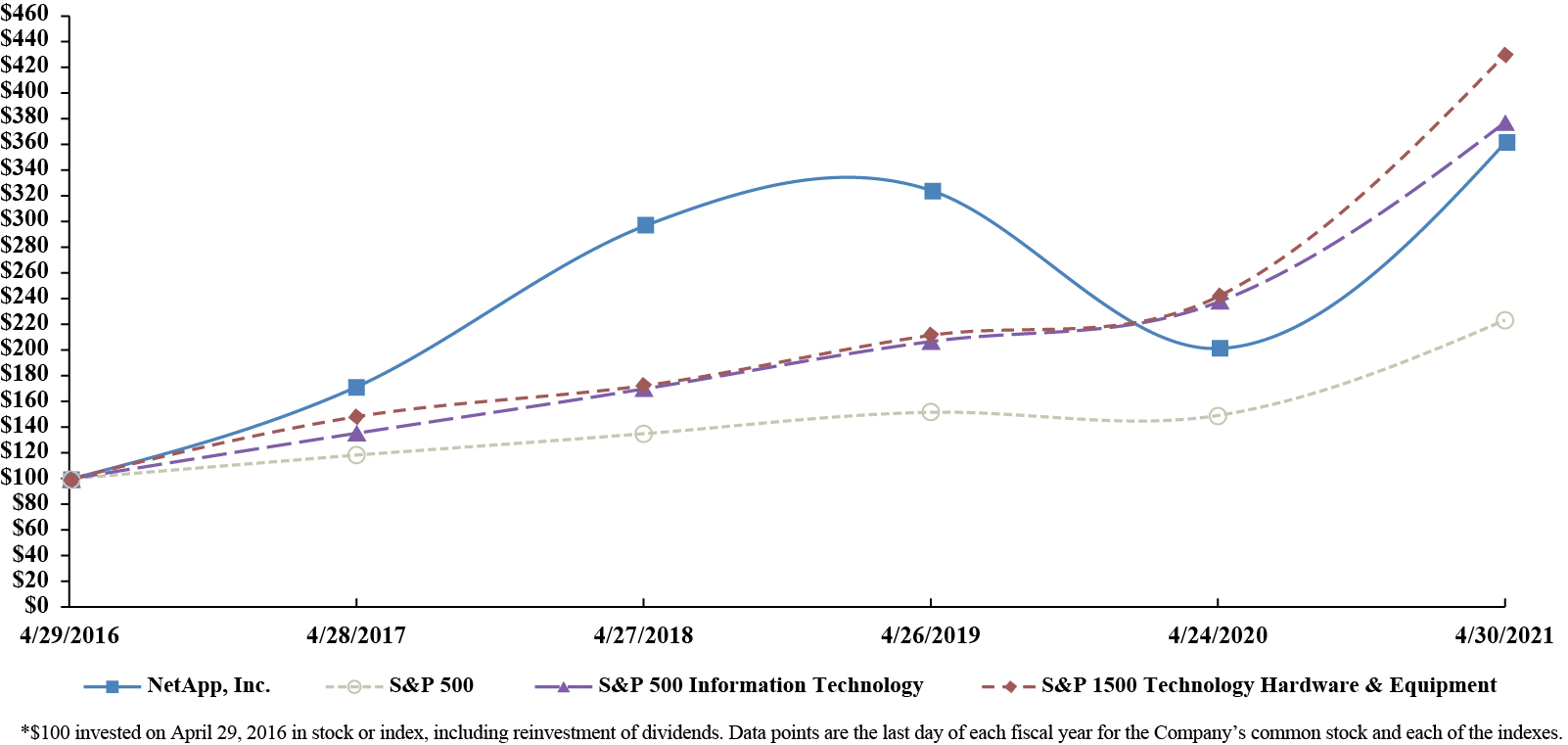
*$100 invested on April 29, 2016 in stock or index, including reinvestment of dividends. Data points are the last day of each fiscal year for the Company’s common stock and each of the indexes.
| April 2016 | April 2017 | April 2018 | April 2019 | April 2020 | April 2021 | |||||||||||||||||||
|---|---|---|---|---|---|---|---|---|---|---|---|---|---|---|---|---|---|---|---|---|---|---|---|---|
| NetApp, Inc. | $ | 100.00 | $ | 172.47 | $ | 296.45 | $ | 323.40 | $ | 200.91 | $ | 361.06 | ||||||||||||
| S&P 500 Index | $ | 100.00 | $ | 117.92 | $ | 134.66 | $ | 151.27 | $ | 148.91 | $ | 223.20 | ||||||||||||
| S&P 500 Information Technology Index | $ | 100.00 | $ | 135.36 | $ | 169.58 | $ | 206.69 | $ | 236.93 | $ | 376.88 | ||||||||||||
| S&P 1500 Technology Hardware & Equipment Index | $ | 100.00 | $ | 148.11 | $ | 172.45 | $ | 211.24 | $ | 241.57 | $ | 429.57 |
We believe that a number of factors may cause the market price of our common stock to fluctuate significantly. See Item 1A. – Risk Factors.
Purchases of Equity Securities by the Issuer and Affiliated Purchasers
The following table provides information with respect to the shares of common stock repurchased by us during the three months ended April 30, 2021:
| Total Number of Shares | Approximate Dollar Value | |||||||||||||||
|---|---|---|---|---|---|---|---|---|---|---|---|---|---|---|---|---|
| Total Number | Average | Purchased as Part of | of Shares That May Yet | |||||||||||||
| of Shares | Price Paid | Publicly Announced | Be Purchased Under The | |||||||||||||
| Period | Purchased | per Share | Program | Repurchase Program | ||||||||||||
| (Shares in thousands) | (Shares in thousands) | (Dollars in millions) | ||||||||||||||
| January 30, 2021 - February 26, 2021 | 200 | $ | 68.54 | 339,269 | $ | 413 | ||||||||||
| February 27, 2021 - March 26, 2021 | 525 | $ | 67.02 | 339,794 | $ | 378 | ||||||||||
| March 27, 2021 - April 30, 2021 | 352 | $ | 74.16 | 340,146 | $ | 352 | ||||||||||
| Total | 1,077 | $ | 69.63 |
In May 2003, our Board of Directors approved a stock repurchase program. As of April 30, 2021, our Board of Directors had authorized the repurchase of up to $13.6 billion of our common stock under our stock repurchase program, and on May 28, 2021, authorized an additional $500 million. Since inception of the program through April 30, 2021, we repurchased a total of 340 million shares of our common stock for an aggregate purchase price of $13.3 billion. Under this program, we may purchase shares of our outstanding common stock through solicited or unsolicited transactions in the open market, in privately negotiated transactions, through accelerated share repurchase programs, pursuant to a Rule 10b5-1 plan or in such other manner as deemed appropriate by our management. The stock repurchase program may be suspended or discontinued at any time, and it was suspended for the first half of fiscal 2021 due to the economic impact of the COVID-19 pandemic. We reinitiated our stock repurchase program in the third quarter of fiscal 2021.
Item 6. Selected Financial Data
We have elected to early adopt the amendment to Item 301 of Regulation S-K and are omitting this disclosure in reliance thereon.
Item 7. Management’s Discussion and Analysis of Financial Condition and Results of Operations
The following discussion of our financial condition and results of operations should be read together with the financial statements and the accompanying notes set forth under Item 8. – Financial Statements and Supplementary Data. The following discussion also contains trend information and other forward-looking statements that involve a number of risks and uncertainties. The Risk Factors set forth in Item 1A. – Risk Factors are hereby incorporated into the discussion by reference.
Executive Overview
Our Company
NetApp is a global cloud-led, data-centric software company that give organizations the freedom to put data to work in the applications that elevate their business. We help our customers get the most out of their data with industry-leading cloud data services, storage systems, and software. Throughout our history, we have kept our focus on one thing – the data, continuously improving how data are managed, stored, analyzed, protected, and moved. Our strategy has been shaped around helping our customers embrace the full potential of new technologies – from the rise of the internet, to helping large enterprise customers in vertical markets, to bringing new systems to market. Today, we are focused on unlocking the best of cloud.
NetApp helps customers move from building data centers to building data fabrics that achieve business objectives. A data fabric simplifies the integration and orchestration of data services across clouds and on-premises to accelerate digital transformation. We help organizations to get the most out of their cloud experience – whether private, public, or hybrid – by enabling IT to discover, integrate, automate, optimize, protect, and secure data and applications. NetApp delivers the full range of capabilities organizations need for their data fabrics, enabling the business to deliver the right data and applications to the right place at the right time with the right capabilities to fuel innovation.
We bring the enterprise-grade data services our customers rely on into the cloud, and the simple flexibility of cloud into the data center. Our industry-leading solutions work across diverse environments and the world’s biggest clouds. NetApp can help a company wherever it is on its hybrid cloud journey.
We focus on delivering an exceptional customer experience to become our customers’ preferred data partner. NetApp’s unique approach to data enables organizations to create new customer experiences, seize every opportunity to innovate, and optimize operations for cost, scale, speed, and agility – all while thriving in a multi-cloud world.
We employ a multichannel distribution strategy, selling products and services to end users and service providers through a direct sales force and through channel partners, including value-added resellers, system integrators, original equipment manufacturers (OEMs) and distributors.
As our product portfolio evolves, market dynamics change, and management continues to assess our largest opportunities, we periodically change how we group product revenue. To provide improved visibility into the value created by our software innovation and R&D investment, beginning in fiscal 2021, we no longer group our products by “Strategic” and “Mature” solutions, but instead disclose the “Software” and “Hardware” components of our product revenues. The engineering DNA of NetApp and the value we provide to customers is grounded in software (particularly our ONTAP OS) and we will continue to look for opportunities to highlight and reinvest in this innovation engine. Software product revenue includes the OS software and optional add-on software solutions attached to our systems across our entire product set: All-Flash FAS, SolidFire, EF-series, Hybrid FAS, E-series, NetApp HCI, and StorageGrid. Hardware product revenues include the non-software component of our systems across our entire product set.
In addition to our products and solutions, we provide a variety of services to our customers, including software support, hardware support and other services including professional services, and customer education and training to help customers most effectively build their unique data fabrics and efficiently manage their data. Revenues generated by our Public Cloud Services (formerly referred to as Cloud Data Services) offerings, are included in software support revenues.
COVID-19
The novel coronavirus, or COVID-19, pandemic and efforts to control its spread have significantly curtailed the movement of people, goods and services worldwide, including in most or all of the regions in which we sell our products and services and conduct our business operations. We have taken precautionary measures intended to minimize the risk of the virus to our employees, our customers, and the communities in which we operate. Since March 2020, the vast majority of our employees have been working remotely and we have suspended business travel.
During fiscal 2021, due to macroeconomic uncertainty caused by COVID-19, we continued to observe certain customers delay purchases of our products and services, while other customers accelerated or placed new orders to address the demands of remote working and digital business. We also experienced certain logistical challenges in delivering our products and services to customers in
certain regions, and minor supply chain constraints. Given recent developments in the broader technology supply chain, we have begun to invest in inventory and certain longer-term commitments to help mitigate the risk of supply shortages.
We believe our existing balances of cash, cash equivalents and investments, cash generated from operations, and ability to access capital markets and committed lines of credit will be sufficient to satisfy our working capital needs, capital expenditures, dividends, stock repurchases, required debt repayments and other liquidity requirements associated with our operations.
The magnitude and duration of the disruption to our business, and impact to our operational and financial performance, caused by COVID-19 pandemic remain uncertain. Refer to Item 1A. – Risk Factors for the significant risks we have identified as a result of the COVID-19 pandemic.
Financial Results and Key Performance Metrics Overview
The following table provides an overview of key financial metrics for each of the last three fiscal years (in millions, except per share amounts and percentages):
| Year Ended | ||||||||||||
|---|---|---|---|---|---|---|---|---|---|---|---|---|
| April 30, 2021 | April 24, 2020 | April 26, 2019 | ||||||||||
| Net revenues | $ | 5,744 | $ | 5,412 | $ | 6,146 | ||||||
| Gross profit | $ | 3,815 | $ | 3,623 | $ | 3,945 | ||||||
| Gross profit margin percentage | 66 | % | 67 | % | 64 | % | ||||||
| Income from operations | $ | 1,031 | $ | 945 | $ | 1,221 | ||||||
| Income from operations as a percentage of net revenues | 18 | % | 17 | % | 20 | % | ||||||
| Provision for income taxes | $ | 232 | $ | 125 | $ | 99 | ||||||
| Net income | $ | 730 | $ | 819 | $ | 1,169 | ||||||
| Diluted net income per share | $ | 3.23 | $ | 3.52 | $ | 4.51 | ||||||
| Net cash provided by operating activities | $ | 1,333 | $ | 1,060 | $ | 1,341 |
| April 30, 2021 | April 24, 2020 | |||||||
|---|---|---|---|---|---|---|---|---|
| Deferred revenue and financed unearned services revenue | $ | 4,003 | $ | 3,698 |
| • | Net revenues: Our net revenues increased 6% in fiscal 2021 compared to fiscal 2020, primarily due to an increase in software support revenues. |
|---|
| | • | Gross profit margin percentage: Our gross profit margin as a percentage of net revenues decreased by approximately one percentage point in fiscal 2021 compared to fiscal 2020, primarily due to
Showing the first 8K of 82K characters. Open the full section
Item 7A. Quantitative and Qualitative Disclosures about Market Risk
We are exposed to market risk related to fluctuations in interest rates and foreign currency exchange rates. We use certain derivative financial instruments to manage foreign currency exchange risks. We do not use derivative financial instruments for speculative or trading purposes. All financial instruments are used in accordance with management-approved policies.
Interest Rate Risk
Fixed Income Investments — As of April 30, 2021, we had fixed income debt investments of $67 million. Our investment portfolio primarily consists of investments with original maturities greater than three months at the date of purchase, which are classified as available-for-sale investments. These investments, which consist primarily of corporate bonds, U.S. Treasury and government debt securities, and certificates of deposit, are subject to interest rate and interest income risk and will decrease in value if market interest rates increase. Conversely, declines in interest rates, including the impact from lower credit spreads, could have a material adverse impact on interest income for our investment portfolio. A hypothetical 100 basis point increase in market interest rates from levels as of April 30, 2021 would have resulted in a decrease in the fair value of our fixed-income securities of less than $1 million. Volatility in market interest rates over time will cause variability in our interest income. We do not use derivative financial instruments in our investment portfolio.
Our investment policy is to limit credit exposure through diversification and investment in highly rated securities. We further mitigate concentrations of credit risk in our investments by limiting our investments in the debt securities of a single issuer and by diversifying risk across geographies and type of issuer. We actively review, along with our investment advisors, current investment ratings, company-specific events and general economic conditions in managing our investments and in determining whether there is a significant decline in fair value that is other-than-temporary. We monitor and evaluate our investment portfolio on a quarterly basis for any other-than-temporary impairments.
Debt — As of April 30, 2021 we have outstanding $2.7 billion aggregate principal amount of Senior Notes. We carry these instruments at face value less unamortized discount and issuance costs on our consolidated balance sheets. Since these instruments bear interest at fixed rates, we have no financial statement risk associated with changes in interest rates. However, the fair value of these instruments fluctuates when interest rates change. See Note 9 – Financing Arrangements of the Notes to Consolidated Financial Statements for more information.
Credit Facility — We are exposed to the impact of changes in interest rates in connection with our $1.0 billion five-year revolving credit facility. Borrowings under the facility accrue interest at rates that vary based on certain market rates and our credit rating on our Senior Notes. Consequently, our interest expense would fluctuate with any changes in these market interest rates or in our credit rating if we were to borrow any amounts under the credit facility. As of April 30, 2021, no amounts were outstanding under the credit facility.
Foreign Currency Exchange Rate Risk
We hedge risks associated with certain foreign currency transactions to minimize the impact of changes in foreign currency exchange rates on earnings. We utilize foreign currency exchange forward and option contracts to hedge against the short-term impact of foreign currency fluctuations on certain foreign currency denominated monetary assets and liabilities. We also use foreign currency exchange forward contracts to hedge foreign currency exposures related to forecasted sales transactions denominated in certain foreign currencies. These derivatives are designated and qualify as cash flow hedges under accounting guidance for derivatives and hedging.
We do not enter into foreign currency exchange contracts for speculative or trading purposes. In entering into foreign currency exchange forward and option contracts, we have assumed the risk that might arise from the possible inability of counterparties to meet the terms of the contracts. We attempt to limit our exposure to credit risk by executing foreign currency exchange contracts with creditworthy multinational commercial banks. All contracts have a maturity of less than 12 months. See Note 12 – Derivatives and Hedging Activities of the Notes to Consolidated Financial Statements for more information regarding our derivatives and hedging activities.
Item 8. Financial Statements and Supplementary Data
INDEX TO CONSOLIDATED FINANCIAL STATEMENTS AND SUPPLEMENTARY DATA
NETAPP, INC.
CONSOLIDATED BALANCE SHEETS
(In millions, except par value)
| April 30, 2021 | April 24, 2020 | |||||||
|---|---|---|---|---|---|---|---|---|
| ASSETS | ||||||||
| Current assets: | ||||||||
| Cash and cash equivalents | $ | 4,529 | $ | 2,658 | ||||
| Short-term investments | 67 | 224 | ||||||
| Accounts receivable | 945 | 973 | ||||||
| Inventories | 114 | 145 | ||||||
| Other current assets | 346 | 274 | ||||||
| Total current assets | 6,001 | 4,274 | ||||||
| Property and equipment, net | 525 | 727 | ||||||
| Goodwill | 2,039 | 1,778 | ||||||
| Other intangible assets, net | 101 | 44 | ||||||
| Other non-current assets | 694 | 699 | ||||||
| Total assets | $ | 9,360 | $ | 7,522 | ||||
| LIABILITIES AND STOCKHOLDERS' EQUITY | ||||||||
| Current liabilities: | ||||||||
| Accounts payable | $ | 420 | $ | 426 | ||||
| Accrued expenses | 970 | 774 | ||||||
| Commercial paper notes | — | 522 | ||||||
| Short-term deferred revenue and financed unearned services revenue | 2,062 | 1,894 | ||||||
| Total current liabilities | 3,452 | 3,616 | ||||||
| Long-term debt | 2,632 | 1,146 | ||||||
| Other long-term liabilities | 650 | 714 | ||||||
| Long-term deferred revenue and financed unearned services revenue | 1,941 | 1,804 | ||||||
| Total liabilities | 8,675 | 7,280 | ||||||
| Commitments and contingencies (Note 18) | ||||||||
| Stockholders' equity: | ||||||||
| Preferred stock, $0.001 par value, 5 shares authorized; no shares issued or outstanding as of April 30, 2021 or April 24, 2020 | — | — | ||||||
| Common stock and additional paid-in capital, $0.001 par value, 885 shares authorized; 222 and 219 shares issued and outstanding as of April 30, 2021 and April 24, 2020, respectively | 504 | 284 | ||||||
| Retained earnings | 211 | — | ||||||
| Accumulated other comprehensive loss | (30 | ) | (42 | ) | ||||
| Total stockholders' equity | 685 | 242 | ||||||
| Total liabilities and stockholders' equity | $ | 9,360 | $ | 7,522 |
See accompanying notes to consolidated financial statements.
NETAPP, INC.
CONSOLIDATED STATEMENTS OF INCOME
(In millions, except per share amounts)
| Year Ended | ||||||||||||
|---|---|---|---|---|---|---|---|---|---|---|---|---|
| April 30, 2021 | April 24, 2020 | April 26, 2019 | ||||||||||
| Revenues: | ||||||||||||
| Product | $ | 2,991 | $ | 2,995 | $ | 3,755 | ||||||
| Software support | 1,281 | 1,034 | 946 | |||||||||
| Hardware support and other services | 1,472 | 1,383 | 1,445 | |||||||||
| Net revenues | 5,744 | 5,412 | 6,146 | |||||||||
| Cost of revenues: | ||||||||||||
| Cost of product | 1,432 | 1,368 | 1,752 | |||||||||
| Cost of software support | 95 | 48 | 35 | |||||||||
| Cost of hardware support and other services | 402 | 373 | 414 | |||||||||
| Total cost of revenues | 1,929 | 1,789 | 2,201 | |||||||||
| Gross profit | 3,815 | 3,623 | 3,945 | |||||||||
| Operating expenses: | ||||||||||||
| Sales and marketing | 1,744 | 1,585 | 1,657 | |||||||||
| Research and development | 881 | 847 | 827 | |||||||||
| General and administrative | 257 | 263 | 278 | |||||||||
| Restructuring charges | 42 | 21 | 35 | |||||||||
| Acquisition-related expense | 16 | — | — | |||||||||
| Gain on sale or derecognition of assets | (156 | ) | (38 | ) | (73 | ) | ||||||
| Total operating expenses | 2,784 | 2,678 | 2,724 | |||||||||
| Income from operations | 1,031 | 945 | 1,221 | |||||||||
| Other (expense) income, net | (69 | ) | (1 | ) | 47 | |||||||
| Income before income taxes | 962 | 944 | 1,268 | |||||||||
| Provision for income taxes | 232 | 125 | 99 | |||||||||
| Net income | $ | 730 | $ | 819 | $ | 1,169 | ||||||
| Net income per share: | ||||||||||||
| Basic | $ | 3.29 | $ | 3.56 | $ | 4.60 | ||||||
| Diluted | $ | 3.23 | $ | 3.52 | $ | 4.51 | ||||||
| Shares used in net income per share calculations: | ||||||||||||
| Basic | 222 | 230 | 254 | |||||||||
| Diluted | 226 | 233 | 259 |
See accompanying notes to consolidated financial statements.
NETAPP, INC.
CONSOLIDATED STATEMENTS OF COMPREHENSIVE INCOME
(In millions)
| Year Ended | ||||||||||||
|---|---|---|---|---|---|---|---|---|---|---|---|---|
| April 30, 2021 | April 24, 2020 | April 26, 2019 | ||||||||||
| Net income | $ | 730 | $ | 819 | $ | 1,169 | ||||||
| Other comprehensive income: | ||||||||||||
| Foreign currency translation adjustments | 15 | (8 | ) | (7 | ) | |||||||
| Defined benefit obligations: | ||||||||||||
| Defined benefit obligation adjustments | (3 | ) | 3 | (2 | ) | |||||||
| Reclassification adjustments related to defined benefit obligations | — | (2 | ) | (2 | ) | |||||||
| Income tax effect | — | 1 | 1 | |||||||||
| Unrealized gains on available-for-sale securities: | ||||||||||||
| Unrealized holding gains arising during the period | — | 22 | 36 | |||||||||
| Reclassification adjustments for gains included in net income | — | (14 | ) | — | ||||||||
| Unrealized gains (losses) on cash flow hedges: | ||||||||||||
| Unrealized holding (losses) gains arising during the period | (11 | ) | 5 | 2 | ||||||||
| Reclassification adjustments for losses (gains) included in net income | 11 | (6 | ) | (1 | ) | |||||||
| Other comprehensive income | 12 | 1 | 27 | |||||||||
| Comprehensive income | $ | 742 | $ | 820 | $ | 1,196 |
See accompanying notes to consolidated financial statements.
NETAPP, INC.
CONSOLIDATED STATEMENTS OF CASH FLOWS
(In millions)
| Year Ended |
|---|
Showing the first 8K of 148K characters. Open the full section
Item 9. Changes in and Disagreements with Accountants on Accounting and Financial Disclosure
None.
Item 9A. Controls and Procedures
(a) Evaluation of Disclosure Controls and Procedures
The phrase “disclosure controls and procedures” refers to controls and procedures designed to ensure that information required to be disclosed in our reports filed or submitted under the Securities Exchange Act of 1934, as amended (the Exchange Act), such as this Annual Report on Form 10-K, is recorded, processed, summarized and reported within the time periods specified in the rules and forms of the U.S. Securities and Exchange Commission (SEC). Disclosure controls and procedures are also designed to ensure that such information is accumulated and communicated to our management, including our Chief Executive Officer (CEO) and our Chief Financial Officer (CFO), as appropriate to allow timely decisions regarding required disclosure.
Under the supervision and with the participation of our management, including our CEO and CFO, we carried out an evaluation of the effectiveness of the design and operation of our disclosure controls and procedures, as defined in Rules 13a-15(e) and 15d-15(e) under the Exchange Act, as of April 30, 2021, the end of the fiscal period covered by this Annual Report on Form 10-K (the Evaluation Date). Based on this evaluation, our CEO and CFO concluded as of the Evaluation Date that our disclosure controls and procedures were effective such that the information required to be disclosed in our SEC reports (i) is recorded, processed, summarized and reported within the time periods specified in SEC rules and forms and (ii) is accumulated and communicated to our management, including our CEO and CFO, as appropriate to allow timely decisions regarding required disclosure.
(b) Management’s Report on Internal Control Over Financial Reporting
Our management is responsible for establishing and maintaining adequate internal control over financial reporting, as such term is defined in Exchange Act Rule 13a-15(f). Our internal control over financial reporting is a process designed to provide reasonable assurance regarding the reliability of financial reporting and the preparation of financial statements for external purposes in accordance with generally accepted accounting principles. Because of its inherent limitations, internal control over financial reporting may not prevent or detect misstatements. Also, projections of any evaluation of effectiveness to future periods are subject to the risk that controls may become inadequate because of changes in conditions, or that the degree of compliance with the policies or procedures may deteriorate.
Under the supervision and with the participation of our management, including our principal executive officer and principal financial officer, we conducted an evaluation of the effectiveness of our internal control over financial reporting based on the criteria established in Internal Control — Integrated Framework (2013) issued by the Committee of Sponsoring Organizations of the Treadway Commission. Based on this assessment, our management concluded that, as of April 30, 2021, our internal control over financial reporting was effective at the reasonable assurance level based on those criteria.
The effectiveness of our internal control over financial reporting as of April 30, 2021 has been audited by Deloitte & Touche LLP, an independent registered public accounting firm, as stated in their report, which is included in Part II, Item 8 of this Annual Report on Form 10-K.
(c) Changes in Internal Control Over Financial Reporting
There has been no change in our internal control over financial reporting identified in connection with our evaluation required by paragraph (d) of rules 13a-15 and 15d-15 under the Exchange Act that occurred during the fourth quarter of fiscal 2021 that has materially affected, or is reasonably likely to materially affect, our internal control over financial reporting.
Item 9B. Other Information
Disclosure Pursuant to Section 13(r) of the Exchange Act
This disclosure is made pursuant to Section 219 of the Iran Threat Reduction and Syria Human Rights Act of 2012 which added subsection (r) to Section 13 of the Exchange Act (Section 13(r)). Section 13(r) requires an issuer to disclose in its annual or quarterly reports whether it or any of its affiliates have knowingly engaged in certain activities, transactions or dealings relating to certain countries including Russia. Disclosure of such activities, transactions or dealings is required even when conducted outside the United States by non-U.S. persons in compliance with applicable law, and whether or not such activities are sanctionable under U.S. law.
During the period from April 25, 2020 to April 30, 2020, we filed notifications with the Russian Federal Security Service (“FSB”) for two products. Those notifications are required under Russian law to qualify our products for importation into, and distribution within, the Russian Federation. The filing of those notifications with the FSB is specifically authorized under OFAC General License 1B, as amended as of March 2, 2021.
The filing of the production notifications with the FSB is a regulatory compliance procedure required under Russian law for the importation and distribution of our products in Russia. We have not sold or supplied any goods or services directly or indirectly to the FSB, and we have not derived any revenues from any such notifications to the FSB.
We may, in the future, file additional notifications for our products with the FSB to the extent those product notifications are required under Russian law to qualify the products for importation or distribution in Russia, but only so long as those activities are authorized by OFAC General License 1B or any successor general license or other authorization issued by OFAC.
PART III
Item 10. Directors, Executive Officers and Corporate Governance
The information required by Item 10 with respect to our executive officers is incorporated herein by reference from the information under Item 1 – Business of Part I of this Annual Report on Form 10-K under the section entitled “Executive Officers.” The information required by Item 10 with respect to the Company’s directors and corporate governance is incorporated herein by reference from the information provided under the headings “Election of Directors” and “Corporate Governance,” respectively, in the Proxy Statement for the 2021 Annual Meeting of Stockholders, which will be filed with the Securities and Exchange Commission within 120 days of our year ended April 30, 2021. The information required by Item 405 of Regulation S-K is incorporated herein by reference from the information provided under the heading “Delinquent Section 16(a) Reports” in the Proxy Statement for the 2021 Annual Meeting of Stockholders.
We have adopted a written code of ethics that applies to our Board of Directors and all of our employees, including our principal executive officer and principal financial and accounting officer. A copy of the code of ethics, which we refer to as our “Code of Conduct,” is available on our website at http://netapp.com/us/media/code-of-conduct.pdf. We will post any amendments to or waivers from the provisions of our Code of Conduct on our website.
Item 11. Executive Compensation
Information regarding the compensation of executive officers and directors of the Company is incorporated by reference from the information under the headings “Executive Compensation and Related Information” and “Director Compensation,” respectively, in our Proxy Statement for the 2021 Annual Meeting of Stockholders.
Item 12. Security Ownership of Certain Beneficial Owners and Management and Related Stockholder Matters
Information regarding security ownership of certain beneficial owners and management and related stockholder matters is incorporated by reference from the information under the heading “Security Ownership of Certain Beneficial Owners and Management” in our Proxy Statement for the 2021 Annual Meeting of Stockholders.
Item 13. Certain Relationships and Related Transactions, and Director Independence
Information regarding certain relationships and related transactions and director independence is incorporated by reference from the information under the headings “Corporate Governance” and “Certain Transactions with Related Parties” in our Proxy Statement for the 2021 Annual Meeting of Stockholders.
Item 14. Principal Accountant Fees and Services
The information required by this item is incorporated by reference from the information under the caption “Audit Fees” in our Proxy Statement for the 2021 Annual Meeting of Stockholders.
With the exception of the information incorporated in Items 10, 11, 12, 13 and 14 of this Annual Report on Form 10-K, NetApp’s Proxy Statement is not deemed “filed” as part of this Annual Report on Form 10-K.
PART IV
Item 15. Exhibits, Financial Statement Schedules
| (a) | Documents filed as part of this report |
| (1) | All Financial Statements |
See index to Consolidated Financial Statements in Part II, Item 8 of this Form 10-K
| (2) | Financial Statement Schedules |
All financial statement schedules have been omitted, since the required information is not applicable or is not present in amounts sufficient to require submission of the schedule, or because the information required is included in the consolidated financial statements and notes thereto included in this Form 10-K.
| (3) | Exhibits required by Item 601 of Regulation S-K |
The information required by this Section (a)(3) of Item 15 is as follows:
EXHIBIT INDEX
| Incorporation by Reference | ||||||||||
|---|---|---|---|---|---|---|---|---|---|---|
| Exhibit No | Description | Form | File No. | Exhibit | Filing Date | |||||
| 24.1 | Power of Attorney (see signature page). | — | — | — | — | |||||
| 31.1 | Certification of the Chief Executive Officer pursuant to Section 302(a) of the Sarbanes-Oxley Act of 2002. | — | — | — | — | |||||
| 31.2 | Certification of the Chief Financial Officer pursuant to Section 302(a) of the Sarbanes-Oxley Act of 2002. | — | — | — | — | |||||
| 32.1 | Certification of Chief Executive Officer pursuant to 18 U.S.C. Section 1350, as adopted pursuant to section 906 of the Sarbanes-Oxley Act of 2002. | — | — | — | — | |||||
| 32.2 | Certification of Chief Financial Officer pursuant to 18 U.S.C. Section 1350, as adopted pursuant to section 906 of the Sarbanes-Oxley Act of 2002. | — | — | — | — | |||||
| 101.INS | Inline XBRL Instance Document – the instance document does not appear in the Interactive Data File because its XBRL tags are embedded within the Inline XBRL document | — | — | — | — | |||||
| 101.SCH | Inline XBRL Taxonomy Extension Schema Document | — | — | — | — | |||||
| 101.CAL | Inline XBRL Taxonomy Calculation Linkbase Document | — | — | — | — | |||||
| 101.DEF | Inline XBRL Taxonomy Extension Definition Linkbase Document | — | — | — | — | |||||
| 101.LAB | Inline XBRL Taxonomy Label Linkbase Document | — | — | — | — | |||||
| 101.PRE | Inline XBRL Taxonomy Extension Presentation Linkbase Document | — | — | — | — | |||||
| 104 | Cover Page Interactive Data File (formatted as inline XBRL and contained in Exhibit 101) |
*Identifies management plan or compensatory plan or arrangement.
(p)Identifies paper format filed exhibit.
SIGNATURES
Pursuant to the requirements of Section 13 or 15(d) of the Securities Exchange Act of 1934, as amended, the registrant has duly caused this report to be signed on its behalf by the undersigned, thereunto duly authorized.
| NETAPP, INC. | ||
|---|---|---|
| By: | /s/ GEORGE KURIAN | |
| George Kurian | ||
| Chief Executive Officer and Director (Principal Executive Officer and Principal Operating Officer) | ||
| Date: June 21, 2021 |
POWER OF ATTORNEY
KNOW ALL PERSONS BY THESE PRESENTS, that each person whose signature appears below constitutes and appoints George Kurian and Michael J. Berry, and each of them, as his true and lawful attorneys-in-fact and agents, with full power of substitution and resubstitution, for him and in his name, place and stead, in any and all capacities, to sign any and all amendments (including post-effective amendments) to this Annual Report on Form 10-K, and to file the same, with all exhibits thereto, and other documents in connection therewith, with the Securities and Exchange Commission, granting unto said attorneys-in-fact and agents, and each of them, full power and authority to do and perform each and every act and thing requisite and necessary to be done in connection therewith, as fully to all intents and purposes as he might or could do in person, hereby ratifying and confirming all that said attorneys-in-fact and agents, or any of them, or their or his substitutes, may lawfully do or cause to be done by virtue thereof.
Pursuant to the requirements of the Securities Exchange Act of 1934, as amended, this report has been signed below by the following persons on behalf of the registrant and in the capacities and on the dates indicated.
| Signature | Title | Date | ||
|---|---|---|---|---|
| /s/ GEORGE KURIAN | Chief Executive Officer and Director (Principal Executive Officer and Principal Operating Officer) | June 21, 2021 | ||
| George Kurian | ||||
| /s/ MICHAEL J. BERRY | Executive Vice President and Chief Financial Officer (Principal Financial Officer) | June 21, 2021 | ||
| Michael J. Berry | ||||
| /s/ ROBERT PARKS | Vice President and Chief Accounting Officer (Principal Accounting Officer) | June 21, 2021 | ||
| Robert Parks | ||||
| /s/ T. MICHAEL NEVENS | Chairman of the Board | June 21, 2021 | ||
| T. Michael Nevens | ||||
| /s/ GERALD HELD | Director | June 21, 2021 | ||
| Gerald Held | ||||
| /s/ KATHRYN M. HILL | Director | June 21, 2021 | ||
| Kathryn M. Hill | ||||
| /s/ DEBORAH KERR | Director | June 21, 2021 | ||
| Deborah Kerr | ||||
| /s/ SCOTT SCHENKEL | Director | June 21, 2021 | ||
| Scott Schenkel | ||||
| /s/ GEORGE T. SHAHEEN | Director | June 21, 2021 | ||
| George T. Shaheen | ||||
| /s/ CARRIE PALIN | Director | June 21, 2021 | ||
| Carrie Palin | ||||
| /s/ DEEPAK AHUJA | Director | June 21, 2021 | ||
| Deepak Ahuja |