 filings.tools
NetApp (NTAP) 10-K risk factor changes: FY2021 vs FY2020
The 2021-04-30 10-K against the 2020-04-24 one, compared heading by heading and sentence by sentence.
Item 1A0 rewritten379 added0 removed0 unchanged
All filing items109 rewritten2,886 added2,440 removed276 unchanged
Summary
counted, not written
- Item 1A headings could not be compared: the parser did not find an Item 1A in both filings.
- Sentence by sentence, 2,886 added, 2,440 removed, 109 rewritten and 276 unchanged across 21 items that differ.
- New this year: Item 1A. Risk Factors; Item 7. Management’s Discussion and Analysis of Financial Condition and Results of Operations; Item 7A. Quantitative and Qualitative Disclosures about Market Risk; Item 3. Legal Proceedings; Item 1B. Unresolved Staff Comments; Item 2. Properties; Item 4. Mine Safety Disclosures; Item 5. Market for Registrant’s Common Equity, Related Stockholder Matters and Issuer Purchases of Equity Securities; Item 6. Selected Financial Data; Item 8. Financial Statements and Supplementary Data; Item 9. Changes in and Disagreements with Accountants on Accounting and Financial Disclosure; Item 9A. Controls and Procedures; Item 9B. Other Information; Item 10. Directors, Executive Officers and Corporate Governance; Item 11. Executive Compensation; Item 12. Security Ownership of Certain Beneficial Owners and Management and Related Stockholder Matters; Item 13. Certain Relationships and Related Transactions, and Director Independence; Item 14. Principal Accountant Fees and Services; Item 15. Exhibits, Financial Statement Schedules.
Sentences by item
21 items, with every count and a link to each item that changed
Underlined words on a shaded ground are new in FY2021; struck-through words were in FY2020. Sentences that are wholly new or wholly gone are labelled rather than marked.
Item 1A. Risk Factors
0 rewritten, 379 added, 0 removed, 0 unchanged
New section this year
The information included elsewhere in this Annual Report on Form 10-K should be considered and understood in the context of the following risk factors, which describe circumstances that may materially harm our future business, operating results or financial condition.
The following discussion reflects our current judgment regarding the most significant risks we face.
These risks can and will change in the future.
Risks Related to Our Business and Industry
If we are unable to develop, introduce and gain market acceptance for new products and services while managing the transition from older ones, or if we cannot provide the expected level of quality and support for our new products and services, our business, operating results, financial condition and cash flows could be harmed.
Our future growth depends upon the successful development and introduction of new hardware and software products and services.
Due to the complexity of storage software, subsystems and appliances and the difficulty in gauging the engineering effort required to produce new products and services, such products and services are subject to significant technical and quality control risks.
If we are unable, for technological, customer reluctance or other reasons, to develop, introduce and gain market acceptance for new products and services, as and when required by the market and our customers, our business, operating results, financial condition and cash flows could be materially and adversely affected.
New or additional product introductions, including new software and cloud offerings, such as Astra by NetApp, Spot by NetApp and new hardware and all-flash storage products, subject us to additional financial and operational risks, including our ability to forecast customer preferences and/or demand, our ability to successfully manage the transition from older products and solutions, our ability to forecast the impact of customers’ demand for new products, services and solutions or the products being replaced, and our ability to manage production capacity to meet the demand for new products and services.
In addition, as new or enhanced products and services are introduced, we must avoid excessive levels of older product inventories and related components and ensure that new products and services can be delivered to meet customers’ demands.
Further risks inherent in the introduction of new products, services and solutions include the uncertainty of price-performance relative to products of competitors, competitors’ responses to the introductions, delays in sales caused by the desire of customers to evaluate new products for extended periods of time and our partners’ investment in selling our new products and solutions.
If these risks are not managed effectively, we could experience material risks to our business, operating results, financial condition and cash flows.
As we enter new or emerging markets, we will likely increase demands on our service and support operations and may be exposed to additional competition.
We may not be able to provide products, services and support to effectively compete for these market opportunities.
Our business may be harmed by technological trends in our market or if we are unable to keep pace with rapid industry, technological and market changes.
Our industry and the markets in which we compete have historically experienced significant growth due to the increase in the demand for storage and data management solutions by consumers, enterprises and governments around the world, and the purchases of storage and data management solutions to address this demand.
However, despite continued data growth, our traditional market, the networked storage hardware market, experienced a decline in each of the last three calendar years due to a combination of customers delaying purchases in the face of technology transitions, increasing adoption of cloud environments built on commodity hardware, increased storage efficiency, and changing economic and business environments.
While customers are navigating through their information technology (IT) transformations, which leverage modern architectures and hybrid cloud environments, they are also reducing IT budgets, looking for simpler solutions, and changing how they consume IT.
This evolution is diverting spending towards transformational projects and architectures like flash, hybrid cloud, IT as a service, converged infrastructure, and software defined storage.
We are unable to predict whether the impact of the COVID-19 pandemic will accelerate the decline of our traditional market and increase demand for our cloud offerings.
Our business may be adversely impacted if we are unable to keep pace with rapid industry, technological or market changes or if our Data Fabric strategy is not accepted in the marketplace.
As a result of these and other factors discussed in this report, our revenue may decline on a year-over-year basis, as it did in fiscal years 2017 and 2020.
The future impact of these trends on both short- and long-term growth patterns is uncertain.
If the general historical rate of industry growth declines, if the growth rates of the specific markets in which we compete decline, and/or if the consumption model of storage changes and our new and existing products, services and solutions do not receive customer acceptance, our business, operating results, financial condition and cash flows could suffer.
Our sales and distribution structure makes forecasting revenues difficult and, if disrupted, could harm our business, operating results, financial condition and cash flows.
Our business and sales models make revenues difficult to forecast.
We sell to a variety of customers directly and through various channels, with a corresponding variety of sales cycles.
The majority of our sales are made and/or fulfilled indirectly through channel partners, including value-added resellers, systems integrators, distributors, original equipment manufacturers (OEMs) and strategic business partners, which now include public cloud providers.
This structure significantly complicates our ability to forecast future revenue, especially within any particular fiscal quarter or year.
Moreover, our relationships with our indirect channel partners and strategic business partners are critical to our success.
The loss of one or more of our key indirect channel partners in a given geographic area or the failure of our channel or strategic partners to promote our products could harm our operating results.
Qualifying and developing new indirect channel partners typically requires a significant investment of time and resources before acceptable levels of productivity are met.
If we fail to maintain our relationships with our indirect channel partners and strategic partners, if their financial condition, business or customer relationships were to weaken, if they fail to comply with legal or regulatory requirements, or if we were to cease to do business with them for these or other reasons, our business, operating results, financial condition and cash flows could be harmed.
Increasing competition and industry consolidation could harm our business, operating results, financial condition and cash flows.
The storage and data management markets are intensely competitive and are characterized by rapidly changing technology and fragmentation.
We compete with many companies in the markets we serve, including established public companies, newer public companies with a strong flash focus, and new market entrants addressing the growing opportunity for application data management for Kubernetes.
Some offer a broad spectrum of IT products and services (full-stack vendors) and others offer a more limited set of storage and data management products or services.
Technology trends, such as the emergence of hosted or public cloud storage, SaaS and flash storage are driving significant changes in storage architectures and solution requirements.
Cloud service provider competitors provide customers storage for their data centers on demand, without requiring a capital expenditure, which meets rapidly evolving business needs and has changed the competitive landscape.
The impacts of the COVID-19 pandemic, including the increase in the number of employees working remotely, has accelerated customer adoption of competitors’ cloud solutions and contributed to increased competition in the market.
An excerpt. Shown here: all 0 rewritten, 40 of 379 added and all 0 removed. The counts are complete. For every sentence, read Item 1A. Risk Factors in the FY2021 filing.
Item 7. Management’s Discussion and Analysis of Financial Condition and Results of Operations
0 rewritten, 561 added, 0 removed, 0 unchanged
New section this year
The following discussion of our financial condition and results of operations should be read together with the financial statements and the accompanying notes set forth under Item 8.
– Financial Statements and Supplementary Data.
The following discussion also contains trend information and other forward-looking statements that involve a number of risks and uncertainties.
The Risk Factors set forth in Item 1A.
– Risk Factors are hereby incorporated into the discussion by reference.
Executive Overview
Our Company
NetApp is a global cloud-led, data-centric software company that give organizations the freedom to put data to work in the applications that elevate their business.
We help our customers get the most out of their data with industry-leading cloud data services, storage systems, and software.
Throughout our history, we have kept our focus on one thing – the data, continuously improving how data are managed, stored, analyzed, protected, and moved.
Our strategy has been shaped around helping our customers embrace the full potential of new technologies – from the rise of the internet, to helping large enterprise customers in vertical markets, to bringing new systems to market.
Today, we are focused on unlocking the best of cloud.
NetApp helps customers move from building data centers to building data fabrics that achieve business objectives.
A data fabric simplifies the integration and orchestration of data services across clouds and on-premises to accelerate digital transformation.
We help organizations to get the most out of their cloud experience – whether private, public, or hybrid – by enabling IT to discover, integrate, automate, optimize, protect, and secure data and applications.
NetApp delivers the full range of capabilities organizations need for their data fabrics, enabling the business to deliver the right data and applications to the right place at the right time with the right capabilities to fuel innovation.
We bring the enterprise-grade data services our customers rely on into the cloud, and the simple flexibility of cloud into the data center.
Our industry-leading solutions work across diverse environments and the world’s biggest clouds.
NetApp can help a company wherever it is on its hybrid cloud journey.
We focus on delivering an exceptional customer experience to become our customers’ preferred data partner.
NetApp’s unique approach to data enables organizations to create new customer experiences, seize every opportunity to innovate, and optimize operations for cost, scale, speed, and agility – all while thriving in a multi-cloud world.
We employ a multichannel distribution strategy, selling products and services to end users and service providers through a direct sales force and through channel partners, including value-added resellers, system integrators, original equipment manufacturers (OEMs) and distributors.
As our product portfolio evolves, market dynamics change, and management continues to assess our largest opportunities, we periodically change how we group product revenue.
To provide improved visibility into the value created by our software innovation and R&D investment, beginning in fiscal 2021, we no longer group our products by “Strategic” and “Mature” solutions, but instead disclose the “Software” and “Hardware” components of our product revenues.
The engineering DNA of NetApp and the value we provide to customers is grounded in software (particularly our ONTAP OS) and we will continue to look for opportunities to highlight and reinvest in this innovation engine.
Software product revenue includes the OS software and optional add-on software solutions attached to our systems across our entire product set: All-Flash FAS, SolidFire, EF-series, Hybrid FAS, E-series, NetApp HCI, and StorageGrid.
Hardware product revenues include the non-software component of our systems across our entire product set.
In addition to our products and solutions, we provide a variety of services to our customers, including software support, hardware support and other services including professional services, and customer education and training to help customers most effectively build their unique data fabrics and efficiently manage their data.
Revenues generated by our Public Cloud Services (formerly referred to as Cloud Data Services) offerings, are included in software support revenues.
COVID-19
The novel coronavirus, or COVID-19, pandemic and efforts to control its spread have significantly curtailed the movement of people, goods and services worldwide, including in most or all of the regions in which we sell our products and services and conduct our business operations.
We have taken precautionary measures intended to minimize the risk of the virus to our employees, our customers, and the communities in which we operate.
Since March 2020, the vast majority of our employees have been working remotely and we have suspended business travel.
During fiscal 2021, due to macroeconomic uncertainty caused by COVID-19, we continued to observe certain customers delay purchases of our products and services, while other customers accelerated or placed new orders to address the demands of remote working and digital business.
We also experienced certain logistical challenges in delivering our products and services to customers in
certain regions, and minor supply chain constraints.
Given recent developments in the broader technology supply chain, we have begun to invest in inventory and certain longer-term commitments to help mitigate the risk of supply shortages.
We believe our existing balances of cash, cash equivalents and investments, cash generated from operations, and ability to access capital markets and committed lines of credit will be sufficient to satisfy our working capital needs, capital expenditures, dividends, stock repurchases, required debt repayments and other liquidity requirements associated with our operations.
The magnitude and duration of the disruption to our business, and impact to our operational and financial performance, caused by COVID-19 pandemic remain uncertain.
Refer to Item 1A.
An excerpt. Shown here: all 0 rewritten, 40 of 561 added and all 0 removed. The counts are complete. For every sentence, read Item 7. Management’s Discussion and Analysis of Financial Condition and Results of Operations in the FY2021 filing.
Item 7A. Quantitative and Qualitative Disclosures about Market Risk
0 rewritten, 35 added, 0 removed, 0 unchanged
New section this year
We are exposed to market risk related to fluctuations in interest rates and foreign currency exchange rates.
We use certain derivative financial instruments to manage foreign currency exchange risks.
We do not use derivative financial instruments for speculative or trading purposes.
All financial instruments are used in accordance with management-approved policies.
Interest Rate Risk
Fixed Income Investments — As of April 30, 2021, we had fixed income debt investments of $67 million.
Our investment portfolio primarily consists of investments with original maturities greater than three months at the date of purchase, which are classified as available-for-sale investments.
These investments, which consist primarily of corporate bonds, U.S. Treasury and government debt securities, and certificates of deposit, are subject to interest rate and interest income risk and will decrease in value if market interest rates increase.
Conversely, declines in interest rates, including the impact from lower credit spreads, could have a material adverse impact on interest income for our investment portfolio.
A hypothetical 100 basis point increase in market interest rates from levels as of April 30, 2021 would have resulted in a decrease in the fair value of our fixed-income securities of less than $1 million.
Volatility in market interest rates over time will cause variability in our interest income.
We do not use derivative financial instruments in our investment portfolio.
Our investment policy is to limit credit exposure through diversification and investment in highly rated securities.
We further mitigate concentrations of credit risk in our investments by limiting our investments in the debt securities of a single issuer and by diversifying risk across geographies and type of issuer.
We actively review, along with our investment advisors, current investment ratings, company-specific events and general economic conditions in managing our investments and in determining whether there is a significant decline in fair value that is other-than-temporary.
We monitor and evaluate our investment portfolio on a quarterly basis for any other-than-temporary impairments.
Debt — As of April 30, 2021 we have outstanding $2.7 billion aggregate principal amount of Senior Notes.
We carry these instruments at face value less unamortized discount and issuance costs on our consolidated balance sheets.
Since these instruments bear interest at fixed rates, we have no financial statement risk associated with changes in interest rates.
However, the fair value of these instruments fluctuates when interest rates change.
See Note 9 – Financing Arrangements of the Notes to Consolidated Financial Statements for more information.
Credit Facility — We are exposed to the impact of changes in interest rates in connection with our $1.0 billion five-year revolving credit facility.
Borrowings under the facility accrue interest at rates that vary based on certain market rates and our credit rating on our Senior Notes.
Consequently, our interest expense would fluctuate with any changes in these market interest rates or in our credit rating if we were to borrow any amounts under the credit facility.
As of April 30, 2021, no amounts were outstanding under the credit facility.
Foreign Currency Exchange Rate Risk
We hedge risks associated with certain foreign currency transactions to minimize the impact of changes in foreign currency exchange rates on earnings.
We utilize foreign currency exchange forward and option contracts to hedge against the short-term impact of foreign currency fluctuations on certain foreign currency denominated monetary assets and liabilities.
We also use foreign currency exchange forward contracts to hedge foreign currency exposures related to forecasted sales transactions denominated in certain foreign currencies.
These derivatives are designated and qualify as cash flow hedges under accounting guidance for derivatives and hedging.
We do not enter into foreign currency exchange contracts for speculative or trading purposes.
In entering into foreign currency exchange forward and option contracts, we have assumed the risk that might arise from the possible inability of counterparties to meet the terms of the contracts.
We attempt to limit our exposure to credit risk by executing foreign currency exchange contracts with creditworthy multinational commercial banks.
All contracts have a maturity of less than 12 months.
See Note 12 – Derivatives and Hedging Activities of the Notes to Consolidated Financial Statements for more information regarding our derivatives and hedging activities.
Item 1. Business
87 rewritten, 161 added, 2,438 removed, 114 unchanged
We were incorporated in 1992 and are headquartered in [removed: Sunnyvale,] [added: San Jose,] California.
In a world where technology is [added: pervasive and] changing [removed: our everyday lives,] [added: expectations,] digital transformation tops the strategic agenda in most organizations.
To successfully transform, data must become the lifeblood of an organization, accelerating efforts to [removed: optimize operations,] create [removed: innovative business opportunities and enable] new customer [removed: touchpoints.][added: experiences and seize opportunities for innovation, while at the same time, optimizing operations for cost, scale, speed, and agility.]
This puts IT leaders under [removed: tremendous] pressure to harness today’s wealth of data and leverage technology to create [removed: new] value across the entire [removed: organization - all with limited time, resources and budget.][added: organization.]
NetApp [removed: Keystone][added: Subscriptions and Licensing (Keystone)]
It provides flexible cloud consumption models that [removed: make it easy] [added: simplify how] to buy, [removed: easy to] consume and [removed: easy to] operate NetApp [removed: capabilities, whether it's on premises or in the public cloud.][added: capabilities.]
For IT organizations that want cloud-like experiences in their own data center, NetApp Keystone subscription services offer a public cloud-like experience based on performance tier and storage service type [removed: – block,] [added: –block,] file, or object, available as customer-managed [added: solution] or [removed: NetApp-managed.][added: NetApp-managed solution.]
Our [removed: unique] combination of efficiency, performance and availability guarantees helps IT organizations protect their storage investment.
[added: Public] Cloud [removed: Data] Services
[removed: NetApp Cloud Data Services is a] [added: Our] portfolio of enterprise-class solutions [removed: that enable] [added: and services enables] customers to fully control and manage storage systems in the cloud, consume high-performance storage services for primary workloads, and optimize cloud environments for cost and [removed: efficiency – available on all the biggest clouds.][added: efficiency.]
NetApp [added: Cloud Volumes] delivers cloud storage as [removed: a] [added: customer-managed] software or [added: as a fully managed] service, enabling customers to choose whether to fully control and manage their own storage [removed: system] [added: systems] in the cloud or simply [removed: choose] [added: select] their performance levels, service level agreements [removed: (SLAs)] [added: (SLAs),] and service level objectives (SLOs).
Customers benefit from the ability to migrate data to the cloud [removed: with ease, securely,] [added: securely] and efficiently with built-in data transport features and services for existing NetApp or third-party storage and can choose where to deploy primary [removed: workloads,] [added: workloads] without having to re-architect the applications or databases.
[removed: Products include: Cloud Volumes ONTAP, Azure] [added: These cloud storage offerings are available on the major cloud providers, including Microsoft (Azure] NetApp [removed: Files, Cloud] [added: Files), Google (Cloud] Volumes Service for Google [removed: Cloud,] [added: Cloud),] and [removed: Cloud] [added: Amazon (Cloud] Volumes Service for [removed: AWS.][added: AWS).]
[added: NetApp] Cloud Sync delivers simple, rapid, and continuous data migration and synchronization service for file systems with any cloud or on-premises target.
[removed: NetApp’s] [added: NetApp] Cloud Tiering service allows customers to retain on-premises, high-performance [removed: All Flash] [added: All-Flash] FAS (AFF) and FAS Solid-State Disk (SSD) storage and combine it with the benefits of cloud [removed: economics, leveraging the low costs of Azure Blob and Amazon S3 object storage.][added: economics.]
NetApp Global File Cache is a software-based solution that delivers fast and secure access to data for users by caching [removed: ‘active data’] [added: active data] sets to distributed offices globally.
[added: NetApp] Cloud Manager provides IT experts and cloud architects with a centralized control plane to manage, [removed: monitor] [added: monitor,] and automate data in hybrid-cloud environments, [removed: providing] [added: delivering] an integrated experience of [removed: NetApp’s] [added: NetApp's] Cloud [removed: Data] [added: Solutions and] Services.
NetApp Cloud Insights is an infrastructure monitoring tool that gives organizations visibility into their entire infrastructure with the ability to monitor, troubleshoot, and optimize cost across all [removed: resources] [added: resources,] including public clouds and private data centers.
NetApp Hybrid Cloud Solutions [removed: is] [added: are] a portfolio of offerings that deliver [added: on-premises, private cloud, and] hybrid [removed: multicloud] [added: cloud services, designed to operate with public cloud] data services [removed: and] [added: (e.g., Microsoft Azure, Google Cloud Platform, AWS) through] a simplified customer experience.
ONTAP 9 provides flexibility to design and deploy a storage environment across the [removed: widest] [added: broadest] range of architectures - engineered systems, software-defined storage (SDS), and the cloud [removed: -] [added: –] while unifying data management across all of them, as well as SAN and [added: NAS environments.]
Inline data compression, deduplication, and compaction work together to reduce storage costs and maximize the [added: amount of] data stored.
NetApp Data Availability Services [removed: (NDAS)] simplify the protection and management of NetApp ONTAP data from primary to secondary to cloud S3 storage.
Simplified orchestration improves [added: the] performance of backup workflows when protecting large numbers of volumes, thereby increasing productivity, reducing [removed: cost] [added: cost,] and providing rapid time to business insight.
NetApp [removed: SnapCenter®] [added: SnapCenter Backup Management] software is designed to deliver [removed: high performance] [added: high-performance] backup and recovery for database and application workloads hosted on ONTAP storage.
Leveraging storage-based data management, SnapCenter [removed: enables] [added: provides] increased performance and availability and reduced testing and development times.
NetApp [removed: SnapMirror®] [added: SnapMirror Data Replication] software is a cost-effective, easy-to-use unified replication solution, replicating data at high speeds across the Data Fabric.
SnapMirror delivers [removed: powerful] [added: robust] data management capabilities for virtualization, protecting critical data while providing the flexibility to move data between locations and storage tiers, including cloud service providers.
NetApp [removed: SnapLock®] [added: SnapLock Data Compliance] software delivers high-performance disk-based data permanence for HDD and SSD deployments.
[removed: Part of our proven NetApp ONTAP storage software,] SnapLock helps provide data integrity and retention, enabling electronic records to be both unalterable and rapidly accessible.
NetApp [removed: Element®] [added: ElementOS] software delivers agility through scale-out flexibility, predictable [removed: performance] [added: performance,] and automation integrations so organizations can build clouds to accelerate new services.
Integrated into the NetApp Data Fabric, [removed: Element] [added: ElementOS] software enables innovative architectures with flexible scale for our [removed: customers’] [added: customers'] private clouds.
[removed: NetApp’s disaggregated] [added: NetApp] HCI, powered by [removed: Element software,] [added: the ElementOS data management storage operating system,] allows independent scaling of compute and storage, adapting to workloads with consistent performance.
[removed: NetApp E-Series and EF-Series storage arrays with] SANtricity software [removed: offer] [added: offers] industry-leading performance, reliability, and ease of use.
[removed: Active IQ® Predictive Analytics] [added: This predictive analytics] and [removed: Support] [added: support solution] continuously assesses telemetry data, drawing on trillions of real-time and historical diagnostic records and known risk signatures to spot potential problems before they have [added: a] business impact.
[removed: Professional services teams from] NetApp and our [removed: partners] [added: partners' services teams] offer assessment, design, and implementation services that help customers optimize their [added: on-premises, private cloud, hybrid cloud, and/or public] cloud [removed: and] IT environments.
[removed: Our highly responsive] [added: The] NetApp Global Support organization supplies systems, processes, and people wherever [removed: they are] needed to provide continuous operation in complex and critical environments.
Our services offer IT organizations the right expertise to envision, deploy, and operate data management solutions, [removed: to] accelerate innovation, and [removed: to] increase lifetime solution value.
We market and sell our products [added: and services] in numerous countries throughout the world.
Our marketing is focused on building our brand [removed: reputation and] [added: reputation, creating] market awareness, communicating [removed: product] [added: customer] advantages and [added: generating] demand [removed: generation] for our sales force and channel partners.
[removed: We form lasting] [added: Our] partnerships with the industry’s [removed: best] [added: leading] cloud, infrastructure, consulting, application, and reseller partners [added: are created] with one goal in mind: the success of our customers.
NetApp, Inc. (NetApp, we, or us) is a global cloud-led, data-centric software company, building on a rich history of software innovation.
We bring enterprise-grade data services to the leading clouds, and the simple flexibility of cloud into the data center.
We help organizations run large and demanding workloads on the public cloud and in hybrid cloud environments with industry-leading solutions that work across diverse environments and the leading public clouds.
We empower organizations to lead with data in the age of accelerated digital transformation.
Digital transformations are driving IT organizations to future-proof on-premises investments for a cloud-next world, move enterprise workloads to the cloud, and continually pursue the promise of cloud-native innovation.
Meeting these requirements means transforming IT to take control and thrive in a multi-cloud world.
Our strategy is to apply our rich data-centric software innovation to enable customers to thrive in a hybrid cloud world and build data fabrics to accelerate data-driven digital transformations.
We help organizations to get the most out of their cloud experience – whether public, private or hybrid – by enabling IT to discover, integrate, automate, optimize, protect, and secure data and applications.
NetApp delivers the full range of capabilities organizations need for their data fabrics, enabling the business to deliver the data and applications to the right place at the right time with the right capabilities to fuel innovation.
NetApp provides software, systems and cloud services that allow organizations to run their applications from the data center to the cloud, whether they are developing in the cloud, moving to the cloud, or creating their own cloudlike experiences on-premises.
NetApp's public cloud services (formerly referred to as “Cloud Data Services”) are delivered as cloud-based software and as Software-as-a-Service (SaaS).
These solutions and services are generally available on the leading public clouds, including Microsoft Azure, Google Cloud Platform and Amazon Web Services (AWS).
The public cloud services portfolio can be categorized into four solution areas:
| | • | Cloud Storage – Software and services available for the management of storage in the public clouds. |
| | • | Cloud Controls – A centralized control plane to automate, monitor, orchestrate, manage, and optimize applications, services, and data in the cloud and hybrid-cloud environments. |
| | • | Cloud Services and Analytics – SaaS services that help protect, leverage, and optimize customer investments in the cloud. |
| | • | Cloud Optimization – Services that automate and continuously optimize cloud compute infrastructure, helping companies reduce their compute costs while ensuring scalability and availability, as well as offerings that provide managed virtual desktop services. |
Cloud Storage
For those customers who wish to manage their own cloud storage implementation, we offer Cloud Volumes ONTAP, a cloud-based data management service built on NetApp ONTAP storage software.
Cloud Controls
NetApp Virtual Desktop Service (VDS) enables organizations to deploy, manage, and optimize virtual desktop environments through a SaaS-delivered global control plane for virtual desktop management that functions as an extension of their cloud environment.
Cloud Services and Analytics
NetApp Cloud Compliance, driven by artificial intelligence algorithms with automated controls for data privacy regulations such as the General Data Protection Regulation (GDPR), California Consumer Privacy Act (CCPA), and more, enables organizations to get their business application data, on-premises data, and cloud environments privacy-ready.
By leveraging the low costs of Azure Blob and Amazon S3 object storage for cold data, organizations can optimize their investments.
NetApp SaaS Backup service is a secure, encrypted cloud-native offering that safeguards business-critical Microsoft Office 365 data from corruption, malicious or accidental deletion via a backup and restore offering.
NetApp Cloud Backup delivers seamless and cost-effective backup and restore capabilities for protecting and archiving cloud and on-premises ONTAP data.
Cloud Optimization
Spot by NetApp offers a portfolio of compute and storage services that monitor and analyze applications' needs and automatically optimize cloud resources to meet those needs.
These cloud operations services help drive cloud resource optimization in real-time for both compute and storage, offering significant operational savings while maintaining SLAs and SLOs.
Spot Cloud Analyzer by NetApp is a cloud management and optimization dashboard.
It provides a gateway to other tools that optimize cloud spending, including tracking and monitoring of cloud expenses, identifying waste and potential optimization points, and providing executable action items.
Spot Eco by NetApp automates reserved instance lifecycle management.
By providing comprehensive lifecycle management, Eco is a flexible reserved capacity management service that allows users to plan, buy, and sell reserved instances.
Spot Ocean by NetApp provides automation for cloud infrastructure containers.
It continuously analyzes how containers are using infrastructure and automatically scales compute resources to maximize utilization and availability.
Spot Wave by NetApp allows organizations to automate infrastructure provisioning, management, and scaling for big data cloud environments.
Wave simplifies, automates, and optimizes cloud infrastructure for Apache Spark running on Kubernetes.
Spot Elastigroup by NetApp simplifies and automates cloud infrastructure for scale-out applications running in Microsoft Azure, Google Cloud Platform and Amazon AWS, freeing operations teams from infrastructure management burdens.
It continuously analyzes resource usage and provides autoscaling groups that optimize compute resources to ensure availability and meet resource demands using the lowest-cost compute options.
NetApp Virtual Desktop Managed Service (VDMS) provides turnkey virtual desktops as a managed service for the expanding enterprise.
NetApp, Inc. (NetApp, we, or us) is a leader in hybrid cloud data services.
In a world of increasing complexity, we simplify.
We help our customers ensure their data and applications are in the right place at the right time with the right characteristics and capabilities to enable new insights and accelerate innovation.
We do this by helping customers build their data fabrics.
Together with our partners, we empower organizations to unleash the full potential of their data to expand customer touchpoints, foster greater innovation and optimize their operations.
Customer Business and IT Needs
Digital transformation requires IT transformation.
This is no small undertaking.
Organizations are innovating on their choice of clouds, building private clouds to gain speed and agility, and modernizing and simplifying IT to accelerate critical business applications - sometimes all at the same time.
NetApp helps customers move from building data centers to building data fabrics.
A data fabric simplifies the integration and orchestration of data services across clouds and on-premises to accelerate digital transformation.
It delivers consistent and integrated hybrid cloud data services for data visibility and insights, data access and control and data protection and security.
Data fabric is an architecture and set of data services that provide consistent capabilities across a choice of endpoints spanning on-premises and multiple cloud environments.
Only NetApp can deliver the full range of capabilities organizations need for their data fabrics: the power to discover resources, integrate disparate data services, automate operations, optimize, and protect and secure data everywhere.
For customers looking to transform with cloud, only NetApp offers data services across the world’s biggest clouds: Microsoft Azure, Amazon Web Services (AWS) and Google Cloud Platform.
Customers can choose the cloud resources that are best for their workloads and reduce the complexities of managing data across multiple clouds and on premises.
For customers looking to grow by adding new capabilities, speed and agility to their current environment, NetApp provides leading private cloud capabilities.
This enables customers to deliver new applications and services faster and run existing workloads more efficiently.
Customers enjoy performance, at scale, on premises, all with a single experience that unifies on-premises and public cloud.
For customers looking to run their current application environment more efficiently, NetApp provides high-performing, cloud-integrated technologies and converged and hyper-converged infrastructures.
This includes a highly differentiated portfolio of all-flash and hybrid array offerings.
Customers get better results with simplicity, speed and automation across core, edge, and cloud.
NetApp helps organizations unleash the power of their data to meet business demands and gain a competitive edge.
Our products, solutions, and services portfolio focus on customers’ top IT imperatives as they undertake digital transformations.
NetApp’s unique approach to data services enables organizations to modernize and simplify IT, build private clouds for speed and agility, and fuel data-driven innovation on any cloud.
During fiscal year 2020, NetApp introduced Keystone - our group of programs, offerings and services that simplify the business of hybrid cloud data services.
With Keystone companies can lessen the complexities associated with IT infrastructure and lifecycle management.
Keystone gives IT buyers a clear, easy-to-understand path forward for managing IT, providing employees time to focus on more important business.
For IT organizations that want to take advantage of NetApp capabilities available on all the public clouds with cloud native, fully integrated and managed data and storage services paid for as a true utility, Keystone starts with NetApp cloud data services.
NetApp Active IQ AI-driven insights optimize the health of systems while predicting capacity and performance bottlenecks from an easy-to-use dashboard.
NetApp cloud storage offers data management capabilities previously unavailable in public clouds, with services that deliver protection, orchestration, and optimization, as well as security and compliance.
NetApp Cloud Sync
NetApp Cloud Tiering
NetApp Global File Cache
NetApp SaaS Backup
SaaS Backup service is a complete software-as-a-service (SaaS) offering that enables organizations to protect Office 365 and Salesforce data against threats or accidental deletion with secure backup and restore.
NetApp Cloud Manager
NetApp Fabric Orchestrator
NetApp Fabric Orchestrator discovers data, applications, and services by securely connecting to public, private, and on-premises providers.
All assets discovered sit behind a unified Data Fabric API and a single user interface.
An excerpt. Shown here: 40 of 87 rewritten, 40 of 161 added and 40 of 2,438 removed. The counts are complete. For every sentence, read Item 1. Business in the FY2021 filing and the FY2020 filing.
Item 3. Legal Proceedings
0 rewritten, 1 added, 0 removed, 0 unchanged
New section this year
For a discussion of legal proceedings, see Note 18 – Commitments and Contingencies of the Notes to Consolidated Financial Statements.
Cover and table of contents
22 rewritten, 2 added, 2 removed, 162 unchanged
| | For the fiscal year ended April [removed: 24, 2020] [added: 30, 2021] |
[removed: ][added: ]
The aggregate market value of voting stock held by non-affiliates of the registrant, as of October [removed: 25, 2019,] [added: 30, 2020,] the last business day of the registrant’s most recently completed second fiscal quarter, was [removed: $7,099,736,024] [added: $5,651,372,914] (based on the closing price for shares of the registrant’s common stock as reported by the NASDAQ Global Select Market on that date).
On June [removed: 5, 2020, 221,816,300] [added: 2, 2021, 223,217,394] shares of the registrant’s common stock, $0.001 par value, were outstanding.
[removed: DOCUMENTS] [added: DOCUMENTS] INCORPORATED BY [removed: REFERENCE][added: REFERENCE]
The information called for by Part III of this Form 10-K is hereby incorporated by reference from the definitive Proxy Statement for our annual meeting of stockholders, which will be filed with the Securities and Exchange Commission not later than 120 days after April [removed: 24, 2020.][added: 30, 2021.]
[removed: TABLE] [added: TABLE] OF [removed: CONTENTS][added: CONTENTS]
| Item 1 | | [Business](#Item_1_Business) | | [removed: 6] [added: 5] |
| Item 7A | | [Quantitative and Qualitative Disclosures About Market Risk](#Item_7A_Quantitative_and_Qualitative) | | [removed: 52] [added: 50] |
| Item 8 | | [Financial Statements and Supplementary Data](#Item_8_Financial_Statements) | | [removed: 54] [added: 52] |
| Item 9 | | [Changes in and Disagreements with Accountants on Accounting and Financial Disclosure](#Item_9_Changes_in_and_Disagreements) | | [removed: 94] [added: 90] |
| Item 9A | | [Controls and Procedures](#Item_9A_Controls_and_Procedures) | | [removed: 94] [added: 90] |
| Item 9B | | [Other Information](#Item_9B_Other_Information) | | [removed: 94] [added: 90] |
| Item 10 | | [Directors, Executive Officers and Corporate Governance](#Item_10_Directors_Executive_Officers) | | [removed: 95] [added: 92] |
| Item 11 | | [Executive Compensation](#Item_11_Executive_Compensation) | | [removed: 95] [added: 92] |
| Item 12 | | [Security Ownership of Certain Beneficial Owners and Management and Related Stockholder Matters](#Item_12_Security_Ownership) | | [removed: 95] [added: 92] |
| Item 13 | | [Certain Relationships and Related Transactions, and Director Independence](#Item_13_Certain_Relationships) | | [removed: 95] [added: 92] |
| Item 14 | | [Principal Accounting Fees and Services](#Item_14_Principal_Accountant_Fees) | | [removed: 95] [added: 92] |
| Item 15 | | [Exhibits, Financial Statement Schedules](#Item_15_Exhibits_Financial_Statement) | | [removed: 95] [added: 92] |
| [Signatures](#Signatures) | | | | [removed: 102] [added: 99] |
All forward-looking statements included in this document are inherently uncertain as they are based on management’s current expectations and assumptions concerning future [removed: events,] [added: events] and are subject to numerous known and unknown risks and uncertainties.
| | • | the impacts of the global COVID-19 pandemic [added: and uneven recovery] on our business operations, financial condition, results of operations or cash flows; |
3060 Olsen Drive,
San Jose, California 95128
1395 Crossman Avenue,
Sunnyvale, California 94089
Item 1B. Unresolved Staff Comments
0 rewritten, 1 added, 0 removed, 0 unchanged
New section this year
Not applicable.
Item 2. Properties
0 rewritten, 11 added, 0 removed, 0 unchanged
New section this year
We owned or leased, domestically and internationally, the following properties as of April 30, 2021.
We own approximately 0.8 million square feet of facilities in Research Triangle Park (RTP), North Carolina.
In addition, we own 65 acres of undeveloped land.
The RTP site supports research and development, global services and sales and marketing.
We own approximately 0.7 million square feet of facilities in Bangalore, India on 14 acres of land.
The Bangalore site supports research and development, marketing and global services.
We executed a lease for our new corporate headquarters located in San Jose, California in April 2021.
The lease commenced on June 1, 2021 and includes approximately 0.3 million square feet of office space.
The San Jose site supports research and development, corporate general administration, sales and marketing, global services and operations.
We lease other sales offices and research and development facilities throughout the U.S. and internationally.
We expect that our existing facilities and those being developed worldwide are suitable and adequate for our requirements over at least the next two years and that additional space will be available if needed.
Item 4. Mine Safety Disclosures
0 rewritten, 2 added, 0 removed, 0 unchanged
New section this year
Not applicable.
PART II
Item 5. Market for Registrant’s Common Equity, Related Stockholder Matters and Issuer Purchases of Equity Securities
0 rewritten, 51 added, 0 removed, 0 unchanged
New section this year
The Company’s common stock is traded on the NASDAQ Stock Market LLC (“NASDAQ”) under the symbol NTAP.
Price Range of Common Stock
The price range per share of common stock presented below represents the highest and lowest intraday sales prices for the Company’s common stock on the NASDAQ during each quarter of our two most recent fiscal years.
| | | Fiscal 2021 | | | | | | | | Fiscal 2020 | | | | | | |
| --- | --- | --- | --- | --- | --- | --- | --- | --- | --- | --- | --- | --- | --- | --- | --- | --- |
| | | High | | | | Low | | | | High | | | | Low | | |
| First Quarter | | $ | 49.65 | | | $ | 39.81 | | | $ | 73.69 | | | $ | 58.04 | |
| Second Quarter | | $ | 48.94 | | | $ | 40.08 | | | $ | 59.84 | | | $ | 44.55 | |
| Third Quarter | | $ | 70.64 | | | $ | 43.92 | | | $ | 65.38 | | | $ | 55.00 | |
| Fourth Quarter | | $ | 78.77 | | | $ | 58.83 | | | $ | 60.96 | | | $ | 34.66 | |
Holders
As of June 2, 2021 there were 456 holders of record of our common stock.
Dividends
The Company paid cash dividends of $0.48 per outstanding common share in each quarter of fiscal 2021 for an aggregate of $427 million, $0.48 per outstanding common share in each quarter of fiscal 2020 for an aggregate of $439 million, and $0.40 per outstanding common share in each quarter of fiscal 2019 for an aggregate of $403 million.
In the first quarter of fiscal 2022, the Company declared a cash dividend of $0.50 per share of common stock, payable on July 28, 2021 to shareholders of record as of the close of business on July 9, 2021.
Performance Graph
The following graph shows a comparison of cumulative total shareholder return, calculated on a dividend reinvested basis, of an investment of $100 for the Company, the S&P 500 Index, the S&P 500 Information Technology Index and the S&P 1500 Technology Hardware & Equipment Index for the five years ended April 30, 2021.
The comparisons in the graphs below are based upon historical data and are not indicative of, nor intended to forecast, future performance of our common stock.
The graph and related information shall not be deemed “soliciting material” or be deemed to be “filed” with the SEC, nor shall such information be incorporated by reference into any past or future filing with the SEC, except to the extent that such filing specifically states that such graph and related information are incorporated by reference into such filing.
COMPARISON OF FIVE YEAR CUMULATIVE TOTAL RETURN
Among NetApp, Inc., the S&P 500 Index, the S&P 500 Information Technology Index and the S&P 1500 Technology Hardware & Equipment Index*
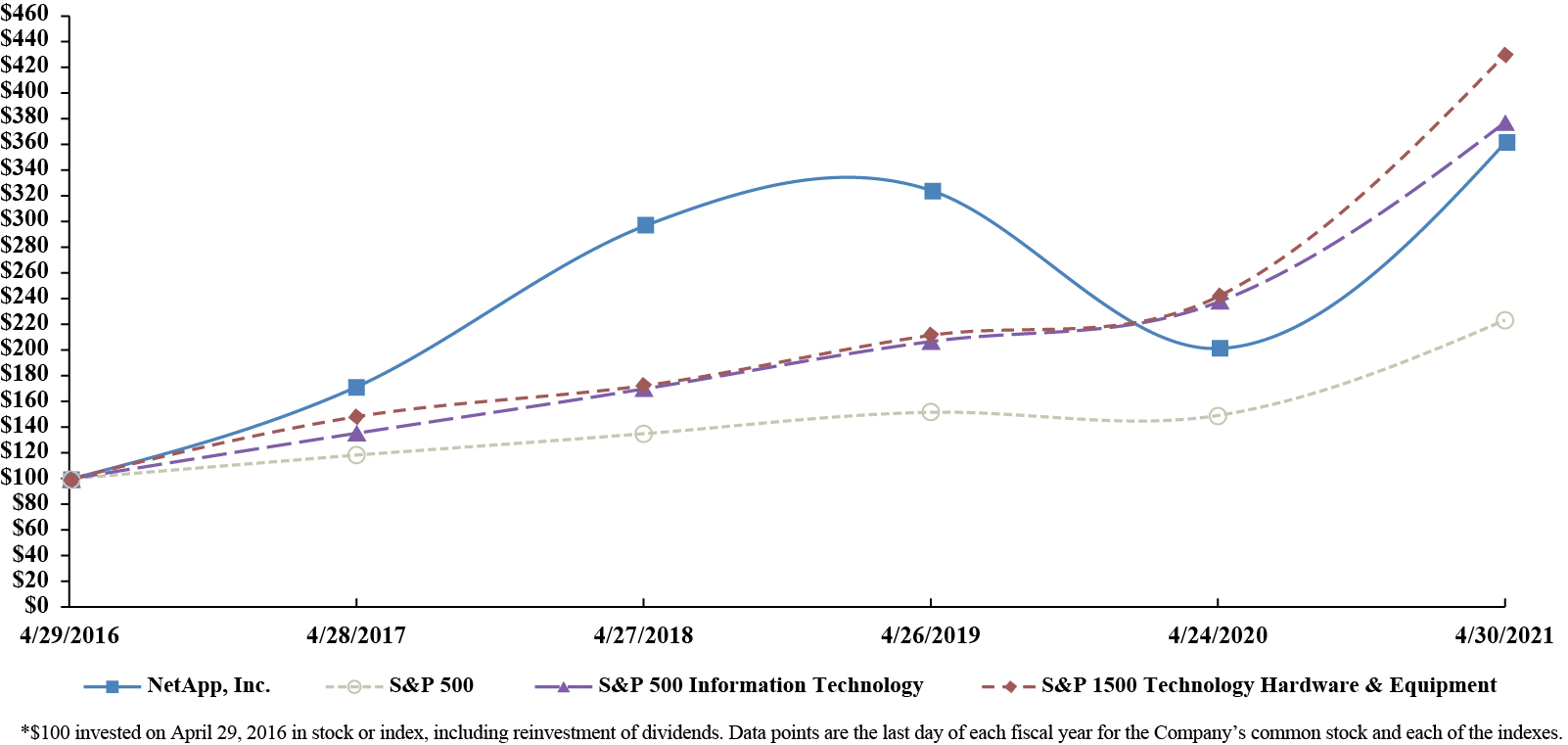
*$100 invested on April 29, 2016 in stock or index, including reinvestment of dividends.
Data points are the last day of each fiscal year for the Company’s common stock and each of the indexes.
| | | April 2016 | | | | April 2017 | | | | April 2018 | | | | April 2019 | | | | April 2020 | | | | April 2021 | | |
| --- | --- | --- | --- | --- | --- | --- | --- | --- | --- | --- | --- | --- | --- | --- | --- | --- | --- | --- | --- | --- | --- | --- | --- | --- |
| NetApp, Inc. | | $ | 100.00 | | | $ | 172.47 | | | $ | 296.45 | | | $ | 323.40 | | | $ | 200.91 | | | $ | 361.06 | |
| S&P 500 Index | | $ | 100.00 | | | $ | 117.92 | | | $ | 134.66 | | | $ | 151.27 | | | $ | 148.91 | | | $ | 223.20 | |
| S&P 500 Information Technology Index | | $ | 100.00 | | | $ | 135.36 | | | $ | 169.58 | | | $ | 206.69 | | | $ | 236.93 | | | $ | 376.88 | |
| S&P 1500 Technology Hardware & Equipment Index | | $ | 100.00 | | | $ | 148.11 | | | $ | 172.45 | | | $ | 211.24 | | | $ | 241.57 | | | $ | 429.57 | |
We believe that a number of factors may cause the market price of our common stock to fluctuate significantly.
See Item 1A.
– Risk Factors.
Purchases of Equity Securities by the Issuer and Affiliated Purchasers
The following table provides information with respect to the shares of common stock repurchased by us during the three months ended April 30, 2021:
| | | | | | | | | | | Total Number of Shares | | | | Approximate Dollar Value | | |
| --- | --- | --- | --- | --- | --- | --- | --- | --- | --- | --- | --- | --- | --- | --- | --- | --- |
| | | Total Number | | | | Average | | | | Purchased as Part of | | | | of Shares That May Yet | | |
| | | of Shares | | | | Price Paid | | | | Publicly Announced | | | | Be Purchased Under The | | |
| Period | | Purchased | | | | per Share | | | | Program | | | | Repurchase Program | | |
An excerpt. Shown here: all 0 rewritten, 40 of 51 added and all 0 removed. The counts are complete. For every sentence, read Item 5. Market for Registrant’s Common Equity, Related Stockholder Matters and Issuer Purchases of Equity Securities in the FY2021 filing.
Item 6. Selected Financial Data
0 rewritten, 1 added, 0 removed, 0 unchanged
New section this year
We have elected to early adopt the amendment to Item 301 of Regulation S-K and are omitting this disclosure in reliance thereon.
Item 8. Financial Statements and Supplementary Data
0 rewritten, 1,412 added, 0 removed, 0 unchanged
New section this year
INDEX TO CONSOLIDATED FINANCIAL STATEMENTS AND SUPPLEMENTARY DATA
| | |
| --- | --- |
| | |
| [Consolidated Balance Sheets as of April 30, 2021 and April 24, 2020](#CONSOLIDATED_BALANCE_SHEETS) | 53 |
| | |
| [Consolidated Statements of Income for the years ended April 30, 2021, April 24, 2020 and April 26, 2019](#CONSOLIDATED_STATEMENTS_OPERATIONS) | 54 |
| | |
| [Consolidated Statements of Comprehensive Income for the years ended April 30, 2021, April 24, 2020 and April 26, 2019](#CONSOLIDATED_STATEMENTS_COMPREHENSIVE_IN) | 55 |
| | |
| [Consolidated Statements of Cash Flows for the years ended April 30, 2021, April 24, 2020 and April 26, 2019](#CONSOLIDATED_STATEMENTS_CASH_FLOWS) | 56 |
| | |
| [Consolidated Statements of Stockholders’ Equity for the years ended April 30, 2021, April 24, 2020 and April 26, 2019](#CONSOLIDATED_STATEMENTS_STOCKHOLDERS_EQU) | 57 |
| | |
| [Notes to Consolidated Financial Statements](#NOTES_TO_CONSOLIDATED_FINANCIAL_STATEMEN) | 58 |
| | |
| [Reports of Independent Registered Public Accounting Firm](#REPORT_INDEPENDENT_REGISTERED_PUBLIC_ACC) | 87 |
| | |
NETAPP, INC.
CONSOLIDATED BALANCE SHEETS
(In millions, except par value)
| | | April 30, 2021 | | | | April 24, 2020 | | |
| --- | --- | --- | --- | --- | --- | --- | --- | --- |
| ASSETS | | | | | | | | |
| Current assets: | | | | | | | | |
| Cash and cash equivalents | | $ | 4,529 | | | $ | 2,658 | |
| Short-term investments | | | 67 | | | | 224 | |
| Accounts receivable | | | 945 | | | | 973 | |
| Inventories | | | 114 | | | | 145 | |
| Other current assets | | | 346 | | | | 274 | |
| Total current assets | | | 6,001 | | | | 4,274 | |
| Property and equipment, net | | | 525 | | | | 727 | |
| Goodwill | | | 2,039 | | | | 1,778 | |
| Other intangible assets, net | | | 101 | | | | 44 | |
| Other non-current assets | | | 694 | | | | 699 | |
| Total assets | | $ | 9,360 | | | $ | 7,522 | |
| | | | | | | | | |
| LIABILITIES AND STOCKHOLDERS' EQUITY | | | | | | | | |
| Current liabilities: | | | | | | | | |
| Accounts payable | | $ | 420 | | | $ | 426 | |
An excerpt. Shown here: all 0 rewritten, 40 of 1,412 added and all 0 removed. The counts are complete. For every sentence, read Item 8. Financial Statements and Supplementary Data in the FY2021 filing.
Item 9. Changes in and Disagreements with Accountants on Accounting and Financial Disclosure
0 rewritten, 1 added, 0 removed, 0 unchanged
New section this year
None.
Item 9A. Controls and Procedures
0 rewritten, 15 added, 0 removed, 0 unchanged
New section this year
(a) Evaluation of Disclosure Controls and Procedures
The phrase “disclosure controls and procedures” refers to controls and procedures designed to ensure that information required to be disclosed in our reports filed or submitted under the Securities Exchange Act of 1934, as amended (the Exchange Act), such as this Annual Report on Form 10-K, is recorded, processed, summarized and reported within the time periods specified in the rules and forms of the U.S. Securities and Exchange Commission (SEC).
Disclosure controls and procedures are also designed to ensure that such information is accumulated and communicated to our management, including our Chief Executive Officer (CEO) and our Chief Financial Officer (CFO), as appropriate to allow timely decisions regarding required disclosure.
Under the supervision and with the participation of our management, including our CEO and CFO, we carried out an evaluation of the effectiveness of the design and operation of our disclosure controls and procedures, as defined in Rules 13a-15(e) and 15d-15(e) under the Exchange Act, as of April 30, 2021, the end of the fiscal period covered by this Annual Report on Form 10-K (the Evaluation Date).
Based on this evaluation, our CEO and CFO concluded as of the Evaluation Date that our disclosure controls and procedures were effective such that the information required to be disclosed in our SEC reports (i) is recorded, processed, summarized and reported within the time periods specified in SEC rules and forms and (ii) is accumulated and communicated to our management, including our CEO and CFO, as appropriate to allow timely decisions regarding required disclosure.
(b) Management’s Report on Internal Control Over Financial Reporting
Our management is responsible for establishing and maintaining adequate internal control over financial reporting, as such term is defined in Exchange Act Rule 13a-15(f).
Our internal control over financial reporting is a process designed to provide reasonable assurance regarding the reliability of financial reporting and the preparation of financial statements for external purposes in accordance with generally accepted accounting principles.
Because of its inherent limitations, internal control over financial reporting may not prevent or detect misstatements.
Also, projections of any evaluation of effectiveness to future periods are subject to the risk that controls may become inadequate because of changes in conditions, or that the degree of compliance with the policies or procedures may deteriorate.
Under the supervision and with the participation of our management, including our principal executive officer and principal financial officer, we conducted an evaluation of the effectiveness of our internal control over financial reporting based on the criteria established in *Internal Control — Integrated Framework (2013)* issued by the Committee of Sponsoring Organizations of the Treadway Commission.
Based on this assessment, our management concluded that, as of April 30, 2021, our internal control over financial reporting was effective at the reasonable assurance level based on those criteria.
The effectiveness of our internal control over financial reporting as of April 30, 2021 has been audited by Deloitte & Touche LLP, an independent registered public accounting firm, as stated in their report, which is included in Part II, Item 8 of this Annual Report on Form 10-K.
(c) Changes in Internal Control Over Financial Reporting
There has been no change in our internal control over financial reporting identified in connection with our evaluation required by paragraph (d) of rules 13a-15 and 15d-15 under the Exchange Act that occurred during the fourth quarter of fiscal 2021 that has materially affected, or is reasonably likely to materially affect, our internal control over financial reporting.
Item 9B. Other Information
0 rewritten, 11 added, 0 removed, 0 unchanged
New section this year
Disclosure Pursuant to Section 13(r) of the Exchange Act
This disclosure is made pursuant to Section 219 of the Iran Threat Reduction and Syria Human Rights Act of 2012 which added subsection (r) to Section 13 of the Exchange Act (Section 13(r)).
Section 13(r) requires an issuer to disclose in its annual or quarterly reports whether it or any of its affiliates have knowingly engaged in certain activities, transactions or dealings relating to certain countries including Russia.
Disclosure of such activities, transactions or dealings is required even when conducted outside the United States by non-U.S. persons in compliance with applicable law, and whether or not such activities are sanctionable under U.S. law.
During the period from April 25, 2020 to April 30, 2020, we filed notifications with the Russian Federal Security Service (“FSB”) for two products.
Those notifications are required under Russian law to qualify our products for importation into, and distribution within, the Russian Federation.
The filing of those notifications with the FSB is specifically authorized under OFAC General License 1B, as amended as of March 2, 2021.
The filing of the production notifications with the FSB is a regulatory compliance procedure required under Russian law for the importation and distribution of our products in Russia.
We have not sold or supplied any goods or services directly or indirectly to the FSB, and we have not derived any revenues from any such notifications to the FSB.
We may, in the future, file additional notifications for our products with the FSB to the extent those product notifications are required under Russian law to qualify the products for importation or distribution in Russia, but only so long as those activities are authorized by OFAC General License 1B or any successor general license or other authorization issued by OFAC.
PART III
Item 10. Directors, Executive Officers and Corporate Governance
0 rewritten, 5 added, 0 removed, 0 unchanged
New section this year
The information required by Item 10 with respect to our executive officers is incorporated herein by reference from the information under Item 1 – Business of Part I of this Annual Report on Form 10-K under the section entitled “Executive Officers.” The information required by Item 10 with respect to the Company’s directors and corporate governance is incorporated herein by reference from the information provided under the headings “Election of Directors” and “Corporate Governance,” respectively, in the Proxy Statement for the 2021 Annual Meeting of Stockholders, which will be filed with the Securities and Exchange Commission within 120 days of our year ended April 30, 2021.
The information required by Item 405 of Regulation S-K is incorporated herein by reference from the information provided under the heading “Delinquent Section 16(a) Reports” in the Proxy Statement for the 2021 Annual Meeting of Stockholders.
We have adopted a written code of ethics that applies to our Board of Directors and all of our employees, including our principal executive officer and principal financial and accounting officer.
A copy of the code of ethics, which we refer to as our “Code of Conduct,” is available on our website at http://netapp.com/us/media/code-of-conduct.pdf.
We will post any amendments to or waivers from the provisions of our Code of Conduct on our website.
Item 11. Executive Compensation
0 rewritten, 1 added, 0 removed, 0 unchanged
New section this year
Information regarding the compensation of executive officers and directors of the Company is incorporated by reference from the information under the headings “Executive Compensation and Related Information” and “Director Compensation,” respectively, in our Proxy Statement for the 2021 Annual Meeting of Stockholders.
Item 12. Security Ownership of Certain Beneficial Owners and Management and Related Stockholder Matters
0 rewritten, 1 added, 0 removed, 0 unchanged
New section this year
Information regarding security ownership of certain beneficial owners and management and related stockholder matters is incorporated by reference from the information under the heading “Security Ownership of Certain Beneficial Owners and Management” in our Proxy Statement for the 2021 Annual Meeting of Stockholders.
Item 13. Certain Relationships and Related Transactions, and Director Independence
0 rewritten, 1 added, 0 removed, 0 unchanged
New section this year
Information regarding certain relationships and related transactions and director independence is incorporated by reference from the information under the headings “Corporate Governance” and “Certain Transactions with Related Parties” in our Proxy Statement for the 2021 Annual Meeting of Stockholders.
Item 14. Principal Accountant Fees and Services
0 rewritten, 3 added, 0 removed, 0 unchanged
New section this year
The information required by this item is incorporated by reference from the information under the caption “Audit Fees” in our Proxy Statement for the 2021 Annual Meeting of Stockholders.
With the exception of the information incorporated in Items 10, 11, 12, 13 and 14 of this Annual Report on Form 10-K, NetApp’s Proxy Statement is not deemed “filed” as part of this Annual Report on Form 10-K.
PART IV
Item 15. Exhibits, Financial Statement Schedules
0 rewritten, 231 added, 0 removed, 0 unchanged
New section this year
| | |
| --- | --- |
| (a) | Documents filed as part of this report |
| | |
| --- | --- |
| (1) | All Financial Statements |
See index to Consolidated Financial Statements in Part II, Item 8 of this Form 10-K
| | |
| --- | --- |
| (2) | Financial Statement Schedules |
All financial statement schedules have been omitted, since the required information is not applicable or is not present in amounts sufficient to require submission of the schedule, or because the information required is included in the consolidated financial statements and notes thereto included in this Form 10-K.
| | |
| --- | --- |
| (3) | Exhibits required by Item 601 of Regulation S-K |
The information required by this Section (a)(3) of Item 15 is as follows:
EXHIBIT INDEX
| | | | | Incorporation by Reference | | | | | | |
| --- | --- | --- | --- | --- | --- | --- | --- | --- | --- | --- |
| Exhibit No | | Description | | Form | | File No. | | Exhibit | | Filing Date |
| | | | | | | | | | | |
| 3.1 | | [Certificate of Incorporation of the Company, as amended.](http://www.sec.gov/Archives/edgar/data/1002047/000119312513454984/d594786dex31.htm) | | 10-Q | | 000-27130 | | 3.1 | | November 26, 2013 |
| | | | | | | | | | | |
| 3.2 | | [Bylaws of the Company.](http://www.sec.gov/Archives/edgar/data/1002047/000119312518143036/d557272dex31.htm) | | 8-K | | 000-27130 | | 3.1 | | April 30, 2018 |
| | | | | | | | | | | |
| 4.1 | | [Indenture dated December 12, 2012, by and between the Company and U.S. Bank National Association.](http://www.sec.gov/Archives/edgar/data/1002047/000119312512500180/d451808dex41.htm) | | 8-K | | 000-27130 | | 4.1 | | December 12, 2012 |
| | | | | | | | | | | |
| 4.2 | | [First Supplemental Indenture dated December 12, 2012, by and between the Company and U.S. Bank National Association.](http://www.sec.gov/Archives/edgar/data/1002047/000119312512500180/d451808dex42.htm) | | 8-K | | 000-27130 | | 4.2 | | December 12, 2012 |
| | | | | | | | | | | |
| 4.3 | | [Second Supplemental Indenture dated June 5, 2014 by and between the Company and U.S. Bank National Association.](http://www.sec.gov/Archives/edgar/data/1002047/000119312514227067/d739441dex41.htm) | | 8-K | | 000-27130 | | 4.1 | | June 5, 2014 |
| | | | | | | | | | | |
| 4.4 | | [Third Supplemental Indenture dated September 29, 2017 by and between the Company and U.S. Bank National Association.](http://www.sec.gov/Archives/edgar/data/1002047/000119312517299733/d458010dex42.htm) | | 8-K | | 000-27130 | | 4.2 | | September 29, 2017 |
| | | | | | | | | | | |
| 4.5 | | [Fourth Supplemental Indenture, dated June 22, 2020, by and between NetApp, Inc. and U.S. Bank National Association.](http://www.sec.gov/Archives/edgar/data/0001002047/000119312520175676/d949594dex42.htm) | | 8-K | | 000-27130 | | 4.2 | | June 22, 2020 |
| | | | | | | | | | | |
| 4.6 | | [Description of Capital Stock of the Company](https://www.sec.gov/Archives/edgar/data/1002047/000156459021033645/ntap-ex46_775.htm) | | — | | — | | — | | — |
| | | | | | | | | | | |
| 10.1* | | [Form of Indemnification Agreement by and between the Company and each of its directors and executive officers.](http://www.sec.gov/Archives/edgar/data/1002047/000119312514325455/d746932dex101.htm) | | 10-Q | | 000-27130 | | 10.1 | | August 28, 2014 |
| | | | | | | | | | | |
| | | | | | | | | | | |
| 10.2* | | [Form of Change of Control Severance Agreement.](http://www.sec.gov/Archives/edgar/data/1002047/000156459019020164/ntap-ex101_40.htm) | | 8-K | | 000-27130 | | 10.1 | | May 22, 2019 |
An excerpt. Shown here: all 0 rewritten, 40 of 231 added and all 0 removed. The counts are complete. For every sentence, read Item 15. Exhibits, Financial Statement Schedules in the FY2021 filing.