 filings.tools
Item 1. Business
53K characters. Original on sec.gov · Markdown
Item 1. Business
Company Overview
NXP Semiconductors N.V. is a global semiconductor company and a long-standing supplier in the industry, with over 50 years of innovation and operating history. For the year ended December 31, 2021, we generated revenue of $11,063 million, compared to $8,612 million for the year ended December 31, 2020.
We provide leading solutions that leverage our combined portfolio of intellectual property, deep application knowledge, process technology and manufacturing expertise in the domains of cryptography-security, high-speed interface, radio frequency (RF), mixed-signal analog-digital (mixed A/D), power management, digital signal processing and embedded system design. Our product solutions are used in a wide range of end market applications including: automotive, industrial & Internet of Things (IoT), mobile, and communication infrastructure. We engage with leading global original equipment manufacturers (OEMs) and sell products in all major geographic regions.
Our legal name is NXP Semiconductors N.V. and our commercial name is “NXP” or “NXP Semiconductors.” We were incorporated in the Netherlands in 2006 as a Dutch public company with limited liability (naamloze vennootschap).
Our corporate seat is in Eindhoven, the Netherlands. Our principal executive office is at High Tech Campus 60, 5656 AG Eindhoven, the Netherlands, and our telephone number is +31 40 2729999. Our registered agent in the United States is NXP USA, Inc., 6501 William Cannon Dr. West, Austin, Texas 78735, United States of America, phone number +1 512 9338214.
Semiconductor Market Overview
Semiconductors perform a broad variety of functions within electronic products and systems, including processing data, sensing, storing information and converting or controlling electronic signals. Semiconductors vary significantly depending upon the specific function or application of the end product in which the semiconductor is used and the customer who is deploying it. Semiconductors also vary on a number of technical characteristics including the degree of integration, level of customization, programmability and the process technology utilized to manufacture the semiconductor. Advances in semiconductor technology have increased the functionality and performance of semiconductors, improving their features and power consumption characteristics while reducing their size and cost. These advances have resulted in growth of semiconductors and electronic content across a diverse array of products. The semiconductor market totaled $555.9 billion in 2021.
Reporting Segment
NXP has one reportable segment representing the entity as a whole, which reflects the way in which our chief operating decision maker executes operating decisions, allocates resources, and manages the growth and profitability of the Company.
End Market Exposure
Our product groups are focused on four primary end markets that we believe are characterized by long-term, attractive growth opportunities and where we believe we enjoy sustained, competitive differentiation through our technology leadership. The four end markets are Automotive, Industrial & IoT, Mobile, and Communication Infrastructure & Other.
| Automotive | Industrial & IoT | Mobile | Comm Infra & Other | |||||||||||
| Key Applications | ADAS Electrification Vehicle Networks Secure Car Access eCockpit Body Comfort & Convenience Powertrain | Smart Home Edge Nodes Factory and Building Automation Home Entertainment Power and Energy Smart Appliances Medical Smart Retail | Smartphones Wearables Mobile Accessories | Wireless Basestations Network & Security Banking Cards Government ID documents Transit Cards RFID Tagging | ||||||||||
| Growth Drivers | Radar systems Domain and zonal processors Electrification systems | Secure connected Edge solutions Smart home and industrial automation Connectivity and crossover processors | UWB mobile access solutions Mobile Wallet/Mobile Transit | RF Power Systems 5G roll out |
**i.**Automotive
Growth in automotive semiconductor sales relies on global vehicle sales and production trends and the increase in semiconductor content per vehicle, which is being driven by the proliferation of electronic features throughout the vehicle. Despite the decline in vehicles sales and production in 2020 due to the outbreak of the COVID-19 and the very low growth in 2021 due to the global supply crisis, the increase in semiconductor content per vehicle continued.
We believe three mega-trends will drive the semiconductor content increase in the future: Autonomous driving, electrification and the service oriented car. Each of the megatrends involve new functions and each new function requires new technologies. The path to full autonomy is driving the increase of driver assistance systems in the car already today. In the same way, strict emissions regulations as well as consumer willingness for energy efficient cars are accelerating the penetration of electrification, which has been even more intensified during the pandemic, with OEMs prioritizing investments in this area. Last but not least, many consumers want their cars to be service oriented, hyper-connected, configurable and upgradeable, in the same way as they are used to with their smartphones.
Semiconductor content per vehicle continues to increase due to government regulation of safety and emissions, standardization of higher-end options across a greater number of vehicle classes as well as consumer demand for greater fuel efficiency, advanced safety, multimedia applications and connectivity. Automotive safety features are evolving from passive safety systems to active safety systems with Advanced Driving Assisted Systems (ADAS) such as radar and vision systems. Semiconductor content is also increasing in engine management and fuel economy applications, like Battery Management Systems (BMS). Comfort and convenience systems and user interface applications, as well as infotainment features such as digital audio broadcasting are also areas with high semiconductor content increases. In addition, the use of networking in automotive applications continues to increase as various subsystems communicate within the automobile and with external devices and networks. Furthermore, we believe networking will play a key role in the electrical/electronic (E/E) architecture transformation towards domain and zonal architectures. Smart car access, automotive Ultra-Wideband (UWB) and Near-Field Communication (NFC) are gaining ground in automotive as well, enabling the connection of vehicles and car keys to portable devices and the infrastructure. Data integrity and security hardware features for safeguarding memory, communication and system data are also increasing in importance.
Due to the high degree of regulatory scrutiny and safety requirements, the automotive semiconductor market is characterized by stringent qualification processes, zero defect quality processes, functionally safe design architecture, high reliability, extensive design-in timeframes and long product life cycles, which results in significant barriers to entry.
**ii.**Industrial & IoT
The world is becoming smarter, more connected and more data driven, and the Industrial & IoT market sits at the center of this global digital transformation. The Industrial & IoT market is highly fragmented with a diverse collection of products and applications such as factory automation, smart home, smart appliances, home entertainment, smart retail, power and energy and medical electronics.
Growth in the Industrial market is driven by the replacement of traditional mechanical equipment by smart and connected electronic equipment using various sensors, processors, connectivity and security chipsets that align well with NXP’s ability to provide a complete range of processing, connectivity and secure solutions. In IoT, growth is driven by the increasing use of high-performance edge and media devices (e.g., home entertainment, connected home assistants, home control and security) and low power IoT nodes (e.g. smart home, hearables, health trackers) where NXP scalable solutions across the entire embedded processing spectrum are ideally suited. Working and learning from home significantly increased in the past two years due to the COVID-19 pandemic, resulting in strong demand for smart home devices, computing peripherals, home entertainment and gaming consoles within our Industrial & IoT business.
The increase in productivity with real-time insights and efficient processes for factory automation, the enhancement in consumer convenience, security and comfort for smart homes, the reduction of resource consumption and better energy efficiency for smart appliances, the increase in performance of rich media content in smart consumer devices and the need for better health prevention and monitoring solutions (wearables, smart patches and smart drug delivery devices) to help ensure the future health of millions of people are some of the key use-cases driving growth in Industrial & IoT.
Finally, with the growing number of connected devices, latency, privacy and bandwidth have become critical limiting factors and Edge computing solves this by bringing the intelligence closer to the source. Security and tamper-detection capabilities are also becoming essential features of these Industrial & IoT solutions.
**iii.**Mobile
Mobile includes applications such as smartphones, feature phones, tablets, wearables and mobile accessories. NXP has a strong focus on mobile wallet, Ultra-Wideband (UWB) and specialty custom analog solutions. The demand for faster speeds, improved battery life, fast charging, mobile wallets, highly secure localization and sensing technology, mobile transit and authentication is driving increased semiconductor content for NXP. The growth in this market is mainly driven by the increasing attach rate of these features across devices, vendors and regions, from flagship smartphones down to feature phones, from developed countries to emerging regions. UWB, thanks to its unique precision, robustness, and reliability, is emerging as a secure, fine-ranging technology capable of enabling a wide range of innovative location-based user experiences. The technology is gaining momentum thanks to wider chipset availability, adoption across various devices by multiple brands, and the formation of a strong UWB ecosystem across the whole supply chain and NXP is well positioned in this market.
**iv.**Communication Infrastructure & Other
The Communication Infrastructure & Other end market is a combination of three different application markets, namely 5G networks, digital network communications and secure edge identification solutions.
The transition to 5G and the cloudification of the network present a significant opportunity for NXP. More base stations are needed and massive MIMO radio technology - which provides better throughput and better spectrum efficiency - is greatly expanding the number of antennas and power amplifiers needed. Small cells are also deployed to improve coverage and capacity of wireless networks. In power amplification, as more bandwidth and higher frequencies are needed, we observe an increasing adoption of GaN technology because of its higher power output and efficiency.
Workplaces are evolving from offices to homes, and consumers and enterprises need to adapt to changing working conditions, leading to increasing demand for better digital communication capabilities and digital content. This creates strong growth in the network communications market. Meanwhile, billions of connected devices exchange more and more data, leading to strong demand for device edge and cloud processing solutions.
Finally, in secure edge identification solutions, NXP has extensive experience providing customers with solutions for applications demanding the highest security and reliability (ePassports, eID credentials, transportation & payment cards and RFID solutions). Further digitalization of governmental services, the trend
towards secure contactless payment and the need to improve tracking, traceability and authentication of products are driving demand across these applications.
Products
We offer customers a broad portfolio of semiconductor products, including microcontrollers, application processors, communication processors, connectivity chipsets, analog and interface devices, RF power amplifiers, security controllers and sensors. A key element of our strategy is to offer highly integrated and secure solutions that are increasingly sought by our customers to simplify their development efforts and shorten their time to market. We believe we have the broadest ARM processor portfolio in the industry, from microcontrollers to crossover processors and from application processors to communication processors.
**i.**Microcontrollers
We have been a provider of MCU solutions for more than 40 years. MCUs integrate all of the major components of a computing system onto a single semiconductor device. Typically, this includes a programmable processor core, memory, interface circuitry and other components. MCUs provide the digital logic, or intelligence, for electronic applications, controlling electronic equipment or analyzing sensor inputs. We are a trusted, long-term supplier of MCUs to many of our customers, especially in the automotive, smartcards, industrial and consumer markets. Our MCU product portfolio ranges from 8-bit products to higher performance 16-bit and 32-bit products with on-board flash memory. Our portfolio is highly scalable, and is coupled with our extensive software and design tools. This enables our customers to design-in and deploy our MCU families, leveraging a consistent software development environment. Due to the scalability of our portfolio we are able to help future-proof our customer’s products as their systems evolve, becoming more complex or requiring greater processing capabilities over time. For automotive applications, our microcontrollers deliver the required reliability, security and functional safety to address current and future automotive challenges. In an increasingly connected and networked society, where security is playing a more important role, our MCU families are equipped with varying security features (such as remote authentication, system/data integrity, secure communication and anomaly detection) to address different type of security risks. Our new i.MX RT crossover processors are built using applications processors chassis, delivering a high level of integration, high speed peripherals, enhanced security, and engines for enhanced user experience (for example, 2D/3D graphics), but powered by a low-power MCU core running a real-time operating system like Amazon Free RTOS or Zephyr RTOS. The i.MX RT series offers the high performing Arm Cortex-M core, real-time functionality, and MCU usability at an affordable price. Our S32x Automotive Processing Platform offers scalability across products and multiple application domains with S32K MCU’s based on Arm Cortex-M cores with Automotive Safety Integrity Level (ASIL-D) capabilities.
**ii.**Application Processors
Application processors consist of a computing core with embedded memory and special-purpose hardware and software for secure multimedia applications such as graphics and video. Our products focus on consumer devices, industrial applications and automotive applications, like driver information systems, ADAS and vehicle networking that require processing and multimedia capabilities. We provide highly integrated ARM-based i.MX application processors with integrated audio, video and graphics capability that are optimized for low-power and high-performance applications. Our i.MX family of processors are designed in conjunction with a broad suite of additional products including power management solutions, audio codecs, touch sensors and accelerometers to provide full systems solutions across a wide range of operating systems and applications. Our i.MX 8 and 9 families are the latest generations of our general purpose application processors. Our i.MX 8 family is a feature and performance scalable multi-core platform that includes single, dual and quad-core families based on the Arm Cortex architecture for advanced graphics, imaging, machine vision, audio, voice, video, and safety-critical applications. Together, these products provide a family of applications processors featuring software, power and pin compatibility across single, dual and quad core implementations. Software support includes Linux and Android implementations. Our i.MX 9 series of application processors integrates hardware neural processing units across the entire series for acceleration of machine learning applications at the edge. In Automotive, our S32x Automotive Processing Platform offers scalability across products and multiple application domains based on Arm Cortex-A, Cortex-R, and Cortex-M cores with Automotive Safety Integrity Level (ASIL-D) capabilities with software compatibility from the MCU’s to SoC’s.
**iii.**Communication Processors
Communication processors combine a computing core, caches and other memories, with high-speed networking and input/output interfaces, such as Ethernet and PCI Express. Our portfolio includes 64-bit Arm-based Layerscape processors with up to 16 CPUs and Ethernet ports running at up to 100Gbps. Software support includes Linux and commercial real-time operating systems. Within enterprise and data-center communications infrastructure, our processors are used in switches, routers, SD-WAN access devices, Wi-Fi access points, and network security systems. Within service-provider communications infrastructure, our processors are used in cellular base stations, fixed wireless access Customer Premises Equipment (CPE), residential gateways, broadband aggregation systems, and core networking equipment. Although designed for use in communications infrastructure, these processors also find widespread use in other types of equipment, including industrial automation for control, edge computing nodes, cloud computing servers for offloading networking functions, and automobiles for communications and some ADAS functions. We also offer Layerscape Access processors, which implement baseband functions, principally for wireless systems such as 5G fixed wireless access, using programmable vector signal processors.
**iv.**Wireless Connectivity
We offer a broad portfolio of connectivity solutions, including Near Field Communications (NFC), Ultra-wideband (UWB), Bluetooth low-energy (BLE), Zigbee as well as Wi-Fi and Wi-Fi/Bluetooth integrated SoCs. These products are integrated into a wide variety of end devices, such as mobile phones, wearables, enterprise access points, home gateways, voice assistants, multimedia devices, gaming consoles, printers, automotive infotainment and smart industrial devices.
**v.**Analog and Interface Products
We have a very broad portfolio of Analog and Interface products that are used in many markets, particularly automotive, industrial/IoT and mobile. In automotive we are the market leader in most of the applications, with integrated 77Ghz Radar solution for ADAS, battery management products for Electrification, audio processing solutions and amplifiers for car entertainment, Controller Area Network (CAN), Local Interconnect Network (LIN), FlexRay and Ethernet solutions for in-vehicle networking and two-way secure products for secure car access. In Industrial/IoT and mobile, we are a major supplier in interface, power and high-performance analog products. Our product portfolios includes I2C/I³C, General Purpose Input/Output (GPIO), LED controllers, real-time clocks, signal and load switches, signal integrity products, wired charging solutions, fast charging solutions, DC-DC, AC-DC converters and high-performance RF amplifiers. We have also successfully engaged with leading OEMs to drive custom and semi-custom products which in turn allow us to refine and accelerate our innovation and product roadmaps.
**vi.**Radio Frequency Devices
NXP is the market leader in High-Performance Radio Frequency (HPRF) power amplifiers. We have an extensive portfolio of LDMOS, GaN and GaAs RF transistors. NXP’s solutions range from sub-6GHz to 40GHz and from milliwatts to kilowatts. For base stations, NXP offers a full range of solutions addressing 5G RF power amplification needs from MIMO to massive MIMO based active antenna systems for cellular and millimeter Wave (mmWave) spectrum bands. We are engaged with the majority of the largest customers in mobile base stations and in several other application areas. In low and medium Power Amplification, NXPs low noise amplifier (LNA) portfolio offers solutions to meet future design needs in a wide range of applications. Two technologies serve the LNA portfolio, each with distinct advantages for their applications. Wireless infrastructure applications and many general wireless applications are served with III-V technology LNAs. Advanced SiGe technology is utilized in LNAs designed for wireless communication, cellular, consumer, automotive and industrial applications.
**vii.**Security Controllers
NXP is the market leader in security controller ICs. Our security controller ICs are embedded in smart cards (ePassports, electronic ID credentials, payment cards and transportation cards), as well as in consumer electronic and smart devices, for example in smartphones, tablets and wearables. These security controller ICs are suited for applications demanding the highest security and reliability. Nearly all of our security products consist of multi-functional solutions comprised of passive RF connectivity devices facilitating information transfer from the user document to reader infrastructure; secure, tamper-proof microcontroller devices in which
information is securely encrypted (“secure element”); and secure real-time operating system software products to facilitate the encryption-decryption of data, and the interaction with the reader infrastructure systems. Our solutions are developed to provide extreme levels of security of user information, undergoing stringent and continued global governmental and banking certification processes, and to deliver a high level of device performance enabling significant throughput and productivity to our customers.
**viii.**Sensors
Sensors serve as a primary interface in embedded systems for advanced human interface and contextual awareness that mimic the human “5 senses” interaction with the external environment. We provide several categories of semiconductor-based environmental and inertial sensors for the Automotive market, including pressure, inertial, magnetic and gyroscopic sensors that provide orientation detection, gesture recognition, tilt to scroll functionality and position detection.
Manufacturing
We manufacture integrated circuits and discrete semiconductors through a combination of wholly owned manufacturing facilities, a manufacturing facility operated jointly with another semiconductor company and third-party foundries and assembly and test subcontractors. We manage our manufacturing assets together through one centralized organization to ensure we realize scale benefits in asset utilization, purchasing volumes and overhead leverage across businesses.
In the future, we expect to outsource an increased part of our internal demand for wafer foundry and packaging services to third-party manufacturing sources in order to increase our flexibility to accommodate increased demand.
The manufacturing of a semiconductor involves several phases of production, which can be broadly divided into “front-end” and “back-end” processes. Front-end processes take place at highly complex wafer manufacturing facilities (called fabrication plants or “wafer fabs”), and involve the imprinting of substrate silicon wafers with the precise circuitry required for semiconductors to function. The front-end production cycle requires high levels of precision and involves as many as 300 process steps. Back-end processes involve the assembly, test and packaging of semiconductors in a form suitable for distribution. In contrast to the highly complex front-end process, back-end processing is generally less complicated, and as a result we tend to determine the location of our back-end facilities based more on cost factors than on technical considerations.
We primarily focus our internal and joint venture wafer manufacturing operations on running proprietary specialty process technologies that enable us to differentiate our products on key performance features, and we generally outsource wafer manufacturing in process technologies that are available at third-party wafer foundries when it is economical to do so. In addition, we increasingly focus our in-house manufacturing on our competitive 8-inch wafer facilities, which predominantly run manufacturing processes in the 140 nanometer, 180 nanometer and 250 nanometer process nodes. This focus increases our return on invested capital and reduces capital expenditures.
Our front-end manufacturing facilities use a broad range of production processes and proprietary design methods, including complementary metal oxide semiconductor (CMOS), bipolar, bipolar CMOS (BiCMOS) and double-diffused metal on silicon oxide semiconductor (DMOS) technologies. Our wafer fabs produce semiconductors with line widths ranging from 90 nanometers to 3 microns for integrated circuits and 0.5 microns to greater than 4 microns for discretes. This broad technology portfolio enables us to meet increasing demand from customers for system solutions, which require a variety of technologies.
Our back-end manufacturing facilities test and package many different types of products using a wide variety of processes. To optimize flexibility, we use shared technology platforms for our back-end assembly operations. Most of our assembly and test activities are maintained in-house.
The following table shows selected key information with respect to our major front-end and back-end facilities:
| Site | Ownership | Wafer sized used | Line widths used (vm) | Technology/Products | ||||||||||||||||||||||
| (Microns) | ||||||||||||||||||||||||||
| Front-end | ||||||||||||||||||||||||||
| Singapore (SSMC)¹⁾ | 61.2 | % | 8” | 0.14-0.25 | CMOS, eNVM, Power, BCDMOS, RF | |||||||||||||||||||||
| Nijmegen, the Netherlands | 100 | % | 8” | 0.14-1.00 | CMOS, BCDMOS, RF, Power MOSFET | |||||||||||||||||||||
| Austin (Oak Hill), United States | 100 | % | 8” | 0.25-1.50 | CMOS, Sensors, RF, Power MOSFET | |||||||||||||||||||||
| Chandler, United States | 100 | % | 8” | 0.18-0.50 | CMOS, eNVM, BCDMOS | |||||||||||||||||||||
| Chandler RF, United States | 100 | % | 6” | 0.25-0.40 | GaN | |||||||||||||||||||||
| Austin (Ed Bluestein), United States | 100 | % | 8” | 0.09-0.18 | CMOS, eNVM, BCDMOS, Radar | |||||||||||||||||||||
| Back-end | ||||||||||||||||||||||||||
| Kaohsiung, Taiwan | 100 | % | — | — | NFC, Automotive Car-access, In-Vehicle Networking, Micro-controllers, ADAS (Radar), Analog, Mixed-Signal and Power | |||||||||||||||||||||
| Bangkok, Thailand | 100 | % | — | — | Automotive In-Vehicle Networking and Sensors, Analog, RFID, Banking and e-Passport modules, Power Management | |||||||||||||||||||||
| Kuala Lumpur, Malaysia | 100 | % | — | — | Micro-processors, ADAS/Radar, Micro-controllers, Advanced Audio Processor, Sensors, Power Management, Analog and Mixed Signal, RF devices | |||||||||||||||||||||
| Tianjin, China | 100 | % | — | — | Micro-processors, Micro-controllers, Power Management, Battery Management, Analog and Mixed Signal |
- Joint venture with TSMC; we are entitled to 60% of the joint venture’s annual capacity.
We use a large number of raw materials in our front- and back-end manufacturing processes, including silicon wafers, chemicals, gases, lead frames, substrates, molding compounds and various types of precious and other metals. Our most important raw materials are the raw, or substrate, silicon wafers we use to make our semiconductors. We purchase these wafers, which must meet exacting specifications, from a limited number of suppliers in the geographic region in which our fabrication facilities are located. At our wholly owned fabrication plants, we use raw wafers ranging from 6 inches to 8 inches in size. Our SSMC wafer fab facility, which produces 8 inch wafers, is jointly owned by TSMC and ourselves. Emerging fabrication technologies employ larger wafer sizes and, accordingly, we expect that our production requirements will in the future shift towards larger substrate wafers.
We typically source our other raw materials in a similar fashion as our wafers, although our portfolio of suppliers is more diverse. Some of our suppliers provide us with materials on a just-in-time basis, which permits us to reduce our procurement costs and the negative cash flow consequences of maintaining inventories, but exposes us to potential supply chain interruptions. We purchase most of our raw materials on the basis of fixed price contracts.
Due to the COVID-19 pandemic, semiconductor supply chains have been under significant pressure. As a result, there has been a tendency towards longer term contracts with suppliers in exchange for capacity. From an operational perspective, all of our manufacturing facilities continue to operate around the world in accordance with guidance issued by local and national government authorities.
Sales, Marketing and Customers
We market our products and solutions worldwide to a variety of OEMs, contract manufacturers and distributors. We generate demand for our products by delivering product solutions to our customers, and supporting their system design-in activities by providing application architecture expertise and local field application engineering support.
Our sales and marketing teams are organized into five regions, which are EMEA (Europe, the Middle East and Africa), the Americas, Japan, South Korea, and Greater China and Asia Pacific). These sales regions are responsible for managing customer relationships and creating demand for our solutions through the full ecosystem development. In addition, our sales and marketing teams in the regions partner with our distributors and our large number of mass market customers.
Our sales and marketing strategy focuses on key defined verticals in Automotive, Mobile, Industrial & IoT and Communication Infrastructure, deepening our relationship with our top OEMs and electronic manufacturing service customers, expanding our reach to our mass market customers, startups and our distribution partners and becoming their preferred supplier, which we believe assists us in reducing sales volatility in challenging markets. We have long-standing customer relationships with most of our customers. Our 10 largest OEM end customers, some of whom are supplied by distributors, in alphabetical order, are Apple, Aptiv, Bosch, Continental, Denso, Harman Auto, LGE, Samsung, Visteon, and Vitesco. We also have a strong position with our distribution partners, including our three largest, Arrow, Avnet and WT Micro.
Our revenue is primarily the sum of our direct sales to OEMs plus our distributors’ resale of NXP products. Avnet accounted for 18% of our revenue in 2021 and 17% in 2020. No other distributor accounted for greater than 10% of our revenue. No OEM for which we had direct sales to accounted for more than 10% of our revenue in 2021 or 2020.
Research and Development
We believe that our future success depends on our ability to both improve our existing products and to develop new products for both existing and new markets. We direct our research and development efforts largely to the development of new semiconductor solutions where we see significant opportunities for growth. We target applications that require stringent overall system and subsystem performance. As new and challenging applications proliferate, we believe that many of these applications will benefit from our solutions. We have assembled a global team of highly skilled semiconductor and embedded software design engineers with expertise in RF, analog, power management, interface, security and digital processing.
To outpace market growth we invest in research and development to extend or create leading market positions, with an emphasis on fast growing sizable market segments, such as ADAS, in-vehicle networks and power management, as well as Edge computing to support the successful deployment in the IoT with our cross-over processing technology, but also in emerging markets, such as massive MIMO in RF Power and mmWave for 5G. In addition, we invest a few percent of our total research and development expenditures in research activities that develop fundamental new technologies or product categories that could contribute significantly to our company's growth in the future.
We annually perform a fundamental review of our business portfolio and our related new product and technology development opportunities in order to decide on changes in the allocation of our research and development resources. For products targeting established markets, we evaluate our research and development expenditures based on clear business need and risk assessments. For break-through technologies and new market opportunities, we look at the strategic fit and synergies with the rest of our portfolio and the size of the potential addressable market. Overall, we allocate our research and development to maintain a healthy mix of emerging growth and mature businesses.
Intellectual Property
The creation and use of intellectual property is a key aspect of our strategy to differentiate ourselves in the marketplace. We seek to protect our proprietary technologies by obtaining patents, trademarks, domain names, retaining trade secrets and defending, enforcing and utilizing our intellectual property rights, where appropriate. We believe this strategy allows us to preserve the advantages of our products and technologies, and helps us to improve the return on our investment in research and development. We have a broad portfolio of approximately 9,500 patent families (each patent family includes all patents and patent applications originating from the same invention). To protect confidential technical information and software, we rely on copyright and trade secret law and enter into confidentiality agreements as applicable. In situations where we believe that a third party has infringed on our intellectual property, we enforce our rights through all available legal means to the extent that we determine the benefits of such actions to outweigh the costs and risks involved.
We own a number of trademarks that are used in the conduct of our business. Where we consider it desirable, we develop names for our new products and secure trademark protection. Our trademarks allow us to further distinguish our company and our products and are important in our relationships with customers, suppliers, partners and end-users.
While our patents, trademarks, trade secrets and other intellectual property rights constitute valuable assets, we do not view any individual right or asset as material to our operations as a whole. We believe it is the combination of our proprietary technology, patents, know-how and other intellectual property rights and assets that creates an advantage for our business.
In addition to obtaining our own patents and other intellectual property rights, we have entered into licensing agreements and other arrangements authorizing us to use intellectual property rights, confidential technical information, software and other technology owned by third parties. We also engage, in certain instances, in licensing and selling of certain of our technology, patents and other intellectual property rights.
Competition
We compete with many different semiconductor companies on a global basis, including with both integrated device manufacturers (“IDMs”) as well as fabless companies. Nearly all our competitors invest extensively in research and development, manufacturing, sales and marketing capabilities across a broad spectrum of product lines. Many of our competitors are focused on single applications or market segments. Most of our competitors compete with us with respect to some, but not all, of our product lines.
Our primary key public competitors in alphabetical order include, but are not limited to, Analog Devices Inc., Infineon Technologies AG, Intel Corp., Marvell Technology, Mediatek Inc., Microchip Technology Inc., NVIDIA Corp., Qualcomm Incorporated, Renesas Electronics Corp., STMicroelectronics NV and Texas Instruments Incorporated.
The basis on which we compete varies across end markets and geographic regions. This includes competing on the basis of our ability to develop new products and the underlying intellectual property in a timely manner to meet customer requirements in terms of product features, quality, performance, warranty, availability and cost. In addition, we are asked to deliver full system capabilities which include multiple NXP devices and enabling software. This requires in-depth knowledge of specific applications in target markets in order to develop robust system solutions and qualified customer support resources.
Seasonality
Historically, our net revenue does not display consistent or predictable seasonal patterns.
Government Regulation, including Environmental Regulation
The information set forth under the “Environmental remediation” caption of Note 15 of our notes to the Consolidated Financial Statements included in Part II, Item 8 of this Annual Report is incorporated herein by
reference. For additional discussion of certain risks associated with government and environmental regulation, see Part I, Item 1A. Risk Factors.
Information about our Executive Officers
The names, ages and positions as of February 24, 2022, of our executive officers, including our chief executive officer, Mr. Sievers, are as follows:
| Name | Age | Position | ||||||||||||
| Kurt Sievers | 52 | Executive director, president and chief executive officer | ||||||||||||
| Bill Betz | 44 | Executive vice president and chief financial officer | ||||||||||||
| Christopher Jensen | 52 | Executive vice president and chief human resources officer | ||||||||||||
| Andy Micallef | 57 | Executive vice president global operations | ||||||||||||
| Stephen Owen | 61 | Executive vice president sales & marketing | ||||||||||||
| Jennifer Wuamett | 56 | Executive vice president and general counsel |
Human Capital
At NXP, our diverse and talented employees drive the innovation that sets our company apart and fuels our success in the market. Across the globe, we have policies and programs to attract and maintain the best talent possible. We focus on driving employee engagement; building thought leadership; embracing diversity, equity and inclusion; providing competitive and fair compensation and benefits; enabling talent development and growth opportunities; investing in future talent; focusing on employee retention; and giving back to our communities.
NXP’s workforce includes direct labor (DL) and indirect labor (IDL). DL are those employees directly involved in manufacturing our products, while IDL consists of individual contributors, managers and executives in other functions such as research and development (R&D) and selling, general and administrative (SG&A). At December 31, 2021, we had approximately 31,000 employees, which includes approximately 1,500 employees in our joint venture. Our NXP global workforce spans three regions encompassing 30+ countries and includes approximately 9,300 employees dedicated to research and development of our products and solutions.
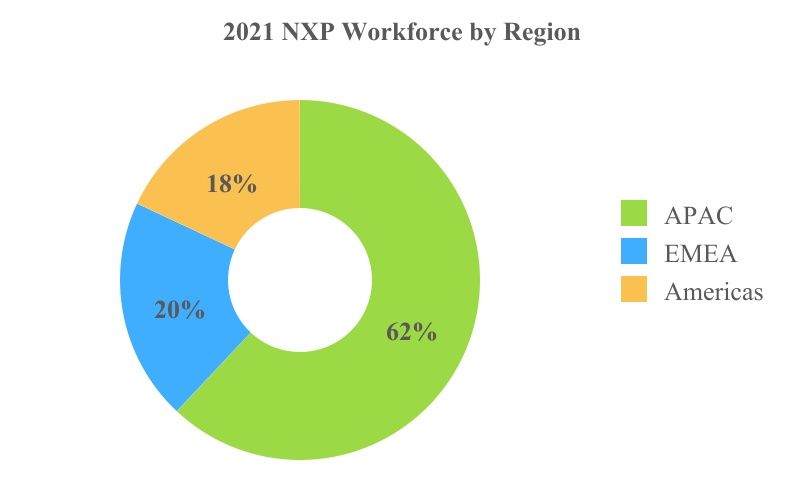
We monitor voluntary attrition closely as a key indicator of employee engagement. This attrition is also compared to industry norms to ensure we are effectively retaining our employees throughout the world. During calendar 2021, our voluntary attrition rate was 7.9% for IDL, 18.4% for our DL population and 12.1% of the combined employee population. In 2021, NXP saw a year-over-year increase in employee turnover. To mitigate voluntary turnover, we launched several initiatives centered around retention for strategic roles and top-performing talent, as well as broad-based programs targeting all employees.
Diversity, Equality and Inclusion
At NXP, we value diversity, equality and inclusion, and respect the unique talents, experiences, backgrounds, cultures and ideas of our team members. Our diversity, equality and inclusion approach is centered around ensuring leadership commitment and accountability; building and sustaining a qualified and diverse talent pipeline and equitable processes; and fostering an inclusive culture and a sense of belonging to attract and retain the best talent. NXP continues to contribute resources focused on driving cultural awareness across the Company, which is spearheaded by NXP’s Head of Diversity, Equality and Inclusion. The Compensation Committee of our Board provides oversight of our policies, programs and initiatives focusing on human capital management, including workforce diversity, equality and inclusion.
NXP Employee Resource Groups (ERGs) enable our culture and inclusive work environment, as we work to ensure diversity of thought throughout our company and bring unique perspectives and skills to help those in our communities. Today, we have eight primary ERGs, with representation in Asia, Europe, Mexico and the United States. Membership and participation in ERGs is open to all employees, and global engagement is encouraged. To track the progress of our growing ERGs, we measure membership, programming and employee engagement for each group.
To support our diversity, equality and inclusion approach and demonstrate our commitment to transparency and accountability, we have established the following aspirational 2025 diversity, equality and inclusion stretch goals to improve global gender representation and minority race and ethnicity representation in the United States.
| 2025 Goals | ||||||||||||||
| 40% Women in Overall Global Workforce | 30% Women in Global Indirect Labor Workforce | 20% Women in Executive Positions* | 25% Women in R&D Positions | 50% Minority Representation in the United States* |
| 2021 Progress towards Goals | ||||||||||||||
| 37% | 24% | 13% | 17% | 49% |
- Executive positions are defined as individuals at the level of Vice President and above. Minority representation includes employees who self-identify as Asian, Hispanic or Latino, Black or African American, American Indian or Alaska Native, Pacific Islander or two or more races. We also include within minority representation employees who have not self-identified an ethnicity.
Corporate Values and Employee Engagement
NXP’s values are the foundation of what makes us an extraordinary company. Engaging, developing, and caring for our team members is how we create long-term value for our stakeholders. Our values guide our decision making and speak to how we operate, our inherent beliefs and how we engage and respect each employee’s contribution, and push the boundaries of creativity and innovation. We hold ourselves accountable to our values by including them in our performance evaluation process.

To assess and improve employee engagement, NXP regularly conducts our global Winning Culture Survey. We invite employees to share their level of agreement on a variety of factors, including engagement, strategy, culture, leadership, continuous improvement, collaboration, execution, accountability, work environment and support.
Talent Development
NXP is committed to continuous learning, including mechanisms for learning from others, on-the-job development experiences, and formal training. Using a blend of internally designed and externally sourced courses and learning resources, we offer our employees around the globe a variety of training programs that provide real-time learning opportunities in support of key business processes, requirements and initiatives. We also provide a library of on-demand skills development and microlearning resources to all our employees.
We work to create developmental opportunities for our employees through stretch assignments, project roles, cross-functional interactions, cross-geography engagements, and both temporary and longer-term job rotations – all of which are used to stimulate core skill and leadership competency development, provide on-the-job learning experience, and fuel employee career growth. We also believe that our commitment to our internship programs and university partnerships are a key contributor to developing the new generation of talent, including engineers in our industry and company, and provide a pipeline of recent college graduates into our talent pool.
Compensation and Benefits
We provide total rewards packages that include market competitive base salary, as well as opportunities to earn short-term cash incentives and equity-based incentives. In addition, in an effort to meet the specific needs of our employees and their families, we offer benefits programs, which vary by country/region, and include an Employee Stock Purchase Plan, retirement programs, healthcare and insurance benefits, allowances, paid time off, family leave, flexible work arrangements, and other employee assistance programs.
NXP’s compensation programs are designed to attract the best talent and drive performance across all areas of our diverse workforce. NXP is committed to managing all reward-based compensation programs, including merit increases, incentive program payouts and long-term incentive awards, to deliver on our pay-for-performance philosophy. Rewarding performance is a critical foundation for our overall compensation program.
We also have developed a proactive process to evaluate each reward-based compensation program in real time and provide leaders with feedback to ensure fair and equitable compensation while decisions are being made. NXP relies on third-party data to establish fair, equitable and competitive compensation and benefits programs. We then empower leaders to recognize both individual and team accomplishments through a variety of compensation programs.
Employee Health and Safety
We are committed to the safety of our employees, and we continuously assess safety risks globally to ensure workplace risks are mitigated. We are certified to ISO 45001, the occupational health and safety management system, and have developed robust safety programs and initiatives to safeguard our workforce.
With the unprecedented COVID-19 pandemic ongoing over the last two years, the health and safety of our employees has continued to be of utmost importance, and we have effectively managed our safety programs over this period. For example, employees who are required to be physically at one of our locations are protected with increased safety and site entry requirements, many of which exceed local requirements. We have hosted several successful vaccination drives in some countries where our employees live and work. During this period we have also transitioned many of our employees to remote working partially or full-time to protect those who must be on-site to do their jobs. Additionally, as external conditions improve, we have developed a global flexible work arrangement program which offers eligible employees the ability to work a combination of on-site and remotely. These remote work arrangements reduce the individual site population to further protect employees who must work on-site. We believe the combination of our remote work transitions and our robust on-site safety programs and initiatives has significantly mitigated the safety risks for all our workforce.
Employee Representation
A number of our employees are members of a labor union and in various countries, local law requires us to inform and consult with employee representatives on matters relating to labor conditions. We have not experienced any material strikes or labor disputes in the past and consider our employee relations to be good.
We also have employee-lead worker’s councils in various countries that provide input and oversight to many of the decisions made on behalf of employees.
Climate and Environment
As part of our commitment to reducing emissions and conserving the earth’s natural resources, environment is a key pillar in our Sustainability Policy and strategy. We set company-wide environmental targets to optimize our resource use and consumption, minimize waste and continuously improve. Our targets are set periodically, and we currently are in the process of evaluating and updating focused mid- and long-term targets on carbon footprint reduction, renewable energy consumption, and water and waste recycling.
See Part I, Item 1A. Risk Factors for a discussion of potential global environmental risks that may adversely affect our business operations, such as climate change or natural disasters.
Our commitment to enable a smarter, more sustainable world goes beyond our operations, and includes innovating product solutions that support the sustainability goals and objectives of our stakeholders. We monitor developments of global legislation by tracking current discussions, timelines, and the likelihood of new implementations. During the design and development phase of our new product solutions, we emphasize these potential requirements to coincide with new product introductions. This proactively timed approach supports the success of sustainable green technology for long- and short-term impact of NXP and our customers.
Additional information about our environment strategy, targets and metrics is included in our Corporate Sustainability Report, and can be found on our website1.
Available Information
Our main corporate website address is www.nxp.com. Copies of our filings with the United States Securities and Exchange Commission (SEC), including our annual report on Form 10-K, quarterly reports on Form 10-Q, current reports on Form 8-K, and amendments to reports filed pursuant to Sections 13(a) and 15(d) of the Securities Exchange Act of 1934, as amended (the “Exchange Act”), are available free of charge on our website within the "Investors Relations" section as soon as reasonably practicable after having been electronically filed or furnished to the SEC. All SEC filings are also available at the SEC's website at www.sec.gov. The information contained on these websites as referenced is not incorporated by reference into this filing. Further, the Company’s references to website URLs are intended to be inactive textual references only.
Previous: Cover and table of contents · Next: Item 1A. Risk Factors