 filings.tools
Item 4. Information on the Company
46K characters. Original on sec.gov · Markdown
Item 4. Information on the Company
| --- | --- |
A. History and Development of the Company
Name and History
Our legal name is NXP Semiconductors N.V. and our commercial name is “NXP” or “NXP Semiconductors”.
We were incorporated in the Netherlands as a Dutch private company with limited liability (besloten vennootschap met
Table of Contents
beperkte aansprakelijkheid) under the name KASLION Acquisition B.V. on August 2, 2006, in connection with the sale by Philips of 80.1% of its semiconductor business to the “Private Equity Consortium”. Initially, the Private Equity Consortium invested in our Company through KASLION Holding B.V., a Dutch private company with limited liability.
On May 21, 2010, we converted into a Dutch public company with limited liability (naamloze vennootschap) and changed our name to NXP Semiconductors N.V. Concurrently, we amended our articles of association in order to effect a 1-for-20 reverse stock split of our shares of common stock.
On August 5, 2010, we made an initial public offering of 34 million shares of our common stock and listed our common stock on the NASDAQ Global Select Market.
In 2014, the last members of the Private Equity Consortium sold their remaining shares of our common stock. Representatives of certain members of the Private Equity Consortium continue to serve on our Board of Directors.
On March 2, 2015, NXP announced that the company has entered into a definitive agreement under which NXP will merge with Freescale Semiconductor, Ltd. (Freescale).
Under the terms of the agreement, Freescale shareholders will receive $6.25 in cash and 0.3521 of an NXP ordinary share for each Freescale common share held at the close of the transaction. The purchase price implies a total equity value for Freescale of approximately $11.8 billion (based on NXP’s closing stock price as of February 27, 2015) and a total enterprise value of approximately $16.7 billion including Freescale’s net debt. The transaction is expected to close in the second half of calendar 2015. NXP intends to fund the transaction with $1.0 billion of cash from its balance sheet, $1.0 billion of new debt and approximately 115 million of NXP ordinary shares. Post transaction, Freescale shareholders are expected to own approximately 32 percent of the combined company. The transaction has been unanimously approved by the boards of directors of both companies and is subject to regulatory approvals in various jurisdictions and customary closing conditions, as well as the approval of NXP and Freescale shareholders. Upon consummation, we expect to account for the merger under the acquisition method of accounting in accordance with Financial Accounting Standards Board Accounting Standard Topic 805, Business Combinations, with NXP treated as the accounting acquirer.
We are a holding company whose only material assets are the direct ownership of 100% of the shares of NXP B.V., a Dutch private company with limited liability (besloten vennootschap met beperkte aansprakelijkheid).
Our corporate seat is in Eindhoven, the Netherlands. Our principal executive office is at High Tech Campus 60, 5656 AG Eindhoven, the Netherlands, and our telephone number is +31 40 2729233. Our registered agent in the United States is NXP Semiconductors USA, Inc., 411 East Plumeria Drive, San Jose, CA 95134, United States of America, phone number +1 408 5185400.
Reporting Segments
NXP is organized into two market oriented reportable segments, High Performance Mixed Signal (“HPMS”) and Standard Products (“SP”). Corporate and Other represents the remaining portion (or “segment”) to reconcile to the Consolidated Financial Statements. You can find a description of each of our reportable segments below. We also have a manufacturing group that manages our manufacturing and supply chain activities. Prior to January 1, 2013 we had three reportable segments: HPMS, SP and Manufacturing Operations. During the first quarter of 2013 we moved our General Purpose Logic Product Line from our HPMS segment (Portable & Computing) to our SP segment; and our NXP software product line to our HPMS Segment (Industrial & Infrastructure) from Corporate and Other. We also determined in the fourth quarter of 2013 that Manufacturing Operations no longer meets the criteria for separate reporting as a reportable segment and consequently, its results are now reflected within Corporate and Other. As a result of the above changes to the composition of our operating and reportable segments, corresponding information for prior periods have been reclassified to conform to the current period presentation.
B. Business Overview
Our Company
We are a global semiconductor company and a long-standing supplier in the industry, with over 50 years of innovation and operating history. We provide leading High Performance Mixed Signal and Standard Product solutions that leverage our deep application insight and our technology and manufacturing expertise in security, interface, RF, analog, power management and digital processing products. Our product solutions are used in a wide range of applications such as: automotive, identification, wireless infrastructure, lighting, industrial, mobile, consumer and computing. We engage with leading original equipment manufacturers (“OEMs”) worldwide and 68% of our revenue in 2014 was derived from Asia Pacific (excluding Japan).
As of December 31, 2014, we had 27,884 full-time equivalent employees located in over 20 countries, with research and development activities in Asia, Europe and the United States, and manufacturing facilities in Asia and Europe. For the year ended December 31, 2014, we generated revenue of $5,647 million.
Markets, applications and products
We sell two categories of products, High Performance Mixed Signal product solutions and Standard Products. The first category, which consists of highly differentiated application-specific High Performance Mixed Signal semiconductors and system solutions, accounted for 77% of our total product revenue in 2014. We believe that High Performance Mixed Signal is an attractive market in terms of growth, barriers to entry, relative business and pricing stability and capital intensity. The second of our product categories, Standard Products, accounted for 23% of our total product revenue in 2014, and consists of devices that can be incorporated in many different types of electronics equipment and that are typically sold to a wide variety of customers, both directly and through distributors. Manufacturing cost, supply chain efficiency and continuous improvement of manufacturing processes drive the profitability of our Standard Products.
Reorganization of HPMS segment
Effective January 1, 2015, NXP has reorganized the HPMS segment from the four business lines: Automotive, Identification, Infrastructure & Industrial and Portable & Computing into the following four business lines: Automotive, Secure Identification Solutions, Secure Connected Devices and Secure Interfaces and Power.
Table of Contents
High Performance Mixed Signal
We focus on developing products and system and sub-system solutions that are innovative and allow our customers to bring their end products to market more quickly. Our products, particularly our application system and sub-system solutions, help our customers design critical parts of their end products and thus help many of them to differentiate themselves based on feature performance, advanced functionality, cost or time-to-market.
We leverage our technical expertise in the areas of RF, analog, power management, interface, security technologies and digital processing across our priority applications markets. Our strong RF capabilities are utilized in our high performance RF for wireless infrastructure and industrial applications, television tuners, car security and car radio products and contactless identification products. Our power technologies and capabilities are applied in our lighting products, AC-DC power conversion and audio power products, while our ability to design ultra-low power semiconductors is used in a wide range of our products including our consumer, mobile, identification, healthcare products and our microcontrollers. Our high-speed interface design skills are applied in our interface products business, and our security solutions are used in our identification, microcontroller, telematics and smart metering products and solutions. Finally, our digital processing capabilities are used in our Auto DSPs, the products leveraging our Coolflux ultra-low power DSPs, such as in our hearing aid business, and our microcontroller based products. In addition, our digital processing knowledge is used to design High Performance Mixed Signal solutions that leverage other suppliers’ digital processing products.
The High Performance Mixed Signal segment is organized into four business lines named: Automotive, Identification, Infrastructure & Industrial and Portable & Computing. The below table provides an overview of the key applications per business line, the leading market positions and our key customers.
| Automotive | Identification | Infrastructure & Industrial | Portable & Computing | |||||
| Key applications | • Car access & immobilizers • In vehicle networking • Car entertainment • Telematics • ABS • Transmission/ throttle control • Automotive Lighting | • Secure identity • Secure transactions • Tagging & authentication | • Wireless base stations • Satellite & CATV infra • Radar • Power supplies • Lighting • Personal Healthcare • TV & Set-top boxes • Mobile Handsets | • Mobile handset • Tablet • Monitor • Personal computer • Smart metering • White goods & home appliances • Pachinko machines • Medical • Industrial • Consumer | ||||
| Selected market leading positions | • #1 Can/LIN/ Flex Ray in-vehicle networking • #1 passive keyless entry/ immobilizers • #1 car radio • #2 audio amplifiers | • #1 e-Government • #1 Transport & Access management • #1 Banking • #1 NFC | • #2 in RF Power | • # 3 in sensor hub | ||||
| Key OEM and electronic manufacturing services (EMS) end customers | • Becker • Bosch • Clarion • Continental • Delphi • Fujitsu Ten • Hyundai • Mitsubishi • Panasonic • Visteon | • Apple • Bundesdruckerei • Gemalto • Giesecke • Kona • Oberthur • Samsung • Smartrac • Sony • Wuhan/Tianyu Info | • Alcatel • BBK • Ericsson • HTC • Huawei • NSN • Philips • Samsung • Sony • ZTE | • Apple • Continental • Foxconn • Huawei • Inventec • Samsung • Vasco • Wistron • ZLG Electronics • ZTE |
The list above, some of whom are supplied by distributors, in alphabetical order, represents our key OEM, ODM and electronic manufacturing services end customers based on 2014 revenue. Key distributors across these applications are Arrow, Avnet, Edom, Vitec and WPG.
Automotive****. In the automotive market we are a leader in in-vehicle networking, car passive keyless entry and immobilization, and car radio and car audio amplifiers. We also have an emerging business in car solid state lighting drivers and are investing in growth areas, such as Car2X communication products which relate to assisted and autonomous driving.
In the can/LIN/FlexRay in-vehicle networking market, we are the market leader, having played a defining role in setting the can/LIN and more recently FlexRay standards. We are a leading supplier to major OEMs and continue to drive new system concepts, such as partial networking for enhanced energy efficiency. In the car access and immobilizers market, we lead the development of new passive keyless entry/start and two-way key concepts with our customers and, as a result, we are a key supplier to almost all car OEMs for those products. We are the market leader in AM/FM car radio chip sets.
Our leadership in mid- and high-end car radio is driven by excellent reception performance, whereas in the low-end and after-market car radio, our leadership is driven by our one-chip radio solutions that offer ease of implementation and low cost of ownership. In digital reception, we have developed multi-standard radios based on our software-defined radio implementation. Based on these software-defined radio technology, we are developing Car2X communication products. In addition, we provide class-AB and class-D audio amplifiers and power analog products for car entertainment. We leverage our proprietary processes for automotive, high-voltage, RF and non-volatile processes as well as our technology standards and leading edge security IP developed by our identification business, to deliver our automotive solutions. We are compliant with all globally relevant automotive quality standards (such as ISO/TS16949 and VDA6.3).
Table of Contents
In 2013, we made (together with Cisco), a strategic investment in Cohda Wireless, an equipment vendor in the Intelligent Transport Systems (ITS) market with whom we co-operate for Car2X solutions. In December 2013, we announced a joint venture with Datang Telecom, targeting the China domestic hybrid and electrical car market which became active in April 2014. In December 2013, we also announced the intended sale of our Telematics Module business to Telit communications which was closed end of March 2014.
For the full year 2014, we had High Performance Mixed Signal revenue of $1,144 million in automotive applications, compared to $1,019 million in 2013, which represents a 12.3% year over year increase. According to Strategy Analytics, the total market for automotive semiconductors was $27.7 billion in 2013, and projects it will grow at a compounded annual growth rate of 7.4% between 2013 and 2017. According to Strategy Analytics’ estimates we were the fifth largest supplier of automotive semiconductors worldwide in 2013.
Identification****. Based on revenue in 2014, NXP continues to have the leading position in the overall identification chip market segment. We address all segments of the market, except for the commodity SIM market. We are the largest supplier world-wide of ICs for e-government, transportation and access management.
NXP is a global market segment leader in the EMV migration wave in which credit and debit cards around the world are transitioning from non-secure magnetic stripes to secure chips.
Our MIFARE products are widely used in worldwide e-passport projects and public transport systems that have adopted electronic ticketing.
We have led the development and standard setting of Near Field Communications (NFC), which is a rapidly growing standard for secure short-range connectivity. In combination with our Secure Element portfolio, this has given us a leadership position in Mobile wallets and Mobile payment.
Our leadership in the identification market is based on the breadth of our product portfolio underpinned by the successful launch of new product platforms led by the strength of our security and our end-to-end system contactless read speed performance.
Key growth drivers will be the further adoption of security ICs in governmental documents and payment cards, the adoption of new security standards, the need for multi-application solutions in existing smart card markets and the increasing needs of anti-counterfeiting solutions.
For the full year 2014, we had High Performance Mixed Signal revenue of $1,469 million in identification applications, compared to $1,297 million in 2013, which represents a 13.3% year over year growth. According to ABI Research, the market size for identification ICs was $3.3 billion in 2013, and is expected to grow at a compounded annual rate of 14% to $5.6 billion in 2017.
Infrastructure and Industrial****. We have a leading market position in high-performance radio frequency solutions and have a broad portfolio in lighting drivers and strong positions in selected niche segments of the AC-DC power conversion and personal healthcare markets. In addition, we have an emerging business in low power connectivity and mobile audio. Our overall revenue in these businesses was $883 million in 2014 versus $729 million in 2013, which represents an increase of 21.1% year over year.
Our leading high-performance radio frequency business mainly provides RF front-end solutions for markets, such as mobile base stations, wireless connectivity, satellite and CATV infrastructure and receivers, industrial applications, and to a lesser extent addresses the military and aerospace markets. We have a leading position in RF Power Amplifiers and significant sales in Small Signal RF discretes and RF ICs for mobile, consumer electronics and cable television infrastructure, while we have emerging businesses in RF ICs for mobile base stations and monolithic microwave ICs (“MMICs”). Our leadership is based on our world-class proprietary RF process technologies and technology advancements that drive overall system performance, such as power scaling in mobile base stations. We are engaged with the majority of the largest customers in mobile base stations and in several other application areas. Key growth drivers for our high-performance RF business include infrastructure build-outs driven by the substantial growth in mobile data use and digital broadcast adoption, infrastructure development of developing countries, including China, 4G roll out, and our expansion into new product markets such as wireless communications LNAs and infrastructure MMICs. We estimate that the market for RF Power Amplifiers was $0.8 billion in 2013 and is expected to grow with a compounded annual growth rate of 8.8% till 2017.
Our market strengths are our specialty RF process technology, decades of experience in designing tuners that work under all broadcasting standards and conditions across the world, and our innovations in new broadcasting standards.
In lighting, we have a broad driver portfolio serving all main segments in general lighting applications. Our strength in lighting ICs is based on our leading-edge high-voltage power analog process technologies and system optimization concepts, such as our patented technology to develop sensors-less temperature-controlled LED drivers. The growth of the lighting IC market has been partly driven by government regulations around the world that ban or discourage the use of incandescent light bulbs and encourage or mandate CFL and LED lighting solutions and by energy-savings conscious customers.
Table of Contents
We are a key player in high efficiency AC-DC power conversion ICs for notebook personal computers (our “green chip” solutions). Our strength in AC-DC power conversion is based on our leading edge high-voltage power analog process technologies and engineering capabilities in designing high efficiency power conversion products. Due to worldwide conservation efforts, many countries, states and local governments have adopted regulations that increase the demand for higher power efficiency solutions in computing and consumer applications, especially in power conversion.
Our personal healthcare revenue is generated by our hearing aid products, which leverage our proprietary ultra low power Coolflux DSP, our low power audio IC design capabilities and our magnetic induction radio technology. We design customer-specific ICs for major hearing aid OEMs, and many of these customers fund our product development efforts.
In addition, we have two emerging product areas, one focused on the mobile audio market and the other on the low power connectivity market. Our mobile audio business focuses on smart speaker drivers and leverages many of the same core technologies and competencies as our personal healthcare business. In 2012 we started shipping to a key smart phone OEMs, followed by many other design wins and significant revenue ramp up in 2014. Our low power connectivity business started in 2010 through the acquisition of Jennic, which brought us a portfolio of 802.15.4-based low power connectivity ICs with a broad range of both the Zigbee standard-based as well as proprietary protocol stacks. In November 2014 we entered into a definitive agreement with Quintic to acquire assets and IP, which will add Bluetooth Low Energy to our connectivity portfolio. With this portfolio we target the emerging Internet of Things market, starting with application solutions for smart lighting, smart energy, wireless remote controls & switches and healthcare monitoring.
We also sell software solutions for mobile phones through our NXP Software business.
The NXP Software solutions business develops audio solutions that enable mobile device manufacturers to produce differentiated hand held products that enhance the end-user experience. Our software has been incorporated into over 1 billion mobile devices produced by many of the world’s leading mobile device manufacturers.
Portable and Computing. We are a top three supplier in the fragmented interface market outside Japan and have a strong portfolio in 32-bit ARM microcontrollers. Our overall High Performance Mixed Signal revenue in these businesses was $712 million in 2014, compared to $488 million in 2013, which represents a 45.9% year over year growth.
In microcontrollers, we have a strong position in multi-purpose 32-bit ARM microcontrollers serving a broad array of applications. ARM processor cores have been gaining momentum in the general purpose MCU market during the past few years. Our competitive advantage is based on having been a launching partner for several low power ARM microcontroller cores, our rich portfolio of analog and security IP, which we integrate with the ARM core into a family of microcontroller products, and our distribution leverage based on our ability to offer a full microcontroller software development kit. Our ARM Cortex M0-based products achieve pricing levels that places it squarely in competition with 8-bit microcontrollers, while offering better performance in terms of processing speed and system power consumption, expanding the addressable market for 32-bit ARM microcontrollers at the expense of 8-bit ARM microcontrollers. Gartner 1 estimates the worldwide market for Microcontrollers 32-bit to be $5.7 billion in 2013, and expects a compounded annual growth rate of 7.6% between 2013 and 2017 2.
The interface products market is highly fragmented with niche markets around each of the established interface standards. Our products address many interface standards and we serve various applications across the mobile, computing, industrial, consumer and automotive markets. We have broad product portfolios in five interface segments, being UARTs and bridges, I 2 C and SPI LED controllers, low power real-time clocks and watch ICs, HDMI switches and transceivers, and display port multiplexers. Our core competencies are the design of high speed interfaces, high voltage design needed for LED and LCD drivers, ultra low power design for real-time clocks and watch ICs, and our ability to engage with leading OEMs in defining new interface standards and product designs. While we successfully engage with leading OEMs to drive our innovation roadmaps, we generate a large part of our revenue by subsequently selling these products to a very broad customer base, which we serve through our distribution channel. We are engaged in development activities and standard setting initiatives with many of the innovation leaders in each of these markets. Key growth drivers will be the adoption rate of new high-speed interface standards such as display port and USB, and application specific interface products for the mobile market. According to Gartner, the worldwide Interface IC market is projected to grow at a 4.5% compounded annual rate between 2013 and 2017, from a revenue base of $1.5 billion in 2013 2.
| 1 | The Gartner Report(s) described herein, (the “Gartner Report(s)”) represent(s) data, research opinion or viewpoints published, as part of a syndicated subscription service, by Gartner, Inc. (“Gartner”), and are not representations of fact. Each Gartner Report speaks as of its original publication date (and not as of the date of this Filing) and the opinions expressed in the Gartner Report(s) are subject to change without notice. |
|---|
| 2 | Source: Gartner, Inc., Semiconductor Forecast Database, 4Q14 Update, December, 2014. |
|---|
Table of Contents
Standard Products
Our Standard Products business supplies a broad range of standard semiconductor components, such as small signal discretes, power discretes, protection and signal conditioning devices and standard logic devices, which we largely produce in dedicated in-house high-volume manufacturing operations. Our portfolio consists of a large variety of catalog products, using widely-known production techniques, with characteristics that are largely standardized throughout the industry as well as leading discrete solutions especially in the field of ESD protection / EMI filtering and low loss rectification and power switching. Our Standard Products are often sold as separate components, but in many cases, are used in conjunction with our High Performance Mixed Signal solutions, often within the same subsystems. Further, we are able to leverage customer engagements where we provide standard products devices, as discrete components, within a system to identify and pursue potential High Performance Mixed Signal opportunities.
Our products are sold both directly to OEMs as well as through distribution, and are primarily differentiated on cost, packaging type and miniaturization, and supply chain performance. Alternatively, our innovative products include “design-in” products, which require significant engineering effort to be designed into an application solution. For these products, our efforts make it more difficult for a competitor to easily replace our product, which makes these businesses more predictable in terms of revenue and pricing than is typical for standard products.
Our key product applications, markets and customers are described in the table below.
| Key Products | • SS Transistors and Diodes • SS MOS • Power MOS • Bipolar Power Transistors • Thyristors • Rectifiers • Interface protection devices • General Purpose Logic | |
| Key OEM and electronic manufacturing services (EMS) end customers | • Apple • Asustek • Bosch • Continental • Delphi • Delta Electronics • Huawei • LGE • Philips • Samsung |
The list above, some of whom are supplied by distributors, in alphabetical order, represents our key OEM and electronic manufacturing services end customers based on 2014 revenue. Key distributors across these applications are Arrow, Avnet, Future and WPG.
In 2014, our Standard Products business generated net revenue of $1,275 million, compared to $1,145 million in 2013, which represents a 11.4% year over year growth.
We are the number one global supplier of small-signal discretes with one of the broadest product portfolios in the industry. We have a strong position due to our strong cost competitiveness, supply chain performance, leverage of our OEM relationships and a broadening portfolio. We are focusing on expanding our share of higher margin products in this business. In addition, we are also building a small signal MOSFET product line, which leverages our small signal transistors and diodes packaging operations and strong customer relationships. In addition to our small signal discretes products, we have a Power MOSFET product line, which is focused on the low-voltage segment of the market. The majority of our revenue in Power MOSFETs is to automotive customers.
We have introduced a new range of Automotive Power MOSFET products in our Trench 6 manufacturing process. Finally, we have small bipolar power, thyristor and rectifier product lines, which are focused on specific applications, such as white goods and power supplies, and are sold as part of our overall High Performance Mixed Signal application solutions. We estimate that the market for discretes, excluding RF & Microwave, was $18 billion in 2013 and is expected to grow at a compounded annual rate of 5%, between 2013 and 2017.
Next to discrete semiconductors, the Standard Products segment also includes Standard Logic ICs. We have the number two position in Standard Logic IC markets 3 based on worldwide revenue for 2013, which we leverage in a large number of our High Performance Mixed Signal solutions. We offer several product families for low-voltage applications in communication equipment, personal computers, personal computer peripherals and consumer and portable electronics. Our 3V and 5V families hold a leading share of the logic market. We continue to expand into the higher margin product range in this business by expanding, among others, our switches and translators (or custom logic) portfolio and optimizing our manufacturing. Gartner sizes the worldwide Standard Logic market at $1.5 billion in 2013, and is estimated to grow with compound annual rate of 2.9% between 2013 and 2017 2.
| 3 | Source: Gartner, Inc., Market Share, Semiconductor Applications, Worldwide, 2013, March 2014 |
|---|
Table of Contents
Corporate and Other
We manufacture integrated circuits and discrete semiconductors through a combination of wholly owned manufacturing facilities, manufacturing facilities operated jointly with other semiconductor companies and third-party foundries and assembly and test subcontractors. Our manufacturing operations primarily focus on manufacturing and supplying products to our High Performance Mixed Signal and Standard Products businesses. We manage our manufacturing assets together through one centralized organization to ensure we realize scale benefits in asset utilization, purchasing volumes and overhead leverage across businesses.
In the future, we expect to outsource an increased part of our internal demand for wafer foundry and packaging services to third-party manufacturing sources in order to increase our flexibility to accommodate increased demand mainly in our High Performance Mixed Signal and to a lesser extent in Standard Products businesses.
The manufacturing of a semiconductor involves several phases of production, which can be broadly divided into “front-end” and “back-end” processes. Front-end processes take place at highly complex wafer manufacturing facilities (called fabrication plants or “wafer fabs”), and involve the imprinting of substrate silicon wafers with the precise circuitry required for semiconductors to function. The front-end production cycle requires high levels of precision and involves as many as 300 process steps. Back-end processes involve the assembly, test and packaging of semiconductors in a form suitable for distribution. In contrast to the highly complex front-end process, back-end processing is generally less complicated, and as a result we tend to determine the location of our back-end facilities based more on cost factors than on technical considerations.
We primarily focus our internal and joint venture wafer manufacturing operations on running proprietary specialty process technologies that enable us to differentiate our products on key performance features, and we generally outsource wafer manufacturing in process technologies that are available at third-party wafer foundries when it is economical to do so. In addition, we increasingly focus our in-house manufacturing on our competitive 8-inch facilities, which predominantly run manufacturing processes in the 140 nanometer, 180 nanometer and 250 nanometer process nodes, and have concentrated the majority of our manufacturing base in Asia. This focus increases our return on invested capital and reduces capital expenditures.
Our front-end manufacturing facilities use a broad range of production processes and proprietary design methods, including CMOS, bipolar, bipolar CMOS (“BiCMOS”) and double-diffused metal on silicon oxide semiconductor (“DMOS”) technologies. Our wafer fabs produce semiconductors with line widths ranging from 140 nanometers to 3 microns for integrated circuits and 0.5 microns to greater than 4 microns for discretes. This broad technology portfolio enables us to meet increasing demand from customers for system solutions, which require a variety of technologies.
Our back-end manufacturing facilities test and package many different types of products using a wide variety of processes. To optimize flexibility, we use shared technology platforms for our back-end assembly operations. Most of our assembly and test activities are maintained in-house. Finally, a number of our High Performance Mixed Signal products enjoy significant packaging cost and innovation benefits due to the scale of our Standard Products business, which manufactures tens of billions of units per year.
Table of Contents
The following table shows selected key information with respect to our major front-end and back-end facilities:
| Site | Ownership | Wafer sizes used | Line widths used (vm) | Technology | ||||||||||
| (Microns) | ||||||||||||||
| Front-end | ||||||||||||||
| Singapore(1) | 61.2 | % | 8” | 0.14-0.25 | CMOS | |||||||||
| Jilin, China | 100 | % | 5” | >4 | Bipolar | |||||||||
| Nijmegen, the Netherlands | 100 | % | 8” | 0.14-0.80 | CMOS, BiCMOS, LDMOS | |||||||||
| Hamburg, Germany | 100 | % | 6”/8” | 0.5-3.0 | Discretes, Bipolar | |||||||||
| Manchester, United Kingdom | 100 | % | 6” | 0.5 | Power discretes | |||||||||
| Back-end(2) | ||||||||||||||
| Kaohsiung, Taiwan | 100 | % | — | — | Leadframe-based packages and ball grid arrays | |||||||||
| Bangkok, Thailand | 100 | % | — | — | Low-pin count leadframes | |||||||||
| Guangdong, China | 100 | % | — | — | Discrete devices | |||||||||
| Seremban, Malaysia | 100 | % | — | — | Discrete devices | |||||||||
| Cabuyao, Philippines | 100 | % | — | — | Power discretes, sensors and RF modules processes |
| (1) | Joint venture with TSMC; we are entitled to 60% of the joint venture’s annual capacity. |
|---|
| (2) | In back-end manufacturing we entered into a joint venture with ASE in Suzhou (ASEN), in which we currently hold a 40% interest. |
|---|
We use a large number of raw materials in our front- and back-end manufacturing processes, including silicon wafers, chemicals, gases, lead frames, substrates, molding compounds and various types of precious and other metals. Our most important raw materials are the raw, or substrate, silicon wafers we use to make our semiconductors. We purchase these wafers, which must meet exacting specifications, from a limited number of suppliers in the geographic region in which our fabrication facilities are located. At our wholly owned fabrication plants, we use raw wafers ranging from 5 inches to 8 inches in size. Our SSMC wafer fab facility, which produces 8 inch wafers, is jointly owned by TSMC and ourselves. We are leveraging our experience in that fab facility in optimizing our remaining wholly owned Nijmegen and Hamburg wafer fabs. Our other remaining fabs are small and are focused exclusively on manufacturing power discretes. Emerging fabrication technologies employ larger wafer sizes and, accordingly, we expect that our production requirements will in the future shift towards larger substrate wafers.
We typically source our other raw materials in a similar fashion as our wafers, although our portfolio of suppliers is more diverse. Some of our suppliers provide us with materials on a just-in-time basis, which permits us to reduce our procurement costs and the negative cash flow consequences of maintaining inventories, but exposes us to potential supply chain interruptions. We purchase most of our raw materials on the basis of fixed price contracts, but generally do not commit ourselves to long-term purchase obligations, which permits us to renegotiate prices periodically.
In addition, on a limited basis, we also produce and sell wafers and packaging services to our divested businesses in order to support their separation and, on a limited basis, their ongoing operations. As these divested businesses develop or acquire their own foundry and packaging capabilities, our revenue from these sources is declining. Our agreement with DSPG expired in December 2010 (although we had an ongoing obligation to supply services relating to certain specialty processes until December 2014), the supplies to ST-Ericsson have effectively been terminated except for a small number of identified products. The former agreement with Trident Microsystems was converted into two separate agreements with Entropic and Sigma after Trident’s bankruptcy. The agreement with IDT is the result of the sale of our high-speed data-converter activity to IDT.
Sales, Marketing and Customers
We market our products worldwide to a variety of OEMs, ODMs, contract manufacturers and distributors. We generate demand for our products by delivering High Performance Mixed Signal solutions to our customers, and supporting their system design-in activities by providing application architecture expertise and local field application engineering support. We have 36 sales offices worldwide.
Our sales and marketing teams are organized into six regions, which are EMEA (Europe, the Middle East and Africa), the Americas, Japan, South Korea, Greater China and Asia Pacific. These sales regions are responsible for managing the customer relationships, design-in and promotion of new products. We seek to further expand the presence of application engineers closely supporting our customers and to increase the amount of product development work that we can conduct jointly with our leading customers. Our web-based marketing tool is complementary to our direct customer technical support.
Table of Contents
Our sales and marketing strategy focuses on deepening our relationship with our top OEMs and electronic manufacturing service customers and distribution partners and becoming their preferred supplier, which we believe assists us in reducing sales volatility in challenging markets. We have long-standing customer relationships with most of our customers. Our 10 largest OEM end customers, some of whom are supplied by distributors, in alphabetical order, are Apple, Bosch, Continental, Gemalto, Giesecke/Devrient, Huawei, Kona, NSN, Panasonic and Samsung. When we target new customers, we generally focus on companies that are leaders in their markets either in terms of market share or leadership in driving innovation. We also have a strong position with our distribution partners, being the number two semiconductor supplier (other than microprocessors) through distribution worldwide. Our 3 largest distribution partners are Arrow, Avnet and WPG.
Our revenue is the sum of our direct sales to original equipment manufacturers, or OEMs, plus our distributors’ resale of NXP products. Two distributors accounted for more than 10% of total 2014 revenue: WPG accounted for 13% of our revenue in 2014, 11% in 2013 and 12% in 2012. Avnet accounted for 13% of our revenue in 2014. No other distributor accounted for more than 10% of our revenue in 2014, 2013 or 2012. No individual OEM for which we had direct sales to accounted for more than 10% of revenue in 2014, 2013 or 2012.
Research and Development, Patents and Licenses, etc.
See the discussion set forth under Part I, Item 5C. Research and Development, Patents and Licenses, etc.
Competition
We compete with many different semiconductor companies, ranging from multinational companies with integrated research and development, manufacturing, sales and marketing organizations across a broad spectrum of product lines, to “fabless” semiconductor companies, to companies that are focused on a single application market segment or standard product. Most of these competitors compete with us with respect to some, but not all, of our businesses. None of our competitors have operations across all of our business lines.
Our key competitors in alphabetical order include Analog Devices Inc., Atmel Corporation, Entropic Communications Inc., Fairchild Semiconductors International Inc., Freescale, Infineon, Linear Technology Corporation, Maxim Integrated Products, Inc., MaxLinear, Renesas, ON Semiconductor Corporation, Power Integrations Inc., ROHM Co., Ltd., Silicon Laboratories Inc., STMicroelectronics and Texas Instruments Incorporated.
The basis on which we compete varies across market segments and geographic regions. Our High Performance Mixed Signal businesses compete primarily on the basis of our ability to timely develop new products and the underlying intellectual property and on meeting customer requirements in terms of cost, product features, quality, warranty and availability. In addition, our High Performance Mixed Signal system solutions businesses require in-depth knowledge of a given application market in order to develop robust system solutions and qualified customer support resources. In contrast, our Standard Products business competes primarily on the basis of manufacturing and supply chain excellence and breadth of product portfolio.
Legal Proceedings
The information set forth under the “Litigation” caption of note 17 of our notes to the Consolidated Financial Statements included in Part III, Item 18 of this Report is incorporated herein by reference. For additional discussion of certain risks associated with legal proceedings, see Part I, Item 3D. Risk Factors above.
Environmental Regulation
The information set forth under the “Environmental remediation” caption of note 17 of our notes to the Consolidated Financial Statements included in Part III, Item 18 of this Report is incorporated herein by reference. For additional discussion of certain risks associated with environmental regulation, see Part I, Item 3D. Risk Factors above.
C. Organizational Structure
A list of our significant subsidiaries, including name, country of incorporation or residence and proportion of ownership interest and voting power is provided as “Exhibit 21.1” under Part III, Item 19. Exhibits and is incorporated herein by reference.
Table of Contents
CORPORATE STRUCTURE
The following chart reflects our corporate structure as of December 31, 2014.
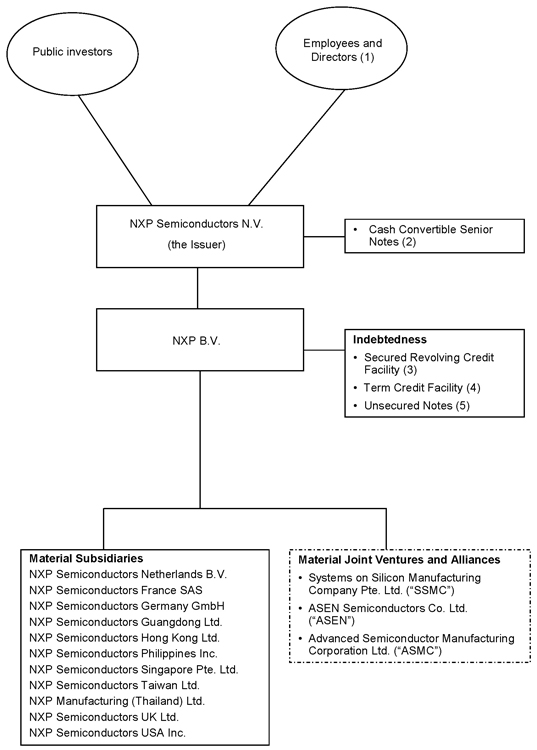
| (1) | For a more detailed description of our management equity stock option plan (“Management Equity Stock Option Plan”) and our Long-Term Incentive Plans as of 2010 see the discussion set forth under “Share Based Compensation Plans” contained in this Report in Part I, Item 6B. Compensation. |
|---|
| (2) | As of December 31, 2014, we had $1,150 million aggregate principal amount of 2019 Cash Convertible Senior Notes outstanding. |
|---|
| (3) | As of December 31, 2014, no borrowings outstanding under the Secured Revolving Credit Facility. |
|---|
| (4) | As of December 31, 2014, we had $791 million aggregate principal amount outstanding under the Term Loans. |
|---|
| (5) | As of December 31, 2014, we had $2,250 million aggregate principal amount of Notes outstanding. |
|---|
Table of Contents
D****. Property, Plant and Equipment
NXP uses 65 sites in over 25 countries with approximately 27,900 full-time employees, 8.5 million square feet of total owned and leased building space of which 5.5 million square feet is owned property.
The following table sets out our principal real property holdings as of December 31, 2014:
| Location | Use | Owned/leased | Building space (square feet) | |||||
| Eindhoven, the Netherlands | Headquarters | Leased | 152,666 | |||||
| Hamburg, Germany | Manufacturing | Owned | 844,899 | |||||
| Nijmegen, the Netherlands | Manufacturing | Owned | 1,845,542 | |||||
| Singapore | Manufacturing | Owned | 746,753 | |||||
| Bangkok, Thailand | Manufacturing | Owned | 561,402 | |||||
| Cabuyao, Philippines | Manufacturing | Owned | 444,080 | |||||
| Kaohsiung, Taiwan | Manufacturing | Owned | 342,971 | |||||
| Manchester, United Kingdom | Manufacturing | Owned | 273,266 | |||||
| Jilin, China | Manufacturing | Leased | 138,856 | |||||
| Guangdong, China | Manufacturing | Leased | 917,272 | |||||
| Seremban, Malaysia | Manufacturing | Owned | 304,309 |
The following is a summary of the terms of our material lease agreements:
Manufacturing in Singapore (SSMC) leases the land at 70 Pasir Ris Drive 1 in Singapore from Jurong Town Corporation for use as a manufacturing facility. The lease commenced on June 1, 1999 for a term of 30 years at an annual rental rate of 1,408,694 Singapore Dollars ($1,113,737), which amount is subject to revision up to, but not exceeding, 5% of the yearly rent for the immediately preceding year, on the anniversary of the lease commencement date. The building has 746,753 square feet of floor space and is owned by us.
We lease 917,272 square feet of manufacturing space through our subsidiary, NXP Semiconductors Guangdong Ltd., at Tian Mei High Tech, Industrial Park, Huang Jiang Town, Dongguan City, Guangdong, China, from Huangjiang Investment Development Company (“Huangjiang”). The lease commenced on October 1, 2003 for a term of 13 years at an annual rental rate of RMB 811,467.
Previous: Item 3. Key Information · Next: Item 4A. Unresolved Staff Comments