 filings.tools
Item 1. BUSINESS
66K characters. Original on sec.gov · Markdown
Item 1. BUSINESS
GENERAL
We are incorporated under the laws of the state of Oklahoma, and our common stock is listed on the NYSE under the trading symbol “OKE.” We are a leading midstream service provider and own one of the nation’s premier NGL systems, connecting NGL supply in the Rocky Mountain, Permian and Mid-Continent regions with key market centers and an extensive network of natural gas gathering, processing, storage and transportation assets. We apply our core capabilities of gathering, processing, fractionating, transporting, storing and marketing natural gas and NGLs through vertical integration across the midstream value chain to provide our customers with premium services while generating consistent and sustainable earnings growth.
Midstream Value Chain
| Legend | 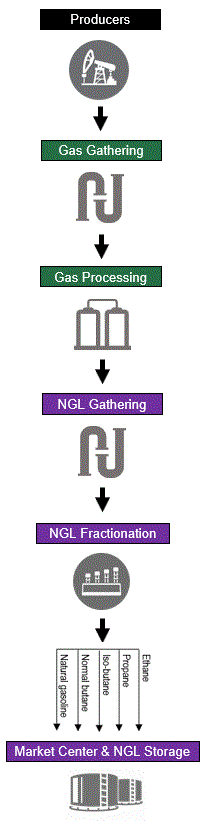 | ||||
| We are connected to supply in natural gas and NGL producing basins and have significant basin diversification, including the Williston, Permian, Powder River and DJ Basins and the STACK and SCOOP areas. In our Natural Gas Gathering and Processing segment, we have more than 3 million dedicated acres in the Williston Basin and approximately 300,000 dedicated acres in the STACK and SCOOP areas. In our Natural Gas Liquids segment, we are the largest NGL takeaway provider in the Williston Basin; Oklahoma, including the STACK and SCOOP areas; Kansas; and the Texas Panhandle. We also have a significant presence in the Permian Basin. | |||||
| Natural Gas Gathering & Processing | |||||
| Natural Gas Liquids | |||||
| Natural Gas Pipelines | |||||
| Raw natural gas is typically gathered at the wellhead, compressed and transported through pipelines to our processing facilities. Most raw natural gas produced at the wellhead contains a mixture of NGL components, such as ethane, propane, iso-butane, normal butane and natural gasoline, which remain in a mixed unfractionated form. | |||||
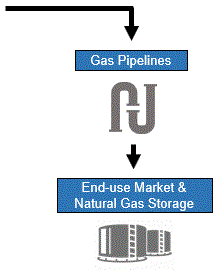
| Once processed, residue natural gas is recompressed and delivered to intrastate and interstate natural gas pipelines. | |||||
| Gathered wellhead natural gas is directed to our processing plants to remove NGLs, resulting in residue natural gas (primarily methane). | |||||
 | |||||
| NGLs extracted at processing plants, both third-party and our own, are then gathered by our NGL gathering pipelines. | |||||
| Gathered NGLs are directed to our downstream fractionators in the Mid-Continent region and Mont Belvieu, Texas, to be separated into purity products. | |||||
| Residue natural gas is transported to storage facilities and end-users, such as large industrial customers, natural gas and electric utilities serving commercial and residential consumers, and international markets through liquefied natural gas exports. | |||||
| Purity products are stored or distributed to our customers, such as petrochemical companies, propane distributors, heating fuel users, ethanol producers, refineries and exporters. | |||||
EXECUTIVE SUMMARY
Business Update and Market Conditions - We operate primarily fee-based businesses in each of our three reportable segments, and our consolidated earnings were approximately 90% fee-based in 2019. Volumes increased across our system in our Natural Gas Gathering and Processing and Natural Gas Liquids segments in 2019, compared with 2018, as a result of our completed capital-growth projects, continued drilling and producer improvements in production due to enhanced completion techniques, offset partially by natural production declines. Since the beginning of 2018, we have completed several capital-growth projects that include NGL pipelines, NGL fractionators, natural gas processing plants and related natural gas and NGL infrastructure, and expect capital expenditures to decrease in 2020 and 2021, compared with 2019. Our NGL projects in the Gulf Coast allow flexibility to add NGL fractionators, NGL storage and, potentially, new export facilities in the future. We expect these projects to meet the needs of producers, natural gas processors and the petrochemical industry that require additional midstream infrastructure to accommodate increasing supply and demand.
We experienced fluctuating NGL location price differentials due to increased supply, increased demand in the Mid-Continent region, infrastructure constraints and slower demand growth in the Gulf Coast due primarily to delays in the startup of petrochemical facilities and constrained NGL export facilities. The Conway-to-Mont Belvieu OPIS price differential for ethane in ethane/propane mix averaged $0.07 per gallon in 2019, compared with $0.15 per gallon in 2018, which resulted in lower earnings from our optimization and marketing activities in our Natural Gas Liquids segment. We expect narrower NGL location price differentials in 2020.
Rocky Mountain Region - We expect to benefit from increased production in this region, which includes the Williston, Powder River and DJ Basins. In our Natural Gas Gathering and Processing segment, gathered and processed volumes increased in 2019, compared with 2018, due primarily to our capital-growth projects, new well connections and increased producer productivity. Our Demicks Lake I natural gas processing plant was placed in service in October 2019, and we expect it to reach its 200 MMcf/d capacity in the first quarter 2020 due to natural gas flaring by producers on our more than 3 million dedicated acres in the Williston Basin. In addition, we completed construction of our Demicks Lake II natural gas processing plant in January 2020. With continued volume growth expected, we are in the process of expanding our Bear Creek plant by 200 MMcf/d, which is expected to be completed in first quarter 2021, and recently announced plans to construct our Demicks Lake III natural gas processing plant, with capacity of 200 MMcf/d and expected completion in the third quarter 2021. Upon completion of these projects, our total processing capacity will be approximately 1.9 Bcf/d in the Williston Basin and is expected to help producers meet North Dakota’s natural gas capture targets and add incremental NGLs to our NGL gathering system.
In our Natural Gas Liquids segment, we announced the completion of our Elk Creek pipeline in December 2019. We are the largest NGL takeaway provider and expect our NGL pipelines to transport more than 240 MBbl/d of NGLs out of this region by the end of the first quarter 2020 due to a combination of growth in volumes from our new and existing processing plants, third-party processing plants and volumes previously transported by rail. In addition, we recently announced an expansion of our Elk Creek pipeline to 400 MBbl/d by adding additional pump stations. The project is expected to be fully completed in the third quarter 2021, with a portion of this incremental capacity available as early as first quarter 2021. In April 2019, we announced a project to extend our Bakken NGL pipeline into an area of the Williston Basin with limited access to NGL pipeline takeaway capacity. This project will provide connectivity for third-party processing plants to key NGL market centers as well as provide additional volumes to our Elk Creek pipeline. To accommodate expected volumes, we are also expanding our Mid-Continent NGL fractionation facilities by 65 MBbl/d and constructing an extension of our Arbuckle II pipeline farther north.
Mid-Continent Region - In our Natural Gas Liquids segment, we are the largest NGL takeaway provider in the STACK and SCOOP areas where volumes continued to increase in 2019, compared with 2018. We expect continued demand for our services from producers that need takeaway capacity for natural gas and NGLs out of this region. In our Natural Gas Gathering and Processing segment, natural gas gathered and processed volumes increased in this region in 2019, compared with 2018, due primarily to new well connections. We expect volumes in this region to decline modestly in 2020, compared with 2019.
Our Natural Gas Pipelines segment transports natural gas from more than 35 natural gas processing plants in Oklahoma. We completed pipeline expansions to provide increased westbound transportation services from the STACK area to multiple interstate pipeline delivery points in western Oklahoma and a 150 MMcf/d eastbound expansion from the STACK and SCOOP areas to an eastern Oklahoma interstate pipeline delivery point.
Permian Basin - We expect our Natural Gas Liquids and Natural Gas Pipelines business segments to continue to benefit from increased production in the Permian Basin from the highly productive Delaware and Midland Basins. In our Natural Gas Liquids segment, we are well-positioned in the Permian Basin through our West Texas LPG pipeline system. Due to our
expansion of the system in the third quarter 2018 and new plant connections, volumes increased in 2019, compared with 2018. We expect volumes to continue to increase on our West Texas LPG pipeline system as our previously announced second and third expansions are completed, which will increase the mainline capacity out of the Permian Basin by 80 MBbl/d in the first quarter 2020 and 40 MBbl/d in the first quarter 2021, respectively, as well as connect our West Texas LPG pipeline with our Arbuckle II pipeline in north Texas. In addition, we recently announced the fourth expansion of our West Texas LPG pipeline system by 100 MBbl/d, which is expected to be completed in the second quarter 2021. These projects are expected to position our West Texas LPG pipeline system for significant NGL volume growth and are backed by long-term acreage and/or plant dedications.
In our Natural Gas Pipelines segment, our Roadrunner joint venture and our WesTex pipeline are well-positioned to serve growth in the Permian Basin. The Roadrunner pipeline connects with our existing natural gas pipeline and storage infrastructure in Texas and, together with our completed WesTex intrastate natural gas pipeline expansion project, creates future opportunities for us to deliver natural gas to Mexico and transport natural gas to other markets in the region.
Gulf Coast - Demand for NGLs is expected to increase at the Mont Belvieu, Texas, NGL market center as new world-scale ethylene production projects, petrochemical plant expansions and NGL export facilities continue to be completed. We are constructing our Arbuckle II pipeline to support expected supply growth and transport NGLs to the Gulf Coast market center and have announced an expansion of our Arbuckle II pipeline to a total capacity of 500 MBbl/d. NGL supply growth and other new NGL pipelines recently completed or being constructed, including our Elk Creek and West Texas LPG pipeline projects, are increasing NGL deliveries to Mont Belvieu, Texas. While we have significant NGL fractionation and storage assets in this area, additional capacity is needed to accommodate expected volume growth. To respond to this need, we are constructing two additional 125 MBbl/d fractionators with related infrastructure in Mont Belvieu, Texas, MB-4 and MB-5, which are both fully contracted. In December 2019, we completed construction of 75 MBbl/d of the MB-4 capacity, with the remaining 50 MBbl/d to be completed in the first quarter 2020, and MB-5 is expected to be completed in the first quarter 2021. Following the completion of MB-4 and MB-5, we expect our NGL fractionation capacity to be approximately 600 MBbl/d in the Gulf Coast and more than 1 MMBbl/d across our entire system. Our MB-5 project also includes system expansions that provide infrastructure capacity to support additional assets as we continue to evaluate opportunities for fractionation, storage and, potentially, export facilities to meet the supply and demand for NGLs.
See Part II, Item 7, Management’s Discussion and Analysis of Financial Condition and Results of Operations, in this Annual Report for more information on our growth projects, results of operations, liquidity and capital resources.
BUSINESS STRATEGY
Our primary business strategy is to maintain prudent financial strength and flexibility while growing our fee-based earnings and dividends per share with a focus on safe, reliable, environmentally responsible, legally compliant and sustainable operations for our customers, employees, contractors and the public through the following:
| • | Operate in a safe, reliable, environmentally responsible and sustainable manner - environmental, safety and health continues to be a primary focus for us, and our emphasis on personal and process safety has produced improvements in the key indicators we track. We also continue to look for ways to reduce our environmental impact by conserving resources and utilizing more efficient technologies. In 2019, we were added to the Dow Jones Sustainability North America Index, which recognizes companies for industry-leading environmental, social and governance performance; |
| • | Pursue organic investments in our existing operating regions to support earnings growth - we expect our investment in capital projects to create stable earnings growth that positions us to grow our dividend. In 2019, we paid dividends of $3.53 per share, an increase of 9% compared with the prior year. Our dividend increase and expected future dividend growth is due primarily to earnings growth from capital projects; |
| • | Manage our balance sheet and maintain investment-grade credit ratings - we seek to maintain investment-grade credit ratings, fund capital-growth projects and begin to pay down debt. We expect to benefit from increasing cash flows from operations in 2020, which we expect to reduce leverage and fund capital-growth projects. At December 31, 2019, we had no borrowings outstanding under our $2.5 Billion Credit Agreement, $220 million of commercial paper outstanding and $21 million of cash and cash equivalents; and |
| • | Attract, select, develop, motivate, challenge and retain a diverse group of employees to support strategy execution - we continue to execute on our recruiting strategy that targets professional and field personnel in our operating areas. We also continue to focus on employee development efforts with our current employees and monitor our benefits and compensation package to remain competitive. |
NARRATIVE DESCRIPTION OF BUSINESS
We report operations in the following business segments:
| • | Natural Gas Gathering and Processing; |
| • | Natural Gas Liquids; and |
| • | Natural Gas Pipelines. |
Natural Gas Gathering and Processing
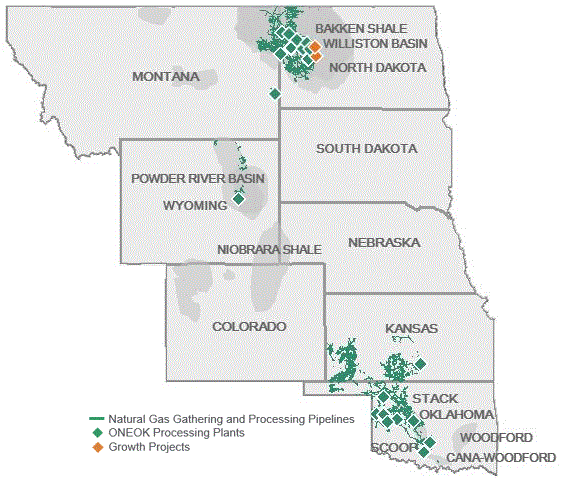
Overview - Our Natural Gas Gathering and Processing segment provides midstream services to producers in North Dakota, Montana, Wyoming, Kansas and Oklahoma.
Rocky Mountain region - The Williston Basin is located in portions of North Dakota and Montana and includes the oil-producing, NGL-rich Bakken Shale and Three Forks formations, and is an active drilling region. Our completed capital-growth projects in the Williston Basin have increased our gathering and processing capacity and allow us to capture increased natural gas production from new wells and previously flared natural gas production.
The Powder River Basin is primarily located in Wyoming, which includes the NGL-rich Niobrara Shale and Frontier, Turner and Sussex formations where we provide gathering and processing services to customers in the eastern portion of Wyoming.
Mid-Continent region - The Mid-Continent region is an active drilling region and includes the oil-producing, NGL-rich STACK and SCOOP areas and the Cana-Woodford Shale, Woodford Shale, Springer Shale, Meramec, Granite Wash and Mississippian Lime formations of Oklahoma and Kansas, and the Hugoton and Central Kansas Uplift Basins of Kansas.
 | |
Property - Our Natural Gas Gathering and Processing segment owns the following assets:
| • | 18,900 miles of natural gas gathering pipelines; |
| • | ten natural gas processing plants with 1.0 Bcf/d of processing capacity in the Mid-Continent region, and 12 natural gas processing plants with 1.5 Bcf/d of processing capacity in the Rocky Mountain region; and |
| • | 14 MBbl/d of NGL fractionation capacity at various natural gas processing plants. |
In addition, we have access to up to 200 MMcf/d of processing capacity in the Mid-Continent region through a long-term processing services agreement with an unaffiliated third party.
We are in the process of expanding our Bear Creek plant by 200 MMcf/d and recently announced plans to construct our Demicks Lake III natural gas processing plant, with capacity of 200 MMcf/d, in the core of the Williston Basin. The additional capacity from these projects is excluded from the assets listed above.
See “Recent Developments” in Part II, Item 7, Management’s Discussion and Analysis of Financial Condition and Results of Operations, in this Annual Report for more information on our growth projects.
Sources of Earnings - Earnings for this segment are derived primarily from the following types of service contracts:
| • | POP with fee contracts with no producer take-in-kind rights - We purchase raw natural gas and charge contractual fees for providing midstream services, which include gathering, treating, compressing and processing the producer’s natural gas. After performing these services, we sell the commodities and remit a portion of the commodity sales proceeds to the producer less our contractual fees. This type of contract represented 63% and 60% of supply volumes in this segment for 2019 and 2018, respectively. |
| • | POP with fee contracts with producer take-in-kind rights - We purchase a portion of the raw natural gas stream, charge fees for providing the midstream services listed above, return primarily the residue natural gas to the producer, sell the remaining commodities and remit a portion of the commodity sales proceeds to the producer less our contractual fees. This type of contract represented 33% and 36% of supply volumes in this segment for 2019 and 2018, respectively. |
| • | Fee-only - Under this type of contract, we charge a fee for the midstream services we provide, based on volumes gathered, processed, treated and/or compressed. Our fee-only contracts represented 4% of supply volumes in this segment in 2019 and 2018. |
For commodity sales, we contract to deliver residue natural gas, condensate and/or unfractionated NGLs to downstream customers at a specified delivery point. Our sales of NGLs are primarily to our affiliate in the Natural Gas Liquids segment.
Utilization - The utilization rates for our natural gas processing plants were 84% and 83% for 2019 and 2018, respectively. We calculate utilization rates using a weighted-average approach, adjusting for the dates that assets were placed in service.
Unconsolidated Affiliates - Our Natural Gas Gathering and Processing segment includes the following unconsolidated affiliates:
| • | 49% ownership interest in Bighorn Gas Gathering, which gathers dry natural gas produced in the Powder River Basin; |
| • | 42.6% ownership interest in Fort Union Gas Gathering, which gathers dry natural gas produced in the Powder River Basin and delivers it to the interstate pipeline system; |
| • | 35% ownership interest in Lost Creek Gathering Company, which gathers natural gas produced from conventional dry natural gas wells in the Wind River Basin of central Wyoming and delivers it to the interstate pipeline system; and |
| • | 10.2% ownership interest in Venice Energy Services Co., a natural gas processing facility near Venice, Louisiana. |
See Note M of the Notes to Consolidated Financial Statements in this Annual Report for additional discussion of our unconsolidated affiliates.
Government Regulation - The FERC traditionally has maintained that a natural gas processing plant is not a facility for the transportation or sale of natural gas in interstate commerce and, therefore, is not subject to jurisdiction under the Natural Gas Act. Although the FERC has made no specific declaration as to the jurisdictional status of our natural gas processing operations or facilities, our natural gas processing plants are primarily involved in extracting NGLs and, therefore, are exempt from FERC jurisdiction. The Natural Gas Act also exempts natural gas gathering facilities from the jurisdiction of the FERC. We believe our natural gas gathering facilities and operations meet the criteria used by the FERC for nonjurisdictional natural gas gathering facility status. Interstate transmission facilities remain subject to FERC jurisdiction. The FERC has historically distinguished between these two types of facilities, either interstate or intrastate, on a fact-specific basis. We transport residue natural gas from certain of our natural gas processing plants to interstate pipelines in accordance with Section 311(a) of the Natural Gas Policy Act. Oklahoma, Kansas, Wyoming, Montana and North Dakota also have statutes regulating, to varying degrees, the gathering of natural gas in those states. In each state, regulation is applied on a case-by-case basis if a complaint is filed against the gatherer with the appropriate state regulatory agency.
See further discussion in the “Regulatory, Environmental and Safety Matters” section.
Natural Gas Liquids
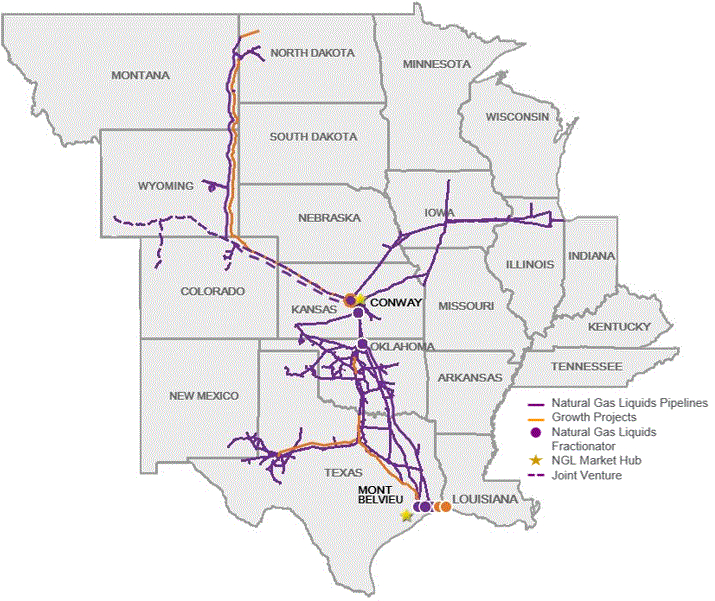
Overview - Our Natural Gas Liquids segment owns and operates facilities that gather, fractionate, treat and distribute NGLs and store NGL products, primarily in Oklahoma, Kansas, Texas, New Mexico and the Rocky Mountain region, which includes the Williston, Powder River and DJ Basins. We provide midstream services to producers of NGLs and deliver those products to the two primary market centers: one in the Mid-Continent in Conway, Kansas, and the other in the Gulf Coast in Mont Belvieu, Texas. We own or have an ownership interest in FERC-regulated NGL gathering and distribution pipelines in Oklahoma, Kansas, Texas, New Mexico, Montana, North Dakota, Wyoming and Colorado, and terminal and storage facilities in Missouri, Nebraska, Iowa and Illinois. The majority of the pipeline-connected natural gas processing plants in the Williston Basin, Oklahoma, Kansas and the Texas Panhandle are connected to our NGL gathering systems. We own and operate truck- and rail-loading and -unloading facilities connected to our NGL fractionation and pipeline assets. We also own FERC-regulated NGL distribution pipelines in Kansas, Missouri, Nebraska, Iowa, Illinois and Indiana that connect our Mid-Continent assets with Midwest markets, including Chicago, Illinois. A portion of our ONEOK North System transports refined petroleum products, including unleaded gasoline and diesel, from Kansas to Iowa.
 | |
Property - Our Natural Gas Liquids segment owns the following assets:
| • | 8,380 miles of gathering pipelines with peak capacity of 1,820 MBbl/d, including 5,550 miles of FERC-regulated pipelines with peak capacity of 920 MBbl/d; |
| • | 4,490 miles of distribution pipelines with peak capacity of 1,400 MBbl/d, including 4,460 miles of FERC-regulated pipelines with peak capacity of 1,360 MBbl/d; |
| • | eight NGL fractionators with combined operating capacity of 870 MBbl/d (includes interests in our proportional share of operating capacity), including 520 MBbl/d in the Mid-Continent region and 350 MBbl/d in the Gulf Coast region; |
| • | one isomerization unit with operating capacity of 10 MBbl/d; |
| • | one ethane/propane splitter with operating capacity of 40 MBbl/d; |
| • | six NGL storage facilities with operating storage capacity of 20 MMBbl; and |
| • | eight NGL product terminals. |
In addition, we lease 10 MMBbl of annual pipeline capacity near our ONEOK North System and have access to 5 MMBbl of combined NGL storage capacity at facilities in Kansas and Texas and 60 MBbl/d of NGL fractionation capacity in the Gulf Coast through service agreements.
Our uncompleted growth projects are excluded from the assets listed above and include:
| • | gathering pipelines, including expansions, with combined operating capacity of 880 MBbl/d; |
| • | the MB-5 fractionator in the Gulf Coast with operating capacity of 125 MBbl/d; |
| • | remaining fractionation capacity on the MB-4 fractionator in the Gulf Coast of 50 MBbl/d; and |
| • | additional fractionation capacity in the Mid-Continent of 65 MBbl/d. |
See “Recent Developments” in Part II, Item 7, Management’s Discussion and Analysis of Financial Condition and Results of Operations, in this Annual Report for more information on our growth projects.
Sources of Earnings - Earnings for our Natural Gas Liquids segment are derived primarily from commodity sales and fee-based services. We also purchase NGLs and condensate from third parties, as well as from our Natural Gas Gathering and Processing segment. Our business activities are categorized as follows:
| • | Exchange services - We utilize our assets to gather, transport, treat and fractionate unfractionated NGLs, thereby converting them into marketable NGL products delivered to a market center or customer-designated location. Many of these exchange volumes are under contracts with minimum volume commitments that provide a minimum level of revenues regardless of volumetric throughput. Our exchange services activities are primarily fee-based and include some rate-regulated tariffs; however, we also capture certain product price differentials through the fractionation process. |
| • | Transportation and storage services - We transport NGL products and refined petroleum products, primarily under FERC-regulated tariffs. Tariffs specify the maximum rates we may charge our customers and the general terms and conditions for transportation service on our pipelines. Our storage activities consist primarily of fee-based NGL storage services at our Mid-Continent and Gulf Coast storage facilities. |
| • | Optimization and marketing - We utilize our assets, contract portfolio and market knowledge to capture location, product and seasonal price differentials through the purchase and sale of NGLs and NGL products. We primarily transport NGL products between Conway, Kansas, and Mont Belvieu, Texas, to capture the location price differentials between the two market centers. Our marketing activities also include utilizing our NGL storage facilities to capture seasonal price differentials. A growing portion of our marketing activities serves truck and rail markets. Our isomerization activities capture the price differential when normal butane is converted into the more valuable iso-butane at our isomerization unit in Conway, Kansas. |
In many of our exchange services contracts, we purchase the unfractionated NGLs at the tailgate of the processing plant and deduct contractual fees related to the transportation and fractionation services we must perform before we can sell them as NGL products. To the extent we hold unfractionated NGLs in inventory, the related contractual fees will not be recognized until the unfractionated inventory is fractionated and sold.
Utilization - The utilization rates for our various assets, including leased assets, have been impacted by ethane rejection. The utilization rates for 2019 and 2018, respectively, were as follows:
| • | our NGL gathering pipelines were 78% in both years; |
| • | our NGL distribution pipelines were 63% and 59%; and |
| • | our NGL fractionators were 84% and 85%. |
We calculate utilization rates using a weighted-average approach, adjusting for the dates that assets were placed in service. Our fractionation utilization rate reflects approximate proportional capacity associated with our ownership interests.
Unconsolidated Affiliates - Our Natural Gas Liquids segment includes the following unconsolidated affiliates:
| • | 50% ownership interest in Overland Pass Pipeline Company, which operates an interstate NGL pipeline system extending 760 miles, originating in Wyoming and Colorado and terminating in Kansas; |
| • | 50% ownership interest in Chisholm Pipeline Company, which operates an interstate NGL pipeline system extending 185 miles from origin points in Oklahoma and terminating in Kansas; and |
| • | 50% ownership interest in Heartland Pipeline Company, which operates a terminal and pipeline system that transports refined petroleum products in Kansas, Nebraska and Iowa. |
See Note M of the Notes to Consolidated Financial Statements in this Annual Report for additional discussion of unconsolidated affiliates.
Government Regulation - The operations and revenues of our NGL pipelines are regulated by various state and federal government agencies. Our interstate NGL pipelines are regulated by the FERC, which has authority over the terms and conditions of service; rates, including depreciation and amortization policies; and initiation of service. In Oklahoma, Kansas and Texas, certain aspects of our intrastate NGL pipelines that provide common carrier service are subject to the jurisdiction of the OCC, KCC and RRC, respectively.
See further discussion in the “Regulatory, Environmental and Safety Matters” section.
Natural Gas Pipelines
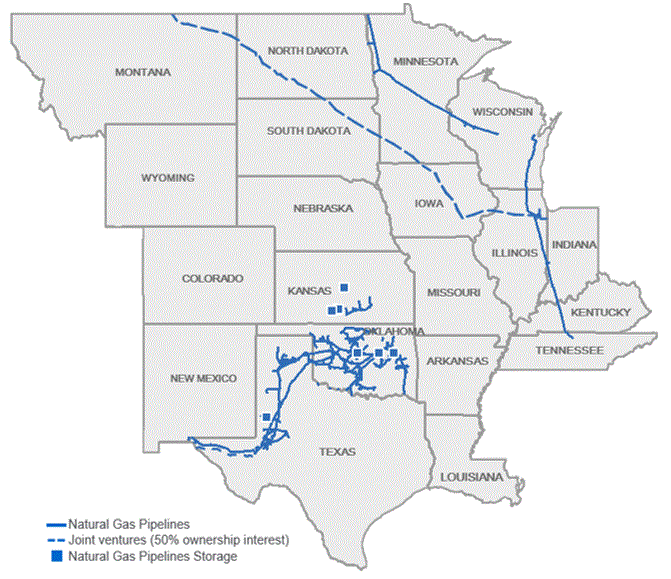
Overview - Our Natural Gas Pipelines segment provides transportation and storage services to end users through its wholly owned assets and its 50% ownership interests in Northern Border Pipeline and Roadrunner.
Interstate Pipelines - Our interstate pipelines are regulated by the FERC and are located in North Dakota, Minnesota, Wisconsin, Illinois, Indiana, Kentucky, Tennessee, Oklahoma, Texas and New Mexico. Our interstate pipeline companies include:
| • | Midwestern Gas Transmission, which is a bidirectional system that interconnects with Tennessee Gas Transmission Company’s pipeline near Portland, Tennessee, and with several interstate pipelines that have access to both the Utica Shale and the Marcellus Shale at the Chicago Hub near Joliet, Illinois; |
| • | Viking Gas Transmission, which is a bidirectional system that interconnects with a TransCanada Corporation pipeline at the United States border near Emerson, Canada, and ANR Pipeline Company near Marshfield, Wisconsin; |
| • | Guardian Pipeline, which interconnects with several pipelines at the Chicago Hub near Joliet, Illinois, and with local natural gas distribution companies in Wisconsin; and |
| • | OkTex Pipeline, which has interconnections with several pipelines in Oklahoma, Texas and New Mexico. |
Intrastate Pipelines - Our intrastate natural gas pipeline assets in Oklahoma transport natural gas through the state and have access to the major natural gas production areas in the Mid-Continent region, which include the STACK and SCOOP areas and the Cana-Woodford Shale, Woodford Shale, Springer Shale, Meramec, Granite Wash and Mississippian Lime formations. In Texas, our intrastate natural gas pipelines are connected to the major natural gas producing formations in the Texas Panhandle, including the Granite Wash formation and Delaware and Midland Basins in the Permian Basin. These pipelines are capable of transporting natural gas throughout the western portion of Texas, including the Waha area where other pipelines may be accessed for transportation to western markets, exports to Mexico, the Houston Ship Channel market to the east and the Mid-Continent market to the north. Our intrastate natural gas pipeline assets also have access to the Hugoton and Central Kansas Uplift Basins in Kansas.
 | |
Property - Our Natural Gas Pipelines segment owns the following assets:
| • | 1,500 miles of FERC-regulated interstate natural gas pipelines with 3.5 Bcf/d of peak transportation capacity; |
| • | 5,100 miles of state-regulated intrastate transmission pipelines with peak transportation capacity of 4.3 Bcf/d; and |
| • | six underground natural gas storage facilities with 52.2 Bcf of total active working natural gas storage capacity. |
Our storage includes two underground natural gas storage facilities in Oklahoma, two underground natural gas storage facilities in Kansas and two underground natural gas storage facilities in Texas.
Sources of Earnings - Earnings in this segment are derived primarily from transportation and storage services.
Our transportation earnings are primarily fee-based from the following types of services:
| • | Firm service - Customers reserve a fixed quantity of pipeline capacity for a specified period of time, which obligates the customer to pay regardless of usage. Under this type of contract, the customer pays a monthly fixed fee and incremental fees, known as commodity charges, which are based on the actual volumes of natural gas they transport or store. Under the firm service contract, the customer generally is guaranteed access to the capacity they reserve. |
| • | Interruptible service - Under interruptible service transportation agreements, the customer may utilize available capacity after firm service requests are satisfied. The customer is not guaranteed use of our pipelines unless excess capacity is available. |
Our regulated natural gas transportation services contracts are based upon rates stated in the respective tariffs, which have generally been established through shipper specific negotiation, discounts and negotiated settlements. The rates are filed with FERC or the appropriate state jurisdictional agencies. In addition, customers typically are assessed fees, such as a commodity charge, and we may retain a percentage or specified volume of natural gas in-kind based on the natural gas volumes transported.
Our storage earnings are primarily fee-based from the following types of services:
| • | Firm service - Customers reserve a specific quantity of storage capacity, including injection and withdrawal rights, and generally pay fixed fees based on the quantity of capacity reserved plus an injection and withdrawal fee. Firm storage contracts typically have terms longer than one year. |
| • | Park-and-loan service - An interruptible storage service offered to customers providing the ability to park (inject) or loan (withdraw) natural gas into or out of our storage, typically for monthly or seasonal terms. Customers reserve the |
right to park or loan natural gas based on a specified quantity, including injection and withdrawal rights when capacity is available.
Utilization - Our natural gas pipelines were 98% and 96% subscribed in 2019 and 2018, respectively, and our natural gas storage facilities were 64% subscribed in both 2019 and 2018.
Unconsolidated Affiliates - Our Natural Gas Pipelines segment includes the following unconsolidated affiliates:
| • | 50% ownership interest in Northern Border Pipeline, which owns a FERC-regulated interstate pipeline that transports natural gas from the Montana-Saskatchewan border near Port of Morgan, Montana, and the Williston Basin in North Dakota to a terminus near North Hayden, Indiana. |
| • | 50% ownership interest in Roadrunner, a bidirectional pipeline, which has the capacity to transport 570 MMcf/d of natural gas from the Permian Basin in West Texas to the Mexican border near El Paso, Texas, and has capacity to transport approximately 1.0 Bcf/d of natural gas from the Delaware Basin to the Waha area. We are the operator of Roadrunner. |
See Note M of the Notes to Consolidated Financial Statements in this Annual Report for additional discussion of unconsolidated affiliates.
Government Regulation - Interstate - Our interstate natural gas pipelines are regulated under the Natural Gas Act, which gives the FERC jurisdiction to regulate virtually all aspects of this business, such as transportation of natural gas, rates and charges for services, construction of new facilities, depreciation and amortization policies, acquisition and disposition of facilities, and the initiation and discontinuation of services.
Intrastate - Our intrastate natural gas pipelines in Oklahoma, Kansas and Texas are regulated by the OCC, KCC and RRC, respectively, and by the FERC under the Natural Gas Policy Act for certain services where we deliver natural gas into FERC regulated natural gas pipelines. While we have flexibility in establishing natural gas transportation rates with customers, there is a maximum rate that we can charge our customers in Oklahoma and Kansas and for the services regulated by the FERC. In Texas and Kansas, natural gas storage may be regulated by the state and by the FERC for certain types of services. In Oklahoma, natural gas storage operations are not subject to rate regulation by the state, and we have market-based rate authority from the FERC for certain types of services.
See further discussion in the “Regulatory, Environmental and Safety Matters” section.
Market Conditions and Seasonality
We operate primarily fee-based businesses in each of our three reportable segments, and our consolidated earnings were approximately 90% fee-based in 2019. While our Natural Gas Gathering and Processing and Natural Gas Liquids segments generate primarily fee-based earnings, those segments’ results of operations are exposed to volumetric risk. We are exposed to volumetric risk from declining well productivity, reduced drilling activity, severe weather disruptions, operational outages and ethane rejection.
Supply and Demand - Supply for each of our segments depends on crude oil and natural gas drilling and production activities, which are driven by the strength of the economy; the decline rate of existing production; producer access to capital; producer firm commitments to transportation pipelines; natural gas, crude oil and NGL prices; or the demand for each of these products from end users.
Demand for gathering and processing services is dependent on natural gas production by producers in the regions in which we operate. State requirements in North Dakota for producers to reduce natural gas flaring have increased the need for our services to capture, gather and process natural gas. Demand for NGLs and the ability of natural gas processors to successfully and economically sustain their operations affect the volume of unfractionated NGLs produced by natural gas processing plants, thereby affecting the demand for NGL gathering, transportation and fractionation services. Natural gas and NGL products are affected by economic conditions and the demand associated with the various industries that utilize the commodities, such as butanes and natural gasoline used by the refining industry as blending stocks for motor fuel, denaturant for ethanol and diluents for crude oil. Ethane, propane, normal butane and natural gasoline are also used by the petrochemical industry to produce chemical products, such as plastic, rubber and synthetic fibers. Propane is also used to heat homes and businesses. Demand for NGLs is expected to increase at the Mont Belvieu, Texas, NGL market center as new world-scale ethylene production projects, petrochemical plant expansions and NGL export facilities continue to be completed.
Commodity Prices - Our earnings are primarily fee-based in all three of our segments, with limited commodity price risk. In our Natural Gas Gathering and Processing segment, we are exposed to commodity price risk as a result of retaining a portion of the commodity sales proceeds associated with our POP with fee contracts. In our Natural Gas Liquids segment, we are exposed to commodity price risk associated with changes in the price of NGLs; the location differential between the Mid-Continent, Chicago, Illinois, and Gulf Coast regions; and the relative price differential between natural gas, NGLs and individual NGL products, which affect our NGL purchases and sales, our exchange services, transportation and storage services, and optimization and marketing financial results. NGL storage revenue may be affected by price volatility and forward pricing of NGL physical contracts versus the price of NGLs on the spot market. In our Natural Gas Pipelines segment, we are exposed to commodity price risk associated with (i) changes in the price of natural gas, which impact our fuel costs and retained fuel in-kind received for our services; and (ii) the differential between forward pricing of natural gas physical contracts and the price of natural gas on the spot market, which affects our natural gas storage revenue.
See additional discussion regarding our commodity price risk and related hedging activities under “Commodity Price Risk” in Part II, Item 7A, Quantitative and Qualitative Disclosures about Market Risk, in this Annual Report.
Seasonality - Cold temperatures usually increase demand for natural gas and certain NGL products, such as propane, the main heating fuels for homes and businesses. Warm temperatures usually increase demand for natural gas used in gas-fired electric generation for residential and commercial cooling, as well as agriculture-related equipment like irrigation pumps and crop dryers. Demand for butanes and natural gasoline, which are primarily used by the refining industry as blending stocks for motor fuel, denaturant for ethanol and diluents for crude oil, are also subject to some variability during seasonal periods when certain government restrictions on motor fuel blending products change. During periods of peak demand for a certain commodity, prices for that product typically increase.
Extreme weather conditions, seasonal temperature changes and the impact of temperature and humidity on the mechanical abilities of the processing equipment impact the volumes of natural gas gathered and processed and NGL volumes gathered, transported and fractionated. Power interruptions and inaccessible well sites as a result of severe storms or freeze-offs, a phenomenon where water produced from natural gas freezes at the wellhead or within the gathering system, may cause a temporary interruption in the flow of natural gas and NGLs.
In our Natural Gas Pipelines segment, natural gas storage is necessary to balance the relatively steady natural gas supply with the seasonal demand of residential, commercial and electric-generation users.
Competition - We compete for natural gas and NGL supply with other midstream companies and major integrated oil companies and independent exploration and production companies that have gathering and processing assets, fractionators, intrastate and interstate pipelines and storage facilities. The factors that typically affect our ability to compete for natural gas and NGL supply are:
| • | quality of services provided; |
| • | producer drilling activity; |
| • | proceeds remitted and/or fees charged under our contracts; |
| • | proximity of our assets to natural gas and NGL supply areas and markets; |
| • | location of our assets relative to those of our competitors; |
| • | efficiency and reliability of our operations; |
| • | receipt and delivery capabilities for natural gas and NGLs that exist in each pipeline system, plant, fractionator and storage location; |
| • | the petrochemical industry’s level of capacity utilization and feedstock requirements; |
| • | current and forward natural gas and NGL prices; and |
| • | cost of and access to capital. |
We have responded by making capital investments to access and connect new supplies with end-user demand; increasing gathering, processing, fractionation and pipeline capacity; increasing storage, withdrawal and injection capabilities; and reducing operating costs so that we compete effectively. Our competitors also continue to invest in midstream infrastructure to address the growing natural gas and NGL supply and market demand. Our and our competitors’ infrastructure projects may affect commodity prices and compete with and could displace supply volumes from the Mid-Continent and Rocky Mountain regions and the Permian Basin where our assets are located. We believe our assets are located strategically, connecting diverse supply areas to market centers.
Customers - Our Natural Gas Gathering and Processing and Natural Gas Liquids segments derive services revenue from major and independent crude oil and natural gas producers. Our Natural Gas Liquids segment’s customers also include NGL and
natural gas gathering and processing companies. Our downstream commodity sales customers are primarily utilities, large industrial companies, natural gasoline distributors, propane distributors, municipalities and petrochemical, refining and marketing companies. Our Natural Gas Pipeline segment’s assets primarily serve local natural gas distribution companies, electric-generation facilities, large industrial companies, municipalities, producers, processors and marketing companies. Our utility customers generally require our services regardless of commodity prices. See discussion regarding our customer credit risk under “Counterparty Credit Risk” in Part II, Item 7A, Quantitative and Qualitative Disclosures about Market Risk, in this Annual Report.
Other
Through ONEOK Leasing Company, L.L.C. and ONEOK Parking Company, L.L.C., we own a 17-story office building (ONEOK Plaza) with 517,000 square feet of net rentable space and a parking garage in downtown Tulsa, Oklahoma, where our headquarters are located. ONEOK Leasing Company, L.L.C. leases excess office space to others and operates our headquarters office building. ONEOK Parking Company, L.L.C. owns and operates a parking garage adjacent to our headquarters.
REGULATORY, ENVIRONMENTAL AND SAFETY MATTERS
Environmental Matters - We are subject to a variety of historical preservation and environmental laws and/or regulations that affect many aspects of our present and future operations. Regulated activities include, but are not limited to, those involving air emissions, storm water and wastewater discharges, handling and disposal of solid and hazardous wastes, wetlands and waterways preservation, cultural resources protection, hazardous materials transportation, and pipeline and facility construction. These laws and regulations require us to obtain and/or comply with a wide variety of environmental clearances, registrations, licenses, permits and other approvals. Failure to comply with these laws, regulations, licenses and permits may expose us to fines, penalties and/or interruptions in our operations that could be material to our results of operations. For example, if a leak or spill of hazardous substances or petroleum products occurs from pipelines or facilities that we own, operate or otherwise use, we could be held jointly and severally liable for all resulting liabilities, including response, investigation and cleanup costs, which could affect adversely our results of operations and cash flows. In addition, emissions controls and/or other regulatory or permitting mandates under the Clean Air Act and other similar federal and state laws could require unexpected capital expenditures at our facilities. We cannot assure that existing environmental statutes and regulations will not be revised or that new regulations will not be adopted or become applicable to us.
Some scientists have determined that GHG emissions endanger public health and the environment because emissions of such gases may contribute to warming of the earth’s atmosphere and other climatic changes. GHG emissions originate primarily from combustion engine exhaust, heater exhaust and fugitive methane gas emissions. International, federal, regional and/or state legislative and/or regulatory initiatives may attempt to control or limit GHG emissions, including initiatives directed at issues associated with climate change. Various federal and state legislative proposals have been introduced to regulate the emission of GHGs, particularly carbon dioxide and methane, and the United States Supreme Court has ruled that carbon dioxide is a pollutant subject to regulation by the EPA. In addition, there have been international efforts seeking legally binding reductions in emissions of GHGs.
Our environmental actions focus on minimizing the impact of our operations on the environment. These actions include: (i) developing and maintaining an accurate GHG emissions inventory according to current rules issued by the EPA; (ii) improving the efficiency of our various pipelines, natural gas processing facilities and NGL fractionation facilities; (iii) following developing technologies for emissions control and the capture of carbon dioxide to keep it from reaching the atmosphere; and (iv) utilizing practices to reduce the loss of methane from our facilities. In addition, many of our compressor station facilities are designed and operated with electric-driven compression units, which reduce the potential emission from these facilities, including GHG emissions.
We participate in the EPA’s Natural Gas STAR Program to reduce voluntarily methane emissions. We continue to focus on maintaining low methane gas release rates through expanded implementation of best practices to limit the release of natural gas during pipeline and facility maintenance and operations.
We believe it is likely that future governmental legislation and/or regulation may require us either to limit GHG emissions from our operations, to purchase allowances for such emissions or to be subject to a carbon emissions tax. However, we cannot predict precisely what form these future regulations will take, the stringency of the regulations, when they will become effective or the impact on our results of operations. In addition to activities on the federal level, state and regional initiatives could also lead to the regulation of GHG emissions sooner than and/or independent of federal regulation. These regulations could be more stringent than any federal legislation that may be adopted.
For additional information regarding the potential impact of laws and regulations on our operations see Item 1A “Risk Factors.”
Pipeline Safety - We are subject to PHMSA safety regulations, including pipeline asset integrity-management regulations. The Pipeline Safety Improvement Act of 2002 requires pipeline companies operating high-pressure pipelines to perform integrity assessments on pipeline segments that pass through densely populated areas or near specifically designated high-consequence areas. The Pipeline Safety, Regulatory Certainty and Job Creation Act of 2011 (the 2011 Pipeline Safety Act) increased maximum penalties for violating federal pipeline safety regulations, directs the DOT and Secretary of Transportation to conduct further review or studies on issues that may or may not be material to us and may result in the imposition of more stringent regulations.
In 2015, PHMSA issued notices of proposed rule-making for hazardous liquid pipeline safety regulations, natural gas transmission and gathering lines and underground natural gas storage facilities, known as “the Mega Rule.” Due to the large number of rules being considered, PHMSA partitioned the new rulemaking into three sections. To date, the first section of rules was finalized and published in 2019 in the federal register. These final rules mostly address congressional mandates due to former pipeline safety reauthorizations. Coupled together, these new rules provide increased requirements for operating and maintenance, integrity management, public awareness and civil/criminal penalties. The potential capital and operating expenditures related to the new regulations are not fully known, but we do not anticipate a material impact to our planned capital or operations and maintenance costs resulting from compliance with the new or pending regulations. In 2019, legislation was introduced to reauthorize PHMSA through 2024. If passed, requirements for operations and maintenance, integrity management, public awareness, civil and criminal penalties could be increased. The potential capital and operating expenditures related to the proposed regulations are unknown, but we do not anticipate a material impact to our planned capital or operations and maintenance costs resulting from compliance with the current or pending regulations.
Air and Water Emissions - The Clean Air Act, the Clean Water Act, analogous state laws and/or regulations impose restrictions and controls regarding the discharge of pollutants into the air and water in the United States. Under the Clean Air Act, a federally enforceable operating permit is required for sources of significant air emissions. We may be required to incur certain capital expenditures for air pollution-control equipment in connection with obtaining or maintaining permits and approvals for sources of air emissions. The Clean Water Act imposes substantial potential liability for the removal of pollutants discharged to waters of the United States and remediation of waters affected by such discharge.
International, federal, regional and/or state legislative and/or regulatory initiatives may attempt to control or limit GHG emissions, including initiatives directed at issues associated with climate change. We monitor all relevant legislation and regulatory initiatives to assess the potential impact on our operations and otherwise take efforts to limit GHG emissions from our facilities, including methane. The EPA’s Mandatory Greenhouse Gas Reporting Rule requires annual GHG emissions reporting from affected facilities and the carbon dioxide emission equivalents for the natural gas delivered by us and the emission equivalents for all NGLs produced by us as if all of these products were combusted, even if they are used otherwise.
Our 2018 total emissions reported pursuant to EPA requirements were approximately 60 million metric tons of carbon dioxide equivalents. This total includes direct emissions from the combustion of fuel in our equipment, such as compressor engines and heaters, as well as carbon dioxide equivalents from natural gas and NGL products delivered to customers and produced as if all such fuel and NGL products were combusted. The additional cost to gather and report this emission data did not have, and we do not expect it to have, a material impact on our results of operations, financial position or cash flows. In addition, Congress has considered, and may consider in the future, legislation to reduce GHG emissions, including carbon dioxide and methane. Likewise, the EPA may institute additional regulatory rule-making associated with GHG emissions from the oil and natural gas industry. At this time, no rule or legislation has been enacted that assesses any material costs, fees or expenses on any of these emissions.
We monitor proposed and final rule-makings. At this time, we do not anticipate a material impact to our planned capital, operations and maintenance costs resulting from compliance with the current or pending regulations and EPA actions. However, the EPA may issue additional regulations, responses, amendments and/or policy guidance, which could alter our present expectations. Generally, EPA rule-makings require expenditures for updated emissions controls, monitoring and record-keeping requirements at affected facilities.
Chemical Site Security - The United States Department of Homeland Security (Homeland Security) released the Chemical Facility Anti-Terrorism Standards in 2007, and the new final rule associated with these regulations was issued in December 2014. We provided information regarding our chemicals via Top-Screens submitted to Homeland Security, and our facilities subsequently were assigned one of four risk-based tiers ranging from high (Tier 1) to low (Tier 4) risk, or not tiered at all due to low risk. To date, one of our facilities has been given a Tier 4 rating. Facilities receiving a Tier 4 rating are required to
complete Site Security Plans, including possible physical security enhancements. We do not expect the cost of the Site Security Plans to have a material impact on our results of operations, financial position or cash flows.
Pipeline Security - The United States Department of Homeland Security’s Transportation Security Administration and the DOT have completed a review and inspection of our “critical facilities” and identified no material security issues. Also, the Transportation Security Administration has released new pipeline security guidelines that include broader definitions for the determination of pipeline “critical facilities.” We have reviewed our pipeline facilities according to the new guideline requirements, and there have been no material changes required to date.
EMPLOYEES
At January 31, 2020, we employed 2,882 people.
INFORMATION ABOUT OUR EXECUTIVE OFFICERS
All executive officers are elected annually by our Board of Directors. Our executive officers listed below include the officers who have been designated by our Board of Directors as our Section 16 executive officers.
| Name and Position | Age | Business Experience in Past Five Years | |||||
| John W. Gibson | 67 | 2011 to present | Chairman of the Board, ONEOK | ||||
| Chairman of the Board | 2007 to 2017 | Chairman of the Board, ONEOK Partners | |||||
| Terry K. Spencer | 60 | 2014 to present | President and Chief Executive Officer, ONEOK | ||||
| President and Chief Executive Officer | 2014 to 2017 | President and Chief Executive Officer, ONEOK Partners | |||||
| 2014 to present | Member of the Board of Directors, ONEOK | ||||||
| 2014 to 2017 | Member of the Board of Directors, ONEOK Partners | ||||||
| Robert F. Martinovich | 62 | 2015 to present | Executive Vice President and Chief Administrative Officer, ONEOK | ||||
| Executive Vice President and Chief Administrative Officer | 2015 to 2017 | Executive Vice President and Chief Administrative Officer, ONEOK Partners | |||||
| 2014 to 2015 | Executive Vice President, Commercial, ONEOK and ONEOK Partners | ||||||
| Walter S. Hulse III | 56 | 2019 to present | Chief Financial Officer, Treasurer and Executive Vice President, Strategic Planning and Corporate Affairs, ONEOK | ||||
| Chief Financial Officer, Treasurer and Executive Vice President, Strategic Planning and Corporate Affairs | 2017 to 2019 | Chief Financial Officer and Executive Vice President, Strategic Planning and Corporate Affairs, ONEOK | |||||
| 2015 to 2017 | Executive Vice President, Strategic Planning and Corporate Affairs, ONEOK and ONEOK Partners | ||||||
| 2012 to 2015 | Managing Member, Spinnaker Strategic Advisory Services, LLC | ||||||
| Kevin L. Burdick | 55 | 2017 to present | Executive Vice President and Chief Operating Officer, ONEOK | ||||
| Executive Vice President and Chief Operating Officer | 2017 | Executive Vice President and Chief Commercial Officer, ONEOK and ONEOK Partners | |||||
| 2016 to 2017 | Senior Vice President, Natural Gas Gathering and Processing, ONEOK Partners | ||||||
| 2013 to 2016 | Vice President, Natural Gas Gathering and Processing, ONEOK Partners | ||||||
| Charles M. Kelley | 61 | 2018 to present | Senior Vice President, Natural Gas, ONEOK | ||||
| Senior Vice President, Natural Gas | 2017 to 2018 | Senior Vice President, Natural Gas Gathering & Processing, ONEOK | |||||
| 2015 to 2017 | Senior Vice President, Corporate Planning and Development, ONEOK and ONEOK Partners | ||||||
| 2014 to 2015 | Vice President, Corporate Development, ONEOK and ONEOK Partners | ||||||
| Sheridan C. Swords | 50 | 2017 to present | Senior Vice President, Natural Gas Liquids, ONEOK | ||||
| Senior Vice President, Natural Gas Liquids | 2013 to 2017 | Senior Vice President, Natural Gas Liquids, ONEOK Partners | |||||
| Stephen B. Allen | 46 | 2017 to present | Senior Vice President, General Counsel and Assistant Secretary, ONEOK | ||||
| Senior Vice President, General Counsel and Assistant Secretary | 2008 to 2017 | Vice President and Associate General Counsel, ONEOK and ONEOK Partners | |||||
| Mary M. Spears | 40 | 2019 to present | Vice President and Chief Accounting Officer, ONEOK | ||||
| Vice President and Chief Accounting Officer | 2015 to 2019 | Director, SEC Reporting, ONEOK | |||||
| 2015 to 2017 | Director, SEC Reporting, ONEOK Partners | ||||||
| 2009 to 2015 | Director, Natural Gas Liquids Accounting, ONEOK Partners |
No family relationships exist between any of the executive officers, nor is there any arrangement or understanding between any executive officer and any other person pursuant to which the officer was selected.
INFORMATION AVAILABLE ON OUR WEBSITE
We make available, free of charge, on our website (www.oneok.com) copies of our Annual Reports, Quarterly Reports, Current Reports on Form 8-K, amendments to those reports filed or furnished to the SEC pursuant to Section 13(a) or 15(d) of the Exchange Act and reports of holdings of our securities filed by our officers and directors under Section 16 of the Exchange Act
as soon as reasonably practicable after filing such material electronically or otherwise furnishing it to the SEC. Copies of our Code of Business Conduct and Ethics, Corporate Governance Guidelines, Director Independence Guidelines, Corporate Sustainability Report, Bylaws and the written charter of our Audit Committee also are available on our website, and we will provide copies of these documents upon request.
In addition to our filings with the SEC and materials posted on our website, we also use social media platforms as additional channels of distribution to reach public investors. Information contained on our website, posted on our social media accounts, and any corresponding applications, are not incorporated by reference into this report.
Previous: Cover and table of contents · Next: Item 1A. RISK FACTORS