 filings.tools
ONEOK 10-K 2022-12-31
Filed 2023-02-28. 23 sections, 553K characters. Original on sec.gov · Markdown · JSON
Cover and table of contents
UNITED STATES
SECURITIES AND EXCHANGE COMMISSION
WASHINGTON, D.C. 20549
FORM 10-K
☒ ANNUAL REPORT PURSUANT TO SECTION 13 OR 15(d) OF THE SECURITIES EXCHANGE ACT OF 1934
For the fiscal year ended December 31, 2022.
OR
☐ TRANSITION REPORT PURSUANT TO SECTION 13 OR 15(d) OF THE SECURITIES EXCHANGE ACT OF 1934
For the transition period from __________ to __________.
Commission file number 001-13643

ONEOK, Inc.
(Exact name of registrant as specified in its charter)
| Oklahoma | 73-1520922 | ||||
| (State or other jurisdiction of incorporation or organization) | (I.R.S. Employer Identification No.) |
| 100 West Fifth Street, | Tulsa, | OK | 74103 | ||||||||||||||
| (Address of principal executive offices) | (Zip Code) |
Registrant’s telephone number, including area code (918) 588-7000
Securities registered pursuant to Section 12(b) of the Act:
| Title of each class | Trading Symbol(s) | Name of each exchange on which registered | ||||||
| Common stock, par value of $0.01 | OKE | New York Stock Exchange |
Securities registered pursuant to Section 12(g) of the Act: None
Indicate by check mark if the registrant is a well-known seasoned issuer, as defined in Rule 405 of the Securities Act. Yes ☒ No ☐.
Indicate by check mark if the registrant is not required to file reports pursuant to Section 13 or Section 15(d) of the Act. Yes ☐ No ☒.
Indicate by check mark whether the registrant (1) has filed all reports required to be filed by Section 13 or 15(d) of the Securities Exchange Act of 1934 during the preceding 12 months (or for such shorter period that the registrant was required to file such reports), and (2) has been subject to such filing requirements for the past 90 days. Yes ☒ No ☐
Indicate by check mark whether the registrant has submitted electronically every Interactive Data File required to be submitted pursuant to Rule 405 of Regulation S-T (§ 232.405 of this chapter) during the preceding 12 months (or for such shorter period that the registrant was required to submit such files). Yes ☒ No ☐
Indicate by check mark whether the registrant is a large accelerated filer, an accelerated filer, a non-accelerated filer, smaller reporting company or an emerging growth company. See the definitions of “large accelerated filer,” “accelerated filer,” “smaller reporting company” and “emerging growth company” in Rule 12b-2 of the Exchange Act.
Large accelerated filer ☒ Accelerated filer ☐ Non-accelerated filer ☐ Smaller reporting company ☐
Emerging growth company ☐
If an emerging growth company, indicate by check mark if the registrant has elected not to use the extended transition period for complying with any new or revised financial accounting standards provided pursuant to Section 13(a) of the Exchange Act. ☐
Indicate by check mark whether the registrant has filed a report on and attestation to its management’s assessment of the effectiveness of its internal control over financial reporting under Section 404(b) of the Sarbanes-Oxley Act (15 U.S.C. 7262(b)) by the registered public accounting firm that prepared or issued its audit report. ☒
If securities are registered pursuant to Section 12(b) of the Act, indicate by check mark whether the financial statements of the registrant included in the filing reflect the correction of an error to previously issued financial statements. ☐
Indicate by check mark whether any of those error corrections are restatements that required a recovery analysis of incentive-based compensation received by any of the registrant’s executive officers during the relevant recovery period pursuant to §240.10D-1(b). ☐
Indicate by check mark whether the registrant is a shell company (as defined in Rule 12b-2 of the Act). Yes ☐ No ☒.
Aggregate market value of registrant’s common stock held by non-affiliates based on the closing trade price on June 30, 2022, was $24.5 billion.
On February 21, 2023, the Company had 447,220,972 shares of common stock outstanding.
DOCUMENTS INCORPORATED BY REFERENCE:
Portions of the definitive proxy statement to be delivered to shareholders in connection with the Annual Meeting of Shareholders to be held May 24, 2023, are incorporated by reference in Part III.
ONEOK, Inc.
2022 ANNUAL REPORT
As used in this Annual Report, references to “we,” “our,” or “us” refer to ONEOK, Inc., an Oklahoma corporation, and its predecessors and subsidiaries, unless the context indicates otherwise.
GLOSSARY
The abbreviations, acronyms and industry terminology used in this Annual Report are defined as follows:
| $1.5 Billion Term Loan Agreement | The senior unsecured delayed-draw three-year $1.5 billion term loan agreement dated November 19, 2018 | ||||
| $2.5 Billion Credit Agreement | ONEOK’s $2.5 billion revolving credit agreement, as amended and restated | ||||
| AFUDC | Allowance for funds used during construction | ||||
| Annual Report | Annual Report on Form 10-K for the year ended December 31, 2022 | ||||
| ASU | Accounting Standards Update | ||||
| Bbl | Barrels, 1 barrel is equivalent to 42 United States gallons | ||||
| BBtu/d | Billion British thermal units per day | ||||
| Bcf | Billion cubic feet | ||||
| Bcf/d | Billion cubic feet per day | ||||
| Btu | British thermal unit | ||||
| CFTC | United States Commodity Futures Trading Commission | ||||
| Clean Air Act | Federal Clean Air Act, as amended | ||||
| Clean Water Act | Federal Water Pollution Control Act Amendments of 1972, as amended | ||||
| COVID-19 | Coronavirus disease 2019, including variants thereof | ||||
| DJ | Denver-Julesburg | ||||
| DOT | United States Department of Transportation | ||||
| EBITDA | Earnings before interest expense, income taxes, depreciation and amortization | ||||
| EPA | United States Environmental Protection Agency | ||||
| EPS | Earnings per share of common stock | ||||
| ESG | Environmental, social and governance | ||||
| Exchange Act | Securities Exchange Act of 1934, as amended | ||||
| FERC | Federal Energy Regulatory Commission | ||||
| Fitch | Fitch Ratings, Inc. | ||||
| GAAP | Accounting principles generally accepted in the United States of America | ||||
| Guardian | Guardian Pipeline, L.L.C., a wholly owned subsidiary of ONEOK, Inc. | ||||
| Guardian Term Loan Agreement | Guardian’s senior unsecured three-year $120 million term loan agreement dated June 24, 2022 | ||||
| GHG | Greenhouse gas | ||||
| Homeland Security | United States Department of Homeland Security | ||||
| ICE | Intercontinental Exchange | ||||
| Inflation Reduction Act | Inflation Reduction Act of 2022 | ||||
| Intermediate Partnership | ONEOK Partners Intermediate Limited Partnership, a wholly owned subsidiary of ONEOK Partners, L.P. | ||||
| KCC | Kansas Corporation Commission | ||||
| LIBOR | London Interbank Offered Rate | ||||
| MBbl/d | Thousand barrels per day | ||||
| MDth/d | Thousand dekatherms per day | ||||
| MMBbl | Million barrels | ||||
| MMBbl/d | Million barrels per day | ||||
| MMBtu | Million British thermal units | ||||
| MMcf/d | Million cubic feet per day | ||||
| Moody’s | Moody’s Investors Service, Inc. | ||||
| Natural Gas Act | Natural Gas Act of 1938, as amended | ||||
| Natural Gas Policy Act | Natural Gas Policy Act of 1978, as amended | ||||
| NGL(s) | Natural gas liquid(s) | ||||
| Northern Border | Northern Border Pipeline Company, a 50% owned joint venture | ||||
| NYMEX | New York Mercantile Exchange | ||||
| NYSE | New York Stock Exchange | ||||
| OCC | Oklahoma Corporation Commission | ||||
| ONEOK | ONEOK, Inc. |
| ONEOK Partners | ONEOK Partners, L.P., a wholly owned subsidiary of ONEOK, Inc. | ||||
| OPIS | Oil Price Information Service | ||||
| Overland Pass | Overland Pass Pipeline Company, LLC, a 50% owned joint venture | ||||
| PHMSA | United States Department of Transportation Pipeline and Hazardous Materials Safety Administration | ||||
| POP | Percent of Proceeds | ||||
| Purity NGLs | Marketable natural gas liquid purity products, such as ethane, ethane/propane mix, propane, iso-butane, normal butane and natural gasoline | ||||
| Quarterly Report(s) | Quarterly Report(s) on Form 10-Q | ||||
| Roadrunner | Roadrunner Gas Transmission, LLC, a 50% owned joint venture | ||||
| RRC | Railroad Commission of Texas | ||||
| S&P | S&P Global Ratings | ||||
| SCOOP | South Central Oklahoma Oil Province, an area in the Anadarko Basin in Oklahoma | ||||
| SEC | Securities and Exchange Commission | ||||
| Securities Act | Securities Act of 1933, as amended | ||||
| Series E Preferred Stock | Series E Non-Voting, Perpetual Preferred Stock, par value $0.01 per share | ||||
| SOFR | Secured Overnight Financing Rate | ||||
| STACK | Sooner Trend Anadarko Canadian Kingfisher, an area in the Anadarko Basin in Oklahoma | ||||
| Term SOFR | The forward-looking term rate based on SOFR | ||||
| Viking | Viking Gas Transmission Company, a wholly owned subsidiary of ONEOK, Inc. | ||||
| WTI | West Texas Intermediate | ||||
| XBRL | eXtensible Business Reporting Language |
The statements in this Annual Report that are not historical information, including statements concerning plans and objectives of management for future operations, economic performance or related assumptions, are forward-looking statements. Forward-looking statements may include words such as “anticipate,” “believe,” “continue,” “could,” “estimate,” “expect,” “forecast,” “goal,” “guidance,” “intend,” “may,” “might,” “outlook,” “plan,” “potential,” “project,” “scheduled,” “should,” “target,” “will,” “would” and other words and terms of similar meaning. Although we believe that our expectations regarding future events are based on reasonable assumptions, we can give no assurance that such expectations or assumptions will be achieved. Important factors that could cause actual results to differ materially from those in the forward-looking statements are described under Part I, Item 1A, Risk Factors, and Part II, Item 7, Management’s Discussion and Analysis of Financial Condition and Results of Operations and “Forward-Looking Statements,” in this Annual Report.
PART I
Item 1. BUSINESS
GENERAL
We are incorporated under the laws of the state of Oklahoma, and our common stock is listed on the NYSE under the trading symbol “OKE.” We are a leading midstream service provider and own one of the nation’s premier NGL systems, connecting NGL supply in the Rocky Mountain, Permian and Mid-Continent regions with key market centers and own an extensive network of gathering, processing, fractionation, transportation and storage assets. We apply our core capabilities of gathering, processing, fractionating, transporting, storing and marketing natural gas and NGLs through vertical integration across the midstream value chain to provide our customers with premium services while generating consistent and sustainable earnings growth.
Midstream Value Chain
| Legend | 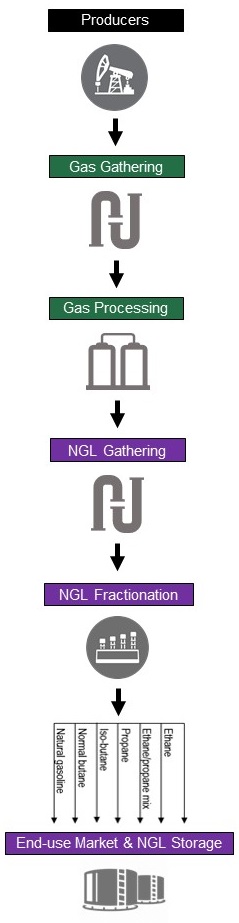 | ||||||||||||||||
| We are connected to supply in natural gas and NGL producing basins and have significant basin diversification, including the Williston, Permian, Powder River and DJ Basins, and the SCOOP and STACK areas. In our Natural Gas Gathering and Processing segment, we have more than 3 million dedicated acres in the Williston Basin and approximately 300,000 dedicated acres in the SCOOP and STACK areas. In our Natural Gas Liquids segment, we are the largest NGL takeaway provider in the Williston and Powder River Basins; Oklahoma, including the SCOOP and STACK areas; Kansas; and the Texas Panhandle. We also have a significant presence in the Permian Basin. | |||||||||||||||||
| Natural Gas Gathering & Processing | |||||||||||||||||
| Natural Gas Liquids | |||||||||||||||||
| Natural Gas Pipelines | |||||||||||||||||
| Raw natural gas is typically gathered at the wellhead, compressed and transported through pipelines to our processing facilities. Most raw natural gas produced at the wellhead also contains a mixture of NGL components, including ethane, propane, iso-butane, normal butane and natural gasoline. | |||||||||||||||||
| Gathered wellhead natural gas is directed to our processing plants to remove NGLs, resulting in residue natural gas (primarily methane). | Once processed, residue natural gas is recompressed and delivered to intrastate and interstate natural gas pipelines primarily in our Natural Gas Pipelines segment. | ||||||||||||||||
 | |||||||||||||||||
| NGLs extracted at natural gas processing plants, both third-party and our own, are then gathered by our NGL gathering pipelines. | |||||||||||||||||
| Gathered NGLs are directed to our downstream fractionators in the Mid-Continent region and Mont Belvieu, Texas, to be separated into purity products. | |||||||||||||||||
| Residue natural gas is transported to storage facilities and end users, such as large industrial customers, natural gas and electric utilities serving commercial and residential consumers, and can ultimately reach international markets through liquefied natural gas exports and cross-border pipelines. | |||||||||||||||||
| Purity products are stored or distributed to our customers, such as petrochemical companies, propane distributors, heating fuel users, ethanol producers, refineries and exporters. | |||||||||||||||||
EXECUTIVE SUMMARY
Business Update and Market Conditions - We experienced earnings growth in 2022, compared with 2021, due primarily to increased producer activity across our operations, higher realized commodity prices, net of hedging, and higher average fee rates. In 2023, we expect to benefit from higher volumes, our completed Demicks Lake III natural gas processing plant and the expected completion of our MB-5 NGL fractionator, highlighting our extensive and integrated assets that are located in some of the most productive shale basins in the United States. Although the energy industry has experienced many commodity cycles, we have positioned ourselves to reduce exposure to direct commodity price volatility. Each of our three segments are primarily fee-based, and our consolidated earnings were approximately 90% fee-based in 2022. While our Natural Gas Gathering and Processing segment’s earnings are primarily fee-based, we have direct commodity price exposure related primarily to our fee with POP contracts, and we have hedged approximately 70% of our forecasted equity volumes for 2023. In addition, our Natural Gas Gathering and Processing and Natural Gas Liquids segments are exposed to volumetric risk as a result of drilling and well completion activity, severe weather disruptions, operational outages, global crude oil, NGL and natural gas demand, changes in gas-to-oil ratios and normal volumetric well declines. Our Natural Gas Pipelines segment is not exposed to significant volumetric risk due to nearly all of our capacity being subscribed under long-term, firm fee-based contracts.
Medford Incident - On July 9, 2022, a fire occurred at our 210 MBbl/d Medford, Oklahoma, NGL fractionation facility. All personnel were safe and accounted for with temporary evacuations of local residents taken as a precautionary measure. On January 9, 2023, we reached an agreement with our insurers to settle all claims for physical damage and business interruption related to the M
Showing the first 8K of 80K characters. Open the full section
Item 1A. RISK FACTORS
Our investors should consider the following risks that could affect us and our business. Although we have tried to identify key factors, our investors need to be aware that other risks may prove to be important in the future. New risks may emerge at any time, and we cannot predict such risks or estimate the extent to which they may affect our financial performance. Investors should consider carefully the following discussion of risks and the other information included or incorporated by reference in this Annual Report, including “Forward-Looking Statements,” which are included in Part II, Item 7, Management’s Discussion and Analysis of Financial Condition and Results of Operations.
RISK FACTORS RELATED TO OUR BUSINESS AND INDUSTRY
If the level of drilling in the regions in which we operate declines substantially near our assets, our volumes and revenues could decline.
Our gathering and transportation pipeline systems are dependent upon production from natural gas and crude oil wells, which naturally declines over time. As a result, our cash flows associated with these wells may also decline over time. In order to maintain or increase throughput levels on our gathering and transportation pipeline systems and the asset utilization rates at our processing and fractionation facilities, we must continually obtain new supplies. Our ability to maintain or expand our businesses depends largely on the level of drilling and production by third parties in the regions in which we operate. Our natural gas and NGL supply volumes may be impacted if producers curtail or redirect drilling and production activities. Drilling and production are impacted by factors beyond our control, including:
-
demand and prices for natural gas, NGLs and crude oil;
-
producers’ access to capital;
-
producers’ finding and development costs of reserves;
-
producers’ ability to secure drilling and completion crews and equipment;
-
producers’ desire and ability to obtain necessary permits, drilling rights and surface access in a timely manner and on reasonable terms;
-
crude oil and associated natural gas field characteristics and production performance; and
-
capacity constraints and/or shut downs on the pipelines that transport crude oil, natural gas and NGLs from producing areas and our facilities.
Commodity prices are subject to significant volatility. Drilling and production activity levels may vary across our geographic areas; however, a prolonged period of low commodity prices may reduce drilling and production activities across all areas. If we are not able to obtain new supplies to replace the natural decline in volumes from existing production or reductions in volumes because of competition, including increased competition due to industry consolidation, throughput on our gathering and transportation pipeline systems and the utilization rates of our processing and fractionation facilities would decline, which could affect adversely our business, results of operations, financial position and cash flows.
Our operating results may be affected adversely by unfavorable economic and market conditions.
In addition to impacts from the COVID-19 pandemic, uncertainty or adverse changes in economic conditions worldwide, in the United States, or in the economic regions in which we operate, could negatively affect the crude oil and natural gas markets, resulting in reduced demand and increased price competition for our services and products, or otherwise affect adversely our business, results of operations, financial position and cash flows. Volatility in commodity prices may have an impact on many
of our suppliers and customers, which, in turn, could have a negative impact on their ability to meet their obligations to us. Periods of severe volatility in equity and credit markets may disrupt our access to such markets, make it difficult to obtain financing necessary to expand facilities or acquire assets, increase financing costs and result in the imposition of restrictive financial covenants. Also, economic conditions in the wake of the pandemic have included increasing inflation. Inflationary pressures have resulted in, and may continue to result in, additional increases to the cost of our materials, services and personnel, which could increase our capital expenditures and operating costs. Sustained levels of high inflation have caused the Federal Reserve System and other central banks to increase interest rates, which may cause the cost of capital to increase and depress economic growth, either of which, or the combination of both, could affect adversely our business, results of operations, financial position and cash flows.
The volatility of natural gas, crude oil and NGL prices could affect adversely our earnings and cash flows.
Lower commodity prices could reduce crude oil, natural gas and NGL production, which could decrease the demand for our services. Additionally, a significant portion of our revenues are derived from the sale of commodities that are received in conjunction with natural gas gathering and processing services, the transportation and storage of natural gas, and from the purchase and sale of NGLs and purity NGLs. As commodity prices decline, we could be paid less for our commodities thereby reducing our cash flows. Historically, commodity prices have been volatile and can change quickly. For example, in March 2020, unsuccessful negotiations between the Organization of the Petroleum Exporting Countries (OPEC) and Russia regarding crude oil production cuts resulted in a price war between Saudi Arabia and Russia. As a result, the global supply of crude oil significantly exceeded demand and led to a collapse in crude oil prices. It is likely that commodity prices will continue to be volatile in the future.
The prices we receive for our commodities are subject to wide fluctuations in response to a variety of factors beyond our control, including, but not limited to, the following:
-
overall domestic and global economic conditions and uncertainty;
-
changes in the supply of, and demand for, domestic and foreign energy, even if relatively minor;
-
market uncertainty;
-
the occurrence of wars and other geopolitical conditions impacting supply and demand for natural gas, NGLs and crude oil;
-
production decisions by other countries, and the failure of countries to abide by recent agreements relating to production decisions;
-
the availability and cost of third-party transportation, natural gas processing and fractionation capacity;
-
the level of consumer product demand and storage inventory levels;
-
ethane rejection;
-
weather conditions;
-
domestic and foreign governmental regulations and taxes;
-
the price and availability of alternative fuels;
-
speculation in the commodity futures markets;
-
the effects of imports and exports on the price of natural gas, crude oil, NGL and liquefied natural gas;
-
the effect of worldwide energy-conservation measures;
-
the impact of new supplies, new pipelines, processing and fractionation facilities on location price differentials; and
-
technology and improved efficiency impacting supply and demand for natural gas, NGLs and crude oil.
These external factors and the volatile nature of the energy markets make it difficult to reliably estimate future prices of commodities and the impact commodity price fluctuations have on our customers and their need for our services, which could affect adversely our business, results of operations, financial position and cash flows.
Increasing attention to ESG issues, including climate change, may impact our business.
There are increasing expectations that companies across all industries address ESG issues, including climate change. Changes in regulatory policies, public sentiment or widespread adoption of technologies that aim to address climate change through reducing GHG emissions may result in a reduction in the demand for hydrocarbon products
Showing the first 8K of 66K characters. Open the full section
Item 1B. UNRESOLVED STAFF COMMENTS
Not applicable.
Item 2. PROPERTIES
A description of our properties is included in Item 1, Business.
Item 3. LEGAL PROCEEDINGS
Information about our legal proceedings is included in Note O of the Notes to Consolidated Financial Statements in this Annual Report.
Item 4. MINE SAFETY DISCLOSURES
Not applicable.
PART II
Item 5. MARKET FOR REGISTRANT’S COMMON EQUITY, RELATED STOCKHOLDER MATTERS AND ISSUER PURCHASES OF EQUITY SECURITIES
Our common stock is listed on the NYSE under the trading symbol “OKE.” The corporate name ONEOK is used in stock listings.
At February 21, 2023, there were 13,064 holders of record of our 447,220,972 outstanding shares of common stock.
For information regarding our Employee Stock Award Program and other equity compensation plans, see Note K of the Notes to Consolidated Financial Statements and “Equity Compensation Plan Information” included in Part III, Item 12, Security Ownership of Certain Beneficial Owners and Management and Related Stockholder Matters, in this Annual Report.
PERFORMANCE GRAPH
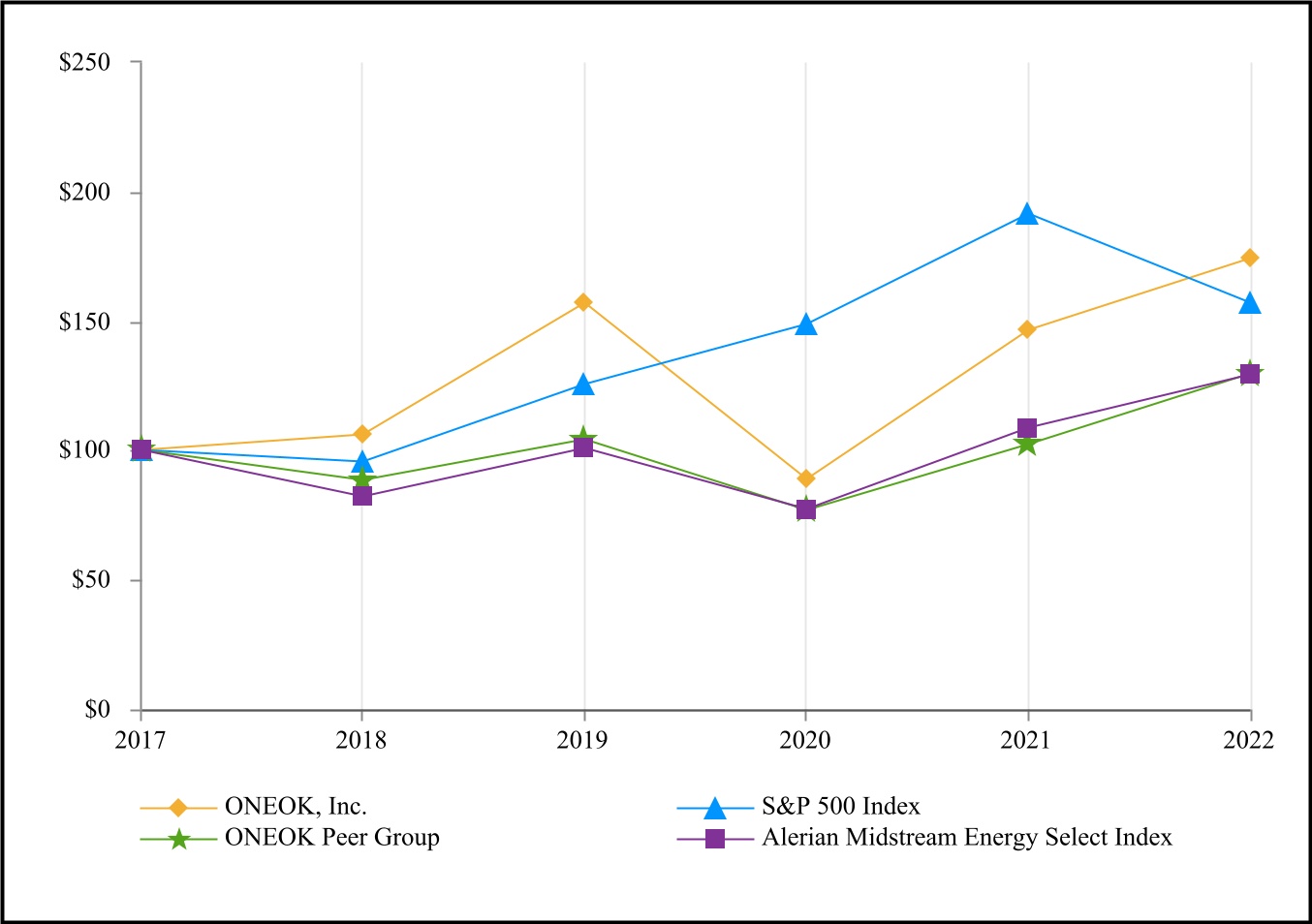
The following performance graph compares the performance of our common stock with the S&P 500 Index, the Alerian Midstream Energy Select Index and a ONEOK Peer Group during the period beginning on December 31, 2017, and ending on December 31, 2022.
Value of a $100 Investment, Assuming Reinvestment of Distributions/Dividends,
at December 31, 2017, and at the End of Every Year Through December 31, 2022.
| Cumulative Total Return | |||||||||||||||||||||||||||||||||||
| Years Ended December 31, | |||||||||||||||||||||||||||||||||||
| 2018 | 2019 | 2020 | 2021 | 2022 | |||||||||||||||||||||||||||||||
| ONEOK, Inc. | $ | 106.28 | $ | 157.06 | $ | 88.96 | $ | 146.64 | $ | 174.36 | |||||||||||||||||||||||||
| S&P 500 Index | $ | 95.62 | $ | 125.72 | $ | 148.85 | $ | 191.58 | $ | 156.88 | |||||||||||||||||||||||||
| ONEOK Peer Group (a) | $ | 88.62 | $ | 104.19 | $ | 76.75 | $ | 102.24 | $ | 129.86 | |||||||||||||||||||||||||
| Alerian Midstream Energy Select Index (b) | $ | 82.33 | $ | 100.72 | $ | 77.13 | $ | 108.56 | $ | 129.35 |
(a) - The current ONEOK Peer Group is composed of the following companies: DCP Midstream, LP; Energy Transfer LP; EnLink Midstream, LLC; Enterprise Products Partners L.P.; Kinder Morgan, Inc.; Magellan Midstream Partners, L.P.; MPLX LP; NuStar Energy L.P.; Plains All American Pipeline, L.P.; Targa Resources Corp.; Western Midstream Partners, LP; and The Williams Companies, Inc.
(b) - The Alerian Midstream Energy Select Index measures the composite performance of approximately 29 North American energy infrastructure companies who are engaged in midstream activities involving energy commodities.
Item 6. [RESERVED]
Item 7. MANAGEMENT’S DISCUSSION AND ANALYSIS OF FINANCIAL CONDITION AND RESULTS OF OPERATIONS
The following discussion and analysis should be read in conjunction with Part I, Item 1, Business, our audited Consolidated Financial Statements and the Notes to Consolidated Financial Statements in this Annual Report.
RECENT DEVELOPMENTS
Please refer to the “Financial Results and Operating Information” and “Liquidity and Capital Resources” sections of Management’s Discussion and Analysis of Financial Condition and Results of Operations in this Annual Report for additional information.
Market Conditions - We experienced earnings growth in 2022, compared with 2021, due primarily to increased producer activity across our operations, higher realized commodity prices, net of hedging and higher average fee rates. In 2023, we expect to benefit from higher volumes, our completed Demicks Lake III natural gas processing plant and the expected completion of our MB-5 NGL fractionator, highlighting our extensive and integrated assets that are located in some of the most productive shale basins in the United States.
Medford Incident - On July 9, 2022, a fire occurred at our 210 MBbl/d Medford, Oklahoma, natural gas liquids fractionation facility. All personnel were safe and accounted for with temporary evacuations of local residents taken as a precautionary measure.
Net income for the year ended December 31, 2022, includes the unfavorable impact of our $5 million property deductible and approximately $30 million of losses incurred associated with the 45-day waiting period for business interruption coverage. Beginning in August 2022, we developed claims related to the Medford incident and recorded accruals for expected insurance recoveries. The table below sets forth our 2022 insurance accruals associated with the Medford incident:
| 2022 Insurance Accruals | ||||||||
| (Millions of dollars) | ||||||||
| Business interruption | $ | 96.1 | ||||||
| Noncash property losses | 45.6 | |||||||
| Medford response expenses | 9.0 | |||||||
| Total insurance recoveries accrued (a) | $ | 150.7 |
(a) - We received a $100 million payment in the fourth quarter 2022, leaving a receivable balance at December 31, 2022, of $50.7 million.
Our business interruption insurance includes coverage for (i) incurred costs and losses that are either unavoidable or incurred to mitigate or reduce losses and (ii) lost earnings. Our business interruption insurance accruals in the table above primarily represent third-party fractionation costs and fully offset the actual losses incurred in 2022, subsequent to the 45-day waiting period.
We assessed the property damage to our facility and wrote off assets totaling $45.6 million, which represents the carrying value associated with certain damaged Medford facility property. These noncash property losses are fully offset by insurance recoveries noted in the table above. We expect to continue to operate NGL pipeline assets in Medford along with existing offices for regional operations. In addition, we are preserving certain Medford assets for future potential NGL facilities that could be constructed in Medford to enhance our NGL business as the market evolves. For additional information on the Medford incident, see Note B of the Notes to Consolidated Financial Statements in this Annual Report.
Subsequent Event - On January 9, 2023, we reached an agreement with our insurers to settle all claims for physical damage and business interruption related to the Medford incident. Under the terms of the settlement agreement, we agreed to resolve the claims for total insurance payments of $930 million, $100 million of which was received in 2022. The remaining $830 million was received in the first quarter 2023. The proceeds serve as settlement for property damage, business interruption claims to the date of settlement and as payment in lieu of future business interruption insurance claims.
In the first quarter 2023, we applied the $830 million received to our outstanding insurance receivable at December 31, 2022, of $50.7 million, and recorded a gain in operating income for the remaining $779.3 million. We expect our cash from operations in the remainder of 2023 and in 2024 to be impacted by incurred costs and losses resulting from the Medford incident for which we will no longer receive business interruption proceeds.
Due to market demand and a more favorable completion schedule, we announced plans to construct a new 125 MBbl/d MB-6 NGL fractionator in Mont Belvieu, Texas, instead of rebuilding our Medford NGL fractionator at this time. The MB-6 fractionator will have the capability to produce purity ethane instead of the ethane/propane mix previously produced at the Medford facility. The 125 MBbl/d capacity of the MB-6 fractionator is expected to be economically equivalent to the capacity lost at Medford. In addition, our 125 MBbl/d MB-5 NGL fractionator remains on schedule to be completed early in the second quarter of 2023, which is expected to reduce the need for third-party fractionation while the new MB-6 fractionator is being constructed. Until these projects are completed, we expect to continue to provide midstream services through existing arrangements with industry peers, along with our integrated NGL pipeline system between the Mid-Continent and Gulf Coast regions and our fractionation and storage assets.
Ethane Production - Price differentials between ethane and natural gas can cause natural gas processors to extract ethane or leave it in the natural gas stream, known as ethane rejection. As a result of these ethane economics, ethane volumes on our system can fluctuate. In the second half of 2022, ethane prices decreased relative to natural gas prices, as overall demand decreased, and were further impacted by lower petrochemical plant utilization, both planned and unplanned. This resulted in higher ethane rejection across most basins where we operate, with the largest impact in the Mid-Continent region, compared with the first half of 2022. As utilization increases and demand for feedstock returns, we expect improvement in ethane economics; however, price fluctuations are expected to continue.
Ethane volumes under long-term contracts delivered to our NGL system increased approximately 20 MBbl/d to an average of 450 MBbl/d in 2022, compared with 430 MBbl/d in 2021, due primarily to changes in ethane extraction economics. We estimate that there are more than 225 MBbl/d of discretionary ethane, consisting of more than 125 MBbl/d in the Rocky Mountain region and approximately 100 MBbl/d in the Mid-Continent region, that can be recovered and transported on our system.
Growth Projects - We operate an integrated, reliable and diversified network of NGL and natural gas gathering, processing, fractionation, transportation and storage assets connecting supply in the Rocky Mountain, Mid-Continent and Permian regions with key market centers. Our primary capital-growth projects are outlined in the table below:
| Project | Scope | Approximate Costs (a) | Completion | ||||||||
| Natural Gas Gathering and Processing | (In millions) | ||||||||||
| Demicks Lake III plant | 200 MMcf/d processing plant in the core of the Williston Basin | $188 | Completed | ||||||||
| Supported by acreage dedications with primarily fee-based contracts | |||||||||||
| Natural Gas Liquids | |||||||||||
Showing the first 8K of 83K characters. Open the full section
Item 7A. QUANTITATIVE AND QUALITATIVE DISCLOSURES ABOUT MARKET RISK
Our exposure to market risk discussed below includes forward-looking statements and represents an estimate of possible changes in future earnings that could occur assuming hypothetical future movements in interest rates or commodity prices. Our views on market risk are not necessarily indicative of actual results that may occur and do not represent the maximum possible gains and losses that may occur since actual gains and losses will differ from those estimated based on actual fluctuations in interest rates or commodity prices and the timing of transactions.
We are exposed to market risk due to commodity price and interest-rate volatility. Market risk is the risk of loss arising from adverse changes in market rates and prices. We may use financial instruments, including forward sales, swaps, options and futures, to manage the risks of certain identifiable or anticipated transactions and achieve more predictable cash flows. Our risk-management function follows policies and procedures established by our Risk Oversight and Strategy Committee to monitor our natural gas, condensate and NGL marketing activities and interest rates to ensure our hedging activities mitigate market risks and comply with approved thresholds or limits. We do not use financial instruments for trading purposes.
We utilize a sensitivity analysis model to assess the risk associated with our derivative portfolio. The sensitivity analysis measures the potential change in fair value of our derivative instruments based upon a hypothetical 10% movement in the underlying commodity prices or interest rates. In addition to these variables, the fair value of our derivative portfolio is influenced by fluctuations in the notional amounts of the instruments and the discount rates used to determine the present values. Because we enter into these derivative instruments for the purpose of mitigating the risks that accompany certain of our business activities, as described below, the change in the market value of our derivative portfolio would typically be offset largely by a corresponding gain or loss on the hedged item.
See Note A of the Notes to Consolidated Financial Statements in this Annual Report for discussion on our accounting policies for our derivative instruments and the impact on our Consolidated Financial Statements.
COMMODITY PRICE RISK
As part of our hedging strategy, we use commodity derivative financial instruments and physical-forward contracts described in Note D of the Notes to Consolidated Financial Statements in this Annual Report to reduce the impact of near-term price fluctuations of natural gas, NGLs and condensate.
Although our businesses are primarily fee-based, in our Natural Gas Gathering and Processing segment, we are exposed to commodity price risk as a result of retaining a portion of the commodity sales proceeds associated with our fee with POP contracts. Under certain fee with POP contracts, our contractual fees and POP percentage may increase or decrease if production volumes, delivery pressures or commodity prices change relative to specified thresholds. We are exposed to basis risk between the various production and market locations where we buy and sell commodities.
The following table presents the effect a hypothetical 10% change in the underlying commodity prices would have on the estimated fair value of our commodity derivative instruments as of the dates indicated:
| Commodity Contracts | December 31, 2022 | December 31, 2021 | |||||||||
| (Millions of dollars) | |||||||||||
| Crude oil and NGLs | $ | 34.6 | $ | 40.6 | |||||||
| Natural gas | 18.0 | 11.5 | |||||||||
| Total change in estimated fair value of commodity contracts | $ | 52.6 | $ | 52.1 |
Our sensitivity analysis represents an estimate of the reasonably possible gains and losses that would be recognized on our commodity derivative contracts assuming hypothetical movements in future market prices and is not necessarily indicative of
actual results that may occur. Actual gains and losses may differ from estimates due to actual fluctuations in market prices, as well as changes in our commodity derivative portfolio during the year.
The following tables set forth hedging information for our Natural Gas Gathering and Processing segment’s forecasted equity volumes for the period indicated:
| Year Ending December 31, 2023 | |||||||||||||||||||||||
| Volumes Hedged | Average Price | Percentage Hedged | |||||||||||||||||||||
| NGLs - excluding ethane (MBbl/d) - Conway/Mont Belvieu | 10.7 | $ | 1.23 | / gallon | 67% | ||||||||||||||||||
| Condensate (MBbl/d) - WTI-NYMEX | 1.7 | $ | 85.48 | / Bbl | 67% | ||||||||||||||||||
| Natural gas (BBtu/d) - NYMEX and basis | 99.2 | $ | 3.50 | / MMBtu | 75% |
| Year Ending December 31, 2024 | |||||||||||||||||||||||
| Volumes Hedged | Average Price | Percentage Hedged | |||||||||||||||||||||
| Natural gas (BBtu/d) - NYMEX and basis | 16.2 | $ | 7.18 | / MMBtu | 11% |
Our Natural Gas Gathering and Processing segment’s commodity price sensitivity is estimated as a hypothetical change in the price of NGLs, crude oil and natural gas at December 31, 2022. Condensate sales are typically based on the price of crude oil. Assuming normal operating conditions, we estimate the following for our forecasted equity volumes:
-
a $0.01 per gallon change in the composite price of NGLs, excluding ethane, would change adjusted EBITDA for the years ending December 31, 2023 and 2024, by $2.5 million and $2.6 million, respectively;
-
a $1.00 per barrel change in the price of crude oil would change adjusted EBITDA for the years ending December 31, 2023 and 2024, by $0.9 million and $1.0 million, respectively; and
-
a $0.10 per MMBtu change in the price of residue natural gas would change adjusted EBITDA for the years ending December 31, 2023 and 2024, by $4.8 million and $5.2 million, respectively.
These estimates do not include any effects of hedging or effects on demand for our services or natural gas processing plant operations that might be caused by, or arise in conjunction with, commodity price fluctuations. For example, a change in the gross processing spread may cause a change in the amount of ethane extracted from the natural gas stream, impacting gathering and processing financial results for certain contracts.
INTEREST-RATE RISK
We are exposed to interest-rate risk through borrowings under our $2.5 Billion Credit Agreement, commercial paper program and long-term debt issuances. Future increases in commercial paper rates or bond rates could expose us to increased interest costs on future borrowings. We may manage interest-rate risk through the use of fixed-rate debt, floating-rate debt and interest-rate swaps. Interest-rate swaps are agreements to exchange interest payments at some future point based on specified notional amounts.
In 2022, we settled $750 million of our forward-starting interest-rate swaps related to our underwritten public offering of $750 million senior unsecured notes, resulting in a gain of $28.1 million, which is included in accumulated other comprehensive loss and amortized into interest expense over the term of the related debt. In December 2022, we terminated the remaining $375 million of our forward-starting interest swaps that had mandatory termination dates of December 31, 2022. We simultaneously entered into forward-starting interest-rate swaps with the same notional amounts at current market rates to hedge the variability of interest payments on a portion of our forecasted debt issuances that may result from changes in the benchmark interest rate before the debt is issued.
At December 31, 2022, and December 31, 2021, we had forward-starting interest-rate swaps with notional amounts totaling $0.4 billion and $1.1 billion, respectively, to hedge the variability of interest payments on a portion of our forecasted debt issuances. All of our interest-rate swaps are designated as cash flow hedges. At December 31, 2022 and 2021, we had derivative assets of $10.9 million and derivative liabilities of $145.5 million, respectively, related to these interest-rate swaps.
The following table presents the effect of a 10% hypothetical change in interest rates on the estimated fair value of our interest-rate derivative instruments as of the dates indicated:
| December 31, 2022 | December 31, 2021 | ||||||||||
| (Millions of dollars) | |||||||||||
| Forward-starting interest-rate swaps | $ | 13.0 | $ | 19.6 |
Our sensitivity analysis represents an estimate of the reasonably possible gains and losses that would be recognized on our interest-rate derivative contracts assuming hypothetical movements in future interest rates and is not necessarily indicative of actual results that may occur. Actual gains and losses may differ from estimates due to actual fluctuations in interest rates, as well as changes in our interest-rate derivative portfolio during the year.
See Note D of the Notes to Consolidated Financial Statements in this Annual Report for more information on our hedging activities.
COUNTERPARTY CREDIT RISK
We assess the creditworthiness of our counterparties on an ongoing basis and require security, including prepayments and other forms of collateral, when appropriate. Certain of our counterparties may be impacted by a relatively low commodity price environment and could experience financial problems, which could result in nonpayment and/or nonperformance, which could impact adversely our results of operations.
Natural Gas Gathering and Processing - Our Natural Gas Gathering and Processing segment derives services revenue primarily from major and independent crude oil and natural gas producers, which include both large integrated and independent exploration and production companies. In this segment, our downstream commodity sales customers are primarily utilities, large industrial companies, marketing companies and our NGL affiliate. We are not typically exposed to material credit risk with producers under fee with POP contracts as we sell the commodities and remit a portion of the sales proceeds back to the producer less our contractual fees. In 2022 and 2021, approximately 95% and 90%, respectively, of the downstream commodity sales in our Natural Gas Gathering and Processing segment were made to customers rated investment-grade by S&P, approved through comparable internal counterparty analysis, or were secured by letters of credit or other collateral.
Natural Gas Liquids - Our Natural Gas Liquids segment’s counterparties are primarily NGL and natural gas gathering and processing companies; major and independent crude oil and natural gas production companies; utilities; large industrial companies; natural gasoline distributors; propane distributors; municipalities; and petrochemical, refining and marketing companies. We charge fees to NGL and natural gas gathering and processing counterparties and NGL pipeline transportation customers. We are not typically exposed to material credit risk on the majority of our exchange services fees, as we purchase NGLs from our gathering and processing counterparties and deduct our fee from the amounts we remit. We also earn sales revenue on the downstream sales of purity NGLs. In 2022 and 2021, approximately 85% and 70%, respectively, of this segment’s commodity sales were made to customers rated investment-grade by S&P, approved through comparable internal counterparty analysis, or were secured by letters of credit or other collateral. In addition, the majority of our Natural Gas Liquids segment’s pipeline tariffs provide us the ability to require security from shippers.
Natural Gas Pipelines - Our Natural Gas Pipelines segment’s customers are primarily local natural gas distribution companies, electric-generation facilities, large industrial companies, municipalities, producers, processors and marketing companies. In 2022 and 2021, approximately 90% and 85%, respectively, of our revenues in this segment were from customers rated investment-grade by S&P, approved through comparable internal counterparty analysis, or were secured by letters of credit or other collateral. In addition, the majority of our Natural Gas Pipelines segment’s pipeline tariffs provide us the ability to require security from shippers.
Item 8. FINANCIAL STATEMENTS AND SUPPLEMENTARY DATA
Report of Independent Registered Public Accounting Firm
To the Board of Directors and Shareholders of ONEOK, Inc.
Opinions on the Financial Statements and Internal Control over Financial Reporting
We have audited the accompanying consolidated balance sheets of ONEOK, Inc. and its subsidiaries (the “Company”) as of December 31, 2022 and 2021, and the related consolidated statements of income, of comprehensive income, of changes in equity and of cash flows for each of the three years in the period ended December 31, 2022, including the related notes (collectively referred to as the “consolidated financial statements”). We also have audited the Company's internal control over financial reporting as of December 31, 2022, based on criteria established in Internal Control - Integrated Framework (2013) issued by the Committee of Sponsoring Organizations of the Treadway Commission (COSO).
In our opinion, the consolidated financial statements referred to above present fairly, in all material respects, the financial position of the Company as of December 31, 2022 and 2021, and the results of its operations and its cash flows for each of the three years in the period ended December 31, 2022, in conformity with accounting principles generally accepted in the United States of America. Also in our opinion, the Company maintained, in all material respects, effective internal control over financial reporting as of December 31, 2022, based on criteria established in Internal Control - Integrated Framework (2013) issued by the COSO.
Basis for Opinions
The Company's management is responsible for these consolidated financial statements, for maintaining effective internal control over financial reporting, and for its assessment of the effectiveness of internal control over financial reporting, included in Management's Report on Internal Control Over Financial Reporting appearing under Item 9A. Our responsibility is to express opinions on the Company’s consolidated financial statements and on the Company's internal control over financial reporting based on our audits. We are a public accounting firm registered with the Public Company Accounting Oversight Board (United States) (PCAOB) and are required to be independent with respect to the Company in accordance with the U.S. federal securities laws and the applicable rules and regulations of the Securities and Exchange Commission and the PCAOB.
We conducted our audits in accordance with the standards of the PCAOB. Those standards require that we plan and perform the audits to obtain reasonable assurance about whether the consolidated financial statements are free of material misstatement, whether due to error or fraud, and whether effective internal control over financial reporting was maintained in all material respects.
Our audits of the consolidated financial statements included performing procedures to assess the risks of material misstatement of the consolidated financial statements, whether due to error or fraud, and performing procedures that respond to those risks. Such procedures included examining, on a test basis, evidence regarding the amounts and disclosures in the consolidated financial statements. Our audits also included evaluating the accounting principles used and significant estimates made by management, as well as evaluating the overall presentation of the consolidated financial statements. Our audit of internal control over financial reporting included obtaining an understanding of internal control over financial reporting, assessing the risk that a material weakness exists, and testing and evaluating the design and operating effectiveness of internal control based on the assessed risk. Our audits also included performing such other procedures as we considered necessary in the circumstances. We believe that our audits provide a reasonable basis for our opinions.
Definition and Limitations of Internal Control over Financial Reporting
A company’s internal control over financial reporting is a process designed to provide reasonable assurance regarding the reliability of financial reporting and the preparation of financial statements for external purposes in accordance with generally accepted accounting principles. A company’s internal control over financial reporting includes those policies and procedures that (i) pertain to the maintenance of records that, in reasonable detail, accurately and fairly reflect the transactions and dispositions of the assets of the company; (ii) provide reasonable assurance that transactions are recorded as necessary to permit preparation of financial statements in accordance with generally accepted accounting principles, and that receipts and expenditures of the company are being made only in accordance with authorizations of management and directors of the company; and (iii) provide reasonable assurance regarding prevention or timely detection of unauthorized acquisition, use, or disposition of the company’s assets that could have a material effect on the financial statements.
Because of its inherent limitations, internal control over financial reporting may not prevent or detect misstatements. Also, projections of any evaluation of effectiveness to future periods are subject to the risk that controls may become inadequate because of changes in conditions, or that the degree of compliance with the policies or procedures may deteriorate.
Critical Audit Matters
The critical audit matter communicated below is a matter arising from the current period audit of the consolidated financial statements that was communicated or required to be communicated to the audit committee and that (i) relates to accounts or disclosures that are material to the consolidated financial statements and (ii) involved our especially challenging, subjective, or complex judgments. The communication of critical audit matters does not alter in any way our opinion on the consolidated financial statements, taken as a whole, and we are not, by communicating the critical audit matter below, providing a separate opinion on the critical audit matter or on the accounts or disclosures to which it relates.
Accounting for the Medford Incident
As described in Note B to the consolidated financial statements, on July 9, 2022, a fire occurred at the Company’s 210 MBbl/d Medford, Oklahoma, natural gas liquids fractionation facility. The Company has property damage and business interruption coverage against which they developed claims related to the Medford incident and recorded accruals for the expected insurance recoveries. Management records recoveries for incurred costs and lost earnings related to its business interruption coverage for the amount probable of recovery, not to exceed the actual losses incurred, and for lost earnings that have been realized and are no longer considered a gain contingency. Management assessed property damage to the facility and incurred costs and lost earnings related to business interruption, as well as timing of recognition under applicable insurance recovery guidance, and recorded accruals of $150.7 million for the year ended December 31, 2022, which was comprised of property damage of $45.6 million, with a corresponding write off of assets due to property damage of the facility; $9 million related to incurred costs in excess of the deductible that were probable of recovery, with an offset to the operating and maintenance line item; and $96.1 million primarily related to third-party fractionation costs incurred subsequent to the 45-day business interruption waiting period, with an offset to other operating (income) expense. The Company received a $100 million unallocated payment from the insurers in the fourth quarter of 2022, and had recorded an outstanding insurance receivable of $50.7 million as of December 31, 2022.
The principal considerations for our determination that performing procedures relating to the accounting for the Medford in
Showing the first 8K of 228K characters. Open the full section
Item 9. CHANGES IN AND DISAGREEMENTS WITH ACCOUNTANTS ON ACCOUNTING AND
FINANCIAL DISCLOSURE
None.
Item 9A. CONTROLS AND PROCEDURES
Evaluation of Disclosure Controls and Procedures
Our Chief Executive Officer (Principal Executive Officer) and Chief Financial Officer (Principal Financial Officer) have concluded that our disclosure controls and procedures were effective as of the end of the period covered by this report based on the evaluation of the controls and procedures required by Rules 13a-15(b) and 15d-15(b) of the Exchange Act.
Management’s Report on Internal Control Over Financial Reporting
Our management is responsible for establishing and maintaining adequate internal control over financial reporting, as such term is defined in Exchange Act Rule 13a-15(f). Under the supervision and with the participation of our management, including our Principal Executive Officer and Principal Financial Officer, we evaluated the effectiveness of our internal control over financial reporting based on the framework in Internal Control-Integrated Framework (2013) issued by the Committee of Sponsoring Organizations of the Treadway Commission. Because of inherent limitations, internal control over financial reporting may not prevent or detect misstatements. Also, projections of any evaluation of effectiveness to future periods are subject to the risk that controls may become inadequate because of changes in conditions, or that the degree of compliance with the policies or procedures may deteriorate. Based on our evaluation under that framework, our management concluded that our internal control over financial reporting was effective as of December 31, 2022.
The effectiveness of our internal control over financial reporting as of December 31, 2022, has been audited by PricewaterhouseCoopers LLP, an independent registered public accounting firm, as stated in their report which is included herein (Item 8).
Changes in Internal Control Over Financial Reporting
There have been no changes in our internal control over financial reporting during the quarter ended December 31, 2022, that have materially affected, or are reasonably likely to materially affect, our internal control over financial reporting.
Item 9B. OTHER INFORMATION
Not applicable.
Item 9C. DISCLOSURE REGARDING FOREIGN JURISDICTIONS THAT PREVENT INSPECTIONS
Not applicable.
PART III
Item 10. DIRECTORS, EXECUTIVE OFFICERS AND CORPORATE GOVERNANCE
Directors of the Registrant
Information concerning our directors is set forth in our 2023 definitive Proxy Statement and is incorporated herein by this reference.
Executive Officers of the Registrant
Information concerning our executive officers is included in Part I, Item 1, Business, of this Annual Report.
Compliance with Section 16(a) of the Exchange Act
Information on compliance with Section 16(a) of the Exchange Act is set forth in our 2023 definitive Proxy Statement and is incorporated herein by this reference.
Code of Ethics
Information concerning the code of ethics, or code of business conduct, is set forth in our 2023 definitive Proxy Statement and is incorporated herein by this reference.
Nominating Committee Procedures
Information concerning the Nominating Committee procedures is set forth in our 2023 definitive Proxy Statement and is incorporated herein by this reference.
Audit Committee
Information concerning the Audit Committee is set forth in our 2023 definitive Proxy Statement and is incorporated herein by this reference.
Audit Committee Financial Experts
Information concerning the Audit Committee Financial Experts is set forth in our 2023 definitive Proxy Statement and is incorporated herein by this reference.
Item 11. EXECUTIVE COMPENSATION
Information on executive compensation is set forth in our 2023 definitive Proxy Statement and is incorporated herein by this reference.
Item 12. SECURITY OWNERSHIP OF CERTAIN BENEFICIAL OWNERS AND MANAGEMENT AND RELATED STOCKHOLDER MATTERS
Security Ownership of Certain Beneficial Owners
Information concerning the ownership of certain beneficial owners is set forth in our 2023 definitive Proxy Statement and is incorporated herein by this reference.
Security Ownership of Management
Information on security ownership of directors and officers is set forth in our 2023 definitive Proxy Statement and is incorporated herein by this reference.
Equity Compensation Plan Information
The following table sets forth certain information concerning our equity compensation plans as of December 31, 2022:
| Number of Securities to be Issued Upon Exercise of Outstanding Options, Warrants and Rights | Weighted-Average Exercise Price of Outstanding Options, Warrants and Rights | Number of Securities Remaining Available For Future Issuance Under Equity Compensation Plans (Excluding Securities in Column (a)) | ||||||||||||||||||||||||||||||
| Plan Category | (a) | (b) (3) | (c) | |||||||||||||||||||||||||||||
| Equity compensation plans approved by security holders (1) | 3,320,600 | — | 5,111,244 | |||||||||||||||||||||||||||||
| Equity compensation plans not approved by security holders (2) | 330,002 | $ | 65.70 | — | ||||||||||||||||||||||||||||
| Total | 3,650,602 | $ | 65.70 | 5,111,244 |
(1) - Includes shares granted under our Employee Stock Purchase Plan, Employee Stock Award Program and restricted stock incentive unit awards and performance unit awards granted under our former Long-Term Incentive Plan, our former Equity Compensation Plan and our Equity Incentive Plan. For a brief description of the material features of these plans, see Note K of the Notes to Consolidated Financial Statements in this Annual Report. Column (c) includes 459,886, 130,204 and 4,521,154 shares available for future issuance under our Employee Stock Purchase Plan, Employee Stock Award Program and Equity Incentive Plan, respectively.
(2) - Includes our NQDC Plan, Deferred Compensation Plan for Non-Employee Directors and our former Stock Compensation Plan for Non-Employee Directors. For a brief description of the material features of these plans, see Notes K and L of the Notes to Consolidated Financial Statements in this Annual Report.
(3) - There is no exercise price associated with restrictive stock incentive unit awards and performance unit awards. Compensation deferred into our common stock under our Deferred Compensation Plan for Non-Employee Directors is distributed to participants at fair market value on the date of distribution. The price used for these plans to calculate the weighted-average exercise price in the table is $65.70, which represents the 2022 year-end closing price of our common stock on the NYSE.
Item 13. CERTAIN RELATIONSHIPS AND RELATED TRANSACTIONS, AND DIRECTOR INDEPENDENCE
Information on certain relationships and related transactions and director independence is set forth in our 2023 definitive Proxy Statement and is incorporated herein by this reference.
Item 14. PRINCIPAL ACCOUNTING FEES AND SERVICES
Information concerning the principal accountant’s fees and services is set forth in our 2023 definitive Proxy Statement and is incorporated herein by this reference.
PART IV
Item 15. EXHIBITS, FINANCIAL STATEMENT SCHEDULES
| (1) Financial Statements | Page No. | ||||||||||
| (a) | Report of Independent Registered Public Accounting Firm (PCAOB ID: 238) | 56-57 | |||||||||
| (b) | Consolidated Statements of Income for the years ended December 31, 2022, 2021 and 2020 | 58 | |||||||||
| (c) | Consolidated Statements of Comprehensive Income for the years ended December 31, 2022, 2021 and 2020 | 59 | |||||||||
| (d) | Consolidated Balance Sheets as of December 31, 2022 and 2021 | 60-61 | |||||||||
| (e) | Consolidated Statements of Cash Flows for the years ended December 31, 2022, 2021 and 2020 | 63 | |||||||||
| (f) | Consolidated Statements of Changes in Equity for the years ended December 31, 2022, 2021 and 2020 | 64-65 | |||||||||
| (g) | Notes to Consolidated Financial Statements | 66-101 | |||||||||
| (2) Financial Statements Schedules | |||||||||||
| All schedules have been omitted because of the absence of conditions under which they are required. |
| 101.SCH | Inline XBRL Taxonomy Extension Schema Document. | |||||||
| 101.CAL | Inline XBRL Taxonomy Calculation Linkbase Document. | |||||||
| 101.DEF | Inline XBRL Taxonomy Extension Definitions Document. | |||||||
| 101.LAB | Inline XBRL Taxonomy Label Linkbase Document. | |||||||
| 101.PRE | Inline XBRL Taxonomy Presentation Linkbase Document. | |||||||
| 104 | Cover Page Interactive Data File (formatted in Inline XBRL and contained in Exhibit 101). |
Attached as Exhibit 101 to this Annual Report are the following Inline XBRL-related documents: (i) Document and Entity Information; (ii) Consolidated Statements of Income for the years ended December 31, 2022, 2021 and 2020; (iii) Consolidated Statements of Comprehensive Income for the years ended December 31, 2022, 2021 and 2020; (iv) Consolidated Balance Sheets at December 31, 2022 and 2021; (v) Consolidated Statements of Cash Flows for the years ended December 31, 2022, 2021 and 2020; (vi) Consolidated Statements of Changes in Equity for the years ended December 31, 2022, 2021 and 2020; and (vii) Notes to Consolidated Financial Statements.
Item 16. FORM 10-K SUMMARY
None.
Signatures
Pursuant to the requirements of Section 13 or 15(d) of the Exchange Act, the registrant has duly caused this report to be signed on its behalf by the undersigned, thereunto duly authorized.
| ONEOK, Inc. | ||||||||
| Registrant | ||||||||
| Date: February 28, 2023 | By: | /s/ Walter S. Hulse III | ||||||
| Walter S. Hulse III | ||||||||
| Chief Financial Officer, Treasurer and | ||||||||
| Executive Vice President, Investor Relations | ||||||||
| and Corporate Development | ||||||||
| (Principal Financial Officer) |
Pursuant to the requirements of the Exchange Act, this report has been signed below by the following persons on behalf of the registrant and in the capacities indicated on this 28th day of February 2023.
| /s/ Julie H. Edwards | /s/ Pierce H. Norton II | ||||||||||
| Julie H. Edwards | Pierce H. Norton II | ||||||||||
| Board Chair | President, Chief Executive Officer and | ||||||||||
| Director | |||||||||||
| /s/ Walter S. Hulse III | /s/ Mary M. Spears | ||||||||||
| Walter S. Hulse III | Mary M. Spears | ||||||||||
| Chief Financial Officer, Treasurer and | Senior Vice President and Chief | ||||||||||
| Executive Vice President, Investor | Accounting Officer, Finance and | ||||||||||
| Relations and Corporate Development | Tax | ||||||||||
| /s/ Brian L. Derksen | /s/ Pattye L. Moore | ||||||||||
| Brian L. Derksen | Pattye L. Moore | ||||||||||
| Director | Director | ||||||||||
| /s/ Mark W. Helderman | /s/ Eduardo A. Rodriguez | ||||||||||
| Mark W. Helderman | Eduardo A. Rodriguez | ||||||||||
| Director | Director | ||||||||||
| /s/ Randall J. Larson | /s/ Gerald B. Smith | ||||||||||
| Randall J. Larson | Gerald B. Smith | ||||||||||
| Director | Director | ||||||||||
| /s/ Steven J. Malcolm | |||||||||||
| Steven J. Malcolm | |||||||||||
| Director | |||||||||||
| /s/ Jim W. Mogg | |||||||||||
| Jim W. Mogg | |||||||||||
| Director | |||||||||||