 filings.tools
Item 1. BUSINESS
80K characters. Original on sec.gov · Markdown
Item 1. BUSINESS
GENERAL
We are incorporated under the laws of the state of Oklahoma, and our common stock is listed on the NYSE under the trading symbol “OKE.” We are a leading midstream service provider and own one of the nation’s premier NGL systems, connecting NGL supply in the Rocky Mountain, Permian and Mid-Continent regions with key market centers and own an extensive network of gathering, processing, fractionation, transportation and storage assets. We apply our core capabilities of gathering, processing, fractionating, transporting, storing and marketing natural gas and NGLs through vertical integration across the midstream value chain to provide our customers with premium services while generating consistent and sustainable earnings growth.
Midstream Value Chain
| Legend | 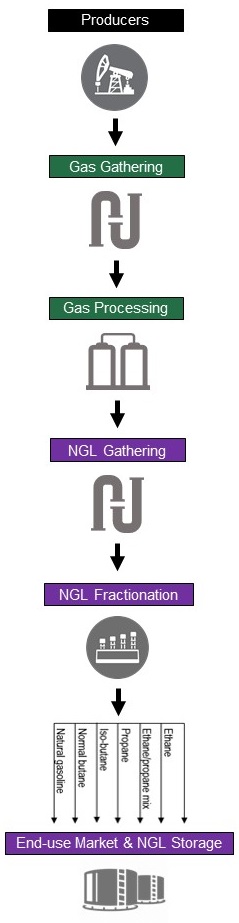 | ||||||||||||||||
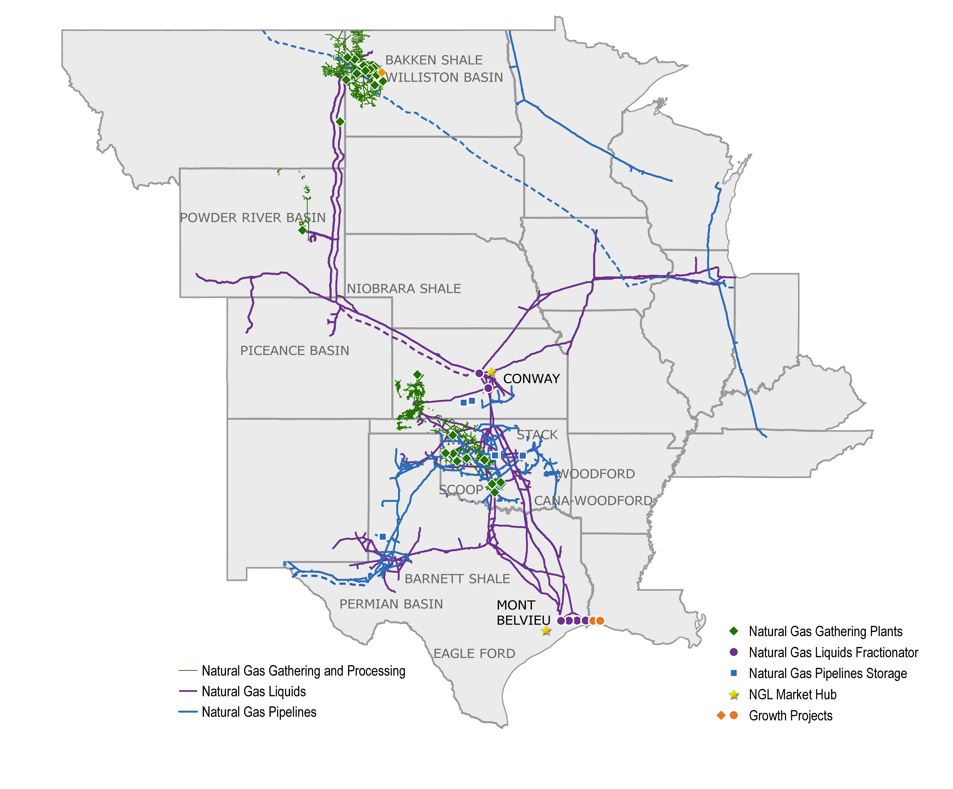
| We are connected to supply in natural gas and NGL producing basins and have significant basin diversification, including the Williston, Permian, Powder River and DJ Basins, and the SCOOP and STACK areas. In our Natural Gas Gathering and Processing segment, we have more than 3 million dedicated acres in the Williston Basin and approximately 300,000 dedicated acres in the SCOOP and STACK areas. In our Natural Gas Liquids segment, we are the largest NGL takeaway provider in the Williston and Powder River Basins; Oklahoma, including the SCOOP and STACK areas; Kansas; and the Texas Panhandle. We also have a significant presence in the Permian Basin. | |||||||||||||||||
| Natural Gas Gathering & Processing | |||||||||||||||||
| Natural Gas Liquids | |||||||||||||||||
| Natural Gas Pipelines | |||||||||||||||||
| Raw natural gas is typically gathered at the wellhead, compressed and transported through pipelines to our processing facilities. Most raw natural gas produced at the wellhead also contains a mixture of NGL components, including ethane, propane, iso-butane, normal butane and natural gasoline. | |||||||||||||||||
| Gathered wellhead natural gas is directed to our processing plants to remove NGLs, resulting in residue natural gas (primarily methane). | Once processed, residue natural gas is recompressed and delivered to intrastate and interstate natural gas pipelines primarily in our Natural Gas Pipelines segment. | ||||||||||||||||
 | |||||||||||||||||
| NGLs extracted at natural gas processing plants, both third-party and our own, are then gathered by our NGL gathering pipelines. | |||||||||||||||||
| Gathered NGLs are directed to our downstream fractionators in the Mid-Continent region and Mont Belvieu, Texas, to be separated into purity products. | |||||||||||||||||
| Residue natural gas is transported to storage facilities and end users, such as large industrial customers, natural gas and electric utilities serving commercial and residential consumers, and can ultimately reach international markets through liquefied natural gas exports and cross-border pipelines. | |||||||||||||||||
| Purity products are stored or distributed to our customers, such as petrochemical companies, propane distributors, heating fuel users, ethanol producers, refineries and exporters. | |||||||||||||||||
EXECUTIVE SUMMARY
Business Update and Market Conditions - We experienced earnings growth in 2022, compared with 2021, due primarily to increased producer activity across our operations, higher realized commodity prices, net of hedging, and higher average fee rates. In 2023, we expect to benefit from higher volumes, our completed Demicks Lake III natural gas processing plant and the expected completion of our MB-5 NGL fractionator, highlighting our extensive and integrated assets that are located in some of the most productive shale basins in the United States. Although the energy industry has experienced many commodity cycles, we have positioned ourselves to reduce exposure to direct commodity price volatility. Each of our three segments are primarily fee-based, and our consolidated earnings were approximately 90% fee-based in 2022. While our Natural Gas Gathering and Processing segment’s earnings are primarily fee-based, we have direct commodity price exposure related primarily to our fee with POP contracts, and we have hedged approximately 70% of our forecasted equity volumes for 2023. In addition, our Natural Gas Gathering and Processing and Natural Gas Liquids segments are exposed to volumetric risk as a result of drilling and well completion activity, severe weather disruptions, operational outages, global crude oil, NGL and natural gas demand, changes in gas-to-oil ratios and normal volumetric well declines. Our Natural Gas Pipelines segment is not exposed to significant volumetric risk due to nearly all of our capacity being subscribed under long-term, firm fee-based contracts.
Medford Incident - On July 9, 2022, a fire occurred at our 210 MBbl/d Medford, Oklahoma, NGL fractionation facility. All personnel were safe and accounted for with temporary evacuations of local residents taken as a precautionary measure. On January 9, 2023, we reached an agreement with our insurers to settle all claims for physical damage and business interruption related to the Medford incident. Under the terms of the settlement agreement, we agreed to resolve the claims for total insurance payments of $930 million, $100 million of which was received in 2022. The remaining $830 million was received in the first quarter 2023. The proceeds serve as settlement for property damage, business interruption claims to the date of the settlement and as payment in lieu of future business interruption insurance claims. Subsequent to settling the insurance claims, we announced plans to construct MB-6, a new 125 MBbl/d NGL fractionator in Mont Belvieu, Texas.
See Part II, Item 7, Recent Developments, in this Annual Report for more information on the Medford incident.
Geopolitical events and supply chain - Geopolitical events have disrupted global supply chains and caused volatile commodity prices for natural gas, NGLs and crude oil. The United States has banned the import of oil and other energy commodities from Russia, and European countries have taken steps to reduce imports of Russian oil and natural gas. In addition, a continued Gulf Coast liquified natural gas facility outage has further disrupted the overseas and domestic natural gas markets. These events have highlighted the importance of a strong national energy supply and infrastructure supporting the United States economy and national security. We operate an integrated, reliable, resilient and diversified network of NGL and natural gas gathering, processing, fractionation, transportation and storage assets connecting supply in the Rocky Mountain, Mid-Continent, Permian and Gulf Coast regions with key market centers. We believe our assets are well positioned to provide midstream services to producers and end-use markets as they respond to domestic and international demand.
Inflation - Inflation in the United States increased significantly in late 2021 and 2022. This rise in inflation generally resulted in higher costs in 2022. However, many of our NGL and natural gas processing contracts include fee escalators or fuel recovery mechanisms that fully offset the increase in costs in 2022. While we expect inflation to remain elevated, we do not expect a material impact on our results of operations as a result of these contract escalators.
Winter weather - In the second and fourth quarters of 2022, we experienced winter weather events in the Rocky Mountain region that brought disruptions to our operations. Our employees in the region were prepared and made the necessary operational adjustments to maintain the safety of our employees, their families and our assets. Region-wide power outages in the second quarter and blizzard conditions in both quarters negatively impacted the gathered and processed volumes in our Natural Gas Gathering and Processing segment, and NGL volumes, including volumes from third parties, delivered to and transported by our Natural Gas Liquids segment.
See Part II, Item 7A, Quantitative and Qualitative Disclosures About Market Risk, in this Annual Report for more information on our exposure to market risk.
Sustainability and Social Responsibility - In 2023, we qualified for inclusion in the S&P Global Sustainability Yearbook for the third year in a row. In 2022, we received an MSCI ESG Rating of AAA and received a perfect score of 100 in the Human Rights Campaign Corporate Equality Index. Additionally, in 2022, our ESG Risk Rating was in the lowest-risk quintile of the Sustainalytics’ refiners and pipelines industry, indicating that our ESG risk management is in the top 20% of our industry.
In September 2021, we announced a companywide absolute GHG emissions reduction target of 2.2 million metric tons of carbon dioxide equivalents from our combined Scope 1 and Scope 2 GHG emissions by 2030. The target represents a 30%
reduction in combined operational Scope 1 and location-based Scope 2 GHG emissions attributable to ONEOK assets as of December 31, 2019. We have achieved reductions totaling approximately 0.5 million metric tons of the targeted 2.2 million metric tons of carbon dioxide equivalents, primarily as a result of methane emissions mitigation, system optimizations, electrification of certain natural gas compression equipment and lower carbon-based electricity in states in which we operate. We continue to look for ways to reduce our GHG emissions and utilize more efficient technologies. We are evaluating the development of renewable energy and low-carbon projects, including opportunities that may complement our extensive midstream assets and expertise.
For more information on our GHG emissions, see “GHG emissions” in the “Regulatory, Environmental and Safety Matters” section.
Capital Ventures Opportunity - In 2022, we formed a capital ventures team focused on pursuing investments in early-stage energy technology companies. During the third quarter 2022, we reached an agreement between us, several other Oklahoma energy companies and organizations and an established energy-focused venture capital firm to commit funds of up to $50 million, collectively, toward a new venture capital fund. We also intend to make direct equity investments in early-stage energy technology companies that help to improve our operations and are aligned with energy transformation. We completed our first direct equity energy investment during the fourth quarter 2022 in a hyperspectral satellite company that is expected to increase our and the industry’s asset monitoring capabilities.
Natural Gas - In our Natural Gas Gathering and Processing segment, we benefited from increased volumes, higher realized commodity prices, net of hedging, and higher average fee rates in 2022, compared with 2021, due primarily to increased producer activity in the Rocky Mountain and Mid-Continent regions, offset partially by the impact of winter weather in the Rocky Mountain region in 2022. We expect additional earnings benefit in 2023 due to the completion of our 200 MMcf/d Demicks Lake III natural gas processing plant in the first quarter, which increased our total processing capacity to approximately 1.9 Bcf/d in the Williston Basin.
In our Natural Gas Pipelines segment, continued demand from local distribution companies, electric-generation facilities and large industrial companies resulted in low-cost expansions that position us well to provide additional services to our customers. In April 2022, we completed a 1.1 Bcf expansion of our Texas natural gas storage facilities’ capacities, and the expansion is fully subscribed through 2032. We are currently expanding the injection capabilities of our Oklahoma natural gas storage facilities which will allow us to utilize and subscribe an additional 4 Bcf of our existing storage capacity, with expected completion in the second quarter 2023. We have subscribed 100% of the incremental 4 Bcf of storage capacity through 2027 and 90% through 2029. In addition, we have begun the electrification of certain compression assets for Viking to improve the reliability of our operations while lowering our Scope 1 emissions from this equipment. This project is expected to cost approximately $95 million and be completed in the third quarter 2023. Viking will seek to recover its investment in the project through a proposed change in rates expected to be filed in third quarter 2023.
NGLs - In our Natural Gas Liquids segment, we benefited from increased volumes and higher average fee rates in 2022, compared with 2021, from increased production in the Rocky Mountain region and the Permian Basin, offset partially by higher costs. In addition, we expect to benefit from the completion of our 125 MBbl/d MB-5 fractionator in Mont Belvieu, Texas, in the second quarter 2023.
See Part II, Item 7, Management’s Discussion and Analysis of Financial Condition and Results of Operations, in this Annual Report for more information on our growth projects, results of operations, liquidity and capital resources.
BUSINESS STRATEGY
Our mission is to deliver energy products and services vital to an advancing world. Our vision is to create exceptional value for our stakeholders by providing solutions for a transforming energy future. Our business strategy is focused on:
-
Zero incidents - we commit to developing processes to drive a zero-incident culture for the well-being of our employees, contractors and communities. Safety and environmental responsibility continue to be primary areas of focus for us, and our emphasis on safety has produced improving trends in the key indicators we track.
-
Highly engaged workforce - we strive to be an employer of choice and continue to focus on attracting, selecting and retaining talent, advancing an inclusive, diverse and engaged culture and developing individuals and leaders.
-
Sustainable business model - we aim to maintain prudent financial strength and flexibility while operating a safe, reliable and resilient asset base. We seek to maintain investment-grade credit ratings and a strong balance sheet. We believe our internally generated cash flows will allow us to fund capital-growth projects in our existing operating regions and to provide value-added products and services that contribute to long-term growth, profitability and
business diversification. We continue to actively research opportunities that will complement our extensive midstream assets and expertise, strengthening the role we expect to play in the transformation to a lower-carbon economy.
- Maximizing total shareholder return - we plan to grow earnings and sustain our dividend by efficiently allocating capital to investments that produce returns above our cost of capital. Producing consistent and strong returns on invested capital will allow us to not only reward our shareholders but also provide the means and opportunity to serve our additional stakeholders, including employees, communities and the environment.
NARRATIVE DESCRIPTION OF BUSINESS
We report operations in the following business segments:
-
Natural Gas Gathering and Processing;
-
Natural Gas Liquids; and
-
Natural Gas Pipelines.
Natural Gas Gathering and Processing
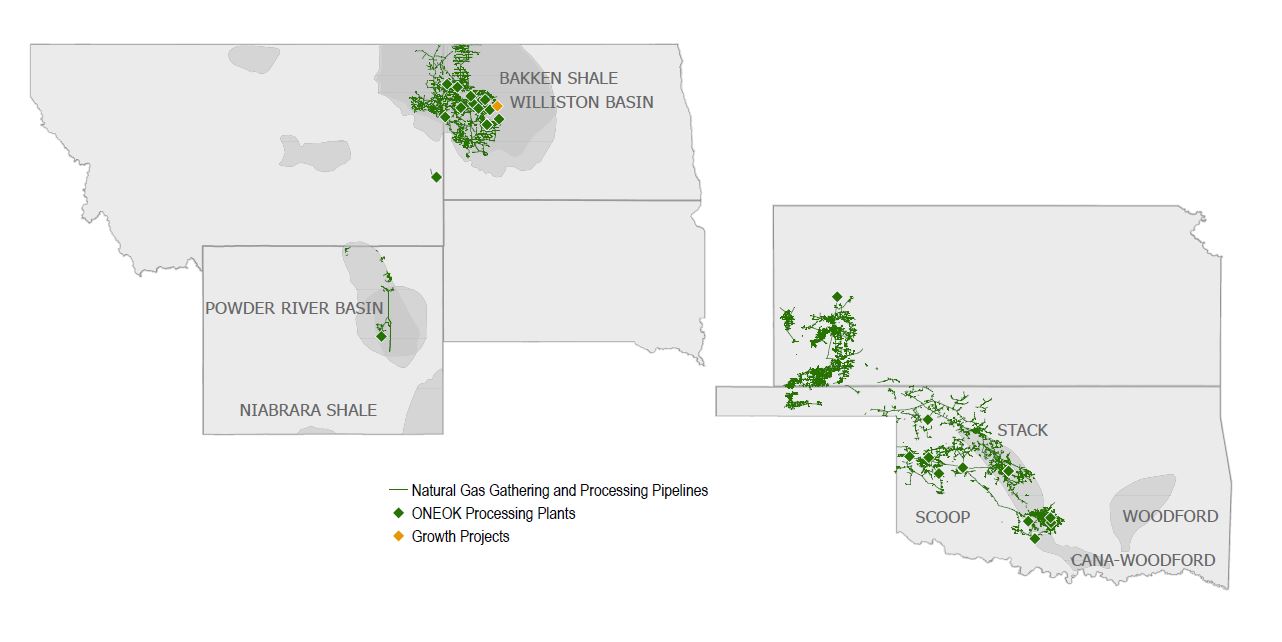
Overview - Our Natural Gas Gathering and Processing segment provides midstream services to producers in North Dakota, Montana, Wyoming, Kansas and Oklahoma.
Rocky Mountain region - The Williston Basin is located in portions of North Dakota and Montana and includes the oil-producing, NGL-rich Bakken Shale and Three Forks formations.
The Powder River Basin is primarily located in Wyoming, which includes the NGL-rich Niobrara Shale and Frontier and Turner formations where we provide gathering and processing services to customers in the eastern portion of the state.
Mid-Continent region - The Mid-Continent region includes the oil-producing, NGL-rich SCOOP and STACK areas including the Cana-Woodford Shale, Woodford Shale, Springer Shale, Meramec, Granite Wash and Mississippian Lime formations of Oklahoma and the Hugoton Basin in Kansas.
Property - Our Natural Gas Gathering and Processing segment includes the following assets:
-
17,200 miles of natural gas gathering pipelines;
-
14 natural gas processing plants with 1.9 Bcf/d of processing capacity in the Rocky Mountain region, and nine natural gas processing plants with 0.9 Bcf/d of processing capacity in the Mid-Continent region, and up to 150 MMcf/d of processing capacity in the Mid-Continent region through a long-term processing services agreement with an unaffiliated third party; and
-
14 MBbl/d of NGL fractionation capacity and 26 MBbl/d of de-ethanizer capacity at various natural gas processing plants.
We recently completed the construction of our 200 MMcf/d Demicks Lake III natural gas processing plant in the Williston Basin, which is included in the assets listed above.
See “Recent Developments” in Part II, Item 7, Management’s Discussion and Analysis of Financial Condition and Results of Operations, in this Annual Report for more information on our growth projects.
Sources of Earnings - Earnings for this segment are derived primarily from the following types of service contracts:
- Fee with POP contracts with no producer take-in-kind rights - We purchase raw natural gas and charge contractual fees for providing midstream services, which include gathering, treating, compressing and processing the producer’s natural gas. After performing these services, we sell the commodities and remit a portion of the commodity sales
proceeds to the producer less our contractual fees. This type of contract represented 73% of supply volumes in this segment for 2022 and 2021.
-
Fee with POP contracts with producer take-in-kind rights - We purchase a portion of the raw natural gas stream, charge fees for providing the midstream services listed above, return primarily the residue natural gas to the producer, sell the remaining commodities and remit a portion of the commodity sales proceeds to the producer less our contractual fees. This type of contract represented 20% of supply volumes in this segment for 2022 and 2021.
-
Fee-only - Under this type of contract, we charge a fee for the midstream services we provide, based on volumes gathered, processed, treated and/or compressed. Our fee-only contracts represented 7% of supply volumes in this segment for 2022 and 2021.
For commodity sales, we contract to deliver residue natural gas, condensate and/or unfractionated NGLs to downstream customers at a specified delivery point. Our sales of NGLs are primarily to our affiliate in the Natural Gas Liquids segment.
Utilization - The utilization rates for our natural gas processing plants were 70% and 69% for 2022 and 2021, respectively, due primarily to increased producer activity in the Rocky Mountain region and the SCOOP and STACK areas of Oklahoma. Our 2022 utilization rates were also impacted by winter weather in the Rocky Mountain region in the second and fourth quarters of 2022 and the full year impact of the capacity made available by the Bear Creek plant expansion, which was placed in-service in the fourth quarter 2021. We calculate utilization rates using a weighted-average approach, adjusting for the dates that assets were placed in or removed from service.
Unconsolidated Affiliates - Our unconsolidated affiliates in this segment are not material.
See Note N of the Notes to Consolidated Financial Statements in this Annual Report for additional discussion of our unconsolidated affiliates.
Government Regulation - The FERC traditionally has maintained that a natural gas processing plant is not a facility for the transportation or sale of natural gas in interstate commerce and, therefore, is not subject to jurisdiction under the Natural Gas Act. Although the FERC has made no specific declaration as to the jurisdictional status of our natural gas processing operations or facilities, our natural gas processing plants are primarily involved in extracting NGLs and, therefore, are exempt from FERC jurisdiction. The Natural Gas Act also exempts natural gas gathering facilities from the jurisdiction of the FERC. We believe our natural gas gathering facilities, upstream of our natural gas processing plants, meet the criteria used by the FERC for non-jurisdictional natural gas gathering facility status. Interstate transmission facilities remain subject to FERC jurisdiction. The FERC has historically distinguished between these two types of facilities, either interstate or intrastate, on a fact-specific basis. We transport residue natural gas from certain of our natural gas processing plants to interstate pipelines in accordance with Section 311(a) of the Natural Gas Policy Act. Oklahoma, Kansas, Wyoming, Montana and North Dakota also have statutes regulating, to varying degrees, the gathering of natural gas in those states. In each state, regulation is applied on a case-by-case basis if a complaint is filed against the gatherer with the appropriate state regulatory agency.
See further discussion in the “Regulatory, Environmental and Safety Matters” section.
Natural Gas Liquids
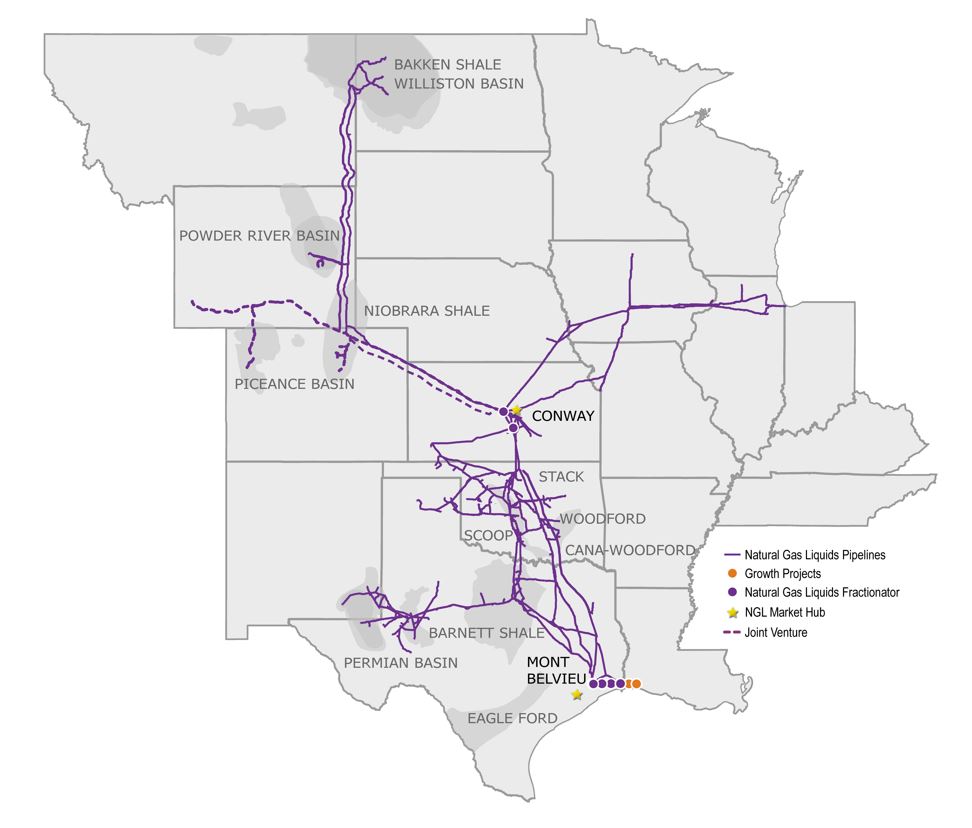
Overview - Our Natural Gas Liquids segment owns and operates facilities that gather, fractionate, treat and distribute NGLs and store purity NGLs, primarily in Oklahoma, Kansas, Texas, New Mexico and the Rocky Mountain region, which includes the Williston, Powder River and DJ Basins. We provide midstream services to producers of NGLs and deliver those products to the two primary market centers: one in the Mid-Continent in Conway, Kansas, and the other in the Gulf Coast in Mont Belvieu, Texas. We own or have an ownership interest in FERC-regulated NGL gathering and distribution pipelines in Oklahoma, Kansas, Texas, New Mexico, Montana, North Dakota, Wyoming and Colorado, and terminal and storage facilities in Kansas, Nebraska, Iowa and Illinois. We have a 50% ownership interest in Overland Pass, which operates an interstate NGL pipeline originating in Wyoming and Colorado and terminating in Kansas. The majority of the pipeline-connected natural gas processing plants in the Williston Basin, Oklahoma, Kansas and the Texas Panhandle are connected to our NGL gathering systems. We lease rail cars and own and operate truck- and rail-loading and -unloading facilities connected to our NGL fractionation, storage and pipeline assets. We also own FERC-regulated NGL distribution pipelines in Kansas, Nebraska, Iowa, Illinois and Indiana that connect our Mid-Continent assets with Midwest markets, including Chicago, Illinois. A portion of our ONEOK North System transports refined petroleum products, including unleaded gasoline and diesel, from Kansas to Iowa.
Property - Our Natural Gas Liquids segment includes the following assets:
-
9,140 miles of gathering pipelines with operating capacity of 1,790 MBbl/d, including 6,350 miles of FERC-regulated pipelines with operating capacity of 1,490 MBbl/d;
-
4,350 miles of distribution pipelines with operating capacity of 1,150 MBbl/d, including 4,180 miles of FERC-regulated pipelines with operating capacity of 1,080 MBbl/d;
-
seven NGL fractionators with combined operating capacity of 710 MBbl/d (includes interests in our proportional share of operating capacity), including 310 MBbl/d in the Mid-Continent region and 400 MBbl/d in the Gulf Coast region;
-
one isomerization unit with operating capacity of 10 MBbl/d;
-
one ethane/propane splitter with operating capacity of 40 MBbl/d;
-
six NGL storage facilities with operating storage capacity of 30 MMBbl; and
-
eight purity NGLs terminals.
In addition, we lease 10 MMBbl of annual pipeline capacity near our ONEOK North System and have access to 5 MMBbl of combined NGL storage capacity at facilities in Kansas and Texas and 60 MBbl/d of NGL fractionation capacity in the Gulf Coast through service agreements.
We are in the process of constructing our 125 MBbl/d MB-5 and MB-6 NGL fractionators in Mont Belvieu, Texas. The additional capacity from these projects is excluded from the assets listed above. As a result of the Medford incident, our 210 MBbl/d NGL fractionator in Medford, Oklahoma, is no longer operational and is excluded from the assets listed above.
See “Recent Developments” in Part II, Item 7, Management’s Discussion and Analysis of Financial Condition and Results of Operations, in this Annual Report for more information on our growth projects.
Sources of Earnings - Earnings for our Natural Gas Liquids segment are derived primarily from commodity sales and purchases and fee-based services. We purchase NGLs and condensate from third parties, as well as from our Natural Gas Gathering and Processing segment. Our business activities are categorized as follows:
-
Exchange services - We utilize our assets to gather, transport, treat and fractionate unfractionated NGLs, thereby converting them into marketable purity NGLs delivered to a market center or customer-designated location. Some of these exchange volumes are under contracts with minimum volume commitments that provide a minimum level of revenues regardless of volumetric throughput. Our exchange services activities are primarily fee-based and include some rate-regulated tariffs; however, we also capture certain product price differentials through the fractionation process.
-
Transportation and storage services - We transport purity NGLs and refined petroleum products, primarily under FERC-regulated tariffs. Tariffs specify the maximum rates we may charge our customers and the general terms and conditions for transportation service on our pipelines. Our storage activities consist primarily of fee-based NGL storage services at our Mid-Continent and Gulf Coast storage facilities.
-
Optimization and marketing - We utilize our assets, contract portfolio and market knowledge to capture location, product and seasonal price differentials through the purchase and sale of unfractionated NGLs and purity NGLs. We primarily transport purity NGLs between Conway, Kansas, and Mont Belvieu, Texas, to capture the location price differentials between the two market centers. Our marketing activities also include utilizing our NGL storage facilities to capture seasonal price differentials and serving truck and rail markets. Our isomerization activities capture the price differential when normal butane is converted into the more valuable iso-butane at our isomerization unit in Conway, Kansas.
In the majority of our exchange services contracts, we purchase the unfractionated NGLs at the tailgate of the processing plant and deduct contractual fees related to the transportation and fractionation services we must perform before we can sell them as purity NGLs. To the extent we hold unfractionated NGLs in inventory, the related contractual fees are not recognized until the unfractionated inventory is fractionated and sold.
Utilization - Increased volumes and decreased capacity, related to capacity constraints after the Medford incident, drove higher utilization rates at our NGL fractionators. The utilization rates for 2022 and 2021, respectively, were as follows:
-
our NGL gathering pipelines were 62% and 61%;
-
our NGL distribution pipelines were 49% and 51%; and
-
our NGL fractionators were 97% and 91%.
We calculate utilization rates using a weighted-average approach, adjusting for the dates that assets were placed in or removed from service. Our fractionation utilization rate reflects approximate proportional capacity associated with our ownership interests.
Unconsolidated Affiliates - We have a 50% ownership interest in Overland Pass, which operates an interstate NGL pipeline system extending 760 miles, originating in Wyoming and Colorado and terminating in Kansas. Our other unconsolidated affiliates in this segment are not material.
See Note N of the Notes to Consolidated Financial Statements in this Annual Report for additional discussion of unconsolidated affiliates.
Government Regulation - The operations and revenues of our NGL pipelines are regulated by various state and federal government agencies. Our interstate NGL pipelines are regulated under the Interstate Commerce Act, which gives the FERC jurisdiction to regulate the terms and conditions of service, rates, including depreciation and amortization policies, and initiation of service. In Oklahoma, Kansas and Texas, certain aspects of our intrastate NGL pipelines that provide common carrier service are subject to the jurisdiction of the OCC, KCC and RRC, respectively.
See further discussion in the “Regulatory, Environmental and Safety Matters” section.
Natural Gas Pipelines
Overview - In our Natural Gas Pipelines segment, our assets are connected to key supply areas and demand centers, including export markets in Mexico via Roadrunner and supply areas in Canada and the United States via our interstate and intrastate
natural gas pipelines and Northern Border, which enables us to provide essential natural gas transportation and storage services. Continued demand from local distribution companies, electric-generation facilities and large industrial companies resulted in low-cost expansions that position us well to provide additional services to our customers when needed.
Intrastate Pipelines and Storage - Our intrastate natural gas pipeline and storage assets are located in Oklahoma, Texas and Kansas. Our intrastate pipeline and storage companies include:
-
ONEOK Gas Transportation, which transports natural gas throughout the state of Oklahoma and has access to the major natural gas production areas in the Mid-Continent region, which include the SCOOP and STACK areas and the Cana-Woodford Shale, Woodford Shale, Springer Shale, Meramec, Granite Wash and Mississippian Lime formations. ONEOK Gas Transportation is connected to our ONEOK Gas Storage storage fields in Oklahoma, which provide 46 Bcf of working gas storage capacity; and
-
ONEOK WesTex Transmission, which transports natural gas throughout the western portion of the state of Texas, including the Waha area where other pipelines may be accessed for transportation to western markets, exports to Mexico, several markets to the southeast along the Gulf Coast, including the Houston Ship Channel, and the Mid-Continent market to the north. It has access to major natural gas producing formations in the Texas Panhandle, including the Granite Wash formation and Delaware and Midland Basins in the Permian Basin. ONEOK WesTex Transmission is connected to our ONEOK Texas Gas Storage storage fields, which provide 5 Bcf of working gas storage capacity.
Interstate Pipelines - Our interstate pipelines are regulated by the FERC and are located in North Dakota, Minnesota, Wisconsin, Illinois, Indiana, Kentucky, Tennessee, Oklahoma, Texas and New Mexico. Our interstate pipeline companies include:
-
Guardian, which interconnects with several pipelines at the Chicago Hub near Joliet, Illinois, and with local natural gas distribution and electric generation companies in Wisconsin;
-
Midwestern Gas Transmission, which is a bidirectional system that interconnects with Tennessee Gas Transmission Company’s pipeline near Portland, Tennessee, and with multiple interstate pipelines that have access to both the Utica Shale and the Marcellus Shale, and multiple interstate pipelines at the Chicago Hub near Joliet, Illinois;
-
Viking, which is a bidirectional system that interconnects with a TC Energy Corporation pipeline at the United States border near Emerson, Canada, and ANR Pipeline Company near Marshfield, Wisconsin; and
-
OkTex Pipeline, which has interconnections with several pipelines in Oklahoma, Texas and New Mexico.
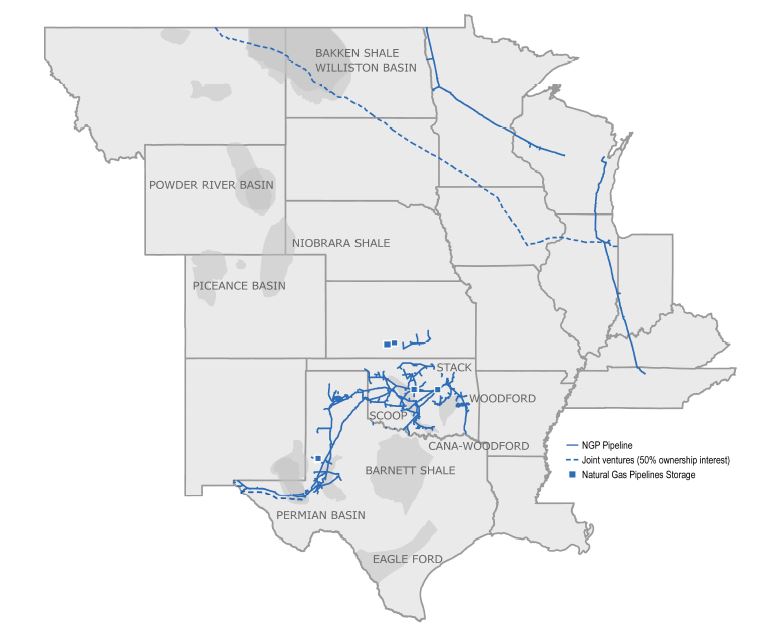
Property - Our Natural Gas Pipelines segment includes the following assets:
-
5,100 miles of state-regulated intrastate transmission pipelines with transportation capacity of 4.4 Bcf/d;
-
1,500 miles of FERC-regulated interstate natural gas pipelines with 3.5 Bcf/d of transportation capacity; and
-
six underground natural gas storage facilities with 53.3 Bcf of total active working natural gas storage capacity.
Our storage includes two underground natural gas storage facilities in Oklahoma, two underground natural gas storage facilities in Kansas and two underground natural gas storage facilities in Texas. We are in the process of expanding the injection capabilities of our Oklahoma natural gas storage facilities which will allow us to utilize and subscribe an additional 4 Bcf of our existing storage capacity.
We are also exploring reactivating previously idled storage facilities in Oklahoma and Texas, which are not included in the capacity above.
Sources of Earnings - Earnings in this segment are derived primarily from transportation and storage services.
Our transportation earnings are primarily fee-based from the following types of services:
-
Firm service - Customers reserve a fixed quantity of pipeline capacity for a specified period of time, which obligates the customer to pay regardless of usage. Under this type of contract, the customer pays a monthly fixed fee and incremental fees, known as commodity charges, which are based on the actual volumes of natural gas they transport or store. Under the firm service contract, the customer generally is guaranteed access to the capacity they reserve.
-
Interruptible service - Under interruptible service transportation agreements, the customer may utilize available capacity after firm service requests are satisfied. The customer is not guaranteed use of our pipelines unless excess capacity is available.
Our regulated natural gas transportation services contracts are based upon rates stated in the respective tariffs, which have generally been established through shipper specific negotiation, discounts and negotiated settlements. The rates are filed with FERC or the appropriate state jurisdictional agencies. In addition, customers typically are assessed fees, such as a commodity charge, and we may retain a percentage of natural gas in-kind for our compression services.
Our storage earnings are primarily fee-based from the following types of services:
-
Firm service - Customers reserve a specific quantity of storage capacity, including injection and withdrawal rights, and generally pay fixed fees based on the quantity of capacity reserved plus an injection and withdrawal fee. Firm storage contracts typically have terms longer than one year.
-
Park-and-loan service - An interruptible storage service offered to customers providing the ability to park (inject) or loan (withdraw) natural gas into or out of our storage, typically for monthly or seasonal terms. Customers reserve the right to park or loan natural gas based on a specified quantity, including injection and withdrawal rights when capacity is available.
Utilization - Our natural gas pipelines were 94% and 95% subscribed in 2022 and 2021, respectively, and our natural gas storage facilities were 77% and 70% subscribed in 2022 and 2021, respectively.
Unconsolidated Affiliates - Our Natural Gas Pipelines segment includes the following unconsolidated affiliates:
-
50% ownership interest in Northern Border, which owns a FERC-regulated interstate pipeline that transports natural gas from the Montana-Saskatchewan border near Port of Morgan, Montana, and the Williston Basin in North Dakota to a terminus near North Hayden, Indiana.
-
50% ownership interest in Roadrunner, a bidirectional pipeline, which has the capacity to transport 570 MMcf/d of natural gas from the Permian Basin in West Texas to the Mexican border near El Paso, Texas, and has capacity to transport approximately 1.0 Bcf/d of natural gas from the Delaware Basin to the Waha area. We are the operator of Roadrunner.
See Note N of the Notes to Consolidated Financial Statements in this Annual Report for additional discussion of unconsolidated affiliates.
Government Regulation - Interstate - Our interstate natural gas pipelines are regulated under the Natural Gas Act, which gives the FERC jurisdiction to regulate virtually all aspects of this business, such as transportation of natural gas, rates and charges for services, construction of new facilities, depreciation and amortization policies, acquisition and disposition of facilities and the initiation and discontinuation of services.
Intrastate - Our intrastate natural gas pipelines in Oklahoma, Kansas and Texas are regulated by the OCC, KCC and RRC, respectively, and by the FERC under the Natural Gas Policy Act for certain services where we deliver natural gas into FERC regulated natural gas pipelines. While we have flexibility in establishing natural gas transportation rates with customers, there is a maximum rate that we can charge our customers in Oklahoma and Kansas and for the services regulated by the FERC. In Texas and Kansas, natural gas storage may be regulated by the state and by the FERC for certain types of services. In Oklahoma, natural gas storage operations are not subject to rate regulation by the state, and we have market-based rate authority from the FERC for certain types of services.
See further discussion in the “Regulatory, Environmental and Safety Matters” section.
Market Conditions and Seasonality
Supply and Demand - Supply for each of our segments depends on crude oil and natural gas drilling and production activities, which are driven by the strength of the economy and impacts of geopolitical events; natural gas, crude oil and NGL prices; the demand for each of these products from end users; the decline rate of existing production; producer access to capital and investment in the industry; or producer firm commitments to transportation pipelines.
Demand for gathering and processing services is dependent on natural gas production by producers in the regions in which we operate. Demand for NGLs and the ability of natural gas processors to successfully and economically sustain their operations affect the volume of unfractionated NGLs produced by natural gas processing plants, thereby affecting the demand for NGL gathering, transportation and fractionation services. Natural gas and purity NGLs are affected by the demand associated with the various industries that utilize the commodities, such as butanes and natural gasoline used by the refining industry as blending stocks for motor fuel, denaturant for ethanol and diluents for crude oil. Ethane, propane, butanes and natural gasoline are also used by the petrochemical industry to produce chemical components, used for a range of products that improve our daily lives and promote economic growth, including health care products, recyclable food packaging, clothing, technology, building materials, industrial, manufacturing and energy infrastructure, lightweight vehicle components and batteries. Propane is also used to heat homes and businesses. Demand for natural gas and NGLs is also impacted by global macroeconomic factors.
Commodity Prices - Our earnings are primarily fee-based in all three of our segments, however in our Natural Gas Gathering and Processing segment, we are exposed to commodity price risk as a result of retaining a portion of the commodity sales proceeds associated with our fee with POP contracts. We have hedged approximately 70% of our forecasted equity volumes for 2023. Under certain fee with POP contracts, our contractual fees and POP percentage may increase or decrease if production volumes, delivery pressures or commodity prices change relative to specified thresholds. In our Natural Gas Liquids segment, we are exposed to commodity price risk associated with changes in the price of NGLs; the location differential between the Mid-Continent, Chicago, Illinois, and Gulf Coast regions; and the relative price differential between natural gas, NGLs and individual purity NGLs, which affect our NGL purchases and sales, our exchange services, transportation and storage services, and optimization and marketing financial results. NGL storage revenue may be affected by price volatility and forward pricing of NGL physical contracts versus the current price of NGLs on the spot market. In our Natural Gas Pipelines segment, we are exposed to minimal commodity price risk associated with (i) changes in the price of natural gas, which impact our fuel costs and retained fuel in-kind received for our compression services; and (ii) the differential between forward pricing of natural gas physical contracts and the price of natural gas on the spot market, which may affect our customer demand for our natural gas storage services.
See additional discussion regarding our commodity price risk and related hedging activities under “Commodity Price Risk” in Part II, Item 7A, Quantitative and Qualitative Disclosures about Market Risk, in this Annual Report.
Seasonality - Cold temperatures usually increase demand for natural gas and certain purity NGLs, such as propane, a heating fuel for homes and businesses. Warm temperatures usually increase demand for natural gas used in gas-fired electric generation for residential and commercial cooling, as well as agriculture-related equipment like irrigation pumps and crop dryers. Demand for butanes and natural gasoline, which are primarily used by the refining industry as blending stocks for motor fuel, denaturant for ethanol and diluents for crude oil, are also subject to some variability during seasonal periods when certain government restrictions on motor fuel blending products change. During periods of peak demand for a certain commodity, prices for that product typically increase.
Extreme weather conditions, seasonal temperature changes and the impact of temperature and humidity on the mechanical abilities of our equipment impact the volumes of natural gas gathered and processed, and NGL volumes gathered, transported and fractionated. Power interruptions and inaccessible well sites as a result of severe storms or freeze-offs, a phenomenon
where water vapor from the well bore freezes at the wellhead or within the natural gas gathering system, may cause a temporary interruption in the flow of natural gas and NGLs.
In our Natural Gas Pipelines segment, natural gas storage is necessary to balance the relatively steady natural gas supply with the seasonal demand of our local natural gas distribution and electric-generation customers as a result of the demand from their residential and commercial customers.
Competition - We compete for natural gas and NGL supply with other midstream companies, major integrated oil companies and independent exploration and production companies that have gathering and processing assets, fractionators, intrastate and interstate pipelines and storage facilities. The factors that typically affect our ability to compete for natural gas and NGL supply are:
-
quality of services provided;
-
producer drilling activity;
-
proceeds remitted and/or fees charged under our contracts;
-
proximity of our assets to natural gas and NGL supply areas and markets;
-
proximity of our assets to alternative energy production;
-
location of our assets relative to those of our competitors;
-
efficiency and reliability of our operations;
-
receipt and delivery capabilities for natural gas and NGLs that exist in each pipeline system, plant, fractionator and storage location;
-
the petrochemical industry’s level of capacity utilization and feedstock requirements;
-
current and forward natural gas and NGL prices; and
-
cost of and access to capital.
We have remained competitive by making capital investments to access and connect new supplies with end-user demand; increasing gathering, processing, fractionation and pipeline capacity; increasing storage, withdrawal and injection capabilities; and improving operating efficiency so that we compete effectively. Our and our competitors’ infrastructure projects may affect commodity prices and could displace supply volumes from the Mid-Continent and Rocky Mountain regions and the Permian Basin where our assets are located. We believe our assets are located strategically, connecting diverse supply areas to market centers.
Customers - Our Natural Gas Gathering and Processing and Natural Gas Liquids segments derive services revenue from major and independent crude oil and natural gas producers. Our Natural Gas Liquids segment’s customers also include other NGL and natural gas gathering and processing companies. Our downstream commodity sales customers are primarily petrochemical, refining and marketing companies, utilities, large industrial companies, natural gasoline distributors, propane distributors and municipalities. Our Natural Gas Pipeline segment’s assets primarily serve local natural gas distribution companies, electric-generation facilities, large industrial companies, municipalities, producers, processors and marketing companies. Our utility customers generally require our services regardless of commodity prices. See discussion regarding our customer credit risk under “Counterparty Credit Risk” in Part II, Item 7A, Quantitative and Qualitative Disclosures about Market Risk, in this Annual Report.
Other
Through ONEOK Leasing Company, L.L.C. and ONEOK Parking Company, L.L.C., we own a 17-story office building (ONEOK Plaza) and a parking garage in downtown Tulsa, Oklahoma, where our headquarters are located. ONEOK Leasing Company, L.L.C. leases excess office space, if any, to others and operates our headquarters office building. ONEOK Parking Company, L.L.C. owns and operates a parking garage adjacent to our headquarters. We have a wholly-owned captive insurance company, which was formed in 2022.
REGULATORY, ENVIRONMENTAL AND SAFETY MATTERS
We are subject to a variety of historical preservation and environmental laws and/or regulations that affect many aspects of our present and future operations. Regulated activities include, but are not limited to, those involving air emissions, storm water and wastewater discharges, handling and disposal of solid and hazardous wastes, wetland and waterway preservation, wildlife conservation, cultural resource protection, hazardous materials transportation, and pipeline and facility construction. These laws and regulations require us to obtain and/or comply with a wide variety of environmental clearances, registrations, licenses, permits and other approvals. Failure to comply with these laws, regulations, licenses and permits may expose us to fines, penalties, reputational harm and/or interruptions in our operations that could be material to our results of operations or financial
condition. In addition, emissions controls and/or other regulatory or permitting mandates under the Clean Air Act and other similar federal and state laws could require unexpected capital expenditures at our facilities. We cannot assure that existing environmental statutes and regulations will not be revised or that new regulations will not be adopted or become applicable to us. We also cannot assure that existing permits will not be revised or cancelled, potentially impacting facility construction activities or ongoing operations.
Air and Water Emissions - The Clean Air Act, the Clean Water Act and analogous state laws and/or regulations impose restrictions and controls regarding the discharge of pollutants into the air and water in the United States. Under the Clean Air Act, a federal operating permit is required for sources of significant air emissions. We may be required to incur certain capital expenditures for air pollution-control equipment in connection with obtaining or maintaining permits and approvals for sources of air emissions. The Clean Water Act imposes substantial potential liability for pollutants discharged into waters of the United States and requires remediation of waters affected by such discharge.
GHG Emissions - 2021 estimated GHG emissions were 3.8 million metric tons of carbon dioxide equivalents of Scope 1 emissions and 2.7 million metric tons of carbon dioxide equivalents of Scope 2 emissions. Scope 1 emissions originate from the combustion of fuel in our equipment, such as compressor engines and heaters, as well as fugitive methane emissions. Scope 2 emissions are generated from purchased power sources.
In September 2021, we announced a companywide absolute GHG emissions reduction target of 2.2 million metric tons of carbon dioxide equivalents from our combined Scope 1 and Scope 2 GHG emissions by 2030. The target represents a 30% reduction in combined operational Scope 1 and location-based Scope 2 GHG emissions attributable to ONEOK assets as of December 31, 2019. We have achieved reductions totaling approximately 0.5 million metric tons of the targeted 2.2 million metric tons of carbon dioxide equivalents, primarily as a result of methane emissions mitigation, system optimizations, electrification of certain natural gas compression equipment and lower carbon-based electricity in states in which we operate. GHG emission reductions as reported may be modified, updated, changed or supplemented based on available information. For the years ended December 31, 2022, 2021 and 2020, we did not have any dedicated capital expenditures specifically for climate-related projects, nor did we purchase or sell carbon credits or offsets. Progress to date on our goal has been accomplished through routine capital-growth projects and asset optimizations that were primarily performed for operational improvements that inherently improved our emissions profile. We continue to anticipate several potential pathways toward achieving our emissions reduction target. In 2023, we anticipate reduction in our emissions to be primarily a result of improved methane management practices and system optimization that will not require material capital expenditures. We do not anticipate purchasing or selling carbon credits or offsets in 2023. Although we have begun the electrification of certain compression assets for Viking to improve the reliability of our operations, which will reduce our Scope 1 emissions, we do expect an increase in our Scope 2 emissions as a result of this project, but anticipate an overall net reduction of GHG emissions on this project to be included in our pathway to achieve our target.
We participated in the EPA’s Natural Gas STAR Program for more than 20 years and are now a legacy natural gas partner as the program ended in late 2022. We currently participate in Our Nation’s Energy (ONE) Future Coalition to voluntarily report methane emission reductions and to calculate our methane intensity. We continue to focus on maintaining low methane gas release rates through expanded implementation of improved practices to limit the release of natural gas during pipeline and facility maintenance and operations.
Regulation
PHMSA - The PHMSA has submitted to the Federal Register an advisory bulletin underscoring to pipeline and pipeline facility operators requirements to minimize methane emissions in the Protecting our Infrastructure of Pipelines and Enhancing Safety (PIPES) Act of 2020. The PIPES Act directs pipeline operators to update their inspection and maintenance plans to address the elimination of hazardous leaks and to minimize natural gas releases from pipeline facilities. The updated plans must also address the replacement or remediation at facilities that historically have been known to experience leaks. We have completed and continue to update our pipeline maintenance procedures to identify and reduce methane leaks.
EPA - The EPA’s Mandatory Greenhouse Gas Reporting Rule requires annual GHG emissions reporting from our affected facilities and the carbon dioxide emission equivalents for all NGLs produced by us as if all of these products were combusted, even if they are used otherwise. The additional cost to gather and report this emission data did not have, and we do not expect it to have, a material impact on our results of operations, financial position or cash flows.
Recently, the EPA has updated the New Source Performance Standards Subpart OOOOb regulations to further reduce methane emissions, which includes increased monitoring frequency and more stringent repair requirements for new and modified oil and gas facilities. In addition, the EPA is proposing new nationwide emission guidelines for states to limit methane emissions from existing oil and gas facilities. Generally, EPA rule-makings require expenditures for updated emissions controls, monitoring
and recordkeeping requirements at affected facilities. At this time, we do not anticipate a material impact to our planned capital, operations and maintenance costs resulting from compliance with the current or pending regulations and proposed EPA actions. However, the EPA may issue additional regulations, responses, amendments and/or policy guidance, which could alter our present expectations.
In June 2022, the U.S. Supreme Court issued a decision in West Virginia v. EPA, which did not preclude but instead limited the EPA’s ability to regulate GHG emissions absent clear congressional authorization. The Court determined that the EPA’s emission reduction measures requiring an industry wide shift in electricity production from coal and natural gas-fired power plants to renewable power sources required specific congressional authorization which had not been given under the Clean Air Act.
Federal Regulation - In August 2022, the Inflation Reduction Act was signed into law. The Inflation Reduction Act includes tax credits and other incentives intended to combat climate change by advancing decarbonization and promoting increased investment in renewable and low carbon intensity energy. In addition, the Inflation Reduction Act also imposes a waste emissions charge for methane emissions from specific types of facilities that are required to report their GHG emissions to the EPA and a sector specific methane intensity rate. We will continue to monitor clarification of the regulation, and based on current estimates, we do not believe waste emission charges will have a material impact on our results of operations, financial position or cash flows.
We believe it is likely that continued future governmental legislation and/or regulation may require us to limit GHG emissions associated with our operations, pay additional fees associated with our GHG emissions or purchase allowances for such emissions. However, we cannot predict precisely what form these future regulations will take, the stringency of the regulations, when they will become effective or the impact on our capital expenditures, competitive position and results of operations. In addition to activities on the federal level, state and regional initiatives could also lead to the regulation of GHG emissions sooner than or independent of federal regulation. These regulations could be more stringent than any federal legislation that may be adopted. We monitor all relevant legislation and regulatory initiatives to assess the potential impact on our operations and otherwise take steps to limit GHG emissions from our facilities, including methane.
For additional information regarding the potential impact of laws and regulations on our operations see Item 1A “Risk Factors.”
Pipeline and Facility Safety - We are subject to PHMSA safety regulations, including pipeline asset integrity-management regulations. The Pipeline Safety Improvement Act of 2002 requires pipeline companies operating high-pressure pipelines to perform integrity assessments on pipeline segments that pass through densely populated areas or near specifically designated high-consequence areas (HCAs). The Pipeline Safety, Regulatory Certainty and Job Creation Act of 2011 (the 2011 Pipeline Safety Act) increased maximum penalties for violating federal pipeline safety regulations, directs the DOT and Secretary of Transportation to conduct further review or studies on issues that may or may not be material to us and may result in the imposition of more stringent regulations.
In 2015, PHMSA issued notices of proposed rule-making for hazardous liquid pipeline safety regulations, natural gas transmission and gathering lines and underground natural gas storage facilities. For natural gas and natural gas gathering pipelines, the new proposed regulations became known as “the Mega Rule.” Due to the large number of rules being considered, PHMSA partitioned the new rule-making into three sections. The first section of rules was finalized and published in 2019 in the Federal Register and became effective in July 2020. These final rules mostly address congressional mandates due to former pipeline safety reauthorizations and established criteria for verifying current operating pressures. The second section of the PHMSA Gas Mega Rule, which was published in August 2022 and will be effective in May 2023, focuses on natural gas transmission pipelines and includes enhancements to management requirements for risk and integrity assessments, guidance for corrosion and mitigation timelines, pipeline inspections following extreme weather events and repair requirements for HCAs and non-HCAs. The third section of the Mega Rule established new regulations for certain gas gathering lines, which were formerly unregulated, and was published in November 2021 and became effective in May 2022.
Coupled together, these new sections of the Mega Rule provide increased requirements for operating and maintenance, integrity management, public awareness and civil/criminal penalties; however, we do not anticipate a material impact to our planned capital or operations and maintenance costs resulting from compliance with the newly published regulations.
In 2020, legislation was passed to reauthorize PHMSA through 2024. Certain requirements for operations and maintenance, integrity management, leak detection and public awareness will be subject to future rule-making as a result. The potential capital and operating expenditures related to the new regulations are not fully known, but we do not anticipate a material impact to our planned capital or operations and maintenance costs resulting from compliance with the new regulations.
On July 9, 2022, a fire occurred at our 210 MBbl/d Medford, Oklahoma, natural gas liquids fractionation facility. All personnel were safe and accounted for with temporary evacuations of local residents taken as a precautionary measure. As a result of the incident, the United States Chemical Safety and Hazard Investigation Board (CSB) requested information including the incident investigation report and causal factors of the incident, which we submitted to the CSB.
Pipeline Security - Homeland Security’s Transportation Security Administration (TSA) and the DOT have completed a review and inspection of our “critical facilities” and identified no material security issues. Also, the TSA has released new pipeline security guidelines that include broader definitions for the determination of pipeline “critical facilities.” We have reviewed our pipeline facilities according to the new guidelines and met the timelines associated with TSA reporting. The cost of compliance did not have a material impact on our operations, financial position or cash flows.
The TSA issued two security directives in 2021 in response to ongoing cybersecurity threats to the pipeline industry. The first security directive, version “A,” was issued in May 2021 and requires critical pipeline owners and operators to (1) report confirmed and potential cybersecurity incidents to the Cybersecurity and Infrastructure Security Agency (CISA); (2) designate a cybersecurity coordinator to be available 24 hours a day, seven days a week; (3) review current practices; and (4) identify any gaps and related remediation measures to address cyber-related risks and report the results to TSA and CISA within 30 days. The second security directive, version “B,” was issued in July 2021 and requires owners and operators of TSA-designated critical pipelines to implement specific mitigation measures to protect against ransomware and other known threats to information technology and operational technology systems, develop and implement a cybersecurity contingency and recovery plan, and conduct a cybersecurity architecture design review. Version “B” was replaced with version “C” in July 2022. This version requires critical pipeline owners and operators to create a Cybersecurity Implementation Plan for approval and audit by the TSA. Our Cybersecurity Implementation Plan was approved in December 2022. While compliance with the security directives is utilizing significant internal and external resources, we do not expect it to have a material impact on our results of operations, financial position or cash flows.
HUMAN CAPITAL
The long-term sustainability of our business is dependent on our continued ability to maintain a highly engaged workforce. To accomplish this, our business strategy includes attracting, selecting and retaining talent, advancing an inclusive, diverse and engaged culture and developing individuals and leaders.
In 2021, we conducted our first annual employee engagement survey using Gallup Inc.’s Q12 methodology. All leaders were asked to review their results with their teams and create an action plan specific to enhancing their employees’ engagement in 2022. In 2022, the annual employee engagement participation rate increased to 90% compared with 80% in 2021. The overall engagement mean went from under the 40th percentile to above the 50th percentile. We showed improvement on all survey questions. The ratio of engaged employees to actively disengaged more than doubled. All leaders have been asked to discuss the 2022 survey results with their teams and create an engagement action plan for 2023. Training and support resources are also available through our learning management system, the Gallup Engagement Portal and dedicated individuals within our human resources department.
As of December 31, 2022, we had 2,966 employees. Listed below is a summary of our human capital resources, measures and objectives that are collectively important to our success as an organization.
Values - Our success relies on the skills, experience and dedication of our employees. We are committed to cultivating an inclusive and dynamic work environment where talented people can find opportunities to succeed, grow and contribute to the success of the company. Our employees work each day to provide safe and reliable services to a wide range of customers in the states where we operate. Our core values, listed below, guide the way in which our employees conduct our business and operations.
-
Safety & Environmental: we commit to a zero-incident culture for the well-being of our employees, contractors and communities and to operate in an environmentally responsible manner.
-
Ethics: we act with honesty, integrity and adherence to the highest standards of personal and professional conduct.
-
Diversity & Inclusion: we respect the uniqueness and worth of each employee, and believe that a diverse, inclusive workforce is essential for a sense of belonging, engagement and performance.
-
Excellence: we hold ourselves and others accountable to a standard of excellence through continuous improvement and teamwork.
-
Service: we invest our time, effort and resources to serve each other, our customers and communities.
-
Innovation: we seek to develop creative solutions by leveraging collaboration through ingenuity and technology.
Diversity and Inclusion - Our diversity and inclusion (D&I) strategy is a cross-functional effort that draws upon contributions from employees at all levels of the organization and is focused on enhancing the workplace to attract and retain talent. The strategy is guided by a D&I Council composed of a diverse group of employees who represent different demographics, work locations, points of view, roles and levels of seniority. We also have a team within our human resources department that is wholly dedicated to supporting our D&I efforts.
In 2022, we provided funding and support for five legacy employee-led business resource groups (BRGs): a Black/African American Resource Group (BAARG); an Indigenous/Native American Resource Group (INRG); a Latinx/Hispanic American Resource Group (LXHA); a Veterans Resource Group; and a Women’s Resource Group. In addition, a new LGBTQ+ (Lesbian, Gay, Bisexual, Transgender, Queer and others) BRG was added in 2022. Each BRG’s purpose is to promote the attraction, development, motivation and retention of members of traditionally underrepresented groups in our industry and workplace in an effort to drive positive business outcomes. A key factor in the success of our BRGs is the active participation by officer-level executive sponsors and allies from outside the BRG’s underrepresented populations. All employees are invited to become a supporter of one or more of our BRGs.
In early 2023, we introduced a Racial Inclusion Collective Resource Group that combines our legacy race- and ethnicity-focused BRGs, along with new resources and support for our Asian-American and Pacific Islander employees and allies, into a single organization to facilitate collaboration on topics relevant to all groups while reserving opportunities for more identity-focused programming where appropriate.
We embed D&I concepts into our core leadership development curriculum and sponsor a number of internal programs intended to promote D&I. In addition, we seek to give back to the communities where we operate by partnering on initiatives to support underrepresented community members and local charitable organizations.
Employee Safety - The safety of our employees is critical to our operations and success. By promoting the safety of our employees and monitoring the integrity of our assets, we are investing in the long-term sustainability of our businesses. We continuously assess the risks our employees face in their jobs, and we work to mitigate those risks through training, appropriate engineering controls, work procedures and other preventive safety programs. Reducing incidents and improving our personal safety incident rates are important, but we are not focused only on statistics. Low personal safety incident rates alone cannot prevent a large-scale incident, which is why we continue to focus on enhancing our Environmental, Safety and Health management systems and process safety programs, such as key risk/key control identification and knowledge sharing. We endeavor to operate our assets safely, reliably and in an environmentally responsible manner. We maintain mature and robust programs that guide trained staff in the completion of these activities, and we continue to enhance and improve these programs and our internal capabilities. We successfully implemented our return to office plan in early 2022, and we have continued to take safety precautions for our employees who work in the field or report to a ONEOK facility.
Health and Welfare - We provide a variety of benefits to help promote the health and welfare of our employees and their families. These benefits include medical, dental and vision plans, virtual health visits and engagement of third-party service providers to offer company on-site and near-site clinics in several of our operating areas. Eligible employees also have access, at no charge, to an employee assistance program, a medical second opinion service and a health care concierge service to assist with finding in-network providers and billing resolution. We offer full pay for maternity, paternity or adoption leave of up to 240 hours per qualifying event. We also provide up to $10,000 for reasonable and necessary expenses of a qualifying adoption and/or surrogacy. Additional benefits provided for the welfare of our employees include, among others, life insurance and long-term disability plans, health and dependent care flexible spending accounts, fertility benefits, disease prevention and management programs and full pay while on bereavement, military or personal and family care leave.
We also provide the opportunity for our employees to help fellow employees through the ONE Trust Fund by contributing donated vacation hours or monetary donations. The ONE Trust Fund is a nonprofit, charitable organization run entirely by employee volunteers, that serves our employees in times of personal crises due to natural disasters, medical emergencies or other hardships.
Personal and Professional Development - We provide various options to assist with career growth and development. For employees just entering the workforce who desire to advance their career and continue to learn or for the professional who is interested in developing their skills, we provide education and training in a variety of areas, including leadership, functional and industry-specific topics, professional development and skill-building opportunities. Our organizational development and D&I teams provide live in-person and virtual classroom training, computer-based self-study and one-on-one coaching that is available to all employees.
We value education and assist eligible employees with the expense of furthering their education in job-related fields, including up to $5,000 per year in qualifying tuition expenses. We also may reimburse employees for certain job-related professional certification examination fees.
Recruiting - We make it a priority to attract, select, develop, motivate, challenge and retain the talent necessary to support our key business strategies. We use targeted recruitment events, maintain strong relationships with area technical schools, colleges and universities, and we offer compensation benefits and career opportunities that are designed to position us as an employer of choice. D&I continues to be a priority in recruiting, and we deploy sourcing strategies designed to access talent from groups that are historically underrepresented in our industry and workplace.
Retirement - We maintain a 401(k) Plan for our employees and match 100% of employee contributions up to 6% of eligible compensation each payroll period, subject to applicable tax limits. We also have a defined benefit pension plan covering certain employees and former employees, which closed to new participants in 2005. Employees that do not participate in our defined benefit pension plan are eligible to receive quarterly and annual profit-sharing contributions under our 401(k) Plan. As of December 31, 2022, 95% of eligible employees were contributing to our 401(k) Plan. For additional information about our retirement benefits, see Note L of the Notes to Consolidated Financial Statements in this Annual Report.
INFORMATION ABOUT OUR EXECUTIVE OFFICERS
All executive officers are elected annually by our Board of Directors. Our executive officers listed below include the officers who have been designated by our Board of Directors as our Section 16 executive officers.
| Name and Position | Age | Business Experience in Past Five Years | ||||||||||||||||||
| Julie H. Edwards | 64 | 2022 to present | Board Chair, ONEOK | |||||||||||||||||
| Board Chair | 2007 to 2022 | Board Director, ONEOK | ||||||||||||||||||
| Pierce H. Norton II | 63 | 2021 to present | President and Chief Executive Officer, ONEOK | |||||||||||||||||
| President and Chief Executive Officer | 2021 to present | Member of the Board of Directors, ONEOK | ||||||||||||||||||
| 2014 to 2021 | President and Chief Executive Officer, ONE Gas, Inc. | |||||||||||||||||||
| 2014 to 2021 | Member of the Board of Directors, ONE Gas, Inc. | |||||||||||||||||||
| Walter S. Hulse III | 59 | 2022 to present | Chief Financial Officer, Treasurer and Executive Vice President, Investor Relations and Corporate Development, ONEOK | |||||||||||||||||
| Chief Financial Officer, Treasurer and Executive Vice President, Investor Relations and Corporate Development | 2019 to 2021 | Chief Financial Officer, Treasurer and Executive Vice President, Strategy and Corporate Affairs, ONEOK | ||||||||||||||||||
| 2017 to 2019 | Chief Financial Officer and Executive Vice President, Strategic Planning and Corporate Affairs, ONEOK | |||||||||||||||||||
| Kevin L. Burdick | 58 | 2022 to present | Executive Vice President and Chief Commercial Officer, ONEOK | |||||||||||||||||
| Executive Vice President and Chief Commercial Officer | 2017 to 2022 | Executive Vice President and Chief Operating Officer, ONEOK | ||||||||||||||||||
| Charles M. Kelley | 64 | 2022 to present | Senior Vice President, Natural Gas Pipelines, ONEOK | |||||||||||||||||
| Senior Vice President, Natural Gas Pipelines | 2018 to 2022 | Senior Vice President, Natural Gas, ONEOK | ||||||||||||||||||
| 2017 to 2018 | Senior Vice President, Natural Gas Gathering & Processing, ONEOK | |||||||||||||||||||
| Sheridan C. Swords | 53 | 2022 to present | Senior Vice President, Natural Gas Liquids and Natural Gas Gathering and Processing, ONEOK | |||||||||||||||||
| Senior Vice President Natural Gas Liquids and Natural Gas Gathering and Processing | 2017 to 2022 | Senior Vice President, Natural Gas Liquids, ONEOK | ||||||||||||||||||
| Stephen B. Allen | 49 | 2017 to present | Senior Vice President, General Counsel and Assistant Secretary, ONEOK | |||||||||||||||||
| Senior Vice President, General Counsel and Assistant Secretary, ONEOK | ||||||||||||||||||||
| Mary M. Spears | 43 | 2022 to present | Senior Vice President and Chief Accounting Officer, Finance and Tax, ONEOK | |||||||||||||||||
| Senior Vice President and Chief Accounting Officer, Finance and Tax | 2019 to 2021 | Vice President and Chief Accounting Officer, ONEOK | ||||||||||||||||||
| 2015 to 2019 | Director, SEC Reporting, ONEOK | |||||||||||||||||||
| Scott D. Schingen | 49 | 2021 to present | Senior Vice President, Operations, ONEOK | |||||||||||||||||
| Senior Vice President, Operations | 2017 to 2021 | Vice President, Natural Gas Liquids Operations, ONEOK | ||||||||||||||||||
| Janet L. Hogan | 58 | 2022 to present | Senior Vice President, Chief Human Resources Officer, ONEOK | |||||||||||||||||
| Senior Vice President, Chief Human Resources Officer | 2017 to 2022 | Senior Vice President, Human Resources, Hormel Foods |
No family relationships exist between any of the executive officers, nor is there any arrangement or understanding between any executive officer and any other person pursuant to which the officer was selected.
INFORMATION AVAILABLE ON OUR WEBSITE
We make available, free of charge, on our website (www.oneok.com) copies of our Annual Reports, Quarterly Reports, Current Reports on Form 8-K, amendments to those reports filed or furnished to the SEC pursuant to Section 13(a) or 15(d) of the Exchange Act and reports of holdings of our securities filed by our officers and directors under Section 16 of the Exchange Act as soon as reasonably practicable after filing such material electronically or otherwise furnishing it to the SEC. Copies of our Code of Business Conduct and Ethics, Corporate Governance Guidelines, Director Independence Guidelines, Corporate Sustainability Report and the written charters of our Board Committees also are available on our website, and we will provide copies of these documents upon request.
In addition to our filings with the SEC and materials posted on our website, we also use social media platforms as additional channels of distribution to reach public investors. Information contained on our website, posted on our social media accounts, and any corresponding applications, are not incorporated by reference into this report.
Previous: Cover and table of contents · Next: Item 1A. RISK FACTORS