 filings.tools
Oracle 10-K 2018-05-31
Filed 2018-06-22. 22 sections, 584K characters. Original on sec.gov · Markdown · JSON
Cover and table of contents
10-K 1 d568983d10k.htm 10-K
Table of Contents
Index to Financial Statements
UNITED STATES
SECURITIES AND EXCHANGE COMMISSION
Washington, D.C. 20549
FORM 10-K
| ☒ | ANNUAL REPORT PURSUANT TO SECTION 13 OR 15(d) OF THE SECURITIES EXCHANGE ACT OF 1934 |
For the fiscal year ended May 31, 2018
OR
| ☐ | TRANSITION REPORT PURSUANT TO SECTION 13 OR 15(d) OF THE SECURITIES EXCHANGE ACT OF 1934 |
For the transition period from to
Commission File Number: 001-35992
Oracle Corporation
(Exact name of registrant as specified in its charter)
| Delaware | 54-2185193 | |
| (State or other jurisdiction of incorporation or organization) | (I.R.S. Employer Identification No.) | |
| 500 Oracle Parkway | ||
| Redwood City, California | 94065 | |
| (Address of principal executive offices) | (Zip Code) |
(650) 506-7000
(Registrant’s telephone number, including area code)
Securities registered pursuant to Section 12(b) of the Act:
| Title of each class | Name of each exchange on which registered | |
| Common Stock, par value $0.01 per share 2.25% senior notes due January 2021 3.125% senior notes due July 2025 | New York Stock Exchange New York Stock Exchange New York Stock Exchange |
Securities registered pursuant to Section 12(g) of the Act:
None
Indicate by check mark if the registrant is a well-known seasoned issuer, as defined in Rule 405 of the Securities Act. YES ☒ NO ☐
Indicate by check mark if the registrant is not required to file reports pursuant to Section 13 or Section 15(d) of the Act. YES ☐ NO ☒
Indicate by check mark whether the registrant (1) has filed all reports required to be filed by Section 13 or 15(d) of the Securities Exchange Act of 1934 during the preceding 12 months (or for such shorter period that the registrant was required to file such reports), and (2) has been subject to such filing requirements for the past 90 days. YES ☒ NO ☐
Indicate by check mark whether the registrant has submitted electronically and posted on its corporate Website, if any, every Interactive Data File required to be submitted and posted pursuant to Rule 405 of Regulation S-T (§232.405 of this chapter) during the preceding 12 months (or for such shorter period that the registrant was required to submit and post such files). YES ☒ NO ☐
Indicate by check mark if disclosure of delinquent filers pursuant to Item 405 of Regulation S-K (§229.405 of this chapter) is not contained herein, and will not be contained, to the best of registrant’s knowledge, in definitive proxy or information statements incorporated by reference in Part III of this Form 10-K or any amendment to this Form 10-K. ☐
Indicate by check mark whether the registrant is a large accelerated filer, an accelerated filer, a non-accelerated filer, a smaller reporting company or an emerging growth company. See the definitions of “large accelerated filer,” “accelerated filer,” “smaller reporting company” and “emerging growth company” in Rule 12b-2 of the Exchange Act.
| Large accelerated filer ☒ | Accelerated filer ☐ | |
| Non-accelerated filer ☐ (Do not check if a smaller reporting company) | Smaller reporting company ☐ | |
| Emerging growth company ☐ |
If an emerging growth company, indicate by check mark if the registrant has elected not to use the extended transition period for complying with any new or revised financial accounting standards provided pursuant to Section 13(a) of the Exchange Act. ☐
Indicate by check mark whether the registrant is a shell company (as defined in Rule 12b-2 of the Exchange Act). YES ☐ NO ☒
The aggregate market value of the voting stock held by non-affiliates of the registrant was $142,975,778,000 based on the number of shares held by non-affiliates of the registrant as of May 31, 2018, and based on the closing sale price of common stock as reported by the New York Stock Exchange on November 30, 2017, which is the last business day of the registrant’s most recently completed second fiscal quarter. This calculation does not reflect a determination that persons are affiliates for any other purposes.
Number of shares of common stock outstanding as of June 15, 2018: 3,981,155,000.
Documents Incorporated by Reference:
Portions of the registrant’s definitive proxy statement relating to its 2018 annual stockholders’ meeting are incorporated by reference into Part III of this Annual Report on Form 10-K where indicated.
Table of Contents
Index to Financial Statements
ORACLE CORPORATION
FISCAL YEAR 2018
FORM 10-K
ANNUAL REPORT
TABLE OF CONTENTS
Table of Contents
Index to Financial Statements
Cautionary Note on Forward-Looking Statements
For purposes of this Annual Report, the terms “Oracle,” “we,” “us” and “our” refer to Oracle Corporation and its consolidated subsidiaries. This Annual Report on Form 10-K contains statements that are not historical in nature, are predictive in nature, or that depend upon or refer to future events or conditions or otherwise contain forward-looking statements within the meaning of Section 21 of the Securities Exchange Act of 1934, as amended, and the Private Securities Litigation Reform Act of 1995. These include, among other things, statements regarding:
| • | our expectations regarding the effects of the U.S. Tax Cuts and Jobs Act of 2017 on our tax position and ability to access and use cash and other balances held by certain of our foreign subsidiaries; |
|---|
| • | our expectation that we will continue to acquire companies, products, services and technologies to further our corporate strategy; |
|---|
| • | our belief that our acquisitions enhance the products and services that we can offer to customers, expand our customer base, provide greater scale to accelerate innovation, grow our revenues and earnings, and increase stockholder value; |
|---|
| • | our expectation that, on a constant currency basis, our total cloud and license revenues generally will continue to increase due to expected growth in our cloud services and our license support offerings, continued demand for our cloud license and on-premise license offerings, and contributions from acquisitions; |
|---|
| • | our belief that our Oracle Cloud Platform and Infrastructure offerings are large opportunities for us to expand our cloud and license business; |
|---|
| • | our beliefs regarding the marketing of our PaaS and IaaS offerings; |
|---|
| • | our expectation that we will continue to place significant strategic emphasis on growing our cloud offerings; |
|---|
| • | our intention that we will renew our cloud software as a service (SaaS) and cloud platform as a service (PaaS) and infrastructure as a service (IaaS) contracts and hardware contracts when they are eligible for renewal; |
|---|
| • | our expectation that our hardware business will have lower operating margins as a percentage of revenues than our cloud and license business; |
|---|
| • | our expectation that we will continue to make significant investments in research and development and related product opportunities, including those related to hardware products and services, and our belief that research and development efforts are essential to maintaining our competitive position; |
|---|
| • | our expectation that our international operations will continue to provide a significant portion of our total revenues and expenses; |
|---|
| • | our expectation that we will continue paying comparable cash dividends on a quarterly basis; |
|---|
| • | the sufficiency of our sources of funding for working capital, capital expenditures, contractual obligations, acquisitions, dividends, stock repurchases, debt repayments and other matters; |
|---|
| • | our belief that we have adequately provided under U.S. generally accepted accounting principles for outcomes related to our tax audits and that the final outcome of our tax related examinations, agreements or judicial proceedings will not have a material effect on our results of operations, and our belief that our net deferred tax assets will be realized in the foreseeable future; |
|---|
| • | our belief that the outcome of certain legal proceedings and claims to which we are a party will not, individually or in the aggregate, result in losses that are materially in excess of amounts already recognized, if any; |
|---|
| • | the possibility that certain legal proceedings to which we are a party could have a material impact on our future cash flows and results of operations; |
|---|
Table of Contents
Index to Financial Statements
| • | the timing and amount of our stock repurchases, including our expectation that the levels of our future stock repurchase activity may be modified in comparison to past periods in order to use available cash for other purposes; |
|---|
| • | our expectation that seasonal trends will continue in the future; |
|---|
| • | our expectations regarding the impact of recent accounting pronouncements on our consolidated financial statements, including our belief that there will be no material impact to our revenues or operating expenses upon adoption of Topic 606 (as defined below); |
|---|
| • | our expectation that, to the extent customers renew support contracts or cloud SaaS, PaaS and IaaS contracts from companies that we have acquired, we will recognize revenues for the full contracts’ values over the respective renewal periods; |
|---|
| • | our ability to predict quarterly hardware revenues; |
|---|
as well as other statements regarding our future operations, financial condition and prospects, and business strategies. Forward-looking statements may be preceded by, followed by or include the words “expects,” “anticipates,” “intends,” “plans,” “believes,” “seeks,” “strives,” “endeavors,” “estimates,” “will,” “should,” “is designed to” and similar expressions. We claim the protection of the safe harbor for forward-looking statements contained in the Private Securities Litigation Reform Act of 1995 for all forward-looking statements. We have based these forward-looking statements on our current expectations and projections about future events. These forward-looking statements are subject to risks, uncertainties and assumptions about our business that could affect our future results and could cause those results or other outcomes to differ materially from those expressed or implied in the forward-looking statements. Factors that might cause or contribute to such differences include, but are not limited to, those discussed in “Risk Factors” included elsewhere in this Annual Report and as may be updated in filings we make from time to time with the U.S. Securities and Exchange Commission (SEC), including our Quarterly Reports on Form 10-Q to be filed by us in our fiscal year 2019, which runs from June 1, 2018 to May 31, 2019.
We have no obligation to publicly update or revise any forward-looking statements, whether as a result of new information, future events or risks, except to the extent required by applicable securities laws. If we do update one or more forward-looking statements, no inference should be drawn that we will make additional updates with respect to those or other forward-looking statements. New information, future events or risks could cause the forward-looking events we discuss in this Annual Report not to occur. You should not place undue reliance on these forward-looking statements, which reflect our expectations only as of the date of this Annual Report.
Table of Contents
Index to Financial Statements
PART I
Item 1. Business
Oracle Corporation provides products and services that address all aspects of corporate information technology (IT) environments—applications, platform and infrastructure. Our applications, platform and infrastructure offerings are delivered to customers worldwide through a variety of flexible and interoperable IT deployment models, including cloud-based, on-premise, or hybrid, which enable customer choice and flexibility. We market and sell our offerings globally to businesses of many sizes, government agencies, educational institutions and resellers with a worldwide sales force positioned to offer the combinations that best meet customer needs.
Our Oracle Cloud offerings provide a comprehensive and fully integrated stack of applications, platform, compute, storage and networking services in all three primary layers of the cloud: Software as a Service (SaaS), Platform as a Service (PaaS) and Infrastructure as a Service (IaaS). Our Oracle Cloud SaaS, PaaS and IaaS offerings (collectively, “Oracle Cloud Services”) integrate the software, hardware and services on customers’ behalf in IT environments that we deploy, support and manage for the customer. Our integrated Oracle Cloud Services are designed to be rapidly deployable to enable customers shorter time to innovation; easily maintainable to reduce integration and testing work; connectable among differing deployment models to enable interchangeability and extendibility between IT environments; compatible to easily move workloads between the Oracle Cloud and other IT environments; cost-effective by requiring lower upfront customer investment; and secure, standards-based and reliable. We are a leader in the core technologies of cloud IT environments, including database and middleware software as well as enterprise applications, virtualization, clustering, large-scale systems management and related infrastructure. Our products and services are the building blocks of our Oracle Cloud Services, our partners’ cloud services and our customers’ cloud IT environments.
Our cloud license and on-premise license deployment model includes Oracle Applications, Oracle Database and Oracle Fusion Middleware software offerings, among others, which customers deploy utilizing IT infrastructure from the Oracle Cloud or their own cloud-based or on-premise IT environments. Substantially all customers, at their option, purchase license support contracts when they purchase a license. Our hardware products include Oracle Engineered Systems, servers, storage and industry-specific products, among others, and customers generally opt to purchase hardware support contracts when they make a hardware purchase. We also offer services to assist our customers and partners to maximize the performance of their Oracle purchases.
Providing choice and flexibility to our customers as to when and how they deploy our applications, platform and infrastructure technologies is an important element of our corporate strategy. We believe that offering customers broad, comprehensive, flexible and interoperable deployment models for our applications, platform and infrastructure technologies is important to our growth strategy and better addresses customer needs relative to our competitors, many of whom provide fewer offerings and more restrictive deployment models.
Our investments in, and innovation with respect to, our products and services that we offer through our cloud and license, hardware and services businesses are another important element of our corporate strategy. In fiscal 2018, 2017 and 2016, we invested $6.1 billion, $6.2 billion and $5.8 billion, respectively, in research and development to enhance our existing portfolio of offerings and products and to develop new technologies and services. We have a deep understanding as to how applications, platform and infrastructure technologies interact and function with one another. We focus our development efforts on improving the performance, security, operation and integration of our technologies to make them more cost-effective and easier to deploy, manage and maintain for our customers and to improve their computing performance relative to our competitors’ products. For example, we believe that Oracle applications and platform technologies, such as the Oracle Database, when combined with Oracle infrastructure technologies deliver improved performance at a lower cost relative to competing infrastructure technologies. After the initial purchase of Oracle products and services, our customers can continue to benefit from our research and development efforts and deep IT expertise by electing to purchase and renew Oracle support offerings for their license and hardware deployments, which may include product enhancements that we periodically deliver to our products, and by renewing their Oracle Cloud Services contracts with us.
Table of Contents
Index to Financial Statements
Our selective and active acquisition program is another important element of our corporate strategy. We believe that our acquisitions enhance the products and services that we can offer to customers, expand our customer base, provide greater scale to accelerate innovation, grow our revenues and earnings, and increase stockholder value. In recent years, we have invested billions of dollars to acquire a number of companies, products, services and technologies that add to, are complementary to, or have otherwise enhanced our existing offerings. We expect to continue to acquire companies, products, services and technologies to further our corporate strategy.
We have three businesses:
| • | our cloud and license business, which is comprised of a single operating segment and includes our Oracle Cloud Services offerings, cloud license and on-premise license offerings, and license support offerings, represented 82%, 80% and 78% of our total revenues in fiscal 2018, 2017 and 2016, respectively; |
|---|
| • | our hardware business, which is comprised of a single operating segment and includes our hardware products and related hardware support services offerings, represented 10%, 11% and 13% of our total revenues in fiscal 2018, 2017, and 2016, respectively; and |
|---|
| • | our services business, which is comprised of a single operating segment, represented 8% of our total revenues in fiscal 2018 and 9% of our total revenues in each of fiscal 2017 and 2016. |
|---|
Management’s Discussion and Analysis of Financial Condition and Results of Operations and Note 15 of Notes to Consolidated Financial Statements, both included elsewhere in this Annual Report, provide additional information related to our businesses and operating segments.
Oracle Corporation was incorporated in 2005 as a Delaware corporation and is the successor to operations originally begun in June 1977.
Applications, Platform and Infrastructure Technologies
Oracle’s comprehensive portfolio of applications, platform and infrastructure technologies is designed to address an organization’s IT environment needs including business process, infrastructure and applications development requirements, among others. Oracle applications, platform and infrastructure technologies are based upon industry standards and are designed to be enterprise-grade, reliable, scalable and secure. We offer our applications, platform and infrastructure offerings through our cloud and license, hardware and services businesses and deliver them through the Oracle Cloud, or through customer use of other IT environments including cloud-based, hybrid and on-premise. We believe our applications, platform and infrastructure offerings enable flexibility, interoperability, and choice to best meet customer IT needs.
Oracle License Support
Oracle license support offerings represent our largest revenue stream and are a part of our cloud and license business. Substantially all of our customers opt to purchase license support contracts when they purchase Oracle applications, platform and/or infrastructure licenses to run within the Oracle Cloud or other cloud-based and on-premise IT environments. Substantially all customers renew their license support contracts annually. Our license support contracts are generally priced as a percentage of the net fees paid by the customer to access the license and are typically one year in duration. We believe our license support offerings protect and enhance our customers’ current investments in Oracle applications, platform and infrastructure technologies because they provide proactive and personalized support services, including Oracle Lifetime Support and unspecified license enhancements and upgrades during the term of the support period.
Providing choice and flexibility to our customers as to when and how they deploy our applications, platform and infrastructure technologies is an important element of our corporate strategy. In recent periods, customer demand has increased for our Oracle Cloud Services. To address customer demand and enable customer choice, we have introduced certain programs for customers to pivot their applications, platform and infrastructure licenses and license support contracts to the Oracle Cloud for new deployments and to migrate to and expand with the Oracle Cloud for their existing workloads. We expect these trends to continue.
Table of Contents
Index to Financial Statements
Applications Technologies
Oracle applications technologies are marketed, sold and delivered through our cloud and license business. Our applications technologies consist of comprehensive cloud-based and license offerings including our Oracle Cloud SaaS offerings, which are available for customers as a subscription, and Oracle Applications offerings, which are available for customers to purchase as a license for use in cloud-based and on-premise IT environments with the option to purchase related license support. Regardless of the deployment model selected, our applications technologies are designed to reduce the risk, cost and complexity of our customers’ IT infrastructures, while supporting customer choice with flexible deployment models that readily enable performance, agility, compatibility and extendibility.
Our applications technologies are generally designed using industry standards-based architectures to manage and automate core business functions across the enterprise, as well as to help customers differentiate and innovate in those processes unique to their industries or organizations. We offer applications that are deployable to meet a number of business automation requirements across a broad range of industries. We also offer industry-specific applications through a focused strategy of investments in internal development and strategic acquisitions, which provide solutions to customers in communications, construction and engineering, financial services, health sciences, hospitality, manufacturing, public sectors, retail and utilities, among others.
Oracle Cloud Software as a Service (SaaS)
Our broad spectrum of SaaS offerings provides customers a choice of software applications that are delivered via a cloud-based IT environment that we host, manage and support. Our SaaS offerings are built upon open industry standards such as SQL, Java and HTML5 for easier application accessibility, integration and development. Our SaaS offerings include a broad suite of modular, next-generation cloud software applications that span core business functions including human capital management (HCM), enterprise resource planning (ERP), customer experience (CX), and supply chain management (SCM), among others. We also offer a number of cloud-based industry solutions to address specific customer needs within certain industries.
We believe that the comprehensiveness and breadth of our SaaS offerings provide greater benefit to our customers and differentiate us from many of our competitors that offer more limited or specialized applications. Our SaaS offerings are designed to support connected business processes in the cloud and are centered on a responsive and flexible business core. Our SaaS offerings are designed to deliver a secure data isolation architecture and flexible upgrades; self-service access controls for users; a Service-Oriented Architecture (SOA); built-in social, mobile and business insight capabilities; and a high performance, high availability infrastructure based on our infrastructure technologies, including Oracle Engineered Systems. These SaaS capabilities are designed to simplify IT environments, reduce time to implementation and risk, improve the user experience and enable customers to focus resources on business growth opportunities. Our SaaS offerings are designed to incorporate emerging technologies such as Internet-of-Things (IoT), Artificial Intelligence (AI) and Machine Learning (ML), blockchain and advances in the “human interface” and how users interact with our applications.
Our Oracle Cloud SaaS offerings include, among others:
| • | Oracle HCM Cloud, which is designed to help organizations find, grow and retain their talent, enable collaboration, provide complete workforce insights, increase operational efficiency, and enable users to connect to an integrated suite of HCM applications from any device; |
|---|
| • | Oracle ERP, which is designed to be a complete, global and integrated ERP solution to help organizations improve decision making and workforce productivity, and to optimize back office operations by utilizing a single data and security model with a common user interface. We also offer NetSuite ERP, which is a cloud-based ERP offering targeted at small and medium-sized organizations and is designed to run back-office operations and financial processes and includes financial management, revenue management and billing, inventory, supply chain and warehouse management capabilities, among others; |
|---|
| • | Oracle CX Cloud, which is designed to be a complete and integrated solution to help organizations deliver consistent and personalized customer experiences across their customer channels, touch points and interactions; |
|---|
Table of Contents
Index to Financial Statements
| • | Oracle SCM Cloud, which is designed to help organizations create, optimize and digitize their supply chains and innovate products quickly; and |
|---|
| • | Oracle Data Cloud, which is designed to enable organizations to leverage consumer data to inform and measure marketing strategies and programs. |
|---|
Oracle Applications
Customers have the ability to license Oracle Applications for use within the Oracle Cloud, or within their own cloud-based or on-premise IT environments. Oracle Applications are designed to manage and automate core business functions across the enterprise, including HCM; ERP; financial management and governance, risk and compliance; procurement; project portfolio management; SCM; business analytics and enterprise performance management; CX and customer relationship management; and industry-specific applications, among others.
As described above, we provide the option for customers to purchase license support contracts in connection with the purchase of Oracle Applications licenses.
Platform and Infrastructure Technologies
Oracle platform technologies are marketed, sold and delivered through our cloud and license business. Our comprehensive platform technologies including database, middleware and development tools are available through subscription to our Oracle Cloud PaaS offerings or by the purchase of a license. Our platform offerings include Oracle Database, the world’s most popular enterprise database, and Java, the computer industry’s most widely-used software development language, among others, and related license support at the customer’s option. Our platform technologies are designed to provide a cost-effective, standards-based, high-performance platform for developing, running, integrating, managing and extending business applications. Our customers are increasingly focused on developing innovations and reducing the total cost of their IT infrastructure and we believe that our platform technologies help them achieve this goal.
Our platform technologies are designed to accommodate demanding, mission-critical business environments using elastic clusters of middleware, database servers and storage. These elastic clusters are designed to scale incrementally as required to address our customers’ IT capacity requirements, satisfy their planning and procurement needs, support their business applications with a standardized platform architecture, reduce their risk of data loss and IT infrastructure downtime and efficiently utilize available IT resources to meet quality of service expectations. In addition to utilizing these tools for modernizing their businesses, our customers are looking to build new and innovative applications leveraging emerging technologies such as IoT chatbots and AI/ML. Today, Oracle delivers applied AI functionality as a part of its Autonomous Data Warehouse Cloud Service, which is designed to deliver simplified, fast and highly elastic support for data warehousing in the Oracle Cloud, eliminating manual configuration, tuning, and scaling tasks and allowing for streamlined operations, more efficient consumption of resources, and higher security and reliability. Our Cloud Platform technologies are designed with built-in automation at all levels to perform maintenance tasks so our customers can utilize their IT resources to focus on extracting more value from the data they currently manage.
Oracle infrastructure technologies provide cloud-based compute, storage and networking capabilities through our Oracle Cloud IaaS offerings. Oracle infrastructure technologies also include hardware and certain hardware-related software offerings such as Oracle Engineered Systems, servers, storage, industry-specific hardware, virtualization software, operating systems, management software and related hardware services including support at the customer’s option. We design our infrastructure technologies to work in customer environments that may include other Oracle or non-Oracle hardware or software components. Our flexible and open approach provides Oracle customers choice on how they utilize and deploy our infrastructure technologies: through the use of Oracle Cloud Platform’s IaaS offerings; in our customer’s data centers; or a hybrid combination of these two deployment models. We focus on the operation and integration of our infrastructure technologies to make them easier to deploy, extend, interconnect, manage and maintain for our customers and to improve computing performance relative to our competitors’ offerings. For example, we believe that Oracle applications and platform technologies when combined with Oracle infrastructure technologies deliver improved performance at a lower cost relative to competing infrastructure technologies. As another example,
Table of Contents
Index to Financial Statements
we design Oracle Engineered Systems to integrate multiple Oracle technology components to work together to deliver improved performance, availability, security and operational efficiency relative to our competitors’ products. These same Oracle technology components are tested together and supported together to streamline the Oracle Engineered System deployment and maintenance cycles. We also engineer our hardware products with virtualization and management capabilities to enable the rapid deployment and efficient management of cloud and other IT infrastructures.
Oracle Cloud-Based Platform and Infrastructure Offerings
We believe that our Oracle Cloud Platform and Infrastructure offerings are large opportunities for us to expand our cloud and license business. We believe that our customers increasingly recognize the value of access to cloud-based IaaS capabilities on both a standalone basis and including PaaS with Oracle Database, Oracle Fusion Middleware (Java, Container Platform, API Management, Integration, Developer Tools, Mobile, Analytics, Content and Experience, Security and Management), and open source including MySQL via a low cost, rapidly deployable, flexible and interoperable services model that Oracle manages and maintains on the customer’s behalf. We believe that we can market and sell our PaaS and IaaS offerings together to help customers migrate their extensive installed base of on-premise platform and infrastructure technologies to the Oracle Cloud while at the same time reaching a broader ecosystem of developers and partners. We also believe we can market our PaaS and IaaS services to small and medium-sized businesses and non-IT lines of business purchasers due to the highly available, low touch and low cost characteristics of the Oracle Cloud.
Oracle Cloud Platform as a Service (PaaS)
Oracle Cloud PaaS is designed to provide a broad suite of services to rapidly build, deploy, integrate, analyze, secure and manage all enterprise applications (customer facilities-based and cloud deployed) using a cloud-based IT model that we run, manage, and support on the behalf of the customer for a fee for a stated time period. Customers and partners utilize our open, standards-based PaaS offerings that are based upon Oracle Fusion Middleware including Java, open source, and the Oracle Database, together with tools for a variety of use cases across data management, applications development, integration, content and experience, business analytics, IT operations management and security. Our Oracle Cloud PaaS offerings include, among others, Data Management, Application Development, Integration, Business Analytics, Management and Security Cloud solutions.
Oracle Cloud Infrastructure as a Service (IaaS)
Oracle Cloud IaaS offerings are substantially marketed, sold and delivered through our cloud and license business and include our Oracle Cloud Infrastructure and Oracle Managed Cloud Services offerings. Oracle Cloud Infrastructure offerings are designed to deliver enterprise-grade compute, storage and networking services within the Oracle Cloud for a fee for a stated period of time, or on a pay-as-you-go basis for service at a specified rate. Customers use Oracle Cloud Infrastructure offerings to build and operate new cloud-native applications, and to move their existing workloads to the Oracle Cloud from their data centers or from other cloud-based IT environments, among other uses. By utilizing Oracle Cloud IaaS, customers leverage the Oracle Cloud for enterprise-grade, scalable, cost-effective, and secure infrastructure technologies that are designed to be rapidly deployable while reducing the amount of time and resources normally consumed by IT processes in their on-premise environments. We continue to invest in Oracle Cloud IaaS to expand the catalog of tools and services we provide to simplify the process of migrating workloads to the Oracle Cloud, as well as to provide customers with the ability to run workloads across on-premise IT environments and the Oracle Cloud in a hybrid deployment model. Our Oracle Cloud IaaS offerings include compute offerings such as bare metal servers and virtual machines, among others; storage offerings including block, object and archive storage, among others; and networking cloud offerings.
We also offer Oracle Managed Cloud Services which are designed to provide comprehensive software and hardware management, maintenance and security services for customer cloud-based, hybrid IT or other infrastructure for a fee for a stated term. Oracle Managed Cloud Services may be hosted at our Oracle data center facilities, select partner data centers or physically at our customer’s facilities.
Table of Contents
Index to Financial Statements
Oracle Cloud at Customer
Oracle Cloud at Customer is a direct response to barriers to public cloud adoption for businesses within certain regulated industries or jurisdictions. Customers are able to access certain SaaS, PaaS and IaaS capabilities of the Oracle Cloud in their own data centers, fully managed by Oracle. This allows customers to take advantage of the agility, innovation and subscription based pricing of Oracle Cloud Services while meeting data sovereignty, data residency, data protection and regulatory business policy requirements.
Other Oracle Platform and Infrastructure Offerings
Oracle Database
The Oracle Database is the world’s most popular enterprise database and is designed to enable reliable and secure storage, retrieval and manipulation of all forms of data. The Oracle Database is licensed throughout the world by businesses and organizations of different sizes for a multitude of purposes, including, among others: for use within the Oracle Cloud to deliver our Cloud SaaS and PaaS offerings; for use by a number of cloud-based vendors in offering their cloud services; for packaged and custom applications for transactions processing; and for data warehousing and business intelligence. The Oracle Database may be deployed within different IT environments including the Oracle Cloud, other cloud-based environments, on-premise data centers and related IT environments. Customers may elect to purchase license support for the Oracle Database at their option.
Oracle Database Enterprise Edition is available with a number of optional add-on products to address specific customer requirements. In addition to the Oracle Database, we also offer a portfolio of specialized database products to address particular customer requirements including MySQL, Oracle TimesTen In-Memory Database, Oracle Berkeley DB, and Oracle NoSQL Database.
Oracle Big Data
Big data generally refers to a massive amount of unstructured, streaming and structured data that is so large that it is difficult to process using traditional IT techniques. We offer big data solutions to complement and extend its applications, platform and infrastructure technologies. We believe that most businesses view big data as a potentially high-value source of business intelligence that can be used to gain new insights into their customers’ behaviors, to anticipate future demand more accurately, to align workforce deployment with business activity forecasts and to accelerate the pace of operations, among other benefits. We offer a broad portfolio of platform and infrastructure offerings to address an organization’s big data requirements including, among others, cloud-based services for data integration, data management, analytics and ML.
Oracle Fusion Middleware
We license our Oracle Fusion Middleware, which is a broad family of integrated application infrastructure software, for use in the Oracle Cloud, other cloud-based environments, on-premise data centers and related IT environments. These products are designed to form a reliable and scalable foundation on which customers can build, deploy, secure, access, extend and integrate business applications and automate their business processes. Built with our Java technology platform, Oracle Fusion Middleware products are designed to be flexible across different deployment environments—cloud, on-premise or hybrid—as a foundation for custom, packaged and composite applications thereby simplifying and reducing time to deployment. Oracle Fusion Middleware is designed to protect customers’ IT investments and work with both Oracle and non-Oracle database, middleware and applications software through its open architecture and adherence to industry standards. Specifically, Oracle Fusion Middleware is designed to enable customers to integrate Oracle and non-Oracle business applications, automate business processes, scale applications to meet customer demand, simplify security and compliance, manage lifecycles of documents and get actionable, targeted business intelligence. In addition, Oracle Fusion Middleware supports multiple development languages and tools, which enables developers to flexibly build and deploy web services, websites, portals and web-based applications across different IT environments.
Table of Contents
Index to Financial Statements
Among our other middleware offerings, we license a wide range of development tools, identity management and business analytics software for mobile computing development that are designed to address the needs of businesses that are increasingly focused on delivering mobile device applications to their customers. We also offer certain of these mobile development capabilities as a cloud service, including Oracle Mobile Cloud Service, among others.
Customers may elect to purchase license support, as described above, for Oracle Fusion Middleware licenses at their option.
Java
Java is the computer industry’s most widely-used software development language and is viewed as a global standard. We believe the Java programming language and platform together represent one of the most popular and powerful development environments in the world, one that is used by millions of developers globally to develop embedded applications, web content, enterprise software and games. Oracle Fusion Middleware software products and certain of our Oracle Applications are built using our Java technology platform, which we believe is a key advantage for our business. Customers may license the use of Java or access Java through Oracle Java Cloud Service.
Java is designed to enable developers to write software on a single platform and run it on many other different platforms, independent of operating system and hardware architecture. Java has been adopted by both independent software vendors (ISVs) that have built their products on Java and by enterprise organizations building custom applications or consuming Java-based ISV products.
Hardware Business
Our hardware business provides a broad selection of hardware products and related hardware support services for cloud-based IT environments, data centers and related IT environments.
Oracle Engineered Systems
Oracle Engineered Systems are core to our cloud-based and on-premise data center infrastructure offerings. Oracle Engineered Systems are pre-integrated products designed to integrate multiple Oracle technology components including database, storage, operating system or middleware software with server, storage and networking hardware and other technologies to work together to deliver improved performance, availability, security and operational efficiency relative to our competitors’ products; to be upgraded effectively and efficiently; and to simplify maintenance cycles by providing a single solution for software patching. We offer certain of our Oracle Engineered Systems, including Oracle Exadata Database Machine, among others, through flexible deployment options, including as a cloud service and as a cloud at customer service.
Servers
We offer a wide range of server products that are designed for mission-critical enterprise environments and are key components of our engineered systems offerings and cloud offerings. We have two families of server products: those based on the SPARC microprocessor, which are designed to be differentiated by their reliability, security and scalability; and those using microprocessors from Intel Corporation. By offering a range of server sizes and microprocessors, customers are offered the flexibility to choose the types of servers that they believe will be most appropriate and valuable for their particular IT environments. We believe the combination of Oracle server systems with Oracle software enhances customer ability to shift data and workloads between data center and cloud deployments based on business requirements.
Storage
Oracle storage products are engineered for the cloud and designed to securely store, manage, protect, and archive customers’ mission-critical data assets generated by any database or application. Oracle storage products combine flash, disk, tape and server technologies with optimized software and unique integrations with Oracle Database designed to offer greater performance and efficiency, and lower total cost relative to our
Table of Contents
Index to Financial Statements
competitors’ storage products. Certain of our storage products are offered as a cloud service and cloud at customer service. Our storage offerings include, among others, Oracle ZFS Storage Appliance, a unified storage system that combines network attached storage (NAS), storage area network (SAN) and object storage capabilities; Oracle’s Zero Data Loss Recovery Appliance that provides unique, recovery-focused data protection for Oracle Database; and Oracle’s StorageTek tape storage and automation product line which includes tape drives, tape libraries, mainframe virtualized tape libraries, media, and software packages that provide lifecycle data management and security for enterprise backup and archive requirements.
Industry-Specific Hardware Offerings
We offer hardware products and services designed for certain specific industries including our point-of-sale terminals and related hardware that are designed for managing businesses within the food and beverage, hotel and retail industries; and hardware products and services for communications networks including network signaling, policy control and subscriber data management solutions, and session border control technology, among others.
Operating Systems, Virtualization, Management and Other Hardware-Related Software
We offer a portfolio of operating systems, including Oracle Linux and Oracle Solaris, virtualization software including Oracle VM, and other hardware related software including development, management and file systems tools that are designed to optimize the performance, efficiency, and security of customers’ hardware products while providing customers with high levels of flexibility, reliability, and availability. We also offer a range of management technologies and products, including Oracle Enterprise Manager, that help customers build and efficiently operate complex IT environments, including both end users’ and service providers’ cloud environments.
Hardware Support
Our hardware support offerings provide customers with unspecified software updates for software components that are essential to the functionality of our hardware products and associated software products such as Oracle Solaris. These offerings can also include product repairs, maintenance services and technical support services. We continue to evolve hardware support processes that are intended to proactively identify and solve quality issues and to increase the amount of new and renewed hardware support contracts sold in connection with the sales of our hardware products. Hardware support contracts are generally priced as a percentage of the net hardware products fees.
Services
We offer services solutions to help customers and partners maximize the performance of their investments in Oracle applications, platform and infrastructure technologies. We believe that our services are differentiated based on our focus on Oracle technologies, extensive experience and broad sets of intellectual property and best practices. Our services business offers the following:
| • | consulting services, which are designed to help our customers and global system integrator partners more successfully architect and deploy our cloud and license offerings including IT strategy alignment, enterprise architecture planning and design, initial software implementation and integration, application development and integration services, security assessments and ongoing software enhancements and upgrades. We utilize a global, blended delivery model to optimize value for our customers and partners, consisting of consultants from local geographies, industry specialists and consultants from our global delivery and solution centers; |
|---|
| • | advanced customer support services, which are provided at customer facilities and remotely to enable increased performance and higher availability of their Oracle products; and |
|---|
| • | education services for Oracle’s cloud and license offerings, including training and certification programs that are offered to customers, partners and employees through a variety of formats including instructor-led classes, live virtual training, video-based training on demand, online learning subscriptions, private events and custom training. |
|---|
Table of Contents
Index to Financial Statements
Oracle Cloud Operations
Oracle Cloud Operations deliver our Oracle Cloud Services to customers through a secure, reliable, scalable, enterprise grade cloud infrastructure platform managed by our employees within a global network of data centers, which we refer to as the Oracle Cloud. Oracle Cloud Operations leverage automated software tools to enable the rapid delivery of the latest cloud technology capabilities to the Oracle Cloud as they become available. The Oracle Cloud enables secure and isolated cloud-based instances for each of our customers to access the functionality of our Oracle Cloud Services via a broad spectrum of devices.
Manufacturing
To produce our hardware products that we market and sell to third-party customers and that we utilize internally to deliver as a part of our Oracle Cloud operations, we rely on both our internal manufacturing operations as well as third-party manufacturing partners. Our internal manufacturing operations consist primarily of materials procurement, assembly, testing and quality control of our Oracle Engineered Systems and certain of our enterprise and data center servers and storage products. For all other manufacturing, we generally rely on third-party manufacturing partners to produce our hardware-related components and hardware products and we may involve our internal manufacturing operations in the final assembly, testing and quality control processes for these components and products. We distribute most of our hardware products either from our facilities or partner facilities. Our manufacturing processes are substantially based on standardization of components across product types, centralization of assembly and distribution centers and a “build-to-order” methodology in which products generally are built only after customers have placed firm orders. Production of our hardware products requires that we purchase materials, supplies, product subassemblies and full assemblies from a number of vendors. For most of our hardware products, we have existing alternate sources of supply or such sources are readily available. However, we do rely on sole sources for certain of our hardware products. As a result, we continue to evaluate potential risks of disruption to our supply chain operations. Refer to “Risk Factors” included in Item 1A within this Annual Report for additional discussion of the challenges we encounter with respect to the sources and availability of supplies for our products and the related risks to our business.
Sales and Marketing
We directly market and sell our cloud, license, hardware and services offerings to businesses of many sizes and in many industries, government agencies and educational institutions. We also market and sell our offerings through indirect channels. No single customer accounted for 10% or more of our total revenues in fiscal 2018, 2017 or 2016.
In the United States, our sales and services employees are based in our headquarters and in field offices throughout the country. Outside the United States, our international subsidiaries sell, support and service our offerings in their local countries as well as within other foreign countries where we do not operate through a direct sales subsidiary. Our geographic coverage allows us to draw on business and technical expertise from a global workforce, provides stability to our operations and revenue streams to offset geography specific economic trends and offers us an opportunity to take advantage of new markets for our offerings. Our international operations subject us to certain risks, which are more fully described in “Risk Factors” included in Item 1A of this Annual Report. A summary of our domestic and international revenues and long-lived assets is set forth in Note 15 of Notes to Consolidated Financial Statements included elsewhere in this Annual Report.
We also market our product offerings worldwide through indirect channels. The companies that comprise our indirect channel network are members of the Oracle Partner Network. The Oracle Partner Network is a global program that manages our business relationships with a large, broad-based network of companies, including independent software and hardware vendors, system integrators and resellers that deliver innovative solutions and services based upon our product offerings. By offering our partners access to our product offerings, educational information, technical services, marketing and sales support, the Oracle Partner Network program extends our market reach by providing our partners with the resources they need to be successful in delivering solutions to customers globally. The majority of our hardware products are sold through indirect channels including independent distributors and value-added resellers.
Table of Contents
Index to Financial Statements
Research and Development
We develop the substantial majority of our product offerings internally. In addition, we have extended our product offerings and intellectual property through acquisitions of businesses and technologies. We also purchase or license intellectual property rights in certain circumstances. Internal development allows us to maintain technical control over the design and development of our products. We have a number of United States and foreign patents and pending applications that relate to various aspects of our products and technology. While we believe that our patents have value, no single patent is essential to us or to any of our principal businesses. Research and development expenditures were $6.1 billion, $6.2 billion and $5.8 billion in fiscal 2018, 2017 and 2016, respectively, or 15% of total revenues in fiscal 2018 and 16% of total revenues in each of fiscal 2017 and 2016. Rapid technological advances in hardware and software development, evolving standards in computer hardware and software technology, changing customer needs and frequent new product introductions, offerings and enhancements characterize the markets in which we compete. We plan to continue to dedicate a significant amount of resources to research and development efforts to maintain and improve our current product and services offerings.
Employees
As of May 31, 2018, we employed approximately 137,000 full-time employees, including approximately 39,000 in sales and marketing, approximately 18,000 in our cloud services and license support operations, approximately 4,000 in hardware, approximately 24,000 in services, approximately 39,000 in research and development and approximately 13,000 in general and administrative positions. Of these employees, approximately 49,000 were employed in the United States and approximately 88,000 were employed internationally. None of our employees in the United States is represented by a labor union; however, in certain foreign subsidiaries, labor unions or workers’ councils represent some of our employees.
Seasonality and Cyclicality
Our quarterly revenues have historically been affected by a variety of seasonal factors, including the structure of our sales force incentive compensation plans, which are common in the technology industry. In each fiscal year, our total revenues and operating margins are typically highest in our fourth fiscal quarter and lowest in our first fiscal quarter. The operating margins of our businesses (in particular, our cloud and license business and hardware business) are generally affected by seasonal factors in a similar manner as our revenues as certain expenses within our cost structure are relatively fixed in the short term. See “Selected Quarterly Financial Data” in Item 7 of this Annual Report for a more complete description of the seasonality and cyclicality of our revenues, expenses and margins.
Competition
We face intense competition in all aspects of our business. The nature of the IT industry creates a competitive landscape that is constantly evolving as firms emerge, expand or are acquired, as technology evolves and as customer demands and competitive pressures otherwise change.
Our customers are demanding less complexity and lower total cost in the implementation, sourcing, integration and ongoing maintenance of their enterprise software and hardware. Our enterprise cloud license and on-premise license, and hardware offerings compete directly with certain offerings from some of the largest and most competitive companies in the world, including Amazon.com, Inc., Microsoft Corporation, International Business Machines Corporation (IBM), Intel Corporation, Cisco Systems, Inc., Adobe Systems Incorporated, Alphabet Inc. and SAP SE, as well as other companies like Hewlett-Packard Enterprise, salesforce.com, inc. and Workday, Inc. In addition, due to the low barriers to entry in many of our market segments, new technologies and new and growing competitors frequently emerge to challenge our offerings. Our competitors range from companies offering broad IT solutions across many of our lines of business to vendors providing point solutions, or offerings focused on a specific functionality, product area or industry. In addition, as we expand into new market segments, we face increased competition as we compete with existing competitors, as well as firms that may be partners in other areas of our business and other firms with whom we have not previously competed.
Table of Contents
Index to Financial Statements
Moreover, we or our competitors may take certain strategic actions—including acquisitions, partnerships and joint ventures, or repositioning of product lines—which invite even greater competition in one or more product offering categories.
Key competitive factors in each of the segments in which we currently compete and may compete in the future include: total cost of ownership, performance, scalability, reliability, security, functionality, efficiency, speed to production and quality of technical support. Our product and service sales (and the relative strength of our products and services versus those of our competitors) are also directly and indirectly affected by the following, among other things:
| • | the adoption of cloud-based IT offerings including SaaS, PaaS and IaaS offerings; |
|---|
| • | ease of deployment, use and maintenance of our products and services offerings; |
|---|
| • | compatibility between Oracle products and services deployed within local IT environments and public cloud IT environments, including our Oracle Cloud environments; |
|---|
| • | the adoption of commodity servers and microprocessors; |
|---|
| • | the broader “platform” competition between our industry standard Java technology platform and the .NET programming environment of Microsoft; |
|---|
| • | operating system competition among our Oracle Solaris and Linux operating systems, with alternatives including Microsoft’s Windows Server, and other UNIX and Linux operating systems; |
|---|
| • | the adoption of open source alternatives to commercial software by enterprise software customers; |
|---|
| • | products, features and functionality developed internally by customers and their IT staff; |
|---|
| • | products, features and functionality customized and implemented for customers by consultants, systems integrators or other third parties; and |
|---|
| • | attractiveness of offerings from business processing outsourcers. |
|---|
For more information about the competitive risks we face, refer to Item 1A. “Risk Factors” included elsewhere in this Annual Report.
Available Information
Our Annual Report on Form 10-K, Quarterly Reports on Form 10-Q, Current Reports on Form 8-K and amendments to those reports filed pursuant to Sections 13(a) and 15(d) of the Securities Exchange Act of 1934, as amended, are available, free of charge, on our Investor Relations website at www.oracle.com/investor as soon as reasonably practicable after we electronically file such material with, or furnish it to, the U.S. Securities and Exchange Commission. We use our Investor Relations website as a means of disclosing material non-public information. Accordingly, investors should monitor our Investor Relations website, in addition to following our press releases, SEC filings and public conference calls and webcasts. In addition, information regarding our environmental policy and global sustainability initiatives and solutions are also available on our website www.oracle.com/corporate/citizenship. The information posted on or accessible through our website is not incorporated into this Annual Report.
Executive Officers of the Registrant
Our executive officers are listed below.
| Name | Office(s) | |
| Lawrence J. Ellison | Chairman of the Board of Directors and Chief Technology Officer | |
| Safra A. Catz | Chief Executive Officer and Director | |
| Mark V. Hurd | Chief Executive Officer and Director | |
| Jeffrey O. Henley | Vice Chairman of the Board of Directors | |
| Thomas Kurian | President, Product Development | |
| Edward Screven | Executive Vice President, Chief Corporate Architect | |
| Dorian E. Daley | Executive Vice President and General Counsel | |
| William Corey West | Executive Vice President, Corporate Controller and Chief Accounting Officer |
Table of Contents
Index to Financial Statements
Mr. Ellison, 73, has been our Chairman of the Board and Chief Technology Officer since September 2014. He served as our Chief Executive Officer from June 1977, when he founded Oracle, until September 2014. He has served as a Director since June 1977. He previously served as our Chairman of the Board from May 1995 to January 2004.
Ms. Catz, 56, has been our Chief Executive Officer since September 2014. She served as our President from January 2004 to September 2014, our Chief Financial Officer most recently from April 2011 until September 2014 and a Director since October 2001. She was previously our Chief Financial Officer from November 2005 until September 2008 and our Interim Chief Financial Officer from April 2005 until July 2005. Prior to being named our President, she held various other positions with us since joining Oracle in 1999. She currently serves as a director of The Walt Disney Company and she previously served as a director of HSBC Holdings plc.
Mr. Hurd, 61, has been our Chief Executive Officer since September 2014. He served as our President from September 2010 to September 2014 and a Director since September 2010. Prior to joining us, he served as Chairman of the Board of Directors of Hewlett-Packard Company from September 2006 to August 2010 and as Chief Executive Officer, President and a member of the Board of Directors of Hewlett-Packard Company from April 2005 to August 2010.
Mr. Henley, 73, has served as our Vice Chairman of the Board since September 2014. He previously served as our Chairman of the Board from January 2004 to September 2014 and has served as a Director since June 1995. He served as our Executive Vice President and Chief Financial Officer from March 1991 to July 2004.
Mr. Kurian, 51, has been our President, Product Development since January 2015. He served as our Executive Vice President, Product Development from July 2009 until January 2015. He served as our Senior Vice President of Development from February 2001 until July 2009. Mr. Kurian worked in Oracle Server Technologies as Vice President of Development from March 1999 until February 2001. He also held various other positions with us since joining Oracle in 1996.
Mr. Screven, 53, has been Executive Vice President, Chief Corporate Architect since May 2015. He served as our Senior Vice President, Chief Corporate Architect from November 2006 to April 2015 and as Vice President, Chief Corporate Architect from January 2003 to November 2006. He held various other positions with us since joining Oracle in 1986.
Ms. Daley, 59, has been our Executive Vice President and General Counsel since April 2015. She served as our Secretary from October 2007 until October 2017 and she was our Senior Vice President, General Counsel from October 2007 to April 2015. She served as our Vice President, Legal, Associate General Counsel and Assistant Secretary from June 2004 to October 2007, as Associate General Counsel and Assistant Secretary from October 2001 to June 2004 and as Associate General Counsel from February 2001 to October 2001. She held various other positions with us since joining Oracle’s Legal Department in 1992.
Mr. West, 56, has been our Executive Vice President, Corporate Controller and Chief Accounting Officer since April 2015. He served as our Senior Vice President, Corporate Controller and Chief Accounting Officer from February 2008 to April 2015 and served as our Vice President, Corporate Controller and Chief Accounting Officer from April 2007 to February 2008. His previous experience includes 14 years with Arthur Andersen LLP, most recently as a partner.
Item 1A. Risk Factors
We operate in rapidly changing economic and technological environments that present numerous risks, many of which are driven by factors that we cannot control or predict. The following discussion, as well as our “Critical Accounting Policies and Estimates” discussion in Management’s Discussion and Analysis of Financial Condition and Results of Operations (Item 7), highlights some of these risks. The risks described below are not exhaustive and you should carefully consider these risks and uncertainties before investing in our securities.
Our Oracle Cloud strategy, including our Oracle Software as a Service (SaaS), Platform as a Service (PaaS), Infrastructure as a Service (IaaS) and Data as a Service (DaaS) offerings, may adversely affect our revenues and profitability. We provide our cloud and other offerings to customers worldwide via deployment models that best suit their needs, including via our cloud-based SaaS, PaaS, IaaS and DaaS offerings. As these business
Table of Contents
Index to Financial Statements
models continue to evolve, we may not be able to compete effectively, generate significant revenues or maintain the profitability of our cloud offerings. Additionally, the increasing prevalence of cloud and SaaS delivery models offered by us and our competitors may unfavorably impact the pricing of our cloud and license offerings. If we do not successfully execute our cloud computing strategy or anticipate the cloud computing needs of our customers, our reputation as a cloud services provider could be harmed and our revenues and profitability could decline.
As customer demand for our cloud offerings increases, we experience volatility in our reported revenues and operating results due to the differences in timing of revenue recognition between our cloud license and on-premise license, and hardware arrangements relative to our cloud offering arrangements. Customers generally purchase our cloud offerings on a subscription basis and revenues from these offerings are generally recognized ratably over the terms of the subscriptions. Consequently, any deterioration in sales activity associated with our cloud offerings may not be immediately observable in our consolidated statement of operations. This is in contrast to revenues associated with our cloud license and on-premise license arrangements which are generally recognized in full at the time of delivery of the related licenses. In addition, we incur certain expenses associated with the infrastructure and marketing of our cloud offerings in advance of our ability to recognize the revenues associated with these offerings.
We have also acquired a number of cloud computing companies, and the integration of these companies into our Oracle Cloud strategy may not be as efficient or scalable as anticipated, which could adversely affect our ability to fully realize the benefits anticipated from these acquisitions.
Our success depends upon our ability to develop new products and services, integrate acquired products and services and enhance our existing products and services. Rapid technological advances, changing delivery models and evolving standards in computer hardware and software development and communications infrastructure, changing and increasingly sophisticated customer needs and frequent new product introductions and enhancements characterize the industries in which we compete. If we are unable to develop new or sufficiently differentiated products and services, enhance and improve our product offerings and support services in a timely manner or position and price our products and services to meet demand, customers may not purchase or subscribe to our software, hardware or cloud offerings or renew software support, hardware support or cloud subscriptions contracts. Renewals of these contracts are important to the growth of our business. In addition, we cannot provide any assurance that the standards on which we choose to develop new products will allow us to compete effectively for business opportunities in emerging areas.
We have continued to refresh and release new offerings of our cloud products and services, including the launch of the Oracle Autonomous Data Warehouse Cloud Service in fiscal 2018. The Oracle Autonomous Data Warehouse Cloud Service offers automation based on machine learning and we have guaranteed, among other matters, that it will reduce customer downtime to less than 30 minutes a year and that Amazon Data Warehouse customers will see a significant cost reduction if they migrate their workloads to our offering. Machine learning and artificial intelligence are increasingly driving innovations in technology but if they fail to operate as anticipated or the Oracle Autonomous Warehouse Cloud Service or our other products do not perform as promised, our business and reputation may be harmed.
In addition, our business may be adversely affected if:
| • | we do not continue to develop and release new or enhanced products and services within the anticipated time frames; |
|---|
| • | there is a delay in market acceptance of new, enhanced or acquired product lines or services; |
|---|
| • | there are changes in information technology (IT) trends that we do not adequately anticipate or address with our product development efforts; |
|---|
| • | we do not timely optimize complementary product lines and services; or |
|---|
| • | we fail to adequately integrate, support or enhance acquired product lines or services. |
|---|
We might experience significant coding, manufacturing or configuration errors in our cloud, license and hardware offerings. Despite testing prior to the release and throughout the lifecycle of a product or service,
Table of Contents
Index to Financial Statements
our cloud, license and hardware offerings sometimes contain coding or manufacturing errors that can impact their function, performance and security, and result in other negative consequences. The detection and correction of any errors in released cloud, license or hardware offerings can be time consuming and costly. Errors in our cloud, license or hardware offerings could affect their ability to properly function or operate with other cloud, license or hardware offerings, could delay the development or release of new products or services or new versions of products or services, could create security vulnerabilities in our products or services, and could adversely affect market acceptance of our products or services. This includes third-party software products or services incorporated into our own. If we experience errors or delays in releasing our cloud, license or hardware offerings or new versions thereof, our sales could be affected and revenues could decline. In addition, we run Oracle’s business operations as well as cloud and other services that we offer to our customers on our products and networks. Therefore, any flaws could affect our ability to conduct our business operations and the operations of our customers. Enterprise customers rely on our cloud, license and hardware offerings and related services to run their businesses and errors in our cloud, license and hardware offerings and related services could expose us to product liability, performance and warranty claims as well as significant harm to our brand and reputation, which could impact our future sales.
**_If our security measures for our products and services are compromised and as a result, our data, our customers’ data or our IT systems are accessed improperly, made unavailable, or improperly modified, our products and services may be perceived as vulnerable, our brand and reputation could be damaged, the IT services we provide to our customers could be disrupted, and customers may stop using our products and ser
Showing the first 8K of 83K characters. Open the full section
Item 1B. Unresolved Staff Comments
None.
Item 2. Properties
Our properties consist of owned and leased office facilities for sales, support, research and development, services, manufacturing, cloud operations and administrative and other functions. Our headquarters facility consists of approximately 2.1 million square feet in Redwood City, California, substantially all of which we own. We also own or lease other facilities for current use consisting of approximately 26.8 million square feet in various other locations in the United States and abroad. Approximately 3.0 million square feet, or 10%, of our total owned and leased space is sublet or is being actively marketed for sublease or disposition. We lease our principal internal manufacturing facility for our hardware products in Hillsboro, Oregon. Our cloud operations deliver our Oracle Cloud Services through the use of global data centers including those that we own and operate and those that we utilize through colocation suppliers. We believe that our facilities are in good condition and suitable for the conduct of our business.
Item 3. Legal Proceedings
The material set forth in Note 14 (pertaining to information regarding contingencies related to our income taxes) and Note 17 (pertaining to information regarding legal contingencies) of Notes to Consolidated Financial Statements in Item 15 of this Annual Report on Form 10-K is incorporated herein by reference.
Item 4. Mine Safety Disclosures
Item 5. Market for Registrant’s Common Equity, Related Stockholder Matters and Issuer Purchases of Equity Securities
| --- | --- |
Our common stock is traded on the New York Stock Exchange under the symbol “ORCL.” According to the records of our transfer agent, we had 9,575 stockholders of record as of May 31, 2018. The following table sets forth the low and high sale prices per share of our common stock, based on the last daily sale, in each of our last eight fiscal quarters.
| Fiscal 2018 | Fiscal 2017 | |||||||||||||||
| Low Sale Price | High Sale Price | Low Sale Price | High Sale Price | |||||||||||||
| Fourth Quarter | $ | 44.79 | $ | 52.97 | $ | 42.44 | $ | 45.73 | ||||||||
| Third Quarter | $ | 46.63 | $ | 52.75 | $ | 38.45 | $ | 43.17 | ||||||||
| Second Quarter | $ | 47.92 | $ | 52.80 | $ | 37.93 | $ | 41.25 | ||||||||
| First Quarter | $ | 44.68 | $ | 51.17 | $ | 38.44 | $ | 41.77 |
We declared and paid cash dividends totaling $0.76 and $0.64 per outstanding common share over the course of fiscal 2018 and fiscal 2017, respectively.
In June 2018, our Board of Directors declared a quarterly cash dividend of $0.19 per share of our outstanding common stock payable on July 31, 2018 to stockholders of record as of the close of business on July 17, 2018. We currently expect to continue paying comparable cash dividends on a quarterly basis; however, future declarations of dividends and the establishment of future record and payment dates are subject to the final determination of our Board of Directors.
For equity compensation plan information, please refer to Item 12 in Part III of this Annual Report.
Stock Repurchase Program
Our Board of Directors has approved a program for us to repurchase shares of our common stock. On December 14, 2017 and February 2, 2018, we announced that our Board of Directors approved expansions of our stock repurchase program totaling $24.0 billion. As of May 31, 2018, approximately $17.8 billion remained available for stock repurchases pursuant to our stock repurchase program.
Our stock repurchase authorization does not have an expiration date and the pace of our repurchase activity will depend on factors such as our working capital needs, our cash requirements for acquisitions and dividend payments, our debt repayment obligations or repurchases of our debt, our stock price, and economic and market conditions. Our stock repurchases may be effected from time to time through open market purchases or pursuant to a Rule 10b5-1 plan. Our stock repurchase program may be accelerated, suspended, delayed or discontinued at any time.
The following table summarizes the stock repurchase activity for the three months ended May 31, 2018 and the approximate dollar value of shares that may yet be purchased pursuant to our stock repurchase program:
| (in millions, except per share amounts) | Total Number of Shares Purchased | Average Price Paid per Share | Total Number of Shares Purchased as Part of Publicly Announced Program | Approximate Dollar Value of Shares that May Yet Be Purchased Under the Program | ||||||||||||
| March 1, 2018—March 31, 2018 | 35.5 | $ | 48.68 | 35.5 | $ | 21,120.5 | ||||||||||
| April 1, 2018—April 30, 2018 | 33.8 | $ | 45.72 | 33.8 | $ | 19,576.4 | ||||||||||
| May 1, 2018—May 31, 2018 | 37.2 | $ | 46.46 | 37.2 | $ | 17,848.4 | ||||||||||
| Total | 106.5 | $ | 46.97 | 106.5 | ||||||||||||
Table of Contents
Index to Financial Statements
Stock Performance Graph and Cumulative Total Return
The graph below compares the cumulative total stockholder return on our common stock with the cumulative total return of the S&P 500 Index and the S&P Information Technology Index for each of the last five fiscal years ended May 31, 2018, assuming an investment of $100 at the beginning of such period and the reinvestment of any dividends. The comparisons in the graphs below are based upon historical data and are not indicative of, nor intended to forecast, future performance of our common stock.
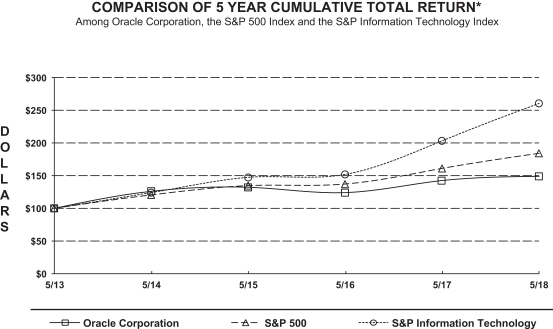
*$100 INVESTED ON MAY 31, 2013 IN STOCK OR
INDEX-INCLUDING REINVESTMENT OF DIVIDENDS
| 5/13 | 5/14 | 5/15 | 5/16 | 5/17 | 5/18 | |||||||||||||||||||
| Oracle Corporation | 100.0 | 126.1 | 132.1 | 124.0 | 142.3 | 148.8 | ||||||||||||||||||
| S&P 500 Index | 100.0 | 120.5 | 134.7 | 137.0 | 160.9 | 184.1 | ||||||||||||||||||
| S&P Information Technology Index | 100.0 | 123.9 | 147.2 | 151.8 | 203.1 | 260.4 |
COMPARISON OF 5 YEAR CUMULATIVE TOTAL RETURN” Among Oracle Corporation, the S&P 500 Index and the S&P Information Technology Index
Table of Contents
Index to Financial Statements
Item 6. Selected Financial Data
The following table sets forth selected financial data as of and for our last five fiscal years. This selected financial data should be read in conjunction with the consolidated financial statements and related notes included in Item 15 of this Annual Report. Over our last five fiscal years, we have acquired a number of companies, including NetSuite Inc. (NetSuite) in fiscal 2017 and MICROS Systems, Inc. in fiscal 2015, among others. The results of our acquired companies have been included in our consolidated financial statements since their respective dates of acquisition and have contributed to our revenues, income, earnings per share and total assets.
| As of and for the Year Ended May 31, | ||||||||||||||||||||
| (in millions, except per share amounts) | 2018 | 2017 | 2016 | 2015 | 2014 | |||||||||||||||
| Consolidated Statements of Operations Data: | ||||||||||||||||||||
| Total revenues | $ | 39,831 | $ | 37,728 | $ | 37,047 | $ | 38,226 | $ | 38,275 | ||||||||||
| Operating income | $ | 13,679 | $ | 12,710 | $ | 12,604 | $ | 13,871 | $ | 14,759 | ||||||||||
| Net income(1) | $ | 3,825 | $ | 9,335 | $ | 8,901 | $ | 9,938 | $ | 10,955 | ||||||||||
| Earnings per share—diluted(1) | $ | 0.90 | $ | 2.21 | $ | 2.07 | $ | 2.21 | $ | 2.38 | ||||||||||
| Diluted weighted average common shares outstanding | 4,238 | 4,217 | 4,305 | 4,503 | 4,604 | |||||||||||||||
| Cash dividends declared per common share | $ | 0.76 | $ | 0.64 | $ | 0.60 | $ | 0.51 | $ | 0.48 | ||||||||||
| Consolidated Balance Sheets Data: | ||||||||||||||||||||
| Working capital(2) | $ | 56,769 | $ | 50,337 | $ | 47,105 | $ | 47,314 | $ | 32,954 | ||||||||||
| Total assets(2) | $ | 137,264 | $ | 134,991 | $ | 112,180 | $ | 110,903 | $ | 90,266 | ||||||||||
| Notes payable and other borrowings(3) | $ | 60,619 | $ | 57,909 | $ | 43,855 | $ | 41,958 | $ | 24,097 |
| (1) | Our net income and diluted earnings per share were unfavorably impacted by a net charge of $7.0 billion during fiscal 2018 due to our preliminary assessment of the one-time effects of the U.S. Tax Cuts and Jobs Act of 2017 (the Tax Act). The more significant provisions of the Tax Act as applicable to us are described below under “Impacts of the U.S. Tax Cuts and Jobs Act of 2017”. |
|---|
| (2) | Total working capital and total assets sequentially increased in nearly all periods presented primarily due to the favorable impacts to our net current assets resulting from our net income generated during all periods presented and the issuances of long-term senior notes of $10.0 billion in fiscal 2018, $14.0 billion in fiscal 2017, $20.0 billion in fiscal 2015, and €2.0 billion and $3.0 billion in fiscal 2014. Our total assets were also favorably impacted by the issuance of $2.5 billion of short-term borrowings in fiscal 2018, and $3.8 billion of short-term borrowings in each of fiscal 2017 and 2016. These increases were partially offset by cash used for acquisitions, repurchases of our common stock and dividend payments made in all periods presented, repayments of certain of our senior notes in fiscal 2018, 2017, 2016 and 2015, and the repayment of $3.8 billion of short-term borrowings in each of fiscal 2018 and 2017. |
|---|
| (3) | Our notes payable and other borrowings, which represented the summation of our notes payable and other borrowings, current, and notes payable and other borrowings, non-current, as reported per our consolidated balance sheets as of the dates listed in the table above, increased between fiscal 2014 and fiscal 2018 primarily due to the fiscal 2018 issuance of long-term senior notes of $10.0 billion and short-term borrowings of $2.5 billion, the fiscal 2017 issuance of long-term senior notes of $14.0 billion and short-term borrowings of $3.8 billion, the fiscal 2016 issuance of $3.8 billion of short-term borrowings, the issuances of long-term senior notes of $20.0 billion in fiscal 2015, and €2.0 billion and $3.0 billion in fiscal 2014. See Note 7 of Notes to Consolidated Financial Statements included elsewhere in this Annual Report for additional information regarding our notes payable and other borrowings. |
|---|
Table of Contents
Index to Financial Statements
Item 7. Management’s Discussion and Analysis of Financial Condition and Results of Operations
We begin Management’s Discussion and Analysis of Financial Condition and Results of Operations with an overview of our businesses and significant trends. This overview is followed by a summary of our critical accounting policies and estimates that we believe are important to understanding the assumptions and judgments incorporated in our reported financial results. We then provide a more detailed analysis of our results of operations and financial condition.
Business Overview
Oracle Corporation provides products and services that address all aspects of corporate information technology (IT) environments—applications, platform and infrastructure. Our applications, platform and infrastructure offerings are delivered to customers worldwide through a variety of flexible and interoperable IT deployment models, including cloud-based, on-premise, or hybrid, which enable customer choice and flexibility. We market and sell our offerings globally to businesses of many sizes, government agencies, educational institutions and resellers with a worldwide sales force that is employed by our domestic and international subsidiaries and is positioned to offer the combinations that best meet customer needs.
We have three businesses: cloud and license; hardware; and services; each of which comprises a single operating segment. The descriptions set forth below as a part of Management’s Discussion and Analysis of Financial Condition and Results of Operations and the information contained within Note 15 of Notes to Consolidated Financial Statements included elsewhere in this Annual Report provide additional information related to our businesses and operating segments and align as to how our chief operating decision makers (CODMs), which include our Chief Executive Officers and Chief Technology Officer, view our operating results and allocate resources.
Cloud and License Business
Our cloud and license line of business, which represented 82%, 80% and 78% of our total revenues in fiscal 2018, 2017 and 2016, respectively, markets, sells and delivers a broad spectrum of applications, platform and infrastructure technologies through our cloud and license offerings.
Cloud services and license support revenues include:
| • | license support revenues, which is our largest revenues stream. Oracle license support grants rights to unspecified product upgrades and maintenance releases and patches released during the term of the support period, as well as technical support assistance. Substantially all of our customers opt to purchase license support contracts when they purchase Oracle applications, platform and/or infrastructure licenses and substantially all customers renew their license support contracts annually in order to continue to benefit from Oracle’s research and development investments that are utilized as a part of unspecified periodic license updates that may be released and that customers with current license support contracts are entitled to. Our license support contracts are generally priced as a percentage of the net fees paid by the customer to access the license, are generally billed in advance of the support services being performed and are generally recognized as revenues ratably as the support services are delivered over the contractual terms; and |
|---|
| • | cloud services revenues, which includes revenues from Oracle Cloud Software-as-a-Service (SaaS), Platform-as-a-Service (PaaS) and Infrastructure-as-a-Service (IaaS) offerings (collectively, Oracle Cloud Services), which deliver applications, platform and infrastructure technologies, respectively, via cloud-based deployment models that we develop functionality for, host, manage and support and that customers access by entering into a subscription agreement with us for a stated period. Our IaaS offerings also include Oracle Managed Cloud Services, which are designed to provide comprehensive software and hardware management, maintenance and security services for customer cloud-based, hybrid IT or other IT infrastructure for a fee for a stated term. The majority of our Oracle Cloud Services arrangements have durations of 12 to 36 months and are generally recognized as revenues ratably over the contractual period of the contract or, in the case of usage model contracts, as the cloud services are consumed. We strive to renew these cloud services contracts when they are eligible for renewal. |
|---|
Table of Contents
Index to Financial Statements
Cloud license and on-premise license revenues include revenues from the licensing of our software products including Oracle Applications, Oracle Database, Oracle Fusion Middleware and Java, among others which our customers use for cloud-based, on-premise and other IT environments. Our cloud license and on-premise license transactions are generally perpetual in nature and are generally recognized when unrestricted access to the license is granted to the customer provided all other revenue recognition criteria are met. The timing of a few large license transactions can substantially affect our quarterly license revenues, which is different than the typical revenue recognition pattern for our cloud services and license support revenues in which revenues are generally recognized ratably over the contractual periods. Cloud license and on-premise license customers have the option to purchase license support contracts, as described above.
Providing choice and flexibility to our customers as to when and how they deploy our applications, platform and infrastructure technologies is an important element of our corporate strategy. In recent periods, customer demand has increased for our Oracle Cloud Services. To address customer demand and enable customer choice, we have introduced certain programs for customers to pivot their applications, platform and infrastructure licenses and license support to the Oracle Cloud for new deployments and to migrate to and expand with the Oracle Cloud for their existing workloads. We expect these trends to continue.
Our cloud services revenues growth and our cloud license and on-premise license revenues growth are affected by the strength of general economic and business conditions, governmental budgetary constraints, the strategy for and competitive position of our offerings, our acquisitions, our ability to deliver and renew our cloud services contracts with our existing customers and foreign currency rate fluctuations. Our license support revenues growth is primarily influenced by three factors: (1) the continuity of substantially all of our license support customer contract base renewing their license support contracts and substantially all customers continuing to purchase license support contracts in connection with their purchase of a new license; (2) the pricing of license support contracts sold in connection with the sale of new licenses; and (3) the pricing of new licenses sold. Customers do so in order to benefit from Oracle’s research and development investments that are utilized as a part of unspecified periodic license updates that may be released and that customers with current license support contracts are entitled to.
On a constant currency basis, we expect that our total cloud and license revenues generally will continue to increase due to:
| • | expected growth in our cloud services and license support offerings, including the high percentage of customers that purchase and renew their license support contracts; |
|---|
| • | continued demand for our cloud license and on-premise license offerings; and |
|---|
| • | contributions from our acquisitions. |
|---|
We believe all of these factors should contribute to future growth in our cloud and license revenues, which should enable us to continue to make investments in research and development to dev
Showing the first 8K of 160K characters. Open the full section
Item 7A. Quantitative and Qualitative Disclosures About Market Risk
Cash, Cash Equivalents, Marketable Securities and Interest Income Risk
Cash, cash equivalents, and marketable securities were $67.3 billion and $66.1 billion as of May 31, 2018 and 2017, respectively. Our bank deposits and time deposits are generally held with large, diverse financial institutions worldwide with high investment-grade credit ratings or financial institutions that meet investment-grade ratings criteria, which we believe mitigates credit risk and certain other risks. In addition, as of May 31, 2018, substantially all of our marketable securities were high quality with approximately 26% having maturity dates within one year and 74% having maturity dates within one to five years (a description of our marketable securities held is included in Notes 3 and 4 of Notes to Consolidated Financial Statements included elsewhere in this Annual Report and “Liquidity and Capital Resources” above). We held a mix of both fixed and floating-rate debt securities. Fixed rate securities may have their market value adversely impacted as interest rates increase,
Table of Contents
Index to Financial Statements
while floating rate securities may produce less income than expected if interest rates fall. Due in part to these factors, our future investment income may vary due to changes in interest rates or we may realize losses if we are forced to sell securities that decline in market value due to changes in interest rates. However because we classify our debt securities as “available for sale,” no gains or losses are recognized due to changes in interest rates unless such securities are sold prior to maturity or declines in fair value are determined to be other-than-temporary. The fair values of our fixed-rate debt securities are impacted by interest rate movements and if interest rates would have been higher by 50 basis points as of May 31, 2018 and 2017 we estimate the change would have decreased the fair values of our marketable securities holdings by $308 million and $348 million, respectively. Substantially all of our marketable securities are designated as available-for-sale. We generally do not use our investments for trading purposes.
Changes in the overall level of interest rates affect the interest income that is generated from our cash, cash equivalents and marketable securities. For fiscal 2018 and 2017, total interest income was $1.2 billion and $802 million, respectively, with our cash, cash equivalents and marketable securities investments yielding an average 1.73% and 1.47%, respectively, on a worldwide basis.
Interest Expense Risk
Interest Expense Risk—Interest Rate Swap Agreements and Cross-Currency Interest Rate Swap Agreements
Our total borrowings were $60.9 billion as of May 31, 2018, consisting of $56.9 billion of fixed-rate borrowings, $1.2 billion of floating-rate borrowings (Floating-Rate Notes) and $2.8 billion of other borrowings, primarily under the 2018 Credit Agreements. We have entered into certain interest rate swap agreements that have the economic effect of modifying the fixed-interest obligations associated with our $1.5 billion of 2.375% senior notes due January 2019 (January 2019 Notes), our $2.0 billion of 2.25% senior notes due October 2019 (October 2019 Notes), our $1.5 billion of 2.80% senior notes due July 2021 (July 2021 Notes), and our April 2038 Notes, so that the interest payable on these senior notes effectively became variable based on LIBOR. We have also entered into cross-currency interest rate swap agreements to manage the foreign currency exchange rate risk associated with our July 2025 Notes by effectively converting the fixed-rate, Euro denominated debt, including the annual interest payments and the payment of principal at maturity, to variable-rate, U.S. Dollar denominated debt based on LIBOR. The critical terms of the swap agreements match the critical terms of the January 2019 Notes, October 2019 Notes, July 2021 Notes, April 2038 Notes and July 2025 Notes that the swap agreements pertain to, including the notional amounts and maturity dates. We do not use these swap arrangements for trading purposes. We are accounting for these swap agreements as fair value hedges pursuant to ASC 815, Derivatives and Hedging (ASC 815). The fair values of these fixed to variable interest rate swap agreements as of May 31, 2018 and 2017 were a $26 million net loss and a $40 million gain, respectively. We estimate that the changes in the fair values of these swap agreements during fiscal 2018 and 2017 were primarily attributable to an increase in forward interest rate prices. If LIBOR-based interest rates would have been higher by 100 basis points as of May 31, 2018 and 2017, the change would have decreased the fair values of the fixed to variable swap agreements by $315 million and $153 million, respectively.
By issuing the Floating-Rate Notes and by entering into the aforementioned swap arrangements, we have assumed risks associated with variable interest rates based upon LIBOR. Changes in the overall level of interest rates affect the interest expense that we recognize in our consolidated statements of operations. An interest rate risk sensitivity analysis is used to measure interest rate risk by computing estimated changes in cash flows as a result of assumed changes in market interest rates. As of May 31, 2018 and 2017, if LIBOR-based interest rates would have been higher by 100 basis points, the change would have increased our interest expense annually by approximately $86 million and $73 million, respectively, as it relates to our fixed to variable interest rate swap agreements and floating-rate borrowings. Additional details regarding our senior notes and related swap agreements are included in Notes 7 and 10 of Notes to Consolidated Financial Statements included elsewhere in this Annual Report.
Table of Contents
Index to Financial Statements
Currency Risk
Foreign Currency Transaction Risk—Foreign Currency Forward Contracts
We transact business in various foreign currencies and have established a program that primarily utilizes foreign currency forward contracts to offset the risks associated with the effects of certain foreign currency exposures. Under this program, our strategy is to enter into foreign currency forward contracts so that increases or decreases in our foreign currency exposures are offset by gains or losses on the foreign currency forward contracts in order to mitigate the risks and volatility associated with our foreign currency transactions. We may suspend this program from time to time. Our foreign currency exposures typically arise from intercompany sublicense fees, intercompany loans and other intercompany transactions. Our foreign currency forward contracts are generally short-term in duration.
Neither do we use these foreign currency forward contracts for trading purposes nor do we designate these forward contracts as hedging instruments pursuant to ASC 815. Accordingly, we record the fair values of these contracts as of the end of our reporting period to our consolidated balance sheet with changes in fair values recorded to our consolidated statement of operations. Given the short duration of the forward contracts, amounts recorded generally are not significant. The balance sheet classification for the fair values of these forward contracts is prepaid expenses and other current assets for forward contracts in an unrealized gain position and other current liabilities for forward contracts in an unrealized loss position. The statement of operations classification for changes in fair values of these forward contracts is non-operating income, net for both realized and unrealized gains and losses.
We expect that we will continue to realize gains or losses with respect to our foreign currency exposures, net of gains or losses from our foreign currency forward contracts. Our ultimate realized gain or loss with respect to foreign currency exposures will generally depend on the size and type of cross-currency transactions that we enter into, the currency exchange rates associated with these exposures and changes in those rates, the net realized gain or loss on our foreign currency forward contracts and other factors. The notional amounts of the forward contracts we held to purchase U.S. Dollars in exchange for other major international currencies were $3.4 billion as of each of May 31, 2018 and 2017 and the notional amounts of forward contracts we held to sell U.S. Dollars in exchange for other major international currencies were $1.4 billion as of each of May 31, 2018 and 2017. The fair values of our outstanding foreign currency forward contracts were nominal at May 31, 2018 and 2017. Net foreign exchange transaction losses included in non-operating income, net in the accompanying consolidated statements of operations were $74 million, $152 million and $110 million in fiscal 2018, 2017 and 2016, respectively. As a large portion of our consolidated operations are international, we could experience additional foreign currency volatility in the future, the amounts and timing of which are unknown.
Foreign Currency Translation Risk—Impact on Cash, Cash Equivalents and Marketable Securities
Fluctuations in foreign currencies impact the amount of total assets and liabilities that we report for our foreign subsidiaries upon the translation of these amounts into U.S. Dollars. In particular, the amount of cash, cash equivalents and marketable securities that we report in U.S. Dollars for a significant portion of the cash held by these subsidiaries is subject to translation variance caused by changes in foreign currency exchange rates as of the end of each respective reporting period (the offset to which is substantially recorded to accumulated other comprehensive loss on our consolidated balance sheets and is also presented as a line item in our consolidated statements of comprehensive income included elsewhere in this Annual Report).
As the U.S. Dollar fluctuated against certain international currencies as of the end of fiscal 2018, the amount of cash, cash equivalents and marketable securities that we reported in U.S. Dollars for foreign subsidiaries that hold international currencies as of May 31, 2018 increased relative to what we would have reported using a constant currency rate from May 31, 2017. As reported in our consolidated statements of cash flows, the estimated effects of exchange rate changes on our reported cash and cash equivalents balances in U.S. Dollars was an increase of $57 million for fiscal 2018, and decreases of $86 million and $115 million in fiscal 2017 and 2016, respectively. If overall foreign currency exchange rates in comparison to the U.S. Dollar uniformly would have been weaker by 10% as of May 31, 2018 and May 31, 2017 the amount of cash, cash equivalents and marketable securities we would report in U.S. Dollars would have decreased by approximately $555 million and $518 million, respectively, assuming constant foreign currency cash, cash equivalents and marketable securities balances.
Table of Contents
Index to Financial Statements
Item 8. Financial Statements and Supplementary Data
The response to this item is submitted as a separate section of this Annual Report. See Part IV, Item 15.
Item 9. Changes In and Disagreements with Accountants on Accounting and Financial Disclosure
None.
Item 9A. Controls and Procedures
Evaluation of Disclosure Controls and Procedures
As of the end of the period covered by this Annual Report on Form 10-K, we carried out an evaluation under the supervision and with the participation of our Disclosure Committee and our management, including our Principal Executive Officers (one of whom is our Principal Financial Officer), of the effectiveness of the design and operation of our disclosure controls and procedures pursuant to Exchange Act Rules 13a-15(e) and 15d-15(e).
Based on our management’s evaluation (with the participation of our Principal Executive Officers, one of whom is our Principal Financial Officer), as of the end of the period covered by this report, our Principal Executive Officers have concluded that our disclosure controls and procedures were effective as of May 31, 2018 to provide reasonable assurance that information required to be disclosed by us in reports that we file or submit under the Exchange Act is (i) recorded, processed, summarized and reported within the time periods specified in the SEC rules and forms and (ii) accumulated and communicated to our management, including our Principal Executive Officers (one of whom is our Principal Financial Officer) as appropriate to allow timely decisions regarding required disclosure.
Management’s Report on Internal Control over Financial Reporting
Our management is responsible for establishing and maintaining adequate internal control over financial reporting, as such term is defined in Exchange Act Rules 13a-15(f) and 15d-15(f). Under the supervision and with the participation of our management, including our Principal Executive Officers (one of whom is our Principal Financial Officer), we conducted an evaluation of the effectiveness of our internal control over financial reporting as of May 31, 2018 based on the guidelines established in Internal Control—Integrated Framework issued by the Committee of Sponsoring Organizations of the Treadway Commission’s 2013 framework. Our internal control over financial reporting includes policies and procedures that provide reasonable assurance regarding the reliability of financial reporting and the preparation of financial statements for external reporting purposes in accordance with U.S. GAAP.
Based on the results of our evaluation, our management concluded that our internal control over financial reporting was effective as of May 31, 2018. We reviewed the results of management’s assessment with our Finance and Audit Committee.
The effectiveness of our internal control over financial reporting as of May 31, 2018 has been audited by Ernst & Young LLP, an independent registered public accounting firm, as stated in their report which is included in Part IV, Item 15 of this Annual Report.
Changes in Internal Control over Financial Reporting
There were no changes in our internal control over financial reporting identified in connection with the evaluation required by paragraph (d) of Exchange Act Rules 13a-15 or 15d-15 that occurred during our last fiscal quarter that have materially affected, or are reasonably likely to materially affect, our internal control over financial reporting.
Inherent Limitations on Effectiveness of Controls
Our management, including our Principal Executive Officers (one of whom is our Principal Financial Officer), believes that our disclosure controls and procedures and internal control over financial reporting are designed
Table of Contents
Index to Financial Statements
to provide reasonable assurance of achieving their objectives and are effective at the reasonable assurance level. However, our management does not expect that our disclosure controls and procedures or our internal control over financial reporting will prevent all errors and all fraud. A control system, no matter how well conceived and operated, can provide only reasonable, not absolute, assurance that the objectives of the control system are met. Further, the design of a control system must reflect the fact that there are resource constraints and the benefits of controls must be considered relative to their costs. Because of the inherent limitations in all control systems, no evaluation of controls can provide absolute assurance that all control issues and instances of fraud, if any, have been detected. These inherent limitations include the realities that judgments in decision-making can be faulty and that breakdowns can occur because of a simple error or mistake. Additionally, controls can be circumvented by the individual acts of some persons, by collusion of two or more people or by management override of the controls. The design of any system of controls also is based in part upon certain assumptions about the likelihood of future events and there can be no assurance that any design will succeed in achieving its stated goals under all potential future conditions; over time, controls may become inadequate because of changes in conditions, or the degree of compliance with policies or procedures may deteriorate. Because of the inherent limitations in a cost-effective control system, misstatements due to error or fraud may occur and not be detected.
Item 9B. Other Information
Item 10. Directors, Executive Officers and Corporate Governance
| --- | --- |
Pursuant to General Instruction G(3) of Form 10-K, the information required by this item relating to our executive officers is included under the caption “Executive Officers of the Registrant” in Part I of this Annual Report.
The other information required by this Item 10 is incorporated by reference from the information contained in our Proxy Statement to be filed with the U.S. Securities and Exchange Commission in connection with the solicitation of proxies for our 2018 Annual Meeting of Stockholders (2018 Proxy Statement) under the sections entitled “Board of Directors—Nominees for Directors,” “Board of Directors—Committees, Membership and Meetings,” “Board of Directors—Committees, Membership and Meetings—The Finance and Audit Committee,” “Corporate Governance—Employee Matters—Code of Conduct,” and “Section 16(a) Beneficial Ownership Reporting Compliance.”
Item 11. Executive Compensation
| --- | --- |
The information required by this Item 11 is incorporated by reference from the information to be contained in our 2018 Proxy Statement under the sections entitled “Board of Directors—Committees, Membership and Meetings—The Compensation Committee—Compensation Committee Interlocks and Insider Participation,” “Board of Directors—Director Compensation,” and “Executive Compensation.”
Item 12. Security Ownership of Certain Beneficial Owners and Management and Related Stockholder Matters
| --- | --- |
The information required by this Item 12 is incorporated herein by reference from the information to be contained in our 2018 Proxy Statement under the sections entitled “Security Ownership of Certain Beneficial Owners and Management” and “Executive Compensation—Equity Compensation Plan Information.”
Item 13. Certain Relationships and Related Transactions, and Director Independence
| --- | --- |
The information required by this Item 13 is incorporated herein by reference from the information to be contained in our 2018 Proxy Statement under the sections entitled “Corporate Governance—Board of Directors and Director Independence” and “Transactions with Related Persons.”
Item 14. Principal Accounting Fees and Services
| --- | --- |
The information required by this Item 14 is incorporated herein by reference from the information to be contained in our 2018 Proxy Statement under the section entitled “Ratification of Selection of Independent Registered Public Accounting Firm.”
Table of Contents
Index to Financial Statements
PART IV
Item 15. Exhibits and Financial Statement Schedules
(a) 1. Financial Statements
The following financial statements are filed as a part of this report:
| Page | ||||
| Reports of Independent Registered Public Accounting Firm | 72 | |||
| Consolidated Financial Statements: | ||||
| Balance Sheets as of May 31, 2018 and 2017 | 74 | |||
| Statements of Operations for the years ended May 31, 2018, 2017 and 2016 | 75 | |||
| Statements of Comprehensive Income for the years ended May 31, 2018, 2017 and 2016 | 76 | |||
| Statements of Equity for the years ended May 31, 2018, 2017 and 2016 | 77 | |||
| Statements of Cash Flows for the years ended May 31, 2018, 2017 and 2016 | 78 | |||
| Notes to Consolidated Financial Statements | 79 | |||
| 2. Financial Statement Schedules | ||||
| The following financial statement schedule is filed as a part of this report: | ||||
| Page | ||||
| Schedule II. Valuation and Qualifying Accounts | 124 |
All other schedules are omitted because they are not required or the required information is shown in the financial statements or notes thereto.
(b) Exhibits
The information required by this Item is set forth in the Index of Exhibits that is after Item 16 of this Annual Report.
Table of Contents
Index to Financial Statements
Report of Independent Registered Public Accounting Firm
To the Stockholders and the Board of Directors of Oracle Corporation
Opinion on the Financial Statements
We have audited the accompanying consolidated balance sheets of Oracle Corporation (the Company) as of May 31, 2018 and 2017, the related consolidated statements of operations, comprehensive income, equity and cash flows for each of the three years in the period ended May 31, 2018, and the related notes and the financial statement schedule listed in the Index at Item 15(a)2 (collectively referred to as the “financial statements”). In our opinion, the financial statements present fairly, in all material respects, the consolidated financial position of the Company at May 31, 2018 and 2017, and the consolidated results of its operations and its cash flows for each of the three years in the period ended May 31, 2018, in conformity with U.S. generally accepted accounting principles.
We also have audited, in accordance with the standards of the Public Company Accounting Oversight Board (United States) (PCAOB), the Company’s internal control over financial reporting as of May 31, 2018, based on criteria established in Internal Control-Integrated Framework issued by the Committee of Sponsoring Organizations of the Treadway Commission (2013 framework) and our report dated June 22, 2018 expressed an unqualified opinion thereon.
Basis for Opinion
These financial statements are the responsibility of the Company’s management. Our responsibility is to express an opinion on the Company’s financial statements based on our audits. We are a public accounting firm registered with the PCAOB and are required to be independent with respect to the Company in accordance with the U.S. federal securities laws and the applicable rules and regulations of the Securities and Exchange Commission and the PCAOB. We conducted our audits in accordance with the standards of the PCAOB. Those standards require that we plan and perform the audit to obtain reasonable assurance about whether the financial statements are free of material misstatement, whether due to error or fraud. Our audits included performing procedures to assess the risks of material misstatement of the financial statements, whether due to error or fraud, and performing procedures that respond to those risks. Such procedures included examining, on a test basis, evidence regarding the amounts and disclosures in the financial statements. Our audits also included evaluating the accounting principles used and significant estimates made by management, as well as evaluating the overall presentation of the financial statements. We believe that our audits provide a reasonable basis for our opinion.
/s/ Ernst & Young LLP
We have served as the Company’s auditor since 2002.
San Jose, California
June 22, 2018
Table of Contents
Index to Financial Statements
Report of Independent Registered Public Accounting Firm
To the Stockholders and the Board of Directors of Oracle Corporation
Opinion on Internal Control over Financial Reporting
We have audited Oracle Corporation’s internal control over financial reporting as of May 31, 2018, based on criteria established in Internal Control—Integrated Framework issued by the Committee of Sponsoring Organizations of the Treadway (2013 framework)(the COSO criteria). In our opinion, Oracle Corporation (the Company) maintained, in all material respects, effective internal control over financial reporting as of May 31, 2018, based on the COSO criteria.
We also have audited, in accordance with the standards of the Public Company Accounting Oversight Board (United States) (PCAOB), the consolidated balance sheets of the Company as of May 31, 2018 and 2017, and the related consolidated statements of operations, comprehensive income, equity, and cash flows for each of the three years in the period ended May 31, 2018, and the related notes and the financial statement schedule listed in the Index at Item 15(a)2 and our report June 22, 2018 expressed an unqualified opinion thereon.
Basis for Opinion
The Company’s management is responsible for maintaining effective internal control over financial reporting and for its assessment of the effectiveness of internal control over financial reporting included in the accompanying Management’s Report on Internal Control Over Financial Reporting. Our responsibility is to express an opinion on the Company’s internal control over financial reporting based on our audit. We are a public accounting firm registered with the PCAOB and are required to be independent with respect to the Company in accordance with the U.S. federal securities laws and the applicable rules and regulations of the Securities and Exchange Commission and the PCAOB.
We conducted our audit in accordance with the standards of the PCAOB. Those standards require that we plan and perform the audit to obtain reasonable assurance about whether effective internal control over financial reporting was maintained in all material respects.
Our audit included obtaining an understanding of internal control over financial reporting, assessing the risk that a material weakness exists, testing and evaluating the design and operating effectiveness of internal control based on the assessed risk, and performing such other procedures as we considered necessary in the circumstances. We believe that our audit provides a reasonable basis for our opinion.
Definition and Limitations of Internal Control Over Financial Reporting
A company’s internal control over financial reporting is a process designed to provide reasonable assurance regarding the reliability of financial reporting and the preparation of financial statements for external purposes in accordance with generally accepted accounting principles. A company’s internal control over financial reporting includes those policies and procedures that (1) pertain to the maintenance of records that, in reasonable detail, accurately and fairly reflect the transactions and dispositions of the assets of the company; (2) provide reasonable assurance that transactions are recorded as necessary to permit preparation of financial statements in accordance with generally accepted accounting principles, and that receipts and expenditures of the company are being made only in accordance with authorizations of
Showing the first 8K of 222K characters. Open the full section
Item 16. Form 10-K Summary
None.
Table of Contents
Index to Financial Statements
ORACLE CORPORATION
INDEX OF EXHIBITS
The following exhibits are filed herewith or are incorporated by reference to exhibits previously filed with the U.S. Securities and Exchange Commission.
Table of Contents
Index to Financial Statements
Table of Contents
Index to Financial Statements
| Exhibit No. | Exhibit Description | Incorporated by Reference | ||||||||||
| Form | File No. | Exhibit | Filing Date | Filed By | ||||||||
| 10.13* | Form of Restricted Stock Unit Award Agreement under the Oracle Corporation Amended and Restated 1993 Directors’ Stock Plan | 10-K | 001-35992 | 10.17 | 06/25/15 | Oracle Corporation | ||||||
| 10.14* | Form of Performance-Based Stock Option Agreement under the Amended and Restated 2000 Long-Term Equity Incentive Plan for Named Executive Officers | 10-Q | 001-35992 | 10.16 | 9/18/17 | Oracle Corporation | ||||||
| 10.15* | Form of Stock Unit Award Agreement under the Amended and Restated 2000 Long-Term Equity Incentive Plan for U.S. Employees (Including Section 16 Officers) | 10-Q | 001-35992 | 10.17 | 9/18/17 | Oracle Corporation | ||||||
| 12.01‡ | Consolidated Ratio of Earnings to Fixed Charges | |||||||||||
| 21.01‡ | Subsidiaries of the Registrant | |||||||||||
| 23.01‡ | Consent of Independent Registered Public Accounting Firm | |||||||||||
| 31.01‡ | Rule 13a-14(a)/15d-14(a) Certification of Principal Executive Officer | |||||||||||
| 31.02‡ | Rule 13a-14(a)/15d-14(a) Certification of Principal Executive and Financial Officer | |||||||||||
| 32.01† | Section 1350 Certification of Principal Executive Officers and Principal Financial Officer | |||||||||||
| 101‡ | Interactive Data Files Pursuant to Rule 405 of Regulation S-T: (1) Consolidated Balance Sheets as of May 31, 2018 and 2016, (2) Consolidated Statements of Operations for the years ended May 31, 2018, 2017 and 2016, (3) Consolidated Statements of Comprehensive Income for the years ended May 31, 2018, 2017 and 2016, (4) Consolidated Statements of Equity for the years ended May 31, 2018, 2017 and 2016, (5) Consolidated Statements of Cash Flows for the years ended May 31, 2018, 2017 and 2016, (6) Notes to Consolidated Financial Statements and (7) Financial Statement Schedule II |
| * | Indicates management contract or compensatory plan or arrangement. |
|---|
| ‡ | Filed herewith. |
|---|
| † | Furnished herewith. |
|---|
Table of Contents
Index to Financial Statements
SIGNATURES
Pursuant to the requirements of Section 13 or 15(d) of the Securities Exchange Act of 1934, the registrant has duly caused this report to be signed on its behalf by the undersigned, thereunto duly authorized.
| ORACLE CORPORATION | ||||||
| Date: June 22, 2018 | By: | /S/ SAFRA A. CATZ | ||||
| Safra A. Catz | ||||||
| Chief Executive Officer and Director | ||||||
| (Principal Executive and Financial Officer) | ||||||
| Date: June 22, 2018 | By: | /S/ MARK V. HURD | ||||
| Mark V. Hurd | ||||||
| Chief Executive Officer and Director | ||||||
| (Principal Executive Officer) |
Pursuant to the requirements of the Securities Exchange Act of 1934, this report has been signed by the following persons on behalf of the Registrant and in the capacities and on the date indicated.
| Name | Title | Date | ||
| /S/ SAFRA A. CATZ Safra A. Catz | Chief Executive Officer and Director (Principal Executive and Financial Officer) | June 22, 2018 | ||
| /S/ MARK V. HURD Mark V. Hurd | Chief Executive Officer and Director (Principal Executive Officer) | June 22, 2018 | ||
| /S/ WILLIAM COREY WEST William Corey West | Executive Vice President, Corporate Controller and Chief Accounting Officer (Principal Accounting Officer) | June 22, 2018 | ||
| /S/ LAWRENCE J. ELLISON Lawrence J. Ellison | Chairman of the Board of Directors and Chief Technology Officer | June 22, 2018 | ||
| /S/ JEFFREY O. HENLEY Jeffrey O. Henley | Vice Chairman of the Board of Directors | June 22, 2018 | ||
| /S/ JEFFREY S. BERG Jeffrey S. Berg | Director | June 22, 2018 | ||
| /S/ MICHAEL J. BOSKIN Michael J. Boskin | Director | June 22, 2018 | ||
| /S/ BRUCE R. CHIZEN Bruce R. Chizen | Director | June 22, 2018 | ||
| /S/ GEORGE H. CONRADES George H. Conrades | Director | June 22, 2018 | ||
| /S/ HECTOR GARCIA-MOLINA Hector Garcia-Molina | Director | June 22, 2018 | ||
| /S/ RENÉE J. JAMES Renée J. James | Director | June 22, 2018 |
Table of Contents
Index to Financial Statements
| Name | Title | Date | ||
| /S/ CHARLES W. MOORMAN IV Charles W. Moorman IV | Director | June 22, 2018 | ||
| /S/ LEON E. PANETTA Leon E. Panetta | Director | June 22, 2018 | ||
| /S/ WILLIAM G. PARRETT William G. Parrett | Director | June 22, 2018 | ||
| /S/ NAOMI O. SELIGMAN Naomi O. Seligman | Director | June 22, 2018 |