 filings.tools
Oracle (ORCL) 10-K risk factor changes: FY2018 vs FY2017
The 2018-05-31 10-K against the 2017-05-31 one, compared heading by heading and sentence by sentence. One of these filings carries no fiscal year tag, so its year is the calendar year of the period end.
Item 1A109 rewritten72 added25 removed286 unchanged
All filing items1,376 rewritten717 added656 removed2,163 unchanged
Summary
counted, not written
- Item 1A headings could not be compared: only 0 carried over between the two years, which usually means one filing was read wrongly, so none is reported as new or removed.
- Sentence by sentence, 717 added, 656 removed, 1,376 rewritten and 2,163 unchanged across 20 items that differ.
Sentences by item
22 items, with every count and a link to each item that changed
Underlined words on a shaded ground are new in FY2018; struck-through words were in FY2017. Sentences that are wholly new or wholly gone are labelled rather than marked.
Item 1A. Risk Factors
109 rewritten, 72 added, 25 removed, 286 unchanged
_Our Oracle Cloud strategy, including our Oracle Software as a Service (SaaS), Platform as a Service (PaaS), Infrastructure as a Service (IaaS) and Data as a Service (DaaS) offerings, may adversely affect our revenues and profitability._ We provide our cloud and [removed: on-premise] [added: other] offerings to customers worldwide via deployment models that best suit their needs, including via our cloud-based SaaS, PaaS, IaaS and DaaS offerings.
[removed: As these business] models continue to evolve, we may not be able to compete effectively, generate significant revenues or maintain the profitability of our cloud offerings.
Additionally, the increasing prevalence of cloud [removed: and SaaS] delivery models offered by us and our competitors may unfavorably impact the pricing of our [removed: on-premise enterprise software offerings and our] [added: other] cloud [removed: offerings,] and [removed: has a dampening impact on overall demand for our on-premise software product] [added: license, hardware] and [removed: service] [added: services] offerings, [added: in particular our IaaS offerings,] which [removed: has reduced and] could [removed: continue to] reduce our revenues and [removed: profitability, at least in the near term.][added: profitability.]
As customer demand for our cloud offerings increases, we experience volatility in our reported revenues and operating results due to the differences in timing of revenue recognition between our [removed: new software licenses] [added: cloud license] and [added: on-premise license, and] hardware arrangements relative to our cloud offering arrangements.
[removed: The deferred revenue that results from sales of our cloud offerings may prevent] [added: Consequently,] any deterioration in sales activity associated with our cloud offerings [removed: from becoming] [added: may not be] immediately observable in our consolidated statement of operations.
This is in contrast to revenues associated with our [removed: new software licenses] [added: cloud license and on-premise license] arrangements [removed: whereby new software licenses revenues] [added: which] are generally recognized in full at the time of delivery of the related [removed: software] licenses.
[removed: We] [added: In addition, we] incur certain expenses associated with the [removed: infrastructures] [added: infrastructure] and marketing of our cloud offerings in advance of our ability to recognize the revenues associated with these offerings.
[removed: Our] [added: In addition, our] business may be adversely affected if:
| | • | | we do not continue to develop and release [removed: these or other] new or enhanced products and services within the anticipated time frames; |
_If our security measures for our products and services are compromised and as a result, our data, our customers’ data or our IT systems are accessed improperly, made unavailable, or improperly modified, our products and services may be perceived as vulnerable, our brand and reputation could be damaged, the IT services we provide to our customers could be disrupted, and customers may stop using our products and services, all of which could reduce our revenue and earnings, increase our expenses and expose us to legal claims and regulatory actions._ We are in the IT business, and our products and services, including our Oracle Cloud [removed: offerings,] [added: Services,] store, retrieve, manipulate and manage our customers’ information and data, external data, as well as our own data.
At times, we encounter attempts by third parties (which may include [added: individuals or groups of hackers and sophisticated organizations, such as state-sponsored organizations,] nation states and individuals sponsored by them) to identify and exploit product and service vulnerabilities, penetrate or bypass our security measures, and gain unauthorized access to our or our customers’, partners’ and suppliers’ software, hardware and cloud offerings, networks and systems, any of which could lead to the compromise of personal information or the confidential information or data of Oracle or our customers.
Data may also be accessed or modified improperly as a result of customer, partner, employee or supplier error or malfeasance and third parties may attempt to fraudulently induce customers, partners, employees or suppliers into disclosing sensitive information such as user names, passwords or other information in order to gain access to our data, our customers’, suppliers’ or partners’ data or the IT systems of Oracle, [removed: its] [added: our] customers, suppliers or partners.
[removed: High-profile security breaches at other companies have increased in recent years, and security] [added: Security] industry experts and government officials have warned about the risks of hackers and cyber-attacks targeting IT products and businesses.
These risks will increase as we continue to grow our cloud offerings and store and process increasingly large amounts of data, including personal information and our customers’ confidential information and data and other external data, and host or manage parts of our customers’ businesses in cloud-based IT environments, especially in customer sectors involving particularly sensitive data such as health sciences, financial [removed: services] [added: services, retail, hospitality] and the government.
We could suffer significant damage to our brand and reputation if a cyber-attack or other security incident were to allow unauthorized access to or modification of our customers’ or suppliers’ data, other external data, or our [added: own data or our IT systems or if the services we provide to our customers were disrupted, or if our products or services are perceived as having security vulnerabilities.]
These types of security incidents could also lead to [added: loss or destruction of information, inappropriate use of proprietary and sensitive data,] lawsuits, [added: indemnity obligations,] regulatory investigations and [added: financial penalties, and] claims and increased legal liability, including in some cases contractual costs related to customer notification and fraud monitoring.
_Our business practices with respect to [removed: the collection, use and management of personal information] [added: data] could give rise to operational interruption, liabilities or reputational harm as a result of governmental regulation, legal requirements or industry standards relating to consumer privacy and data protection._ As regulatory focus on privacy issues continues to increase and worldwide laws and regulations concerning the handling of personal information expand and become more complex, potential risks related to data collection and use within our business will intensify.
The Privacy Shield and other data transfer mechanisms are [removed: likely] [added: currently subject] to [removed: be reviewed by the] [added: challenges in] European courts, which may lead to uncertainty about the legal basis for data transfers to the U.S. or interruption of such transfers.
In addition, U.S. and foreign governments have enacted or are considering enacting legislation or regulations, or may in the near future interpret existing legislation or regulations, in a manner that could significantly impact [added: our ability, as well as] the ability of [removed: Oracle and] our [removed: customers] [added: customers, partners] and data [removed: partners] [added: providers,] to collect, augment, analyze, use, transfer and share personal and other information that is integral to certain services [removed: Oracle provides.][added: we provide.]
This could be true particularly in those jurisdictions where privacy laws or regulators take a broader view of how personal information is defined, therefore subjecting the handling of such data to heightened restrictions that may be obstructive to [added: our operations and] the operations of [removed: Oracle and its customers] [added: our customers, partners] and data providers.
For example, in 2016, the EU adopted [removed: a new law governing data practices and privacy called] the General Data Protection Regulation (GDPR), which [removed: becomes] [added: became] effective in May 2018.
The GDPR and other changes in laws or regulations associated with the enhanced protection of [removed: certain] [added: personal and other] types of [removed: sensitive data, such as healthcare] data [removed: or other personal information,] could greatly increase [removed: our cost of providing our products and services or even prevent us from offering certain services in jurisdictions that we operate.]
Additionally, public perception and standards related to the privacy of personal information can shift rapidly, in ways that may affect [removed: Oracle’s] [added: our] reputation or influence regulators to enact regulations and laws that may limit [removed: Oracle’s] [added: our] ability to provide certain products.
Any failure, or perceived failure, by [removed: Oracle] [added: us] to comply with [added: these public statements or with] U.S. federal, state, or foreign laws and regulations, including laws and regulations regulating privacy, data security, or consumer protection, [removed: or other policies,] public perception, standards, self-regulatory requirements or legal obligations, could result in lost or restricted business, proceedings, actions or fines brought against us or levied by governmental entities or others, or could adversely affect our business and harm our reputation.
_We might experience significant coding, manufacturing or configuration errors in our cloud, [removed: software] [added: license] and hardware offerings._ Despite testing prior to the release and throughout the lifecycle of a product or service, [removed: our cloud, software and hardware offerings sometimes contain coding or manufacturing errors that can impact their function, performance and security, and result in other negative consequences.]
The detection and correction of any errors in released cloud, [removed: software] [added: license] or hardware offerings can be time consuming and costly.
[added: Errors in our] cloud, [removed: software] [added: license] or hardware offerings could affect their ability to properly function or operate with other cloud, [removed: software] [added: license] or hardware offerings, could delay the development or release of new products or services or new versions of products or services, could create security vulnerabilities in our products or services, and could adversely affect market acceptance of our products or services.
If we experience errors or delays in releasing our cloud, [removed: software] [added: license] or hardware offerings or new versions thereof, our sales could be affected and revenues could decline.
Enterprise customers rely on our cloud, [removed: software] [added: license] and hardware offerings and [added: related] services to run their businesses and errors in our cloud, [removed: software or] [added: license and] hardware offerings [added: and related services] could expose us to product liability, performance and warranty claims as well as significant harm to our brand and reputation, which could impact our future sales.
_We may fail to achieve our financial forecasts due to inaccurate sales forecasts or other factors._ Our revenues, particularly [added: certain of] our cloud [removed: revenues, new software licenses] [added: license and on-premise license] revenues and hardware revenues, are difficult to forecast.
[removed: We] [added: For our license business, we] use a “pipeline” system, a common industry practice, to forecast sales and trends in [removed: our] [added: that] business.
Our pipeline estimates can prove to be unreliable both in a particular quarter and over a longer period of time, in part because the [removed: “conversion rate”] [added: conversion rate] or [removed: “closure rate”] [added: closure rate] of the pipeline into contracts can be very difficult to estimate.
[removed: We] [added: For our Oracle Cloud Services, we] may use conversion or renewal rates in our forecasts [removed: for our cloud business] that differ materially from our actual conversion or renewal rates because this business is continuing to evolve and such rates may be unpredictable.
A reduction in the conversion [removed: rate,] [added: rates, renewal rates,] or in the pipeline itself, could cause us to plan or budget incorrectly and adversely affect our business or results of operations.
In particular, a slowdown in IT spending or economic conditions generally can unexpectedly reduce the conversion [removed: rate] [added: rates and renewal rates] in particular periods as purchasing decisions are delayed, reduced in amount or cancelled.
The conversion [removed: rate] [added: rates] can also be affected by the tendency of some of our customers to wait until the end of a fiscal period in the hope of obtaining more favorable terms, which can also impede our ability to negotiate, execute and deliver upon these contracts in a timely manner.
Conversion rates [added: and renewal rates] post-acquisition may be quite different from the acquired companies’ historical conversion rates.
Differences in conversion rates [added: and renewal rates] can also be affected by changes in business practices that we implement in our newly acquired companies.
A substantial portion of our [removed: new software licenses] [added: cloud license] and [added: on-premise license, and] hardware contracts is completed in the latter part of a quarter and a significant percentage of these are larger orders.
The number of large [removed: new software licenses] [added: cloud license and on-premise license] transactions and, to a lesser extent, hardware products transactions increases the risk of fluctuations in our quarterly results because a delay in even a small number of these transactions could cause our quarterly sales, revenues and profitability to fall significantly short of our predictions.
As these business
##### [Index to Financial Statements](#INDEX)
We have continued to refresh and release new offerings of our cloud products and services, including the launch of the Oracle Autonomous Data Warehouse Cloud Service in fiscal 2018.
The Oracle Autonomous Data Warehouse Cloud Service offers automation based on machine learning and we have guaranteed, among other matters, that it will reduce customer downtime to less than 30 minutes a year and that Amazon Data Warehouse customers will see a significant cost reduction if they migrate their workloads to our offering.
Machine learning and artificial intelligence are increasingly driving innovations in technology but if they fail to operate as anticipated or the Oracle Autonomous Warehouse Cloud Service or our other products do not perform as promised, our business and reputation may be harmed.
##### [Index to Financial Statements](#INDEX)
our cloud, license and hardware offerings sometimes contain coding or manufacturing errors that can impact their function, performance and security, and result in other negative consequences.
##### [Index to Financial Statements](#INDEX)
Because the techniques used to obtain unauthorized access to, or sabotage IT systems change frequently, grow more complex over time, and often are not recognized until launched against a target, we may be unable to anticipate or implement adequate measures to prevent against such techniques.
Our internal IT systems continue to evolve and we are often early adapters of new technologies.
However, our business policies and internal security controls may not keep pace with these changes as new threats emerge.
In addition, we may not discover any security breach and loss of information for a significant period of time after the security breach.
As illustrated by the Spectre and Meltdown threats, our products operate in conjunction with and are dependent on products and components across a broad ecosystem.
If there is a security vulnerability in one of these components, and if there is a security exploit targeting it, we could face increased costs, liability claims, customer dissatisfaction, reduced revenue, or harm to our reputation or competitive position.
##### [Index to Financial Statements](#INDEX)
the size of potential fines related to data protection and our cost of providing our products and services could result in changes to our business practices or even prevent us from offering certain services in jurisdictions in which we operate.
Although we have implemented contracts, policies and procedures designed to ensure compliance with applicable laws and regulations, there can be no assurance that our employees, contractors, partners, data providers or agents will not violate such laws and regulations or our contracts, policies and procedures.
We make statements about our use and disclosure of personal information through our privacy policy, information provided on our website and press statements.
Use of our competitors’ technologies may influence a customer’s purchasing decision or create an environment that makes it less efficient to utilize Oracle products and services.
Our competition may also adopt business practices that provide customers access to competing products and services at a risk profile that we may not generally find acceptable, which may convince customers to purchase competitor products and services.
We could lose
##### [Index to Financial Statements](#INDEX)
We introduced Oracle Bring Your Own License (BYOL) to PaaS and Universal Credit Pricing in fiscal 2018 to simplify the way customers purchase and consume our cloud services.
Oracle BYOL enables customers to maintain their existing software licenses for Oracle PaaS while expanding their platform technology footprint at a discounted price.
Oracle Universal Credit Pricing provides a flexible model for customers to access Oracle PaaS and IaaS services on demand via a single contract.
##### [Index to Financial Statements](#INDEX)
reputation, our brand, our international expansion efforts, our ability to attract and retain employees, our business and our operating results.
##### [Index to Financial Statements](#INDEX)
##### [Index to Financial Statements](#INDEX)
_Any failure to offer high-quality technical support services may adversely affect our relationships with our customers and our financial results._ Our customers depend on our support organization to resolve technical issues relating to our applications, platform and infrastructure offerings.
We may be unable to respond quickly enough to accommodate short-term increases in customer demand for support services.
Increased customer demand for these services, without corresponding revenues, could increase costs and adversely affect our operating results.
Any failure to maintain high-quality technical support, or a market perception that we do not maintain high-quality support, could adversely affect our reputation, our ability to sell our applications to existing and prospective customers, and our business, operating results, and financial position.
##### [Index to Financial Statements](#INDEX)
We could incur future losses in emerging market countries where we do business should their currencies become designated as highly inflationary.
##### [Index to Financial Statements](#INDEX)
Therefore, we may experience component inventory
##### [Index to Financial Statements](#INDEX)
Any
##### [Index to Financial Statements](#INDEX)
As customers deploy with the Oracle Cloud, many are adopting a hybrid IT model whereby certain of their IT instances are deployed using the Oracle Cloud, while other of their IT instances are deployed using Oracle on-premise offerings.
We have continued to refresh and release new offerings of our cloud and on-premise software and hardware products and services, including our Database Multitenant, Database In-Memory, SaaS, PaaS, Generation 2 IaaS, Version 12.2 DaaS and Oracle Engineered Systems offerings.
| --- | --- | --- | --- |
own data or our IT systems or if the services we provide to our customers were disrupted, or if our products or services are perceived as having security vulnerabilities.
Errors in our
In addition, currency
The U.S. Dollar continued to strengthen relative to other currencies in fiscal 2017, which is reflected in our results.
Certain of our international subsidiaries operate in economies that have been designated as highly inflationary.
These factors generally have the strongest effect on our sales of new software licenses,
These vendors include on-premise software companies and companies that offer cloud-based SaaS, PaaS, IaaS and DaaS offerings and business process outsourcing (BPO) as competitive alternatives to buying software and hardware.
Our competitors that offer business applications and middleware products may influence a customer’s purchasing decision for the underlying database in an effort to persuade potential customers not to acquire our products.
A significant portion of our hardware products are based on our SPARC microprocessor and Oracle Solaris operating system platform, which has a smaller installed base than certain of our competitors’ platforms and which may make it difficult for us to win new customers that have already made significant investments in our competitors’ platforms.
manufacturing, assembly, sales, customer support, consulting and other services and shared administrative service centers.
| | • | | our ability to repatriate funds held by our foreign subsidiaries to the U.S. at favorable tax rates; |
have facilities and operations.
_Business disruptions could adversely affect our operating results._ A significant portion of our critical business operations are concentrated in a few geographic areas.
We are a highly automated business and a disruption or failure of our systems could cause delays in completing sales and providing services, including some of our cloud offerings.
Significant judgment is required in determining our worldwide provision for income taxes and other tax liabilities.
In particular, reforming the taxation of international businesses has been a priority for U.S. politicians, and key members of the legislative and executive branches have proposed a wide variety of potential changes, any of which could have a significant adverse impact on our effective tax rate.
Although we have negotiated certain unilateral Advance Pricing Agreements with the IRS and certain selected bilateral Advance Pricing Agreements that cover some of
our intercompany transfer pricing issues and preclude the relevant tax authorities from making a transfer pricing adjustment within the scope of these agreements, these agreements do not cover substantial elements of our transfer pricing.
We are regularly under audit by tax authorities with respect to these non-income based taxes and may have exposure to additional non-income based tax liabilities.
Our acquisition activities have increased our non-income based tax exposures, particularly with our entry into the hardware business, which increased the volume and complexity of laws and regulations that we are subject to and with which we must comply.
| | • | | impairment of goodwill or impairment of intangible assets, both asset types of which have increased due to our recent acquisitions and may continue to increase in the future; |
For example, we recognized a goodwill impairment loss in the fourth quarter of fiscal 2015 relating to our hardware reporting unit.
An excerpt. Shown here: 40 of 109 rewritten, 40 of 72 added and all 25 removed. The counts are complete. For every sentence, read Item 1A. Risk Factors in the FY2018 filing and the FY2017 filing.
Item 7. Management’s Discussion and Analysis of Financial Condition and Results of Operations
333 rewritten, 193 added, 168 removed, 436 unchanged
Our [removed: products] [added: applications, platform and infrastructure offerings] are delivered to [removed: over 400,000 worldwide] customers [added: worldwide] through a variety of flexible and interoperable IT deployment [removed: models] [added: models,] including [added: cloud-based,] on-premise, [removed: cloud-based] or [removed: hybrid that] [added: hybrid, which] enable customer choice and [removed: best meet customer IT needs.][added: flexibility.]
[removed: Our on-premise IT offerings] [added: | | • | | hardware revenues, which] include [removed: Oracle Applications, Oracle Database and Oracle Fusion Middleware software, among others;] [added: the sale of] hardware products including Oracle Engineered Systems, servers, [removed: storage and] [added: storage,] industry-specific [removed: products, among others;] [added: hardware;] and [removed: related] [added: hardware] support [added: revenues;] and [removed: services.][added: |]
We [removed: provide our cloud] [added: market] and [removed: on-premise] [added: sell our] offerings [added: globally] to businesses of many sizes, government agencies, educational institutions and resellers with a [added: worldwide] sales force [added: that is employed by our domestic and international subsidiaries and is] positioned to offer the combinations that best [removed: suit] [added: meet] customer needs.
In recent years, we have invested billions of dollars to acquire a number of [added: complementary] companies, products, services and [removed: technologies that add to, are complementary to, or have otherwise enhanced our existing offerings.][added: technologies, including NetSuite in fiscal 2017.]
Note [removed: 2] [added: 6] of Notes to Consolidated Financial [removed: Statements,] [added: Statements] included elsewhere in this Annual [removed: Report, provides] [added: Report has] additional information [removed: related to] [added: regarding] our [removed: acquisition of NetSuite.][added: intangible assets and related amortization.]
In recent periods, customer demand has increased [removed: at a greater rate] for [removed: cloud-based IT deployment models relative to on-premise IT deployment models.][added: our Oracle Cloud Services.]
To address [removed: this demand,] [added: customer demand and enable customer choice,] we have [removed: increased our investment in and focus on the development, marketing and sale of our cloud-based] [added: introduced certain programs for customers to pivot their] applications, platform and infrastructure [removed: technologies resulting in higher growth of our SaaS, PaaS] [added: licenses] and [removed: IaaS revenues as customer preferences have pivoted] [added: license support] to the Oracle Cloud for new deployments and [removed: as customers] [added: to] migrate to and expand with the Oracle Cloud for their existing [removed: on-premise] workloads.
We have three businesses: cloud and [removed: on-premise software, hardware] [added: license; hardware;] and [removed: services,] [added: services;] each of which comprises a single operating segment.
_Cloud and [removed: On-Premise Software] [added: License] Business_
Our cloud and [removed: on-premise software] [added: license] line of [removed: business] [added: business, which represented 82%, 80% and 78% of our total revenues in fiscal 2018, 2017 and 2016, respectively,] markets, sells and delivers a broad spectrum of applications, platform and infrastructure technologies through our cloud and [removed: on-premise software] [added: license] offerings.
Our Oracle Cloud [removed: SaaS, PaaS and IaaS] [added: Services] offerings deliver [added: certain of our] applications, platform and infrastructure technologies [added: on a subscription basis] via cloud-based deployment models that we host, manage and [removed: support] [added: support,] and [removed: that customers access by entering into a] [added: revenues are generally recognized over the] subscription [removed: agreement with us for a stated] period.
[removed: We offer customers the ability to] [added: Cloud] license [added: and on-premise license revenues include revenues from the licensing of] our software products including Oracle Applications, Oracle Database, Oracle Fusion Middleware and Java, among [removed: others,] [added: others which our customers use] for [added: cloud-based,] on-premise and other IT environments.
[removed: Our new software license transactions are generally perpetual in nature and the] [added: The] timing of a few large [removed: software] license transactions can substantially affect our quarterly [removed: new software licenses] [added: license] revenues, which is different than the typical revenue recognition [added: pattern] for our [removed: cloud-based offerings for] [added: cloud services and license support revenues in] which revenues are generally recognized [removed: on a ratable basis] [added: ratably] over the [removed: subscription period.][added: contractual periods.]
[removed: New software license customers have the option to purchase software license updates and product] [added: License] support [removed: contracts, which grant] [added: contracts provide customers with] rights to unspecified [added: software] product [removed: upgrades and] [added: upgrades,] maintenance releases and patches released during the term of the support [removed: period,] [added: period and include internet access to technical content,] as well as [added: internet and telephone access to] technical support [removed: assistance.][added: personnel.]
Our cloud [removed: SaaS, PaaS and IaaS] [added: services] revenues [added: growth] and [removed: new software licenses] [added: our cloud license and on-premise license] revenues [added: growth] are affected by the strength of general economic and business conditions, governmental budgetary constraints, the strategy for and competitive position of our offerings, our acquisitions, our ability to deliver and renew our cloud [added: services] contracts with our existing customers and foreign currency rate fluctuations.
Our [removed: software] license [removed: updates and product] support revenues growth is primarily influenced by [removed: four] [added: three] factors: (1) the [removed: percentage] [added: continuity] of [added: substantially all of] our [removed: software] [added: license] support [removed: contract] customer [added: contract] base [removed: that renews its software] [added: renewing their license] support [removed: contracts;] [added: contracts and substantially all customers continuing to purchase license support contracts in connection with their purchase of a new license;] (2) the pricing of [removed: new software] [added: license] support contracts sold in connection with the sale of new [removed: software] licenses; [added: and] (3) the pricing of new [removed: software] licenses [removed: sold; and (4) the amount of software support contracts assumed from companies we have acquired.][added: sold.]
[removed: Substantially all of our customers purchase software license updates and product support contracts when they acquire on-premise new software licenses and renew their software license updates and product support contracts annually] [added: Customers do so] in order to benefit from Oracle’s research and development investments that are utilized as a part of [added: unspecified] periodic [removed: software] [added: license] updates that [removed: are] [added: may be] released and that customers with current [removed: software] [added: license] support contracts are entitled to.
On a constant currency basis, we expect that our total cloud and [removed: on-premise software] [added: license] revenues generally will continue to increase due to:
| | • | | [removed: continued demand for] [added: expected growth in] our [removed: on-premise software products] [added: cloud services] and [removed: software] license [removed: updates and product] support offerings, including the high percentage of customers that [added: purchase and] renew their [removed: software] license [removed: updates and product] support contracts; [removed: and] |
We believe all of these factors should contribute to [removed: growing] [added: future growth in] our cloud and [removed: on-premise software] [added: license] revenues, which should enable us to continue to make investments in research and [removed: development.][added: development to develop and improve our cloud and license products and services.]
Our cloud and [removed: on-premise software] [added: license] business’ [removed: segment] margin has historically trended upward over the course of the four quarters within a particular fiscal year due to the historical upward trend of our [removed: new software licenses] [added: cloud license and on-premise license] revenues over those quarterly periods and because the majority of our costs for this business are generally fixed in the short term.
Our hardware [removed: business] [added: business, which represented 10%, 11% and 13% of our total revenues in fiscal 2018, 2017 and 2016, respectively,] provides a broad selection of hardware products and hardware-related software products including Oracle Engineered Systems, servers, storage, industry-specific hardware, [removed: virtualization software,] operating systems, [added: virtualization,] management [removed: software] and [removed: related] [added: other] hardware [removed: services including] [added: related software, and related] hardware support.
The majority of our hardware products are sold through indirect channels, [removed: including independent distributors and value-added resellers.]
Our hardware support offerings provide customers with [added: unspecified] software updates for software components that are essential to the functionality of our hardware [removed: products,] [added: products and associated software products] such as Oracle [removed: Solaris and certain other software products, and can include product repairs, maintenance services and technical support services.][added: Solaris.]
Hardware support contracts are [added: entered into at the option of the customer, are] generally priced as a percentage of the net hardware products [removed: fees.][added: fees and are generally recognized as revenues ratably as the hardware support services are delivered over the contractual terms.]
We generally expect our hardware business to have lower operating margins as a percentage of revenues than our cloud and [removed: on-premise software] [added: license] business due to the incremental costs we incur to produce and distribute these products and to provide support services, including direct materials and labor costs.
Our hardware revenues, cost of hardware and hardware operating margins that we report are affected [removed: by:] [added: by, among others:] our ability to timely manufacture or deliver a few large hardware transactions; our strategy for and the [removed: competitive] position of our hardware [removed: products;] [added: products relative to competitor offerings; customer demand for competing offerings such as PaaS and IaaS;] the strength of general economic and business conditions; governmental budgetary constraints; whether customers decide to purchase hardware support contracts at or in close proximity to the time of hardware product sale; the percentage of our hardware support contract customer base that renews its support contracts and the close association between hardware products, which have a finite life, and customer demand for related hardware support as hardware products age; customer decisions to either maintain or upgrade their existing hardware infrastructure to newly developed technologies that are available; certain of our acquisitions; and foreign currency rate fluctuations.
Our services offerings include consulting services, advanced support services and education services and represented [added: 8% of our total revenues in fiscal 2018 and] 9% of our total revenues in each of fiscal [removed: 2017, 2016] [added: 2017] and [removed: 2015.][added: 2016.]
Our services business has lower [removed: segment] margins than our cloud and [removed: on-premise software] [added: license] and hardware businesses.
Our services revenues are impacted [removed: by] [added: by, among others:] our strategy [removed: for] [added: for,] and the competitive position [removed: of] [added: of,] our [removed: services,] [added: services; customer demand for our cloud and license and hardware offerings and the associated services for these offerings; our strategic emphasis on growing our cloud revenues;] certain of our [removed: acquisitions,] [added: acquisitions;] general economic [removed: conditions,] [added: conditions;] governmental budgetary [removed: constraints,] [added: constraints;] personnel reductions in our customers’ IT [removed: departments,] [added: departments; and] tighter controls over discretionary [removed: spending, our strategic emphasis on growing our cloud revenues, and customer demand for our cloud and on-premise software and hardware offerings.][added: spending.]
Our consolidated financial statements are prepared in accordance with U.S. generally accepted accounting principles (GAAP) as set forth in the Financial Accounting Standards Board’s (FASB) Accounting Standards [removed: Codification (ASC), and we consider the various staff accounting bulletins and other applicable guidance issued by the U.S. Securities and Exchange Commission.]
| | • | | services revenues, which are earned from providing [removed: cloud, software] [added: cloud-, license-] and [removed: hardware related] [added: hardware-related] services including consulting, advanced customer support and education services. |
Revenue Recognition for Cloud [removed: SaaS, PaaS and IaaS] [added: Services] Offerings, Hardware Products, Hardware Support and Related Services (Non-software Elements)
Our revenue recognition policy for non-software deliverables including [added: our] cloud [removed: SaaS, PaaS and IaaS] [added: services] offerings, hardware products, hardware support and related services is based upon the accounting guidance contained in ASC 605-25, _Revenue [removed: Recognition_, _Multiple-Element Arrangements,_] [added: Recognition, Multiple-Element Arrangements_,] and we exercise judgment and use estimates in connection with the determination of the amount of cloud [removed: SaaS, PaaS and IaaS] [added: services] revenues, hardware products revenues, hardware support and related services revenues to be recognized in each accounting period.
Revenues from the sales of our non-software elements are recognized when: (1) persuasive evidence of an arrangement exists; (2) we deliver the products [removed: and passage of the title to the buyer occurs;] [added: or services;] (3) the sale price is fixed or determinable; and (4) collection is reasonably assured.
Revenues for our cloud [removed: SaaS, PaaS and IaaS] [added: services] offerings [added: sold on a subscription basis] are generally recognized ratably over the contract term commencing with the date the service is made available to [removed: customers and all other revenue recognition criteria have been satisfied.][added: customers.]
[removed: Revenues from the sale of] [added: Our] hardware [removed: products represent amounts earned primarily] [added: business’ revenues are generated] from the [removed: sale] [added: sales] of our Oracle Engineered Systems, [removed: computer servers,] [added: server,] storage, and industry-specific hardware [removed: and] [added: products that] are [added: generally] recognized [added: as revenues] upon [removed: the] delivery [removed: of the hardware product] to the [removed: customer] [added: customer,] provided all other revenue recognition criteria [removed: have been satisfied.][added: are met.]
Our hardware support offerings [removed: generally provide customers with software updates for the software components that are essential to the functionality of our hardware products and] can also include product repairs, maintenance services and technical support services.
_Revenue Recognition for Multiple-Element Arrangements—Cloud [removed: SaaS, PaaS and IaaS] [added: Services] Offerings, Hardware Products, Hardware Support and Related Services (Non-software Arrangements)_
For those units of accounting that include more than one deliverable but are treated as a single unit of accounting, we generally recognize revenues over the contractual period of the arrangement, or in the case of our cloud [added: services] offerings, we generally recognize revenues over the contractual term of the cloud [removed: software] [added: services] subscription.
The descriptions set forth below as a part of Management’s Discussion and Analysis of Financial Condition and Results of Operations and the information contained within Note 15 of Notes to Consolidated Financial Statements included elsewhere in this Annual Report provide additional information related to our businesses and operating segments and align as to how our chief operating decision makers (CODMs), which include our Chief Executive Officers and Chief Technology Officer, view our operating results and allocate resources.
Cloud services and license support revenues include:
| | • | | license support revenues, which is our largest revenues stream. Oracle license support grants rights to unspecified product upgrades and maintenance releases and patches released during the term of the support period, as well as technical support assistance. Substantially all of our customers opt to purchase license support contracts when they purchase Oracle applications, platform and/or infrastructure licenses and substantially all customers renew their license support contracts annually in order to continue to benefit from Oracle’s research and development investments that are utilized as a part of unspecified periodic license updates that may be released and that customers with current license support contracts are entitled to. Our license support contracts are generally priced as a percentage of the net fees paid by the customer to access the license, are generally billed in advance of the support services being performed and are generally recognized as revenues ratably as the support services are delivered over the contractual terms; and |
| | • | | cloud services revenues, which includes revenues from Oracle Cloud Software-as-a-Service (SaaS), Platform-as-a-Service (PaaS) and Infrastructure-as-a-Service (IaaS) offerings (collectively, Oracle Cloud Services), which deliver applications, platform and infrastructure technologies, respectively, via cloud-based deployment models that we develop functionality for, host, manage and support and that customers access by entering into a subscription agreement with us for a stated period. Our IaaS offerings also include Oracle Managed Cloud Services, which are designed to provide comprehensive software and hardware management, maintenance and security services for customer cloud-based, hybrid IT or other IT infrastructure for a fee for a stated term. The majority of our Oracle Cloud Services arrangements have durations of 12 to 36 months and are generally recognized as revenues ratably over the contractual period of the contract or, in the case of usage model contracts, as the cloud services are consumed. We strive to renew these cloud services contracts when they are eligible for renewal. |
##### [Index to Financial Statements](#INDEX)
Our cloud license and on-premise license transactions are generally perpetual in nature and are generally recognized when unrestricted access to the license is granted to the customer provided all other revenue recognition criteria are met.
Cloud license and on-premise license customers have the option to purchase license support contracts, as described above.
Providing choice and flexibility to our customers as to when and how they deploy our applications, platform and infrastructure technologies is an important element of our corporate strategy.
| | • | | continued demand for our cloud license and on-premise license offerings; and |
Hardware transactions are generally recognized as revenues upon delivery to the customer provided all other revenue recognition criteria are met.
Our hardware business also offers related hardware support.
##### [Index to Financial Statements](#INDEX)
including independent distributors and value-added resellers.
##### [Index to Financial Statements](#INDEX)
Codification (ASC), and we consider the various staff accounting bulletins and other applicable guidance issued by the U.S. Securities and Exchange Commission (SEC).
| | • | | cloud and license revenues, which include the sale of: cloud services and license support; and cloud license and on-premise licenses, which represent licenses purchased by customers for use in both cloud and on-premise deployments; |
Revenues for cloud services offerings sold on a usage basis are generally recognized as the customer consumes the service, provided all other revenue recognition criteria have been satisfied.
##### [Index to Financial Statements](#INDEX)
We exercise judgment and use estimates in connection with the determination of the amount of cloud license and on-premise license revenues and related services revenues to be recognized in each accounting period.
##### [Index to Financial Statements](#INDEX)
We recognize the related fees ratably over the term of the arrangement, typically one year.
Where VSOE does not exist for the undelivered element in such arrangement, no revenue is recognized until the earlier of the point in time at which 1) VSOE has been established for such element; or 2) the element that does not have VSOE has been delivered.
##### [Index to Financial Statements](#INDEX)
##### [Index to Financial Statements](#INDEX)
goodwill.
##### [Index to Financial Statements](#INDEX)
Should the qualitative assessment be used for any given fiscal year, qualitative factors to consider include cost factors; financial performance; legal, regulatory, contractual, political, business, or other factors; entity specific factors; industry and market considerations, macroeconomic conditions, and other relevant events and factors affecting the reporting unit.
If we determine that it is more likely than not that the fair value of the reporting unit is less than its carrying value, a quantitative test is then performed; otherwise, no further testing is required.
For those reporting units tested using a quantitative approach, we compare the fair value of each reporting unit with the carrying amount of the reporting unit, including goodwill.
If the estimated fair value of the reporting unit is less than the carrying amount of the reporting unit, goodwill impairment is recognized for the difference, limited to the amount of goodwill recognized for the reporting unit.
Some of these uncertainties arise as a consequence of revenue sharing and cost reimbursement arrangements
##### [Index to Financial Statements](#INDEX)
On December 22, 2017 the U.S. Tax Cuts and Jobs Act of 2017 (the Tax Act), was signed into law.
The net expense related to the enactment of the Tax Act has been accounted for during fiscal 2018 based on provisional estimates pursuant to the SEC Staff Accounting Bulletin No. 118.
Subsequent adjustments, if any, will be accounted for in the period such adjustments are identified.
The provisional estimates incorporate, among other factors, assumptions made based on interpretations of the Tax Act and existing tax laws and a range of historical and forecasted financial and tax-specific facts and information, including, without limitation, the amount of cash and other specified assets anticipated to be held by the company’s foreign subsidiaries on relevant dates and estimates of deferred tax balances during interim periods pending finalization of those balances.
Although we believe that
##### [Index to Financial Statements](#INDEX)
_Impacts of the U.S. Tax Cuts and Jobs Act of 2017_
The comparability of our operating results in fiscal 2018 compared to the corresponding prior year periods, and of our consolidated balance sheets as of May 31, 2018 relative to May 31, 2017, was impacted by the U.S. Tax Cuts and Jobs Act of 2017 (the Tax Act), which was signed into law on December 22, 2017.
Our Oracle Cloud offerings provide a comprehensive and fully integrated stack of applications, platform, compute, storage and networking services in all three primary layers of the cloud: Software as a Service (SaaS), Platform as a Service (PaaS) and Infrastructure as a Service (IaaS).
Our comprehensive and fully integrated stack of Oracle Cloud SaaS, PaaS and IaaS offerings integrate the software, hardware and services on the customers’ behalf in IT environments that we deploy, support and manage for the customer.
Our integrated Oracle Cloud offerings are designed to be rapidly deployable to enable customers shorter time to innovation; easily maintainable to reduce integration and testing work; connectable among differing deployment models to enable interchangeability and extendibility between cloud and on-premise IT environments; compatible to easily move workloads between on-premise IT environments and the Oracle Cloud; cost-effective by requiring lower upfront customer investment; and secure, standards-based and reliable.
We are a leader in the core technologies of cloud IT environments, including database and middleware software as well as enterprise applications, virtualization, clustering, large-scale systems management and related infrastructure.
Our products and services are the building blocks of our Oracle Cloud services, our partners’ cloud services and our customers’ cloud IT environments.
In addition to providing a broad spectrum of cloud offerings, we develop and sell our applications, platform and infrastructure products and services to our customers worldwide for use in their global data centers and on-premise IT environments.
An important element of our corporate strategy is to continue our investments in, and innovation with respect to, our products and services that we offer through our cloud and on-premise software, hardware and services businesses.
We have a deep understanding as to how applications, platform and infrastructure technologies interact and function with one another within IT environments.
We focus our development efforts on improving the performance, security, operation and integration of these differing technologies to make them more cost-effective and easier to deploy, manage and maintain for our customers and to improve their computing performance relative to our competitors.
After the initial purchase of Oracle products and services, our customers can continue to benefit from our research and development efforts and deep IT expertise by purchasing and renewing Oracle support offerings for their on-premise deployments, which may include product enhancements that we periodically deliver to our products, and/or by renewing their SaaS, PaaS and IaaS contracts with us.
As customers deploy with the Oracle Cloud, many are adopting a hybrid IT model whereby certain of their IT instances are deployed using the Oracle Cloud, while other of their IT instances are deployed using Oracle on-premise offerings, and both instances are designed with capabilities to be manageable as one.
Our Oracle Cloud at Customer program provides another deployment option that utilizes the Oracle Cloud Machine and Oracle Database Exadata Cloud Machine to bring certain Oracle Cloud PaaS and IaaS offerings to a customer’s on-premise IT environment to meet data sovereignty, data residency, data protection and regulatory business policy requirements, among others, while benefiting from many advantages of a cloud service.
##### [Table of Contents](#toc)
A selective and active acquisition program is another important element of our corporate strategy.
We believe that our acquisitions enhance the products and services that we can offer to customers, expand our customer base, provide greater scale to accelerate innovation, grow our revenues and earnings, and increase stockholder value.
On November 7, 2016, we acquired NetSuite Inc. (NetSuite).
We expect to continue to acquire companies, products, services and technologies to further our corporate strategy.
We believe that offering customers broad, comprehensive, flexible and interoperable deployment models for our applications, platform and infrastructure technologies is important to our growth strategy and better addresses customer needs relative to our competitors, many of whom provide fewer offerings and more restrictive deployment models.
We enable customers to evolve and transform to substantially any IT deployment model at whatever pace is most appropriate for them.
Our chief operating decision makers (CODMs), which include our Chief Executive Officers and Chief Technology Officer, view the operating results of our three businesses and allocate resources in a manner that is consistent with the changing market dynamics that we have experienced in recent periods.
As a result, during fiscal 2017, we updated our operating segments.
The discussion and analysis of financial condition and results of operations presented below provides the current view that is utilized by our CODMs to evaluate performance and determine resource allocations.
In addition to the discussion below, Note 16 of Notes to Consolidated Financial Statements, included elsewhere in this Annual Report, provides additional information related to our businesses and operating segments, including the recasting of our segments’ financial information from prior periods to conform to the current year’s presentation.
Our cloud and on-premise software revenues represented 80%, 78% and 77% of our total revenues in fiscal 2017, 2016 and 2015, respectively.
Our IaaS offerings also include Oracle Managed Cloud Services, which are designed to provide comprehensive software and hardware management, maintenance and security services for on-premise, cloud-based, or hybrid IT infrastructure for a stated period.
Our SaaS, PaaS and IaaS arrangements are generally one to three years in duration and we strive to renew these contracts when they are eligible for renewal.
Our software
license updates and product support contracts are generally one year in duration and are generally billed in advance of the service being performed.
In recent periods, we have placed significant strategic emphasis on growing our cloud SaaS, PaaS and IaaS revenues, which represented 12%, 8% and 6% of our total consolidated revenues in fiscal 2017, 2016 and 2015, respectively.
This emphasis has affected the growth of our new software licenses revenues, and to a lesser extent, has also affected the growth of our software license updates and product support revenues.
We expect these trends will continue with the mix of revenues continuing to shift toward cloud-based services for this business.
| | • | | expected growth in our cloud SaaS, PaaS and IaaS offerings; |
Our hardware business represented 11%, 13% and 14% of our total revenues in fiscal 2017, 2016 and 2015, respectively.
In recent years, we have invested billions of dollars to acquire a number of complementary companies, products, services and technologies, including NetSuite in fiscal 2017 and MICROS in fiscal 2015.
| | • | | cloud and on-premise software revenues, which include the sale of: cloud SaaS, PaaS and IaaS offerings, which generally grant customers access to a broad range of our applications, platform and infrastructure technologies and related support and services offerings on a subscription basis in a secure, standards-based cloud computing environment; new software licenses, which generally grant to customers a perpetual right to use our database, middleware, applications and industry-specific software products; and software license updates and product support offerings (described further below); |
| | • | | hardware revenues, which include the sale of hardware products including Oracle Engineered Systems, computer servers, and storage products, and industry-specific hardware; and hardware support revenues (described further below); and |
Revenues generally are recognized net of any taxes collected from customers and subsequently remitted to governmental authorities.
Our cloud SaaS, PaaS and IaaS offerings generally provide customers access to certain of our software and/or infrastructure within a cloud-based IT environment that we manage, host and support and offer to customers on a subscription basis.
Our cloud IaaS offerings also include deployment and management services for software and hardware related IT infrastructure.
The determination of ESP is made through consultation with and approval by our management, taking into consideration our pricing model and go-to-market strategy.
An excerpt. Shown here: 40 of 333 rewritten, 40 of 193 added and 40 of 168 removed. The counts are complete. For every sentence, read Item 7. Management’s Discussion and Analysis of Financial Condition and Results of Operations in the FY2018 filing and the FY2017 filing.
Item 7A. Quantitative and Qualitative Disclosures About Market Risk
23 rewritten, 11 added, 35 removed, 26 unchanged
In addition, as of May 31, [removed: 2017,] [added: 2018,] substantially all of our marketable securities [removed: are] [added: were] high quality with approximately [removed: 32%] [added: 26%] having maturity dates within one year and [removed: 68%] [added: 74%] having maturity dates within one to five years (a description of our marketable securities held is included in [removed: Note] [added: Notes] 3 and [removed: Note] 4 of Notes to Consolidated Financial Statements included elsewhere in this Annual Report and “Liquidity and Capital Resources” above).
We [removed: hold] [added: held] a mix of both fixed and floating-rate debt securities.
The fair values of our fixed-rate debt securities are impacted by interest rate movements and if interest rates would have been higher by 50 basis points as of May 31, [removed: 2017,] [added: 2018 and 2017] we estimate the change would have decreased the fair values of our marketable securities holdings by [added: $308 million and] $348 [removed: million.][added: million, respectively.]
For fiscal [added: 2018 and] 2017, total interest income was [added: $1.2 billion and] $802 [removed: million] [added: million, respectively,] with our cash, cash equivalents and marketable securities investments yielding an average [removed: 1.47%] [added: 1.73% and 1.47%, respectively,] on a worldwide basis.
_Interest Expense [removed: Risk_—_Fixed to Variable] [added: Risk_—_Interest Rate Swap Agreements and Cross-Currency] Interest Rate Swap Agreements_
Our total borrowings were [removed: $57.9] [added: $60.9] billion as of May 31, [removed: 2017,] [added: 2018,] consisting of [removed: $51.9] [added: $56.9] billion of fixed-rate borrowings, [removed: $2.3] [added: $1.2] billion of floating-rate borrowings (Floating-Rate Notes) and [removed: $3.8] [added: $2.8] billion of other borrowings, primarily under [removed: revolving credit agreements.][added: the 2018 Credit Agreements.]
We have entered into certain interest rate swap agreements that have the economic effect of modifying the fixed-interest obligations associated with our $1.5 billion of 2.375% senior notes due January 2019 (January 2019 Notes), our $2.0 billion of 2.25% senior notes due October 2019 (October 2019 Notes), [removed: and] our $1.5 billion of 2.80% senior notes due July 2021 (July 2021 [removed: Notes)] [added: Notes), and our April 2038 Notes,] so that the interest payable on these senior notes effectively became variable based on LIBOR.
The critical terms of the [removed: interest rate] swap agreements match the critical terms of the January 2019 Notes, October 2019 Notes, [removed: and] July 2021 [added: Notes, April 2038] Notes [added: and July 2025 Notes] that the [removed: interest rate] swap agreements pertain to, including the notional amounts and maturity dates.
We do not use these [removed: interest rate] swap arrangements [removed: or our fixed-rate borrowings] for trading purposes.
We are accounting for these [removed: interest rate] swap agreements as fair value hedges pursuant to ASC 815, _Derivatives and Hedging_ (ASC 815).
The [removed: total] fair [removed: value gain] [added: values] of these fixed to variable interest rate swap agreements as of May 31, [added: 2018 and] 2017 [removed: was] [added: were a $26 million net loss and a] $40 [removed: million.][added: million gain, respectively.]
If LIBOR-based interest rates would have been higher by 100 basis points as of May 31, [added: 2018 and] 2017, the change would have decreased the fair values of the fixed to variable swap agreements by [added: $315 million and] $153 [removed: million.][added: million, respectively.]
Additional details regarding our senior notes and related [removed: interest rate] swap agreements are included in Notes [removed: 8] [added: 7] and [removed: 11] [added: 10] of Notes to Consolidated Financial Statements included elsewhere in this Annual Report.
By issuing the Floating-Rate Notes and by entering into the aforementioned [removed: interest rate] swap arrangements, we have assumed risks associated with variable interest rates based upon LIBOR.
As of May 31, [added: 2018 and] 2017, if LIBOR-based interest rates would have been higher by 100 basis points, the change would have increased our interest expense annually by approximately [removed: $73] [added: $86] million [added: and $73 million, respectively,] as it relates to our fixed to variable interest rate swap agreements and floating-rate borrowings.
_Foreign Currency Transaction [removed: Risk_—_Foreign] [added: Risk—Foreign] Currency Forward Contracts_
[removed: As] [added: The notional amounts] of [added: the forward contracts we held to purchase U.S. Dollars in exchange for other major international currencies were $3.4 billion as of each of] May 31, [added: 2018 and] 2017 and [removed: 2016,] the notional amounts of [removed: the] forward contracts we held to [removed: purchase] [added: sell] U.S. Dollars in exchange for other major international currencies were [removed: $3.4] [added: $1.4] billion [added: as of each of May 31, 2018] and [removed: $2.7 billion, respectively.][added: 2017.]
The fair values of our outstanding foreign currency forward contracts were nominal at May 31, [removed: 2017] [added: 2018] and [removed: 2016.][added: 2017.]
Net foreign exchange transaction losses included in non-operating income, net in the accompanying consolidated statements of operations were [removed: $152] [added: $74] million, [removed: $110] [added: $152] million and [removed: $157] [added: $110] million in fiscal [removed: 2017, 2016] [added: 2018, 2017] and [removed: 2015,] [added: 2016,] respectively.
In particular, the amount of cash, cash equivalents and marketable securities that we report in U.S. Dollars for a significant portion of the cash held by these subsidiaries is subject to translation variance caused by changes in foreign currency exchange rates as of [added: the end of each respective reporting period (the offset to which is substantially recorded to accumulated other comprehensive loss on our consolidated balance sheets and is also presented as a line item in our consolidated statements of comprehensive income included elsewhere in this Annual Report).]
As the U.S. Dollar fluctuated against certain international currencies as of the end of fiscal [removed: 2017,] [added: 2018,] the amount of cash, cash equivalents and marketable securities that we reported in U.S. Dollars for foreign subsidiaries that hold international currencies as of May 31, [removed: 2017 decreased] [added: 2018 increased] relative to what we would have reported using a constant currency rate from May 31, [removed: 2016.][added: 2017.]
As reported in our consolidated statements of cash flows, the estimated effects of exchange rate changes on our reported cash and cash equivalents balances in U.S. Dollars [added: was an increase of $57 million] for fiscal [removed: 2017, 2016] [added: 2018,] and [removed: 2015 were] decreases of $86 [removed: million,] [added: million and] $115 million [added: in fiscal 2017] and [removed: $1.2 billion,] [added: 2016,] respectively.
If overall foreign currency exchange rates in comparison to the U.S. Dollar uniformly would have been weaker by [removed: 10%,] [added: 10% as of May 31, 2018 and May 31, 2017] the amount of cash, cash equivalents and marketable securities we would report in U.S. Dollars would have decreased by approximately [added: $555 million and] $518 million, [added: respectively,] assuming constant foreign currency cash, cash equivalents and marketable securities balances.
Cash, cash equivalents, and marketable securities were $67.3 billion and $66.1 billion as of May 31, 2018 and 2017, respectively.
Fixed rate securities may have their market value adversely impacted as interest rates increase,
##### [Index to Financial Statements](#INDEX)
while floating rate securities may produce less income than expected if interest rates fall.
Due in part to these factors, our future investment income may vary due to changes in interest rates or we may realize losses if we are forced to sell securities that decline in market value due to changes in interest rates.
However because we classify our debt securities as “available for sale,” no gains or losses are recognized due to changes in interest rates unless such securities are sold prior to maturity or declines in fair value are determined to be other-than-temporary.
We have also entered into cross-currency interest rate swap agreements to manage the foreign currency exchange rate risk associated with our July 2025 Notes by effectively converting the fixed-rate, Euro denominated debt, including the annual interest payments and the payment of principal at maturity, to variable-rate, U.S. Dollar denominated debt based on LIBOR.
We estimate that the changes in the fair values of these swap agreements during fiscal 2018 and 2017 were primarily attributable to an increase in forward interest rate prices.
##### [Index to Financial Statements](#INDEX)
##### [Table of Contents](#toc)
##### [Index to Financial Statements](#INDEX)
Our floating-rate debt securities serve to lower the overall risk to our investments portfolio associated with the risk of rising interest rates.
The table below presents the approximate fair values of our cash, cash equivalents and marketable securities and the related weighted-average interest rates for our investment portfolio at May 31, 2017 and 2016.
| | | | | | | | | | | | | | | | | |
| --- | --- | --- | --- | --- | --- | --- | --- | --- | --- | --- | --- | --- | --- | --- | --- | --- |
| | | May 31, | | | | | | | | | | | | | | |
| | | 2017 | | | | | | | | 2016 | | | | | | |
| (Dollars in millions) | | Fair Value | | | | Weighted- Average Interest Rate | | | | Fair Value | | | | Weighted- Average Interest Rate | | |
| Cash and cash equivalents | | $ | 21,784 | | | | 0.63% | | | $ | 20,152 | | | | 0.35% | |
| Marketable securities | | | 44,294 | | | | 1.88% | | | | 35,973 | | | | 1.62% | |
| Total cash, cash equivalents and marketable securities | | $ | 66,078 | | | | 1.47% | | | $ | 56,125 | | | | 1.16% | |
As of May 31, 2017, the weighted-average interest rate associated with our Floating-Rate Notes and January 2019 Notes, October 2019 Notes and July 2021 Notes after considering the effects of the aforementioned interest rate swap arrangements, was 1.68%.
As of May 31, 2017 and 2016, the notional amounts of forward contracts we held to sell U.S. Dollars in exchange for other major international currencies were $1.4 billion and $2.0 billion, respectively.
the end of each respective reporting period (the offset to which is substantially recorded to accumulated other comprehensive loss on our consolidated balance sheets and is also presented as a line item in our consolidated statements of comprehensive income included elsewhere in this Annual Report).
The following table includes estimates of the U.S. Dollar equivalent of cash, cash equivalents and marketable securities denominated in certain major foreign currencies that we held as of May 31, 2017:
| | | | | |
| --- | --- | --- | --- | --- |
| (in millions) | | U.S Dollar Equivalent at May 31, 2017 | | |
| Euro | | $ | 1,331 | |
| Canadian Dollar | | | 450 | |
| Japanese Yen | | | 409 | |
| British Pound | | | 277 | |
| Indian Rupee | | | 266 | |
| Russian Ruble | | | 253 | |
| Australian Dollar | | | 237 | |
| Chinese Renminbi | | | 174 | |
| Other foreign currencies | | | 1,780 | |
| Total cash, cash equivalents and marketable securities denominated in foreign currencies | | $ | 5,177 | |
_Foreign Currency Translation Risk_—_Net Investment Hedge_
In July 2013, we issued €750 million of 3.125% senior notes due July 2025 (July 2025 Notes).
We designated the July 2025 Notes as a net investment hedge of our investments in certain of our international subsidiaries that use the Euro as their functional currency in order to reduce the volatility in stockholders’ equity caused by the changes in foreign currency exchange rates of the Euro with respect to the U.S. Dollar.
As a result, provided there is no ineffectiveness related to the hedge, the change in the carrying value of the Euro-denominated July 2025 Notes due to fluctuations in foreign currency exchange rates on the effective portion is recorded in accumulated other comprehensive loss on our consolidated balance sheets and is also presented as a line item in our consolidated statements of comprehensive income included elsewhere in this Annual Report and totaled $1 million of net other comprehensive losses for fiscal 2017.
Any remaining change in the carrying value of the July 2025 Notes representing any ineffective portion of the net investment hedge is recognized in non-operating income, net.
We did not record any ineffectiveness during fiscal 2017.
Fluctuations in the exchange rates between the Euro and the U.S. Dollar will impact the amount of U.S. Dollars that we will require to settle the July 2025 Notes at maturity.
If the U.S. Dollar would have been weaker by 10% in comparison to the Euro as of May 31, 2017, we estimate our obligation to cash settle the principal portion of the July 2025 Notes in U.S. Dollars would have increased by approximately $83 million.
Item 1. Business
131 rewritten, 54 added, 183 removed, 156 unchanged
Our [removed: products] [added: applications, platform and infrastructure offerings] are delivered to [removed: over 400,000 worldwide] customers [added: worldwide] through a variety of flexible and interoperable IT deployment models, including [added: cloud-based,] on-premise, [removed: cloud-based] or hybrid, [removed: that] [added: which] enable customer choice and [removed: best meet customer IT needs.][added: flexibility.]
Our Oracle Cloud offerings provide a comprehensive and fully integrated stack of [removed: application,] [added: applications,] platform, compute, storage and networking services in all three primary layers of the cloud: Software as a Service (SaaS), Platform as a Service (PaaS) and Infrastructure as a Service (IaaS).
Our [removed: on-premise IT offerings include: Oracle Applications, Oracle Database and Oracle Fusion Middleware software, among others;] hardware products [removed: including] [added: include] Oracle Engineered Systems, servers, storage and industry-specific products, among [removed: others;] [added: others,] and [removed: related] [added: customers generally opt to purchase hardware] support [removed: and services.][added: contracts when they make a hardware purchase.]
We [removed: provide our cloud] [added: market] and [removed: on-premise] [added: sell our] offerings [removed: worldwide] [added: globally] to businesses of many sizes, government agencies, educational institutions and resellers with a [added: worldwide] sales force positioned to offer the combinations that best [removed: suit] [added: meet] customer needs.
Our [removed: comprehensive and fully integrated stack of] Oracle Cloud SaaS, PaaS and IaaS offerings [added: (collectively, “Oracle Cloud Services”)] integrate the software, hardware and services on [removed: the] customers’ behalf in IT environments that we deploy, support and manage for the customer.
Our integrated Oracle Cloud [removed: offerings] [added: Services] are designed to be rapidly deployable to enable customers [removed: to have] shorter time to innovation; easily maintainable to reduce integration and testing work; connectable among differing deployment models to enable interchangeability and extendibility between [removed: cloud and on-premise] IT environments; compatible to easily move workloads between [removed: on-premise IT environments and] the Oracle [removed: Cloud;] [added: Cloud and other IT environments;] cost-effective by requiring lower upfront customer investment; and secure, standards-based and reliable.
[removed: An important element of our corporate strategy is to continue our] [added: Our] investments in, and innovation with respect to, our products and services that we offer through our cloud and [removed: on-premise software,] [added: license,] hardware and services [removed: businesses.][added: businesses are another important element of our corporate strategy.]
In fiscal [removed: 2017, 2016] [added: 2018, 2017] and [removed: 2015,] [added: 2016,] we invested [removed: $6.2] [added: $6.1] billion, [removed: $5.8] [added: $6.2] billion and [removed: $5.5] [added: $5.8] billion, respectively, in research and development to enhance our existing portfolio of offerings and products and to develop new technologies and services.
We have a deep understanding as to how applications, platform and infrastructure technologies interact and function with one [removed: another within IT environments.][added: another.]
We focus our development efforts on improving the performance, security, operation and integration of [removed: these differing] [added: our] technologies to make them more cost-effective and easier to deploy, manage and maintain for our customers and to improve their computing performance relative to our [removed: competitors.][added: competitors’ products.]
After the initial purchase of Oracle products and services, our customers can continue to benefit from our research and development efforts and deep IT expertise by [removed: purchasing] [added: electing to purchase] and [removed: renewing] [added: renew] Oracle support offerings for their [removed: on-premise] [added: license and hardware] deployments, which may include product enhancements that we periodically deliver to our products, [removed: and/or] [added: and] by renewing their [removed: SaaS, PaaS and IaaS] [added: Oracle Cloud Services] contracts with us.
[removed: A] [added: Our] selective and active acquisition program is another important element of our corporate strategy.
We believe that our acquisitions enhance the products and services that we can offer to customers, expand our customer base, [added: provide greater scale to accelerate innovation, grow our revenues and earnings, and increase stockholder value.]
[added: Management’s Discussion and Analysis of Financial Condition and Results of Operations and] Note [removed: 2] [added: 15] of Notes to Consolidated Financial Statements, [added: both] included elsewhere in this Annual Report, [removed: provides] [added: provide] additional information related to our [removed: acquisition of NetSuite.][added: businesses and operating segments.]
| | • | | our cloud and [removed: on-premise software] [added: license] business, which is comprised of a single operating segment and includes our [added: Oracle Cloud Services offerings,] cloud [removed: SaaS, PaaS] [added: license] and [removed: IaaS offerings,] on-premise [removed: new software licenses] [added: license] offerings, and [removed: software] license [removed: updates and product] support offerings, represented [removed: 80%, 78%] [added: 82%, 80%] and [removed: 77%] [added: 78%] of our total revenues in fiscal [removed: 2017, 2016] [added: 2018, 2017] and [removed: 2015,] [added: 2016,] respectively; |
| | • | | our hardware business, which is comprised of a single operating segment and includes our [removed: on-premise] hardware products and related hardware support services offerings, represented [removed: 11%, 13%] [added: 10%, 11%] and [removed: 14%] [added: 13%] of our total revenues in fiscal [added: 2018,] 2017, [removed: 2016,] and [removed: 2015,] [added: 2016,] respectively; and |
| | • | | our services business, which is comprised of a single operating segment, represented [added: 8% of our total revenues in fiscal 2018 and] 9% of our total revenues in each of fiscal [removed: 2017, 2016] [added: 2017] and [removed: 2015.] [added: 2016.] |
In recent periods, customer demand has increased [removed: at a greater rate] for [removed: cloud-based IT deployment models relative to on-premise IT deployment models.][added: our Oracle Cloud Services.]
Oracle’s comprehensive portfolio of applications, platform and infrastructure technologies is designed to address an organization’s IT environment needs including business process, infrastructure and [added: applications] development requirements, among others.
We offer our applications, platform and infrastructure [removed: technologies] [added: offerings] through our cloud and [removed: on-premise software,] [added: license,] hardware and services businesses and deliver them through [removed: flexible and interoperable] [added: the Oracle Cloud, or through customer use of other IT environments including] cloud-based, [removed: on-premise and] hybrid [removed: deployment models that enable customer choice] and [removed: best meet customer IT needs.][added: on-premise.]
To address [removed: this demand,] [added: customer demand and enable customer choice,] we have [removed: increased our investment in and focus on the development, marketing and sale of our cloud-based] [added: introduced certain programs for customers to pivot their] applications, platform and infrastructure [removed: technologies resulting in higher growth of our cloud SaaS, PaaS] [added: licenses] and [removed: IaaS revenues as customer preferences have pivoted] [added: license support contracts] to the Oracle Cloud for new deployments and [removed: as customers] [added: to] migrate to and expand with the Oracle Cloud for their existing [removed: on-premise] workloads.
Our applications technologies consist of comprehensive cloud-based and [removed: on-premise software] [added: license] offerings including our Oracle Cloud SaaS offerings, which are available for customers as a subscription, and Oracle Applications offerings, which are available for customers to purchase as [removed: an on-premise software] [added: a] license [added: for use in cloud-based and on-premise IT environments] with the option to purchase related [removed: software] [added: license] support.
Regardless of the deployment model selected, our applications technologies are designed to reduce the risk, cost and complexity of our customers’ IT infrastructures, while supporting customer choice with flexible deployment models that readily enable [added: performance,] agility, compatibility and extendibility.
Our applications technologies are generally designed using [removed: an] industry standards-based [removed: architecture] [added: architectures] to manage and automate core business functions across the enterprise, as well as to help customers differentiate and innovate in those processes unique to their industries or organizations.
[removed: In addition to] [added: We offer] applications that are deployable to meet a number of business automation requirements across a broad range of [removed: industries, we also offer industry-specific applications through a focused strategy of investments in internal development and strategic acquisitions.][added: industries.]
[removed: Our] [added: We also offer] industry-specific applications [added: through a focused strategy of investments in internal development and strategic acquisitions, which] provide solutions to customers in communications, construction and engineering, financial services, health sciences, [removed: hospitality and retail,] [added: hospitality,] manufacturing, public [removed: sectors] [added: sectors, retail] and utilities, among others.
[removed: Our] [added: Oracle] applications technologies are marketed, sold and delivered through our cloud and [removed: on-premise software] [added: license] business.
We believe that the comprehensiveness and breadth of our SaaS offerings provide greater benefit to our customers and differentiate us from many of our competitors that offer more limited or specialized [removed: cloud-based] applications.
Our SaaS offerings are designed to deliver a secure data isolation architecture and flexible [removed: upgrades,] [added: upgrades;] self-service access controls for [removed: users,] [added: users;] a Service-Oriented Architecture [removed: (SOA) for integration with on-premise systems,] [added: (SOA);] built-in social, mobile and business insight [removed: capabilities,] [added: capabilities;] and a high performance, high availability infrastructure based on our infrastructure [removed: technologies] [added: technologies,] including Oracle Engineered Systems.
These SaaS capabilities are designed to simplify IT environments, reduce time to implementation and risk, [added: improve the user experience] and enable customers to focus resources on business growth opportunities.
[added: | | • | |] Oracle HCM [removed: Cloud] [added: Cloud, which] is designed to [removed: be integrated to] help organizations find, grow and retain [removed: the best] [added: their] talent, enable collaboration, provide complete workforce insights, increase operational efficiency, and enable users to connect [added: to an integrated suite of HCM applications] from any [removed: device.][added: device; |]
[added: Our] Oracle [removed: HCM] Cloud [removed: includes,] [added: SaaS offerings include,] among others:
[removed: NetSuite ERP] [added: | | • | | Oracle ERP, which] is [removed: an] [added: designed to be a complete, global and] integrated [added: ERP solution to help organizations improve decision making and workforce productivity, and to optimize back office operations by utilizing a single data and security model with a common user interface. We also offer NetSuite ERP, which is a] cloud-based [added: ERP] offering [removed: that] [added: targeted at small and medium-sized organizations and] is designed to run back-office operations and financial processes and includes financial management, revenue management and billing, inventory, supply chain and warehouse management capabilities, among [removed: others.][added: others; |]
[added: | | • | |] Oracle [removed: Customer Experience Cloud] [added: CX Cloud, which] is designed to be [added: a] complete and integrated [added: solution] to help organizations deliver consistent and personalized customer experiences across [removed: all] [added: their customer] channels, touch points and [removed: interactions.][added: interactions; |]
[removed: Our] [added: | | • | |] Oracle [removed: Supply Chain Management Cloud] [added: SCM Cloud, which] is designed to help organizations [added: create,] optimize [added: and digitize] their supply chains and innovate products [removed: quickly.][added: quickly; and |]
[removed: Oracle Data Cloud][added: _Oracle Big Data_]
[added: | | • | |] Oracle Data [removed: Cloud] [added: Cloud, which] is designed to enable organizations to leverage consumer data to inform and measure marketing strategies and programs. [added: |]
[removed: _On-Premise Oracle] [added: _Oracle] Applications_
[removed: We license] Oracle Applications [removed: software for use in data centers and related on-premise IT environments] [added: are designed] to manage and automate core business functions across the enterprise, including [removed: human capital and talent management;] [added: HCM;] ERP; [removed: customer experience and customer relationship management;] financial management and governance, risk and compliance; procurement; project portfolio management; [removed: supply chain management;] [added: SCM;] business analytics and enterprise performance management; [added: CX] and [added: customer relationship management; and] industry-specific applications, among others.
As described [removed: below,] [added: above,] we provide the option for customers to purchase [removed: software] license [removed: and product] support contracts in connection with the purchase of Oracle Applications [removed: software] licenses.
Our cloud license and on-premise license deployment model includes Oracle Applications, Oracle Database and Oracle Fusion Middleware software offerings, among others, which customers deploy utilizing IT infrastructure from the Oracle Cloud or their own cloud-based or on-premise IT environments.
Substantially all customers, at their option, purchase license support contracts when they purchase a license.
We also offer services to assist our customers and partners to maximize the performance of their Oracle purchases.
Providing choice and flexibility to our customers as to when and how they deploy our applications, platform and infrastructure technologies is an important element of our corporate strategy.
For example, we believe that Oracle applications and platform technologies, such as the Oracle Database, when combined with Oracle infrastructure technologies deliver improved performance at a lower cost relative to competing infrastructure technologies.
##### [Index to Financial Statements](#INDEX)
We believe our applications, platform and infrastructure offerings enable flexibility, interoperability, and choice to best meet customer IT needs.
Oracle License Support
Substantially all of our customers opt to purchase license support contracts when they purchase Oracle applications, platform and/or infrastructure licenses to run within the Oracle Cloud or other cloud-based and on-premise IT environments.
Substantially all customers renew their license support contracts annually.
Our license support contracts are generally priced as a percentage of the net fees paid by the customer to access the license and are typically one year in duration.
Providing choice and flexibility to our customers as to when and how they deploy our applications, platform and infrastructure technologies is an important element of our corporate strategy.
##### [Index to Financial Statements](#INDEX)
Our SaaS offerings are designed to incorporate emerging technologies such as Internet-of-Things (IoT), Artificial Intelligence (AI) and Machine Learning (ML), blockchain and advances in the “human interface” and how users interact with our applications.
##### [Index to Financial Statements](#INDEX)
Customers have the ability to license Oracle Applications for use within the Oracle Cloud, or within their own cloud-based or on-premise IT environments.
Our comprehensive platform technologies including database, middleware and development tools are available through subscription to our Oracle Cloud PaaS offerings or by the purchase of a license.
In addition to utilizing these tools for modernizing their businesses, our customers are looking to build new and innovative applications leveraging emerging technologies such as IoT chatbots and AI/ML.
Today, Oracle delivers applied AI functionality as a part of its Autonomous Data Warehouse Cloud Service, which is designed to deliver simplified, fast and highly elastic support for data warehousing in the Oracle Cloud, eliminating manual configuration, tuning, and scaling tasks and allowing for streamlined operations, more efficient consumption of resources, and higher security and reliability.
Our Cloud Platform technologies are designed with built-in automation at all levels to perform maintenance tasks so our customers can utilize their IT resources to focus on extracting more value from the data they currently manage.
Oracle infrastructure technologies provide cloud-based compute, storage and networking capabilities through our Oracle Cloud IaaS offerings.
As another example,
##### [Index to Financial Statements](#INDEX)
Our Oracle Cloud IaaS offerings include compute offerings such as bare metal servers and virtual machines, among others; storage offerings including block, object and archive storage, among others; and networking cloud offerings.
Oracle Managed Cloud Services may be hosted at our Oracle data center facilities, select partner data centers or physically at our customer’s facilities.
##### [Index to Financial Statements](#INDEX)
The Oracle Database is the world’s most popular enterprise database and is designed to enable reliable and secure storage, retrieval and manipulation of all forms of data.
The Oracle Database is licensed throughout the world by businesses and organizations of different sizes for a multitude of purposes, including, among others: for use within the Oracle Cloud to deliver our Cloud SaaS and PaaS offerings; for use by a number of cloud-based vendors in offering their cloud services; for packaged and custom applications for transactions processing; and for data warehousing and business intelligence.
The Oracle Database may be deployed within different IT environments including the Oracle Cloud, other cloud-based environments, on-premise data centers and related IT environments.
Customers may elect to purchase license support for the Oracle Database at their option.
We offer a broad portfolio of platform and infrastructure offerings to address an organization’s big data requirements including, among others, cloud-based services for data integration, data management, analytics and ML.
##### [Index to Financial Statements](#INDEX)
Customers may elect to purchase license support, as described above, for Oracle Fusion Middleware licenses at their option.
We offer a wide range of server products that are designed for mission-critical enterprise environments and are key components of our engineered systems offerings and cloud offerings.
We believe the combination of Oracle server systems with Oracle software enhances customer ability to shift data and workloads between data center and cloud deployments based on business requirements.
Oracle storage products combine flash, disk, tape and server technologies with optimized software and unique integrations with Oracle Database designed to offer greater performance and efficiency, and lower total cost relative to our
##### [Index to Financial Statements](#INDEX)
competitors’ storage products.
Certain of our storage products are offered as a cloud service and cloud at customer service.
Our storage offerings include, among others, Oracle ZFS Storage Appliance, a unified storage system that combines network attached storage (NAS), storage area network (SAN) and object storage capabilities; Oracle’s Zero Data Loss Recovery Appliance that provides unique, recovery-focused data protection for Oracle Database; and Oracle’s StorageTek tape storage and automation product line which includes tape drives, tape libraries, mainframe virtualized tape libraries, media, and software packages that provide lifecycle data management and security for enterprise backup and archive requirements.
In addition to providing a broad spectrum of cloud offerings, we develop and sell our applications, platform and infrastructure products and services to our customers worldwide for use in their global data centers and on-premise IT environments.
As customers deploy with the Oracle Cloud, many are adopting a hybrid IT model whereby certain of their IT instances are deployed using the Oracle Cloud, while other of their IT instances are deployed using Oracle on-premise offerings, and both are designed with capabilities to be manageable as one.
Our Oracle Cloud at Customer program provides another deployment option that utilizes the Oracle Cloud Machine and Oracle Database Exadata Cloud Machine to bring certain Oracle Cloud PaaS and IaaS offerings to a customer’s on-premise IT environment to meet data sovereignty, data residency, data protection and regulatory business policy requirements, among others, while benefiting from many advantages of a cloud service.
##### [Table of Contents](#toc)
provide greater scale to accelerate innovation, grow our revenues and earnings, and increase stockholder value.
On November 7, 2016, we acquired NetSuite Inc. (NetSuite).
| --- | --- | --- | --- |
Our chief operating decision makers (CODMs), which consist of our Chief Executive Officers and Chief Technology Officer, view the operating results of our three businesses and allocate resources in a manner that is consistent with the changing market dynamics that we have experienced.
As a result, during fiscal 2017, we updated our operating segments.
Management’s Discussion and Analysis of Financial Condition and Results of Operations and Note 16 of Notes to Consolidated Financial Statements, both included elsewhere in this Annual Report, provide additional information related to our businesses and operating segments, including the recasting of our segment’s financial information from prior periods to conform with the current year’s presentation.
Our ability to offer applications to address industry-specific complex processes provides us an opportunity to address customer-specific technology challenges and expand our customers’ knowledge of our broader offerings.
Oracle Human Capital Management (HCM) Cloud
| | • | | Oracle Talent Acquisition and Management Clouds, which are designed to provide customers with talent acquisition functionality to identify, source, recruit, screen and hire applicants efficiently and collaboratively; and to provide customers with the ability to set meaningful performance management goals, capture feedback about employees to help guide career development and perform talent reviews and succession planning; |
| | • | | Oracle Global Human Resources Cloud, which is designed to provide organizations with a complete view of their employee base and permit employees to manage their profiles and collaborate with other |
| | employees, and includes features such as workforce directory, workforce predictions and workforce modeling; |
| --- | --- |
| | • | | Oracle Workforce Rewards Cloud, which is designed to provide organizations with the tools to manage employee compensation, benefits, and payroll; |
| | • | | Oracle Learning Cloud, which is designed to provide customers with the ability to create and deliver personalized learning content to multiple audiences and track compliance; |
| | • | | Oracle Workforce Management Cloud, which is designed to enable organizations to track, monitor and increase accuracy of time reporting and to implement absence and leave policies globally or locally; and |
| | • | | Oracle Work Life Solutions Cloud, which is designed to improve employee engagement in the workplace by providing features such as wellness tracking, friendly competitions, volunteering, and an interactive integrated help desk service. |
Oracle Enterprise Resource Planning (ERP) Cloud
Oracle Enterprise Resource Planning Cloud is designed to be complete, global and integrated to help organizations of all sizes optimize their back office operations.
A single data and security model and common user interface across the ERP cloud applications portfolio are designed to deliver better decision making and improved workforce productivity.
Our integrated suite of ERP cloud applications include, among others:
| | • | | Oracle Enterprise Performance Management Cloud, which is designed to provide organizations with a full range of capabilities from enterprise planning and profitability management to financial consolidation and close, account reconciliation, tax provisioning and collaborative reporting; |
| | • | | Oracle Financials Cloud, a financial management solution that is designed to be comprehensive, integrated and highly scalable for global companies in a wide variety of industries; |
| | • | | Oracle Procurement Cloud, which is designed to streamline the source-to-pay process through automation and social collaboration to help organizations manage the procurement process and control costs; |
| | • | | Oracle Project Financial Management Cloud, which is designed to optimize the project management process by using a comprehensive set of modern application tools including role-based analytics, social collaboration, costing and controls; and |
| | • | | Oracle Risk Management Cloud, which enables organizations to document risks and enforce controls as an integral part of their ERP cloud deployment. |
In November 2016, we acquired NetSuite to expand our cloud ERP offerings and related cloud SaaS offerings.
Oracle Customer Experience (CX) Cloud
Our CX cloud applications include, among others:
| | • | | Oracle Marketing Cloud, which is designed to personalize customer experiences on a consistent platform and to increase customer engagement, advocacy and revenue generating possibilities using cross-channel, content and social marketing solutions with integrated data management and activation; |
| | • | | Oracle Sales Cloud, which is designed to enable sales teams to engage with their customers earlier and to generate customer orders more frequently via a platform that equips sales teams with processes, tools, resources and intelligence to leverage as a part of the sales cycle; |
| | • | | Oracle Commerce Cloud, which is designed to enable secure customer transactions through almost any device, to be scalable and to support personalized customer experiences through customer search, merchandising, promotions and content management capabilities; |
| | • | | Oracle Configure, Price and Quote Cloud, which is designed to help sales teams, channels and ecommerce sites sell faster, more easily and more accurately through almost any device; |
| | • | | Oracle Service Cloud, which is designed to provide a unified web, social, and contact center platform that is used to understand customer needs, to resolve customer problems and to ensure the delivery of accurate information to users; |
| | • | | Oracle Engagement Cloud, which is designed to support business accounts using fully integrated sales and service capabilities on a single platform; and |
| | • | | Oracle Field Service Cloud, which is designed to manage the efficient scheduling, dispatch and routing of field service technicians and spare parts to resolve problems and deliver customer service at customer sites. |
Oracle Supply Chain Management (SCM) Cloud
An excerpt. Shown here: 40 of 131 rewritten, 40 of 54 added and 40 of 183 removed. The counts are complete. For every sentence, read Item 1. Business in the FY2018 filing and the FY2017 filing.
Item 3. Legal Proceedings
1 rewritten, 0 added, 0 removed, 0 unchanged
The material set forth in Note [removed: 15] [added: 14] (pertaining to information regarding contingencies related to our income taxes) and Note [removed: 18] [added: 17] (pertaining to information regarding legal contingencies) of Notes to Consolidated Financial Statements in Item 15 of this Annual Report on Form 10-K is incorporated herein by reference.
Cover and table of contents
37 rewritten, 11 added, 6 removed, 138 unchanged
For the fiscal year ended May 31, [removed: 2017][added: 2018]
The aggregate market value of the voting stock held by non-affiliates of the registrant was [removed: $120,972,065,000] [added: $142,975,778,000] based on the number of shares held by non-affiliates of the registrant as of May 31, [removed: 2017,] [added: 2018,] and based on the closing sale price of common stock as reported by the New York Stock Exchange on November 30, [removed: 2016,] [added: 2017,] which is the last business day of the registrant’s most recently completed second fiscal quarter.
Number of shares of common stock outstanding as of June [removed: 16, 2017: 4,136,682,000.][added: 15, 2018: 3,981,155,000.]
Portions of the registrant’s definitive proxy statement relating to its [removed: 2017] [added: 2018] annual stockholders’ meeting are incorporated by reference into Part III of this Annual Report on Form 10-K where indicated.
FISCAL YEAR [removed: 2017][added: 2018]
| Item 1. | | [removed: [Business](#toc385998_2)] [added: [Business](#toc568983_1)] | | | 3 | |
| Item 1A. | | [Risk [removed: Factors](#toc385998_3)] [added: Factors](#toc568983_2)] | | | [removed: 22] [added: 14] | |
| Item 1B. | | [Unresolved Staff [removed: Comments](#toc385998_4)] [added: Comments](#toc568983_3)] | | | [removed: 37] [added: 31] | |
| Item 2. | | [removed: [Properties](#toc385998_5)] [added: [Properties](#toc568983_4)] | | | [removed: 37] [added: 31] | |
| Item 3. | | [Legal [removed: Proceedings](#toc385998_6)] [added: Proceedings](#toc568983_5)] | | | [removed: 37] [added: 31] | |
| Item 4. | | [Mine Safety [removed: Disclosures](#toc385998_7)] [added: Disclosures](#toc568983_6)] | | | [removed: 37] [added: 31] | |
| [PART [removed: II.](#toc385998_8)] [added: II.](#toc568983_7a)] | | | | | | |
| Item 5. | | [Market for Registrant’s Common Equity, Related Stockholder Matters and Issuer Purchases of Equity [removed: Securities](#toc385998_9)] [added: Securities](#toc568983_7)] | | | [removed: 38] [added: 32] | |
| Item 6. | | [Selected Financial [removed: Data](#toc385998_10)] [added: Data](#toc568983_8)] | | | [removed: 40] [added: 34] | |
| Item 7. | | [Management’s Discussion and Analysis of Financial Condition and Results of [removed: Operations](#toc385998_11)] [added: Operations](#toc568983_9)] | | | [removed: 41] [added: 35] | |
| Item 7A. | | [Quantitative and Qualitative Disclosures About Market [removed: Risk](#toc385998_12)] [added: Risk](#toc568983_10)] | | | [removed: 72] [added: 65] | |
| Item 8. | | [Financial Statements and Supplementary [removed: Data](#toc385998_13)] [added: Data](#toc568983_11)] | | | [removed: 74] [added: 68] | |
| Item 9. | | [Changes In and Disagreements with Accountants on Accounting and Financial [removed: Disclosure](#toc385998_14)] [added: Disclosure](#toc568983_12)] | | | [removed: 75] [added: 68] | |
| Item 9A. | | [Controls and [removed: Procedures](#toc385998_15)] [added: Procedures](#toc568983_13)] | | | [removed: 75] [added: 68] | |
| Item 9B. | | [Other [removed: Information](#toc385998_16)] [added: Information](#toc568983_14)] | | | [removed: 76] [added: 69] | |
| [PART [removed: III.](#toc385998_17)] [added: III.](#toc568983_15a)] | | | | | | |
| Item 10. | | [Directors, Executive Officers and Corporate [removed: Governance](#toc385998_18)] [added: Governance](#toc568983_15)] | | | [removed: 77] [added: 70] | |
| Item 11. | | [Executive [removed: Compensation](#toc385998_19)] [added: Compensation](#toc568983_16)] | | | [removed: 77] [added: 70] | |
| Item 12. | | [Security Ownership of Certain Beneficial Owners and Management and Related Stockholder [removed: Matters](#toc385998_20)] [added: Matters](#toc568983_17)] | | | [removed: 77] [added: 70] | |
| Item 13. | | [Certain Relationships and Related Transactions, and Director [removed: Independence](#toc385998_21)] [added: Independence](#toc568983_18)] | | | [removed: 77] [added: 70] | |
| Item 14. | | [Principal Accounting Fees and [removed: Services](#toc385998_22)] [added: Services](#toc568983_19)] | | | [removed: 77] [added: 70] | |
| [PART [removed: IV.](#toc385998_23)] [added: IV.](#toc568983_20a)] | | | | | | |
| Item 15. | | [Exhibits and Financial Statement [removed: Schedules](#toc385998_24)] [added: Schedules](#toc568983_20)] | | | [removed: 78] [added: 71] | |
| Item 16. | | [Form 10-K [removed: Summary](#toc385998_25)] [added: Summary](#toc568983_21)] | | | [removed: 131] [added: 124] | |
| | • | | our expectation that, on a constant currency basis, our total cloud and [removed: on-premise software] [added: license] revenues generally will continue to increase due to expected growth [removed: from] [added: in] our cloud [removed: software as a service (SaaS), platform as a service (PaaS)] [added: services] and [removed: infrastructure as a service (IaaS)] [added: our license support] offerings, continued demand for our [removed: on-premise software products and software] [added: cloud] license [removed: updates] and [removed: product support] [added: on-premise license] offerings, and contributions from acquisitions; |
| | • | | our belief that our [removed: PaaS offerings, together with our IaaS offerings,] [added: Oracle Cloud Platform and Infrastructure offerings] are large opportunities for us to expand our cloud and [removed: on-premise software] [added: license] business; |
| | • | | our intention that we will renew our cloud [removed: SaaS, PaaS] [added: software as a service (SaaS)] and [removed: IaaS] [added: cloud platform as a service (PaaS) and infrastructure as a service (IaaS)] contracts [added: and hardware contracts] when they are eligible for renewal; |
| | • | | our expectation that our hardware business will have lower operating margins as a percentage of revenues than our cloud and [removed: on-premise software] [added: license] business; |
| | • | | the timing and amount of our stock repurchases, including our expectation that [added: the levels of our] future stock repurchase activity may be [removed: reduced] [added: modified] in comparison to past periods in order to use available cash for other purposes; |
| | • | | our expectations regarding the impact of recent accounting pronouncements on our consolidated financial [removed: statements;] [added: statements, including our belief that there will be no material impact to our revenues or operating expenses upon adoption of Topic 606 (as defined below);] |
Forward-looking statements may be preceded by, followed by or include the words “expects,” “anticipates,” “intends,” “plans,” “believes,” “seeks,” “strives,” [added: “endeavors,”] “estimates,” “will,” “should,” “is designed to” and similar expressions.
Factors that might cause or contribute to such differences include, but are not limited to, those discussed in “Risk Factors” included elsewhere in this Annual Report and as may be updated in filings we make from time to time with the U.S. Securities and Exchange Commission [removed: (the SEC),] [added: (SEC),] including [removed: the] [added: our] Quarterly Reports on Form 10-Q to be filed by us in our fiscal year [removed: 2018,] [added: 2019,] which runs from June 1, [removed: 2017] [added: 2018] to May 31, [removed: 2018.][added: 2019.]
10-K 1 d568983d10k.htm 10-K
##### [Index to Financial Statements](#INDEX)
##### [Index to Financial Statements](#INDEX)
| [PART I.](#toc568983_1a) | | | | | | |
| | | [Signatures](#toc568983_22) | | | 128 | |
##### [Index to Financial Statements](#INDEX)
| | • | | our expectations regarding the effects of the U.S. Tax Cuts and Jobs Act of 2017 on our tax position and ability to access and use cash and other balances held by certain of our foreign subsidiaries; |
| | • | | our beliefs regarding the marketing of our PaaS and IaaS offerings; |
| | • | | our expectation that we will continue to place significant strategic emphasis on growing our cloud offerings; |
##### [Index to Financial Statements](#INDEX)
##### [Index to Financial Statements](#INDEX)
10-K 1 d385998d10k.htm FORM 10-K
| [PART I.](#toc385998_1) | | | | | | |
| | | [Signatures](#toc385998_26) | | | 132 | |
| | • | | our expectation that we will continue to place significant strategic emphasis on growing our SaaS, PaaS and IaaS offerings, which has affected the growth of our new software license revenues and to a lesser extent, has also affected the growth of our software license updates and product support revenues; |
| | • | | continued realization of gains or losses with respect to our foreign currency exposures; |
| | • | | our expectations regarding the timing and amount of expenses relating to the Fiscal 2017 Oracle Restructuring Plan and the improved efficiencies in our operations that such plan will create; |
Item 2. Properties
4 rewritten, 0 added, 0 removed, 3 unchanged
Our headquarters facility consists of approximately [removed: 2.0] [added: 2.1] million square feet in Redwood City, California, substantially all of which we own.
We also own or lease other facilities for current use consisting of approximately [removed: 27.1] [added: 26.8] million square feet in various other locations in the United States and abroad.
Approximately [removed: 2.6] [added: 3.0] million square feet, or 10%, of our total owned and leased space is sublet or is being actively marketed for sublease or disposition.
Our cloud operations deliver our Oracle Cloud [removed: offerings] [added: Services] through the use of global data centers including those that we own and operate and those that we utilize through colocation suppliers.
Item 4. Mine Safety Disclosures
0 rewritten, 2 added, 1 removed, 2 unchanged
Not applicable.
##### [Index to Financial Statements](#INDEX)
None.
Item 5. Market for Registrant’s Common Equity, Related Stockholder Matters and Issuer Purchases of Equity Securities
14 rewritten, 11 added, 8 removed, 24 unchanged
Our common stock is traded on the New York Stock Exchange under the symbol “ORCL.” According to the records of our transfer agent, we had [removed: 10,176] [added: 9,575] stockholders of record as of May 31, [removed: 2017.][added: 2018.]
| | | Fiscal [removed: 2017] [added: 2018] | | | | | | | | Fiscal [removed: 2016] [added: 2017] | | | | | | |
| Fourth Quarter | | $ | [removed: 42.44] [added: 44.79] | | | $ | [removed: 45.73] [added: 52.97] | | | $ | [removed: 37.76] [added: 42.44] | | | $ | [removed: 41.61] [added: 45.73] | |
| Third Quarter | | $ | [removed: 38.45] [added: 46.63] | | | $ | [removed: 43.17] [added: 52.75] | | | $ | [removed: 33.94] [added: 38.45] | | | $ | [removed: 39.23] [added: 43.17] | |
| Second Quarter | | $ | [removed: 37.93] [added: 47.92] | | | $ | [removed: 41.25] [added: 52.80] | | | $ | [removed: 35.44] [added: 37.93] | | | $ | [removed: 40.62] [added: 41.25] | |
| First Quarter | | $ | [removed: 38.44] [added: 44.68] | | | $ | [removed: 41.77] [added: 51.17] | | | $ | [removed: 35.45] [added: 38.44] | | | $ | [removed: 44.91] [added: 41.77] | |
We declared and paid cash dividends totaling [removed: $0.64] [added: $0.76] and [removed: $0.60] [added: $0.64] per outstanding common share over the course of fiscal [removed: 2017] [added: 2018] and fiscal [removed: 2016,] [added: 2017,] respectively.
In June [removed: 2017,] [added: 2018,] our Board of Directors declared a quarterly cash dividend of $0.19 per share of our outstanding common stock payable on [removed: August 2, 2017] [added: July 31, 2018] to stockholders of record as of the close of business on July [removed: 19, 2017.][added: 17, 2018.]
On [removed: March 15, 2016,] [added: December 14, 2017 and February 2, 2018,] we announced that our Board of Directors approved [removed: an expansion] [added: expansions] of our stock repurchase program [removed: by an additional $10.0] [added: totaling $24.0] billion.
As of May 31, [removed: 2017,] [added: 2018,] approximately [removed: $5.3] [added: $17.8] billion remained available for stock repurchases pursuant to our stock repurchase program.
The following table summarizes the stock repurchase activity for the three months ended May 31, [removed: 2017] [added: 2018] and the approximate dollar value of shares that may yet be purchased pursuant to our stock repurchase program:
The graph below compares the cumulative total stockholder return on our common stock with the cumulative total return of the S&P 500 Index and the S&P Information Technology Index for each of the last five fiscal years ended May 31, [removed: 2017,] [added: 2018,] assuming an investment of $100 at the beginning of such period and the reinvestment of any dividends.
[removed: 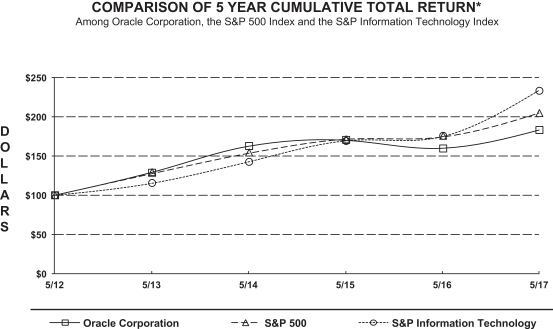][added: 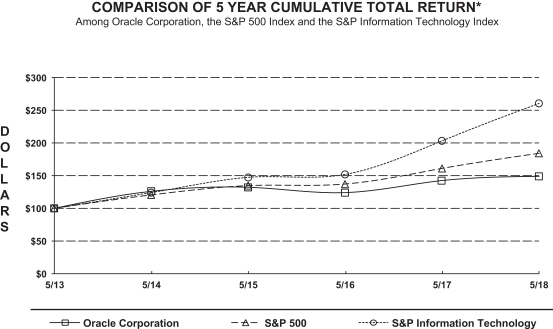]
*$100 INVESTED ON MAY 31, [removed: 2012] [added: 2013] IN STOCK OR
| March 1, 2018—March 31, 2018 | | | 35.5 | | | $ | 48.68 | | | | 35.5 | | | $ | 21,120.5 | |
| April 1, 2018—April 30, 2018 | | | 33.8 | | | $ | 45.72 | | | | 33.8 | | | $ | 19,576.4 | |
| May 1, 2018—May 31, 2018 | | | 37.2 | | | $ | 46.46 | | | | 37.2 | | | $ | 17,848.4 | |
| Total | | | 106.5 | | | $ | 46.97 | | | | 106.5 | | | | | |
##### [Index to Financial Statements](#INDEX)
| | | 5/13 | | | | 5/14 | | | | 5/15 | | | | 5/16 | | | | 5/17 | | | | 5/18 | | |
| Oracle Corporation | | | 100.0 | | | | 126.1 | | | | 132.1 | | | | 124.0 | | | | 142.3 | | | | 148.8 | |
| S&P 500 Index | | | 100.0 | | | | 120.5 | | | | 134.7 | | | | 137.0 | | | | 160.9 | | | | 184.1 | |
| S&P Information Technology Index | | | 100.0 | | | | 123.9 | | | | 147.2 | | | | 151.8 | | | | 203.1 | | | | 260.4 | |
COMPARISON OF 5 YEAR CUMULATIVE TOTAL RETURN” Among Oracle Corporation, the S&P 500 Index and the S&P Information Technology Index
##### [Index to Financial Statements](#INDEX)
| March 1, 2017—March 31, 2017 | | | 4.0 | | | $ | 43.90 | | | | 4.0 | | | $ | 5,664.8 | |
| April 1, 2017—April 30, 2017 | | | 3.3 | | | $ | 44.49 | | | | 3.3 | | | $ | 5,518.6 | |
| May 1, 2017—May 31, 2017 | | | 3.8 | | | $ | 45.07 | | | | 3.8 | | | $ | 5,349.4 | |
| Total | | | 11.1 | | | $ | 44.47 | | | | 11.1 | | | | | |
| | | 5/12 | | | | 5/13 | | | | 5/14 | | | | 5/15 | | | | 5/16 | | | | 5/17 | | |
| Oracle Corporation | | | 100.0 | | | | 128.9 | | | | 162.5 | | | | 170.2 | | | | 159.8 | | | | 183.3 | |
| S&P 500 Index | | | 100.0 | | | | 127.3 | | | | 153.3 | | | | 171.4 | | | | 174.3 | | | | 204.8 | |
| S&P Information Technology Index | | | 100.0 | | | | 115.1 | | | | 142.6 | | | | 169.5 | | | | 174.8 | | | | 233.8 | |
Item 6. Selected Financial Data
13 rewritten, 2 added, 1 removed, 12 unchanged
Over our last five fiscal years, we have acquired a number of companies, including NetSuite Inc. (NetSuite) in fiscal 2017 and MICROS Systems, Inc. [removed: (MICROS)] in fiscal 2015, among others.
| (in millions, except per share amounts) | | [removed: 2017] [added: 2018] | | | | [removed: 2016(1)] [added: 2017] | | | | [removed: 2015] [added: 2016] | | | | [removed: 2014] [added: 2015] | | | | [removed: 2013] [added: 2014] | | |
| Total revenues | | $ | [removed: 37,728] [added: 39,831] | | | $ | [removed: 37,047] [added: 37,728] | | | $ | [removed: 38,226] [added: 37,047] | | | $ | [removed: 38,275] [added: 38,226] | | | $ | [removed: 37,180] [added: 38,275] | |
| Operating income | | $ | [removed: 12,710] [added: 13,679] | | | $ | [removed: 12,604] [added: 12,710] | | | $ | [removed: 13,871] [added: 12,604] | | | $ | [removed: 14,759] [added: 13,871] | | | $ | [removed: 14,684] [added: 14,759] | |
| Net [removed: income] [added: income(1)] | | $ | [removed: 9,335] [added: 3,825] | | | $ | [removed: 8,901] [added: 9,335] | | | $ | [removed: 9,938] [added: 8,901] | | | $ | [removed: 10,955] [added: 9,938] | | | $ | [removed: 10,925] [added: 10,955] | |
| Earnings per [removed: share—diluted] [added: share—diluted(1)] | | $ | [removed: 2.21] [added: 0.90] | | | $ | [removed: 2.07] [added: 2.21] | | | $ | [removed: 2.21] [added: 2.07] | | | $ | [removed: 2.38] [added: 2.21] | | | $ | [removed: 2.26] [added: 2.38] | |
| Diluted weighted average common shares outstanding | | | [removed: 4,217] [added: 4,238] | | | | [removed: 4,305] [added: 4,217] | | | | [removed: 4,503] [added: 4,305] | | | | [removed: 4,604] [added: 4,503] | | | | [removed: 4,844] [added: 4,604] | |
| Cash dividends declared per common share | | $ | [removed: 0.64] [added: 0.76] | | | $ | [removed: 0.60] [added: 0.64] | | | $ | [removed: 0.51] [added: 0.60] | | | $ | [removed: 0.48] [added: 0.51] | | | $ | [removed: 0.30] [added: 0.48] | |
| Working capital(2) | | $ | [removed: 50,337] [added: 56,769] | | | $ | [removed: 47,105] [added: 50,337] | | | $ | [removed: 47,314] [added: 47,105] | | | $ | [removed: 32,954] [added: 47,314] | | | $ | [removed: 27,950] [added: 32,954] | |
| Total assets(2) | | $ | [removed: 134,991] [added: 137,264] | | | $ | [removed: 112,180] [added: 134,991] | | | $ | [removed: 110,903] [added: 112,180] | | | $ | [removed: 90,266] [added: 110,903] | | | $ | [removed: 81,745] [added: 90,266] | |
| Notes payable and other borrowings(3) | | $ | [removed: 57,909] [added: 60,619] | | | $ | [removed: 43,855] [added: 57,909] | | | $ | [removed: 41,958] [added: 43,855] | | | $ | [removed: 24,097] [added: 41,958] | | | $ | [removed: 18,427] [added: 24,097] | |
| (2) | Total working capital and total assets sequentially increased in nearly all periods presented primarily due to the favorable impacts to our net current assets resulting from our net income generated during all periods presented and the issuances of long-term senior notes of [added: $10.0 billion in fiscal 2018,] $14.0 billion in fiscal 2017, $20.0 billion in fiscal 2015, [added: and] €2.0 billion and $3.0 billion in fiscal [removed: 2014 and $5.0 billion in fiscal 2013.] [added: 2014.] Our total assets were also favorably impacted by the issuance of [added: $2.5 billion of short-term borrowings in fiscal 2018, and] $3.8 billion of short-term borrowings in [removed: both] [added: each of] fiscal 2017 and [removed: fiscal] 2016. These increases were partially offset by cash used for acquisitions, repurchases of our common stock and dividend payments made in all periods presented, repayments of certain of our senior notes in fiscal [removed: 2016, 2015] [added: 2018, 2017, 2016] and [removed: 2013,] [added: 2015,] and the repayment of $3.8 billion of short-term borrowings in [removed: fiscal 2017. In fiscal 2016, we adopted Accounting Standards Update (ASU) 2015-17, _Income Taxes (Topic 740): Balance Sheet Classification] [added: each] of [removed: Deferred Taxes_ on a retrospective basis. Pursuant to the new accounting standard, all deferred tax assets and liabilities are classified as non-current in our consolidated balance sheets and the working capital amounts presented above for] fiscal [removed: 2015, 2014] [added: 2018] and [removed: 2013 have been recast accordingly.] [added: 2017.] |
| (3) | Our notes payable and other borrowings, which represented the summation of our notes payable and other borrowings, current, and notes payable and other borrowings, non-current, as reported per our consolidated balance sheets as of the dates listed in the table above, increased between fiscal [removed: 2013] [added: 2014] and fiscal [removed: 2017] [added: 2018] primarily due to the fiscal [added: 2018 issuance of long-term senior notes of $10.0 billion and short-term borrowings of $2.5 billion, the fiscal] 2017 issuance of long-term senior notes of $14.0 billion and short-term borrowings of $3.8 billion, the fiscal 2016 issuance of $3.8 billion of short-term borrowings, [removed: and] the issuances of long-term senior notes of $20.0 billion in fiscal 2015, [added: and] €2.0 billion and $3.0 billion in fiscal [removed: 2014, and $5.0 billion in fiscal 2013.] [added: 2014.] See Note [removed: 8] [added: 7] of Notes to Consolidated Financial Statements included elsewhere in this Annual Report for additional information regarding our notes payable and other borrowings. |
| (1) | Our net income and diluted earnings per share were unfavorably impacted by a net charge of $7.0 billion during fiscal 2018 due to our preliminary assessment of the one-time effects of the U.S. Tax Cuts and Jobs Act of 2017 (the Tax Act). The more significant provisions of the Tax Act as applicable to us are described below under “Impacts of the U.S. Tax Cuts and Jobs Act of 2017”. |
##### [Index to Financial Statements](#INDEX)
| (1) | Our results of operations for fiscal 2016 compared to fiscal 2015 were significantly impacted by movements in international currencies relative to the U.S. Dollar, which decreased our fiscal 2016 total revenues by 5 percentage points and total operating income by 7 percentage points in comparison to the corresponding prior year period. |
Item 8. Financial Statements and Supplementary Data
0 rewritten, 0 added, 1 removed, 2 unchanged
##### [Table of Contents](#toc)
Item 9A. Controls and Procedures
5 rewritten, 2 added, 10 removed, 18 unchanged
[removed: Disclosure controls are also designed to ensure that such information is accumulated and communicated to our] [added: Our] management, including our Principal Executive Officers (one of whom is our Principal Financial Officer), [removed: as appropriate to allow timely decisions regarding required disclosure.][added: believes that our disclosure controls and procedures and internal control over financial reporting are designed]
Based on our management’s evaluation (with the participation of our Principal Executive Officers, one of whom is our Principal Financial Officer), as of the end of the period covered by this report, our Principal Executive Officers have concluded that our disclosure controls and procedures were [removed: effective.][added: effective as of May 31, 2018 to provide reasonable assurance that information required to be disclosed by us in reports that we file or submit under the Exchange Act is (i) recorded, processed, summarized and reported within the time periods specified in the SEC rules and forms and (ii) accumulated and communicated to our management, including our Principal Executive Officers (one of whom is our Principal Financial Officer) as appropriate to allow timely decisions regarding required disclosure.]
Under the supervision and with the participation of our management, including our Principal Executive Officers (one of whom is our Principal Financial Officer), we conducted an evaluation of the effectiveness of our internal control over financial reporting as of May 31, [removed: 2017] [added: 2018] based on the guidelines established in _Internal Control—Integrated Framework_ issued by the Committee of Sponsoring Organizations of the Treadway Commission’s 2013 framework.
Based on the results of our evaluation, our management concluded that our internal control over financial reporting was effective as of May 31, [removed: 2017.][added: 2018.]
The effectiveness of our internal control over financial reporting as of May 31, [removed: 2017] [added: 2018] has been audited by Ernst & Young LLP, an independent registered public accounting firm, as stated in their report which is included in Part IV, Item 15 of this Annual Report.
##### [Index to Financial Statements](#INDEX)
to provide reasonable assurance of achieving their objectives and are effective at the reasonable assurance level.
Disclosure controls are procedures that are designed to ensure that information required to be disclosed in our reports filed under the Securities Exchange Act of 1934, or the Exchange Act, such as this Annual Report on Form 10-K, is recorded, processed, summarized and reported within the time periods specified by the U.S. Securities and Exchange Commission.
Our quarterly evaluation of disclosure controls includes an evaluation of some components of our internal control over financial reporting.
We also perform a separate annual evaluation of internal control over financial reporting for the purpose of providing the management report below.
The evaluation of our disclosure controls included a review of their objectives and design, our implementation of the controls and the effect of the controls on the information generated for use in this Annual Report on Form 10-K.
In the course of the controls evaluation, we reviewed data errors or control problems identified and sought to confirm that appropriate corrective actions, including process improvements, were being undertaken.
This type of evaluation is performed on a quarterly basis so that the conclusions of management, including our Principal Executive Officers (one of whom is our Principal Financial Officer), concerning the effectiveness of the disclosure controls can be reported in our periodic reports on Form 10-Q and Form 10-K.
Many of the components of our disclosure controls are also evaluated on an ongoing basis by both our internal audit and finance organizations.
The overall goals of these various evaluation activities are to monitor our disclosure controls and to modify them as necessary.
We intend to maintain our disclosure controls as dynamic processes and procedures that we adjust as circumstances merit.
Our management, including our Principal Executive Officers (one of whom is our Principal Financial Officer), believes that our disclosure controls and procedures and internal control over financial reporting are designed to provide reasonable assurance of achieving their objectives and are effective at the reasonable assurance level.
Item 9B. Other Information
0 rewritten, 1 added, 0 removed, 3 unchanged
##### [Index to Financial Statements](#INDEX)
Item 10. Directors, Executive Officers and Corporate Governance
1 rewritten, 0 added, 0 removed, 2 unchanged
The other information required by this Item 10 is incorporated by reference from the information contained in our Proxy Statement to be filed with the U.S. Securities and Exchange Commission in connection with the solicitation of proxies for our [removed: 2017] [added: 2018] Annual Meeting of Stockholders [removed: (2017] [added: (2018] Proxy Statement) under the sections entitled “Board of Directors—Nominees for Directors,” “Board of Directors—Committees, Membership and Meetings,” “Board of Directors—Committees, Membership and Meetings—The Finance and Audit Committee,” “Corporate Governance—Employee Matters—Code of Conduct,” and “Section 16(a) Beneficial Ownership Reporting Compliance.”
Item 11. Executive Compensation
1 rewritten, 0 added, 0 removed, 1 unchanged
The information required by this Item 11 is incorporated by reference from the information to be contained in our [removed: 2017] [added: 2018] Proxy Statement under the sections entitled “Board of Directors—Committees, Membership and Meetings—The Compensation Committee—Compensation Committee Interlocks and Insider Participation,” “Board of Directors—Director Compensation,” and “Executive Compensation.”
Item 12. Security Ownership of Certain Beneficial Owners and Management and Related Stockholder Matters
1 rewritten, 0 added, 0 removed, 1 unchanged
The information required by this Item 12 is incorporated herein by reference from the information to be contained in our [removed: 2017] [added: 2018] Proxy Statement under the sections entitled “Security Ownership of Certain Beneficial Owners and Management” and “Executive Compensation—Equity Compensation Plan Information.”
Item 13. Certain Relationships and Related Transactions, and Director Independence
1 rewritten, 0 added, 0 removed, 1 unchanged
The information required by this Item 13 is incorporated herein by reference from the information to be contained in our [removed: 2017] [added: 2018] Proxy Statement under the sections entitled “Corporate Governance—Board of Directors and Director Independence” and “Transactions with Related Persons.”
Item 14. Principal Accounting Fees and Services
1 rewritten, 1 added, 0 removed, 3 unchanged
The information required by this Item 14 is incorporated herein by reference from the information to be contained in our [removed: 2017] [added: 2018] Proxy Statement under the section entitled “Ratification of Selection of Independent Registered Public Accounting Firm.”
##### [Index to Financial Statements](#INDEX)
Item 15. Exhibits and Financial Statement Schedules
650 rewritten, 338 added, 215 removed, 956 unchanged
| [Reports of Independent Registered Public Accounting [removed: Firm](#tx385998_1)] [added: Firm](#tx568983_1)] | | | [removed: 79] [added: 72] | |
| [Balance Sheets as of May 31, [removed: 2017] [added: 2018] and [removed: 2016](#tx385998_3)] [added: 2017](#tx568983_2)] | | | [removed: 81] [added: 74] | |
| [Statements of Operations for the years ended May 31, [removed: 2017, 2016] [added: 2018, 2017] and [removed: 2015](#tx385998_4)] [added: 2016](#tx568983_3)] | | | [removed: 82] [added: 75] | |
| [Statements of Comprehensive Income for the years ended May 31, [removed: 2017, 2016] [added: 2018, 2017] and [removed: 2015](#tx385998_5)] [added: 2016](#tx568983_4)] | | | [removed: 83] [added: 76] | |
| [Statements of Equity for the years ended May 31, [removed: 2017, 2016] [added: 2018, 2017] and [removed: 2015](#tx385998_6)] [added: 2016](#tx568983_5)] | | | [removed: 84] [added: 77] | |
| [Statements of Cash Flows for the years ended May 31, [removed: 2017, 2016] [added: 2018, 2017] and [removed: 2015](#tx385998_7)] [added: 2016](#tx568983_6)] | | | [removed: 85] [added: 78] | |
| [Notes to Consolidated Financial [removed: Statements](#tx385998_8)] [added: Statements](#tx568983_7)] | | | [removed: 86] [added: 79] | |
| [Schedule II. Valuation and Qualifying [removed: Accounts](#tx385998_10)] [added: Accounts](#tx568983_8)] | | | [removed: 130] [added: 124] | |
The information required by this Item is set forth in the Index of Exhibits that [removed: follows the signature page] [added: is after Item 16] of this Annual Report.
[removed: The] [added: To the Stockholders and the] Board of Directors [removed: and Stockholders] of Oracle Corporation
We have audited the accompanying consolidated balance sheets of Oracle Corporation [added: (the Company)] as of May 31, [removed: 2017 and 2016,] [added: 2018] and [added: 2017,] the related consolidated statements of operations, comprehensive income, [removed: equity,] [added: equity] and cash flows for each of the three years in the period ended May 31, [removed: 2017.][added: 2018, and the related notes and the financial statement schedule listed in the Index at Item 15(a)2 (collectively referred to as the “financial statements”).]
These financial statements [removed: and schedule] are the responsibility of the Company’s management.
Our responsibility is to express an opinion on [removed: these] [added: the Company’s] financial statements [removed: and schedule] based on our audits.
We conducted our audits in accordance with the standards of the [removed: Public Company Accounting Oversight Board (United States).][added: PCAOB.]
Those standards require that we plan and perform the audit to obtain reasonable assurance about whether the financial statements are free of material [removed: misstatement.][added: misstatement, whether due to error or fraud.]
[removed: An audit includes] [added: Such procedures included] examining, on a test basis, evidence [removed: supporting] [added: regarding] the amounts and disclosures in the financial statements.
[removed: An audit] [added: Our audits] also [removed: includes assessing] [added: included evaluating] the accounting principles used and significant estimates made by management, as well as evaluating the overall [added: presentation of the] financial [removed: statement presentation.][added: statements.]
In our opinion, the financial statements [removed: referred to above] present fairly, in all material respects, the consolidated financial position of [removed: Oracle Corporation] [added: the Company] at May 31, [removed: 2017] [added: 2018] and [removed: 2016,] [added: 2017,] and the consolidated results of its operations and its cash flows for each of the three years in the period ended May 31, [removed: 2017,] [added: 2018,] in conformity with U.S. generally accepted accounting principles.
We also have audited, in accordance with the standards of the Public Company Accounting Oversight Board (United [removed: States), Oracle Corporation’s] [added: States) (PCAOB), the Company’s] internal control over financial reporting as of May 31, [removed: 2017,] [added: 2018,] based on criteria established in Internal Control-Integrated Framework issued by the Committee of Sponsoring Organizations of the Treadway Commission (2013 framework) and our report dated June [removed: 27, 2017] [added: 22, 2018] expressed an unqualified opinion thereon.
We have audited Oracle Corporation’s internal control over financial reporting as of May 31, [removed: 2017,] [added: 2018,] based on criteria established in Internal Control—Integrated Framework issued by the Committee of Sponsoring Organizations of the Treadway [removed: Commission] (2013 [removed: framework) (the] [added: framework)(the] COSO criteria).
[removed: Oracle Corporation’s] [added: The Company’s] management is responsible for maintaining effective internal control over financial [removed: reporting,] [added: reporting] and for its assessment of the effectiveness of internal control over financial reporting included in the accompanying Management’s Report on Internal Control Over Financial Reporting.
We conducted our audit in accordance with the standards of the [removed: Public Company Accounting Oversight Board (United States).][added: PCAOB.]
In our opinion, Oracle Corporation [added: (the Company)] maintained, in all material respects, effective internal control over financial reporting as of May 31, [removed: 2017,] [added: 2018,] based on the COSO criteria.
We also have audited, in accordance with the standards of the Public Company Accounting Oversight Board (United [removed: States),] [added: States) (PCAOB),] the consolidated balance sheets of [removed: Oracle Corporation] [added: the Company] as of May 31, [removed: 2017] [added: 2018] and [removed: 2016,] [added: 2017,] and the related consolidated statements of operations, comprehensive income, equity, and cash flows for each of the three years in the period ended May 31, [removed: 2017 of Oracle Corporation] [added: 2018,] and [added: the related notes and the financial statement schedule listed in the Index at Item 15(a)2 and] our report [removed: dated] June [removed: 27, 2017] [added: 22, 2018] expressed an unqualified opinion thereon.
As of May 31, [removed: 2017] [added: 2018] and [removed: 2016][added: 2017]
[removed: | | |] May [removed: 31, | | | | | | |][added: 31, 2018]
| (in millions, except per share data) | | [added: 2018 | | | |] 2017 | | | | 2016 | | |
| Cash and cash equivalents | | $ | [removed: 21,784] [added: 21,620] | | | $ | [removed: 20,152] [added: 21,784] | |
| Marketable securities | | | [removed: 44,294] [added: 45,641] | | | | [removed: 35,973] [added: 44,294] | |
| Trade receivables, net of allowances for doubtful accounts of [removed: $319] [added: $370] and [removed: $327] [added: $319] as of May 31, [removed: 2017] [added: 2018] and May 31, [removed: 2016,] [added: 2017,] respectively | | | [removed: 5,300] [added: 5,279] | | | | [removed: 5,385] [added: 5,300] | |
| Prepaid expenses and other current assets | | | [removed: 2,837] [added: 3,424] | | | | [removed: 2,591] [added: 3,137] | |
| Total current assets | | | [removed: 74,515] [added: 75,964] | | | | [removed: 64,313] [added: 74,515] | |
| Property, plant and equipment, net | | | [removed: 5,315] [added: 5,897] | | | | [removed: 4,000] [added: 5,315] | |
| Intangible assets, net | | | [removed: 7,679] [added: 6,670] | | | | [removed: 4,943] [added: 7,679] | |
| Goodwill, net | | | [removed: 43,045] [added: 43,755] | | | | [removed: 34,590] [added: 43,045] | |
| Deferred tax assets | | | [removed: 1,143] [added: 1,491] | | | | [removed: 1,291] [added: 1,143] | |
| Other [added: non-current] assets | | | [removed: 3,294] [added: 3,487] | | | | [removed: 3,043] [added: 3,294] | |
| Total non-current assets | | | [removed: 60,476] [added: 61,300] | | | | [removed: 47,867] [added: 60,476] | |
| Total assets | | $ | [removed: 134,991] [added: 137,264] | | | $ | [removed: 112,180] [added: 134,991] | |
| Notes payable and other borrowings, current | | $ | [removed: 9,797] [added: 4,491] | | | $ | [removed: 3,750] [added: 9,797] | |
##### [Index to Financial Statements](#INDEX)
Opinion on the Financial Statements
Basis for Opinion
We are a public accounting firm registered with the PCAOB and are required to be independent with respect to the Company in accordance with the U.S. federal securities laws and the applicable rules and regulations of the Securities and Exchange Commission and the PCAOB.
Our audits included performing procedures to assess the risks of material misstatement of the financial statements, whether due to error or fraud, and performing procedures that respond to those risks.
We have served as the Company’s auditor since 2002.
June 22, 2018
##### [Index to Financial Statements](#INDEX)
To the Stockholders and the Board of Directors of Oracle Corporation
Opinion on Internal Control over Financial Reporting
Basis for Opinion
We are a public accounting firm registered with the PCAOB and are required to be independent with respect to the Company in accordance with the U.S. federal securities laws and the applicable rules and regulations of the Securities and Exchange Commission and the PCAOB.
Definition and Limitations of Internal Control Over Financial Reporting
June 22, 2018
##### [Index to Financial Statements](#INDEX)
| (in millions, except per share data) | | 2018 | | | | 2017 | | |
##### [Index to Financial Statements](#INDEX)
| Cloud services and license support | | $ | 26,254 | | | $ | 23,800 | | | $ | 21,714 | |
| Cloud license and on-premise license | | | 6,190 | | | | 6,418 | | | | 7,276 | |
| Cloud services and license support(1) | | | 3,612 | | | | 3,015 | | | | 2,664 | |
##### [Index to Financial Statements](#INDEX)
For the Years Ended May 31, 2018, 2017 and 2016
| Net income | | $ | 3,825 | | | $ | 9,335 | | | $ | 8,901 | |
##### [Index to Financial Statements](#INDEX)
For the Years Ended May 31, 2018, 2017 and 2016
| Repurchase of common stock | | | (238 | ) | | | (1,632 | ) | | | (9,871 | ) | | | — | | | | (11,503 | ) | | | — | | | | (11,503 | ) |
| Net income | | | — | | | | — | | | | 3,825 | | | | — | | | | 3,825 | | | | 135 | | | | 3,960 | |
| Balances as of May 31, 2018 | | | 3,997 | | | $ | 28,950 | | | $ | 18,412 | | | $ | (1,636 | ) | | $ | 45,726 | | | $ | 498 | | | $ | 46,224 | |
##### [Index to Financial Statements](#INDEX)
For the Years Ended May 31, 2018, 2017 and 2016
| Net income | | $ | 3,825 | | | $ | 9,335 | | | $ | 8,901 | |
##### [Index to Financial Statements](#INDEX)
Oracle Corporation provides products and services that address all aspects of corporate information technology (IT) environments—applications, platform and infrastructure.
Our applications, platform and infrastructure offerings are delivered to customers worldwide through a variety of flexible and interoperable IT deployment models, including cloud-based, on-premise, or hybrid, which enable customer choice and flexibility.
Our Oracle Cloud offerings provide a comprehensive and fully integrated stack of applications, platform, compute, storage and networking services in all three primary layers of the cloud: Software as a Service (SaaS), Platform as a Service (PaaS) and Infrastructure as a Service (IaaS).
Our Oracle Cloud SaaS, PaaS and IaaS offerings (collectively, “Oracle Cloud Services”) integrate the software, hardware and services on customers’ behalf in IT environments that we deploy, support and manage for the customer.
The ASU simplifies the accounting for goodwill impairment by removing Step 2 of the goodwill impairment test.
Under the legacy guidance, Step 2 of the goodwill impairment test required entities to calculate the implied fair value of goodwill in the same manner as the amount of goodwill recognized in a business combination by assigning the fair value of a reporting unit to all of the assets and liabilities of the reporting unit.
The carrying value in excess of the implied fair value was recognized as goodwill impairment.
ASU 2017-04 did not have a material impact on our consolidated financial statements.
| | | | | |
| --- | --- | --- | --- | --- |
Our audits also included the financial statement schedule listed in the Index at Item 15(a) 2.
Also, in our opinion, the related financial statement schedule, when considered in relation to the basic financial statements taken as a whole, presents fairly in all material respects the information set forth therein.
June 27, 2017
| | | | | | | | | |
| --- | --- | --- | --- | --- | --- | --- | --- | --- |
| Inventories | | | 300 | | | | 212 | |
| | | | | | | | | | | | | |
| Cloud software as a service | | $ | 3,211 | | | $ | 2,001 | | | $ | 1,476 | |
| Cloud platform as a service and infrastructure as a service | | | 1,360 | | | | 852 | | | | 617 | |
| Total cloud revenues | | | 4,571 | | | | 2,853 | | | | 2,093 | |
| New software licenses | | | 6,418 | | | | 7,276 | | | | 8,535 | |
| Software license updates and product support | | | 19,229 | | | | 18,861 | | | | 18,847 | |
| Total on-premise software revenues | | | 25,647 | | | | 26,137 | | | | 27,382 | |
| Total cloud and on-premise software revenues | | | 30,218 | | | | 28,990 | | | | 29,475 | |
| Cloud software as a service(1) | | | 1,285 | | | | 1,049 | | | | 742 | |
| Cloud platform as a service and infrastructure as a service(1) | | | 678 | | | | 469 | | | | 375 | |
| Software license updates and product support(1) | | | 1,052 | | | | 1,146 | | | | 1,199 | |
| | | | | | | | | | | | | | | | | | | | | | | | | | | | | |
| --- | --- | --- | --- | --- | --- | --- | --- | --- | --- | --- | --- | --- | --- | --- | --- | --- | --- | --- | --- | --- | --- | --- | --- | --- | --- | --- | --- | --- |
| Balances as of May 31, 2014 | | | 4,464 | | | $ | 21,077 | | | $ | 25,965 | | | $ | (164 | ) | | $ | 46,878 | | | $ | 569 | | | $ | 47,447 | |
| Repurchase of common stock | | | (194 | ) | | | (943 | ) | | | (7,145 | ) | | | — | | | | (8,088 | ) | | | — | | | | (8,088 | ) |
| Tax benefit from stock plans | | | — | | | | 267 | | | | — | | | | — | | | | 267 | | | | — | | | | 267 | |
| Net income | | | — | | | | — | | | | 9,938 | | | | — | | | | 9,938 | | | | 113 | | | | 10,051 | |
| (Increase) decrease in inventories | | | (88 | ) | | | 88 | | | | (96 | ) |
May 31, 2017
Oracle Corporation develops, manufactures, markets, sells, hosts and supports applications, platform and infrastructure technologies for information technology (IT) environments including applications software, database and middleware software, hardware—including Oracle Engineered Systems, computer server, storage and industry-specific hardware products—and related services that are engineered to work together in cloud-based and on-premise IT environments.
Included in acquisition related and other expenses as presented in our consolidated statements of operations for fiscal 2016 and 2015 are an acquisition related benefit of $19 million and a litigation related benefit of $53 million, respectively.
Further, acquisition related and other expenses for fiscal 2015 included $186 million related to a goodwill impairment loss.
In fiscal 2017, we adopted Accounting Standards Update (ASU) 2016-09, _Compensation—Stock Compensation (Topic 718): Improvements to Employee Share-Based Payment Accounting_ (ASU 2016-09).
As required by ASU 2016-09, excess tax benefits recognized on stock-based compensation expense are reflected in the consolidated statements of operations as a component of the provision for income taxes on a prospective basis.
As required by ASU 2016-09, excess tax benefits recognized on stock-based compensation expense are classified as an operating activity in our consolidated statements of cash flows and we have applied this provision on a retrospective basis.
For fiscal 2016 and 2015, net cash provided by operating activities increased by $124 million and $244 million, respectively, with a corresponding offset to net cash used for financing activities.
Finally, ASU 2016-09 allows for the option to account for forfeitures as they occur, rather than estimating expected forfeitures over the course of a vesting period.
We have elected to account for forfeitures as they occur and the net cumulative effect of this change was recognized as a $9 million increase to additional paid in capital, a $3 million increase to deferred tax assets and a $6 million reduction to retained earnings as of June 1, 2016.
In addition, in fiscal 2017, we also adopted the following Accounting Standards Updates, none of which had a material impact to our reported financial position or results of operations and cash flows:
| | • | | ASU 2017-09, _Compensation—Stock Compensation (Topic 718): Scope of Modification Accounting_; |
| | • | | ASU 2017-01, _Business Combinations (Topic 805): Clarifying the Definition of a Business_; |
| | • | | ASU 2016-18, _Statement of Cash Flows (Topic 230): Restricted Cash_; |
An excerpt. Shown here: 40 of 650 rewritten, 40 of 338 added and 40 of 215 removed. The counts are complete. For every sentence, read Item 15. Exhibits and Financial Statement Schedules in the FY2018 filing and the FY2017 filing.
Item 16. Form 10-K Summary
51 rewritten, 19 added, 3 removed, 91 unchanged
| Date: June [removed: 27, 2017] [added: 22, 2018] | | | | By: | | [removed: /s/] [added: /S/] SAFRA A. CATZ |
| Date: June [removed: 27, 2017] [added: 22, 2018] | | | | By: | | [removed: /s/] [added: /S/] MARK V. HURD |
| /S/ SAFRA A. CATZ Safra A. Catz | | Chief Executive Officer and Director (Principal Executive and Financial Officer) | | June [removed: 27, 2017] [added: 22, 2018] |
| /S/ MARK V. HURD Mark V. Hurd | | Chief Executive Officer and Director (Principal Executive Officer) | | June [removed: 27, 2017] [added: 22, 2018] |
| /S/ WILLIAM COREY WEST William Corey West | | Executive Vice President, Corporate Controller and Chief Accounting Officer (Principal Accounting Officer) | | June [removed: 27, 2017] [added: 22, 2018] |
| /S/ LAWRENCE J. ELLISON Lawrence J. Ellison | | Chairman of the Board of Directors and Chief Technology Officer | | June [removed: 27, 2017] [added: 22, 2018] |
| /S/ JEFFREY O. HENLEY Jeffrey O. Henley | | Vice Chairman of the Board of Directors | | June [removed: 27, 2017] [added: 22, 2018] |
| /S/ JEFFREY S. BERG Jeffrey S. Berg | | Director | | June [removed: 27, 2017] [added: 22, 2018] |
| /S/ MICHAEL J. BOSKIN Michael J. Boskin | | Director | | June [removed: 27, 2017] [added: 22, 2018] |
| /S/ BRUCE R. CHIZEN Bruce R. Chizen | | Director | | June [removed: 27, 2017] [added: 22, 2018] |
| /S/ GEORGE H. CONRADES George H. Conrades | | Director | | June [removed: 27, 2017] [added: 22, 2018] |
| /S/ HECTOR GARCIA\-MOLINA Hector Garcia-Molina | | Director | | June [removed: 27, 2017] [added: 22, 2018] |
| /S/ RENÉE J. JAMES Renée J. James | | Director | | June [removed: 27, 2017] [added: 22, 2018] |
| /S/ LEON E. PANETTA Leon E. Panetta | | Director | | June [removed: 27, 2017] [added: 22, 2018] |
| /S/ NAOMI O. SELIGMAN Naomi O. Seligman | | Director | | June [removed: 27, 2017] [added: 22, 2018] |
| [removed: Exhibit No.] [added: Exhibit No.] | | Exhibit Description | | Incorporated by Reference | | | | | | | | |
| 2.01 | | [removed: Agreement] [added: [Agreement] and Plan of Merger, dated July 28, 2016, among NetSuite Inc., OC Acquisition LLC, Napa Acquisition Corporation and Oracle [removed: Corporation] [added: Corporation](http://www.sec.gov/Archives/edgar/data/1341439/000119312516666792/d180474dex991.htm)] | | 8-K | | 001-35992 | | 99.1 | | 8/1/16 | | Oracle Corporation |
| 3.01 | | [removed: Amended] [added: [Amended] and Restated Certificate of Incorporation of Oracle Corporation and Certificate of Amendment of Amended and Restated Certificate of Incorporation of Oracle [removed: Corporation] [added: Corporation](http://www.sec.gov/Archives/edgar/data/1341439/000119312506020874/dex31.htm)] | | 8-K 12G3 | | 000-51788 | | 3.01 | | 2/6/06 | | Oracle Corporation |
| 3.02 | | [removed: Amended] [added: [Amended] and Restated Bylaws of Oracle [removed: Corporation] [added: Corporation](http://www.sec.gov/Archives/edgar/data/1341439/000119312516623620/d200599dex302.htm)] | | 8-K | | 001-35992 | | 3.02 | | 6/16/16 | | Oracle Corporation |
| 4.01 | | [removed: Specimen] [added: [Specimen] Certificate of Registrant’s Common [removed: Stock] [added: Stock](http://www.sec.gov/Archives/edgar/data/1341439/000119312510112896/dex44.htm)] | | S-3 ASR | | 333-166643 | | 4.04 | | 5/7/10 | | Oracle Corporation |
| 4.02 | | [removed: Indenture] [added: [Indenture] dated January 13, 2006, among Ozark Holding Inc., Oracle Corporation and Citibank, [removed: N.A.] [added: N.A.](http://www.sec.gov/Archives/edgar/data/0000777676/000095013406000839/f16289exv10w34.htm)] | | 8-K | | 000-14376 | | 10.34 | | 1/20/06 | | Oracle Systems Corporation |
| 4.03 | | [removed: First] [added: [First] Supplemental Indenture dated May 9, 2007 among Oracle Corporation, Citibank, N.A. and The Bank of New York Trust Company, [removed: N.A.] [added: N.A.](http://www.sec.gov/Archives/edgar/data/1341439/000119312507109320/dex43.htm)] | | S-3 ASR | | 333-142796 | | 4.3 | | 5/10/07 | | Oracle Corporation |
| 4.04 | | [removed: Forms] [added: [Forms] of 5.75% Note due 2018 and 6.50% Note due 2038, together with Officers’ Certificate issued April 9, 2008 setting forth the terms of the [removed: Notes] [added: Notes](http://www.sec.gov/Archives/edgar/data/1341439/000119312508077170/dex409.htm)] | | 8-K | | 000-51788 | | 4.09 | | 4/8/08 | | Oracle Corporation |
| 4.05 | | [removed: Forms] [added: [Forms] of 5.00% Note due 2019 and 6.125% Note due 2039, together with Officers’ Certificate issued July 8, 2009 setting forth the terms of the [removed: Notes] [added: Notes](http://www.sec.gov/Archives/edgar/data/1341439/000119312509145686/dex408.htm)] | | 8-K | | 000-51788 | | 4.08 | | 7/8/09 | | Oracle Corporation |
| 4.06 | | [removed: Forms] [added: [Forms] of Original 2020 Note and Original 2040 Note, together with Officers’ Certificate issued July 19, 2010 setting forth the terms of the [removed: Notes] [added: Notes](http://www.sec.gov/Archives/edgar/data/1341439/000119312510213084/dex408.htm)] | | 10-Q | | 000-51788 | | 4.08 | | 9/20/10 | | Oracle Corporation |
| 4.07 | | [removed: Forms] [added: [Forms] of New 2020 Note and New 2040 [removed: Note] [added: Note](http://www.sec.gov/Archives/edgar/data/1341439/000119312511227635/dex45.htm)] | | S-4 | | 333-176405 | | 4.5 | | 8/19/11 | | Oracle Corporation |
| 4.08 | | [removed: Forms] [added: [Forms] of [removed: 1.20% Note due 2017 and] 2.50% Note due 2022, together with Officers’ Certificate issued October 25, 2012 setting forth the terms of the [removed: Notes] [added: Notes](http://www.sec.gov/Archives/edgar/data/1341439/000119312512435493/d429721dex410.htm)] | | 8-K | | 000-51788 | | 4.10 | | 10/25/12 | | Oracle Corporation |
| 4.09 | | [removed: Forms] [added: [Forms] of 2.25% Note due 2021 and 3.125% Note due 2025, together with Officers’ Certificate issued July 10, 2013 setting forth the terms of the [removed: Notes] [added: Notes](http://www.sec.gov/Archives/edgar/data/1341439/000119312513287255/d566107dex411.htm)] | | 8-K | | 001-35992 | | 4.11 | | 7/10/13 | | Oracle Corporation |
| 4.10 | | [removed: Forms] [added: [Forms] of Floating-Rate Note due 2019, 2.375% Note due 2019 and 3.625% Note due 2023, together with Officers’ Certificate issued July 16, 2013 setting forth the terms of the [removed: Notes] [added: Notes](http://www.sec.gov/Archives/edgar/data/1341439/000119312513291787/d568055dex412.htm)] | | 8-K | | 001-35992 | | 4.12 | | 7/16/13 | | Oracle Corporation |
| 4.11 | | [removed: Forms] [added: [Forms] of Floating-Rate Note due [removed: 2017, Floating-Rate Note due] 2019, 2.25% Note due 2019, 2.80% Note due 2021, 3.40% Note due 2024, 4.30% Note due 2034 and 4.50% Note due 2044, together with Officers’ Certificate issued July 8, 2014 setting forth the terms of the [removed: Notes] [added: Note](http://www.sec.gov/Archives/edgar/data/1341439/000119312514263107/d756565dex413.htm)s] | | 8-K | | 001-35992 | | 4.13 | | 7/8/14 | | Oracle Corporation |
| 4.12 | | [removed: Forms] [added: [Forms] of 2.50% Notes due 2022, 2.95% Notes due 2025, 3.25% Notes due 2030, 3.90% Notes due 2035, 4.125% Notes due 2045 and 4.375% Notes due 2055, together with Officers’ Certificate issued May 5, 2015 setting forth the terms of the [removed: Notes] [added: Notes](http://www.sec.gov/Archives/edgar/data/1341439/000119312515172238/d920453dex413.htm)] | | 8-K | | 001-35992 | | 4.13 | | 5/5/15 | | Oracle Corporation |
| 4.13 | | [removed: Forms] [added: [Forms] of 1.90% Notes due 2021, 2.40% Notes due 2023, 2.65% Notes due 2026, 3.85% Notes due 2036 and 4.00% Notes due 2046, together with Officers’ Certificate issued July 7, 2016 setting forth the terms of the [removed: Notes] [added: Notes](http://www.sec.gov/Archives/edgar/data/0001341439/000119312516643428/d224097dex41.htm)] | | 8-K | | 001-35992 | | 4.1 | | 7/7/16 | | Oracle Corporation |
| 10.01* | | [removed: Oracle] [added: [Oracle] Corporation Deferred Compensation Plan, as amended and restated as of July 1, [removed: 2015] [added: 2015](http://www.sec.gov/Archives/edgar/data/1341439/000119312515323532/d64286dex1001.htm)] | | 10-Q | | 001-35992 | | 10.01 | | 9/18/15 | | Oracle Corporation |
| 10.02* | | [removed: Oracle] [added: [Oracle] Corporation Employee Stock Purchase Plan (1992), as amended and restated as of October 1, [removed: 2009] [added: 2009](http://www.sec.gov/Archives/edgar/data/1341439/000119312510151896/dex1002.htm)] | | 10-K | | 000-51788 | | 10.02 | | 7/1/10 | | Oracle Corporation |
| 10.03* | | [removed: Oracle] [added: [Oracle] Corporation Amended and Restated 1993 Directors’ Stock Plan, as amended and restated on April 29, [removed: 2016] [added: 2016](http://www.sec.gov/Archives/edgar/data/1341439/000119312516628942/d203801dex1003.htm)] | | 10-K | | 001-35992 | | 10.03 | | 6/22/16 | | Oracle Corporation |
| 10.04* | | [removed: Amended] [added: [Amended] and Restated 2000 Long-Term Equity Incentive Plan, as approved on [removed: June 30, 2016] [added: November 15, 2017](http://www.sec.gov/Archives/edgar/data/0001341439/000119312517347046/d455628dex1004.htm)] | | [removed: 10-Q] [added: 8-K] | | 001-35992 | | 10.04 | | [removed: 9/19/16] [added: 11/17/17] | | Oracle Corporation |
| 10.05* | | [removed: Form] [added: [Form] of Stock Option Agreement under the Amended and Restated 2000 Long-Term Equity Incentive Plan for U.S. Executive Vice Presidents and Section 16 [removed: Officers] [added: Officers](http://www.sec.gov/Archives/edgar/data/0001341439/000119312517287455/d407367dex1005.htm)] | | 10-Q | | [removed: 000-51788] [added: 001-35992] | | 10.05 | | [removed: 12/23/11] [added: 9/18/17] | | Oracle Corporation |
| 10.06* | | [removed: Form] [added: [Form] of Stock Option Agreement under the Oracle Corporation Amended and Restated 1993 Directors’ Stock [removed: Plan] [added: Plan](http://www.sec.gov/Archives/edgar/data/0001341439/000119312515235239/d920711dex1006.htm)] | | 10-K | | 001-35992 | | 10.06 | | 06/25/15 | | Oracle Corporation |
| 10.07* | | [removed: Form] [added: [Form] of Indemnity Agreement for Directors and Executive [removed: Officers] [added: Officers](http://www.sec.gov/Archives/edgar/data/0001341439/000119312511351954/d263957dex107.htm)] | | 10-Q | | 000-51788 | | 10.07 | | 12/23/11 | | Oracle Corporation |
| 10.08* | | [removed: Offer] [added: [Offer] letter dated [removed: February] [added: September] 2, 2010 to [removed: John Fowler] [added: Mark V. Hurd] and employment agreement dated [removed: February 2, 2010] [added: September 3, 2010](http://www.sec.gov/Archives/edgar/data/0001341439/000119312510205818/dex1028.htm)] | | [removed: 10-Q] [added: 8-K] | | 000-51788 | | [removed: 10.26] [added: 10.28] | | [removed: 3/29/10] [added: 9/8/10] | | Oracle Corporation |
##### [Index to Financial Statements](#INDEX)
##### [Index to Financial Statements](#INDEX)
| Exhibit No. | | Exhibit Description | | Incorporated by Reference | | | | | | | | |
| 4.14 | | [Form of 2.625% Notes due 2023, 2.950% Notes due 2024, 3.250% Notes due 2027, 3.800% Notes due 2037 and 4.000% Notes due 2047, together with Officers’ Certificate issued November 9, 2017 setting forth the terms of the Notes](http://www.sec.gov/Archives/edgar/data/0001341439/000119312517338832/d491112dex41.htm) | | 8-K | | 001-35992 | | 4.1 | | 11/9/17 | | Oracle Corporation |
##### [Index to Financial Statements](#INDEX)
| Exhibit No. | | Exhibit Description | | Incorporated by Reference | | | | | | | | |
| 10.14* | | [Form of Performance-Based Stock Option Agreement under the Amended and Restated 2000 Long-Term Equity Incentive Plan for Named Executive Officers](http://www.sec.gov/Archives/edgar/data/0001341439/000119312517287455/d407367dex1016.htm) | | 10-Q | | 001-35992 | | 10.16 | | 9/18/17 | | Oracle Corporation |
| 10.15* | | [Form of Stock Unit Award Agreement under the Amended and Restated 2000 Long-Term Equity Incentive Plan for U.S. Employees (Including Section 16 Officers)](http://www.sec.gov/Archives/edgar/data/1341439/000119312517287455/d407367dex1017.htm) | | 10-Q | | 001-35992 | | 10.17 | | 9/18/17 | | Oracle Corporation |
| 21.01‡ | | [Subsidiaries of the Registrant](https://www.sec.gov/Archives/edgar/data/1341439/000119312518201034/d568983dex2101.htm) | | | | | | | | | | |
| | | | | | | | | | | | | |
##### [Index to Financial Statements](#INDEX)
##### [Table of Contents](#toc)
##### [Index to Financial Statements](#INDEX)
| --- | --- | --- | --- | --- |
| Name | | Title | | Date |
| /S/ CHARLES W. MOORMAN IV Charles W. Moorman IV | | Director | | June 22, 2018 |
| | | | | |
| /S/ WILLIAM G. PARRETT William G. Parrett | | Director | | June 22, 2018 |
| | | | | |
| 10.09* | | Offer letter dated September 2, 2010 to Mark V. Hurd and employment agreement dated September 3, 2010 | | 8-K | | 000-51788 | | 10.28 | | 9/8/10 | | Oracle Corporation |
| 10.11* | | Sun Microsystems, Inc. 2007 Omnibus Incentive Plan | | 10-Q | | 000-15086 | | 10.1 | | 2/6/08 | | Sun Microsystems, Inc. |
| 21.01‡ | | Subsidiaries of the Registrant | | | | | | | | | | |
An excerpt. Shown here: 40 of 51 rewritten, all 19 added and all 3 removed. The counts are complete. For every sentence, read Item 16. Form 10-K Summary in the FY2018 filing and the FY2017 filing.