 filings.tools
Oracle (ORCL) 10-K risk factor changes: FY2020 vs FY2019
The 2020-05-31 10-K against the 2019-05-31 one, compared heading by heading and sentence by sentence. One of these filings carries no fiscal year tag, so its year is the calendar year of the period end.
Item 1A68 rewritten38 added9 removed377 unchanged
All filing items1,119 rewritten571 added468 removed2,025 unchanged
Summary
counted, not written
- Item 1A headings could not be compared: only 0 carried over between the two years, which usually means one filing was read wrongly, so none is reported as new or removed.
- Sentence by sentence, 571 added, 468 removed, 1,119 rewritten and 2,025 unchanged across 17 items that differ.
- Not in this year's filing: Item 16. Form 10-K Summary.
Sentences by item
22 items, with every count and a link to each item that changed
Underlined words on a shaded ground are new in FY2020; struck-through words were in FY2019. Sentences that are wholly new or wholly gone are labelled rather than marked.
Item 1A. Risk Factors
68 rewritten, 38 added, 9 removed, 377 unchanged
We have continued to refresh and release new offerings of our cloud products and [removed: services, including the launch of the Oracle Autonomous Data Warehouse Cloud Service.][added: services.]
Machine learning and artificial intelligence are increasingly driving innovations in technology but if they fail to operate as anticipated or [removed: the Oracle Autonomous Data Warehouse Cloud Service or] our other products do not perform as promised, our business and reputation may be harmed.
Our Oracle Cloud strategy, including our Oracle [added: Cloud] Software-as-a-Service [removed: (SaaS)] and Infrastructure-as-a-Service [removed: (IaaS)] [added: (SaaS and IaaS, respectively, and collectively, Oracle Cloud Services)] offerings, may adversely affect our revenues and profitability.
Despite testing prior to the release and throughout the lifecycle of a product or service, our cloud, license and hardware offerings sometimes contain [removed: coding or] [added: coding,] manufacturing [added: or configuration] errors that can impact their function, performance and security, and result in other negative consequences.
Enterprise customers rely on our cloud, license and hardware offerings and related services to run their businesses and errors in our cloud, license and hardware offerings and related services could expose us to product liability, [removed: performance and warranty claims as well as significant harm to our brand and reputation, which could impact our future sales.]
We have a reputation for secure and reliable product offerings and related [removed: services] [added: services,] and we have invested a great deal of time and resources in protecting the integrity and security of our products, services and the internal and external data that we manage.
Our products and services, including our Oracle Cloud [removed: Services] [added: Services,] may also be accessed or modified improperly as a result of customer, partner, employee or supplier error or malfeasance and third parties may attempt to fraudulently induce customers, partners, employees or suppliers into disclosing sensitive information such as user names, passwords or other information in order to gain access to our data, our customers’, suppliers’ or partners’ data or the IT systems of Oracle, our customers, suppliers or partners.
Because the techniques used to obtain unauthorized access to, or sabotage IT systems change frequently, grow more complex over time, and often are not recognized until launched against a target, we may be unable to anticipate or implement adequate measures to prevent [removed: against] such techniques.
Our internal IT systems continue to evolve and we are often early [removed: adapters] [added: adopters] of new technologies.
[removed: In addition, we] [added: We] may not discover any security breach and loss of information for a significant period of time after the security breach.
Customers could lose confidence in the security and reliability of our products and services, including our cloud offerings, and perceive them to not be [removed: secure.]
Our business practices with respect to data could give rise to operational interruption, liabilities or reputational harm as a result of governmental regulation, legal requirements or industry standards relating to [removed: consumer] privacy and data protection.
In the wake of the European Union General Data Protection Regulation (GDPR), the rate of global consideration and adoption of privacy laws has increased, giving rise to more global jurisdictions in which regulatory inquiries and audits may be requested of Oracle, and if [added: we are] not deemed to be in compliance, could result in enforcement actions and/or fines.
This is true in the [removed: U.S.] [added: U.S.,] where [removed: California recently enacted] the California Consumer Privacy Act (CCPA) [added: became] effective in January 2020, [added: the U.S.] Congress is considering several privacy bills at the federal level, and other state legislatures are considering privacy laws.
[removed: One] [added: For example, one] European data protection regulator has fined a major U.S. technology company EUR 50 million for its data handling practices.
Additionally, public perception and standards related to the privacy of personal information can shift rapidly, in ways that may affect our reputation or influence regulators to enact regulations and laws that may limit our ability to provide certain [removed: products.][added: products and services.]
Macroeconomic developments like the [removed: developments associated with the] United [removed: Kingdom’s vote to exit] [added: Kingdom leaving] the EU (Brexit), evolving trade policies between the U.S. and international trade partners, or the occurrence of similar events in other countries that lead to uncertainty or instability in economic, political or market conditions could negatively affect our business, operating results, financial condition and outlook, which, in turn, could adversely affect our stock price.
In addition, international, regional or domestic political unrest and the related potential impact on global stability, terrorist attacks and the potential for other hostilities in various parts of the world, [removed: potential] public health crises [added: such as the outbreak of the novel coronavirus COVID-19,] and natural disasters continue to contribute to a climate of economic and political uncertainty that could adversely affect our results of operations and financial condition, including our revenue growth and profitability.
Use of our competitors’ technologies [removed: may influence] [added: influences] a customer’s purchasing decision or [removed: create] [added: creates] an environment that makes it less efficient to utilize or migrate to Oracle products and services.
Our [removed: competition] [added: competitors] may also adopt business practices that provide customers access to competing products and services at a risk profile that we may not generally find acceptable, which may convince customers to purchase competitor products and services.
If our competitors offer deep discounts on certain products or services or develop products that the marketplace considers more valuable, we may need to lower [removed: prices] [added: prices, introduce pricing models and offerings that are less favorable to us,] or offer other favorable terms in order to compete successfully.
Any such changes may reduce [added: revenues and] margins and could adversely affect operating results.
Oracle BYOL enables customers to maintain their existing software licenses for Oracle Infrastructure while expanding their [removed: platform technology] [added: IaaS] footprint at a discounted price.
These laws and regulations include U.S. laws and local laws which include data privacy requirements, labor relations laws, tax laws, foreign currency-related regulations, anti-competition regulations, [removed: prohibitions on] [added: anti-bribery laws and other laws prohibiting] payments to governmental [removed: officials,] [added: officials such as the U.S. Foreign Corrupt Practices Act (FCPA),] market [removed: access,] [added: access regulations,] tariffs, [added: and] import, export and general trade regulations, including but not limited to economic sanctions and embargos.
[removed: Where circumstances warrant, we provide information and report our findings to government authorities, but no] [added: No] assurance can be given that action will not be taken by such [removed: authorities.][added: authorities or that our compliance program will prove effective.]
| | • | general economic [removed: conditions] [added: conditions, including the latency] in [added: economic impacts and associated economic recoveries, if any, in] each country or region; |
| | • | overlapping tax regimes; [added: and] |
| | • | public health risks, social risks and supporting infrastructure stability risks, particularly in areas in which we have significant operations; [removed: and] |
We may be unable to respond quickly enough to accommodate short-term increases in customer demand for support [removed: services.][added: services or may be inefficient in our resolution of customer support issues.]
Any failure to maintain high-quality technical support, or a market perception that we do not maintain high-quality technical support, could adversely affect our reputation, our ability to sell our applications [added: and infrastructure offerings] to existing and prospective customers, and our business, operating results, and financial position.
In particular, [added: sudden shifts in regional or global economic activity such as those being experienced with the COVID-19 pandemic,] a slowdown in IT spending or economic conditions generally can unexpectedly reduce the conversion rates and renewal rates in particular periods as purchasing decisions are delayed, reduced in amount or cancelled.
In addition, for newly acquired companies, we have limited ability to predict how their pipelines [removed: will convert into sales or revenues for a number of quarters following the acquisition.]
In particular, the economic uncertainties relating to [removed: Brexit] [added: Brexit,] and European sovereign and other debt obligations may cause the value of the British Pound and Euro to fluctuate relative to the U.S. Dollar.
In addition, our reported assets generally are adversely affected when the dollar strengthens relative to other currencies as a portion of our consolidated cash and bank deposits, among other assets, are held in foreign [removed: currencies.][added: currencies and reported in U.S. Dollars.]
In addition, we incur foreign currency transaction gains and losses, primarily related to sublicense fees and other intercompany agreements among us and our subsidiaries that we expect to cash settle in the near term, which are charged [removed: against] [added: to] earnings in the period incurred.
We [removed: have] [added: are currently restructuring our workforce and] in the past [added: we have] restructured or made other adjustments to our workforce in response to management changes, product changes, performance issues, change in strategies, acquisitions and other internal [removed: and external considerations.]
[removed: In the past, these] [added: These] types of restructurings have resulted in increased restructuring costs and temporary reduced productivity while the employees adjusted to their new roles and responsibilities.
We rely on hiring qualified employees and the continued service of our senior management, including our Chairman of the Board of Directors, Chief Technology Officer and founder; our Chief Executive [removed: Officers;] [added: Officer;] other members of our executive team; and other key employees.
Changes in government procurement policy, priorities, [added: regulations,] technology [removed: initiatives,] [added: initiatives and requirements,] and/or contract award criteria may negatively impact our potential for growth in the government sector.
We continue to [removed: make] [added: review and consider] strategic acquisitions of companies, products, services and technologies.
The COVID-19 pandemic has affected how we and our customers are operating our respective businesses, and the duration and extent to which this will impact our future results of operations and our overall financial performance remains uncertain.
A novel strain of coronavirus (COVID-19) was first identified in late calendar year 2019 and subsequently declared a pandemic by the World Health Organization in March 2020.
The long-term impacts, if any, of the global COVID-19 pandemic on our business are currently unknown.
We are conducting business as usual with modifications to employee travel, employee work locations, and cancellation of certain marketing events, among other modifications.
We will continue to actively monitor the situation and may take further actions that alter our business operations as may be required by federal, state or local authorities or that we determine are in the best interests of our employees, customers, partners, suppliers and stockholders.
It is not clear what the potential long-term effects of any such alterations or modifications may have on our business, including the effects on our customers and prospects.
We have observed other companies, including customers and partners, taking precautionary and preemptive actions to address the COVID-19 pandemic.
Such companies may take further actions that alter their normal business operations if there are future spikes of COVID-19 infections resulting in additional government mandated shutdowns.
The conditions caused by the COVID-19 pandemic have adversely affected our customers’ willingness to purchase our products and delayed prospective customers’ purchasing decisions.
The impacts of the global COVID-19 pandemic on the broader global economy have been swift, dramatic and unpredictable.
The latency and duration of these impacts are diverse across geographies and jurisdictions in which we market, sell and develop our offerings.
The depth and duration of the current economic declines attributable to the COVID-19 pandemic, and any potential economic recoveries, are not currently known.
In the fourth quarter of fiscal 2020 we experienced revenue declines compared to the fourth quarter of fiscal 2019 and delayed payments from customers.
The effect of the pandemic for fiscal 2021 and future periods is unknown.
If we are not able to respond to and manage the impact of the COVID-19 pandemic effectively, our business will be harmed.
In addition, we may not be able to accurately anticipate customer transition from or be able to sufficiently backfill reduced customer demand for our license, hardware and support offerings relative to the expected increase in customer adoption of and demand for our Oracle Cloud Services, which could adversely affect our revenues and profitability.
performance and warranty claims as well as significant harm to our brand and reputation, which could impact our future sales.
In addition, we often experience increased activity of this nature during times of instability, including during the COVID-19 pandemic, when our operations may be more susceptible to malfeasance due to operational changes instituted to comply with safety, health and regulatory requirements, among others.
secure.
These penalties can be significant.
Where circumstances warrant, we provide information and report our findings to government authorities, and in some circumstances such authorities conduct their own investigations and we respond to their requests or demands for information.
will convert into sales or revenues for a number of quarters following the acquisition.
and external considerations.
For example, the U.S. Department of Defense (DoD) has issued cybersecurity requirements for contractors’ internal systems through a mandatory cybersecurity contract clause referred to as “DFARS 7012” and will be implementing a new third-party accreditation program known as the Cybersecurity Maturity Model Certification (CMMC).
The DFARS 7012 and CMMC requirements may impact our lines of business in the U.S. federal government market.
Compliance with these cybersecurity requirements is complex and costly, and failure to meet the required security controls could limit our ability to sell products and services, directly or indirectly, to the DoD and other federal government entities that implement similar cybersecurity requirements.
| | • | general supply chain material shortages worldwide prior to the outbreak of COVID-19, which we expect will be further exacerbated globally as a result of the virus pandemic; |
Third-party manufacturing and logistics delays attributable to the effects of COVID-19 caused a loss of sales during our fourth quarter of fiscal 2020.
participant, if the financial condition or operations of our channel participants were to weaken or if the level of demand for our channel participants’ products and services were to decrease.
research and development efforts to maintain our competitive position.
Various Democratic proposals would partially or wholly reverse beneficial features of the Tax Act, such as by raising the U.S. corporate tax rate and increasing the tax on non-U.S. income.
A change in party control of the White House and U.S. Senate thus could lead to dramatic changes in the tax law and result in an increase in our provision for income taxes.
Increased federal and state fiscal spending to fund COVID-19 relief measures, coupled with a drop in tax revenue from pandemic-related reductions in economic activity, will add to the pressure to raise more tax revenue from federal and state corporate income and other taxes or to enact new types of taxes on businesses and their customers.
reconsidered, creating significant uncertainty as to the future level of corporate income tax on our international operations.
The foregoing changes brought about by the Tax Act in combination with the uncertain international tax environment have upended expectations and the predictability and reliability of the global tax system, leading to the ongoing re-evaluation of our global legal and tax operating structure.
The resulting potential modifications to our structure could adversely impact our provision for income taxes.
The UK Government has announced a procurement policy that includes environmental, social and economic sustainability measures.
| --- | --- | --- |
The Oracle Autonomous Data Warehouse Cloud Service offers automation based on machine learning and we have guaranteed, among other matters, that it will reduce customer downtime to less than 30 minutes a year and that Amazon Data Warehouse customers will see a significant cost reduction if they migrate their workloads to our offering.
We have also acquired a number of cloud computing companies, and the integration of these companies into our Oracle Cloud strategy may not be as efficient or scalable as anticipated, which could adversely affect our ability to fully realize the benefits anticipated from these acquisitions.
For example, certain data transfer mechanisms are currently subject to challenges in European courts, which may lead to uncertainty about the legal basis for data transfers to the U.S. or interruption of such transfers.
In the event any court blocks transfers to or from a particular jurisdiction on the basis that no transfer mechanisms are legally adequate, this could give rise to operational interruption in the performance of services for customers and internal processing of employee information, regulatory liabilities or reputational harm.
This impact could also occur in those jurisdictions where privacy laws or regulators take a broader view of how personal information is defined, therefore subjecting the handling of such data to heightened restrictions that may be obstructive to our operations and the operations of our customers, partners and data providers.
This impact could be acute in countries that have passed or are considering passing legislation that requires data to remain localized “in country,” as this imposes financial costs on any service provider that is required to store data in jurisdictions not of its choosing and nonstandard operational processes that are difficult and costly to integrate with global processes.
Due to the complexity involved in applying the provisions of the Tax Act, we made reasonable estimates of the effects and recorded provisional amounts in our financial statements for the year ended May 31, 2018.
We have adjusted the provisional amounts and reflected the adjustments in our financial statements for the year ended May 31, 2019 based on the regulatory and other guidance issued to date by the Treasury Department and IRS, but also on judgments and assumptions where uncertainty continues to exist.
The cumulative impact of international environmental legislation could be significant.
An excerpt. Shown here: 40 of 68 rewritten, all 38 added and all 9 removed. The counts are complete. For every sentence, read Item 1A. Risk Factors in the FY2020 filing and the FY2019 filing.
Item 7. Management’s Discussion and Analysis of Financial Condition and Results of Operations
253 rewritten, 92 added, 81 removed, 323 unchanged
These models include [removed: on-premise] [added: on‑premise] deployments, [removed: cloud-based] [added: cloud‑based] deployments, and hybrid deployments (an approach that combines both on-premise and [removed: cloud-based] [added: cloud‑based] deployment) such as our Oracle Cloud at Customer offering (an instance of Oracle Cloud in a customer’s own data center).
[removed: Our] [added: Through our worldwide sales force and Oracle Partner Network, we sell to] customers [removed: include] [added: all over the world including] businesses of many sizes, government agencies, educational institutions and [removed: resellers that we market and sell to directly through our worldwide sales force and indirectly through the Oracle Partner Network.][added: resellers.]
The descriptions set forth below as a part of Management’s Discussion and Analysis of Financial Condition and Results of Operations and the information contained within Note 15 of Notes to Consolidated Financial Statements included elsewhere in this Annual Report provide additional information related to our businesses and operating segments and align [removed: as] to how our chief operating decision makers (CODMs), which include our Chief Executive [removed: Officers] [added: Officer] and Chief Technology Officer, view our operating results and allocate resources.
Our cloud and license line of business, which represented [removed: 83%, 81% and 80%] [added: 83%] of our total revenues in [added: each of] fiscal [removed: 2019, 2018] [added: 2020] and [removed: 2017, respectively,] [added: 2019,] markets, sells and delivers a broad spectrum of applications and infrastructure technologies through our cloud and license offerings.
| | • | cloud services revenues, which provide customers access to Oracle Cloud applications and infrastructure technologies via cloud-based deployment models that Oracle develops, provides unspecified updates and enhancements for, hosts, manages and supports and that customers access by entering into a subscription agreement with us for a stated period. The majority of our Oracle Cloud Services [removed: arrangements are generally billed in advance of the cloud services being performed; have durations of one to three years; are generally renewed at the customer’s option; and are generally recognized as revenues ratably over the contractual period of the cloud contract or, in the case of usage model contracts, as the cloud services are consumed over time.] |
Cloud license and on-premise license revenues include revenues from the licensing of our software products including Oracle Applications, Oracle Database, Oracle Middleware and Java, among others, which our customers deploy within [removed: cloud-based, on-premise] [added: cloud‑based, on‑premise] and other IT environments.
Our cloud license and [removed: on-premise] [added: on‑premise] license transactions are generally perpetual in nature and are generally recognized [removed: upfront] [added: up front] at the point in time when the software is made available to the customer to download and use.
Revenues from [removed: usage-based] [added: usage‑based] royalty arrangements for distinct cloud licenses and on-premise licenses are recognized at the point in time when the software end user usage occurs.
The timing of a few large license transactions can substantially affect our quarterly license revenues due to the point in time [removed: for] [added: nature of] revenue recognition [removed: of] [added: for] license transactions, which is different than the typical revenue recognition pattern for our cloud services and license support revenues in which revenues are generally recognized ratably over the contractual terms.
Cloud license and on-premise license customers have the option to purchase and renew license support [removed: contracts,] [added: contracts] as described above.
Providing choice and flexibility to our customers as to when and how they deploy our applications and infrastructure technologies [removed: is an] [added: are] important [removed: element] [added: elements] of our corporate strategy.
Our cloud and license business’ revenue growth is affected by many factors, including the strength of general economic and business conditions; governmental budgetary constraints; the strategy for and competitive position of our offerings; [removed: our acquisitions;] the continued renewal of our cloud services and license support customer contracts by the customer contract base; substantially all customers continuing to purchase license support contracts in connection with their license purchases; the pricing of license support contracts sold in connection with the sales of licenses; the pricing, amounts and volumes of licenses and cloud services sold; and foreign currency rate fluctuations.
| | • | expected growth in our cloud services and license support offerings; [added: and] |
| | • | continued demand for our cloud license and on-premise license [removed: offerings; and] [added: offerings.] |
We believe [removed: all of] these factors should contribute to future growth in our cloud and license [added: business’] revenues, which should enable us to continue to make investments in research and development to develop and improve our cloud and license products and services.
The historical upward trend of our cloud and license business’ revenues over the course of the four quarters within a particular fiscal year is primarily due to the addition of new cloud services and license support contracts to the customer contract base that we generally recognize as revenues ratably; the renewal of existing customers’ cloud services and license support contracts over the course of each fiscal year that we generally recognize as revenues ratably; and the historical upward trend of our cloud license and on-premise license revenues, which we generally recognize at a point in time upon [removed: delivery,] [added: delivery; in each case] over those four quarterly periods.
Our hardware business, which represented [removed: 9%, 10% and 11%] [added: 9%] of our total revenues in [added: each of] fiscal [removed: 2019, 2018] [added: 2020] and [removed: 2017, respectively,] [added: 2019,] provides a broad selection of hardware products and hardware-related software products including Oracle Engineered Systems, servers, storage, industry-specific [removed: hardware,] [added: hardware offerings,] operating systems, virtualization, [added: management and other hardware-related software, and related hardware support.]
[removed: Each] [added: The] hardware product and [removed: its] related software, such as an operating system or firmware, are highly interdependent and interrelated and are accounted for as a combined performance obligation.
The revenues for this combined performance obligation are generally recognized at the point in time that the hardware product [removed: and its related software are] [added: is] delivered to the customer and ownership is transferred to the customer.
Our hardware revenues, cost of hardware and hardware operating margins that we report are affected [removed: by, among others:] [added: by many factors, including] our ability to timely manufacture or deliver a few large hardware transactions; our strategy for and the position of our hardware products relative to competitor offerings; customer demand for competing offerings, including [removed: IaaS;] [added: cloud infrastructure offerings;] the strength of general economic and business conditions; governmental budgetary constraints; whether customers decide to purchase hardware support contracts at or in close proximity to the time of hardware product sale; the percentage of our hardware support contract customer base that renews its support contracts and the close association between hardware products, which have a finite life, and customer demand for related hardware support as hardware products age; customer decisions to either maintain or upgrade their existing hardware infrastructure to newly developed technologies that are available; [removed: certain of our acquisitions;] and foreign currency rate fluctuations.
Our services business, which represented 8% of our total revenues in [removed: fiscal 2019 and 9% of our total revenues in] each of fiscal [removed: 2018] [added: 2020] and [removed: 2017,] [added: 2019,] helps customers and partners maximize the performance of their investments in Oracle applications and infrastructure technologies.
We believe that our services are differentiated based on our focus on Oracle technologies, extensive experience, broad sets of intellectual [removed: property,] [added: property] and best practices.
Our services offerings include consulting services, advanced customer [removed: support] services and education services.
Our services revenues are [removed: impacted by, among others:] [added: affected by many factors including,] our strategy for, and the competitive position of, our services; customer demand for our cloud and license and hardware offerings and the associated services for these offerings; [removed: certain of our acquisitions;] general economic conditions; governmental budgetary constraints; personnel reductions in our customers’ IT departments; and tighter controls over customer discretionary spending.
[removed: In recent years,] [added: Historically,] we have invested billions of dollars to acquire a number of complementary companies, products, services and [removed: technologies, including NetSuite in fiscal 2017.][added: technologies.]
[removed: We expect to continue to] [added: The pace of our acquisitions has slowed recently, but as compelling opportunities become available, we may] acquire companies, products, services and technologies in furtherance of our corporate strategy.
[removed: Note 2 of] Notes to Consolidated Financial Statements included elsewhere in this Annual Report provides additional information related to our recent acquisitions.
We believe that we can fund our future acquisitions with our internally available cash, cash equivalents and marketable securities, cash generated from operations, additional borrowings or from the issuance of additional [added: securities.]
We estimate the financial impact of any potential acquisition with regard to earnings, operating margin, cash [removed: flow] [added: flows] and return on invested capital targets before deciding to move forward with an acquisition.
Our consolidated financial statements are prepared in accordance with U.S. generally accepted accounting principles (GAAP) as set forth in the Financial Accounting Standards Board’s [removed: (FASB), ASC,] [added: (FASB) Accounting Standards Codification (ASC),] and we consider the various staff accounting bulletins and other applicable guidance issued by the SEC.
Note 1 of Notes to Consolidated Financial Statements included elsewhere in this Annual Report includes [removed: a description of] [added: additional information about] our [removed: significant] [added: critical and other] accounting policies.
GAAP, as set forth within the ASC, requires us to make certain estimates, judgments and [removed: assumptions as we apply our significant accounting policies.][added: assumptions.]
The accounting policies that reflect [added: our more significant] estimates, judgments and assumptions [removed: that] [added: and which] we believe are the most critical to aid in fully understanding and evaluating our reported financial results [removed: and for which we include additional discussion below are:][added: include:]
We use [removed: judgment] [added: historical sales transaction data and judgment, among other factors,] in determining the SSP for products and services.
[removed: SSP for our products and services can] evolve over time due to changes in our pricing practices that are influenced by intense competition, changes in demand for our products and services, and economic factors, among others.
Our cloud licenses and on-premise licenses have not historically been sold on a standalone basis, as substantially all customers elect to purchase license support contracts at the time of a [removed: cloud] license [removed: and on-premise license] purchase.
As a result, the SSP for a cloud license and an on-premise license included in a contract with multiple performance obligations is determined by applying a residual approach whereby all other performance [added: obligations within a contract are first allocated a portion of the transaction price based upon their respective SSPs, with any residual amount of transaction price allocated to cloud license and on-premise license revenues.]
We apply the provisions of ASC 805, [removed: Business Combinations,] [added: *Business Combinations*,] in accounting for our acquisitions.
As a result, during the measurement period, which may be up to one year from the [added: business] acquisition date, we record adjustments to the assets acquired and liabilities assumed with the corresponding offset to goodwill.
Upon the conclusion of [removed: the] [added: a business acquisition’s] measurement period or final determination of the values of assets acquired or liabilities assumed, whichever comes first, any subsequent adjustments are recorded to our consolidated statements of operations.
Impacts of the COVID-19 Pandemic on Oracle’s Business
For a discussion of the impacts on and risks to our business from COVID-19, please refer to “Impacts of the COVID-19 Pandemic on Oracle’s Business” included in Item 1 Business in this Annual Report, the risks included in Item 1A Risk Factors in this Annual Report and the information presented below in Results of Operations in this Item 7.
| | | arrangements are generally billed in advance of the cloud services being performed; have durations of one to three years; are generally renewed at the customer’s option; and are generally recognized as revenues ratably over the contractual period of the cloud contract or, in the case of usage model contracts, as the cloud services are consumed over time. |
Note 2 of
We believe that the estimates, judgments and assumptions upon which we rely are reasonable based upon information available to us at the time that these estimates, judgments and assumptions are made.
These estimates, judgments and assumptions can affect the reported amounts of assets and liabilities as of the date of the financial statements as well as the reported amounts of revenues and expenses during the periods presented.
To the extent that there are differences between these estimates, judgments or assumptions and actual results, our financial statements will be affected.
SSP for our products and services can
We reevaluate these items quarterly based upon facts and
If we later determine that it is more likely than not that the net deferred tax assets would be
consistent with that used by our CODMs.
Excluding the effects of currency rate fluctuations, our total revenues were flat in fiscal 2020.
The constant currency increase in our cloud and license business’ revenues during fiscal 2020 was offset by decreases in our hardware business’ revenues and services business’ revenues.
Due to the effects of the COVID-19 pandemic, all three of our businesses’ revenues were adversely impacted during the fourth quarter of fiscal 2020 and some of these effects may continue into fiscal 2021.
While we expect these effects to be temporary, the impacts of COVID-19 for fiscal 2021 and future periods are unknown.
Excluding the effects of currency rate fluctuations, our total operating expenses decreased during fiscal 2020 relative to fiscal 2019 primarily due to lower expenses for substantially all of our operating expense categories other than cloud services and license support expenses, which increased primarily due to headcount and infrastructure investments that were made to support the increase in our cloud and license business’ revenues; and research and development expenses, which increased primarily due to higher stock-based compensation expenses.
We curtailed a number of variable expenditures in our fourth quarter of fiscal 2020 including marketing
expenses and employee travel expenses in response to COVID-19.
We expect certain of these expenses to normalize in future periods provided global economic conditions improve.
| | | $ | 2,547 | | | $ | 2,054 | |
| --- | --- | --- | --- | --- | --- |
| | Fiscal 2025 | | | 126 | |
| | | | 2020 | | | | 2019 | | |
| (7) | The fiscal 2019 income tax reform adjustment presented in the table above was due to an adjustment made pursuant to SEC Staff Accounting Bulletin No. 118 (SAB 118) related to the enactment of the U.S. Tax Cuts and Jobs Act of 2017 (the Tax Act). The more significant provisions of the Tax Act as applicable to us are described in our Annual Report on Form 10-K for the fiscal year ended May 31, 2019. |
| (Dollars in millions) | | 2020 | | | | Actual | | Constant | | 2019 | | |
| EMEA | | 28% | | | | | | | | 28% | | |
| Cloud Services and License Support Revenues by Ecosystem: | | | | | | | | | | | | |
| Applications cloud services and license support(1) | | $ | 11,019 | | | 4% | | 5% | | $ | 10,572 | |
| Infrastructure cloud services and license support(1) | | | 16,377 | | | 1% | | 3% | | | 16,155 | |
| Total cloud services and license support revenues(1) | | $ | 27,396 | | | 3% | | 4% | | $ | 26,727 | |
Our cloud and license business’ revenues were adversely impacted during the fourth quarter of fiscal 2020 due to the COVID-19 pandemic, in particular our cloud license and on-premise license revenues.
These constant currency expense increases were partially offset by lower sales and marketing expenses, which were primarily due to our curtailment of variable expenditures in our fourth quarter of fiscal 2020, including reduced marketing expenses and employee travel expenses, in response to COVID-19.
| (Dollars in millions) | | 2020 | | | | Actual | | Constant | | 2019 | | |
| Total expenses(1) | | | 1,540 | | | \-17% | | \-15% | | | 1,847 | |
Our hardware business’ revenues were also adversely impacted during the fourth quarter of fiscal 2020 due to the economic effects caused by COVID-19.
These unfavorable
impacts to our fiscal 2020 hardware revenues were partially offset by increased hardware revenues related to certain of our strategic hardware offerings, namely our Oracle Exadata offerings.
| (Dollars in millions) | | 2020 | | | | Actual | | Constant | | 2019 | | |
| Total Margin | | $ | 450 | | | \-16% | | \-15% | | $ | 537 | |
Our services business revenues were also adversely impacted during the fourth quarter of fiscal 2020 due to the impacts of COVID-19, including the impacts of consulting project delays due to customer resource constraints and jurisdictional restrictions imposed with respect to in-person meetings.
| --- | --- |
[Index to Financial Statements](#ITEM_15_EXHIBITS_FINANCIAL_STATEMENT_SCH)
| | • | contributions from our acquisitions. |
management and other hardware related software, and related hardware support.
securities.
obligations within a contract are first allocated a portion of the transaction price based upon their respective SSPs, with any residual amount of transaction price allocated to cloud license and on-premise license revenues.
pursuant to ASC 740, Income Taxes, which contains a two-step approach to recognizing and measuring uncertain tax positions taken or expected to be taken in a tax return.
Impacts of the U.S. Tax Cuts and Jobs Act of 2017
The comparability of our operating results in fiscal 2019 compared to the corresponding prior year periods, and of our consolidated balance sheets as of May 31, 2019 relative to May 31, 2018, was impacted by the U.S. Tax Cuts and Jobs Act of 2017 (the Tax Act), which was effective for us in our third quarter of fiscal 2018.
Impacts of Acquisitions
The comparability of our operating results in fiscal 2019 compared to fiscal 2018 was impacted by our recent acquisitions.
In our discussion of changes in our results of operations from fiscal 2019 compared to fiscal 2018, we may qualitatively disclose the impact of our acquired products and services revenues (for the one-year period subsequent to the acquisition date) to certain of our businesses’ revenues where such qualitative discussions would be meaningful for an understanding of the factors that influenced the changes in our results of operations.
When material, we may also provide quantitative disclosures related to such acquired products and services.
Expense contributions from our recent acquisitions for each of the respective period comparisons may not be separately identifiable due to the integration of these businesses into our existing operations, and/or were insignificant to our results of operations during the periods presented.
We caution readers that, while pre- and post-acquisition comparisons, as well as any quantified amounts themselves, may provide indications of general trends, any acquisition information that we provide has inherent limitations for the following reasons:
| | • | any qualitative and quantitative disclosures cannot specifically address or quantify the substantial effects attributable to changes in business strategies, including our sales force integration efforts. We believe that if our acquired companies had operated independently and sales forces had not been integrated, the relative mix of products and services sold would have been different; and |
| | • | the amounts shown as cloud services and license support deferred revenues in our “Supplemental Disclosure Related to Certain Charges” (presented below) are not necessarily indicative of revenue improvements we will achieve upon contract renewals to the extent customers do not renew. |
A discussion regarding our financial condition and results of operations for fiscal 2019 compared to fiscal 2018 is presented below and the results for both fiscal 2019 and 2018 have been accounted for and presented to reflect our adoption of Topic 606 and ASU 2017-07, neither of which materially impacted our financial condition or results of operations for fiscal 2019 or 2018.
Our consolidated
financial statements for the fiscal years ended and as of May 31, 2018 and 2017 included elsewhere in this Annual Report have been retrospectively restated to reflect the adoption of Topic 606 and ASU 2017-07.
The adoption of Topic 606 and ASU 2017-07 did not have a material impact on the comparability of our financial condition and results of operations for fiscal 2018 relative to fiscal 2017 as presented in Item 7 of our Annual Report on Form 10-K for the fiscal year ended May 31, 2018.
Additional information regarding our adoption of Topic 606 and ASU 2017-07 is included in Note 1 of Notes to Consolidated Financial Statements included elsewhere in this Annual Report.
This constant currency expense increase was partially offset by certain expense decreases in fiscal 2019 relative to fiscal 2018, primarily lower expenses related to our hardware business and lower restructuring expenses.
You should review the introduction under “Impacts of Acquisitions” (above) for a discussion of the inherent limitations in comparing pre- and post-acquisition information.
| --- | --- | --- | --- | --- | --- | --- | --- | --- |
| Acquired deferred sales commissions amortization(2) | | | — | | | | (22 | ) |
| | | $ | 2,054 | | | $ | 9,330 | |
| (2) | Certain acquired companies capitalized sales commissions associated with subscription agreements and amortized these amounts over the related contractual terms. Business combination accounting rules generally require us to eliminate these acquired capitalized sales commissions balances as of the acquisition date and our post-combination GAAP sales and marketing expenses generally do not reflect the amortization of these acquired deferred sales commissions balances. This adjustment is intended to include, and thus reflect, the full amount of amortization related to such balances as though the acquired companies operated independently in the periods presented. |
| Fiscal 2020 | | $ | 1,583 | |
| --- | --- | --- | --- | --- |
| | | 2019 | | | | 2018 | | |
Stock-based compensation included in acquisition related and other expenses resulted from unvested stock options and restricted stock-based awards assumed from acquisitions whose vesting was accelerated generally upon termination of the employees pursuant to the terms of those stock options and restricted stock-based awards.
| (8) | The income tax reform adjustments presented in the table above were due to the enactment of the Tax Act (refer to Note 1 of Notes to Consolidated Financial Statements included elsewhere in this Annual Report), which was effective for us in fiscal 2018, and also due to subsequent income tax expense adjustments made pursuant to SAB 118 during fiscal 2019. |
| Revenues by Ecosystem: | | | | | | | | | | | | |
| Applications revenues(1) | | $ | 11,510 | | | 4% | | 6% | | $ | 11,065 | |
| Infrastructure revenues(1) | | | 21,072 | | | 0% | | 3% | | | 20,976 | |
In constant currency, our total applications revenues and our total infrastructure revenues each grew during fiscal 2019 relative to fiscal 2018 as customers continued to deploy our applications technologies and infrastructure technologies through different deployment models that we offer that enable customer choice.
The Americas region contributed 43%, the EMEA region contributed 31% and the Asia Pacific region contributed 26% of the constant currency revenues growth for this business in fiscal 2019.
In constant currency, total cloud and license expenses increased in fiscal 2019 compared to fiscal 2018 due to higher sales and marketing expenses and higher cloud services and license support expenses, each of which increased primarily due to higher employee related expenses from higher headcount and due to higher technology infrastructure expenses.
| Total expenses(1) | | | 1,847 | | | \-16% | | \-13% | | | 2,190 | |
An excerpt. Shown here: 40 of 253 rewritten, 40 of 92 added and 40 of 81 removed. The counts are complete. For every sentence, read Item 7. Management’s Discussion and Analysis of Financial Condition and Results of Operations in the FY2020 filing and the FY2019 filing.
Item 7A. Quantitative and Qualitative Disclosures About Market Risk
22 rewritten, 1 added, 1 removed, 33 unchanged
Cash, cash equivalents, and marketable securities were [removed: $37.8] [added: $43.1] billion and [removed: $67.3] [added: $37.8] billion as of May 31, [removed: 2019] [added: 2020] and [removed: 2018,] [added: 2019,] respectively.
In addition, as of May 31, [removed: 2019,] [added: 2020,] substantially all of our marketable securities were high quality with [removed: approximately 33%] [added: substantially all] having maturity dates within one year [removed: and 67% having maturity dates within one to four years] (a description of our marketable securities held is included in Notes 3 and 4 of Notes to Consolidated Financial Statements included elsewhere in this Annual Report and “Liquidity and Capital Resources” above).
The fair values of our fixed-rate debt securities are impacted by interest rate movements and if interest rates would have been higher by 50 basis points as of each of May 31, [removed: 2019] [added: 2020] and [removed: 2018] [added: 2019] we estimate the change would have decreased the fair values of our marketable securities holdings by [removed: $128] [added: $15] million and [removed: $308] [added: $128] million, respectively.
For fiscal [removed: 2019] [added: 2020] and [removed: 2018,] [added: 2019,] total interest income was [removed: $1.1 billion] [added: $527 million] and [removed: $1.2] [added: $1.1] billion, respectively, with our cash, cash equivalents and marketable securities investments yielding an average [removed: 2.08%] [added: 1.47%] and [removed: 1.73%,] [added: 2.08%,] respectively, on a worldwide basis.
[removed: Interest] [added: Interest] Expense [removed: Risk][added: Risk]
Our total borrowings were [removed: $56.3] [added: $71.6] billion as of May 31, [removed: 2019,] [added: 2020,] consisting of [removed: $55.4] [added: $71.5] billion of fixed-rate [removed: borrowings, $750 million of floating-rate] borrowings [removed: (Floating-Rate Notes)] and $113 million of other borrowings.
As of May 31, [removed: 2019,] [added: 2020,] we held certain interest rate swap agreements that have the economic effect of modifying the fixed-interest obligations associated with our [removed: $2.0 billion of 2.25% fixed-rate senior notes due October 2019 (October 2019 Notes) and our] $1.5 billion of 2.80% fixed-rate senior notes due July 2021 (July 2021 Notes), so that the fixed-rate interest payable on these senior notes effectively became variable based on LIBOR.
The critical terms of the swap agreements match the critical terms of the [removed: October 2019 Notes,] July 2021 Notes and July 2025 Notes that the swap agreements pertain to, including the notional amounts and maturity dates.
We are accounting for these swap agreements as fair value hedges pursuant to ASC 815, [removed: Derivatives] [added: *Derivatives] and [removed: Hedging] [added: Hedging*] (ASC 815).
The fair values of our outstanding fixed to variable interest rate swap agreements as of May 31, [removed: 2019] [added: 2020] and [removed: 2018] [added: 2019] were a [removed: $17] [added: $12] million net [removed: loss] [added: gain] and a [removed: $26] [added: $17] million net loss, respectively.
We estimate that the changes in the fair values of these swap agreements [removed: during fiscal 2019] [added: as of May 31, 2020] and [removed: 2018] [added: 2019, respectively,] were primarily attributable to [removed: an increase] [added: a decrease and increase, respectively,] in forward interest rate prices.
If LIBOR-based interest rates would have been higher by 100 basis points as of May 31, [removed: 2019] [added: 2020] and [removed: 2018,] [added: 2019,] the change would have decreased the collective fair values of the fixed to variable swap agreements by [removed: $90] [added: $63] million and [removed: $315] [added: $90] million, respectively.
By [removed: issuing the Floating-Rate Notes and by] entering into the aforementioned swap arrangements, we have assumed risks associated with variable interest rates based upon LIBOR.
As of May 31, [removed: 2019] [added: 2020] and [removed: 2018,] [added: 2019,] if LIBOR-based interest rates would have been higher by 100 basis points, the change would have increased our interest expense annually by approximately [removed: $52] [added: $24] million and [removed: $86] [added: $52] million, respectively, as it relates to our fixed to variable interest rate swap agreements and [added: related borrowings, and as of May 31, 2019, as it related to our] floating-rate borrowings.
[removed: The statement of operations classification for] changes in fair values of these forward contracts is non-operating income, net for both realized and unrealized gains and losses.
The notional amounts of the forward contracts we held to purchase U.S. Dollars in exchange for other major international currencies were [removed: $3.8] [added: $4.2] billion and [removed: $3.4] [added: $3.8] billion as of May 31, [removed: 2019] [added: 2020] and [removed: 2018,] [added: 2019,] respectively, and the notional amounts of forward contracts we held to sell U.S. Dollars in exchange for other major international currencies were [removed: $3.3] [added: $3.9] billion and [removed: $1.4] [added: $3.3] billion as of May 31, [removed: 2019] [added: 2020] and [removed: 2018,] [added: 2019,] respectively.
The fair values of our outstanding foreign currency forward contracts were nominal at May 31, [removed: 2019] [added: 2020] and [removed: 2018.][added: 2019.]
Net foreign exchange transaction losses included in non-operating income, net in the accompanying consolidated statements of operations were [removed: $111 million, $74] [added: $185] million and [removed: $152] [added: $111] million in fiscal [removed: 2019, 2018] [added: 2020] and [removed: 2017,] [added: 2019,] respectively.
In particular, the amount of cash, cash equivalents and marketable securities that we report in U.S. Dollars for a significant portion of the cash held by these subsidiaries is subject to translation variance caused by changes in foreign currency exchange rates as of the end of each respective reporting period (the offset to which is substantially recorded to [removed: accumulated other][added: AOCL on our consolidated balance sheets and is also presented as a line item in our consolidated statements of comprehensive income included elsewhere in this Annual Report).]
As the U.S. Dollar fluctuated against certain international currencies as of the end of fiscal [removed: 2019,] [added: 2020,] the amount of cash, cash equivalents and marketable securities that we reported in U.S. Dollars for foreign subsidiaries that hold international currencies as of May 31, [removed: 2019] [added: 2020] decreased relative to what we would have reported using a constant currency rate from May 31, [removed: 2018.][added: 2019.]
As reported in our consolidated statements of cash flows, the estimated effects of exchange rate changes on our reported cash and cash equivalents balances in U.S. Dollars was a decrease of [removed: $158] [added: $125] million [removed: for fiscal 2019, an increase of $57] [added: and $158] million for fiscal [removed: 2018] [added: 2020] and [removed: a decrease of $86 million in fiscal 2017.][added: 2019, respectively.]
If overall foreign currency exchange rates in comparison to the U.S. Dollar uniformly would have been weaker by 10% as of May 31, [removed: 2019] [added: 2020] and May 31, [removed: 2018] [added: 2019] the amount of cash, cash equivalents and marketable securities we would report in U.S. Dollars would have decreased by approximately [removed: $434] [added: $491] million and [removed: $555] [added: $434] million, respectively, assuming constant foreign currency cash, cash equivalents and marketable securities balances.
The statement of operations classification for
comprehensive loss on our consolidated balance sheets and is also presented as a line item in our consolidated statements of comprehensive income included elsewhere in this Annual Report).
Item 1. Business
99 rewritten, 51 added, 17 removed, 213 unchanged
Oracle hardware product offerings include Oracle Engineered Systems, servers, storage and industry-specific products, among [removed: others, and customers generally opt to purchase hardware support contracts when they purchase Oracle hardware.][added: others.]
We believe that offering customers broad, comprehensive, flexible and interoperable deployment models for Oracle applications and infrastructure technologies is important to our growth strategy and better addresses customer needs relative to our competitors, many of whom provide fewer [removed: offerings and] [added: offerings,] more restrictive deployment [removed: models.][added: models and less flexibility for a customer’s transition to cloud-based IT environments.]
In fiscal [removed: 2019, 2018] [added: 2020, 2019] and [removed: 2017,] [added: 2018,] we invested [removed: $6.0 billion,] $6.1 [added: billion, $6.0] billion and [removed: $6.2] [added: $6.1] billion, respectively, in research and development to enhance our existing portfolio of offerings and products and to develop new technologies and services.
We focus our development efforts on improving the performance, security, [removed: operation and] [added: operation,] integration [removed: of our technologies to improve the computing performance] [added: and cost-effectiveness] of our [removed: products and services] [added: offerings] relative to our [removed: competitors’ offerings, to be more cost-effective, and to be] [added: competitors; making it] easier for [removed: customers] [added: organizations] to deploy, [added: use,] manage and [removed: maintain.][added: maintain our offerings; and incorporating emerging technologies within our offerings to enable leaner business processes, automation and innovation.]
After [removed: the] [added: an] initial purchase of Oracle products and services, our customers can continue to benefit from our research and development efforts and deep IT expertise by electing to purchase and renew Oracle support offerings for their [removed: license and hardware deployments, which may include product enhancements that we periodically deliver to our products, and by renewing their Oracle Cloud Services contracts with us.]
[removed: In recent years, we] [added: We] have [removed: collectively] invested billions of dollars [added: over time] to acquire a number of companies, products, services and technologies that add to, are complementary to, or have otherwise enhanced our existing offerings.
| | • | our cloud and license business, which is comprised of a single operating segment and includes our Oracle Cloud Services offerings, cloud license and on-premise license offerings, and license support offerings, represented [removed: 83%, 81% and 80%] [added: 83%] of our total revenues in [added: each of] fiscal [added: 2020 and] 2019, [removed: 2018] and [removed: 2017, respectively;] [added: 81% of our total revenues in fiscal 2018;] |
| | • | our hardware business, which is comprised of a single operating segment and includes our hardware products and related hardware support services offerings, represented [removed: 9%, 10% and 11%] [added: 9%] of our total revenues in [added: each of] fiscal [added: 2020 and] 2019, [removed: 2018] and [removed: 2017, respectively;] [added: 10% of our total revenues in fiscal 2018;] and |
| | • | our services business, which is comprised of a single operating segment, represented 8% of our total revenues in [added: each of] fiscal [removed: 2019] [added: 2020] and [added: 2019, and] 9% of our total revenues in [removed: each of] fiscal [removed: 2018 and 2017.] [added: 2018.] |
Oracle applications and infrastructure offerings are marketed and sold through our cloud and license, hardware, and services businesses and are delivered through the Oracle Cloud, or through other IT deployment models including cloud-based, hybrid and [removed: on-premise.][added: on-premise deployments.]
We believe that our customers increasingly recognize the value of access to cloud-based applications and infrastructure capabilities via a lower cost, rapidly deployable, flexible and interoperable services model that Oracle [removed: manages] [added: manages, upgrades] and maintains on the customer’s behalf.
Oracle applications technologies are marketed, [removed: sold and] [added: sold,] delivered [removed: through our cloud] and [removed: license business and represented 35%, 34% and 33% of] [added: supported through] our cloud and license [removed: business revenues during fiscal 2019, 2018 and 2017, respectively.][added: business.]
Oracle [removed: applications technologies consist of comprehensive cloud-based offerings including our Oracle Cloud SaaS offerings, which are available for customers as a subscription, and Oracle] Applications license offerings, which are available for customers to purchase for use [removed: in] [added: within the] Oracle [removed: Cloud IaaS,] [added: Cloud, and] other [removed: cloud-based,] [added: cloud-based] and on-premise IT [removed: environments] [added: environments,] with the option to purchase related license support.
We also offer industry-specific [removed: applications through a focused strategy of investments in internal development and strategic acquisitions,] [added: applications,] which provide solutions to customers in [added: the] communications, construction and engineering, financial services, health sciences, hospitality, manufacturing, public sector, retail and [removed: utilities,] [added: utilities industries,] among [removed: other industries.][added: others.]
Oracle’s broad spectrum of Oracle Cloud SaaS offerings provides customers a choice of software applications that are delivered via a cloud-based IT environment that we host, manage, upgrade and support, and that customers [removed: access] [added: purchase] by entering into a subscription agreement with us for a stated period.
Our SaaS offerings [added: represent an industry leading business innovation platform, leveraging our Generation 2 Cloud Infrastructure, and] include a broad suite of modular, [removed: next-generation] [added: next generation] cloud software applications [removed: that span] [added: spanning all] core business functions [removed: including enterprise resource planning (ERP), human capital management (HCM), customer experience (CX), and supply chain management (SCM),] [added: including,] among [removed: others.][added: others:]
We believe that the comprehensiveness and breadth of our SaaS offerings [added: as a business innovation platform] differentiate us from many of our competitors that offer more limited or specialized applications.
[removed: Our SaaS] offerings are designed to support connected business processes in the cloud and are centered on [added: an intuitive interface,] a responsive and flexible business [removed: core] [added: core,] and a common data model.
Our SaaS offerings are designed to deliver a secure data isolation architecture and flexible upgrades; self-service access controls for users; a Service-Oriented Architecture (SOA); built-in social, mobile and business insight [removed: capabilities;] [added: capabilities (analytics);] and a high performance, high availability infrastructure based on our infrastructure technologies, including [removed: Oracle Engineered Systems.][added: Oracle’s Generation 2 Cloud Infrastructure.]
Our SaaS offerings are also designed to [added: natively] incorporate emerging technologies such as Internet-of-Things (IoT), [removed: Artificial Intelligence (AI), Machine Learning (ML),] [added: artificial intelligence, machine learning,] blockchain, [added: digital assistants] and advances in the “human interface” and how users interact with Oracle Cloud SaaS [removed: offerings.][added: offerings within a business context or to augment human capabilities to enhance productivity.]
| | • | [removed: Oracle ERP Cloud, which is designed to be a complete, global and integrated ERP solution to help organizations improve decision making and workforce productivity, and to optimize back-office operations by utilizing a single data and security model with a common user interface. We also offer] NetSuite [removed: ERP,] [added: Application Suite,] which is a cloud-based ERP [removed: product] [added: solution] that is generally marketed to small to medium-sized organizations and is designed to run back-office operations and financial [removed: processes] [added: processes,] and includes financial management, revenue management and billing, inventory, supply chain and warehouse management capabilities, among [removed: others;] [added: others.] |
| | • | Oracle [removed: HCM] [added: Human Capital Management (HCM)] Cloud, which is designed to help organizations find, develop and retain their talent, enable collaboration, provide complete workforce insights, improve business process efficiency, and enable users to connect to an integrated suite of HCM applications from any device; |
| | • | Oracle [removed: CX] [added: Customer Experience Cloud including Sales, Service, Marketing and Data] Cloud, which is designed to be a complete and integrated solution to help organizations deliver consistent and personalized customer experiences across their customer channels, touch points and [removed: interactions;] [added: interactions. It also enables organizations to leverage their own data and consumer data to inform and measure marketing strategies and programs; and] |
| | • | Oracle [removed: SCM] [added: Supply Chain Management (SCM)] Cloud, which is designed to help organizations create, optimize and digitize their supply chains and innovate products quickly; [removed: and] |
Oracle Applications [added: Licenses]
Oracle Applications are designed to manage and automate core business functions across the enterprise, including HCM; ERP; financial management and governance, risk and compliance; procurement; project portfolio management; SCM; business analytics and enterprise performance management; [removed: CX] [added: Oracle Customer Experience Cloud] and customer relationship management; and industry-specific applications, among others.
As described [removed: above,] [added: below,] we provide customers [removed: with an] [added: the] option to purchase license support contracts in connection with the purchase of Oracle Applications licenses.
Our cloud and license business’ infrastructure technologies include the Oracle Database, which is the world’s most popular enterprise database; Java, which is the computer industry’s most widely-used software development language; [removed: middleware;] and [added: middleware including] development tools, among others.
These technologies are available through [added: a] subscription to our Oracle Cloud IaaS offerings or [removed: with] [added: through] the purchase of a license [added: and related license support, at the customer’s option,] to run within the Oracle Cloud or other [removed: cloud-based and on-premise] IT [removed: environments and related license support at the customer’s option.][added: environments.]
Our cloud and license [added: business’] infrastructure technologies also [removed: provide] [added: include] cloud-based compute, storage and networking capabilities through our [removed: Oracle Cloud IaaS offerings.]
Our hardware business’ infrastructure technologies [removed: include] [added: consist of] hardware products and certain unique hardware-related software [removed: offerings, such as] [added: offerings including] Oracle Engineered Systems, [added: enterprise] servers, [removed: storage,] [added: storage solutions,] industry-specific hardware, virtualization software, operating systems, management software, and related hardware [removed: services] [added: services,] including [added: hardware] support at the customer’s option.
Our flexible and open approach provides Oracle customers a choice as to how they can utilize and deploy Oracle infrastructure technologies: through the use of Oracle Cloud offerings; [added: on-premise] in our customers’ data centers; or a hybrid combination of these two deployment models, such as in the Oracle Cloud at Customer deployment [removed: model.][added: model (described further below).]
For example, [removed: we design] [added: the] Oracle [removed: Engineered Systems to integrate] [added: Exadata Database Machine integrates] multiple Oracle technology components to work together to deliver improved performance, availability, security and operational efficiency [added: of Oracle Database workloads] relative to our competitors’ products.
Oracle infrastructure technologies are marketed, sold and delivered through our cloud and license [removed: business and represented 65%, 66% and 67% of our cloud and license business’ total revenues in fiscal 2019, 2018 and 2017, respectively.][added: business.]
Oracle Cloud IaaS is based upon Oracle’s Generation 2 Cloud [added: Infrastructure] technology and is designed to deliver platform, compute, storage and networking services, among others, that Oracle runs, manages, upgrades and supports on behalf of the customer for a fee for a stated time period, or for certain of our IaaS services, on a “pay-as-you-go” basis [removed: for services] at a specified [removed: rate.][added: rate for services consumed.]
Oracle Generation 2 Cloud infrastructure technology is designed to be differentiated from other cloud vendors to provide better security by separating control code from customer data on separate [added: computers with a different architecture.]
We continue to invest in Oracle Cloud IaaS to [added: improve features and performance; to] expand the catalog of [added: cloud-based infrastructure] tools and services we [removed: provide] [added: provide;] to simplify the [removed: process of] [added: processes for] migrating workloads to the Oracle [removed: Cloud, as well as] [added: Cloud; and] to provide customers with the ability to run workloads across [removed: on-premise] [added: different] IT environments and the Oracle Cloud in a hybrid deployment model.
Customers use Oracle Cloud IaaS offerings to build and operate new cloud-native applications, to run new workloads and to move their existing Oracle or non-Oracle workloads to the Oracle Cloud from their [added: on-premise] data centers or from other cloud-based IT environments, among other uses.
Oracle customers and partners utilize Oracle’s open, standards-based IaaS offerings for platform related services that are based upon the Oracle Database, [added: Java and] Oracle Middleware including [removed: Java,] open [removed: source,] [added: source] and other tools for a variety of use cases across data management, applications development, integration, content and experience, business analytics, IT operations [removed: management] [added: management, security,] and [removed: security.][added: emerging technologies.]
Our Oracle Cloud IaaS offerings’ [added: cloud-based] compute services range from virtual machines to [removed: GPU-based] [added: graphics processing unit-based] offerings to bare metal servers and include options for dense I/O workloads and high performance computing.
Customers generally opt to purchase hardware support contracts when they purchase Oracle hardware.
For example, the Oracle Autonomous Database is designed to deliver transformational infrastructure through an Oracle Cloud IaaS offering that utilizes Oracle’s Generation 2 Cloud Infrastructure’s machine learning capabilities.
license and hardware deployments, which may include product enhancements that we periodically deliver to our products, and by renewing their Oracle Cloud Services contracts with us.
Impacts of the COVID-19 Pandemic on Oracle’s Business
Oracle is committed to the health, safety and welfare of our employees, customers, suppliers, communities, stockholders and other stakeholders.
While the world continues to navigate the risks and uncertainties associated with the COVID-19 pandemic, we are committed to providing critical technologies, programs and support to individuals and organizations to navigate, adjust and continue their operations in light of the unique demands and constraints imposed by the pandemic.
For decades, we have developed, delivered and supported products and services that enable telecommunication companies to keep people connected; retailers to provide food and other necessities; researchers to identify solutions; hospitals to provide care; airlines to ensure travel; banks to help people access funds; insurers to provide benefits; governments to keep people safe and informed; utilities to supply power and water; and many other critical functions.
We have proactively sought, supported, donated to, partnered and engaged with organizations globally that provide critical medicines, research, goods and services to combat the COVID-19 pandemic, including:
| | • | medical research organizations, which power COVID-19 simulation and modeling projects using Oracle Cloud IaaS; |
| | • | the U.S. federal government, which received an Oracle system to collect and distribute information as to how COVID-19 patients respond to potential therapies; |
| | • | hospitals, which have utilized Oracle infrastructure technologies to rapidly develop and deploy applications that collect, analyze and manage characteristics of COVID-19 patients; |
| | • | enterprises, which have the ability to complimentarily access Oracle Human Capital Management (HCM) Cloud options for employee health and safety programs in order to proactively manage and respond to COVID-19 implications on their workforces; |
| | • | state and local government agencies, which have utilized Oracle Cloud SaaS solutions to develop and target constituent outreach related to COVID-19, and to assess, research and respond to COVID-19 incident management on a unified platform; and |
| | • | pharmaceutical companies, which power their research and clinical trials using Oracle Health Sciences solutions; |
among dozens of other specific use cases, programs and partnerships that Oracle has donated to, partnered with, developed and supported in response to the COVID-19 pandemic.
Oracle applications and infrastructure technologies are critical to the business operations of our customers, which number in the hundreds of thousands across a broad geographic and industry base.
We are profitable and generate a large amount of positive cash flow from our operations and we do not believe the COVID-19 pandemic will jeopardize either of these characteristics of our business.
Other impacts due to COVID-19 on our business are currently unknown.
For additional details regarding the impacts and risks to our business from the COVID-19 pandemic, refer to Item 1A Risk Factors and Item 7 Management’s Discussion and Analysis of Financial Condition and Results of Operations included elsewhere in this Annual Report on Form 10-K.
Our applications cloud services and license support revenues represented 40%, 40% and 38% of our total cloud services and license support revenues during fiscal 2020, 2019 and 2018, respectively.
Oracle applications technologies include our Oracle Cloud SaaS offerings, which are available for customers as a subscription, and
Customers access Oracle Cloud SaaS offerings utilizing common web browsers via a broad spectrum of devices.
| | • | Oracle Enterprise Resource Planning (ERP) Cloud, which is designed to be a complete, global and integrated ERP solution to help organizations improve decision making and workforce productivity, and to optimize back-office operations by utilizing a single data and security model with a common user interface; |
| | • | Oracle Enterprise and Performance Management (EPM) Cloud, which is designed to analyze financial performance, drive accurate and agile financial plans, optimize the financial close and consolidation process, streamline account reconciliation and satisfy an organization’s reporting requirements; |
Our SaaS
We believe Oracle ERP Cloud is a strategic suite of applications that is foundational to facilitate and extract more business value out of the adoption of other Oracle SaaS offerings, such as Oracle HCM Cloud and Oracle EPM Cloud, as customers realize the value of a common data model that spans across core business applications.
Our infrastructure technologies are designed to be flexible, cost-effective, standards-based and high-performance in order to facilitate the development, running, integration, management and extension across an organization’s cloud-based, on-premise and hybrid IT environments.
Oracle Cloud IaaS offerings.
Our infrastructure offerings also include new and innovative services such as the Oracle Autonomous Data Warehouse Cloud Service, Oracle Autonomous Transaction Processing Cloud Service and emerging technologies such as IoT, digital assistant, and Blockchain.
Our infrastructure cloud services and license support revenues represented 60% of our total cloud services and license support revenues during each of fiscal 2020 and 2019 and 62% in fiscal 2018.
In addition, Oracle Cloud IaaS offers networking, connectivity, and edge
services that help connect customer datacenters and third\-party clouds such as Microsoft Azure with Oracle Cloud Services.
Oracle Autonomous Database offerings are designed to deliver performance and scale with automated database operations and policy-driven optimization by combining certain Oracle infrastructure technologies including the Oracle Database, Oracle’s Generation 2 Cloud infrastructure, and native machine learning capabilities, among others.
| | • | Oracle Autonomous Transaction Processing Cloud Service (ATP), which is designed to enable businesses to safely run a complex mix of high-performance transactions, reporting and batch processing using instant, elastic compute and storage through an Oracle Database running on an Oracle Exadata cloud-based instance. Oracle ATP is designed to enable organizations to conduct real-time transactional data analysis |
Oracle ADW and Oracle ATP both offer the following options, among others:
| | • | Shared Exadata Infrastructure, which is a simple and elastic deployment choice Oracle autonomously operates all aspects of the database lifecycle, including database placement, backup and updates; and |
| | • | Dedicated Exadata Infrastructure, which is designed to provide the characteristics of a private cloud in a public cloud deployment, including dedicated compute, storage, network and database service for a single tenant. Dedicated Exadata Infrastructure deployment is also designed to provide high levels of security isolation and governance with customizable operational policies for autonomous operations for workload placement, workload optimization, schedule updating, availability, over-provisioning and peak usage. |
We also offer certain of our middleware capabilities as a cloud service.
Oracle Middleware software
devices.
For example, we believe that Oracle applications and platform technologies, such as the Oracle Database, when combined with other Oracle infrastructure technologies deliver improved performance at a lower cost relative to competing infrastructure technologies and provide customers flexibility through a choice of cloud-based and on-premise deployment models.
We believe our cloud ERP offerings drive adoption of our other SaaS offerings as our customers realize benefits of a common data model utilized across our SaaS offerings.
Our Oracle Cloud SaaS offerings include, among others:
| | • | Oracle Data Cloud, which is designed to enable organizations to leverage their own data and consumer data to inform and measure marketing strategies and programs. |
Our infrastructure technologies are designed to provide cost-effective, standards-based, high-performance platforms and infrastructure to develop, run, integrate, manage and extend business applications.
Our customers are increasingly focused on developing innovations and reducing the total cost of their IT infrastructure, and we believe that Oracle infrastructure technologies help them achieve this goal.
In addition to utilizing our cloud and license business’ infrastructure technologies to modernize approaches to their IT environments, customer interest is increasing for emerging technologies such as IoT, chatbots and AI/ML to automate business processes, reduce human error and provide a platform to build new and innovative applications.
We deliver emerging technologies through certain of our applications and infrastructure technologies, including as a part of Oracle Autonomous Data Warehouse Cloud Service, which is described further below.
computers with a different architecture.
Oracle Managed Cloud Services may be hosted at our Oracle data center facilities, select partner data centers or physically at our customers’ facilities.
Oracle Middleware is designed to form a reliable and scalable foundation on which customers can build, deploy, secure, access, extend and integrate business applications and automate their business processes.
We also offer certain of these mobile development capabilities as a cloud service, including Oracle Mobile Cloud Service, among others.
“Risk Factors” included elsewhere in this Annual Report.
| Mark V. Hurd | | Chief Executive Officer and Director |
He served as our President from September 2010 to September 2014 and a Director since September 2010.
Prior to joining us, he served as Chairman of the Board of Directors of Hewlett-Packard Company from September 2006 to August 2010 and as Chief Executive Officer, President and a member of the Board of Directors of Hewlett-Packard Company from April 2005 to August 2010.
Mr. West, 57, has been our Executive Vice President, Corporate Controller and Chief Accounting Officer since April 2015.
An excerpt. Shown here: 40 of 99 rewritten, 40 of 51 added and all 17 removed. The counts are complete. For every sentence, read Item 1. Business in the FY2020 filing and the FY2019 filing.
Cover and table of contents
31 rewritten, 6 added, 3 removed, 146 unchanged
| | [removed: ☒] [added: ☒] | ANNUAL REPORT PURSUANT TO SECTION 13 OR 15(d) OF |
For the fiscal year ended May 31, [removed: 2019][added: 2020]
| | [removed: ☐] [added: ☐] | TRANSITION REPORT PURSUANT TO SECTION 13 OR 15(d) OF |
[removed: Oracle Corporation][added: ORACLE CORPORATION]
| Common Stock, par value $0.01 per share 2.25% senior notes due January 2021 3.125% senior notes due July 2025 | ORCL [added: — —] | New York Stock Exchange New York Stock Exchange New York Stock Exchange |
The aggregate market value of the voting stock held by non-affiliates of the registrant was [removed: $107,968,269,000] [added: $107,880,125,000] based on the number of shares held by non-affiliates of the registrant as of May 31, [removed: 2019,] [added: 2020,] and based on the closing sale price of common stock as reported by the New York Stock Exchange on November [removed: 30, 2018,] [added: 29, 2019,] which is the last business day of the registrant’s most recently completed second fiscal quarter.
Number of shares of common stock outstanding as of June [removed: 17, 2019: 3,335,819,000.][added: 16, 2020: 3,068,682,000.]
Portions of the registrant's definitive proxy statement relating to its [removed: 2019] [added: 2020] annual stockholders' meeting are incorporated by reference into Part III of this Annual Report on Form 10-K where indicated.
FISCAL YEAR [removed: 2019][added: 2020]
| Item 1A. | | [Risk Factors](#ITEM_1A_RISK_FACTORS) | | [removed: 16] [added: 17] |
| Item 1B. | | [Unresolved Staff Comments](#ITEM_1B_UNRESOLVED_STAFF_COMMENTS) | | [removed: 32] [added: 33] |
| Item 2. | | [Properties](#ITEM_2_PROPERTIES) | | [removed: 32] [added: 33] |
| Item 3. | | [Legal Proceedings](#ITEM_3_LEGAL_PROCEEDINGS) | | [removed: 32] [added: 33] |
| Item 4. | | [Mine Safety Disclosures](#ITEM_4_MINE_SAFETY_DISCLOSURES) | | [removed: 32] [added: 33] |
| Item 5. | | [Market for Registrant’s Common Equity, Related Stockholder Matters and Issuer Purchases of Equity Securities](#ITEM_5_MARKET_FOR_REGISTRANTS_COMMON_EQU) | | [removed: 33] [added: 34] |
| Item 6. | | [Selected Financial Data](#ITEM_6_SELECTED_FINANCIAL_DATA) | | [removed: 35] [added: 36] |
| Item 7. | | [Management’s Discussion and Analysis of Financial Condition and Results of Operations](#ITEM_7_MANAGEMENTS_DISCUSSION_ANALYSIS) | | [removed: 36] [added: 37] |
| Item 9B. | | [Other Information](#ITEM_9B_OR_INFORMATION) | | [removed: 62] [added: 63] |
| Item 10. | | [Directors, Executive Officers and Corporate Governance](#ITEM_10_DIRECTORS_EXECUTIVE_FICERS_CORPO) | | [removed: 63] [added: 64] |
| Item 11. | | [Executive Compensation](#ITEM_11_EXECUTIVE_COMPENSATION) | | [removed: 63] [added: 64] |
| Item 12. | | [Security Ownership of Certain Beneficial Owners and Management and Related Stockholder Matters](#ITEM_12_SECURITY_OWNERSHIP_CERTAIN_BENEF) | | [removed: 63] [added: 64] |
| Item 13. | | [Certain Relationships and Related Transactions, and Director Independence](#ITEM_13_CERTAIN_RELATIONSHIPS_RELATED_TR) | | [removed: 63] [added: 64] |
| Item 14. | | [Principal Accounting Fees and Services](#ITEM_14_PRINCIPAL_ACCOUNTING_FEES_SERVIC) | | [removed: 63] [added: 64] |
| Item 15. | | [Exhibits and Financial Statement Schedules](#ITEM_15_EXHIBITS_FINANCIAL_STATEMENT_SCH) | | [removed: 64] [added: 65] |
| Item 16. | | [Form 10-K Summary](#FORM_10K_SUMMARY) | | [removed: 118] [added: 117] |
| | • | our expectation that we [removed: will continue to] [added: may] acquire companies, products, services and technologies to further our corporate [removed: strategy;] [added: strategy as compelling opportunities become available;] |
| | • | our expectation that, on a constant currency basis, our total cloud and license revenues generally will continue to increase due to expected growth in our cloud services and our license support offerings, [added: and] continued demand for our cloud license and on-premise license [removed: offerings, and contributions from acquisitions;] [added: offerings;] |
| | • | our belief that [removed: our cloud] [added: Oracle] ERP [removed: offerings drive] [added: Cloud is a strategic suite of applications that is foundational to facilitate and extract more business value out of the] adoption of [removed: our] other [added: Oracle] SaaS offerings as our customers realize [removed: benefits] [added: value] of a common data model [removed: utilized] [added: that spans] across [removed: our SaaS offerings;] [added: core business applications;] |
| | • | our belief that we have adequately provided under U.S. generally accepted accounting principles for outcomes related to our tax audits and that the final outcome of our tax related examinations, [removed: agreements or judicial proceedings will not have a material effect on our results of operations, and our belief that our net deferred tax assets will be realized in the foreseeable future;] |
| | • | [removed: our expectations regarding] the timing and amount of expenses [removed: relating] [added: we expect] to [added: incur and] the [added: cost savings we expect to realize pursuant to our] Fiscal 2019 Oracle Restructuring [removed: Plan and the improved efficiencies in our operations that such a plan will create;] [added: Plan;] |
Factors that might cause or contribute to such differences include, but are not limited to, those discussed in “Risk Factors” included elsewhere in this Annual Report and as may be updated in filings we make from time to time with the U.S. Securities and Exchange Commission (the SEC), including our Quarterly Reports on Form 10-Q to be filed by us in our fiscal year [removed: 2020,] [added: 2021,] which runs from June 1, [removed: 2019] [added: 2020] to May 31, [removed: 2020.][added: 2021.]
| | | [Signatures](#SIGNATURES) | | 123 |
| | • | our expectations regarding the impacts on our business as a result of the global COVID-19 pandemic; |
| | | agreements or judicial proceedings will not have a material effect on our results of operations, and our belief that our net deferred tax assets will be realized in the foreseeable future; |
| --- | --- | --- |
| | • | our expectations regarding our ability to collect delayed customer payments; |
| --- | --- | --- |
10-K 1 orcl-10k_20190531.htm 10-K
| | | [Signatures](#SIGNATURES) | | 124 |
| | • | our expectation that the U.S. Tax Cuts and Jobs Act of 2017 will continue to have a meaningful impact on our provision for income taxes; |
Item 2. Properties
2 rewritten, 0 added, 0 removed, 6 unchanged
We also own or lease other facilities for current use consisting of approximately [removed: 27.7] [added: 25.4] million square feet in various other locations in the U.S. and abroad.
Approximately [removed: 3.1] [added: 2.8] million square feet, or 10%, of our total owned and leased space is sublet or is being actively marketed for sublease or disposition.
Item 5. Market for Registrant’s Common Equity, Related Stockholder Matters and Issuer Purchases of Equity Securities
8 rewritten, 8 added, 8 removed, 14 unchanged
Our common stock is traded on the New York Stock Exchange under the symbol “ORCL.” According to the records of our transfer agent, we had [removed: 8,970] [added: 8,511] stockholders of record as of May 31, [removed: 2019.][added: 2020.]
On September [removed: 17, 2018] [added: 11, 2019] and [removed: February 15, 2019,] [added: March 12, 2020,] we announced that our Board of Directors approved expansions of our stock repurchase program totaling [removed: $24.0] [added: $30.0] billion.
As of May 31, [removed: 2019,] [added: 2020,] approximately [removed: $5.8] [added: $16.6] billion remained available for stock repurchases pursuant to our stock repurchase program.
The following table summarizes the stock repurchase activity for the three months ended May 31, [removed: 2019] [added: 2020] and the approximate dollar value of shares that may yet be purchased pursuant to our stock repurchase program:
[removed: Stock] [added: Stock] Performance Graph and Cumulative Total [removed: Return][added: Return]
The graph below compares the cumulative total stockholder return on our common stock with the cumulative total return of the S&P 500 Index and the S&P Information Technology Index for each of the last five fiscal years ended May 31, [removed: 2019,] [added: 2020,] assuming an investment of $100 at the beginning of such period and the reinvestment of any dividends.
[removed: ][added: 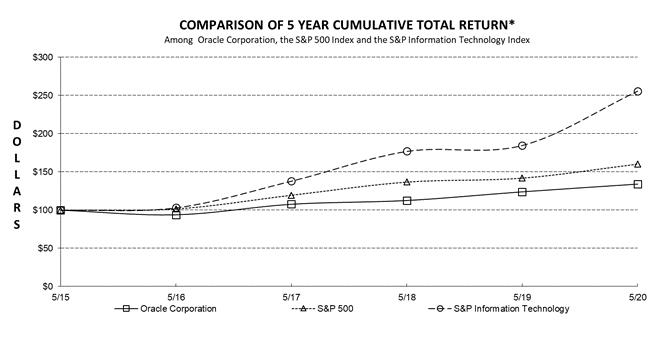]
*$100 INVESTED ON MAY 31, [removed: 2014] [added: 2015] IN STOCK OR
| March 1, 2020—March 31, 2020 | | | 67.9 | | | $ | 47.15 | | | | 67.9 | | | $ | 18,648.4 | |
| April 1, 2020—April 30, 2020 | | | 38.7 | | | $ | 51.68 | | | | 38.7 | | | $ | 16,648.4 | |
| May 1, 2020—May 31, 2020 | | | — | | | $ | — | | | | — | | | $ | 16,648.4 | |
| Total | | | 106.6 | | | $ | 48.80 | | | | 106.6 | | | | | |
| | | 5/15 | | | | 5/16 | | | | 5/17 | | | | 5/18 | | | | 5/19 | | | | 5/20 | | |
| Oracle Corporation | | | 100.0 | | | | 93.9 | | | | 107.7 | | | | 112.6 | | | | 123.9 | | | | 134.0 | |
| S&P 500 Index | | | 100.0 | | | | 101.7 | | | | 119.5 | | | | 136.7 | | | | 141.8 | | | | 160.1 | |
| S&P Information Technology Index | | | 100.0 | | | | 103.1 | | | | 138.0 | | | | 176.9 | | | | 184.7 | | | | 255.6 | |
| March 1, 2019—March 31, 2019 | | | 58.0 | | | $ | 52.93 | | | | 58.0 | | | $ | 8,780.5 | |
| April 1, 2019—April 30, 2019 | | | 29.1 | | | $ | 54.41 | | | | 29.1 | | | $ | 7,198.4 | |
| May 1, 2019—May 31, 2019 | | | 24.9 | | | $ | 54.11 | | | | 24.9 | | | $ | 5,848.4 | |
| Total | | | 112.0 | | | $ | 53.57 | | | | 112.0 | | | | | |
| | | 5/14 | | | | 5/15 | | | | 5/16 | | | | 5/17 | | | | 5/18 | | | | 5/19 | | |
| Oracle Corporation | | | 100.0 | | | | 104.8 | | | | 98.4 | | | | 112.8 | | | | 118.0 | | | | 129.9 | |
| S&P 500 Index | | | 100.0 | | | | 111.8 | | | | 113.7 | | | | 133.6 | | | | 152.8 | | | | 158.6 | |
| S&P Information Technology Index | | | 100.0 | | | | 118.8 | | | | 122.5 | | | | 163.9 | | | | 210.2 | | | | 219.4 | |
Item 6. Selected Financial Data
14 rewritten, 0 added, 0 removed, 14 unchanged
| (in millions, except per share amounts) | | [removed: 2019] [added: 2020] | | | | [removed: 2018(4)] [added: 2019] | | | | [removed: 2017(4)] [added: 2018] | | | | [removed: 2016(4)] [added: 2017] | | | | [removed: 2015(4)] [added: 2016(4)] | | |
| Total revenues | | $ | [removed: 39,506] [added: 39,068] | | | $ | [removed: 39,383] [added: 39,506] | | | $ | [removed: 37,792] [added: 39,383] | | | $ | [removed: 37,047] [added: 37,792] | | | $ | [removed: 38,226] [added: 37,047] | |
| Operating income | | $ | [removed: 13,535] [added: 13,896] | | | $ | [removed: 13,264] [added: 13,535] | | | $ | [removed: 12,913] [added: 13,264] | | | $ | [removed: 12,604] [added: 12,913] | | | $ | [removed: 13,871] [added: 12,604] | |
| Net income(1) | | $ | [removed: 11,083] [added: 10,135] | | | $ | [removed: 3,587] [added: 11,083] | | | $ | [removed: 9,452] [added: 3,587] | | | $ | [removed: 8,901] [added: 9,452] | | | $ | [removed: 9,938] [added: 8,901] | |
| Earnings per share—diluted(1) | | $ | [removed: 2.97] [added: 3.08] | | | $ | [removed: 0.85] [added: 2.97] | | | $ | [removed: 2.24] [added: 0.85] | | | $ | [removed: 2.07] [added: 2.24] | | | $ | [removed: 2.21] [added: 2.07] | |
| Diluted weighted average common shares outstanding | | | [removed: 3,732] [added: 3,294] | | | | [removed: 4,238] [added: 3,732] | | | | [removed: 4,217] [added: 4,238] | | | | [removed: 4,305] [added: 4,217] | | | | [removed: 4,503] [added: 4,305] | |
| Cash dividends declared per common share | | $ | [removed: 0.81] [added: 0.96] | | | $ | [removed: 0.76] [added: 0.81] | | | $ | [removed: 0.64] [added: 0.76] | | | $ | [removed: 0.60] [added: 0.64] | | | $ | [removed: 0.51] [added: 0.60] | |
| Working capital(2) | | $ | [removed: 27,756] [added: 34,940] | | | $ | [removed: 57,035] [added: 27,756] | | | $ | [removed: 50,995] [added: 57,035] | | | $ | [removed: 47,105] [added: 50,995] | | | $ | [removed: 47,314] [added: 47,105] | |
| Total assets(2) | | $ | [removed: 108,709] [added: 115,438] | | | $ | [removed: 137,851] [added: 108,709] | | | $ | [removed: 136,003] [added: 137,851] | | | $ | [removed: 112,180] [added: 136,003] | | | $ | [removed: 110,903] [added: 112,180] | |
| Notes payable and other borrowings(3) | | $ | [removed: 56,167] [added: 71,597] | | | $ | [removed: 60,619] [added: 56,167] | | | $ | [removed: 57,909] [added: 60,619] | | | $ | [removed: 43,855] [added: 57,909] | | | $ | [removed: 41,958] [added: 43,855] | |
| (1) | Our net income and diluted earnings per share were impacted in fiscal 2019 and 2018 by the effects of [added: our adoption of] the U.S. Tax Cuts and Jobs Act of 2017 (the Tax Act). The more significant provisions of the Tax Act as applicable to us are described [removed: below under “Impacts of] [added: in our Annual Report on Form 10-K for] the [removed: U.S. Tax Cuts and Jobs Act of 2017”.] [added: fiscal year ended May 31, 2019.] |
| (2) | Working capital and total assets [added: increased in fiscal 2020 primarily due to the favorable impacts to our net current assets resulting from our fiscal 2020 net income and the issuance of $20.0 billion of long-term senior notes in fiscal 2020, partially offset by cash used for repurchases of our common stock and dividend payments in fiscal 2020. Working capital and total assets] decreased in fiscal 2019 primarily due to $36.1 billion of cash used for repurchases of our common stock during fiscal 2019 and also due to dividend payments, partially offset by the favorable impacts to our net current assets resulting from our fiscal 2019 net income. Working capital and total assets sequentially increased in [removed: nearly all of] the fiscal [removed: 2015] [added: 2016] to 2018 periods presented primarily due to the favorable impacts to our net current assets resulting from our net income generated during the periods presented and the [removed: issuances] [added: issuance] of long-term senior notes of $10.0 billion in fiscal [removed: 2018,] [added: 2018] and $14.0 billion in fiscal 2017. These working capital and total assets increases were partially offset by cash used for acquisitions, repurchases of our common stock and dividend payments in the fiscal [removed: 2015] [added: 2016] to 2018 periods presented. In addition, our total assets were also affected in all periods presented by the repayments of notes payable and other borrowings as discussed further below. |
| (3) | Our notes payable and other borrowings, which represented the summation of our notes [removed: payable and other borrowings,] [added: payable,] current, and notes payable and other borrowings, non-current, as reported per our consolidated balance sheets as of the dates listed in the table above, [added: increased during fiscal 2020 primarily due to the issuance of $20.0 billion of long-term senior notes. Notes payable and other borrowings] decreased during fiscal 2019 primarily due to repayments of certain short-term borrowings and senior notes. Notes payable and other borrowings increased between fiscal [removed: 2015] [added: 2016] and 2018 primarily due to the fiscal 2018 issuance of long-term senior notes of $10.0 billion and short-term borrowings of $2.5 billion, the fiscal 2017 issuance of long-term senior notes of $14.0 billion and short-term borrowings of $3.8 billion, and [removed: the] fiscal 2016 short-term borrowings of $3.8 billion. See Note 7 of Notes to Consolidated Financial Statements included elsewhere in this Annual Report for additional information regarding our notes payable and other borrowings. |
| (4) | The summary consolidated financial data for the fiscal [removed: years] [added: year] ended and as of May 31, [removed: 2018 and 2017] [added: 2016] have [added: not] been [removed: retrospectively restated] [added: updated] to reflect the adoption of [removed: Accounting Standards Update ("ASU") No. 2014-09, Revenue] [added: ASC 606, *Revenue] from Contracts with [removed: Customers: Topic 606 and subsequent amendments to the initial guidance: ASU 2015-14, ASU 2016-08, ASU 2016-10, ASU 2016-12, ASU 2016-20, ASU 2017-10, ASU 2017-13 and ASU 2017-14 (collectively, Topic 606), and] [added: Customers* (ASC 606) or] ASU 2017-07, [removed: Compensation—Retirement Benefits (Topic 715): Improving] [added: *Improving] the [removed: presentation] [added: Presentation] of Net Periodic Pension Costs and Net Periodic Postretirement Benefit [removed: Costs] [added: Costs*] (ASU 2017-07). [removed: See Note 1 of Notes] [added: Refer] to [removed: Consolidated Financial Statements included elsewhere in this] [added: our] Annual Report [removed: for a summary of adjustments related to Topic 606 and ASU 2017-07. The summary consolidated financial data] [added: on Form 10-K] for the fiscal [removed: years] [added: year] ended [removed: and as of] May 31, [removed: 2016 and 2015 have not been updated to reflect the] [added: 2019 for additional discussion regarding Oracle’s] adoption of [removed: Topic 606 or ASU 2017-07.] [added: these accounting pronouncements.] |
Item 9A. Controls and Procedures
6 rewritten, 1 added, 2 removed, 18 unchanged
As of the end of the period covered by this Annual Report on Form 10-K, we carried out an evaluation under the supervision and with the participation of our Disclosure Committee and our management, including our Principal Executive [removed: Officers (one of whom is our Principal] [added: and] Financial [removed: Officer),] [added: Officer,] of the effectiveness of the design and operation of our disclosure controls and procedures pursuant to Exchange Act Rules 13a-15(e) and 15d-15(e).
Based on our management’s evaluation (with the participation of our Principal Executive [removed: Officers, one of whom is our Principal] [added: and] Financial Officer), as of the end of the period covered by this report, our Principal Executive [removed: Officers have] [added: and Financial Officer has] concluded that our disclosure controls and procedures were effective as of May 31, [removed: 2019] [added: 2020] to provide reasonable assurance that information required to be disclosed by us in reports that we file or submit under the Exchange Act is (i) recorded, processed, summarized and reported within the time periods specified in the SEC rules and forms and (ii) accumulated and communicated to our management, including our Principal Executive [removed: Officers (one of whom is our Principal] [added: and] Financial [removed: Officer)] [added: Officer] as appropriate to allow timely decisions regarding required disclosure.
Under the supervision and with the participation of our management, including our Principal Executive [removed: Officers (one of whom is our Principal] [added: and] Financial [removed: Officer),] [added: Officer,] we conducted an evaluation of the effectiveness of our internal control over financial reporting as of May 31, [removed: 2019] [added: 2020] based on the guidelines established in [removed: Internal] [added: *Internal] Control—Integrated [removed: Framework] [added: Framework*] issued by the Committee of Sponsoring Organizations of the Treadway Commission’s 2013 framework.
Based on the results of our evaluation, our management concluded that our internal control over financial reporting was effective as of May 31, [removed: 2019.][added: 2020.]
The effectiveness of our internal control over financial reporting as of May 31, [removed: 2019] [added: 2020] has been audited by Ernst & Young LLP, an independent registered public accounting firm, as stated in their report which is included in Part IV, Item 15 of this Annual Report.
Our management, including our Principal Executive [removed: Officers (one of whom is our Principal] [added: and] Financial [removed: Officer),] [added: Officer,] believes that our disclosure controls and procedures and internal control over financial reporting are designed to provide reasonable assurance of achieving their objectives and are effective at the reasonable assurance level.
[Index to Financial Statements](#ITEM_15_EXHIBITS_FINANCIAL_STATEMENT_SCH)
We implemented internal controls to ensure we adequately evaluated our contracts and properly assessed the impact of the new accounting standard related to revenue recognition on our financial statements to facilitate its adoption on June 1, 2018.
There were no significant changes to our internal control over financial reporting due to the adoption of the new standard.
Item 9B. Other Information
1 rewritten, 0 added, 0 removed, 3 unchanged
[removed: PART III][added: PART III]
Item 10. Directors, Executive Officers and Corporate Governance
1 rewritten, 0 added, 0 removed, 2 unchanged
The other information required by this Item 10 is incorporated by reference from the information contained in our Proxy Statement to be filed with the U.S. Securities and Exchange Commission in connection with the solicitation of proxies for our [removed: 2019] [added: 2020] Annual Meeting of Stockholders [removed: (2019] [added: (2020] Proxy Statement) under the sections entitled “Board of Directors—Nominees for Directors,” “Board of Directors—Committees, Membership and Meetings,” “Board of Directors—Committees, Membership and Meetings—The Finance and Audit Committee,” “Corporate Governance—Employee Matters—Code of Conduct,” and “Delinquent Section 16(a) Reports.”
Item 11. Executive Compensation
1 rewritten, 0 added, 0 removed, 1 unchanged
The information required by this Item 11 is incorporated by reference from the information to be contained in our [removed: 2019] [added: 2020] Proxy Statement under the sections entitled “Board of Directors—Committees, Membership and Meetings—The Compensation Committee—Compensation Committee Interlocks and Insider Participation,” “Board of Directors—Director Compensation,” and “Executive Compensation.”
Item 12. Security Ownership of Certain Beneficial Owners and Management and Related Stockholder Matters
1 rewritten, 0 added, 0 removed, 1 unchanged
The information required by this Item 12 is incorporated herein by reference from the information to be contained in our [removed: 2019] [added: 2020] Proxy Statement under the sections entitled “Security Ownership of Certain Beneficial Owners and Management” and “Executive Compensation—Equity Compensation Plan Information.”
Item 13. Certain Relationships and Related Transactions, and Director Independence
1 rewritten, 0 added, 0 removed, 1 unchanged
The information required by this Item 13 is incorporated herein by reference from the information to be contained in our [removed: 2019] [added: 2020] Proxy Statement under the sections entitled “Corporate Governance—Board of Directors and Director Independence” and “Transactions with Related Persons.”
Item 14. Principal Accounting Fees and Services
1 rewritten, 0 added, 0 removed, 3 unchanged
The information required by this Item 14 is incorporated herein by reference from the information to be contained in our [removed: 2019] [added: 2020] Proxy Statement under the section entitled “Ratification of Selection of Independent Registered Public Accounting Firm.”
Item 15. Exhibits and Financial Statement Schedules
610 rewritten, 374 added, 181 removed, 857 unchanged
| [removed: (a)] [added: (a)] | 1. Financial Statements |
| [Reports of Independent Registered Public Accounting Firm](#REPORT_INDEPENDENT_REGISTERED_PUBLIC_ACC) | | [removed: 65] [added: 66] |
| [Balance Sheets as of May 31, [removed: 2019] [added: 2020] and [removed: 2018](#CONSOLIDATED_BALANCE_SHEETS)] [added: 2019](#CONSOLIDATED_BALANCE_SHEETS)] | | [removed: 67] [added: 69] |
| [Statements of Operations for the years ended May 31, [removed: 2019, 2018] [added: 2020, 2019] and [removed: 2017](#CONSOLIDATED_STATEMENTS_OPERATIONS)] [added: 2018](#CONSOLIDATED_STATEMENTS_OPERATIONS)] | | [removed: 68] [added: 70] |
| [Statements of Comprehensive Income for the years ended May 31, [removed: 2019, 2018] [added: 2020, 2019] and [removed: 2017](#CONSOLIDATED_STATEMENTS_COMPREHENSIVE_IN)] [added: 2018](#CONSOLIDATED_STATEMENTS_COMPREHENSIVE_IN)] | | [removed: 69] [added: 71] |
| [Statements of Equity for the years ended May 31, [removed: 2019, 2018] [added: 2020, 2019] and [removed: 2017](#CONSOLIDATED_STATEMENTS_EQUITY)] [added: 2018](#CONSOLIDATED_STATEMENTS_EQUITY)] | | [removed: 70] [added: 72] |
| [Statements of Cash Flows for the years ended May 31, [removed: 2019, 2018] [added: 2020, 2019] and [removed: 2017](#CONSOLIDATED_STATEMENTS_CASH_FLOWS)] [added: 2018](#CONSOLIDATED_STATEMENTS_CASH_FLOWS)] | | [removed: 71] [added: 73] |
| [Notes to Consolidated Financial Statements](#N1_ORGANIZATION_SIGNIFICANT_ACCOUNTING_P) | | [removed: 72] [added: 74] |
| [Schedule II. Valuation and Qualifying Accounts](#SCHEDULE_II) | | [removed: 118] [added: 117] |
[removed: Report] [added: Report] of Independent [removed: Registered] [added: Registered] Public Accounting [removed: Firm][added: Firm]
We have audited the accompanying consolidated balance sheets of Oracle Corporation (the Company) as of May 31, [removed: 2019] [added: 2020] and [removed: 2018,] [added: 2019,] the related consolidated statements of operations, comprehensive income, [removed: equity] [added: equity,] and cash flows for each of the three years in the period ended May 31, [removed: 2019, and] [added: 2020,] the related notes and the financial statement schedule listed in the Index at Item [removed: 15(a)2] [added: 15(a) 2] (collectively referred to as the “financial statements”).
In our opinion, the financial statements present fairly, in all material respects, the [removed: consolidated] financial position of the Company at May 31, [removed: 2019] [added: 2020] and [removed: 2018,] [added: 2019,] and the [removed: consolidated] results of its operations and its cash flows for each of the three years in the period ended May 31, [removed: 2019,] [added: 2020,] in conformity with U.S. generally accepted accounting principles.
We also have audited, in accordance with the standards of the Public Company Accounting Oversight Board (United States) (PCAOB), the Company's internal control over financial reporting as of May 31, [removed: 2019,] [added: 2020,] based on criteria established in Internal Control-Integrated Framework issued by the Committee of Sponsoring Organizations of the Treadway Commission (2013 framework) and our report dated June [removed: 21, 2019] [added: 22, 2020] expressed an unqualified opinion thereon.
We have audited Oracle Corporation’s internal control over financial reporting as of May 31, [removed: 2019,] [added: 2020,] based on criteria established in Internal Control— Integrated Framework issued by the Committee of Sponsoring Organizations of the Treadway Commission (2013 [removed: framework)(the] [added: framework) (the] COSO criteria).
In our opinion, Oracle Corporation (the Company) maintained, in all material respects, effective internal control over financial reporting as of May 31, [removed: 2019,] [added: 2020,] based on the COSO criteria.
We also have audited, in accordance with the standards of the Public Company Accounting Oversight Board (United States) (PCAOB), the consolidated balance sheets of Oracle Corporation as of May 31, [removed: 2019] [added: 2020] and [removed: 2018,] [added: 2019,] the related consolidated statements of operations, comprehensive income, equity, and cash flows for each of the three years in the period ended May 31, [removed: 2019, and] [added: 2020,] the related [removed: notes] [added: notes,] and the financial statement schedule listed in the Index at Item [removed: 15(a)2] [added: 15(a) 2] and our report June [removed: 21, 2019] [added: 22, 2020] expressed an unqualified opinion thereon.
[removed: ORACLE CORPORATION][added: ORACLE CORPORATION]
As of May 31, [removed: 2019] [added: 2020] and [removed: 2018][added: 2019]
| (in millions, except per share data) | | [added: 2020 | | | |] 2019 | | | | 2018 | | |
| Cash and cash equivalents | | $ | [removed: 20,514] [added: 37,239] | | | $ | [removed: 21,620] [added: 20,514] | |
| Marketable securities | | | [removed: 17,313] [added: 5,818] | | | | [removed: 45,641] [added: 17,313] | |
| Trade receivables, net of allowances for doubtful accounts of [removed: $371] [added: $409] and [removed: $370] [added: $371] as of May 31, [removed: 2019] [added: 2020] and May 31, [removed: 2018,] [added: 2019,] respectively | | | [removed: 5,134] [added: 5,551] | | | | [removed: 5,136] [added: 5,134] | |
| Prepaid expenses and other current assets | | | [removed: 3,425] [added: 3,532] | | | | [removed: 3,762] [added: 3,425] | |
| Total current assets | | | [removed: 46,386] [added: 52,140] | | | | [removed: 76,159] [added: 46,386] | |
| Property, plant and equipment, net | | | [removed: 6,252] [added: 6,244] | | | | [removed: 5,897] [added: 6,252] | |
| Intangible assets, net | | | [removed: 5,279] [added: 3,738] | | | | [removed: 6,670] [added: 5,279] | |
| Goodwill, net | | | [removed: 43,779] [added: 43,769] | | | | [removed: 43,755] [added: 43,779] | |
| Deferred tax assets | | | [removed: 2,696] [added: 3,252] | | | | [removed: 1,395] [added: 2,696] | |
| Other non-current assets | | | [removed: 4,317] [added: 6,295] | | | | [removed: 3,975] [added: 4,317] | |
| Total non-current assets | | | [removed: 62,323] [added: 63,298] | | | | [removed: 61,692] [added: 62,323] | |
| Total assets | | $ | [removed: 108,709] [added: 115,438] | | | $ | [removed: 137,851] [added: 108,709] | |
| [removed: Notes payable and other borrowings, current | | $ | 4,494 | | | $ | 4,491] [added: 7.] | [added: NOTES PAYABLE AND OTHER BORROWINGS] |
| Accounts payable | | | [removed: 580] [added: 637] | | | | [removed: 529] [added: 580] | |
| Accrued compensation and related benefits | | | [removed: 1,628] [added: 1,453] | | | | [removed: 1,806] [added: 1,628] | |
| Deferred revenues | | | [removed: 8,374] [added: 8,002] | | | | [removed: 8,341] [added: 8,374] | |
| Other current liabilities | | | [removed: 3,554] [added: 4,737] | | | | [removed: 3,957] [added: 3,554] | |
| Total current liabilities | | | [removed: 18,630] [added: 17,200] | | | | [removed: 19,124] [added: 18,630] | |
| Notes payable and other borrowings, non-current | | | [removed: 51,673] [added: 69,226] | | | | [removed: 56,128] [added: 51,673] | |
| Income taxes payable | | | [removed: 13,295] [added: 12,463] | | | | [removed: 13,429] [added: 13,295] | |
| Other non-current liabilities | | | [removed: 2,748] [added: 3,832] | | | | [removed: 2,297] [added: 2,748] | |
Critical Audit Matter
The critical audit matter communicated below is a matter arising from the current period audit of the financial statements that was communicated or required to be communicated to the audit committee and that: (1) relates to accounts or disclosures that are material to the financial statements and (2) involved our especially challenging, subjective, or complex judgments.
The communication of the critical audit matter does not alter in any way our opinion on the financial statements, taken as a whole, and we are not, by communicating the critical audit matter below, providing a separate opinion on the critical audit matter or on the accounts or disclosures to which it relates.
| | | |
| | | |
| | | Legal Contingencies |
| Description of the matter | | As discussed in Note 17 of the financial statements, the Company is involved in various claims and legal proceedings. The Company accrues a liability for an estimated loss if the potential loss from any claim or legal proceeding is considered probable, and the amount can be reasonably estimated. For purposes of disclosure, the Company also performs an assessment of the materiality of legal contingencies where a loss is either reasonably possible or it is reasonably possible that an exposure to loss exists in excess of the amount accrued. The audit of the Company’s accounting for and disclosure of legal contingencies is highly subjective and requires significant judgment in assessing the Company’s evaluation of the probability of a loss, and the estimated amount or range of loss. These judgments are impacted by uncertainties related to the ultimate outcome of the legal contingencies, the status of the litigation or the appeals processes, and the status of any settlement discussions associated with the legal contingencies. |
| How we addressed the matter in our audit | | We obtained an understanding, evaluated the design, and tested the operating effectiveness of the controls over the identification and evaluation of these matters, including controls over management’s assessment of the probability of incurrence of a loss and whether the loss or range of loss was reasonably estimable. Our substantive audit procedures, among others, included gaining an understanding of the status of ongoing lawsuits, reviewing letters addressing the matters from internal and external legal counsel, meetings with internal legal counsel to discuss the allegations, and obtaining a representation letter from management on these matters. We also evaluated the Company’s disclosures in relation to these matters. |
June 22, 2020
June 22, 2020
ORACLE CORPORATION
For the Years Ended May 31, 2020, 2019 and 2018
| Net income | | $ | 10,135 | | | $ | 11,083 | | | $ | 3,587 | |
ORACLE CORPORATION
For the Years Ended May 31, 2020, 2019 and 2018
| Repurchase of common stock | | | (361 | ) | | | (2,932 | ) | | | (16,268 | ) | | | — | | | | (19,200 | ) | | | — | | | | (19,200 | ) |
| Net income | | | — | | | | — | | | | 10,135 | | | | — | | | | 10,135 | | | | 164 | | | | 10,299 | |
| Balances as of May 31, 2020 | | | 3,067 | | | $ | 26,486 | | | $ | (12,696 | ) | | $ | (1,716 | ) | | $ | 12,074 | | | $ | 643 | | | $ | 12,717 | |
ORACLE CORPORATION
For the Years Ended May 31, 2020, 2019 and 2018
| Net income | | $ | 10,135 | | | $ | 11,083 | | | $ | 3,587 | |
ORACLE CORPORATION
May 31, 2020
Oracle Corporation provides products and services that substantially address all aspects of enterprise information technology (IT) environments, including applications and infrastructure.
We elected the package of practical expedients permitted under the transition guidance of the new standard, which allows us to carry forward our historical lease classification.
The adoption of Topic 842 did not result in a cumulative catch-up adjustment to the opening of our accumulated deficit balance as of June 1, 2019.
There was no material impact to our consolidated statements of operations and consolidated statements of cash flows for the year ended May 31, 2020 due to the adoption of Topic 842.
Refer to the “Leases” section below for a description of our accounting policy that we have applied since our adoption of Topic 842.
May 31, 2020
information available to us at the time that these estimates, judgments and assumptions are made.
May 31, 2020
technologies.
Our customers that we contract with for the provision of cloud services, software, hardware or other services include businesses of many sizes, government agencies, educational institutions and our channel partners, which include resellers and system integrators.
May 31, 2020
As a result, the SSP for a cloud license and an on-premise license included in a contract with multiple performance obligations is determined by applying a residual approach whereby all other performance
May 31, 2020
May 31, 2020
subsequent adjustments are recorded to our consolidated statements of operations.
Prior to June 1, 2019, we accounted for operating lease abandonment pursuant to the provisions of ASC 420.
Effective June 1, 2019, abandoned operating leases related to an acquired company or our internal operations are accounted for as ROU asset impairment charges pursuant to Topic 842 and are accounted for separately from the business combination.
| --- | --- | --- |
Adoption of ASU No. 2014-09
As discussed in Note 1 to the consolidated financial statements, the Company changed its method of accounting for revenue from contracts with customers and for incremental costs to obtain contracts with customers in each period presented, due to the Company’s adoption of ASU No. 2014-09, Revenue from Contracts with Customers.
June 21, 2019
| --- | --- | --- | --- | --- | --- | --- | --- | --- |
| Balances as of May 31, 2016 | | | 4,131 | | | $ | 24,217 | | | $ | 23,888 | | | $ | (816 | ) | | $ | 47,289 | | | $ | 501 | | | $ | 47,790 | |
| Cumulative-effect of accounting change | | | — | | | | — | | | | 820 | | | | (43 | ) | | | 777 | | | | 4 | | | | 781 | |
| Repurchase of common stock | | | (86 | ) | | | (504 | ) | | | (2,988 | ) | | | — | | | | (3,492 | ) | | | — | | | | (3,492 | ) |
| Net income | | | — | | | | — | | | | 9,452 | | | | — | | | | 9,452 | | | | 118 | | | | 9,570 | |
| Fair values of restricted stock-based awards and stock options assumed in connection with acquisitions | | $ | 8 | | | $ | 3 | | | $ | 90 | |
Oracle Cloud Services integrate the software, hardware and services on a customer’s behalf in a cloud-based IT environment that Oracle deploys, upgrades, supports and manages for the customer.
Certain other prior year balances have been reclassified to conform to the current year presentation.
Such reclassifications did not affect total revenues, operating income or net income.
In fiscal 2019, we adopted the following Accounting Standards Updates:
| | • | Accounting Standards Update (ASU) 2014-09, Revenue from Contracts with Customers: Topic 606 and subsequent amendments to the initial guidance: ASU 2015-14, ASU 2016-08, ASU 2016-10, ASU 2016-12, ASU 2016-20, ASU 2017-10, ASU 2017-13 and ASU 2017-14 (collectively, Topic 606), utilizing the full retrospective method of transition whereby the results and related disclosures for the comparative fiscal 2018 and 2017 periods presented in this Form 10-K were recast to be presented as if Topic 606 had been in effect during fiscal 2018 and 2017. Retrospective adjustments applicable prior to June 1, 2016 were recorded as a cumulative-effect adjustment that resulted in a $43 million increase in accumulated other comprehensive loss (AOCL) and an $820 million increase in retained earnings. Refer to the “Revenue Recognition” and “Deferred Sales Commissions” sections below for accounting policy updates upon our adoption of Topic 606. |
| | • | ASU 2017-12, Derivatives and Hedging (Topic 815): Targeted Improvements to Accounting for Hedging Activities (ASU 2017-12), which amends and simplifies existing guidance in order to allow companies to more accurately present the economic effects of risk management activities in the financial statements. We early adopted this new standard on June 1, 2018 using the modified retrospective method, which |
NOTES TO CONSOLIDATED FINANCIAL STATEMENTS—(Continued)
| | | requires us to account for ASU 2017-12 as of the date of adoption with any retrospective adjustments applicable to prior periods included as a cumulative-effect adjustment to AOCL and retained earnings. The adoption of ASU 2017-12 did not have a material impact on our consolidated financial statements as of the adoption date or for any of the periods presented. As a result of the adoption of ASU 2017-12, we have elected to modify certain of our hedge documentation to exclude the fair value of certain components of the related hedging instrument in our assessment of hedge effectiveness. See Note 10 for additional explanations of the impact of adoption. |
| | • | ASU 2017-07, Compensation—Retirement Benefits (Topic 715): Improving the Presentation of Net Periodic Pension Costs and Net Periodic Postretirement Benefit Costs (ASU 2017-07), which provides guidance on the capitalization, presentation and disclosure of net benefit costs related to postretirement benefit plans. We adopted ASU 2017-07 on a full retrospective basis, which resulted in the retrospective reclassification of $54 million and $42 million, respectively, of non-service net periodic pension cost for fiscal 2018 and 2017, respectively, from line items within operating expenses into non-operating income, net. |
| | • | ASU 2016-16, Income Taxes (Topic 740): Intra-Entity Transfers of Assets Other Than Inventory (ASU 2016-16), which requires entities to recognize the income tax consequences of an intra-entity transfer of an asset, other than inventory, when the transfer occurs. We adopted ASU 2016-16 effective June 1, 2018 on a modified retrospective basis through a cumulative-effect adjustment that resulted in a $110 million decrease in prepaid assets with the corresponding offset to retained earnings. |
The impacts of adopting Topic 606 and ASU 2017-07 for select historical consolidated statements of operations line items were as follows:
| --- | --- | --- | --- | --- | --- | --- | --- | --- | --- | --- | --- | --- | --- | --- | --- | --- | --- | --- | --- | --- | --- | --- | --- | --- |
| | | 2018 | | | | | | | | | | | | 2017 | | | | | | | | | | |
| Total revenues | | $ | 39,831 | | | $ | (448 | ) | | $ | 39,383 | | | $ | 37,728 | | | $ | 64 | | | $ | 37,792 | |
| Total operating expenses | | $ | 26,152 | | | $ | (33 | ) | | $ | 26,119 | | | $ | 25,018 | | | $ | (139 | ) | | $ | 24,879 | |
| Net income | | $ | 3,825 | | | $ | (238 | ) | | $ | 3,587 | | | $ | 9,335 | | | $ | 117 | | | $ | 9,452 | |
The impact of adopting Topic 606 for select historical consolidated balance sheet line items was as follows:
| | | As of May 31, 2018 | | | | | | | | | | |
| (in millions) | | As Previously Reported | | | | Adjustments | | | | As Adjusted | | |
| Trade receivables, net of allowances for doubtful accounts | | $ | 5,279 | | | $ | (143 | ) | | $ | 5,136 | |
| Prepaid expenses and other current assets | | $ | 3,424 | | | $ | 338 | | | $ | 3,762 | |
| Deferred tax assets | | $ | 1,491 | | | $ | (96 | ) | | $ | 1,395 | |
| Other non-current assets | | $ | 3,487 | | | $ | 488 | | | $ | 3,975 | |
| Total current liabilities | | $ | 19,195 | | | $ | (71 | ) | | $ | 19,124 | |
| Total non-current liabilities | | $ | 71,845 | | | $ | 9 | | | $ | 71,854 | |
| Total equity | | $ | 46,224 | | | $ | 649 | | | $ | 46,873 | |
In addition, in fiscal 2019, we also adopted the following Accounting Standards Updates, none of which had a material impact upon adoption or for any of the periods presented to our reported financial position, results of operations or cash flows:
| | • | ASU 2018-15, Intangibles—Goodwill and Other—Internal-Use Software (Subtopic 350-40): Customer’s Accounting for Implementation Costs Incurred in a Cloud Computing Arrangement That Is a Service Contract (ASU 2018-15); |
| | • | ASU 2018-14, Compensation—Retirement Benefits—Defined Benefit Plans—General (Topic 715-20): Disclosure Framework—Changes to the Disclosure Requirements for Defined Benefit Plans (ASU 2018-14); |
| | • | ASU 2018-13, Fair Value Measurement (Topic 820): Disclosure Framework—Changes to the Disclosure Requirements for Fair Value Measurement (ASU 2018-13); |
An excerpt. Shown here: 40 of 610 rewritten, 40 of 374 added and 40 of 181 removed. The counts are complete. For every sentence, read Item 15. Exhibits and Financial Statement Schedules in the FY2020 filing and the FY2019 filing.
Item 16. Form 10-K Summary
0 rewritten, 0 added, 166 removed, 0 unchanged
Dropped this year
| --- | --- |
None.
[Index to Financial Statements](#ITEM_15_EXHIBITS_FINANCIAL_STATEMENT_SCH)
ORACLE CORPORATION
INDEX OF EXHIBITS
The following exhibits are filed or furnished herewith or are incorporated by reference to exhibits previously filed with the U.S. Securities and Exchange Commission.
| | | | | Incorporated by Reference | | | | | | | | |
| --- | --- | --- | --- | --- | --- | --- | --- | --- | --- | --- | --- | --- |
| Exhibit No. | | Exhibit Description | | Form | | File No. | | Exhibit | | Filing Date | | Filed By |
| | | | | | | | | | | | | |
| 3.01 | | [Amended and Restated Certificate of Incorporation of Oracle Corporation and Certificate of Amendment of Amended and Restated Certificate of Incorporation of Oracle Corporation](http://www.sec.gov/Archives/edgar/data/1341439/000119312506020874/dex31.htm) | | 8-K 12G3 | | 000-51788 | | 3.01 | | 2/6/06 | | Oracle Corporation |
| | | | | | | | | | | | | |
| 3.02 | | [Amended and Restated Bylaws of Oracle Corporation](http://www.sec.gov/Archives/edgar/data/1341439/000119312516623620/d200599dex302.htm) | | 8-K | | 001-35992 | | 3.02 | | 6/16/16 | | Oracle Corporation |
| | | | | | | | | | | | | |
| 4.01 | | [Specimen Certificate of Oracle Corporation’s Common Stock](http://www.sec.gov/Archives/edgar/data/1341439/000119312510112896/dex44.htm) | | S-3 ASR | | 333-166643 | | 4.04 | | 5/7/10 | | Oracle Corporation |
| | | | | | | | | | | | | |
| 4.02 | | [Indenture dated January 13, 2006, among Ozark Holding Inc., Oracle Corporation and Citibank, N.A.](http://www.sec.gov/Archives/edgar/data/0000777676/000095013406000839/f16289exv10w34.htm) | | 8-K | | 000-14376 | | 10.34 | | 1/20/06 | | Oracle Systems Corporation |
| | | | | | | | | | | | | |
| 4.03 | | [First Supplemental Indenture dated May 9, 2007 among Oracle Corporation, Citibank, N.A. and The Bank of New York Trust Company, N.A.](http://www.sec.gov/Archives/edgar/data/1341439/000119312507109320/dex43.htm) | | S-3 ASR | | 333-142796 | | 4.3 | | 5/10/07 | | Oracle Corporation |
| | | | | | | | | | | | | |
| 4.04 | | [Form of 6.50% Note due 2038, together with Officers’ Certificate issued April 9, 2008 setting forth the terms of the Note](http://www.sec.gov/Archives/edgar/data/1341439/000119312508077170/dex409.htm) | | 8-K | | 000-51788 | | 4.09 | | 4/8/08 | | Oracle Corporation |
| | | | | | | | | | | | | |
| 4.05 | | [Forms of 5.00% Note due 2019 and 6.125% Note due 2039, together with Officers’ Certificate issued July 8, 2009 setting forth the terms of the Notes](http://www.sec.gov/Archives/edgar/data/1341439/000119312509145686/dex408.htm) | | 8-K | | 000-51788 | | 4.08 | | 7/8/09 | | Oracle Corporation |
| | | | | | | | | | | | | |
| 4.06 | | [Forms of Original 2020 Note and Original 2040 Note, together with Officers’ Certificate issued July 19, 2010 setting forth the terms of the Notes](http://www.sec.gov/Archives/edgar/data/1341439/000119312510213084/dex408.htm) | | 10-Q | | 000-51788 | | 4.08 | | 9/20/10 | | Oracle Corporation |
| | | | | | | | | | | | | |
| 4.07 | | [Forms of New 2020 Note and New 2040 Note](http://www.sec.gov/Archives/edgar/data/1341439/000119312511227635/dex45.htm) | | S-4 | | 333-176405 | | 4.5 | | 8/19/11 | | Oracle Corporation |
[Index to Financial Statements](#ITEM_15_EXHIBITS_FINANCIAL_STATEMENT_SCH)
| | | | | Incorporated by Reference | | | | | | | | |
| --- | --- | --- | --- | --- | --- | --- | --- | --- | --- | --- | --- | --- |
| Exhibit No. | | Exhibit Description | | Form | | File No. | | Exhibit | | Filing Date | | Filed By |
| | | | | | | | | | | | | |
| 4.08 | | [Forms of 2.50% Note due 2022, together with Officers’ Certificate issued October 25, 2012 setting forth the terms of the Note](http://www.sec.gov/Archives/edgar/data/1341439/000119312512435493/d429721dex410.htm) | | 8-K | | 000-51788 | | 4.10 | | 10/25/12 | | Oracle Corporation |
| | | | | | | | | | | | | |
| 4.09 | | [Forms of 2.25% Note due 2021 and 3.125% Note due 2025, together with Officers’ Certificate issued July 10, 2013 setting forth the terms of the Notes](http://www.sec.gov/Archives/edgar/data/1341439/000119312513287255/d566107dex411.htm) | | 8-K | | 001-35992 | | 4.11 | | 7/10/13 | | Oracle Corporation |
| | | | | | | | | | | | | |
| 4.10 | | [Forms of Floating-Rate Note due 2019, 2.375% Note due 2019 and 3.625% Note due 2023, together with Officers’ Certificate issued July 16, 2013 setting forth the terms of the Notes](http://www.sec.gov/Archives/edgar/data/1341439/000119312513291787/d568055dex412.htm) | | 8-K | | 001-35992 | | 4.12 | | 7/16/13 | | Oracle Corporation |
| | | | | | | | | | | | | |
| 4.11 | | [Forms of Floating-Rate Note due 2019, 2.25% Note due 2019, 2.80% Note due 2021, 3.40% Note due 2024, 4.30% Note due 2034 and 4.50% Note due 2044, together with Officers’ Certificate issued July 8, 2014 setting forth the terms of the Notes](http://www.sec.gov/Archives/edgar/data/1341439/000119312514263107/d756565dex413.htm) | | 8-K | | 001-35992 | | 4.13 | | 7/8/14 | | Oracle Corporation |
| | | | | | | | | | | | | |
An excerpt. Shown here: all 0 rewritten, all 0 added and 40 of 166 removed. The counts are complete. For every sentence, read Item 16. Form 10-K Summary in the FY2019 filing.