 filings.tools
Oracle 10-K 2025-05-31
Filed 2025-06-18. 23 sections, 466K characters. Original on sec.gov · Markdown · JSON
Cover and table of contents
UNITED STATES
SECURITIES AND EXCHANGE COMMISSION
Washington, D.C. 20549
FORM 10-K
☒ ANNUAL REPORT PURSUANT TO SECTION 13 OR 15(d) OF THE SECURITIES EXCHANGE ACT OF 1934
For the fiscal year ended May 31**,** 2025
OR
☐ TRANSITION REPORT PURSUANT TO SECTION 13 OR 15(d) OF THE SECURITIES EXCHANGE ACT OF 1934
For the transition period from ___ to ___
Commission File Number: 001-35992
Oracle Corporation
(Exact name of registrant as specified in its charter)
| Delaware | 54-2185193 |
| (State or other jurisdiction of incorporation or organization) | (I.R.S. Employer Identification No.) |
| 2300 Oracle Way | |
| Austin**,** Texas (Address of principal executive offices) | 78741 (Zip Code) |
(737) 867-1000
(Registrant’s telephone number, including area code)
Securities registered pursuant to Section 12(b) of the Act:
| Title of each class | Trading Symbol(s) | Name of each exchange on which registered |
| Common Stock, par value $0.01 per share 3.125% senior notes due July 2025 | ORCL — | New York Stock Exchange New York Stock Exchange |
Securities registered pursuant to Section 12(g) of the Act:
None
Indicate by check mark if the registrant is a well-known seasoned issuer, as defined in Rule 405 of the Securities Act. Yes ☒ No ☐
Indicate by check mark if the registrant is not required to file reports pursuant to Section 13 or Section 15(d) of the Act. Yes ☐ No ☒
Indicate by check mark whether the registrant (1) has filed all reports required to be filed by Section 13 or 15(d) of the Securities Exchange Act of 1934 during the preceding 12 months (or for such shorter period that the registrant was required to file such reports), and (2) has been subject to such filing requirements for the past 90 days. Yes ☒ No ☐
Indicate by check mark whether the registrant has submitted electronically every Interactive Data File required to be submitted pursuant to Rule 405 of Regulation S-T (§232.405 of this chapter) during the preceding 12 months (or for such shorter period that the registrant was required to submit such files). Yes ☒ No ☐
Indicate by check mark whether the registrant is a large accelerated filer, an accelerated filer, a non-accelerated filer, a smaller reporting company or an emerging growth company. See the definitions of “large accelerated filer,” “accelerated filer,” “smaller reporting company” and “emerging growth company” in Rule 12b-2 of the Exchange Act.
| Large accelerated filer ☒ | Accelerated filer ☐ | Non-accelerated filer ☐ | Smaller reporting company ☐ | Emerging growth company ☐ |
If an emerging growth company, indicate by check mark if the registrant has elected not to use the extended transition period for complying with any new or revised financial accounting standards provided pursuant to Section 13(a) of the Exchange Act. ☐
Indicate by check mark whether the registrant has filed a report on and attestation to its management’s assessment of the effectiveness of its internal control over financial reporting under Section 404(b) of the Sarbanes-Oxley Act (15 U.S.C. 7262(b)) by the registered public accounting firm that prepared or issued its audit report. ☒
If securities are registered pursuant to Section 12(b) of the Act, indicate by check mark whether the financial statements of the registrant included in the filing reflect the correction of an error to previously issued financial statements. ☐
Indicate by check mark whether any of those error corrections are restatements that required a recovery analysis of incentive-based compensation received by any of the registrant’s executive officers during the relevant recovery period pursuant to §240.10D-1(b). ☐
Indicate by check mark whether the registrant is a shell company (as defined in Rule 12b-2 of the Exchange Act). Yes ☐ No ☒
The aggregate market value of the voting stock held by non-affiliates of the registrant was $305,793,119,000 based on the number of shares held by non-affiliates of the registrant as of May 31, 2025, and based on the closing sale price of common stock as reported by the New York Stock Exchange on November 29, 2024, which is the last business day of the registrant’s most recently completed second fiscal quarter. This calculation does not reflect a determination that persons are affiliates for any other purposes.
Number of shares of common stock outstanding as of June 13, 2025: 2,808,833,000.
Documents Incorporated by Reference:
Portions of the registrant's definitive proxy statement relating to its 2025 annual meeting of stockholders are incorporated by reference into Part III of this Annual Report on Form 10-K where indicated. Such proxy statement will be filed with the U.S. Securities and Exchange Commission within 120 days of the registrant’s fiscal year ended May 31, 2025.
ORACLE CO****RPORATION
FISCAL YEAR 2025
FORM 10-K
ANNUAL REPORT
TABLE OF CONTENTS
Cautionary Note on Forward-Looking Statements
For purposes of this Annual Report on Form 10-K (this Annual Report), the terms “Oracle,” “we,” “us” and “our” refer to Oracle Corporation and its consolidated subsidiaries. This Annual Report contains statements that are not historical in nature, are predictive in nature, or that depend upon or refer to future events or conditions or otherwise contain forward-looking statements within the meaning of Section 21E of the Securities Exchange Act of 1934, as amended (the Exchange Act), and Section 27A of the Securities Act of 1933, as amended (the Securities Act). These include, among other things, statements regarding:
our expectation that we may acquire, and realize the anticipated benefits of acquiring, companies, products, services and technologies to further our corporate strategy as compelling opportunities become available;
our belief that our acquisitions enhance the products and services that we can offer to customers, expand our customer base, provide greater scale to accelerate innovation, grow our revenues and earnings and increase stockholder value;
our expectation that, on a constant currency basis, our total cloud and license revenues generally will continue to increase due to expected growth in our cloud services and continued demand for our cloud license and on-premise license and license support offerings;
our belief that our Oracle Cloud Applications (OCA) and Oracle Cloud Infrastructure (OCI) offerings represent opportunities for us to continue to expand our cloud and license business, and that we are in the early stages of what we expect will be a material migration of our existing Oracle customer base from on-premise applications and infrastructure products and services to the Oracle Cloud;
our belief that we can market our OCA and OCI services to a broader ecosystem of small and medium-sized businesses, non-information technology lines of business purchasers, developers and partners due to the highly available, intuitive design, ease-of-access, low touch and low cost characteristics of the Oracle Cloud;
our expectation that substantially all of our customers will renew their license support contracts upon expiration;
our belief that Oracle Fusion Cloud Enterprise Resource Planning is a strategic suite of applications that is foundational to facilitating and extracting more business value out of the adoption of other OCA offerings as customers realize the value of a common data model that spans across core business applications;
our belief that our OCA offerings remove business boundaries between front- and back-office activities;
our expectation that current and expected customer demand will require continued growth in our cloud services and license support expenses in order to increase our existing data center capacity and establish additional data centers in new geographic locations;
our expectation that our hardware business will have lower operating margins as a percentage of revenues than our cloud and license business;
our expectation that we will continue to make significant investments in research and development to develop new products and services offerings, as well as maintain and improve our current offerings, and our belief that research and development efforts are essential to maintaining our competitive position;
our expectations regarding our investment in Ampere Computing Holdings LLC (Ampere) and the pending acquisition of Ampere by SoftBank Group Corp.;
our expectation that our international operations will continue to provide a significant portion of our total revenues and expenses;
our expectation that the proportion of our cloud services revenues relative to our total revenues will continue to increase;
the sufficiency of our sources of funding for working capital, capital expenditures, contractual obligations, acquisitions, dividends, stock repurchases, debt repayments and other matters;
our belief that we have adequately provided under United States (U.S.) generally accepted accounting principles for outcomes related to our tax audits, that the final outcome of our tax-related examinations, agreements or judicial proceedings will not have a material effect on our results of operations and that our net deferred tax assets will likely be realized in the foreseeable future;
our belief that the outcome of certain legal proceedings and claims to which we are a party will not, individually or in the aggregate, result in losses that are materially in excess of amounts already recognized, if any;
the possibility that certain legal proceedings to which we are or may become a party could have a material impact on our financial position, future cash flows and results of operations;
the timing and amount of expenses we expect to incur;
the possibility that we may incur additional restructuring expenses in future periods due to the initiation of new restructuring plans;
declarations and amounts of future cash dividend payments and the timing and amount of future stock repurchases;
our expectations regarding the impact of recent accounting pronouncements on our consolidated financial statements;
our expectations regarding the amounts and performance of our investments in marketable and non-marketable equity securities and the timing and amount of changes in fair value of these investments;
our ability to predict revenues, particularly certain cloud license and on-premise license revenues and hardware revenues, and margins;
the percentages of remaining performance obligations that we expect to recognize as revenues over respective future periods;
our expectation that the financial impacts of standard warranty or service level provisions in our revenue arrangements will continue to be insignificant;
our expectation that supply chain shortages, including those arising from tariffs, changing trade policy or other macroeconomic developments, and the risks associated with our response to such shortages, including committing to higher purchases and balances of hardware products, may increase and will continue to impact us in the future;
our beliefs regarding the retention of employees and how our products help to improve our employees’ learning experiences and growth opportunities;
as well as other statements regarding our future operations, financial condition and prospects and business strategies. Forward-looking statements may be preceded by, followed by or include the words “anticipates,” “believes,” “commits,” “continues,” “could,” “endeavors,” “estimates,” “expects,” “focus,” “forecasts,” “future,” “goal,” “intends,” “is designed to,” “likely,” “maintains,” “may,” “ongoing,” “plans,” “possible,” “potential,” “projects,” “seeks,” “shall,” “should,” “strives,” “will” and similar expressions. We claim the protection of the safe harbor for forward-looking statements contained in the Exchange Act and the Securities Act for all forward-looking statements. We have based these forward-looking statements on our current expectations and projections about future events. These forward-looking statements are subject to risks, uncertainties and assumptions about our business that could affect our future results and could cause those results or other outcomes to differ materially from those expressed or implied in the forward-looking statements. Factors that might cause or contribute to such differences include, but are not limited to, those discussed in “Risk Factors” included elsewhere in this Annual Report and as may be updated in filings we make from time to time with the U.S. Securities and Exchange Commission (the SEC), including our Quarterly Reports on Form 10-Q to be filed by us in our fiscal year 2026, which runs from June 1, 2025 to May 31, 2026.
We have no obligation to publicly update or revise any forward-looking statements, whether as a result of new information, future events or risks, except to the extent required by applicable securities laws. If we do update one or more forward-looking statements, no inference should be drawn that we will make additional updates with respect to those or other forward-looking statements. New information, future events or risks could cause the forward-looking events we discuss in this Annual Report not to occur. You should not place undue reliance on these forward-looking statements, which reflect our expectations only as of the date of this Annual Report.
PAR****T I
Item 1. Business
Oracle provides products and services that address enterprise information technology (IT) needs. Our products and services include enterprise applications and infrastructure offerings that are delivered worldwide through a variety of flexible and interoperable IT deployment models. These models include on-premise, cloud-based and hybrid deployments. It is an important element of our corporate strategy to provide choice and flexibility to Oracle customers as to when and how they deploy Oracle applications and infrastructure technologies. We believe that offering customers broad, comprehensive, flexible and interoperable deployment models for Oracle applications and infrastructure technologies is important to our growth strategy and better addresses customer needs relative to our competitors, many of whom provide fewer offerings, more restrictive deployment models and less flexibility for customers transitioning to cloud-based IT environments.
Oracle Cloud Applications (OCA) and Oracle Cloud Infrastructure (OCI, collectively with OCA, Oracle Cloud Services) offerings provide comprehensive and integrated applications and infrastructure services, enabling our customers to choose the best option that meets their specific business needs. Oracle Cloud Services integrate IT components in a cloud-based IT environment that Oracle deploys and manages for customers and is accessible by utilizing common web browsers via a broad spectrum of devices. Oracle Cloud Services are designed to be:
rapidly deployable to enable customers shorter time to innovation;
intuitive for casual and experienced users;
easily maintainable to reduce upgrade, integration and testing work;
connectable among differing deployment models to enable interoperability and extensibility to easily move workloads among the Oracle Cloud and other IT environments;
cost-effective by lowering upfront customer investments and implementing usage-based resource consumption costs; and
highly secure, standards-based and reliable.
Oracle cloud license and on-premise license deployment offerings include Oracle Applications, Oracle Database and Oracle Middleware software offerings, among others, which customers deploy using IT infrastructure from the Oracle Cloud or their own IT environments. Substantially all customers opt to purchase license support contracts when they purchase an Oracle license.
Oracle hardware products include Oracle Engineered Systems, servers, storage and industry-specific products, among others. Customers generally opt to purchase hardware support contracts when they purchase Oracle hardware products.
Oracle also offers professional services to assist our customers and partners to maximize the performance of their investments in Oracle products and services.
Our customers include businesses of many sizes, government agencies, educational institutions and resellers that we market and sell to directly through our worldwide sales force or indirectly through the Oracle Partner Network. Using Oracle technologies, our customers build, deploy, run, manage and support their internal and external products, services and business operations, including, for example, an artificial intelligence (AI) product company that uses OCI to build and serve generative AI models; a global technology company that uses multiple OCI compute and data services to power its logistics and mobile application offerings; a multinational financial institution that runs its banking applications using Oracle Exadata Cloud@Customer; and a global consumer products company that leverages Oracle Fusion Cloud Enterprise Resource Planning (ERP) for its accounting processes, risk management, supply chain and financial planning functions.
Our investments in, and innovation with respect to, Oracle products and services that we offer through our three businesses (cloud and license, hardware and services businesses, described further below) are another important element of our corporate strategy. In fiscal 2025, 2024 and 2023, we invested $9.9 billion, $8.9 billion and $8.6 billion, respectively, in research and development to enhance our existing portfolio of offerings and to develop new
technologies and services. We have a deep understanding as to how applications and infrastructure technologies interact and function with one another, including using OCI to power our OCA, which we and our customers use to run internal business processes. We focus our development efforts on improving the performance, security, reliability, operation, integration and cost-effectiveness of our offerings relative to our competitors; facilitating the ease with which organizations are able to deploy, use, manage and maintain our offerings; and incorporating emerging technologies, such as AI, within our offerings to enable leaner business processes, automation and innovation.
After an initial purchase of Oracle products and services, our customers can continue to benefit from our offerings, research and development efforts and deep IT expertise by electing to purchase and renew Oracle support offerings for their license and hardware deployments, which may include product enhancements that we periodically deliver to our products, and by renewing their Oracle Cloud Services contracts with us.
Our selective and active acquisition program is another important element of our corporate strategy. We believe that our acquisitions enhance the products and services that we can offer to customers, expand our customer base, provide greater scale to accelerate innovation, grow our revenues and earnings and increase stockholder value. We have invested billions of dollars over time to acquire a number of companies, products, services and technologies that add to, are complementary to, or have otherwise enhanced our existing offerings. We expect to continue to acquire companies, products, services and technologies as suitable opportunities arise to further our corporate strategy.
We have three businesses: cloud and license; hardware; and services. Each business is comprised of a single operating segment. Item 7 Management’s Discussion and Analysis of Financial Condition and Results of Operations and Note 13 of Notes to Consolidated Financial Statements, both included elsewhere in this Annual Report, provide additional information related to our businesses and operating segments.
Oracle Corporation was incorporated in 2005 as a Delaware corporation and is the successor to operations originally begun in June 1977.
Oracle Applications and Infrastructure Technologies
Oracle applications and infrastructure technologies, including database and middleware software as well as enterprise applications, virtualization, clustering, large-scale systems management and related infrastructure products and services, are based upon industry standards and are designed to be enterprise-grade, reliable, scalable and secure. These technologies are the building blocks of Oracle Cloud Services, our partners’ cloud services and our customers’ cloud IT environments. Oracle applications and infrastructure offerings are marketed and sold through our cloud and license and hardware businesses, and are delivered through the Oracle Cloud or a variety of flexible and interoperable IT deployment models, including cloud-based, hybrid and on-premise deployments.
We believe that our Oracle Cloud Services offerings represent opportunities for us to continue to expand our cloud and license business. We believe that our customers increasingly recognize the value of access to the latest versions of Oracle cloud-based applications and infrastructure capabilities via a lower cost, rapidly deployable, flexible and interoperable services model that Oracle provisions, manages, upgrades and maintains on our customers’ behalf. We believe that we can market and sell our Oracle Cloud Services offerings together to help new and existing customers migrate their extensive installed base of on-premise and cloud-based applications and infrastructure technologies to the Oracle Cloud and we believe we are in the early stages of what we expect will be a material migration of our existing Oracle customer base from on-premise applications and infrastructure products and services to the Oracle Cloud. During the past three fiscal years, customers with annual license support contracts that migrated to the Oracle Cloud contributed to the increase in annualized cloud services revenue by $4.3 billion. In addition, we also believe we can market our Oracle Cloud Services offerings to a broader ecosystem of small and medium-sized businesses, non-IT lines of business purchasers, developers and partners due to the highly available, intuitive design, ease-of-access, low touch and low cost characteristics of the Oracle Cloud.
In recent periods, customer demand for our applications and infrastructure technologies delivered through our Oracle Cloud deployment models has increased. To address customer demand and enable customer choice, we have introduced certain programs for customers to pivot their applications and infrastructure licenses and license support
contracts to the Oracle Cloud for new deployments and to migrate to and expand with the Oracle Cloud for their existing workloads. The proportion of our cloud services revenues relative to our total revenues has increased and our cloud services revenues represented 43%, 37% and 32% of our total revenues during fiscal 2025, 2024 and 2023, respectively. We expect these trends to continue.
Oracle Applications Technologies
Oracle applications technologies are marketed, sold, delivered and supported through our cloud and license business. Our applications cloud services and license support revenues represented 44%, 46% and 47% of our total cloud services and license support revenues during fiscal 2025, 2024 and 2023, respectively. Oracle applications offerings include our OCA offerings, which are available for customers as a subscription, and Oracle applications license offerings, which are available for customers to purchase for use within the Oracle Cloud and other cloud-based and on-premise IT environments, and include the option to purchase related license support. Our applications technologies are designed to reduce the risk, cost and complexity of our customers’ IT infrastructures, while supporting customer choice with flexible deployment models that readily enable performance, agility, compatibility and extendibility. The applications technologies that we offer are generally designed using industry standard architectures to manage and automate core business functions across the enterprise and a broad range of industries, as well as to help customers differentiate and innovate in those processes unique to their industries or organizations. We also offer industry-specific applications, which provide solutions to customers in the automotive, communications, construction and engineering, consumer packaged goods, defense and intelligence, education, financial services, government, healthcare, high technology, hospitality, industrial manufacturing, life sciences, media and entertainment, oil and gas, professional services, public safety, restaurant, retail, travel and logistics, utilities and wholesale distribution industries, among others.
Oracle Cloud Applications (OCA)
The broad spectrum of OCA offerings provides customers with a choice of software applications delivered via a cloud-based IT environment that we deploy and manage and that customers purchase by entering into a subscription agreement with us for a stated period. Our OCA offerings represent an industry leading business innovation platform leveraging OCI and include a broad suite of modular, next-generation cloud software applications spanning all core business functions, including, among others:
Oracle Fusion Cloud ERP, which is designed to be a complete and integrated ERP solution to help organizations improve decision making and workforce productivity, and to optimize back-office operations by utilizing a single data and security model with a common user interface;
Oracle Fusion Cloud Enterprise Performance Management (EPM), which is designed to analyze financial performance, drive accurate and agile financial plans, optimize the financial close and consolidation process, streamline account reconciliation and satisfy an organization’s reporting requirements;
Oracle Fusion Cloud Supply Chain and Manufacturing Management (SCM), which is designed to help organizations create, optimize and digitize their supply chains;
Oracle Fusion Cloud Human Capital Management (HCM), which is designed to help organizations find, develop and retain their talent, enable collaboration, provide workforce insights, improve business process efficiency and enable users to connect to an integrated suite of HCM applications from a broad range of devices;
Oracle Fusion Sales, Service and Marketing, which are modules that are designed to be complete and integrated solutions to help organizations deliver consistent and personalized customer experiences across their customer channels, touch points and interactions;
NetSuite Applications Suite, which is generally marketed to small to medium-sized organizations and is designed to be a unified, cloud-based applications suite to run a company’s entire business and includes financials and ERP, customer relationship management, human resources, professional services and commerce, among others; and
Oracle Health applications, which are designed to enable medical professionals to deliver better healthcare to individual patients and communities.
In addition, we offer several cloud-based industry solutions to address specific customer needs within certain industries including communications, construction and engineering, education, financial services, government, healthcare, hospitality, manufacturing and retail, among others.
OCA offerings are built upon open industry standards such as SQL, Java and HTML5 for easier application accessibility, integration and development. Customers access OCA offerings utilizing common web browsers via a broad spectrum of devices.
Customers, partners and other interested parties may elect to subscribe to Oracle applications and infrastructure training and certification programs through learning subscriptions offered by Oracle University. Learners generally have unlimited access to course content delivered during the subscription period.
We believe that the comprehensiveness and breadth of our cloud applications offerings differentiate us from many of our competitors that offer more limited or specialized applications. Our cloud applications offerings are designed to support connected business processes in the cloud and are centered on an intuitive and conversational user experience, a responsive, open and flexible business core and a common data model. We believe Oracle Fusion Cloud ERP is a strategic suite of applications that is foundational to facilitating and extracting more business value out of the adoption of other OCA offerings, such as Oracle Fusion Cloud HCM and Oracle Fusion Cloud EPM, as customers realize the value of a common data model that spans across core business applications. We believe our cloud applications offerings together remove business boundaries between front- and back-office activities. Our cloud applications offerings are designed to deliver a secure data isolation architecture and flexible upgrades; self-service access controls for users; a Service-Oriented Architecture; built-in social, mobile and business insight capabilities (analytics); and a high performance, high availability infrastructure based on OCI. These cloud applications capabilities are designed to simplify customer IT environments, reduce time to implement and upgrade, enable agility, reduce risk and provide a user-friendly experience. Our cloud applications offerings incorporate advanced technologies such as AI, Internet-of-Things (IoT), machine learning, blockchain, digital assistants and advances in the “human interface” and how users interact with OCA offerings within a business context or to augment human capabilities to enhance productivity.
Oracle Applications Licenses
Customers have the ability to license Oracle Applications, including Oracle E-Business Suite, PeopleSoft, JD Edwards and Siebel applications, among others, for use within the Oracle Cloud or within their own cloud-based or on-premise IT environments. These licensed applications are designed to manage and automate core business functions across the enterprise, including HCM, ERP, EPM, SCM, Customer Experience and industry-specific applications, as described above, among others.
Oracle Infrastructure Technologies
Oracle infrastructure technologies are marketed, sold and delivered through our cloud and license business and through our hardware business. Our infrastructure technologies are designed to be flexible, cost-effective, standards-based, secure and highly-performant to facilitate the development, deployment, integration, management and extension across an organization’s cloud-based, on-premise and hybrid IT environments.
Our cloud and license business’ infrastructure technologies include the Oracle Database and MySQL Database, the world’s most popular database management systems; Java, the computer industry’s most widely-used language by professional software developers; and middleware, including development tools, among others. These infrastructure technologies are available through a subscription to our OCI offerings or through the purchase of a license and related license support, at the customer’s option, to run within the Oracle Cloud as a part of a customer’s cloud-based, on-premise or other IT environments. Our OCI offerings also include cloud-based compute, storage and networking capabilities, application development and cloud native services, among others, and new and innovative services such as AI Infrastructure offerings and emerging technologies such as generative AI, agentic AI, IoT and blockchain.
Our hardware business’ infrastructure technologies consist of hardware products and certain unique hardware-related software offerings, including Oracle Engineered Systems, enterprise servers, storage solutions, industry-specific hardware, virtualization software, operating systems, management software and related hardware support services. Our customers use Oracle hardware products and related offerings in their cloud-based, on-premise or hybrid IT environments to run their internal business operations and to deliver products and services to their customers.
We design our infrastructure technologies to work in our customers’ on-premise IT environments that may include other Oracle or non-Oracle hardware or software components. Our flexible and open approach also provides Oracle customers with a choice as to how they can utilize and deploy Oracle infrastructure technologies: through the use of Oracle Cloud offerings; on-premise in our customers’ data centers; or a hybrid combination of these two deployment models, such as in the Oracle Exadata Cloud@Customer deployment models (described further below). We focus on the operation and integration of Oracle infrastructure technologies to make them easier to deploy, extend, interconnect, manage and maintain for our customers and to improve computing performance relative to our competitors’ offerings. For example, the Oracle Exadata Database Machine integrates multiple Oracle technology components to work together to deliver improved performance, availability, scalability, security and operational efficiency of Oracle Database workloads relative to our competitors’ products.
Oracle Infrastructure Technologies – Cloud and License Business Offerings
Our infrastructure cloud services and license support revenues represented 56%, 54% and 53% of our total cloud services and license support revenues during fiscal 2025, 2024 and 2023, respectively.
Oracle Cloud Infrastructure (OCI)
OCI offerings are designed to deliver our infrastructure technologies, including compute, storage and networking services, as a service. OCI offerings include our Oracle Autonomous Database offerings, among others, that Oracle runs, manages, upgrades and supports on behalf of the customer. We also offer a portfolio of specialized databases to address specific customer requirements, including MySQL, the world’s most popular open source database, as a cloud service with Oracle HeatWave MySQL. We typically charge a prepaid fee that is decremented as the OCI services are consumed by the customer over a stated time period. By utilizing OCI, customers can leverage the Oracle Cloud for enterprise-grade, high-performance, scalable, cost-effective and secure infrastructure technologies that are designed to be rapidly deployable and provide real-time elasticity while reducing the amount of time and resources normally consumed by IT processes within on-premise environments. OCI is designed to be differentiated from other cloud vendors to provide better security by separating cloud control code computers from customer compute nodes. Customers use OCI to build and operate new applications ranging from low-code to AI-powered cloud-native applications, to run new workloads and to move their existing Oracle or non-Oracle workloads to the Oracle Cloud from their on-premise data centers or other cloud-based IT environments, among other uses. We continue to invest in OCI to improve features and performance; to expand the catalog of cloud-based infrastructure tools and services that we provide; to increase the capacity and geographic footprint to deliver these services; to simplify the processes for migrating workloads to the Oracle Cloud; and to provide customers with the ability to run workloads across different IT environments, the Oracle Cloud as well as other third-party clouds in both hybrid and multicloud deployment models.
Oracle customers and partners utilize OCI offerings for platform-related services that are based upon the Oracle Database, Java and Oracle Middleware, including open source and other tools for a variety of use cases across data management (including the use of Oracle Autonomous Database and Oracle HeatWave MySQL), applications development, integration, content management, analytics, IT management and governance, security and rapidly emerging technologies such as AI and machine learning. OCI AI offerings are designed to be embedded into customer applications for a variety of predictive use cases, including, among others, the servicing of machine parts that are at risk of failing, using generative AI for fault detection on an assembly line, improving customer experiences in the
purchasing of consumer products, the stocking of retailer store shelves, credit fraud detection and financial modeling to stay within a business’ forecasts.
Oracle customers and partners also utilize OCI offerings for highly scalable, available and secure compute, storage and networking services. OCI compute services range from virtual machines to graphics processing unit-based offerings to bare metal servers and include options for high I/O workloads and high-performance computing to run traditional compute-intensive workloads and AI models. OCI storage offerings include block, file, object and archive storage services. In addition, our OCI offerings include networking, connectivity and edge services that help connect customers’ data centers and third-party clouds with our OCI services for the creation of distributed and multicloud architectures.
In addition to the full suite of OCI offerings delivered by Oracle public cloud regions across the globe and by our multicloud partnerships, we provide our customers with flexibility by offering certain OCI services within a customer’s own data center, such as:
Oracle Exadata Cloud@Customer, which is designed to enable customers to run Oracle Autonomous Database and Oracle Exadata Database Service securely in their own data centers behind their firewalls while having the services managed by Oracle;
OCI Dedicated Region, which is designed to enable customers to bring a self-contained OCI instance into their data centers while accessing a substantial portfolio of OCI and OCA offerings;
OCI Sovereign Cloud, which is designed to enable customers to utilize OCI services while addressing restrictions imposed upon customers that operate in certain regulated industries, entities or jurisdictions. This capability now also allows us to offer sovereign AI to customers who want the latest in AI innovations while operating within their regulatory environments;
Oracle Alloy, which is engineered to enable partners to control the commercial and customer experience to address their specific market needs for cloud services; and
Oracle Compute Cloud@Customer and Oracle Roving Edge Infrastructure, which are designed to enable customers to access cloud computing and storage services at the edge of networks and in generally disconnected locations in order to accelerate deployment of cloud workloads outside of the data center.
Oracle Autonomous Database
Oracle Autonomous Database is designed to deliver performance and scale for enterprise database workloads with automated database operations and policy- and AI- and machine learning-driven optimization by combining certain Oracle infrastructure technologies, including the Oracle Database, OCI, Oracle Exadata and native AI and machine learning capabilities, among others. Oracle Autonomous Database is designed to be self-driving, automating routine database administration tasks, including maintenance, tuning, patching, scaling, security and backup. Oracle Autonomous Database is engineered to lower labor costs and reduce human error while using machine learning-driven diagnostics for fault prediction and error handling and is also engineered to provide automatic threat detection and remediation. Oracle Autonomous Database is designed to enable on-demand, automatic scaling of database resources combined with consumption-based pricing in order to help organizations lower costs by paying only for resources used. The integration of Oracle Autonomous Database with other Oracle Cloud services, such as Java Cloud and the Oracle APEX low-code application development service, along with open interfaces and integrations, is designed to provide developers with a modern, open platform to develop new and innovative cloud-native applications.
For analytics workloads, Oracle Autonomous Database is designed to provide customers with easy-to-use analytics tools and machine learning capabilities that are accelerated using Oracle Exadata’s scale-out infrastructure and work with Oracle Analytics Cloud and third-party analytics tools. We believe Oracle Autonomous Database’s built-in developer capabilities and automation can enable organizations to quickly deploy new data marts and data warehouses; move existing ones to the cloud; and create data lakes. All of these capabilities are designed to enable
organizations to gain new insights into customer behavior, more accurately anticipate future demand, align workforce deployment with business activity forecasts and accelerate the pace of operations, among other benefits.
For transaction processing workloads, Oracle Autonomous Database is designed to enable organizations to securely run a mix of high-performance transactions of ranging complexity. It is also designed to enable organizations to efficiently support dynamic workloads, conduct real-time analysis of transactional data and lower administration costs. Oracle Autonomous Database is available on OCI for shared or dedicated deployments and on-premise with Oracle Exadata Cloud@Customer and OCI Dedicated Region. In addition, Oracle Autonomous Database is available on other hyperscale cloud IT environments, such as Amazon Web Services, Google Cloud and Microsoft Azure.
We offer advanced AI functionality, such as AI Vector Search and Select AI, in our recent release of Oracle Database 23ai, which enables customers to leverage their data for advanced generative AI functionality without needing to duplicate and maintain such data securely in other databases or external systems, while also providing customers with an option to utilize generative AI large language models (LLMs) of their choice.
Oracle Database Licenses
Oracle Database is the world’s most popular enterprise database and is designed to enable reliable and secure storage, retrieval and manipulation of all forms of data. Oracle Database is licensed throughout the world by businesses and organizations of all sizes for a multitude of purposes, including, among others, for use within the Oracle Cloud to deliver our OCA and OCI offerings; for use as a cloud license by a number of cloud-based vendors as a component of their respective cloud offerings; for packaged and custom applications for transaction processing; and for data warehousing and business intelligence. Oracle Database may be deployed in various IT environments, including Oracle Public Cloud, Oracle Exadata Cloud@Customer, OCI Dedicated Region, Oracle Alloy, other cloud-based IT environments and on-premise data centers, among others. Oracle Database Enterprise Edition is available with a number of optional add-on products to address specific customer requirements. As described above, customers may elect to purchase license support for Oracle Database licenses. We also offer Oracle Database as a cloud service, such as with Oracle Exadata Database Service and Oracle Base Database Service.
Oracle Middleware Licenses
We license our Oracle Middleware, which is a broad family of integrated application infrastructure software, for use in various IT environments. Oracle Middleware is designed to enable customers to design and integrate Oracle and non-Oracle business applications, automate business processes, scale applications to meet customer demand, simplify security and compliance, manage lifecycles of documents and get actionable, targeted business intelligence. Built with Oracle’s Java technology platform, Oracle Middleware products are designed to be a foundation for custom, packaged and composite applications, thereby simplifying and reducing time-to-deployment. Oracle Middleware is designed to protect customers’ IT investments and work with both Oracle and non-Oracle databases, middleware and applications software through an open architecture and adherence to industry standards. In addition, Oracle Middleware supports multiple development languages and tools, which enables developers to flexibly build once and deploy applications globally across websites, portals and cloud-based applications utilizing a variety of IT environments.
Among our other middleware license offerings, we license development tools, such as Oracle WebLogic Server for Java application development, and Oracle Identity Manager, which automates user identity provisioning and allows enterprises to manage the end-to-end lifecycle of user identities across all enterprise resources. Organizations may elect to purchase license support, as described above, for Oracle Middleware licenses. We also offer certain of our middleware capabilities as a part of our OCI offerings.
Java Licenses
Java is the world’s most popular programming language among professional developers and is used to deliver cloud development and deployment services, microservices, analytics, data management, blockchain, security and continuous integration tools for numerous platforms and technologies, including websites, enterprise and consumer applications, embedded devices and large-scale systems. Java is designed to enable developers to write software on
a single platform and run it on many other different platforms, independent of operating system and hardware architecture. Java has been adopted by both independent software vendors (ISVs) that have built their products using Java and by enterprise organizations building custom applications or consuming Java-based ISV products. Customers generally purchase Java offerings through subscriptions that include licenses and support services.
Oracle License Support
We provide customers the option to purchase license support contracts in connection with the purchase of Oracle applications and infrastructure licenses. Substantially all of our customers opt to purchase license support contracts when they purchase these licenses to run within the Oracle Cloud or other cloud-based and on-premise IT environments. We believe our license support offerings protect and enhance our customers’ investments in Oracle applications and infrastructure technologies because they provide proactive and personalized support services and unspecified license upgrades and enhancements during the term of the support period. Substantially all license support customers renew their support contracts with us upon expiration in order to continue to benefit from technical support services and the periodic issuance of unspecified updates and enhancements, which current license support customers are entitled to receive. Our license support contracts are generally priced as a percentage of the net fees paid by the customer to purchase the license, are typically one year in duration and are generally billed to the customer annually in advance.
Oracle Infrastructure Technologies – Hardware Business Offerings
Oracle infrastructure technologies include a broad selection of hardware products and related hardware support services to power various IT environments. Our hardware products and services include offerings designed for specific industries, including the communications, food and beverage, healthcare, hospitality and retail industries, among others. We also offer a portfolio of operating systems, including Oracle Linux and Oracle Solaris, virtualization and other hardware-related software and a range of management technologies and products, including Oracle Enterprise Manager and the Oracle Cloud Observability and Management platform. These products are designed to help customers efficiently operate complex IT environments, including both end users’ and service providers’ cloud IT environments. Our primary hardware offerings are further described below.
Oracle Engineered Systems
Oracle Engineered Systems are core to our cloud-based and on-premise data center infrastructure offerings. Oracle Engineered Systems are pre-built products, combining multiple unique Oracle technology components, that may include database, storage, operating system, virtualization and management software with server, storage, networking hardware and other technologies. Oracle Engineered Systems are designed to deliver improved performance, scalability, availability, security and operational efficiency relative to our competitors’ products; to be upgraded effectively and efficiently; and to simplify maintenance cycles and improve security by providing a single solution for patching. For example, Oracle Exadata Database Machine is an integrated platform that is optimized for achieving higher performance, scalability and availability at a lower cost by combining Oracle Database, storage and operating system software with Oracle server, storage and networking hardware. We offer our Oracle Engineered Systems through flexible deployment options, including on-premise, as a cloud offering in OCI, as a platform for Oracle Database services in Oracle multicloud partner data centers and as a hybrid cloud offering in customer data centers.
Oracle Servers and Storage
We offer a wide range of Oracle server products that are designed for mission-critical enterprise environments and that are key components of our Oracle Engineered Systems and Oracle Cloud offerings. We have two families of server products: those using x86 microprocessors and those based on the Oracle SPARC microprocessor. We also offer Oracle storage products, which combine flash, disk and server technologies with optimized software and unique integrations with the Oracle Database offering greater performance and efficiency and lower total cost relative to our competitors’ storage products. Certain of our storage products provide integration with Oracle Cloud Services for backup and archiving.
Oracle Hardware Support
Oracle hardware support offerings provide customers with unspecified software updates for software components that are essential to the functionality of our hardware products such as for Oracle operating systems and firmware. These offerings can also include product repairs, maintenance services and technical support services. We continue to evolve hardware support processes that are intended to proactively identify and solve quality issues. Hardware support contracts are generally priced as a percentage of net hardware products fees.
Oracle Services
We offer services to help customers and partners maximize the performance of their investments in Oracle applications and infrastructure technologies. We believe that our services are differentiated based on our expertise in Oracle technologies, extensive experience and broad sets of intellectual property and best practices. Our services offerings substantially include, among others:
consulting services, which are designed to help our customers and global system integrator partners more successfully architect and deploy our cloud and license offerings, including IT strategy alignment, enterprise architecture planning and design, implementation, integration, application development, security assessments and ongoing software enhancements and upgrades. We utilize a global, blended delivery model to optimize value for our customers and partners, which involves the use of consultants from local geographies, industry specialists and consultants from our global delivery and solution centers; and
advanced customer services, which are support services provided by Oracle to a customer to enable increased performance and higher availability of a customer’s Oracle products and services.
Oracle Cloud Operations
Oracle Cloud Operations deliver our Oracle Cloud Services to customers through a secure, reliable, scalable, enterprise grade cloud infrastructure platform managed by Oracle employees within a global network of data centers, which we refer to as the Oracle Cloud. The Oracle Cloud enables secure and isolated cloud-based instances for each of our customers to access the functionality of Oracle Cloud Services via a broad spectrum of devices. Oracle Cloud Operations leverage automated software tools to enable the rapid delivery of the latest cloud technology capabilities to the Oracle Cloud as they become available and provide Oracle customers access to the latest Oracle releases. We have invested in the rapid expansion of the Oracle Cloud by increasing existing data center capacity and adding data centers in new geographic locations to meet current and expected customer demand. We expect this trend will continue.
Manufacturing
We rely on third-party manufacturing partners to produce most of our hardware products that we market and sell to customers and utilize internally to deliver Oracle Cloud Services, and we distribute most of our hardware products from these partners’ facilities. Our manufacturing processes are substantially based on standardization of components across product types and centralization of assembly and distribution centers. Production of our hardware products requires that we purchase materials, supplies, product subassemblies and full assemblies from a number of suppliers. For most of our hardware products, we have existing alternative sources of supply or such sources are readily available. However, we do rely on sole sources for certain hardware components. We monitor and evaluate potential risks of disruption within our supply chain operations. Refer to Risk Factors included in Item 1A within this Annual Report for additional discussion of the challenges we encounter with respect to the sources and availability of supplies for our hardware products and the related risks to our businesses.
Sales and Marketing
We directly market and sell our cloud, license, hardware, support and services offerings globally to businesses of many sizes and in many industries, government agencies and educational institutions. We also market and sell our offerings globally through indirect channels.
In the United States (U.S.), our sales and services employees are based throughout the country. Outside the U.S., our international subsidiaries sell, support and service our offerings in their local countries as well as within other foreign countries where we do not operate through a direct sales subsidiary. Our geographic coverage allows us to draw on business and technical expertise from a global workforce, provides stability to our operations and revenue streams to offset geography-specific economic trends and offers us an opportunity to take advantage of new markets for our offerings. Our international operations subject us to certain risks, which are more fully described in Risk Factors included in Item 1A of this Annual Report. A summary of our domestic and international revenues and long-lived assets is set forth in Note 13 of Notes to Consolidated Financial Statements included elsewhere in this Annual Report.
We also market our product offerings worldwide through indirect channels. The companies that comprise our indirect channel network are members of the Oracle Partner Network. The Oracle Partner Network is a global program that manages our business relationships with a large, broad-based network of companies, including cloud and license, hardware and services suppliers, system integrators and resellers that deliver innovative solutions and services based upon and in conjunction with our product offerings. By offering our partners access to our product offerings, educational information, technical services, marketing and sales support, the Oracle Partner Network program extends our market reach by providing our partners with the resources they need to be successful in delivering solutions to customers globally.
Research and Development
We develop the substantial majority of our products and services offerings internally utilizing the skills and diversity of a global workforce. In addition, we have extended our products and services offerings and intellectual property through acquisitions of businesses and technologies. We also purchase or license intellectual property rights in certain circumstances. Internal development allows us to maintain technical control over the design and development of our products. We have a number of U.S. and foreign patents and pending applications that relate to various aspects of our products and technology. However, although we believe that our patents have value, neither our business as a whole nor any of our principal businesses are materially dependent on a single patent. Rapid technological advances in cloud, software and hardware development, evolving standards in computer hardware and software technology, changing customer needs and frequent new product introductions, offerings and enhancements characterize the markets in which we compete. We plan to continue to dedicate a significant amount of resources to research and development efforts to develop new products and services offerings, as well as maintain and improve our current offerings.
Human Capital Resources
At Oracle, our success is driven by the quality of our people, who we believe are among the best and brightest in the industry. We strive to attract and retain talented employees, to support our employees’ success and well-being and to foster a culture of inclusion where everyone is empowered to have a voice in driving innovation. The Compensation Committee of our Board of Directors (the Compensation Committee) is responsible for reviewing and monitoring matters related to human capital management, including talent acquisition and retention.
Workforce
As of May 31, 2025, we employed approximately 162,000 full-time employees, of which approximately 58,000 were employed in the U.S. and approximately 104,000 were employed internationally. Our approximate employee counts by lines of business are:
| 29,000 | Cloud services and license support operations | 37,000 | Services | |||||||||||
| 31,000 | Sales and marketing | 50,000 | Research and development | |||||||||||
| 3,000 | Hardware | 12,000 | General and administrative |
The average tenure of our employees is approximately eight years and 30% of our employees have been employed with Oracle for ten or more years.
None of our employees in the U.S. are represented by labor unions; however, in certain foreign subsidiaries, labor unions or workers’ councils represent some of our employees.
Employee Experience
In order to attract and retain high quality talent, Oracle strives to deliver a great employee experience, anchored by an inclusive culture where employees can thrive, engage in meaningful work, leverage growth opportunities and focus on their well-being. We support employee well-being from multiple dimensions, including flexible benefits, economic, health, development, lifestyle and compensation.
We believe that one of the primary reasons candidates join Oracle is for the opportunity to develop their career and participate in our global inclusive culture. We have programs and resources to help our employees explore, build and achieve their career goals. By promoting an inclusive culture that leverages a broad range of perspectives and fosters a sense of belonging, we inspire and engage our workforce to solve complex problems to help our customers across the globe.
We promote regular career conversations between leaders and employees, focused on helping employees identify and take steps to grow their careers. Our Talent Review process, which runs on Oracle Fusion Cloud HCM, provides the mechanism for leaders to review and discuss opportunities and action plans to develop employees. 29% of our open non-entry level positions were filled internally in fiscal 2025, providing growth opportunities and retaining critical knowledge and talent.
We believe that helping our employees learn and apply new skills is key to retaining and engaging them. It is also critical to our ability to innovate and rapidly evolve. We believe that our easily accessible learning resources enable us to improve our employees’ learning experience and better measure learning consumption. Oracle employees received more than 4.7 million hours of training in fiscal 2025 and accessed online learning content at an average rate of approximately 2.5 million views per month. Our employees take advantage of instructor-led classes, virtual library content and online learning resources on sales, business, product, market/industry, leadership, technical and compliance skills, well-being and personal development related topics.
Leaders Who Listen
We believe that an important aspect of creating a workforce that supports employee, customer and business success is listening to employee feedback. We share the results of our annual employee engagement survey with leaders, including members of our Board of Directors (the Board). In fiscal 2025, 83% of our employees participated in the annual survey. Leaders listen to employees, evaluate feedback and prioritize actions to enhance employee, business and customer success.
Making a Difference
Each year, through our volunteering and giving programs, Oracle employees donate tens of thousands of volunteer hours and millions of dollars (matched by Oracle) to a wide variety of causes. Oracle and our employees also rise to the occasion in times of crisis.
During fiscal 2025, Oracle donated tens of millions of dollars to advance education, promote health, strengthen communities and protect the environment. We also have two nonprofit foundations that focus on children and young people. Oracle Health Foundation makes pediatric case grants available globally that fund medical care ranging from hearing aids to major surgeries. Oracle Education Foundation teaches young people how to innovate, solve problems with technology and shape a better future. Since 2014, Oracle has partnered with Design Tech High School, a public charter school for which we built a home at our Redwood Shores, California campus in 2016.
Seasonality and Cyclicality
Our quarterly revenues have historically been affected by a variety of seasonal factors, including the structure of our sales force incentive compensation plans, which are common in the IT industry. In each fiscal year, our total revenues and operating margins are typically highest in our fourth fiscal quarter and lowest in our first fiscal quarter. See “Cloud and License Business” in Item 7 of this Annual Report for more information regarding the seasonality and cyclicality of the revenues, expenses and margins of our cloud and license business, which is our largest business.
Competition
We face intense competition in all aspects of our business. The nature of the IT industry creates a competitive landscape that is constantly evolving as firms emerge, expand or are acquired, as technology evolves and as customer demands and competitive pressures otherwise change.
Our customers are demanding less complexity and lower total cost in the implementation, sourcing, integration and ongoing maintenance of their IT environments. Our enterprise cloud, license and hardware offerings compete directly with certain offerings from some of the largest and most competitive companies in the world, including Adobe Systems Incorporated, Alphabet Inc., Amazon.com, Inc., Cisco Systems, Inc., Intel Corporation, International Business Machines Corporation, Microsoft Corporation, Salesforce, Inc. and SAP SE, as well as other companies like Hewlett-Packard Enterprise and Workday, Inc. In addition, due to the low barriers to entry in many of our market segments, new technologies and new and growing competitors frequently emerge to challenge our offerings. Our competitors range from companies offering broad IT solutions across many of our lines of business to vendors providing point solutions, or offerings focused on a specific functionality, product area or industry. In addition, as we expand into new market segments, we face increased competition as we compete with existing competitors, as well as firms that may be partners in other areas of our business and other firms with whom we have not previously competed. For example, following our acquisition of Cerner Corporation, we also face competition from large healthcare IT providers such as Allscripts Healthcare Solutions, Inc., Arcadia Solutions, athenahealth, Inc., Epic Systems Corporation and InterSystems Corporation, among others. Moreover, we or our competitors may take certain strategic actions—including acquisitions, partnerships and joint ventures or repositioning of product lines—which invite even greater competition in one or more product offering categories.
Key competitive factors in each of the segments in which we currently compete and may compete in the future include: total cost of ownership, performance, scalability, reliability, security, functionality, efficiency, ease of use, speed to production and quality of technical support. Our products and services sales and the relative strength of our products and services versus those of our competitors are also directly and indirectly affected by the following, among other factors:
market adoption of cloud-based IT offerings, including Oracle Cloud Services offerings;
our ability to develop AI technologies and features and to have access to AI technologies of competitors;
the ease of deployment, use, transacting for and maintenance of our products and services offerings;
compatibility between Oracle products and services deployed within local IT environments and public cloud IT environments, including our Oracle Cloud environments;
the broader “platform” competition between our industry standard Java technology platform and the .NET programming environment of Microsoft;
operating system competition among our Oracle Solaris and Linux operating systems, with alternatives including Microsoft’s Windows Server and other UNIX and Linux operating systems;
the adoption of open source alternatives to commercial software by enterprise software customers;
products, features and functionality developed internally by customers and their IT staff;
products, features and functionality customized and implemented for customers by consultants, systems integrators or other third parties; and
the attractiveness of offerings from business processing outsourcers.
For more information about the competitive risks we face, refer to Item 1A Risk Factors included elsewhere in this Annual Report.
Governmental Regulation
We operate globally and are subject to numerous U.S. federal, state and foreign laws and regulations covering a wide variety of subject matters. For information about governmental regulations applicable to our business, refer to Item 1A Risk Factors included elsewhere in this Annual Report.
Available Information
Our Annual Reports on Form 10-K, Quarterly Reports on Form 10-Q, Current Reports on Form 8-K and amendments to those reports filed pursuant to Sections 13(a) and 15(d) of the Exchange Act are available, free of charge, on the SEC website at www.sec.gov and our Investor Relations website at www.oracle.com/investor as soon as reasonably practicable after we electronically file such materials with, or furnish them to, the SEC. We use our Investor Relations website as a means of disclosing material non-public information. Accordingly, investors should monitor our Investor Relations website, in addition to following our press releases, SEC filings and public conference calls and webcasts. In addition, information regarding our environmental policy and global sustainability initiatives and solutions are also available on our website at www.oracle.com/social-impact. The information posted on or accessible through our website is not incorporated into this Annual Report. The references to our websites are intended to be inactive textual references only.
Information About Our Executive Officers
Our executive officers are listed below:
| Name | Office(s) | |
| Lawrence J. Ellison | Chairman of the Board of Directors and Chief Technology Officer | |
| Safra A. Catz | Chief Executive Officer and Director | |
| Jeffrey O. Henley | Vice Chairman of the Board of Directors | |
| Clayton Magouyrk | President, Oracle Cloud Infrastructure | |
| Michael Sicilia | President, Industries | |
| Stuart Levey | Executive Vice President, Chief Legal Officer | |
| Maria Smith | Executive Vice President, Chief Accounting Officer |
Mr. Ellison, 80, has been our Chairman of the Board and Chief Technology Officer since September 2014. He served as our Chief Executive Officer from June 1977, when he founded Oracle, until September 2014. He has served as a Director since June 1977. He previously served as our Chairman of the Board from May 1995 to January 2004.
Ms. Catz, 63, has been our Chief Executive Officer since September 2014. She served as our President from January 2004 to September 2014, our Chief Financial Officer most recently from April 2011 until September 2014 and a Director since October 2001. She was previously our Chief Financial Officer from November 2005 until September 2008 and our Interim Chief Financial Officer from April 2005 until July 2005. Prior to being named our President, she held various other positions with us since joining Oracle in 1999. She previously served as a director of The Walt Disney Company.
Mr. Henley, 80, has served as our Vice Chairman of the Board since September 2014. He previously served as our Chairman of the Board from January 2004 to September 2014 and has served as a Director since June 1995. He served as our Executive Vice President and Chief Financial Officer from March 1991 to July 2004.
Mr. Magouyrk, 38, has been our President, Oracle Cloud Infrastructure since June 2025. From December 2019 to June 2025, he served as an Executive Vice President in various roles, including Executive Vice President, Cloud Infrastructure and Executive Vice President, Oracle Cloud Infrastructure Engineering. Prior to being named Executive Vice President, Mr. Magouyrk held various other positions with us since joining Oracle in 2014. Prior to joining Oracle, he was a senior engineer at Amazon and Amazon Web Services from 2008 to 2014.
Mr. Sicilia, 54, has been our President, Industries since June 2025. From October 2019 to June 2025, he served as an Executive Vice President in various roles, including Executive Vice President, Industries and Executive Vice President, Global Business Units. Prior to being named Executive Vice President, Mr. Sicilia held various other positions with us since joining Oracle in 2009. Prior to joining Oracle, he was Chief Technology Officer at Primavera Systems and held other positions from 1993 to 2008.
Mr. Levey, 62, has been our Executive Vice President, Chief Legal Officer since October 2022. Prior to joining Oracle, Mr. Levey served as Chief Executive Officer of Diem Association from August 2020 until June 2022, and as Chief Legal Officer of HSBC Holdings, plc from January 2012 to August 2020.
Ms. Smith, 59, has been our Executive Vice President, Chief Accounting Officer since December 2022. She served as our Senior Vice President, Corporate Controller from December 2020 to December 2022, as our Senior Vice President, Assistant Corporate Controller from September 2017 to December 2020, and as our Vice President, Global Controllers Organization and Mergers and Acquisitions from November 2012 to September 2017. She held various other positions with us since joining Oracle in 1999.
Item 1A. Risk Factors
We operate in rapidly changing economic and technological environments that present numerous risks, many of which are driven by factors that we cannot control or predict. The following discussion, as well as our discussion in Item 7 Management’s Discussion and Analysis of Financial Condition and Results of Operations, highlights some of these risks. The risks described below are not exhaustive and you should carefully consider these risks and uncertainties before investing in our securities.
Business and Operational Risks
We may be unsuccessful in developing and selling new products and services, integrating acquired products and services and enhancing our existing products and services. Our industry is characterized by rapid technological advances, intense competition, changing delivery models, evolving standards in communications infrastructure, increasingly sophisticated customer needs and frequent new product introductions and enhancements. We have continued to refresh and release new offerings of our cloud products and services, but if we are unable to develop new or sufficiently differentiated products and services, enhance and improve our product offerings and support services in a timely manner or position and price our products and services to meet demand, customers may not purchase or subscribe to our license, hardware or cloud offerings or renew license support, hardware support or cloud subscriptions contracts. Renewals of these contracts are important to our future success. In addition, we cannot provide any assurance that the standards on which we choose to develop new products will allow us to compete effectively for business opportunities in emerging areas.
In addition, our business may be adversely affected if:
we do not continue to develop and release new or enhanced products and services within the anticipated time frames;
infrastructure costs to deliver new or enhanced products and services take longer or result in greater costs than anticipated;
supply chain costs, energy costs or other costs to develop, produce or distribute our products and services result in greater costs than anticipated;
we are unable to accurately anticipate, plan for and manage future data center capacity needs in a timely manner to meet current or expected customer demand;
we fail to meet our contractual service level commitments;
there is a delay in market acceptance of and difficulty in transitioning new and existing customers to new, enhanced or acquired product lines or services;
sanctions, tariffs, export controls, geopolitical instability and related market disruptions or other regulatory, legislative or other trade and non-tariff barriers, including retaliatory measures, impede or prevent us from serving certain customers or restrict our customers from operating in specific jurisdictions;
inflation, trade policy, geopolitical conditions and other macroeconomic factors reduce customer demand for our products and services or cause us to be unable to meet current or expected customer demand;
there are changes in IT trends that we do not adequately anticipate or timely address with our product development efforts;
we do not optimize complementary product lines and services in a timely manner; or
we fail to adequately integrate, support or enhance acquired product lines or services.
In addition, our profitability and revenues could be adversely impacted if we lose one or more of our key customers for any reason, including as a result of any of the factors discussed above. Any such loss could also limit or reduce our growth in future periods.
Our AI products may not operate as anticipated, which could adversely affect our reputation, revenues and profitability. Machine learning and AI, including generative AI, agentic AI and LLMs, are increasingly driving innovations in technology, and AI technology and services are highly competitive and rapidly evolving. We have invested, and expect to continue to invest, significant resources to build and support our AI products. In addition, we rely on partners and suppliers to produce some of our AI products. If we are unable to introduce new AI products or if our AI products fail to operate as anticipated or as well as competing products or otherwise do not meet customer needs, or if our competitors’ AI products achieve higher market acceptance than ours, we may fail to
recoup our investments in AI and our business and reputation may be harmed. Further, if we do not continue to invest significant resources to develop and support our AI products, we may fall behind technological developments and evolving industry standards, which would likewise harm our ability to compete. In addition, AI technologies are rapidly changing and present evolving legal, regulatory and ethical issues, including claims of bias, discrimination, a perceived lack of transparency, as well as sometimes unpredictable behaviors or improper use of copyrighted or other protected material, such as personal and patient health information, any of which could expose us or our customers to reputational or legal risk and inhibit adoption of our AI products. Regulatory uncertainty, including the lack of comprehensive federal legislation and a patchwork of existing and proposed frameworks and regulatory initiatives in numerous jurisdictions, may expose us to compliance challenges and uncertainties. Our failure to adapt to these changes, or any failure by our employees, contractors, partners, suppliers or agents to comply with laws and regulations applicable to our AI products or our related policies and procedures, could result in legal, financial and reputational consequences including, but not limited to, being required to adjust or limit our product offerings or our use of AI in certain jurisdictions to comply with new and evolving AI laws and regulations.
If we do not successfully execute our Oracle Cloud strategy, including our offerings of Oracle Cloud Services, our revenues and profitability may decline. We provide our cloud and other offerings to customers worldwide via a variety of deployment models, including via our cloud-based OCA and OCI offerings. As these business models continue to evolve, we may not be able to compete effectively, generate significant revenues or maintain the profitability of our cloud offerings. Additionally, the increasing prevalence of various cloud offering models by us and our competitors may unfavorably impact the pricing of our cloud and license offerings. If we do not successfully execute our cloud computing strategy or anticipate the cloud computing needs of our customers, our reputation as a cloud services provider could be harmed and our revenues and profitability could decline.
As customer demand for our cloud offerings increases, we experience volatility in our reported revenues and operating results due to the differences in timing of revenue recognition between our cloud license and on-premise license and hardware product arrangements relative to our cloud offering arrangements. Customers predominantly purchase our cloud offerings on a subscription basis, and revenues from these offerings are generally recognized ratably or as services are consumed over the terms of the subscriptions. Consequently, any deterioration in sales activity associated with our cloud offerings may not be immediately observable in our consolidated statements of operations. This is in contrast to revenues associated with our license and hardware product arrangements, which are generally recognized in full at the time of delivery of the related licenses and hardware products. In addition, we may not be able to accurately anticipate customer transitions from or be able to sufficiently backfill reduced customer demand for our license, hardware and support offerings relative to the expected increase in customer adoption of
Showing the first 8K of 79K characters. Open the full section
Item 1B. Unresolved Staff Comments
None.
Item 1C. Cybersecurity
Our overall information security risk management approach is designed to enable us to assess, identify and manage major risk exposures, including from material risks from cybersecurity threats, in a timely manner. As part of our information security risk management program, we perform risk assessments in which we map and prioritize information security risks identified through the processes described below. These assessments inform our information security risk management strategies and oversight processes and we view cybersecurity risks as one of the key risk categories we face.
We believe that Oracle is a target for computer hackers, cyber threats and other bad actors because our products and services store, retrieve, process and manage large amounts of data, including sensitive data. We and our vendors are regularly subject to attempts by third parties to identify and exploit product and service vulnerabilities, penetrate or bypass our security measures and gain unauthorized access to our or our customers’, partners’ and suppliers’ software, hardware and cloud offerings, networks and systems.
If a large scale cyberattack or other major security incident results in unauthorized access to or modification or exfiltration of a significant amount of our customers’ or suppliers’ data, other external data, our own data or our IT systems, or if the services we provide to our customers are disrupted, or if our products or services are reported to have (or are perceived as having) security vulnerabilities, we could incur significant expenses and suffer substantial damage to our brand and reputation, and this could result in a material impact on our business. Refer to “Data Privacy, Cybersecurity and Intellectual Property Risks” in Risk Factors included in Item 1A within this Annual Report for additional discussion of the challenges we encounter with respect to cybersecurity risks.
During fiscal 2025, Oracle experienced cybersecurity incidents that, to date, have not had a material impact on our business, including our business strategy, results of operations or financial condition.
Our corporate security and information security programs are designed to help us prevent, prepare for, detect, respond to and recover from cybersecurity threats. We leverage industry standard security frameworks to evaluate our security controls. Relevant personnel collaborate with subject matter experts throughout the process to identify and assess material cybersecurity threats, evaluate their severity, and explore ways to mitigate a potential security incident. We continually conduct security and privacy reviews to pinpoint risks associated with our products, services and enterprise. We also employ various monitoring tools to track suspicious or anomalous activity across our networks, systems, and data, and we simulate cyber threats to proactively address vulnerabilities. Finally, we routinely train our employees on cybersecurity matters.
This program includes processes for triaging, assessing the severity of, escalating, containing, investigating and remediating information security events, as well as meeting legal obligations and minimizing customer impact and brand and reputational damage. In addition, we maintain insurance to protect against potential losses arising from a cybersecurity incident. Periodic tabletop exercises are conducted to test and reinforce our incident response controls, with incident severity and priority assessed on an ongoing basis.
We also conduct external and internal risk management audits to assess and report on our internal incident response preparedness and help identify areas for continued focus and improvement. We conduct periodic penetration testing to identify vulnerabilities in our products, services, and systems. We also undergo security-related industry certifications and attestations by external auditors, including System and Organization Controls (SOC) 1, SOC 2, International Organization for Standardization (ISO) 27001, 27017 and 27018, Cloud Security Alliance Security Trust Assurance and Risk (CSA STAR), Payment Card Industry Data Security Standard (PCI DSS) and other compliance frameworks. Additionally, our vendor risk management program identifies and mitigates risks associated with third-party service providers, including those within our supply chain and those with access to our customer or employee data or systems. We use the findings from these and other processes to review our information security practices, procedures and technologies.
Cybersecurity is an important area of focus for our Board. Our information security risk management program is designed to allow our Board to establish a mutual understanding with management of the effectiveness of our information security risk management practices and capabilities, including the division of responsibilities for reviewing our information security risk exposure and risk tolerance, tracking emerging information risks and ensuring proper escalation of certain key risks for periodic review by the Board of Directors and its committees. As
part of its broader risk oversight activities, the Board oversees risks from cybersecurity risks, both directly and through the Finance and Audit Committee of the Board (the F&A Committee). As reflected in its charter, the F&A Committee assists the Board with the management and assessment of privacy and data security risk and is responsible for reviewing and discussing with management privacy and data security risk exposures, including, among other things, the potential impacts of those exposures on our business, financial results, operations and reputation. The F&A Committee also oversees our internal controls over financial reporting, including with respect to financial reporting-related information systems.
As an element of its information security risk management oversight activities, the F&A Committee reviews the results of our incident response control tests, external and internal audits and penetration testing and oversees our vendor risk management program. The F&A Committee also receives quarterly updates regarding cybersecurity matters from senior management. In turn, the F&A Committee reports to the full Board on a quarterly basis regarding the F&A Committee’s cybersecurity risk oversight activities. We also have Board members with expansive knowledge and expertise in the area of cybersecurity. In addition to these regularly scheduled updates, our Chief Privacy Officer and Senior Vice President, Cloud Security and Head of Global Information Security may also report to the F&A Committee on how certain information security risks are being managed and progress towards agreed mitigation goals, as well as any potential material risks from cybersecurity threats that have been detected by the information security team.
Robert Duhart, Senior Vice President, Cloud Security and Head of Global Information Security is responsible for the day-to-day identification, assessment and management of the information security risks we face. Our Senior Vice President, Cloud Security and Head of Global Information Security has extensive experience in managing cybersecurity and has served in various leadership roles in information technology and cybersecurity at several large public companies, the U.S. Department of Defense and the Federal Bureau of Investigation. Most recently, he served as the Chief Information Security Officer, eCommerce and Deputy Chief Information Security Officer at a major retailer. Our Senior Vice President, Cloud Security and Head of Global Information Security earned a master’s degree in technology management from George Mason University – Costello College of Business, and a Chief Information Security Officer Executive Certificate from Carnegie Mellon University – Heinz College of Information Systems and Public Policy.
Our Senior Vice President, Cloud Security and Head of Global Information Security is supported by team members who have relevant educational and industry experience. These team members provide regular reports to the Senior Vice President, Cloud Security and Head of Global Information Security and work closely with our Chief Privacy Officer and include personnel dedicated to information security, product security, and physical security. Informed by the processes and practices discussed under “Risk Management and Strategy” above, team members escalate cybersecurity threats and incidents to the Senior Vice President, Cloud Security and Head of Global Information Security who assesses the severity of such threats and incidents for inclusion in quarterly update to the F&A Committee where appropriate. In addition to the ordinary-course Board and F&A Committee reporting and oversight described above, we also maintain disclosure controls and procedures designed for prompt reporting to the Board and timely public disclosure, as appropriate, of material events covered by our risk management framework, including cybersecurity risks.
Item 2. Properties
Our properties consist of owned and leased office facilities for cloud operations, sales, support, research and development, services, manufacturing and administrative and other functions. Our headquarters facility consists of approximately 0.9 million square feet in Austin, Texas, all of which we own. We also own or lease offices and certain other facilities for current use consisting of approximately 26.9 million square feet in various other locations in the U.S. and abroad. Approximately 10.4 million square feet, or 37%, of our total owned and leased offices and certain other facilities are sublet or are being actively marketed for sublease or disposition. We lease our principal internal manufacturing facility for our hardware products in Hillsboro, Oregon. Additionally, our cloud operations deliver our Oracle Cloud Services through the use of global data centers, substantially all of which were leased through colocation suppliers. We believe that our facilities are in good condition and suitable for the conduct of our business.
Item 3. Legal Proceedings
The material set forth in Note 12 (pertaining to information regarding contingencies related to our income taxes) and Note 15 (pertaining to information regarding legal contingencies) of Notes to Consolidated Financial Statements in Item 15 of this Annual Report is incorporated herein by reference.
Item 4. Mine Safety Disclosures
Item 5. Market for Registrant’s Common Equity, Related Stockholder Matters and Issuer Purchases of Equity Securities
Our common stock is traded on the New York Stock Exchange under the symbol “ORCL.” According to the records of our transfer agent, we had 6,574 stockholders of record as of May 31, 2025.
For equity compensation plan information, please refer to Item 12 in Part III of this Annual Report.
Stock Repurchase Program
Our Board has approved a program for us to repurchase shares of our common stock. As of May 31, 2025, approximately $6.4 billion remained available for stock repurchases pursuant to our stock repurchase program.
Our stock repurchase authorization does not have an expiration date and the pace of our repurchase activity will depend on factors such as our working capital needs, our cash requirements for acquisitions and dividend payments, our debt repayment obligations or repurchases of our debt, our stock price and economic and market conditions. Our stock repurchases may be effected from time to time through open market purchases or pursuant to a Rule 10b5-1 trading plan. Our stock repurchase program may be accelerated, suspended, delayed or discontinued at any time.
The following table summarizes the stock repurchase activity for the three months ended May 31, 2025 and the approximate dollar value of shares that may yet be purchased pursuant to our stock repurchase program:
| (in millions, except per share amounts) | Total Number of Shares Purchased | Average Price Paid per Share | Total Number of Shares Purchased as Part of Publicly Announced Program | Approximate Dollar Value of Shares that May Yet Be Purchased Under the Program | ||||||||||||
| March 1, 2025—March 31, 2025 | 0.3 | $ | 150.68 | 0.3 | $ | 6,462.3 | ||||||||||
| April 1, 2025—April 30, 2025 | 0.4 | $ | 133.53 | 0.4 | $ | 6,412.3 | ||||||||||
| May 1, 2025—May 31, 2025 | 0.3 | $ | 156.46 | 0.3 | $ | 6,362.3 | ||||||||||
| Total | 1.0 | $ | 146.22 | 1.0 |
Stock Performance Graph and Cumulative Total Return
The graph below compares the cumulative total stockholder return on our common stock with the cumulative total return of the S&P 500 Index and the Dow Jones U.S. Technology Total Return Index for each of the last five fiscal years ended May 31, 2025, assuming an investment of $100 at the beginning of such period and the reinvestment of any dividends. The comparisons in the graphs below are based upon historical data and are not indicative of, nor intended to forecast, future performance of our common stock.
COMPARISON OF 5 YEAR CUMULATIVE TOTAL RETURN*
Among Oracle Corporation, the S&P 500 Index and the Dow Jones U.S. Technology Total Return Index
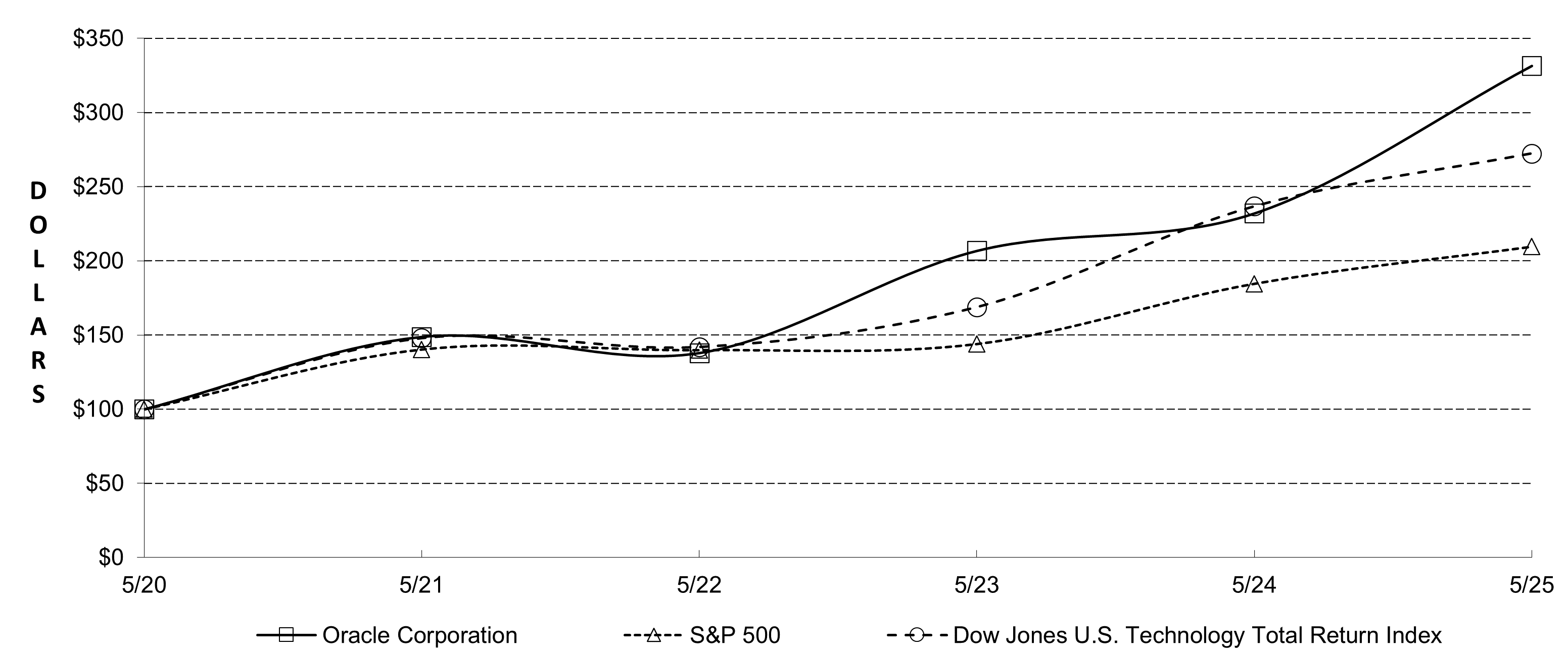
*$100 INVESTED ON MAY 31, 2020 IN STOCK OR
INDEX-INCLUDING REINVESTMENT OF DIVIDENDS
| 5/20 | 5/21 | 5/22 | 5/23 | 5/24 | 5/25 | |||||||||||||||||||
| Oracle Corporation | 100.0 | 148.8 | 138.0 | 206.8 | 232.0 | 331.5 | ||||||||||||||||||
| S&P 500 Index | 100.0 | 140.3 | 139.9 | 144.0 | 184.6 | 209.5 | ||||||||||||||||||
| Dow Jones U.S. Technology Total Return Index | 100.0 | 148.0 | 142.0 | 168.9 | 236.8 | 272.4 |
Item 6. [Reserved]
Item 7. Management’s Discussion and Analysis of Financial Condition and Results of Operations
We begin Management’s Discussion and Analysis of Financial Condition and Results of Operations with an overview of our businesses and significant trends. This overview is followed by a summary of our critical accounting estimates that we believe are important to understanding significant assumptions and judgments incorporated in our reported financial results. We then provide a more detailed analysis of our results of operations and financial condition for fiscal 2025 compared to fiscal 2024. A discussion regarding our financial condition and results of operations for fiscal 2024 compared to fiscal 2023 can be found in Management’s Discussion and Analysis of Financial Condition and Results of Operations in Part II, Item 7 of our Annual Report on Form 10-K for the fiscal year ended May 31, 2024, as filed with the SEC on June 20, 2024, which is available free of charge on the SEC’s website at www.sec.gov and on our Investor Relations website at www.oracle.com/investor.
Business Overview
Oracle provides products and services that address enterprise IT needs. Our products and services include enterprise applications and infrastructure offerings that are delivered worldwide through a variety of flexible and interoperable IT deployment models. These models include on-premise, cloud-based and hybrid deployments (an approach that combines both on-premise and cloud-based deployments). Accordingly, we offer choice and flexibility to our customers and facilitate the product, service and deployment combinations that best suit our customers’ needs. Through our worldwide sales force and Oracle Partner Network, we sell to customers all over the world including businesses of many sizes, government agencies, educational institutions and resellers.
We have three businesses: cloud and license; hardware; and services; each of which comprises a single operating segment. The descriptions set forth below as a part of this Item 7 Management’s Discussion and Analysis of Financial Condition and Results of Operations and the information contained within Item 1 Business and Note 13 of Notes to Consolidated Financial Statements included elsewhere in this Annual Report provide additional information related to our businesses and operating segments and align to how our chief operating decision makers (CODMs), which are our Chief Executive Officer and Chief Technology Officer, view our operating results and allocate resources.
Cloud and License Business
Our cloud and license business, which represented 86% and 84% of our total revenues in fiscal 2025 and 2024, respectively, markets, sells and delivers a broad spectrum of enterprise applications and infrastructure technologies through our cloud and license offerings. Revenue streams included in our cloud and license business are:
Cloud services and license support revenues, which include:
o
cloud services revenues, which are earned by providing customers access to Oracle Cloud applications and infrastructure technologies via cloud-based deployment models that Oracle develops, provides unspecified updates and enhancements for, deploys, hosts, manages and supports and that customers access by entering into a subscription agreement with us for a stated period. Oracle Cloud Services arrangements generally: are billed in advance of the cloud services being delivered; have durations of one to four years; are renewed at the customer’s option; and are recognized as revenues ratably over the contractual period of the cloud contract or, in the case of usage model contracts, as the cloud services are consumed over time; and
o
license support revenues, which are earned by providing Oracle license support services to customers that have elected to purchase support services in connection with the purchase of Oracle applications and infrastructure software licenses for use in cloud, on-premise and other IT environments. Substantially all license support customers renew their support contracts with us upon expiration in order to continue to benefit from technical support services and the periodic issuance of unspecified updates and enhancements, which current license support customers are entitled to receive. License support contracts are generally: priced as a percentage of the net fees paid by the customer to purchase a cloud license and/or on-premise license; billed in advance of the support services being performed; renewed at the customer’s option; and recognized as revenues ratably over the contractual period that the support services are provided, which is generally one year.
Cloud license and on-premise license revenues, which include revenues from the licensing of our software products including Oracle Applications, Oracle Database, Oracle Middleware and Java, among others, which our customers deploy within cloud-based, on-premise or other IT environments. Our cloud license and on-premise license transactions are generally perpetual in nature and are generally recognized as revenues up front at the point in time when the software is made available to the customer to download and use. Revenues from usage-based royalty arrangements for distinct cloud licenses and on-premise licenses are recognized at the point in time when the software end user usage occurs. The timing of a few large license transactions can substantially affect our quarterly license revenues due to the point-in-time nature of revenue recognition for license transactions, which is different than the typical revenue recognition pattern for our cloud services and license support revenues in which revenues are recognized over time. Cloud license and on-premise license customers have the option to purchase and renew license support contracts, as further described above.
Providing choice and flexibility to our customers as to when and how they deploy Oracle applications and infrastructure technologies are important elements of our corporate strategy. In recent periods, customer demand for our applications and infrastructure technologies delivered through our Oracle Cloud Services has increased. To address customer demand and enable customer choice, we have certain programs for customers to pivot their applications and infrastructure software licenses and the related license support to the Oracle Cloud for new deployments and to migrate to and expand with the Oracle Cloud for their existing workloads. The proportion of our cloud services revenues relative to our total revenues has increased and we expect this trend to continue. Cloud services revenues represented 43%, 37% and 32% of our total revenues during fiscal 2025, 2024 and 2023, respectively.
Our cloud and license business’ revenue growth is affected by many factors, including the strength of general economic and business conditions, including the effects of inflation, tariffs and trade policy, geopolitical conditions and other macroeconomic factors on customer demand; governmental budgetary constraints; the strategy for and competitive position of our offerings; customer satisfaction with our offerings; the continued renewal of our cloud services and license support customer contracts by the customer contract base; substantially all customers continuing to purchase license support contracts in connection with their license purchases; the pricing of license support contracts sold in connection with the sales of licenses; the pricing, amounts and volumes of licenses and cloud services sold; our ability to manage Oracle Cloud capacity requirements to meet existing and prospective customer demand; and foreign currency rate fluctuations.
On a constant currency basis, we expect that our total cloud and license revenues generally will continue to increase due to:
expected growth in our cloud services offerings; and
continued demand for our cloud license and on-premise license and license support offerings.
We believe these factors should contribute to
Showing the first 8K of 83K characters. Open the full section
Item 7A. Quantitative and Qualitative Disclosures About Market Risk
Equity Price Risk
Non-Marketable Equity and Convertible Debt Investments
Our non-marketable equity and convertible debt investments totaled $2.1 billion and $2.0 billion as of May 31, 2025 and 2024, respectively. Our non-marketable equity investments in privately owned companies not accounted for under the equity method are adjusted to fair value for observable transactions for identical or similar investments of the same issuer or for impairment. Our investments accounted for under the equity method generally do not fluctuate based on market price changes. However, these investments could be impaired if the carrying value exceeds the fair value and is not expected to recover. The timing and amounts of changes in fair values of our non-marketable equity investments depend on factors beyond our control, including the perceived and actual performance of the companies in which we invest. For additional disclosure regarding the impact to our quarterly results of operations from investment volatility, please refer to Item 1A Risk Factors included elsewhere in this
Annual Report. For additional details on our non-marketable investments, see Note 1 of Notes to Consolidated Financial Statements included elsewhere in this Annual Report.
Currency Risk
Foreign Currency Translation Risk
As described under “Constant Currency Presentation” above, our international operations have provided and are expected to continue to provide a significant portion of our consolidated revenues and expenses that we report in U.S. Dollars. As a result, our consolidated revenues and expenses are affected and will continue to be affected by changes in the U.S. Dollar against major foreign currencies. Fluctuations in foreign currencies impact the amount of total assets, liabilities, earnings and cash flows that we report for our foreign subsidiaries upon the translation of these amounts into U.S. Dollars for, and as of the end of, each reporting period. For example, the strengthening of the U.S. Dollar will reduce the reported amount of our foreign subsidiaries' cash, cash equivalents, trade receivables, deferred revenues, current and non-current liabilities, total revenues and total expenses that we translate into U.S. Dollars and report in our consolidated financial statements for, and as of the end of, each reporting period.
Foreign Currency Transaction Risk
We transact business in various foreign currencies. Our foreign currency exposures primarily arise from various intercompany transactions. Our principal currency exposures include the Australian Dollar, Brazilian Real, British Pound, Euro, Indian Rupee, Japanese Yen and Saudi Riyal. We have established a program that primarily utilizes foreign currency forward contracts to partially offset the risks that arise from the aforementioned transactions. Under this program, our strategy is to enter into foreign currency forward contracts for currencies in which we have significant exposure so that increases or decreases in our foreign currency exposures are offset by gains or losses on the foreign currency forward contracts which mitigate the risks and volatility associated with our foreign currency transactions. We may suspend this program from time to time. Our foreign currency forward contracts are generally short-term in duration and we do not use them for trading purposes.
Realized gains or losses with respect to our foreign currency exposures, net of gains or losses from our foreign currency forward contracts, including costs incurred to enter into these foreign currency forward contracts, are included in non-operating income (expenses), net in our consolidated financial statements. Our ultimate realized gain or loss with respect to foreign currency exposures will generally depend on the size and type of cross-currency transactions that we enter into, the currency exchange rates associated with these exposures and changes in those rates, the net realized gain or loss on our foreign currency forward contracts and other factors. Furthermore, as a large portion of our consolidated operations are international, we could experience additional foreign currency volatility in the future, in which the amounts and timing are unknown. Refer to Note 1 of Notes to Consolidated Financial Statements included elsewhere in this Annual Report for additional details about our foreign currency forward contracts.
Sensitivity Analysis
The following table sets forth the hypothetical potential losses that we consider to be the most material to the reported fair values and/or future earnings of our foreign currency influenced holdings, prior to any income tax effects, resulting from hypothetical changes in relevant market rates as of or for the reporting periods below:
| Year Ended May 31, | ||||||||||||
| (in millions) | Hypothetical Change | Impact | 2025 | 2024 | ||||||||
| Foreign currency risk: | ||||||||||||
| Total revenues | 10% decrease in foreign exchange rates | Earnings | $ | (2,379 | ) | $ | (2,259 | ) | ||||
| Cash, cash equivalents and trade receivables, net | 10% decrease in foreign exchange rates | Fair values | $ | (1,788 | ) | $ | (1,592 | ) |
Item 8. Financial Statements and Supplementary Data
The response to this item is submitted as a separate section of this Annual Report. See Part IV, Item 15.
Item 9. Changes In and Disagreements with Accountants on Accounting and Financial Disclosure
None.
Item 9A. Controls and Procedures
Evaluation of Disclosure Controls and Procedures
As of the end of the period covered by this Annual Report on Form 10-K, we carried out an evaluation under the supervision and with the participation of our Disclosure Committee and our management, including our Principal Executive and Financial Officer, of the effectiveness of the design and operation of our disclosure controls and procedures pursuant to Exchange Act Rules 13a-15(e) and 15d-15(e).
Based on our management’s evaluation (with the participation of our Principal Executive and Financial Officer), as of the end of the period covered by this report, our Principal Executive and Financial Officer has concluded that our disclosure controls and procedures were effective as of May 31, 2025 to provide reasonable assurance that information required to be disclosed by us in reports that we file or submit under the Exchange Act is (i) recorded, processed, summarized and reported within the time periods specified in the SEC rules and forms and (ii) accumulated and communicated to our management, including our Principal Executive and Financial Officer as appropriate to allow timely decisions regarding required disclosure.
Management’s Report on Internal Control over Financial Reporting
Our management is responsible for establishing and maintaining adequate internal control over financial reporting, as such term is defined in Exchange Act Rules 13a-15(f) and 15d-15(f). Under the supervision and with the participation of our management, including our Principal Executive and Financial Officer, we conducted an evaluation of the effectiveness of our internal control over financial reporting as of May 31, 2025 based on the guidelines established in Internal Control—Integrated Framework issued by the Committee of Sponsoring Organizations of the Treadway Commission’s 2013 framework. Our internal control over financial reporting includes policies and procedures that provide reasonable assurance regarding the reliability of financial reporting and the preparation of financial statements for external reporting purposes in accordance with U.S. GAAP.
Based on the results of our evaluation, our management concluded that our internal control over financial reporting was effective as of May 31, 2025. We reviewed the results of management’s assessment with the F&A Committee.
The effectiveness of our internal control over financial reporting as of May 31, 2025 has been audited by Ernst & Young LLP, an independent registered public accounting firm, as stated in their report which is included in Part IV, Item 15 of this Annual Report.
Changes in Internal Control over Financial Reporting
There were no changes in our internal control over financial reporting identified in connection with the evaluation required by paragraph (d) of Exchange Act Rules 13a-15 or 15d-15 that occurred during our last fiscal quarter that have materially affected, or are reasonably likely to materially affect, our internal control over financial reporting.
Inherent Limitations on Effectiveness of Controls
Our management, including our Principal Executive and Financial Officer, believes that our disclosure controls and procedures and internal control over financial reporting are designed to provide reasonable assurance of achieving their objectives and are effective at the reasonable assurance level. However, our management does not expect that our disclosure controls and procedures or our internal control over financial reporting will prevent all errors and all fraud. A control system, no matter how well-conceived and operated, can provide only reasonable, not absolute, assurance that the objectives of the control system are met. Further, the design of a control system must reflect the fact that there are resource constraints and the benefits of controls must be considered relative to their costs.
Because of the inherent limitations in all control systems, no evaluation of controls can provide absolute assurance that all control issues and instances of fraud, if any, have been detected. These inherent limitations include the realities that judgments in decision making can be faulty and that breakdowns can occur because of a simple error or mistake. Additionally, controls can be circumvented by the individual acts of some persons, by collusion of two or more people or by management override of the controls. The design of any system of controls also is based in part upon certain assumptions about the likelihood of future events and there can be no assurance that any design will succeed in achieving its stated goals under all potential future conditions; over time, controls may become inadequate because of changes in conditions, or the degree of compliance with policies or procedures may deteriorate. Because of the inherent limitations in a cost-effective control system, misstatements due to error or fraud may occur and not be detected.
Item 9B. . Other Information
Rule 10b5-1 Trading Plans
During the quarter ended May 31, 2025, none of our directors or officers (as defined in Rule 16a-1(f) of the Exchange Act) adopted or terminated a “Rule 10b5-1 trading arrangement” or “non-Rule 10b5-1 trading arrangement,” as those terms are defined in Item 408 of Regulation S-K.
Item 9C. . Disclosure Regarding Foreign Jurisdictions that Prevent Inspections
Item 10. Directors, Executive Officers and Corporate Governance
Pursuant to General Instruction G(3) of Form 10-K, the information required by this item relating to our executive officers is included under the caption “Information About Our Executive Officers” in Part I of this Annual Report.
The other information required by this Item 10 is incorporated herein by reference from the information contained in our Proxy Statement to be filed with the SEC in connection with the solicitation of proxies for our 2025 Annual Meeting of Stockholders (2025 Proxy Statement).
Item 11. Executive Compensation
The information required by this Item 11 is incorporated herein by reference from the information to be contained in our 2025 Proxy Statement.
Item 12. Security Ownership of Certain Beneficial Owners and Management and Related Stockholder Matters
The information required by this Item 12 is incorporated herein by reference from the information to be contained in our 2025 Proxy Statement.
Item 13. Certain Relationships and Related Transactions, and Director Independence
The information required by this Item 13 is incorporated herein by reference from the information to be contained in our 2025 Proxy Statement.
Item 14. Principal Accountant Fees and Services
The information required by this Item 14 is incorporated herein by reference from the information to be contained in our 2025 Proxy Statement.
PAR****T IV
Item 15. Exhibits and Financial Statement Schedules
(a)
1. Financial Statements
The following financial statements are filed as a part of this report:
2. Financial Statement Schedules
All schedules are omitted because the information required to be set forth therein is not applicable or is shown in the financial statements or notes herein or not present in amounts sufficient to require submission of the schedule.
(b) Exhibits
The information required by this Item is set forth in the Index of Exhibits that is after Item 16 of this Annual Report on Form 10-K.
Report of Independent Regist****ered Public Accounting Firm
To the Stockholders and the Board of Directors of Oracle Corporation
Opinion on the Financial Statements
We have audited the accompanying consolidated balance sheets of Oracle Corporation (the Company) as of May 31, 2025 and 2024, the related consolidated statements of operations, comprehensive income, stockholders’ equity and cash flows for each of the three years in the period ended May 31, 2025, and the related notes (collectively referred to as the “consolidated financial statements”). In our opinion, the consolidated financial statements present fairly, in all material respects, the financial position of the Company at May 31, 2025 and 2024, and the results of its operations and its cash flows for each of the three years in the period ended May 31, 2025, in conformity with U.S. generally accepted accounting principles.
We also have audited, in accordance with the standards of the Public Company Accounting Oversight Board (United States) (PCAOB), the Company’s internal control over financial reporting as of May 31, 2025, based on criteria established in Internal Control—Integrated Framework issued by the Committee of Sponsoring Organizations of the Treadway Commission (2013 framework), and our report dated June 18, 2025 expressed an unqualified opinion thereon.
Basis for Opinion
These financial statements are the responsibility of the Company’s management. Our responsibility is to express an opinion on the Company’s financial statements based on our audits. We are a public accounting firm registered with the PCAOB and are required to be independent with respect to the Company in accordance with the U.S. federal securities laws and the applicable rules and regulations of the Securities and Exchange Commission and the PCAOB.
We conducted our audits in accordance with the standards of the PCAOB. Those standards require that we plan and perform the audit to obtain reasonable assurance about whether the financial statements are free of material misstatement, whether due to error or fraud. Our audits included performing procedures to assess the risks of material misstatement of the financial statements, whether due to error or fraud, and performing procedures that respond to those risks. Such procedures included examining, on a test basis, evidence regarding the amounts and disclosures in the financial statements. Our audits also included evaluating the accounting principles used and significant estimates made by management, as well as evaluating the overall presentation of the financial statements. We believe that our audits provide a reasonable basis for our opinion.
Critical Audit Matter
The critical audit matter communicated below is a matter arising from the current period audit of the financial statements that was communicated or required to be communicated to the audit committee and that: (1) relates to accounts or disclosures that are material to the financial statements and (2) involved our especially challenging, subjective or complex judgments. The communication of the critical audit matter does not alter in any way our opinion on the consolidated financial statements, taken as a whole, and we are not, by communicating the critical audit matter below, providing a separate opinion on the critical audit matter or on the account or disclosure to which it relates.
| Uncertain Tax Positions | ||
| Description of the matter | As discussed in Note 12 of the consolidated financial statements, the Company recognizes uncertain tax positions and measures unrecognized tax benefits related to various domestic and foreign matters. The Company uses significant judgment in the accounting for uncertain tax positions related to certain intercompany transfer prices and calculations, including the interpretation and application of tax laws and legal rulings in various jurisdictions. Auditing management’s evaluation of whether an uncertain tax position is more likely than not to be sustained and the measurement of the benefit of various tax positions was complex, involved significant judgment, and was based on interpretations and application of tax laws and legal rulings. |
| How we addressed the matter in our audit | We obtained an understanding, evaluated the design, and tested the operating effectiveness of the controls over management’s process to assess the technical merits of the Company’s tax positions related to certain intercompany transfer prices and calculations, including ongoing monitoring activities, and management’s process to measure the benefit of those tax positions. To test management’s assessment of these uncertain tax positions, we performed audit procedures that included, among others, evaluating management’s assumptions and analysis which detailed the basis and technical merits of the uncertain tax positions. We involved our tax subject matter professionals in assessing the technical merits of these positions and used our knowledge of relevant tax laws and experience with related taxing authorities. |
/s/ Ernst & Young LLP
We have served as the Company’s auditor since 2002.
San Jose, California
June 18, 2025
Report of Independent Registered Public Accounting Firm
To the Stockholders and the Board of Directors of Oracle Corporation
Opinion on Internal Control Over Financial Reporting
We have audited Oracle Corporation’s internal control over financial reporting as of May 31, 2025, based on criteria established in Internal Control—Integrated Framework issued by the Committee of Sponsoring Organizations of the Treadway Commission (2013 framework) (the COSO criteria). In our opinion, Oracle Corporation (the Company) maintained, in all material respects, effective internal control over financial reporting as of May 31, 2025, based on the COSO criteria.
We also have audited, in accordance with the standards of the Public Company Accounting Oversight Board (United States) (PCAOB), the consolidated balance sheets of the Company as of May 31, 2025 and 2024, the related consolidated statements of operations, comprehensive income, stockholders’ equity and cash flows for each of the three years in the period ended May 31, 2025, and the related notes and our report dated June 18, 2025 expressed an unqualified opinion
Showing the first 8K of 201K characters. Open the full section