 filings.tools
Oracle (ORCL) 10-K risk factor changes: FY2025 vs FY2024
The 2025-05-31 10-K against the 2024-05-31 one, compared heading by heading and sentence by sentence.
Item 1A120 rewritten56 added38 removed202 unchanged
All filing items1,130 rewritten461 added314 removed1,704 unchanged
Summary
counted, not written
- Item 1A lists 30 risk factor headings: 1 new, 1 reworded and 28 unchanged since FY2024. 0 headings from FY2024 no longer appear.
- Sentence by sentence, 461 added, 314 removed, 1,130 rewritten and 1,704 unchanged across 21 items that differ.
- New this year: Item 9B. . Other Information; Item 9C. . Disclosure Regarding Foreign Jurisdictions that Prevent Inspections.
New Item 1A headings (1)
- We are subject to risks with respect to environmental, social and governance (ESG) matters.
Removed Item 1A headings (0)
Every FY2024 risk factor heading is still here, word for word or reworded.
Reworded Item 1A headings (1)
- If we are unable to secure data center capacity at affordable rates or do not accurately plan for [added: and manage] our infrastructure capacity requirements, our profitability may decline.
A heading is new when no FY2024 heading matches it after ignoring case and punctuation, and reworded when it shares at least 60 percent of its words with one that went away. All current risk factor headings.
Sentences by item
23 items, with every count and a link to each item that changed
Underlined words on a shaded ground are new in FY2025; struck-through words were in FY2024. Sentences that are wholly new or wholly gone are labelled rather than marked.
Item 1A. Risk Factors
120 rewritten, 56 added, 38 removed, 202 unchanged
we are unable to [removed: increase our existing] [added: accurately anticipate, plan for and manage future] data center capacity [removed: or establish data centers in new geographic locations] [added: needs] in a timely manner to meet current or expected customer demand;
sanctions, [added: tariffs,] export [removed: controls] [added: controls, geopolitical instability and related market disruptions] or other regulatory, legislative or other [removed: barriers] [added: trade and non-tariff barriers, including retaliatory measures, impede or] prevent us from serving certain customers or restrict our customers from operating in specific jurisdictions;
Our AI products may not operate as anticipated, which could adversely affect our reputation, revenues and profitability. Machine learning and AI, including generative AI, [added: agentic AI and LLMs,] are increasingly driving innovations in technology, and AI technology and services are highly competitive and rapidly evolving.
[removed: We have invested, and expect to continue to invest, significant resources] [added: If we are unable] to [removed: build and support our] [added: introduce new] AI [removed: products, and] [added: products or] if our AI products fail to operate as anticipated or as well as competing products or otherwise do not meet customer [removed: needs] [added: needs,] or if our competitors’ AI products achieve higher market acceptance than ours, we may fail to [removed: recoup our investments in AI and our business and reputation may be harmed.]
In addition, AI technologies are rapidly [removed: evolving] [added: changing] and present [removed: emerging legal] [added: evolving legal, regulatory] and ethical issues, including claims of bias, discrimination, a perceived lack of transparency, as well as sometimes unpredictable behaviors or improper use of copyrighted or other protected material, such as personal and patient health information, any of which could expose us or our customers to reputational or legal risk and inhibit adoption of our AI products.
Regulatory uncertainty, including the lack of comprehensive federal [removed: legislation,] [added: legislation and] a patchwork of existing and proposed [removed: frameworks,] [added: frameworks] and [removed: emerging] regulatory [removed: initiatives,] [added: initiatives in numerous jurisdictions,] may expose us to compliance challenges and [added: uncertainties.]
Our failure to adapt to these [removed: changes] [added: changes, or any failure by our employees, contractors, partners, suppliers or agents to comply with laws and regulations applicable to our AI products or our related policies and procedures,] could result in [removed: legal] [added: legal, financial] and reputational consequences including, but not limited to, being required to adjust or limit our product offerings or our use of AI in certain jurisdictions to comply with new and evolving AI laws and regulations.
If we do not successfully execute our Oracle Cloud strategy, including our offerings of Oracle Cloud Services, our revenues and profitability may decline. We provide our cloud and other offerings to customers worldwide via a variety of deployment models, including via our cloud-based [removed: SaaS] [added: OCA] and OCI offerings.
As customer demand for our cloud offerings increases, we experience volatility in our reported revenues and operating results due to the differences in timing of revenue recognition between our cloud license and on-premise [removed: license,] [added: license] and hardware product arrangements relative to our cloud offering arrangements.
Consequently, any deterioration in sales activity associated with our cloud offerings may not be immediately observable in our consolidated [removed: statement] [added: statements] of operations.
If we are unable to secure data center capacity at affordable rates or do not accurately plan for [added: and manage] our infrastructure capacity requirements, our profitability may decline. As a part of our Oracle Cloud strategy, we plan our investment levels based on estimates of future revenues and [added: customer demand and] future anticipated rates of growth.
In connection with these investments, we entered, and expect to continue to enter, into long-term [removed: operating] lease commitments with third-party data center providers [removed: that generally require us to pay] [added: and other] significant [removed: contract termination fees to early exit such obligations should our strategies change, which could adversely impact our profitability] [added: commitments with suppliers of chips] and [removed: cash flows.][added: other data center infrastructure.]
Ongoing or future delays [added: or the inability to meet customer demand] could cause the loss of additional sales, delay our revenue recognition or increase our costs, all of which could adversely affect the margins of our business.
Errors in our cloud, license or hardware offerings, or errors embedded in third-party software products or services incorporated into our own products, [removed: could] [added: can] affect their ability to properly function, integrate or operate with other cloud, license or hardware [removed: offerings, could] [added: offerings;] result in service interruptions, delays or outages of our cloud [removed: offerings, could] [added: offerings;] create security vulnerabilities in our products or [removed: services, could] [added: services;] delay the development or release of new products or services or new versions of products or [removed: services,] [added: services;] and [removed: could] adversely affect market acceptance of our products or services.
[added: Therefore, any flaws could affect our and our customers’] abilities to conduct business operations and to ensure accuracy in financial processes and reporting, and may result in unanticipated costs and interruptions.
Our enterprise cloud, license and hardware offerings compete directly with certain offerings from some of the largest and most competitive companies in the [removed: world.][added: world, many of which have well-developed customer bases and strong brand recognition.]
In addition, due to the low barriers to entry in many of our market segments, new technologies and [removed: new] [added: new, agile] and growing competitors frequently emerge to challenge our offerings.
OCI’s multicloud services work with a number of our competitors’ products, including Microsoft Azure, Amazon Web Services and Google [removed: Cloud Platform.][added: Cloud.]
Our competitors may also [removed: adopt business practices that provide customers access] [added: seek] to [added: attract or retain customers who might otherwise purchase our products and services by offering] competing products and services on terms that we may not generally find [removed: acceptable, which may convince customers to purchase competitor products and services.][added: acceptable.]
Mergers, consolidations or alliances among our competitors, or acquisitions of our competitors by large [removed: companies] [added: companies,] may result in increased competition.
Additionally, the increasing prevalence of cloud delivery models offered by us and our competitors may unfavorably impact the pricing of our other cloud and license, hardware and services offerings, and we [removed: may also incur] [added: have incurred] increased cloud delivery expenses as we expand our cloud operations and update our infrastructure, all of which could reduce our revenues and profitability.
Our customers depend on our support organization to resolve technical issues [removed: relating] [added: related] to our applications and infrastructure offerings.
We may be unable to respond quickly enough to accommodate short-term increases in customer demand for support services or [removed: may be inefficient in our resolution of customer support issues.][added: resolve issues efficiently.]
Any failure to maintain high-quality technical support, or [removed: a market] [added: even the] perception that [removed: we do not maintain high-quality technical support,] [added: our support is insufficient,] could adversely affect our reputation, [added: hinder] our ability to sell and renew our applications and infrastructure offerings to existing and prospective customers, and [added: negatively impact] our business, operating [removed: results,] [added: results] and financial position.
We may not receive significant revenues from our current research and development efforts for several years, if at all. Developing our various product offerings is expensive and the [added: return on] investment [removed: in the development of these][added: is often long.]
An important element of our corporate strategy is to [removed: continue to dedicate a] [added: commit] significant [removed: amount of] resources to research and [removed: development and] [added: development, as well as] related product and service opportunities, both through internal investments and the acquisition of intellectual property from acquired companies.
Accelerated product and service introductions and short lifecycles require high levels of [removed: expenditures for] research and development [removed: that] [added: spending, which] could adversely affect our operating results if not offset by revenue increases.
We believe that [removed: we must continue to dedicate a significant amount of resources to our] [added: continued investment in] research and development [removed: efforts] [added: is essential] to [removed: maintain] [added: maintaining] our competitive position.
However, [added: our investments in research and development may fail to yield competitive products and services and] we do not expect to receive significant revenues from these investments for several years, if at all.
Our supply chain operations are affected by industry consolidation and component constraints or shortages, natural disasters, political unrest (such as the tensions between China and Taiwan), public health crises, changes to trade laws or regulations, [added: tariffs and customs controls,] port stoppages, shipping interruptions or other transportation disruptions or slowdowns, and other factors affecting the countries or regions where these single source component vendors are located or where the products are being shipped.
While this permits us to secure [removed: manufacturing] [added: cloud infrastructure] capacity, it has increased excess and obsolescence risk of such hardware products and could adversely impact our profitability and cash flows.
We outsource most of our manufacturing, assembly, delivery and technology of, and certain component designs for, our hardware products to a variety of companies, many of which are located outside the U.S. From time to time, these partners experience production [removed: problems,] [added: problems or] delays or cannot meet our demand for [removed: products.][added: products on a timely or cost-effective basis, including as a result of changes to trade laws or regulations, tariffs, sanctions and export or import controls.]
Ongoing or future delays [added: or cost increases] in manufacturing could cause the loss of additional sales, delayed revenue recognition or an increase in our hardware products expenses, all of which could adversely affect the margins of our cloud and license business and hardware business.
These types of restructurings have resulted, and may in the future result, in increased restructuring costs and [removed: temporary] [added: temporarily] reduced productivity while employees adjust to the restructuring.
These types of restructurings may also lead to [removed: a shortage] [added: shortages] of sufficiently skilled employees in certain [removed: roles.][added: roles, loss of valuable institutional knowledge and damage to employee morale and retention.]
In addition, we may not achieve or sustain the expected growth, resource redeployment or cost savings benefits of these restructurings, or may not do so within [removed: the] [added: our] expected timeframe.
We may lose key employees or may be unable to hire enough qualified employees. We rely on hiring qualified employees and [removed: the continued service of] [added: retaining] our senior management, including our Chairman of the [removed: Board of Directors,] [added: Board,] Chief Technology Officer and founder; our Chief Executive Officer; other [removed: members of our] executive [removed: team;] [added: team members;] and [removed: other] key employees.
In the technology industry, [removed: there is substantial and continuous] [added: especially in the AI field,] competition for highly skilled business, product development and technical [removed: personnel, particularly in the AI field.][added: personnel is intense and ongoing.]
Hiring freezes or slowdowns [removed: may] [added: can also] result in decreased productivity while existing employees take on additional roles and responsibilities, and may also lead to a shortage of sufficiently skilled employees in certain roles.
[added: With] rare exceptions, we do not have long-term employment [removed: or non-competition] agreements with our employees.
supply chain costs, energy costs or other costs to develop, produce or distribute our products and services result in greater costs than anticipated;
inflation, trade policy, geopolitical conditions and other macroeconomic factors reduce customer demand for our products and services or cause us to be unable to meet current or expected customer demand;
We have invested, and expect to continue to invest, significant resources to build and support our AI products.
In addition, we rely on partners and suppliers to produce some of our AI products.
[Table of Contents](#toc_page)
recoup our investments in AI and our business and reputation may be harmed.
Further, if we do not continue to invest significant resources to develop and support our AI products, we may fall behind technological developments and evolving industry standards, which would likewise harm our ability to compete.
If we underestimate customer demand or our data center capacity needs, we may face shortages of available infrastructure, limiting our ability to support customer growth and potentially causing us to lose business to competitors.
Conversely, if we overestimate customer demand or our data center capacity needs, we could be locked into multi-year commitments for excess data center space, resulting in lower profitability and cash flows because our third-party data center vendors generally require us to pay significant contract termination fees to early exit such obligations.
We have faced, and may continue to face, rising costs for data center energy demands.
[Table of Contents](#toc_page)
[Table of Contents](#toc_page)
For example, industry supply capacity for AI accelerators, including graphics processing units, is competitive, and we at times have to accept less favorable terms with suppliers to avoid supply constraints.
[Table of Contents](#toc_page)
We may also face rising compensation costs without corresponding gains in productivity or sales.
We may not successfully maintain, expand or develop our relationships with channel participants.
In addition, we do not control channel participants, some of whom operate in jurisdictions with elevated corruption risks.
However, our strategic acquisition program carries several risks, including but not limited to:
[Table of Contents](#toc_page)
failure to identify or accurately assess significant liabilities or shortcomings prior to finalization of an acquisition;
product and service inconsistencies across multiple product lines or services offerings, leading to customer confusion and delays;
labor challenges, including difficulties obtaining timely approvals from works councils or similar bodies under applicable employment laws;
regulatory and judicial challenges, including delays or restrictions from governmental authorities under foreign direct investment, foreign subsidy, competition and antitrust laws, potentially requiring asset divestitures, other concessions or a termination of the acquisition process;
We are subject to risks with respect to environmental, social and governance (ESG) matters. We are subject to evolving, and sometimes conflicting, laws, regulations, policies and stakeholder expectations relating to matters beyond our core products and services, including ESG matters, such as environmental sustainability, climate change, human capital and workforce matters.
Further, in an effort to be responsive to customer, employee and other stakeholder interests and expectations, we publicly disclose certain ESG-related goals and statistics.
If we fail to meet these goals, or are perceived as failing to meet our ESG goals, our revenues, reputation and brand may be harmed.
In addition, views on ESG and related matters diverge within and among different stakeholder groups, including stockholders, customers and employees, as well as government actors.
Efforts to meet evolving and increasingly divergent stakeholder expectations on ESG and related matters may place a strain on our employees and systems, and if we are targeted by those who disagree with our public positions on ESG and related issues, or if we do not otherwise successfully manage ESG-related expectations across our stakeholders, it could erode stakeholder trust, impact our reputation or subject us to litigation, which could adversely affect our business and reputation.
[Table of Contents](#toc_page)
[Table of Contents](#toc_page)
ability of our customers, partners and data providers, to collect, augment, analyze, use, transfer (including across national borders) and share personal and other information that is integral to certain services we provide.
the use of AI and support of LLMs becomes more prevalent in the industry;
[Table of Contents](#toc_page)
For example, the U.S. Congress is considering extending tax provisions enacted as part of the 2017 Tax Cuts and Jobs Act, as well as making other changes to federal tax law, some of which could have an adverse impact on us.
There can be no assurance that these enacted changes, which are subject to ongoing OECD guidance and interpretations by the various adopting countries, and any contemplated changes, if implemented by countries, will not materially increase the level of income tax on our international profits.
[Table of Contents](#toc_page)
For example, the U.S. enacted a law making it unlawful, beginning in January 2025, to provide internet hosting services to TikTok that are used to enable the distribution, maintenance, or updating of TikTok for users within the U.S. The President issued executive orders that prohibit enforcement until a future date, and also prohibit the imposition of penalties at any time for providing services during the time period covered by the prohibition of enforcement, and ordered the Attorney General to notify relevant service providers that continuing to provide services during the prohibition of enforcement does not violate the statute.
There is no guarantee that our compliance policies and procedures will be followed at all times or will effectively detect and prevent all violations of laws, including economic and financial sanction laws and embargoes.
In addition, we are currently navigating a period of geopolitical and regulatory volatility.
[Table of Contents](#toc_page)
[Index to Financial Statements](#item_15_exhibits_financial_statement_sch)
uncertainties.
Therefore, any flaws could affect our and our customers’
offerings often involves a long return on investment cycle.
We may also experience increased compensation costs that are not offset by either improved productivity or higher sales.
With
There can be no assurance that we will be successful in maintaining, expanding or developing our relationships with channel participants.
We have a selective and active acquisition program and we expect to continue to make acquisitions in the future because acquisitions have been an important element of our overall corporate strategy.
Risks we may face in connection with our acquisition program include:
our operating results or financial condition may be adversely impacted by (1) claims or liabilities that we assume from an acquired company or technology or that are otherwise related to an acquisition; (2) pre-existing contractual relationships that we assume from an acquired company, the termination or
we may fail to identify or assess the magnitude of certain liabilities, shortcomings or other circumstances prior to acquiring a company or technology;
we may have multiple product lines or services offerings as a result of our acquisitions that are offered, priced, delivered and supported differently, which could cause customer confusion and delays;
we may be unable to obtain timely approvals from, or may otherwise have certain limitations, restrictions, penalties or other sanctions imposed on us by worker councils or similar bodies under applicable employment laws as a result of an acquisition;
we may be unable to obtain required approvals from governmental authorities under foreign direct investment, foreign subsidy, competition and antitrust laws on a timely basis, if at all, and we may need to divest or dispose of assets or businesses or take other actions to obtain such approvals;
Our products and
practices or even prevent us from offering certain services in jurisdictions in which we operate.
Even a favorable judgment
These changes may materially increase the level of income tax on our international profits.
In addition, we continue to monitor relations between the U.S. and the Russian Federation, the Republic of Belarus and the People’s Republic of China, among others.
For example, in April 2024, the U.S. President signed into law a bill that will make it unlawful to provide internet hosting services to TikTok that are used to enable the distribution, maintenance, or updating of TikTok for users within the U.S. if certain steps are not taken by TikTok’s owners within a set time frame.
Compliance with these laws may increase our expenses as we engage specialized or other additional resources to assist us with our compliance efforts.
This may adversely impact spending on government programs.
Approximately half of our hardware revenues come from international sales.
Environmental legislation, such as the EU Waste Electrical and Electronic Equipment Directive, China’s regulation on Management Methods for Controlling Pollution Caused by Electronic Information Products and the EU carbon border adjustment mechanism, among others, may increase our cost of doing business internationally and impact our hardware revenues from the EU, China and other countries with similar environmental legislation as we endeavor to comply with and implement these requirements.
The Nomination and Governance Committee of our Board of Directors oversees and periodically reviews our environmental, social and governance (ESG) programs, including environmental sustainability.
We also have an Environmental Steering Committee (ESC) comprised of senior individuals from a wide range of Oracle business units, including our Chief Sustainability Officer who oversees our overall sustainability strategy, including climate related risk mitigation.
We publish an annual Social Impact Report, which includes disclosure of our ESG matters and goals.
Our disclosures on these matters, and standards we set for ourselves or a failure to meet these standards, may potentially harm our reputation and brand.
By electing to set and share publicly these corporate ESG standards, our business may also face increased scrutiny related to ESG initiatives and activities.
Further, new laws, regulations, policies, and international accords relating to ESG matters, including sustainability, climate change, human capital and diversity, some of which require specific, target-driven frameworks or disclosure requirements, are being developed, formalized and implemented in many jurisdictions.
Standards for reporting ESG metrics, including ESG-related disclosures, are complex and evolving, and the implementation and oversight of controls to comply with applicable reporting and disclosure standards could impose significant compliance costs.
In addition, such disclosure requirements could result in revisions to our previous ESG-related disclosure or challenges in meeting evolving and varied regulatory and other stakeholder expectations and standards, which could expose us to liability or harm our reputation and prospects.
the risk of fluctuations in our quarterly results.
The amount of our investments in Ampere could increase in future periods for a variety of reasons, including due to the potential exercise of put options by our co-investors or call options by us.
If either of these options are exercised by us or our co-investors, we would acquire control of Ampere and its results would be consolidated with our results of operations.
Ampere has generated net losses in the past and we currently expect such entity to generate net losses in future periods that we may need to consolidate into our results of operations in future periods.
We expect to refinance a portion of our outstanding debt as it matures.
However, we do not expect to increase the amount of stock repurchases until our gross debt is reduced below certain thresholds.
An excerpt. Shown here: 40 of 120 rewritten, 40 of 56 added and all 38 removed. The counts are complete. For every sentence, read Item 1A. Risk Factors in the FY2025 filing and the FY2024 filing.
Item 7. Management’s Discussion and Analysis of Financial Condition and Results of Operations
236 rewritten, 89 added, 46 removed, 258 unchanged
We then provide a more detailed analysis of our results of operations and financial condition for fiscal [removed: 2024] [added: 2025] compared to fiscal [removed: 2023.][added: 2024.]
A discussion regarding our financial condition and results of operations for fiscal [removed: 2023] [added: 2024] compared to fiscal [removed: 2022] [added: 2023] can be found in Management’s Discussion and Analysis of Financial Condition and Results of Operations in Part II, Item 7 of our Annual Report on Form 10-K for the fiscal year ended May 31, [removed: 2023,] [added: 2024,] as filed with the SEC on June 20, [removed: 2023,] [added: 2024,] which is available free of charge on the SEC’s website at www.sec.gov and on our Investor Relations website at www.oracle.com/investor.
The descriptions set forth below as a part of this Item 7 Management’s Discussion and Analysis of Financial Condition and Results of Operations and the information contained within Item 1 Business and Note [removed: 14] [added: 13] of Notes to Consolidated Financial Statements included elsewhere in this Annual Report provide additional information related to our businesses and operating segments and align to how our chief operating decision makers (CODMs), which are our Chief Executive Officer and Chief Technology Officer, view our operating results and allocate resources.
Our cloud and license business, which represented [removed: 84%] [added: 86%] and [removed: 83%] [added: 84%] of our total revenues in fiscal [removed: 2024] [added: 2025] and [removed: 2023,] [added: 2024,] respectively, markets, sells and delivers a broad spectrum of enterprise applications and infrastructure technologies through our cloud and license offerings.
License support contracts are [removed: generally] [added: generally:] priced as a percentage of the net fees paid by the customer to purchase a cloud license and/or on-premise license; [removed: are generally] billed in advance of the support services being performed; [removed: are generally] renewed at the customer’s option; and [removed: are generally] recognized as revenues ratably over the contractual period that the support services are provided, which is generally one year.
Cloud services revenues represented [removed: 37%, 32%] [added: 43%, 37%] and [removed: 25%] [added: 32%] of our total revenues during fiscal [removed: 2024, 2023] [added: 2025, 2024] and [removed: 2022,] [added: 2023,] respectively.
Our cloud and license business’ revenue growth is affected by many factors, including the strength of general economic and business [removed: conditions;] [added: conditions, including the effects of inflation, tariffs and trade policy, geopolitical conditions and other macroeconomic factors on customer demand;] governmental budgetary constraints; the strategy for and competitive position of our offerings; customer satisfaction with our offerings; the continued renewal of our cloud services and license support customer contracts by the customer contract base; substantially all customers continuing to purchase license support contracts in connection with their license purchases; the pricing of license support contracts sold in connection with the sales of licenses; the pricing, amounts and volumes of licenses and cloud services sold; our ability to manage Oracle Cloud capacity requirements to meet existing and prospective customer demand; and foreign currency rate fluctuations.
The historical upward trend of our cloud and license business’ revenues over the course of the four quarters within a particular fiscal year is primarily due to the addition of new cloud services and license support contracts to the customer contract [removed: base that] [added: base, which] we generally recognize as revenues ratably or based upon customer usage over the respective contractual terms and the renewal of existing customers’ cloud services and license support contracts over the course of each fiscal [removed: year that] [added: year, which] we generally recognize as revenues in a similar manner; and the historical upward trend of our cloud license and on-premise license revenues, which we generally recognize at a point in time upon delivery; in each case over those four fiscal quarterly periods.
Our hardware business, which represented [added: 5% and] 6% of our total revenues in [removed: each of] fiscal [removed: 2024] [added: 2025] and [removed: 2023,] [added: 2024, respectively,] provides a broad selection of enterprise hardware products and hardware-related software products including Oracle Engineered Systems, servers, storage, industry-specific hardware offerings, operating systems, virtualization, management and other hardware-related software and related hardware support.
Our hardware revenues, cost of hardware and hardware operating margins that we report are affected by many factors, including our manufacturing partners’ abilities to timely [added: and cost-effectively] manufacture or deliver a few large hardware transactions; our strategy for and the [added: pricing and] position of our hardware products relative to competitor offerings; customer demand for competing offerings, including cloud infrastructure offerings; the strength of general economic and business [removed: conditions;] [added: conditions, including the effects of inflation, tariffs and trade policy, geopolitical conditions and other macroeconomic factors on customer demand;] governmental budgetary constraints; whether customers decide to purchase hardware support contracts at or in close proximity to the time of hardware product sale; the percentage of our hardware support contract customer base that renews its support contracts; [added: the effect of tariffs] and [added: other trade barriers on our costs, and our ability to pass such costs on to customers;] the [added: geographic locations of our customers; the] close association between hardware products, which have a finite life, and customer demand for related hardware support as hardware products age; customer decisions to either maintain or upgrade their existing hardware infrastructure to newly developed technologies that are available; and foreign currency rate fluctuations.
Our services business, which represented [removed: 10%] [added: 9%] and [removed: 11%] [added: 10%] of our total revenues in fiscal [removed: 2024] [added: 2025] and [removed: 2023,] [added: 2024,] respectively, helps customers and partners maximize the performance of their investments in Oracle applications and infrastructure technologies.
Historically, we have invested billions of dollars to acquire a number of complementary companies, products, services and [removed: technologies.]
Refer to Note [removed: 2] [added: 5] of Notes to Consolidated Financial Statements included elsewhere in this Annual Report for additional information [removed: related to] [added: regarding] our [removed: acquisition of Cerner] [added: intangible assets] and [removed: our other recent acquisitions.][added: related amortization.]
[added: As compelling] opportunities become available, we may acquire companies, products, services and technologies in furtherance of our corporate strategy.
The total carrying value of our investments in Ampere, after accounting for losses under the equity method of accounting, was [removed: $1.5] [added: $1.6] billion and [removed: $1.2] [added: $1.5] billion as of May 31, [removed: 2024] [added: 2025] and [removed: 2023,] [added: 2024,] respectively.
Our equity investments in Ampere represent an ownership interest of approximately 29% as of May 31, [removed: 2024] [added: 2025] and [removed: 2023.][added: 2024.]
During the fiscal year ended May 31, [removed: 2024,] [added: 2025,] we invested an aggregate of [removed: $600] [added: $341] million in convertible debt instruments issued by Ampere.
In accordance with the terms of an agreement with other co-investors, we are also a counterparty to certain put (exercisable by a co-investor) and call (exercisable by Oracle) options at prices of approximately [removed: $400] [added: $500] million to $1.5 billion, respectively, to acquire additional equity interests in Ampere from our co-investors through January 2027.
Our consolidated financial statements are prepared in accordance with U.S. generally accepted accounting principles (GAAP), which requires us to make certain estimates, judgments and assumptions that can affect the reported amounts of assets, liabilities, revenues, [removed: expenses,] [added: expenses] and related [removed: disclosure.][added: disclosures.]
We have critical accounting estimates in the areas of [removed: business combinations,] income taxes and non-marketable investments.
Some of these uncertainties arise as a consequence of revenue sharing and cost reimbursement arrangements among related entities, the process of identifying items of revenues and expenses that qualify for preferential tax [removed: treatment,] [added: treatment] and the segregation of foreign and domestic earnings and expenses to avoid double taxation.
[removed: For those tax related contingencies that are not a part of a business combination, we] [added: We] account for [removed: these] uncertain tax issues pursuant to [removed: ASC] [added: the Financial Accounting Standards Board's Accounting Standards Codification (ASC)] 740, *Income Taxes*, which contains a two-step approach to recognizing and measuring uncertain tax positions taken or expected to be taken in a tax return.
We adjust reserves for our uncertain tax positions due to changing facts and circumstances, such as the closing of a tax audit, judicial [removed: rulings,] [added: rulings] and refinement of estimates or realization of earnings or deductions that differ from our estimates.
If the investment is determined to be impaired, we adjust the carrying amount of such investment to its estimated fair value by recognizing a charge, which is included in non-operating [removed: expenses,] [added: income (expenses),] net in our consolidated statements of operations.
Consistent with our internal management reporting processes, research and development expenses, general and administrative expenses, stock-based compensation expenses, amortization of intangible assets, certain other expense allocations, acquisition related and other expenses, restructuring expenses, interest expense, non-operating [removed: expenses,] [added: income (expenses),] net and provision for income taxes are not attributed to our three operating segments because our management does not view the performance of our three businesses including such items and/or it is impracticable to do so.
Refer to “Supplemental Disclosure Related to Certain Charges” below for additional discussion of certain of these items and Note [removed: 14] [added: 13] of Notes to Consolidated Financial Statements included elsewhere in this Annual Report for a reconciliation of the summations of total segment margin as presented in the discussion below to total income before income taxes as presented per our consolidated statements of operations for fiscal [removed: 2024] [added: 2025] and [removed: 2023.][added: 2024.]
To present this information, current and comparative prior period results for entities reporting in currencies other than U.S. Dollars are converted into U.S. Dollars at constant exchange rates (i.e., the rates in effect on May 31, [removed: 2023,] [added: 2024,] which was the last day of our prior fiscal year) rather than the actual exchange rates in effect during the respective periods.
For example, if an entity reporting in Euros had revenues of 1.0 million Euros from products sold on May 31, [removed: 2024] [added: 2025] and [removed: 2023,] [added: 2024,] our financial statements would reflect reported revenues of [removed: $1.09] [added: $1.13] million in fiscal [removed: 2024] [added: 2025] (using [removed: 1.09] [added: 1.13] as the applicable average exchange rate for the period) and [removed: $1.08] [added: $1.09] million in fiscal [removed: 2023] [added: 2024] (using [removed: 1.08] [added: 1.09] as the applicable average exchange rate for the period).
The constant currency presentation, however, would translate the fiscal [removed: 2024] [added: 2025] results using the fiscal [removed: 2023] [added: 2024] exchange rate and indicate, in this example, no change in revenues between the periods compared.
| (Dollars in millions) | | [removed: 2024] [added: 2025] | | | | Actual | | Constant | | [removed: 2023] [added: 2024] | | |
| EMEA(1) | | | [removed: 13,030] [added: 14,025] | | | 8% | | [removed: 5%] [added: 7%] | | | [removed: 12,109] [added: 13,030] | |
| Asia Pacific | | | [removed: 6,809] [added: 7,035] | | | 3% | | [removed: 6%] [added: 5%] | | | [removed: 6,619] [added: 6,809] | |
| Total revenues | | | [removed: 52,961] [added: 57,399] | | | [removed: 6%] [added: 8%] | | [removed: 6%] [added: 9%] | | | [removed: 49,954] [added: 52,961] | |
| Total Operating Expenses | | | [removed: 37,608] [added: 39,721] | | | [removed: 2%] [added: 6%] | | [removed: 2%] [added: 6%] | | | [removed: 36,861] [added: 37,608] | |
| Total Operating Margin | | $ | [removed: 15,353] [added: 17,678] | | | [removed: 17%] [added: 15%] | | 16% | | $ | [removed: 13,093] [added: 15,353] | |
| Total Operating Margin % | | [removed: 29%] [added: 31%] | | | | | | | | [removed: 26%] [added: 29%] | | |
| Americas | | [removed: 62%] [added: 63%] | | | | | | | | [removed: 63%] [added: 62%] | | |
| EMEA | | 25% | | | | | | | | [removed: 24%] [added: 25%] | | |
| Asia Pacific | | [removed: 13%] [added: 12%] | | | | | | | | 13% | | |
| Cloud and license | | $ | [removed: 44,464] [added: 49,230] | | | [removed: 8%] [added: 11%] | | [removed: 8%] [added: 11%] | | $ | [removed: 41,086] [added: 44,464] | |
[Table of Contents](#toc_page)
Our margin for this business may be adversely impacted due to increases in supply chain and energy costs, the impact of tariffs and trade policy and other factors.
[Table of Contents](#toc_page)
[Table of Contents](#toc_page)
technologies.
On March 19, 2025, SoftBank Group Corp. announced that it had entered into an agreement with Ampere and its equity holders to acquire all of the equity interests of Ampere.
The transaction is subject to customary closing conditions, including regulatory approvals.
When the Ampere Acquisition closes, we will cease to be an investor in Ampere.
During the period prior to the closing of the Ampere Acquisition, the amount of our investments in Ampere could increase for a variety of reasons and we will continue to recognize our share of loss in Ampere’s net earnings until the closure of the acquisition.
[Table of Contents](#toc_page)
[Table of Contents](#toc_page)
[Table of Contents](#toc_page)
| Americas | | $ | 36,339 | | | 10% | | 11% | | $ | 33,122 | |
Total revenues increased by $4.4 billion in reported currency in fiscal 2025 relative to fiscal 2024 due to a $4.8 billion increase in cloud and license revenues, partially offset by a $198 million decrease in services revenues and a $130 million decrease in hardware revenues, in each case during fiscal 2025 relative to fiscal 2024.
In constant currency, applications cloud services and license support and infrastructure cloud services and license support contributed 26% and 74%, respectively, of the growth in cloud services and license support revenues in fiscal 2025.
Total GAAP operating expenses increased by $2.1 billion in reported currency in fiscal 2025 relative to fiscal 2024.
The increase in GAAP operating expenses in reported currency during fiscal 2025 relative to fiscal 2024 was primarily due to a $2.1 billion increase in cloud services and license support expenses primarily due to higher infrastructure expenses and higher employee-related expenses, including higher expenses relating to stock-based compensation, that were incurred to support the growth in our cloud services revenues; a $945 million increase in research and development expenses primarily due to an $813 million increase in employee-related expenses, including higher stock-based compensation expenses, and a $112 million increase in infrastructure expenses; a $377 million increase in sales and marketing expenses; and a $54 million increase in general and administrative expenses primarily due to higher employee-related expenses, including higher stock-based compensation expenses.
[Table of Contents](#toc_page)
| | | $ | 4,841 | | | $ | 5,243 | |
| | Fiscal 2030 | | | 522 | |
| | Thereafter | | | 558 | |
| | | | 2025 | | | | 2024 | | |
[Table of Contents](#toc_page)
[Table of Contents](#toc_page)
Our cloud and license business’ total revenues increased by $4.8 billion in reported currency in fiscal 2025 relative to fiscal 2024 primarily due to a $4.7 billion increase in cloud services revenues as customers purchased our applications and infrastructure technologies and renewed their related cloud contracts and a $120 million increase in cloud license and on-premise license revenues.
These increases were partially offset by an $86 million decrease in license support revenues in fiscal 2025 relative to fiscal 2024.
In constant currency, applications cloud services and license support and infrastructure cloud services and license support contributed 26% and 74%, respectively, of the growth in cloud services and license support revenues in fiscal 2025.
Total cloud and license business’ expenses increased by $2.4 billion in reported currency in fiscal 2025 relative to fiscal 2024.
Excluding the favorable effects of currency rate fluctuations of less than 1% in fiscal 2025, the constant currency increase in expenses in fiscal 2025 relative to fiscal 2024 was primarily due to a $1.6 billion increase in infrastructure expenses; a $359 million increase in employee-related expenses for employees engaged in cloud services delivery; and a $350 million increase in sales and marketing expenses to support the increase in our cloud services revenues.
[Table of Contents](#toc_page)
| (Dollars in millions) | | 2025 | | | | Actual | | Constant | | 2024 | | |
| Americas | | $ | 1,441 | | | \-4% | | \-3% | | $ | 1,494 | |
| Total expenses(1) | | | 1,018 | | | \-12% | | \-11% | | | 1,151 | |
Total hardware revenues decreased by $130 million in reported currency in fiscal 2025 relative to fiscal 2024.
Geographically, we experienced constant currency hardware revenue declines in all regions in fiscal 2025.
Total hardware expenses decreased by $133 million in reported currency in fiscal 2025 relative to fiscal 2024.
The decrease in hardware expenses aligned with lower hardware revenues.
[Table of Contents](#toc_page)
| (Dollars in millions) | | 2025 | | | | Actual | | Constant | | 2024 | | |
Total services revenues decreased by $198 million in reported currency in fiscal 2025 relative to fiscal 2024.
[Index to Financial Statements](#item_15_exhibits_financial_statement_sch)
We acquired certain companies and technologies during fiscal 2024 and 2023, including Cerner in fiscal 2023.
As compelling
We currently expect Ampere to continue to generate net losses in future periods but we remain confident in the long-term potential of Ampere’s server chips.
If either of such options is exercised by us or our co-investors, we would obtain control of Ampere and consolidate its results with our results of operations.
Business Combinations
In accordance with the provisions of Accounting Standards Codification (ASC) 805, *Business Combinations*, we use our best estimates and assumptions, which are inherently uncertain and subject to refinement, to recognize and measure assets acquired and liabilities assumed, including intangible assets and pre-acquisition contingencies, at the acquisition date as well as any contingent consideration, where applicable.
Although we believe that the assumptions and estimates we have made in the past have been reasonable and appropriate, they are based in part on historical experience and information obtained from the management of the acquired companies and are inherently uncertain.
Unanticipated events and circumstances may occur that may affect the accuracy or validity of such assumptions, estimates or actual results.
As a result, during the measurement period, which may be up to one year from the business acquisition date, we record adjustments to the assets acquired and liabilities assumed with the corresponding offset to goodwill.
Upon the conclusion of a business acquisition’s measurement period or final determination of the values of assets acquired or liabilities assumed, whichever comes first, any subsequent adjustments are recorded to our consolidated statements of operations.
For a given business acquisition, we may identify certain pre-acquisition contingencies as of the acquisition date and may extend our review and evaluation of these pre-acquisition contingencies throughout the measurement period in order to obtain sufficient information to assess whether we include these contingencies as a part of the fair value estimates of assets acquired and liabilities assumed and, if so, to determine their estimated amounts.
If we cannot reasonably determine the fair value of a non-income tax related pre-acquisition contingency by the end of the measurement period, which is generally the case given the nature of such matters, we will recognize an asset or a liability for such pre-acquisition contingency if: (1) it is probable that an asset existed or a liability had been incurred at the acquisition date and (2) the amount of the asset or liability can be reasonably estimated.
Subsequent to the measurement period or final determination of the net asset values for the business combination, whichever comes first, changes in our estimates of such contingencies will affect earnings and could have a material effect on our results of operations and financial position.
In addition, uncertain tax positions and tax related valuation allowances assumed in a business combination are initially estimated as of the acquisition date.
We reevaluate these items quarterly based upon facts and circumstances that existed as of the acquisition date with any adjustments to our preliminary estimates being recorded to goodwill if identified within the measurement period.
Subsequent to the measurement period or our final determination of the tax allowance’s or contingency’s estimated value, whichever comes first, changes to these uncertain tax positions and tax related valuation allowances will affect our provision for income taxes in our consolidated statement of operations and could have a material impact on our results of operations and financial position.
A description of our accounting policies associated with tax related contingencies assumed as a part of a business combination is provided under “Business Combinations” above.
| Americas | | $ | 33,122 | | | 6% | | 6% | | $ | 31,226 | |
for non-strategic hardware products and related support services.
Excluding the effects of foreign currency rate fluctuations, our total operating expenses increased in fiscal 2024 relative to fiscal 2023 due to higher cloud services and license support expenses, which were primarily due to higher infrastructure investments that were made to support the increase in our cloud services and license support revenues; higher research and development expenses, which were primarily due to higher employee related expenses; and higher acquisition related and other expenses, which were primarily due to certain asset impairment charges and certain litigation related charges.
| | | $ | 5,243 | | | $ | 5,673 | |
| | Fiscal 2025 | | $ | 2,303 | |
| | Thereafter | | | 1,080 | |
Restructuring expenses in fiscal 2023 primarily related to employee severance in connection with the Fiscal 2022 Oracle Restructuring Plan (2022 Restructuring Plan).
| | | | 2024 | | | | 2023 | | |
| | | | | | | | | | | | | | |
| --- | --- | --- | --- | --- | --- | --- | --- | --- | --- | --- | --- | --- | --- |
| Americas | | $ | 28,196 | | | 9% | | 9% | | $ | 25,821 | | |
Excluding the effects of foreign currency rate fluctuations, our cloud and license business’ total revenues increased in fiscal 2024 relative to fiscal 2023 due to growth in our cloud services and license support revenues as customers purchased our applications and infrastructure technologies via cloud and license deployment models and renewed their related cloud contracts and license support contracts to continue to gain access to the latest versions of our technologies and to receive support services for which we delivered such cloud and support services during the period presented.
The growth in our cloud services and license support revenues was partially offset by a decrease in our cloud license and on-premise license revenues.
In constant currency, our total cloud and license business’ expenses increased in fiscal 2024 relative to fiscal 2023 primarily due to higher technology infrastructure expenses to support the increase in our cloud and license business’ revenues.
These constant currency expense increases were partially offset by lower sales and marketing expenses, which decreased primarily due to lower employee related expenses due to lower headcount.
| Total expenses(1) | | | 1,151 | | | \-14% | | \-15% | | | 1,342 | |
In constant currency, total margin as a percentage of revenues increased in fiscal 2024 relative to fiscal 2023 due to lower total expenses for this business.
The constant currency decrease in services revenues in the Americas region was partially offset by constant currency increases in services revenues in the EMEA and the Asia Pacific regions in fiscal 2024.
In constant currency, total services expenses remained flat in fiscal 2024 relative to fiscal 2023.
In constant currency, our services business’ total margin and total margin as a percentage of revenues decreased in fiscal 2024 relative to fiscal 2023 due to lower total revenues for this business.
Restructuring expenses in fiscal 2023 primarily related to the 2022 Restructuring Plan, which is substantially complete.
Interest expense remained flat in fiscal 2024 relative to fiscal 2023.
An excerpt. Shown here: 40 of 236 rewritten, 40 of 89 added and 40 of 46 removed. The counts are complete. For every sentence, read Item 7. Management’s Discussion and Analysis of Financial Condition and Results of Operations in the FY2025 filing and the FY2024 filing.
Item 7A. Quantitative and Qualitative Disclosures About Market Risk
11 rewritten, 3 added, 2 removed, 25 unchanged
Our non-marketable equity and convertible debt investments totaled [removed: $2.0] [added: $2.1] billion and [removed: $1.6] [added: $2.0] billion as of May 31, [removed: 2024] [added: 2025] and [removed: 2023,] [added: 2024,] respectively.
Our non-marketable equity investments in privately owned companies not accounted for [added: under the equity method are adjusted to fair value for observable transactions for identical or similar investments of the same issuer or for impairment.]
Our [removed: non-marketable equity] investments accounted for under the equity [removed: method, and convertible debt investments in privately owned companies, primarily in a related party entity,] [added: method] generally do not fluctuate based on market price changes.
For additional disclosure regarding the impact to our quarterly results of operations from investment volatility, please refer to Item 1A Risk Factors included elsewhere in this [removed: Annual Report.]
[removed: In particular,] [added: For example,] the strengthening of the U.S. Dollar [removed: generally] will reduce the reported amount of our [removed: foreign-denominated] [added: foreign subsidiaries'] cash, cash equivalents, trade receivables, [added: deferred revenues, current and non-current liabilities,] total revenues and total expenses that we translate into U.S. Dollars and report in our consolidated financial statements for, and as of the end of, each reporting period.
Our principal currency exposures include the Australian Dollar, Brazilian Real, [added: British Pound,] Euro, Indian Rupee, Japanese Yen and Saudi Riyal.
Under this program, our strategy is to enter into foreign currency forward contracts for [removed: major] currencies in which we have [removed: an] [added: significant] exposure so that increases or decreases in our foreign currency exposures are offset by gains or losses on the foreign currency forward contracts which mitigate the risks and volatility associated with our foreign currency transactions.
Realized gains or losses with respect to our foreign currency exposures, net of gains or losses from our foreign currency forward contracts, including costs incurred to enter into these foreign currency forward contracts, are included in non-operating [removed: expenses or income,] [added: income (expenses),] net in our consolidated financial statements.
| (in millions) | | Hypothetical Change | | Impact | | [removed: 2024] [added: 2025] | | | | [removed: 2023] [added: 2024] | | |
| Total revenues | | 10% decrease in foreign exchange rates | | Earnings | | $ | [removed: (2,259] [added: (2,379] | ) | | $ | [removed: (2,037] [added: (2,259] | ) |
| Cash, cash equivalents and trade receivables, net | | 10% decrease in foreign exchange rates | | Fair values | | $ | [removed: (1,592] [added: (1,788] | ) | | $ | [removed: (1,407] [added: (1,592] | ) |
[Table of Contents](#toc_page)
Annual Report.
[Table of Contents](#toc_page)
[Index to Financial Statements](#item_15_exhibits_financial_statement_sch)
under the equity method are adjusted to fair value for observable transactions for identical or similar investments of the same issuer or for impairment.
Item 1. Business
109 rewritten, 48 added, 59 removed, 196 unchanged
Using Oracle technologies, our customers build, deploy, run, manage and support their internal and external products, services and business operations, including, for example, an artificial intelligence (AI) product company that uses [removed: Oracle Cloud Infrastructure (OCI)] [added: OCI] to build and serve generative AI models; a global technology company that uses [added: multiple] OCI [added: compute and data services] to power its logistics and mobile application offerings; a multinational financial institution that runs its banking applications using Oracle Exadata Cloud@Customer; and a global consumer products company that leverages Oracle Fusion Cloud Enterprise Resource Planning (ERP) for its accounting processes, risk management, supply chain and financial planning functions.
Oracle [removed: SaaS] [added: Cloud Applications (OCA)] and [removed: OCI (collectively] Oracle Cloud [added: Infrastructure (OCI, collectively with OCA, Oracle Cloud] Services) offerings provide comprehensive and integrated applications and infrastructure [removed: services] [added: services,] enabling our customers to choose the best option that meets their specific business needs.
Oracle Cloud Services integrate [removed: the] IT [removed: components, including software, hardware and services,] [added: components] in a cloud-based IT environment that Oracle [removed: deploys, manages, supports] [added: deploys] and [removed: upgrades] [added: manages] for customers and [removed: that customers may access] [added: is accessible by] utilizing common web browsers via a broad spectrum of devices.
Oracle cloud license and on-premise license deployment offerings include Oracle Applications, Oracle Database and Oracle Middleware software offerings, among others, which customers deploy using IT infrastructure from the Oracle Cloud or their own [removed: cloud-based or on-premise] IT environments.
[removed: Providing] [added: It is an important element of our corporate strategy to provide] choice and flexibility to Oracle customers as to when and how they deploy Oracle applications and infrastructure [removed: technologies is an important element of our corporate strategy.][added: technologies.]
We believe that offering customers broad, comprehensive, flexible and interoperable deployment models for Oracle applications and infrastructure technologies is important to our growth strategy and better addresses customer needs relative to our competitors, many of whom provide fewer offerings, more restrictive deployment models and less flexibility for [removed: a customer’s transition] [added: customers transitioning] to cloud-based IT environments.
In fiscal [removed: 2024, 2023] [added: 2025, 2024] and [removed: 2022,] [added: 2023,] we invested [removed: $8.9] [added: $9.9] billion, [removed: $8.6] [added: $8.9] billion and [removed: $7.2] [added: $8.6] billion, respectively, in research and development to enhance our existing portfolio of offerings and to develop new [removed: technologies and services.]
[added: We have a deep understanding as to how applications and infrastructure technologies] interact and function with one another, including [removed: through the use of] [added: using] OCI to power our [removed: Oracle Cloud SaaS applications,] [added: OCA,] which we and our customers use to run internal business processes.
We focus our development efforts on improving the performance, security, reliability, operation, integration and cost-effectiveness of our offerings relative to our competitors; facilitating the ease with which organizations are able to deploy, use, manage and maintain our offerings; and incorporating emerging [removed: technologies] [added: technologies,] such as [removed: AI] [added: AI,] within our offerings to enable leaner business processes, automation and innovation.
We expect to continue to acquire companies, products, services and technologies [added: as suitable opportunities arise] to further our corporate strategy.
Item 7 Management’s Discussion and Analysis of Financial Condition and Results of Operations and Note [removed: 14] [added: 13] of Notes to Consolidated Financial Statements, both included elsewhere in this Annual Report, provide additional information related to our businesses and operating segments.
Oracle [removed: technologies] [added: applications and infrastructure technologies, including database and middleware software as well as enterprise applications, virtualization, clustering, large-scale systems management and related infrastructure products and services,] are based upon industry standards and are designed to be enterprise-grade, reliable, scalable and secure.
[removed: Oracle applications and infrastructure technologies, including database and middleware software as well as enterprise applications, virtualization, clustering, large-scale systems management and related infrastructure products and services,] [added: These technologies] are the building blocks of Oracle Cloud Services, our partners’ cloud services and our customers’ cloud IT environments.
Oracle applications and infrastructure offerings are marketed and sold through our cloud and license and hardware businesses, and are delivered through the Oracle Cloud or [removed: through other] [added: a variety of flexible and interoperable] IT deployment models, including cloud-based, hybrid and on-premise deployments.
We believe that our Oracle Cloud Services offerings [removed: are] [added: represent] opportunities for us to continue to expand our cloud and license business.
In addition, we also believe we can market our Oracle Cloud Services offerings to a broader ecosystem of small and medium-sized businesses, non-IT lines of business purchasers, developers and partners due to the highly available, intuitive design, [removed: ease of access,] [added: ease-of-access,] low touch and low cost characteristics of the Oracle Cloud.
[removed: introduced certain programs for customers to pivot their applications and infrastructure licenses and license support] contracts to the Oracle Cloud for new deployments and to migrate to and expand with the Oracle Cloud for their existing workloads.
The proportion of our cloud services revenues relative to our total revenues has increased and our cloud services revenues represented [removed: 37%, 32%] [added: 43%, 37%] and [removed: 25%] [added: 32%] of our total revenues during fiscal [removed: 2024, 2023] [added: 2025, 2024] and [removed: 2022,] [added: 2023,] respectively.
Our applications cloud services and license support revenues represented [removed: 46%, 47%] [added: 44%, 46%] and [removed: 42%] [added: 47%] of our total cloud services and license support revenues during fiscal [removed: 2024, 2023] [added: 2025, 2024] and [removed: 2022,] [added: 2023,] respectively.
Oracle applications offerings include our [removed: Oracle Cloud SaaS] [added: OCA] offerings, which are available for customers as a subscription, and Oracle applications license offerings, which are available for customers to purchase for use within the Oracle Cloud and other cloud-based and on-premise IT environments, and include the option to purchase related license support.
[removed: Regardless of the deployment model selected, our] [added: Our] applications technologies are designed to reduce the risk, cost and complexity of our customers’ IT infrastructures, while supporting customer choice with flexible deployment models that readily enable performance, agility, compatibility and extendibility.
[removed: Our] [added: The] applications technologies [added: that we offer] are generally designed using industry standard architectures to manage and automate core business functions across the [removed: enterprise,] [added: enterprise and a broad range of industries,] as well as to help customers differentiate and innovate in those processes unique to their industries or organizations.
We also offer industry-specific applications, which provide solutions to customers in the automotive, communications, construction and engineering, consumer packaged goods, [removed: energy] [added: defense] and [removed: water,] [added: intelligence, education,] financial services, [removed: food and beverage, government and education,] [added: government,] healthcare, high technology, hospitality, industrial manufacturing, life sciences, media and entertainment, oil and gas, professional services, public safety, [added: restaurant,] retail, travel and [removed: transportation] [added: logistics, utilities] and wholesale distribution industries, among others.
[removed: Oracle’s] [added: The] broad spectrum of [removed: Oracle Cloud SaaS] [added: OCA] offerings provides customers [added: with] a choice of software applications [removed: that are] delivered via a cloud-based IT environment that we [removed: deploy, manage, upgrade] [added: deploy] and [removed: support] [added: manage] and that customers purchase by entering into a subscription agreement with us for a stated period.
Customers access [removed: Oracle Cloud SaaS] [added: OCA] offerings utilizing common web browsers via a broad spectrum of devices.
[removed: Our SaaS] [added: OCA] offerings are built upon open industry standards such as SQL, Java and HTML5 for easier application accessibility, integration and development.
Our [removed: SaaS] [added: OCA] offerings represent an industry leading business innovation platform leveraging OCI and include a broad suite of modular, next-generation cloud software applications spanning all core business functions, including, among others:
Oracle [removed: Cerner healthcare] [added: Health] applications, which are designed to enable medical professionals to deliver better healthcare to individual patients and communities.
Customers, partners and other interested parties may elect to subscribe to Oracle applications and infrastructure training and certification programs through [removed: a variety of online, cloud-based] learning subscriptions offered by Oracle University.
We believe that the comprehensiveness and breadth of our [removed: SaaS] [added: cloud applications] offerings [removed: as a business innovation platform] differentiate us from many of our competitors that offer more limited or specialized applications.
Our [removed: SaaS] [added: cloud applications] offerings are designed to support connected business processes in the cloud and are centered on an intuitive and conversational user experience, a responsive, open and flexible business core and a common data model.
We believe Oracle Fusion Cloud ERP is a strategic suite of applications that is foundational to facilitating and extracting more business value out of the adoption of other [removed: Oracle Cloud SaaS] [added: OCA] offerings, such as Oracle Fusion Cloud HCM and Oracle Fusion Cloud EPM, as customers realize the value of a common data model that spans across core business applications.
We believe our [removed: SaaS] [added: cloud applications] offerings together remove business boundaries between front- and back-office activities.
Our [removed: SaaS] [added: cloud applications] offerings are designed to deliver a secure data isolation architecture and flexible upgrades; self-service access controls for users; a Service-Oriented Architecture; built-in social, mobile and business insight capabilities (analytics); and a high performance, high availability infrastructure based on OCI.
These [removed: SaaS] [added: cloud applications] capabilities are designed to simplify customer IT environments, reduce time to implement and upgrade, enable agility, reduce [removed: risk, provide an intuitive user experience for casual and experienced users] [added: risk] and [removed: enable customers to focus resources on business growth opportunities.][added: provide a user-friendly experience.]
Our [removed: SaaS] [added: cloud applications] offerings [removed: are also designed to natively] incorporate advanced technologies such as AI, Internet-of-Things (IoT), machine learning, blockchain, digital assistants and advances in the “human interface” and how users interact with [removed: Oracle Cloud SaaS] [added: OCA] offerings within a business context or to augment human capabilities to enhance productivity.
We provide customers the option to purchase license support contracts in connection with the purchase of Oracle [removed: Applications] [added: applications and infrastructure] licenses.
Substantially all of our customers opt to purchase license support contracts when they purchase [removed: Oracle applications and infrastructure] [added: these] licenses to run within the Oracle Cloud or other cloud-based and on-premise IT environments.
We believe our license support offerings protect and enhance our customers’ investments in Oracle applications and infrastructure technologies because they provide proactive and personalized support services [removed: (including Oracle Lifetime Support)] and unspecified license [removed: enhancements and] upgrades [added: and enhancements] during the term of the support period.
[added: Our license support contracts are] generally priced as a percentage of the net fees paid by the customer to purchase the license, are typically one year in duration and are generally billed to the customer annually in advance.
These models include on-premise, cloud-based and hybrid deployments.
Oracle Cloud Services are designed to be:
rapidly deployable to enable customers shorter time to innovation;
intuitive for casual and experienced users;
easily maintainable to reduce upgrade, integration and testing work;
connectable among differing deployment models to enable interoperability and extensibility to easily move workloads among the Oracle Cloud and other IT environments;
cost-effective by lowering upfront customer investments and implementing usage-based resource consumption costs; and
highly secure, standards-based and reliable.
[Table of Contents](#toc_page)
technologies and services.
During the past three fiscal years, customers with annual license support contracts that migrated to the Oracle Cloud contributed to the increase in annualized cloud services revenue by $4.3 billion.
To address customer demand and enable customer choice, we have introduced certain programs for customers to pivot their applications and infrastructure licenses and license support
[Table of Contents](#toc_page)
Oracle Cloud Applications (OCA)
[Table of Contents](#toc_page)
[Table of Contents](#toc_page)
[Table of Contents](#toc_page)
purchasing of consumer products, the stocking of retailer store shelves, credit fraud detection and financial modeling to stay within a business’ forecasts.
All of these capabilities are designed to enable
[Table of Contents](#toc_page)
In addition, Oracle Autonomous Database is available on other hyperscale cloud IT environments, such as Amazon Web Services, Google Cloud and Microsoft Azure.
We offer advanced AI functionality, such as AI Vector Search and Select AI, in our recent release of Oracle Database 23ai, which enables customers to leverage their data for advanced generative AI functionality without needing to duplicate and maintain such data securely in other databases or external systems, while also providing customers with an option to utilize generative AI large language models (LLMs) of their choice.
Java is designed to enable developers to write software on
[Table of Contents](#toc_page)
Our primary hardware offerings are further described below.
[Table of Contents](#toc_page)
[Table of Contents](#toc_page)
[Table of Contents](#toc_page)
By promoting an inclusive culture that leverages a broad range of perspectives and fosters a sense of belonging, we inspire and engage our workforce to solve complex problems to help our customers across the globe.
It is also critical to our ability to innovate and rapidly evolve.
We share the results of our annual employee engagement survey with leaders, including members of our Board of Directors (the Board).
[Table of Contents](#toc_page)
We also have two nonprofit foundations that focus on children and young people.
Oracle Health Foundation makes pediatric case grants available globally that fund medical care ranging from hearing aids to major surgeries.
Oracle Education Foundation teaches young people how to innovate, solve problems with technology and shape a better future.
our ability to develop AI technologies and features and to have access to AI technologies of competitors;
[Table of Contents](#toc_page)
| Clayton Magouyrk | | President, Oracle Cloud Infrastructure |
| Michael Sicilia | | President, Industries |
[Table of Contents](#toc_page)
These models include on-premise, cloud-based and hybrid deployments (an approach that combines both on-premise and cloud-based deployments), such as Oracle Exadata Cloud@Customer and Dedicated Region offerings (instances of Oracle Cloud in a customer’s own data center) and multicloud options that enable customers to use Oracle Cloud in conjunction with other public clouds.
Accordingly, we offer choice and flexibility to our customers and facilitate the product, service and deployment combinations that best suit our customers’ needs.
Oracle Cloud Services are designed to be rapidly deployable to enable customers shorter time to innovation; intuitive for casual and experienced users; easily maintainable to reduce upgrade, integration and testing work; connectable among differing deployment models to enable interoperability and extensibility to easily move workloads among the Oracle Cloud and other IT and cloud environments; cost-effective by lowering upfront customer investments and implementing usage-based resource consumption costs; and highly secure, standards-based and reliable.
We have a deep understanding as to how applications and infrastructure technologies
[Index to Financial Statements](#item_15_exhibits_financial_statement_sch)
For example, our Oracle Autonomous Database is designed to deliver transformational infrastructure as an OCI offering that uses machine learning capabilities to automate many traditionally manual functions.
Oracle’s comprehensive portfolio of applications and infrastructure technologies is designed to address an organization’s IT environment needs, including business process, infrastructure and applications development requirements, among others.
To address customer demand and enable customer choice, we have
We offer applications that are deployable to meet several business automation requirements across a broad range of industries.
Oracle Cloud Software-as-a-Service (SaaS)
Oracle license support offerings are marketed and sold as a part of our cloud and license business.
Our license support contracts are
Oracle infrastructure technologies are marketed, sold and delivered through our cloud and license business.
applications, to run new workloads and to move their existing Oracle or non-Oracle workloads to the Oracle Cloud from their on-premise data centers or other cloud-based IT environments, among other uses.
quickly deploy new data marts and data warehouses;
move existing ones to the cloud; and
create data lake houses.
Oracle MySQL HeatWave
Oracle MySQL HeatWave combines transactions, real-time analytics, machine learning and generative AI in one managed cloud service.
Oracle is the steward of the Java platform and ecosystem.
Oracle’s Java offerings are used by customers to support their Java deployments and to stay current with the latest security updates and other technology innovations.
By offering a range of server sizes and microprocessors, customers have the flexibility to choose the types of servers that they believe will be most appropriate and valuable for their IT environments.
Oracle Storage
Oracle storage products are engineered for cloud, on-premise and hybrid IT environments and designed to securely archive, back up, manage and protect customers’ mission-critical data assets.
Oracle Industry-Specific Hardware Offerings
We offer a portfolio of operating systems, including Oracle Linux and Oracle Solaris, virtualization software and other hardware-related software.
development of our products.
Culture and Inclusion
We believe that C&I powers innovation.
By promoting an inclusive culture that values acceptance and belonging and provides opportunities for all, we seek to enable and inspire our workforce to help our customers solve hard problems.
Our focus on C&I is reflected throughout our organization, starting at the highest level.
Our Chief Executive Officer is a woman and forty percent of the members of our Board of Directors are women and/or come from a diverse background.
We endeavor to hire employees from a broad pool of talent with diverse backgrounds, experiences, perspectives and abilities, and we believe Oracle’s leaders serve as role models for the inclusive culture in our workforce.
We strive to enable our employees to further their careers, build their networks and foster the skills needed to succeed at Oracle, including through participation in our Employee Resource Groups, which offer employees opportunities to engage in mentor relationships that further develop inclusive leaders and employees at Oracle.
We seek to continuously build on our inclusive hiring strategies, tracking our progress and holding ourselves accountable for greater diverse representation at Oracle.
Our programs are supported by Oracle leaders across the globe with strategic sponsorship from Oracle’s Inclusive Leadership Council, which is led by Safra Catz, our Chief Executive Officer, and extend through the actions we are taking globally on Oracle’s five C&I Imperatives:
Data and Talent Analytics: leveraging data, global insights, programs and systems that drive inclusive experiences;
Multi-Generation: ensuring intentional and unbiased investment in talent;
Culture: increasing a sense of belonging and acceptance that will attract talent from many backgrounds and inspire retention;
Engagement: championing a growth mindset both globally and locally by leveraging an inclusive range of perspectives and voices; and
An excerpt. Shown here: 40 of 109 rewritten, 40 of 48 added and 40 of 59 removed. The counts are complete. For every sentence, read Item 1. Business in the FY2025 filing and the FY2024 filing.
Item 3. Legal Proceedings
1 rewritten, 0 added, 0 removed, 0 unchanged
The material set forth in Note [removed: 13] [added: 12] (pertaining to information regarding contingencies related to our income taxes) and Note [removed: 16] [added: 15] (pertaining to information regarding legal contingencies) of Notes to Consolidated Financial Statements in Item 15 of this Annual Report is incorporated herein by reference.
Cover and table of contents
42 rewritten, 14 added, 7 removed, 110 unchanged
[removed: [Index to] [added: | Item 15. | | [Exhibits and] Financial [removed: Statements](#item_15_exhibits_financial_statement_sch)][added: Statement Schedules](#item_15_exhibits_financial_statement_sch) | | 60 |]
For the fiscal year ended May 31, [removed: 2024][added: 2025]
The aggregate market value of the voting stock held by non-affiliates of the registrant was [removed: $186,225,386,000] [added: $305,793,119,000] based on the number of shares held by non-affiliates of the registrant as of May 31, [removed: 2024,] [added: 2025,] and based on the closing sale price of common stock as reported by the New York Stock Exchange on November [removed: 30, 2023,] [added: 29, 2024,] which is the last business day of the registrant’s most recently completed second fiscal quarter.
Number of shares of common stock outstanding as of June 13, [removed: 2024: 2,755,860,000.][added: 2025: 2,808,833,000.]
Portions of the registrant's definitive proxy statement relating to its [removed: 2024] [added: 2025] annual meeting of stockholders are incorporated by reference into Part III of this Annual Report on Form 10-K where indicated.
Such proxy statement will be filed with the U.S. Securities and Exchange Commission within 120 days of the registrant’s fiscal year ended May 31, [removed: 2024.][added: 2025.]
FISCAL YEAR [removed: 2024][added: 2025]
| Item 1. | | [Business](#item_1_business) | | [removed: 4] [added: 3] |
| Item 1A. | | [Risk Factors](#item_1a_risk_factors) | | [removed: 19] [added: 17] |
| Item 1B. | | [Unresolved Staff Comments](#item_1b_unresolved_staff_comments) | | [removed: 33] [added: 31] |
| Item 1C. | | [Cybersecurity](#item_1c) | | [removed: 33] [added: 32] |
| Item 2. | | [Properties](#item_2_properties) | | [removed: 35] [added: 33] |
| Item 3. | | [Legal Proceedings](#item_3_legal_proceedings) | | [removed: 36] [added: 34] |
| Item 4. | | [Mine Safety Disclosures](#item_4_mine_safety_disclosures) | | [removed: 36] [added: 34] |
| Item 5. | | [Market for Registrant’s Common Equity, Related Stockholder Matters and Issuer Purchases of Equity Securities](#item_5_market_registrants) | | [removed: 37] [added: 35] |
| Item 6. | | [\[Reserved\]](#reserved) | | [removed: 38] [added: 36] |
| Item 7. | | [Management’s Discussion and Analysis of Financial Condition and Results of Operations](#item_7_managements_discussion_analysis) | | [removed: 39] [added: 37] |
| Item 7A. | | [Quantitative and Qualitative Disclosures About Market Risk](#item_7a_quantitative_qualitative_disclos) | | [removed: 56] [added: 55] |
| Item 8. | | [Financial Statements and Supplementary Data](#item_8_financial_statements_supplementar) | | [removed: 58] [added: 57] |
| Item 9. | | [Changes in and Disagreements with Accountants on Accounting and Financial Disclosure](#item_9_changes_in_disagreements_with_acc) | | [removed: 58] [added: 57] |
| Item 9A. | | [Controls and Procedures](#item_9a_controls_procedures) | | [removed: 58] [added: 57] |
| Item 10. | | [Directors, Executive Officers and Corporate Governance](#item_10_directors_executive_ficers_corpo) | | [removed: 60] [added: 59] |
| Item 11. | | [Executive Compensation](#item_11_executive_compensation) | | [removed: 60] [added: 59] |
| Item 12. | | [Security Ownership of Certain Beneficial Owners and Management and Related Stockholder Matters](#item_12_security_ownership_certain_benef) | | [removed: 60] [added: 59] |
| Item 13. | | [Certain Relationships and Related Transactions, and Director Independence](#item_13_certain_relationships_related_tr) | | [removed: 60] [added: 59] |
| Item 14. | | [Principal Accountant Fees and Services](#item_14_principal_accounting_fees_servic) | | [removed: 60] [added: 59] |
| Item 16. | | [Form 10-K Summary](#form_10k_summary) | | [removed: 106] [added: 104] |
our belief that our Oracle Cloud [removed: Software-as-a-Service (SaaS)] [added: Applications (OCA)] and Oracle Cloud Infrastructure (OCI) offerings [removed: are] [added: represent] opportunities for us to continue to expand our cloud and license business, and that we are in the early stages of what we expect will be a material migration of our existing Oracle customer base from on-premise applications and infrastructure products and services to the Oracle Cloud;
our belief that we can market our [removed: Oracle SaaS] [added: OCA] and OCI services [removed: (collectively Oracle Cloud Services)] to a broader ecosystem of small and medium-sized businesses, [removed: non-IT] [added: non-information technology] lines of business purchasers, developers and partners due to the highly available, intuitive design, [removed: ease of access,] [added: ease-of-access,] low touch and low cost characteristics of the Oracle Cloud;
our belief that Oracle Fusion Cloud Enterprise Resource Planning [removed: (ERP)] is a strategic suite of applications that is foundational to facilitating and extracting more business value out of the adoption of other [removed: Oracle SaaS] [added: OCA] offerings as customers realize the value of a common data model that spans across core business applications;
our belief that our [removed: SaaS] [added: OCA] offerings remove business boundaries between front- and back-office activities;
our expectation that we will continue to make significant investments in research and development to [added: develop new products and services offerings, as well as] maintain and improve our current [removed: products and service] offerings, and our belief that research and development efforts are essential to maintaining our competitive position;
our belief that we have adequately provided under [removed: U.S.] [added: United States (U.S.)] generally accepted accounting principles for outcomes related to our tax audits, that the final outcome of our tax-related examinations, agreements or judicial proceedings will not have a material effect on our results of [removed: operations,] [added: operations] and that our net deferred tax assets will likely be realized in the foreseeable future;
the possibility that certain legal proceedings to which we are [added: or may become] a party could have a material impact on our financial position, future cash flows and results of operations;
our expectations regarding the [added: amounts and] performance of our investments in marketable and non-marketable equity securities and the timing and amount of changes in fair value of these investments;
our ability to predict revenues, particularly certain cloud license and on-premise license revenues and hardware [removed: revenues;][added: revenues, and margins;]
our expectation that supply chain [removed: shortages] [added: shortages, including those arising from tariffs, changing trade policy or other macroeconomic developments,] and the risks associated with our response to such shortages, including committing to higher purchases and balances of hardware products, [added: may increase and] will continue to impact us in the future;
our beliefs regarding the retention of employees and how our products help to improve our employees’ learning [removed: experiences;][added: experiences and growth opportunities;]
as well as other statements regarding our future operations, financial condition and [removed: prospects,] [added: prospects] and business strategies.
Forward-looking statements may be preceded by, followed by or include the words “anticipates,” “believes,” [added: “commits,”] “continues,” “could,” “endeavors,” “estimates,” “expects,” [added: “focus,” “forecasts,” “future,” “goal,”] “intends,” “is designed to,” “likely,” [added: “maintains,”] “may,” [added: “ongoing,”] “plans,” [added: “possible,”] “potential,” [added: “projects,”] “seeks,” “shall,” “should,” “strives,” “will” and similar expressions.
[Table of Contents](#toc_page)
[Table of Contents](#toc_page)
ORACLE CORPORATION
| Item 9B. | | [Other Information](#item9b) | | 58 |
| Item 9C. | | [Disclosure Regarding Foreign Jurisdictions that Prevent Inspections](#item9c) | | 58 |
| | | | | |
| | | [Signatures](#signatures) | | 112 |
| | | | | |
[Table of Contents](#toc_page)
our expectations regarding our investment in Ampere Computing Holdings LLC (Ampere) and the pending acquisition of Ampere by SoftBank Group Corp.;
[Table of Contents](#toc_page)
the possibility that we may incur additional restructuring expenses in future periods due to the initiation of new restructuring plans;
declarations and amounts of future cash dividend payments and the timing and amount of future stock repurchases;
[Table of Contents](#toc_page)
Oracle Corporation
| Item 15. | | [Exhibits and Financial Statement Schedules](#item_15_exhibits_financial_statement_sch) | | 61 |
| | | [Signatures](#signatures) | | 114 |
our expectations regarding the financial performance and long-term potential of one of our investment companies;
the cost savings we expect to realize pursuant to the Fiscal 2024 Oracle Restructuring Plan;
declarations of future cash dividend payments and the timing and amount of future stock repurchases, including our expectation that the levels of our future stock repurchase activity may be modified in comparison to past periods in order to use available cash for other purposes and that the amount of stock repurchases will not increase until our gross debt is reduced below certain thresholds;
forward-looking events we discuss in this Annual Report not to occur.
An excerpt. Shown here: 40 of 42 rewritten, all 14 added and all 7 removed. The counts are complete. For every sentence, read Cover and table of contents in the FY2025 filing and the FY2024 filing.
Item 1B. Unresolved Staff Comments
0 rewritten, 1 added, 0 removed, 1 unchanged
[Table of Contents](#toc_page)
Item 1C. Cybersecurity
14 rewritten, 5 added, 4 removed, 23 unchanged
During fiscal [removed: 2024, we did not identify any risks from cybersecurity threats, including as a result of any previous] [added: 2025, Oracle experienced] cybersecurity [removed: incidents, that] [added: incidents that, to date,] have [removed: materially affected us,] [added: not had a material impact on our business,] including our business strategy, results of operations or financial condition.
[removed: However, if] [added: If] a [added: large scale] cyberattack or other [added: major] security incident results in unauthorized access to or modification or exfiltration of [added: a significant amount of] our customers’ or suppliers’ data, other external data, our own data or our IT systems, or if the services we provide to our customers are disrupted, or [added: if our products or services are reported to have (or are perceived as having) security vulnerabilities, we could incur significant expenses and suffer substantial damage to our brand and reputation, and this could result in a material impact on our business.]
Cybersecurity is an important area of focus for our [removed: Board of Directors.][added: Board.]
Our information security risk management program is designed to allow our Board [removed: of Directors] to establish a mutual understanding with management of the effectiveness of our information security risk management practices and capabilities, including the division of responsibilities for reviewing our information security risk exposure and risk tolerance, tracking emerging information risks and ensuring proper escalation of certain key risks for periodic review by the Board of Directors and its committees.
[removed: As] part of its broader risk oversight activities, the Board [removed: of Directors] oversees risks from cybersecurity risks, both directly and through the Finance and Audit Committee [removed: (F&A] [added: of the Board (the F&A] Committee).
As reflected in its charter, the F&A Committee assists the Board [removed: of Directors] with the management and assessment of privacy and data security risk and is responsible for reviewing and discussing with management privacy and data security risk exposures, including, among other things, the potential impacts of those exposures on our business, financial results, operations and reputation.
The F&A Committee also receives quarterly updates regarding cybersecurity matters from senior [removed: management, including Mr. Screven, our Executive Vice President and Chief Corporate Architect (Chief Corporate Architect).][added: management.]
In turn, the F&A Committee reports to the full Board [removed: of Directors] on a quarterly basis regarding the F&A Committee’s cybersecurity risk oversight activities.
In addition to these regularly scheduled updates, our Chief [removed: Corporate Architect, Chief] Privacy Officer and [added: Senior Vice President, Cloud Security and] Head of Global Information Security may also report to the F&A Committee on how certain information security risks are being managed and progress towards agreed mitigation goals, as well as any potential material risks from cybersecurity threats that have been detected by the information security team.
[removed: Our Chief Corporate Architect] [added: Robert Duhart, Senior Vice President, Cloud Security and Head of Global Information Security] is responsible for [added: the] day-to-day identification, assessment and management of the information security risks we face.
Our [removed: Chief Corporate Architect] [added: Senior Vice President, Cloud Security and Head of Global Information Security] is supported by team members who have relevant educational and industry experience.
These team members provide regular reports to the [removed: Chief Corporate Architect] [added: Senior Vice President, Cloud Security] and [added: Head of Global Information Security and] work closely with our Chief Privacy Officer and include personnel dedicated to information security, product security, and physical security.
Informed by the processes and practices discussed under “Risk Management and Strategy” above, team members escalate cybersecurity threats and incidents to the [removed: Chief Corporate Architect,] [added: Senior Vice President, Cloud Security and Head of Global Information Security] who assesses the severity of such threats and incidents for inclusion in quarterly update to the F&A Committee where appropriate.
In addition to the ordinary-course Board [removed: of Directors] and F&A Committee reporting and oversight described above, we also maintain disclosure controls and procedures designed for prompt reporting to the Board [removed: of Directors] and timely public disclosure, as appropriate, of material events covered by our risk management framework, including cybersecurity risks.
As
[Table of Contents](#toc_page)
Our Senior Vice President, Cloud Security and Head of Global Information Security has extensive experience in managing cybersecurity and has served in various leadership roles in information technology and cybersecurity at several large public companies, the U.S. Department of Defense and the Federal Bureau of Investigation.
Most recently, he served as the Chief Information Security Officer, eCommerce and Deputy Chief Information Security Officer at a major retailer.
Our Senior Vice President, Cloud Security and Head of Global Information Security earned a master’s degree in technology management from George Mason University – Costello College of Business, and a Chief Information Security Officer Executive Certificate from Carnegie Mellon University – Heinz College of Information Systems and Public Policy.
[Index to Financial Statements](#item_15_exhibits_financial_statement_sch)
if our products or services are reported to have (or are perceived as having) security vulnerabilities, we could incur significant expenses and suffer substantial damage to our brand and reputation.
Our Chief Corporate Architect studied computer science at Carnegie Mellon University and has been with Oracle since 1986 in a number of positions.
In his current role as Chief Corporate Architect, he drives technology and architecture decisions across all Oracle products and leads companywide strategic initiatives, including with respect to industry standards and security, to ensure that product development is consistent with Oracle’s overall long-term strategy.
Item 2. Properties
3 rewritten, 1 added, 1 removed, 4 unchanged
We also own or lease [added: offices and certain] other facilities for current use consisting of approximately [removed: 27.7] [added: 26.9] million square feet in various other locations in the U.S. and abroad.
Approximately [removed: 9.1] [added: 10.4] million square feet, or [removed: 32%,] [added: 37%,] of our total owned and leased [removed: space is] [added: offices and certain other facilities are] sublet or [removed: is] [added: are] being actively marketed for sublease or disposition.
[removed: Our] [added: Additionally, our] cloud operations deliver our Oracle Cloud Services through the use of global data centers, substantially all of which were leased through colocation suppliers.
[Table of Contents](#toc_page)
[Index to Financial Statements](#item_15_exhibits_financial_statement_sch)
Item 4. Mine Safety Disclosures
0 rewritten, 1 added, 1 removed, 2 unchanged
[Table of Contents](#toc_page)
[Index to Financial Statements](#item_15_exhibits_financial_statement_sch)
Item 5. Market for Registrant’s Common Equity, Related Stockholder Matters and Issuer Purchases of Equity Securities
9 rewritten, 8 added, 8 removed, 14 unchanged
Our common stock is traded on the New York Stock Exchange under the symbol “ORCL.” According to the records of our transfer agent, we had [removed: 6,921] [added: 6,574] stockholders of record as of May 31, [removed: 2024.][added: 2025.]
Our Board [removed: of Directors] has approved a program for us to repurchase shares of our common stock.
As of May 31, [removed: 2024,] [added: 2025,] approximately [removed: $7.0] [added: $6.4] billion remained available for stock repurchases pursuant to our stock repurchase program.
Our stock repurchase authorization does not have an expiration date and the pace of our repurchase activity will depend on factors such as our working capital needs, our cash requirements for acquisitions and dividend payments, our debt repayment obligations or repurchases of our debt, our stock [removed: price,] [added: price] and economic and market conditions.
The following table summarizes the stock repurchase activity for the three months ended May 31, [removed: 2024] [added: 2025] and the approximate dollar value of shares that may yet be purchased pursuant to our stock repurchase program:
The graph below compares the cumulative total stockholder return on our common stock with the cumulative total return of the S&P 500 Index and the Dow Jones U.S. Technology Total Return Index for each of the last five fiscal years ended May 31, [removed: 2024,] [added: 2025,] assuming an investment of $100 at the beginning of such period and the reinvestment of any dividends.
[removed: ][added: 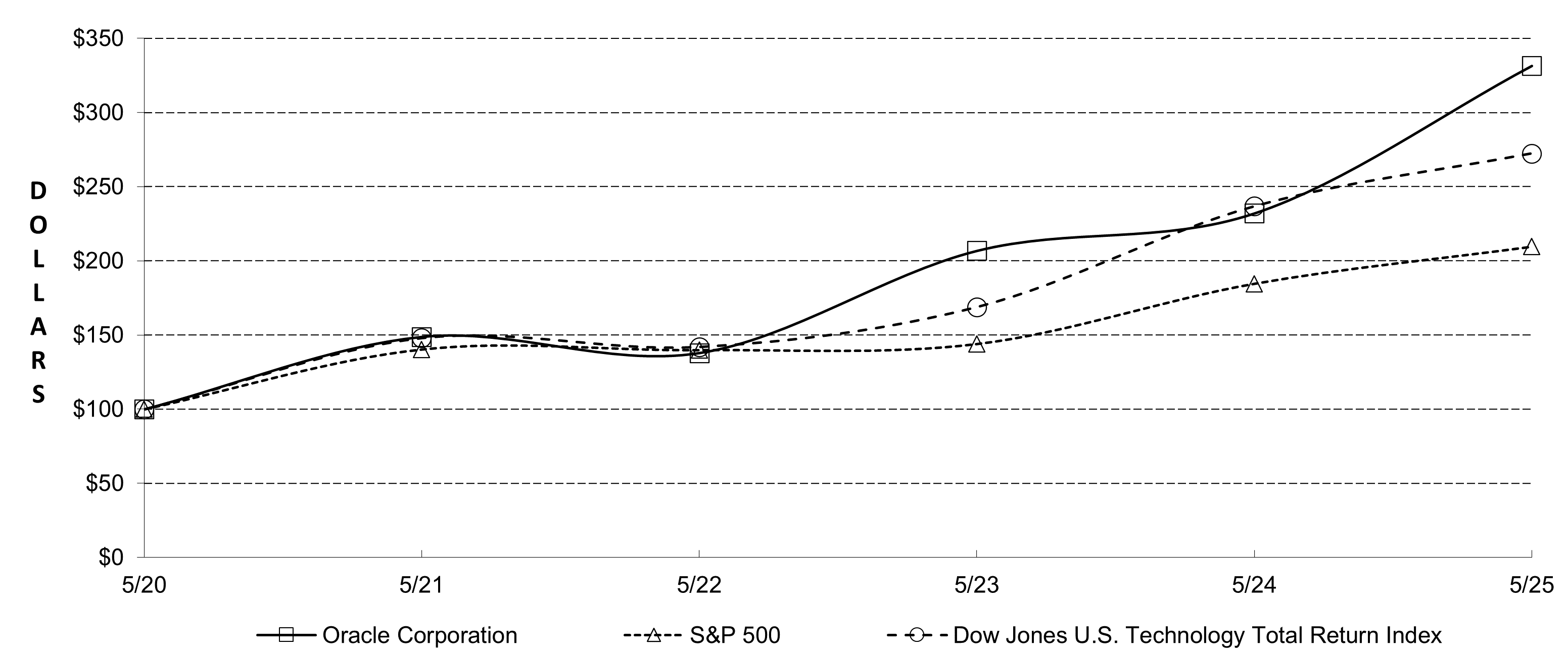]
*$100 INVESTED ON MAY 31, [removed: 2019] [added: 2020] IN STOCK OR
| Dow Jones U.S. Technology Total Return Index | | | 100.0 | | | | [removed: 139.1] [added: 148.0] | | | | [removed: 205.9] [added: 142.0] | | | | [removed: 197.5] [added: 168.9] | | | | [removed: 234.9] [added: 236.8] | | | | [removed: 329.3] [added: 272.4] | |
| March 1, 2025—March 31, 2025 | | | 0.3 | | | $ | 150.68 | | | | 0.3 | | | $ | 6,462.3 | |
| April 1, 2025—April 30, 2025 | | | 0.4 | | | $ | 133.53 | | | | 0.4 | | | $ | 6,412.3 | |
| May 1, 2025—May 31, 2025 | | | 0.3 | | | $ | 156.46 | | | | 0.3 | | | $ | 6,362.3 | |
| Total | | | 1.0 | | | $ | 146.22 | | | | 1.0 | | | | | |
[Table of Contents](#toc_page)
| | | 5/20 | | | | 5/21 | | | | 5/22 | | | | 5/23 | | | | 5/24 | | | | 5/25 | | |
| Oracle Corporation | | | 100.0 | | | | 148.8 | | | | 138.0 | | | | 206.8 | | | | 232.0 | | | | 331.5 | |
| S&P 500 Index | | | 100.0 | | | | 140.3 | | | | 139.9 | | | | 144.0 | | | | 184.6 | | | | 209.5 | |
| March 1, 2024—March 31, 2024 | | | 0.4 | | | $ | 121.76 | | | | 0.4 | | | $ | 7,065.6 | |
| April 1, 2024—April 30, 2024 | | | 0.4 | | | $ | 119.95 | | | | 0.4 | | | $ | 7,014.0 | |
| May 1, 2024—May 31, 2024 | | | 0.4 | | | $ | 119.69 | | | | 0.4 | | | $ | 6,962.3 | |
| Total | | | 1.2 | | | $ | 120.42 | | | | 1.2 | | | | | |
[Index to Financial Statements](#item_15_exhibits_financial_statement_sch)
| | | 5/19 | | | | 5/20 | | | | 5/21 | | | | 5/22 | | | | 5/23 | | | | 5/24 | | |
| Oracle Corporation | | | 100.0 | | | | 108.1 | | | | 161.0 | | | | 149.2 | | | | 223.6 | | | | 250.9 | |
| S&P 500 Index | | | 100.0 | | | | 112.8 | | | | 158.3 | | | | 157.9 | | | | 162.5 | | | | 208.3 | |
Item 6. [Reserved]
0 rewritten, 1 added, 1 removed, 0 unchanged
[Table of Contents](#toc_page)
[Index to Financial Statements](#item_15_exhibits_financial_statement_sch)
Item 9A. Controls and Procedures
5 rewritten, 1 added, 2 removed, 17 unchanged
Based on our management’s evaluation (with the participation of our Principal Executive and Financial Officer), as of the end of the period covered by this report, our Principal Executive and Financial Officer has concluded that our disclosure controls and procedures were effective as of May 31, [removed: 2024] [added: 2025] to provide reasonable assurance that information required to be disclosed by us in reports that we file or submit under the Exchange Act is (i) recorded, processed, summarized and reported within the time periods specified in the SEC rules and forms and (ii) accumulated and communicated to our management, including our Principal Executive and Financial Officer as appropriate to allow timely decisions regarding required disclosure.
Under the supervision and with the participation of our management, including our Principal Executive and Financial Officer, we conducted an evaluation of the effectiveness of our internal control over financial reporting as of May 31, [removed: 2024] [added: 2025] based on the guidelines established in *Internal Control—Integrated Framework* issued by the Committee of Sponsoring Organizations of the Treadway Commission’s 2013 framework.
Based on the results of our evaluation, our management concluded that our internal control over financial reporting was effective as of May 31, [removed: 2024.][added: 2025.]
We reviewed the results of management’s assessment with [removed: our Finance and Audit] [added: the F&A] Committee.
The effectiveness of our internal control over financial reporting as of May 31, [removed: 2024] [added: 2025] has been audited by Ernst & Young LLP, an independent registered public accounting firm, as stated in their report which is included in Part IV, Item 15 of this Annual Report.
[Table of Contents](#toc_page)
[Index to Financial Statements](#item_15_exhibits_financial_statement_sch)
PART III
Item 9B. . Other Information
0 rewritten, 2 added, 0 removed, 0 unchanged
New section this year
Rule 10b5-1 Trading Plans
During the quarter ended May 31, 2025, none of our directors or officers (as defined in Rule 16a-1(f) of the Exchange Act) adopted or terminated a “Rule 10b5-1 trading arrangement” or “non-Rule 10b5-1 trading arrangement,” as those terms are defined in Item 408 of Regulation S-K.
Item 9C. . Disclosure Regarding Foreign Jurisdictions that Prevent Inspections
0 rewritten, 3 added, 0 removed, 0 unchanged
New section this year
Not applicable.
[Table of Contents](#toc_page)
PART III
Item 10. Directors, Executive Officers and Corporate Governance
1 rewritten, 0 added, 0 removed, 1 unchanged
The other information required by this Item 10 is incorporated herein by reference from the information contained in our Proxy Statement to be filed with the SEC in connection with the solicitation of proxies for our [removed: 2024] [added: 2025] Annual Meeting of Stockholders [removed: (2024] [added: (2025] Proxy Statement).
Item 11. Executive Compensation
1 rewritten, 0 added, 0 removed, 0 unchanged
The information required by this Item 11 is incorporated herein by reference from the information to be contained in our [removed: 2024] [added: 2025] Proxy Statement.
Item 12. Security Ownership of Certain Beneficial Owners and Management and Related Stockholder Matters
1 rewritten, 0 added, 0 removed, 0 unchanged
The information required by this Item 12 is incorporated herein by reference from the information to be contained in our [removed: 2024] [added: 2025] Proxy Statement.
Item 13. Certain Relationships and Related Transactions, and Director Independence
1 rewritten, 0 added, 0 removed, 0 unchanged
The information required by this Item 13 is incorporated herein by reference from the information to be contained in our [removed: 2024] [added: 2025] Proxy Statement.
Item 14. Principal Accountant Fees and Services
1 rewritten, 1 added, 1 removed, 1 unchanged
The information required by this Item 14 is incorporated herein by reference from the information to be contained in our [removed: 2024] [added: 2025] Proxy Statement.
[Table of Contents](#toc_page)
[Index to Financial Statements](#item_15_exhibits_financial_statement_sch)
Item 15. Exhibits and Financial Statement Schedules
575 rewritten, 227 added, 144 removed, 847 unchanged
| [Reports of Independent Registered Public Accounting Firm](#report_independent_registered_public_acc) (PCAOB ID: 42) | | [removed: 62] [added: 61] |
| [Balance Sheets as of May 31, [removed: 2024] [added: 2025] and [removed: 2023](#consolidated_balance_sheets)] [added: 2024](#consolidated_balance_sheets)] | | [removed: 65] [added: 64] |
| [Statements of Operations for the years ended May 31, [removed: 2024, 2023] [added: 2025, 2024] and [removed: 2022](#consolidated_statements_operations)] [added: 2023](#consolidated_statements_operations)] | | [removed: 66] [added: 65] |
| [Statements of Comprehensive Income for the years ended May 31, [removed: 2024, 2023] [added: 2025, 2024] and [removed: 2022](#consolidated_statements_comprehensive_in)] [added: 2023](#consolidated_statements_comprehensive_in)] | | [removed: 67] [added: 66] |
| [Statements of Stockholders’ Equity [removed: (Deficit)] for the years ended May 31, [removed: 2024, 2023] [added: 2025, 2024] and [removed: 2022](#consolidated_statements_equity)] [added: 2023](#consolidated_statements_equity)] | | [removed: 68] [added: 67] |
| [Statements of Cash Flows for the years ended May 31, [removed: 2024, 2023] [added: 2025, 2024] and [removed: 2022](#consolidated_statements_cash_flows)] [added: 2023](#consolidated_statements_cash_flows)] | | [removed: 69] [added: 68] |
| [Notes to Consolidated Financial Statements](#n1_organization_significant_accounting_p) | | [removed: 70] [added: 69] |
The information required by this Item is set forth in the Index of Exhibits that is after Item 16 of this Annual [removed: Report.][added: Report on Form 10-K.]
We have audited the accompanying consolidated balance sheets of Oracle Corporation (the Company) as of May 31, [removed: 2024] [added: 2025] and [removed: 2023,] [added: 2024,] the related consolidated statements of operations, comprehensive income, stockholders’ equity [removed: (deficit)] and cash flows for each of the three years in the period ended May 31, [removed: 2024,] [added: 2025,] and the related notes (collectively referred to as the “consolidated financial statements”).
In our opinion, the consolidated financial statements present fairly, in all material respects, the financial position of the Company at May 31, [removed: 2024] [added: 2025] and [removed: 2023,] [added: 2024,] and the results of its operations and its cash flows for each of the three years in the period ended May 31, [removed: 2024,] [added: 2025,] in conformity with U.S. generally accepted accounting principles.
We also have audited, in accordance with the standards of the Public Company Accounting Oversight Board (United States) (PCAOB), the Company’s internal control over financial reporting as of May 31, [removed: 2024,] [added: 2025,] based on criteria established in Internal Control—Integrated Framework issued by the Committee of Sponsoring Organizations of the Treadway Commission (2013 framework), and our report dated June [removed: 20, 2024] [added: 18, 2025] expressed an unqualified opinion thereon.
The communication of the critical audit matter does not alter in any way our opinion on the consolidated financial statements, taken as a whole, and we are not, by communicating the critical audit matter below, providing a separate opinion on the critical audit matter or on the [removed: accounts] [added: account] or [removed: disclosures] [added: disclosure] to which it relates.
| | | [removed: Income] [added: Uncertain] Tax [removed: – Uncertain tax positions] [added: Positions] |
| *Description of the matter* | | As discussed in Note [removed: 13] [added: 12] of the consolidated financial statements, the Company recognizes uncertain tax positions and measures unrecognized tax benefits related to various domestic and foreign matters. The Company uses significant judgment in the accounting for uncertain tax positions related to certain [removed: revenue sharing] [added: intercompany transfer prices] and [removed: cost reimbursement arrangements,] [added: calculations,] including the interpretation and application of tax laws and legal rulings in various jurisdictions. Auditing management’s evaluation of whether an uncertain tax position is more likely than not to be sustained and the measurement of the benefit of [removed: uncertain] [added: various] tax positions [removed: related to certain revenue sharing and cost reimbursement arrangements] was complex, involved significant judgment, and was based on interpretations and application of tax laws and legal rulings. |
| *How we addressed the matter in our audit* | | We obtained an understanding, evaluated the design, and tested the operating effectiveness of the controls over management’s process [removed: for interpretation and application] [added: to assess the technical merits] of [added: the Company’s] tax [removed: laws] [added: positions related to certain intercompany transfer prices] and [removed: legal rulings, as well as development of the assumptions] [added: calculations, including ongoing monitoring activities,] and [removed: estimates used in] [added: management’s process to measure] the [removed: measurement] [added: benefit] of [removed: these] [added: those tax] positions. To test management’s assessment of these uncertain tax positions, we performed audit procedures that included, among others, evaluating management’s assumptions and analysis which detailed the basis and technical merits of the uncertain tax positions. We involved our tax subject matter professionals in assessing the technical merits of these positions and used our knowledge of relevant tax laws and experience with related taxing authorities. [removed: In addition, we also evaluated the Company’s disclosures in relation to these matters included in Note 13 of the consolidated financial statements.] |
We have audited Oracle Corporation’s internal control over financial reporting as of May 31, [removed: 2024,] [added: 2025,] based on criteria established in Internal Control—Integrated Framework issued by the Committee of Sponsoring Organizations of the Treadway Commission (2013 framework) (the COSO criteria).
In our opinion, Oracle Corporation (the Company) maintained, in all material respects, effective internal control over financial reporting as of May 31, [removed: 2024,] [added: 2025,] based on the COSO criteria.
We also have audited, in accordance with the standards of the Public Company Accounting Oversight Board (United States) (PCAOB), the consolidated balance sheets of the Company as of May 31, [removed: 2024] [added: 2025] and [removed: 2023,] [added: 2024,] the related consolidated statements of operations, comprehensive income, stockholders’ equity [removed: (deficit)] and cash flows for each of the three years in the period ended May 31, [removed: 2024,] [added: 2025,] and the related notes and our report dated June [removed: 20, 2024] [added: 18, 2025] expressed an unqualified opinion thereon.
As of May 31, [removed: 2024] [added: 2025] and [removed: 2023][added: 2024]
| (in millions, except per share data) | | [added: 2025 | | | |] 2024 | | | | 2023 | | |
| Cash and cash equivalents | | $ | [removed: 10,454] [added: 10,786] | | | $ | [removed: 9,765] [added: 10,454] | |
| Marketable securities | | | [removed: 207] [added: 417] | | | | [removed: 422] [added: 207] | |
| Trade receivables, net of allowances for credit losses of [removed: $485] [added: $557] and [removed: $428] [added: $485] as of May 31, [removed: 2024] [added: 2025] and May 31, [removed: 2023,] [added: 2024,] respectively | | | [removed: 7,874] [added: 8,558] | | | | [removed: 6,915] [added: 7,874] | |
| Prepaid expenses and other current assets | | | [removed: 4,019] [added: 4,818] | | | | [removed: 3,902] [added: 4,019] | |
| Total current assets | | | [removed: 22,554] [added: 24,579] | | | | [removed: 21,004] [added: 22,554] | |
| Property, plant and equipment, net | | | [removed: 21,536] [added: 43,522] | | | | [removed: 17,069] [added: 21,536] | |
| Intangible assets, net | | | [removed: 6,890] [added: 4,587] | | | | [removed: 9,837] [added: 6,890] | |
| [removed: Goodwill, net] [added: Goodwill] | | | [removed: 62,230] [added: 62,207] | | | | [removed: 62,261] [added: 62,230] | |
| Deferred tax assets | | | [removed: 12,273] [added: 11,877] | | | | [removed: 12,226] [added: 12,273] | |
| Other non-current assets | | | [removed: 15,493] [added: 21,589] | | | | [removed: 11,987] [added: 15,493] | |
| Total non-current assets | | | [removed: 118,422] [added: 143,782] | | | | [removed: 113,380] [added: 118,422] | |
| Total assets | | $ | [removed: 140,976] [added: 168,361] | | | $ | [removed: 134,384] [added: 140,976] | |
| Notes payable and other borrowings, current | | $ | [removed: 10,605] [added: 7,271] | | | $ | [removed: 4,061] [added: 10,605] | |
| Accounts payable | | | [removed: 2,357] [added: 5,113] | | | | [removed: 1,204] [added: 2,357] | |
| Accrued compensation and related benefits | | | [removed: 1,916] [added: 2,243] | | | | [removed: 2,053] [added: 1,916] | |
| Deferred revenues | | | [removed: 9,313] [added: 9,387] | | | | [removed: 8,970] [added: 9,313] | |
| Other current liabilities | | | [removed: 7,353] [added: 8,629] | | | | [removed: 6,802] [added: 7,353] | |
| Total current liabilities | | | [removed: 31,544] [added: 32,643] | | | | [removed: 23,090] [added: 31,544] | |
| Notes payable and other borrowings, non-current | | | [removed: 76,264] [added: 85,297] | | | | [removed: 86,420] [added: 76,264] | |
| Income taxes payable | | | [removed: 10,817] [added: 10,269] | | | | [removed: 11,077] [added: 10,817] | |
[Table of Contents](#toc_page)
[Table of Contents](#toc_page)
June 18, 2025
[Table of Contents](#toc_page)
June 18, 2025
[Table of Contents](#toc_page)
| (in millions, except per share data) | | 2025 | | | | 2024 | | |
| Operating lease liabilities | | | 11,536 | | | | 6,255 | |
[Table of Contents](#toc_page)
[Table of Contents](#toc_page)
For the Years Ended May 31, 2025, 2024 and 2023
| Net income | | $ | 12,443 | | | $ | 10,467 | | | $ | 8,503 | |
[Table of Contents](#toc_page)
For the Years Ended May 31, 2025, 2024 and 2023
| Repurchases of common stock | | | (4 | ) | | | (47 | ) | | | (553 | ) | | | — | | | | (600 | ) | | | — | | | | (600 | ) |
| Other comprehensive income, net | | | — | | | | — | | | | — | | | | 257 | | | | 257 | | | | 27 | | | | 284 | |
| Balances as of May 31, 2025 | | | 2,807 | | | $ | 37,107 | | | $ | (15,481 | ) | | $ | (1,175 | ) | | $ | 20,451 | | | $ | 518 | | | $ | 20,969 | |
[Table of Contents](#toc_page)
For the Years Ended May 31, 2025, 2024 and 2023
| Net income | | $ | 12,443 | | | $ | 10,467 | | | $ | 8,503 | |
[Table of Contents](#toc_page)
May 31, 2025
Certain prior year balances have been reclassified to conform to the current year presentation.
Such reclassifications did not affect revenue, income from operations or net income.
In fiscal 2025, we adopted Accounting Standards Update (ASU) 2023-07, *Segment Reporting (Topic 280): Improvements to Reportable Segment Disclosures* (ASU 2023-07), which did not have a material impact on our consolidated financial statements for the year ended May 31, 2025.
[Table of Contents](#toc_page)
During the first quarter of fiscal 2025, we completed an assessment of the useful lives of our servers and networking equipment and increased the estimate of the useful lives from five years to six years, effective at the beginning of fiscal 2025.
Based on the carrying value of our servers and networking equipment as of May 31, 2024, this change in accounting estimate decreased our total operating expenses by $733 million and increased our net income by $573 million, or $0.21 per basic and $0.20 per diluted share, during fiscal 2025.
[Table of Contents](#toc_page)
[Table of Contents](#toc_page)
[Table of Contents](#toc_page)
We have elected the optional exemption to not disclose the variable consideration for contracts in which the variable consideration expected to be received over the duration of the contract is allocated entirely to the wholly unsatisfied performance obligations.
A liability
[Table of Contents](#toc_page)
Our debt investments in Ampere are in the form of convertible debt which, under the terms of an
[Table of Contents](#toc_page)
On March 19, 2025, SoftBank Group Corp. announced that it had entered into an agreement with Ampere and its equity holders to acquire all of the equity interests of Ampere (the Ampere Acquisition).
The transaction is subject to customary closing conditions, including regulatory approvals.
When the Ampere Acquisition closes, we will cease to be an investor in Ampere.
During the period prior to the closing of the Ampere Acquisition, we will continue to recognize our share of loss in Ampere’s net earnings until the closure of the acquisition.
[Index to Financial Statements](#item_15_exhibits_financial_statement_sch)
June 20, 2024
(1)
| Balances as of May 31, 2021 | | | 2,814 | | | $ | 26,533 | | | $ | (20,120 | ) | | $ | (1,175 | ) | | $ | 5,238 | | | $ | 714 | | | $ | 5,952 | |
| Repurchases of common stock | | | (186 | ) | | | (1,723 | ) | | | (14,477 | ) | | | — | | | | (16,200 | ) | | | — | | | | (16,200 | ) |
| Other, net | | | — | | | | (4 | ) | | | 1 | | | | — | | | | (3 | ) | | | (396 | ) | | | (399 | ) |
| Other comprehensive loss, net | | | — | | | | — | | | | — | | | | (517 | ) | | | (517 | ) | | | (50 | ) | | | (567 | ) |
The comparability of our consolidated financial statements as of and for the year ended May 31, 2022 was impacted by $4.7 billion of certain litigation related charges during fiscal 2022.
During the first quarter of fiscal 2024, we finalized our adoption of Accounting Standards Update (ASU) 2020-04, *Reference Rate Reform (Topic 848): Facilitation of the Effects of Reference Rate Reform on Financial Reporting* and subsequent amendments to the initial guidance, which had no material impact to our consolidated financial statements or notes thereto for the year ended May 31, 2024.
dictated by GAAP and does not require management’s judgment in its application.
Our investments in non-marketable debt instruments are recorded at cost plus accrued interest, adjusted for any provision for expected credit losses.
We also have
If either of such options is exercised by us or our co-investors, we would obtain control of Ampere and consolidate its results with our results of operations.
Ampere has historically generated net losses.
future demand within specific time horizons.
required.
Cash flow movements related to our lease activities are included in prepaid expenses and other assets and accounts payable and other liabilities as presented in net cash
income taxes in such period.
For fiscal 2022, acquisition related and other expenses included certain litigation related charges.
more than 50% likely to be realized upon ultimate settlement.
Early adoption is permitted.
ACQUISITIONS
Fiscal 2023 Acquisition of Cerner Corporation
On June 8, 2022, we completed our acquisition of Cerner Corporation (Cerner), a provider of digital information systems used within hospitals and health systems that are designed to enable medical professionals to deliver better healthcare to individual patients and communities.
The total purchase price for Cerner was $28.2 billion, which consisted of $28.2 billion in cash and $55 million for the fair values of restricted stock-based awards and stock options assumed.
In allocating the purchase price based on estimated fair values, we recorded approximately $18.6 billion of goodwill, $12.0 billion of identifiable intangible assets and $2.4 billion of net tangible liabilities.
Goodwill recognized as a part of our acquisition of Cerner was not deductible for income tax purposes.
Other Fiscal 2024, 2023 and 2022 Acquisitions
During fiscal 2024, 2023 and 2022, we acquired certain other companies and purchased certain technology and development assets primarily to expand our products and services offerings.
These acquisitions were not significant individually or in the aggregate to our consolidated financial statements.
insignificant for fiscal 2024, 2023 and 2022.
| | | | | | | | | | | | | | | | | | | | | | | | | | | | | | | | | | | | | | | | | | | | | |
| --- | --- | --- | --- | --- | --- | --- | --- | --- | --- | --- | --- | --- | --- | --- | --- | --- | --- | --- | --- | --- | --- | --- | --- | --- | --- | --- | --- | --- | --- | --- | --- | --- | --- | --- | --- | --- | --- | --- | --- | --- | --- | --- | --- | --- |
| Developed technology | | $ | 4,300 | | | $ | 59 | | | $ | (124 | ) | | $ | 4,235 | | | $ | (2,407 | ) | | $ | (676 | ) | | $ | 124 | | | $ | (2,959 | ) | | $ | 1,893 | | | $ | 1,276 | | | | 3 | |
| Other | | | 3,582 | | | | 4 | | | | (53 | ) | | | 3,533 | | | | (1,506 | ) | | | (841 | ) | | | 53 | | | | (2,294 | ) | | | 2,076 | | | | 1,239 | | | N.A. | | |
Represents weighted-average useful lives (in years) of intangible assets acquired during fiscal 2024.
| | | | | |
| --- | --- | --- | --- | --- |
| Thereafter | | | 1,080 | |
| Balances as of May 31, 2022 | | $ | 39,938 | | | $ | 2,367 | | | $ | 1,506 | | | $ | 43,811 | |
An excerpt. Shown here: 40 of 575 rewritten, 40 of 227 added and 40 of 144 removed. The counts are complete. For every sentence, read Item 15. Exhibits and Financial Statement Schedules in the FY2025 filing and the FY2024 filing.