 filings.tools
Prologis 10-K 2021-12-31
Filed 2022-02-09. 23 sections, 546K characters. Original on sec.gov · Markdown · JSON
Cover and table of contents
UNITED STATES SECURITIES AND EXCHANGE COMMISSION
Washington, D.C. 20549
FORM 10-K
(Mark One)
| ☑ | ANNUAL REPORT PURSUANT TO SECTION 13 OR 15(d) OF THE SECURITIES EXCHANGE ACT OF 1934 |
|---|
For the fiscal year ended December 31, 2021
or
| ☐ | TRANSITION REPORT PURSUANT TO SECTION 13 OR 15(d) OF THE SECURITIES EXCHANGE ACT OF 1934 |
|---|
For the transition period from ______________ to ______________
Commission File Number: 001-13545 (Prologis, Inc.) 001-14245 (Prologis, L.P.)

Prologis, Inc.
Prologis, L.P.
(Exact name of registrant as specified in its charter)
| Maryland (Prologis, Inc.) Delaware (Prologis, L.P.) | 94-3281941 (Prologis, Inc.) 94-3285362 (Prologis, L.P.) | |
| (State or other jurisdiction of incorporation or organization) | (I.R.S. Employer Identification No.) | |
| Pier 1, Bay 1, San Francisco, California | 94111 | |
| (Address or principal executive offices) | (Zip Code) |
(415) 394-9000
(Registrants’ telephone number, including area code)
(Former name, former address and former fiscal year, if changed since last report)
Securities registered pursuant to Section 12(b) of the Act:
| Title of Each Class | Trading Symbol(s) | Name of Each Exchange on Which Registered | ||||
|---|---|---|---|---|---|---|
| Prologis, Inc. | Common Stock, $0.01 par value | PLD | New York Stock Exchange | |||
| Prologis, L.P. | 3.000% Notes due 2026 | PLD/26 | New York Stock Exchange | |||
| Prologis, L.P. | 2.250% Notes due 2029 | PLD/29 | New York Stock Exchange | |||
Securities registered pursuant to Section 12(g) of the Act:
Prologis, Inc. – NONE
Prologis, L.P. – NONE
Indicate by check mark if the registrant is a well-known seasoned issuer, as defined in Rule 405 of the Securities Act.
| Prologis, Inc.: Yes ☑ No ☐ | Prologis, L.P.: Yes ☑ No ☐ |
Indicate by check mark if the registrant is not required to file reports pursuant to Section 13 or Section 15(d) of the Act.
| Prologis, Inc.: Yes ☐ No ☑ | Prologis, L.P.: Yes ☐ No ☑ | |
| Indicate by check mark whether the registrant: (1) has filed all reports required to be filed by Section 13 or 15(d) of the Securities Exchange Act of 1934 during the preceding 12 months (or for such shorter period that the registrant was required to file such reports), and (2) has been subject to such filing requirements for the past 90 days. Prologis, Inc.: Yes ☑ No ☐ Prologis, L.P.: Yes ☑ No ☐ | ||
| Indicate by check mark whether the registrant has submitted electronically every Interactive Data File required to be submitted pursuant to Rule 405 of Regulation S-T during the preceding 12 months (or for such shorter periods that the registrant was required to submit such files). Prologis, Inc.: Yes ☑ No ☐ Prologis, L.P.: Yes ☑ No ☐ |
Indicate by check mark whether the registrant is a large accelerated filer, an accelerated filer, a non-accelerated filer, a smaller reporting company, or an emerging growth company. See the definitions of “large accelerated filer,” “accelerated filer,” “smaller reporting company,” and “emerging growth company” in Rule 12b-2 of the Exchange Act (check one):
| Prologis, Inc.: | ☑ | Large accelerated filer | ☐ | Accelerated filer | ☐ | Smaller reporting company |
|---|---|---|---|---|---|---|
| ☐ | Non-accelerated filer | ☐ | Emerging growth company |
| Prologis, L.P.: | ☐ | Large accelerated filer | ☐ | Accelerated filer | ☐ | Smaller reporting company |
|---|---|---|---|---|---|---|
| ☑ | Non-accelerated filer | ☐ | Emerging growth company |
If an emerging growth company, indicate by check mark if the registrant has elected not to use the extended transition period for complying with any new or revised financial accounting standards provided pursuant to Section 13(a) of the Exchange Act. ☐
Indicate by check mark whether the registrant has filed a report on and attestation to its management’s assessment of the effectiveness of its internal control over financial reporting under Section 404(b) of the Sarbanes-Oxley Act (15 U.S.C. 7262(b)) by the registered public accounting firm that prepared or issued its audit report. ☑
Indicate by check mark whether the registrant is a shell company (as defined in Rule 12b-2 of the Securities Exchange Act of 1934).
| Prologis, Inc.: Yes ☐ No ☑ | Prologis, L.P.: Yes ☐ No ☑ |
Based on the closing price of Prologis, Inc.’s common stock on June 30, 2021, the aggregate market value of the voting common equity held by nonaffiliates of Prologis, Inc. was $87,997,816,686.
The number of shares of Prologis, Inc.’s common stock outstanding at February 7, 2022, was approximately 740,000,000.
DOCUMENTS INCORPORATED BY REFERENCE
Portions of Part III of this report are incorporated by reference to the registrant’s definitive proxy statement for the 2021 annual meeting of its stockholders or will be provided in an amendment filed on Form 10-K/A.
Auditor Name: KPMG LLP Auditor Location: Denver, CO Auditor Firm ID: 185
EXPLANATORY NOTE
This report combines the annual reports on Form 10-K for the year ended December 31, 2021, of Prologis, Inc. and Prologis, L.P. Unless stated otherwise or the context otherwise requires, references to “Prologis, Inc.” or the “Parent” mean Prologis, Inc. and its consolidated subsidiaries; and references to “Prologis, L.P.” or the “Operating Partnership” or the “OP” mean Prologis, L.P., and its consolidated subsidiaries. The terms “the Company,” “Prologis,” “we,” “our” or “us” means the Parent and the OP collectively.
The Parent is a real estate investment trust (a “REIT”) and the general partner of the OP. At December 31, 2021, the Parent owned 97.32% common general partnership interest in the OP and substantially all of the preferred units in the OP. The remaining 2.68% common limited partnership interests are owned by unaffiliated investors and certain current and former directors and officers of the Parent.
We operate the Parent and the OP as one enterprise. The management of the Parent consists of the same members as the management of the OP. These members are officers of the Parent and employees of the OP or one of its subsidiaries. As sole general partner, the Parent has control of the OP through complete responsibility and discretion in the day-to-day management and therefore, consolidates the OP for financial reporting purposes. Because the only significant asset of the Parent is its investment in the OP, the assets and liabilities of the Parent and the OP are the same on their respective financial statements.
We believe combining the annual reports on Form 10-K of the Parent and the OP into this single report results in the following benefits:
| • | enhances investors’ understanding of the Parent and the OP by enabling investors to view the business as a whole in the same manner as management views and operates the business; |
|---|
| • | eliminates duplicative disclosure and provides a more streamlined and readable presentation as a substantial portion of the Company’s disclosure applies to both the Parent and the OP; and |
|---|
| • | creates time and cost efficiencies through the preparation of one combined report instead of two separate reports. |
|---|
It is important to understand the few differences between the Parent and the OP in the context of how we operate the Company. The Parent does not conduct business itself, other than acting as the sole general partner of the OP and issuing public equity from time to time. The OP holds substantially all the assets of the business, directly or indirectly. The OP conducts the operations of the business and is structured as a partnership with no publicly traded equity. Except for net proceeds from equity issuances by the Parent, which are contributed to the OP in exchange for partnership units, the OP generates capital required by the business through the OP’s operations, incurrence of indebtedness and issuance of partnership units to third parties.
The presentation of noncontrolling interests, stockholders’ equity and partners’ capital are the main areas of difference between the consolidated financial statements of the Parent and those of the OP. The differences in the presentations between stockholders’ equity and partners’ capital result from the differences in the equity and capital issuances in the Parent and in the OP.
The preferred stock, common stock, additional paid-in capital, accumulated other comprehensive income (loss) and distributions in excess of net earnings of the Parent are presented as stockholders’ equity in the Parent’s consolidated financial statements. These items represent the common and preferred general partnership interests held by the Parent in the OP and are presented as general partner’s capital within partners’ capital in the OP’s consolidated financial statements. The common limited partnership interests held by the limited partners in the OP are presented as noncontrolling interest within equity in the Parent’s consolidated financial statements and as limited partners’ capital within partners’ capital in the OP’s consolidated financial statements.
To highlight the differences between the Parent and the OP, separate sections in this report, as applicable, individually discuss the Parent and the OP, including separate financial statements and separate Exhibit 31 and 32 certifications. In the sections that combine disclosure of the Parent and the OP, this report refers to actions or holdings as being actions or holdings of Prologis.
TABLE OF CONTENTS
The statements in this report that are not historical facts are forward-looking statements within the meaning of Section 27A of the Securities Act of 1933, as amended, and Section 21E of the Securities Exchange Act of 1934, as amended. These forward-looking statements are based on current expectations, estimates and projections about the industry and markets in which we operate as well as management’s beliefs and assumptions. Such statements involve uncertainties that could significantly impact our financial results. Words such as “expects,” “anticipates,” “intends,” “plans,” “believes,” “seeks,” and “estimates” including variations of such words and similar expressions are intended to identify such forward-looking statements, which generally are not historical in nature. All statements that address operating performance, events or developments that we expect or anticipate will occur in the future — including statements relating to rent and occupancy growth, acquisition and development activity, contribution and disposition activity, general conditions in the geographic areas where we operate, our debt, capital structure and financial position, our ability to earn revenues from co-investment ventures, form new co-investment ventures and the availability of capital in existing or new co-investment ventures — are forward-looking statements. These statements are not guarantees of future performance and involve certain risks, uncertainties and assumptions that are difficult to predict. Although we believe the expectations reflected in any forward-looking statements are based on reasonable assumptions, we can give no assurance that our expectations will be attained, and therefore actual outcomes and results may differ materially from what is expressed or forecasted in such forward-looking statements. Some of the factors that may affect outcomes and results include, but are not limited to: (i) international, national, regional and local economic and political climates and conditions; (ii) changes in global financial markets, interest rates and foreign currency exchange rates; (iii) increased or unanticipated competition for our properties; (iv) risks associated with acquisitions, dispositions and development of properties, including increased development costs due to additional regulatory requirements related to climate change; (v) maintenance of Real Estate Investment Trust (“REIT”) status, tax structuring and changes in income tax laws and rates; (vi) availability of financing and capital, the levels of debt that we maintain and our credit ratings; (vii) risks related to our investments in our co-investment ventures, including our ability to establish new co-investment ventures; (viii) risks of doing business internationally, including currency risks; (ix) environmental uncertainties, including risks of natural disasters; (x) risks related to the coronavirus (“COVID-19”) pandemic; and (xi) those additional factors discussed under Part I, Item 1A. Risk Factors in this report. We undertake no duty to update any forward-looking statements appearing in this report except as may be required by law.
PART I
Item 1. Business
Prologis, Inc. is a self-administered and self-managed REIT and is the sole general partner of Prologis, L.P. through which it holds substantially all of its assets. We operate Prologis, Inc. and Prologis, L.P. as one enterprise and, therefore, our discussion and analysis refers to Prologis, Inc. and its consolidated subsidiaries, including Prologis, L.P. We invest in real estate through wholly owned subsidiaries and other entities through which we co-invest with partners and investors. We have a significant ownership interest in the co-investment ventures, which may be consolidated or unconsolidated based on our level of control of the entity.
Prologis, Inc. began operating as a fully integrated real estate company in 1997 and elected to be taxed as a REIT under the Internal Revenue Code of 1986, as amended (“Internal Revenue Code” or “IRC”). We believe the current organization and method of operation enable Prologis, Inc. to maintain its status as a REIT. Prologis, L.P. was also formed in 1997.
We operate and manage our business on an owned and managed (“O&M”) basis and therefore evaluate the operating performance of the properties for our O&M portfolio, which includes our consolidated properties and properties owned by our unconsolidated co-investment ventures. We make operating decisions based on our total O&M portfolio, as we manage the properties without regard to their ownership. We also evaluate our results based on our proportionate economic ownership of each property included in the O&M portfolio (“our share”) to reflect our share of the financial results of the O&M portfolio.
Included in our discussion below are references to funds from operations (“FFO”) and net operating income (“NOI”), neither of which are U.S. generally accepted accounting principles (“GAAP”). See Item 7. Management’s Discussion and Analysis of Financial Condition and Results of Operations for a reconciliation of Net Earnings Attributable to Common Stockholders/Unitholders in the Consolidated Statements of Income to our FFO measures and a reconciliation of NOI to Operating Income, the most directly comparable GAAP measures.
Our corporate headquarters is located at Pier 1, Bay 1, San Francisco, California 94111, and our other principal office locations are in Amsterdam, Denver, Mexico City, Shanghai, Singapore and Tokyo.
Our Internet address is www.prologis.com. All reports required to be filed with the Securities and Exchange Commission (“SEC”) are available and can be accessed free of charge through the Investor Relations section of our website. The common stock of Prologis, Inc. is listed on the New York Stock Exchange (“NYSE”) under the ticker “PLD” and is a component of the Standard & Poor’s (“S&P”) 500.
THE COMPANY
We are the global leader in logistics real estate with a focus on high-barrier, high growth markets. We own, manage and develop well-located, high-quality logistics facilities in 19 countries across four continents. Our portfolio focuses on the world’s most vibrant centers of commerce and our scale across these locations allows us to respond to our customers’ diverse logistics requirements. Our teams actively manage our portfolio to provide comprehensive real estate services, including leasing, property management, development, acquisitions and dispositions. Our property dispositions allow us to recycle capital and contribute to self-funding our development and acquisition activities.
With the broadening of e-commerce adoption driving requirements for increased warehouse space to store inventory, surging customer demand has continued to outpace supply. We believe this demand surge is driven by three primary factors: (i) overall consumption growth; (ii) customer supply chains still re-positioning to address the significant shift to e-commerce, as well as preparing for higher growth and service expectations; and (iii) our customers’ desire for more supply chain resiliency. With inventory-to-sales ratios below pre-pandemic levels, our customers not only need to restock for this shortfall, but build an additional safety stock. We believe these forces have placed a premium on speed-to-market and flexibility, driving demand for years to come.
The scale of our 1.0 billion square foot portfolio allows us to help our customers in a multitude of unique ways. We continue to focus on differentiated ways to meet our customers’ needs through our Prologis Essentials business. This program includes product and service solutions for our customers’ operations, workforce, energy, transportation and data and analytic needs. Our integrated suite of solutions allows our customers to benefit from our global scale, strategic partnerships with vendors and local expertise to obtain services and products more efficiently. We use our proprietary data and analytics to provide our customers actionable insights on everything from inventory, shipping, security, communications management and dock visibility.
Prologis Essentials has a strong sustainability component to its suite of services, which supports our customers’ progress toward their sustainability goals. This includes new development and redevelopment of buildings to specifications that align with leading sustainable building standards and implementation of energy solutions such as solar power and LED lighting. As we explore additional ways to deliver revenue-generating sustainability solutions, we created a new senior leadership role in 2021 – chief sustainability and energy officer. We also are anticipating the introduction of electric vehicle (“EV”) fleets in logistics and are making long-term investments in our portfolio and talent to be well prepared for the future of EV trucking and logistics.
At December 31, 2021, we owned or had investments in, on a wholly-owned basis or through ventures, properties and development projects (based on gross book value and total expected investment at completion, respectively) in the following geographies:
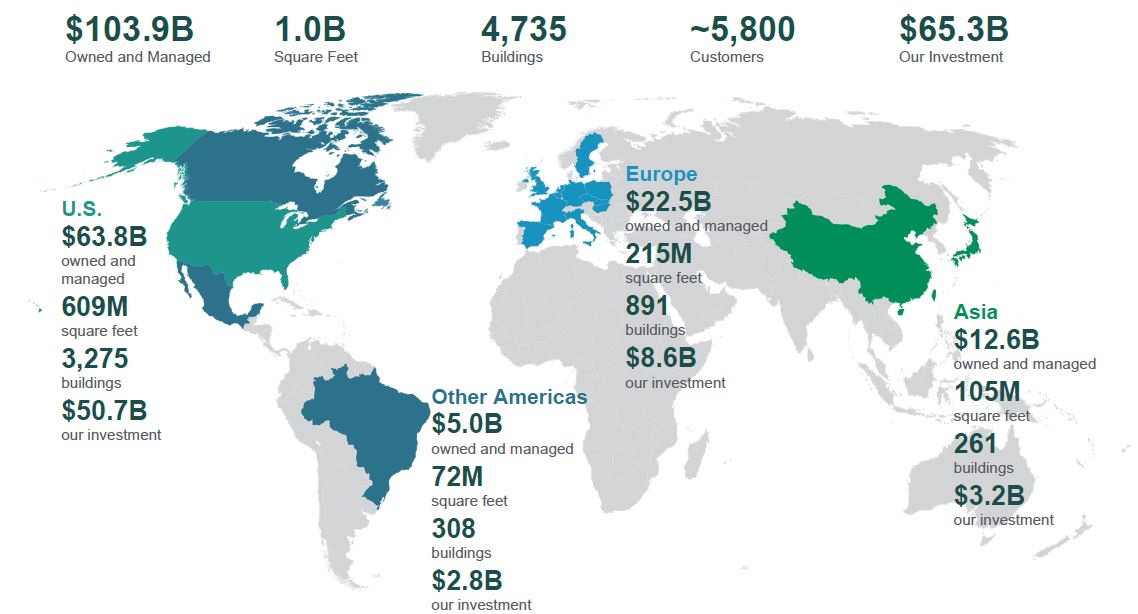
Throughout this discussion, we reflect amounts in the United States (“U.S.”) dollar, our reporting currency. Included in these amounts are consolidated and unconsolidated investments denominated in foreign currencies, principally the British pound sterling, Canadian dollar, euro and Japanese yen that are impacted by fluctuations in exchange rates when translated to U.S. dollars. We mitigate our exposure to foreign currency fluctuations by investing outside the U.S. through co-investment ventures, borrowing in the functional currency of our subsidiaries and utilizing derivative financial instruments.
OPERATING SEGMENTS
Our business comprises two operating segments: Real Estate Operations and Strategic Capital.
Below is information summarizing consolidated activity within our segments over the last three years (in millions):

| (1) | NOI from Real Estate Operations is calculated directly from our Consolidated Financial Statements as Rental Revenues and Development Management and Other Revenues less Rental Expenses and Other Expenses. NOI from Strategic Capital is calculated directly from our Consolidated Financial Statements as Strategic Capital Revenues less Strategic Capital Expenses. |
|---|
| (2) | A developed property moves into the operating portfolio when it meets our definition of stabilization, which is the earlier of when a property that was developed has been completed for one year, is contributed to a co-investment venture following completion or is 90% occupied. Amounts represent our total expected investment (“TEI”), which includes the estimated cost of development or expansion, land, construction and leasing costs. |
|---|
Real Estate Operations
Rental. Rental operations comprise the largest component of our operating segments and generally contribute 85% to 90% of our consolidated revenues, earnings and FFO. We collect rent from our customers through operating leases, including reimbursements for the majority of our property operating costs. For leases that commenced during 2021 within the consolidated operating portfolio, the weighted average lease term was 62 months. We expect to generate internal growth by increasing rents, maintaining high occupancy rates and controlling expenses. The primary driver of our revenue growth will be rolling in-place leases to current market rents as leases expire. We believe our active portfolio management, combined with the skills of our property, leasing, maintenance, capital, energy, sustainability and risk management teams allow us to maximize NOI across our portfolio. Substantially all of our consolidated rental revenue, NOI and cash flows are generated in the U.S.
Development. Given the scarcity of modern logistics facilities in our target markets, our development business provides the opportunity to build to our customers’ current and future requirements and deepen our market presence. We believe we have a competitive advantage due to (i) the strategic locations of our global land bank and redevelopment sites; (ii) the development expertise of our local teams; (iii) the depth of our customer relationships and (iv) our ability to integrate sustainable design features and practices, as detailed in our Environmental Stewardship, Social Responsibility and Governance section below, that result in cost-savings and operational efficiencies for our customers. Successful development and redevelopment efforts provide significant earnings growth as projects are leased, generate income and increase the net asset value of our Real Estate Operations segment. Generally, we develop properties in the U.S. for long-term hold and outside the U.S. for contribution to our unconsolidated co-investment ventures.
Strategic Capital
Our strategic capital segment allows us to partner with many of the world’s largest institutional investors. We capitalize our business through private equity, principally perpetual open-ended or long-term ventures, and two publicly traded vehicles: Nippon Prologis REIT, Inc. in Japan and FIBRA Prologis in Mexico. We align our interests with our partners by holding significant ownership interests in all of our eight unconsolidated co-investment ventures (ranging from 15% to 50%). This structure allows us to reduce our exposure to foreign currency movements for investments outside the U.S.
This segment produces durable, long-term cash flows and generally contributes 10% to 15% of our recurring consolidated revenues, earnings and FFO. We generate strategic capital revenues from our unconsolidated co-investment ventures, principally through asset management and property management services. Asset management fees are primarily driven by the real estate valuation of the respective ventures. We earn additional revenues by providing leasing, acquisition, construction management, development and disposition services. In certain ventures, we also have the ability to earn revenues through incentive fees (“promotes” or “promote revenues”) periodically during the life of a venture or upon liquidation based primarily on the appreciation of the portfolio. We plan to profitably grow this business by increasing our assets under management in existing or new ventures. Most of the strategic capital revenues are generated outside the U.S.
FUTURE GROWTH
We believe the quality and scale of our global portfolio, our ability to build out the global land bank, our strategic capital business, the expertise of our team, the depth of our customer relationships and the strength of our balance sheet are differentiators that allow us to drive growth in revenues, NOI, earnings, FFO and cash flows.

| • | Rent Growth. We expect rents in our markets to continue to increase due to the demand for the location and quality of our properties. In addition, due to strong market rent growth over the last several years, our in-place leases have considerable upside potential to drive future incremental organic NOI growth. We estimate that our net effective lease mark-to-market is approximately 36%, which represents the growth rate from in-place rents to market rents based on our weighted average ownership of the O&M portfolio at December 31, 2021. Therefore, even if market rent growth is flat in the future, we expect our lease renewals to translate into significant increases in future rental income, on a consolidated basis or through the earnings we recognize from our unconsolidated co-investment ventures based on our ownership. We have experienced positive rent change on rollover (comparing the net effective rent (“NER”) of the new lease to the prior lease for the same space) in every quarter since 2013. |
|---|
| • | Value Creation from Development. A successful development and redevelopment program requires maintaining control of well-located land and redevelopment sites and sourcing a future pipeline through acquisition opportunities, including our innovative approach with Covered Land Plays, which are income generating assets acquired with the intention to redevelop for higher and better use as industrial properties. The global nature of our development program is a wide landscape of opportunities to pursue based on our judgement of market conditions, opportunities and risks. We believe that the carrying value of our global land bank is meaningfully below its current fair value. Due to the strategic nature of our global land bank, development expertise of our teams and strength of our customer relationships, we expect to create value as we build new properties. |
|---|
We are able to maintain strong margins despite rising construction costs, as we experienced in 2021, due to our procurement activities that mitigate a portion of the inflationary increases, as well as rising market rents. We measure the estimated value creation of a development project as the margin above our TEI. Based on our current estimates, our consolidated land, including options and Covered Land Plays, has the potential to support the development of $22.2 billion ($26.4 billion on an O&M basis) of TEI of new logistics space. As properties stabilize, we expect to realize the value creation principally through contributions to unconsolidated co-investment ventures and increases in the NOI of the consolidated portfolio. Our current investment in the development portfolio was $2.7 billion and we expect our development activities to increase in 2022.
| • | Strategic Capital Advantages. We continue to successfully raise capital to propel the long-term growth of the co-investment ventures while maintaining our substantial investments in these vehicles. At December 31, 2021, the gross book value of the operating portfolio held by our eight unconsolidated co-investment ventures was $45.3 billion across 456 million square feet. During 2021, the valuations of the real estate portfolios owned by the unconsolidated co-investment ventures increased significantly, resulting in higher asset management fees. We expect that continued market rent growth will result in an increase in the asset valuations of the unconsolidated co-investment ventures, which will drive significant returns to the investors and increase the potential for earning promote revenues over the next couple of years. Our Strategic Capital business generates durable fee streams, with asset management fees marked to fair values each quarter, all while requiring minimal capital other than our investment in the venture. |
|---|

| (1) | General and Administrative (“G&A”) Expenses is a line item in the Consolidated Financial Statements. Adjusted G&A expenses is calculated from our Consolidated Financial Statements as G&A Expenses and Strategic Capital Expenses, less expenses under the Prologis Promote Plan (“PPP”) and property-level management expenses for the properties owned by the ventures. |
|---|
| • | Balance Sheet Strength. We continue to seek and execute on opportunities to refinance debt at historically low rates. Our financing activities over the last three years resulted in extending our consolidated weighted average remaining maturity from 6 to 10 years and lowering our weighted average effective interest rate from 2.7% to 1.6% at January 1, 2019 and December 31, 2021, respectively. At December 31, 2021, we had total available liquidity of $5.0 billion and continue to maintain low leverage as a percentage of our real estate investments and our market capitalization. As a result of our low leverage, available liquidity and investment capacity in the co-investment ventures, we have significant capacity to capitalize on value-added investment opportunities that will translate into future earnings growth. |
|---|
| • | Economies of Scale from Growth. We have scalable systems and infrastructure in place to grow both our consolidated and O&M portfolios with limited incremental G&A expense. We believe we can continue to grow NOI and strategic capital revenues organically and through accretive development and acquisition activity while further reducing G&A as a percentage of our investments in real estate. We use adjusted G&A expenses as a percentage of the O&M portfolio (based on gross book value) to measure and evaluate our overhead costs. As shown in the graph above, the acquisitions of Liberty Property Trust and Liberty Property Limited Partnership (collectively “Liberty” or the “Liberty Transaction”) and Industrial Property Trust Inc. (“IPT” or the “IPT Transaction”) in 2020 are key examples of this effort, where we increased our investments in real estate in the O&M portfolio by over 20% and had minimal increases to G&A expenses, resulting in lower G&A expenses as a percentage of investments in real estate. |
|---|
| • | Staying “Ahead of What’s Next™”. We are focused on creating value beyond real estate by enhancing our customers’ experience, leveraging our scale to deliver the best value through our procurement activities and constantly innovating through data analytics and digitization efforts. Our Prologis Essentials business supports our customers’ through service and product offerings, including innovative solutions to operations, transport, technology, energy, and labor challenges that can make our customers’ decision process easier and their enterprise more efficient. Additionally, we invest in sustainable logistics building design features and practices, such as the addition of solar panels, LED lighting and EV charging, that also allows us to assist our customers with their sustainability performance. |
|---|
Competition
Real estate ownership is highly fragmented, and we face competition from many owners and operators. Competitively priced logistics space could impact our occupancy rates and have an adverse effect on how much rent we can charge, which in turn could affect our operating results. We face competition regarding our capital deployment activities, including regional, national and global operators or developers. We also face competition from investment managers for institutional capital within our strategic capital business.
Despite the competition, our global reach and local market knowledge over the years has given us distinct competitive advantages, including the following:
| • | a portfolio of properties strategically located in markets characterized by large population densities, growing consumption and high barriers to entry, typically near large labor pools and extensive transportation infrastructure, including our Last Touch® facilities; |
|---|
| • | the ability to leverage the organizational scale and structure of our 1.0 billion square foot O&M portfolio to provide a single point of contact for our multi-market customers to address their needs through our in-house global customer led solutions team; |
|---|
| • | long-term relationships with customers served by our customer experience team that allows us to proactively and promptly respond to their needs across our global platform; |
|---|
| • | the access our customers have to Prologis Essentials integrated suite of solutions; |
|---|
| • | a strategically located, global land bank and redevelopment sites that have the potential to support the development of $26.4 billion of TEI of new logistics space on an O&M basis; |
|---|
| • | local teams with the expertise, experience and relationships to lease our properties and deploy capital advantageously; |
|---|
| • | development of logistics facilities with sustainable design features that meet customer needs for high-quality buildings while enabling them to make progress on their own sustainability objectives; |
|---|
| • | relationships and successful track record with current and prospective investors in our strategic capital business that is comprised of 95% perpetual long-term ventures and two publicly traded vehicles; |
|---|
| • | a market intelligence team that allows us to track business conditions in real time, proactively pursue market opportunities and disruptions alike, and develop revenue-generating capabilities to strengthen our operational excellence; |
|---|
| • | an investment in technology and talent to support our sustainability objectives, including expanding our efforts around renewable energy; |
|---|
| • | Prologis Ventures, our corporate venture capital group, and Prologis Labs, our initiative for testing new technologies alongside our customers, together track the leading edge of innovation within real estate and the supply chain, creating important capabilities that connect Prologis with the C-suites of our customers; and |
|---|
| • | a strong balance sheet and credit ratings, coupled with significant liquidity, borrowing capacity and long-term fixed debt with low rates. |
|---|
Customers
At December 31, 2021, in our Real Estate Operations segment representing our consolidated properties, we had more than 3,500 customers occupying 448 million square feet of logistics operating properties. Our broad customer base represents a spectrum of international, national, regional and local logistics users who operate in various industries, providing diverse goods to consumers throughout the globe.
The location of our global portfolio gives us the unique ability to provide our customers with the right real estate solutions for their supply chains that, in turn, allows them to meet end-consumer delivery expectations. We have invested in properties located within infill and urban areas in our largest global markets with same day access (defined as Last Touch®) and next day access (defined as city distribution), to the consumer population. We have also invested in facilities located at key transportation hubs on the edge of these major infill and urban areas and gateway distribution facilities that incorporate access to major sea and intermodal ports.
Below are the primary categories of goods in our buildings for our consolidated real estate properties at December 31, 2021.

| (1) | NER is calculated using the estimated total cash to be received over the term of the lease divided by the lease term to determine the average amount of cash rent payments received per year. Amounts derived in a currency other than the U.S. dollar have been translated using the average rate from the previous twelve months. |
|---|
The following table details our top 25 customers for our consolidated and O&M real estate properties at December 31, 2021 (square feet in millions):
| Consolidated - Real Estate Operations | Owned and Managed | |||||||||||||||
|---|---|---|---|---|---|---|---|---|---|---|---|---|---|---|---|---|
| Top Customers | % of NER | Total Occupied Square Feet | Top Customers | % of NER | Total Occupied Square Feet | |||||||||||
| 1. Amazon | 7.0 | 24 | 1. Amazon | 4.8 | 33 | |||||||||||
| 2. FedEx | 2.1 | 7 | 2. Geodis | 1.4 | 15 | |||||||||||
| 3. Home Depot | 1.9 | 9 | 3. FedEx | 1.3 | 9 | |||||||||||
| 4. Geodis | 1.1 | 5 | 4. DHL | 1.2 | 11 | |||||||||||
| 5. Wal-Mart | 1.0 | 4 | 5. Home Depot | 1.2 | 11 | |||||||||||
| 6. U.S. Government | 0.8 | 2 | 6. GXO | 1.2 | 11 | |||||||||||
| 7. UPS | 0.8 | 4 | 7. DSV Panalpina | 0.8 | 7 | |||||||||||
| 8. GXO | 0.7 | 4 | 8. CEVA Logistics | 0.7 | 7 | |||||||||||
| 9. DSV Panalpina | 0.7 | 2 | 9. UPS | 0.7 | 6 | |||||||||||
| 10. DHL | 0.6 | 3 | 10. Kuehne + Nagel | 0.7 | 6 | |||||||||||
| Top 10 Customers | 16.7 | 64 | Top 10 Customers | 14.0 | 116 | |||||||||||
| 11. Pepsi | 0.6 | 3 | 11. Wal-Mart | 0.6 | 6 | |||||||||||
| 12. Office Depot | 0.5 | 3 | 12. U.S. Government | 0.6 | 3 | |||||||||||
| 13. Staples | 0.5 | 3 | 13. ZOZO | 0.5 | 3 | |||||||||||
| 14. Berkshire Hathaway | 0.5 | 2 | 14. Hitachi | 0.5 | 4 | |||||||||||
| 15. VF Corporation | 0.4 | 1 | 15. DB Schenker | 0.5 | 5 | |||||||||||
| 16. Kellogg | 0.4 | 2 | 16. J Sainsburys | 0.5 | 3 | |||||||||||
| 17. Ryder System | 0.4 | 2 | 17. Cainiao (Alibaba) | 0.5 | 5 | |||||||||||
| 18. Mondelez International | 0.4 | 2 | 18. BMW | 0.4 | 4 | |||||||||||
| 19. National Distribution Centers | 0.3 | 1 | 19. Maersk | 0.4 | 3 | |||||||||||
| 20. Westrock Company | 0.3 | 1 | 20. Ingram Micro | 0.3 | 4 | |||||||||||
| 21. Kuehne + Nagel | 0.3 | 1 | 21. Sumitomo | 0.3 | 3 | |||||||||||
| 22. Sysco Guest Supply | 0.3 | 2 | 22. Pepsi | 0.3 | 3 | |||||||||||
| 23. Lindt & Sprüngli | 0.3 | 2 | 23. Staples | 0.3 | 4 | |||||||||||
| 24. Ingram Micro | 0.3 | 1 | 24. Panasonic | 0.3 | 2 | |||||||||||
| 25. Iron Mountain | 0.3 | 1 | 25. Mercado Libre | 0.3 | 3 | |||||||||||
| Top 25 Customers | 22.5 | 91 | Top 25 Customers | 20.3 | 171 |
In our Strategic Capital segment, we view our partners and investors as our customers. At December 31, 2021, we had 149 investors in our private equity ventures, several of which invest in multiple ventures.
Employees
Our employees are the most important part of our business. When attracting, developing and retaining talent, we seek individuals who hold varied experiences and viewpoints to create an inclusive and diverse culture and workplace that allows each employee to do their best work and drive our collective success. We focus on leadership development at every level of the organization. We align employees’ goals with our overall strategic direction to create a clear link between individual efforts and the long-term success of the company. We then provide feedback on their performance towards those goals to ensure their growth. Providing our employees’ learning and development through training, educational opportunities and mentorship is critical to our ability to continue to innovate. We have strong employee engagement throughout all areas of the company, which we regularly measure through employee engagement surveys.
Throughout the COVID-19 pandemic, we have protected our employee’s health and well-being by providing the technology and communication equipment necessary to allow the majority of our employees to work remotely. For those employees who cannot effectively do their jobs remotely, we have put protocols in place to ensure a safe working environment. Moving forward, we will provide workplace flexibility with accountability to our employees as determined by role. We continue to attract and retain the top talent in the industry through a robust benefit package, career growth opportunities, talent recognition and individual development planning. Our talented team allows Prologis to deliver on our commitment to our customers and investors.
The following table summarizes our total number of employees at December 31, 2021:
| Geographies | ||||
|---|---|---|---|---|
| U.S. (1) | 1,166 | |||
| Other Americas | 146 | |||
| Europe | 494 | |||
| Asia | 247 | |||
| Total | 2,053 |
| (1) | This includes employees who were based in the U.S. but also support other geographies. |
|---|
We allocate the personnel costs related to providing property management and leasing functions to our Real Estate Operations and Strategic Capital segments based on the square footage of the respective portfolios. The personnel costs to perform only Strategic Capital functions are allocated directly to that segment.
Prologis employees are not organized under collective bargaining agreements, other than in Brazil, France and Spain, and there is a works council in France.
CODE OF ETHICS AND BUSINESS CONDUCT
We maintain a Code of Ethics and Business Conduct applicable to our board of directors (the “Board”) and all of our officers and employees, including the principal executive officer, the principal financial officer and the principal accounting officer, and other people performing similar functions. A copy of our Code of Ethics and Business Conduct is available on our website, www.prologis.com. In addition to being accessible through our website, copies of our Code of Ethics and Business Conduct can be obtained, free of charge, upon written request to Investor Relations, Pier 1, Bay 1, San Francisco, California 94111. Any amendments to or waivers of our Code of Ethics and Business Conduct that apply to the principal executive officer, the principal financial officer, the principal accounting officer, or other people performing similar functions, and that relate to any matter enumerated in Item 406(b) of Regulation S-K, will be disclosed on our website.
ENVIRONMENTAL STEWARDSHIP, SOCIAL RESPONSIBILITY AND GOVERNANCE (“ESG”)
Our long-standing dedication to ESG creates value for our company by strengthening our relationships with our customers, investors, employees and the communities in which we do business. The principles of ESG are an important aspect of our business strategy, delivering a strategic business advantage while positively impacting the environment. We develop modern and efficient buildings with state-of-the-art technology to stay ahead of our customers’ needs while advancing structural, transportation, and energy requirements. We invest in sustainable design features and practices. This includes the addition of solar panels, cool roofs, LED lighting, electric vehicle charging stations, waste diversion, recycling and xeriscaping. These services and solutions deliver cost-savings and operational efficiencies for our customers, reduce energy and water consumption and decrease greenhouse gas emissions within our customers’ operations across our portfolio and our own corporate operations.
We believe our Prologis Essentials LED and SolarSmart solutions accelerate energy savings and help reduce the environmental footprint of our customers. We regularly and proactively reach out to customers to discuss how Prologis can work with them to enhance the sustainability of their operations. We have a comprehensive approach to carbon management that includes science-based targets to address our global carbon footprint resulting from our development activities. We have committed to achieving 100% carbon-neutral construction globally by 2025 and will partner with our customers to decarbonize their operations through our CarbonZero program. We have also committed to achieving green building certifications for 100% of our new development and redevelopment and are exploring innovative and sustainable building designs and technologies such as EV charging stations. We are regularly recognized for our commitment to and leadership in sustainable building practices and are positioning ourselves as the developer of choice for customers seeking a partner that can help them meet their own sustainability goals.
We are committed to social responsibility and strengthening relationships important to our business through customer partnerships, investor outreach, community involvement, labor solutions, and inclusion and diversity initiatives. We also focus on our employees and our customers’ employees through health and wellness programs and building design. Through our Community Workforce Initiative, for example, we are helping build a talent pipeline for our customers with an emphasis on revitalizing career pathways and creating economic opportunities in the communities where we operate. We set an ambitious goal to train 25,000 individuals by 2025 by partnering with leading public sector organizations and leveraging digital learning technologies to develop innovative training solutions. In 2021, we partnered with the Association for Supply Chain Management to create a new industry certificate for our digital curriculum to develop the next generation of talent for the logistics industry.
We strive to promote a culture of uncompromising integrity, including through our governance practices and corporate oversight. Our Board independence and diversity, open communication with our stockholders and a risk management framework that supports our investment and process decisions all serve to mitigate risk and preserve value for our company. The strength of our balance sheet and credit ratings, ability to stay ahead of customer needs, dedication to proactive risk mitigation and engagement with our employees through ethics and anti-corruption training, along with stockholder outreach ensures the financial, operational and reputational resilience of our organization for the long-term. Our approach is reinforced by our Code of Ethics and Business Conduct, as described above.
ENVIRONMENTAL MATTERS
We are exposed to various environmental risks that may result in unanticipated losses and affect our operating results and financial condition. Either the previous owners or we have conducted environmental reviews on a majority of the properties we have acquired, including land. While some of these assessments have led to further investigation and sampling, none of the environmental assessments have revealed an environmental liability that we believe would have a material adverse effect beyond amounts recorded at December 31, 2021. See further discussion in Item 1A. Risk Factors and Note 16 to the Consolidated Financial Statements in Item 8. Financial Statements and Supplementary Data.
GOVERNMENTAL MATTERS
We are exposed to various regulatory requirements, taxes, tariffs, trade wars and laws within the countries in which we operate and unexpected changes in these items may result in unanticipated losses, adverse tax consequences and affect our operating results and financial condition. In addition, we may be impacted by the ability of our non-U.S. subsidiaries to distribute or otherwise transfer cash among our subsidiaries due to currency exchange control regulations and transfer pricing regulations. The impact of regional or country-specific economic instability, including government shutdowns or other internal trade alliances or agreements could also have a material adverse effect on our business, financial condition or results of operations. See further discussion in Item 1A. Risk Factors.
INSURANCE COVERAGE
We carry insurance coverage on our properties. We determine the type of coverage and the policy specifications and limits based on what we deem to be the risks associated with our ownership of properties and our business operations in specific markets. Such coverage typically includes property damage and rental loss insurance resulting from such perils as fire, windstorm, flood, earthquake and terrorism; commercial general liability insurance; and environmental insurance. Insurance is maintained through a combination of commercial insurance, self-insurance and a wholly-owned captive insurance entity. Additionally, in 2021 we sponsored catastrophe bonds that provide further insurance coverage for potential losses resulting from earthquake risks in the U.S. The costs to insure our properties are primarily covered through expense reimbursements from our customers. We believe our insurance coverage contains policy specifications and insured limits that are customary for similar properties, business activities and markets and we believe our properties are adequately insured. See further discussion in Item 1A. Risk Factors.
Item 1A. Risk Factors
Our operations and structure involve various risks that could adversely affect our business and financial condition, including but not limited to, our financial position, results of operations, cash flow, ability to make distributions and payments to security holders and the market value of our securities. These risks relate to Prologis as well as our investments in consolidated and unconsolidated entities and include among others, (i) risks related to our global operations (ii) risks related to our business; (iii) risks related to financing and capital; (iv) risks related to income taxes; and (v) general risks.
Risks Related to our Global Operations
As a global company, we are subject to social, political and economic risks of doing business in many countries.
We conduct a significant portion of our business and employ a substantial number of people outside of the U.S. During 2021, we generated approximately $620 million or 13.0% of our consolidated revenues from operations outside the U.S. Circumstances and developments related to international operations that could negatively affect us include, but are not limited to, the following factors:
| • | difficulties and costs of staffing and managing international operations in certain geographies, including differing employment practices and labor issues; |
|---|
| • | local businesses and cultural factors that differ from our usual standards and practices; |
|---|
| • | volatility in currencies and currency restrictions, which may prevent the transfer of capital and profits to the U.S.; |
|---|
| • | challenges in establishing effective controls and procedures to regulate operations in different geographies and to monitor compliance with applicable regulations, such as the Foreign Corrupt Practices Act, the United Kingdom (“U.K.”) Bribery Act and other similar laws; |
|---|
| • | unexpected changes in regulatory and environmental requirements, taxes, tariffs, trade wars and laws within the countries in which we operate; |
|---|
| • | potentially adverse tax consequences; |
|---|
| • | the responsibility of complying with multiple and potentially conflicting laws, e.g., with respect to corrupt practices, employment and licensing; |
|---|
| • | the impact of regional or country-specific business cycles and economic instability, including government shutdowns and withdrawals from the European Union or other international trade alliances or agreements; |
|---|
| • | political instability, uncertainty over property rights, civil unrest, drug trafficking, political activism or the continuation or escalation of terrorist or gang activities; |
|---|
| • | foreign ownership restrictions in operations with the respective countries; and |
|---|
| • | access to capital may be more restricted, or unavailable on favorable terms or at all in certain locations. |
|---|
In addition, we may be impacted by the ability of our non-U.S. subsidiaries to dividend or otherwise transfer cash among our subsidiaries due to currency exchange control regulations, transfer pricing regulations and potentially adverse tax consequences, among other factors.
Compliance or failure to comply with regulatory requirements could result in substantial costs.
We are required to comply with many regulations in different countries, including (but not limited to) the Foreign Corrupt Practices Act, the U.K. Bribery Act and similar laws and regulations. Our properties are also subject to various federal, state and local regulatory requirements, such as the Americans with Disabilities Act and state and local fire, life-safety, energy and greenhouse gas emissions requirements. Noncompliance could result in the imposition of governmental fines or the award of damages to private litigants. While we believe that we are currently in material compliance with these regulatory requirements, the requirements may change or new requirements may be imposed that could require significant unanticipated expenditures by us.
Disruptions in the global capital and credit markets may adversely affect our operating results and financial condition.
To the extent there is turmoil in the global financial markets, this turmoil has the potential to adversely affect (i) the value of our properties; (ii) the availability or the terms of financing that we have or may anticipate utilizing; (iii) our ability to make principal and interest payments on, or refinance any outstanding debt when due; and (iv) the ability of our customers to enter into new leasing transactions or satisfy rental payments under existing leases. Disruptions in the capital and credit markets may also adversely affect the market price of our securities and our ability to make distributions and payments to our security holders.
The depreciation in the value of the foreign currency in countries where we have a significant investment may adversely affect our results of operations and financial position.
We hold significant real estate investments in international markets where the U.S. dollar is not the functional currency. At December 31, 2021, approximately $9.1 billion or 15.6% of our total consolidated assets were invested in a currency other than the U.S. dollar, principally the British pound sterling, Canadian dollar, euro and Japanese yen. For the year ended December 31, 2021, $422 million or 12.1% of our total consolidated segment NOI was denominated in a currency other than the U.S. dollar. See Note 17 to the Consolidated Financial Statements in Item 8. Financial Statements and Supplementary Data for more information on these amounts. As a result, we are subject to foreign currency risk due to potential fluctuations in exchange rates between foreign currencies and the U.S. dollar. A significant change in the value of the foreign currency of one or more countries where we have a significant investment may have a material adverse effect on our business and, specifically, our U.S. dollar reported financial position and results of operations.
Our hedging of foreign currency and interest rate risk may not effectively limit our exposure to these risks.
We attempt to mitigate our risk by borrowing in the currencies in which we have significant investments thereby providing a natural hedge. We may also enter into derivative financial instruments that we designate as net investment hedges, as these amounts offset the translation adjustments on the underlying net assets of our foreign investments. We enter into other foreign currency contracts, such as forwards, to reduce fluctuations in foreign currency cash flow associated with the translation of future earnings of our international subsidiaries. Although we attempt to mitigate the potential adverse effects of changes in foreign currency rates there can be no assurance that those attempts will be successful. In addition, we occasionally use interest rate swap contracts to manage interest rate risk and limit the impact of future interest rate changes on earnings and cash flows. Hedging arrangements involve risks, such as the risk of fluctuation in the relative value of the foreign currency or interest rates and the risk that counterparties may fail to honor their obligations under these arrangements. The funds required to settle such arrangements could be significant depending on the stability and movement of the hedged foreign currency or the size of the underlying financing and the applicable interest rates at the time of the breakage. The failure to hedge effectively against foreign exchange changes or interest rate changes may adversely affect our business.
Risks Related to our Business
General economic conditions and other events or occurrences that affect areas in which our properties are geographically concentrated, may impact financial results.
We are exposed to the economic conditions and other events and occurrences in the local, regional, national and international geographies in which we own properties. Our operating performance is further impacted by the economic conditions of the specific markets in which we have concentrations of properties.
At December 31, 2021, 30.7% of our consolidated operating properties or $13.8 billion (based on consolidated gross book value, or investment before depreciation) were located in California (Central Valley, San Francisco Bay Area and Southern California markets), which represented 25.9% of the aggregate square footage of our operating properties and 33.0% of our consolidated operating property NOI. Our revenues from, and the value of, our properties located in California may be affected by local real estate conditions (such as an oversupply of or reduced demand for logistics properties) and the local economic climate. Business layoffs, downsizing, industry slowdowns, changing demographics and other factors may adversely impact California’s economic climate. Because of the investment we have located in California, a downturn in California’s economy or real estate conditions, including state income tax and property tax laws, could adversely affect our business.
In addition to California, we also have significant holdings (defined as more than 3% of total consolidated investment before depreciation) in operating properties in certain markets located in Atlanta, Chicago, Dallas/Fort Worth, Houston, Lehigh Valley, New Jersey/New York City, Seattle and South Florida. Of these markets, no single market contributed more than 10% of our total consolidated investment before depreciation in operating properties. Our operating performance could be adversely affected if conditions become less favorable in any of the markets in which we have a concentration of properties. Conditions such as an oversupply of logistics space or a reduction in demand for logistics space, among other factors, may impact operating conditions. Any material oversupply of logistics space or material reduction in demand for logistics space could adversely affect our overall business.
Our O&M portfolio, which includes our consolidated properties and properties owned by our unconsolidated co-investment ventures, has concentrations of properties in the same markets mentioned above, as well as in markets in China, France, Japan, Mexico and the U.K., and are subject to the economic conditions in those markets.
Real estate investments are not as liquid as certain other types of assets, which may reduce economic returns to investors.
Real estate investments are not as liquid as certain other types of investments and this lack of liquidity may limit our ability to react promptly to changes in economic or other conditions. Significant expenditures associated with real estate investments, such as secured mortgage debt payments, real estate taxes and maintenance costs, are generally not reduced when circumstances cause a reduction in income from the investments. As a REIT, under the IRC, we are only able to hold property for sale in the ordinary course of business through taxable REIT subsidiaries in order to not incur punitive taxation on any tax gain from the sale of such property. We may dispose of certain properties that have been held for investment to generate liquidity. If we do not satisfy certain safe harbors or we believe there is too much risk of incurring the punitive tax on any tax gain from the sale, we may not pursue such sales.
We may decide to sell or contribute properties to certain of our co-investment ventures or sell properties to third parties to generate proceeds to fund our capital deployment activities. Our ability to sell or contribute properties on advantageous terms is affected by: (i) competition from other owners of properties that are trying to dispose of their properties; (ii) economic and market conditions, including the capitalization rates applicable to our properties; and (iii) other factors beyond our control. If our competitors sell assets similar to assets we intend to divest in the same markets or at valuations below our valuations for comparable assets, we may be unable to divest our assets at favorable pricing or at all. The co-investment ventures or third parties who might acquire our properties may need to have access to debt and equity capital, in the private and public markets, in order to acquire properties from us. Should they have limited or no access to capital on favorable terms, then dispositions and contributions could be delayed.
If we do not have sufficient cash available to us through our operations, sales or contributions of properties or available credit facilities to continue operating our business as usual, we may need to find alternative ways to increase our liquidity. Such alternatives may include, without limitation, divesting properties at less than optimal terms, incurring debt, entering into leases with new customers at lower rental rates or less than optimal terms or entering into lease renewals with our existing customers without an increase in rental rates. There can be no assurance, however, that such alternative ways to increase our liquidity will be available to us. Additionally, taking such measures to increase our liquidity may adversely affect our business, and in particular, our distributable cash flow and debt covenants.
Our investments are concentrated in the logistics sector and our business would be adversely affected by an economic downturn in that sector.
Our investments in real estate assets are concentrated in the logistics sector. This concentration may expose us to the risk of economic downturns in this sector to a greater extent than if our business activities were more diversified.
Investments in real estate properties are subject to risks that could adversely affect our business.
Investments in real estate properties are subject to varying degrees of risk. While we seek to minimize these risks through geographic diversification of our portfolio, market research and our asset management capabilities, these risks cannot be eliminated. Factors that may affect real estate values and cash flows include:
| • | local conditions, such as oversupply or a reduction in demand; |
|---|
| • | technological changes, such as reconfiguration of supply chains, autonomous vehicles, robotics, 3D printing or other technologies; |
|---|
| • | the attractiveness of our properties to potential customers and competition from other available properties; |
|---|
| • | increasing costs of maintaining, insuring, renovating and making improvements to our properties; |
|---|
| • | our ability to reposition our properties due to changes in the business and logistics needs of our customers; |
|---|
| • | our ability to lease the properties at favorable rates and control variable operating costs; and |
|---|
| • | governmental and environmental regulations and the associated potential liability under, and changes in, environmental, zoning, usage, tax, tariffs and other laws. |
|---|
These factors may affect our ability to recover our investment in the properties and result in impairment charges.
Our customers may be unable to meet their lease obligations or we may be unable to lease vacant space or renew leases or re-lease space on favorable terms as leases expire.
Our operating results and distributable cash flow would be adversely affected if a significant number of our customers were unable to meet their lease obligations. At December 31, 2021, our top 10 customers accounted for 16.7% of our consolidated NER and 14.0% of our O&M NER. In the event of default by a significant number of customers, we may experience delays and incur substantial costs in enforcing our rights as landlord, and we may be unable to re-lease spaces. A customer may experience a downturn in its business, which may cause the loss of the customer or may weaken its financial condition, resulting in the customer’s failure to make rental payments when due or requiring a restructuring that might reduce cash flow from the lease. In addition, a customer may seek the protection of bankruptcy, insolvency or similar laws, which could result in the rejection and termination of such customer’s lease and thereby cause a reduction in our available cash flow.
We are also subject to the risk that, upon the expiration of leases they may not be renewed by existing customers, the space may not be re-leased to new customers or the terms of renewal or re-leasing (including the cost of required renovations or concessions to customers) may be less favorable to us than current lease terms. Our competitors may offer space at rental rates below current market rates or below the rental rates we currently charge our customers and we may be pressured to reduce our rental rates below those we currently charge to retain customers when leases expire or we may lose potential customers.
We may acquire properties and companies that involve risks that could adversely affect our business and financial condition.
We have acquired properties and will continue to acquire properties through the direct acquisition of real estate, the acquisition of entities that own real estate or through additional investments in co-investment ventures that acquire properties. The acquisition of properties involves risks, including the risk that the acquired property will not perform as anticipated and that any actual costs for rehabilitation, repositioning, renovation and improvements identified in the pre-acquisition due diligence process will exceed estimates. When we acquire properties, we may face risks associated with a lack of market knowledge or understanding of the local economy, forging new business relationships in the area and unfamiliarity with local government and permitting procedures. Additionally, there is, and it is expected there will continue to be, significant competition for properties that meet our investment criteria as well as risks associated with obtaining financing for acquisition activities. The acquired properties or entities may be subject to liabilities, including tax liabilities, which may be without any recourse, or with only limited recourse, with respect to unknown liabilities. As a result, if a liability were asserted against us based on our new ownership of any of these entities or properties, then we may have to pay substantial sums to settle it.
We may be unable to integrate the operations of newly acquired companies and realize the anticipated synergies and other benefits or do so within the anticipated timeframe. Potential difficulties we may encounter in the integration process include: (i) the inability to dispose of non-industrial assets or operations that are outside of our area of expertise; (ii) potential unknown liabilities and unforeseen increased expenses, delays or regulatory conditions associated with these transactions; and (iii) performance shortfalls as a result of the diversion of management’s attention caused by completing these transactions and integrating the companies’ operations.
Our real estate development and redevelopment strategies may not be successful.
Our real estate development and redevelopment strategy is focused on monetizing land and redevelopment sites in the future through development of logistics facilities to hold for long-term investment and for contribution or sale to a co-investment venture or third party, depending on market conditions, our liquidity needs and other factors. We may increase our investment in the development, renovation and redevelopment business and we expect to complete the build-out and leasing of our current development portfolio. We may also develop, renovate and redevelop properties within existing or newly formed co-investment ventures. The real estate development, renovation and redevelopment business includes the following significant risks:
| • | we may not be able to obtain financing for development projects on favorable terms or at all; |
|---|
| • | we may explore development opportunities that may be abandoned and the related investment impaired; |
|---|
| • | we may not be able to obtain, or may experience delays in obtaining, all necessary zoning, land-use, building, occupancy and other governmental permits and authorizations; |
|---|
| • | we may have construction costs or additional environmental regulation costs that exceed our estimates and projects may not be completed, delivered or stabilized as planned due to defects or other issues; |
|---|
| • | we may not be able to attract third-party investment in new development co-investment ventures or sufficient customer demand for our product; |
|---|
| • | we may have properties that perform below anticipated levels, producing cash flows below budgeted amounts; |
|---|
| • | we may seek to sell certain land parcels and not be able to find a third party to acquire such land or the sales price will not allow us to recover our investment, resulting in impairment charges; |
|---|
| • | we may not be able to lease properties we develop on favorable terms or at all; |
|---|
| • | we may not be able to capture the anticipated enhanced value created by our value-added properties on expected timetables or at all; |
|---|
| • | we may experience delays (temporary or permanent) if there is public or government opposition to our activities; and |
|---|
| • | we may have substantial renovation, new development and redevelopment activities, regardless of their ultimate success, that require a significant amount of management’s time and attention, diverting their attention from our day-to-day operations. |
|---|
We are subject to risks and liabilities in connection with forming and attracting third-party investment in co-investment ventures, investing in new or existing co-investment ventures, and managing properties through co-investment ventures.
At December 31, 2021, we had investments in co-investment ventures, both public and private, that owned operating properties with a gross book value of approximately $54 billion. Our organizational documents do not limit the amount of available funds that we may invest in these ventures, and we may and currently intend to develop and acquire properties through co-investment ventures and investments in other entities when warranted by the circumstances. However, there can be no assurance that we will be able to form new co-investment ventures, or attract third-party investment or that additional investments in new or existing ventures to develop or acquire properties will be successful. Further, there can be no assurance that we are able to realize value from our existing or future investments. The same factors that impact the valuation of our consolidated portfolio, as discussed above, also impact the portfolios held by the co-investment ventures and could result in other than temporary impairment of our investment and a reduction in fee revenues.
Our co-investment ventures involve certain additional risks that we do not otherwise face, including:
| • | our partners may share certain approval rights over major decisions made on behalf of the ventures; |
|---|
| • | if our partners fail to fund their share of any required capital contributions, then we may choose to contribute such capital; |
|---|
| • | our partners might have economic or other business interests or goals that are inconsistent with our business interests or goals that would affect our ability to operate the venture; |
|---|
| • | the venture or other governing agreements often restrict the transfer of an interest in the co-investment venture or may otherwise restrict our ability to sell the interest when we desire or on advantageous terms; |
|---|
| • | our relationships with our partners are generally contractual in nature and may be terminated or dissolved under the terms of the agreements, and in such event, we may not continue to invest in or manage the assets underlying such relationships resulting in |
|---|
| a decrease in our assets under management and a reduction in fee revenues. This may also require us to acquire the properties in order to maintain an investment in the portfolio; and |
|---|
| • | disputes between us and our partners may result in litigation or arbitration that would increase our expenses and prevent our officers and directors from focusing their time and effort on our business and result in subjecting the properties owned by the applicable co-investment venture to additional risk. |
|---|
We generally seek to maintain sufficient influence over our co-investment ventures to permit us to achieve our business objectives; however, we may not be able to continue to do so indefinitely. We have formed publicly traded investment vehicles, such as NPR and FIBRA Prologis, for which we serve as sponsor or manager. These entities bear their own risks related to trading markets, foreign currency exchange rates and market demand. We have contributed, and may continue to contribute, assets into such vehicles. There is a risk that our managerial relationship may be terminated.
We have also made investments in early and growth-stage companies that are focused on emerging technology. These companies may not be successful at raising additional capital or generating cash flows to sustain operations, which could result in the impairment of our investment. In addition, through Prologis Essentials we are investing in the development of new business lines that are complementary to our core business. These business lines may not be successful and may include risks that are different than investing in our core real estate business.
We are exposed to various environmental risks, which may result in unanticipated losses that could affect our business and financial condition.
Under various federal, state and local laws, ordinances and regulations, a current or previous owner, developer or operator of real estate may be liable for the costs of removal or remediation of certain hazardous or toxic substances. The costs of removal or remediation of such substances could be substantial. Such laws often impose liability without regard to whether the owner or operator knew of, or was responsible for, the release or presence of such hazardous substances. In addition, third parties may sue the owner or operator of a site for damages based on personal injury, property damage or other costs, including investigation and clean-up costs, resulting from the environmental contamination.
Environmental laws in some countries, including the U.S., also require that owners or operators of buildings containing asbestos properly manage and maintain the asbestos, adequately inform or train those who may come into contact with asbestos and undertake special precautions, including removal or other abatement, in the event that asbestos is disturbed during building renovation or demolition. These laws may impose fines and penalties on building owners or operators who fail to comply with these requirements and may allow third parties to seek recovery from owners or operators for personal injury associated with exposure to asbestos. Some of our properties are known to contain asbestos-containing building materials.
In addition, some of our properties are leased or have been leased, in part, to owners and operators of businesses that use, store or otherwise handle petroleum products or other hazardous or toxic substances, creating a potential for the release of such hazardous or toxic substances. Furthermore, certain of our properties are on, adjacent to or near other properties that have contained or currently contain petroleum products or other hazardous or toxic substances, or upon which others have engaged, are engaged or may engage in activities that may release such hazardous or toxic substances. From time to time, we may acquire properties, or interests in properties, with known adverse environmental conditions for which we believe that the environmental liabilities associated with these conditions are quantifiable and that the acquisition will yield a superior risk-adjusted return. In connection with certain divested properties, we have agreed to remain responsible for, and to bear the cost of, remediating or monitoring certain environmental conditions on the properties.
Our insurance coverage does not cover all potential losses.
We and our unconsolidated co-investment ventures carry insurance coverage including property damage and rental loss insurance resulting from certain perils such as fire and additional perils as covered under an extended coverage policy, namely windstorm, flood, earthquake and terrorism; commercial general liability insurance; and environmental insurance, as appropriate for the markets where each of our properties and business operations are located. The insurance coverage contains policy specifications and insured limits customarily carried for similar properties, business activities and markets. We believe our properties and the properties of our co-investment ventures are adequately insured. Certain losses, however, including losses from floods, earthquakes, acts of war, acts of terrorism or riots and pandemics, generally are not insured against or not fully insured against because it is not deemed economically feasible or prudent to do so. If an uninsured loss or a loss in excess of insured limits occurs with respect to one or more of our properties, we could experience a significant loss of capital invested and future revenues in these properties and could potentially remain obligated under any recourse debt associated with the property.
Furthermore, we cannot be sure that the insurance companies will be able to continue to offer products with sufficient coverage at commercially reasonable rates. If we experience a loss that is uninsured or that exceeds insured limits with respect to one or more of our properties or if the insurance companies fail to meet their coverage commitments to us in the event of an insured loss, then we could lose the capital invested in the damaged properties, as well as the anticipated future revenues from those properties and, if there is recourse debt, then we would remain obligated for any mortgage debt or other financial obligations related to the properties. Any such losses or higher insurance costs could adversely affect our business.
A number of our investments, both wholly-owned and owned through co-investment ventures, are located in areas that are known to be subject to earthquake activity. U.S. properties located in active seismic areas include properties in our markets in California and Seattle. International properties located in active seismic areas include Japan and Mexico. We generally carry earthquake insurance on our properties located in areas historically subject to seismic activity, subject to coverage limitations and deductibles, if we believe it is commercially reasonable. We evaluate our earthquake insurance coverage annually in light of current industry practice through an analysis prepared by outside consultants and in some specific instances have elected to self-insure our earthquake exposure based on this analysis. We have elected not to carry earthquake insurance for our assets in Japan based on this analysis.
Furthermore, a number of our properties are located in areas that are known to be subject to hurricane or flood risk. We carry hurricane and flood hazard insurance on all of our properties located in areas historically subject to such activity, subject to coverage limitations and deductibles, if we believe it is commercially reasonable. We evaluate our insurance coverage annually in light of current industry practice through an analysis prepared by outside consultants.
Risks Related to Financing and Capital
We may be unable to refinance our debt or our cash flow may be insufficient to make required debt payments.
We are subject to risks normally associated with debt financing, including the risk that our cash flow will be insufficient to meet required payments of principal and interest. There can be no assurance that we will be able to refinance any maturing indebtedness, that such refinancing would be on terms as favorable as the terms of the maturing indebtedness, or that we will be able to otherwise obtain funds by selling assets or raising equity to make required payments on maturing indebtedness. If we are unable to refinance our indebtedness at maturity or meet our payment obligations, our business and financial condition will be negatively impacted and, if the maturing debt is secured, the lender may foreclose on the property securing such indebtedness. Our credit facilities and certain other debt bears interest at variable rates. Increases in market interest rates would increase our interest expense under these agreements.
Covenants in our credit agreements could limit our flexibility and breaches of these covenants could adversely affect our financial condition.
The terms of our various credit agreements, including our credit facilities and term loans, the indentures under which certain of our senior notes are issued and other note agreements, require us to comply with a number of customary financial covenants, such as maintaining debt service coverage ratios, leverage ratios and fixed charge coverage ratios. These covenants may limit our flexibility to run our business, and breaches of these covenants could result in defaults under the instruments governing the applicable indebtedness. If we default under the covenant provisions and are unable to cure the default, refinance the indebtedness or meet payment obligations, our business and financial condition generally and, in particular, the amount of our distributable cash flow could be adversely affected.
Adverse changes in our credit ratings could negatively affect our financing activity.
At December 31, 2021, our credit ratings were A3 from Moody’s with a stable outlook and A- from S&P with a positive outlook. A securities rating is not a recommendation to buy, sell or hold securities and is subject to revision or withdrawal at any time by the rating organization.
The credit ratings of our senior notes and preferred stock are based on our operating performance, liquidity and leverage ratios, overall financial position and other factors employed by the credit rating agencies in their rating analyses of us. Our credit ratings can affect the amount of capital we can access, as well as the terms and pricing of any debt we may incur. There can be no assurance that we will be able to maintain our current credit ratings, and in the event our credit ratings are downgraded, we would likely incur higher borrowing costs and may encounter difficulty in obtaining additional financing. Also, a downgrade in our credit ratings may trigger additional payments or other negative consequences under our credit facilities and other debt instruments. Adverse changes in our credit ratings could negatively impact our business and, in particular, our refinancing and other capital market activities, our ability to manage debt maturities, our future growth and our development and acquisition activity.
In order to meet REIT distribution requirements we may need access to external sources of capital.
To qualify as a REIT, we are required each year to distribute at least 90% of our REIT taxable income (determined without regard to the dividends-paid deduction and by excluding any net capital gain) to our stockholders and we may be subject to tax to the extent our taxable income is not fully distributed. Historically, we have satisfied these distribution requirements by making cash distributions to our stockholders, however, we may elect to pay a portion of the distribution in shares of our stock. Assuming we continue to satisfy these distribution requirements with cash, we may not be able to fund all future capital needs, including acquisition and development activities, from cash retained from operations and may have to rely on third-party sources of capital. Furthermore, to maintain our REIT status and not have to pay federal income and excise taxes, we may need to borrow funds on a short-term basis to meet the REIT distribution requirements even if the then-prevailing market conditions are not favorable for these borrowings. These short-term borrowing needs could result from differences in timing between the actual receipt of cash and inclusion of income for federal income tax purposes, or the effect of nondeductible capital expenditures, the creation of reserves or required debt or amortization payments. Our ability to access debt and equity capital on favorable terms or at all depends on a number of factors, including general market conditions, the market’s perception of our growth potential, our current and potential future earnings and cash distributions and the market price of our securities.
Transition to an alternative reference rate due to the cessation of the London Inter-bank Offered Rate (“LIBOR”) could have a negative impact on our required debt payments and the value of our related debt and derivative financial instruments.
In March 2021, the Financial Conduct Authority (“FCA”) formally announced that the publication of LIBOR was ending and confirmed that USD LIBOR-indexed rates would cease to be published after June 30, 2023. Certain interbank offered rates (“IBOR”) ceased on December 31, 2021. For discussion on the transition of these rates see Note 2 to the Consolidated Financial Statements in Item 8. Financial Statements and Supplementary Data. The Federal Reserve Board and the Federal Reserve Bank of New York identified the Secured Overnight Financing Rate (“SOFR”) as its preferred alternative rate for USD LIBOR for debt and derivative financial instruments. This extended cessation date for USD LIBOR-indexed rates would allow most legacy USD LIBOR contracts to mature before disruptions occur in the USD LIBOR market, without the need to transition those contracts to SOFR. At December 31, 2021, only the available USD commitments on our global senior credit facilities were indexed to USD LIBOR. See Item 7A. Quantitative and Qualitative Disclosures About Market Risk for additional discussion regarding our variable rate debt.
Our global senior credit facility agreements contain provisions that reference a comparable or successor rate to the extent USD LIBOR rates are no longer available and no mandatory prepayment or redemption provisions would be triggered in that instance. We anticipate managing the transition from USD LIBOR to SOFR using the language set out in our agreements and through potentially modifying our debt and derivative instruments, however future market conditions may not allow immediate implementation of desired modifications and we may incur significant associated costs in doing so. We will continue to monitor and evaluate the potential impact on our debt payments and value of our related debt and derivative financial instruments.
Our stockholders may experience dilution if we issue additional common stock or units in the OP.
Any additional future issuance of common stock or OP units will reduce the percentage of our common stock and units owned by investors. In most circumstances, stockholders and unitholders will not be entitled to vote on whether or not we issue additional common stock or units. In addition, depending on the terms and pricing of any additional offering of our common stock or OP units and the utilization of the proceeds, our stockholders and unitholders may experience dilution in both book value and fair value of their common stock or units.
Risks Related to Income Tax
The failure of Prologis, Inc. to qualify as a REIT would have serious adverse consequences.
Prologis, Inc. elected to be taxed as a REIT under Sections 856 through 860 of the IRC commencing with the taxable year ended December 31, 1997. We believe Prologis, Inc. has been organized and operated to qualify as a REIT under the IRC and believe that the current organization and method of operation comply with the rules and regulations promulgated under the IRC to enable Prologis, Inc. to continue to qualify as a REIT. However, it is possible that we are organized or have operated in a manner that would not allow Prologis, Inc. to qualify as a REIT, or that our future operations could cause Prologis, Inc. to fail to qualify. Qualification as a REIT requires us to satisfy numerous requirements (some annually and others on a quarterly basis) established under highly technical and complex sections of the IRC for which there are only limited judicial and administrative interpretations and involves the determination of various factual matters and circumstances not entirely within our control. For example, to qualify as a REIT, Prologis, Inc. must derive at least 95% of its gross income in any year from qualifying sources. In addition, Prologis, Inc. must pay dividends to its stockholders aggregating annually at least 90% of its taxable income (determined without regard to the dividends paid deduction and by excluding capital gains) and must satisfy specified asset tests on a quarterly basis. Historically, we have satisfied these distribution requirements by making cash distributions to our stockholders, but we may choose to satisfy these requirements by making distributions of cash or other property, including, in limited circumstances, our own stock. The provisions of the IRC and applicable Treasury regulations regarding qualification as a REIT are more complicated for Prologis, Inc. because we hold substantially all of our assets through the OP.
If Prologis, Inc. fails to qualify as a REIT in any taxable year, we will be required to pay federal income tax (including, for taxable years prior to 2018, any applicable alternative minimum tax) on taxable income at regular corporate rates. Unless we are entitled to relief under certain statutory provisions, Prologis, Inc. would be disqualified from treatment as a REIT for the four taxable years following the year in which it lost the qualification and would be subject to corporate tax on built-in gains that exist at the time of REIT re-election if recognized within the five-year period after re-election, and potentially 10 years for certain states. If Prologis, Inc. lost its REIT status, our net earnings would be significantly reduced for each of the years involved. In addition, we may need to borrow additional funds or liquidate some investments to pay any additional tax liability. Accordingly, funds available for investment, operations and distributions would be reduced.
Furthermore, we own a direct or indirect interest in certain subsidiary REITs that elected to be taxed as REITs under Sections 856 through 860 of the IRC. Provided that each subsidiary REIT qualifies as a REIT, our interest in such subsidiary REIT will be treated as a qualifying real estate asset for purposes of the REIT asset tests, and any dividend income or gains derived by us from such subsidiary REIT will generally be treated as income that qualifies for purposes of the REIT 95% and 75% gross income tests. To qualify as a REIT, the subsidiary REIT must independently satisfy all of the REIT qualification requirements. If such subsidiary REIT were to fail to qualify as a REIT, and certain relief provisions did not apply, it would be treated as a regular taxable corporation and its income would be subject to U.S. federal income tax. In addition, a failure of the subsidiary REIT to qualify as a REIT would have an adverse effect on the ability of Prologis, Inc. to comply with the REIT income and asset tests, and thus its ability to qualify as a REIT.
In addition, we may acquire properties through the acquisition of REIT entities that own the real estate. If a gain in such assets is not otherwise recognized by the seller or target in such acquisitions, and such entities were to fail to satisfy the REIT requirements for any year, they would be disqualified from treatment as a REIT for the four taxable years following the year in which the REIT qualification was lost and the acquired assets would be subject to corporate tax on built-in gains that exist at the time of REIT re-election or, if earlier, at the time of Prologis’ acquisition of the assets. A sale of such assets within the 5-year recognition period, and potentially 10 years for certain states, could result in corporate tax liabilities that could be significant.
Certain property transfers may generate prohibited transaction income, resulting in a penalty tax on gain attributable to the transaction.
From time to time, we may transfer or otherwise dispose of some of our properties, including by contributing properties to our co-investment ventures. Under the IRC, any gain resulting from transfers of properties we hold as inventory or primarily for sale to customers in the ordinary course of business is treated as income from a prohibited transaction subject to a 100% penalty tax. We do not believe that our transfers or disposals of property or our contributions of properties into our co-investment ventures are prohibited transactions. However, whether property is held for investment purposes is a question of fact that depends on all the facts and circumstances surrounding the particular transaction. The Internal Revenue Service (“IRS”) may contend that certain transfers or dispositions of properties by us or contributions of properties into our co-investment ventures are prohibited transactions. While we believe that the IRS would not prevail in any such dispute, if the IRS were to argue successfully that a transfer, disposition or contribution of property constituted a prohibited transaction, we would be required to pay a 100% penalty tax on any gain allocable to us from the prohibited transaction. In addition, income from a prohibited transaction might adversely affect our ability to satisfy the income tests for qualification as a REIT.
Legislative or regulatory action could adversely affect us.
In recent years, numerous legislative, judicial and administrative changes have been made to the U.S., state, local and foreign income tax laws applicable to investments in real estate, REITs, similar entities and investments. Additional changes are likely to continue to occur in the future, both in and outside of the U.S. and may impact our taxation or that of our stockholders. Any increases in tax liability could be substantial and would reduce the amount of cash available for other purposes.
Complying with REIT requirements may limit our flexibility or cause us to forego otherwise attractive opportunities.
Our use of taxable REIT subsidiaries (“TRSs”) enables us to engage in non-REIT qualifying business activities. Under the IRC, no more than 20% of the value of the assets of a REIT may be represented by securities of one or more TRSs and other non-qualifying assets. This limitation may hinder our ability to make certain attractive investments, including the purchase of non-qualifying assets, the expansion of non-real estate activities and investments in the businesses to be conducted by our TRSs, and to that extent limit our opportunities.
General Risks
Our business may be materially and adversely affected by the impact of the global pandemic of COVID-19.
The World Health Organization and certain national and local governments characterized COVID-19 as a pandemic in March 2020. The COVID-19 outbreak has disrupted financial markets and global, national and local economies. There are government restrictions on activities across the globe. The impact of the COVID-19 outbreak on our business, that of our co-investment ventures, and our customers for the long-term continues to be uncertain.
Given the ongoing and dynamic nature of these circumstances, we cannot predict the extent to which the continuation of the COVID-19 pandemic may impact our business and operating results and that of our co-investment ventures, but its impact may include the following:
| • | Existing customers and potential customers of our logistics facilities may be adversely affected by the decrease in economic activity, which in turn could disrupt their business and their ability to enter into new leasing transactions or satisfy rental payments; |
|---|
| • | Government, labor or other restrictions may prevent us from completing the development or leasing of properties currently under development or making our properties ready for our customers to move in; |
|---|
| • | Our ability to recover our investments in real estate assets may be impacted by current market conditions; |
|---|
| • | Increases in material costs as a result of labor shortages and supply chain disruptions may make the development of properties more costly than we originally budgeted; and |
|---|
| • | Our workforce, including our executives, may become ill or have difficulty working remotely, caring for our properties and/or customers. |
|---|
Any prolonged economic downturn, escalation of the outbreak or disruption in the financial markets may also impact our ability to access capital markets to issue debt or equity securities and to complete real estate transactions at attractive pricing or at all.
These items may materially and adversely affect our financial condition, results of operations, cash flows and real estate values.
Our business and operations could suffer in the event of system failures or cyber security attacks.
Despite system redundancy, the implementation of security measures and the existence of a disaster recovery plan for our internal and hosted information technology systems, our systems are vulnerable to damages from any number of sources, including energy blackouts, natural disasters, terrorism, war, telecommunication failures and cyber security attacks, such as malware, ransomware, or unauthorized access. Any system failure or accident that causes interruptions in our operations could result in a material disruption to our business. We may incur additional costs to remedy damages caused by such disruptions. Third-party security events at vendors, sub-processors, and service providers could also impact our data and operations via unauthorized access to information or disruption of services which may ultimately result in financial losses. Despite training, detection systems and response procedures, an increase in email attacks (phishing and business email compromise) may create disruption to our business and financial risk.
Although security incidents have had an insignificant financial impact on our operating results, the growing frequency of attempts may lead to increased costs to protect the company and respond to any events, including additional personnel, consultants and protection technologies. Any compromise of our security could result in a violation of applicable privacy and other laws, unauthorized access to information of ours and others, significant legal and financial exposure, damage to our reputation, loss or misuse of the information and a loss of confidence in our security measures, which could harm our business. Additionally, remediation costs for security events may not be covered by our insurance.
Risks associated with our dependence on key personnel.
We depend on the deep industry knowledge and the efforts of our executive officers and other key employees. From time to time, our personnel and their roles may change. While we believe that we are able to retain our key talent and find suitable employees to meet our needs, the loss of key personnel, any change in their roles or the limitation of their availability could adversely affect our business. If we are unable to continue to attract and retain our executive officers, or if compensation costs required to attract and retain key employees become more expensive, our performance and competitive position could be materially adversely affected.
Our business could be adversely impacted if we have deficiencies in our disclosure controls and procedures or internal control over financial reporting.
The design and effectiveness of our disclosure controls and procedures and internal control over financial reporting may not prevent all errors, misstatements or misrepresentations. While management continually reviews the effectiveness of our disclosure controls and procedures and internal control over financial reporting, there can be no guarantee that our internal control over financial reporting will be effective in accomplishing all control objectives all of the time. Deficiencies, including any material weakness, in our internal control over financial reporting that may occur in the future could result in misstatements or restatements of our financial statements or a decline in the price of our securities.
We are exposed to the potential impacts of future climate change and could be required to implement new or stricter regulations, which may result in unanticipated losses that could affect our business and financial condition.
We are also exposed to potential physical risks from possible future changes in climate. Our logistics facilities may be exposed to catastrophic weather events, such as severe storms, fires or floods. If the frequency of extreme weather events increases, our exposure to these events could increase. We may be adversely impacted as a real estate developer in the future by potential impacts to the supply chain or stricter energy efficiency standards or greenhouse gas regulations for the commercial building sectors. We cannot give any assurance that other such conditions do not exist or may not arise in the future. The potential impacts of future climate change on our real estate properties could adversely affect our ability to lease, develop or sell such properties or to borrow using such properties as collateral.
Item 1B. Unresolved Staff Comments
None.
Item 2. Properties
GEOGRAPHIC DISTRIBUTION
We predominately invest in logistics facilities. Our properties are typically used for distribution, storage, packaging, assembly and light manufacturing of consumer products. The vast majority of our operating properties are used by our customers for retail and online fulfillment and business-to-business transactions.
The following tables provide details of our consolidated operating properties, investment in land and development portfolio and our O&M portfolio. The O&M portfolio includes the properties we consolidate and the properties owned by our unconsolidated co-
investment ventures reflected at 100% of the amount included in the ventures’ financial statements as calculated on a GAAP basis, not our proportionate share.
Included in the operating property information below for our consolidated operating properties are 497 buildings owned primarily by one co-investment venture that we consolidate but of which we own less than 100% of the equity. No individual property or market amounted to 10% or more of our consolidated total assets at December 31, 2021, or generated revenue equal to 10% or more of our consolidated total revenues for the year ended December 31, 2021, with the exception of the Southern California market. Dollars and square feet in the following tables are in millions:
| Consolidated Operating Properties | O&M | |||||||||||||||||||
|---|---|---|---|---|---|---|---|---|---|---|---|---|---|---|---|---|---|---|---|---|
| Geographies | Rentable Square Footage | Gross Book Value | Encumbrances (1) | Rentable Square Footage | Gross Book Value | |||||||||||||||
| U.S.: | ||||||||||||||||||||
| Atlanta | 25 | $ | 1,629 | $ | 13 | 31 | $ | 2,084 | ||||||||||||
| Baltimore/Washington D.C. | 11 | 1,269 | 12 | 15 | 1,667 | |||||||||||||||
| Central PA | 15 | 1,308 | - | 17 | 1,428 | |||||||||||||||
| Central Valley | 17 | 1,326 | 9 | 19 | 1,461 | |||||||||||||||
| Chicago | 39 | 3,248 | 8 | 55 | 4,724 | |||||||||||||||
| Dallas/Ft. Worth | 32 | 2,281 | 8 | 39 | 2,872 | |||||||||||||||
| Houston | 24 | 2,518 | 4 | 31 | 3,034 | |||||||||||||||
| Lehigh Valley | 25 | 3,107 | - | 28 | 3,386 | |||||||||||||||
| New Jersey/New York City | 33 | 3,869 | 44 | 41 | 5,144 | |||||||||||||||
| Orlando | 10 | 1,022 | 70 | 11 | 1,120 | |||||||||||||||
| San Francisco Bay Area | 20 | 2,951 | 9 | 25 | 3,611 | |||||||||||||||
| Seattle | 14 | 2,066 | - | 22 | 2,932 | |||||||||||||||
| South Florida | 12 | 1,614 | 28 | 19 | 2,471 | |||||||||||||||
| Southern California | 77 | 9,181 | 14 | 97 | 11,515 | |||||||||||||||
| Remaining Markets – U.S. (15 markets) (2) | 76 | 5,500 | 38 | 102 | 7,485 | |||||||||||||||
| Subtotal U.S. | 430 | 42,889 | 257 | 552 | 54,934 | |||||||||||||||
| Other Americas: | ||||||||||||||||||||
| Brazil | - | - | - | 13 | 641 | |||||||||||||||
| Canada | 10 | 833 | 150 | 10 | 833 | |||||||||||||||
| Mexico | * | 28 | - | 43 | 2,765 | |||||||||||||||
| Subtotal Other Americas | 10 | 861 | 150 | 66 | 4,239 | |||||||||||||||
| Europe: | ||||||||||||||||||||
| France | 1 | 93 | - | 33 | 2,913 | |||||||||||||||
| Germany | 1 | 78 | - | 26 | 2,387 | |||||||||||||||
| Netherlands | * | 12 | - | 24 | 2,261 | |||||||||||||||
| U.K. | * | 69 | - | 28 | 5,351 | |||||||||||||||
| Remaining Countries – Europe (8 countries) (3) | 2 | 117 | - | 90 | 7,064 | |||||||||||||||
| Subtotal Europe | 4 | 369 | - | 201 | 19,976 | |||||||||||||||
| Asia: | ||||||||||||||||||||
| China | - | - | - | 42 | 3,098 | |||||||||||||||
| Japan | * | 26 | - | 40 | 7,201 | |||||||||||||||
| Singapore | 1 | 141 | - | 1 | 141 | |||||||||||||||
| Subtotal Asia | 1 | 167 | - | 83 | 10,440 | |||||||||||||||
| Total operating portfolio (4) | 445 | 44,286 | 407 | 902 | 89,589 | |||||||||||||||
| Value-added properties (5) | 3 | 626 | - | 5 | 968 | |||||||||||||||
| Total operating properties | 448 | $ | 44,912 | $ | 407 | 907 | $ | 90,557 | ||||||||||||
| Items notated by ‘*’ indicate an amount less than one million that rounds to zero. |
| Consolidated – Investment in Land | Consolidated – Development Portfolio | |||||||||||||||||||
|---|---|---|---|---|---|---|---|---|---|---|---|---|---|---|---|---|---|---|---|---|
| Geographies | Acres | Estimated Build Out Potential (square feet) (6) | Current Investment | Rentable Square Footage Upon Completion | TEI (7) | |||||||||||||||
| U.S.: | ||||||||||||||||||||
| Atlanta | 221 | 3 | $ | 34 | 3 | $ | 191 | |||||||||||||
| Baltimore/Washington D.C. | 41 | * | 18 | * | 13 | |||||||||||||||
| Central PA | 29 | * | 8 | - | - | |||||||||||||||
| Central Valley | 770 | 14 | 158 | 2 | 272 | |||||||||||||||
| Chicago | 134 | 2 | 43 | 2 | 292 | |||||||||||||||
| Dallas/Ft. Worth | 351 | 5 | 140 | 2 | 173 | |||||||||||||||
| Houston | 163 | 2 | 39 | * | 99 | |||||||||||||||
| Lehigh Valley | 208 | 2 | 77 | 1 | 101 | |||||||||||||||
| New Jersey/New York City | 18 | 1 | 56 | * | 124 | |||||||||||||||
| Orlando | 100 | 1 | 27 | 1 | 106 | |||||||||||||||
| San Francisco Bay Area | - | - | - | * | 42 | |||||||||||||||
| Seattle | 158 | 2 | 116 | * | 77 | |||||||||||||||
| South Florida | 150 | 2 | 134 | 1 | 154 | |||||||||||||||
| Southern California | 536 | 10 | 400 | 3 | 468 | |||||||||||||||
| Remaining Markets – U.S. (15 markets) | 814 | 12 | 281 | 4 | 368 | |||||||||||||||
| Subtotal U.S. | 3,693 | 56 | 1,531 | 19 | 2,480 | |||||||||||||||
| Other Americas: | ||||||||||||||||||||
| Brazil | 263 | 5 | 52 | - | - | |||||||||||||||
| Canada | 167 | 3 | 125 | 1 | 54 | |||||||||||||||
| Mexico | 681 | 12 | 94 | 1 | 103 | |||||||||||||||
| Subtotal Other Americas | 1,111 | 20 | 271 | 2 | 157 | |||||||||||||||
| Europe: | ||||||||||||||||||||
| France | 254 | 5 | 137 | * | 27 | |||||||||||||||
| Germany | 26 | 1 | 12 | 1 | 96 | |||||||||||||||
| Netherlands | 42 | 1 | 24 | 1 | 138 | |||||||||||||||
| U.K. | 247 | 4 | 295 | 3 | 514 | |||||||||||||||
| Remaining Countries – Europe (8 countries) | 780 | 16 | 158 | 2 | 178 | |||||||||||||||
| Subtotal Europe | 1,349 | 27 | 626 | 7 | 953 | |||||||||||||||
| Asia: | ||||||||||||||||||||
| Japan | 74 | 5 | 92 | 7 | 1,127 | |||||||||||||||
| Subtotal Asia | 74 | 5 | 92 | 7 | 1,127 | |||||||||||||||
| Total land and development portfolio | 6,227 | 108 | $ | 2,520 | 35 | $ | 4,717 | |||||||||||||
| Items notated by ‘*’ indicate an amount less than one million that rounds to zero. |
| (1) | Certain of our consolidated properties are pledged as security under secured mortgage debt and assessment bonds. For purposes of this table, the total principal balance of a debt issuance that is secured by a pool of properties is allocated among the properties in the pool based on each property’s investment balance. In addition to the amounts reflected here, we also have $10 million of encumbrances related to one land parcel included in the consolidated land portfolio. |
|---|
| (2) | No remaining market within the U.S. represented more than 2% of the total gross book value of the consolidated operating properties. |
|---|
| (3) | No remaining country within Europe represented more than 2% of the total gross book value of the O&M operating properties. |
|---|
| (4) | Included in our consolidated operating properties are properties that we consider to be held for contribution and are presented within Assets Held for Sale or Contribution in the Consolidated Balance Sheets. We include these properties in our operating portfolio as they are expected to be contributed to our co-investment ventures and remain in our O&M operating portfolio. At December 31, 2021, we had investments in real estate properties that were expected to be contributed to our unconsolidated co-investment ventures totaling $535 million and aggregating 4 million square feet. See Note 6 to the Consolidated Financial Statements in Item 8. Financial Statements and Supplementary Data for further information on our Assets Held for Sale or Contribution. |
|---|
| (5) | Value-added properties are properties we have either acquired at a discount and believe we could provide greater returns post-stabilization or properties we expect to repurpose to a higher and better use. |
|---|
| (6) | Represents the estimated finished square feet available for lease upon completion of a building on existing parcels of land. |
|---|
| (7) | TEI is based on current projections and is subject to change. As noted in the table below, our current investment in the development portfolio was $2.7 billion, leaving approximately $2.0 billion of additional required investment. At December 31, 2021, based on TEI, approximately 18% of the properties in the development portfolio were completed but not yet stabilized, 71% of the properties were expected to be completed before December 31, 2022, and the remaining properties were expected to be completed before October 2023. |
|---|
The following table summarizes our investment in consolidated real estate properties at December 31, 2021 (in millions):
| Investment Before Depreciation | ||||
|---|---|---|---|---|
| Operating properties, excluding assets held for sale or contribution | $ | 44,454 | ||
| Development portfolio, including cost of land | 2,729 | |||
| Land | 2,520 | |||
| Other real estate investments (1) | 3,302 | |||
| Total consolidated real estate properties | $ | 53,005 |
| (1) | Included in other real estate investments were: (i) non-strategic real estate assets acquired that we do not intend to operate long-term; (ii) real estate assets that we intend to redevelop into industrial properties; (iii) land parcels we own and lease to third parties; and (iv) costs associated with potential acquisitions and future development projects, including purchase options on land. |
|---|
LEASE EXPIRATIONS
We generally lease our properties on a long-term basis (the average term for leases commenced, including new leases and renewals, in 2021 was 62 months). The following table summarizes the lease expirations of our consolidated operating portfolio for leases in place at December 31, 2021 (dollars and square feet in millions):
| NER | ||||||||||||||||||||
| Number of Leases | Occupied Square Feet | Dollars | % of Total | Dollars Per Square Foot | ||||||||||||||||
| 2022 (1) | 780 | 51 | $ | 308 | 10.5 | % | $ | 6.04 | ||||||||||||
| 2023 | 927 | 64 | 394 | 13.5 | % | 6.16 | ||||||||||||||
| 2024 | 947 | 64 | 421 | 14.4 | % | 6.58 | ||||||||||||||
| 2025 | 628 | 54 | 359 | 12.3 | % | 6.65 | ||||||||||||||
| 2026 | 775 | 63 | 438 | 15.0 | % | 6.95 | ||||||||||||||
| 2027 | 374 | 40 | 285 | 9.7 | % | 7.13 | ||||||||||||||
| 2028 | 179 | 23 | 161 | 5.5 | % | 7.00 | ||||||||||||||
| 2029 | 132 | 23 | 152 | 5.2 | % | 6.61 | ||||||||||||||
| 2030 | 74 | 15 | 105 | 3.6 | % | 7.00 | ||||||||||||||
| 2031 | 83 | 15 | 108 | 3.6 | % | 7.20 | ||||||||||||||
| Thereafter | 70 | 23 | 197 | 6.7 | % | 8.57 | ||||||||||||||
| 4,969 | 435 | $ | 2,928 | 100 | % | $ | 6.73 | |||||||||||||
| Month to month | 93 | 3 | ||||||||||||||||||
| Total consolidated | 5,062 | 438 |
| (1) | We have signed leases that were due to expire in 2022, totaling 31 million square feet in our consolidated portfolio (5.7% of total NER). These are excluded from 2022 expirations and are reflected at their respective expiration year. |
|---|
CO-INVESTMENT VENTURES
Included in our O&M portfolio are consolidated and unconsolidated co-investment ventures that hold investments in real estate properties, primarily logistics facilities, that we also manage. Our unconsolidated co-investment ventures are accounted for under the equity method. The amounts included for the unconsolidated ventures are reflected at 100% of the amount included in the ventures’ financial statements as calculated on a GAAP basis, not our proportionate share. The following table summarizes our consolidated and unconsolidated co-investment ventures at December 31, 2021 (in millions):
| Operating Properties | ||||||||||||||||
|---|---|---|---|---|---|---|---|---|---|---|---|---|---|---|---|---|
| Square Feet | Gross Book Value | Investment in Land | Development Portfolio – TEI | |||||||||||||
| Consolidated Co-Investment Venture | ||||||||||||||||
| U.S.: | ||||||||||||||||
| Prologis U.S. Logistics Venture (“USLV”) | 77 | $ | 7,927 | $ | 12 | $ | 6 | |||||||||
| Total | 77 | $ | 7,927 | $ | 12 | $ | 6 | |||||||||
| Unconsolidated Co-Investment Ventures | ||||||||||||||||
| U.S.: | ||||||||||||||||
| Prologis Targeted U.S. Logistics Fund (“USLF”) | 122 | $ | 12,199 | $ | - | $ | 288 | |||||||||
| Other Americas: | ||||||||||||||||
| FIBRA Prologis | 43 | 2,763 | - | 27 | ||||||||||||
| Prologis Brazil Logistics Venture ("PBLV") and other joint ventures | 13 | 641 | 46 | 185 | ||||||||||||
| Subtotal Other Americas | 56 | 3,404 | 46 | 212 | ||||||||||||
| Europe: | ||||||||||||||||
| Prologis European Logistics Fund (“PELF”) (1) | 140 | 14,560 | 9 | 62 | ||||||||||||
| Prologis European Logistics Partners Holdings Sàrl (“PELP”) (1) | 58 | 5,208 | 35 | 54 | ||||||||||||
| Subtotal Europe | 198 | 19,768 | 44 | 116 | ||||||||||||
| Asia: | ||||||||||||||||
| Nippon Prologis REIT (“NPR”) | 40 | 7,175 | - | - | ||||||||||||
| Prologis China Core Logistics Fund (“PCCLF”) | 26 | 2,241 | - | - | ||||||||||||
| Prologis China Logistics Venture | 16 | 858 | 24 | 786 | ||||||||||||
| Subtotal Asia | 82 | 10,274 | 24 | 786 | ||||||||||||
| Total | 458 | $ | 45,645 | $ | 114 | $ | 1,402 | |||||||||
| (1) | In December 2021, Prologis UK Logistics Venture (“UKLV”) sold its operating properties to our unconsolidated co-investment ventures, PELF and PELP, and its land to us. |
|---|
For more information regarding our unconsolidated and consolidated co-investment ventures, see Notes 5 and 11 to the Consolidated Financial Statements in Item 8. Financial Statements and Supplementary Data.
Item 3. Legal Proceedings
From time to time, we and our co-investment ventures are parties to a variety of legal proceedings arising in the ordinary course of business. We believe that, with respect to any such matters to which we are currently a party, the ultimate disposition of any such matter will not result in a material adverse effect on our business, financial position or results of operations.
Item 4. Mine Safety Disclosures
Not Applicable.
PART II
Item 5. Market for Registrant’s Common Equity, Related Stockholder Matters and Issuer Purchases of Equity Securities
MARKET INFORMATION AND HOLDERS
Our common stock is listed on the NYSE under the symbol “PLD.”
Stock Performance Graph
The following line graph compares the change in Prologis, Inc. cumulative total stockholder’s return on shares of its common stock from December 31, 2016, to the cumulative total return of the S&P 500 Stock Index and the Financial Times and Stock Exchange NAREIT Equity REITs Index from December 31, 2016, to December 31, 2021. The graph assumes an initial investment of $100 in our common stock and each of the indices on December 31, 2016, and, as required by the SEC, the reinvestment of all dividends. The return shown on the graph is not necessarily indicative of future performance.
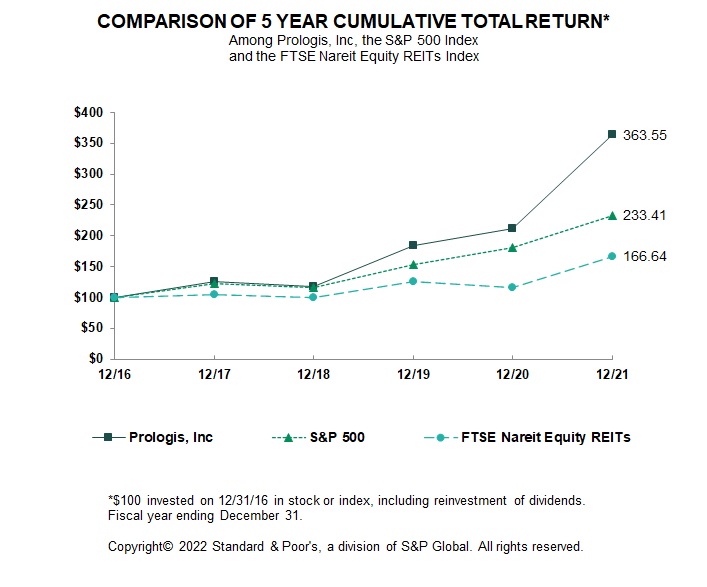
This graph and the accompanying text are not “soliciting material,” are not deemed filed with the SEC and are not to be incorporated by reference in any filing by the Company under the Securities Act of 1933, as amended, or the Securities Exchange Act of 1934, as amended, whether made before or after the date hereof and irrespective of any general incorporation language in any such filing.
PREFERRED STOCK DIVIDENDS
At December 31, 2021, we had 1.3 million shares of the Series Q preferred stock with a liquidation preference of $50 per share that will be redeemable at our option on or after November 13, 2026. Dividends payable per share was $4.27 for the year ended December 31, 2021.
For more information regarding dividends, see Note 9 to the Consolidated Financial Statements in Item 8. Financial Statements and Supplementary Data.
SALES OF UNREGISTERED SECURITIES
During 2021, we issued 0.8 million shares of common stock of Prologis, Inc. in connection with the redemption of common units of Prologis, L.P. and issued 1.0 million common units in Prologis, L.P. in connection with the acquisition of additional ownership interest in an unconsolidated other venture from our partner in reliance on the exemption from registration requirements of the Securities Act of 1933, as amended, afforded by Section 4(a)(2) thereof.
PURCHASES OF EQUITY SECURITIES
During 2021, we did not purchase any common stock of Prologis, Inc. in connection with our share purchase program.
SECURITIES AUTHORIZED FOR ISSUANCE UNDER EQUITY COMPENSATION PLANS
For information regarding securities authorized for issuance under our equity compensation plans, see Notes 9 and 12 to the Consolidated Financial Statements in Item 8. Financial Statements and Supplementary Data.
OTHER STOCKHOLDER MATTERS
Common Stock Plans
Further information relative to our equity compensation plans will be provided in our 2022 Proxy Statement or in an amendment filed on Form 10-K/A.
Item 6. [Reserved]
Item 7. Management’s Discussion and Analysis of Financial Condition and Results of Operations
The following discussion should be read in conjunction with the Consolidated Financial Statements included in Item 8. Financial Statements and Supplementary Data of this report and the matters described under Item 1A. Risk Factors.
A discussion regarding our financial condition and results of operations for 2021 compared to 2020 is presented below. Information on 2019 is included in graphs only to show year over year trends in our results of operations and operating metrics. Our financial condition for 2019, results of operations for 2019 and 2020 compared to 2019 and details on the IPT Transaction and LPT Transaction referenced throughout this document can be found under Item 7. Management’s Discussion and Analysis of Financial Condition and Results of Operations, which is incorporated by reference herein to our Annual Report on Form 10-K for the fiscal year ended December 31, 2020, filed with the SEC on February 11, 2021, and is available on the SEC’s website at www.sec.gov and our Investor Relations website at www.ir.prologis.com.
MANAGEMENT’S OVERVIEW
Summary of 2021
Our financial condition and operating results were strong during 2021. E-commerce continues to grow well above its historical average and demand for space is robust based on our proprietary data. As demand surges, having the right logistics real estate in the right location is mission critical for our customers, which is evident with our O&M occupancy at 97.7% at December 31, 2021. Leasing activity accelerated for our portfolio during 2021. Our outlook for 2022 is equally as promising as we expect increases in market rents and asset valuations to drive our operating results as well as our execution of profitable deployment activities.
We generated net proceeds of $5.2 billion and realized net gains of $1.6 billion, principally from the contribution of properties to our unconsolidated co-investment ventures in Japan, Europe and the U.S. and dispositions to third parties.
We earned promotes aggregating $98 million ($43 million net of related expenses), primarily during the fourth quarter of 2021 from one of our unconsolidated co-investment ventures in Europe.
In December 2021, UKLV sold its operating properties to our unconsolidated co-investment ventures, PELF and PELP, and its land to us.
We completed the following consolidated financing activities that included the issuance of $2.9 billion and redemption of $1.5 billion of senior notes, with aggregate principal amounts in U.S. dollars. This resulted in a consolidated weighted average remaining maturity of 10 years and lowered our weighted average effective interest rate to 1.6% at December 31, 2021 (principal in millions):
| Aggregate Principal | Issuance Date Weighted Average | ||||||||||||||||||
|---|---|---|---|---|---|---|---|---|---|---|---|---|---|---|---|---|---|---|---|
| Issuance Date | Borrowing Currency | USD (1) | Interest Rate (2) | Term (3) | Maturity Dates | ||||||||||||||
| February | € | 1,350 | $ | 1,639 | 0.7% | 14.3 | February 2032 – 2041 | ||||||||||||
| February | $ | 400 | $ | 400 | 1.6% | 10.1 | March 2031 | ||||||||||||
| June | ¥ | 65,000 | $ | 587 | 0.8% | 15.4 | June 2028 – 2061 | ||||||||||||
| December | £ | 215 | $ | 285 | 2.0% | 17.7 | December 2033 – 2041 | ||||||||||||
| Total | $ | 2,911 | 1.0% | 14.2 | |||||||||||||||
| Aggregate Principal | Redemption Date Weighted Average | ||||||||||||||||||
| Redemption Date | Borrowing Currency | USD (1) | Interest Rate (2) | Term (3) | Maturity Date | ||||||||||||||
| March | € | 600 | $ | 716 | 3.4% | 3.0 | February 2024 | ||||||||||||
| March | $ | 750 | $ | 750 | 3.8% | 4.7 | November 2025 | ||||||||||||
| Total | $ | 1,466 | 3.6% | 3.8 |
| (1) | The exchange rate used to calculate into U.S. dollars was the spot rate at the settlement date. |
|---|
| (2) | The weighted average interest rate represents the fixed or variable interest rates of the related debt at the issuance or redemption date. |
|---|
| (3) | The weighted average term represents the remaining maturity in years on the related debt at the issuance or redemption date. |
|---|
At December 31, 2021, we had total available liquidity of $5.0 billion, principally due to aggregate availability under our credit facilities of $4.4 billion and unrestricted cash balances of $556 million. In April 2021, we increased our available liquidity by entering into a second global senior credit facility with an available borrowing capacity of $1.0 billion and we terminated the $500 million multi-currency term loan.
RESULTS OF OPERATIONS
We evaluate our business operations based on the NOI of our two operating segments: Real Estate Operations and Strategic Capital. NOI by segment is a non-GAAP performance measure that is calculated using revenues and expenses directly from our financial statements. We consider NOI by segment to be an appropriate supplemental measure of our performance because it helps management and investors understand our operating results.
Below is a reconciliation of our NOI by segment to Operating Income per the Consolidated Financial Statements (in millions). Each segment’s NOI is reconciled to line items in the Consolidated Financial Statements as provided in the related discussion below.
| 2021 | 2020 | |||||||
|---|---|---|---|---|---|---|---|---|
| Real Estate Operations – NOI | $ | 3,105 | $ | 2,820 | ||||
| Strategic Capital – NOI | 384 | 419 | ||||||
| General and administrative expenses | (294 | ) | (275 | ) | ||||
| Depreciation and amortization expenses | (1,578 | ) | (1,562 | ) | ||||
| Operating income before gains on real estate transactions, net | 1,617 | 1,402 | ||||||
| Gains on dispositions of development properties and land, net | 817 | 465 | ||||||
| Gains on other dispositions of investments in real estate, net | 773 | 252 | ||||||
| Operating income | $ | 3,207 | $ | 2,119 | ||||
See Note 17 to the Consolidated Financial Statements for more information on our segments and a reconciliation of each business segment’s NOI to Operating Income and Earnings Before Income Taxes.
Real Estate Operations
This operating segment principally includes rental revenue and rental expenses recognized from our consolidated properties. We allocate the costs of our property management and leasing functions to the Real Estate Operations segment through Rental Expenses
and the Strategic Capital segment through Strategic Capital Expenses based on the square footage of the relative portfolios. In addition, this segment is impacted by our development, acquisition and disposition activities.
Below are the components of Real Estate Operations NOI, derived directly from line items in the Consolidated Financial Statements (in millions):
| 2021 | 2020 | |||||||
|---|---|---|---|---|---|---|---|---|
| Rental revenues | $ | 4,148 | $ | 3,791 | ||||
| Development management and other revenues | 20 | 11 | ||||||
| Rental expenses | (1,041 | ) | (952 | ) | ||||
| Other expenses | (22 | ) | (30 | ) | ||||
| Real Estate Operations – NOI | $ | 3,105 | $ | 2,820 |
The change in Real Estate Operations (“REO”) NOI in 2021 compared to 2020 of approximately $285 million was impacted by the followin
Showing the first 8K of 78K characters. Open the full section
Item 7A. Quantitative and Qualitative Disclosures About Market Risk
We are exposed to the impact of foreign exchange-related variability and earnings volatility on our foreign investments and interest rate changes. See our risk factors in Item 1A. Risk Factors, specifically Risks Related to our Global Operations and Risks Related to Financing and Capital. See also Notes 2 and 15 in the Consolidated Financial Statements in Item 8. Financial Statements and Supplementary Data for more information about our foreign operations and derivative financial instruments.
We monitor our market risk exposures using a sensitivity analysis. Our sensitivity analysis estimates the exposure to market risk sensitive instruments assuming a hypothetical 10% adverse change in foreign currency exchange rates or interest rates at December 31, 2021. The results of the sensitivity analysis are summarized in the following sections. The sensitivity analysis is of limited predictive value. As a result, revenues and expenses, as well as our ultimate realized gains or losses with respect to foreign currency exchange rate and interest rate fluctuations will depend on the exposures that arise during a future period, hedging strategies at the time and the prevailing foreign currency exchange rates and interest rates.
Foreign Currency Risk
We are exposed to foreign currency exchange variability related to investments in and earnings from our foreign investments. Foreign currency market risk is the possibility that our results of operations or financial position could be better or worse than planned because of changes in foreign currency exchange rates. We primarily hedge our foreign currency risk by borrowing in the currencies in which we invest thereby providing a natural hedge. Additionally, we hedge our foreign currency risk by entering into derivative financial instruments that we designate as net investment hedges, as these amounts offset the translation adjustments on the underlying net assets of our foreign investments. At December 31, 2021, after consideration of our ability to borrow in the foreign currencies in which we invest and also derivative and nonderivative financial instruments as discussed in Note 15 to the Consolidated Financial Statements, we had minimal net equity denominated in a currency other than the U.S. dollar.
For the year ended December 31, 2021, $573 million or 12.0% of our total consolidated revenue was denominated in foreign currencies. We enter into other foreign currency contracts, such as forwards, to reduce fluctuations in foreign currency associated with the translation of the future earnings of our international subsidiaries. We have forward contracts that were not designated as hedges, denominated principally in British pound sterling, Canadian dollar, euro and Japanese yen, and have an aggregate notional amount of $1.7 billion to mitigate risk associated with the translation of the future earnings of our subsidiaries denominated in these currencies. The gain or loss on settlement of these contracts is included in our earnings and offsets the lower or higher translation of earnings from our investments denominated in currencies other than the U.S. dollar. Although the impact to net earnings is mitigated through higher
translated U.S. dollar earnings from these currencies, a weakening of the U.S. dollar against these currencies by 10% could result in a $166 million cash payment on settlement of these contracts.
Interest Rate Risk
We are also exposed to the impact of interest rate changes on future earnings and cash flows. To mitigate that risk, we generally borrow with fixed rate debt and we may use derivative instruments to fix the interest rate on our variable rate debt. At December 31, 2021, $15.9 billion of our debt bore interest at fixed rates and therefore the fair value of these instruments was affected by changes in market interest rates. At December 31, 2021, $1.9 billion of our debt bore interest at variable rates. The following table summarizes the future repayment of debt and scheduled principal payments at December 31, 2021 (dollars in millions):
| 2022 | 2023 | 2024 | 2025 | Thereafter | Total | Fair Value | |||||||||||||||||||||
|---|---|---|---|---|---|---|---|---|---|---|---|---|---|---|---|---|---|---|---|---|---|---|---|---|---|---|---|
| Fixed rate debt (1) | $ | 646 | $ | 36 | $ | 136 | $ | 188 | $ | 14,858 | $ | 15,864 | $ | 15,995 | |||||||||||||
| Weighted average interest rate (2) | -0.1 | % | 4.4 | % | 7.6 | % | 3.1 | % | 1.7 | % | 1.7 | % | |||||||||||||||
| Variable rate debt | |||||||||||||||||||||||||||
| Credit facilities | $ | - | $ | 266 | $ | 225 | $ | - | $ | - | $ | 491 | $ | 491 | |||||||||||||
| Senior notes | 340 | - | - | - | - | 340 | 340 | ||||||||||||||||||||
| Term loans | - | 134 | - | - | 956 | 1,090 | 1,090 | ||||||||||||||||||||
| Total variable rate debt | $ | 340 | $ | 400 | $ | 225 | $ | - | $ | 956 | $ | 1,921 | $ | 1,921 |
| (1) | At December 31, 2021, we had one interest rate swap agreement to fix €150 million ($165 million) of our floating rate euro senior notes which is included in fixed rate debt. |
|---|
| (2) | The weighted average interest rates represent the effective interest rates (including amortization of debt issuance costs and noncash premiums and discounts) at December 31, 2021 for the debt outstanding. |
|---|
At December 31, 2021, the weighted average effective interest rate on our variable rate debt was 0.5%. Changes in interest rates can cause interest expense to fluctuate on our variable rate debt. On the basis of our sensitivity analysis, a 10% increase in interest rates on our average outstanding variable rate debt balances would result in additional annual interest expense of $1 million for the year ended December 31, 2021, which equates to a change in interest rates of 5 basis points on our average outstanding variable rate debt balances and less than 1 basis point on our average total debt portfolio balances.
Item 8. Financial Statements and Supplementary Data
The Consolidated Balance Sheets of Prologis, Inc. and Prologis, L.P. at December 31, 2021 and 2020, the Consolidated Statements of Income of Prologis, Inc. and Prologis, L.P., the Consolidated Statements of Comprehensive Income of Prologis, Inc. and Prologis, L.P., the Consolidated Statements of Equity of Prologis, Inc., the Consolidated Statements of Capital of Prologis, L.P. and the Consolidated Statements of Cash Flows of Prologis, Inc. and Prologis, L.P. for each of the years in the three-year period ended December 31, 2021, Notes to Consolidated Financial Statements and Schedule III — Real Estate and Accumulated Depreciation, together with the reports of KPMG LLP, independent registered public accounting firm, are included under Item 15 of this report and are incorporated herein by reference. Selected unaudited quarterly financial data are voluntarily presented in Note 19 of the Consolidated Financial Statements.
Item 9. Changes in and Disagreements with Accountants on Accounting and Financial Disclosure
None.
Item 9A. Controls and Procedures
Controls and Procedures (Prologis, Inc.)
Prologis, Inc. carried out an evaluation under the supervision and with the participation of management, including the Chief Executive Officer and Chief Financial Officer, of the effectiveness of the disclosure controls and procedures (as defined in Rule 13a-15(e) under the Securities and Exchange Act of 1934 (the “Exchange Act”)) at December 31, 2021. Based on this evaluation, the Chief Executive Officer and the Chief Financial Officer have concluded that the disclosure controls and procedures are effective to ensure that information required to be disclosed by us in reports that we file or submit under the Exchange Act is recorded, processed, summarized and reported within the time periods specified in the SEC rules and forms. Subsequent to December 31, 2021, there were no significant changes in the internal controls or in other factors that could significantly affect these controls, including any corrective actions with regard to significant deficiencies and material weaknesses.
Changes in Internal Control over Financial Reporting
There have not been any changes in Prologis, Inc.’s internal control over financial reporting (as defined in Rules 13a-15(f) and 15(d)-15(f) under the Exchange Act) that occurred during the quarter ended December 31, 2021, that have materially affected, or are reasonably likely to materially affect, Prologis, Inc.’s internal control over financial reporting.
Management’s Annual Report on Internal Control over Financial Reporting
We are responsible for establishing and maintaining adequate internal control over financial reporting as defined in Rules 13a-15(f) and 15d-15(f) under the Exchange Act.
Under the supervision and with the participation of management, including the Chief Executive Officer and Chief Financial Officer, an evaluation of the effectiveness of the internal control over financial reporting was conducted at December 31, 2021, based on the criteria described in “Internal Control — Integrated Framework” (2013) issued by the Committee of Sponsoring Organizations of the Treadway Commission. Based on this assessment, management determined that, at December 31, 2021, the internal control over financial reporting was effective.
Our internal control over financial reporting at December 31, 2021, has been audited by KPMG LLP, an independent registered public accounting firm, as stated in their attestation report, which is included herein.
Limitations of the Effectiveness of Controls
Management’s assessment included an evaluation of the design of the internal control over financial reporting and testing of the operational effectiveness of the internal control over financial reporting. The internal control over financial reporting is a process designed to provide reasonable assurance regarding the reliability of financial reporting and the preparation of financial statements for external purposes in accordance with GAAP. Because of its inherent limitations, internal control over financial reporting may not prevent or detect misstatements. Also, projections of any evaluation of effectiveness to future periods are subject to the risk that controls may become inadequate because of changes in conditions, or that the degree of compliance with the policies or procedures may deteriorate.
Controls and Procedures (Prologis, L.P.)
Prologis, L.P. carried out an evaluation under the supervision and with the participation of management, including the Chief Executive Officer and Chief Financial Officer, of the effectiveness of the disclosure controls and procedures (as defined in Rule 13a-15(e) under the Exchange Act) at December 31, 2021. Based on this evaluation, the Chief Executive Officer and the Chief Financial Officer have concluded that the disclosure controls and procedures are effective to ensure that information required to be disclosed by us in reports that we file or submit under the Exchange Act is recorded, processed, summarized and reported within the time periods specified in the SEC rules and forms. Subsequent to December 31, 2021, there were no significant changes in the internal controls or in other factors that could significantly affect these controls, including any corrective actions with regard to significant deficiencies and material weaknesses.
Changes in Internal Control over Financial Reporting
There have not been any changes in Prologis, L.P.’s internal control over financial reporting (as defined in Rules 13a-15(f) and 15(d)-15(f) under the Exchange Act) that occurred during the quarter ended December 31, 2021, that have materially affected, or are reasonably likely to materially affect, Prologis, L.P.’s internal control over financial reporting.
Management’s Annual Report on Internal Control over Financial Reporting
We are responsible for establishing and maintaining adequate internal control over financial reporting as defined in Rules 13a-15(f) and 15d-15(f) under the Exchange Act.
Under the supervision and with the participation of management, including the Chief Executive Officer and Chief Financial Officer, an evaluation of the effectiveness of the internal control over financial reporting was conducted at December 31, 2021, based on the criteria described in “Internal Control — Integrated Framework” (2013) issued by the Committee of Sponsoring Organizations of the Treadway Commission. Based on this assessment, management determined that, at December 31, 2021, the internal control over financial reporting was effective.
Limitations of the Effectiveness of Controls
Management’s assessment included an evaluation of the design of the internal control over financial reporting and testing of the operational effectiveness of the internal control over financial reporting. The internal control over financial reporting is a process designed to provide reasonable assurance regarding the reliability of financial reporting and the preparation of financial statements for external purposes in accordance with GAAP. Because of its inherent limitations, internal control over financial reporting may not prevent or detect misstatements. Also, projections of any evaluation of effectiveness to future periods are subject to the risk that controls may become inadequate because of changes in conditions, or that the degree of compliance with the policies or procedures may deteriorate.
Item 9B. Other Information
None.
Item 9C. Disclosure Regarding Foreign Jurisdictions that Prevent Inspections
Not Applicable.
PART III
Item 10. Directors, Executive Officers and Corporate Governance
The information required by this item is incorporated herein by reference to, including relevant sections in our 2022 Proxy Statement, under the captions entitled Board of Directors and Corporate Governance; Executive Officers; Executive Compensation; Director Compensation; Security Ownership; Equity Compensation Plans and Additional Information or will be provided in an amendment filed on Form 10-K/A.
Item 11. Executive Compensation
The information required by this item is incorporated herein by reference to the relevant sections in our 2022 Proxy Statement, under the captions entitled Board of Directors and Corporate Governance; Executive Officers; Executive Compensation and Director Compensation or will be provided in an amendment filed on Form 10-K/A.
Item 12. Security Ownership of Certain Beneficial Owners and Management and Related Stockholder Matters
The information required by this item is incorporated herein by reference to the relevant sections in our 2022 Proxy Statement, under the captions entitled Security Ownership and Equity Compensation Plans or will be provided in an amendment filed on Form 10-K/A.
Item 13. Certain Relationships and Related Transactions, and Director Independence
The information required by this item is incorporated herein by reference to the relevant sections in our 2022 Proxy Statement, under the caption entitled Board of Directors and Corporate Governance or will be provided in an amendment filed on Form 10-K/A.
Item 14. Principal Accounting Fees and Services
The information required by this item is incorporated herein by reference to the relevant sections in our 2022 Proxy Statement, under the caption entitled Audit Matters or will be provided in an amendment filed on Form 10-K/A.
PART IV
Item 15. Exhibits, Financial Statements and Schedules
The following documents are filed as a part of this report:
(a) Financial Statements and Schedules:
- Financial Statements:
See Index to the Consolidated Financial Statements and Schedule III on page 49 of this report, which is incorporated herein by reference.
- Financial Statement Schedules:
Schedule III — Real Estate and Accumulated Depreciation
All other schedules have been omitted since the required information is presented in the Consolidated Financial Statements and the related notes or is not applicable.
(b) Exhibits: The Exhibits required by Item 601 of Regulation S-K are listed in the Index to the Exhibits on pages 102 to 112 of this report, which is incorporated herein by reference.
(c) Financial Statements: See Index to the Consolidated Financial Statements and Schedule III on page 49 of this report, which is incorporated by reference.
Item 16. Form 10-K Summary
Not Applicable.
INDEX TO THE CONSOLIDATED FINANCIAL STATEMENTS AND SCHEDULE III
REPORT OF INDEPENDENT REGISTERED PUBLIC ACCOUNTING FIRM
To the Stockholders and Board of Directors
Prologis, Inc.:
Opinion on the Consolidated Financial Statements
We have audited the accompanying consolidated balance sheets of Prologis, Inc. and subsidiaries (the Company) as of December 31, 2021 and 2020, the related consolidated statements of income, comprehensive income, equity, and cash flows for each of the years in the three-year period ended December 31, 2021, and the related notes and financial statement schedule III (collectively, the consolidated financial statements). In our opinion, the consolidated financial statements present fairly, in all material respects, the financial position of the Company as of December 31, 2021 and 2020, and the results of its operations and its cash flows for each of the years in the three-year period ended December 31, 2021, in conformity with U.S. generally accepted accounting principles.
We also have audited, in accordance with the standards of the Public Company Accounting Oversight Board (United States) (PCAOB), the Company’s internal control over financial reporting as of December 31, 2021, based on criteria established in Internal Control – Integrated Framework (2013) issued by the Committee of Sponsoring Organizations of the Treadway Commission, and our report dated February 9, 2022 expressed an unqualified opinion on the effectiveness of the Company’s internal control over financial reporting.
Basis for Opinion
These consolidated financial statements are the responsibility of the Company’s management. Our responsibility is to express an opinion on these consolidated financial statements based on our audits. We are a public accounting firm registered with the PCAOB and are required to be independent with respect to the Company in accordance with the U.S. federal securities laws and the applicable rules and regulations of the Securities and Exchange Commission and the PCAOB.
We conducted our audits in accordance with the standards of the PCAOB. Those standards require that we plan and perform the audit to obtain reasonable assurance about whether the consolidated financial statements are free of material misstatement, whether due to error or fraud. Our audits included performing procedures to assess the risks of material misstatement of the consolidated financial statements, whether due to error or fraud, and performing procedures that respond to those risks. Such procedures included examining, on a test basis, evidence regarding the amounts and disclosures in the consolidated financial statements. Our audits also included evaluating the accounting principles used and significant estimates made by management, as well as evaluating the overall presentation of the consolidated financial statements. We believe that our audits provide a reasonable basis for our opinion.
Critical Audit Matter
The critical audit matter communicated below is a matter arising from the current period audit of the consolidated financial statements that was communicated or required to be communicated to the audit committee and that: (1) relates to accounts or disclosures that are material to the consolidated financial statements and (2) involved our especially challenging, subjective, or complex judgments. The communication of a critical audit matter does not alter in any way our opinion on the consolidated financial statements, taken as a whole, and we are not, by communicating the critical audit matter below, providing a separate opinion on the critical audit matter or on the accounts or disclosures to which it relates.
Assessment of the Company’s evaluation of the expected holding period for operating properties
As discussed in Notes 2 and 4, the Company had $44,454 million of operating properties as of December 31, 2021. The Company tests the recoverability of operating properties whenever events or changes in circumstances, including shortening the expected holding period of such assets, indicate that the carrying amount of these assets may not be recoverable.
We identified the assessment of the Company’s evaluation of the expected holding period for operating properties as a critical audit matter. Subjective auditor judgment was required to assess the relevant events or changes in circumstances that the Company used to evaluate its expected holding period. A shortening of the expected holding period could indicate a potential impairment.
The following are the primary procedures we performed to address this critical audit matter. We evaluated the design and tested the operating effectiveness of certain internal controls related to determining the expected holding period of operating properties and any related changes. We evaluated the Company’s expected holding period by inquiring of the Company regarding changes to the expected holding period, considering certain factors related to the current economic environment, reading minutes of the meetings of the Company’s Board of Directors, reading external communications with investors and analysts, and analyzing documents prepared by the Company regarding proposed real estate transactions and potential changes to the expected holding period.
/s/ KPMG LLP
We have served as the Company’s auditor since 2002.
Denver, Colorado
February 9, 2022
REPORT OF INDEPENDENT REGISTERED PUBLIC ACCOUNTING FIRM
To the Partners of Prologis, L.P. and the Board of Directors of Prologis, Inc.:
Opinion on the Consolidated Financial Statements
We have audited the accompanying consolidated balance sheets of Prologis, L.P. and subsidiaries (the Operating Partnership) as of December 31, 2021 and 2020, the relate
Showing the first 8K of 322K characters. Open the full section