 filings.tools
Palantir Technologies 10-K 2022-12-31
Filed 2023-02-21. 23 sections, 585K characters. Original on sec.gov · Markdown · JSON
Cover and table of contents
UNITED STATES
SECURITIES AND EXCHANGE COMMISSION
WASHINGTON, DC 20549
FORM 10-K
(Mark One)
| ☒ | ANNUAL REPORT PURSUANT TO SECTION 13 OR 15(d) OF THE SECURITIES EXCHANGE ACT OF 1934 |
For the fiscal year ended December 31, 2022
OR
| ☐ | TRANSITION REPORT PURSUANT TO SECTION 13 OR 15(d) OF THE SECURITIES EXCHANGE ACT OF 1934 |
For the transition period from _________ to _________
Commission File Number: 001-39540
Palantir Technologies Inc.
(Exact Name of Registrant as Specified in its Charter)
________________________________________________
| Delaware | 68-0551851 | |||||||
| (State or other jurisdiction of incorporation or organization) | (I.R.S. Employer Identification No.) | |||||||
| 1200 17th Street, Floor 15 Denver, Colorado | 80202 | |||||||
| (Address of principal executive offices) | (Zip Code) |
Registrant’s telephone number, including area code: (720) 358-3679
________________________________________________
Securities registered pursuant to Section 12(b) of the Act:
| Title of each class | Trading Symbol(s) | Name of each exchange on which registered | ||||||||||||
| Class A Common Stock, par value $0.001 per share | PLTR | New York Stock Exchange |
Securities registered pursuant to Section 12(g) of the Act: None
Indicate by check mark if the registrant is a well-known seasoned issuer, as defined in Rule 405 of the Securities Act. Yes ☒ No ☐
Indicate by check mark if the registrant is not required to file reports pursuant to Section 13 or Section 15(d) of the Act. Yes ☐ No ☒
Indicate by check mark whether the registrant (1) has filed all reports required to be filed by Section 13 or 15(d) of the Securities Exchange Act of 1934 during the preceding 12 months (or for such shorter period that the registrant was required to file such reports), and (2) has been subject to such filing requirements for the past 90 days. Yes ☒ No ☐
Indicate by check mark whether the registrant has submitted electronically every Interactive Data File required to be submitted pursuant to Rule 405 of Regulation S-T (§ 232.405 of this chapter) during the preceding 12 months (or for such shorter period that the registrant was required to submit such files). Yes ☒ No ☐
Indicate by check mark whether the registrant is a large accelerated filer, an accelerated filer, a non-accelerated filer, a smaller reporting company, or an emerging growth company. See the definitions of “large accelerated filer,” “accelerated filer,” “smaller reporting company,” and “emerging growth company” in Rule 12b-2 of the Exchange Act.
| Large accelerated filer | ☒ | Accelerated filer | ☐ | |||||||||||||||||
| Non-accelerated filer | ☐ | Smaller reporting company | ☐ | |||||||||||||||||
| Emerging growth company | ☐ |
If an emerging growth company, indicate by check mark if the registrant has elected not to use the extended transition period for complying with any new or revised financial accounting standards provided pursuant to Section 13(a) of the Exchange Act. ☐
Indicate by check mark whether the registrant has filed a report on and attestation to its management’s assessment of the effectiveness of its internal control over financial reporting under Section 404(b) of the Sarbanes-Oxley Act (15 U.S.C. 7262(b)) by the registered public accounting firm that prepared or issued its audit report. ☒
If securities are registered pursuant to Section 12(b) of the Act, indicate by check mark whether the financial statements of the registrant included in the filing reflect the correction of an error to previously issued financial statements. ☐
Indicate by check mark whether any of those error corrections are restatements that required a recovery analysis of incentive-based compensation received by any of the registrant’s executive officers during the relevant recovery period pursuant to §240.10D-1(b). ☐
Indicate by check mark whether the registrant is a shell company (as defined in Rule 12b-2 of the Act). Yes ☐ No ☒
The aggregate market value of the common stock held by non-affiliates of the registrant, based on the closing price of the shares of Class A common stock on June 30, 2022 as reported by the New York Stock Exchange on such date was approximately $16.6 billion. Shares of the registrant's common stock held by each executive officer and director and by each other person who may be deemed to be an affiliate of the registrant have been excluded from this computation. This calculation does not reflect a determination that certain persons are affiliates of the registrant for any other purpose.
As of February 14, 2023, there were 1,997,726,022 shares of the registrants’ Class A common stock outstanding, 102,656,175 shares of the registrant’s Class B common stock outstanding, and 1,005,000 shares of the registrant’s Class F common stock outstanding.
Documents Incorporated by Reference
Portions of the registrant’s Definitive Proxy Statement relating to the Annual Meeting of Stockholders to be held in 2023 are incorporated by reference into Part III of this Annual Report on Form 10-K where indicated. Such Definitive Proxy Statement will be filed with the Securities and Exchange Commission within 120 days after the end of the registrant’s fiscal year ended December 31, 2022.
TABLE OF CONTENTS
SPECIAL NOTE REGARDING FORWARD-LOOKING STATEMENTS
This Annual Report on Form 10-K contains forward-looking statements within the meaning of the federal securities laws, which statements involve substantial risks and uncertainties. Forward-looking statements generally relate to future events or our future financial or operating performance. In some cases, you can identify forward-looking statements because they contain words such as “may,” “will,” “should,” “expect,” “plan,” “anticipate,” “could,” “can,” “would,” “intend,” “target,” “goal,” “outlook,” “project,” “contemplate,” “believe,” “estimate,” “predict,” “potential,” “future,” or “continue” or the negative of these words or other similar terms or expressions that concern our expectations, strategy, plans, or intentions. Forward-looking statements contained in this Annual Report on Form 10-K include, but are not limited to, statements about:
-
our expectations regarding financial performance and liquidity, including but not limited to our expectations regarding revenue, cost of revenue, operating expenses, stock-based compensation, our ability to achieve and maintain future profitability and cash flows;
-
our ability to successfully execute our business and growth strategy;
-
the sufficiency of our cash and cash equivalents to meet our liquidity needs;
-
the demand for our platforms in general;
-
our ability to increase our number of customers and revenue generated from customers;
-
our expectations regarding the future contribution margin of our existing and future customers;
-
our expectations regarding our ability to quickly and effectively integrate our platforms for our existing and future customers;
-
our ability to develop new platforms, and enhancements to existing platforms, and bring them to market in a timely manner;
-
our market share, category positions, and market trends, including our ability to grow our business in large government and commercial organizations, including our expectations regarding the impact of Federal Acquisition Streamlining Act of 1994 (“FASA”);
-
our ability to compete with existing and new competitors in existing and new markets and products;
-
our expectations regarding anticipated technology needs and developments and our ability to address those needs and developments with our platforms;
-
our expectations regarding litigation and legal and regulatory matters;
-
our expectations regarding our ability to meet existing performance obligations and maintain the operability of our products;
-
our expectations regarding the effects of existing and developing laws and regulations, including with respect to taxation, privacy, data protection, and cybersecurity;
-
our expectations regarding new and evolving markets;
-
our ability to develop and protect our brand;
-
our ability to maintain the security and availability of our platforms;
-
our expectations and management of future growth;
-
our expectations concerning relationships with third parties, including our customers, equity method investment partners, and vendors;
-
our expectations regarding our investments in, and enterprise agreements with, various entities, including special purpose acquisition companies and/or other privately-held or publicly-traded entities;
-
our ability to maintain, protect, and enhance our intellectual property;
-
our expectations regarding our multi-class stock and governance structure and the benefits thereof;
-
our expectations regarding macroeconomic conditions, including rising inflation and interest rates and monetary policy changes;
-
the impacts of the ongoing coronavirus (“COVID-19”) pandemic and the ongoing Russia-Ukraine conflict, including on our and our customers’, vendors’, and partners’ respective businesses and the markets in which we and our customers, vendors, and partners operate;
-
the impacts of the volatility and fluctuations in currency exchange rates, including an increase in the strength of the U.S. dollar, on the costs of our products outside of the United States and on customer demand; and
-
the increased expenses associated with being a public company.
We caution you that the foregoing list may not contain all of the forward-looking statements made in this Annual Report on Form 10-K.
You should not rely upon forward-looking statements as predictions of future events. We have based the forward-looking statements contained in this Annual Report on Form 10-K primarily on our current expectations and projections about future events and trends that we believe may affect our business, financial condition, results of operations, and prospects. The outcome of the events described in these forward-looking statements is subject to risks, uncertainties, and other factors, including those described in the section titled “Risk Factors” and elsewhere in this Annual Report on Form 10-K. Moreover, we operate in a very competitive and rapidly changing environment. New risks and uncertainties emerge from time to time and it is not possible for us to predict all risks and uncertainties that could have an impact on any forward-looking statements contained in this Annual Report on Form 10-K. We cannot assure you that the results, events, and circumstances reflected in the forward-looking statements will be achieved or occur, and actual results, events, or circumstances could differ materially from those described in such forward-looking statements.
Neither we nor any other person assumes responsibility for the accuracy and completeness of any of these forward-looking statements. Moreover, the forward-looking statements made in this Annual Report on Form 10-K relate only to events as of the date on which the statements are made. We undertake no obligation to update any forward-looking statements made in this Annual Report on Form 10-K to reflect events or circumstances after the date of this Annual Report on Form 10-K or to reflect new information or the occurrence of unanticipated events, except as required by law. We may not actually achieve the plans, intentions, or expectations disclosed in our forward-looking statements, and you should not place undue reliance on our forward-looking statements. Our forward-looking statements do not reflect the potential impact of any future acquisitions, mergers, dispositions, restructurings, joint ventures, partnerships, channel sales relationships, or investments we may make.
In addition, statements that “we believe” and similar statements reflect our beliefs and opinions on the relevant subject. These statements are based upon information available to us as of the date of this Annual Report on Form 10-K, and while we believe such information forms a reasonable basis for such statements, such information may be limited or incomplete, and our statements should not be read to indicate that we have conducted an exhaustive inquiry into, or review of, all potentially available relevant information. These statements are inherently uncertain and investors are cautioned not to unduly rely upon these statements.
PART I
Item 1. BUSINESS
Overview
We build software that empowers organizations to effectively integrate their data, decisions, and operations at scale.
We were founded in 2003 and started building software for the intelligence community in the United States to assist in counterterrorism investigations and operations. We later began working with commercial enterprises, who often faced fundamentally similar challenges in working with data.
We have built three principal software platforms, Palantir Gotham (“Gotham”), Palantir Foundry (“Foundry”), and Palantir Apollo (“Apollo”). Gotham and Foundry enable institutions to transform massive amounts of information into an integrated data asset that reflects their operations. For over a decade, Gotham has surfaced insights for global defense agencies, the intelligence community, disaster relief organizations and beyond. And Foundry is becoming a central operating system not only for individual institutions but also for entire industries. Apollo is a cloud-agnostic, single control layer that coordinates ongoing delivery of new features, security updates, and platform configurations, helping to ensure the continuous operation of critical systems and allowing our customers to run their software in virtually any environment.
Recent crises and systemic shocks, such as the ongoing COVID-19 pandemic and the ongoing Russia-Ukraine conflict, have made clear to many of our customers that accommodating the extended timelines ordinarily required to realize results from implementing new software solutions is not a viable option. As a result, customers are increasingly adopting our software, which can be ready in days, over internal software development efforts, which may take months or years. See further discussion
in the section titled “Management’s Discussion and Analysis of Financial Condition and Results of Operations—Macroeconomic Trends.”
Our Platforms
We have built three principal software platforms: Gotham, Foundry, and Apollo. Our software platforms provide the critical infrastructure needed to integrate our customers’ data and operations and run their software in virtually any environment.
The vertically integrated nature of Gotham and Foundry allows users of varying technical abilities to collaborate effectively in our platforms. Data engineers can integrate new data sources, analysts can clean and transform data, data scientists can write models, business users can conduct daily workflows, and senior leaders can make critical decisions. The two platforms can either be used separately or bundled together as a single ecosystem.
Data, analyses, decisions, and the metadata around each are secured with fine-grained access controls that propagate from source data to shared analyses. Each platform is comprised of user-facing applications that are targeted to the specific industries and sectors in which they are used.
Despite their differences, Gotham and Foundry both serve as central operating systems for our customers. Where they vary in specific functionality, they align in approach. Both platforms, backed by Apollo, can be deployed in almost any environment.
Similarly, customers can now use Apollo to enable continuous deployment, configuration management, and central software operations management across almost any environment for their own software products.
Gotham
Gotham enables users to identify patterns hidden deep within datasets, ranging from signals intelligence sources to reports from confidential informants. It also facilitates the hand-off between analysts and operational users, helping operators plan and execute real-world responses to threats that have been identified within the platform. Gotham is now used broadly across government functions.
We also offer Gotham to our commercial customers, including to those in the financial services industry in connection with fraud investigations.
Foundry
Foundry transforms the ways organizations operate by creating a central operating system for their data. Individual users can integrate and analyze the data they need in one place. The speed with which users can experiment and test new ideas is what makes the software stick.
Data projects often fail because the steps and methods used to build data pipelines are difficult to understand and recreate. We built Foundry’s backend to solve the root of this problem. The platform’s graphical interface does the rest, allowing users to track and trace their pipelines so they know what the rows and columns in their tables represent and why they are there. All of our commercial customers now use it, as do several of our government customers.
Apollo
We have always prioritized meeting our customers wherever they need us most. We originally built Apollo to enable the continuous delivery of our software wherever our customers are: in the cloud, on-premises, or even more rugged environments. Today, Apollo enables the rapid, secure delivery of our software and updates across our business.
In 2021, we began offering Apollo as a commercial solution to allow our customers to securely deploy their own software in virtually any environment. Apollo provides a single control layer to coordinate ongoing delivery of new features, security updates, and platform configurations.
Our Customers
We work with many of the world’s leading government and commercial institutions. As of December 31, 2022, we had 367 customers.
An overview of those customers and the ways in which they use our software follows below.
Overview
Our software is currently used across more than 60 industries around the world.
Of the $1.9 billion in revenue that we generated in 2022, 56% came from customers in the government segment, and 44% came from customers in the commercial segment.
Our business continues to have a global presence. In 2022, we earned 61% of our revenue from customers in the United States, and 39% from those abroad.
The average revenue for our top twenty customers during the trailing twelve months ended December 31, 2022 was $49.4 million, and is up from 2021, when the average revenue from our top 20 customers during the trailing twelve months ended December 31, 2021 was $43.6 million, demonstrating our expanding relationships with existing customers.
Our Software at Work
Our software is in the hands of factory workers, soldiers, clinicians, prosecutors, investigators, claims adjusters, technicians, intelligence analysts, and social workers around the world. It is used in a variety of applications including by utility operations analysts, automotive manufacturing workers, oil and gas technicians and operators, and pharmaceutical researchers in the United States; supply-chain managers in South Korea; assembly workers in France; public health administrators in the United Kingdom and the United States; and special forces personnel and military officials in the United States and abroad.
Industries and Sectors
In addition to supporting individual institutions, our platforms have become central operating systems for entire industries and sectors.
Our work with Airbus S.A.S. (“Airbus”), for example, was initially focused on the production of the A350 aircraft. The deployment of our software soon grew into Skywise, our aviation platform that has become the central operating system of the airline industry.
Skywise connects more than 10,000 aircraft across a growing community of airlines, maintenance and repair organizations, authorities, and Airbus. Decision makers at each of these institutions use Skywise to more efficiently design, manufacture, service, operate, and maintain their global fleets.
Our work with healthcare organizations across both the commercial and government sectors in the United States and globally has helped modernize public health information systems, including by facilitating pandemic management across U.S. and non-U.S. government agencies, integrating and harmonizing clinical trial data, and enabling proactive coordination across multi-threaded teams to effectively respond to real-time changes in patient demand and nursing supply.
Similarly, when it comes to our work with defense and intelligence agencies, our software is not only used by individual organizations but is also used to enable sharing of information and collaboration across agencies and countries. This is made possible by our software’s access controls, which enable agencies to work on the same platform simultaneously and securely.
Sales and Marketing
Our approach to sales and marketing is built around discussions with existing and prospective customers in order to understand the principal challenges our customers face and identify ways in which our software platforms can provide long-term value and results.
Customer Acquisition
Our customer acquisition strategy targets large-scale, hard-to-execute opportunities at large government and commercial institutions. The high installation costs, high failure risks, complexity of data environments, and the long sales cycles associated with these opportunities raise the barriers to entry for competition. The larger, more complex, and more technologically demanding the problem, the more likely we are to succeed. Additionally, our focus in the short term remains making our principal software platforms available to an increasingly broad swath of our potential market. We believe that every institution faces challenges that our platforms and products were designed to address.
Across both the public and private sectors, there is a history of failures when investing in new technologies. One U.S. military department spent more than $1 billion building an enterprise resource planning system from scratch. The system was never delivered, and the project was terminated.
Many of our customers have had similar experiences investing millions — even billions — of dollars in digital transformation projects, enterprise data warehouses, and digital twin initiatives that never really worked.
These failures have made both software buyers and vendors highly risk-averse. Institutions often doubt that any vendor can implement a working solution and are unwilling to invest. On the other hand, smaller technology companies are often unable to compete for complex, large-scale opportunities because installation costs and the risks of failure are too high, and the sales cycles too long.
These are precisely the opportunities we target. Rather than reject projects with risky and resource intensive installation requirements, we actively seek them out.
There are a number of sales and marketing strategies that have accelerated our ability to acquire customers in recent years:
Expansion of Access to Platforms
The speed with which our platforms can be deployed has significantly expanded the range of potential customers with which we plan on partnering over the long term. We anticipate that our reach among an increasingly broad set of customers, in both the commercial and government sectors, will accelerate moving forward. We believe that, as these new partners grow, we will grow with them.
We have also made a number of investments in companies whose businesses rely on the ability of their organizations to manage and analyze data effectively at scale, though we do not currently anticipate entering into new investments to purchase, or commit to purchase, securities of special purpose acquisition companies.
Our proximity to these businesses and the industries in which they are operating has enhanced, and is expected to continue enhancing, our own product and business development efforts, as we continue expanding access to our platforms to the broadest possible set of customers.
Direct Sales Force
We have invested and continue to invest in an account-based sales force to identify and capture new customers and opportunities.
We believe that our decision to grow our sales force in recent years has resulted in multiple new customers, broadening and expanding our commercial customer base and relationships with leading government agencies around the world.
Sector and Industry Platforms
We are developing industry operating systems to help companies and government agencies manage operations across their entire organizations. These operating systems allow our software to be distributed at scale to institutions within given industries.
For example, Skywise is our aviation platform that we have developed in partnership with Airbus. Our approach with Airbus involves a collaborative go-to-market strategy to distribute the Foundry platform across the aviation industry. The adoption of our software has been swift. Since June 2017, Skywise has expanded from zero to more than one hundred airlines on the platform. Each one is now an existing or potential customer.
We are working on similar partnerships in the insurance, healthcare, automotive, and government sectors, which we anticipate will have a significant impact on our business moving forward.
U.S. Government
We intend to capture an even greater share of U.S. federal government spending on software systems, following our 2018 legal victory in federal court. The ruling requires the government to consider commercially available products, such as our software, before attempting to build its own.
See the section titled “Management’s Discussion and Analysis of Financial Condition and Results of Operations—Overview—Our Customers” for a discussion of the terms of our government contracts.
Channel Sales & Cloud Partnerships
We have entered into, and continue to explore the development of, channel sales partnerships for specific industries and sectors by partnering closely with leading providers of public, private, and hybrid cloud services, which have relationships with essentially every major enterprise in the world and have large, existing sales forces.
This channel emerged as an extension of the large computing requirements for our platforms and the migration towards the cloud as the hosting environment of choice for many customers. The existing footprint of these providers provides us with access to their large customer base and expands our distribution capabilities.
Joint Ventures & New Business Partnerships
We intend to continue to form joint ventures and new business partnerships, where we believe specific industries or sectors require a partner and additional investment in order to realize the full potential of our platforms.
Account Growth
There are a number of sales and marketing strategies that we use to drive revenue growth at an account.
These strategies include (i) creating new ecosystem partnerships to extend the platform beyond the customer’s four walls into the operations of its partners and suppliers, (ii) selling additional productized cross-industry software capabilities, and (iii) selling strategic implementations of our software against specific use cases, which deliver competitive differentiation.
Our sales and marketing strategies allow us to scale existing customer contracts horizontally to include additional divisions or functions within a single institution and vertically to include additional users and user groups. In tackling the customer’s most pressing and challenging problems first, we establish the trust needed to expand platform usage across the full enterprise.
Research and Development
We believe that in order to fully address the most complex and valuable challenges that our customers face, we must experience and understand their problems firsthand. To do so, we embed with our users. Our research and development function is responsible for the design, development, testing, validation, and refinement of our platforms, and embedding with our users allows us to identify research and development opportunities for our platforms or new products. We focus on innovating and developing new features and modules for our existing platforms, or new products, and further enhancing the functionality, reliability, usability, and performance of our platforms. By leveraging the tens of thousands of front-line hours across various industries and using emerging technologies, we can better anticipate customer needs and bring new use cases and new applications of existing services to our existing and potential customers. Many of our current research and development efforts are focused on deploying software, models, and other critical assets at the edge. This includes integrations with complex hardware, operations in disconnected environments, and more. We have made, and will continue to make, significant investments in research and development to broaden our platform capabilities, strengthen our existing platforms and innovate.
Privacy and Civil Liberties
We are committed to ensuring that our software is as effective as possible while preserving individuals’ fundamental rights to privacy and civil liberties. We have made deep investments to ensure that safeguarding privacy and civil liberties protections remains central to our software and business practices.
Our platforms were built from the start to protect individual privacy and prevent the misuse of information. We are not in the business of collecting, mining, or selling data. We build software platforms that enable our customers to integrate their own data — data that they already have.
The same technology that makes Palantir so analytically powerful — its ability to construct a model of the real world from countless data points — is what allows our customers to monitor and control access to that data and its use.
Principles
As we build and implement technology to answer questions of increasing significance and complexity, we follow a set of principles that help us ensure we are doing so responsibly.
- Systems should incorporate principles of “privacy by design.” Our goal has always been to eliminate the perceived trade-offs between privacy and utility. To do so, we treat privacy as a first-order concern at every stage of the engineering process and build privacy features as core capabilities in our platforms, seamlessly integrated with analytical and collaboration tools.
-
Decisions that can affect individuals’ rights to freedom, opportunity, and happiness cannot be left solely to computers. Our customers are using data to inform decisions with significant implications for individuals. Rather than relying on algorithms that inhibit accountability and redress, we build in means for humans to make necessary judgment calls based on their context and intuition.
-
Systems must facilitate accountability and oversight. Effective privacy protection entails multi-layered, overlapping policies and procedures to reassure the protection of fundamental rights. We design our platforms to support these policies with mechanisms that control usage, alert users to data handling requirements, and generate information for those responsible for oversight.
-
Technology is not the answer to every problem. Some decisions carry implications that are too complex or significant to be automated or streamlined, even with a human in the loop. We strive to contextualize major world problems and think critically about whether it’s possible to engineer complementary solutions in an ethically responsible way. When the answer is no, we turn the opportunity down. Privacy and civil liberties engineering is an evolving field, and every organization is subject to unique requirements and concerns. The ways in which these principles are realized will differ among products and organizations. But the end goal should be the same: developing and implementing technology with a full understanding of its potential effects on fundamental rights and incorporating technical capabilities that can support responsible data handling policies.
Customer Impact
Some examples of the ways in which our software facilitates data protection at our customers follow below.
-
Our platforms provide a secure, privacy-protective cloud-based data enclave to centralize data on COVID-19 for collaborative clinical research.
-
Our platforms serve as the central analytics system of a major law enforcement agency in northern Europe. Scandinavia has long been at the forefront of data protection, and our software facilitates effective implementation of its rigorous privacy policies.
-
A customer in Europe needed to adhere to rigorous purpose specification and proportionality requirements during sensitive analytical workflows. We worked with the customer to implement technical measures requiring analysts to provide reviewable justifications for access. Those controls were further supported by auditing capabilities to ensure that data processing satisfied legitimate purposes under the relevant regulations.
-
A multinational insurer sought to build and apply machine-learning models to surface fraudulent insurance claims, while ensuring that processing was sufficiently transparent, interpretable, and accountable to decision makers and oversight authorities. We helped to configure and implement a number of supporting privacy-enhancing features, including pseudonymization processes to minimize data exposure, rigorous documentation of machine learning model features and parameters, and auditing tools for users and regulators.
Our Team
We employ a team of engineers, lawyers, and social scientists to ensure that our company remains a leader in the field when it comes to privacy practices and software development.
The Privacy and Civil Liberties Engineering team is responsible for ensuring a culture of responsibility around the development and use of our technology by leading the development of privacy-enhancing technologies, publishing research, consulting with policymakers, helping our customers implement data governance best practices, and facilitating company-wide dialogue on ethical issues. The team is supported by the Palantir Council of Advisors on Privacy and Civil Liberties, a group of independent experts in privacy law, policy, and ethics who help us to understand and address the implications of our work.
Privacy-Enhancing Technologies
-
Access Controls. Our platforms provide highly granular access restrictions with subtle and flexible access permissions, such as temporal and purpose-based limitations. This allows for precision data management — even, at times, across multiple, independent databases — that closely aligns access with customer specifications. For example, a user sees only the specific information necessary for a defined task (e.g., investigating a specific crime or determining whether to extend credit to an individual).
-
Sensitive Data Inference. Institutions managing sprawling collections of data often struggle to keep track of which data assets include sensitive fields such as personal identifiers or health records. Our software provides inference tools to assist institutions in detecting the presence of such data so that they can flag and handle the data appropriately.
-
Federation. Federation allows users to search and analyze data from multiple, independent databases without duplicating and centralizing data in a single place. Our platforms provide intelligent query interfaces that reduce the
complexity of federation so that users can access the information they need without directly integrating the source into the platform.
-
Audit Logging and Analysis. User actions — including searches, data use justifications, access requests, analyst collaborations, and report generation — within a system must be recorded to ensure that authorized oversight entities, both internal to an institution and external, can confirm appropriate and lawful data usage. Our platforms maintain audit logs and make them accessible to (and readable by) authorized users to help them both retroactively investigate and proactively identify misuse of systems.
-
Data Integrity and Redress. Our platforms track the provenance and version history of all data in the system so that users can assess the reliability of the data and review and correct inaccuracies. Providing users with well-curated, up-to-date data reduces the risks of erroneous conclusions.
-
Data Retention and Deletion. Institutions must be able to implement flexible and auditable retention policies and verify that data flagged for deletion has truly been purged from the system. Our platforms enable institutions to schedule and manage the removal of old or irrelevant information as required by data management best practices or applicable regulations.
Competition
We are fundamentally competing with the internal software development efforts of our potential customers.
Organizations frequently attempt to build their own data platforms before turning to buy ours. In trying to build something on their own, they generally rely on a patchwork of custom solutions, outside consultants, IT services companies, packaged enterprise and open source software, and significant internal IT resources.
In addition, our competitors include large enterprise software companies, government contractors, and system integrators. We also face competition from emerging companies as well as established companies that are only now beginning to enter this market.
The principal competitive factors in the markets in which we operate include:
-
platform capabilities and product functionality;
-
data security and privacy;
-
ease and speed of adoption, use, and deployment;
-
product innovation;
-
pricing and cost structures;
-
customer experience, including support; and
-
brand awareness and reputation.
While we believe we generally compete favorably with our competitors, as well as with software developed by customers internally, based on these competitive factors, some of our competitors have greater name recognition, longer operating histories, and larger customer bases; larger sales and marketing budgets and resources and the capacity to leverage their sales efforts and marketing expenditures across a broader portfolio of products; broader, deeper, or otherwise more established relationships with technology, channel, and distribution partners and customers; wider geographic presence or greater access to larger potential customer bases; greater focus in specific geographies; lower labor and research and development costs; larger and more mature intellectual property portfolios; and substantially greater financial, technical, and other resources to provide services, to make acquisitions, and to develop and introduce new products and capabilities.
Intellectual Property
We believe that our intellectual property rights are valuable and important to our business. We rely on a combination of patents, copyrights, trademarks, trade secrets, know-how, contractual provisions, and confidentiality procedures to protect our intellectual property rights.
We seek to protect our proprietary inventions relevant to our business through patent protection in the United States and abroad; however, we are not dependent on any particular patent or application for the operation of our business.
In addition, we have registered “Palantir” as a trademark in the United States and other jurisdictions. We also have registered trademarks for “Gotham,” “Palantir Foundry,” and our corporate logo, and are the registered holder of a variety of domestic and international domain names that include “Palantir,” including, most importantly, “Palantir.com.”
In addition to the protection provided by our intellectual property rights, we enter into proprietary information and invention assignment agreements or similar agreements with our employees, consultants, and contractors. We further control the use of our proprietary technology and intellectual property rights through provisions in our agreements with customers.
Seasonality
We generally experience seasonality in the timing of recognition of revenue as a result of the timing of the execution of our contracts and, to a lesser extent, the existence of certain acceptance criteria, as we have historically executed many of our contracts in the third and fourth quarters due to the fiscal year ends and procurement cycles of our customers and at times we may start work prior to finalizing such contracts. See “Risk Factors—Seasonality may cause fluctuations in our results of operations and financial position.”
Employees and Human Capital
Our employees are critical to the success of our business. As of December 31, 2022, we had 3,838 full-time employees, including 1,436 employees employed outside of the United States. We also engage part-time employees, independent contractors, and third-party personnel to supplement our workforce.
Other than our employees in France, who are represented by a works council, none of our employees is represented by a labor union. We have not experienced any work stoppages due to employee disputes, and we believe that our employee relations are strong.
Our human capital resources objectives include recruiting, retaining, training, and motivating our personnel. We strive to foster a diverse and inclusive culture and environment which encourages active dialogue and robust engagement on the issues most salient to employee satisfaction and believe our employees are empowered to play a significant role in shaping the direction and success of the company. One avenue for employees to contribute their voices is through Affinity Groups: employee-led resource groups that celebrate unique perspectives and backgrounds and help guide our Diversity, Equity & Inclusion (“DEI”) business initiatives. We also conduct regular company-wide surveys to assess the sentiment toward our values and culture, and our employees’ well-being and overall health. These surveys allow Palantir to get actionable feedback and drive awareness, discussion, and change.
Diversity, Equity, & Inclusion
To achieve our best outcomes, Palantir needs people who bring a wide range of backgrounds, perspectives, and lived experiences. Our DEI team takes the lead in working to increase awareness and accountability and promote active allyship throughout Palantir. We acknowledge that each member of our increasingly diverse community has their own needs, experiences, and opportunities.
Available Information
Our website is https://www.palantir.com, our investor relations website is https://investors.palantir.com, our LinkedIn account is @Palantir Technologies and our Twitter account is @PalantirTech. We have used, and intend to continue to use, our website, investor relations website, LinkedIn, and Twitter accounts as a means of disclosing material non-public information and for complying with our disclosure obligations under Regulation FD. The following filings are available for download free of charge through our investor relations website after we file them with the Securities and Exchange Commission (“SEC”): Annual Report on Form 10-K, Quarterly Reports on Form 10-Q, current reports on Form 8-K, and our Proxy Statement for our Annual Meeting of Stockholders (“Proxy Statement”). The SEC also maintains an Internet website that contains reports, proxy statements and other information about issuers, like us, that file electronically with the SEC. The address of that website is www.sec.gov.
We webcast our earnings calls and certain events we participate in or host with members of the investment community on our investor relations website. Additionally, we provide notifications of news or announcements regarding our financial performance, including SEC filings, investor events, press and earnings releases, and blogs as part of our investor relations website. Further corporate governance information, including our corporate governance guidelines, code of business conduct and ethics, and committee charters is also available on our investor relations website under the heading “Governance.” The contents of the websites provided above are not intended to be incorporated by reference into this Annual Report on Form 10-K
or in any other report or document we file with the SEC. Further, our references to the URLs for these websites are intended to be inactive textual references only.
Item 1A. RISK FACTORS
Investing in our Class A common stock involves a high degree of risk. You should carefully consider the risks and uncertainties described below, together with all of the other information in this Annual Report on Form 10-K, including the section titled “Management’s Discussion and Analysis of Financial Condition and Results of Operations” and our consolidated financial statements and accompanying notes, before making a decision to invest in our Class A common stock. Our business, financial condition, results of operations, or prospects could also be harmed by risks and uncertainties not currently known to us or that we currently do not believe are material. If any of the risks actually occur, our business, financial condition, results of operations, and prospects could be adversely affected. In that event, the trading price of our Class A common stock could decline, and you could lose part or all of your investment.
Risk Factor Summary
Our business is subject to numerous risks and uncertainties that you should consider before investing in our Class A common stock. These risks are described more fully below and include, but are not limited to, risks relating to the following:
-
we have a history of losses, we anticipate our operating expenses will continue to increase in the future, and we may not be able to achieve or maintain profitability in the future;
-
we may not be able to sustain our revenue growth rate;
-
our sales efforts involve considerable time and expense and our sales cycle is often long and unpredictable;
-
a limited number of customers account for a substantial portion of our revenue;
-
our results of operations and our key business measures are likely to fluctuate significantly on a quarterly basis;
-
seasonality may cause fluctuations in our results of operations and financial position;
-
our platforms are complex and may have a lengthy implementation process;
-
we may not successfully develop and deploy new technologies to address the needs of our customers;
-
our platforms must operate with third-party products and services;
-
we may be unable to hire, retain, train, and motivate qualified personnel and senior management and deploy our personnel and resources to meet customer demand;
-
we may be unable to successfully build, expand, and deploy our marketing and sales organization;
-
we may not be able to maintain and enhance our brand and reputation;
-
unfavorable news or social media coverage may harm our reputation and business;
-
exclusive arrangements or unique terms with customers or partners may result in significant risks or liabilities to us;
-
we face intense competition in our markets;
-
we may be unable to maintain or properly manage our culture as we grow;
-
we may not enter into relationships with potential customers if we consider their activities to be inconsistent with our organizational mission or values;
-
joint ventures, channel sales relationships, platform partnerships, and strategic alliances may be unsuccessful;
-
we may not be successful in executing our strategy to increase our sales to larger customers;
-
breach of the systems of any third parties upon which we rely, our customers’ cloud or on-premises environments, or our internal systems or unauthorized access to data;
-
the ongoing COVID-19 pandemic, ongoing Russia-Ukraine conflict, and related challenging macroeconomic conditions may adversely affect our business and operations;
-
the market for our platforms and services may develop more slowly than we expect;
-
we have made and may continue to make strategic investments to support key business initiatives, including in privately-held and publicly-traded companies, as well as alternative investments, and we may not realize a return on these investments;
-
issues raised by the use of artificial intelligence in our platforms may result in reputational harm or liability;
-
we depend on computing infrastructure of third parties and they may experience errors, disruption, performance problems, or failure;
-
we may fail to adequately obtain, maintain, protect, and enforce our intellectual property and other proprietary rights;
-
we may be subject to intellectual property rights claims;
-
there may be real or perceived errors, failures, defects, or bugs in our platforms;
-
we rely on the availability of third-party technology that may be difficult to replace or that may cause errors;
-
our business is subject to complex and evolving U.S. and non-U.S. laws and regulations regarding privacy, data protection and security, technology protection, and other matters;
-
our non-U.S. sales and operations subject us to additional risks and regulations;
-
we may encounter unfavorable outcomes in legal, regulatory, and administrative inquiries and proceedings;
-
we may fail to receive and maintain government contracts or there may be changes in the contracting or fiscal policies of the public sector;
-
many of our customer contracts may be terminated by the customer at any time for convenience and may contain other provisions permitting the customer to discontinue contract performance;
-
we may not realize the full deal value of our customer contracts;
-
there may be a decline in the U.S. and other government budgets, changes in spending or budgetary priorities, or delays in contract awards; and
-
the multi-class structure of our common stock, the Founder Voting Trust Agreement, and the Founder Voting Agreement concentrate voting power with certain stockholders, in particular, Stephen Cohen, Alexander Karp, and Peter Thiel (our “Founders”) and their affiliates.
Risks Related to Our Business and Industry
We have a history of losses, we anticipate our operating expenses will continue to increase in the future, and we may not be able to achieve or maintain profitability in the future.
Other than the fourth quarter of 2022, we have incurred losses in each period since our inception, and we may not maintain profitability in future periods. In addition, we anticipate that our operating expenses will continue to increase in the future. As we continue to expand our business, industry verticals, and the breadth of our operations, upgrade our infrastructure, hire additional employees, expand into new markets, invest in research and development, invest in sales and marketing, including expanding our sales organization and related sales-based payments that may come with such expansion, lease more real estate to accommodate our anticipated future growth, and incur costs associated with general administration, including expenses related to being a public company, we expect that our costs of revenue and operating expenses will continue to increase. To the extent we are successful in increasing our customer base, we may also incur increased losses because the costs associated with acquiring and growing our customers and with research and development are generally incurred upfront, while our revenue from customer contracts is generally recognized over the contract term. Furthermore, our sales model often requires us to spend months and invest significant resources working with customers on pilot deployments at no or low cost to them, which may result in no or minimal future revenue. We may not be able to continue to increase our revenue at a rate sufficient to offset increases in our costs of revenue and operating expenses in the near term or at all, which would prevent us from achieving or maintaining profitability in the future. Any failure by us to sustain or increase profitability on a consistent basis could adversely affect our business, financial condition, and results of operations.
We may not be able to sustain our revenue growth rate in the future.
Although our revenue has increased in recent periods, there can be no assurances that revenue will continue to grow or do so at current rates, and you shoul
Showing the first 8K of 286K characters. Open the full section
Item 1B. UNRESOLVED STAFF COMMENTS
None.
Item 2. PROPERTIES
Facilities
We have leased principal properties in Denver, Colorado, which is the location of our corporate headquarters; in Palo Alto, California; New York City, New York; and London, England. In addition, we lease various office space throughout the world.
We believe that our existing facilities are adequate to meet current requirements, and that suitable additional or substitute space will be available as needed to accommodate any further physical expansion of operations and for any additional offices.
Item 3. LEGAL PROCEEDINGS
From time to time we are subject to legal proceedings and claims arising in the ordinary course of business. Based on our current knowledge, we believe that the amount or range of reasonably possible losses will not, either individually or in the aggregate, have a material adverse effect on our business, results of operations, or financial condition.
The results of any litigation cannot be predicted with certainty, and an unfavorable resolution in any legal proceedings could materially affect our future business, results of operations, or financial condition. Regardless of the outcome, litigation can have an adverse impact on us because of defense and settlement costs, diversion of management resources, and other factors.
For information on legal proceedings, refer to Note 8. Commitments and Contingencies—Litigation and Legal Proceedings in our consolidated financial statements included elsewhere in this Annual Report on Form 10-K.
Item 4. MINE SAFETY DISCLOSURES
Item 5. MARKET FOR REGISTRANT’S COMMON EQUITY, RELATED STOCKHOLDER MATTERS, AND ISSUER PURCHASES OF EQUITY SECURITIES
Market Information for Common Stock
Our Class A common stock has been listed on the NYSE under the symbol “PLTR” since September 30, 2020. Prior to that date, there was no public trading market for our Class A common stock.
Our Class B common stock and Class F common stock are not listed on any stock exchange nor traded on any public market.
Holders of Record
As of February 14, 2023, there were 850 holders of record of our Class A common stock, 32 holders of record of our Class B common stock, and one holder of record of our Class F common stock. Because many of our shares of Class A common stock are held by brokers and other institutions on behalf of stockholders, we are unable to estimate the total number of stockholders represented by these record holders.
Dividend Policy
We have never declared or paid any cash dividends on our capital stock. We intend to retain any future earnings and do not expect to pay any dividends in the foreseeable future. Any future determination to declare cash dividends will be made at the discretion of our Board of Directors, subject to applicable laws, and will depend on a number of factors, including our financial condition, results of operations, capital requirements, contractual restrictions, general business conditions, and other factors that our Board of Directors may deem relevant. In addition, the terms of our credit facility contain restrictions on our ability to declare and pay cash dividends on our capital stock, and we may enter into credit agreements or other borrowing arrangements in the future that may restrict our ability to declare and pay cash dividends.
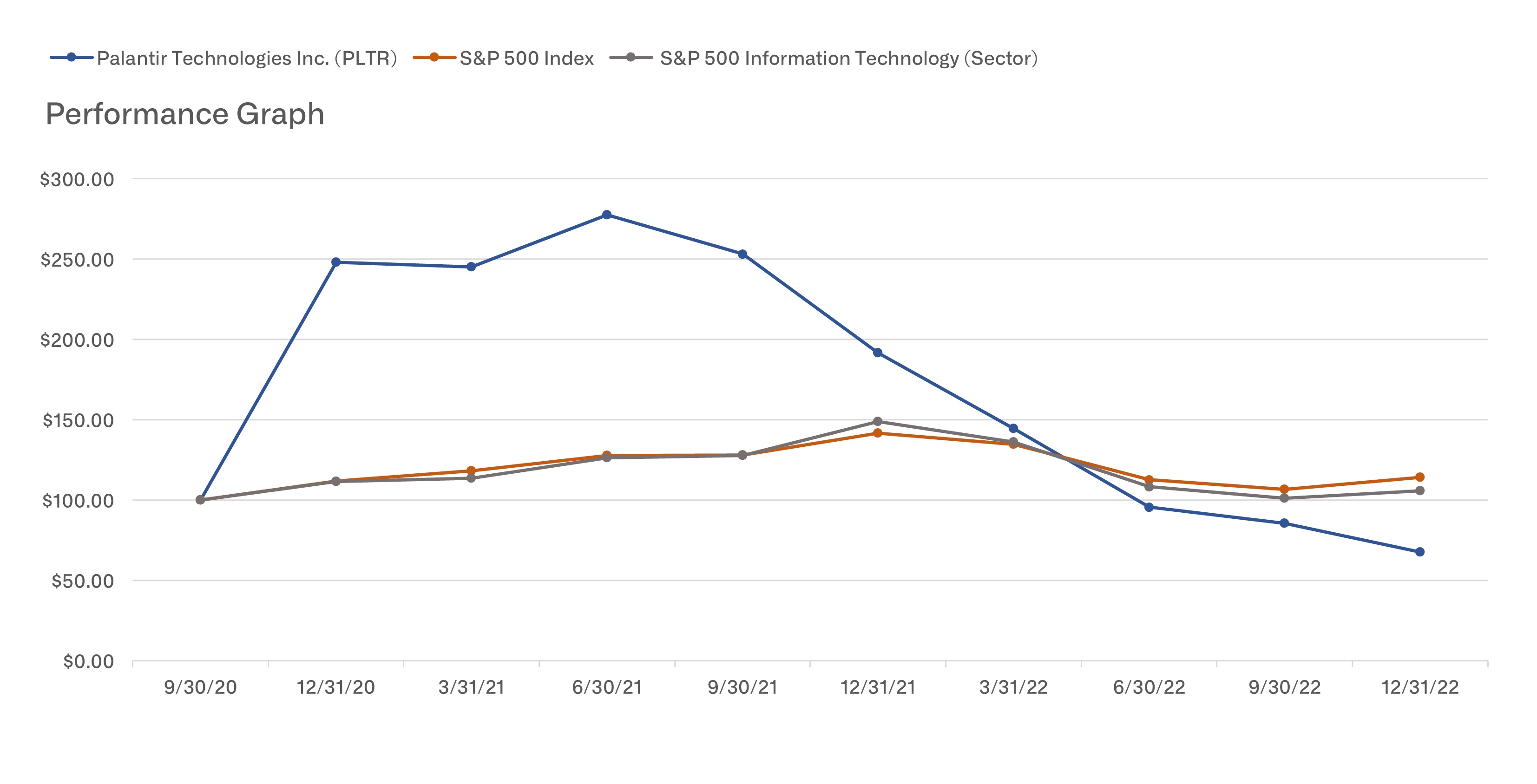
Performance Graph
This performance graph shall not be deemed “soliciting material” or to be “filed” with the SEC for purposes of Section 18 of the Exchange Act, or otherwise subject to the liabilities under that Section, and shall not be deemed to be incorporated by reference into any of our filings under the Securities Act or the Exchange Act.
The following graph compares the cumulative total return to stockholders on our Class A common stock since September 30, 2020 (the date our Class A common stock commenced trading on the NYSE (“Direct Listing”)) relative to the cumulative total returns of the Standard & Poor’s 500 Index and the Standard & Poor’s Information Technology Index over the same period. An investment of $100 (with reinvestment of all dividends) is assumed to have been made in our Class A common stock and in each index at the market close on September 30, 2020, and its relative performance is tracked through December 31, 2022. The returns shown are based on historical results and are not intended to suggest future performance.
Unregistered Sales of Equity Securities
None.
Item 6. [RESERVED]
Item 7. MANAGEMENT’S DISCUSSION AND ANALYSIS OF FINANCIAL CONDITION AND RESULTS OF OPERATIONS
The following discussion and analysis of our financial condition and results of operations should be read in conjunction with our consolidated financial statements and the accompanying notes thereto included elsewhere in this Annual Report on Form 10-K. This discussion contains forward-looking statements based upon current plans, expectations, and beliefs, involving risks and uncertainties. Our actual results may differ materially from those anticipated in these forward-looking statements. You should review the section titled “Special Note Regarding Forward-Looking Statements” for a discussion of forward-looking statements and the section titled “Risk Factors” for a discussion of factors that could cause actual results to differ materially from the results described in or implied by the forward-looking statements contained in the following discussion and analysis and elsewhere in this Annual Report on Form 10-K. Our historical results are not necessarily indicative of the results that may be expected for any period in the future.
This section of this Annual Report on Form 10-K generally discusses fiscal years 2022 and 2021 items and year-to-year comparisons between fiscal years 2022 and 2021. Discussions of fiscal year 2021 items and year-to-year comparisons between fiscal years 2021 and 2020 that are not included in this Annual Report on Form 10-K can be found in Part II, Item 7, “Management’s Discussion and Analysis of Financial Condition and Results of Operations” of our Annual Report on Form 10-K for the fiscal year ended December 31, 2021, which was filed with the SEC on February 24, 2022 and is incorporated herein by reference.
Overview
We build software that empowers organizations to effectively integrate their data, decisions, and operations at scale.
We were founded in 2003 and started building software for the intelligence community in the United States to assist in counterterrorism investigations and operations. We later began working with commercial enterprises, who often faced fundamentally similar challenges in working with data.
We have built three principal software platforms, Gotham, Foundry, and Apollo. Gotham and Foundry enable institutions to transform massive amounts of information into an integrated data asset that reflects their operations. For over a decade, Gotham
has surfaced insights for global defense agencies, the intelligence community, disaster relief organizations and beyond. Foundry is becoming a central operating system not only for individual institutions but also for entire industries. Apollo, which we began offering as a commercial solution in 2021, is a cloud-agnostic, single control layer that coordinates ongoing delivery of new features, security updates, and platform configurations, helping to ensure the continuous operation of critical systems. Apollo allows our customers to run their software in virtually any environment.
While our focus in the short term remains on making our principal software platforms available to increasingly broad swaths of the market, we are also working to identify additional component parts and products embedded within those platforms that have potential as commercial offerings on their own.
We believe that every institution faces challenges that our platforms and products were designed to address. Our approach with all our clients is to establish a partnership that transforms the way they use data in pursuit of their goals.
We regularly evaluate partnerships and investment opportunities in complementary businesses, employee teams, technologies, and intellectual property rights in an effort to expand our product and service offerings.
Our Business
Our customers pay us to use the software platforms we have built. While we generally offer contract terms of one to five years in length, our customers sometimes enter into shorter-term contracts. Revenue is generally recognized ratably over the contract term. Many of our customer contracts contain termination for convenience provisions.
For the year ended December 31, 2022, we generated $1.9 billion in revenue, reflecting a 24% growth rate from the year ended December 31, 2021, when we generated $1.5 billion in revenue.
In the year ended December 31, 2022, we incurred losses from operations of $161.2 million, or adjusted income from operations of $420.8 million when excluding stock-based compensation and related employer payroll taxes. In the year ended December 31, 2021, our losses from operations were $411.0 million, or adjusted income from operations of $473.5 million when excluding stock-based compensation and related employer payroll taxes.
In the year ended December 31, 2022, our gross profit was $1.5 billion, reflecting a gross margin of 79%, or 81% when excluding stock-based compensation. In the year ended December 31, 2021, our gross profit was $1.2 billion, reflecting a gross margin of 78%, or 82% when excluding stock-based compensation.
For more information about our adjusted income from operations, which excludes stock-based compensation and related employer payroll taxes; and gross profit and gross margin, when excluding stock-based compensation; as well as reconciliations from loss from operations and gross profit, see the section titled “Non-GAAP Reconciliations” below.
Our Customers
We define a customer as an organization from which we have recognized revenue during the trailing twelve-month period. During the period ended December 31, 2022, we had 367 customers, including companies in various commercial sectors and government agencies around the world. During the period ended December 31, 2021, we had 237 customers.
For large government agencies, where a single institution has multiple divisions, units, or subsidiary agencies, each such division, unit, or subsidiary agency that enters into a separate contract with us and is invoiced as a separate entity is treated as a separate customer. For example, while the U.S. Food and Drug Administration, Centers for Disease Control and Prevention, and National Institutes of Health are subsidiary agencies of the U.S. Department of Health and Human Services, we treat each of those agencies as a separate customer given that the governing structures and procurement processes of each agency are independent.
We have built lasting and significant customer relationships and partnerships with some of the world’s leading government institutions and companies. As of December 31, 2022, we expect to generate revenue under our existing customer contracts for an additional 2.8 years on a dollar-weighted average contract duration basis. Dollar-weighted average contract duration represents the length of time we expect to generate revenue on average, including existing contractual obligations and assuming that our customers will exercise all of the contractual options available to them, and is subject to change as we enter into new contracts or if customers terminate for convenience. We calculate this duration on a dollar-weighted basis to adjust for smaller deals. The timing of our customer billings and receipt of payments varies from contract to contract. Our average revenue for the top twenty customers during the trailing twelve months ended December 31, 2022 was $49.4 million, which grew 13% from an average of $43.6 million in revenue from the top twenty customers during the trailing twelve months ended December 31, 2021, demonstrating our expanding relationships with existing customers.
Organizations in the commercial and government sectors face similar challenges when it comes to managing data, and we intend to expand our reach in both markets moving forward. Our decisions about which customer relationships require further investment may change over time, based on our assessment of the potential long-term value that our software can generate for them. We enter into initial pilots with customers, generally at our own expense and without a guarantee of fut
Showing the first 8K of 69K characters. Open the full section
Item 7A. QUANTITATIVE AND QUALITATIVE DISCLOSURES ABOUT MARKET RISK
We are exposed to market risks in the ordinary course of our business, which primarily relate to fluctuations in the value of our investments, interest rates, foreign exchange, and inflation.
Market Risk
As of December 31, 2022, we had outstanding investments in marketable securities valued at $35.1 million. We have sold, and may continue to sell, some or all of our existing investments. These Investments are often in early- or growth-stage companies that have minimal public trading history; as such the fair value of these Investments may fluctuate depending on the financial outcome and prospects of the Investees, as well as global market conditions including recent and ongoing volatility related to the impacts of the ongoing COVID-19 pandemic, the ongoing Russia-Ukraine conflict, and rising interest rates. Additionally, investing in early- or growth-stage companies carries inherent risks because, among other things, the technologies or products that are being developed by these companies are typically in the early phases and may never materialize or they may not achieve their growth or other business objectives, and they have and may continue to experience a decline in financial condition, which could result in a loss of all or a substantial part of our investment in these companies. We record gains or losses as the fair value of these Investments change and as we sell them. We anticipate additional volatility to our consolidated statements of operations due to changes in market prices and declines in financial conditions of Investees, and as such gains and losses are realized. During the fiscal year ended December 31, 2022, net unrealized losses of $159.0 million and net realized losses of $113.1 million related to marketable securities were recorded in other income (expense), net on the consolidated statements of operations. We do not currently anticipate entering into new Investment Agreements to purchase, or commit to purchase, securities of special purpose acquisition companies.
Interest Rate Risk
Our cash, cash equivalents, and restricted cash consist of cash, certificates of deposit, and money market funds. Our primary investment policy and strategies are focused on the preservation of capital and supporting our liquidity requirements; however, to a lesser extent we have made and may continue to make investments in early- and growth-stage companies as disclosed in Note 4. Investments and Fair Value Measurements in our consolidated financial statements included elsewhere in this Annual Report on Form 10-K. We do not currently anticipate entering into new Investment Agreements to purchase, or commit to purchase, securities of special purpose acquisition companies.
Due to the short-term nature of the financial instruments, we have not been exposed to, nor do we anticipate being exposed to, material risks due to changes in interest rates.
Foreign Currency Exchange Risk
Our contracts with customers are primarily denominated in U.S. dollars, with the remaining denominated in foreign currencies. Our expenses are generally denominated in the currencies of the jurisdictions in which we conduct our operations, which are primarily in the United States, United Kingdom, and other European countries. Our results of current and future operations and cash flows are, therefore, subject to fluctuations due to changes in foreign currency exchange rates, particularly changes in the Euro and GBP. We have experienced, and may continue to experience, fluctuations in net loss as a result of transaction gains or losses related to remeasuring certain assets and liability balances that are denominated in foreign currencies. These exposures may change over time as business practices evolve and economic conditions change. To date, foreign currency transaction gains and losses have not been material to our consolidated financial statements, and we have not engaged in any foreign currency hedging transactions.
Inflation Risk
We do not believe that inflation has had a material effect on our business, results of operations, or financial condition. If our costs were to become subject to significant inflationary pressures, we may not be able to fully offset such higher costs through price increases. Our inability or failure to do so could harm our business, financial condition, or results of operations.
Item 8. FINANCIAL STATEMENTS AND SUPPLEMENTARY DATA
INDEX
Report of Independent Registered Public Accounting Firm
To the Stockholders and the Board of Directors of Palantir Technologies Inc.
Opinion on the Financial Statements
We have audited the accompanying consolidated balance sheets of Palantir Technologies Inc. (the Company) as of December 31, 2022 and 2021, the related consolidated statements of operations, comprehensive loss, redeemable convertible and convertible preferred stock and stockholders’ equity, and cash flows for each of the three years in the period ended December 31, 2022, and the related notes (collectively referred to as the “consolidated financial statements”). In our opinion, the consolidated financial statements present fairly, in all material respects, the financial position of the Company at December 31, 2022 and 2021, and the results of its operations and its cash flows for each of the three years in the period ended December 31, 2022, in conformity with U.S. generally accepted accounting principles.
We also have audited, in accordance with the standards of the Public Company Accounting Oversight Board (United States) (PCAOB), the Company’s internal control over financial reporting as of December 31, 2022, based on criteria established in Internal Control-Integrated Framework issued by the Committee of Sponsoring Organizations of the Treadway Commission (2013 framework) and our report dated February 21, 2023 expressed an unqualified opinion thereon.
Basis for Opinion
These financial statements are the responsibility of the Company’s management. Our responsibility is to express an opinion on the Company’s financial statements based on our audits. We are a public accounting firm registered with the PCAOB and are required to be independent with respect to the Company in accordance with the U.S. federal securities laws and the applicable rules and regulations of the Securities and Exchange Commission and the PCAOB.
We conducted our audits in accordance with the standards of the PCAOB. Those standards require that we plan and perform the audit to obtain reasonable assurance about whether the financial statements are free of material misstatement, whether due to error or fraud. Our audits included performing procedures to assess the risks of material misstatement of the financial statements, whether due to error or fraud, and performing procedures that respond to those risks. Such procedures included examining, on a test basis, evidence regarding the amounts and disclosures in the financial statements. Our audits also included evaluating the accounting principles used and significant estimates made by management, as well as evaluating the overall presentation of the financial statements. We believe that our audits provide a reasonable basis for our opinion.
Critical Audit Matter
The critical audit matter communicated below is a matter arising from the current period audit of the financial statements that was communicated or required to be communicated to the audit committee and that: (1) relates to accounts or disclosures that are material to the financial statements and (2) involved our especially challenging, subjective or complex judgments. The communication of the critical audit matter does not alter in any way our opinion on the consolidated financial statements, taken as a whole, and we are not, by communicating the critical audit matter below, providing a separate opinion on the critical audit matter or on the accounts or disclosures to which it relates.
| Revenue Recognition | |||||
| Description of the Matter | As discussed in Note 2 to the consolidated financial statements, the Company generates its revenue primarily from the sale of subscriptions to access its software in the Company’s hosted environment, along with ongoing operations and maintenance (“O&M”) services (“Palantir Cloud”); software licenses, primarily term licenses in the customers’ environments, with ongoing O&M services (“On-Premises Software”); and professional services. Management applies significant judgment in identifying and evaluating any non-standard terms and conditions in customer arrangements which may impact the determination of performance obligations or the timing of revenue recognition. In addition, the determining whether promises are distinct performance obligations that should be accounted for separately – or not distinct within the context of the contract and, thus, accounted for together – requires significant judgment. The Company concluded that the promise to provide a software license is highly interdependent and interrelated with the promise to provide O&M services and such promises are not distinct within the context of its contracts and are accounted for as a single performance obligation for the Company’s On-Premises Software. Auditing revenue recognition was complex and required a significant level of auditor judgment to identify and evaluate non-standard terms and conditions that impact revenue recognition and to assess whether the software licenses and O&M services should be accounted for as distinct performance obligations or combined as a single performance obligation. | ||||
| How We Addressed the Matter in Our Audit | We obtained an understanding, evaluated the design, and tested the operating effectiveness of the Company’s controls to identify and evaluate terms and conditions and performance obligations in customer arrangements that would impact revenue recognition. Our substantive procedures included, among others, testing the completeness and accuracy of management’s identification and evaluation of non-standard terms and conditions, reading executed contracts for a sample of revenue transactions and evaluating whether the Company appropriately applied its revenue recognition policy to the arrangements based on the terms and conditions therein and consistent with U.S. GAAP. In addition, we evaluated management’s key assumptions and analysis of its performance obligations, including their assessment of the nature, interdependency, and level of integration between the software license and O&M services. We also evaluated the appropriateness of the related disclosures in the consolidated financial statements. |
/s/ Ernst & Young LLP
We have served as the Company’s auditor since 2008.
San Jose, California
February 21, 2023
Report of Independent Registered Public Accounting Firm
To the Stockholders and the Board of Directors of Palantir Technologies Inc.
Opinion on Internal Control Over Financial Reporting
We have audited Palantir Technologies Inc.’s internal control over financial reporting as of December 31, 2022, based on criteria established in Internal Control—
Showing the first 8K of 148K characters. Open the full section
Item 9. CHANGES IN AND DISAGREEMENTS WITH ACCOUNTANTS ON ACCOUNTING AND FINANCIAL DISCLOSURE
None.
Item 9A. CONTROLS AND PROCEDURES
Evaluation of Disclosure Controls and Procedures
Our disclosure controls and procedures are designed to ensure that information we are required to disclose in reports that we file or submit under the Exchange Act is recorded, processed, summarized, and reported within the time periods specified in SEC rules and forms, and that such information is accumulated and communicated to our management, including our Chief Executive Officer and Chief Financial Officer, as appropriate, to allow timely decisions regarding required disclosure.
Our management, with the participation and supervision of our Chief Executive Officer and our Chief Financial Officer, have evaluated the effectiveness of our disclosure controls and procedures (as defined in Rules 13a-15(e) and 15d-15(e) under the Exchange Act) as of the end of the period covered by this Annual Report on Form 10-K. Based on such evaluation, our Chief Executive Officer and Chief Financial Officer have concluded that as of such date, our disclosure controls and procedures were, in design and operation, effective at a reasonable assurance level.
Management’s Report on Internal Control Over Financial Reporting
Our management is responsible for establishing and maintaining adequate internal control over financial reporting, as defined in Rule 13a-15(f) of the Exchange Act. Under the supervision and with the participation of our principal executive officer and principal financial officer and oversight of the Board of Directors, we conducted an evaluation of the effectiveness of our internal control over financial reporting based on the criteria set forth in Internal Control—Integrated Framework issued by the Committee of Sponsoring Organizations of the Treadway Commission (2013 framework). Based on our evaluation, management concluded that our internal control over financial reporting was effective as of December 31, 2022.
In accordance with guidance issued by the SEC, companies are permitted to exclude acquisitions from their final assessment of internal control over financial reporting for the first fiscal year in which the acquisition occurred. Our management’s evaluation of internal control over financial reporting excluded the internal control activities of Palantir Japan, which we acquired in November 2022, as discussed in Note 14. Business Combinations in the consolidated financial statements included elsewhere within this Annual Report on Form 10-K. The financial results of Palantir Japan were included in the consolidated financial statements from the date of acquisition and constituted less than 5% of total and net assets as of December 31, 2022 and less than 1% of revenues for the year then ended.
Our independent registered public accounting firm, Ernst & Young LLP, has issued an audit report with respect to our internal control over financial reporting, which is included in Part II, Item 8, “Financial Statements and Supplementary Data”, of this Annual Report on Form 10-K.
Changes in Internal Controls Over Financial Reporting
There were no changes in our internal control over financial reporting identified in connection with the evaluation required by Rule 13a-15(d) and 15d-15(d) of the Exchange Act that occurred during the period covered by this Annual Report on Form 10-K that have materially affected, or are reasonably likely to materially affect, our internal control over financial reporting.
Inherent Limitations on the Effectiveness of Controls
The effectiveness of any system of internal control over financial reporting, including ours, is subject to inherent limitations, including the exercise of judgment in designing, implementing, operating, and evaluating the controls and procedures, and the inability to eliminate misconduct completely. Accordingly, in designing and evaluating the disclosure controls and procedures, management recognizes that any system of internal control over financial reporting, including ours, no matter how well designed and operated, can only provide reasonable, not absolute assurance of achieving the desired control objectives. In addition, the design of disclosure controls and procedures must reflect the fact that there are resource constraints and that management is required to apply its judgment in evaluating the benefits of possible controls and procedures relative to their costs. Moreover, projections of any evaluation of effectiveness to future periods are subject to the risk that controls may become inadequate because of changes in conditions, or that the degree of compliance with the policies or procedures may deteriorate. We intend to continue to monitor and upgrade our internal controls as necessary or appropriate for our business but cannot assure you that such improvements will be sufficient to provide us with effective internal control over financial reporting.
Item 9B. OTHER INFORMATION
None.
Item 9C. DISCLOSURE REGARDING FOREIGN JURISDICTIONS THAT PREVENT INSPECTIONS
None.
PART III
Item 10. DIRECTORS, EXECUTIVE OFFICERS AND CORPORATE GOVERNANCE
The information called for by this item will be set forth in our Proxy Statement for the 2023 Annual Meeting of Stockholders to be filed with the SEC within 120 days of the fiscal year ended December 31, 2022 (“Proxy Statement”) and is incorporated herein by reference.
Our Board of Directors has adopted a code of conduct that applies to all of our employees, officers, and directors, including our Chief Executive Officer, Chief Financial Officer and other executive and senior financial officers. The full text of our code of conduct is posted on the investor relations page on our website, which is located at https://investors.palantir.com. We intend to satisfy the disclosure requirement under Item 5.05 of Form 8-K regarding amendment to, or waiver from, a provision of our code of conduct by posting such information on the website address and location specified above.
Item 11. EXECUTIVE COMPENSATION
The information called for by this item will be set forth in our Proxy Statement and is incorporated herein by reference.
Item 12. SECURITY OWNERSHIP OF CERTAIN BENEFICIAL OWNERS AND MANAGEMENT AND RELATED STOCKHOLDER MATTERS
The information required by this item will be set forth in our Proxy Statement and is incorporated herein by reference.
Item 13. CERTAIN RELATIONSHIPS AND RELATED TRANSACTIONS, AND DIRECTOR INDEPENDENCE
The information, if any, required by this item will be set forth in our Proxy Statement and is incorporated herein by reference.
Item 14. PRINCIPAL ACCOUNTANT FEES AND SERVICES
The information required by this item will be set forth in our Proxy Statement and is incorporated herein by reference.
PART IV
Item 15. EXHIBIT AND FINANCIAL STATEMENT SCHEDULES
(a) We have filed the following documents as part of this Annual Report on Form 10-K:
- Financial Statements
See Index under Part II, Item 8 of this Annual Report on Form 10-K.
- Financial Statement Schedules
Schedules not listed above have been omitted because they are not required, because they are not applicable, or because the required information is otherwise included.
- Exhibits
The exhibits listed below are filed as part of this Annual Report on Form 10-K or are incorporated herein by reference, in each case as indicated below.
| 101.CAL | XBRL Taxonomy Extension Calculation Linkbase Document. | ||||||||||||||||
| 101.DEF | XBRL Taxonomy Extension Definition Linkbase Document. | ||||||||||||||||
| 101.LAB | XBRL Taxonomy Extension Label Linkbase Document. | ||||||||||||||||
| 101.PRE | XBRL Taxonomy Extension Presentation Linkbase Document. | ||||||||||||||||
| 104.1* | Cover Page Interactive Data File (formatted as Inline XBRL and contained in Exhibit 101) |
- Filed Herewith
+ Indicates a management contract or compensatory plan or arrangement
† The certifications attached as Exhibit 32.1 that accompany this Annual Report on Form 10-K are not deemed filed with the Securities and Exchange Commission and are not to be incorporated by reference into any filing of the Registrant under the Securities Act of 1933, as amended, or the Securities Exchange Act of 1934, as amended, whether made before or after the date of this Annual Report on Form 10-K, irrespective of any general incorporation language contained in such filing.
Item 16. FORM 10-K SUMMARY
None.
SIGNATURES
Pursuant to the requirements of Section 13 or 15(d) of the Securities Exchange Act of 1934, the registrant has duly caused this report to be signed on its behalf by the undersigned thereunto duly authorized.
| PALANTIR TECHNOLOGIES INC. | |||||||||||
| Date: February 21, 2023 | By: | /s/ Alexander C. Karp | |||||||||
| Alexander C. Karp | |||||||||||
| Chief Executive Officer | |||||||||||
| (Principal Executive Officer) |
POWER OF ATTORNEY
KNOW ALL PERSONS BY THESE PRESENTS, that each person whose signature appears below constitutes and appoints Alexander C. Karp, Stephen Cohen, and David Glazer, and each one of them, as their true and lawful attorneys-in-fact and agents, with full power of substitution and resubstitution, for them and in their name, place and stead, in any and all capacities, to sign any and all amendments to this Annual Report on Form 10-K, and to file the same, with all exhibits thereto and other documents in connection therewith, with the Securities and Exchange Commission, granting unto said attorneys-in-fact and agents, and each of them, full power and authority to do and perform each and every act and thing requisite and necessary to be done in connection therewith, as fully to all intents and purposes as they might or could do in person, hereby ratifying and confirming all that said attorneys-in-fact and agents or any of them, or their substitute or substitutes, may lawfully do or cause to be done by virtue hereof.
Pursuant to the requirements of the Securities Act of 1934, this report has been signed by the following persons on behalf of the registrant and in the capacities and on the dates indicated.
| Signature | Title | Date | ||||||
| /s/ Alexander C. Karp | ||||||||
| Alexander C. Karp | Chief Executive Officer and Director (Principal Executive Officer) | February 21, 2023 | ||||||
| /s/ Stephen Cohen | ||||||||
| Stephen Cohen | President and Director | February 21, 2023 | ||||||
| /s/ David Glazer | ||||||||
| David Glazer | Chief Financial Officer (Principal Financial Officer) | February 21, 2023 | ||||||
| /s/ Jeffrey Buckley | ||||||||
| Jeffrey Buckley | Chief Accounting Officer (Principal Accounting Officer) | February 21, 2023 | ||||||
| /s/ Lauren Friedman Stat | ||||||||
| Lauren Friedman Stat | Director | February 21, 2023 | ||||||
| /s/ Alexander Moore | ||||||||
| Alexander Moore | Director | February 21, 2023 | ||||||
| /s/ Alexandra Schiff | ||||||||
| Alexandra Schiff | Director | February 21, 2023 | ||||||
| /s/ Peter Thiel | ||||||||
| Peter Thiel | Director | February 21, 2023 | ||||||
| /s/ Eric Woersching | ||||||||
| Eric Woersching | Director | February 21, 2023 |