 filings.tools
PNC Financial Services Group 10-K 2023-12-31
Filed 2024-02-21. 23 sections, 1121K characters. Original on sec.gov · Markdown · JSON
Cover and table of contents
UNITED STATES
SECURITIES AND EXCHANGE COMMISSION
Washington, DC 20549
FORM 10-K
| ☒ | ANNUAL REPORT PURSUANT TO SECTION 13 OR 15(d) OF THE SECURITIES EXCHANGE ACT OF 1934 |
For the fiscal year ended December 31, 2023
or
| ☐ | TRANSITION REPORT PURSUANT TO SECTION 13 OR 15(d) OF THE SECURITIES EXCHANGE ACT OF 1934 |
For the transition period from to
Commission file number 001-09718
THE PNC FINANCIAL SERVICES GROUP, INC.
(Exact name of registrant as specified in its charter)
| Pennsylvania | 25-1435979 | |||||||||||||
| (State or other jurisdiction of incorporation or organization) | (I.R.S. Employer Identification No.) |
The Tower at PNC Plaza, 300 Fifth Avenue, Pittsburgh, Pennsylvania 15222-2401
(Address of principal executive offices, including zip code)
Registrant’s telephone number, including area code - (888) 762-2265
Securities registered pursuant to Section 12(b) of the Act:
| Title of Each Class | Trading Symbol(s) | Name of Each Exchange on Which Registered | ||||||
| Common Stock, par value $5.00 | PNC | New York Stock Exchange |
Securities registered pursuant to Section 12(g) of the Act:
$1.80 Cumulative Convertible Preferred Stock - Series B, par value $1.00
Indicate by check mark if the registrant is a well-known seasoned issuer, as defined in Rule 405 of the Securities Act. Yes ☒ No ☐
Indicate by check mark if the registrant is not required to file reports pursuant to Section 13 or Section 15(d) of the Act. Yes ☐ No ☒
Indicate by check mark whether the registrant: (1) has filed all reports required to be filed by Section 13 or 15(d) of the Securities Exchange Act of 1934 during the preceding 12 months (or for such shorter period that the registrant was required to file such reports), and (2) has been subject to such filing requirements for the past 90 days. Yes ☒ No ☐
Indicate by check mark whether the registrant has submitted electronically every Interactive Data File required to be submitted pursuant to Rule 405 of Regulation S-T (§232.405 of this chapter) during the preceding 12 months (or for such shorter period that the registrant was required to submit such files). Yes ☒ No ☐
Indicate by check mark whether the registrant is a large accelerated filer, an accelerated filer, a non-accelerated filer, a smaller reporting company, or an emerging growth company. See the definitions of “large accelerated filer,” “accelerated filer,” “smaller reporting company,” and “emerging growth company” in Rule 12b-2 of the Exchange Act.
| Large accelerated filer | ☒ | Accelerated filer | ☐ | Emerging growth company | ☐ | |||||||||||||||
| Non-accelerated filer | ☐ | Smaller reporting company | ☐ |
If an emerging growth company, indicate by check mark if the registrant has elected not to use the extended transition period for complying with any new or revised financial accounting standards provided pursuant to Section 13(a) of the Exchange Act. ☐
Indicate by check mark whether the registrant has filed a report on and attestation to its management’s assessment of the effectiveness of its internal control over financial reporting under Section 404(b) of the Sarbanes-Oxley Act (15 U.S.C. 7262(b)) by the registered public accounting firm that prepared or issued its audit report. ☒
If securities are registered pursuant to Section 12(b) of the Act, indicate by check mark whether the financial statements of the registrant included in the filing reflect the correction of an error to previously issued financial statements. ☐
Indicate by check mark whether any of those error corrections are restatements that required a recovery analysis of incentive-based compensation received by any of the registrant’s executive officers during the relevant recovery period pursuant to §240.10D-1(b). ☐
Indicate by check mark whether the registrant is a shell company (as defined in Rule 12b-2 of the Act). Yes ☐ No ☒
The aggregate market value of the registrant’s outstanding voting common stock held by nonaffiliates on June 30, 2023, determined using the per share closing price on that date on the New York Stock Exchange of $125.95, was approximately $50.0 billion. There is no non-voting common equity of the registrant outstanding.
Number of shares of registrant’s common stock outstanding at February 2, 2024: 397,808,112
DOCUMENTS INCORPORATED BY REFERENCE
Portions of the definitive Proxy Statement of The PNC Financial Services Group, Inc. to be filed pursuant to Regulation 14A for the 2024 annual meeting of shareholders (Proxy Statement) are incorporated by reference into Part III of this Form 10-K.
THE PNC FINANCIAL SERVICES GROUP, INC.
Cross-Reference Index to 2023 Form 10-K
TABLE OF CONTENTS
THE PNC FINANCIAL SERVICES GROUP, INC.
Cross-Reference Index to 2023 Form 10-K (continued)
TABLE OF CONTENTS (Continued)
THE PNC FINANCIAL SERVICES GROUP, INC.
Cross-Reference Index to 2023 Form 10-K (continued)
MD&A TABLE REFERENCE
THE PNC FINANCIAL SERVICES GROUP, INC.
Cross-Reference Index to 2023 Form 10-K (continued)
NOTES TO CONSOLIDATED FINANCIAL STATEMENTS TABLE REFERENCE
THE PNC FINANCIAL SERVICES GROUP, INC.
Cross-Reference Index to 2023 Form 10-K (continued)
NOTES TO CONSOLIDATED FINANCIAL STATEMENTS TABLE REFERENCE (Continued)
PART I
Forward-Looking Statements: From time to time, The PNC Financial Services Group, Inc. has made and may continue to make written or oral forward-looking statements regarding our outlook for financial performance, such as earnings, revenues, expenses, tax rates, capital and liquidity levels and ratios, asset levels, asset quality, financial position and other matters regarding or affecting us and our future business and operations or the impact of legal, regulatory or supervisory matters on our business operations or performance, including our sustainability strategy. This Annual Report on Form 10-K (the “Report” or “Form 10-K”) includes such forward-looking statements. With respect to all such forward-looking statements, you should review our Risk Factors discussion in Item 1A, our Risk Management, Critical Accounting Estimates and Judgments, and Cautionary Statement Regarding Forward-Looking Information sections included in Item 7, and Note 20 Legal Proceedings. In this Report, “PNC,” “we,” “us,” “the Company” or “the Corporation” refers to The PNC Financial Services Group, Inc. and its subsidiaries on a consolidated basis (except when referring to PNC as a public company, its common stock or other securities issued by PNC, which just refer to The PNC Financial Services Group, Inc.). References to The PNC Financial Services Group, Inc. or to any of its subsidiaries are specifically made where applicable.
See page 184 for a glossary of certain terms and acronyms used in this Report.
Item 1. BUSINESS
Business Overview
Headquartered in Pittsburgh, Pennsylvania, we are one of the largest diversified financial institutions in the U.S. We have businesses engaged in retail banking, including residential mortgage, corporate and institutional banking and asset management, providing many of our products and services nationally. Our retail branch network is located coast-to-coast. We also have strategic international offices in four countries outside the U.S. At December 31, 2023, our consolidated total assets, total deposits and total shareholders’ equity were $561.6 billion, $421.4 billion and $51.1 billion, respectively.
We were incorporated under the laws of the Commonwealth of Pennsylvania in 1983 with the consolidation of Pittsburgh National Corporation and Provident National Corporation. Since 1983, we have diversified our geographical presence, business mix and product capabilities through organic growth, strategic bank and non-bank acquisitions and equity investments, and the formation of various non-banking subsidiaries. We offer a broad range of deposit, credit and fee-based products and services to serve our customers. See Note 22 Segment Reporting for additional details regarding our products and services.
Acquisition of BBVA USA Bancshares, Inc.
On June 1, 2021, PNC acquired BBVA USA Bancshares, Inc. (BBVA), a U.S. financial holding company conducting its business
operations primarily through its U.S. banking subsidiary, BBVA USA. PNC paid $11.5 billion in cash as consideration for the
acquisition.
On October 8, 2021, BBVA USA merged into PNC Bank. On October 12, 2021, PNC converted approximately 2.6 million
customers, 9,000 employees and over 600 branches across seven states. Our results of operations and balance sheets for all periods presented in this Report reflect the benefit of BBVA’s acquired businesses for the period since the acquisition closed on June 1, 2021.
Presentation of Noninterest Income
Effective for the first quarter of 2022, PNC updated the presentation of its noninterest income categorization to be based on product and service type, and accordingly, has changed the basis of presentation of its noninterest income revenue streams to: (i) Asset management and brokerage, (ii) Capital markets related, (iii) Card and cash management, (iv) Lending and deposit services, (v) Residential and commercial mortgage and (vi) Other noninterest income. For a description of each updated noninterest income revenue stream, see Note 1 Accounting Policies. Additionally, in the fourth quarter of 2022, PNC updated the name of the noninterest income line item “Capital markets related” to “Capital markets and advisory.” This update did not impact the components of the category. All periods presented herein reflect these changes.
Signature Bank Portfolio Acquisition
On October 2, 2023, PNC acquired a portfolio of capital commitments facilities from Signature Bridge Bank, N.A. through an agreement with the FDIC as receiver of the former Signature Bank, New York. The acquired portfolio represented approximately $16.0 billion in total commitments, including approximately $9.0 billion of funded loans, at the time of acquisition.
The PNC Financial Services Group, Inc. – 2023 Form 10-K 1
Subsidiaries
Our corporate legal structure at December 31, 2023 consisted of one domestic subsidiary bank, including its subsidiaries, and 54 active non-bank subsidiaries, in addition to various affordable housing investments and historic rehabilitation investments. Our bank subsidiary is PNC Bank, a national bank chartered in Wilmington, Delaware. For additional information on certain of our subsidiaries, see Exhibit 21 to this Report.
Statistical Disclosure By Bank Holding Companies
The following statistical information is included on the indicated pages of this Report and is incorporated herein by reference:
| Form 10-K page | |||||
| Average Consolidated Balance Sheet and Net Interest Analysis | 180 | ||||
| Analysis of Year-To-Year Changes in Net Interest Income | 181 | ||||
| Maturities and Weighted-Average Yield of Securities | 110 and 180 | ||||
| Selected Loan Maturities and Interest Sensitivity | 183 | ||||
| Credit Ratios | 63, 66 and 67 | ||||
| Allocation of Allowance for Credit Losses | 66 | ||||
| Average Amount and Average Rate Paid on Deposits | 180 | ||||
| Uninsured Deposits and Time Deposits | 183 |
Supervision and Regulation
The PNC Financial Services Group, Inc. is a BHC registered under the BHC Act and a financial holding company under the GLB Act. PNC primarily conducts its business through its domestic bank subsidiary, PNC Bank, a national banking association chartered and located in Wilmington, Delaware.
We are subject to numerous governmental regulations, some of which are highlighted below. See Note 19 Regulatory Matters for additional information regarding our regulatory matters. Applicable laws and regulations restrict our permissible activities and investments, impose conditions and requirements on the products and services we offer and the manner in which they are offered and sold, and require compliance with protections for loan, deposit, brokerage, fiduciary, investment management and other customers, among other things. They also restrict our ability to repurchase stock or pay dividends, or to receive dividends from our bank subsidiary, and impose capital adequacy and liquidity requirements. The consequences of noncompliance with these, or other applicable laws or regulations, can include substantial monetary and nonmonetary sanctions. See the additional information included as Risk Factors in Item 1A of this Report discussing the impact of financial regulatory initiatives on the regulatory environment for us and the financial services industry.
In addition, we are subject to comprehensive supervision and examination by many regulatory bodies, including the Federal Reserve and the OCC. These examinations consider not only compliance with applicable laws, regulations and supervisory policies of the agency, but also capital levels, asset quality, risk management effectiveness, the ability and performance of management and the Board of Directors, the effectiveness of internal controls and internal audit function, earnings, liquidity and various other factors.
The results of examination activity by any of our federal bank regulators potentially can result in the imposition of significant limitations on our activities and growth. These regulatory agencies generally have broad discretion to impose restrictions and limitations on the operations of a regulated entity and take enforcement action, including the imposition of substantial monetary penalties and nonmonetary requirements, against a regulated entity where the relevant agency determines, among other things, that the operations of the regulated entity or any of its subsidiaries fail to comply with applicable law or regulations, are conducted in an unsafe or unsound manner, or represent an unfair or deceptive act or practice. This supervisory framework, including the examination reports and supervisory ratings (which are not publicly available) of the agencies, could materially impact the conduct, growth and profitability of our operations.
The CFPB is responsible for examining us for compliance with most federal consumer financial protection laws,
Showing the first 8K of 85K characters. Open the full section
Item 1A. RISK FACTORS
We are subject to a number of risks potentially impacting our business, financial condition, results of operations and cash flows. As a financial services company, certain elements of risk are inherent in what we do and the business decisions we make. Thus, we encounter risk as part of the normal course of our business, and we design risk management processes to help manage these risks. For more information about how we manage risks, see the Risk Management section of this Report.
The following are the material risk factors that affect us of which we are currently aware. Any one or more of these risk factors could have a material adverse impact on our business, financial condition, results of operations or cash flows. In addition, these risks present other possible adverse consequences, including those described below. These risk factors and other risks we face are also discussed further in other sections of this Report. Thus, the risk factors below should not be considered a complete list of potential risks that we may face.
Risks Related to the Economy and Other External Factors, Including Regulation
Our business and financial performance are vulnerable to the impact of adverse economic conditions.
Given the nature of our business, our business and overall financial performance are affected to a significant extent by economic conditions, primarily in the U.S. Declining or adverse economic conditions and adverse changes in investor, consumer and business sentiment generally result in reduced business activity, which may decrease the demand for our products and services or reduce the number of creditworthy borrowers. The ability of borrowers to repay loans is often weakened as a result of economic downturns, higher inflation and unemployment. This may be further exacerbated by a deterioration in households’ finances, particularly if consumers also continue to face high inflation. In addition, adverse economic conditions, including periods of inflation, may limit the availability of, or increase the costs of, capital and labor, erode consumer and customer purchasing power, confidence and spending and may also reduce our tolerance for extending credit. Increases in costs or expenses impacting our customers’ operations and financial performance, such as the interest rates payable on their debt obligations, could increase our credit risk or decrease the demand for our products and services.
We operate in an uncertain economic environment due to structural and secular changes triggered by the pandemic for certain sectors of the economy combined with increased interest rates, inflation and geopolitical tensions. These conditions may not abate in the near term, and their continuation could materially adversely affect our operations and financial performance. Such economic conditions also have led and may continue to lead to turmoil and volatility in financial markets, often with at least some financial asset categories losing value. Any of these effects would likely have an adverse impact on our operations and financial performance, with the significance of the impact generally depending on the nature and severity of the adverse economic conditions.
Even when economic conditions are relatively good or stable, specific economic factors can negatively affect our business and performance. This can be especially true when the factors relate to particular segments of the economy. For example, as remote work continues to be a feasible alternative to pre-pandemic in-office work arrangements, notable portions of available commercial real estate space remain underutilized. This likely decreases demand for financial services in that sector and harms the creditworthiness of some of our office commercial real estate customers, as well as businesses whose customers have historically been office workers.
Given the geographic scope of our business and operations, we are most exposed to issues within the U.S. economy and financial markets. Our foreign business activities continue to be a relatively small part of our overall business. As a result, the direct impact on our business and financial performance from economic conditions outside the U.S. is not likely to be significant, although the impact would increase if we expanded our foreign business more than nominally. We are, however, susceptible to the risk that foreign economic conditions and geopolitical tensions could negatively affect our business and financial performance. Primarily, this risk results from the possibility that poor economic conditions or financial market disruptions affecting other major economies would also affect the U.S.
Throughout the remainder of this Risk Factors section, we address specific ways in which economic issues could create risk for us and result in adverse impacts on our business and financial performance.
The impact of government legislation, regulation and policy and other political factors on the economy could have an adverse effect on our business and financial performance.
Changes in law or governmental policy affecting the economy, business activity, or personal spending, investing or saving activities may cause consumers and businesses to alter their behavior in ways that impact demand for our products and services. Such changes may also alter the profitability of the transactions in which we engage or result in increased regulatory burden and associated costs. PNC may alter the types or terms of the products and services we offer to reflect such changes. Uncertainty regarding future law or policy may have similar impacts. In addition, the application of some laws may be uncertain, require significant judgment and be
16 The PNC Financial Services Group, Inc. – 2023 Form 10-K
subject to differing interpretations. Congress and the agencies that regulate us have changed and may continue to change the laws and policies that are applicable to us, including their interpretations of rules and guidelines, which has subjected and may continue to subject financial institutions like us to heightened levels of regulation and supervision and more stringent enforcement and potentially severe penalties. For example, the increased time frames and difficulty in obtaining regulatory approvals for acquisitions and other activities could affect our ability to make acquisitions or introduce new products and services. As another example, tax laws and tax rates may be subject to significant change and an increase in our effective tax rates could adversely affect our business, results of operation and financial condition. In addition, these changes may adversely impact our operations or financial condition as discussed in more detail in the Risk Factor headed “As a regulated financial services firm, we are subject to numerous governmental regulations and comprehensive oversight by a variety of regulatory agencies and enforcement authorities. These regulations and their implementation can have a significant impact on our businesses and operations and our ability to grow and expand.”
Concern regarding the ability of Congress and the President collectively to reach agreement on federal budgetary matters (including the debt ceiling), or prolonged stalemates leading to total or partial governmental shutdowns, also can have adverse economic consequences and create the risk of economic instability or market volatility, with potential adverse consequences to our business and financial performance. Divided control of the U.S. government increases concern over the inability of Congress and the President to reach necessary agreements and make government shutdowns or defaults in government obligations more likely.
The policies of the Federal Reserve and other governmental agencies have a significant impact on interest rates and overall financial market performance, which are important to our business and financial performance.
The monetary policies of the Federal Reserve,
Showing the first 8K of 100K characters. Open the full section
Item 1B. UNRESOLVED STAFF COMMENTS
There are no SEC staff comments regarding PNC’s periodic or current reports under the Exchange Act that are pending resolution.
Item 1C. CYBERSECURITY
We manage our cybersecurity risk as an integral part of our enterprise risk management programs. Accordingly, you should review the disclosure in this Item 1C in conjunction with the disclosure in the Risk Management section of this Report.
The PNC Financial Services Group, Inc. – 2023 Form 10-K 31
Information Security Program
PNC’s approach to cyber risk management, oversight, and reporting is based on a well-structured information security program. The program is responsible for protecting information assets to achieve business objectives in a secure manner and designed to keep customers’ information and their funds safe and available. Program capabilities are built against industry guidance and a security framework to identify risks to sensitive information, protect that information and maintain an appropriate response and recovery capability to help ensure resilience against information security incidents.
PNC’s information security program is designed to ensure that PNC follows industry guidance and security frameworks for data protection, system development security, identity and access management, incident management, threat and vulnerability management, security operations management and third- and fourth-party security. Our program is continuously enhanced by threat intelligence, new regulations, industry guidance and disruptive new technologies. The program includes, among other things, annual security and privacy training for all PNC employees, phishing exercises, and informative articles and communications to raise employee awareness.
PNC actively monitors and responds to the overall cybersecurity threat landscape via active capabilities to share information and leverage intelligence, monitoring, and response capabilities across the security industry, which include cybersecurity threats, physical threats and fraud. PNC’s intelligence and analysis capabilities collaborate to analyze events and trends for possible response.
We have not experienced any material cybersecurity threats that have impacted PNC’s business strategy, results of operations, or financial condition to date. Notwithstanding our well-established approach regarding cybersecurity, we may not be successful in preventing or mitigating the impact of a cybersecurity incident that could have a material impact on our business, results of operations or financial condition. See Item 1A Risk Factors of this Report for a discussion of cybersecurity risks.
Board Governance and Risk Oversight
PNC’s Board of Directors maintains governance and oversight of the risks posed by cybersecurity threats through the Board-level Technology and Risk Committees.
The Technology Committee meets no less than quarterly, and its purpose is to (i) assist the Board with the oversight of technology strategy and significant technology initiatives and programs, including those that can position the use of technology to drive strategic advantages and (ii) fulfill oversight responsibilities with respect to technology risk, information management, and security risks (including cyber security, cyber fraud, and physical security risks), and the adequacy of PNC’s business recovery, resiliency and contingency plans and test results.
The Technology Committee is informed of cyber threats and risks through multiple mechanisms. PNC’s Chief Information Security Officer presents quarterly to the Technology Committee on such topics as threat intelligence and assessment reports, incident and event reporting from other institutions, governance and regulatory exam statuses, and the status of other key program deliverables, among other content.
The Risk Committee meets no less than quarterly and provides oversight of PNC’s ERM framework. Cybersecurity risk is integrated into PNC’s overall ERM framework, and is represented as the Information Security domain, alongside seven other operational risk domains. See the Risk Management section of this Report for more details on our ERM framework.
PNC’s inherent information security risks, the maturity and completeness of the control environment, and measurements against our risk appetite are presented quarterly to the Technology Committee by the firm’s Chief Technology Risk Officer. Overall risks across the Enterprise Risk Framework are then reported quarterly to the Risk Committee by the Chief Risk Officer.
Communication to the Board occurs more frequently than quarterly, when dictated by incident and event management policies and procedures based on the criticality and urgency of the communication.
Role of Management
Management is directly involved in assessing and managing PNC’s risks from cybersecurity threats. PNC uses a three-lines-of-defense model where cybersecurity risk is managed and assessed by the first line of defense, led by the Chief Information Security Officer and the Director of Technology and Security Risk Management, and the second line of defense which is led by the Chief Technology Risk Officer, who reports to the Chief Risk Officer. The first and second lines of defense are examined internally by our third line of defense, Internal Audit. The lines of defense model ensures appropriate oversight within the management structure. See the Risk Governance and Oversight section of Risk Management for more details on each of our lines of defense. In addition to the three lines of internal defense, PNC engages external consultants to assess and inform the program, as needed.
The Chief Information Security Officer’s organization includes managers who have led cybersecurity programs in other industries such as robotics and artificial intelligence, consulting, telecommunications, healthcare, and manufacturing, which brings together a multi-faceted approach to managing cybersecurity threats and risks. The Information Security department leadership and personnel hold degrees in Information Security, Management Information Systems, Computer Science, Engineering Management and other professional majors. They also hold multiple professional certifications inclusive of vendor-issued security credentials from CISCO,
32 The PNC Financial Services Group, Inc. – 2023 Form 10-K
Microsoft and F5, and industry certifications including but not limited to: Certified Information Systems Security Professional issued by the International Information System Security Certification Consortium; the Cybersecurity and Infrastructure Security Agency and Certified Information Security Manager issued by the Information Systems Audit and Control Association; and the Certificate of Cloud Security Knowledge issued by the Cloud Security Association.
Cyber Risks Related to Third Parties
Risks from cybersecurity threats associated with its use of third-party service providers are addressed as part of the information security risk and third-party risk domains, and their management is integrated into the ERM Framework.
To control cyber risks at third parties and protect customer data and systems, PNC assesses suppliers and third parties through a third-party security program that includes periodic security assessment. The third-party security program also includes regular monitoring of certain third parties using an independent security rating service that is designed to ensure insight and alerting is available at scale. In the event of an incident at a third party, there are specific incident response processes and protocols in place that are designed to protect PNC from potential adverse impacts.
Item 2. PROPERTIES
Our executive and primary administrative offices are currently located at The Tower at PNC Plaza, Pittsburgh, Pennsylvania. The 33-story structure is owned by PNC Bank, National Association.
We own or lease numerous other premises for use in conducting business activities, including operations centers, offices, and branches and other facilities. We consider the facilities owned or occupied under lease by our subsidiaries to be adequate for the purposes of our business operations. We include here by reference the additional information regarding our properties in Note 6 Leases and Note 7 Premises, Equipment and Leasehold Improvements.
Item 3. LEGAL PROCEEDINGS
See the information set forth in Note 20 Legal Proceedings, which is incorporated here by reference.
Item 4. MINE SAFETY DISCLOSURES
Not applicable.
INFORMATION ABOUT OUR EXECUTIVE OFFICERS
Information regarding each of our executive officers as of February 20, 2024 is set forth below. Executive officers do not have a stated term of office. Each executive officer has held the position or positions indicated or another executive position with the same entity or one of its affiliates for the past five years unless otherwise indicated below.
| Name | Age | Position with PNC | Year Employed (a) | ||||||||
| Carole L. Brown | 59 | Executive Vice President and Head of Asset Management Group | 2019 | ||||||||
| Richard K. Bynum | 53 | Executive Vice President and Chief Corporate Responsibility Officer | 2005 | ||||||||
| William S. Demchak | 61 | Chairman and Chief Executive Officer (b) | 2002 | ||||||||
| Kieran J. Fallon | 57 | Executive Vice President and Chief Risk Officer | 2011 | ||||||||
| Deborah Guild | 55 | Executive Vice President and Head of Enterprise Technology and Security | 2013 | ||||||||
| Vicki C. Henn | 55 | Executive Vice President and Chief Human Resources Officer | 1994 | ||||||||
| Gregory B. Jordan | 64 | Executive Vice President, General Counsel and Chief Administrative Officer | 2013 | ||||||||
| Stacy M. Juchno | 48 | Executive Vice President and General Auditor | 2009 | ||||||||
| Ganesh Krishnan | 48 | Executive Vice President and Enterprise Chief Information Officer | 2008 | ||||||||
| Michael P. Lyons | 53 | President and Head of Corporate & Institutional Banking | 2011 | ||||||||
| Alexander E. C. Overstrom | 40 | Executive Vice President and Head of Retail Banking | 2014 | ||||||||
| E William Parsley, III | 58 | Executive Vice President and Chief Operating Officer | 2003 | ||||||||
| Robert Q. Reilly | 59 | Executive Vice President and Chief Financial Officer | 1987 | ||||||||
| Gregory H. Kozich | 60 | Senior Vice President and Controller | 2010 |
(a)Where applicable, refers to year employed by predecessor company.
(b)Mr. Demchak also serves as a director. Biographical information for Mr. Demchak is included in “Election of Directors (Item 1)” in our proxy statement to be filed for the 2024 annual meeting of shareholders. See Item 10 of this Report.
Carole L. Brown was appointed Executive Vice President and Head of Asset Management Group in July 2020. Previously, she was the Chief Change and Risk Officer for PNC’s Asset Management Group and Corporate & Institutional Banking businesses. Prior to
The PNC Financial Services Group, Inc. – 2023 Form 10-K 33
joining PNC in 2019, she served as chief financial officer for the City of Chicago from May 2015 to May 2019. Prior to her work for the City of Chicago, Ms. Brown had a more than 25-year career as a municipal finance investment banker.
Richard K. Bynum was appointed Executive Vice President and Chief Corporate Responsibility Officer in July 2020. Prior to his appointment, he served as regional president for PNC’s Greater Washington market from 2017 to 2020. He previously served as a member of PNC’s retail executive leadership team, where he led the Business Banking division. Prior to that, he served as the Greater Washington retail market executive from 2010 to 2014.
Kieran J. Fallon was appointed Executive Vice President and Chief Risk Officer in February 2021. Prior to his appointment, he served as PNC’s Senior Deputy General Counsel with legal oversight responsibility for PNC’s government, regulatory affairs and enterprise risk, and as PNC’s primary liaison with PNC’s regulatory bodies. Previously, he served as PNC’s chief counsel of Regulatory Affairs and briefly as acting general counsel. Prior to joining PNC in 2011, Mr. Fallon served as associate general counsel for legislation and special projects with the Board of Governors of the Federal Reserve System in Washington, D.C.
Deborah Guild has served as Executive Vice President and Head of Enterprise Technology and Security since December 2020. She previously served as PNC’s Chief Information Security Officer, Chief Security Officer, and Chief Technology Officer. Prior to joining PNC in October 2013, Ms. Guild spent 21 years at Bank of America where she most recently served as Chief Technology Officer of Enterprise Functions and End User Computing.
Vicki C. Henn has served as Executive Vice President and Chief Human Resources Officer of PNC since July 2014. Ms. Henn joined PNC in 1994 and has held numerous management positions. Prior to being named to her current position, Ms. Henn was a Senior Vice President, responsible for Human Resources for Retail Banking.
Gregory B. Jordan joined PNC in 2013 as Executive Vice President, General Counsel and Head of Regulatory and Government Affairs. In February 2016, Mr. Jordan was also appointed Chief Administrative Officer. Prior to joining PNC, he served as the Global Managing Partner for the last 13 years of his 29 year tenure at Reed Smith LLP.
Stacy M. Juchno has served as Executive Vice President and General Auditor of PNC since April 2014 and previously served as Senior Vice President and Finance Governance and Oversight Director.
Ganesh Krishnan has served as Executive Vice President and Enterprise Chief Information Officer since December 2020. He previously served as Chief Information Officer for PNC’s Corporate & Institutional Banking business and Staff Service Technology starting in 2017. Mr. Krishnan joined PNC in 2008 as a Technology Infrastructure Services manager and has held a variety of technology leadership roles with PNC.
Michael P. Lyons was appointed President in February 2024 and is Head of Corporate & Institutional Banking. He previously served as an Executive Vice President since 2011. Prior to joining PNC in October 2011, from May 2010 until October 2011, Mr. Lyons was head of corporate development and strategic planning for Bank of America.
Alexander E. C. Overstrom was appointed Executive Vice President and Head of Retail Banking in July 2022. Previously, he held numerous management roles including Head of Small Business, Deputy Head of Retail Banking, Head of Merchant Services, and Chief Operating Officer of Corporate & Institutional Banking and Asset Management. Prior to joining PNC in 2014, he worked in strategy and investment banking at Goldman Sachs.
E William Parsley, III has served as Executive Vice President since 2009 and was appointed Chief Operating Officer in February 2018. Previously, he served as Treasurer and Chief Investment Officer starting in 2004 and Head of Consumer Lending starting in the spring of 2016.
Robert Q. Reilly was appointed Chief Financial Officer in 2013. He served as the Head of PNC’s Asset Management Group from 2005 until April 2013. Previously, he held numerous management roles in both Corporate Banking and Asset Management. He was appointed Executive Vice President in 2009.
Gregory H. Kozich has served as Controller of PNC since 2011. He was appointed as Senior Vice President in 2010. Prior to joining PNC in 2010, Mr. Kozich was with the Federal National Mortgage Association from 2005 until late 2010, most recently serving as its corporate controller.
34 The PNC Financial Services Group, Inc. – 2023 Form 10-K
PART II
Item 5. MARKET FOR REGISTRANT’S COMMON EQUITY, RELATED STOCKHOLDER MATTERS AND ISSUER PURCHASES OF EQUITY SECURITIES
Our common stock is listed on the New York Stock Exchange and is traded under the symbol “PNC.” At the close of business on February 9, 2024, there were 43,059 common shareholders of record.
Holders of PNC common stock are entitled to receive dividends when declared by our Board of Directors out of funds legally available for this purpose. Our Board of Directors may not pay or set apart dividends on the common stock until dividends for all past dividend periods on any series of outstanding preferred stock and certain outstanding capital securities issued by the parent company have been paid or declared and set apart for payment. The Board of Directors presently intends to continue the policy of paying quarterly cash dividends. The amount of any future dividends will depend on economic and market conditions, our financial condition and operating results, and other factors, including contractual restrictions and applicable government regulations and policies (such as those relating to the ability of bank and non-bank subsidiaries to pay dividends to the parent company and regulatory capital limitations). PNC’s ability to pay or increase dividends or otherwise return capital to shareholders is subject to PNC’s compliance with its SCB, which is determined at least annually through the Federal Reserve’s CCAR process as described in the Supervision and Regulation section in Item 1 of this Report. Consistent with the SCB framework, which allows for capital return in amounts in excess of the SCB minimum levels, our Board of Directors has authorized a repurchase framework under the previously approved repurchase program of up to 100 million common shares, of which approximately 45% were still available for repurchase at December 31, 2023. In light of the Federal banking agencies proposed rules to adjust the Basel III capital framework, share repurchase activity is expected to remain modest during the first quarter of 2024. PNC continues to evaluate the potential impact of the proposed rules and may adjust share repurchase activity depending on market and economic conditions, as well as other factors. PNC’s SCB for the four-quarter period beginning October 1, 2023 is the regulatory minimum of 2.5%.
For further information concerning dividend restrictions and other factors that could limit our ability to pay dividends, as well as restrictions on loans, dividends or advances from bank subsidiaries to the parent company, see the Supervision and Regulation section in Item 1, Item 1A Risk Factors and the Liquidity and Capital Management portion of the Risk Management section in Item 7, and Note 9 Borrowed Funds, Note 11 Equity and Note 19 Regulatory Matters, which we include here by reference.
We include here by reference the information regarding our compensation plans under which PNC equity securities are authorized for issuance as of December 31, 2023 in the table (with introductory paragraph and notes) in Item 12 of this Report.
Our stock transfer agent and registrar is:
Computershare
150 Royall Street, Suite 101
Canton, MA 02021
800-982-7652
Hearing impaired: 800-952-9245
Registered shareholders may contact Computershare regarding dividends and other shareholder services.
We include here by reference the information that appears under the Common Stock Performance Graph caption at the end of this Item 5.
Unregistered Sales of Equity Securities
None.
The PNC Financial Services Group, Inc. – 2023 Form 10-K 35
Equity Security Repurchases
Details of our repurchases of PNC common stock during the fourth quarter of 2023 are included in the following table.
| 2023 period In thousands, except per share data | Total shares purchased (a) | Average price paid per share | Total shares purchased as part of publicly announced programs (b) | Maximum number of shares that may yet be purchased under the programs (b) | ||||||||||
| October 1 – 31 | 10 | $ | 118.13 | 45,500 | ||||||||||
| November 1 – 30 | 78 | $ | 128.58 | 78 | 45,422 | |||||||||
| December 1 – 31 | 437 | $ | 154.36 | 437 | 44,985 | |||||||||
| Total | 525 | $ | 149.83 | 515 |
(a)Includes PNC common stock purchased in connection with our various employee benefit plans generally related to forfeitures of unvested restricted stock awards and shares used to cover employee payroll tax withholding requirements. Note 16 Employee Benefit Plans and Note 17 Stock Based Compensation Plans include additional information regarding our employee benefit and equity compensation plans that use PNC common stock.
(b)Consistent with the SCB framework, which allows for capital return in amounts in excess of the SCB minimum levels, our Board of Directors has authorized a repurchase framework under the previously approved repurchase program of up to 100 million common shares, of which approximately 45 million shares, or 45% were still available for repurchase at December 31, 2023. In light of the Federal banking agencies proposed rules to adjust the Basel III capital framework, share repurchase activity is expected to remain modest during the first quarter of 2024. PNC continues to evaluate the potential impact of the proposed rules and may adjust share repurchase activity depending on market and economic conditions, as well as other factors. PNC’s SCB for the four-quarter period beginning October 1, 2023 is the regulatory minimum of 2.5%. Under the SCB framework we repurchased 4.0 million shares in 2023 and 21.1 million shares in 2022.
Common Stock Performance Graph
This graph shows the cumulative total shareholder return (i.e., price change plus reinvestment of dividends) on our common stock during the five-year period ended December 31, 2023, as compared with: (i) a selected peer group as set forth below and referred to as the “Peer Group”; (ii) an overall stock market index, the S&P 500 Index; and (iii) a published industry index, the S&P 500 Banks. The yearly points marked on the horizontal axis of the graph correspond to December 31 of each year. The stock performance graph assumes that $100 was invested at market close on December 31, 2018 for the five-year period and that dividends were reinvested. The table below the graph shows the resultant compound annual growth rate for the performance period.
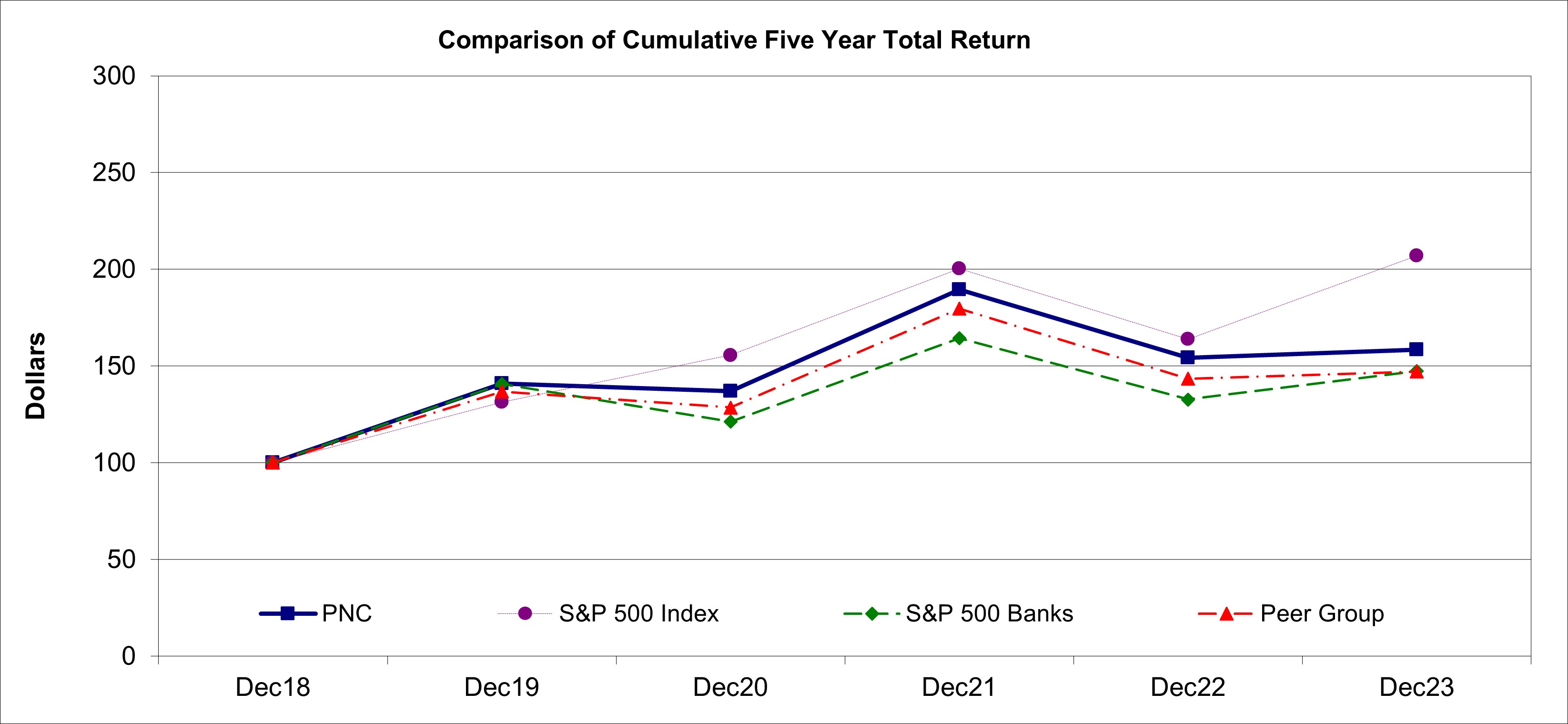
| Base Period | Assumes $100 investment at Close of Market on December 31, 2018 Total Return = Price change plus reinvestment of dividends | 5-Year Compound Growth Rate | |||||||||||||||||||||
| Dec. 2018 | Dec. 2019 | Dec. 2020 | Dec. 2021 | Dec. 2022 | Dec. 2023 | ||||||||||||||||||
| PNC | $ | 100 | $ | 140.89 | $ | 137.04 | $ | 189.42 | $ | 154.26 | $ | 158.41 | 9.64 | % | |||||||||
| S&P 500 Index | $ | 100 | $ | 131.47 | $ | 155.65 | $ | 200.29 | $ | 163.98 | $ | 207.04 | 15.67 | % | |||||||||
| S&P 500 Banks | $ | 100 | $ | 140.64 | $ | 121.29 | $ | 164.28 | $ | 132.73 | $ | 147.28 | 8.05 | % | |||||||||
| Peer Group | $ | 100 | $ | 136.89 | $ | 128.54 | $ | 179.63 | $ | 143.33 | $ | 147.08 | 8.02 | % |
The Peer Group for the preceding chart and table above consists of the following companies: Bank of America Corporation; Capital One Financial Corporation; Citizens Financial Group, Inc.; Fifth Third Bancorp; JPMorgan Chase & Co.; KeyCorp; M&T Bank Corporation; Regions Financial Corporation; The PNC Financial Services Group, Inc.; Truist Financial Corporation; U.S. Bancorp; and Wells Fargo & Company. For Truist Financial Corporation, the preceding chart and table reflects historical BB&T Corporation
36 The PNC Financial Services Group, Inc. – 2023 Form 10-K
data up until December 6, 2019, without inclusion of historical data from SunTrust Banks, Inc. This Peer Group was approved for 2023 by the Board’s Personnel and Compensation Committee, and the Committee has approved the same peer group for 2024.
Each yearly point for the Peer Group is determined by calculating the cumulative total shareholder return for each company in the Peer Group from December 31, 2018 to December 31 of that year, or the last business day of that year (End of Month Dividend Reinvestment Assumed) and then using the median of these returns as the yearly plot point.
In accordance with the rules of the SEC, this section, captioned “Common Stock Performance Graph,” is not incorporated by reference into any of our future filings made under the Securities Exchange Act of 1934 or the Securities Act of 1933. The Common Stock Performance Graph, including its accompanying table and footnotes, is not deemed to be soliciting material or to be filed under the Exchange Act or the Securities Act.
Item 6. RESERVED
Item 7. MANAGEMENT’S DISCUSSION AND ANALYSIS OF FINANCIAL CONDITION AND RESULTS OF OPERATIONS (MD&A)
E****XECUTIVE S****UMMARY
Key Strategic Goals
At PNC we manage our company for the long term. We are focused on the fundamentals of growing customers, loans, deposits and revenue and improving profitability, while investing for the future and managing risk, expenses and capital. We continue to invest in our products, markets and brand, and embrace our commitments to our customers, shareholders, employees and the communities where we do business.
We strive to serve our customers and expand and deepen relationships by offering a broad range of deposit, credit and fee-based products and services. We are focused on delivering those products and services to our customers with the goal of addressing their financial objectives and needs. Our business model is built on customer loyalty and engagement, understanding our customers’ financial goals and offering our diverse products and services to help them achieve financial well-being. Our approach is concentrated on organically growing and deepening client relationships across our businesses that meet our risk/return measures.
We are focused on our strategic priorities, which are designed to enhance value over the long term, and consist of:
-
Expanding our leading banking franchise to new markets and digital platforms,
-
Deepening customer relationships by delivering a superior banking experience and financial solutions, and
-
Leveraging technology to create efficiencies that help us better serve customers.
Our capital and liquidity priorities are to support customers, fund business investments and return excess capital to shareholders, while maintaining appropriate capital and liquidity in light of economic conditions, the Basel III framework and other regulatory expectations. For more detail, see the Supervision and Regulation section in Item 1 Business, the Capital Highlights portion of this Executive Summary and the Liquidity and Capital Management portion of the Risk Management section in this Item 7.
Key Factors Affecting Financial Performance
We face a variety of risks that may impact various aspects of our risk profile from time to time. The extent of such impacts may vary depending on factors such as the current business and economic conditions, political and regulatory environment and operational challenges. Many of these risks and our risk management strategies are described in more detail elsewhere in this Report.
Our success will depend upon, among other things, the following factors that we manage or control:
-
Effectively managing capital and liquidity including:
-
Continuing to maintain and, over time, grow our deposit base as a low-cost stable funding source,
-
Prudent liquidity and capital management to meet evolving regulatory capital, capital planning, stress testing and liquidity standards, and
-
Actions we take within the capital and other financial markets,
-
Execution of our strategic priorities,
-
Management of credit risk in our portfolio,
-
Our ability to manage and implement strategic business objectives within the changing regulatory environment,
-
The impact of legal and regulatory-related contingencies,
-
The appropriateness of critical accounting estimates and related contingencies, and
The PNC Financial Services Group, Inc. – 2023 Form 10-K 37
- Our ability to manage operational risks related to new products and services, changes in processes and procedures or the implementation of new technology.
Our financial performance is also substantially affected by a number of external factors outside of our control, including the following:
-
Global and domestic economic conditions,
-
The actions by the Federal Reserve, U.S. Treasury and other government agencies, including those that impact money supply and market interest rates and inflation,
-
The level of, and direction, timing and magnitude of movement in, interest rates and the shape of the interest rate yield curve,
-
The functioning and other performance of, and availability of liquidity in, U.S. and global financial markets, including capital markets,
-
The impact of tariffs and other trade policies of the U.S. and its global trading partners,
-
Changes in the competitive landscape,
-
Impacts of changes in federal, state and local governmental policy, including on the regulatory landscape, capital markets, taxes, infrastructure spending and social programs,
-
The impact of market credit spreads on asset valuations,
-
The ability of customers, counterparties and issuers to perform in accordance with contractual terms, and the resulting impact on our asset quality,
-
The effect of climate change on our business and performance, including indirectly through impacts on our customers,
-
Loan demand, utilization of credit commitments and standby letters of credit, and
-
The impact on customers and changes in customer behavior due to changing business and economic conditions or regulatory or legislative initiatives.
For additional information on the risks we face, see Item 1A Risk Factors and the Cautionary Statement Regarding Forward-Looking Information section in this Item 7.
Acquisition of BBVA USA Bancshares, Inc.
On June 1, 2021, PNC acquired BBVA, a U.S. financial holding company conducting its business operations primarily through its U.S. banking subsidiary, BBVA USA. PNC paid $11.5 billion in cash as consideration for the acquisition.
On October 8, 2021, BBVA USA merged into PNC Bank. On October 12, 2021, PNC converted approximately 2.6 million customers, 9,000 employees and over 600 branches across seven states. Our results of operations and balance sheets for all periods presented in this Report reflect the benefit of BBVA’s acquired businesses for the period since the acquisition closed on June 1, 2021.
Presentation of Noninterest Income
Effective for the first quarter of 2022, PNC updated the presentation of its noninterest income categorization to be based on product and service type, and accordingly, has changed the basis of presentation of its noninterest income revenue streams to: (i) Asset management and brokerage, (ii) Capital markets related, (iii) Card and cash management, (iv) Lending and deposit services, (v) Residential and commercial mortgage and (vi) Other noninterest income. For a description of each updated noninterest income revenue stream, see Note 1 Accounting Policies. Additionally, in the fourth quarter of 2022, PNC updated the name of the noninterest income line item “Capital markets related” to “Capital markets and advisory.” This update did not impact the components of the category. All periods presented herein reflect these changes.
Signature Bank Portfolio Acquisition
On October 2, 2023, PNC acquired a portfolio of capital commitments facilities from Signature Bridge Bank, N.A. through an agreement with the FDIC as receiver of the former Signature Bank, New York. The acquired portfolio represented approximately $16.0 billion in total commitments, including approximately $9.0 billion of funded loans, at the time of acquisition.
Workforce Reduction
During the fourth quarter of 2023, PNC implemented a workforce reduction that is expected to reduce 2024 personnel expense by approximately $325 million annually, on a pre-tax basis. PNC incurred expenses of $150 million in the fourth quarter of 2023 in connection with this workforce reduction.
FDIC Special Assessment
In November 2023, the FDIC approved a final rule to implement a special assessment to recover the loss to the Deposit Insurance Fund associated with protecting uninsured depositors following the closures of Silicon Valley Bank and Signature Bank. PNC
38 The PNC Financial Services Group, Inc. – 2023 Form 10-K
incurred an expense on a pre-tax basis of $515 million during the fourth quarter of 2023 representing the total estimated cost of the assessment.
Selected Financial Data
The following tables include selected financial data which sho
Showing the first 8K of 249K characters. Open the full section
Item 7A. QUANTITATIVE AND QUALITATIVE DISCLOSURES ABOUT MARKET RISK
This information is set forth in the Risk Management section of Item 7 and in Note 1 Accounting Policies, Note 14 Fair Value and Note 15 Financial Derivatives in the Notes to Consolidated Financial Statements in Item 8 of this Report.
Item 8. FINANCIAL STATEMENTS AND SUPPLEMENTARY DATA
82 The PNC Financial Services Group, Inc. – 2023 Form 10-K
R****EPORT OF I****NDEPENDENT R****EGISTERED P****UBLIC A****CCOUNTING F****IRM
To the Board of Directors and Shareholders of The PNC Financial Services Group, Inc.
Opinions on the Financial Statements and Internal Control over Financial Reporting
We have audited the accompanying consolidated balance sheet of The PNC Financial Services Group, Inc. and its subsidiaries (the “Company”) as of December 31, 2023 and 2022, and the related consolidated statements of income, of comprehensive income, of changes in equity and of cash flows for each of the three years in the period ended December 31, 2023, including the related notes (collectively referred to as the “consolidated financial statements”). We also have audited the Company's internal control over financial reporting as of December 31, 2023, based on criteria established in Internal Control - Integrated Framework (2013) issued by the Committee of Sponsoring Organizations of the Treadway Commission (COSO).
In our opinion, the consolidated financial statements referred to above present fairly, in all material respects, the financial position of the Company as of December 31, 2023 and 2022, and the results of its operations and its cash flows for each of the three years in the period ended December 31, 2023 in conformity with accounting principles generally accepted in the United States of America. Also in our opinion, the Company maintained, in all material respects, effective internal control over financial reporting as of December 31, 2023, based on criteria established in Internal Control - Integrated Framework (2013) issued by the COSO.
Basis for Opinions
The Company's management is responsible for these consolidated financial statements, for maintaining effective internal control over financial reporting, and for its assessment of the effectiveness of internal control over financial reporting, included in Management’s Report on Internal Control over Financial Reporting appearing under Item 9A. Our responsibility is to express opinions on the Company’s consolidated financial statements and on the Company's internal control over financial reporting based on our audits. We are a public accounting firm registered with the Public Company Accounting Oversight Board (United States) (PCAOB) and are required to be independent with respect to the Company in accordance with the U.S. federal securities laws and the applicable rules and regulations of the Securities and Exchange Commission and the PCAOB.
We conducted our audits in accordance with the standards of the PCAOB. Those standards require that we plan and perform the audits to obtain reasonable assurance about whether the consolidated financial statements are free of material misstatement, whether due to error or fraud, and whether effective internal control over financial reporting was maintained in all material respects.
Our audits of the consolidated financial statements included performing procedures to assess the risks of material misstatement of the consolidated financial statements, whether due to error or fraud, and performing procedures that respond to those risks. Such procedures included examining, on a test basis, evidence regarding the amounts and disclosures in the consolidated financial statements. Our audits also included evaluating the accounting principles used and significant estimates made by management, as well as evaluating the overall presentation of the consolidated financial statements. Our audit of internal control over financial reporting included obtaining an understanding of internal control over financial reporting, assessing the risk that a material weakness exists, and testing and evaluating the design and operating effectiveness of internal control based on the assessed risk. Our audits also included performing such other procedures as we considered necessary in the circumstances. We believe that our audits provide a reasonable basis for our opinions.
Definition and Limitations of Internal Control over Financial Reporting
A company’s internal control over financial reporting is a process designed to provide reasonable assurance regarding the reliability of financial reporting and the preparation of financial statements for external purposes in accordance with generally accepted accounting principles. A company’s internal control over financial reporting includes those policies and procedures that (i) pertain to the maintenance of records that, in reasonable detail, accurately and fairly reflect the transactions and dispositions of the assets of the company; (ii) provide reasonable assurance that transactions are recorded as necessary to permit preparation of financial statements in accordance with generally accepted accounting principles, and that receipts and expenditures of the company are being made only in accordance with authorizations of management and directors of the company; and (iii) provide reasonable assurance regarding pre
Showing the first 8K of 571K characters. Open the full section
Item 9. CHANGES IN AND DISAGREEMENTS WITH ACCOUNTANTS ON ACCOUNTING AND FINANCIAL DISCLOSURE
None.
Item 9A. CONTROLS AND PROCEDURES
M****ANAGEMENT’S R****EPORT ON I****NTERNAL C****ONTROL OVER F****INANCIAL R****EPORTING
The management of The PNC Financial Services Group, Inc. and subsidiaries (PNC) is responsible for establishing and maintaining adequate internal control over financial reporting, as such term is defined in the Exchange Act Rule 13a-15(f).
Because of inherent limitations, internal control over financial reporting may not prevent or detect misstatements. Also, projections of any evaluation of effectiveness to future periods are subject to the risk that controls may become inadequate because of changes in conditions, or that the degree of compliance with the policies or procedures may deteriorate.
188 The PNC Financial Services Group, Inc. – 2023 Form 10-K
We performed an evaluation under the supervision and with the participation of our management, including the Chairman, President and Chief Executive Officer and the Executive Vice President and Chief Financial Officer, of the effectiveness of PNC’s internal control over financial reporting as of December 31, 2023. This assessment was based on criteria for effective internal control over financial reporting described in Internal Control-Integrated Framework (2013) issued by the Committee of Sponsoring Organizations of the Treadway Commission. Based on this assessment, management concluded that PNC maintained effective internal control over financial reporting as of December 31, 2023.
PricewaterhouseCoopers LLP, the independent registered public accounting firm that audited our consolidated financial statements as of and for the year ended December 31, 2023 included in this Report, has also audited the effectiveness of PNC’s internal control over financial reporting as of December 31, 2023. The report of PricewaterhouseCoopers LLP is included under Item 8 of this Report.
D****ISCLOSURE C****ONTROLS AND P****ROCEDURES AND C****HANGES IN I****NTERNAL C****ONTROL OVER F****INANCIAL R****EPORTING
As of December 31, 2023, we performed an evaluation under the supervision and with the participation of our management, including the Chairman, President and Chief Executive Officer and the Executive Vice President and Chief Financial Officer, of the effectiveness of the design and operation of our disclosure controls and procedures and of changes in our internal control over financial reporting.
Based on that evaluation, our Chairman, President and Chief Executive Officer and our Executive Vice President and Chief Financial Officer concluded that our disclosure controls and procedures (as defined in Rule 13a-15(e) under the Securities and Exchange Act of 1934, as amended) were effective as of December 31, 2023, and that there has been no change in PNC’s internal control over financial reporting that occurred during the fourth quarter of 2023 that has materially affected, or is reasonably likely to materially affect, our internal control over financial reporting.
Item 9B. OTHER INFORMATION
Director or Executive Officer Rule 10b5-1 and Non-Rule 10b5-1 Trading Arrangements
During the three months ended December 31, 2023, none of PNC’s directors or executive officers adopted, terminated, or modified a Rule 10b5-1 trading arrangement or non-Rule 10b5-1 trading arrangement.
PART III
Item 10. DIRECTORS, EXECUTIVE OFFICERS AND CORPORATE GOVERNANCE
Certain of the information regarding our directors (or nominees for director), executive officers and Audit Committee (and Audit Committee financial experts), required by this item is included under the captions “Item 1 - Election of Directors,” and “Corporate Governance – Board committees – Audit Committee,” in our Proxy Statement to be filed for the 2024 annual meeting of shareholders and is incorporated herein by reference.
Additional information regarding our executive officers is included in Part I of this Report under the caption “Information about our Executive Officers.”
Information regarding our compliance with Section 16(a) of the Securities Exchange Act of 1934 is included, to the extent necessary, under the caption “Delinquent Section 16(a) Reports” in our Proxy Statement to be filed for the 2024 annual meeting of shareholders and is incorporated herein by reference.
Certain information regarding our PNC Code of Business Conduct and Ethics required by this item is included under the captions “Corporate Governance – Our Code of Business Conduct and Ethics” in our Proxy Statement to be filed for the 2024 annual meeting of shareholders and is incorporated herein by reference. Our PNC Code of Business Conduct and Ethics is available on our corporate website at www.pnc.com/corporategovernance. In addition, any future amendments to, or waivers from, a provision of the PNC Code of Business Conduct and Ethics that applies to our directors or executive officers (including our principal executive officer, principal financial officer, and principal accounting officer or controller) will be posted at this internet address.
Item 11. EXECUTIVE COMPENSATION
The information required by this item is included under the captions “Corporate Governance – Board committees – Human Resources Committee – Compensation committee interlocks and insider participation,” “Director Compensation,” “Compensation Discussion and Analysis,” “Compensation Committee Report,” “Compensation and Risk,” “Compensation Tables,” “Change in Control and Termination of Employment” and “CEO Pay Ratio” in our Proxy Statement to be filed for the 2024 annual meeting of shareholders and is incorporated herein by reference. In accordance with Item 407(e)(5) of Regulation S-K, the information set forth under the caption “Compensation Committee Report” in such Proxy Statement will be deemed to be furnished in this Report and will not be
The PNC Financial Services Group, Inc. – 2023 Form 10-K 189
deemed to be incorporated by reference into any filing under the Securities Act or the Exchange Act as a result of furnishing the disclosure in this manner.
Item 12. SECURITY OWNERSHIP OF CERTAIN BENEFICIAL OWNERS AND MANAGEMENT AND RELATED STOCKHOLDER MATTERS
The information required by this item regarding security ownership of certain beneficial owners and management is included under the caption “Security Ownership of Management and Certain Beneficial Owners” in our Proxy Statement to be filed for the 2024 annual meeting of shareholders and is incorporated herein by reference.
Information regarding our compensation plans under which PNC equity securities are authorized for issuance as of December 31, 2023 is included in the table which follows. For additional information regarding these plans, see Note 17 Stock Based Compensation Plans.
Equity Compensation Plan Information
At December 31, 2023
| (a) | (b) | ||||||||||||||||||||||
| Number of securities to be issued upon exercise of outstanding options, warrants and rights | Number of securities remaining available for future issuance under equity compensation plans (excluding securities reflected in column (a)) | ||||||||||||||||||||||
| Plan Category | |||||||||||||||||||||||
| Equity compensation plans approved by security holders | 4,677,131 | (1) | 15,393,550 | (2) | |||||||||||||||||||
| Equity compensation plans not approved by security holders | |||||||||||||||||||||||
| Total | 4,677,131 | 15,393,550 |
(1) – Of this total, the following amounts relate to the 2016 Incentive Award Plan (2016 Incentive Plan), approved by shareholders on April 26, 2016: 3,734,119 are stock-payable restricted stock units (at a maximum share award level), 857,867 are performance share units (at maximum share award level) and 65,431 are deferred stock units (at a maximum share award level). Also included in this total are 19,714 stock-payable restricted stock units (at a maximum award level) that relate to the 2006 Incentive Award Plan, as amended and restated (2006 Incentive Plan). The restricted stock units and incentive performance units have no exercise price.
Following shareholder approval of the 2016 Incentive Plan, no further grants were permitted under the 2006 Incentive Plan, and the balance of shares authorized but unissued under the 2006 Incentive Plan were made available under the 2016 Incentive Plan.
(2) – Includes 1,542,918 shares available for issuance under the Employee Stock Purchase Plan, of which 104,213 shares are subject to purchase during the purchase period ending December 31, 2023. The amount available for awards under the 2016 Incentive Plan is 13,850,632.
Item 13. CERTAIN RELATIONSHIPS AND RELATED TRANSACTIONS, AND DIRECTOR INDEPENDENCE
The information required by this item is included under the captions “Director and Executive Officer Relationships – Director independence, – Transactions with directors, – Family relationships, and – Indemnification and advancement of costs” and “Related Person Transactions” in our Proxy Statement to be filed for the 2024 annual meeting of shareholders and is incorporated herein by reference.
Item 14. PRINCIPAL ACCOUNTING FEES AND SERVICES
The information required by this item is included under the caption “Item 2 - Ratification of Independent Registered Public Accounting Firm” in our Proxy Statement to be filed for the 2024 annual meeting of shareholders and is incorporated herein by reference.
190 The PNC Financial Services Group, Inc. – 2023 Form 10-K
PART IV
Item 15. EXHIBITS, FINANCIAL STATEMENT SCHEDULES
F****INANCIAL S****TATEMENTS, F****INANCIAL S****TATEMENT S****CHEDULES
Our consolidated financial statements required in response to this Item are incorporated by reference from Item 8 of this Report.
E****XHIBIT I****NDEX
| Exhibit No. | Description | Method of Filing + | ||||||||||||
| 2.1.1 | Share Purchase Agreement, dated as of November 15, 2020, between Banco Bilbao Vizcaya Argentaria, S.A. and The PNC Financial Services Group, Inc. | Incorporated herein by reference to Exhibit 2.1 of the Corporation’s Current Report on Form 8-K filed November 19, 2020 | ||||||||||||
| 2.1.2 | Amendment No. 1 to the Purchase Agreement | Incorporated herein by reference to Exhibit 2.1.2 of the Corporation’s Quarterly Report on Form 10-Q for the quarter ended June 30, 2021 | ||||||||||||
| 3.1.1 | Amended and Restated Articles of Incorporation of the Corporation, as amended and effective January 2, 2009 | Incorporated herein by reference to Exhibit 3.1 of the Corporation’s Annual Report on Form 10-K for the year ended December 31, 2008 | ||||||||||||
| 3.1.2 | Statement with Respect to Shares of Fixed-to-Floating Rate Non-Cumulative Perpetual Preferred Stock, Series O dated July 21, 2011 | Incorporated herein by reference to Exhibit 3.1 of the Corporation’s Current Report on Form 8-K filed July 27, 2011 | ||||||||||||
| 3.1.3 | Statement with Respect to Shares of Fixed-to-Floating Rate Non-Cumulative Perpetual Preferred Stock, Series P dated April 19, 2012 | Incorporated herein by reference to Exhibit 3.1 of the Corporation’s Current Report on Form 8-K filed April 24, 2012 | ||||||||||||
| 3.1.4 | Statement with Respect to Shares of 5.375% Non-Cumulative Perpetual Preferred Stock, Series Q dated September 14, 2012 | Incorporated herein by reference to Exhibit 3.1 of the Corporation’s Current Report on Form 8-K filed September 21, 2012 | ||||||||||||
| 3.1.5 | Statement with Respect to Shares of Fixed-to-Floating Rate Non-Cumulative Perpetual Preferred Stock, Series R dated May 2, 2013 | Incorporated herein by reference to Exhibit 3.1 of the Corporation’s Current Report on Form 8-K filed May 7, 2013 | ||||||||||||
| 3.1.6 | Amendment to Amended and Restated Articles of Incorporation of the Corporation, effective November 19, 2015 | Incorporated herein by reference to Exhibit 3.1.6 of the Corporation’s Current Report on Form 8-K filed November 20, 2015 | ||||||||||||
| 3.1.7 | Statement with Respect to Shares of Fixed-to-Floating Rate Non-Cumulative Perpetual Preferred Stock, Series S dated October 27, 2016 | Incorporated herein by reference to Exhibit 3.1 of the Corporation’s Current Report on Form 8-K filed November 1, 2016 | ||||||||||||
| 3.1.8 | Statement with Respect to Shares of the 3.400% Fixed-Rate Reset Non-Cumulative Perpetual Preferred Stock, Series T | Incorporated herein by reference to Exhibit 3.1 of the Corporation’s Current Report on Form 8-K filed September 13, 2021 | ||||||||||||
| 3.1.9 | Statement with Respect to Shares of the 6.000% Fixed-Rate Reset Non-Cumulative Perpetual Preferred Stock, Series U | Incorporated herein by reference to Exhibit 3.1 of the Corporation’s Current Report on Form 8-K filed April 26, 2022 | ||||||||||||
| 3.1.10 | Statement with Respect to Shares of the 6.200% Fixed-Rate Reset Non-Cumulative Perpetual Preferred Stock, Series V | Incorporated herein by reference to Exhibit 3.1 of the Corporation’s Current Report on Form 8-K filed August 19, 2022 | ||||||||||||
| 3.1.11 | Statement with Respect to Shares of the 6.250% Fixed-Rate Reset Non-Cumulative Perpetual Preferred Stock, Series W | Incorporated herein by reference to Exhibit 3.1 of the Corporation’s Current Report on Form 8-K filed February 7, 2023 | ||||||||||||
| 3.2 | Amended and Restated Bylaws of the Corporation effective February 10, 2022 | Filed herewith | ||||||||||||
The PNC Financial Services Group, Inc. – 2023 Form 10-K 191
192 The PNC Financial Services Group, Inc. – 2023 Form 10-K
| Exhibit No. | Description | Method of Filing + | ||||||||||||
| 4.11.2 | Amendment No. 1 to Issuing and Paying Agency Agreement, dated May 22, 2015, between PNC Bank, National Association and PNC Bank, National Association, relating to the $30 billion Global Bank Note Program for the Issue of Senior and Subordinated Bank Notes | Incorporated herein by reference to Exhibit 4.21.2 of the Corporation’s Quarterly Report on Form 10-Q for the quarter ended June 30, 2015 | ||||||||||||
| 4.11.3 | Amendment No. 2 to Issuing and Paying Agency Agreement, dated May 27, 2016, between PNC Bank, National Association and PNC Bank, National Association, relating to the $40 billion Global Bank Note Program for the Issue of Senior and Subordinated Bank Notes | Incorporated herein by reference to Exhibit 4.20.3 of the Corporation’s Quarterly Report on Form 10-Q for the quarter ended June 30, 2016 | ||||||||||||
| 4.12 | Forms of PNC Bank, National Association Senior Global Bank Notes issued after January 16, 2014 (included in Exhibit 4.11.1) | Incorporated herein by reference to Exhibit 4.25 of the Corporation’s Annual Report on Form 10-K for the year ended December 31, 2013 | ||||||||||||
| 4.13 | Forms of PNC Bank, National Association Subordinated Global Bank Notes issued on or after May 22, 2015 (included in Exhibit 4.11.2) | Incorporated herein by reference to Exhibit 4.21.2 of the Corporation’s Quarterly Report on Form 10-Q for the quarter ended June 30, 2015 | ||||||||||||
| 4.14 | Description of the Corporation’s Securities | Filed herewith | ||||||||||||
| 10.1.1 | The Corporation’s Supplemental Executive Retirement Plan, as amended and restated effective January 1, 2009 | Incorporated herein by reference to Exhibit 10.2 of the Corporation’s Annual Report on Form 10-K for the year ended December 31, 2008* | ||||||||||||
| 10.1.2 | Amendment 2009-1 to the Corporation’s Supplemental Executive Retirement Plan, as amended and restated effective January 1, 2009 | Incorporated herein by reference to Exhibit 10.3 of the Corporation’s Annual Report on Form 10-K for the year ended December 31, 2009* | ||||||||||||
| 10.1.3 | Amendment 2013-1 to the Corporation’s Supplemental Executive Retirement Plan, as amended and restated effective January 1, 2009 | Incorporated herein by reference to Exhibit 10.1.3 of the Corporation’s Annual Report on Form 10-K for the year ended December 31, 2013* | ||||||||||||
| 10.2 | The Corporation’s ERISA Excess Pension Plan, as amended and restated effective January 1, 2023 | Incorporated by reference to Exhibit 10.2 of the Corporation’s Annual Report on Form 10-K for the year ended December 31, 2022* | ||||||||||||
| 10.3.1 | The Corporation’s Key Executive Equity Program, as amended and restated effective January 1, 2009 | Incorporated herein by reference to Exhibit 10.6 of the Corporation’s Annual Report on Form 10-K for the year ended December 31, 2008* | ||||||||||||
| 10.3.2 | Amendment 2009-1 to the Corporation’s Key Executive Equity Program, as amended and restated as of January 1, 2009 | Incorporated herein by reference to Exhibit 10.9 of the Corporation’s Annual Report on Form 10-K for the year ended December 31, 2009* | ||||||||||||
| 10.4.1 | The Corporation’s Supplemental Incentive Savings Plan, as amended and restated effective January 1, 2010 | Incorporated herein by reference to Exhibit 10.17 of the Corporation’s Annual Report on Form 10-K for the year ended December 31, 2011* | ||||||||||||
| 10.4.2 | Amendment 2013-1 to the Corporation’s Supplemental Incentive Savings Plan, as amended and restated effective January 1, 2010 | Incorporated herein by reference to Exhibit 10.4.2 of the Corporation’s Annual Report on Form 10-K for the year ended December 31, 2013* | ||||||||||||
| 10.5.1 | The Corporation and Affiliates Deferred Compensation Plan, as amended and restated May 5, 2009 | Incorporated herein by reference to Exhibit 10.62 of the Corporation’s Quarterly Report on Form 10-Q for the quarter ended June 30, 2009* | ||||||||||||
| 10.5.2 | Amendment 2009-1 to the Corporation and Affiliates Deferred Compensation Plan, as amended and restated May 5, 2009 | Incorporated herein by reference to Exhibit 10.17 of the Corporation’s Annual Report on Form 10-K for the year ended December 31, 2009* | ||||||||||||
| 10.5.3 | Amendment 2010-1 to the Corporation and Affiliates Deferred Compensation Plan, as amended and restated May 5, 2009 | Incorporated herein by reference to Exhibit 10.20 of the Corporation’s Annual Report on Form 10-K for the year ended December 31, 2010* | ||||||||||||
The PNC Financial Services Group, Inc. – 2023 Form 10-K 193
| Exhibit No. | Description | Method of Filing + | ||||||||||||
| 10.5.4 | Amendment 2011-1 to the Corporation and Affiliates Deferred Compensation Plan, as amended and restated May 5, 2009 | Incorporated herein by reference to Exhibit 10.23 of the Corporation’s Annual Report on Form 10-K for the year ended December 31, 2011* | ||||||||||||
| 10.5.5 | Amendment 2012-1 to the Corporation and Affiliates Deferred Compensation Plan, as amended and restated May 5, 2009 | Incorporated herein by reference to Exhibit 10.24 of the Corporation’s Annual Report on Form 10-K for the year ended December 31, 2012* | ||||||||||||
| 10.5.6 | Amendment 2013-1 to the Corporation and Affiliates Deferred Compensation Plan, as amended and restated May 5, 2009 | Incorporated herein by reference to Exhibit 10.5.6 of the Corporation’s Annual Report on Form 10-K for the year ended December 31, 2013* | ||||||||||||
| 10.6.1 | The Corporation and Affiliates Deferred Compensation and Incentive Plan, as amended and restated effective January 1, 2020 | Incorporated herein by reference to Exhibit 10.6.3 of the Corporation’s Annual Report on Form 10-K for the year ended December 31, 2019* | ||||||||||||
| 10.6.2 | Amendment 2021-1 to the Corporation and Affiliates Deferred Compensation and Incentive Plan, as amended and restated effective January 1, 2020 | Incorporated herein by reference to Exhibit 10.6.1 of the Corporation’s Quarterly Report on Form 10-Q for the quarter ended September 30, 2021* | ||||||||||||
| 10.6.3 | Amendment 2021-2 to the Corporation and Affiliates Deferred Compensation and Incentive Plan, as amended and restated effective January 1, 2020 | Incorporated herein by reference to Exhibit 10.6.3 of the Corporation’s Annual Report on Form 10-K for the year ended December 31, 2021* | ||||||||||||
| 10.7 | The PNC Financial Services Group, Inc. 2016 Incentive Award Plan | Incorporated herein by reference to Exhibit 99.1 of the Corporation’s Form S-8 (File No. 333-210995) filed April 29, 2016* | ||||||||||||
| 10.8 | The Corporation’s Directors Deferred Compensation Plan, as amended and restated effective January 1, 2015 | Incorporated herein by reference to Exhibit 10.52 of the Corporation’s Quarterly Report on Form 10-Q for the quarter ended September 30, 2014* | ||||||||||||
| 10.9 | The Corporation’s 2016 Incentive Award Plan Directors Deferred Stock Unit Program effective January 1, 2017 | Incorporated herein by reference to Exhibit 10.16 of the Corporation’s Annual Report on Form 10-K for the year ended December 31, 2016* | ||||||||||||
| 10.10 | Trust Agreement between the Corporation, as settlor, and Matrix Trust Company, as trustee | Incorporated herein by reference to Exhibit 10.15 of the Corporation’s Annual Report on Form 10-K for the year ended December 31, 2017* | ||||||||||||
| 10.11 | Trust Agreement between PNC Investment Corp., as settlor, and PNC Bank, National Association, as trustee | Incorporated herein by reference to Exhibit 10.34 of the Corporation’s Quarterly Report on Form 10-Q for the quarter ended September 30, 2005* | ||||||||||||
| 10.12 | Certificate of Corporate Action for Grantor Trusts effective January 1, 2012 | Incorporated herein by reference to Exhibit 10.37 of the Corporation’s Annual Report on Form 10-K for the year ended December 31, 2011* | ||||||||||||
| 10.13 | Certificate of Corporate Action for Grantor Trusts effective December 1, 2021 | Incorporated herein by reference to Exhibit 10.14 of the Corporation’s Annual Report on Form 10-K for the year ended December 31, 2021* | ||||||||||||
| 10.14 | The Corporation’s Employee Stock Purchase Plan, as amended and restated as of January 1, 2020 | Incorporated herein by reference to Exhibit 4.4 of the Corporation’s Form S-8 (File No. 333-238049) filed May 6, 2020* | ||||||||||||
| 10.15 | 2021 Form of Performance Share Units Award Agreement | Incorporated herein by reference to Exhibit 10.26 of the Corporation’s Annual Report on Form 10-K for the year ended December 31, 2021* | ||||||||||||
| 10.16 | 2021 Form of Restricted Share Units Award Agreement | Incorporated herein by reference to Exhibit 10.36 of the Corporation’s Annual Report on Form 10-K for the year ended December 31, 2021* | ||||||||||||
| 10.17 | 2021 Form of Restricted Share Units Award Agreement – Senior Leader Program | Incorporated herein by reference to Exhibit 10.37 of the Corporation’s Quarterly Report on Form 10-Q for the quarter ended June 30, 2021* | ||||||||||||
194 The PNC Financial Services Group, Inc. – 2023 Form 10-K
| Exhibit No. | Description | Method of Filing + | ||||||||||||
| 10.18 | 2022 Form of Performance Share Units Award Agreement | Incorporated herein by reference to Exhibit 10.34 of the Corporation’s Quarterly Report on Form 10-Q for the quarter ended June 30, 2022* | ||||||||||||
| 10.19 | 2022 Form of Restricted Share Units Award Agreement | Incorporated herein by reference to Exhibit 10.35 of the Corporation’s Quarterly Report on Form 10-Q for the quarter ended June 30, 2022* | ||||||||||||
| 10.20 | 2022 Form of Restricted Share Units Award Agreement – Senior Leader Program | Incorporated herein by reference to Exhibit 10.36 of the Corporation’s Quarterly Report on Form 10-Q for the quarter ended June 30, 2022* | ||||||||||||
| 10.21 | 2022 Form of Performance Restricted Share Units Award Agreement | Incorporated herein by reference to Exhibit 10.37 of the Corporation’s Quarterly Report on Form 10-Q for the quarter ended June 30, 2022* | ||||||||||||
| 10.22 | 2023 Form of Performance Share Units Award Agreement | Incorporated herein by reference to Exhibit 10.33 of the Corporation’s Quarterly Report on Form 10-Q for the quarter ended June 30, 2023* | ||||||||||||
| 10.23 | 2023 Form of Restricted Share Units Award Agreement | Incorporated herein by reference to Exhibit 10.34 of the Corporation’s Quarterly Report on Form 10-Q for the quarter ended June 30, 2023* | ||||||||||||
| 10.24 | 2023 Form of Restricted Share Units Award Agreement – Senior Leader Program | Incorporated herein by reference to Exhibit 10.35 of the Corporation’s Quarterly Report on Form 10-Q for the quarter ended June 30, 2023* | ||||||||||||
| 10.25 | 2023 Form of Five-Year Restricted Share Units Award Agreement | Incorporated herein by reference to Exhibit 10.36 of the Corporation’s Quarterly Report on Form 10-Q for the quarter ended June 30, 2023* | ||||||||||||
| 10.26 | Form of Time Sharing Agreement between the Corporation and certain executives | Incorporated herein by reference to Exhibit 10.33 of the Corporation’s Quarterly Report on Form 10-Q for the quarter ended March 31, 2022* | ||||||||||||
| 10.27 | Form of change of control employment agreements | Incorporated herein by reference to Exhibit 10.51 of the Corporation’s Current Report on Form 8-K filed August 16, 2016* | ||||||||||||
| 10.28.1 | The National City Corporation 2004 Deferred Compensation Plan, as amended and restated effective January 1, 2005 | Incorporated herein by reference to Exhibit 10.35 of National City Corporation’s Quarterly Report on Form 10-Q for the quarter ended March 31, 2006* | ||||||||||||
| 10.28.2 | Amendment to The National City Corporation 2004 Deferred Compensation Plan, as amended and restated effective January 1, 2005 | Incorporated herein by reference to Exhibit 10.56 of the Corporation’s Annual Report on Form 10-K for the year ended December 31, 2010* | ||||||||||||
| 10.29.1 | Distribution Agreement, dated January 16, 2014, between PNC Bank, National Association and the Dealers named therein, relating to the $25 billion Global Bank Note Program for the Issue of Senior and Subordinated Bank Notes | Incorporated by reference to Exhibit 10.47 of the Corporation’s Annual Report on Form 10-K for the year ended December 31, 2014 | ||||||||||||
| 10.29.2 | Amendment No. 1 to Distribution Agreement, dated May 22, 2015, between PNC Bank, National Association and the Dealers named therein, relating to the $30 billion Global Bank Note Program for the Issue of Senior and Subordinated Bank Notes | Incorporated herein by reference to Exhibit 10.47.2 of the Corporation’s Quarterly Report on Form 10-Q for the quarter ended June 30, 2015 | ||||||||||||
| 10.29.3 | Amendment No. 2 to Distribution Agreement, dated May 27, 2016, between PNC Bank, National Association and the Dealers named therein, relating to the $40 billion Global Bank Note Program for the Issue of Senior and Subordinated Bank Notes | Incorporated herein by reference to Exhibit 10.48.3 of the Corporation’s Quarterly Report on Form 10-Q for the quarter ended June 30, 2016 | ||||||||||||
| 21 | Schedule of Certain Subsidiaries of the Corporation | Filed herewith | ||||||||||||
| 22 | Subsidiary Issuers of Guaranteed Securities | Filed herewith | ||||||||||||
The PNC Financial Services Group, Inc. – 2023 Form 10-K 195
| Exhibit No. | Description | Method of Filing + | ||||||||||||
| 23.1 | Consent of PricewaterhouseCoopers LLP, the Corporation’s Independent Registered Public Accounting Firm | Filed herewith | ||||||||||||
| 24 | Powers of Attorney | Filed herewith | ||||||||||||
| 31.1 | Certification of Chief Executive Officer pursuant to Section 302 of the Sarbanes-Oxley Act of 2002 | Filed herewith | ||||||||||||
| 31.2 | Certification of Chief Financial Officer pursuant to Section 302 of the Sarbanes-Oxley Act of 2002 | Filed herewith | ||||||||||||
| 32.1 | Certification of Chief Executive Officer pursuant to 18 U.S.C. Section 1350 | Furnished herewith | ||||||||||||
| 32.2 | Certification of Chief Financial Officer pursuant to 18 U.S.C. Section 1350 | Furnished herewith | ||||||||||||
| 97 | Dodd-Frank Recoupment Policy effective October 2, 2023 | Filed herewith | ||||||||||||
| 101.INS | Inline XBRL Instance Document | Filed herewith** | ||||||||||||
| 101.SCH | Inline XBRL Taxonomy Extension Schema Document | Filed herewith | ||||||||||||
| 101.CAL | Inline XBRL Taxonomy Extension Calculation Linkbase Document | Filed herewith | ||||||||||||
| 101.LAB | Inline XBRL Taxonomy Extension Label Linkbase Document | Filed herewith | ||||||||||||
| 101.PRE | Inline XBRL Taxonomy Extension Presentation Linkbase Document | Filed herewith | ||||||||||||
| 101.DEF | Inline XBRL Taxonomy Extension Definition Linkbase Document | Filed herewith | ||||||||||||
| 104 | Cover Page Interactive Data File (formatted as inline XBRL and contained in Exhibit 101) |
| + | Incorporated document references to filings by the Corporation are to SEC File No. 001-09718, and to filings by National City Corporation are to SEC File No. 001-10074. | ||||
| * | Denotes management contract or compensatory plan. | ||||
| ** | The instance document does not appear in the interactive data file because its XBRL tags are embedded within the inline XBRL. |
You can obtain copies of these Exhibits electronically at the SEC’s website at www.sec.gov. The Exhibits are also available as part of this Form 10-K on PNC’s corporate website at www.pnc.com/secfilings. Shareholders and bondholders may also obtain copies of Exhibits, without charge, by contacting Shareholder Relations at 800-843-2206 or via e-mail at investor.relations@pnc.com. The Interactive Data File (XBRL) exhibit is only available electronically.
Item 16. FORM 10-K SUMMARY
None.
196 The PNC Financial Services Group, Inc. – 2023 Form 10-K
SIGNATURES
Pursuant to the requirements of Section 13 or 15(d) of the Securities Exchange Act of 1934, the registrant has duly caused this report to be signed on its behalf by the undersigned, thereunto duly authorized.
The PNC Financial Services Group, Inc.
(Registrant)
| By: | /s/ Robert Q. Reilly | |||||||
| Robert Q. Reilly | ||||||||
| Executive Vice President and Chief Financial Officer | ||||||||
| February 21, 2024 |
Pursuant to the requirements of the Securities Exchange Act of 1934, this report has been signed below by the following persons on behalf of The PNC Financial Services Group, Inc. and in the capacities indicated on February 21, 2024.
| Signature | Capacities | |||||||
| /s/ William S. Demchak | Chairman and Chief Executive Officer and Director | |||||||
| William S. Demchak | (Principal Executive Officer) | |||||||
| /s/ Robert Q. Reilly | Executive Vice President and Chief Financial Officer | |||||||
| Robert Q. Reilly | (Principal Financial Officer) | |||||||
| /s/ Gregory H. Kozich | Senior Vice President and Controller | |||||||
| Gregory H. Kozich | (Principal Accounting Officer) | |||||||
| * Joseph Alvarado; Debra A. Cafaro; Marjorie Rodgers Cheshire; Andrew T. Feldstein; Richard J. Harshman; Daniel R. Hesse; Renu Khator, Linda R. Medler, Robert A. Niblock, Martin Pfinsgraff; Bryan Salesky | Directors |
| *By: | /s/ Laura Gleason | |||||||
| Laura Gleason, Attorney-in-Fact, pursuant to Powers of Attorney filed herewith |
The PNC Financial Services Group, Inc. – 2023 Form 10-K 197