 filings.tools
PayPal Holdings 2018 10-K Annual Report
PYPL · CIK 1633917 · Form 10-K · Fiscal year ended December 31, 2018 · Filed February 7, 2019
22 sections, 558K characters. Original on sec.gov · Markdown · JSON
Risk FactorsBusinessMD&AFinancial StatementsWhat changed vs 2017
Cover and table of contents
10-K 1 pypl201810-k.htm 10-K
UNITED STATES
SECURITIES AND EXCHANGE COMMISSION
Washington, D.C. 20549
FORM 10-K
| ý | ANNUAL REPORT PURSUANT TO SECTION 13 OR 15(d) OF THE SECURITIES EXCHANGE ACT OF 1934 |
For the fiscal year ended December 31, 2018.
OR
| o | TRANSITION REPORT PURSUANT TO SECTION 13 OR 15(d) OF THE SECURITIES EXCHANGE ACT OF 1934 |
For the Transition Period from to .
Commission file number 001-36859
PayPal Holdings, Inc.
(Exact Name of Registrant as Specified in Its Charter)
| Delaware | 47-2989869 |
| (State or Other Jurisdiction of Incorporation or Organization) | (I.R.S. Employer Identification No.) |
| 2211 North First Street San Jose, California | 95131 |
| (Address of Principal Executive Offices) | (Zip Code) |
(408) 967-1000
(Registrant’s telephone number, including area code)
Securities registered pursuant to Section 12(b) of the Act:
| Title of each class | Name of each exchange on which registered |
| Common Stock, $0.0001 par value per share | The NASDAQ Stock Market LLC |
Securities registered pursuant to Section 12(g) of the Securities Exchange Act of 1934:
None
Indicate by check mark if the registrant is a well-known seasoned issuer, as defined in Rule 405 of the Securities Act.
Yes [x] No [ ]
Indicate by check mark if the registrant is not required to file reports pursuant to Section 13 or Section 15(d) of the Exchange Act. Yes [ ] No [x]
Indicate by check mark whether the registrant (1) has filed all reports required to be filed by Section 13 or 15(d) of the Exchange Act during the preceding 12 months (or for such shorter period that the registrant was required to file such reports), and (2) has been subject to such filing requirements for the past 90 days. Yes [x] No [ ]
Indicate by check mark whether the registrant has submitted electronically every Interactive Data File required to be submitted pursuant to Rule 405 of Regulation S-T (§ 232.405 of this chapter) during the preceding 12 months (or for such shorter period that the registrant was required to submit such files). Yes [x] No [ ]
Indicate by check mark if disclosure of delinquent filers pursuant to Item 405 of Regulation S-K (§ 229.405 of this chapter) is not contained herein, and will not be contained, to the best of the registrant's knowledge, in definitive proxy or information statements incorporated by reference in Part III of this Form 10-K or any amendment to this Form 10-K. [x]
Indicate by check mark whether the registrant is a large accelerated filer, an accelerated filer, a non-accelerated filer, a smaller reporting company or an emerging growth company. See the definitions of “large accelerated filer,” “accelerated filer,” “smaller reporting company,” and “emerging growth company” in Rule 12b-2 of the Exchange Act. :
| Large accelerated filer | ý | Accelerated filer | o |
| Non-accelerated filer | o | Smaller reporting company | o |
| Emerging growth company | o | ||
| If an emerging growth company, indicate by check mark if the registrant has elected not to use the extended transition period for complying with any new or revised financial accounting standards provided pursuant to Section 13(a) of the Exchange Act. o |
Indicate by check mark whether the registrant is a shell company (as defined in Rule 12b-2 of the Exchange Act). Yes [ ] No [x]
As of June 30, 2018, the aggregate market value of the registrant's common stock held by non-affiliates of the registrant was approximately $98.5 billion based on the closing sale price as reported on the NASDAQ Global Select Market.
As of January 31, 2019, there were 1,173,209,367 shares of common stock outstanding.
DOCUMENTS INCORPORATED BY REFERENCE
Portions of the registrant’s definitive proxy statement for its 2019 Annual Meeting of Stockholders are incorporated herein by reference in Part III of this Annual Report on Form 10-K to the extent stated herein. Such proxy statement will be filed with the Securities and Exchange Commission within 120 days of the registrant’s fiscal year ended December 31, 2018.
TABLE OF CONTENTS
Presentation of Information
On July 17, 2015, PayPal Holdings, Inc. (“PayPal Holdings”) became an independent publicly traded company through the pro rata distribution by eBay (defined below) of 100% of the outstanding common stock of PayPal Holdings to eBay’s stockholders (which we refer to as the “separation” or the “distribution”). For additional information, see “Business—Separation from eBay Inc.” To accomplish this separation, in January 2015, eBay incorporated PayPal Holdings, Inc., which ultimately became the parent of PayPal, Inc. and holds directly or indirectly all of the assets and liabilities associated with PayPal, Inc. Unless otherwise expressly stated or the context otherwise requires, references to “we,” “our,” “us,” “the Company,” or “PayPal” refer to PayPal Holdings, Inc. and its consolidated subsidiaries or, in the case of information as of dates or for periods prior to our separation from eBay, the consolidated entities of the payments business of eBay, including PayPal, Inc. and certain other assets and liabilities that were historically held at the eBay corporate level, but were specifically identifiable and attributable to the payments business, and references to our “Payments Platform” mean our combined payment solution capabilities, including our PayPal, PayPal Credit, Braintree, Venmo, Xoom, and iZettle products.
References in this Annual Report on Form 10-K to “eBay” refer to eBay Inc., a Delaware corporation, and its consolidated subsidiaries, which prior to the separation and distribution, but not after such date, included the business and operations of PayPal.
Trademarks, Trade Names and Service Marks
PayPal owns or has rights to use the trademarks, service marks, and trade names that it uses in conjunction with the operation of its business. Some of the more important trademarks that PayPal owns or has rights to use that appear in this Annual Report on Form 10-K include: PayPal®, PayPal Credit®, Braintree, Venmo, Xoom and iZettle, which may be registered or trademarked in the United States and other jurisdictions. PayPal’s rights to some of these trademarks may be limited to select markets. Each trademark, trade name, or service mark of any other company appearing in this Annual Report on Form 10-K is, to PayPal’s knowledge, owned by such other company.
PART I
FORWARD-LOOKING STATEMENTS
This Annual Report on Form 10-K contains forward-looking statements within the meaning of Section 27A of the Securities Act of 1933 and Section 21E of the Securities Exchange Act of 1934, including statements that involve expectations, plans or intentions, such as those relating to future business, future results of operations or financial condition, new or planned features or services, or management strategies. You can identify these forward-looking statements by words such as “may,” “will,” “would,” “should,” “could,” “expect,” “anticipate,” “believe,” “estimate,” “intend,” “strategy,” “future,” “opportunity,” “plan,” “project,” “forecast,” and other similar expressions. These forward-looking statements involve risks and uncertainties that could cause our actual results to differ materially from those expressed or implied in our forward-looking statements. Such risks and uncertainties include, among others, those discussed in “Item 1A. Risk Factors” of this Annual Report on Form 10-K, as well as in our consolidated financial statements, related notes, and the other information appearing elsewhere in this report and our other filings with the Securities and Exchange Commission (“SEC”). We do not intend, and undertake no obligation except as required by law, to update any of our forward-looking statements after the date of this report to reflect actual results or future events or circumstances. Given these risks and uncertainties, readers are cautioned not to place undue reliance on such forward-looking statements. You should read the information in this report in conjunction with the audited consolidated financial statements and the related notes that appear elsewhere in this report.
Item 1. BUSINESS
Overview
PayPal Holdings, Inc. was incorporated in Delaware in January 2015 and is a leading technology platform and digital payments company that enables digital and mobile payments on behalf of consumers and merchants worldwide. PayPal is committed to democratizing financial services and empowering people and businesses to join and thrive in the global economy. Our goal is to enable our consumers and merchants to manage and move their money anywhere in the world, anytime, on any platform and using any device. Our combined payment solutions, including our PayPal, PayPal Credit, Braintree, Venmo, Xoom and iZettle products, compose our proprietary Payments Platform.
PayPal’s service enables our customers to send and receive payments. We operate a two-sided network where both merchants and consumers have PayPal accounts with stored balance functionality. Since PayPal serves as a proprietary payment method that is accepted by merchants, we are more than a connection to third-party payment networks. Our service enables the completion of payments on our Payments Platform on behalf of our customers. We offer our customers the flexibility to use their accounts to purchase and receive payment for goods and services, as well as to transfer and withdraw funds. We enable consumers to exchange funds more safely with merchants using a variety of funding sources, which may include a bank account, a PayPal account balance, a PayPal Credit account, a credit or debit card, or other stored value products such as coupons and gift cards. Our PayPal, Venmo and Xoom products also make it safer and simpler for friends and family to transfer funds to each other. We offer merchants an end-to-end payments solution that provides authorization and settlement capabilities, as well as instant access to funds. We help merchants connect with their customers and manage risk. We enable consumers to engage in cross-border shopping and merchants to extend their global reach while reducing the complexity and friction involved in enabling overseas and cross-border trade.
We earn revenues primarily by charging fees for completing payment transactions for our customers and other payment-related services that are typically based on the volume of activity processed on our Payments Platform. Generally, we do not charge consumers to fund or draw from their accounts; however, we generate revenue from consumers on fees charged for foreign currency exchange. We also earn revenue by providing other value added services which comprise revenue earned through partnerships, our PayPal Credit products, subscription fees, gateway services, and other services that we provide to our merchants and consumers. Our gateway services, which include our Payflow Gateway services and Braintree Gateway services, provide the technology that links a merchant’s website to its processing network and merchant account and enables merchants to accept payments online with credit or debit cards.
Strategy
Our ability to grow revenue is affected by, among other things, consumer spending patterns, merchant and consumer adoption of digital payment methods, the expansion of multiple commerce channels, the growth of mobile devices and merchant and consumer applications on those devices, the growth of consumers globally with internet and mobile access, the pace of transition from cash and checks to digital forms of payment, our share of the digital payments market, and our ability to innovate and bring new products and services that merchants and consumers value. Our strategy to drive growth in our business includes the following:
| • | Growing our core business: through expanding our global capabilities, customer base and scale, increasing our customers' use of our products and services by better addressing their everyday needs related to accessing, managing and moving money, and expanding the adoption of our solutions by new merchants and consumers; |
| • | Expanding our value proposition for customers: by focusing on trust and simplicity, providing risk management and insights from our two-sided Payments Platform, and being technology and platform agnostic; |
| • | Extending through strategic partnerships: by building new strategic partnerships to provide better experiences for our customers, offering greater choice and flexibility, acquiring new customers, and reinforcing our role in the ecosystem; and |
| • | Seeking new areas of growth: organically and through acquisitions in our existing and new international markets around the world and focusing on innovation both in the digital and physical world. |
Key Performance Metrics
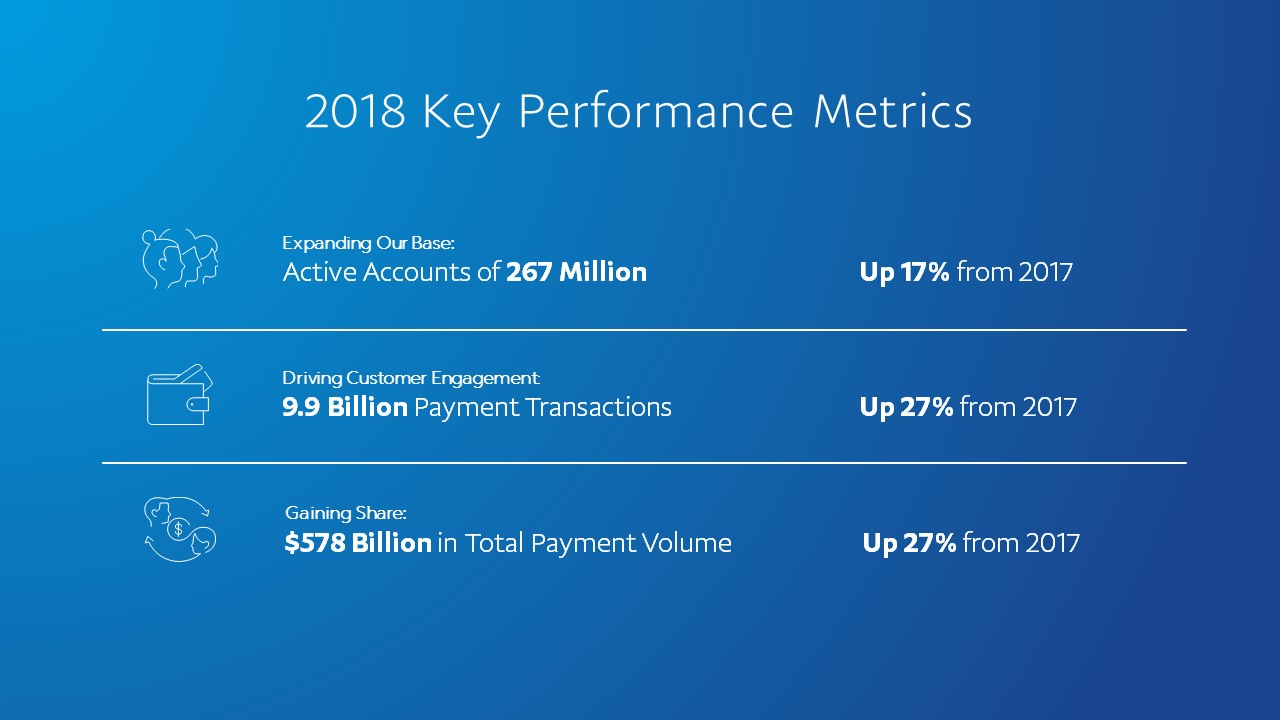
We measure the relevance of our products and services to our customers, and therefore the success of our business, through active accounts, payment transactions, and payment volume:
Active Accounts: An active account is an account registered directly with PayPal or a platform access partner that has completed a transaction on our Payments Platform, not including gateway-exclusive transactions, within the past 12 months. A platform access partner is a third party whose customers are provided access to PayPal's Payments Platform through such third party's login credentials. As of December 31, 2018, we had approximately 267 million active accounts across more than 200 markets. A market is a geographic area or political jurisdiction, such as a country, territory, or protectorate, in which we offer some or all of our services. A country, territory, or protectorate is identified by a distinct set of laws and regulations.
Number of Payment Transactions: Number of payment transactions is the total number of payments, net of payment reversals, successfully completed on our Payments Platform or enabled by PayPal via a partner payment solution, not including gateway-exclusive transactions.
Total Payment Volume (“TPV”): TPV is the value of payments, net of reversals, successfully completed on our Payments Platform or enabled by PayPal via a partner payment solution, not including gateway-exclusive transactions.
Our Strengths
Our business is built on a strong foundation designed to drive growth and differentiate us from our competitors. We believe that our competitive strengths include the following:
| • | Two-sided Platform—our platform connecting merchants and consumers enables PayPal to offer unique end-to-end product experiences while gaining valuable insights into customer behavior through our data. Our platform provides for simple digital and mobile transactions while being both technology and platform agnostic. |
| • | Scale—our global scale allows us to drive organic growth. As of December 31, 2018, we had 267 million active accounts, which included 21 million active merchant accounts. In 2018, we processed $578 billion of TPV in more than 200 markets around the world. |
| • | Brands—we have built well-recognized and trusted brands. Our marketing efforts play an important role in building brand visibility, usage, and overall preference among customers. |
| • | Risk Management—our risk management system and tokenization usage are designed to help keep our customers safe and to help ensure we process legitimate transactions around the world, while identifying and reducing illegal, high-risk, or fraudulent transactions. |
| • | Regulatory—we believe that our regulatory licenses, which enable us to operate in markets around the world, are a distinct advantage and support business growth. |
Technology
Our Payments Platform utilizes a combination of proprietary and third-party technologies and services to efficiently and securely facilitate transactions between millions of merchants and consumers worldwide across different channels, markets and networks. Our Payments Platform connects with financial service providers around the world and allows consumers to make purchases using a wide range of payment methods, regardless of where a merchant is located. Consumers who use our Payments Platform can send payments in more than 200 markets across the globe and in more than 100 currencies, withdraw funds to their bank accounts in 56 currencies and hold balances in their PayPal accounts in 25 currencies.
A transaction on our Payments Platform can involve multiple participants in addition to us, including a merchant, a consumer, and the consumer’s funding source provider. We have developed intuitive user interfaces, customer tools, and transaction completion database and network applications on our Payments Platform that help our customers utilize our suite of products and services. Our Payments Platform, open application programming interfaces, and developer tools are designed to enable developers to innovate with ease and offer robust applications to our global ecosystem of merchants and consumers, while at the same time maintaining the security of our customers’ financial information.
The technology infrastructure supporting our Payments Platform simplifies the storage and processing of large amounts of data and facilitates the deployment and operation of large-scale global products and services. Our technology infrastructure is designed around industry-standard architectures intended to reduce downtime in the event of outages or catastrophic occurrences. Our Payments Platform incorporates multiple layers of protection for continuity and system redundancy purposes and to help address cybersecurity challenges. We have a comprehensive cybersecurity program designed to protect our technology infrastructure and Payments Platform against these challenges, including regularly testing our systems to address potential vulnerabilities. We strive to continually improve our technology infrastructure and Payments Platform to enhance the customer experience and to increase efficiency, scalability, and security.
Merchant and Consumer Payment Solutions
Our combined payment solution capabilities offer our merchants and consumers a broad range of products and services, enabling our merchants to securely and simply receive payments from their customers while allowing our consumers to make seamless transactions across different markets and networks.
We partner with our merchants to help grow and expand their businesses by improving sales conversion; providing global reach, offering alternative payment methods; reducing losses through proprietary protection programs, providing fraud prevention and risk management solutions; and leveraging data analytics. We generate revenues from merchants primarily by charging fees for completing their payment transactions and other payment-related services. Merchants can onboard quickly with PayPal and are generally not required to invest in new or specialized hardware. We do not charge merchants setup or recurring fees for our standard service. We offer access to credit products for certain small and medium-sized merchants through our PayPal Working Capital and PayPal Business Loan products, which we collectively refer to as our business financing offerings. Our PayPal Working Capital product allows businesses to borrow a certain percentage of their annual payment volume processed by PayPal for a fixed fee. Our PayPal Business Loan product provides businesses with short-term financing for a fixed fee based on an evaluation of both the applying business as well as the business owner. We believe that our business financing offerings allow us to deepen our engagement with our existing small and medium-sized business merchants and expand services to new merchants by providing access to capital that may not be available effectively or efficiently from traditional banks or other lending providers.
PayPal is a popular form of payment for mobile commerce, and our business has grown with the increased adoption of mobile devices. We believe our Braintree products strengthen our position in mobile payments and extend our coverage to a new class of retailers and service providers that offer their services primarily through mobile applications. Through a single Braintree integration, a merchant can begin accepting payments with credit or debit cards, PayPal, PayPal Credit, Google Pay, Apple Pay, Samsung Pay, and other payment solutions. We also offer gateway services, including our Payflow Gateway services and Braintree Gateway services, which enable merchants to accept payments online with credit or debit cards. Our gateway services provide the payment gateway technology that links a merchant’s website to its processing network and enable merchants to accept payments online with credit and debit cards.
We believe that our recent acquisition of iZettle in September 2018 will enable us to further expand our in-store presence and strengthen our Payments Platform to help small businesses around the world grow and thrive in an omnichannel retail environment. iZettle offers a card acceptance service that enables small businesses to take credit and debit card payments, as well as a software solution to record, manage and analyze sales. iZettle provides in-store capabilities in eleven countries, as well as near-term, in-store expansion opportunities into other existing PayPal markets.
We focus on providing affordable consumer products intended to democratize the management and movement of money. We generate revenue from consumers on fees charged for foreign currency exchange and on interest and fees from our PayPal Credit product. We offer our PayPal Credit product to consumers as a potential funding source at checkout. Once a consumer is approved for credit, PayPal Credit is made available as a funding source in his or her account. We believe that our consumer credit products allow us to increase engagement with consumers and merchants on our two-sided network and differentiate ourselves from other payment processors by helping merchants drive incremental sales through products like PayPal Credit. We are responsible for servicing functions related to all of our credit products. In the U.S., credit originating from our PayPal Working Capital and PayPal Business Loan products is currently extended through third-party financial institutions from whom we purchase the related receivables. For our consumer and merchant credit products outside the U.S., we extend credit through certain international PayPal subsidiaries.
During the fourth quarter of 2017, we expanded our strategic consumer credit relationship with Synchrony Financial and agreed to sell our U.S. consumer credit receivables portfolio to Synchrony Bank. Following the closing of this transaction in July 2018, Synchrony Bank became the exclusive issuer of the U.S. PayPal branded consumer credit program and we no longer hold an ownership interest in receivables generated through the program.
We offer consumers person-to-person (“P2P”) payment solutions through our PayPal, Venmo and Xoom products. PayPal continues to be a key driver of our total P2P volumes, enabling both domestic and international P2P transfers across our Payments Platform. Our Venmo app in the U.S. is a leading mobile application used to move money between our customers and to make purchases at approved merchants. Xoom is an international money transfer service that enables our customers to send money to, pay bills for, and send prepaid mobile phone reloads to people around the world in a secure, fast, and cost-effective way, using a mobile device or personal computer. P2P is a significant customer acquisition channel that facilitates organic growth by enabling potential PayPal users to establish active accounts with us at the time they make or receive a P2P payment.
Protecting Merchants and Consumers
Protecting merchants and consumers on our Payments Platform from financial and fraud loss is imperative to successfully competing in the payments industry and sustainably growing our business. Fraudulent activities, such as account takeover, identity theft, and counterparty malicious activities, represent a significant risk to merchants and consumers, as well as their payment partners. We provide merchants and consumers with protection programs on most purchase transactions completed on our Payments Platform, excluding gateway-exclusive transactions or situations where our customer agreements specifically do not provide for protections. We believe that these programs, which protect both merchants and consumers from financial and fraud loss due primarily to fraud and counterparty non-performance, are generally much broader than similar protections provided by other participants in the payments industry. As a result, merchants may incur losses for chargebacks and other claims on certain transactions when using other payments providers that the merchants would not incur if they used our payments services. We also provide consumer protection against losses on qualifying purchases and accept claims for review up to 180 days post-transaction. We believe that this protection is generally consistent with, or better than, that offered by other payments providers. These programs are designed to promote confidence on both the part of consumers (i.e., when using our Payment Platform, they will only be required to pay if they receive their purchased item or service in the condition significantly as described) and merchants (i.e., they will receive payment for the product they deliver to the customer).
Our ability to protect both consumers and merchants is based largely on our proprietary, end-to-end Payments Platform and our ability to leverage the data from both sides of transactions on our two-sided network (i.e., from buyers and sellers, and from senders and receivers of payments). We believe mobile devices will continue to play a significant and increasing role in commerce, including by creating the opportunities to make our ecosystem safer. For example, PayPal is able to use location data from mobile devices and growing protection for the mobile operating environment to reduce financial and fraud risk to merchants and consumers. Our ongoing investment in systems and processes, designed to enhance the safety and security of our products, reflects our goal of having PayPal recognized as one of the world’s most trusted payments brands.
Competition
The global payments industry is highly competitive, rapidly changing, highly innovative, and increasingly subject to regulatory scrutiny and oversight. We compete against a wide range of businesses, including those that are larger than we are, have a dominant and secure position, or offer other products and services to consumers and merchants that we do not offer, as well as smaller companies that may be able to respond more quickly in the face of regulatory and technological changes. We compete against all forms of payments, including credit and debit cards; automated clearing house and bank transfers; other online payment services; mobile payments; and offline payment methods, including cash and check.
We compete primarily on the basis of the following:
| • | ability to attract, retain, and engage both merchants and consumers with our two-sided platform; |
| • | ability to demonstrate to merchants that they may achieve incremental sales by using and offering our services to consumers; |
| • | consumer confidence in the safety and security of transactions on our Payments Platform, including the ability for consumers to use our products and services without sharing their financial information with the merchant or any other party they are paying; |
| • | simplicity and transparency of our fee structure; |
| • | ability to develop products and services across multiple commerce channels, including mobile payments, credit products, and payments at the retail point of sale; |
| • | trust in our dispute resolution and buyer and seller protection programs; |
| • | customer service experience; |
| • | brand recognition and preference; |
| • | website, mobile platform and application onboarding, ease-of-use, speed, availability, and dependability; |
| • | the technology and payment agnostic nature of our Payments Platform; |
| • | system reliability and data security; |
| • | ability to assist merchants in complying with payments-related laws and regulations ; |
| • | ease and quality of integration into third-party mobile applications and operating systems; and |
| • | quality of developer tools, such as our application programming interfaces and software development kits. |
In addition to the discussion in this section, see “Item 1A. Risk Factors” under the caption “We face substantial and increasingly intense competition worldwide in the global payments industry” for further discussion of the potential impact of competition on our business.
Research and Development
Total research and development expense was $1.1 billion, $953 million and $834 million in 2018, 2017 and 2016, respectively.
Intellectual Property
The protection of our intellectual property, including our trademarks (particularly those covering the PayPal name), patents, copyrights, domain names, trade dress, and trade secrets is important to the success of our business. We seek to protect our intellectual property rights by relying on applicable laws and regulations in the U.S. and internationally, as well as a variety of administrative procedures. We also rely on contractual restrictions to protect our proprietary rights when offering or procuring products and services. We have routinely entered into confidentiality and invention assignment agreements with our employees and contractors, and non-disclosure agreements with parties with whom we conduct business, to control use, access to, and limit disclosure of our proprietary information.
We pursue the registration of our domain names, trademarks, and service marks in the U.S. and internationally. Additionally, we have filed patent applications in the U.S. and in international jurisdictions covering certain aspects of our proprietary technology and new innovations. We have registered our core brands as domain names and as trademarks in the U.S. and a large number of other jurisdictions. We also have in place an active program to continue to secure and enforce trademarks and domain names that corresponds to our brands in markets of interest.
For additional information regarding some of the risks relating to our intellectual property, including costs of protecting our intellectual property, see the information in “Item 1A. Risk Factors” under the captions “We are subject to patent litigation” and “We may be unable to adequately protect or enforce our intellectual property rights, or third parties may allege that we are infringing their intellectual property rights.”
Government Regulation
We operate globally and in a rapidly evolving regulatory environment characterized by a heightened regulatory focus on all aspects of the payments industry. That focus continues to become even more heightened as regulators on a global basis focus on such important issues as countering terrorist financing, anti-money laundering, privacy, cybersecurity, and consumer protection. Some of the laws and regulations to which we are subject were enacted recently, and the laws and regulations applicable to us, including those enacted prior to the advent of digital and mobile payments, are continuing to evolve through legislative and regulatory action and judicial interpretation. New or changing laws and regulations, including how such laws and regulations are interpreted and implemented, as well as increased penalties and enforcement actions related to non-compliance, could have a material adverse impact on our business, results of operations, and financial condition. Therefore, we monitor these areas closely to design compliant solutions for our customers who depend on us.
Government regulation impacts key aspects of our business. We are subject to regulations that affect the payments industry in the markets we operate.
Payments Regulation. Various laws and regulations govern the payments industry in the U.S. and internationally. In the U.S., PayPal, Inc. holds licenses to operate as a money transmitter (or its equivalent), which, among other things, subjects PayPal, Inc. to reporting requirements, bonding requirements, limitations on the investment of customer funds, and inspection by state regulatory agencies. Outside the U.S., we provide similar services customized for various countries and foreign jurisdictions through our foreign subsidiaries. The activities of those non-U.S. entities are, or may be, supervised by a financial regulatory authority in the jurisdictions in which they operate. Among other regulatory authorities, the Luxembourg Commission de Surveillance du Secteur Financier (the “CSSF”), the Australian Securities and Investment Commission, the Monetary Authority of Singapore, the Reserve Bank of India, and the Central Bank of Russia have asserted jurisdiction over some or all of our activities in their respective jurisdictions. This list is not exhaustive, and there are numerous other regulatory agencies that have or may assert jurisdiction over our activities. The laws and regulations applicable to the payments industry in any given jurisdiction are subject to interpretation and change.
Banking Agency Supervision. We serve our customers in the European Union (“EU”) through PayPal (Europe) S.à.r.l. et Cie, SCA, a wholly-owned subsidiary that is licensed and subject to regulation as a bank in Luxembourg by the CSSF. Consequently, we must comply with rules and regulations of the European banking industry, including those related to capitalization, funds management, corporate governance, anti-money laundering, disclosure, reporting, and inspection. We also are, or may be, subject to banking-related regulations in other countries now or in the future related to our role in the financial industry. In addition, based on our relationships with our partner financial institutions, we are, or may be, subject to indirect regulation and examination by these financial institutions’ regulators.
Consumer Financial Protection Bureau. The Consumer Financial Protection Bureau (the “CFPB”) has significant authority to regulate consumer financial products in the U.S., including consumer credit, deposit, payment, and similar products. As a large market participant of remittance transfers, the CFPB has direct supervisory authority over our business. The CFPB and other similar regulatory agencies in other jurisdictions may have broad consumer protection mandates that could result in the promulgation and interpretation of rules and regulations that may affect our business.
Anti-Money Laundering and Counter-Terrorist Financing. PayPal is subject to anti-money laundering (“AML”) laws and regulations in the U.S. and other jurisdictions, as well as laws designed to prevent the use of the financial systems to facilitate terrorist activities. Our AML program is designed to prevent our payment network from being used to facilitate money laundering, terrorist financing, and other illicit activities, or to do business in countries or with persons and entities included on designated country or person lists promulgated by the U.S. Department of the Treasury’s Office of Foreign Assets Controls (“OFAC”) and equivalent authorities in other countries. Our AML and sanctions compliance programs, overseen by our AML/Bank Secrecy Act Officer, is composed of policies, procedures and internal controls, and is designed to address these legal and regulatory requirements and assist in managing money laundering and terrorist financing risks.
Interchange Fees. Interchange fees associated with four-party payments systems are being reviewed or challenged in various jurisdictions. For example, in the EU, the Multilateral Interchange Fee (“MIF”) Regulation caps credit and debit interchange fees for card payments and provides for business rules to be complied with by any company dealing with card transactions, including PayPal. As a result, the fees that we collect in certain jurisdictions may become the subject of regulatory challenge.
Data Protection and Information Security. Aspects of our operations or business are subject to privacy and data protection regulation in the U.S., the EU, Asia Pacific, and elsewhere. For example, the EU adopted a comprehensive General Data Protection Regulation (the “GDPR”), which came into effect in May 2018, as supplemented by any national laws (such as in the U.K., the Data Protection Act 2018) and further implemented through binding guidance from the European Data Protection Board,and expanded the scope of the EU data protection law to foreign companies processing personal data of European Economic Area (“EEA”) individuals, imposed a stricter data protection compliance regime, and included new data subject rights (e.g., the right to erasure, commonly known as the “right to be forgotten”). In the U.S., we are subject to privacy information safeguarding requirements under the Gramm-Leach-Bliley Act that require the maintenance of a written, comprehensive information security program and in Europe, the operations of our Luxembourg bank are subject to confidentiality and information safeguarding requirements under the Luxembourg Banking Act, among other laws. Regulatory authorities around the world are considering numerous legislative and regulatory proposals concerning privacy and data protection that may contain additional privacy and data protection obligations than exist today. In addition, the interpretation and application of these privacy and data protection laws in the U.S., Europe and elsewhere are often uncertain and in a state of flux.
Anti-Corruption. PayPal is subject to applicable anti-corruption laws, such as the U.S. Foreign Corrupt Practices Act and the U.K. Bribery Act, and similar anti-corruption laws in the jurisdictions in which we operate. Anti-corruption laws generally prohibit offering, promising, giving, accepting, or authorizing others to provide anything of value, either directly or indirectly, to or from a government official or private party in order to influence official action or otherwise gain an unfair business advantage, such as to obtain or retain business. We have implemented policies, procedures, and internal controls that are designed to comply with these laws and regulations.
Additional Regulatory Developments. Various regulatory agencies continue to examine a wide variety of issues, including virtual currencies, identity theft, account management guidelines, privacy, disclosure rules, cybersecurity, and marketing that may impact PayPal's business.
For an additional discussion on governmental regulation affecting our business, please see the risk factors related to regulation of our payments business and regulation in the areas of consumer privacy, data use, and/or security in “Item 1A. Risk Factors” under the caption “Risk Factors That May Affect Our Business, Results of Operations and Financial Condition” and “Item 3. Legal Proceedings” included elsewhere in this Annual Report on Form 10-K.
Seasonality
The Company does not experience meaningful seasonality with respect to net revenues. No individual quarter in 2018, 2017 or 2016 accounted for more than 30% of annual net revenue.
Employees
As of December 31, 2018, we employed approximately 21,800 people globally, of whom approximately 11,500 were located in the U.S. We consider our relationship with our employees to be good.
Separation from eBay Inc.
PayPal Holdings, Inc. was incorporated in Delaware in January 2015 for the purpose of owning and operating eBay’s Payments business in connection with the separation and distribution described below. Prior to the contribution of this business to PayPal Holdings, Inc., which occurred prior to the distribution in July 2015, PayPal Holdings, Inc. had no operations. On July 17, 2015 (the “distribution date”), PayPal became an independent publicly traded company through the pro rata distribution by eBay of 100% of the outstanding common stock of PayPal to eBay stockholders (which we refer to as the “separation” or the “distribution”). Each eBay stockholder of record as of the close of business on July 8, 2015 received one share of PayPal common stock for every share of eBay common stock held on the record date. Approximately 1.2 billion shares of PayPal common stock were distributed on July 17, 2015 to eBay stockholders. PayPal’s common stock began “regular way” trading under the ticker symbol “PYPL” on the NASDAQ Stock Market on July 20, 2015. Prior to the separation, eBay transferred substantially all of the assets and liabilities and operations of eBay’s payments business to PayPal, which was completed in June 2015.
Available Information
The address of our principal executive offices is PayPal Holdings, Inc., 2211 North First Street, San Jose, California 95131. Our website is located at www.paypal.com, and our investor relations website is located at http://investor.paypal-corp.com. From time to time, we may use our investor relations site and other online and social media channels, including our PayPal Stories Blog (https://www.paypal.com/stories/us), Twitter handles (@PayPal and @PayPalNews), LinkedIn page (https://www.linkedin.com/company/paypal), Facebook page (https://www.facebook.com/PayPalUSA/), YouTube channel (https://www.youtube.com/paypal), Dan Schulman's LinkedIn profile (https://www.linkedin.com/in/dan-schulman/), John Rainey's LinkedIn profile (www.linkedin.com/in/john-rainey-pypl), Bill Ready's LinkedIn profile (https://www.linkedin.com/in/williamready/), and Dan Schulman's Facebook page (https://www.facebook.com/DanSchulmanPayPal/) to disclose material non-public information and comply with our disclosure obligations under Regulation Fair Disclosure. Our Annual Report on Form 10-K, quarterly reports on Form 10-Q, current reports on Form 8-K, and amendments to those reports are available free of charge on our investor relations website as soon as reasonably practicable after they are electronically filed with, or furnished to, the SEC. The content of our websites and information we may post on or provide to online and social media channels, including those mentioned above, and information that can be accessed through our websites or these online and social media channels is not incorporated by reference into this Annual Report on Form 10-K or in any other report or document we file with the SEC, and any references to our websites or these online and social media channels are intended to be inactive textual references only.
Item 1A. RISK FACTORS
The following discussion is divided into three sections. The first section, which begins immediately following this paragraph, discusses some of the risks that may adversely affect our business, results of operations and financial condition. The second section, captioned “Risks Related to Our Separation from eBay” discusses some of the risks relating to our separation from eBay in July 2015 into an independent publicly traded company. The third section, captioned “Risks Related to Our Common Stock,” discusses some of the risks relating to an investment in our Common Stock. You should carefully review all of these sections in addition to the other information appearing in this Annual Report on Form 10-K, including our consolidated financial statements and related notes, for important information regarding risks and uncertainties that affect us. The risks and uncertainties described below are not the only ones we face. Additional risks and uncertainties that we are unaware of, or that we currently believe are not material, may also become important factors that adversely affect our business. If any of the following risks actually occur, our business, financial condition, results of operations, and future prospects could be materially and adversely affected.
Risk Factors That May Affect Our Business, Results of Operations, and Financial Condition
We face substantial and increasingly intense competition worldwide in the global payments industry.
The global payments industry is highly competitive, rapidly changing, highly innovative, and increasingly subject to regulatory scrutiny. We compete against a wide range of businesses, including businesses that are larger than we are, have a more dominant and secure position, or offer other products and services to consumers and merchants that we do not offer, as well as smaller companies that may be able to respond more quickly to regulatory and technological changes. Many of the areas in which we compete evolve rapidly with changing and disruptive technologies, shifting user needs, and frequent introductions of new products and services. Competition may also intensify as businesses enter into business combinations and alliances, and established companies in other segments expand to become competitive with different aspects of our business.
We compete primarily on the basis of the following:
| • | ability to attract, retain, and engage both merchants and consumers with our two-sided platform; |
| • | ability to demonstrate to merchants that they may achieve incremental sales by using and offering our services to consumers; |
| • | consumer confidence in the safety and security of transactions on our Payments Platform, including the ability for consumers to use our products and services without sharing their financial information with the merchant or any other party they are paying; |
| • | simplicity and transparency of our fee structure; |
| • | ability to develop products and services across multiple commerce channels, including mobile payments, credit products, and payments at the retail point of sale; |
| • | trust in our dispute resolution and buyer and seller protection programs; |
| • | customer service experience; |
| • | brand recognition and preference; |
| • | website, mobile platform and application onboarding, ease-of-use, speed, availability, and dependability; |
| • | the technology and payment agnostic nature of our Payments Platform; |
| • | system reliability and data security; |
| • | ability to assist merchants in complying with payments-related laws and regulations ; |
| • | ease and quality of integration into third-party mobile applications and operating systems; and |
| • | quality of developer tools, such as our application programming interfaces and software development kits. |
We compete against a wide range of businesses with varying roles in all forms of payments, including:
| • | paper-based transactions (principally cash and checks); |
| • | providers of traditional payment methods, particularly credit and debit cards and Automated Clearing House transactions (in particular, well-established banks); |
| • | payment networks which facilitate payments for credit card users; |
| • | providers of “digital wallets” which offer customers the ability to pay online and/or in-store through a variety of payment methods, including with mobile applications, through contactless payments, and with a variety of payment cards; |
| • | providers of mobile payments solutions that use tokenized card data approaches and contactless payments (e.g., near field communication (“NFC”) or host card emulation functionality) to eliminate the need to swipe or insert a card or enter a personal identification number or password; |
| • | payment-card processors that offer their services to merchants, including for “card on file” payments where the merchant invites the consumer to select a payment method for their first transaction and to use the same payment method for subsequent transactions; |
| • | providers of “person-to-person” payments that facilitate individuals sending money with an email address or mobile phone number; |
| • | merchants and merchant associations providing proprietary payment networks to facilitate payments within their own retail network; |
| • | money remitters; |
| • | providers of card readers for mobile devices and of other point-of-sale and multi-channel technologies; and |
| • | providers of virtual currencies and distributed ledger technologies. |
We often partner with many of these businesses and we consider the ability to continue establishing these partnerships as important to our business. Competition for relationships with these partners is intense and there can be no assurance that we will be able to continue to establish, grow, or maintain these partner relationships.
We also face competition and potential competition from:
| • | service providers that provide online merchants the ability to offer their customers the option of paying for purchases from their bank account or paying on credit; |
| • | issuers of stored value products targeted at online payments; |
| • | other global online and mobile payment-services providers; |
| • | services targeting users of social networks and online gaming, including those offering social commerce and peer-to-peer payments; |
| • | payment services enabling banking customers to send and receive payments through their bank account, including through immediate or real-time payments systems; |
| • | ecommerce services that provide special offers linked to a specific payment provider; |
| • | services that help merchants accept and manage virtual currencies; and |
| • | electronic funds transfer services as a method of payment for both online and offline transactions. |
Some of these competitors have larger customer bases, volume, scale, resources, and market share than we do, which may provide them significant competitive advantages. Some of our competitors may also be subject to less burdensome licensing, anti-money laundering, counter-terrorist financing, and other regulatory requirements. They may devote greater resources to the development, promotion, and sale of products and serv
Showing the first 8K of 133K characters. Open the full section
Item 1B. UNRESOLVED STAFF COMMENTS
None.
Item 2. PROPERTIES
We own and lease various properties in the U.S. and other countries around the world. We use the properties for executive and administrative offices, data centers, product development offices, and customer service offices. As of December 31, 2018, our owned and leased properties provided us with aggregate square footage as follows:
| United States | Other Countries | Total | ||||||
| (In millions) | ||||||||
| Owned facilities | 1.1 | 0.2 | 1.3 | |||||
| Leased facilities | 1.2 | 1.9 | 3.1 | |||||
| Total facilities | 2.3 | 2.1 | 4.4 |
We own a total of approximately 106 acres of land, with approximately 85 acres in the U.S. Our corporate headquarters are located in San Jose, California and occupy approximately 0.7 million of owned square feet.
Item 3. LEGAL PROCEEDINGS
The information set forth under “Note 13—Commitments and Contingencies—Litigation and Regulatory Matters” to the consolidated financial statements included in Part IV, Item 15 of this Annual Report on Form 10-K is incorporated herein by reference.
Item 4. MINE SAFETY DISCLOSURES
Not applicable.
PART II
Item 5. MARKET FOR REGISTRANT'S COMMON EQUITY, RELATED STOCKHOLDER MATTERS AND ISSUER PURCHASES OF EQUITY SECURITIES
Common Stock
PayPal common stock is quoted on the NASDAQ Stock Market under the ticker symbol “PYPL.”
As of January 31, 2019, there were approximately 3,824 holders of record of our common stock. The actual number of stockholders is significantly greater than this number of record holders, and includes stockholders who are beneficial owners but whose shares are held in street name by brokers and other nominees.
Dividend Policy
We have never paid any cash dividends and we currently do not anticipate paying any cash dividends in the foreseeable future.
Stock Repurchase Activity
In April 2017, our Board of Directors authorized a stock repurchase program that provides for the repurchase of up to $5 billion of our common stock, with no expiration from the date of authorization. This program became effective in December 2017 upon completion of a previous stock repurchase program. In July 2018, our Board of Directors authorized an additional stock repurchase program that provides for the repurchase of up to $10 billion of our common stock, with no expiration from the date of authorization. This program will become effective upon completion of the April 2017 stock repurchase program. Our stock repurchase programs are intended to offset the impact of dilution from our equity compensation programs and, subject to market conditions and other factors, may also be used to make opportunistic repurchases of our common stock to reduce outstanding share count. Any share repurchases under our stock repurchase programs may be made through open market transactions, block trades, privately negotiated transactions including accelerated share repurchase agreements or other means at times and in such amounts as management deems appropriate, and will be funded from our cash from operations or other financing alternatives. Moreover, any stock repurchases are subject to market conditions and other uncertainties and we cannot predict if or when any stock repurchases will be made. We may terminate our stock repurchase programs at any time without notice.
The stock repurchase activity under our stock repurchase programs during the three months ended December 31, 2018 is summarized as follows:
| Total number of shares purchased | Average price paid per share(1) | Total number of shares purchased as part of publicly announced plans or programs | Approximate dollar value of shares that may yet be purchased under the plans or programs | ||||||||||
| (In millions, except per share amounts) | |||||||||||||
| October 1, 2018 through October 31, 2018 | — | $ | — | — | $ | 12,074 | |||||||
| November 1, 2018 through November 30, 2018 | 1.1 | $ | 84.21 | 1.1 | 11,980 | ||||||||
| December 1, 2018 through December 31, 2018 | 6.0 | $ | 84.18 | 6.0 | 11,474 | ||||||||
| 7.1 | 7.1 | $ | 11,474 |
(1) Average price paid per share includes broker commissions.
No activity has occurred to date under the July 2018 repurchase program.
Item 6. SELECTED FINANCIAL DATA
The following selected financial data reflect the consolidated operations of PayPal. PayPal derived the selected consolidated income statement data for the years ended December 31, 2018, 2017, and 2016 and the selected consolidated balance sheet data as of December 31, 2018 and 2017 as set forth below, from its audited consolidated financial statements, which are included in “Item 15. Exhibits, Financial Statement Schedules” of this Annual Report on Form 10-K. PayPal derived the selected consolidated income statement data for the years ended December 31, 2015 and 2014 and selected consolidated balance sheet data as of December 31, 2016, 2015, and 2014 from audited consolidated financial statements not included in this Annual Report on Form 10-K. The historical results do not necessarily indicate the results expected for any future period. To ensure a full understanding, you should read the selected consolidated financial data presented below in conjunction with “Management’s Discussion and Analysis of Financial Condition and Results of Operations” and the consolidated financial statements and accompanying notes included elsewhere in this report.
| Year Ended December 31, | |||||||||||||||||||
| 2018 | 2017 | 2016 | 2015 | 2014 | |||||||||||||||
| (In millions, except per share amounts) | |||||||||||||||||||
| Consolidated Statement of Income Data: | |||||||||||||||||||
| Net revenues | $ | 15,451 | $ | 13,094 | $ | 10,842 | $ | 9,248 | $ | 8,025 | |||||||||
| Operating income | 2,194 | 2,127 | 1,586 | 1,461 | 1,268 | ||||||||||||||
| Net income | 2,057 | 1,795 | 1,401 | 1,228 | 419 | ||||||||||||||
| Net income per share: | |||||||||||||||||||
| Basic | $ | 1.74 | $ | 1.49 | $ | 1.16 | $ | 1.00 | $ | 0.34 | |||||||||
| Diluted | $ | 1.71 | $ | 1.47 | $ | 1.15 | $ | 1.00 | $ | 0.34 | |||||||||
| Weighted average shares(1)(2): | |||||||||||||||||||
| Basic | 1,184 | 1,203 | 1,210 | 1,222 | 1,218 | ||||||||||||||
| Diluted | 1,203 | 1,221 | 1,218 | 1,229 | 1,224 | ||||||||||||||
| Consolidated Balance Sheet Data: | |||||||||||||||||||
| Total assets | $ | 43,332 | $ | 40,774 | $ | 33,103 | $ | 28,881 | $ | 21,917 | |||||||||
| Total long-term liabilities | 2,042 | 1,917 | 1,513 | 1,505 | 386 |
(1) On July 17, 2015, the distribution date, eBay stockholders of record as of the close of business on July 8, 2015 received one share of PayPal common stock for every share of eBay common stock held as of the record date. Basic and diluted net income per share for the year ended December 31, 2014 was calculated using the number of common shares distributed on July 17, 2015.
(2) The weighted average number of common shares outstanding for basic and diluted earnings per share for the year ended December 31, 2015 was based on the number of common shares distributed on July 17, 2015 for the period prior to distribution and the weighted average number of common shares outstanding for the period beginning after the distribution date.
Item 7. MANAGEMENT’S DISCUSSION AND ANALYSIS OF FINANCIAL CONDITION AND RESULTS OF OPERATIONS
This Annual Report on Form 10-K contains forward-looking statements within the meaning of Section 27A of the Securities Act of 1933 and Section 21E of the Securities Exchange Act of 1934, including statements that involve expectations, plans or intentions (such as those relating to future business, future results of operations or financial condition, new or planned features or services, or management strategies). These forward-looking statements can be identified by words such as “may,” “will,” “would,” “should,” “could,” “expect,” “anticipate,” “believe,” “estimate,” “intend,” “strategy,” “future,” “opportunity,” “plan,” “project,” “forecast,” and other similar expressions. These forward-looking statements involve risks and uncertainties that could cause our actual results and financial condition to differ materially from those expressed or implied in our forward-looking statements. Such risks and uncertainties include, among others, those discussed in “Item 1A. Risk Factors” of this Annual Report on Form 10-K, as well as in our consolidated financial statements, related notes, and the other information appearing elsewhere in this report and our other filings with the Securities and Exchange Commission (“SEC”). We do not intend, and undertake no obligation except as required by law, to update any of our forward-looking statements after the date of this report to reflect actual results or future events or circumstances. Given these risks and uncertainties, readers are cautioned not to place undue reliance on such forward-looking statements. You should read the following “Management's Discussion and Analysis of Financial Condition and Results of Operations” in conjunction with the audited consolidated financial statements and the related notes that appear elsewhere in this report. Unless otherwise expressly stated or the context otherwise requires, references to “we,” “our,” “us,” “the Company” and “PayPal” refer to PayPal Holdings and its consolidated subsidiaries.
Business Environment
We are a leading technology platform and digital payments company that enables digital and mobile payments on behalf of consumers and merchants worldwide. PayPal is committed to democratizing financial services and empowering people and businesses to join and thrive in the global economy. Our goal is to enable our consumers and merchants to manage and move their money anywhere in the world, anytime, on any platform, and using any device. We also facilitate person-to-person (“P2P”) payments through our PayPal, Venmo and Xoom products. Our combined payment solutions, including our PayPal, PayPal Credit, Braintree, Venmo, Xoom, and iZettle products, compose our proprietary Payments Platform.
We operate globally and in a rapidly evolving regulatory environment characterized by a heightened regulatory focus on all aspects of the payments industry. That focus continues to become even more heightened as regulators on a global basis focus on such important issues as countering terrorist financing, anti-money laundering, privacy, cybersecurity, and consumer protection. Some of the laws and regulations to which we are subject were enacted recently, and the laws and regulations applicable to us, including those enacted prior to the advent of digital and mobile payments, are continuing to evolve through legislative and regulatory action and judicial interpretation. New or changing laws and regulations, including how such laws and regulations are interpreted and implemented, as well as increased penalties and enforcement actions related to non-compliance, could have a material adverse impact on our business, results of operations, and financial condition. Therefore, we monitor these areas closely to design compliant solutions for our customers who depend on us.
Information security risks for global payments and technology companies like us have significantly increased in recent years. We are not immune to these risks and there can be no assurance that we will not suffer such losses in the future. For additional information regarding our information security risks, see “Item 1A. Risk Factors” under the caption—“Cyberattacks and security vulnerabilities could result in serious harm to our reputation, business and financial condition.”
The United Kingdom (“U.K.”) held a referendum in June 2016 in which a majority of voters approved an exit from the European Union (“EU”) (commonly referred to as “Brexit”). In March 2017, the U.K. government initiated the exit process under Article 50 of the Treaty on European Union, which commenced a two-year period expiring on March 29, 2019, after which time the U.K. is expected to leave the EU in the absence of any effective extension to the Article 50 period. Political negotiations are underway; however, there is a significant lack of clarity over the terms of the U.K.'s exit from the EU and the terms of the U.K.'s future relationship with the EU. The U.K.'s financial service regulators are implementing Temporary Permission Regimes (“TPR”) that are expected to be put in place by the U.K.'s government to support European Economic Area (“EEA”) financial service firms in continuing to conduct business in the U.K. should the U.K. exit the EU without an agreement. The final TPR rules are expected to be published in the first quarter of 2019 and will come into effect when the U.K. leaves the EU. Accordingly, we may need to adjust our business to comply with additional legal and regulatory requirements if accessing the TPR. We are currently unable to determine the impact that Brexit will have on our business, as any impact will depend, in part, on the outcome of tariff, trade, regulatory, and other negotiations. For additional information on how Brexit could affect our business, see “Item 1A. Risk Factors” under the caption—“The United Kingdom’s departure from the EU could adversely affect us.”
Brexit could adversely affect U.K., regional (including European) and worldwide economic and market conditions, and could contribute to instability in global financial and foreign exchange markets, including volatility in the value of the British Pound and Euro. We have foreign exchange exposure management programs designed to help reduce the impact from foreign currency rate movements.
In 2018, 2017, and 2016, net revenues generated from our U.K. operations constituted 11%, 11% and 12%, respectively, of total net revenues. In 2018, 2017, and 2016, net revenues generated from the EU (excluding the U.K.) constituted less than 20% of total net revenues. Approximately 31% and 30% of our gross loans and interest receivables as of December 31, 2018 and 2017, respectively, were generated from our U.K. operations. Approximately 7% and 5% of our gross loans and interest receivables as of December 31, 2018 and 2017, respectively, were generated from the EU (excluding the U.K.) operations.
Overview of Results of Operations
The following table provides a summary of our consolidated GAAP financial measures for the years ended December 31, 2018, 2017, and 2016:
| Year Ended December 31, | Percent Increase/(Decrease) | ||||||||||||||||
| 2018 | 2017 | 2016 | 2018 | 2017 | |||||||||||||
| (In millions, except percentages and per share amounts) | |||||||||||||||||
| Net revenues | $ | 15,451 | $ | 13,094 | $ | 10,842 | 18 | % | 21 | % | |||||||
| Operating expenses | 13,257 | 10,967 | 9,256 | 21 | % | 18 | % | ||||||||||
| Operating income | 2,194 | 2,127 | 1,586 | 3 | % | 34 | % | ||||||||||
| Operating margin | 14 | % | 16 | % | 15 | % | ** | ** | |||||||||
| Income tax expense | 319 |
Showing the first 8K of 109K characters. Open the full section
Item 7A. QUANTITATIVE AND QUALITATIVE DISCLOSURES ABOUT MARKET RISK
Market risk is the potential for economic losses to be incurred on market risk sensitive instruments arising from adverse changes in market factors such as interest rates, foreign currency exchange rates, and investment risk. Management establishes and oversees the implementation of policies governing our investing, funding, and foreign currency derivative activities in order to mitigate market risks. We monitor risk exposures on an ongoing basis.
Interest Rate Risk
We are exposed to interest rate risk relating to our investment portfolio and from interest-rate sensitive assets underlying the customer balances we hold on our consolidated balance sheets as customer accounts.
As of December 31, 2018 and 2017, approximately 78% and 39%, respectively, of our total cash, cash equivalents, and investment portfolio was held in cash and cash equivalents. The assets underlying the customer balances we hold on our consolidated balance sheets as customer accounts are maintained in interest and non-interest bearing bank deposits, time deposits, U.S. and foreign government and agency securities, and corporate debt securities. We seek to preserve principal while holding eligible liquid assets, as defined by applicable regulatory requirements and commercial law in the jurisdictions where we operate, equal to at least 100% of the aggregate amount of all customer balances. We do not pay interest on amounts due to customers.
In the fourth quarter of 2017, we entered into an unsecured $3.0 billion, 364 day delayed-draw term loan credit facility, which was available in up to three borrowings (“2017 Credit Agreement”). In the fourth quarter of 2018, we entered into an amended and restated credit agreement (“Amended Credit Agreement”), which provides for an unsecured $5.0 billion, 364-day delayed-draw term loan credit facility, which is available in up to four separate borrowings. In the third quarter of 2015, we entered into a $2.0 billion senior unsecured credit facility maturing in 2020 (“2015 Credit Agreement”). We also maintain uncommitted credit facilities in various regions throughout the world with borrowing capacity of approximately $300 million in the aggregate.
Borrowings under the Amended Credit Agreement and 2015 Credit Agreement, if any, bear interest at floating rates. As a result, we are exposed to fluctuations in interest rates to the extent of our borrowings. As of December 31, 2018, we had $2.0 billion of borrowings outstanding under the Amended Credit Agreement at a weighted average interest rate of 3.34%. Accordingly, at December 31, 2018, $3.0 billion of borrowing capacity was available for the purposes permitted by the Amended Credit Agreement, subject to customary conditions to borrowing. As of December 31, 2018, no borrowings or letters of credit were outstanding under the 2015 Credit Agreement or our uncommitted credit facilities.
Interest rates may also adversely impact our customers’ spending levels and ability and willingness to pay outstanding amounts owed to us. Higher interest rates often lead to higher payment obligations by customers of our credit products to us, or to lenders under mortgage, credit card, and other consumer and merchant loans, which may reduce our customers’ ability to remain current on their obligations to us and therefore lead to increased delinquencies, charge-offs, and allowance for loan and interest receivable, which could have an adverse effect on our net income.
A 100 basis point increase in interest rates would not have had a material impact on our financial assets or liabilities at December 31, 2018 and 2017.
Foreign Currency Exchange Rate Risk
We have significant operations internationally that are denominated in foreign currencies, primarily the British Pound, Euro, Australian Dollar, and Canadian Dollar, subjecting us to foreign currency exchange rate risk which may adversely impact our financial results. We transact business in various foreign currencies and have significant international revenues and costs. In addition, we charge our international subsidiaries for their use of intellectual property and technology and for certain corporate services. Our cash flows, results of operations, and certain of our intercompany balances that are exposed to foreign exchange rate fluctuations may differ materially from expectations, and we may record significant gains or losses due to foreign currency fluctuations and related hedging activities. We are generally a net receiver of foreign currencies and therefore benefit from a weakening of the U.S. dollar, and are adversely affected by a strengthening of the U.S. dollar, relative to foreign currencies.
We have a foreign currency exchange exposure management program designed to identify material foreign currency exposures, manage these exposures, and reduce the potential effects of currency fluctuations on our reported consolidated cash flows and results of operations through the execution of foreign currency exchange contracts. These foreign currency exchange contracts are accounted for as derivative instruments; for additional details related to our foreign currency exchange contracts, please see “Note 10—Derivative Instruments” to the consolidated financial statements included elsewhere in this Annual Report on Form 10-K.
We use foreign currency exchange forward contracts to protect our forecasted U.S. dollar-equivalent earnings from adverse changes in foreign currency exchange rates. These hedging contracts reduce, but do not entirely eliminate, the impact of adverse currency exchange rate movements. We designate these contracts as cash flow hedges for accounting purposes. The derivative’s gain or loss is initially reported as a component of accumulated other comprehensive income (“AOCI”) and subsequently reclassified into the financial statement line item in which the hedged item is recorded in the same period the forecasted transaction affects earnings. If we elect to discontinue our cash flow hedges and it is probable that the original forecasted transaction will occur, we continue to report them in AOCI until the forecasted transaction affects earnings at which point we also reclassify the de-designated hedges into earnings. Gains and losses on derivatives held after we discontinue our cash flow hedges and gains and losses on derivative instruments that are not designated as cash flow hedges are recorded in the same financial statement line item to which the derivative relates.
We considered the historical trends in currency exchange rates and determined that it was reasonably possible that changes in exchange rates of 20% for all currencies could be experienced in the near term. If the U.S. dollar weakened by 20% at December 31, 2018 and 2017, the amount recorded in AOCI related to our foreign currency exchange forward contracts, before taxes, would have been approximately $707 million and $536 million lower, respectively. If the U.S. dollar strengthened by 20% at December 31, 2018 and 2017, the amount recorded in AOCI related to our foreign currency exchange forward contracts, before taxes, would have been approximately $707 million and $536 million higher, respectively.
We have an additional foreign currency exchange management program whereby we use foreign currency exchange contracts to offset the foreign currency exchange risk on our assets and liabilities denominated in currencies other than the functional currency of our subsidiaries. These contracts are not designated as hedging instruments and reduce, but do not entirely eliminate, the impact of currency exchange rate movements on our assets and liabilities. The foreign currency exchange gains and losses on our assets and liabilities are recorded in other income (expense), net, and are offset by the gains and losses on the foreign currency exchange contracts.
Adverse changes in exchange rates of 20% for all currencies would have resulted in an adverse impact on income before income taxes of approximately $295 million and $243 million at December 31, 2018 and 2017, respectively, without considering the offsetting effect of hedging. Foreign currency exchange contracts in place as of December 31, 2018 would have positively impacted income before income taxes by approximately $308 million, resulting in a net positive impact of approximately $13 million. Foreign currency exchange contracts in place as of December 31, 2017 would have positively impacted income before income taxes by approximately $211 million, resulting in a net negative impact of approximately $32 million. These reasonably possible adverse changes in exchange rates of 20% were applied to total monetary assets and liabilities denominated in currencies other than the functional currencies of our subsidiaries at the balance sheet dates to compute the adverse impact these changes would have had on our income before income taxes in the near term.
Investment Risk
As of December 31, 2018 and 2017, our equity investments totaled $293 million and $88 million, respectively, which represented approximately 3% and 1% of our total cash and investment portfolio at those dates, respectively, and were related to minority equity interests in companies that are not publicly traded. As of December 31, 2018 and 2017, we did not hold any marketable equity instruments. We review our investments for impairment when events and circumstances indicate a decline in fair value of such assets below carrying value. Our analysis includes a review of recent operating results and trends, recent sales and acquisitions of the securities in which we have invested, and other publicly available data.
Item 8. FINANCIAL STATEMENTS AND SUPPLEMENTARY DATA
The audited consolidated financial statements covering the years ended December 31, 2018, 2017, and 2016 and accompanying notes listed in Part IV, Item 15(a)(1) of this Annual Report on Form 10‑K are included elsewhere in this report.
Item 9. CHANGES IN AND DISAGREEMENTS WITH ACCOUNTANTS ON ACCOUNTING AND FINANCIAL DISCLOSURE
None.
Item 9A. CONTROLS AND PROCEDURES
Evaluation of disclosure controls and procedures. Based on the evaluation of our disclosure controls and procedures (as defined in the Rules 13a-15(e) and 15d-15(e) under the Securities Exchange Act of 1934, as amended, or the Exchange Act), our principal executive officer and our principal financial officer have concluded that as of December 31, 2018, the end of the period covered by this report, our disclosure controls and procedures were effective.
Management's report on internal control over financial reporting. Our management is responsible for establishing and maintaining adequate internal control over financial reporting. Our management, including our principal executive officer and principal financial officer, conducted an evaluation of the effectiveness of our internal control over financial reporting based on the framework in Internal Control - Integrated Framework (2013) issued by the Committee of Sponsoring Organizations of the Treadway Commission. Based on its evaluation under the framework in Internal Control - Integrated Framework, our management concluded that our internal control over financial reporting was effective as of December 31, 2018.
The effectiveness of our internal control over financial reporting as of December 31, 2018 has been audited by PricewaterhouseCoopers LLP, an independent registered public accounting firm, as stated in their report which appears in Item 15(a) of this Annual Report on Form 10-K.
Changes in internal controls over financial reporting. There were no changes in our internal controls over financial reporting as defined in Exchange Act Rule 13a-15(f) that occurred during our most recently completed fiscal quarter that have materially affected, or are reasonably likely to materially affect, our internal control over financial reporting.
Item 9B. OTHER INFORMATION
None.
PART III
Item 10. DIRECTORS, EXECUTIVE OFFICERS AND CORPORATE GOVERNANCE
Incorporated by reference from our Proxy Statement for our 2019 Annual Meeting of Stockholders to be filed with the SEC within 120 days after December 31, 2018.
Code of Ethics, Governance Guidelines and Committee Charters
We have adopted a Code of Business Conduct and Ethics that applies to all PayPal employees and directors. We have also adopted a Code of Ethics for Senior Financial Officers that applies to our senior financial officers, including our principal executive officer, principal financial officer and principal accounting officer. The Code of Ethics for Senior Financial Officers is included in our Code of Business Conduct and Ethics posted on our website at https://investor.paypal-corp.com/corporate-governance.cfm. We will post any amendments to or waivers from the Code of Ethics for Senior Financial Officers at that location.
Item 11. EXECUTIVE COMPENSATION
Incorporated by reference from our Proxy Statement for our 2019 Annual Meeting of Stockholders to be filed with the SEC within 120 days after December 31, 2018.
Item 12. SECURITY OWNERSHIP OF CERTAIN BENEFICIAL OWNERS AND MANAGEMENT AND RELATED STOCKHOLDER MATTERS
Incorporated by reference from our Proxy Statement for our 2019 Annual Meeting of Stockholders to be filed with the SEC within 120 days after December 31, 2018.
Item 13. CERTAIN RELATIONSHIPS AND RELATED TRANSACTIONS, AND DIRECTOR INDEPENDENCE
Incorporated by reference from our Proxy Statement for our 2019 Annual Meeting of Stockholders to be filed with the SEC within 120 days after December 31, 2018.
Item 14. PRINCIPAL ACCOUNTING FEES AND SERVICES
Incorporated by reference from our Proxy Statement for our 2019 Annual Meeting of Stockholders to be filed with the SEC within 120 days after December 31, 2018.
PART IV
Item 15. EXHIBITS, FINANCIAL STATEMENT SCHEDULES
(a) The following documents are filed as part of this report:
| 1. Consolidated Financial Statements | Page Number |
| Report of Independent Registered Public Accounting Firm | 66 |
| Consolidated Balance Sheets | 68 |
| Consolidated Statements of Income | 69 |
| Consolidated Statements of Comprehensive Income | 70 |
| Consolidated Statements of Stockholders' Equity | 71 |
| Consolidated Statements of Cash Flows | 72 |
| Notes to Consolidated Financial Statements | 74 |
| 2. Financial Statement Schedule | |
| Schedule II—Valuation and Qualifying Accounts | 121 |
| All other schedules have been omitted because the information required to be set forth therein is not applicable or is shown in the financial statements or notes thereto. | |
| 3. Exhibits Required by Item 601 of Regulation S-K | |
| The information required by this Item is set forth in the Index of Exhibits that precedes the signature page of this Annual Report. |
Report of Independent Registered Public Accounting Firm
To the Board of Directors and Stockholders of PayPal Holdings, Inc.
Opinions on the Financial Statements and Internal Control over Financial Reporting
We have audited the accompanying consolidated balance sheets of PayPal Holdings, Inc. and its subsidiaries (the “Company”) as of December 31, 2018 and 2017, and the related consolidated statements of income, comprehensive income, stockholders’ equity and cash flows for each of the three years in the period ended December 31, 2018, including the related notes and schedule of valuation and qualifying accounts for each of the three years in the period ended December 31, 2018 appearing under Item 15(a)(2) (collectively referred to as the “consolidated financial statements”). We also have audited the Company's internal control over financial reporting as of December 31, 2018, based on criteria established in Internal Control - Integrated Framework (2013) issued by the Committee of Sponsoring Organizations of the Treadway Commission (COSO).
In our opinion, the consolidated financial statements referred to above present fairly, in all material respects, the financial position of the Company as of December 31, 2018 and 2017, and the results of its operations and its cash flows for each of the three years in the period ended December 31, 2018 in conformity with accounting principles generally accepted in the United States of America. Also in our opinion, the Company maintained, in all material respects, effective internal control over financial reporting as of December 31, 2018, based on criteria established in Internal Control - Integrated Framework (2013) issued by the COSO.
Basis for Opinions
The Company's management is responsible for these consolidated financial statements, for maintaining effective internal control over financial reporting, and for its assessment of the effectiveness of internal control over financial reporting, included in Management's report on internal control over financial reporting appearing under Item 9A. Our responsibility is to express opinions on the Company’s consolidated financial statements and on the Company's internal control over financial reporting based on our audits. We are a public accounting firm registered with the Public Company Accounting Oversight Board (United States) (PCAOB) and are required to be independent with respect to the Company in accordance with the U.S. federal securities laws and the applicable rules and regulations of the Securities and Exchange Commission and the PCAOB.
We conducted our audits in accordance with the standards of the PCAOB. Those standards require that we plan and perform the audits to obtain reasonable assurance about whether the consolidated financial statements are free of material misstatement, whether due to error or fraud, and whether effective internal control over financial reporting was maintained in all material respects.
Our audits of the consolidated financial statements included performing procedures to assess the risks of material misstatement of the consolidated financial statements, whether due to error or fraud, and performing procedures that respond to those risks. Such procedures included examining, on a test basis, evidence regarding the amounts and disclosures in the consolidated financial statements. Our audits also included evaluating the accounting principles used and significant estimates made by management, as well as evaluating the overall presentation of the consolidated financial statements. Our audit of internal control over financial reporting included obtaining an understanding of internal control over financial reporting, assessing the risk that a material weakness exists, and testing and evaluating the design and operating effectiveness of internal control based on the assessed risk. Our audits also included performing such other procedures as we considered necessary in the circumstances. We believe that our audits provide a reasonable basis for our opinions.
Definition and Limitations of Internal Control over Financial Reporting
A company’s internal control over financial reporting is a process designed to provide reasonable assurance regarding the reliability of financial reporting and the preparation of financial statements for external purposes in accordance with generally accepted accounting principles. A company’s internal control over financial reporting includes those policies and procedures that (i) pertain to the maintenance of records that, in reasonable detail, accurately and fairly reflect the transactions and dispositions of the assets of the company; (ii) provide reasonable assurance that transactions are recorded as necessary to permit preparation of financial statements in accordance with generally accepted accounting principles, and that receipts and expenditures of the company are being made only in accordance with authorizations of management and directors of the company; and (iii) provide reasonable assurance regarding prevention or timely detection of unauthorized acquisition, use, or disposition of the company’s assets that could have a material effect on the financial statements.
Because of its inherent limitations, internal control over financial reporting may not prevent or detect misstatements. Also, projections of any evaluation of effectiveness to future periods are subject to the risk that controls may become inadequate because of changes in conditions, or that the degree of compliance with the policies or procedures may deteriorate.
/s/ PricewaterhouseCoopers LLP
San Jose, California
February 7, 2019
We have served as the Company’s auditor since 2000.
PayPal Holdings, Inc.
CONSOLIDATED BALANCE SHEETS
| As of December 31, | |||||||
| 2018 | 2017 | ||||||
| (In millions, except par value) | |||||||
| ASSETS | |||||||
| Current assets: | |||||||
| Cash and cash equivalents | $ | 7,575 | $ | 2,883 | |||
| Short-term investments | 1,534 | 2,812 | |||||
| Accounts receivable, net | 313 | 283 | |||||
| Loans and interest receivable, net of allowances of $172 in 2018 and $129 in 2017 | 2,532 | 1,314 |
Showing the first 8K of 233K characters. Open the full section
Item 16. FORM 10-K SUMMARY
None.
Exhibit Index
| Incorporated by Reference | |||||
| Exhibit Number | Exhibit Description | Filed with this Form 10-K | Form | Date Filed | |
| 2.01 | Separation and Distribution Agreement by and between eBay Inc. and PayPal Holdings, Inc. | 10-12B/A | 6/26/2015 | ||
| 2.02 | Purchase and Sale Agreement, dated as of November 10, 2017, by and between Synchrony Bank and Bill Me Later, Inc. | 8-K | 11/16/2017 | ||
| 2.03 | Purchase and Sale Agreement, dated as of November 10, 2017, by and between Synchrony Bank and PayPal (Europe) SÀ R.L. et CIE, S.C.A. | 8-K | 11/16/2017 | ||
| 2.04 | Amendment No. 1 to the Purchase and Sale Agreement, dated as of April 12, 2018, by and between Synchrony Bank and Bill Me Later, Inc. | 10-Q | 7/26/2018 | ||
| 2.05 | Amendment No. 1 to the Purchase and Sale Agreement, dated as of April 12, 2018, by and between Synchrony Bank and PayPal (Europe) S.À R.L. et CIE, S.C.A. | 10-Q | 7/26/2018 | ||
| 3.01 | PayPal Holdings, Inc. Restated Certificate of Incorporation | 10-Q | 7/27/2017 | ||
| 3.02 | PayPal Holdings, Inc. Amended and Restated Bylaws effective January 17, 2019. | 8-K | 1/18/2019 | ||
| 10.01 | Operating Agreement by and among eBay Inc., eBay International AG, PayPal Holdings, Inc., PayPal, Inc., PayPal Pte. Ltd. and PayPal Payments Pte. Holdings S.C.S., dated July 17, 2015. | 8-K | 7/20/2015 | ||
| 10.02 | Amendment, dated June 30, 2016, to the Operating Agreement by and among eBay Inc., eBay International AG, PayPal Holdings, Inc., PayPal, Inc., PayPal Pte. Ltd. and PayPal Payments Pte. Holdings S.C.S, dated July 17, 2015. | 10-Q | 7/26/2016 | ||
| 10.03 | Tax Matters Agreement by and between eBay Inc. and PayPal Holdings, Inc., dated July 17, 2015. | 8-K | 7/20/2015 | ||
| 10.04 | Employee Matters Agreement by and between eBay Inc. and PayPal Holdings, Inc., dated July 17, 2015. | 8-K | 7/20/2015 | ||
| 10.05 | Intellectual Property Matters Agreement by and among eBay Inc., eBay International AG, PayPal Holdings, Inc., PayPal, Inc., PayPal Pte. Ltd. and PayPal Payments Pte. Holdings S.C.S., dated July 17, 2015. | 8-K | 7/20/2015 | ||
| 10.06 | Credit and Guarantee Agreement, dated as of July 17, 2015, by and among PayPal Holdings, Inc., PayPal, Inc., JPMorgan Chase Bank, N.A., as Administrative Agent, and the other parties thereto. | 8-K | 7/20/2015 | ||
| 10.07 | 364-Day Credit and Guarantee Agreement, dated as of December 5, 2017, by and among PayPal Holdings, Inc., PayPal, Inc., the Lenders party thereto and JPMorgan Chase Bank, N.A., as Administrative Agent. | 8-K | 12/6/2017 | ||
| 10.08 | Amended and Restated 364-Day Credit and Guarantee Agreement, dated as of November 26, 2018, among PayPal Holdings, Inc., PayPal, Inc., the Lenders party thereto and JPMorgan Chase Bank, N.A., as Administrative Agent | 8-K | 11/27/2018 | ||
| 10.09+ | PayPal Employee Incentive Plan, as amended and restated. | DEF 14A | 4/14/2016 | ||
| 10.10+ | PayPal Holdings, Inc. Amended and Restated 2015 Equity Incentive Award Plan | 8-K | 5/25/2018 | ||
| 10.11+ | PayPal Holdings, Inc. Amended and Restated Deferred Compensation Plan effective November 6, 2018 | X |
| Incorporated by Reference | |||||
| Exhibit Number | Exhibit Description | Filed with this Form 10-K | Form | Date Filed | |
| 10.12+ | PayPal Holdings, Inc. Change in Control Severance Plan for Key Employees, dated June 16, 2015. | 10-12B/A | 6/18/2015 | ||
| 10.13+ | PayPal Holdings, Inc. SVP and Above Standard Severance Plan, dated June 16, 2015. | 10-12B/A | 6/18/2015 | ||
| 10.14 | Form of Indemnity Agreement between PayPal Holdings, Inc. and individual directors and officers. | 10-12B/A | 5/14/2015 | ||
| 10.15+ | Form of Global Restricted Stock Unit Award Grant Notice and Restricted Stock Unit Award Agreement under the PayPal Holdings, Inc. 2015 Equity Incentive Award Plan. | 10-12B/A | 5/14/2015 | ||
| 10.16+ | Form of Global Performance Based Restricted Stock Unit Award Grant Notice and Performance Based Restricted Stock Unite Award Agreement under the PayPal Holdings, Inc. 2015 Equity Incentive Award Plan, as amended and restated. | 10-Q | 4/27/2017 | ||
| 10.17+ | Form of Global Notice of Grant of Stock Option and Stock Option Agreement under the PayPal Holdings, Inc. 2015 Equity Incentive Award Plan. | 10-12B/A | 5/14/2015 | ||
| 10.18+ | Form of Director Annual Award Agreement under the PayPal Holdings, Inc. 2015 Equity Incentive Award Plan. | 10-12B/A | 5/14/2015 | ||
| 10.19+ | Form of Electing Director Quarterly Award Agreement under the PayPal Holdings, Inc. 2015 Equity Incentive Award Plan. | 10-12B/A | 5/14/2015 | ||
| 10.20+ | PayPal Holdings, Inc. Amended and Restated Employee Stock Purchase Plan | 8-K | 5/25/2018 | ||
| 10.21+ | Offer Letter dated September 29, 2014 between eBay Inc. and Daniel Schulman. | 10-12B/A | 5/14/2015 | ||
| 10.22+ | Amendment dated December 31, 2014 to Offer Letter between eBay Inc. and Daniel Schulman. | 10-12B/A | 5/14/2015 | ||
| 10.23+ | Letter dated April 7, 2015 from eBay Inc. to Louise Pentland. | 10-K | 2/11/2016 | ||
| 10.24+ | Letter dated April 13, 2015 from eBay Inc. to Jonathan Auerbach. | 10-K | 2/11/2016 | ||
| 10.25+ | Letter dated May 19, 2015 from eBay Inc. to William Ready. | 10-12B/A | 6/2/2015 | ||
| 10.26+ | Letter Agreement dated July 29, 2015 between John Rainey and PayPal Holdings, Inc. | 10-Q | 10/29/2015 | ||
| 10.27+ | Letter Agreement, dated April 17, 2016, between Aaron Karczmer and PayPal Holdings, Inc. | 10-Q | 4/27/2017 | ||
| 10.28+ | Independent Director Compensation Policy | X | |||
| 10.29+ | Letter dated May 5, 2013 from eBay, Inc. to Tomer Barel | 10-K | 2/11/2016 | ||
| 10.30+ | Letter Agreement dated August 22, 2017 between Tomer Barel and PayPal Holdings, Inc. | 10-Q | 10/24/2017 | ||
| 21.01 | List of Subsidiaries. | X | |||
| 23.01 | PricewaterhouseCoopers LLP consent. | X | |||
| 24.01 | Power of Attorney (see signature page). | X | |||
| 31.01 | Certification of PayPal Holdings, Inc.’s Chief Executive Officer, as required by Section 302 of the Sarbanes-Oxley Act of 2002. | X | |||
| 31.02 | Certification of PayPal Holdings, Inc.’s Chief Financial Officer, as required by Section 302 of the Sarbanes-Oxley Act of 2002. | X | |||
| 32.01 | Certification of PayPal Holdings, Inc.’s Chief Executive Officer, as required by Section 906 of the Sarbanes-Oxley Act of 2002. | X | |||
| 32.02 | Certification of PayPal Holdings, Inc.’s Chief Financial Officer, as required by Section 906 of the Sarbanes-Oxley Act of 2002. | X | |||
| 101.INS | XBRL Instance Document | X | |||
| 101.SCH | XBRL Taxonomy Extension Schema Document | X |
| Incorporated by Reference | |||||
| Exhibit Number | Exhibit Description | Filed with this Form 10-K | Form | Date Filed | |
| 101.CAL | XBRL Taxonomy Extension Calculation Linkbase Document | X | |||
| 101.DEF | XBRL Taxonomy Extension Definition Linkbase Document | X | |||
| 101.LAB | XBRL Taxonomy Extension Label Linkbase Document | X | |||
| 101.PRE | XBRL Taxonomy Extension Presentation Linkbase Document | X |
+ Indicates a management contract or compensatory plan or arrangement
SIGNATURES
Pursuant to the requirements of Section 13 or 15(d) of the Securities Exchange Act of 1934, as amended, the Registrant has duly caused this report to be signed on its behalf by the undersigned, thereunto duly authorized, in the City of San Jose, State of California, on February 7, 2019.
| PayPal Holdings, Inc. | ||||
| By: | /s/ Daniel H. Schulman | |||
| Name: Title: | Daniel H. Schulman President, Chief Executive Officer and Director |
POWER OF ATTORNEY
KNOW ALL PERSONS BY THESE PRESENTS, that each person whose signature appears below constitutes and appoints Daniel H. Schulman, John D. Rainey, A. Louise Pentland, Wanji Walcott, Brian Y. Yamasaki and Aaron A. Anderson, and each or any one of them, each with the power of substitution, his or her attorney-in-fact, to sign any amendments to this report, with exhibits thereto and other documents in connection therewith, with the Securities and Exchange Commission, hereby ratifying and confirming all that each of said attorneys-in-fact, or his substitute or substitutes, may do or cause to be done by virtue hereof.
Pursuant to the requirements of the Securities Exchange Act of 1934, as amended, this report has been signed below by the following persons on behalf of the Registrant and in the capacities indicated on February 7, 2019.
| Principal Executive Officer: | Principal Financial Officer: | |||
| By: | /s/ Daniel H. Schulman | By: | /s/ John D. Rainey | |
| Daniel H. Schulman | John D. Rainey | |||
| President, Chief Executive Officer and Director | Chief Financial Officer and Executive Vice President, Global Customer Operations | |||
| Principal Accounting Officer: | ||||
| By: | /s/ Aaron A. Anderson | |||
| Aaron A. Anderson | ||||
| Vice President, Chief Accounting Officer |
Additional Directors
| By: | /s/ Rodney C. Adkins | By: | /s/ Wences Casares | |
| Rodney C. Adkins | Wences Casares | |||
| Director | Director | |||
| By: | /s/ Jonathan Christodoro | By: | /s/ John J. Donahoe | |
| Jonathan Christodoro | John J. Donahoe | |||
| Director | Director | |||
| By: | /s/ David W. Dorman | By: | /s/ Belinda Johnson | |
| David W. Dorman | Belinda Johnson | |||
| Director | Director | |||
| By: | /s/ Gail J. McGovern | By: | /s/ Deborah M. Messemer | |
| Gail J. McGovern | Deborah M. Messemer | |||
| Director | Director | |||
| By: | /s/ David M. Moffett | By: | /s/ Ann M. Sarnoff | |
| David M. Moffett | Ann M. Sarnoff | |||
| Director | Director | |||
| By: | /s/ Frank D. Yeary | |||
| Frank D. Yeary | ||||
| Director | ||||