 filings.tools
Regions Financial (RF) 10-K risk factor changes: FY2022 vs FY2021
The 2022-12-31 10-K against the 2021-12-31 one, compared heading by heading and sentence by sentence.
Item 1A112 rewritten189 added93 removed318 unchanged
All filing items1,826 rewritten1,021 added980 removed4,016 unchanged
Summary
counted, not written
- Item 1A lists 49 risk factor headings: 12 new, 1 reworded and 36 unchanged since FY2021. 8 headings from FY2021 no longer appear.
- Sentence by sentence, 1,021 added, 980 removed, 1,826 rewritten and 4,016 unchanged across 13 items that differ.
New Item 1A headings (12)
- We may suffer losses if the value of collateral declines in stressed market conditions.
- We rely on the mortgage secondary market to manage various risks.
- We are at risk of a variety of systems failures or errors and cybersecurity incidents that could adversely affect customer experience and our business and financial performance.Cybersecurity
- We are subject to complex and evolving laws, regulations, rules, standards and contractual obligations regarding privacy and cybersecurity, which could increase the cost of doing business, compliance risks and potential liability.Cybersecurity
- We will continually encounter technological change and must effectively anticipate, develop, and implement new technology.
- An outbreak or escalation of hostilities between countries or within a country or region could have a material adverse effect on the U.S. economy and on our businesses.
- We can be negatively affected if we fail to identify and address operational risks associated with the introduction of or changes to products, services and delivery platforms.
- Enhanced regulatory and other standards for the oversight of vendors and other service providers can result in higher costs and other potential exposures.
- We face substantial legal and operational risks in safeguarding personal information.
- Differences in regulation can affect our ability to compete effectively.
- Our operations rely on its ability, and the ability of key external parties, to maintain appropriately-staffed workforces, and on the competence, trustworthiness, health and safety of employees.
- Our business and financial performance could be adversely affected by a U.S. government debt default or the threat of such a default.
Removed Item 1A headings (8)
- The value of our deferred tax assets could adversely affect our operating results and regulatory capital ratios.
- We are subject to a variety of systems failure and cybersecurity risks that could adversely affect our business and financial performance.
- We rely on the mortgage secondary market for some of our liquidity.
- If an orderly liquidation of a systemically important BHC or non-bank financial company were triggered, we could face assessments for the Orderly Liquidation Fund.
- The market price of shares of our capital stock will fluctuate.
- Our capital stock is subordinate to our existing and future indebtedness.
- We may need to raise additional debt or equity capital in the future, but may be unable to do so.
- Future issuances of additional equity securities could result in dilution of existing shareholders’ equity ownership.
Reworded Item 1A headings (1)
- Our business, financial condition, liquidity, capital and results of operations have been, and will likely continue to be, adversely affected by the COVID-19
[removed: pandemic.][added: pandemic and may, in the future also be affected by other pandemics.]
A heading is new when no FY2021 heading matches it after ignoring case and punctuation, and reworded when it shares at least 60 percent of its words with one that went away. All current risk factor headings.
Sentences by item
23 items, with every count and a link to each item that changed
| Item | Added | Removed | Rewritten | Unchanged |
|---|---|---|---|---|
| Item 1A. Risk Factors | 189 | 93 | 112 | 318 |
| Item 7. Management’s Discussion and Analysis of Financial Condition and Results of Operations | 381 | 412 | 576 | 916 |
| Item 7A. Quantitative and Qualitative Disclosures about Market Risk | 0 | 0 | 0 | 2 |
| Item 1. Business | 102 | 88 | 81 | 205 |
| Item 3. Legal Proceedings | 0 | 0 | 0 | 2 |
| Cover and table of contents | 12 | 13 | 39 | 249 |
| Item 1B. Unresolved Staff Comments | 0 | 0 | 0 | 1 |
| Item 2. Properties | 0 | 0 | 2 | 3 |
| Item 4. Mine Safety Disclosures. | 1 | 0 | 10 | 10 |
| Item 5. Market For Registrant’s Common Equity, Related Shareholder Matters and Issuer Purchases of Equity Securities | 3 | 10 | 7 | 13 |
| Item 6. [Reserved] | 0 | 0 | 0 | 1 |
| Item 8. Financial Statements and Supplementary Data | 303 | 351 | 933 | 2,090 |
| Item 9. Changes in and Disagreements with Accountants on Accounting and Financial Disclosure | 0 | 0 | 0 | 1 |
| Item 9A. Controls and Procedures | 0 | 2 | 1 | 3 |
| Item 9B. Other Information | 0 | 0 | 0 | 1 |
| Item 9C. Disclosure Regarding Foreign Jurisdictions that Prevent Inspections | 0 | 0 | 0 | 3 |
| Item 10. Directors, Executive Officers and Corporate Governance | 0 | 0 | 1 | 7 |
| Item 11. Executive Compensation | 0 | 0 | 0 | 1 |
| Item 12. Security Ownership of Certain Beneficial Owners and Management and Related Stockholder Matters | 1 | 1 | 3 | 9 |
| Item 13. Certain Relationships and Related Transactions, and Director Independence | 0 | 0 | 0 | 1 |
| Item 14. Principal Accountant Fees and Services | 0 | 0 | 0 | 3 |
| Item 15. Exhibits and Financial Statement Schedules | 11 | 5 | 56 | 127 |
| Item 16. Form 10-K Summary | 18 | 5 | 5 | 50 |
Underlined words on a shaded ground are new in FY2022; struck-through words were in FY2021. Sentences that are wholly new or wholly gone are labelled rather than marked.
Item 1A. Risk Factors
112 rewritten, 189 added, 93 removed, 318 unchanged
An investment in the Company involves risks, some of which, including market, [removed: liquidity,] credit, [added: technology, strategic,] operational, [added: reputational,] legal, [added: regulatory and] compliance, [removed: reputational] [added: liquidity, reputational, talent management, estimate] and [removed: strategic] [added: assumption, and other external] risks, could be substantial and is inherent in our business.
- A decrease in the demand for, or the availability of, loans and other products and services offered by [removed: us;][added: us, including as a result of increases in interest rates;]
- An increase in the number of clients and counterparties who become delinquent, file for protection under bankruptcy laws or default on their loans or other obligations to us, which could result in a higher level of nonperforming assets, net charge-offs, provisions for credit losses, and valuation adjustments on loans held for [removed: sale.][added: sale]
In the event of severely adverse business and economic conditions generally or specifically in the principal markets in which we conduct business, there can be no assurance that the federal government and the Federal Reserve would [removed: intervene.][added: intervene or make adjustments to fiscal or monetary policy that would cause business and economic conditions to improve.]
If [added: business and] economic conditions worsen or volatility increases, our business, financial condition and results of operations could be materially adversely affected.
Volatility and uncertainty related to inflation and the effects of inflation, which [removed: may lead] [added: has recently led] to increased costs for businesses and consumers and potentially contribute to poor business and economic conditions generally, may enhance or [removed: contribute to some of the risks discussed herein.]
For example, higher inflation, or volatility and uncertainty related to inflation, could reduce demand for [removed: the] our products, adversely affect the creditworthiness of the Company’s borrowers or result in lower values for [removed: the] our investment securities and other [removed: interest-earning] [added: fixed-rate] assets.
[removed: Our] [added: - Our] business, financial condition, liquidity, capital and results of operations have been, and will likely continue to be, adversely affected by the COVID-19 [removed: pandemic.][added: pandemic and may, in the future also be affected by other pandemics.]
The COVID-19 pandemic [removed: has] created disruptions that have adversely [removed: affected, and may in the future adversely affect,] [added: affected] our business, financial condition, liquidity, capital and results of operations.
The nature and extent of any ongoing or future adverse effects [added: from COVID-19 or any future similar pandemics] will depend on future developments, which are highly uncertain and outside our control, including [removed: the scope and duration of the COVID-19 pandemic and] its impact on our employees, clients, customers, counterparties and service providers, as well as other market participants.
Circumstances brought about by the [removed: pandemic persist, and likely will persist, including] [added: pandemics may include] supply chain disruptions, labor shortages, increased market volatility, credit deterioration and defaults, and increased spending on business continuity efforts, which may require that we reduce costs and investments in other areas.
[removed: Should the pandemic worsen, we] [added: We] may face additional circumstances such as significant draws on credit lines should customers seek to increase liquidity.
[removed: Other negative effects of the pandemic that may impact our] [added: Our] business, financial condition, liquidity, capital and results of operations [removed: cannot be predicted at this time, but it is likely that such adverse effects] [added: have been, and] will [added: likely] continue [removed: until] [added: to be, adversely affected by] the COVID-19 pandemic [removed: subsides.][added: and may, in the future also be affected by other pandemics.]
[removed: Further, a] [added: A] substantial majority of our assets are loans, which cannot necessarily be called or sold on timeframes short enough to meet these liquidity requirements.
Factors that could detrimentally impact our access to liquidity sources include [added: increases in funding costs,] a downturn in the geographic markets in which our loans and operations are concentrated, difficult credit markets, or unforeseen outflows of cash or collateral, including as a result of unusual effects in the [removed: market, including as a result of the COVID-19 pandemic.][added: market.]
[removed: Further or continued adverse] [added: Adverse] changes in [removed: these] [added: the] economic conditions [added: in these regions] could materially adversely affect our business, results of operations or financial condition.
Weather-related events, other natural or man-made disasters, climate change and the transition to a lower-carbon economy [removed: all] pose [removed: near] [added: shorter-] and [removed: long-term] [added: longer-term] risks to our business and/or that of our [removed: customers] [added: customers, vendors] and [added: suppliers and] are expected to increase over time.
These changes could materially and negatively impact our business, results of operations, financial condition and our reputation, in addition to having a similar impact on our [removed: customers.][added: customers, vendors and suppliers.]
Federal and state regulatory authorities, investors and other third parties have increasingly [removed: viewed] [added: scrutinized the business activities of] financial institutions [removed: as important in addressing risks related] [added: and the relationship of those activities] to climate change, which may result in financial institutions facing increased pressure regarding the disclosure and management of climate risks and related lending and investment activities.
In addition, the transition to a lower-carbon economy could indirectly subject [removed: Regions] [added: us] to specific risks through our borrowers' exposure to changes in commodity prices.
[removed: For more information see “Weakness] [added: - Weakness] in commodity businesses could adversely affect our [removed: performance” below.][added: performance.]
As a large financial institution with a diverse base of customers, vendors and suppliers, we may face negative publicity based on the [removed: identity] [added: identity, practices, and perceptions] of [removed: those] [added: certain entities] with whom [removed: we] [added: financial institutions] choose to do business.
The public holds diverse and [added: potentially] conflicting views of [removed: those] [added: certain] entities [added: with whom we choose to do business] and their activities, including the perceived environmental, social or economic impacts of [removed: our business and that] [added: those entities or] of [removed: our customers, vendors and suppliers.][added: financial institutions relationships with those entities.]
Because [removed: Regions has] [added: we have] multiple stakeholders, among them shareholders, customers, employees, federal and state regulatory authorities, and political entities, often those stakeholders have differing priorities and expectations regarding ESG issues.
If [removed: Regions’] [added: our] relationships with [removed: its] [added: our] customers, vendors and suppliers were to become the subject of such negative publicity, our ability to attract and retain customers and employees, compete effectively, and grow our business may be negatively impacted.
[removed: Regions'] [added: Our] failure to align with, or remain aligned with, investors' ESG-related priorities may negatively impact the trading price of our common stock.
As of December 31, [removed: 2021,] [added: 2022,] consumer residential real estate loans represented approximately [removed: 27.1%] [added: 25.6%] of our total loan portfolio.
[removed: Declines] [added: A general decline] in home values would adversely affect the value of collateral securing the residential real estate that we hold, as well as the volume of loan originations and the amount we realize on the sale of real estate loans.
As of December 31, [removed: 2021,] [added: 2022,] approximately [removed: 8.0%] [added: 8.6%] of our loan portfolio consisted of investor real estate loans.
Continued uncertainty in economic [removed: conditions, including those caused by the COVID-19 pandemic,] [added: conditions] may impair a borrower's business operations and slow the execution of new leases.
Of our [removed: $6.3] [added: $6.0] billion home equity portfolio at December 31, [removed: 2021,] [added: 2022,] approximately [removed: $3.7] [added: $3.5] billion were home equity lines of credit and $2.5 billion were closed-end home equity loans (primarily originated as amortizing loans).
As of December 31, [removed: 2021,] [added: 2022,] approximately [removed: $1.8] [added: $1.9] billion of our home equity lines and loans were in a second lien position.
Changes in commodity [removed: products] prices depend on local, regional and global events or conditions that affect supply and demand for the relevant commodity.
We operate in a highly competitive industry that could become even more competitive as a result of legislative, [removed: regulatory] [added: regulatory, market,] and technological changes, as well as continued industry consolidation.
For example, there have been a number of recently completed or announced significant mergers of financial institutions within our market areas, and [added: notwithstanding current regulatory approval delays] there may in the future be additional consolidation.
In our market areas, we face competition from other commercial banks, savings and loan associations, credit unions, internet banks, fintechs, finance companies, mutual funds, insurance companies, brokerage and investment banking firms, [added: mortgage companies, and other financial intermediaries that offer similar services.]
[removed: Some] [added: Many] of our non-bank competitors are not subject to the same extensive regulations we are and, therefore, may have greater flexibility in competing for business.
Regulatory changes, such as the [removed: December 2020] revisions to the FDIC’s rules on brokered deposits intended to reflect recent technological changes and innovations, may also make it easier for fintechs to partner with banks and offer deposit products.
[removed: The move toward digital banking and financial services, and customer] expectations regarding digital offerings, will require us to invest greater resources in technological improvements and may put us at a disadvantage to banks and non-banks with greater resources to spend on [removed: technology..][added: technology.]
The level of net interest income is [removed: primarily] [added: mostly] a function of the average balance of interest-earning assets, the average balance of interest-bearing liabilities and the spread between the yield on such assets and the cost of such liabilities.
Risk Factor Summary
Market Risks
- Our businesses have been, and may continue to be, adversely affected by conditions in the financial markets and economic conditions generally.
- Fluctuations in market interest rates may adversely affect our performance.
- Transitions away from and the replacement of LIBOR and other benchmark rates could adversely impact our business, financial condition and results of operations.
Credit Risks
- If we experience greater credit losses in our loan portfolios than anticipated, our earnings may be materially adversely affected.
- Any future reductions in our credit ratings may increase our funding costs and place limitations on business activities.
- Changes in the soundness of other financial institutions could adversely affect us.
- We may suffer losses if the value of collateral declines in stressed market conditions.
Liquidity Risks
- Ineffective liquidity management could adversely affect our financial results and condition.
Technology Risks
- We are subject to complex and evolving laws, regulations, rules, standards and contractual obligations regarding privacy and cybersecurity, which could increase the cost of doing business, compliance risks and potential liability.
- We will continually encounter technological change and must effectively anticipate, develop, and implement new technology.
Strategic Risks
- Industry competition may adversely affect our degree of success.
- Our operations are concentrated primarily in the South, Midwest and Texas, and adverse changes in the economic conditions in this region can adversely affect our financial results and condition.
- Weakness in the residential real estate markets could adversely affect our performance.
- Weakness in the commercial real estate markets could adversely affect our performance.
- Risks associated with home equity products where we are in a second lien position could materially adversely affect our performance.
- An outbreak or escalation of hostilities between countries or within a country or region could have a material adverse effect on the U.S. economy and on our businesses.
Operational Risks
- We are subject to a variety of operational risks, including the risk of fraud or theft by employees, which may adversely affect our business and results of operations.
- We rely on other companies to provide key components of our business infrastructure.
- We depend on the accuracy and completeness of information about clients and counterparties.
- We are exposed to risk of environmental liability when we take title to property.
- We can be negatively affected if we fail to identify and address operational risks associated with the introduction of or changes to products, services and delivery platforms.
- Enhanced regulatory and other standards for the oversight of vendors and other service providers can result in higher costs and other potential exposures.
Reputational Risks
- We are subject to environmental, social and governance risks that could adversely affect our reputation and the trading price of our common stock.
- Damage to our reputation could significantly harm our businesses.
Legal, Regulatory and Compliance Risks
- We are, and may in the future be, subject to litigation, investigations and governmental proceedings that may result in liabilities adversely affecting our financial condition, business or results of operations or in reputational harm.
- We are subject to extensive governmental regulation, which could have an adverse impact on our operations.
- We are subject to a variety of risks in connection with any sale of loans we may conduct.
- We may be subject to more stringent capital and liquidity requirements.
- Rulemaking changes and regulatory initiatives implemented by the CFPB may result in higher regulatory and compliance costs that may adversely affect our results of operations.
- We may not be able to complete future acquisitions, may not be successful in realizing the benefits of any future acquisitions that are completed, or may choose not to pursue acquisition opportunities we might find beneficial.
- Increases in FDIC insurance assessments may adversely affect our earnings.
Risks Related to the Operation of Our Business
Further, the trajectory of the COVID-19 pandemic (including variant strains and resurgences of the COVID-19 virus) and its effects on the U.S. and global economy remains uncertain, as does the success of any measures taken or that may be taken in response to the COVID-19 pandemic, which ultimately may not be sufficient to address the specific effects of the pandemic or avert severe and prolonged reductions in economic activity.
We cannot predict the extent to which the pandemic will cause such adverse effects in the future.
We are offering assistance to support customers based upon customer needs.
If such measures are not effective in mitigating the effects of the pandemic on borrowers, we may experience higher rates of default and increased credit losses in the future.
We may also have to provide additional assistance or otherwise experience higher rates of default and increased credit losses.
Further, we have approximately $748 million in PPP loans as of year-end 2021.
While much of the PPP forgiveness process has been completed, these efforts may continue to affect our revenue and results of operations and make our results
more difficult to forecast.
In addition, the PPP and other government programs in which we may participate are complex and our participation may lead to governmental and regulatory scrutiny, negative publicity and damage to our reputation.
The effects of the COVID-19 pandemic may also cause some of our commercial customers to be unable to pay their loans as they come due or decrease the value of collateral, which could cause significant increases in our credit losses.
The pandemic may alter consumer behavior, including short- and long-term spending patterns.
Accordingly, certain of these industries may continue to be negatively impacted even after the pandemic has subsided.
The COVID-19 pandemic may also have the effect of heightening many of the other risks described in the section entitled “Risk Factors” in this Annual Report on Form 10-K and any subsequent Quarterly Report on Form 10-Q.
As discussed in greater detail below, CECL became effective January 1, 2020, and substantially changed the accounting for credit losses on loans and other financial assets.
The accounting standard removed the historical “probable” threshold in GAAP for recognizing credit losses and instead required companies to reflect their estimate of credit losses over the life of the financial assets.
See Note 1 "Summary of Significant Accounting Policies" to the consolidated financial statements of this Annual Report on Form 10-K for disclosure on the impact to the allowance at adoption in 2020.
For example, oil prices have been volatile in recent years, including in 2020 and 2021, and in 2021 commodity prices have generally increased as a result of increased demand combined with supply chain disruption driven by the COVID-19 pandemic.
mortgage companies, and other financial intermediaries that offer similar services.
Although providing digital products and services has been important to serving customers and competing in the financial services industry for some time, the COVID-19 pandemic has further accelerated the move toward digital banking and financial services and we expect a bank’s digital offerings to be a key competitive differentiator beyond the COVID-19 pandemic.
Longer-term rates are affected by multiple factors including the actions of the FOMC such as quantitative easing or tightening, as well as the market’s expectations for future inflation, growth and other economic considerations.
The level of net interest income is, therefore, influenced by the overall level of interest rates along with the shape of the yield curve.
Interest rate volatility can reduce unrealized gains or create unrealized losses in our portfolios.
The monetary response to the pandemic, including significant reductions to the federal funds rate along with the Federal Reserves's quantitative easing program, has led to a decrease in the yields on U.S. Treasury securities.
The yield curve steepened throughout 2021 in anticipation of an economic recovery and removal of monetary accommodation.
Conversely, an increasing rate environment would have a positive impact on net interest income.
Our results of operations and financial condition may be adversely affected as a result.
In addition, the U.S. bank regulators had also issued guidance strongly encouraging banking organizations to cease using U.S. dollar LIBOR as a reference rate in new contracts as soon as practicable and in any event by December 31, 2021.
This transition is further supported by the requirements of the EU Benchmarks Regulation, which no longer permits inter-bank offering rates that rely on quotes or estimates submitted by contributing banks that are not anchored in transaction-based data.
Various regulators, industry bodies and other market participants in the U.S. and other countries are engaged in initiatives to develop, introduce and encourage the use of alternative rates to replace certain benchmarks.
In the U.S., SOFR has been identified by the Alternate Reference Rates Committee convened by the Federal Reserve as the alternative benchmark rate to U.S. dollar LIBOR.
However, there continues to be substantial uncertainty as to the ultimate effects of LIBOR transition, including with respect to the acceptance and use of SOFR or other alternative benchmark rates.
The characteristics of these new rates are not identical to the benchmarks they seek to replace, will not produce the exact economic equivalent as those benchmarks, and may perform differently in a variety of market conditions compared to those benchmarks.
Uncertainty remains as to the transition process and acceptance of SOFR as the primary alternative to LIBOR.
Derivatives markets linked to proposed alternatives, including swaps markets, have not yet developed into robust markets, which may present continuing risks as the June 30, 2023 cessation date approaches.
Other benchmark administrators have also proposed potentially viable replacement rate options, including Bloomberg Index Services Limited’s “BSBY” and the American Financial Exchange’s “AMERIBOR”.
At this time, it is not possible to predict whether any of the available rates will be broadly accepted, whether they will continue to evolve, and what the effect of their implementation may be on the markets for floating-rate financial instruments.
Further, it is not possible to predict the extent of additional developments in derivative markets linked to these benchmarks.
We are in the process of assessing the impact that a cessation or market replacement of LIBOR would have on these various products and contracts.
other assets, such as loans.
An excerpt. Shown here: 40 of 112 rewritten, 40 of 189 added and 40 of 93 removed. The counts are complete. For every sentence, read Item 1A. Risk Factors in the FY2022 filing and the FY2021 filing.
Item 7. Management’s Discussion and Analysis of Financial Condition and Results of Operations
576 rewritten, 381 added, 412 removed, 916 unchanged
Management believes the following sections provide an overview of several of the most relevant matters necessary for an understanding of the financial aspects of Regions's business, particularly regarding its [removed: 2021] [added: 2022] results.
After [removed: preliminary growth of 5.7 percent in 2021, the February baseline forecast anticipates] [added: full-year 2022] real GDP growth of [removed: 4.1 percent in 2022 and 3.2 percent in 2023,] [added: 2.1 percent,] the January [removed: 2022] [added: 2023] baseline forecast anticipates [added: real GDP] growth of [removed: 4.1] [added: 1.1] percent in [removed: 2022] [added: 2023] and [removed: 3.0] [added: 1.5] percent in [removed: 2023.][added: 2024.]
[removed: The Company] [added: Regions] continues to expect that by [removed: late-2023] [added: late-2024] the economy will be back on the path of growth around 2.0 percent that prevailed prior to the pandemic.
As has been the case since the onset of the pandemic, [added: however,] there remains a heightened degree of uncertainty around current economic forecasts.
The continued economic uncertainty, as described above, impacted Regions' forecast utilized in calculating the ACL as of December 31, [removed: 2021.][added: 2022.]
As provided initially in the CARES Act [removed: passed into law on March 27, 2020,] and subsequently extended through the Consolidated Appropriations [removed: Act signed into law on December 27, 2020,] [added: Act,] certain loan modifications related to the COVID-19 pandemic beginning March 1, [removed: 2020,] [added: 2020] through [removed: the earlier of 60 days after the end of the pandemic or] January 1, [removed: 2022, are] [added: 2022 were] eligible for relief from TDR classification.
[removed: 2021 Results][added: | | | | 2021 (3) | | | | | | | | | | | | | | |]
Regions reported net income available to common shareholders of [removed: $2.4 billion,] [added: $2.1 billion] or [removed: $2.49] [added: $2.28] per diluted [removed: share,] [added: share] in [removed: 2021] [added: 2022] compared to net income available to common shareholders [removed: from continuing operations] of [removed: $1.0 billion,] [added: $2.4 billion] or [removed: $1.03] [added: $2.49] per diluted [removed: share,] [added: share] in [removed: 2020.][added: 2021.]
Net interest income (taxable-equivalent basis) totaled [removed: $4.0] [added: $4.8] billion in [removed: 2021] [added: 2022] compared to [removed: $3.9] [added: $4.0] billion in [removed: 2020.][added: 2021.]
The net interest margin (taxable-equivalent basis) was [removed: 2.85] [added: 3.36] percent in [removed: 2021,] [added: 2022,] reflecting a [removed: 36] [added: 51] basis point [removed: decrease] [added: increase] from [removed: 2020.][added: 2021.]
[removed: The increase in net interest income was primarily driven by decreases] [added: Modest increases] in interest expense on deposits and long-term [removed: borrowings,] [added: borrowings partially offset] the [removed: acquisition of EnerBank, and PPP] [added: increase in interest] income.
These increases were partially offset by a [removed: decrease in interest income due to declines] [added: decline] in [removed: loan] [added: cash] balances [removed: and] [added: as] a [removed: continued decline in long-term interest rates.][added: result of loan growth and deposit declines due to normalizing pandemic liquidity.]
The [removed: benefit from] [added: provision for] credit losses totaled [removed: $524] [added: $271] million in [removed: 2021] [added: 2022] compared to a [removed: provision for] [added: benefit from] credit losses of [removed: $1.3 billion] [added: $524 million] in [removed: 2020.][added: 2021.]
The [removed: benefit from] [added: provision for] credit losses was [removed: lower] [added: higher] than net charge-offs by [removed: $728] [added: $8] million in [removed: 2021.][added: 2022.]
The [removed: significant decrease] [added: increase] in the provision for credit losses was driven primarily by [removed: improvement in the] economic [removed: outlook] [added: conditions, normalizing asset quality,] and [removed: strong credit performance.][added: loan growth.]
Non-interest income was [removed: $2.5] [added: $2.4] billion in [removed: 2021] [added: 2022] compared to [removed: $2.4] [added: $2.5] billion in [removed: 2020.][added: 2021.]
Non-interest expense was [removed: $3.7] [added: $4.1] billion in [removed: 2021] [added: 2022] and [removed: $3.6] [added: $3.7] billion in [removed: 2020.][added: 2021.]
The increase was driven by several expense categories, primarily salaries and employee benefits expense and [removed: equipment] [added: professional, legal] and [removed: software expense.][added: regulatory expenses.]
Regions' effective tax rate was [removed: 21.6] [added: 22.0] percent in [removed: 2021] [added: 2022] compared to [removed: 16.8] [added: 21.6] percent in [removed: 2020.][added: 2021.]
In [removed: 2021] [added: 2022,] Regions repurchased approximately [removed: 20.8] [added: 8] million shares of common stock under [removed: this program,] [added: these programs,] which reduced shareholders' equity by [removed: $467] [added: $230] million.
At December 31, [removed: 2021,] [added: 2022,] Regions’ Tier 1 capital and Total capital ratios were estimated to be [removed: 11.03%] [added: 10.91%] and [removed: 12.74%,] [added: 12.54%,] respectively.
Regions' CET1 ratio at December 31, [removed: 2021] [added: 2022] was estimated to be [removed: 9.57%.][added: 9.60%.]
During [removed: 2021,] [added: 2022,] total loans increased by [removed: $2.5] [added: $9.2] billion or [removed: 3.0] [added: 10.5] percent compared to [removed: 2020.][added: 2021.]
The allowance was [removed: 1.79] [added: 1.63] percent of total loans, net of unearned income at December 31, [removed: 2021,] [added: 2022,] a decrease from [removed: 2.69] [added: 1.79] percent at December 31, [removed: 2020.][added: 2021.]
The coverage ratio of allowance to non-performing loans excluding held for sale was [removed: 349] [added: 317] percent at December 31, [removed: 2021,] [added: 2022,] compared to [removed: 308] [added: 349] percent at December 31, [removed: 2020.][added: 2021.]
- Adjusted [removed: Average Balances of Loans] [added: Net Charge-offs] within the Table 1 "GAAP to Non-GAAP Reconciliations"
At the end of [removed: 2021,] [added: 2022,] Regions Bank had [removed: $28.1] [added: $9.2] billion in cash on deposit with the Federal Reserve and the loan-to-deposit ratio was [removed: 63] [added: 74] percent.
Cash and cash equivalents at the parent company totaled [removed: $1.5] [added: $1.6] billion.
At December 31, [removed: 2021,] [added: 2022,] the Company’s borrowing capacity with the Federal Reserve was [removed: $13.3] [added: $13.2] billion based on available collateral.
Borrowing availability with the FHLB was [removed: $16.2] [added: $14.5] billion based on available collateral at the same date.
| Total Adjusted Revenue [removed: (1)] [added: (2)] | | | | | | Up [removed: 4-5%] [added: 8-10%] | | |
| Adjusted [removed: Non-Interest Expense] [added: non-interest expense (non-GAAP)] | | | [added: B] | | | [removed: Up 3-4%] [added: $] | [added: 3,886] | | [added: | | | $ | 3,698 | | | | | $ | 3,541 | | | | | | | | | | | | | |]
| Adjusted Operating Leverage | | | | | | [removed: Positive] [added: ~4%] | | |
| Net Charge-Offs / Average Loans | | | | | | [removed: Approximately] 25-35 [removed: basis points] [added: bps] | | |
| Effective Tax Rate [removed: (3)] | | | | | | [removed: 21-23%] [added: 22-23%] | | |
[removed: |] [added: (1)Expectation for] CET1 [removed: | | | | | | Near] [added: is to manage near] the [removed: mid-point] [added: upper end] of a 9.25-9.75% operating range [removed: | | |][added: over the near term.]
For more information related to the Company's [removed: 2022] [added: 2023] expectations, refer to the related sub-sections discussed in more detail within Management's Discussion and Analysis of this Form 10-K.
The emphasis of this discussion will be on operations for the years [removed: 2021] [added: 2022] and [removed: 2020;] [added: 2021;] in addition, financial information for prior years will also be presented when appropriate.
Results of operations are also affected by the provision for credit losses and non-interest expenses such as salaries and employee benefits, [added: equipment and software expenses,] occupancy, professional, legal and regulatory expenses, FDIC insurance assessments, and other operating expenses, as well as income taxes.
The table below presents computations of earnings and certain other financial measures, which [removed: exclude] [added: excludes] certain [removed: items] [added: adjustments] that are included in the financial results presented in accordance with GAAP.
As 2022 came to a close, many of the distortions stemming from the pandemic and the policy response to it that had impacted the economy for the prior two years were fading while interest-sensitive sectors of the economy were impacted by the effects of significant increases in market interest rates in 2022.
Many businesses across a broad range of industry groups are struggling to ascertain the level of underlying demand as 2023 begins.
Firms who produce goods or provide services to consumers saw robust growth in demand from the second half of 2020 through much of 2022, reflecting in part financial transfers as part of the policy response to the pandemic and in part by a faster pace of wage growth.
Consumer demand for goods began to waver over the second half of 2022, and while faster growth in consumer spending on services took up that slack, services spending is expected to slow in 2023.
Firms who produce goods or provide services to firms saw robust growth in demand from late-2020 through much of 2022, which was mainly a reflection of two factors.
First, firms rushed to fill in the gaps left by production having been disrupted by the effects of the pandemic on the labor market, supply chains, and shipping networks.
Second, firms built up inventories to levels higher than were considered normal prior to the pandemic, as a hedge against further supply chain/labor supply disruptions.
Much of that catch-up or precautionary demand began to wane in late-2022 with order backlogs having been worked down and inventories having been built up.
With the robust growth in demand seen over much of the past two years having subsided, firms are left trying to gauge underlying demand and, in turn, appropriate levels of staffing and capital spending.
In areas such as retail trade, warehousing/distribution, and technology, many firms were not anticipating a drop-off in demand and are now adjusting to lower than anticipated demand by laying off workers and decreasing capital budgets.
Other firms are reassessing planned levels of staffing and capital outlays.
Subsiding demand is likely to be an ongoing challenge through much of 2023, as a period of elevated inflation and rising interest rates has had an impact on the demand side of the economy and on consumer and business confidence.
While supply chain stresses have eased considerably, they have not yet fully cleared, but with the demand side of the economy easing, any lingering supply chain stresses are not as disruptive to businesses as has been the case over the past two years.
One sector still being impacted is residential construction, with many builders still having difficulty sourcing building materials.
While higher mortgage interest rates contributed to steep declines in home sales, builders were still sitting on sizable backlogs of unfilled orders and units in various phases of construction.
This has put a floor under demand for construction materials and supplies, thus helping sustain supply-side stresses.
With a slower pace of growth in consumer spending, businesses scaling down planned growth in capital expenditures, and growth in residential construction remaining weighed down by higher mortgage interest rates, the overall pace of economic activity in 2023 is expected to be considerably slower than the pace seen over the second half of 2022.
This will be accompanied by a marked slowdown in the pace of job growth, which will likely fall below the pace required to keep the jobless rate steady.
The pace of job growth slowed steadily over the second half of 2022 but remained more than sufficient to keep the unemployment rate from rising.
Moreover, there were over ten million open jobs across the U.S. economy as 2022 came to a close.
Given the well below-trend pace of real GDP growth anticipated over the next several quarters, Regions expects the demand for labor to decline, but there is uncertainty in how that will manifest itself.
Regions expects a meaningfully slower pace of job growth coupled with a significant decline in job vacancies, with firms also resorting to reducing hours worked by current workers as a lever with which to manage total labor input.
Regions believes that, given how hard and costly it has been for firms to attract and retain labor, firms will be unlikely to lay workers off in large numbers.
While there were several high-profile announcements of layoffs as 2022 came to a close, the collective number of layoffs was a minute share of total nonfarm employment, and those workers losing jobs were able to find new positions relatively quickly.
The rate of layoffs and discharges, measured as a share of total nonfarm employment, was still below pre-pandemic norms at year-end 2022.
That
Regions expects the unemployment rate to rise over coming quarters is more a reflection of diminished hiring than of widespread layoffs.
As labor demand becomes more closely aligned with labor supply, growth in hourly wages and in total labor compensation costs will slow.
As measured by the CPI, inflation rose to 8.0 percent in 2022, the highest annual rate since 1981, with an intra-year peak rate of 9.1 percent.
Inflation did decelerate over the second half of the year, in part due to what by year-end 2022 were falling prices for core consumer goods (consumer goods excluding food and energy).
Services price inflation proved to be more persistent, but there were signs that it too was decelerating by year-end 2022.
While the Company expects inflation to decelerate further over the course of 2023, it also expects it to end the year above the FOMC’s 2.0 percent target rate.
The FOMC, however, does not yet feel confident that inflation is on a one-way track lower and, to that point, as China’s economy comes back online in 2023 there could be a new round of upward pressure on energy and commodity prices.
That would in turn push headline inflation higher but, even should that prove to be the case, Regions looks for core inflation to decelerate.
Regions expects 25-basis point increases in the Fed funds rate at the first two FOMC meetings of 2023, after which the expectation is for the FOMC to remain on hold.
At present Regions does not expect the FOMC to cut the Fed funds rate in 2023.
At the same time, the FOMC will continue to let the Fed balance sheet wind down as maturing assets are allowed to run off the balance sheet.
A number of states within the footprint have seen heightened flows of domestic in-migration since the onset of the pandemic, which has resulted in more rapid rates of job growth and more rapid growth in housing costs.
It is likely that migration patterns will shift in 2023 as the broader economy and the labor market slow.
That Regions' footprint has an above-average exposure to manufacturing means it could feel the contraction in the manufacturing sector more acutely, but the larger, more industrially diverse areas of the footprint are expected to continue to outperform.
As in 2020 and 2021, intra-year growth patterns in 2022 will remain subject to period spikes and subsequent declines in COVID-19 case counts, though it could be that these swings in case counts become less disruptive as time goes on.
As 2021 was coming to a close, there were signs that global supply chain and logistics bottlenecks were beginning to ease, and Regions expects further progress along these lines in 2022.
With manufacturing activity across Asia having come back online, global shipping rates having fallen from their peaks, U.S. motor vehicle producers having recalled idled workers and increased production, late-2021 brought signs that the supply-side constraints that weighed on the U.S. economy over much of the year were easing.
Though it will still be some time before supply chains are functioning normally, further progress along these lines will support stepped-up manufacturing activity.
With business inventories having been drawn down significantly over the course of 2021, it is anticipated that inventory restocking will be a meaningful tailwind for growth in 2022.
Additionally, with production having been curtailed in 2021, manufacturers and homebuilders ended the year with sizable backlogs of unfilled orders and, with supply-side constraints easing, backfilling these orders will also be a tailwind for growth in 2022.
As the supply side of the economy normalizes further over the course of 2022, the demand side of the economy is being waned from the considerable fiscal and monetary support provided in 2020 and 2021.
Still, though to a lesser degree than was the case over the prior two years, fiscal and monetary policy will remain accommodative in 2022.
While pandemic-related transfer payments such as the three rounds of Economic Impact Payments, supplemental unemployment insurance benefits, and the expanded Child Care Tax Credit have largely run their course, robust growth in labor earnings will help fill the void in disposable personal income.
To that point, aggregate private sector wage and salary earnings, the largest single component of personal income, rose at an annualized rate of 11 percent in the fourth quarter of 2021, and while growth will moderate in 2022 it will nonetheless remain well above the pre-pandemic trend rate.
Between robust growth in labor earnings, a significant pool of excess saving, and healthy household balance sheets, there are plenty of reasons for continued growth in consumer spending, though elevated inflation will likely weigh on growth in discretionary spending.
Business investment is expected to remain supportive of real GDP growth in 2022.
Firms took advantage of favorable financing conditions, including elevated internal cash balances, to embark on replacement investment in machinery and equipment in 2021, and that is expected to continue in 2022.
At the same time, firms increased investments in technology and automation in 2021 as a means of either enhancing labor productivity or substituting capital for labor given pressing labor supply constraints.
That is expected to continue in 2022, and investment in intellectual property products is expected to remain robust.
The one area of business investment that may continue to underperform is investment in structures, particularly as needs for physical office and retail space remain difficult to gauge.
The supply/demand imbalance in the housing market widened during 2021.
Inventories of new homes for sale have been held down by shortages of labor and materials, and inventories of existing homes for sale continue to bump along near record-lows.
At the same time, demand for home purchases has been fueled by favorable mortgage interest rates and greater freedom in work arrangements for many.
The growing supply/demand imbalance has fueled rapid house price appreciation; the HPI was on course to rise by around 15 percent for full-year 2021 and another double-digit increase is expected in 2022 though the pace of price appreciation is expected to slow as the year progresses.
It should be noted that, given the extent to which prices have risen to date, affordability has become an increasing issue even in the absence of higher mortgage interest rates.
To the extent mortgage interest rates rise in 2022, affordability constraints will become more binding for increased numbers of prospective buyers.
Labor supply constraints have weighed on the pace of growth in nonfarm employment.
At year-end 2021, the level of nonfarm employment was 3.6 million jobs below the level as of February 2020, and there were 2.3 million fewer people in the labor force than was the case at the onset of the pandemic.
With over 10.5 million open jobs across the U.S. economy as of November 2021, there were more than 1.5 open jobs for each unemployed person.
Labor force participation is expected to rise
Table of Contents
in 2022, but the labor force participation rate at year-end 2022 is expected to be well below the pre-pandemic rate.
With continued strong demand for labor while labor supply remains constrained, wage growth has been much faster than would otherwise have been the case at this point in the cycle.
As measured by the CPI, inflation is likely to remain at or above 7.0 percent through the first quarter of 2022.
The expectation of further easing of supply chain and logistics bottlenecks would contribute to a sharp deceleration in goods price inflation, if not outright goods price deflation.
While that would act as a drag on overall inflation, faster growth in services prices is expected, including rent and medical care, and continued robust growth in labor costs to keep inflation easily above the FOMC’s 2.0 percent target rate through 2022.
We believe the FOMC will begin raising the Fed funds rate in March and expect four or five 25-basis point hikes by year-end, though market expectations currently anticipate a slightly faster pace of rate hikes.
We also anticipate the FOMC will allow the Fed’s balance sheet to begin winding down either late in the second quarter of 2022 or early in the third quarter of 2022.
This would be a significant departure from the FOMC’s playbook during the prior cycle, when the Fed’s balance sheet was held steady for nearly three years after the asset purchases ended.
Patterns of economic activity within the Regions footprint are expected to be broadly similar to those seen in the U.S. as a whole.
To the extent supply chain and logistics bottlenecks do ease over the course of 2022, an above-average exposure to manufacturing, particularly motor vehicle manufacturing, across much of the footprint will be a tailwind to growth within the footprint.
To the extent remote working remains part of the post-pandemic landscape, states such as Florida, Georgia, Tennessee, Texas, and the Carolinas that have consistently benefited from above-average degrees of in-migration should continue to do so, which will provide support to the broader economies of these states.
COVID-19 Pandemic
Following are select areas where the COVID-19 pandemic has impacted the Company.
An excerpt. Shown here: 40 of 576 rewritten, 40 of 381 added and 40 of 412 removed. The counts are complete. For every sentence, read Item 7. Management’s Discussion and Analysis of Financial Condition and Results of Operations in the FY2022 filing and the FY2021 filing.
Item 1. Business
81 rewritten, 102 added, 88 removed, 205 unchanged
Further, Regions and its subsidiaries deliver specialty capabilities including merger and acquisition advisory services, capital [removed: market] [added: markets] solutions, home improvement lending and others.
At December 31, [removed: 2021,] [added: 2022,] Regions had total consolidated assets of approximately [removed: $162.9] [added: $155.2] billion, total consolidated deposits of approximately [removed: $139.1] [added: $131.7] billion and total consolidated shareholders’ equity of approximately [removed: $18.3] [added: $15.9] billion.
At December 31, [removed: 2021,] [added: 2022,] Regions operated [removed: 2,068] [added: 2,039] ATMs and [removed: 1,302] [added: 1,286] total branch outlets primarily across the South, Midwest and Texas.
| Texas | | | [removed: 93] [added: 90] | | |
| Louisiana | | | [removed: 84] [added: 83] | | |
| Arkansas | | | [removed: 60] [added: 58] | | |
| Indiana | | | [removed: 44] [added: 41] | | |
| South Carolina | | | [removed: 20] [added: 18] | | |
| Kentucky | | | [removed: 11] [added: 10] | | |
Regions Equipment Finance Corporation and Regions Commercial Equipment Finance, LLC, [removed: each a] [added: both] wholly-owned [removed: subsidiary] [added: subsidiaries] of Regions Bank, provide equipment financing products focusing on commercial clients.
BlackArch Partners LLC and its broker-dealer [removed: subsidiary] [added: subsidiary, BlackArch Securities LLC,] offer merger and acquisition services to its institutional clients and commercial entities, as well as serving as a broker-dealer to commercial clients.
This framework is intended primarily for the protection of depositors, the FDIC’s DIF and the banking system as a whole, and [removed: generally] is not intended for the protection of shareholders or other investors.
As [removed: such, we and our subsidiaries are] [added: a BHC Regions is] subject to [removed: the supervision, examination and reporting requirements of] [added: regulation under] the BHC Act and [removed: the regulations of] [added: to regulation, examination, and supervision by] the Federal Reserve.
[removed: Generally, the] [added: The] BHC Act provides for “umbrella” regulation of FHCs by the Federal Reserve and functional regulation of holding company subsidiaries by applicable regulatory agencies.
Its operations are generally subject to supervision and examination by both the Federal Reserve and the Alabama State Banking [removed: Department and the bank regulators are given authority to approve or disapprove mergers, acquisitions, consolidations, the establishment of branches and similar corporate actions.][added: Department.]
[removed: State] [added: Regions Bank is also subject to additional state] and federal [removed: laws and regulations] [added: laws, as well as various compliance regulations, that] govern [removed: the activities in which Regions Bank engages, including] [added: its activities,] the investments it [removed: makes] [added: makes,] and the aggregate amount of loans that may be granted to one borrower.
Regions Bank and its affiliates are also subject to supervision, regulation, [removed: examination] and [removed: enforcement] [added: examination] by the CFPB with respect to consumer protection laws and regulations.
As a BHC with over $100 billion in total consolidated assets, we are subject to enhanced prudential standards and capital [removed: and as modified by the federal banking regulators' 2019] rules (the “Tailoring Rules”).
Accordingly, under the Tailoring Rules, Category IV firms are, among other things, (1) not subject to LCR or NSFR requirements (or, in certain cases, subject to reduced requirements), (2) remain eligible to opt-out of the requirement to recognize most elements of AOCI in regulatory capital (3) [removed: no longer] [added: not] subject to company-run capital stress testing requirements, (4) subject to supervisory capital stress testing on a biennial instead of annual basis, (5) subject to requirements to develop and maintain a capital plan on an annual basis and (6) subject to certain liquidity risk management and risk committee requirements.
Banking and other financial services statutes, regulations and policies are continually under review by [removed: the] United States Congress, state legislatures and federal and state regulatory agencies.
Regions cannot predict future changes in the applicable laws, regulations and regulatory agency policies, including any changes resulting from [removed: the recent change] [added: changes] in [added: the] U.S. presidential [removed: administration, yet such changes may have a material impact on Regions’ business, financial condition or results of operations.][added: administration.]
We will continue to evaluate the impact of any changes in law and any new regulations promulgated, including changes in regulatory costs and fees, modifications to consumer products or disclosures [removed: required by the CFPB] and the requirements of the enhanced supervision provisions, among others.
[removed: In general, the] [added: The] BHC Act limits the activities permissible for BHCs to the business of banking, managing or controlling banks and such other activities as the Federal Reserve has determined to be so closely related to banking as to be properly incidental thereto.
[removed: If the company does not return to compliance within 180 days, the] [added: The] Federal Reserve may [removed: order] [added: also impose corrective capital and/or managerial requirements on] the [added: FHC, and if deficiencies are persistent, may require the] company to divest its subsidiary banks or the company may be required to discontinue or divest investments in companies engaged in activities permissible only for a BHC electing to be treated as an FHC.
The capital rules also require firms to maintain a [removed: “buffer,”] [added: buffer (referred to as the SCB)] consisting of solely CET1 capital, in addition to the minimum risk-based requirements.
Failure to satisfy the buffer requirement in full results in graduated constraints on capital [removed: distributions] [added: distributions, including dividends] and [added: share repurchases, and] discretionary executive compensation.
[removed: The] [added: As a Category IV BHC, Regions'] SCB [removed: reflects stressed losses in the supervisory severely adverse scenario of] [added: is determined through] the [added: FRB’s] CCAR [added: supervisory] stress tests [added: which include analyses using baseline] and [removed: includes] [added: severely adverse economic and financial scenarios Regions SCB requirement is determined by adding the FRB's modeled capital degradation, in the supervisory severely adverse scenario, plus] four quarters of planned common stock dividends.
[removed: Regions voluntarily participated in] [added: With] the [removed: 2021 CCAR process, and] [added: result of Regions' 2022 stress testing, finalized] on August [removed: 5, 2021] [added: 4, 2022,] the FRB announced that Regions' SCB for the fourth quarter of [removed: 2021] [added: 2022] through the third quarter of [removed: 2022] [added: 2023] is floored at 2.5 percent, the regulatory minimum.
For Regions Bank, the buffer requirement [removed: consists of] [added: is] the [removed: static] 2.5 percent [removed: CCB.][added: SCB.]
In December 2017, the Basel Committee published standards that it described as the finalization of the Basel III post-crisis regulatory [removed: reforms .][added: reforms.]
[removed: Under the] [added: The] Basel [removed: framework,] [added: framework contemplates that national regulators would have implemented] these standards [removed: will generally be effective on] [added: by] January 1, 2023, with an aggregate output floor phasing in through January 1, 2028.
[removed: Under] [added: Furthermore, under] the current U.S. Basel III rules, operational risk capital requirements and a capital floor apply only to advanced approaches institutions, and not to Regions or Regions Bank.
Under the Tailoring Rules, Category IV firms with less than $50 billion in wSTWF, including Regions and Regions Bank, are not subject to [removed: an] [added: a] LCR requirement or [removed: the recently finalized] [added: any] NSFR requirement.
Furthermore, as a Category IV firm, Regions is obligated, at a minimum, to: (i) calculate collateral positions monthly; (ii) establish a more limited set of liquidity risk limits [removed: than was previously required;] [added: ;] (iii) monitor elements of intraday liquidity risk exposures; and (iv) report liquidity data on the FR 2052a on a monthly basis.
[removed: U.S. BHCs with total consolidated assets of $100 billion or more, including] [added: As a] Category IV [removed: BHCs such as Regions,] [added: BHC, Regions] must [added: also] develop and maintain a capital plan, and must submit the capital plan to the [removed: Federal Reserve] [added: FRB] as part of the [removed: Federal Reserve’s] CCAR process.
The CCAR process is intended to help ensure that these BHCs have robust, forward-looking capital planning processes that account for each company’s unique risks and that permit continued operations during times of economic and [added: financial stress.]
During a year in which a Category IV [removed: BHC] [added: bank] does not undergo a supervisory stress test, the BHC will receive an updated SCB requirement that reflects the [removed: BHC’s] [added: BHC's] updated planned common stock dividends.
In addition, the [removed: Federal Reserve's] [added: FRB's] capital plan rule relating to the CCAR process provides that a BHC must receive prior approval for any dividend, stock repurchase or other capital distribution if the BHC is required to resubmit its capital plan, subject to an exception for distributions on newly issued capital instruments.
The FDIC separately requires insured depositary institutions with $100 billion or more in total assets, such as Regions Bank, to submit to the FDIC periodic plans for resolution in the event of the [removed: institution’s] [added: bank’s] failure.
Safety and [removed: Soundness Standards][added: Soundness]
| Florida | | | 275 | | |
| Alabama | | | 189 | | |
| Georgia | | | 116 | | |
| Total | | | 1,286 | | |
Regions Community Development Corporation, a wholly-owned subsidiary of Regions Bank, provides financing to qualifying customers under the CRA and also invests in CRA related projects.
In addition to laws and regulations, state and federal bank regulatory agencies may issue policy statements, interpretive letters, and similar written guidance applicable to Regions and its subsidiaries.
Yet, such changes may have a material impact on Regions’ business, financial condition or results of operations.
The scope of the laws and regulations, and the intensity of the supervision to which Regions is subject have increased in recent years, initially in response to the financial crisis, and more recently in light of other factors, including technological factors, market changes, climate, as well as increased scrutiny and possible denials of bank mergers and acquisitions by federal banking regulators.
Regulatory enforcement and fines have also increased across the banking and financial services sector.
Regions expects that its business will remain subject to extensive regulation and supervision.
The descriptions below summarize certain significant federal and state laws to which Regions is subject.
These descriptions do not summarize all possible or proposed changes in laws or regulations and are are not intended to be substitute for the related statues or regulatory provisions.
Regions has elected to be treated as an FHC which allows it to engage in a broader range of activities than would otherwise be permissible for a BHC.
Regions and certain of its subsidiaries and affiliates, including those that engage in derivatives transactions, securities underwriting, market making, brokerage, investment advisory, and insurance activities, are subject to other federal and state laws and regulations, as well as supervision and examination by other federal and state regulatory agencies and other regulatory authorities, including the SEC, CFTC, FINRA, and the NYSE.
Examinations by Region’s regulators consider not only compliance with applicable laws, regulations, and supervisory policies of the agency, but also capital levels, asset quality, risk management effectiveness, the ability and performance of management, and the board of directors, the effectiveness of internal controls, earnings, liquidity, and various other factors.
Following those examinations, Regions and Regions Bank are assigned supervisory ratings.
This supervisory framework, including the examination reports and supervisory ratings, which are considered confidential supervisory information, could materially impact the conduct, growth, and profitability of Region’s operations.
Under the Federal Reserve's Large Financial Institution Rating System, component ratings are assigned for capital planning, liquidity risk management, and governance and controls.
To be considered "well managed" under this rating system, a firm must be rated "broadly meets expectations" or "conditionally meets expectations" for each of its three component ratings.
The results of examinations by any of Region’s federal bank regulators potentially can result in the imposition of significant limitations on Region’s activities and growth.
These regulatory agencies generally have broad enforcement authority and discretion to impose restrictions and limitations on the operations of a regulated entity, including the imposition of substantial monetary penalties and non-monetary requirements against a regulated entity where the relevant agency determines that the operations of the regulated entity or any of its subsidiaries fail to comply with applicable laws or regulations, are conducted in an unsafe or unsound manner, or represent an unfair or deceptive act or practice.
Enhanced Prudential Standards and Regulatory Tailoring Rules
The Federal Reserve has the authority to limit an FHC’s ability to conduct otherwise permissible activities if the FHC or any of its depository institution subsidiaries ceases to meet applicable eligibility requirements.
As a Category IV BHC, the capital degradation component of the SCB is calculated every other year, in even-numbered years.
See Note 12 "Regulatory Capital Requirements and Restrictions" in Item 8.
"Financial Statements and Supplementary Data" of this Annual Report on Form 10-K for details on minimum capital ratios and those needed to be well capitalized.
The U.S. federal bank regulatory authorities have not yet proposed rules implementing the post-Basel III revisions for purposes of their risk-based capital ratios.
In addition, in December 2018, the U.S. federal banking agencies finalized rules that permit BHCs and banks to phase in, for regulatory capital purposes, the day-one impact of CECL on retained earnings over a period of three years.
In response to the COVID-19 pandemic, in 2020, the U.S. federal banking agencies published another final rule to delay the estimated impact on regulatory capital stemming from the implementation of CECL.
The final rule maintains the three-year transition option in the previous rule and provides banks the option to delay for two years an estimate of CECL’s effect on regulatory capital,
relative to the incurred loss methodology’s effect on regulatory capital, followed by a three-year transition period (five-year transition option).
Regions adopted the capital transition relief over the permissible five-year period.
Regions Bank submitted it's most recent resolution plan in November 2022.
Enforcement Authority
The federal banking agencies have broad authority to issue orders to depository institutions and their holding companies prohibiting activities that constitute violations of law, rule, regulation, or administrative order, or that represent unsafe or unsound banking practices, as determined by the federal banking agencies.
The federal banking agencies also are empowered to require affirmative actions to correct any violation or practice; issue administrative orders that can be judicially enforced; direct increases in capital; limit dividends and distributions; restrict growth; assess civil money penalties against institutions or individuals who violate any laws, regulations, orders, or written agreements with the agencies; order termination of certain activities of holding companies or their non-bank subsidiaries; remove officers and directors; order divestiture of ownership or control of a non-banking subsidiary by a holding company, or terminate deposit insurance and appoint a conservator or receiver.
FDIA and Prompt Corrective Action
The federal banking agencies have adopted a set of guidelines prescribing safety and soundness standards relating to internal controls and information systems, informational security, internal audit systems, loan documentation, credit underwriting, interest rate exposure, asset growth, and compensation, fees and benefits.
The guidelines prohibit excessive compensation as an unsafe and unsound practice, and describe compensation as excessive when the amounts paid are unreasonable or disproportionate to the services performed by an executive officer, employee, director or principal shareholder.
During the past decade, properly managing risks has been identified as critical to the conduct of safe and sound banking activities and has become even more important as new technologies, product innovation, and the size and speed of financial transactions have changed the nature of banking markets.
| Florida | | | 280 | | |
| Alabama | | | 190 | | |
| Georgia | | | 114 | | |
| Total | | | 1,302 | | |
Described below are the material elements of selected laws and regulations applicable to us and our subsidiaries.
These descriptions are not intended to be complete and are qualified in their entirety by reference to the full text of the statutes and regulations described.
We are registered with the Federal Reserve as a BHC and have elected to be treated as an FHC under the BHC Act.
Regions Bank is a member of the FDIC, and, as such, its deposits are insured by the FDIC to the extent provided by law.
The federal and state banking regulators also have the power to prevent the continuance or development of unsafe or unsound banking practices or other violations of law.
Various consumer and compliance laws and regulations also affect its operations.
Some of Regions’ non-bank subsidiaries are also subject to regulation by various federal and state agencies, such as the SEC and FINRA in the case of our broker-dealer subsidiaries, Regions Securities LLC and BlackArch Securities LLC.
We are also subject to the disclosure and regulatory requirements of the Securities Exchange Act of 1934, as amended, as administered by the SEC.
Our common stock and certain of our depositary shares representing our outstanding preferred stock are listed on the NYSE.
Consequently, we are also subject to the NYSE’s rules for listed companies.
For a BHC to be eligible to elect and maintain FHC status, all of its subsidiary insured depository institutions must be well-capitalized and well-managed as described below under “Regulatory Remedies under the FDIA” and must have received at least a satisfactory rating on such institution’s most recent examination under the CRA.
The BHC itself must also be well-capitalized and well-managed in order to be eligible to elect FHC status.
If an FHC fails to continue to be well-capitalized or well-managed after engaging in activities not permissible for BHCs that have not elected to be treated as financial holding companies, the company must enter into an agreement with the Federal Reserve to comply with all applicable capital and management requirements.
The BHC Act does not place territorial restrictions on permissible non-banking activities of BHCs.
Under the U.S. Basel III-based capital rules, the minimum capital ratios are:
- 4.5% CET1 capital to RWAs;
- 6.0% tier 1 capital (that is, CET1 capital plus additional tier 1 capital) to RWAs;
- 8.0% total capital (that is, tier 1 capital plus tier 2 capital) to RWAs; and
- 4.0% tier 1 capital to total average consolidated assets (the “leverage ratio”).
As a Category IV BHC, Regions' SCB is determined through the FRB’s CCAR supervisory stress tests.
For further information, see “Comprehensive Capital Analysis and Review and Stress Testing” below and the “Regulatory Requirements” section of Item 7.
“Management’s Discussion and Analysis of Financial Condition and Results of Operations” of this Annual Report on Form 10-K.
Leverage Requirements
BHCs and banks are also required to comply with minimum leverage capital requirements.
These requirements provide for a minimum ratio of Tier 1 capital to total consolidated average tangible assets (as defined for regulatory purposes), called the “leverage ratio,” of 4.0% for all BHCs.
Comprehensive Capital Analysis and Review and Stress Testing
The Federal Reserve currently conducts analyses of BHCs with at least $100 billion in total consolidated assets using baseline and severely adverse economic and financial scenarios generated by the Federal Reserve.
Under the Tailoring Rules, Category IV firms, including Regions, are now subject to supervisory stress testing every other year, in even-numbered years, rather than annually, and are no longer subject to company-run stress testing requirements.
The final rule implementing the SCB also eliminated the quantitative objection provisions of CCAR but the Federal Reserve continues to require that a BHC reduce its planned capital distributions if those distributions would not be consistent with the applicable capital buffer constraints based on the BHC’s own baseline scenario projections.
Although the final rule replaced the static CCB requirement with one based on the results of the Federal Reserve’s supervisory stress tests, firms continue to be subject to progressively more stringent constraints on capital actions as they approach the minimum ratios.
As noted above, banking institutions that fail to meet the effective minimum ratios once the SCB is taken into account will be subject to constraints on capital distributions, including dividends and share repurchases, and certain discretionary executive compensation.
financial stress.
In January 2021, the Federal Reserve finalized a rule that further tailors the capital planning requirements applicable to Category IV firms to align with the two-year supervisory stress testing cycle for Category IV BHCs.
Under the final rule, for Category IV BHCs, the portion of the SCB requirement that reflects stressed losses in the supervisory severely adverse scenario of the Federal Reserve’s supervisory stress tests is calculated every other year.
Pursuant to the Dodd-Frank Act, as amended by EGRRCPA, Category I, II and III BHCs are required to submit resolution plans to the Federal Reserve and FDIC providing for the company’s strategy for rapid and orderly resolution in the event of its material financial distress or failure.
In June 2021, the FDIC issued a “Statement on Resolution Plans for Insured Depositary Institutions,” which, among other things, establishes a three-year filing cycle for banks with $100 billion or more in total assets, such as Regions Bank, and provides details regarding the content that filers will be expected to prepare.
An excerpt. Shown here: 40 of 81 rewritten, 40 of 102 added and 40 of 88 removed. The counts are complete. For every sentence, read Item 1. Business in the FY2022 filing and the FY2021 filing.
Cover and table of contents
39 rewritten, 12 added, 13 removed, 249 unchanged
For the fiscal year ended December 31, [removed: 2021][added: 2022]
Common Stock, $.01 par [removed: value—937,146,134] [added: value—934,561,674] shares issued and outstanding as of February 22, [removed: 2022.][added: 2023.]
Portions of the proxy statement for the registrant's [removed: 2022] [added: 2023] Annual Meeting of Shareholders are incorporated by reference into Part III to the extent described therein.
| Cautionary Note Regarding Forward-Looking Statements and Risk Factor Summary | | | | | | | | | | | | [removed: [7](#i3fb286a1b5ee4660bf14097244cfd7a1_16)] [added: [7](#i979934bd3e34401bb0bf1f22723bf744_19)] | | |
| Item 1. | | | | | | Business | | | | | | [removed: [10](#i3fb286a1b5ee4660bf14097244cfd7a1_19)] [added: [10](#i979934bd3e34401bb0bf1f22723bf744_22)] | | |
| Item 1A. | | | | | | Risk Factors | | | | | | [removed: [21](#i3fb286a1b5ee4660bf14097244cfd7a1_22)] [added: [21](#i979934bd3e34401bb0bf1f22723bf744_25)] | | |
| Item 1B. | | | | | | Unresolved Staff Comments | | | | | | [removed: [37](#i3fb286a1b5ee4660bf14097244cfd7a1_25)] [added: [41](#i979934bd3e34401bb0bf1f22723bf744_28)] | | |
| Item 2. | | | | | | Properties | | | | | | [removed: [37](#i3fb286a1b5ee4660bf14097244cfd7a1_28)] [added: [41](#i979934bd3e34401bb0bf1f22723bf744_31)] | | |
| Item 3. | | | | | | Legal Proceedings | | | | | | [removed: [37](#i3fb286a1b5ee4660bf14097244cfd7a1_31)] [added: [41](#i979934bd3e34401bb0bf1f22723bf744_34)] | | |
| Item 4. | | | | | | Mine Safety Disclosures | | | | | | [removed: [37](#i3fb286a1b5ee4660bf14097244cfd7a1_34)] [added: [41](#i979934bd3e34401bb0bf1f22723bf744_37)] | | |
| Item 5. | | | | | | Market for Registrant's Common Equity, Related shareholder Matters and Issuer Purchases of Equity Securities | | | | | | [removed: [39](#i3fb286a1b5ee4660bf14097244cfd7a1_40)] [added: [43](#i979934bd3e34401bb0bf1f22723bf744_46)] | | |
| Item 6. | | | | | | \[Reserved\] | | | | | | [removed: [40](#i3fb286a1b5ee4660bf14097244cfd7a1_46)] [added: [44](#i979934bd3e34401bb0bf1f22723bf744_52)] | | |
| Item 7. | | | | | | Management's Discussion and Analysis of Financial Condition and Results of Operations | | | | | | [removed: [41](#i3fb286a1b5ee4660bf14097244cfd7a1_49)] [added: [45](#i979934bd3e34401bb0bf1f22723bf744_55)] | | |
| Item 7A. | | | | | | Quantitative and Qualitative Disclosures about Market Risk | | | | | | [removed: [41](#i3fb286a1b5ee4660bf14097244cfd7a1_49)] [added: [45](#i979934bd3e34401bb0bf1f22723bf744_55)] | | |
| Item 8. | | | | | | Financial Statements and Supplementary Data | | | | | | [removed: [87](#i3fb286a1b5ee4660bf14097244cfd7a1_271)] [added: [88](#i979934bd3e34401bb0bf1f22723bf744_262)] | | |
| Item 9. | | | | | | Changes in and Disagreements with Accountants on Accounting and Financial Disclosure | | | | | | [removed: [172](#i3fb286a1b5ee4660bf14097244cfd7a1_397)] [added: [168](#i979934bd3e34401bb0bf1f22723bf744_379)] | | |
| Item 9A. | | | | | | Controls and Procedures | | | | | | [removed: [172](#i3fb286a1b5ee4660bf14097244cfd7a1_400)] [added: [168](#i979934bd3e34401bb0bf1f22723bf744_382)] | | |
| Item 9B. | | | | | | Other Information | | | | | | [removed: [172](#i3fb286a1b5ee4660bf14097244cfd7a1_403)] [added: [168](#i979934bd3e34401bb0bf1f22723bf744_385)] | | |
| Item 9C. | | | | | | Disclosure Regarding Foreign Jurisdictions that Prevent Inspections | | | | | | [removed: [172](#i3fb286a1b5ee4660bf14097244cfd7a1_403)] [added: [168](#i979934bd3e34401bb0bf1f22723bf744_385)] | | |
| Item 10. | | | | | | Directors, Executive Officers and Corporate Governance | | | | | | [removed: [173](#i3fb286a1b5ee4660bf14097244cfd7a1_409)] [added: [169](#i979934bd3e34401bb0bf1f22723bf744_394)] | | |
| Item 11. | | | | | | Executive Compensation | | | | | | [removed: [174](#i3fb286a1b5ee4660bf14097244cfd7a1_412)] [added: [170](#i979934bd3e34401bb0bf1f22723bf744_397)] | | |
| Item 12. | | | | | | Security Ownership of Certain Beneficial Owners and Management and Related Stockholder Matters | | | | | | [removed: [174](#i3fb286a1b5ee4660bf14097244cfd7a1_415)] [added: [170](#i979934bd3e34401bb0bf1f22723bf744_400)] | | |
| Item 13. | | | | | | Certain Relationships and Related Transactions, and Director Independence | | | | | | [removed: [174](#i3fb286a1b5ee4660bf14097244cfd7a1_418)] [added: [170](#i979934bd3e34401bb0bf1f22723bf744_403)] | | |
| Item 14. | | | | | | Principal Accountant Fees and Services | | | | | | [removed: [174](#i3fb286a1b5ee4660bf14097244cfd7a1_421)] [added: [170](#i979934bd3e34401bb0bf1f22723bf744_406)] | | |
| Item 15. | | | | | | Exhibits and Financial Statement Schedules | | | | | | [removed: [175](#i3fb286a1b5ee4660bf14097244cfd7a1_427)] [added: [171](#i979934bd3e34401bb0bf1f22723bf744_412)] | | |
| Item 16. | | | | | | Form 10-K Summary | | | | | | [removed: [180](#i3fb286a1b5ee4660bf14097244cfd7a1_430)] [added: [176](#i979934bd3e34401bb0bf1f22723bf744_415)] | | |
Agencies - collectively, [removed: FNMA] [added: FNMA, FHLMC,] and GNMA.
ASC - Accounting Standards [removed: Codification.][added: Codification]
[removed: DE&I] [added: DEI] - Diversity, Equity & Inclusion
GNMA - Government National Mortgage [removed: Association.][added: Association, known as Ginnie Mae.]
G-SIB - Globally [removed: Systematically] [added: Systemically] Important Bank Holding Company.
Forward-looking statements are subject to the risk that the actual effects may differ, possibly materially, from what is reflected in those forward-looking statements due to factors and future developments that are uncertain, unpredictable and in many cases beyond our [removed: control, including the scope and duration of the COVID-19 pandemic (including the impact of additional variants and resurgences), the effectiveness, availability and acceptance of any vaccines or therapies, and the direct and indirect impact of the COVID-19 pandemic on our customers, third parties and us.][added: control.]
- Current and future economic and market conditions in the United States generally or in the communities we serve (in particular the Southeastern United States), including the effects of possible declines in property values, increases in [added: interest rates and] unemployment rates, [added: inflation,] financial market disruptions and potential reductions of economic growth, which may adversely affect our lending and other businesses and our financial results and conditions.
- Possible changes in trade, monetary and fiscal policies of, and other activities undertaken by, governments, agencies, central banks and similar organizations, which could have a material adverse effect on our [removed: earnings.][added: businesses and our financial results and conditions.]
- [removed: Possible changes] [added: Changes] in market interest rates or capital markets could adversely affect our revenue and expense, the value of assets and obligations, and the availability and cost of capital and liquidity.
- The impact of pandemics, including the [removed: ongoing] COVID-19 pandemic, on our businesses, operations, and financial results and conditions.
The duration and severity of any [removed: pandemic, including the COVID-19 pandemic,] [added: pandemic] could disrupt the global economy, adversely affect our capital and liquidity position, impair the ability of borrowers to repay outstanding loans and increase our allowance for credit losses, impair collateral values, and result in lost revenue or additional expenses.
- The risks and uncertainties related to our acquisition or divestiture of [removed: businesses, including our recently completed acquisitions of EnerBank, Sabal, and Clearsight,] [added: businesses] and risks related to such acquisitions, including that the expected synergies, cost savings and other financial or other benefits may not be realized within [removed: the] expected timeframes, or might be less than projected; [added: and] difficulties in integrating [removed: the businesses; and the inability of Regions to effectively cross-sell products following these acquisitions.][added: acquired businesses.]
- The effects of anti-takeover [added: laws] and exclusive forum [removed: laws and] provision in our certificate of incorporation and bylaws.
Common Stock, $.01 par value—$17,100,675,350 as of June 30, 2022.
| SIGNATURES | | | | | | | | | | | | [177](#i979934bd3e34401bb0bf1f22723bf744_418) | | |
CCPA - California Privacy Rights Act.
CPI- Consumer Price Index.
FHLMC - Federal Home Loan Mortgage Corporation, known as Freddie Mac.
GLBA - Gramm-Leach-Bliley Act.
GSE - Government-Sponsored Enterprise.
IOSCO - International Organization of Securities Commissions.
PCAOB - Public Company Accounting Oversight Board.
TAL - Total trading assets and liabilities.
- Volatility and uncertainty related to inflation and the effects of inflation, which may lead to increased costs for businesses and consumers and potentially contribute to poor business and economic conditions generally.
- Our ability to identify and address operational risks associated with the introduction of or changes to products, services, or delivery platforms.
Common Stock, $.01 par value—$18,795,418,440 as of June 30, 2021.
| SIGNATURES | | | | | | | | | | | | [181](#i3fb286a1b5ee4660bf14097244cfd7a1_433) | | |
AMERIBOR - American Interbank Offered Rate.
E&P - Extraction and production.
EGRRCPA - The Economic Growth, Regulatory Relief, and Consumer Protection Act.
ETS - Emergency Temporary Standard
EU - European Union
ISM - Institute for Supply Management.
NM - Not meaningful.
OIS - Overnight indexed swap.
OLA - Orderly Liquidation Authority.
PCE - Personal Consumption Expenditure.
U.K. - United Kingdom.
Item 2. Properties
2 rewritten, 0 added, 0 removed, 3 unchanged
At December 31, [removed: 2021,] [added: 2022,] Regions Bank, Regions’ banking subsidiary, operated [removed: 1,302] [added: 1,286] banking offices.
At December 31, [removed: 2021,] [added: 2022,] there were no significant encumbrances on the offices, equipment and other operational facilities owned by Regions and its subsidiaries.
Item 4. Mine Safety Disclosures.
10 rewritten, 1 added, 0 removed, 10 unchanged
Information concerning the Executive Officers of Regions as of February 24, [removed: 2022] [added: 2023,] is set forth below.
| John M. Turner, Jr. | | | | | | [removed: 60] [added: 61] | | | | | | President and Chief Executive Officer of registrant and Regions Bank. Previously served as Head of Corporate Banking Group of registrant and Regions Bank and as South Region President of Regions Bank. Prior to joining Regions, served as President of Whitney National Bank and Whitney Holding Corporation. | | | | | | 2011 | | |
| David J. Turner, Jr. | | | | | | [removed: 58] [added: 59] | | | | | | Senior Executive Vice President and Chief Financial Officer of registrant and Regions Bank. | | | | | | 2010 | | |
| Tara A. Plimpton | | | | | | [removed: 53] [added: 54] | | | | | | Senior Executive Vice President, Chief Legal Officer and Corporate Secretary of registrant and Regions Bank. Previously served as General Counsel of registrant and Regions Bank. Prior to joining Regions, served as Vice President and General Counsel of GE Global Operations and as General Counsel of GE Energy Connections. | | | | | | 2020 | | |
| C. Matthew Lusco | | | | | | [removed: 64] [added: 65] | | | | | | Senior Executive Vice President and Chief Risk Officer of registrant and Regions Bank. Previously served as managing partner of KPMG LLP’s offices in Birmingham, Alabama and Memphis, Tennessee. | | | | | | 2011 | | |
| Kate R. Danella | | | | | | [removed: 43] [added: 44] | | | | | | Senior Executive Vice President and [removed: Chief Strategy and Client Experience Officer] [added: Head] of [added: Consumer Banking Group of] registrant and Regions Bank. Previously served as [removed: Executive Vice President] [added: Chief Strategy] and [added: Client Experience Officer;] Head of Strategic Planning & Consumer Bank Products and Origination [removed: Partnerships] [added: Partnerships;] and as Head of Strategic Planning and Corporate Development of registrant and Regions Bank. Previously served as Head of Private Wealth Management [removed: and as Wealth Strategy and Effectiveness Executive] of Regions Bank. Prior to joining Regions, served as Vice President of Capital Group Companies. | | | | | | 2018 | | |
| David R. Keenan | | | | | | [removed: 54] [added: 55] | | | | | | Senior Executive Vice President and Chief Administrative and Human Resources Officer of registrant and Regions Bank. Previously served as Chief Human Resources Officer of registrant and Regions Bank. | | | | | | 2010 | | |
| Scott M. Peters | | | | | | [removed: 60] [added: 61] | | | | | | Senior Executive Vice President and [removed: Head of Consumer Banking Group] [added: Chief Transformation Officer] of registrant and Regions Bank. Director of Regions Investment Services, Inc. Previously served as [added: Head of] Consumer [added: Banking Group and as Consumer] Services Group Head of registrant and Regions Bank. | | | | | | 2010 | | |
| William D. Ritter | | | | | | [removed: 51] [added: 52] | | | | | | Senior Executive Vice President and Head of Wealth Management Group of registrant and Regions Bank. Director of Highland Associates, Inc. | | | | | | 2010 | | |
| Ronald G. Smith | | | | | | [removed: 61] [added: 62] | | | | | | Senior Executive Vice President and Head of Corporate Banking Group of registrant and Regions Bank. Director of Regions Equipment Finance Corporation. Manager of RFC Financial Services Holding LLC. Previously served as Regional President, Mid-America Region of Regions Bank. | | | | | | 2010 | | |
| C. Dandridge Massey | | | | | | 50 | | | | | | Senior Executive Vice President and Chief Enterprise Operations and Technology Officer of registrant and Regions Bank. Previously served as Head of Digital and Contact Center Banking and Head of Enterprise Technology Strategic Services at Truist Bank. | | | | | | 2022 | | |
Item 5. Market For Registrant’s Common Equity, Related Shareholder Matters and Issuer Purchases of Equity Securities
7 rewritten, 3 added, 10 removed, 13 unchanged
As of February 22, [removed: 2022,] [added: 2023,] there were [removed: 37,222] [added: 36,067] holders of record of Regions common stock (including participants in the [removed: Computershare Investment] [added: Broadridge Direct Stock Purchase and Dividend Reinvestment] Plan for Regions Financial Corporation).
Restrictions on the ability of Regions Bank to transfer funds to Regions at December 31, [removed: 2021,] [added: 2022,] are set forth in Note 12 "Regulatory Capital Requirements and Restrictions" to the consolidated financial statements, which are included in Item 8.
[removed: As part of the Company's capital plan, on] [added: On] April [removed: 21, 2021, Regions announced] [added: 20, 2022,] the [removed: Board's authorization of] [added: Board authorized] the repurchase of up to $2.5 billion of the Company's common stock, permitting purchases from the second quarter of [removed: 2021] [added: 2022] through the [removed: first] [added: fourth] quarter of [removed: 2022.][added: 2024.]
As of December 31, [removed: 2021,] [added: 2022,] Regions [added: had] repurchased approximately [removed: 20.8 million] [added: 725 thousand] shares of common stock at a total cost of [removed: $467] [added: $15] million under this plan.
All of these shares were immediately retired upon repurchase [removed: and, therefore,] [added: and therefore] were not included in treasury stock.
[removed: 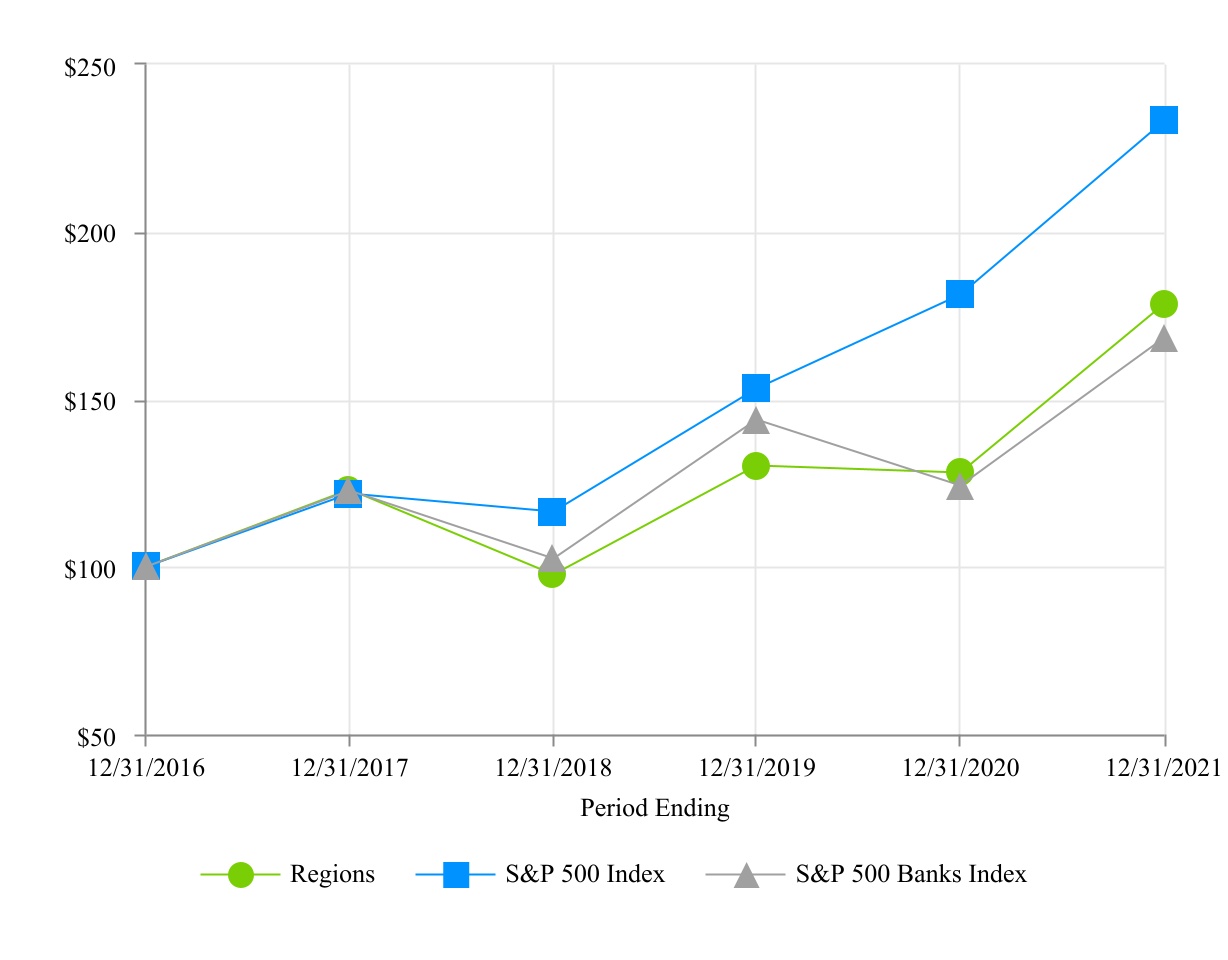][added: 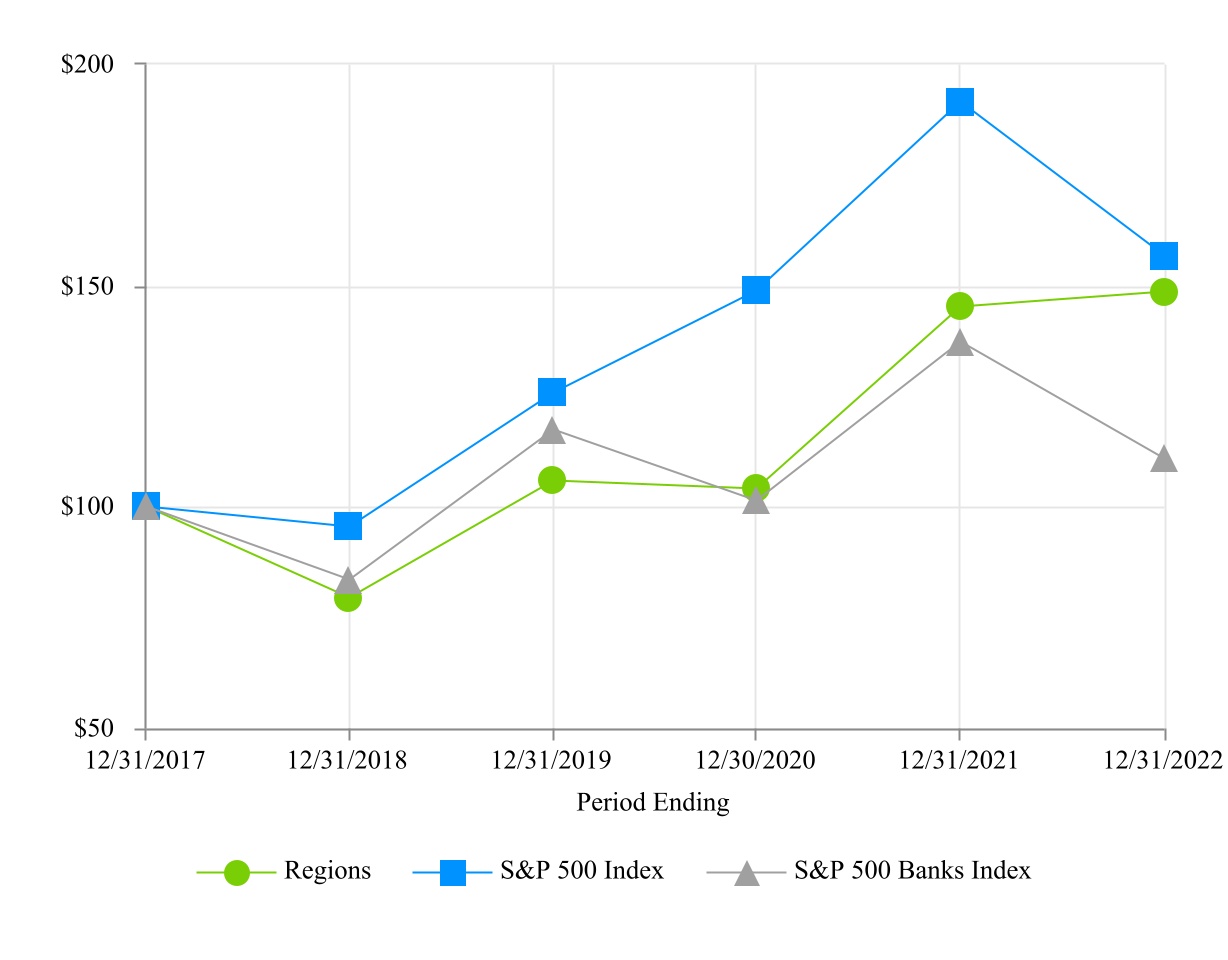]
| | | | [removed: 12/31/2016] [added: 12/31/2017] | | | | | | [removed: 12/31/2017] [added: 12/31/2018] | | | | | | [removed: 12/31/2018] [added: 12/31/2019] | | | | | | [removed: 12/31/2019] [added: 12/31/2020] | | | | | | [removed: 12/31/2020] [added: 12/31/2021] | | | | | | [removed: 12/31/2021] [added: 12/31/2022] | | |
| Regions | | | $ | 100.00 | | | | | $ | 79.43 | | | | | $ | 105.88 | | | | | $ | 104.15 | | | | | $ | 145.18 | | | | | $ | 148.54 | |
| S&P 500 Index | | | 100.00 | | | | | | 95.61 | | | | | | 125.70 | | | | | | 148.81 | | | | | | 191.48 | | | | | | 156.77 | | |
| S&P 500 Banks Index | | | 100.00 | | | | | | 83.56 | | | | | | 117.52 | | | | | | 101.35 | | | | | | 137.28 | | | | | | 110.91 | | |
| | | | | | | | | | | | | | | | | | | | | | | | | | | | | | |
| --- | --- | --- | --- | --- | --- | --- | --- | --- | --- | --- | --- | --- | --- | --- | --- | --- | --- | --- | --- | --- | --- | --- | --- | --- | --- | --- | --- | --- | --- |
| Period | | | | | | | | | Total Number of Shares Purchased | | | | | | Average Price Paid per Share | | | | | | Total Number of Shares Purchased as Part of Publicly Announced Plans or Programs | | | | | | Maximum Approximate Dollar Value of Shares that May Yet Be Purchased Under Publicly Announced Plans or Programs | | |
| October 1-31, 2021 | | | | | | | | | 650,000 | | | | | | $ | 23.87 | | | | | 650,000 | | | | | | $ | 2,305,547,758 | |
| November 1-30, 2021 | | | | | | | | | 7,294,800 | | | | | | $ | 24.09 | | | | | 7,294,800 | | | | | | $ | 2,129,712,326 | |
| December 1-31, 2021 | | | | | | | | | 4,825,000 | | | | | | $ | 22.58 | | | | | 4,825,000 | | | | | | $ | 2,020,698,556 | |
| Total Fourth Quarter | | | | | | | | | 12,769,800 | | | | | | $ | 23.51 | | | | | 12,769,800 | | | | | | $ | 2,020,698,556 | |
| Regions | | | $ | 100.00 | | | | | $ | 122.95 | | | | | $ | 97.66 | | | | | $ | 130.18 | | | | | $ | 128.05 | | | | | $ | 178.50 | |
| S&P 500 Index | | | 100.00 | | | | | | 121.82 | | | | | | 116.47 | | | | | | 153.13 | | | | | | 181.29 | | | | | | 233.28 | | |
| S&P 500 Banks Index | | | 100.00 | | | | | | 122.55 | | | | | | 102.41 | | | | | | 144.02 | | | | | | 124.21 | | | | | | 168.23 | | |
Item 8. Financial Statements and Supplementary Data
933 rewritten, 303 added, 351 removed, 2,090 unchanged
Regions’ management assessed the effectiveness of the Company’s internal control over financial reporting as of December 31, [removed: 2021.][added: 2022.]
Based on our assessment, we believe and assert that, as of December 31, [removed: 2021,] [added: 2022,] the Company’s internal control over financial reporting is effective based on those criteria.
We have audited Regions Financial Corporation and subsidiaries’ internal control over financial reporting as of December 31, [removed: 2021,] [added: 2022,] based on criteria established in Internal Control—Integrated Framework issued by the Committee of Sponsoring Organizations of the Treadway Commission (2013 framework) (the COSO criteria).
In our opinion, Regions Financial Corporation and subsidiaries (the Company) maintained, in all material respects, effective internal control over financial reporting as of December 31, [removed: 2021,] [added: 2022,] based on the COSO criteria.
We also have audited, in accordance with the standards of the Public Company Accounting Oversight Board (United States) (PCAOB), the consolidated balance sheets of Regions Financial Corporation and subsidiaries as of December 31, [removed: 2021] [added: 2022] and [removed: 2020,] [added: 2021,] the related consolidated statements of income, comprehensive [removed: income,] [added: income (loss),] shareholders’ equity and cash flows for each of the three years in the period ended December 31, [removed: 2021,] [added: 2022,] and the related notes and our report dated February 24, [removed: 2022] [added: 2023] expressed an unqualified opinion thereon.
[removed: February 24, 2022][added: | | | | 2022 | | | | | | | | | | | | | | | | | | | | | | | |]
We have audited the accompanying consolidated balance sheets of Regions Financial Corporation and subsidiaries (the Company) as of December 31, [removed: 2021] [added: 2022] and [removed: 2020,] [added: 2021,] the related consolidated statements of income, comprehensive [removed: income,] [added: income (loss),] shareholders’ equity and cash flows for each of the three years in the period ended December 31, [removed: 2021,] [added: 2022,] and the related notes (collectively referred to as the “consolidated financial statements”).
In our opinion, the consolidated financial statements present fairly, in all material respects, the financial position of the Company at December 31, [removed: 2021] [added: 2022] and [removed: 2020,] [added: 2021,] and the results of its operations and its cash flows for each of the three years in the period ended December 31, [removed: 2021,] [added: 2022,] in conformity with U.S. generally accepted accounting principles.
We also have audited, in accordance with the standards of the Public Company Accounting Oversight Board (United States) (PCAOB), the Company’s internal control over financial reporting as of December 31, [removed: 2021,] [added: 2022,] based on criteria established in Internal Control-Integrated Framework issued by the Committee of Sponsoring Organizations of the Treadway Commission (2013 framework) and our report dated February 24, [removed: 2022] [added: 2023] expressed an unqualified opinion thereon.
| *Description of the Matter* | | | | | | The allowance for credit losses consists of two components: the allowance for loan losses and the reserve for unfunded commitments. As of December 31, [removed: 2021,] [added: 2022,] the allowance for credit losses (ACL) was $1.6 billion. The provision for [removed: (benefit from)] credit losses was [removed: ($524 million)] [added: $271 million] for the year ended December 31, [removed: 2021.] [added: 2022.] As discussed in Notes 1 and 5 to the consolidated financial statements, the ACL is established to absorb expected credit losses over the contractual life of the loans measured at amortized cost, including unfunded commitments. Management’s measurement of expected losses is driven by loss forecasting models which utilize relevant quantitative information about historical experience, current conditions and the reasonable and supportable economic forecast that affects the collectability of the reported amount. Management’s estimate for the expected credit losses is established through these quantitative factors, as well as qualitative considerations to account for the imprecision inherent in the estimation process. As a result, management may adjust the ACL for the potential impact of qualitative factors through their established framework. Management’s qualitative framework provides for specific model and general imprecision adjustments for such factors as the economic forecast imprecision, potential model [removed: error] imprecision, process imprecision and specific issues or events that [removed: management] [added: Management] believes are not adequately captured in the modeled outcomes. Auditing management’s ACL estimate and related provision for credit losses involved a high degree of complexity in evaluating the expected loss forecasting models and subjectivity in evaluating management’s measurement of the economic forecast used during the reasonable and supportable period and the qualitative factors. | | |
| *How We Addressed the Matter in Our Audit* | | | | | | We obtained an understanding, evaluated the design and tested the operating effectiveness of the Company’s process for establishing the ACL, including management’s controls over: 1) expected loss forecasting models including model validation, [removed: implementation,] monitoring, the completeness and accuracy of key inputs and assumptions used in the models; 2) the development and application of the reasonable and supportable economic forecast; 3) the identification and measurement of qualitative factors. With respect to expected loss forecasting models, with the support of specialists, we evaluated the conceptual soundness of the model methodology and replicated a sample of models. We also tested the appropriateness of key inputs and assumptions used in these models by agreeing a sample of inputs to supporting information. Regarding the reasonable and supportable economic forecast, with the support of specialists, we assessed the forecasted economic scenario by, among other procedures, evaluating management’s methodology for developing the forecast and comparing a sample of key economic variables developed to external [removed: sources, historical and peer bank information.] [added: sources.] With respect to the identification of qualitative factors, we evaluated the potential impact of imprecision in the quantitative models and hence the need to consider a qualitative adjustment to the ACL. Regarding measurement of the qualitative factors, we evaluated [removed: internal] [added: the methodology applied and] data utilized by management to estimate the appropriate level of the qualitative [removed: factors, as well as internal data] [added: factors. We also considered if qualitative adjustments were consistent with external macroeconomic factors independently obtained during the audit and the results] produced by the Company’s Credit Review, Internal Audit and Model Validation [removed: groups, and external macroeconomic factors independently obtained during the audit.] [added: groups.] We evaluated the overall ACL amount, including model estimates and qualitative factor adjustments, and whether the recorded ACL appropriately reflects expected credit losses on the loan portfolio and unfunded credit commitments. We reviewed historical loss statistics, [removed: peer bank] [added: peer-bank] information, subsequent events and transactions and considered whether they corroborate or contradict the Company’s measurement of the ACL. | | |
| | | | [added: | | | | | | | | | | | | 2022 | | | | | |] 2021 | | | | | | 2020 | | |
| Cash and due from banks | | | $ | [removed: 1,350] [added: 1,997] | | | | | $ | [removed: 1,558] [added: 1,350] | |
| Interest-bearing deposits in other banks | | | [removed: 28,061] [added: 9,230] | | | | | | [removed: 16,398] [added: 28,061] | | |
| Debt securities held to maturity (estimated fair value of [removed: $950] [added: $751] and [removed: $1,215] [added: $950,] respectively) | | | [removed: 899] [added: 801] | | | | | | [removed: 1,122] [added: 899] | | |
| Debt securities available for sale (amortized cost of [removed: $28,263] [added: $31,367] and [removed: $26,092,] [added: $28,263,] respectively) | | | [removed: 28,481] [added: 27,933] | | | | | | [removed: 27,154] [added: 28,481] | | |
| Loans held for sale (includes [removed: $783] [added: $196] and [removed: $1,446] [added: $783] measured at fair value, respectively) | | | [removed: 1,003] [added: 354] | | | | | | [removed: 1,905] [added: 1,003] | | |
| Loans, net of unearned income | | | [removed: 87,784] [added: 97,009] | | | | | | [removed: 85,266] [added: 87,784] | | |
| Allowance for loan losses | | | [removed: (1,479)] [added: (1,464)] | | | | | | [removed: (2,167)] [added: (1,479)] | | |
| Net loans | | | [removed: 86,305] [added: 95,545] | | | | | | [removed: 83,099] [added: 86,305] | | |
| Other earning assets | | | [removed: 1,187] [added: 1,308] | | | | | | [removed: 1,217] [added: 1,187] | | |
| Premises and equipment, net | | | [removed: 1,814] [added: 1,718] | | | | | | [removed: 1,897] [added: 1,814] | | |
| Interest receivable | | | [removed: 319] [added: 511] | | | | | | [removed: 346] [added: 319] | | |
| Goodwill | | | [removed: 5,744] [added: 5,733] | | | | | | [removed: 5,190] [added: 5,744] | | |
| Residential mortgage servicing rights at fair value | | | [removed: 418] [added: 812] | | | | | | [removed: 296] [added: 418] | | |
| Other identifiable intangible assets, net | | | [removed: 305] [added: 249] | | | | | | [removed: 122] [added: 305] | | |
| Other assets | | | [removed: 7,052] [added: 9,029] | | | | | | [removed: 7,085] [added: 7,052] | | |
| Total assets | | | $ | [removed: 162,938] [added: 155,220] | | | | | $ | [removed: 147,389] [added: 162,938] | |
| Non-interest-bearing | | | $ | [removed: 58,369] [added: 51,348] | | | | | $ | [removed: 51,289] [added: 58,369] | |
| Interest-bearing | | | [removed: 80,703] [added: 80,395] | | | | | | [removed: 71,190] [added: 80,703] | | |
| Total deposits | | | [removed: 139,072] [added: 131,743] | | | | | | [removed: 122,479] [added: 139,072] | | |
| Long-term borrowings | | | [removed: 2,407] [added: 2,284] | | | | | | [removed: 3,569] [added: 2,407] | | |
| Total borrowed funds | | | [removed: 2,407] [added: 2,284] | | | | | | [removed: 3,569] [added: 2,407] | | |
| Other liabilities | | | [removed: 3,133] [added: 5,242] | | | | | | [removed: 3,230] [added: 3,133] | | |
| Total liabilities | | | [removed: 144,612] [added: 139,269] | | | | | | [removed: 129,278] [added: 144,612] | | |
| Non-cumulative perpetual, including related surplus, net of issuance costs; [removed: issued—1,750,000 and 1,850,000 shares, respectively] [added: issued—1,403,500 shares] | | | 1,659 | | | | | | [removed: 1,656] [added: 1,659] | | |
| Issued including treasury [removed: stock—982,940,601and 1,001,507,052] [added: stock—975,524,168 and 982,940,601] shares, respectively | | | 10 | | | | | | 10 | | |
| Additional paid-in capital | | | [removed: 12,189] [added: 11,988] | | | | | | [removed: 12,731] [added: 12,189] | | |
| Retained earnings | | | [removed: 5,550] [added: 7,004] | | | | | | [removed: 3,770] [added: 5,550] | | |
| Accumulated other comprehensive income, net | | | [removed: 289] [added: (3,343)] | | | | | | [removed: 1,315] [added: 289] | | |
February 24, 2023
February 24, 2023
| Accumulated other comprehensive income (loss), net | | | (3,343) | | | | | | 289 | | |
| Noncontrolling interest | | | 4 | | | | | | — | | |
| Total equity | | | 15,951 | | | | | | 18,326 | | |
| Net income | | | — | | | | | | — | | | | | | — | | | | | | — | | | | | | — | | | | | | 2,245 | | | | | | — | | | | | | — | | | | | | 2,245 | | | | | | — | | |
| | | | | | | | | | | | | | | | | | | | | | | | | | | | | | | | | | | | | | | | | | | | | | | | | | | | | | | | | | | | |
| Impact of common stock share repurchases | | | — | | | | | | — | | | | | | (8) | | | | | | — | | | | | | (230) | | | | | | — | | | | | | — | | | | | | — | | | | | | (230) | | | | | | — | | |
| BALANCE AT DECEMBER 31, 2022 | | | 2 | | | | | | $ | 1,659 | | | | | 934 | | | | | | $ | 10 | | | | | $ | 11,988 | | | | | $ | 7,004 | | | | | $ | (1,371) | | | | | $ | (3,343) | | | | | $ | 15,947 | | | | | $ | 4 | |
("RETDR") or 2) extension or renewal options are included in the original or modified contract at the reporting date and are not unconditionally cancellable by Regions.
Segmentation
units.
These investments consist primarily of investments in strategic partners and certain CRA projects.
Deferred tax assets and liabilities are determined based on differences between the financial reporting and tax bases of assets and liabilities and are measured using the enacted tax rates and laws that the Company expects will apply at the time when the deferred tax assets and liabilities are expected to be realized.
If the Company does not believe that it is more likely than not that an uncertain tax position will be sustained, the Company records a liability for the uncertain tax position.
Prior to mid-2022, service charges on deposit accounts also included non-sufficient fund fees, which were earned when a depositor presented an item for payment in excess of available funds and an item was returned unpaid.
flow analyses and option pricing models based on market rates and volatilities, which are Level 2 measurements.
| ASU 2022-01—Derivatives and Hedging (Topic 815): Fair Value Hedging—Portfolio Layer Method | | | This Update represents the final amended guidance to the ‘last-of-layer’ hedge model for fair value hedge relationships. The last-of-layer method allowed for essentially a single hedge for a given portfolio of only prepayable assets. The ‘portfolio layer’ method will make the hedging asset side of the balance sheet easier as it allows for more flexibility in the use of derivatives and structures that best align with management's objectives for hedging purposes. Multiple hedged layers are permitted in fair value hedge relationships for a closed portfolio of financial assets. Both prepayable and non-prepayable financial instruments may be used and included. The Update permits reclassification of debt securities from held-to-maturity to available-for-sale upon adoption with restrictions. Portfolio layer method hedging must be applied to those debt securities. Also, the decision to reclassify must be within 30 days after the date of adoption, and securities would need to be included in a closed portfolio that is designed in a portfolio layer method hedge within that 30-day period. | | | January 1, 2023 Early adoption is permitted. | | | The early adoption of this guidance did not have a material impact. | | |
| ASU 2022-06— Reference Rate Reform (Topic 848): Deferral of the Sunset Date of Topic 848 | | | This Update defers the sunset date for applying reference rate reform relief in Topic 848 to December 31, 2024 from December 31, 2022. | | | Effective upon issuance | | | The adoption of this guidance did not have a material impact. | | |
| ASU 2022-02, Financial Instruments—Credit Losses (Topic 326): Troubled Debt Restructurings and Vintage Disclosures | | | This Update is intended to improve the decision usefulness of information provided to investors about certain loan refinancings, restructurings, and write-offs. The amendments in the Update eliminate the accounting guidance for TDRs by creditors that have adopted CECL while enhancing disclosure requirements for certain loan refinancings and restructurings by creditors made to borrowers experiencing financial difficulty. The Update also requires that a public business entity disclose current-period gross write-offs by year of origination for financing receivables and net investment in leases. The amendments in this Update should be applied prospectively, except for the transition method related to the recognition and measurement of TDRs for which there is an option to apply a modified retrospective transition method, resulting in a cumulative-effect adjustment to retained earnings in the period of adoption. | | | January 1, 2023 | | | Regions adopted this guidance as of January 1, 2023 with no material impact. | | |
| 2022-03, Fair Value Measurement of Equity Securities Subject to Contractual Sale Restrictions | | | This Update clarifies how the fair value of equity securities subject to contractual sale restrictions is determined. ASU 2022-03 clarifies that a contractual sale restriction should not be considered in measuring fair value. It also requires entities with investments in equity securities subject to contractual sale restrictions to disclose certain qualitative and quantitative information about such securities. | | | January 1, 2023 | | | Regions adopted this guidance as of January 1, 2023 with no material impact. | | |
| Residential agency | | | $ | 289 | | | | | $ | — | | | | | $ | (10) | | | | | $ | 279 | | | | | $ | — | | | | | $ | (21) | | | | | $ | 258 | |
| Commercial agency | | | 523 | | | | | | — | | | | | | (1) | | | | | | 522 | | | | | | — | | | | | | (29) | | | | | | 493 | | |
| | | | $ | 812 | | | | | $ | — | | | | | $ | (11) | | | | | $ | 801 | | | | | $ | — | | | | | $ | (50) | | | | | $ | 751 | |
| U.S. Treasury securities | | | $ | 1,310 | | | | | $ | — | | | | | $ | (123) | | | | | $ | 1,187 | | | | | | | | | | | | | | | | | $ | 1,187 | |
| Residential agency | | | 19,477 | | | | | | — | | | | | | (2,523) | | | | | | 16,954 | | | | | | | | | | | | | | | | | | 16,954 | | |
| Commercial agency | | | 8,262 | | | | | | — | | | | | | (649) | | | | | | 7,613 | | | | | | | | | | | | | | | | | | 7,613 | | |
| | | | $ | 31,367 | | | | | $ | 1 | | | | | $ | (3,435) | | | | | $ | 27,933 | | | | | | | | | | | | | | | | | $ | 27,933 | |
| Residential agency | | | $ | 289 | | | | | $ | 258 | |
| | | | $ | 812 | | | | | $ | 751 | |
| Residential agency | | | 19,477 | | | | | | 16,954 | | |
| Commercial agency | | | 8,262 | | | | | | 7,613 | | |
| | | | $ | 31,367 | | | | | $ | 27,933 | |
For debt securities transferred to held to maturity from available for sale, the analysis in the tables below compares the securities' original amortized cost to its current estimated fair value; there were no unrealized losses on debt securities held to maturity using this analysis at December 31, 2021.
| Residential agency | | | $ | 251 | | | | | $ | (29) | | | | | $ | 7 | | | | | $ | (1) | | | | | $ | 258 | | | | | $ | (30) | |
| Commercial agency | | | 469 | | | | | | (26) | | | | | | 24 | | | | | | (4) | | | | | | 493 | | | | | | (30) | | |
| | | | $ | 720 | | | | | $ | (55) | | | | | $ | 31 | | | | | $ | (5) | | | | | $ | 751 | | | | | $ | (60) | |
| U.S Treasury securities | | | $ | 276 | | | | | $ | (8) | | | | | $ | 903 | | | | | $ | (115) | | | | | $ | 1,179 | | | | | $ | (123) | |
| Federal agency securities | | | 766 | | | | | | (50) | | | | | | 53 | | | | | | (12) | | | | | | 819 | | | | | | (62) | | |
| Residential agency | | | 9,350 | | | | | | (1,005) | | | | | | 7,578 | | | | | | (1,518) | | | | | | 16,928 | | | | | | (2,523) | | |
Our assessment of and conclusion on the effectiveness of internal control over financial reporting did not include the internal controls over the operations of EnerBank USA or Sabal Capital Partners LLC, which are included in the Company's 2021 consolidated financial statements.
EnerBank USA constituted approximately 2 percent of both the Company's total assets and total liabilities as of December 31, 2021, and less than 1 percent of total revenue for the year then ended.
Sabal Capital Partners LLC constituted less than 1 percent of the Company's total assets and total liabilities as of December 31, 2021 and less than 1 percent of total revenue for the year then ended.
Table of Contents
As indicated in the accompanying Report of Management on Internal Control over Financial Reporting, management’s assessment of and conclusions on the effectiveness of internal control over financial reporting did not include the internal controls of EnerBank USA or Sabal Capital Partners LLC, which are included in the 2021 consolidated financial statements.
EnerBank USA constituted approximately 2 percent of both the Company’s total assets and total liabilities as of December 31, 2021, and less than 1 percent of the Company’s total revenue for the year then ended.
Sabal Capital Partners LLC constituted less than 1 percent of the Company’s total assets and total liabilities as of December 31, 2021, and less than 1 percent of the Company’s total revenue for the year then ended.
Our audit of internal control over financial reporting of the Company also did not include an evaluation of the internal control over financial reporting of EnerBank USA or Sabal Capital Partners LLC.
Adoption of New Accounting Standard
As discussed in Notes 1 and 5 to the consolidated financial statements, the Company changed its method of accounting for credit losses in 2020 due to the adoption of ASU 2016-13*, Measurement of Credit Losses on Financial Instruments*.
As explained below, auditing the Company’s allowance for credit losses, including the adoption of the new accounting guidance, was a critical audit matter.
| | | | | | | | | | | | |
| --- | --- | --- | --- | --- | --- | --- | --- | --- | --- | --- | --- |
_________
(1)Upon adoption of CECL on January 1, 2020, the provision for credit losses is the sum of the provision for loans losses and the provision for unfunded credit commitments.
Prior to the adoption of CECL, the provision for unfunded commitments was included in other non-interest expense.
| | | | | | | | | | | | | | | | | | |
| --- | --- | --- | --- | --- | --- | --- | --- | --- | --- | --- | --- | --- | --- | --- | --- | --- | --- |
| BALANCE AT JANUARY 1, 2019 | | | 1 | | | | | | $ | 820 | | | | | 1,025 | | | | | | $ | 11 | | | | | $ | 13,766 | | | | | $ | 2,828 | | | | | $ | (1,371) | | | | | $ | (964) | | | | | $ | 15,090 | | | | | | | |
| Net proceeds from issuance of 500 thousand shares of Series C, fixed to floating rate, non-cumulative perpetual preferred stock, including related surplus | | | 1 | | | | | | 490 | | | | | | — | | | | | | — | | | | | | — | | | | | | — | | | | | | — | | | | | | — | | | | | | 490 | | | | | | | | |
| Common stock transactions: | | | | | | | | | | | | | | | | | | | | | | | | | | | | | | | | | | | | | | | | | | | | | | | | | | | | | | | | | | | |
| Impact of share repurchases | | | — | | | | | | — | | | | | | (72) | | | | | | (1) | | | | | | (1,100) | | | | | | — | | | | | | — | | | | | | — | | | | | | (1,101) | | | | | | | | |
| Cumulative effect from change in accounting guidance | | | — | | | | | | — | | | | | | — | | | | | | — | | | | | | — | | | | | | (377) | | | | | | — | | | | | | — | | | | | | (377) | | | | | | | | |
Prior to the adoption, the provision for unfunded commitments is included in other non-interest expense.
commercial portfolio segment.
individual facts and circumstances of the borrower.
Prior to the adoption of CECL on January 1, 2020, all loans with the TDR designation were considered to be impaired, even if they were accruing.
With the adoption of CECL on January 1, 2020, the definition of impaired loans was removed from accounting guidance.
For collateral-dependent loans, CECL requires an entity to measure the expected credit losses based on the fair value of the collateral at the reporting date when the entity determines that foreclosure is probable.
Additionally, CECL allows a fair value of collateral practical expedient as a measurement approach for loans when the repayment is expected to be provided substantially through the operation or sale of the collateral when the borrower is experiencing financial difficulty ("collateral dependent”).
Loans identified as TDRs and RETDRs are treated consistently in CECL loss models.
*INVESTMENTS IN FEDERAL RESERVE BANK AND FEDERAL HOME LOAN BANK STOCK*
*INVESTMENTS IN OPERATING LEASES*
Investments in operating leases represent the assets underlying the related lease contracts and are reported at cost, less accumulated depreciation and net of origination fees and costs.
Depreciation on these assets is generally provided on a straight-line basis over the lease term down to an estimated residual value.
Regions periodically evaluates its depreciation rate for leased assets based on projected residual values and adjusts depreciation expense over the remaining life of the lease if deemed appropriate.
Regions also evaluates the current value of the operating lease assets and tests for impairment when indicators of impairment are present.
Income from operating lease assets includes lease origination fees, net of lease origination costs, and is recognized as operating lease revenue on a straight line basis over the scheduled lease term.
The accrual of revenue on operating leases is generally discontinued at the time an account is determined to be uncollectible.
Operating lease revenue and the depreciation expense on the related operating lease assets are included as components of net interest income on the consolidated statements of income.
An excerpt. Shown here: 40 of 933 rewritten, 40 of 303 added and 40 of 351 removed. The counts are complete. For every sentence, read Item 8. Financial Statements and Supplementary Data in the FY2022 filing and the FY2021 filing.
Item 9A. Controls and Procedures
1 rewritten, 0 added, 2 removed, 3 unchanged
During the fourth fiscal quarter of the year ended December 31, [removed: 2021,] [added: 2022,] there have been no changes in Regions’ internal control over financial reporting that have materially affected, or are reasonably likely to materially affect, Regions’ control over financial reporting.
In the fourth quarter, Regions acquired EnerBank and Sabal Capital Partners and are in the process of integrating the acquired businesses into our overall internal control over financial reporting process.
As permitted under applicable regulations, we have excluded acquisitions from our assessment of internal control over financial reporting as of December 31, 2021.
Item 10. Directors, Executive Officers and Corporate Governance
1 rewritten, 0 added, 0 removed, 7 unchanged
Information about the Directors and Director nominees of Regions included in Regions’ Proxy Statement for the [removed: 2022] [added: 2023] Annual Meeting of Shareholders (the “Proxy Statement”) under the captions “PROPOSAL 1—ELECTION OF DIRECTORS—Who are this year's nominees?,” “—What criteria were considered by the NCG Committee in selecting the nominees?,” “—What skills and characteristics are currently represented on the Board?,” and “—How often are the [removed: Directors] [added: members] elected?” and the information incorporated by reference pursuant to Item 13.
Item 12. Security Ownership of Certain Beneficial Owners and Management and Related Stockholder Matters
3 rewritten, 1 added, 1 removed, 9 unchanged
The following table gives information about the common stock that may be issued upon the exercise of options, warrants and rights under all of Regions’ existing equity compensation plans as of December 31, [removed: 2021.][added: 2022.]
| Equity Compensation Plans Approved by Stockholders | | | — | | | | | | $ | — | | [removed: 30,267,272] [added: 27,767,251] | | | (b) | | |
(a)Does not include outstanding restricted stock units of [removed: 11,206,894.][added: 10,163,763.]
| Total | | | — | | | | | | $ | — | | 27,767,251 | | | | | |
| Total | | | — | | | | | | $ | — | | 30,267,272 | | | | | |
Item 15. Exhibits and Financial Statement Schedules
56 rewritten, 11 added, 5 removed, 127 unchanged
| Consolidated Balance Sheets—December 31, [removed: 2021] [added: 2022] and [removed: 2020;] [added: 2021;] | | |
| Consolidated Statements of Income—Years ended December 31, [removed: 2021, 2020] [added: 2022, 2021] and [removed: 2019;] [added: 2020;] | | |
| Consolidated Statements of Comprehensive Income—Years ended December 31, [removed: 2021, 2020] [added: 2022, 2021] and [removed: 2019;] [added: 2020;] | | |
| Consolidated Statements of Changes in Shareholders’ Equity—Years ended December 31, [removed: 2021, 2020] [added: 2022, 2021] and [removed: 2019;] [added: 2020;] and | | |
| Consolidated Statements of Cash Flows—Years ended December 31, [removed: 2021, 2020] [added: 2022, 2021] and [removed: 2019.] [added: 2020.] | | |
| 3.6 | | | [Bylaws as amended and [removed: restated](https://www.sec.gov/Archives/edgar/data/0001281761/000119312521220699/d191960dex32.htm) [on] [added: restated on] July 21, [removed: 2021](https://www.sec.gov/Archives/edgar/data/0001281761/000119312521220699/d191960dex32.htm)[,] [added: 2021,] incorporated by reference to Exhibit 3.2 to Form 8-K Current Report filed by registrant on [removed: July](https://www.sec.gov/Archives/edgar/data/0001281761/000119312521220699/d191960dex32.htm) [21,] [added: July 21,] 2021](https://www.sec.gov/Archives/edgar/data/0001281761/000119312521220699/d191960dex32.htm). | | | | | |
| 4.3 | | | [Form of depositary receipt representing [removed: the](http://www.sec.gov/Archives/edgar/data/1281761/000119312514167390/d717083dex41.htm) [Series B](http://www.sec.gov/Archives/edgar/data/1281761/000119312514167390/d717083dex41.htm) [Depositary] [added: the Series B Depositary] Shares, incorporated by [removed: reference](http://www.sec.gov/Archives/edgar/data/1281761/000119312514167390/d717083dex41.htm) [to] [added: reference to] Exhibit A to Exhibit [removed: 4.1](http://www.sec.gov/Archives/edgar/data/1281761/000119312514167390/d717083dex41.htm) [to] [added: 4.1 to] the Form 8-K Current Report filed by registrant on April 29, 2014.](http://www.sec.gov/Archives/edgar/data/1281761/000119312514167390/d717083dex41.htm) | | | | | |
| 4.6 | | | [Form of depositary receipt representing [removed: the](http://www.sec.gov/Archives/edgar/data/1281761/000119312519124304/d739526dex41.htm) [Series C](http://www.sec.gov/Archives/edgar/data/1281761/000119312519124304/d739526dex41.htm) [Depositary] [added: the Series C Depositary] Shares, incorporated by reference [removed: to](http://www.sec.gov/Archives/edgar/data/1281761/000119312519124304/d739526dex41.htm) [Exhibit] [added: to Exhibit] A [removed: to](http://www.sec.gov/Archives/edgar/data/1281761/000119312519124304/d739526dex41.htm) [Exhibit] [added: to Exhibit] 4.1 to the Form 8-A filed by registrant on April 29, 2019.](http://www.sec.gov/Archives/edgar/data/1281761/000119312519124304/d739526dex41.htm) | | | | | |
| 4.8 | | | [Form of depositary receipt representing [removed: the](https://www.sec.gov/Archives/edgar/data/1281761/000119312520162091/d937005dex41.htm) [Series D](https://www.sec.gov/Archives/edgar/data/1281761/000119312520162091/d937005dex41.htm) [Depositary] [added: the Series D Depositary] Shares, incorporated by reference [removed: to](https://www.sec.gov/Archives/edgar/data/1281761/000119312520162091/d937005dex41.htm) [Exhibit](https://www.sec.gov/Archives/edgar/data/1281761/000119312520162091/d937005dex41.htm) [A to](https://www.sec.gov/Archives/edgar/data/1281761/000119312520162091/d937005dex41.htm) [Exhibit 4.](https://www.sec.gov/Archives/edgar/data/1281761/000119312520162091/d937005dex41.htm)[1](https://www.sec.gov/Archives/edgar/data/1281761/000119312520162091/d937005dex41.htm) [to] [added: to Exhibit A to Exhibit 4.1 to] the Form 8-K Current Report filed by registrant on June 5, 2020.](https://www.sec.gov/Archives/edgar/data/1281761/000119312520162091/d937005dex41.htm) | | | | | |
| 4.9 | | | [Deposit Agreement, dated as of May 4, 2021, by and among Regions Financial Corporation, Computershare [removed: Inc. and Computershare] [added: Inc.](https://www.sec.gov/Archives/edgar/data/1281761/000119312521147588/d188159dex41.htm) [](https://www.sec.gov/Archives/edgar/data/1281761/000119312521147588/d188159dex41.htm)[a](https://www.sec.gov/Archives/edgar/data/1281761/000119312521147588/d188159dex41.htm)[n](https://www.sec.gov/Archives/edgar/data/1281761/000119312521147588/d188159dex41.htm)[d](https://www.sec.gov/Archives/edgar/data/1281761/000119312521147588/d188159dex41.htm) [](https://www.sec.gov/Archives/edgar/data/1281761/000119312521147588/d188159dex41.htm)[Computershare] Trust Company, [removed: N.A., jointly as depositary,] [added: N.A.,](https://www.sec.gov/Archives/edgar/data/1281761/000119312521147588/d188159dex41.htm) [jointly as](https://www.sec.gov/Archives/edgar/data/1281761/000119312521147588/d188159dex41.htm) [depositary,] and the holders from time to time of the depositary receipts described therein, incorporated by reference to Exhibit 4.1 to the Form 8-A filed by registrant on May 3, 2021.](https://www.sec.gov/Archives/edgar/data/1281761/000119312521147588/d188159dex41.htm) | | | | | |
| 4.11 | | | [Description of Registered [removed: Securities](https://www.sec.gov/Archives/edgar/data/1281761/000128176122000016/rf-20211231xex411.htm).] [added: Securities](https://www.sec.gov/Archives/edgar/data/1281761/000128176123000012/rf-20221231xex411.htm).] | | | | | |
| [removed: 10.1*] [added: 10.14*] | | | [Regions Financial Corporation 2015 Long Term Incentive Plan, incorporated by reference to Appendix B to Regions Financial Corporation’s Proxy Statement dated March 10, 2015, for the Regions Annual Meeting of Stockholders held April 23, 2015.](http://www.sec.gov/Archives/edgar/data/1281761/000119312515085528/d825466ddef14a.htm#toc825466_93) | | | | | |
| [removed: 10.2*] [added: 10.15*] | | | [Amendment Number One to the Regions Financial Corporation 2015 Long Term Incentive Plan, incorporated by reference to Exhibit 10.1 to Form 10-Q Quarterly Report filed by registrant on May 5, 2017.](http://www.sec.gov/Archives/edgar/data/1281761/000128176117000047/rf-20170331xex101.htm) | | | | | |
| [removed: 10.3*] [added: 10.21*] | | | [2020 Form of Notice and Form of [removed: Director Restricted] [added: Performance] Stock Unit Award Agreement under Regions Financial Corporation 2015 Long Term Incentive Plan, incorporated by reference to Exhibit [removed: 10.1] [added: 10.3] to Form 10-Q Quarterly Report filed by registrant on August 5, [removed: 2020.](https://www.sec.gov/Archives/edgar/data/1281761/000128176120000075/rf-2020630xexx101.htm)] [added: 2020.](https://www.sec.gov/Archives/edgar/data/1281761/000128176120000075/rf-2020630xex103.htm)] | | | | | |
| [removed: 10.4*] [added: 10.16*] | | | [Form of Director Restricted Stock Unit Notice and Award Agreement under the Regions Financial Corporation 2015 Long Term Incentive Plan, incorporated by reference to Exhibit 10.1 to Form 10-Q Quarterly Report filed by registrant on August 6, 2021.](https://www.sec.gov/Archives/edgar/data/1281761/000128176121000067/rf-2021630ex101.htm) | | | | | |
| [removed: 10.5*] [added: 10.17*] | | | [removed: [2018] [added: [2019] Form of Notice and Form of Restricted Stock Unit Award Agreement under Regions Financial Corporation 2015 Long Term Incentive Plan, incorporated by reference to Exhibit [removed: 10.1] [added: 10.2] to Form 10-Q Quarterly Report filed by registrant on August [removed: 8, 2018.](http://www.sec.gov/Archives/edgar/data/1281761/000128176118000092/rf-2018630xex101.htm)] [added: 7, 2019.](http://www.sec.gov/Archives/edgar/data/1281761/000128176119000071/rf-2019630xex102.htm)] | | | | | |
| [removed: 10.6*] [added: 10.20*] | | | [2019 Form of Notice and Form of [removed: Restricted] [added: Performance] Stock Unit Award Agreement under Regions Financial Corporation 2015 Long Term Incentive Plan, incorporated by reference to Exhibit [removed: 10.2] [added: 10.3] to Form 10-Q Quarterly Report filed by registrant on August 7, [removed: 2019.](http://www.sec.gov/Archives/edgar/data/1281761/000128176119000071/rf-2019630xex102.htm)] [added: 2019.](http://www.sec.gov/Archives/edgar/data/1281761/000128176119000071/rf-2019630xex103.htm)] | | | | | |
| [removed: 10.7*] [added: 10.18*] | | | [2020 Form of Notice and Form of Restricted Stock Unit Award Agreement under Regions Financial Corporation 2015 Long Term Incentive Plan, incorporated by reference to Exhibit 10.2 to Form 10-Q Quarterly Report filed by registrant on August 5, 2020.](https://www.sec.gov/Archives/edgar/data/1281761/000128176120000075/rf-2020630xex102.htm) | | | | | |
| [removed: 10.8*] [added: 10.19*] | | | [Form of Associate Restricted Stock Unit Notice and Award Agreement under the Regions Financial Corporation 2015 Long Term Incentive Plan, incorporated by reference to Exhibit 10.2 to Form 10-Q Quarterly Report filed by registrant on August 6, 2021.](https://www.sec.gov/Archives/edgar/data/1281761/000128176121000067/rf-2021630xex102.htm) | | | | | |
| [removed: 10.9*] [added: 10.23*] | | | [removed: [2018] [added: [2019] Form of Notice and Form of Performance [removed: Stock] Unit Award Agreement under Regions Financial Corporation 2015 Long Term Incentive Plan, incorporated by reference to Exhibit [removed: 10.2] [added: 10.3] to Form 10-Q Quarterly Report filed by registrant on August [removed: 8, 2018.](http://www.sec.gov/Archives/edgar/data/1281761/000128176118000092/rf-2018630xex102.htm)] [added: 7, 2019.](http://www.sec.gov/Archives/edgar/data/1281761/000128176119000071/rf-2019630xex103.htm)] | | | | | |
| [removed: 10.10*] [added: 10.22*] | | | [removed: [2019 Form of Notice and Form] [added: [Form] of [added: Associate] Performance Stock Unit [added: Notice and] Award Agreement under [added: the] Regions Financial Corporation 2015 Long Term Incentive Plan, incorporated by reference to Exhibit 10.3 to Form 10-Q Quarterly Report filed by registrant on August [removed: 7, 2019.](http://www.sec.gov/Archives/edgar/data/1281761/000128176119000071/rf-2019630xex103.htm)] [added: 6, 2021.](https://www.sec.gov/Archives/edgar/data/1281761/000128176121000067/rf-2021630xex103.htm)] | | | | | |
| [removed: 10.11*] [added: 10.24*] | | | [2020 Form of Notice and Form of Performance [removed: Stock] Unit Award Agreement under Regions Financial Corporation 2015 Long Term Incentive Plan, incorporated by reference to Exhibit [removed: 10.3] [added: 10.4] to Form 10-Q Quarterly Report filed by registrant on August 5, [removed: 2020.](https://www.sec.gov/Archives/edgar/data/1281761/000128176120000075/rf-2020630xex103.htm)] [added: 2020.](https://www.sec.gov/Archives/edgar/data/1281761/000128176120000075/rf-2020630xexx104.htm)] | | | | | |
| [removed: 10.12*] [added: 10.25*] | | | [Form of Associate Performance [removed: Stock] Unit Notice and Award Agreement under the Regions Financial Corporation 2015 Long Term Incentive Plan, incorporated by reference to Exhibit [removed: 10.3] [added: 10.4] to Form 10-Q Quarterly Report filed by registrant on August 6, [removed: 2021.](https://www.sec.gov/Archives/edgar/data/1281761/000128176121000067/rf-2021630xex103.htm)] [added: 2021.](https://www.sec.gov/Archives/edgar/data/1281761/000128176121000067/rf-2021630xex104.htm)] | | | | | |
| [removed: 10.14*] [added: 10.2*] | | | [removed: [2019 Form of Notice and Form of Performance Unit Award Agreement under Regions] [added: [Regions] Financial Corporation [removed: 2015 Long Term Incentive] [added: Directors’ Deferred Restricted Stock Unit] Plan, incorporated by reference to Exhibit [removed: 10.3] [added: 10.26] to Form [removed: 10-Q Quarterly] [added: 10-K Annual] Report filed by registrant on [removed: August 7, 2019.](http://www.sec.gov/Archives/edgar/data/1281761/000128176119000071/rf-2019630xex103.htm)] [added: February 22, 2019.](http://www.sec.gov/Archives/edgar/data/1281761/000128176119000019/rf-20181231xex1026.htm)] | | | | | |
| [removed: 10.15*] [added: 10.29*] | | | [removed: [2020 Form of Notice and Form of Performance Unit Award Agreement under Regions] [added: [Regions] Financial Corporation [removed: 2015 Long Term Incentive Plan,] [added: Non-Qualified Excess 401(k) Plan (Amended and Restated as of June 1, 2020),] incorporated by reference to Exhibit [removed: 10.4] [added: 10.5] to Form 10-Q Quarterly Report filed by registrant on August 5, [removed: 2020.](https://www.sec.gov/Archives/edgar/data/1281761/000128176120000075/rf-2020630xexx104.htm)] [added: 2020.](https://www.sec.gov/Archives/edgar/data/1281761/000128176120000075/rf-2020630xex105.htm)] | | | | | |
| [removed: 10.16*] [added: 10.26*] | | | [removed: [Form of Associate Performance] [added: [Restricted Stock] Unit Notice and Award Agreement under the Regions Financial Corporation 2015 Long Term Incentive [removed: Plan, incorporated by reference to Exhibit 10.4 to Form 10-Q Quarterly Report filed by registrant on August 6, 2021.](https://www.sec.gov/Archives/edgar/data/1281761/000128176121000067/rf-2021630xex104.htm)] [added: Plan with executive officer C. Dandridge Massey dated July 1, 2022.](https://www.sec.gov/Archives/edgar/data/1281761/000128176123000012/rf-20221231exx1026.htm)] | | | | | |
| [removed: 10.17*] [added: 10.4*] | | | [Regions Financial Corporation [removed: Directors’] Deferred [removed: Restricted Stock Unit Plan,] [added: Compensation Plan for Former Directors of AmSouth Bancorporation (formerly named Deferred Compensation Plan for Directors of AmSouth Bancorporation),] incorporated by reference to Exhibit [removed: 10.26] [added: 10.30] to Form 10-K Annual Report filed by registrant on February [removed: 22, 2019.](http://www.sec.gov/Archives/edgar/data/1281761/000128176119000019/rf-20181231xex1026.htm)] [added: 25, 2009.](http://www.sec.gov/Archives/edgar/data/1281761/000119312509036452/dex1030.htm)] | | | | | |
| [removed: 10.18*] [added: 10.3*] | | | [Regions Financial Corporation Directors’ Deferred Investment Plan (As Amended and Restated as of January 1, 2021), incorporated by reference to Exhibit 4.7 to Form S-8 Registration Statement filed by registrant on December 30, 2020.](https://www.sec.gov/Archives/edgar/data/1281761/000119312520329640/d83581dex47.htm) | | | | | |
| [removed: 10.19*] [added: 10.38*] | | | [removed: [Regions Financial Corporation Deferred Compensation Plan for Former Directors of] [added: [Amendment Number 2 to] AmSouth Bancorporation [removed: (formerly named] Deferred Compensation [removed: Plan for Directors of AmSouth Bancorporation),] [added: Plan,] incorporated by reference to Exhibit [removed: 10.30] [added: 10.36] to Form 10-K Annual Report filed by registrant on February 25, [removed: 2009.](http://www.sec.gov/Archives/edgar/data/1281761/000119312509036452/dex1030.htm)] [added: 2009.](http://www.sec.gov/Archives/edgar/data/1281761/000119312509036452/dex1036.htm)] | | | | | |
| [removed: 10.20*] [added: 10.36*] | | | [AmSouth Bancorporation Deferred Compensation Plan, incorporated by reference to Exhibit 10.13 to Form 10-K Annual Report filed by AmSouth Bancorporation on March 15, 2005.](http://www.sec.gov/Archives/edgar/data/3133/000119312505051242/dex1013.htm) | | | | | |
| [removed: 10.21*] [added: 10.37*] | | | [Amendment Number 1 to AmSouth Bancorporation Deferred Compensation Plan effective November 4, 2006, incorporated by reference to Exhibit 10.59 to Form 10-K Annual Report filed by registrant on March 1, 2007.](http://www.sec.gov/Archives/edgar/data/1281761/000119312507043798/dex1059.htm) | | | | | |
| [removed: 10.22*] [added: 10.39*] | | | [Amendment Number [removed: 2] [added: Three] to [added: the] AmSouth Bancorporation Deferred Compensation Plan, incorporated by reference to Exhibit [removed: 10.36] [added: 10.1] to Form [removed: 10-K Annual] [added: 10-Q Quarterly] Report filed by registrant on [removed: February 25, 2009.](http://www.sec.gov/Archives/edgar/data/1281761/000119312509036452/dex1036.htm)] [added: November 5, 2014.](http://www.sec.gov/Archives/edgar/data/1281761/000128176114000074/rf-20140930xex101.htm)] | | | | | |
| [removed: 10.24*] [added: 10.6*] | | | [Form of Change-in-Control Agreement with executive officer John M. Turner, Jr., incorporated by reference to Exhibit 99.3 to Form 8-K Current Report filed by registrant on June 19, 2018.](http://www.sec.gov/Archives/edgar/data/1281761/000128176118000060/exh993.htm) | | | | | |
| [removed: 10.25*] [added: 10.7*] | | | [Form of Change-in-Control Agreement with executive officer [removed: John B. Owen,] [added: Kate R. Danella,] incorporated by reference to Exhibit [removed: 10.3 of] [added: 10.37 to] Form [removed: 8-K Current] [added: 10-K Annual] Report filed by registrant on [removed: October 3, 2007.](http://www.sec.gov/Archives/edgar/data/1281761/000089183607000301/ex_10-3.htm)] [added: February 22, 2019.](http://www.sec.gov/Archives/edgar/data/1281761/000128176119000019/rf-20181231xex1037.htm)] | | | | | |
| [removed: 10.26*] [added: 10.10*] | | | [Form of Change-in-Control Agreement with executive officer [removed: Kate R. Danella,] [added: William D. Ritter,] incorporated by reference to Exhibit [removed: 10.37] [added: 10.49] to Form 10-K Annual Report filed by registrant on February [removed: 22, 2019.](http://www.sec.gov/Archives/edgar/data/1281761/000128176119000019/rf-20181231xex1037.htm)] [added: 24, 2011.](http://www.sec.gov/Archives/edgar/data/1281761/000119312511045404/dex1049.htm)] | | | | | |
| [removed: 10.27*] [added: 10.8*] | | | [Form of Change-in-Control Agreement with executive officer C. Matthew Lusco, incorporated by reference to Exhibit 10.11 of Form 10-Q Quarterly Report filed by registrant on August 4, 2011.](http://www.sec.gov/Archives/edgar/data/1281761/000119312511209965/dex1011.htm) | | | | | |
| [removed: 10.28*] [added: 10.9*] | | | [Form of Change-in-Control Agreement with executive [removed: officers](http://www.sec.gov/Archives/edgar/data/1281761/000119312511045404/dex1048.htm) [David] [added: officers David] R. Keenan, Scott M. Peters, Ronald G. Smith and David J. Turner, Jr., incorporated by reference to Exhibit 10.48 to Form 10-K Annual Report filed by registrant on February 24, 2011.](http://www.sec.gov/Archives/edgar/data/1281761/000119312511045404/dex1048.htm) | | | | | |
| [removed: 10.29*] [added: 10.11*] | | | [Form of [added: Amendment to] Change-in-Control Agreement with executive [removed: officer] [added: officers David J. Turner, Jr.,](http://www.sec.gov/Archives/edgar/data/1281761/000119312513069212/d418921dex1052.htm) [David R. Keenan, Scott M. Peters, Ronald G. Smith, and] William D. Ritter, incorporated by reference to Exhibit [removed: 10.49] [added: 10.52] to Form 10-K Annual Report filed by registrant on February [removed: 24, 2011.](http://www.sec.gov/Archives/edgar/data/1281761/000119312511045404/dex1049.htm)] [added: 21, 2013.](http://www.sec.gov/Archives/edgar/data/1281761/000119312513069212/d418921dex1052.htm)] | | | | | |
| [removed: 10.31*] [added: 10.40*] | | | [Regions Financial Corporation Executive Severance Plan (Amended and [removed: Restated](https://www.sec.gov/Archives/edgar/data/1281761/000128176120000010/rf-20191231xex1032.htm) [e](https://www.sec.gov/Archives/edgar/data/1281761/000128176120000010/rf-20191231xex1032.htm)[ffective] [added: Restated effective] January 1, 2020), incorporated by reference to Exhibit 10.32 to Form 10-K Annual Report filed by registrant on February 21, 2020.](https://www.sec.gov/Archives/edgar/data/1281761/000128176120000010/rf-20191231xex1032.htm) | | | | | |
| [removed: 10.32*] [added: 10.30*] | | | [removed: [Regions] [added: [Amendment One to the Regions] Financial Corporation Non-Qualified Excess 401(k) Plan (Amended and Restated as of June 1, [removed: 2020)](https://www.sec.gov/Archives/edgar/data/1281761/000128176120000075/rf-2020630xex105.htm)[,](https://www.sec.gov/Archives/edgar/data/1281761/000128176120000075/rf-2020630xex105.htm) [incorporated] [added: 2020), incorporated] by reference to Exhibit [removed: 10.5] [added: 10.2] to Form 10-Q Quarterly Report filed by registrant on [removed: August 5, 2020.](https://www.sec.gov/Archives/edgar/data/1281761/000128176120000075/rf-2020630xex105.htm)] [added: November 4, 2021.](https://www.sec.gov/Archives/edgar/data/1281761/000128176121000079/rf-2021930ex102.htm)] | | | | | |
| 4.2A | | | [Amendment to](https://www.sec.gov/Archives/edgar/data/1281761/000128176123000012/rf-20221231xex42a.htm) [Deposit Agreement, dated as of April 29, 2014](https://www.sec.gov/Archives/edgar/data/1281761/000128176123000012/rf-20221231xex42a.htm)[, effective as of](https://www.sec.gov/Archives/edgar/data/1281761/000128176123000012/rf-20221231xex42a.htm) [October 21, 2022, by and among Regions Financial Corporation,](https://www.sec.gov/Archives/edgar/data/1281761/000128176123000012/rf-20221231xex42a.htm) [Computershare, Inc](https://www.sec.gov/Archives/edgar/data/1281761/000128176123000012/rf-20221231xex42a.htm)[., Computer](https://www.sec.gov/Archives/edgar/data/1281761/000128176123000012/rf-20221231xex42a.htm)[share Trust Company, N.A.](https://www.sec.gov/Archives/edgar/data/1281761/000128176123000012/rf-20221231xex42a.htm)[,](https://www.sec.gov/Archives/edgar/data/1281761/000128176123000012/rf-20221231xex42a.htm) [and](https://www.sec.gov/Archives/edgar/data/1281761/000128176123000012/rf-20221231xex42a.htm) [Broadridge Corporate Issuer Solutions, Inc](https://www.sec.gov/Archives/edgar/data/1281761/000128176123000012/rf-20221231xex42a.htm)[.](https://www.sec.gov/Archives/edgar/data/1281761/000128176123000012/rf-20221231xex42a.htm)[](https://www.sec.gov/Archives/edgar/data/1281761/000128176123000012/rf-20221231xex42a.htm) | | | | | |
| 4.5A | | | [Amendment to](https://www.sec.gov/Archives/edgar/data/1281761/000128176123000012/rf-20221231xex45a.htm) [Deposit Agreement, dated as of April 30, 2019](https://www.sec.gov/Archives/edgar/data/1281761/000128176123000012/rf-20221231xex45a.htm)[, effective as of](https://www.sec.gov/Archives/edgar/data/1281761/000128176123000012/rf-20221231xex45a.htm) [October 21, 2022, by and among Regions Financial Corporation, Computershare, Inc.,](https://www.sec.gov/Archives/edgar/data/1281761/000128176123000012/rf-20221231xex45a.htm) [Computershare Trust Company, N.A.](https://www.sec.gov/Archives/edgar/data/1281761/000128176123000012/rf-20221231xex45a.htm)[,](https://www.sec.gov/Archives/edgar/data/1281761/000128176123000012/rf-20221231xex45a.htm)[and](https://www.sec.gov/Archives/edgar/data/1281761/000128176123000012/rf-20221231xex45a.htm) [Broadridge Corporate Issuer Solutions, Inc](https://www.sec.gov/Archives/edgar/data/1281761/000128176123000012/rf-20221231xex45a.htm)[.](https://www.sec.gov/Archives/edgar/data/1281761/000128176123000012/rf-20221231xex45a.htm) | | | | | |
| 4.7A | | | [Amendment to](https://www.sec.gov/Archives/edgar/data/1281761/000128176123000012/rf-20221231xex47a.htm) [Deposit Agreement, dated as of June 5, 2020](https://www.sec.gov/Archives/edgar/data/1281761/000128176123000012/rf-20221231xex47a.htm)[, effective as of](https://www.sec.gov/Archives/edgar/data/1281761/000128176123000012/rf-20221231xex47a.htm) [October 21, 2022](https://www.sec.gov/Archives/edgar/data/1281761/000128176123000012/rf-20221231xex47a.htm)[,](https://www.sec.gov/Archives/edgar/data/1281761/000128176123000012/rf-20221231xex47a.htm) [by and among Regions Financial Corporation,](https://www.sec.gov/Archives/edgar/data/1281761/000128176123000012/rf-20221231xex47a.htm) [Computershare, Inc.,](https://www.sec.gov/Archives/edgar/data/1281761/000128176123000012/rf-20221231xex47a.htm) [Computershare Trust Company, N.A.](https://www.sec.gov/Archives/edgar/data/1281761/000128176123000012/rf-20221231xex47a.htm)[,](https://www.sec.gov/Archives/edgar/data/1281761/000128176123000012/rf-20221231xex47a.htm) [](https://www.sec.gov/Archives/edgar/data/1281761/000128176123000012/rf-20221231xex47a.htm)[and](https://www.sec.gov/Archives/edgar/data/1281761/000128176123000012/rf-20221231xex47a.htm) [Broadridge Corporate Issuer Solutions, Inc](https://www.sec.gov/Archives/edgar/data/1281761/000128176123000012/rf-20221231xex47a.htm)[.](https://www.sec.gov/Archives/edgar/data/1281761/000128176123000012/rf-20221231xex47a.htm) | | | | | |
| 4.9A | | | [Amendment to](https://www.sec.gov/Archives/edgar/data/1281761/000128176123000012/rf-20221231xex49a.htm) [Deposit Agreement, dated as of May 4, 2021](https://www.sec.gov/Archives/edgar/data/1281761/000128176123000012/rf-20221231xex49a.htm)[, effective as of](https://www.sec.gov/Archives/edgar/data/1281761/000128176123000012/rf-20221231xex49a.htm) [October 21, 2022](https://www.sec.gov/Archives/edgar/data/1281761/000128176123000012/rf-20221231xex49a.htm)[,](https://www.sec.gov/Archives/edgar/data/1281761/000128176123000012/rf-20221231xex49a.htm) [by and among Regions Financial Corporation,](https://www.sec.gov/Archives/edgar/data/1281761/000128176123000012/rf-20221231xex49a.htm) [Computershare, Inc.,](https://www.sec.gov/Archives/edgar/data/1281761/000128176123000012/rf-20221231xex49a.htm) [Computershare Trust Company, N.A.](https://www.sec.gov/Archives/edgar/data/1281761/000128176123000012/rf-20221231xex49a.htm)[,](https://www.sec.gov/Archives/edgar/data/1281761/000128176123000012/rf-20221231xex49a.htm) [](https://www.sec.gov/Archives/edgar/data/1281761/000128176123000012/rf-20221231xex49a.htm)[and](https://www.sec.gov/Archives/edgar/data/1281761/000128176123000012/rf-20221231xex49a.htm) [Broadridge Corporate Issuer Solutions, Inc](https://www.sec.gov/Archives/edgar/data/1281761/000128176123000012/rf-20221231xex49a.htm)[.](https://www.sec.gov/Archives/edgar/data/1281761/000128176123000012/rf-20221231xex49a.htm) | | | | | |
| 10.12* | | | [Offer Letter with executive officer C. Dandridge Massey dated May 2, 2022.](https://www.sec.gov/Archives/edgar/data/1281761/000128176123000012/rf-20221231xex1012.htm) | | | | | |
| 10.13* | | | [Repayment Agreement with executive officer C. Dandridge Massey dated May 2, 2022.](https://www.sec.gov/Archives/edgar/data/1281761/000128176123000012/rf-20221231exx1013.htm) | | | | | |
| 10.28* | | | [Regions Financial Corporation](https://www.sec.gov/Archives/edgar/data/1281761/000128176123000012/rf-20221231xex1028.htm) [Executive Incentive](https://www.sec.gov/Archives/edgar/data/1281761/000128176123000012/rf-20221231xex1028.htm) [Plan](https://www.sec.gov/Archives/edgar/data/1281761/000128176123000012/rf-20221231xex1028.htm) [(Amended](https://www.sec.gov/Archives/edgar/data/1281761/000128176123000012/rf-20221231xex1028.htm) [and Restated](https://www.sec.gov/Archives/edgar/data/1281761/000128176123000012/rf-20221231xex1028.htm) [Effective](https://www.sec.gov/Archives/edgar/data/1281761/000128176123000012/rf-20221231xex1028.htm) [January 1,](https://www.sec.gov/Archives/edgar/data/1281761/000128176123000012/rf-20221231xex1028.htm) [2023).](https://www.sec.gov/Archives/edgar/data/1281761/000128176123000012/rf-20221231xex1028.htm) | | | | | |
| 10.43* | | | [Regions Financial Corporation](https://www.sec.gov/Archives/edgar/data/1281761/000128176123000012/rf-20221231ex1043.htm) [Use of Corporate Aircraft Policy, amended](https://www.sec.gov/Archives/edgar/data/1281761/000128176123000012/rf-20221231ex1043.htm) [and](https://www.sec.gov/Archives/edgar/data/1281761/000128176123000012/rf-20221231ex1043.htm) [restated December 2022.](https://www.sec.gov/Archives/edgar/data/1281761/000128176123000012/rf-20221231ex1043.htm) | | | | | |
| | | | | | | | | |
| | | | | | | | | |
| | | | | | | | | |
| 10.13* | | | [2018 Form of Notice and Form of Performance Unit Award Agreement under Regions Financial Corporation 2015 Long Term Incentive Plan, incorporated by reference to Exhibit 10.3 to Form 10-Q Quarterly Report filed by registrant on August 8, 2018.](http://www.sec.gov/Archives/edgar/data/1281761/000128176118000092/rf-2018630xex103.htm) | | | | | |
| 10.23* | | | [Amendment Number Three to the AmSouth Bancorporation Deferred Compensation Plan, incorporated by reference to Exhibit 10.1 to Form 10-Q Quarterly Report filed by registrant on November 5, 2014.](http://www.sec.gov/Archives/edgar/data/1281761/000128176114000074/rf-20140930xex101.htm) | | | | | |
| 10.30* | | | [Form of Amendment to Change-in-Control Agreement with executive officers David J. Turner, Jr., John B. Owen, David R. Keenan, Scott M. Peters, Ronald G. Smith, and William D. Ritter, incorporated by reference to Exhibit 10.52 to Form 10-K Annual Report filed by registrant on February 21, 2013.](http://www.sec.gov/Archives/edgar/data/1281761/000119312513069212/d418921dex1052.htm) | | | | | |
| 10.34* | | | [Amendment Two to the Regions Financial Corporation Non-Qualified Excess 401(k) Plan (Amended and Restated as of June 1, 2020).](https://www.sec.gov/Archives/edgar/data/1281761/000128176122000016/rf-20211231xex1034.htm) | | | | | |
| 10.43* | | | [Amendment Number One to the Regions Financial Corporation Amended and Restated Management Incentive Plan, incorporated by reference to Exhibit 10.3 to Form 10-Q Quarterly Report filed by registrant on November 5, 2014.](http://www.sec.gov/Archives/edgar/data/1281761/000128176114000074/rf-20140930xex103.htm) | | | | | |
An excerpt. Shown here: 40 of 56 rewritten, all 11 added and all 5 removed. The counts are complete. For every sentence, read Item 15. Exhibits and Financial Statement Schedules in the FY2022 filing and the FY2021 filing.
Item 16. Form 10-K Summary
5 rewritten, 18 added, 5 removed, 50 unchanged
| DATE: | | | February 24, [removed: 2022] [added: 2023] | | | | | | Regions Financial Corporation | | |
| /S/ JOHN M. TURNER, JR. | | | | | | President and Chief Executive Officer, and Director (principal executive officer) | | | February 24, [removed: 2022] [added: 2023] | | |
| /S/ DAVID J. TURNER, JR. | | | | | | Senior Executive Vice President and Chief Financial Officer (principal financial officer) | | | February 24, [removed: 2022] [added: 2023] | | |
| /S/ [removed: HARDIE B. KIMBROUGH, JR.] [added: Karin K. Allen] | | | | | | Executive Vice President and [added: Assistant] Controller [removed: (principal accounting officer)] [added: (Chief Accounting Officer and Authorized Officer)] | | | February 24, [removed: 2022] [added: 2023] | | |
| * | | | | | | Director | | | February 24, [removed: 2022] [added: 2023] | | |
| Karin K. Allen | | | | | | | | | | | |
| Mark A. Crosswhite | | | | | | | | | | | |
| * | | | | | | Director | | | February 24, 2023 | | |
| Noopur Davis | | | | | | | | | | | |
| * | | | | | | Director | | | February 24, 2023 | | |
| * | | | | | | Director | | | February 24, 2023 | | |
| * | | | | | | Director | | | February 24, 2023 | | |
| J. Thomas Hill | | | | | | | | | | | |
| * | | | | | | Director | | | February 24, 2023 | | |
| * | | | | | | Director | | | February 24, 2023 | | |
| Joia M. Johnson | | | | | | | | | | | |
| * | | | | | | Director | | | February 24, 2023 | | |
| * | | | | | | Director | | | February 24, 2023 | | |
| * | | | | | | Director | | | February 24, 2023 | | |
| * | | | | | | Director | | | February 24, 2023 | | |
| * | | | | | | Director | | | February 24, 2023 | | |
| | | | | | | | | | | | |
| * | | | | | | Director | | | February 24, 2023 | | |
Table of Contents
| Hardie B. Kimbrough, Jr. | | | | | | | | | | | |
| Carolyn H. Byrd | | | | | | | | | | | |
| Don DeFosset | | | | | | | | | | | |
| Join M. Johnson | | | | | | | | | | | |